Days Start with the basic programme and choose extensions for the time you have.
How the guide reaches this number
Three days leave room for Bačvice and an outstanding choice; alternatively, use the entire third day for Trogir. I would add dedicated days for the islands after checking boats and the time each requires. A connecting overnight stay permits a walk through the centre but delivers only part of this proposal.
2–3
When May, June and September; July and August bring heat and demand, while winter has more rain and fewer seasonal services.
How the guide reaches this number
May, June and September suit combining the centre with outdoor activities, avoiding the greatest heat and demand. July and August call for advance bookings, breaks in the shade and more allowance for airport and port traffic. October can work for walking, with closer attention to rain and the end of seasonal services. In winter, the city remains inhabited and open to visits, but beaches, boat frequency and programmes should not be extrapolated from summer. For a particular crossing or longer walk, check the forecast and operator’s notice close to the date.
Per person/day Budget about EUR76; mid-range about EUR196; comfortable about EUR522 per person per day, based on spending travellers report to Budget Your Trip (checked in October 2026).
How the guide reaches this number
Indicative figures, excluding travel to the destination.
Budget about EUR76; mid-range about EUR196; comfortable about EUR522 per person per day, based on spending travellers report to Budget Your Trip (checked in October 2026). Indicative figures, excluding travel to the destination.
Per person per day: accommodation, meals, urban transport, visits and a small allowance for extras. Flights excluded; larger purchases vary. Editorial estimate, not a quote.
 What Nilo thinks
I would stay at least two full days in Split: the first for the palace and its interiors, the second for the west, with Marjan and the gallery or an afternoon at the beach. Three days leave room for Bačvice and an outstanding choice; alternatively, use the entire third day for Trogir. I would add dedicated days for the islands after checking boats and the time each requires. A connecting overnight stay permits a walk through the centre but delivers only part of this proposal.I would choose Split to see how an ancient building continues to organise a city. The Peristyle, mausoleum converted into a cathedral and streets among houses reveal different uses of the same space without relying on a reconstruction. Then the walk to the Riva changes the scale: it becomes possible to understand the palace’s position facing the sea and the port’s role in the trip.
Read more
I would also set aside time outside that core. Veli Varoš introduces the slope; Marjan opens the landscape; in Meje, Meštrović’s house adds sculpture to the visit. If swimming matters, Bačvice lets you stay in the city. I would decide this second part by interests and time, rather than treating all four options as a compulsory list for one afternoon.
Quick facts
- Population
- About 161 thousand people in the administrative municipality of Split (Grad Split): 160,577 in the DZS 2021 census. This figure does not cover the entire functional urban area.
- Foundation
- Diocletian’s Palace was built between the late 3rd and early 4th centuries; the urban centre developed over this complex.
- Country and region
- Croatia, central Dalmatia, Split-Dalmatia County.
- Language
- Croatian. Local names help you recognise signs, bus stops and tickets.
- Currency
- Euro (EUR).
- Time zone
- Europe/Zagreb: UTC+1 in standard time and UTC+2 during daylight saving time.
- Best time to visit
- May, June and September; July and August bring heat and demand, while winter has more rain and fewer seasonal services.
- Average daily cost
- Budget about EUR76; mid-range about EUR196; comfortable about EUR522 per person per day, based on spending travellers report to Budget Your Trip (checked in October 2026). Indicative figures, excluding travel to the destination.
When to go
May, June and September; July and August bring heat and demand, while winter has more rain and fewer seasonal services.
How the year changes
May, June and September suit combining the centre with outdoor activities, avoiding the greatest heat and demand. July and August call for advance bookings, breaks in the shade and more allowance for airport and port traffic. October can work for walking, with closer attention to rain and the end of seasonal services. In winter, the city remains inhabited and open to visits, but beaches, boat frequency and programmes should not be extrapolated from summer. For a particular crossing or longer walk, check the forecast and operator’s notice close to the date.
Nilo's tips
Choose interiors before tickets
I would begin by recognising the palace through its open streets. Then I would choose the cathedral, baptistery and substructures according to interest, checking what each ticket includes.
Distinguish the port from the city terminal
Arriving from the airport, I would check the service’s final stop before its price. Saving on a ticket may not help if the final walk with luggage is unsuitable.
Do not extend Marjan out of obligation
The first view already plays a useful role in a city day. I would add trails only after checking access, heat and effort, preserving the lunch break.
Check Monday opening
I would arrange the days around the Meštrović Gallery’s opening times. If the only available time falls during a closure, I would choose the beach or the center.
Explore the map
Explore the map, read about the other places and plan your travel days in the app.
Open the appWhat to see

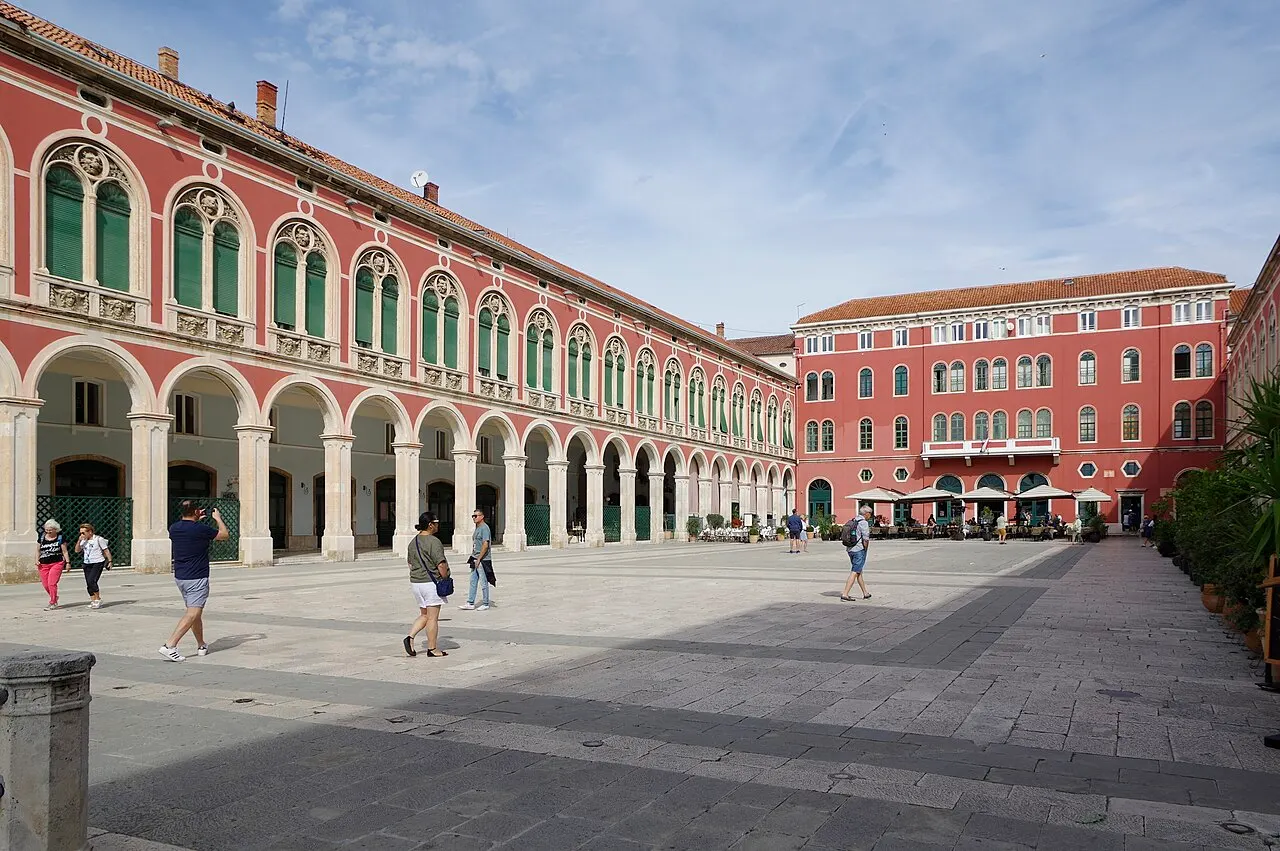
Peristil
The square among columns was a ceremonial space within the palace. Observe the relationship between the portico, the entrance to the former mausoleum and façades resting on the Roman structure. The square’s paving is part of a public route; sitting at a café or visiting an interior has different access conditions. On busy days, pass through first and return at a quieter moment, without occupying passages or entrances.
It lets you identify the palace’s ceremonial layout before choosing interiors.
Check access
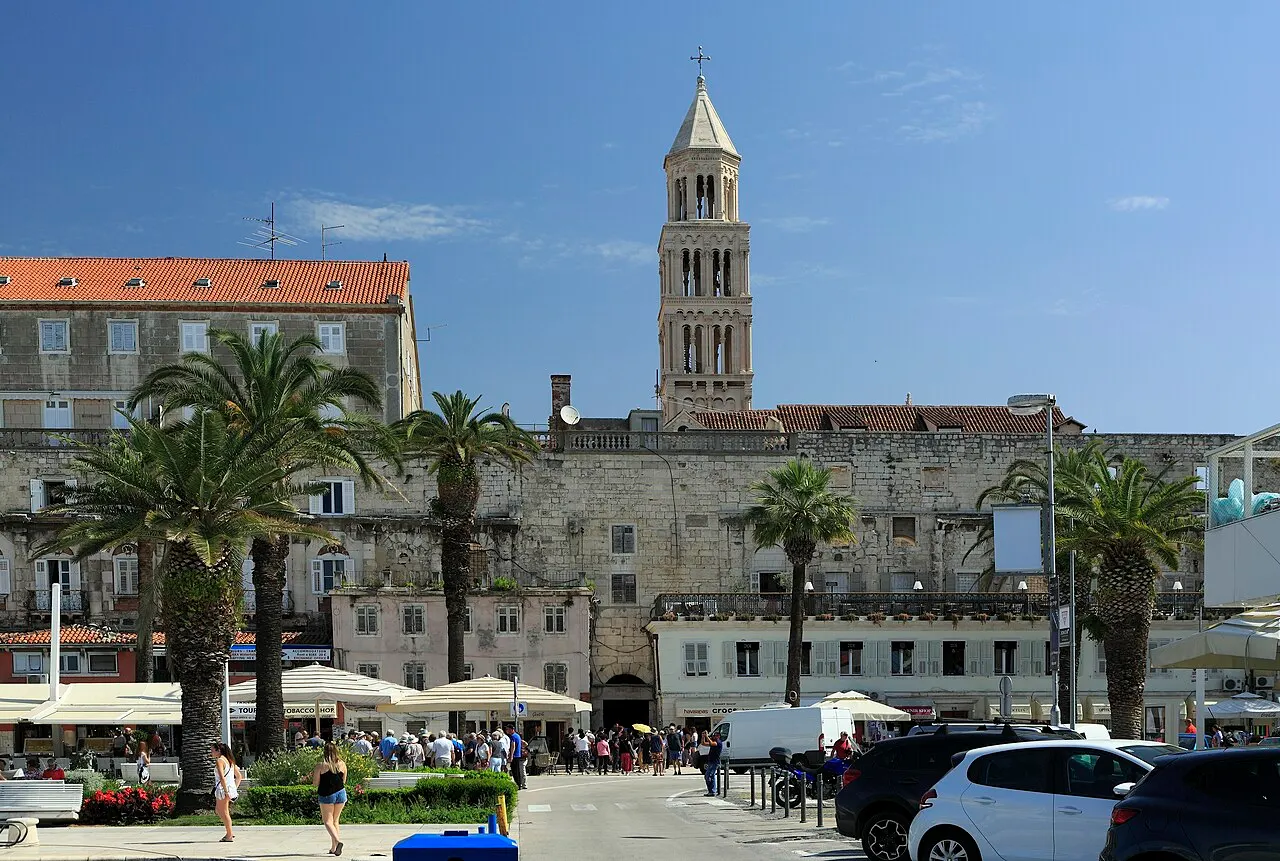
Katedrala svetog Duje
The Cathedral of St Domnius occupies Diocletian’s former mausoleum. Inside, wooden doors, ancient structures and altars from different periods give substance to the visit. It is an active church: services may change tourist access. The bell tower requires climbing stairs and should be chosen separately according to mobility and tolerance of heights. Check at the ticket office which spaces your ticket includes; access to the palace streets does not include these interiors.
The conversion of mausoleum to church makes changes of use legible; climbing the bell tower is a separate choice.
Check access

Podrumi Dioklecijanove palače
The substructures supported the imperial apartments facing the sea. The scale of the rooms helps explain the arrangement of the upper floor, which has been considerably altered. Separate the passage used to reach the Riva from the circuit of rooms open to visitors: walking through the corridor is not the same as exploring the paid underground complex. Consult the City Museum for opening hours, exhibitions and access to the rooms, especially outside summer.
The halls help explain the structure of the former apartments; the passage to the Riva does not replace the paid circuit.
Check access

Riva
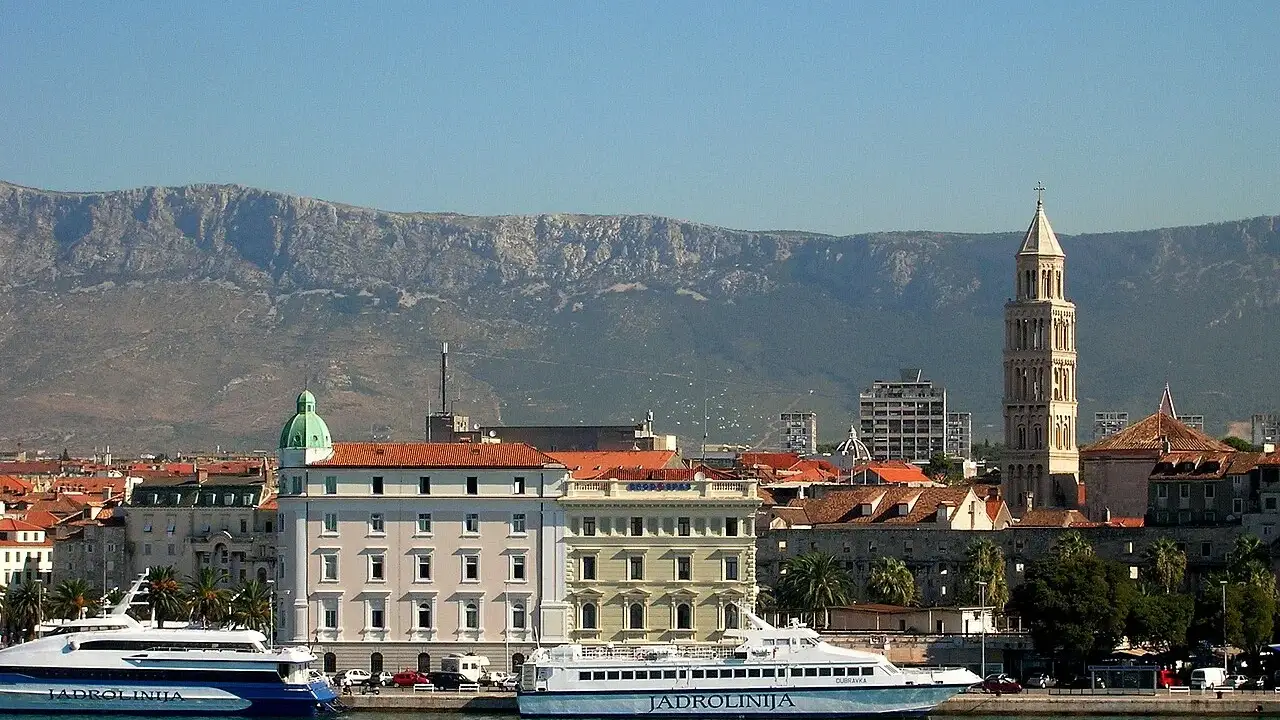
The promenade lets you look back at the palace’s south façade from a little distance. It is a good place to pause after the narrow streets, with the port’s activity in view. The public area can be walked without buying anything; occupying a table depends on the establishment. Nights and events bring more people and noise, which matters if you are considering a room facing the promenade.
The view of the southern façade and a seaside pause complete your understanding of the centre without requiring a purchase.
Check access

Park-šuma Marjan
The wooded peninsula contains paths, viewpoints and small religious buildings. Climbing through Veli Varoš to the first view already connects centre, port and islands, without requiring a traverse of the whole park. Anyone continuing should choose a route, carry water and respect local closures. Heat, wind and fire risk change conditions; the first view is a sufficient alternative when a longer walk will not fit.
The first viewpoint connects centre and harbour; a longer walk depends on effort, weather and closures.
Check access

Zlatna vrata
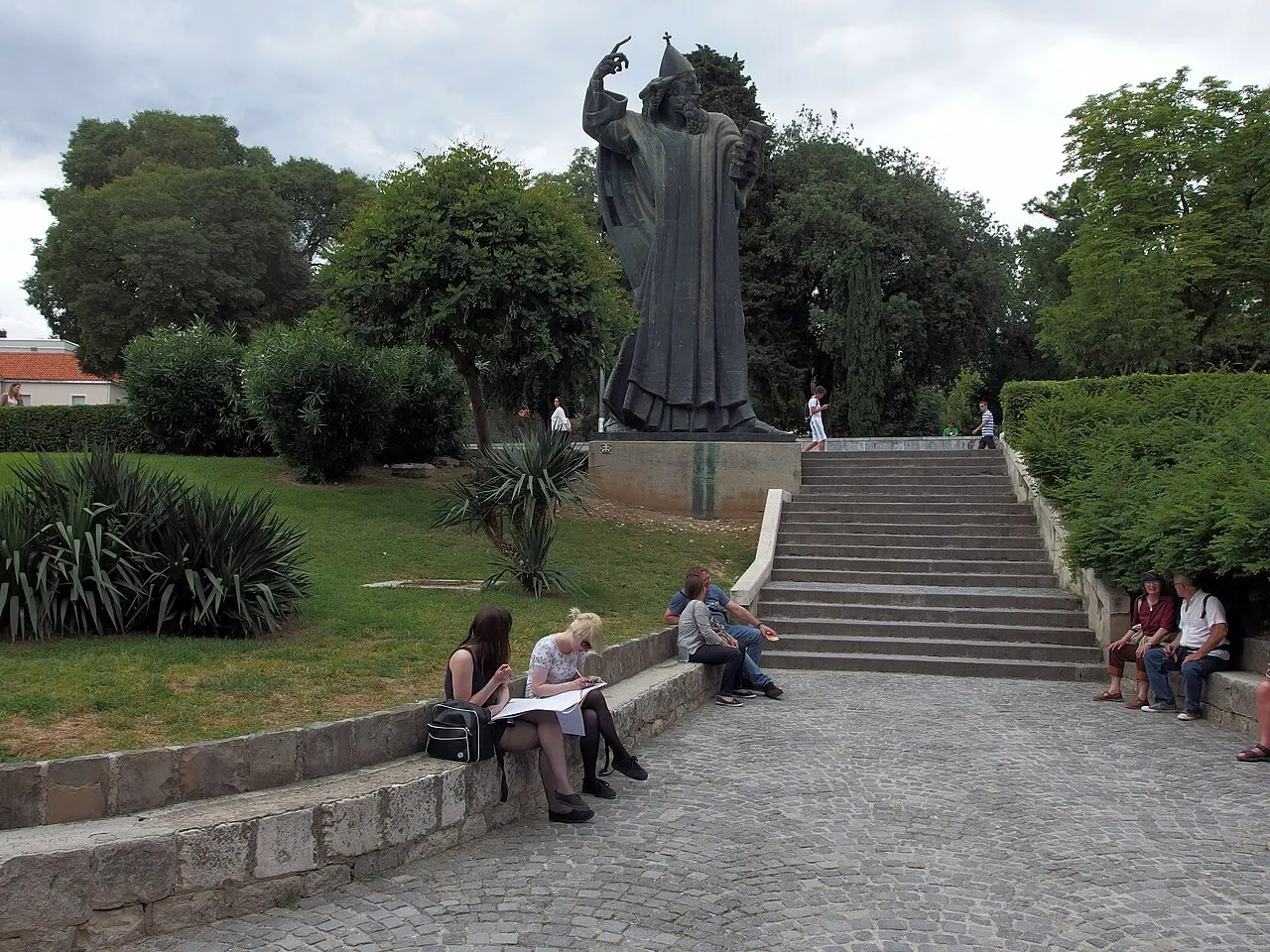
The Golden Gate marks the northern entrance to the palace and helps explain the alignment of the old Roman streets. Look at the arch and the arrangement of the façade before walking through. It is an entrance to the urban complex, not a ticket office that includes the interiors. The statue of Grgur Ninski stands outside, so you can combine the two stops without another journey across the city.
It is the monumental entrance that helps explain the palace from the north.
Check access
Dioklecijanova palača
Diocletian's Palace is an inhabited urban complex, with streets, squares, houses and visitor spaces from different periods. First identify the perimeter, the gates and the façade facing the Riva; then choose interiors according to your interests and time. Walking through its streets differs from buying admission to the cathedral, baptistery or underground halls. The monuments have individual entries so the palace name does not conceal these differences.
The complex defines Split’s layout and historic identity, beyond its individual parts.
Check access

Jupiterov hram
The former Temple of Jupiter was converted into a baptistery. It is a small visit in physical extent, but useful for understanding the complex’s religious transformation: the ancient vault remains, while the font and sculpture of St John the Baptist belong to other phases. Find the entrance within the palace core and check the baptistery ticket; do not treat it as another open square.
The Roman vault and conversion to a baptistery justify a brief visit for those following the complex’s history.
Check access

Pazar
The open-air market stands beside the palace’s eastern wall, near St Dominic’s Church. Food and everyday use make it worth visiting; arrive while the stalls are active rather than expecting uniform trading until late afternoon. Buying fruit for a break is simpler than assuming every stall prepares meals. Ask permission before photographing people close up.
It shows daily food supply while the stalls are active, without a promise of prepared meals.
Check access
Nilo’s itinerary
Start with the basic programme and choose extensions for the time you have.
Plan my days in the app ↗Day 1 · The palace and the centre’s squares
Start at the Pazar while the stalls are active. Enter through the Silver Gate and walk to the Peristyle to identify the complex before visiting interiors.
Visit the Cathedral of St Domnius according to its liturgical schedule and your chosen ticket. For the bell tower, consider steps and height; visiting only the cathedral is a valid choice.
Continue to the Temple of Jupiter and the Vestibule. Stop for lunch in the centre, without buying a sequence of visits in advance that prevents you from adjusting your pace.
Devote the afternoon to the substructure halls if they are open, distinguishing the paid circuit from the passage towards the sea. If closed, extend your walk through the squares and return to the Peristyle. If urban history is your main interest, the City Museum can replace the substructure halls, subject to opening and admission.
After your chosen interiors, walk to the Golden Gate and the statue of Grgur Ninski. Return through the western sector, passing the Iron Gate, Pjaca and Prokurative before the Riva. These are stops along an urban walk: if paid visits take up the afternoon, leave these squares for the second day, without turning every passage into another timed commitment.
Finish on the Riva, observing the southern façade from the waterfront. Look for dinner without treating every table in the centre as a free passage through a monument.
Day 2 · Fish market, Varoš and sculpture in Meje
Visit the fish market while the stalls are operating. If you left the western squares for today, combine Pjaca and Prokurative before continuing through Matejuška and Veli Varoš to the first Marjan viewpoint, with water and breaks according to the heat.
Return by the same route and have lunch in the west. This proposal includes the first viewpoint, not a traverse of the entire peninsula. If weather or mobility prevents the climb, stay in the lower streets and on the promenade.
Continue to the Meštrović Gallery in Meje, comparing bus and walking options against the group’s capacity. Check hours before leaving: the gallery closes on Mondays and public holidays according to the information consulted.
If the gallery is closed or your main interest is swimming, replace the afternoon with Bačvice. Return to the centre and head east; the beach replaces Meje rather than adding another stop after the gallery. If you prefer scenery without another interior, choose Sustipan instead of the gallery, considering access and the effort from the centre.
For a visit with a different focus, choose the Archaeological Museum or the Poljud tour instead of the Marjan and Meje programme, checking opening times and transport. The western waterfront can provide a pause on the way back; none of these programmes needs adding to an afternoon at the gallery or beach.
Leave the end of the day for a meal and check your next journey. An early departure by boat calls for sorting out the ticket and terminal before bed.


If you stay longer
Day 3 · Urban beach and time for your own choices
If you have a third day in the city, spend the morning at Bačvice without scheduling a departure that depends on leaving the water at the last minute. If you visited the beach yesterday, return to the palace at a gentler pace or choose another interior whose opening you have confirmed.
Have lunch near the beach or in the centre. Keep the afternoon for an outstanding visit, a short waterfront walk and a pause before travelling on.
If you prefer Trogir, replace this entire day with the day trip below. Do not add Trogir to a beach day or combine it with a flight without a confirmed buffer.
Food
Pašticada
Beef slowly cooked in sauce, often served with gnocchi. Choose it for an unhurried meal when the restaurant actually offers it, rather than trying to fit it between two departures.
Crni rižot
Seafood risotto darkened with cuttlefish ink. Recipes vary; check ingredients if you have an allergy to molluscs or other seafood.
Poljički soparnik
Thin dough with a chard filling, associated with the historic region of Poljica. Look for this regional product at stalls and food events advertising it, without assuming every market sells it daily.
Fish and market produce
The fish market and Pazar introduce the city’s food supply. In a restaurant, check whether fish is charged by portion or weight before choosing; the price displayed at a market stall is not the price of a prepared meal.
Where to eat
- Centre and edge of Veli Varoš
Look for a konoba, a traditional local eating house, listing pašticada or black risotto on its daily menu. Choose by the dish and stated ingredients, with time for a seated meal; a traditional name on the façade does not confirm everything is prepared daily.
- Pazar and surroundings
Fruit and market purchases work for a simple break. For a meal, find somewhere with an actual kitchen and check the menu: a food market does not guarantee a food court or a ready regional dish at every stall.
- Fish market area and western centre
For fish, compare species, preparation and charging unit. An individual portion, a whole fish by weight and a rice dish have different costs and sizes; check before ordering.
· 2026-10-16
Day trips
Trogir
Trogir’s historic centre, also recognised by UNESCO, is an option for an additional day devoted to architecture and smaller streets. The road heads towards the airport; Split’s tourist board suggests about half an hour in favourable conditions, but traffic and public transport take longer. For buses, look up Promet route 37 Split–Airport–Trogir, departing from Sukoišan terminal, separate from the bus station beside the port. Check outward and return times for your date and allow a day, without squeezing the visit between tight connections.
Supetar, Brač island
The Jadrolinija ferry takes 50 minutes from Split to Supetar. It is the simplest option for adding a crossing and exploring the arrival port, provided the return timetable fits your day. Bol and Zlatni Rat beach lie elsewhere on Brač: they require land transport and are not included in those 50 minutes.
Klis Fortress
About 15 km from Split according to the city’s tourist board, Klis Fortress occupies a high passage between mountains. It suits anyone wanting to understand the defence of the inland approach, with exposed terrain and walking effort. For buses, consult Promet route 22 Split–Klis, its Split departure point and the appropriate fortress stop; confirm opening, the final walk and last return. A short distance does not prove frequent buses or a climb suitable for everyone.
Where to begin
The palace and the centre’s squares
Start at the Pazar while the stalls are active. Enter through the Silver Gate and walk to the Peristyle to identify the complex before visiting interiors.
Fish market, Varoš and sculpture in Meje
Visit the fish market while the stalls are operating. If you left the western squares for today, combine Pjaca and Prokurative before continuing through Matejuška and Veli Varoš to the first Marjan viewpoint, with water and breaks according to the heat.
Money
The currency is the euro. Budget separately for accommodation, meals, travel and the interiors you actually intend to visit: walking through the palace streets does not require buying a single pass. When checked in October 2026, the Meštrović Gallery listed EUR12 adult admission, with its own discount and free-entry conditions; this is not the price of other museums. Check the composition of cathedral and substructure tickets before buying. For meals with fish sold by weight, confirm the unit and total cost of your choice. Summer accommodation requires comparing the same occupancy, taxes, access and cancellation policy rather than inferring a nightly rate from a map location.
Getting there and around
Split Airport (SPU) is in Kaštela towards Trogir, about 20 km from Split according to the airport itself. The shuttle connects the airport’s northern boarding area to Split’s main bus station, near the port. The official page reports service throughout the day, but departures useful for your flight must be reconfirmed. Plan the final stretch to your accommodation: a home in the centre’s lanes or in Varoš may require walking with luggage.
Promet operates public transport. Some routes stop at the airport, with purchase through the company’s app or on the bus as directed by the airport. Route 37 is a relevant connection, but check the day’s terminal and route: Sukoišan is not the main bus station beside the port. Comparing only prices and assuming the same arrival point often produces an unexpected walk. There is no single reliable journey time in summer traffic.
Explore the historic centre on foot. For Meje, beaches and more distant parts of Marjan, compare walking and buses before setting out; the choice depends on heat, effort and your accommodation’s location. Stone paving and steps limit accessibility in some sections. Do not drive into the pedestrian core or count on parking beside your booked building.
For the islands, buy and check the route with the operator, including the destination port and whether the vessel carries vehicles. With Jadrolinija, Split–Supetar on Brač takes 50 minutes; Split–Stari Grad on Hvar takes about two hours and does not arrive in Hvar town. The fast service to Hvar is a different connection. Leave a buffer between disembarkation and a flight, and check the return before boarding. If continuing along the coast to Dubrovnik, treat the journey as a change of base and check your chosen connection.
Safety
In the centre and terminals, keep documents and luggage under control in queues and while boarding. Heat calls for water and breaks on climbs; on Marjan, respect fire warnings and closed sections. Wet stone, steps and bell-tower access require secure footwear and care. At beaches, assess wind, signs and your swimming ability; other people’s activity offers no guarantee. If weather prevents a walk or crossing, switch to an open interior rather than trying to recover the day with a risky journey.
Etiquette tips
Squares and interiors have different uses
In the cathedral, respect services and guidance on clothing and visiting. Outside, do not block residents’ doors or turn narrow stairs into a group stopping area.
Alcohol in public spaces
Municipal rules restrict drinking in defined public areas of the centre and near schools. Use authorised establishments and check signs; permission at a table does not extend to the entire square.
Monuments
Do not climb monuments or enter fountains for a photograph. Municipal rules provide penalties, and these spaces remain part of city life.
Mistakes to avoid
Buying a ticket for ‘the palace’ on the assumption that its streets and all interiors operate as one attraction. Choose the spaces and check what each ticket includes.
Confusing the city bus terminus with the main bus station used by the shuttle and port, particularly with luggage or a departure approaching.
Arriving in Stari Grad and imagining you are already in Hvar town. Before choosing a boat, consider travel within the island too.
Using the same day for the gallery, a long traverse of Marjan and the beach on the opposite side of the city, without allowing for heat, meals and return travel.
Adding an island every morning without checking season, wind and the return departure. To explore beyond the port, an overnight stay may be a better choice.
Useful phrases
Dobar dan
Good morning/good afternoon.
Hvala
Thank you.
Molim
Please; it can also mean ‘you’re welcome’, depending on context.
Račun, molim
The bill, please.
Gdje je autobusni kolodvor?
Where is the bus station? Then confirm which terminal you need.
Where to stay
- Historic centre and edges of Grad · Visitors prioritising walks and wanting to return to their room between outings.: Close to the palace, squares and Riva. Before booking, check stairs, lift, luggage drop-off and night noise; an address within the old core does not mean cars can reach the door.
- Lower Veli Varoš · Visitors who prefer the west and intend to climb Marjan.: It combines neighbourhood streets and the centre without crossing the city. The street matters: slopes and steps can make two nearby addresses very different for mobility and luggage.
- Bačvice · Visitors wanting an urban beach and relative proximity to the port.: Easy to alternate swimming and walks to the centre. Check the exact position and soundproofing if you want quiet, since summer activity and nightlife are part of the neighbourhood.
- Meje · Visitors giving more weight to sculpture, western outings and Marjan access.: It brings the gallery and peninsula into daily plans, with a longer journey to the port. Compare buses and the walk from the actual address before planning a very early departure.
· 2026-10-16
Districts
Grad and the palace
Narrow streets, squares and historic interiors with a high concentration of visitors. The centre is the best place to understand the palace’s adaptation over the centuries, but it remains somewhere people live and work.
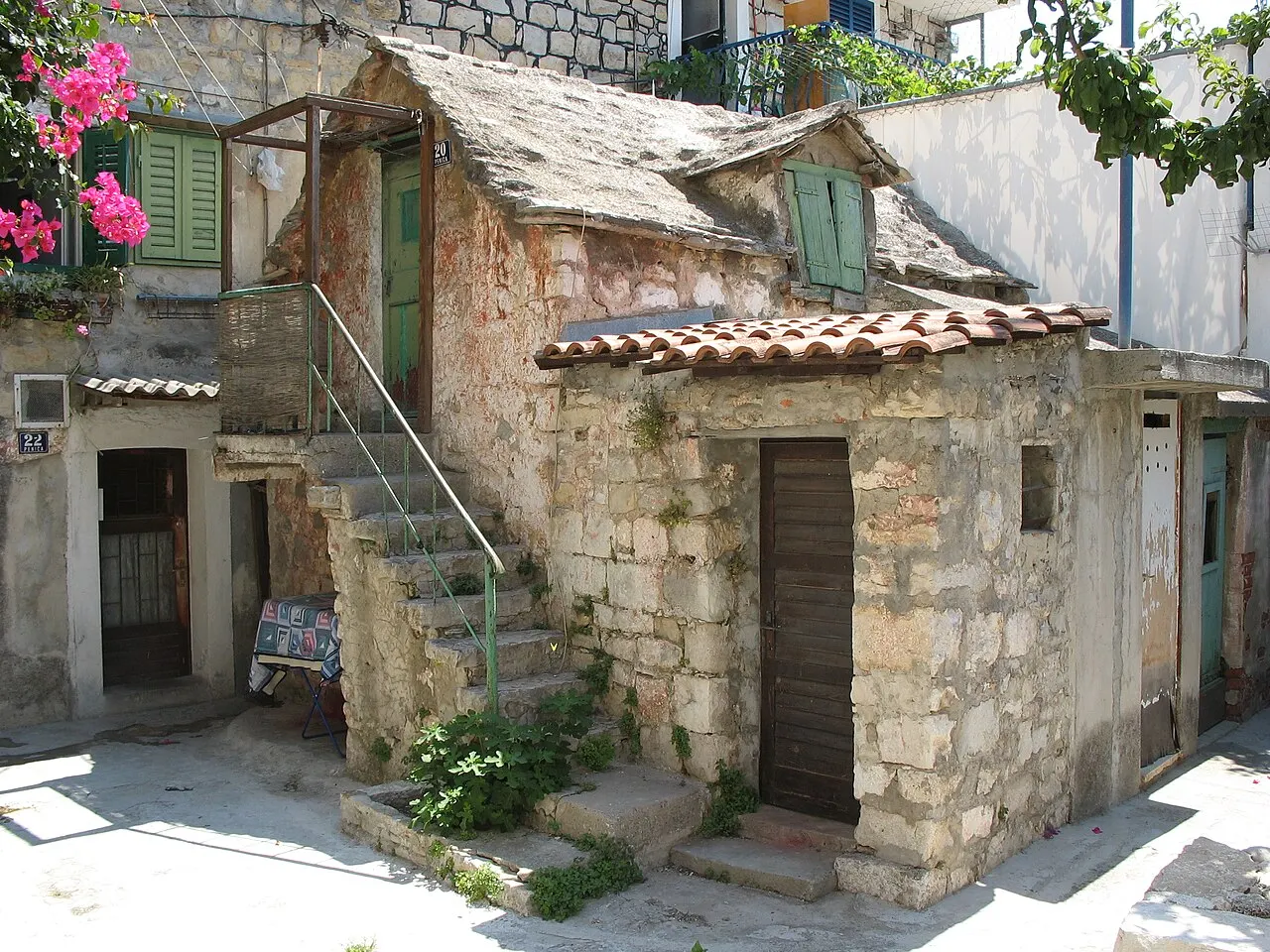
Veli Varoš
Stone houses and sloping streets west of the centre, associated with former fishing life. This is the natural route to Marjan’s first viewpoint; the atmosphere of the lanes should not be confused with easy luggage access.
Meje
An area south of Marjan, associated with the Meštrović Gallery and outings in the west. It works for combining sculpture and landscape, with a longer journey to the boat terminal.
Bačvice
The neighbourhood around the shallow sandy beach, near the port. It brings swimming and urban walks together, but summer crowds and nightlife should inform your accommodation choice.
History
Late 3rd and early 4th centuries · Diocletian’s residence
The emperor commissioned a fortified seaside complex. Its sectors and gates still organise part of the city centre.
7th century · The mausoleum takes on a Christian role
The conversion of the funerary building into a cathedral is one of the changes of use you can recognise during a visit.
Middle Ages · The city grows over the palace
Homes, churches and new squares were incorporated into the Roman complex. The protected area brings together these layers, rather than ancient ruins alone.
19th century · The waterfront expands
The Riva began to acquire its form as a promenade during French rule and underwent later extensions.
1979 · Recognition of the historic ensemble
UNESCO inscribed the historic centre with Diocletian’s Palace on the World Heritage List.
April 2026 · The Meštrović Gallery reopens
The institution announced its reopening after renovation, returning the sculptor’s former house in Meje to visitors.
Complete history
The starting point for understanding Split is the close relationship between an imperial complex and the city that later occupied it. Diocletian did not build a historic centre to be explored as a museum: he built a fortified coastal residence near Salona. Remains from the late 3rd and early 4th centuries stayed in use and were adapted. Walking through the centre, look for stretches of wall, gates and columns surviving among later façades.
That continuity is especially clear in the cathedral. The body of the old mausoleum was converted to Christian worship in the 7th century; medieval elements and later interventions changed the building. The bell tower belongs to another stage of construction and was rebuilt. Visiting these spaces as parts of a single Roman episode obscures the very transformation that makes the ensemble interesting.
Medieval growth extended beyond the palace core. Pjaca and other squares drew civic activities elsewhere, while neighbourhoods such as Veli Varoš developed outside the old walls. Romanesque churches, Gothic palaces, Renaissance and Baroque buildings coexist within the protected architecture. This helps explain why a short walk can cross very different periods.
The waterfront changed too. The Riva began to take shape as a promenade under French rule in the early 19th century and was subsequently extended. Today it connects the centre with the port and provides space for cafés, meetings and celebrations. UNESCO recognition in 1979 covered the historic ensemble: the life of today’s streets is part of getting to know the city, rather than an interval between monuments.
Geography and shape of the city
The historic centre sits against the south side of the peninsula. The Riva faces the palace’s seaward façade; the passenger port and main bus station lie to the east. Veli Varoš occupies the western approach to Marjan’s slopes, and Meje stretches along the south side of the wooded area. Bačvice is beyond the port, southeast of the centre. To organise your days, group the old core into one walk and reserve another period for the west. Proximity on a map does not remove steps, uneven paving or the heat of the climb. Beaches and islands require their own decisions about access and time.
I would weigh access and quiet against a historic location. A beautiful view does not solve the staircase you need to climb with luggage.
I would prefer to know one island well rather than accumulate crossings with no time beyond the quay. The arrival port is part of the decision.
Culture
Bačvice’s picigin is part of local identity: the game takes place in shallow water, with more interest in the collective effort to keep the ball up than in a score. Watching from the edge lets you approach without crossing a game. There is no guaranteed performance at a set time.
Ivan Meštrović’s sculpture appears both at the gallery and in the city centre. Literature and television offer other representations of Split: Marko Marulić belongs to Croatia’s literary tradition, and Miljenko Smoje wrote series that gave popular form to Dalmatian life. Artistic works offer perspectives from their periods, not an automatic description of today’s residents.
Festivals and events
Sudamja
The festival of patron saint Domnius has its main day on 7 May. The 2026 programme included a procession, performances and activities in different parts of the centre. For another trip, consult the relevant edition rather than repeating a previous year’s times.
Splitsko ljeto
The Split Summer Festival presents theatre, opera, dance and music in city venues. Check the programme and ticket office for your chosen edition; a square open during the day may have staging and controlled access during a performance.
Books and films
Velo misto, by Miljenko Smoje
The television series was written by the journalist and writer associated with Split. It helps you seek references to Dalmatian urban life beyond the Roman setting; treat characters and situations as artistic constructions rather than a current portrait of every resident.
Judita, by Marko Marulić
The work by the humanist associated with Split offers an introduction to Croatian literary history. An annotated edition helps place its language and context; it is neither a travel manual nor a description of today’s streets.
Frequently asked questions
Split: How many days should I allow?
At least two full days allow the first for the palace and its interiors and the second for the west, with Marjan and the gallery or a beach afternoon. Three days leave room for Bačvice and a remaining choice; Trogir can replace the entire third day. Add separate days for the islands after checking boats and the time needed on each. A connection night provides only part of this proposal.
Split: How do I get from the airport?
Split Airport (SPU) is in Kaštela, about 20 km from Split according to the airport. The shuttle connects the northern boarding area with the main bus station near the port; reconfirm the useful departure for your flight. Promet line 37 uses Sukoišan, which is not that station: check the terminal and the day’s route. There is no single reliable duration in summer traffic. Allow for the final stretch to your accommodation, which may involve walking with luggage through narrow lanes or Varoš.
Split: Which area should I stay in?
The historic centre and edges of Grad favour walking visits and returning to your room between outings; check stairs, lifts, luggage drop-off and noise, since a central address does not guarantee car access to the door. Lower Veli Varoš suits the west, but the street and gradient matter. Bačvice combines beach and relative proximity to the port, with activity and nightlife. Meje favours the gallery and Marjan, with a longer trip to the port: check buses and walking before an early sailing.
Split: Do I need a ticket to enter the palace?
The palace streets and squares form part of the inhabited city. The cathedral, baptistery and underground halls have their own access arrangements and tickets; check which spaces your chosen ticket includes. Services can change cathedral visits, and the bell tower requires stairs and tolerance of heights. Walking through the corridor to the Riva is not the same as visiting the paid underground circuit.
Split: What should I check before visiting Meštrović Gallery?
The gallery reopened in April 2026. In October 2026, the operator listed Tuesday to Sunday opening, closure on Mondays and public holidays, and a 12 EUR adult ticket including Crikvine–Kaštilac. Confirm the hours and conditions of the second site. For people with mobility difficulties, the institution reports access limited to the garden, garden toilet and shop; discuss individual needs before relying on access to the interiors.
Split: How do I choose an island to visit?
Check the operator, line, arrival port, vehicle carriage and return before buying. With Jadrolinija, Split–Supetar on Brač takes 50 minutes; Bol and Zlatni Rat are elsewhere on the island and require land transport beyond that duration. Split–Stari Grad on Hvar takes about two hours and does not arrive in Hvar town; the fast line to Hvar is a different connection. Add a separate day and leave a margin between disembarking and a flight.
Split: When is the best time to visit?
May, June and September favour the centre and outdoor activities. July and August concentrate heat and demand, requiring reservations, shade and traffic margins. In April and October, check boat and beach-service calendars without assuming summer frequency; October also calls for attention to rain. The city remains visitable in winter, but beaches, boats and programmes have their own conditions. Check the forecast and operator close to your crossing or walk.
Split: Can I visit Trogir as a day trip?
Allow a whole additional day, or replace the third beach day, to explore its historic core. The route follows the road towards the airport. Split tourism indicates about half an hour in favourable conditions, but that is not a bus duration: traffic and public transport take longer. Promet line 37 departs from Sukoišan, separate from the bus station near the port. Check the outward and return services for your date and avoid fitting the visit between tight connections.
Split: How much should I allow per day?
The October 2026 Budget Your Trip consultation indicated about 76 EUR for a budget profile, 196 EUR for a mid-range profile and 522 EUR for a comfortable profile, per person per day, from travellers’ reported spending. These are indicative figures excluding transport to the destination. Separate accommodation, meals, transport and your chosen interiors; palace streets do not require a single pass. Compare rooms with the same occupancy, taxes, access and cancellation terms, and confirm the unit and total when ordering fish by weight.
Other cities in the country
Croatia ↗- Days
- 2–3
- When
- May–Jun · Sep–Oct
- Per person/day
- Average 150–220 EURMid-range · per person/day
Cost scope
Per person per day: accommodation, meals, urban transport, visits and a small allowance for extras. Flights excluded; larger purchases vary. Editorial estimate, not a quote.