Italy
Amalfi Coast
Churches of the maritime republic, Ravello's gardens, the high trail and the coast by boat
Days Start with the basic programme and choose extensions for the time you have.
How the guide reaches this number
On the first, the cathedral in the morning, the paper-mill valley and Atrani on foot, and Ravello in the afternoon, with Villa Rufolo and the Terrazza dell'Infinito. On the second, the Sentiero degli Dei early, from Agerola to Positano, and the afternoon in Positano, coming back by boat. On the third, Capri by boat, with Villa Jovis and Monte Solaro. With a fourth day, I'd go to Pompeii, knowing that by bus to Sorrento and train to Pompei Scavi, the trip out takes more than two hours. I wouldn't rent a car: the road is narrow, parking is expensive and, on restriction days, half the plates may not drive on the SS163 from 10 a.m. to 6 p.m. The coast is not for anyone who wants a wide, flat beach, because almost everything is reached by stairs or by boat, and the easiest beaches are in Maiori and Minori. I'd come in May, June, September or October, with the boats running and fewer people than in July and August; from November to March the boats stop and many restaurants close. With only one day, I'd do Amalfi in the morning and Ravello in the afternoon, without trying Positano the same day.
3–4
When May to June and September to October; the regular boats between the villages run from April to the end of October, and July and August are the hottest and most crowded months
How the guide reaches this number
The coast's season is set by the boats: the regular lines between the villages run from early April to the end of October, and from November to March only the bus links Amalfi to Positano. At the Capri station, the average high goes from 24.4 °C in May and 28.7 °C in June to 32.4 °C in August, and returns to 28.3 °C in September and 23.5 °C in October; July has almost no rain. July and August are the hottest and most crowded months, with packed buses and the Sentiero degli Dei under strong sun. May, June, September and October combine more moderate heat, running boats and fewer people than July and August, and the Ravello Festival runs from July to September. At the end of October, many of the restaurants and beach clubs close. November is the rainiest month, with 96 mm, and heavy rain can close the road because of rockfall.
Per person/day Budget about 108 EUR; mid-range about 246 EUR; comfortable about 478 EUR per person, based on spending that travelers report to Budget Your Trip (checked in October 2026).
How the guide reaches this number
Per person per day: accommodation, meals, urban transport, visits and a small allowance for extras. Flights excluded; larger purchases vary. Editorial estimate, not a quote.
 What Nilo thinks
I'd stay three days, sleeping in Amalfi. On the first, the cathedral in the morning, the paper-mill valley and Atrani on foot, and Ravello in the afternoon, with Villa Rufolo and the Terrazza dell'Infinito. On the second, the Sentiero degli Dei early, from Agerola to Positano, and the afternoon in Positano, coming back by boat. On the third, Capri by boat, with Villa Jovis and Monte Solaro. With a fourth day, I'd go to Pompeii, knowing that by bus to Sorrento and train to Pompei Scavi, the trip out takes more than two hours. I wouldn't rent a car: the road is narrow, parking is expensive and, on restriction days, half the plates may not drive on the SS163 from 10 a.m. to 6 p.m. The coast is not for anyone who wants a wide, flat beach, because almost everything is reached by stairs or by boat, and the easiest beaches are in Maiori and Minori. I'd come in May, June, September or October, with the boats running and fewer people than in July and August; from November to March the boats stop and many restaurants close. With only one day, I'd do Amalfi in the morning and Ravello in the afternoon, without trying Positano the same day.The Amalfi Coast is a limestone slope that drops straight into the Gulf of Salerno, and the villages take the little room it leaves: Amalfi at the mouth of a valley, Positano in tiers up from the beach, Ravello on a ridge about 350 m up. Between the 9th and 12th centuries, Amalfi was a republic of merchants who sailed as far as Constantinople, and the cathedral's bronze door came from there; the relics of Saint Andrew arrived later, in the early 13th century. What remains is a small town of 4,548 residents, with paper mills in the valley, lemon trees on stone terraces and a single road about 7 m wide linking everything. That is why the coast is covered by boat and by bus, and its best view is on foot, from the Sentiero degli Dei. In Ravello there is the garden of Villa Rufolo, where Wagner saw the setting of Parsifal, and in Cetara, spaghetti with anchovy colatura.
Quick facts
- Population
- 4,548 residents in the municipality of Amalfi (Istat, provisional figure of May 31, 2026); Positano has 3,643 and Ravello, 2,333
- Founding
- Roman origin according to local tradition; self-government from 839 and an elected duchy from 958
- Country and region
- Italy, Campania, province of Salerno; 13 municipalities on the south coast of the Sorrento Peninsula
- Language
- Italian; Neapolitan and local speech appear in daily life
- Currency
- Euro (€)
- Time zone
- CET, UTC+1; UTC+2 during daylight saving time, from late March to late October
- Best time to visit
- May to June and September to October; the regular boats between the villages run from April to the end of October, and July and August are the hottest and most crowded months
- Average cost per day
- Budget about 108 EUR; mid-range about 246 EUR; comfortable about 478 EUR per person, based on spending that travelers report to Budget Your Trip (checked in October 2026).
When to go
May to June and September to October; the regular boats between the villages run from April to the end of October, and July and August are the hottest and most crowded months
How the year changes

The coast's season is set by the boats: the regular lines between the villages run from early April to the end of October, and from November to March only the bus links Amalfi to Positano. At the Capri station, the average high goes from 24.4 °C in May and 28.7 °C in June to 32.4 °C in August, and returns to 28.3 °C in September and 23.5 °C in October; July has almost no rain. July and August are the hottest and most crowded months, with packed buses and the Sentiero degli Dei under strong sun. May, June, September and October combine more moderate heat, running boats and fewer people than July and August, and the Ravello Festival runs from July to September. At the end of October, many of the restaurants and beach clubs close. November is the rainiest month, with 96 mm, and heavy rain can close the road because of rockfall.
Nilo's tips
Sleep in Amalfi and leave the car out of it
Amalfi is where the SITA buses, which climb to Ravello and Agerola and continue to Positano and Sorrento, meet the boats from the Molo Pennello to Positano, Salerno and Capri. With the 24-hour COSTIERASITA ticket, at €10, and one boat a day, you can do almost everything without driving. The SS163 is about 7 m wide, parking is expensive, and on restriction days half the plates may not drive from 10 a.m. to 6 p.m.
Buy the bus ticket before you board
The ticket is bought at a tobacconist, newsstand or bar, not on the bus. Buy the day's COSTIERASITA in one go, write your name and date of birth and validate it on the first trip. In summer, the buses fill up in Positano and Amalfi: if the first one goes by full, wait for the next or take a boat.
Walk from Agerola to Positano
In the direction from Bomerano to Nocelle, the Sentiero degli Dei is almost all downhill, and the coast stays ahead of you the whole time. Take the first bus from Amalfi to Agerola (7:10 a.m. Monday to Saturday, 8:15 a.m. on Sundays and holidays, 40 minutes to Bomerano) and start before 9 a.m. in summer. The 7.8 km take three to four hours, and from Nocelle there are still about 1,500 steps to Positano. After rain, postpone: the stone gets slippery.
Check today's boat, not last week's
Boat schedules change every week and trips are canceled in rough seas. Check the day before, buy the return together with the outbound on a windy day and keep the bus as plan B between Positano and Amalfi.
Pompeii from the coast is a full day
The ancient city is on the other side of the peninsula. By the timetable, the SITA bus from Amalfi to Sorrento takes 1 hour 25 minutes to 1 hour 40 minutes, and the Circumvesuviana from Sorrento to Pompei Scavi, about 40 minutes, plus the wait for the change in Sorrento. Take the 6:20 a.m. or 7:15 a.m. bus and buy the named ticket beforehand. Last entry is at 5:30 p.m. from March 16 to October 14 and at 3:30 p.m. from October 15 to March 15.
Explore the map
Explore the map, read about the other places and plan your travel days in the app.
Open the appWhat to see
Amalfi Coast: The slope and the Lattari Mountains
The SS163 runs along the mid-slope from Vietri sul Mare to Positano, about 7 m wide for both directions, with tight curves and stretches that close in heavy rain because of rockfall. The center of the coast, at the mouth of the valley: Piazza Duomo with the cathedral, the Molo Pennello where the boats depart, the end of the line for the SITA buses and, up the valley, the old paper mills.

Duomo di Amalfi
The Cathedral of Saint Andrew was begun in 987 by Duke Mansone I, next to a 9th-century church that is now the Basilica of the Crucifix. A staircase of 62 steps leads up to the bronze door, cast in Constantinople before 1066. The striped façade dates from 1891, rebuilt after a collapse in 1861, and the bell tower, begun in the 12th century, was finished in 1276. The visit takes in the Cloister of Paradise, from 1266–1268, with pointed arches on 120 columns, the Basilica of the Crucifix and the crypt with the relics of Saint Andrew, brought from Constantinople in the early 13th century. The cloister has been part of the diocesan museum route since 2006; check hours and admission at the atrium ticket office.
The cathedral begun in 987, the 62-step staircase, the bronze door cast in Constantinople and the crypt with Saint Andrew's relics bring Amalfi's maritime republic together in a single square.
Check access
Villa Rufolo
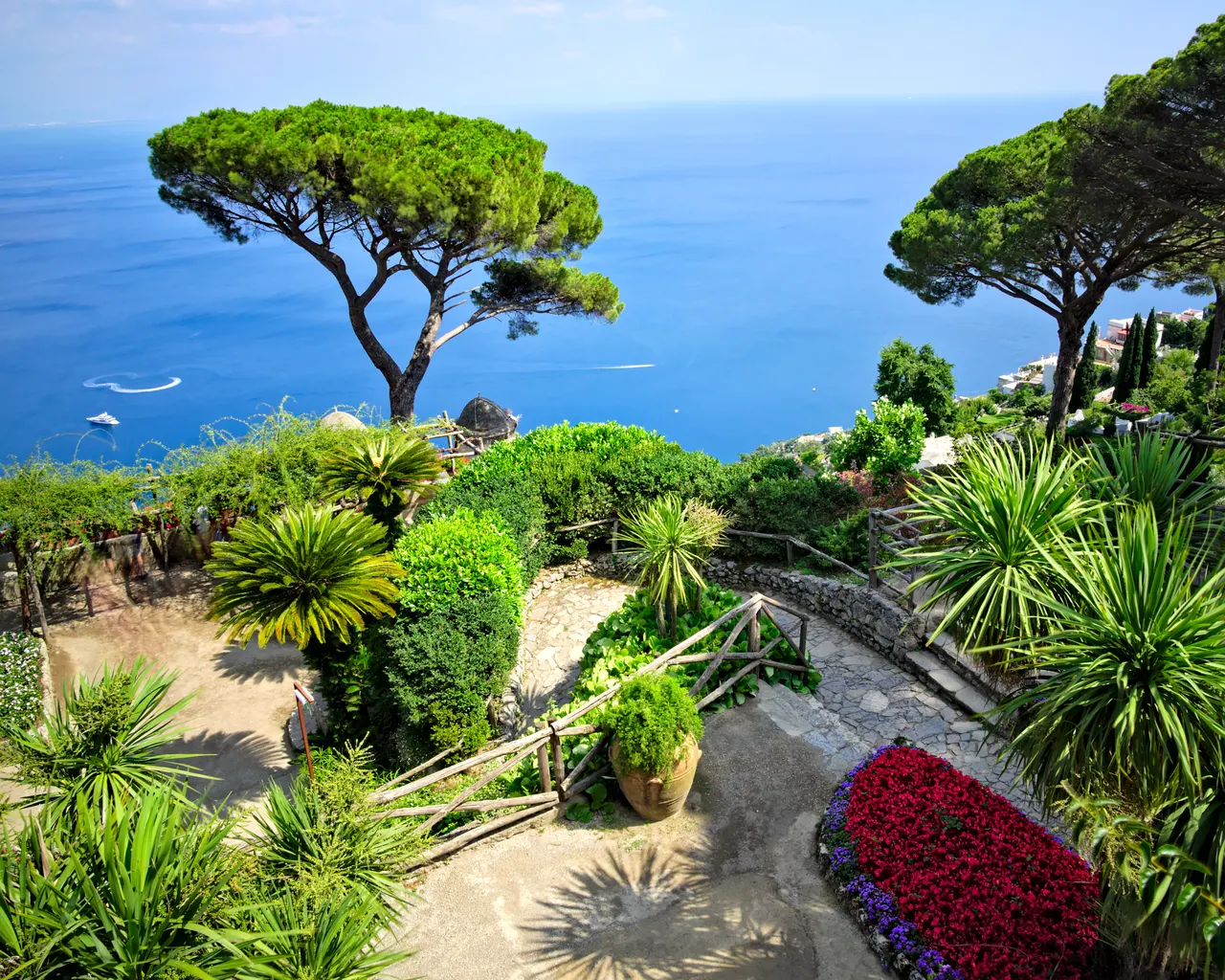
The Rufolo family complex in Ravello, expanded by Nicola Rufolo in the first half of the 13th century, has a Moorish cloister and towers from the original phase, of the 11th and 12th centuries, and a terraced garden above the Gulf of Salerno. Francis Nevile Reid restored it in the 19th century, and Wagner, visiting, recognized there the magic garden of Klingsor, from Parsifal. It is the main stage of the Ravello Festival. It is open daily from 9 a.m. to 7 p.m., with last entry at 6:30 p.m.; admission is €8, and €6 for people over 65 and children aged 5 to 12 (checked in October 2026).
The Rufolo family's medieval palace has a Moorish cloister, towers, the garden Wagner associated with Parsifal and a lookout over the Gulf of Salerno that hosts the summer festival.
Check access
Sentiero degli Dei
The trail links Bomerano, in Agerola, to Nocelle, above Positano, over 7.8 km along the mid-slope, with the coast and Capri ahead. It takes three to four hours, has no admission fee and is almost all downhill in this direction, with stone steps and exposed stretches that are not suited to anyone with vertigo or to strollers. From Nocelle to Positano it is about 1,500 steps and a 500 m descent. The trail can be closed because of fire or landslide, and it is slippery after rain.
The 7.8 km mid-slope trail from Bomerano to Nocelle puts the coast and Capri ahead of you and lets you see the Amalfi Coast from above, away from the road; in summer, it only makes sense with an early start.
Check access
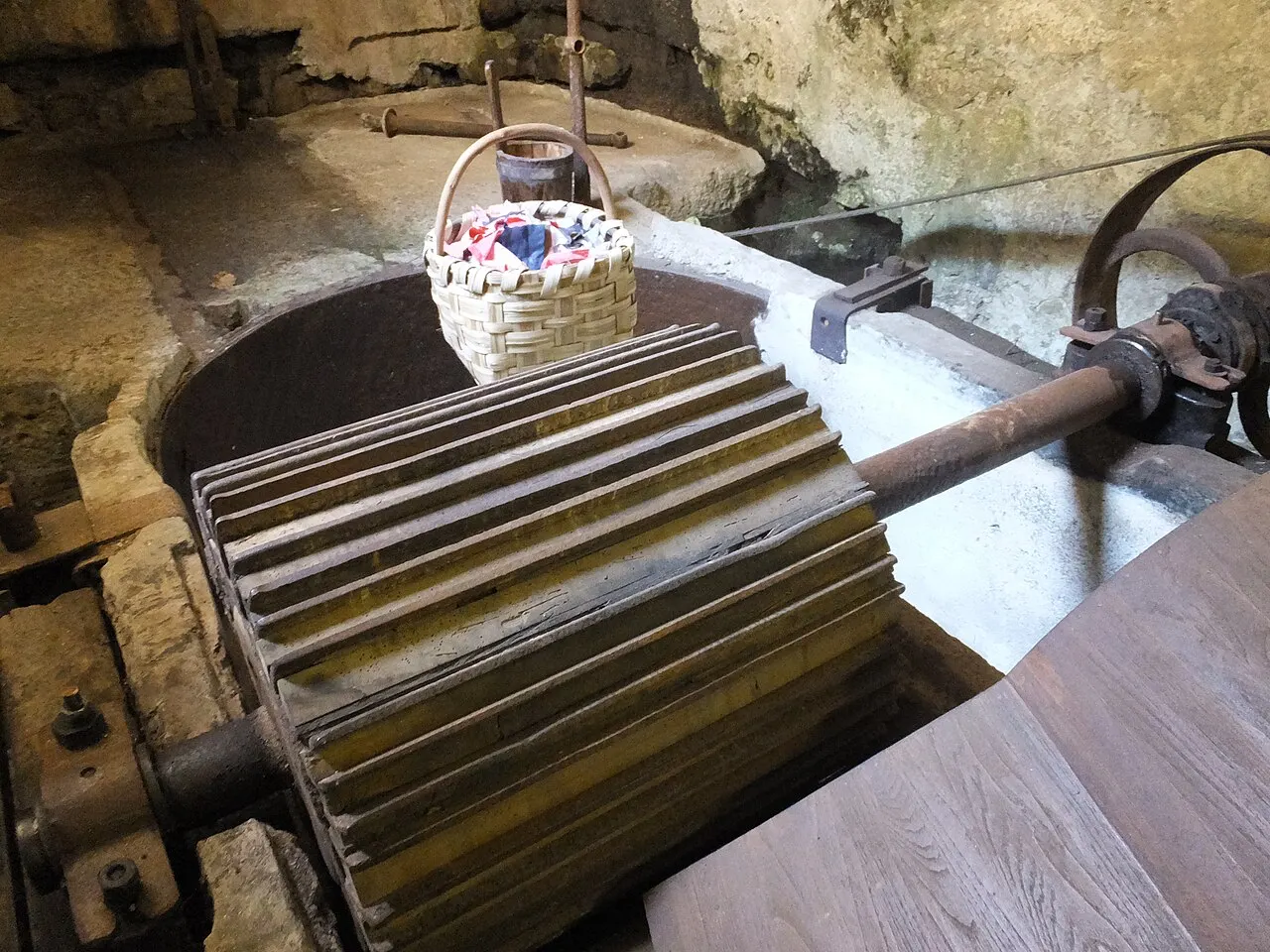
Museo della Carta
At Via delle Cartiere 23, in the valley behind the cathedral, the paper museum was created in 1969, by the will of Nicola Milano, in a former mill. It shows how Amalfi paper was made, a technique the Amalfitans learned from the Arabs; of the many mills in the valley, only two still produce. It is open daily from 10 a.m. to 7 p.m. from March 1; from November to February the hours are reduced, with closing days, and change every winter, so check the museum's information page. The guided visit with a handmade paper workshop can be bought on site or online at least 48 hours ahead.
Paper was Amalfi's industry, and here you can see how it was made, in a former mill in the valley, with a handmade-paper workshop on the guided visit.
Check access
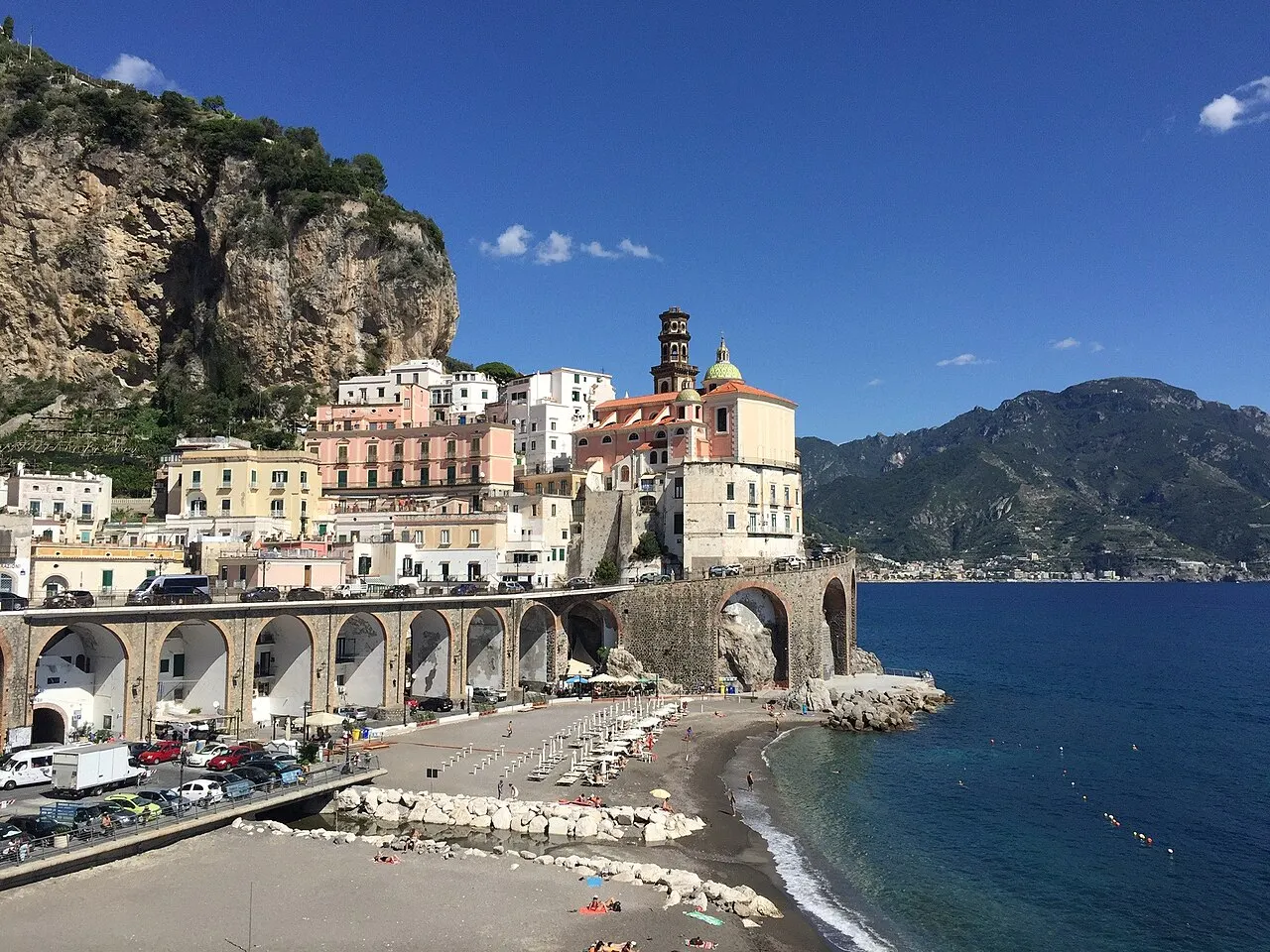
Atrani
The smallest municipality in Italy, at 0.12 km², lies just east of Amalfi. The chapel of San Salvatore de' Birecto, from the 10th century, was where the dukes of Amalfi received the birecto, the cap of power; the collegiate church of Santa Maria Maddalena, founded in 1274 and enlarged in 1753, has the only Rococo façade on the coast. Atrani appears in Escher's 1931 lithograph «Atrani, Coast of Amalfi» and returns in his Metamorphoses.
Italy's smallest municipality, at 0.12 km², preserves the chapel where Amalfi's dukes were crowned and the square Escher drew in 1931, beside Amalfi with less bustle.
Check access

Villa Cimbrone
At the far end of Ravello's ridge, the villa was bought in 1904 by Ernest Beckett, later Lord Grimthorpe, who remodeled it with battlements, terraces and a cloister made partly from pieces of other buildings and redesigned the gardens out to the cliff edge. The walk ends at the Terrazza dell'Infinito, the lookout lined with busts above the gulf. The villa is a hotel, and the gardens are open to the public; check hours and admission before going up.
The Terrazza dell'Infinito, the cliff-edge lookout at the end of the gardens Ernest Beckett began remodeling in 1904, offers the coast's most open view; the rest is a hotel garden with reassembled period features.
Check access
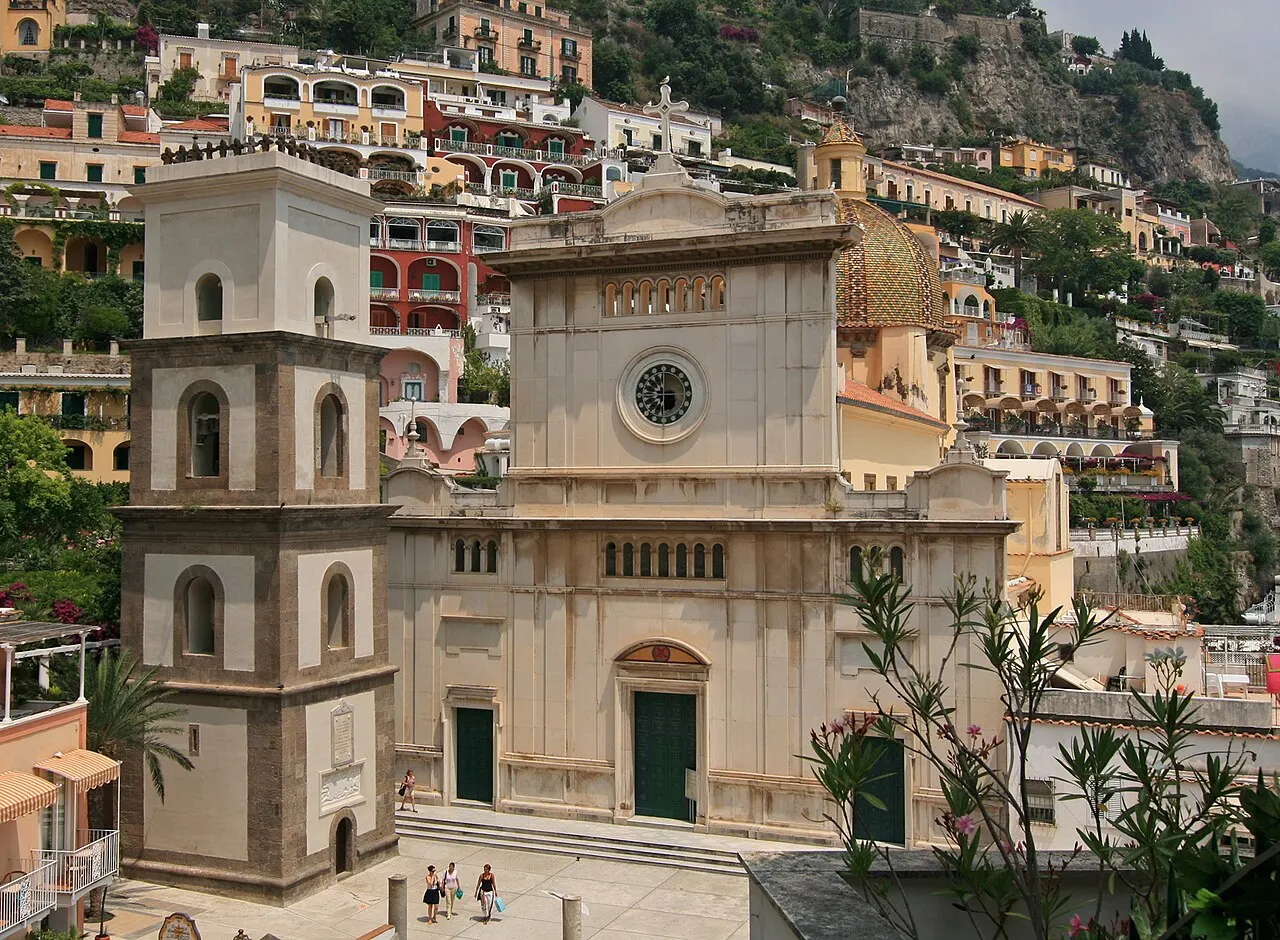
Chiesa di Santa Maria Assunta
Positano's parish church, with a majolica-covered dome that can be seen from anywhere in the village, holds a Byzantine icon from the 13th century. It is a few steps from the Spiaggia Grande.
The majolica dome seen in almost every photo of Positano covers a church with a 13th-century Byzantine icon; the visit is quick and on the way to the beach.
Check access
MAR Museo Archeologico Romano
Attached to the church of Santa Maria Assunta, the museum shows a Roman villa destroyed in 79 CE, with a triclinium decorated with 1st-century frescoes in the Fourth Pompeian Style, as well as medieval crypts. It is open from 9 a.m. to 9 p.m. from April 1 to October 31 and from 10 a.m. to 4 p.m. the rest of the year; tickets are bought at the ticket office or on the museum's website.
The museum attached to the parish church shows a Roman villa destroyed in 79 CE, with a triclinium of Fourth Pompeian Style frescoes; this is ancient Positano, open until 9 p.m. from April through October.
Check access
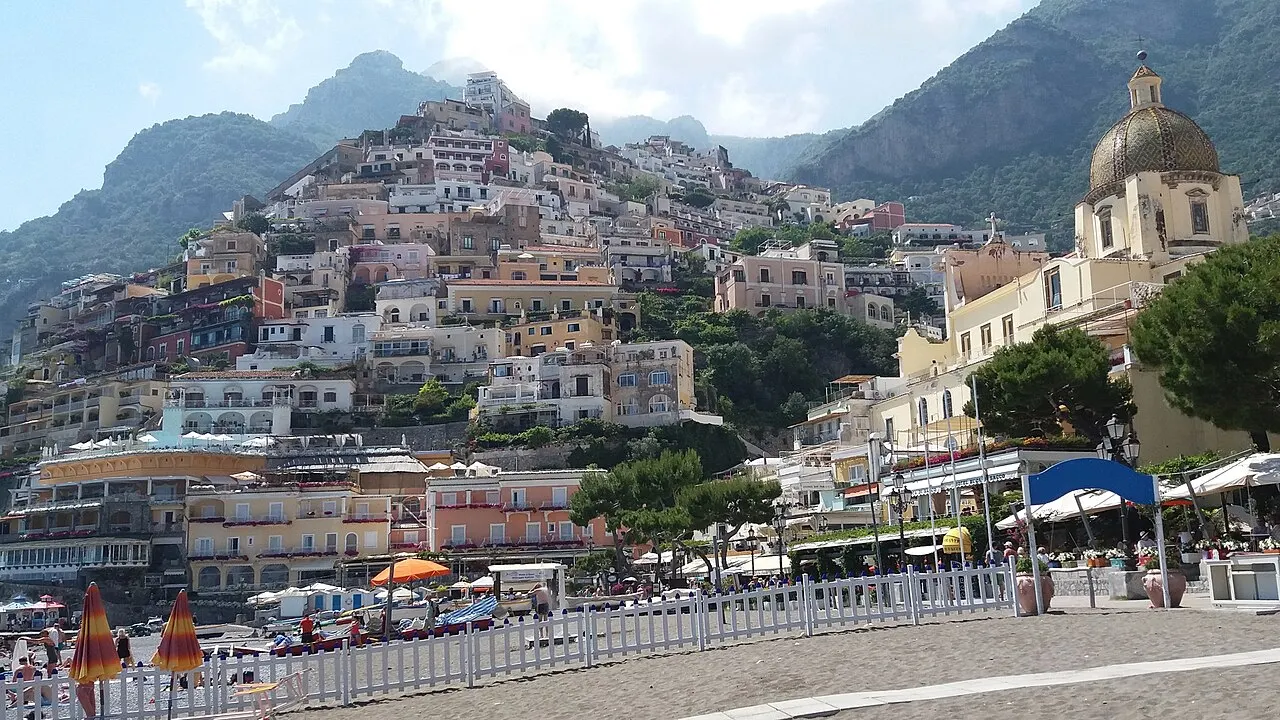
Spiaggia Grande
Positano's main beach is where the boats from Amalfi, Salerno and Capri arrive and from where boats leave for beaches that can only be reached by sea or by stairs, such as Arienzo. Part of the beach is taken up by establishments with paid sun loungers, which close in winter; Fornillo beach, to the west, can be reached on foot.
Positano's main beach is also the departure point for boats to Arienzo and the other villages; it works as the end of a hiking day, rather than a quiet beach.
Check access
Nilo’s itinerary
Start with the basic programme and choose extensions for the time you have.
Plan my days in the app ↗Day 1 · Amalfi, Atrani and Ravello
Start with Amalfi's cathedral in the morning: climb the 62 steps and go in through the Cloister of Paradise, the Basilica of the Crucifix and the crypt of Saint Andrew; check the route's hours at the atrium ticket office.
Continue up the valley along Via delle Cartiere to the Museo della Carta, open from 10 a.m., and book the visit with the workshop 48 hours ahead if you want to make paper.
Return to Piazza Duomo and walk to Atrani, just to the east, for the square by the beach and the collegiate church of Santa Maria Maddalena.
In the afternoon, take the SITA bus from Amalfi to Ravello, about 25 minutes, with the COSTIERASITA ticket already validated.
In Ravello, visit Villa Rufolo, open until 7 p.m. with last entry at 6:30 p.m., and walk to the end of the ridge for the Terrazza dell'Infinito, at Villa Cimbrone.
Take the bus down to Amalfi and have dinner in town.
Day 2 · Sentiero degli Dei to Positano
Take the 7:10 a.m. SITA bus from Amalfi to Agerola (8:15 a.m. on Sundays and holidays) and get off at Bomerano, 40 minutes later, where the trail begins.
Walk the 7.8 km to Nocelle, three to four hours, with at least 1.5 liters of water per person.
From Nocelle, go down the roughly 1,500 steps to Positano, or take the local bus.
Have lunch in Positano and stop by the church of Santa Maria Assunta and the MAR, open until 9 p.m. from April to October.
Finish at the Spiaggia Grande and return to Amalfi by boat, about 20 minutes, checking the last departure of the day first; outside the boat season, or if the sea closes, return by SITA bus, with the last departure from Positano at about 10 p.m. Monday to Saturday.
Day 3 · Capri by boat
Take an early boat to Capri from the Molo Pennello: the crossing takes about 50 minutes and costs €23 to €30 depending on the company and the departure. Buy the return together, and remember that most lines stop at the end of October.
At Marina Grande, take the funicular up to the Piazzetta.
Walk to the ruins of Villa Jovis, the villa of Emperor Tiberius, who moved to Capri in the year 27.
In the afternoon, go to Anacapri and take the chairlift up Monte Solaro, at 589 m, for the view of the Faraglioni and the gulf.
Return to Marina Grande with time to spare for the boat back, which can be canceled in rough seas.


If you stay longer
Day 4 · Pompeii
Day trip
The Roman city buried in 79 CE lies on the other side of the peninsula. From Amalfi, take the SITA bus to Sorrento, 1 hour 25 minutes to 1 hour 40 minutes by the timetable, and from there the Circumvesuviana to Pompei Scavi, about 40 minutes; with the change in Sorrento, the trip out takes more than two hours. The ticket is named and costs €20 for the ancient city only or €25 with the Villa of the Mysteries and other villas (2026 prices). From March 16 to October 14 it is open from 9 a.m. to 7 p.m., with last entry at 5:30 p.m.; from October 15 to March 15, from 9 a.m. to 5 p.m., with last entry at 3:30 p.m. There is a limit of 20,000 visitors a day, and on the first Sunday of the month admission is free.
Food
Amalfi sfusato lemon
The coast's lemon, weighing 100 to 120 grams, with a thin, pale-yellow skin, has had protected geographical indication since 2001 and is harvested several times a year, with the best fruit from March to July. It is eaten raw in salads and goes into fish, first courses, liqueur and sweets.
Limoncello
The lemon liqueur made with the sfusato from the coast's terraces. Production runs from February to October.
Scialatielli
Short, wide fresh pasta with an irregular cut, created in Amalfi in 1978 by the cook Enrico Cosentino, made with flour, water or milk, grated cheese, chopped basil and egg. It is recognized as a traditional product of Campania.
Colatura di alici di Cetara
A liquid anchovy sauce made in Cetara: the fish are salted in chestnut or oak barrels, and the liquid that drains off is concentrated in the sun and filtered through linen, ready in early December. It goes on spaghetti boiled without salt, a traditional Christmas Eve dish in Cetara. The technique descends from Roman garum.
Delizia al limone
Sponge cake soaked in limoncello syrup, filled and covered with lemon cream, created in 1978 by the pastry chef Carmine Marzuillo, from Sorrento. It is sold in single portions in the coast's pastry shops.
Lemon granita and scorzette
In the coast's pastry shops and bars, the lemon becomes granita, gelato, babà and strips of lemon peel, the scorzette.
Where to eat
- Pasticceria Pansa · Piazza Duomo, Amalfi · $
Pastry shop and café from 1830 facing the cathedral, with lemon scorzette, granita and period sweets; open from 7:30 a.m. to 1 a.m.
Source · 2026-10-15
- Cetara · $$
Spaghetti with anchovy colatura, the village's dish.
- Maiori, Minori and Agerola · $
Pizza, panini and neighborhood trattorias, cheaper than the seafront ones in Amalfi and Positano.
$: pizzeria, panino or pastry shop · $$: trattoria; €35 to €65 per person at Da Ciccio, in Vettica Minore (Wikivoyage) · $$$: seafood restaurant in central Amalfi; €60 to €85 per person at Eolo and La Caravella (Wikivoyage) · 2026-10-16
Day trips
Pompeii
The Roman city buried in 79 CE lies on the other side of the peninsula. From Amalfi, take the SITA bus to Sorrento, 1 hour 25 minutes to 1 hour 40 minutes by the timetable, and from there the Circumvesuviana to Pompei Scavi, about 40 minutes; with the change in Sorrento, the trip out takes more than two hours. The ticket is named and costs €20 for the ancient city only or €25 with the Villa of the Mysteries and other villas (2026 prices). From March 16 to October 14 it is open from 9 a.m. to 7 p.m., with last entry at 5:30 p.m.; from October 15 to March 15, from 9 a.m. to 5 p.m., with last entry at 3:30 p.m. There is a limit of 20,000 visitors a day, and on the first Sunday of the month admission is free.
Valle delle Ferriere
A nature reserve in the valley behind Amalfi, with a trail of about two and a half hours that passes the ruins of the republic's old ironworks and rare Woodwardia radicans ferns. Access is on foot, from Amalfi, from Pogerola or from Pontone square.
Cetara
The anchovy colatura village lies on the east side of the coast, served from April to October by the boats on the Amalfi-Salerno line that stop at Minori, Maiori and Cetara, and by SITA buses all year. It is worth it for a lunch of spaghetti with colatura and a stroll around the harbor.
Naples
The capital of Campania is a train-and-boat trip via Salerno, or a bus-and-Circumvesuviana trip via Sorrento. It is worth more as a two- or three-day stop than as a day trip: see the guide to Naples.
Where to begin
Amalfi, Atrani and Ravello
Start with Amalfi's cathedral in the morning: climb the 62 steps and go in through the Cloister of Paradise, the Basilica of the Crucifix and the crypt of Saint Andrew; check the route's hours at the atrium ticket office.
Sentiero degli Dei to Positano
Take the 7:10 a.m. SITA bus from Amalfi to Agerola (8:15 a.m. on Sundays and holidays) and get off at Bomerano, 40 minutes later, where the trail begins.
Money
The currency is the euro. Hotels, restaurants and most shops accept cards, but small bars, vendors and beach establishments sometimes take cash only. The 24-hour COSTIERASITA bus ticket costs €10, the boat from Amalfi to Positano €10 to €14, and the one from Amalfi to Capri €23 to €30. Villa Rufolo charges €8, and Pompeii, €20 for the ancient city only or €25 with the suburban villas (2026 prices). Lodging is what weighs most: in the Amalfi hotels listed by Wikivoyage, a mid-range double room goes from €80 to €280 a night depending on the season, and the most expensive, the Santa Caterina, from €450 to €780. A day at a beach club is expensive: in Positano, the published packages start at €235 per person with lunch, at Arienzo, and at €250 for one or two sun loungers, at La Scogliera. A taxi between Positano and Amalfi costs about €120 for up to four people. To spend less, sleep in Maiori, Minori or Agerola, use buses and boats, and have pizza or a panino for lunch.
Getting to the Amalfi Coast
Guide estimate
Scroll to compare all columns
| Route | Time | Price |
|---|---|---|
| Naples airport → Sorrento · Curreri bus | about 80 min | about €10, paid to the driver |
| Naples airport → Sorrento · Alibus and Circumvesuviana | about 75 min on the regular train | Alibus for about €5 |
| Sorrento → Positano · SITA bus | about 40 min | no fixed fare, varies with distance |
| Sorrento → Amalfi · SITA bus | 1h30 | no fixed fare, varies with distance |
| Salerno → Amalfi · boat, April to October | 35 min | most between €11 and €13.50 |
| Amalfi → Positano · boat | about 20 min | €10 to €14 |
| Amalfi → Capri · boat | about 50 min | €23 to €30, depending on the company and departure |
| Positano → Capri · boat | 40 to 50 min | €27.50 to €30 |
| Amalfi → Ravello · SITA bus | about 25 min | COSTIERASITA 24-hour ticket, €10 |
| Positano → Amalfi · taxi | no published time | about €120 for up to four people |
Getting there and around
Getting there: Naples, Salerno or Sorrento
The most used international airport is Naples (NAP), at Capodichino. From there, the Curreri bus goes to Sorrento in about 80 minutes, for about €10 paid to the driver. From Sorrento, by the SITA timetable, the bus takes about 40 minutes to Positano and 1 hour 30 minutes to Amalfi (the 6:30 a.m. departure reaches Positano at 7:10 a.m. and Amalfi at 8 a.m.), and runs late in traffic. Another option is the Alibus to Naples central station, for about €5, and the Circumvesuviana to Sorrento, which takes about 75 minutes on regular trains. From April to October, another option from the airport is the Alibus to Napoli Centrale (about €5), a train to Salerno and a boat to Amalfi: at Piazza della Concordia, across from the station, and at Molo Manfredi, about 2 km away, boats leave for Amalfi in 35 minutes, most for between €11 and €13.50 (from €6.50 to €23.50 depending on the company and the departure). From November to March, with no boats, the SITA bus links Salerno to Amalfi along the SS163. Salerno Costa d'Amalfi airport (QSR), reopened in 2024, has seasonal flights and an express bus to Salerno. Naples is a day trip and a gateway; from Rome, the route goes through Naples or Salerno.
Boats between the villages
From April to the end of October, boats from several companies link Salerno, Cetara, Maiori, Minori, Amalfi, Positano, Sorrento and Capri. In Amalfi, all of them leave from the Molo Pennello, in the center. Amalfi to Positano takes about 20 minutes and costs €10 to €14; Amalfi to Capri, about 50 minutes, €23 to €30 depending on the company and the departure, and Positano to Capri, 40 to 50 minutes, €27.50 to €30, with carry-on luggage included and large suitcases charged separately. Schedules change every week and trips are canceled in rough seas; from November to March, the coast's lines stop and only those to Capri and Ischia from Naples and Sorrento continue.
SITA buses
SITA Sud buses link Sorrento, Positano, Praiano, Amalfi, Ravello, Agerola, Maiori, Minori and Salerno all year, with fewer departures in winter. By the 2026 timetable, Amalfi to Ravello takes about 25 minutes, with frequent departures by day; Amalfi to Agerola (Bomerano), 40 minutes, with the first bus at 7:10 a.m. Monday to Saturday and at 8:15 a.m. on Sundays and holidays; and Amalfi to Sorrento, 1 hour 25 minutes to 1 hour 40 minutes, with the last departure from Amalfi at 9:30 p.m. Monday to Saturday. The 24-hour COSTIERASITA ticket costs €10 and is valid along the whole coast; the €12 version includes Positano's local buses. It is bought at a tobacconist, newsstand or bar, not on the bus; it is validated on the first trip, and you write your name and date of birth by hand. Single tickets vary with distance and were repriced on October 1, 2026; where the company sells singles on board, they cost more. In summer it is common to travel standing, and a stroller goes only folded in the luggage hold. Times at intermediate stops run late in traffic, so don't count on the bus to catch a train or a flight.
Car, taxi and scooter
The SS163 is about 7 m wide and closes in heavy rain because of rockfall. On restriction days, from 10 a.m. to 6 p.m., cars with odd-numbered plates may not drive on odd-numbered days, and those with even-numbered plates on even-numbered days, between Vietri sul Mare and Positano; residents, guests with a reservation on their arrival and departure days, taxis and cars with a driver are exempt, and scooters and motorcycles are not covered by the rule. In 2026 there were restrictions from March 30 to April 6, from April 24 to May 2 and, in October, only on weekends and holidays, through October 31; from November 1 there is no restriction. The dates change from year to year, so check the calendar before traveling by car. A taxi from Positano to Amalfi costs about €120 for up to four people, and scooter rental starts at about €50 a day.
Safety
The Amalfi Coast is calm, and the practical risks come from geography and weather. The SS163 closes in heavy rain because of rockfall, and small landslides can close trails in winter; check the forecast before setting out. On the Sentiero degli Dei, the heat, the stone steps and the exposed stretches call for sturdy footwear, water and an early start; the trail is closed by the authorities in case of fire or landslide. Rough seas cancel boats without warning. In summer, buses are packed and it is common to travel standing. Tap water is drinkable along the whole coast. The medical emergency number is 118; there is a small first-aid station in Ravello, and serious cases go to Sorrento, Salerno or Naples. Pharmacies generally open from 8:30 a.m. to 1 p.m. and from 4 p.m. to 8 p.m., with continuous hours in tourist areas.
Etiquette tips
Bus ticket with your name
The COSTIERASITA is personal: write your name and date of birth by hand and validate it on the first trip. A ticket left blank counts as irregular.
Carry small change
Small bars, street vendors and some beach establishments take cash only, even where the rest of the coast takes cards.
In Positano, paying the ZTL is not parking
The limited traffic zone of Via Pasitea, Piazza dei Mulini and Via Colombo charges vehicles with more than five seats, and payment does not authorize stopping or parking inside it.
Mistakes to avoid
Renting a car to get around the coast
Renting a car to go from one village to another. The road is narrow, parking is expensive and scarce, and on restriction days half the plates may not drive from 10 a.m. to 6 p.m. Boats and buses handle almost everything.
Counting on the last bus before a flight
Booking a train or flight that depends on the SITA bus or Circumvesuviana timetable. Both run late with traffic and crowding, and boats are canceled in rough seas. Leave a margin of a few hours, or sleep in Salerno or Naples the night before.
Getting on the bus without a ticket
Boarding the SITA expecting to buy the day ticket on board. The COSTIERASITA is not sold on the bus: buy it beforehand, at a tobacconist, newsstand or bar. A single on board, where one exists, costs more.
Hiking the Sentiero degli Dei at noon
Starting the trail late in the morning, in sandals and with little water. In summer the sun is strong and shade is scarce: start before 9 a.m., in sturdy sneakers and with at least 1.5 liters of water per person.
Planning boats in winter
Building a November to March itinerary around a boat between Amalfi and Positano or from Positano to Capri. In that season those lines stop, and the coast is covered by bus.
Useful phrases
Un biglietto COSTIERASITA, per favore
A COSTIERASITA ticket, please. The 24-hour bus ticket, asked for at the tobacconist
A che ora parte l'ultimo autobus per Amalfi?
What time does the last bus to Amalfi leave?
Scendo alla prossima fermata
I'm getting off at the next stop. The driver announces the main stops
Oggi il traghetto parte con questo mare?
Is the boat leaving today with this sea? Useful at the pier when it's windy
Posso pagare con la carta?
Can I pay by card?
Il sentiero è aperto?
Is the trail open? For asking about the Sentiero degli Dei after rain
Where to stay
- Amalfi · First trip without a car · $$$: It is where the SITA buses and the boats to Positano, Salerno and Capri meet, all leaving from the center. In return, the center is crowded by day in summer.
- Atrani · Anyone who wants Amalfi's convenience with less bustle · $$: It sits next to Amalfi, a walk from the buses and the quay, and has a square by the beach with a village pace.
- Ravello · Couples and people who come for the concerts · $$$: It is quiet at night and has the gardens and the festival nearby. It is about 350 m up, away from the beach, and depends on the bus to get down to Amalfi.
- Positano · Anyone who wants the most famous view and doesn't mind stairs · $$$: Everything is done by steps, and the beach and the quay are below. It is the most expensive on the coast and the hardest with luggage.
- Maiori and Minori · Families and anyone who wants a beach without stairs · $$: They have the flattest parts of the coast and beaches near the bus stop, with a boat to Amalfi.
- Agerola · Tight budgets and people who come for the trail · $: It sits on the plateau, at the start of the Sentiero degli Dei, with lodging cheaper than on the coast. To get down to the sea, it depends on the SITA bus.
$: simple B&B or hostel bed · $$: €80 to €280 a night, mid-range double room (Wikivoyage) · $$$: over €280 a night; €450 to €780 at the Santa Caterina (Wikivoyage) · 2026-10-16
Districts
Amalfi
The center of the coast, at the mouth of the valley: Piazza Duomo with the cathedral, the Molo Pennello where the boats depart, the end of the line for the SITA buses and, up the valley, the old paper mills. It is the busiest by day and the most practical for sleeping without a car.
Atrani
Amalfi's neighbor to the east, it is the smallest municipality in Italy, at 0.12 km² and about 760 residents. It has a square next to the beach, the church of Santa Maria Maddalena and a slower pace than Amalfi.
Ravello
On the ridge above Atrani, at about 350 m, far from the sea and the beach. It holds the gardens of Villa Rufolo and Villa Cimbrone and the summer music festival; at night, it is quiet.
Positano
The most photographed village on the coast, built in tiers up from the Spiaggia Grande. Everything is done on foot, by stairs, and car traffic is limited to a few streets, such as Via Pasitea. Higher up are Montepertuso and Nocelle, where the Sentiero degli Dei ends.
Praiano and Furore
Between Positano and Amalfi, with houses scattered across the slope. Praiano has the beach that catches the sun until sunset, and Furore has the gorge of the Schiato stream under the SS163 bridge.
Maiori and Minori
East of Amalfi, with the flattest parts of the coast and beaches near parking and the bus stop. They make a good base for anyone who wants a beach without stairs.
Agerola
On the plateau above the coast, served by the SITA bus that climbs from Amalfi. The hamlet of Bomerano is the start of the Sentiero degli Dei.
History
839 · Amalfi throws off Lombard rule
After being taken by Sicard of Benevento in 838, Amalfi frees itself from Lombard rule in 839 and begins to elect its own rulers. It is the start of the city-state that traded with Byzantium and with the Arab ports.
958 · The first elected duke
Amalfi creates the office of duke, or doge, elected by the citizens. The dukes were crowned in the chapel of San Salvatore de' Birecto, in Atrani, which still stands.
987 · The cathedral and the archbishopric
Duke Mansone I begins the cathedral next to a 9th-century church, and Amalfi's see is raised to an archbishopric the same year. Amalfitan merchants already had a permanent presence in Constantinople and had founded pilgrim hostels in Jerusalem and Antioch.
1073 · The Normans
Robert Guiscard takes Amalfi, which passes to the Norman county of Apulia but keeps some of its rights. In 1131, after a revolt, Roger II of Sicily subdues the city for good.
1135–1137 · The sacks by Pisa
The fleet of Pisa, a rival in Mediterranean trade, sacks Amalfi twice, and the city enters a rapid decline. The Tavole Amalfitane, Amalfi's maritime code, continued to be recognized until 1570.
1206–1208 · The relics of Saint Andrew
Cardinal Pietro Capuano brings the relics of Saint Andrew from Constantinople, and the cathedral crypt is completed to receive them. Saint Andrew is the city's patron saint.
1266–1268 · The Cloister of Paradise
Archbishop Filippo Augustariccio has the cloister built next to the cathedral, with Moorish-style pointed arches on 120 columns.
1343 · The storm that took the harbor
A storm with a tidal wave destroys the harbor and the lower part of Amalfi. Petrarch, who was in Naples, described the storm in a letter. The city never again rose above local importance.
1861–1891 · The rebuilt façade
Part of the cathedral's façade collapses in 1861. The reconstruction, designed by Errico Alvino, ends in 1891 and is the striped, mosaic-covered façade seen today.
1953–1955 · The Ravello festival and the regatta
The Ravello music festival begins in 1953, dedicated to Wagner, in the gardens of Villa Rufolo. In 1955 the regatta is born, bringing together Amalfi, Genoa, Pisa and Venice.
1997 · World Heritage Site
UNESCO inscribes the Amalfi Coast as a cultural landscape, covering 11,231 hectares, for the way the villages and farming terraces occupied an almost vertical slope.
2024 · Salerno airport reopens
Salerno Costa d'Amalfi airport resumes scheduled flights in July 2024, after being closed since 2016, and receives 380,606 passengers in 2025.
Complete history
A republic made of ships
Amalfi had no land to farm and no plain to grow on: it had a cove sheltered by the Lattari Mountains and the open sea to the south. From 839, free of Lombard rule, the city began to elect its own rulers and, from 958 onward, dukes. Its merchants were in Constantinople, in the Arab ports and in the Holy Land, where they founded pilgrim hostels in Jerusalem and Antioch, and tradition links the origin of the Knights Hospitaller to them. The geographer Ibn Hawqal, in 977, described Amalfi as the most prosperous Lombard city. From this period come the cathedral begun in 987 by Mansone I, the Tavole Amalfitane, a code of maritime law used far beyond the coast, and paper, a technique the Amalfitans learned from the Arabs.
Normans, Pisa and the sea
Independence ended in stages. In 1039 Amalfi fell under the principality of Salerno, in 1073 Robert Guiscard took it for the Normans, and in 1131 Roger II of Sicily subdued the city after a revolt. In 1135 and 1137 the fleet of Pisa sacked it. The final blow came from the sea: in 1343 a storm with a tidal wave destroyed the harbor and the lower part of the city, and Amalfi never again carried weight beyond the region. What remained of its power was religious, with the relics of Saint Andrew brought from Constantinople in the early 13th century, and industrial, with the paper mills in the valley behind the city.
From travelers to World Heritage
From the 19th century onward, the coast began to receive travelers from northern Europe. Francis Nevile Reid first visited Ravello in 1851 and later bought Villa Rufolo, where Wagner found the setting he associated with Klingsor's garden in Parsifal; Ernest Beckett bought Villa Cimbrone in 1904. Positano, which had been a port of the republic and prospered in the 16th and 17th centuries, was in decline, with emigration, in the mid-19th century, and became a destination from the 1950s, and John Steinbeck's 1953 essay helped fix its image. The SS163 road, about 40 km long, is the only land link between the villages, and UNESCO inscribed the coast in 1997. Today the economy is tourism and lemons: about 400 hectares of terraced lemon groves produce close to 8,000 tonnes a year.
Geography and shape of the city
The slope and the Lattari Mountains
The Amalfi Coast is the southern slope of the Sorrento Peninsula, facing the Gulf of Salerno and the Tyrrhenian Sea. The limestone Lattari Mountains drop almost without a plain to the water, and each village occupies the mouth of a narrow valley or a step on the slope. Amalfi sits at the mouth of one of these valleys, at 6 m above sea level in the center, in a municipality of 5.7 km²; Ravello is on a ridge above Atrani, at about 350 m; Positano climbs the slope in tiers from the beach; and Agerola, where the Sentiero degli Dei begins, occupies a plateau above the coast.
Terraces and lemon trees
With no flat land, the farming was built: dry-stone walls hold up terraces where the lemon trees of the sfusato lemon grow, cultivated in all 13 municipalities of the coast. The landscape of terraces, villages and stair paths is what UNESCO recognized in 1997.
The road and the sea
The SS163 runs along the mid-slope from Vietri sul Mare to Positano, about 7 m wide for both directions, with tight curves and stretches that close in heavy rain because of rockfall. That is why the sea has always been the other road: from April to the end of October, regular boats link Salerno, Maiori, Minori, Amalfi, Positano, Sorrento and Capri.
The climate
The climate is Mediterranean. At the Capri weather station, 35 km away and at 160 m above sea level, the average high in August is 32.4 °C and in January 13.7 °C (1991–2020 normals). July has almost no rain, with 11 mm for the month, and October and November are the rainiest months, with 88 mm and 96 mm.
The SS163 is the only road between the villages on the coast, about 40 km from Vietri sul Mare to Positano.
Culture
Ravello and music
Ravello has had a music festival since 1953, born as a tribute to Wagner, who associated the garden of Villa Rufolo with Klingsor's in Parsifal. The concerts take place on a stage set up on the Villa Rufolo's lookout and in the auditorium designed by Oscar Niemeyer. In 2026, the program at Villa Rufolo ran from July 4 to September 5, with an exhibition by William Kentridge, and included the traditional dawn concert on the lookout, with the Giuseppe Verdi Philharmonic Orchestra of Salerno, in August, with tickets sold out.
Paper, lemon and the craft arts
Amalfi paper was an industry for centuries along the stream that runs down to the city, and two mills still operate. Lemon is the other product that defines the coast: about 400 hectares of terraced lemon groves in the 13 municipalities, which supply the limoncello, the sweets and the granita. On the east coast, Cetara keeps the anchovy colatura, made in barrels as in the days of Roman garum.
The coast seen from outside
Travelers and artists helped build the coast's image. Boccaccio set the tale of Landolfo Rufolo in Ravello, in the Decameron; Escher drew Atrani in 1931; Steinbeck wrote about Positano for Harper's Bazaar in 1953; John Huston filmed Beat the Devil at Villa Cimbrone the same year. The Regatta of the Ancient Maritime Republics, created in 1955, has boats from Amalfi, Genoa, Pisa and Venice row against one another, rotating among the four cities.
The sfusato lemon has had protected geographical indication since 2001 and is harvested in the 13 municipalities of the coast.
Festivals and events
Saint Andrew, June 26–27 and November 30
Amalfi's patron saint has two feasts: the patronage, on June 26 and 27, and the liturgical feast, on November 30.
Ravello Festival, July to September
Concerts on the Villa Rufolo lookout and in the Oscar Niemeyer auditorium. In 2026, the program at the villa ran from July 4 to September 5; the dawn concert, on the lookout, sells out.
Regatta of the Ancient Maritime Republics, between late May and early July
Amalfi, Genoa, Pisa and Venice take turns as host, with a historical procession and a rowing race. Amalfi hosted the 70th edition in 2025; the 2027 one is in Venice.
Books and films
Decameron (14th century), Giovanni Boccaccio
The fourth tale of the second day tells the story of Landolfo Rufolo, of Ravello. The Rufolo family is the one of Villa Rufolo, and Boccaccio probably knew the house: the palace with courtyard, loggias and gardens in the tale is associated with that of the villa.
«Positano Bites Deep», John Steinbeck (Harper's Bazaar, May 1953)
The essay Steinbeck wrote about Positano for Harper's Bazaar helped make the village known and is the text most cited when telling how it became a destination in the 1950s.
Atrani, Coast of Amalfi (1931), M. C. Escher
The first lithograph Escher made of Atrani, printed in August 1931. The village returns in his three Metamorphoses, and the drawing helps explain how the houses occupy the mouth of the valley.
Beat the Devil (1953), John Huston
John Huston's film has scenes at Villa Cimbrone, in Ravello, and shows the ridge and the gardens as they were in the 1950s.
Frequently asked questions
Amalfi: How do you get there from Naples airport?
Curreri runs from the airport to Sorrento in about 80 minutes for about €10, then SITA takes about 1 hour 30 minutes to Amalfi, with traffic delays. From April to October, another option is Alibus to Napoli Centrale (about €5), a train to Salerno and a boat to Amalfi (about 35 minutes sailing). Choose your pier in Salerno: Piazza della Concordia is across from the station; Molo Manfredi is about 2 km away. Check the sailing and sea conditions.
Amalfi: How many days should you stay?
Three days, sleeping in Amalfi: one for the town and Ravello, one for the Sentiero degli Dei and Positano, one for Capri by boat. With only one day, I'd do Amalfi in the morning and Ravello in the afternoon, without trying Positano the same day.
Amalfi: How do you get to Positano and Capri by boat?
From April to the end of October, boats leave from the Molo Pennello: Amalfi to Positano takes about 20 minutes and costs €10 to €14, and Amalfi to Capri about 50 minutes, €23 to €30. Schedules change every week, and from November to March the coast's lines stop. Rough seas can cancel sailings: check with the operator before relying on the boat.
Amalfi: How long does the day trip to Pompeii take?
SITA bus to Sorrento, 1 hour 25 minutes to 1 hour 40 minutes, and Circumvesuviana to Pompei Scavi, about 40 minutes: with the change in Sorrento, the trip out takes more than two hours. The ticket is named and costs €20 for the ancient city only or €25 with the villas (2026 prices).
Amalfi: When is the best time to go?
May to June and September to October. The regular boats between the villages run from April to the end of October, and July and August are the hottest and most crowded months.
Other cities in the country
Italy ↗- Days
- 3–5
- When
- Apr–May · Sep–Oct
- Per person/day
- Average 130–190 EURMid-range · per person/day
Cost scope
Per person per day: accommodation, meals, urban transport, visits and a small allowance for extras. Flights excluded; larger purchases vary. Editorial estimate, not a quote.
- Days
- 2–3
- When
- Apr–Jun · Sep–Oct
- Per person/day
- Average 180–330 EURMid-range · per person/day
Cost scope
Per person per day: accommodation, meals, urban transport, visits and a small allowance for extras. Flights excluded; larger purchases vary. Editorial estimate, not a quote.
- Days
- 2–3
- When
- Mar–May · Sep–Oct
- Per person/day
- Average 180–250 EURMid-range · per person/day
Cost scope
Per person per day: accommodation, meals, urban transport, visits and a small allowance for extras. Flights excluded; larger purchases vary. Editorial estimate, not a quote.
- Days
- 1–2
- When
- Apr–Jun · Sep–Oct
- Per person/day
- Average 150–220 EURMid-range · per person/day
Cost scope
Per person per day: accommodation, meals, urban transport, visits and a small allowance for extras. Flights excluded; larger purchases vary. Editorial estimate, not a quote.
- Days
- 2–3
- When
- Apr–Jun · Sep–Oct
- Per person/day
- Average 130–200 EURMid-range · per person/day
Cost scope
Per person per day: accommodation, meals, urban transport, visits and a small allowance for extras. Flights excluded; larger purchases vary. Editorial estimate, not a quote.
- Days
- 2–3
- When
- May–Jun · Sep
- Per person/day
- Average 170 EURMid-range · per person/day
Cost scope
Per person per day: accommodation, meals, urban transport, visits and a small allowance for extras. Flights excluded; larger purchases vary. Editorial estimate, not a quote.
- Days
- 3
- When
- May–Jun · Sep
- Per person/day
- Explore costsGuide estimate
Cost scope
Per person per day: accommodation, meals, urban transport, visits and a small allowance for extras. Flights excluded; larger purchases vary. Editorial estimate, not a quote.
- Days
- 6
- When
- Jun–Sep
- Per person/day
- Explore costsGuide estimate
Cost scope
Per person per day: accommodation, meals, urban transport, visits and a small allowance for extras. Flights excluded; larger purchases vary. Editorial estimate, not a quote.
- Days
- 3
- When
- Apr–Jun · Sep–Oct
- Per person/day
- Average 114 EURMid-range · per person/day
Cost scope
Per person per day: accommodation, meals, urban transport, visits and a small allowance for extras. Flights excluded; larger purchases vary. Editorial estimate, not a quote.
- Days
- 7
- When
- May–Jun · Sep
- Per person/day
- Explore costsGuide estimate
Cost scope
Per person per day: accommodation, meals, urban transport, visits and a small allowance for extras. Flights excluded; larger purchases vary. Editorial estimate, not a quote.