
Italy
Florence
The Uffizi, the Duomo's dome and the David on foot
Days Start with the basic programme and choose extensions for the time you have.
How the guide reaches this number
A fourth day is only worth it for Siena, for Pisa and Lucca, or for the workshops of the Oltrarno. Anyone looking for a big city to explore without a plan will be frustrated, because the center is small, the collection is dense, and from April to October there's a line almost everywhere. With just one day, start at 8:30am with the climb up Brunelleschi's dome, and leave the cathedral's interior for after 10:15am. Then cross the square to the Baptistery and the Museo dell'Opera. Have lampredotto standing up, for €4.50 to 6, and end at the Uffizi in the 4pm slot, the cheapest one. Leave the Accademia out of a packed day, because the David alone doesn't justify the wait; with two days, it fits into the first slot of the second day. The Duomo–Uffizi–Ponte Vecchio rectangle disappoints after ten in the morning, expensive, cramped, and with fewer and fewer residents, and the city's ordinary life reappears on the other side of the Ponte Santa Trinita, in the squares and workshops of the Oltrarno.
2–3
When Late March to May and mid-September to late October; avoid July and August for the heat trapped in the basin
How the guide reaches this number
The basin sets the climate. January ranges from 3 to 11 °C, with high humidity, fog and drizzle. July and August run from 19 to 33 °C, with heat waves topping 38 °C and little shade on the stone streets, which give the heat back at night. Rain peaks in October and November, at 90 to 110 mm a month, and every great Arno flood has come in the fall. High season runs from April to June and from September to October, and Holy Week, the first half of June (Calcio Storico and Pitti) and long holiday weekends bring the peaks in crowds and prices. In August the heat coincides with Ferragosto on August 15, when many neighborhood trattorias and shops close for two or three weeks, although the museums stay open. The best windows are late March to May and mid-September to late October, with 18 to 26 °C and long daylight. July is the worst month, because it combines the heat trapped in the basin with the longest lines of the year.
Per person/day about €70–100 budget, about €180–250 mid-range, €500 or more on the high end, plus a tourist tax of €3.50–8 per person/night
How the guide reaches this number
Per person per day: accommodation, meals, urban transport, visits and a small allowance for extras. Flights excluded; larger purchases vary. Editorial estimate, not a quote.
 What Nilo thinks
Stay two days in Florence and, if you can, a third for the Bargello, Fra Angelico's cells at San Marco, and the trip up to Fiesole. A fourth day is only worth it for Siena, for Pisa and Lucca, or for the workshops of the Oltrarno. Anyone looking for a big city to explore without a plan will be frustrated, because the center is small, the collection is dense, and from April to October there's a line almost everywhere. With just one day, start at 8:30am with the climb up Brunelleschi's dome, and leave the cathedral's interior for after 10:15am. Then cross the square to the Baptistery and the Museo dell'Opera. Have lampredotto standing up, for €4.50 to 6, and end at the Uffizi in the 4pm slot, the cheapest one. Leave the Accademia out of a packed day, because the David alone doesn't justify the wait; with two days, it fits into the first slot of the second day. The Duomo–Uffizi–Ponte Vecchio rectangle disappoints after ten in the morning, expensive, cramped, and with fewer and fewer residents, and the city's ordinary life reappears on the other side of the Ponte Santa Trinita, in the squares and workshops of the Oltrarno.Brunelleschi’s dome helps orient a visit to Florence, but climbing it takes time and effort: there are 463 steps, no lift, and entry at a reserved time. If you want to make the climb, arrange the rest of the day around that commitment. Choose the museums that interest you most, check each one’s admission rules and leave room for lunch, journeys and rest. Entry to the cathedral is free and requires no reservation; the dome has a different visiting arrangement. South of the Arno, the Oltrarno lets you connect Pitti, Santo Spirito and streets with workshops in a neighbourhood walk. Visits depend on each place’s address and opening times. On arrival and departure days, settle transport times, accommodation arrangements and luggage storage first. Florence has many places close together, but that does not make every visit fit into the same day.
Quick facts
- Population
- roughly 363,000 residents in the municipality; about 16% with foreign citizenship, according to the municipal bulletin published in January 2026
- Founded
- Florentia, a Roman colony of the first century BC; 59 BC is the traditional date, but the exact year remains uncertain. The medieval commune took shape gradually; consuls documented in 1138
- Country and region
- Italy, capital of the Tuscany region and of the metropolitan city of Florence
- Language
- Italian; 14th-century literary Florentine is the base of standard Italian. English is common in the center, scarce in the neighborhoods
- Currency
- Euro (EUR). Card accepted almost everywhere; some street carts and market stalls take cash only
- Time zone
- CET (UTC+1); daylight saving CEST (UTC+2), from the last Sunday of March to the last of October
- Best time to visit
- Late March to May and mid-September to late October; avoid July and August for the heat trapped in the basin
- Average daily cost
- about €70–100 budget, about €180–250 mid-range, €500 or more on the high end, plus a tourist tax of €3.50–8 per person/night
When to go
Late March to May and mid-September to late October; avoid July and August for the heat trapped in the basin
January
2° to 11°C
58 mm of rain
February
3° to 13°C
64 mm of rain
June
16° to 29°C
45 mm of rain
July
18° to 32°C
25 mm of rain
AvoidAugust
19° to 32°C
37 mm of rain
AvoidNovember
6° to 16°C
115 mm of rain
December
3° to 11°C
81 mm of rain
How the year changes
The basin sets the climate. January ranges from 3 to 11 °C, with high humidity, fog and drizzle. July and August run from 19 to 33 °C, with heat waves topping 38 °C and little shade on the stone streets, which give the heat back at night. Rain peaks in October and November, at 90 to 110 mm a month, and every great Arno flood has come in the fall. High season runs from April to June and from September to October, and Holy Week, the first half of June (Calcio Storico and Pitti) and long holiday weekends bring the peaks in crowds and prices. In August the heat coincides with Ferragosto on August 15, when many neighborhood trattorias and shops close for two or three weeks, although the museums stay open. The best windows are late March to May and mid-September to late October, with 18 to 26 °C and long daylight. July is the worst month, because it combines the heat trapped in the basin with the longest lines of the year.
The same numbers as a table
| Month | Temperature °C | Rain mm |
|---|---|---|
| January | 2 to 11 | 58 |
| February | 3 to 13 | 64 |
| March · | 5 to 16 | 61 |
| April · | 8 to 20 | 67 |
| May · | 12 to 24 | 63 |
| June | 16 to 29 | 45 |
| July | 18 to 32 | 25 |
| August | 19 to 32 | 37 |
| September · | 15 to 27 | 67 |
| October · | 11 to 22 | 105 |
| November | 6 to 16 | 115 |
| December | 3 to 11 | 81 |
Nilo's tips
Dome with a set time: 463 steps, about €30
The cathedral nave is free and has its own line, with a bag check, but the dome climb only admits people with a booked time slot. It comes with the Brunelleschi Pass, about €30 and valid for 3 days. The staircase has 463 steps and no elevator, and large backpacks can't go up and have nowhere to be stored. The pass also covers the Museo dell'Opera del Duomo, across the square, with the original panels of Ghiberti's Gates of Paradise; the ones on the Baptistery are copies.
Enter the Uffizi after 4pm, for about €16
The full high-season price is about €25, for the same hundred rooms of Botticelli, Leonardo, and Caravaggio. The cheaper slot from 4pm has existed since January 1, 2026. Book it on the official site and leave at nightfall through the Loggia dei Lanzi, when Piazza della Signoria empties out.
Pay at the register and drink standing
The same cup served at a table on a central square costs much more than at the counter, where Florentines drink their coffee standing up. The table price is legal and posted, so check the list before sitting down. At many bars, you pay for your order first, at the register.
The bistecca is bought by weight
The bill comes by the etto, and a 1.2 kg cut at €8 per 100 g comes to nearly €100. Ask the weight of the cut before it goes on the grill. It always arrives rare, so anyone who doesn't like meat that way is better off choosing something else.
A €2 ticket is good for 90 minutes
With it, the airport's tram T2 costs much less than the roughly €25 taxi to downtown, and the same ticket covers the rest of your trip within its time window. Buy it at the machine on the platform, not inside the vehicle, where it costs more, and keep it until the end of your journey.
Bus 7 to Fiesole, walk back down
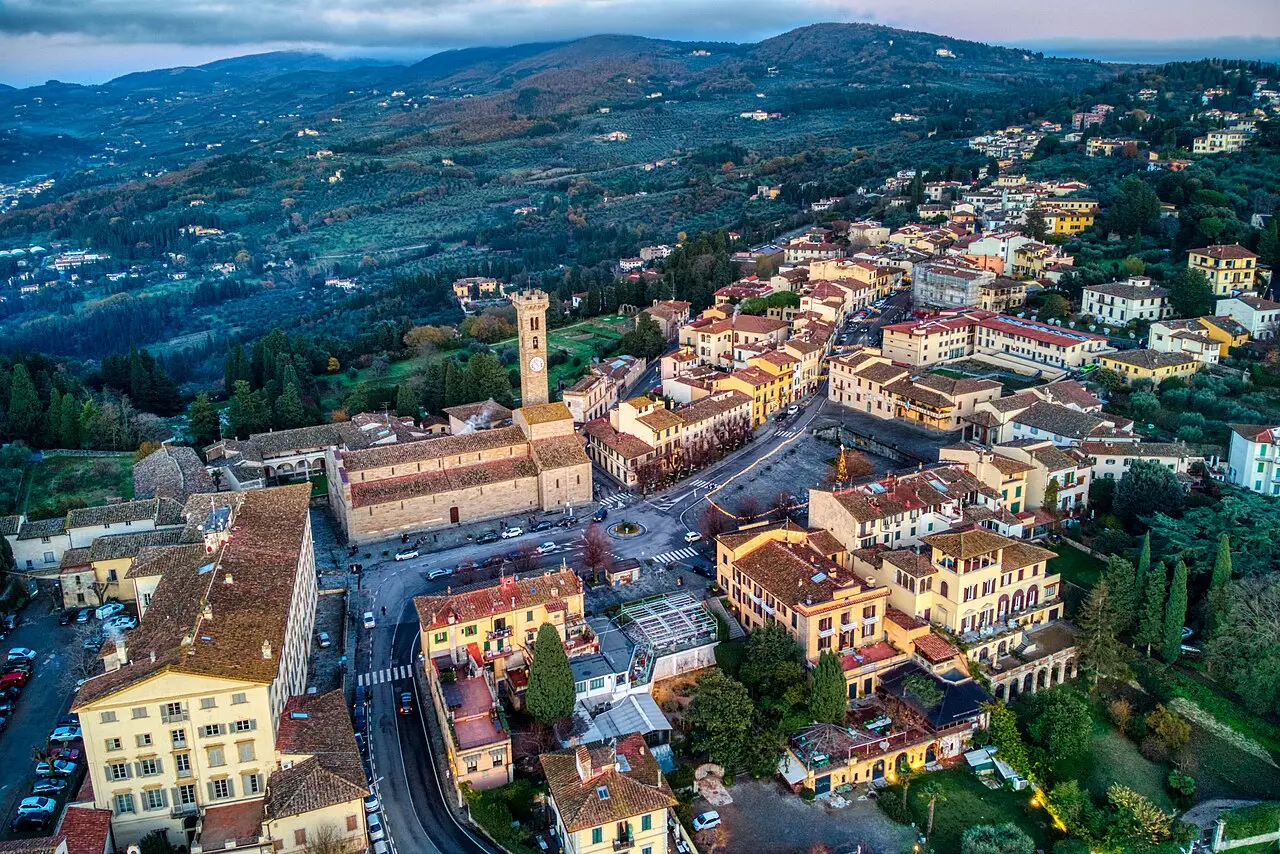
The roughly 40-minute walk down the Via Vecchia Fiesolana, between stone walls and cypresses down to San Domenico, is the best part of the outing. Set aside an afternoon for Fiesole, the Etruscan town Florence razed in 1125, atop the hill to the north, and only take the bus back at the bottom of the descent. On a third day in Florence, I'd trade any second museum for this walk down.
Explore the map

© OpenStreetMap · OpenFreeMap · © OpenMapTiles
Explore the map, read about the other places and plan your travel days in the app.
Open the appWhat to see
Florence: The basin closed in by hills
The Arno runs east to west toward Pisa and is a torrential river, nearly dry in July and capable of catastrophic autumn floods: those of 1333, 1557, 1844, and 1966 are marked on the walls with level plaques. The historic center, inside the viali, covers about 505 ha and has been a World Heritage Site since 1982.
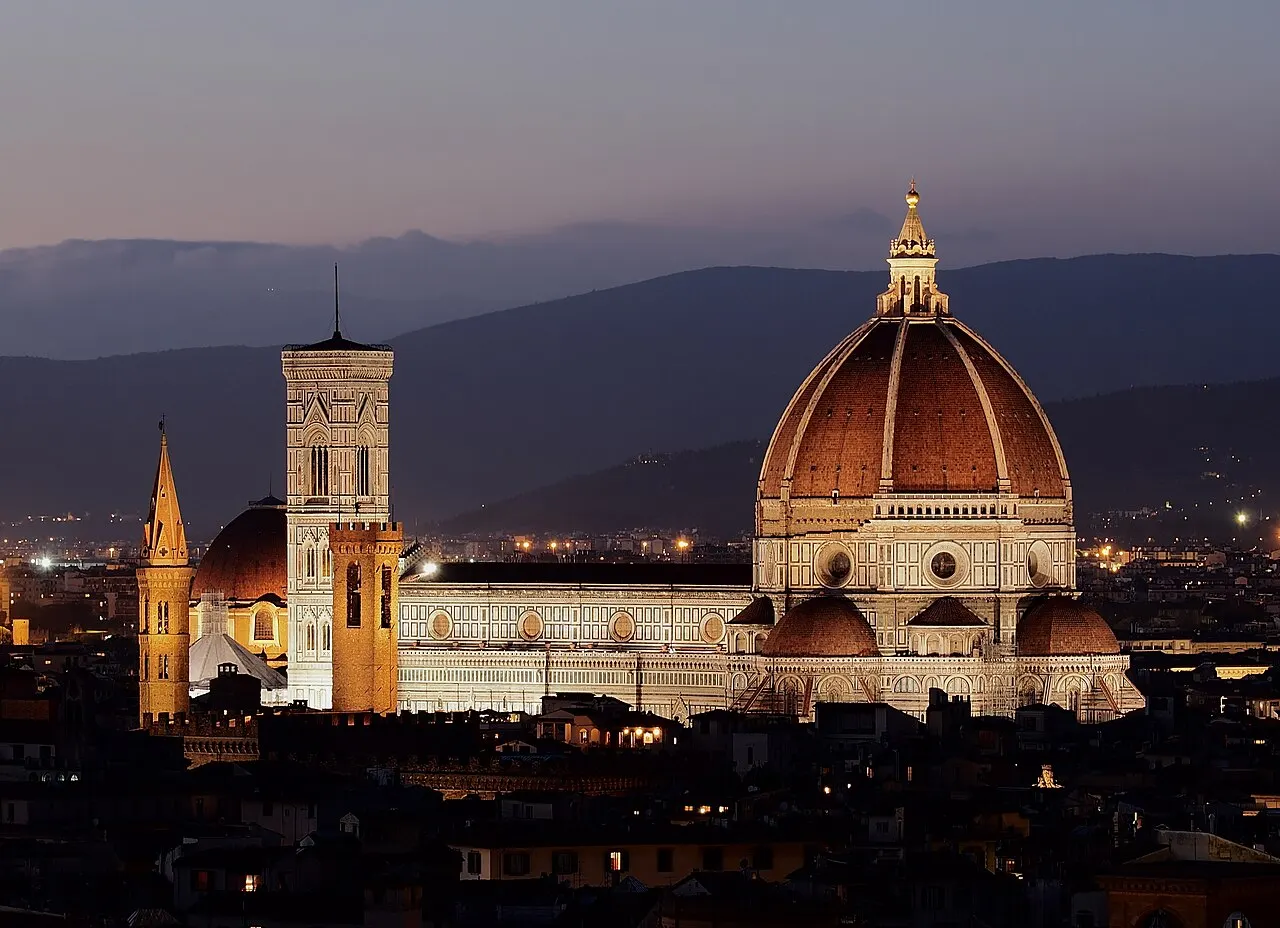
Cathedral of Santa Maria del Fiore and the dome
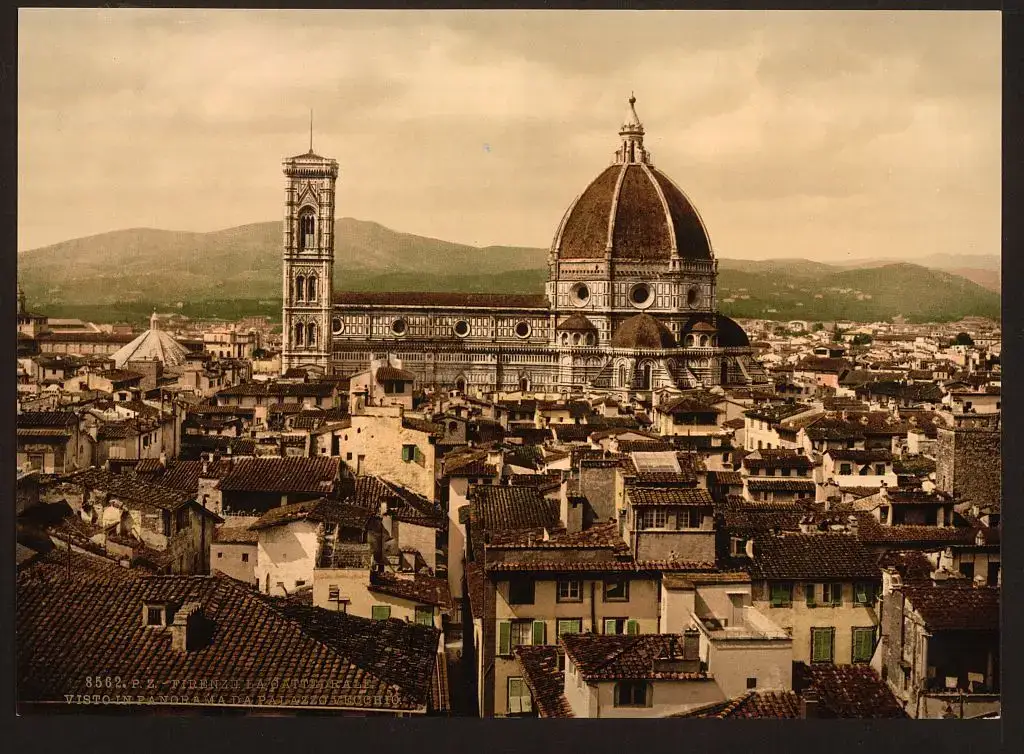
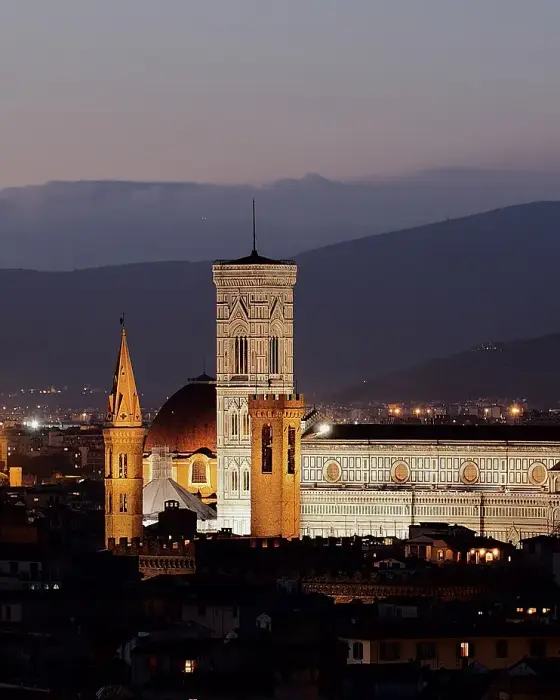
Begun in 1296 by Arnolfo di Cambio and closed by Brunelleschi's dome between 1420 and 1436: a 45.5 m span, herringbone brickwork, two shells and no wooden centering. The nave is free and opens at 10:15am, Monday to Saturday, with a line and a bag check; the climb up the 463 steps needs a booked time slot and comes with the Brunelleschi Pass (about €30, valid 3 days), which also covers Giotto's campanile (84.7 m, 414 steps), the crypt of Santa Reparata and the Museo dell'Opera.
Brunelleschi's dome, with a 45.5 m span and raised between 1420 and 1436 without wooden support structure, is the reason to come to Florence. The nave is free, but the climb up the 463 steps requires a booked time slot on the Brunelleschi Pass.
Check access
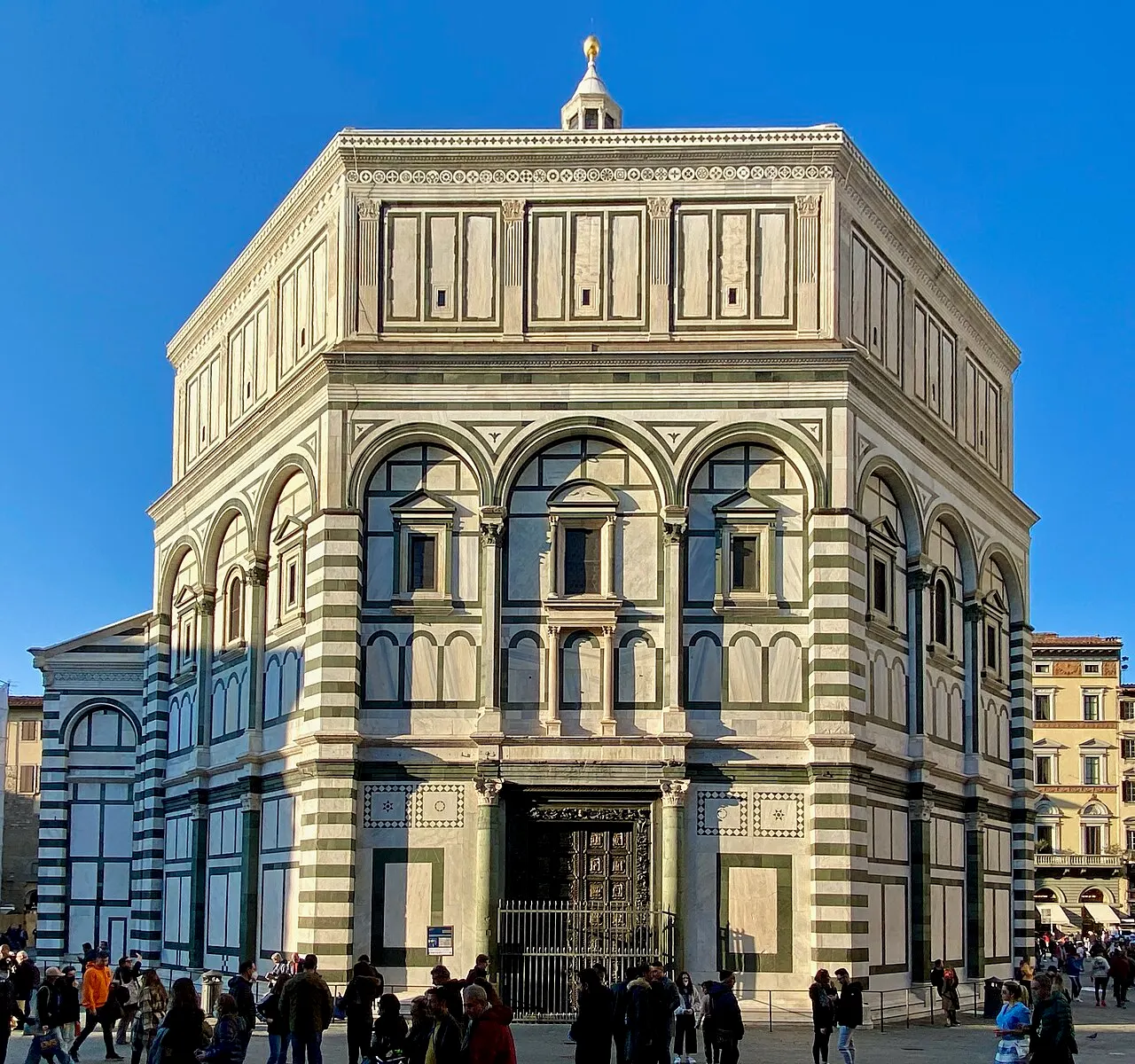
Baptistery of San Giovanni
The oldest standing building in the center, octagonal, faced with white and green marble from Prato between the 11th and 13th centuries. The Last Judgment mosaic on the dome dates from the 13th century. Ghiberti's Gates of Paradise (1425–1452) on the east facade are copies; the ten original gilded bronze panels have been restored and are on display at the Museo dell'Opera del Duomo, across the square.
It's the oldest standing building in the center, octagonal and clad in white and green marble, with the 13th-century Last Judgment mosaic on the vault. It stands on the same square as the Duomo, and the original panels of the Gates of Paradise are in the Museo dell'Opera, across the way.
Check access

Galleria degli Uffizi
Vasari built it between 1560 and 1580 as offices (uffizi) for the ducal administration; it opened to the public in 1765. It holds Botticelli (Primavera and The Birth of Venus), Leonardo, Michelangelo, Raphael, Titian and Caravaggio across about a hundred rooms. Timed-entry tickets cost about €25 in high season and about €16 for entry from 4pm, a rate introduced on January 1, 2026.
Botticelli, Leonardo, Michelangelo, Raphael, Titian, and Caravaggio across about a hundred rooms make the Uffizi the museum that justifies the trip. Book a time slot: anyone entering from 4pm pays about €16 instead of €25.
Check access
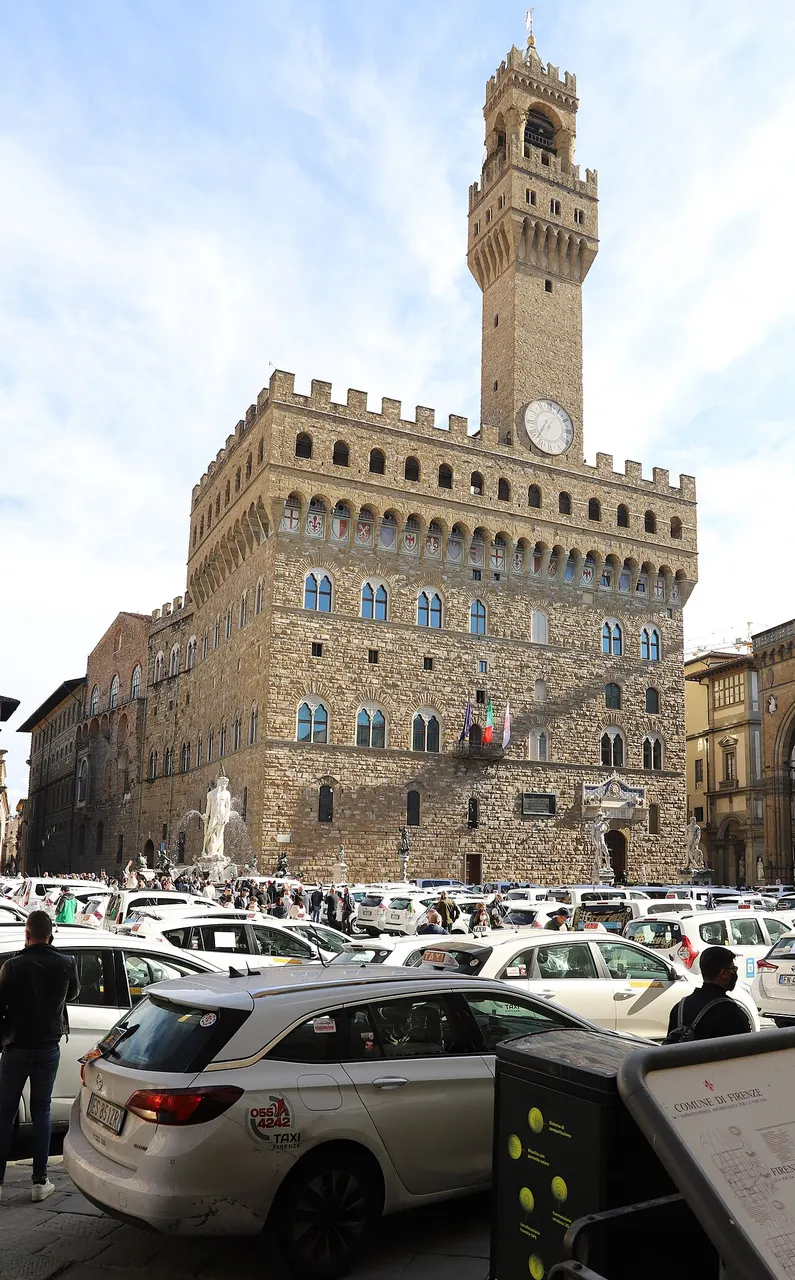
Palazzo Vecchio and Piazza della Signoria
Seat of government since 1299–1314, with the 94 m Torre di Arnolfo and the Salone dei Cinquecento, a hall of about 54 by 23 m decorated by Vasari over unfinished frescoes by Leonardo and Michelangelo. In the square, the David is a copy installed in 1910, and the Loggia dei Lanzi (1382) houses Cellini's Perseus, from 1554. A round granite plaque marks the spot where Savonarola was burned in 1498.
The square is open and brings together the Loggia dei Lanzi with Cellini's Perseus, the copy of the David, and Savonarola's plaque. The palace is worth it for the Salone dei Cinquecento, about 54 by 23 m, decorated by Vasari over unfinished frescoes by Leonardo and Michelangelo.
Check access
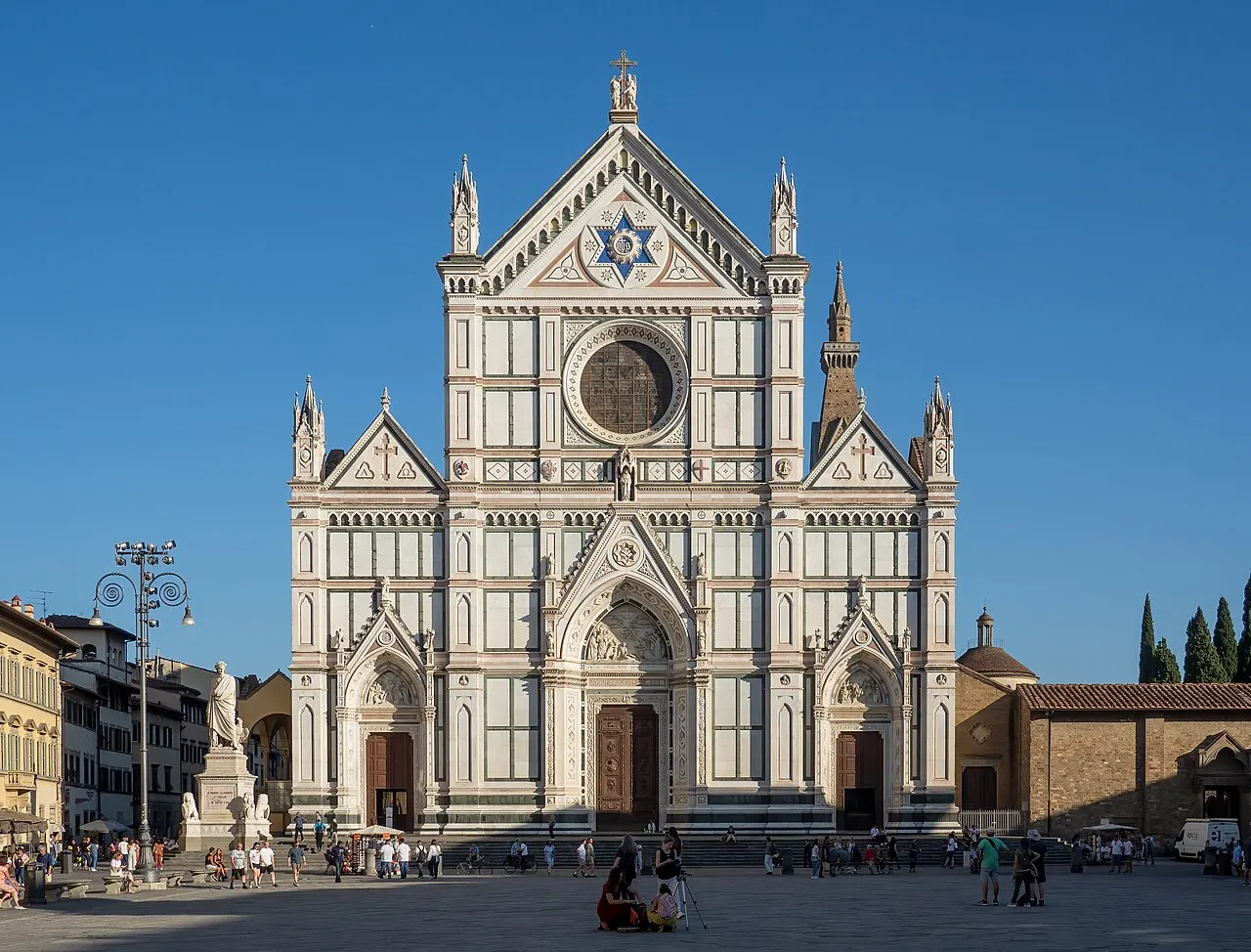
Basilica of Santa Croce
Franciscan, begun in 1294, with Giotto's frescoes in the Bardi and Peruzzi chapels and Brunelleschi's Pazzi Chapel in the cloister. It became Italy's pantheon in the 19th century: the tombs of Michelangelo, Galileo, Machiavelli and Rossini, and an empty cenotaph for Dante, buried in Ravenna since 1321. In the 1966 flood the water reached about 5 m inside here; the mark is signposted.
It's worth the short visit that brings together, in a single nave, the tombs of Michelangelo, Galileo, and Machiavelli and Giotto's frescoes, something no other stop on the itinerary shows all at once. It's in the same neighborhood as the Mercato di Sant'Ambrogio, where the second day begins, and it fits into any free hour of the stay; cover your shoulders and knees to enter.
Check access
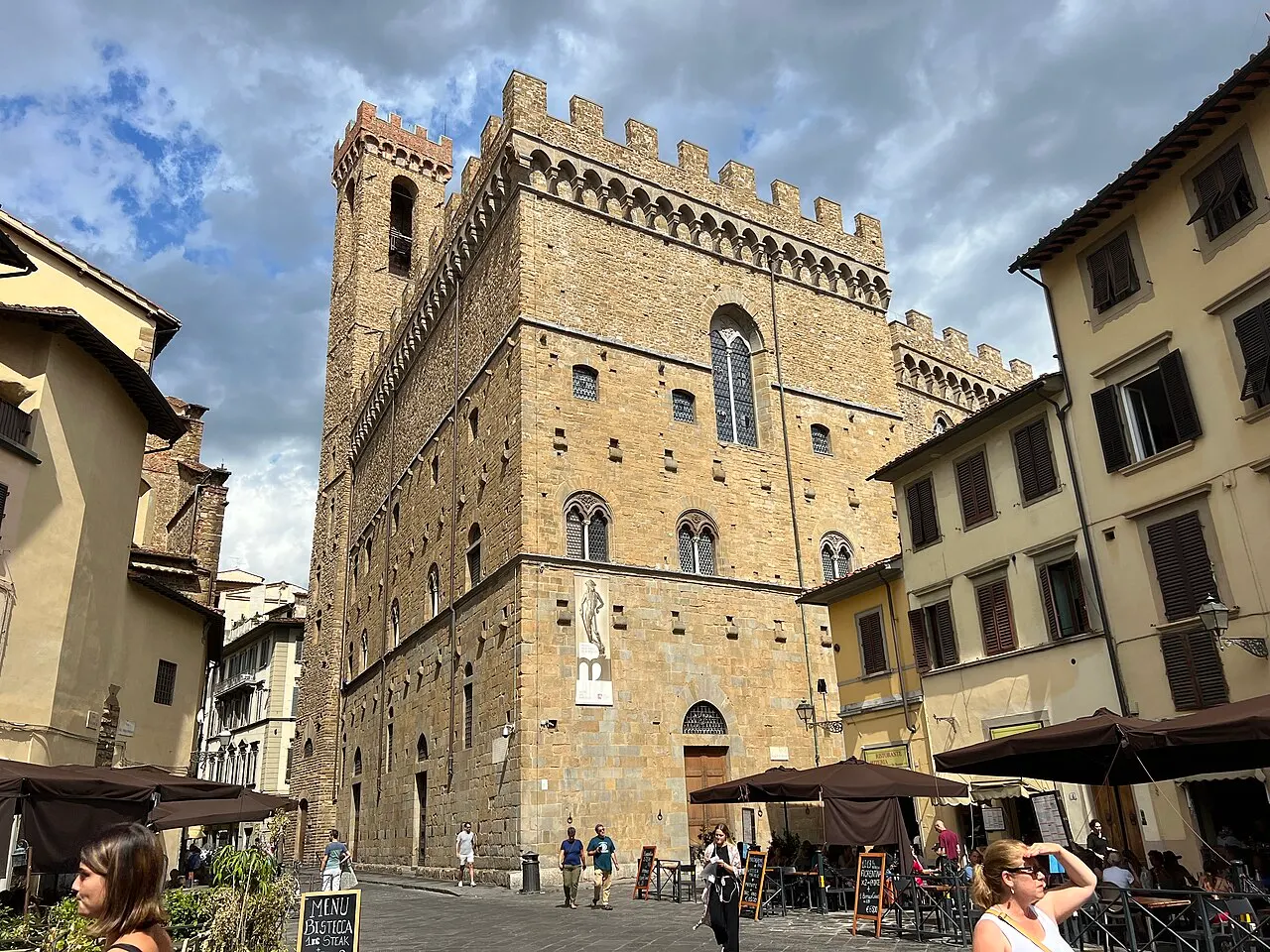
Museo Nazionale del Bargello
The podestà's palace from 1255, later a prison and the seat of the chief of police (the bargello), today a sculpture museum. It holds Donatello's bronze David, the first freestanding male nude since Antiquity, his Saint George, works by Michelangelo, Cellini and Giambologna, and the two 1401 panels of the Sacrifice of Isaac with which Ghiberti and Brunelleschi competed for the Baptistery doors, displayed side by side.
It's worth it for anyone who wants to see Renaissance sculpture beyond the Accademia's marble David, with Donatello and the competition that decided the Baptistery's doors in the same visit. Arrive at 8:15am, as the itinerary's third day proposes, and the first hour covers the main rooms.
Check access
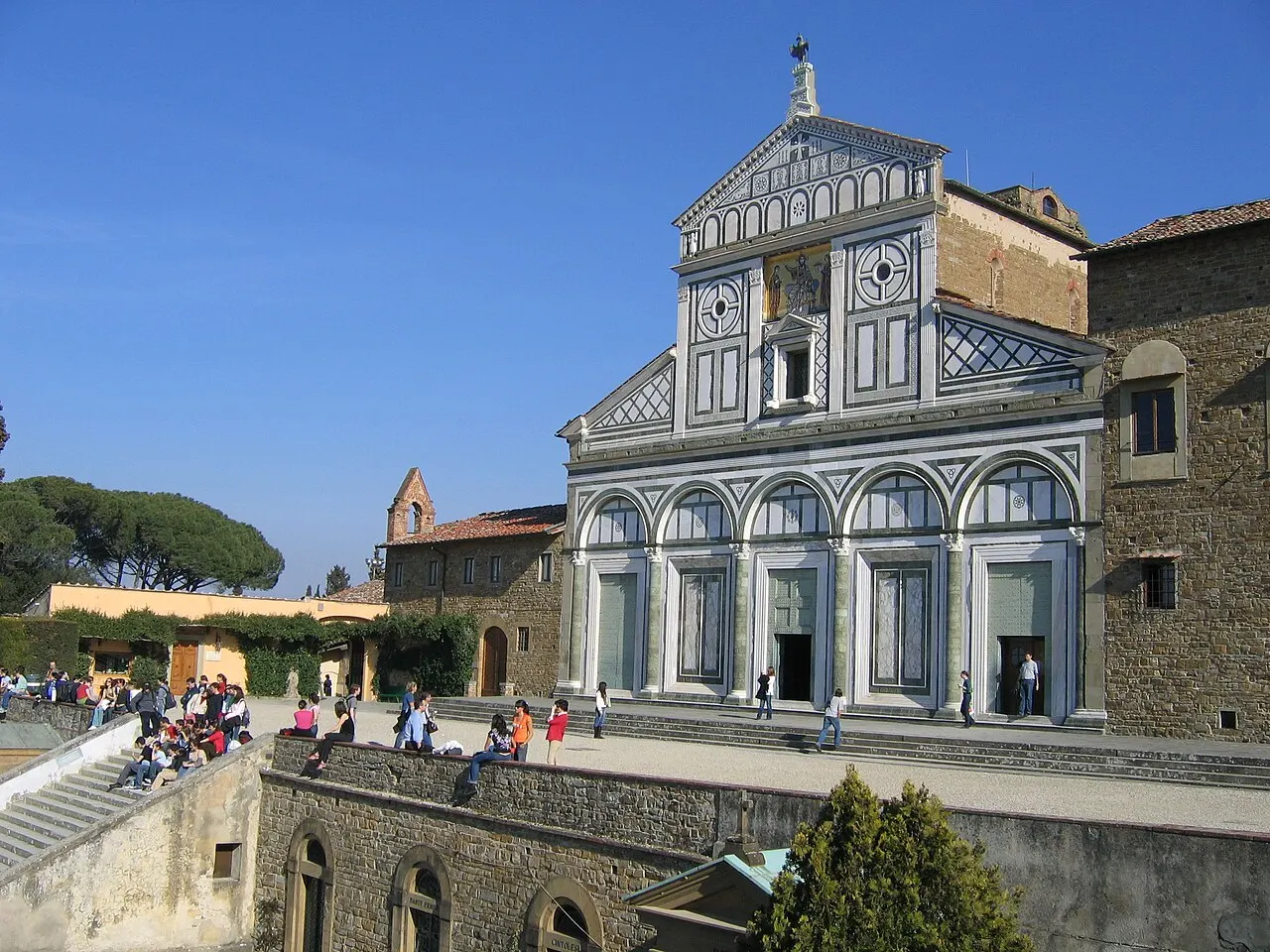
San Miniato al Monte and Piazzale Michelangelo
A Romanesque church from 1018–1207 at the highest point of the south bank, with a geometric marble facade, a 12th-century floor with zodiac signs and an active Olivetan monastery. The monks sing vespers in the late afternoon, at a time posted on the door. Just below, the Piazzale Michelangelo, a terrace opened by Giuseppe Poggi in 1869 with another bronze copy of the David. The walk up the ramps takes about 25 minutes from the river.
From the Piazzale Michelangelo you see the whole center in the Arno basin, and San Miniato, just above, has a Romanesque marble facade and vespers sung by the monks in the late afternoon. The walk up the ramps takes about 25 minutes from the river.
Check access
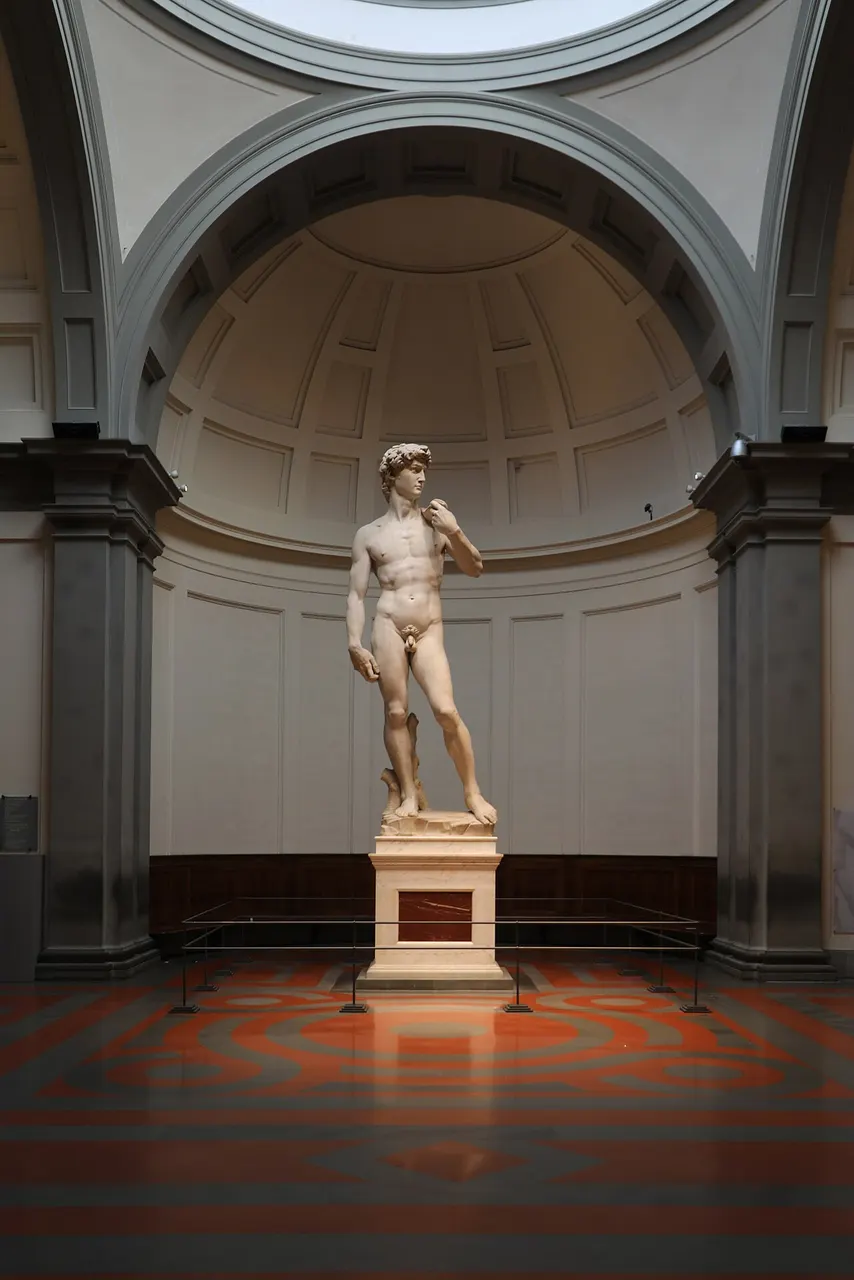
Galleria dell'Accademia
It exists because of one statue: Michelangelo's David, 5.17 m carved from a single block of Carrara marble between 1501 and 1504 and brought here from Piazza della Signoria in 1873. In the entrance corridor stand the four unfinished Prisoners, showing the figure emerging from the stone. About €16 plus a booking fee; 40 to 60 minutes are enough.
The 5.17 m David, carved from a single block of Carrara marble, is the museum's only draw, and it's not much to justify half a morning in line: the visit wraps up in 40 to 60 minutes, for about €16 plus the booking fee. Beyond it, there's little left besides Michelangelo's unfinished figures near the entrance.
Check access

Ponte Vecchio and the Vasari Corridor
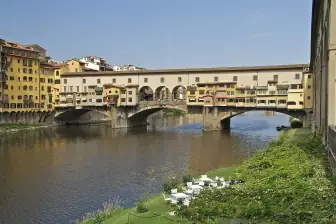
Rebuilt in 1345 after the 1333 flood, it's the only bridge the Germans didn't dynamite in August 1944. The butchers were expelled by a 1593 decree of Ferdinando I and replaced by goldsmiths, who remain in the same overhanging shops. Above it runs the 750 m corridor Vasari built in 1565, reopened to the public in late 2024 with its own ticket (a supplement on top of the Uffizi entry). Since May 25, 2026 the bridge has been under restoration, with pontoons on the river; crossing on foot remains open.
The 1345 bridge, with the jewelers' shops suspended over it, is seen better from the side, from the Ponte Santa Trinita, than from inside. After ten in the morning, it gets so crowded you can barely walk between the shop windows.
Check access
Nilo’s itinerary
Start with the basic programme and choose extensions for the time you have.
Plan my days in the app ↗Day 1 · The religious axis and the civic axis
Climb the dome's 463 steps at 8:30am, in the slot you booked in advance, and come down in time to enter the cathedral nave, which is free and opens at 10:15am.
Visit the Baptistery of San Giovanni and its Last Judgment mosaic, then cross the square to the Museo dell'Opera del Duomo to see the original panels of the Gates of Paradise and Michelangelo's Bandini Pietà.
Have lunch standing at a trippaio cart, for €4.50 to 6, or on the upper floor of the Mercato Centrale, ten minutes' walk away.
Head to Piazza della Signoria and the Palazzo Vecchio, with the Salone dei Cinquecento and, if you still have the legs, the climb up the 94 m tower; on the paving of the square, look for the round granite plaque marking where Savonarola was hanged and burned in 1498.
Enter the Uffizi at your booked time, ideally from 4pm for the reduced fare, and leave through the Loggia dei Lanzi at dusk.
Day 2 · Michelangelo in the morning, Oltrarno in the afternoon
Have coffee and buy fruit at 8am at the Mercato di Sant'Ambrogio, at neighborhood prices rather than center prices.
Enter the Galleria dell'Accademia at the first slot to see the 5.17 m David and the unfinished Prisoners; an hour covers the visit.
Cross the river by the Ponte Santa Trinita, from where you see the Ponte Vecchio from the side, and, in 2026, the pontoons of the restoration.
Spend the afternoon in the Oltrarno, between the Brancacci Chapel in Santa Maria del Carmine (frescoes by Masaccio and Masolino, 1424–1428, with limited entry), Santo Spirito and the workshops along Via dei Serragli and Borgo San Frediano.
Climb up to San Miniato al Monte in the late afternoon for the sung vespers and walk down through the Piazzale Michelangelo, 25 minutes on foot to the river.



If you stay longer
Day 3 · Sculpture, cells and the hill
Arrive at 8:15am at the Bargello, the sculpture museum housed in the podestà's palace of 1255, and give the first hour to Donatello and to the two Sacrifice of Isaac panels that Ghiberti and Brunelleschi entered in the 1401 competition for the Baptistery doors.
Walk to the Museo di San Marco and go through the Dominican friars' cells one by one, with frescoes by Fra Angelico, up to Savonarola's triple cell at the end of the corridor.
Have a €12 to €18 set lunch at a trattoria outside the viali, in Sant'Ambrogio or Campo di Marte.
Take bus 7 from Piazza San Marco to Fiesole, 25 minutes on a €2 city ticket, to see the Roman theater from the 1st century BCE, the baths and the view over the whole basin.
Walk back down the Via Vecchia Fiesolana to San Domenico, about 40 minutes downhill between stone walls and cypresses, and catch the bus again there.
Food
 AI illustration
Bistecca alla fiorentina
A T-bone loin cut, traditionally from Chianina cattle, at least 3 cm thick and 1 to 1.2 kg. Grilled over embers, flipped once, and served rare by definition. Charged by the etto (100 g), about €5–8 per etto: a cut runs from €50 to nearly €100 and serves two or three people.
 AI illustration
Lampredotto
The cow's fourth stomach, cooked in a broth of tomato, onion and celery, sliced and served in a panino with green sauce and pepper. Sold from carts (trippai) since the 19th century, €4.50–6, from early morning to mid-afternoon. The question at order time is “bagnato?”: if you say yes, the top of the bread is dipped in the broth before it's closed.
 AI illustration
Trippa alla fiorentina
Tripe in thin strips with tomato sauce and parmesan, served on a plate or in a paper cup at the same cart as the lampredotto. Working-class food, bought standing up, almost never in the evening.
 AI illustration
Ribollita and pappa al pomodoro
Two soups made from stale bread. Ribollita has black kale (cavolo nero), cannellini beans and unsalted bread, cooked one day and reboiled the next, which is where the name comes from; pappa al pomodoro is bread, tomato, garlic and basil. Both arrive with a drizzle of raw olive oil on top and are dishes for October through March.
 AI illustration
Crostini neri and pappardelle al cinghiale
The standard opener at any Tuscan trattoria: bread slices topped with chicken-liver pâté, capers and anchovy, followed by wide pasta with wild boar ragù. A lunch menu with primo, secondo, side and water usually runs between €12 and €18.
 AI illustration
Pane sciocco and schiacciata
Tuscan bread has no salt, a habit documented since the Middle Ages and tied to the price and tax on salt. The schiacciata is the local focaccia, thin, with olive oil and coarse salt, sold by weight and used as a sandwich with ham or finocchiona. At Carnival comes the schiacciata alla fiorentina, an orange cake dusted with powdered sugar stamped with the city's lily.
 AI illustration
Gelato
The city claims to have invented cut gelato at the Medici court, and the buontalenti flavor (egg custard, no milk) carries the name of the 16th-century architect. A scoop between €2.50 and €4.50. A sign of industrial product: bright, colorful mounds rising above the rim of the tub; artisanal gelato sits low and covered.
 AI illustration
Negroni, wine at the counter and buchette
The Negroni (gin, sweet vermouth and Campari in equal parts) was born in Florence around 1919, when Count Camillo Negroni asked for a stronger Americano. On the facades of the center there are more than a hundred buchette del vino, 16th-century little windows through which the palaces sold wine directly; some started operating again after 2020. A glass of Chianti Classico at the counter, €4–7.
Day trips
Fiesole
Fiesole lies 8 km north, 25 minutes on bus 7 from Piazza San Marco, with a €2 city ticket. Founded by the Etruscans before Florence existed and razed by the Florentines in 1125, it keeps a Roman theater from the 1st century BCE that is still used in summer, baths, an archaeological museum and the convent of San Francesco at the top. It's the highest lookout over the basin and the cheapest day trip from Florence.

Siena
Siena lies about 75 km south. The Autolinee Toscane express bus leaves from the terminal next to Santa Maria Novella and gets there direct in 1 hour 15 minutes to 1 hour 30 minutes, while the train is slower because of the change at Empoli. There you'll find the shell-shaped Piazza del Campo, the cathedral striped in white and black marble, and the Palio, raced on July 2 and August 16.
Pisa and Lucca
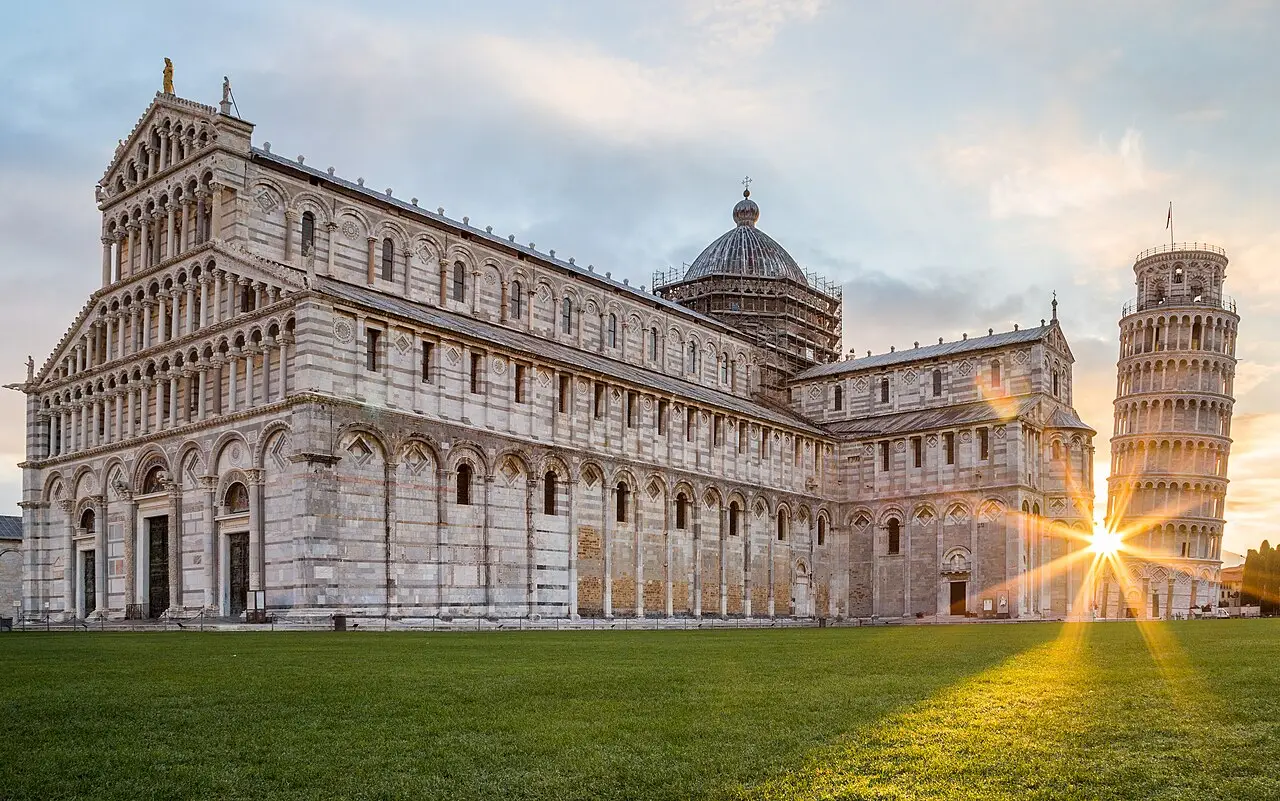
Pisa is about 80 km away, about an hour by regional train from Santa Maria Novella, and Lucca is 30 minutes further by train. You can combine both in one day: the Campo dei Miracoli and the tower in the morning, the regional train from Pisa to Lucca after lunch, and in the afternoon Lucca's walls, a 4.2 km tree-lined, flat loop around the whole city. To return, take the direct train from Lucca to Florence, which runs via Pistoia and Prato and takes 1 hour 20 minutes to 1 hour 30 minutes.
Where to begin
The religious axis and the civic axis
Climb the dome's 463 steps at 8:30am, in the slot you booked in advance, and come down in time to enter the cathedral nave, which is free and opens at 10:15am.
Michelangelo in the morning, Oltrarno in the afternoon
Have coffee and buy fruit at 8am at the Mercato di Sant'Ambrogio, at neighborhood prices rather than center prices.
Sculpture, cells and the hill
Arrive at 8:15am at the Bargello, the sculpture museum housed in the podestà's palace of 1255, and give the first hour to Donatello and to the two Sacrifice of Isaac panels that Ghiberti and Brunelleschi entered in the 1401 competition for the Baptistery doors.
Money
The currency is the euro, and the price of almost everything depends on whether you're standing or sitting. An espresso costs €1.20–1.50 standing at the counter; sitting down, you also pay for the table, and on a central piazza the bill jumps three or four times, with the price list posted and perfectly legal. Cappuccino and cornetto, €3–4.50; a lampredotto panino, €4.50–6; a slice of pizza, €3–5; gelato, €2.50–4.50; a glass of wine at the counter, €4–7; a Negroni at a bar in the center, €9–14. A lunch menu at a neighborhood trattoria runs €12–18; an à la carte dinner with starter, main and wine, €30–45 per person, unless a bistecca joins the order, since it's charged by the etto. Museums: the Uffizi about €25 (or about €16 if you enter after 4pm), the Accademia about €16 plus a booking fee, and the Duomo complex's Brunelleschi Pass about €30; the cathedral nave is free. A tram or bus ticket is €2. A hostel bed costs €35–45; a double in a three-star hotel, €110–180, plus a tourist tax of €3.50 to €8 per person per night depending on category (about €5.50–6 in short-term rentals), charged for up to seven consecutive nights and waived for children under 12. The bill carries a coperto of €2 to €3.50 per person, which is a cover charge and not a tip, and in touristy places a servizio of 10% to 12% may appear too, so read the bill before adding anything. Tipping isn't expected: rounding up or leaving €1 to €2 per person is the usual gesture. Cards and tap-to-pay work almost everywhere, but street carts and market stalls sometimes take only cash, so carry a few small bills.
Getting there and around
Amerigo Vespucci Airport: 5 km northwest, the T2 tram runs downtown
Amerigo Vespucci Airport (FLR), in Peretola, is about 5 km northwest, and getting to the center is easy. Tram T2 “Vespucci” leaves from the terminal door and reaches Santa Maria Novella station in about 20 minutes, with departures every 4 to 6 minutes and a standard €2 ticket, then continues to Piazza San Marco. A taxi to the center has a flat fare of around €25, with surcharges at night, for luggage and on Sundays: only get into a white taxi with a number on the door, from the official ranks. The other useful airport is Pisa (PSA), about 80 km away, from which you take the PisaMover to Pisa Centrale and a regional train to Florence, about 1 hour 15 minutes in all. By rail, Santa Maria Novella is a terminus five minutes' walk from the Duomo, with Frecciarossa and Italo trains to Bologna in about 35 minutes, Rome in 1 hour 30 minutes to 1 hour 45 minutes and Milan in about 1 hour 50 minutes. Some regional trains stop only at Rifredi or Campo di Marte, so check the station printed on your ticket before boarding.
Tram, bus and a €2 ticket good for 90 minutes
The urban network is run by Autolinee Toscane, which replaced ATAF in November 2021. The single ticket has cost €2 since August 2026 and is valid for 90 minutes with transfers. There's a ten-ride pass for €15.50, an SMS ticket for €2, and tap-to-pay validation with a bank card on board and on the tram platforms. The machines are at every tram stop; buying on board costs more. Two tram lines run (T1 from Villa Costanza (Scandicci) to Careggi, and T2 from the airport to San Marco) and new branches to Bagno a Ripoli, Le Piagge and Sesto Fiorentino are under construction, with staggered openings starting late 2026. Inside the viali, electric minibuses on the C lines circulate. The center is a camera-monitored ZTL: don't drive in, even a rental, even for five minutes. Leave the car in Villa Costanza, next to the T1 terminus, or at the Parterre. In practice, everything is done on foot, over uneven cobblestones and half-meter sidewalks: bring thick-soled shoes. Bicycles work on the flat north bank and in the Cascine park; there are app-based shared bikes and scooters.
Safety
Florence is safe to walk at any hour, and violent crime against visitors is rare. The real risk is pickpocketing, concentrated around Santa Maria Novella station and the surrounding streets, the San Lorenzo market, the C-line minibuses and the crush on the Ponte Vecchio and Piazza del Duomo on busy days: wear your backpack on your front and keep your phone out of your back pocket. The common scams always run the same way: men who tie “gift” bracelets on your wrist near the Baptistery and the Piazzale and then demand payment, fake petition clipboards worked in pairs, and cars posing as taxis outside the airport, when a licensed taxi is white, with a number on the door and a meter. At night, the area around the station, the Cascine park after the market closes and parts of Piazza Santa Maria Novella are more unpleasant than dangerous, mostly because of drunks leaving the bars. In summer the heat is a real hazard, so carry water and refill at the free public fountains found throughout the neighborhoods. General emergency number: 112.
Etiquette tips
Coffee is drunk standing, at the counter
In many bars you order and pay at the register first, take the receipt to the counter and drink there, because sitting down changes the price. Cappuccino is a drink for before 11am; after lunch, order a caffè, as Florentines do.
Don't sit on the sidewalk to eat
A municipal ordinance in effect since 2018 bans eating while sitting on sidewalks, doorsteps and steps on some central streets (Via de' Neri, Piazzale degli Uffizi, Via della Ninna and Piazza del Grano) during meal hours, with fines of hundreds of euros. Eat standing next to the shop or take it to a garden.
Shoulders and knees covered in churches
Cover your shoulders and knees to enter the cathedral, Santa Croce, San Lorenzo and San Miniato. The Duomo has a bag check and turns away tank tops, short shorts and hats at the door, so in July carry a scarf in your daypack to cover your shoulders at the entrance.
The bistecca isn't ordered well done
Bistecca alla fiorentina is sold by weight, at least 3 cm thick and rare by definition. Asking for medium usually earns you an explanation; asking for well done, a polite refusal. If you don't eat rare red meat, order peposo or arista.
Greet on the way in and on the way out
“Buongiorno” until mid-afternoon, “buonasera” after, said while crossing the threshold of any shop, bar, bakery or office, even with no intention of buying. Walking in silent reads as rude, not discreet.
Coperto: a cover charge for bread and table service
The coperto of €2 to €3.50 per person covers bread and table service and appears on almost every menu. No one brings the bill before you ask: say “il conto, per favore.” Splitting the bill across many cards is possible, but frowned upon at small places.
Mistakes to avoid
Driving into the ZTL
Driving into the center. The viali surround a camera-monitored ZTL, active on weekdays and with evening bands in spring and summer. The fine reaches the renter's address months later, one per camera crossed. If your hotel is inside the zone, send your plate ahead for the temporary registration, and confirm the allowed hours anyway.
Buying Uffizi tickets at the door
Buying a ticket at the door of the Uffizi or the Accademia in high season. Without a booked slot, the line runs past two hours and sometimes closes before you reach the ticket window. Book on the official site days ahead, arrive 15 minutes before your slot, and prefer entry after 4pm at the Uffizi, cheaper since January 2026.
The David in the square is from 1910
Mistaking a copy for the original. The David in Piazza della Signoria is a 1910 copy, the one on Piazzale Michelangelo is bronze, and the Baptistery's Gates of Paradise are replicas. The original David is in the Accademia, and Ghiberti's panels are in the Museo dell'Opera del Duomo: skip those two museums and you photograph three copies and no originals.
The nave is free; the dome is a separate pass
Thinking the Duomo is a single ticket. The cathedral nave is free and has its own line. The dome, the campanile, the baptistery, the crypt and the museum come in combined passes, and the climb up the dome only comes with a booked slot, 463 steps, no elevator and nowhere to leave a large backpack.
Staying inside the tourist rectangle
Staying inside the Duomo–Uffizi–Ponte Vecchio rectangle. Walking five minutes east or into the Oltrarno cuts the price of lunch in half and leaves the sidewalks far less crowded. To cross the river, use the Ponte Santa Trinita, which gives you a side view of the whole Ponte Vecchio; the Ponte Vecchio remains open on foot but has been under restoration since May 25, 2026, with pontoons in the river.
Useful phrases
Buongiorno / Buonasera
Good morning / Good evening: said on entering any establishment; the switch happens around mid-afternoon
Un caffè al banco, per favore
A coffee at the counter, please: at the counter it costs around €1.30, at a table it can cost four times more
Un panino col lampredotto, bagnato
A lampredotto sandwich, with the top dipped in the broth: “bagnato?” is the question the trippaio asks
Il conto, per favore
The check, please: it never arrives before you ask for it
Permesso
Excuse me: for getting past someone on a narrow street, a staircase or a full bus
O bischero
Something like “oh, silly fool,” a light insult between friends; the Tuscan gorgia turns the “c” into a breath, so “la Coca-Cola” comes out as “la Hoha-Hola”
Districts
Centro storico (Duomo–Signoria)
The area between the Duomo, Piazza della Repubblica and Piazza della Signoria provides reference points for exploring the historic centre on foot, depending on your route and access needs. The historic centre was inscribed on the World Heritage List in 1982; the property’s current boundaries, expanded since then, cover 532 hectares and extend beyond this sector and the former Roman core. When choosing accommodation, compare its address with the places you want to visit and your arrival and departure points. Check check-in and check-out times and where to store luggage. A central address may shorten some journeys, but does not guarantee easy access to every attraction or replace checking transport.
San Lorenzo and Mercato Centrale
The Medici neighborhood, with the family church, Brunelleschi's Old Sacristy and Michelangelo's Medici Chapels. The 1874 covered market, designed by Giuseppe Mengoni, has butchers and fishmongers on the ground floor and a food court upstairs since 2014; around it, the leather stalls.
Santa Maria Novella
The area around the 1935 station, by Giovanni Michelucci, one of the few rationalist buildings in the center. Hotels, the regional bus terminal and the basilica with the facade Alberti finished in 1470 and Masaccio's Trinity (about 1427), the first rigorous use of linear perspective in painting.
Santa Croce and Sant'Ambrogio
To the east: the square where the Calcio Storico is played in June, the leather school behind the basilica and, a few blocks further, the Sant'Ambrogio market, which supplies the neighborhood and not the tourist. It's where the north bank's nightlife concentrates.
Oltrarno: Santo Spirito and San Frediano
The south bank inside the walls, with restoration, cabinetmaking, gilding and goldsmith workshops still active on the streets behind Via Maggio. The church of Santo Spirito is Brunelleschi's last project and its facade never received a finish; the square fills with residents and students at night.
San Niccolò
A narrow strip between the river and the hillside, under Poggi's ramps, with the 1324 Porta San Niccolò preserved at full height because it fell outside the demolition of the walls. Few blocks, small bars, and the start of the climb to San Miniato.
Campo di Marte and Le Cure
Residential east, outside the viali: Pier Luigi Nervi's Artemio Franchi Stadium, opened in 1931 and completed in 1932, with its helicoidal reinforced-concrete staircases, and neighborhood markets. Rent and restaurant bills well below downtown.
Novoli, Rifredi and Careggi
Northwest: the Novoli university campus, the Careggi hospital complex, the Rifredi station (a stop for many regional trains) and the northern terminus of tram line T1. It's where much of the city the visitor never sees lives and works.
History
1st century BC · Florentia, Roman colony
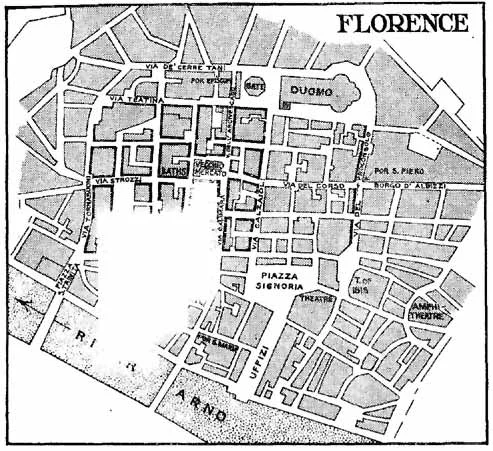
Florentia emerged as a Roman colony near the Arno. Its foundation is traditionally associated with 59 BC, but the exact date remains uncertain; archaeological remains point to the late first century BC. Today’s Via Roma and Via Calimala, crossed by Via del Corso and Via degli Strozzi, preserve the grid around the former forum at Piazza della Repubblica.
1115–1138 · The commune takes shape
Matilda of Canossa dies in 1115. The commune took shape through a process: the war against Fiesole ends with its capture and destruction in 1125, and Florence’s consuls are first documented in 1138.

1252 · The gold florin
Florence mints the fiorino, about 3.5 g of gold with the lily on one side and Saint John on the other. It becomes Europe's reference currency for two centuries and underwrites the Florentine banking houses.

1293–1302 · Factions and Dante's exile
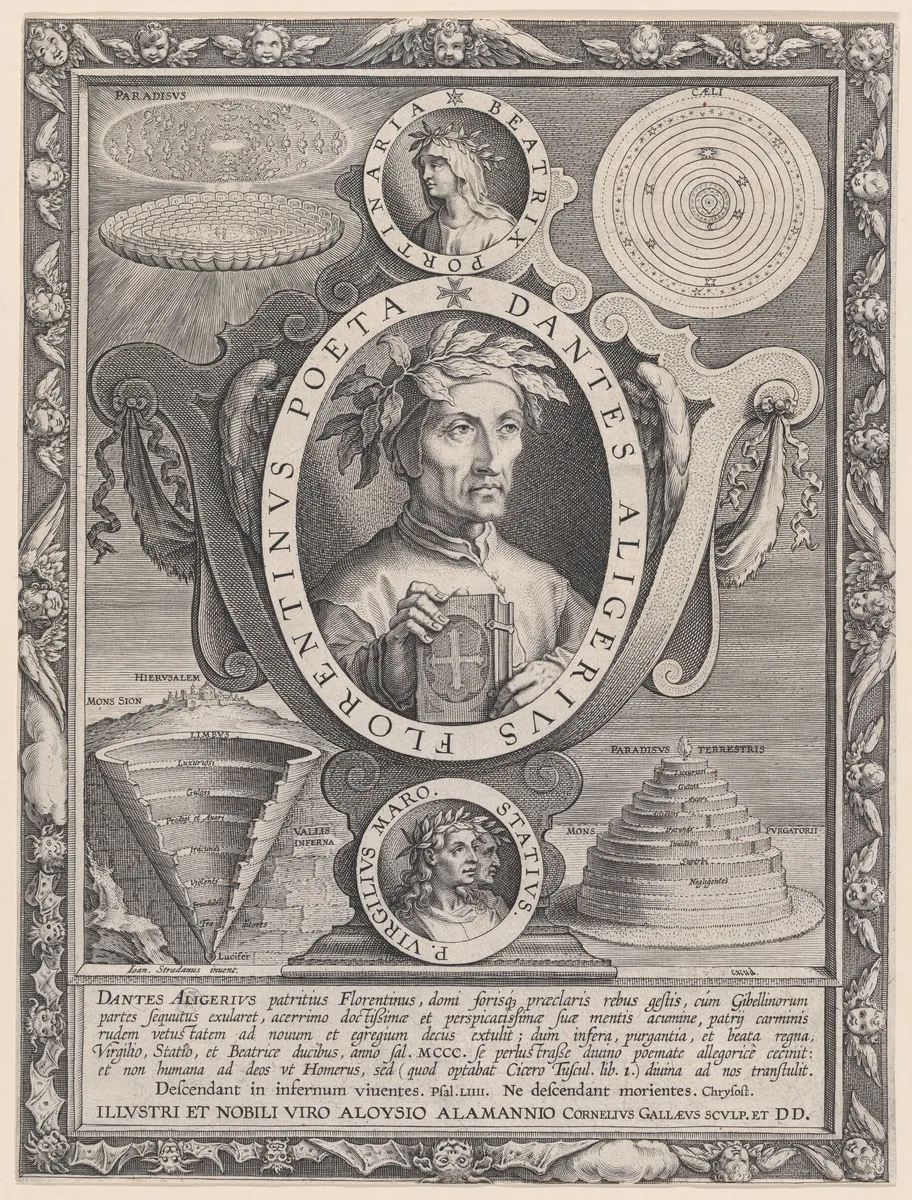
The Ordinances of Justice of 1293 exclude the magnates from government, but the fight between White and Black Guelphs continues. Dante Alighieri, a prior in 1300, is banished in 1302 on pain of being burned alive, and never returns.
1348 · The Black Death
The epidemic kills between half and two thirds of the roughly 120,000 residents. Boccaccio sets the Decameron around ten young people fleeing the infected city; in 1378 the wool carders seize power for a few weeks in the Ciompi revolt.

1401–1436 · The dome
Ghiberti wins the 1401 competition for the Baptistery doors, beating Brunelleschi. Brunelleschi then raises the cathedral's dome between 1420 and 1436: a 45.5 m span, four million bricks in herringbone pattern and no wooden centering.

1434 · The Medici take over
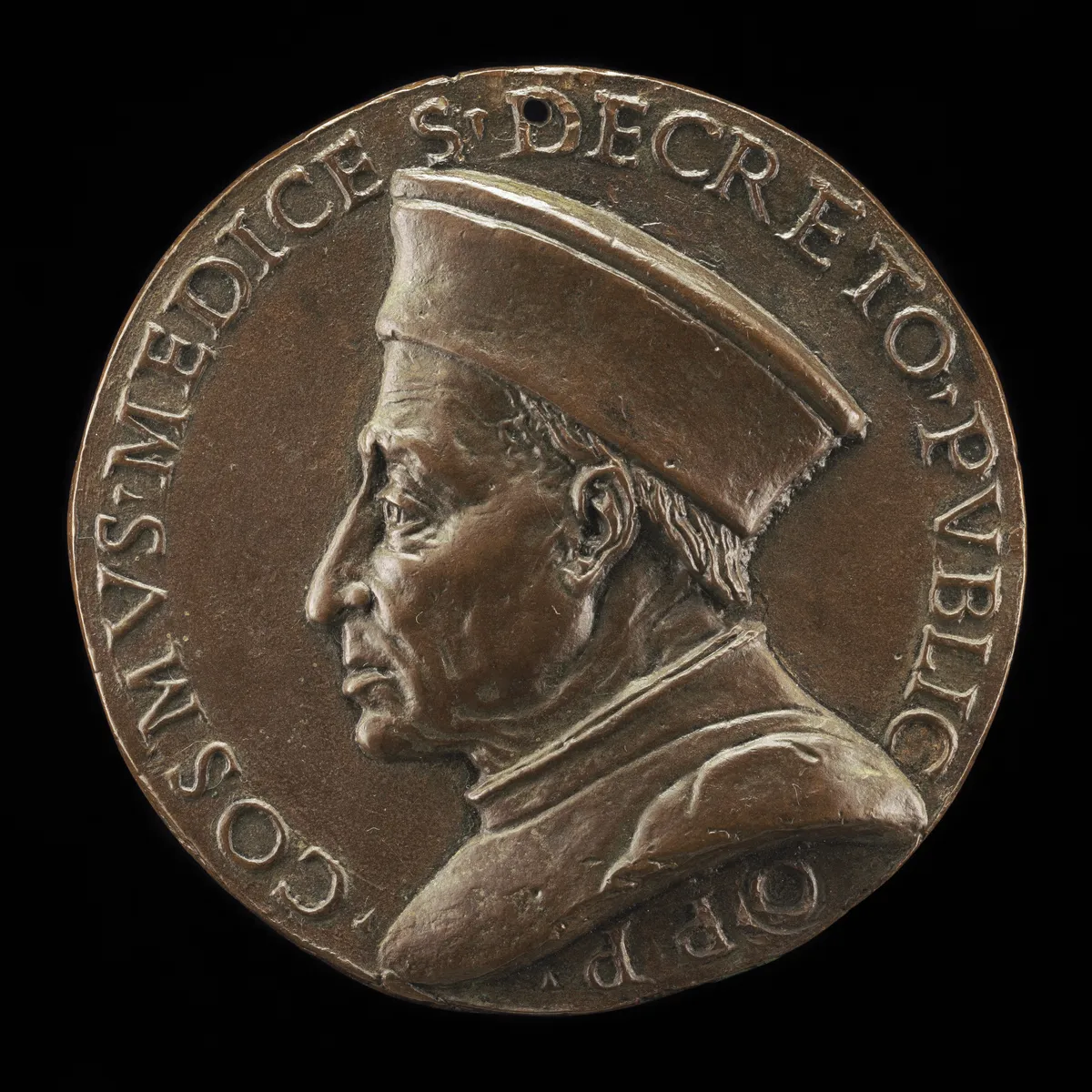
Cosimo il Vecchio returns from exile and rules with no formal office, through the bank and his network of clients. Lorenzo the Magnificent leads from 1469 to 1492 and funds workshops where Botticelli, Verrocchio and the young Michelangelo pass through.
1494–1498 · Savonarola's republic
With the Medici expelled, the Dominican friar Girolamo Savonarola sets up a government of morals and burns luxury objects in the Bonfire of the Vanities in 1497. He is hanged and burned in Piazza della Signoria on May 23, 1498.

1569 · Grand Duchy of Tuscany
Cosimo I receives the title of grand duke and consolidates the administration in a new building: the Uffizi, by Vasari, built between 1560 and 1580. In 1565 Vasari builds the 750 m suspended corridor that passes over the Ponte Vecchio.

1737 · The Family Pact
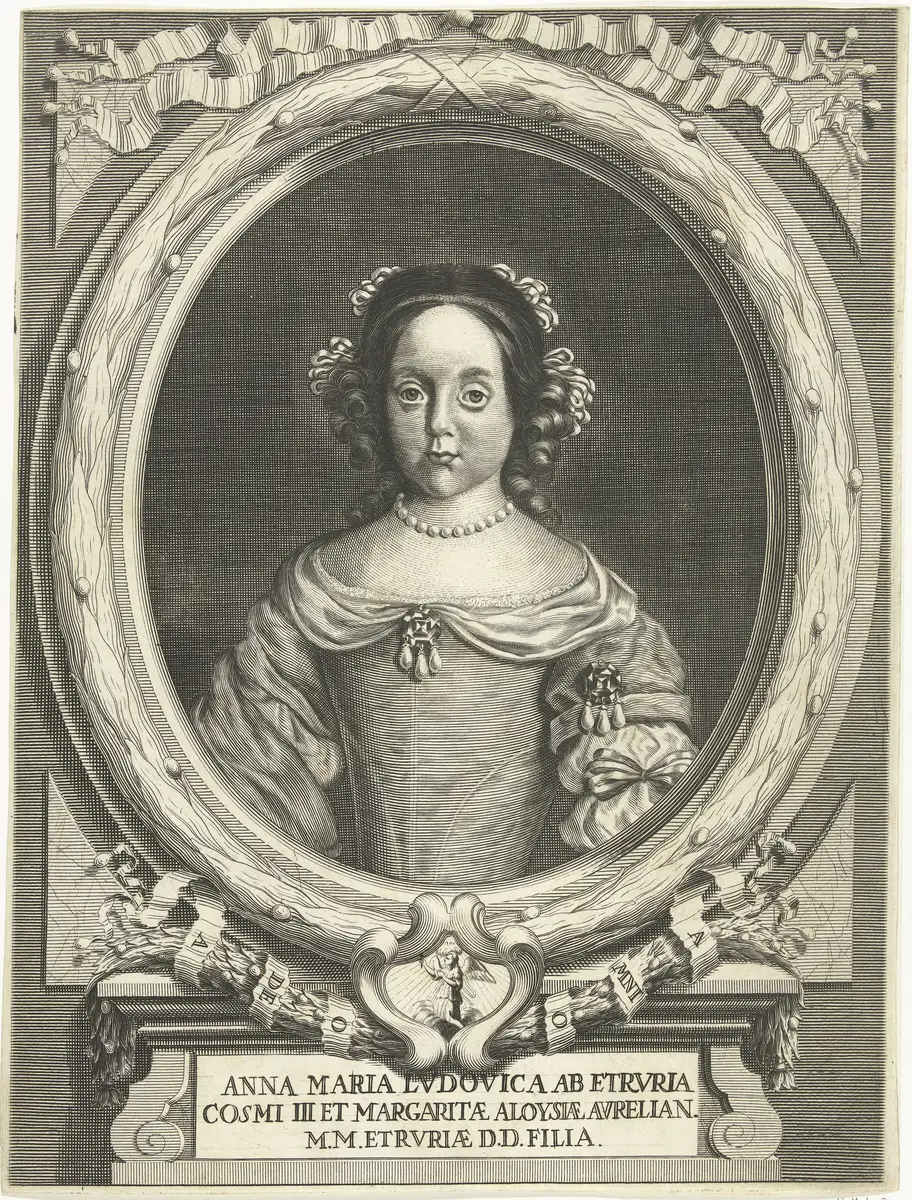
Anna Maria Luisa, the last of the Medici, signs the Family Pact with the House of Lorraine, bequeathing the family's entire collection to the Tuscan state on the condition that nothing ever leave Florence. That clause is what keeps the collections in the city to this day.
1865–1966 · Capital, mines and the flood
Florence is the capital of the Kingdom of Italy from 1865 to 1871, and Giuseppe Poggi tears down the walls to open the viali and the Piazzale Michelangelo. On August 4, 1944 the Germans dynamite every bridge except the Ponte Vecchio; on November 4, 1966 the Arno overflows and leaves about 5 m of water in Santa Croce.
Complete history
The Roman colony and the medieval city
The exact date of Florentia’s foundation remains uncertain. Tradition points to 59 BC; archaeological remains place the city’s formation in the late first century BC. The colony arose near the Arno, with a street grid and a forum where Piazza della Repubblica stands today. Via Roma and Via Calimala preserve the north–south axis, crossed by the axis of Via del Corso and Via degli Strozzi. The new route of the Via Cassia belongs to the imperial expansion, after the foundation.
Between the fifth and seventh centuries, conflicts and crises accompanied the contraction of the city. The medieval commune took shape through a process: Matilda of Canossa died in 1115, the war against Fiesole ended with its capture and destruction in 1125, and Florence’s consuls are documented in 1138. The great medieval circuit, begun in 1284 and completed with interruptions in 1333, left gates and stretches of wall still visible in the Oltrarno.
The wealth comes from wool and money
The Lana and Calimala guilds imported raw cloth from northern Europe, dyed it, finished it, and resold it at a markup, and the profits turned into banks with branches in London, Bruges, and Naples. The 1252 florin became the currency of international credit, and whoever controlled the exchange rate controlled politics. In the 1340s, the English king's default broke the Bardi and Peruzzi banks, and soon after the 1348 plague killed between half and two-thirds of the population. The banking system survived both blows: in 1397 Giovanni di Bicci founded the Medici Bank, and starting in 1434 his son Cosimo governed the republic from within, without ever holding office.
Brunelleschi, Masaccio and the 15th-century workshops
Within a one-kilometer radius, the 15th century produced Brunelleschi's dome (1420–1436), Masaccio's perspective in the Trinity at Santa Maria Novella (around 1427), Donatello's bronze David and Verrocchio's workshop, where Leonardo trained. These works were commissions: guilds, confraternities and banking families paid for them to compete for prestige in the public squares. The political cycle closed with the expulsion of the Medici in 1494, Savonarola's moral republic, the siege of 1529–1530 and the family's permanent return as dukes in 1532 and grand dukes in 1569. From then on Florence was a court capital, and power passed from the banks and guilds to the grand dukes.
The Medici line ends and the Lorraines arrive, in 1737
When the Medici line died out in 1737, Tuscany passed to the House of Lorraine, and that same year Anna Maria Luisa, the last of the family, signed the Family Pact, which binds the Medici collection to the city. The Lorraine rulers modernized the administration and abolished the death penalty in 1786. The 19th century brought the Grand Tour, the English and the antiques dealers; between 1865 and 1871 Florence was capital of the kingdom, and Giuseppe Poggi's works replaced the walls with boulevards, razed the old market and the ghetto to open Piazza della Repubblica, and built the ramps up to the 1869 lookout. The 20th century left two scars: the German mines of August 1944, which destroyed the bridges and the medieval blocks at both ends of the Ponte Vecchio, and the flood of November 4, 1966, which left dozens dead and thousands of artworks and books damaged and brought in the volunteers known as the mud angels, the episode that professionalized modern restoration at the Opificio delle Pietre Dure.
Tourism, fashion, university and hospital
Today the economy is tourism, fashion and leather, the university and the hospital: about 15 million overnight stays a year in a municipality of 363,000 residents, the historic headquarters of Gucci (founded here in 1921) and of Ferragamo, the Novoli university campus and the Careggi hospital. Facing the imbalance between tourism and housing, the city has banned new short-term rentals in the UNESCO area since 2023; in February 2025 it ordered self-check-in key boxes removed from building fronts; and in May 2026 it extended the freeze on new listings to nine neighborhoods around the center, with a grace period for existing operators until May 31, 2028. The tourist tax has gone up, and the tram network is still being expanded.
Whoever controlled Florence's banks also controlled the politics: they were the same families.
Geography and shape of the city
The basin closed in by hills
The city sits in a basin at about 50 m of elevation, closed in by hills on almost every side: Fiesole and Monte Ceceri to the north, between 250 and 400 m, and the ridge of Arcetri, San Miniato and Bellosguardo to the south. This amphitheater traps the heat in summer and the humidity in winter, and it's the physical reason August is hard here.
The Arno and the flood markers
The Arno runs east to west toward Pisa; it's a torrential river, nearly dry in July and capable of catastrophic autumn floods: 1333, 1557, 1844 and 1966 are marked on walls with level plaques.
The two banks and the ring
Piazza della Repubblica occupies the central area of the Roman city: the cardo followed the line of today’s Via Roma and Via Calimala, while the decumanus followed Via Strozzi and Via del Corso. This layout helps explain the streets of the centre without reducing the entire city to the Roman rectangle. In the nineteenth century, Giuseppe Poggi’s plan replaced some walls with avenues and preserved monumental gates; stretches of the walls remained in the Oltrarno. South of the Arno, a route can lead from neighbourhood streets onto the hillsides. The World Heritage property currently recorded by UNESCO covers 532 hectares and includes areas beyond the flat core. When planning a walk, check the actual route, slopes and entrances between your chosen addresses; allow time for crossings and breaks.
The viali, the ring of avenues around the center, follow the line of the 1284–1333 city wall, which Giuseppe Poggi tore down between 1865 and 1871.
Culture
Standard Italian was born here
Standard Italian is, in large part, 14th-century written Florentine. Dante was born here in 1265, was banished in 1302, and wrote the Comedy in exile, naming real enemies of the city; Boccaccio and Petrarch completed the trio that fixed the vernacular as a literary language. The Accademia della Crusca, founded in 1583 and based at the Villa di Castello, is still the authority that issues rulings on the Italian language. In the same circuit are Machiavelli, who wrote The Prince in 1513 after losing his post in the chancery, Vasari, whose Lives of the Artists (1550 and 1568) invented art history and the word “renaissance,” and Galileo, funded by the Medici and today the subject of the Museo Galileo, next to the Uffizi.
Craftsmanship is still industry
Craftsmanship remains an industry here. The Oltrarno workshops do furniture restoration, gold leaf, bookbinding and goldsmithing, many at addresses unchanged for generations; the Opificio delle Pietre Dure, created in 1588 as the ducal mosaic workshop, became one of the world's leading restoration labs after the 1966 flood. Leather sustains an entire chain: the Scuola del Cuoio has run in the old dormitory of the Santa Croce friars since 1950, Gucci was founded in the city in 1921 and Ferragamo has its headquarters and museum in Palazzo Spini Feroni. Twice a year, in January and June, the Pitti Immagine Uomo fair fills the Fortezza da Basso and packs the city outside tourist season.
Melodrama was invented here
In music, opera was invented here around 1600, in the circle of the Camerata de' Bardi, with Jacopo Peri's Euridice; the Maggio Musicale Fiorentino, founded in 1933, is one of Europe's oldest opera festivals and now performs at the Teatro del Maggio, in the Cascine park. In soccer, ACF Fiorentina has played in purple at the Stadio Artemio Franchi since 1931. In film, Mario Monicelli's Amici miei (1975) captured Florence's dry, mocking humor better than any guidebook. The city even lent its name to an ailment: Stendhal syndrome, a racing heart and dizziness in the face of too much art, recalls the writer who felt faint at Santa Croce in 1817, and it was described clinically in 1979 by the Florentine psychiatrist Graziella Magherini.
Festivals and events
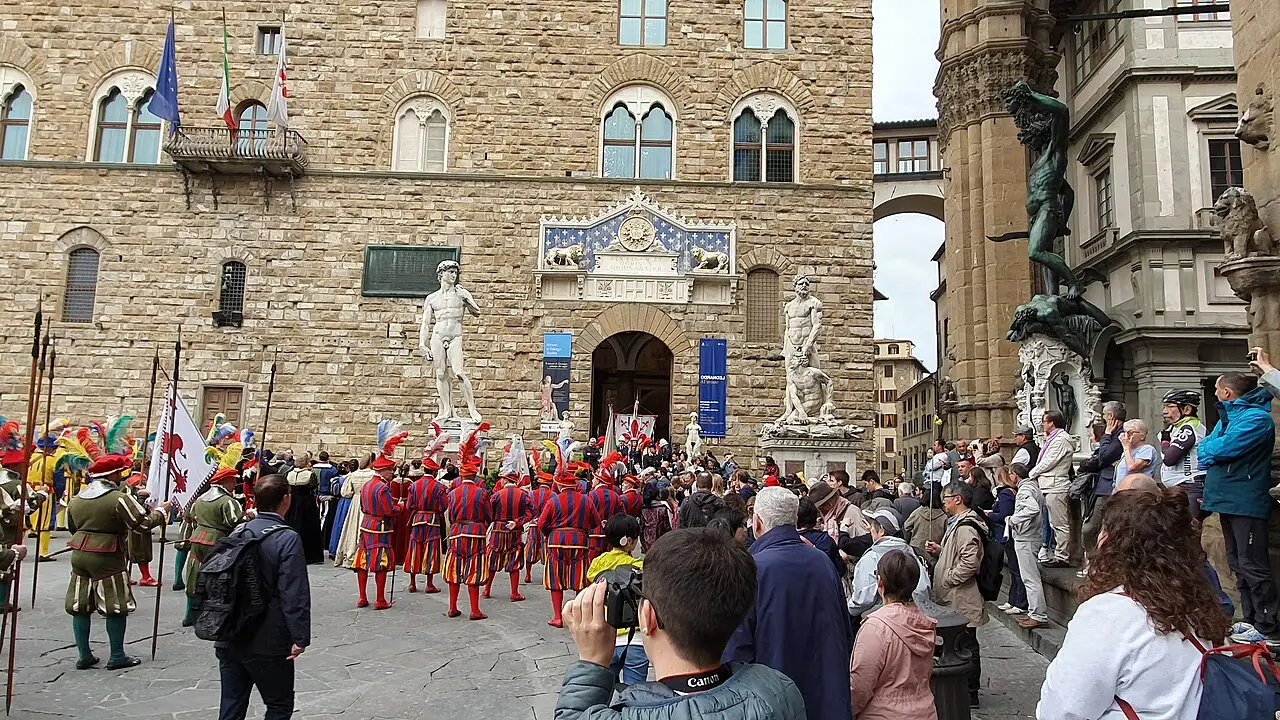
Scoppio del Carro
Easter Sunday, around 11am, in Piazza del Duomo. A cart about 9 m tall pulled by white oxen receives a dove-shaped rocket fired from the cathedral's high altar; the tradition traces back to flints from the Holy Sepulchre brought by a Pazzi during the First Crusade, in 1099. Arrive around 9:30am to get a view.
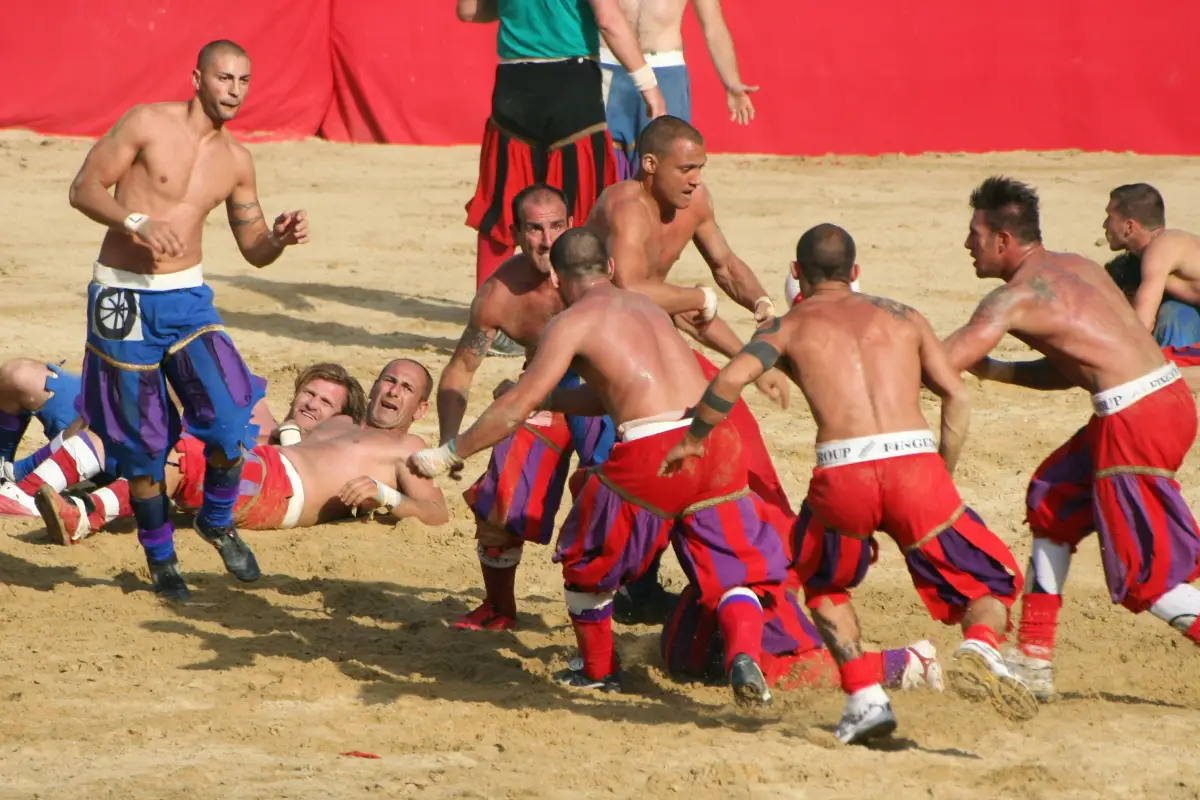
Calcio Storico Fiorentino and San Giovanni
In June a sand arena goes up in Piazza Santa Croce. Four neighborhood teams (white Santo Spirito, blue Santa Croce, red Santa Maria Novella, green San Giovanni) field 27 players a side for 50 minutes with no substitutions, under rules codified in 1580. The final is on June 24, the feast of patron saint John the Baptist, and the night ends with fireworks launched from the Piazzale Michelangelo around 10pm.
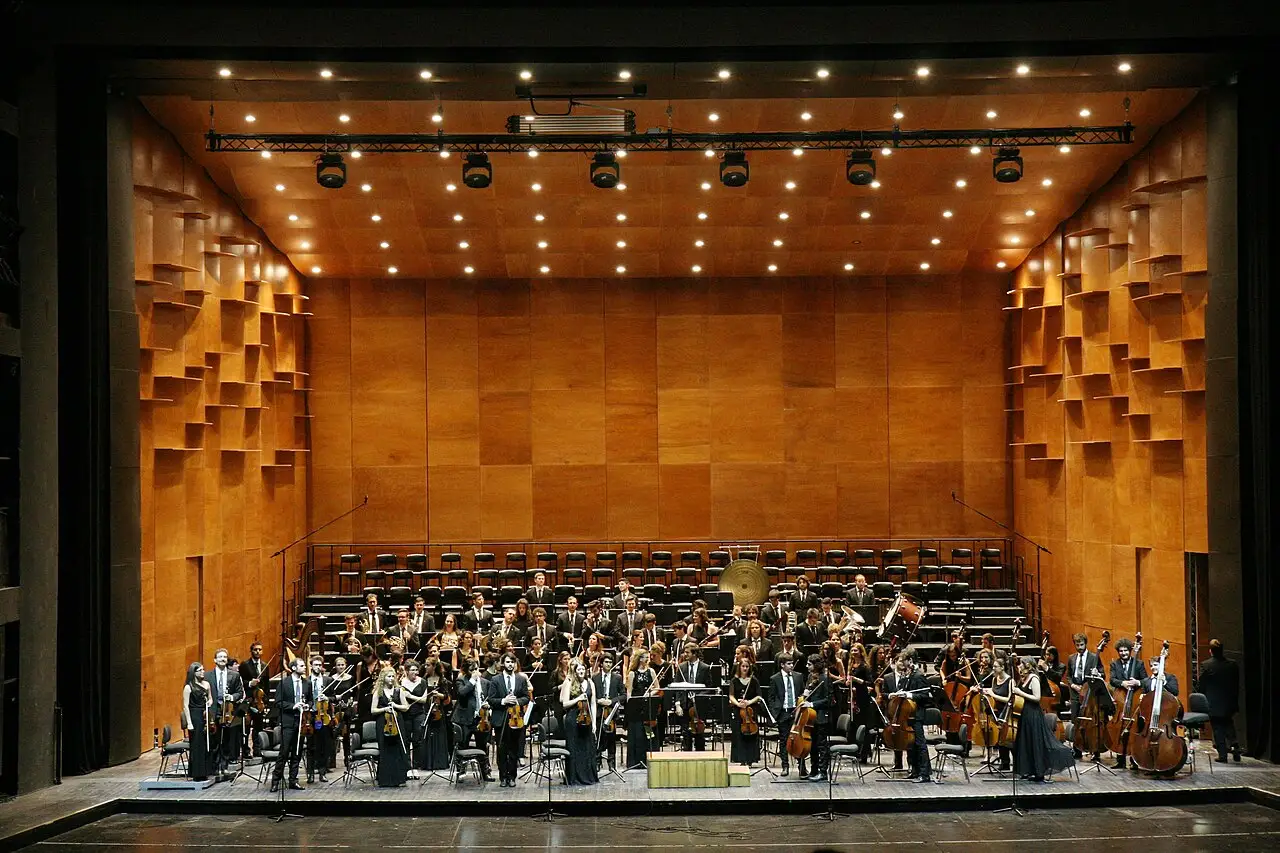
Maggio Musicale Fiorentino
April to June. An opera, symphonic concert and ballet festival created in 1933, today at the Teatro del Maggio, in the Cascine park, with a season that stretches through the rest of the year. Tickets from about €20 in the upper sections.

Festa della Rificolona
On September 7, the eve of the Nativity of the Virgin, children walk to the Santissima Annunziata square carrying paper lanterns on the end of a pole, in memory of the peasants who reached the fair before dawn; the side sport is popping other people's lanterns with paper blowguns.

Pitti Immagine Uomo
January and June, Fortezza da Basso. A menswear fashion fair with tens of thousands of buyers that defines two weeks a year on the city's calendar: full hotels and high prices even outside tourist high season.
Books and films
The Divine Comedy, by Dante Alighieri (1308–1321)
Written in the exile decreed in 1302 and populated with real Florentines, named and surnamed, distributed among the circles. Beyond explaining the city's factions from the inside, it's the text that turned the local dialect into the Italian language.
Brunelleschi's Dome, by Ross King (2000)
Reconstructs the engineering of the 1420–1436 project: the 45.5 m span with no wooden centering, the herringbone brickwork, the cranes designed for the site and the rivalry with Ghiberti. After reading it, the city's skyline becomes legible.
A Room with a View (James Ivory, 1985)
An adaptation of E. M. Forster shot in Piazza della Signoria and the hills of Fiesole. It shows the Anglo-Saxon tourism of the late 19th century that invented much of the foreign relationship with Florence: including the habit of looking at the city with a guidebook in hand.
Frequently asked questions
Florence: How do you get from the airport to downtown?
Tram T2 “Vespucci” leaves from the terminal door and reaches Santa Maria Novella station in about 20 minutes, with departures every 4 to 6 minutes and a standard €2 ticket, then continues to Piazza San Marco.
Florence: How do you get to Fiesole?
Fiesole lies 8 km north, 25 minutes on bus 7 from Piazza San Marco, with a €2 city ticket.
Florence: Do I need to carry cash?
Only a little: contactless cards work for almost everything, but street carts and market stalls sometimes only take cash, so carry a few small euro bills.
Florence: How do you order coffee at the counter?
In many bars you order and pay at the register first, take the receipt to the counter and drink there, because sitting down changes the price.
Florence: Is it a safe city?
Florence is safe to walk at any hour, and violent crime against visitors is rare. The real risk is pickpocketing, concentrated around Santa Maria Novella station and the surrounding streets, the San Lorenzo market, the C-line minibuses, and the crush of the Ponte Vecchio and Piazza del Duomo on a busy day: wear your backpack on your front and keep your phone out of your back pocket. The common scams always work the same way: men who tie “free gift” bracelets onto your wrist near the Baptistery and the Piazzale and then charge for them, fake-petition clipboards worked by a pair, and cars that offer themselves as taxis outside the airport, when the legal taxi is white, with a number on the door and a meter.
Other cities in the country
Italy ↗- Days
- 3–5
- When
- Apr–May · Sep–Oct
- Per person/day
- Average 130–190 EURMid-range · per person/day
Cost scope
Per person per day: accommodation, meals, urban transport, visits and a small allowance for extras. Flights excluded; larger purchases vary. Editorial estimate, not a quote.
- Days
- 2–3
- When
- Apr–Jun · Sep–Oct
- Per person/day
- Average 180–330 EURMid-range · per person/day
Cost scope
Per person per day: accommodation, meals, urban transport, visits and a small allowance for extras. Flights excluded; larger purchases vary. Editorial estimate, not a quote.
- Days
- 1–2
- When
- Apr–Jun · Sep–Oct
- Per person/day
- Average 150–220 EURMid-range · per person/day
Cost scope
Per person per day: accommodation, meals, urban transport, visits and a small allowance for extras. Flights excluded; larger purchases vary. Editorial estimate, not a quote.
- Days
- 2–3
- When
- Apr–Jun · Sep–Oct
- Per person/day
- Average 130–200 EURMid-range · per person/day
Cost scope
Per person per day: accommodation, meals, urban transport, visits and a small allowance for extras. Flights excluded; larger purchases vary. Editorial estimate, not a quote.
- Days
- 3–4
- When
- May–Jun · Sep–Oct
- Per person/day
- Average 246 EURMid-range · per person/day
Cost scope
Per person per day: accommodation, meals, urban transport, visits and a small allowance for extras. Flights excluded; larger purchases vary. Editorial estimate, not a quote.
- Days
- 2–3
- When
- May–Jun · Sep
- Per person/day
- Average 170 EURMid-range · per person/day
Cost scope
Per person per day: accommodation, meals, urban transport, visits and a small allowance for extras. Flights excluded; larger purchases vary. Editorial estimate, not a quote.
- Days
- 3
- When
- May–Jun · Sep
- Per person/day
- Explore costsGuide estimate
Cost scope
Per person per day: accommodation, meals, urban transport, visits and a small allowance for extras. Flights excluded; larger purchases vary. Editorial estimate, not a quote.
- Days
- 6
- When
- Jun–Sep
- Per person/day
- Explore costsGuide estimate
Cost scope
Per person per day: accommodation, meals, urban transport, visits and a small allowance for extras. Flights excluded; larger purchases vary. Editorial estimate, not a quote.
- Days
- 3
- When
- Apr–Jun · Sep–Oct
- Per person/day
- Average 114 EURMid-range · per person/day
Cost scope
Per person per day: accommodation, meals, urban transport, visits and a small allowance for extras. Flights excluded; larger purchases vary. Editorial estimate, not a quote.
- Days
- 7
- When
- May–Jun · Sep
- Per person/day
- Explore costsGuide estimate
Cost scope
Per person per day: accommodation, meals, urban transport, visits and a small allowance for extras. Flights excluded; larger purchases vary. Editorial estimate, not a quote.
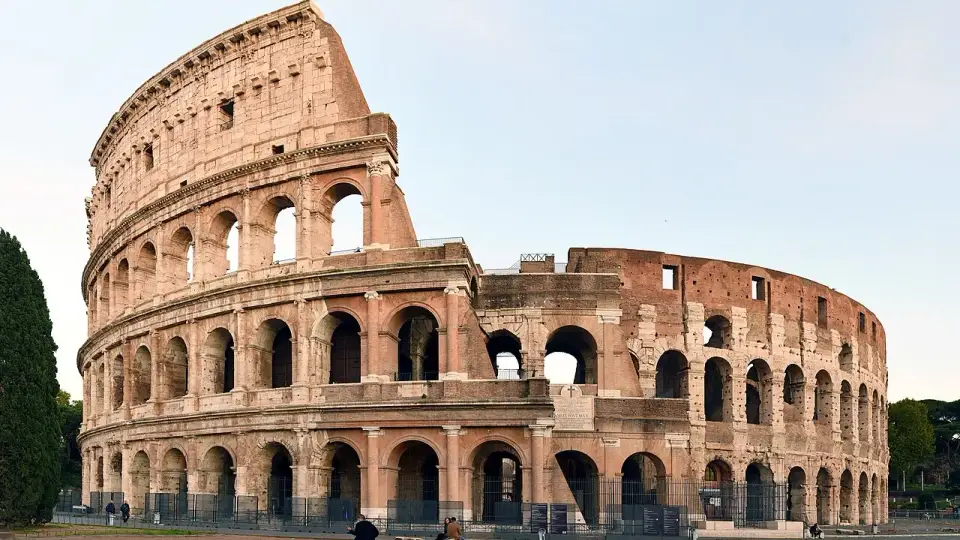
Itineraries through here
 Italy in 10 daysThe Italian Grand TourRome · Florence · Venice · Milan8–13 days4 cities
 Italy and Switzerland in 10 daysFrom the Alps to Rome by trainZurich · Milan · Florence · Rome7–12 days4 cities
 France and Italy in 10 daysThe Louvre, the Uffizi and the VaticanParis · Florence · Rome9–13 days3 cities
 Classic Europe in 15 daysFirst time in EuropeLondon · Paris · Florence · Rome12–17 days4 cities
 Italy in 15 daysFrom the Cinque Terre to the Amalfi CoastMilan · Cinque Terre · Florence · Rome · Amalfi Coast11–17 days5 cities