Italy
Cinque Terre
Five villages between the sea and the vineyards, linked by train, boat and trail
Days Start with the basic programme and choose extensions for the time you have.
How the guide reaches this number
On the first day I'd do the southern end: Riomaggiore early, the Via dell'Amore at the 9 a.m. slot, Manarola and the Punta Bonfiglio viewpoint, and Corniglia in the afternoon. On the second, Vernazza first thing in the morning, before the harbor fills up, and Monterosso in the afternoon, with the old village, the Capuchin convent and the beach at Fegina. I'd go from Vernazza to Monterosso on the trail if the park confirms it is open; if not, by boat until November 1, which shows you the villages from the sea, and by train after that. With a third day, I'd take the boat to Porto Venere, which is part of the same UNESCO site. With one day only, I'd do the Via dell'Amore and Manarola in the morning and finish the afternoon in Vernazza. I wouldn't build the trip around crossing the five villages on foot: in 2026 the park closed sections of the coastal trail for inspection, and the train is what secures the itinerary. For beach days, I'd stay in Monterosso, the village with the longest beaches.
2–3
When May, June and September; in July and August the average high in La Spezia reaches 28.9 °C, and October through December are the rainiest months, with alerts that close the trails
How the guide reaches this number
The climate is Mediterranean and mild. In La Spezia, the 1961–1990 normal gives highs of 11.0 °C and lows of 4.2 °C in January, and highs of 28.9 °C and lows of 19.7 °C in July. Rain is concentrated in autumn and early winter: 164 mm in October, 201 mm in November and 200 mm in December, against 36 mm in July and 51 mm in June. This is the figure that weighs most on a trip, because heavy rain closes the slope: with a yellow weather alert the park advises against the trails and may suspend sales of the Trekking Card, and with an orange or red alert it closes the whole network and suspends sales of all cards; in September 2026 there were two orange alerts and, after them, the park announced the closure of the Corniglia–Monterosso section for inspection. May, June and September combine little rain and moderate warmth for walking; in July and August the sun-exposed trails are more tiring. Demand also has a calendar: the park charges more for the trail card on peak days of the park's 2026 calendar (Easter, April 25 and 26, holidays and weekends in May, early June and the weekends of September 12 to 27), and Trenitalia applies three price bands to trips between the villages from March 14 to November 1. Regular boats stop after November 1, and the Via dell'Amore closes at 6 p.m. starting October 26, 2026.
Per person/day Budget about 81 EUR; mid-range about 170 EUR; comfortable about 341 EUR per person, based on spending reported by travelers to Budget Your Trip (consulted in October 2026).
How the guide reaches this number
Per person per day: accommodation, meals, urban transport, visits and a small allowance for extras. Flights excluded; larger purchases vary. Editorial estimate, not a quote.
 What Nilo thinks
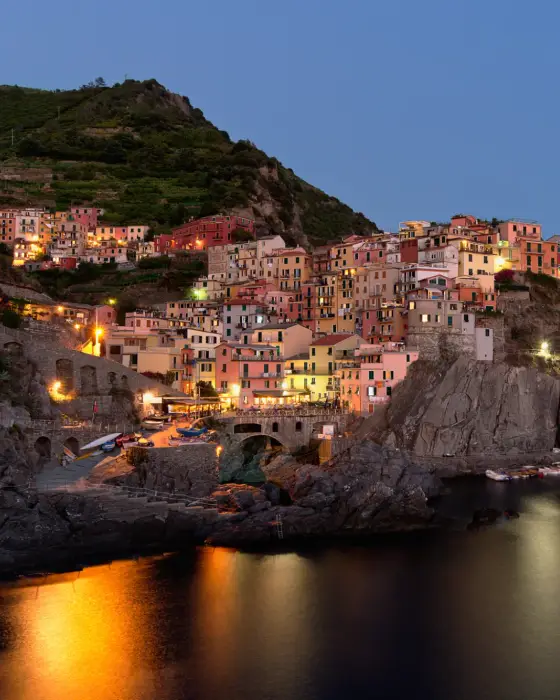
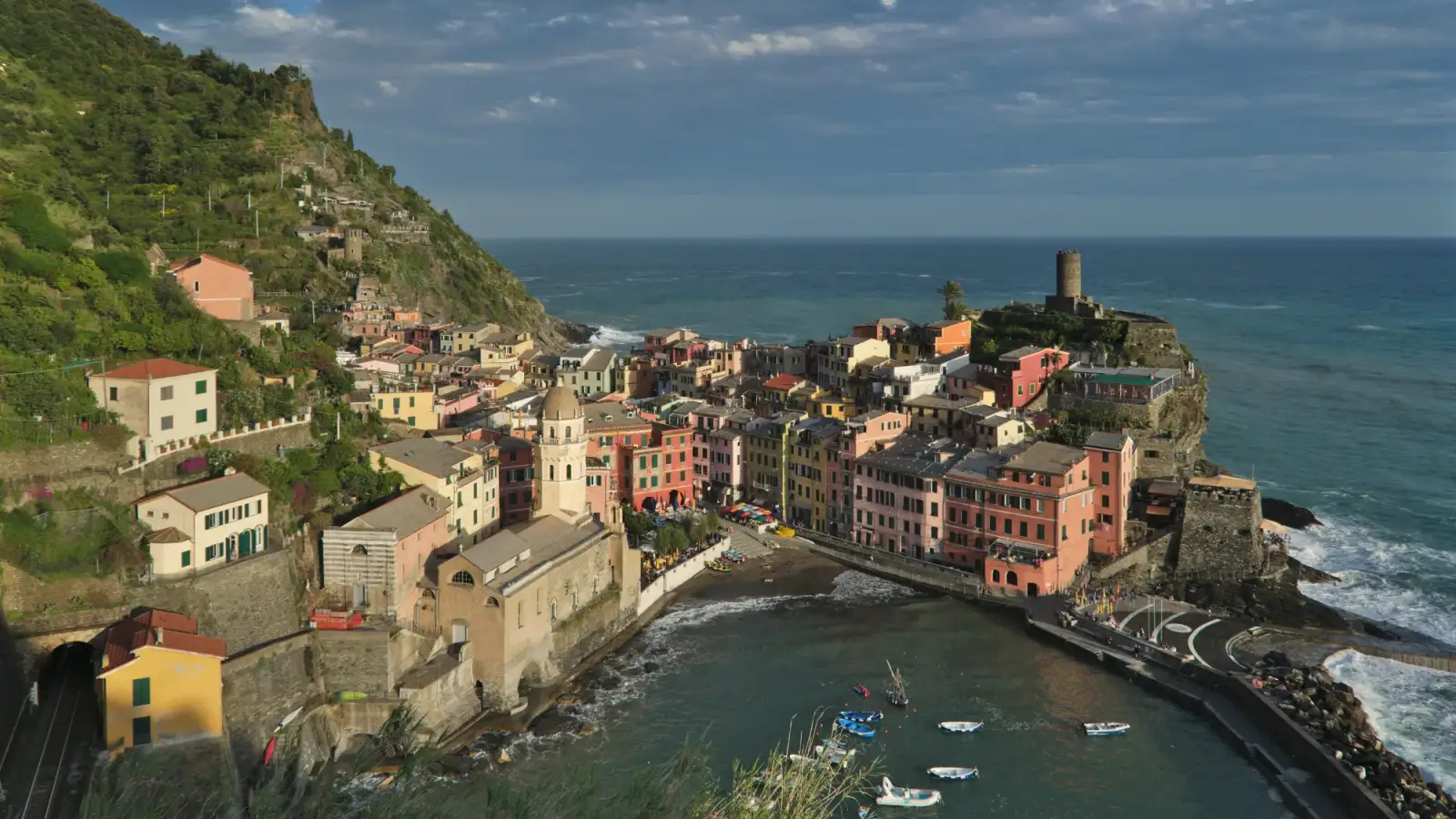
I'd stay two days in the Cinque Terre, sleeping both nights in the same place, in one of the villages or in La Spezia, because the train links everything in under half an hour and changing hotels with a suitcase on the stairs isn't worth it. On the first day I'd do the southern end: Riomaggiore early, the Via dell'Amore at the 9 a.m. slot, Manarola and the Punta Bonfiglio viewpoint, and Corniglia in the afternoon. On the second, Vernazza first thing in the morning, before the harbor fills up, and Monterosso in the afternoon, with the old village, the Capuchin convent and the beach at Fegina. I'd go from Vernazza to Monterosso on the trail if the park confirms it is open; if not, by boat until November 1, which shows you the villages from the sea, and by train after that. With a third day, I'd take the boat to Porto Venere, which is part of the same UNESCO site. With one day only, I'd do the Via dell'Amore and Manarola in the morning and finish the afternoon in Vernazza. I wouldn't build the trip around crossing the five villages on foot: in 2026 the park closed sections of the coastal trail for inspection, and the train is what secures the itinerary. For beach days, I'd stay in Monterosso, the village with the longest beaches.The five villages of the Cinque Terre huddle at the bottom of narrow valleys that drop into the Ligurian Sea, with painted tower houses and, all around, whole hillsides cut into vine terraces. They did not begin with fishermen: in the 11th century, people from the interior came down the ridge and built these dry-stone steps to plant grapes and olives, and the sea came later. Until 1874 you could only arrive by mule or by boat; today the train goes from tunnel to tunnel and links Riomaggiore to Monterosso in under twenty minutes. Monterosso has the beaches and the summer house of Eugenio Montale, who put this coast in his poems; Vernazza has a natural harbor and a Genoese castle above it; Corniglia stands alone on high, 377 steps from the station; Manarola and Riomaggiore are linked by the Via dell'Amore, a path cut into the rock that reopened in 2024. The slopes are unstable: with heavy rain there are landslides, and that is why the park charges for the trails, controls entry to the Via dell'Amore and closes paths when there is an alert.
Quick facts
- Population
- 3,221 residents in the three municipalities on May 31, 2026: Monterosso al Mare 1,301, Vernazza 670 (with Corniglia) and Riomaggiore 1,250 (with Manarola); the municipalities also include hillside hamlets (ISTAT demographic balance, via Wikipedia)
- Founding
- The present villages took shape in the 11th century; the oldest document that mentions the region dates from March 1056, drawn up in Monterosso
- Country and region
- Italy, Liguria, province of La Spezia, on the Riviera di Levante; UNESCO World Heritage Site since 1997 and National Park since 1999
- Language
- Italian; Ligurian is also spoken in the villages, with local variants that differ between neighboring villages, such as Riomaggiore and Manarola
- Currency
- Euro (EUR, €)
- Time zone
- UTC+1 in winter and UTC+2 during European summer time, from the end of March to the end of October
- Best time to go
- May, June and September; in July and August the average high in La Spezia reaches 28.9 °C, and October through December are the rainiest months, with alerts that close the trails
- Average cost per day
- Budget about 81 EUR; mid-range about 170 EUR; comfortable about 341 EUR per person, based on spending reported by travelers to Budget Your Trip (consulted in October 2026).
When to go
May, June and September; in July and August the average high in La Spezia reaches 28.9 °C, and October through December are the rainiest months, with alerts that close the trails
How the year changes
The climate is Mediterranean and mild. In La Spezia, the 1961–1990 normal gives highs of 11.0 °C and lows of 4.2 °C in January, and highs of 28.9 °C and lows of 19.7 °C in July. Rain is concentrated in autumn and early winter: 164 mm in October, 201 mm in November and 200 mm in December, against 36 mm in July and 51 mm in June. This is the figure that weighs most on a trip, because heavy rain closes the slope: with a yellow weather alert the park advises against the trails and may suspend sales of the Trekking Card, and with an orange or red alert it closes the whole network and suspends sales of all cards; in September 2026 there were two orange alerts and, after them, the park announced the closure of the Corniglia–Monterosso section for inspection. May, June and September combine little rain and moderate warmth for walking; in July and August the sun-exposed trails are more tiring. Demand also has a calendar: the park charges more for the trail card on peak days of the park's 2026 calendar (Easter, April 25 and 26, holidays and weekends in May, early June and the weekends of September 12 to 27), and Trenitalia applies three price bands to trips between the villages from March 14 to November 1. Regular boats stop after November 1, and the Via dell'Amore closes at 6 p.m. starting October 26, 2026.
Nilo's tips
Reserve the Via dell'Amore together with the card
The Via dell'Amore is included in both park cards, the trail card and the train card, but the time slot has to be reserved. When buying at card.parconazionale5terre.it, you can choose the time on the spot or save a voucher to reserve later. I'd choose 9 a.m., the opening, to enter in Riomaggiore before the crowds and come out in Manarola with the whole day ahead.
Check the trails the day before and in the morning
The situation changes with the rain: in September 2026 the park announced the closure of Corniglia–Vernazza–Monterosso for geological inspection, and the municipality of Monterosso had already closed the Servano section in August, leaving the entrance via Via Corone. In mid-October, the "Rete sentieristica" page and the park's notices did not give the same answer about these sections, so I'd confirm at an information office in the stations, from La Spezia to Levanto, or in the free app Guida ai sentieri delle Cinque Terre. With a yellow alert, I'd leave the trail for another day.
Do the train math before you buy
Each single trip between the villages costs €5, €8 or €10 depending on the band of the day, and the one-day Treno MS Card costs €22, €29.50 or €35 in the corresponding band, with the trail included; from November 2 to December 31, it costs €17.30. With three train legs and the Via dell'Amore on the same day, the train card already pays off. If you're only going to walk and come back at night, remember that on regional trains leaving Levanto or La Spezia Centrale after 7:30 p.m. the single ticket is charged band A, the cheapest.
Corniglia needs its own plan
It is the only village without a landing, so it is not part of a boat itinerary. From the station, you either climb the 377 steps of the Lardarina or take the park bus, included in both cards. I'd go up by bus and come down by the staircase.
Use the restroom with the card
The restrooms at the Riomaggiore, Manarola, Corniglia, Vernazza and Monterosso stations are free for those with the Cinque Terre Card and cost €1 for everyone else.
Explore the map
Explore the map, read about the other places and plan your travel days in the app.
Open the appWhat to see
Cinque Terre: A narrow strip between the mountains and the sea
The vine and olive terraces held up by dry-stone walls also regulate the water that runs down the slopes. It is where the Via dell'Amore begins and where the church of San Giovanni Battista, from 1340, stands.
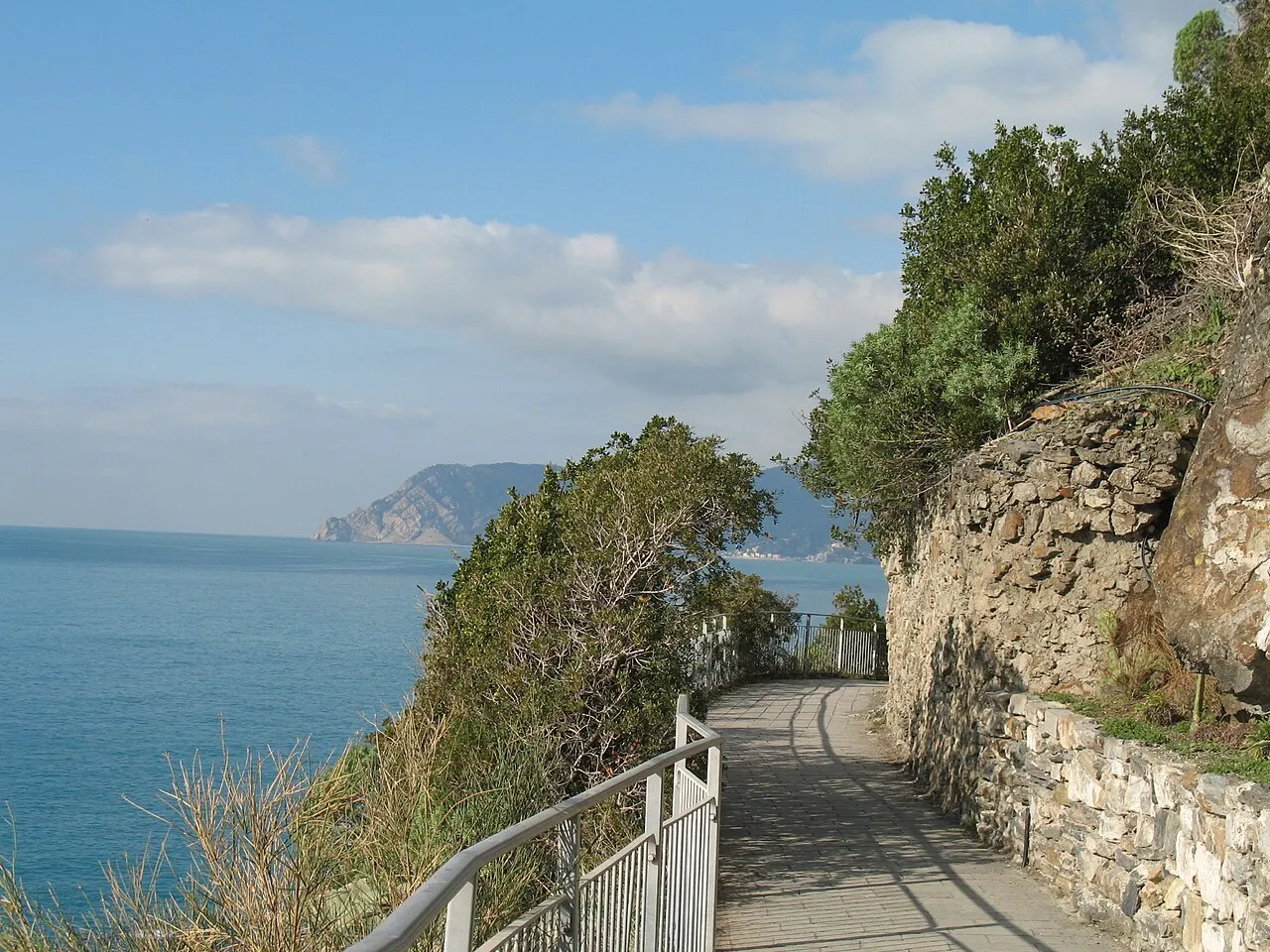
Via dell'Amore
A path of a little over 1 km cut into the rock about thirty meters above the sea, between Riomaggiore and Manarola, born from the railway works of the 1920s and opened as a promenade in the 1930s. It closed after the 2012 landslide and reopened in full on July 26, 2024. Today it is one-way, from Riomaggiore to Manarola, with entry by reserved time slot and about 30 minutes to walk. It requires the Cinque Terre Card, trail or train version, with the time slot reserved on the park's website or at the information offices. It is open from 9 a.m. to 9 p.m. from March 29 to October 24, 2026, and from 9 a.m. to 6 p.m. from October 26, 2026 to March 28, 2027.
The rock-cut path of just over 1 km between Riomaggiore and Manarola is the coast's easiest and most famous stretch, fully reopened in 2024 after twelve years closed; it takes about 30 minutes with a reserved time slot. The route is one-way, from Riomaggiore to Manarola.
Check access

Punta Bonfiglio
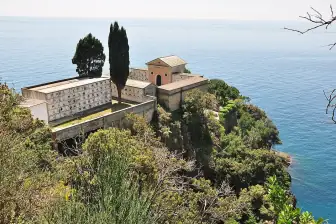
The promontory next to Manarola, with a path opened in 1968 between the Marina and the Palaedo landing and the village's small cemetery at the top, where verses by Vincenzo Cardarelli are engraved. From here and from the end of Via Belvedere, which ends in a small square dedicated to Eugenio Montale, you see all of Manarola on its rock.
The Punta Bonfiglio path, opened in 1968, and the end of Via Belvedere offer a view of all of Manarola on its rock, just a few minutes from the exit of Via dell'Amore.
Check access
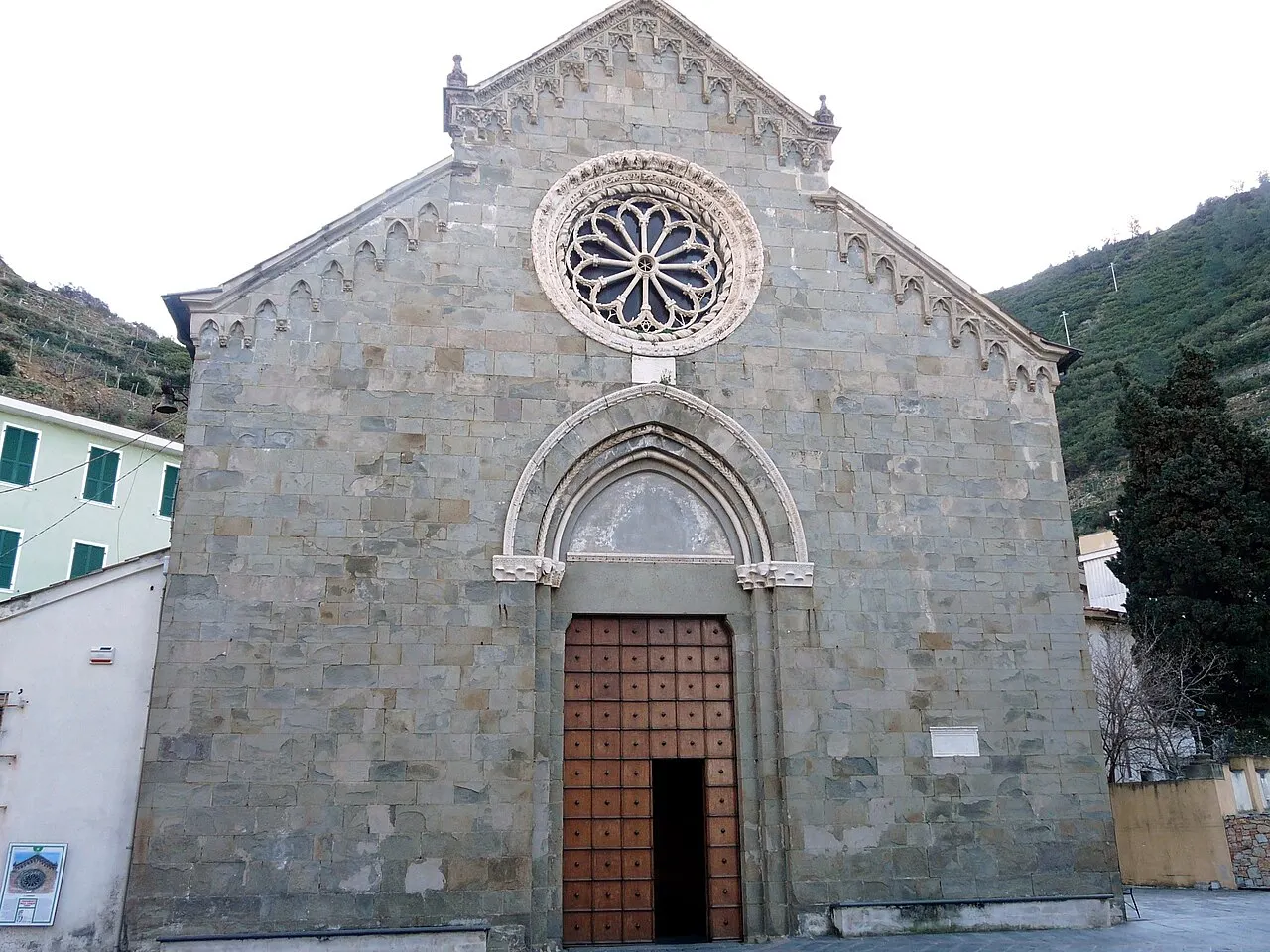
Chiesa di San Lorenzo (Manarola)
A Gothic parish church from 1338, at the top of the village, with a facade of local sandstone and a Carrara marble rose window from 1375. On the square there are also the bell tower, separate from the church, and the oratory of the Disciplinanti.
The Gothic parish church of 1338, with its Carrara marble rose window of 1375, stands at the top of the village and is a natural stop on the climb to the viewpoints.
Check access
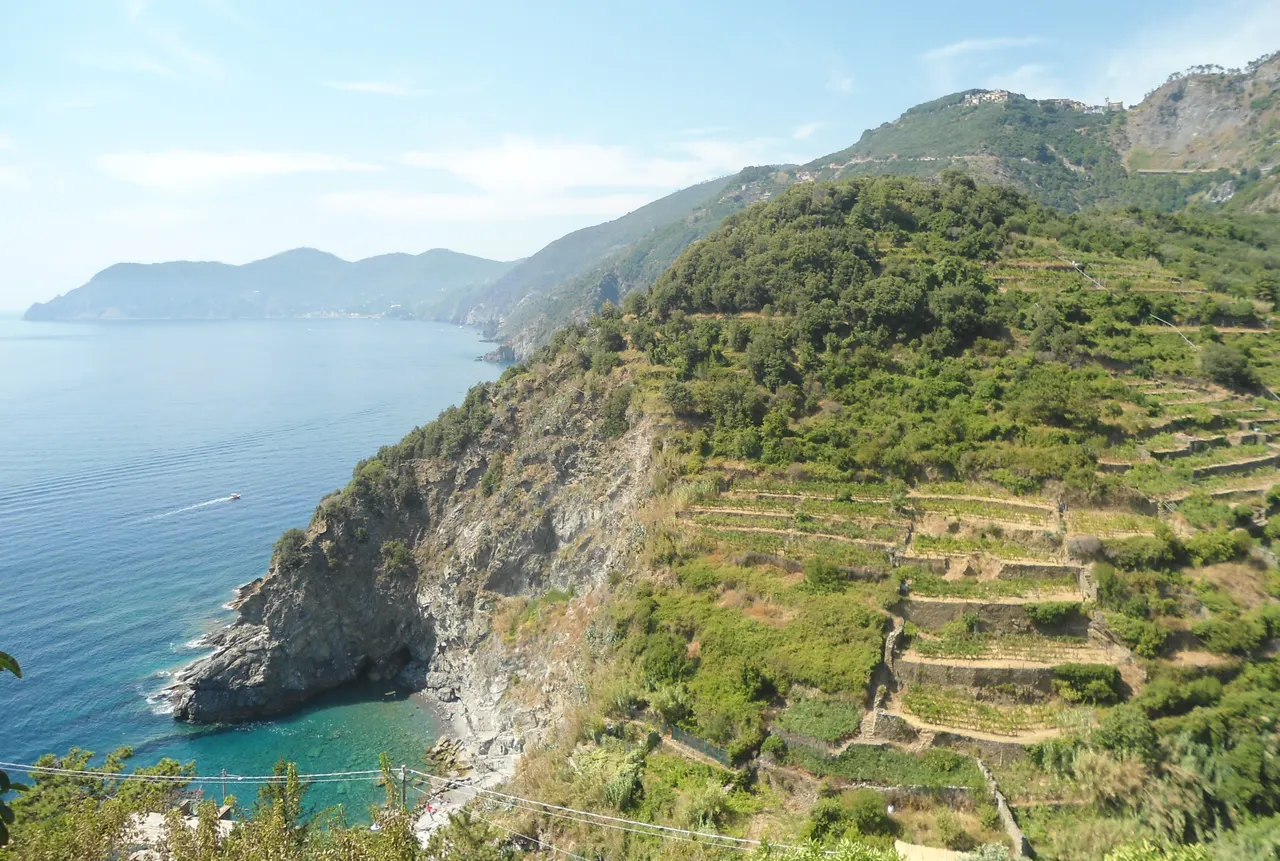
Terrazza di Santa Maria
The viewpoint of Corniglia, about 90 m above sea level, at the end of Via Fieschi, the main street that leaves the church of San Pietro (1354). From the terrace you see the coast of the Cinque Terre and, below, the village's small marina. To get here from the station, it is 377 steps up the Lardarina staircase or the park bus.
The lookout at about 90 m, at the end of Corniglia's main street, shows the Cinque Terre coast from a higher vantage point than the other villages, and the surrounding village is the quietest of the five.
Check access

Castello Doria
A medieval fortress on the spur of rock, about 70 m high, that closes Vernazza's harbor to the south. The first records of the castle date from the 13th century, but its first core is attributed to the 11th, and the cylindrical tower, restored in the 20th century, is the oldest part. Below it, the Belforte bastion guarded the harbor entrance. Today the castle is a museum and exhibition space; check hours and admission with the municipality of Vernazza.
The castle, whose first core is attributed to the 11th century, stands on the 70 m spur above Vernazza's harbor; today it is a museum and exhibition space, with opening hours to check with the municipality.
Check access
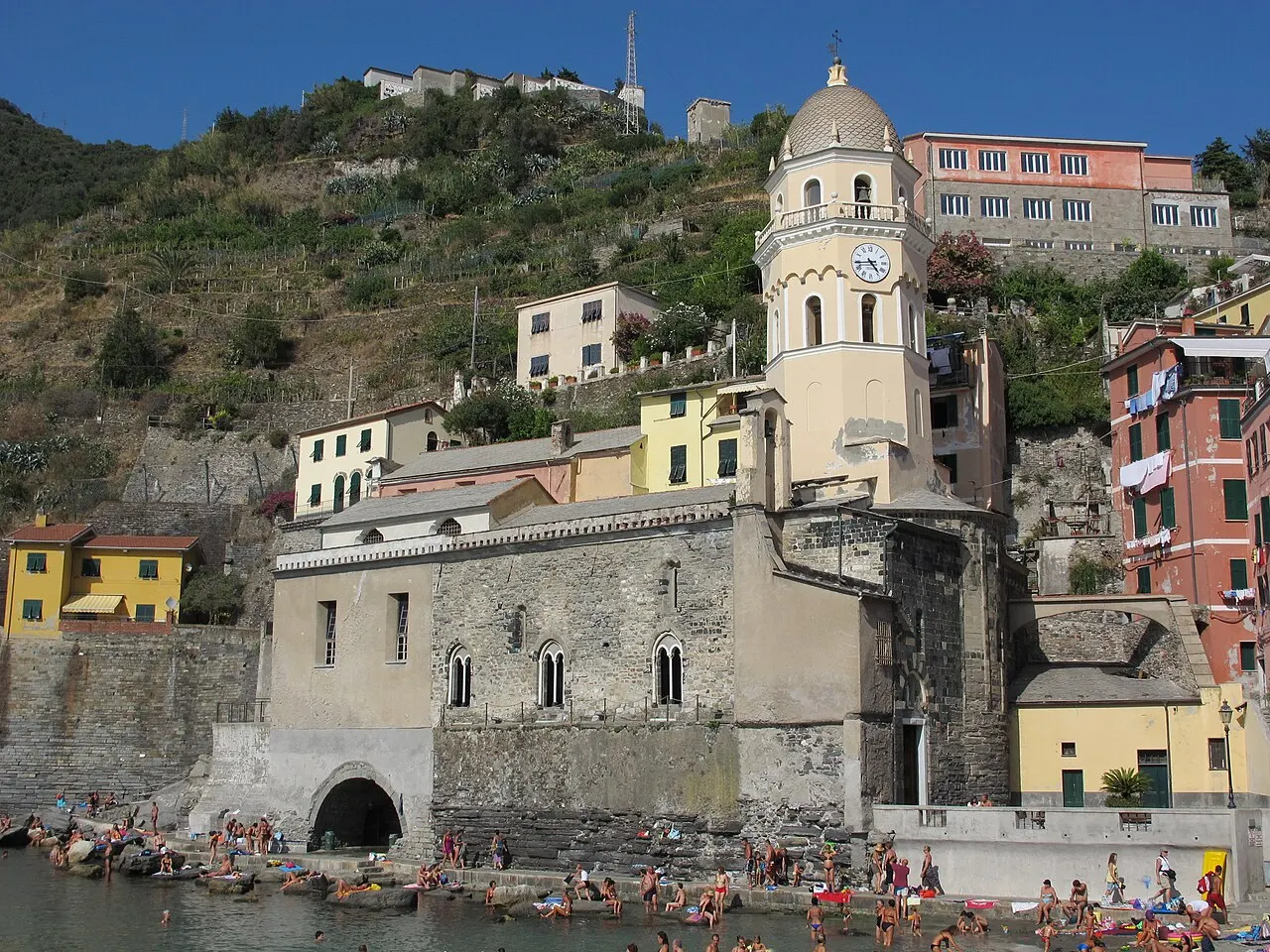
Chiesa di Santa Margherita d'Antiochia
Vernazza's parish church, begun in 1318, stands on the harbor square, with its entrance on the apse side and an octagonal tower that ends in a dome. Inside it keeps its three Gothic naves.
The 1318 church on the harbor square, with its entrance on the apse side and octagonal tower, is on the route of any visit to Vernazza and takes only a few minutes to see.
Check access

Sentiero Azzurro
Coastal trail number 2, today the Sentiero Verde Azzurro, which links the villages halfway up the slope. The Vernazza–Monterosso section is 3.7 km with 217 m of elevation gain and takes about 2 hours; Corniglia–Vernazza is 4.1 km and about 1 hour 30 minutes; both are rated for experienced hikers. On September 10, 2026 the park announced the closure of the Corniglia–Vernazza–Monterosso section of the Sentiero Verde Azzurro, pending a geological inspection, and as of October 16 it had not published a reopening notice; on the same date, the park's "Rete sentieristica" page showed only the Manarola–Corniglia section as closed. Check at a park office before setting out. When open, entry requires the Cinque Terre Card, and footwear must be closed with a non-slip sole.
The 3.7 km Vernazza–Monterosso section of the coastal trail takes about two hours and shows the villages from above; the park announced its closure on September 10, 2026 for a geological inspection, and it belongs in the itinerary only if a park office confirms it is open.
Check access
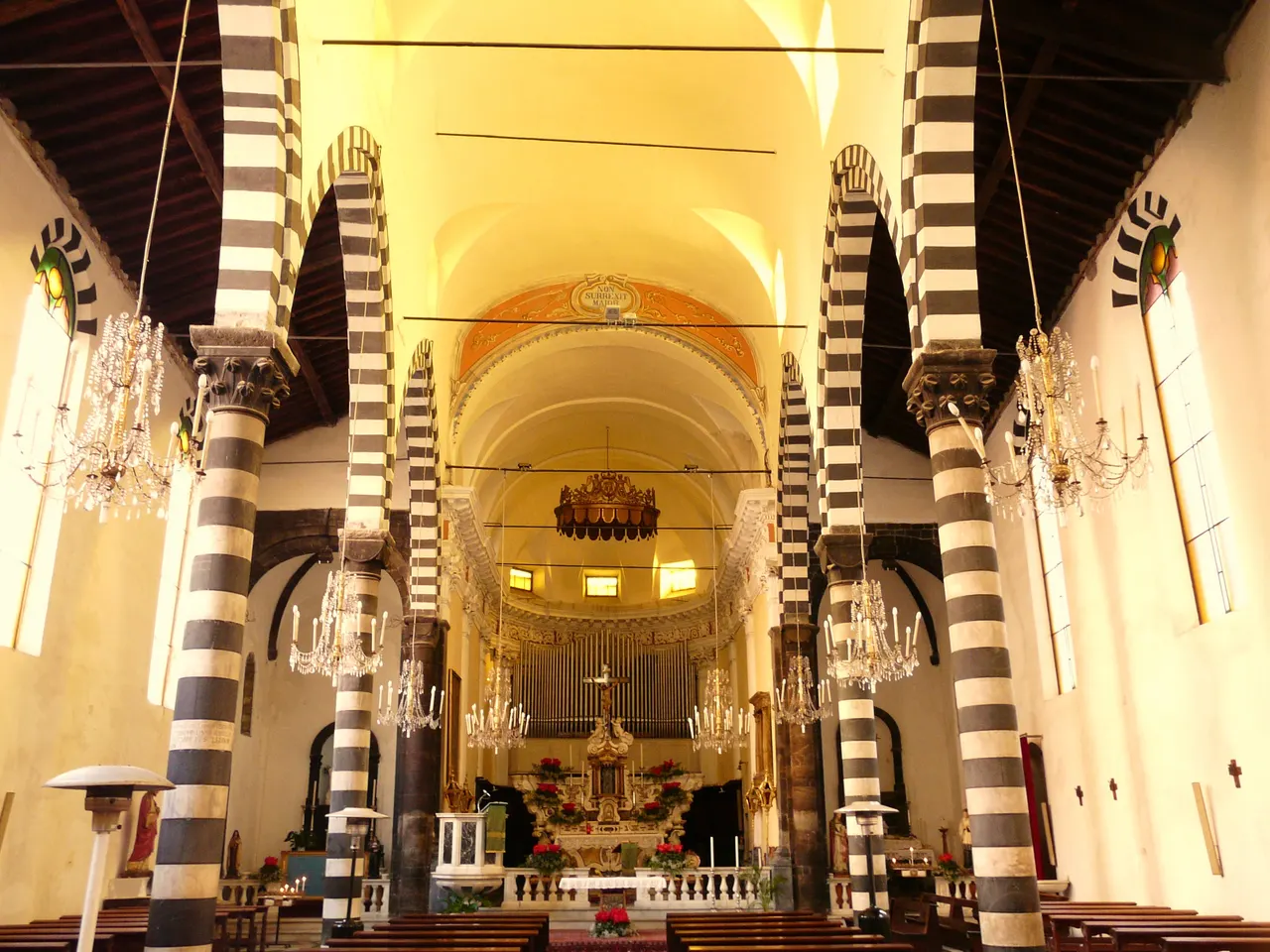
Chiesa di San Giovanni Battista (Monterosso al Mare)
The church of Monterosso's old village, built from 1282 to 1307, with a facade in white and black stripes in the Genoese style, a rose window and a bell tower that was a medieval tower with crenellations. In the 2011 flood, more than two meters of water and mud entered the church.
The church of 1282–1307, with its white-and-black striped facade and bell tower converted from a medieval tower, is the center of Monterosso's old village.
Check access

Convento dei Cappuccini (Monterosso al Mare)
Convent and church of San Francesco on the hill between the old village and Fegina, built from 1619 to 1622. It holds a Crucifixion attributed to the Flemish painter Anthony van Dyck. It lies on the way between the two sides of Monterosso, next to the 16th-century Torre Aurora.
The convent of 1619–1622 holds a Crucifixion attributed to van Dyck and stands on the hill you cross on foot between the old village and Fegina.
Check access
Nilo’s itinerary
Start with the basic programme and choose extensions for the time you have.
Plan my days in the app ↗Day 1 · Riomaggiore, Via dell'Amore, Manarola and Corniglia
The day before, reserve the 9 a.m. slot for the Via dell'Amore together with the Cinque Terre Card at card.parconazionale5terre.it, and check on the park's website that there is no weather alert.
Take the regional train to Riomaggiore around 8 a.m. (from La Spezia Centrale it is 6 to 8 minutes) and climb the main street to the church of San Giovanni Battista, from 1340.
At 9 a.m., enter the Via dell'Amore and walk the one-way path to Manarola, in about 30 minutes.
In Manarola, climb to the church of San Lorenzo (1338) and then follow Via Belvedere and the Punta Bonfiglio path, from where you see the whole village.
Have lunch in Manarola and take the train to Corniglia, the next station.
From the station, climb the 377 steps of the Lardarina or take the park bus, included in the card, and walk along Via Fieschi to the Terrazza di Santa Maria.
Return by train to where you are sleeping. With three train rides and the Via dell'Amore on the same day, the Treno MS Card costs less than single tickets added to the trail card.
Day 2 · Vernazza and Monterosso
Take the train early to Vernazza, before the harbor fills up, and see the church of Santa Margherita d'Antiochia (1318) on the harbor square.
Climb to the Castello Doria, on the spur of rock about 70 m high that closes the harbor to the south; today it is a museum and exhibition space, and the opening hours are checked with the municipality of Vernazza.
Around 11 a.m., continue to Monterosso: on foot along the Sentiero Azzurro (about 2 hours, 3.7 km) only if a park office confirms that the section is open; otherwise, by boat (€10, from March 28 to November 1) or by train.
In Monterosso's old village, see the church of San Giovanni Battista (1282–1307) and climb to the Convento dei Cappuccini, where the Crucifixion attributed to van Dyck is kept.
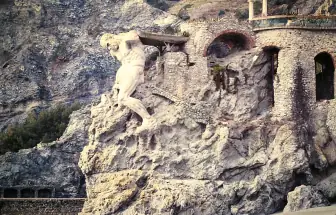
Go down the other side of the hill, passing the Torre Aurora, to Fegina, the beach and the Statua del Gigante.
Have dinner with Monterosso anchovies and return by train; on the October 2026 timetable, the last regional to La Spezia left at 11:33 p.m.




If you stay longer
Day 3 · Porto Venere
Day trip
At the tip of the Gulf of La Spezia, it is part of the same UNESCO site, with the church of San Pietro on the rock and the Genoese castle. By boat, it leaves from Monterosso or Vernazza for €22 one way, with stops at the villages, and from La Spezia for €8; on the winter schedule, the Monterosso–Porto Venere leg takes 1 hour. The regular boats run until November 1, and from November 2 to December 8 there is only the Cinque Terre Trip, with one departure a day.
Food
Acciughe di Monterosso
Anchovies caught at night by lampara light, traditionally from June 29, Saint Peter's Day, and preserved in salt in Monterosso; the salted anchovies are a Slow Food Presidium. In restaurants they also appear fried, stuffed and marinated.
Focaccia
The Ligurian fugassa, a flat bread with olive oil and salt, sold by the piece in bakeries and eaten standing up. It has variants with onion.
Trofie al pesto
Liguria's short, twisted pasta with Genoese pesto, a raw sauce of basil, salt, pine nuts, garlic, Parmesan and pecorino cheese, and olive oil. It often comes cooked with potato and green beans.
Farinata
A thin tart of chickpea flour, water, salt and olive oil, baked in a wood-fired oven in a copper pan and cut into slices, with a golden crust on top.
Torta di riso
The savory tart of rice, cheese and egg, the festival dish of Riomaggiore on the day of Saint John the Baptist and also of Corniglia. It shows that the villages were farming communities before they were fishing ones.
Minestra di campo
Riomaggiore's winter soup, with potato and the herbs that grow among the vineyards on the terraces, seasoned with olive oil.
Mesciua
La Spezia's soup of beans, chickpeas and wheat, soaked and cooked together, served with olive oil and black pepper. The name means "mixture" in the local dialect.
Cinque Terre and Sciacchetrà
The dry white wine with the Cinque Terre designation of origin comes from the terraced vineyards of Riomaggiore, Vernazza and Monterosso. Sciacchetrà is the sweet version made from sun-dried grapes, mainly the Bosco grape, labeled "riserva" after three years; it is also a Slow Food Presidium.
Where to eat
- Monterosso al Mare · $$
Monterosso anchovies, salted, fried or stuffed, in the restaurants of the old village.
- Any village · $
Focaccia and farinata bought by the piece at a bakery, to eat standing up or take on the trail.
- Riomaggiore and Corniglia · $$
Torta di riso and, in winter, minestra of field herbs, the peasant cooking of the villages.
- Manarola and Riomaggiore · $$
A glass of Sciacchetrà, the sweet raisin-grape wine of the terraces, to end the dinner.
- La Spezia · $
Mesciua, the city's soup of beans, chickpeas and wheat, and the menu of a neighborhood restaurant.
$: up to €15 per meal at an inexpensive restaurant (Numbeo, La Spezia, updated October 2, 2026) · $$: about €35 per person, half of the three-course dinner for two at €70 at a mid-range restaurant (Numbeo, La Spezia, October 2, 2026) · $$$: over €35 per person, without drinks · 2026-10-15
Day trips
Porto Venere
At the tip of the Gulf of La Spezia, it is part of the same UNESCO site, with the church of San Pietro on the rock and the Genoese castle. By boat, it leaves from Monterosso or Vernazza for €22 one way, with stops at the villages, and from La Spezia for €8; on the winter schedule, the Monterosso–Porto Venere leg takes 1 hour. The regular boats run until November 1, and from November 2 to December 8 there is only the Cinque Terre Trip, with one departure a day.
Levanto via Punta Mesco
Trail 590 climbs from Monterosso to the ruins of the hermitage of Sant'Antonio del Mesco, at 311 m, in about 1 hour 15 minutes, and trail 591 descends from there to Levanto in another 2 hours 15 minutes. The return is by train, 4 to 8 minutes to Monterosso. It is a walking alternative to the trail between the villages; check the situation at a park office before setting out.
Where to begin
Riomaggiore, Via dell'Amore, Manarola and Corniglia
The day before, reserve the 9 a.m. slot for the Via dell'Amore together with the Cinque Terre Card at card.parconazionale5terre.it, and check on the park's website that there is no weather alert.
Vernazza and Monterosso
Take the train early to Vernazza, before the harbor fills up, and see the church of Santa Margherita d'Antiochia (1318) on the harbor square.
Money
The currency is the euro. The biggest cost specific to the region is access: the Trekking Card costs €10 a day (€15 on peak days) and the Treno MS Card, which includes the trains between Levanto and La Spezia, €22 to €35 a day from March 14 to November 1, 2026, depending on the calendar band, and €17.30 from November 2 to December 31. Without a card, each train trip between the villages costs €5 to €10; anyone who makes five trips in a day, or three trips plus the Via dell'Amore, spends more than with the train card of the same band. The restrooms at the village stations cost €1 for people without a card. The boat is the most expensive option: €42 for the day ticket, €10 to €30 for a single trip. For food, the nearest reference with published data is La Spezia: a meal at an inexpensive restaurant at €15, a three-course dinner for two at a mid-range restaurant at €70, a cappuccino at €1.57 and a 0.5 l beer at €5 (Numbeo, updated October 2, 2026); in the villages, which live off tourism, no average is published.
Getting there and between the villages
Guide estimate
Scroll to compare all columns
| Route | Time | Price |
|---|---|---|
| Pisa airport → La Spezia · Pisa Mover and train | 1h11 to 1h48 | €15.40 to €18.40 |
| Genoa Piazza Principe → Monterosso · direct InterCity | 1h18 | €11 |
| La Spezia → Florence · train, usually with one change | 1h45 to 2h47 | price on Trenitalia |
| La Spezia → Riomaggiore · regional train | 6 to 8 min | Cinque Terre fare: €5, €8 or €10 per trip |
| Riomaggiore → Monterosso · regional train | 14 to 17 min | Cinque Terre fare: €5, €8 or €10 per trip |
| Monterosso → Levanto · regional train | 4 to 8 min | Cinque Terre fare: €5, €8 or €10 per trip |
| Trekking Card · trails, park buses and restrooms | per day | €10 per day, €15 on peak days |
| Treno MS Card · trails and unlimited train | per day | €22, €29.50 or €35 per day |
| Monterosso → Vernazza · boat, one way | depends on the sea | €10 |
| Monterosso or Vernazza → Porto Venere · boat | depends on the sea | €22 |
| Line 02 · adult day boat ticket | all day | €42 (afternoon, €28) |
Getting there and around
Getting here: train to La Spezia, Monterosso or Levanto
For those arriving by air, the options are the airports of Pisa (PSA) and Genoa. From Pisa, the Pisa Mover goes to Pisa Centrale station, and from there the train reaches La Spezia Centrale: in a Trenitalia search made on October 15, 2026 for a weekday that month, the trip from the airport to La Spezia took 1 hour 11 minutes to 1 hour 48 minutes, for €15.40 to €18.40. From Genoa Piazza Principe, there was a direct InterCity to Monterosso in 1 hour 18 minutes (€11). From La Spezia to Florence (Santa Maria Novella), the options that same day took 1 hour 45 minutes to 2 hours 47 minutes, usually with one change. Driving doesn't help: almost all parking in the villages is reserved for residents, and you go down to the center on foot.
The regional train between the villages
The La Spezia–Levanto line stops at all five villages, and the train is the simplest way to go from one to another. On the timetable in force in October 2026, there were trains from La Spezia Centrale to Riomaggiore every 30 minutes or less between 8 a.m. and 11:30 a.m., taking 6 to 8 minutes; Riomaggiore to Monterosso took 14 to 17 minutes, and Monterosso to Levanto, 4 to 8. From March 14 to November 1, 2026 the Cinque Terre Fare applies: €5, €8 or €10 per trip, depending on band A, B or C of the Trenitalia calendar, and half price for children aged 4 to 11. The ticket is good for one trip only, with no stop in between, and must be validated before boarding. On regional trains leaving Levanto or La Spezia Centrale after 7:30 p.m., band A is charged. The last regional from Monterosso to La Spezia left at 11:33 p.m.; after it there was an InterCity at 12:04 a.m., with its own €8.50 ticket, outside the Cinque Terre Fare and the cards, and the next regional left at 5:05 a.m.
Cinque Terre Card: trail, train and bus
The park sells two cards. The Trekking Card gives access to the Sentiero Verde Azzurro between Monterosso, Vernazza and Corniglia and to the Via dell'Amore, to the park buses within the villages and to the station restrooms; it costs €10 a day for adults and €15 on peak days of the park's 2026 calendar (Easter, April 25 and 26, holidays and weekends in May, early June and the weekends of September 12 to 27); for ages 4 to 11, €7, or €10 on peak days. The Treno MS Card adds unlimited second-class train travel between Levanto and La Spezia: €22, €29.50 or €35 per day, depending on the band, from March 14 to November 1, 2026, and €17.30 from November 2 to December 31. The train card is named and non-transferable, and both are bought at the park offices in the stations from La Spezia to Levanto or at card.parconazionale5terre.it; the train card also from Trenitalia. The Via dell'Amore requires, in addition to the card, the reservation of a time slot.
By boat, for those in no hurry
From March 28 to November 1, 2026, Line 02 of the Consorzio Marittimo Turistico Cinque Terre Golfo dei Poeti links Riomaggiore, Manarola, Vernazza and Monterosso with Levanto, Porto Venere, La Spezia and Lerici; Corniglia has no landing. On the 2026 schedule, the day ticket costs €42 per adult and the afternoon ticket €28; Monterosso–Vernazza is €10 one way only, and Monterosso or Vernazza to Porto Venere, €22. In March, through the 27th, and from November 2 to December 8, there is only the Cinque Terre Trip, with one departure a day from La Spezia or Porto Venere and stops at Vernazza and Monterosso (€37 round trip on the winter schedule). The sea shuts down the service on a bad day: the consortium publishes daily notices.
Safety
The real risks here are terrain and weather, not crime. The trails are steep, with loose stone and steps, and the Corniglia–Vernazza and Vernazza–Monterosso sections are rated for experienced hikers. The slope gives way in heavy rain: a landslide injured four tourists on the Via dell'Amore in 2012, and the flood of October 25, 2011 killed four people in the Cinque Terre area. So heed the weather alerts of the Liguria Region (allertaliguria.regione.liguria.it): with a yellow alert the park asks that no one enter the trails and that anyone on them return to the villages, and with orange or red the whole network is off limits. Bring water, a small first-aid kit and something for emergencies, don't walk alone and tell someone your route. In July and August, start early, because the average high passes 28 °C and many stretches have no shade. The emergency number is 112. At night, on the October 2026 timetable, the last regional from Monterosso to La Spezia left at 11:33 p.m.; after it there was only an InterCity at 12:04 a.m., with its own ticket, and the next regional at 5:05 a.m.
Etiquette tips
Wear closed shoes with a grippy sole
The park rules ban open or smooth-soled footwear on the trails and call for closed shoes with a non-slip sole, preferably waterproof and covering the ankle. Anyone who ignores this can be fined under the national protected-areas law.
Follow the direction of the Via dell'Amore
The path is one-way, from Riomaggiore to Manarola, and only authorized categories, such as residents, may return along it. Enter in the time slot you reserved.
Stay on the marked trail
The rules ask that you not leave the marked path and not enter a trail in bad weather. Beyond it are private terraces and vineyards.
Take your trash back and fill a bottle
The park asks each hiker to carry their own trash down the hill and to prefer a reusable bottle to a plastic one.
Tell someone your route
The park's vademecum advises against walking alone and asks that you tell a trusted person your itinerary. If in doubt about the path or the weather, the guidance is to turn back.
Mistakes to avoid
Driving to the villages
Thinking you can park in every village. Almost all spaces are reserved for residents, the way down to the center is on foot, and the train links the five in a few minutes.
Counting on the whole coastal trail
Planning the trip around the walk from Riomaggiore to Monterosso. On September 10, 2026 the park announced the closure of Corniglia–Vernazza–Monterosso for geological inspection, and in mid-October Manarola–Corniglia was listed as closed on the trail network. Check at a park office the day before and treat the train as your main plan.
Wearing sandals on the trail
Going onto the trail in flip-flops, sandals or smooth-soled sneakers. It is banned and can earn a fine, as well as being the wrong footwear for loose stone.
Using one train ticket for two villages
Buying a single ticket and getting off partway. It is good for one trip only, with no intermediate stop, and must be validated before boarding. For several villages on the same day, the Treno MS Card usually works out cheaper.
Waiting for a boat to Corniglia
Corniglia has no landing, and the boat doesn't stop there. You get there by train and, from the station, by the Lardarina staircase or by bus.
Leaving the Via dell'Amore for the last minute
Arriving in Riomaggiore without a reserved time slot. Entry is by time slot with limited places, and without the card and the reservation you can't get in.
Useful phrases
Un biglietto per Monterosso, per favore
A ticket to Monterosso, please
Il sentiero per Vernazza è aperto?
Is the trail to Vernazza open?
A che ora parte l'ultimo treno per La Spezia?
What time does the last train to La Spezia leave?
Ho la Cinque Terre Card con la prenotazione
I have the Cinque Terre Card with the reservation
Dov'è l'imbarco del battello?
Where is the boat landing?
Un pezzo di focaccia, per favore
A piece of focaccia, please
Where to stay
- Monterosso al Mare · Anyone who wants a beach, a flat base and more hotel options · $$$: It is the largest village, with the longest beaches, at Fegina, and with a direct InterCity from Genoa.
- Vernazza · Anyone who wants to wake up at the harbor before the day visitors · $$$: The harbor and the castle are a few steps away, and the village sits in the middle of the train line, one station from Monterosso and from Corniglia.
- Manarola and Riomaggiore · Anyone who will do the Via dell'Amore early · $$: They sit at the southern end, 6 to 8 minutes by train from La Spezia, with the Via dell'Amore between the two. The streets are steep and have stairs, which matters with luggage.
- Corniglia · Anyone who wants quiet and doesn't mind stairs · $$: It sits at the top of the promontory, away from the harbor and the boats. From the station it is 377 steps or the park bus.
- La Spezia · Anyone arriving late, wanting a city or paying less · $: It has the long-distance train station and the boat quay, with a train to Riomaggiore every half hour or less. It is outside the villages and doesn't have their scenery.
$: La Spezia, outside the villages; no published average consulted, compare on booking sites · $$: rooms and guesthouses in the smaller villages; no published average consulted · $$$: hotels in Monterosso and Vernazza; no published average consulted · 2026-10-15
Districts
Riomaggiore
The southernmost village, with tower houses in rows that climb the valley of the Rio Maggiore and a newer neighborhood around the station, in the neighboring valley of the Rio Finale. It is where the Via dell'Amore begins and where the church of San Giovanni Battista, from 1340, stands. It suits anyone who wants the first train stop from La Spezia.
Manarola
A small village on a spur of rock, with the main street over the old stream and the church of San Lorenzo, from 1338, at the top. It is the exit point of the Via dell'Amore and has the Punta Bonfiglio path, with a view over the houses. At Christmas, the hill above the village hosts Mario Andreoli's illuminated nativity scene.
Corniglia
The only one of the five without a harbor, on top of a promontory about 90 m high. From the station you climb the Lardarina staircase, 377 steps in 33 flights, or take a bus. It has the church of San Pietro, from 1354, and the Terrazza di Santa Maria viewpoint.
Vernazza
The village of the natural harbor that Genoa fortified in the Middle Ages. The harbor square brings together the church of Santa Margherita d'Antiochia and the tower of the Castello Doria.
Monterosso al Mare
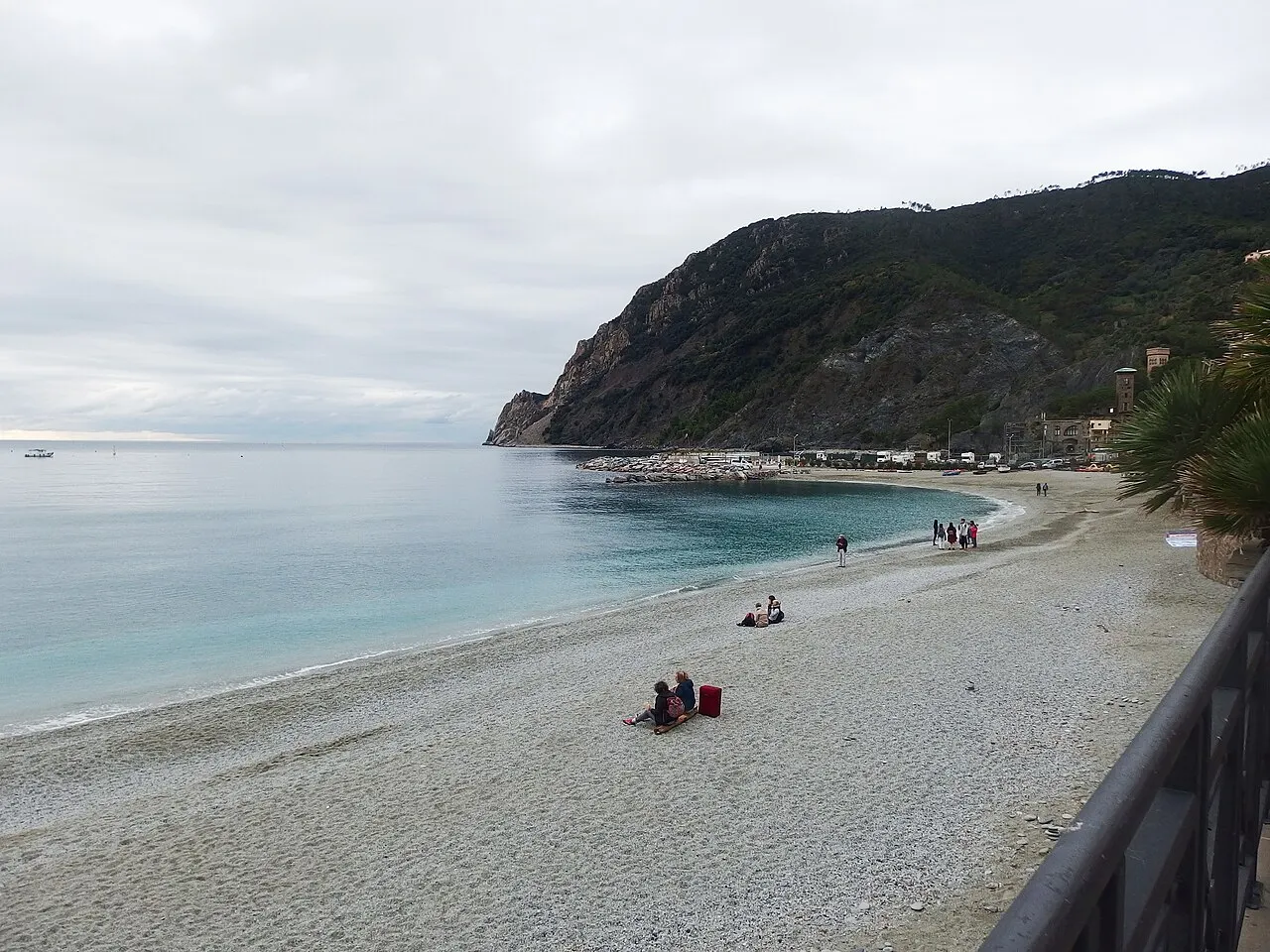
The largest and northernmost, divided by a short tunnel between the old village, around the church of San Giovanni Battista, and Fegina, the beach neighborhood where the station is. It has the longest beaches of the five villages and suits anyone who wants the sea.
La Spezia
A city of 92,706 residents (May 31, 2026), a military and commercial port on the gulf of the same name. La Spezia Centrale station receives the long-distance trains and the regional trains to the Cinque Terre, and the Passeggiata Morin quay has the boats to Porto Venere and to the villages. It is the base for anyone arriving late or wanting to sleep outside the villages.
Levanto
A town just west of Monterosso, outside the five villages but inside the park, 4 to 8 minutes by train from Monterosso. It is the terminus of the Cinque Terre regional trains and the start of the trail through Punta Mesco.
History
1056 · The first document from the region
In March 1056, a deed drawn up in Monterosso records the donation of property in Porto Venere and on the islands of Palmaria, Tino and Tinetto by Marquis Guido, son of Alberto, to local monasteries. It is the oldest mention of the Cinque Terre.
11th c. · People from the valley come down to the sea
After 1016, when Genoa and Pisa defeated the Saracens and the threat at sea eased, people from the Vara valley crossed the ridge and settled on the coast. The villages began as farming communities, not fishing ones, and started cutting the slopes into terraces.
1080 · The castle of Vernazza
A deed of 1080 mentions the castrum Vernatio as a maritime base of the Obertenghi, the family of marquises that dominated the coast. Vernazza's natural harbor is why it appears early in the documents.
1209–1276 · The villages pass to Genoa
In 1209, eighty-eight heads of household in Vernazza swore allegiance to the Republic of Genoa; in 1251, the inhabitants of the district of Carpena, of which Riomaggiore was part, did the same. In 1276, Nicolò Fieschi, who had tried to create a lordship of his own, sold Genoa his rights in the region.
1545 · Dragut's attack
In July 1545, the fleet of the Ottoman corsair Dragut attacked Monterosso and Corniglia and took residents away as slaves. Manarola held out with help from Riomaggiore. The coastal watchtowers date from this period of attacks.
1874 · The railway arrives
On July 22, 1874, the section between Sestri Levante and La Spezia of the Genoa–Pisa line opened, with 51 tunnels that added up to more than 28 of its 44 km. The villages, which had depended on mules and boats, now had a direct connection to the rest of the country.
1920s–1930s · The Via dell'Amore is born
The widening of the railway tunnel between Riomaggiore and Manarola, starting in 1920, opened two paths through the rock to an explosives depot. In the 1930s, with volunteer labor, residents turned them into the path that came to be called the Via dell'Amore.
1925 · Montale publishes Ossi di seppia
Eugenio Montale, who spent his summers in Monterosso, published the poetry collection Ossi di seppia in 1925, full of the landscape of this coast. He received the Nobel Prize in Literature in 1975.
1997–1999 · UNESCO, marine area and national park
In 1997 UNESCO inscribed the Cinque Terre, Porto Venere and the islands as a World Heritage Site. In 1998 came the Marine Protected Area and in 1999 the National Park, created to protect the terraces and the dry-stone walls.
2011 · The flood of October 25
A storm on October 25, 2011 caused floods and landslides that killed four people in the Cinque Terre area. Monterosso and Vernazza were the hardest-hit villages, with mud and debris in the center and at the stations.
2012–2025 · The Via dell'Amore closes and reopens
On September 24, 2012, a landslide injured four Australian tourists on the Via dell'Amore, which closed. In 2015 only a short stretch reopened; the whole path reopened on July 26, 2024, with access by reserved time slot, and, after a landslide at the end of 2024, again on February 14, 2025.
2026 · Coastal trail closed for inspection
On September 10, 2026, after heavy-rain alerts, the park announced the closure of the Corniglia–Vernazza–Monterosso section of the Sentiero Verde Azzurro, pending geological checks, and said it would update the situation after them.
Complete history
Farming villages that learned the sea
The Cinque Terre did not begin as fishing ports. In the 11th century, when the Saracen threat at sea eased after the victories of Genoa and Pisa in 1016, families from the Vara valley crossed the ridge and came down to the coast, where the climate was better for vines and olive trees. The terrain, however, was almost vertical, and the solution was to cut the slope into steps, the "fasce," held up by dry-stone walls. Only later did the residents begin to use the sea, first as a road faster than the mules and then as a source of food, dividing the year between the vineyard and the boat. That is why, in Riomaggiore, the festival dish is rice tart, not a fish.
Under Genoa, between corsairs and towers
In the 13th century the villages came into the orbit of the Republic of Genoa, which was contesting the coast with Pisa: Vernazza swore allegiance in 1209, the district of Carpena, to which Riomaggiore belonged, in 1251, and the Fieschi sold their rights to Genoa in 1276. Vernazza, with its natural harbor, received a fortified port and a galley shipyard. From the 15th century on, Turkish corsair raids turned the coast into a line of watchtowers that signaled to each other with fire at night and smoke by day, from Punta Mesco to Punta di Montenero. Dragut's attack in July 1545 took residents of Monterosso and Corniglia away as slaves. The Torre Aurora in Monterosso and the tower of Corniglia, from the mid-16th century, belong to this system; the Castello Doria of Vernazza, with a core from the 11th century, and the castle of Riomaggiore, begun in 1260 and completed by Genoa in the 15th and 16th centuries, were incorporated into it.
The train, emigration and the vineyard
Until 1874, reaching the villages meant a mule or a boat. The Genoa–Pisa railway opened its coastal section that year, with 51 tunnels, and created new neighborhoods around the stations, such as the one in Riomaggiore, in the valley of the Rio Finale. The line was not doubled along its whole length until 1970. At the start of the 20th century, terraced viticulture was, according to the account of Pietro Riccobaldi, the only source of income in Manarola, and it demanded extremely hard work; from the second half of the century, residents gradually left the terraces for less arduous and better-paid jobs. From 1973, with the Cinque Terre designation of origin and a winemaking cooperative, producers installed monorails to carry the harvest up and down the slopes.
Heritage, tourism and the slope that gives way
The UNESCO inscription in 1997 and the national park of 1999 turned the protection of the terraces into public policy, financed in part by the card visitors pay to use the trails. The same slope that gives the landscape is unstable: the flood of October 25, 2011 buried the centers of Monterosso and Vernazza, the 2012 landslide closed the Via dell'Amore for almost twelve years, and in 2026 sections of the coastal trail closed again for inspection. Visitors today find a regulated access system, with cards, reserved time slots and closures for weather alerts, which exists because of this fragility.
The Via dell'Amore began as two paths opened to carry explosives to the railway tunnel works, in the 1920s.
Geography and shape of the city
A narrow strip between the mountains and the sea
The Cinque Terre occupy a narrow strip between the Ligurian Sea and the ridge that separates them from the Vara valley and the Gulf of La Spezia, from Punta Mesco, in the west, to Punta di Montenero, in the east. The mountains run parallel to the coast and are not high, such as Monte Malpertuso at 815 m, but they stand so close to the sea that almost the entire slope is steep, and much of the coast drops vertically onto the rocks.
Villages at the bottom of the valleys
Each village sits at the mouth of a small valley with a stream, now covered by streets: Manarola's main street is the old bed of the Groppo torrent, covered between 1950 and 1970, and Vernazza grew along the Vernazzola. Corniglia is the exception: it stands on top of a promontory about 90 m high, with no direct access to the sea, surrounded by vineyards. Monterosso has the most open gulf and, for that reason, the longest beaches, at Fegina and in the old village.
Terraces, streams and concentrated rain
The vine and olive terraces held up by dry-stone walls also regulate the water that runs down the slopes. The streams are torrential, full in autumn and spring and almost dry in summer. In La Spezia, the 1961–1990 normal gives 36 mm of rain in July and 201 mm in November; the coast of the Cinque Terre has one of the mildest winters in Liguria, with an average near 9 °C.
Corniglia is the only one of the five villages that isn't at the water's edge: it stands on top of a promontory about 90 m high.
Culture
Montale's coast
Eugenio Montale spent summers in Monterosso, where his family had a house, and the landscape of the Cinque Terre is in his first book, Ossi di seppia, from 1925; it was there that he met the girl of the poems of the "Arletta cycle." He received the Nobel Prize in Literature in 1975. Manarola has a small square named after him at the end of Via Belvedere, with the first lines of the poem "Riviere," and, in the Punta Bonfiglio cemetery, verses from "Liguria" by Vincenzo Cardarelli. In Monterosso, the park organized literary walks about Montale from October 18 to December 13, 2026.
Terraced vineyards and monorails
The landscape UNESCO protects is agricultural. The vine and olive terraces, held up by dry-stone walls, were built by hand over centuries, and the national park exists to preserve them, devoting to them part of what it collects from the Cinque Terre Card. Since the 1973 cooperative, monorails with small carts have climbed the slopes carrying materials and harvest. The terrace grape harvest yields the Cinque Terre white wine and the raisin-grape Sciacchetrà.
Patron saint festivals and Manarola's nativity scene
Patron saint festivals mark the summer: Saint John the Baptist in Riomaggiore, Saint Margaret in Vernazza (July 20) and Saint Lawrence in Manarola (August 10), with a procession by boat. In Manarola, since 1961, the hill above the village has hosted an illuminated nativity scene at Christmas, made from recycled material by the retired railway worker Mario Andreoli, who died in 2022. In the church of San Pietro in Corniglia, the Festival Organistico delle 5 Terre takes place every summer.
Neighboring villages, different speech
Until the Via dell'Amore, the only link between Riomaggiore and Manarola was a long trail over the ridge, and contact between the two villages was so slight that each has its own variant of Ligurian, different in vocabulary and pronunciation. Vernazza served as the model for Portorosso, the village in the animated film Luca (2021), by Enrico Casarosa, a director born in Genoa.
Festivals and events
Saint John the Baptist, June 24
Festival of Riomaggiore's patron saint, whose traditional dish is the torta di riso, the savory rice tart.
Saint Margaret, July 20
Festival of Vernazza's patron saint, to whom its parish church, on the harbor square, is dedicated.
Saint Lawrence, August 10
Festival of Manarola's patron saint: at night, the procession carries the saint's statue by boat from the Palaedo landing to the Marina and climbs to the church of San Lorenzo.
Pilgrimage of San Bernardino, September 8
The people of Corniglia climb in pilgrimage to the sanctuary of Our Lady of Graces, in the hamlet of San Bernardino, above the village.
Manarola's illuminated nativity scene, Christmas season
Since 1961, the hill above Manarola has hosted figures of light made by Mario Andreoli from recycled material. Check the lighting dates with the municipality of Riomaggiore.
Books and films
Cuttlefish Bones (Ossi di seppia, 1925), Eugenio Montale
The first book by the poet who spent his summers in Monterosso and won the Nobel Prize in 1975. The dry coast, the stones and the sea of these poems are those of the Cinque Terre.
Luca (2021), Enrico Casarosa
A Pixar animated film directed by a Genoese, set in a village on the Ligurian coast called Portorosso. Vernazza served as the model for the setting.
Viaggio in Italia (1957), Guido Piovene
In his travel account of Italy, Piovene gets off at Vernazza looking in the taverns for the wines of the Cinque Terre, which Boccaccio already mentioned. It helps in understanding the weight the vine has in the region's history.
Frequently asked questions
Cinque Terre: How do you get there by air?
Through the airports of Pisa or Genoa. From Pisa, the Pisa Mover goes to Pisa Centrale station and the train reaches La Spezia Centrale, 1 hour 11 minutes to 1 hour 48 minutes from the airport; from Genoa Piazza Principe there was a direct InterCity to Monterosso in 1 hour 18 minutes.
Cinque Terre: Is the train card worth it?
From March 14 to November 1, 2026, each single trip between the villages costs €5, €8 or €10 for adults, depending on the day’s band; children aged 4 to 11 pay half on single tickets. The one-day adult Treno MS Card costs €22, €29.50 or €35 in the corresponding band, with the trail included. For an adult taking three train legs and the Via dell'Amore on the same day, the card already pays off. From November 2 to December 31, 2026, the adult card costs €17.30.
Cinque Terre: How many days should you stay?
I'd stay two days, sleeping both nights in the same place, in one of the villages or in La Spezia, because the train links everything in under half an hour. With one day only, I'd do the Via dell'Amore and Manarola in the morning and finish the afternoon in Vernazza.
Cinque Terre: How do you get to Porto Venere?
By boat, leaving from Monterosso or Vernazza for €22 one way, with stops at the villages, or from La Spezia for €8. The regular boats run until November 1, and from November 2 to December 8 there is only the Cinque Terre Trip, with one departure a day.
Cinque Terre: When is the best time to go?
May, June and September; in July and August the average high in La Spezia reaches 28.9 °C, and October through December are the rainiest months, with alerts that close the trails.
Other cities in the country
Italy ↗- Days
- 3–5
- When
- Apr–May · Sep–Oct
- Per person/day
- Average 130–190 EURMid-range · per person/day
Cost scope
Per person per day: accommodation, meals, urban transport, visits and a small allowance for extras. Flights excluded; larger purchases vary. Editorial estimate, not a quote.
- Days
- 2–3
- When
- Apr–Jun · Sep–Oct
- Per person/day
- Average 180–330 EURMid-range · per person/day
Cost scope
Per person per day: accommodation, meals, urban transport, visits and a small allowance for extras. Flights excluded; larger purchases vary. Editorial estimate, not a quote.
- Days
- 2–3
- When
- Mar–May · Sep–Oct
- Per person/day
- Average 180–250 EURMid-range · per person/day
Cost scope
Per person per day: accommodation, meals, urban transport, visits and a small allowance for extras. Flights excluded; larger purchases vary. Editorial estimate, not a quote.
- Days
- 1–2
- When
- Apr–Jun · Sep–Oct
- Per person/day
- Average 150–220 EURMid-range · per person/day
Cost scope
Per person per day: accommodation, meals, urban transport, visits and a small allowance for extras. Flights excluded; larger purchases vary. Editorial estimate, not a quote.
- Days
- 2–3
- When
- Apr–Jun · Sep–Oct
- Per person/day
- Average 130–200 EURMid-range · per person/day
Cost scope
Per person per day: accommodation, meals, urban transport, visits and a small allowance for extras. Flights excluded; larger purchases vary. Editorial estimate, not a quote.
- Days
- 3–4
- When
- May–Jun · Sep–Oct
- Per person/day
- Average 246 EURMid-range · per person/day
Cost scope
Per person per day: accommodation, meals, urban transport, visits and a small allowance for extras. Flights excluded; larger purchases vary. Editorial estimate, not a quote.
- Days
- 3
- When
- May–Jun · Sep
- Per person/day
- Explore costsGuide estimate
Cost scope
Per person per day: accommodation, meals, urban transport, visits and a small allowance for extras. Flights excluded; larger purchases vary. Editorial estimate, not a quote.
- Days
- 6
- When
- Jun–Sep
- Per person/day
- Explore costsGuide estimate
Cost scope
Per person per day: accommodation, meals, urban transport, visits and a small allowance for extras. Flights excluded; larger purchases vary. Editorial estimate, not a quote.
- Days
- 3
- When
- Apr–Jun · Sep–Oct
- Per person/day
- Average 114 EURMid-range · per person/day
Cost scope
Per person per day: accommodation, meals, urban transport, visits and a small allowance for extras. Flights excluded; larger purchases vary. Editorial estimate, not a quote.
- Days
- 7
- When
- May–Jun · Sep
- Per person/day
- Explore costsGuide estimate
Cost scope
Per person per day: accommodation, meals, urban transport, visits and a small allowance for extras. Flights excluded; larger purchases vary. Editorial estimate, not a quote.