
Croatia
Dubrovnik
Medieval walls, island boat trips and Ston oysters
Days Start with the basic programme and choose extensions for the time you have.
How the guide reaches this number
A third, if you have it, goes to Ston and the Pelješac peninsula, an hour's drive away. The city doesn't suit anyone traveling with a stroller, heavy luggage or bad knees, because off the Stradun everything is stairs. It also doesn't suit anyone looking for a sandy beach: the ones here are pebble and rock slab, with sea urchins, and the nearest sand is on Lopud, by ferry. With a single day, get on the walls at 8am at Pile, then walk the length of the Stradun to Luža Square and the Rector's Palace. Have lunch in Gruž, 8 minutes by bus from Pile, where you pay half of what eating inside the walls costs. Take the bus back to watch the sunset at a Buža bar, on the south face of the walls. What disappoints is the walled city in the face of the crowds: it's 13 hectares with fewer than 1,500 residents, and in July and August, between 10am and 4pm, you walk through the center in single file.
2–3
When May, the first half of June, September, and the first half of October
How the guide reaches this number
Summer is dry and hot: July and August have highs of 29 to 32 °C, the sea between 24 and 26 °C, practically no rain and the absolute peak of crowds, with days when two cruise ships put 4,000 passengers ashore before ten in the morning. June and September deliver almost the same weather (26 to 29 °C, sea around 23 °C) with shorter lines and room rates 30% cheaper. May and the first half of October bring 20 to 24 °C, a sea of 18 to 22 °C and far fewer visitors, and that's when the circuit of the walls stops being an endurance test in the sun. Winter is mild but wet, with highs of 12 to 14 °C and the two rainiest months of the year, November and December, with about 200 mm each. From November to March the cable car and several restaurants cut their hours, catamarans to the islands grow scarce and the walled city, which locals call Grad, goes quiet, except around February 3, St. Blaise's Day. The month to avoid is August, for heat, price and crowds; anyone who needs everything open should also avoid January.
Per person/day Budget €70-100; mid-range €150-220; comfortable from €300.
How the guide reaches this number
In July and August add 30% to 50% to all of that (approximate 2026 ranges)
Budget €70-100; mid-range €150-220; comfortable from €300. In July and August add 30% to 50% to all of that (approximate 2026 ranges)
Per person per day: accommodation, meals, urban transport, visits and a small allowance for extras. Flights excluded; larger purchases vary. Editorial estimate, not a quote.
 What Nilo thinks
Dubrovnik is well covered in two days: the first for the walled city, the second for the morning market, the island of Lokrum and Srđ hill. A third, if you have it, goes to Ston and the Pelješac peninsula, an hour's drive away. The city doesn't suit anyone traveling with a stroller, heavy luggage or bad knees, because off the Stradun everything is stairs. It also doesn't suit anyone looking for a sandy beach: the ones here are pebble and rock slab, with sea urchins, and the nearest sand is on Lopud, by ferry. With a single day, get on the walls at 8am at Pile, then walk the length of the Stradun to Luža Square and the Rector's Palace. Have lunch in Gruž, 8 minutes by bus from Pile, where you pay half of what eating inside the walls costs. Take the bus back to watch the sunset at a Buža bar, on the south face of the walls. What disappoints is the walled city in the face of the crowds: it's 13 hectares with fewer than 1,500 residents, and in July and August, between 10am and 4pm, you walk through the center in single file.Dubrovnik fits entirely inside 1,940 meters of medieval walls above the Adriatic, and walking the full circuit on top is the main reason for the trip. From up there you see the old port, the island of Lokrum, and the rooftops, where the orange tile marks the houses rebuilt after the 1991 and 1992 siege. Down below, the Stradun, a flat street of polished limestone over a filled-in channel, runs through a Baroque city of matching facades, rebuilt by rule after the 1667 earthquake. Outside the walls, a 10-minute boat ride leads to Lokrum, the island of peacocks, and the cable car climbs 412 m up Srđ hill. To eat, order mussels na buzara at a konoba, and, an hour's drive away, try the oysters of Mali Ston. Come in May, the first half of June, in September, or the first half of October, and set aside two days, with a third for Ston if you have one to spare.
Quick facts
- Population
- about 41,600 in the municipality (2021 census); fewer than 1,500 permanent residents inside the walls, against about 5,000 in 1991 (estimate)
- Founded
- Ragusa, on the coastal outcrop, from the 7th century; first written mention of the name Dubrovnik in the Charter of Ban Kulin, dated August 29, 1189
- Country and region
- Croatia: southern Dalmatia, Dubrovnik-Neretva County, the country's southern tip
- Language
- Croatian, in the Latin alphabet; English common in trade and Italian common among older residents
- Currency
- Euro (€) since January 1, 2023; the kuna stopped circulating on January 15, 2023
- Time zone
- CET, UTC+1 (CEST, UTC+2, from the last Sunday of March to the last of October)
- Best time to visit
- May, the first half of June, September, and the first half of October
- Average daily cost
- Budget €70-100; mid-range €150-220; comfortable from €300. In July and August add 30% to 50% to all of that (approximate 2026 ranges)
When to go
May, the first half of June, September, and the first half of October
January
2° to 11°C
164 mm of rain
February
3° to 12°C
158 mm of rain
March
6° to 15°C
150 mm of rain
April
9° to 19°C
110 mm of rain
July
20° to 32°C
52 mm of rain
August
20° to 32°C
68 mm of rain
November
8° to 16°C
207 mm of rain
December
4° to 12°C
201 mm of rain
How the year changes
Summer is dry and hot: July and August have highs of 29 to 32 °C, the sea between 24 and 26 °C, practically no rain and the absolute peak of crowds, with days when two cruise ships put 4,000 passengers ashore before ten in the morning. June and September deliver almost the same weather (26 to 29 °C, sea around 23 °C) with shorter lines and room rates 30% cheaper. May and the first half of October bring 20 to 24 °C, a sea of 18 to 22 °C and far fewer visitors, and that's when the circuit of the walls stops being an endurance test in the sun. Winter is mild but wet, with highs of 12 to 14 °C and the two rainiest months of the year, November and December, with about 200 mm each. From November to March the cable car and several restaurants cut their hours, catamarans to the islands grow scarce and the walled city, which locals call Grad, goes quiet, except around February 3, St. Blaise's Day. The month to avoid is August, for heat, price and crowds; anyone who needs everything open should also avoid January.
The same numbers as a table
| Month | Temperature °C | Rain mm |
|---|---|---|
| January | 2 to 11 | 164 |
| February | 3 to 12 | 158 |
| March | 6 to 15 | 150 |
| April | 9 to 19 | 110 |
| May · | 13 to 24 | 84 |
| June · | 17 to 29 | 63 |
| July | 20 to 32 | 52 |
| August | 20 to 32 | 68 |
| September · | 15 to 26 | 138 |
| October · | 11 to 21 | 182 |
| November | 8 to 16 | 207 |
| December | 4 to 12 | 201 |
Nilo's tips
Get on the walls at 8am, at opening
The 1,940 m circuit is one-way and has almost no shade. From April to October the walls open at 8am: go in at opening, or after 5pm, when the sun drops. From November to March they open later and close around 3pm, so check that month's hours on the official website. The ticket, about €40, already includes Fort Lovrijenac, which lies outside the circuit and which many people forget to visit.
Eat in Gruž, not on the Stradun
The same espresso costs €1.80-2.50 standing in Gruž and €3.50-5 seated on the Stradun. The restaurants next to the market follow the market's price list, not the walled city's. It's 25 minutes on foot from Pile or 8 by bus.
Buy the bus ticket at the Tisak kiosk
At a Tisak kiosk the ticket costs about €1.73 and is valid for 60 minutes, while from the driver it costs about €2.50. If you'll ride routes 4, 6 or 10 more than three times in one day, buy the 24-hour pass, about €5.30. Always buy before boarding, because the line at the driver holds up the whole bus.
Fish: ask the weight before you say yes
Fresh fish is sold by the kilo, at €60 to €120, and a medium sea bass for two easily runs €80 to €120. Before accepting the catch of the day, ask to see the fish on the scale, ask the price and say what size you want. To drink, stick with the house wine served by the carafe, which costs a fraction of a bottle.
Go up Srđ an hour before sunset
At that hour the Imperial Fort, with the Homeland War Museum, is still open, and the low light falls over the walled city and Lokrum. The cable car climbs Srđ's 412 m in four minutes, for about €27 to €30 round trip. To get back, the zigzag trail goes down on foot in about an hour and costs nothing.
St. Blaise on Feb. 3; the oyster festival on March 19
On St. Blaise's day, the Grad belongs to the residents, with mass, a procession of reliquaries along the Stradun, flags of the old districts, and white doves released. On St. Joseph's day, the oyster festival in Ston and Mali Ston serves raw and grilled oysters with local white wine, prices drop, and producers open the beds to visitors. Ston is 55 km away via the D8 and the Pelješac Bridge, about an hour by car.
Explore the map

© OpenStreetMap · OpenFreeMap · © OpenMapTiles
Explore the map, read about the other places and plan your travel days in the app.
Open the appWhat to see
Dubrovnik: The strip between the sea and the mountain
Dubrovnik occupies a narrow strip of land between the Adriatic and the limestone wall of the Dinaric Alps, which rises behind the city to the top of Srđ hill, 412 m, and blocks access inland. It concentrates museums, restaurants, and most of the short-term rental apartments; it has fewer than 1,500 permanent residents and empties out after ten at night outside summer.
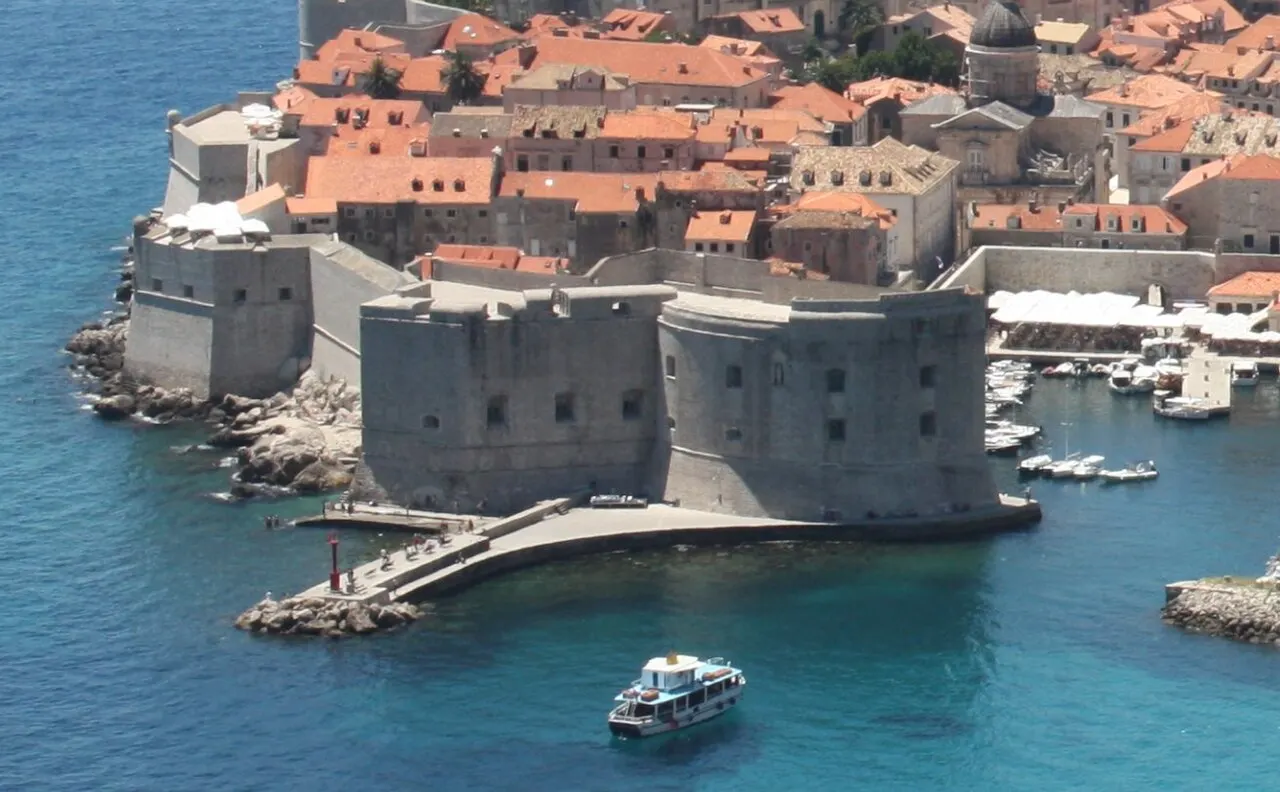
City walls
A closed 1,940 m circuit walked in one direction, with walls up to 25 m high and 6 m thick facing the mainland. The 2026 ticket costs about €40 and includes Fort Lovrijenac; the loop takes 1 hour 30 minutes to 2 hours, with almost no shade, and the Minčeta Tower, finished by Juraj Dalmatinac in 1464, is the highest point.
Check access

The Stradun and Luža Square
A 300 m street over the filled-in channel, paved in limestone polished by use, with the Big Onofrio Fountain (1438, Onofrio della Cava) at one end and Orlando's Column (1418) at the other. The forearm of Orlando's statue measured the Dubrovnik ell, 51.2 cm, the republic's official length standard; alongside stand the clock tower and the Baroque Church of St. Blaise, from 1715, the work of the Venetian Marino Gropelli.
Orlando's forearm measured the cubit, 51.2 cm.
Check access
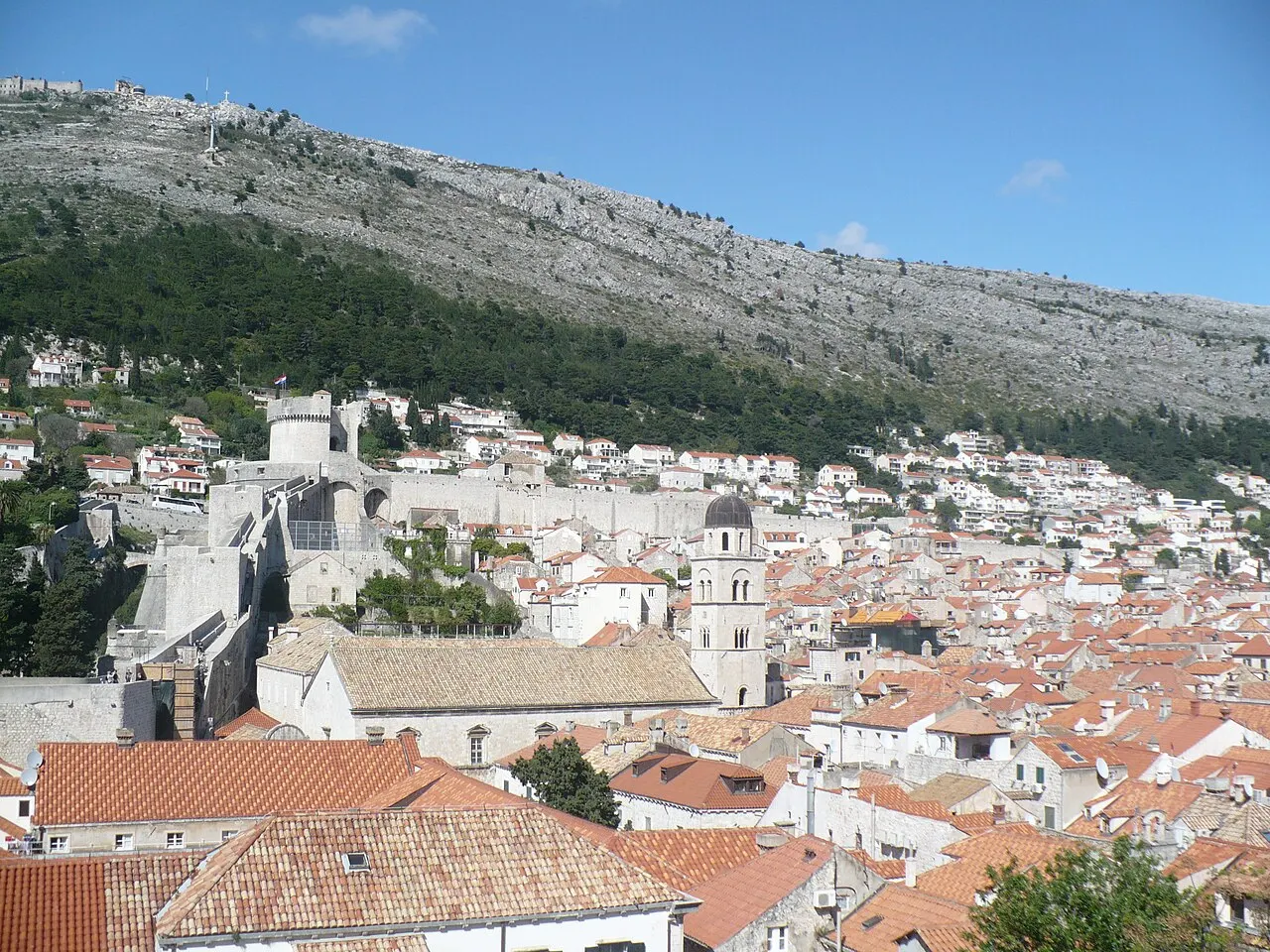
Srđ, cable car, and the Imperial Fort
The cable car climbs 412 m in about four minutes, leaving from Petra Krešimira IV street; it opened in 1969, was destroyed in 1991, and reopened in July 2010. At the top stand the Imperial Fort, built by Napoleon's troops between 1806 and 1812 and defended in December 1991 by a few dozen Croats, now the Museum of the Homeland War, and the white cross from 1935, re-erected in 2002.
The cable car climbs 412 m in about four minutes.
Check access

Rector's Palace
Seat of the republic's government, Gothic-Renaissance, rebuilt twice after gunpowder store explosions in 1435 and 1463. The rector governed for one month and couldn't leave the building during his term; above the council hall entrance it reads “Obliti privatorum publica curate”: forget private matters, tend to public ones.
The rector could not leave the building for a month.
Check access
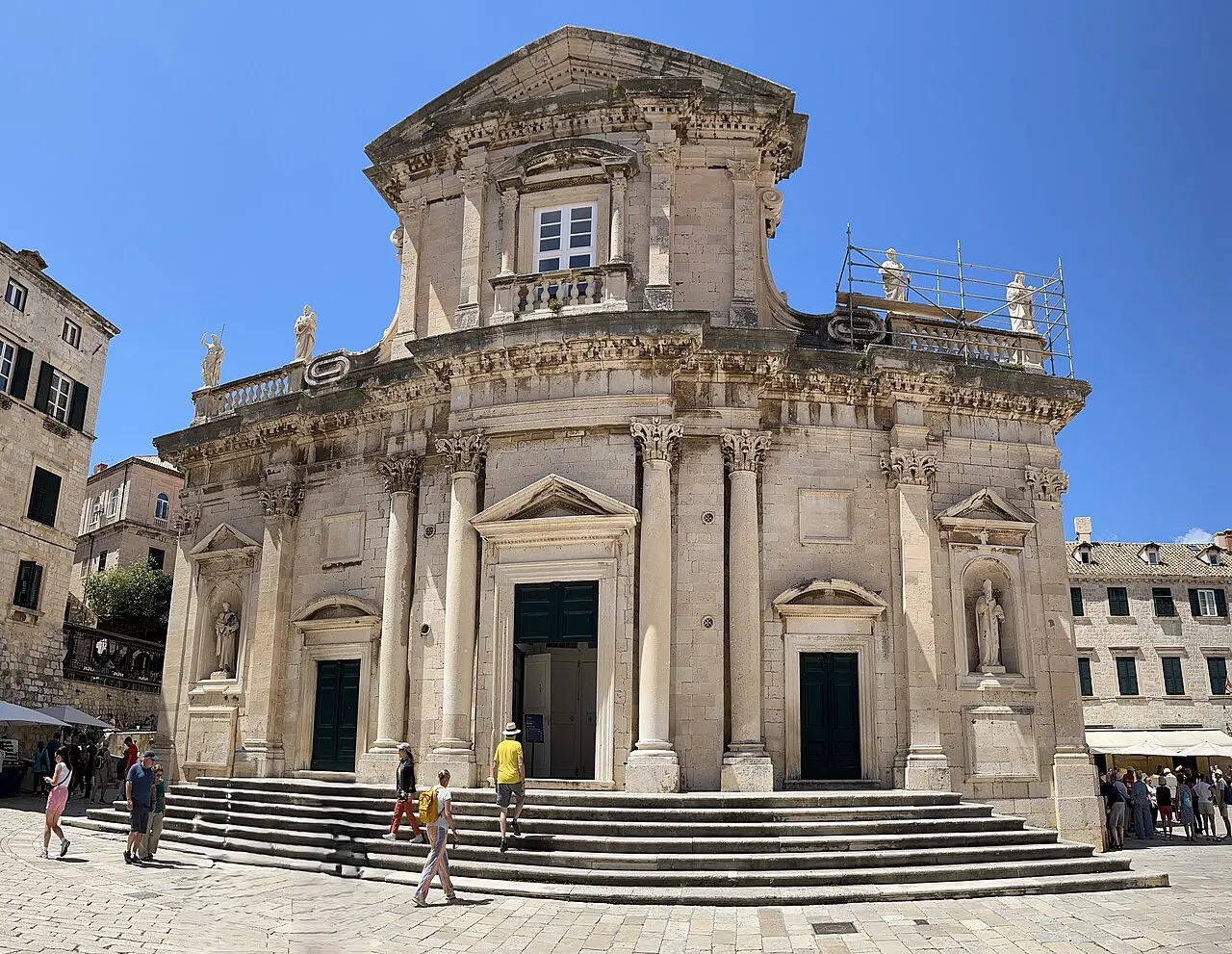
Cathedral of the Assumption and its treasury
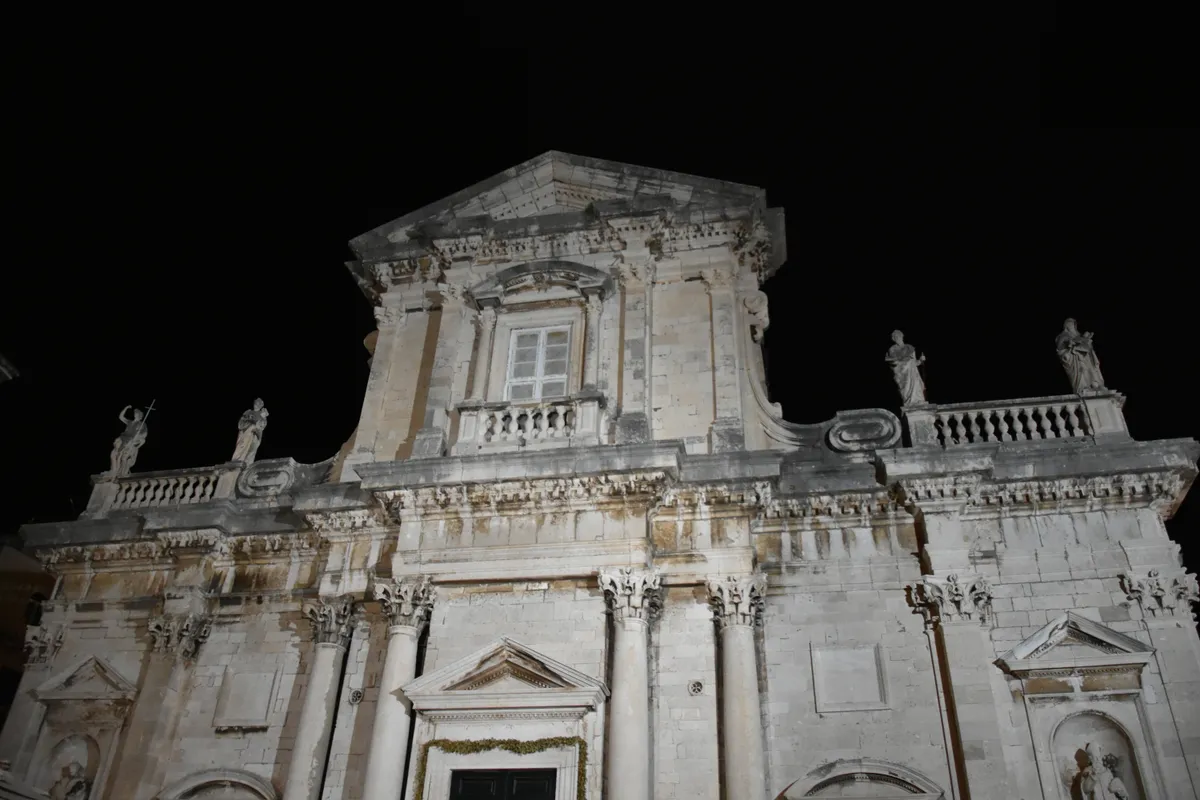
The third cathedral on the same site, Baroque, built between 1672 and 1713 to a design by Andrea Buffalini of Urbino; the previous one was said to have been funded by Richard the Lionheart after a shipwreck near Lokrum in 1192. The treasury holds the reliquary with the skull of St. Blaise, shaped like a Byzantine crown, and more than 180 pieces of goldwork.
Reliquary of St. Blaise shaped like a Byzantine crown.
Check access
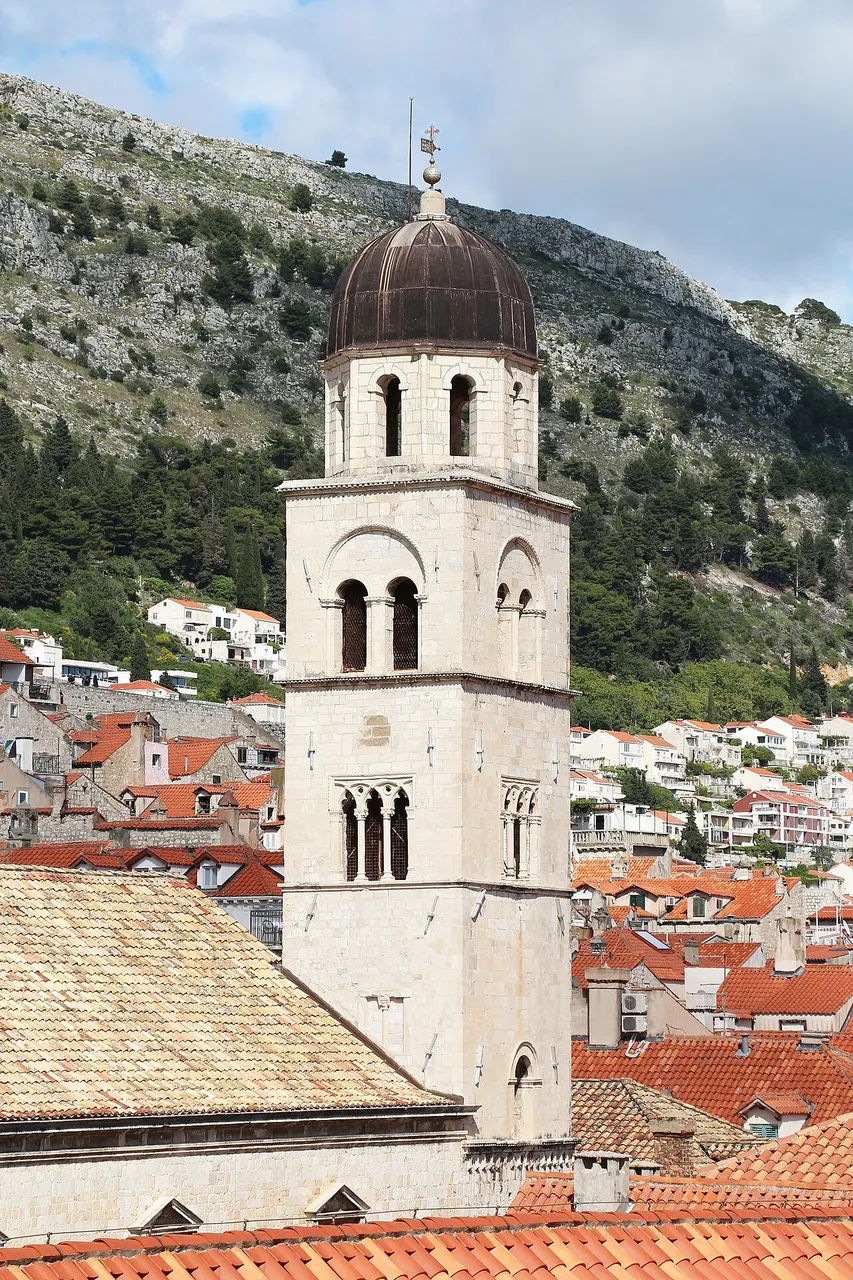
Franciscan monastery and the 1317 pharmacy
A Romanesque-Gothic cloister from 1360, attributed to Mihoje Brajkov of Bar, with 120 paired columns and capitals all different from each other. The Mala braća pharmacy has run since 1317, is one of the oldest in Europe still operating, and keeps its counter open to the public at the entrance.
The Mala braća pharmacy has been operating since 1317.
Check access

Fort Lovrijenac
A triangular fortress on a 37 m rock west of the city, outside the main circuit. The seaward walls are up to 12 m thick and the ones facing the city only 60 cm, so it could be destroyed if it fell into enemy hands; above the gate is the inscription “Non bene pro toto libertas venditur auro.”
The walls facing the city are 60 cm thick.
Check access

Lokrum Island
A wooded island 600 m from the coast, 10 minutes by boat from the Old Port, with a Benedictine abbey founded in 1023, a botanical garden created by Archduke Maximilian of Habsburg from 1859, free-roaming peacocks, and a saltwater lake nicknamed the Dead Sea. It's a nature reserve: overnight stays are forbidden, and the last boat back sets the end of the visit.
It's a 10-minute boat ride from the Old Port to the island, 600 m out, with the 1023 abbey and Maximilian's garden; it's a nature reserve, overnight stays are forbidden, and the last boat ends the visit.
Check access

Sponza Palace
A customs house and mint built between 1516 and 1522 by Paskoje Miličević, with an arcaded courtyard mixing Gothic and Renaissance that survived the 1667 earthquake. It houses the State Archives, with continuous records since 1022, and a memorial room for those killed in the 1991-92 siege.
The 1516–1522 arcaded courtyard, which mixes Gothic and Renaissance and survived the 1667 earthquake, and the memorial room for those killed in the 1991–92 siege can be seen in ten minutes. The rest of the building houses the State Archive, with continuous records since 1022, which is why the visit fits into a short stop.
Check access
Nilo’s itinerary
Start with the basic programme and choose extensions for the time you have.
Plan my days in the app ↗Day 1 · The walled city, from the top down
Enter the walls through the Pile gate at opening, around 8am, with water and a hat; a one-way, 1,940 m circuit, 1 hour 30 minutes to 2 hours, ticket about €40.
Come down at St. John's bastion and cross the Stradun to Luža Square: the Big Onofrio Fountain, Orlando's Column, the clock tower, and the Church of St. Blaise.
Visit the Rector's Palace and Sponza Palace, on the same square: the council hall, the arcaded courtyard and the memorial room for those killed in 1991–92.
Have lunch at a konoba off the Stradun, in the lanes of Prijeko or near Od Puča, and order mussels na buzara or šporki makaruli.
End the afternoon in the Franciscan cloister of 1360 and stop at the pharmacy next door, open since 1317.
Day 2 · Market, island, and hill
Reach the Gundulićeva poljana market at 8am, since it closes around 1pm, to buy dried figs, lavender, honey and arancini by the bag.
Take the 10-minute boat from the Old Port to Lokrum and see the Benedictine abbey of 1023, Maximilian's botanical garden, the peacocks and the saltwater lake nicknamed the Dead Sea.
Come back mid-afternoon and have lunch in Gruž, next to the fish market on Obala Stjepana Radića, at neighborhood prices.
Take the cable car up Srđ an hour before sunset: it climbs 412 m in four minutes to the Imperial Fort and the Homeland War Museum.
Walk down the zigzag trail, about an hour, or take the cable car back and have dinner at Uvala Lapad bay.


If you stay longer
Day 3 · Ston, salt and oysters
Leave early by car or bus for Ston, 55 km via the D8 and the Pelješac Bridge, about an hour.
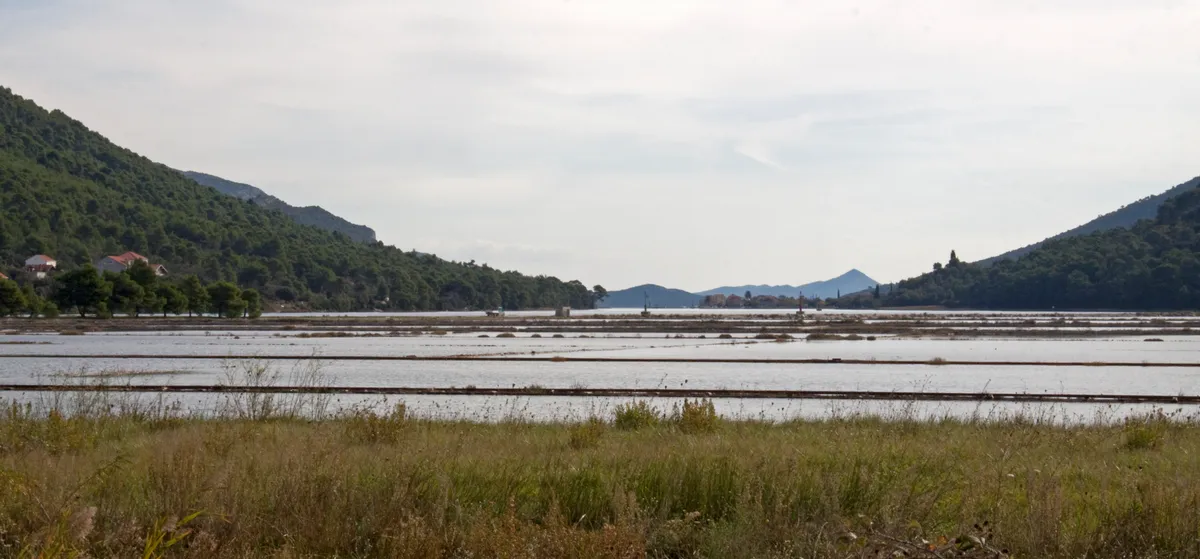
Climb the Walls of Ston, built from 1333 onward between Ston and Mali Ston, about 5.5 km long, 3 km of it restored.
Have oysters for lunch in Mali Ston, farmed in the bay since the days of the republic, at €2–3.50 apiece.
Visit the Ston salt pans, in continuous production for about two thousand years in the same evaporation pools, with harvesting done by hand.
Return along the peninsula road with a stop at a Dingač or Postup winery, in Potomje, before dusk.
Food
 AI illustration
Ston oysters
The European flat oyster (Ostrea edulis), farmed in the Mali Ston bay, 55 km away, with cultivation documented since the republic's time. Served raw with lemon, it costs €2 to €3.50 per piece at restaurants in the bay itself and more in the city; the oyster festival takes place on March 19.
 AI illustration
Na buzaru
A method, not a dish: mussels, shrimp, or langoustines quickly cooked in olive oil, garlic, parsley, white wine, and breadcrumbs. It comes in a pot for the middle of the table, is eaten by hand, and bread is used to soak up the sauce.
 AI illustration
Šporki makaruli
“Dirty macaroni,” a dish specific to Dubrovnik: short pasta with a slow beef ragu, cloves, cinnamon, and red wine. Traditionally it's the lunch for February 3, St. Blaise's day, and it appears at konobas all year round.
 AI illustration
Zelena menestra
A stew of collard greens and cabbage with smoked pork and sausage, cooked for hours until everything falls apart. It's winter, home-style food, served in deep plates with bread; some restaurants in Gruž and Lapad still keep it on the menu.
 AI illustration
Peka
Octopus, kid, or veal with potatoes, roasted under an iron bell covered in embers for two to three hours. It needs to be ordered at least three or four hours ahead and usually has a minimum order for two people.
 AI illustration
Rožata
A milk and egg pudding flavored with rozulin, a local rose petal liqueur, topped with caramel sauce. It's the city's traditional dessert and is registered as a protected specialty of the region.
 AI illustration
Arancini
Strips of orange peel cooked in syrup and rolled in sugar, sold in small bags at the Gundulićeva poljana and Gruž markets. Nothing to do with the Sicilian rice ball of the same name; here it's a peel candy, homemade since the 19th century and eaten with coffee.
 AI illustration
Wines from Pelješac and Korčula
Dense reds made from the plavac mali grape on the slopes of Dingač and Postup, on the Pelješac peninsula, and pošip and grk whites from the island of Korčula. A bottle of Dingač starts at €20-25 in a shop; a half-liter jug of house wine at a konoba runs €8 to €12.
Day trips

Cavtat
18 km south, 40 minutes by the line 10 bus or 45 minutes by boat from the Old Port in summer. It's the old Epidaurum, from which Dubrovnik's founders came; it has a car-free promenade, the house-museum of painter Vlaho Bukovac, and the Račić family mausoleum, carved by Ivan Meštrović in 1922.

The Elafiti Islands
Koločep, Lopud, and Šipan, reached by Jadrolinija ferry leaving Gruž in 25, 50, and 80 minutes. They're car-free or nearly so, with stone trails through olive groves; Lopud has Šunj, the region's only sand beach, a 20-minute walk from the port.

Mljet National Park
An island about 1 hour 30 minutes by catamaran from Gruž to Polače or Sobra. The western third has been a national park since 1960, with two saltwater lakes connected to the sea, the Veliko and the Malo jezero, and a 12th-century Benedictine monastery on an islet within the larger lake; rent a bike at the dock to ride around the lakes.
Where to begin
The walled city, from the top down
Enter the walls through the Pile gate at opening, around 8am, with water and a hat; a one-way, 1,940 m circuit, 1 hour 30 minutes to 2 hours, ticket about €40.
Market, island, and hill
Reach the Gundulićeva poljana market at 8am, since it closes around 1pm, to buy dried figs, lavender, honey and arancini by the bag.
Money
The currency has been the euro since January 1, 2023, and contactless cards work almost everywhere, including on the newer buses and at the larger market stalls. At ATMs, decline the dynamic currency conversion that Euronet machines offer and always choose to be charged in euros. Real approximate 2026 ranges: espresso €1.80 to €5 depending on the neighborhood; a slice of pizza or burek €3–4.50; a single-dish lunch at a konoba €15–25; dinner with a starter, fish and wine €45–70 per person; a 0.5 L draft beer €4–6; a half-liter carafe of house wine €8–12. Fresh fish is sold by the kilo, with prices that vary a lot by species. Three-star hotel: €90–150 a night in May, €200–350 in July; a vacation apartment in Lapad, €70–130 outside the peak. The tourist tax per person per night is around €2 to €2.65 in high season (April to September) and less outside it, set by municipal decision, with an exemption for children under 12 and half the amount between 12 and 18; check the current rate when you book. Tipping isn't mandatory: round up the bill or leave about 10% when there's table service.
Getting there and around
Airport: 20 km southeast, the bus waits for the flight
Dubrovnik Airport (DBV) is in Čilipi, 20 km southeast, near Cavtat. The Platanus/Atlas bus leaves in sync with flights, takes 25 to 40 minutes and costs about €13 one way (2026), stopping at the Gruž bus station and at Pile. A taxi runs €35 to €50, and Uber and Bolt operate in the city. There's no train: the Croatian rail network doesn't reach Dubrovnik, and the overland connection is via the D8 coastal road and the 2,404 m Pelješac Bridge, opened in July 2022. From the Gruž bus station, buses leave for Split (about 4 hours 30 minutes), Zagreb (about 10 hours), Mostar (about 3 hours), Sarajevo (about 5 hours) and Kotor (about 2 hours 30 minutes, with a border stop). At the same quay dock the Jadrolinija ferries to Bari, in Italy (an overnight crossing of about 9 hours), and the catamarans to Korčula, Mljet, Šipan and Lastovo. Croatia has been in the Schengen area since January 1, 2023: Brazilians enter without a visa for up to 90 days in any 180, and ETIAS, the electronic authorization expected in the coming months, should cost about €20 and be valid for three years.
Libertas buses with a kiosk ticket, or on foot
Within the city, you get around by Libertas bus or on foot. A ticket bought in advance at Tisak kiosks costs about €1.73 and is valid for 60 minutes; from the driver it's about €2.50, and the 24-hour pass is around €5.30 (approximate 2026 prices). The main routes are 1A and 1B, linking Pile to Gruž, 4 and 6 to Lapad and Babin Kuk, 8 to Mokošica and 10 toward Župa dubrovačka and Cavtat. The walled city is completely closed to cars: the Stradun is flat, but everything else is stairs, which makes strollers, wheeled suitcases and wheelchairs a problem. From Pile to Gruž is 25 minutes on foot or 8 by bus, and the Srđ cable car costs about €27 to €30 round trip. Cycling isn't worth it, because the streets are slopes of slick paving and there are no bike lanes. Parking near Pile in July runs €5 to €8 an hour, and the usual solution is to leave the car in Gruž or Lapad.
Safety
Dubrovnik has very little violent crime, and the real risk here is physical, not criminal. The limestone of the Stradun and the stairways turns slippery in the rain, and most accidents involving visitors are falls. The second risk is sunstroke and dehydration on the wall circuit, which has no shade and no water points along much of the route. In the sea, you get in over rock: sea urchins are common, and water shoes solve the problem. There are three common scams: taxis without a meter leaving Pile and the cruise terminal (agree on the fare first or use an app), restaurants that present fish without a price per kilo, and the dynamic currency conversion offered by ATMs and card machines, which you should always decline in favor of paying in euros. Theft is rare, but the crowd at the Pile gate and buses 1A and 1B when cruise passengers disembark are where it happens. There's no neighborhood to avoid, and nights are quiet. What does call for care is the D8 coastal road and the road up Srđ, both narrow, with blind curves and plenty of motorbikes in summer. The single emergency number is 112, and the general hospital is in Medarevo, at the entrance to the Lapad peninsula.
Etiquette tips
Carry your bag, don't drag it
There's no ban or fine on wheeled suitcases: the news that circulated in 2023 was denied by the city, and what exists is a campaign asking visitors to carry their luggage. Carry yours, because the noise of wheels on limestone echoes through the stepped lanes, or leave it at the luggage storage near Pile and arrange a porter cart with your accommodation.
Cover up away from the beach
Walking around the center's streets shirtless, in swim trunks, or in a bikini is an offense and carries a fine in the hundreds of euros. In churches, shoulders and knees covered, including at the cathedral and the Franciscan monastery.
Don't sit or eat on monument steps
Sitting and picnicking on church steps, the Jesuit stairway, and the stone benches of palaces is forbidden, and there are wardens patrolling in summer. Use the squares, the bars, or the seawall.
The war: a family matter
The 1991-92 siege shows up on plaques, in the Srđ museum, and in the Sponza memorial room, and almost every family has a story. Asking with care is fine; comparing suffering, giving opinions on Yugoslavia, or using “Balkan” as a synonym for backward is not.
Coffee: an hour at the table for one espresso
Holding a table for an hour over a single espresso is the local norm, and no one will rush you. The check only comes when you ask for it: “račun, molim.”
Greet on the way in and out
At bakeries, pharmacies, shops, and konobas people say “dobar dan” on the way in and “doviđenja” on the way out. Walking in silently and going straight for the product reads as rude, not as being in a hurry.
Mistakes to avoid
The walls at ten, with the cruise crowds
Arriving at the walls at the same time as the cruise passengers, around ten in the morning, guarantees a line from start to finish and strong sun on a route with almost no shade. Go first thing in the morning or late in the afternoon, once the sun is low.
The fish of the day without asking the price per kilo
Ordering “the fish of the day” without asking the price per kilo. The bill is priced by the weight of the whole fish, and anyone who didn't ask only finds out the price when it arrives at the table.
Lapad and Gruž are 8 minutes by bus
Booking everything within the walls. In July a night in the Grad costs double, bar noise runs into the small hours, and every delivery comes on foot. Lapad, Gruž, and Boninovo are 8-15 minutes by bus and cost much less.
Center closed to cars, no bike lanes, and hilly
Counting on a car or bike. The center is closed to vehicles, there are no bike lanes, the terrain is steep, and summer parking near Pile runs €5 to €8 an hour: renting a car only pays off for the day trip to Ston and Pelješac.
Going to the beach expecting sand
Going to the beach expecting sand. Banje, Sveti Jakov, and the Lapad beaches are pebble and slab, with rocky water entry and sea urchins. Bring water shoes, or take the boat to Šunj, on Lopud: the coast's sand exception.
Useful phrases
Dobar dan
Good morning / good afternoon (DOH-bar dahn): standard greeting from mid-morning to dusk
Molim
Please, and also “you're welcome” and “pardon?” (MOH-leem)
Hvala lijepa
Thank you very much (HVAH-lah lee-EH-pah)
Oprostite
Excuse me / sorry (oh-proh-STEE-teh)
Račun, molim
The check, please (RAH-choon, MOH-leem)
Koliko košta?
How much does it cost? (KOH-lee-koh KOSH-tah)
Districts
Grad (walled city)
The 13 hectares within the walls, car-free, with the Stradun as its axis and stairways everywhere else. It concentrates museums, restaurants, and most short-term rentals; it has fewer than 1,500 permanent residents and empties out after ten at night outside summer.
Pile
The west gate and the square right in front of it, the endpoint of most bus lines and the cruise shuttle. This is how nearly everyone enters, and where the line for the walls forms from nine in the morning.
Ploče
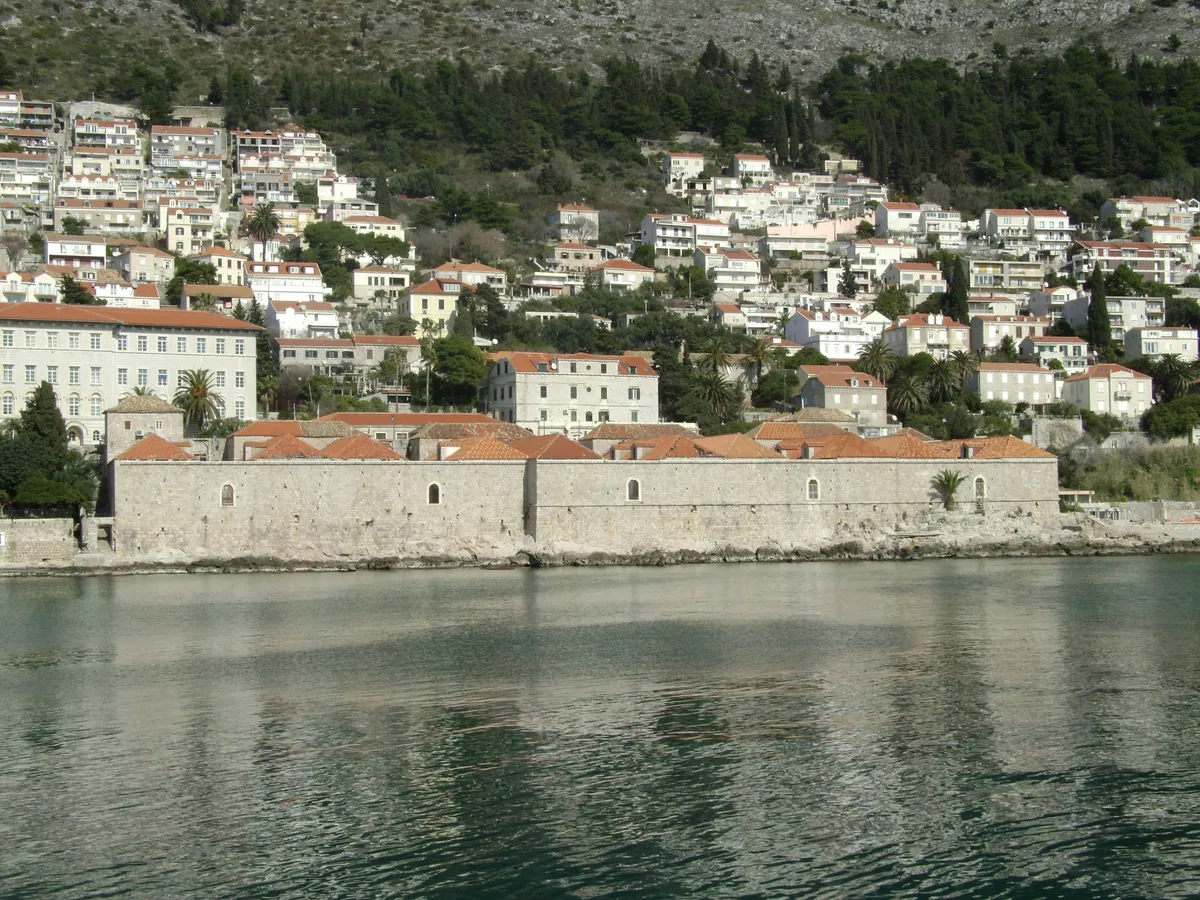
The slope east of the gate of the same name, with the city's priciest hotels, Banje pebble beach, and the Lazareti, the former 17th-century quarantine complex now used for events. The seawall here gives the classic frontal view of the walls.
Gruž
The real port, 3 km west of the center: cruise terminal, Jadrolinija ferries, catamarans to the islands, and the bus station. The fish and produce market on Obala Stjepana Radića runs in the morning and charges about half the prices of the walled city.
Lapad
A residential peninsula where much of the population lives: apartment buildings, schools, supermarkets, and Uvala Lapad bay, with a car-free promenade. It's 10 minutes by bus from Pile and the most balanced base between price and distance.
Babin Kuk
The tip of the Lapad peninsula, taken up by large hotels built in the 1970s and 1980s and pebble beaches, including the one nicknamed Copacabana. A roughly 4 km walking loop runs around the tip, shaded by pines.
Boninovo and Montovjerna
A slope stretch between the walled city and Lapad, with postwar buildings, the municipal cemetery, schools, and the general hospital at Medarevo. It's the best served by bus and one of the cheapest to sleep in.
Mokošica and Rijeka dubrovačka
A dormitory neighborhood built in the 1980s at the Ombla estuary, 7 km to the northwest, with the riverside old town of Komolac alongside it. It's where many families moved once short-term rental took over the Grad.
History
7th c. · Ragusa on the rock
Inhabitants of Epidaurum, present-day Cavtat, destroyed by Avars and Slavs around 614, settle on a limestone islet called Laus, hugging the coast. Excavations under the cathedral revealed earlier occupation, which weakens the story of a single, sudden founding.
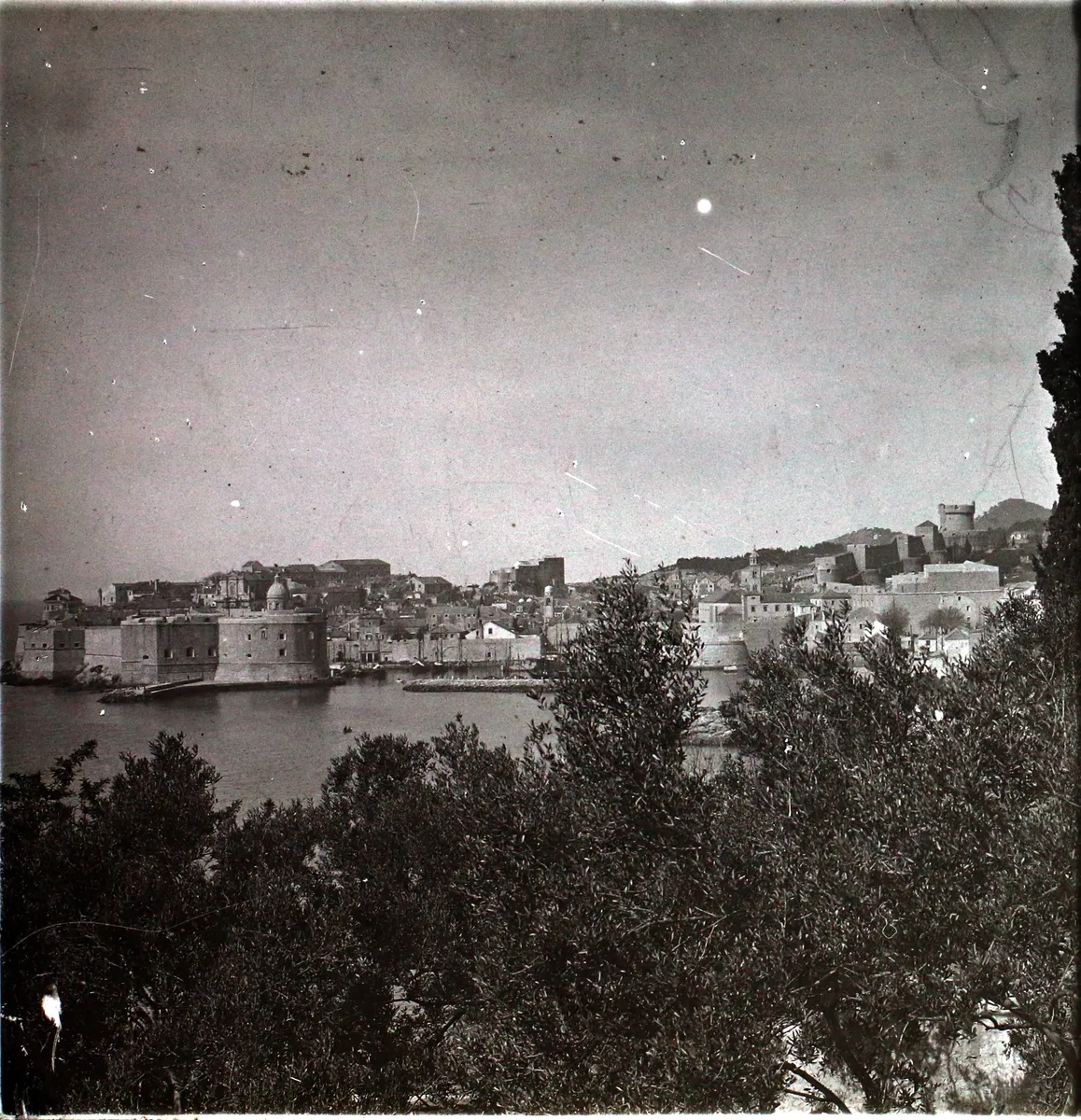
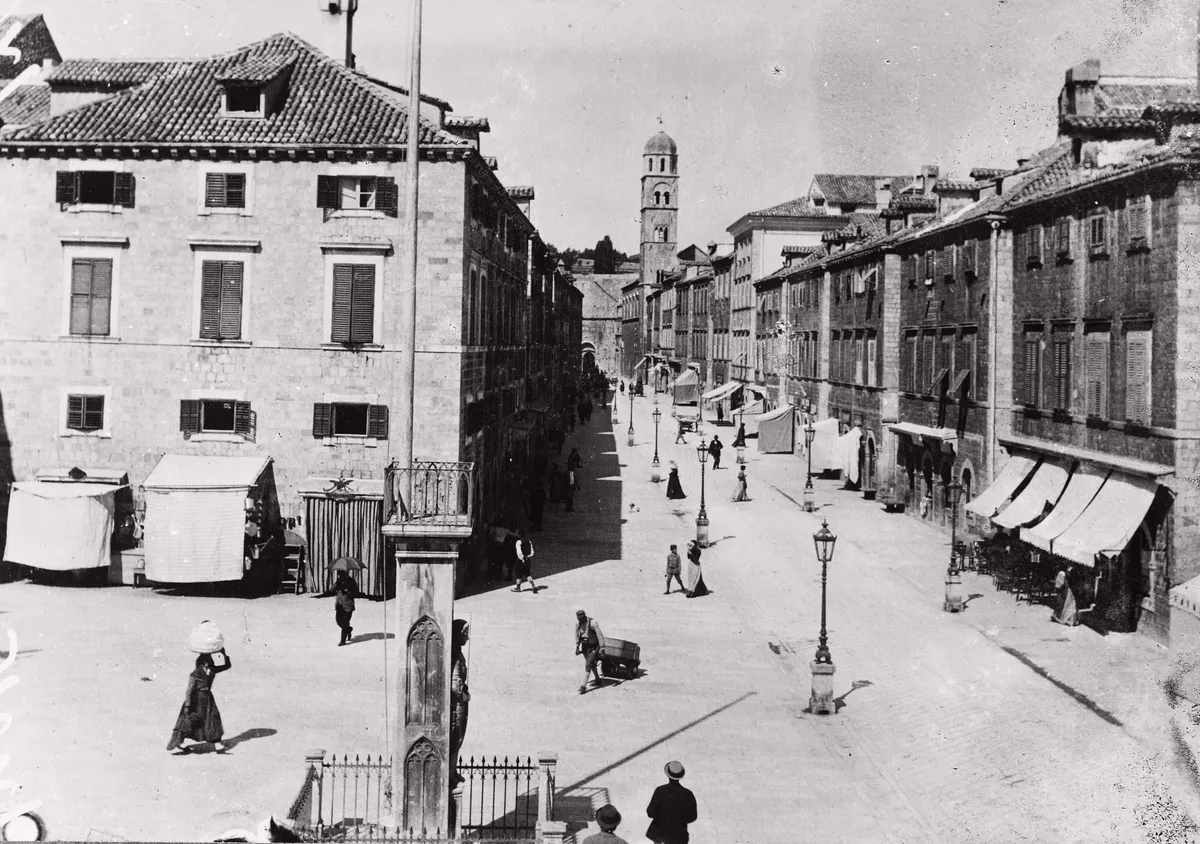
11th-12th c. · From the filled canal comes the Stradun
The sea channel separating Latin Ragusa from the Slavic settlement of Dubrava, on the slope, is filled in. The landfill becomes the Placa, today called the Stradun, and the two communities merge into a single city with one shared wall.
1205-1358 · Under Venice
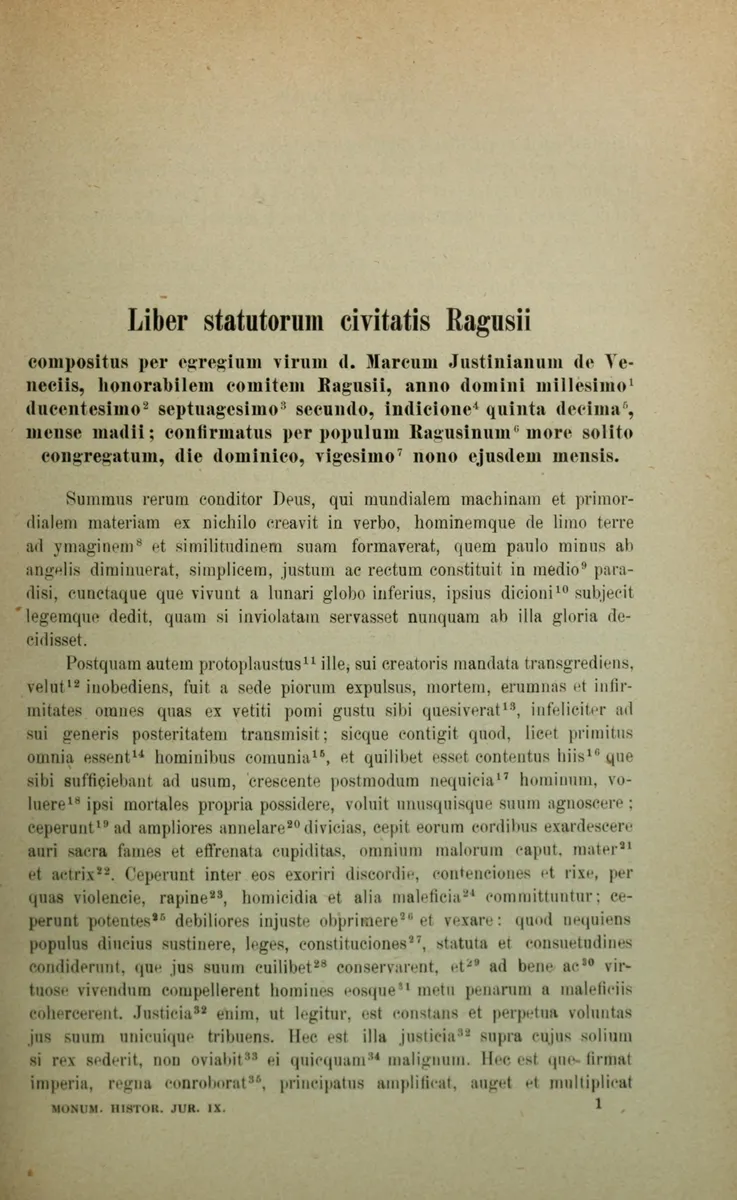
After the Fourth Crusade, Venice imposes a Venetian count on the city and keeps it for 153 years. Dubrovnik copies Venetian institutions, the Great Council and the Council of Rogati, and comes out of that rule with an administration ready to run itself.
1358 · The Republic of Ragusa is born
By the Treaty of Zadar, Venice cedes Dalmatia to the Hungarian-Croatian king Louis I. Dubrovnik accepts a nominal suzerainty, pays annual tribute, and in practice gains independence, its own fleet, and its own foreign policy.

1377 · The first quarantine
On July 27, 1377, the Great Council rules that ships and caravans arriving from plague-affected areas be isolated for 30 days at Mrkan or Cavtat before entering the city. It's the world's first documented institutional quarantine; the Lazareti of Ploče, built in the 17th century, are the stone version of that rule.
1416 · End of the slave trade
On January 27, 1416, the Great Council bans the slave trade across the entire republic's territory, one of the earliest such decisions in Europe. The Ragusan fleet specializes in salt from Ston, wool, Balkan silver and lead, wax, and wheat.
1458 · Tribute to the sultan
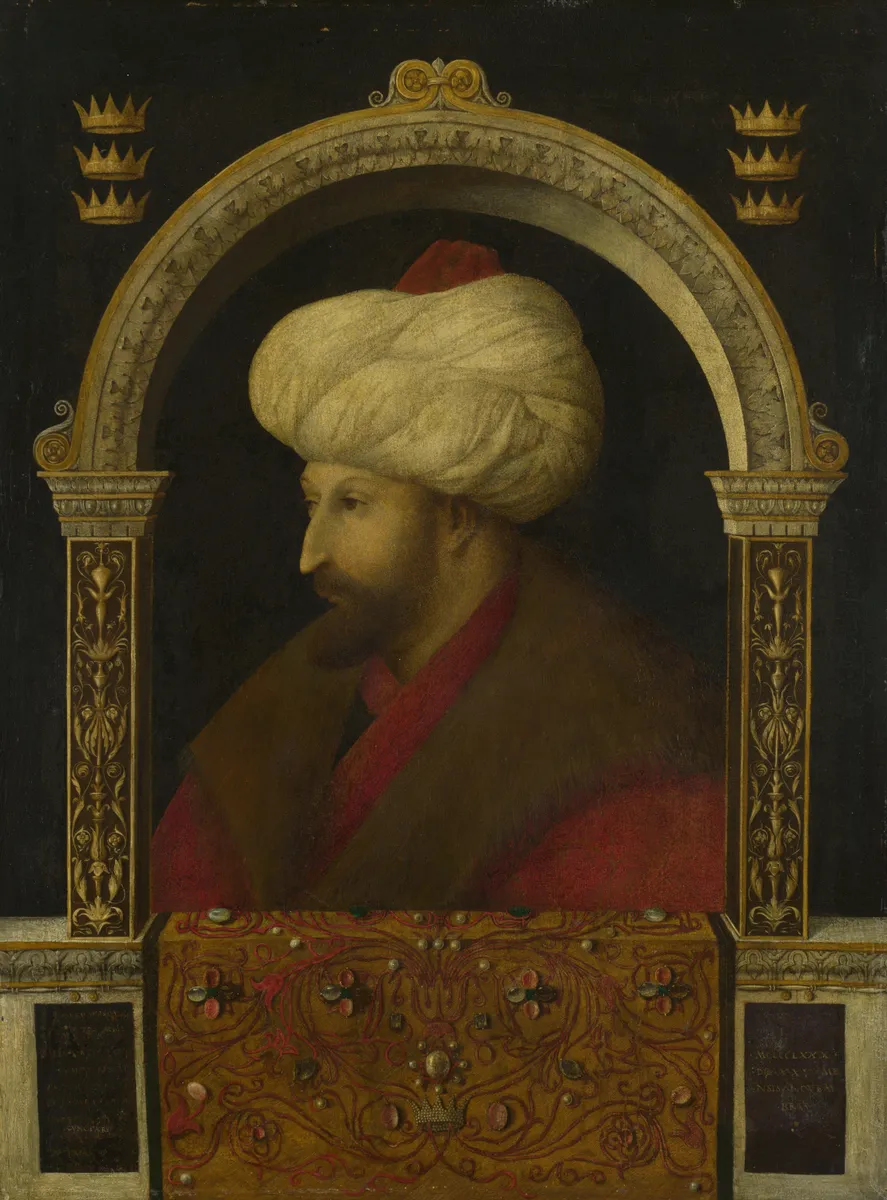
The republic starts paying an annual tribute to the Ottoman Empire, set at 12,500 gold ducats from 1481, and in exchange moves freely through the sultan's ports and roads. At the same time it keeps treaties with Spain, the pope, and the Kingdom of Naples.
1667 · The earthquake
On April 6, 1667, a tremor followed by fire brings down most of the city and kills thousands of people; estimates range from 3,000 to 5,000 dead out of a population of about 6,000 within the walls. The Sponza Palace, Fort Lovrijenac, and part of the Rector's Palace survived; the rest was rebuilt in restrained Baroque, with standardized façades and straight streets.
1808 · The end of the republic
French troops occupy the city in 1806 and, on January 31, 1808, Marshal Marmont dissolves the Republic of Ragusa by decree. The Congress of Vienna hands the region to Austria in 1815 and Dubrovnik becomes a secondary port of the Kingdom of Dalmatia, connected by road and not by rail.

1918-1945 · Yugoslavia and war
With the fall of the Austro-Hungarian Empire the city enters the Kingdom of Serbs, Croats and Slovenes and officially adopts the Croatian name Dubrovnik in place of Ragusa. Occupied by Italians and then Germans in World War II, it enters socialist Yugoslavia in 1945 and starts living off tourism from the 1960s on.
1991-1992 · The siege
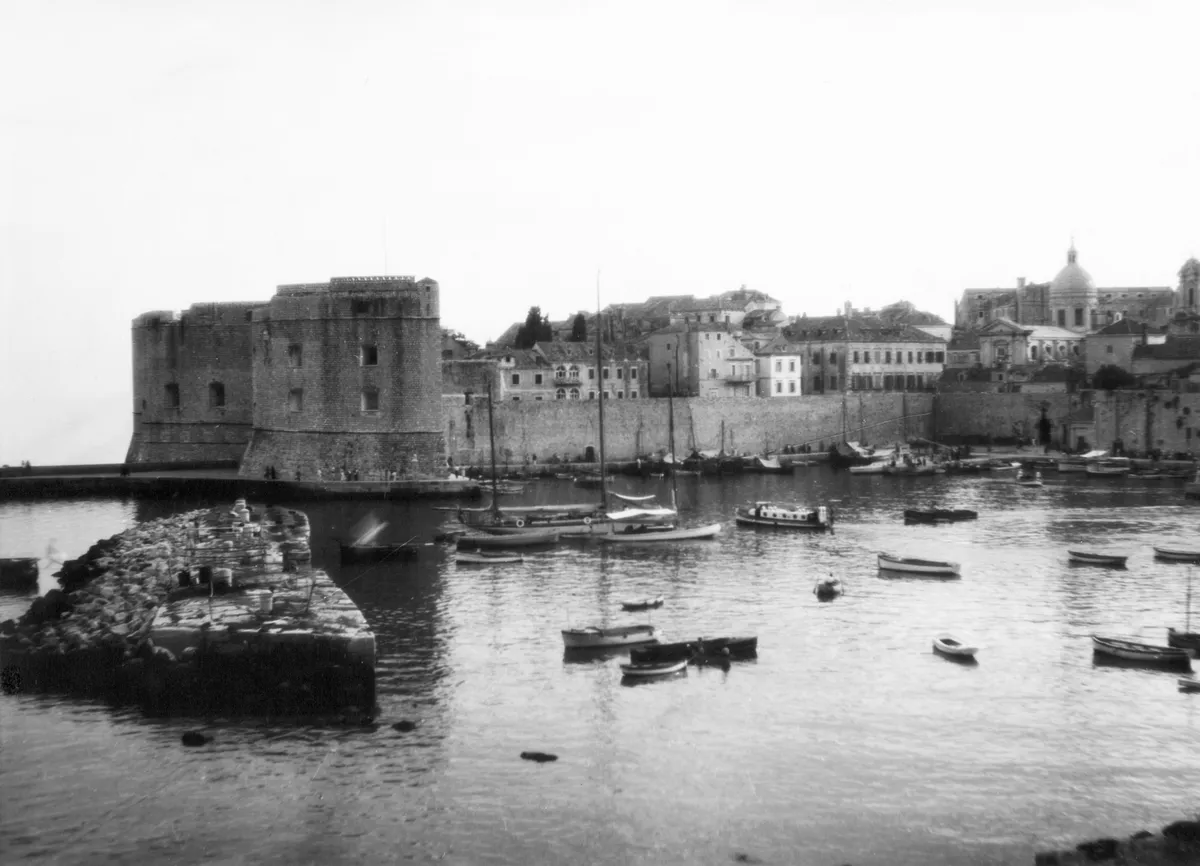
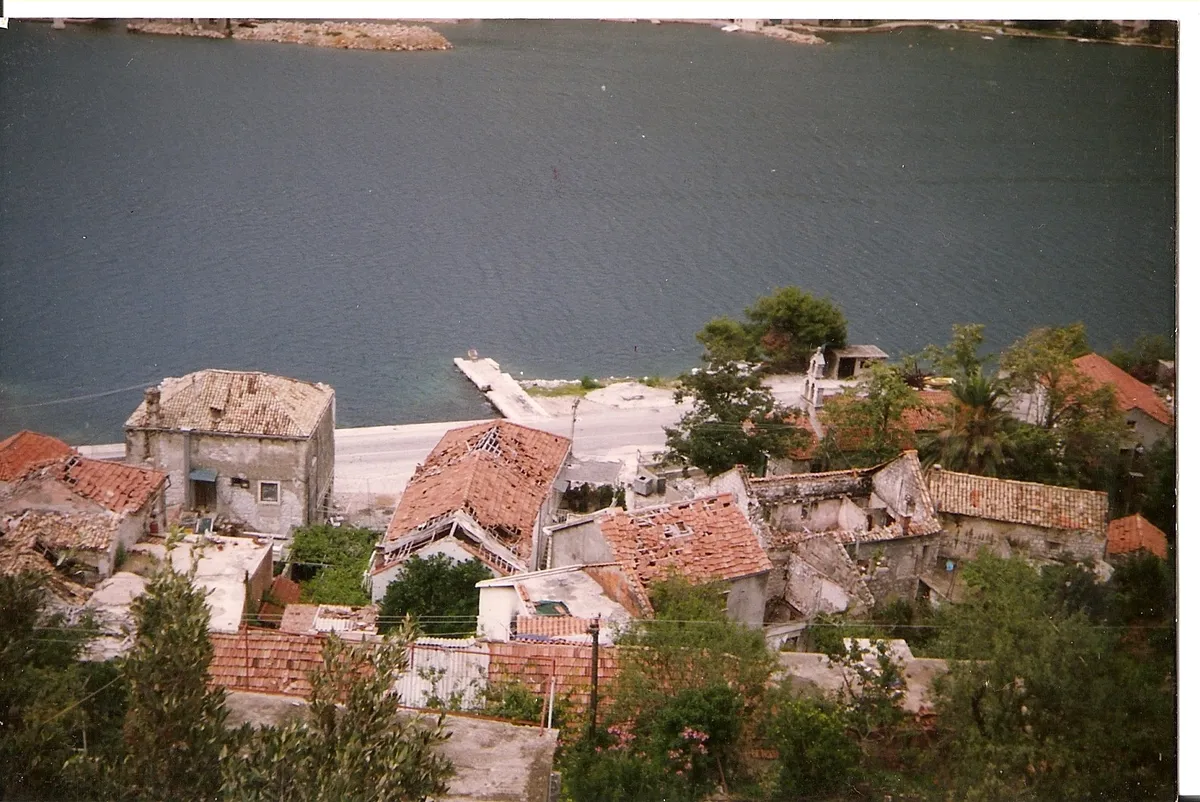
The Yugoslav People's Army shells the city from October 1, 1991 to May 1992, cutting off water and power; on December 6, 1991, hundreds of shells fall on the walled center. About two-thirds of the old town's buildings were hit, and reconstruction, coordinated with UNESCO and using tiles produced in Toulouse and Slovenia, stretched to the end of the decade.
Complete history
The founding at Laus, around 614
The city is born of a defensive decision. When Epidaurum, the Roman colony of present-day Cavtat, is destroyed by Avars and Slavs around 614, part of the population moves to a limestone rock separated from the coast by a shallow channel: Laus, in Greek, which becomes Lausa, Rausa, and finally Ragusa. On the facing slope was a Slavic settlement amid oak groves, dubrava, which gives the name Dubrovnik. Between the 11th and 12th centuries the channel is filled in and the two halves become a single city: the landfill is the street now called the Stradun, which is why it's flat, wide, and straight while everything around it is slope and stairs. A fire in 1296 wrecks the north side and the rebuilding follows a regular plan. The row of parallel lanes climbing from the Stradun to Prijeko street is planned medieval urbanism, not chance.
Independence came through negotiation
Independence came through negotiation. After 153 years under a Venetian count, the Treaty of Zadar in 1358 transferred Dalmatia to the Hungarian-Croatian king Louis I, and Dubrovnik traded a modest annual tribute for real autonomy. The republic, which had already codified its Statute in 1272, built over the next two centuries a small and obsessively administrative state. The rector was elected for one month and forbidden to leave the palace during his term. The world's first documented quarantine came in 1377, the slave trade was abolished in 1416 and the orphanage opened in 1432. In 1438 the nearly 12 km aqueduct bringing water from Šumet was completed. The fleet reached about 180 ships, and the flag carried a single word, Libertas. Above the gate of Fort Lovrijenac is carved, in Latin, that liberty should not be sold for all the gold in the world.
The 1667 earthquake explains the look
The earthquake of April 6, 1667 is the fracture that explains the city's current look. In minutes the Renaissance city collapsed and fire consumed what was left; between 3,000 and 5,000 people died, a large part of the merchant elite and the rector himself. The republic decided to rebuild by rule: façades of equal height and rhythm, standardized doors and windows, straight streets, reduced ornament. That's why Dubrovnik looks uniform and austere, and why the few earlier buildings (the Sponza of 1522, the Lovrijenac, the Franciscan cloister of 1360) stand out so much. Decline came with it: the Atlantic route drained Mediterranean trade, the French occupied the city in 1806, and Marmont ended the republic in 1808. Austria administered the region until 1918 and the port lost ground to Trieste and Rijeka.
Tourism, UNESCO, and then the war
The 20th century brought two opposite transformations. The first was tourism: from the 1960s on, Yugoslavia invested in hotels on the Lapad and Babin Kuk peninsulas, and the old town joined the UNESCO list in 1979. The second was war. Between October 1, 1991 and May 1992, the Yugoslav People's Army besieged the city by land and sea, cut water, power, and phone lines, and shelled the protected center; the worst day was December 6, 1991. About two-thirds of the buildings in the walled core suffered some damage, more than 300 were hit directly, and the Srđ cable car was destroyed. Restoration, done with UNESCO support and tile ordered from abroad, finished in the late 1990s and left a visible mark: seen from above, the city's roofscape alternates old dark tiles and new orange ones.
Mass tourism and a cap on cruise ships, since 2011
Over the last two decades, the city has fully joined Europe and mass tourism. Croatia joined the European Union in 2013 and adopted the euro and entered the Schengen area on January 1, 2023, and the 2,404-meter Pelješac Bridge, opened in July 2022, finally linked the region to the rest of the country without crossing Bosnia. Game of Thrones filming from 2011 put the city on the map as King's Landing and helped push visitor numbers into the millions a year, peaking in July and August. Since 2017, the city's Respect the City program has limited berthing to two cruise ships and about 4,000 passengers at a time, restricted tables and chairs on public streets and controlled new short-term rental licenses. Property prices, however, have already pushed residents out to Mokošica, Lapad and Župa dubrovačka, and the walled city today functions more as a workplace than as a neighborhood.
Above the gate of Fort Lovrijenac it is written that freedom is not sold for all the gold in the world, and it's tempting to walk under it twice just to reread it.
At night, few windows are lit inside the walls: fewer than 1,500 people live there.
Geography and shape of the city
The strip between the sea and the mountain
Dubrovnik occupies a narrow strip of land between the Adriatic and the limestone wall of the Dinaric Alps, which rises behind the city to the top of Srđ hill, 412 m, and blocks access inland. There's no urban river: the region's water comes from the Ombla, which springs at the foot of the mountain 4 km to the northwest and runs less than 30 meters before becoming the 4 km estuary of the Rijeka dubrovačka.
The wall, the Stradun, and the port
The old town sits on the former islet, now joined to the coast, with a closed 1,940 m wall circuit, walls up to 25 m high and 6 m thick on the landward side; the Stradun, about 300 m, runs over the filled-in channel and splits the city into two logics: to the south, the older, irregular layout; to the north, the regular comb of stepped lanes rebuilt after the 1296 fire. To the west lie the Lapad and Babin Kuk peninsulas, and between them the natural bay of Gruž, the city's real port, with cruise berths, ferries, and the bus station.
Sun, autumn rain, and two winds
The climate is Mediterranean, with about 2,600 hours of sun a year, dry summers, and about 1,000 to 1,200 mm of rain concentrated between October and December; two winds shape the weather, the cold, northeasterly bura, which clears the sky, and the humid, southeasterly jugo, which brings cloud and rough seas.
You can tell the two winds apart by the sky, which turns clear under the bura and hazy under the jugo.
Culture
Literature before tourism
The city has a literary and scientific tradition that goes back centuries before modern tourism. Marin Držić (1508-1567) wrote comedies in the Ragusan dialect that are still staged, among them “Dundo Maroje,” from 1551, about a Dubrovnik merchant chasing his spendthrift son to Rome. Ivan Gundulić (1589-1638) wrote the epic poem “Osman” and has a statue by Ivan Rendić, from 1893, in the middle of the market square that bears his name. Ruđer Bošković (1711-1787), a physicist, astronomer, and Jesuit born in the city, proposed a unified theory of forces a century and a half before the modern atom. The republic's chancery wrote in Latin, Italian, and Croatian at once, and the word on the flag was a single one: Libertas.
The Summer Festival, from July 10 to August 25
Stage life revolves around the Dubrovnik Summer Festival, created in 1950, which fills about thirty open-air stages from July 10 to August 25: “Hamlet” staged inside Fort Lovrijenac became a symbol of the city. In traditional music, the linđo is a Dalmatian circle dance accompanied by the lijerica, a three-string instrument played with a bow across the knee, and klapa singing, a cappella and in close harmony, has been on UNESCO's intangible heritage list since 2012. Outside summer, the program shrinks: the Marin Držić Theatre and a few bars in the Grad hold the calendar together, and nightlife concentrates in Lapad and Babin Kuk.
Water polo in the sea and King's Landing on screen
The city's sport is water polo: Jug, founded in 1923, trains and plays in the sea, in the Danče cove, was European champion in 1981, 2001, 2006 and 2016 and produced much of the Croatian national team. Out of the water, recent fame came from the screen, because from 2011 Game of Thrones filmed its King's Landing scenes here, with Lovrijenac as the Red Keep, the Minčeta tower as the House of the Undying and the Jesuit staircase as the street of the walk of shame; in 2016, the Stradun became the Canto Bight casino in “Star Wars: The Last Jedi.” That explains the themed tours, the photo lines at specific spots and the ongoing public debate about how much tourism the city can handle.
Festivals and events

Feast of St. Blaise (Sveti Vlaho)
February 3, with an eve on February 2. Patron saint since 972, celebrated with mass, a procession of reliquaries down the Stradun, flags of the old districts, and the release of white doves; it's the most important date on the local calendar and has been on UNESCO's intangible list since 2009.
 AI illustration
Dubrovnik Summer Festival
From July 10 to August 25, since 1950. Theater, opera, concerts, and dance in forts, cloisters, and squares of the walled city; single tickets usually run €15 to €60, and Lovrijenac shows sell out weeks ahead.
 AI illustration
Oyster festival in Ston and Mali Ston
March 19, St. Joseph's day, at the end of the harvest season. Stalls in the bay serve raw and grilled oysters with local white wine; it's the day prices drop and producers open the beds to visitors.
 AI illustration
Winter in Dubrovnik (Dubrovački zimski festival)
From late November to early January, with food stalls and mulled wine on the Stradun, makeshift skating, and free concerts. It's the only time of year the walled center is used mostly by residents.
Books and films
“Dubrovnik: A History,” Robin Harris (2003)
The reference history of the republic in English: it explains how a state of a few thousand people survived between Venice and the Ottoman Empire through tribute, diplomacy, and information.
“Dundo Maroje,” Marin Držić (1551)
A comedy written in the Ragusan dialect by an author who plotted against his own city's government. It shows the mercantile Dubrovnik of the 16th century from the inside (money, inheritance, and reputation) and it's still staged at the Summer Festival.
“Game of Thrones,” HBO (2011-2019)
It doesn't explain the city's history, but it does explain its present: the seasons filmed there as King's Landing turned Lovrijenac, the Minčeta Tower and the Jesuit Stairs into places where people line up, and they're the direct source of the local debate over overtourism.
Frequently asked questions
Dubrovnik: How do you get from the airport to the center?
The Platanus/Atlas bus leaves in sync with flights, takes 25 to 40 minutes, and costs about €13 one way (2026), stopping at the Gruž bus station and at Pile. A taxi runs €35 to €50, and Uber and Bolt operate in the city.
Dubrovnik: How do you get to Cavtat?
Cavtat is 18 km to the south, 40 minutes by the line 10 bus or 45 minutes by boat from the Old Port in summer.
Dubrovnik: What's the currency, and are cards accepted?
The currency has been the euro since January 1, 2023, and contactless cards work almost everywhere, including on the newer buses and at the larger market stalls.
Dubrovnik: What's summer like?
Summer is dry and hot: July and August have highs of 29 to 32 °C, the sea between 24 and 26 °C, practically no rain, and the absolute peak of crowds, with days when two cruise ships put 4,000 passengers ashore before ten in the morning.
Dubrovnik: Is it forbidden to drag a wheeled suitcase?
There's no ban or fine for wheeled suitcases: the story that circulated in 2023 was denied by the city hall, and what exists is a campaign asking visitors to carry their luggage instead.
Other cities in the country
Croatia ↗- Days
- 2–3
- When
- May–Jun · Sep
- Per person/day
- Average 196 EURMid-range · per person/day
Cost scope
Per person per day: accommodation, meals, urban transport, visits and a small allowance for extras. Flights excluded; larger purchases vary. Editorial estimate, not a quote.


Itineraries through here
 Greece and Croatia in 7 daysFrom the Acropolis to the walls of DubrovnikAthens · Santorini · Dubrovnik6–9 days3 cities
 Croatia and Montenegro in 7 daysFrom Diocletian’s Palace to the Bay of KotorSplit · Dubrovnik · Kotor6–9 days3 cities
 Croatia and Slovenia in 7 daysLake Bled and the Dalmatian coastBled · Split · Dubrovnik6–9 days3 cities