
Greece
Santorini
Sunset in Oia, wine, Akrotiri and black sand
Days Start with the basic programme and choose extensions for the time you have.
How the guide reaches this number
A third, if you have it, goes to the Bronze Age at Akrotiri and to the black sand. If you're after beaches with turquoise water, you'll be let down, because the sand here is black, heats up in the sun and burns bare feet. With more than 2 million visitors a year, the island also isn't for anyone looking for peace and quiet in summer. With just one day, get to Akrotiri at 8:30am and have lunch in Pyrgos. In the afternoon, walk from Imerovigli to Skaros Rock and watch the sunset in the same light as Oia, without the 40 minutes the crowd takes to leave Oia on foot after the sun goes down. The letdown is the rim in midsummer, when a crowd squeezed into Oia's narrow streets takes the same photo. Getting up early pays off: at 8am the streets are empty and the caldera shows its bands of red and black rock.
2–3
When June and the second half of September: tolerable heat, warm sea and fewer cruise ships than in July and August
How the guide reaches this number
Summer here is dry and long: from May to September it barely rains. In July and August the high sits between 28 and 31 °C, the low between 23 and 25 °C, and the sea reaches 24–26 °C. The meltemi blows from the north, sometimes strong enough to cancel fast ferries and change boat routes inside the caldera. That wind is deceptive: it masks the sun, and your skin burns just the same. Use sunscreen even when the wind feels cool. May brings 22–25 °C with the sea still at 19–21 °C, everything open and half the crowd. June and the second half of September are the best balance of heat, warm sea, and crowding. October has 22–24 °C and the first rains, with many hotels and restaurants closing between late October and early November. Winter runs 12–15 °C, wind, and rain. The island shrinks down to Fira and the inland villages, with fewer ferries and almost no international flights. August piles it all on: heat, meltemi, top prices. The Greek holiday of August 15 lands right on the cruise peak. More useful than picking the month is picking the day. Check the ship schedule, and save Oia and Fira for the hours with no tender in port.
Per person/day €60–90 on a budget; €150–250 comfortable; over €400 with a hotel on the caldera rim (2026)
How the guide reaches this number
Per person per day: accommodation, meals, urban transport, visits and a small allowance for extras. Flights excluded; larger purchases vary. Editorial estimate, not a quote.
 What Nilo thinks
I'd set aside two days for Santorini: the first on the caldera rim, from Fira to Oia, and the second on the volcano, Thirasia and the vineyards. A third, if you have it, goes to the Bronze Age at Akrotiri and to the black sand. If you're after beaches with turquoise water, you'll be let down, because the sand here is black, heats up in the sun and burns bare feet. With more than 2 million visitors a year, the island also isn't for anyone looking for peace and quiet in summer. With just one day, get to Akrotiri at 8:30am and have lunch in Pyrgos. In the afternoon, walk from Imerovigli to Skaros Rock and watch the sunset in the same light as Oia, without the 40 minutes the crowd takes to leave Oia on foot after the sun goes down. The letdown is the rim in midsummer, when a crowd squeezed into Oia's narrow streets takes the same photo. Getting up early pays off: at 8am the streets are empty and the caldera shows its bands of red and black rock.From the clifftop on Santorini, whitewashed houses look out over the caldera, the flooded crater of a volcano that blew up around 1600 BC. Walk the rim trail from Fira to Oia early in the morning and watch the sunset from Imerovigli or from the kasteli in Pyrgos, with the same light as Oia and fewer people. At Akrotiri, the Bronze Age town buried by the eruption preserves streets and three-story houses from the 17th century BC. Taste Assyrtiko from vines braided close to the ground, tomato fritters and fava, and spend an afternoon on the black sand of Kamari or Perissa. Come in June or in the second half of September, and save Oia for the hours when there's no ship in the bay.
Quick facts
- Population
- about 15,500 residents in the municipality of Thira (2021 census); at the August peak the population present on the island multiplies several times over with tourists and seasonal workers
- Founded
- Akrotiri inhabited since the late Neolithic (around 4500 BC); the Doric city of Thera was founded on the mountain to the east in the 9th c. BC
- Country and region
- Greece · Cyclades archipelago, Aegean Sea · municipality of Thira, regional unit of Thira
- Language
- Modern Greek; English is common in hotels, tavernas, buses, and ferries
- Currency
- Euro (€); Greece adopted the euro in 2001 and has used notes and coins since 2002
- Time zone
- EET, UTC+2, with daylight saving UTC+3 from the last Sunday in March to the last in October
- Best time to visit
- June and the second half of September: tolerable heat, warm sea and fewer cruise ships than in July and August
- Average daily cost
- €60–90 on a budget; €150–250 comfortable; over €400 with a hotel on the caldera rim (2026)
When to go
June and the second half of September: tolerable heat, warm sea and fewer cruise ships than in July and August
How the year changes
Summer here is dry and long: from May to September it barely rains. In July and August the high sits between 28 and 31 °C, the low between 23 and 25 °C, and the sea reaches 24–26 °C. The meltemi blows from the north, sometimes strong enough to cancel fast ferries and change boat routes inside the caldera. That wind is deceptive: it masks the sun, and your skin burns just the same. Use sunscreen even when the wind feels cool. May brings 22–25 °C with the sea still at 19–21 °C, everything open and half the crowd. June and the second half of September are the best balance of heat, warm sea, and crowding. October has 22–24 °C and the first rains, with many hotels and restaurants closing between late October and early November. Winter runs 12–15 °C, wind, and rain. The island shrinks down to Fira and the inland villages, with fewer ferries and almost no international flights. August piles it all on: heat, meltemi, top prices. The Greek holiday of August 15 lands right on the cruise peak. More useful than picking the month is picking the day. Check the ship schedule, and save Oia and Fira for the hours with no tender in port.
Nilo's tips
Check the day before how many cruise ships are in port
The cap is 8,000 cruise passengers a day, and they come ashore from tenders at the Old Port nearly all in the same window. During ship hours, head inland, to Pyrgos, Emporio, or Megalochori, where nobody gets off. Come back to Fira and Oia once the boats are already loading back up.
Watch the sunset from Imerovigli, Skaros, Pyrgos, or Ammoudi
All four get the same sunset light as Oia, from the Skaros rock to the Ammoudi pier down below. From the Pyrgos kasteli the view is 360 degrees, with no admission charge, and the village doesn't have the crowds that pack Oia at dusk.
Bring small bills: you pay the conductor in cash
Most routes cost €2.20, and the conductor collects on board, in cash, so set aside coins and small bills before boarding. Card readers exist only on a few newer vehicles.
Akrotiri is covered; visit Ancient Thera when it opens at 8:30am
Akrotiri is entirely shaded, under the 2012 bioclimatic roof, and works even in the hours when the rest of the island punishes you. Ancient Thera, on Mesa Vouno, at 396 m, has no water or shade at the top, takes about 50 minutes to climb on foot, and closes at 3:30pm, before the cool afternoon, so arrive at opening and save Akrotiri, about €20, for late morning. For the full Fira-to-Oia trail, set out early in the morning and allow up to four hours. Late in the afternoon, pick just a short stretch that lets you get back while there's still light.
Go down to Ammoudi and arrange the ride back first
The way back is 300 steps up after dinner, in the dark, and the island has few taxis. The walk down from Oia to the fish-taverna pier at Ammoudi is easy. For the way back, ask the restaurant, right at the start of the meal, to call a taxi (€10–15 up to the top). In Fira, the way down to the Old Port is by cable car, for €10 and about 3 minutes, but with a cruise ship in the bay the line gets long.
Eat in Pyrgos or Megalochori for half the price of the rim
Away from the caldera rim, Pyrgos, Megalochori, and Emporio charge about half for the same dish, and the house wine also runs cheaper. To try Assyrtiko at the source, book a tasting of four to six wines at one of the island's wineries, for €25–45. Arrange a driver or taxi before you start, because almost no winery route has a bus line.
Explore the map

© OpenStreetMap · OpenFreeMap · © OpenMapTiles
Explore the map, read about the other places and plan your travel days in the app.
Open the appWhat to see
Santorini: The ring of the volcano and the caldera
Santorini sits on the rim of a volcanic caldera flooded by the sea. The archipelago covers about 90 km²: Thira (about 76 km²), Thirasia (about 9 km²), the uninhabited rock of Aspronisi, and the lava islets of Nea Kameni and Palea Kameni, which grew inside the caldera between 197 BC and the last eruption, in 1950.

Akrotiri prehistoric site
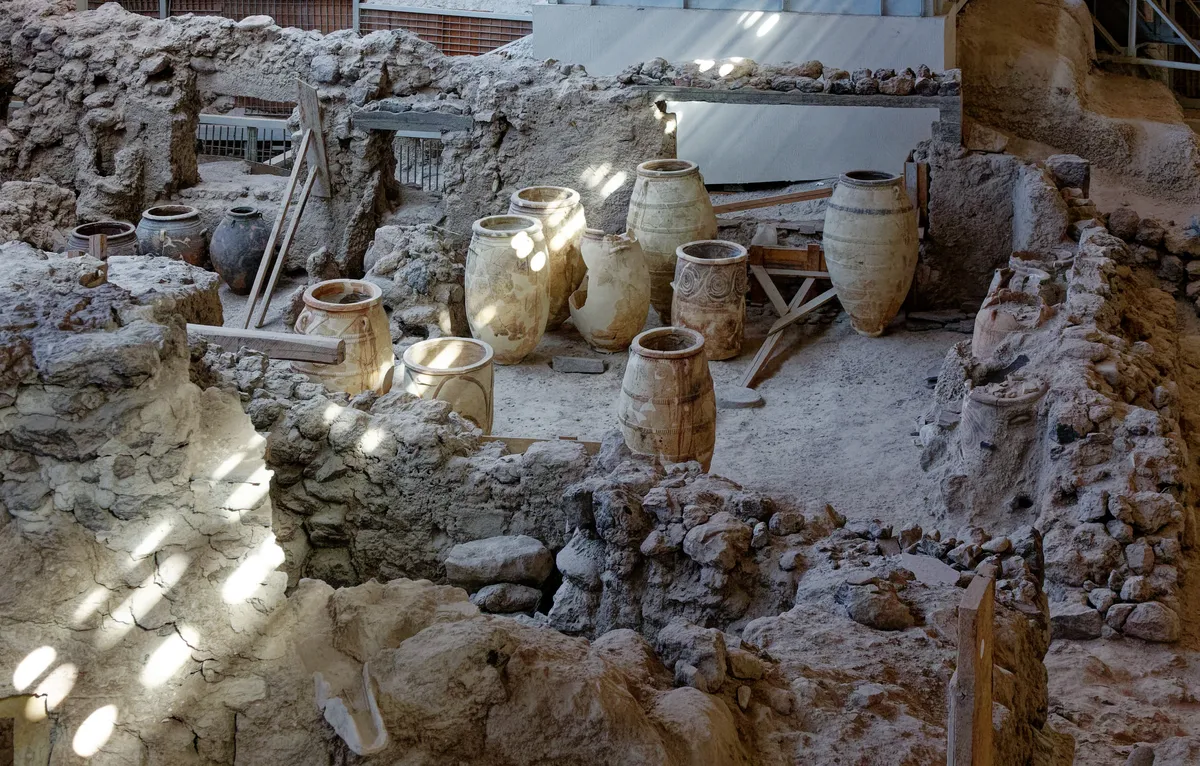
A 17th-century-BC city buried by the eruption and excavated since 1967. The bioclimatic shelter opened in 2012 lets you walk through streets, squares, and three-story houses in the shade; adult admission about €20 (2026).
You can walk through streets, squares, and three-story houses in a 17th-century BC city buried by the eruption and excavated since 1967, with adult admission of about €20 in 2026; the roof opened in 2012 provides shade.
Check access
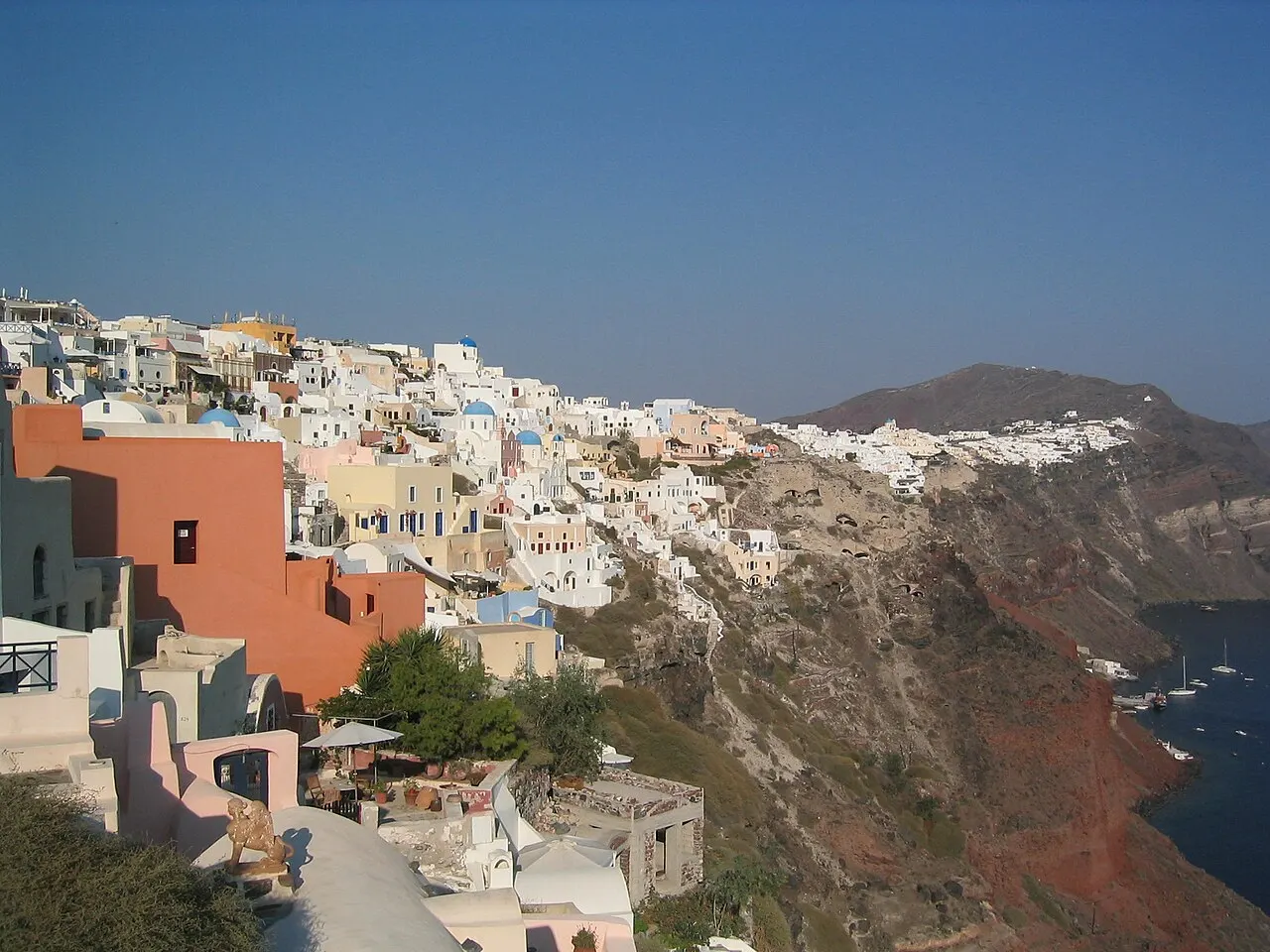
Oia's Kastro and Ammoudi
The ruins of Agios Nikolaos castle are the late-afternoon lookout. Below, 300 steps lead down to Ammoudi, a pier of fish tavernas set into red rock; boats to Thirasia leave from there.
The ruins are the late-afternoon viewpoint, and below there's a pier of fish tavernas on the red rock, from where boats leave for Thirasia; 300 steps separate the Agios Nikolaos castle from Ammoudi.
Check access
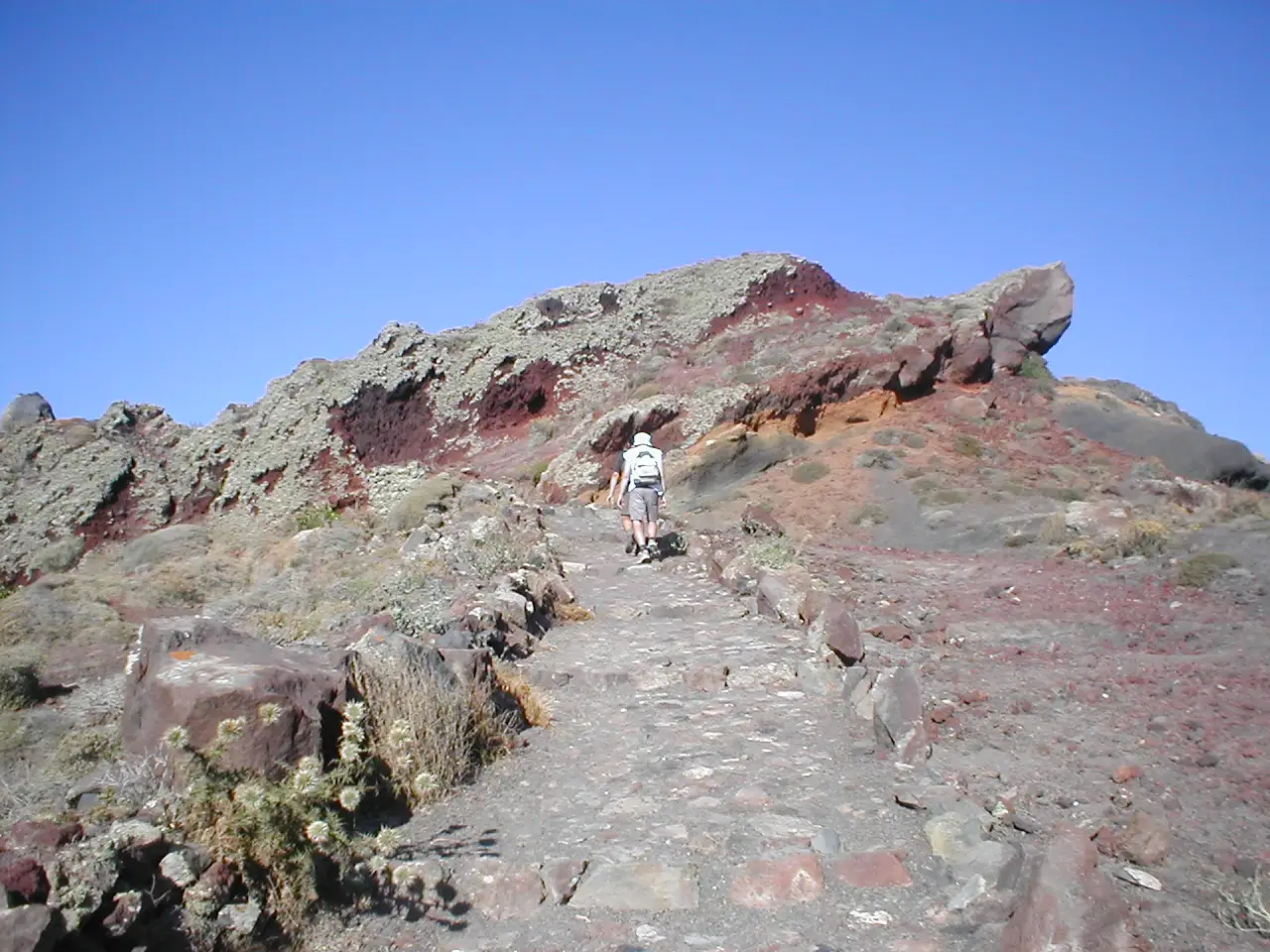
Fira–Oia rim trail
About 10 km and 3 hours 30 minutes to 4 hours of walking along the top of the cliff, passing through Firostefani, Imerovigli, and Skaros. Stretches of loose ground, exposed climbs, and no shade at all: leave early in the morning, bring water and allow time to finish before dark. In the late afternoon, limit yourself to a short section, depending on sunset time.
About 10 km and 3 hours 30 minutes to 4 hours of walking, with stretches of loose ground, exposed climbs, and no shade, calls for an early morning start with water, and in the late afternoon only a short stretch fits; it passes through Firostefani, Imerovigli, and Skaros.
Check access
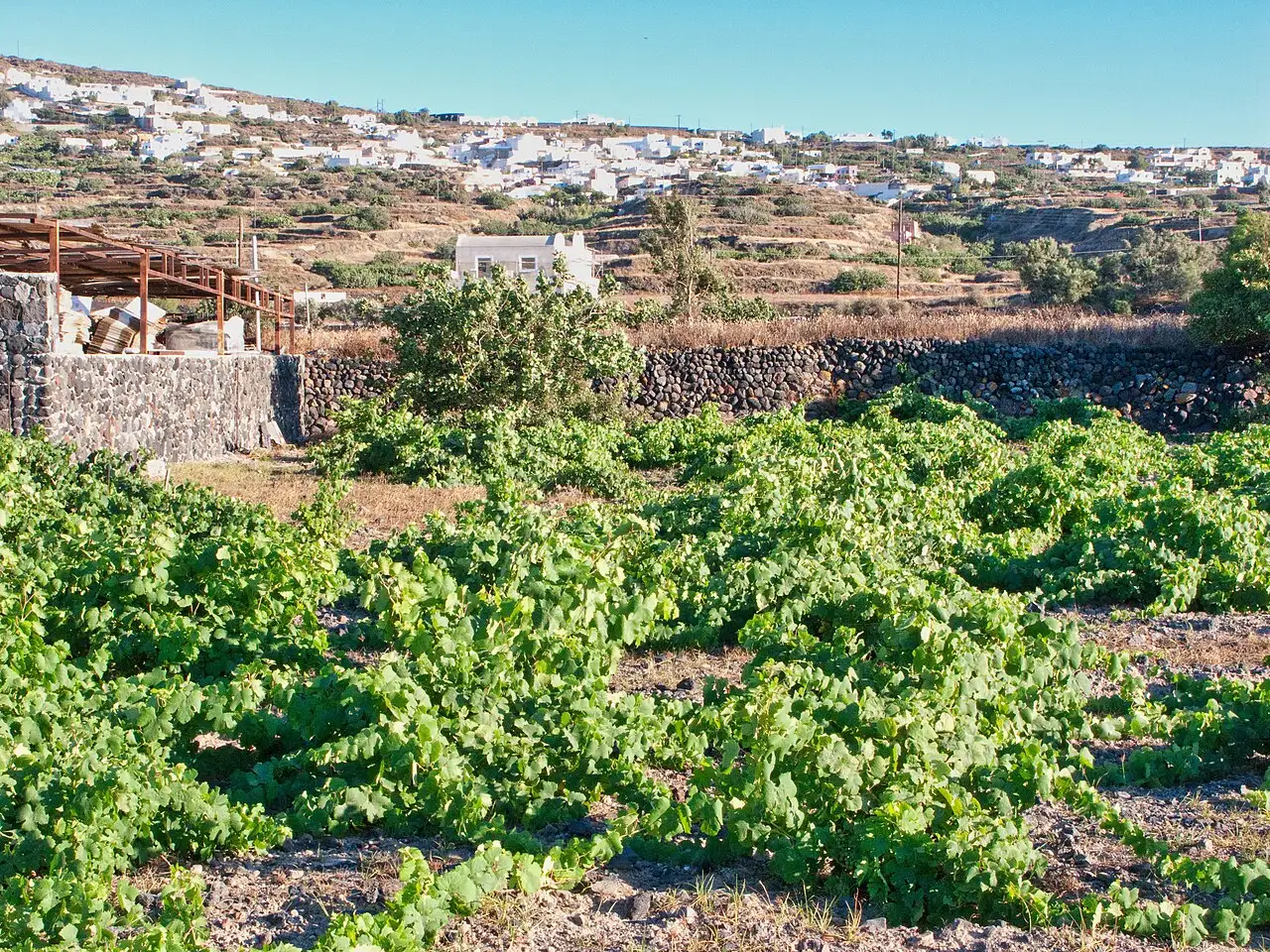
Low-vine wineries
Santo Wines (a cooperative, in Pyrgos), Venetsanos (above Athinios port, from 1947), and Domaine Sigalas (in Baxedes) welcome visits and tastings. There you can see the kouloura, the basket-braided vine trained low to the ground to trap dew and withstand the wind.
Check access
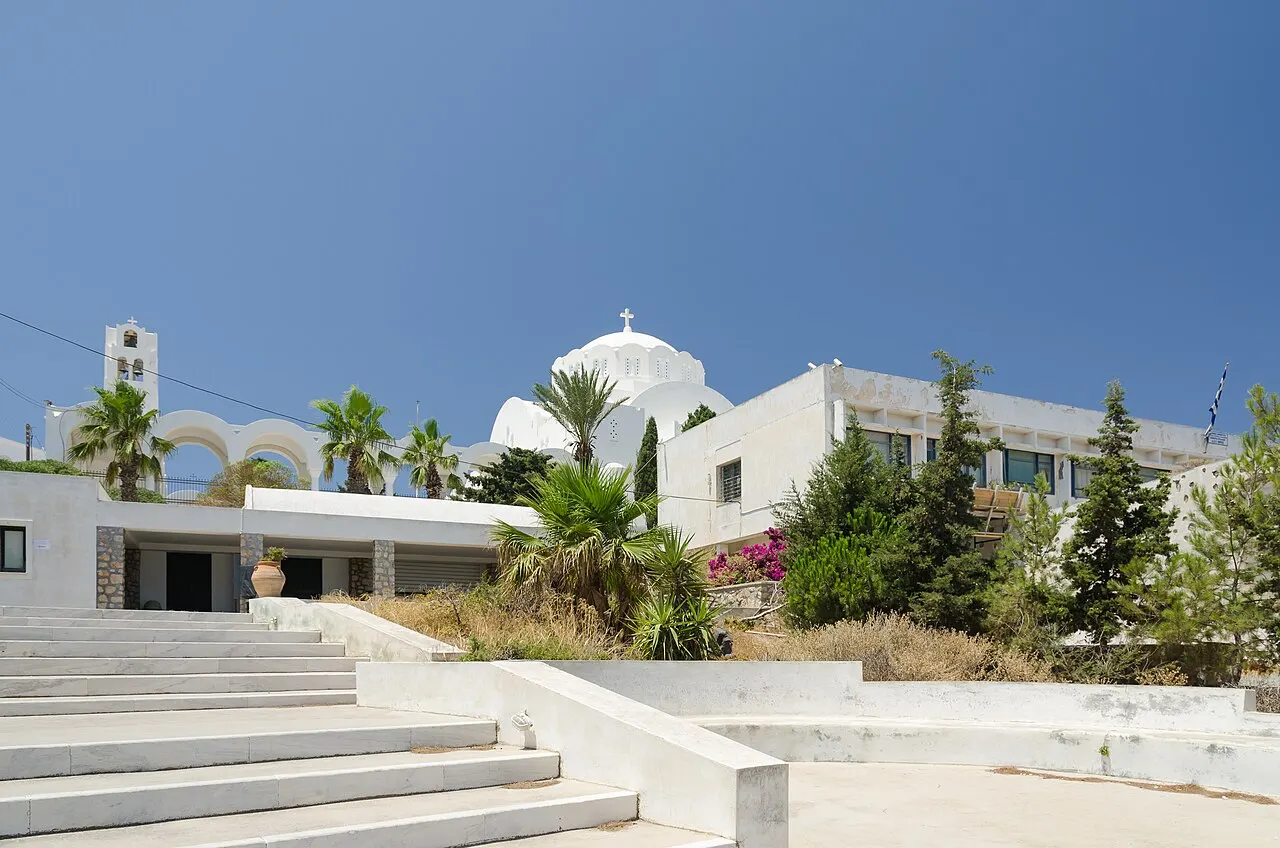
Museum of Prehistoric Thera, Fira
Opened in 2000, it brings together pottery, the gold ibex found in 1999 and paintings from Akrotiri. Alongside the Blue Monkeys and the Ladies, the exhibition includes the Fishermen, the Flotilla and the Saffron Gatherers. It opens from 8:30am to 3:30pm, closes on Tuesdays and costs €10 at the full rate.
It brings together paintings from Akrotiri and the gold ibex.
Check access
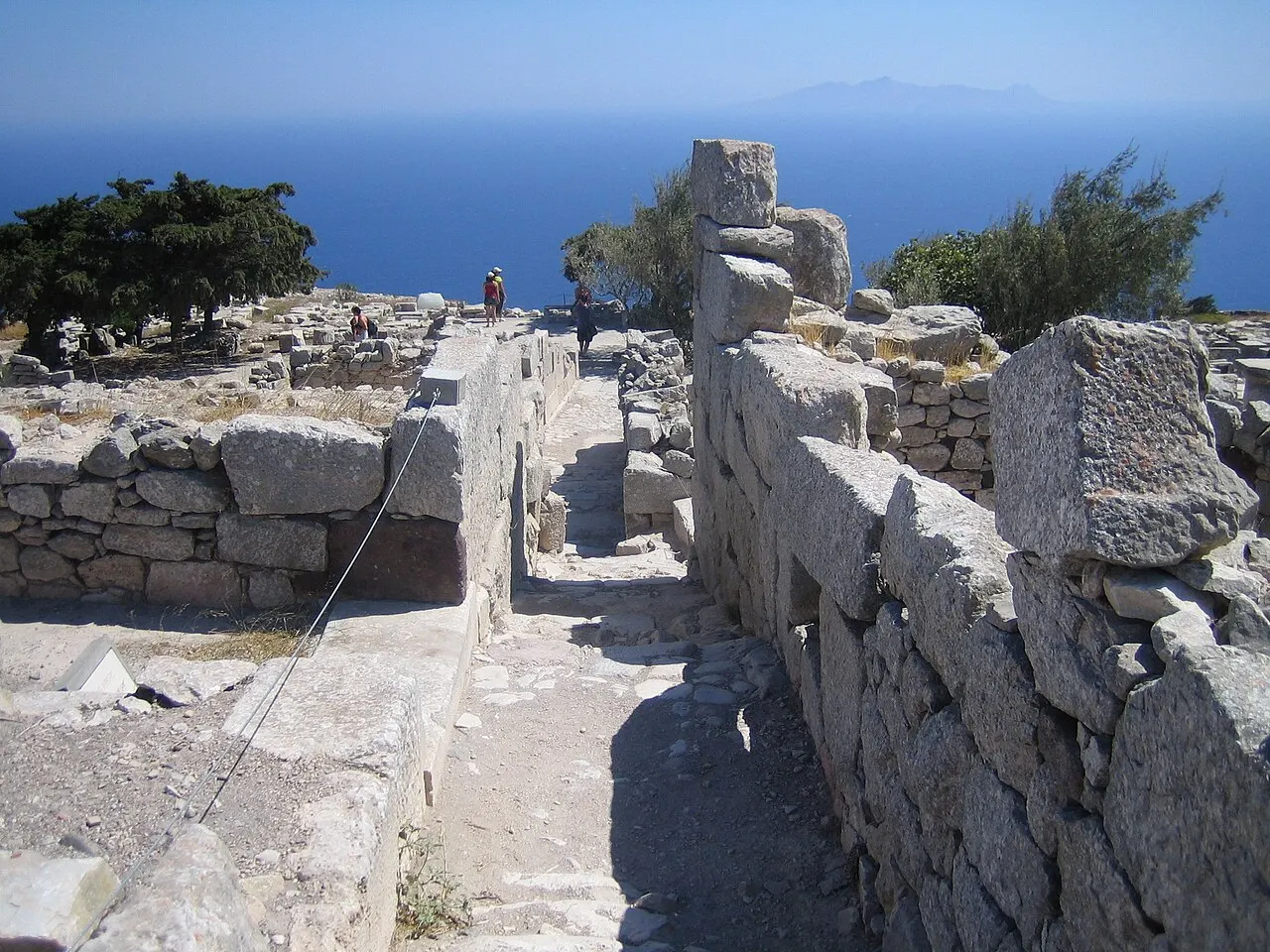
Ancient Thera, Mesa Vouno
The Dorian city at 396 m, with an agora, a rock-cut theater, a Ptolemaic gymnasium and archaic inscriptions on the stones. Drive up the road from Kamari or walk for about 50 minutes; there is no shade or water at the top, and the site opens at 8:30am and closes at 3:30pm, so arrive at opening time.
The site closes at 3:30pm, so go at opening.
Check access
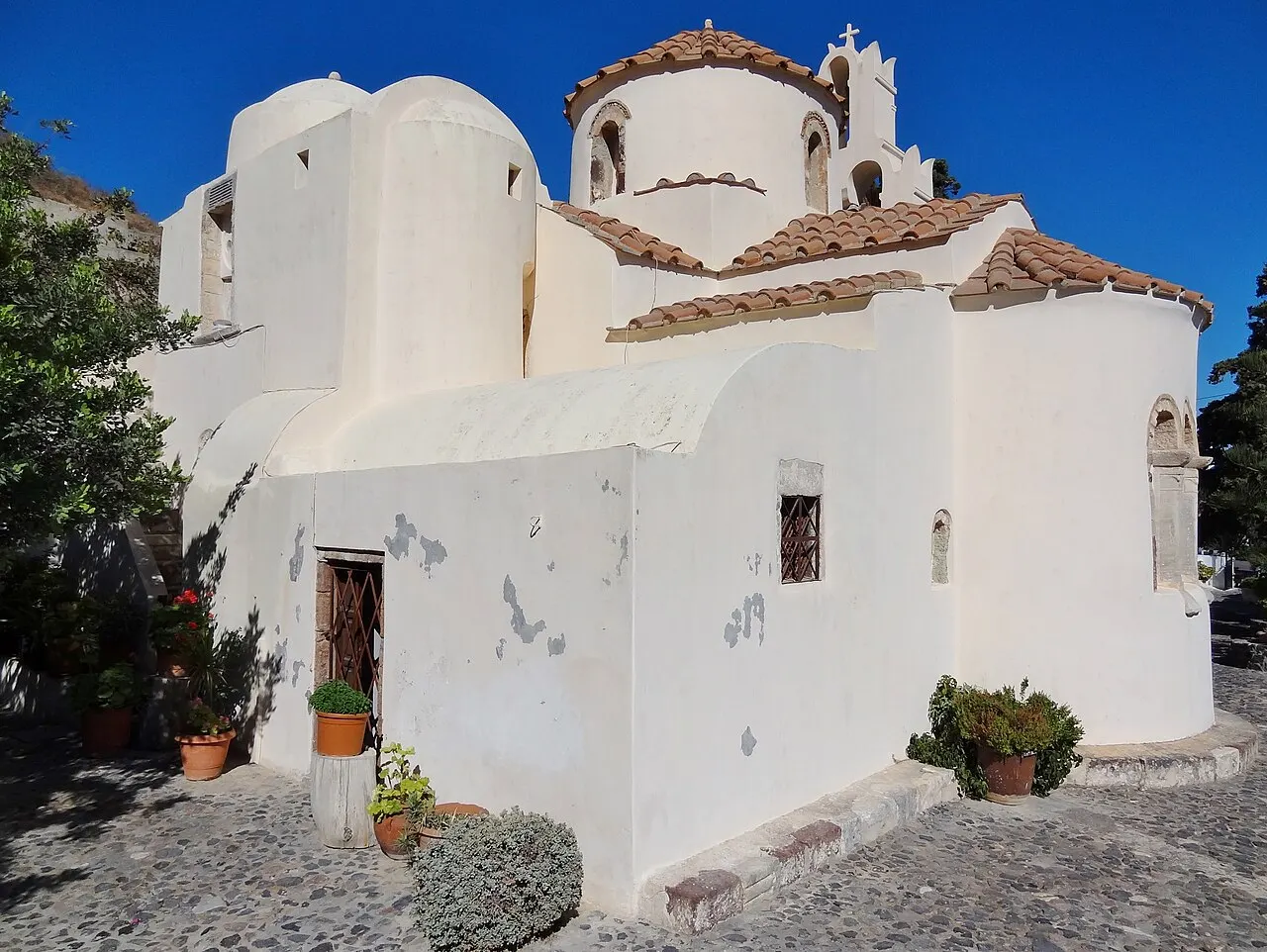
Panagia Episkopi, Mesa Gonia
A Byzantine church from c. 1100, built under Alexios I Komnenos, with frescoes, a marble iconostasis, and a vine-covered courtyard. It survived the 1956 earthquake that destroyed the village around it.
The church survived the 1956 earthquake.
Check access

Tomato Industrial Museum, Vlychada
Housed in the old Nomikos tomato-paste factory, opened to the public in 2014, with original boilers, cans, and machinery. In the same complex the Santorini Arts Factory runs an art and theater program in summer.
It opened to the public in 2014 with the original machinery.
Check access
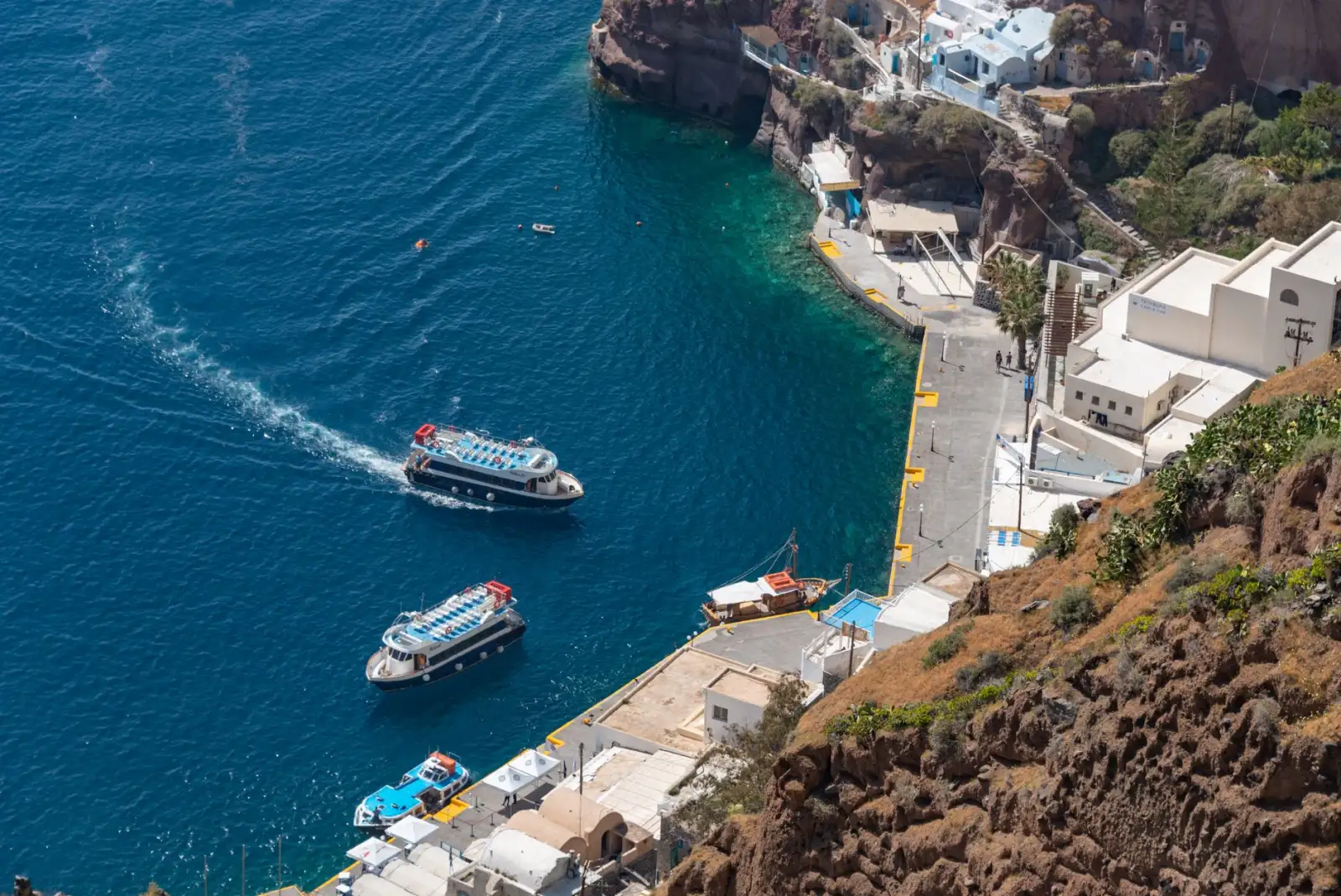
Fira cable car and the Old Port
Opened in 1979, a gift from shipowner Evangelos Nomikos, it covers the 220 m cliff in about 3 minutes. The alternative on foot is 588 steps; mules still work the stairs, with legal load limits since 2018.
The cable car links Fira to the Old Port, the departure point for caldera boats, in about 3 minutes for €10 one way. Allow time for the line when there are cruise ships in the bay; the walking alternative has 588 steps and takes stamina on the way back.
Check access
Nilo’s itinerary
Start with the basic programme and choose extensions for the time you have.
Plan my days in the app ↗Day 1 · The caldera rim, from Fira to Oia
Start at 8:30am at the Museum of Prehistoric Thera in Fira (€10), where the frescoes and the gold ibex from Akrotiri help explain the island before the eruption. On Tuesdays, when it is closed, start with the walk and save the museum for another day.
Walk the rim to Firostefani and Imerovigli (40 min) and go down to the rock of Skaros, the island's Venetian capital until its 17th-century collapse (30 min round trip).
Have lunch in Imerovigli and stop between 1pm and 4pm: there's no shade on the caldera trail at that time of day.
Instead of returning to the trail in the afternoon sun, go back to Fira and take the 5pm bus to Oia, reaching the kastro around 6pm, two hours before August's sunset, to choose a spot to stand.
Have dinner in Ammoudi, 300 steps below Oia, and go back up by taxi (€10–15) instead of climbing the stairs in the dark.
Day 2 · Volcano, Thirasia, and vineyards
Catch the 9:30am boat from the Old Port to Nea Kameni: it's a 20-minute crossing and a 130 m climb to the crater over loose scoria, with an entry fee of about €5 on top of the tour.
If there is a stop at Palea Kameni, check the distance and swimming conditions for reaching the springs with the crew. Only enter the water if you can swim in open sea and complete the round trip; staying aboard is also an option. The iron-rich water can stain your swimsuit.
Land in Thirasia for lunch in Korfos, by the water, and climb the roughly 200 steps (or ride a mule) up to the village of Manolas, at the top.
Choose a boat trip whose return time fits your winery reservation, including the journey on land. Longer trips take up to eight hours; in that case, save the tasting for another day. Venetsanos, Santo Wines and Domaine Sigalas welcome visitors by appointment.
End the day in Pyrgos, where the medieval kasteli gets the same light as Oia at dusk, without the crowds, and have dinner in the village itself.
If you stay longer
Day 3 · Bronze Age and black sand
Start at Ancient Thera on Mesa Vouno, at 396 m, when it opens at 8:30am, before the sun reaches the unshaded summit; carry water, because there is nothing up there.
Head down to Akrotiri in the late morning (about €20): its 2012 bioclimatic roof keeps the site shaded, and the route passes streets and three-story houses from the 17th century BC.
Have fish for lunch in Kamari or Perissa and spend the afternoon on the black sand; rent sun loungers (€15–25 a pair), because the sand burns your feet after midday.
In the late afternoon, visit the Tomato Industrial Museum in Vlychada, inside the old Nomikos factory, and walk along the wind-carved pumice cliffs on the beach next door.
Have dinner in Megalochori or Emporio, inland villages far from the caldera rim.
Food
 AI illustration
Fava Santorinis
A puree of yellow vetchling (Lathyrus clymenum), not fava beans, grown on the island for millennia and with a protected designation of origin since 2010. Served warm with olive oil, raw onion, and capers; the pantremeni version comes with sautéed onion.
 AI illustration
Tomatokeftedes
Fritters of Santorini's small tomato with onion, mint, and flour, pressed by hand. They started as a way to use up tomatoes from the tomato-paste factories and now start almost every meal on the island.
 AI illustration
Santorini's small tomato
A small variety with thick skin and high sugar, grown with almost no irrigation, pulling moisture from dew and volcanic soil. It has held PDO status since 2013 and appears sun-dried, as a paste, or raw.
 AI illustration
Melitzana lefki
The island's white eggplant, seedless and sweet-fleshed, harvested in summer. Served grilled, in a salad with fava, or fried in thin slices.
 AI illustration
Chloro from Thirasia
A fresh goat cheese, salty and moist, produced on a small scale in Thirasia and inland. It goes into tomatokeftedes, salads, and cheese pies.
 AI illustration
Assyrtiko
A native white grape with high acidity and a mineral taste, the base of the Santorini designation (created in 1971). Nykteri is the long-fermented version; order half a liter of house wine at a taverna for €12–20.
 AI illustration
Vinsanto
A sweet wine from assyrtiko and aidani grapes sun-dried for 10 to 14 days and aged in barrels for years. It was exported to Russia in the 19th century and today closes out dinner, with cheese or on its own.
 AI illustration
Koufeto and melitinia
Festival sweets: koufeto is white pumpkin in syrup with almond, served at weddings; melitinia are little pastry baskets with mizithra cheese, honey, and mastic, baked at Easter.
Day trips

Thirasia
The other half of the caldera ring, 10–15 minutes by boat from Ammoudi or about 25 minutes from Athinios (round trip €12–25 on a scheduled boat or excursion). About 300 residents, no buses and no big hotels; lunch in Korfos, 200 steps or a mule ride up to Manolas and a whole afternoon without lines. Set aside half a day.
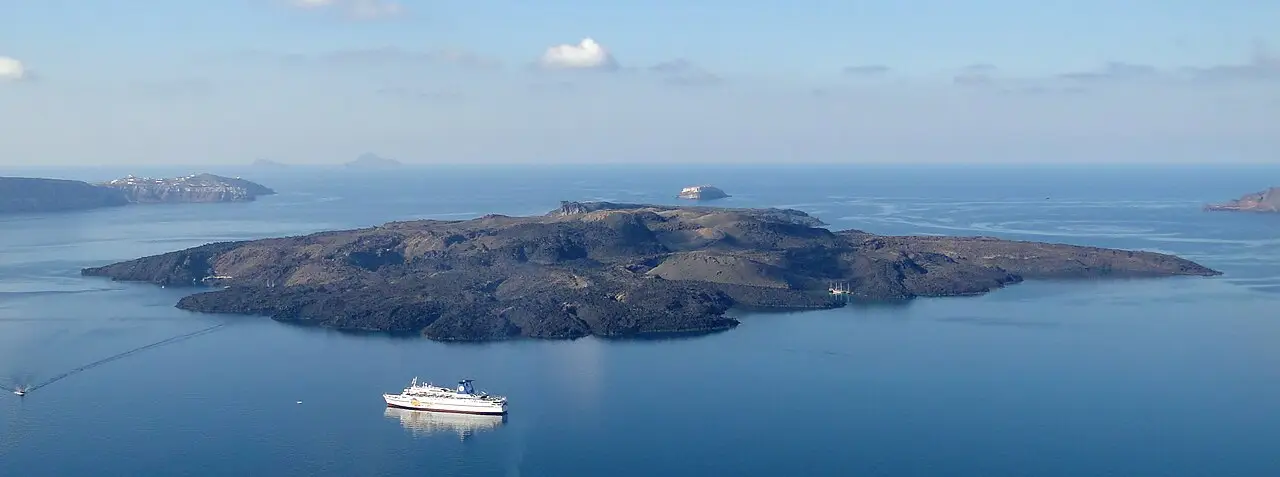
Nea Kameni and Palea Kameni
Nea Kameni and Palea Kameni were born long after the rest of the island. Boats leave from Fira's Old Port and from Ammoudi; it's a 20-minute crossing, about an hour's walk to the crater at 130 m and a swim in the hot springs. The trip takes 4 to 8 hours, depending on the route.
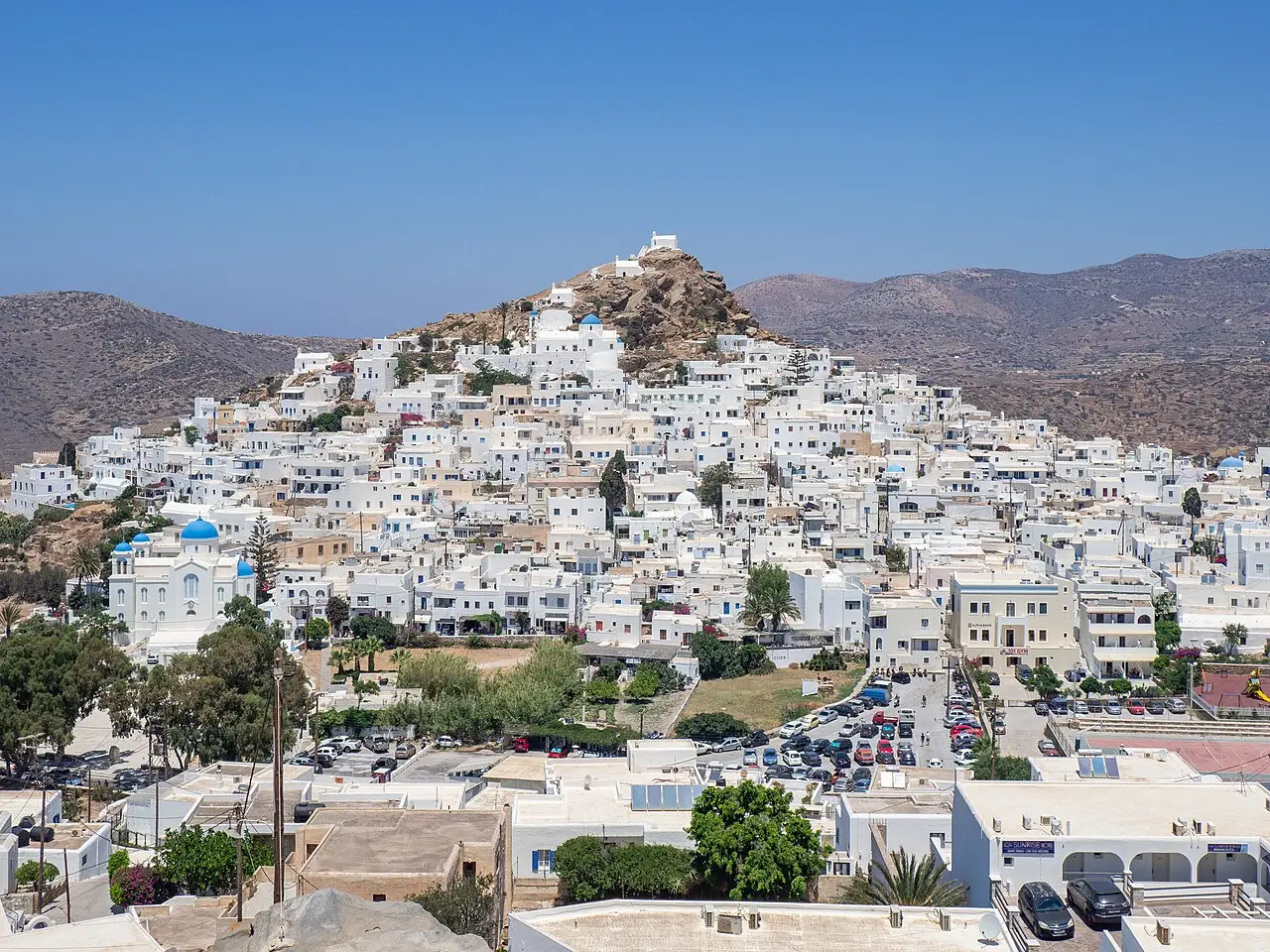
Ios or Folegandros
Fast ferry from Athinios: Ios in 35–45 minutes, Folegandros in 45–60 minutes, for €25–40 one way. You can go and come back the same day between May and September: confirm the return time before buying, because the meltemi cancels fast crossings.
Where to begin
The caldera rim, from Fira to Oia
Start at 8:30am at the Museum of Prehistoric Thera in Fira (€10), where the frescoes and the gold ibex from Akrotiri help explain the island before the eruption. On Tuesdays, when it is closed, start with the walk and save the museum for another day.
Volcano, Thirasia, and vineyards
Catch the 9:30am boat from the Old Port to Nea Kameni: it's a 20-minute crossing and a 130 m climb to the crater over loose scoria, with an entry fee of about €5 on top of the tour.
Bronze Age and black sand
Start at Ancient Thera on Mesa Vouno, at 396 m, when it opens at 8:30am, before the sun reaches the unshaded summit; carry water, because there is nothing up there.
Money
The currency is the euro, and contactless cards handle almost everything. Two exceptions catch new arrivals off guard: the KTEL bus and some beach kiosks and smaller boats only take cash. Typical 2026 ranges: freddo espresso €3–4.50, gyros or souvlaki in pita €4–6, taverna lunch €15–25 per person. Dinner with a caldera view runs €45–90; half a liter of house Assyrtiko, €12–20 (a bottle in a shop, €15–30); a winery tasting, €25–45; a museum, €6–12. For a bed: a simple room in Perissa or Kamari €60–110 a night, a mid-range hotel in Fira €150–280, a cave suite with a caldera view €350 to €900 or more in August. Add the climate resilience hotel fee, charged per room per night in high season. From April to October, hotels charge €2 at 1–2 stars, €5 at 3 stars, €10 at 4 stars and €15 at 5 stars, per room per night. From November to March, rates are lower; vacation rentals have their own scale. Cruise passengers pay a disembarkation fee: €20 per passenger at the peak of summer, about €12 in April, May and October and about €4 between November and March. It's almost always built into the ticket. Tipping isn't mandatory. The norm is to round up the bill or leave 5 to 10% in cash on the table, even when paying by card. There are ATMs in Fira, Oia, Kamari and Perissa, many with their own fee of €3 to €6. Withdraw at a bank if you can, and decline conversion into your card's currency.
Getting there and around
Airport: 6 km southeast of Fira, runway shared with the air base
Santorini's airport (JTR) is in Monolithos, about 6 km southeast of Fira, with a single terminal and a runway shared with the air base. Flights from Athens take 45 to 50 minutes, on Aegean, Sky Express and Volotea, and between April and October seasonal direct flights arrive from several European cities. The KTEL bus to Fira costs about €2.20 and is paid in cash. A taxi runs €20–25 to Fira and €40–50 to Oia, but the whole island has just over 40 licensed taxis, so in high season I'd book a transfer before boarding. If you arrive by boat, the port is Athinios, tucked into the southern wall of the caldera 10 km from Fira: from Piraeus, Blue Star's conventional ferries take 7 hours 30 minutes to 8 hours for €40–55, and fast catamarans 4 hours 30 minutes to 5 hours 30 minutes for €75–100 (2026). In summer there are daily connections with Crete (Heraklion, about 2 hours), Ios, Naxos, Paros and Mykonos. Athinios has no shade and no waiting room worth the name, and the road out is a series of hairpin bends. The good part is that buses wait for every arrival, something nobody believes while standing in the sun.
Everything leaves from Fira: to get from Oia to Perissa, change buses there
On the island, all KTEL buses leave from Fira's central station, on radial routes. There's no shortcut on the map: every line passes through there. Most fares are €2.20. Fira–Perissa/Perivolos and Fira–Athinios cost €2.70, Fira–Vlychada €2.80, and the night lines, from 12:30am to 7am, run €2.50 to €3.10 (2026). Payment is in cash to the conductor; contactless is still rare on board. The cable car between Fira and the Old Port covers 220 m in about 3 minutes, for €10 one way, with long lines when the cruise tenders arrive. On foot it's 588 steps. You can only rent a motorcycle, quad, or car with the matching license class: check the required category and insurance coverage terms before renting. The rim villages are all stairs and uneven stone, wheeled luggage suffers, and Fira, Imerovigli, and Oia connect on foot via the caldera trail, about 10 km with no shade along the way.
Safety
Santorini has a very low rate of violent crime, and the most important precautions for travelers involve traffic, heat and terrain. The first is traffic: narrow roads with no shoulder, blind curves and lots of people riding an ATV for the first time in their lives. Wear a helmet and only rent a vehicle you are licensed and experienced to drive; check your insurance coverage before setting off. The second is the caldera rim itself: in many stretches there's no railing, and the volcanic rock is crumbly and gives way under weight. Don't sit on the edge for a photo, and avoid the Fira–Oia trail at midday without water or shade. On the beaches, the black sand passes 50 °C at noon and burns your feet. Perissa and Kamari get currents when the meltemi blows. The northern beaches, like Baxedes and Koloumbos, have strong surf and no lifeguards. On the volcano, the facts are simple: Nea Kameni last erupted in 1950. The system is monitored in real time by the Santorini volcano monitoring institute. The seismic swarm of January and February 2025, between Santorini and Amorgos, was caused by magma intruding into a dike between the two islands, according to studies published in Science and Nature in November 2025, and it ended without an eruption. If there's an alert, follow Greek Civil Protection, which sends messages through 112. Look after your belongings in cable car lines, on crowded buses and at viewpoints; the low incidence of violent crime does not eliminate theft. Emergencies: 112. The Fira health center handles simple cases. Serious cases are flown to Athens, so travel insurance with air evacuation coverage is recommended.
Etiquette tips
Toilet paper goes in the bin
The island's plumbing is narrow and old and clogs easily. In homes, tavernas, and most hotels, used paper goes in the bin next to the toilet. There's a sign on the wall, and it means it.
Water on the island: desalinated, quick showers
Almost everything that comes out of the tap is desalinated or arrived by boat. Short showers, turn off the tap while brushing your teeth, and no filling bathtubs; tap water is brackish and not drinkable in most villages.
Photos in Oia: domes and terraces are private property
The churches and terraces that show up in photos of Oia and Imerovigli are, in many cases, private or parish property. Don't climb onto a private wall, roof, or staircase to take a photo, and cover shoulders and knees when entering a church.
At sunset, no one holds a spot
The streets of Oia's kastro are two meters wide and hold thousands of people. Don't set up a tripod, don't reserve space with a bag, and let people through who are trying to get by. The street is also how residents get home.
The bill comes as one
A Greek table shares: dishes go in the middle and the bill comes as one. Asking for separate checks complicates things; agree on the split beforehand, and expect the house to offer raki or a dessert on the house at the end.
Visit the wineries by car or with a booked taxi
The wineries are far from the bus network, and without a car or a booked taxi the tasting ends with a walk along the side of the road. Arrange your ride back before the first glass, and don't drive after it.
Mistakes to avoid
Going straight from Oia to Perissa
Thinking you can go straight from Oia to Perissa. Every bus line runs through Fira, and with the transfer you lose an hour. The same goes for the Akrotiri–Kamari trip.
Arriving in Oia at 8pm in August
Arriving in Oia at 8pm in August to watch the sunset. The main street becomes impassable from 6:30pm on, and getting out afterward takes 40 minutes on foot, so arrive two hours earlier, around 6pm, or watch the sunset from another village on the rim.
Renting a scooter without the right license category
Only rent a scooter or ATV with the required license class, driving experience and appropriate insurance. Confirm the coverage limits in the contract. The roads have blind curves, narrow stretches and little room to correct a mistake.
Red Beach is often closed over collapse risk
Counting on Red Beach. Access has often been closed since 2018 because of rockfall risk, and the trail is unstable. Check on the day and keep Vlychada, Kamari, or White Beach, reachable only by boat, as a backup.
Return flight the same day as the last boat
Booking your return flight for the same day as your last boat trip. The meltemi cancels crossings without warning, and the Athinios road jams up with every ferry arrival. Leave a half-day buffer.
Useful phrases
Γεια σας (yá sas)
Hello / goodbye, the polite form; for one person and informally, “yá su”
Καλησπέρα (kalispéra)
Good afternoon / good evening: the standard greeting after 5pm
Ευχαριστώ (efharistó)
Thank you; “parakaló” works for both “please” and “you're welcome”
Πόσο κάνει; (póso káni)
How much does it cost?
Το λογαριασμό, παρακαλώ (to logariasmó, parakaló)
The check, please
Ένα ασύρτικο, παρακαλώ (éna assírtiko, parakaló)
One assyrtiko, please: the island's white wine
Districts
Fira
The capital and the hub for everything: all the bus lines pass through here, along with the two main museums, the cable car, and the largest concentration of shops and bars. It's the noisiest village and the most practical for anyone not renting a vehicle.
Firostefani and Imerovigli
Firostefani is 10 minutes on foot from Fira along the caldera rim, to the north, and Imerovigli is 40. Both have hotels with pools facing the caldera and almost no shops, and from Imerovigli runs the short trail to the Skaros rock, where the Venetian capital stood until its collapse in the 17th century.
Oia
The northwestern village, rebuilt after 1956 and today the point of greatest crowding at sunset. Ruins of Agios Nikolaos castle, 19th-century sea captains' houses, and 300 steps down to the pier at Ammoudi.
Pyrgos
The former capital until 1800, high up inland, with a maze-like medieval kasteli and a 360-degree view with no entry fee. Good restaurants and prices well below the caldera rim.
Megalochori and Akrotiri
Southwestern villages, among vineyards, Venetian towers, and wineries; Megalochori keeps 18th-century merchant houses with stone gateways. Akrotiri gives access to the prehistoric site, the lighthouse, and the Red and White Beaches.
Emporio and Mesa Gonia
The farming interior: Emporio is the island's largest village by number of old houses, with the kasteli and the 15th-century Goulas tower; Mesa Gonia was leveled in 1956 and holds the Byzantine church of Panagia Episkopi, from c. 1100.
Kamari and Perissa
The island's two big black-sand beaches on the east side, separated by the Mesa Vouno massif. They concentrate budget lodging, sun-lounger rentals, and the beach life the caldera doesn't have.
Vlychada and Thirasia
Vlychada, in the south, has pumice cliffs carved by the wind, a marina, the Tomato Industrial Museum, and the Santorini Arts Factory. Thirasia, across the caldera, is the neighboring island of about 300 residents, with no buses and no crowds.
History
17th c. BC · Akrotiri, a Bronze Age city
A south-coast port with two- and three-story houses, a sewer system, indoor bathrooms and frescoes, which traded with Crete, Cyprus and Egypt. Estimates put its peak population somewhere between 2,000 and 4,000.
c. 1600 BC · The Minoan eruption
One of the largest explosive eruptions of the Holocene (VEI 7) throws out dozens of km³ of material, buries Akrotiri under up to 60 m of pumice, and makes the island's center collapse, forming the caldera. The absence of bodies supports the hypothesis of evacuation before the catastrophe, but does not prove how everyone left. Valuable objects remained, including the gold ibex found in 1999.
9th c. BC · Doric settlers at Mesa Vouno
According to tradition, settlers from Sparta led by Theras found the city of Thera at an altitude of 396 m. Some of the oldest inscriptions in the Greek alphabet survive on the rocks nearby.
631 BC · Thera founds Cyrene
After seven years of drought, the island sends colonists to the coast of Libya and founds Cyrene, an episode Herodotus tells in Book IV of the Histories.
3rd c. BC · Ptolemaic naval base
Egypt's Ptolemies station a garrison and gymnasium at Ancient Thera, using the island as a foothold in the Aegean. Rome, then Byzantium, keep it as an outlying province.
c. 1100 · Panagia Episkopi
The Byzantine church of Mesa Gonia is built under Alexios I Komnenos and still stands, with frescoes and a marble iconostasis. It is the oldest religious building still in use on the island.
1204–1579 · Venetians and the name Santorini
After the Fourth Crusade the island enters the Sanudo Duchy of Naxos and gains five fortified villages (kastelia): Skaros, Oia, Pyrgos, Emporio, and Akrotiri. The Latin name comes from a chapel dedicated to Saint Irene; in 1579 the duchy is annexed by the Ottoman Empire.
18th–19th c. · Fleet, wine, and volcanic soil
With Ottoman tax privileges, Santorini keeps a merchant fleet and exports Vinsanto to Russia. From 1830 it joins the Greek state; in the 1860s local pozzolana is mined by the ton for the works of the Suez Canal.

July 9, 1956 · The Amorgos earthquake
A quake of about magnitude 7.5 followed by a tsunami brings down most of the houses of Oia and Fira and kills about 53 people. The emigration that follows empties the island for two decades.
1967 · Marinatos excavates Akrotiri
Spyridon Marinatos opens the systematic excavation of the buried city and works on it until he dies at the site, in 1974, where he is buried. Christos Doumas succeeds him as director.
2025–2026 · Seismic swarm and tourism limits
Between January and February 2025, thousands of tremors between Santorini and Amorgos lead to a state of emergency and the temporary departure of much of the population; studies published in November 2025 attribute the swarm to magma intruding into a dike between the two islands. For 2026, the cap of 8,000 cruise passengers a day and a cruise disembarkation fee of up to €20 per passenger apply.

Complete history
Akrotiri and the Minoan eruption, around 1600 BC
Santorini's story begins with a buried town. In the 17th century BC, Akrotiri, on the southern tip, was a prosperous port in the Minoan orbit, with two- and three-story houses, streets with sewers beneath them, bathrooms connected to ceramic pipes and frescoes of monkeys, antelopes, a fleet and a boy fishing. Around 1600 BC, the volcano erupted with VEI 7 force; radiocarbon dating points to 1627–1600 BC, while archaeology tends toward slightly later dates. The eruption buried the town under dozens of meters of pumice, collapsed the center of the island into the sea and set off a tsunami that hit northern Crete. The absence of skeletons is one piece of evidence used to suggest there was warning and evacuation before the eruption; it does not allow us to reconstruct how each resident left. The objects found include the gold ibex now displayed in the Fira museum. The island stayed uninhabited for generations, and the pumice sealed what was left.
Repopulation came from the other side of the Greek world
Repopulation came from the other side of the Greek world. In the 9th century BC, Dorian settlers, linked to Sparta and a chief named Theras, settled atop Mesa Vouno, at 396 m, away from the sea and the wind, and founded Ancient Thera, with an agora, a theater, and temples. In 631 BC, after seven years of drought, the island exported part of its own population to found Cyrene, in Libya; Herodotus tells the episode as an administrative decision, with families chosen by lot. In the 3rd century BC Egypt's Ptolemies made Thera a naval base, which explains the gymnasium and garrison at the site. Then came Rome, Byzantium, and a long stretch of little record, broken around 1100 by the building of the church of Panagia Episkopi, still standing in Mesa Gonia.
Three and a half centuries as a Latin island
From 1204 to 1579 the island was Latin. The carving-up of the Byzantine Empire after the Fourth Crusade put Santorini in the Venetian Sanudo Duchy of Naxos, and from that period come the name (from a chapel dedicated to Saint Irene) and the territory's organization into five kastelia: Skaros, Oia, Pyrgos, Emporio, and Akrotiri, walled villages built away from the shore because of piracy. Ottoman rule began in 1579, but was light-handed: the island kept tax privileges, a protected Catholic minority (still with a cathedral and a Dominican convent in Fira today), and a merchant fleet that by the 18th c. reached over a hundred ships, carrying Vinsanto to the ports of the Black Sea and to Orthodox monasteries.
Pozzolana, wine and tomatoes, until the 1956 earthquake
In the 19th century, the island's rock became an industry. Santorini's pozzolana, known as Thera earth, was quarried on a large scale on the southern slopes and on Thirasia as an ingredient for hydraulic cement, and some of it was shipped to the construction of the Suez Canal, between 1859 and 1869. At the same time, Assyrtiko vines and the island's cherry tomatoes became export products, and the tomato paste factories, the biggest of them run by the Nomikos family, operated from 1915 until the 1980s. On July 9, 1956, the Amorgos earthquake, of magnitude about 7.5, followed by a tsunami, destroyed most of Oia and Fira and killed about 53 people. The island emptied out: those who could left for Athens, Germany and Australia, and the population fell to around 7,000 in the 1970s.
Tourism after 1956 and the limits on crowds
Rebuilding after the earthquake came with tourism. In the following decades, the cave houses on the rim became hotels and suites with caldera views, and the Oia sunset, reproduced around the world since the 1990s, began drawing more than 2 million visitors a year to an island of about 15,500 residents. The cost shows on land and at sea: vineyard area has shrunk, by local estimates, to about half of what it was in the 1980s, and almost all the water comes from desalination. Faced with overcrowding, the official response came in stages: the cap of 8,000 cruise passengers a day, strictly enforced in 2026, a cruise disembarkation fee that varies by season and an extra charge per hotel night, created for climate resilience.
Spyridon Marinatos, who began the systematic excavation of Akrotiri, died at the site itself in 1974 and is buried there.
Geography and shape of the city
The volcano's ring and the caldera
Santorini sits on the rim of a volcanic caldera flooded by the sea. The archipelago covers about 90 km²: Thira (about 76 km²), Thirasia (about 9 km²), the uninhabited rock of Aspronisi and the lava islets of Nea Kameni and Palea Kameni, which grew inside the caldera between 197 BC and the last eruption, in 1950. The caldera measures roughly 11 by 7.5 km and reaches almost 390 m deep; the inner cliffs rise 150 to 300 m in red, black and white bands of lava, scoria and pumice, stacked in layers you can read with the naked eye. That's why the island is lopsided: on the inside it's a sheer wall, and on the outside it slopes gently down to the black-sand beaches of Kamari, Perissa and Perivolos.
The villages and the highest point
The shape of the island explains where the villages are. The rim villages (Fira, Firostefani, Imerovigli, Oia) line up along the clifftop, for defense against pirates and because of the wind, with houses carved into the soft rock and barrel vaults facing the drop; the farming villages (Pyrgos, Megalochori, Emporio, Mesa Gonia) sit inland, on the sheltered slope. The highest point is Profitis Ilias, at 567 m, a block of limestone older than the volcano.
The missing water and the meltemi
There is no usable river or water table: the island runs on desalination and rain cisterns. The climate is Mediterranean, with hot, dry summers, about 370 mm of rain a year concentrated between November and March, and the meltemi wind blowing hard from the north in July and August.
The pumice left by the eruption was sold as Thera earth and became cement in the construction of the Suez Canal.
Culture
More than 250 churches for about 15,500 residents
The island has hundreds of churches and chapels for about 15,500 residents: more than 250 by current counts, many private, built by families and opened once a year on the saint's day. That's the real structure of social life: the panigiri, a church festival with food, house wine, and violin, laouto, and santouri music, held from May to September in a different village each week. Alongside the Orthodox majority survives a Catholic minority inherited from the Venetian centuries, with a cathedral, a Dominican convent, and a school in Fira, which gives the island two Easters in years when the calendars don't align.
Santorini wine: the kouloura vine and Assyrtiko
Wine underpins part of the island's economy and culture. Assyrtiko is grown in a form that practically exists only here: the kouloura, the vine braided into a basket close to the ground, which protects the bunch from the meltemi and collects dew in a place where it almost never rains. The vines have century-old roots because phylloxera never took hold in the volcanic soil. The Santorini designation has existed since 1971, but the planted area has shrunk considerably in recent decades as land has been converted to hotels: local estimates put it at something close to half of what existed in the 1980s. The same holds for fava, the small tomato, and the white eggplant, kept alive by a handful of producers and cooperatives.
Sunset fame and the island's own cultural calendar
The Oia sunset has become one of the most reproduced views in the world since the 1990s and supports an industry of weddings and photo shoots that takes over the whole rim in July and August. As a counterweight, the island has its own cultural calendar: the Santorini Jazz Festival, in Kamari, since 1998; the Megaron Gyzi Festival, in a 17th-century Venetian mansion in Fira, since 1980; the Arts Factory in Vlychada; and the Art Space gallery, set inside a 19th-century cave winery in Exo Gonia. Local public debate today is about limits: how many ships, how much desalinated water and where seasonal workers live.
Festivals and events

Orthodox Easter
A movable date (April 12 in 2026, May 2 in 2027). On Good Friday, Pyrgos is lit by hundreds of tin-can fires along the rooftops and stairs of the kasteli, and the epitaph procession climbs the whole village.
 AI illustration
Santorini Jazz Festival
In July, on Kamari beach, outdoors, since 1998. A week of shows with Greek and foreign musicians, cheap tickets, and an audience sitting on the black sand.
 AI illustration
Megaron Gyzi Festival
Between late July and August, in the 17th-century Venetian mansion in Fira. Chamber music, exhibitions, and concerts in a small courtyard; the house also holds photos of the island before and after 1956.
 AI illustration
Dekapentavgoustos, August 15
The Dormition of the Virgin is the biggest religious holiday of the Greek summer. In Santorini the main celebration is at Panagia Episkopi, in Mesa Gonia, with mass, a communal table, and music into the small hours.
 AI illustration
Santorini Experience
In October, since 2015: a swimming race across the caldera and street races climbing the 588 steps of the Fira cliff. It closes the sports season and fills the island outside the peak.
Books and films
Thera: Pompeii of the Ancient Aegean, by Christos Doumas (1983)
The archaeologist who succeeded Marinatos as director of Akrotiri describes house by house what the pumice preserved, with plans and photos from the excavations. It's the book that makes the site make sense before you visit.
Summer Lovers, by Randal Kleiser (1982)
Filmed in Oia, Akrotiri, and the southern beaches before mass tourism, it shows the island with dirt roads, houses still in ruin since 1956, and the excavation still underway. It works as a visual record of what's changed in forty years.
Histories, by Herodotus, Book IV
Contains the account of Thera's colonization of Cyrene in 631 BC, after seven years of drought, with families chosen by lot and an attempt by the chosen ones to flee. It's the version antiquity told about why the island exported people.
Frequently asked questions
Santorini: Can you take the bus from Oia to Perissa directly?
No. Every bus line passes through Fira, and the transfer costs an hour. The same goes for going from Akrotiri to Kamari.
Santorini: How do you get there by plane?
From Athens it's 45 to 50 minutes by air, with Aegean, Sky Express, and Volotea, and between April and October seasonal direct flights arrive from several European cities.
Santorini: How do you get to Thirasia?
Thirasia is the other half of the caldera ring, 10 to 15 minutes by boat from Ammoudi or about 25 minutes from Athinios (round trip €12 to 25 on a scheduled boat or excursion).
Santorini: Is the island safe?
Yes. Santorini has a very low rate of violent crime, and the precautions that matter are traffic, heat, and terrain.
Santorini: What is fava santorinis?
Fava santorinis is a puree of yellow vetchling (Lathyrus clymenum), a plant grown on the island for millennia and with a protected designation of origin since 2010; despite the name, it has no fava beans in it.
Other cities in the country
Greece ↗- Days
- 2–3
- When
- Apr–May · Sep–Oct
- Per person/day
- Average 90–150 EURMid-range · per person/day
Cost scope
Per person per day: accommodation, meals, urban transport, visits and a small allowance for extras. Flights excluded; larger purchases vary. Editorial estimate, not a quote.
- Days
- 2–3
- When
- May–Jun · Sep–Oct
- Per person/day
- Average 272 EURMid-range · per person/day
Cost scope
Per person per day: accommodation, meals, urban transport, visits and a small allowance for extras. Flights excluded; larger purchases vary. Editorial estimate, not a quote.
- Days
- 7
- When
- May–Jun · Sep
- Per person/day
- Average 144 EURMid-range · per person/day
Cost scope
Per person per day: accommodation, meals, urban transport, visits and a small allowance for extras. Flights excluded; larger purchases vary. Editorial estimate, not a quote.


Itineraries through here
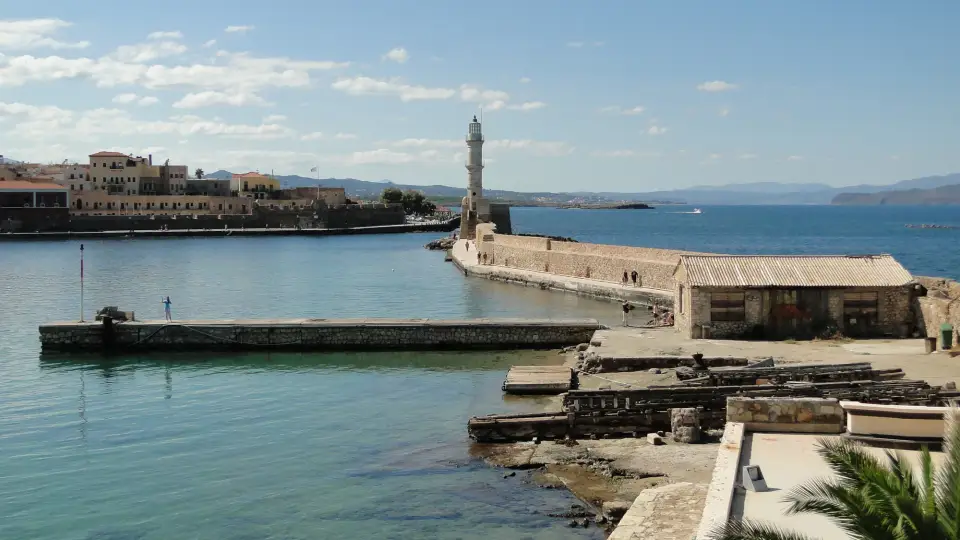
 Greece and Croatia in 7 daysFrom the Acropolis to the walls of DubrovnikAthens · Santorini · Dubrovnik6–9 days3 cities
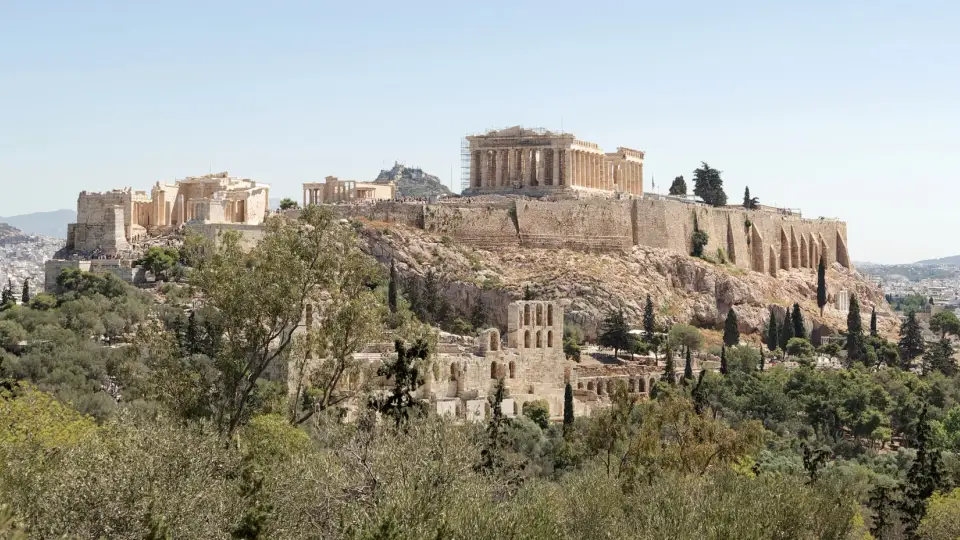
 Athens and Santorini in 5 daysThe Acropolis and the calderaAthens · Santorini4–6 days2 cities
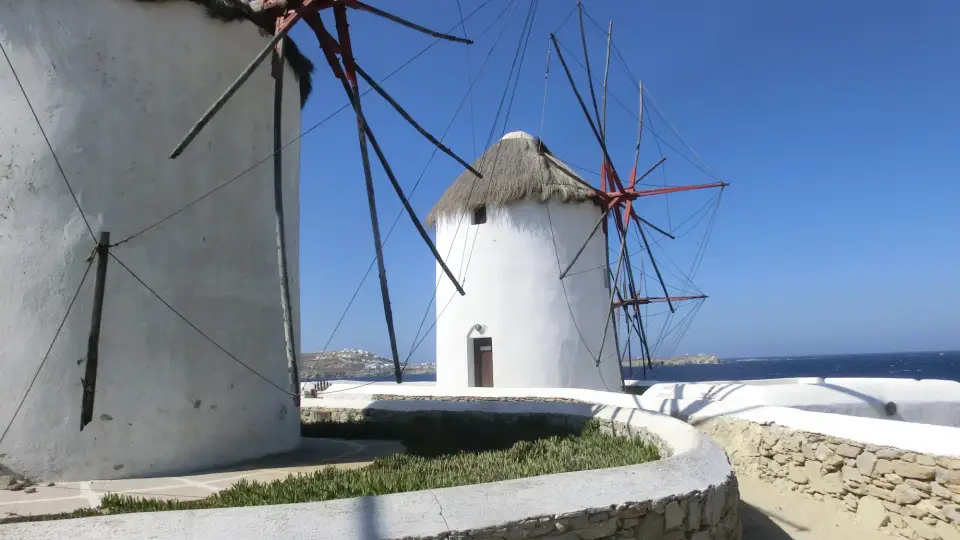
 Greece in 15 daysIsland-hopping the Cyclades to CreteAthens · Mykonos · Santorini · Crete13–16 days4 cities
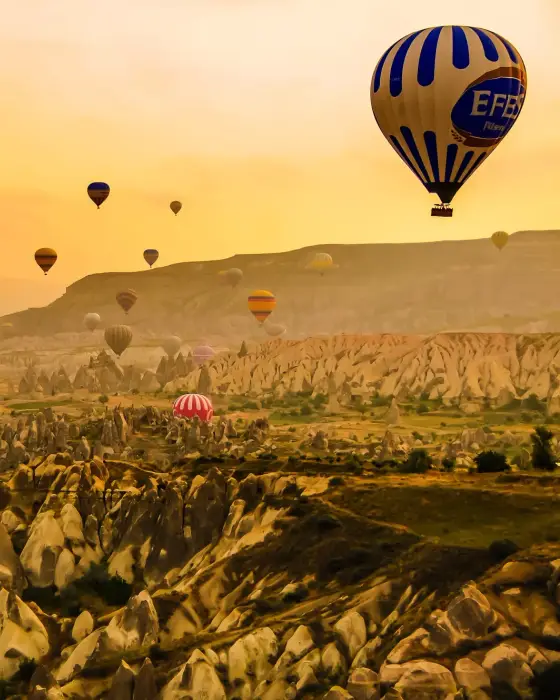 Turkey and Greece in 15 daysFrom Cappadocia’s balloons to Santorini’s calderaIstanbul · Cappadocia · Athens · Mykonos · Santorini12–17 days5 cities