Greece
Mykonos
Chora on foot, Delos by boat and the southern beaches by bus
Days Start with the basic programme and choose extensions for the time you have.
How the guide reaches this number
On the first, Chora on foot: the Archaeological Museum in the morning, Kastro and Paraportiani, Little Venice and the sunset at Kato Mili. On the second, Delos on the 10 a.m. boat, returning at 1:30 p.m., and the afternoon at a southern beach by the Fabrika bus. The third is for those who rent a car or motorbike: the Tourliani monastery in Ano Mera, a north-coast beach such as Agios Sostis and the Armenistis lighthouse at the end of the afternoon. With a fourth day, I'd go to Tinos by ferry. I'd come in May, June, September or October, with fewer people and lower prices than in July and August, and I'd avoid November to April, when most hotels and restaurants close. Mykonos is not a cheap island, and the nightlife of Paradise is the center of the trip only for those who come for it; those who don't can stay in Chora and the calmer beaches.
2–3
When May to June and September to October; July and August are the busiest months, and from November to April many hotels, restaurants and boats stop operating
How the guide reaches this number
Mykonos has a long, dry, windy summer and a mild, rainy winter. From June to September it hardly rains; July and August have average highs near 28 °C and nights above 24 °C, and the meltemi, a north wind that blows from mid-May to mid-September, is stronger in the afternoon and can cancel boats between the islands. The rain, about 312 mm a year, falls almost entirely from October to March, and in January average highs are 14.6 °C. July and August are the busiest months, and from mid-July to the end of August you need to book hotels and ferries in advance. From mid-May to mid-October it is usually warm enough for the beach, and May, June, September and October have lower prices and fewer people than the summer peak. At the end of October most hotels close, many restaurants and shops stay closed until May, and many of the Piraeus and Rafina ferries stop until April; boats to Delos run from April 1 to November 30, and in November there is only the 10 a.m. departure. Also watch out for the Pentecost weekend and August 15, when Greeks fill hotels and ferries.
Per person/day Budget about 113 EUR; mid-range about 272 EUR; comfortable about 615 EUR per person, based on spending reported by travelers to Budget Your Trip (checked in October 2026).
How the guide reaches this number
Per person per day: accommodation, meals, urban transport, visits and a small allowance for extras. Flights excluded; larger purchases vary. Editorial estimate, not a quote.
 What Nilo thinks
I'd stay three days, sleeping in Chora, and I stand by two. On the first, Chora on foot: the Archaeological Museum in the morning, Kastro and Paraportiani, Little Venice and the sunset at Kato Mili. On the second, Delos on the 10 a.m. boat, returning at 1:30 p.m., and the afternoon at a southern beach by the Fabrika bus. The third is for those who rent a car or motorbike: the Tourliani monastery in Ano Mera, a north-coast beach such as Agios Sostis and the Armenistis lighthouse at the end of the afternoon. With a fourth day, I'd go to Tinos by ferry. I'd come in May, June, September or October, with fewer people and lower prices than in July and August, and I'd avoid November to April, when most hotels and restaurants close. Mykonos is not a cheap island, and the nightlife of Paradise is the center of the trip only for those who come for it; those who don't can stay in Chora and the calmer beaches.Chora, the main town of Mykonos, is a maze of narrow, whitewashed streets around a bay. At the western tip, the 18th-century captains' houses lean over the sea in Little Venice, and beside them a row of Venetian windmills occupies the hill, facing the north wind that blows in summer. The island's fame came from outside. First came the French archaeologists who, from 1873, excavated Delos, the island of Apollo's sanctuary 2 km away; then the jet set of the 1960s and the gay public of the 1980s. Today the island holds together the church of Paraportiani, made of five churches joined together, the beach bars of Paradise and the tavernas of the square in Ano Mera. To taste what is local, ask for mostra: dry bread topped with kopanisti, a spicy cheese kneaded several times during maturation, with tomato and olive oil.
Quick facts
- Population
- 10,704 residents in the municipality of Mykonos, which includes Delos and Rineia, and 4,808 in the town of Chora (2021 census)
- Founding
- Neolithic settlement at Ftelia, around 5000 BC; Ionian occupation from the 11th century BC; Venetian rule from 1207
- Country and region
- Greece, South Aegean region; Cyclades archipelago, regional unit of Mykonos
- Language
- Greek; English widely spoken in hotels, restaurants, boats and agencies
- Currency
- Euro (€)
- Time zone
- EET, UTC+2; UTC+3 during daylight saving time, from the last Sunday of March to the last Sunday of October
- Best time to go
- May to June and September to October; July and August are the busiest months, and from November to April many hotels, restaurants and boats stop operating
- Average cost per day
- Budget about 113 EUR; mid-range about 272 EUR; comfortable about 615 EUR per person, based on spending reported by travelers to Budget Your Trip (checked in October 2026).
When to go
May to June and September to October; July and August are the busiest months, and from November to April many hotels, restaurants and boats stop operating
How the year changes
Mykonos has a long, dry, windy summer and a mild, rainy winter. From June to September it hardly rains; July and August have average highs near 28 °C and nights above 24 °C, and the meltemi, a north wind that blows from mid-May to mid-September, is stronger in the afternoon and can cancel boats between the islands. The rain, about 312 mm a year, falls almost entirely from October to March, and in January average highs are 14.6 °C. July and August are the busiest months, and from mid-July to the end of August you need to book hotels and ferries in advance. From mid-May to mid-October it is usually warm enough for the beach, and May, June, September and October have lower prices and fewer people than the summer peak. At the end of October most hotels close, many restaurants and shops stay closed until May, and many of the Piraeus and Rafina ferries stop until April; boats to Delos run from April 1 to November 30, and in November there is only the 10 a.m. departure. Also watch out for the Pentecost weekend and August 15, when Greeks fill hotels and ferries.
Nilo's tips
Go to Delos on the first boat
The 10 a.m. boat reaches Delos in half an hour and returns at 1:30 p.m., which leaves about three hours on the island, time for the Sacred Way, the Terrace of the Lions, the theater quarter and the museum. On the way back, the afternoon is still free for a southern beach. Buy the boat ticket at the kiosk on the Deliana quay, in the old port, and bring cash or a card for the €20 admission, paid separately at the ticket office on the island.
For the beaches, start at Fabrika
The southern beaches are sheltered from the north wind, and, on the autumn 2026 timetable, Platys Gialos and Paradise have buses from the Fabrika terminal every half hour during the day. From Platys Gialos, boats continue to Paraga, Paradise, Super Paradise, Agrari and Elia, wind permitting, so you can change beaches without taking a road. Remember that the buses to Ano Mera, Elia and Kalafatis leave from another stop, on the new ring road, and there is no bus between one terminal and the other.
Sunset at Kato Mili, dinner afterward
At sunset, the tables in Little Venice are the most sought-after in town. From the windmill hill you see the same sun going down behind the houses of Little Venice, standing and without a reservation; dinner can wait until after sunset.
A car for one day only
Chora is closed to cars, and the south works by bus and boat. A car or a motorbike makes sense for the day in Ano Mera, the north beaches and the Armenistis lighthouse. Rent at Fabrika and return it the same day.
Explore the map
Explore the map, read about the other places and plan your travel days in the app.
Open the appWhat to see
Mykonos: Granite, wind and little water
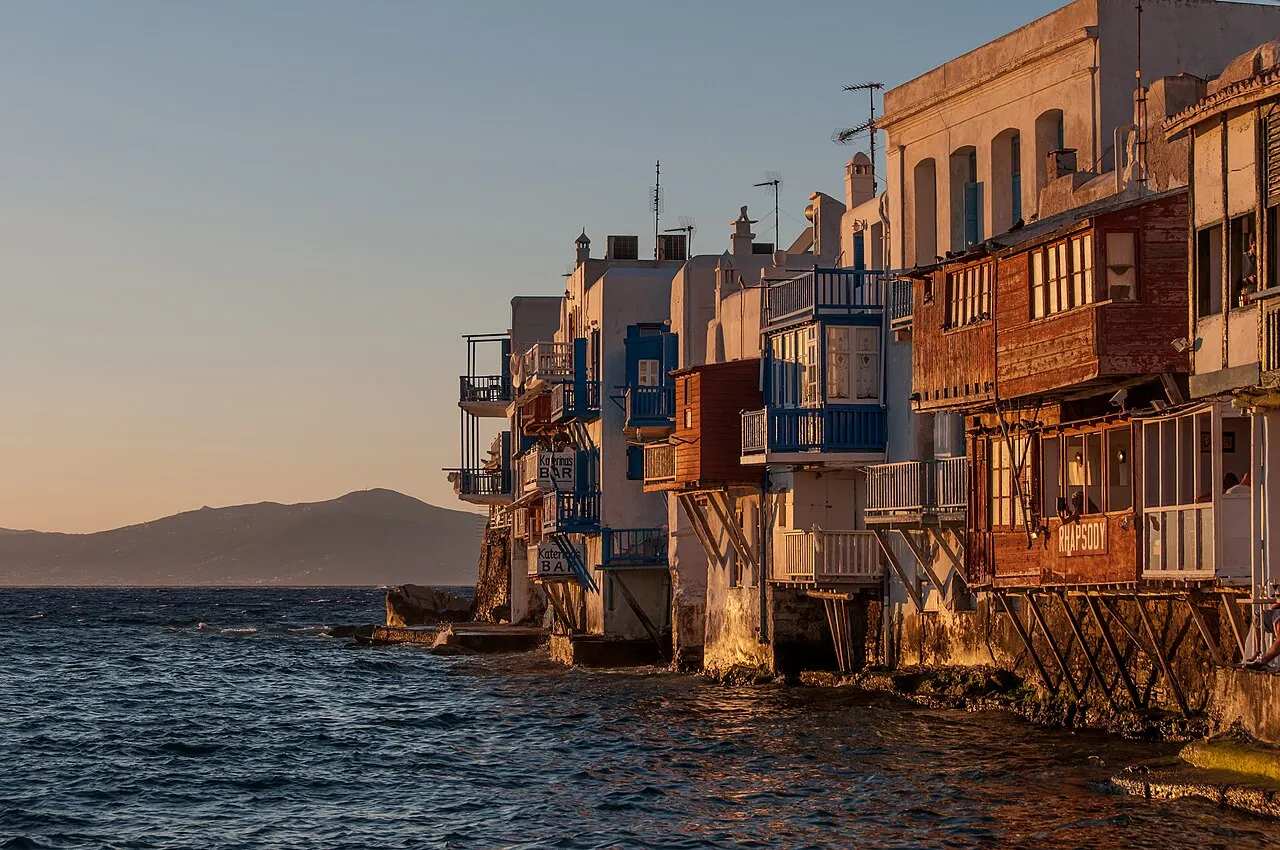
The new port, where most ferries and cruise ships dock, is at Tourlos, 2 km to the north, and the airport is 4 km to the southeast. The row of 18th- and 19th-century houses with wooden balconies over the sea, now occupied by bars and restaurants.
Little Venice
The row of houses over the sea at the western tip of Chora began to be built in the mid-18th century by merchants and captains. The little doors at water level gave direct access to the sea and to the storerooms, and they fed the reputation that the owners were pirates. Today the colorful wooden balconies are bars and restaurants, and at the end of the afternoon the seaside walkway fills with people waiting for the sunset.
The merchants’ and captains’ houses built over the sea from the mid-18th century, with doors opening straight onto the water, are Chora’s most characteristic stretch, and in late afternoon the seaside walkway becomes the place to watch the sunset.
Check access

Kato Mili
The windmills lined up on the hill south of Little Venice are the island's best-known image. Most of Mykonos's windmills were built by the Venetians in the 16th century, and they continued to be erected into the early 20th century; they ground wheat until the mid-20th century and were an important source of income. They face north, where the strongest wind comes from, and the hill is the most popular viewpoint for the sunset over Little Venice.
The row of Venetian windmills, built from the 16th century and used to grind wheat until the mid-20th century, is the island’s signature image and the most sought-after viewpoint for sunset over Little Venice, free and on foot.
Check access
Panagia Paraportiani
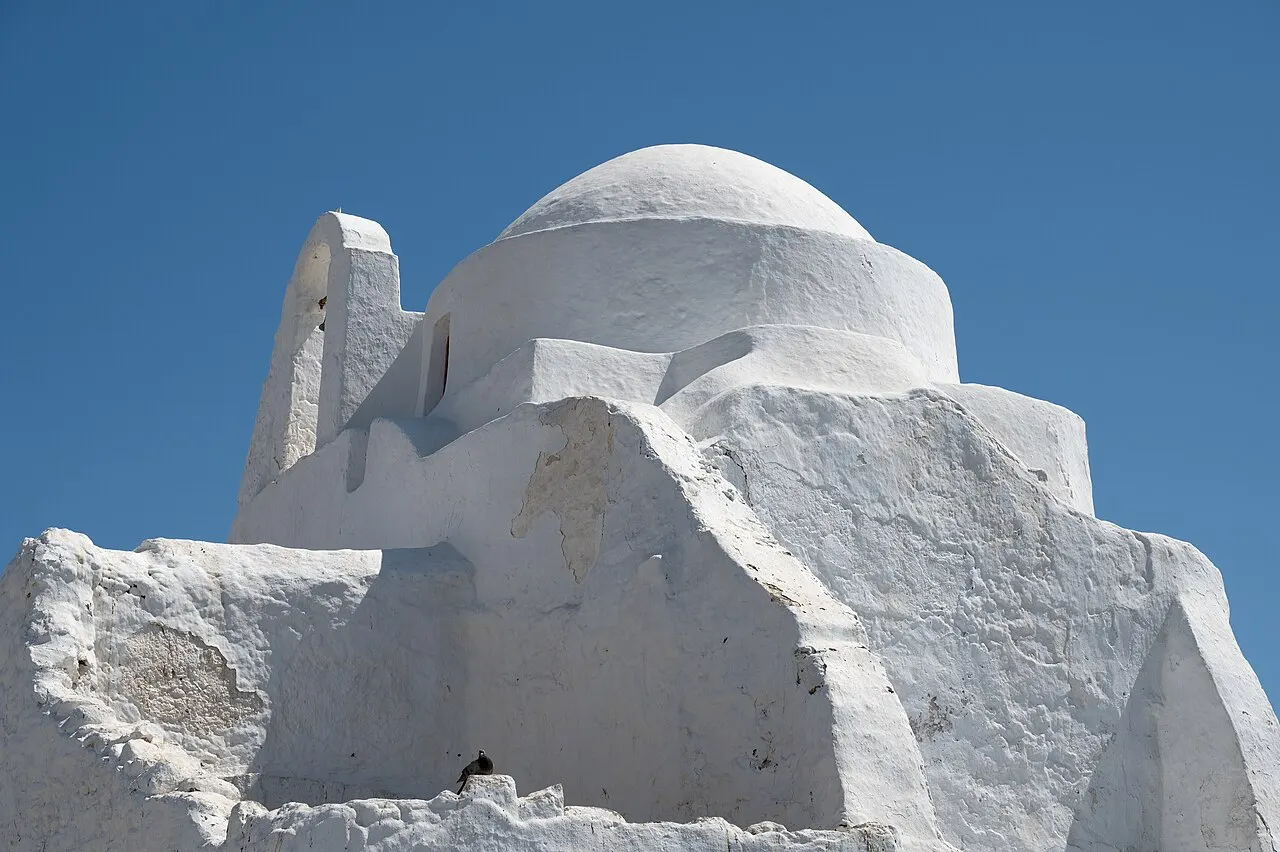
The whitewashed church of Kastro began to be built in 1425 and was only completed in the 17th century. It is in fact five churches joined together: four on the ground floor, dedicated to Saint Eustathius, Saint Sozon, the Holy Anargyroi and Saint Anastasia, and a fifth built on top of them. The name means “Our Lady of the Side Door,” because it stood next to the side entrance of the medieval castle.
Five churches joined in one whitewashed building, begun in 1425 and completed in the 17th century, beside the castle’s former side gate; the visit is quick and lies on the route between Kastro and Little Venice.
Check access
Panagia Tourliani Monastery
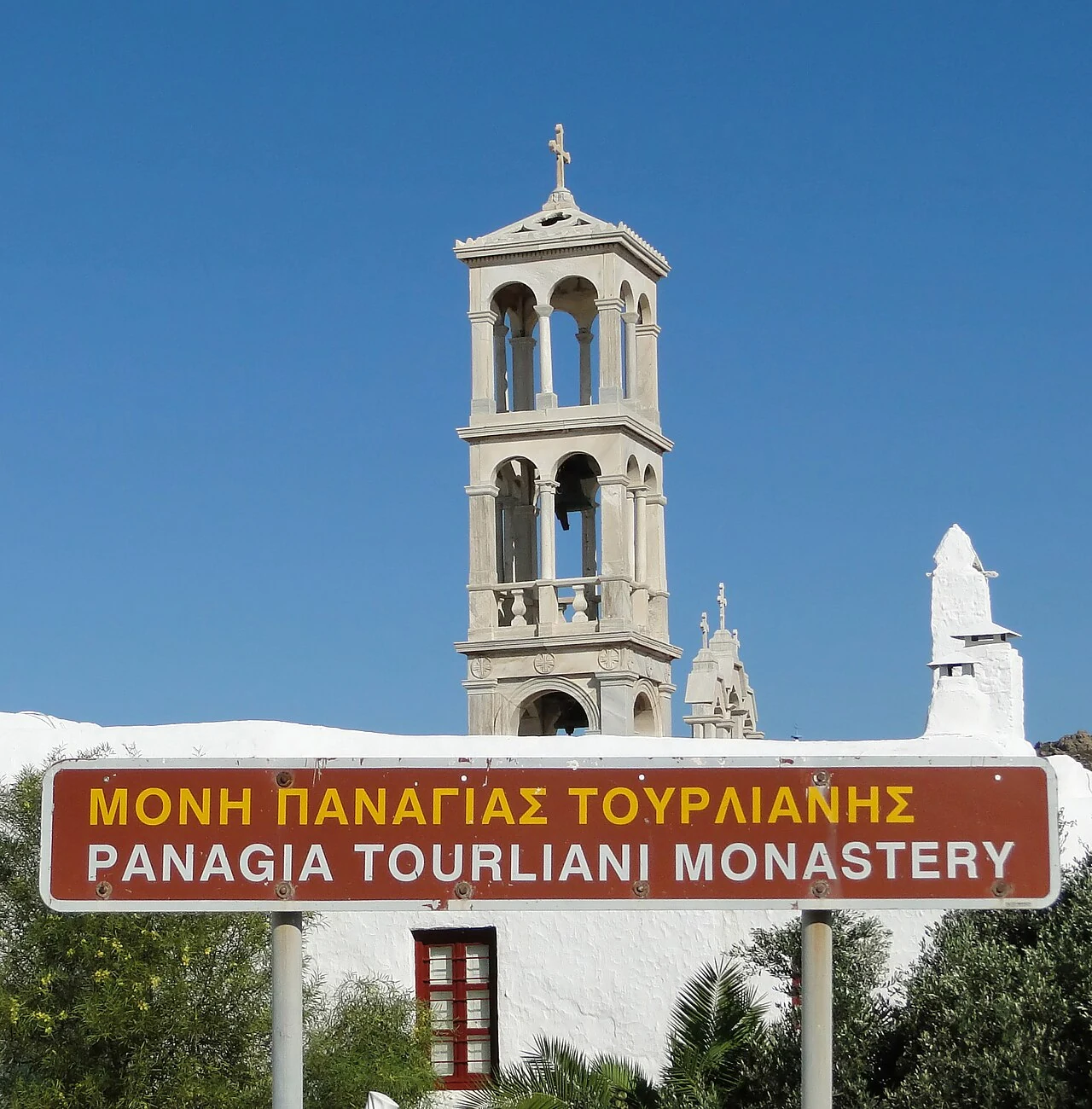
The island's most important monastery stands on the square of Ano Mera, about 7 km from Chora. It was founded in 1542, took its present form in the renovation of 1757 to 1767 and has a Baroque gilded wooden altarpiece made in 1775 by Florentine artists and an iconostasis 10.20 m long, covering the three naves, with icons by the iconographer Ioannis, from Corfu. There is a small museum of icons and vestments. The big feast is on August 15.
The monastery of 1542, with its Florentine Baroque altarpiece of 1775 and the 10.20 m iconostasis spanning the three naves, is the reason to head up to the only inland village, and the surrounding square has tavernas for lunch.
Check access
Armenistis Lighthouse
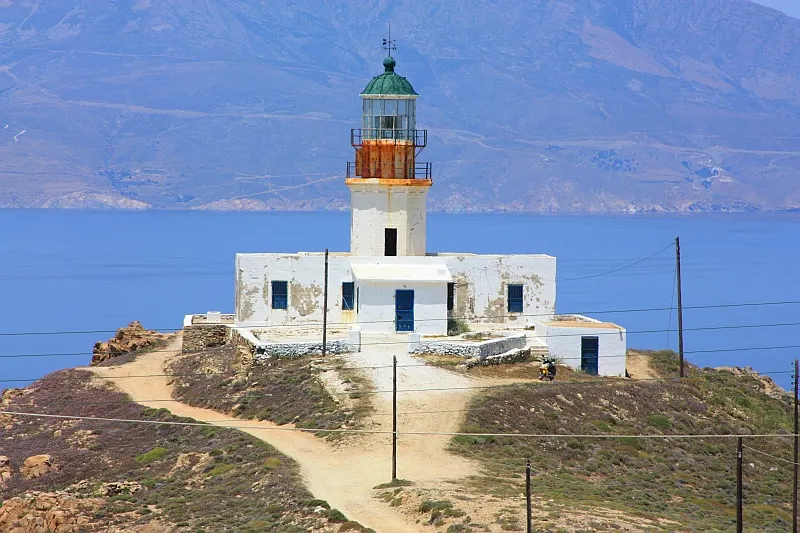
On the northwest tip of the island, about 6.5 km from Chora, the 19 m stone tower was completed in 1891 by the French Lighthouse Company, after the wreck of the steamer Volta in 1887. The lighthouse is still in operation, and from the headland you can see the channel between Mykonos and Tinos. You get there by car or motorbike.
The tower of 1891, built after the wreck of the Volta, stands on the northwest headland above the Tinos channel; worthwhile if you already have a car or motorbike for the day in the north of the island, but it does not justify renting one just for it.
Check access
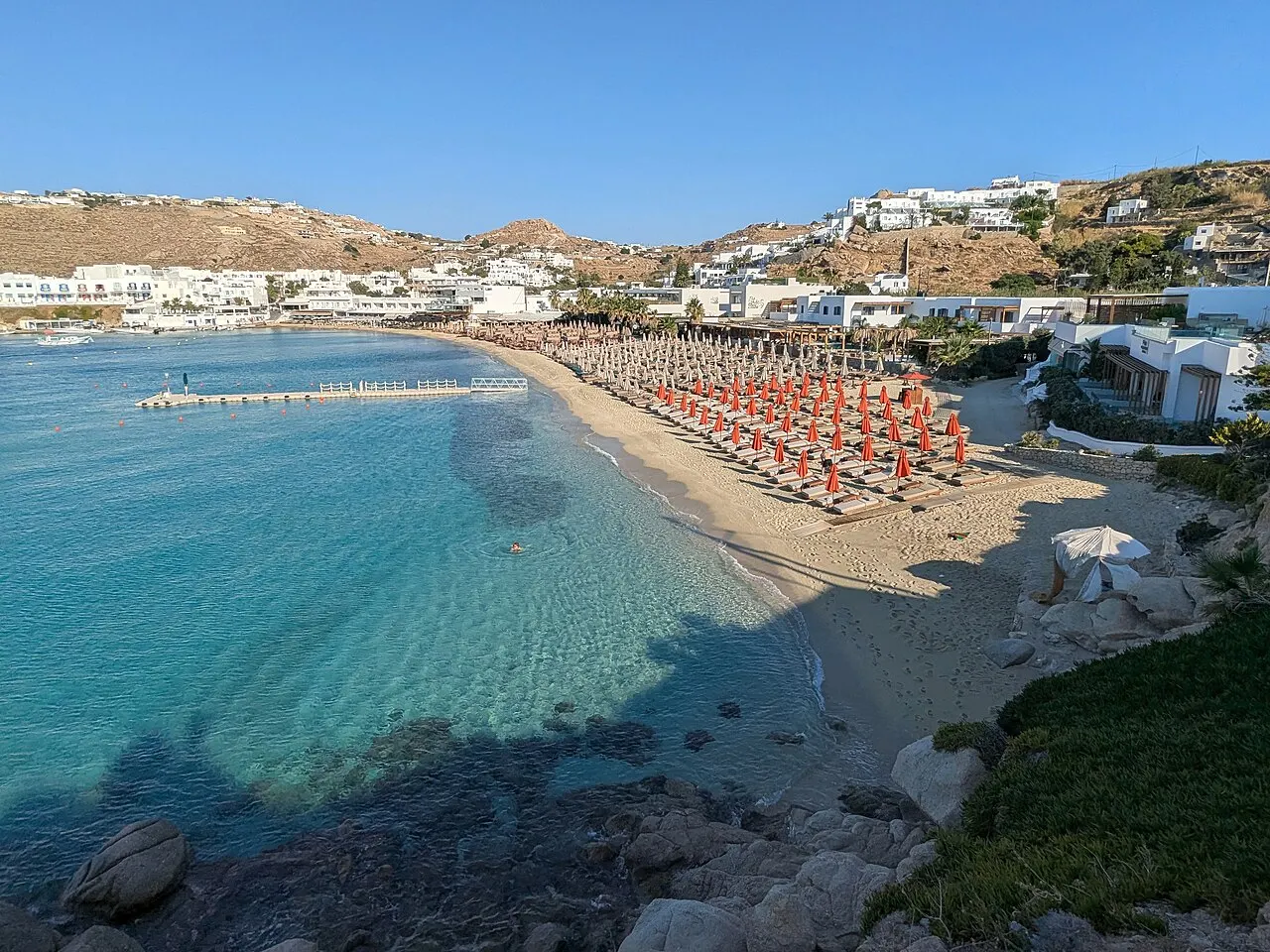
Platys Gialos
The long sandy beach on the south coast, about 5 km from Chora, has hotels, restaurants and sunbed rental. On the autumn 2026 timetable, buses from Fabrika run every half hour during the day. Wind permitting, boats leave from here that stop at Paraga, Paradise, Super Paradise, Agrari and Elia, the simplest way to see the other southern beaches.
It is the best-served southern beach, with buses from Fabrika every half hour during the day on the autumn 2026 timetable and boats to the other beaches subject to the wind, making it the best base for an afternoon at the beach without a car.
Check access

Agios Sostis
A north-coast beach, past Panormos, with no sunbeds to rent, no hotels nearby and one small taverna. You can only get there by car or motorbike, and on north-wind days the sea is rough.
With no sunbeds and no hotels nearby, this is the northern beach for those wanting the island without the south’s facilities; it calls for a car or motorbike and a day without strong north winds.
Check access
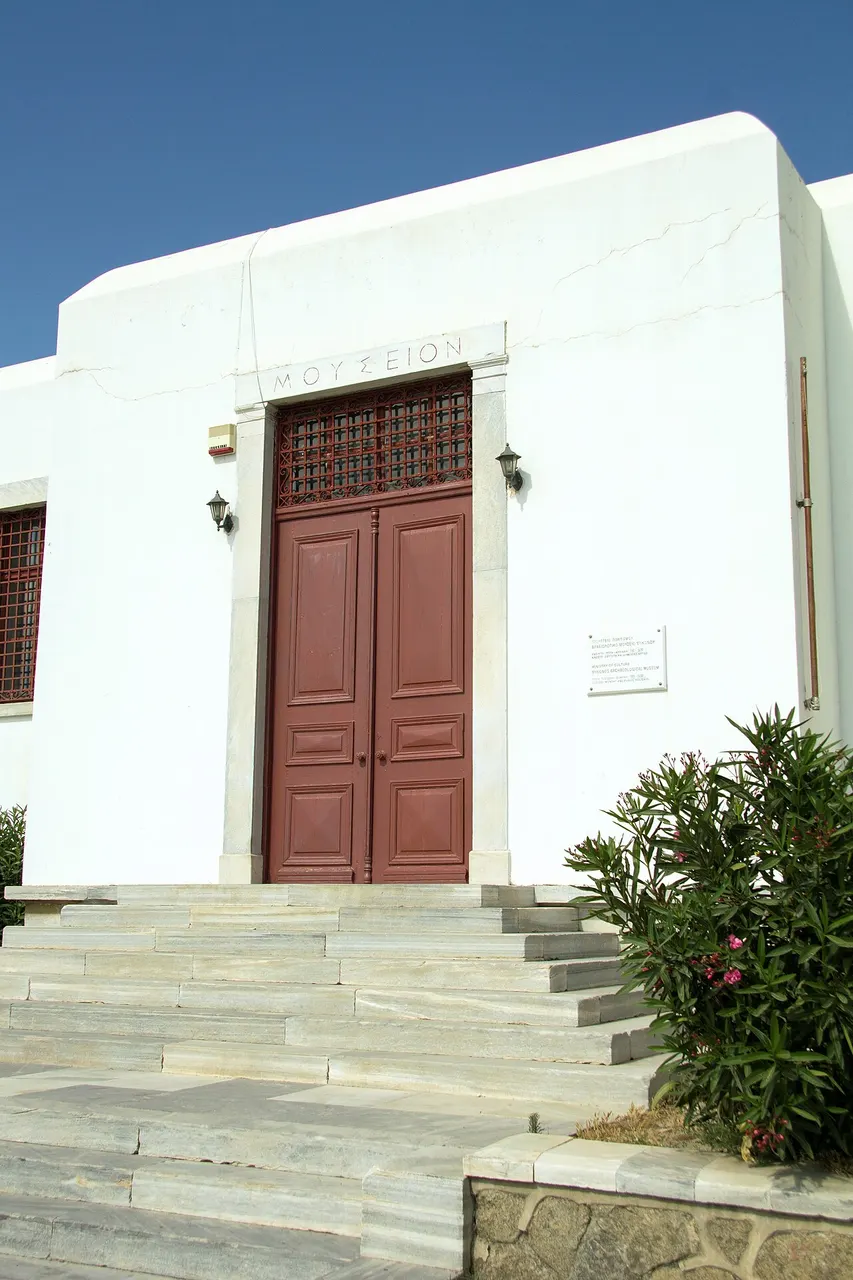
Archaeological Museum of Mykonos
Near the old port, the museum holds vases from the 25th to the 1st century BC, funerary statues, stelae and urns from Rineia, where Athens buried the dead removed from Delos in the purification of 426 BC. There are few pieces from Mykonos itself. It is open from 9 a.m. to 4 p.m., except Tuesdays and holidays, and admission is €5 (€3 reduced).
The urns and stelae from Rineia tell the story of the purification of Delos in 426 BC, but the collection from Mykonos itself is small, and visitors to Delos see larger pieces, such as the original lions, in the island’s museum. It fits a rainy morning or before the boat, and is closed on Tuesdays.
Check access

Aegean Maritime Museum
Founded by George M. Drakopoulos and opened in 1985 in a 19th-century house in Tria Pigadia, the museum tells the story of Greek seafaring with maps, engravings, coins, instruments, ship models, pieces from the 1821 war and the mechanism of the Armenistis lighthouse. The website does not publish opening hours: confirm by phone at +30 22890 22700.
The Greek seafaring collection, with the Armenistis lighthouse mechanism and pieces from 1821, interests enthusiasts, but opening hours are not published and must be confirmed by phone before going.
Check access
Nilo’s itinerary
Start with the basic programme and choose extensions for the time you have.
Plan my days in the app ↗Day 1 · Chora on foot: Kastro, Little Venice and the windmills
Start at the Archaeological Museum, near the old port, which opens at 9 a.m. (closed Tuesdays), to see the urns and stelae from Rineia linked to Delos.
Cross Chora to Tria Pigadia, the three wells from 1722, and continue to Kastro, at the western tip of the town.
See Panagia Paraportiani, the five churches joined into a single whitewashed building.
Go down to Little Venice and have lunch or a coffee in one of the houses over the sea.
At the end of the afternoon, climb the Kato Mili hill for the sunset over Little Venice and have dinner afterward in Chora.
Day 2 · Delos in the morning, a southern beach in the afternoon
Be at the Delos Tours kiosk on the Deliana quay in the old port at 9:30 a.m. and buy the round-trip boat ticket (€25).
Take the 10 a.m. boat (from Tuesday to Sunday there is also the 11:30 a.m., depending on the period), a half-hour crossing; on Delos, pay admission (€20) at the ticket office.
Walk the Sacred Way, the Terrace of the Lions, the theater quarter and the House of Dionysus, and see the original lions in the museum.
Return on the 1:30 p.m. boat and walk about 20 minutes to the Fabrika terminal.
Take the bus to Platys Gialos, which, on the autumn 2026 timetable, leaves every half hour during the day, and spend the afternoon at the beach; return by bus to Chora.


If you stay longer
Day 3 · Ano Mera, the north coast and the Armenistis lighthouse
Rent a car or motorbike at Fabrika, or take the bus to Ano Mera, which since October 2026 leaves from the new ring road (confirm the stop on the KTEL website), if you will only stay in the village.
Visit the Panagia Tourliani monastery, on the square in Ano Mera, and have lunch at one of the tavernas on the square.
Continue to the north coast and spend the afternoon at Agios Sostis, with no sunbeds and with one small taverna.
At the end of the afternoon, go to the Armenistis lighthouse, on the northwest tip, and return to Chora, about 6.5 km away.


Food
Kopanisti
A salty, spicy cheese with protected designation of origin, made in the Cyclades and in Mykonos for more than 300 years. The name means “beaten”: during maturation, the curd is kneaded several times to spread the molds that give it its sharp flavor. It can be made with cow's, sheep's or goat's milk.
Mostra
The most common way to eat kopanisti: dry bread topped with the cheese, chopped tomato and olive oil. In Mykonos it is served as meze, the small plate that goes with ouzo.
Louza
Cured pork loin, made in the northern Cyclades: Mykonos, Syros, Andros and Tinos.
Kremmydopita
The island's onion pie, included among Mykonos's traditional recipes alongside kopanisti and louza.
Amygdalota
Almond sweets, listed among Mykonos's traditional recipes.
Gyros and souvlaki
Skewered meat or meat from a vertical spit, served in pita. The shops scattered around Chora are the cheapest meal in town.
Where to eat
- Chora · $
Gyros and souvlaki in pita at the shops scattered around town, the cheapest meal on the island.
- Little Venice · $$$
A drink or dinner in the houses over the sea at sunset; prices are on the menu at the door and vary a lot.
- Ano Mera · $$
Greek cooking at the tavernas around the village square, next to the Tourliani monastery.
- Platys Gialos · $$$
Restaurants and tavernas facing the beach, with fish, seafood and Greek cooking; prices are on the menu at the door.
- North coast · $$
Small tavernas by the beaches of Agios Sostis and Fokos, which need a car or motorbike.
$: a meal at a simple restaurant, about €11.50 (from €8 to €30) · $$: three-course dinner for two, without drinks, about €50 (from €40 to €150) · $$$: over €150 for two, without drinks · 2026-10-15
Day trips
Delos
The island of Apollo's sanctuary lies 2 km off the coast of Mykonos, half an hour by boat from the Deliana quay, in the old port of Chora. The round-trip boat costs €25 and runs from April 1 to November 30; admission, €20, is paid on the island. Until the end of October 2026 there are departures at 10 a.m. and 11:30 a.m. (the latter Tuesday to Sunday), with returns at 1:30 p.m. and 3 p.m., plus one afternoon departure; in November, only the 10 a.m. With a half-hour crossing, each departure leaves about three hours on land. The island covers 3.43 km², and the excavations are among the most extensive in the Mediterranean: the Terrace of the Lions, dedicated by the people of Naxos shortly before 600 BC, whose originals are in the museum and copies in the open air; the marble theater; the houses with mosaics, such as that of Dionysus riding a panther; and Mount Kynthos, 112 m high. Delos has been a World Heritage Site since 1990.
Tinos
The neighboring island is 9 nautical miles from port to port, and there are several ferries a day, with a duration that varies by boat: check the outbound and return times before buying. The church of Panagia Evangelistria, in the town of Tinos, is the center of an annual pilgrimage, and on August 15 many of the faithful crawl on their knees the 800 m from the quay to the church. In the rest of the island there are about 80 windmills, around a thousand decorated dovecotes, Venetian fortifications on Mount Exomvourgo and the green marble of the hills around Pyrgos.
Where to begin
Chora on foot: Kastro, Little Venice and the windmills
Start at the Archaeological Museum, near the old port, which opens at 9 a.m. (closed Tuesdays), to see the urns and stelae from Rineia linked to Delos.
Delos in the morning, a southern beach in the afternoon
Be at the Delos Tours kiosk on the Deliana quay in the old port at 9:30 a.m. and buy the round-trip boat ticket (€25).
Ano Mera, the north coast and the Armenistis lighthouse
Rent a car or motorbike at Fabrika, or take the bus to Ano Mera, which since October 2026 leaves from the new ring road (confirm the stop on the KTEL website), if you will only stay in the village.
Money
The currency is the euro. Mykonos is among the most expensive islands in Greece, and almost all restaurants display the menu with prices at the door, which helps you choose before sitting down. In the Numbeo survey updated on October 4, 2025, with few contributors, a meal at a simple restaurant costs about €11.50 (from €8 to €30), a three-course dinner for two at a mid-range restaurant, without drinks, about €50 (from €40 to €150), a cappuccino €3.37 and a half-liter draft beer €5. Excursions have fixed prices: the round-trip boat to Delos costs €25 (€12 for ages 6 to 12), admission to the archaeological site €20 (€10 reduced), paid on the island, and the guided visit with boat and admission included, €79 (€35 for ages 6 to 12). The Archaeological Museum of Mykonos charges €5, and the SeaBus between the ports, €2. Hotels and short-term rentals charge a climate resilience fee per room per night, which varies by category and is higher from April to October; check the amount when booking. Cruise arrivals have paid, since July 2025, €20 from June to September, €12 in April, May and October and €4 from November to March, already included in the fare.
Getting there and around
By air: the airport is 4 km southeast of Chora
Mykonos airport (JMK), named after Manto Mavrogenous, is 4 km southeast of Chora. The flight from Athens takes about 45 minutes, and in summer there are seasonal direct flights from several European cities. The bus between the airport and the Fabrika terminal in Chora runs hourly: on the timetable in effect since October 12, 2026, from Fabrika from 9 a.m. to 9 p.m. and from the airport from 9:15 a.m. to 9:15 p.m. Many hotels offer a transfer, and it is worth arranging before you arrive, because the island has few taxis.
By boat: Piraeus, Rafina and the other islands
In season, there are daily ferries from Piraeus and from Rafina, the port closest to Athens airport. From Piraeus, the trip takes 3h30 to 5h15; from Rafina, 2h10 to 5h30, depending on the boat, and the fast ones cost more. There are connections to Tinos, Syros, Andros, Paros, Naxos, Ios, Santorini and Crete. Most ferries dock at the new port of Tourlos, 2 km north of Chora, and some fast ones use the old port: check your ticket. From April to October, the SeaBus links the two ports in 12 minutes for €2. Many Piraeus and Rafina lines stop at the end of October and resume in April, and the meltemi can cancel crossings in summer.
Bus: two terminals, with no link between them
KTEL Mykonos operates two networks. From the old port leave the buses to the new port, and KTEL announces that those to Ano Mera, Elia and Kalafatis now leave from the new ring road, without saying where the stop is: confirm on the website before you go. From Fabrika, in southern Chora, leave the buses to the airport, Ornos, Agios Ioannis, Platys Gialos, Paraga and Paradise. On the autumn 2026 timetable, Platys Gialos and Paradise have buses every half hour from Fabrika during the day and hourly at night, until 10 or 11 p.m. There is no bus between the two terminals, and on foot it is about 20 minutes through the streets of Chora. Buy your ticket before boarding, on the KTEL website or at kiosks and minimarkets, because the fare varies by destination; the driver also sells them, with change counted out. KTEL also lists a line from Fabrika to Super Paradise, operated by Idea Tours since October 3, 2026, with no published times: check before you go.
Beach boats, taxi, car and motorbike
From the quays at Platys Gialos and Ornos, boats leave that stop at the southern beaches (Paraga, Paradise, Super Paradise, Agrari and Elia), subject to the wind. Taxis have no meters, charge by destination according to a table, and the main stand is on Manto Mavrogenous Square, in the old port, with long lines at night. Cars are not allowed into Chora, and parking in high season is difficult. A car or motorbike is useful for the north, the east and Ano Mera, but the roads are narrow and full of curves, and drunk drivers are the island's most-cited risk.
Safety
Mykonos is generally a safe island, and the most cited problem is traffic: narrow roads, sharp curves and drunk drivers. Anyone renting a motorbike or ATV should have experience and avoid driving after drinking. In summer, sun and heat call for a hat, sunscreen and water, and on meltemi days the sea on the north coast is rough. The public hospital of Mykonos is about 1 km above Chora, on the road to Ano Mera, with a 24-hour emergency room. The single emergency number is 112; police answer at 100, ambulance at 166 and fire brigade at 199. Ask at your hotel whether the tap water is drinkable, because part of the supply comes from desalination.
Etiquette tips
Read the menu at the door before sitting down
Almost all restaurants and many bars in Chora display their prices at the entrance. Prices vary a lot from one place to another, especially in Little Venice.
Nudism has an address
Topless is common on many beaches, including family ones. Full nudity is concentrated in stretches of Paradise, Super Paradise, Paraga and Elia.
A “no, thank you” is enough with vendors
On the busiest beaches, street vendors come by offering bags, clothes and costume jewelry. A simple refusal ends the conversation.
Join the taxi line
At Manto Mavrogenous Square, taxis are taken in order of the line, which can be long at night. Ordering by phone costs extra.
Mistakes to avoid
Arriving without knowing the port
Buying a ticket and going to the wrong port. Most ferries use the new port of Tourlos, 2 km north of Chora, and some fast ones use the old port. The port is written on the ticket, and the SeaBus links the two from April to October.
Counting on a taxi when you leave the plane or ferry
The island has few taxis, and in high season the wait can be long. Arrange the transfer with your hotel or use the hourly bus between the airport and Fabrika.
Thinking the boat ticket includes Delos
The round-trip boat (€25) does not include admission to the site, €20, bought at the ticket office on the island. And the return has a set time: if you miss your boat, you wait for the next one, if there is one.
Booking a flight right after a ferry
Connecting a ferry and the return flight on the same day. The meltemi reaches force 7 or 8 and keeps most ferries from sailing. Leave a spare night before an international flight.
Renting an ATV without experience
The island's roads are narrow, with sharp curves and drunk drivers at night. Motorbikes and ATVs require experience; without it, use buses and boats.
Coming in November expecting summer
In November most hotels, restaurants and shops are closed, and there are fewer ferries and boats.
Useful phrases
Γεια σας (yá sas)
Hello and goodbye, formal
Ευχαριστώ (efharistó)
Thank you
Παρακαλώ (parakaló)
Please, and also “you're welcome”
Πόσο κάνει; (póso káni?)
How much is it?
Πού είναι η στάση του λεωφορείου; (pú íne i stási tu leoforíu?)
Where is the bus stop?
Τον λογαριασμό, παρακαλώ (ton logariasmó, parakaló)
The check, please
Where to stay
- Chora · First trip and anyone not renting a car · $$: The old port, the boats to Delos, both bus terminals and the restaurants are here, all on foot. In return, Little Venice and the port concentrate bars and music until late in summer.
- Platys Gialos · Anyone who wants a beach at the door and frequent buses · $$: It is the best-served beach in the south, with buses to Fabrika every half hour during the day and boats to the other beaches.
- Psarou · Anyone who wants a small beach and has a high budget · $$$: A sophisticated beach popular with Greeks, next to Platys Gialos, with hotels and restaurants and the Fabrika bus at the stop before the one for Platys Gialos.
- Ornos · Families · $$: A sandy beach with a gentle slope, a market, a bakery and a pharmacy, about 30 minutes on foot from Chora and with a bus from Fabrika.
- Paradise and Paraga · Little money and a party night · $: They have a campsite, huts and cheaper rooms, with a bus from Fabrika every half hour during the day. The music from the beach bars starts in the afternoon.
- Ano Mera · Anyone with a car who wants quiet · $$: It is the only inland village, with a square of tavernas and access to the beaches of the north and east, but far from the nightlife and the Delos boats.
$: up to €75 a night · $$: €75 to €150 a night · $$$: over €150 a night; in high season prices can double · 2026-10-15
Districts
Kastro
The western tip of Chora, on the site of the old castle, with the church of Panagia Paraportiani and the Folklore Museum in a captain's house. It is the oldest part of the town and a few steps from Little Venice.
Little Venice (Alefkandra)
The row of 18th- and 19th-century houses with wooden balconies over the sea, now occupied by bars and restaurants. To the south is the windmill hill of Kato Mili. At the end of the afternoon it is the most crowded spot on the island.
Old Port and Tria Pigadia
The center of Chora around the old port, with Manto Mavrogenous Square, the taxi stand, the quay for boats to Delos and the Archaeological Museum. Farther inland, the three wells of Tria Pigadia, from 1722, the Aegean Maritime Museum and Lena's House.
Tourlos
The new port, 2 km north of Chora, where most ferries and cruise ships dock. It connects to the old port by the SeaBus, from April to October, and by bus. It is not a place to stay.
Ornos and Agios Ioannis
Bays southwest of Chora, with beaches, hotels and a market at Ornos and a view of Delos and Rineia at Agios Ioannis. Frequent buses from Fabrika, and boats to the southern beaches leaving from Ornos.
Platys Gialos and Psarou
Two neighboring beaches on the south coast, about 5 km from Chora. Platys Gialos is the busiest beach, with hotels and the departure point for boats to the other southern beaches; Psarou is smaller and more expensive.
Paradise and Paraga
Southern beaches connected by bus to Fabrika, with a campsite, simple hotels and beach bars. At Paradise, loud music starts in the middle of the afternoon.
North coast
Panormos, Agios Sostis and, at the far northwest, the Armenistis lighthouse, on a coast exposed to the summer north wind, good for windsurfing and poor for swimming on strong days. There are few houses and small tavernas. KTEL lists a line from the old port to Panormos, with no times in the autumn timetable; for Agios Sostis and Armenistis, count on a car or motorbike.
Ano Mera
The only inland village, about 7 km from Chora, with a square surrounded by tavernas and the Panagia Tourliani monastery. It is the gateway to the beaches of the north and east, which need a car or motorbike.
History
c. 5000 BC · The Neolithic settlement of Ftelia
On a low hill beside Ftelia bay, on the north coast, a settlement was excavated whose oldest buildings date to about 5000 BC. The site was inhabited for a few centuries and abandoned in the middle of the fifth millennium BC.
11th c. BC · Carians and Ionians
Herodotus cites the Carians as the first inhabitants. Ionians from Athens arrived in the early 11th century BC. The island was poor, and its proximity to Delos, 2 km away, made it a supply stop and a place of passage.
426 BC · The purification of Delos
In the sixth year of the Peloponnesian War, Athens ordered all the dead removed from Delos to make it fit for the worship of Apollo. The bones and offerings went into a pit on Rineia, and what was found there is now in the Archaeological Museum of Mykonos.
1207 · The Ghisi, Venetian lords
After the Fourth Crusade, Andrea Ghisi became the first Latin ruler of Mykonos, under the Duchy of the Archipelago. The family ruled for about two centuries, and in 1390 the island passed under the direct rule of Venice.
1537 · Barbarossa and the Ottomans
Admiral Hayreddin Barbarossa attacked the island, and an Ottoman fleet settled in. Mykonos remained under the Ottoman Empire until 1830, with a local government of syndics, and the last Venetians left the region in 1718, when the castle of Tinos fell.
18th c. · Trade, pirates and Little Venice
Until the end of the 18th century the island prospered as a trading center, attracting immigrants from neighboring islands and also pirate attacks. In the middle of the century the first houses of Little Venice appeared, built by merchants and captains with direct access to the sea.
1822 · Manto Mavrogenous repels the Ottoman landing
In the War of Independence, which began in 1821, Manto Mavrogenous equipped ships and men with her family's fortune. On October 22, 1822, under her leadership, the islanders repelled Ottoman troops that had landed on the island.
1873 · The excavations of Delos
The French School at Athens began to excavate Delos. The work drew visitors, and tourism came to weigh on the economy of an island that had lost trade and people after the opening of the Corinth Canal, in 1893, and the First World War.
1891 · The Armenistis lighthouse
After the wreck of the English steamer Volta on the north coast in 1887, it was decided to build a lighthouse on the headland now called Armenistis. The French Lighthouse Company completed the 19 m stone tower in 1891.
1944 · The liberation
From September 25 to 28, 1944, the Greek Sacred Band attacked the German garrison on the island. The Germans who remained surrendered, and Mykonos was liberated on September 30.
1960–1980 · From high-society destination to gay destination
In the 1960s the island drew the international jet set; in the 1970s, nudist beaches; in the 1980s, it became one of the most sought-after destinations for gay tourists in Europe. In 1978, Chora was declared a traditional settlement, which preserves its Cycladic architecture.
1990 · Delos, World Heritage Site
UNESCO inscribed Delos on the World Heritage List, citing the archaeological site that conveys the image of a great cosmopolitan Mediterranean port.
2025 · The cruise passenger fee
Since July 21, 2025, every cruise passenger who disembarks in Mykonos or Santorini pays a fee ranging from €4 in winter to €20 from June to September, collected by the cruise line along with the fare.
Complete history
A poor island next to a sanctuary
Mykonos has little water, no rivers and almost no good farmland, and in Antiquity it was a modest island. What gave it importance was its neighbor Delos, 2 km away, the sanctuary where, according to myth, Apollo and Artemis were born and where the Delian League met. Mykonos supplied it and served as a place of passage. When Athens purified Delos in 426 BC, removing all the dead, the common grave was opened on Rineia, the other neighbor, which is why the Archaeological Museum of Mykonos holds mostly urns, stelae and vases from Rineia and few pieces from the island itself. Delos became rich again after Rome declared it a free port in 166 BC, and declined after the attacks by Mithridates' forces in 88 and 69 BC.
Venetians, Ottomans and the town on the headland
The Chora you walk through today began to take shape after 1207, when the Venetian Ghisi family took over the island. The Kastro quarter, at the western tip of the town, occupies the site of the medieval castle, and the church of Panagia Paraportiani takes its name from that castle's side door. The windmills, mostly built by the Venetians in the 16th century and still being erected into the early 20th century, ground the wheat and were an important source of income. In 1537 Admiral Barbarossa took the island for the Ottoman Empire, which governed it for almost three centuries through a local council. In the 18th century, maritime trade brought money and immigrants, and the captains built the houses of Little Venice with doors opening directly onto the sea; the three wells of Tria Pigadia, from 1722, supplied the town.
The revolution, the decline and tourism
Mykonos joined the Greek War of Independence with its ships, and the local heroine, Manto Mavrogenous, led the defense that repelled an Ottoman landing on October 22, 1822; a square in Chora bears her name and her statue. Independence came in 1830. At the end of the 19th century the economy declined again, and got worse with the opening of the Corinth Canal, in 1893, and the First World War; many residents emigrated to the mainland and to the United States. The turnaround came from Delos: the French excavations, begun in 1873, brought the first visitors, and in the 20th century tourism came to dominate the economy. In the 1960s the jet set arrived, in the 1980s the gay public, and by the 2000s Mykonos was among the most expensive islands in Greece.
The island today
Tourism is the island's economy, and the pressure shows in the numbers and in the rules. Much of the water comes from desalination, and the island produces 4,500 m³ a day from the sea. Chora's architecture has been protected since 1978; outside it, decades of building hotels and vacation homes have destroyed part of the island's ancient sites. Since 2025, cruise passengers pay a higher fee per disembarkation in Mykonos and Santorini than at other Greek ports, and hotels charge a fee per room per night, higher in high season.
The Archaeological Museum of Mykonos holds mostly pieces from Rineia, where the dead removed from Delos in 426 BC were taken.
Geography and shape of the city
Granite, wind and little water
Mykonos has about 86 km² of rocky terrain, almost all granite, with low hills worn down by the wind. There are no rivers, only seasonal streams, two of them dammed, and a desalination plant supplements the supply. The island lies in the middle of the Cyclades, with Tinos to the northwest, Syros to the west and Paros and Naxos to the south; Delos and Rineia lie to the southwest, separated by a narrow channel.
Chora and the bay
Chora occupies the west coast, around a wide bay. The old port is in the center of the town; at the western tip are Kastro, Little Venice (also called Alefkandra) and the windmill hill of Kato Mili, which faces the sunset. The new port, where most ferries and cruise ships dock, is at Tourlos, 2 km to the north, and the airport is 4 km to the southeast. No cars circulate inside Chora: the streets are narrow and whitewashed, with an irregular layout.
Sheltered south, windy north
The prevailing summer wind comes from the north, which is why the most popular beaches are on the sheltered south coast: Ornos, Psarou, Platys Gialos, Paraga, Paradise, Super Paradise, Agrari and Elia. The north coast, with Panormos, Agios Sostis and Ftelia, takes the wind head-on, which favors windsurfing and spoils swimming on strong days. Inland lies Ano Mera, the only village away from the sea.
The climate
The National Observatory of Athens classifies the climate as hot semi-arid: about 312 mm of rain falls per year, almost all of it from October to March. In the 2008 to 2026 measurements, average highs in July and August are near 28 °C and lows above 24 °C; in January, the average high is 14.6 °C and the low is 11 °C. The meltemi, a dry north wind, blows from mid-May to mid-September, eases the heat and is stronger in the afternoon.
Mykonos's most popular beaches are on the south coast, sheltered from the north wind that blows in summer.
Culture
Churches and the religious calendar
The island is Orthodox, and the whitewashed churches and chapels are part of the landscape of Chora and the countryside. The icon of Panagia Tourliani leaves Ano Mera in procession on the first Sunday of Lent and stays in one of Chora's three parish churches until Lazarus Saturday, the eve of Palm Sunday; the monastery's feast is on August 15, and the main one on August 23. There is also a Catholic church, Our Lady of the Rosary, built in 1668, the only one on the island.
A gay destination since the 1980s
Mykonos became one of the most sought-after destinations for gay travelers in Europe in the 1980s, and Chora has bars and nightclubs aimed at that public. The beaches of Super Paradise and Elia have stretches frequented by gay men, and the small cove between Elia and Agrari is known as the gay beach. Greece does not criminalize same-sex relations.
Petros, the pelican
An injured pelican, found in the sea by a fisherman in the 1950s, was nursed by the locals, was named Petros and became the island's mascot. He died after being hit by a car in December 1985, and since then other pelicans have lived around the port; one of them inherited the name.
Cinema, travelers and the Biennale
In 1884, the English travelers Theodore and Mabel Bent went to Mykonos to record the traditional funeral laments, the moirologia. A century later, the island became a film setting: part of Shirley Valentine (1989) was filmed here, and the final scene of The Bourne Identity (2002) takes place in a motorbike rental shop on the island. In 2013 the Mykonos Biennale was created, with theater, film, visual arts and music.
Festivals and events
Dormition of the Virgin, August 15
Big feast at the Panagia Tourliani monastery, in Ano Mera, on the national holiday of the Dormition. On the same day, thousands of pilgrims go to neighboring Tinos, and the ferries that stop at Tinos fill up: buy your ticket in advance.
Feast of Panagia Tourliani, August 23
The monastery's main feast, closing the celebration of the Dormition, in Ano Mera.
Tourliani icon in Chora, during Lent
On the first Sunday of Orthodox Lent, the icon of Panagia Tourliani is carried in procession to one of Chora's parish churches and stays there until Lazarus Saturday. The date changes with the Orthodox Easter calendar.
Orthodox Easter and Pentecost
Movable holidays: in 2027, Orthodox Easter falls on May 2 and Pentecost on June 20. On the Pentecost weekend, many Greeks come to the island, and hotels and ferries fill up.
Books and films
The Cyclades, or Life among the Insular Greeks (1885), J. Theodore Bent
The account of the Bents' travels through the Cyclades in the winters of 1882 to 1884, including their stop in Mykonos at the end of February 1884 to record the funeral laments. It shows the islands before tourism.
Shirley Valentine (1989), by Lewis Gilbert
The dramatic comedy about a Liverpool housewife who travels to Greece and decides to stay. Part of the film was shot in Mykonos, and Agios Ioannis beach became associated with it.
The Bourne Identity (2002), by Doug Liman
The final scene takes place in a motorbike rental shop in Mykonos, presented in the film as a hard place to find.
Frequently asked questions
Mykonos: How do you get from the airport to Chora?
The bus between the airport and the Fabrika terminal runs hourly: on the timetable in effect since October 12, 2026, from the airport from 9:15 a.m. to 9:15 p.m. Many hotels offer a transfer, and it is worth arranging before you arrive, because the island has few taxis.
Mykonos: How many days should you stay?
Three days, sleeping in Chora, and two hold up: one for Chora on foot and another for Delos in the morning and a southern beach in the afternoon. The third is for those who rent a car or motorbike and go to Ano Mera, the north coast and the Armenistis lighthouse.
Mykonos: Does the boat to Delos include admission?
No: the round-trip boat costs €25 and does not include admission to the site, €20, bought at the ticket office on the island. The 10 a.m. boat arrives in half an hour and returns at 1:30 p.m., which leaves about three hours on Delos.
Mykonos: Can you reach the beaches without a car?
Yes: on the autumn 2026 timetable, Platys Gialos and Paradise have buses from Fabrika every half hour during the day. Boats from Platys Gialos continue to Paraga, Paradise, Super Paradise, Agrari and Elia, wind permitting. Buses to Ano Mera, Elia and Kalafatis leave from the new ring road: check the stop with KTEL before going. There is no bus between the two terminals.
Mykonos: When is the best time to go?
May to June and September to October. July and August are the busiest months, and from November to April many hotels, restaurants and boats stop operating.
Other cities in the country
Greece ↗- Days
- 2–3
- When
- Apr–May · Sep–Oct
- Per person/day
- Average 90–150 EURMid-range · per person/day
Cost scope
Per person per day: accommodation, meals, urban transport, visits and a small allowance for extras. Flights excluded; larger purchases vary. Editorial estimate, not a quote.
- Days
- 2–3
- When
- Jun · Sep
- Per person/day
- Average 150–250 EURMid-range · per person/day
Cost scope
Per person per day: accommodation, meals, urban transport, visits and a small allowance for extras. Flights excluded; larger purchases vary. Editorial estimate, not a quote.
- Days
- 7
- When
- May–Jun · Sep
- Per person/day
- Average 144 EURMid-range · per person/day
Cost scope
Per person per day: accommodation, meals, urban transport, visits and a small allowance for extras. Flights excluded; larger purchases vary. Editorial estimate, not a quote.