Poland
Warsaw
Rebuilt Old Town and the ghetto and Uprising museums
Days Start with the basic programme and choose extensions for the time you have.
How the guide reaches this number
Anyone looking for a continuous historic center will be disappointed, because beyond the reconstructed square there are wide avenues, empty lots turned into parking and housing blocks from the 1960s to the 1980s. With only one day, start at 10am in the Rynek and walk down Krakowskie Przedmieście to Nowy Świat. Have lunch there at a bar mleczny for 20–30 zł, then take the tram to Muranów to spend at least 2 hours 30 minutes at POLIN, with a timed ticket. At the end of the day, go up to the terrace of the Palace of Culture to see the scale of what was rebuilt. If there's light left, cross the river to Praga, where the right bank has sand, willows and herons. Avoid November, with its cold, drizzle and darkness at 4pm.
2
When May–June and September: 18–24 °C, long days and less rain than in July
How the guide reaches this number
The climate is continental, with four well-defined seasons. January and February range from −6 °C to 1 °C, with many gray days, unreliable snow and darkness by 4pm, and this is also when air pollution rises because of coal heating in the outskirts. March and April are unsettled, between 5 °C and 14 °C. May and June are the best stretch: 18–24 °C, moderate rain and daylight until almost 9pm around the solstice. July and August reach average highs of 25–27 °C, with heat waves of 32–35 °C and the year's peak rainfall (about 75 mm in July), almost always in late-afternoon showers. September brings back 18–20 °C and settled weather, and it's festival season. November is the month I'd avoid: 4–7 °C, constant drizzle and nightfall at 4pm. High season runs from May to September, with a second peak in December because of the Christmas lights on Krakowskie Przedmieście, lit from early December until early February.
Per person/day about 180–250 zł on a tight budget; about 350–550 zł (≈80–125 €) at a mid-range standard with hotel, two meals and transport
How the guide reaches this number
Per person per day: accommodation, meals, urban transport, visits and a small allowance for extras. Flights excluded; larger purchases vary. Editorial estimate, not a quote.
 What Nilo thinks
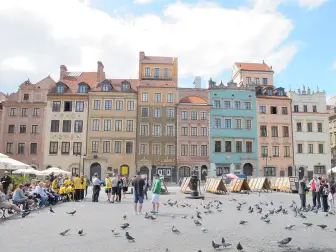
Set aside two days: the first for the rebuilt city, from the Old Town to the Palace of Culture, and the second for the ghetto and the Uprising, with POLIN and the memorials. Anyone looking for a continuous historic center will be disappointed, because beyond the reconstructed square there are wide avenues, empty lots turned into parking and housing blocks from the 1960s to the 1980s. With only one day, start at 10am in the Rynek and walk down Krakowskie Przedmieście to Nowy Świat. Have lunch there at a bar mleczny for 20–30 zł, then take the tram to Muranów to spend at least 2 hours 30 minutes at POLIN, with a timed ticket. At the end of the day, go up to the terrace of the Palace of Culture to see the scale of what was rebuilt. If there's light left, cross the river to Praga, where the right bank has sand, willows and herons. Avoid November, with its cold, drizzle and darkness at 4pm.The colorful square of Warsaw's Old Town looks 18th-century, but it was built between 1949 and 1953 over the rubble. The facades were copied from the views Bernardo Bellotto painted of the city, because in January 1945 about 85% of the left bank lay in ruins. It was this method, of paintings and prewar surveys, that UNESCO recognized in 1980. The visit has two sides: the rebuilt city, from the Royal Castle to the Royal Route and the Palace of Culture, and the museums that tell what was lost. POLIN tells a thousand years of Jewish life on the site of the former ghetto, and the Uprising Museum covers the 63 days of 1944. Between the two, have pierogi and żurek, the sour rye soup, for lunch at a bar mleczny, and order wuzetka, the city's chocolate cake with whipped cream. Come in May, June or September, with 18 to 24 °C, and set aside two days.
Quick facts
- Population
- about 1.86 million in the municipality (GUS, 2026); about 2.1 million counting unregistered residents, and about 3.1 million in the metropolitan area
- Founded
- First documentary mentions around 1300; it became the kingdom's capital between 1596 and 1611, with the court's move from Kraków
- Country and region
- Poland, Masovian Voivodeship (mazowieckie), on both banks of the Vistula
- Language
- Polish; English is common among people under 45 and in the service sector
- Currency
- Złoty (PLN, “zł”), divided into 100 groszy; about 4.3 zł per euro and about 3.7 zł per dollar (2026)
- Time zone
- CET (UTC+1) and CEST (UTC+2) during European summer
- Best time to visit
- May–June and September: 18–24 °C, long days and less rain than in July
- Average daily cost
- about 180–250 zł on a tight budget; about 350–550 zł (≈80–125 €) at a mid-range standard with hotel, two meals and transport
When to go
May–June and September: 18–24 °C, long days and less rain than in July
January
-4° to 1°C
31 mm of rain
February
-3° to 3°C
30 mm of rain
March
-1° to 7°C
29 mm of rain
April
4° to 15°C
35 mm of rain
July
15° to 25°C
82 mm of rain
August
14° to 25°C
61 mm of rain
October
5° to 13°C
40 mm of rain
November
1° to 7°C
36 mm of rain
December
-2° to 2°C
36 mm of rain
How the year changes
The climate is continental, with four well-defined seasons. January and February range from −6 °C to 1 °C, with many gray days, unreliable snow and darkness by 4pm, and this is also when air pollution rises because of coal heating in the outskirts. March and April are unsettled, between 5 °C and 14 °C. May and June are the best stretch: 18–24 °C, moderate rain and daylight until almost 9pm around the solstice. July and August reach average highs of 25–27 °C, with heat waves of 32–35 °C and the year's peak rainfall (about 75 mm in July), almost always in late-afternoon showers. September brings back 18–20 °C and settled weather, and it's festival season. November is the month I'd avoid: 4–7 °C, constant drizzle and nightfall at 4pm. High season runs from May to September, with a second peak in December because of the Christmas lights on Krakowskie Przedmieście, lit from early December until early February.
The same numbers as a table
| Month | Temperature °C | Rain mm |
|---|---|---|
| January | -4 to 1 | 31 |
| February | -3 to 3 | 30 |
| March | -1 to 7 | 29 |
| April | 4 to 15 | 35 |
| May · | 9 to 20 | 56 |
| June · | 12 to 23 | 64 |
| July | 15 to 25 | 82 |
| August | 14 to 25 | 61 |
| September · | 10 to 19 | 50 |
| October | 5 to 13 | 40 |
| November | 1 to 7 | 36 |
| December | -2 to 2 | 36 |
Nilo's tips
Check whether you land at Chopin or at Modlin, 40 km away
Ryanair uses Modlin, 40 km from the center, while Chopin is 8 km away. From Modlin, the bus takes about an hour to reach the city, and from Chopin the train gets to the center in 20 to 25 minutes.
Buy the right ticket through the jakdojade app
It calculates the route and sells the right ticket, so download it before leaving the hotel. Anyone arriving Friday and leaving Sunday saves more with the weekend ticket than with the 3-day one. Inspectors go in plain clothes and board in groups on the tram between two stops, so don't board without validating.
At Łazienki, pick the 4pm concert
The 4pm recital escapes the tour buses, which pack the noon one at the foot of the Chopin monument in Łazienki Park. Arrive 30 minutes early and bring a blanket, because the benches fill up fast and the rest of the audience sits on the grass.
On August 1, save the evening for the Uprising marches
After the 5pm minute of silence, the evening of August 1 has marches and concerts in memory of the 1944 fighters. Keep that evening free of other plans and check, in the year of your trip, where and at what time each event happens.
POLIN at opening, on a weekday
On weekends the morning line doubles and timed slots sell out earlier. In the afternoon, fit in the Warsaw Uprising Museum, on Grzybowska Street, which takes another 2 hours and tells the story of the 63 days of 1944.
Cross to Praga and eat on Brzeska Street
On the right bank, Praga holds 19th-century brick blocks that escaped the destruction of 1944. On Brzeska Street vendors sell pyzy warszawskie, potato dumplings stuffed with meat, in glass jars to take away. For dinner, head to Koneser, the former distillery on Ząbkowska Street, packed with restaurants.
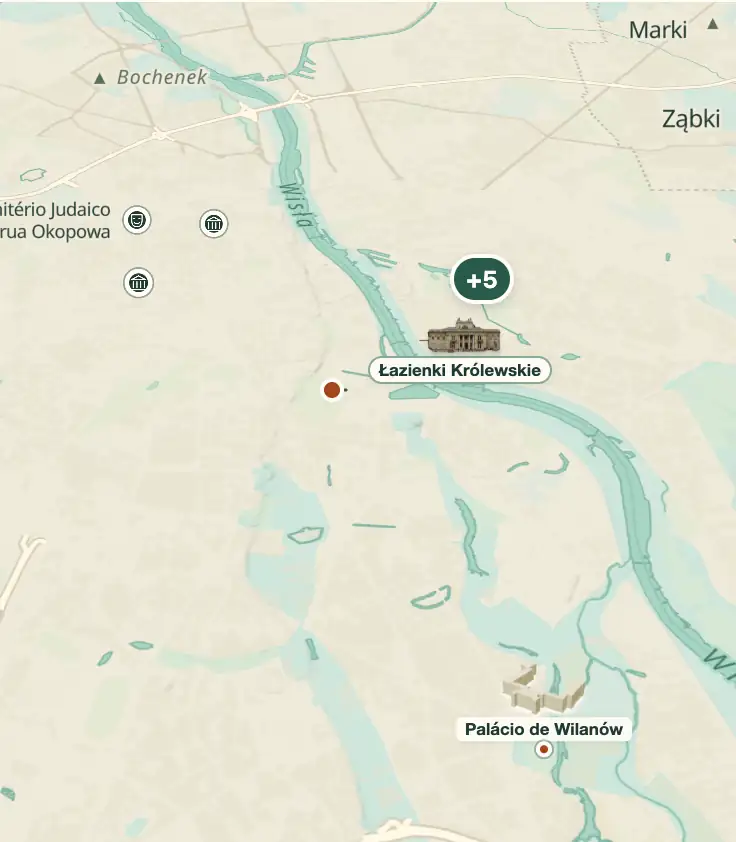
Explore the map
© OpenStreetMap · OpenFreeMap · © OpenMapTiles
Explore the map, read about the other places and plan your travel days in the app.
Open the appWhat to see
Warsaw: The plain, the river and the two banks
Warsaw lies on the Mazovian Plain, moraine ground left by glaciers, between 78 and 116 m above sea level, and the Vistula crosses it from south to north for about 28 km within the city limits. On the left bank lies the core rebuilt between 1949 and 1953, with the Rynek, the Barbican and the rebuilt wall, listed by UNESCO in 1980.
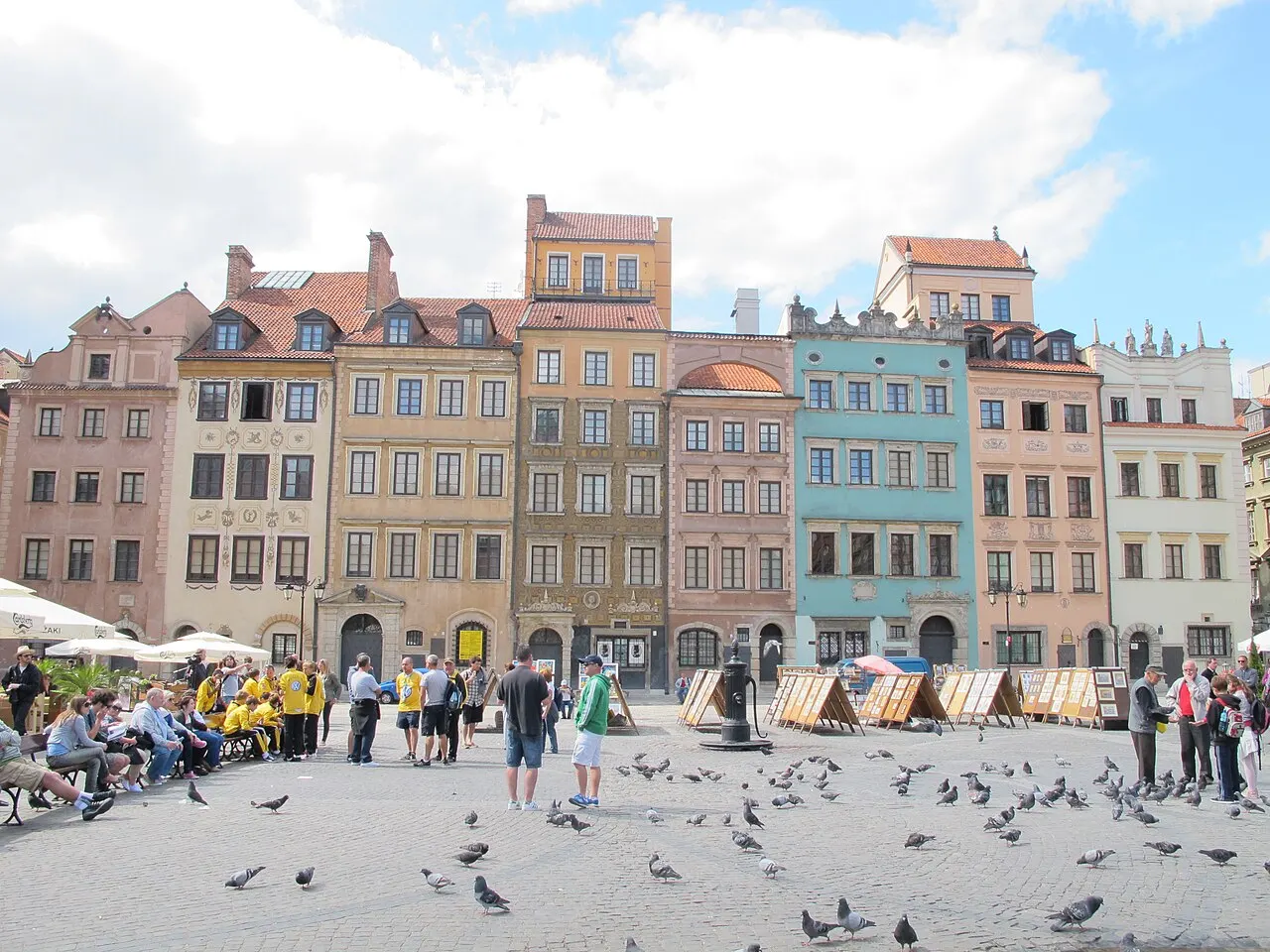
Rynek Starego Miasta and the Old Town
The square's colorful row houses were rebuilt between 1949 and 1953 on the original foundations, with facades copied from the vedute Bernardo Bellotto painted between 1767 and 1780. The ensemble made the UNESCO list in 1980 precisely as an example of reconstruction. At the center of the square stands the bronze Syrenka, the city's mermaid symbol, sculpted by Konstanty Hegel in 1855.
The Rynek is the heart of the Old Town, rebuilt after 1945, and UNESCO listed it in 1980 precisely as an example of reconstruction based on documentary evidence. Walk the square early, before the tour groups.
Check access
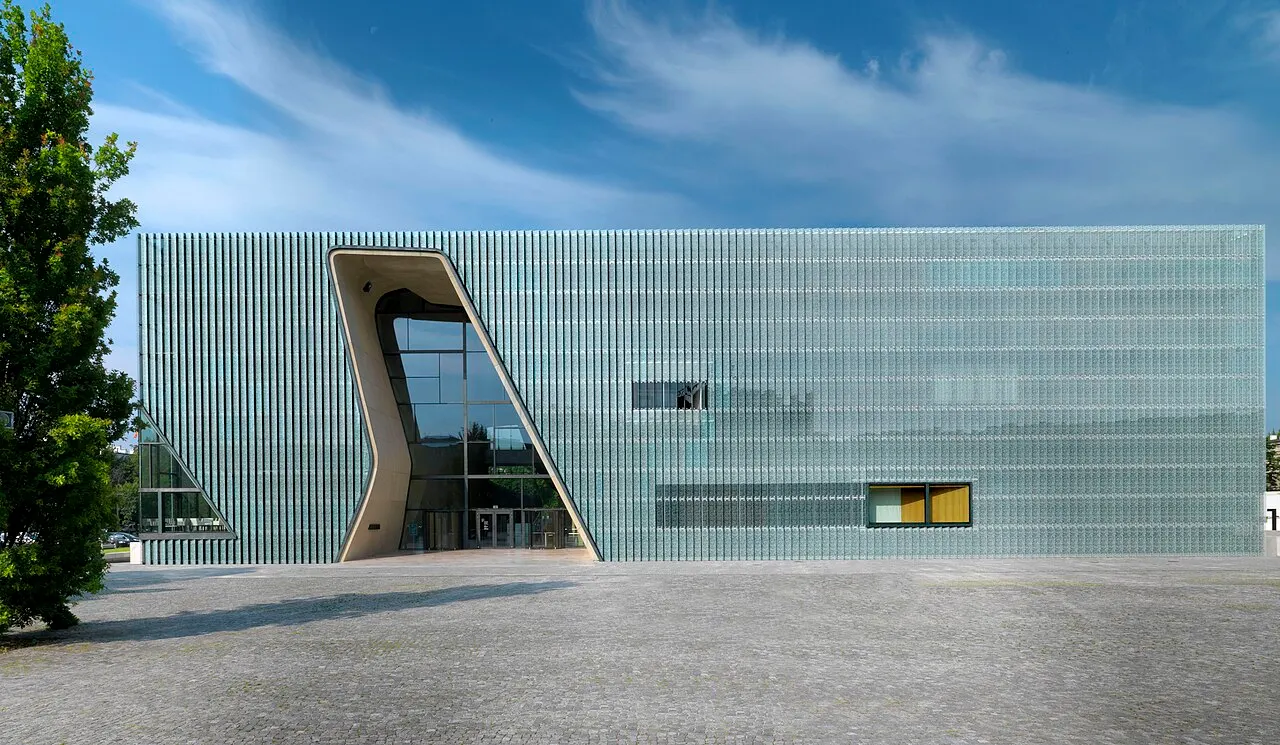
Muzeum POLIN
Museum of the History of Polish Jews, on the site of the former ghetto; the building by Finnish architect Rainer Mahlamäki opened in 2013 and the main exhibition in October 2014. It tells a thousand years of Jewish presence in Poland, not just the Holocaust, and takes 2 hours 30 minutes to 4 hours. Facing it stands the Monument to the Ghetto Heroes, by Nathan Rapoport (1948), where German chancellor Willy Brandt knelt on December 7, 1970.
The museum tells a thousand years of Jewish presence in Poland, not just the Holocaust, on the site of the former ghetto, and the main exhibition takes 2 hours 30 minutes to 4 hours. Book the time slot in advance, because the morning line grows fast.
Check access
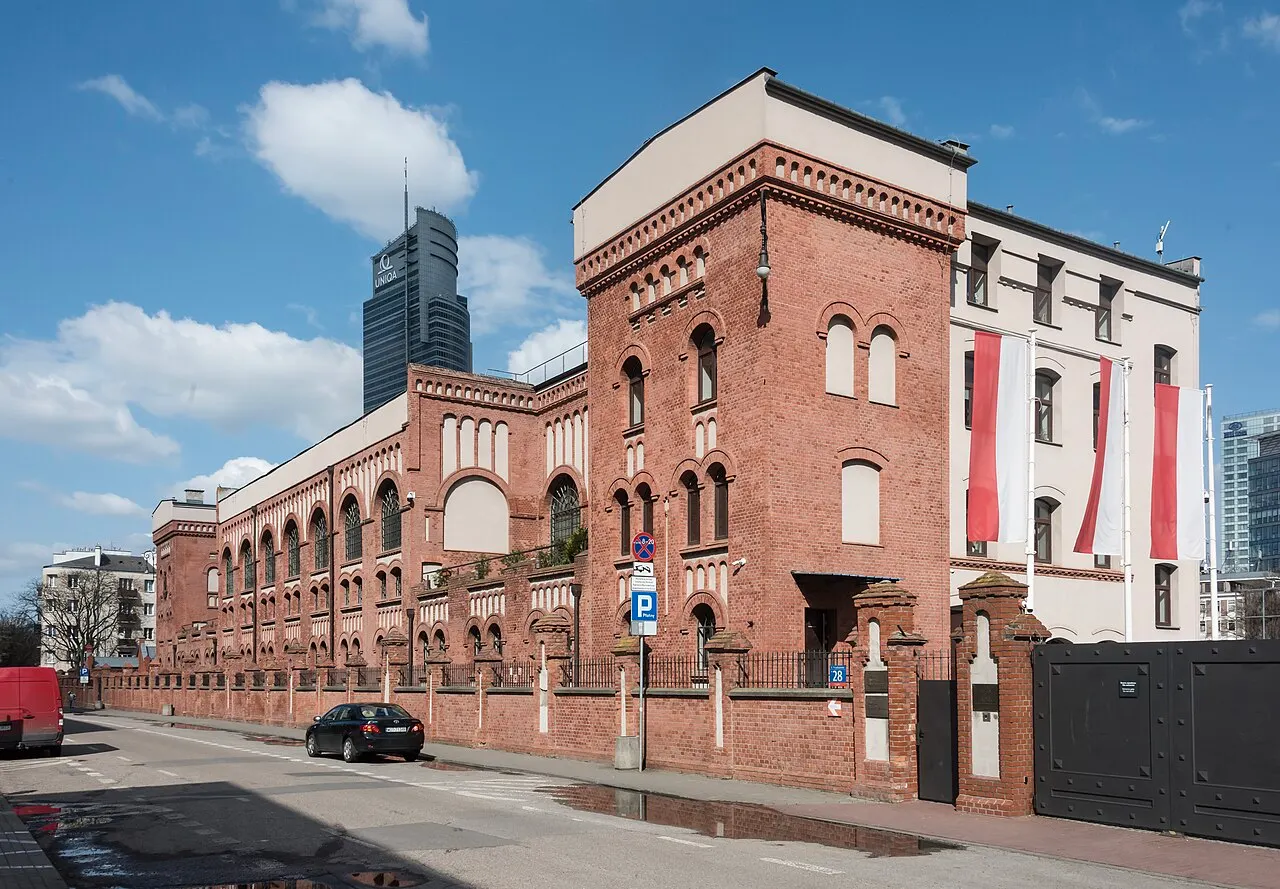
Muzeum Powstania Warszawskiego
Installed in 2004 in a former tram power plant on Grzybowska Street, it covers the 63 days of the 1944 Uprising almost day by day, with radios, letters and a replica of a Liberator bomber. The film “Miasto ruin” is a 3D flyover of the razed city, reconstructed from aerial photographs from 1945. Book a time slot: weekend lines are long.
Check access
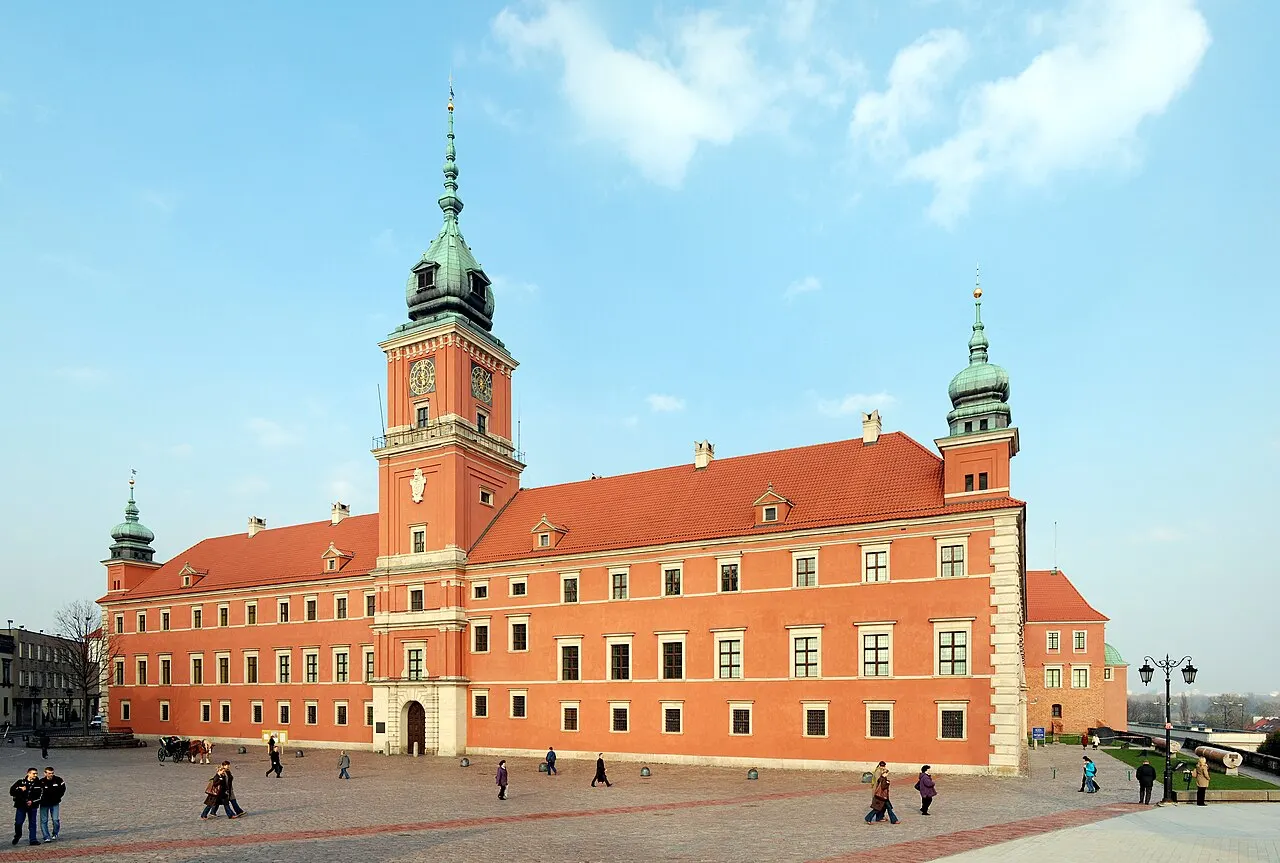
Zamek Królewski (Royal Castle)
Seat of the Sejm since 1569 and royal residence from 1596, when the court arrived from Kraków; the Constitution of May 3, 1791 was signed in one of its rooms. The Germans dynamited it in 1944, and the reconstruction, carried out between 1971 and 1984 with public donations, reused fragments kept since the war. It holds two Rembrandts and the Bellotto vedute that served as the model for rebuilding the city.
Dynamited by the Germans in 1944, the castle was rebuilt between 1971 and 1984 with public donations and fragments kept since the war, and displays the Bellotto vedute that served as the model for the city. Buy the ticket online to skip the line and set aside two hours.
Check access
Pałac Kultury i Nauki
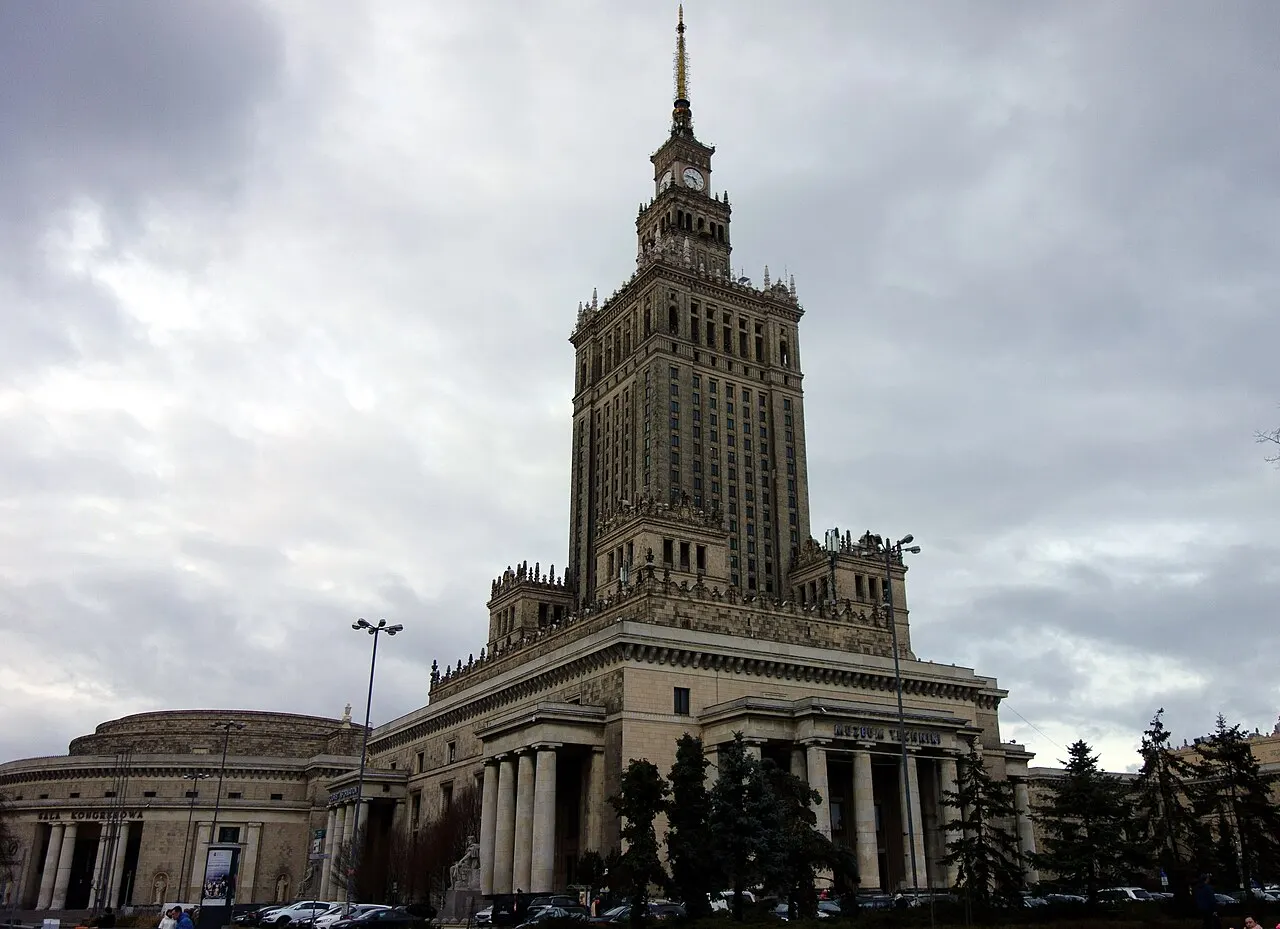
A 237-meter tower with the spire, built between 1952 and 1955 as a gift from the Soviet Union, designed by Lev Rudnev. It has 42 floors, more than 3,200 rooms, theaters, a cinema, and the Sala Kongresowa where the Rolling Stones played in 1967. The 30th-floor terrace, at 114 m, opens daily and costs around 25–30 zł.
Check access
Łazienki Królewskie
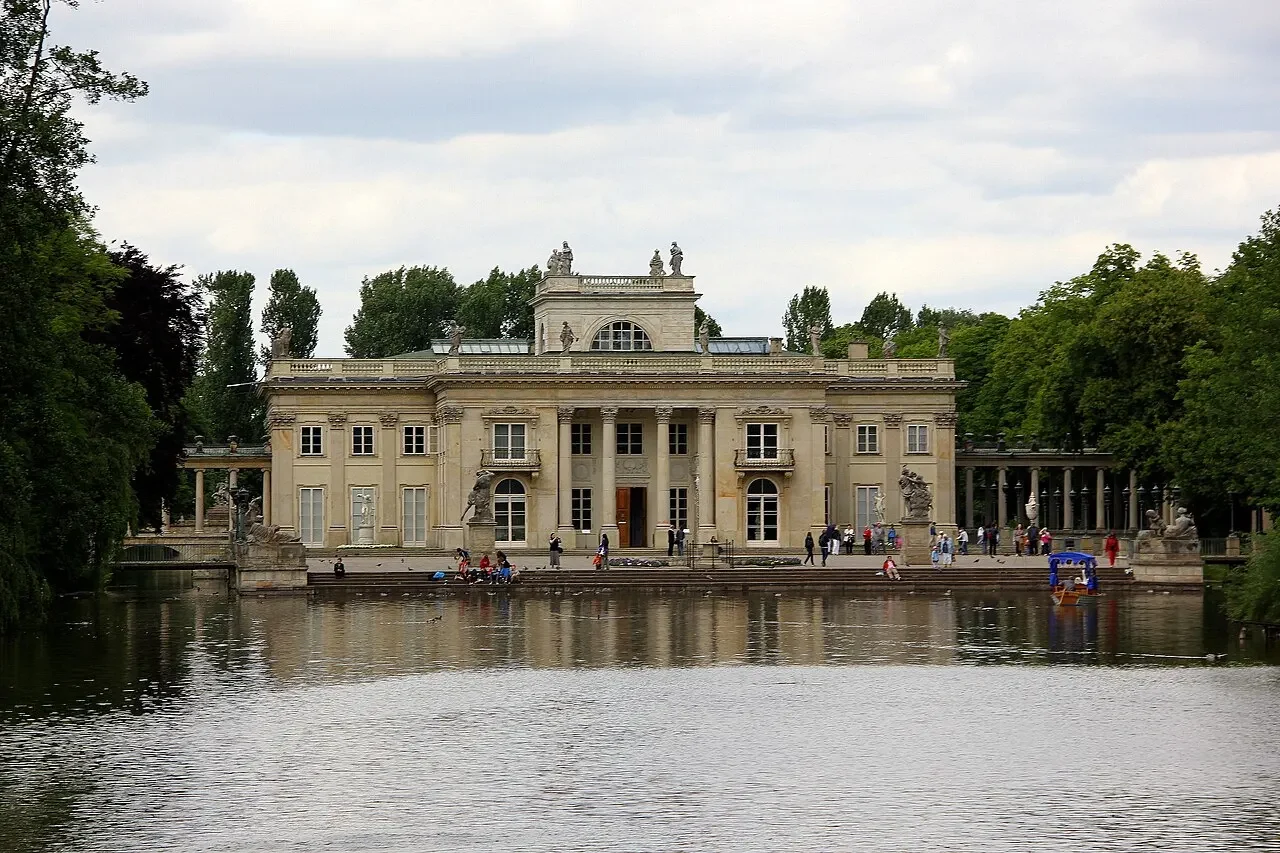
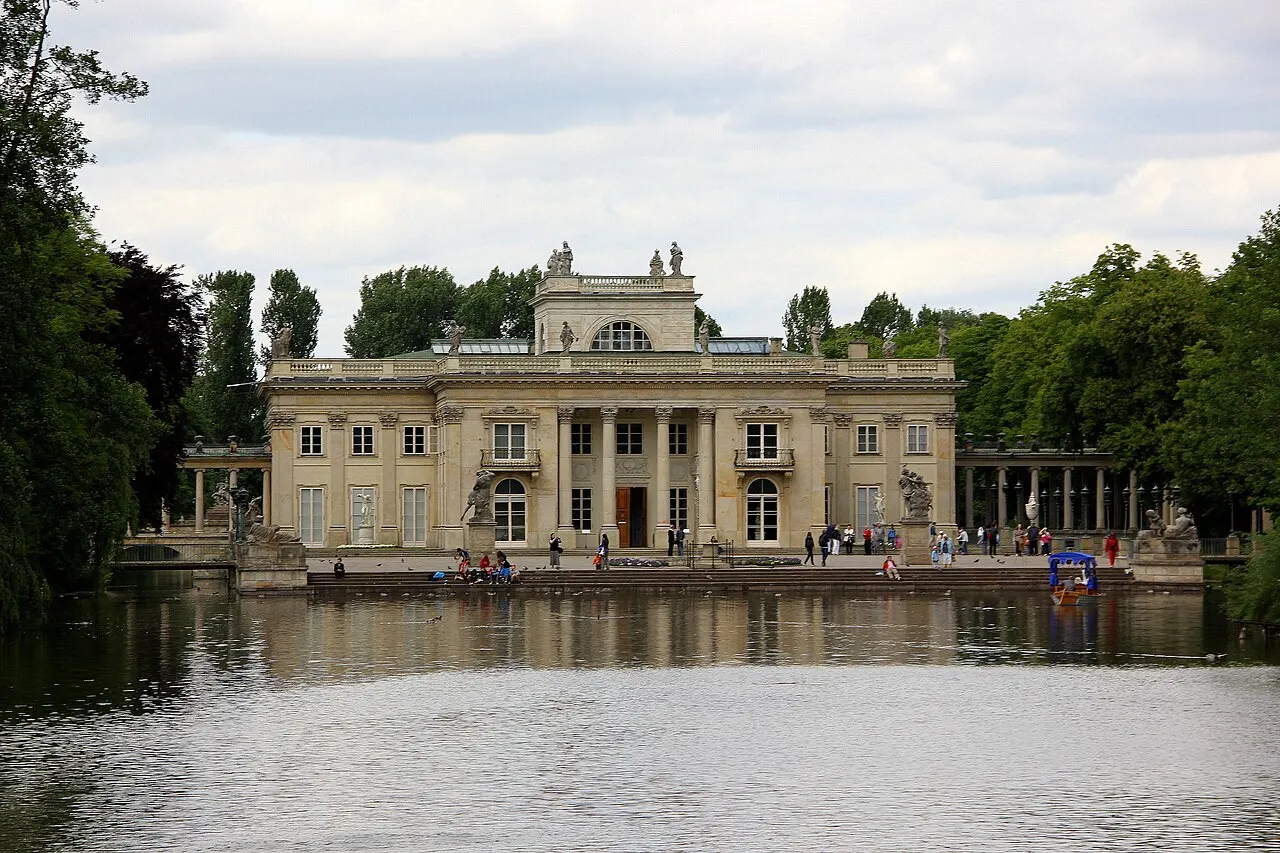
A 76-hectare park designed for King Stanisław August starting in 1764, with the Palace on the Water, a lakeside amphitheater and free-roaming peacocks. The Chopin monument, by Wacław Szymanowski, was unveiled in 1926, destroyed by the Germans in 1940 and recast in 1958, and in summer it's the stage for the free Sunday piano recitals.
The 76-hectare park of King Stanisław August has the Palace on the Water, free-roaming peacocks, and, from mid-May to the end of September, free Sunday piano recitals, no reservation needed. Count on an hour seated for the 4pm concert.
Check access
Krakowskie Przedmieście and the Royal Route
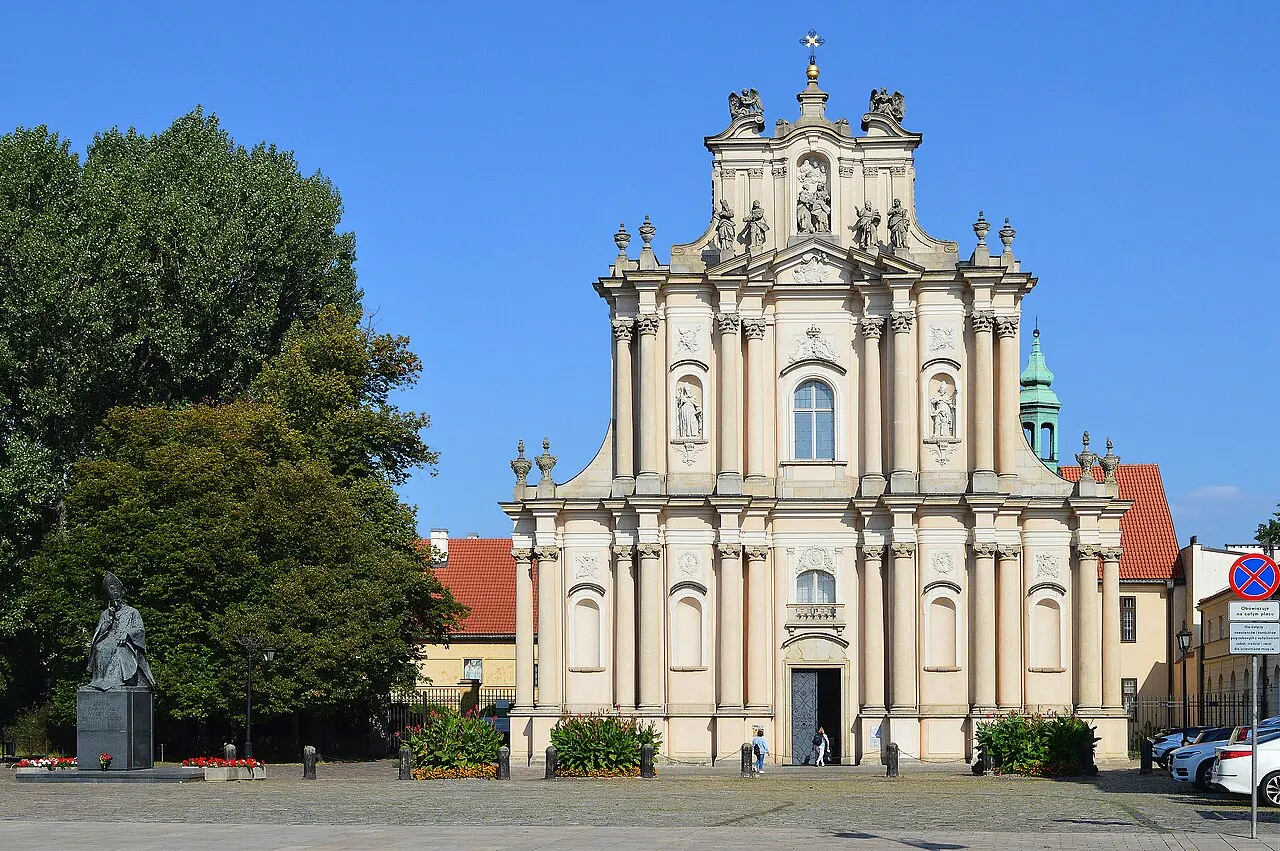
The avenue linking the Royal Castle to Nowy Świat gathers baroque churches, the Presidential Palace and the University of Warsaw campus. In the Church of the Holy Cross, a pillar in the left nave holds the urn with Chopin's heart, brought from Paris in 1850. Sigismund's Column, from 1644, is the city's oldest secular monument: toppled in 1944, it was re-erected in 1949.
The avenue linking the Royal Castle to Nowy Świat brings together Sigismund's Column, from 1644, toppled in 1944 and re-erected in 1949, and the Church of the Holy Cross, whose left-nave pillar holds the urn with Chopin's heart. Walk the route in the morning and decline a stranger's invitation for “a drink,” the most common local scam.
Check access

Bulwary Wiślane and the wild bank
The left-bank boulevards were rebuilt between 2015 and 2017 and became the summer promenade, with floating bars and the Copernicus Science Centre. On the other side, the right bank is a Natura 2000 area: sand, willows and herons 500 m from the financial center. In summer there's a free ferry for pedestrians and cyclists between the two banks.
Check access
Wilanów Palace
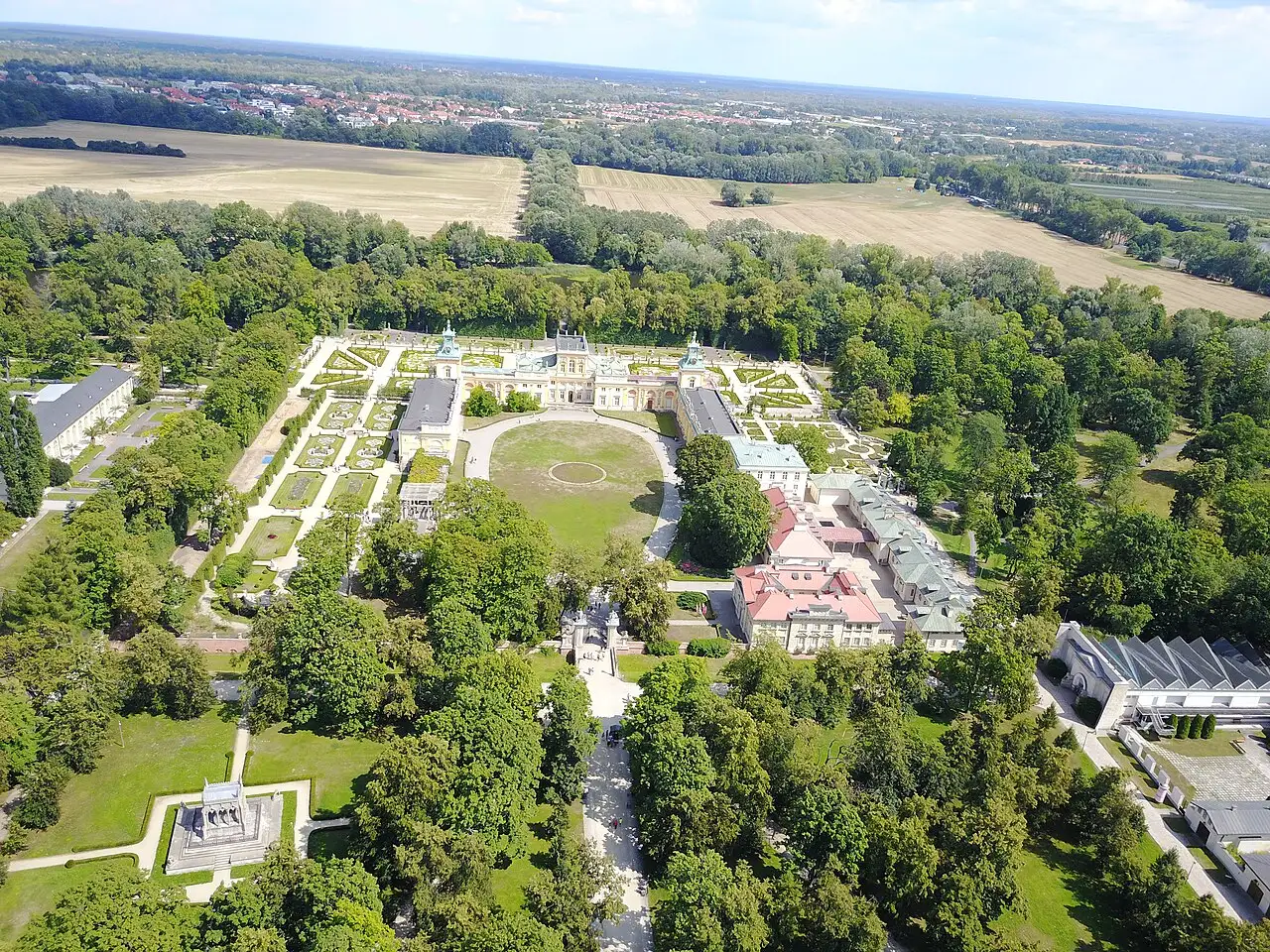
The baroque summer residence of Jan III Sobieski, built between 1677 and 1696 by Augustyn Locci, 10 km south of the center. It came through both wars almost intact, which makes it one of the city's rare genuinely old interiors. The gardens cover about 45 hectares, and from November to February host the Ogród Świateł light show.
Jan III Sobieski's baroque palace, from 1677–1696, came through both wars almost intact, but it's 10 km south, about 30 minutes each way on bus 116 or 180, and takes another 1 hour 30 minutes between palace and gardens. On a short visit, that quarter of a day pays off more downtown, where the history of 1944 is.
Check access
Nilo’s itinerary
Start with the basic programme and choose extensions for the time you have.
Plan my days in the app ↗Day 1 · The remade city
Start at 10am at the Rynek Starego Miasta and go into the Royal Castle (2 hours; buy the ticket online to skip the line).
Walk down Krakowskie Przedmieście past Sigismund's Column (1644) and step into the Church of the Holy Cross to see the pillar holding Chopin's heart.
Have lunch at a bar mleczny on Nowy Świat or at the Hala Koszyki covered market, from 1909, reopened in 2016.
Go up to the 30th-floor terrace of the Palace of Culture in the late afternoon, when you can see the Wola towers against the sunset.
Have dinner in Śródmieście and finish at the Pawilony courtyards, between Nowy Świat and Krucza Street.
Day 2 · Ghetto and Uprising: POLIN and the memorials
Book a time slot and arrive at POLIN at opening; the main exhibition needs 2 hours 30 minutes at minimum.
On leaving, cross to the Monument to the Ghetto Heroes (1948) and follow the wall's route on foot to the Umschlagplatz memorial.
Have lunch in Muranów and notice how the district's ground level is higher: the ghetto's rubble is underneath.
Spend the afternoon at the Warsaw Uprising Museum, on Grzybowska Street (2 hours), without skipping the film “Miasto ruin.”
End the day walking the Vistula boulevards, with a view of the wild bank on the other side.

Food
 AI illustration
Pierogi
Boiled stuffed dumplings: “ruskie” has potato and farmer's cheese (twaróg), “z mięsem” ground meat, “z kapustą i grzybami” sauerkraut with mushroom. Ask for “odsmażane” to have them pan-fried in butter with onion. A serving of nine is a main course, not a starter; 25–40 zł.
 AI illustration
Żurek
A sour soup made with rye flour starter, white sausage (biała kiełbasa), potato and half a boiled egg. Served year-round, peaking at Easter; the version served in a hollowed-out round loaf is aimed at tourists, but it works.
 AI illustration
Bigos
A stew of sauerkraut and fresh cabbage with several meats, smoked sausage, prunes and sometimes wine, cooked and reheated over several days, because it gets better every time it goes back on the stove. It's winter food and home food, and good restaurant bigos was also made the day before or earlier.
 AI illustration
Pyzy warszawskie
Large balls of grated potato stuffed with meat, served with cracklings and fried onion. It's a dish specific to Warsaw, tied to the Praga district, where Brzeska Street sells servings in glass jars to go.
 AI illustration
Flaki
Soup of tripe cut into thin strips, with carrot, marjoram and a lot of black pepper, served boiling hot. A classic of bar mleczny canteens and markets; it disappears from menus at the height of summer heat.
 AI illustration
Wuzetka
A chocolate cake with a layer of whipped cream and jam, named around 1949 after the nickname for the Trasa W-Z, the east-west avenue opened that year. It costs 8–14 zł at any cukiernia and is the most Varsovian dessert there is.
 AI illustration
Pączek
A fried doughnut filled with rose jam and topped with icing and candied orange peel. On Tłusty Czwartek, the last Thursday before Lent, lines stretch around the block at the old pastry shops, such as Blikle (1869), on Nowy Świat, and Zagoździński (1925), on Górczewska Street.
 AI illustration
Wódka with śledź
Vodka is drunk cold and neat, in shots of 40 to 50 ml, always paired with food: herring in oil with onion (śledź) is the standard match. Żubrówka mixed with apple juice, called “tatanka” or “szarlotka,” is the combination nobody criticizes.
Day trips

Żelazowa Wola
Żelazowa Wola, the village where Chopin was born in 1810, lies 55 km west, about 1 hour by car or 1 hour 30 minutes by bus with a transfer. The house is now a museum with a park, and on Sundays from May to September short recitals are included in the ticket.
Łódź
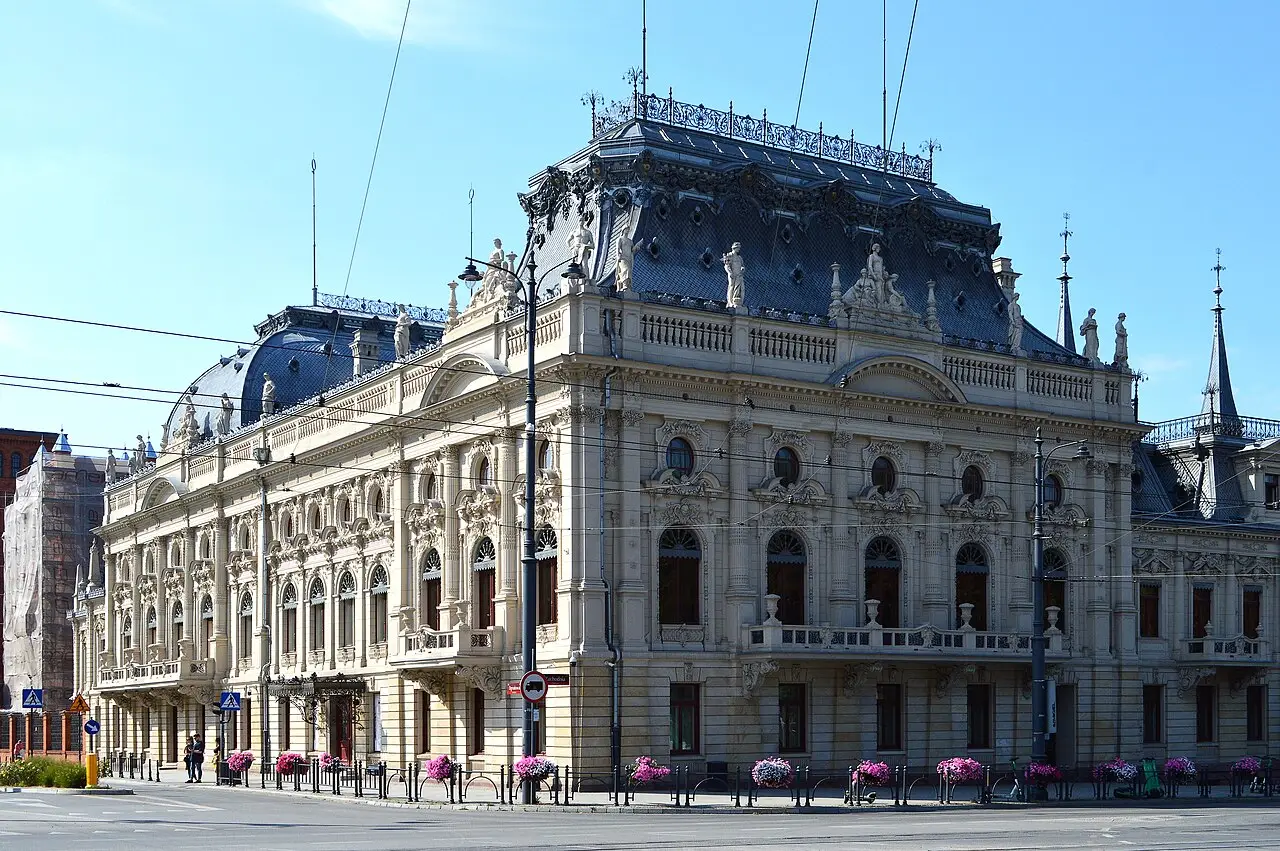
Łódź lies 135 km southwest, 1 hour 20 minutes to 1 hour 40 minutes by direct train from Warszawa Centralna. A 19th-century textile city, it has the 4.2 km Piotrkowska Street, the Manufaktura factory complex, the Księży Młyn workers' estate and the EC1 cultural center.
Kampinos National Park
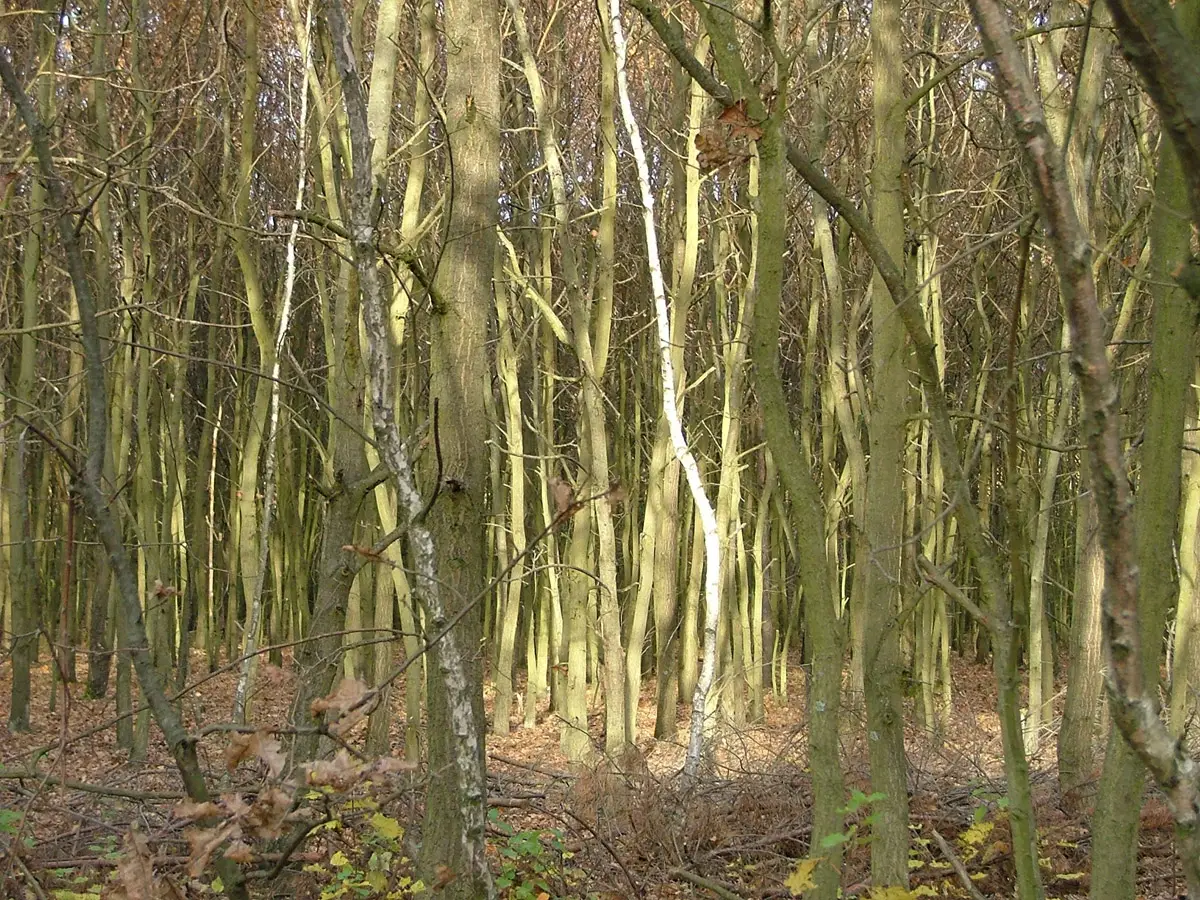
Kampinos National Park, created in 1959, begins at the city's northwest edge and covers 385 km² of forest and inland sand dunes. The city bus takes 40 to 60 minutes to get there, and on the way is the Palmiry cemetery, where the Germans shot about 1,700 people between 1939 and 1941.
Where to begin
The remade city
Start at 10am at the Rynek Starego Miasta and go into the Royal Castle (2 hours; buy the ticket online to skip the line).
Ghetto and Uprising: POLIN and the memorials
Book a time slot and arrive at POLIN at opening; the main exhibition needs 2 hours 30 minutes at minimum.
Parks and the right bank
Spend the morning in Łazienki Park, between the Palace on the Water and the free-roaming peacocks. If it's a Sunday, from mid-May to the end of September, flip the day: Wilanów in the morning and the free 4pm piano recital at Łazienki, which doesn't get the noon tour buses.
Money
The currency is the złoty (PLN, written “zł”), divided into 100 groszy. Poland is in the European Union but hasn't adopted the euro, and paying in euros only works at tourist spots, at a poor rate; in 2026 the euro is worth about 4.3 zł and the dollar about 3.7 zł. Cards are accepted almost everywhere, including kiosks, trams and markets, and the local BLIK system requires a Polish bank account, so it's no use to visitors. Expect these price ranges: coffee 12–18 zł, beer in a bar 14–22 zł, lunch at a bar mleczny 20–30 zł, a main course at a midrange restaurant 45–70 zł, a full dinner with drinks 120–180 zł per person, museums 20–45 zł, a hostel bed 70–120 zł and a double room in a three-star hotel 300–450 zł a night. At ATMs, always decline the “conversion to your currency” (DCC), which costs more than your bank's rate. A 10% tip is usual in restaurants with table service and isn't expected in bars or cafés. Be careful with “thank you”: saying “dziękuję” as you hand over the money means the waiter keeps the change, so say it only after you've received it. Warsaw doesn't charge a tourist tax on accommodation.
Getting there and around
Airports: Chopin 8 km away, Modlin 40 km away
Chopin Airport (WAW) is 8 km southwest, and S2, S3 and KM trains leave from the station beneath Terminal A, reaching Warszawa Śródmieście or Centralna in 20 to 25 minutes; a regular city transit ticket is valid, because the airport is in zone 1. Bus 175 runs to the Royal Route in about 40 minutes, night bus N32 covers the small hours, and a taxi or ride-hailing app costs 50–80 zł. Modlin Airport (WMI), used by Ryanair, is 40 km north, and Contibus links it to the center in about an hour for 40 zł, paid on arrival or on board; the alternative is the shuttle bus to Modlin station and a regional train from there. Don't accept rides from people who approach you in the arrivals hall: use the official taxi rank or an app.
Metro: 2 lines, the M1 from 1995 and the M2 from 2015
The network is unified (ZTM/WTP) and brings together trams, buses, SKM urban trains and two metro lines: the M1, north-south, opened in 1995, and the M2, east-west, opened in 2015 and extended through 2025. In zone 1, which covers practically the whole city, 2026 prices are 3.40 zł for 20 minutes, 4.40 zł for 75 minutes, 7.00 zł for 90 minutes, 15 zł for 24 hours, 24 zł for the weekend ticket and 36 zł for 3 days (check at wtp.waw.pl). Buy through the jakdojade, mPay or SkyCash apps, or at machines, and validate at the yellow device when boarding. The ticket only starts counting at validation, a detail easy to learn too late, and the fine runs around 266 zł. Trams are the fastest way to cross downtown, the night network “N” leaves Centrum square every 30 minutes, there are Veturilo bikes from March to November, and the historic center is walkable: from the Old Town to the Palace of Culture is about 25 minutes on foot.
Safety
Warsaw is one of the safest capitals in Europe for walking after dark, and violent crime against visitors is rare. The bigger nuisance is petty scams. Pickpockets work the crowded trams and buses heading to the Old Town, the area around Centralna station and the street markets, so wear your backpack on your front. Unlicensed taxis wait at Chopin arrivals and outside Centralna, always without a meter, and some bars send people to hand out invitations on Krakowskie Przedmieście and in the Rynek, only to present absurd bills later. At ATMs, use the ones at bank branches and decline the currency conversion offered on screen. After midnight, the area around Dworzec Centralna and Aleje Jerozolimskie fills with drunk people, and the side streets of Praga-Północ call for caution after 11pm, although both places are normal by day. Avoid arguing with drunk groups outside bars, the most common source of trouble. Tap water is drinkable, the single emergency number is 112 and, in winter, the most concrete risk is icy sidewalks.
Etiquette tips
Take your shoes off when entering a home
Don't ask: take off your shoes at the door, always. Hosts usually offer slippers (kapcie), and crossing the living room in shoes is a clear faux pas, even in a student apartment.
Say hello when you enter small shops and elevators
Say “dzień dobry” on entering and “do widzenia” on leaving, even if you buy nothing. Entering in silence reads as rude, not discreet.
Stop on August 1 at 5pm
When the sirens sound, everyone freezes where they are for a minute, drivers included. Continuing to walk or filming people during that minute draws immediate negative attention.
Never say “Polish concentration camps”
The camps were German, set up on occupied Polish territory. The wrong phrasing causes immediate offense and has been a matter of law since 2018; use “German Nazi camps in occupied Poland.”
Flowers always in an odd number
Bouquets with an even number are for funerals, and chrysanthemums are cemetery flowers. Bring 3, 5, 7 or 11 stems and leave chrysanthemums out of any social occasion.
With vodka, keep pace with the table
Drink in short rounds, with the vodka ice-cold and neat, a toast (“na zdrowie”) and food between shots. Leaving the table in the middle of a round, or sipping it as if it were whiskey, looks disrespectful to whoever poured.
Mistakes to avoid
Treating the Old Town as medieval
Treating the Old Town as medieval and skipping the Uprising Museum and POLIN. It's easy to spend a whole day getting it all wrong that way: the 1949–1953 reconstruction is Warsaw's central subject, and without the two museums the colorful row houses become scenery without an explanation.
Forgetting to validate at the yellow device
Buying a transport ticket and forgetting to validate it at the yellow device when boarding. It only becomes valid at validation, and the fine runs around 266 zł, charged on the spot by plainclothes inspectors who don't look like inspectors until the badge appears.
Confusing Centralna with Śródmieście
Confusing Warszawa Centralna, Warszawa Śródmieście and the Centrum metro station. They're three different stations within a 400 m radius: buses to Modlin airport leave from Centralna, and a good share of regional trains stop at Śródmieście.
Exchange booths advertising “0% commission”
Changing money at exchange booths near the Rynek that advertise “0% commission.” The commission is baked into the spread; use a kantor away from the tourist circuit or withdraw from an ATM while declining the automatic conversion.
A stranger's invitation for a drink
Accepting a stranger's invitation for “a drink” on Krakowskie Przedmieście or the Rynek. It's the most common local scam: the bill arrives with three digits, and there's a bouncer at the door to make sure it gets paid.
Useful phrases
Dzień dobry
Good morning / good afternoon (jen dobri): used when entering any place
Dziękuję
Thank you (jen-koo-yeh): said when paying, it means the change stays
Proszę
Please / here you go / you're welcome (prosheh): covers all three
Przepraszam
Sorry / excuse me (pshe-prasham). Also used to ask people to make way
Ile to kosztuje?
How much is it? (eeleh to kosh-too-yeh)
Poproszę rachunek
The bill, please (po-prosheh ra-hoo-nek)
Districts
Stare Miasto and Nowe Miasto
The core rebuilt between 1949 and 1953, with the Rynek, the Barbican and the rebuilt wall, listed by UNESCO in 1980. It concentrates the tourist flow and the priciest restaurants; on Freta Street, in Nowe Miasto, stands the house where Maria Skłodowska-Curie was born in 1867.
Śródmieście
The administrative and commercial center around the Palace of Culture, Marszałkowska Street and Nowy Świat. It's where the offices, cinemas, most hotels and the bars of Plac Zbawiciela and Mokotowska Street are.
Powiśle
A narrow strip between the escarpment and the river, industrial until the 1990s and now dominated by students and bars. It has the University Library with its rooftop garden (1999), the Copernicus Science Centre (2010) and the most direct access to the Vistula boulevards.
Praga-Północ
The right bank, with 19th-century brick blocks that escaped the destruction of 1944 because the Red Army took this side in September of that year. It has courtyards with street chapels, workshops and the old Koneser distillery, now a food hall that has housed the Polish Vodka Museum since 2018.
Wola
A former belt of factories and part of the ghetto's territory; since 2015 it has been the skyscraper district around Rondo Daszyńskiego, with the Varso Tower (310 m, 2022) and the Warsaw Spire. The Warsaw Uprising Museum and a good part of the new hotels are here.
Muranów
In Muranów, the streets sit a few meters above the 1939 level: the ghetto's rubble became landfill under the asphalt.
Mokotów
A residential zone to the south, with Pole Mokotowskie park, interwar villas in Stary Mokotów and embassies on aleja Szucha. Further south is Służewiec, the office cluster residents have nicknamed “Mordor.”
Żoliborz
This residential district north of the center took shape between the wars under Mayor Stefan Starzyński, and suits anyone who wants to see 1930s Warsaw away from the tourist crowds. The Church of St. Stanislaus Kostka holds the tomb of Father Jerzy Popiełuszko, who celebrated Masses against the communist regime and was murdered by the secret police in 1984.
History
c. 1300 · A ducal outpost on the escarpment
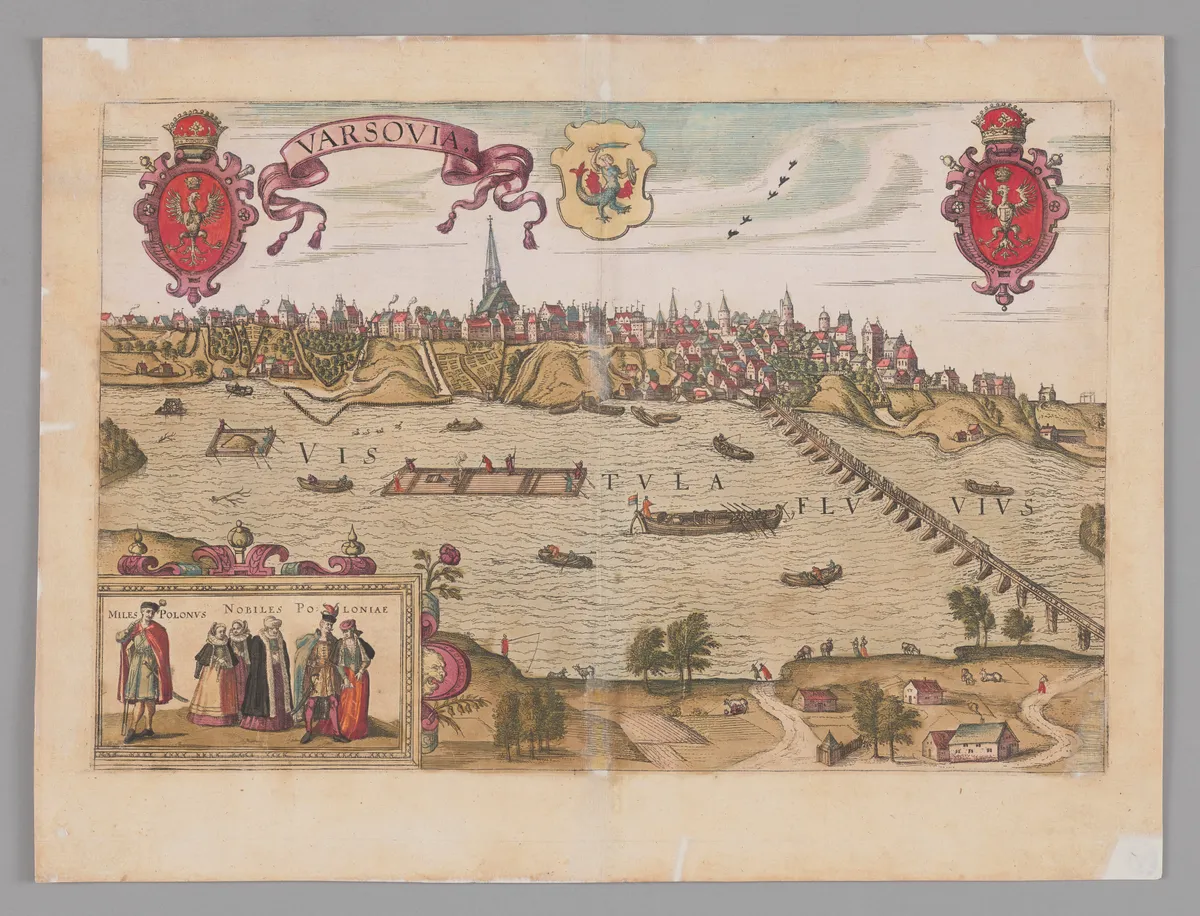
The dukes of Mazovia build a wooden castle on the bluff of the Vistula's left bank, a high point that allows them to watch over the river. The name Warszowa appears in documents in the early decades of the 14th century.
1526 · Mazovia joins the Crown
With the death of Janusz III, the last Mazovian duke, the duchy is incorporated into the Kingdom of Poland. Warsaw stops being a regional capital and becomes a player in national politics.
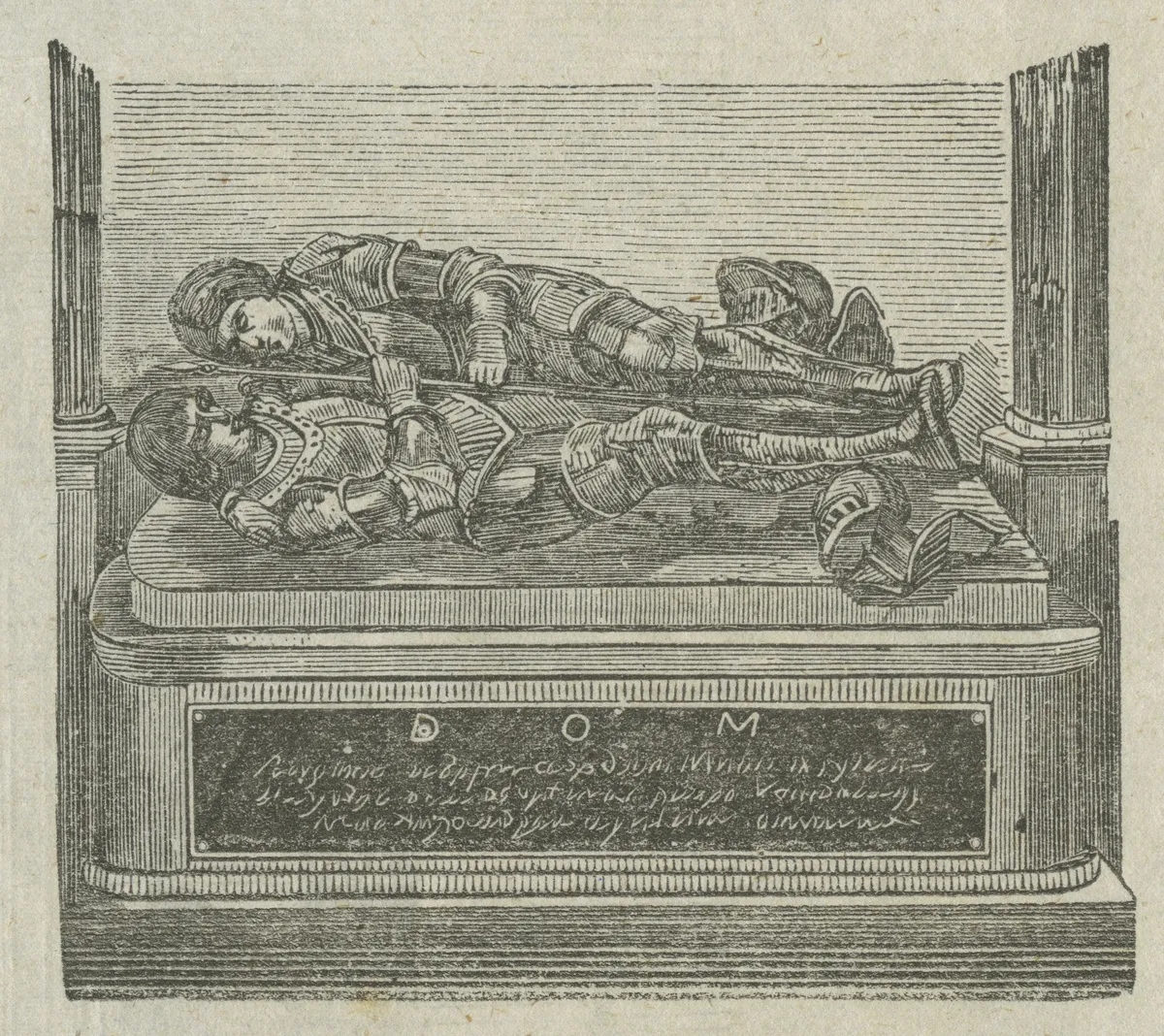
1569–1573 · Seat of the Sejm
The Union of Lublin (1569) merges Poland and Lithuania, and Warsaw, halfway between Kraków and Vilnius, becomes the seat of parliament. In 1573 the Warsaw Confederation, an act of religious tolerance, is signed here, and the Wola field starts hosting royal elections.
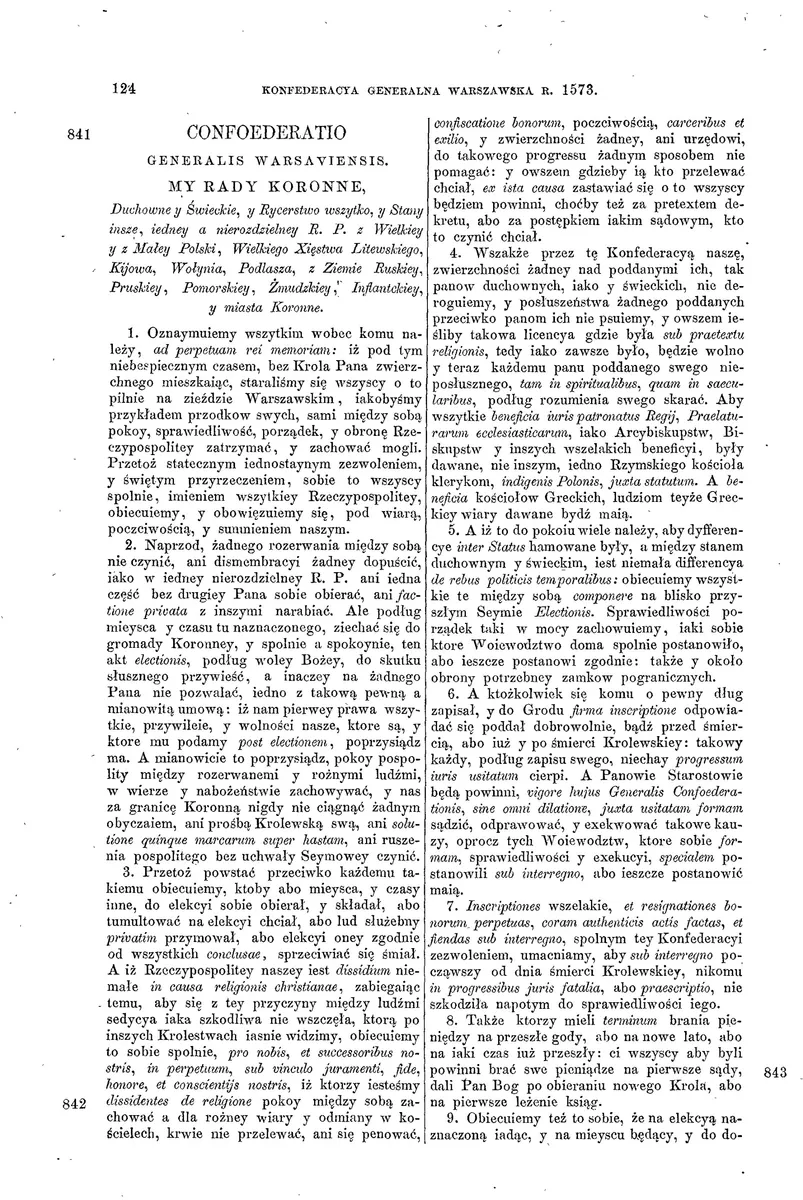
1596–1611 · The capital changes cities
After the fire at Wawel Castle in 1595, Sigismund III Vasa moves the court to Warsaw. The move is confirmed in 1611, and the city grows with nobles' palaces along the Royal Route.
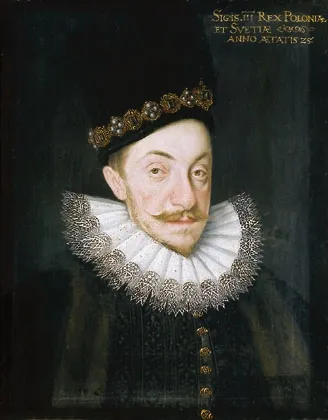
1655–1660 · The Swedish Deluge
Between 1655 and 1660, in the period Poles call the Deluge, Swedish troops occupy and sack the city three times, carrying off libraries, marble and entire roofs to Scandinavia.
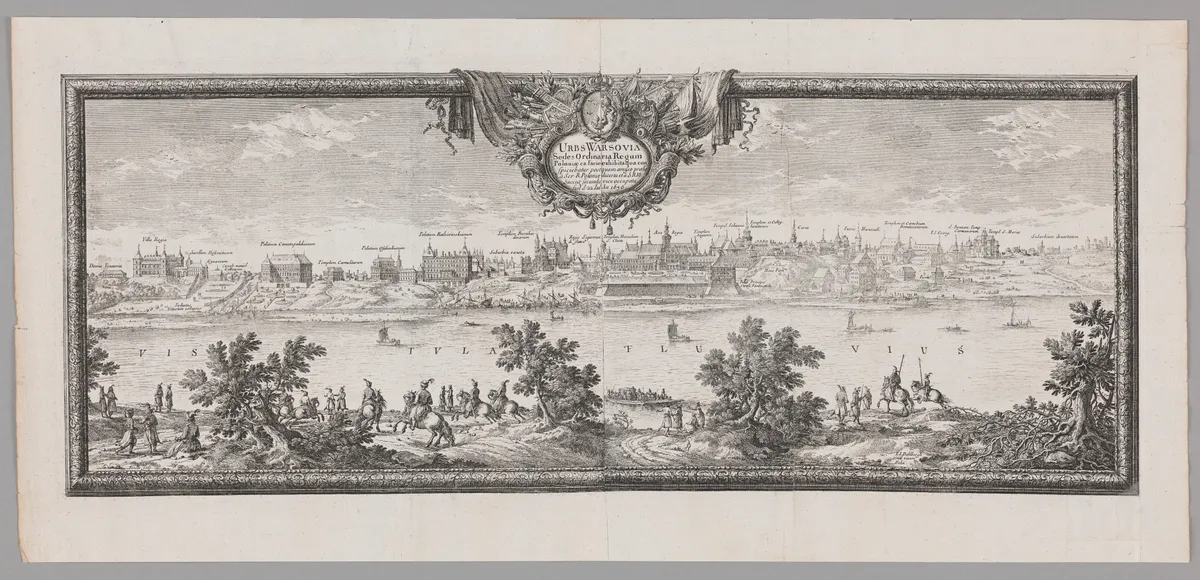
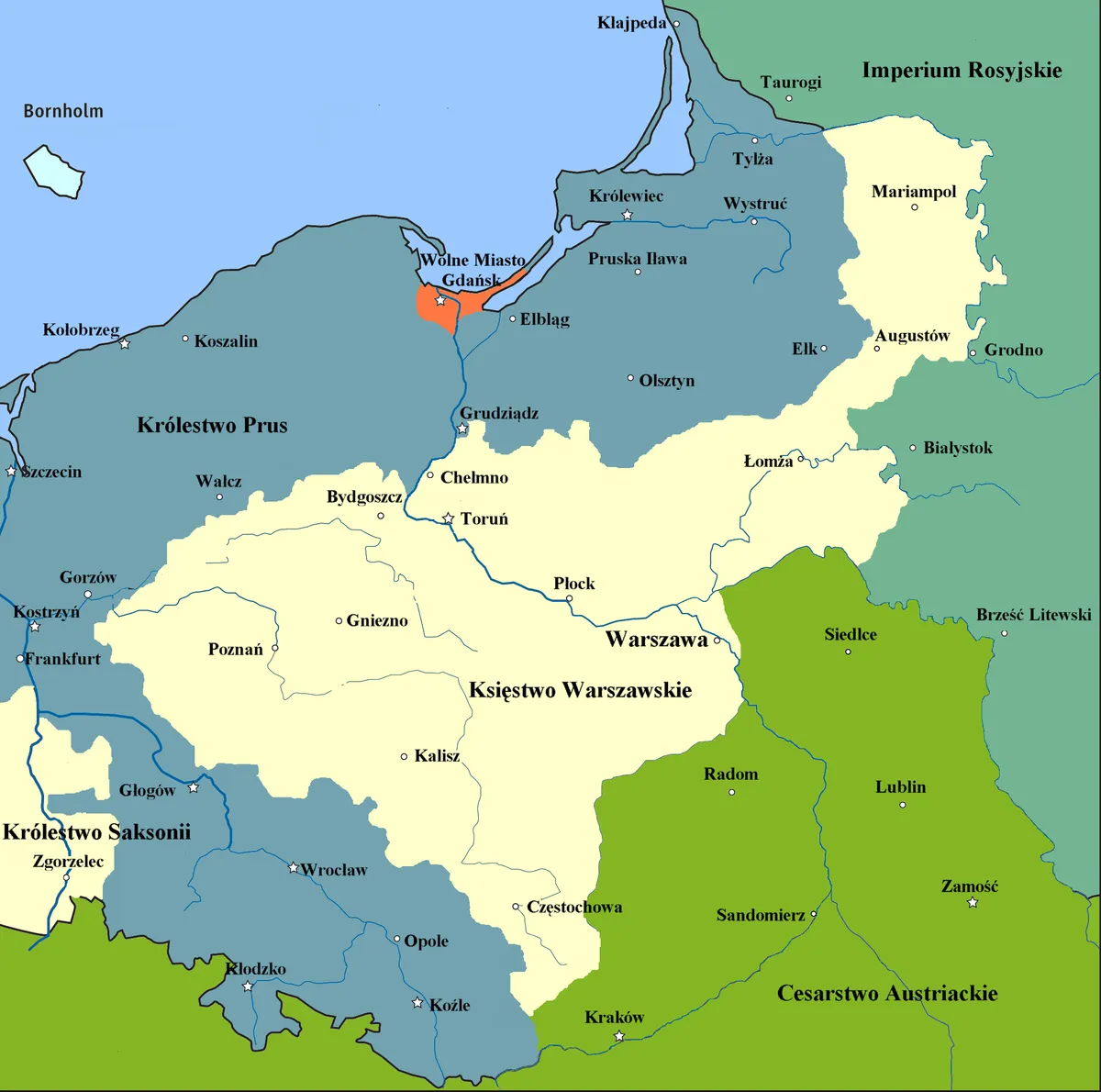
1795–1815 · Partitions and the Duchy of Warsaw
The Third Partition hands the city to Prussia in 1795, and Poland disappears from the map. Napoleon creates the Duchy of Warsaw in 1807; after 1815 the city falls under Russian rule as capital of Congress Poland.
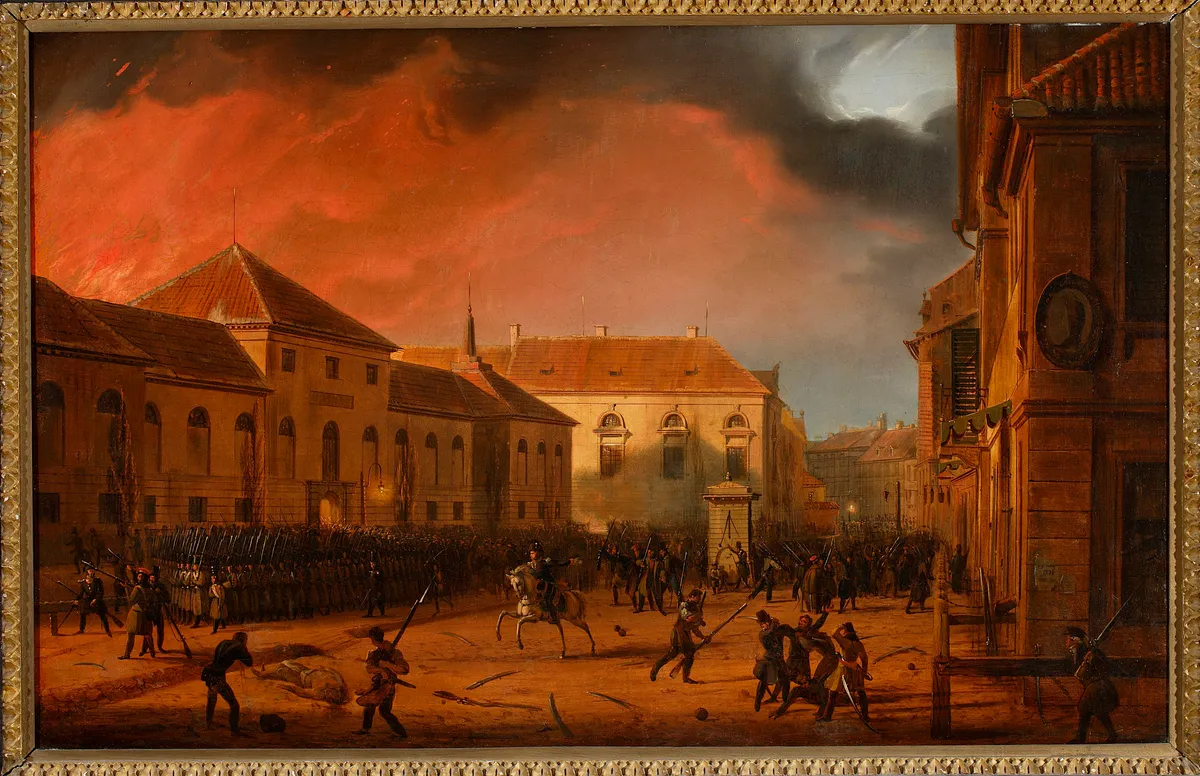
1830–1864 · The 1830 and 1863 uprisings, crushed
The November Uprising, which began in 1830, and the January Uprising, which began in 1863, end in defeat, executions at the Citadel and Russification. The city industrializes anyway, and its Jewish population reaches about a third of the total by around 1900.
1918–1920 · Capital again
With independence in 1918, Warsaw once again becomes the capital of a Polish state. In August 1920, the Battle of Warsaw stops the Red Army's advance at the city's gates.

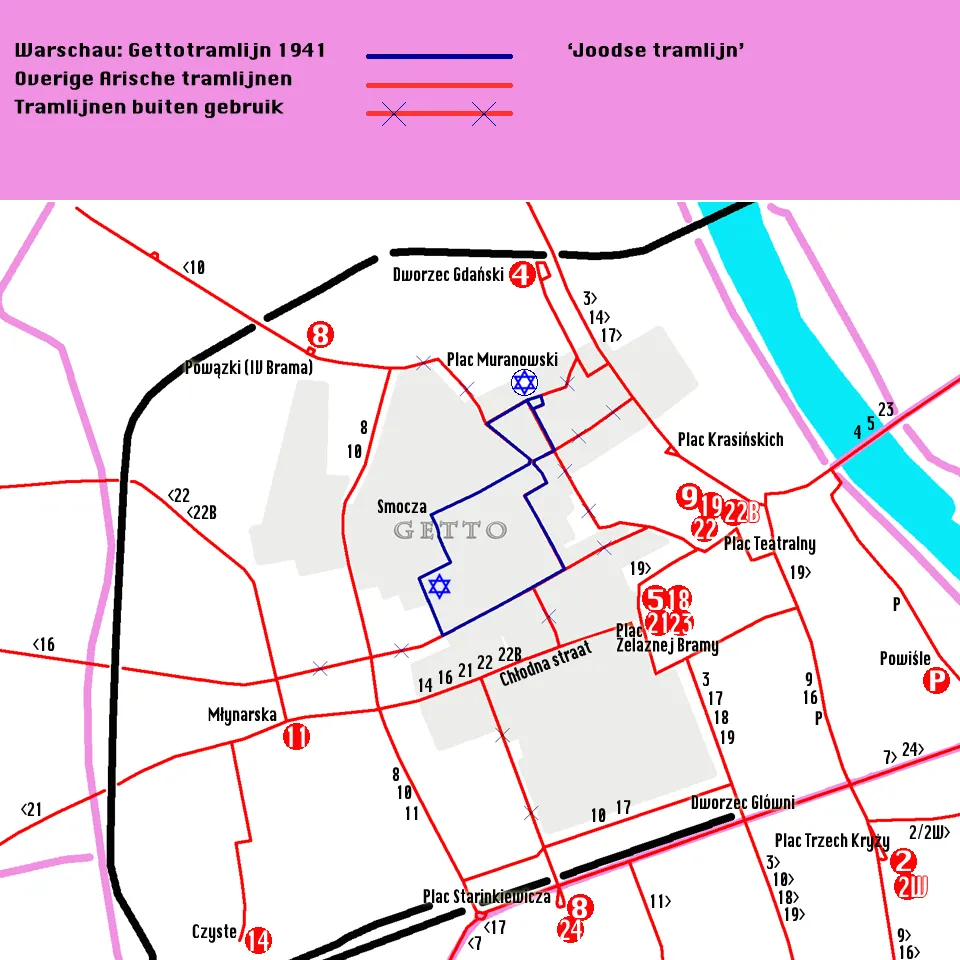
1940–1943 · The ghetto
The Germans seal the ghetto on November 16, 1940, confining about 400,000 people in 3 km². In summer 1942 they deport about 254,000 to Treblinka; the uprising from April 19 to May 16, 1943 ends with the entire district burned and dynamited.
1944 · Uprising and razing
The Warsaw Uprising begins on August 1 at 5pm and holds out for 63 days, with about 16,000 fighters and 150,000 to 200,000 civilians killed. After the capitulation, on October 2, the population is expelled and German squads demolish what is left: by January 1945 about 85% of the left bank lay in ruins.

1945–1955 · Planned reconstruction
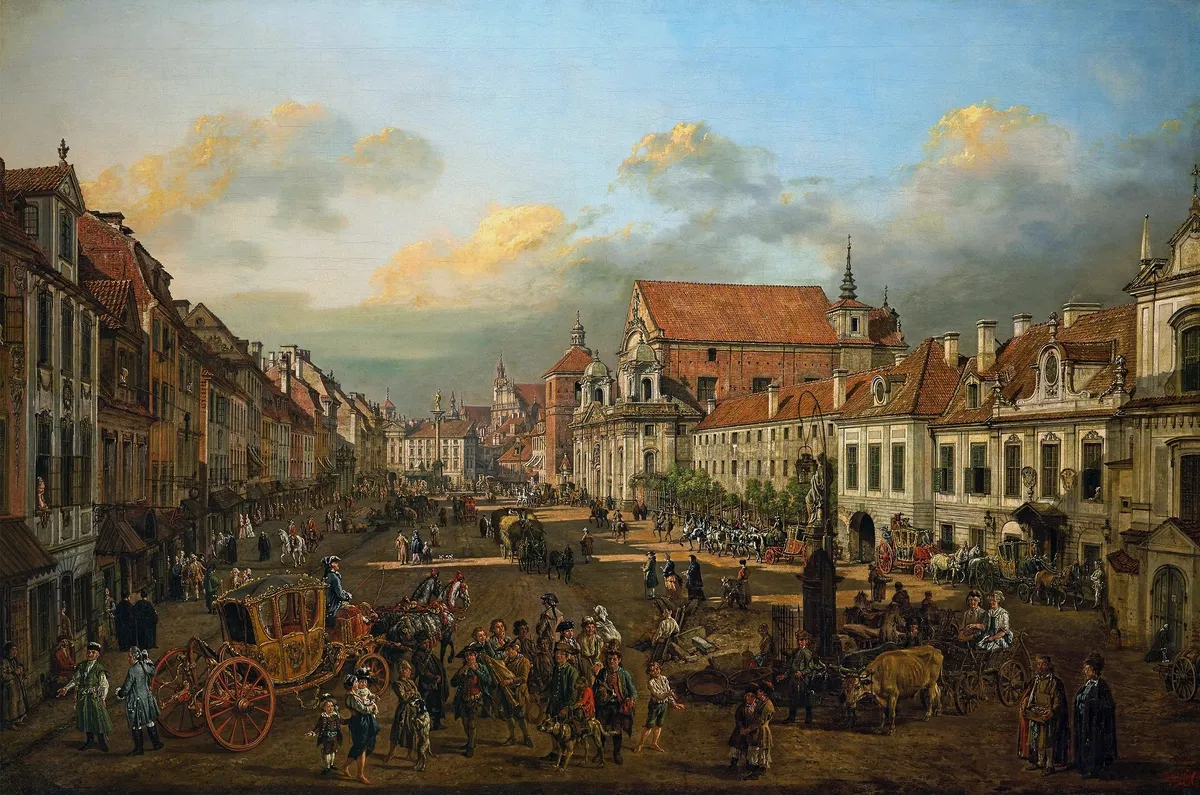
The Capital Reconstruction Office (BOS) is created in February 1945 and rebuilds the Old Town between 1949 and 1953, using Bernardo Bellotto's vedute and surveys made by students before the war. In the same period the Trasa W-Z (1949), the MDM district (1952) and the Palace of Culture (1952–1955) appear.
Complete history
The castle of the Dukes of Mazovia and the court (c. 1300–1611)
Warsaw was born around 1300, when the Dukes of Mazovia chose a high bluff on the left bank of the Vistula to control the river trade in grain heading down to Gdańsk. It remained a middling town for two centuries, until the ducal line died out in 1526 and Mazovia was absorbed into the Crown. What raised its status was its location: when the Union of Lublin joined Poland and Lithuania in 1569, Warsaw lay exactly between Kraków and Vilnius, and so it received the Sejm, the royal elections on the field of Wola and, after the Wawel fire of 1595, the court itself. Between 1596 and 1611, the capital changed cities without any law ever spelling it out.
Swedes, partitions and uprisings (1655–1863)
The next three centuries alternated between building and destruction. The Swedes sacked the city between 1655 and 1660 and even carried off the castle's marble cladding. In the 18th century, King Stanisław August Poniatowski created the Łazienki gardens, and on May 3, 1791, Europe's first modern constitution was signed here, four years before Poland vanished from the map in the partitions. Under Russian rule from 1815, Warsaw rose up in 1830 and 1863, lost both times and was saddled with the Citadel, an 1832 fortress-prison aimed at the city itself. Even so, it industrialized: textile mills and metalworks came to Wola and Praga, the first railway line arrived in 1845, and the population jumped from 160,000 in 1850 to more than 600,000 in the 1897 Russian census, a third of it Jewish.
In the 20th century: capital in 1918, siege in 1920
Capital of the Second Republic from 1918, Warsaw stopped the Red Army at the Battle of Warsaw in August 1920 and spent the 1930s modernizing under Mayor Stefan Starzyński, with Żoliborz, new schools and the tram network. In September 1939 it was besieged and bombed. In November 1940 the Germans sealed the ghetto with about 400,000 people inside, in the summer of 1942 they emptied it toward Treblinka, and in April 1943 the ghetto uprising ended with the district burned block by block. On August 1, 1944, the Home Army (AK) launched the Warsaw Uprising, which held out for 63 days while the Red Army waited on the right bank. After the capitulation, the city was emptied and demolished by explicit decision, and of its 1.3 million residents in 1939, only a few hundred people were left in January 1945, hiding in the ruins.
Rebuilding the Old Town: 1949–1953
The reconstruction was a political project. In February 1945 the BOS, the Capital Reconstruction Office, was created, and it was decided to keep the capital here rather than move it to Łódź. The Old Town was rebuilt between 1949 and 1953 on the original foundations, with facades copied from the vedute Bernardo Bellotto painted between 1767 and 1780 and from surveys architecture students had made before the war; the ensemble made the UNESCO list in 1980 for exactly that reason. In parallel, the regime designed the socialist city: the Trasa W-Z opened in 1949, the monumental MDM district in 1952, the Palace of Culture and Science between 1952 and 1955 as a Soviet gift, and Muranów built directly over the rubble of the ghetto. The ground there sits a few meters higher than it did in 1939. In the 1960s to 1980s came the prefabricated housing estates of Ursynów, Bródno and Bemowo, where a good part of the city still lives today.
The Warsaw Pact in 1955 and martial law in 1981
Today's Warsaw was built on top of that legacy in two waves. The first is political: the Warsaw Pact was signed here in 1955, martial law began in December 1981, Father Jerzy Popiełuszko was murdered by the secret police in 1984, and the Round Table talks that dismantled the regime met from February to April 1989 at the Presidential Palace. The second is economic: after 1989 the city became the region's financial hub, joined the European Union in 2004, opened its first metro line in 1995 and the second in 2015, and raised a cluster of towers in Wola crowned by the Varso Tower (310 m with the spire, completed in 2022). Since February 2022 it has also taken in hundreds of thousands of Ukrainians, which changed the shops, the schools and the language heard on the tram. The two museums the city gave itself (the Uprising Museum in 2004, and POLIN in 2013–2014) show it chose to tell its own destruction instead of hiding it behind the rebuilt facades.
Geography and shape of the city
The plain, the river and the two banks
Warsaw lies on the Mazovian Plain, moraine ground left by glaciers, between 78 and 116 m above sea level, and the Vistula crosses it from south to north for about 28 km within the city limits. The two banks are asymmetrical. The left one rests on an escarpment 10 to 25 m high (the skarpa wiślana), home to the Royal Castle, the Royal Route, Łazienki and the viewpoints; the right one, Praga, is flat and sandy, and was settled later and with less money. Within the city, the river is wide, shallow and practically unchanneled.
The grid rewritten after 1945
The urban grid is radial-concentric, with avenues converging on the center, but it was rewritten after 1945: the reconstruction opened wide arteries (Marszałkowska, Trasa W-Z, aleje Jerozolimskie), left gaps that still show up as parking lots today, and raised entire districts over compacted rubble.
A continental climate, with no sea or mountains nearby
The climate is transitional continental (Dfb), with cold, dry winters and warm, rainy summers; there are no mountains or sea to moderate it, and the wind comes from the east in winter and from the west in summer.
Just 500 m from the office towers, the far bank of the river is a nature reserve, with herons fishing among the sandbanks.
Culture
Chopin: born nearby, heart in Holy Cross Church
Music organizes a good part of the calendar. Fryderyk Chopin was born in 1810, 55 km from here, and lived in Warsaw until leaving the country in November 1830; his heart is in a pillar of the Church of the Holy Cross, and his name is on the airport, on the museum at Ostrogski Palace (2010) and on the International Piano Competition, held every five years since 1927. The latest edition was in October 2025. The National Theatre was founded in 1765, and the Teatr Wielki, by Antonio Corazzi, opened in 1833 with one of the largest stages in the world. At the other end of the spectrum, the city has been a jazz hub since the Jazz Jamboree of 1958, and a hub for contemporary music since the Warsaw Autumn festival, created in 1956, which served as an opening through which Western avant-garde entered the socialist bloc.
The capital of Polish literature and film
Polish literature and film run through here almost without exception. “The Doll” (Lalka), by Bolesław Prus (1890), describes Russian-era Warsaw street by street and still works as a map. Isaac Bashevis Singer grew up on Krochmalna Street, in the heart of the Jewish quarter, and rebuilt that world in Yiddish after emigrating. In film, Andrzej Wajda shot the Uprising in “Kanał” (1957) and the postwar hangover in “Ashes and Diamonds” (1958); Roman Polański recreated the ghetto and the ruins in “The Pianist” (2002), based on the memoirs of pianist Władysław Szpilman. Miron Białoszewski wrote the civilian account of the Uprising in 1970, without heroics, from the point of view of someone in the basement.
Bars, stadiums and the candles of November 1
Nightlife splits between the center and the right bank. In Śródmieście, the Pawilony courtyards off Nowy Świat, Plac Zbawiciela and Mazowiecka and Jasna streets are packed with bars that fill up after 10pm, and in Praga old factory sheds have become clubs and concert halls. On weekends, part of the city trades the bar for the stadium: soccer here means Legia Warsaw, founded in 1916, whose fans fill the stadium on Łazienkowska Street (about 31,000 seats) with some of the most organized choreography in Europe, while the PGE Narodowy, opened in 2012 with 58,000 seats, hosts the national team, concerts and the Christmas decorations. The most beautiful collective ritual, though, is neither nocturnal nor sporting: on November 1, All Saints' Day, the Powązkowski and Bródnowski cemeteries are covered in candles and the whole city walks among the graves.
The Rolling Stones played in 1967 at the Sala Kongresowa, inside the Palace of Culture that the Soviet Union gave the city.
Festivals and events

August 1: Godzina W
On August 1, at 5pm sharp, the exact time the Uprising began in 1944, sirens sound and the city stops for a minute: pedestrians, cars and trams. It's a day of mourning and remembrance, not celebration.

Chopin concerts at Łazienki
The Łazienki Park piano recitals take place at the foot of the Chopin monument on Sundays at noon and 4pm, from mid-May to the end of September. They have been free since 1959.
 AI illustration
Jazz at the Starówka and Jazz Jamboree
On Saturdays in July and August there are free jazz concerts on the Old Town's Rynek. The Jazz Jamboree, created in 1958 and held in autumn, is one of the oldest jazz festivals in Europe.
 AI illustration
Warsaw Autumn
A contemporary music festival created in 1956, held in September, with world premieres and concerts scattered across churches, radio studios and the National Philharmonic. Tickets between 30 and 90 zł.

Noc Muzeów
A mid-May night when dozens of museums, ministries, embassies and even the metro open for free until 2am. The lines are enormous: pick three nearby spots and walk between them.
Books and films
“The Doll” (Lalka), Bolesław Prus, 1890
The novel moves through Russian-era Warsaw street by street, with addresses that still exist, and lays out the social structure the war later erased.
“The Pianist,” Roman Polański, 2002
An adaptation of Władysław Szpilman's memoirs: it shows the ghetto from the inside and, in its final third, the city turned into a field of ruins after 1944.
“Memoir of the Warsaw Uprising,” Miron Białoszewski, 1970
A civilian account of the 63 days written in fragmented language, from the point of view of someone who spent the siege in basements: the exact counterpoint to the heroic version.
Frequently asked questions
Warsaw: Is the Old Town medieval?
No: the colorful row houses on the square were rebuilt between 1949 and 1953 on the original foundations, with façades copied from Bernardo Bellotto's vedute. The Uprising Museum and POLIN tell what was lost.
Warsaw: How do you get from Chopin Airport to downtown?
By train: the S2, S3 and KM leave from the station beneath Terminal A and reach Śródmieście or Centralna in 20 to 25 minutes with the regular ticket, because the airport is in zone 1. Bus 175 runs to the Royal Route in about 40 minutes, night bus N32 covers the small hours, and a taxi or ride-hailing app costs 50 to 80 zł.
Warsaw: How do you get to Żelazowa Wola, where Chopin was born?
Żelazowa Wola, the village where Chopin was born in 1810, lies 55 km west, about 1 hour by car or 1 hour 30 minutes by bus with a transfer.
Warsaw: Is it safe for tourists?
Yes: Warsaw is one of the safest capitals in Europe for walking after dark, and violent crime against visitors is rare. What causes trouble are small scams, such as pickpockets on the crowded trams heading to the Old Town and taxis without a meter at Chopin Airport arrivals.
Warsaw: What are pierogi, and which should you order?
Pierogi are boiled stuffed dumplings: the “ruskie” have potato and farmer's cheese (twaróg), the “z mięsem” ground meat, and the “z kapustą i grzybami” sauerkraut with mushroom. A portion of nine is a main course, for 25 to 40 zł.
Other cities in the country
Poland ↗- Days
- 2–3
- When
- May–Jun · Sep
- Per person/day
- Average 250–450 złMid-range · per person/day
Cost scope
Per person per day: accommodation, meals, urban transport, visits and a small allowance for extras. Flights excluded; larger purchases vary. Editorial estimate, not a quote.