Ghana
Accra
Markets, street food, forts and the independence square
Days Start with the basic programme and choose extensions for the time you have.
How the guide reaches this number
On the first, stay in Ga Mashie, among the forts, the lighthouse and Makola Market; on the second, head to the east coast, with the University of Ghana in Legon, the art galleries and Teshie's coffin workshops. Save the third for street food, for Kantamanto, the huge secondhand clothing market hit by the 2025 fire (check first whether the rebuilt section is operating), and for Labadi Beach, the busiest urban beach, where admission costs GH¢30 to 60 and the point is the activity on the sand, away from the water. This isn't a city for monument collectors: beyond the forts, the mausoleum and the square, the history lives in street names and surnames, and a local guide helps you see it. With just one day, start at 7am at Bukom harbor and eat waakye before 9am. Then climb the lighthouse and follow High Street to the National Museum. In the afternoon, cross Makola and reach Nkrumah's mausoleum by 5pm, a few minutes' walk from Black Star Square. If your trip falls in June, change the date, because that's the peak of the rain and the floods.
2–3
When November to March, dry and sunny; July and August are cool and cloudy; avoid June, the peak of rain and flooding
How the guide reaches this number
Accra sits 5.6° from the equator, so the temperature barely moves: 24 to 33°C year-round, with lows rarely below 22°C. What changes is the rain, which comes in two seasons. The main one runs from April to mid-July, peaking in June (about 180–200 mm that month), when the Odaw overflows and whole streets flood. The minor one is in September and October, with short late-afternoon showers. July and August bring the coolest, cloudiest stretch of the year, without heavy rain, with rough seas and 24–28°C. From November to March it's dry and sunny, and between December and January the harmattan brings Saharan dust: milky sky, diffuse light, dry throat and skin. High price season is December, because of the diaspora's return, and the second peak is March, for the independence holiday. The month to avoid is June.
Per person/day GH¢450–1,100 per person (about US$40–100), excluding airfare
How the guide reaches this number
Per person per day: accommodation, meals, urban transport, visits and a small allowance for extras. Flights excluded; larger purchases vary. Editorial estimate, not a quote.
 What Nilo thinks
I'd give Accra two days, and three if the trip allows. On the first, stay in Ga Mashie, among the forts, the lighthouse and Makola Market; on the second, head to the east coast, with the University of Ghana in Legon, the art galleries and Teshie's coffin workshops. Save the third for street food, for Kantamanto, the huge secondhand clothing market hit by the 2025 fire (check first whether the rebuilt section is operating), and for Labadi Beach, the busiest urban beach, where admission costs GH¢30 to 60 and the point is the activity on the sand, away from the water. This isn't a city for monument collectors: beyond the forts, the mausoleum and the square, the history lives in street names and surnames, and a local guide helps you see it. With just one day, start at 7am at Bukom harbor and eat waakye before 9am. Then climb the lighthouse and follow High Street to the National Museum. In the afternoon, cross Makola and reach Nkrumah's mausoleum by 5pm, a few minutes' walk from Black Star Square. If your trip falls in June, change the date, because that's the peak of the rain and the floods.The forts of Jamestown and Osu, the stalls of Makola Market and Kwame Nkrumah’s mausoleum reveal different moments in Accra: the Ga communities of the coast, colonial trade and the capital of independence. Visiting them alongside the city that still uses these places gives the history context, from the fishing harbour and market traders to neighbourhoods where highlife is played.
Read more
Food offers another way into the city. Kenkey has the tang of fermented maize; waakye brings rice, beans and accompaniments together in a morning meal; kelewele takes plantain, ginger and chilli to street-side frying pans. Art galleries and the figurative-coffin workshops in Teshie add other ways of understanding what Accra produces today.
Quick facts
- Population
- about 5.5 million in Greater Accra (5.46 million in the 2021 census, projected forward to 2026); the Accra Metropolitan district had 284,000 in 2021 after being split into several districts
- Founded
- Ga villages on the coast since the 15th–16th centuries; European forts between 1649 and 1673; colonial capital since 1877; national capital since 1957
- Country and region
- Ghana, Greater Accra Region; national capital, with the port of Tema 25 km away
- Languages
- English is official; Ga is the city's historic language; Twi (Akan) is the trade lingua franca; Ewe, Dagbani and Hausa are also spoken
- Currency
- Ghanaian cedi (GHS, GH¢); about GH¢11.3 per dollar and GH¢2.1 per Brazilian real in September 2026
- Time zone
- GMT (UTC+0) year-round, no daylight saving
- Best time to visit
- November to March, dry and sunny; July and August are cool and cloudy; avoid June, the peak of rain and flooding
- Average daily cost
- GH¢450–1,100 per person (about US$40–100), excluding airfare
When to go
November to March, dry and sunny; July and August are cool and cloudy; avoid June, the peak of rain and flooding
April
25° to 33°C
88 mm of rain
May
25° to 32°C
151 mm of rain
June
24° to 30°C
190 mm of rain
AvoidJuly
23° to 29°C
63 mm of rain
August
23° to 28°C
21 mm of rain
September
23° to 30°C
43 mm of rain
October
24° to 31°C
80 mm of rain
How the year changes
Accra sits 5.6° from the equator, so the temperature barely moves: 24 to 33°C year-round, with lows rarely below 22°C. What changes is the rain, which comes in two seasons. The main one runs from April to mid-July, peaking in June (about 180–200 mm that month), when the Odaw overflows and whole streets flood. The minor one is in September and October, with short late-afternoon showers. July and August bring the coolest, cloudiest stretch of the year, without heavy rain, with rough seas and 24–28°C. From November to March it's dry and sunny, and between December and January the harmattan brings Saharan dust: milky sky, diffuse light, dry throat and skin. High price season is December, because of the diaspora's return, and the second peak is March, for the independence holiday. The month to avoid is June.
The same numbers as a table
| Month | Temperature °C | Rain mm |
|---|---|---|
| January · | 25 to 33 | 12 |
| February · | 25 to 33 | 26 |
| March · | 25 to 33 | 61 |
| April | 25 to 33 | 88 |
| May | 25 to 32 | 151 |
| June | 24 to 30 | 190 |
| July | 23 to 29 | 63 |
| August | 23 to 28 | 21 |
| September | 23 to 30 | 43 |
| October | 24 to 31 | 80 |
| November · | 25 to 32 | 37 |
| December · | 25 to 32 | 27 |
Nilo's tips
Look for waakye in the morning
Waakye is a morning meal, and stalls often run out around 11am. In Nima or Osu, I would look for a stall early, while more accompaniments are available, and bring small notes to pay. Boiled egg, wele and shito are common additions; ask what is still available before choosing.
Go to Bukom between 5am and 9am and climb the lighthouse for a few cedis
Get to Bukom before 9am, because after that the canoes are already back and the beach is left with just the nets spread out. Next to the harbor is the lighthouse, and you arrange the climb right there with the guard, paying in cash, since there's no ticket office or posted hours. Ask before photographing anyone, because in Ga Mashie a camera raised without asking turns into an argument.
Flag down a trotro with a hand signal
On a trotro, the conductor, called the “mate,” signals the destination: a finger circling in the air means Kwame Nkrumah Circle, and pointing down means downtown. Make the same sign from the sidewalk and the van pulls over for you. To get off, shout “Bus stop!” or bang twice on the side panel.
Black Star Square is only worth it after 5pm.
At midday the square is empty and scorching, so the time that works is after 5pm. Black Star Square was built in 1961 for Elizabeth II's visit, an esplanade for tens of thousands of people. Fit in the Kwame Nkrumah Memorial Park and Mausoleum first, at the Old Polo Ground where independence was declared on March 6, 1957. Reopened in 2023 after renovation, it charges foreigners admission in the GH¢50–150 range. The two are a few minutes' walk apart, which saves you from getting into the 4pm to 7:30pm traffic just to cover 700 meters.
Saturday is funeral day: the color of your clothes matters
Funerals take up all of Saturday and close off blocks, so expect traffic detours and loud music on residential streets. The colors follow a code: black with red is mourning, and black with white marks the funeral of an elderly person, whose death is celebrated. If you're going to a party on a Saturday night, avoid those two combinations, and when you pass a funeral ask permission before raising your camera.
Withdraw a large sum on day one and break it into 5, 10 and 20 notes
Ecobank, Stanbic, Absa, and GCB ATMs are in Osu, at Accra Mall, and in Airport City, with limits around GH¢2,000–4,000 per transaction. Withdraw on the first day, and ask to break it into 5, 10, and 20 notes at the supermarket or hotel front desk. MTN mobile money is the real local payment method, but it requires a Ghanaian number: without one, don't count on it.
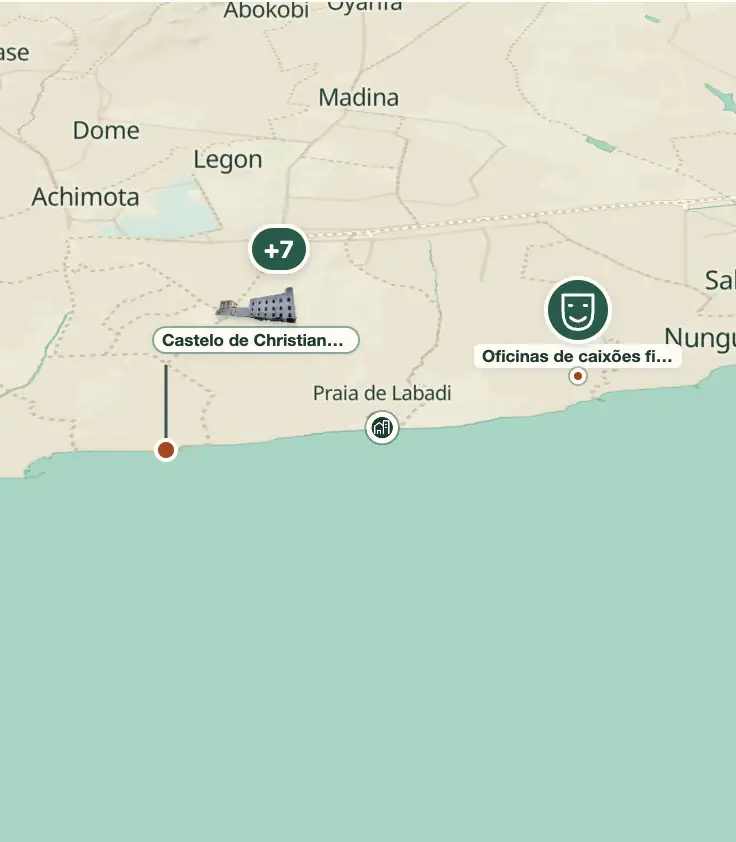
Explore the map
© OpenStreetMap · OpenFreeMap · © OpenMapTiles
Explore the map, read about the other places and plan your travel days in the app.
Open the appWhat to see
Accra: The coastal plain, with less rain than the neighboring coast
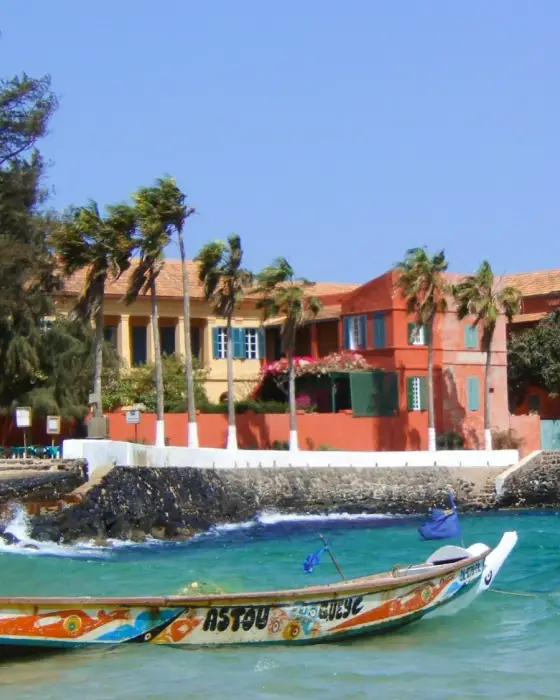
Accra occupies the coastal plain of the Gulf of Guinea, almost entirely below 100 meters, with modest rises to the north, at Achimota and Legon, and a string of shallow lagoons to the east and west, such as Korle, Chemu and Sakumo. By the sea lies Jamestown, part of Ga Mashie, the poorest and most photographed neighborhood of the center, birthplace of the Chale Wote festival in 2011.
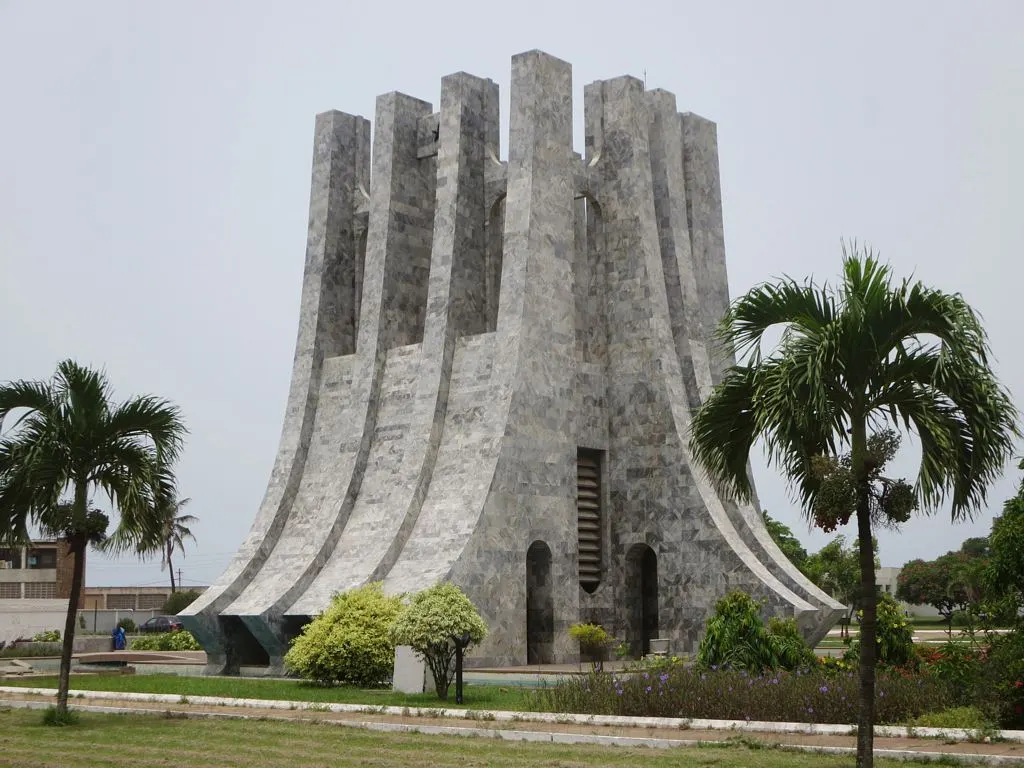
Kwame Nkrumah Memorial Park and Mausoleum
It stands on the Old Polo Ground, the exact lawn where independence was declared on March 6, 1957. It holds the tombs of Nkrumah and his wife Fathia, along with the statue toppled and beheaded during the 1966 coup, displayed with its damage. Renovated and reopened in 2023; foreign visitors pay roughly GH¢50–150.
On the lawn where independence was declared on March 6, 1957, stand Nkrumah's tomb and the statue toppled and beheaded in the 1966 coup, still bearing the scars, in a complex reopened in 2023.
Check access

Jamestown Lighthouse and Bukom harbor
A white-and-red tower about 28 m tall, raised in 1871 and rebuilt in 1930. From the top you see the fishing harbor, where canoes return between 5 and 9am; the climb is arranged on the spot with the caretaker for a few cedis.
The roughly 28 m tower, built in 1871, lets you see the fishing harbor from above when the canoes return between 5am and 9am, and the climb is arranged on the spot with the guard.
Check access
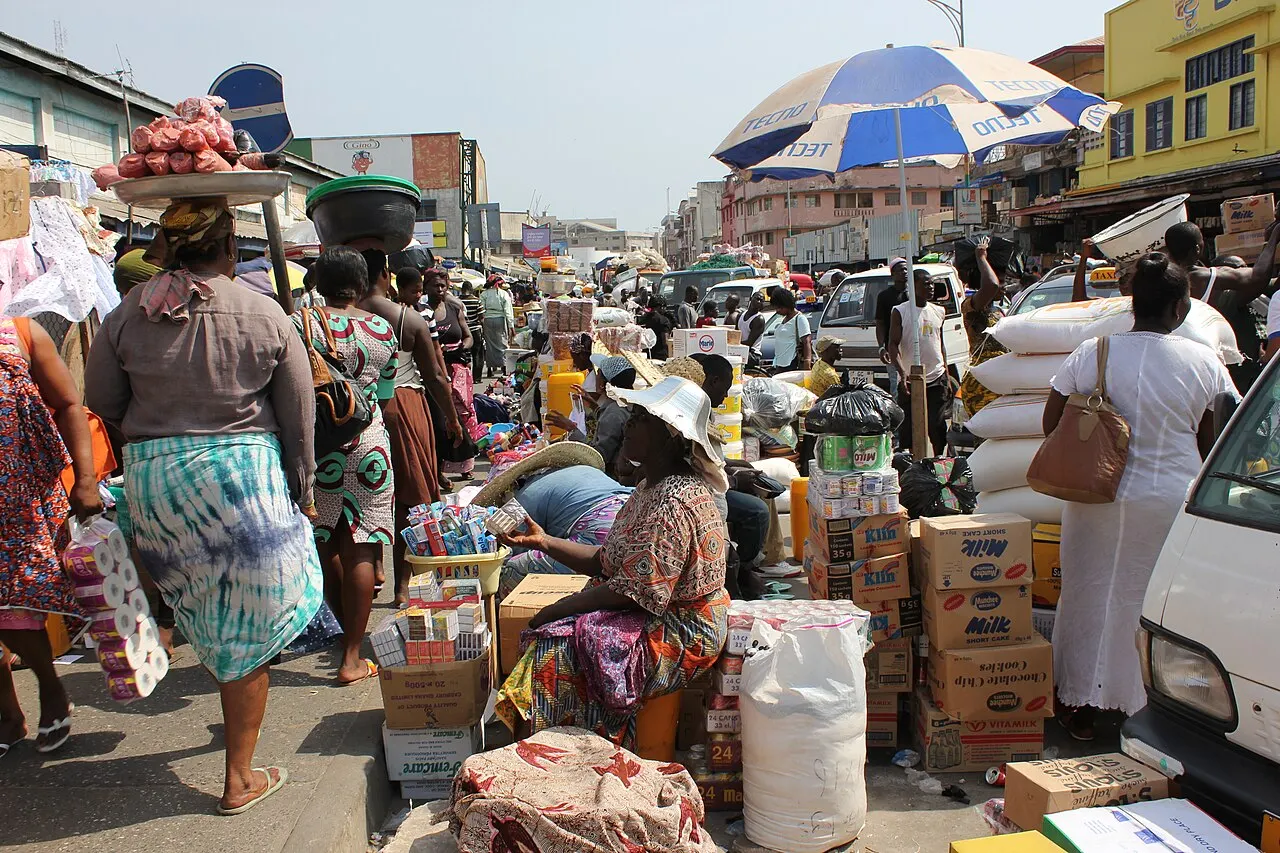
Makola Market
Running since 1924, it's the center of the country's popular trade. It was dynamited and burned in 1979 by Rawlings' military regime, on charges of speculation, and rebuilt by the traders themselves; the “market queens” still control price and space by aisle.
The market has operated since 1924 and concentrates the buying and selling of this nation's ordinary people, and in 1979 Rawlings's military regime dynamited and burned it, after which the traders themselves rebuilt it, and the market queens still rule over the price charged and the stretch of each aisle.
Check access
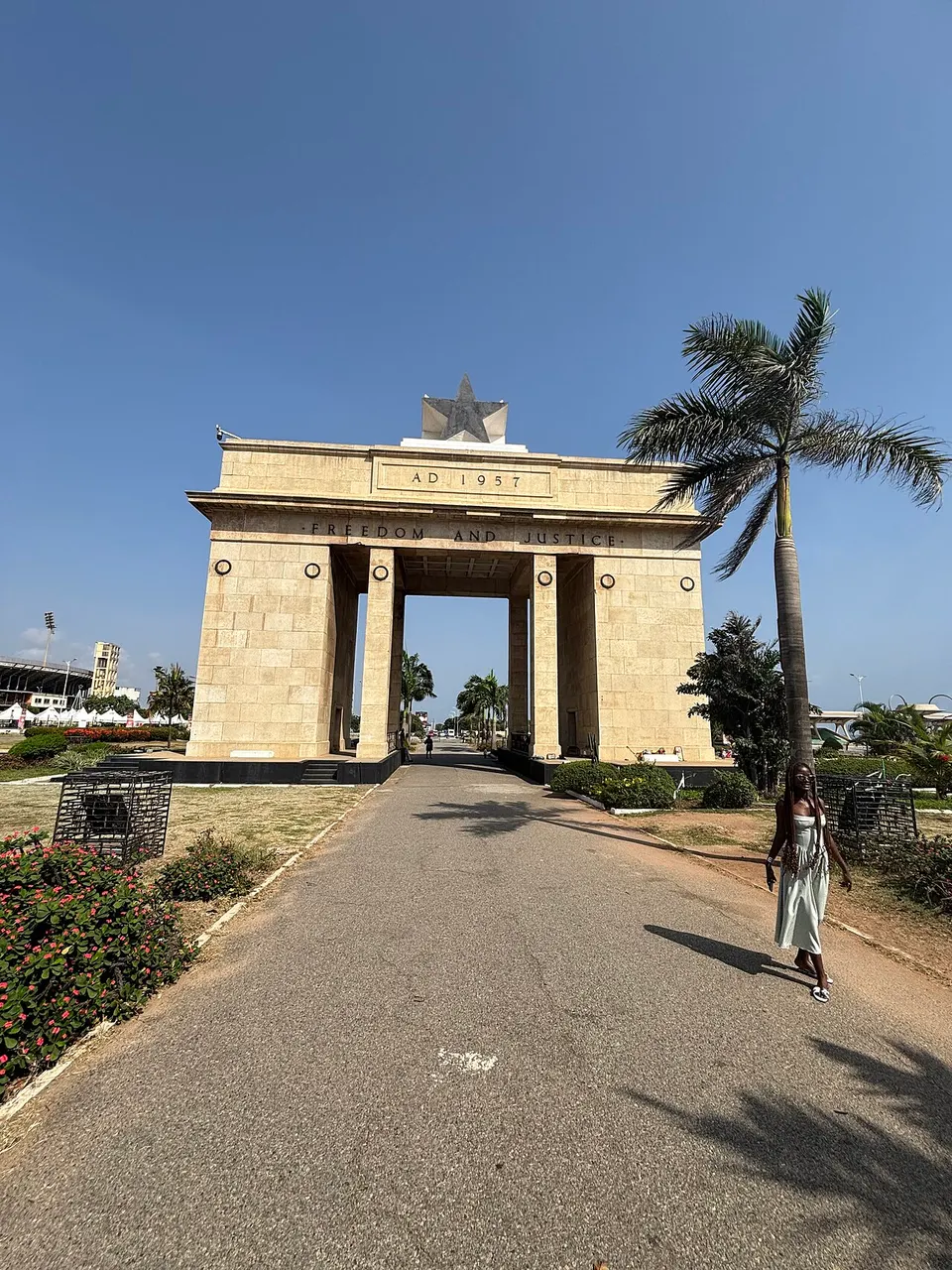
Black Star Square and Independence Arch
A concrete esplanade for tens of thousands of people, built in 1961 for Elizabeth II's visit. It hosts the March 6 parade; on other days it sits empty and scorching, and the best time is after 5pm.
The concrete esplanade was built in 1961 to receive Elizabeth II's visit, the March 6 parade is held there, and for the rest of the year the empty, scorching ground calls for arriving after 5pm.
Check access
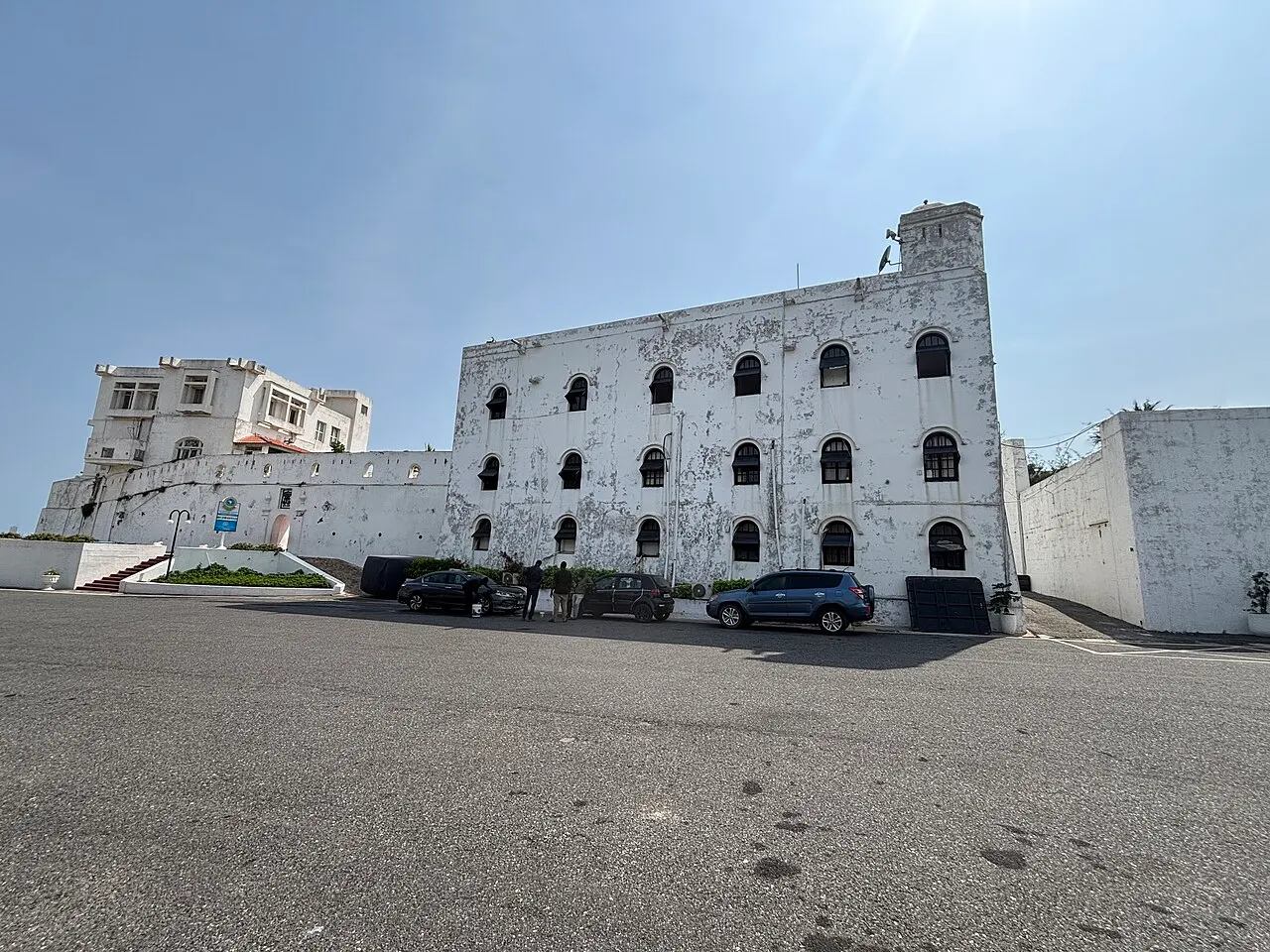
Christiansborg Castle (Osu Castle)
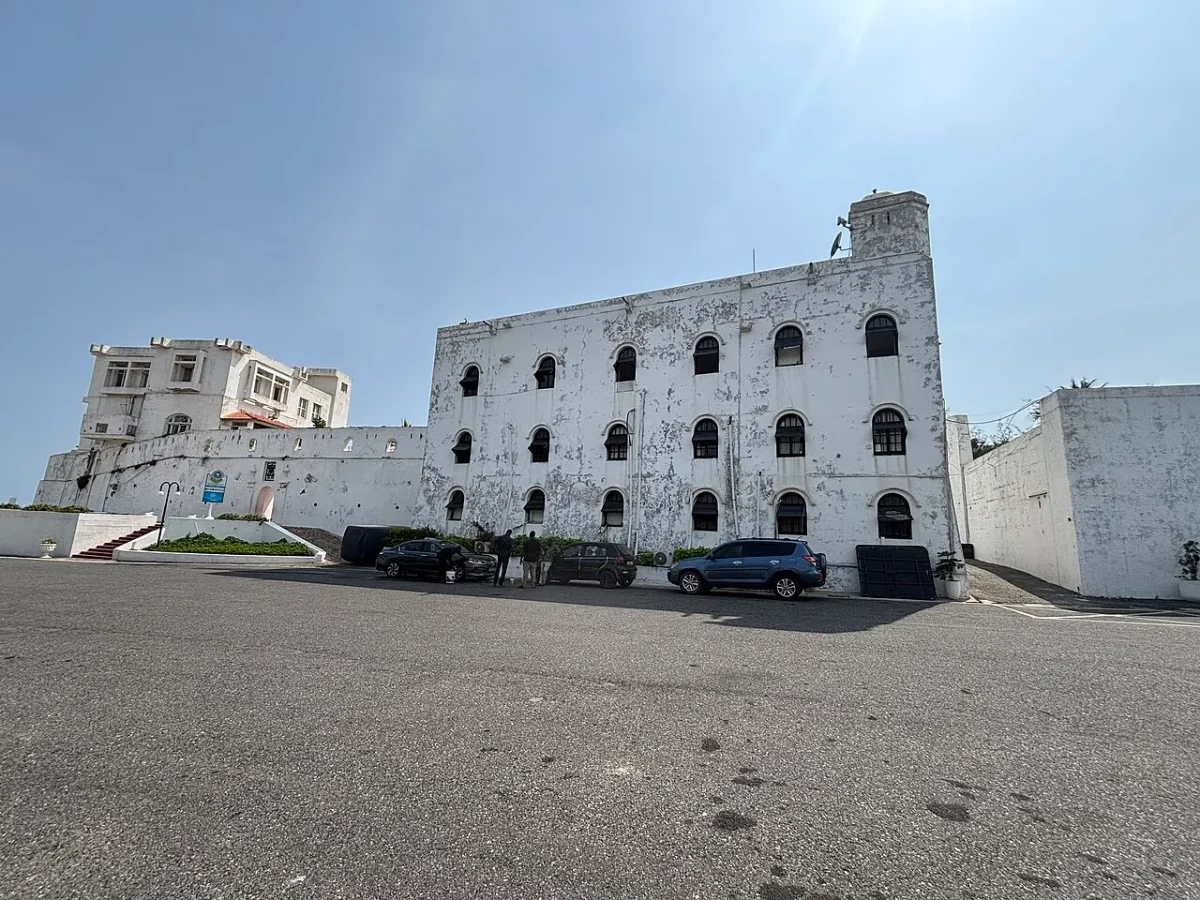
Founded by the Danes in 1661 on an earlier trading post, it served as a slave-trading depot, colonial governor's residence, and seat of Ghana's government until 2013. Part of the Forts and Castles of the Gold Coast Unesco listing from 1979; visits are guided, limited, and depend on prior authorization.
The Danes founded the castle in 1661, it served as a slave-trading post, was the governor's residence and remained the seat of government until 2013, was added to the Unesco list in 1979, and entry with a guide depends on a permit requested beforehand.
Check access

National Museum of Ghana
Opened in 1957 during independence week and reopened in 2022 after seven years closed for renovation. Holds Akan gold weights, kente and adinkra textiles, archaeological pottery, and the ethnographic collection from the northern regions.
In 1957, the same week the country became independent, the museum opened, and in 2022 it reopened after seven years closed for renovation, bringing together Akan gold-weighing weights, kente and adinkra cloths and archaeological pottery.
Check access
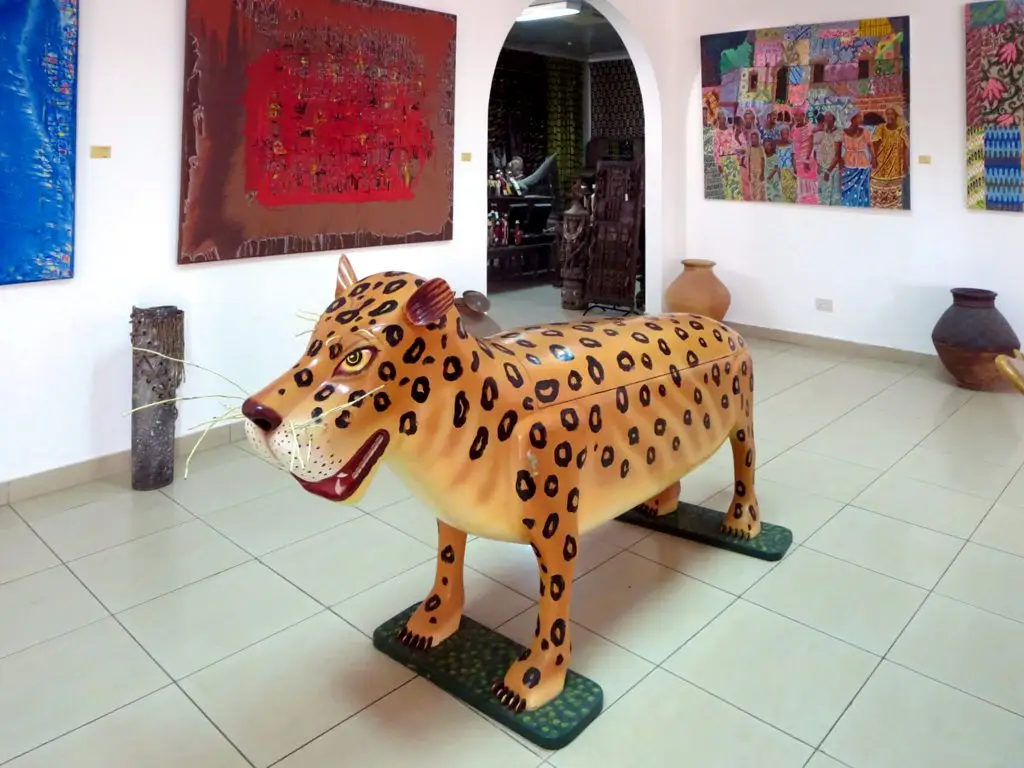
Artists Alliance Gallery
The gallery founded by painter Ablade Glover in 1993 now occupies three floors of contemporary Ghanaian art and crafts by the sea in La. It's the most direct place to understand what's being made today between Accra and Kumasi, with prices on display.
Three floors by the water bring together current production and craft, with prices on display, and show what's being made between the coast and the interior. Ablade Glover founded it in 1993; it's in La.
Check access
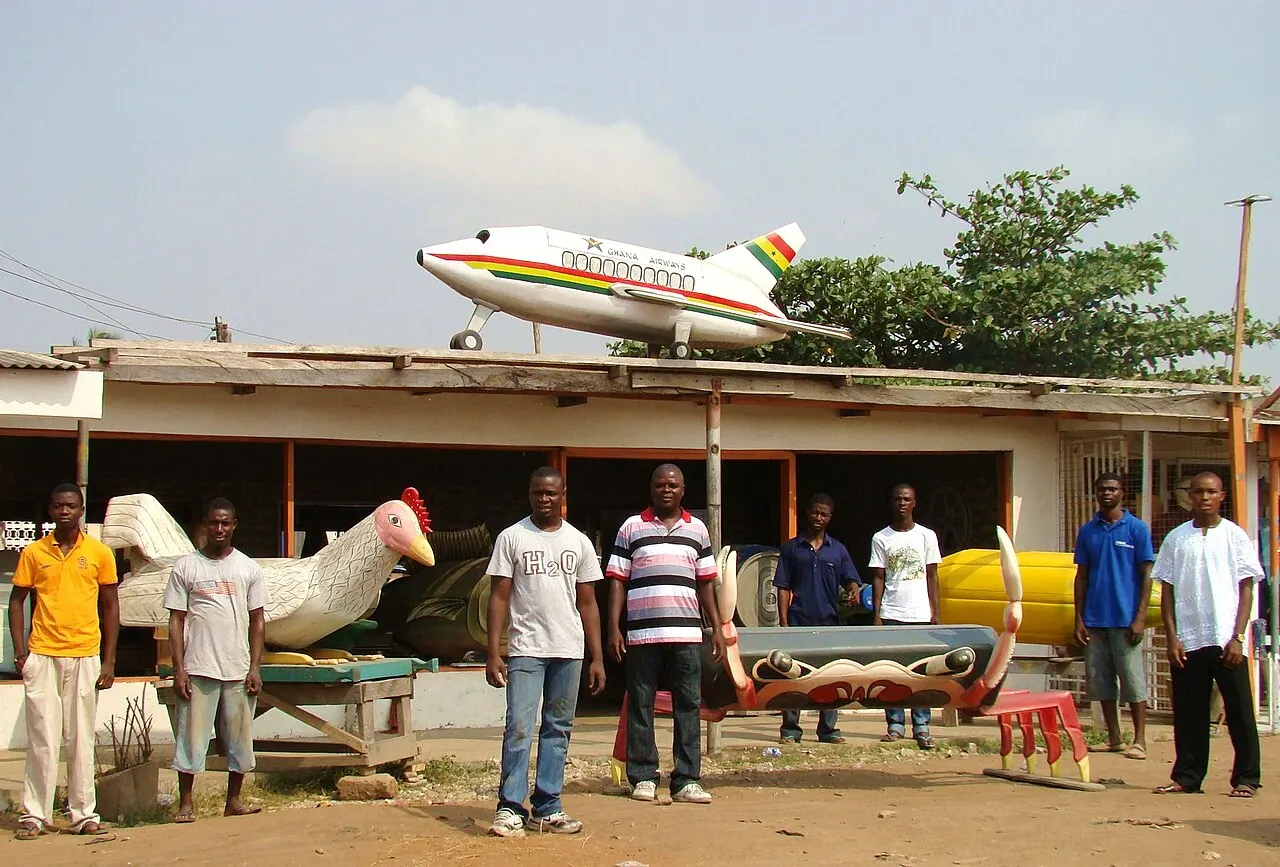
Figurative coffin workshops in Teshie
The tradition began in the 1950s with Seth Kane Kwei and produces coffins shaped like a fish, a cocoa pod, a sandal, a plane, or a Bible, depending on the deceased's profession. The workshops sit on the Teshie road and welcome visitors; photos, always ask first.
The Teshie workshops, which Seth Kane Kwei started in the 1950s, welcome visitors and show coffins shaped like a fish, a cocoa pod, a sandal or an airplane, matching the trade of the deceased, and photos are only taken after asking first.
Check access
 AI illustration
Kantamanto
West Africa's largest secondhand-clothing market, once receiving about 15 million pieces a week from Europe and North America. A fire on January 2, 2025 destroyed much of the stalls, and rebuilding was still underway in 2026; check the situation before going.
The fire of January 2, 2025 took out much of the stalls, and reconstruction was still underway in 2026: confirm the day before, or you'll cross Accra to see a construction site instead of the 15 million garments a week.
Check access
Nilo’s itinerary
Start with the basic programme and choose extensions for the time you have.
Plan my days in the app ↗Day 1 · Ga Mashie: the three forts and the sea
Start at 7am in Jamestown, at the Bukom fishing harbor, when the canoes come back, then ask the guard to let you climb the 1871 lighthouse.
Walk High Street to Fort Ussher and Fort James, stopping for kenkey with fried fish at a sidewalk stall.
In the afternoon, visit the National Museum of Ghana, reopened in 2022, and walk on to Makola Market, with your backpack zipped and small bills ready.
Arrive at 5pm at the Kwame Nkrumah Memorial Park and Mausoleum and walk to Black Star Square, when the concrete has cooled and the low light is good for photos.
Have dinner in Osu, on Cantonments Road, and drink a Club beer at a bar with live music after 9pm.
Day 2 · Legon, art and the east coast to Teshie
Start the morning on the University of Ghana campus in Legon, with the Balme Library tower and the student market.
Mid-morning, see contemporary Ghanaian art at Gallery 1957 or the Nubuke Foundation.
Lunch on banku with grilled tilapia and green pepper by the sea, in La or Teshie.
In the afternoon, visit the figurative coffin workshops of Teshie, a tradition started by Seth Kane Kwei in the 1950s; ask permission before taking photos.
At dusk, buy kelewele from a sidewalk frying pan and, if it's Saturday, listen from a distance to the music of a funeral on a closed-off block.


If you stay longer
Day 3 · Food, market, and water
Have a waakye breakfast before 9am at a street stall in Nima or Osu, with egg, wele and shito, because by 11am it's gone.
Spend the morning in Kantamanto and the Odawna market, at Circle, but check first whether the section rebuilt after the 2025 fire is operating.
Lunch on fufu with groundnut soup at a chop bar, eating with your right hand.
In the afternoon, visit Artists Alliance Gallery, in La, and head to Labadi Beach to walk on the sand and watch the scene, without going into the sea.
Spend your last night in Airport City or East Legon, where the music venues and late-night bars are.


Food
 AI illustration
Waakye
Rice and beans cooked together with dried sorghum leaves, which give it its dark red color. It's breakfast food, served on a leaf or in a foam container with spaghetti (talia), gari, boiled egg, wele (cooked cowhide) and a spoonful of shito; at the good stalls the pot usually runs out around 11am.
 AI illustration
Ga kenkey (komi)
Corn dough fermented for days, shaped into a ball, wrapped in corn husk and steamed. The Ga version is sourer and smaller than the Fante one; it comes with fried fish, pepper ground in a mortar and raw onion, and is almost always eaten by hand.
 AI illustration
Shito
A black pepper paste with dried fish, dried shrimp, ginger, garlic and oil, cooked for hours until it's nearly a jelly. It goes with everything and travels well in a glass jar: the most honest edible souvenir in the city.
 AI illustration
Jollof
Rice cooked in a sauce of tomato, onion, pepper and stock, served at parties, funerals, and office lunches. The rivalry with the Nigerian version is a serious matter; in Accra it comes with grilled chicken, cabbage salad, and shito.
 AI illustration
Banku with grilled tilapia
Fermented corn-and-cassava dough, shaped into a smooth ball, with whole grilled fish, freshly ground green pepper, and onion. A late-afternoon dish, eaten by the sea in La, Teshie, or Osu.
 AI illustration
Fufu with groundnut soup or light soup
Yam, cassava and plantain pounded into an elastic dough, served in groundnut soup, light tomato soup or palmnut. Pinch it off with your right hand and swallow without chewing; it's the heavy Sunday lunch.
 AI illustration
Kelewele
Cubes of ripe plantain seasoned with ginger, pepper, onion, and salt, fried on the spot. They show up in sidewalk pans after 6pm and are sold in small bags, topped with roasted peanuts.
 AI illustration
Sobolo, pito and akpeteshie
Sobolo is a chilled hibiscus infusion with ginger and pineapple, sold in reused bottles; pito is northern millet beer, served in a calabash; akpeteshie is the local sugarcane or palm spirit, strong and cheap. The standard commercial beers are Club and Star.
Where to eat
- Nima and Osu
Look for a waakye stall in the morning to try rice and beans with the available accompaniments. Ask about chilli and the ingredients in shito, which contains dried fish and shrimp.
- Ga Mashie and Makola
Kenkey with fried fish or a chop-bar meal fits a visit to the forts and markets. Choose from what is being prepared and confirm the price before ordering.
- Osu and Labone
Restaurants in these areas offer dinner without relying on a street stall. Look for banku with tilapia or fufu with soup; confirm ingredients if you have dietary restrictions.
Day trips

Cape Coast and Elmina
145 km west on the N1, 3 to 4 hours' drive each way (avoid the drive back on Sunday afternoon). Cape Coast Castle, from 1653, and São Jorge da Mina, from 1482, form the oldest cluster of European architecture south of the Sahara and have been on the Unesco list since 1979.
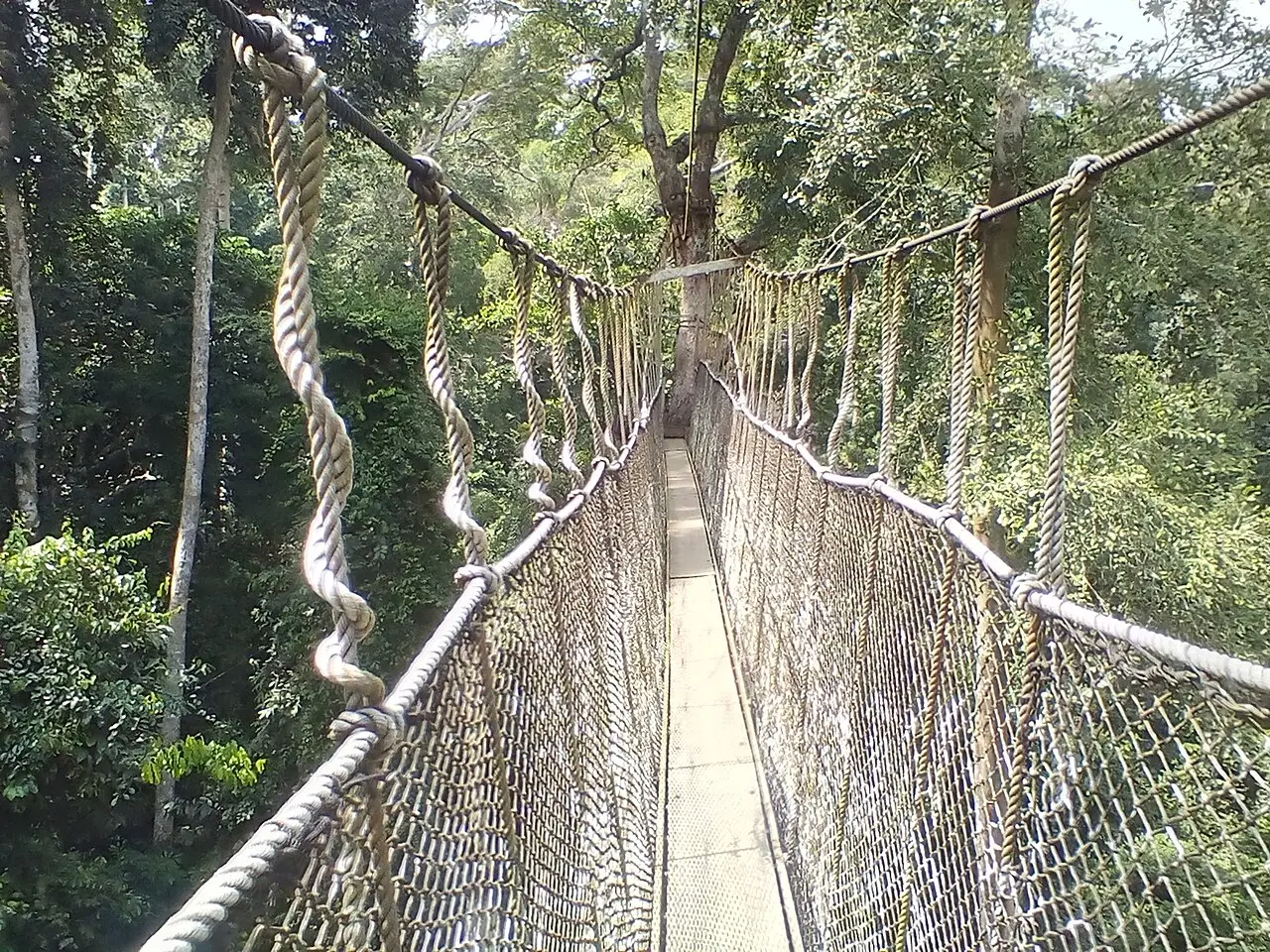
Kakum National Park
175 km, just north of Cape Coast, usually combined with it in a long day or an overnight. It has a 350 m canopy walkway across seven bridges, up to 40 m off the ground, built in 1995; go first thing in the morning, before the heat and the buses.

Aburi and the Akuapem Hills
40 km to the north, 1 hour to 1 hour 30 minutes uphill. The Aburi Botanical Gardens have operated since 1890, the air is about 5°C cooler than on the coast, and the road is lined with wood-carving workshops; the view from the escarpment over the Accra plain is at the Peduase lookout.
Where to begin
Ga Mashie: the three forts and the sea
Start at 7am in Jamestown, at the Bukom fishing harbor, when the canoes come back, then ask the guard to let you climb the 1871 lighthouse.
Legon, art and the east coast to Teshie
Start the morning on the University of Ghana campus in Legon, with the Balme Library tower and the student market.
Food, market, and water
Have a waakye breakfast before 9am at a street stall in Nima or Osu, with egg, wele and shito, because by 11am it's gone.
Money
The currency is the Ghanaian cedi (GHS, GH¢), with notes from 1 to 200 and pesewa coins that almost nobody uses. In September 2026 the dollar was worth about GH¢11.3 and the Brazilian real about GH¢2.1. Inflation topped 50% in 2022 and fell to around 4.6% in July 2026, but prices never went back to where they were. On the street, cash rules: trotro, taxi, market and stall food only take notes. Almost nobody has change for 100 and 200 notes, so carry 5, 10 and 20 notes for fares and lunch. Cards work in hotels, supermarkets (Shoprite, Marina Mall, Palace) and restaurants in Osu, Cantonments and Airport City. Mobile money is for people with a local phone number. Price ranges in September 2026: coffee GH¢25–50, street waakye or kenkey GH¢20–40, a plate at a chop bar GH¢40–70, dinner at an Osu restaurant GH¢150–350, a large beer GH¢25–45, a short app ride GH¢25–40 and a midrange hotel GH¢700–1,500 a night. Tipping isn't required: leave 5–10% at tourist restaurants and GH¢10–20 for whoever carries your bags or acts as an informal guide. The tax on electronic transfers, the e-levy, was abolished in 2025.
Getting there and around
Kotoka airport: 10 km out, with no direct train or bus
Kotoka International Airport (ACC) is about 10 km from the center, and Terminal 3, for international flights, opened in September 2018. There's no train or direct bus, so order a Bolt, Uber or Yango at the ride-hailing point in the parking lot: GH¢50–120 to Osu, Cantonments or Airport Residential. The counter taxis charge two to three times more for the same trip. Keep your international yellow fever vaccination certificate handy, because immigration checks it on arrival. Since May 25, 2026 a new digital system applies: ECOWAS citizens enter visa-free, and other Africans apply for a free ETA or e-visa. Brazilian passport holders need a visa or e-visa, requested before the trip through the immigration service portal. Processing takes about 96 hours, and the fee varies by consulate and service, so check the amount on the portal before paying.
The trotro shouts its destination, with no official map
Within the city, transport means the trotro: Sprinter and Mercedes 207 vans running fixed routes with no official map. The conductor, called the “mate,” announces the destination from the door, shouting and gesturing, and he's the one you pay, in cash. Urban fares run GH¢3–10 after the 20% increase that took effect on June 2, 2026, and a typical ride such as Circle–Lapaz cost around GH¢8 in September 2026. Routes leaving the city go past that ceiling: Atomic Junction–Ashaiman was around GH¢16 the same month. There are also the Aayalolo buses, on the Amasaman–Achimota–Tudu corridor, and shared fixed-route taxis, cheaper than “dropping,” the private ride whose price you agree on before getting in. For visitors, Bolt, Uber and Yango are the most predictable option, with urban rides at GH¢25–60. Avoid the gridlock hours, 6:30 to 9:30am and 4 to 7:30pm. You can't walk between neighborhoods, because of broken sidewalks, open drainage ditches and 33°C sun, but within each neighborhood walking is easy.
Safety
AI illustrationAccra has theft and robberies, including armed incidents; watch your belongings and choose your transportation carefully, especially at night. Theft and pickpocketing concentrate in Makola, Kantamanto, Kwame Nkrumah Circle, and crowded trotros. Motorcycle robberies happen at night on dark streets in Osu, Nima, Kaneshie, and along Spintex Road, and streets become truly dark during power outages, known here as dumsor. Avoid Jamestown’s waterfront and La and Labadi beaches after dark, and keep your belongings with you. Rip currents and rough surf make sea bathing dangerous. Shallow water can also knock you down and carry you away; at urban beaches without adequate supervision, stay on the sand. Recurring scams include an unsolicited guide who follows you and charges afterward, an invitation to ‘my uncle’s gallery,’ donations for nonexistent orphanages, and WhatsApp approaches involving romance or business stories. Use Bolt, Uber, or Yango, checking the license plate before boarding, instead of a street taxi at night; drink only bottled water or sealed sachet water; and treat malaria as the most concrete health risk, with preventive medication prescribed before travel and repellent from dusk onward. Emergency numbers: 112 general, 191 police, 193 ambulance.
Etiquette tips
Use your right hand to give, receive, and eat
Give, receive, pay, eat, and point always with the right hand; the left is for hygiene, and using it is a direct offense. If your right hand is occupied, say so beforehand: “sorry for my left” is a common, accepted phrase.
The handshake ends with a snap
The Ghanaian greeting ends with a snap between the thumb of one person and the middle finger of the other. Nobody expects a foreigner to get it right, but trying goes down well; in a group, greet people from right to left.
Greet before you ask
Never open with “where is” or the price. “Good morning, how are you?”, the reply, and only then the matter at hand: walking into a shop, an office, or a stall without greeting reads as rude, not as being in a hurry.
Call someone with your palm down
To call someone over, extend your hand with the palm facing down and sweep your fingers toward your body. Pointing the index finger at a person is aggressive, and whistling to call someone is worse still.
Address elders as Uncle, Auntie, or by title
Older men are “Uncle” or “Papa,” older women are “Auntie” or “Mama,” and professional titles (Doctor, Nana, Chief, Honourable) are always used. Calling an older stranger by their first name sounds off.
Wear pants away from the beach and avoid mourning colors at a party
Shorts and a tank top are for the beach; for church, the office, a visit to a chief, or any invitation, trousers and a shirt. Mourning colors form a separate code: red next to black marks a recent loss, white next to black celebrates a long life. Avoid both combinations at a party, to not get it wrong by accident.
Mistakes to avoid
No yellow fever certificate
Arriving without proof of yellow fever vaccination. Immigration checks the yellow card right there, and without it the choice is getting the shot on the spot or being turned away at the airport.
The map scale lies
Trusting the map's scale and setting off on foot between neighborhoods. The twelve kilometers between Osu and East Legon take 20 minutes at 11am and more than an hour at 6pm, and on foot the route has no continuous sidewalk or shade, just open drainage ditches and 33°C sun.
Only 100 and 200 notes
Carrying only 100 and 200 notes. Trotro, taxi, waakye stalls, and street vendors rarely have change, and the purchase simply stalls; break your cash into small notes on the first day.
Haggle in Makola and Kantamanto, not at the chop bar
Haggling in the wrong place. In Makola, Kantamanto, and craft shops, the first price is an invitation to negotiate. At a chop bar, a food stall, or in the trotro, the price is fixed and pushing back is offensive.
Camera without a permit in Jamestown and in front of official buildings
Photographing without asking in Jamestown, at the market, at a funeral, or a ceremony, and photographing the airport, military installations, or Jubilee House, which is prohibited and draws attention.
Useful phrases
Ojekoo
“good morning” in Ga (oh-jeh-KOH); the reply is “yaa”
Oyiwaladɔŋŋ
“thank you” in Ga (oh-ee-wah-lah-DONG)
Ɛte sɛn?
“how are you?” in Twi (eh-teh-SEN); the reply is “ɛyɛ” (eh-YEH), “I'm fine”
Medaase
“thank you” in Twi (meh-DAH-seh)
Chale
“man,” “buddy” (CHA-lee); opens, closes, and fills in any sentence in Accra
Bus stop!
the standard shout inside a trotro to get off at the next stop; knocking twice on the body has the same effect
Where to stay
- Osu · First visits and restaurants and bars nearby: Cantonments Road, known as Oxford Street, brings together restaurants, pharmacies and services. It is a base for walking within the neighbourhood; Ga Mashie, the museums and Teshie require transport. Nightlife can bring noise: check the street and room position.
- Cantonments and Labone · A residential area close to Osu: These areas border Osu, with cafés, restaurants and a more residential setting. They can combine evenings out with quieter accommodation, but the street matters and visits elsewhere still require transport.
- Airport Residential and Airport City · Late arrivals, early flights or short stays: Proximity to the airport reduces the arrival or departure journey. The forts, markets and coast require a car or ride-hailing trip; the location suits flight logistics better than walking around the historic centre.
- East Legon · Longer stays or activities in the north and east: Restaurants and services are concentrated in an area farther from the coast. It can suit activities in that part of the city; traffic matters when visiting Ga Mashie, Makola and the forts. Compare the address with each day’s programme.
Districts
Jamestown and Usshertown (Ga Mashie)
The original Ga core around Fort James (1673) and Fort Ussher (1649), with a fishing harbor, lighthouse, and boxing gyms in Bukom, home neighborhood of Azumah Nelson and Ike Quartey. It is the poorest and most photographed part of the center and was the birthplace of Chale Wote, founded in 2011. Since 2023, the festival has taken place in Osu; check the edition’s program before deciding where to go.
Osu
The old Danish quarter around Christiansborg Castle. Cantonments Road, known as Oxford Street, holds bars, restaurants, currency exchange, pharmacies, and the most predictable nightlife for newcomers.
Cantonments, Labone and Airport Residential
This is the district of embassies, high-walled houses, galleries, cafés serving Ghanaian coffee and expensive hotels, with tree-lined streets and real sidewalks in places. It suits travelers who want quiet and don't mind paying three to five times the prices found in the rest of the city.
Adabraka and Kwame Nkrumah Circle
The country's transport hub: trotros and buses leave from here for every region. The Circle interchange, opened in 2016, became a nighttime landmark; underneath it run an electronics market, street food, and the Odawna market.
Makola and the commercial center
A continuous street market between High Street and Rawlings Park, with Makola, Tudu, and the huge Kantamanto secondhand-clothing market. Busy from 7am to 6pm, almost all cash, almost all run by women traders.
Nima, Maamobi and Accra New Town
The zongos: Muslim-majority neighborhoods formed by migrants from northern Ghana, Niger and Nigeria. Dense, with the city's best night-time street food (waakye, kebab, tuo zaafi) and narrow streets best entered with company.
East Legon, Legon and Madina
To the north, around the University of Ghana, founded in 1948. New condos, offices, gyms, bars, and the city's worst traffic at peak hours; Madina is the market that supplies this stretch.
Teshie, Nungua and Tema
The east coast, linked by the Tema Motorway. Teshie is where figurative coffins have been made since the 1950s; Tema was built from scratch between 1952 and 1962 as a planned port city, right on the Greenwich meridian.
History
15th–16th c. · The Ga and Ayawaso hill
Ga groups arrive on the coastal plain from the east and organize power inland, at Ayawaso, the “Great Accra” of European accounts. The city's name likely comes from nkran, “ants” in Akan, for the tall anthills of the plain.
1649–1673 · Three forts in five kilometers
The Dutch build Crèvecœur in 1649, the Danes occupy and rebuild Christiansborg in Osu from 1661, and the English build Fort James in 1673. Each fort creates a neighborhood: Kinka, Osu and Nleshi.
1677–1681 · Akwamu destroys Ayawaso
The Akwamu kingdom razes the inland Ga capital and levies tribute on the coast. The Ga move down to the beach for good, and the modern city forms between the forts.
August 7, 1826 · Battle of Katamanso
A coalition of Ga, Adangme, British and allied forces defeats the Asante army near Dodowa, 40 km from Accra. The victory lifts Asante pressure off the plain and ties the Ga to the British sphere.
1850–1877 · The British take over and move the capital
Denmark sells its forts to Britain in 1850, and the Dutch leave between 1868 and 1872. In 1877 the Gold Coast capital moves from Cape Coast to Accra, justified by a drier climate and less fever.
1908–1928 · Plague, sewers and the Guggisberg era
A bubonic plague outbreak in 1908 drives drainage work, removals and the first planned suburbs. Governor Gordon Guggisberg delivers Korle Bu hospital and the railway to Kumasi in 1923, Achimota School in 1927, and Takoradi port in 1928.

June 22, 1939 · The earthquake
A quake of estimated magnitude 6.5, centered offshore, brings down much of Jamestown and Osu and leaves about 17 dead and thousands homeless. Reconstruction pushes the city north, into Kaneshie, Adabraka and Abossey Okai.
February 28, 1948 · The shooting at the Christiansborg crossroads
World War II veterans march on the castle to demand their pensions and the police open fire, killing Sergeant Adjetey and two others. Three days of riots and the arrest of the “Big Six” follow, the turning point that speeds up independence.
March 6, 1957 · Independence and pan-Africanism
Kwame Nkrumah declares Ghana’s independence from British colonial rule at the Old Polo Ground. Accra hosts the All-African Peoples’ Conference in 1958, inaugurates Black Star Square in 1961, and welcomes W.E.B. Du Bois, who dies in the city in 1963.

1966–1992 · Four coups and the Castle
Nkrumah falls on February 24, 1966; coups follow in 1972, 1979 and 1981, with Jerry Rawlings in power for nearly twenty years. The Fourth Republic begins in 1992, the first peaceful transfer of power happens in 2000, and the seat of government only leaves Christiansborg Castle in 2013.
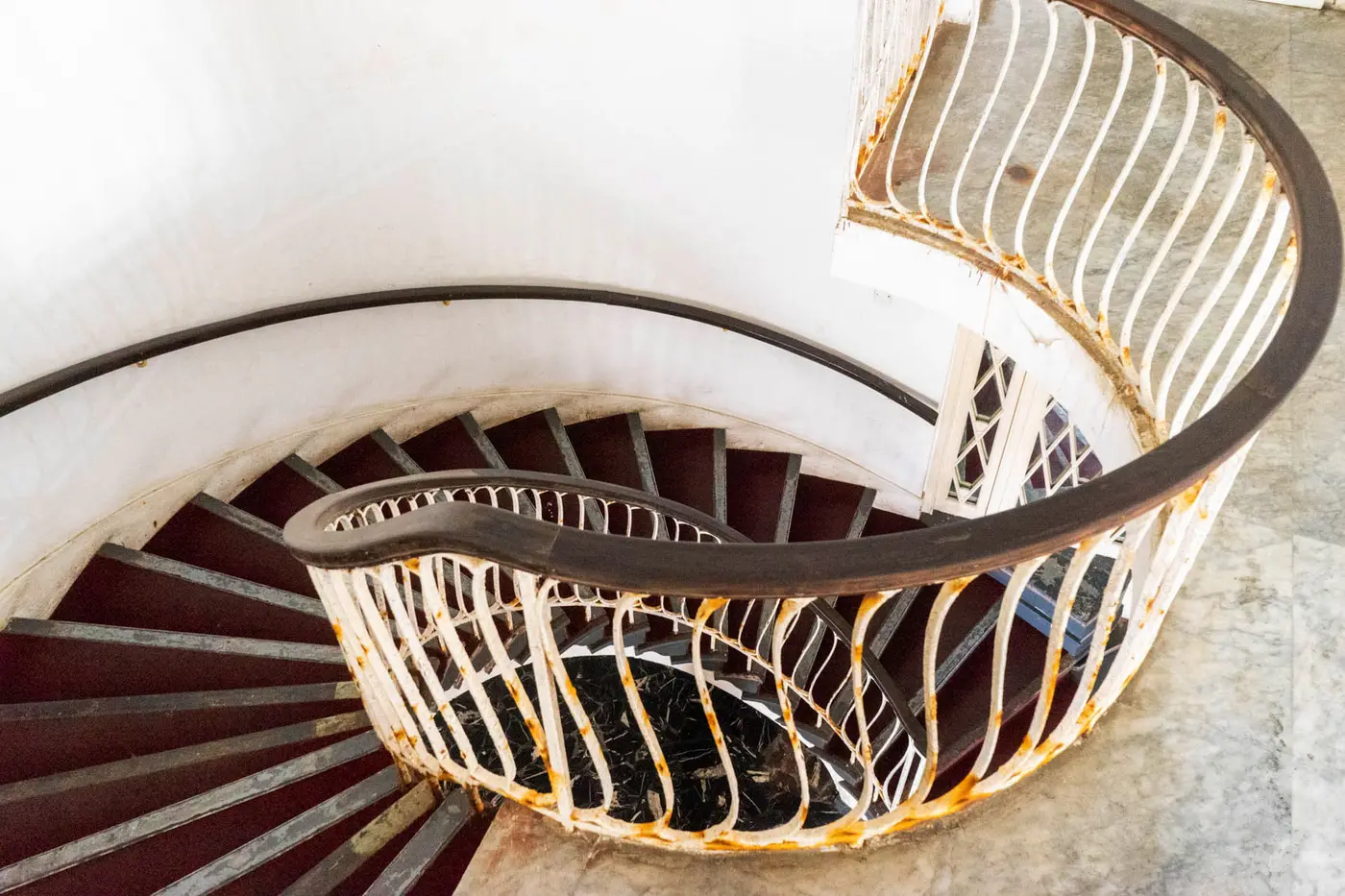
2015–2026 · Flood, currency crisis and recovery
On June 3, 2015, a flood combined with a fuel station explosion at Kwame Nkrumah Circle kills more than 150 people in one night. Then comes Terminal 3 at the airport (2018), the 2019 Year of Return with about 1.1 million visitors, the 2022 currency crisis, the US$3 billion IMF deal in 2023, and inflation returning to single digits (about 4.6% in July 2026).
 AI illustration
Complete history
The Ga villages that formed Accra
Accra grew gradually, over centuries of successive arrivals. Ga groups arrived on the coastal plain from the east between the 15th and 16th centuries and concentrated power inland, at Ayawaso hill, while keeping fishing villages on the beach. When the Akwamu kingdom destroyed Ayawaso between 1677 and 1681, the Ga moved down to the coast for good. It's on this five-kilometer stretch of sand, between the mouth of the Odaw and Osu, that the modern city takes shape, which is why it has several historic centers instead of one.
Colonial forts almost touching: Dutch, Danish and English
Three European powers built forts almost side by side. The Dutch raised Crèvecœur in 1649, today Fort Ussher; the Danes took and rebuilt Christiansborg in Osu from 1661; the English built Fort James in 1673. Each fort created a neighborhood with its own name, merchant elite and church, Kinka, Osu and Nleshi, and that division survives in place names and surnames. The trade was in gold, ivory and enslaved people until the British ban of 1807, and afterward in palm oil and cocoa. Denmark sold its forts in 1850, the Dutch left between 1868 and 1872, and in 1877 the British moved the colony's capital from Cape Coast to Accra.
Plague and earthquake: the two disasters that shaped the street plan
The 20th century built the city on top of two disasters. The 1908 bubonic plague justified drainage work, removals and the first planned suburbs. The earthquake of June 22, 1939, of estimated magnitude 6.5, brought down much of Jamestown and Osu and pushed expansion north. Between the two events, Governor Gordon Guggisberg equipped the whole colony from Accra: Korle Bu hospital and the railway to Kumasi in 1923, Achimota School in 1927, Takoradi port in 1928. That's the infrastructure the independent state inherited.
The march on the Castle, in 1948
On February 28, 1948, World War II veterans marched to Christiansborg Castle to demand pensions; police fired at the crossroads and killed Sergeant Adjetey and two others. Three days of riots followed, and the arrest of the “Big Six.” Nine years later, on March 6, 1957, Kwame Nkrumah declared independence at the Old Polo Ground, and Accra became a home of pan-Africanism, with the 1958 All-African Peoples' Conference, the 1961 Black Star Square, and Du Bois living there until his death in 1963. Nkrumah fell on February 24, 1966, and the country went through coups in 1972, 1979 and 1981 before the Fourth Republic of 1992 and the peaceful transfer of power in 2000.
Thirty years of growth without a plan
Today’s Accra is the result of thirty years of unplanned growth. Greater Accra spread well beyond its old limits and absorbed Madina, Adenta, Amasaman, and Tema. Wetlands that drained rainfall became neighborhoods, which is why the city floods every June. Expansion accompanied oil production, which began in 2010, and the growth of East Legon’s housing developments and Osu’s bars. Airport Terminal 3 opened in 2018; the following year, the Year of Return drew diaspora travelers and other visitors. The 2022 currency crisis, with inflation above 50%, and the 2023 IMF program interrupted that cycle. In 2026, inflation is near 4.6% and the cedi has stabilized at around GH¢11 to the dollar, while street prices remain high for people earning cedis.
Kinka, Osu and Nleshi, the neighborhoods of the three forts, still show up in the surnames of the people who live there.
Geography and shape of the city
The coastal plain, with less rain than the neighboring coast
Accra sits on the coastal plain of the Gulf of Guinea, almost entirely below 100 meters, with modest rises to the north at Achimota and Legon and a string of shallow lagoons to the east and west: Korle, Chemu, Sakumo. Climatically it's an anomaly: while the West African coast gets 1,500 to 2,500 mm of rain a year, Accra sits at about 750–800 mm, because the coast runs parallel to the southwest monsoon and there's no relief to force condensation, hence the landscape of coastal savanna, grass and baobab, not forest.
The two rivers and the lagoons
Two rivers organize the map. The Odaw crosses the city and empties into the Korle Lagoon, home to the Old Fadama settlement and the former Agbogbloshie e-waste yard; the Densu, to the west, is dammed at the Weija reservoir, which supplies much of the city's water.
The street grid, split among several centers with no single hub
The grid began as three fort villages on the beach, grew north along roads radiating from Kwame Nkrumah Circle, was tied together by the Ring Road and the N1 (George Bush Motorway), and stretches 25 km east along the Tema Motorway, opened in 1965. There's no single center: government sits in Ridge and Cantonments, popular trade in Makola and the Circle, new money in East Legon and Airport City, and memory in Ga Mashie, the old core by the sea.
Accra gets about a third of the rain that falls on the neighboring coast.
Culture
Highlife started here
Ghanaian popular music was born here: highlife came out of Accra's dance clubs in the 1950s with E.T. Mensah and the Tempos, became the soundtrack of Nkrumah's nation-building project, and later dissolved into hiplife, which Reggie Rockstone created in 1994 rapping Twi over hip-hop beats. In the 2010s came azonto, afrobeats, and Asakaa drill, and today the city exports Sarkodie, Stonebwoy, Amaarae, and Black Sherif. Nightlife concentrates in Osu, Airport City, and East Legon, starts late (before midnight the bar is empty) and shares the calendar with church: dawn Pentecostal services, vigils, and “31st night,” when the whole country walks into a church to see in the new year.
Chale Wote and street art between Jamestown and Osu
In visual arts, the annual Chale Wote festival began in Jamestown in 2011, with murals, performance, and sound in the streets. Since 2023, its program has centered on Osu, including the Black Star Square area; galleries such as Gallery 1957, Nubuke Foundation, and Artists Alliance sustain the market through the rest of the year, while artists such as El Anatsui, Ibrahim Mahama, and Amoako Boafo move between Accra, Tamale, and the international market. Literature includes Ayi Kwei Armah’s portrait of post-independence disillusionment, Ama Ata Aidoo in theater and fiction, and Nii Ayikwei Parkes in contemporary narrative. In cinema, Kwaw Ansah led the way in 1980 with Love Brewed in the African Pot, and Blitz Bazawule left Accra to direct in Hollywood.
Soccer and boxing
The sports are soccer and boxing. Accra Hearts of Oak, founded in 1911, is the city's club and historic rival of Kumasi's Asante Kotoko; Accra Sports Stadium carries the memory of the May 9, 2001 disaster, when 127 people died in a stampede after police fired tear gas. Boxing comes from Bukom, the Jamestown fishing neighborhood that produced world champions like Azumah Nelson and Ike Quartey, where training still happens in street rings at dusk. Outside the stadium, the most visible collective ritual is the funeral: held on Saturday, announced on giant posters with the deceased's photo, lasting all day and calling for black-and-red clothing, or black-and-white, when the deceased was elderly and the death is being celebrated.
The bar is still empty at midnight and only fills up after that.
Festivals and events

Homowo (August to September)
The Ga festival that “hoots at hunger,” in memory of an ancient famine. Preceded by weeks banning drumming and noise, it culminates with chiefs scattering kpokpoi (fermented corn with palm-nut soup) through the streets of Ga Mashie, Osu, La, and Teshie, on slightly different dates by neighborhood.

Chale Wote Street Art Festival (August)
An annual festival founded in Jamestown in 2011, with murals, performance, fashion, sound systems, and a market. Since 2023, it has taken place in Osu, including the Black Star Square area. Check the edition’s dates and venues. Admission is free, with large crowds and strong heat; bring small bills and little baggage.
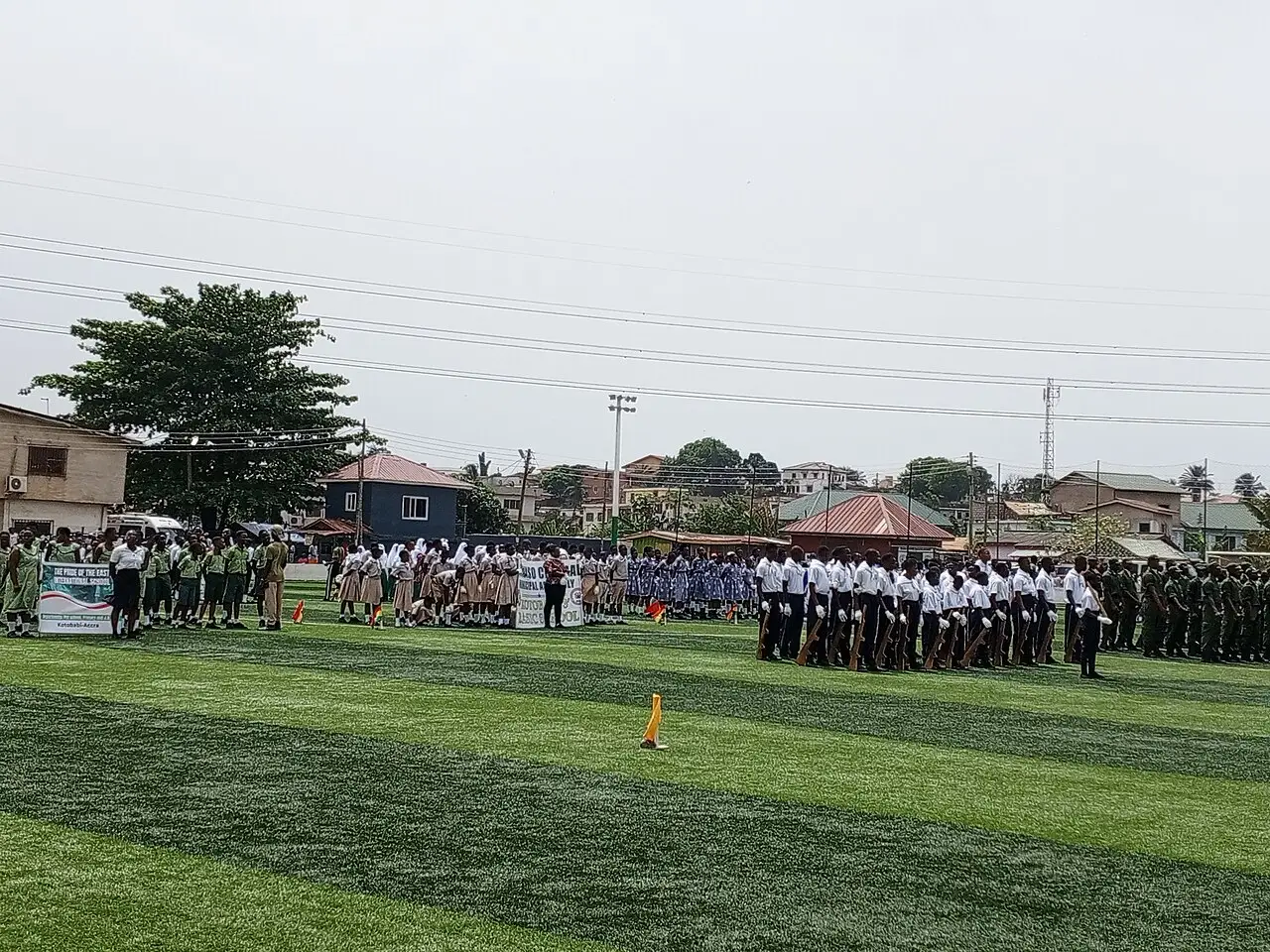
Independence Day (March 6)
A national holiday with a military and school parade, broadcast live; the main ceremony has been decentralized to other cities in some years, but Accra always holds an event at Black Star Square. Shops close, traffic is blocked downtown.
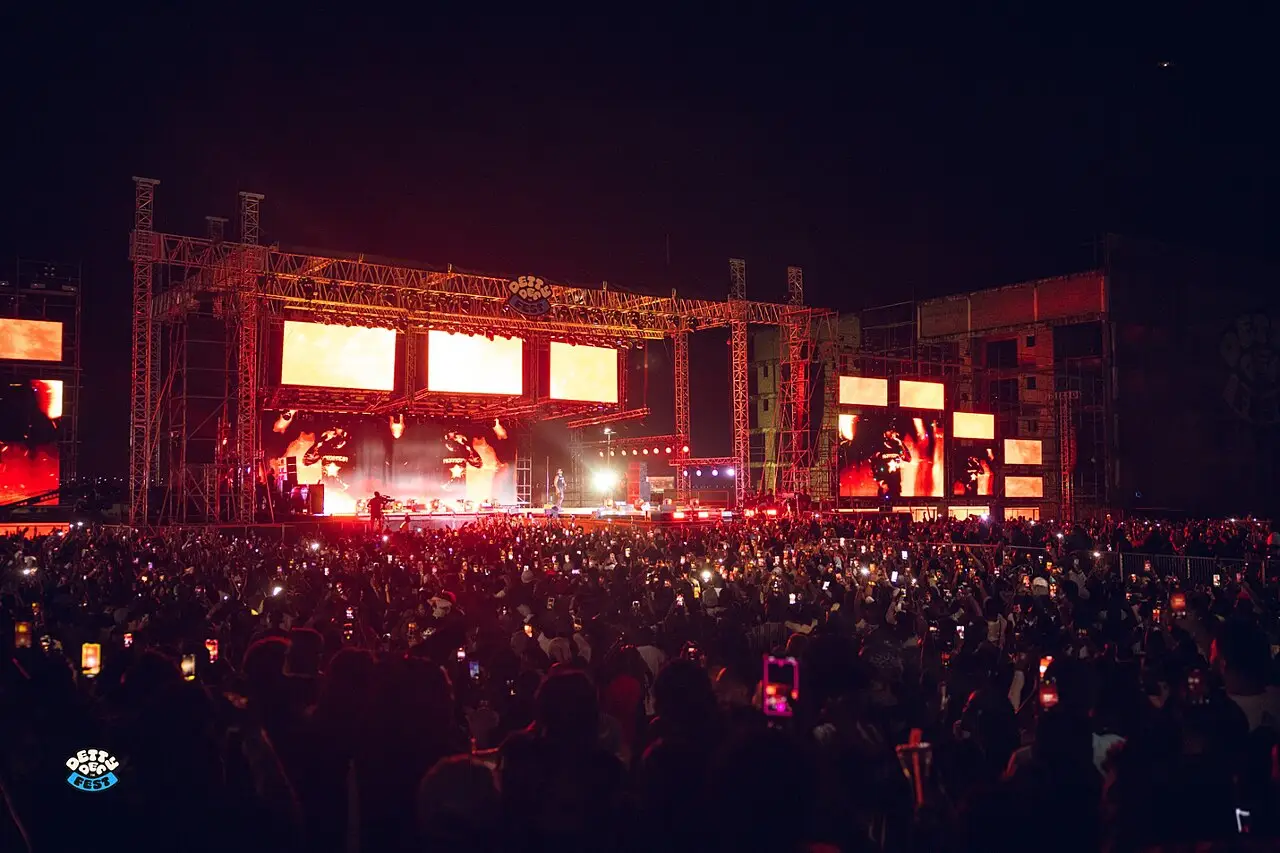
Detty December (mid-December to January 1)
The month the diaspora returns: big concerts, festivals like Afro Future (formerly Afrochella), and a crowded season of weddings and funerals. Hotels and flights can double in price, and bookings need months of lead time.
 AI illustration
31st Night and Watch Night (December 31)
At New Year, Ghanaians go to church for services that start at 9pm and end after midnight, and only then come the fireworks and the food on the street. If you want to see the party, head out after midnight, when the services let out and the streets fill up again.
Books and films
“The Beautyful Ones Are Not Yet Born,” Ayi Kwei Armah (1968)
A novel about an honest, penniless railway clerk in the last months of the Nkrumah government. It explains post-independence disillusionment and the economy of the small bribe better than any history textbook.
“The Burial of Kojo,” Blitz Bazawule (2018)
The Ghanaian director's first feature, shot on a minimal budget and narrated by a young girl. It shows the link between the Accra that's built and the country of illegal mining that sustains it.
“All for You,” E.T. Mensah and the Tempos (1950s)
E.T. Mensah and the Tempos played the highlife of Accra's dance clubs in the 1950s, the music that became the official soundtrack of independence in 1957. Listen before you go to recognize the horn-and-guitar base that gave rise to hiplife, which Reggie Rockstone created in 1994.
Frequently asked questions
Accra: Do I need the yellow fever certificate to enter?
Immigration checks the yellow card right there, and without it the choice is getting the shot on the spot or being turned away at the airport.
Accra: How do you get from Kotoka airport to downtown?
There's no train or direct bus, so order a Bolt, Uber or Yango at the ride-hailing point in the parking lot: GH¢50 to 120 to Osu, Cantonments or Airport Residential.
Accra: How long does the day trip to Cape Coast and Elmina take?
145 km west on the N1, 3 to 4 hours' drive each way (avoid the drive back on Sunday afternoon).
Accra: What's the currency, and what's it worth?
The currency is the Ghanaian cedi (GHS, GH¢), with notes from 1 to 200 and pesewa coins that almost nobody uses. In September 2026 the dollar was worth about GH¢11.3 and the Brazilian real about GH¢2.1.
Accra: What's the climate like throughout the year?
Accra sits 5.6° from the equator, so the temperature barely moves: 24 to 33°C year-round, with lows rarely below 22°C.