Morocco
Marrakesh
Medina, souks, Jemaa el-Fna and Saadian palaces
Days Start with the basic programme and choose extensions for the time you have.
How the guide reaches this number
A fourth day only makes sense to leave the city, because the Ourika Valley, 35 km away, or Essaouira, 175 km away, gives you more than another morning inside the walls. Don't expect peace and quiet: almost everything is negotiated, you'll be approached several times per block, and July and August make the medina unbearable in the middle of the day. With just one day, get to the Saadian Tombs at opening time and have a tanjia for lunch that you ordered in the morning. In the afternoon, wander the souks with no fixed schedule and at 5:30pm climb to the rooftop of a café on Jemaa el-Fna to watch the food stalls being set up. Dar el Bacha disappoints, today a street of design shop windows and high rents. The palm grove has shrunk between buildings and golf courses, and since the 2023 earthquake some monuments and stretches of wall are under restoration. The square, even so, still gathers people in circles to listen to someone speak, as it has since the 11th century.
3
When March to May and October to November
How the guide reaches this number
The climate is hot semi-arid and the whole calendar is organized around heat, not rain. Winter is dry and sunny, with highs of 18–20 °C and lows of 5–8 °C from December to February. The old houses have no heating, and a night at a riad is genuinely cold: sleeping in a coat is common, and no one thinks it's odd. Spring, from March to May, is the best season for the street: 22–30 °C, the Atlas snow-capped in the background and a peak season around Easter. Summer is too hot to walk around in. July and August average highs of 37–40 °C, with days above 45 °C when the chergui, the dry east wind, blows. Long stretches of the medina have no shade at all. September still runs above 33 °C; October and November bring back 25–28 °C and the second peak of visitors. It rains about 250 mm a year, between November and March, in short, heavy bursts that flood streets with no drainage. The drought running since 2018 has strained the city's water supply, and public hammams have already cut their opening days: check before you count on one. The months to avoid are July and August, for the heat, and the week of Eid al-Adha, when many shops, workshops and restaurants close.
Per person/day Budget 250–450 DH; mid-range 700–1,400 DH; comfortable from 2,500 DH, excluding the city tax
How the guide reaches this number
Per person per day: accommodation, meals, urban transport, visits and a small allowance for extras. Flights excluded; larger purchases vary. Editorial estimate, not a quote.
 What Nilo thinks
Stay three days in Marrakech: one in the imperial medina, from the Koutoubia to the kasbah, one in the souks and the workshops of the northern medina, and one in Gueliz and the gardens. A fourth day only makes sense to leave the city, because the Ourika Valley, 35 km away, or Essaouira, 175 km away, gives you more than another morning inside the walls. Don't expect peace and quiet: almost everything is negotiated, you'll be approached several times per block, and July and August make the medina unbearable in the middle of the day. With just one day, get to the Saadian Tombs at opening time and have a tanjia for lunch that you ordered in the morning. In the afternoon, wander the souks with no fixed schedule and at 5:30pm climb to the rooftop of a café on Jemaa el-Fna to watch the food stalls being set up. Dar el Bacha disappoints, today a street of design shop windows and high rents. The palm grove has shrunk between buildings and golf courses, and since the 2023 earthquake some monuments and stretches of wall are under restoration. The square, even so, still gathers people in circles to listen to someone speak, as it has since the 11th century.Marrakech fits inside 19 km of red walls, and the whole old city converges on Jemaa el-Fna, the square that fills up at night with food stalls and circles of musicians. Around it, the souks are organized by trade, with textiles in Semmarine, spices in Attarine and the hammering of the blacksmiths in Haddadine. To the south are the El Badi Palace, paid for with Songhai gold, and the Saadian Tombs, with the hall of twelve Carrara marble columns. Outside the medina, the blue garden that Majorelle planted in 1923 requires a timed ticket. Eat tanjia, meat slow-cooked for hours in a clay urn in the hammam furnace, and accept the mint tea that vendors serve before talking price. Come between October and November or in spring, away from the 40 °C of July and August.
Quick facts
- Population
- 1,015,000 in the city (2024 census); about 1.3 million in Greater Marrakech; 4th largest in the country, after Casablanca, Tangier, and Fez
- Founded
- c. 1070, Almoravid camp of Abu Bakr ibn Umar, made capital under Yusuf ibn Tashfin
- Country and region
- Morocco: Marrakech-Safi region (4,892,393 residents in 2024), Haouz plain, 466 m altitude
- Languages
- Arabic (darija day to day) and Amazigh, mostly Tachelhit, both official; French in administration, business and tourism; English and Spanish in hotels
- Currency
- Moroccan dirham (MAD, DH): closed currency
- Time zone
- UTC+1 year-round; the country falls back to UTC+0 only during the month of Ramadan
- Best time to visit
- March to May and October to November
- Average daily cost
- Budget 250–450 DH; mid-range 700–1,400 DH; comfortable from 2,500 DH, excluding the city tax
When to go
March to May and October to November
January
6° to 19°C
25 mm of rain
February
8° to 21°C
26 mm of rain
June
18° to 34°C
3 mm of rain
July
21° to 38°C
2 mm of rain
August
21° to 37°C
5 mm of rain
September
19° to 33°C
15 mm of rain
December
7° to 20°C
24 mm of rain
How the year changes
The climate is hot semi-arid and the whole calendar is organized around heat, not rain. Winter is dry and sunny, with highs of 18–20 °C and lows of 5–8 °C from December to February. The old houses have no heating, and a night at a riad is genuinely cold: sleeping in a coat is common, and no one thinks it's odd. Spring, from March to May, is the best season for the street: 22–30 °C, the Atlas snow-capped in the background and a peak season around Easter. Summer is too hot to walk around in. July and August average highs of 37–40 °C, with days above 45 °C when the chergui, the dry east wind, blows. Long stretches of the medina have no shade at all. September still runs above 33 °C; October and November bring back 25–28 °C and the second peak of visitors. It rains about 250 mm a year, between November and March, in short, heavy bursts that flood streets with no drainage. The drought running since 2018 has strained the city's water supply, and public hammams have already cut their opening days: check before you count on one. The months to avoid are July and August, for the heat, and the week of Eid al-Adha, when many shops, workshops and restaurants close.
The same numbers as a table
| Month | Temperature °C | Rain mm |
|---|---|---|
| January | 6 to 19 | 25 |
| February | 8 to 21 | 26 |
| March · | 10 to 24 | 35 |
| April · | 12 to 26 | 26 |
| May · | 15 to 29 | 11 |
| June | 18 to 34 | 3 |
| July | 21 to 38 | 2 |
| August | 21 to 37 | 5 |
| September | 19 to 33 | 15 |
| October · | 16 to 29 | 19 |
| November · | 11 to 23 | 30 |
| December | 7 to 20 | 24 |
Nilo's tips
From the airport, take bus 19 for 30 DH to the Koutoubia
The petit taxi makes the same trip in 15 minutes, but charges about 100 DH by day and 150 DH by night. Those rates are on the table posted at the terminal exit; confirm the amount with the driver before getting in. The Alsa bus 19 covers the 5 km between Marrakech-Menara and Jemaa el-Fna every 20–30 minutes, roughly from 6am to 9:30pm. If your flight lands after 9:30pm, the bus has already stopped running, so know the posted fare before you land, because it's your only reference.
Saadian Tombs at opening, El Badi right after
Get to the Saadian Tombs at opening time, because the line forms before 10am, and see the hall of twelve columns first. Then walk a few minutes to the El Badi Palace, whose 8 hectares of walls and pools thin out the crowds. Up on top, storks are nesting, and in an annex that almost nobody looks for is the Koutoubia minbar, from around 1137.
The tanjia is ordered in the morning
You drop off the urn in the morning with the farnatchi, the furnace man, and only come back in the afternoon to eat. Turn up when you're already hungry and you'll be eating tajine instead, for 40–70 DH, which is good, but it's a different dish. Plan your day half a day ahead.
Return to Jemaa el-Fna at 7pm, when the food stalls are set up
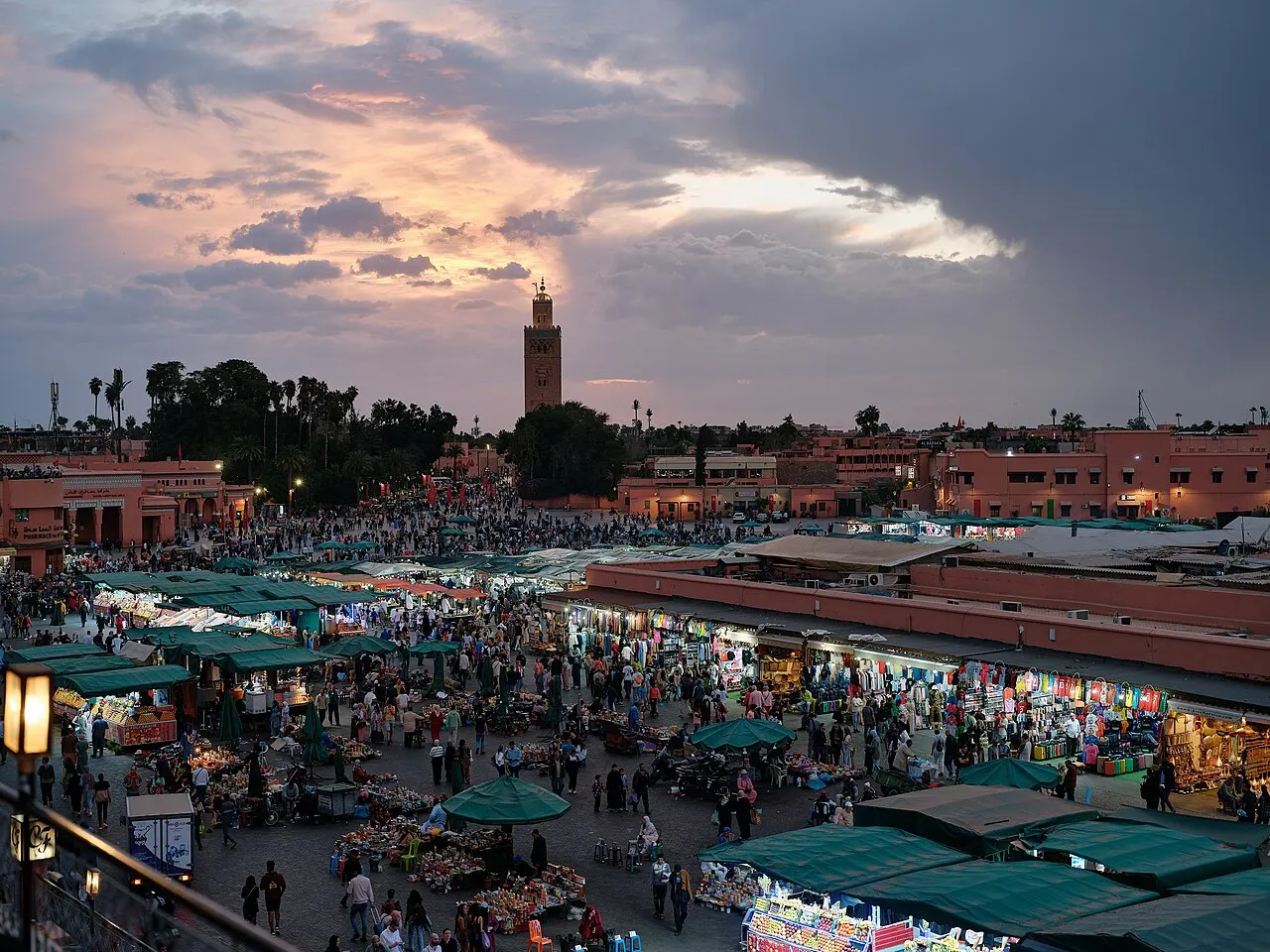
The roughly hundred food stalls go up starting at 5:30pm, within an hour, and by 7pm the square becomes an open-air dining hall. At 10am it's a parking lot with numbered orange-juice stalls, and the mechoui alley closes when the meat runs out, with nothing left by 2pm. To photograph the water seller in the red hat, a snake charmer, or the monkey's owner, agree on the 10 to 20 DH before raising your camera, never after.
Check the fixed prices at Ensemble Artisanal before the souk
An hour there is worth more than any haggling tip, because you arrive at the souk already knowing what a piece costs without bargaining. Learn the names of the techniques while you look, which changes the whole conversation. Then, at the souk, open between 30% and 40% of the asking price and settle close to half.
Confirm the hammam before showing up with a towel
In 2024, public hammams went as far as closing three days a week for lack of water, and the closing days change with no notice on the door. The cause is the drought that's run since 2018, which has lowered the Lalla Takerkoust dam. Ask at your riad or at the hammam itself before you go, book for late afternoon, and allow 90 minutes, including the rest time.
Explore the map
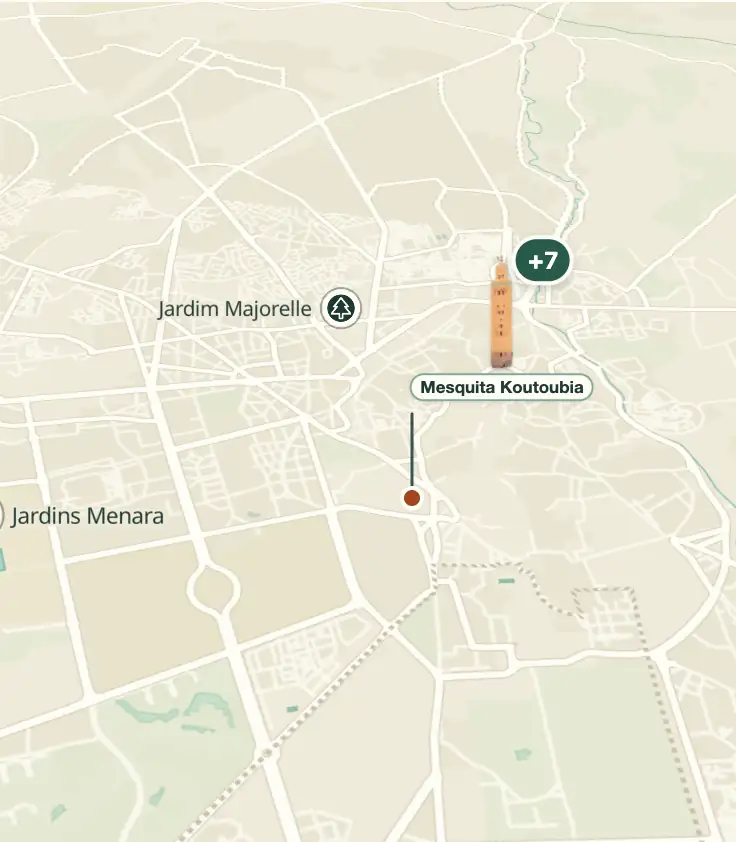
© OpenStreetMap · OpenFreeMap · © OpenMapTiles
Explore the map, read about the other places and plan your travel days in the app.
Open the appWhat to see
Marrakech: The dry plain and the Atlas
Marrakech sits on an arid plain, the Haouz, at 466 m altitude, between the Tensift river (almost always dry, 5 km to the north) and the High Atlas wall, which begins 60 km to the south and peaks at Toubkal, 4,167 m, snow-covered from December to April and visible from the city on clear days.
Jemaa el-Fna
A square of about 4 ha, in continuous use since the 11th century, between the medina and the kasbah. In 2001 UNESCO proclaimed it a masterpiece of oral and intangible heritage, the first time the list protected a practice, the halqa, rather than a building. Go twice: at 10am, when it's a parking lot with juice stalls, and at 7pm, when it turns into an open-air dining hall.
The roughly 4 ha square has been in continuous use since the 11th century; in 2001 UNESCO proclaimed it by protecting the halqa as a practice rather than a building, and at 10am the ground works as a parking lot with juice stalls while by 7pm it turns into an open-air dining hall.
Check access
Saadian Tombs
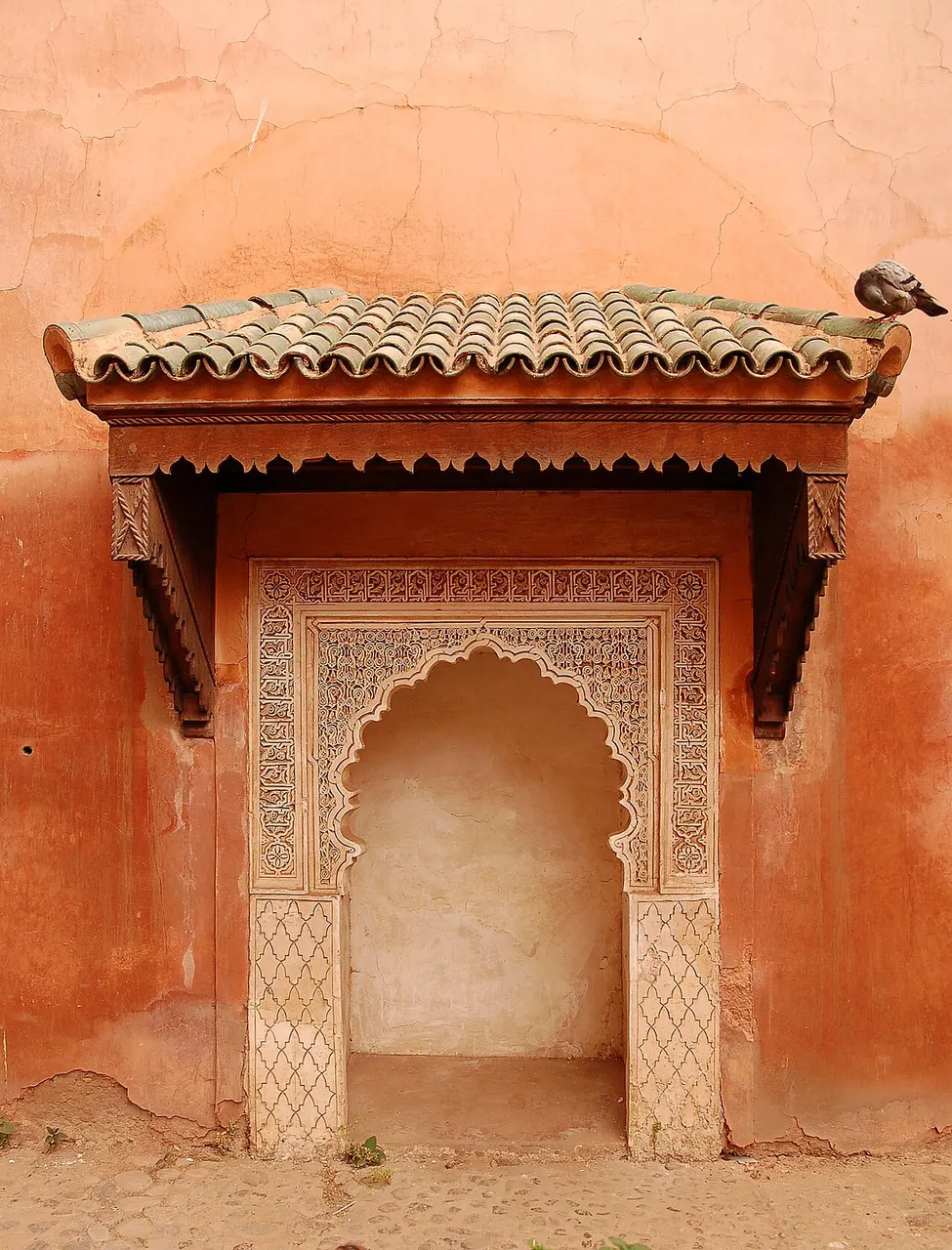
A 16th-century necropolis with 66 graves, including Ahmad al-Mansur's, in the hall of the twelve Carrara marble columns. Moulay Ismail had the entrance walled up around 1672 instead of destroying it, and the site wasn't rediscovered until 1917, by aerial photography. The entrance is a narrow passage beside the Kasbah Mosque and the line forms before 10am.
Check access
The souks and the trades
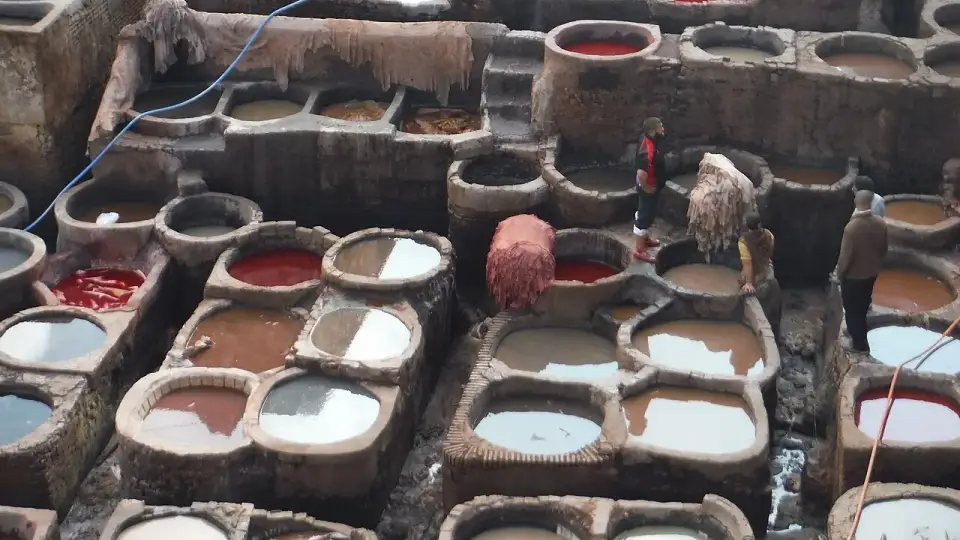
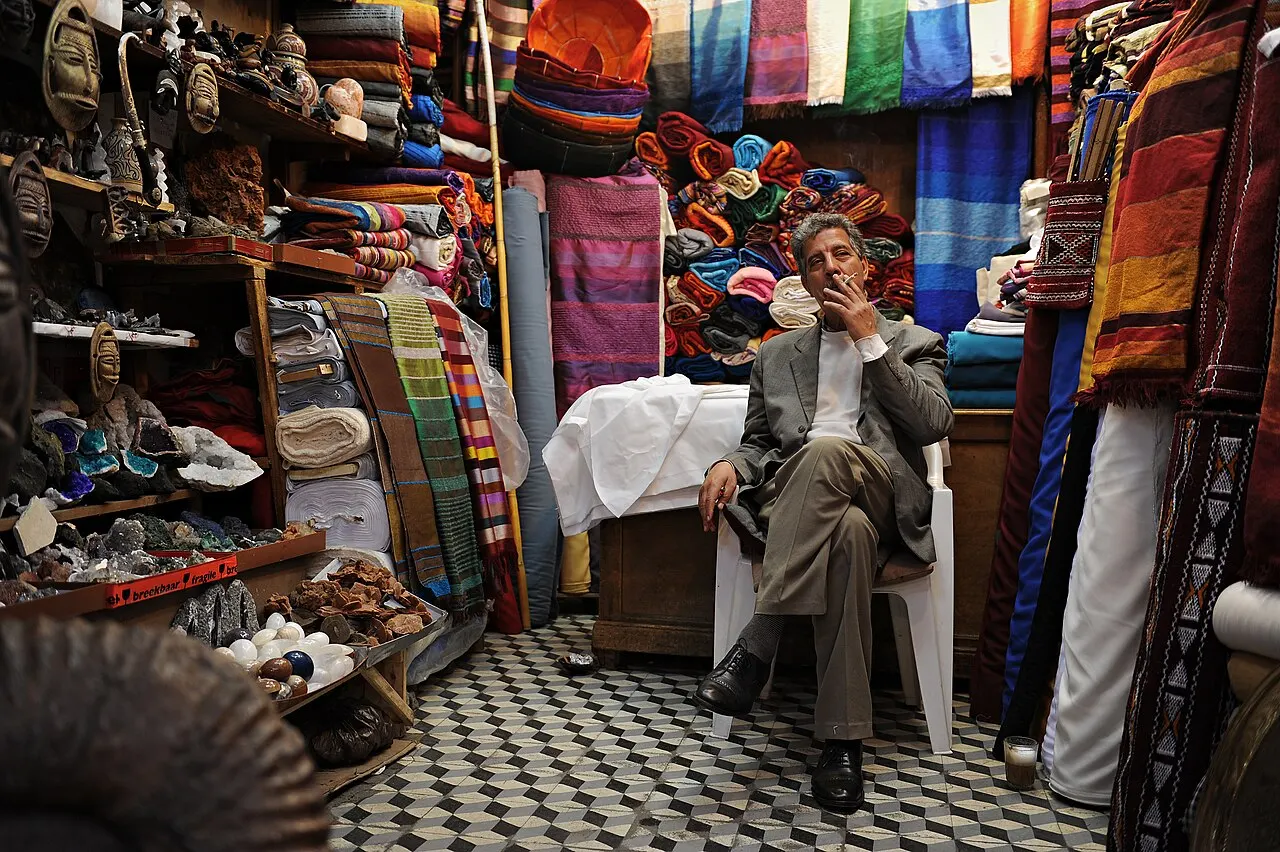
Organized by guild since the Middle Ages: Semmarine (textiles), Attarine (perfumes and spices), Rahba Kedima (herbs, wool and apothecaries), Haddadine (blacksmiths, and the noise tells you the street), Cherratine (leather) and Sebbaghine (dyeing, with skeins of wool hung up to dry). The tanneries of Bab Debbagh, to the northeast, still use lime and pigeon droppings in the process; you go in with a sprig of mint under your nose, and the price is agreed beforehand.
At the Bab Debbagh tanneries, you go in with a sprig of mint under your nose, and the price is agreed beforehand.
Check access
Koutoubia Mosque
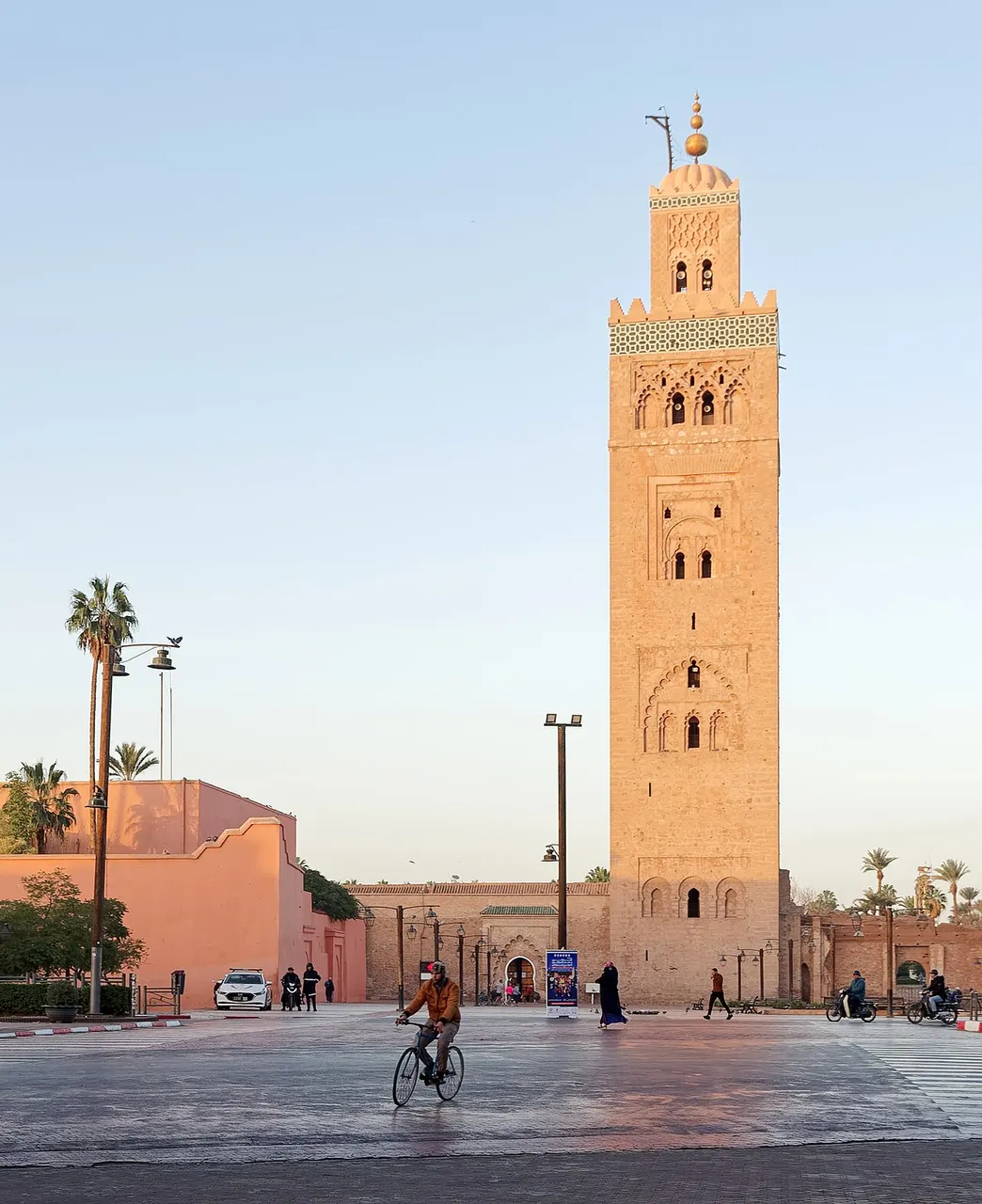
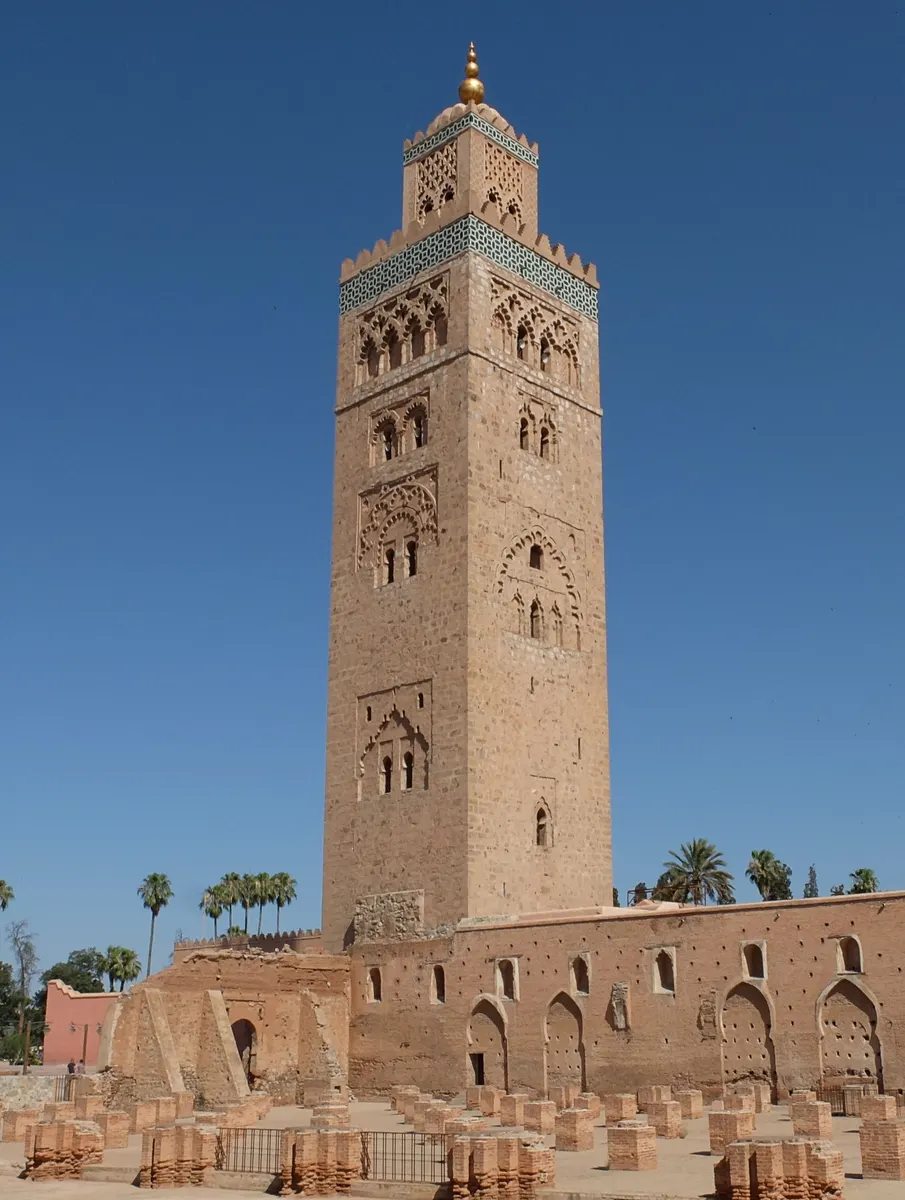
Built by the Almohads in two stages from 1147. The foundations of the first version, demolished over a misaligned qibla, are still visible alongside it. The 77 m minaret, finished around 1195, is the direct model for the Giralda in Seville and the Hassan Tower in Rabat. Non-Muslims don't enter; the garden around it is public and no building in the city may rise above the tower.
The 77 m tower the Almohads finished on the mosque is the direct model for the Giralda in Seville and the Hassan Tower in Rabat.
Check access

Ben Youssef Medersa
Quranic school founded in the 14th century and rebuilt in 1564–65 by the Saadian sultan Abdallah al-Ghalib: about 130 student cells on two floors around a courtyard of marble, zellige and carved cedar. It served as a school until 1960 and reopened in April 2022, after four years of restoration.
The marble courtyard, with zellige and carved cedar, is the core of the Quranic school rebuilt in 1564–65, with about 130 student cells on two floors; after four years closed for restoration, it reopened in April 2022 and is the best example of Saadian decoration you can visit in the medina.
Check access

El Badi Palace
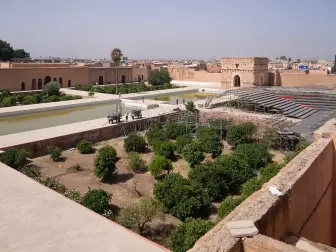
Built between 1578 and 1593 with the ransom from the Battle of the Three Kings and the gold taken from the Songhai in 1591; the Italian marble was reportedly paid for in sugar, weight for weight. Moulay Ismail carried everything off to Meknes from 1672 on, and what's left is 8 ha of walls, pools and orange groves, with storks nesting on top. In an annex stands the Koutoubia minbar, made in Córdoba around 1137.
Built between 1578 and 1593 and dismantled starting in 1672, the palace left behind 8 ha of walls, reflecting pools, and orange groves, with storks nesting on top, and in an annex, the Koutoubia minbar, made in Córdoba around 1137.
Check access

Bahia Palace
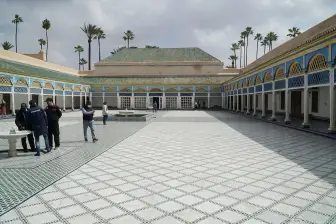
Built between 1866 and 1900, first by Si Moussa and then expanded by the grand vizier Ba Ahmed, who bought house after house until he had 8 ha and about 150 rooms. It's the best place in the city to see painted cedar ceilings and 19th-century zellige; under the protectorate it served as General Lyautey's residence.
Ba Ahmed bought house after house until he had 8 ha and about 150 rooms, from 1866 to 1900, after Si Moussa got it started, and the palace is the best place to see painted cedar ceilings and zellige, besides having been Lyautey's residence during the protectorate.
Check access

Jardin Majorelle and Musée Yves Saint Laurent
The French painter Jacques Majorelle bought the plot in 1923, planted the garden of cacti and bamboo, and registered the ultramarine blue that bears his name; it opened to the public in 1947. Yves Saint Laurent and Pierre Bergé bought the estate in 1980; it now houses the Musée Berbère, from 2011, and next door the Musée Yves Saint Laurent, opened in October 2017. It's the busiest spot in the city: buy a timed ticket in advance.
The garden draws more visitors than any other place in Marrakech, and the timed ticket is bought in advance.
Check access

Marrakech Museum and Almoravid Koubba
The museum occupies Dar Menebhi, the late-19th-century house of vizier Mehdi Menebhi, with a covered courtyard and a central chandelier weighing 1,200 kg. Fifty meters away is the Koubba Ba'adiyn, from the 12th century: the only Almoravid building still standing in the city, a survivor of the 1147 demolition, with the repertoire of interlaced arches and ribbed dome that gave rise to all later Moroccan architecture. It was only identified in 1948, under four meters of rubble.
The museum occupies the house of vizier Menebhi, with a 1,200 kg chandelier in the covered courtyard, and sits 200 m from the Ben Youssef Medersa, which shows the same kind of courtyard and zellige, done much better. Stop for five minutes at the Koubba Ba'adiyn, 50 m from the museum, the only Almoravid building still standing in the city, which sits outside and is visited separately.
Check access
Nilo’s itinerary
Start with the basic programme and choose extensions for the time you have.
Plan my days in the app ↗Day 1 · The imperial medina, from the Koutoubia to the kasbah
Start at 8:30am on the Koutoubia esplanade, with the 77 m minaret finished around 1195; the interior is closed to non-Muslims, but the garden and the foundations of the first mosque are visible.
Head 900 m south, enter through the Bab Agnaou (c. 1188), and visit the Saadian Tombs right at opening, to see the hall of the twelve columns before the line forms.
Cross over to the El Badi Palace, raised between 1578 and 1593 and stripped from 1672 on; climb the wall past the stork nests and see the Koutoubia minbar, from c. 1137, in the annex.
Have tanjia for lunch at a farnatchi in the kasbah or on Riad Zitoun el Jdid street, then walk down that street to the Bahia Palace (1866–1900), with 8 ha of courtyards.
Reach the Jemaa el-Fna by 5:30pm, have tea on a café rooftop to watch the food stalls go up from above, and head down for dinner around 7pm.
Day 2 · Souks, trades and the north of the medina
Enter the souks at 10am through the Rahba Kedima, the herb and wool square, and follow the Semmarine–Attarine axis with no rush to get anywhere.
Visit the Ben Youssef Medersa, rebuilt in 1564–65 and reopened in April 2022, with about 130 student cells around the marble and zellige courtyard.
200 m away, see the Koubba Ba'adiyn, from the 12th century, the only Almoravid building still standing, and the Marrakech Museum, in the vizier Menebhi's house.
Save the afternoon for the Souk Haddadine, the blacksmiths', and the Souk Cherratine, the leatherworkers'; turn down the “shortcuts” offered to the Bab Debbagh tanneries, and if you do go, agree on the price first.
Have dinner away from the square at a neighborhood restaurant in Riad Laarous, then walk back with your offline map open.
Day 3 · Gueliz, gardens and the Atlas on the horizon
Open the day at the Jardin Majorelle at 8am, with a timed ticket bought in advance, then head to the Musée Yves Saint Laurent, opened in October 2017, on the same street.
Walk down Avenue Mohammed V to Place du 16 Novembre to see the orthogonal grid laid out from 1913, and have lunch at a café on Rue Tarik Ibn Ziad.
Take a taxi to the Menara Gardens, about 3 km away, with the 12th-century Almohad basin and the 1869 pavilion.
Book a hammam for late afternoon (neighborhood, 20–50 DH plus the scrub, or riad, 300–600 DH) and allow 90 minutes including the rest.
Finish with the purchase you'd put off, now with three price references in mind and a fixed price checked at the Ensemble Artisanal.



Food
 AI illustration
Tanjia marrakchia
This is the city's dish: the meat is seasoned in a clay amphora and taken to the embers of the furnace that heats the hammam, where it stays all morning. Order it early and eat it at a late lunch.
 AI illustration
Tajine
Slow-cooked in the cone-shaped clay dish that gives the plate its name: the lid condenses the steam and returns the water to the meat. The common versions are chicken with preserved lemon and olive, lamb with prune and almond, and kefta with egg. At a local restaurant it runs 40–70 DH.
 AI illustration
Friday couscous
Semolina steamed three times over a seven-vegetable broth, served on Friday after midday prayer, in a shared platter. Outside of Friday, what tourist restaurants serve is rarely the same dish.
 AI illustration
Harira
A soup of tomato, lentil, chickpea, celery and cilantro, thickened with tedouira, a flour slurry. It's what breaks the fast during Ramadan, alongside dates and chebakia, and it's sold year-round from street stalls for 5–15 DH.
 AI illustration
Mechoui
A whole lamb roasted for hours in a pit oven, sold by weight and carved on the spot, with salt and cumin served on the side. The mechoui alley sits at the west end of the Jemaa el-Fna, opens around 11:30am and closes when it sells out.
 AI illustration
Babbouche
Snails cooked in a broth of licorice, thyme, mint and orange peel, served in a small bowl with a pin to pull them out; you drink the broth at the end, thought of as a digestive. At the stalls on the square, 10–20 DH.
 AI illustration
Morning breads and fry-ups
Msemen (folded semolina flatbread cooked on a griddle), harcha (semolina griddle bread), baghrir (thousand-hole pancake) and sfenj (fried dough ring strung on a cord) are sold between 7 and 10am at corner stalls, with honey, almond-and-argan amlou, or butter; 2–6 DH a piece.
 AI illustration
Mint tea and orange juice
On the square, glasses of orange juice cost 10–15 DH and appear from early morning.
Day trips

Ourika Valley and Imlil
The Ourika begins 35 km to the south, about an hour away by car, and ends at Setti Fatma, where a 1-hour trail leads to the seven waterfalls. Imlil, 65 km and 1 hour 30 minutes away, sits at 1,740 m and is the base for hikes up Toubkal (4,167 m, two days with a refuge). Grands taxis leave from Bab Er Robb; several villages in the area were hit by the 2023 earthquake and are still rebuilding.
Essaouira
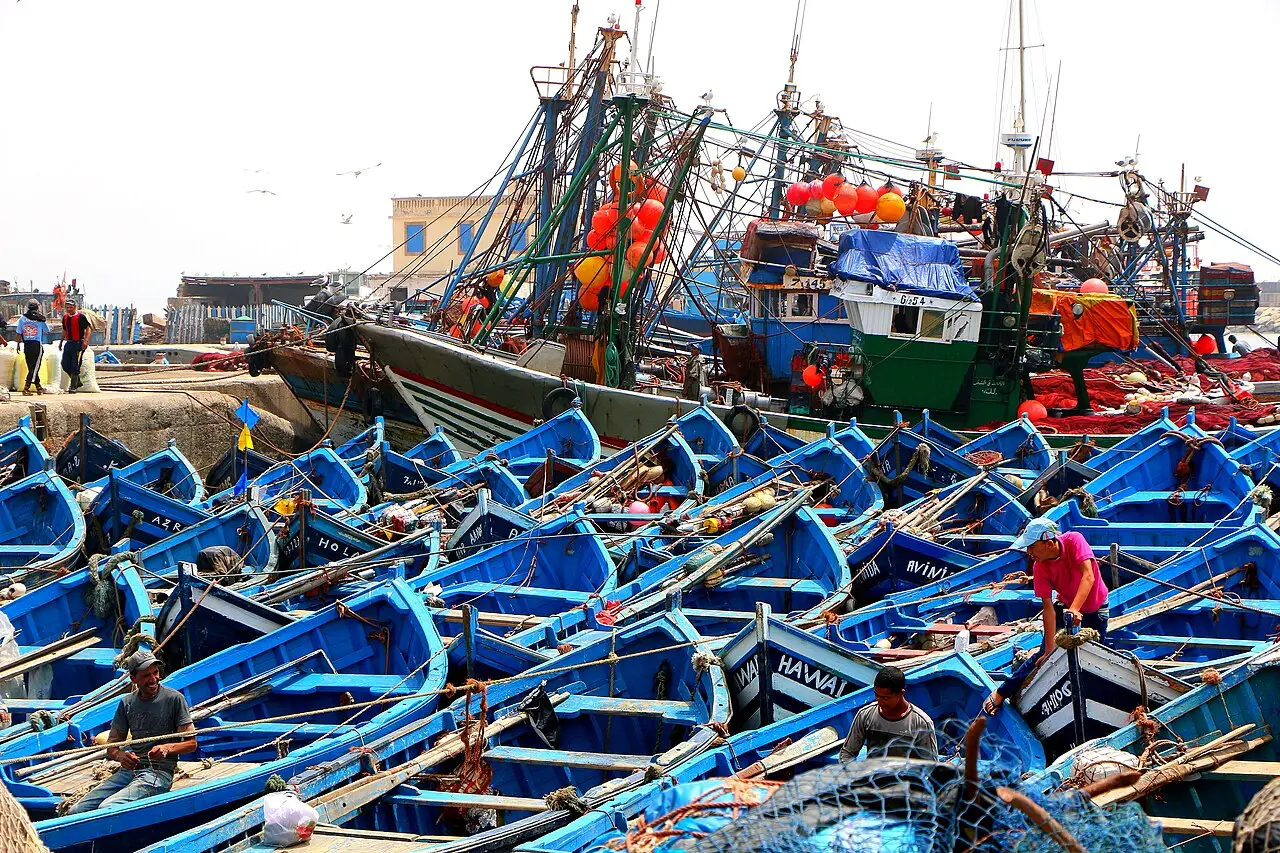
An Atlantic port 175 km to the west, 2 hours 30 minutes to 3 hours by Supratours or CTM bus, with morning departures and a late-afternoon return. It has a fortified medina designed in 1764 by the Frenchman Théodore Cornut and inscribed by UNESCO in 2001, ramparts over the sea, a market where fish is grilled on the spot, and a steady wind that made it a kitesurfing hub.
Aït Ben Haddou and Ouarzazate
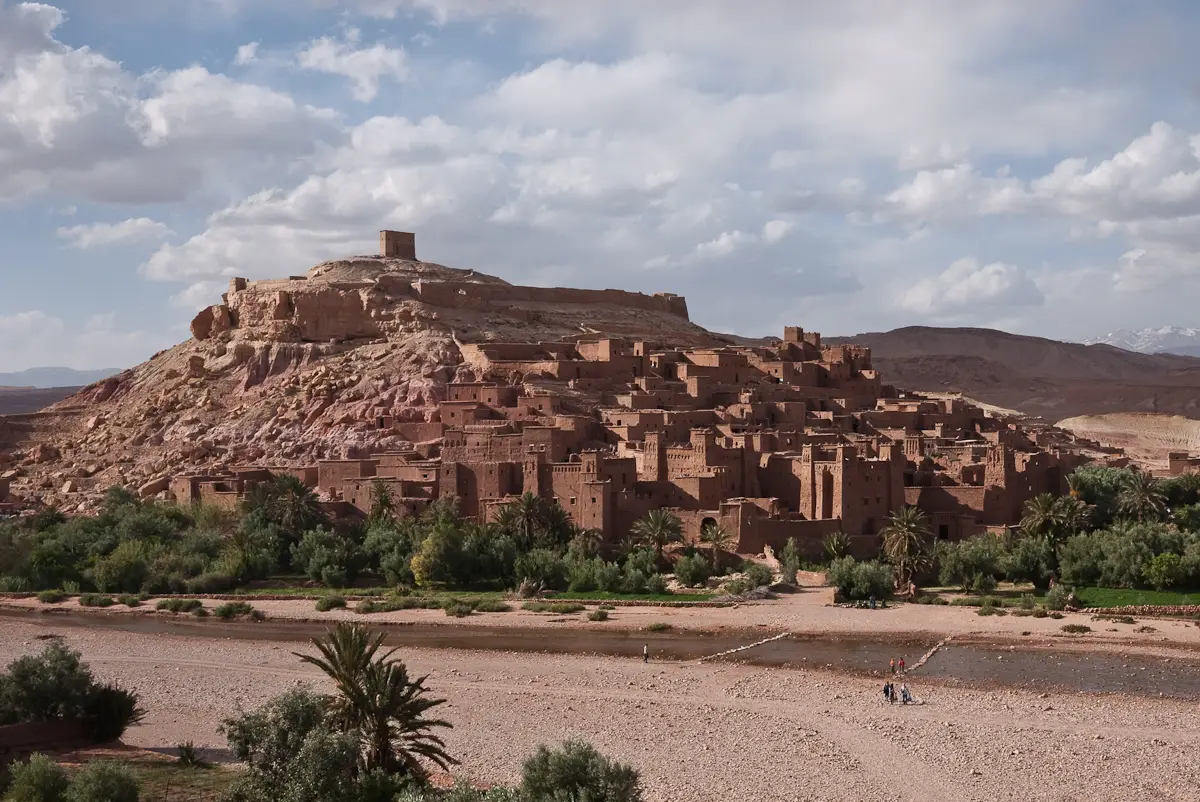
About 180 km to the southeast, 3 hours 30 minutes–4 hours on a mountain road that crosses the Tizi n'Tichka pass at 2,260 m. The ksar of Aït Ben Haddou, a fortified rammed-earth village listed by UNESCO in 1987, is a recurring film set; 30 km away are the Ouarzazate studios. It can be done as one long day, but staying overnight in the area saves four hours of hairpin turns in the dark.
Where to begin
The imperial medina, from the Koutoubia to the kasbah
Start at 8:30am on the Koutoubia esplanade, with the 77 m minaret finished around 1195; the interior is closed to non-Muslims, but the garden and the foundations of the first mosque are visible.
Souks, trades and the north of the medina
Enter the souks at 10am through the Rahba Kedima, the herb and wool square, and follow the Semmarine–Attarine axis with no rush to get anywhere.
Gueliz, gardens and the Atlas on the horizon
Open the day at the Jardin Majorelle at 8am, with a timed ticket bought in advance, then head to the Musée Yves Saint Laurent, opened in October 2017, on the same street.
Money
The currency is the Moroccan dirham (MAD, DH), divided into 100 centimes. It's a closed currency: you can't buy it outside the country, and you should change any leftovers before you fly out. In 2026 the euro is worth about 11 DH and the dollar about 9.5 DH. Coffee at the counter costs 12–20 DH, mint tea 10–20 DH and orange juice in the square 10–15 DH. A tagine in a popular restaurant runs 40–70 DH, and dinner in a riad with a starter and dessert 250–450 DH. A bus ticket costs about 4–5 DH, and a short taxi ride 15–30 DH. A neighborhood hammam costs 20–50 DH, plus the kessa and the beldi soap, and a hotel hammam 300–600 DH; a night in a midrange riad runs about 700–1,500 DH. ATMs (Attijariwafa, BMCE, Banque Populaire) charge 20 to 40 DH per withdrawal and usually cap each transaction at 2,000–4,000 DH. Cards work in hotels, supermarkets and restaurants in Gueliz, but in the souks, taxis and stalls it's cash only. The practical everyday problem is getting change for a 200 DH note, so break big notes at the supermarket. The tourist tax is charged at your accommodation, on top of the booking price: about 15 DH per person per night in municipal tax, plus 8 to 11 DH in tourism promotion tax depending on the category, from age 12. Tipping: 5 to 10 DH for a porter, café waiter or parking attendant, and 10% in a restaurant with table service. On arrival, the border requires a passport valid for at least six months. Brazilians, Portuguese and European Union citizens enter without a visa for stays of up to 90 days.
Getting there and around
Airport, trains and intercity buses
Marrakech-Menara Airport (RAK) is 5 km southwest of Jemaa el-Fna. Alsa bus 19 covers that route for about 30 DH, with buses every 20 to 30 minutes. A petit taxi charges about 100 DH by day and 150 DH at night for the quarter-hour ride, according to the price list posted at the terminal door. The ONCF train station is in Gueliz, at the intersection of Avenue Hassan II and Avenue Mohammed VI. It's the end of the country's rail line: there's no more track heading south from here. Casablanca is about 3 hours away and Rabat 4 hours, with second-class tickets from 100 to 200 DH. For Tangier, ONCF sells the whole route on a single ticket, with a change in Casablanca to the Al Boraq high-speed train, and the full trip takes 5 to 6 hours. The Kenitra–Marrakech high-speed extension is under construction, expected by the end of the decade. CTM and Supratours buses leave from their own terminals near Bab Doukkala and the train station, and the other companies use the Gare Routière at Bab Doukkala.
No subway or train in the city: buses and taxis only
There's no subway and no urban train within the city. The bus network has been run by Alsa since 2010; a ticket costs about 4–5 DH, paid on board. The most useful lines for visitors are the 1, between the Jemaa el-Fna, Gueliz and the Menara, and the 12. Petits taxis are khaki-beige and carry up to three passengers; they run only within the city perimeter and are required to use the meter. Ask for “compteur” before you close the door. Count on 15–30 DH for a short daytime ride, and 50% more after 8pm, which is the legal rate, not the driver's invention. It's normal for the driver to pick up another passenger heading the same way, which surprises anyone who doesn't know the custom and can feel, at first, like getting into the wrong car. The grands taxis, six-seat Mercedes, run out to Ourika, Asni, Imlil and Essaouira from Bab Er Robb and Bab Doukkala, charging by the seat. Apps like inDrive, Careem and, since November 27, 2025, Uber all work, but the trade is contested by cab drivers: arrange the pickup away from taxi stands. The two-horse calèches have a posted municipal rate, on the order of 150 DH an hour. You can cross the medina on foot in 40 minutes, and almost no derb is wide enough for a car. Motorbikes, handcarts and pedestrians share 1.5 m alleys: walk on the wall side and look back when you hear a horn.
Safety
Marrakech has rare violent crime against visitors and a strong police presence, including the tourist brigade that patrols the medina in plain clothes; what wears you down is something else. Pickpocketing happens on the Jemaa el-Fna at night and in the souks at busy times, and there's bag theft by pairs on motorbikes in the wider alleys. Carry your bag on the wall side and don't hold your phone in an empty alley. Commercial hassle is constant and grating rather than frightening: fake guides (guiding without a license is illegal in Morocco, and the official guide wears a numbered badge), the woman who grabs your hand to apply henna and charges afterward, the monkey owner who puts the animal on your shoulder, the “friend” who shows up at your riad's door. A curt “no, thank you,” without stopping and without eye contact, settles most of it; stopping to explain only stretches the conversation out. Watch for card machines in carpet shops that ring up different amounts than agreed, for heavy pressure toward “cooperative visits” during day trips, and for poorly lit alleys after midnight in the north of the medina. Women traveling alone report frequent verbal harassment, with no associated violence; ignoring it and walking on is what works. Emergencies: 19 (city police), 15 (ambulance), 177 (gendarmerie outside the urban perimeter).
Etiquette tips
Tea comes before the price
Refusing the tea outright looks worse than leaving without buying, once you've talked. Accepting doesn't commit you to anything either, because the tea is a courtesy, not a promise to buy.
A photo of someone is negotiated first
On the Jemaa el-Fna, snake charmers, water sellers (guerrab) in red hats and monkey owners charge for photos: 10 to 20 DH, agreed before you raise the camera. Photographing women, children, or the inside of a shop without asking is a serious breach.
Working mosques aren't for visiting
Non-Muslims don't enter working mosques in Morocco, including the Koutoubia. Medersas, palaces, museums and the Almoravid Koubba are open to everyone, and that's where you see the same architecture.
The right hand and the bread
You eat with three fingers of the right hand, from the side of the tajine closest to you, and the bread stands in for the fork. The left hand holds the bread, it doesn't take the food. Refusing the piece your host pushes your way is refusing the gesture.
Haggling: open low, settle in the middle
Looking at a piece and leaving with a thank-you is always acceptable, even after accepting the tea. Asking the price and making a counteroffer, though, says you want to buy it, so only open the negotiation if you're ready to close. Once it's open, haggle smiling and unhurried: offer well below the asking price and expect to settle close to the middle.
Ramadan changes the whole street
During the month of Ramadan, no eating, drinking or smoking in public during the day, even for those who aren't fasting. Many restaurants only open at ftour, and sunset empties the streets for 40 minutes: the best time to cross the medina and the worst time to look for a taxi.
Mistakes to avoid
Following whoever says “it's closed today”
Following whoever says “the square is closed today,” that “the souk closes at noon,” or that the tannery “is right there.” It's always a detour to a shop that pays a commission, and getting back usually costs a tip negotiated on the spot.
Get your bearings from the Koutoubia, not the signal
Trusting GPS inside the medina. The dead-end derbs aren't mapped properly and the signal drops between half-meter-thick earthen walls. Get your bearings from visible landmarks (the Koutoubia, Bab Doukkala, Rahba Kedima) and download the offline map before you go in.
A petit taxi with the meter off
Getting into a petit taxi without the meter running, or accepting a fixed price “because traffic is bad.” Ask for the “compteur” before you sit down and, if they refuse, take the next one, which usually shows up in less than a minute.
Break everything into 20s and 50s
Carrying only 100 and 200 DH notes. Juice stalls, taxis, neighborhood hammams and calèches rarely have change; withdraw on the first day and break it all into 20 and 50 DH notes at the supermarket.
Midday in July and August, on the street
Scheduling midday in July and August out on the street. Between 1pm and 5pm it goes above 40 °C and there's no shade along several stretches of the medina. Flip the day: souks and monuments early, museum, riad, or hammam in the afternoon, the square after 7pm.
Useful phrases
السلام عليكم: Salam ou alaykom (sa-lám u a-léi-kum)
Peace be upon you. The standard greeting, answered with “wa alaykom salam”
شكرا: Choukran (chú-kran)
Thank you; “bezzaf” after it means “thank you very much”
لا شكرا: La, choukran (lá chú-kran)
No, thank you: the most-used phrase in the souks, said without breaking stride
بشحال؟: Bchhal? (bech-hál)
How much does it cost? The question that opens the bargaining
غالي بزاف: Ghali bezzaf (gá-li be-zzáf)
That's too expensive: the standard polite counter
ⴰⵣⵓⵍ: Azul (a-zúl)
Hello in Amazigh (Tachelhit), used in the High Atlas and taken warmly in the city
Districts
Medina
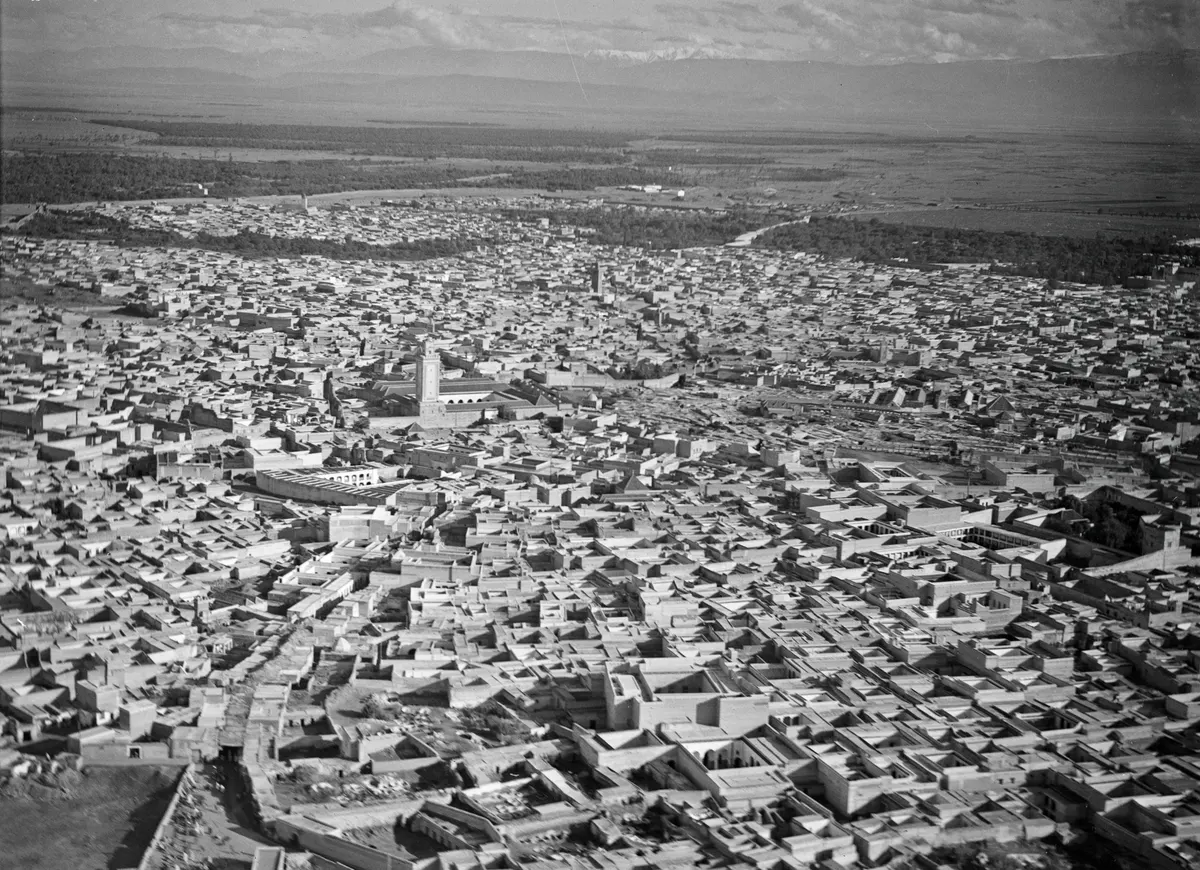
About 600 ha of walled city with about 150,000 residents, organized in derbs: dead-end alleys of eight to fifteen houses behind one shared gate. UNESCO World Heritage since 1985; it's where the souks, the historic monuments and most of the guest riads are.
Jemaa el-Fna
The square in the fold between the medina and the kasbah, everyone's courtyard. It changes function three times a day: orange-juice stalls in the morning, halqa (circles of storytellers, gnawa musicians, acrobats from Amizmiz) in the afternoon, and about a hundred food stalls set up within an hour at dusk.
Kasbah and Mellah
The city of power, to the south: the 1180s Almohad kasbah with the Bab Agnaou, the Saadian Tombs, El Badi and the Kasbah Mosque. Next to it is the Mellah, the Jewish quarter created in 1558, with the Lazama Synagogue, the Miaara cemetery and the city's cheapest spice market.
Riad Zitoun and Dar el Bacha
The two axes that link the square to the rest of the medina. Riad Zitoun el Jdid leads to the Bahia Palace and the Dar Si Said; Dar el Bacha street, home to Thami El Glaoui's former house (opened as the Musée des Confluences in 2017) has in recent years drawn the design shops, the specialty cafés and the medina's steepest rent hikes.
Gueliz
The ville nouvelle laid out from 1913 by Henri Prost, on an orthogonal grid around Avenue Mohammed V. Banks, cinemas, galleries, supermarkets, the train station, the Jardin Majorelle and nearly every bar that serves alcohol are here; it's where Marrakech's middle class shops.
Hivernage
A tree-lined strip between Gueliz and the walls, created in the 1920s as a winter district for Europeans. Large hotels, the convention center, nightclubs and the Jardin Harti; wide streets, high walls and little street life.
Palmeraie
About 13,000 ha of palm grove to the north and east, irrigated since the 12th century by the khettaras. Today it's an area of pool hotels, country houses and golf courses; the palm grove has lost ground to housing development and it's the focus of the city's main environmental conflict, water use.
Sidi Ghanem and the residential districts
10 km to the northwest, Sidi Ghanem is the industrial zone turned district of ceramics, textile and furniture workshops, with showrooms open Monday to Friday. Daoudiate, Massira, M'hamid and Sidi Youssef Ben Ali are home to most of the population, outside any tourist circuit.
History
c. 1070 · Almoravid camp
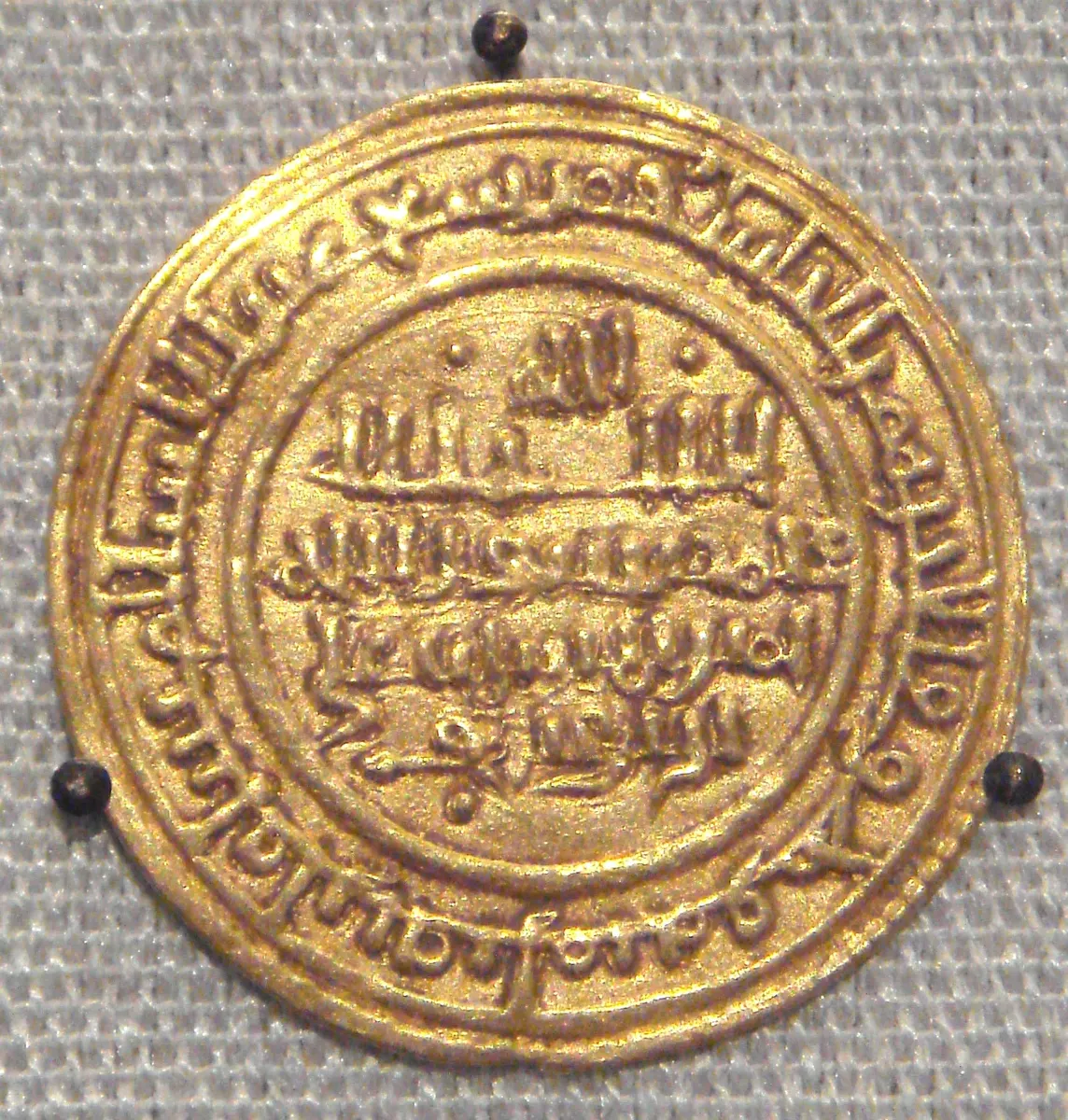
Abu Bakr ibn Umar sets up a military camp on the Haouz plain, and Yusuf ibn Tashfin turns it into a capital. The Almoravid empire will reach the Senegal River to the south and the Ebro, on the Iberian Peninsula, after 1086.
1122–1123 · The walls and the water
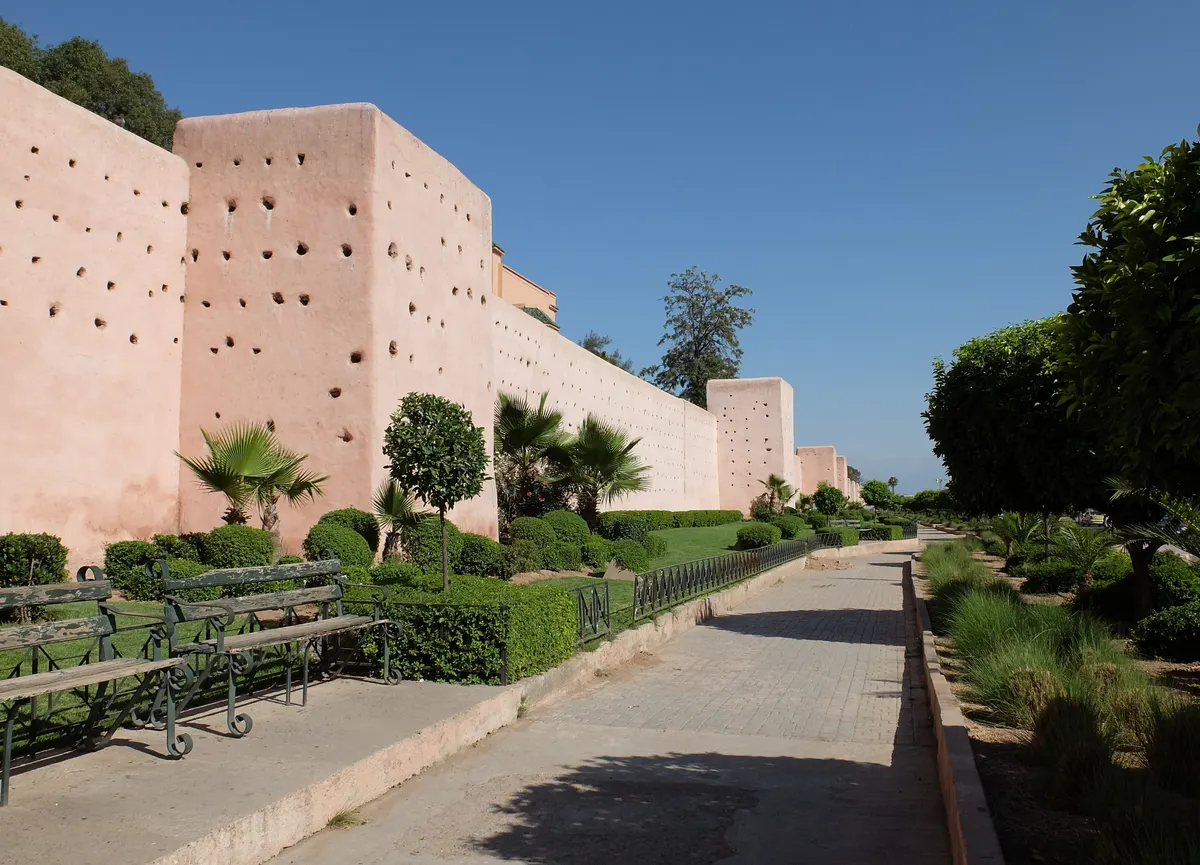
Ali ibn Yusuf raises about 19 km of pisé wall, red earth rammed with lime. In the same period the khettaras are dug, underground galleries sloping down that bring water from the foot of the Atlas by gravity.
1147 · Almohad conquest
Abd al-Mu'min takes the city, executes the last Almoravid, and demolishes nearly every building of the previous dynasty. Only the Koubba Ba'adiyn survives; the capital stays in Marrakech.

1147–1195 · The Koutoubia
The mosque is built in two stages (the first demolished over a misaligned qibla) and the 77 m minaret is finished under Yaqub al-Mansur. It becomes the model for the Giralda in Seville and the Hassan Tower in Rabat.
1269 · The capital moves to Fez
The Marinids conquer the city and move power to Fez. Marrakech spends nearly three centuries as a secondary, contested, impoverished town.
1549–1603 · Saadian peak
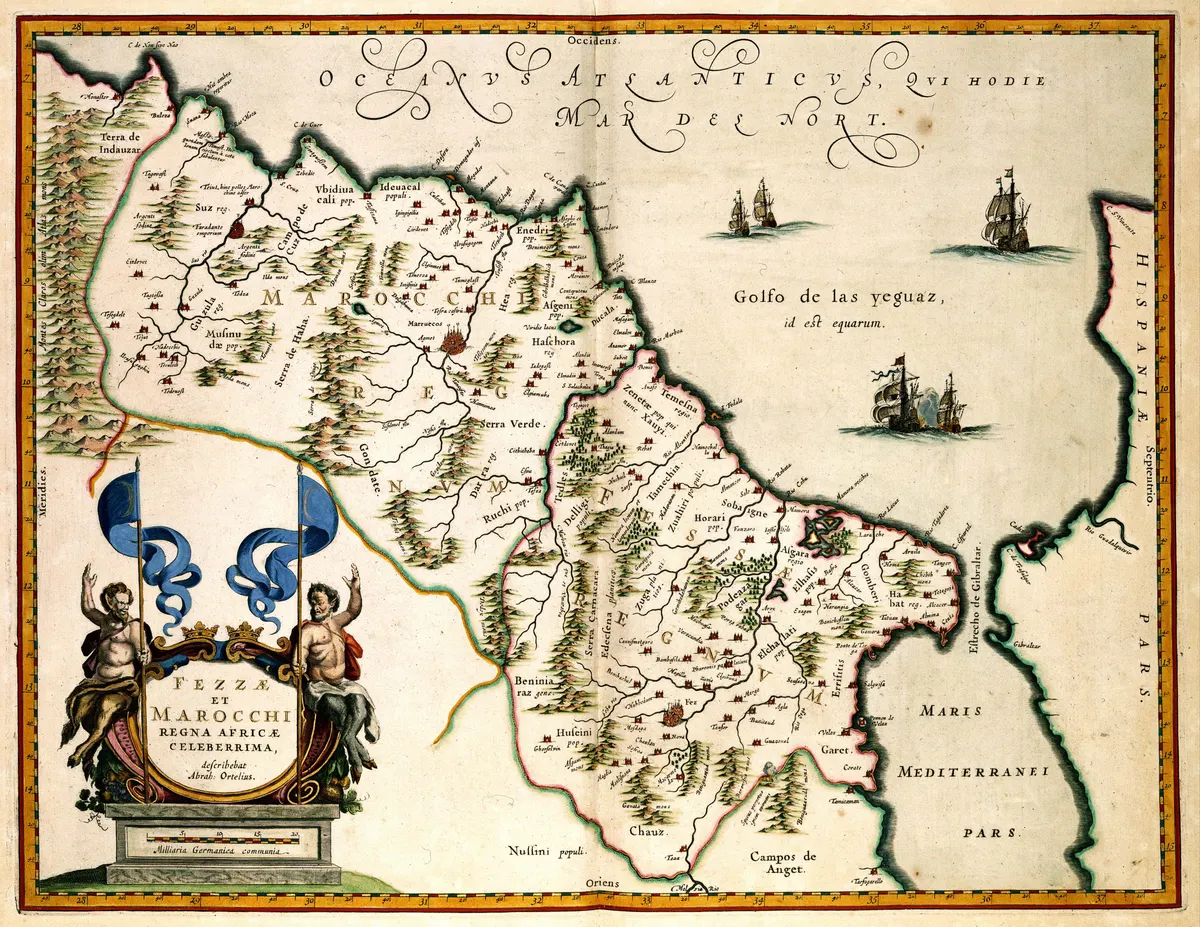
The Saadians, from the Souss valley, return the capital to Marrakech. Ahmad al-Mansur funds the city with the ransom from the Battle of the Three Kings (1578) and with the gold taken from the Songhai empire in 1591.
1558–1593 · Mellah, medersa and El Badi
The Jewish quarter (Mellah) is created in 1558 next to the palace; the Ben Youssef Medersa is rebuilt in 1564–65 with 130 cells; the El Badi Palace is raised between 1578 and 1593 with Carrara marble.
1672 · Moulay Ismail strips El Badi
The Alaouite sultan moves the capital to Meknes and strips El Badi of its marble, doors and tiles over twelve years. He has the Saadian necropolis walled up instead of destroyed.

1866–1900 · Bahia Palace
Si Moussa, and later his son, the grand vizier Ba Ahmed, buy house after house and assemble 8 ha of courtyards and about 150 rooms along the Riad Zitoun axis. It's the city's last great pre-colonial building project.

1912–1956 · Protectorate and the Glaoui
Thami El Glaoui governs Marrakech as pasha through the entire French protectorate and takes part in deposing Sultan Mohammed V in 1953. From 1913, Henri Prost lays out Gueliz outside the walls, which preserves the medina.
1985 · 2001 · 2023 · Heritage and earthquake
The medina joins the UNESCO list in 1985 and the Jemaa el-Fna is proclaimed a masterpiece of oral heritage in 2001. On September 8, 2023, a magnitude-6.8 earthquake centered about 72 km to the south kills about 2,960 people across the country and damages walls and minarets in the medina; restoration continues into 2026.
 AI illustration
Complete history
Marrakech was born from a position and a water table, with no river
Marrakech was born from a strategic position and a water table, in a place with no river or port. Around 1070, the Almoravids, a Sanhaja Amazigh confederation from the western Sahara, planted a camp at the point where the caravans coming up from Timbuktu with gold, salt and enslaved people met the passes of the High Atlas, the Tizi n'Tichka and the Tizi n'Test. Yusuf ibn Tashfin turned the camp into the capital of an empire that ran from the Senegal River to the Ebro. His son, Ali ibn Yusuf, solved the site's two problems between 1122 and 1123: he walled the city with about 19 km of rammed earth and had the khettaras dug, underground galleries that pull water from the foot of the mountain by gravity, no pump at all. The palm grove that shows up on postcards is a product of that irrigation engineering. The country's name in Portuguese, English, Spanish and French comes from this city's name.
The Almohads tore down nearly everything
In 1147 the Almohads took Marrakech and tore down nearly everything the Almoravids had built, claiming the qibla was misaligned; only one dome survived, the Koubba Ba'adiyn, rediscovered under four meters of rubble only in 1948. Where they had knocked things down they raised the Koutoubia, whose 77 m minaret, finished around 1195, became the model for the Giralda in Seville and the Hassan Tower in Rabat, and they laid out the kasbah, the district of power to the south, with the monumental Bab Agnaou gate. In 1269 the Marinids won and moved the capital to Fez. Nearly three centuries of decline followed: the city lost investment, the palm grove shrank, and the Portuguese occupied nearby Atlantic ports such as Safi and Azemmour.
Recovery came with the Saadians
Recovery came with the Saadians, a dynasty from the Souss Valley that made Marrakech the capital again in the mid-16th century. The money came from two datable sources: the ransom paid for the prisoners of the Battle of the Three Kings, in 1578, and the gold taken from the Songhai Empire when Ahmad al-Mansur invaded the Sahel and occupied Timbuktu and Gao, in 1591, hence his nickname al-Dhahbi, the golden one. That money paid for the El Badi Palace (1578–1593), the rebuilding of the Ben Youssef Medersa (1564–65) and the Saadian Tombs. The Mellah, the Jewish quarter, was created in 1558 next to the palace, and Marrakech's Jewish community reached tens of thousands of people before emigrating almost entirely between 1948 and the 1960s. In 1672 the Alaouite sultan Moulay Ismail moved the capital to Meknes and dismantled El Badi piece by piece; the Saadian necropolis he chose to wall up, and it only reappeared in 1917, identified through French aerial photography.
The protectorate, Gueliz and the riads, 1912 to today
The 20th century split the city in two, and that's what saved the medina. In 1912 the French protectorate handed the south to Thami El Glaoui, pasha of Marrakech for 44 years, who administered the region for France, took part in deposing Sultan Mohammed V in 1953, and submitted in 1955, shortly before independence in 1956. At the same time, the urban planner Henri Prost laid out a new town from 1913, Gueliz, on an orthogonal grid outside the walls, under a rule of no intervention within them. While other Mediterranean medinas were cut through by avenues, Marrakech's stayed intact and inhabited. From the 1960s on came the hippie trail, then fashion, and with it the money that saved gardens and riads from demolition. From the late 1990s on, thousands of courtyard houses in the medina were bought and converted into guest riads, which multiplied the price per square meter and emptied whole derbs of their longtime residents.
Tourism, craft and Haouz farming
Today the economy rests on tourism and the medina's workshops, and recent years have tested it twice. On September 8, 2023, a magnitude 6.8 earthquake, with its epicenter about 72 km to the south, killed about 2,960 people across the country and damaged walls and minarets in the medina, with restoration work still underway in 2026. Then came the water problem: after six straight years of low rainfall, the government imposed restrictions in 2024 that went as far as closing public baths three days a week, and water became the region's most serious issue. Between December 2025 and January 2026, the Marrakech Stadium, with about 45,000 seats, hosted Africa Cup of Nations matches, and Morocco is co-hosting the 2030 World Cup.
Marrakech was founded at a caravan crossroads, with water drawn from underground through galleries called khettaras.
Geography and shape of the city
The dry plain and the Atlas
Marrakech sits on an arid plain, the Haouz, at 466 m altitude, between the Tensift river (almost always dry, 5 km to the north) and the High Atlas wall, which begins 60 km to the south and peaks at Toubkal, 4,167 m, snow-covered from December to April and visible from the city on clear days. There's no reliable surface water: the city lived a thousand years off the Almoravid khettaras and today depends on dams and wells, which makes drought a permanent topic. The climate is hot semi-arid, with about 250 mm of rain a year and summers above 40 °C.
The radial medina and the derb
Inside the 19 km of walls, the medina is radial and irregular: the streets converge on the Jemaa el-Fna and the souks, and the basic unit is the derb, a dead-end alley with a dozen houses and one shared gate; the houses face inward, with a blind facade and a central courtyard, a direct answer to heat and privacy.
The 1913 grid and the color
Outside the walls, Gueliz and Hivernage follow the right-angled grid laid out from 1913 on around Avenue Mohammed V, which runs in a straight line from the Koutoubia to the new town. A municipal regulation keeps pinkish-ochre render on almost the whole city and bans buildings taller than the Koutoubia minaret, which explains the low, single-colored skyline you see from any rooftop terrace.
In the medina, the dead ends have no name on GPS; in Gueliz, the streets are straight.
Culture
The circle of storytellers in Jemaa el-Fna
Marrakech's living culture is heard before it's seen, in the halqa, the circle that forms around a storyteller, a healer or a musician. It's the reason Jemaa el-Fna was recognized by UNESCO in 2001, and it survives with difficulty, because the storytellers working in darija have dwindled to a few dozen. The music has three layers you can hear in the same square: the Gnawa, descendants of enslaved people brought from the Sahel, with the three-string guembri and metal castanets (qraqeb) in nighttime trance ceremonies called lila; urban chaabi and the aita of the Haouz plain, sung by women; and the Amazigh ahwash of the High Atlas villages, with bendir drums and a chorus in a circle. On the streets of Gueliz the sound is different: Moroccan rap in darija, which since the 2000s has become the main political voice of urban youth.
Craft: an economic sector of the medina
Craft here isn't local folklore: it's an economic sector employing tens of thousands of people in the medina. The techniques are identifiable, and it's worth learning the name before buying: zellige (hand-cut mosaic tiles), tadelakt (lime plaster polished with beldi soap, used in hammams), dinanderie (hammered brass and copper work, the noise from Souk Haddadine), leather babouches tanned at Bab Debbagh, and carpets with a traceable origin: raw-wool Beni Ouarain from the Middle Atlas, Boucherouite made of rag strips, Glaoua and Taznakht from the south. The Ensemble Artisanal, on Avenue Mohammed V, sells at fixed prices and works as a benchmark before you go bargaining in the souk.
The Film Festival and the Ouarzazate studios
The International Film Festival has run since 2001 and screens films for free on a screen set up in Jemaa el-Fna, and the Ouarzazate studios, 200 km away, have sustained the industry since the 1980s. Marrakech appears in Hitchcock's “The Man Who Knew Too Much” (1956), in “Hideous Kinky” (1998) and in “Much Loved” (2015), which is banned in Morocco. Contemporary African art gained a permanent base with MACAAL, opened in 2016, the Musée Yves Saint Laurent, from 2017, the Maison de la Photographie, from 2009, and the 1-54 fair, held in the city since 2018. In sports, Kawkab Marrakech (founded in 1947) plays at the Marrakech Stadium, with about 45,000 seats, opened in 2011 and used for the Africa Cup of Nations from December 2025 to January 2026. Nightlife with alcohol is legal and concentrated in Hivernage, Gueliz and the hotels; inside the medina, almost everything closes around midnight, except the square.
Festivals and events
 AI illustration
Ramadan and Eid al-Fitr
A lunar month of fasting; in 2027 it should begin around February 7, with the end date depending on the sighting of the moon. Days go quiet and nights come alive: ftour at sunset with harira, dates and chebakia, souks open into the small hours, and the square more crowded than at any other time of year.
 AI illustration
National Festival of Popular Arts
Since 1960, in July: four nights of music and dance from every region of the country (Atlas ahwash, gnawa, Haouz aita) with a main stage in the ruins of the El Badi Palace and a display of tbourida, the charge of horsemen firing rifles, outside the walls.
 AI illustration
Marrakech du Rire
A comedy festival created in 2011 by the French-Moroccan comedian Jamel Debbouze, in June, with shows in French, Classical Arabic and darija at the Théâtre Royal, the Palais des Congrès and El Badi.
 AI illustration
Marrakech International Film Festival
Created in 2001, it runs in late November or early December. Besides the competition at the Palais des Congrès, it screens free features on a screen set up in the Jemaa el-Fna, with thousands sitting on the ground of the square.
 AI illustration
Marrakech International Marathon
A road race since 1987, on the last Sunday of January, on a flat course through the Menara, Hivernage and the Palmeraie. The half marathon starts the same day; a temperature of 12–20 °C explains the fast times.
Books and films
“The Voices of Marrakesh,” Elias Canetti (1968)
Sixty pages written after a visit in 1954: the blind beggars repeating God's name, the camel led to slaughter, the logic of the market. It's the text that fixed the idea of the square as a place of voices, and it still describes precisely what you hear there.
“Much Loved,” Nabil Ayouch (2015)
A film about four women who work as prostitutes for clients from the Gulf in Marrakech. It was banned in Morocco before it premiered and works as a counterpart to the postcard: it shows the service economy created by tourism and the city that lives outside the walls.
“The Man Who Knew Too Much,” Alfred Hitchcock (1956)
The first third takes place in Marrakech, with scenes shot on the Jemaa el-Fna and at the La Mamounia hotel, opened in 1923. It's worth seeing for the square and the new town in the year of independence, when international tourism was just getting started.
Frequently asked questions
Marrakech: Should I follow whoever says the square is closed today?
No: whoever says the square or the souk is closed always leads to a detour to a shop that pays a commission, and getting back usually costs a tip negotiated on the spot.
Marrakech: How do I get from the airport to the center?
By Alsa bus 19, which links Marrakech-Menara Airport to the Koutoubia for about 30 DH, every 20 to 30 minutes, from 6am to 9:30pm. The petit taxi covers the trip in 15 minutes for about 100 DH by day and 150 DH by night, per the table posted at the terminal door, and it's the only option after 9:30pm.
Marrakech: How do I get to the Ourika Valley and the waterfalls?
By grand taxi, charged by the seat from Bab Er Robb: the Ourika begins 35 km to the south, about a 1-hour drive, and ends at Setti Fatma, where a 1-hour trail leads to the seven waterfalls.
Marrakech: What's the climate like throughout the year?
It's hot semi-arid: winter is dry, with highs of 18–20 °C and cold nights; March to May and October to November stay between 22 and 30 °C, and July and August go above 37–40 °C, the months to avoid.
Marrakech: Does accepting the vendor's tea obligate me to buy?
No: the tea is a courtesy, not a promise to buy. Refusing it outright looks worse than leaving without buying, once you've talked.
Other cities in the country
Morocco ↗- Days
- 2–3
- When
- Mar–May · Sep–Nov
- Per person/day
- Average 800–1,400 MADMid-range · per person/day
Cost scope
Per person per day: accommodation, meals, urban transport, visits and a small allowance for extras. Flights excluded; larger purchases vary. Editorial estimate, not a quote.
- Days
- 2–3
- When
- Apr · Jun · Sep–Oct
- Per person/day
- Average 800–1,400 MADMid-range · per person/day
Cost scope
Per person per day: accommodation, meals, urban transport, visits and a small allowance for extras. Flights excluded; larger purchases vary. Editorial estimate, not a quote.
- Days
- 4
- When
- Jan–Apr · Oct–Dec
- Per person/day
- Average 400–900 MADMid-range · per person/day
Cost scope
Per person per day: accommodation, meals, urban transport, visits and a small allowance for extras. Flights excluded; larger purchases vary. Editorial estimate, not a quote.