Days Start with the basic programme and choose extensions for the time you have.
How the guide reaches this number
The city doesn't suit anyone who wants a compact historic center and a tight schedule, because outside the Plateau and the Medina the sidewalks disappear and much of the day goes by inside a car stuck in traffic. With one day, catch the morning ferry to Gorée and come back to eat thiéboudienne around 2pm. Then set aside 90 minutes for the Musée des Civilisations noires and finish with café Touba on the sidewalk. The Renaissance Monument disappoints, because it charges for the elevator for a view the Phare des Mamelles, right next door, gives practically for free. For the evening, don't stay on the Plateau: the district of ministries and banks, packed at eleven in the morning, empties out at night and on weekends, and live music stays at the clubs in the Almadies, at the western tip. If someone serves attaya, accept, and set aside an hour or more for the three rounds of tea.
2–3
When November to May, dry season; August and September are the months to avoid
How the guide reaches this number
The dry season runs from November to May and is high season: 18 to 27 °C, low humidity, steady trade winds and practically no rain. December to February are the coolest months, and at night the 17 °C on the Corniche calls for a light jacket. Between February and May the harmattan can bring dust from the Sahara and reduce visibility for days on end. The hivernage runs from July to October, with somewhere between 450 and 600 mm of rain concentrated in a few heavy storms, high humidity and temperatures of 25 to 31 °C. August and September are the peak, with flooding in the banlieue and unpredictable traffic. June and October are reasonable transition months, with lower prices. Of all of them, August is the worst: that's when flooding and unpredictable traffic come together. Through the end of 2026, two events still put pressure on hotels, flights and transportation: the Youth Olympic Games, from October 31 to November 13, and Dak'Art, the art biennial, from November 19 to December 19. The next Tabaski, which stops the city for two or three days, falls around May 16, 2027.
Per person/day Budget about €20–30 (about 13,000–20,000 F CFA); mid-range about €55–90 (about 36,000–59,000 F CFA), approximate for 2026
How the guide reaches this number
Per person per day: accommodation, meals, urban transport, visits and a small allowance for extras. Flights excluded; larger purchases vary. Editorial estimate, not a quote.
 What Nilo thinks
Stay two days in Dakar: one for the Plateau and Gorée, another for the western tip, from the Mamelles to Ngor, and a third, if you have it, for the Medina and the nightlife. The city doesn't suit anyone who wants a compact historic center and a tight schedule, because outside the Plateau and the Medina the sidewalks disappear and much of the day goes by inside a car stuck in traffic. With one day, catch the morning ferry to Gorée and come back to eat thiéboudienne around 2pm. Then set aside 90 minutes for the Musée des Civilisations noires and finish with café Touba on the sidewalk. The Renaissance Monument disappoints, because it charges for the elevator for a view the Phare des Mamelles, right next door, gives practically for free. For the evening, don't stay on the Plateau: the district of ministries and banks, packed at eleven in the morning, empties out at night and on weekends, and live music stays at the clubs in the Almadies, at the western tip. If someone serves attaya, accept, and set aside an hour or more for the three rounds of tea.Dakar sits on a basalt peninsula at the western tip of Africa, with the Atlantic on three sides, and the sea breeze reaches every corner. Twenty minutes away by ferry is Île de Gorée, a former outpost of the Atlantic slave trade, where the Maison des Esclaves keeps the memory of the slave trade. On land, the Musée des Civilisations noires, opened in 2018, gives the broadest view of Black culture. From the Phare des Mamelles you can see the whole peninsula, and a pirogue takes ten minutes to Île de Ngor. You eat on the sidewalk here too: thiéboudienne, rice in fish broth, grilled mutton dibi and café Touba with pepper inside. The night belongs to mbalax, which came out of the Medina with Youssou N'Dour and plays live at the clubs in the Almadies. Come in the dry season, from November to May, and plan for two days, one more if you have it.
Quick facts
- Population
- about 1.3 million in Dakar department and about 4.2 million in the metropolitan region (ANSD projections for 2026)
- Founded
- Lebu villages between the 15th and 17th c.; French post founded in May 1857
- Country and region
- Senegal, West Africa
- Language
- French is the official language; Wolof is the street lingua franca; also Pulaar, Serer, Diola, and Mandinka
- Currency
- West African CFA franc (XOF), fixed at 655.957 F per €1
- Time zone
- GMT (UTC+0) year-round, no daylight saving
- Best time to visit
- November to May, dry season; August and September are the months to avoid
- Average daily cost
- Budget about €20–30 (about 13,000–20,000 F CFA); mid-range about €55–90 (about 36,000–59,000 F CFA), approximate for 2026
When to go
November to May, dry season; August and September are the months to avoid
June
24° to 29°C
7 mm of rain
July
25° to 30°C
53 mm of rain
August
25° to 31°C
166 mm of rain
September
25° to 31°C
138 mm of rain
AvoidOctober
26° to 31°C
26 mm of rain
How the year changes
The dry season runs from November to May and is high season: 18 to 27 °C, low humidity, steady trade winds and practically no rain. December to February are the coolest months, and at night the 17 °C on the Corniche calls for a light jacket. Between February and May the harmattan can bring dust from the Sahara and reduce visibility for days on end. The hivernage runs from July to October, with somewhere between 450 and 600 mm of rain concentrated in a few heavy storms, high humidity and temperatures of 25 to 31 °C. August and September are the peak, with flooding in the banlieue and unpredictable traffic. June and October are reasonable transition months, with lower prices. Of all of them, August is the worst: that's when flooding and unpredictable traffic come together. Through the end of 2026, two events still put pressure on hotels, flights and transportation: the Youth Olympic Games, from October 31 to November 13, and Dak'Art, the art biennial, from November 19 to December 19. The next Tabaski, which stops the city for two or three days, falls around May 16, 2027.
The same numbers as a table
| Month | Temperature °C | Rain mm |
|---|---|---|
| January · | 19 to 26 | 1 |
| February · | 18 to 25 | 0 |
| March · | 18 to 25 | 0 |
| April · | 19 to 25 | 0 |
| May · | 21 to 26 | 0 |
| June | 24 to 29 | 7 |
| July | 25 to 30 | 53 |
| August | 25 to 31 | 166 |
| September | 25 to 31 | 138 |
| October | 26 to 31 | 26 |
| November · | 24 to 30 | 0 |
| December · | 21 to 28 | 0 |
Nilo's tips
Take the first ferry to Gorée and skip the afternoon boat
The Maison des Esclaves, the Castel and the history museum need three hours on the island, time the mid-afternoon boat doesn't allow. The crossing takes about 20 minutes and costs about 5,000 F CFA round-trip for foreigners. As you come down the ramp, someone will offer to be your guide, and the usual scam is to charge at the end a price that never existed. Agree on the amount right there, out loud, or say no.
Load your BRT card before you board
The Sunu BRT only takes a rechargeable card and doesn't accept cash at the entrance, so top yours up on the first day. With it you cross 18.3 km of dedicated corridor between Guédiawaye and Petersen without getting into traffic. For everything else, use Yango or Heetch, apps that show the price on screen and spare you haggling with the yellow-and-black taxis.
Friday, from 1pm to 3pm, do not book anything
It's the week's main prayer hour, and almost nothing runs on its normal schedule: whoever you're looking for won't be at the counter. Use those two hours to have lunch, the thiéboudienne served at that time for 1,500 to 3,000 F CFA at a gargote, and pick your schedule back up after 3pm.
Order your clothes at HLM as soon as you arrive: the tailor takes 24 to 48 hours
An order placed on your last day won't be ready before you fly out. At the HLM market you buy fabric by the meter, and the tailor makes the custom piece right there. Colobane, nearby, is the secondhand clothing market, for those more in a hurry than particular.
Withdraw a lot at once and change it for small bills
Every ATM withdrawal costs extra and has a low ceiling, and street stalls won't take a 10,000 F note. Break your big bills into small ones at the supermarket. Wave and Orange Money require a Senegalese number, so without a local SIM you're left out.
Go out for mbalax after midnight
The mbalax clubs in the Almadies, at the western tip, rarely start playing before midnight. Have dinner first in the Medina, where the dibiteries serve grilled mutton from 8pm, get to the show late and plan to start the next day after ten.
Explore the map
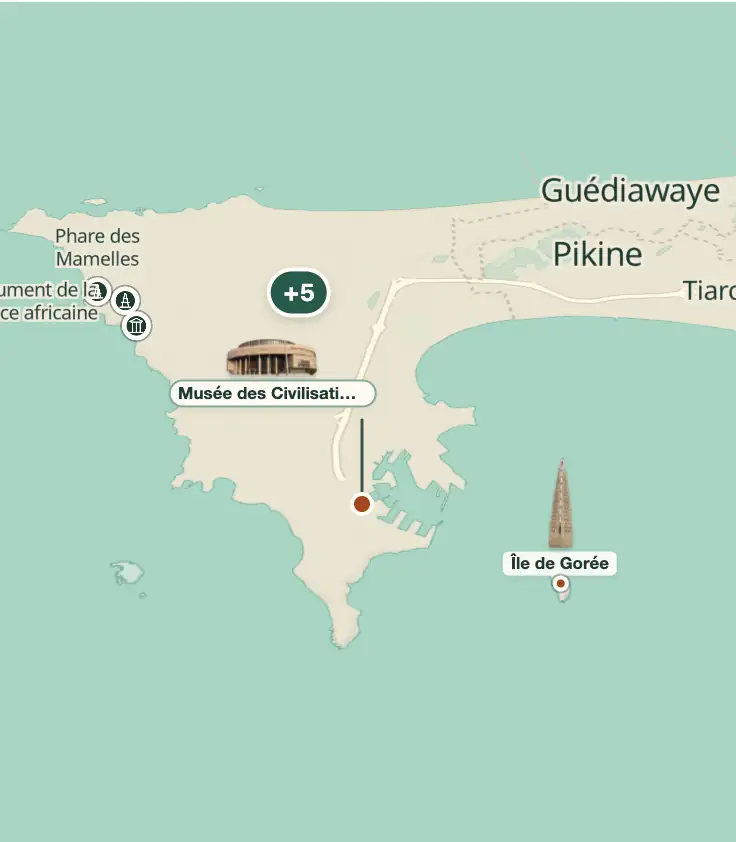
© OpenStreetMap · OpenFreeMap · © OpenMapTiles
Explore the map, read about the other places and plan your travel days in the app.
Open the appWhat to see
Dakar is worth it for Gorée island, music that starts after midnight, and street conversation, which opens with greetings in Wolof.
The colonial city settled on the Plateau, at the southeastern tip, sheltered from the wind by the body of the peninsula itself and facing the Bay of Hann and the port: hence the grid layout and the concentration of ministries, banks and embassies. Next to it lies the Medina, created in 1914 to relocate the African population outside the Plateau, which brings together the Grande Mosquée, Marché Tilène, dibiteries and workshops and is the city's densest and most walkable district.

Île de Gorée
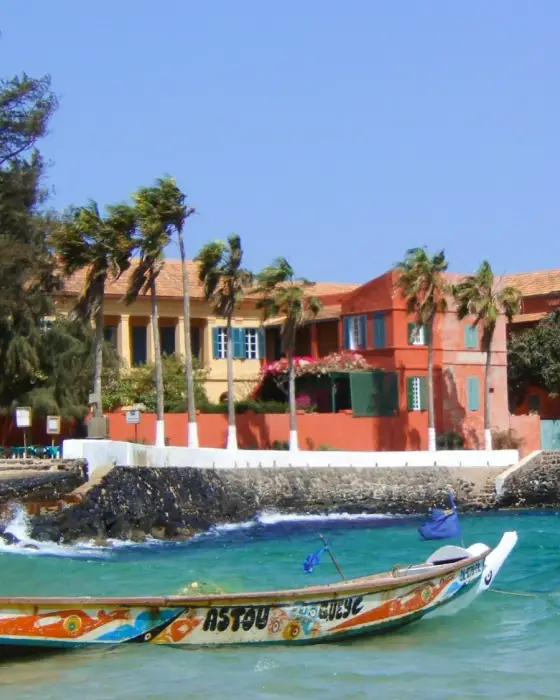
An island of about 28 hectares 3 km from the port, occupied by the Portuguese, the Dutch (1621), the English, and the French (1677), and listed as a UNESCO World Heritage Site in 1978. The Maison des Esclaves, a house from 1776 restored in the 1970s, is the symbolic center of the memory of the Atlantic slave trade. The ferry leaves from the Gorée terminal, inside the port, and takes about 20 minutes.
The Maison des Esclaves is the symbolic center of the memory of the Atlantic slave trade, and the ferry that leaves from inside the port takes about 20 minutes.
Check access
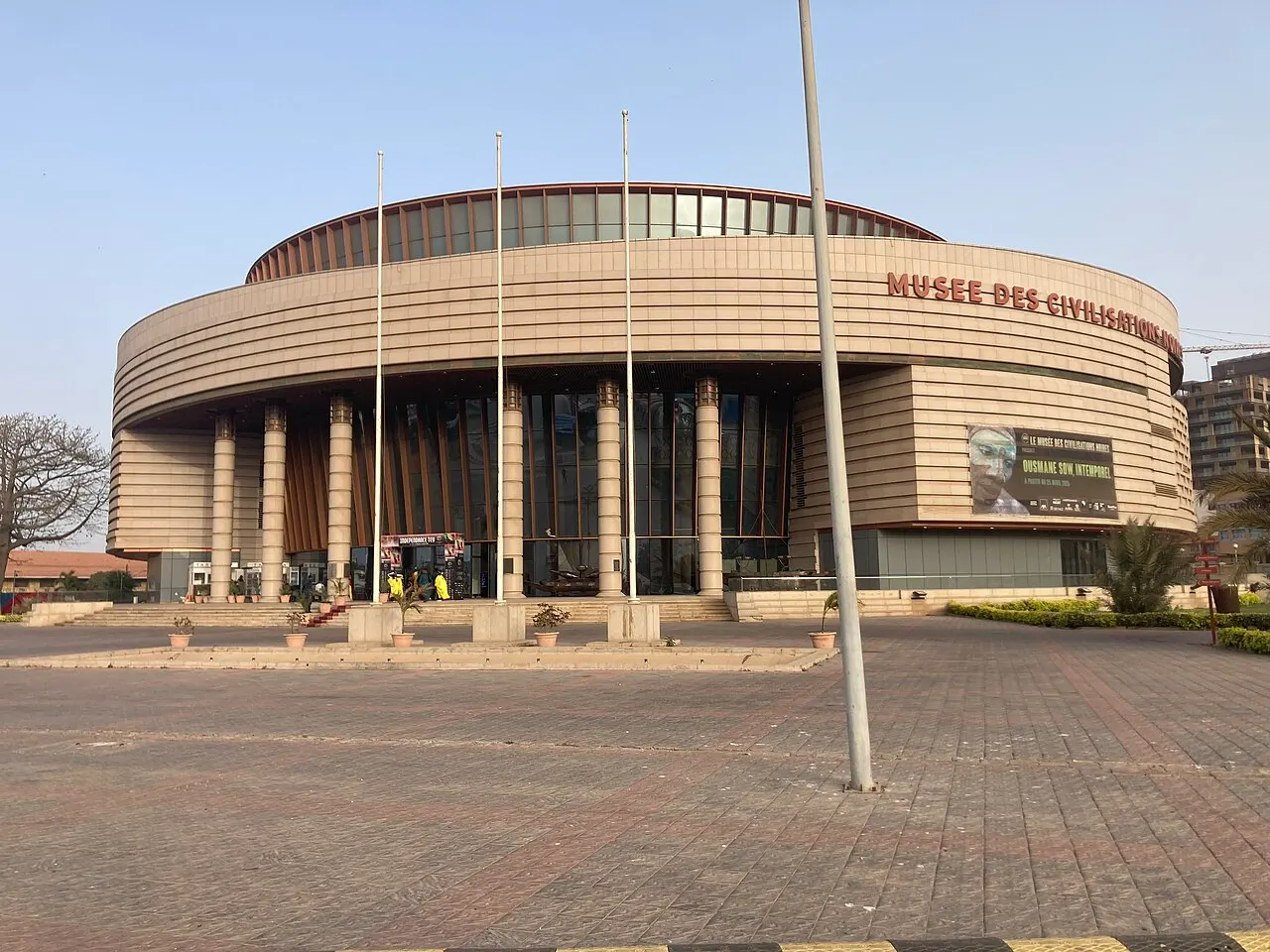
Musée des Civilisations noires
Opened in December 2018 next to Gare de Dakar, with about 14,000 m² and a circular plan inspired by the impluvium houses of Casamance. It was built with Chinese financing and an announced capacity of 18,000 pieces; it's now one of the stages for the debate over restitution of African collections.
The museum opened in 2018, next to the station, with a circular plan inspired by the impluvium house of Casamance and an announced capacity of 18,000 pieces, and it's one of the stages for the debate over the restitution of collections.
Check access

Phare des Mamelles
An 1864 lighthouse atop the city's highest cone, about 105 m up, still in operation. Access is a drive or walk up the slope, and the terrace works as a lookout bar in the late afternoon.
The 1864 lighthouse, still in operation, sits atop the city's highest cone, about 105 m, and the climb is worth it for the terrace, which works as a lookout bar in the late afternoon.
Check access
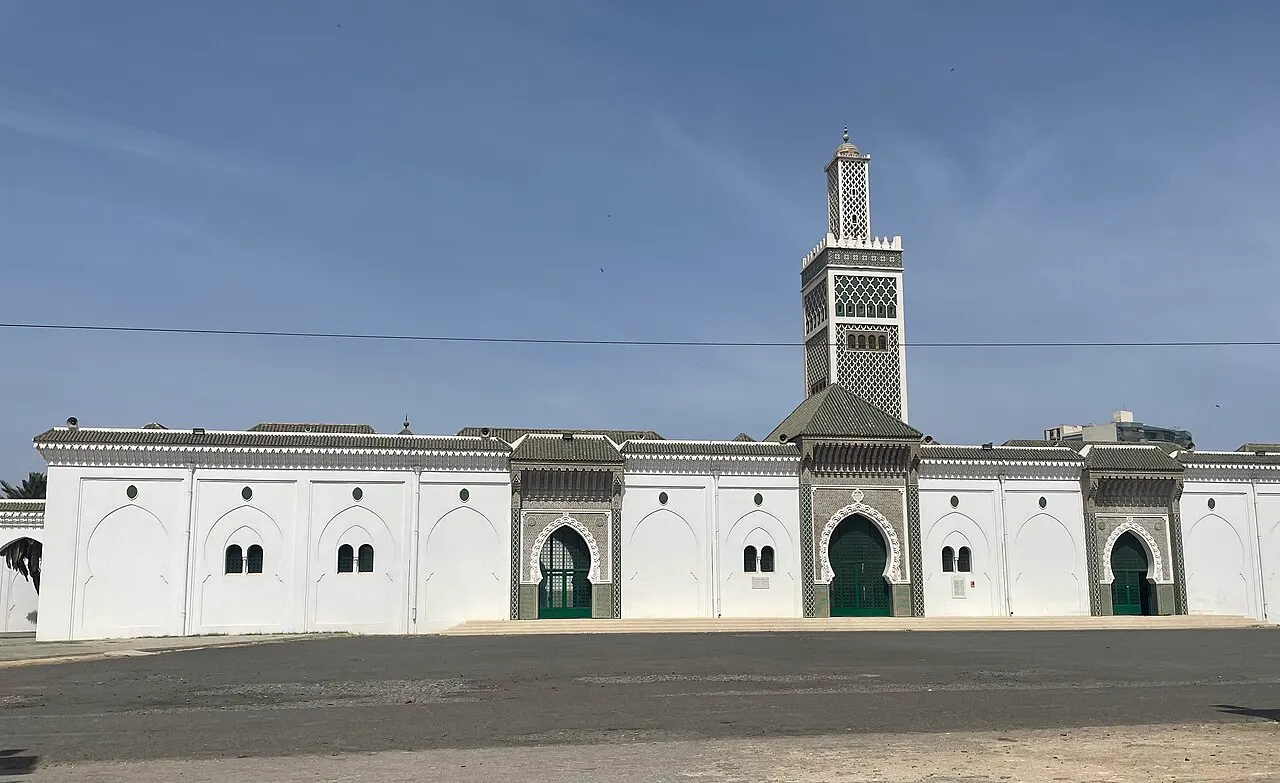
Grande Mosquée de Dakar
Opened on March 27, 1964 in the Medina, with Hassan II and Senghor in attendance, it has a minaret about 67 m tall and a Moroccan-inspired design. Non-Muslims don't enter the prayer hall, but the surroundings, Allées Papa Gueye Fall and Marché Tilène, are the neighborhood's functional heart.
Opened in 1964 with Hassan II and Senghor, it has a minaret about 67 m tall, and non-Muslims don't enter the prayer hall, but the surroundings work as the neighborhood's heart; the design is Moroccan-inspired.
Check access
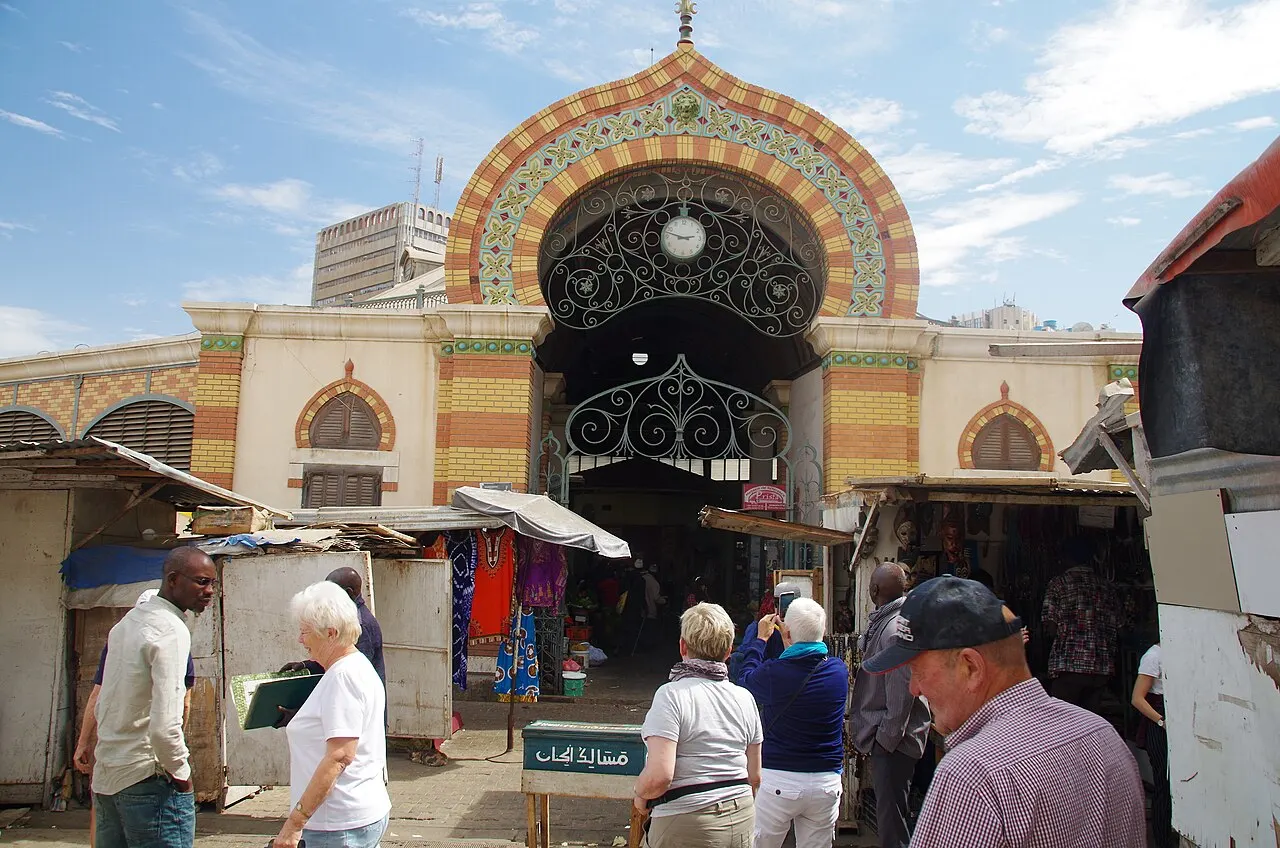
Marché Kermel
A covered market, circular in plan with a metal structure, in a building from 1910 rebuilt in 1997 after the 1994 fire. It sells fish, flowers, fruit and crafts, and mostly runs in the morning; the Plateau's oldest cafés sit around it.
Marché Kermel is the market to visit in the morning: fish, flowers, fruit and crafts under the circular metal structure, with the Plateau's oldest cafés around it. The building dates from 1910, caught fire in 1994 and was rebuilt in 1997.
Check access

Mosquée de la Divinité, Ouakam
A white mosque completed in 1997, wedged between the cliff and Ouakam beach, just below the Renaissance Monument. The cove is used by Lebu fishermen, and the access is a walk down the slope, with the most photographed contrast in the city.
The white mosque, completed in 1997, sits between the cliff and Ouakam beach, right below the Renaissance Monument. Walk down the slope to the fishermen's cove to see the city's most photographed contrast.
Check access

Place de l'Indépendance and Gare de Dakar
The colonial rectangle of the Plateau holds banks, ministries, and the former Chambre de Commerce; the 1914 railway station, restored in 2019, became the TER terminal. Across the avenue, the autonomous port handles most of Senegal's foreign trade.
The square is the center of the colonial Plateau, with banks, ministries and the old Chambre de Commerce, and next to it the 1914 station, restored in 2019, became the TER terminal. The whole area is best seen on foot in the morning, before the heat, on the way to Marché Kermel.
Check access
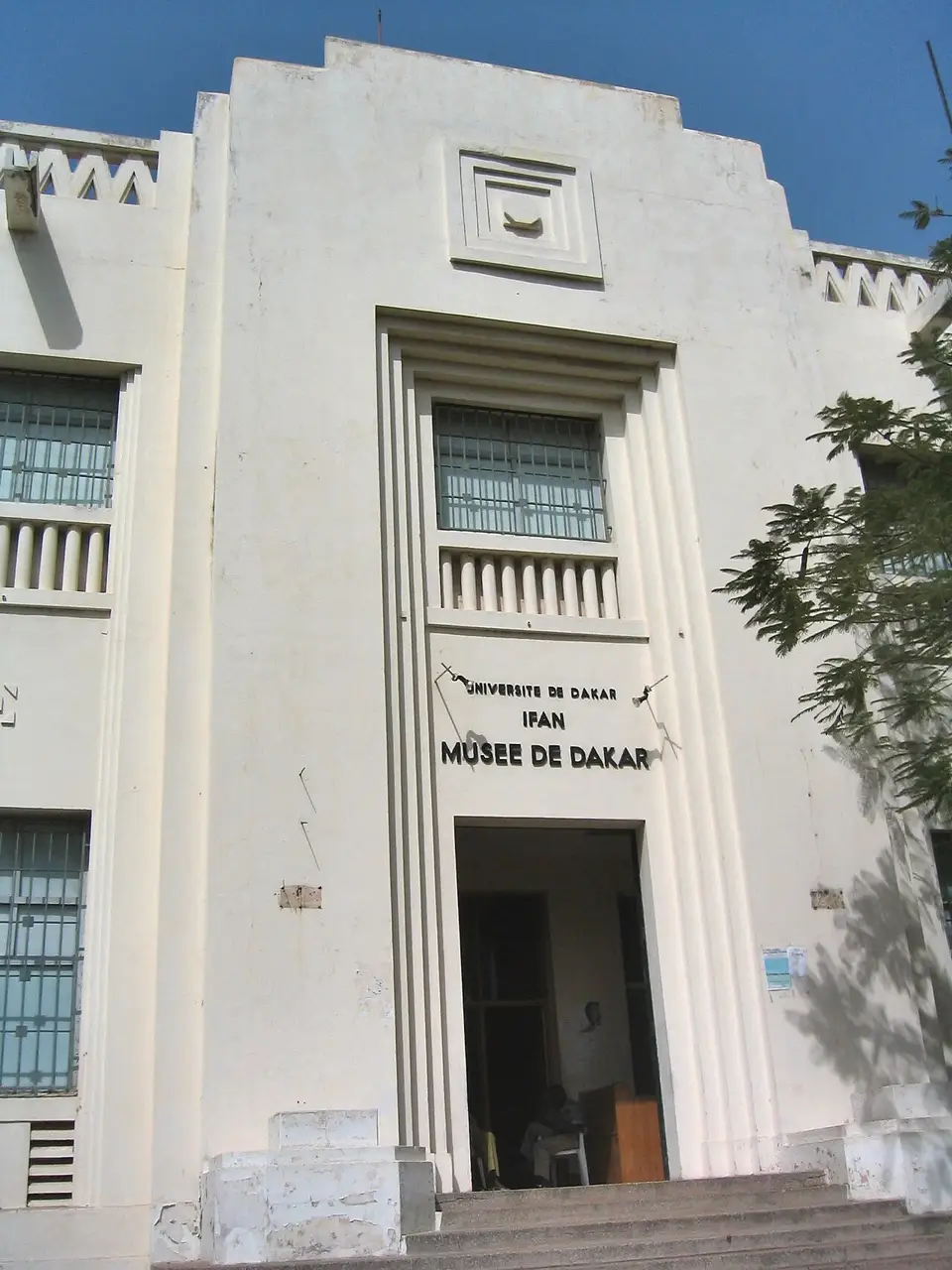
Musée Théodore Monod d'Art africain (IFAN)
Housed in a 1936 building on Place Soweto, it's one of the oldest ethnographic museums in West Africa. The Institut Fondamental d'Afrique Noire's collection gathers masks, statuary, and textiles from across the region, with a strong Dogon and Bassari holding.
The IFAN collection, with Dogon and Bassari pieces at the front, is serious, but the display follows the ethnographic model of the 1936 building and appeals mainly to those who already enjoy the region's traditional art. For a broad view of Black culture, the newer, more spacious Musée des Civilisations noires does that job better.
Check access

Monument de la Renaissance africaine
A 49 m bronze statue unveiled on April 4, 2010, atop one of the Mamelles hills, built by the North Korean firm Mansudae. It's been contested for its cost and iconography since its opening; there's an internal elevator up to the viewpoint in the head, with a view over the whole peninsula.
The 49 m bronze statue, unveiled in 2010, cost around US$27 million, was built by North Korea's Mansudae and has been contested over its price and iconography ever since. The paid elevator goes up to the head to see the peninsula, the same view the Mamelles hills give for free, outdoors.
Check access
Nilo’s itinerary
Start with the basic programme and choose extensions for the time you have.
Plan my days in the app ↗Day 1 · Plateau, memory, and the port
Start at 8am at Place de l'Indépendance, before the heat, and head down to Marché Kermel, the 1910 iron market, while the fish is still coming in.
Take the morning ferry to Île de Gorée and set aside three hours for the Maison des Esclaves, the Castel, and the history museum.
Have thiéboudienne for lunch on the island itself, or head back and eat at a gargote on Rue Mohamed V, around 2pm.
In the afternoon, visit the Musée des Civilisations noires, next to the Gare de Dakar: the 2018 building and its collection take 90 minutes.
Finish with a café Touba on the sidewalk, and if you want dinner, dibi in the Medina after 8pm.
Day 2 · The western tip of Africa
Climb the Mamelles in the morning to see the shape of the peninsula from above.
Walk up to the Phare des Mamelles, from 1864, then head down into Ouakam to see the Mosquée de la Divinité wedged into the cove under the cliff.
Have yassa for lunch in Ngor and cross by pirogue to Île de Ngor: ten minutes, with departures running all day.
Head back along the Corniche Ouest in the late afternoon, when the running and workout groups take over the waterfront.
Finish at Soumbédioune, at the fish market and the village artisanal, right when the pirogues come in.



If you stay longer
Day 3 · Medina, fabric, and music
Start with the 1964 Grande Mosquée and Marché Tilène, in the Medina, between 9 and 11am, when the market is full and the heat is still bearable.
Go to the HLM market to buy fabric by the meter, and if you still have two more days in the city, order a piece from a tailor: 24 to 48 hours is the standard turnaround.
Have mafé or ndambé for lunch at a gargote on Avenue Blaise Diagne.
In the afternoon, choose between the Musée Théodore Monod (IFAN), on Place Soweto, and the Village des Arts, where the studios welcome visitors.
Have dibi for dinner at a dibiterie in the Medina and end the night with live mbalax at the clubs in the Almadies, which rarely start before midnight.
Food
 AI illustration
Thiéboudienne (ceebu jën)
The national dish: rice cooked in fish and tomato broth, served with a fish steak stuffed with rof (parsley, garlic, and pepper) and vegetables such as cassava, cabbage, carrot, squash, and jaxatu. Listed on UNESCO's intangible heritage list in December 2021; eaten at lunch, between 1pm and 3pm, from a shared bowl.
 AI illustration
Yassa
Chicken or fish marinated in lemon and mustard and topped with plenty of slow-cooked onion, served with white rice. It comes from Casamance and now shows up in any gargote in Dakar, usually as the day's alternative to thiéboudienne.
 AI illustration
Mafé
A meat stew in peanut-paste sauce with vegetables, served over rice. It's the heaviest dish in the repertoire and tends to show up during the cooler months of the dry season.
 AI illustration
Dibi
Mutton grilled over coals and cut into pieces on the spot, served on paper with raw onion rings, mustard, and chili. Sold at dibiteries that open in the evening, mainly in the Medina and Grand Dakar; it's ordered by the kilo.
 AI illustration
Ndambé
Black-eyed peas cooked with palm oil and tomato, served inside half a baguette for breakfast, sometimes with egg or noodles inside. It costs a few hundred francs and is the standard street breakfast.
 AI illustration
Fataya, pastel, and accara
Fried snacks sold on a tray on the sidewalk: fataya (fish or meat turnover), pastel (with fish, served with kani chili sauce), and accara (black-eyed pea fritter eaten inside bread, with sauce). They show up in the late afternoon, when schools let out.
 AI illustration
Café Touba
Coffee roasted with djar, guinea pepper, brewed and served in a small cup from thermos flasks on the sidewalk. The name comes from Touba, the Mouride brotherhood's holy city; it costs around 200 to 300 F CFA and is sold from before dawn.
 AI illustration
Attaya, bissap, and bouye
Attaya is green tea with plenty of sugar and mint, served in three rounds, each sweeter than the last, over an hour or more: turning down the third one ends the conversation. Bissap (hibiscus) and bouye (baobab fruit) are cold juices sold in reused bottles or small bags.
Day trips
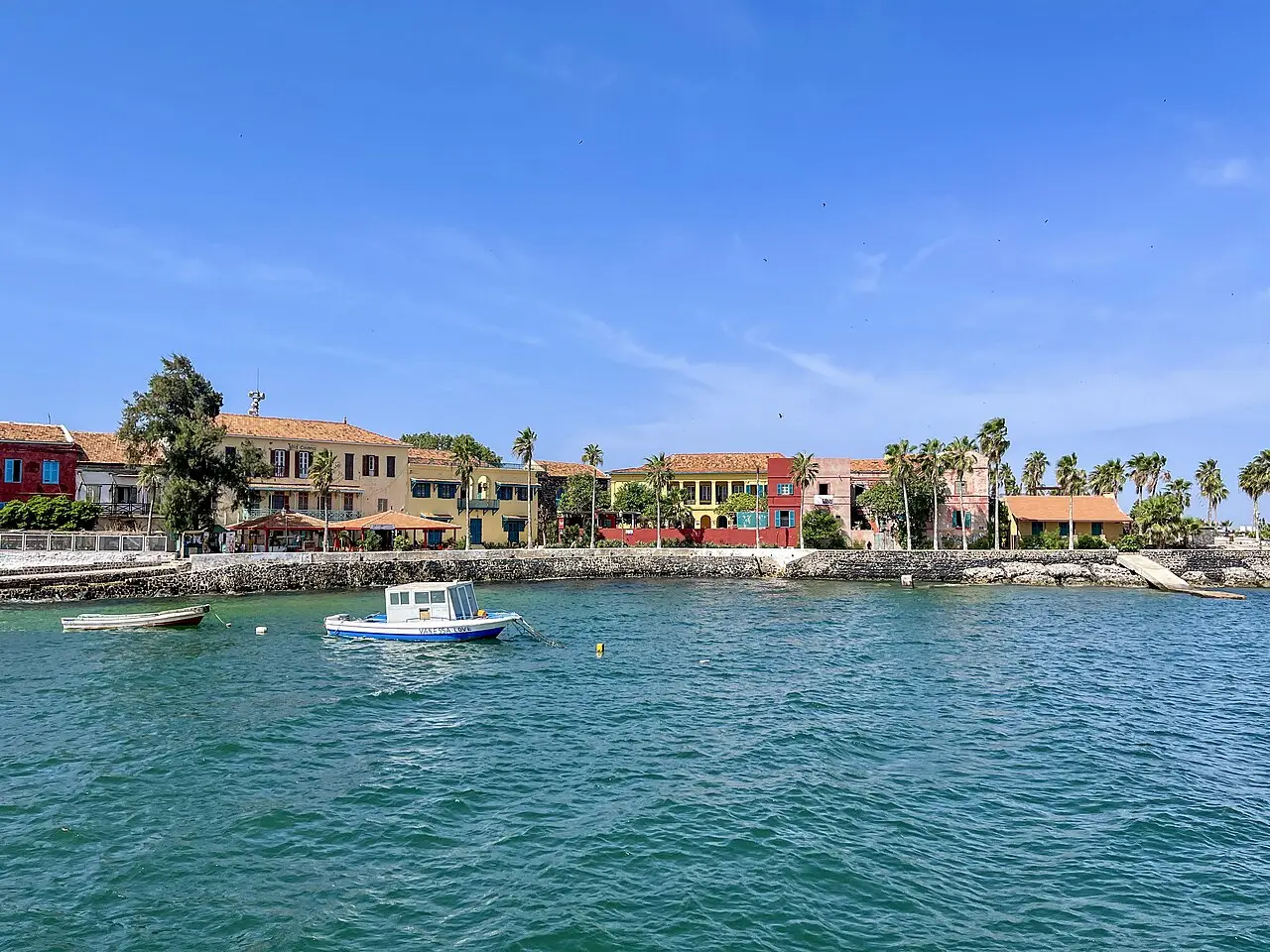
Île de Gorée
3 km from the port, a ferry of about 20 minutes with departures every one or two hours and a separate fare for foreigners (around 5,000 F CFA round-trip). Half a day is enough, but if you stay until late afternoon you see the island empty out and grow calmer as the tourist boats leave.

Lac Rose (Lac Retba)
About 35 km northeast, an hour's drive; a hypersaline lagoon where salt has been harvested by canoe since the 1970s and where the old Dakar Rally used to finish. The pink color depends on salt concentration and the alga Dunaliella salina and has faded since the 2022 floods. Check the current state before going if the color is the goal.

Réserve de Bandia and the Somone lagoon
Between 65 and 80 km south on the expressway, 1 hour 15 minutes to 1 hour 45 minutes by car; the fenced reserve, about 3,500 hectares, has reintroduced giraffes, rhinos, and antelopes, and the mangrove lagoon alongside it is toured by pirogue. You can combine both in one day if you leave early.
Where to begin
Plateau, memory, and the port
Start at 8am at Place de l'Indépendance, before the heat, and head down to Marché Kermel, the 1910 iron market, while the fish is still coming in.
The western tip of Africa
Climb the Mamelles in the morning to see the shape of the peninsula from above.
Medina, fabric, and music
Start with the 1964 Grande Mosquée and Marché Tilène, in the Medina, between 9 and 11am, when the market is full and the heat is still bearable.
Money
The currency is the West African CFA franc (XOF), pegged at 655.957 F to the euro, which makes conversion predictable and immune to daily swings. In 2026, café Touba on the street costs 200–300 F, a ndambé sandwich 500–1,000 F and a plate of thiéboudienne at a gargote 1,500–3,000 F. A meal at a mid-range restaurant runs 6,000–15,000 F, a Gazelle beer at a bar 1,500–2,500 F and a short taxi ride 1,500–2,500 F. For lodging, budget 15,000–30,000 F a night at a simple guesthouse and 35,000–80,000 F (about €55–120) at a mid-range hotel. Cash covers almost everything outside hotels, supermarkets and restaurants in the Almadies. ATMs work on the Plateau, in Point E and in the Almadies, with a common limit of 200,000 to 400,000 F per withdrawal and a fee charged per transaction. Mobile payment through Wave and Orange Money is everywhere, even at street stalls, but it requires a Senegalese number, which leaves visitors out of that layer. Tipping isn't mandatory: round up at restaurants and agree on the amount with guides beforehand. Ask for small bills too, because a 10,000 F note often can't be changed at a street stall.
Getting there and around
Airport, 43 kilometers from the Plateau, in Diass
Aéroport International Blaise Diagne (AIBD), opened in December 2017, is in Diass, about 43 km from the Plateau. The old Léopold Sédar Senghor airport, inside the city, no longer handles commercial flights. By car it's about 50 minutes on the toll highway off-peak and more than two hours at rush hour, so leave plenty of time on your departure day so you don't miss your flight. The official airport taxi to the Plateau costs between 20,000 and 30,000 F CFA (about €30–45). Dakar Dem Dikk runs a much cheaper shuttle bus, and the TER extension to the airport was under construction. Check whether it has started running before counting on it. Inside the terminal, turn down approaches from drivers and go to the taxi counter or call a ride-hailing app.
Getting around the city has four layers, from the 2024 electric BRT to taxis
Inside the city there are four layers, and it's worth knowing which is which. The electric BRT (Sunu BRT), in commercial service since May 2024, covers 18.3 km on a segregated corridor between Guédiawaye and Petersen, in the Plateau, with about 23 stations. The fare is 400 F CFA within a single zone and up to 500 F between zones, paid with a rechargeable card, not cash. The TER links Gare de Dakar to Diamniadio in around 45 minutes, with tickets running roughly 500 to 1,500 F CFA depending on class. Dakar Dem Dikk buses and AFTU's white “Tata” minibuses cost 150 to 300 F CFA and require knowing the route by heart. The old blue-and-yellow “cars rapides” have almost all been pulled from service over the last decade. Yellow-and-black taxis don't use meters: the price is agreed before you get in, typically 1,500 to 3,000 F CFA within the peninsula and more out to Almadies. The Yango and Heetch apps work well and remove the negotiation entirely. Walking gets you around in the Plateau and the Medina; outside them, sidewalks disappear and distances grow.
Safety
Dakar is a capital where crime is mostly against property, with little armed violence. The concrete, frequent risk is phone snatching, by pairs on motorbikes or on foot, and it has an address and a time: the Corniche Ouest at dusk, outside the bars in the Almadies, Petersen, Colobane and Place de l'Indépendance after 9pm. Walk with your phone put away and no open bag and you've already removed most of the problem. Deserted beaches after dark, including stretches of Yoff and Ngor, are the most common setting for muggings. By day the same beaches are a harbor, market and soccer field all at once. Scams come in three repeating forms: the “guide” who introduces himself as the ferry arrives at Gorée and at the end charges an amount never agreed on; street money changing with a miscount; and requests for donations to an association, with a printed receipt and no address. Talibés, children sent to Quranic schools, beg on the street, and the standard advice from local NGOs is to donate to institutions rather than to each child. The most underestimated danger is traffic: motorbikes, buses and minibuses don't stop for pedestrians, and crossing means waiting for a real gap, not trusting a gesture. There's no recent history of attacks in the city, and Senegal is one of the most stable countries in the region. Political demonstrations, when they happen, are concentrated on the Plateau and around the university, and the rule is to go around them, not watch. A yellow fever vaccination certificate is required for entry; malaria is present in the country, with low risk in Dakar and higher risk inland and during the hivernage. On visas: Senegal's entry rules have recently been revised, with an announced prior electronic authorization based on reciprocity. Check the requirement for your passport with the consulate before buying your ticket.
Etiquette tips
Greet before anything else
“Salaam aleekum” followed by “nanga def?” opens any interaction: shop, taxi, government office, front desk. Asking the price straight off, without greeting, reads as cutting someone off mid-sentence.
Right hand for everything
Eating, handing over and receiving money, shaking hands, passing an object: use the right hand. The left is reserved for hygiene, and the gesture gets noticed.
At the shared bowl, eat your triangle
Each person eats the slice of rice in front of them, without reaching toward the middle; the host pushes pieces of fish and vegetable toward your side. Turning down what's pushed your way is ruder than eating slowly.
Take off your shoes and stay through the third round
When entering a home, leave your shoes at the door. If they've served the first round of attaya, leaving before the third ends the visit too early.
Ask before photographing
In markets, fishing beaches, and the Medina, photographing without asking creates real, immediate friction. In Gorée and at religious sites, ask about permission and any fee as well.
Dress and Friday
Shoulders and knees covered are the norm outside the beaches and Almadies; in the Medina, even more so. On Friday afternoon many people wear a grand boubou and traffic stops at prayer time. Do not book anything between 1pm and 3pm.
Mistakes to avoid

No meters: agree on the fare before you get in
Getting into a taxi without agreeing on the price. There's no meter in use: the fare is settled before you sit down, or you call a Yango/Heetch, which already shows the price on screen and settles the matter.
The stall doesn't break a 10,000 note
Showing up without change. Many stalls have no change for a 10,000 F CFA note; break large bills at the supermarket and carry 500, 1,000, and 2,000 F notes.
Underestimating the time to the airport
Planning the return flight assuming half an hour to the airport. The AIBD sits about 43 km from the Plateau, and the trip runs anywhere from 50 minutes to over two hours depending on traffic and the time of day.
A packed schedule in August
Packing the schedule in August. It's the peak of the hivernage: heavy rains flood streets in the banlieue, traffic jams for hours, and boat trips to Gorée and the Îles de la Madeleine can be canceled depending on sea conditions.
Treating Wolof as a secondary dialect
Treating Wolof as a secondary dialect. French gets you through at counters, hotels, and offices, but the negotiation, the joke, and the real price happen in Wolof: five words change the tone of any conversation, on any corner.
Useful phrases
Salaam aleekum
“Peace be upon you”: the entry greeting anywhere. The reply is “Maleekum salaam”.
Nanga def?
“How are you?” (nan-ga DEF). The standard reply is “Maangi fi rekk” (MAAN-gui fi REK), “I'm here, that's all”.
Jërëjëf
“Thank you” (jerre-JEF). The usual reply is “Ñoo ko bokk” (nyo ko BOK), “it's ours”.
Ñaata la?
“How much is it?” (NYA-ta la). To ask for a discount: “Wañi ko” (WA-nyi ko), “lower it”.
Waaw / Déedéet
“Yes” (wow) and “no” (deh-deh-ET). “Baax na” (BAAKH na) means “it's good, deal's set”.
Ba beneen yoon
“Until next time” (ba be-NEN yon), the standard goodbye on the street and at the counter.
Districts
Plateau
The southeastern tip, laid out on a grid since the 19th century: ministries, banks, Place de l'Indépendance, the 1936 cathedral, Marché Kermel, and the autonomous port. It empties out at night and on weekends, when the offices close.
Medina
Created in 1914 to relocate the African population outside the Plateau, with numbered rather than named streets. It holds the Grande Mosquée, Marché Tilène, dibiteries, and workshops; it's the densest and most walkable district in the city.
Fann, Point E, and Mermoz
Central residential band around Cheikh Anta Diop University, founded in 1957 and home to tens of thousands of students. Point E gathers restaurants, bars, and NGO offices; Fann Résidence has embassies, clinics, and 1960s houses.
Almadies and Ngor
The western tip: hotels, expensive restaurants, live-music venues, and most of the nightlife, which doesn't start until after midnight. Ngor keeps a fishing village and the island offshore, reached by pirogue in ten minutes, home to Dakar's best-known surf spot.
Ouakam and Mamelles
A former Lebu village turned middle-class neighborhood, wedged between the military base and the cliff. It holds the Renaissance Monument, the 1864 lighthouse, and the Mosquée de la Divinité, built in the cove below the cliff.
Yoff
A fishing neighborhood on the northern coast and seat of the Layene brotherhood, with the mausoleum of Seydina Limamou Laye by the sea. Colorful pirogues share the sand with amateur soccer teams in the late afternoon.
Colobane, Grand Dakar, and HLM
A belt of markets and workshops between the Medina and the outskirts: Colobane for secondhand clothes, HLM for fabric sold by the meter and tailors who deliver a made-to-measure piece in 24 to 48 hours.
Pikine and Guédiawaye
The banlieue east of the peninsula, with Pikine and Guédiawaye among the capital's most populous neighborhoods. They're the city's demographic and musical engine (the Arène Nationale wrestling arena is in Pikine) and also the area hit hardest by hivernage flooding.
History
15th–17th c. · The Lebu and the anchorage
Lebu fishermen and farmers settle the Cap-Vert peninsula and call the place Ndakaaru. In 1444 the Portuguese navigator Dinis Dias rounds the point, and the island offshore becomes an anchorage on the Atlantic route.
1621–1677 · Gorée changes flags
The Dutch fortify the island and name it Goede Reede, “good anchorage”; after English incursions, France takes it in 1677. Gorée will be a trading post and stronghold for nearly two centuries.
1790 · The Lebu republic
The Lebu break with the damel of Cayor and set up an autonomous republic based in Ndakaaru, headed by a serigne. Lebu collective land ownership still weighs on land disputes in today's city.
1857 · Protet founds the post
In May, French officer Auguste Protet sets up the Dakar post in the sheltered bay east of the peninsula. The choice is nautical: deep water and shelter from the trade winds.
1885 · The railway and the peanut
The Dakar–Saint-Louis railway enters service and links the peanut-growing interior to the port. The trade axis shifts, and Dakar overtakes Gorée and Rufisque.
1902 · Capital of French West Africa
The AOF's general government moves from Saint-Louis to Dakar, which now administers eight territories. The Plateau gains ministries, barracks, and the grid layout it still keeps today.
1914 · The plague, the Medina, and Blaise Diagne
A bubonic plague epidemic serves as justification to relocate the African population north of the Plateau, creating the Medina with its numbered streets. That same year Blaise Diagne becomes the first African elected deputy in France.

1940–1944 · The bombardment and Thiaroye
Between September 23 and 25, 1940, British and Free French forces bomb Dakar without managing to take it from Vichy hands. On December 1, 1944, French troops kill dozens of Senegalese tirailleurs at the Thiaroye camp who were demanding back pay.
1960 · Independence and Senghor
The agreement of April 4, 1960 grants Senegal independence within the Mali Federation, and on August 20 of that same year the country leaves the federation and becomes a sovereign state. Léopold Sédar Senghor, poet of Négritude and a Catholic leading a Muslim-majority country, governs until resigning in 1980.
1966 · First World Festival of Black Arts
In April, Dakar brings together artists and intellectuals from across the Black world, including Duke Ellington, Aimé Césaire, and Josephine Baker. The event establishes the city as the continent's cultural stage.
2017–2026 · Infrastructure and the Youth Olympics
Blaise Diagne Airport (2017), the Museum of Black Civilizations (2018), the TER (2021), and the electric BRT (2024) reorganize mobility and reinforce the eastern axis toward Diamniadio. Between October 31 and November 13, 2026, the city hosts the Youth Olympic Games, the first Olympic competition held in Africa.
 AI illustration
Complete history
Lebu fishermen before any flag
The Cap-Vert peninsula was settled by Lebu fishermen and farmers who came from the north between the 15th and 17th centuries and called the place Ndakaaru. The Portuguese rounded the point in 1444 with Dinis Dias and used the island opposite as an anchorage; it passed to the Dutch in 1621, who called it Goede Reede, and to France in 1677. For almost two centuries, it was Gorée that mattered to Europeans: the island was a stronghold, trading post and embarkation point in the Atlantic trade, while the coast opposite remained a string of Lebu villages. In 1790 the Lebu broke with the damel of Cayor and set up an autonomous theocratic republic based in Ndakaaru. That legal and land-ownership precedent was later negotiated, bought out and sidestepped by the colonial city, and it still turns up in land disputes.
The French flag in 1857
In May 1857, officer Auguste Protet raised the French flag over the village and founded the Dakar post, in the sheltered bay east of the peninsula. What turned the post into a city was the railway: the Dakar–Saint-Louis line, opened in 1885, combined with a deep-water port, made Dakar the natural outlet for the peanuts grown inland. In 1902 the capital of French West Africa was moved from Saint-Louis to Dakar, bringing with it the general government, barracks, banks, and the Plateau's orthogonal layout. In 1914 a bubonic plague epidemic served as a sanitary justification to separate the African population from the European quarter: the Medina was born, to the north, with numbered streets and none of the services on the other side of the avenue.
1914: the first African elected deputy
In 1914, Blaise Diagne became the first African elected to the French parliament, backed by the “originaires” of the four communes (Saint-Louis, Gorée, Rufisque and Dakar), who held French citizenship while the rest of the colony lived under the code de l'indigénat. World War II left two marks on the city: between September 23 and 25, 1940, the British fleet and Free French forces bombarded Dakar without taking it from Vichy; and on December 1, 1944, at the Thiaroye camp, French troops killed dozens of Senegalese tirailleurs who were demanding back pay. Thiaroye ran through Senegalese literature, film and politics for eight decades, and in 2024 the massacre was officially acknowledged by France.
Independence in 1960 and the Mali Federation
Senegal negotiated independence with France within the Mali Federation, alongside present-day Mali, in the agreement of April 4, 1960, a date that is today the national holiday. The federation lasted only a few months: on August 20, 1960, Senegal left it and became its own sovereign state, and Léopold Sédar Senghor governed until resigning in 1980, a rare case of voluntary departure in the region. In April 1966, Dakar hosted the First World Festival of Black Arts and established itself as the continent's cultural stage. Hard years followed: the Sahel droughts of the 1970s emptied the countryside and pushed people toward the capital; the structural adjustment plans of the 1980s cut public-sector jobs; and the 50% devaluation of the CFA franc, in January 1994, cut the purchasing power of an entire generation. The region's population jumped from around 400,000 in 1960 to over 4 million, pushing the city out of the peninsula, toward Pikine, Guédiawaye and Keur Massar.
Peaceful transfer of power three times since 2000
Senegalese politics has notched three peaceful transfers of power: Abdoulaye Wade in 2000, Macky Sall in 2012, and Bassirou Diomaye Faye in March 2024, elected ten days after leaving prison, with Ousmane Sonko as prime minister. The state has poured infrastructure into the capital over the past ten years: Blaise Diagne Airport in Diass (2017), the Museum of Black Civilizations (2018), the TER to Diamniadio (2021), the electric BRT (2024), and the administrative city of Diamniadio, about 30 km from the Plateau. At the same time, oil production at Sangomar and gas production at the Grand Tortue field, begun in 2024, and the upward revision of public debt in 2024–2025 dominate the economic debate. In 2026, Dakar hosts the Youth Olympic Games: the first Olympic event held on the continent. The city grew eastward because there was no other direction, and today it makes the reverse trip every day: the colonial Plateau still concentrates formal employment while most residents live on the outskirts.
The peninsula had nowhere to grow, so the city grew eastward. Whoever lives there goes back to downtown every day to work.
Geography and shape of the city
The volcanic peninsula and the Mamelles
Dakar occupies the Cap-Vert peninsula, a volcanic spur pointing west into the Atlantic and ending at Pointe des Almadies, the westernmost point of continental Africa. The relief is low, with two basalt cones (the Mamelles) reaching about 105 m and holding the 1864 lighthouse and the African Renaissance Monument; between them and the sea runs the Corniche Ouest cliff.
The Plateau, the bottleneck, and the three axes
The colonial city settled on the Plateau, at the southeastern tip, sheltered from the wind by the body of the peninsula itself and facing the Bay of Hann and the port: hence the grid layout and the concentration of ministries, banks and embassies. Since there's only one direction to grow, everything that came after 1950 was pushed east, through the narrow neck of the peninsula, creating one of the most rigid traffic patterns on the continent: practically the whole region moves along three axes, the VDN, the toll highway and the Route de Rufisque.
The Niayes sands and the rain
The sandy depressions of the Niayes, to the north, used to drain the rain and were settled for housing starting in the 1970s, which explains the recurring floods in Pikine, Guédiawaye, and Keur Massar between July and October. The climate is Sahelian, tempered by the cold Canary Current and the trade winds: temperatures rarely top 32 °C, and rain concentrates in a little over three months.
Culture
Mbalax started here
The city produces and exports music. Mbalax, which crosses the sabar drum with guitar, bass, and horns, became the national sound through Youssou N'Dour, who came up out of the Medina, formed Étoile de Dakar in the 1970s, and still runs the Thiossane club and a media group. Before him, Orchestra Baobab played Cuban son with Wolof lyrics; alongside them, Doudou N'Diaye Rose organized sabar percussion into orchestra form and trained entire generations before dying in 2015. Since the 1990s, rap has been the city's second voice (Positive Black Soul, Daara J, Keur Gui) and that scene produced the Y'en a marre civic movement in 2011, which weighed on the 2012 elections. Shows start late: rarely before midnight, often not until after two in the morning.
Dak'Art and the African circuit
Dak'Art, the contemporary African art biennial created in 1990, is the continent's leading art circuit, and it spreads an “off” program of hundreds of exhibitions across houses, garages, and galleries for weeks. Village des Arts holds studios open to visitors, and international residencies in the city have multiplied since 2019. In film, the lineage runs deep: Ousmane Sembène opened modern African cinema with “Borom Sarret” (1963) and “Xala” (1975); Djibril Diop Mambéty shot “Touki Bouki” (1973) on the same streets; his niece Mati Diop won the Grand Prix at Cannes with “Atlantics” (2019) and the Golden Bear with “Dahomey” (2024). In literature, the line runs from Senghor and Cheikh Hamidou Kane to Mariama Bâ, Aminata Sow Fall, and Mohamed Mbougar Sarr, the 2021 Prix Goncourt winner.
The brotherhoods organize the practice
About 95% of Senegalese are Muslim, and practice is organized by Sufi brotherhoods rather than a state clergy: Mourides (Touba, founded by Cheikh Amadou Bamba), Tijanis (Tivaouane and Kaolack), Layenes (based in Yoff, within Dakar), and Qadiris. It shows on the street: portraits of Bamba painted on buses and shop doors, business names, the city emptying out during the Magal. The Catholic minority, around 4%, gave the country its first president and keeps up the Popenguine pilgrimage at Pentecost. In sports, wrestling with strikes (laamb) outdraws soccer at the gate and fills the Arène Nationale in Pikine: bouts of a few minutes preceded by months of ritual preparation. Soccer's recent landmark is the Africa Cup of Nations Senegal won in February 2022.
Mbalax shows in Dakar start after midnight, when much of the city has already gone to bed.
Festivals and events

Dak'Art: Contemporary African Art Biennial
It takes place in even-numbered years, based in the old Palais de Justice, with an “off” program that takes over the whole city for weeks. Dates change from edition to edition, and the 2026 edition, the 16th, is set for November 19 to December 19.

Tabaski (Eid al-Adha)
The biggest celebration in the Senegalese calendar: every family buys and sacrifices a ram, vacant lots turn into livestock markets for weeks and the city practically stops for two or three days. The date follows the lunar calendar: in 2026 it fell at the end of May, and in 2027 it should fall around May 16.
 AI illustration
Grand Magal de Touba
A Mouride pilgrimage to Touba, about 190 km away, on the 18th of the month of Safar, which in 2026 falls in early August and shifts about 11 days earlier each year. Dakar empties out, roads to the interior clog up, and much of trade shuts down.
 AI illustration
Appel des Layènes, in Yoff
The Layene brotherhood's annual ceremony around the mausoleum of Seydina Limamou Laye, on the Yoff shore, with processions in white along the beach. A moveable date on the Islamic calendar; it's the largest religious gathering within the city limits.
 AI illustration
Dakar 2026 Youth Olympic Games
From October 31 to November 13, 2026, with venues in Dakar, Diamniadio, and Saly: the first Olympic competition held on African soil. Expect full hotels, higher prices, and traffic restrictions in the Plateau and along the Corniche.
Books and films
“Atlantics”, by Mati Diop (2019)
Filmed in Dakar's suburbs, it starts from a tower under construction on the Corniche to talk about unpaid wages and the boat crossing to Europe. Grand Prix winner in Cannes; it explains the contemporary city better than any tour guide.
“So Long a Letter”, by Mariama Bâ (1979)
An epistolary novel written in Dakar about polygamy, widowhood, and the newly independent Senegalese middle class. It's the way in to the family rules that organize life in the city.
“Set”, by Youssou N'Dour and Super Étoile de Dakar (1990)
The album that set modern mbalax (sped-up sabar, high voice, Wolof lyrics) and whose title gave its name to the “set setal” movement of cleaning and painting the neighborhoods. It's the real soundtrack of the streets.
Frequently asked questions
Dakar: What bills should you carry to pay at stalls?
Many stalls have no change for a 10,000 F CFA note; break your big bills at the supermarket and carry 500, 1,000 and 2,000 F notes.
Dakar: Where is the airport, and how long does it take to reach downtown?
Flights arrive at Aéroport International Blaise Diagne (AIBD), in Diass, about 43 km from the Plateau: that's about 50 minutes by car off-peak and over two hours at rush hour. The old Léopold Sédar Senghor airport, inside the city, no longer handles commercial flights.
Dakar: Île de Gorée?
3 km from the port, a ferry of about 20 minutes with departures every one or two hours and a separate fare for foreigners (around 5,000 F CFA round-trip).
Dakar: What's the currency, and how do you convert it?
The currency is the West African CFA franc (XOF), pegged at 655.957 F to the euro, which makes conversion predictable and immune to daily swings.
Dakar: What's the best time to visit?
The dry season runs from November to May and is high season: 18 to 27 °C, low humidity, steady trade winds and practically no rain. December to February are the coolest months, and at night the 17 °C on the Corniche calls for a light jacket. Between February and May the harmattan can bring dust from the Sahara and cut visibility for days at a time.