Morocco
Casablanca
Hassan II Mosque, art deco, the medina and the Corniche
Days Start with the basic programme and choose extensions for the time you have.
How the guide reaches this number
If you're after a medieval maze, you'll be disappointed, because the medina here dates from the late 18th century, is small, and has straight streets. The sea disappoints at first sight too, because it's hidden behind the port. Aïn Diab beach begins 5 km west of the center, at the end of the T2 tram line. Give the city two days, the second for the Corniche and Anfa, and three if you want the Quartier Habous, the museums, and an evening in Gauthier. With just one day, take the Hassan II Mosque guided tour at 9am and continue on foot through the Sqala and the medina to Place des Nations Unies. Have fish for lunch at the Marché Central and then walk Boulevard Mohammed V looking at the art deco facades. End the day at Place Mohammed V, when the five neo-Moorish buildings light up and the fountain plays to music.
2–3
When April-June and September-October
How the guide reaches this number
The climate is Mediterranean with an ocean influence, much milder than Morocco's interior, and anyone expecting desert heat will need a jacket. In summer, from June to September, highs range from 25 to 28 °C, with thick sea fog that on many mornings only lifts around 11am. The sea stays between 18 and 21 °C and is cold for a long swim. In winter, from December to February, temperatures range between 8 and 18 °C, with rain concentrated between November and March (about 400 mm a year) and rarely more than three days of rain in a row. Heating is rare in hotels and apartments, so indoors feels colder than the thermometer says. The best windows are April–June and September–October: 20 to 26 °C, little rain and clear light. August is the busiest month, with Moroccans on vacation packing the Corniche and higher lodging prices. Ramadan, expected from February 8 to March 9, 2027, changes the whole routine: restaurants closed during the day, reduced business hours, streets full after sunset. Traveling then is perfectly doable, as long as you plan your lunches and accept slow mornings.
Per person/day 350-600 MAD budget; 800-1,400 MAD comfortable; 2,500 MAD+ with a luxury hotel (2026)
How the guide reaches this number
Per person per day: accommodation, meals, urban transport, visits and a small allowance for extras. Flights excluded; larger purchases vary. Editorial estimate, not a quote.
 What Nilo thinks
Come for 20th-century Morocco, made of art deco, the port, rap, soccer, and migration from the countryside. If you're after a medieval maze, you'll be disappointed, because the medina here dates from the late 18th century, is small, and has straight streets. The sea disappoints at first sight too, because it's hidden behind the port. Aïn Diab beach begins 5 km west of the center, at the end of the T2 tram line. Give the city two days, the second for the Corniche and Anfa, and three if you want the Quartier Habous, the museums, and an evening in Gauthier. With just one day, take the Hassan II Mosque guided tour at 9am and continue on foot through the Sqala and the medina to Place des Nations Unies. Have fish for lunch at the Marché Central and then walk Boulevard Mohammed V looking at the art deco facades. End the day at Place Mohammed V, when the five neo-Moorish buildings light up and the fountain plays to music.On a platform jutting into the Atlantic, the Hassan II Mosque raises a 210 m minaret, and the guided tour goes into the prayer hall and the underground hammam. Behind it lies Morocco's economic capital, with the country's largest port, where the French protectorate built Africa's densest art deco center. Walk along Boulevard Mohammed V with your eyes up, because the curved balconies and reliefs start above the shop windows. At the Marché Central, pick your sardines and have them grilled next door, then order a nous-nous on a terrace, your chair turned to the street. Come between April and June or in September and October, and give the city two days, or three for the Quartier Habous and the museums.
Quick facts
- Population
- about 3.24 million in the municipality; about 4.8 million in the urban area; 7.69 million in the Casablanca-Settat region (2024 census)
- Founded
- Anfa, a Berber port active since at least the 8th c.; Portuguese fort Casa Branca in 1515; refounded as Dar el-Beida around 1770
- Country and region
- Morocco · Casablanca-Settat region · Casablanca prefecture
- Language
- Darija (Moroccan Arabic) in the street; Standard Arabic and Tamazight official since 2011; French in business and on signs; English rising among young people
- Currency
- Moroccan dirham (MAD, درهم), a closed currency; about 10.5-11 MAD per euro and about 9-10 per dollar (2026)
- Time zone
- UTC+1 year-round since 2018; back to UTC+0 during Ramadan (approx. Feb 8 to Mar 9 in 2027)
- Best time to visit
- April-June and September-October
- Average daily cost
- 350-600 MAD budget; 800-1,400 MAD comfortable; 2,500 MAD+ with a luxury hotel (2026)
When to go
April-June and September-October
January
9° to 18°C
62 mm of rain
February
10° to 18°C
50 mm of rain
March
12° to 20°C
43 mm of rain
May
16° to 23°C
14 mm of rain
July
21° to 26°C
1 mm of rain
August
21° to 27°C
0 mm of rain
November
13° to 21°C
84 mm of rain
December
11° to 19°C
62 mm of rain
How the year changes
The climate is Mediterranean with an ocean influence, much milder than Morocco's interior, and anyone expecting desert heat will need a jacket. In summer, from June to September, highs range from 25 to 28 °C, with thick sea fog that on many mornings only lifts around 11am. The sea stays between 18 and 21 °C and is cold for a long swim. In winter, from December to February, temperatures range between 8 and 18 °C, with rain concentrated between November and March (about 400 mm a year) and rarely more than three days of rain in a row. Heating is rare in hotels and apartments, so indoors feels colder than the thermometer says. The best windows are April–June and September–October: 20 to 26 °C, little rain and clear light. August is the busiest month, with Moroccans on vacation packing the Corniche and higher lodging prices. Ramadan, expected from February 8 to March 9, 2027, changes the whole routine: restaurants closed during the day, reduced business hours, streets full after sunset. Traveling then is perfectly doable, as long as you plan your lunches and accept slow mornings.
The same numbers as a table
| Month | Temperature °C | Rain mm |
|---|---|---|
| January | 9 to 18 | 62 |
| February | 10 to 18 | 50 |
| March | 12 to 20 | 43 |
| April · | 13 to 21 | 34 |
| May | 16 to 23 | 14 |
| June · | 19 to 25 | 3 |
| July | 21 to 26 | 1 |
| August | 21 to 27 | 0 |
| September · | 20 to 26 | 12 |
| October · | 17 to 24 | 45 |
| November | 13 to 21 | 84 |
| December | 11 to 19 | 62 |
Nilo's tips
From the airport, take the train: it runs 6am to 10pm
Mohammed V airport has its own station, under the terminal, and the train costs about six times less than the taxi. The Al Bidaoui line runs to Casa Voyageurs for about 45 MAD in 2nd class, with departures almost every hour between 6am and 10pm. The official taxi costs about 300 MAD by day and more at night. After 10pm, agree on the taxi fare before getting in or call inDrive, Careem, Roby, Heetch, or Yassir.
Street breakfast before 10am, dinner after 9pm
Morning street dishes end early, and Casablancans eat dinner late. Sfenj (2–4 MAD) disappears from the stalls around 11am and bissara (5–12 MAD) before noon, so have your coffee at the counter before 10am. The restaurants in Gauthier and Maârif only fill up after 9pm, so arrive at 8pm and you'll have the room to yourself.
On the tram, buy the 15 MAD card, not the pass
The card costs 15 MAD, is valid for 5 years, and drops each ride to 6 MAD, while the pass only pays off with many rides on the same day. The 24-hour pass needs seven or eight rides in the day, and the three-day one, about six a day, more than any reasonable itinerary calls for. Buy the card once, at the ticket office of the first station. The figures are from 2024, and the ticket office confirms on the spot.
Hassan II: go at 9am, tickets only at the official booth
The visit is guided only, and the real ticket is only sold at the foundation's ticket office, never from someone offering it on the sidewalk. The Hassan II is the only mosque in Morocco open to non-Muslims, and the first time slot, around 9am, calls for arriving twenty minutes early. Admission costs about 140 MAD for foreigners and 70 MAD for Moroccans, and there has also been a fee for the esplanade since late 2024.
Friday is couscous day, for 50 to 90 MAD
At working-class restaurants, couscous is the Friday lunch, for 50–90 MAD. Since the Hassan II tour schedule changes that day because of prayer, leave the mosque for another day and keep Friday for the table.
At the Marché Central, the price gets settled at the stall
Discussing the price after the fish is served embarrasses both sides, so settle the price at the stall before sitting down. At the Marché Central, open since 1917, you pay two bills, the fish chosen at the stall and the kitchen next door that grills it, and with bread they come to between 30 and 60 MAD. Go at lunchtime and leave with your bag in front of your body, because the market door is a pickpocketing spot.
Explore the map

© OpenStreetMap · OpenFreeMap · © OpenMapTiles
Explore the map, read about the other places and plan your travel days in the app.
Open the appWhat to see
Casablanca: The plateau, the sea and the mild climate
Casablanca stretches across a low limestone plateau, the Chaouia plain, along about 30 km of Atlantic coast, and no river crosses downtown: the Oued Bouskoura runs buried beneath the city. The port, Morocco's largest, occupies 6 km of coastline just north of downtown and hides the sea, which only opens up at the Aïn Diab Corniche, 5 km to the west.
Hassan II Mosque
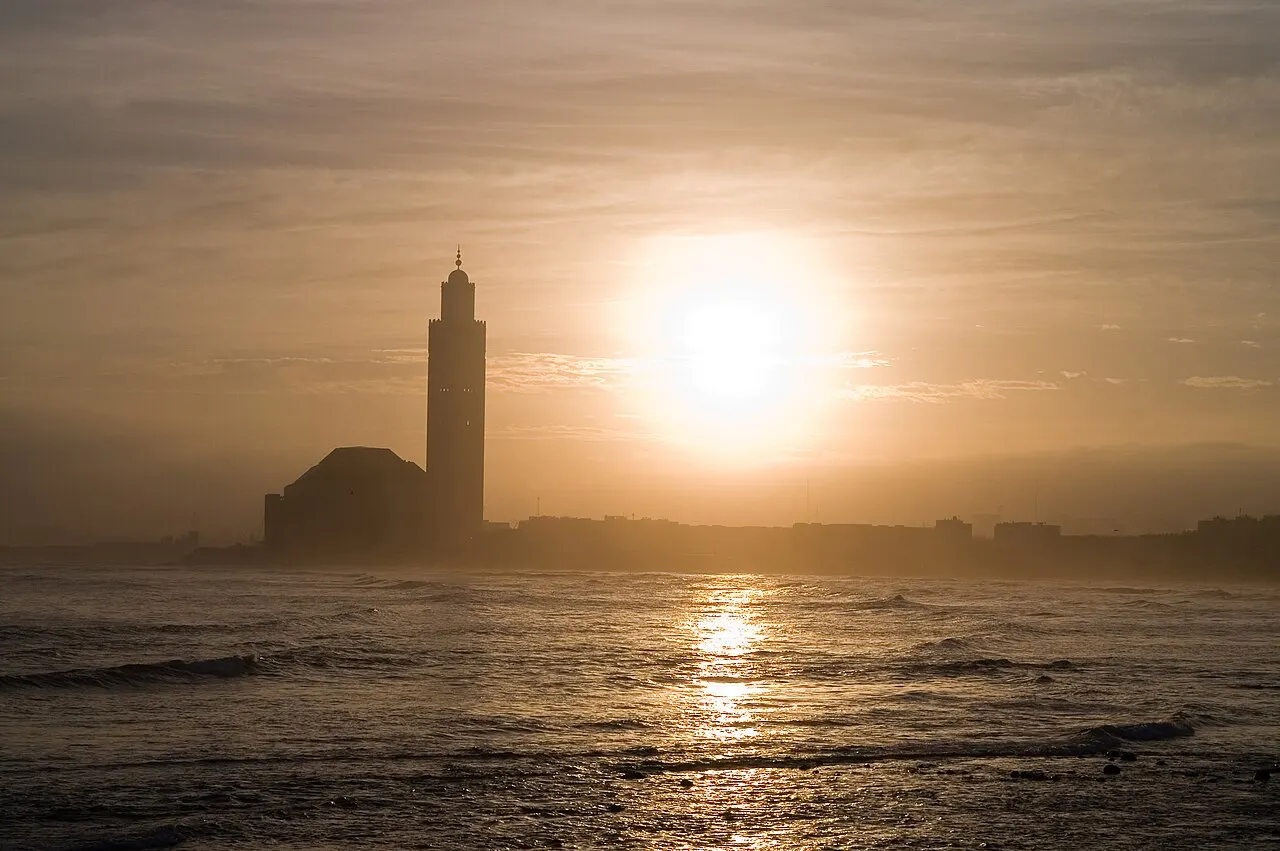
Designed by Michel Pinseau, built between 1986 and 1993 on a platform partly jutting into the Atlantic and funded by public subscription. The 210 m minaret was the world's tallest until 2019, when the Great Mosque of Algiers reached 265 m, and it's now the second tallest. The prayer hall's roof opens in about five minutes, and it holds 25,000 people inside and 80,000 on the esplanade. It's the only mosque in Morocco open to non-Muslims, and only on a guided visit: about four time slots a day, about 140 MAD for foreigners and about 70 MAD for Moroccans (2026); there has also been a fee to enter the esplanade since late 2024.
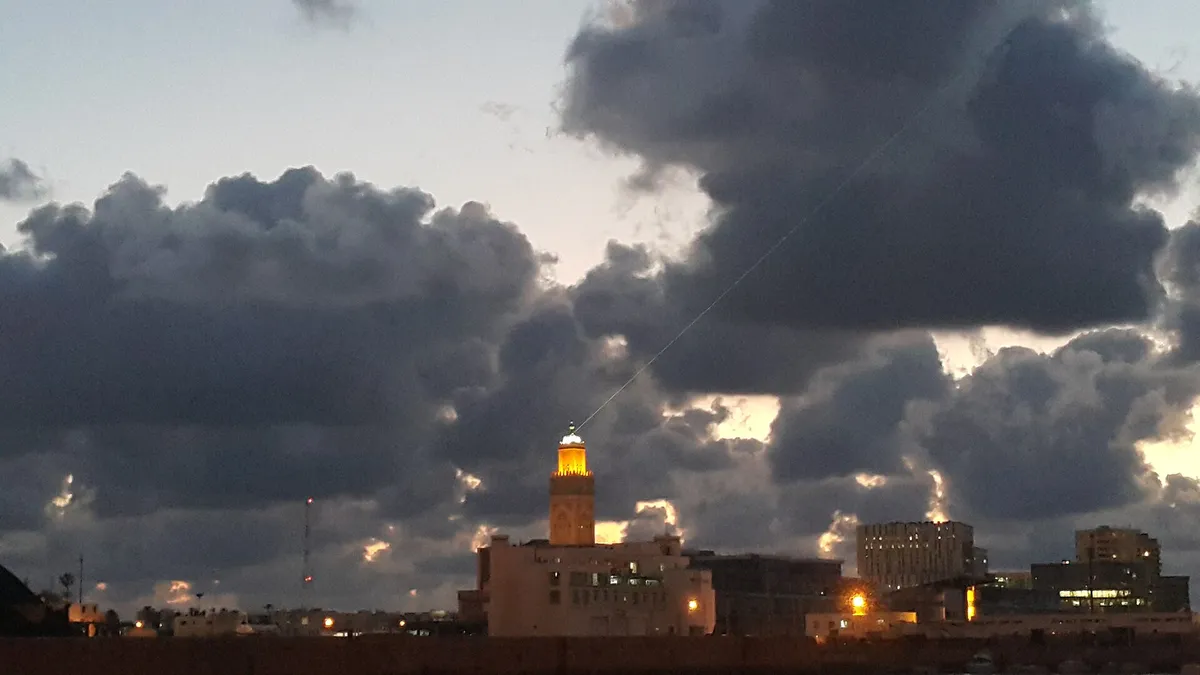
It's the only mosque in Morocco open to non-Muslims, only on a guided visit, which goes into the prayer hall with its retractable roof, built on a platform jutting into the Atlantic.
Check access

Place Mohammed V
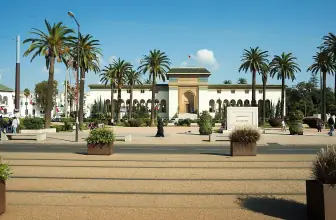
An administrative square designed by Henri Prost and ringed by five neo-Moorish buildings from 1918-1930: the Wilaya with a clock tower about 50 m tall, the Palace of Justice, the Post Office with a zellige-lined atrium, Bank Al-Maghrib and the former French consulate. The central fountain runs with music at dusk, and pigeons have been part of the scene since the 1930s.
Five neo-Moorish buildings enclose the administrative square, the Wilaya has a clock tower about 50 m tall, the Post Office has a zellige-lined atrium, and the fountain plays music at dusk.
Check access
Boulevard Mohammed V and the art deco
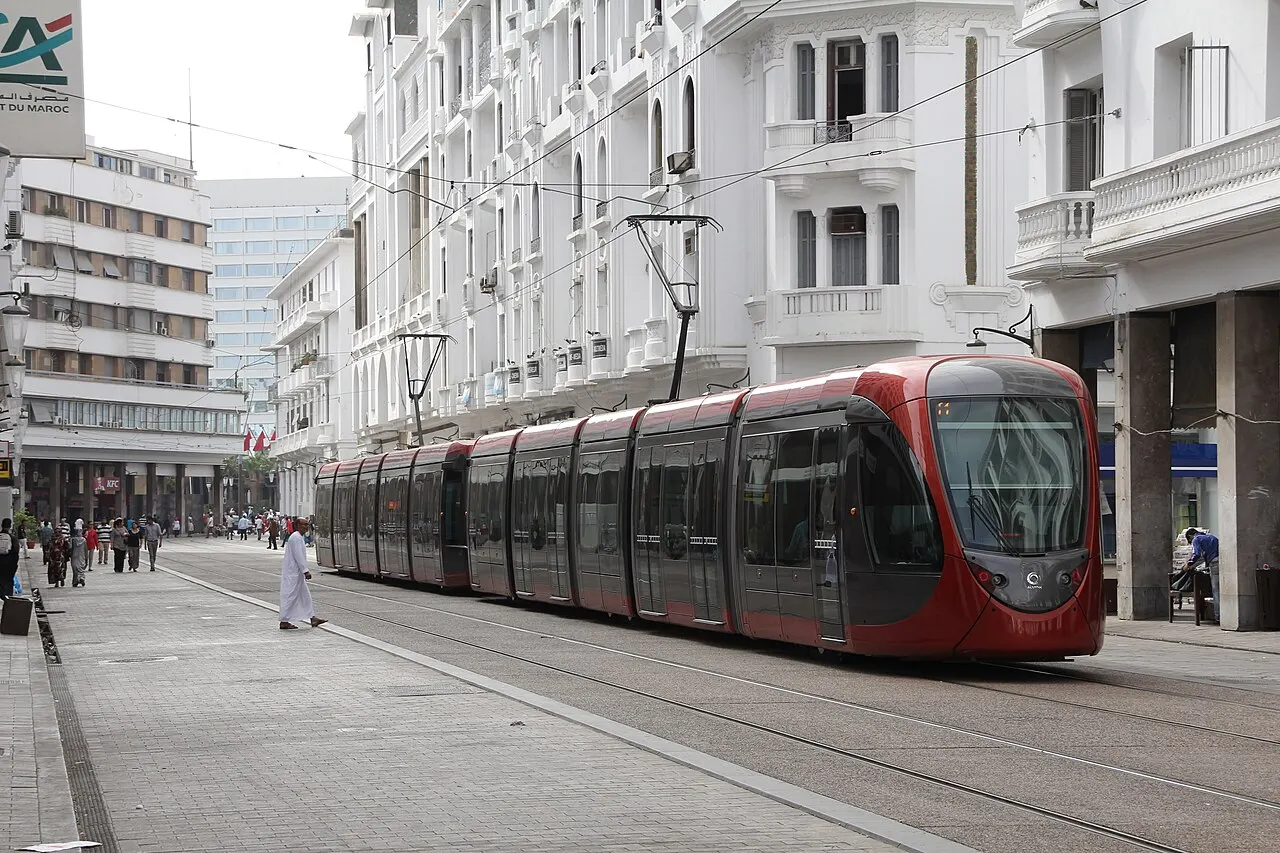
The protectorate's commercial axis, holding the highest concentration of art deco façades in Africa: 1930s shopping arcades, the Rialto cinema (1930, still operating, where Josephine Baker and Édith Piaf once performed) and the Immeuble Liberté, by the Swiss architect Léonard Morandi (1951, 17 stories and 78 m). Look up from the second floor: that's where the reliefs, curved balconies and wrought iron live.
Look up from the second floor. That's where the reliefs, curved balconies, and wrought iron live.
Check access
Old medina and the Sqala battery
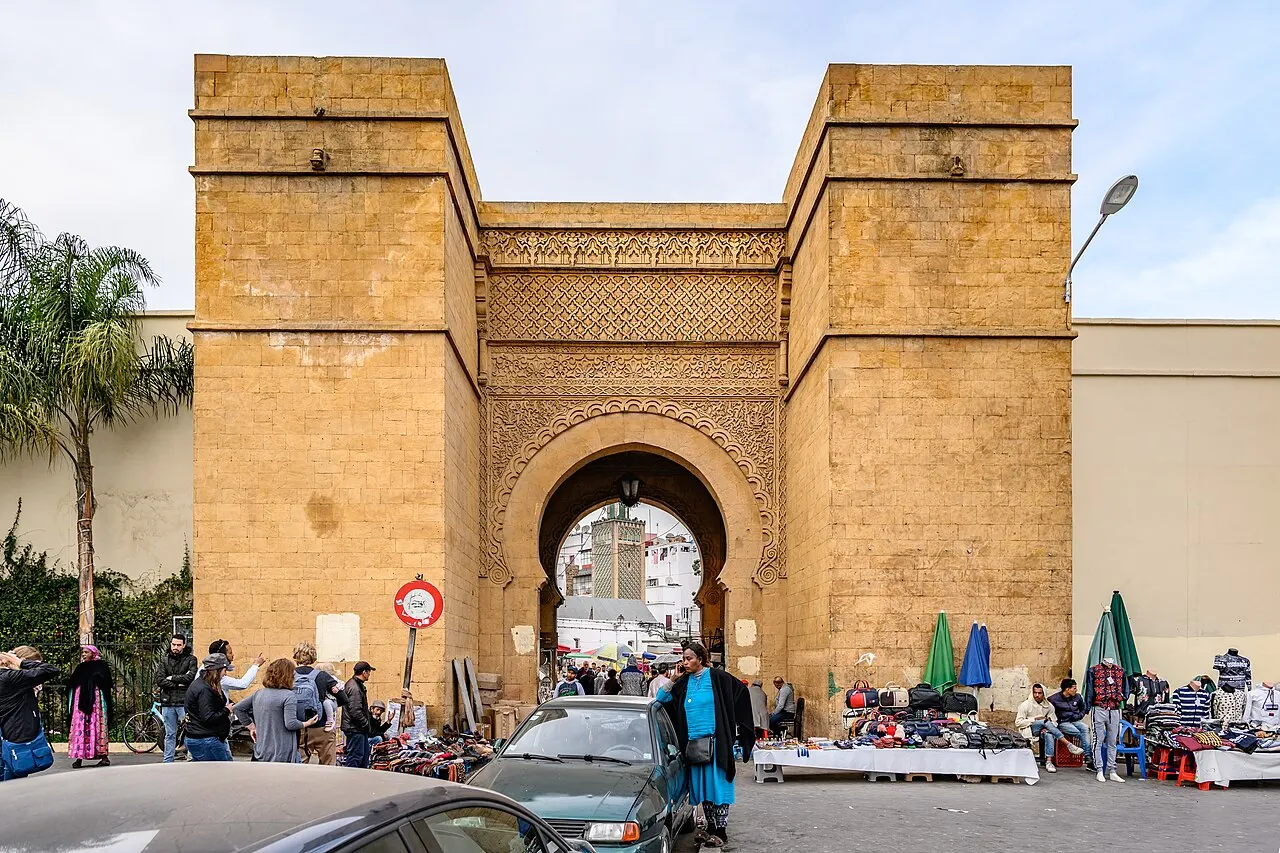
A late-18th-century fortification on the western wall, with cannons facing the Atlantic and a view over the port. From it you enter the medina rebuilt by Sidi Mohammed ben Abdallah: the zawiya of Sidi Belyout, the city's patron saint, the fabric market and the Bab Marrakech and Bab El Kébir gates.
The cannons on the wall aim at the Atlantic, the view reaches the port, and from there you enter the rebuilt medina, with the patron saint's shrine, the textile market and two gates.
Check access

Marché Central
A municipal market opened in 1917 on Boulevard Mohammed V, with a central courtyard and stalls of fish, flowers, olives and spices.
The municipal market, opened in 1917, has a central courtyard with stalls of fish, flowers, olives, and spices, and that's where you pick your sardines to have grilled at the kitchen next door.
Check access

Quartier Habous and the Mahkama du Pacha
The 1920s “new medina” and its most elaborate building: the Mahkama, built between 1948 and 1952 by Auguste Cadet, with 64 rooms, carved cedar, stucco and zellige, used as a courthouse and official reception hall. Indoor visits depend on the day and the building's use; check ahead before counting on it.
In the new medina, the Mahkama is the neighborhood's most elaborate building and serves as a courthouse and official reception hall, and indoor visits depend on the day and the building's use, so check ahead before counting on it.
Check access
Abderrahman Slaoui Museum
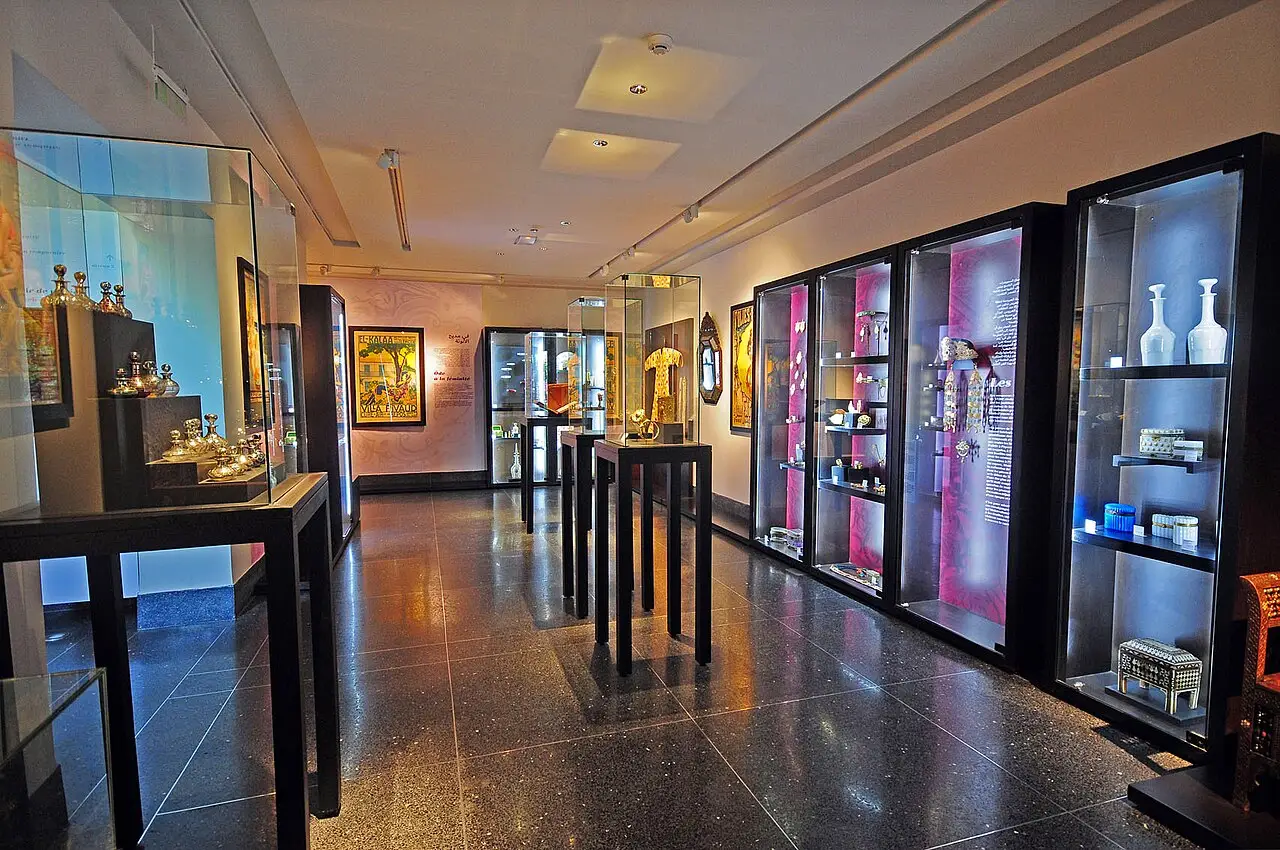
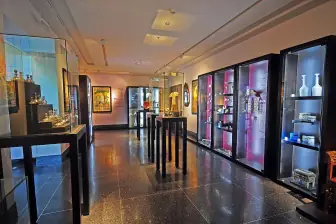
A private museum opened in 2012 in a 1940s villa on Rue du Parc, with the collection of the collector it's named after: 1920s-40s art deco travel posters, Fez jewelry, crystal flasks and orientalist miniatures. Small, calm, with a café terrace. It takes about an hour.
The small, calm private museum occupies a villa and shows deco posters, Fez jewelry, crystal flasks, and miniatures; the visit takes about an hour, and there's a café terrace.
Check access
Museum of Moroccan Judaism
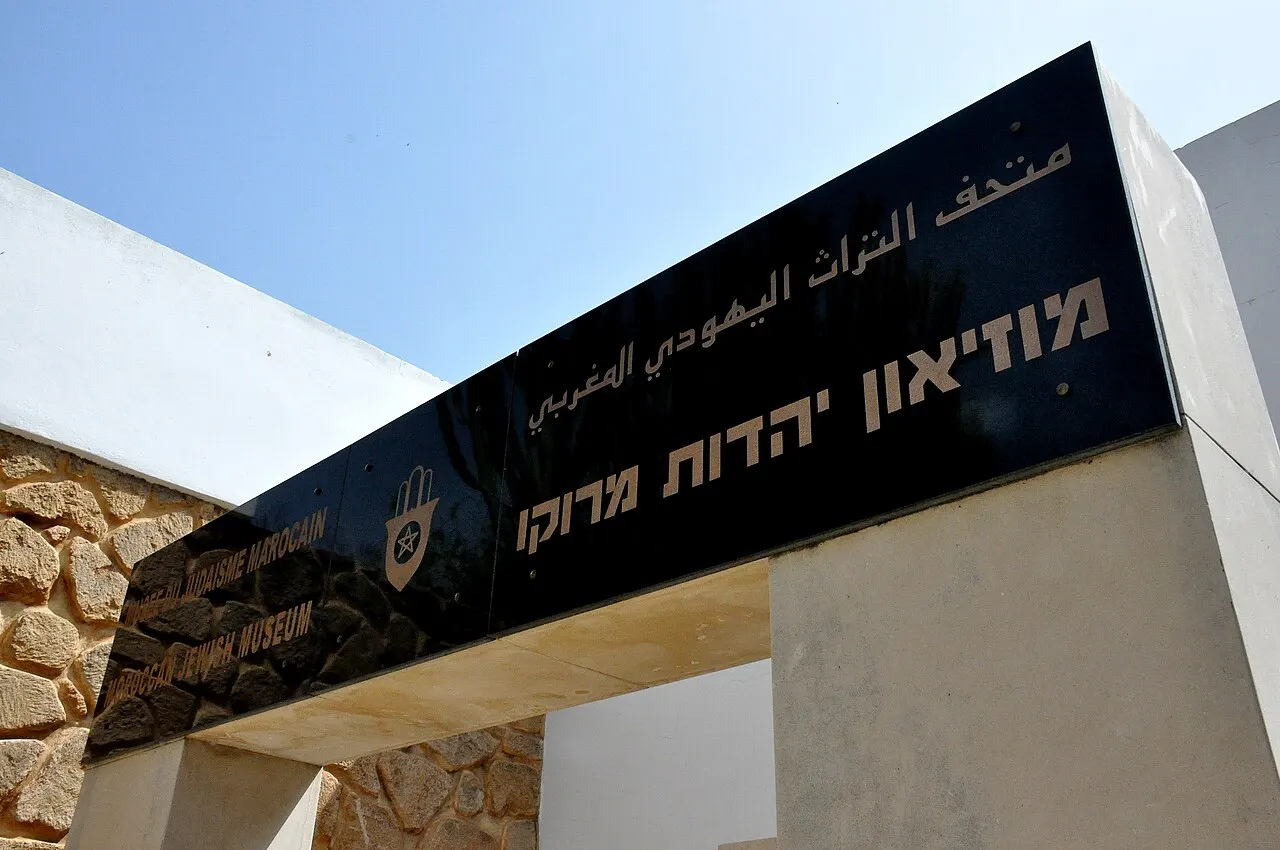
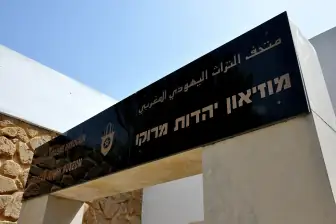
In the Oasis neighborhood, opened in 1997, it's the only museum dedicated to Judaism in the Arab world. It documents a community that once reached about 250,000 people in the country and some 75,000 in Casablanca in the late 1940s, and today numbers a few thousand: most of them still in the city. Worth calling ahead to arrange a visit.
This space is the only museum of Judaism in the Arab world and documents a community that reached about 250,000 in the country and some 75,000 in Casablanca in the late 1940s, while today only a few thousand remain, most of them still living here, and it's worth calling ahead to arrange a visit.
Check access
Villa des Arts
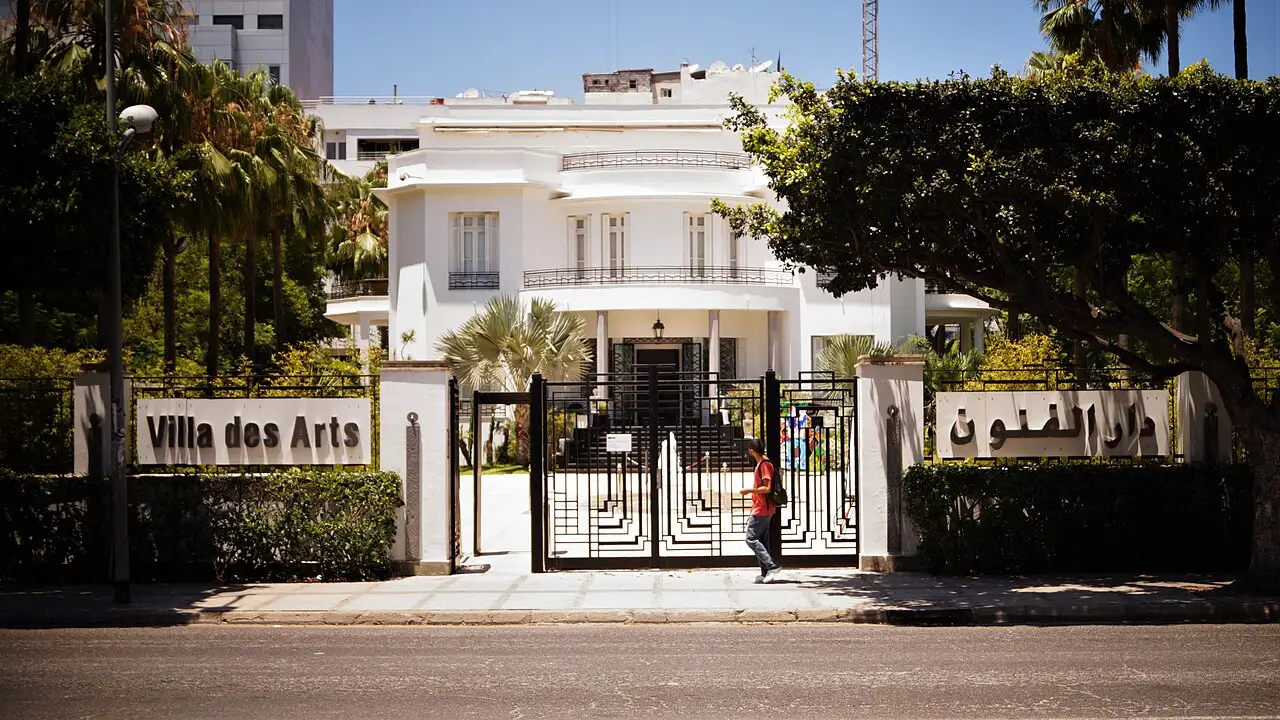
A 1934 art deco villa restored and turned into a gallery by the Fondation ONA, today the Fondation Al Mada, with exhibitions of modern and contemporary Moroccan art and free admission. It's at 30, Boulevard Brahim Roudani, next to the Arab League Park, and is worth it for the building as much as for what's hanging inside.
The villa dates from 1934 and admission is free, but what's on display changes with each show. On your Quartier Habous day, prefer the Abderrahman Slaoui Museum, with its art deco travel posters, Fez jewelry, and crystal flasks, which you can see in an hour.
Check access
Nilo’s itinerary
Start with the basic programme and choose extensions for the time you have.
Plan my days in the app ↗Day 1 · The mosque, the medina and the art deco
Take the guided tour of the Hassan II Mosque in the first morning slot, around 9am, arriving twenty minutes early; it lasts about an hour and covers the prayer hall, the ablutions hall and the underground hammam.
Leave through the esplanade to the Sqala battery and enter the old medina; cross it toward Place des Nations Unies, about a 25-minute walk, passing the zawiya of Sidi Belyout.
Have lunch at the Marché Central: pick the fish at the stall and have it grilled at the kitchen next door, with bread and salad.
Walk along Boulevard Mohammed V looking up (the 1930 Rialto cinema, 1930s shopping arcades, Léonard Morandi's Immeuble Liberté, with 17 floors) and step into one or two building stairwells, among the city's best art deco pieces.
Finish at Place Mohammed V at dusk, when the five neo-Moorish buildings light up and the fountain runs with music.
Day 2 · The sea, Anfa and late afternoon
Visit the Museum of Moroccan Judaism, in the Oasis neighborhood, and call ahead to book the visit.
Take the T2 tram to the Aïn Diab Plage station, at the end of the line, and walk along the Corniche; at low tide, cross on foot to the rock with the white shrine of Sidi Abderrahmane.
Have fish for lunch in Aïn Diab, facing the seawater pools of the beach clubs.
Head up through Anfa to the Twin Center and the Casa-Anfa district, where 2019 office-building Casablanca butts up against 1930s modernist villas.
Close the day on a Boulevard d'Anfa terrace, chairs facing the street, until dark.

If you stay longer
Day 3 · Habous, the Slaoui Museum and the old slaughterhouses
Start before 10am with bissara and msemen at a no-frills spot in the medina or Derb Sultan, with mint tea.
Head to the Quartier Habous: arcades, Arabic-language bookshops, jewelers, the Mahkama du Pacha (indoor visits depend on the day) and sweets at the square's confectionery, running since 1930.
Visit the Abderrahman Slaoui Museum, in a 1940s villa on Rue du Parc, with art deco travel posters, jewelry from Fez and crystal perfume bottles, in about an hour.
Take tram T1 to Hay Mohammadi and see the old 1922 slaughterhouses, now a cultural space.
Have dinner in Gauthier or Maârif, where restaurants only fill up after 9pm, and end at a sidewalk café with a nous-nous.

Food
 AI illustration
Atlantic sardine
Morocco is the world's largest exporter of canned sardines, and the Atlantic fleet unloads in Casablanca. Sardines come grilled over charcoal, as kefta (seasoned patties with chermoula), breaded or in a street sandwich. At the Marché Central you pick the fish at the stall and pay the kitchen next door to grill it; a plate with bread costs 30–60 MAD.
 AI illustration
Harira
A thick soup of tomato, lentils, chickpeas and vermicelli, thickened with tedouira (flour diluted in water) and finished with cilantro and lemon. It's the fast-breaking dish during Ramadan, with dates and chebakia, but it's sold year-round at street counters for 8-15 MAD.
 AI illustration
Bissara
A dried fava bean purée with olive oil, cumin and paprika, served steaming with round bread. It's a winter breakfast, sold early at hole-in-the-wall spots in the medina and Derb Sultan for 5-12 MAD; it's gone before noon.
 AI illustration
Sfenj
An unsweetened fried ring of dough, made and sold on the sidewalk in the morning and handed over threaded on a strip of palm leaf for you to carry. It costs 2–4 MAD apiece, goes well with tea and disappears from the stalls around 11am.
 AI illustration
Msemen, harcha and baghrir
The three griddle breads of breakfast: msemen is flaky and square, harcha is made of semolina and melts in your mouth, baghrir has a thousand holes and soaks up butter and honey. They cost 2–8 MAD each, and the custom is to eat them standing at the counter or take them wrapped in paper.
 AI illustration
Friday couscous and fish tagine
Couscous is the Friday dish, served after the midday prayer with seven vegetables and broth on the side; at a popular restaurant, 50-90 MAD. The city's coastal version is fish tagine with chermoula (cilantro, garlic, cumin, paprika and lemon) made with sea bream, croaker or sardine.
 AI illustration
Babbouche (ghlal)
Small snails cooked in a broth of ten to fifteen herbs and spices, among them licorice, thyme, anise and bitter orange peel. They're sold from carts, with a toothpick to pull the snail out; you drink the broth from the bowl at the end, and it's considered a cold remedy. 10–20 MAD.
 AI illustration
Nous-nous, atay and jus d'avocat
The nous-nous is the standard order on a Casablanca terrace: coffee and milk well mixed in the same glass, for 12–20 MAD. Atay b'na'na' is gunpowder green tea with mint and lots of sugar, poured from high up to make foam. At mahlabas (dairy bars), order a jus d'avocat, avocado blended with milk, almonds and honey, in a tall glass, for 15–25 MAD.
Day trips

Rabat
90 km northeast, with TNR trains every 30 minutes (about 1 hour, around 40 MAD in second class) and Al Boraq in about 50 minutes. It's been the capital since 1912: the whitewashed, blue-trimmed Kasbah of the Oudaias, the unfinished Hassan Tower from 1195, the Chellah necropolis, the Mohammed VI Museum of Modern Art and the Grand Theatre designed by Zaha Hadid on the banks of the Bouregreg. You can easily go and come back in a day.

El Jadida
100 km southwest, about 1 hour 30 minutes by train or car. The former Portuguese Mazagan (1514–1769) is a UNESCO World Heritage site: a square citadel with bastions, the Church of the Assumption and, above all, the 1514 Cistern, whose Manueline columns are reflected in a thin layer of water and where Orson Welles filmed scenes of “Othello” (1952). Another 80 km south is Oualidia, an oyster lagoon.
Mohammedia
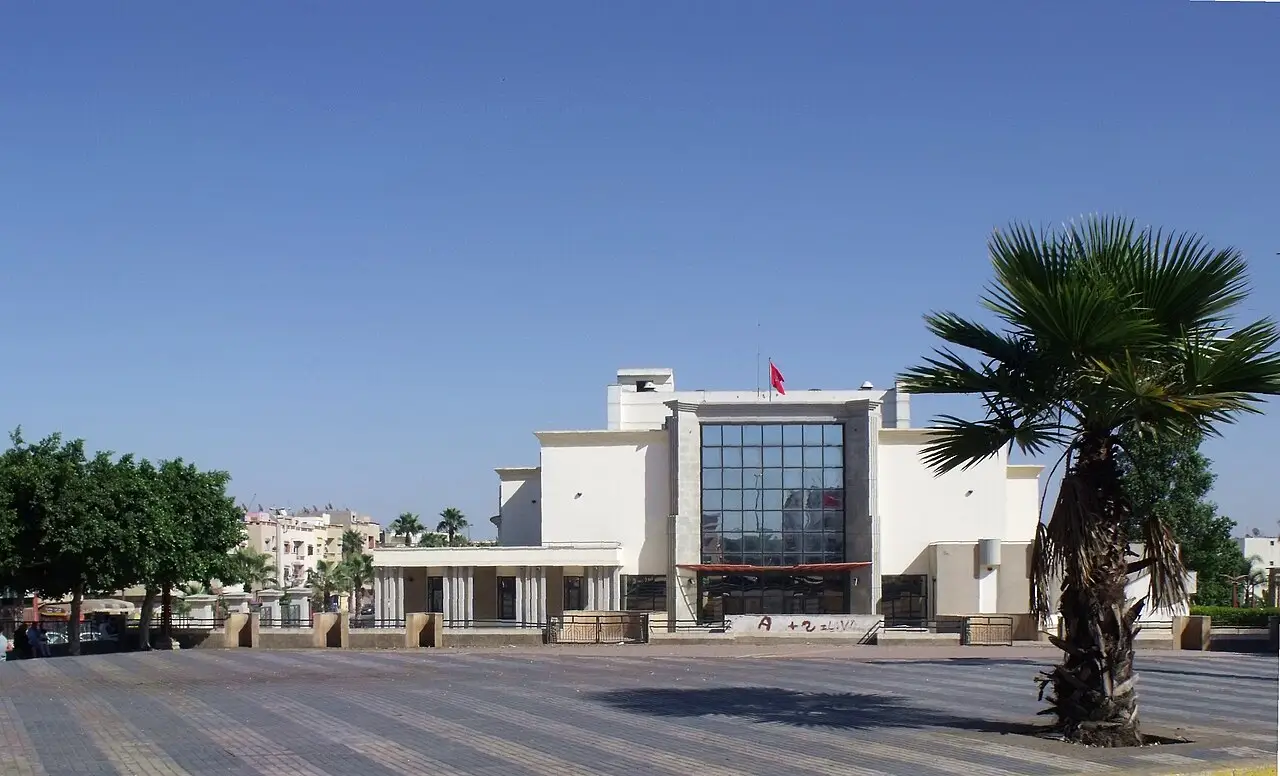
25 km northeast, about 20 minutes by train. It's the former Fedala, which saw Allied troops in World War II and today has a wide beach, a golf course, a fish market and seafood restaurants. It's the closest swim and much calmer than Casablanca's Corniche.
Where to begin
The mosque, the medina and the art deco
Take the guided tour of the Hassan II Mosque in the first morning slot, around 9am, arriving twenty minutes early; it lasts about an hour and covers the prayer hall, the ablutions hall and the underground hammam.
Habous, the Slaoui Museum and the old slaughterhouses
Start before 10am with bissara and msemen at a no-frills spot in the medina or Derb Sultan, with mint tea.
The sea, Anfa and late afternoon
Visit the Museum of Moroccan Judaism, in the Oasis neighborhood, and call ahead to book the visit.
Money
The currency is the Moroccan dirham (MAD), and it's a closed currency, which catches out anyone who finds this out on the way home: you can bring in and take out only up to 2,000 MAD, and outside Morocco exchange is poor or nonexistent. Exchange on arrival, keep the receipt and convert back at the airport before passport control. In 2026 the euro is worth roughly 10.5–11 MAD and the dollar 9–10 MAD. Price ranges in 2026: nous-nous or espresso 12–20 MAD; sfenj 2–4; msemen 3–8; harira 8–15; plate of grilled sardines or a sandwich 30–60; lunch at a working-class restaurant 50–90; dinner in Gauthier or Maârif 180–400 per person without alcohol; beer at a licensed bar 40–70; tram ticket 8–9; three-star hotel in the center 500–900 MAD a night. Add the tourist promotion tax, charged per person per night by the hotel, between about 15 and 30 MAD depending on the category. Cash rules: cards work in hotels, chains and larger restaurants, but the medina, taxis, sfenj carts and neighborhood cafés are cash only. ATMs are on every corner and charge foreign cards a withdrawal fee of about 20–30 MAD; always decline the “conversion into your currency” offered on screen. Tipping: round the taxi fare up, leave 5–10% at sit-down restaurants and 2–5 MAD for the parking attendant in a yellow vest, a recognized job in the city.
Getting there and around
Mohammed V airport has a train station under the terminal
Mohammed V Airport (CMN) is in Nouaceur, 30 km southeast of the city, and the best way out is right under the terminal, where there's a train station. The Al Bidaoui line reaches Casa Voyageurs in about 35–40 minutes and continues to Casa Port and Rabat, with departures roughly every hour between 6am and 10pm, for around 45 MAD in second class. Airport taxis charge a fixed fare of around 300 MAD by day and more at night; agree on it before you get in, or book through an app. Casa Voyageurs is the long-distance station: Al Boraq, the high-speed train opened in November 2018, reaches Rabat in about 50 minutes and Tangier in 2 hours 10 minutes (second class roughly 230–350 MAD, depending on how far ahead you book). For Rabat there's also the TNR, every 30 minutes, taking about 1 hour for around 40 MAD. Casa Port, rebuilt in 2014, serves the coastal line and is a ten-minute walk from the medina. Long-distance CTM and Supratours buses leave from the terminal on Rue Leon l'Africain.
The tram has been the backbone since 2012
Within the city, the backbone is the Casa Transport tram, with more than 100 km of network today: T1 in 2012, T2 in 2019, T3, T4 and two busway corridors (BW1 and BW2) together in 2024. A single ticket costs about 8–9 MAD, two rides come to about 16 MAD, and with the rechargeable card (15 MAD for the card, valid for 5 years) a ride drops to 6 MAD. There's a 24-hour pass for around 50 MAD and a three-day pass for around 120 MAD (prices adopted in 2024, check at the ticket office). Buses, run by Alsa, cost about 5 MAD and are slower. Casablanca's petits taxis are red, carry at most three passengers and are shared by default: the driver stops along the way and picks up someone else heading the same direction, and that's normal, not a scam. They must use the meter, so ask for the “compteur” before you close the door. The flag fare is around 8 MAD, there's a surcharge of about 50% between 8pm and 6am, and a ride across the center rarely tops 30 MAD. Grands taxis are white, carry six people and run fixed intercity routes. Apps that work: inDrive, Careem, Roby, Heetch and Yassir; Uber returned to Morocco on November 27, 2025, with drivers from licensed tourist-transport companies only. The center and the medina are walkable, but the Corniche is too far to reach on foot from downtown: to get to the sea, take the T2 to its final station, Aïn Diab Plage, at the tip of the waterfront. Cycling is uncomfortable because there's no continuous bike lane.
Safety
Casablanca is a big, working city: violent crime against foreigners is rare, and street theft runs above the Moroccan average. The concrete risk is pickpockets and bag-snatchers, and it has a time and place: standing on a crowded tram, outside the Marché Central, on the medina's narrow streets and along the Corniche after dark. Carry your bag in front, keep your phone in a front pocket, and don't walk with your phone in hand near the curb, since motorbike snatching happens. Fake guides approach in the medina and at the entrance to the Hassan II Mosque offering a “shortcut” or “ticket”: the answer is a “la, shukran” without breaking stride, and the mosque ticket is only bought at the foundation's booth. Women traveling alone report frequent verbal harassment, especially at night and in outlying neighborhoods; a firm pace and not engaging work better than arguing. Avoid walking after 11pm through empty stretches between downtown and Aïn Diab, in the port area and in outlying neighborhoods you don't know: taxis and apps are cheap and solve that. Minor scams: a “broken” meter, wrong change with the similar-looking 20 and 200 dirham notes, and a rug shop that serves tea before letting you leave. Note the emergency numbers: 19 (urban police), 15 (ambulance), 177 (gendarmerie outside cities). Tap water is treated and safe to drink in the city, though many people prefer bottled for the taste of chlorine. Brazilians don't need a visa for stays of up to 90 days. Check entry requirements before flying, since Morocco has been expanding electronic authorization requirements for other nationalities.
Etiquette tips
The right hand and the gesture to the heart
Greet with your right hand and then bring your hand to your chest; the gesture counts more than the strength of the handshake. Between a man and a woman, wait for her to offer her hand first: many prefer just the hand-to-heart gesture, and that isn't coldness.
During Ramadan, avoid eating on the street by day
Even if you're not fasting, eating, drinking or smoking on the sidewalk in daylight is offensive and technically illegal. Hotels serve as usual, and so do some tourist restaurants, behind a curtain over the door; use those instead of a park bench.
You decline the offer before accepting
Tea, food and rides are offered by reflex, and etiquette calls for declining once or twice before saying yes. Refusing flatly the first time is what comes across as rude; a “shukran, bezzaf” with your hand on your chest ends the exchange without offending anyone.
Bargain in the souk, not at the café
Prices get negotiated at a medina stall, in Habous, in Derb Ghallef and at a rug shop. They don't get negotiated at a café, bakery, pharmacy, a shop with a price tag, or a taxi with the meter running: asking for a discount there embarrasses the seller.
Ask before taking a photo
Photographing people without asking, especially women and vendors, causes immediate friction; a gesture and a smile are usually enough to ask. Don't photograph the port, military installations, the police, or close-up the official buildings on Place Mohammed V.
Alcohol exists, but discreetly
Alcohol is sold in licensed bars, hotels and a separate section of some supermarkets; Casablanca and Flag beers are local, as is the vin gris from Boulaouane. Don't drink on the street or walk around with a bottle in view, and know that sales to Moroccans are suspended during Ramadan.
Mistakes to avoid
The 1942 film was shot in a studio
Looking for the film's “Rick's Café” as a historic landmark. It never existed: every scene was shot in a studio in California, without a single image of the real city. The bar of the same name was opened in 2004 by a former American diplomat, in a 1930s riad on Boulevard Sour Jdid, and it's a decent restaurant, just not a historic one.
Thinking it's the capital
This is the economic capital: the port, the stock exchange and much of the country's industry are here. The government and the embassies are in Rabat.
Petit taxi without a meter
Getting into a petit taxi without insisting on the meter. Refusing the “compteur” and then quoting an inflated fixed price is the city's most common friction: say “compteur afak” before you close the door and, if the driver refuses, get out and take another one. Remember too that taxis are shared by default, so someone getting in partway through the ride is normal, not a scam, even if it may feel like you got into the wrong car.
Hassan II outside visiting hours
Showing up at the Hassan II Mosque outside visiting hours. You can only see the interior on an official guided tour, at about four time slots a day that change on Fridays and during Ramadan. Outside those, you can only enter the esplanade, which now also charges admission. Arrive twenty minutes early, buy at the foundation's ticket office and bring ID.
Leaving the country with dirhams in your pocket
Counting on cards for everything and leaving the country with dirhams in your pocket. The medina, taxis, food carts and neighborhood cafés only take cash, and dirhams can't be taken out in quantity or exchanged at a reasonable rate abroad. Spend what's left while still in the country, or exchange it back at the departure area, before passport control.
Useful phrases
السلام عليكم: s-salamu 3alaykum (salamu aleikum)
Hello, literally “peace be upon you”; the reply is “wa 3alaykum s-salam”
شكرا / بارك الله فيك: shukran / barak Allahu fik (baraka-lahu fik)
Thank you; the second form is warmer and widely used in Casablanca
بشحال؟: bshhal? (bech-hal)
How much is it? The question that opens any purchase in the medina
عافاك: 3afak (afak)
Please; tacked onto any request, as in “l-hsab afak,” the bill, please
واخا: wakha (wa-kha, with the kh scraped in the throat)
Okay, agreed; used to accept, agree and close a conversation
بزاف: bezzaf (be-zaf)
Too much, a lot; “ghali bezzaf” means “too expensive” and is the phrase that opens the bargaining
Districts
Old medina (Sidi Belyout)
A walled triangle between the port and Place des Nations Unies, rebuilt from 1770 and nothing like the medinas of Fez or Marrakech: straighter streets, two-story houses and shops selling hardware, fabric, spices and used electronics. The Sqala battery marks the western tip, and the clock tower at the entrance is a 1993 replica of the 1908 original.
Art deco center (Boulevard Mohammed V)
The protectorate's downtown, between Place des Nations Unies and Place Mohammed V, with the 1917 Marché Central, the 1930 Rialto cinema and hundreds of façades built between 1918 and 1950. It's an office, bank and street-shopping zone by day, and empties out quite a bit after 9pm.
Habous (Nouvelle Médina)
A medina planned between 1916 and the 1930s by Auguste Cadet and Edmond Brion, with regular arcades, olive-planted squares, Arabic-language bookshops, jewelers and the Mahkama du Pacha. It's where you buy sweets, rugs, tarbouches and religious books, with calmer bargaining than in the old medina.
Maârif
A middle-class neighborhood born from a 1920s Spanish workers' colony and now the city's shopping axis, around Rue Jean Jaurès and the Twin Center (1999, 115 m, by Ricardo Bofill with Elie Mouyal). Street shops, cafés and restaurants that only fill up after 9pm.
Gauthier and Racine
Two residential grids from the 1930s, with four-story buildings and curved balconies, turned into a cluster of cafés, galleries, French bookshops, bars and restaurants. It's where Casablanca's young middle class has dinner and goes out on weeknights.
Anfa and Casa-Anfa
The wealthy residential hill, with modernist villas from the 1930s-50s, consulates and the old hotel where Roosevelt and Churchill met in 1943. On the grounds of the old Anfa airport, the Casa-Anfa district has been growing since 2010, home to Casablanca Finance City and the tower designed by Thom Mayne, opened in 2019.
Aïn Diab and the Corniche
A coastal strip 5 km west of downtown, with paid beach clubs, seawater pools, restaurants, nightclubs and the Morocco Mall, opened in 2011. The white shrine of Sidi Abderrahmane sits on a rock only reachable on foot at low tide.
Hay Mohammadi and Derb Sultan
Working-class neighborhoods in the city's east and south, built up by rural exodus over the 20th century. Hay Mohammadi is the birthplace of the group Nass El Ghiwane and holds the 1922 slaughterhouses, now a cultural space; in Derb Sultan sits Derb Ghallef, the country's largest market for electronics and used parts.
History
8th-11th c. · Anfa and the Barghawata
A Berber port called Anfa occupies the Chaouia plain, within the territory of the Barghawata confederation (744–1058), which upheld its own heresy for three centuries. Almoravids, Almohads and Marinids succeed one another in control without turning Anfa into a capital.
1468 · Portugal razes Anfa
A Portuguese fleet destroys the city in retaliation for corsairs attacking shipping between Lisbon and Guinea. Anfa is left nearly depopulated for half a century.
1515-1755 · Casa Branca
The Portuguese build a fortress on the site and name it Casa Branca. They abandon it after the 1755 Lisbon earthquake damages the buildings and commercial interest shifts to Mazagan.
c. 1770 · Dar el-Beida refounded
Sultan Sidi Mohammed ben Abdallah rebuilds the city with a wall, a mosque and the Sqala battery, and names it Dar el-Beida, “the white house.” Spanish merchants translate the name back: Casablanca.
1830-1906 · The grain and wool port
Opened to European trade after the mid-19th-century treaties, the city exports wheat and wool to England and France and draws foreign trading houses. By 1900 it had about 20,000 residents.
1907 · Bombardment and occupation
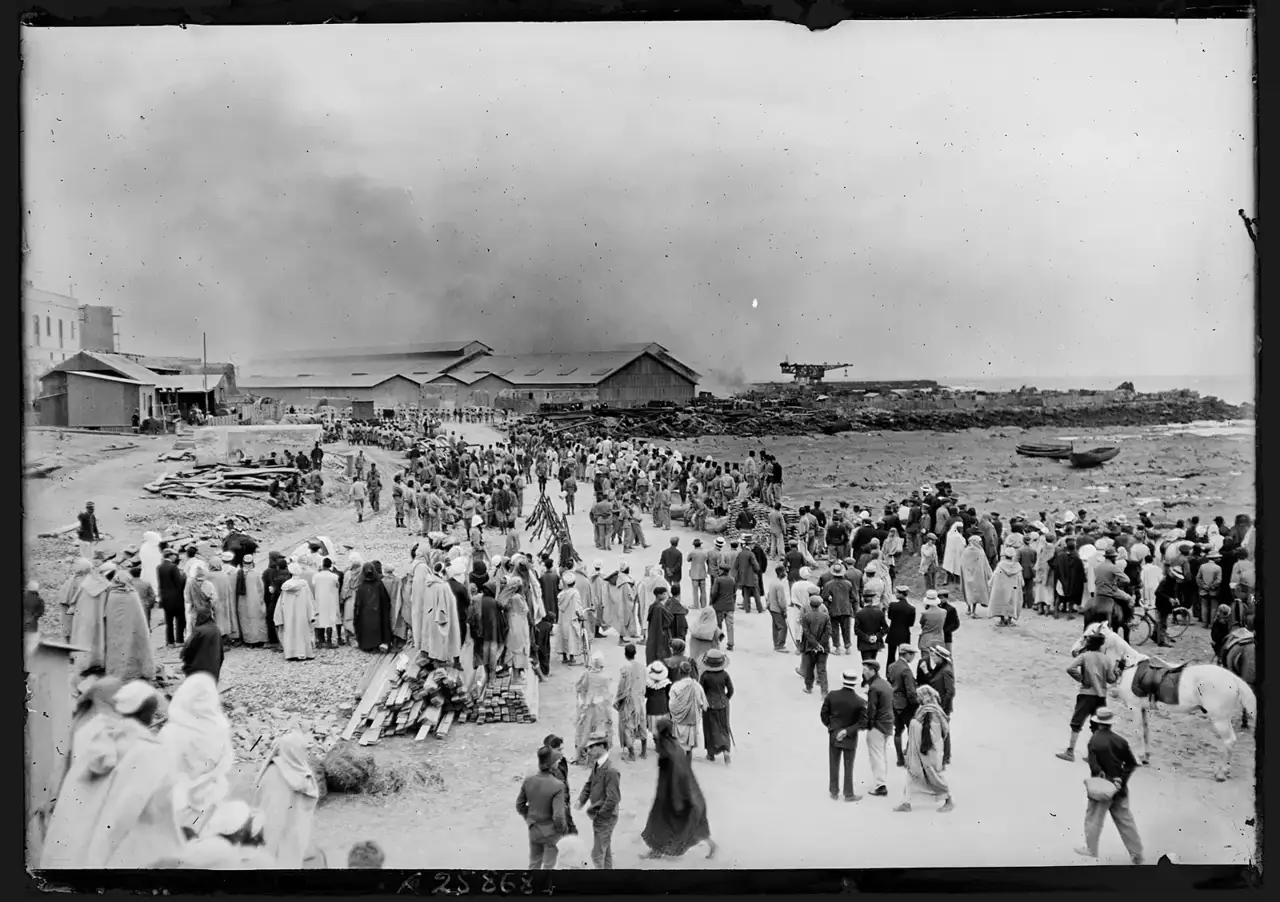
Works for a narrow-gauge railway from the port cross the Sidi Belyout cemetery; nine European workers die in the protest that follows. France bombards the city from the sea and lands troops in August: the effective start of the occupation.
1912-1930 · Henri Prost's plan
With the Treaty of Fez (March 30, 1912), Lyautey makes Rabat the political capital and Casablanca the economic one. From 1914 Prost designs today's radial city: fan-shaped boulevards, a neo-Moorish administrative square, an industrial zone to the east and a deep-water port begun in 1913.
1942-1943 · Torch and the Anfa Conference
On November 8, 1942 the Americans land at Fedala, Safi and Port Lyautey, with naval combat off Casablanca. From January 14 to 24, 1943 Roosevelt and Churchill meet at the Anfa hotel and announce the “unconditional surrender” formula.
1952-1956 · Carrières Centrales and independence
In December 1952 the crackdown on protests in the working-class Carrières Centrales district leaves dozens dead and turns Casablanca's unions into the engine of the nationalist movement. Morocco becomes independent on March 2, 1956.
1981 · The bread riots
On June 20, 1981 a general strike against rising food prices ends in clashes in working-class neighborhoods. The official toll of 66 dead was never accepted; independent estimates speak of hundreds.
1993-2024 · The Hassan II Mosque, the tram and the Al Boraq
The Hassan II Mosque opens on August 30, 1993 with the world's tallest minaret, 210 m. What follows: the May 16, 2003 attacks, the tram from 2012, the Al Boraq high-speed train in 2018 and the works tied to the 2030 World Cup.
Complete history
Destroyed and rebuilt three times
Casablanca has almost no ruins in sight because it was destroyed and rebuilt three times. The original core, Anfa, was a Berber port on the Chaouia plain, active since at least the 8th century and tied to the Barghawata confederation, which upheld its own Islamic doctrine for three centuries before being crushed by the Almoravids. In the 15th century Anfa lived off privateering against Portuguese shipping; in 1468 a Portuguese fleet razed it, and in 1515 the Portuguese built a fortress there called Casa Branca, abandoned after the 1755 Lisbon earthquake damaged it. Around 1770 Sultan Sidi Mohammed ben Abdallah rebuilt everything with a wall, a mosque and the Sqala battery, and named the whole Dar el-Beida. It's this late-18th-century medina that you visit today.
From stronghold to trading post
The 19th century turned the stronghold into a trading post. After the 1856 and 1861 trade treaties the city began exporting wheat, wool and later phosphate to Manchester and Marseille, and drew European trading houses, consuls and a sizable Moroccan Jewish community. Even so, in 1900 Casablanca had about 20,000 residents while Fez was three times larger. The break came in July 1907: a narrow-gauge railway built to carry stone to the port cut through the Sidi Belyout cemetery, the protest turned into a riot and nine European workers were killed. France bombarded the city from the sea and landed troops in August. Five years later, the Treaty of Fez of March 30, 1912 established the protectorate, and Marshal Lyautey made the decision that still shapes the country: Rabat would be the political capital, Casablanca the economic one.
Henri Prost's 1914 radial plan
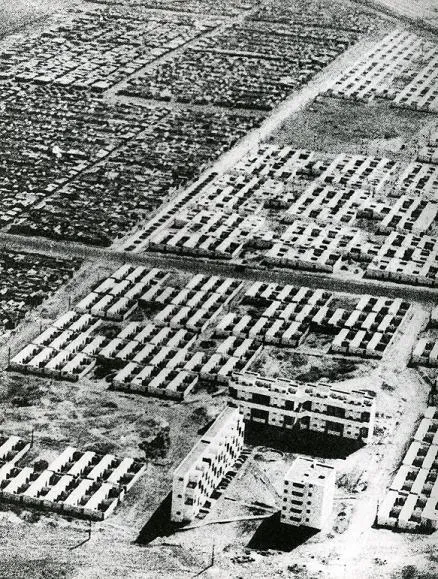
The modern city is the work of one planner and a generation of architects. Henri Prost, head of the urban planning service from 1914, designed a radial plan centered on today's Place des Nations Unies, with fan-shaped boulevards, two ring roads (Zerktouni and Anfa), industry to the east, housing to the west and a neo-Moorish administrative square, today's Place Mohammed V. Between 1918 and 1950 Marius Boyer, Edmond Brion, Auguste Cadet and Hippolyte Delaporte built an art deco center of rare density in reinforced concrete, with zellige and stucco applied over modern volumes. Soon after, between 1949 and 1951, the Swiss architect Léonard Morandi raised the Immeuble Liberté, 17 stories and 78 m, at the time one of Africa's tallest buildings. The plan did not account for rural migration. It was in Casablanca, in the 1930s, that the word bidonville (from bidon, the oil drum) was coined for the tin-roofed houses of Carrières Centrales. The answer was Michel Écochard's plan (1946–52), with its 8-by-8-meter grid, and ATBAT-Afrique's Nid d'Abeille and Sémiramis blocks, presented at CIAM 9 in 1953 and studied worldwide ever since.
Operation Torch lands at Casablanca, 1942
World War II brought two decisive episodes to Casablanca. On November 8, 1942, Operation Torch landed American troops at Fedala (now Mohammedia), Safi and Port Lyautey, with a naval battle off Casablanca; between January 14 and 24, 1943, Roosevelt and Churchill met at the Anfa hotel and came away with the formula of unconditional surrender. The 1942 film that bears the city's name was shot entirely at the Warner studios in California and doesn't have a single Moroccan shot. In the struggle for independence, the city's working-class neighborhoods were on the front line: in December 1952 the crackdown on protests in Carrières Centrales left dozens dead, and Casablanca's unions became the engine of the nationalist movement until March 2, 1956. In January 1961, Mohammed V convened the conference here that created the “Casablanca Group”, forerunner of the Organization of African Unity.
The 1965 uprisings and the 1981 bread riots
Independent Casablanca grew fast and paid dearly for it. The student riots of March 1965 and, above all, the bread riots of June 20, 1981 marked the “years of lead” in the city; the general strike against price increases ended with hundreds dead, far beyond the official 66. Hassan II funded the mosque that bears his name by public subscription, and it was inaugurated on August 30, 1993, on a platform jutting into the Atlantic. On May 16, 2003, twelve young men from the Sidi Moumen shantytown killed 33 people in five simultaneous attacks in the center; the response combined policing with a program to clear the bidonvilles and build cultural facilities, whose symbol is the Les Étoiles de Sidi Moumen center, opened in 2014. Since then the city has been re-equipped more than redesigned: tram T1 in 2012, T2 in 2019, T3, T4 and two busway lines in 2024; and the construction for the 2030 World Cup, co-hosted with Spain and Portugal, including the 115,000-seat Grand Stade Hassan II in Benslimane. The result is a city that tourism doesn't explain: Casablanca runs the port, the banks, the textile and auto industries and much of Morocco's rap, film and press, and every year it takes in thousands of people from the interior who come to work. That's why the art deco center sits alongside unmaintained buildings, why the sea is hidden behind the port and why the pace of the street feels more like a business capital than a Moroccan imperial city.
There are almost no old ruins: Portugal razed Anfa in 1468, and the city was rebuilt around 1770 and again by the French from 1912 on.
Geography and shape of the city
The plateau, the sea and the mild climate
Casablanca sits on a low limestone plateau (the Chaouia plain, between 0 and 120 m) along about 30 km of Atlantic coast running southwest-northeast. No river crosses downtown: the only watercourse, the Oued Bouskoura, was diverted and buried over the course of the 20th century and now runs almost entirely underground, beneath the city and the airport area. The cold Canary Current is what keeps this climate mild, in a city at the latitude of Beirut and Los Angeles: it pushes in the morning fog and holds back the heat that punishes Morocco's interior in the same season.
Prost's fan-shaped grid
The grid is Prost's: a triangular medina of about 50 hectares wedged between the port and Place des Nations Unies; a center of fan-shaped boulevards from that square (Mohammed V, Hassan II, Félix Houphouët-Boigny); two ring roads, Zerktouni and Anfa, followed by Boulevard de la Résistance and the bypass; industry pushed east (Aïn Sebaâ, Sidi Bernoussi) and upper-income housing to the west (Anfa, Aïn Diab), a divide still legible in the price per square meter.
The port, the distant beach and the water
The port, Morocco's largest, occupies 6 km of coastline right north of downtown. That's why downtown has almost no sea view, and why the beach city, on the Aïn Diab Corniche, only starts 5 km to the west. Since the drought that set in in 2018, the water supply has relied on a transfer from the Oum Er-Rbia and a large desalination plant under construction on the coast to the southwest, sized for about 300 million m³ a year.
Casablanca has a river, the Oued Bouskoura, which has run underground beneath the streets and the airport since it was diverted in the last century.
Culture
Urban music: from Nass El Ghiwane to Casablanca rap
Moroccan urban popular music was born in a working-class neighborhood of this city. Around 1970, in Hay Mohammadi, Larbi Batma, Boujemaâ Hgour, Omar Sayed and Allal Yaâla formed Nass El Ghiwane: they traded the orchestra for the bendir and the guembri and sang zawiya poetry about unemployment, exile and injustice. Martin Scorsese called them “Africa's Rolling Stones” and picked Ahmed El Maânouni's documentary about them, “Transes” (1981), as the first title restored by his World Cinema Foundation, in 2007. Casablanca also created the L'Boulevard festival in 1999, which gave a stage to metal, rap and fusion and named the scene known as Nayda: in 2003, fourteen young metalheads from the city were even arrested for “satanism” and released after public protest. Today Moroccan rap is almost entirely a Casablanca product: Don Bigg, Dizzy DROS, Shayfeen, ElGrandeToto and Stormy sing in darija to audiences of tens of millions.
The Casablanca School and concrete architecture
In art and architecture, the city made two breaks with tradition. The first is the Casablanca School: Farid Belkahia ran the School of Fine Arts from 1962 to 1974 with Mohamed Melehi and Mohammed Chabâa, took painting out of the gallery (in 1969 they hung the works in Jemaa el-Fna square in Marrakech) and linked modern abstraction to the signs of Moroccan craft; the magazine Souffles, founded by Abdellatif Laâbi in 1966, was the written half of the movement. The second is the defense of 20th-century heritage: the Casamémoire association, founded in 1995, halted demolitions in the art deco center and runs a free guided-tour weekend every year. In cinema, it was here that Moroccan film turned urban and began speaking darija: Nabil Ayouch (“Ali Zaoua,” 2000; “Horses of God,” 2012; “Casablanca Beats,” in competition at Cannes in 2021), Nour-Eddine Lakhmari (“Casanegra,” 2008) and Maryam Touzani (“Adam,” 2019, shot in the old medina).
Soccer splits the weekend
Soccer sets the rhythm of the weekend. Two clubs split the city and the Stade Mohammed V, opened in 1955 with about 45,000 seats: Wydad Athletic Club, founded in 1937, in red, and Raja Club Athletic, founded in 1949, in green, historically the team of the working-class neighborhoods. Both have won the CAF Champions League (Raja in 1989, 1997 and 1999, Wydad in 1992, 2017 and 2022) and their organized supporter groups, Winners and Ultras Eagles, produce songs that spill out of the stadium: “Fi Bladi Delmouni,” sung in 2018 about unemployment and emigration, became a national protest anthem. Morocco hosted the Africa Cup of Nations from December 21, 2025 to January 18, 2026 and co-hosts the 2030 World Cup with Spain and Portugal; the 115,000-seat Grand Stade Hassan II is being built in Benslimane, 45 km to the northeast.
“Fi Bladi Delmouni,” a 2018 stadium chant about unemployment and emigration, came out of Stade Mohammed V and became a protest anthem across Morocco.
Festivals and events
 AI illustration
Ramadan and Eid al-Fitr
In 2027 Ramadan is expected to run from February 8 to March 9, with Eid al-Fitr around March 10; the exact date depends on sighting the moon. During the month, cafés close during the day and reopen around 7pm, the city eats harira at sunset and the streets stay busy until 2am; the national clock goes back to UTC+0.
 AI illustration
Casablanca Heritage Days
Organized by the Casamémoire association since the late 1990s, usually on a weekend in April. Free guided tours of art deco buildings normally closed to the public: stairwells, terraces, cinema halls and old downtown offices.
 AI illustration
Jazzablanca
A jazz and urban music festival created in 2006, usually in late June or early July, with open-air stages, international headliners and a parallel free program. Venue and dates have shifted between editions, so check before buying a ticket.

L'Boulevard
An urban music festival created in 1999 and usually held in September, with a new-band contest (the Tremplin) and rap, metal, reggae and fusion shows. It's the event that named the Nayda scene and where nearly every current Moroccan rap name got its start.
 AI illustration
Fête du Trône
July 30, the anniversary of Mohammed VI's rise to the throne in 1999. A national holiday with public buildings lit up, flags on every façade, shops closed part of the day and downtown traffic altered.
Books and films
“Horses of God,” Mahi Binebine (2010)
A novel narrated by one of the young men from the Sidi Moumen neighborhood who carried out the May 16, 2003 attacks, written by the Moroccan painter and writer Mahi Binebine, born in Marrakech. It explains in two hundred pages the distance between the art deco center and the periphery that feeds it; adapted by Nabil Ayouch as “Horses of God” (2012).
“Casanegra,” Nour-Eddine Lakhmari (2008)
Two friends in their early twenties cross the city at night, from the port to Maârif, speaking darija start to finish. It's the film that broke with the tourist image and opened the wave of Moroccan urban cinema, and the cinematography is the best record of Casablanca's rainy winter.
Nass El Ghiwane, 1970s records, and “Transes” (1981)
Nass El Ghiwane, the most influential group in modern Moroccan music. “Transes” (1981), by Ahmed El Maânouni, films them live in their formative years, and it's the documentary Martin Scorsese's restoration foundation chose to launch its work with in 2007.
Frequently asked questions
Casablanca: Is Rick's Café historic?
No. The bar named after the 1942 film was opened in 2004 by a former American diplomat, in a 1930s riad on Boulevard Sour Jdid, and it works as a decent restaurant.
Casablanca: How do I get from Mohammed V Airport to downtown?
Go by train: the station is right under the terminal, and the Al Bidaoui line gets to Casa Voyageurs in about 35 to 40 minutes, hourly between 6am and 10pm, for around 45 MAD in 2nd class.
Casablanca: How do I get to Rabat?
Rabat is 90 km to the northeast, with TNR trains every 30 minutes (about 1 hour, around 40 MAD in 2nd class) and the Al Boraq in about 50 minutes.
Casablanca: What's the currency, and how much cash can I bring?
The currency is the Moroccan dirham (MAD) and it's closed, which catches out anyone who finds out on the way home: you can only bring in or take out up to 2,000 MAD, and outside Morocco the exchange rate is poor or nonexistent.
Casablanca: What's the climate like?
Mild year-round, thanks to the Atlantic's influence: summer stays between 25 and 28 °C, with fog until nearly 11am, and winter ranges from 8 to 18 °C, with rain concentrated between November and March; bring a jacket even in summer.
Other cities in the country
Morocco ↗- Days
- 3
- When
- Mar–May · Oct–Nov
- Per person/day
- Average 700–1,400 MADMid-range · per person/day
Cost scope
Per person per day: accommodation, meals, urban transport, visits and a small allowance for extras. Flights excluded; larger purchases vary. Editorial estimate, not a quote.
- Days
- 2–3
- When
- Mar–May · Sep–Nov
- Per person/day
- Average 800–1,400 MADMid-range · per person/day
Cost scope
Per person per day: accommodation, meals, urban transport, visits and a small allowance for extras. Flights excluded; larger purchases vary. Editorial estimate, not a quote.
- Days
- 4
- When
- Jan–Apr · Oct–Dec
- Per person/day
- Average 400–900 MADMid-range · per person/day
Cost scope
Per person per day: accommodation, meals, urban transport, visits and a small allowance for extras. Flights excluded; larger purchases vary. Editorial estimate, not a quote.