Portugal
Algarve
Lagos's cliffs, the Sagres headland, the trail above Benagil and the ria at Tavira
Days Start with the basic programme and choose extensions for the time you have.
How the guide reaches this number
On the first, the Church of Santo António and the Lagos Museum in the morning, Praça do Infante with the building of the former slave market, and Ponta da Piedade on foot in the afternoon. On the second, Sagres early, with the fortress at opening, and Cabo de São Vicente after lunch, knowing the fortress closes at 5:30 p.m. On the third, the Seven Hanging Valleys Trail in the morning, starting from Praia da Marinha, with the guided tour of the Benagil cave early on the path. With a fourth day, I'd go to Tavira and the Ria Formosa and sleep there a night, because it is 108 km by road from Lagos. I'd have a car or taxi for the Benagil day, which is 37 km away and has impractical public transport. The Algarve is not for anyone who wants to see the whole coast from a single hotel: Lagos serves the west, and the east calls for another base. I'd come in May, June, September or October, with beach warmth, fewer people and cheaper hotels than in July. With only one day, I'd stay in Lagos: the center in the morning and Ponta da Piedade in the afternoon.
3–4
When May to June and September to October; July is the most expensive hotel month in Lagos, and November and December are the rainiest
How the guide reaches this number
In the Algarve, the season is decided by heat, water and the price of a room. At the Faro airport station (IPMA 1991 to 2020 normals), the average high is 23.5 °C in May, 26.8 °C in June, 29.4 °C in July, 29.2 °C in August, 26.4 °C in September and 23.3 °C in October; in January, it is 16.3 °C, with a low of 8.3 °C. Rain almost disappears from June to August and returns in October, with 56 mm; November and December are the rainiest months, with 75.5 mm and 90 mm. July and August are the months of full beaches, and on Kayak July is the most expensive hotel month in Lagos. May, June, September and October combine beach temperatures, little rain and fewer people, and are the best for the Seven Hanging Valleys Trail, which follows the top of the cliffs without shade. From November to March there are low prices and mild days for walking, and many boat trips depend on the sea. In any month, count on the Sagres Fortress closing at 5:30 p.m.: the summer schedule until 8 p.m. is suspended until further notice.
Per person/day Budget about 63 EUR; mid-range about 143 EUR; comfortable about 277 EUR per person, based on spending reported by travelers on Budget Your Trip (checked October 2026).
How the guide reaches this number
Per person per day: accommodation, meals, urban transport, visits and a small allowance for extras. Flights excluded; larger purchases vary. Editorial estimate, not a quote.
 What Nilo thinks
I'd stay three days, sleeping in Lagos. On the first, the Church of Santo António and the Lagos Museum in the morning, Praça do Infante with the building of the former slave market, and Ponta da Piedade on foot in the afternoon. On the second, Sagres early, with the fortress at opening, and Cabo de São Vicente after lunch, knowing the fortress closes at 5:30 p.m. On the third, the Seven Hanging Valleys Trail in the morning, starting from Praia da Marinha, with the guided tour of the Benagil cave early on the path. With a fourth day, I'd go to Tavira and the Ria Formosa and sleep there a night, because it is 108 km by road from Lagos. I'd have a car or taxi for the Benagil day, which is 37 km away and has impractical public transport. The Algarve is not for anyone who wants to see the whole coast from a single hotel: Lagos serves the west, and the east calls for another base. I'd come in May, June, September or October, with beach warmth, fewer people and cheaper hotels than in July. With only one day, I'd stay in Lagos: the center in the morning and Ponta da Piedade in the afternoon.In the Algarve, the coast changes character from one end to the other. In the west, Miocene limestone has turned into cliff, cave and stack standing free in the sea, and in Lagos you can set out on foot from the historic center and reach Ponta da Piedade in under an hour. In the east, the Ria Formosa swaps cliff for 60 km of lagoon and sand islands, with Tavira on the banks of the Gilão river. Lagos was the port from which, in the 15th century, the voyages along the African coast set out, and it was there, in 1444, that about 235 captives brought from Arguin were divided and sold, a scene recorded by the chronicler Zurara. The town remembers both histories in the same square, with the statue of the prince and the building of the former slave market. In the far southwest, the Sagres Fortress and Cabo de São Vicente close off the continent. And between one visit and the next there is seafood cataplana, sardines on bread and a Dom Rodrigo wrapped in colored paper.
Quick facts
- Population
- 33,583 inhabitants in the municipality of Lagos and 19,347 in the town (2021 Census, INE); about 492.7 thousand in the Algarve region (INE estimate for 2024)
- Founding
- Lagos descends from Lacóbriga, a settlement older than the Romans; charter around 1255; made a city in 1573
- Country and region
- Portugal, Algarve region, Faro district; Lagos is in the Barlavento, to the west, and Tavira in the Sotavento, to the east
- Language
- Portuguese
- Currency
- Euro (€)
- Time zone
- WET, UTC+0; UTC+1 during daylight saving time, from the last Sunday in March to the last Sunday in October
- Best time to visit
- May to June and September to October; July is the most expensive hotel month in Lagos, and November and December are the rainiest
- Average daily cost
- Budget about 63 EUR; mid-range about 143 EUR; comfortable about 277 EUR per person, based on spending reported by travelers on Budget Your Trip (checked October 2026).
When to go
May to June and September to October; July is the most expensive hotel month in Lagos, and November and December are the rainiest
How the year changes
In the Algarve, the season is decided by heat, water and the price of a room. At the Faro airport station (IPMA 1991 to 2020 normals), the average high is 23.5 °C in May, 26.8 °C in June, 29.4 °C in July, 29.2 °C in August, 26.4 °C in September and 23.3 °C in October; in January, it is 16.3 °C, with a low of 8.3 °C. Rain almost disappears from June to August and returns in October, with 56 mm; November and December are the rainiest months, with 75.5 mm and 90 mm. July and August are the months of full beaches, and on Kayak July is the most expensive hotel month in Lagos. May, June, September and October combine beach temperatures, little rain and fewer people, and are the best for the Seven Hanging Valleys Trail, which follows the top of the cliffs without shade. From November to March there are low prices and mild days for walking, and many boat trips depend on the sea. In any month, count on the Sagres Fortress closing at 5:30 p.m.: the summer schedule until 8 p.m. is suspended until further notice.
Nilo's tips
Do Sagres in the morning and the cape after lunch
The fortress opens at 9:30 a.m. and, until further notice, closes at 5:30 p.m. all year, with last entry at 5 p.m., even in the months when the website announces hours until 8 p.m. The ticket costs €10, or €5 for people over 65, young people aged 13 to 24 and families, and the website recommends bringing cash because the card may fail. Cabo de São Vicente, 6.8 km by road, has no hours: the cliffs are open at any hour, even with the lighthouse closed. In the reverse order, the risk is arriving at the fortress as it closes.
Start the Seven Valleys trail at Praia da Marinha
Walking from east to west, Benagil appears early, about 2 km on foot by the OpenStreetMap route, and you can fit in the guided tour of the cave before the heat. The path follows the top of the cliffs without shade, and the average highs in July and August pass 29 °C. Since the trail is linear, 5.7 km, arrange a taxi to get back from Praia de Vale Centeanes to the car instead of repeating the route in the early afternoon.
For the Ria Formosa, change base for a night
From Lagos to Tavira it is 108 km by road; by train, there is a change at Faro and about 1h50 on the Lagos to Faro stretch alone. Sleeping in Tavira leaves the morning free for the Quatro Águas boat to Tavira Island, or for the Santa Luzia bridge to Barril.
Visit the Lagos Museum between Tuesday and Sunday, in the morning
It closes on Mondays and at lunch, from 1 p.m. to 2 p.m., and the €3 admission includes the Church of Santo António. The €5 combined ticket adds the Rota da Escravatura, in Praça do Infante, but the museum's website shows a notice of temporary closure for that unit: confirm at the museum ticket office before paying for the combined ticket.
Explore the map
Explore the map, read about the other places and plan your travel days in the app.
Open the appWhat to see
Algarve: Barlavento and Sotavento
The highest point is Fóia, at 902 m, in the Serra de Monchique. On the east bank of the Bensafrim stream, where the train station and the marina are, linked to the center by a pedestrian bridge.

Ponta da Piedade
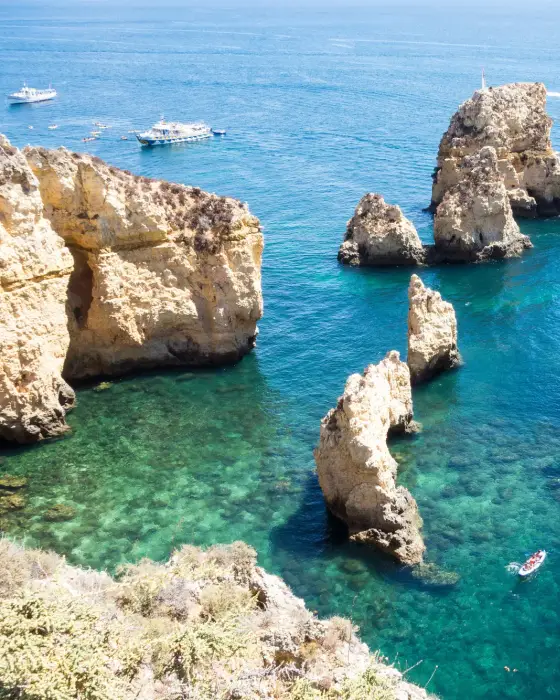
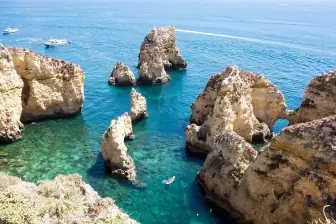
The headland south of Lagos, with Miocene limestone cliffs, isolated stacks in the sea and caves. Beside the lighthouse, built in 1912 and 1913 on the site of a demolished chapel, a long staircase cut into the hillside runs down to the sea. The boats that enter the caves leave from the Lagos marina. One of the caves bears the name of the poet Sophia de Mello Breyner Andresen.
The Algarve's cliff coast is a 2.7 km walk from central Lagos: Miocene limestone stacks, caves and the staircase beside the lighthouse leading down to the sea, without needing a car.
Check access
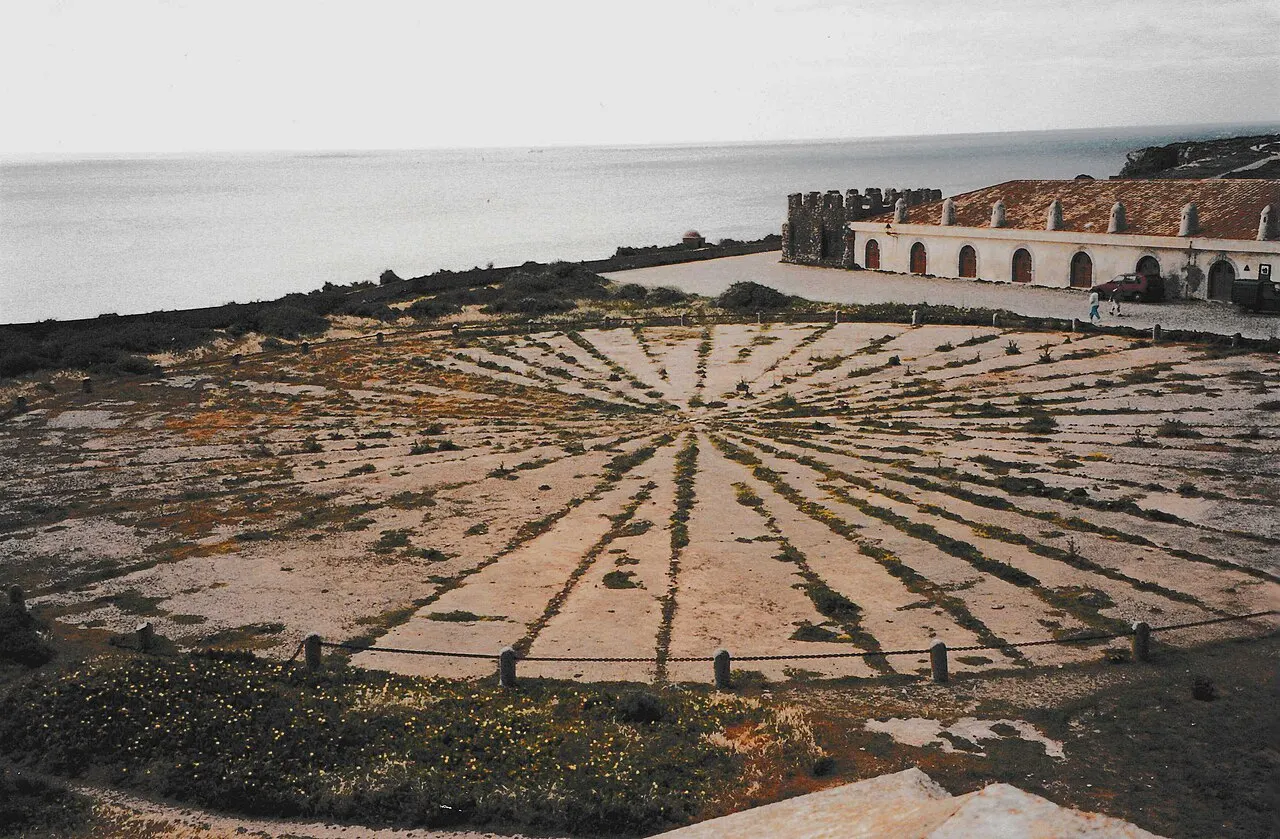
Sagres Fortress
The headland, about 1 km long and 40 m above the sea, where Prince Henry founded the Vila do Infante in the mid-15th century. What you see today is mostly the reconstruction done from 1793, after Drake's sack in 1587 and the 1755 earthquake, plus the Rosa dos Ventos, a star-shaped stone circle of uncertain function, rediscovered in 1921. It opens at 9:30 a.m. and, until further notice, closes at 5:30 p.m. all year, with last entry half an hour before; the website announces hours until 8 p.m. in summer, but suspends them for operational reasons. It closes on January 1 and 22, Easter Sunday, May 1 and December 25. The ticket costs €10, or €5 for people over 65, young people aged 13 to 24 and families with at least one adult and one minor; accompanied children under 12 do not pay. The website warns that card payment may fail and recommends bringing cash.
The headland 40 m above the sea combines the fortress rebuilt after the 1755 earthquake with the Rosa dos Ventos, a stone circle of uncertain function. It gives historical context to the Sagres coast; check the current closing time and bring cash, as the official website warns that card payments may fail.
Check access
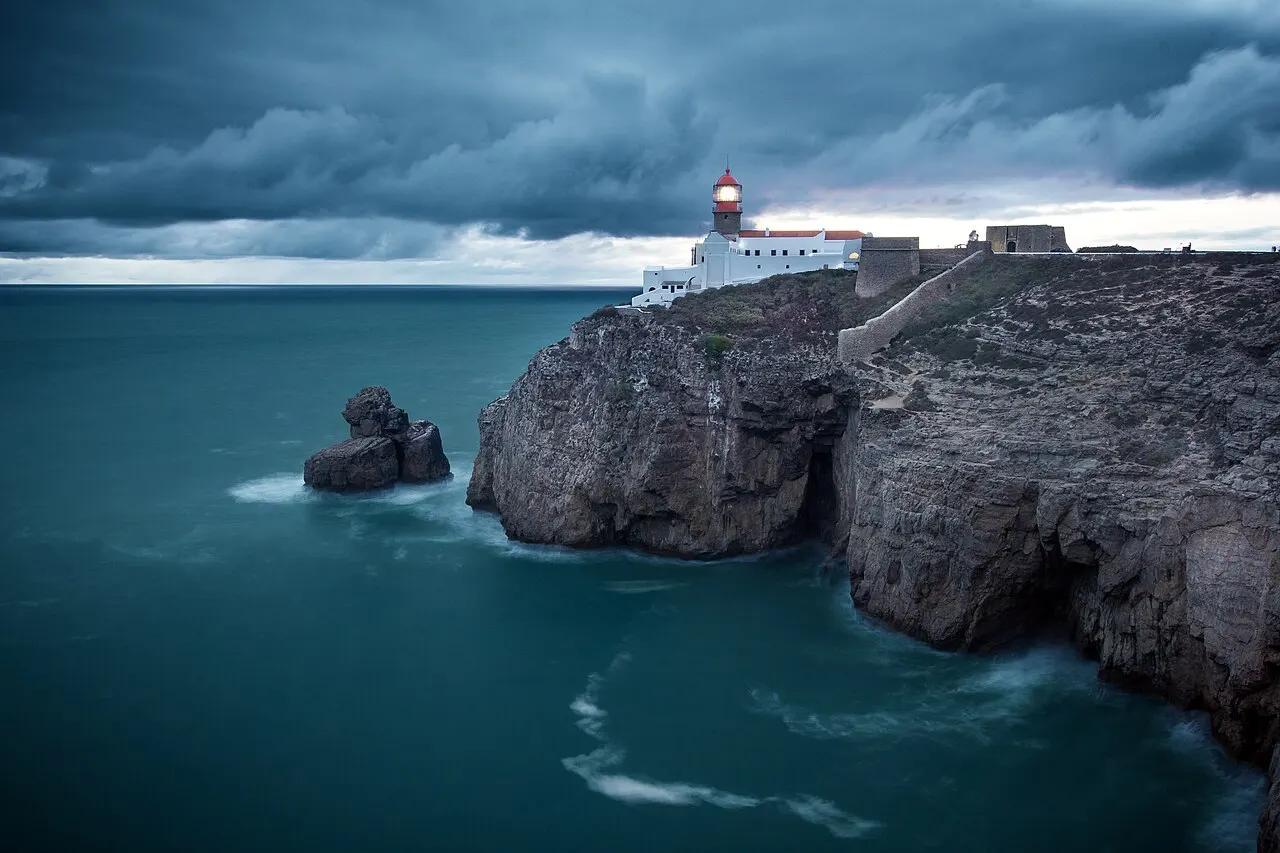
Cabo de São Vicente
The southwestern tip of mainland Portugal, 6.8 km from the Sagres Fortress by road. The current lighthouse entered service in 1846, with a 28 m tower and a light 86 m above the sea. The lighthouse complex and its museum unit are closed to the public indefinitely (confirmed in June 2026), but the cape and the cliffs are freely accessible at any hour, with free parking.
The southwestern tip of the mainland, with its 1846 lighthouse and cliffs accessible at any time free of charge. The lighthouse complex is closed, but the visit is to the cape, rather than inside the building.
Check access
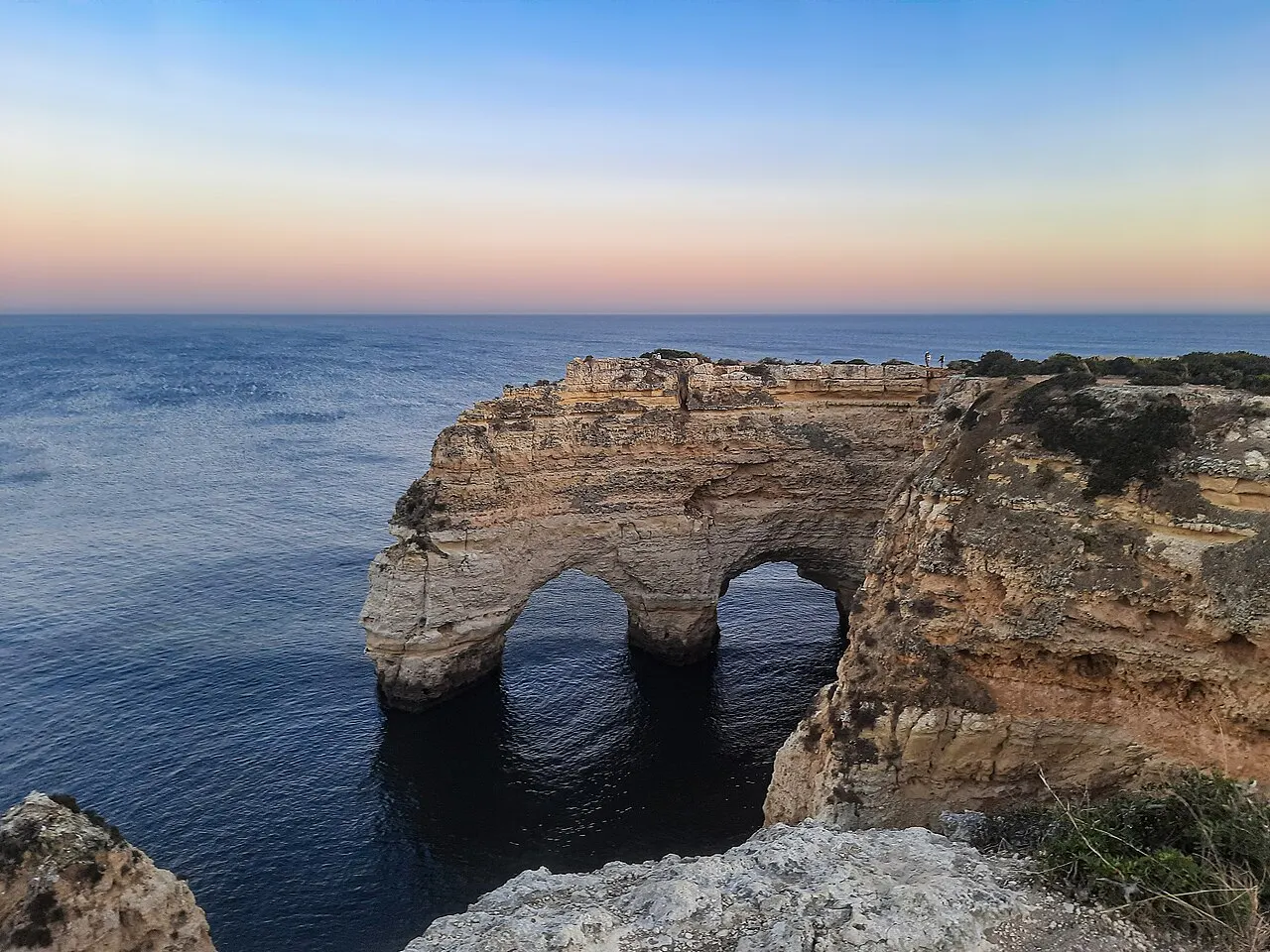
Seven Hanging Valleys Trail
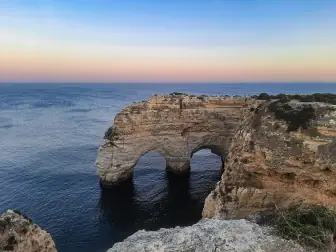
A 5.7 km linear trail marked by the Municipality of Lagoa (PR1 LGA) between Praia de Vale Centeanes and Praia da Marinha, passing Benagil. It follows the top of the limestone cliffs, cut by valleys that end above the sea, with junipers on top and seabirds on the walls. Since it is not circular, you have to return by the same path or arrange transport at the end.
The 5.7 km marked trail along the clifftops between Vale Centeanes and Marinha passes Benagil and reveals valleys ending above the sea. With no shade, it is best walked in the morning.
Check access
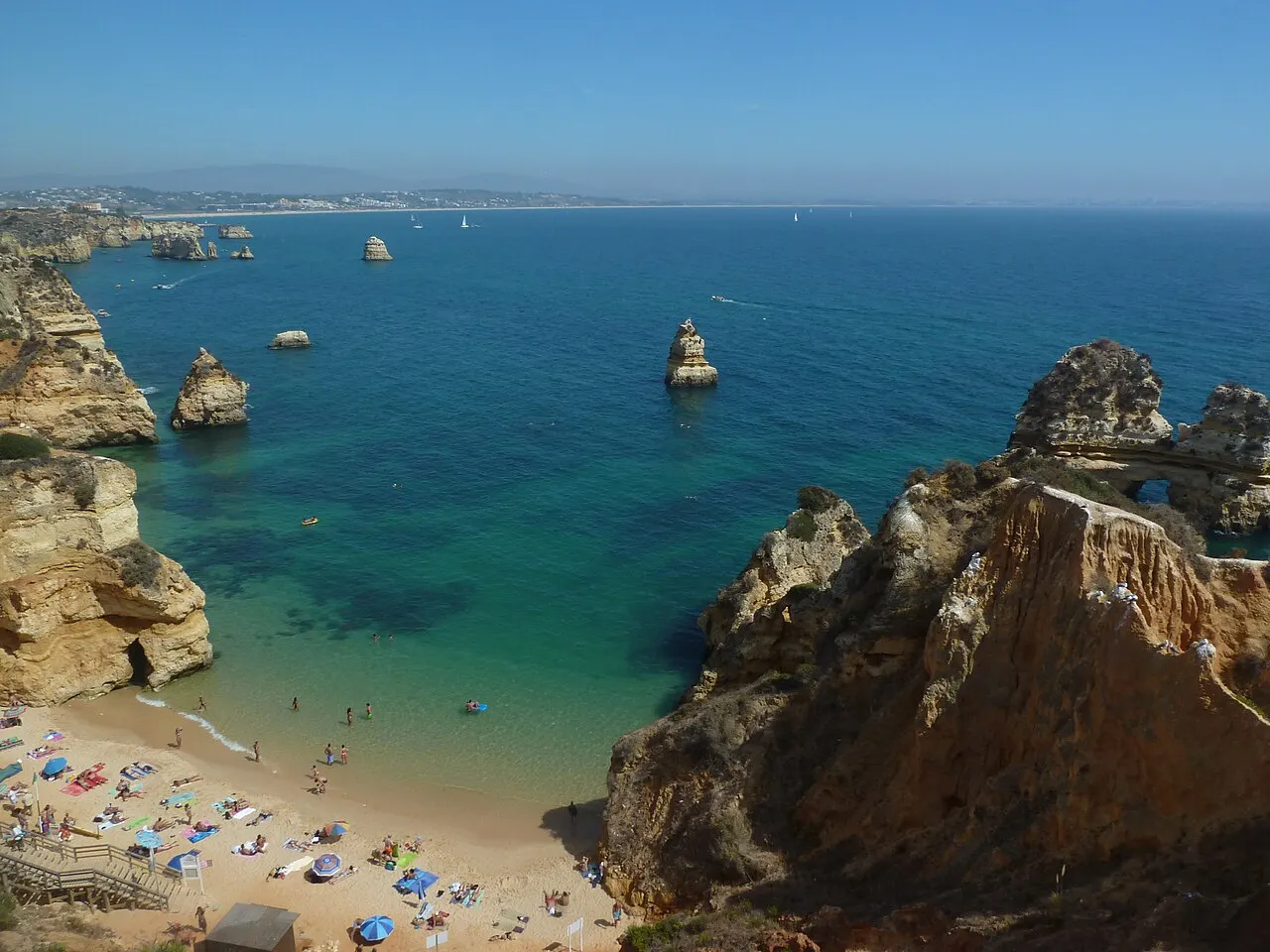
Praia do Camilo
A small beach between cliffs, on the way from the center of Lagos to Ponta da Piedade, with rock formations and a shape that the Lagos municipality compares to a shell. You go down by staircase.
On the walking route to Ponta da Piedade, this small cove shows the rock formations of the Lagos coast. It is a stop along the way, reached by staircase.
Check access
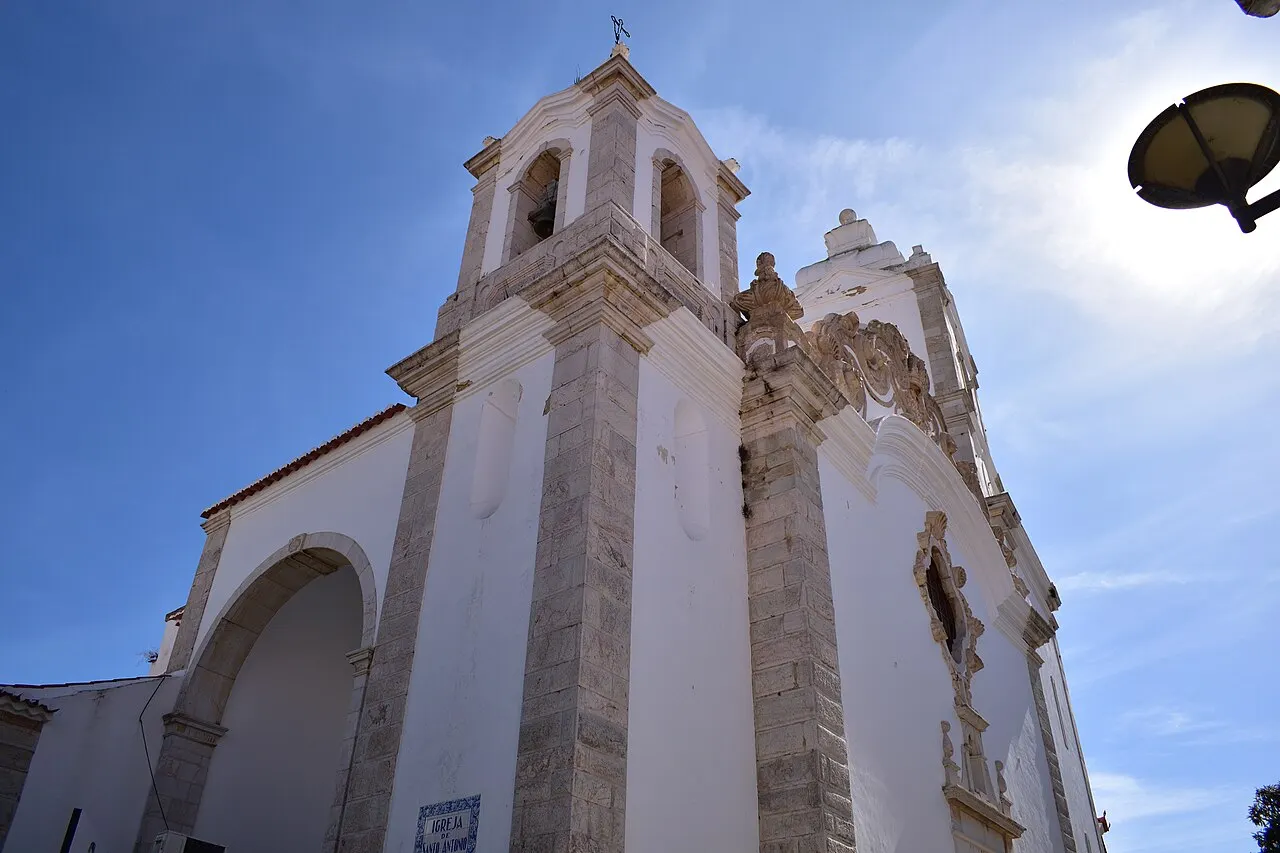
Church of Santo António
The church of the soldiers of the Lagos infantry regiment, with a facade from 1715 and an interior lined with Baroque gilded woodwork and 18th-century azulejos. It was damaged by the 1755 earthquake and restored in 1769. Today it is part of the Dr. José Formosinho Lagos Museum, founded in 1930, with collections of archaeology, sacred art and Algarve ethnography; it is open Tuesday to Sunday, 10 a.m. to 1 p.m. and 2 p.m. to 6 p.m., for €3.
The Baroque gilded woodwork and 18th-century azulejos are among the remains of Lagos before 1755, and the €3 ticket includes the Lagos Museum, with regional archaeology and sacred art.
Check access

Slave Market
The former customs building, in Praça do Infante, is identified as the site of the first market of enslaved Africans in Portugal, where in 1444 the captives from Arguin were landed, divided and sold. The Rota da Escravatura unit of the Lagos Museum operates there, which grew out of the 2009 discovery of more than 150 skeletons of Africans in a dump at Vale da Gafaria, outside the walls. Entry costs €3, or €5 with the Lagos Museum, but the museum's website posts a notice of temporary closure with no reopening date: confirm before going. When it is closed, the building and the square remain visible from outside.
The site on Praça do Infante is identified as Portugal's first market for enslaved Africans. Through the remains of more than 150 Africans found in 2009, the museum tells the story of the captives sold in the city in 1444. Its website announces a temporary closure with no reopening date, so confirm before visiting.
Check access

Benagil Cave
A sea cave next to the village of Benagil, with an opening in the roof that lets light fall on a small interior beach. Since August 2024, visits follow their own rules: landing on the inside beach is forbidden, as is arriving by swimming or with a float and renting a kayak without a guide; there is a limit on the number of boats and kayaks inside the cave at the same time, and each boat stays at most two minutes inside. In summer, guided tours leave from Praia de Benagil.
The opening in the roof lighting the interior beach is the main attraction. Since August 2024, entry has been by boat or guided kayak only, without landing, and each boat may remain inside for no more than two minutes.
Check access
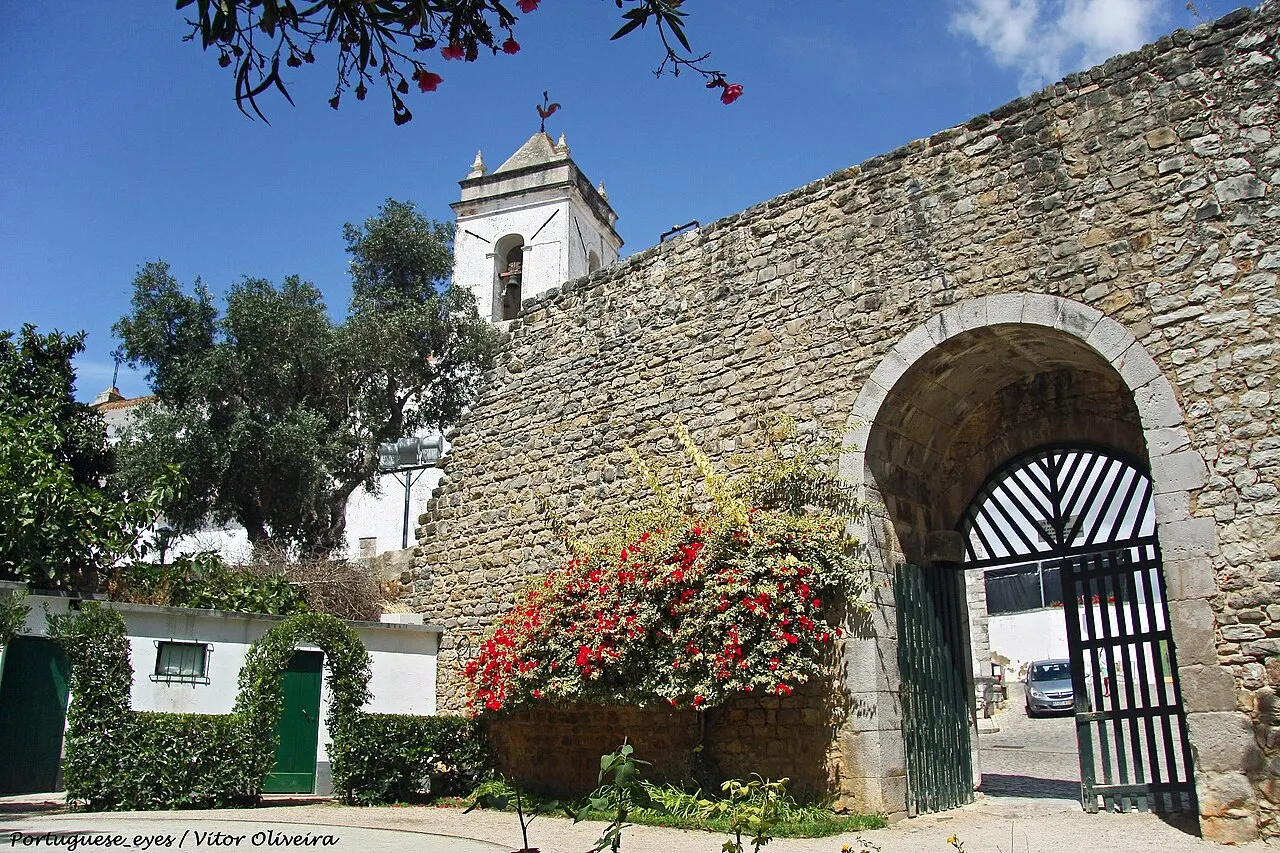
Tavira Castle
The remains of the castle built in the Muslim period, at the top of the town, beside the Church of Santa Maria do Castelo, built over a mosque and holding the tomb of D. Paio Peres Correia, who took Tavira in 1242. From there you walk down to the seven-arched bridge over the Gilão river, called Roman but identified by archaeologists as a 12th-century work.
The Muslim-period castle, the Church of Santa Maria do Castelo with the tomb of Paio Peres Correia, and the 12th-century bridge over the Gilão fit into a morning walk through Tavira.
Check access
Nilo’s itinerary
Start with the basic programme and choose extensions for the time you have.
Plan my days in the app ↗Day 1 · Lagos on foot and Ponta da Piedade
Start at 10 a.m. at the Church of Santo António and the Lagos Museum, on Rua General Alberto da Silveira (€3), before the 1 p.m. to 2 p.m. break; it closes on Mondays.
Go down to Praça do Infante, with the statue of the prince and the building of the former Slave Market. If the Rota da Escravatura unit is open (the museum's website shows a notice of temporary closure), the combined ticket with the museum costs €5; if it is closed, see the building from outside.
Have lunch in the historic center, inside the walls.
In the afternoon, walk to Ponta da Piedade, 2.7 km along the coast from Praça do Infante, stopping at Praia do Camilo, which you go down to by staircase.
At the lighthouse, go down the staircase to the sea and look at the limestone columns from below; if you want to enter the caves, book a boat from the Lagos marina.
Walk back or take a taxi and have dinner in the center.
Day 2 · Sagres and Cabo de São Vicente
Leave Lagos before 9 a.m.: it is 34 km by road to Sagres; by bus, check the schedule of Eva's line 47 the day before.
Enter the Sagres Fortress when it opens, at 9:30 a.m. (€10; bring cash, because the card may fail), and walk the headland to the point, passing the Rosa dos Ventos.
Have lunch in Sagres.
Continue 6.8 km by road to Cabo de São Vicente and walk the cliffs around the 1846 lighthouse; the lighthouse complex is closed, the cape is not.
Return to Lagos in the late afternoon.
Day 3 · The Seven Hanging Valleys and the Benagil cave
Leave early by car or taxi for Praia da Marinha, in Lagoa, about 37 km from Lagos.
Walk the Seven Hanging Valleys Trail (PR1 LGA) to the west, along the top of the cliffs, with water and a hat. Benagil is near this end, about 2 km on foot by the OpenStreetMap route.
At Benagil, take the guided boat or kayak tour to the cave, booked in advance in summer; each boat stays at most two minutes inside, and you do not arrive by swimming.
Continue the trail to Praia de Vale Centeanes, where it ends.
Return to Marinha by a taxi arranged in advance, which in summer beats repeating 5.7 km without shade in the early afternoon, and head back to Lagos.





If you stay longer
Day 4 · Tavira and the Ria Formosa
Day trip
Tavira is 108 km from Lagos by road. By CP regional train, the trip on the Algarve Line requires a change at Faro, with about 1h50 on the Lagos to Faro stretch alone; check the full schedule at cp.pt. That is why I'd sleep a night there. In town, climb to the castle and the Church of Santa Maria do Castelo and go down to the Gilão bridge. From the Quatro Águas pier, 2.4 km on foot from the center, boats leave for Tavira Island; on the Santa Luzia side, the floating bridge leads to Praia do Barril, with a little train in summer or a 2 km walk, to the anchors of the old tuna fishery.

Food
Cataplana
It is the pot made of two halves joined by a hinge, copper in origin, and the name of the dish cooked in it. The ingredients go in raw, with onion and seasonings, and cook over low heat with the lid closed. The most common version is seafood, such as clams, and there are versions with pork.
Xarém
A cornmeal porridge from Algarve cooking, associated above all with Olhão, served with clams, bacon, ham and chouriço. Xarém with cockles was a finalist in the 7 Wonders of Portuguese Gastronomy.
Grilled sardines
Grilled over embers and eaten on a thick slice of bread, which soaks up the fat of the fish, with roasted peppers and boiled potato. In Lagos, they are grilled on small grills in the street.
Tuna and octopus
Fresh tuna, in steaks, is an important ingredient of Algarve cooking, a legacy of the fishery that lasted until the 20th century. Santa Luzia, next to Tavira, presents itself as the octopus capital.
Dom Rodrigo
A sweet of egg threads, ovos-moles, almond and cinnamon, now sold wrapped in colored foil, a custom that a Lagos house began in the first half of the 20th century, first with silver paper and then with other colors. It is associated with Lagos and Tavira, and in December 2025 it received Protected Geographical Indication for an area covering the 16 municipalities of the Algarve.
Almond sweets
Colored almond marzipan is one of the typical sweets of Algarve pastry shops, and shows the Andalusian influence on the confectionery of southern Portugal.
Medronho brandy
A colorless brandy distilled from the fruit of the strawberry tree, a shrub that grows in the Algarve hills. It is 38% to 54% alcohol.
Where to eat
- Lagos historic center · $$
Grilled fish, grilled sardines and seafood cataplana at the restaurants inside the walls.
- Lagos Municipal Market · $
Fresh fish and seafood for those with a kitchen, and the best place to see what the sea brought in that day. It opens Monday to Saturday and closes on Saturday afternoon; check the hours.
- Lagos pastry shops · $
Dom Rodrigo wrapped in foil and colored almond marzipan, to take away.
- Olhão · $$
Xarém with clams or cockles, the dish the town claims as its own.
- Santa Luzia, next to Tavira · $$
Octopus, in the village that presents itself as its capital, on the way to Praia do Barril.
$: meal at an inexpensive restaurant, €11 on average (range of €10 to €30 on Numbeo) · $$: three-course dinner for two at a mid-range restaurant, €50 on average without drinks (range of €40 to €75) · $$$: dinner for two above €75 · 2026-10-15
Day trips
Tavira and the Ria Formosa
Tavira is 108 km from Lagos by road. By CP regional train, the trip on the Algarve Line requires a change at Faro, with about 1h50 on the Lagos to Faro stretch alone; check the full schedule at cp.pt. That is why I'd sleep a night there. In town, climb to the castle and the Church of Santa Maria do Castelo and go down to the Gilão bridge. From the Quatro Águas pier, 2.4 km on foot from the center, boats leave for Tavira Island; on the Santa Luzia side, the floating bridge leads to Praia do Barril, with a little train in summer or a 2 km walk, to the anchors of the old tuna fishery.
Silves
It is 34 km from Lagos by road, about 20 km northeast of Portimão. It was the Muslim Xelb, one of the most important cities of western al-Andalus, and it keeps a castle of about 12,000 m² with red sandstone walls and the Cathedral, built after 1189 on the site of a mosque. It fits in a morning or an afternoon.
Monchique and Fóia
Fóia, at 902 m, is the highest point in the Algarve, in the Serra de Monchique, 48 km from Lagos by road. The mountains are strawberry-tree country, and medronho brandy is the product you take home from there.
Where to begin
Lagos on foot and Ponta da Piedade
Start at 10 a.m. at the Church of Santo António and the Lagos Museum, on Rua General Alberto da Silveira (€3), before the 1 p.m. to 2 p.m. break; it closes on Mondays.
Sagres and Cabo de São Vicente
Leave Lagos before 9 a.m.: it is 34 km by road to Sagres; by bus, check the schedule of Eva's line 47 the day before.
The Seven Hanging Valleys and the Benagil cave
Leave early by car or taxi for Praia da Marinha, in Lagoa, about 37 km from Lagos.
Money
The currency is the euro. In Lagos, according to Numbeo (update of October 2, 2026, with few contributions), a meal at an inexpensive restaurant costs on average €11, a three-course dinner for two at a mid-range restaurant €50 without drinks, a cappuccino €2.44 and half a liter of draft beer €3.50. A city bus trip costs €1.50. Admissions are cheap: the Lagos Museum and the Rota da Escravatura cost €3 each, or €5 together (the Rota has a notice of temporary closure), with reduced admission for young people aged 12 to 18, people over 65 and students; the Sagres Fortress costs €10, or €5 for people over 65, young people aged 13 to 24 and families, and its website recommends bringing cash because card payment may fail. What weighs most is lodging, and it varies a lot with the month: on Kayak, the average nightly rate for hotels in Lagos runs from €67 in November to €226 in July (checked October 15, 2026), and hostel dorm beds appear from €10 to €39 on Hostelworld (October 15, 2026). The guided tour to the Benagil cave has a price that varies by operator and type of vessel; compare before booking.
Getting there and around
Getting there: Faro airport, train and bus
The nearest international airport is Faro (FAO), 90 km from Lagos according to the Municipality, or 84 km by the shortest road on OpenStreetMap. The airport has no station: bus lines 14 and 16, run by Próximo, go every day to the Faro bus station, which is near the train station, about 5.7 km away. By car, the route is the Via do Infante (A22), exiting at Lagos Este / Odiáxere. The CP train station in Lagos is on the east bank, next to the marina, 1.2 km on foot from Praça do Infante over the pedestrian bridge; it is the western terminus of the Algarve Line, which runs to Vila Real de Santo António via Portimão, Faro and Tavira, with a change of train at Faro. From Faro to Lagos, the regional train takes about 1h50. By bus, Eva Transportes (the Vamus Algarve regional network), the Rede Nacional de Expressos and FlixBus connect Lagos to other cities in the Algarve and the country, and Lisbon is about 300 km away.
Getting around the region
The center of Lagos is done on foot, and Ponta da Piedade is 2.7 km from Praça do Infante by the shortest route. The urban network A Onda, run by Translagos, charges €1.50 per trip. Bolt and Uber operate in the town, and there are taxis (about €5 starting fare and €0.90 per km, according to Numbeo in October 2026). For Sagres and Cabo de São Vicente, Eva's line 47 serves the localities of Vila do Bispo; check the schedules beforehand. For Benagil and the Seven Hanging Valleys Trail, 37 km from Lagos, a car or taxi saves a lot of time. Tavira is 108 km by road; by train, it is about 1h50 from Lagos to Faro, the change at Faro and then the stretch to Tavira, so check the full schedule at cp.pt.
Safety
The Algarve is a low-risk region, and what calls for attention is nature. The limestone cliffs are shaped by erosion and keep wearing away: on the Seven Hanging Valleys Trail and at Ponta da Piedade, stay away from the edge, and on the beach do not settle against the base of the cliff. Some beaches become small at high tide, such as the one at Benagil, where the water reaches almost to the rocks; check the tide before going down. In summer, the average highs pass 29 °C, and the trails along the cliff tops have no shade: bring water and a hat and prefer the morning. Prefer a lifeguarded beach in the bathing season. The Benagil cave should only be visited with an authorized operator, who follows the limits on vessels. The emergency number is 112.
Etiquette tips
Follow the rules of the Benagil cave
Since August 2024, you may not reach the cave by swimming or with a float, you may not land on the inside beach, and kayaks are allowed only with a guide, at a ratio of one guide for every six kayaks. Operators that break the rules can be fined up to €216,000 in the most serious cases.
Treat the Slave Market as a place of memory
Praça do Infante has the statue of Prince Henry and, a few meters away, the unit that remembers the Africans sold there from 1444 on and the remains found at Vale da Gafaria. Visit with the respect due a memorial.
Nudism only where it is practiced
On Tavira Island there are areas where naturism is practiced. Outside them, the custom is a swimsuit.
Words in European Portuguese
The Portuguese spoken here is that of Portugal, and some everyday words change: train is «comboio», bus is «autocarro», bus stop is «paragem» and bathroom is «casa de banho». To ask for something, the usual form is «se faz favor».
Mistakes to avoid
Treating the Algarve as a single town
Tavira is 108 km from Lagos by road, and by train you have to change at Faro, after about 1h50 on the Lagos to Faro stretch alone. Trying to do Sagres, Benagil and Tavira on the same trip from a single hotel spends your days on the road. Lagos serves the west; for the Ria Formosa, sleep a night in Tavira.
Going to the Benagil cave by swimming or in a rented kayak
Since August 2024, arriving by swimming or with a float is forbidden, and kayaks enter only with a guide. Book a guided boat or kayak tour.
Arriving at Sagres in the late afternoon
The Sagres Fortress closes at 5:30 p.m. all year until further notice, with last entry at 5 p.m., even in the months when the website announces hours until 8 p.m. Go in the morning and leave Cabo de São Vicente, which has no hours, for afterward.
Counting on the Cabo de São Vicente lighthouse being open
The lighthouse complex and its museum unit are closed to the public indefinitely. The cape and the cliffs remain open and free of charge.
Planning the Lagos museums for Monday
The Lagos Museum is open Tuesday to Sunday and closes for lunch, from 1 p.m. to 2 p.m. The Rota da Escravatura has a notice of temporary closure, and the Forte da Ponta da Bandeira is closed.
Forgetting the way back on the Seven Valleys trail
The route is linear, 5.7 km. Anyone who leaves the car at one end and walks to the other has another 5.7 km back along the top of the cliffs, without shade, or needs a taxi arranged in advance.
Useful phrases
Bom dia / Boa tarde
Greeting for morning and afternoon; at night, «boa noite»
Obrigado / Obrigada
Thanks; the speaker's gender decides the form: a man says «obrigado», a woman says «obrigada»
A conta, se faz favor
The check, please. «Se faz favor» is the most common way to ask for something in Portugal
Onde é a paragem do autocarro?
Where is the bus stop?
A que horas parte o comboio para Faro?
What time does the train to Faro leave?
Uma cataplana para dois, se faz favor
One cataplana for two people, please
Where to stay
- Lagos historic center · For those who come without a car and want everything on foot · $$: It is about 1 km from the train station, with museums, restaurants and the walk to Ponta da Piedade from your door. In exchange, there is noise from the bars at night.
- Ponta da Piedade and Porto de Mós · Couples and anyone who wants quiet near the sea · $$$: Vacation homes and hotels on the headland, 2 to 3 km from the center, with the coves of Dona Ana and Camilo nearby. To go to dinner in the center, count on a walk or a taxi.
- Meia Praia · Families with children · $$: The beach is long and flat, without stairs, and the apartments sit next to it, on the station side. The center is on the other side of the pedestrian bridge.
- Sagres · For those who want the west coast and the cape nearby · $$: It puts the fortress and Cabo de São Vicente a few kilometers away, but leaves Benagil and the Seven Valleys trail more than an hour away by road.
- Tavira · For those going to the Ria Formosa · $$: It is where you sleep to do Tavira Island and Barril without the 108 km of road from Lagos.
$: hostel dorm bed, €10 to €39 a night · $$: hotel room, average of €67 a night in November to €226 in July · $$$: above €226 a night · 2026-10-15
Districts
Lagos historic center
The streets inside and around the walls, between Praça do Infante and Praça Gil Eanes, with the Church of Santo António, the Lagos Museum, the former Slave Market, restaurants and bars. Everything is done on foot, and it is the most practical address for anyone arriving by train or bus.

Marina and Meia Praia
On the east bank of the Bensafrim stream, where the train station and the marina are, linked to the center by a pedestrian bridge. From there begins Meia Praia, with more than 4 km of sand to the Alvor river, and the beach hotels and apartments along it.
Ponta da Piedade and Porto de Mós
The headland south of the center, with the lighthouse, the coves of Dona Ana and Camilo and, farther west, Porto de Mós beach. It is an area of vacation homes and hotels, a 2 to 3 km walk from the center, and quieter than it.
Luz
A parish west of Lagos, with 4,357 inhabitants in 2021, a beach framed by cliff and the remains of a Roman bathing complex, which is one of the units of the Lagos Museum. It suits those who want a beach at the door and accept depending on a car or bus to reach the center.
Sagres and Vila do Bispo
The municipality at the far southwest, with the Sagres Fortress, Cabo de São Vicente and the coast of the natural park. It is 34 km from Lagos by road and an alternative base for those who want the west coast closer.
Lagoa, Carvoeiro and Benagil
The stretch of cliffs east of Portimão, with Praia da Marinha, the village of Benagil, with about 60 residents, and the cave. It is where the Seven Hanging Valleys Trail runs, about 37 km from Lagos by road.
Tavira
A Sotavento town on the Gilão river, with a castle, churches rebuilt after 1755 and access to Tavira Island, inside the Ria Formosa. It is 108 km from Lagos by road, too far to go and return without rushing in the same day.
History
before Rome · Lacóbriga, the original settlement
The name of Lagos comes from Lacóbriga, a settlement of Celtic origin older than the Romans, who later made the region part of the province of Lusitania. Sections of the town walls are attributed to this period, and were extended later by the Muslims and in the 14th and 16th centuries.
8th century to 1249 · The Muslim al-Gharb
With the arrival of the Muslims in the 8th century, Lagos came to be called Zawaia and the region took the name al-Gharb, the west of al-Andalus. Silves, called Xelb, was one of the most important cities of western al-Andalus in the 10th century. Afonso III took Zawaia in 1241, and the conquest of the Algarve was completed in 1249.
1415 · The Ceuta fleet sails from Lagos
John I gathered in Lagos the fleet that conquered Ceuta, in North Africa. The town became the port from which the voyages along the African coast set out, and Prince Henry, the king's son, spent much of his time in the Algarve there.
1434 · Gil Eanes rounds Cape Bojador
Gil Eanes, whose home port was Lagos, was the first European navigator on record to pass Cape Bojador, on the coast of present-day Western Sahara, until then the limit of Portuguese voyages to the south.
1443 to 1460 · Prince Henry at Sagres
On October 27, 1443, the crown granted the prince the territory of Cabo de São Vicente, and he founded the Vila do Infante there, on the Sagres headland. The prince died at Sagres on November 13, 1460.
1444 · The division and sale of captives in Lagos
In August 1444, a fleet of Lagos merchants commanded by Lançarote de Freitas landed in the town the captives taken in the bay of Arguin, on the coast of present-day Mauritania. The chronicler Gomes Eanes de Zurara counts 235 people, a number the historian Vitorino Magalhães Godinho considered low, and describes the landing, the division and the sale in front of the prince. Captives had already been brought from Arguin in 1443, by Nuno Tristão; the regular trade in enslaved people was organized from the end of the 1440s, with the Arguin trading post and the exchanges in the Senegal region.
1573 to 1755 · Lagos, seat of the Algarve government
Sebastian I made Lagos a city in 1573, and it became the seat of government of the Kingdom of the Algarve. In 1587, Francis Drake attacked the coast, sacked Sagres and destroyed much of the fortress. Between 1679 and 1690, Lagos gained the Forte da Ponta da Bandeira to defend the port.
1755 · The earthquake and the move to Faro
The earthquake and tsunami of November 1, 1755 destroyed the old town of Lagos and severely damaged the Sagres Fortress. The capital of the Algarve passed provisionally to Loulé and then to Faro, where it remains today.
1841 to 1967 · The tuna traps at Barril
At Praia do Barril, on Tavira Island, a tuna fishery operated using the almadrava technique, with fixed nets in the sea. After fishing ended, the anchors used for the nets were placed on the sand as a memorial to the activity.
1987 · The Ria Formosa becomes a natural park
The Ria Formosa, a nature reserve since 1978, became a natural park under Decree-Law 373/87 of December 9, 1987. It covers about 18,400 hectares between Loulé and Vila Real de Santo António, and is also protected as a wetland of international importance under the Ramsar Convention.
2009 · The skeletons of Vale da Gafaria
Excavations for an underground car park in Lagos, outside the walls, uncovered a modern-era dump with more than 150 human skeletons. Studies show they were Africans brought to Lagos as merchandise. The discovery shaped the Rota da Escravatura museum unit, in Praça do Infante.
Complete history
From al-Gharb to the Kingdom of the Algarve
The Algarve has an Arabic name because it was Muslim for more than four centuries: al-Gharb, the west, was the western tip of al-Andalus. Silves, the Xelb of the Moors, was the main city, on an Arade river then navigable to the sea. The Christian conquest was slow and reversible: Sancho I took Silves in 1189 with crusaders from northern Europe and lost it to the Almohads in the following years, and only in 1249 did Afonso III complete the conquest. For that reason the kings began to style themselves kings of Portugal and the Algarve, a title that remained in the royal titulature until at least 1910.
Lagos, port of the African voyages
In the 15th century, Lagos had what the voyages along the African coast needed: a sheltered bay at the mouth of the Bensafrim stream and proximity to Cabo de São Vicente, where Prince Henry received lands in 1443. The Ceuta fleet sailed from there in 1415, and Gil Eanes, who passed Cape Bojador in 1434, was from Lagos. The same voyages brought African captives: in 1444, the town witnessed the division and sale of about 235 people taken at Arguin, a scene that Zurara described in the chronicle commissioned by the prince himself. The building identified as the first market of enslaved Africans in Portugal, in Praça do Infante, and the remains found in 2009 at Vale da Gafaria make Lagos one of the places where this history can be seen in the ground of the town.
The capital the earthquake displaced
Made a city in 1573, Lagos governed the Algarve until 1755. It resisted Drake in the late 1580s and fortified the port with the Forte da Ponta da Bandeira, completed in 1690. The earthquake and tsunami of November 1, 1755 destroyed the old town, and the regional government moved to Faro, where it stayed. The Church of Santo António, damaged and restored in 1769, is one of the buildings that give an idea of the Lagos from before the earthquake.
From tuna to tourism
From the 19th century to the mid-20th, the coastal economy was the sea: tuna traps such as the one at Barril, in Tavira, from 1841 to 1967, and canneries in Portimão. Tuna fishing declined when the shoals changed route and the rivers silted up, and tourism took its place. Today it is the engine of the Algarve economy, and the pressure of visitors has reached fragile places such as the Benagil cave, where visits came under their own rules in August 2024.
Geography and shape of the city
Barlavento and Sotavento
The Algarve is a strip of about 5,000 km² between the Atlantic Ocean, to the south and west, and the Monchique and Caldeirão mountains, to the north, which separate it from the Alentejo. The region is divided into two halves of eight municipalities each. The Barlavento, to the west, has Lagos and Portimão; the Sotavento, to the east, has Faro and Tavira. The highest point is Fóia, at 902 m, in the Serra de Monchique.
The cliff coast, from Sagres to Lagoa
In the Barlavento, the coast is cut into limestone cliffs with caves, arches and isolated stacks in the sea. At Ponta da Piedade, the rock formed in the Miocene, between about 20 and 7 million years ago, when the sea covered the region, and there are fossils of shark teeth and corals. In Lagoa, the streams that run down to the sea end above the water level, forming the hanging valleys that give the Benagil trail its name. In the far southwest, the Sagres headland and Cabo de São Vicente form the corner of the continent, inside the Southwest Alentejo and Vicentine Coast Natural Park, created in 1995.
The Ria Formosa, to the east
East of Faro, the coast changes: instead of cliffs, the Ria Formosa, a lagoon about 60 km long, from Praia do Ancão to Praia da Manta Rota, separated from the sea by sandy barrier islands (Barreta, Culatra, Armona, Tavira and Cabanas). It has been a natural park since 1987 and is an important area for waterbirds.
The climate
The climate is Mediterranean, with hot, dry summers and mild, rainy winters. At the Faro airport station (IPMA 1991 to 2020 normals), the average high runs from 16.3 °C in January to 29.4 °C in July, and annual rainfall totals 455 mm, concentrated from October to March. July and August have almost no rain.
The streams on the Lagoa coast end above sea level, and that is why the valleys on the Benagil trail are called hanging.
Culture
The Mediterranean diet and the slow towns
When UNESCO inscribed the Mediterranean diet as intangible heritage, in 2013, Tavira was the community that represented Portugal in the nomination. Tavira is also part of the Cittaslow network, of towns that commit to a slower urban rhythm. The confectionery of egg and almond, with Dom Rodrigo at the front, is the other face of the region's cooking, and Lagos organizes a sweets fair around it, the Arte Doce.
The memory of the sea and of slavery
Lagos treats its history of the voyages of discovery with more than one reading. Prince Henry has a statue in Praça do Infante, and in the same square stands the building identified as the first market of enslaved Africans in Portugal, where in 1444 the captives brought from Arguin were sold. The Rota da Escravatura unit, which tells this history, has a notice of temporary closure on the museum's website. The Lagos Museum, founded in 1930 by José Formosinho, brings together Roman archaeology, sacred art and ethnography in a single route that passes through the Church of Santo António.
Sea festivals and the Middle Ages
The summer calendar mixes tradition and re-enactment. On August 29, several Algarve beaches hold the Banho 29, a memory of the pilgrimages in which people from the interior came down to the coast for a sea bath that, it was said, was worth 29; in Lagos, the bath is at midnight, next to the Forte da Ponta da Bandeira. In Silves, the Medieval Fair fills the neighborhoods around the red sandstone castle and recalls the Muslim Xelb, home of the prince and poet al-Mu'tamid.
The colored foil of the Dom Rodrigo was the idea of a Lagos house in the first half of the 20th century: first silver, then in other colors.
Festivals and events
Banho 29, August 29
A collective sea bath, often in old-fashioned swimwear, on several Algarve beaches. In Lagos, it takes place at midnight at the Cais and at Praia da Solaria, next to the Forte da Ponta da Bandeira.
Silves Medieval Fair, summer
One of the biggest summer festivals in the Algarve, in the historic neighborhoods around the castle, with shows and banquets that evoke the Muslim Xelb. The dates and prices of each edition are published on the fair's website.
Sagres Birdwatching Festival, early October
An annual festival organized by the Vila do Bispo municipality with SPEA and Almargem, during the migration season; the 2026 edition ran from October 2 to 5. In 2025, it recorded 148 species and included boat trips to see dolphins and seabirds, workshops and astronomical observation. The date for the following year is published on the festival's website.
Olhão Seafood Festival, annual
An annual seafood festival in Olhão, one of the most crowded in the town. Check each year's date with the Olhão Municipality.
Books and films
Crónica da Guiné (around 1453), Gomes Eanes de Zurara
The chronicle that Prince Henry commissioned on the voyages along the African coast describes in detail the division and sale of captives in Lagos in August 1444. It is a partial source, written to praise the prince, and for that very reason it helps to understand how the town justified that trade.
Os Pescadores (1923), Raul Brandão
Chronicles about the fishing communities of the Portuguese coast, from the Minho to the Algarve, with pages on Olhão. They show the Algarve coast from before tourism, when the sea was work.
Viagem a Portugal (1981), José Saramago
The account of Saramago's journey through mainland Portugal, between 1979 and 1980, ends in the sixth chapter, «De Algarve e sol, pão seco e pão mole», devoted to the region.
Frequently asked questions
Algarve: how do you get from Faro airport to Lagos?
Faro airport (FAO) is 90 km from Lagos and has no station: bus lines 14 and 16, run by Próximo, go to the Faro bus station, near the train station. From Faro to Lagos, the regional train takes about 1h50; by car, the route is the Via do Infante (A22).
Algarve: how do you visit the Benagil cave?
Since August 2024, arriving by swimming or with a float is forbidden, you may not land on the inside beach, and kayaks enter only with a guide. Book a guided boat or kayak tour, whose price varies by operator and type of vessel.
Algarve: how many days should I stay?
I'd stay three days, sleeping in Lagos: the center and Ponta da Piedade, Sagres with Cabo de São Vicente, and the Seven Hanging Valleys Trail with the Benagil cave. With a fourth day, I'd go to Tavira and the Ria Formosa and sleep there a night.
Algarve: when is the best time to go?
May, June, September and October combine beach temperatures, little rain and fewer people. July is the most expensive hotel month in Lagos, and November and December are the rainiest.
Algarve: can you do everything without a car?
The center of Lagos is done on foot, Bolt and Uber operate in the town, and for Sagres Eva's line 47 serves the localities of Vila do Bispo, with schedules to check beforehand. For Benagil and the Seven Hanging Valleys Trail, 37 km from Lagos, a car or taxi saves a lot of time.
Other cities in the country
Portugal ↗- Days
- 3–4
- When
- Apr–Jun · Sep–Oct
- Per person/day
- Average 130–200 EURMid-range · per person/day
Cost scope
Per person per day: accommodation, meals, urban transport, visits and a small allowance for extras. Flights excluded; larger purchases vary. Editorial estimate, not a quote.
- Days
- 2–3
- When
- May–Jun · Sep–Oct
- Per person/day
- Average 70–120 EURMid-range · per person/day
Cost scope
Per person per day: accommodation, meals, urban transport, visits and a small allowance for extras. Flights excluded; larger purchases vary. Editorial estimate, not a quote.
- Days
- 4–5
- When
- Apr–Jun · Sep–Oct
- Per person/day
- Average 116 EURMid-range · per person/day
Cost scope
Per person per day: accommodation, meals, urban transport, visits and a small allowance for extras. Flights excluded; larger purchases vary. Editorial estimate, not a quote.
- Days
- 5–6
- When
- Jun–Sep
- Per person/day
- Explore costsGuide estimate
Cost scope
Per person per day: accommodation, meals, urban transport, visits and a small allowance for extras. Flights excluded; larger purchases vary. Editorial estimate, not a quote.