Spain
Granada
The Alhambra, the Albaicín, the Sacromonte caves, and the tapa that comes with your drink
Days Start with the basic programme and choose extensions for the time you have.
How the guide reaches this number
The first belongs to the Alhambra, which takes about three hours and wants the morning: entry at 8:30 a.m., the Alcazaba, the Nasrid Palaces in the booked slot, and the Generalife, and in the afternoon the center, with the Capilla Real, the Cathedral, and the Corral del Carbón, before dinner from tapa to tapa on Calle Navas. The second is on the other side of the valley: the Carrera del Darro and the Bañuelo in the morning, the Albaicín as far as the Placeta de San Miguel Bajo, the Sacromonte in the afternoon, sunset at the Mirador de San Nicolás, and flamenco in a cave at night. With a third day, I'd go to the Alpujarras, by car, to the villages of the Barranco de Poqueira; in winter, anyone who skis swaps that day for the Sierra Nevada. Without a ticket bought beforehand, the visit to the Nasrid Palaces depends on what is left at the day's ticket office, which sells only until two hours before each slot; since they are the reason for the trip, I wouldn't leave that to chance. The second day, the Albaicín and the viewpoints need no ticket at all. In July and August, with highs above 35 °C, I'd do the hills only in the early morning and late afternoon.
2–3
When April, May, and October; July and August exceed an average high of 35 °C, and winter is cold at night, with snow in the mountains
How the guide reaches this number
Granada has a very hot, dry summer and a winter that is cold at night, with rain concentrated in autumn and early winter. In the 1991–2020 normals for the airport station, the average high in July is 36.4 °C and in August 35.9 °C, and the average low in January is 0.5 °C. April and May (average highs of 22 °C and 27 °C) and October (25 °C) are the best windows for walking the hills; they are also the months of the most expensive hotels, according to the average rate the INE measures. July and August have the cheapest lodging of the year, and anyone who comes then visits the Alhambra at the first time slot and leaves the middle of the afternoon for indoors. From November to March the nights are near zero, the mountains are covered in snow, and the ski resort opens on the date it announces each season. The Alhambra's hours change with the season: from 8:30 a.m. to 8 p.m. from April 1 to October 14, and from 8:30 a.m. to 6 p.m. from October 15 to March 31.
Per person/day Budget about 61 EUR; mid-range about 150 EUR; comfortable about 350 EUR per person, based on spending reported by travelers to Budget Your Trip (consulted in October 2026).
How the guide reaches this number
Per person per day: accommodation, meals, urban transport, visits and a small allowance for extras. Flights excluded; larger purchases vary. Editorial estimate, not a quote.
 What Nilo thinks
I'd stay two days in Granada. The first belongs to the Alhambra, which takes about three hours and wants the morning: entry at 8:30 a.m., the Alcazaba, the Nasrid Palaces in the booked slot, and the Generalife, and in the afternoon the center, with the Capilla Real, the Cathedral, and the Corral del Carbón, before dinner from tapa to tapa on Calle Navas. The second is on the other side of the valley: the Carrera del Darro and the Bañuelo in the morning, the Albaicín as far as the Placeta de San Miguel Bajo, the Sacromonte in the afternoon, sunset at the Mirador de San Nicolás, and flamenco in a cave at night. With a third day, I'd go to the Alpujarras, by car, to the villages of the Barranco de Poqueira; in winter, anyone who skis swaps that day for the Sierra Nevada. Without a ticket bought beforehand, the visit to the Nasrid Palaces depends on what is left at the day's ticket office, which sells only until two hours before each slot; since they are the reason for the trip, I wouldn't leave that to chance. The second day, the Albaicín and the viewpoints need no ticket at all. In July and August, with highs above 35 °C, I'd do the hills only in the early morning and late afternoon.Granada was the last Muslim capital of the Iberian Peninsula, and that is why it has the Alhambra: the Nasrid emirs ruled from here from 1238 to 1492, and the palaces they left on the Sabika hill have a hall with a ceiling of 8,017 interlocking pieces of wood and a courtyard with a fountain of twelve marble lions. On the slope opposite, the Albaicín keeps its narrow streets and the houses with a garden behind the wall, and higher up, in the Sacromonte, there are houses dug into the hillside, where flamenco is danced at night. Down below, the Catholic Monarchs who took the city are buried in the Capilla Real, a few steps from bars where every drink arrives with a tapa. Behind it all stands the Sierra Nevada, with snow in winter and the highest peak on the Peninsula, less than an hour away by car.
Quick facts
- Population
- 233,975 inhabitants in the municipality of Granada (INE, 2025)
- Founding
- Iberian oppidum of Ilturir, around 650 BC; Madinat Garnata, founded by the Zirid Zawi ben Ziri in 1013; Nasrid capital from 1238 to 1492
- Country and region
- Spain; capital of the province of Granada, in Andalusia, at about 684 m, at the foot of the Sierra Nevada
- Language
- Spanish (Castilian), spoken with an Andalusian accent
- Currency
- Euro (€, EUR)
- Time zone
- UTC+1 in winter and UTC+2 in summer time, from the last Sunday of March to the last Sunday of October
- Best time to visit
- April, May, and October; July and August exceed an average high of 35 °C, and winter is cold at night, with snow in the mountains
- Average daily cost
- Budget about 61 EUR; mid-range about 150 EUR; comfortable about 350 EUR per person, based on spending reported by travelers to Budget Your Trip (consulted in October 2026).
When to go
April, May, and October; July and August exceed an average high of 35 °C, and winter is cold at night, with snow in the mountains
How the year changes
Granada has a very hot, dry summer and a winter that is cold at night, with rain concentrated in autumn and early winter. In the 1991–2020 normals for the airport station, the average high in July is 36.4 °C and in August 35.9 °C, and the average low in January is 0.5 °C. April and May (average highs of 22 °C and 27 °C) and October (25 °C) are the best windows for walking the hills; they are also the months of the most expensive hotels, according to the average rate the INE measures. July and August have the cheapest lodging of the year, and anyone who comes then visits the Alhambra at the first time slot and leaves the middle of the afternoon for indoors. From November to March the nights are near zero, the mountains are covered in snow, and the ski resort opens on the date it announces each season. The Alhambra's hours change with the season: from 8:30 a.m. to 8 p.m. from April 1 to October 14, and from 8:30 a.m. to 6 p.m. from October 15 to March 31.
Nilo's tips
Choose the Nasrid Palaces slot first
The general ticket is valid all day for the Alcazaba, the Partal, and the Generalife, but the Nasrid Palaces accept only the printed half hour. I'd take a mid-morning slot: you can see the Alcazaba before and the Generalife after without crossing the hill twice, and each area admits only one entry.
The Alhambra can also be seen for free
The Mirador de San Nicolás and the one at San Cristóbal show the whole complex from across the valley, and the Paseo del Padre Manjón, at the end of the Carrera del Darro, shows the wall from below. I'd save one of these for late afternoon on the day you visit the monument inside.
Build dinner out of tapas
I'd have dinner going from bar to bar on Calle Navas or Calle Elvira, one drink and the tapa that comes with it in each, instead of sitting down in a restaurant. It is the local way, and the cheapest.
Use the city buses on the hills
The C31 climbs to the Albaicín, the C32 links the Alhambra to the Albaicín, and the C34 goes to the Sacromonte. I'd go up by bus and come down on foot, which is when the slopes weigh least.
Sunday is Monumentos Andalusíes day
The ticket for the Bañuelo, the Palacio de Dar al-Horra, and the other Nasrid houses on the circuit is free on Sunday. On the other hand, the cathedral opens only at 3 p.m. that day. On a Sunday, I'd do the Bañuelo, the Albaicín, and the Palacio de Dar al-Horra in the morning, without paying, and leave the Cathedral for after 3 p.m.
Explore the map
Explore the map, read about the other places and plan your travel days in the app.
Open the appWhat to see
Granada: Between the Sierra Nevada and the Vega
The climate is Mediterranean with a continental character, dry and with a wide swing between day and night. The flat area around the cathedral, the Capilla Real, the Plaza Bib-Rambla, and the Gran Vía de Colón, with shops, hotels, and the bus stops that climb to the hills.
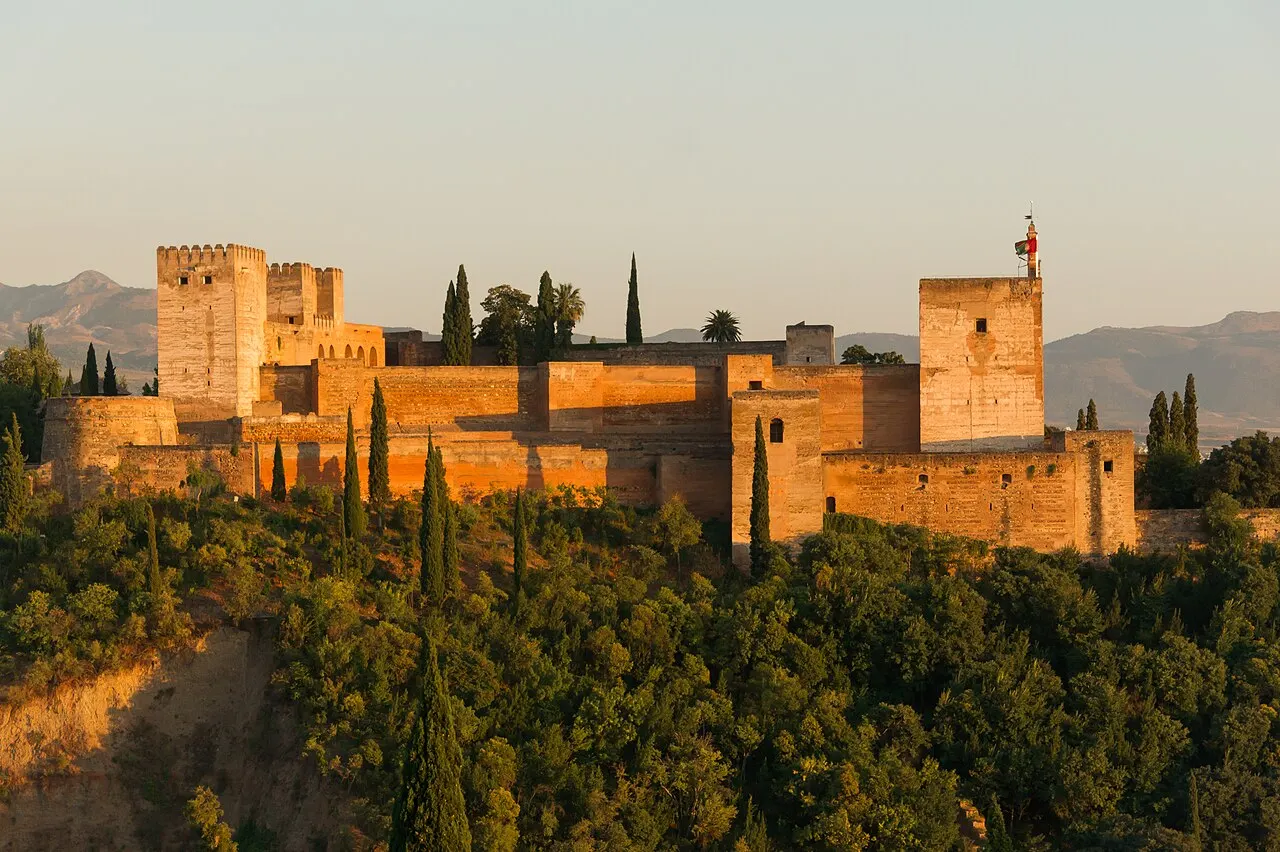
Alhambra
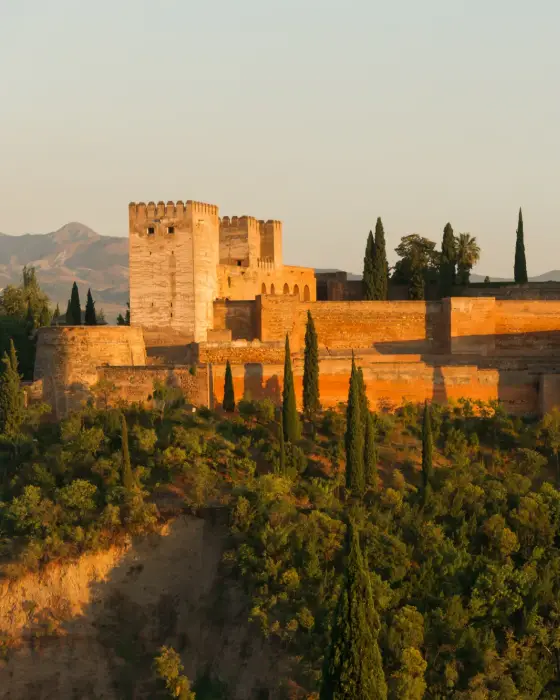
The palace city of the Nasrids, begun in 1238 on the Sabika hill. The general daytime ticket covers four areas: the Alcazaba, the fortress with the 25 m Torre de la Vela; the Nasrid Palaces, with the Comares Palace and its Hall of the Ambassadors, 18.2 m high under a ceiling of 8,017 pieces of wood, and the Palace of the Lions; the Partal; and the Generalife, the summer residence with gardens. In the middle stands the Renaissance Palace of Charles V, begun in 1527, which houses the Alhambra Museum and the Museum of Fine Arts. The general visit takes about three hours, each area admits a single entry, and the Nasrid Palaces only within the half-hour slot printed on the ticket.
It is the reason for the trip: the palace city of the Nasrids, with the Palace of the Lions and the Hall of the Ambassadors, and entry to the Nasrid Palaces is only within the half-hour slot bought in advance.
Check access
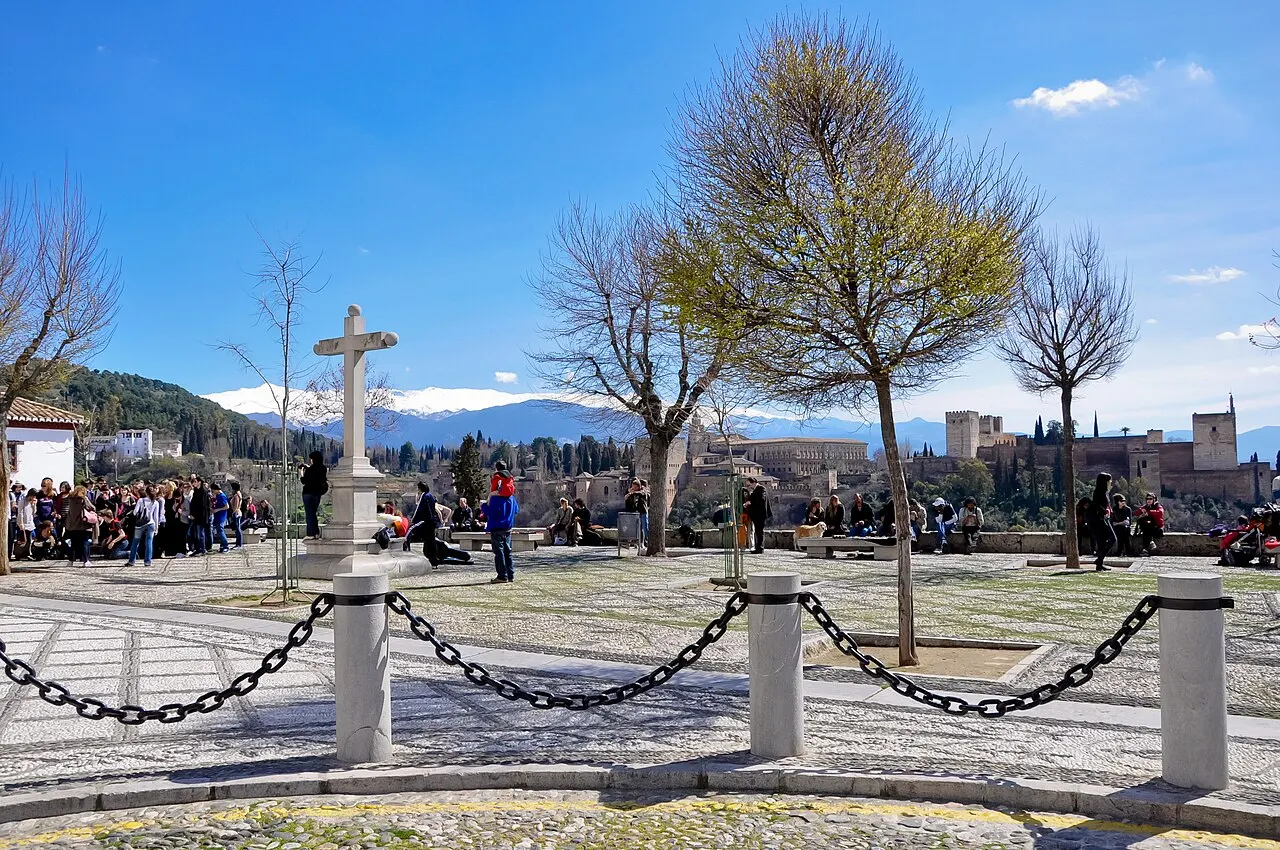
Mirador de San Nicolás
The square in front of the church of San Nicolás, at the top of the Albaicín, from which you see the whole Alhambra with the Sierra Nevada behind it. Next to it is the Mezquita Mayor, from 2003, the first built in Granada after 1492. It is free and gets crowded in the late afternoon.
Free of charge, it shows the whole Alhambra with the Sierra Nevada behind it, and late afternoon is its moment, even with the square full.
Check access

Capilla Real de Granada
Built from 1505 to 1517 in Isabelline Gothic, it holds the tomb of Isabella and Ferdinand, the Catholic Monarchs, carved by Domenico Fancelli, and that of Joanna and Philip, by Bartolomé Ordóñez; in the crypt is also the coffin of Infante Miguel, the monarchs' grandson, who died as a child. The sacristy-museum displays the crown and scepter and the queen's painting collection, with Memling, Juan de Flandes, and Botticelli. Ticket €7.
The Catholic Monarchs who took the city in 1492 are buried here, and the sacristy holds the queen’s crown, scepter and painting collection.
Check access

Carrera del Darro
The street that follows the Darro River from the Plaza Nueva, under the Alhambra wall, with stone bridges, the church of Santa Ana, the Bañuelo hammam, and the Casa de Castril, from 1539, home of the Archaeological Museum. It ends at the Paseo del Padre Manjón, from where you look up at the Alhambra from below.
The riverside street below the Alhambra wall links Plaza Nueva to the Bañuelo and the Paseo del Padre Manjón and is the natural route up to the Albaicín.
Check access

El Bañuelo
A hammam, an Arab public bath, from the 11th or 12th century, which you visit as a monument on the Carrera del Darro. It is included in the Monumentos Andalusíes ticket, which is also valid for the Palacio de Dar al-Horra and is free on Sundays.
An Arab bath from the 11th or 12th century on the Carrera del Darro, with an inexpensive ticket and free entry on Sundays.
Check access
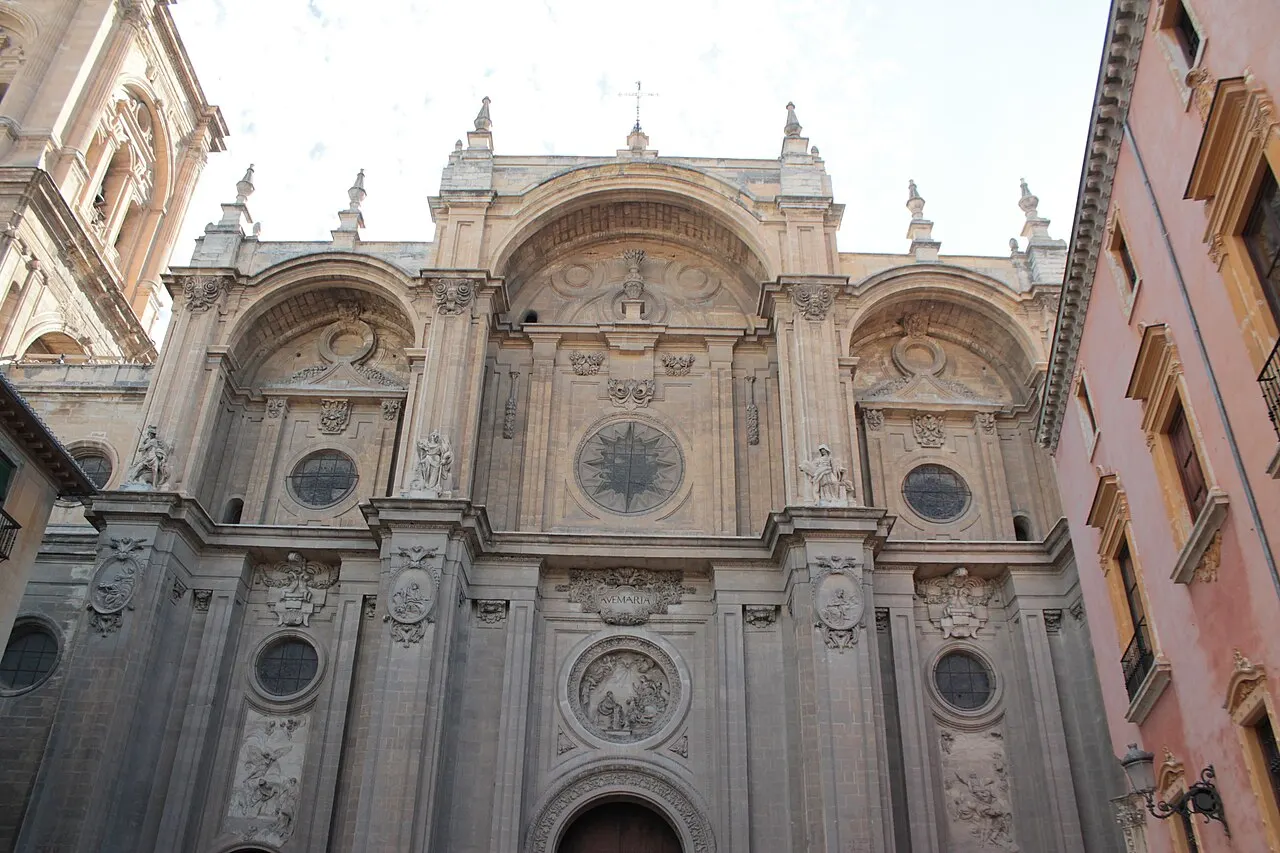
Catedral de Granada
Begun in 1523 on the site of the main mosque and completed in 1704, with a Renaissance design by Diego de Siloé, who made the circular main chapel, and a Baroque facade altered by Alonso Cano from 1667. Ticket €10.
Diego de Siloé’s Renaissance cathedral on the site of the main mosque, next to the Capilla Real; on Sundays it opens only in the afternoon.
Check access

Corral del Carbón
The only funduq, or alhóndiga, from the Nasrid era preserved on the Iberian Peninsula: a grain warehouse and inn for merchants from outside the city, from the early 14th century. Later it was a playhouse and, in the 17th century, a coal depot, which is where the name comes from.
The only surviving Nasrid funduq on the Iberian Peninsula, a few minutes from the cathedral, and the visit is quick.
Check access

Museo Cuevas del Sacromonte
A museum opened in 2002 on a 4,800 m² site in the Sacromonte, with up to eleven caves set up as homes and workshops. It explains how people lived in the dug-out houses of the valley.
The caves furnished as homes explain the neighborhood dug into the hillside better than viewing it from outside.
Check access

Monasterio de la Cartuja
A Carthusian monastery founded in 1506, north of the center, known for its sacristy of 1727 to 1764, one of the central works of late Spanish Baroque. Ticket €7.
The sacristy, built from 1727 to 1764, is one of the major works of late Spanish Baroque; it is to the north, away from the route through the hills, so it is worthwhile for those who enjoy Baroque art.
Check access
Nilo’s itinerary
Start with the basic programme and choose extensions for the time you have.
Plan my days in the app ↗Day 1 · The Alhambra in the morning and the center in the afternoon
Be at the Alhambra entrance at 8:30 a.m., when it opens: take the C30 bus, which leaves from the Plaza Isabel la Católica, or walk up the Cuesta de Gomérez from the Plaza Nueva, in about 30 minutes.
Start with the Alcazaba and climb the Torre de la Vela, from where you see the Albaicín opposite and the Vega to the west.
Enter the Nasrid Palaces in the half-hour slot printed on the ticket: the Comares Palace, with the Hall of the Ambassadors, and the Palace of the Lions.
Continue through the Partal to the Generalife and its gardens, and stop at the Palace of Charles V on the way back.
Walk down to the center along the Cuesta de Gomérez and have lunch.
In the afternoon, visit the Capilla Real, open Monday to Saturday until 6:30 p.m., and the Cathedral, open until 6:15 p.m.; on Sunday, the cathedral opens only at 3 p.m.
Walk a few minutes to the Corral del Carbón, on Calle Mariana Pineda, open every day from 9 a.m. to 8 p.m.
Have dinner going from tapa to tapa on Calle Navas and the streets of the Realejo.
Day 2 · The Darro valley, the Albaicín, and the Sacromonte
Leave the Plaza Nueva along the Carrera del Darro and enter the Bañuelo; the Monumentos Andalusíes are open from 10 a.m. to 5 p.m. from September 15 to April 30, and from 9 a.m. to 2:30 p.m. and 5 p.m. to 8:30 p.m. from May to mid-September.
Continue to the Paseo del Padre Manjón and look up at the Alhambra from below.
Climb to the Albaicín by the slopes to the Plaza Larga and visit the Palacio de Dar al-Horra with the same ticket as the Bañuelo.
Have lunch at the Placeta de San Miguel Bajo.
Go down to the Plaza Nueva and take the C34 to the Sacromonte for the Museo Cuevas del Sacromonte. Anyone who wants the Abadía del Sacromonte goes up afterward, in the afternoon session: from 3 p.m. to 5 p.m. from October 26 to March 28, from 3:30 p.m. to 6 p.m. the rest of the year.
Walk back along the top of the Albaicín and reach the Mirador de San Nicolás an hour before sunset; if it is crowded, the other option is the Mirador de San Cristóbal.
At night, watch a flamenco show in a Sacromonte cave and return by bus or taxi.


If you stay longer
Day 3 · Alpujarras (Barranco de Poqueira and Trevélez)
Day trip
On the southern slope of the Sierra Nevada, the white villages of the Barranco de Poqueira are about 67 km by road from the Plaza Nueva (Pampaneira, at 1,058 m, around 1 hour 20 minutes by car) and 73 km (Capileira, at 1,457 m, around 1 hour 30 minutes), with Bubión between the two; Trevélez, at 1,543 m, home of the ham, is about 100 km away and around 1 hour 50 minutes. There are few buses a day, so a car or a tour goes further. Walk between the villages on the old mule trails and have lunch on a plato alpujarreño.
Food
The tapa with your drink
In Granada, unlike most of Spain, the tapa comes free with each drink in most bars. With two or three rounds the tapa becomes dinner, and people who go from bar to bar dine that way.
Habas con jamón
Broad beans sautéed with cured ham, two products of the Vega and the mountains. It is one of the city's most typical dishes.
Tortilla del Sacromonte
An omelet that includes boiled brains and calf testicles, among other ingredients. It is the city's dish named after a neighborhood.
Plato alpujarreño
Blood sausage, lomo de orza (cured pork loin preserved in lard), sausage, fried potatoes with onion and pepper, fried eggs, and serrano ham. It came out of the pantry after the winter slaughter in the Alpujarras and became a restaurant dish in the villages of the Barranco de Poqueira from the 1970s.
Pionono de Santa Fe
A little sponge-cake roll soaked in water-and-sugar syrup, filled and topped with cream toasted with a torch. The name honors Pope Pius IX, and the creation is attributed to the confectioner Ceferino Isla, of Santa Fe, a town in the Vega.
Jamón de Trevélez
Ham cured in Trevélez, a village in the Alpujarras at 1,543 m above sea level, known for its high-altitude serrano ham.
Churros con chocolate
Fried dough served with thick chocolate for dipping, at breakfast or late at night.
Where to eat
- Los Diamantes · Calle Navas and Realejo · $
Fried fish and seafood as tapa and ración, in a place opened in 1942 on Calle Navas, now with several branches in the center.
Source · 2026-10-15
- Café Fútbol · Centro · $
Churros with chocolate at Plaza de Mariana Pineda, number 6, in a café the Suárez family opened in 1903.
Source · 2026-10-15
- Calle Elvira and Plaza Nueva · $
Tapas bars north of the Plaza Nueva, at the foot of the Albaicín, with the tapa served with each drink.
- Albaicín · $$
Lunch at outdoor tables at low prices on the Placeta de San Miguel Bajo.
- Alpujarras · $$
Plato alpujarreño in the restaurants of Capileira, Bubión, and Pampaneira, and ham in Trevélez.
$: simple meal, about €8.50 to €20 per person (Numbeo, October 2026); or tapas, which come with the drink · $$: mid-range restaurant, about €25 to €83 for a three-course dinner for two, without drinks (Numbeo, October 2026) · $$$: above that, with wine or a tasting menu · 2026-10-15
Day trips
Alpujarras (Barranco de Poqueira and Trevélez)
On the southern slope of the Sierra Nevada, the white villages of the Barranco de Poqueira are about 67 km by road from the Plaza Nueva (Pampaneira, at 1,058 m, around 1 hour 20 minutes by car) and 73 km (Capileira, at 1,457 m, around 1 hour 30 minutes), with Bubión between the two; Trevélez, at 1,543 m, home of the ham, is about 100 km away and around 1 hour 50 minutes. There are few buses a day, so a car or a tour goes further. Walk between the villages on the old mule trails and have lunch on a plato alpujarreño.
Sierra Nevada
Pradollano, the base of the southernmost ski resort in Europe, is at 2,100 m and about 33 km from the Plaza Nueva, around 45 minutes by car on the A-395. There is a daily bus from the bus station. In winter it is skiing; in summer, trails in the Sierra Nevada National Park, created in 1999.
Fuente Vaqueros
The village in the Vega where Federico García Lorca was born in 1898, about 22 km to the west, under half an hour by car. The house where he was born is a museum. It combines with the Huerta de San Vicente, on the same day.
Where to begin
The Alhambra in the morning and the center in the afternoon
Be at the Alhambra entrance at 8:30 a.m., when it opens: take the C30 bus, which leaves from the Plaza Isabel la Católica, or walk up the Cuesta de Gomérez from the Plaza Nueva, in about 30 minutes.
The Darro valley, the Albaicín, and the Sacromonte
Leave the Plaza Nueva along the Carrera del Darro and enter the Bañuelo; the Monumentos Andalusíes are open from 10 a.m. to 5 p.m. from September 15 to April 30, and from 9 a.m. to 2:30 p.m. and 5 p.m. to 8:30 p.m. from May to mid-September.
Money
The currency is the euro. Food weighs little on the budget because of the tapa that comes with your drink: by prices reported to Numbeo and updated on October 15, 2026, a meal at an inexpensive restaurant costs €14 on average (from €8.50 to €20), a three-course dinner for two at a mid-range restaurant, without drinks, about €35, half a liter of draft beer about €3, and a cappuccino about €2. The fixed expense is tickets: the general daytime visit to the Alhambra costs €22.27 under the official fare schedule in force (order of July 17, 2025), with a service fee on online purchases, and children under 12 get in free, but need a ticket issued together with the adult's. The night visit to the Nasrid Palaces costs €12.73, the Cathedral €10, the Capilla Real, the Cartuja, and the Abadía del Sacromonte €7 each, and the Monumentos Andalusíes ticket €8.48, free on Sundays. For lodging, the average daily rate per occupied room in the city's hotels, as measured by the INE, ranged from €73 in August 2026 to €122 in October 2025, and hostel dorm beds appeared from about €12 to €21 a night in October 2026.
Getting there and around
From the airport and the station
Federico García Lorca Granada-Jaén airport (GRX) is 17 km from the center. A bus links it to the city in about 45 minutes, passing the bus station, the Gran Vía de Colón, and the Paseo del Violón, next to the Palacio de Congresos; schedules and fares are on the website of the metropolitan transport consortium (siu.ctagr.es). A taxi to the city charges the intercity fare. Trains arrive at the station on the Avenida de los Andaluces, west of the center: since June 2019 there are direct high-speed trains to Madrid, Barcelona, Seville, Málaga, and Córdoba, and the fastest to Madrid takes about 3 hours 5 minutes. The metro runs beside the station.
Metro and city buses
The light metro has one 16 km line with 26 stops, from Albolote in the north to Armilla in the south, with stops at the railway station, the bus station, and Calle Recogidas, in the center. For the hills, the city lines serve: the C30 climbs from the center to the Alhambra, leaving from the Plaza Isabel la Católica, the C31 climbs to the Albaicín, the C32 links the Alhambra to the Albaicín, and the C34 goes to the Sacromonte. By the prices reported to Numbeo in October 2026, a single fare is between €1.40 and €1.60; the official fare is on the websites of Transportes Rober and the Ayuntamiento. Since September 30, 2026, because of roadworks on Calle Reyes Católicos, the C31 and C34 are diverted along Calle Elvira, with an alternative stop at the Plaza Nueva.
On foot
The center and the valley floor are done on foot. From the Plaza Nueva to the Alhambra, the climb along the Cuesta de Gomérez takes about 30 minutes; to the Mirador de San Nicolás, through the Albaicín, the streets are cobbled and steep. Anyone with mobility difficulties does the hills by bus.
To the mountains
The Sierra Nevada ski resort has a daily bus from the bus station. For the Alpujarras there are few buses a day, and a car gives more freedom: the Barranco de Poqueira is about 67 to 73 km by road, around 1 hour 20 minutes to 1 hour 30 minutes by car.
Safety
The risk travel guides point to most in Granada is pickpocketing, in tourist areas and around the cathedral. Also around the cathedral, women offer a sprig of rosemary and then charge for it, insisting on at least €5: say “no, gracias” firmly and do not accept anything in your hand. In summer, heat is the most common health problem: carry water, wear a hat, and avoid the slopes of the Albaicín between noon and late afternoon. In the mountains, climbing Mulhacén in winter is only for people with mountaineering experience. Tap water is safe to drink. The emergency number is 112.
Etiquette tips
Bring your original ID to the Alhambra
The ticket is named, personal, and non-transferable, and the original ID may be checked at the controls.
Eat on local time
Lunch runs roughly from 1 p.m. to 4 p.m., and dinner starts around 8 p.m. Many shops close in the middle of the afternoon and almost everything closes on Sunday.
Respect Mass at the Abadía
On Sunday, the noon Mass at the Abadía del Sacromonte suspends the tourist visit to the church. Go before 11:30 a.m. or after Mass.
At the Alhambra, backpack in front
Backpacks and bags larger than 40 × 40 cm are not allowed in; small ones go in front of the body. For eating there are designated areas, such as the Plaza de los Aljibes.
Mistakes to avoid
Leaving the Alhambra ticket to the last minute
Online sales run until 11:59 p.m. the day before, but time slots tend to sell out days or months ahead. Buy on the official site (tickets.alhambra-patronato.es) as soon as you have the date. The ticket office sells only for the same day, depending on what is left, and for the Nasrid Palaces up to two hours before the slot.
Arriving late for the Nasrid Palaces slot
Once the half-hour slot printed on the ticket has passed, you lose the right to enter the Nasrid Palaces. If you need to pick up the ticket at the machines, do it at least one hour before the slot.
Buying in someone else's name
Whoever picks up the ticket at the machines must be the person who made the booking, with ID and the card used for the purchase. For a third party to pick it up, a signed authorization and a copy of both IDs are required.
Counting on a bus to the Alpujarras without checking the schedule
There are few buses a day between Granada and the high Alpujarra. Anyone who misses the last one stays in the village; check the return before going or go by car.
Climbing to the Albaicín in the middle of a July afternoon
With an average high of 36.4 °C in July and slopes without shade, the walk is heavy going. In summer, leave the Albaicín for early morning or late afternoon.
Useful phrases
¿Me pone una caña, por favor?
A small draft beer, please. The tapa usually comes with it
¿Qué tapa lleva?
Which tapa comes with the drink?
Tengo entrada para los Nazaríes a las diez
I have a ticket for the Nasrid Palaces at ten
¿Dónde para el C32?
Where does the C32 bus stop?
No, gracias
No, thank you. Useful with the rosemary sellers
La cuenta, por favor
The check, please
Where to stay
- Centro · First trip, to do everything on foot and by bus · $$: It is on the flat, near the cathedral, the tapas streets, and the stops of the buses that climb to the hills. It lacks the view the hills have.
- Albaicín · Couples and anyone who wants to wake up with the Alhambra in front of them · $$$: The upper parts look at the Alhambra from across the valley. In exchange, the streets are stone slopes, narrow for cars and heavy for anyone with a suitcase.
- Realejo · Anyone who wants a neighborhood of bars and to stay within walking distance of the Alhambra · $$: It lies between the center and the Alhambra hill, with Calle Navas and the Campo del Príncipe nearby.
$: hostel dorm bed, from about €12 to €21 a night (October 2026) · $$: hotel at the city average: the average daily rate measured by the INE was €73 to €122, depending on the month (August 2025 to August 2026) · $$$: above average, in a four- or five-star hotel or a carmen with a view; check the rate for your date · 2026-10-15
Districts
Centro
The flat area around the cathedral, the Capilla Real, the Plaza Bib-Rambla, and the Gran Vía de Colón, with shops, hotels, and the bus stops that climb to the hills. It is the most practical starting point for everything.
Albaicín
The Muslim quarter on the hill opposite the Alhambra, a World Heritage Site since 1994, with narrow, winding streets from the Nasrid layout, cármenes (houses with a garden or orchard behind high walls), and about 28 old cisterns. It has the viewpoints of San Nicolás and San Cristóbal and calls for walking uphill.
Sacromonte
The valley above the Albaicín, following the Darro, with houses dug into the hillside since the 16th century and a traditional Roma community, which established the zambra there, a dance associated with the quarter. At night it hosts flamenco shows in caves.
Realejo
The quarter on the southern slope of the Sabika, between the center and the Alhambra, with the Campo del Príncipe and streets of bars. The pedestrian Calle Navas, just below city hall, is one of the city's tapas streets.
The Alhambra hill
The whole Sabika, with the Alhambra, the Generalife, and the Palace of Charles V. It is where you go in the morning, by C30 bus or on foot along the Cuesta de Gomérez.
History
about 650 BC · The oppidum of Ilturir
The Bastetani, an Iberian people, found a fortified settlement on the hill where the Albaicín stands today. The oldest excavated remains in the city date from that time.
1st century BC · Florentia Iliberritana
Iliberis becomes a Roman colony and later a municipium, under the name Florentia Iliberritana.
1013 · The Zirids found Madinat Garnata
With the fall of the Caliphate of Córdoba, Zawi ben Ziri creates the taifa kingdom of Granada and moves the city to the Albaicín hill, which is walled. The Zirid wall dates from this phase.
1066 · The Granada massacre
Between 1027 and 1066 the Jewish community carries great political weight in the taifa. In 1066 an uprising against it ends in a massacre.
1090–1228 · Almoravids and Almohads
Granada passes to the Berber dynasties of North Africa: the Almoravids from 1090, the Almohads from 1166, until their withdrawal from the peninsula in 1228.
1238 · Muhammad I begins the Alhambra
Muhammad I ibn al-Ahmar, founder of the Nasrid dynasty, begins building on the Sabika hill. In 1246 he agrees to become a vassal of Ferdinand III of Castile, which gives the emirate another two and a half centuries of life.
1362–1391 · The Palace of the Lions
During the second reign of Muhammad V the Palace of the Lions is built, with its fountain of twelve marble lions. It is the high point of the Nasrid architecture you visit today.
Jan. 2, 1492 · The surrender
After the capitulations signed at Santa Fe on November 25, 1491, Boabdil (Muhammad XI) hands the city over to the Catholic Monarchs. The Alhambra is not attacked, and the flag of Castile rises over the Torre de la Vela.
1505–1531 · The Christian city on top
The Capilla Real is built from 1505 to 1517 for the tombs of the Catholic Monarchs, the cathedral begins in 1523 on the site of the main mosque, the Palace of Charles V in 1527 inside the Alhambra, and the university is founded in 1531.
1568–1571 · The Alpujarras revolt
The Moriscos, Muslims forcibly converted, rise up in the Alpujarras. After the defeat come deportations and resettlement; between 1609 and 1614 they are expelled from Spain.
1829–1832 · Washington Irving at the Alhambra
The American writer lives in the Alhambra for about three months in 1829 and publishes Tales of the Alhambra in 1832. The book helps bring the monument, then abandoned, onto the traveler's circuit.
1922 · The Cante Jondo Competition
On June 13 and 14, Manuel de Falla and Federico García Lorca organize a cante jondo competition in the Alhambra's Plaza de los Aljibes, with cash prizes reserved for amateurs.
1936 · The murder of Lorca
Granada joins the military uprising at the start of the Civil War. García Lorca is shot on August 18, on the road between Víznar and Alfacar, and his body has never been found.
1984–1994 · World Heritage Site
UNESCO inscribes the Alhambra and the Generalife in 1984 and extends the listing to the Albaicín in 1994.
2017–2019 · Metro and high-speed rail
The light metro line opens on September 21, 2017, and the new railway station, with the high-speed line from Antequera, in June 2019.
Complete history
Two hills and two rivers
Granada is explained by two hills separated by the Darro valley. On the northern one, the Albaicín, there was an Iberian settlement, a Roman town and, from 1013, the capital of the Zirids, who ringed it with a wall when the Caliphate of Córdoba fell apart. On the southern one, the Sabika, the Nasrids built from 1238 the Alhambra, a palace city with a fortress, the emir's residence, houses, workshops, and gardens. The plain of the Vega, irrigated by the Genil, fed them both.
The emirate that lasted 250 years
The Nasrid emirate survived for two and a half centuries between Castile and North Africa, paying tribute and changing allies. It was in this period, above all in the 14th century, under Isma'il I, Yusuf I, and Muhammad V, that the halls of stucco, wood, and tile you visit today in the Nasrid Palaces were made. The city had a madrasa from 1349 and received Ibn Battuta in 1350.
1492 and the following century
The surrender of January 2, 1492 was negotiated: the capitulations guaranteed Muslims their religion and their property. In less than ten years came the forced conversions and the first revolt (1499–1501), and the Albaicín mosque became the church of San Salvador. The Catholic Monarchs wanted to be buried here, and the 16th century filled the center with Christian works: the Capilla Real, Diego de Siloé's cathedral on the site of the main mosque, the Palace of Charles V fitted into the Alhambra, and the university. The second revolt, in the Alpujarras (1568–1571), ended with the deportation of the Moriscos, and the mountain region lost most of its population.
Abandonment and rediscovery
Without the court, Granada lost weight. The Alhambra fell into decline in the 18th century, Napoleon's troops occupied it from 1810 to 1812 and blew up part of it, and an earthquake in 1821 did more damage. Recovery began with the Romantic travelers, Washington Irving foremost among them, with the declaration as a national monument in 1870, and with the work of the architect Leopoldo Torres Balbás from 1923.
From the 20th century to today
Lorca wrote works such as Blood Wedding and Yerma at the Huerta de San Vicente, and he was killed here at the start of the Civil War, in 1936. Under Franco's regime the province was among the poorest in Spain, and tourism later became the city's great activity. Today Granada lives on its university and on visitors to the Alhambra, joined UNESCO's Cities of Literature network in 2014, and gained the metro in 2017 and the high-speed train in 2019.
The ceiling of the Hall of the Ambassadors, in the Alhambra, has 8,017 interlocking pieces of wood.
Geography and shape of the city
Between the Sierra Nevada and the Vega
Granada sits where the hills coming down from the Sierra Nevada meet the Vega, the farming plain of the Genil River, which crosses the city from east to west. The center lies at about 684 m, and the mountains behind it rise above 3,000 m: Mulhacén, at 3,479 m, is the highest peak on the Iberian Peninsula. On a clear day, the snow shows up behind the Alhambra from much of the city.
The hills and the flat center
The Darro River, almost entirely covered in the center, runs between two hills: the Sabika, with the Alhambra, to the south, and the Albaicín, between 700 and 800 m, to the north, with the Sacromonte higher up, following the valley. The Christian and modern city grew on the flat ground, to the west and south: the cathedral, the Gran Vía de Colón, and the shopping streets. That is why a visit alternates flat blocks with cobbled slopes, and the hills call for strong legs or a small bus.
The climate
The climate is Mediterranean with a continental character, dry and with a wide swing between day and night. At the airport station, about 17 km west of the center and at 567 m, the 1991–2020 normals give average highs of 36.4 °C in July and 14.3 °C in January, and lows of 0.5 °C in January. It rains about 367 mm a year, with November and December wetter and July practically without rain.
Culture
Lorca and the city of literature
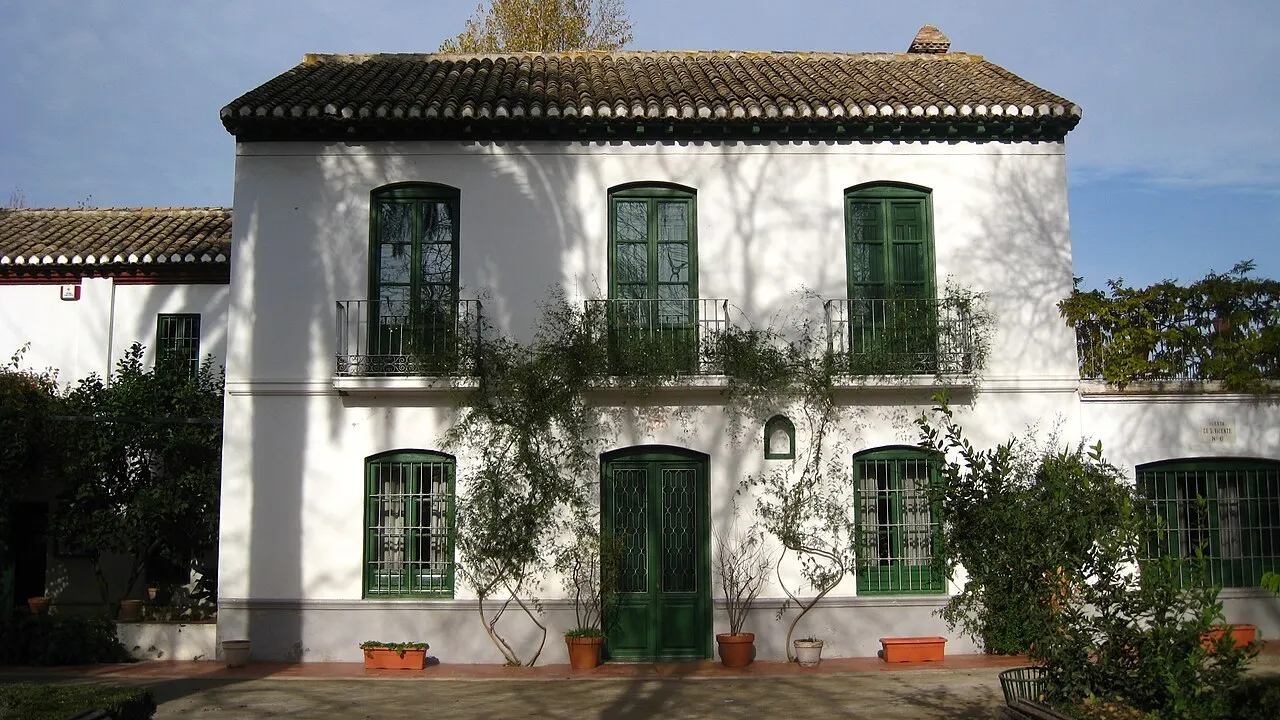
Federico García Lorca was born in Fuente Vaqueros, in the Vega, in 1898, spent the summers of 1926 to 1936 at the Huerta de San Vicente, and became famous with the Gypsy Ballads of 1928. The house where he was born and the summer house are both museums. Since 2014 Granada has belonged to UNESCO's Cities of Literature network, and Washington Irving, with Tales of the Alhambra, is the other name the city reads.
Flamenco, zambra, and cante jondo
The Sacromonte, the Roma quarter of the caves, gave the city the zambra, a dance born there, and today it concentrates the flamenco shows in caves. In 1922, Manuel de Falla and Lorca organized the Cante Jondo Competition at the Alhambra, which awarded a prize to an amateur singer of 72 who, as the story goes, had come on foot from Puente Genil, and to a boy of 12, Manolo Caracol.
Music in the palace
The Granada International Festival of Music and Dance has taken place since 1952 in June and July in the palaces and gardens of the Alhambra, with concerts in the Palace of Charles V and dance in the Generalife's cypress theater, opened in 1953. In 2026 the festival reached its 75th edition.
In Granada, the tapa usually comes with the drink, at no extra cost.
Festivals and events
Toma de Granada, January 2
A civic festival celebrating the surrender of 1492, with the procession of the royal standard. Every year there is public debate about whether to keep it.
San Cecilio, February 1
The patron saint's day, with a pilgrimage to the Abadía del Sacromonte and Mass.
Holy Week, March or April
Thirty-two brotherhoods take to the streets. On Holy Wednesday, the Gypsies' brotherhood climbs to the Abadía del Sacromonte.
Día de la Cruz, May 3
Since the early 19th century, the Albaicín and the Realejo set up altars with crosses in squares and courtyards, with loom blankets, Fajalauza pottery, and an apple pierced by scissors. The best-decorated ones win a prize.
Corpus fair, usually in June
The city fair, with no fixed date, because it follows Corpus Christi. The Wednesday procession is led by the Tarasca, a mannequin on a dragon dressed in the fashion of the season.
International Festival of Music and Dance, June and July
Concerts and dance in the palaces and gardens of the Alhambra, since 1952.
Virgen de las Angustias, September
The patron saint receives an offering of flowers on September 15 and goes out in procession on the last Sunday of the month.
Books and films
Tales of the Alhambra (1832), Washington Irving
Written after the author lived in the Alhambra in 1829, it mixes Moorish legends with life in the abandoned palace. The book helped put the Alhambra, then abandoned, on travelers' itineraries.
Gypsy Ballads (1928), Federico García Lorca
The poems that made Lorca famous, with Gypsies, civil guards, and the Andalusian landscape. It helps in understanding the Sacromonte and the city's relationship with the poet.
South from Granada (1957), Gerald Brenan
The Englishman tells of the seven years he lived in the 1920s in Yegen, in the Alpujarras, with visits from Virginia Woolf and Lytton Strachey. It is a portrait of the mountain region before the roads.
Frequently asked questions
Granada: how do you get from the airport to the center?
The airport (GRX) is 17 km from the center, and a bus links it to the city in about 45 minutes, passing the bus station and the Gran Vía de Colón. A taxi to the city charges the intercity fare.
Granada: how and when should I buy the Alhambra ticket?
Buy on the official site (tickets.alhambra-patronato.es) as soon as you have the date, because time slots tend to sell out days or months ahead. The general daytime visit costs €22.27, plus the service fee for online purchases, and children under 12 get in free, but need a ticket issued together with the adult's.
Granada: how many days should I stay?
I'd stay two days: the first with the Alhambra in the morning and the center in the afternoon, and the second with the Albaicín, the Sacromonte and sunset at the Mirador de San Nicolás. With a third day, I'd drive to the Alpujarras, or to the Sierra Nevada in winter, for anyone who skis.
Granada: how do you get to the Alpujarras?
The villages of the Barranco de Poqueira are about 67 to 73 km by road, around 1 hour 20 minutes to 1 hour 30 minutes by car. There are few buses a day, and anyone who misses the last one stays in the village, so check the return or go by car.
Granada: when is the best time to go?
April and May (average highs of 22 °C and 27 °C) and October (25 °C) are the best windows for walking the hills, and also the months of the most expensive hotels. July and August exceed an average high of 35 °C and have the cheapest lodging of the year.
Other cities in the country
Spain ↗- Days
- 3–4
- When
- May–Jun · Sep–Oct
- Per person/day
- Average 140–200 EURMid-range · per person/day
Cost scope
Per person per day: accommodation, meals, urban transport, visits and a small allowance for extras. Flights excluded; larger purchases vary. Editorial estimate, not a quote.
- Days
- 3–4
- When
- Apr–Jun · Sep–Oct
- Per person/day
- Average 156 EURMid-range · per person/day
Cost scope
2026 planning examples per person per day: accommodation, food, local transport, admission fees and extras. Flights and trips to other cities excluded. Hostel: one bed; hotels: one whole room allocated to one person. If sharing, divide accommodation. Admission and transport amounts are averages across the stay; check prices for your dates.
- Days
- 2–3
- When
- Mar–May · Oct–Nov
- Per person/day
- Average 70–120 EURMid-range · per person/day
Cost scope
Per person per day: accommodation, meals, urban transport, visits and a small allowance for extras. Flights excluded; larger purchases vary. Editorial estimate, not a quote.
- Days
- 3–4
- When
- Apr–Jun · Sep–Oct
- Per person/day
- Average 153 EURMid-range · per person/day
Cost scope
Per person per day: accommodation, meals, urban transport, visits and a small allowance for extras. Flights excluded; larger purchases vary. Editorial estimate, not a quote.
- Days
- 4–5
- When
- May–Jun · Sep–Oct
- Per person/day
- Explore costsGuide estimate
Cost scope
Per person per day: accommodation, meals, urban transport, visits and a small allowance for extras. Flights excluded; larger purchases vary. Editorial estimate, not a quote.
- Days
- 3
- When
- May–Jun · Sep
- Per person/day
- Average 113 EURMid-range · per person/day
Cost scope
Per person per day: accommodation, meals, urban transport, visits and a small allowance for extras. Flights excluded; larger purchases vary. Editorial estimate, not a quote.
- Days
- 3
- When
- Apr–Jun · Sep–Oct
- Per person/day
- Average 165 EURMid-range · per person/day
Cost scope
Per person per day: accommodation, meals, urban transport, visits and a small allowance for extras. Flights excluded; larger purchases vary. Editorial estimate, not a quote.