Spain
Valencia
Gothic center, the park in the Turia riverbed, the Ciudad de las Artes and paella from the Albufera
Days Start with the basic programme and choose extensions for the time you have.
How the guide reaches this number
On the first, Ciutat Vella on foot: the Mercado Central early, the Lonja when it opens, the cathedral with the climb up the Miguelete and, in the afternoon, the Torres de Serranos and El Carmen. On the second, the Museo de Bellas Artes and the Jardín del Turia, by bicycle or on foot, to the Ciudad de las Artes, with the Oceanogràfic or the Museu de les Ciències in the afternoon and dinner in Ruzafa. On the third, the Cabanyal and the beach in the morning and the Albufera in the afternoon, with paella in El Palmar and the boat ride at sunset. With two days, I'd combine the center and the Turia into one and keep the Albufera, which is the part of the city that is most its own. With a fourth day, I'd go to Xàtiva, for the castle and the history of the Borjas; Sagunt, closer, fits in a morning. I'd avoid Monday for museum day and Sunday for market day. What justifies the trip is the combination of a Gothic center, a park in a riverbed, an urban beach and the lagoon of rice paddies about 20 km from the center, by city bus.
3–4
When April to June and September to October; July and August are hot and crowded at the beach, March is the month of the Fallas, and September and October are also the rainiest months, with heavy downpours
How the guide reaches this number
The climate is Mediterranean and mild most of the year. By the 1991–2020 normals, the average high runs from 16.7 °C in January to 30.3 °C in August, and winter nights hover around 8 °C. In April, May and June the average highs run from 21 °C to 27 °C, without the heat of July and August, when highs pass 29 °C and nights stay above 21 °C. September and October are still warm, but they are the rainiest months, with rain that tends to fall in short, heavy storms, and it was on an October 29 that the DANA of 2024 came. March is the month of the Fallas: from the 1st to the 19th there is gunpowder daily at 2 p.m. and, between the 15th and the 19th, the city is taken over by monuments, crowds and noise, and the monuments fill streets and squares. If you want to see the festival, book early; if you want the city calm, pick another week. In the Albufera, the rice paddies are flooded from May to July and from November to January and dry in March and April.
Per person/day Budget about 64 EUR; mid-range about 153 EUR; comfortable about 330 EUR per person, based on spending reported by travelers to Budget Your Trip (checked in October 2026).
How the guide reaches this number
Per person per day: accommodation, meals, urban transport, visits and a small allowance for extras. Flights excluded; larger purchases vary. Editorial estimate, not a quote.
 What Nilo thinks
I'd stay three days. On the first, Ciutat Vella on foot: the Mercado Central early, the Lonja when it opens, the cathedral with the climb up the Miguelete and, in the afternoon, the Torres de Serranos and El Carmen. On the second, the Museo de Bellas Artes and the Jardín del Turia, by bicycle or on foot, to the Ciudad de las Artes, with the Oceanogràfic or the Museu de les Ciències in the afternoon and dinner in Ruzafa. On the third, the Cabanyal and the beach in the morning and the Albufera in the afternoon, with paella in El Palmar and the boat ride at sunset. With two days, I'd combine the center and the Turia into one and keep the Albufera, which is the part of the city that is most its own. With a fourth day, I'd go to Xàtiva, for the castle and the history of the Borjas; Sagunt, closer, fits in a morning. I'd avoid Monday for museum day and Sunday for market day. What justifies the trip is the combination of a Gothic center, a park in a riverbed, an urban beach and the lagoon of rice paddies about 20 km from the center, by city bus.Valencia sits on the plain where the Turia reaches the Mediterranean, and much of its history is a history of water. The huerta's irrigation canals date from the Muslim period, and the tribunal that apportions that water still meets on Thursdays in front of the cathedral. In the 15th century, the wealth of the silk trade raised the Lonja, whose main hall rests on eight helical stone columns. In 1957, a flood made the city divert the river, and the empty bed became a park of about 9 km, which you can ride by bicycle from the Gothic center to Calatrava's white buildings. To the south, the Albufera, a shallow lagoon ringed by rice paddies, gives paella valenciana its rice. In March, the Fallas fill the streets with satirical monuments that are burned on the night of the 19th.
Quick facts
- Population
- 840,792 inhabitants in the municipality (INE, municipal register of January 1, 2025)
- Founded
- 138 BC, as the Roman colony of Valentia, under the consul Decimus Junius Brutus
- Country and region
- Spain; capital of the Valencian Community and of the province of Valencia, on the Mediterranean coast, at 16 m above sea level
- Language
- Castilian Spanish and Valencian, both official; the official name of the city is València
- Currency
- Euro (€)
- Time zone
- UTC+1 (CET) in winter and UTC+2 (CEST) during daylight saving time, from the last Sunday of March to the last Sunday of October
- Best time to go
- April to June and September to October; July and August are hot and crowded at the beach, March is the month of the Fallas, and September and October are also the rainiest months, with heavy downpours
- Average daily cost
- Budget about 64 EUR; mid-range about 153 EUR; comfortable about 330 EUR per person, based on spending reported by travelers to Budget Your Trip (checked in October 2026).
When to go
April to June and September to October; July and August are hot and crowded at the beach, March is the month of the Fallas, and September and October are also the rainiest months, with heavy downpours
How the year changes
The climate is Mediterranean and mild most of the year. By the 1991–2020 normals, the average high runs from 16.7 °C in January to 30.3 °C in August, and winter nights hover around 8 °C. In April, May and June the average highs run from 21 °C to 27 °C, without the heat of July and August, when highs pass 29 °C and nights stay above 21 °C. September and October are still warm, but they are the rainiest months, with rain that tends to fall in short, heavy storms, and it was on an October 29 that the DANA of 2024 came. March is the month of the Fallas: from the 1st to the 19th there is gunpowder daily at 2 p.m. and, between the 15th and the 19th, the city is taken over by monuments, crowds and noise, and the monuments fill streets and squares. If you want to see the festival, book early; if you want the city calm, pick another week. In the Albufera, the rice paddies are flooded from May to July and from November to January and dry in March and April.
Nilo's tips
Do the Mercado Central and the Lonja on the same morning
The two face each other. The market opens at 7:30 a.m. and closes at 3 p.m., and the Lonja opens at 10 a.m.: start with the stalls, with the esmorzaret, and cross the street when the Lonja opens. On Sundays the market is closed, but the Lonja is free.
The Turia bed links the Torres de Serranos, the Bellas Artes and the Ciudad de las Artes
The old bed links the Torres de Serranos, the Museo de Bellas Artes and the Ciudad de las Artes without crossing a street with cars. By bicycle, the whole stretch is easy, because there is no climb; on foot, set aside the morning.
At the Ciudad de las Artes, choose one building
The complex from the outside is free, and the Oceanogràfic alone takes up the afternoon. The three-building combined ticket only pays off with the whole day. Check the official calendar for that day's price and hours, because they change with the season.
Paella at lunch, near where the rice grows
I'd eat the paella in El Palmar or at a rice restaurant on the Malvarrosa, at lunch, near where the rice is grown. Ask how many people each paella serves before ordering.
Book the Albufera boat for the late afternoon
The ride of about 40 minutes leaves from El Palmar and is most popular at sunset, when the lagoon turns golden. Take EMT line 24, which ends at El Palmar, and check that day's sunset time and the time of the last bus back before boarding.
Thursday, noon, Door of the Apostles
The Tribunal de las Aguas meets at the cathedral's side door, on the Plaza de la Virgen side. The session is public and outdoors; arrive a few minutes early to see the opening.
Explore the map
Explore the map, read about the other places and plan your travel days in the app.
Open the appWhat to see
Valencia: The Turia plain and the sea
The rice paddies around it are flooded from May to July and from November to January and dry in March and April, which changes the landscape through the year. Almost everything is done on foot.
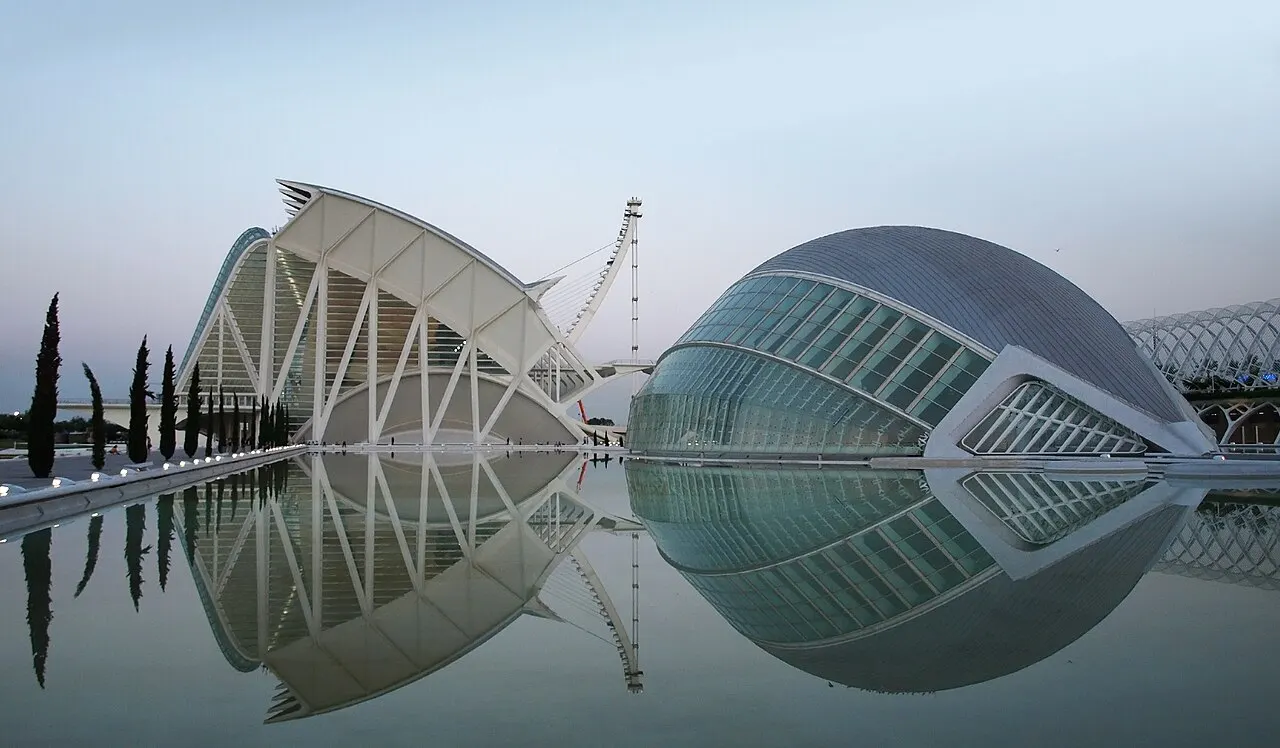
Ciudad de las Artes y las Ciencias
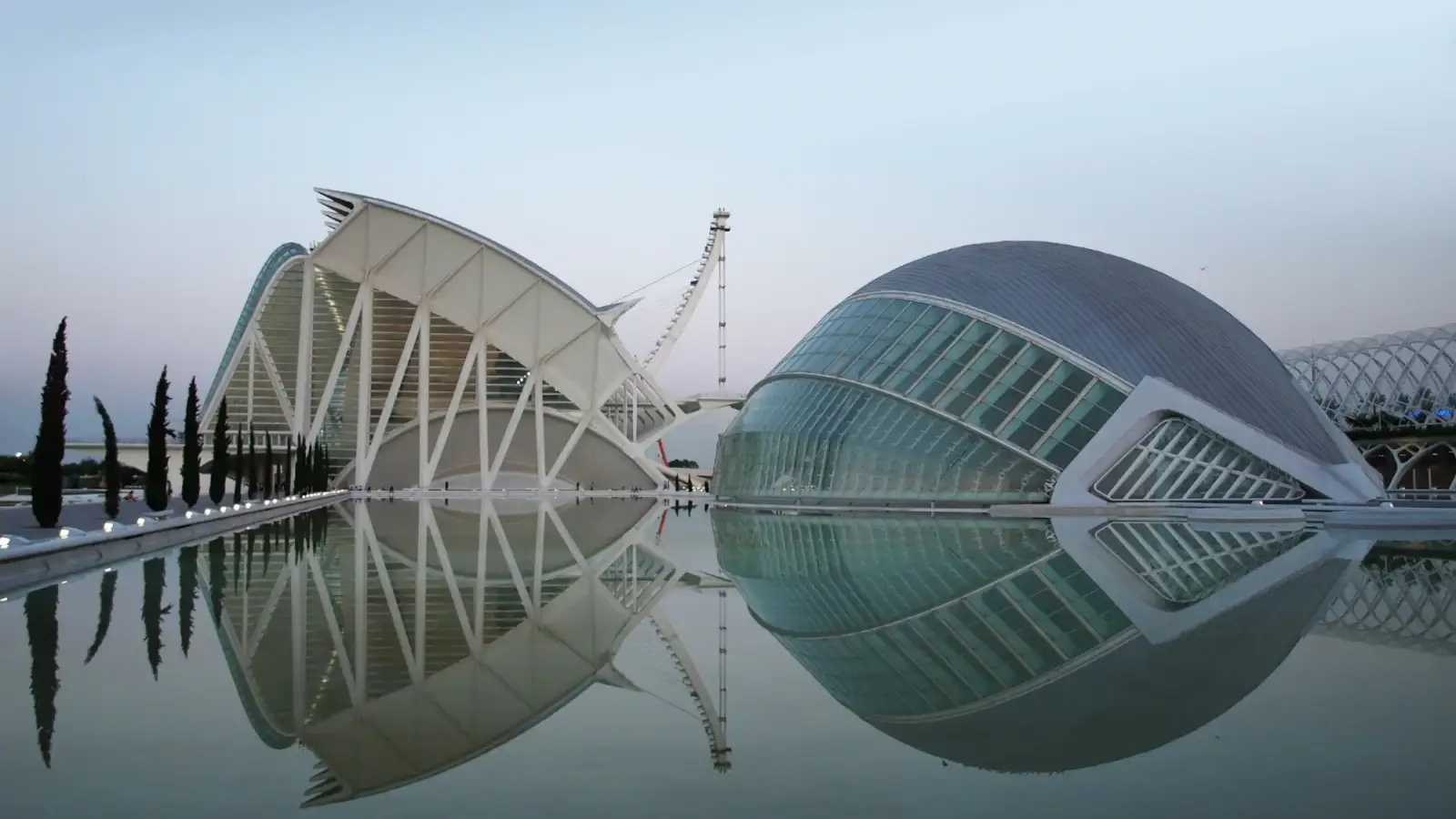
A complex of buildings by Santiago Calatrava and Félix Candela on the final stretch of the old Turia riverbed: the Hemisfèric (1998), the Museu de les Ciències, the Oceanogràfic (2003), the Palau de les Arts Reina Sofía (2005), the Umbracle and the Àgora, which has housed a CaixaForum since 2022. Walking between the buildings and the reflecting pools is free; each building charges its own admission. The Oceanogràfic, by Candela, covers 110,000 m² and presents itself as the largest aquarium in Europe; general admission costs between €35.90 and €43.05, depending on the day and the season, and the combined ticket with the Museu de les Ciències and the Hemisfèric, between €44 and €51.25 (official price list checked in October 2026). Ticket offices close an hour before the building.
Calatrava and Candela’s white buildings above reflecting pools became the image the city showed the world after 1998, and seeing the complex from outside is free. Going into the Oceanogràfic takes a whole afternoon; the Museu de les Ciències is the shorter option.
Check access

Lonja de la Seda
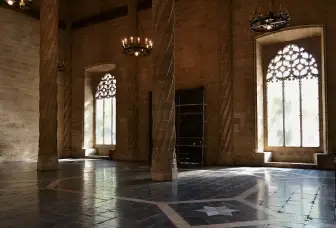
The silk exchange, in civil Gothic, has a Contract Hall built from 1483 to 1498 by Pere Compte and Joan Iborra, with eight helical columns that open into the ribs of the vault. A Latin inscription runs along the walls and warns merchants against usury; outside, 28 gargoyles show satirical and some indecent scenes. It has been on the UNESCO World Heritage list since 1996. It is open Monday to Saturday from 10 a.m. to 7 p.m. and on Sundays and holidays from 10 a.m. to 2 p.m.; admission is €2, and free on Sundays and holidays.
The hall of helical columns, built in 1483–1498, is the city’s finest secular Gothic interior, costs €2 (free Sundays and holidays) and takes less than an hour, right opposite the Mercado Central.
Check access

Mercado Central
A modernista market of iron, glass and ceramic, designed by Francesc Guàrdia and Alexandre Soler, begun in 1914 and opened in 1928, with 6,800 m² and more than 200 stalls of fish, meat, vegetables, rice, spices and salt-cured foods. It is open Monday to Saturday, from 7:30 a.m. to 3 p.m., and closed on Sundays and holidays. It stands across from the Lonja, and the two visits fit into the same morning.
The place to see what the city eats, from rice stalls to salt-cured foods, beneath a modernista dome from 1928. It closes at 3 p.m. and does not open Sundays or holidays, so go early in the day.
Check access
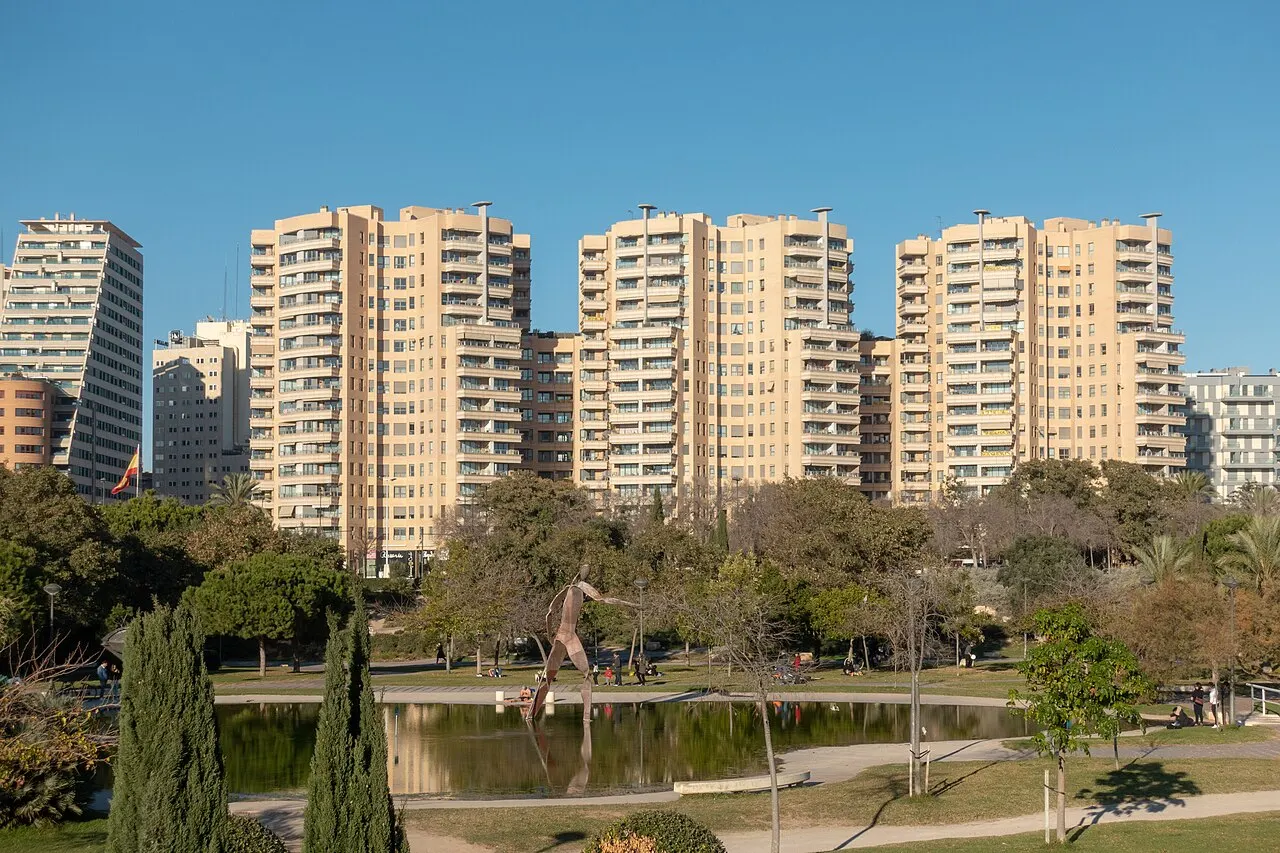
Jardín del Turia
After the flood of October 14, 1957, the Turia River was diverted into a new canal south of the city, and the old bed, which a plan from the 1960s wanted to turn into an expressway, became a park from 1986, after a campaign by residents. It is about 9 km of garden, bike path and sports fields that cross the city from west to east, passing under bridges that range from the 15th century (the Trinidad) to those of Calatrava. It ends at the Ciudad de las Artes y las Ciencias.
About 9 km of park in the riverbed left after the diversion following 1957 provide the natural route between the center and the Ciudad de las Artes, on foot or by bicycle, and explain the city’s shape better than any viewpoint.
Check access
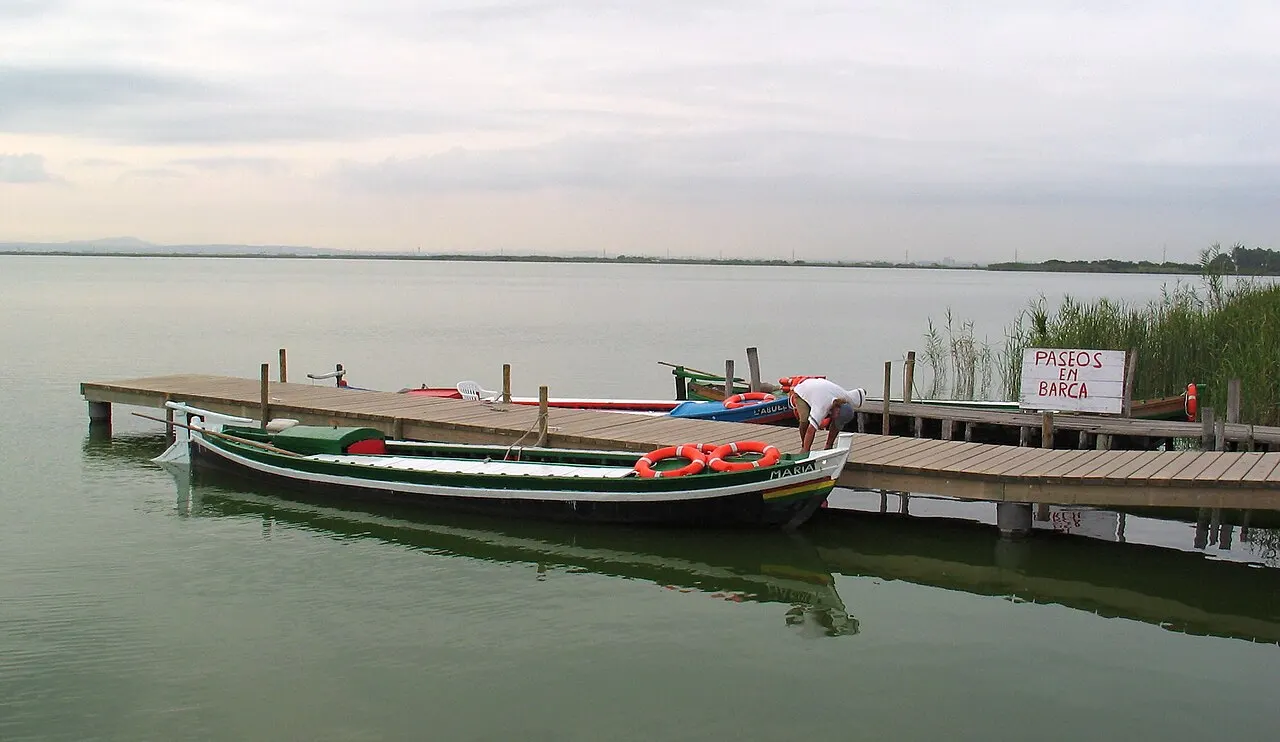
Parque Natural de la Albufera
A freshwater lagoon of about 24 km², with an average depth of 1 m, separated from the sea by a sandbar of dunes and pines, the Devesa del Saler, and surrounded by rice paddies. The natural park, of 21,120 ha, was created in 1986 and begins about 10 km from the center. More than 300 bird species pass through over the year. This is the land of paella rice: the dish almost certainly originated in this area, where it is documented since the 18th century. The rides on the traditional boats last about 40 minutes, and the sunset one is the most popular.
The lagoon surrounded by rice paddies is where paella rice comes from; a traditional boat ride of about 40 minutes at sunset, leaving from El Palmar, brings the landscape, birds and a paella lunch together in one afternoon.
Check access
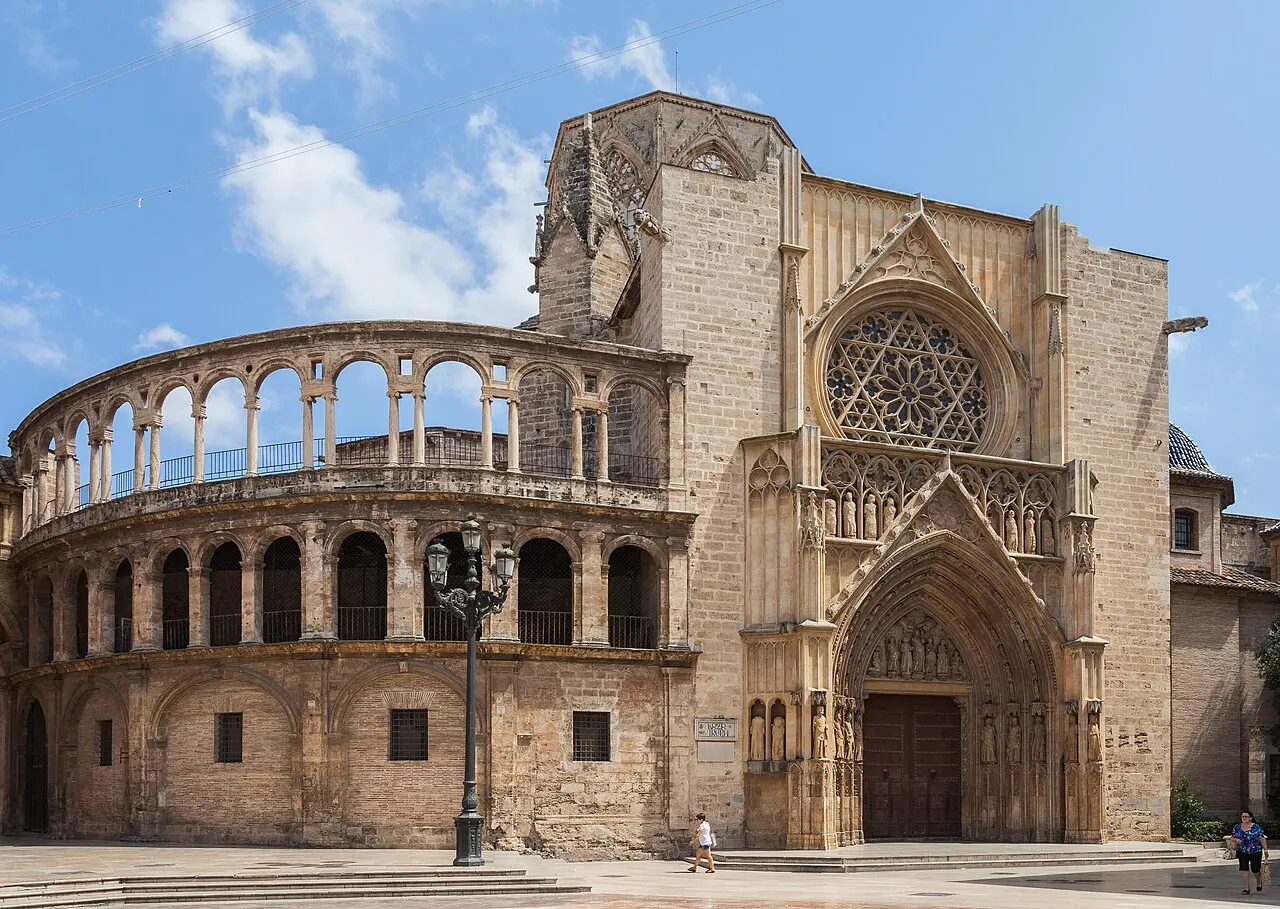
Catedral de Valencia
The cathedral mixes Romanesque, Gothic and Baroque and keeps, in a chapel since 1916, the agate chalice that tradition identifies with the one from the Last Supper, in the city since 1432 and in the cathedral's care since 1437. The cultural visit, with a museum and an audio guide in ten languages, costs €12 and is open Monday to Friday from 10:30 a.m. to 6:30 p.m., on Saturdays until 5:30 p.m. and on Sundays from 2 p.m. (October to June hours). The bell tower, the Miguelete, has 207 steps up to the terrace, costs €3 and is open every day from 10 a.m. to 6:45 p.m. On Thursdays, at noon, the Tribunal de las Aguas meets at the Door of the Apostles, on the Plaza de la Virgen side.
The chalice traditionally linked to the Last Supper and the 207-step climb up the Miguelete, costing €3, explain the visit; with only one morning, you can see the facade and Plaza de la Virgen for free and climb just the tower.
Check access

Torres de Serranos
One of the two gates that remain of the medieval wall, from 1392, on the edge of the old Turia bed. From the terrace you can see the center and the garden. It is here that, on the last Sunday of February, the Fallera Mayor makes the Crida, the official call to the Fallas. It is open Monday to Saturday from 10 a.m. to 7 p.m. and on Sundays and holidays from 10 a.m. to 2 p.m., for €2, with free admission on Sundays and holidays; in rain, fog or strong wind, the climb may be suspended.
The gate dating from 1392 is the center’s best inexpensive viewpoint, at €2 (free Sundays and holidays), on the way between El Carmen and the Turia. In rain, fog or strong winds, the climb may be suspended.
Check access
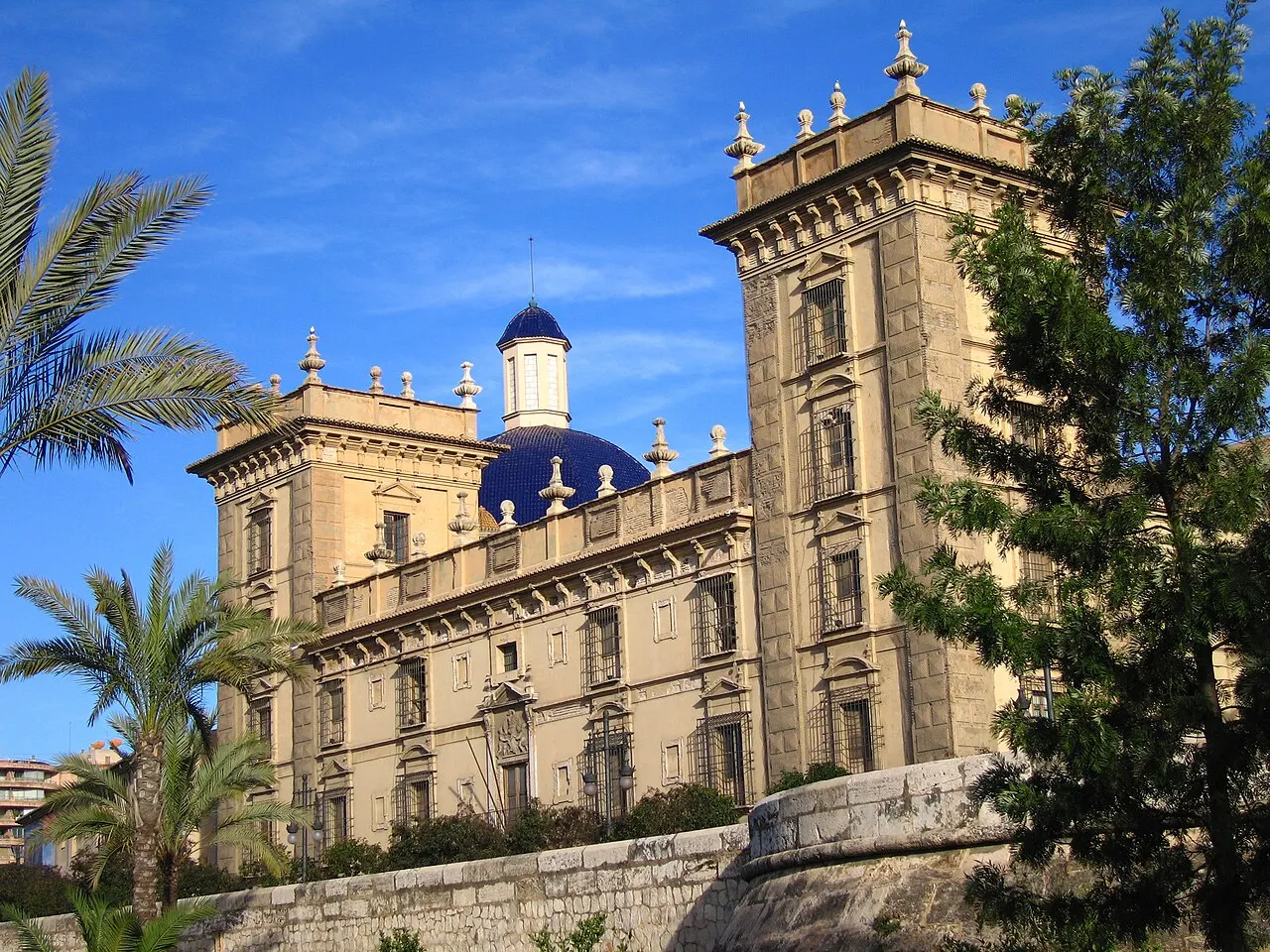
Museo de Bellas Artes de Valencia
A picture gallery in the former Colegio de San Pío V, across the Turia from the Torres de Serranos. It holds Valencian Gothic altarpieces, a self-portrait by Velázquez, Goya's portrait of Joaquina Candado and 19th-century painting, with Sorolla, born in Valencia in 1863. Admission is free; it is open Tuesday to Sunday, from 10 a.m. to 8 p.m., and closed on Mondays.
Admission is free and the collection ranges from Valencian Gothic altarpieces to Velázquez, Goya and Sorolla, across the Turia facing the Torres de Serranos. Closed Mondays.
Check access

Playa de la Malvarrosa
The urban beaches of Cabanyal, Malvarrosa and Patacona form more than 3 km of golden sand with a promenade, volleyball courts and rice restaurants facing the sea. Behind the sand lies the Cabanyal, a former fishing neighborhood with tile-covered facades. On the Malvarrosa stands the beach house that Vicente Blasco Ibáñez inaugurated in 1902, now the Casa Museo.
The Cabanyal, Malvarrosa and Patacona beaches total more than 3 km of sand, with a promenade and rice restaurants, and the Cabanyal’s tiled facades just behind. This waterfront is reachable from the center by public transport, for a morning or late afternoon.
Check access
Nilo’s itinerary
Start with the basic programme and choose extensions for the time you have.
Plan my days in the app ↗Day 1 · Ciutat Vella: market, Lonja, cathedral and El Carmen
Start between 8:30 and 9 a.m. at the Mercado Central (open Monday to Saturday, 7:30 a.m. to 3 p.m.) and have your coffee or esmorzaret at one of the stalls.
Cross the street to the Lonja de la Seda when it opens, at 10 a.m.: the hall of helical columns and the orange-tree courtyard take less than an hour (€2).
Walk on to the cathedral by the Plaza de la Reina: a cultural visit with audio guide (€12) and the climb up the Miguelete's 207 steps (€3). If it is Thursday, be at the Door of the Apostles at noon for the Tribunal de las Aguas.
Have lunch in the center and stop by the alabaster portal of the Palace of the Marquis of Dos Aguas, close by.
In the afternoon, climb the Torres de Serranos (open until 7 p.m. Monday to Saturday and until 2 p.m. on Sundays) and cross El Carmen to the Torres de Quart.
Have dinner in El Carmen, where the center's nightlife is concentrated.
Day 2 · Along the Jardín del Turia to the Ciudad de las Artes
Cross the Turia in front of the Torres de Serranos to the Museo de Bellas Artes (free, Tuesday to Sunday from 10 a.m.) for Velázquez, Goya and Sorolla.
Go down the Turia bed on foot or by Valenbisi, passing under the bridges, to the Ciudad de las Artes y las Ciencias, at the end of the garden.
Have lunch near the complex and spend the afternoon at the Oceanogràfic or, for a shorter visit, at the Museu de les Ciències; check the official calendar for that day's price and hours.
Stay to see the buildings lit up at dusk, which costs nothing from outside.
Finish in Ruzafa, on the neighborhood's terraces and in its restaurants.
Day 3 · The sea in the morning and the Albufera at sunset
Take the metro or the tram to the Cabanyal and walk along the streets of tile-fronted houses to the beach.
Continue along the promenade to the Malvarrosa. The Casa Museo Blasco Ibáñez is open Tuesday to Saturday (10 a.m.–2 p.m. and 3–7 p.m.) and on Sunday mornings, for €2; it is closed on Mondays.
Return to the center by metro or tram and take EMT line 24, which reaches El Palmar in under an hour (the 25, to El Perellonet, also stops at the Embarcadero and at El Palmar). Have lunch with paella or all i pebre at one of the village's rice restaurants.
If the boat is only in the late afternoon and there is time left over, walk part of the l'Estell route, 6 km among the rice paddies.
Take the boat ride of about 40 minutes in the late afternoon, the most popular time; book ahead and check that day's sunset time, which changes a lot between winter and summer.
Check the time of the last bus back before boarding the boat.



If you stay longer
Day 4 · Xàtiva
Day trip
62 km to the south, with Cercanías trains on line C-2 from the Estación del Norte, every 15 to 30 minutes on weekdays. It is the land of the Borja family and the birthplace of Pope Alexander VI, and has a castle high on the ridge above the town. Burned by Philip V's troops in 1707, it hangs the king's portrait upside down in the local fine arts museum. It takes a day, with the climb to the castle.
Food
Paella valenciana
The rice dish of the Albufera, cooked in a wide, shallow pan over a fire. The traditional recipe calls for rice, chicken, rabbit, green beans (bajoqueta), lima beans (garrofó), tomato, olive oil, saffron, water and salt; snails and rosemary are accepted variations. The lightly toasted bottom, the socarrat, is the part everyone fights over. It was declared a Bien de Interés Cultural in 2021. The seafood version is a different dish, the paella de marisco.
Arroz negro, arroz al horno and fideuà
The city's other rice dishes: the negro is made with cuttlefish ink and seafood; the al horno is baked in a clay pot with meat, chickpeas and potato; the fideuà swaps the rice for short strands of pasta, cooked like a paella.
All i pebre
An eel stew from the Albufera with potato, garlic and paprika, whose name means «garlic and pepper». Catarroja and El Palmar dispute its origin, and it is in the restaurants of El Palmar that it turns up most.
Horchata with fartons
A cold drink made from chufa, a small tuber grown in the huerta, with a designation of origin. You order it liquid, granizada or mixed, and it comes with the farton, a long glazed sweet bread, born in Alboraya to be dipped in the glass. It is a summer drink, from the horchaterías of the center and of Alboraya.
Esmorzaret
The mid-morning lunch, between 9 a.m. and noon: a big sandwich (of sausage and blood sausage, of cuttlefish, of meat with garlic) with small bites and a drink, and then a cremaet, coffee with rum, sugar and spices caramelized over the flame.
Esgarraet and clóchinas
Two typical starters. The esgarraet is roasted pepper with shredded salt cod, garlic and olive oil. The clóchinas are the small mussels of the Valencian coast, steamed and served only in season, from May to August.
Agua de València
A cocktail of orange juice, cava and spirits, served in a pitcher to share. Despite the name, it has no water in it.
Where to eat
- Casa Carmela · Malvarrosa · $$
Paella and rice dishes on the beach promenade.
Source · 2026-10-16
- Casa Quiquet · El Palmar · $$
Paella and all i pebre in the Albufera village, to pair with the boat ride.
Source · 2026-10-16
- Bodega Casa Montaña · El Cabanyal · $
Tapas at a bodega in the fishermen's neighborhood, near the beach.
Source · 2026-10-16
- La Salita · Ruzafa · $$$
Chef-driven cooking with one Michelin star, for a tasting-menu evening. Book ahead.
Source · 2026-10-16
- Horchatería Daniel · Alboraya · $
Horchata and fartons in Alboraya, in the garden land where chufa is grown.
Source · 2026-10-16
- Ciutat Vella · $
Mid-morning esmorzaret and coffee at the bars around the Mercado Central.
$: a meal at a simple restaurant, €12 to €28 (Numbeo, October 2026) · $$: mid-range restaurant: a three-course dinner for two, without drinks, €45 to €80 (Numbeo, October 2026) · $$$: above that, or a tasting menu · 2026-10-16
Day trips
Sagunt
28 km to the north, with Cercanías trains on lines C-5 and C-6 from the Estación del Norte, departing every 30 minutes outside peak hours on weekdays and hourly on weekends; check the travel time with Renfe. The city was besieged by Hannibal in 219 BC, in an eight-month siege, and has a Roman theater and a castle at the top of the hill, at about 140 m above sea level. It fits in half a day.
Xàtiva
62 km to the south, with Cercanías trains on line C-2 from the Estación del Norte, every 15 to 30 minutes on weekdays. It is the land of the Borja family and the birthplace of Pope Alexander VI, and has a castle high on the ridge above the town. Burned by Philip V's troops in 1707, it hangs the king's portrait upside down in the local fine arts museum. It takes a day, with the climb to the castle.
Where to begin
Ciutat Vella: market, Lonja, cathedral and El Carmen
Start between 8:30 and 9 a.m. at the Mercado Central (open Monday to Saturday, 7:30 a.m. to 3 p.m.) and have your coffee or esmorzaret at one of the stalls.
Along the Jardín del Turia to the Ciudad de las Artes
Cross the Turia in front of the Torres de Serranos to the Museo de Bellas Artes (free, Tuesday to Sunday from 10 a.m.) for Velázquez, Goya and Sorolla.
The sea in the morning and the Albufera at sunset
Take the metro or the tram to the Cabanyal and walk along the streets of tile-fronted houses to the beach.
Money
The currency is the euro, and cards work in most shops and restaurants. According to Numbeo surveys updated in October 2026, a meal at a simple restaurant costs on average €17, a three-course dinner for two at a mid-range restaurant, without drinks, about €60, a cappuccino about €2.40 and half a liter of draft beer about €3. The municipal monuments are inexpensive: the Lonja de la Seda and the Torres de Serranos cost €2 each and are free on Sundays and holidays; the Museo de Bellas Artes is free. The cathedral's cultural visit costs €12 and the climb up the Miguelete, €3. The big expense is the Ciudad de las Artes: general admission to the Oceanogràfic costs from €35.90 to €43.05, depending on the day, and the combined ticket with the Museu de les Ciències and the Hemisfèric, from €44 to €51.25. Anyone who will use transport and see several municipal monuments can do the math with the Valencia Tourist Card, €24 for 48 hours and €30 for 72 hours, which includes bus, metro and Cercanías and free admission to 14 museums and monuments.
Getting there and around
From the airport to the center
Valencia airport (VLC) is in Manises, about 8 km west of the city. Metro lines 3 and 5 run every 15 to 20 minutes and reach the center in about 20 minutes. The airport ticket costs €4.80, and on the first purchase you also pay for the card (€1.10 for cardboard or €2.10 for plastic). Metrobus line 150 leaves from the arrivals door of Terminal 1, passes through Manises, Quart de Poblet and Mislata and stops at the Mercado Central (Avenida del Oeste), in about 45 minutes, every 20 to 30 minutes. The 24-, 48- or 72-hour Valencia Tourist Card already covers the airport metro. High-speed trains to Madrid arrive at Joaquín Sorolla station, and suburban trains (Cercanías) leave from the modernista Estación del Norte, in the center; a free bus links the two.
Metro, tram, bus and bicycle
The public transport network adds up to 60 city bus lines, six metro lines and four tram lines. The metro and tram (Metrovalencia) use the SUMA card and two zones, and the 24-, 48- or 72-hour pass can include the airport. The historic center is covered on foot, and the city is flat, with more than 200 km of bike lanes and the Jardín del Turia as the spine; the public bike system Valenbisi has about 275 stations. The 24-, 48- or 72-hour Valencia Tourist Card includes bus, metro, tram and Cercanías and admission to municipal museums and monuments; the 72-hour card costs €30 (October 2026). For the Albufera, EMT lines 24 (to El Palmar) and 25 (to El Perellonet), which leave from the center and stop at the Embarcadero and at El Palmar, take under an hour; the road is narrow and not recommended by bicycle beyond the Devesa.
Safety
For visitors, everyday precautions are those of any European tourist center: watch your bag and phone in crowds, as in the Mercado Central, at the Fallas mascletàs and on the packed metro. The serious natural risk is the torrential rain of autumn. The DANA of October 29, 2024 killed 230 people in the province, almost all outside the center, in municipalities to the south cut by ravines that overflowed. In September and October, follow the warnings from AEMET, the weather agency, and the Civil Protection alerts sent to your phone, and do not cross flooded streets or underpasses. In summer, the heat can be strong: the record is 44.5 °C, in August 2023. During the Fallas, there is gunpowder in the streets every day from March 1 to 19; protect your ears at the mascletà and keep your distance from the fire at the cremà. The emergency number is 112.
Etiquette tips
Paella valenciana has no seafood
The traditional recipe is chicken, rabbit and beans; the seafood one is called paella de marisco and is a different dish. Ordering by the right name avoids confusion.
The steps of the Mercado Central are a walkway
The access steps are the path of people shopping, and the market asks that you not sit on them. To sit and have something to drink there are benches and cafés nearby.
Valencian on the signs
Signs, street names and notices appear in Valencian, sometimes only in it: València, plaça, carrer. A «bon dia» and a «gràcies» are well received, and Castilian Spanish works everywhere.
Mistakes to avoid
The Mercado Central in the afternoon or on Sunday
The market closes at 3 p.m. Monday to Saturday and does not open on Sundays or holidays. Anyone who leaves it for after lunch finds the doors shut.
Museums on a Monday
The Museo de Bellas Artes, the Museo Nacional de Cerámica, the Museo Fallero and the Iglesia de San Nicolás close on Mondays. Save Monday for the market, the Lonja, the cathedral and the beach.
Buying Oceanogràfic tickets without checking the calendar
The price changes with the day and the season, and closing time varies from 4 p.m. to 10 p.m. The ticket office closes an hour before the aquarium; anyone who arrives late in the afternoon may be left out.
Biking to El Palmar
There is a bike path to the Devesa del Saler, but not to El Palmar, and the road is narrow, with stretches where only one vehicle fits. EMT buses 24 and 25 are the recommended way.
Arriving for the Fallas without a reservation
Between March 15 and 19 the city receives a crowd, the monuments fill streets and squares and there are night mascletàs on weekends. Book lodging early, or pick another week if the goal is the rest of the city.
Useful phrases
Bon dia
Good morning, in Valencian
Gràcies
Thank you, in Valencian
Una orxata amb fartons, per favor
A horchata with fartons, please
¿Para cuántas personas es la paella?
How many people is the paella for?
On està la parada de l'autobús 24?
Where is the stop for bus 24? It's the one that goes to El Palmar
Bon profit
Enjoy your meal, in Valencian
Where to stay
- Ciutat Vella · A first short trip, to do everything on foot · $$: The Mercado Central, Lonja, cathedral and Torres de Serranos are a few minutes from one another. In El Carmen, the nightlife streets are noisy on weekends, and in Fallas week the whole center is a party.
- Ruzafa · Those who want restaurants, bars and terraces · $$: It is the neighborhood for eating and going out, near the Estación del Norte and about 2 km from the Ciudad de las Artes. The terraces stay busy until late.
- Ensanche · Those who arrive by train and prefer calmer streets · $$: It lies between the Estación del Norte, the Mercado de Colón and the historic center, with shops, and you can walk to Ciutat Vella and to Ruzafa.
- El Cabanyal and Malvarrosa · Those who come for the beach · $$: The hotels on the promenade face the sea and are close to the rice restaurants. The center is reached by metro, tram or bus.
- Quatre Carreres · Families spending a day at the Ciudad de las Artes · $$: It is within walking distance of the Oceanogràfic and the end of the Jardín del Turia, far from the historic center.
$: hostel or simple guesthouse · $$: mid-range hotel · $$$: high-end hotel; prices in every band rise during the Fallas · 2026-10-16
Districts
Ciutat Vella
The historic center, made up of the neighborhoods of La Seu, El Carmen, El Mercat, Velluters, Sant Francesc and La Xerea. It holds the cathedral, the Lonja, the Mercado Central and the Plaza del Ayuntamiento, where the Fallas mascletàs take place. Almost everything is done on foot.
El Carmen
The northwest part of Ciutat Vella, between the Torres de Serranos and the Torres de Quart, with narrow streets, street art, the Centre del Carme and many bars. It is the nightlife neighborhood in the center, and so noisy on weekends.
Ensanche and Ruzafa
The 19th-century expansion south of the center. The Ensanche has the modernista Mercado de Colón and shops; Ruzafa, a former village of Arab origin, is the neighborhood of galleries, restaurants and late-afternoon terraces, with the neighborhood market and the 10-hectare Parque Central, opened in 2019 next to the Estación del Norte.
Pla del Real
Across the Turia, north of the center, with the Jardines de Viveros and the Museo de Bellas Artes. Residential, with the old riverbed as its backyard.
Quatre Carreres
The southeastern district where the Ciudad de las Artes y las Ciencias stands, at the end of the Jardín del Turia. Outside the complex it is mostly residential.
El Cabanyal and Malvarrosa
The former fishing villages by the beach, east of the center, with tiled facades, the Cabanyal market, which specializes in fish, tapas bars and the promenade with rice restaurants. The Marina, the yacht harbor, is at the far south end.
El Palmar and Albufera
El Palmar is a village in the municipality of Valencia on an island in the Albufera, about 20 km from the center, inhabited by fishermen since the 13th century. It has traditional barracas, the dock for the boat rides and a row of rice restaurants.
History
138 BC · Valentia, a Roman colony
Rome founds Valentia Edetanorum on a river island in the Turia, under the consul Decimus Junius Brutus Callaicus.
711–1238 · Balansiya
The Muslims take the city in 711, and it becomes Balansiya. El Cid controls it between 1094 and 1102. Tiger nut, the base of horchata, arrives in this period, and the huerta's irrigation system goes back to it.
1238 · James I enters the city
On October 9, 1238, James I of Aragon enters Valencia and creates the Kingdom of Valencia, with its own laws, the Furs. The date is still a holiday in the Valencian Community.
15th c. · Valencia's golden century
Valencia lives the peak of Mediterranean trade. The Torres de Serranos (1392), the Lonja de la Seda (main hall of 1483–1498) and the arrival in the city, in 1432, of the chalice the cathedral has held since 1437 all date from this period. From the Borja family, tied to Xàtiva, come the popes Callixtus III and Alexander VI.
1609 · Expulsion of the Moriscos
The Crown expels the Moriscos, the descendants of Muslims converted to Christianity.
1707 · Almansa and the end of the Furs
Valencia supports the Austrian side in the War of the Spanish Succession. After the battle of Almansa, on April 25, 1707, Philip V abolishes the Furs, and Xàtiva is burned as punishment.
1936–1937 · Capital of the Republic
During the Civil War, the Republican government settles in Valencia on November 6, 1936, and leaves for Barcelona on October 31, 1937.
1957 · The great flood
On October 14, 1957, the Turia overflows at 3,700 m³/s and kills more than 80 people. The response is the Plan Sur: a new canal built from 1965 to 1973 diverts the river out of the city, and the old bed is freed.
1986–2005 · The riverbed becomes a park
After a campaign by residents against the planned expressway, the Jardín del Turia opens in 1986. At the end of the bed, the Ciudad de las Artes y las Ciencias opens the Hemisfèric in 1998, the Oceanogràfic in 2003 and the Palau de les Arts in 2005.
2024 · Green Capital and the DANA
Valencia is European Green Capital in 2024. On October 29, a DANA (gota fría) causes floods that leave 230 dead in the province of Valencia, according to the official figure of December 2025. The Plan Sur canal filled and protected the center; the destruction was concentrated in the municipalities to the south, such as Paiporta, and in the La Torre neighborhood.
Complete history
A city made of river water
Valencia was born where the Turia meets the sea, on a plain the Romans chose in 138 BC and that the Muslims, from 711, turned into a vegetable garden with a network of irrigation canals. That system of sharing water is still standing: the Tribunal de las Aguas, which settles disputes between the farmers of the huerta, meets every Thursday at noon in front of the Door of the Apostles of the cathedral. The tiger nut, the root behind horchata, arrived with the Islamic expansion, and the landscape of canals, gardens and rice paddies still supplies much of the local cooking.
From the kingdom of James I to the golden century
James I's conquest, in 1238, created the Kingdom of Valencia within the Crown of Aragon, with its own laws. The 15th century was a period of economic and cultural splendor, with the port and the silk trade. The Lonja de la Seda, built for the merchants' business, is the portrait of that moment, as are the Torres de Serranos, the monumental gate of the wall. Then came the expulsion of the Moriscos, in 1609, and the defeat in the War of the Spanish Succession, which cost the kingdom its laws in 1707.
The river that moved
No modern episode weighs as heavily on the shape of the city as the flood of October 14, 1957, which killed more than 80 people. The Plan Sur diverted the Turia into a new canal to the south, built from 1965 to 1973. The dry bed was nearly turned into an expressway, and a campaign by residents with the slogan «the Turia riverbed is ours and we want it green» won the park, opened in 1986. That is why a green strip of about 9 km now crosses the city, and why the Ciudad de las Artes y las Ciencias could be built on the final stretch of the bed, starting in 1998.
Showcase and catastrophe
The 2000s brought big events: the America's Cup in 2007 and 2010 and a Formula 1 Grand Prix, and in 2024 the city was European Green Capital. In the same year, on October 29, the DANA showed once again what water can do on the plain: the floods killed 230 people in the province, most of them in the municipalities south of the city, such as Paiporta, while the Plan Sur canal held the river away from the center. The metro took months to return in full: the last closed sections, to Castelló and Torrent Avinguda, reopened on June 27, 2025, and night service returned on August 1, 2025.
Geography and shape of the city
The Turia plain and the sea
Valencia covers 134.65 km² of alluvial plain between the Turia and Júcar rivers, at an average altitude of 16 m, with no hills: the highest point in the municipality is 104 m. The historic center, Ciutat Vella, lies inside the old line of the walls, on the south bank of the old Turia bed, now the garden. The port and the former fishing villages, such as El Cabanyal, are to the east, by the beach. To the south, the Plan Sur canal carries the river to the sea outside the city.
The huerta and the Albufera
Around the city stretches the huerta, the garden land irrigated by canals, and to the south lies the Albufera, a shallow lagoon of about 24 km² separated from the sea by a strip of dunes and pines. The rice paddies around it are flooded from May to July and from November to January and dry in March and April, which changes the landscape through the year.
A Mediterranean climate with a rainy autumn
According to the 1991–2020 normals for the Valencia station (WMO), the average high runs from 16.7 °C in January to 30.3 °C in August, and the low from 7.7 °C in January to 22.2 °C in August. It rains about 460 mm a year, little in summer and more in September (72 mm) and October (63 mm), when the rain tends to arrive concentrated in gota fría storms. The heat record is 44.5 °C, on August 10, 2023.
The Jardín del Turia occupies the bed of a river that no longer runs there: after the flood of 1957, the Turia was diverted into a canal south of the city.
Culture
The Fallas, a year of work that turns to ash
The city's popular culture revolves around the Fallas. The falla committees build papier-mâché monuments, full of satire and social criticism, which are set up in the streets and squares on the night of March 15 and burned on the night of the 19th, Saint Joseph's. The festival comes from the carpenters' custom of burning scrap wood on the eve of their patron saint, and UNESCO inscribed it as intangible heritage in 2016. The rest of the year, the Museo Fallero keeps the ninots, the figures saved from the fire by popular vote.
Water as an institution
The Tribunal de las Aguas, which settles disputes over the use of water in the huerta's canals through a simple, quick oral trial, meets every Thursday at noon at the Door of the Apostles of the cathedral. The tradition goes back to the Muslim period, was formalized by James I and is recognized by UNESCO.
Blasco Ibáñez and Sorolla
Two names from the late 19th century took the Valencian landscape beyond the city. The novelist Vicente Blasco Ibáñez wrote about the huerta and the Albufera, and his beach house on the Malvarrosa, from 1902, is now a museum. The painter Joaquín Sorolla, born in Valencia in 1863, painted the light of the Mediterranean beaches; the Museo de Bellas Artes has works by him, and several of the best known are in the Prado and in the Museo Sorolla, in Madrid.
Valencian, terraces and nightlife
Valencian is an official language alongside Castilian and appears on signs, in street names and in the speech of much of the city. Social life happens outdoors: the late-afternoon terrace, the «tardeo», fills Ruzafa and the squares of the center, and the longest nights are in El Carmen and Ruzafa. On October 9, the day of the Valencian Community, the tradition is to give a tied silk scarf full of marzipan sweets, the mocadorà.
The Tribunal de las Aguas meets every Thursday at noon at the Door of the Apostles of the cathedral to settle irrigation disputes in the huerta.
Festivals and events
Fallas, March 15 to 19
The city raises satirical monuments in streets and squares, set up on the night of the 15th and burned on the night of the 19th, starting at 8 p.m. (the cremà). From March 1 to 19 there is a mascletà, a gunpowder show made to be felt in the chest, every day at 2 p.m. in the Plaza del Ayuntamiento. The flower offering to the Virgin of the Desamparados is on the 17th and 18th, and the Nit del Foc, the fireworks over the Turia riverbed, on the night of the 18th.
La Crida, last Sunday of February
At the Torres de Serranos, the Fallera Mayor of Valencia makes the official call to the Fallas, before a crowd.
9 d'Octubre
The holiday for James I's entry in 1238. The historic flag, the Real Senyera, leaves city hall in a civic procession to the cathedral and the statue of James I, and the day ends with a mascletà. It is also the day of the mocadorà.
Festa del Santo Cáliz, last Thursday of October
An annual celebration of the chalice at the cathedral, at 7 p.m. Between October 30, 2025 and October 29, 2026, the cathedral holds a jubilee year dedicated to it.
Valencia Marathon, December
The marathon, on a flat course, is run in early December; in 2026, on the 6th. Hotels and streets along the course are full that weekend.
Books and films
The Cabin (1898), Vicente Blasco Ibáñez
A naturalist novel set in the huerta of Valencia in the 19th century: a family rents the land that the neighbors refuse to see cultivated, and the community persecutes it. It explains the dispute over land and water that the Tribunal de las Aguas still arbitrates.
Reeds and Mud (1902), Vicente Blasco Ibáñez
A novel set in the Albufera of the early 20th century, among fishermen and rice growers. It is the book to take along to El Palmar.
Frequently asked questions
Valencia: how do you get from the airport to the center?
Metro lines 3 and 5 run every 15 to 20 minutes and reach the center in about 20 minutes. The airport ticket costs €4.80, and on the first purchase you also pay for the card (€1.10 for cardboard or €2.10 for plastic).
Valencia: how many days should I stay?
I'd stay three days: Ciutat Vella on foot, the Turia to the Ciudad de las Artes and, on the third, the Cabanyal and the Albufera, with paella in El Palmar. With two days, I'd combine the center and the Turia into one and keep the Albufera.
Valencia: how do you get to the Albufera and El Palmar?
There is a bike lane to the Devesa del Saler, but not to El Palmar, and EMT buses 24 and 25 are the recommended way. The boat trip of about 40 minutes leaves from El Palmar and is most popular at sunset; check the last bus back before boarding.
Valencia: is it worth going during the Fallas?
From March 1 to 19 there are fireworks every day at 2 p.m. and, between the 15th and the 19th, the city is taken over by monuments, people and noise. Anyone who wants to see the festival should book early; anyone who wants a quiet city should pick another week.
Valencia: is the Valencia Tourist Card worth it?
The Valencia Tourist Card costs €24 for 48 hours and €30 for 72 hours and includes buses, metro, Cercanías, the airport metro and free entry to 14 museums and monuments. Anyone who will use transport and see several municipal monuments can do the math.
Other cities in the country
Spain ↗- Days
- 3–4
- When
- May–Jun · Sep–Oct
- Per person/day
- Average 140–200 EURMid-range · per person/day
Cost scope
Per person per day: accommodation, meals, urban transport, visits and a small allowance for extras. Flights excluded; larger purchases vary. Editorial estimate, not a quote.
- Days
- 3–4
- When
- Apr–Jun · Sep–Oct
- Per person/day
- Average 156 EURMid-range · per person/day
Cost scope
2026 planning examples per person per day: accommodation, food, local transport, admission fees and extras. Flights and trips to other cities excluded. Hostel: one bed; hotels: one whole room allocated to one person. If sharing, divide accommodation. Admission and transport amounts are averages across the stay; check prices for your dates.
- Days
- 2–3
- When
- Mar–May · Oct–Nov
- Per person/day
- Average 70–120 EURMid-range · per person/day
Cost scope
Per person per day: accommodation, meals, urban transport, visits and a small allowance for extras. Flights excluded; larger purchases vary. Editorial estimate, not a quote.
- Days
- 2–3
- When
- Apr–May · Oct
- Per person/day
- Average 150 EURMid-range · per person/day
Cost scope
Per person per day: accommodation, meals, urban transport, visits and a small allowance for extras. Flights excluded; larger purchases vary. Editorial estimate, not a quote.
- Days
- 4–5
- When
- May–Jun · Sep–Oct
- Per person/day
- Explore costsGuide estimate
Cost scope
Per person per day: accommodation, meals, urban transport, visits and a small allowance for extras. Flights excluded; larger purchases vary. Editorial estimate, not a quote.
- Days
- 3
- When
- May–Jun · Sep
- Per person/day
- Average 113 EURMid-range · per person/day
Cost scope
Per person per day: accommodation, meals, urban transport, visits and a small allowance for extras. Flights excluded; larger purchases vary. Editorial estimate, not a quote.
- Days
- 3
- When
- Apr–Jun · Sep–Oct
- Per person/day
- Average 165 EURMid-range · per person/day
Cost scope
Per person per day: accommodation, meals, urban transport, visits and a small allowance for extras. Flights excluded; larger purchases vary. Editorial estimate, not a quote.