
Spain
Barcelona
Sagrada Família, medieval lanes and vermouth on the sidewalk
Days Start with the basic programme and choose extensions for the time you have.
How the guide reaches this number
Keep the first for the Ciutat Vella and the sea, the second for the Eixample and Gaudí, and the third for Montjuïc and the markets. Do not come with nothing booked, because the Sagrada Família and Park Güell only admit you at a time bought in advance, and skip July and August if you want a quieter stay. With a single day, go into the Sagrada Família at opening (9:00am. Monday to Saturday, 10:30am on Sunday) and walk down to El Born and Santa Maria del Mar. Have a menú del día for lunch in a neighborhood restaurant and finish on the beach in the late afternoon, when the breeze comes in. The waterfront is the part that disappoints: that sand was laid in 1992 over warehouses and railway tracks, and the restaurants on the front line charge a lot for mediocre rice. La Rambla, which every guidebook sells, gives you more at seven in the morning than at seven at night. Away from La Rambla and the waterfront, the sights do what they promise, and it is worth walking two streets into the neighborhoods to eat.
3–4
When May, early June, and mid-September through October
How the guide reaches this number
The best time for Barcelona is spring, at 15–22°C, especially May and early June, when the city's life happens on the street. September and October come right after, at 20–26°C and with fewer tourists, but also a greater chance of storms, because most of the year's roughly 600 mm of rain falls in autumn. In summer, highs run between 28 and 31°C, with high humidity and nights that don't drop below 23°C; on the upside, the sea reaches 24–26°C in August, and beach season runs from June to October. Winter is mild, at 9–15°C from December to February, with frequent sun and a few days of cold wind. Skip August, with its heat, crowds and many neighborhood bars closed for vacation, and avoid early March too, when the Mobile World Congress fills the Fira Gran Via and triples hotel prices.
Per person/day Budget €70–95; mid-range €140–200; comfortable from €280, not including the tourist tax
How the guide reaches this number
Per person per day: accommodation, meals, urban transport, visits and a small allowance for extras. Flights excluded; larger purchases vary. Editorial estimate, not a quote.
 What Nilo thinks
Plan three days in Barcelona, a dense, flat city you can walk. Keep the first for the Ciutat Vella and the sea, the second for the Eixample and Gaudí, and the third for Montjuïc and the markets. Do not come with nothing booked, because the Sagrada Família and Park Güell only admit you at a time bought in advance, and skip July and August if you want a quieter stay. With a single day, go into the Sagrada Família at opening (9:00am. Monday to Saturday, 10:30am on Sunday) and walk down to El Born and Santa Maria del Mar. Have a menú del día for lunch in a neighborhood restaurant and finish on the beach in the late afternoon, when the breeze comes in. The waterfront is the part that disappoints: that sand was laid in 1992 over warehouses and railway tracks, and the restaurants on the front line charge a lot for mediocre rice. La Rambla, which every guidebook sells, gives you more at seven in the morning than at seven at night. Away from La Rambla and the waterfront, the sights do what they promise, and it is worth walking two streets into the neighborhoods to eat.Barcelona is squeezed onto a plain about 5 km wide between the Mediterranean and the Collserola range, and that short stretch holds almost everything there is to see. The Sagrada Família, whose Tower of Jesus Christ reached 172.5 m in February 2026, shares the Eixample grid with Gaudí's houses on Passeig de Gràcia, while the Gothic lanes around the cathedral hide Roman streets beneath Plaça del Rei. In El Born, Santa Maria del Mar shows what the Ribera dockworkers' money built between 1329 and 1383, and Montjuïc brings together the MNAC's Romanesque painting and the Fundació Joan Miró above the port. The city eats on its own schedule: vermouth standing up on weekends, a €13–18 menú del dia, and late dinners in Gràcia's squares. Lock in Sagrada Família and Park Güell tickets early, since they sell out days in advance, weeks in summer. Come in May and early June, or from mid-September to October, and allow three days for Gaudí, the Gothic Quarter and the beach.
Quick facts
- Population
- about 1.7 million in the municipality; about 3.4 million in the metropolitan area (AMB) and about 4.6 million in the urban region
- Founded
- Roman colony of Barcino, c. 10 BC
- Country and region
- Spain: autonomous community of Catalonia, Barcelonès comarca
- Languages
- Catalan and Spanish, both official; Catalan is Catalonia's own language
- Currency
- Euro (€)
- Time zone
- CET, UTC+1 (UTC+2 during daylight saving time, late March to late October)
- Best time to visit
- May, early June, and mid-September through October
- Average daily cost
- Budget €70–95; mid-range €140–200; comfortable from €280, not including the tourist tax
When to go
May, early June, and mid-September through October
January
6° to 14°C
43 mm of rain
February
7° to 15°C
33 mm of rain
March
9° to 17°C
42 mm of rain
April
11° to 19°C
47 mm of rain
July
22° to 29°C
27 mm of rain
August
22° to 30°C
51 mm of rain
November
10° to 18°C
48 mm of rain
December
7° to 15°C
38 mm of rain
How the year changes
The best time for Barcelona is spring, at 15–22°C, especially May and early June, when the city's life happens on the street. September and October come right after, at 20–26°C and with fewer tourists, but also a greater chance of storms, because most of the year's roughly 600 mm of rain falls in autumn. In summer, highs run between 28 and 31°C, with high humidity and nights that don't drop below 23°C; on the upside, the sea reaches 24–26°C in August, and beach season runs from June to October. Winter is mild, at 9–15°C from December to February, with frequent sun and a few days of cold wind. Skip August, with its heat, crowds and many neighborhood bars closed for vacation, and avoid early March too, when the Mobile World Congress fills the Fira Gran Via and triples hotel prices.
The same numbers as a table
| Month | Temperature °C | Rain mm |
|---|---|---|
| January | 6 to 14 | 43 |
| February | 7 to 15 | 33 |
| March | 9 to 17 | 42 |
| April | 11 to 19 | 47 |
| May · | 15 to 22 | 42 |
| June · | 19 to 26 | 27 |
| July | 22 to 29 | 27 |
| August | 22 to 30 | 51 |
| September · | 19 to 27 | 86 |
| October · | 15 to 23 | 84 |
| November | 10 to 18 | 48 |
| December | 7 to 15 | 38 |
Nilo's tips
The T-casual does not work on the airport metro
The T-casual and the single ticket do not work at Aeroport T1 and T2 on the L9 Sud. If your pass does not include that stretch, buy the airport ticket, at €5.90. The T-usual, the Hola Barcelona and the T-dia are valid alternatives; the T-dia allows one trip out and one trip back to the airport. Compare the hotel location: the R2 Nord train leaves from T2 and serves Sants; the metro stops at both terminals, and the Aerobús goes to Plaça de Catalunya. The train and the metro avoid the traffic.
The T-casual is for one person only
The T-casual gives ten individual rides in zone 1 for €13, against €2.90 for a single ticket; two people cannot use it on the same ride. To share, compare the T-familiar, with eight rides, and the T-grup, with 70. Count how many boardings the group will make before you buy. Anyone who will use transit a lot can compare the unlimited passes, such as the Hola Barcelona and the T-usual. Also check validity at the airport; the T-casual, the T-familiar and the T-grup do not cover the terminal stations on the L9 Sud.
Sagrada Família at opening, then 800 m on foot
Look for a ticket at opening: 9:00am. Monday to Saturday and 10:30am on Sunday, subject to the basilica calendar. Allow 90 minutes for the interior. To climb the towers, buy the ticket that includes them and confirm which ones will be open on your date. On the way out, put the phone away before you go down the steps, where it is worth paying extra attention. Instead of the metro, walk the 800 m along Avinguda Gaudí to the Recinte Modernista de Sant Pau.
La Boqueria opens at 8:00am, Monday to Saturday
Right at opening, the stalls are still setting up, the inside counters are already serving coffee, and the people around you are buying lunch rather than photographing the fruit. At that hour you can walk without squeezing past anyone all the way to the back of the market, where fish is sold to people who are going to cook it. La Rambla is also better early: in the morning it's a street you pass through, and by late afternoon it turns into a slow line of tourists.
Vermut on Sunday at 12:30pm, before it fills up
Vermut is a Saturday and Sunday-noon ritual. It's when the neighborhood bars fill up with people from that very street. The right addresses are Carrer del Parlament, in Sant Antoni, and the squares of Gràcia: Vila de Gràcia, Sol, Virreina. Get there by 12:30pm: by one there's no table, and even then lunch is still two hours away.
The menú del dia only exists on weekdays
Monday to Friday, between 1:30 and 3:30pm, neighborhood places serve a starter, main, drink and dessert for €13–18. The same dish at night, à la carte, runs €25–40. Skip any terrace with photos of the dishes and a menu in six languages. Walk two streets in from the Raval, the Born or Poble-sec. On Carrer Blai, in Poble-sec, the bill is counted by skewer: they keep your toothpicks on the plate and tally them at the end.
Explore the map

© OpenStreetMap · OpenFreeMap · © OpenMapTiles
Explore the map, read about the other places and plan your travel days in the app.
Open the appWhat to see
Barcelona: The site between the sea and the mountains
Barcelona sits on a plain about 5 km wide between the Mediterranean and the Collserola range, with Montjuïc hill (about 173 m) closing off the port to the south and the Besòs and Llobregat rivers marking the edges of the municipality.
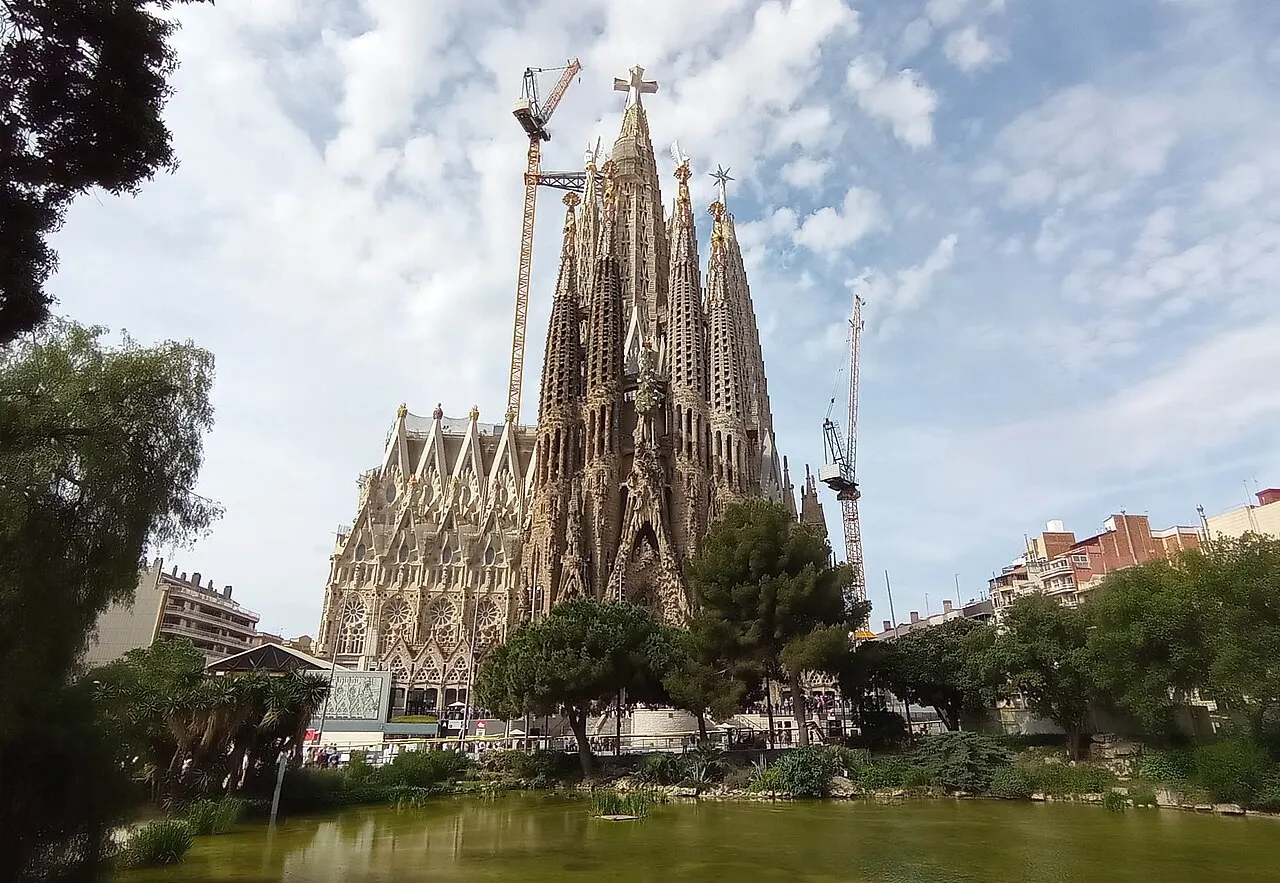
Sagrada Família
A basilica begun in 1882 and taken over by Antoni Gaudí in 1883. Placing the cross in February 2026 took the Tower of Jesus Christ to 172.5 m and completed its exterior; work continues inside and on other parts of the temple. Timed-entry tickets; the Nativity façade and the crypt are World Heritage.
It is Gaudí’s central work, and the interior shows how structure, light and symbolism come together. Choose an available time in the official calendar and, as a planning allowance, set aside about 90 minutes for the interior. If you want to climb a tower, select a ticket that includes that access.
Check access

Park Güell
A 1900–1914 garden-city project that failed as a real-estate venture and became a public park. The Monumental Zone has had paid, timed entry since 2013; the wavy trencadís-tiled bench is credited to Josep Maria Jujol, Gaudí's collaborator.
Like the Sagrada Família, it sells out days in advance, and the Monumental Zone only lets you in with a time slot bought ahead. Book a late-afternoon entry and go up on bus 24 or the escalators from Lesseps metro station.
Check access
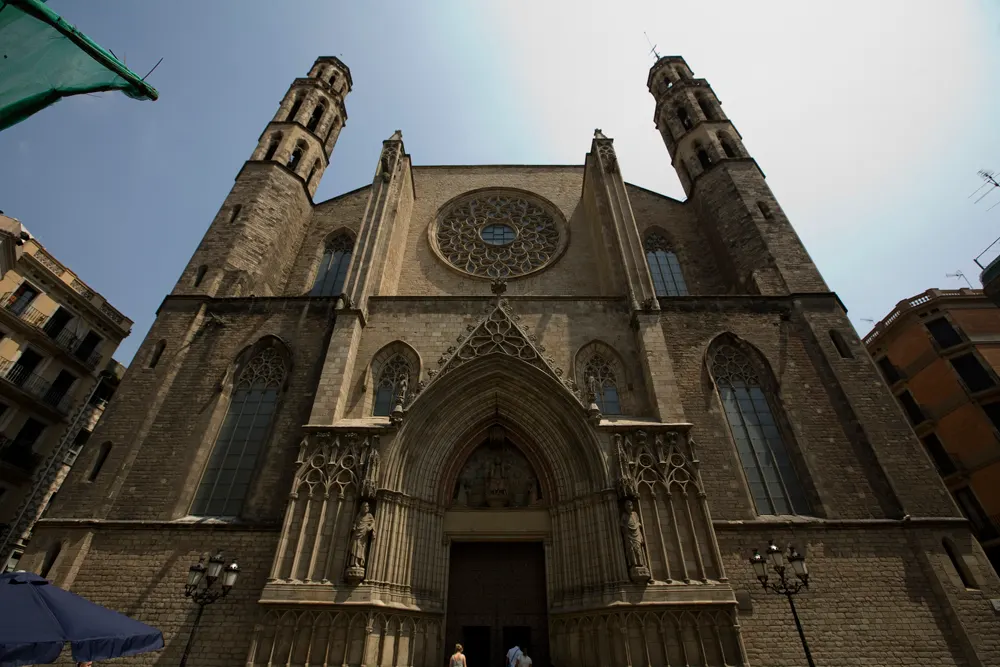
Santa Maria del Mar
A church built between 1329 and 1383 with money from the stevedores and merchants of La Ribera, in just over fifty years, a speed that explains its unity of style. The interior has three naves of almost the same height, no gold, and octagonal columns 13 m apart.
It's the best example of Catalan Gothic, with wide naves and almost no decoration, and the visit is short. It sits at the end of Carrer Montcada; go between 1pm and 5pm, when there are fewer people.
Check access

Casa Batlló and La Pedrera
Two Gaudí houses on Passeig de Gràcia: Casa Batlló (1904–1906), with its broken-glass façade and scaled roof, and Casa Milà, known as La Pedrera (1906–1912), with its wavy stone façade and sculpted chimneys on the rooftop terrace. Both charge steep prices and sell tickets by time slot.
Tickets are expensive and timed, so I'd go inside just one and look at the other from the sidewalk. The Illa de la Discòrdia, with Casa Amatller and Casa Lleó Morera next to the Batlló, fits into the same walk along Passeig de Gràcia.
Check access
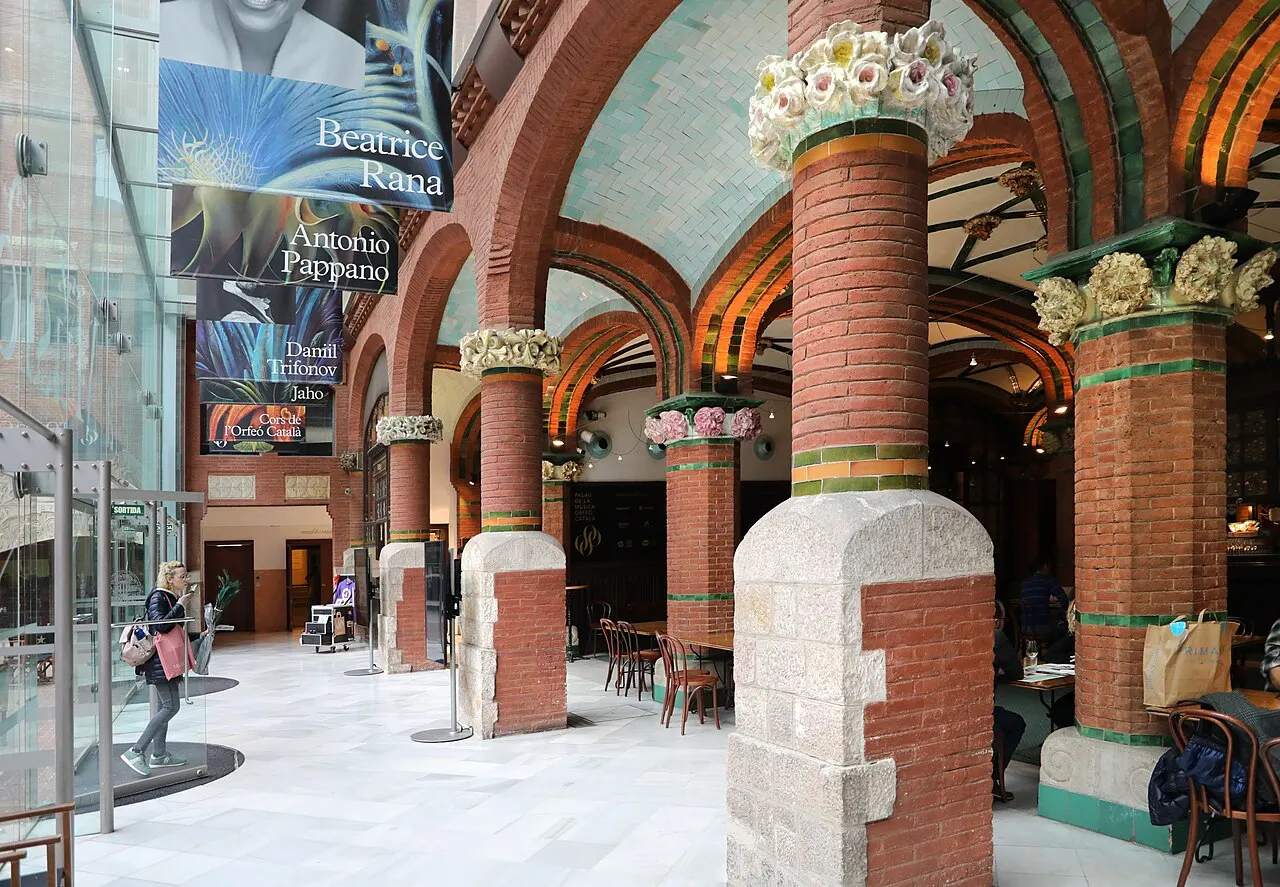
Palau de la Música Catalana
Concert hall by Lluís Domènech i Montaner, opened in 1908 for the Orfeó Català. The inverted stained-glass skylight sits in the middle of the ceiling. You can buy a self-guided, audio-guided, or guided visit, or attend a concert; check the schedule for each option.
I'd see the hall during a concert, which shows the Palau working for what it was built for. With no concert on your date, choose between the self-guided visit, with an audio guide, or a guided tour.
Check access
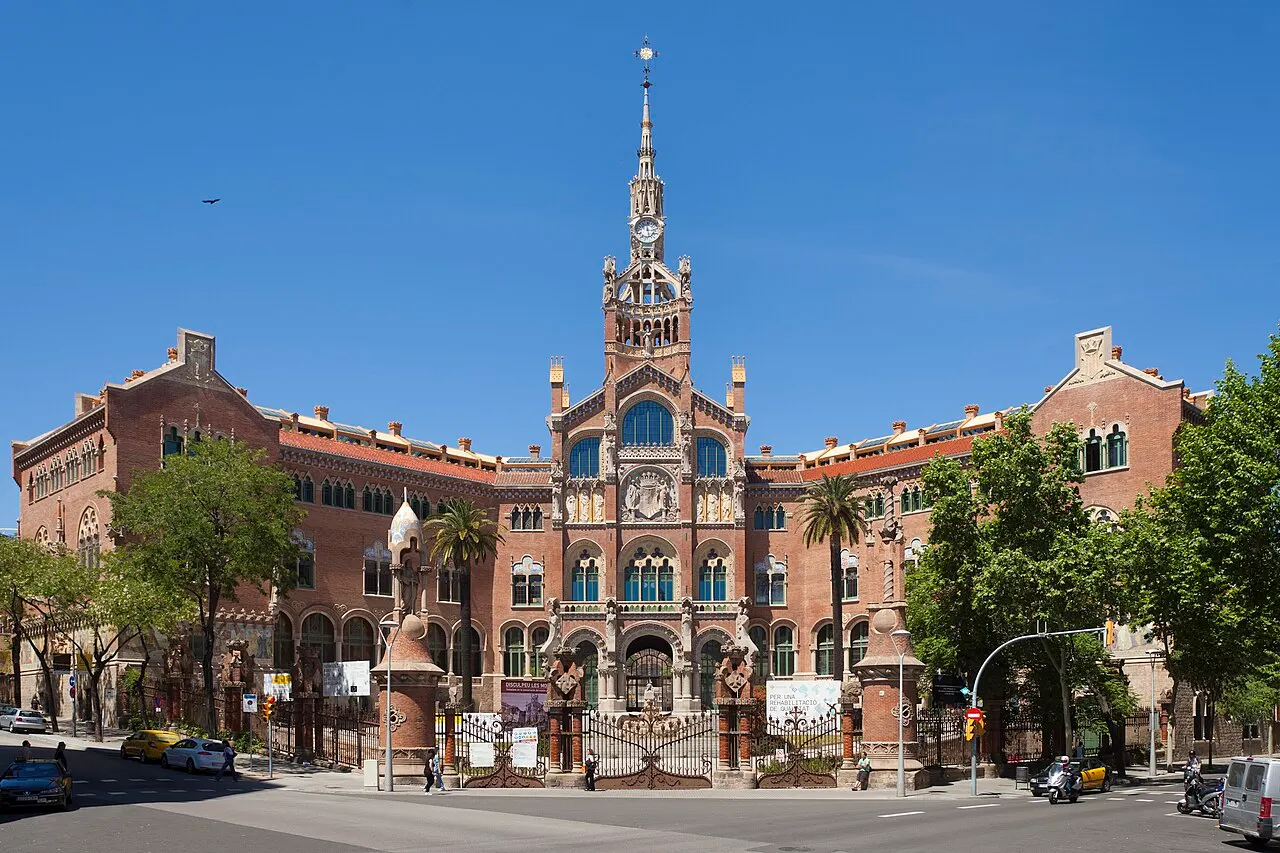
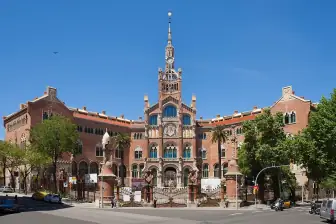
Recinte Modernista de Sant Pau
A hospital built by Domènech i Montaner between 1902 and 1930 as a small city of pavilions linked by tunnels. It functioned as a hospital until 2009 and opened as a monument in 2014, 800 m from the Sagrada Família along Avinguda Gaudí.
It fits into the same morning as the Sagrada Família: leave the basilica and walk up Avinguda Gaudí instead of taking the metro. Set aside time to go down into the tunnels that link the pavilions.
Check access
Catedral de Santa Eulàlia and Roman Barcino
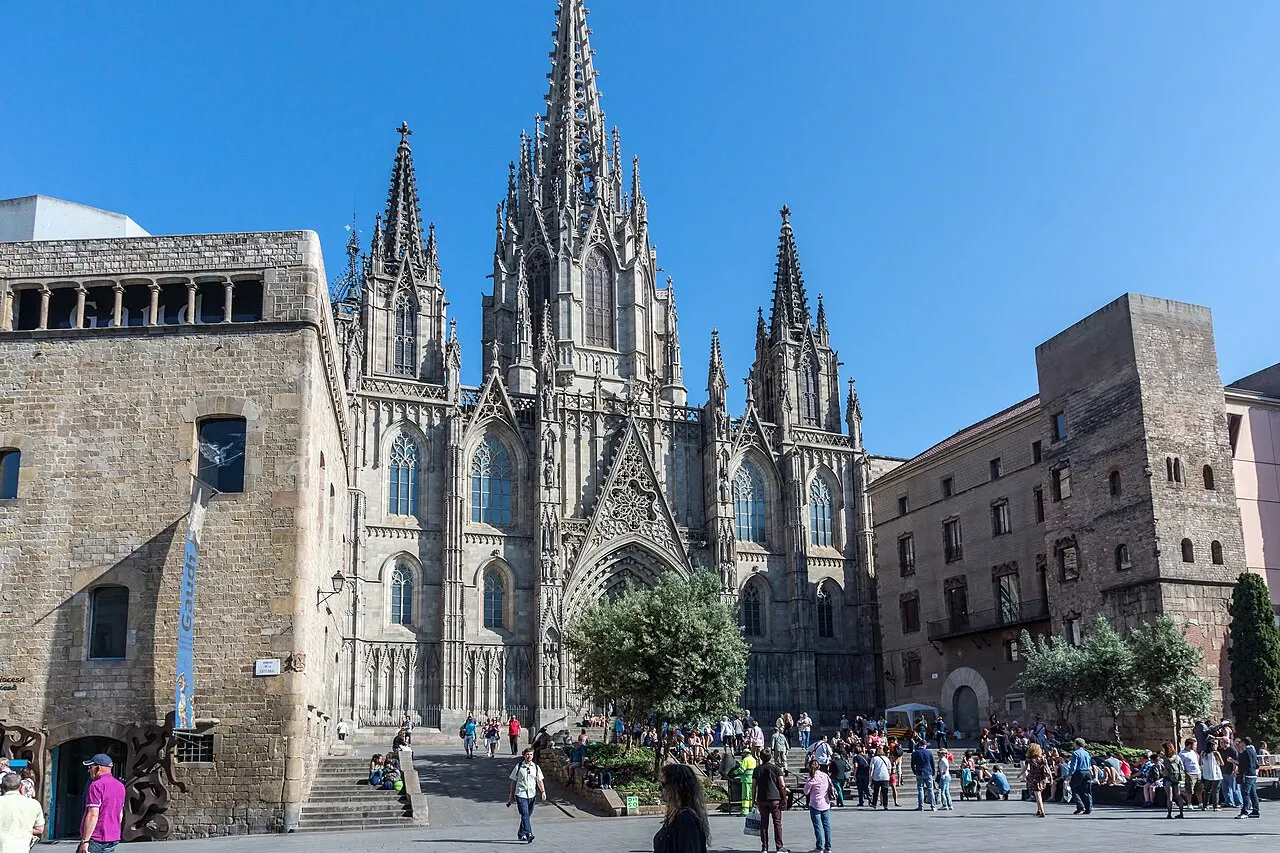
A Gothic cathedral built between 1298 and 1448, with a neo-Gothic façade completed in 1913. Thirteen geese live in the cloister, one for each year of the saint's life; a few meters away, the MUHBA museum shows Roman streets excavated beneath Plaça del Rei.
Go early, see the cloister of the geese, and then head down to the MUHBA museum, a few meters away, where you can walk through 4,000 m² of excavated Roman streets.
Check access
Montjuïc
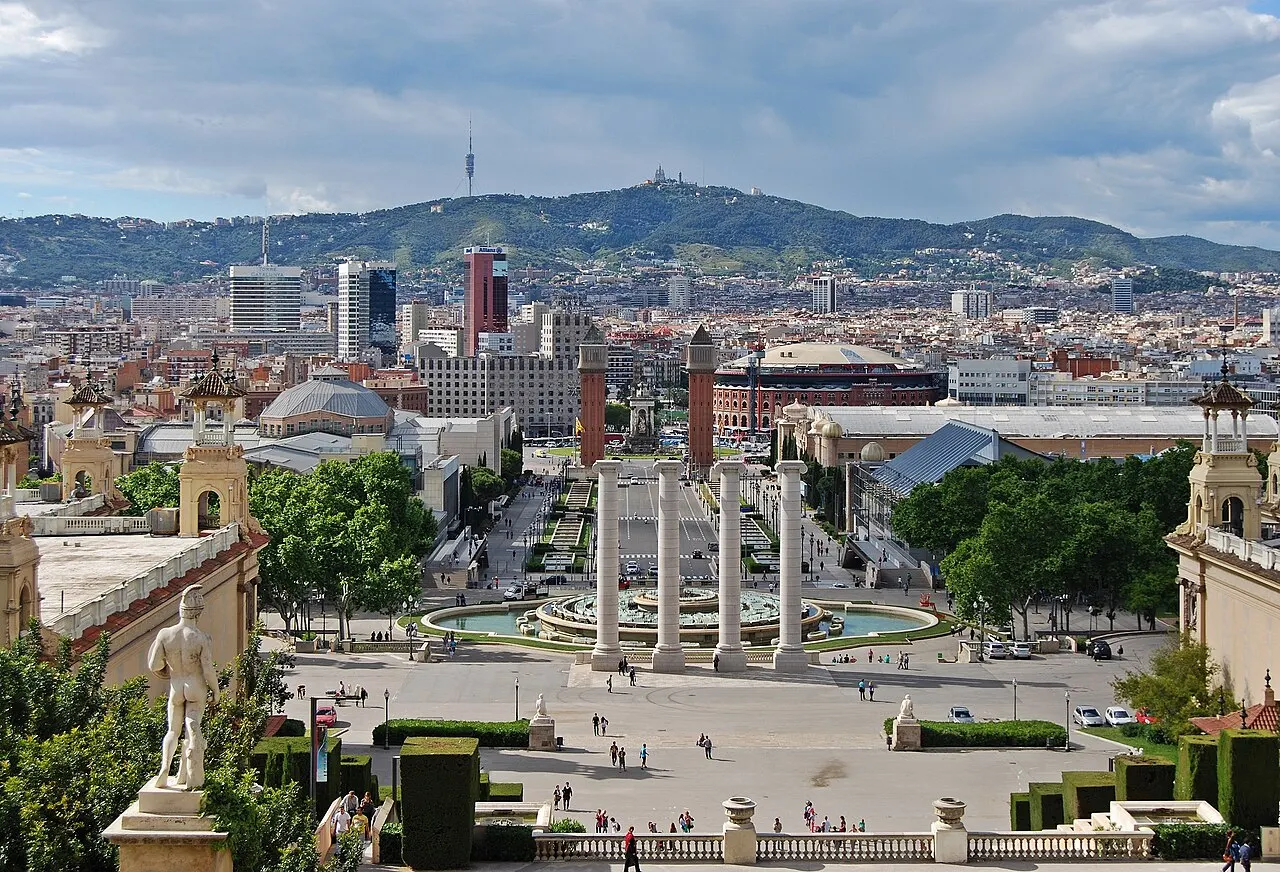
The hill above the port holds the MNAC, in the 1929 Palau Nacional, with the world's largest collection of Romanesque mural painting; the Fundació Joan Miró, in Josep Lluís Sert's 1975 building; the 17th-century castle; and the Magic Fountain. You reach it by funicular from the Paral·lel metro stop.
Set aside a full day, Tuesday to Sunday, since the museums close on Mondays: arrive at the MNAC at opening, 10am, move on in the afternoon to the Fundació Joan Miró, and finish at the castle, with its view of the port and the city squeezed between the sea and the mountains.
Check access
Museu Picasso
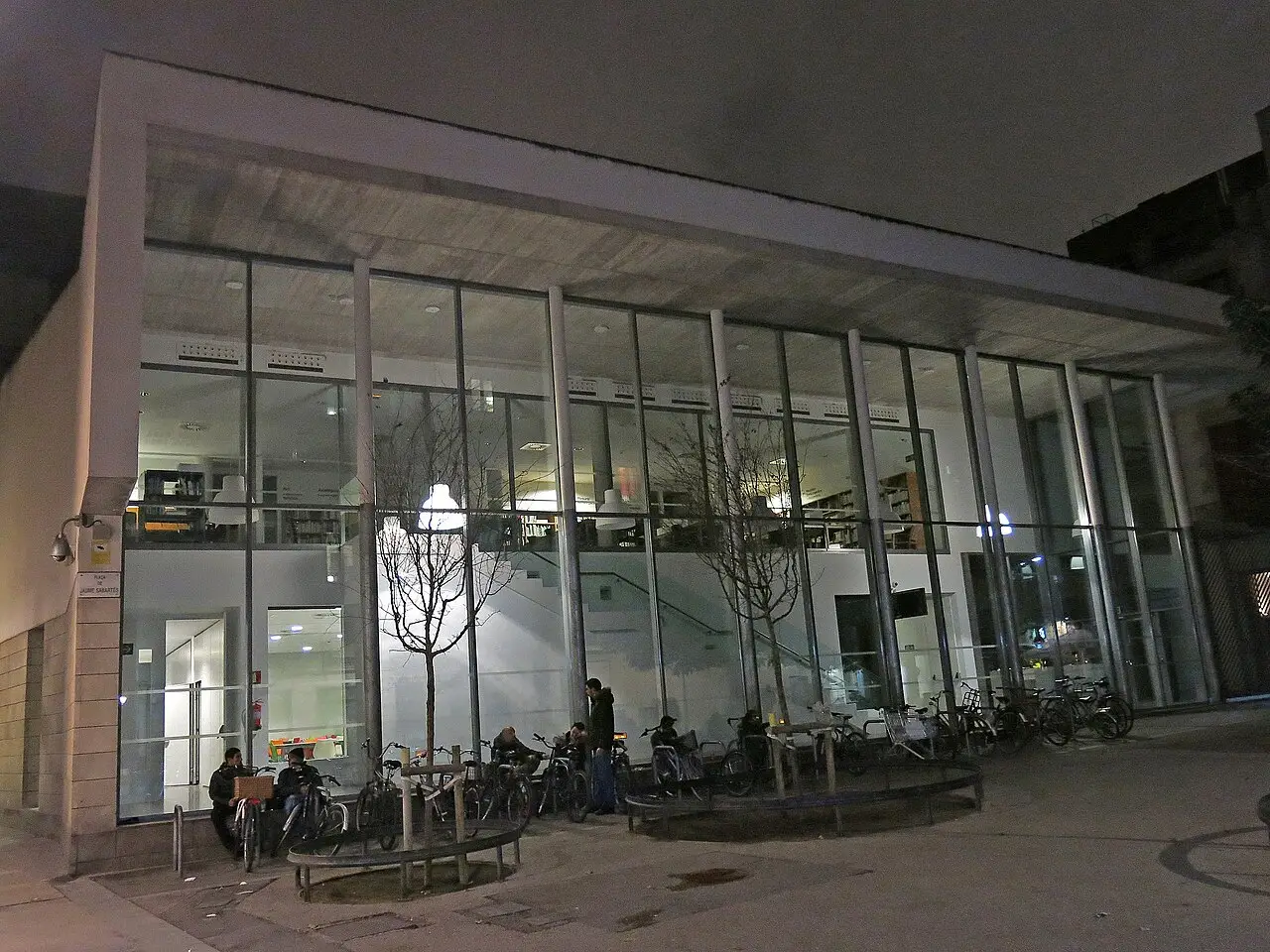
Opened in 1963 in the Palau Aguilar and now spread across five Gothic palaces on Carrer Montcada, it holds more than four thousand works, nearly all from the artist's formative years in Barcelona. Its centerpiece is the 58-canvas series on Las Meninas, painted in 1957.
It's more than four thousand works, almost all from the artist's formative years in Barcelona: anyone expecting the Picasso of Cubism finds the student instead. What justifies the ticket is the 1957 series of 58 canvases on Las Meninas, but with three days, the museum ranks behind Santa Maria del Mar, at the end of the same Carrer Montcada.
Check access
Nilo’s itinerary
Start with the basic programme and choose extensions for the time you have.
Plan my days in the app ↗Day 1 · Ciutat Vella, the Born and Barceloneta beach
Start at Plaça Nova, facing the 4th-century Roman towers, and step into the Catedral de Santa Eulàlia to see the cloister with the thirteen geese.
Head down to the MUHBA at Plaça del Rei, where you walk through 4,000 m² of Roman streets excavated beneath the square.
Cross over to Carrer Montcada for the Museu Picasso and finish the street at Santa Maria del Mar, ideally between 1pm and 5pm, when the basilica has fewer crowds.
Have lunch in the Born or at the Mercat de Santa Caterina, with its colorful roof, and walk on to Barceloneta via the Passeig del Born and the Pla de Palau.
End the day walking the roughly 2 km of beach between Barceloneta and the Port Olímpic in the late afternoon, when the breeze picks up.
Day 2 · Eixample, Gaudí, and Gràcia
Enter the Sagrada Família with a ticket for the start of visiting hours: 9:00am. Monday to Saturday, 10:30am on Sundays. Check the time printed on the ticket and allow 90 minutes. If you want to climb a tower, choose the ticket that includes that access.
Walk the 800 m up Avinguda Gaudí to the Recinte Modernista de Sant Pau and wander through the pavilions and tunnels.
Take the metro to Passeig de Gràcia and walk the Illa de la Discòrdia, with Casa Batlló, Casa Amatller and Casa Lleó Morera on the same block and La Pedrera three blocks up.
Visit Park Güell in the late afternoon, with a timed entry, going up on bus 24 or by the escalators from Lesseps metro station.
Walk down to Gràcia and have dinner on one of its squares, Vila de Gràcia, Sol or Virreina, from 9pm on.
Day 3 · Montjuïc, market, and vermouth
Start with breakfast at the Mercat de Sant Antoni, renovated in 2018; the food stalls open Monday to Saturday. On Sundays there is a book market, and you can have coffee in a neighborhood bar. If you prefer the Mercat de la Llibertat, in Gràcia, save it for another morning, because it is farther from Montjuïc. Plan this day’s museums for Tuesday to Sunday.
Go to the MNAC, in the Palau Nacional, for the 10:00am opening. Start with the Romanesque murals removed from churches in the Pyrenees in the 1920s. On Sundays and holidays it closes at 3:00pm; on ordinary Mondays it does not open. After the visit, stop for lunch.
Continue to the Fundació Joan Miró and keep the afternoon for the collection and the courtyards of Sert’s building. It is normally closed on Mondays, with exceptions on the official calendar. On Sundays it stays open until 7:00pm, so the two museums can be combined in this order.
If there is still time before closing, take the cable car or the bus to Castell de Montjuïc, at about 173 m, to see the port from above, which the hill closes off to the south, and the whole city pressed between the sea and the range.
Head down to Poble-sec for skewers on Carrer Blai, or take the metro to Poblenou to see the city's first superblock, from 2016.





If you stay longer
Day 4 · Montserrat
Day trip
60 km northwest, about 1.5 hours on the FGC R5 train from Plaça Espanya plus a rack railway or cable car. An 11th-century Benedictine monastery wedged into a range of conglomerate rock; the Escolania boys' choir sings around 1pm on school days.
Food
 AI illustration
Pa amb tomàquet
Open crusty bread rubbed with ripe tomato, olive oil, and salt. It comes with everything and isn't an optional side: it's the base on which ham, cheese, or anchovy get served.
 AI illustration
Calçots amb romesco
Sweet spring onions grilled over coals, served November through April. You char the outside, pull out the tender core, dip it in romesco sauce made of almonds and peppers, and eat it overhead, with a paper bib.
 AI illustration
Bomba de la Barceloneta
A ball of mashed potato stuffed with meat, breaded and fried, served with two sauces: alioli and a spicy one. It was invented in the neighborhood in the 1950s and is the dish most associated with it.
 AI illustration
Arròs negre and fideuà
Rice cooked with squid ink, and short noodles cooked in fish broth, both served with alioli on the side. These are lunch dishes, made for two or more, and rarely worth it right on the beachfront.
 AI illustration
Escalivada and esqueixada
Escalivada: roasted eggplant, pepper, and onion, peeled and served cold with olive oil. Esqueixada: raw desalted cod, shredded by hand, with tomato, onion, and olives, summer food.
 AI illustration
Botifarra amb seques
Grilled Catalan sausage with sautéed white beans. It's the most common homestyle dish at neighborhood eateries, almost always on the menú del dia.
 AI illustration
Crema catalana
A custard made with milk and egg yolk, flavored with lemon peel and cinnamon, served cold with sugar burned on top at the moment of serving. Milk and those aromas set the traditional recipe apart from crème brûlée, which is made with cream.
 AI illustration
Vermut
Red vermouth on tap, with ice, orange, and an olive, drunk at midday before lunch, especially on Saturday and Sunday. “Fer el vermut” means the whole gathering, not just the drink.
Day trips

Montserrat
60 km northwest, about 1.5 hours on the FGC R5 train from Plaça Espanya plus a rack railway or cable car. An 11th-century Benedictine monastery wedged into a range of conglomerate rock; the Escolania boys' choir sings around 1pm on school days.
Girona
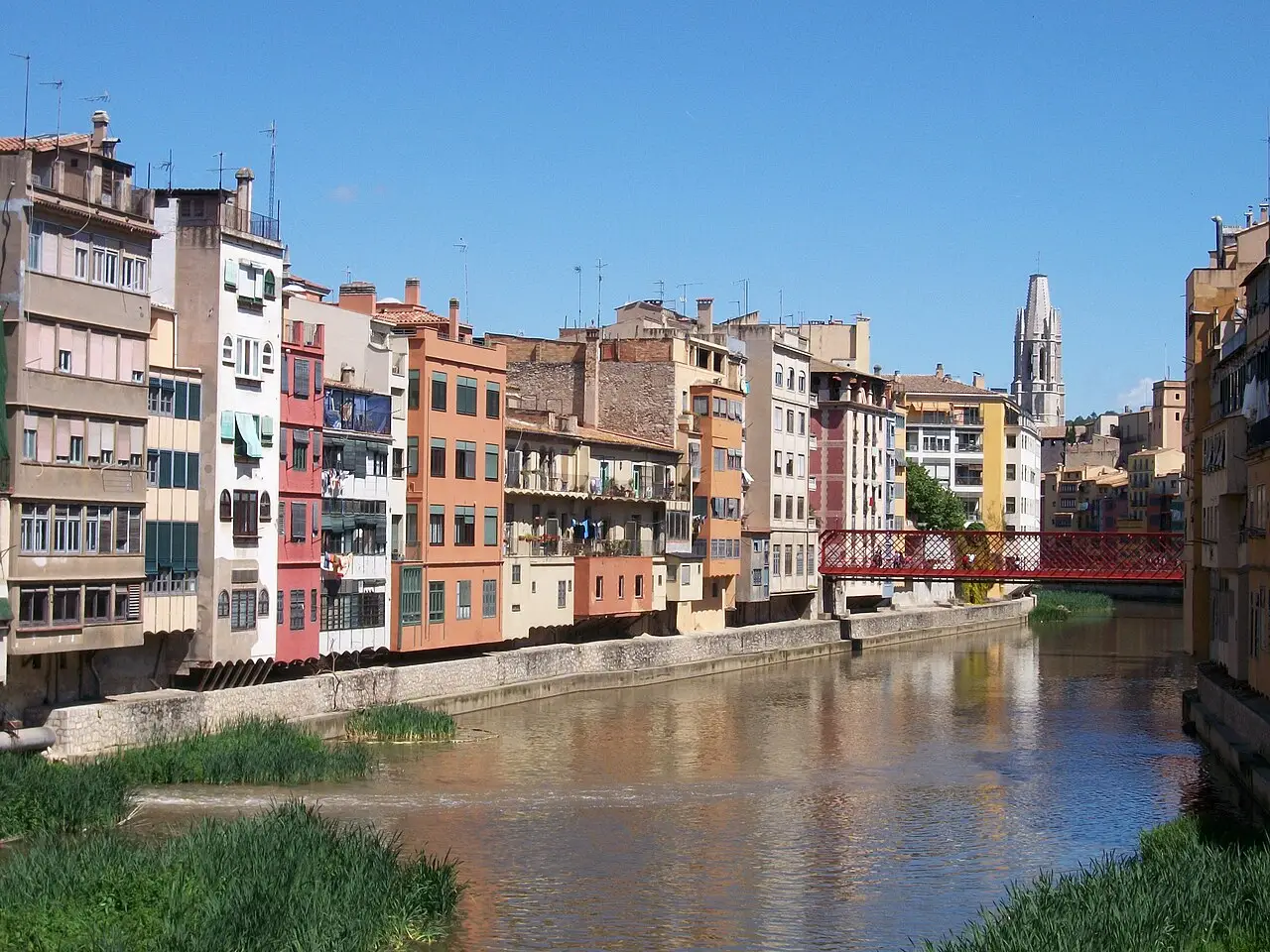
100 km northeast, 38 minutes by AVE high-speed train from Sants. One of the best-preserved Jewish quarters (El Call) in Europe, a walkable Carolingian wall, and the colorful houses overlooking the Onyar River.
Sitges
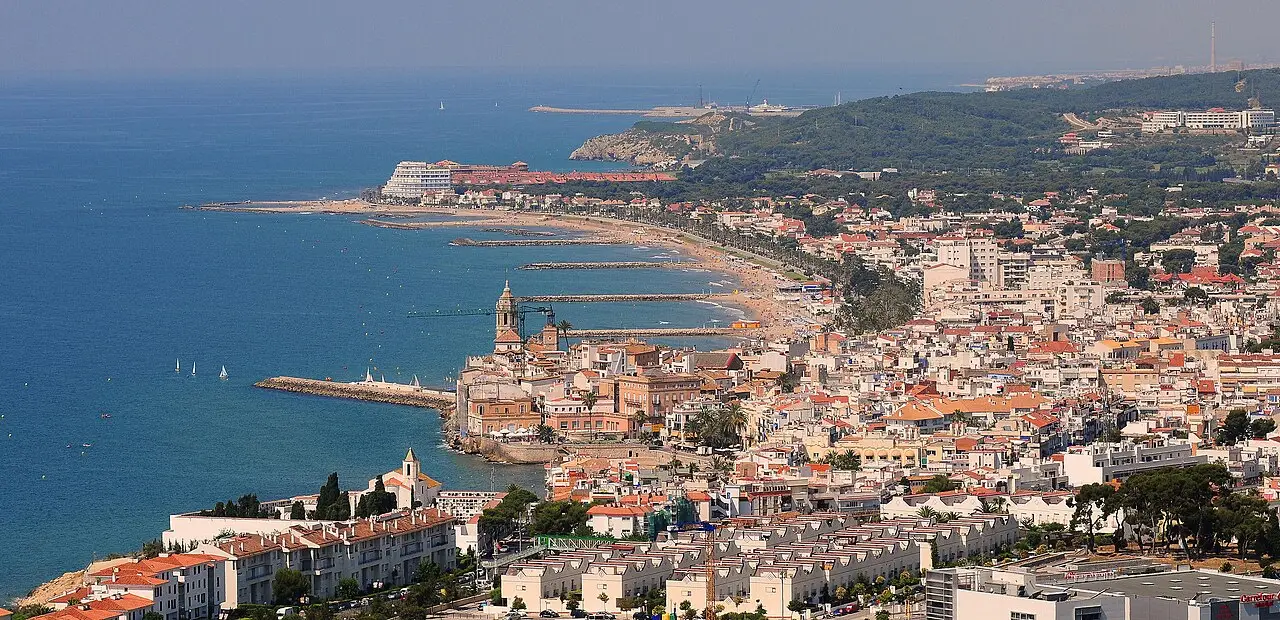
36 km southwest, about 40 minutes on the R2 Sud train. A seaside town with seventeen beaches, the Cau Ferrat museum in painter Santiago Rusiñol's former house, and Catalonia's liveliest carnival and LGBT season.
Where to begin
Ciutat Vella, the Born and Barceloneta beach
Start at Plaça Nova, facing the 4th-century Roman towers, and step into the Catedral de Santa Eulàlia to see the cloister with the thirteen geese.
Eixample, Gaudí, and Gràcia
Enter the Sagrada Família with a ticket for the start of visiting hours: 9:00am. Monday to Saturday, 10:30am on Sundays. Check the time printed on the ticket and allow 90 minutes. If you want to climb a tower, choose the ticket that includes that access.
Montjuïc, market, and vermouth
Start with breakfast at the Mercat de Sant Antoni, renovated in 2018; the food stalls open Monday to Saturday. On Sundays there is a book market, and you can have coffee in a neighborhood bar. If you prefer the Mercat de la Llibertat, in Gràcia, save it for another morning, because it is farther from Montjuïc. Plan this day’s museums for Tuesday to Sunday.
Money
The currency is the euro, and it pays to learn the bar prices on your first day. A coffee at the counter costs €1.50–2.20, a caña of beer €2.50–4, the menú del día on weekdays €13–18 with a starter, a main course, a drink and dessert, and dinner at a mid-range restaurant €25–40 per person without wine. Ten metro rides come to about €13, and a three-star hotel runs €130 to €220 a night in high season. From April 2026 to March 2027, a five-star hotel adds €7 in regional tax and €5 in municipal surcharge per person per night. Other categories use different amounts. People up to the age of 16 are exempt, and the charge covers only the first seven nights of the stay. Further increases are scheduled for later years: check the table for your dates and whether the booking total already includes this charge. Cards and contactless work almost everywhere, and bank validation is also available at some metro gates for buying a single ticket, but carry €20–30 in cash for old bars and markets. A tip is neither required nor expected as a percentage: round up the bill or leave €1–2 per person when the meal was worth it.
Getting there and around
The airport is 15 km from downtown, with a free shuttle between terminals
Josep Tarradellas Barcelona-El Prat Airport is 15 km from the center and has two terminals linked by a free shuttle bus. There are four ways to reach the city. The Aerobús A1 (T1) and A2 (T2) takes 35 minutes to Plaça de Catalunya and costs about €7.75 one way. The L9 Sud metro stops at both terminals, with an airport fare of €5.90 unless the pass includes that access, such as the T-usual, the T-dia or the Hola Barcelona. The T-casual and the ordinary ticket are excluded: you cannot board or alight at the airport with them. Renfe’s R2 Nord train leaves from T2 and reaches Sants in about 20 minutes, and it can be worth it if your hotel is near one of the stations it serves. A taxi costs €35–45 with the airport supplement and takes 25–35 minutes. Before you buy, check the arrival airport: some tickets sold as “Barcelona” land in Girona or Reus, more than 90 km away, with a bus ride of over an hour into the city.
Barcelona has 8 TMB lines, plus FGC and Rodalies
Within the city there are eight TMB metro lines, FGC urban trains, Renfe’s Rodalies, six tram lines and a bus network named by axis: H for horizontal, V for vertical, D for diagonal. The letter of the line already tells you which direction the bus runs. A single ticket costs €2.90 and is almost never worth it: the standard is the T-casual, ten rides in zone 1 for €13, but it is for one person and cannot be shared. The multi-person cards T-familiar and T-grup offer eight and 70 rides respectively. Choose according to how many boardings the group expects. For heavy use, compare the T-usual and the Hola Barcelona, the latter lasting 48 to 120 hours. Both include airport access on the L9 Sud, unlike the T-casual, the T-familiar and the T-grup. The metro runs until midnight from Sunday to Thursday, until 2am on Friday and all night on Saturday, and Nitbus buses leave from Plaça de Catalunya. The city is flat and walkable on the sea-to-mountain axis up to the Diagonal, and it is easy to walk more than you planned every day. The public Bicing is only for residents with local registration, so visitors rent a bicycle or a scooter from a private company.
Safety
Distraction theft is a risk in crowded places, and assaults and aggression can happen too. Watch for pickpockets on La Rambla, on metro line L3, on the steps outside the Sagrada Família, at Sants station, on Barceloneta beach and on the tour buses. The methods repeat, which makes them easier to spot: someone hugs you and greets you as if they knew you, opens a map over your table to cover the phone, spills a drink on your clothes or stages a fight beside you. The replies are simple and become a habit quickly: wear your backpack on the front in the metro, loop the bag strap around your leg at outdoor tables, keep nothing in a back pocket, and keep a copy of your passport on your phone. At night, the Raval around Carrer de Sant Ramon and some stretches of the Gòtic ask for more attention, especially after 2am. Refuse at the door any invitation to a “bar with girls” offered on the street, which ends in an inflated bill. Take a taxi only from a rank, an app or a phone booking. The emergency number is 112, and there is a tourist police post at Rambla, 43, which files a report in several languages.
Etiquette tips
Greet before you order
A “bon dia” or “buenos días” opens the conversation in any bar, bakery or pharmacy. Walking in and firing off your order straight away comes across as rude.
Use four words of Catalan
“Bon dia,” “si us plau,” “gràcies,” “adéu.” No one expects you to speak Catalan, and everyone will switch to Spanish if you prefer, but the gesture changes the tone of the conversation.
Eat on the city's schedule
Lunch runs from 1:30pm to 3:30pm and dinner from 9pm to 11pm. A kitchen that serves dinner at 7pm is usually cooking for tourists, with prices and quality to match.
Shirtless only on the beach: off it, there's a fine
Walking around shirtless, in swim trunks, or in a bikini outside the beach and the beachfront promenade has been a municipal offense since 2011, with fines of €120 to 300.
You have to ask for the bill
No one brings the check before you ask for it, because rushing a table is bad manners. Say “el compte, si us plau” or mime writing in the air.
Don't fold everything into “Spain”
Plenty of people here identify as Catalan first. Asking about language and politics is fine, but it's a serious subject, not small talk for a two-minute chat with a stranger.
Mistakes to avoid
Eating on the Rambla with photos of the dish
Eating on the Rambla or at any terrace with photos of the dishes and a menu in six languages. These are the worst value for money in the city, and it's an expensive lesson to learn sitting at one. Two streets in from the Raval, the Born, or Poble-sec, the same money buys a far better meal.
T-casual to get to the airport
Arriving at the airport turnstile with the ordinary ticket or the T-casual and discovering the restriction only there. Check beforehand whether your card covers Aeroport T1 and T2; if it does not, buy the specific ticket. The T-usual, the T-dia and the Hola Barcelona include that access, each on its own terms.
Showing up at the Sagrada Família with no ticket
Don't show up at the door of the Sagrada Família or Park Güell with no ticket. Both sell timed entry, and tickets sell out days in advance, weeks in summer; in 2026, with the centenary of Gaudí's death, demand for the towers rose even more.
Phone in hand on the Rambla and on L3
Walking with the phone in your hand and the backpack on your back at any crowded tourist spot. A distraction theft happens in seconds; put the phone away and keep the bag in front of your body in a crowd.
Leaving your bag alone at Barceloneta
Leaving your towel and bag alone on the sand at Barceloneta while you go in the sea. Bring the bare minimum to the beach, and don't count on the person next to you to watch it.
Useful phrases
Bon dia / Bona tarda
Good morning / good afternoon, in Catalan
Si us plau
Please
Gràcies / De res
Thank you / you're welcome
Què és això?
What is this? For pointing at a market stall
El compte, si us plau
The bill, please
Que vagi bé
Take care / all the best: the most common goodbye, used by whoever's serving you
Districts
Barri Gòtic (Ciutat Vella)
The Roman and medieval core, with streets three meters wide, between the Cathedral, Plaça del Rei, and Plaça Sant Jaume, home to city hall and the Generalitat. It's the most visited part of the city, and the most expensive place to eat badly.
El Born / La Ribera
The medieval merchants' quarter, with Santa Maria del Mar, the Museu Picasso, and the old Born market converted into a 1714 archaeological site. Today it's packed with designer shops, wine bars, and the Parc de la Ciutadella.
El Raval
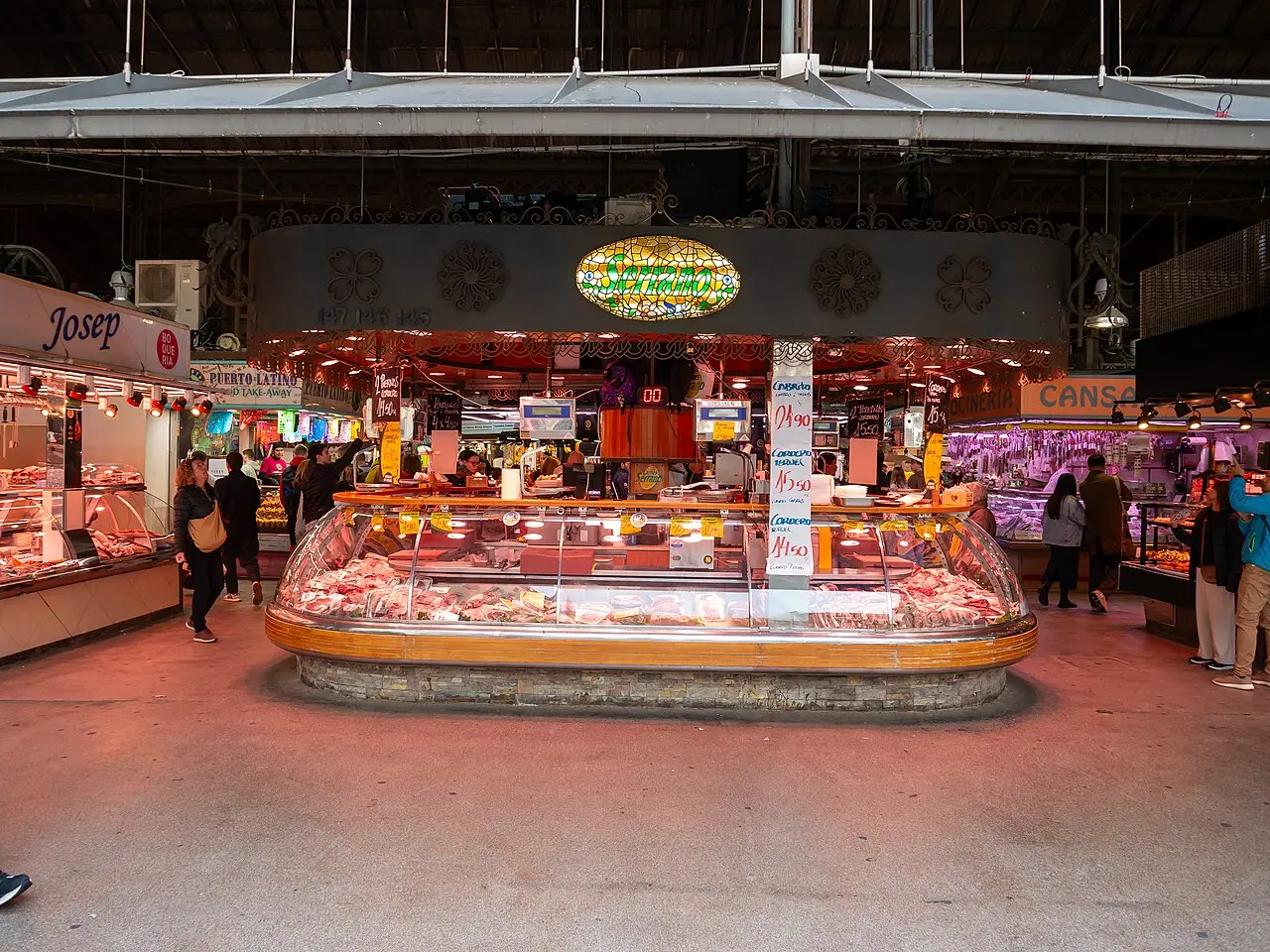
On the other side of the Rambla, it's the densest and most diverse neighborhood in the city, with a strong Pakistani, Filipino, and North African presence. It's home to the MACBA, the Filmoteca, the Liceu on its edge, and a bar scene that starts early.
Eixample
Cerdà's grid, split into Dreta and Esquerra by the Passeig de Gràcia. It's where almost all the Modernista houses stand, along with the green axes with benches down the middle of the street and the Gaixample, the hub of the city's LGBT life.
Gràcia
An independent town until 1897, it keeps a low scale, small squares (Vila de Gràcia, Sol, Virreina) and a street pattern that doesn't line up with the grid next door. Lots of bookshops, original-language cinema, and vermouth bars.
Barceloneta
A fishermen's quarter laid out in 1753 in narrow blocks, between the port and the beach. It lives with the tension between longtime residents and beach tourism, and it's where you eat bombas and overpriced seaside paella.
Poblenou / 22@
The old “Catalan Manchester” of chimneys and factories, reconverted since 2000 into a tech and design district. It holds onto the Rambla del Poblenou, the 1775 cemetery, and the city's first superblock, from 2016.
Poble-sec and Sant Antoni
The slope of Montjuïc and the edge of the Eixample, with Carrer Blai and its skewer tapas, the Mercat de Sant Antoni renovated in 2018, and the Paral·lel, once the street of variety theaters. This is where you eat well without a tourist line.
History
c. 10 BC · Founding of Barcino
Rome establishes a small colony on Mount Tàber, today the Barri Gòtic. The 4th-century wall still stands in stretches around Plaça Nova and beneath Plaça del Rei.

801 · Carolingian conquest
Louis the Pious, son of Charlemagne, takes the city and folds it into the Spanish March. This is where the line of the Counts of Barcelona begins.
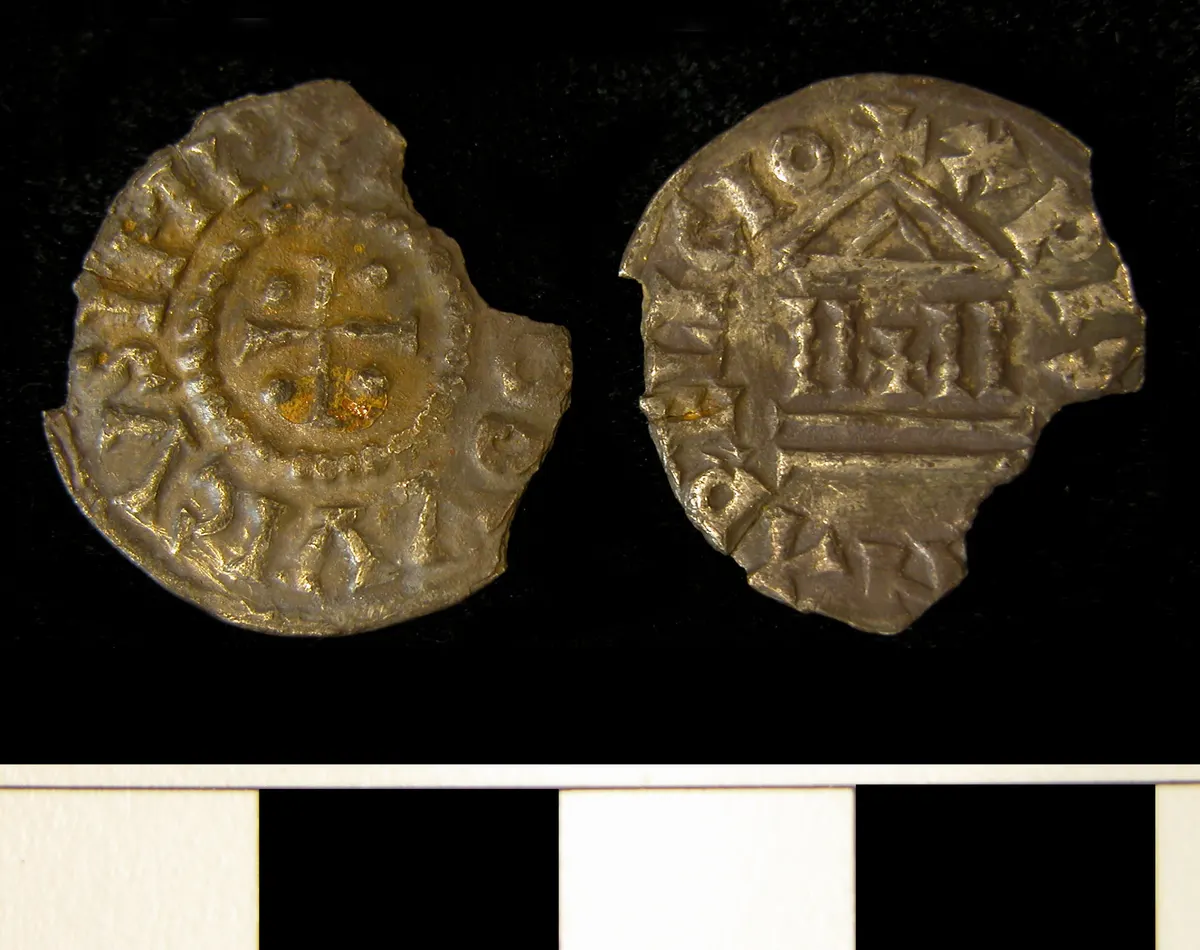
985 · Al-Mansur's sack of the city
Almanzor's troops destroy the city, and Count Borrell II receives no help from the Frankish king. From then on, the counts stop paying homage to the Frankish crown.
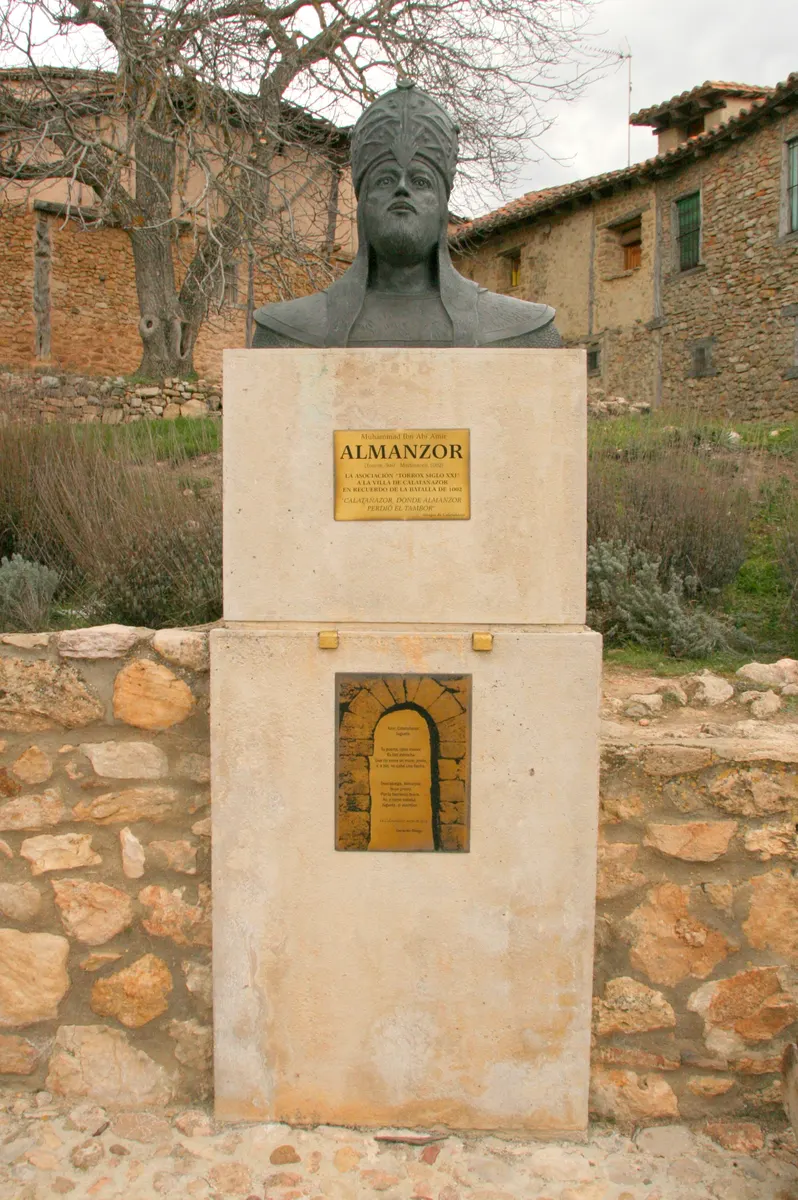
1137 · The Crown of Aragon is born
The marriage agreement between Ramon Berenguer IV and Petronilla of Aragon unites the county with the neighboring kingdom. Barcelona becomes the maritime base for an expansion that reaches Sicily, Sardinia, and Naples.
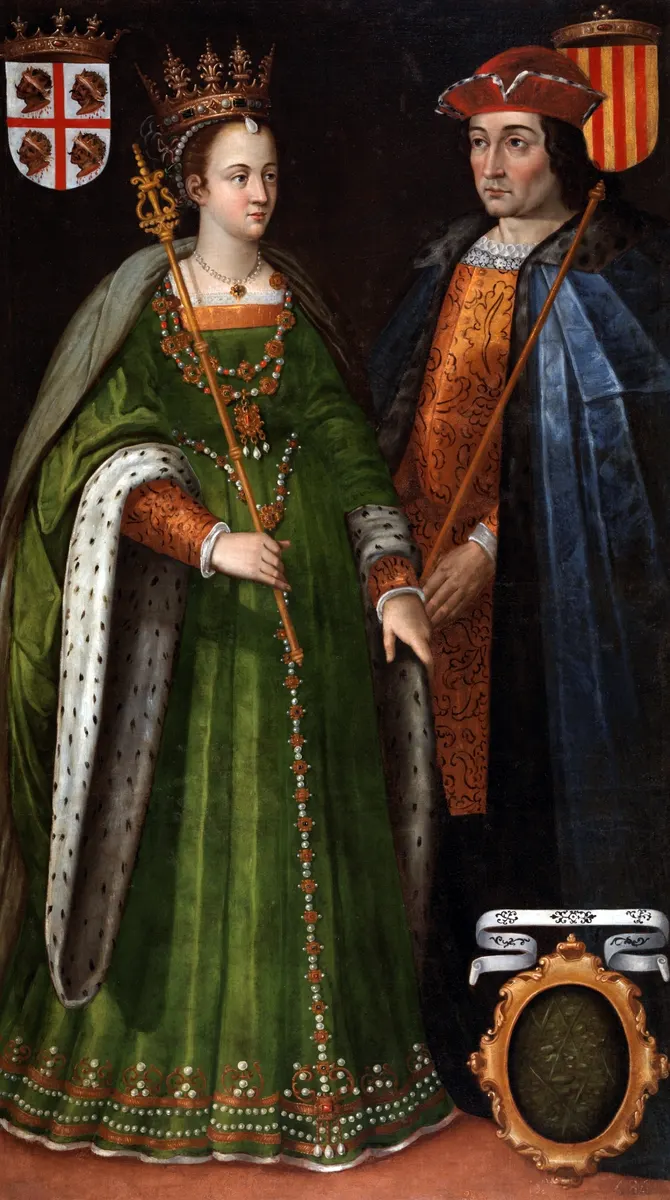
13th–15th c. · Maritime peak and Catalan Gothic
The city drafts the Consolat de Mar, a maritime code copied across half of Europe, and builds Santa Maria del Mar between 1329 and 1383. The Drassanes Reials (Royal Shipyards) turn out galleys on an assembly line.
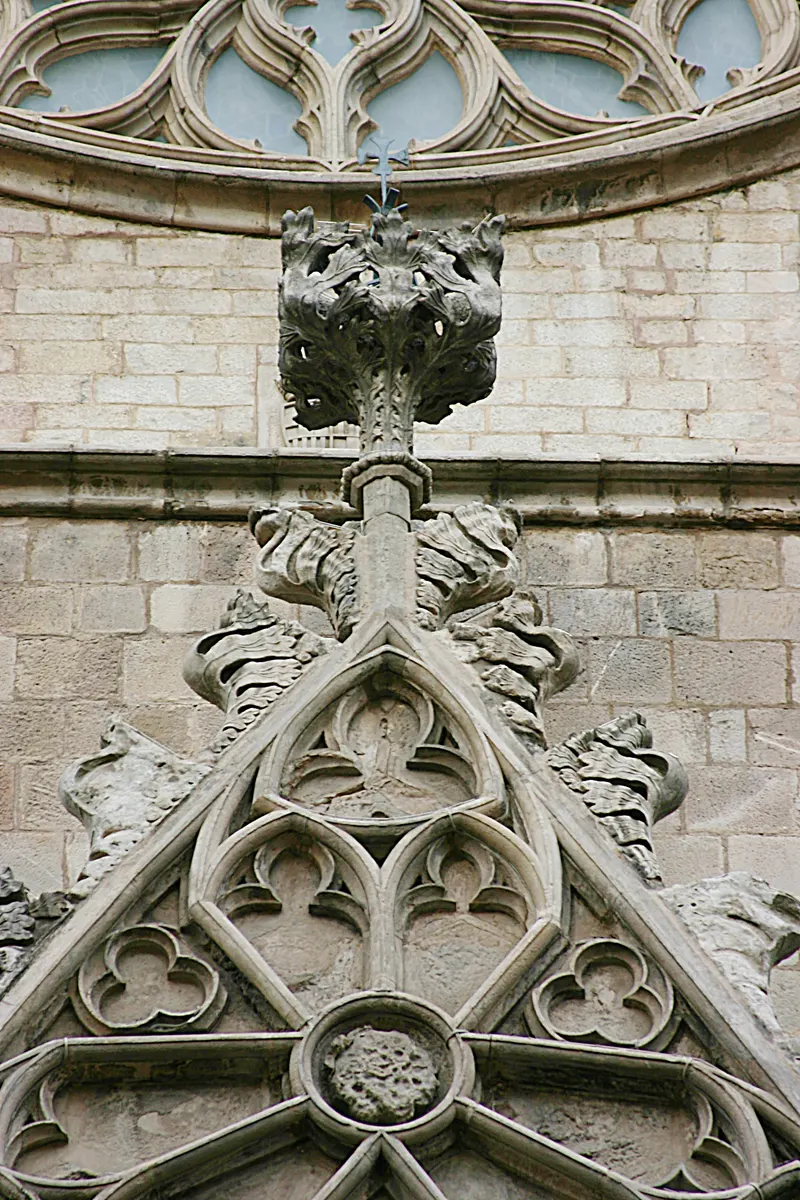
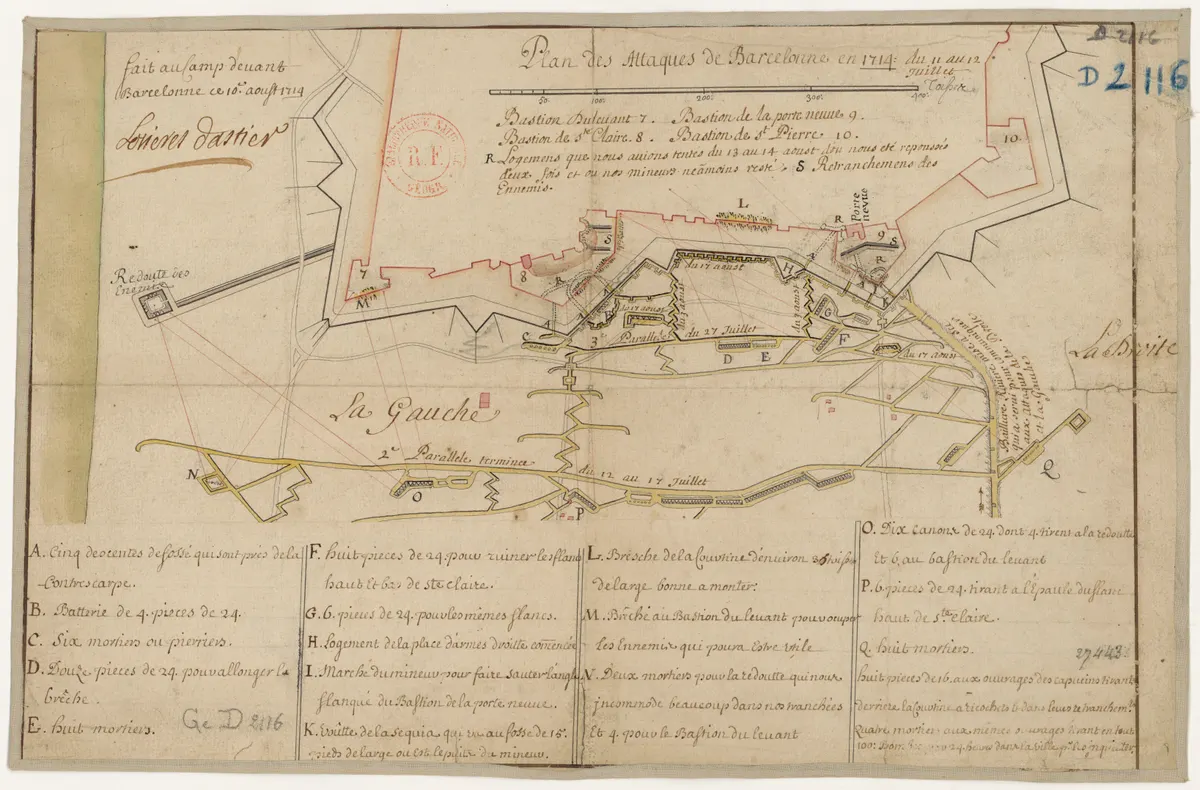
1714 · The fall of Barcelona in the War of the Spanish Succession
After a thirteen-month siege, Philip V's troops enter the city during the War of the Spanish Succession. The Nueva Planta decrees abolish Catalonia's institutions; the date became the Diada, Catalonia's national holiday.
1859 · The Cerdà Plan
Ildefons Cerdà lays out the Eixample across the plain, with 113 m blocks and chamfered corners. Demolition of the medieval walls had begun in 1854.

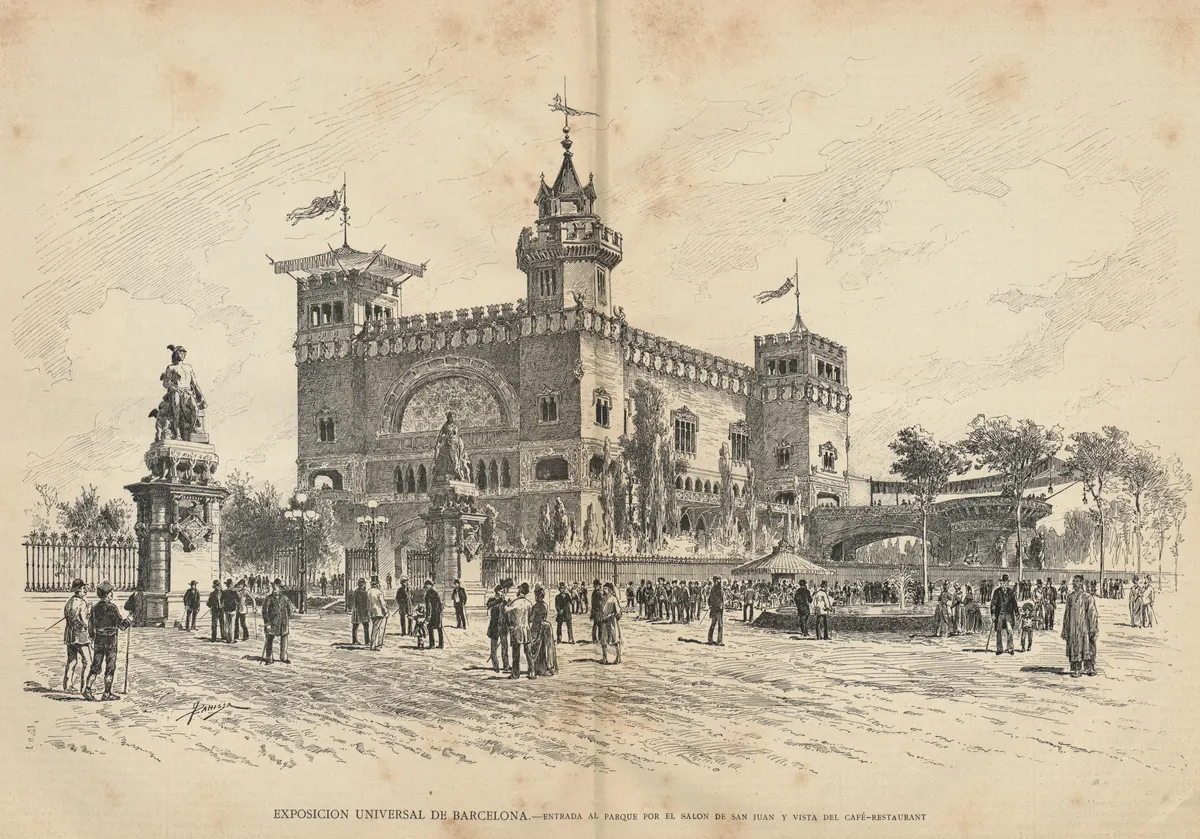
1888 and 1929 · The world's fairs of 1888 and 1929
The 1888 fair remakes Parc de la Ciutadella, and the 1929 fair urbanizes Montjuïc, with Carles Buïgas's Magic Fountain and Mies van der Rohe's German Pavilion.
1936–1939 · Civil War
Barcelona sides with the Republic, takes in the Republican government at the end of 1937, lives through a social revolution documented by George Orwell and is bombed by the Italian air force in March 1938. It falls on January 26, 1939.

1992 · Olympic Games
The city tears down warehouses and rail lines along the coast and creates about 4.5 km of beach, the Olympic Village, and the ring roads. It marks the start of mass tourism.

2015–2026 · Accommodation regulation and the tourist-apartment plan
The city regulates accommodation and transforms street space through superilles. In 2024, city hall announced the goal of ending licensed tourist-apartment use in November 2028. The regional lodging tax increases in April 2026; the apartment measure still concerns a future date.

Complete history
Barcino, a Roman colony
Barcelona begins as Barcino, a Roman colony founded around 10 BC on Mont Tàber, a twelve-meter rise. It was never a Roman capital (that role belonged to Tarraco, today's Tarragona), so it grew compactly inside a 4th-century wall whose towers remain visible at Plaça Nova and beneath Plaça del Rei. In 801, the Franks take the city and turn it into a frontier county. Al-Mansur's sack in 985, with no help from the Frankish king, gives the counts grounds to stop paying him homage: Catalan historiography dates the start of its own sovereignty from this episode.
A marriage creates the Crown of Aragon
The marriage agreement between Ramon Berenguer IV and Petronilla of Aragon, in 1137, creates the Crown of Aragon and turns the port into the base for a Mediterranean expansion that reaches Majorca, Sicily, Sardinia, Naples and Athens. From the 13th to the 15th century the city writes the Consolat de Mar and builds Catalan Gothic: wide naves, few columns, little decoration; Santa Maria del Mar, the Saló del Tinell, the Drassanes. The 1348 plague and the Catalan civil war of 1462–1472 break the cycle, and the final blow is political: on September 11, 1714, Philip V's troops enter the city and the Nueva Planta decrees abolish its own institutions and the official use of Catalan.
Textile industry reinvents the city
The city reinvents itself in the 19th century with a textile industry run on cotton and steam. In 1854 demolition of the walls begins; in 1859 engineer Ildefons Cerdà designs the Eixample, a grid of 113-meter blocks with chamfered corners for vehicles to turn, planned with inner courtyards that speculation later filled in. The industrial bourgeoisie finances modernisme (Gaudí, Domènech i Montaner, Puig i Cadafalch) while the working class builds Europe's strongest anarcho-syndicalist movement. The two coexist: the Sagrada Família breaks ground in 1882, and the Setmana Tràgica of July 1909 ends with dozens of churches set on fire.
Civil War and nearly four decades of dictatorship
The 20th century concentrates the violence and the demographic change. Barcelona sides with the Republic, becomes the seat of the Republican government at the end of 1937, is bombed by the Italian air force in March 1938 and falls on January 26, 1939. Nearly forty years of dictatorship follow, with Catalan banned from schools and the press, and a massive migration from Andalusia, Murcia and Extremadura that builds entire neighborhoods (Nou Barris, La Verneda, Bellvitge) and doubles the region's population. The Generalitat is restored in 1977, and the 1992 Games give the city the excuse to turn toward the sea, replacing warehouses and rail lines with beach, promenade and the Olympic Village.
Tourism, housing and public space
International tourism grew more strongly after the 1992 Games. In 2025, the Tourism Observatory estimated 16 million tourists in the city and 26.1 million across the city and region. These are different geographic totals. Pressure on housing led city hall to regulate the expansion of tourist accommodation; in 2024 it announced the goal of ending licensed tourist-apartment use in November 2028, under Catalonia’s new urban-planning regime. This is a future goal, rather than a closure already carried out.
Meanwhile, superilles redistribute street space towards pedestrians, places to spend time and greenery: the Poblenou pilot began in 2016, and work on the Eixample’s green axes began in 2022. This transformation also addresses mobility and residents’ everyday life.
The regional lodging tax increased on April 1, 2026. For five-star hotels in Barcelona, the general rate through March 2027 is €7 per person per unit of stay, plus a €5 municipal surcharge; it is capped at seven units for a continuous stay at the same establishment, and under-17s are exempt. Check the conditions and amount when booking. In February 2026, placing the cross took the Sagrada Família’s Tower of Jesus Christ to 172.5 m and completed its exterior; work continues inside and on other parts of the basilica.
Mount Tàber, where Rome established Barcino and where the Barri Gòtic stands today, is only twelve meters high, easy to climb without noticing.
In the Eixample, every block has chamfered corners, cut on the diagonal.
Geography and shape of the city
The site between sea and range
Barcelona sits on a sloped plain about 5 km wide, wedged between the Mediterranean and the Collserola range, whose summit, Tibidabo, reaches 512 m. To the south, Montjuïc hill (about 173 m) closes off the port; to the east and west, the Besòs and Llobregat rivers mark the edges of the municipality.
Density and the tilted grid
With no room to grow between the sea and the hills, the city packed itself to about 16,000 residents per km², with buildings of uniform height, six to eight stories, and a metro faster than a car on almost any trip. The Eixample grid doesn't follow the cardinal points: it's rotated about 45º to run parallel to the coast and give sun to every facade, which is why nobody gives directions in north and south, but in mar (down), muntanya (up), Llobregat (southwest) and Besòs (northeast).
The climate and the afternoon breeze
The climate is Mediterranean, with hot, humid summers, rain concentrated in autumn, and a late-afternoon sea breeze that's what makes August bearable on the street.
Culture
Barcelona holds two overlapping identities: Catalan and Mediterranean
Barcelona runs on two overlapping identities: the Catalan one, with its own language, literature and institutions, and the Mediterranean port one, open to whoever arrives. The city is the largest publishing hub in Spanish and Catalan in the world, which shows on April 23, Sant Jordi, when book stalls take over Passeig de Gràcia and the Rambla. Museums and collections follow a very clear line: Romanesque at the MNAC, Catalan Gothic in the churches, modernisme along the streets of the Eixample, avant-garde at the Museu Picasso, the Fundació Miró and the Fundació Tàpies.
Human towers and fire
Popular culture here takes forms that exist nowhere else in Spain. The castells, human towers up to ten stories high, were declared Intangible Cultural Heritage by Unesco in 2010 and turn up at neighborhood festivals; the correfoc is a run of devils carrying fireworks by hand, with the crowd joining in long sleeves; the sardana, danced in a circle in front of the Cathedral, is the quietest national ritual. Rumba catalana, born among the Roma of Gràcia and El Raval in the 1950s with Peret, is the city's most lasting musical contribution.
Festival, table and museum
Today the calendar splits between major music festivals, Primavera Sound at Parc del Fòrum and Sónar in June, a dining scene made highly professional since the elBulli era, and Futbol Club Barcelona, founded in 1899, whose stadium, the Spotify Camp Nou, partly reopened in November 2025 and has been expanding capacity in phases toward the roughly 105,000 seats planned for late 2027. Nightlife starts late: dinner at 9:30pm, bar at midnight, concert hall at one in the morning.
The castells, human towers up to ten levels high, have been on UNESCO's intangible heritage list since 2010, and during La Mercè, in September, they go up for free in Plaça Sant Jaume.
Festivals and events

La Mercè
September 24, with four to five days of free programming: castells in Plaça Sant Jaume, correfoc, giant puppets, concerts, and a closing fireworks-and-music show on Montjuïc. It's the city's biggest festival.

Sant Jordi
April 23. People exchange a book and a rose; publishers release titles on this day, and the central streets turn into a twelve-hour book fair. It's not a public holiday: the city works and buys books on its break.
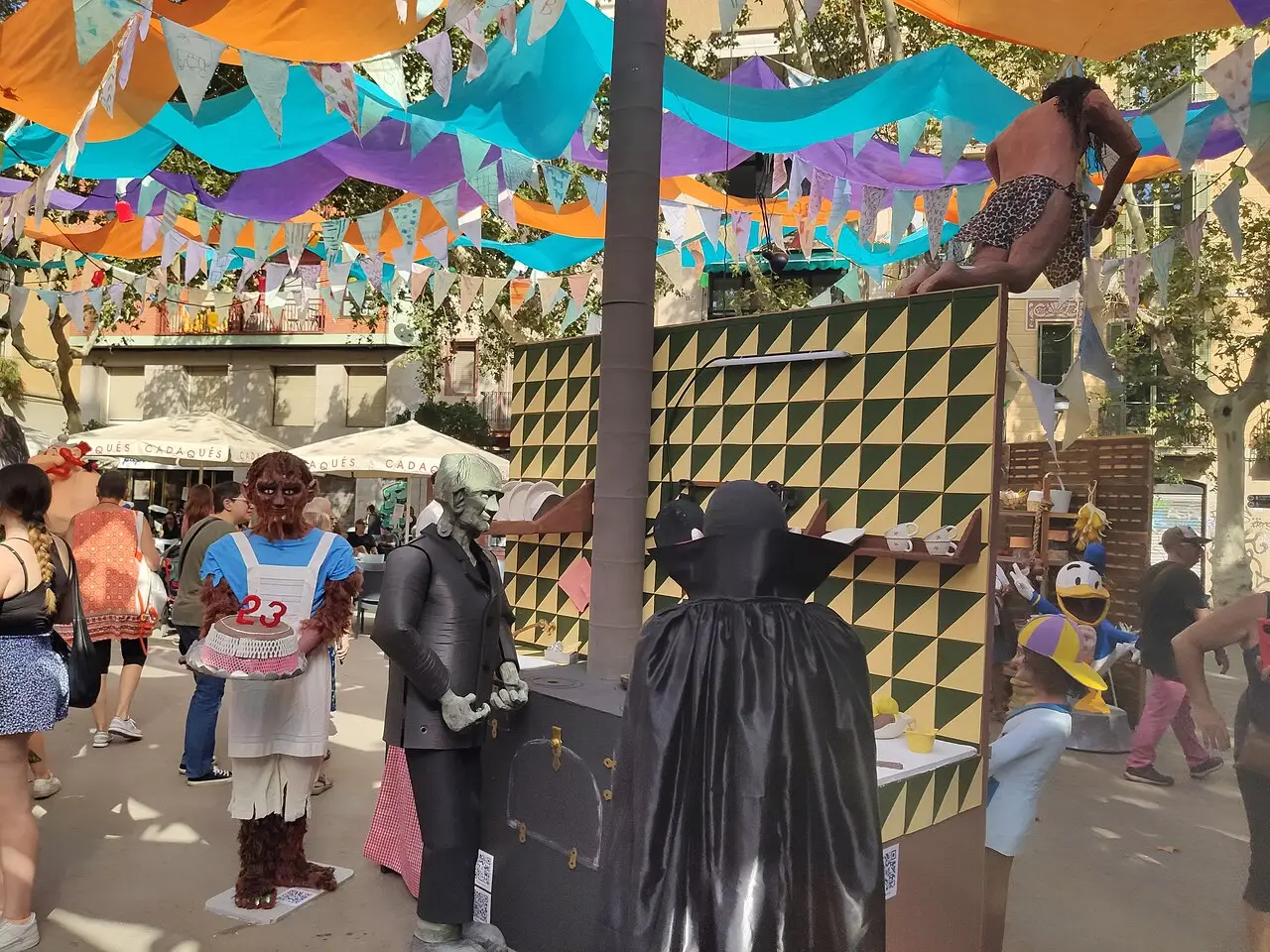
Festa Major de Gràcia
August 15 to 21. Residents decorate entire streets with recycled materials and compete against each other; there are concerts in every square and a crowd the neighborhood can't quite hold.

Nit de Sant Joan
The night of June 23 into 24, the loudest of the year. Bonfires and fireworks on the beach, cava, and coca de Sant Joan, a flat cake topped with candied fruit or custard.

Diada Nacional de Catalunya
September 11, marking the fall of the city in 1714. It's a public holiday, with floral offerings and, in many years, large political demonstrations.
Books and films
Homage to Catalonia: George Orwell (1938)
A first-person account of revolutionary Barcelona in 1936 and its unraveling in 1937. It explains why the city's political memory runs so long.
The Shadow of the Wind: Carlos Ruiz Zafón (2001)
A novel set in postwar Barcelona, moving between El Raval, the Gòtic, and Tibidabo. It works as an emotional map of the years of scarcity and censorship.
All About My Mother: Pedro Almodóvar (1999)
A film shot largely in the Eixample and Camp de la Bota, with the Sagrada Família still under construction in the background. It shows the city as a destination for people starting over.
Frequently asked questions
Barcelona: Is it worth eating on the Rambla?
It's not worth it: the Rambla and the terraces with photos of the dishes and a menu in six languages have the worst value for money in the city. Walk two streets in from the Raval, the Born or Poble-sec, where the same money buys a far better meal.
Barcelona: How do you get from the airport to downtown?
The Aerobús A1 (T1) and A2 (T2) takes 35 minutes to Plaça de Catalunya and costs about €7.75 one way.
Barcelona: How do you get to Montserrat?
Montserrat is 60 km northwest, about 1 hour and 30 minutes on the FGC R5 train from Plaça Espanya, plus the rack railway or the cable car.
Barcelona: What's the best time to go?
The best time for Barcelona is spring, at 15 to 22°C, especially May and early June, when the city's life happens on the street. September and October come next, at 20 to 26°C and with fewer tourists, but also with a higher chance of storms, since most of the roughly 600 mm of rain the city gets each year falls in autumn.
Barcelona: Do you need to greet before ordering?
Yes: a “bon dia” or “buenos días” opens the sentence in any bar, bakery or pharmacy, and firing off your order straight away sounds like you're barging in.
Other cities in the country
Spain ↗- Days
- 3–4
- When
- Apr–Jun · Sep–Oct
- Per person/day
- Average 156 EURMid-range · per person/day
Cost scope
2026 planning examples per person per day: accommodation, food, local transport, admission fees and extras. Flights and trips to other cities excluded. Hostel: one bed; hotels: one whole room allocated to one person. If sharing, divide accommodation. Admission and transport amounts are averages across the stay; check prices for your dates.
- Days
- 2–3
- When
- Mar–May · Oct–Nov
- Per person/day
- Average 70–120 EURMid-range · per person/day
Cost scope
Per person per day: accommodation, meals, urban transport, visits and a small allowance for extras. Flights excluded; larger purchases vary. Editorial estimate, not a quote.
- Days
- 2–3
- When
- Apr–May · Oct
- Per person/day
- Average 150 EURMid-range · per person/day
Cost scope
Per person per day: accommodation, meals, urban transport, visits and a small allowance for extras. Flights excluded; larger purchases vary. Editorial estimate, not a quote.
- Days
- 3–4
- When
- Apr–Jun · Sep–Oct
- Per person/day
- Average 153 EURMid-range · per person/day
Cost scope
Per person per day: accommodation, meals, urban transport, visits and a small allowance for extras. Flights excluded; larger purchases vary. Editorial estimate, not a quote.
- Days
- 4–5
- When
- May–Jun · Sep–Oct
- Per person/day
- Explore costsGuide estimate
Cost scope
Per person per day: accommodation, meals, urban transport, visits and a small allowance for extras. Flights excluded; larger purchases vary. Editorial estimate, not a quote.
- Days
- 3
- When
- May–Jun · Sep
- Per person/day
- Average 113 EURMid-range · per person/day
Cost scope
Per person per day: accommodation, meals, urban transport, visits and a small allowance for extras. Flights excluded; larger purchases vary. Editorial estimate, not a quote.
- Days
- 3
- When
- Apr–Jun · Sep–Oct
- Per person/day
- Average 165 EURMid-range · per person/day
Cost scope
Per person per day: accommodation, meals, urban transport, visits and a small allowance for extras. Flights excluded; larger purchases vary. Editorial estimate, not a quote.


Itineraries through here
 Portugal and Spain in 15 daysIberia from end to endLisbon · Porto · Madrid · Seville · Barcelona13–18 days5 cities
 Spain in 10 daysPrado, flamenco and GaudíMadrid · Seville · Barcelona8–11 days3 cities
 Madrid, Valencia and Barcelona in 10 daysAlbufera paella and the Sagrada FamíliaMadrid · Valencia · Barcelona9–12 days3 cities