Days Start with the basic programme and choose extensions for the time you have.
How the guide reaches this number
A third, if you have it, goes to the zellij workshops, a hammam and the Ville Nouvelle. Anyone looking for a beach or a promenade will be frustrated, because here there are 9,400 sloping lanes, with mules and no signs. With a single day, start at 9am at the upper gate and walk down Talaa Kebira without shortcuts to Nejjarine Square. From there, continue to the Qarawiyyin and the al-Attarine madrasa and climb to a terrace over the Chouara. In the late afternoon, leave through Bab Rcif and take a taxi back. The tannery disappoints, because it's smaller than the photos promise and comes with a handbag shop attached. The Qarawiyyin and the zaouia of Moulay Idriss II can only be seen from the threshold, since they don't admit non-Muslims, so walk slowly and look in through the open doors.
2–3
When March to May and September to November; April and October give the best balance between heat and rain
How the guide reaches this number
The best period runs from March to May and from September to November, with highs of 20 to 28 °C. October has almost no rain, but March and April still catch the tail end of the rainy season, with downpours that make the sloping lanes slippery. Winter, from December to February, stays between 5 and 16 °C, with concentrated rain, and the thick walls of the old houses, almost always without heating, hold on to the cold: bring a jacket and check whether your riad has a heater. July and August are the months I'd avoid: the medina sits in a closed basin, the temperature tops 38 °C almost every day and has gone above 43 °C, the smell of the tanneries gets stronger, and the lanes hold the heat until late. Annual rainfall, 500 to 600 mm, falls almost entirely between November and April. High season is Easter, May, September and October. Low season is July, August and midwinter, when riads cut their prices by 20 to 30%. Ramadan, expected from about February 8 to March 9, 2027, changes the whole routine: kitchens closed by day, clocks set back to UTC+0, and streets full after ftour, the breaking of the fast around 6pm, into the early morning.
Per person/day Backpacker 300–500 DH; mid-range comfort 800–1,400 DH (about US$85–150), with a riad, meals in the medina and half a day with an official guide
How the guide reaches this number
Per person per day: accommodation, meals, urban transport, visits and a small allowance for extras. Flights excluded; larger purchases vary. Editorial estimate, not a quote.
 What Nilo thinks
Stay two days: one to walk down the whole medina, another for Fes el-Jdid, the mellah and the Marinid tombs in the late afternoon. A third, if you have it, goes to the zellij workshops, a hammam and the Ville Nouvelle. Anyone looking for a beach or a promenade will be frustrated, because here there are 9,400 sloping lanes, with mules and no signs. With a single day, start at 9am at the upper gate and walk down Talaa Kebira without shortcuts to Nejjarine Square. From there, continue to the Qarawiyyin and the al-Attarine madrasa and climb to a terrace over the Chouara. In the late afternoon, leave through Bab Rcif and take a taxi back. The tannery disappoints, because it's smaller than the photos promise and comes with a handbag shop attached. The Qarawiyyin and the zaouia of Moulay Idriss II can only be seen from the threshold, since they don't admit non-Muslims, so walk slowly and look in through the open doors.In Fez, the medieval medina is still inhabited: it's 9,400 car-free lanes, with leather and copper workshops and the shout of “balak” announcing the mule coming downhill. There stands the Qarawiyyin, founded in 857–859 and considered the oldest continuously operating educational institution in the world. The Bou Inania and al-Attarine madrasas, open to non-Muslims, show zellij, lace-carved plaster, and carved cedar. On Seffarine Square, copper is hammered in the open air, and from the terraces of the leather shops you can see the vats of the Chouara tannery. Fez was Morocco's capital during several periods until 1912, when the French protectorate moved the government to Rabat and built a new city far from the old one. Order the fassi tagine with prunes and almonds, and order the pigeon pastilla with cinnamon the day before. Come between March and May or September and November, with April and October as the best months, and allow two days.
Quick facts
- Population
- about 1.2 million in the city and about 1.3 million in the Fez prefecture (2024 census, rounded); between 100 and 150 thousand people live inside the walls, a number falling since the 1980s
- Founded
- 789, by Idris I, on the right bank of the Fez river; the twin city of Idris II dates from 808–809; the two were unified by the Almoravids in 1069–1070
- Country and region
- Morocco: Fès-Meknès region, the Saïss plain, 60 km from Meknès, 200 km from Rabat, 290 km from Casablanca and 530 km from Marrakesh
- Languages
- Moroccan Arabic (darija) day to day and Standard Arabic in writing; Amazigh present; French in administration, on menus and in commerce; English among guides and riads
- Currency
- Moroccan dirham (MAD, DH): about 9.5 DH per dollar and about 1.8 DH per real in 2026; it's a closed currency, not bought outside the country
- Time zone
- UTC+1 year-round, with a switch back to UTC+0 during Ramadan
- Best time to visit
- March to May and September to November; April and October give the best balance between heat and rain
- Average daily cost
- Backpacker 300–500 DH; mid-range comfort 800–1,400 DH (about US$85–150), with a riad, meals in the medina and half a day with an official guide
When to go
March to May and September to November; April and October give the best balance between heat and rain
January
4° to 16°C
60 mm of rain
February
4° to 17°C
54 mm of rain
June
15° to 31°C
11 mm of rain
July
18° to 35°C
1 mm of rain
August
18° to 35°C
5 mm of rain
December
5° to 17°C
62 mm of rain
How the year changes
The best period runs from March to May and from September to November, with highs of 20 to 28 °C. October has almost no rain, but March and April still catch the tail end of the rainy season, with downpours that make the sloping lanes slippery. Winter, from December to February, stays between 5 and 16 °C, with concentrated rain, and the thick walls of the old houses, almost always without heating, hold on to the cold: bring a jacket and check whether your riad has a heater. July and August are the months I'd avoid: the medina sits in a closed basin, the temperature tops 38 °C almost every day and has gone above 43 °C, the smell of the tanneries gets stronger, and the lanes hold the heat until late. Annual rainfall, 500 to 600 mm, falls almost entirely between November and April. High season is Easter, May, September and October. Low season is July, August and midwinter, when riads cut their prices by 20 to 30%. Ramadan, expected from about February 8 to March 9, 2027, changes the whole routine: kitchens closed by day, clocks set back to UTC+0, and streets full after ftour, the breaking of the fast around 6pm, into the early morning.
The same numbers as a table
| Month | Temperature °C | Rain mm |
|---|---|---|
| January | 4 to 16 | 60 |
| February | 4 to 17 | 54 |
| March · | 7 to 20 | 59 |
| April · | 8 to 22 | 55 |
| May · | 12 to 26 | 38 |
| June | 15 to 31 | 11 |
| July | 18 to 35 | 1 |
| August | 18 to 35 | 5 |
| September · | 16 to 30 | 22 |
| October · | 13 to 26 | 54 |
| November · | 8 to 20 | 66 |
| December | 5 to 17 | 62 |
Nilo's tips
Enter via Bab Boujloud at the top, leave via Bab Rcif at the bottom
Entering from the top, you do the whole medina downhill, because Boujloud sits at about 410 m, up high, while Rcif sits down by the river. It's 25 to 35 minutes going down and much longer coming back, so start early at the top and work your way down over the day. In the late afternoon, leave through Rcif or through Bab Ftouh, on the Andalusian side. From there, a petit taxi for 15 to 25 DH takes you to your riad and spares you the climb, which your legs will feel by 7pm.
Bissara until 11am, snails at night
It's a breakfast dish, and the counter empties around 11am; the snails only come out at night. Bissara, a fava bean soup with olive oil and cumin, costs 5 to 15 DH at the stalls near Bab Boujloud and Bab Rcif, in a clay bowl to drink standing up. The snails (babbouche) cost the same 5 to 15 DH at the carts near Bab Rcif, and the spicy broth is drunk at the end, hot. Pastilla, on the other hand, takes planning, because many riads only make it to order: ask the day before.
At Chouara, settle the tip before going up
The terraces of the leather shops show the vats free of charge, but hand you a sprig of mint at the entrance and expect 20 to 50 DH in tips when you come down. Settle the amount before going up, look at the vats, and don't let the visit turn into a handbag sales pitch.
On Friday, from noon to 3pm, many shops close
It's the break for prayer and the family couscous, and half the souks disappear during that window. The Bou Inania madrasa, from 1350–1355, has an active mosque and also closes to visitors during prayer, so save the 20 to 30 DH ticket for another time. Use the break to rest in the Jnan Sbil garden, with 7.5 hectares of shade on the edge of the medina. Go back to the souks after 3pm, when the shutters go back up.
Petit taxi only with the meter running
On the meter, the short ride is cheap, with the flag fall around 7.50 DH and 15 to 25 DH from the medina to the Ville Nouvelle. Ask for the meter to be switched on before sitting down and turn down a flat price for a short trip; after 8pm, the official rate table adds a 50% surcharge. To the airport, 15 km south, a grand taxi charges about 150 DH by day, and bus line 16 goes to the train station for about 4 DH.
Agree with your riad on the gate and who will pick you up
From the gate to the house it's 200 to 600 meters of unsigned alleys, and arriving at night with nothing arranged is the quickest way to get lost in the medina. Write to your riad about which gate you'll use (Boujloud, Rcif, Ftouh, or Guissa) and ask for someone to wait at the gate at the agreed time. A porter carries the bag to the house for 20 to 50 DH.
Explore the map
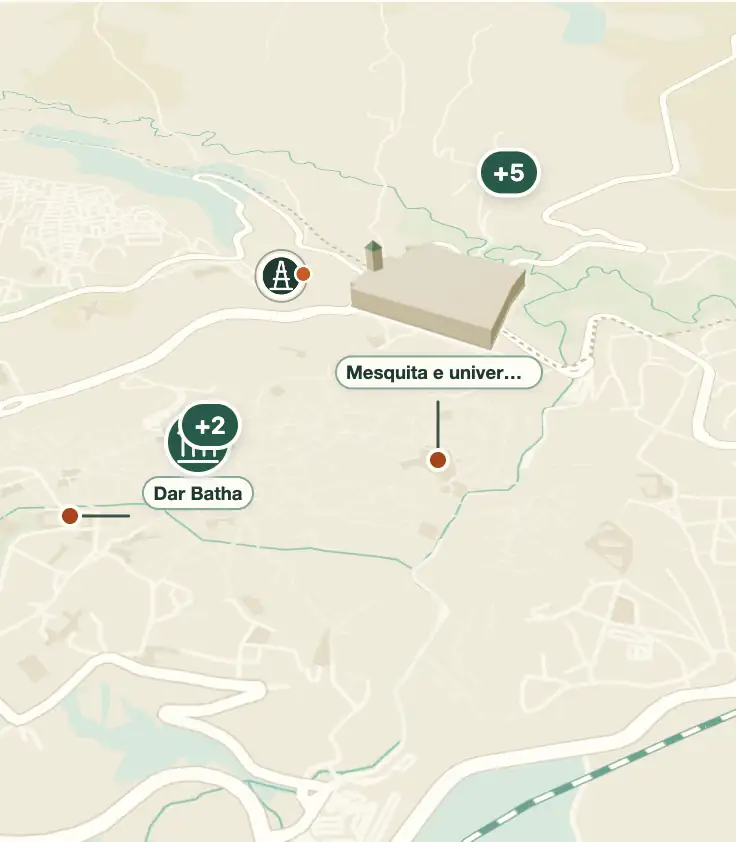
© OpenStreetMap · OpenFreeMap · © OpenMapTiles
Explore the map, read about the other places and plan your travel days in the app.
Open the appWhat to see
Fez: The Taza corridor and the water
Fez sits at about 400 m of elevation on the Saïss plain, at the mouth of the Taza corridor, the natural passage between Atlantic Morocco and Algeria, and it exists because of water: the Ras el-Ma springs feed the Fez river, a tributary of the Sebou, and a medieval canal system splits that flow into hundreds of branches supplying homes, public fountains, mills, hammams and the tannery tanks.
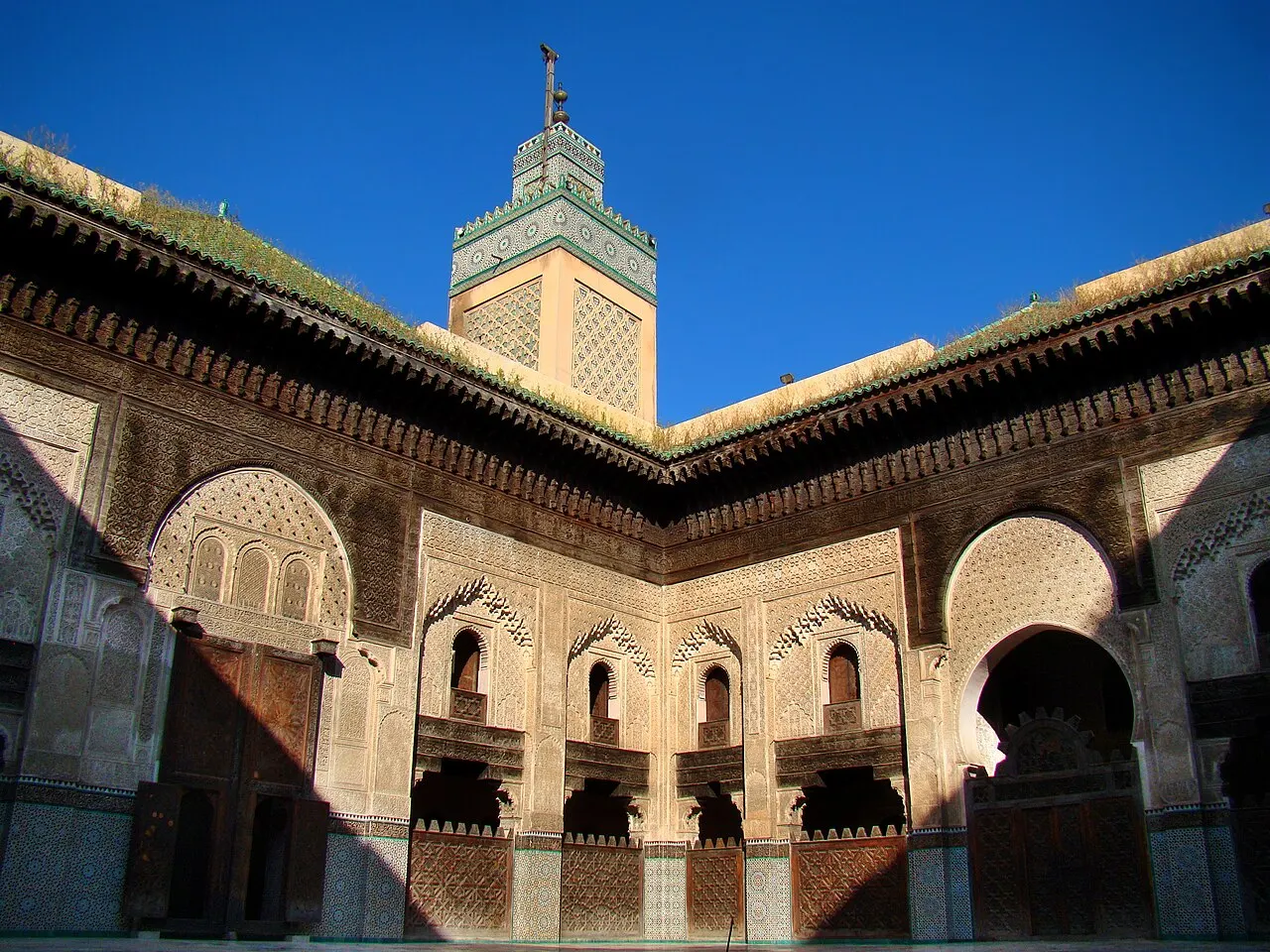
Bou Inania Madrasa
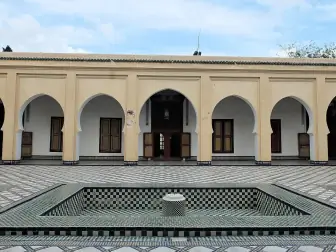
Built between 1350 and 1355 by Abu Inan Faris, it's the only madrasa in Fez with a minaret and a Friday mosque, which makes it the largest of all. It's open to non-Muslims: marble courtyard, zellij up to chest height, lacy plasterwork above and carved cedar on the ceiling. Outside, on the Talaa Kebira, are the thirteen wooden blocks of the 14th-century water clock, whose mechanism no one has ever reconstructed. Entry runs around 20–30 DH.
This is the only madrasa in Fez with a minaret and a Friday mosque.
Check access

Al-Attarine Madrasa
A 1323–1325 madrasa tucked against the perfumers' and spice sellers' souk, which gave it its name. The courtyard is small and covered in mosaic up to the top, with a marble basin in the center; from the terrace you can see the Qarawiyyin's roof right beside it, which helps you grasp the real scale of the whole complex.
The madrasa next to the perfume souk that gave it its name has a small courtyard covered in mosaic up to the top and a marble basin, and from the terrace you can see the Qarawiyyin's roof, which helps gauge the scale.
Check access

Chouara Tannery
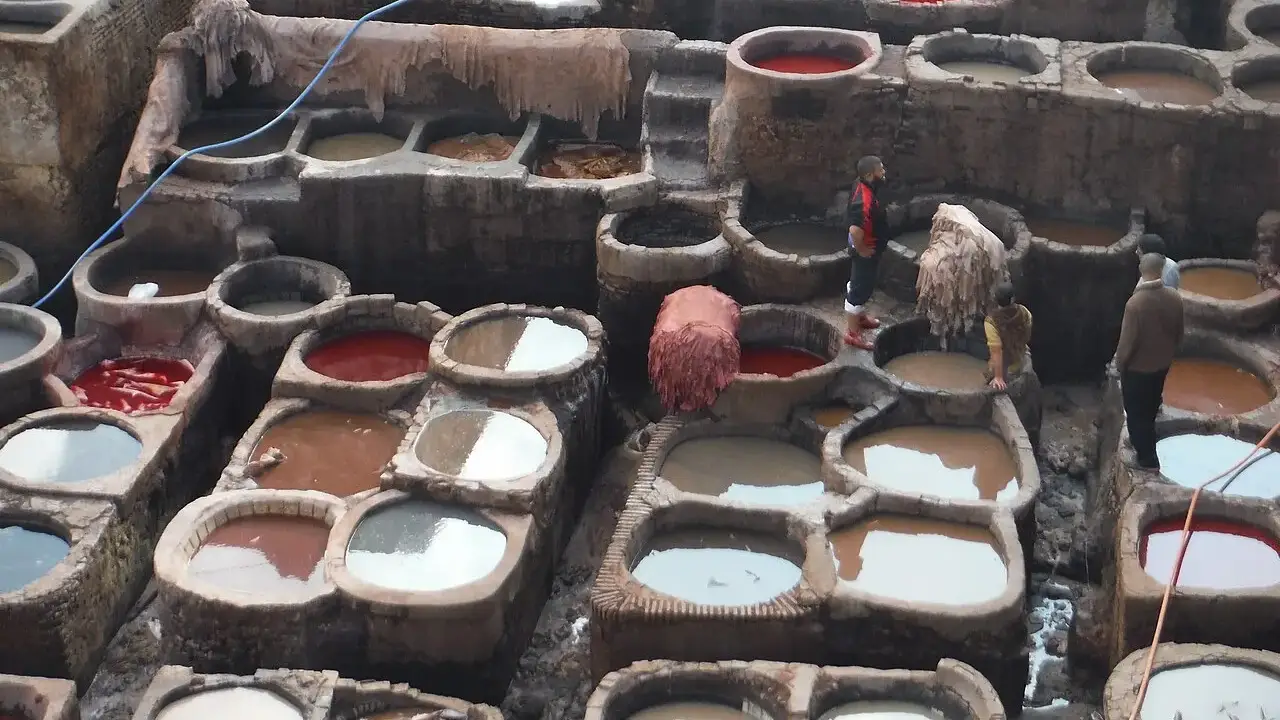
The largest of the medina's three tanneries, in operation since around the 11th century, with dozens of stone vats set into a courtyard. The white ones use lime and pigeon droppings, which soften the hide; the colored ones use poppy, indigo, saffron and henna. It's free to view from the surrounding leather shops' terraces, which hand you a sprig of mint at the entrance and expect a 20–50 DH tip on the way out; the vats were refitted in 2015–2016.
The largest of the three tanneries, in operation since around the 11th century, can be seen for free from the terraces of the leather shops, which hand you a sprig of mint at the entrance and expect a 20 to 50 DH tip on the way out; the white vats soften the hide, and the colored ones dye with poppy, indigo, saffron, and henna.
Check access

Qarawiyyin mosque and university
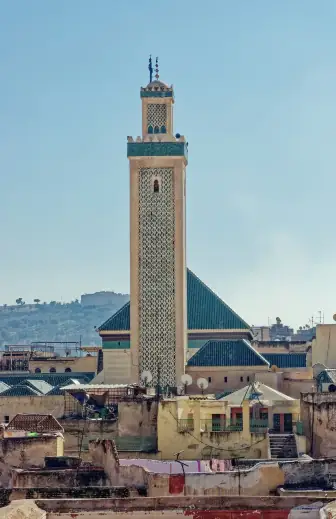
Founded in 857–859 with Fatima al-Fihri's inheritance and expanded by the Almoravids in 1135; UNESCO and Guinness consider it the oldest continuously operating educational institution in the world, folded into the state university network in 1963. Non-Muslims don't enter, but the open doors along the street let you see the courtyard, the fountain and the green roof. The library, one of the oldest in the world, was restored by architect Aziza Chaouni and reopened in 2016.
Founded in 857–859 with Fatima al-Fihri's inheritance, the Qarawiyyin can only be seen from the threshold by non-Muslims: through the open doors on the street, the courtyard, the fountain, and the green roof appear. The library, restored by architect Aziza Chaouni, reopened in 2016.
Check access
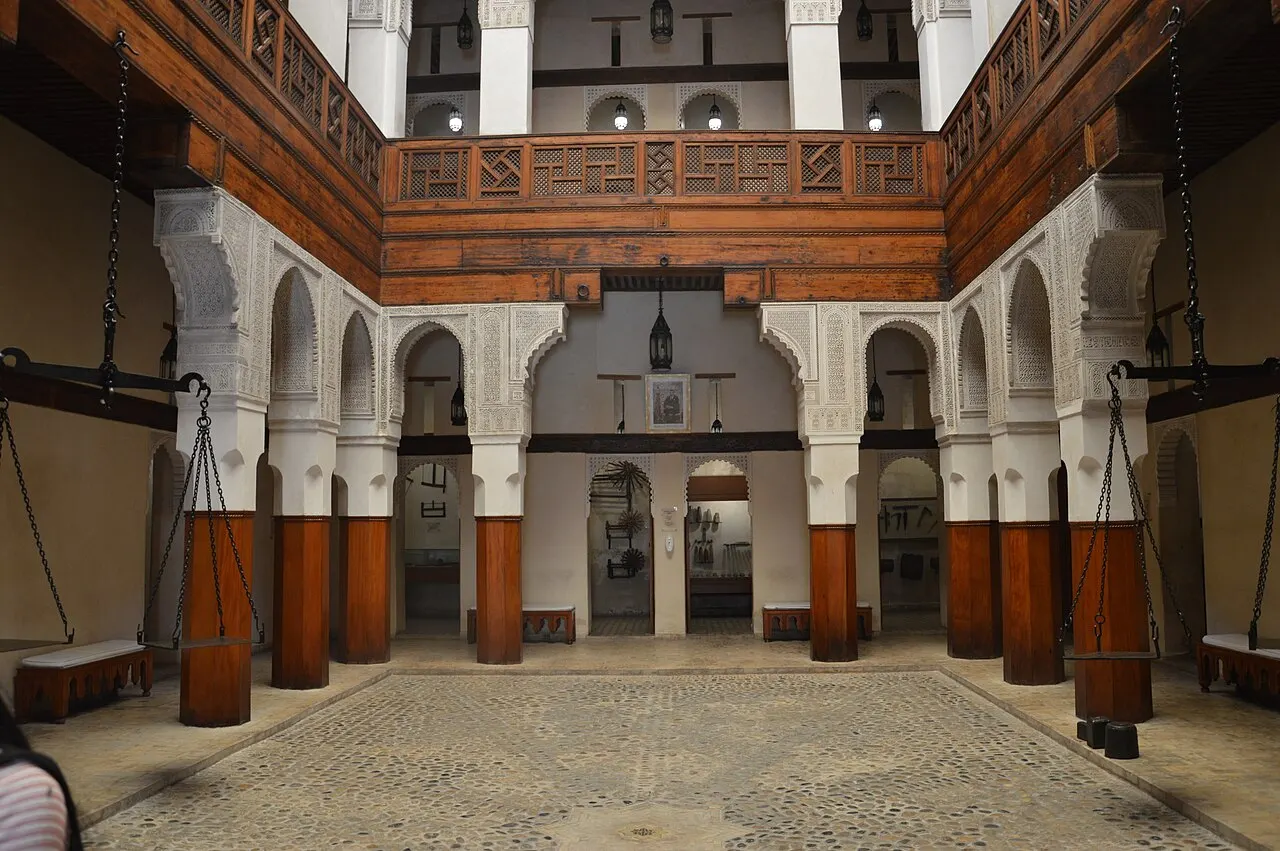
Funduq al-Najjarine
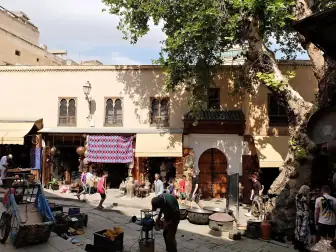
A 1711 merchants' inn, with three floors of cedar galleries around a square courtyard where goods and animals used to be kept. It became the Nejjarine Museum of Wooden Arts and Crafts in 1998, and the terrace serves coffee with a view over the rooftops. Beside it stand the Nejjarine fountain, with an 18th-century zellij panel, and the carpenters' square.
A 1711 merchants' inn, with three floors of cedar galleries around a square courtyard where goods and animals used to be kept.
Check access

Seffarine Square
Coppersmiths' square, next to the Qarawiyyin library, where basins, trays and cauldrons of copper have been hammered out in the open since the Middle Ages. The noise is the point: ten hammers in different rhythms is the medina's signature sound, and the pieces still leave from there for weddings and neighborhood hammams.
Next to the Qarawiyyin library, the coppersmiths have hammered copper in the open air since the Middle Ages, and the mismatch of ten hammers is the medina's soundtrack; the pieces still leave from there for weddings and hammams.
Check access

Dar Batha and Jnan Sbil
A palace begun under Hassan I in the late 19th century and turned into a museum of Moroccan arts in 1915, with the main collection of Fez blue ceramics, fassi embroidery and carved wood, plus an Andalusian courtyard that hosts concerts. A hundred meters away is the Jnan Sbil, a 19th-century royal garden of 7.5 hectares, reopened in 2011 after a long restoration. The museum recently underwent renovations: confirm its status on the day of your visit.
The palace begun under Hassan I in the late 19th century became a museum in 1915 and holds the main collection of Fez blue ceramics and fassi embroidery, and the Jnan Sbil, a 7.5-hectare garden right beside it, reopened in 2011 after a long restoration.
Check access

Marinid Tombs and Borj Nord
Ruins of a 14th-century necropolis on the northern slope, from where you see the whole medina basin, with the minarets rising above the unbroken roofline; best in the late afternoon, and the climb takes 20 to 30 minutes on foot from Bab Guissa. Two hundred meters below stands the Borj Nord, a 1582 Saadian fort built by order of Ahmad al-Mansur, which houses the arms museum: confirm whether it's open.
On the northern slope, the 14th-century necropolis lets you see the whole basin, with minarets rising from the unbroken roofline, and late afternoon is the best time. The climb on foot from Bab Guissa takes 20 to 30 minutes. Two hundred meters below, the 1582 Borj Nord houses the arms museum, and it's worth confirming whether the door is still open on the day of your visit.
Check access
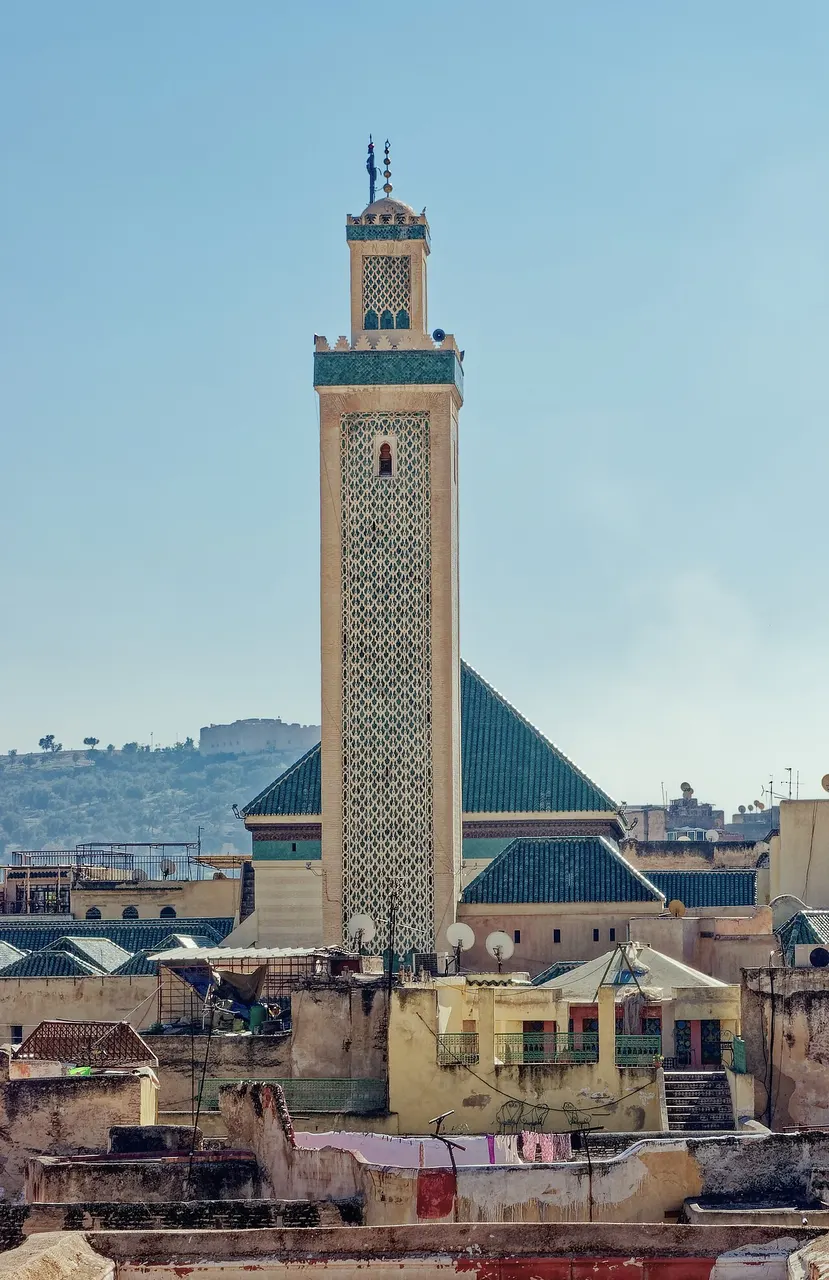
Zaouia of Moulay Idriss II
Tomb of Idris II, who in 808–809 founded al-Aliya, the left-bank city that later merged with his father's, Idris I's. Rediscovered in 1437 and rebuilt in the 18th century under the Alaouites, it sits in a horm, a sacred zone once marked by wooden bars at head height, which kept out loaded animals. Non-Muslims stay on the threshold and can see the tomb chamber from outside; the flow of pilgrims never stops.
The tomb of Idris II, who founded al-Aliya, the left-bank half of Fez, is closed to non-Muslims, who stop at the threshold and see the chamber from outside, amid pilgrims who never stop coming in. What you can enjoy is the horm around it, the sacred zone once marked by wooden bars at head height, and that block can be crossed for free in a few minutes.
Check access
Nilo’s itinerary
Start with the basic programme and choose extensions for the time you have.
Plan my days in the app ↗Day 1 · The descent through the medina
Enter through Bab Boujloud at 9am and visit the Bou Inania madrasa just to your right; outside, look at the water clock on the Talaa Kebira.
Walk down the Talaa Kebira without shortcuts to Nejjarine square: a zellij fountain, a 1711 funduq and the wood museum, with coffee on the terrace.
Continue to the Qarawiyyin and the zaouia of Moulay Idriss II, looking at the courtyards through the open doors, and go into the al-Attarine madrasa, next to the spice souk.
Continue toward Seffarine square following the sound of the hammers, and climb up to the Chouara tannery through one of the leather shop terraces; bring the sprig of mint and leave 20 to 50 DH.
Leave through Bab Rcif in the late afternoon and catch a petit taxi back, instead of climbing the slope again; have snails for dinner at a cart near the square.
Day 2 · Fes el-Jdid, the mellah and the view from above
Start with bissara and bread at a stall near Bab Semmarine and cross the Grande Rue of Fes el-Jdid, the Marinid city from 1276.
See the bronze and zellij doors of the Royal Palace on Place des Alaouites, from outside: the palace isn't open for visits.
Walk through the mellah, created around 1438, with its wooden balconies facing the street, the 17th-century Ibn Danan synagogue and the cemetery of white gravestones on the slope.
In the afternoon, visit the Dar Batha museum, for Fez's blue pottery and fassi embroidery, and rest in the neighboring Jnan Sbil garden, with 7.5 hectares of shade.
Take a taxi up to Borj Nord and walk to the Marinid tombs to see the whole medina inside the basin with the sun low.





If you stay longer
Day 3 · Crafts, a bath and the new city
In the morning, go to the Ain Nokbi pottery quarter, outside Bab Ftouh, and watch zellij get cut by hammer piece by piece before assembly.
Come back through Adwat al-Andalusiyyin, the medina's quiet side, passing the Sahrij madrasa and the 859–860 Andalusian mosque.
Have lunch: a pastilla ordered the day before, or a lamb tagine with prunes at a family-run place.
Book a hammam in the late afternoon: beldi soap, a kessa mitt and a scrub done by someone else, between 150 and 400 DH at the hammams for visitors.
Finish in the Ville Nouvelle, on Boulevard Mohammed V, with a sidewalk coffee and, if you like, the one part of the city where you can buy alcohol.
Food
 AI illustration
Pastilla (bastila)
A pie of thin warqa pastry filled with pigeon or shredded chicken, ground almonds, egg and cinnamon, dusted with powdered sugar on top. It's a festive dish, and Fez is where the recipe was codified; many riads only make it to order, a day ahead. Salty and sweet at the same time, which is startling on the first bite.
 AI illustration
Bissara
A thick fava bean soup with olive oil, cumin and paprika: the breakfast of anyone starting early in the medina.
 AI illustration
Harira
A soup of tomato, lentils, chickpeas and flour, thickened and served with dates, hard-boiled egg or chebakia. It's available year-round for 10 to 20 DH, but it's above all the dish that breaks the fast during Ramadan, always right after sunset.
 AI illustration
Rfissa
Msemen or trid torn by hand, topped with chicken, lentils, softened onion and fenugreek, and drizzled with the broth right before serving. It's a home-cooked dish, traditionally prepared for women who have just given birth; in riads it's made to order.
 AI illustration
Lamb tagine with prunes and almonds
Slow-cooked in the clay pot with a conical lid, which sends the steam back down onto the food. The fassi version adds prunes, cinnamon, sesame and fried almonds and is sweeter than the version from the south of the country; at a simple medina eatery it costs 40 to 70 DH.
 AI illustration
Khlii
Salted beef or mutton, sun-dried and preserved in its own fat in clay pots for months. It's eaten fried with eggs in a small shallow pan, at breakfast, and it's the oldest flavor in the city's cooking. It started as a way to keep meat without ice.
 AI illustration
Babbouche
Snails (babbouche) cooked in a spicy, peppery broth, served in a small cup and eaten with a toothpick: a nighttime street dish in Fez.
 AI illustration
Atay bi na'na'
Gunpowder green tea with mint and plenty of sugar, poured from thirty centimeters up to form foam. It's served three times, each round sweeter than the last; you can decline without offending by saying la, shukran, baraka.
Day trips
Meknès and Volubilis
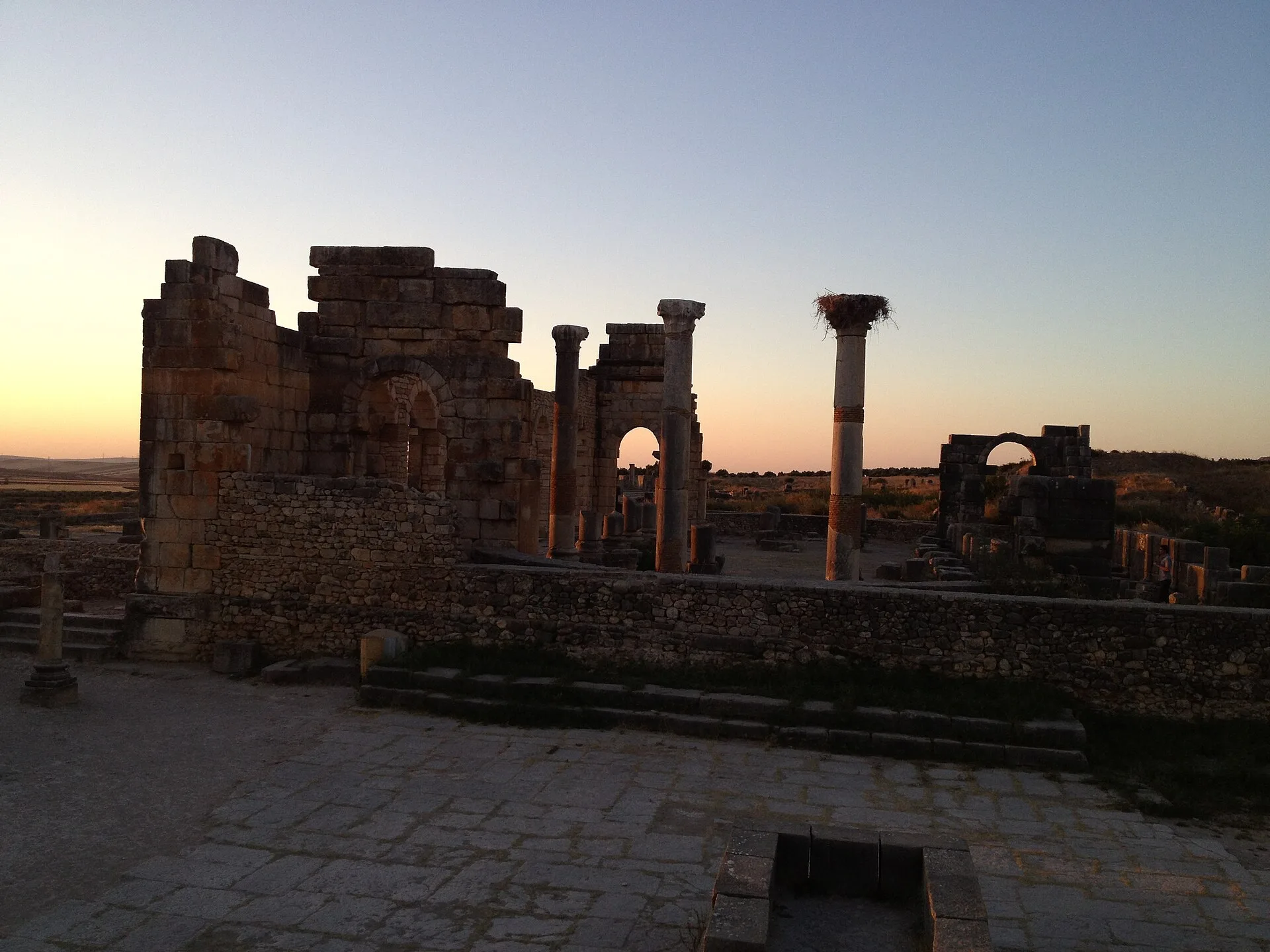
Meknès is 60 km away, 35 to 40 minutes by train for about 25 DH, with the Bab Mansour gate, Moulay Ismail's granaries and stables, and the sultan's mausoleum. From there, a grand taxi takes 40 minutes to the 33 km to Volubilis, the Roman capital of Mauretania Tingitana and a World Heritage Site since 1997, with floor mosaics and the sacred village of Moulay Idriss Zerhoun right beside it. A full day.
Ifrane and the Azrou cedar forest
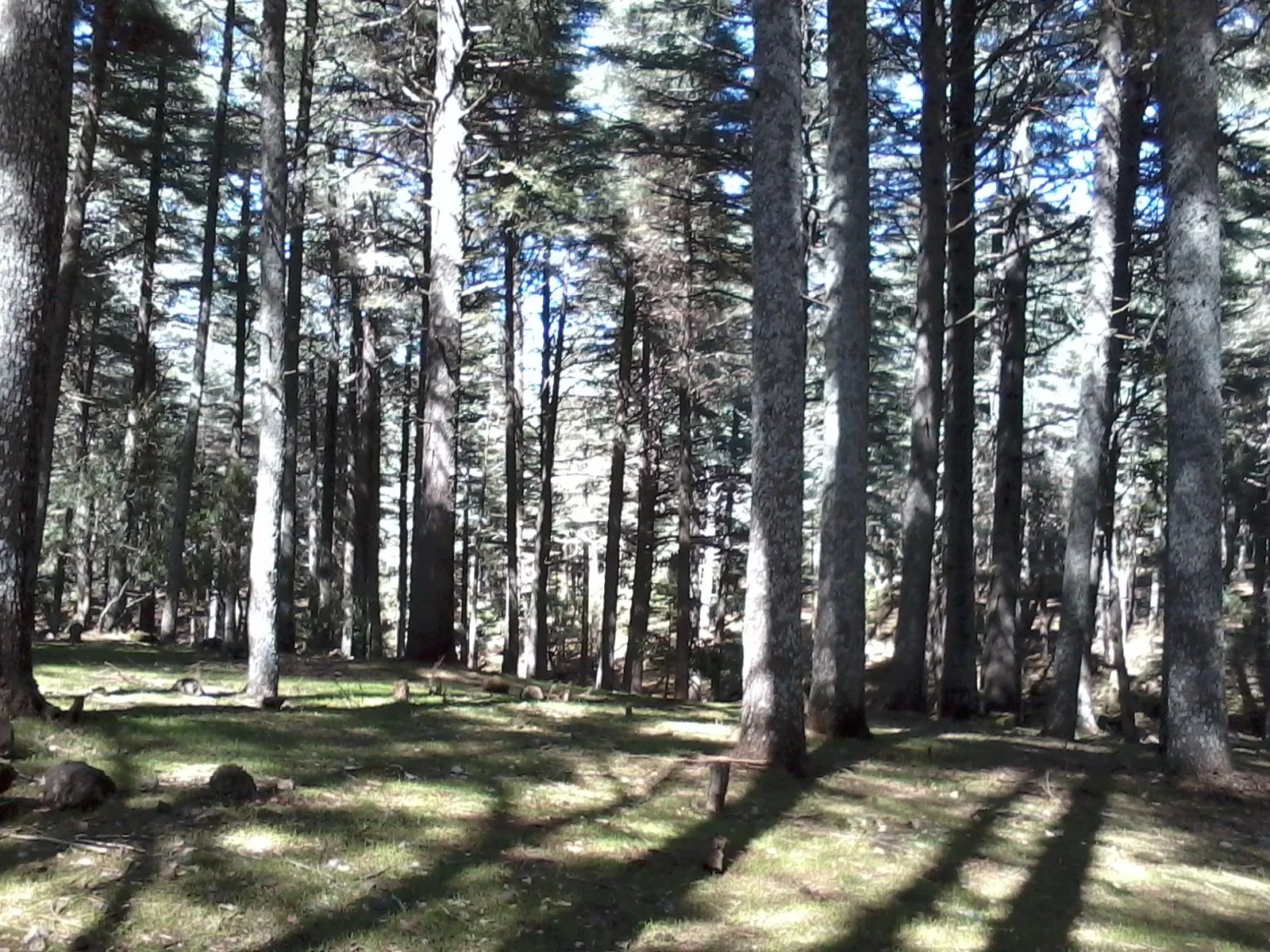
Ifrane is 65 km away, about 1 hour 15 minutes by car or grand taxi, at 1,665 m of elevation, with gabled roofs built by the French in the 1930s. Twenty kilometers further, the Azrou cedar forest shelters Barbary macaques, the only wild primates in Africa north of the Sahara. It takes you out of Fez's heat in an hour and fills the day.
Chefchaouen
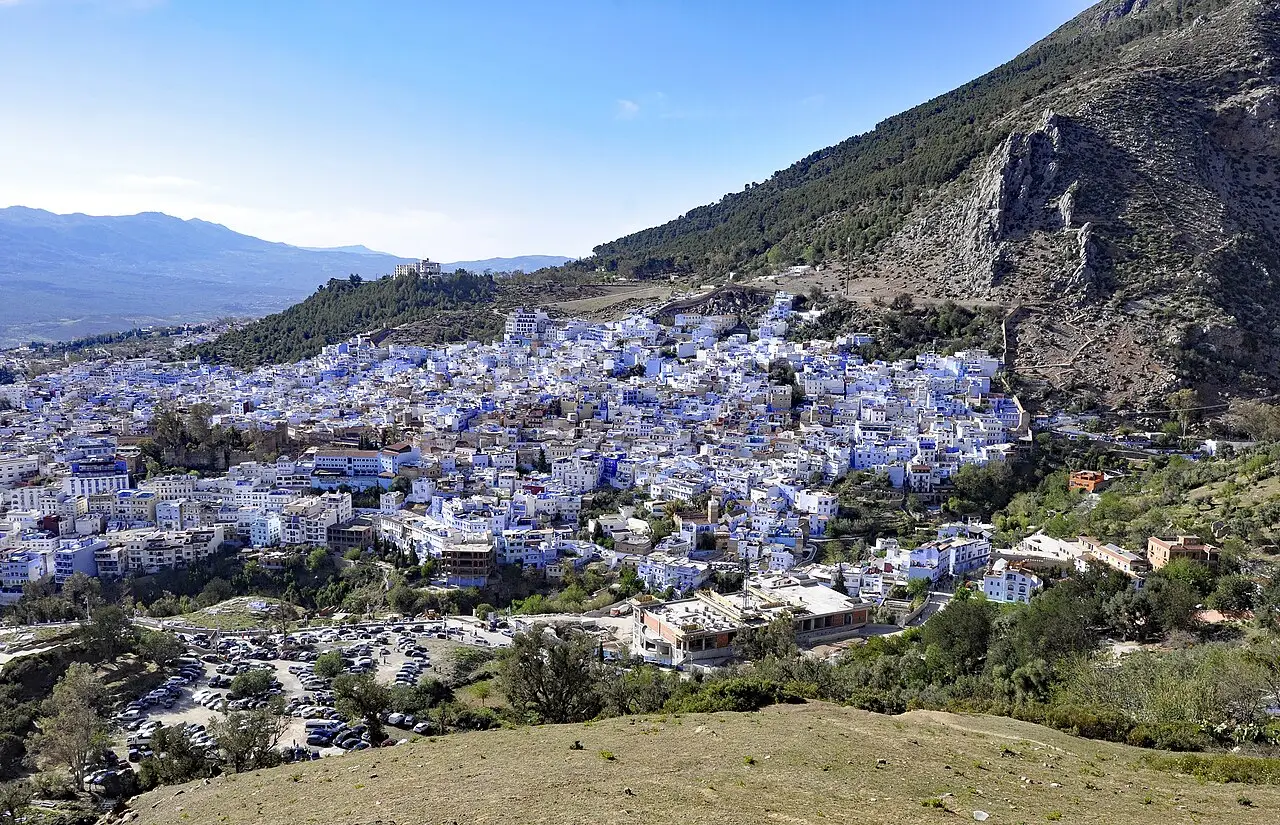
200 km to the north, about 4 hours by CTM bus for 100 to 130 DH, on the slope of the Rif, with houses painted blue since the 1930s and stepped streets. You can go and come back the same day, but that's 8 hours on the road. It works better with one overnight, and from there you continue on to Tangier or Tetouan.
Where to begin
The descent through the medina
Enter through Bab Boujloud at 9am and visit the Bou Inania madrasa just to your right; outside, look at the water clock on the Talaa Kebira.
Fes el-Jdid, the mellah and the view from above
Start with bissara and bread at a stall near Bab Semmarine and cross the Grande Rue of Fes el-Jdid, the Marinid city from 1276.
Money
The Moroccan dirham (DH) is a closed currency: you can't buy it outside the country, bringing cash in or out is limited to 2,000 DH, and it's worth keeping your exchange receipt to convert money back at the airport. Everyday price ranges: nous-nous coffee 10 to 15 DH, mint tea 10 to 20 DH, bissara 5 to 15 DH, a sandwich from a stall 20 to 40 DH, tagine at a simple place in the medina 40 to 70 DH, a meal at a mid-range restaurant 100 to 200 DH, a full dinner at a riad 250 to 400 DH. A hostel bed runs 100 to 150 DH, a room at a mid-range riad 400 to 900 DH and a high-end riad from 1,500 DH. Hotels add the municipal tourist tax, on the order of 10 to 30 DH per person per night depending on category. Buses cost 4 to 5 DH, a petit taxi 15 to 25 DH, an official badge-wearing guide 300 to 400 DH for half a day and entry to a museum or madrasa 20 to 70 DH. Cards work at hotels, riads and larger restaurants. The whole medina runs on cash, so carry 20 and 50 DH notes and coins for tips, because at eight in the morning nobody has change for a big note. ATMs are easy to find in the Ville Nouvelle and exist at Bab Boujloud and Bab Rcif, with a fee of 25 to 40 DH per international withdrawal. Tipping: 5 to 10 DH at a café, about 10% at a restaurant, 20 to 50 DH on the tannery terrace and 20 to 50 DH for whoever carries your bag.
Getting there and around

Fès-Saïss Airport: 15 km south, the connection is usually in Casablanca
Fès-Saïss Airport (FEZ) sits 15 km south of the city and receives flights from Morocco and Europe. There's no direct link to Brazil, and the connection is usually in Casablanca, Madrid or Paris. Bus line 16 connects the airport to the train station, running every 30 to 60 minutes. Taxis also cover the route, at a higher fare at night. The ONCF station is in the Ville Nouvelle: Meknès in 35 to 40 minutes, Rabat in about 3 hours, Casablanca in about 4 hours for 110 to 150 DH in second class, Tangier in about 5 hours and Marrakesh in about 7 hours. The Al Boraq high-speed line doesn't serve Fez. It links Tangier to Casablanca, and the extension to Marrakesh was still under construction. CTM and Supratours buses leave from the terminal near Place Atlas, and shared grand taxis depart from separate points by destination, one point for each place; it's worth confirming which before waiting. Brazilians don't need a visa for stays of up to 90 days, and the passport needs 6 months of validity. Check before you fly whether the electronic travel authorization Morocco has been rolling out already applies to your passport.
No metro or tram: the petit taxi is what works
There's no metro or tram within the city. Alsa buses cover the Ville Nouvelle and the medina's perimeter for 4 to 5 DH paid on board. What actually works is the red petit taxi, with a meter required by law. Always ask for it to be turned on. Ride-hailing apps have a limited, informal presence in Morocco, so count on the street taxi. Fes el-Bali is the largest car-free urban area in the world: about 9,400 alleys across 280 hectares, where everything comes and goes by mule, handcart, or on a porter's back. Cars stop at the gates (Bab Boujloud at the top, Bab Rcif at the bottom of the basin, by the covered river, Bab Ftouh to the southeast, on the Andalusian side, and Bab Guissa to the north), and the rest is on foot. Porters carry the suitcase to the riad, and it's money well spent. The whole medina is a slope: going down is quick, coming back isn't.
Safety
Fez is a safe city for walking, even at night on the main streets, and violent crime against visitors is rare. The real nuisance is commercial: unlicensed guides who approach you at Bab Boujloud, on Talaa Kebira and on the way to the tanneries, offers of help that end in a shop paying commission, and the line that the way ahead is closed. The answer that works is a firm la, shukran, without breaking stride and without getting into an argument: arguing already means accepting the invitation. Pickpockets turn up in crowded souks and on packed buses; wear your bag in front of your body. At night the residential lanes are poorly lit and deserted after 10pm. It isn't dangerous, but it's easy to get lost, so head back along streets with shops still open or call a taxi at the nearest gate. Women on their own get comments in the street, more often in the Ville Nouvelle at night; ignoring them and walking on is the local norm. The practical precaution that's easiest to forget is the ground: the lanes are uneven, wet near the tanneries and broken by steps, and closed shoes with grippy soles solve almost everything. Tap water is treated, but people with sensitive stomachs prefer bottled water. The tourist police have a post near Bab Boujloud, and the emergency number is 19 in the city and 177 outside it.
Etiquette tips
Flatten against the wall when you hear balak
When a mule driver shouts “balak,” press against the wall without looking for where the shout came from: the load can't swerve around someone standing in the middle of the lane.
Active mosques and zaouias don't admit non-Muslims
Non-Muslims don't enter the Qarawiyyin, the Andalusian Mosque or the zaouia of Moulay Idriss II: look from the threshold, without going in, and nobody minds. The Bou Inania, Attarine, Sahrij and Cherratine madrasas, the Nejjarine funduq and Dar Batha, however, are open to everyone and charge admission.
Ask before photographing people
Tanners, vendors and women in general decline the photo, and insisting creates immediate friction. On the Chouara terraces the view is fair game, but a lens pointed down into the tanks usually comes with a request for a tip: agree on it beforehand.
Hire an official guide and settle the price up front
Accredited guides wear a ministry badge and are hired through the riad or the tourism office, for 300 to 400 DH for half a day. Anyone who approaches on the street without a badge works on shop commission, and the free tour turns into three hours of carpets.
Eat with your right hand and use bread as your utensil
The dish is shared, and everyone eats from the section in front of them, without reaching across the middle. The left hand doesn't touch the food, and turning down bread at a meal comes across as turning down the whole table.
Only ask the price if you're thinking of buying
Asking is treated as opening a negotiation, and walking away after a number has been named is seen as backing out, not shopping around. When you do want to negotiate, offer around 40% of the first price and settle between 60 and 70%; when you don't, say la, shukran and keep walking.
Mistakes to avoid
Riad without an agreed meeting point
Booking a riad in the medina without arranging a meeting point. The taxi doesn't enter the alleys and drops you at one of the wall's gates, and without someone from the riad waiting there, arrival turns into a search on foot, with luggage, through unmarked alleys.
Trusting the map inside the medina
Trusting your phone's map inside Fes el-Bali. Much of the 9,400 alleys aren't mapped, and the GPS signal bounces between the walls. Navigate by the gates, by the direction of the descent and by the name of the nearest landmark, and ask shopkeepers, not whoever approaches you first.
The tannery that's “closed”
Believing whoever tells you the tannery is closed, that today's the Berber market day, or that the street ahead is off-limits. It's the standard pitch to redirect you to a commission shop; the tanneries operate every day and no such seasonal fair exists.
Going down without thinking about the way back
Heading down from Bab Boujloud without thinking about the way back. The medina slopes down from the top of the city to the river, and whoever walks back to a riad near the upper gate climbs it all again at the end of the day, when their legs are already tired.
Shopping on a Friday
Scheduling your day of shopping and sightseeing on a Friday. That's when the medina empties out of merchants, for prayer and the family lunch.
Useful phrases
السلام عليكم: Salam alaykum (sa-lám a-lái-kum)
Peace be upon you. The standard greeting, answered with wa alaykum salam
بلاك: Balak! (ba-lák)
Watch out, coming through: shouted by whoever's leading a mule or a cart; flatten against the wall
بشحال؟: Bech-hal? (be-ch-rál)
How much does it cost? Opens the negotiation, so only ask if you're thinking of buying
لا شكرا: La, shukran (la chú-kran)
No, thank you: the polite refusal, enough for street vendors and guides
واخا: Wakha (uá-ra)
Okay, agreed: seals a price, a meeting or any deal
بركة: Baraka (bá-ra-ka)
Enough, that's plenty: used to end the tea, the food or the insisting, without rudeness
Districts
Talaa Kebira and Talaa Seghira
The two streets that run down from Bab Boujloud into the heart of the medina; the Kebira is about 1.3 km long and holds the Bou Inania madrasa, the water clock and the street trade. They meet again near the Souk Attarine and form the backbone of any walk.
Adwat al-Qarawiyyin
The southwestern half of Fes el-Bali, settled by families from Kairouan in 817–818. It holds the Qarawiyyin, the zaouia of Moulay Idriss II, the Attarine madrasa and almost all the souks. It's the densest, loudest, and easiest part to get lost in.
Adwat al-Andalusiyyin
The northeastern half, across the covered river, settled by refugees from Córdoba starting in 818. It has the 859–860 Andalusian mosque, the Sahrij madrasa and residential streets with almost no shops; it's the side where you can walk without bumping into anyone.
Fes el-Jdid
Walled administrative city founded by the Marinids in 1276, west of the old medina. It holds the Royal Palace, with its bronze and zellij doors on the Place des Alaouites, the mechouars, the Grande Rue and the Bab Semmarine gate.
Mellah
Jewish quarter created around 1438 next to the palace, the first in Morocco and the origin of the word. What remains are the wooden balconies facing the street, forbidden in the Muslim medina, the 17th-century Ibn Danan synagogue, restored in 1999, and the cemetery of white gravestones on the slope.
Batha and Bab Boujloud
Transition strip between the medina and the new city, with the Dar Batha museum, the Jnan Sbil garden and the square where taxis and buses stop. It's the natural entrance and the simplest place to arrange a meeting point.
Ville Nouvelle
Laid out by Henri Prost starting in 1916, 2 km to the southwest, in wide blocks around Boulevards Mohammed V and Hassan II. It holds the train station, the banks, the sidewalk cafe tables, the cinemas and the few shops that sell alcohol.
Bab Ftouh and Ain Nokbi
Southeast gate of the medina, on the Andalusian side, with the large cemetery on the slope and, just beyond, the pottery quarter moved outside the walls in the 1980s. That's where zellij is cut by hammer, piece by piece, and where the blue ceramic kilns fire.
History
789 · Idris I founds Madinat Fas
The founder of the Idrisid dynasty sets up a settlement on the right bank of the Fez river, at a spot with a spring and an obligatory crossing point between the Atlantic and Algeria. He dies poisoned in 791.
808–809 · Idris II founds the twin city
His son builds al-Aliya on the opposite bank and makes it the Idrisid capital. The two cities coexist separately behind their own walls, with their own markets and mosques, for about 260 years.
817–818 · Refugees from Kairouan and Córdoba
Families from Kairouan settle one bank, and about 800 families expelled from the Córdoba suburb, after the 818 revolt, settle the other. That's where the names Adwat al-Qarawiyyin and Adwat al-Andalusiyyin come from.
857–859 · Founding of the Qarawiyyin
Fatima al-Fihri, heiress to a Kairouan merchant, has the mosque built that becomes a center of learning and legal rulings. Her sister Mariam founds the Andalusian mosque in 859–860.
1069–1070 · The Almoravids make it one city
Yusuf ibn Tashfin takes Fez, tears down the wall separating the two banks and unifies the administration. Marrakesh, founded in 1070, gets the capital, and Fez becomes the religious and commercial hub of the north.
1146 · Almohad conquest and new walls
Abd al-Mumin takes the city after a nine-month siege and rebuilds the walled perimeter still visible today. The Qarawiyyin, already expanded by the Almoravids in 1135, draws Maimonides in the 1160s and Ibn Khaldun in the 14th century.
1276 · The Marinids found Fes el-Jdid
Abu Yusuf Yaqub builds a walled administrative city to the west, with a palace, mechouars, gardens and an archers' barracks. Fez becomes the capital again and gets its madrasas: Saffarine in 1271, Sahrij in 1321–1323, Attarine in 1323–1325 and Bou Inania in 1350–1355.
around 1438 · Morocco's first mellah
The Jewish community is moved to a neighborhood next to the palace, in Fes el-Jdid, under the sultan's direct protection. The word mellah, tied to salt, comes to name every Jewish quarter in the country.
1549–1727 · The capital leaves twice
The Saadians move the court to Marrakesh in 1549 and build the Borj Nord fort in 1582 to watch over the rebellious city. Moulay Ismail moves the capital to Meknès between 1672 and 1727, and Fez survives as a religious center and the base of the merchant fassi families.
1912 · Treaty of Fez and the protectorate
On March 30, Sultan Moulay Abd al-Hafid signs the treaty in the city handing Morocco to France; April revolts leave dozens dead. The capital moves to Rabat, and starting in 1916 Henri Prost designs the Ville Nouvelle 2 km from the medina, left untouched on purpose.
1981 · Fes el-Bali joins the UNESCO list
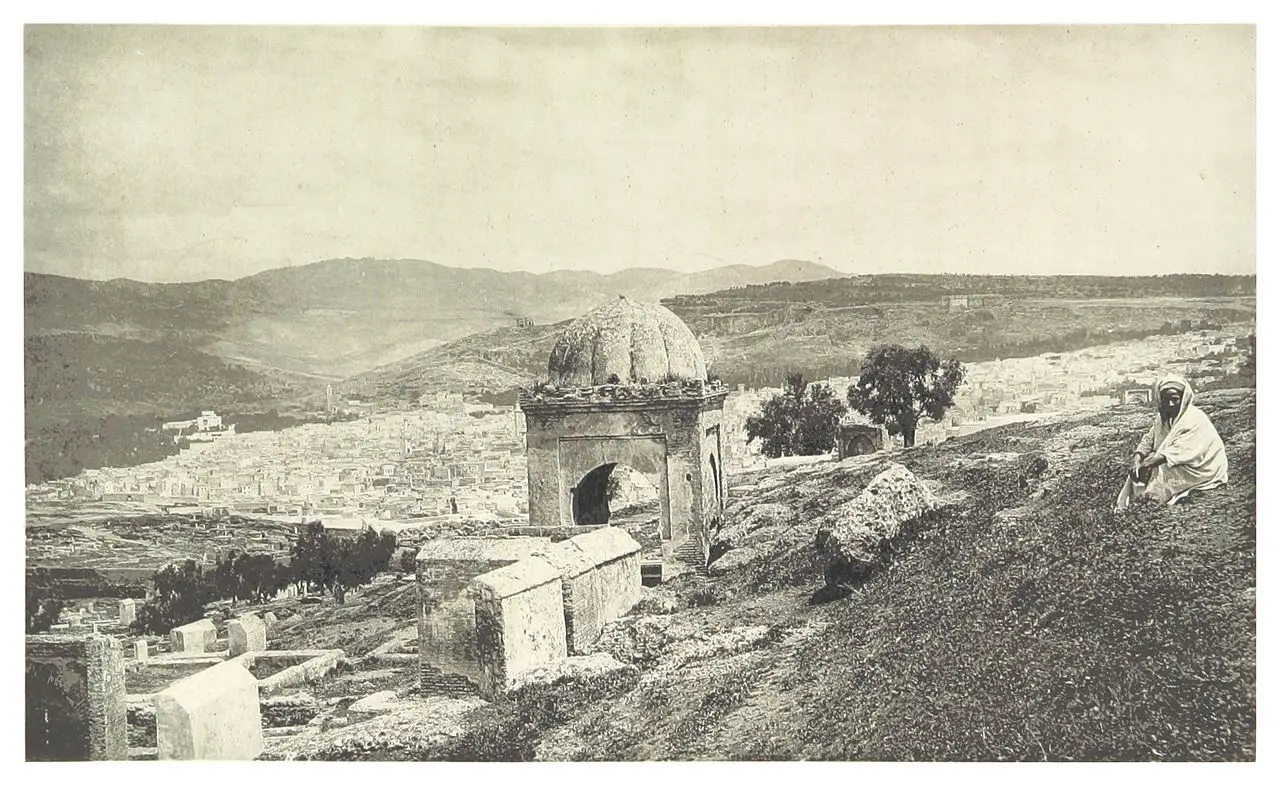
The medina, with about 280 hectares and 9,400 alleys, becomes a World Heritage Site. A rehabilitation program backed by the World Bank starting in 1998 shores up houses at risk, restores fondouks and refits the Chouara tannery tanks in 2015–2016.

Complete history
Born twice, on opposite banks
Fez was founded twice, on opposite banks. In 789 Idris I sets up a settlement on the right bank of the Fez river; in 808–809 his son, Idris II, founds al-Aliya on the left bank and makes it the Idrisid capital. Between 817 and 818 two groups of refugees arrive who define the city to this day: families from Kairouan, in present-day Tunisia, and about 800 families expelled from the Córdoba suburb after the 818 revolt. Each group settles on one bank, with its own wall, market and mosque. The neighborhoods are still called Adwat al-Qarawiyyin and Adwat al-Andalusiyyin. In 857–859 Fatima al-Fihri funds the Qarawiyyin mosque, which grows into a school of law and theology and has never stopped operating since.
Unification is an outsider's doing
In 1069–1070 the Almoravid Yusuf ibn Tashfin, an outsider, took Fez and had the wall between the two towns torn down, creating a single street grid, which is why the medina has two halves with different logics, linked by six bridges. The Almoravids enlarged the Qarawiyyin in 1135 and moved the capital to Marrakesh, founded in 1070. In 1146 the Almohads took the city after a nine-month siege and rebuilt the walls along their current line. Even without the court, Fez established itself for centuries as a market, a workshop and a university: Maimonides lived there in the 1160s, Ibn Khaldun taught there in the 14th century, and Fez leather, copper and zellij traveled across the Mediterranean.
The city you walk through today is Marinid
The city visitors walk through today is mostly Marinid. The dynasty had already built the Saffarine madrasa in 1271 when, in 1276, Abu Yusuf Yaqub founded Fes el-Jdid, a walled administrative town to the west, with a palace, mechouars, gardens and troops. The wall separated the court from the merchants' city, and the two remain separate to this day. In the following century, the sultans filled the old medina with boarding madrasas around the Qarawiyyin: Sahrij in 1321–1323, Attarine in 1323–1325 and Bou Inania between 1350 and 1355. Around 1438, the Jewish community was moved next to the palace, and so the first mellah in Morocco was born. The dynasty ended in revolt: in 1465, an uprising in Fez killed the last Marinid sultan, Abd al-Haqq II, along with his Jewish vizier, Harun, and razed the Jewish quarter.
The capital moves twice; the religious hub remains
After that, Fez loses the royal court twice without losing its importance. The Saadians move the capital to Marrakesh in 1549 and build the Borj Nord in 1582, with its cannons aimed at the medina. Moulay Ismail takes the court to Meknès between 1672 and 1727. The city remains the country's religious center and the base of the fassi families, whose surnames still carry weight in Moroccan business and politics. The break comes in 1912: the Treaty of Fez, signed on March 30, establishes the French protectorate, riots in April leave dozens dead, and Lyautey moves the capital to Rabat. From 1916, Henri Prost lays out the Ville Nouvelle 2 km away, in straight blocks, a decision that preserved the whole medina and, at the same time, drained it of money and administration.
The medina in the 20th century, from independence to UNESCO
In the 20th century the medina grows crowded and poor at the same time. Qarawiyyin students form the backbone of the nationalism that leads to independence in 1956; starting in the 1960s rural exodus fills the old houses, which get subdivided, while the old families move to the Ville Nouvelle or to Casablanca. The 1981 UNESCO listing and the World Bank-backed rehabilitation program since 1998 have shored up hundreds of houses at risk of collapse and restored fondouks, fountains and tanneries. The conversion of houses into riads, starting in the 2000s, brought money and changed the ownership of entire blocks. Today the city lives off leather, textiles, services, the Sidi Mohamed Ben Abdellah University, founded in 1975, and tourism, and it's still off the high-speed line linking Tangier to Casablanca.
Geography and shape of the city
The Taza corridor and the water
Fez sits at about 400 m of elevation on the Saïss plain, wedged between the Rif to the north and the Middle Atlas to the south, at the mouth of the Taza corridor: the natural passage between Atlantic Morocco and Algeria. The city exists because of the water: the Ras el-Ma springs feed the Fez river, a tributary of the Sebou, and a medieval canal system splits that flow into hundreds of branches supplying homes, public fountains, mills, hammams and the tannery tanks. The stretch of river inside the medina, the Oued Bou Khrareb, was largely covered over in the 20th century and became a street.
The tilted basin and the three layers
Fez has three layers, side by side. Fes el-Bali, the old medina, fills a sloping basin: it starts at about 410 m at Bab Boujloud and runs down to the Bou Khrareb river, now covered over, which is why almost every route inside it is a slope. To the west lies Fes el-Jdid, the walled town the Marinids founded in 1276, with the Royal Palace and the mellah. Farther on, the new town of the French protectorate holds the train station, the banks and the sidewalk cafés.
The continental Mediterranean climate
The climate is continental Mediterranean: summers of 35 to 40 °C, with peaks above 43 °C, winters between 5 and 16 °C, and 500 to 600 mm of rain concentrated between November and April.
The Bou Khrareb river runs covered beneath the medina, and it's easy to cross over it several times without knowing it's a river.
Culture
Al-Ala came from Córdoba
The city's soundtrack is classical Andalusian music, al-Ala, brought by refugees from Córdoba and Valencia and organized into nûbas, long suites with a fixed order of movements. Fez is one of the historic schools of this repertoire, has its own conservatory and dedicated orchestra, and malhun, sung poetry born in the craft guilds, is still heard at weddings. On the religious side, the city is the seat of the Tijaniyya brotherhood: Ahmad al-Tijani died in Fez in 1815 and is buried in the medina's zaouia, which draws pilgrims from Senegal, Mauritania and Nigeria every year. Brotherhoods like the Aissawa and Hamadcha keep up night sessions of hadra, with percussion and chanting, mostly at moussems and weddings.
What's made here comes out of a workshop
What Fez produces still comes out of a workshop, piece by piece, made by hand. Zellij is cut by hand with the menqach hammer, tile by tile, before being assembled upside down; the ceramics carry the cobalt blue known as Fez blue; the leather comes from the medina's three tanneries; the copper is hammered in Seffarine Square; fassi embroidery, counted-stitch and monochrome, is wedding trousseau work. The crafts were organized for centuries into guilds with an amin responsible for price and quality, and the model still structures the souks: each street belongs to one trade. Even the red hat known as the fez is named after the city that made and dyed it.
Scholars, writers, a university and soccer
On the literary side, the Qarawiyyin gives the city its lineage: Maimonides lived in Fez in the 1160s, Ibn Khaldun taught there in the 14th century, and Leo Africanus, the geographer who described Morocco to Renaissance Europe, grew up in the medina. Tahar Ben Jelloun, the most translated Moroccan writer, was born in the city in 1944. Sidi Mohamed Ben Abdellah University, founded in 1975, has tens of thousands of students and pushes nightlife toward the Ville Nouvelle, since the medina closes early. In soccer, Maghreb de Fès, founded in 1946, won the CAF Confederation Cup in 2011 and plays at the Complexe Sportif de Fès, with around 45,000 seats, renovated for the Africa Cup of Nations that Morocco hosted between December 2025 and January 2026.
The zellij is assembled upside down, tile by tile, and it's easy to stand watching the mosaic come together from the back.
A night hadra session, with percussion and brotherhood chanting, can be heard from a distance and sound like a street party.
Festivals and events
Fes Festival of World Sacred Music
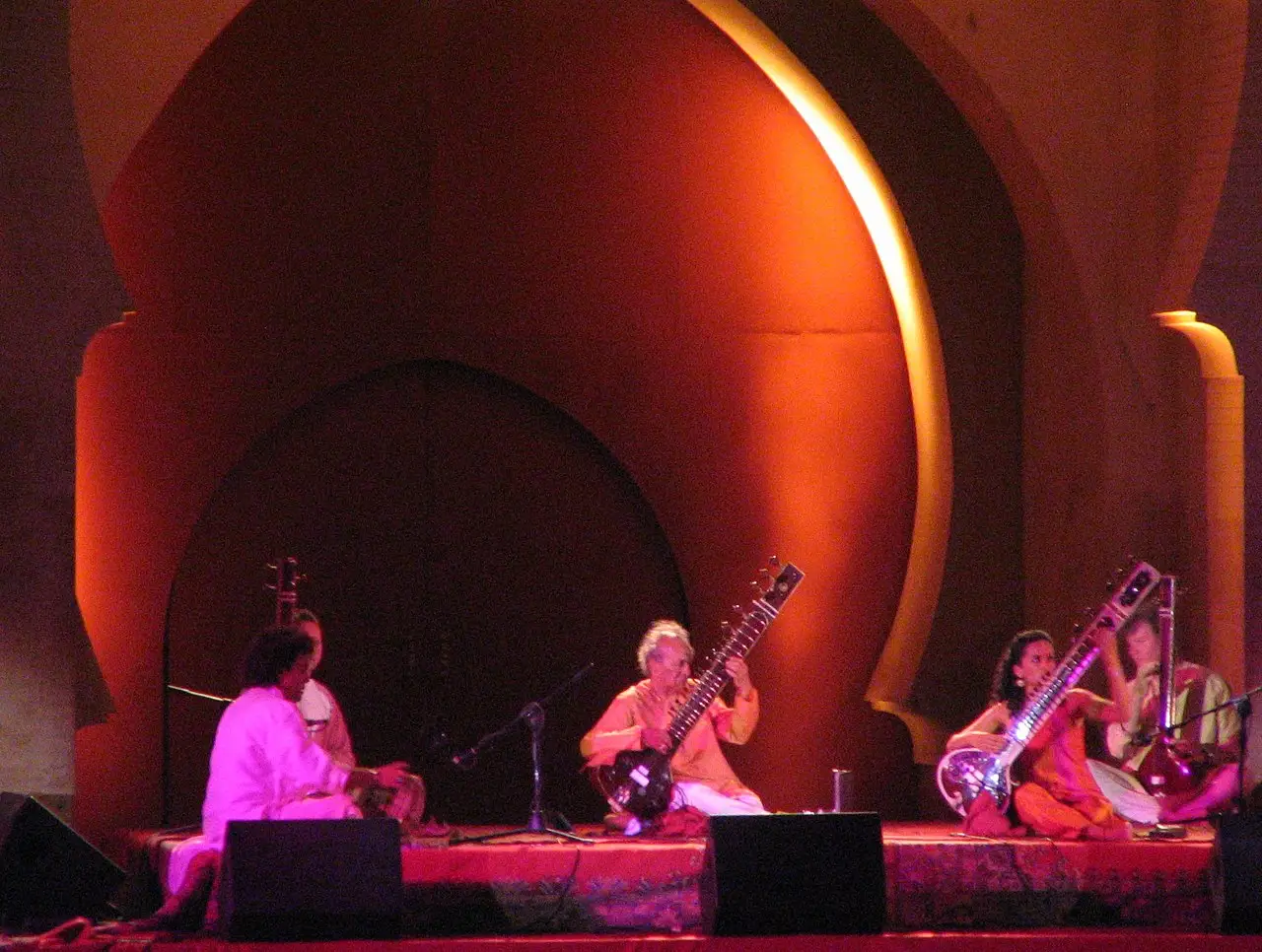
A week in May or June, running since 1994, with concerts at Bab Makina, in the Dar Batha courtyard and in squares around the medina, bringing together religious repertoires from many countries. Tickets from 100 to 600 DH, with part of the program free; confirm the year's dates, since they've shifted before.
 AI illustration
Moussem of Moulay Idriss II
Annual pilgrimage to the tomb of Idris II, founder of al-Aliya, the left-bank half of Fez, generally in September, with a procession of craft guilds carrying offerings through the streets to the zaouia. The medina gets packed and many shops close on the main day.
 AI illustration
Fes Festival of Sufi Culture
In October, running since 2007, with hadra sessions from the brotherhoods, round tables and concerts in the Dar Batha garden. Much of the program is free and starts in the late afternoon, when the heat lets up.
 AI illustration
Ramadan
Roughly February 8 to March 9 in 2027, with the dates moving back about 11 days each year. Restaurants in the medina close during the day, the country turns the clock back to UTC+0, and the city only fills up after ftour, around 6pm.
 AI illustration
Sefrou Cherry Festival
In June, 28 km from Fez, listed as UNESCO Intangible Cultural Heritage in 2012. There's a parade, Amazigh music and the crowning of the cherry queen; you can go and come back by grand taxi in the same day.
Books and films
Leo Africanus: Amin Maalouf (1986)
A novel narrated by al-Hasan al-Wazzan, the geographer who grew up in Fez at the end of the 15th century and ended up describing Morocco to Renaissance Europe. It rebuilds the city at its height, with its fondouks, madrasas and the Qarawiyyin working as the center of learning.
Fez, City of Islam: Titus Burckhardt (1960)
A study that explains why the medina has the shape it has: the hierarchy of trades, the distribution of water, the logic of dead-end alleys and the relationship between mosque, madrasa and market. It's the text that turns a labyrinth into a legible system.
The Sand Child: Tahar Ben Jelloun (1985)
Fez appears through the eyes of someone who grew up there: the house closed around the courtyard, the weight of the neighborhood, the storyteller in the square.
Frequently asked questions
Fez: How do I get to my riad inside the medina?
By taxi to one of the wall's gates, and on foot from there: arrange with your riad which gate (Boujloud, Rcif, Ftouh, or Guissa) and have someone waiting at it, because the last 200 to 600 meters are through unmarked alleys; a porter carries the bag for 20 to 50 DH.
Fez: Is there a direct flight from Brazil?
No. The connection is usually in Casablanca, Madrid, or Paris, and Fès-Saïss Airport (FEZ) sits 15 km south of the city.
Fez: How do I get to Meknès, and what should I see there?
Meknès is 60 km away, 35 to 40 minutes by train for about 25 DH, with the Bab Mansour gate, Moulay Ismail's granaries and stables, and the sultan's mausoleum.
Fez: What should I know about the dirham before traveling?
The Moroccan dirham (DH) is a closed currency: you can't buy it outside the country, bringing cash in or out is limited to 2,000 DH, and it's worth keeping your exchange receipt to convert it back at the airport.
Fez: What's the best time to visit?
The best period runs from March to May and from September to November, with highs of 20 to 28 °C.
Other cities in the country
Morocco ↗- Days
- 3
- When
- Mar–May · Oct–Nov
- Per person/day
- Average 700–1,400 MADMid-range · per person/day
Cost scope
Per person per day: accommodation, meals, urban transport, visits and a small allowance for extras. Flights excluded; larger purchases vary. Editorial estimate, not a quote.
- Days
- 2–3
- When
- Apr · Jun · Sep–Oct
- Per person/day
- Average 800–1,400 MADMid-range · per person/day
Cost scope
Per person per day: accommodation, meals, urban transport, visits and a small allowance for extras. Flights excluded; larger purchases vary. Editorial estimate, not a quote.
- Days
- 4
- When
- Jan–Apr · Oct–Dec
- Per person/day
- Average 400–900 MADMid-range · per person/day
Cost scope
Per person per day: accommodation, meals, urban transport, visits and a small allowance for extras. Flights excluded; larger purchases vary. Editorial estimate, not a quote.