Tunisia
Tunis
The medina, the Bardo, Carthage and Sidi Bou Saïd
Days Start with the basic programme and choose extensions for the time you have.
How the guide reaches this number
A third day, if you have it, goes to Bab Souika, the Belvédère and the lakefront, and a fourth takes you to Dougga or Kairouan. Don't come for the beach, because downtown faces an enclosed lagoon and the sand is 15 to 25 km away, in La Marsa, Gammarth and Raoued. With just one day, walk the medina in the morning, from Bab el Bhar to the souks around the Zitouna. In the afternoon, take the TGM to Carthage and stay on the same train to Sidi Bou Saïd, with the sun low over the gulf. The evenings disappoint, because the medina empties out around 7pm and the action moves to the Berges du Lac, a landfill from the 1980s. Avoid the height of summer, when the Saharan wind pushes the heat above 40 °C, and choose October.
2–3
When April to June, and September to November
How the guide reaches this number
The good window is from April to early June and from mid-September to early November, with highs of 22 to 28 °C, the sea still usable in October, and little rain. July and August sit between 33 and 36 °C with high humidity coming off the lagoon, and the chhili wave, the Saharan wind, can push two or three days above 40 °C. It's also when the Tunisian diaspora comes back en masse, which fills roads, beaches, and hotels along the northern coast and drives prices up. Winter, from December to February, has 8 to 17 °C, concentrated rain, and wind: the city keeps running and the museums stay empty, but a hotel without decent heating is a real problem. March is unstable, and in 2027 the start of it falls within Ramadan, expected from about February 8 to March 8, depending on the moon: on those days restaurants and cafés close during the day and the city's rhythm shifts to after 6pm, so I'd go in the second half of the month. It's worth checking the calendar before buying your ticket: Carthage has its festival in July and August, the JCC takes over the city in October or November, and March 20 (Independence Day), July 25 (Republic Day), and December 17 (Revolution Day) are holidays with reduced services.
Per person/day Backpacking 60–110 DT; mid-range comfort 180–350 DT (about US$60–115), with a three-star hotel or a riad in the medina, three meals and public transport, plus the tourist tax, 4 to 12 DT per night depending on the hotel category
How the guide reaches this number
Per person per day: accommodation, meals, urban transport, visits and a small allowance for extras. Flights excluded; larger purchases vary. Editorial estimate, not a quote.
 What Nilo thinks
Plan on two days: the first for the medina and the second for the Bardo in the morning and Carthage in the afternoon. A third day, if you have it, goes to Bab Souika, the Belvédère and the lakefront, and a fourth takes you to Dougga or Kairouan. Don't come for the beach, because downtown faces an enclosed lagoon and the sand is 15 to 25 km away, in La Marsa, Gammarth and Raoued. With just one day, walk the medina in the morning, from Bab el Bhar to the souks around the Zitouna. In the afternoon, take the TGM to Carthage and stay on the same train to Sidi Bou Saïd, with the sun low over the gulf. The evenings disappoint, because the medina empties out around 7pm and the action moves to the Berges du Lac, a landfill from the 1980s. Avoid the height of summer, when the Saharan wind pushes the heat above 40 °C, and choose October.In the Tunis medina, every street still has its trade. At the perfumers' souk, open since 1240, essences are sold by the drop, and at the Souk des Chéchias the red felt cap has been made since the 17th century. The narrow streets climb up to the Zitouna Mosque, rebuilt in 864 with ancient columns taken from the ruins of Carthage. Those ruins lie within the city itself, on the edge of the gulf, and the same suburban train that passes them stops at Sidi Bou Saïd, the blue-and-white village on the cliff over the sea, before reaching La Marsa. The Bardo holds the world's largest collection of Roman mosaics, including the portrait of Virgil between two muses. For food, order lablabi, chickpea soup over bread with harissa, and brik à l'œuf, the thin pastry fried with an egg inside. Come from April to early June or from mid-September to early November, and allow two days.
Quick facts
- Population
- about 640,000 in the municipality of Tunis and about 2.8-2.9 million in Greater Tunis, which combines the governorates of Tunis, Ariana, Ben Arous and Manouba (based on the November 2024 census); all of Tunisia has about 11.9 million
- Founded
- Tunes is attested as a Libyan-Berber settlement in the 4th century BC; refounded as an Arab city after 698, with the arsenal and the Zitouna mosque; becomes the capital of Ifriqiya in 1159, under the Almohads; the Hafsids take over in 1229
- Country and region
- Tunisia: the north of the country, on the Gulf of Tunis; 65 km from Bizerte, 65 km from Hammamet, 145 km from Sousse, 155 km from Kairouan, and 270 km from Sfax
- Language
- Tunisian Arabic (derja) on the street and standard Arabic in writing; French in administration, on signs, menus and banks; English limited to hotels, guides and young people; Italian still shows up in La Goulette
- Currency
- Tunisian dinar (TND, DT), a closed currency
- Time zone
- UTC+1 year-round, no daylight saving since 2009
- Best time to visit
- April to June, and September to November
- Average daily cost
- Backpacking 60–110 DT; mid-range comfort 180–350 DT (about US$60–115), with a three-star hotel or a riad in the medina, three meals and public transport, plus the tourist tax, 4 to 12 DT per night depending on the hotel category
When to go
April to June, and September to November
January
8° to 16°C
59 mm of rain
February
8° to 17°C
55 mm of rain
March
10° to 19°C
46 mm of rain
July
22° to 34°C
4 mm of rain
August
23° to 35°C
15 mm of rain
December
9° to 18°C
68 mm of rain
How the year changes
The good window is from April to early June and from mid-September to early November, with highs of 22 to 28 °C, the sea still usable in October, and little rain. July and August sit between 33 and 36 °C with high humidity coming off the lagoon, and the chhili wave, the Saharan wind, can push two or three days above 40 °C. It's also when the Tunisian diaspora comes back en masse, which fills roads, beaches, and hotels along the northern coast and drives prices up. Winter, from December to February, has 8 to 17 °C, concentrated rain, and wind: the city keeps running and the museums stay empty, but a hotel without decent heating is a real problem. March is unstable, and in 2027 the start of it falls within Ramadan, expected from about February 8 to March 8, depending on the moon: on those days restaurants and cafés close during the day and the city's rhythm shifts to after 6pm, so I'd go in the second half of the month. It's worth checking the calendar before buying your ticket: Carthage has its festival in July and August, the JCC takes over the city in October or November, and March 20 (Independence Day), July 25 (Republic Day), and December 17 (Revolution Day) are holidays with reduced services.
The same numbers as a table
| Month | Temperature °C | Rain mm |
|---|---|---|
| January | 8 to 16 | 59 |
| February | 8 to 17 | 55 |
| March | 10 to 19 | 46 |
| April · | 12 to 22 | 38 |
| May · | 15 to 27 | 22 |
| June · | 19 to 31 | 13 |
| July | 22 to 34 | 4 |
| August | 23 to 35 | 15 |
| September · | 21 to 31 | 58 |
| October · | 17 to 27 | 55 |
| November · | 13 to 22 | 53 |
| December | 9 to 18 | 68 |
Nilo's tips
With little luggage, take bus 635 from the airport to Tunis Marine
The bus costs less than 2 DT and reaches Tunis Marine, from where the TGM continues to Carthage, Sidi Bou Saïd, and La Marsa. The luggage space is tight and the frequency is irregular, so with a big suitcase, a child, or a night arrival, the metered yellow taxi is the simplest choice.
Go to Carthage and La Marsa on the TGM train, under 1.5 DT
The TGM links Tunis Marine to the northern coast over a causeway across the lagoon, with stops at Carthage and Sidi Bou Saïd. It has run since 1872, costs less than 1.5 DT per ride, and takes 30 to 40 minutes end to end. If you're having fish for dinner on the other side, check at the station, on the same day, when the last train back leaves.
Buy the 20 DT ticket and bring water for Carthage's 4 km
The walk through the ruins adds up to about 4 km on foot, with no shade and little water for sale, so it's worth bringing a hat too. The combined ticket is valid only on the day of purchase, and added to the Bardo, the museum day comes to 50 DT. In the good window, from April to June and from September to November, the afternoon works and leaves the morning for the Bardo. In July and August, with 33 to 36 °C, do Carthage early and the Bardo afterward.
Weekly closures: the Bardo on Mondays; most souks on Sundays
The Bardo closes on Mondays, like several national museums, and on Fridays a good part of the medina's shops also stop for an hour or two for the midday prayer. Save the medina for Tuesday, Wednesday, or Thursday, and the Bardo for any day but Monday, with admission at 30 DT since April 1, 2026. On Sunday, when almost all the souks close, go to Carthage and Sidi Bou Saïd, which don't depend on open shops.
Exchange dinars on arrival; keep the receipt for later
Without the exchange receipt, leftover dinars can't be converted back on the way out, and outside Tunisia nobody buys the currency. Keep the receipt from every exchange, and for daily spending, carry bills, because cafés, souks, taxis, and snack bars only accept cash.
Have lablabi in the morning at a counter, for 4 to 9 DT
Lablabi is the morning dish, especially in winter, a chickpea soup over day-old bread that becomes a full meal with egg and tuna at the medina's counters. To eat on the go the rest of the day, the casse-croûte of tuna, egg, olive, and harissa costs 3 to 7 DT and is put together right in front of you. Finish with a green tea with pine nuts, at 2 to 4 DT in any café, and, to take home, go for fresh harissa, sold by weight.
Explore the map
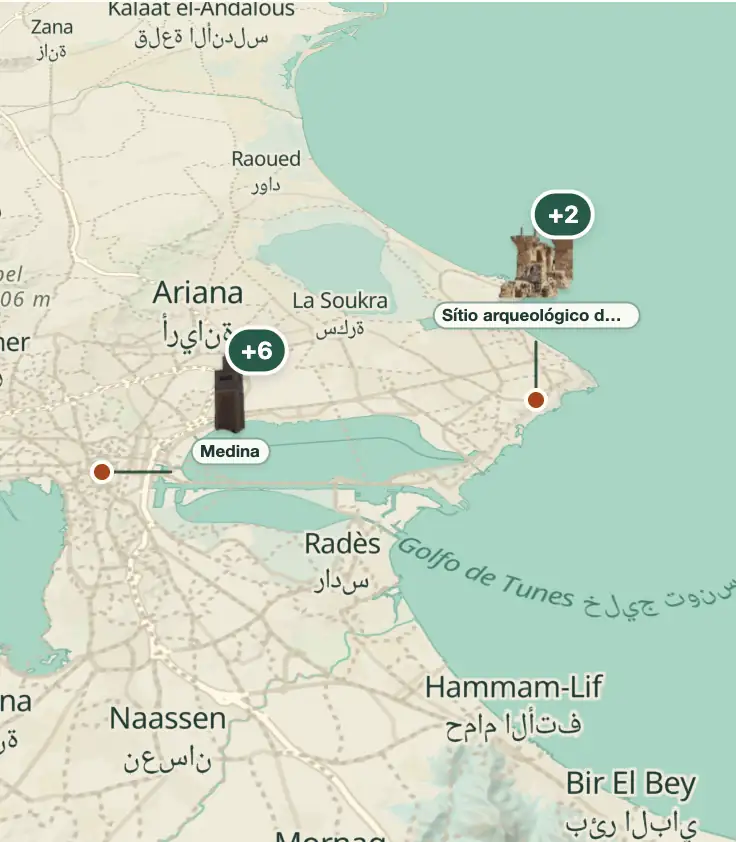
© OpenStreetMap · OpenFreeMap · © OpenMapTiles
Explore the map, read about the other places and plan your travel days in the app.
Open the appWhat to see
Tunis: Between the lagoon and the sebkhas
Tunis sits about 4 m above sea level downtown and climbs to about 70 m on the hills of the Belvédère and the Kasbah, squeezed between the Lac de Tunis, to the east, and the Sebkhat Sijoumi and Sebkhat Ariana, to the west and south.

The medina and the Zitouna
The Great Mosque of the Olive Tree was founded in 698 or 703 and rebuilt in 864 by the Aghlabids, with about 160 ancient columns taken from the ruins of Carthage and the surrounding region. It served as a university until 1956 and trained Maliki jurists for a thousand years; non-Muslims only enter the ablutions courtyard, during reduced hours and never near the Friday noon prayer.
The Mosque of the Olive Tree, rebuilt in 864, gathers about 160 ancient columns taken from the ruins of Carthage and served as a university until 1956; it trained Maliki jurists for a thousand years, and non-Muslims only enter the ablutions courtyard, during reduced hours and nowhere near the Friday prayer.
Check access

Bardo National Museum
Set in a 19th-century beylical palace, opened in 1888 and reopened to the public on September 14, 2023 after more than two years closed. It holds the largest collection of Roman mosaics in the world, including the 3rd-century portrait of Virgil between two muses, and the cargo of the 1st-century BC Mahdia shipwreck. Closed Mondays.
Reopened on September 14, 2023, after more than two years closed, the 19th-century palace holds the world's largest collection of Roman mosaics, including the portrait of Virgil between two muses.
Check access
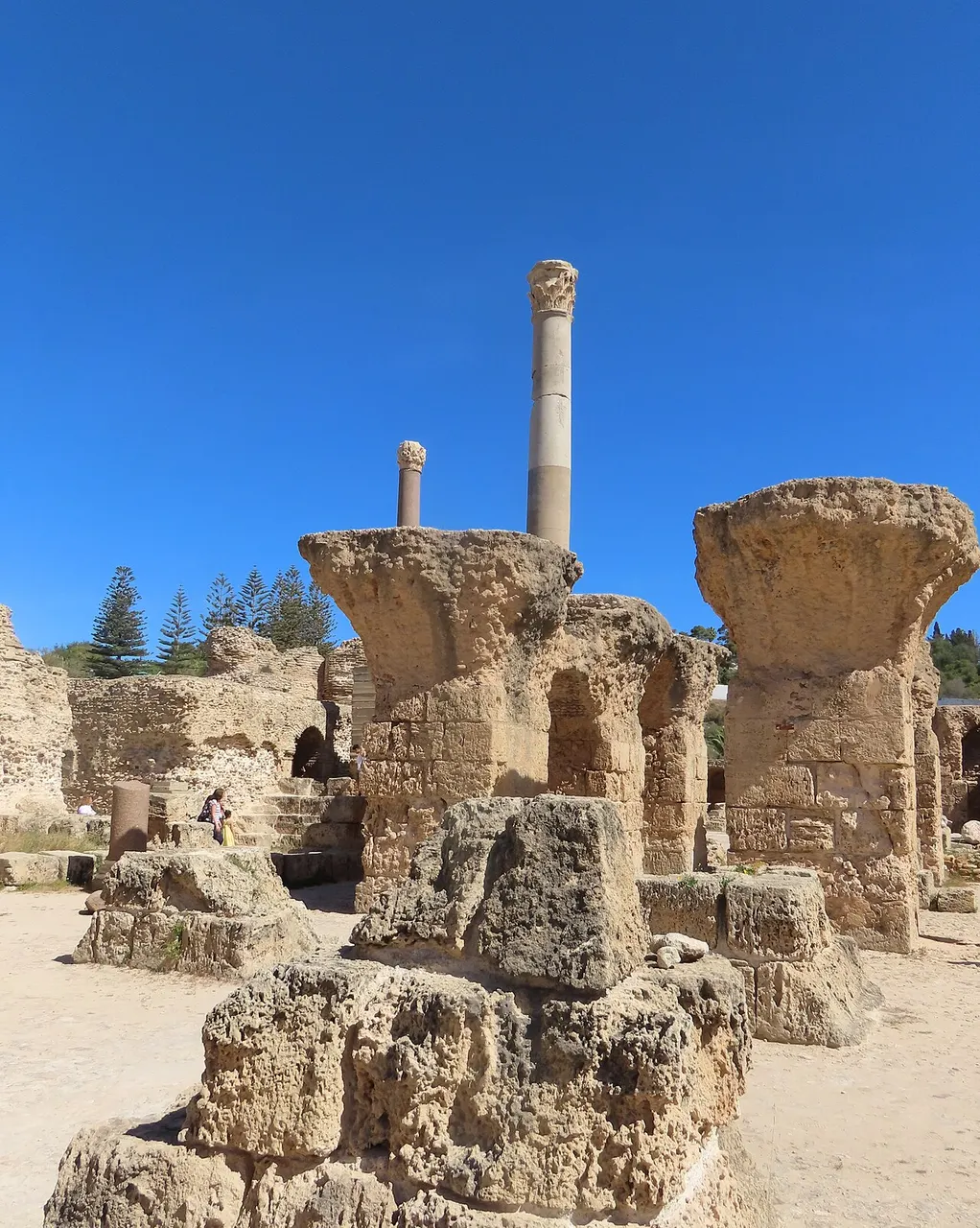
Carthage archaeological site
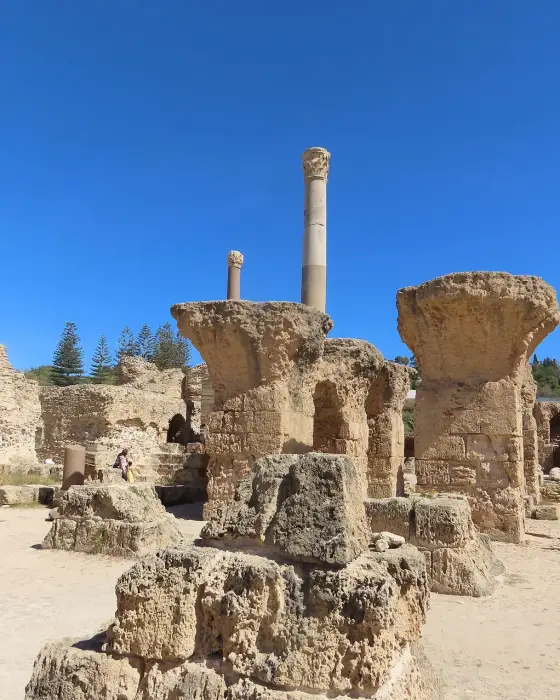
The archaeological site of Carthage brings together nine areas spread over about 5 km, on UNESCO's list since 1979: the Baths of Antoninus, from 145–162, by the sea; the Punic ports, one circular and one rectangular; the Salammbô tophet, with its votive stelae; the Punic quarter of Byrsa; the Roman theater used for the Carthage Festival; and the La Malga cisterns, fed by a 132-km aqueduct from Zaghouan. The combined ticket covers all of them, but it's valid only on the day of purchase.
Carthage gathers nine areas spread over about 5 km, among them the Baths of Antoninus and the Punic ports, and the ticket is valid only on the day of purchase.
Check access
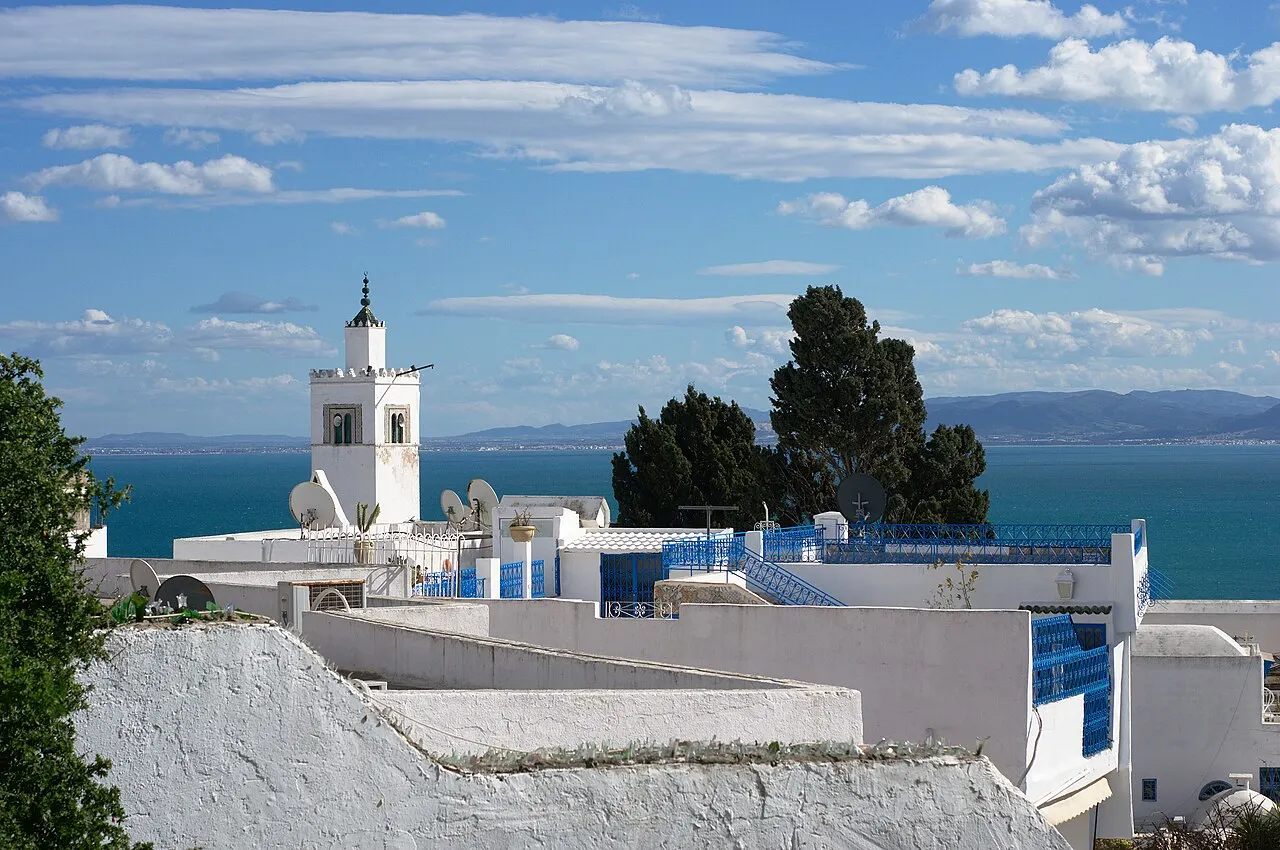
Sidi Bou Saïd and Ennejma Ezzahra
Village on a cliff 130 m above the sea, with the blue and white imposed by decree in 1915 under the influence of Baron Rodolphe d'Erlanger. His palace, Ennejma Ezzahra, was built between 1912 and 1922 and houses the Center for Arab and Mediterranean Music, with the instrument collection that served as the basis for the 1932 Cairo Congress of Arab Music.
It's worth the TGM trip for the blue-and-white village on the cliff 130 m above the gulf, with the colors imposed by decree in 1915, and for Ennejma Ezzahra, Baron d'Erlanger's palace that now houses the Center for Arab and Mediterranean Music.
Check access

Souk el Attarine and the Souk des Chéchias
The perfumers' souk opened in 1240 under Abu Zakariya and still sells essences by the drop from heavy glass bottles. The Souk des Chéchias, with its covered arcade and wooden benches, is the seat of the chaouachine guild, which has made the red felt cap since the 17th century: knitted wool, milled in a water mill, dyed and brushed with teasel. Ask to see the wooden mold before settling on a price.
The Souk el Attarine, open since 1240, still sells essences by the drop, and at the Souk des Chéchias next door, the guild has made the red felt cap since the 17th century, with wool milled, dyed, and brushed; ask to see the wooden mold before negotiating.
Check access
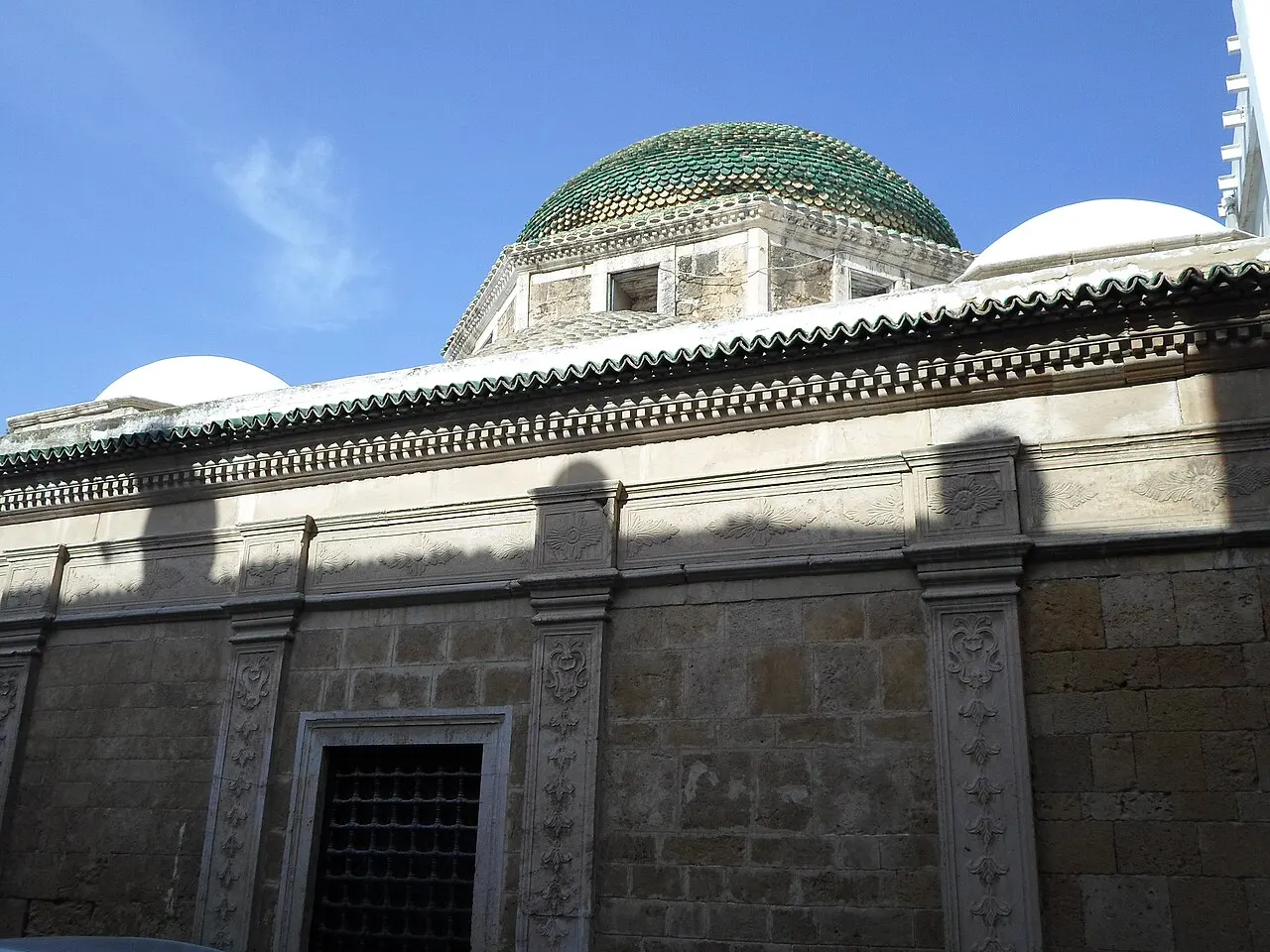
Tourbet el Bey
Mausoleum of the Husainid dynasty built under the reign of Ali Pasha II, between 1758 and 1782, in the south of the medina. It holds over a hundred graves under green domes, with Carrara marble and ceramic tilework; the men's headstones bear a chechia carved in stone, and the size of the turban marks the rank of the deceased.
In the south of the medina, the Husainid mausoleum, from 1758 to 1782, gathers more than a hundred graves; the men's headstones bear a carved chechia, and the size of the turban reveals the rank.
Check access

Dar Ben Abdallah
18th-century urban palace around a marble courtyard, now the Museum of Popular Arts and Traditions. The rooms have been refitted with 19th-century furniture, costumes and jewelry and explain how a medina house worked: four wings in a cross, no window onto the street, and all the luxury turned inward.
The 18th-century palace, now a museum, shows a medina house from the inside: a marble courtyard, four wings, and no window onto the street.
Check access
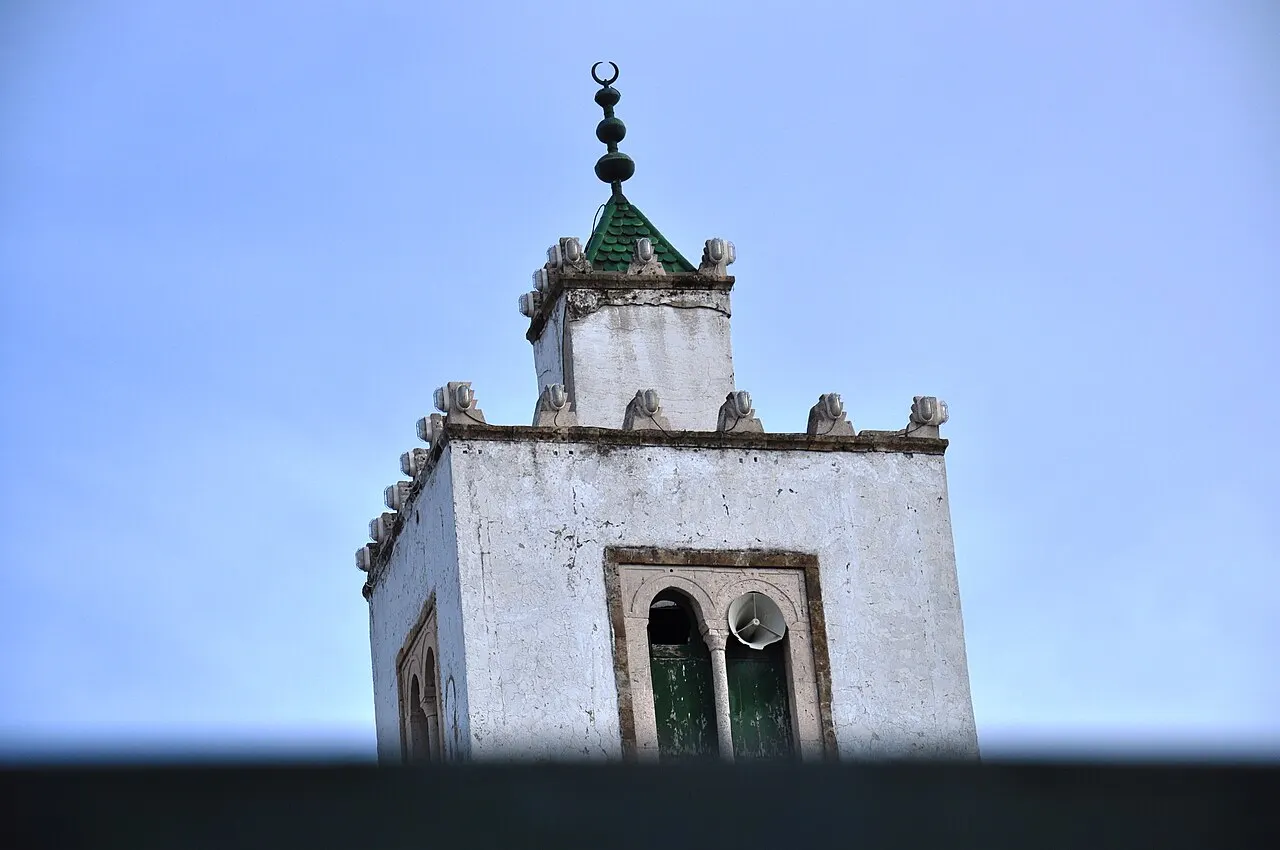
Sidi Mahrez mosque
Built between 1692 and 1697 by Mohamed Bey el Mouradi, it's the only mosque in Tunis with cascading Ottoman domes, copied from Istanbul and completely outside the Maghrebi hypostyle-hall pattern. It sits in Bab Souika and is dedicated to the city's patron saint, who died in 1022.
The only mosque in Tunis with cascading domes, copied from Istanbul and outside the Maghrebi hypostyle-hall pattern, it was built from 1692 to 1697 and dedicated to the patron saint who died in 1022.
Check access
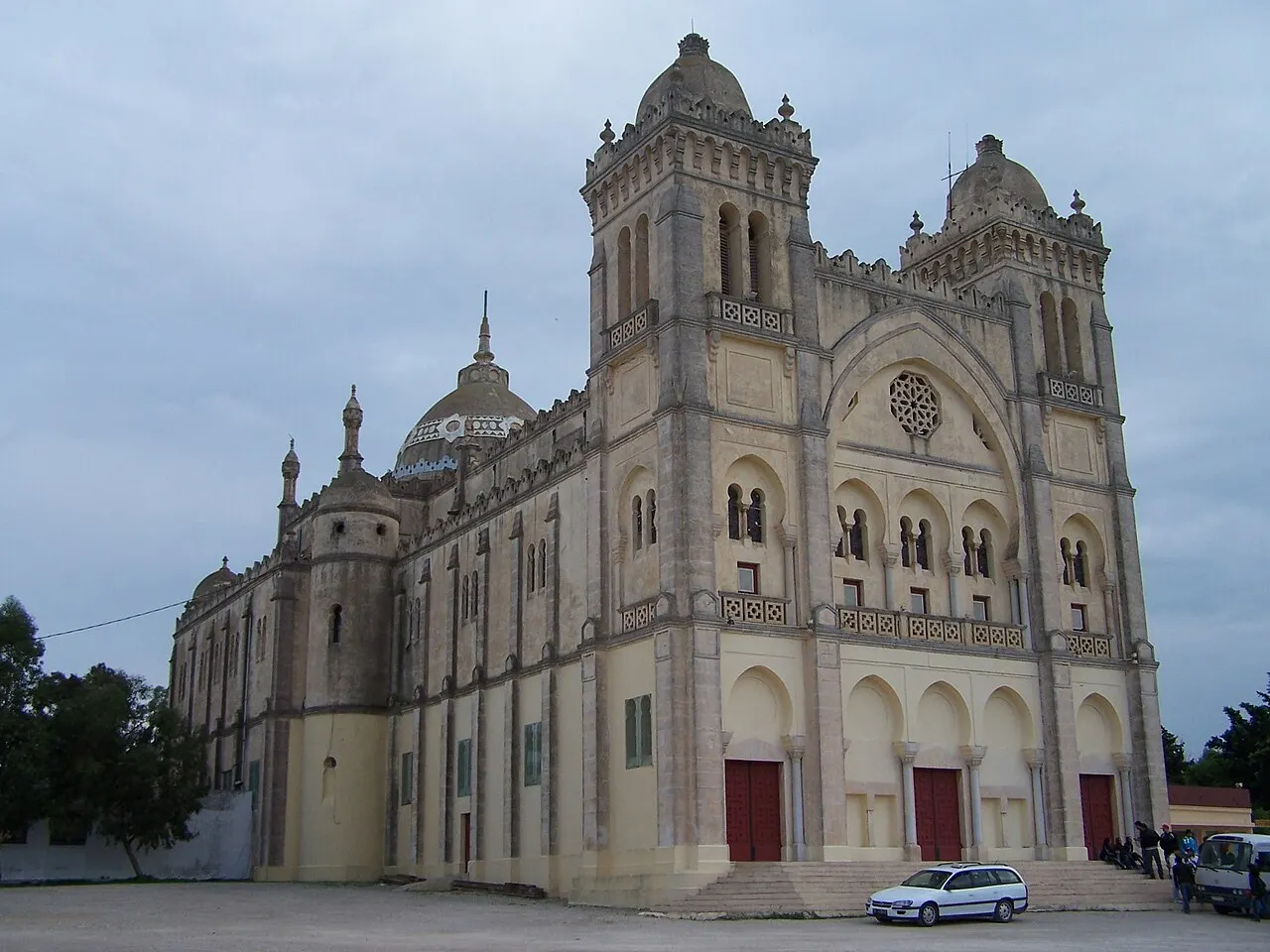
Acropolium of Carthage
The former Cathedral of Saint Louis, now called the Acropolium, was built between 1884 and 1890 on top of Byrsa, in a neo-Byzantine-Moorish style, on the spot where Louis IX died in 1270. It stopped being a church after independence and now serves as a concert hall and a viewpoint over the gulf.
Since it stopped being a church, after independence, the Acropolium only opens for concerts, and on an ordinary day it's worth it for the viewpoint atop Byrsa. The hill is already included in the Carthage ticket, so the climb is part of the same visit, at no extra cost.
Check access
Nilo’s itinerary
Start with the basic programme and choose extensions for the time you have.
Plan my days in the app ↗Day 1 · The medina, from Bab el Bhar to the Kasbah
Enter at 9am through the Bab el Bhar, at Place de la Victoire, and go up Rue Jamaa Ezzitouna to the courtyard of the Zitouna Mosque, founded in 698 or 703: only the courtyard is open to non-Muslims, during reduced hours.
Walk through the Souk el Attarine, from 1240, and go down to the Souk des Chéchias; ask to see the wooden mold and the brushing process before haggling over the felt cap.
Have a brik à l'œuf for lunch at a medina counter for 2 to 5 DT and drink tea with pine nuts at Café M'Rabet or at a carpet shop's terrace, letting them know up front that you won't be buying.
In the afternoon, visit the Tourbet el Bey, a Husainid mausoleum built between 1758 and 1782, and Dar Ben Abdallah, an 18th-century palace that houses the museum of popular arts and traditions.
Exit uphill, through Place du Gouvernement at the Kasbah, and end at Avenue Habib Bourguiba: the 1897 cathedral, the 1902 Théâtre municipal and a table on the central mall until the end of the afternoon.
Day 2 · Bardo in the morning, Carthage in the afternoon
Arrive at the Bardo National Museum at opening and set aside two hours for the Roman mosaics, the portrait of Virgil and the cargo of the Mahdia shipwreck; take light metro line 4 or the RFR's line D, and remember it's closed Mondays.
Head back downtown and catch the TGM at Tunis Marine to Carthage-Hannibal or Carthage-Dermech, about 20 minutes crossing the lagoon.
Buy the combined ticket for the Carthage sites (20 DT) and do the Baths of Antoninus, the Punic harbors, the Salammbô tophet and Byrsa hill with the Acropolium. It's about 4 km on foot, with no shade: bring water.
Continue by TGM to Sidi Bou Saïd, walk up the cobbled street to the Café des Nattes, and eat a freshly fried bambalouni on the way down.
Have grilled fish for dinner in La Marsa or La Goulette and head back by TGM; check the time of the last train that same day.




If you stay longer
Day 3 · Bab Souika, Belvédère and the lakeside
Start at the Bab Souika square, with a coffee on the sidewalk, and see the Sidi Mahrez mosque, from 1692-1697, the only one with Ottoman domes in the city.
Go up to Halfaouine, with the Sahib Ettabaa mosque and the neighborhood hammams, and come down through the medina's northern faubourgs, where there's hardly a tourist shop.
Have a tuna, harissa and olive casse-croûte downtown for 3 to 7 DT and stop by the 1891 Marché Central to buy harissa and dates by weight.
Spend the afternoon in the Parc du Belvédère, opened in 1892, and at the Cité de la Culture, on Avenue Mohamed V, with the national museum of modern and contemporary art.
End at Berges du Lac 2, on the edge of the reclaimed lagoon, where the restaurants and bars that stay open past 11pm are.

Food
 AI illustration
Brik à l'œuf
A thin sheet of malsouka folded over a raw egg, tuna, parsley, capers and sometimes potato, fried in deep oil and served scalding hot. Eaten by hand, starting at the corner, before the yolk runs; it's a standard restaurant starter and a fixture on the Ramadan iftar table. Costs 2 to 5 DT at a counter.
 AI illustration
Lablabi
Chickpea soup poured over torn day-old bread inside the bowl, seasoned with garlic, cumin, harissa, olive oil, capers, and lemon, almost always topped with a poached egg and tuna if you ask. It's the morning dish, especially in winter, served from early on at counters and specialized shops in the medina for 4 to 9 DT, and it's the city's cheapest and most complete meal.
 AI illustration
Couscous
Semolina steamed over the broth, served with lamb, chicken, merguez or, in the Tunis and La Goulette version, with a whole fish (grouper, sea bream or white bream) and a tomato-and-harissa broth. It's the Friday dish and the family celebration dish; at a downtown restaurant it runs 15 to 30 DT, and the fish version costs more.
 AI illustration
Harissa
Harissa is the paste of dried red chili with garlic and spices that seasons almost everything on the Tunisian table, from lablabi to casse-croûte. The canned kind is industrial and has less flavor, so buy it fresh, sold by weight at the stalls of the Marché Central and the medina's souks.
 AI illustration
Ojja and kafteji
Ojja is egg cooked inside a tomato-and-pepper sauce with harissa, served in the pan, with merguez or shrimp. Kafteji is the fried, chopped version: peppers, zucchini, pumpkin, potato and tomato fried separately, chopped up with egg and eaten with bread. Both are counter food, 6 to 14 DT.
 AI illustration
Casse-croûte and fricassé
The Tunisian sandwich is half a baguette with tuna, boiled egg, olive, potato, mechouia salad and harissa, put together in front of the customer for 3 to 7 DT. The fricassé is the same filling inside a small fried roll, smaller and greasier, sold in bakeries and street stalls: two of them make a lunch.
 AI illustration
Bambalouni and makroudh
Bambalouni is a ring of dough fried on the spot and rolled in sugar, a specialty of the climb up to Sidi Bou Saïd, eaten hot or not eaten at all. Makroudh is the semolina diamond filled with date paste, fried and dipped in honey, of Kairouan origin, sold by weight in medina pastry shops; both cost 1 to 3 DT apiece.
 AI illustration
Tea with pine nuts, boukha and Celtia
Tunisian green tea comes sweet, with a handful of pine nuts or almonds at the bottom of the glass, for 2 to 4 DT at any café. Boukha is the fig brandy distilled by Jewish families of Tunis since 1880 and drunk chilled; the local Celtia beer and the Mornag and Kelibia wines are found at licensed restaurants and supermarkets, but not at ordinary cafés and not on Fridays in many establishments.
Day trips

Dougga (Thugga)
Dougga is 110 km southwest, about 2 hours by car via Medjez el-Bab and Téboursouk. It's the best-preserved Roman city in North Africa, on UNESCO's list since 1997, with a capitol from 166–167, a theater from 168 seating 3,500 and a Libyco-Punic mausoleum from the 2nd century BC. There's no direct public transport, so rent a car or hire a taxi for the whole day (180 to 300 DT).
Kairouan
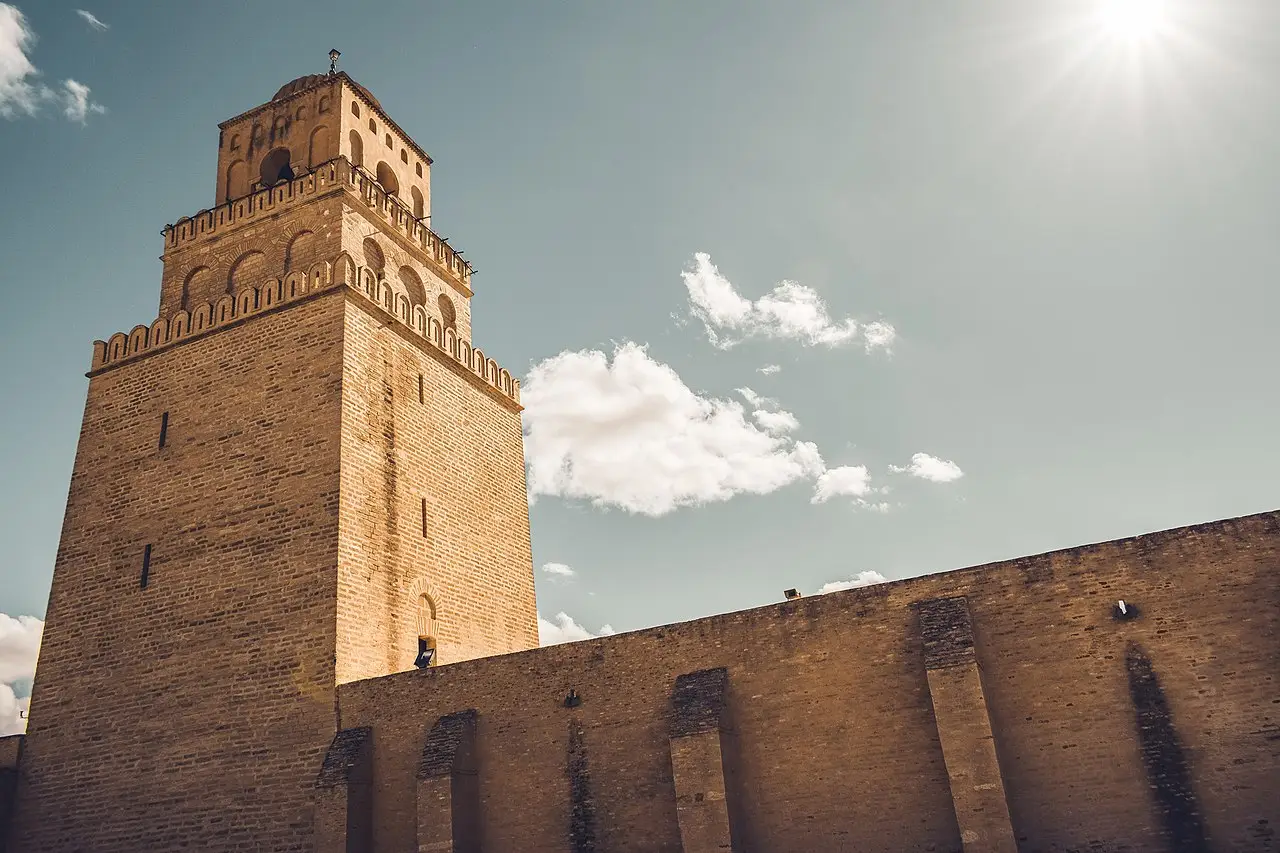
Kairouan is 155 km south, about 2 hours on the A1 highway and then a regular road, or by louage from Moncef Bey. The Great Mosque, founded in 670, is the oldest in the Maghreb, and the city also has the 9th-century Aghlabid basins, the walled medina of carpets and the original makroudh. It has been a UNESCO World Heritage Site since 1988, and you can easily go and come back the same day.
Bizerte and Ichkeul park
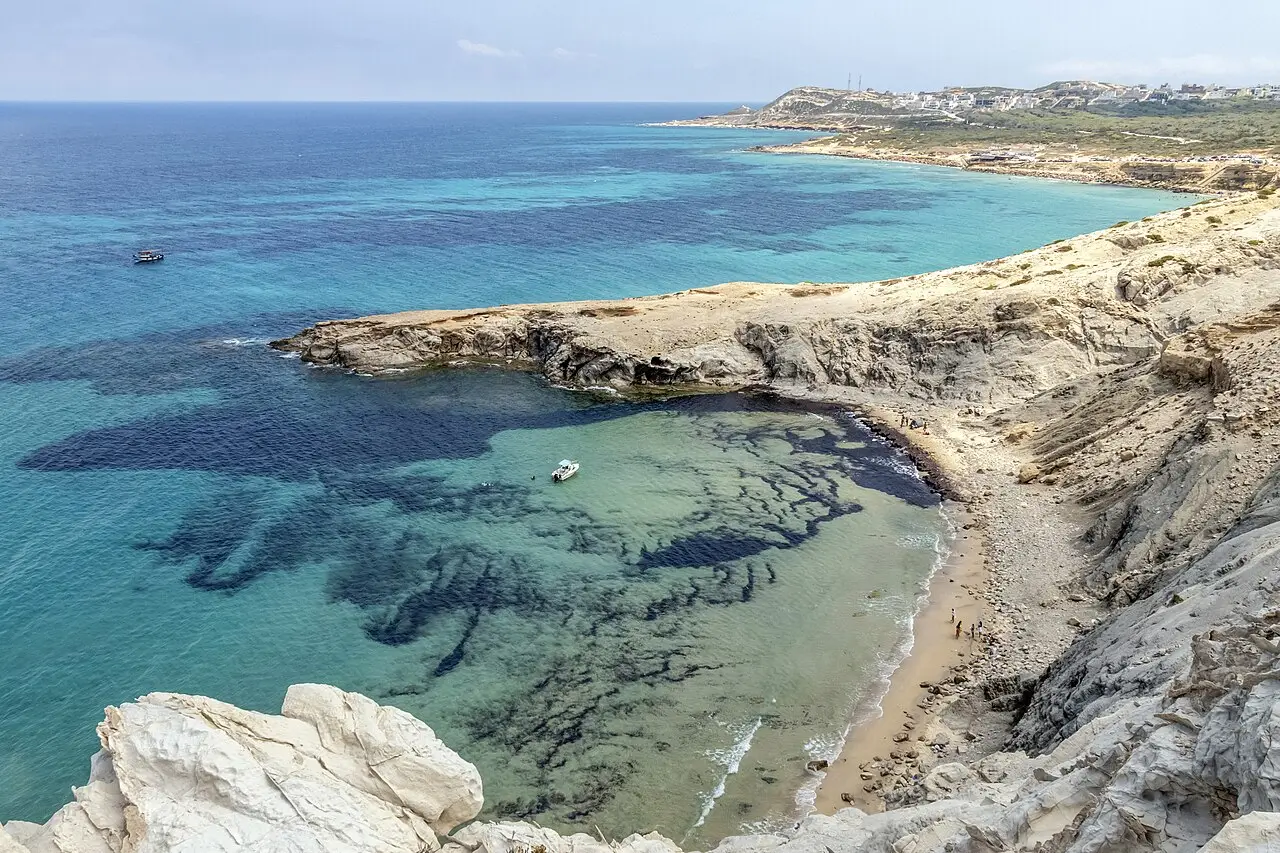
Bizerte is 65 km north, about 1 hour by car or by louage from Bab Saadoun, and it's the northernmost city in Africa, with the old Andalusian harbor, the 17th-century kasbah and beaches to the north. 25 km from there is Ichkeul National Park, a lake and marsh on the migratory bird route, on UNESCO's list since 1980 and best between November and March.
Where to begin
The medina, from Bab el Bhar to the Kasbah
Enter at 9am through the Bab el Bhar, at Place de la Victoire, and go up Rue Jamaa Ezzitouna to the courtyard of the Zitouna Mosque, founded in 698 or 703: only the courtyard is open to non-Muslims, during reduced hours.
Bardo in the morning, Carthage in the afternoon
Arrive at the Bardo National Museum at opening and set aside two hours for the Roman mosaics, the portrait of Virgil and the cargo of the Mahdia shipwreck; take light metro line 4 or the RFR's line D, and remember it's closed Mondays.
Bab Souika, Belvédère and the lakeside
Start at the Bab Souika square, with a coffee on the sidewalk, and see the Sidi Mahrez mosque, from 1692-1697, the only one with Ottoman domes in the city.
Money
The currency is the Tunisian dinar (TND, DT), divided into 1,000 millimes, trading at around 3.0 DT to the dollar and 0.55 DT to the Brazilian real in 2026. It's a closed currency: it can't be bought outside the country and it's forbidden to bring in or take out more than a token amount of dinars, so exchange at the airport or at a bank as soon as you arrive and keep the receipt, which you'll need to convert back whatever is left when you leave. Cash rules here: cards work in hotels, supermarkets, the Berges du Lac malls and larger restaurants, and don't work in cafés, souks, taxis or snack bars. ATMs are easy to find on Avenue Habib Bourguiba and run out of paper or bills on holidays. Price ranges in 2026: espresso 1.5–3 DT; tea with pine nuts 2–4 DT; casse-croûte 3–7 DT; lablabi 4–9 DT; sit-down meal downtown 20–45 DT; fish dinner in La Goulette or La Marsa 45–90 DT; Celtia beer in a bar 6–12 DT; mid-range hotel 120–300 DT a night; Bardo admission 30 DT and the Carthage combined ticket 20 DT, with an extra photo fee at some sites. Add the lodging tax hotels charge foreigners per night: 4 DT at two-star hotels, 8 DT at three-star and 12 DT at four- and five-star, with an exemption for children under 12. Tipping: round up at cafés, 5% to 10% in restaurants with table service, 1 DT for whoever carries your bag or watches your car.
Getting there and around
Airport: 8 km from downtown, no rail link
Tunis-Carthage Airport (TUN) is 8 km northeast of downtown and has no rail link. The yellow taxi to Avenue Habib Bourguiba costs 10 to 15 DT on the meter during the day and about 50% more between 9pm and 5am, which is legal and shows on the display. Turning down the “forfait” and asking for the “compteur” is common practice, and drivers accept it without fuss. Bus line 635 links the airport to Tunis Marine for less than 2 DT, with cramped luggage space and irregular frequency, and Bolt operates in the city, with the price fixed before the ride starts. Arriving by sea, CTN, GNV and Corsica Linea ferries from Marseille, Genoa, Civitavecchia and Palermo dock at La Goulette, 12 km from downtown on the same TGM line.
Three rail systems and one informal one
Inside the city there are three rail systems and one informal one. The light metro, opened in 1985, has six lines and about 45 km at street level, with interchanges at Place de Barcelone and République. Fares are by zone and cost 0.5 DT, 1 DT and 1.5 DT in 2022; check the current price at the ticket window, buy the paper ticket before boarding and keep it until you exit, because inspectors do show up. The TGM has linked Tunis Marine to the northern coastal strip since 1872, crossing the lagoon on a causeway, in 30 to 40 minutes end to end and for less than 1.5 DT, and it's the transport visitors use most. The RFR rapid rail network opened Line E in 2023 and Line D, via the Bardo, on January 25, 2025, with new trains and air-conditioning. SNCFT trains leave from Tunis Ville station, on Place de Barcelone, for Sousse (about 2 hours 15 minutes), Sfax (about 4 hours) and Bizerte. Louages are white vans with a colored stripe that leave only when full and cover the rest of the country from Bab Alioua (south), Bab Saadoun (north and west) and Moncef Bey (Cap Bon and the Sahel). The medina and the Ville Nouvelle are best done on foot, ideally in the morning, because between 12pm and 3pm in summer the Ville Nouvelle has no shade and the medina closes many of its shops after lunch on Friday, at prayer time.
Safety
Tunis is a relatively safe capital for violent crime, and the visitor's real problem is the wallet: pickpocketing on Avenue Habib Bourguiba, in the crowded cars of the light metro and in the narrow souks of the medina, plus phone-snatching by scooter riders on empty streets; wearing your backpack in front and keeping your phone out of sight takes care of most of it. The scams that keep repeating: the “guide” who tells you the medina is closed or that there's a Berber market only today, and leads you to a carpet shop; the terrace with a “free view” that turns into a sales floor; the broken meter; and the swap of a 5 DT note for a 1 DT one in the dim light of a street exchange stand. The terrorism risk has dropped a lot since the 2015 and 2016 attacks, but it explains the permanent police presence and the barbed wire downtown. Photographing the Ministry of the Interior, military posts, the port and the presidential palace is forbidden, and the ban is enforced for real. Avoid the outlying neighborhoods of Ettadhamen, Douar Hicher, Sidi Hassine and Kabaria at night, and don't cross the medina after the shops close, around 7pm. At that hour it is not dangerous, but it gets dark and empty, and it is easy to lose your way. Women traveling alone report comments and persistence on the street, more often at night and in tourist areas. A short reply and walking toward a busy café usually settles it. Since 2022, decree-law 54 criminalizes spreading “fake news” and has already led to arrests, so save the political commentary for later, including on social media with location on. Tap water is chlorinated and safe to drink in Greater Tunis, but brackish to the taste; most people drink bottled. Emergencies: 197 (police), 190 (ambulance), 198 (fire department).
Etiquette tips
Greet before you ask anything
Say “aslema” or “salem alikom” and ask “labès?” before getting into price, address or time. Jumping straight to the point reads as haste, and haste usually costs you the information you wanted.
Don't photograph police, barracks or the palace
In Radès and around the Ministry of the Interior, put the camera away: photographing there gets you stopped by the police.
Ask before photographing people and stalls
In the souks and at the Marché Central, many vendors charge for it or refuse, because the stall is their business. A gesture toward the camera and a “najem nsawwar?” settle it; if the answer is no, it's final.
At the Zitouna, the courtyard is the limit
The courtyard is open to everyone during reduced hours; the prayer hall is not. Shoulders and knees covered for everyone, shoes off where indicated, and no visits near the Friday noon prayer.
During Ramadan, eat and smoke out of sight
Eating, drinking or smoking on the street during the day isn't illegal for foreigners, but it's frowned upon, and Tunisians have been prosecuted for it. The few cafés that serve during the day do so with the door half-closed; wait for iftar to order on the sidewalk.
Only haggle if you plan to buy
In the souk, the first number is a starting point, and the seller expects three or four rounds of talk and a tea somewhere in the middle. Negotiating without any intention of closing is bad manners; “la, choukran,” with a hand on the chest, ends the matter without offending anyone.
Mistakes to avoid
Closed currency: you can't buy it abroad
Arriving without dinars. Exchange at the airport or at a bank as soon as you arrive, keep the receipt, and don't count on finding a currency exchange in Brazil or in Europe.
The “forfait” costs double the meter fare
Accepting the taxi's flat rate. The yellow taxi is required to use the meter, and a driver who says the meter's broken or who proposes a “forfait” is charging double. Ask for the “compteur”; if he refuses, get out and take another one or call a car through the app.
Going to the Bardo on a Monday
Going to the Bardo on a Monday. The museum closes on Mondays, and plenty of people lose their only free morning of the trip to it. Several national museums follow the same rule.
Carthage: nine areas across 5 km, a single ticket
Treating Carthage as a single site. It's nine areas spread over about 5 km between the TGM stations, linked by a combined ticket valid for the day. Without a plan, you see two and walk the other seven under the open sun.
The open sea starts at La Goulette
Assuming the city has a beach. Downtown faces a closed lagoon, and the open sea starts at La Goulette. Usable sand is in La Marsa, Gammarth and Raoued, 15 to 25 km away, by TGM or by car.
Useful phrases
عسلامة: Aslema (as-le-MAH)
Hello. Works for entering a shop, café or taxi; the more formal form is “salem alikom.”
لاباس؟: Labès? (la-BESS)
How are you? The standard answer is “labès, hamdoullah,” and the question comes before any other topic.
بقداش؟: B'kaddech? (be-ka-DESH)
How much does it cost? The first useful question in the souk, in the taxi and at the sandwich stall.
يعيشك: Yaïchek (yah-EE-chek)
Thank you, in the warm, colloquial form; “choukran” also works and is more neutral.
برشا / شوية: Barcha / chwaya (BAR-cha / CHWAI-ya)
A lot / a little. Settles harissa, sugar in tea, ice, price and distance.
سامحني: Samahni (sa-MAH-ni)
Excuse me, pardon me. It's what opens a path in a two-meter alley and ends an approach without friction.
Districts
Medina
Hafsid core of about 270 hectares with the faubourgs, some 700 historic buildings, listed by UNESCO in 1979, organized in rings around the Zitouna: perfumes and fabrics near the mosque, iron and leather near the gates. It's residential and commercial at once, closes early and empties at night; almost everything is done on foot, with streets two meters wide and no cars in the core.
Bab Souika and Halfaouine
Northern faubourg, working-class and noisy, with the Bab Souika square as a shared living room and the Sidi Mahrez mosque, of 1692-1697, marking the entrance. Halfaouine, just above, gave its name to Férid Boughedir's 1990 film and still concentrates hammams, neighborhood cafés and the Sahib Ettabaa mosque, from the 1810s.
Ville Nouvelle and Avenue Habib Bourguiba
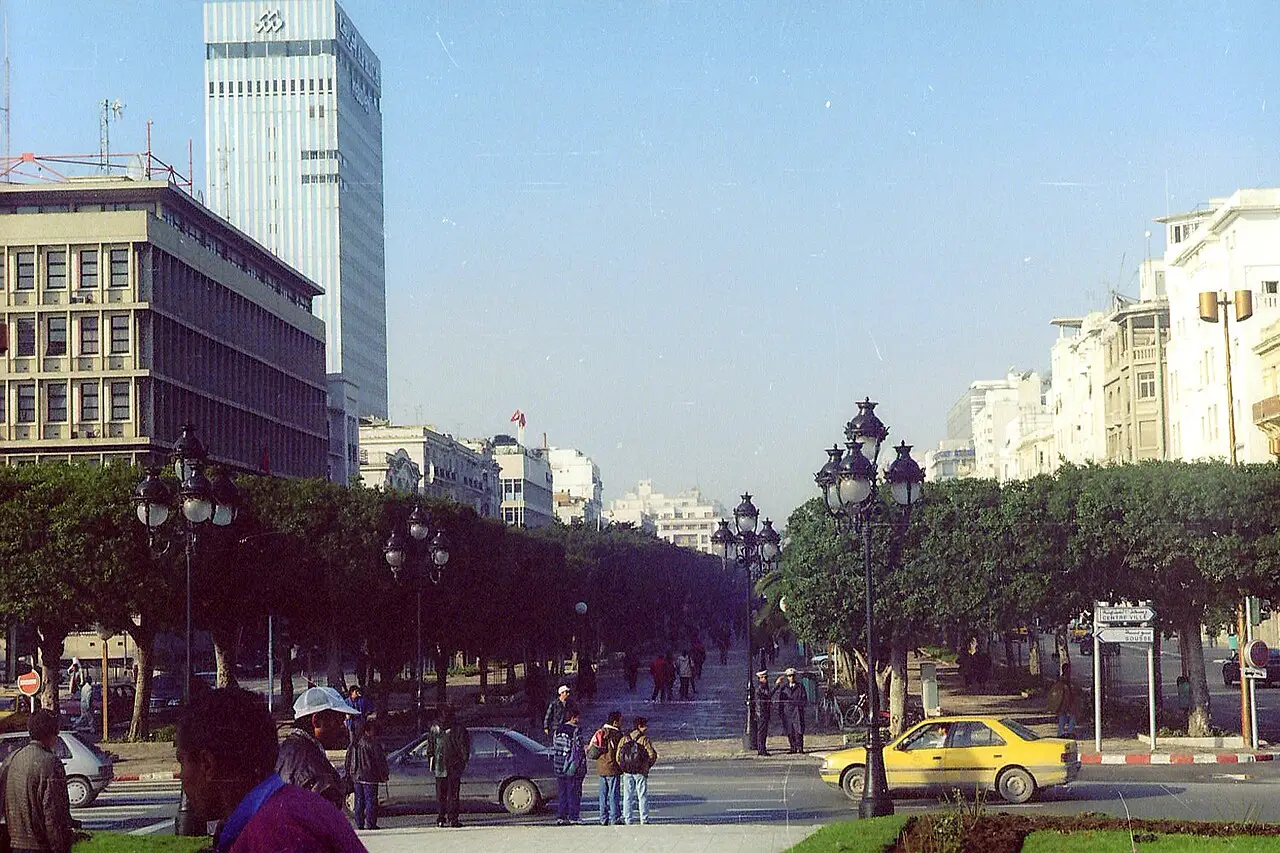
French grid built from 1881 on drained land, with the main avenue linking the Porte de France to the clock at Place du 14 Janvier 2011. It concentrates banks, cinemas, bookstores, the 1897 cathedral, the 1902 Théâtre municipal and the café tables along the central mall. It's where you arrange to meet and where demonstrations happen.
Lafayette
Neighborhood just north of the avenue, historically Jewish and Italian, with the 1938 Grande Synagogue on Avenue de la Liberté, under permanent guard. Today it's commercial and administrative, with doctors' and lawyers' offices and the Avenue Mohamed V axis where the Cité de la Culture, opened in 2018, stands.
Belvédère and Mutuelleville
Tree-lined slope around the Parc du Belvédère, opened in 1892 with about 100 hectares and a zoo from 1963. Around it sit upper-middle-class residential streets, hotels, embassies and the Coupole de El Menzah; it's the quietest and greenest part of the compact city.
Le Bardo
Former palace town of the beys, 4 km to the west, today an ordinary neighborhood served by the light metro and the RFR's line D, opened in 2025. It holds the Bardo National Museum, set in a 19th-century Husainid palace, and the parliament building next door.
Berges du Lac 1 and 2
Business districts built from the 1980s onward on landfill from the northern lagoon, with wide streets, office towers, embassies, malls and most of the city's expensive restaurants and late-opening bars. There's no sidewalk worth long walks and no history. It's where you sleep when the trip is for work.
Northern suburbs: La Goulette, Carthage, Sidi Bou Saïd and La Marsa
A ribbon of suburbs along the TGM line, between 10 and 20 km from downtown. La Goulette has the 1535 Spanish fort, the ferry port and streets of fish restaurants; Carthage is a residential neighborhood built over nine archaeological sites, with the presidential palace in the middle; Sidi Bou Saïd is the blue-and-white village protected by decree since 1915; La Marsa and Gammarth have the beaches and the late-afternoon cafés.
History
4th c. BC · Tunes, a settlement 15 km from Carthage
The Libyan-Berber settlement of Tunes appears in Greek sources as a stronghold 15 km from Carthage; Agathocles of Syracuse occupies it in 310 BC and rebel mercenaries use it as a base in the Mercenary War, between 241 and 238 BC.
146 BC · Rome razes Carthage
The end of the Third Punic War destroys Carthage and, with it, Tunes. Augustus refounds Carthage as a Roman colony in 29 BC and it becomes the capital of Africa Proconsularis and one of the largest cities in the Empire, with the Baths of Antoninus built between 145 and 162.
698 · The Arab conquest and the arsenal
Hassan ibn al-Nu'man takes the region, dismantles what's left of Carthage and moves the military port to Tunis, linked to the sea by a canal through the lagoon. The Zitouna mosque is founded in 698 or 703 and rebuilt in 864 by the Aghlabids, with columns taken from the Roman ruins.
1159 · The Almohads move the capital
Abd al-Mu'min takes Tunis and makes it the provincial capital of Ifriqiya, replacing Kairouan. The medina's wall, gates and the layout of the souks date from this century and the next.
1229-1534 · The Hafsid sultanate
Abu Zakariya declares independence in 1229 and Tunis becomes the capital of a state that negotiates with Genoa, Pisa and Aragon; the Souk el Attarine opens in 1240. Louis IX of France lands at Carthage on the Eighth Crusade and dies of dysentery on August 25, 1270; Andalusi refugees arrive in waves after 1236 and 1492.
1535-1574 · Charles V and the Ottomans
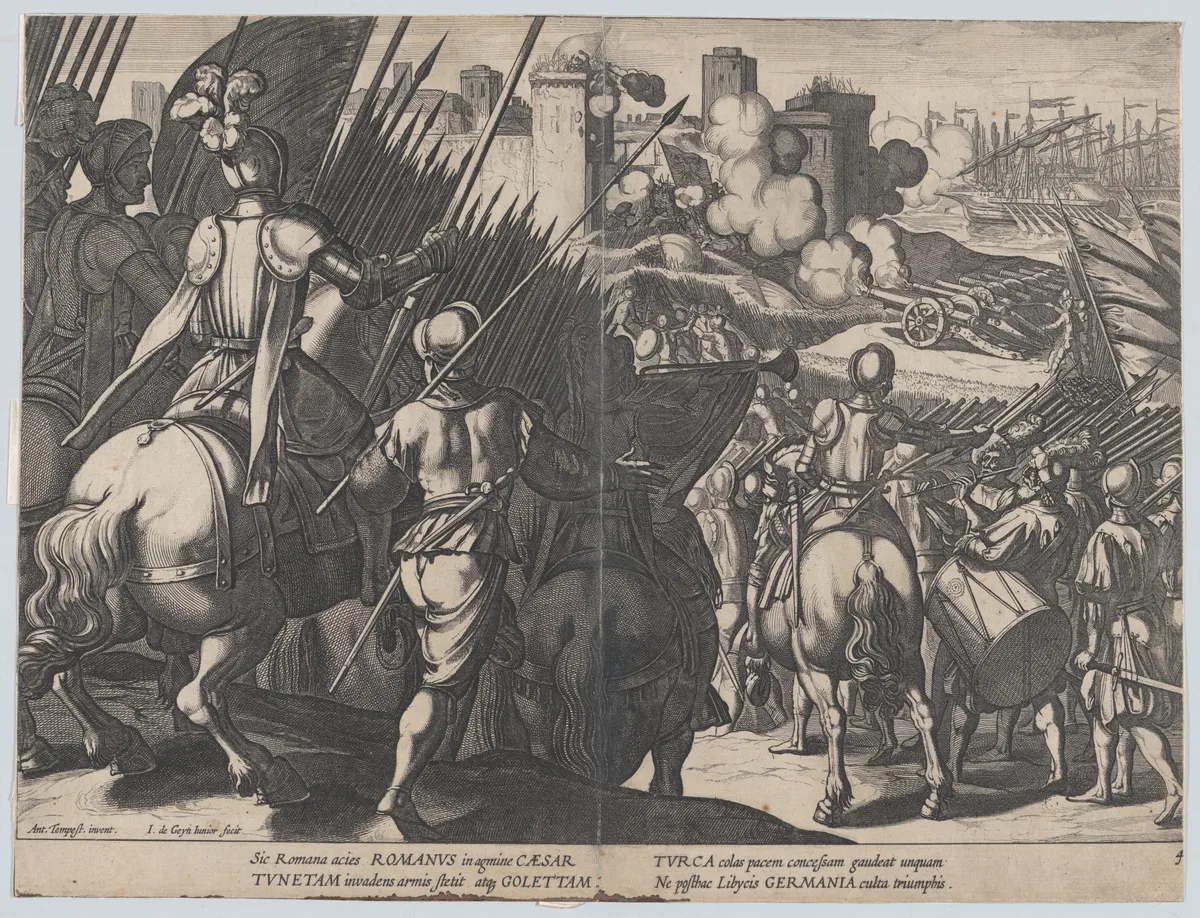
Charles V takes Tunis in 1535 and sacks it for three days, leaving a garrison at the fort of La Goulette. Sinan Pasha conquers the city for good in 1574 and the Regency of Tunis becomes an Ottoman province ruled by deys, beys and the income of corsairing.
1705-1881 · The Husainid beys
Al-Husayn ibn Ali founds in 1705 the dynasty that rules until 1957. The Regency promulgates in 1861 the first constitution in the Arab world, goes bankrupt in 1869 and is placed under an international Franco-British-Italian financial commission.
May 12, 1881 · The Treaty of Bardo
Signed at the Bardo palace, it establishes the French protectorate, confirmed by the Convention of La Marsa in 1883. France drains the edge of the lagoon and builds the Ville Nouvelle on a grid, with a central avenue, an 1897 cathedral and a 1902 theater, adjoining the medina but turned away from it.

1942-1943 · The Tunisia campaign
Axis troops occupy Tunis in November 1942; the city's Jewish community is subjected to forced labor and collective fines for six months. The Allies enter Tunis on May 7, 1943 and the campaign ends on May 13, with about 240,000 prisoners.
1956-1957 · Independence and the republic
Independence is proclaimed on March 20, 1956, and the Husainid monarchy is abolished on July 25, 1957, with Habib Bourguiba as president and Tunis as capital. The Code of Personal Status, from August 1956, bans polygamy and establishes judicial divorce, and it is the source of the distinct legal standing Tunisian women hold in the region.
 AI illustration
2011-2025 · The 2011 revolution, the Bardo attack and Kaïs Saïed
On January 14, 2011, the crowd on Avenue Habib Bourguiba ends 23 years of Ben Ali; the Arab League had already been headquartered in the city between 1979 and 1990, and the PLO between 1982 and 1994. The attack on the Bardo Museum, on March 18, 2015, kills 22 people and devastates tourism for three years; Kaïs Saïed suspends parliament on July 25, 2021, a new constitution is approved in 2022, and the RFR rapid rail network opens line E in 2023 and line D on January 25, 2025.

Complete history
The city that survived Carthage
Tunis is the city that survived Carthage. The Punic site, founded by tradition in 814 BC by colonists from Tyre, sat on the peninsula 15 km away, with two dug-out harbors (one circular, military, and one rectangular, commercial) that can still be seen as lagoons in the middle of a residential neighborhood. Tunes existed alongside it, smaller, on the hill between the lagoon and the sebkha, and served as a camp for anyone laying siege to Carthage: Agathocles in 310 BC, the rebel mercenaries between 241 and 238 BC, Scipio at the end. Rome razed Carthage in 146 BC and refounded it in 29 BC as the capital of Africa Proconsularis; the Baths of Antoninus, from 145-162, are the largest ever built by the Romans outside Italy. When the Arab army arrived, in 698, it did not rebuild the city on the open coast and moved the military port to Tunis, sheltered by a shallow lagoon. From then on, Carthage becomes a quarry and Tunis becomes a city.
The medina you walk through is Hafsid
The medina you walk through today was born under the Hafsids. The Almohads made Tunis the capital of Ifriqiya in 1159, in place of Kairouan, and in 1229 Abu Zakariya declared independence and built a Mediterranean state that signed treaties with Genoa, Pisa and the Crown of Aragon. The Souk el Attarine opened in 1240, and the logic that still organizes the medina dates from that time: each trade has its own street, the ones that smell good sit next to the mosque, and the noisy or foul-smelling ones, such as blacksmiths and tanners, go to the edges, near the gates. Louis IX died outside the city on August 25, 1270, during the Eighth Crusade, and between 1884 and 1890 France built the neo-Byzantine Cathedral of Saint Louis in his memory, on top of Byrsa hill. Waves of Andalusians arrived after 1236, after 1492 and above all with the expulsion of the Moriscos in 1609, and they brought the chechia, irrigated gardens and new towns such as Testour, 75 km away.
From Charles V to the French protectorate (1535–1881)
Between 1535 and 1574 the city changes hands three times. Charles V took and sacked it in 1535, leaving a Spanish garrison at the fort of La Goulette; the Ottomans under Sinan Pasha took it for good in 1574, and the Regency of Tunis came to live off corsairing and the ransom of captives, under deys and later beys. Al-Husayn ibn Ali founded the Husainid dynasty in 1705, which outlived the end of piracy, promulgated the first written constitution in the Arab world in 1861, went bankrupt in 1869 and fell under an international financial commission. It was that debt France used as its argument: on May 12, 1881, at the Bardo palace, the bey signed the treaty that created the protectorate. The French did not move into the medina. They drained the edge of the lagoon and built a grid city beside it, with a tree-lined avenue, a cathedral in 1897, a theater in 1902 and a central market in 1891. That decision preserved the medina whole while stripping it of money, administration and the families in charge.
Occupation, independence and Bourguiba's fall
In the 20th century, Tunis went through Axis occupation, independence and a role as a seat of Arab politics. The Axis occupied the city in November 1942 and imposed forced labor and collective fines on the local Jewish community for six months, until the Allies entered on May 7, 1943. Independence came on March 20, 1956, and the republic on July 25, 1957, and Bourguiba governed until he was deposed by Ben Ali on November 7, 1987. During that period, Tunis hosted the headquarters of the Arab League from 1979 to 1990, after Egypt's expulsion, and the PLO leadership from 1982 to 1994, which brought an Israeli bombing of Hammam Chott on October 1, 1985. Meanwhile, the medina lost its old families, took in rural migrants and subdivided houses, and only began receiving investment again after its UNESCO listing in 1979 and the work of the Association de Sauvegarde de la Médina, founded in 1967.
Two new railways between 2023 and 2025
In recent years, what has most changed the city's routine are the two lines of the RFR rapid rail network: Line E, from 2023, and Line D, from 2025, which put the Bardo Museum one train ride from downtown.
The Punic ports of Carthage, one circular and one rectangular, today look like a park with water.
Geography and shape of the city
Between the lagoon and the sebkhas
Tunis sits about 4 m above sea level downtown and climbs to about 70 m on the hills of the Belvédère and the Kasbah, squeezed between two bodies of salt water. To the east is the Lac de Tunis, a shallow lagoon of about 40 km² separated from the gulf by a sandbar and linked to the sea by a 10-km shipping canal dug in 1893 to La Goulette. To the west and south lie the Sebkhat Sijoumi and the Sebkhat Ariana, salt flats that fill up in winter and dry out in summer, and that for centuries acted as a limit on growth.
The oval hill and the drained lake
The medina sits on the hill between the two, which is why it's oval rather than square: the streets follow the contour lines, with the main axis descending from the Kasbah, at the top, down to the Bab el Bhar, on the old waterfront. The Ville Nouvelle sits literally on top of the drained lake, which explains the grid layout, the Avenue Habib Bourguiba with its 1.3 km central promenade lined with ficus trees, and the fact that the sea only begins 10 km from downtown.
The northern coast, the lake landfill and the climate
With no room between the lagoon and the sebkhas, the city grew in two directions. To the north, a spit of land leads to the coastal suburbs, served since 1872 by the TGM line, and the landfill on the lagoon became the Berges du Lac neighborhood. The climate is Mediterranean, with summers of 33 to 36 °C, humid because of the lagoon and sometimes above 40 °C when the chhili, the Saharan wind, blows, and winters of 8 to 17 °C with concentrated rainfall.
The medina is oval because the streets follow the shape of the hill, with no grid layout.
Culture
Malouf and mezoued, the city's two musics
The city's music has two layers that don't mix. Malouf is the Andalusi heritage codified into thirteen nubas, played on oud, rabab and percussion, saved from disappearing by the La Rachidia institute, founded in 1934 in the medina, and systematized by Salah El Mahdi; it's what you hear at Ennejma Ezzahra and at the palace festivals during Ramadan. Mezoued is the opposite: goatskin bagpipes, lyrics about exile, prison and being broke, born in the working-class neighborhoods and banned on state radio for decades, today the real soundtrack of weddings and buses. Tunisian rap grew up between the two, and it played a documented role in 2010-2011 with El Général's “Rais Lebled,” recorded in Sfax and sung in Tunis.
Film: the city's steadiest cultural export
Film is the city's most consistent cultural export. The Carthage Film Festival (JCC), created by Tahar Cheriaa in 1966, is the oldest film festival in Africa and the Arab world and takes over the theaters on Avenue Habib Bourguiba in October or November. Tunis produced Moufida Tlatli, with “The Silences of the Palace” (1994); Férid Boughedir, with “Halfaouine” (1990) and “A Summer in La Goulette” (1996); Abdellatif Kechiche, born in the city in 1960; and Kaouther Ben Hania, Oscar-nominated for “The Man Who Sold His Skin” (2020) and “Four Daughters” (2023). On the written side, Ibn Khaldun was born here in 1332, poet Aboul-Qacem Echebbi provided the closing lines of the national anthem, and Albert Memmi, born in the Jewish hara in 1920, wrote the colonial city's autobiography in “The Pillar of Salt.”
The derby between Espérance and Club Africain
Soccer organizes the week. Espérance Sportive de Tunis, founded in 1919 in Bab Souika, and Club Africain, founded in 1920 in Bab Jedid, split the city street by street and play the derby at the Olympic Stadium of Radès, opened in 2001 for about 60,000 people; Espérance is one of Africa's most decorated clubs. Outside the stadium, life happens in the café: men seated facing the sidewalk, shisha, tea with pine nuts and long conversation in the traditional neighborhoods; mixed cafés and bars in the Berges du Lac, in La Marsa and in the Ville Nouvelle. Religious practice is Maliki Sunni, with the Zitouna as the reference point; a few hundred Jews remain in Tunis, with a synagogue guarded on Avenue de la Liberté, and a larger community on Djerba.
Malouf, the music inherited from Andalusia, has thirteen nubas and has been taught since 1934 at the La Rachidia institute, in the medina.
Festivals and events
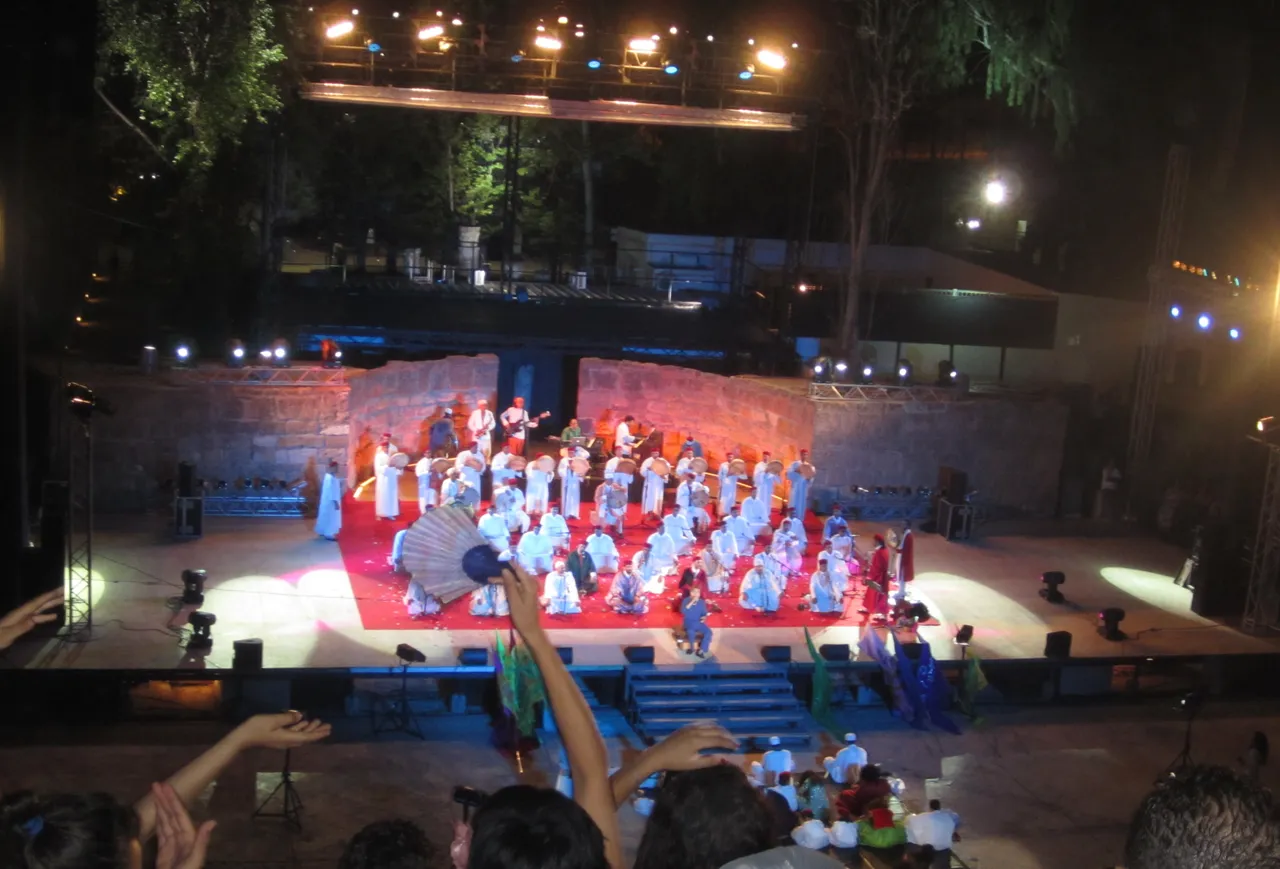
Carthage International Festival
July and August, at the restored Roman theater of Carthage, with about 7,500 seats; running since 1964, it alternates Arab music, jazz, international pop and theater. Tickets 20 to 120 DT, sold in advance; the TGM gets packed on the way out.

Carthage Film Festival (JCC)
October or November, with screenings also in outlying neighborhoods. Founded in 1966, it's the oldest film festival on the continent; it was biennial until 2014 and then became annual, focused on African and Arab productions with lines forming in the street.
 AI illustration
Ramadan and the Medina Festival
In 2027, starting around February 8 (the exact date depends on the sighting of the moon). The city flips its schedule: restaurants closed by day, the medina full after iftar, malouf concerts in palaces and madrasas into the small hours, and chaotic traffic at sunset.
 AI illustration
Dream City
Biennial contemporary art event created in 2007 by Selma and Sofiane Ouissi, held in the fall of odd-numbered years inside houses, courtyards and streets of the medina (recent editions in 2023 and 2025; the next should fall in 2027). A walking route with timed entry, free or low-cost.
 AI illustration
Carthage Theater Days
December, in downtown venues and at the Cité de la Culture. The theatrical counterpart to the JCC, founded in 1983, it brings together Arab and African companies; Tunisia has a tradition of political theater and the festival tends to reflect the country's mood.
Books and films
“The Silences of the Palace” (1994)
Film shot in a beylical palace: the bey's maids in the years leading up to 1956, malouf played behind closed doors, and the end of a world independence swept away. It explains the domestic hierarchy and the inward-turned architecture found in every medina house.
“The Pillar of Salt” (La Statue de sel, 1953), by Albert Memmi
Autobiographical novel of a Tunisian Jew born in the hara of Tunis in 1920: the alley, the French lycée, life in three languages and the labor camp under the German occupation of 1942-1943. It's the finest written portrait of the colonial city's many communities.
“A Summer in La Goulette” (Un été à La Goulette, 1996), by Férid Boughedir
A comedy set in the summer of 1966 in La Goulette, the port suburb where Muslims, Jews, and Sicilians shared the same building and the same stretch of beach, on the eve of the Six-Day War. It shows the coexistence the city lost in the following years, and why La Goulette still lives off fish restaurants.
Frequently asked questions
Tunis: Should I accept the taxi's flat rate?
No: the yellow taxi is required to use the meter, and a driver who says the meter's broken, or who proposes a "forfait," is charging double.
Tunis: How much does a taxi from the airport to downtown cost?
The yellow taxi to Avenue Habib Bourguiba costs 10 to 15 DT on the meter during the day and about 50% more between 9pm and 5am, which is legal and shows on the display.
Tunis: How far is Dougga?
Dougga is 110 km southwest, about 2 hours by car via Medjez el-Bab and Téboursouk.
Tunis: What's the currency, and how much is the dinar worth?
The currency is the Tunisian dinar (TND, DT), divided into 1,000 millimes, trading at around 3.0 DT to the dollar and 0.55 DT to the real in 2026.
Tunis: What's the best time to visit?
The good window is from April to early June and from mid-September to early November, with highs of 22 to 28 °C, the sea still usable in October, and little rain.