
Thailand
Chiang Mai
Temples, Doi Suthep, khao soi and street markets
Days Start with the basic programme and choose extensions for the time you have.
How the guide reaches this number
Chiang Mai isn't for anyone looking for nightlife, because few bars stay open past midnight or 1am, and between February and April the smoke from burning makes the air unhealthy. With just one day, start at 8am at Wat Chiang Man, the 1296 temple with the chedi of fifteen elephants, and walk along the moat to Wat Chedi Luang and, 700 m farther on, Wat Phra Singh, with the murals of the Lai Kham chapel. Have khao soi for lunch before 2pm, because the dish comes off the menu in the afternoon at most shops, and in the late afternoon take a songthaew up to Doi Suthep, when the groups have already come down. The Night Bazaar disappoints, because its stalls repeat, at package-tour prices, what Warorot market sells by day. Nimmanhaemin also falls short of its reputation, with one coffee roastery after another and little else, so spend your time at the temples of the old city and on the mountain.
2–3
When November to January: dry, cool and before the burning season, which runs from February to April
How the guide reaches this number
The year has three distinct seasons, and the middle one calls for caution. The cool, dry season runs from November to February, with highs of 28–31 °C, lows of 13–17 °C and clear skies. It's high season, with lodging prices 30% to 60% above average and bookings required for Loy Krathong. The hot season runs from March to May and reaches 36–40 °C, overlapping with the worst window of the year: between mid-February and late April, agricultural burning and forest fires in the basin and in neighboring countries push PM2.5 to very unhealthy levels, and in March 2026 the city once again appeared at the top of the world's pollution rankings, with an AQI above 200 on several days. The province bans open burning from February 1 to May 31, which reduces the problem but doesn't eliminate it. The rainy season runs from June to October, with 1,100–1,200 mm a year concentrated in late-afternoon downpours of one to two hours: it's the greenest, cheapest time of year, with the cleanest air, because the rain washes out the smoke. The best window is November to January, cool, dry, and before the smoke; the month to avoid is March.
Per person/day 900–1,200 THB budget; 2,000–3,500 THB comfortable, with lodging included
How the guide reaches this number
Per person per day: accommodation, meals, urban transport, visits and a small allowance for extras. Flights excluded; larger purchases vary. Editorial estimate, not a quote.
 What Nilo thinks
In two days you'll see temples, mountains and markets within a short, cheap radius, and a third day is for the craft workshops, a cooking class and the markets; with more time, Doi Inthanon and the Mae Taeng valley make a full day. Chiang Mai isn't for anyone looking for nightlife, because few bars stay open past midnight or 1am, and between February and April the smoke from burning makes the air unhealthy. With just one day, start at 8am at Wat Chiang Man, the 1296 temple with the chedi of fifteen elephants, and walk along the moat to Wat Chedi Luang and, 700 m farther on, Wat Phra Singh, with the murals of the Lai Kham chapel. Have khao soi for lunch before 2pm, because the dish comes off the menu in the afternoon at most shops, and in the late afternoon take a songthaew up to Doi Suthep, when the groups have already come down. The Night Bazaar disappoints, because its stalls repeat, at package-tour prices, what Warorot market sells by day. Nimmanhaemin also falls short of its reputation, with one coffee roastery after another and little else, so spend your time at the temples of the old city and on the mountain.Inside a square of moat and brick wall laid out in 1296, Chiang Mai, the former capital of the Lanna kingdom, holds more than thirty temples. At Wat Chiang Man, the oldest, fifteen stucco elephants hold up the chedi. At Wat Phra Singh, 19th-century murals show the city's clothing and markets of that era. On the hill to the west, 306 steps lead up to the golden chedi of Doi Suthep, and on the way down, Wat Umong has brick tunnels under the forest. Come too for northern cooking, from khao soi, the curry-broth noodles served at lunch, to sai ua with sticky rice and the chili pastes sold by weight at Warorot market. This isn't a nightlife city, and the evening is for the Saturday and Sunday markets. Come between November and January, before the smoke from the burning season, and set aside two days, or three with a cooking class.
Quick facts
- Population
- about 130,000 in the city proper; about 1.2 million in the urban area; about 1.8 million in the province
- Founded
- 1296, by King Mangrai, as capital of the Lanna kingdom
- Country and region
- Thailand, Chiang Mai Province, Northern Region
- Language
- Thai official; kam mueang (northern Thai) in daily speech
- Currency
- Thai baht (THB, ฿): about 32 to 34 per dollar in 2026
- Time zone
- ICT, UTC+7, no daylight saving time
- Best time
- November to January: dry, cool and before the burning season, which runs from February to April
- Average cost per day
- 900–1,200 THB budget; 2,000–3,500 THB comfortable, with lodging included
When to go
November to January: dry, cool and before the burning season, which runs from February to April
February
17° to 33°C
10 mm of rain
March
20° to 35°C
20 mm of rain
April
23° to 37°C
54 mm of rain
May
24° to 35°C
168 mm of rain
June
25° to 33°C
118 mm of rain
July
24° to 32°C
149 mm of rain
August
24° to 32°C
223 mm of rain
September
24° to 32°C
207 mm of rain
October
23° to 32°C
124 mm of rain
How the year changes
The year has three distinct seasons, and the middle one calls for caution. The cool, dry season runs from November to February, with highs of 28–31 °C, lows of 13–17 °C and clear skies. It's high season, with lodging prices 30% to 60% above average and bookings required for Loy Krathong. The hot season runs from March to May and reaches 36–40 °C, overlapping with the worst window of the year: between mid-February and late April, agricultural burning and forest fires in the basin and in neighboring countries push PM2.5 to very unhealthy levels, and in March 2026 the city once again appeared at the top of the world's pollution rankings, with an AQI above 200 on several days. The province bans open burning from February 1 to May 31, which reduces the problem but doesn't eliminate it. The rainy season runs from June to October, with 1,100–1,200 mm a year concentrated in late-afternoon downpours of one to two hours: it's the greenest, cheapest time of year, with the cleanest air, because the rain washes out the smoke. The best window is November to January, cool, dry, and before the smoke; the month to avoid is March.
The same numbers as a table
| Month | Temperature °C | Rain mm |
|---|---|---|
| January · | 16 to 30 | 11 |
| February | 17 to 33 | 10 |
| March | 20 to 35 | 20 |
| April | 23 to 37 | 54 |
| May | 24 to 35 | 168 |
| June | 25 to 33 | 118 |
| July | 24 to 32 | 149 |
| August | 24 to 32 | 223 |
| September | 24 to 32 | 207 |
| October | 23 to 32 | 124 |
| November · | 20 to 31 | 41 |
| December · | 17 to 29 | 14 |
Nilo's tips
Khao soi only at lunch: closes around 3pm
The good khao soi shops close around 3pm, and at most of them the dish disappears from the menu in the afternoon, so have lunch there. It costs 50–80 THB, with sides served separately to adjust the broth. If you're only free in the evening, look for khao kha moo, braised pork leg, near Chang Phueak gate, served in the late afternoon for 50–70 THB.
The 30-baht bus almost no one takes at the airport
CNX is 4 km from the moat, and the cheapest way into town is the RTC air-conditioned bus, the R3, for a flat 30 THB to the old city and Nimman. It has its own app that shows where the bus is, so you don't wait at the stop for nothing. The counter taxi charges a fixed 150–200 THB and up; with a big suitcase or in a hurry, call Grab or Bolt, which usually come out cheaper than the counter, at 80 to 180 THB.
Ask through the window before getting on the songthaew
The question is tao-RAI, and asking it can save you about 150 baht. The red songthaew is a shared ride, not a private taxi. The right price is 30–40 THB per trip within the city, with detours for other passengers, and to get off you press the buzzer on the ceiling. If they ask for 200 baht to cross the old city, that's the price for a tourist being ripped off. Say no and wave down the next one, which will come by within a few minutes.
Doi Suthep at 7am, never at 10am
Leave at 7am for the 15 km climb to Doi Suthep, about 40 minutes by shared songthaew, and reach the top of the staircase before 9am, when the tour buses arrive; foreigner admission is around 50 THB. The valley view only exists on a clear day, and between February and April the smoke from burning can hide everything from up there. On the way down, stop at Wat Umong, with 14th-century brick tunnels, cooler than the center and left out of most tours. If you can't leave early, go up in the late afternoon, when the groups have already come down.
Saturday is Wua Lai; Sunday is Ratchadamnoen
The day of the week decides which market you see, and they're different. The Saturday night market takes over Wua Lai Road, the street of silversmiths, south of the moat. The Sunday one fills Ratchadamnoen, the old city's main street, from 4pm to 10pm, starting at Tha Phae gate. On Saturday, finish at Wat Sri Suphan, on Wua Lai itself, lit up at night; the silver-clad ubosot is closed to women by monastic rule, but the courtyard is open to everyone.
Warorot: open until 5pm, cheaper than the Night Bazaar
At Warorot, which locals call Kad Luang, sai ua, khaep mu, and chili pastes are sold by weight, without the Night Bazaar's package-tourism prices. The market opens early, around 6am, and closes near 5pm, so go in the morning or early afternoon; the Night Bazaar only opens from 6pm to 11pm. Withdraw your cash in one go before you go, because the ATM charges a flat fee of about 220 THB per withdrawal with a foreign card, and the market runs on cash.
Explore the map

© OpenStreetMap · OpenFreeMap · © OpenMapTiles
Explore the map, read about the other places and plan your travel days in the app.
Open the appWhat to see
Chiang Mai: The valley and the range to the west
Chiang Mai's layout reads as three concentric rings: the walled 1296 square, about 1.5 km on each side and ringed by the moat; the ring road right next to it; and the Superhighway (route 11), which closes the outer ring. Beyond that ring, the city has spread into low-rise subdivisions across Hang Dong, San Sai, Saraphi, and Mae Rim.
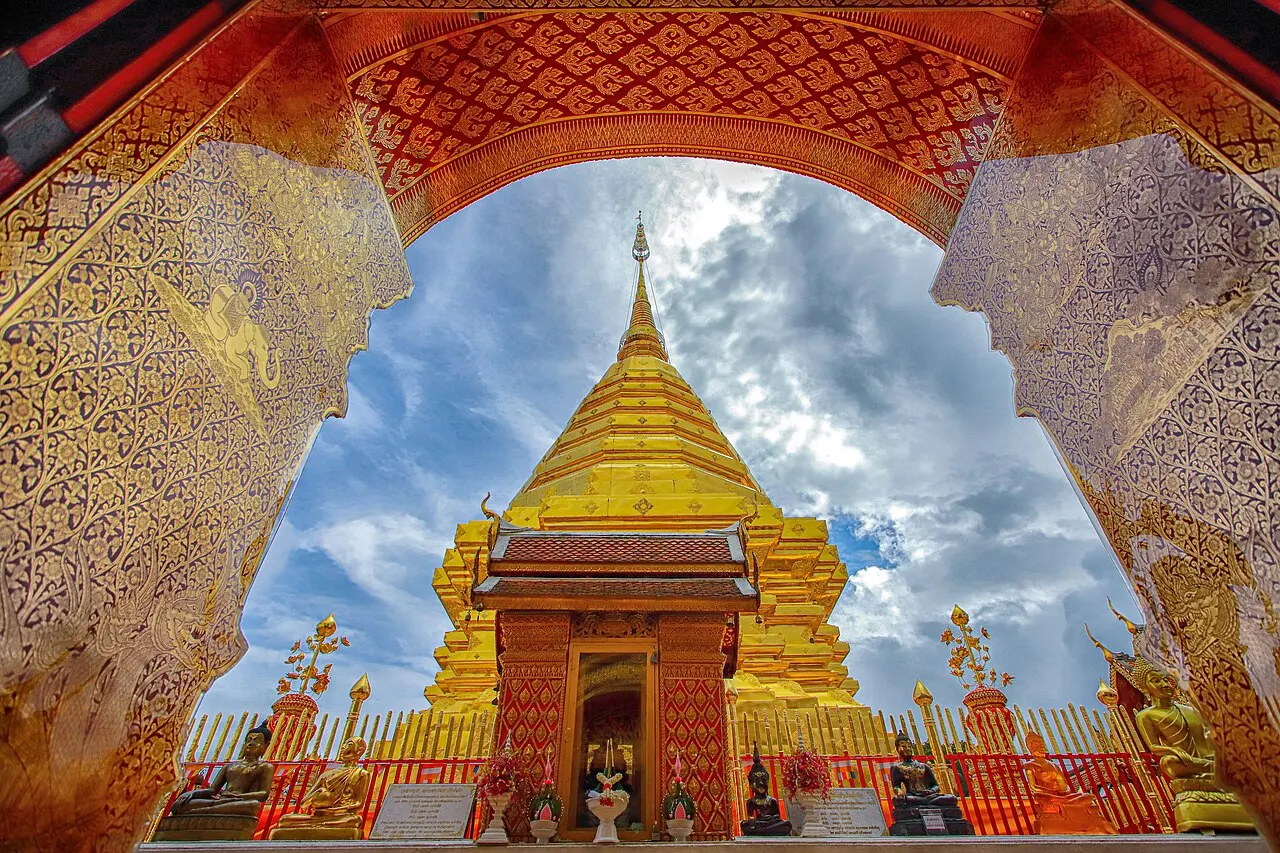
Wat Phra That Doi Suthep
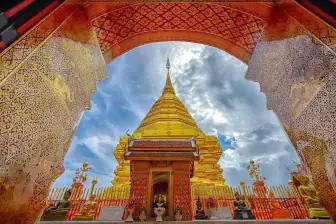
A reliquary temple founded in 1383 under King Kue Na, at about 1,070 m on the mountain to the west, 15 km from the city and 30 to 40 minutes by car. A 306-step stairway lined with nagas leads up to the golden chedi; admission for foreigners is around 50 THB, and on clear days the whole valley is in view.
The climb up the mountain to the west ends at the reliquary after the staircase, with a view of the valley on clear days; 306 steps flanked by nagas; about 50 THB.
Check access
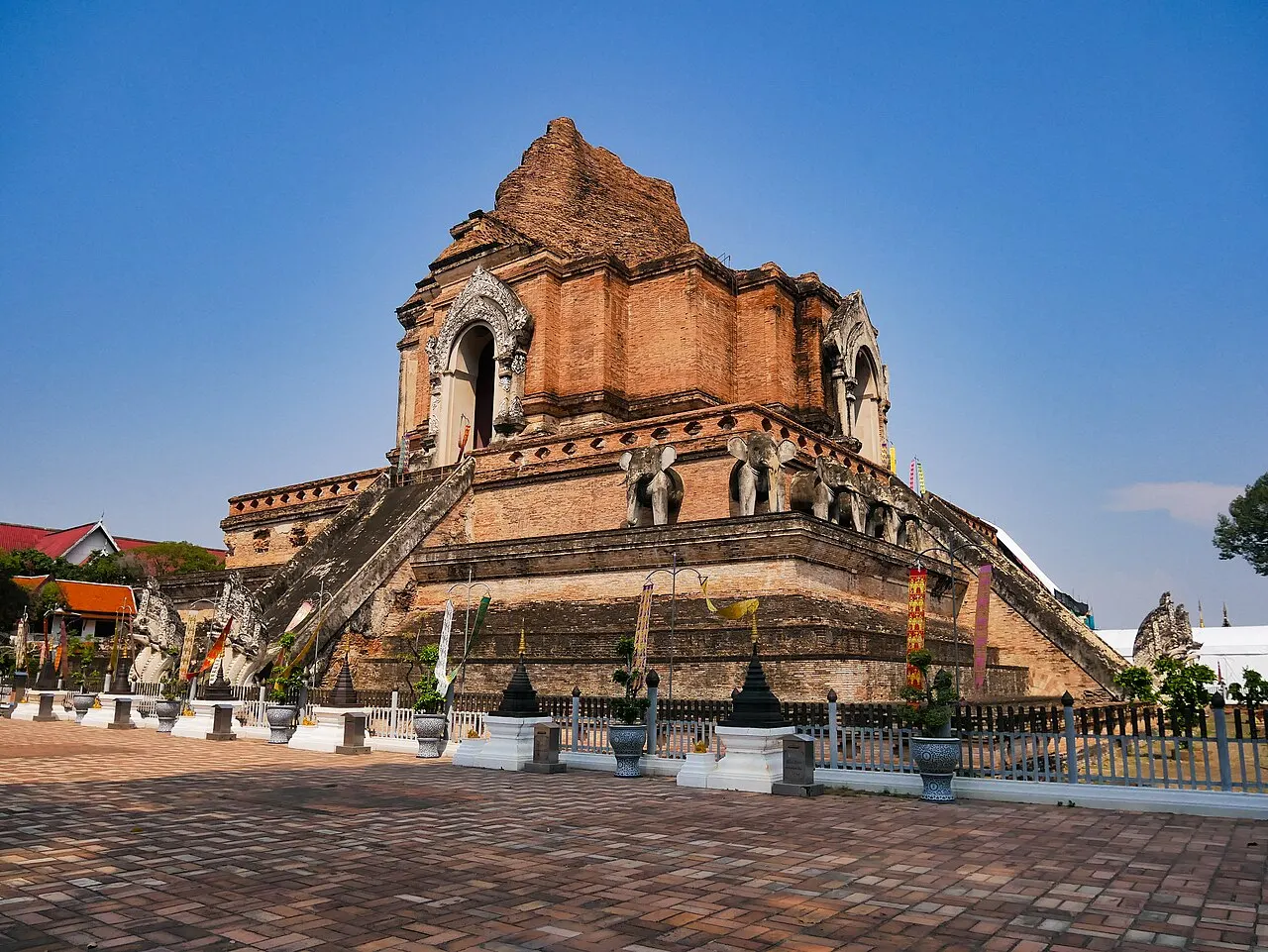
Wat Chedi Luang
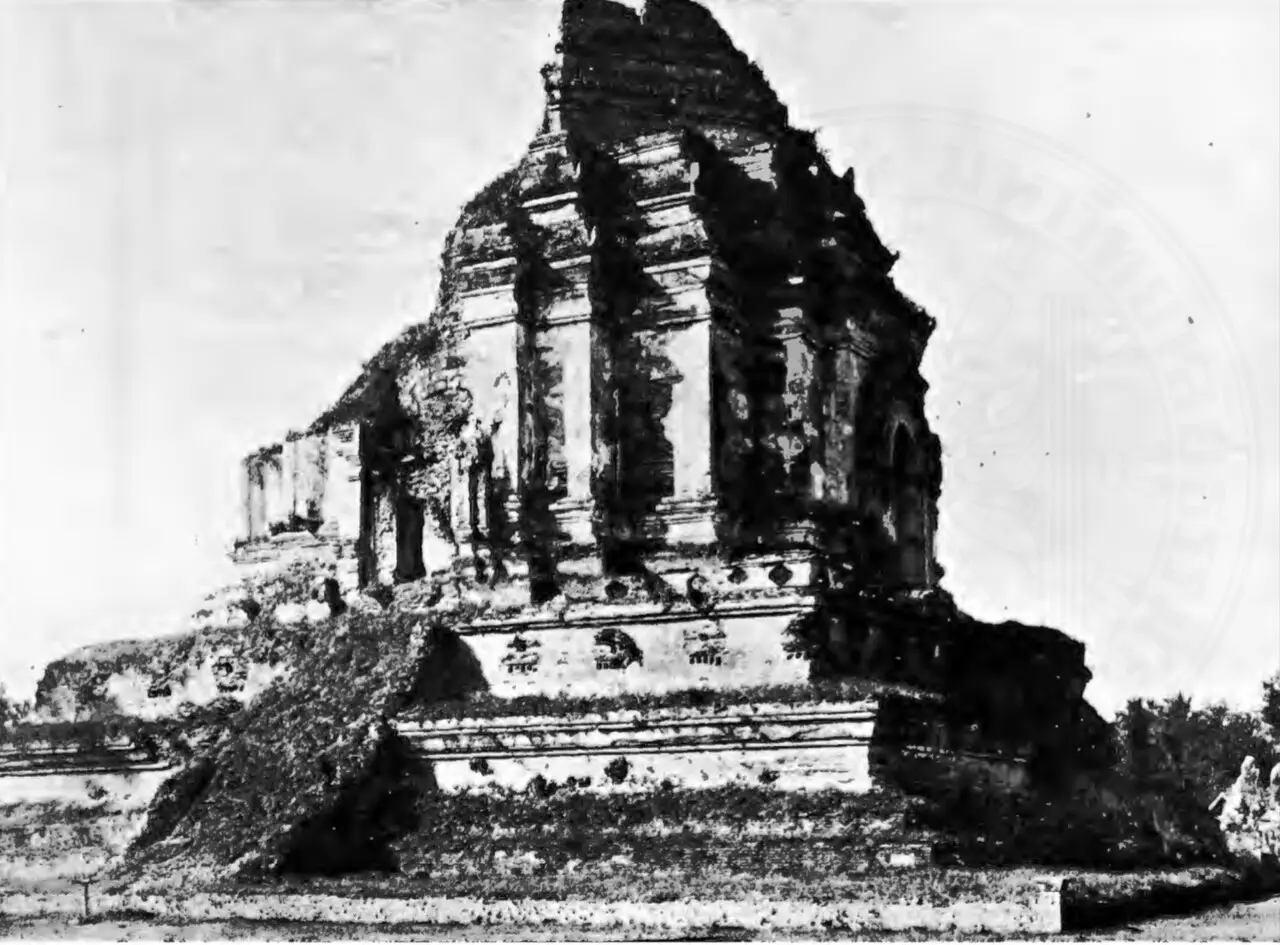
At the center of the walled square, it holds the tallest chedi Lanna ever built: about 80 m before the 1545 earthquake, today about 60 m with a truncated top. It housed the Emerald Buddha between 1468 and 1551 and keeps, beside it, the city pillar (lak mueang) that gives its name to the Inthakin festival.
In the middle of the walled compound, the tallest chedi that Lanna ever built stood about 80 m until the 1545 earthquake and now measures about 60 m with its top truncated, and the pillar beside it gives the festival its name.
Check access
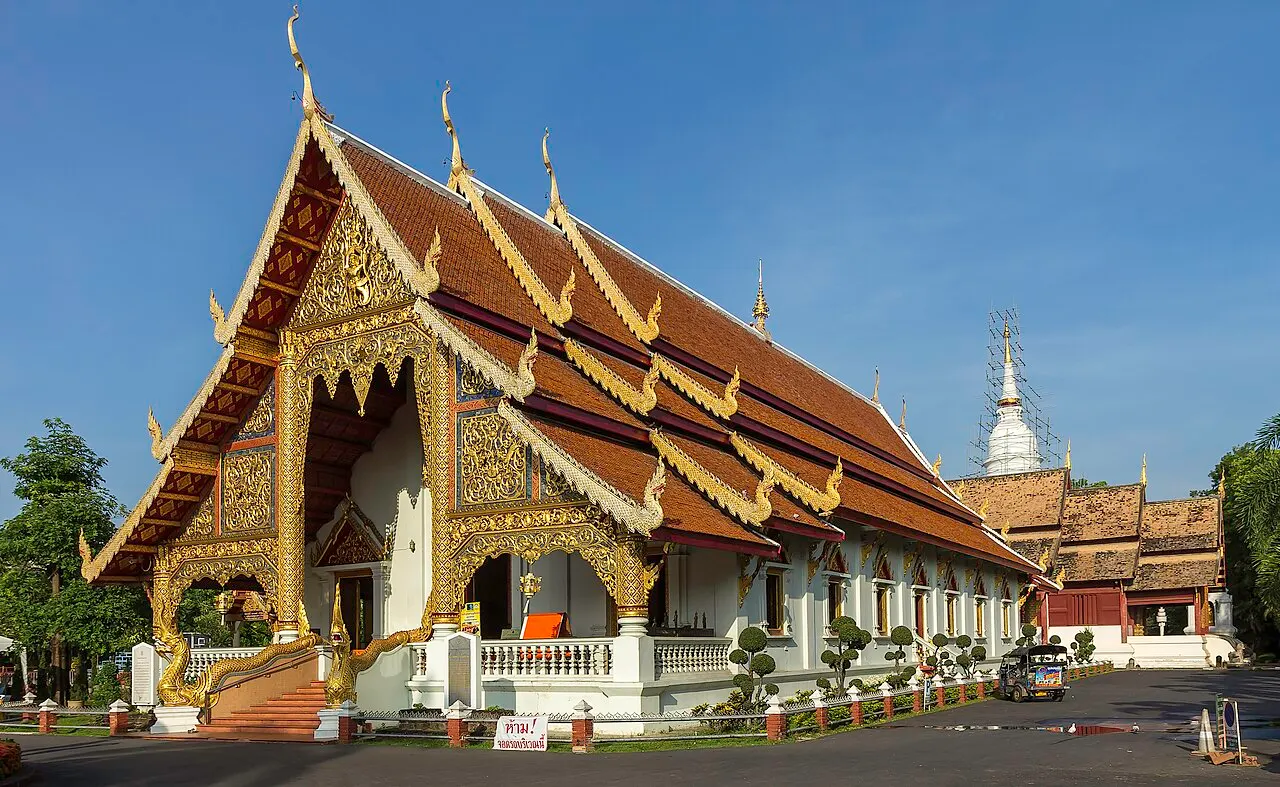
Wat Phra Singh
A temple from 1345 at the far west end of Ratchadamnoen road, seat of the north's most important abbot. The main draw is the Lai Kham chapel, with 19th-century murals depicting the clothing, hairstyles and markets of Chiang Mai at the time: a rare visual record of civilian life.
The stop at the end of the avenue is worth it for the interior mural showing how people dressed, styled their hair, and shopped; the 19th-century Lai Kham chapel; the abbot's residence dates to 1345.
Check access
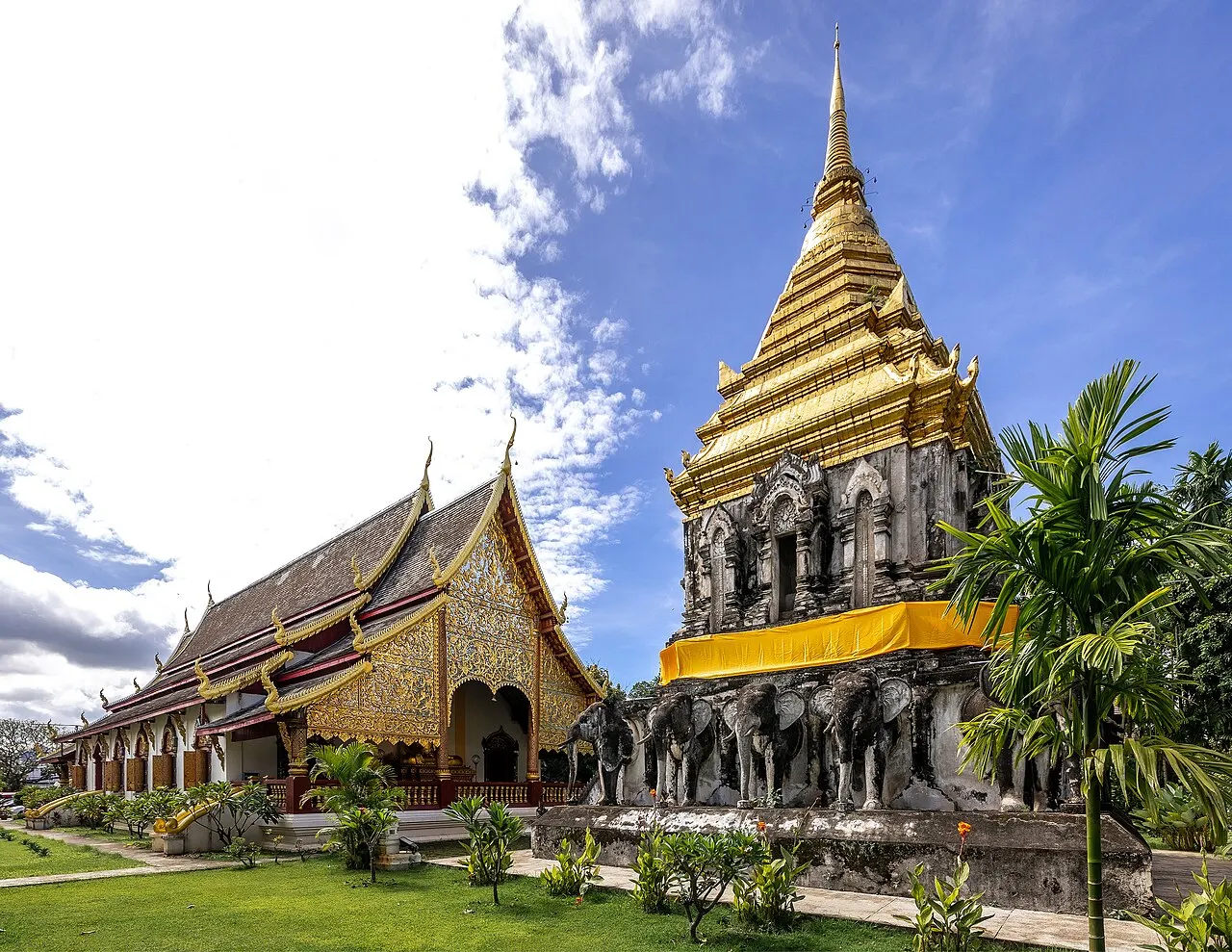
Wat Chiang Man
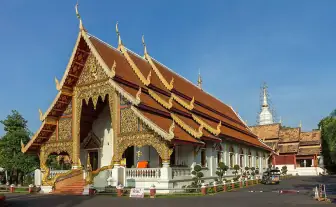
The oldest temple in the city, built in 1296 on the ground where Mangrai lived during the construction of the walls. It has the Chang Lom chedi, supported by fifteen stucco elephants, and two highly venerated images: the Crystal Buddha and the Stone Buddha.
It's the city's oldest temple, built in 1296, and it holds the Chang Lom chedi, resting on fifteen stucco elephants, and the Crystal Buddha. Arrive at 8am, before the heat and the tour buses.
Check access

Wat Suan Dok
Founded in 1370 in an old flower garden, it has a field of white chedis holding the ashes of Chiang Mai's ruling family, moved there in 1909. It's also home to the monastic campus of Mahachulalongkorn Buddhist University and its monk chats.
Founded in 1370 on what was once a flower garden, the temple has chedis holding the ruling family's ashes, moved there in 1909, and it also hosts the monastic campus and the monk chat sessions.
Check access

Wat Umong
Forest temple to the west, next to Doi Suthep, with brick tunnels from the 14th century dug under a chedi and covered with remains of mural painting. It is used as a meditation center, has a lake with fish and turtles and is several degrees cooler than downtown.
The 14th-century brick tunnels beneath a chedi are lined with remnants of mural painting, and the site doubles as a meditation center and runs several degrees cooler than downtown.
Check access
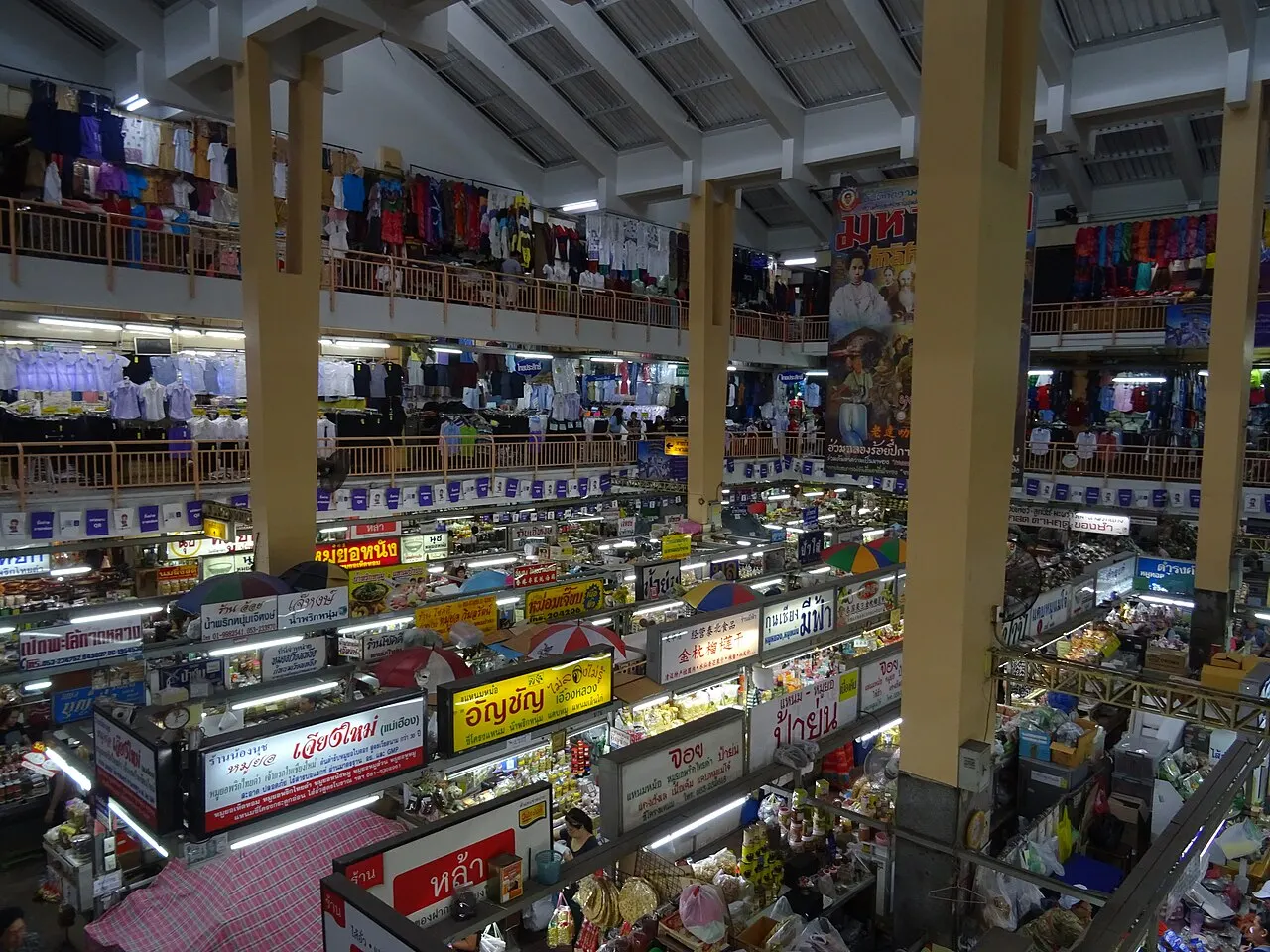
Warorot Market (Kad Luang)
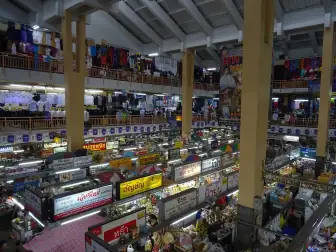
A three-story covered market beside the Ping River, running since the 1910s and open from about 6am to 5pm. It sells sai ua, khaep mu, chili pastes and dried fruit; the flower market and Chinatown cluster around it.
The three-story covered market by the river is open roughly from 6am to 5pm and sells food, with the flower trade spread around it.
Check access
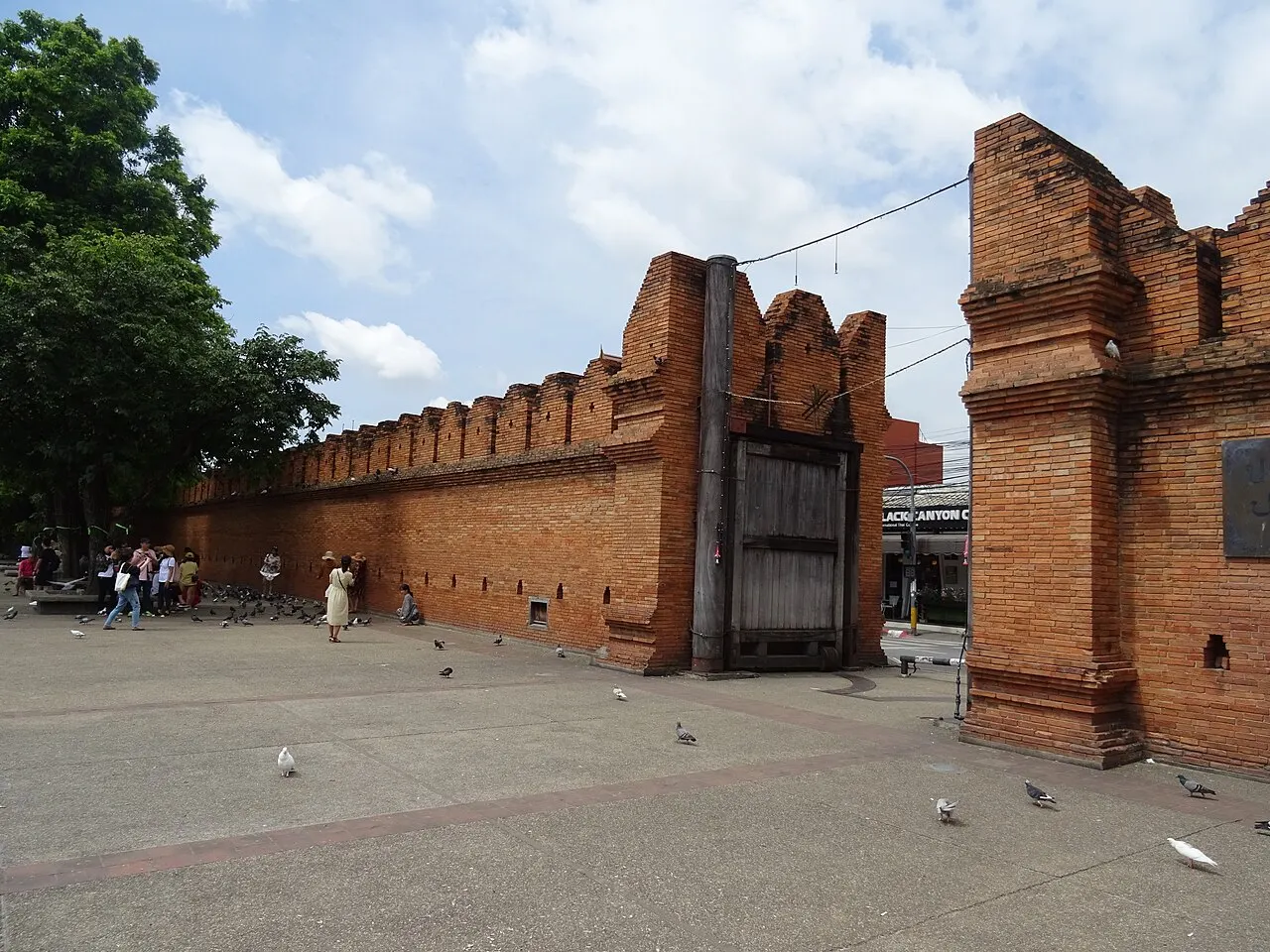
Tha Phae Gate, moat and wall
The east gate is the most photographed plaza in the city and the starting point of the Sunday fair; the visible structure is a reconstruction from the 1980s on the original base. The four corner bastions, like the Katam to the southwest, show the 13th-century brick masonry.
It's Chiang Mai's most photographed spot, and what gets photographed is an 1980s reconstruction on the original base. It works as a meeting point (the Sunday market starts here and fills Ratchadamnoen Road from 4pm to 10pm), but the real 13th-century brick is in the corner bastions, like Katam, to the southwest.
Check access
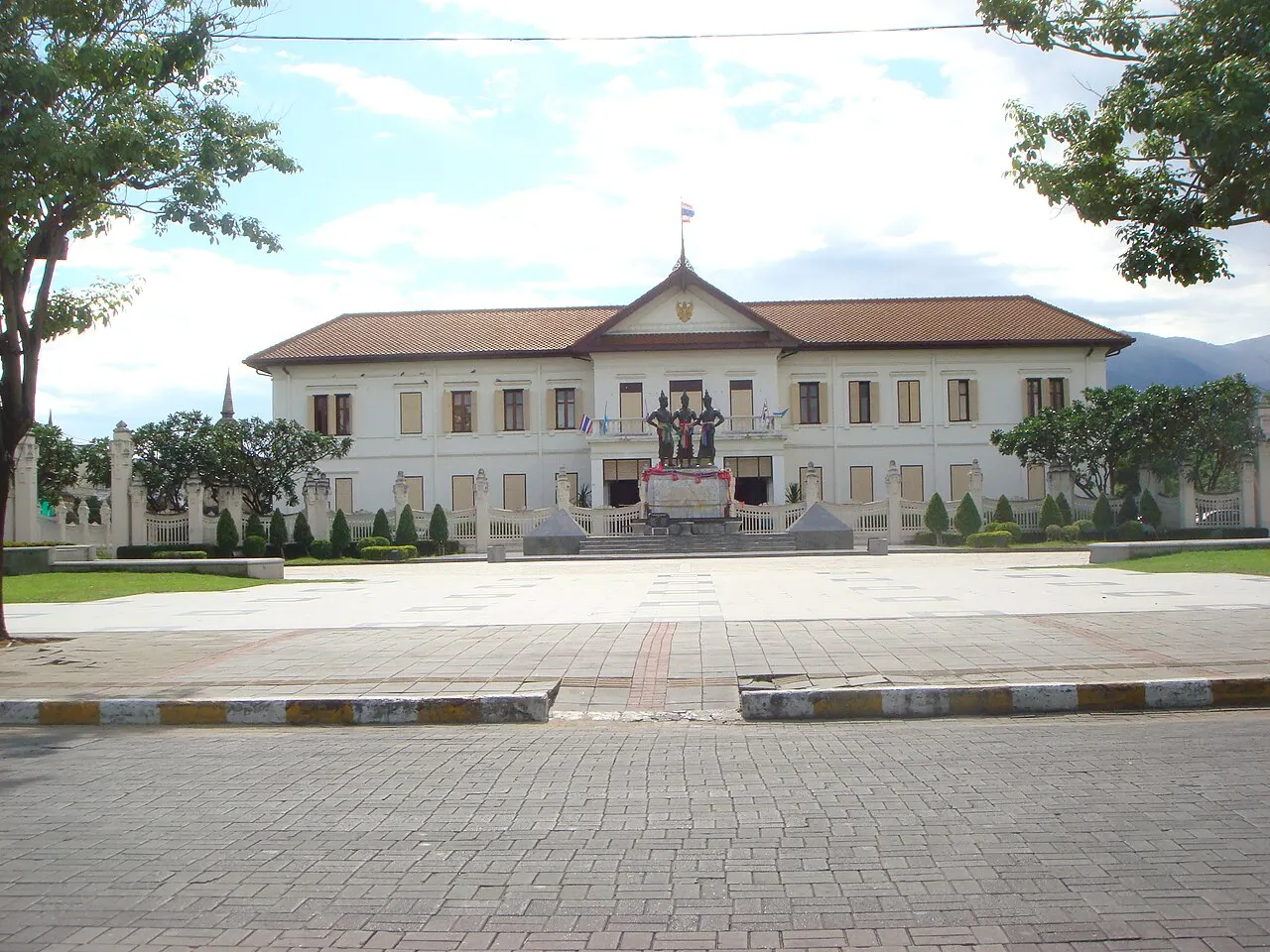
Monument to the Three Kings and the square museums
The statue of Mangrai, Ngam Mueang and Ram Khamhaeng marks the ceremonial center of the old city. Behind it, three museums occupy administrative buildings: the Center for Art and Culture, the Lanna Folklore Museum and the History Museum, with combined ticket.
Behind the Monument to the Three Kings stand three municipal museums, housed in former administrative buildings and visited with a combined ticket: the Arts and Culture Center, the Lanna Folklife Museum, and the Historical Center. They make a good plan for a rainy afternoon, but inside the moat the temples pay off more than the museums.
Check access
Nilo’s itinerary
Start with the basic programme and choose extensions for the time you have.
Plan my days in the app ↗Day 1 · Inside the moat
Start at 8am at Wat Chiang Man, the 1296 temple, to see the chedi of fifteen elephants before the heat and the tour buses.
Walk on to Wat Chedi Luang and allow time for the city pillar beside it; from there, another 700 m to Wat Phra Singh and the murals of the Lai Kham chapel.
Have khao soi for lunch before 2pm at a specialist place, because most of them take the dish off the menu in the afternoon.
In the afternoon, do the museum circuit at the Three Kings Monument plaza with combined ticket, and finish at the Katam bastion, at the southwest corner of the wall.
At dusk, eat at Chang Phueak gate and walk back through the north side of the moat.
Day 2 · The mountain and the river
Leave at 7am for Wat Phra That Doi Suthep, 15 km and about 40 minutes by shared songthaew; climb the 306 steps before 9am, when the tour groups arrive.
Go down to Wat Umong to walk through the 14th-century tunnels and lunch in Suthep, by the university.
In the afternoon, head over to Warorot market and buy sai ua, khaep mu and chili pastes by weight. It closes around 5pm.
Walk the east bank of the Ping, in Wat Ket, seeing the teak mansions and the cemetery of American missionaries.
Dine by the river and walk back over Nawarat Bridge.


If you stay longer
Day 3 · Workshops, cuisine and fair
Spend the morning in a northern cooking class: most start with a market walk and teach khao soi, sai ua and nam prik num.
After lunch, go to San Kamphaeng and Bo Sang, 13 to 18 km east, to see the making of sa paper umbrellas and celadon ceramics.
Return through Nimmanhaemin late afternoon and try a single-origin coffee from the north at a roaster on soi 1 to 17.
If it's Saturday, walk the market on Wua Lai, the silversmiths' street; if it's Sunday, the one on Ratchadamnoen, which takes over the old city's main road from 4pm to 10pm.
Finish at Wat Sri Suphan, lit up at night, keeping in mind that the silver ubosot is closed to women by monastic rule. The courtyard is open to everyone.
Food
 AI illustration
Khao soi
The dish that defines the city: egg noodles in a coconut curry broth, topped with crispy fried noodles, with chicken or beef, and pickled mustard greens, shallots and lime on the side. It costs 50 to 80 THB and is almost never served at dinner; the good places close around 3pm.
 AI illustration
Sai ua
A fresh, uncured northern sausage, ground with lemongrass, kaffir lime leaf, galangal, turmeric and chili paste. It's sold by weight at Warorot and at roadside stalls, and the custom is to eat it sliced, with sticky rice, at room temperature.
 AI illustration
Nam prik ong and nam prik num
Two chili pastes that appear together: the ong is red, made with tomato and ground pork; the num is green, made with chilies and garlic roasted on coals then pounded. They come with raw vegetables, crackling (khaep mu) and a basket of sticky rice.
 AI illustration
Khanom jeen nam ngiao
Fermented rice noodles in a pork and tomato broth, seasoned with dried kapok flower, which provides acidity and color. It is market food and lunch food, served with cabbage, bean sprouts and dried chili fried on the side.
 AI illustration
Gaeng hang lay
Pork belly curry with ginger, garlic, tamarind and curry powder, no coconut milk: it shows the mark two centuries of Burmese rule left on northern cooking. It cooks for hours and is a festival and monastic-merit dish, served with sticky rice.
 AI illustration
Khao kha moo
Pork knuckle cooked slowly in soy sauce and spices, sliced over white rice with a boiled egg, preserved mustard and a sauce of garlic and chili. The most famous stand is at the Chang Phueak gate plaza and opens late afternoon; 50–70 THB per dish.
 AI illustration
Northern larb khua
Different from northeastern larb: here the ground meat is seasoned with a dry mix of more than ten toasted spices and then stir-fried, with no lime and no toasted rice. It comes with bitter raw herbs and is a special-occasion dish, most often found at Lanna restaurants.
 AI illustration
Coffee from the northern mountains
Arabica grown above 1,000 m in Doi Chang, Doi Saket and Akha and Lahu villages has become the city's signature drink since the 2000s, with dozens of roasters in Nimman and Santitham. An espresso costs 25–40 THB at a stall and 60–90 THB at a specialty café.
Day trips
Doi Inthanon National Park
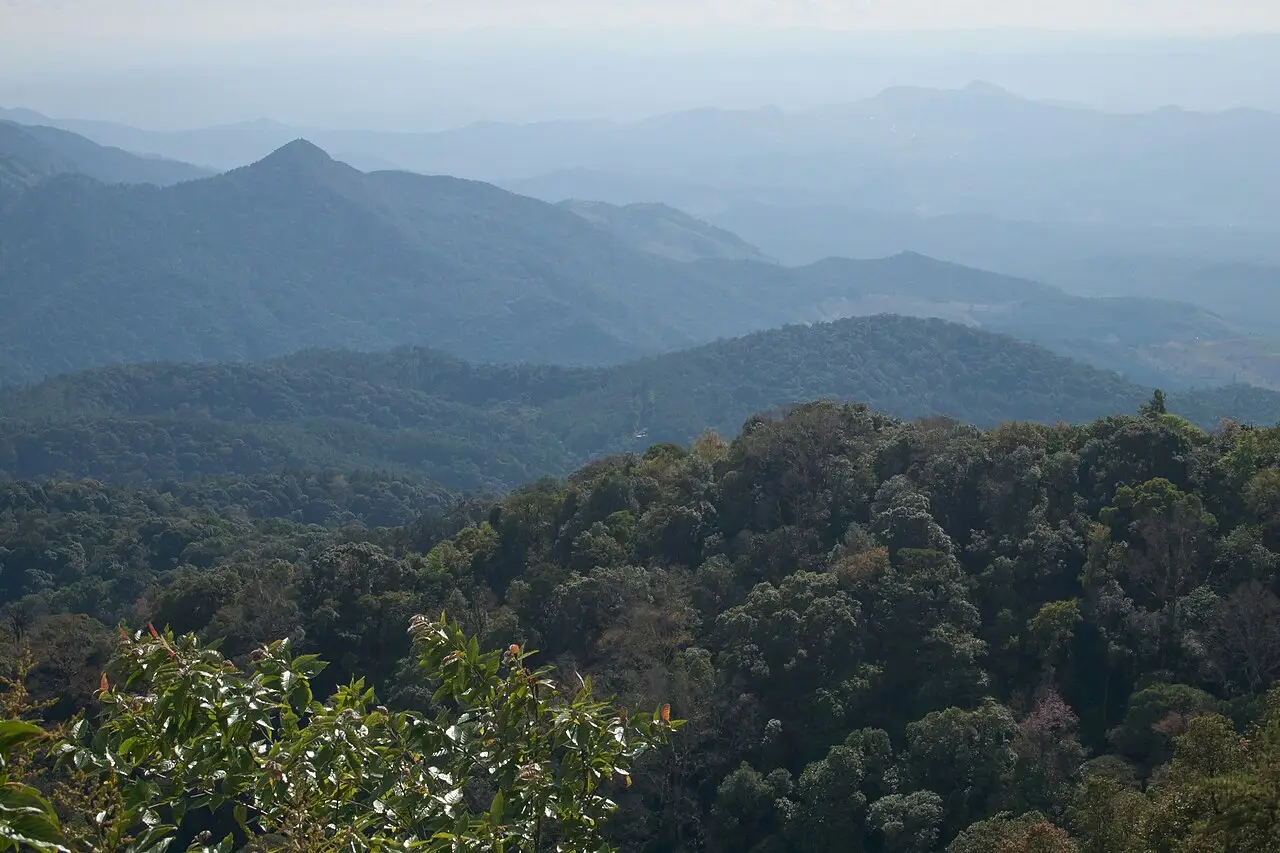
1 hour 45 minutes to 2 hours by car from here, at the country's highest point, 2,565 m above sea level. It has the two royal chedis built in 1987 and 1992, Wachirathan waterfall and the country's only cloud forest; the entry fee for foreigners is around 300 THB.

Chiang Rai and the White Temple
185 km north, 3 to 3.5 hours by van or bus on Route 118. Wat Rong Khun, a work by the artist Chalermchai Kositpipat begun in 1997 and still unfinished, and the Blue Temple (Wat Rong Suea Ten, from 2016) fit into the same day, with the Golden Triangle right after, another 60 km on.
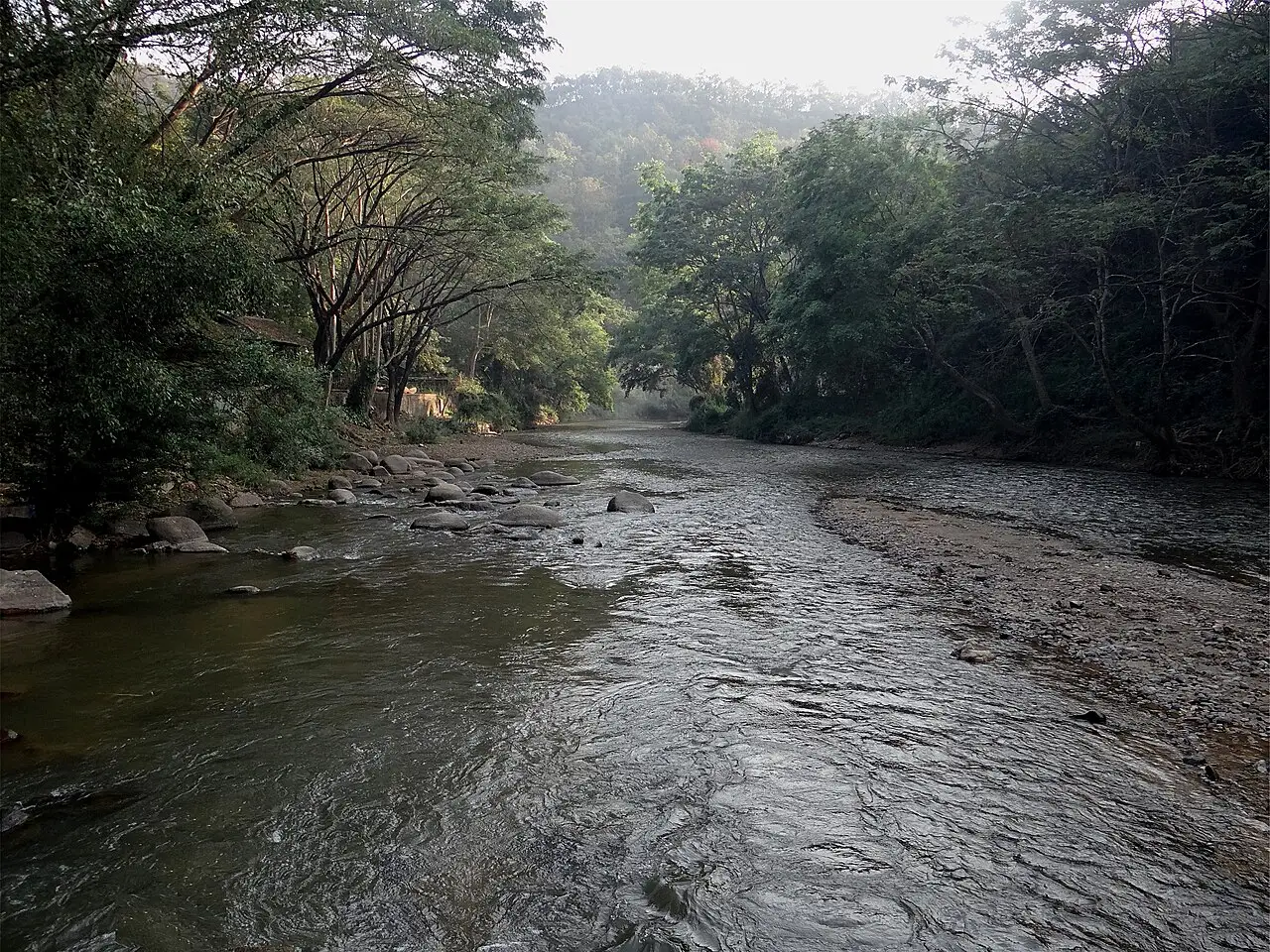
Mae Taeng Valley and elephant sanctuaries
60 to 70 km to the north, about 1 hour by road. It's where the elephant rescue projects set up from 1996 onward are concentrated, and today they offer observation and feeding with no riding; half-day or full-day programs need to be booked days in advance.
Where to begin
Inside the moat
Start at 8am at Wat Chiang Man, the 1296 temple, to see the chedi of fifteen elephants before the heat and the tour buses.
The mountain and the river
Leave at 7am for Wat Phra That Doi Suthep, 15 km and about 40 minutes by shared songthaew; climb the 306 steps before 9am, when the tour groups arrive.
Money
The currency is the baht (THB), at around 32 to 34 to the dollar and 37 to 40 to the euro in 2026, and Chiang Mai is much cheaper than Bangkok. A khao soi costs 50–80 THB, a street dish 40–70, a meal at a sit-down restaurant 150–300, an espresso 25–40 at a stall and 60–90 at a Nimman roastery, and a large beer 70–120. A simple guesthouse runs 400 to 800 THB a night, a mid-range hotel 1,200 to 2,500, and a monthly studio rental in Nimman 9,000 to 18,000. A budget day comes to around 900–1,200 THB and a comfortable day 2,000–3,500. Cash still works for markets, songthaews and stalls; cards work in hotels, malls and larger cafés. ATMs charge a flat fee of about 220 THB per withdrawal with a foreign card, so withdraw large amounts at once, since the fee is the same regardless of the amount, and exchange offices in the center usually give a better rate than the airport. PromptPay QR payment is everywhere, but it requires a Thai bank account. Tipping isn't mandatory: round up the bill, leave 20–50 THB for a massage or a guide, and know that upscale restaurants already include a 10% service charge.
Getting there and around
Chiang Mai Airport (CNX): 4 km from the moat
Chiang Mai International Airport (CNX) is just 4 km southwest of the moat, about 15 minutes by car. There are three ways out. The RTC bus (line R3) charges a flat 30 THB and runs the old city–Nimman loop in 35 to 50 minutes. The official taxi counter is in the arrivals hall, with fares from about 150–200 THB. Grab and Bolt cost 80 to 180 THB to the old city, with a signposted pickup point. The train station is 2.5 km east of the moat and receives the overnight trains from Bangkok, a trip of about 11 to 13 hours; intercity buses use the Arcade Bus Terminal, 3 km to the northeast.
No metro, no train: the light rail has been delayed since 2018
The city has no metro or urban rail. A light rail project has been announced and postponed several times since 2018 and still has no construction underway. The real transportation is the red songthaews (rot daeng), pickup trucks with two benches that work as shared taxis: you flag one down, say your destination through the window and pay 30–40 THB per trip within the city, pressing the buzzer to get off. The buzzer isn't easy to find, and it's common to get off a few blocks past where you wanted. Besides those, there's the RTC network of air-conditioned buses (lines R1, R3 and others, a flat 30 THB, from about 6am to about 11pm, with its own app), tuk-tuks (80 to 150 THB for a short ride, always negotiated in advance) and the Grab, Bolt and InDrive apps, which usually come out cheaper than a tuk-tuk. You can cross the old city on foot from end to end in 25 minutes, but the sidewalks are uneven and often blocked; renting a scooter costs 200–300 THB a day, and the right license is a condition of your insurance, not a formality.
Safety
In Chiang Mai, the biggest risk for visitors is traffic, especially on motorbikes, more than crime. The city has low rates of violent crime and street theft is rare compared with capitals of similar size, but the danger on the streets rises sharply during Songkran week, when alcohol, water on the road and crowded highways produce the country's worst accident rate of the year. The classic scams are predictable, which is why you can sidestep them: the tuk-tuk offering a “20 baht tour” that stops at commission-paying jewelers and tailors, the claim that “the temple is closed today” from someone who wants to take you somewhere else, and the scooter rental shop that charges for old damage when you return it. There are no no-go neighborhoods, but the dark alleys around the Night Bazaar and Loi Kroh after 2am see bar fights and romance-scam approaches. Health has two seasonal risks: dengue in the rainy season, from June to October, and particulate matter between February and April, which weighs on anyone with asthma or COPD or who is pregnant. During that period, check the daily AQI and limit time outdoors at the peaks. Cannabis was decriminalized in 2022 and, since 2025, once again requires a medical prescription to buy: the rules change often and taking it out of the country is still a serious crime. Save the three numbers before you need them: 191 for police, 1669 for ambulance and 1155 for the tourist police, who answer in English.
Etiquette tips
Remove shoes and cover shoulders and knees at temples
Taking off your shoes applies to every ubosot and wihan, and also to many shops, massage parlors and private homes. Keep your feet pointed away from Buddha images when sitting. The correct posture is to sit sideways, with legs folded back.
Never comment on the monarchy
Article 112 of the Thai penal code provides for 3 to 15 years for lèse-majesté and is enforced, including against foreigners and social media posts. Also don't step on notes or coins, which bear the royal effigy.
Women do not touch or hand anything directly to a monk
The object is placed on a cloth or tray that the monk retrieves. On buses and songthaews, yield your seat when a monk boards and avoid sitting beside him.
Keep jai yen: the “cool head”
Raising your voice or showing irritation in public makes the other person lose prestige and locks the negotiation instead of opening it. Complaints are made smiling and in a low voice; silence is a legitimate response.
Don't touch anyone's head, nor point with your foot
Don't touch anyone's head, not even a child's, and don't point with your foot or cross your legs with a foot stretched toward someone. Hand things over and take them with your right hand, supporting your right elbow with your left as a mark of respect.
Return the wai, but don't initiate it with people serving you
The palms-together greeting is hierarchical: whoever is younger or lower in status starts. A slight nod of the head is enough to return it; giving a wai to waiters or children causes embarrassment rather than goodwill.
Mistakes to avoid
Booking March thinking you'll see the mountains
Booking the trip for March thinking you'll see the mountains. It's the peak of smoke season: Doi Suthep disappears into white haze and flights are sometimes diverted. If the date can't move, book lodging with an air purifier and bring an N95 or KN95 mask.
Renting a scooter without a motorcycle license class
Renting a scooter without an international license with a motorcycle category. The fine at a checkpoint is small, but in case of an accident the travel insurance is voided, and traffic is the city's number one risk. Never leave your passport as a deposit: leave a copy and a cash deposit, and photograph every scratch before leaving the shop.
Treating the songthaew like a private taxi
Treating the red songthaew like a private taxi. It's a shared ride: ask the price through the window before getting in, expect 30–40 THB per stretch within the city, and count on detours to pick up other passengers. Agreeing to “two hundred baht” to cross the old city is paying five times the fare, a common mistake for whoever forgets to ask first.
Mae Taeng has sanctuaries with no riding
Buying an elephant-back ride. Riding requires breaking the animal's behavior, and since the 2010s there have been observation-only sanctuaries in Mae Taeng and the Mae Wang valley, with no riding and no shows: check whether the program allows forced bathing or performances before booking.
In the north, sticky rice is eaten by hand
Expecting the Thai food of Bangkok. In the north people eat sticky rice with their hands, sweetness is rare, coconut milk barely appears outside khao soi and roasted chili pastes dominate the table. Khao soi shops, moreover, traditionally open only for lunch and close in mid-afternoon.
Useful phrases
สวัสดีครับ / สวัสดีค่ะ (sa-uat-dii KRÁP / KÁ)
Hello: men end the sentence with khráp, women with khâ; the particle is mandatory to sound polite
สวัสดีเจ้า (sa-uat-dii TCHÁO)
Hello in kam mueang, northern Thai: jao replaces khráp/khâ and almost always earns a smile
ขอบคุณครับ / ค่ะ (kóp-kun KRÁP / KÁ)
Thank you
เท่าไหร่ (tau-RÁI)
How much does it cost: the question asked through the window before getting into the songthaew
ไม่เผ็ด (mái PÉT)
No chili: in Chiang Mai the request tends to actually be taken seriously
ไม่เป็นไร (mái pen RAI)
No problem, never mind: it closes out practically any friction of the day
Districts
Old City (inside the moat)
Square of about 1.5 km per side surrounded by the moat and remnants of brick wall, with Wat Phra Singh, Wat Chedi Luang and Wat Chiang Man. Concentrates guesthouses, cooking schools, agencies and the highest density of active temples in the country.
Nimmanhaemin (Nimman)
A grid of numbered streets (soi 1 to 17) west of the moat, right next to Chiang Mai University. Cafés that roast their own beans, coworking spaces, condos and the MAYA and One Nimman complexes. It's where most remote workers live.
Wat Ket and Charoenraj
East bank of the Ping River, old neighborhood of Chinese, Burmese and Muslim merchants of the 19th century. Teak mansions, galleries, the flower market and the Protestant cemetery opened by American missionaries.
Chang Klan and Night Bazaar
The corridor of hotels and the night market between the moat and the river, which runs every night from about 6pm to 11pm. It brings together Anusarn Market, food courts and the shops most geared to package tourism.
Wua Lai
The silversmiths' street south of the moat, with Wat Sri Suphan and its ubosot clad in silver and embossed aluminum, a project begun in 2004. It hosts the Saturday night market.
Santitham
Residential neighborhood north of Nimman, no large hotels, street kitchens, dawn markets and rents well below Nimman. It is the best measure of the city's true price.
Chang Phueak
The north gate of the old city and the square of night stalls known for the khao kha moo served since the 1990s by a vendor in a cowboy hat. It's also where songthaews leave for Mae Rim and the north.
Hang Dong, San Kamphaeng and Mae Rim
Rural belt within a radius of 10 to 25 km, with ceramics workshops, Bo Sang paper umbrella village, hot springs, viewpoint cafés and the majority of elephant sanctuaries.
History
7th–13th centuries · The Mon kingdom of Haripunchai
The Ping River plain was controlled by Haripunchai, a Mon-language kingdom with its capital at present-day Lamphun, 26 km south. Its Buddhist tradition and brick architecture were absorbed by the Thai conquerors.
1281 · Mangrai takes Haripunchai
King Mangrai, of the Thai principality of Ngoen Yang (Chiang Saen), conquers Haripunchai and begins to control the valley. Before settling, he founds Wiang Kum Kam by the Ping, abandoned because of flooding.
1296 · Founding of Chiang Mai
Mangrai founds the “new city” (chiang mai) with a square of wall and moat, advised by allied kings Ngam Mueang, of Phayao, and Ram Khamhaeng, of Sukhothai. The first temple, Wat Chiang Man, is built in the same year.
1441–1487 · Apogee under Tilokarat
The Lanna kingdom reaches its greatest extent and disputes territory with Ayutthaya. In 1477 Tilokarat hosts at Wat Chet Yot a council that revises the Pali canon, and the chedi of Wat Chedi Luang is enlarged to about 80 m.
1545 · The earthquake and the broken chedi
An earthquake brings down the top of the Wat Chedi Luang chedi, reducing it to the truncated silhouette it has today. The Emerald Buddha, housed there since 1468, would be taken to Luang Prabang in 1551.
1558–1774 · Two centuries of Burmese rule
King Bayinnaung takes Chiang Mai in 1558 and Burma rules Lanna for more than two hundred years. The period leaves lasting marks on the cuisine (gaeng hang lay), architecture and family names.
1775–1796 · Abandonment and refounding by Kawila
With the Burmese expelled with Taksin's support, the city stayed practically empty for twenty years. Kawila repopulated it by force in 1796, bringing entire populations of Shan, Lue and Khoen: a policy remembered as “put vegetables in the basket, put people in the city”.
1874–1899 · Absorption by Siam
Bangkok installs commissioners to control teak concessions disputed by British companies and, in 1899, dissolves Lanna's autonomy, integrating the region into the monthon Phayap. American Presbyterian missionaries, arrived in 1867, open the first modern schools and hospitals.
1921 · The railway arrives from Bangkok
The railway from Bangkok, about 750 km, reaches the city, cutting a journey once made by boat and elephant from weeks to just over a day. The city starts to receive trade, officials and, decades later, tourists.
1939 · End of the princely line
Kaew Nawarat, the last titular prince of Chiang Mai, dies in the same year Siam becomes Thailand. Local administration becomes entirely provincial.

1964–today · University, tourism and smoke
Chiang Mai University opens in 1964 and creates the Nimmanhaemin axis; the city celebrates 700 years in 1996 and enters the Unesco tentative list in 2015. Since the 2010s it has lived with the boom of remote workers and the annual PM2.5 crisis between February and April.
Complete history
Mangrai avoids the floods of Wiang Kum Kam
Chiang Mai was born from an engineering decision. King Mangrai had already tried to settle at Wiang Kum Kam, a few kilometers to the south, and gave it up because the Ping River flooded the site every year. The ruins are still there, buried under two meters of sediment and excavated since 1984. In 1296 he chose higher ground between the Ping and Doi Suthep mountain and laid out a walled square with a moat, oriented so the mountain would shield the west flank. That square is why the city center still has the shape it has today: four sides of about 1.5 km, five gates and traffic that circles a rectangle of water.
Two and a half centuries as its own kingdom
For two and a half centuries Lanna was a kingdom of its own, with a script, calendar, language and monastic school distinct from those of Sukhothai and Ayutthaya. The high point was the reign of Tilokarat (1441–1487), who enlarged the chedi of Wat Chedi Luang to something around 80 meters and in 1477, at Wat Chet Yot, convened a council to revise the Buddhist Pali canon, a gathering that northern Thai monks still cite. The fall was swift: in 1558 the Burmese king Bayinnaung took the city almost without a fight, and Chiang Mai spent more than two hundred years under Burmese administration. That period still shows up on the table: gaeng hang lay, a pork curry with ginger and tamarind and no coconut milk, is a direct legacy of Burmese cooking.
Abandonment and Kawila's rebuilding (1775–1796)
The expulsion of the Burmese, between 1774 and 1775, left the city so devastated that it was simply abandoned for about twenty years. It was Kawila who rebuilt it, reoccupying the walled square in 1796 and repopulating it with people brought by force from Kengtung, Chiang Saen and the Salween valley: Shan, Lue, Khoen, Yong. The diversity of surnames, dialects and temple styles in the north comes from that policy, summed up in the period phrase “put vegetables in the basket, put people in the city”. Chiang Mai came back into existence as a tributary state of Bangkok, ruled by local princes.
Autonomy ended over timber
The region's autonomy ended after disputes over teak logging. Starting in the 1870s, British companies from Rangoon and Moulmein began logging teak in the north, and the legal disputes between them and the local princes gave Bangkok the pretext, and the diplomatic pressure, to intervene. Siamese commissioners arrived in 1874, taxation and justice were centralized, and in 1899 Lanna formally stopped being a separate state, becoming the monthon of Phayap. The 1921 railway sealed the integration: what had been a weeks-long trip upriver became an overnight train ride. In 1939 Kaew Nawarat, the last titular prince, died, and that same year the country changed its name.
The 1964 university creates the Nimman district
Today's Chiang Mai organized itself in three waves. Chiang Mai University, opened in 1964 as the first outside the capital, created the Nimmanhaemin neighborhood and a local class of architects, artists and cooks. International tourism arrived in the 1980s and 1990s and transformed commerce inside the moat. The city celebrated its 700th anniversary in 1996 and entered Unesco's tentative list in 2015. The third wave, from the 2010s, brought remote work and new neighborhood life: shared offices, residential buildings and cafes that roast their own beans, pushing up rents in Nimman and Santitham. Over all of this hangs the issue that has dominated the public agenda since around 2015: between February and April, agricultural burning and forest fires in the valley and in neighboring countries push PM2.5 to levels that have put Chiang Mai at the top of the world's most polluted cities list several times, including in March 2026.
Before Chiang Mai, King Mangrai founded Wiang Kum Kam, 5 km to the south, and abandoned it because the Ping River flooded the whole place every year.
The historic center is a square of about 1.5 km on each side, ringed by a moat, that Mangrai laid out in 1296.
Geography and shape of the city
The valley and the range to the west
Chiang Mai sits in an intermontane valley at about 310 m above sea level, on the west bank of the Ping River, a tributary that, farther south, forms the Chao Phraya. To the west rises the steep Doi Suthep-Pui massif, with the Doi Pui peak at 1,685 m and the Doi Suthep temple at about 1,070 m; to the southwest, about 100 km away, is Doi Inthanon, Thailand's highest point at 2,565 m.
The closed basin, the cold, and the smoke
Because it sits in a basin closed in by mountains, Chiang Mai has two phenomena tied to its terrain: in winter, cold air pools at the bottom of the valley and mornings drop to 13–17 °C, and between February and April the same temperature inversion traps the smoke from burning for weeks.
The three rings and the seismic edge
The urban fabric has three concentric rings: the 1296 walled square with its moat, the immediate ring road and the Superhighway (route 11), which closes an outer ring. Beyond it, growth has spread through Hang Dong, San Sai, Saraphi and Mae Rim in low-density subdivisions, linked by two- to four-lane roads. The region is moderately seismically active. The magnitude 6.1 earthquake in Mae Lao, in neighboring Chiang Rai province, in 2014, and the magnitude 7.7 one in Myanmar, in March 2025, were felt strongly in the city.
Culture
Lanna identity survives in the city's everyday practice
Chiang Mai is the center of Lanna identity, which survives less as folklore and more as everyday practice. The language spoken at home is kam mueang, with the final particle jao instead of khrap and kha, and its own script, tai tham, which still appears on temple signs and in monastic manuscripts. The Lanna calendar runs two months ahead of central Thailand's, and the name of the lantern festival shows it: Yi Peng means “full moon of the second month” by the Lanna count, the same moon that falls in the twelfth month in Bangkok. The music that best captures this identity is that of Jaran Manopetch (1951 to 2001), a Chiang Mai singer who in the 1970s and 1980s put kam mueang into folk songs and became a staple at every live-music venue in the city.
Lacquer, celadon and Bo Sang umbrellas: the workshops of San Kamphaeng
Crafts are still made here, in workshops in the San Kamphaeng and Hang Dong belt: lacquerware, silver, celadon ceramics, silk, teak carving and the sa paper umbrellas of Bo Sang, made since the 19th century. From the 2000s this base drew designers and architects, and the city has hosted Chiang Mai Design Week in December since 2014. The contemporary art scene has older roots, in the Faculty of Fine Arts at Chiang Mai University and the Chiang Mai Social Installation group, active between 1992 and 1998. Filmmaker Apichatpong Weerasethakul, winner of the Palme d'Or in 2010, keeps his production company in the city.
More than 300 temples, with drums at 5am
Religious life shapes the calendar more than any cultural agenda. There are more than 300 temples in the urban area; most ring the drum around 5am, and the alms line for monks happens before 7am on nearly every residential street. Universities give the city about 100,000 students, which supports a scene of small bars and live music in Nimman and along Huay Kaew, without Bangkok's scale: most bars close their doors before 1am.
Almost everything closes early for anyone hoping to keep the night going: most bars pull down their shutters before 1am.
Festivals and events

Songkran (April 13 to 15)
Thai New Year, celebrated in Chiang Mai with the greatest intensity in the country and for up to six days in practice. The moat becomes a water reservoir for collective battle, but the core of the ritual is bathing Buddha images and pouring water on the hands of elders.

Loy Krathong and Yi Peng (full moon of the 12th lunar month, in November or late October)
They fall on the full moon of the 12th month of the Thai lunar calendar: in November most years, and sometimes in late October. Two overlapping festivals: banana-leaf krathong float down the Ping River and paper khom loi lanterns rise into the sky. Lantern releases are restricted, for air-safety reasons, to authorized dates and areas. Airport flights are suspended during specific windows and the big mass releases are paid events held outside the city.

Flower Festival (first weekend of February)
Parade of floats covered in chrysanthemums and night-blooming jasmine between Nawarat gate and Suan Buak Hat park, held since 1977. Marks the end of the cold season, when the valley is at its peak bloom.
 AI illustration
Inthakin / Sai Khan Dok (May or June)
A six- to eight-day ritual around the city pillar kept at Wat Chedi Luang, when residents line up to lay flowers on trays and pray for rain for the coming season. It's the most local festival on the calendar and barely shows up on tourist itineraries.
 AI illustration
Chinese New Year (January or February)
Celebrated on the Warorot–Charoenraj axis, heritage of Chinese merchant families settled on the Ping bank since the 19th century, with lion dances, street altars and the market open late.
Books and films
The Chiang Mai Chronicle (Tamnan Phuen Mueang Chiang Mai), translation by David Wyatt and Aroonrut Wichienkeeo
The chronicle compiled by local monks in the 19th century, narrating the 1296 founding, the Burmese siege and Kawila's refounding. It is the source from which almost all the dates the city repeats about itself come.
Jaran Manopetch, songs in kam mueang (1970s–1990s)
The folk repertoire of the Chiang Mai singer who brought the northern dialect to record and created the sound that still plays in the city's bars. Hearing “Sao Chiang Mai” explains more about the local self-image than any museum.
Uncle Boonmee Who Can Recall His Past Lives (Apichatpong Weerasethakul, 2010)
Palme d'Or at Cannes, filmed in the northeast but directed by someone who keeps the production company in Chiang Mai. It is the best entry point to the Thai relationship between forest, spirits and Buddhism, which in the city you see in the spirit houses on every sidewalk.
Frequently asked questions
Chiang Mai: Booking March thinking you'll see the mountains?
It's the peak of smoke season: Doi Suthep disappears into white haze and flights are sometimes diverted.
Chiang Mai: Chiang Mai Airport (CNX): 4 km from the moat?
The RTC bus, line R3, leaves from the airport, 4 km from the moat, and for a flat 30 THB reaches the old city and Nimman in 35 to 50 minutes; with a big suitcase or in a hurry, Grab and Bolt run 80 to 180 THB.
Chiang Mai: money?
The currency is the baht (THB), at around 32 to 34 to the dollar and 37 to 40 to the euro in 2026, and Chiang Mai is much cheaper than Bangkok.
Chiang Mai: Take off your shoes and cover shoulders and knees at temples?
Taking off your shoes applies to every ubosot and wihan, and also to many shops, massage parlors, and private homes.
Chiang Mai: safety?
In Chiang Mai, the biggest risk to visitors is traffic, especially motorbikes, more than crime.
Other cities in the country
Thailand ↗- Days
- 3–4
- When
- Jan–Feb · Nov–Dec
- Per person/day
- Average 2,500–4,500 THBMid-range · per person/day
Cost scope
Per person per day: accommodation, meals, urban transport, visits and a small allowance for extras. Flights excluded; larger purchases vary. Editorial estimate, not a quote.
- Days
- 3–4
- When
- Jan–Mar · Dec
- Per person/day
- Average 4,420 THBMid-range · per person/day
Cost scope
Per person per day: accommodation, meals, urban transport, visits and a small allowance for extras. Flights excluded; larger purchases vary. Editorial estimate, not a quote.


Itineraries through here
 Thailand, Cambodia and Vietnam in 15 daysThe grand Indochina loopBangkok · Chiang Mai · Siem Reap · Ho Chi Minh City · Hanoi12–16 days5 cities
 Thailand in 7 daysFrom the Chao Phraya to Chiang MaiBangkok · Chiang Mai5–7 days2 cities
 Thailand and Vietnam in 10 daysMarkets and temples of Southeast AsiaBangkok · Chiang Mai · Hanoi · Ho Chi Minh City9–13 days4 cities
 Thailand in 10 daysThe Grand Palace, khao soi and Phang Nga BayBangkok · Chiang Mai · Phuket8–11 days3 cities