
Thailand
Bangkok
Bangkok brings together Buddhist temples and street food
Days Start with the basic programme and choose extensions for the time you have.
How the guide reaches this number
The first is for Rattanakosin and the river; the second, for Siam and Lumphini, among malls, covered skywalks and the park; the third, for Thonburi or Chatuchak and Talat Noi; with a fourth day, go to Ayutthaya, the capital destroyed in 1767. It's not a city to wander on foot without a plan, because the narrow sidewalks are fought over by stalls and motorbikes, and the heat weighs on any walk over 1.5 km. With a single day, enter the Grand Palace at 8:30am and walk ten minutes to Wat Pho. From Tha Tien pier, cross by boat to Wat Arun and climb to the prang terrace before 4pm. After 6pm, take the metro to Wat Mangkon and have dinner in Yaowarat, trying soup, noodles and dessert at three stalls. Don't expect the “Venice of the East” of the brochures: most of the canals became avenues, and the khlongs that remain serve as transport for people who live in the city. The canal trip from the photos is outside the city, on a weekend day trip to Amphawa.
3–4
When November to February, dry, 21–33 °C
How the guide reaches this number
The climate has three seasons. The cool, dry season runs from November to February, with lows of 21–24°C, highs of 31–33°C and lower humidity: it's high season, with pricier hotels and crowded temples. March to May brings the heat, with highs of 35–40°C and a heat index above that; April is the hottest month of the year and brings Songkran, when a lot shuts for three days. The southwest monsoon brings rain from May to October, in heavy late-afternoon downpours that last one or two hours; September and October are the wettest months, with around 300 to 350 mm each, and flooding in low-lying streets. Avoid this period if walking is part of the plan, although it's also the cheapest time to travel. Between December and March, fine particulate pollution (PM2.5) rises with regional crop burning and thermal inversion, and on the worst days the sky turns visibly white, to the point that schools suspend outdoor activities; anyone with respiratory problems should check the index before going out.
Per person/day 900–1,500 baht budget; 2,500–4,500 comfortable
How the guide reaches this number
Per person per day: accommodation, meals, urban transport, visits and a small allowance for extras. Flights excluded; larger purchases vary. Editorial estimate, not a quote.
 What Nilo thinks
Bangkok calls for three days, one for each part of the city. The first is for Rattanakosin and the river; the second, for Siam and Lumphini, among malls, covered skywalks and the park; the third, for Thonburi or Chatuchak and Talat Noi; with a fourth day, go to Ayutthaya, the capital destroyed in 1767. It's not a city to wander on foot without a plan, because the narrow sidewalks are fought over by stalls and motorbikes, and the heat weighs on any walk over 1.5 km. With a single day, enter the Grand Palace at 8:30am and walk ten minutes to Wat Pho. From Tha Tien pier, cross by boat to Wat Arun and climb to the prang terrace before 4pm. After 6pm, take the metro to Wat Mangkon and have dinner in Yaowarat, trying soup, noodles and dessert at three stalls. Don't expect the “Venice of the East” of the brochures: most of the canals became avenues, and the khlongs that remain serve as transport for people who live in the city. The canal trip from the photos is outside the city, on a weekend day trip to Amphawa.In Bangkok, at the foot of every office tower there's a spirit house with rice, jasmine, and red soda renewed every day, and the same street devotion sustains the city's roughly 400 temples. In Rattanakosin, the island founded in 1782, stand the Emerald Buddha at the Grand Palace and the 46 m Reclining Buddha at Wat Pho, and on the far bank of the Chao Phraya, Wat Arun is covered in shards of Chinese porcelain. The boats that cross the river are still transport for the people who live along it, even after most of the canals became avenues. Street food is the other reason to come: pad thai, som tam pounded in a mortar, boat noodles, and, in Yaowarat, the Chinese quarter, a dinner sampled at three different stalls. Come between November and February, the cool, dry season, and set aside three days, or four with the Ayutthaya day trip.
Quick facts
- Population
- about 9 million in the municipality (official registration about 5.5 million), about 17.5 million in the metropolitan region
- Founding
- April 21, 1782 (Rattanakosin); Bang Makok settlement since the 16th century
- Country and region
- Thailand, central plain of the Chao Phraya River
- Language
- Thai, tonal, own script with 44 consonants; functional English in tourist areas
- Currency
- Baht (THB, ฿); about 32–35 per US dollar and about 37–40 per euro in 2026
- Time zone
- ICT, UTC+7, no daylight saving
- Best time to visit
- November to February, dry, 21–33 °C
- Average daily cost
- 900–1,500 baht budget; 2,500–4,500 comfortable
When to go
November to February, dry, 21–33 °C
March
26° to 35°C
51 mm of rain
April
27° to 36°C
93 mm of rain
May
27° to 35°C
217 mm of rain
June
26° to 34°C
199 mm of rain
July
26° to 34°C
190 mm of rain
August
26° to 33°C
227 mm of rain
September
25° to 33°C
336 mm of rain
October
25° to 33°C
289 mm of rain
How the year changes
The climate has three seasons. The cool, dry season runs from November to February, with lows of 21–24°C, highs of 31–33°C and lower humidity: it's high season, with pricier hotels and crowded temples. March to May brings the heat, with highs of 35–40°C and a heat index above that; April is the hottest month of the year and brings Songkran, when a lot shuts for three days. The southwest monsoon brings rain from May to October, in heavy late-afternoon downpours that last one or two hours; September and October are the wettest months, with around 300 to 350 mm each, and flooding in low-lying streets. Avoid this period if walking is part of the plan, although it's also the cheapest time to travel. Between December and March, fine particulate pollution (PM2.5) rises with regional crop burning and thermal inversion, and on the worst days the sky turns visibly white, to the point that schools suspend outdoor activities; anyone with respiratory problems should check the index before going out.
The same numbers as a table
| Month | Temperature °C | Rain mm |
|---|---|---|
| January · | 23 to 33 | 24 |
| February · | 25 to 34 | 21 |
| March | 26 to 35 | 51 |
| April | 27 to 36 | 93 |
| May | 27 to 35 | 217 |
| June | 26 to 34 | 199 |
| July | 26 to 34 | 190 |
| August | 26 to 33 | 227 |
| September | 25 to 33 | 336 |
| October | 25 to 33 | 289 |
| November · | 25 to 33 | 45 |
| December · | 23 to 32 | 12 |
Nilo's tips
Grand Palace opens 8:30; ignore claims that it's closed
The palace opens every day, and anyone on the sidewalk insisting it's closed today is offering a 20-baht tuk-tuk to a jewelry store. The hours are 8:30am to 3:30pm, with the only ticket office inside the main gate. Wear clothes that cover shoulders and knees and bring 500 baht for admission. Arrive at opening time, because by ten the line at Wat Phra Kaew has stalled and the stone floor is already hot.
From 4pm to 8pm, go by boat or motorbike, never by car
Between 4pm and 8pm, when the avenues jam up, the Saen Saep canal boat keeps moving on the water. Board at Hua Chang, next to the Jim Thompson House: Pratunam is a few minutes away, and the same line continues east to Asok and Thonglor, a stretch where the advantage over the car only grows. The fare is 10 to 20 baht. The boat pulls in, lowers the tarp against the spray, and leaves within seconds, so wait standing near the edge. For the last stretch inside the soi, the orange-vested motorcycle taxi charges 20 to 60 baht and hands you the helmet, mandatory for the passenger.
The express boat costs 16 baht; the ICONSIAM boat is free
The orange-flag express charges 16 baht and stops at the same piers as the tourist boat, which charges 30 to 60 for onboard commentary. For the west bank, the ICONSIAM mall runs a free boat from Sathorn pier. The mall's terrace doesn't charge admission either and gives an open view over the river. With that option, I wouldn't pay for the glass-floor observation deck at Mahanakhon tower.
Chatuchak opens Saturday and Sunday; arrive by metro
On weekdays, most stalls are closed, and all that's left is the market's empty frame. Get off at Kamphaeng Phet metro station, which opens right inside the market, and go in through section 26, because through any other door the maze of alleys repeats itself and it's easy to get lost. Work your way in a spiral from there, and set aside three hours for the antiques and handicraft sections, the most popular ones. Go before noon, because the tin roof turns into an oven once the sun is high.
Withdraw a lot at once: the ATM always charges 220 baht
The fee per withdrawal doesn't change with the amount: taking out 2,000 or 20,000 baht with a foreign card costs the same. So withdraw the money for the trip in one go and avoid repeating the transaction. To change cash, the Superrich and Vasu exchange offices pay more than banks and the airport.
Eat on the street by the clock: moo ping early, boat noodles at lunch, Yaowarat after 6pm
Bangkok's street food changes throughout the day. Early in the morning, look for charcoal-grilled moo ping, which costs 10 to 15 baht with a little bag of sticky rice, and at lunch head to the stalls around Victory Monument, where boat noodles go for 15–25 baht a bowl and the bill is tallied by the stack of empty bowls on the table. In the evening, go to Yaowarat, a street of gold shops by day that only turns into a food street after 6pm: get off at Wat Mangkon metro station, opened in 2019, and eat at three different stalls instead of sitting at just one.
Explore the map

© OpenStreetMap · OpenFreeMap · © OpenMapTiles
Explore the map, read about the other places and plan your travel days in the app.
Open the appWhat to see
Bangkok: the delta plain and the river
Bangkok occupies the Chao Phraya delta plain, and the river, which runs 372 km from its confluence at Nakhon Sawan, cuts through the city in tight bends and separates Phra Nakhon, on the east bank, from Thonburi, to the west. On the east bank lies Rattanakosin, the historic island ringed by the 1782 canals, home to the Grand Palace, Wat Pho, Sanam Luang, the National Museum, and the ministries.
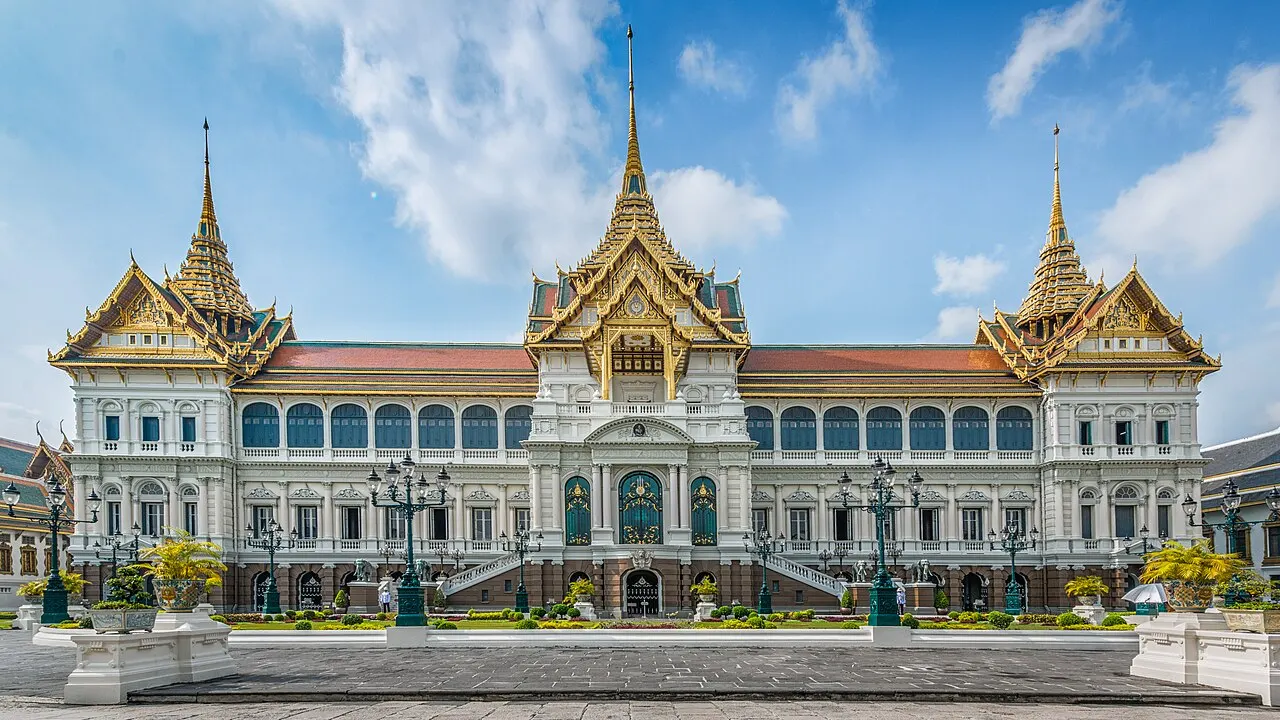
Grand Palace and Wat Phra Kaew
A 218,000 m² complex built starting in 1782, a royal residence until 1925 and the venue for state ceremonies. It holds the Emerald Buddha, a 66 cm jade image whose robe the king changes three times a year; admission is around 500 baht, open daily 8:30am to 3:30pm, with shoulders and knees covered.
It was the royal residence until 1925 and still hosts state ceremonies, and the king changes the robe of the 66-cm jade image three times a year.
Check access

Wat Pho
Next to the Grand Palace, Wat Pho holds the Reclining Buddha, 46 m long and 15 m high, with mother-of-pearl soles showing the 108 auspicious signs. Since 1955 the temple has housed the national school of Thai massage, and a one-hour session costs 400–500 baht.
Check access

Wat Arun
On the Thonburi bank, the central prang, about 70 m tall, is covered in shards of Chinese porcelain that arrived as ship ballast in the 19th century. Restored between 2013 and 2017; steep steps climb to the first terrace.
The central prang, about 70 m tall and restored between 2013 and 2017, is covered in shards of Chinese porcelain that arrived as ship ballast, and the climb up steep steps only goes as far as the first terrace.
Check access
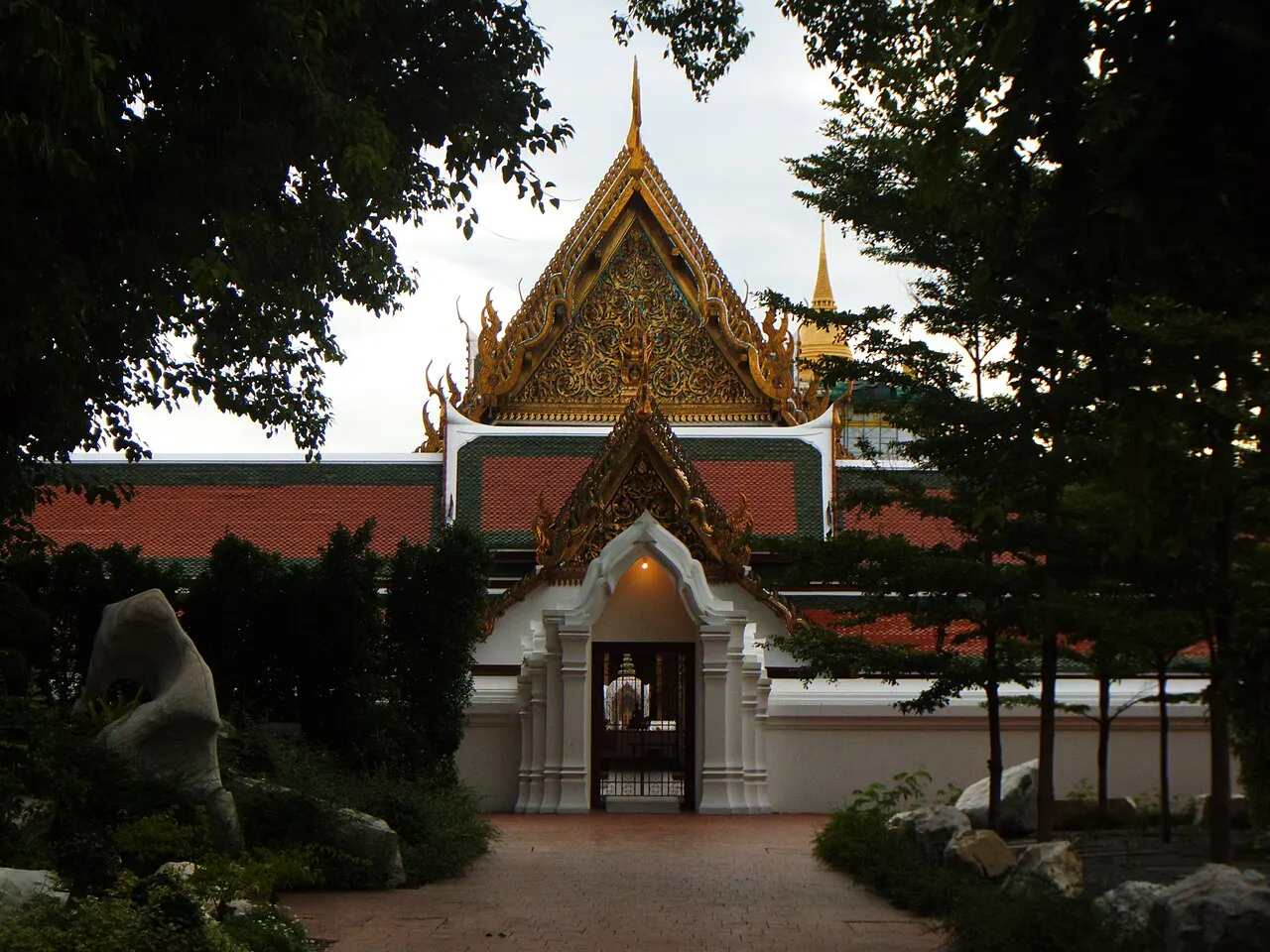
Wat Saket, the Golden Mount
An artificial hill about 58 m tall, built over a chedi that collapsed in the 19th century, with more than 300 steps spiraling up to the golden chedi at the top. It’s the old city’s best viewpoint and the center of a temple fair in November.
The artificial hill, about 58 m high and formed over a collapsed chedi, climbs more than 300 steps in a spiral to the golden chedi at the top, the lookout over the old city.
Check access

Wat Traimit
On the edge of Chinatown, it displays a solid gold Buddha, 3 m tall and about 5.5 tons. The image spent centuries covered in stucco and was only identified in 1955, when the coating cracked during a move.
Check access

Jim Thompson House
Six teak houses dismantled upcountry and reassembled in 1959 by a former American OSS officer who revived the Thai silk industry and disappeared in Malaysia in 1967. The visit is guided, lasts about 40 minutes, and includes a Southeast Asian art collection.
The teak houses were brought from the countryside and reassembled in 1959 by the man who revived Thai silk before vanishing in Malaysia in 1967, and the guided tour takes about 40 minutes.
Check access

Chatuchak Market
About 15,000 stalls spread across 27 sections, open mainly Saturday and Sunday, 9am to 6pm. It sells everything from plants to furniture; the antiques and crafts sections draw the most people, and Kamphaeng Phet metro station sits right inside the market.
With about 15,000 stalls, it sells everything from plants to furniture, and Kamphaeng Phet MRT station is inside the market. It opens Saturday and Sunday, 9am to 6pm; arrive early, before the midday heat.
Check access

Lumphini Park
About 57 hectares donated by Rama VI in the 1920s, with a paddleboat lake, tai chi classes at dawn, and water monitor lizards up to 2 m long roaming freely. It opens at 4:30am and closes at 9pm, and it's downtown's main open space.
It's downtown's main open space, about 57 hectares, with a paddleboat lake, tai chi at dawn, and big monitor lizards roaming freely. It opens at 4:30am and closes at 9pm.
Check access

Erawan Shrine
Built in 1956 to undo the bad luck blamed on the construction of the neighboring hotel, it became the city’s busiest altar, with lakhon chatri dancers hired by those whose wishes were granted. It survived a bombing in August 2015 and reopened within two days.
It's a stop on the covered skywalk between Siam and Chit Lom, not a destination: a 1956 shrine built to undo the bad luck of the neighboring hotel's construction, wedged between malls. Pass it on the way somewhere else, without planning the afternoon around it.
Check access
Nilo’s itinerary
Start with the basic programme and choose extensions for the time you have.
Plan my days in the app ↗Day 1 · Rattanakosin and the river
Enter the Grand Palace and Wat Phra Kaew at 8:30am, when they open, with shoulders and knees covered: admission is around 500 baht, and the complex takes about two hours.
Walk ten minutes to Wat Pho to see the 46 m Reclining Buddha and book a one-hour massage at the temple school, for 400–500 baht.
Take the crossing boat from Tha Tien pier to Wat Arun, and climb to the prang terrace before 4pm.
Head back on the orange-flag express boat (16 baht) to Tha Chang or Phra Athit and spend the late afternoon by the river, on Phra Athit street, in Banglamphu.
After 6pm, get off at Wat Mangkon metro station and explore Yaowarat on foot, trying soup, noodles and dessert at three different stalls.
Day 2 · Jim Thompson, the Saen Saep canal and Siam
Start the morning at the Jim Thompson House, five minutes from BTS National Stadium station, with the 40-minute guided tour.
Take the Saen Saep canal boat from Hua Chang to Pratunam, for 10–20 baht, and wander through the wholesale clothing market.
Spend the afternoon at BACC, across from MBK, and follow the covered skywalk that links Siam to Chit Lom, stopping at the Erawan Shrine.
In the late afternoon, walk through Lumphini Park, between the lake and water monitors up to 2 m long, or take the free boat from Sathorn pier to the ICONSIAM terrace, which shows off the river and the sunset from above with no admission fee.
In the evening, watch muay thai at Rajadamnern, the 1945 arena, or at Lumpinee, which moved to Ram Intra in 2014: bouts run five rounds with live flute and drums. Each arena has its own schedule, so check its website for which nights have fights that week, and expect foreigner tickets between 1,000 and 2,000 baht.
Day 3 · The west bank and markets
If it’s Saturday or Sunday, start at Chatuchak at opening time, via the Kamphaeng Phet metro station, and set aside three hours.
On a weekday, swap it for a longtail boat ride on the Bang Luang khlongs in Thonburi, with a stop at Baan Silapin, an artists’ house with puppet theater.
Have khao ka mu or boat noodles for lunch at the stalls around Victory Monument.
In the afternoon, walk through Talat Noi and along Charoen Krung, among Sino-Portuguese shophouses, mechanics' workshops and the galleries of Warehouse 30.
At night, head up to one of the hotel rooftop bars in Sathorn, which show Bangkok lit up from above for far less than the SkyWalk on the 78th floor of Mahanakhon.




If you stay longer
Day 4 · Ayutthaya
Day trip
Ayutthaya holds the ruins of the capital that preceded Bangkok, seat of a kingdom that lasted 417 years until the Burmese army destroyed it in 1767. The train leaves from Krung Thep Aphiwat central station, takes 1 hour 20 minutes to 2 hours and costs 15 to 350 baht depending on class, and vans cover the route in about 1 hour 30 minutes; outside Ayutthaya station you can rent a bicycle to get around the ruins.
Food
 AI illustration
Pad thai
Stir-fried rice noodles with tamarind, palm sugar, nam pla, egg, tofu, and dried shrimp. It was promoted by the Phibun government in the 1940s as a national dish to cut rice consumption; 60–120 baht on the street.
 AI illustration
Som tam
A salad of shredded green papaya, pounded in a mortar with garlic, chili, lime, palm sugar, and fish sauce. The Isan version adds salted crab and fermented pla ra fish; ask for “tam thai” if you want the sweeter variant, with peanuts.
 AI illustration
Kuaitiao ruea, boat noodles
Boat noodles seasoned with strong herbs and, traditionally, a dash of pork blood, served in deliberately small bowls so customers order more than one.
 AI illustration
Khao man kai
Poached chicken served over rice cooked in the same broth, with a sauce of fermented soybean paste, ginger, and chili. The Thai version of the Hainanese dish, 50–70 baht; you’ll spot the stall by the whole chickens hanging in the glass case.
 AI illustration
Tom yam kung
A sour, spicy shrimp soup with lemongrass, galangal, kaffir lime leaf, and chili paste. It comes in a clear version (nam sai) and a creamy one with evaporated milk (nam khon); 120–250 baht at a sit-down restaurant.
 AI illustration
Khao ka mu
Pork knuckle simmered for hours in soy sauce and five-spice, sliced over rice with a boiled egg and pickled mustard greens. A late-afternoon and late-night dish, 50–80 baht, recognizable by the steaming pot on the sidewalk.
 AI illustration
Moo ping with khao niao
Moo ping pork skewers marinate overnight in coconut milk, palm sugar and cilantro before going onto the charcoal, and that marinating time is what separates a good stall from an average one. It comes with khao niao, sticky rice, in a separate little bag.
 AI illustration
Cha yen and khao niao mamuang
Orange iced tea with condensed milk is served in a plastic bag with a handle when it’s to go. The sweet sticky rice with mango dessert has a season: nam dok mai mangoes are at their best from March to June.
Day trips

Ayutthaya
Ayutthaya holds the ruins of the capital that preceded Bangkok, seat of a kingdom that lasted 417 years until the Burmese army destroyed it in 1767. The train leaves from Krung Thep Aphiwat central station, takes 1 hour 20 minutes to 2 hours and costs 15 to 350 baht depending on class, and vans cover the route in about 1 hour 30 minutes; outside Ayutthaya station you can rent a bicycle to get around the ruins.
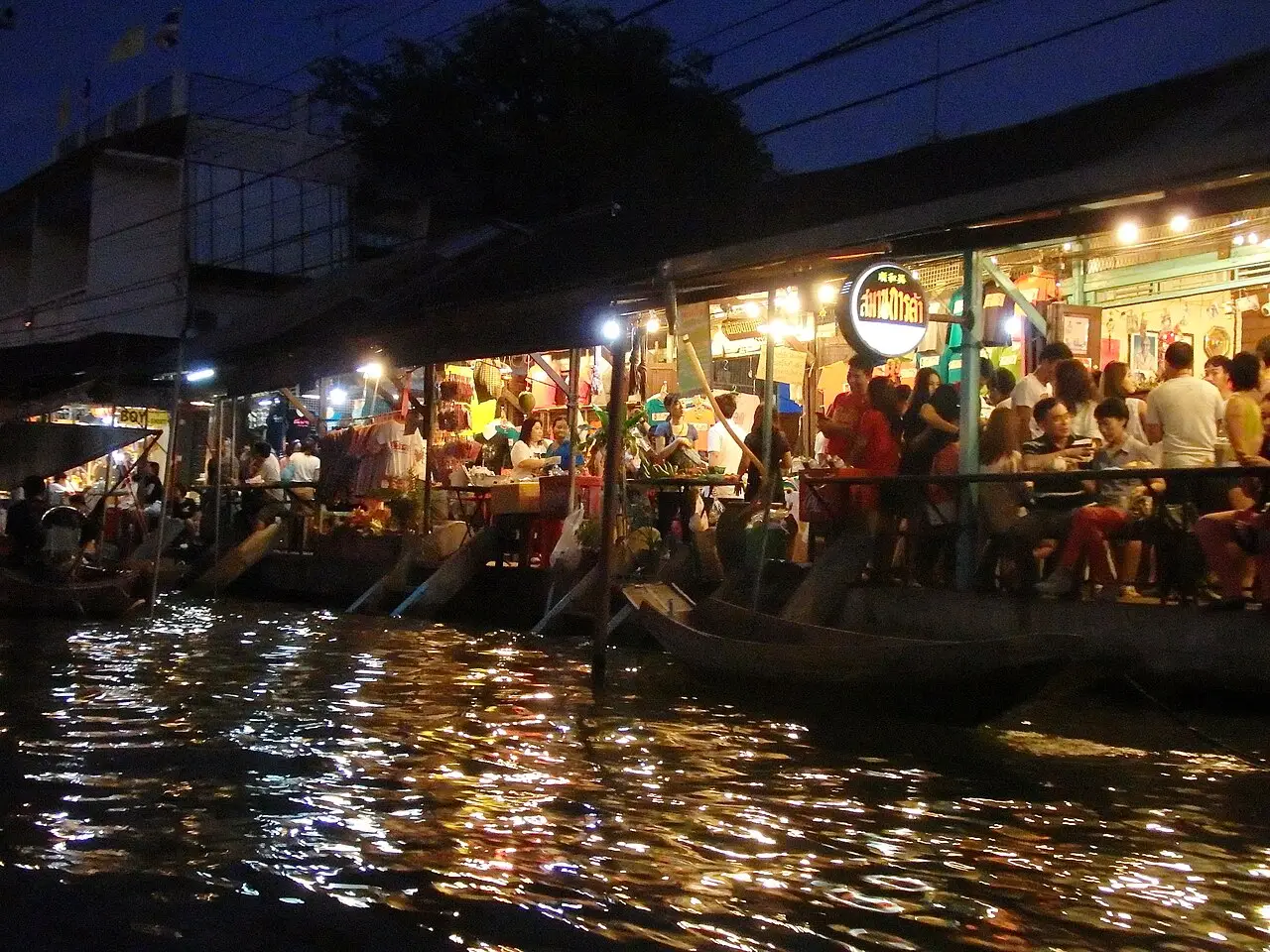
Amphawa and Maeklong
Amphawa, about 80 km from Bangkok, is the floating market you see in photos, open Friday to Sunday, from midafternoon into the evening; after dark the firefly boat heads out. Plan your trip for one of those three days and arrange the return in advance, because the van that takes you there doesn't bring you back at that hour.

Ko Kret and Bang Krachao
Ko Kret is a river island of Mon potters 20 km to the north, reached in about an hour and busiest on weekends. Bang Krachao, the “green lung” of roughly 16 km² of mangrove across from Khlong Toei, is five minutes away by boat (about 20 baht) and is best explored by rented bicycle for 80–100 baht a day.
Where to begin
Rattanakosin and the river
Enter the Grand Palace and Wat Phra Kaew at 8:30am, when they open, with shoulders and knees covered: admission is around 500 baht, and the complex takes about two hours.
Jim Thompson, the Saen Saep canal and Siam
Start the morning at the Jim Thompson House, five minutes from BTS National Stadium station, with the 40-minute guided tour.
The west bank and markets
If it’s Saturday or Sunday, start at Chatuchak at opening time, via the Kamphaeng Phet metro station, and set aside three hours.
Money
The currency is the baht (THB, ฿), trading at around 32 to 35 to the dollar and 37 to 40 to the euro in 2026. Cash still rules the street; PromptPay QR payment is universal among Thais but requires a local account, so don't count on it. Cards work at malls, hotels and sit-down restaurants, rarely at stalls. The ATM fee is a flat 220 baht per withdrawal with a foreign card, not proportional to the amount, so withdraw a lot at once, or change money at independent exchange offices like Superrich and Vasu, which give better rates than banks and the airport. For reference: a bottle of water 7–14 baht, street coffee 25–40, specialty coffee 90–140, a street dish 50–80, a mall food court 60–120, a sit-down restaurant 250–500 per person, a large beer at a market 60–80 and at a bar 150–250, a one-hour Thai massage 300–500, a hostel bed 300–600, a three-star hotel 1,200–2,500 and a five-star 3,500–9,000. Formal restaurants add 10% service and 7% VAT; tipping isn't required, and leaving the small change is enough. For purchases over 2,000 baht at a participating store, ask for the VAT refund form at checkout, because it gets stamped right there; without it, the airport refunds nothing when you leave.
Getting there and around
Bangkok has 2 airports; the wrong one costs an hour
Bangkok has two airports, and arriving at the wrong one expecting the other's train costs an hour. Suvarnabhumi (BKK), opened September 28, 2006, and expanded with the SAT-1 satellite terminal in 2023, sits 30 km east and connects to downtown via the Airport Rail Link: 15 to 45 baht, about 26 minutes to Phaya Thai, where you transfer to the BTS, with trains from 5:30am to midnight. Don Mueang (DMK), 25 km to the north, handles the budget carriers and is served by the SRT Red Line to Krung Thep Aphiwat station (about 33 baht, 17 minutes) and by buses A1 and A2. By taxi, join the official line on the ground floor and walk past anyone offering a ride before it: in line you get the meter plus a 50-baht airport surcharge and 25 to 75 in tolls, which comes to 350 to 550 baht to Sukhumvit or Silom, in 40 to 90 minutes depending on the time of day. Grab and Bolt both work and have a marked pickup point. Since May 1, 2025, every foreigner must fill out the Thailand Digital Arrival Card (TDAC) online, free, up to 72 hours before arrival, and there are self-service kiosks at the airport for anyone who forgets; Brazilians enter visa-free for up to 90 days, under a bilateral agreement.
Bangkok runs 8 rail lines, with no single ticket
The rail network has eight lines and no single ticketing system: BTS Skytrain (1999), MRT Blue (2004) and Purple (2016), Airport Rail Link, Red Line (2021), Gold Line (2020), and the Yellow and Pink monorails (2023–24). Fares run from 17 to 62 baht per trip; the 20-baht cap, in force since September 30, 2025, applies only to Thais registered on the Tang Rat app: foreigners pay the full fare. The cards don't talk to each other: Rabbit covers the BTS, Gold, Yellow, and Pink lines; the MRT uses its own card; for a few days, single tickets or QR through the app are the better deal. On the canals and the river, the boat usually beats the car in the late afternoon, when traffic jams the streets it bypasses by water. BMTA buses cost 8 to 25 baht, motorcycle taxis charge 20 to 60 for short trips with a mandatory helmet, and walking only works over short stretches: narrow sidewalks, few crossings, and heat that makes anything over 1.5 km hard going.
Safety
In Bangkok, violent crime against visitors is low, and what really gets in the way is traffic and scams. Motorbikes climb onto the sidewalk and ride against traffic, and crossing outside a crosswalk or a footbridge is the most common cause of accidents involving foreigners. Look both ways even on a one-way street. The scams have repeated for decades, which makes them easy to spot: the false claim that a temple is closed, the cheap tuk-tuk that ends up at a gem shop, the “broken” taxi meter, being charged for a scratch on a rented motorbike or jet ski with no prior photo, and the game stall with a guaranteed prize. Theft is opportunistic, in Chatuchak, on Khao San, on crowded boats and buses; hold your phone close when walking near the roadside, because motorcycle phone snatching happens. Don't leave a glass unattended at a bar and be wary of cheap drinks served from a bucket. Dengue circulates year-round, peaking in the rainy season, and the local mosquito bites during the day: apply repellent in the morning, not just at night. Between December and March, check the PM2.5 index before scheduling outdoor exercise. Political protests concentrate around Ratchaprasong and Ratchadamnoen: go around them and don't photograph up close. Write down the phone numbers before heading out: emergency 191, ambulance 1669 and Tourist Police 1155, which answers in English.
Etiquette tips
Body etiquette: head and feet in a Thai temple
The head is the most respected part of the body, and the feet the least. Don’t touch anyone’s head, not even a child’s, and never point your feet at a person or a Buddha image; when seated in a temple, tuck your legs back.
Shoes off
Take off your shoes when entering temples, homes, many small shops, and low-floor restaurants. The sign is a step at the entrance or a pile of footwear; socks can stay on.
Nothing about royalty
Don't comment on, joke about, or criticize the king or the royal family, not even in private conversation or on social media. Article 112 carries 3 to 15 years, applies to foreigners, and anyone can file the complaint. Stand still when the national anthem plays in a station or park, at 8am and 6pm, and stand up when the royal anthem plays in the cinema, before the film.
The right amount of wai
The palms-together greeting follows a hierarchy, bottom to top: you don’t wai a waiter, a driver, or a child. If someone in a service role wais you, a nod with a smile is answer enough.
Jai yen: keep calm to avoid losing face
Raising your voice, haggling angrily or complaining in public makes you lose face in front of onlookers, even when you're in the right, because jai yen calls for calm above all. To complain, speak quietly, smile and pick a moment without an audience.
Monks and distance
Monks don’t accept objects directly from a woman’s hand or touch her: pass the item through a man or set it down on a cloth. On trains, the marked rows of seats are reserved for them.
Mistakes to avoid
“The palace is closed today”
Believing someone at the Grand Palace gate who says the complex is “closed for a ceremony today” and offers a tuk-tuk for 20 baht: the story is always false, and the ride ends at a gem shop or a tailor, never at the palace. The official ticket office is inside the main gate itself, and it's open every day, ceremony or not.
A parked taxi with a verbally agreed price
Getting into a taxi parked outside a mall or hotel with a price agreed verbally. That car is parked there precisely because the driver doesn't want to turn on the meter: hail one on the street, confirm “meter” before you close the door, or use Grab or Bolt, where the fare shows up before the ride.
Measuring the trip by map distance
Calculating travel time by map distance. Between 4pm and 8pm the avenues jam up, and the car loses to the rail: from Suvarnabhumi, the Airport Rail Link reaches Phaya Thai in about 26 minutes, while a taxi to Sukhumvit or Silom takes 40 to 90 minutes, depending on traffic. At that time, take the BTS, which runs on an elevated track above the cars, or catch the Saen Saep canal boat, which runs on the water for 10 to 20 baht.
Walking outside between noon and 3pm
Walking outdoors between noon and 3pm in March, April, or May. It's easy to think the street has emptied for some holiday you don't know about; in fact it emptied because of the sun. Schedule temples right after sunrise, air-conditioned interiors at midday, and the street again after 4pm. It's the routine most residents follow.
The Rabbit doesn't work on the MRT Blue Line
Assuming one card works for everything because the turnstiles look alike. The Rabbit doesn't work on the MRT Blue Line, the MRT card doesn't work on the BTS, and the 20-baht cap per trip doesn't apply to foreigners: budget 17 to 62 baht per trip.
Useful phrases
สวัสดีครับ / สวัสดีค่ะ (sa-uát-di krap / kâ)
Hello: men end the sentence with “krap”, women with “kâ”; the particle applies to almost every polite sentence
ขอบคุณครับ / ค่ะ (kóop-kun krap / kâ)
Thank you
เท่าไหร่ (tâo-rai)
How much does it cost?
ไม่เผ็ด (mâi pét)
No chili: repeat it and smile; it's a request, not a guarantee
อร่อย (a-ròi)
It's delicious: the phrase that sparks the most conversation at a street stall
ไม่เป็นไร (mâi pen rai)
No problem, you're welcome, never mind: it covers all three
Districts
Rattanakosin (Phra Nakhon)
The historic island ringed by the 1782 canals: the Grand Palace, Wat Pho, Sanam Luang, the National Museum, and government ministries. Almost no one lives there, and the neighborhood empties out after 6pm.
Banglamphu and Khao San
Next to the historic island on the north side, it mixes wooden shophouses and neighborhood markets with Khao San Road, a backpacker strip since the 1980s. On Phra Athit street, along the river, are the bars for students from Thammasat University.
Yaowarat (Chinatown)
The Chinese quarter since the city's founding in 1782, today one of the largest Chinatowns in Southeast Asia, with gold shops, their gilded fronts facing the street, lined up one after another.
Silom and Sathorn
The financial axis, with banks, embassies, Lumphini Park at the end, and the LGBT scene on Soi 2 and 4. By day it’s offices; by night, street markets and rooftop hotel bars.
Sukhumvit, from Asok to Ekkamai
An avenue that runs for dozens of kilometers and became the spine of the expat city: Asok for business, Phrom Phong for the Japanese community, Thonglor and Ekkamai for restaurants and bars catering to upper-class Thais.
Siam and Ratchaprasong (Pathumwan)
A cluster of malls linked by covered skywalk (Siam Paragon, Siam Center, MBK, CentralWorld) with Chulalongkorn University behind and the Erawan Shrine on the corner. It's the city's default meeting point and also a recurring protest stage.
Thonburi and Kudi Chin
The west bank, lower-lying and slower-paced, with Wat Arun, navigable canals, and old communities. Kudi Chin has been Portuguese-Siamese since the 18th century and still makes khanom farang cake, inherited from the Portuguese of Ayutthaya.
Ari and Phaya Thai
A residential neighborhood from the 1950s north of the center, today with cafés, houses converted into restaurants, and agency offices. Good for seeing Bangkok's middle class without the tourist backdrop.
History
16th century · Bang Makok, a customs post
A settlement of water plum trees on a bend of the Chao Phraya where ships heading to Ayutthaya stopped to pay duty. A shortcut canal dug in 1522 ended up becoming the river’s main channel, leaving the old bend behind as a khlong.
1688 · Siege of Bangkok
The French garrison of the fortress built for King Narai is besieged and expelled during the Siamese revolution. Siam closes itself off from the West for about 150 years.
1767 · Fall of Ayutthaya
The Burmese army of the Konbaung kingdom takes and burns the capital after 417 years of rule. General Taksin regroups the court in Thonburi, on the river’s west bank.
1782 · Rama I founds Rattanakosin
On April 21, the city pillar is driven into the ground on the east bank and work begins on the Grand Palace and Wat Phra Kaew. The layout copies Ayutthaya: an artificial island between two ring canals, a wall, and a royal temple, built in part with bricks brought by boat from the ruins.
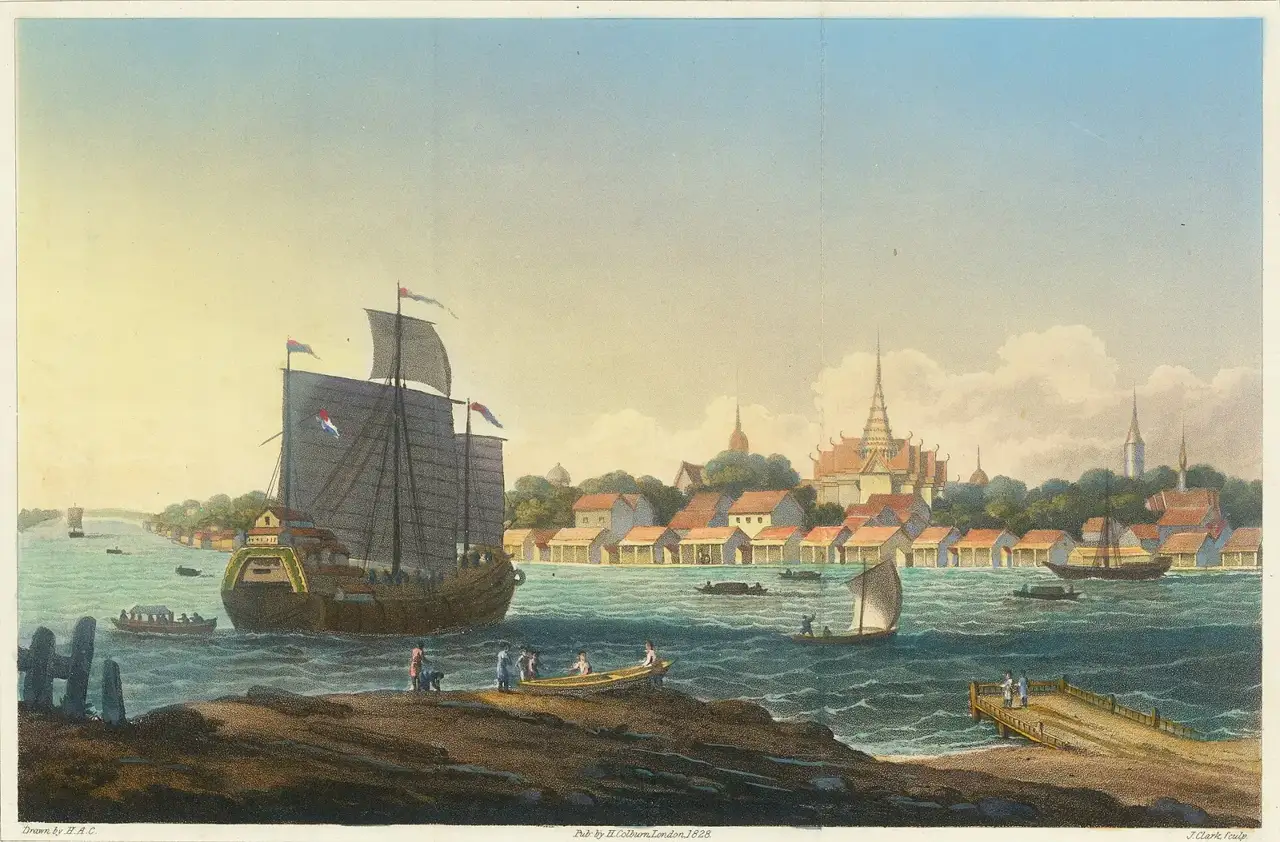
1855 · Bowring Treaty
The trade opening with the British brings European trading houses, mass Chinese immigration, and rice as an export monocrop. In 1864, Charoen Krung, the city’s first paved road, opens.
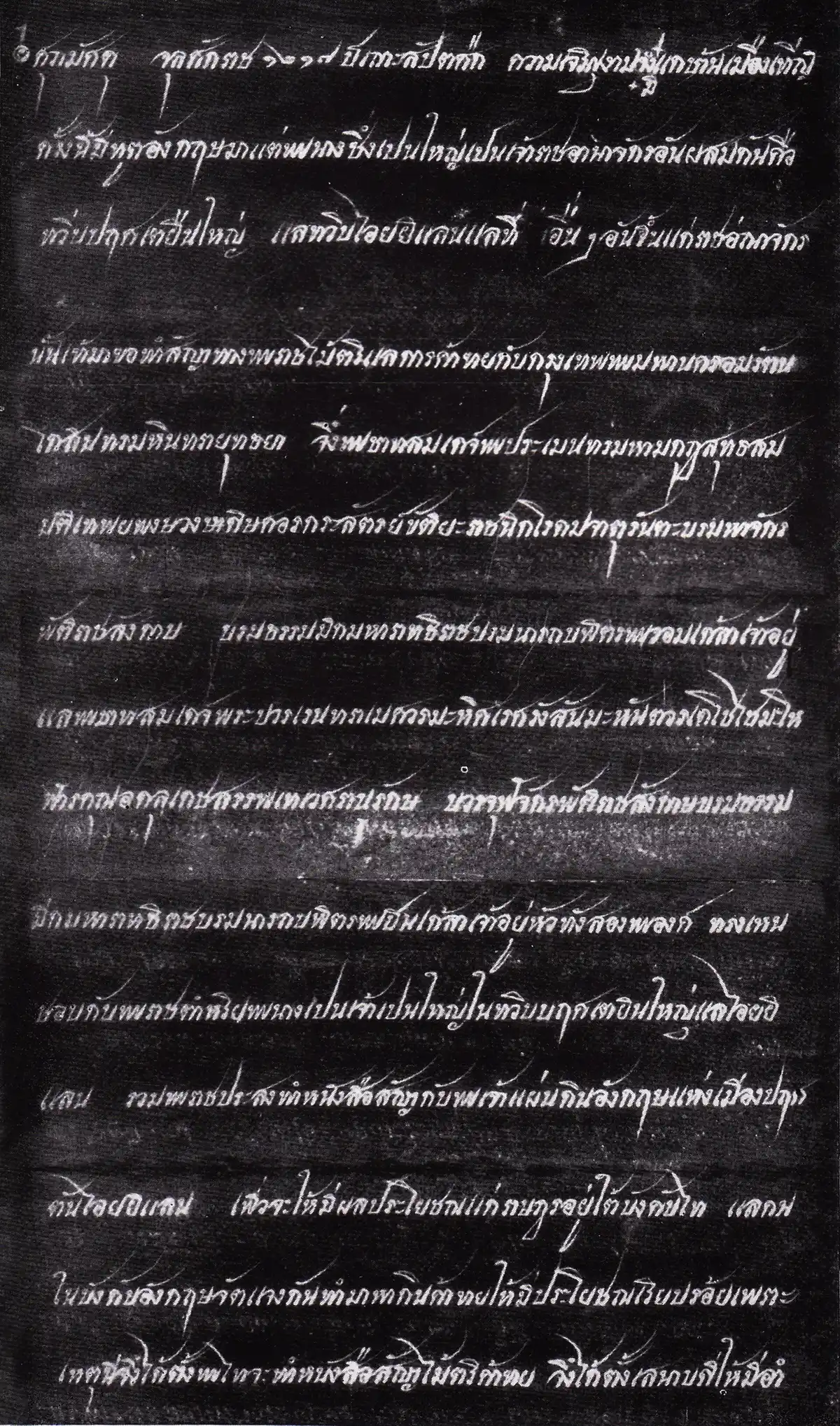
1868–1910 · Rama V’s reforms
Chulalongkorn builds the Dusit district and Ratchadamnoen Avenue, brings the railway inland, and completes the abolition of slavery in 1905. Through territorial concessions to the neighboring colonial powers, Siam remains the only uncolonized country in the region.
1932 · End of absolute monarchy
On June 24, the Khana Ratsadon group seizes power within hours and imposes a constitution. The Democracy Monument, in the middle of Ratchadamnoen, marks the date: construction begins in 1939, the year the name Siam becomes Thailand, and it is inaugurated on June 24, 1940.
1962–1975 · Vietnam War and filled-in canals
The American military presence funds hotels, bars, and the expansion of Sukhumvit Avenue. Dozens of khlongs become avenues, and the city loses the natural drainage it still misses every rainy season.
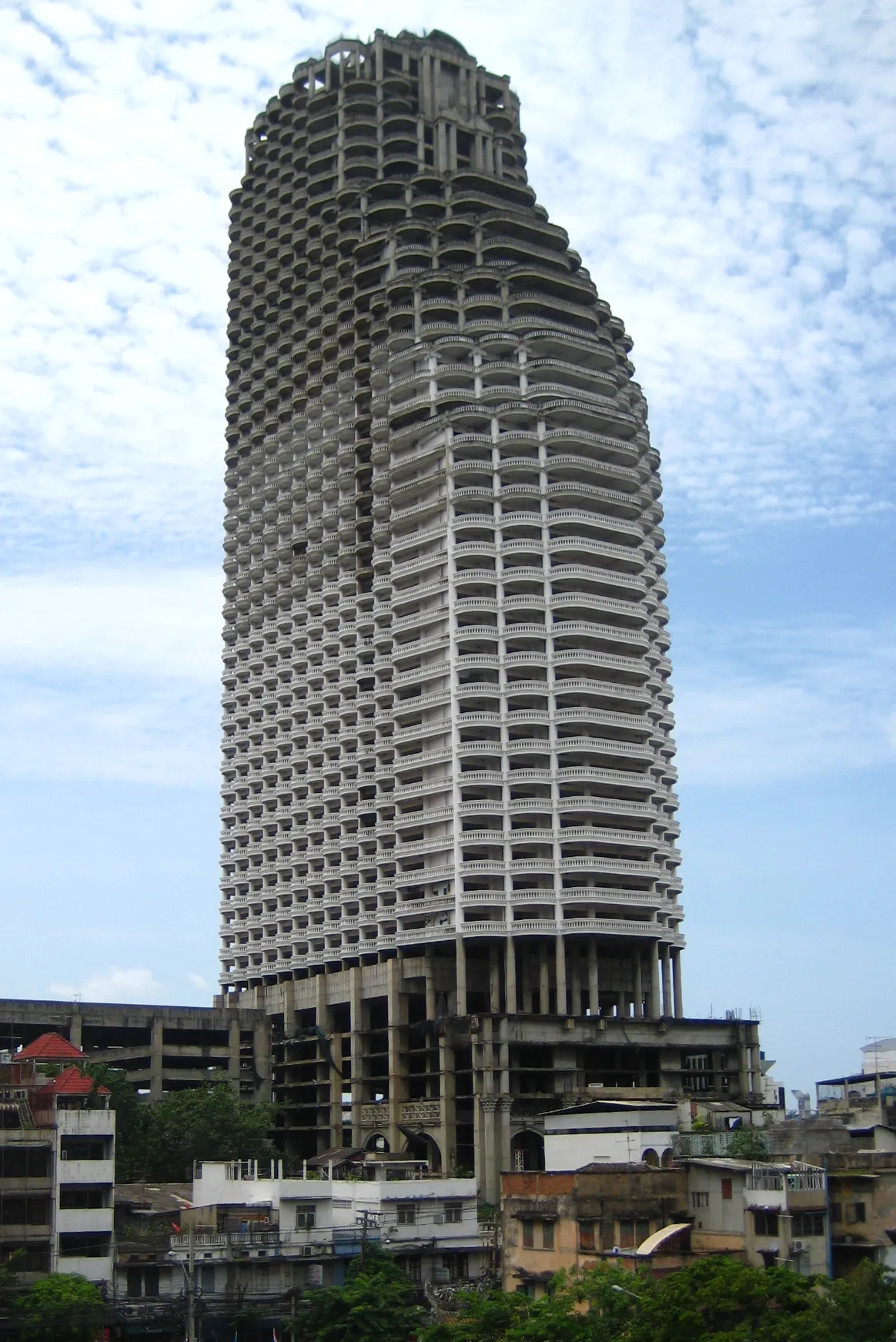
1997 · Baht crisis
On July 2, the central bank floats the currency and triggers the Asian financial crisis from Bangkok. Stalled construction projects turn into concrete skeletons, like the Sathorn Unique tower.
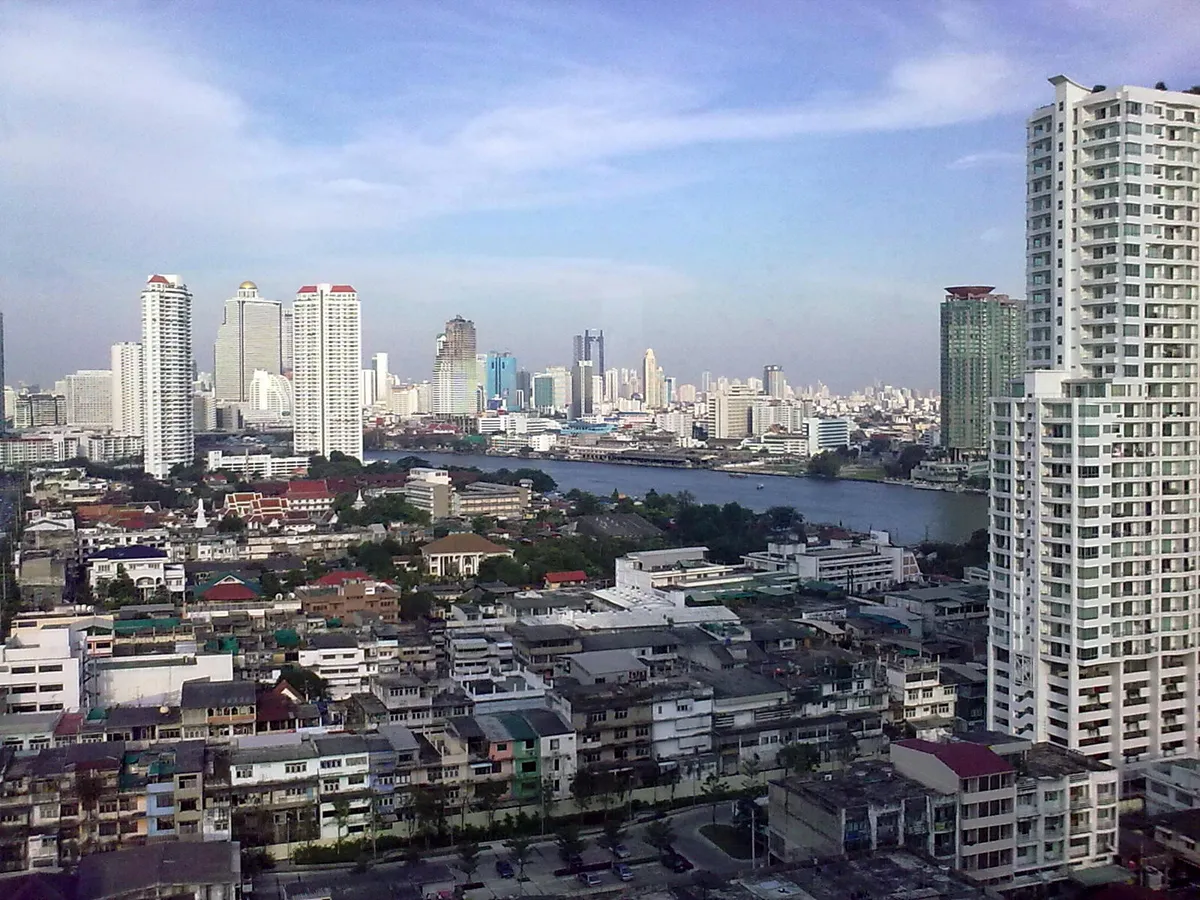
1999–2024 · The city on rails
The BTS Skytrain opens on December 5, 1999, the metro in 2004, and the Yellow and Pink monorails in 2023–24, adding up to eight lines. On September 30, 2025, a 20-baht fare cap takes effect, restricted to registered Thai passengers.
 AI illustration
2025 · The March 28 earthquake
A magnitude-7.7 earthquake centered in Myanmar shakes Bangkok’s towers and brings down the under-construction State Audit Office building in Chatuchak, killing dozens. The city revised its evacuation and high-rise inspection standards.
Complete history
It began as a customs post, long before becoming a capital
Bangkok was taxing ships long before it became the kingdom's capital. In the 16th century, the settlement of Bang Makok sat on a bend of the Chao Phraya where ships heading upriver to Ayutthaya stopped to pay duties. In 1522 a shortcut canal was cut across that bend, and erosion widened it until it became the river's main channel, while the old stretch shrank to a khlong, one of the city's canals. In 1688, the fortress that French engineers had built there in the service of King Narai was besieged and its garrison expelled, and Siam closed itself off to the West for a century and a half.
The capital only arrived through catastrophe
Bangkok's founding came directly from the fall of Ayutthaya, the kingdom's earlier capital. In April 1767, after a fourteen-month siege, the Burmese army took and burned Ayutthaya, ending a 417-year-old kingdom. General Taksin regrouped what was left and set up court in Thonburi, on the west bank. Deposed in 1782, he was succeeded by Chao Phraya Chakri, who crowned himself Rama I and, on April 21 of that year, drove the city pillar into the ground on the east bank. Rattanakosin was designed as a reconstruction of Ayutthaya: an artificial island ringed by two canals, with a wall, a palace, and a royal temple, built in part with bricks brought by boat from the ruins of the former capital.
From amphibious city to city of streets
The 19th century turned the amphibious city into a city of streets. The Bowring Treaty, signed with the British in 1855 under Rama IV, opened Siam to free trade and brought European trading houses, Teochew Chinese immigration, and rice as an export monoculture. In 1864 Charoen Krung opened, the first paved road, built at the request of foreigners who wanted to get around by carriage. Rama V, between 1868 and 1910, moved the court to Dusit, laid out Ratchadamnoen inspired by European boulevards, connected the country by rail, completed the abolition of slavery in 1905, and negotiated territory with France and the United Kingdom to keep Siam independent.
The coup of June 24, 1932
On June 24, 1932, a group of military officers and civilians called Khana Ratsadon seized power within hours and replaced the absolute monarchy with a constitutional one. What followed was a century of coups: more than a dozen successful power seizures by 2014. The name Siam became Thailand in 1939. In World War II the city was occupied by Japanese troops and bombed by the Allies, and the 1942 flood kept streets underwater for two months. Between 1962 and 1975, the American presence tied to the Vietnam War financed hotels, bars and the expansion of Sukhumvit, and the canals were filled in one by one to become avenues: the urban planning decision the city still pays for in flooding.
The 1997 crisis, the BTS and the metro
The 1990s property bubble burst on July 2, 1997, when the central bank floated the baht and set off the Asian financial crisis, leaving concrete skeletons across the skyline. The opening of the BTS on December 5, 1999, and of the subway in 2004 pulled jobs, malls and apartments toward the elevated lines, and the city came to be read by station rather than by neighborhood. While the city changed its physical scale, street politics kept two fixed addresses: the protests of 1973, 1976, 2006, 2010, 2013–14 and 2020 recurred at Ratchaprasong and on Ratchadamnoen, which became the regular stage for demonstrations. Since the election of governor Chadchart Sittipunt in May 2022, public debate has shifted scale and now revolves around sidewalks, flooding, air quality and fares: the 20-baht cap per ride on urban rail took effect on September 30, 2025, still limited to Thais registered on the Tang Rat app. The March 28, 2025, earthquake, centered in Myanmar with a magnitude of 7.7, was the first major seismic test for the hundreds of towers built since 1990: only the State Audit Office building under construction in Chatuchak collapsed, and the episode opened a review of building and evacuation codes that is still under way.
Many of Bangkok's wide avenues were canals filled in between 1950 and 1980 to make way for cars.
Hardly anyone here names their neighborhood: they name the nearest train station, because that's how the city has found its way around since the BTS arrived.
Geography and shape of the city
The delta plain and the river
Bangkok sits on the alluvial plain of the lower Chao Phraya, about 25 km from the Gulf of Thailand, at an average elevation of 1 to 2 meters above sea level: it's a city built on delta mud. The river, which runs 372 km from the confluence at Nakhon Sawan, cuts through the municipality's 1,569 km² in tight bends and separates Phra Nakhon, the east bank where the historic center sits, from Thonburi, to the west.
The khlongs and a city without a street grid
Until the 20th century transport ran on the khlongs, the web of canals that earned the city the nickname “Venice of the East”; most were filled in between 1950 and 1980 to become avenues, and those that remain (Saen Saep, Bang Luang, Bangkok Noi) still work as boat routes. There's no urban grid: the city grew in huge superblocks served by a few main roads and by soi, numbered side streets, usually dead ends, that branch off them. That's why all the traffic piles onto the same arteries, and addresses are given by soi and by station.
The sinking ground and the climate
The soft subsoil and groundwater extraction make the ground sink 1 to 2 cm a year, which, combined with rising sea levels, puts the eastern part of the city at risk of chronic flooding. The climate is tropical savanna, with 1,500 to 1,800 mm of rain a year concentrated between May and October.
Bangkok's ground sinks 1 to 2 cm a year because of groundwater extraction, enough to put the eastern part of the city at risk of chronic flooding.
Culture
Four hundred temples in use
About 90% of Thais are Theravada Buddhists, and Bangkok has around 400 active temples. The practice is visible on the street: monks in orange robes collecting alms before 7am, spirit houses (san phra phum) with jasmine garlands and red soda beside every office tower, amulets sold by weight near Wat Mahathat. The monarchy occupies another register, just as present: official portraits along the avenues, the royal anthem before every movie screening, and article 112 of the penal code, which punishes offending the royal family with 3 to 15 years in prison and applies to foreigners too. At 8am and 6pm, the national anthem plays over loudspeakers at stations and parks, and whoever is nearby stops wherever they are until the music ends.
Thai cinema: from Apichatpong Weerasethakul to GDH studio
The city produces and exports culture. Thai art-house cinema came out of here with Pen-ek Ratanaruang and Apichatpong Weerasethakul, Palme d'Or winner in 2010, while horror and comedy from studio GDH dominate Southeast Asian box offices. In music, luk thung of rural origin, mor lam from Isan played at street festivals, and T-pop from Bangkok agencies coexist. The Bangkok Art Biennale has run since 2018, the BACC has operated across from MBK since 2008, and independent galleries cluster along Charoen Krung, around Warehouse 30.
Muay thai's two historic arenas
Muay thai has two historic arenas: Rajadamnern, from 1945, and Lumpinee, which moved to Ram Intra in 2014; fights go five rounds to a live soundtrack of flute and drums. Nightlife is sorted by neighborhood: Khao San for backpackers, RCA for university students, Thonglor and Ekkamai for cocktail bars, Silom for the LGBT scene, and the law closes most venues between 1am and 2am, with exceptions in designated zones until 4am. Since January 23, 2025, same-sex marriage has been legal in Thailand, the first country in Southeast Asia to allow it, and Bangkok hosts most of the ceremonies.
Festivals and events

Songkran, April 13 to 15
Thai New Year. The ritual washing of Buddha images and elders’ hands has turned into a street water battle, and stretches of Silom and Khao San close to traffic. Inscribed by UNESCO as intangible cultural heritage in December 2023.

Loi Krathong, November full moon
Small banana-leaf baskets with a candle and incense are set afloat on the Chao Phraya and the canals to ask the water goddess for forgiveness. The piers between Phra Athit and Asiatique fill up from 7pm on.

Chinese New Year, January or February
Fifteen days of celebration centered on Yaowarat, with lion dances, street altars, and the main avenue closed to traffic on the first day.
 AI illustration
Vegetarian Festival (Kin Je), September or October
Nine days of a diet free of meat, dairy, garlic, and onion, signaled by yellow and red flags at Chinatown’s stalls. It follows the Chinese lunar calendar and changes date every year.

Wat Saket Fair, November
A length of red cloth is carried in procession and wrapped around the chedi on the Golden Mount. At the foot of the hill, a temple fair sets up with a Ferris wheel and food stalls, for about a week.
Books and films
“Four Reigns” (Si Phaendin, 1953), by Kukrit Pramoj
A novel following a woman of the court from the reign of Rama V to that of Rama VIII. It’s the gateway to understanding how the palace became a city, and why the monarchy still organizes the calendar.
“Last Life in the Universe” (2003), by Pen-ek Ratanaruang
A film shot in Bangkok with cinematography by Christopher Doyle. It shows the city that doesn’t make the postcards: an empty apartment, an overpass, silence, and the dead time between two people.
“Very Thai” (2005), by Philip Cornwel-Smith
A visual-reportage book about urban popular culture: spirit houses, uniforms, amulets, taxi decor, street food. It explains, one by one, the objects you’ll see on the street and not understand.
Frequently asked questions
Bangkok: is it true what they say on the street, that the Grand Palace is closed?
No: the Grand Palace opens every day, from 8:30am to 3:30pm, and anyone on the sidewalk claiming it's closed for a ceremony is offering you a 20-baht tuk-tuk to a gem shop. The only ticket office is inside the main gate.
Bangkok: how do you get from Suvarnabhumi Airport to downtown?
Suvarnabhumi (BKK), opened on September 28, 2006, and expanded with the SAT-1 satellite terminal in 2023, is 30 km east and connects to downtown by the Airport Rail Link: 15 to 45 baht, about 26 minutes to Phaya Thai, where you change to the BTS, with trains from 5:30am to midnight.
Bangkok: what is there to see in Ayutthaya?
Ayutthaya holds the ruins of the capital that preceded Bangkok, seat of a kingdom that lasted 417 years until the Burmese army destroyed it in 1767.
Bangkok: what's the currency and what's it worth?
The currency is the baht (THB, ฿), trading at around 32 to 35 to the dollar and 37 to 40 to the euro in 2026.
Bangkok: when is the best time to go?
The cool, dry season runs from November to February, with lows of 21 to 24 °C, highs of 31 to 33 °C, and lower humidity: it's high season, with pricier hotels and crowded temples.
Other cities in the country
Thailand ↗- Days
- 2–3
- When
- Jan · Nov–Dec
- Per person/day
- Average 2,000–3,500 THBMid-range · per person/day
Cost scope
Per person per day: accommodation, meals, urban transport, visits and a small allowance for extras. Flights excluded; larger purchases vary. Editorial estimate, not a quote.
- Days
- 3–4
- When
- Jan–Mar · Dec
- Per person/day
- Average 4,420 THBMid-range · per person/day
Cost scope
Per person per day: accommodation, meals, urban transport, visits and a small allowance for extras. Flights excluded; larger purchases vary. Editorial estimate, not a quote.


Itineraries through here
 Thailand, Cambodia and Vietnam in 15 daysThe grand Indochina loopBangkok · Chiang Mai · Siem Reap · Ho Chi Minh City · Hanoi12–16 days5 cities
 Thailand in 7 daysFrom the Chao Phraya to Chiang MaiBangkok · Chiang Mai5–7 days2 cities
 Thailand and Vietnam in 10 daysMarkets and temples of Southeast AsiaBangkok · Chiang Mai · Hanoi · Ho Chi Minh City9–13 days4 cities
 Singapore, Malaysia and Thailand in 10 daysFrom Singapore to BangkokSingapore · Kuala Lumpur · Bangkok7–10 days3 cities
 Thailand in 10 daysThe Grand Palace, khao soi and Phang Nga BayBangkok · Chiang Mai · Phuket8–11 days3 cities