Thailand
Phuket
Old Sino-Portuguese town, the beaches of Kata and Karon, and the limestone islands of Phang Nga Bay
Days Start with the basic programme and choose extensions for the time you have.
How the guide reaches this number
The first would go to the old town: the shophouses of Thalang Road, the Thaihua museum, the Jui Tui and Pudjor shrines and a lunch of moo hong. The second, to the south of the island, with Wat Chalong and the Big Buddha in the morning, Kata beach in the middle of the day and sunset at Cape Phromthep. The third, at sea, among the limestone towers of Phang Nga Bay, with a stop at Ko Panyi. With a fourth day, I'd go to the Phi Phi islands on a speedboat tour from Phuket, checking beforehand that the program includes Phi Phi Le and Maya Bay, where you land at the Loh Samah pier, do not swim and stay at most one hour. The Rassada ferry goes only to Ton Sai, on Phi Phi Don; I'd choose it for sleeping on the island, not for seeing Maya Bay on a day trip. I'd leave Patong for one night, if nightlife interests you. From May to October, I'd book the boat trips right at the start, to have slack if the sea does not let them leave, and I'd swim only where there are lifeguards.
3–4
When December to March; this is the dry season, and from May to October the monsoon brings more rain and rough seas on the west coast
How the guide reaches this number
Temperatures change little through the year, with average highs between 31 °C and 34 °C; what decides the trip is the rain and the state of the sea. December to March is the dry season, with 24 to 74 mm of rain a month in Phuket town and generally calm seas on the west coast: it is the most sought-after time, especially around Christmas.
Per person/day Budget about 1,820 THB; mid-range about 4,420 THB; comfortable about 11,400 THB per person, based on spending that travelers report to Budget Your Trip (consulted October 2026).
How the guide reaches this number
Per person per day: accommodation, meals, urban transport, visits and a small allowance for extras. Flights excluded; larger purchases vary. Editorial estimate, not a quote.
 What Nilo thinks
I'd stay three days in Phuket, based in Kata or Karon. The first would go to the old town: the shophouses of Thalang Road, the Thaihua museum, the Jui Tui and Pudjor shrines and a lunch of moo hong. The second, to the south of the island, with Wat Chalong and the Big Buddha in the morning, Kata beach in the middle of the day and sunset at Cape Phromthep. The third, at sea, among the limestone towers of Phang Nga Bay, with a stop at Ko Panyi.
With a fourth day, I'd go to the Phi Phi islands on a speedboat tour from Phuket, checking beforehand that the program includes Phi Phi Le and Maya Bay, where you land at the Loh Samah pier, do not swim and stay at most one hour. The Rassada ferry goes only to Ton Sai, on Phi Phi Don; I'd choose it for sleeping on the island, not for seeing Maya Bay on a day trip. I'd leave Patong for one night, if nightlife interests you.
From May to October, I'd book the boat trips right at the start, to have slack if the sea does not let them leave, and I'd swim only where there are lifeguards.Phuket tends to be sold as a beach, and the beaches are real: Kata and Karon on the west coast, with sand between rocky headlands and the open Andaman Sea in front. But for centuries the island was a tin mine, and it is in the old town, away from the seafront, that this history shows. The Sino-Portuguese shophouses of Thalang Road, the Taoist shrines where the Vegetarian Festival processions begin and the Hokkien noodle shops tell how Chinese, Malay and Siamese miners built a town of their own.
Read more
To the east, Phang Nga Bay changes the landscape again: limestone towers rise from shallow water, among mangroves and villages on stilts. I'd look at the island through these three parts, the town, the beaches and the sea of islands, and I'd choose the season by the wind, because the monsoon from May to October decides whether swimming and boat trips happen.
Quick facts
- Population
- 432,464 registered residents in Phuket province (civil registry of the Department of Provincial Administration, December 2025); 71,284 in Phuket municipality (2024). The registry leaves out many people who live on the island without being registered there
- Founding
- No single date: Thalang, in the north of the island, was the old capital; Phuket town grew with tin in the 19th century, became a municipality on December 10, 1935, and received city status (thesaban nakhon) on February 13, 2004
- Country and region
- Thailand: Phuket province, in the south of the country, on the Andaman Sea; 547 km² across the main island and 32 smaller islands, 862 km from Bangkok
- Language
- Thai; in the Chinese-descended community, Hokkien words survive, such as jia chai, the local name of the Vegetarian Festival
- Currency
- Thai baht (THB, ฿); about 38 per euro and 33.5 per US dollar (rate of September 24, 2026)
- Time zone
- UTC+7 year-round, with no daylight saving time
- Best time to visit
- December to March; this is the dry season, and from May to October the monsoon brings more rain and rough seas on the west coast
- Average cost per day
- Budget about 1,820 THB; mid-range about 4,420 THB; comfortable about 11,400 THB per person, based on spending that travelers report to Budget Your Trip (consulted October 2026).
When to go
December to March; this is the dry season, and from May to October the monsoon brings more rain and rough seas on the west coast
How the year changes
Temperatures change little through the year, with average highs between 31 °C and 34 °C; what decides the trip is the rain and the state of the sea. December to March is the dry season, with 24 to 74 mm of rain a month in Phuket town and generally calm seas on the west coast: it is the most sought-after time, especially around Christmas.
April has the highest average temperature of the year (29.4 °C) and marks the transition. From May to October, the monsoon brings rain on more than half the days, peaking in September (361 mm) and October (320 mm). On the west coast beaches the waves grow, the red flag is frequent and there are rip currents that have caused drownings; Kata becomes a surf spot. Boat trips can be canceled when the sea is rough, and jellyfish appear closer to shore in this period.
November still totals about 177 mm of rain over 15 days; the dry season begins in December. If your trip falls in the monsoon, leave spare days for boat trips and choose the beach by the flag of the day.
Nilo's tips
Choose your base by what you will do
Kata and Karon suit anyone who wants beach and the south of the island; the old town, anyone who wants food and history and to spend less. Patong is for those looking for nightlife. From the old town to Kata is about 15 km, and every day you switch costs a trip.
Use the Smart Bus on arrival
The bus leaves from in front of exit 3 of the domestic terminal and runs down the west coast to Rawai for 100 ฿, with a contactless card or cash. Check the time of the last departure on the line's page before landing.
Book the boat early in the trip
Phi Phi and Phang Nga Bay depend on the sea. If the trip is postponed, you still have days to rebook. Ask whether the national park fee is included.
The Vegetarian Festival changes the old town
During the nine days of the ninth Chinese lunar month, usually between late September and October, processions take over the old town streets and many residents stop eating meat. I'd pick those days to see the island's Hokkien culture, checking the year's dates on the TAT calendar beforehand and remembering that the piercing rituals are not a scene for all ages.
With a red flag, stay on the sand
In the monsoon, choose the beach by the flag and the presence of lifeguards, not by the photo. Kata, at that time, is better for watching surfing than for swimming.
Explore the map
Explore the map, read about the other places and plan your travel days in the app.
Open the appWhat to see
Phuket: The island and its two coasts
East of the island, Phang Nga Bay is shallow and dotted with limestone towers that rise vertically from the water, with caves and mangroves. It concentrates hotels, shopping centers and the nightlife of Bangla Road and the Paradise Complex, the latter aimed at a gay clientele.

Phuket Old Town
Phuket's old town gathers the Sino-Portuguese shophouses built at the height of the tin boom, between the reign of Rama V and the early 20th century: narrow facades, long bodies running to the back, covered arcades over the sidewalk, and windows and doors with carvings of Chinese and European influence. Thalang Road, Dibuk Road and Soi Rommanee are the best preserved streets; many houses have become cafés, shops and small museums. Walk early, before the midday heat.
The Sino-Portuguese shophouses of Thalang Road, Dibuk Road and Soi Rommanee are what remains of the tin town, revealing the island’s Hokkien and Peranakan roots that the beaches do not show. Early in the morning, the heat still allows a walk.
Check access
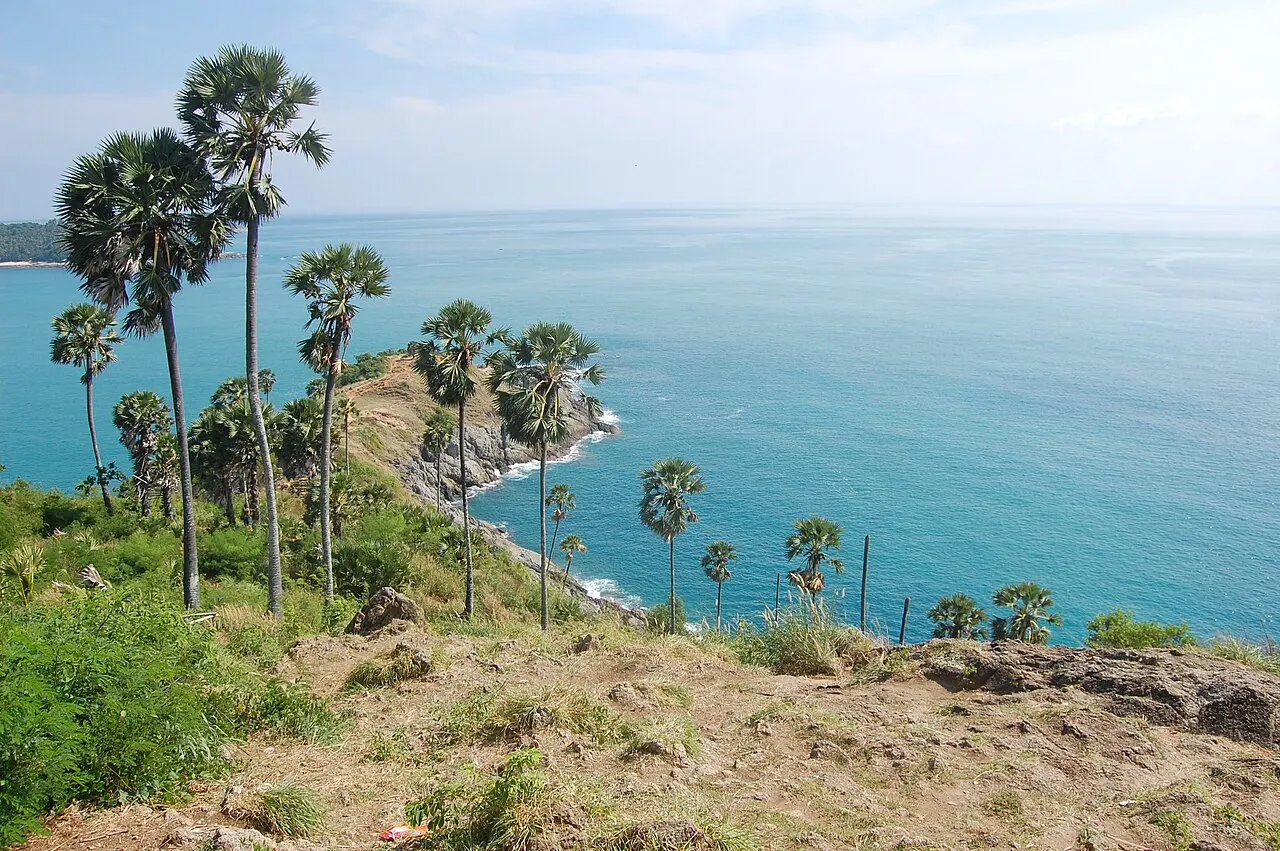
Phromthep Cape
Cape Phromthep is the southern tip of the island, about 2 km from Rawai beach, with a lighthouse built in 1996 and a trail to the point. It is Phuket's best-known sunset viewpoint, named by the TAT as one of the most beautiful in the country; arrive before late afternoon to find a spot.
The island’s southern tip, with a 1996 lighthouse and a trail to the point, is Phuket’s best-known sunset spot and lies about 11 km from Kata.
Check access

Kata Beach
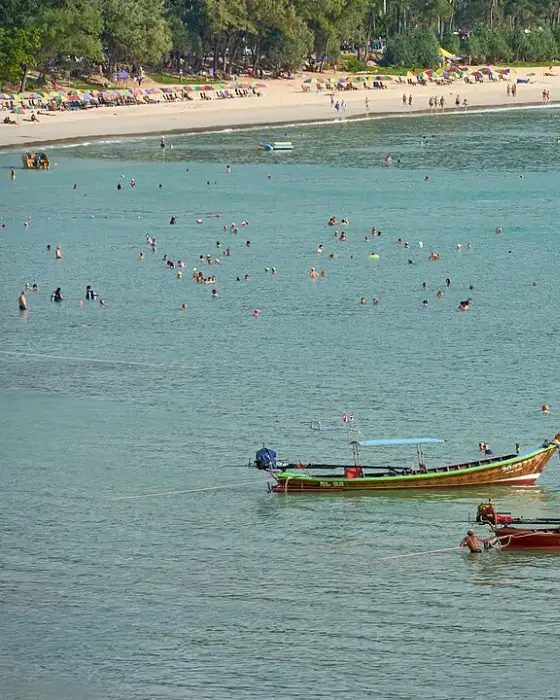
Kata Yai is the main beach of Kata, on the west coast, and Kata Noi is a smaller cove to the south, beyond a headland. It is about 15 km from the old town by road and close to the Big Buddha and Cape Phromthep. In the dry season the sea is usually calm; in the monsoon, the waves attract surfers and the red flag is frequent.
Kata Yai beach, calmer than Patong, is the best base for swimming in the dry season and is near Wat Chalong, the Big Buddha and Cape Phromthep. During the monsoon it becomes a surfing spot, and swimming depends on the warning flag.
Check access
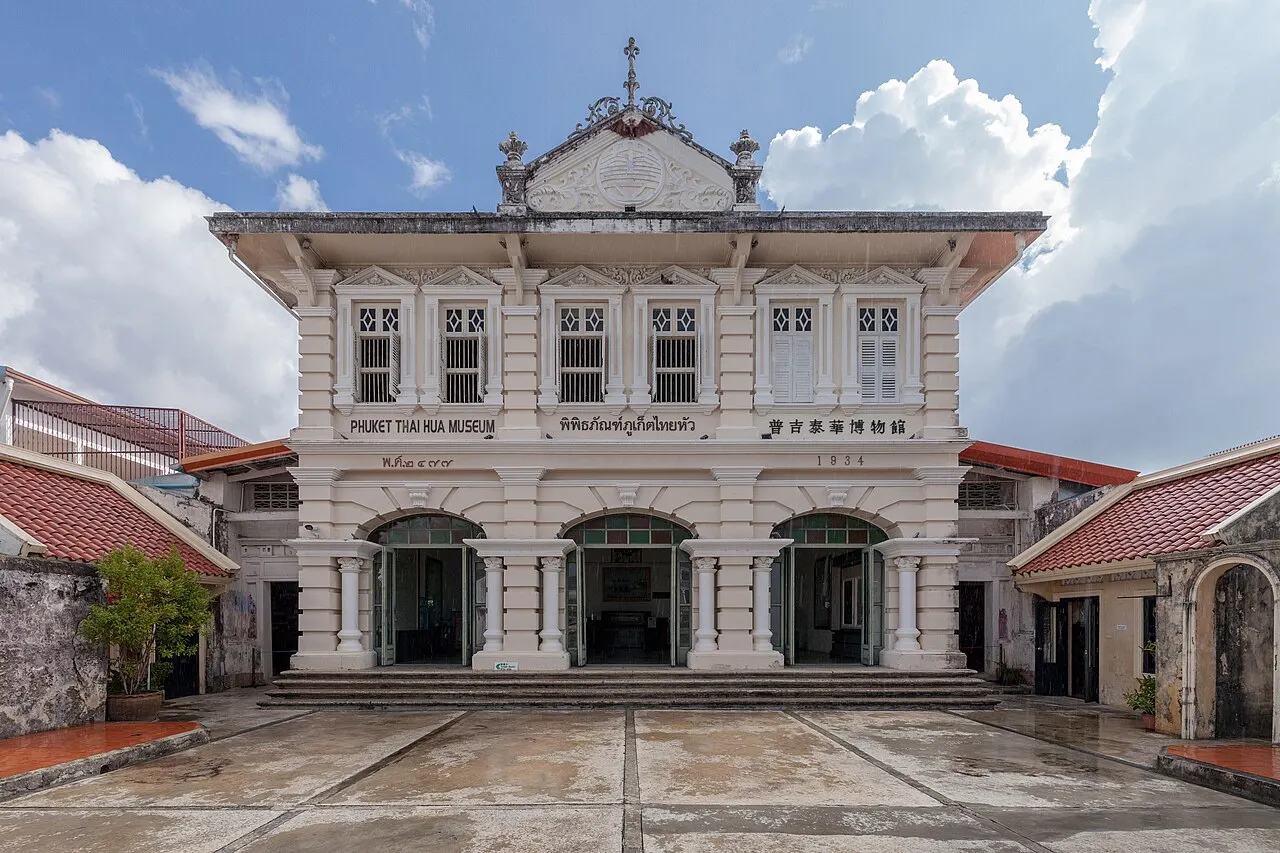
Phuket Thaihua Museum
Housed in the building of a former Chinese-language school on Krabi Road, the museum tells the story of Phuket's Chinese immigrants and gives context for a walk through the old town. Wikivoyage reports admission of 200 baht, 100 for students; check the price and hours before going.
Housed in a former Chinese-language school, it tells the story of Phuket’s Chinese immigrants and gives context to a walk through the old town, for about 200 baht.
Check access

Jui Tui Shrine
A Taoist shrine on Soi Phuthon, by Ranong Road, begun early in the reign of Rama VI and one of the centers of the Vegetarian Festival: it is the shrine that draws the most participants during the nine days. Next to it is the Pudjor shrine, dedicated to Guan Yin, more than a century old and restored from 2024 to 2026. Entry is free; dress modestly and do not get in the way of people praying.
It is the shrine that draws the most participants during the Vegetarian Festival, beside Pudjor, restored from 2024 to 2026. Entry is free and it is a few blocks from Thalang Road.
Check access
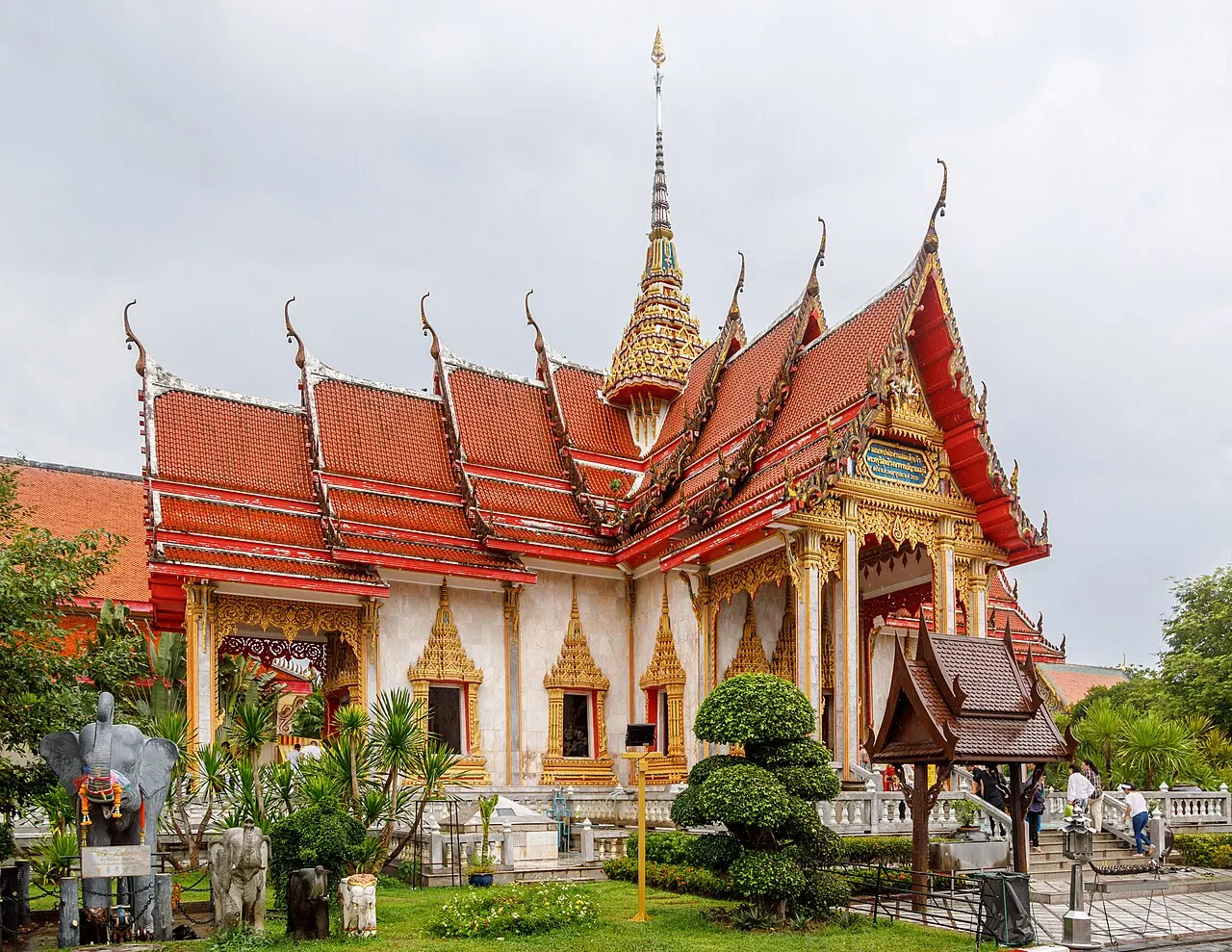
Wat Chalong
The island's most important Buddhist temple, officially Wat Chaiyathararam, dedicated to the monks Luang Pho Chaem and Luang Pho Chuang, who helped the wounded of the 1876 miners' revolt. It is a working temple, with worshippers all day; cover shoulders and knees and take off your shoes in the halls.
It is the island’s main Buddhist temple, dedicated to the monks who cared for those wounded in the 1876 revolt. Combine it with the Big Buddha in the same morning, about 8 km away.
Check access

Big Buddha
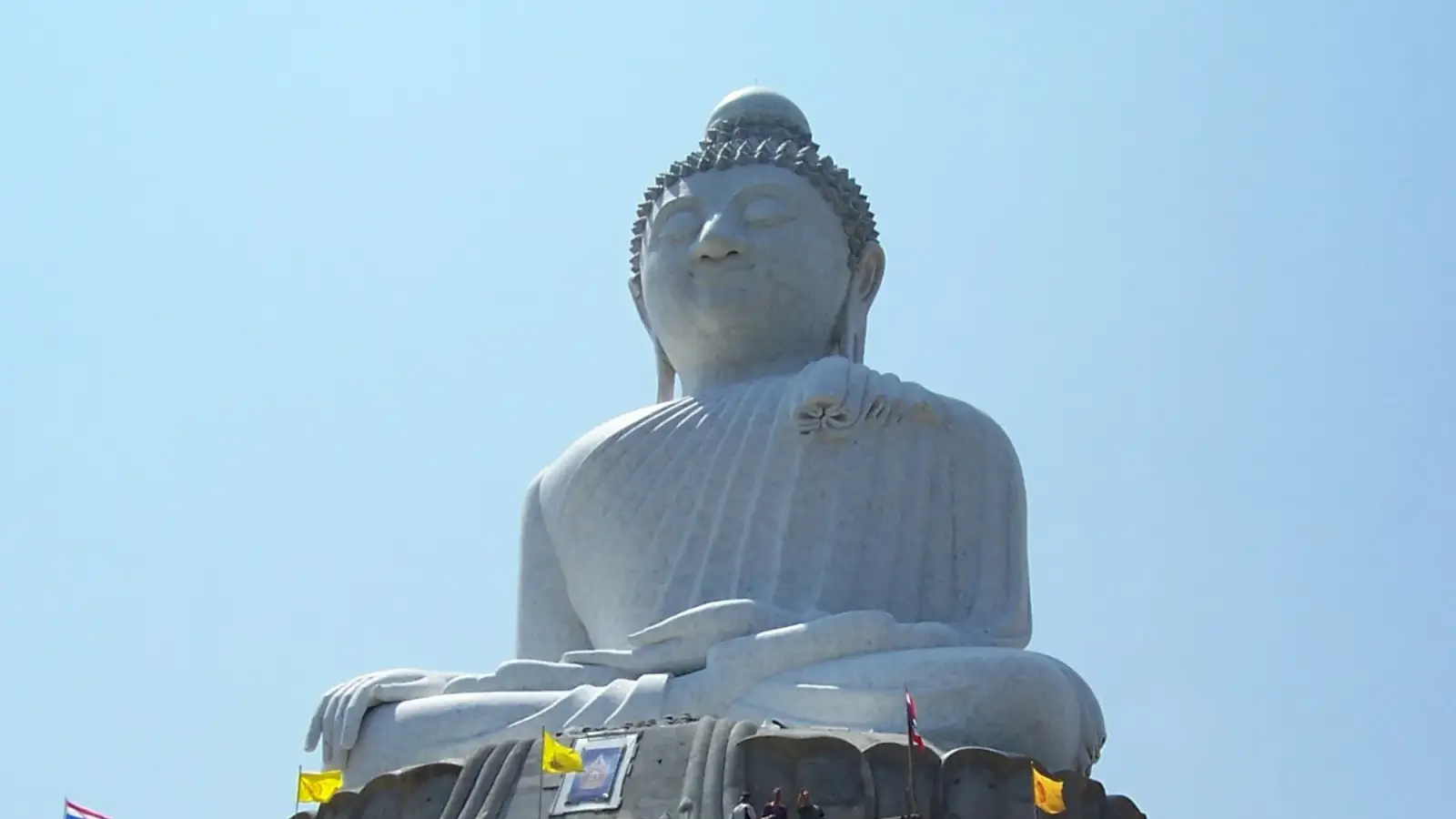
Phuket's Big Buddha, Phra Phutthamingmongkhon Eknakhiri, is a statue 45 m tall and 25.45 m wide at the top of Nakkerd Hill, between Chalong and Kata, made of concrete covered in white Burmese marble. Construction began in 2002, paid for with donations. The statue faces Chalong Bay, which can be seen from the top of the hill. It is the main Buddha of Wat Kitthi Sankaram; respect the site's dress rules.
The 45 m statue, clad in white Burmese marble, faces Chalong Bay from the top of Nakkerd Hill and is the most recognizable image of the island’s south. Combine it with Wat Chalong in the same morning.
Check access

Karon View Point
A viewpoint on the road between Kata Noi and Nai Harn, from which the three bays of Kata Noi, Kata and Karon can be seen in sequence. It fits on the same route as Cape Phromthep.
It shows the bays of Kata Noi, Kata and Karon in sequence and lies on the route between Kata and Cape Phromthep, so it takes only a few minutes to stop.
Check access

Karon Beach
One of the longest beaches on the island, north of Kata and south of Patong, calmer than Patong and sought out by families. The shoreline was hit hard by the 2004 tsunami and rebuilt. As along the whole west coast, whether you can swim depends on the flag of the day.
One of the island’s longest beaches, quieter than Patong and popular with families. It suits anyone staying in Karon or wanting more room on the sand than in Kata.
Check access
Nilo’s itinerary
Start with the basic programme and choose extensions for the time you have.
Plan my days in the app ↗Day 1 · Phuket's old town
Leave Kata or Karon early for the old town, about 15 km away: by ride-hailing car it takes about 20 minutes without traffic, and the blue songthaews make the trip more slowly.
Start with Thalang Road and Soi Rommanee before the heat, looking at the Sino-Portuguese facades, and continue along Dibuk Road.
Visit the Phuket Thaihua Museum, on Krabi Road, to understand Chinese immigration; Wikivoyage reports admission of 200 baht (100 for students), and it is best to check the hours beforehand.
Have lunch at moo hong or mee hokkien at an old town eatery and order an o-aew for dessert.
In the afternoon, walk to the Jui Tui Shrine and the Pudjor shrine, on Soi Phuthon, by Ranong Road. If the heat gets heavy, the free Dragon Line runs through the old town every 15 minutes.
Late in the day, go up by car to the Khao Rang viewpoint to see the town and the bay. If it is Sunday, check whether the Thalang Road street market is set up before heading back to the beach.
Day 2 · The south of the island: temples, beach and Cape Phromthep
In the morning, go to Wat Chalong, about 9 km from Kata, in clothes that cover your shoulders and knees.
Continue to the Big Buddha, on Nakkerd Hill, about 8 km from Wat Chalong; the statue faces Chalong Bay.
Come down to Kata and spend the middle of the day at the beach, swimming only if the flag allows.
Late in the day, follow the southern road to Karon View Point, from which the bays of Kata Noi, Kata and Karon can be seen.
Finish at Cape Phromthep, about 11 km from Kata, arriving before sunset to find a spot, and return to Kata for dinner.
Day 3 · Phang Nga Bay and James Bond Island
Day trip
Phang Nga Bay has been a national park since 1981, with limestone towers, caves and mangroves northeast of Phuket. Boat tours leave from piers on Phuket's east coast, such as Ao Po Marina, about 29 km from the old town; by land, Tha Dan Pier, by the park headquarters, is about 87 km away, an hour and a half by car without traffic. The classic route passes Khao Phing Kan, the island used in the 1974 film The Man with the Golden Gun, with the 20 m rock of Ko Ta Pu in front of it; boats have not been allowed to approach it since 1998. At Khao Phing Kan the tide varies by 2 to 3 m, and some caves can be reached only at low tide; several mangroves and grottoes in the bay can be reached only by kayak. Many tours stop at Ko Panyi, a Muslim fishing village built on stilts. The park charges an entrance fee; confirm whether the tour includes it.


If you stay longer
Day 4 · The Phi Phi Islands and Maya Bay
Day trip
The Phi Phi archipelago lies about 46 km southeast of Phuket, in Krabi province, within Hat Noppharat Thara and Mu Ko Phi Phi National Park. There are two main islands: Phi Phi Don, the only inhabited one, with the village and the Ton Sai pier, and Phi Phi Le, uninhabited, where Maya Bay, the setting of the film The Beach, is found.
There are two ways to go. The ferry leaves from Rassada Pier and takes an hour and a half to two hours to reach Ton Sai; it does not stop at Phi Phi Le, and reaching Maya Bay requires hiring a long-tail boat in Phi Phi Don to the other island, which leaves little time on a ferry day trip. To see Maya Bay the same day from Phuket, the practical way is a speedboat tour, which makes the crossing in about 50 minutes and passes both islands; check the program to see whether Maya Bay is included.
The bay was closed from 2018 to 2022 so the coral could recover. Since it reopened on January 1, 2022, boats do not enter it: landing is at a pier in Loh Samah Bay, on the other side of Phi Phi Le, swimming is prohibited and each visit lasts at most one hour. The park charges an entrance fee; check whether the tour includes it and whether the bay is open on your dates. In the monsoon, rough seas can cancel the departure.
Food
Mee hokkien (Hokkien noodles)
Wheat noodles stir-fried in the Hokkien style, a legacy of the Chinese miners. On the island it appears in many versions, in the noodle shops of the old town and in the markets.
Mee hoon pa chang
Thin rice noodles stir-fried in soy sauce, topped with fried onion and served with pork broth. The name comes from Pa Chang, the cook to whom the recipe is credited.
Moo hong
Pork belly slowly braised with dark soy sauce, sugar, garlic, black pepper and coriander root, from Fujian cuisine. It is eaten with white rice, as a main dish.
Oh tao
A fritter of oysters or other seafood with egg, flour, bean sprouts and taro, seasoned with salt, sugar, chili or vinegar. It is one of the island's oldest dishes.
Kanom jeen
Fresh rice noodles served with broths and curries, such as fish curry, and more than ten kinds of fresh greens. On the island it is a breakfast food.
Lo bah
Fried pork offal served with fried tofu and a sweet-sour, spicy sauce, street food for late afternoon.
O-aew
The dessert that Phuket considers its own: jelly made from the seed of a climbing fig and banana, served with red beans, shaved ice and red syrup. Some versions also include chao kuay, the dark herbal jelly.
Ah-pong and ang-gu
Two sweets of the local tradition. Ah-pong is a thin pancake of flour, egg yolk, coconut milk and sugar, an adaptation of the appam of southern India. Ang-gu is a glutinous rice flour cake shaped like a turtle, a symbol of long life, eaten with tea or coffee.
Where to eat
- Phuket Old Town · $
Moo hong, mee hokkien, oh tao and o-aew at the eateries and stalls on Thalang, Dibuk and Yaowarat roads; in the morning, kanom jeen with curry and greens.
- Naka, on Wirat Hong Yok Road · $
The weekend market in front of Wat Naka has a large area of food stalls, with noodles, grilled meats, fruit and sweets.
- Patong · $$
Seafood and international restaurants along the beachfront and the streets near Bangla Road, generally pricier than in the old town, where food and lodging tend to cost less.
$: about 150 THB for a meal at an inexpensive restaurant (Numbeo average, October 2026) · $$: about 1,087 THB for a three-course meal for two, without drinks, at a mid-range restaurant (Numbeo average, October 2026) · $$$: tasting menus at resort restaurants; check the price at the restaurant · 2026-10-16
Day trips
Phang Nga Bay and James Bond Island
Phang Nga Bay has been a national park since 1981, with limestone towers, caves and mangroves northeast of Phuket. Boat tours leave from piers on Phuket's east coast, such as Ao Po Marina, about 29 km from the old town; by land, Tha Dan Pier, by the park headquarters, is about 87 km away, an hour and a half by car without traffic. The classic route passes Khao Phing Kan, the island used in the 1974 film The Man with the Golden Gun, with the 20 m rock of Ko Ta Pu in front of it; boats have not been allowed to approach it since 1998. At Khao Phing Kan the tide varies by 2 to 3 m, and some caves can be reached only at low tide; several mangroves and grottoes in the bay can be reached only by kayak. Many tours stop at Ko Panyi, a Muslim fishing village built on stilts. The park charges an entrance fee; confirm whether the tour includes it.
The Phi Phi Islands and Maya Bay
The Phi Phi archipelago lies about 46 km southeast of Phuket, in Krabi province, within Hat Noppharat Thara and Mu Ko Phi Phi National Park. There are two main islands: Phi Phi Don, the only inhabited one, with the village and the Ton Sai pier, and Phi Phi Le, uninhabited, where Maya Bay, the setting of the film The Beach, is found.
There are two ways to go. The ferry leaves from Rassada Pier and takes an hour and a half to two hours to reach Ton Sai; it does not stop at Phi Phi Le, and reaching Maya Bay requires hiring a long-tail boat in Phi Phi Don to the other island, which leaves little time on a ferry day trip. To see Maya Bay the same day from Phuket, the practical way is a speedboat tour, which makes the crossing in about 50 minutes and passes both islands; check the program to see whether Maya Bay is included.
The bay was closed from 2018 to 2022 so the coral could recover. Since it reopened on January 1, 2022, boats do not enter it: landing is at a pier in Loh Samah Bay, on the other side of Phi Phi Le, swimming is prohibited and each visit lasts at most one hour. The park charges an entrance fee; check whether the tour includes it and whether the bay is open on your dates. In the monsoon, rough seas can cancel the departure.
Where to begin
Phuket's old town
Leave Kata or Karon early for the old town, about 15 km away: by ride-hailing car it takes about 20 minutes without traffic, and the blue songthaews make the trip more slowly.
The south of the island: temples, beach and Cape Phromthep
In the morning, go to Wat Chalong, about 9 km from Kata, in clothes that cover your shoulders and knees.
Money
The currency is the baht (THB, ฿). For comparing prices, Numbeo recorded on October 15, 2026 about 150 THB for a meal at an inexpensive restaurant and about 1,087 THB for a three-course meal for two at a mid-range restaurant, without drinks; these are averages reported by users, and at the beaches food and lodging tend to cost more than in the old town. For transport, the Smart Bus charges 100 ฿ between the airport and the beaches and 50 ฿ between the bus terminal and Patong, and the old town's Dragon Line is free.
PromptPay, the QR payment that Thais use everywhere, requires a Thai bank's app; bring baht in cash for stalls, songthaews and markets. Cards work at hotels, shopping centers, sit-down restaurants and on the Smart Bus, which accepts contactless cards. Ask the price of the taxi and the boat trip before boarding, and check whether the national park fee is included in the price of the island tour.
Alcohol can be sold from 11 a.m. to midnight since May 29, 2026; outside those hours, only at venues with their own license, such as hotels and authorized nightclubs.
Getting there and around
Phuket International Airport (HKT), in the far north
The airport is in Mai Khao, about 31 km from the old town and about 37 km from Patong by road. The Phuket Smart Bus, an air-conditioned bus, leaves from the stop in front of exit 3 of the domestic terminal and runs down the west coast to Rawai, passing Surin, Kamala, Patong, Karon and Kata, with a flat fare of 100 ฿ per trip; it takes cash and contactless cards. Schedules change with the direction; check the timetable on the line's website before landing. There are also buses between the airport and the town's bus terminal, as well as taxis and ride-hailing cars, such as Grab.
No metro or train: buses, songthaews and ride-hailing
Phuket has no train or metro; the nearest railway stations are about 230 km away, on the mainland. On the island, the Smart Bus links bus terminal 1, in town, to Patong for 50 ฿, and the Dragon Line, a free electric bus, runs a loop through the old town from 10 a.m. to 9 p.m., every 15 minutes (TAT data, July 2025). Songthaews, pickup trucks with benches in the bed, are the cheapest local transport: the blue ones link the town to the beaches, leaving from Ranong Road, and the pink ones run within the town. The website onemap.phuket.cloud shows the lines and the buses' position in real time.
Taxis on the island generally work with a fixed price agreed beforehand; agree on the amount or order the car through the app, which shows the price on the spot. Motorbike taxis are common in town and in Patong. Long-distance buses to Bangkok and other provinces use bus terminal 2, about 4 km from the center.
Boats to the islands
Ferries to the Phi Phi islands and Ko Lanta leave from Rassada Pier, on the east coast, about 4.5 km from the old town; speedboats and tours to Phi Phi and Phang Nga Bay leave from that pier and from others on the east coast, such as Chalong and Ao Po Marina. In the monsoon, rough seas can cancel or delay crossings.
Safety
The greatest risk in Phuket is at sea and on the road, not on the street. In the monsoon, from May to October, the rip currents of the west coast have caused drownings: swim at beaches with lifeguards and follow the flag system, leaving the water when the flag is red. Jellyfish also appear closer to shore at that time, and the sting of some species can be serious; ask at your hotel before going in. Passenger boats between the islands have sunk or collided from overloading, poor maintenance and rough seas: choose operators with life jackets in plain sight and do not board when the sea is bad.
On the road, rental motorbikes call for care: many are not registered for use on public roads, and travel insurance may not cover riders without the proper license. In busy areas, watch for theft, including bags snatched by someone passing on a motorbike, and keep an eye on your drinking. Drug laws are severe, and vapes are illegal.
Dengue and rabies exist in Thailand: use repellent and avoid stray dogs and monkeys. In an emergency, call 191 (police and general emergency), 1669 (ambulance) or 1155 (tourist police). The island's main hospitals are Vachira Phuket, public, and Bangkok Hospital Phuket, private.
Etiquette tips
A temple is a place of worship
At Wat Chalong, the Big Buddha and the Chinese shrines, wear clothes that cover your shoulders and knees, take off your shoes when entering the halls and do not point your feet at Buddha images or at monks.
During the Vegetarian Festival
The processions are religious rituals of the Hokkien community, with mediums with pierced faces and walking on hot coals. Watch from the sidewalk without blocking the way, do not touch the palanquins or the participants in the rituals, and follow the instructions of the organizers and the police. White clothing is what participants wear; spectators do not need it.
Nothing against the monarchy
Criticizing or joking about the royal family is a crime in Thailand, with long prison sentences, and the law also applies to comments and shares on social media.
Beachwear stays on the beach
Bikinis and swim trunks are sand clothing. In the old town, at temples and in markets, put a T-shirt and shorts or a skirt on over them.
Cigarettes and vapes
Smoking in public places can bring a fine of up to 5,000 baht, and possessing or using a vape or e-cigarette is illegal in Thailand, with no exception for tourists.
Mistakes to avoid
Staying only at the beach
Going from the airport straight to the beach and not seeing the old town, about 15 km from Kata and 16 km from Patong by road. That is where the tin history, the Chinese shrines and the food that earned the island its City of Gastronomy title are.
Swimming under a red flag
From May to October, the rip currents of the west coast have caused drownings. Swim only at beaches with lifeguards and respect the flag; when it is red, stay on the sand.
Leaving your passport as a deposit
Motorbike and jet ski rental shops sometimes ask for the passport as a deposit and keep it, claiming damage. Do not hand over the document; offer a copy and photograph the vehicle before you leave.
Renting a motorbike without a license or insurance
Many rental motorbikes in tourist areas are not registered for use on public roads, and travel insurance often does not cover riders without the proper license. The island's roads climb and drop over hills with tight curves; if you do not ride often, use buses, ride-hailing or taxis.
Thinking cannabis is free for all
Cannabis is allowed in Thailand only for medical use, with a Thai medical prescription limited to 30 days; recreational use is illegal. Taking it out of the country without an export license brings a fine starting at 30,000 baht per kilo, with detention if the fine is not paid.
Leaving all the boat trips for the end of the trip
In the monsoon, the sea can cancel the departure for Phi Phi or Phang Nga Bay. Book the trip at the start of your stay, to have spare days in case it is postponed.
Useful phrases
สวัสดีครับ / สวัสดีค่ะ (sa-wat-di khrap / kha)
Hello; men end with khrap, women with kha
ขอบคุณครับ / ค่ะ (khop-khun khrap / kha)
Thank you
เท่าไหร่ (thao-rai)
How much is it?
ไม่เผ็ด (mai phet)
Not spicy
หาด / เกาะ / อ่าว / แหลม (hat / ko / ao / laem)
Beach, island, bay and cape: the words that appear in map names, such as Hat Kata, Ko Phi Phi, Ao Phang Nga and Laem Phromthep
กินเจ (kin je)
“Eat je”: following the Vegetarian Festival diet, with no meat, seafood or dairy. The stalls that serve this food hang yellow flags with the word เจ (je) in red
Where to stay
- Kata and Karon · First time, families and anyone who wants a beach with a base near the south of the island · $$: The two beaches are calmer than Patong, about 15 km from the old town and close to the Big Buddha, Wat Chalong and Cape Phromthep. The airport Smart Bus passes through them.
- Phuket Old Town · Tight budgets and anyone interested in food and history · $: Lodging and food cost less than at the beaches, the shrines and eateries are within walking distance, and Rassada Pier, where the ferries to Phi Phi leave, is about 4.5 km away. The beach requires a songthaew, bus or car.
- Patong · Anyone who wants nightlife and everything on foot · $$: It has the island's largest supply of hotels, restaurants and bars, with Bangla Road starting at the beachfront avenue. It is the loudest and most crowded area; to sleep early, choose another beach.
- North: Nai Yang and Mai Khao · Anyone who arrives late, leaves early or wants a quiet beach · $$$: They are near the airport and Sirinat National Park, with less crowded beaches. In exchange, the old town and the southern beaches are 40 minutes or more away by car.
$: hostel or simple hotel, mostly in the old town; check the price for your dates · $$: mid-range hotel in Kata, Karon or Patong; check the price for your dates · $$$: beach resort; check the price for your dates, which rises in the December to March high season · 2026-10-16
Districts
Phuket Old Town
The historic core of the capital, around Thalang, Dibuk, Krabi, Phang Nga and Yaowarat roads and the alley Soi Rommanee, in an area of about 2.7 km². Restored Sino-Portuguese shophouses hold cafés, shops, small hotels and museums, and the Chinese shrines are a few blocks away. It is the neighborhood for anyone who wants local food and lower prices than at the beaches; the nearest beach is about 15 km away.
Patong
The island's main tourist area, on a west coast bay with 2,850 m of beach. It concentrates hotels, shopping centers and the nightlife of Bangla Road and the Paradise Complex, the latter aimed at a gay clientele. It suits those who want nightlife, shopping and plenty on foot; it is not the place for quiet.
Karon
A long beach south of Patong, one of the island's largest, with big hotels behind the strip of sand. It is calmer than Patong and sought out by families and couples.
Kata (Kata Yai and Kata Noi)
Two coves south of Karon, about 15 km from the old town by road: Kata Yai, the main one, and Kata Noi, smaller, beyond a headland. In the monsoon, the waves bring surfers to Kata Yai. It is a short distance from the Big Buddha and Cape Phromthep, which makes it a good base for the south of the island.
Rawai, Nai Harn and Cape Phromthep
The southern end of the island, with Nai Harn beach, Cape Phromthep and Rawai, home to one of the chao le communities, the sea peoples, who celebrate the floating boat festival twice a year. It is the last stop of the Smart Bus line from the airport.
Chalong
An inland neighborhood in the south, between the town and Chalong Bay, where Wat Chalong, the island's most important Buddhist temple, the climb to the Big Buddha and Chalong Pier, from which boats leave for the southern islands, are found.
North: Thalang, Nai Yang and Mai Khao
The greener northern half of the island, with the airport, the Thalang National Museum, the protected Khao Phra Thaeo forest and Sirinat National Park, created in 1981, where Nai Yang beach, a nesting site for sea turtles, is found. It suits those who arrive late or leave early and those who prefer a quieter beach, away from town.
History
1545 · Junk Ceylon in Portuguese accounts
The Portuguese Fernão Mendes Pinto reaches Siam in 1545 and mentions the island seven times as Junk Ceylon, a name derived from the Malay Tanjung Salang, a supply port on the route between India and China.
1685 · The French tin monopoly
King Narai grants the French the island's tin monopoly, after the Dutch and the English had competed for the trade. The French presence ends after the Siamese revolution of 1688.
1785 · The siege of Thalang
A Burmese army besieges Thalang, then the capital of the island. The governor's widow, Chan, and her sister Mook organize the defense, and the siege ends on March 13, 1785. King Rama I gives the two women the titles Thao Thep Kasattri and Thao Si Sunthon.
1825 · The Vegetarian Festival begins
Phuket's Chinese community begins to observe the nine days of abstaining from meat in the ninth lunar month, according to local tradition, which names the Kathu shrine as the first to celebrate it.
1876 · The miners' revolt
Chinese workers from the tin mines of Phuket and neighboring provinces rebel. The monks Luang Pho Chaem and Luang Pho Chuang, from Chalong, help the wounded with medicinal herbs, and Wat Chalong is dedicated to them.
1868–1932 · The tin city
Under Rama V, Phuket becomes the administrative center of the tin provinces of southern Siam. The Sino-Portuguese shophouses and the mansions of the old town are built in this period, and in the early 20th century Governor Phraya Ratsadanupradit opens roads and invites European mining companies.
1933 · The province is born
The monthon of Phuket, an administrative unit that grouped the coastal towns of the west, is dissolved, and Phuket becomes a province.
1967 · The bridge to the mainland
The 660 m Sarasin Bridge, the first road link between Phuket and Phang Nga province, is officially opened on July 7, 1967. Since a new bridge opened beside it in 2011, it has been for pedestrians only.
1980s · The beaches become a destination
Tourism grows on the west coast beaches, above all Patong, Karon and Kata, and becomes the island's main source of income, replacing tin and rubber.
2004 · The tsunami
On December 26, 2004, the tsunami caused by an earthquake off Sumatra hits the west coast. About 250 people die in Phuket, and Kamala, Patong, Karon and Kata suffer the greatest damage. Thailand installs tsunami warning buoys in the Indian Ocean in December 2006.
2015 · City of Gastronomy
UNESCO adds Phuket to its Creative Cities Network as a City of Gastronomy, for a cuisine that blends Thai, Hokkien Chinese and Malay heritage.
Complete history
An island on the tin route
For centuries Phuket sat on a shipping route between India and China, and the name that appears on European maps, Junk Ceylon, is a corruption of the Malay Tanjung Salang, Cape Salang. The name Phuket itself comes from the Malay bukit, hill. What drew the ships was tin: the Dutch, English and French competed for the metal in the 17th century, and King Narai even named a French missionary governor of the island and granted France the trade monopoly in 1685. The island was never colonized by a European power. The capital at that time was Thalang, in the north, which is why the airport district still carries that name.
The heroines of Thalang
In 1785, during the war between Siam and Burma, a Burmese army besieged Thalang just after the governor's death. His widow, Chan, and her sister, Mook, organized the defense; according to tradition, they dressed women as soldiers so that the town would look better defended. The siege ended on March 13, 1785, and King Rama I gave the two women the titles Thao Thep Kasattri and Thao Si Sunthon. The monument to them, beside Highway 402, appears on the province's seal, and the Thalang National Museum next to it tells the story of that war along with the island's earlier history.
Hokkien miners and the Sino-Portuguese town
In the 19th century, tin mining brought Chinese workers, mostly Hokkien. From unions between Hokkien miners and local women came the Baba, or Peranakan, community, with its own language, dress and cuisine. The town of Phuket took shape around that trade: the shophouses, with narrow facades and long bodies running back from the street, covered arcades over the sidewalk and Chinese and European details, date from the reign of King Rama V and the early 20th century, when Governor Phraya Ratsadanupradit opened roads and brought in European mining companies. In 1876, a revolt of Chinese miners marked the island, and the Chalong monks who cared for the wounded are still venerated at Wat Chalong.
From tin to beaches
Tin and rubber sustained Phuket until mining declined in the 20th century. The Sarasin Bridge, opened in 1967, linked the island to the mainland by road, and in the 1980s the beaches of the west coast, Patong first among them, became an international destination. The tsunami of December 26, 2004 killed about 250 people in Phuket and devastated the shoreline of Kamala, Patong, Karon and Kata, which was rebuilt in the following years. Today tourism accounts for most of the province's economy, and the island's real population is well above the official registry, because many Thai and foreign workers live there without being registered locally.
In 1785, the sisters Chan and Mook organized the defense of Thalang against a Burmese army; the siege ended on March 13.
Geography and shape of the city
The island and its two coasts
Phuket island covers 543 km², is 48 km long and up to 21 km wide. A range of hills runs north to south along the west side, and the highest point, Khao Mai Thao Sip Song, is 529 m. The west coast, facing the open Andaman Sea, has the sand beaches, separated by rocky headlands; the east coast, facing Phang Nga Bay, has mud beaches and mangroves. The southern tip is Cape Phromthep. About 60% of the island is covered by forest and rubber and oil palm plantations.
Phang Nga Bay
East of the island, Phang Nga Bay is shallow and dotted with limestone towers that rise vertically from the water, with caves and mangroves. About 10,000 years ago, with the sea lower, it was possible to walk from Phuket to Krabi. Part of the bay has been a national park since 1981 and a Ramsar site since 2002.
Monsoon and dry season
The climate is tropical monsoon, warm all year: at the Phuket town station (1981 to 2010 normals), average highs range from 31.5 °C to 34 °C and lows from 24.4 °C to 25.8 °C. The dry season runs from December to March, with 24 to 74 mm of rain a month. From May to October, the monsoon brings rain on 18 to 23 days a month and rough seas on the west coast: September totals 361 mm and October 320 mm.
How the island is laid out
Phuket town occupies the southeast of the island, far from the main beaches: Patong is about 16 km away by road and Kata about 15 km. The airport is at the far north, about 31 km from the old town. Highway 402 runs the length of the island from the bridges over the Pak Prah Strait to the town, and the west coast beaches are linked to one another by roads that climb and drop over the hills.
The west coast has the sand beaches; the east coast, mangroves and the piers from which boats leave for Phang Nga Bay.
Culture
The Vegetarian Festival and the Hokkien heritage
The Vegetarian Festival, called jia chai by the Hokkien community, takes place from the first to the ninth day of the ninth Chinese lunar month, usually between late September and October. During the nine days, participants dress in white and give up meat and animal products, and the town's Chinese shrines organize processions in which the nine emperor gods are carried through the streets. In the processions and at the shrines, the ma song, mediums who believe they are possessed by the gods, pierce their cheeks and tongues with skewers, blades and other objects, and there are rituals of walking on hot coals and climbing ladders of blades: these are intense scenes that weigh on the decision to bring children. Thailand's Department of Cultural Promotion registered the festival as intangible cultural heritage in 2018. The same community celebrates pho tor, the festival of spirits of the seventh lunar month, with offerings and red cakes shaped like turtles.
Baba, chao le and an island of many origins
Phuket is mostly Buddhist, but about a quarter of the population is Muslim (26.65% in a 2017 survey), especially in Thalang district, in the north. The Baba, or Peranakan, community, born of unions between Hokkien miners and local women, has ties to the Peranakan of Penang and Malacca. The chao le, sea peoples such as the Urak Lawoi of Ko Sire and the communities of Rawai, are among the island's oldest inhabitants and release small boats to sea in the sixth and eleventh lunar months, in a ceremony to ward off bad luck.
Sea, regattas and nightlife
Outdoor life revolves around the sea: the King's Cup Regatta, in December, is one of the great regattas of Asia, and Kata receives surfers in the monsoon. Nightlife is concentrated in Patong, on Bangla Road and at the Paradise Complex. Since May 29, 2026, the sale of alcohol in Thailand has been allowed from 11 a.m. to midnight, with separate rules for hotels and licensed nightclubs.
Festivals and events
Vegetarian Festival: ninth Chinese lunar month, between late September and October
Nine days of abstaining from meat and rituals at the town's Chinese shrines, from the first to the ninth day of the ninth lunar month, with daily processions through the old town. Participants wear white, and the stalls that serve festival food hang yellow flags with the word เจ (je) written in red. The dates change every year with the lunar calendar: in 2026, for example, the festival ran from October 10 to 18, with processions from the 11th to the 18th. For another year, check the dates published by the TAT before booking.
Heroines' Festival: March 13
Celebrates Thao Thep Kasattri and Thao Si Sunthon and the end of the Burmese siege of 1785, at their monument in Thalang.
Chao le boat festival: sixth and eleventh lunar months
The chao le communities of Rawai, Ko Sire and Laem La release small boats with offerings to the sea at night to ward off bad luck. The dates follow the Thai lunar calendar.
Pho tor: seventh Chinese lunar month
The festival of spirits of the Hokkien community, with offerings to ancestors, burned paper and red cakes shaped like turtles, which symbolize long life.
King's Cup Regatta: December
A week of sailing races on the west coast, hosted at a resort in Kata, that brings together sailors from many countries.
Books and films
The Man with the Golden Gun (1974), by Guy Hamilton
The James Bond film put Khao Phing Kan and the rock of Ko Ta Pu, in Phang Nga Bay, on the map of international tourism: the island became the villain Scaramanga's hideout and is still called James Bond Island today.
The Beach (2000), by Danny Boyle
Filmed at Maya Bay, on Phi Phi Le, the film starring Leonardo DiCaprio led to two developments. The production altered the beach and was sued for environmental damage, in a case the Thai Supreme Court judged in 2006. And the number of visitors grew to about 5,000 a day, which led to the bay's closure from 2018 to 2022. The On On Hotel, in Phuket's old town, also appears in the film.
Saphan Rak Sarasin (1987)
A Thai film that tells the story of the couple who jumped from the Sarasin Bridge in 1973, after the girl's family forbade them to marry; it helps explain why the 1967 bridge, now for pedestrians only, is a place of memory on the island.
Frequently asked questions
Phuket: How do you get from the airport to the beaches?
The Phuket Smart Bus leaves from the stop in front of exit 3 of the domestic terminal and runs down the west coast to Rawai, with a flat fare of 100 ฿ per trip, in cash or by contactless card. There are also taxis and ride-hailing cars, such as Grab.
Phuket: How many days should you plan?
I'd stay three days in Phuket, based in Kata or Karon. With a fourth day, I'd go to the Phi Phi islands on a speedboat tour from Phuket, checking beforehand that the program includes Phi Phi Le and Maya Bay.
Phuket: Does the ferry to Phi Phi stop at Maya Bay?
The ferry leaves from Rassada Pier and takes an hour and a half to two hours to reach Ton Sai, without stopping at Phi Phi Le. To see Maya Bay the same day from Phuket, the practical way is a speedboat tour; check the program to see whether Maya Bay is included.
Phuket: Can you pay by card?
Cards work at hotels, shopping centers, sit-down restaurants and on the Smart Bus. PromptPay, the QR payment that Thais use everywhere, requires a Thai bank's app, so bring baht in cash for stalls, songthaews and markets.
Phuket: When is the best time to go?
December to March is the dry season, with 24 to 74 mm of rain a month in Phuket town and generally calm seas on the west coast. From May to October, the monsoon brings rain on more than half the days, peaking in September (361 mm) and October (320 mm).
Other cities in the country
Thailand ↗- Days
- 3–4
- When
- Jan–Feb · Nov–Dec
- Per person/day
- Average 2,500–4,500 THBMid-range · per person/day
Cost scope
Per person per day: accommodation, meals, urban transport, visits and a small allowance for extras. Flights excluded; larger purchases vary. Editorial estimate, not a quote.
- Days
- 2–3
- When
- Jan · Nov–Dec
- Per person/day
- Average 2,000–3,500 THBMid-range · per person/day
Cost scope
Per person per day: accommodation, meals, urban transport, visits and a small allowance for extras. Flights excluded; larger purchases vary. Editorial estimate, not a quote.