Cambodia
Siem Reap
The temples of Angkor, Tonlé Sap, and Khmer cooking
Days Start with the basic programme and choose extensions for the time you have.
How the guide reaches this number
On the first, do Angkor Wat at sunrise, Angkor Thom, and Ta Prohm; on the second, go to Banteay Srei and Kbal Spean and finish at the museum. On the third, take the boat on Tonlé Sap if it’s between September and January, or stay in town for the workshops and the Street 60 market. Anyone looking for late nightlife will be disappointed, because it fits into three blocks of Pub Street that empty out around one in the morning. Anyone who can’t handle heat or early starts will also struggle, because temple visits start early. With just one day, watch sunrise at Angkor Wat and go into the Bayon at 9:30am. At 11am, have amok for lunch at a Khmer restaurant, rest until 3pm, and reach Ta Prohm in the late afternoon, all in the same tuk-tuk hired for the day. At that pace there’s no time left to read the 800 m of bas-reliefs at Angkor Wat properly. It disappoints anyone who arrives between March and May expecting a floating village, because the lake recedes and the boat can’t leave the channel. On the other hand, with 387,772 visitors in the first half of 2026, many temple corridors stand empty, and that is unlikely to last.
3
When November to February: dry, 22–33 °C, lower humidity
How the guide reaches this number
Siem Reap has three seasons, and each one changes what you can do at the temples and on the lake. From November to February the weather is dry and relatively cool, between 22 and 33 °C, with lower humidity and clear skies. This is high season, with higher hotel prices and bigger sunrise crowds. From March to May comes the dry heat, with highs of 35 to 38 °C and a worse heat index at midday among the pale stones. April adds the Khmer New Year, when the city fills with Cambodians and many services shut for three or four days. From June to October is the southwest monsoon: it rains almost every day, usually in late-afternoon downpours that last an hour or two. The park turns green, the moats fill, and prices drop, making it the best time for photography and the worst for anyone who can’t stand mud and humidity. September and October bring the peak flood of Tonlé Sap, when the flooded forest of Kampong Phluk and the Prek Toal bird sanctuary fill with water. At the end of the dry season, from March to May, those same routes are too shallow for the boat. If you need to cut a month, cut April, which combines peak heat with the holiday that shuts the city. To plan the early start, count on the sun rising behind the towers of Angkor Wat around 6am in November and 6:30am in January and February. The exact alignment over the central tower happens near the equinoxes, around March 21 and September 22.
Per person/day US$25–35 on a budget; US$60–90 with comfort, not counting the Angkor Pass
How the guide reaches this number
Per person per day: accommodation, meals, urban transport, visits and a small allowance for extras. Flights excluded; larger purchases vary. Editorial estimate, not a quote.
 What Nilo thinks
I’d set aside three days for Siem Reap, the length the US$62 pass assumes, with a 4:30am alarm on at least one of them. On the first, do Angkor Wat at sunrise, Angkor Thom, and Ta Prohm; on the second, go to Banteay Srei and Kbal Spean and finish at the museum. On the third, take the boat on Tonlé Sap if it’s between September and January, or stay in town for the workshops and the Street 60 market. Anyone looking for late nightlife will be disappointed, because it fits into three blocks of Pub Street that empty out around one in the morning. Anyone who can’t handle heat or early starts will also struggle, because temple visits start early. With just one day, watch sunrise at Angkor Wat and go into the Bayon at 9:30am. At 11am, have amok for lunch at a Khmer restaurant, rest until 3pm, and reach Ta Prohm in the late afternoon, all in the same tuk-tuk hired for the day. At that pace there’s no time left to read the 800 m of bas-reliefs at Angkor Wat properly. It disappoints anyone who arrives between March and May expecting a floating village, because the lake recedes and the boat can’t leave the channel. On the other hand, with 387,772 visitors in the first half of 2026, many temple corridors stand empty, and that is unlikely to last.Just 6 km from downtown Siem Reap begin the roughly 400 km² of the Angkor Archaeological Park, what remains of the capital of the Khmer empire. There stand Angkor Wat, the largest religious monument in the world by area, the Bayon, with its 216 stone faces, and Ta Prohm, where conservation decided to leave the fig roots over the galleries. See the sun rise behind the towers of Angkor Wat at least once, and save the middle of the day for shade, because the pale stone gets too hot and the temples sit far apart from each other. In town, try amok, fish in coconut-milk curry steamed in a banana-leaf basket. To the south, Tonlé Sap lake has villages on stilts you visit by boat when the water is high. Come between November and February, in the dry season, and set aside three days, the length the Angkor pass assumes.
Quick facts
- Population
- about 250,000 in the urban area; about 1.1 million in the province (2024–2026 estimates)
- Founded
- Angkor from 802 onward; the modern city took shape after 1907
- Country and region
- Cambodia, Siem Reap province, north of Tonlé Sap
- Language
- Khmer; English common in the tourism sector; French among older people
- Currency
- Riel (KHR) and US dollar circulating side by side, about 4,000 KHR = US$1
- Time zone
- UTC+7, no daylight saving: 10 hours ahead of Brasília
- Best time to visit
- November to February: dry, 22–33 °C, lower humidity
- Average daily cost
- US$25–35 on a budget; US$60–90 with comfort, not counting the Angkor Pass
When to go
November to February: dry, 22–33 °C, lower humidity
How the year changes
Siem Reap has three seasons, and each one changes what you can do at the temples and on the lake. From November to February the weather is dry and relatively cool, between 22 and 33 °C, with lower humidity and clear skies. This is high season, with higher hotel prices and bigger sunrise crowds. From March to May comes the dry heat, with highs of 35 to 38 °C and a worse heat index at midday among the pale stones. April adds the Khmer New Year, when the city fills with Cambodians and many services shut for three or four days. From June to October is the southwest monsoon: it rains almost every day, usually in late-afternoon downpours that last an hour or two. The park turns green, the moats fill, and prices drop, making it the best time for photography and the worst for anyone who can’t stand mud and humidity. September and October bring the peak flood of Tonlé Sap, when the flooded forest of Kampong Phluk and the Prek Toal bird sanctuary fill with water. At the end of the dry season, from March to May, those same routes are too shallow for the boat. If you need to cut a month, cut April, which combines peak heat with the holiday that shuts the city. To plan the early start, count on the sun rising behind the towers of Angkor Wat around 6am in November and 6:30am in January and February. The exact alignment over the central tower happens near the equinoxes, around March 21 and September 22.
Nilo's tips
Buy the pass the day before, 4 km from downtown
The three-day and seven-day passes are sold only at the Angkor Enterprise office on Apsara Road, 4 km east of downtown. At the gate of Angkor Wat, the machines at the west gate and the Heritage Walk issue only the one-day pass. Go the day before, in the late afternoon, because the counter takes your photo on the spot and the pass is not transferable. It costs US$37 for one day, US$62 for three, usable within ten, and US$72 for seven. A pass bought in the late afternoon is usually already valid for that day’s sunset, but this rule has changed more than once, so check at the counter.
Book the 4:45am tuk-tuk the day before and stay at the south pool
At 4:45am there's nobody on the street to negotiate with, and the crowd at the south pool is much smaller. A full-day tuk-tuk costs US$15–20 for the small circuit, and you agree on the departure time the night before. In front of Angkor Wat, the south pool is on your right as you walk in and has a reflection similar to the north pool, the one in the classic photo, which fills up first. The light comes from behind the towers, so the facade takes a while to light up. Go into the temple at 6:30am, when the groups leave for breakfast.
From 11am to 3pm, swap the temple for a museum or a massage
From 11am to 3pm, get away from the hot stone of the temples and spend those hours somewhere under cover. The Angkor National Museum, on Charles de Gaulle Avenue, takes an hour and a half, and a one-hour massage costs US$8–12. When you go back to the park, carry two liters of water per person, because the places to buy it inside are few and expensive.
Skip the Bakheng line and eat on Street 60
The top of Phnom Bakheng admits 300 people at a time, and anyone arriving at 5:30pm usually gets left out. The line starts at 4pm and the climb takes twenty minutes. Swap Bakheng for Pre Rup, Srah Srang, or the moat of Angkor Wat, which have the same late-afternoon light and no entry quota. After sunset, head to the Street 60 night market, with grilled food and a Ferris wheel, where food costs what it does in town and not what it does on Pub Street.
Boat on Tonlé Sap only Sept–Jan, via a fixed-address agency
In the dry season the lake recedes and the boat runs aground before reaching the houses and the flooded forest, which is only navigable from September to January. Kampong Phluk, 16 km south, is the village the itinerary proposes and the one with the flooded forest. Kampong Khleang, at 50 km, has more houses and fewer tourists and takes a whole morning; Chong Kneas, at 12 km, is the most crowded with tour groups. Book through an agency with a fixed address, with the total price, destination, and duration in writing, because the local scheme is a second fee charged in the middle of the lake.
At the ATM: clean notes, a big withdrawal, and riel
The ATM charges US$4 to 6 per withdrawal, plus your own bank's fee, so take out a lot at once. Bring clean dollars, because a torn or scribbled-on bill is often refused at the counter. Change from any purchase comes in riel: 2,000 riel is 50 cents, and that's what pays for street breakfast. KHQR is everywhere, and visitors can pay through it with the Bakong Tourists app, without a Cambodian account; even so, for markets, temples, and tuk-tuks, bring cash.
Explore the map

© OpenStreetMap · OpenFreeMap · © OpenMapTiles
Explore the map, read about the other places and plan your travel days in the app.
Open the appWhat to see
Siem Reap: the Tonlé Sap and the Kulen plateau
Siem Reap sits about 15 meters above sea level, on an alluvial plain between the Tonlé Sap, 12 km to the south, the largest freshwater lake in Southeast Asia, and the Phnom Kulen plateau, 48 km to the northeast, which reaches 487 m and supplied the water and sandstone Angkor was built with.

Angkor Wat
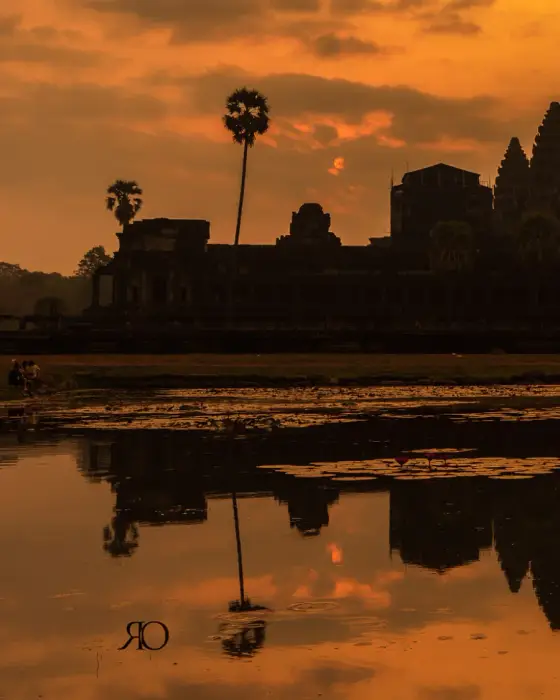
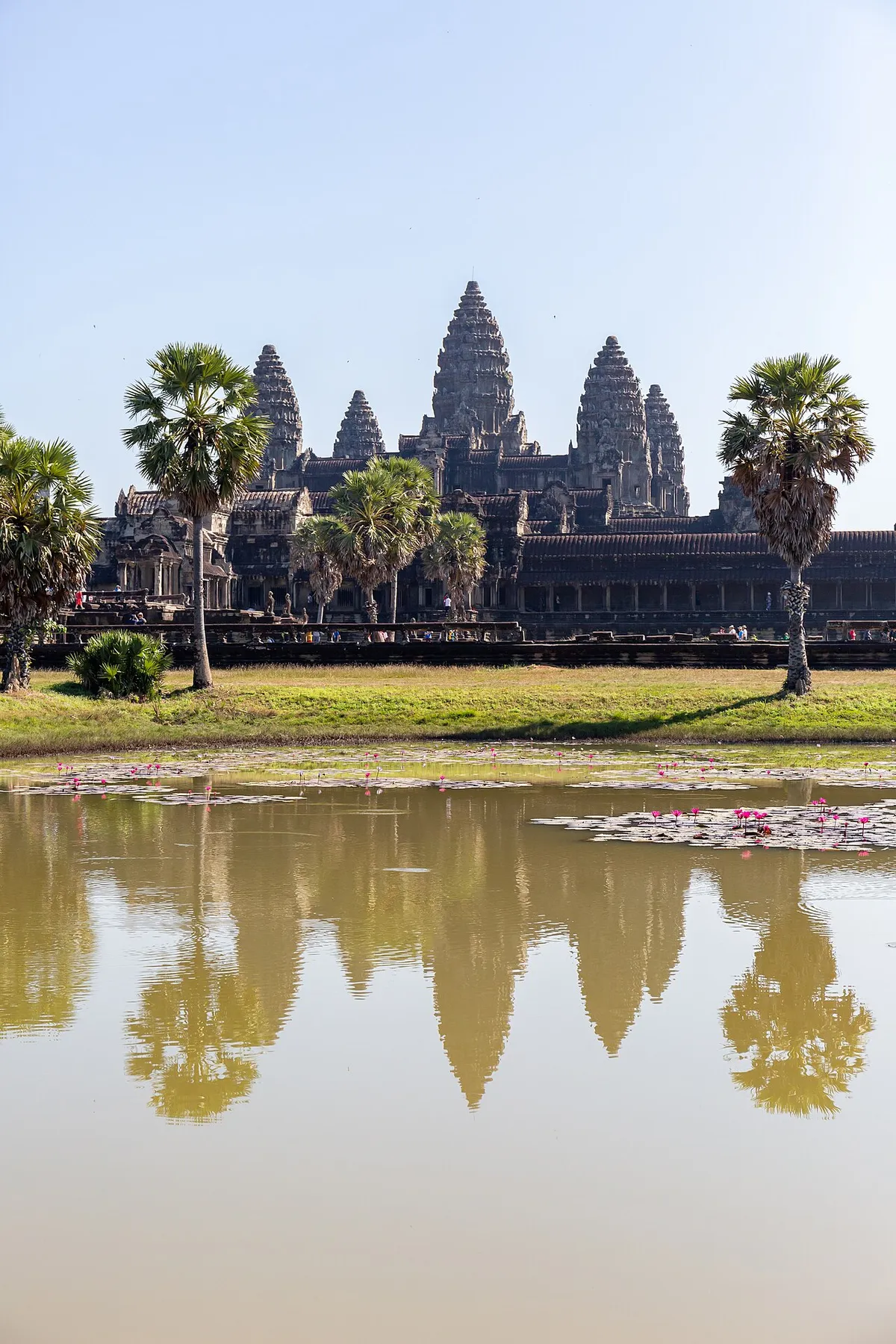
The largest religious monument in the world by area: 162 walled hectares, a moat about 190 m wide, and a central tower 65 m high. Built between 1113 and 1150 by Suryavarman II, it is the only major temple at Angkor that faces west, and its outer gallery holds 800 continuous meters of bas-reliefs, with the Churning of the Ocean of Milk in the east wing and about 1,800 apsara figures spread across the walls.
Built during the reign of Suryavarman II (1113 to 1150), in a project that took about three decades, it's the only major Angkor temple facing west, and it covers 162 walled hectares, with a moat about 190 m wide and a 65-m central tower.
Check access

Angkor Thom and the Bayon
A 9 km² walled city founded by Jayavarman VII around 1200, with five monumental gates and causeways of 54 deities pulling a serpent. At its center stands the Bayon, with 216 stone faces on 54 towers and an outer gallery that records everyday 12th-century scenes: a market, a cockfight, a kitchen, childbirth.
Jayavarman VII founded the 9-km² walled city around 1200, and the Bayon at its center has 216 stone faces on 54 towers, while the outer gallery shows a 12th-century market and a childbirth; there are five gates and 54 deities pulling the serpent.
Check access

Ta Prohm
A Buddhist monastery from 1186 where conservators decided to leave the roots of fig and tetrameles trees over the galleries instead of removing them. An inscription found on site mentions 12,640 people in the temple’s service, and restoration has been run since 2004 by the Archaeological Survey of India in partnership with APSARA.
The site's conservators chose to leave the roots of the fig and tetrameles trees over the galleries rather than remove them completely.
Check access
Banteay Srei
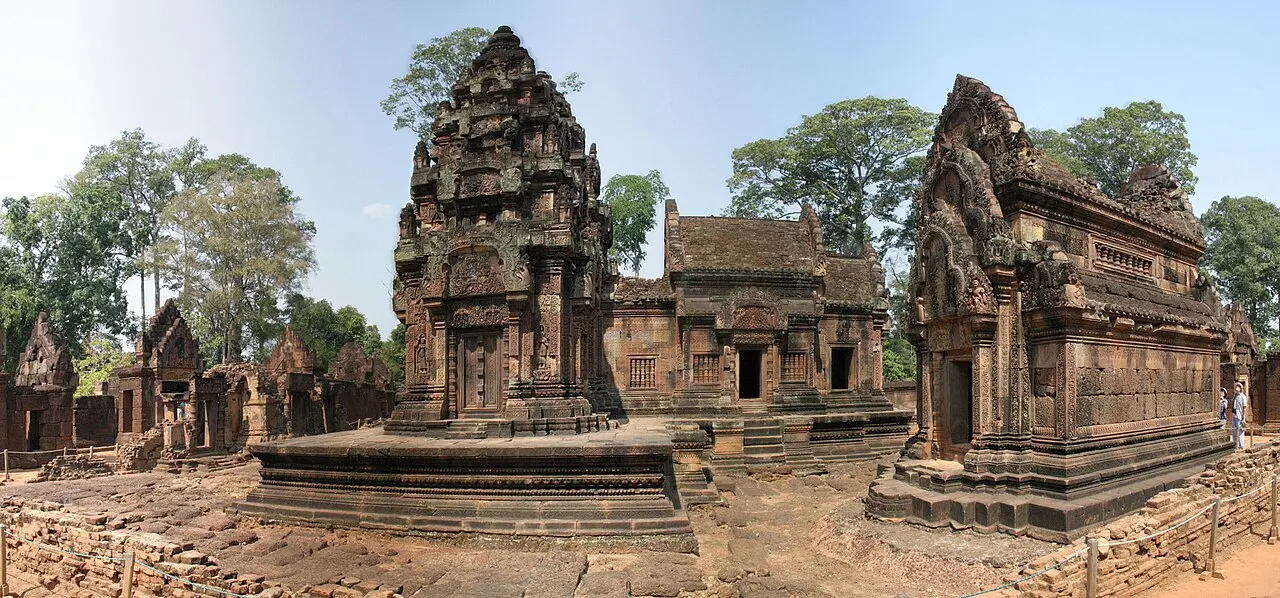
37 km north of downtown, a temple from 967 dedicated to Shiva, built in pink sandstone by a brahmin rather than a king. The high-relief carving is the deepest and best preserved in the entire Angkorian complex; this is where André Malraux tried to remove pieces in 1923, an episode that ended in a criminal trial.
The 37-km trip north is worth it for the deepest and best-preserved carving in all of Angkor, the work of a Brahmin in 967 rather than a king, and in 1923 Malraux ended up prosecuted after trying to remove pieces.
Check access
Preah Khan and Neak Pean
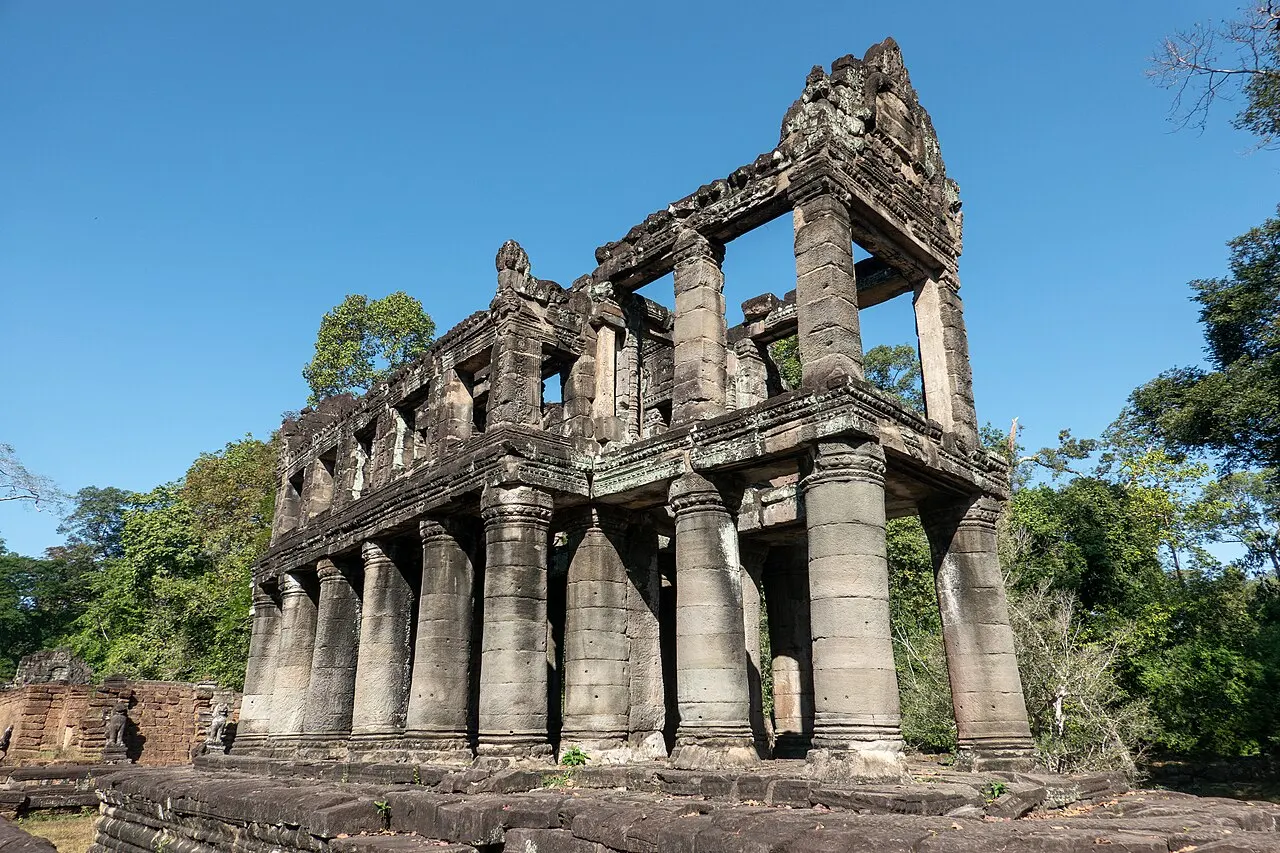
Preah Khan (1191) covers 56 hectares, with corridors that narrow progressively and a two-story building with round columns, rare at Angkor; the World Monuments Fund has worked there since 1991. A few minutes away, Neak Pean is an artificial island with five linked pools, probably a therapeutic complex, surrounded by the Jayatataka Baray.
Two nearby compounds are visited together, one with passages that keep narrowing and a pavilion with round columns, the other on an island with linked pools; Preah Khan, from 1191, covers 56 hectares; World Monuments Fund, since 1991.
Check access
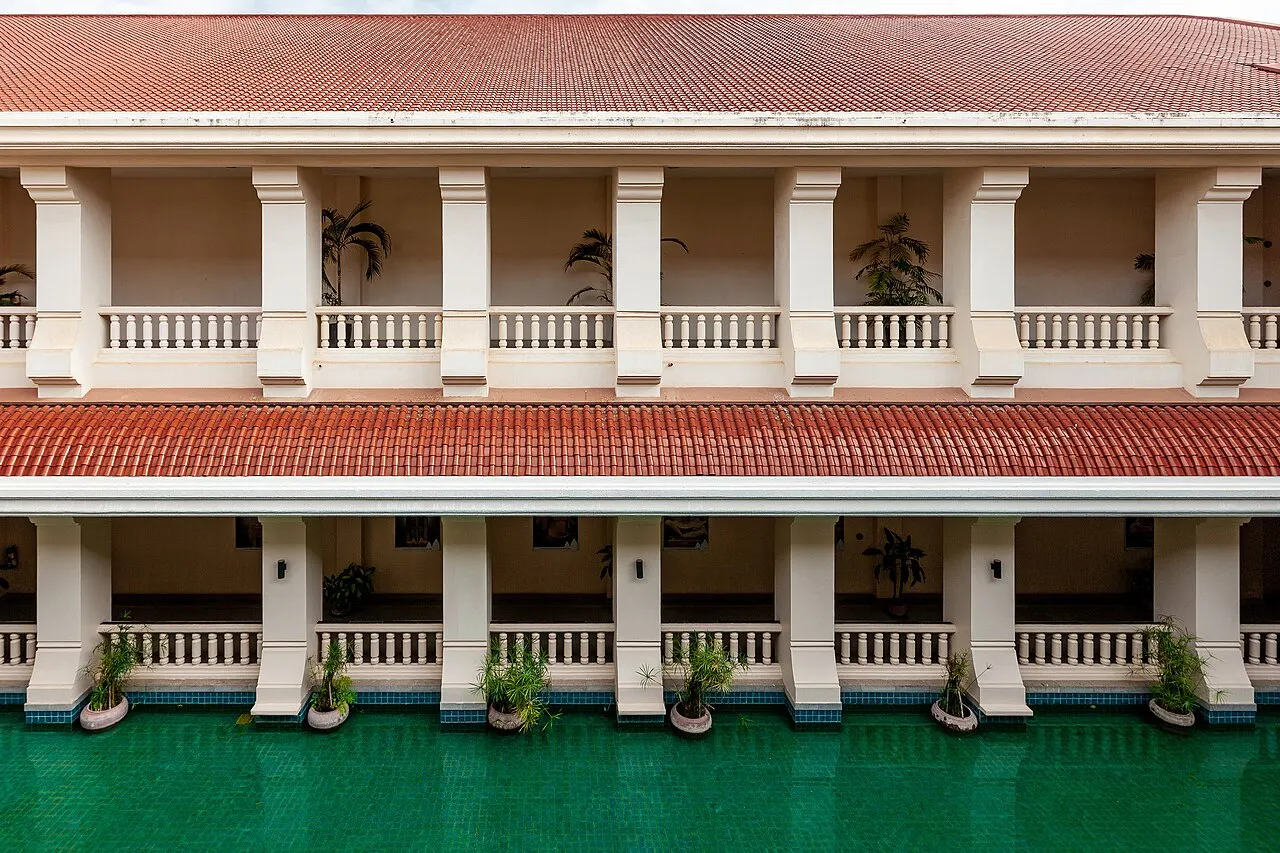
Angkor National Museum
Opened in 2007 on Charles de Gaulle Avenue, the one that leads to the temples, it's organized into eight themed galleries with originals removed from the temples, including a hall with more than a thousand Buddha images. It works best as preparation before your first visit to the park rather than as a standalone outing; set aside about ninety minutes.
It works better as preparation than as a stand-alone outing, because it gathers originals removed from the sanctuaries in themed galleries. It opened in 2007 on Charles de Gaulle Boulevard, and one of the galleries holds more than a thousand images of the Buddha.
Check access

Tonlé Sap: Kampong Phluk and Kampong Khleang
Villages on stilts 6 to 10 meters tall, built for the lake's yearly swings. Kampong Phluk is 16 km south of the city; Kampong Khleang, at 50 km, is considerably larger and gets far fewer visitors. The flooded forest is only navigable from September to January, and between March and May the boat never leaves the canal.
You can only cross the flooded forest from September to January; from March to May the boat doesn't leave the channel.
Check access

Artisans Angkor and Phare, the Cambodian Circus
The Artisans Angkor workshop, founded in 1992 as a trade school for young people from the countryside, is free to visit and shows stone carving, lacquer work, and silk weaving. At night, Phare brings together artists trained at the Phare Ponleu Selpak school in Battambang for a daily acrobatics show running since 2013.
By day you can watch stone, lacquer, and silk work without paying admission, and at night there's acrobatics by performers trained far from the capital; Artisans Angkor, a school since 1992; Phare, since 2013, comes from Battambang.
Check access
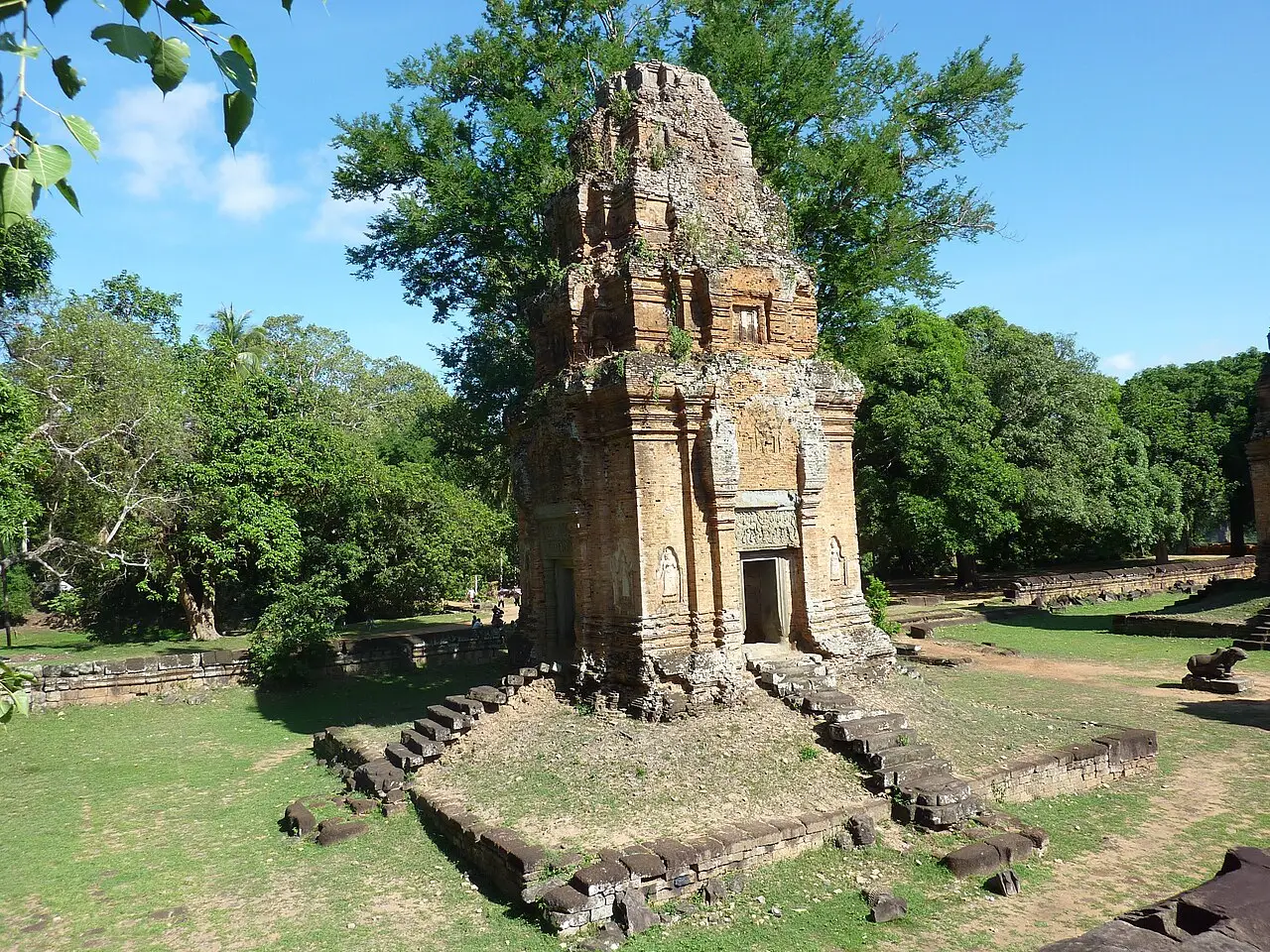
The Roluos Group
Thirteen kilometers southeast, the oldest temples in the region: Preah Ko (879), Bakong (881), and Lolei (893), what remains of Hariharalaya, the capital before Angkor. Bakong is the empire's first sandstone temple-mountain and still has an active monastery within its grounds.
The Roluos Group holds the beginnings of Angkorian architecture, with Bakong as the first sandstone temple-mountain. But it lies outside the small and grand circuits, and it only pays off if you have a fourth morning.
Check access
Nilo’s itinerary
Start with the basic programme and choose extensions for the time you have.
Plan my days in the app ↗Day 1 · Angkor Wat, Angkor Thom, and the small circuit
Buy the Angkor Pass the day before, at the Angkor Enterprise office on Apsara Road, and arrange a 4:45am departure with your tuk-tuk driver (US$15–20 for the day).
Watch sunrise from the south pool of Angkor Wat, which draws fewer people than the north pool of the classic photo, and go into the temple around 6:30am.
Walk the west and south galleries first, along the 800 m of bas-reliefs, then join the line for the Bakan, the third level, with shoulders and knees covered.
Enter Angkor Thom through the south gate at 9:30am to see the Bayon, the Baphuon, the Terrace of the Elephants, and the Terrace of the Leper King, and take the long break for lunch and the heat from 11am to 3pm.
Reach Ta Prohm in the late afternoon, when the light drops between the roots, and head back to town at 5pm for dinner in Wat Bo, away from Pub Street.
Day 2 · Banteay Srei, Kbal Spean, and the museum
Leave at 8am for Banteay Srei, 37 km to the north, and arrive ahead of the buses; set aside an hour for the pink sandstone carving from 967.
Continue another 12 km to Kbal Spean, with a 1.5 km trail climbing up to the lingas carved into the riverbed. Bring closed shoes and water.
Return via the grand circuit, stopping at Pre Rup or Banteay Samré, and have lunch at one of the roadside stalls, not inside the park.
Visit the Angkor National Museum, on Charles de Gaulle Avenue, in the late afternoon, for about an hour and a half, and look for the gallery of a thousand Buddha images.
Catch Phare, the Cambodian circus, at 8pm, with a ticket bought the same day if it isn’t high season.
Day 3 · Tonlé Sap, workshops, and the Khmer city
Spend the morning in Kampong Phluk, 16 km to the south, on a boat trip of about an hour and a half among the stilt houses, a trip that only makes sense from September to January.
Head back to town and have amok or banh chok for lunch at a neighborhood restaurant, away from Pub Street.
In the afternoon, visit the carving and silk workshops of Artisans Angkor, with a free guided tour, then continue to Wat Bo and its 19th-century murals.
End the afternoon on Street 60, at the Cambodian night market, with grilled food, a Ferris wheel, and local prices.
Walk back through Psar Chas, watch the market close around 6pm, and finish with a one-hour massage for US$8 to 12.




Food
 AI illustration
Amok trey
Freshwater fish in kroeung curry paste with coconut milk and egg, steamed inside a banana-leaf basket until it sets into a firm custard, with a noni leaf on the bottom. It's the dish most associated with Cambodia and costs US$4–7 at a Khmer restaurant.
 AI illustration
Lok lak
Cubes of beef stir-fried in a dark sauce, served over lettuce and onion with rice and, almost always, a fried egg. It comes with tuk marij: freshly ground Kampot pepper with salt and lime, which is where the flavor really is.
 AI illustration
Num banh chok
Fermented rice noodles with a thin green fish curry, served heaped with banana blossom, cucumber, bean sprouts, and raw herbs on top. It's breakfast: sold from baskets on bicycles and market stalls between 6 and 9am, for 4,000–6,000 riel.
 AI illustration
Bai sach chrouk
Marinated pork grilled over charcoal and served on broken rice with cucumber pickle and a light broth on the side. The country's standard street breakfast, US$1.50–2.50, found on the corners of Wat Bo and Street 60.
 AI illustration
Prahok and prahok ktis
Prahok is the fermented fish paste that forms the salty backbone of Khmer cuisine; prahok ktis is the table version, cooked with ground pork, coconut milk, and kroeung, eaten with raw vegetables. Strong smell, milder flavor than you'd expect.
 AI illustration
Kralan
Glutinous rice with black beans, coconut, and a little salt, cooked inside a bamboo tube over coals; you peel the fiber off in strips to eat it. Sold roadside on the way to Phnom Kulen and Kampong Thom for US$1–1.50 a tube.
 AI illustration
Kuy teav
A morning rice-noodle soup in pork broth, with fried garlic, scallions, and a plate of herbs and lime on the side for you to adjust. It's the first meal of the day for much of the city and costs US$1.50–3.
 AI illustration
Angkor beer, tuk kolok, and sombai
Angkor beer has been brewed in Sihanoukville since 1992, and draft costs US$0.50–1 on Pub Street, US$2–3 elsewhere. Tuk kolok are the iced fruit shakes sold at market stalls, US$1–2; sombai is a locally bottled rice liquor with fruit and spices, commonly drunk as a digestif.
Day trips
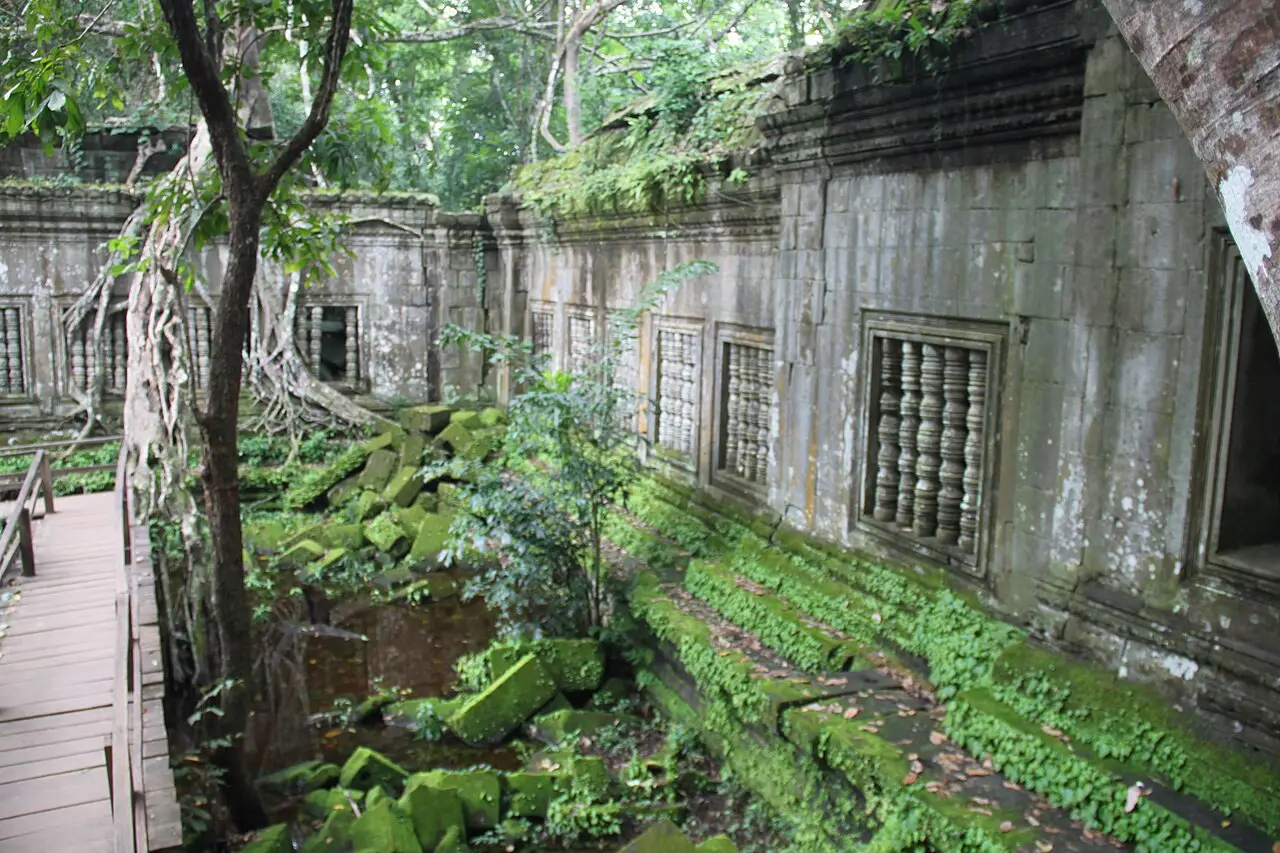
Beng Mealea and Koh Ker
Beng Mealea is 77 km east, about a 1 hour 20 minute drive: a 12th-century temple on the same scale as Angkor Wat, left in ruins and crossed by wooden walkways. Another 45 km beyond it is Koh Ker, capital of the empire between 928 and 944 and a UNESCO World Heritage Site since 2023, with the seven-tier, 36 m pyramid of Prasat Thom. Both charge their own admission, not covered by the Angkor Pass, and the full trip takes a whole day.

Phnom Kulen
Phnom Kulen, 48 km to the northeast and 1 hour 30 minutes by road, is the national park where the empire was proclaimed in 802. At the top there's a waterfall about 20 m high, the reclining Buddha carved into the rock at Preah Ang Thom, and a stretch of river with lingas carved into the riverbed, which is not Kbal Spean: that one sits at the foot of the plateau and is included in the Angkor pass. Kulen charges its own US$20 fee and the access road runs one-way: you go up in the morning and come down in the afternoon.

Kampong Khleang
It's the largest stilt village on the Tonlé Sap, and the calmest of the nearby options. Set aside the whole morning: the round trip takes up most of the outing, and the boat moves at canal pace, not open-lake pace.
Where to begin
Angkor Wat, Angkor Thom, and the small circuit
Buy the Angkor Pass the day before, at the Angkor Enterprise office on Apsara Road, and arrange a 4:45am departure with your tuk-tuk driver (US$15–20 for the day).
Banteay Srei, Kbal Spean, and the museum
Leave at 8am for Banteay Srei, 37 km to the north, and arrive ahead of the buses; set aside an hour for the pink sandstone carving from 967.
Tonlé Sap, workshops, and the Khmer city
Spend the morning in Kampong Phluk, 16 km to the south, on a boat trip of about an hour and a half among the stilt houses, a trip that only makes sense from September to January.
Money
Cambodia runs on two currencies at once, and the division of labor between them becomes clear by the third purchase. The US dollar is widely accepted, especially for larger expenses. Riel are used for small purchases and change, at an approximate conversion of 4,000 KHR per dollar; at that rate, 2,000 riel is 50 cents. Check the rate used by the business. Torn, scribbled-on or very worn dollar bills are often refused: bring clean bills and a few small ones. ATMs dispense both dollars and riel, and charge between US$4 and US$6 per withdrawal, plus your own bank's fee, which favors fewer, larger withdrawals. Indicative price ranges for September 2026: coffee at a café US$1.50–3; a simple Khmer restaurant meal US$3–6; a full dinner at a tourist-oriented place US$8–15. Draft beer US$0.50–1 on Pub Street; a one-hour massage US$8–12. Dorm bed US$5–8, air-conditioned guesthouse US$12–20, mid-range hotel with pool US$30–60, resort US$120 and up. The Angkor Pass is the expense that throws off a budget: US$37 for one day, US$62 for three days, usable within ten, and US$72 for seven, within a month. Tipping isn't mandatory but is expected and matters: 5% to 10% at a tourist restaurant, US$1–2 per tuk-tuk ride and US$5–10 a day for a guide. Cards work at bigger hotels and restaurants, sometimes with a 3% surcharge. KHQR is widely used by local businesses. Visitors can pay through the Bakong Tourists app without opening a Cambodian bank account: register, check identity verification requirements and funding options, including compatible Visa and Mastercard cards. Check fees and limits before transferring money. Carry cash for markets, temples and tuk-tuks.
Getting there and around
New airport since 2023, 45 km out
Siem Reap Angkor International Airport (SAI) opened on October 16, 2023, 45–50 km east of downtown, kept away from the temples because of vibration and noise. The old airport, 7 km from town, has been closed. In the first half of 2026 it handled 714,133 passengers. From the terminal to downtown there is an official taxi at a flat fare of around US$30–35 and a shared van for US$10–12, both taking 45 to 60 minutes along National Road 6. Ride-hailing apps usually come out a little cheaper, but there isn’t always a driver waiting. Overland, buses from Phnom Penh take 6 to 7 hours for US$10–18, with Giant Ibis and Vireak Buntham as the most dependable operators. There is no rail link to Siem Reap. The land border with Thailand at Poipet has been closed since June 2025 because of the border conflict, with no reopening date, so anyone coming from Thailand has to fly. Every passenger arriving by air must fill out the Cambodia e-Arrival Card up to seven days before the flight, and the tourist e-visa costs US$30 for a 30-day stay, usually issued within three business days.
No route, no ticket: it's all tuk-tuk
There's no scheduled public transport in the city, and no integrated ticket. It's all tuk-tuk, of two kinds: the traditional trailer, a motorbike pulling a cart with seats, and the closed electric model used by the apps. Download PassApp, the most used and cheapest, and Grab as backup. A ride within downtown runs US$1–3, and from downtown to Angkor Wat, US$3–5 per leg. For the temples, the standard is hiring for the full day: US$15–20 for the small circuit, US$22–30 for the large one, and US$10 more to include Banteay Srei; agree on the departure time the night before if the plan includes sunrise. A regular bicycle costs US$2–5 a day; the small circuit runs about 17 km on flat ground, doable early in the morning and uncomfortable after 11am. E-bikes cost US$10–15. Motorbike rental to foreigners remains restricted in Siem Reap and requires a Cambodian license or international permit; ask ahead and don't count on it. Downtown is walkable: from Psar Chas to Wat Bo is ten minutes on foot, and the sidewalks were redone in the 38-streets project, between 2020 and 2023.
Safety
In Siem Reap violence against visitors is rare, and the realistic risk is to your belongings. The usual pattern is bag snatching by pairs on motorbikes, on Sivatha Boulevard and the streets around Pub Street after 10pm, and theft from guesthouse rooms without a safe. Carry your bag on the side away from the street, don’t hold your phone out inside the tuk-tuk, and carry a copy of your passport instead of the original. The statistically bigger danger is traffic: motorbikes without headlights, routine wrong-way driving on side streets, and no real right of way for pedestrians. Cross at a steady pace, without running or stopping, and wear a helmet if you ride a motorbike. The common scams are few and repeated: the driver who offers free waiting time and charges for it later, buying powdered milk for a child at a shop in on the deal, currency exchange with a hidden fee, and fake Angkor tickets sold outside the official ticket office. Land mines and unexploded ordnance still exist in the northwestern provinces, especially Banteay Meanchey, Oddar Meanchey, and Preah Vihear: don’t leave marked trails outside the park, which is cleared and signposted. Dengue is the most common local health problem and the mosquito bites by day, so wear repellent in the morning and late afternoon; malaria is a rural and forest risk, not an urban one. The border with Thailand has seen armed clashes since July 2025 and recurring tensions ever since: Siem Reap lies about 150 km away and has not been directly affected, but avoid border crossings and militarized areas and check consular advisories before any overland crossing. Emergencies: 117 police, 118 fire, 119 ambulance; the Royal Angkor International Hospital treats adults to international standards, and the Angkor Hospital for Children treats children free of charge.
Etiquette tips
Clothing covering shoulders and knees in the park
Cover shoulders and knees throughout the archaeological park. Guards enforce the rule at the entrance to the Bakan, the third level of Angkor Wat, where anyone in a tank top, short shorts, or a dress above the knee is turned away. Carry a scarf or light pants in your daypack, because there is nowhere to buy them near the line.
The sampeah and keeping distance from monks
The Cambodian greeting, the sampeah, is made with palms together in front of the chest, and the greater the respect, the higher the hands. Don’t hold out your hand to a monk expecting a handshake; women should not touch monks or hand objects directly to them, but place them on a cloth or pass them to a man nearby.
Shoes, hats, and where your feet point
Remove shoes and hats when entering active pagodas and private homes. Sitting on a temple floor, tuck your legs back with your feet pointing away from the Buddha image; pointing a foot at a person or a sacred image is offensive.
No climbing, touching, or posing improperly on the ruins
Climbing on sculptures, leaning on the reliefs, and sitting on stone heads is forbidden and fined. Posing nude or seminude at the temples brings detention, a fine, deportation, and a ban on returning to the country, with documented cases since 2015.
Don't give money to or buy from children at the temples
Buying postcards, bracelets, or drinks from children working in the park sustains school dropout and is discouraged by both APSARA and local NGOs. For the same reason, avoid tourist visits to orphanages, a practice Cambodian NGOs have been asking to end since the 2010s.
Heads, hands, and how you point
Don't touch anyone's head, including a child's. It's the highest and most respected part of the body. Point with an open hand, never with your index finger, and give and receive money or cards with your right hand, with the left supporting your elbow in formal situations.
Mistakes to avoid
Trying to buy the Angkor Pass at the temple gate
Counting on buying the three-day or seven-day pass at the gate of Angkor Wat. Those two are sold only outside the park, at a counter that closes in the late afternoon. Anyone who shows up for sunrise without one loses the whole morning.
Booking half a day for Angkor
Treating Angkor as a single monument and setting aside half a day. The park covers about 400 km², the small circuit runs 17 km and the grand circuit more than 26, and Angkor Wat alone takes two to three hours if you want to see the reliefs properly. A full day barely covers Angkor Wat, the Bayon, and Ta Prohm, and even then in a rush, so buy the three-day pass for US$62.
Phnom Bakheng without allowing time for the line
Going to Phnom Bakheng for sunset without allowing time for the line. Whole groups climb the hill and have to turn back without going in, because the top has already filled up. Pre Rup, Srah Srang and the Angkor Wat moat have the same light, with no entry cap.
Between 11am and 3pm, the stone runs hotter than the air
Underestimating heat and water. Between 11am and 3pm the sandstone gets much hotter than the thermometer suggests, and there's no shade on the temple walkways. Bring two liters per person, start at 5am, and take a long break at midday, like the whole city does.
Booking a boat trip on the street, in the wrong season
Booking a boat trip on the street, without checking the right season. The most common scam in the region is charging a second fee midway across the lake, or steering you into a handicraft shop on the way back.
Useful phrases
សួស្តី: Suosdei (suos-dei)
Hello, at any time of day
អរគុណច្រើន: Arkun chran (a-kun tchran)
Thank you very much; press your palms together as you say it
សូមទោស: Som toh (som tôh)
Sorry, or excuse me to get past
នេះថ្លៃប៉ុន្មាន: Nih thlai ponman? (nih tlai pon-man)
How much is this?
ថ្លៃណាស់: Thlai nas (tlai nãh)
That's expensive; a polite opening move for bargaining at a market
ឆ្ងាញ់ណាស់: Chgnanh nas (tchnhanh nãh)
This is delicious; works well at a food stall
Districts
Psar Chas (Old Market)
The tourist core, between the west bank of the river and Sivatha Boulevard, with the covered market from the 1920s selling dried fish, prahok, spices and clothing. Here are Pub Street, Alley West and The Lane, three blocks of bars and restaurants that hold nearly all of the city's nightlife.
Wat Bo
The river's east bank, more residential and quieter, with mid-sized guesthouses and good restaurants at local prices. The pagoda that gives the district its name holds 19th-century murals depicting scenes from the Reamker, the Khmer version of the Ramayana.
Kandal Village
A few blocks west of the Old Market, around Hup Guan Street, with Cambodian design shops, local-roast cafés and spas set in 1960s houses. Redeveloped starting in 2013, it's the most walkable neighborhood for a temple-free afternoon.
Sala Kamreuk and Wat Damnak
South of downtown, across the bridge, home to the Angkor Night Market and Wat Damnak, which houses the Center for Khmer Studies and its public library. An area of mid-range hotels and NGO offices.
Slor Kram and the Royal Gardens
The northern strip of downtown, with the Royal Independence Gardens park, the Raffles Grand Hotel d’Angkor (1932), and the Preah Ang Chek Preah Ang Chorm shrine, where Cambodians come to make offerings. At dusk the garden’s trees fill with fruit bats.
Taphul and Steung Thmey
West of downtown, with cheap lodging, long-term rental houses, and most of the city's long-term foreign residents. Food and laundry prices drop noticeably compared with Psar Chas.
Road 60
An avenue that runs north toward the park, with a Cambodian night market of grilled-food stalls, a small amusement park, and a Ferris wheel, patronized almost entirely by locals. It's the most direct place to eat and shop at local, not tourist, prices.
Charles de Gaulle and the Ring Road
A corridor of large resorts between the city and the park's south gate, plus the ring road completed in the 2010s to divert heavy traffic away from downtown. Convenient if you prioritize distance to the temples, inconvenient for walking to dinner.
History
802 · Jayavarman II founds the empire
Atop Phnom Kulen, 48 km northeast of the modern city, Jayavarman II declares himself chakravartin and breaks with Javanese overlordship. It is the founding date of the Khmer Empire.
889–915 · The capital moves to Angkor
Yasovarman I moves the court from Hariharalaya, in what is now the Roluos group, to Yasodharapura, around the hill of Phnom Bakheng. He excavates the East Baray, a reservoir measuring 7 by 1.8 km.
1113–1150 · Suryavarman II builds Angkor Wat
A temple-mountain dedicated to Vishnu, facing west, with a 162-hectare enclosure surrounded by a moat about 190 m wide. The work took roughly three decades.
1177 · The Chams sack the city
A Champa fleet sails up the Tonlé Sap and takes Angkor, killing the king. The naval battle appears carved into the Bayon's outer bas-reliefs.
1181–1218 · Jayavarman VII and the Bayon
A Mahayana Buddhist king, he re-founds the capital as Angkor Thom, 9 km² within walls, and builds the Bayon, Ta Prohm (1186), and Preah Khan (1191). Inscriptions credit him with 102 hospitals and a road network with rest houses.
1431 · Ayutthaya takes Angkor
After decades of extreme droughts and floods recorded in the region's tree rings, Siamese troops sack the capital. The court moves downriver to Longvek and, later, Phnom Penh.
1795–1907 · A century of Siamese rule
Siem Reap and Battambang fall under Siamese control until the treaty of 1907. Angkor Wat was never truly abandoned: it kept working as a Theravada Buddhist monastery and a pilgrimage site.
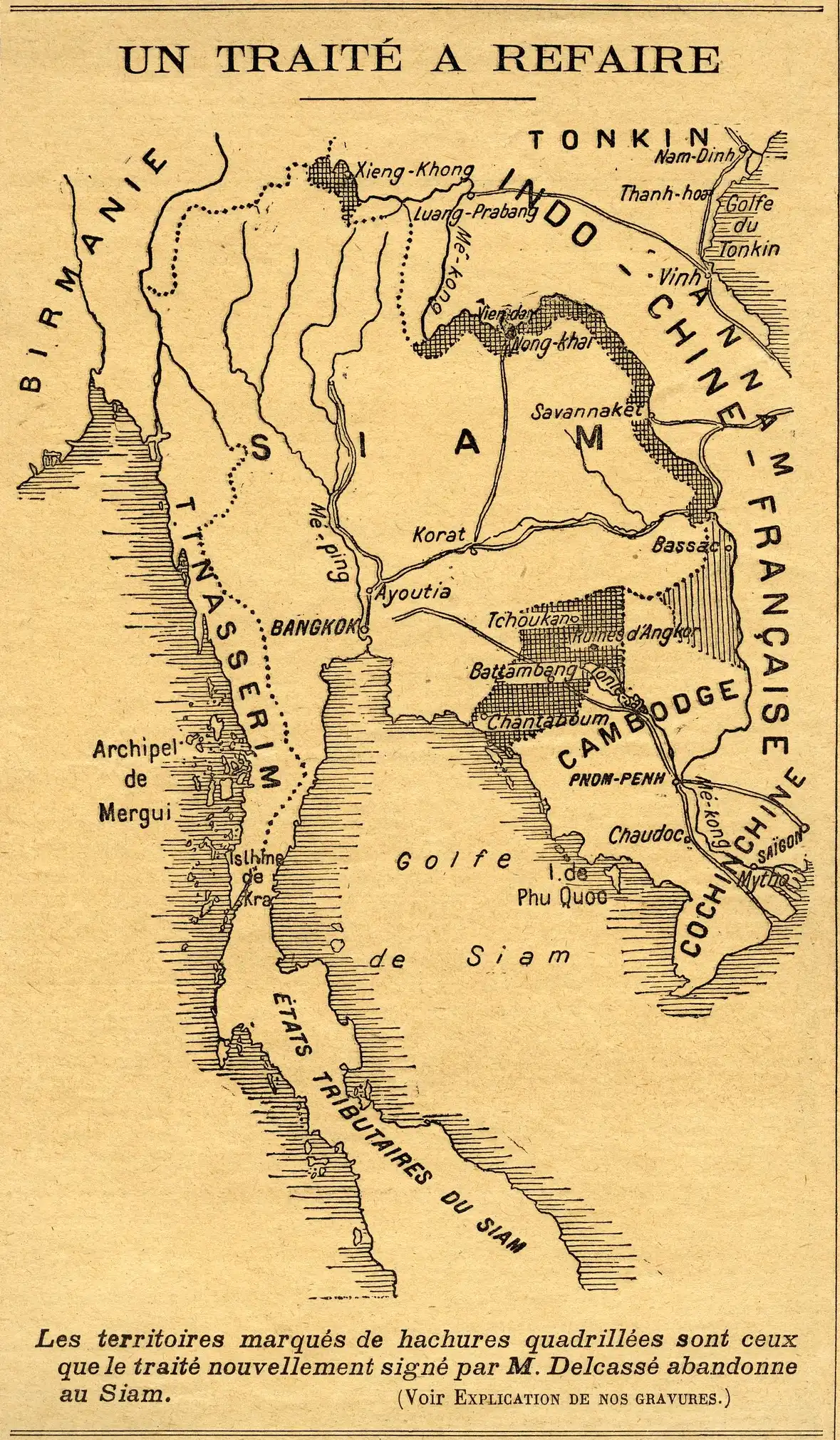
1860–1908 · France, the EFEO, and the handover
Henri Mouhot describes the ruins to the European public in accounts published in 1863; the French protectorate begins in 1863, and the 1907 treaty returns the province to Cambodia. In 1908 the École française d'Extrême-Orient takes over conservation of the temples.

1932–1946 · Early tourism and Thai occupation
The Grand Hotel d’Angkor opens in 1932 and the first organized groups arrive. Between 1941 and 1946 Thailand reoccupies the province, which is returned to Cambodia after the war.
1970–1998 · War, the Khmer Rouge, and landmines
The city is emptied in 1975 and its population deported to the countryside. The region remains mined and under guerrilla attack until the final surrender of 1998, with Angkor effectively closed to the public for two decades.
1992–2026 · UNESCO and the tourism cycle
Angkor joins the UNESCO list in 1992, already listed as endangered, and comes off that list in 2004. Foreign visitors go from about 2.2 million in 2019 to nearly zero in 2020, and the recovery still hasn't arrived: 387,772 in the first half of 2026, 31.7% fewer than in the same period of 2025.

Complete history
Jayavarman II founds the Angkorian empire in 802
In 802, Jayavarman II declares himself universal sovereign on the Phnom Kulen plateau and opens the Angkorian period, and the court settles first at Hariharalaya, the Roluos group, 13 km southeast of today's Siem Reap, where Bakong (881) is the first temple-mountain in sandstone. Between 889 and 915, Yasovarman I moves the capital to the plain around Phnom Bakheng and digs the East Baray. This urban sprawl reached somewhere between 700,000 and a million people in the 11th and 12th centuries, according to the LiDAR laser mapping of 2012 and 2015, and it relied on a hydraulic network of barays, canals, and dikes that stored monsoon water and distributed it in the dry season.
Suryavarman II and Jayavarman VII: Angkor Wat and the Bayon
Angkor’s golden age has two builders: Suryavarman II and Jayavarman VII. Suryavarman II raises Angkor Wat between 1113 and 1150, facing west and dedicated to Vishnu, with 800 continuous meters of bas-reliefs in the outer gallery, among them the Churning of the Ocean of Milk, the myth in which gods and demons pull on a serpent to churn the sea. After the Cham sack of 1177, Jayavarman VII answers with Angkor Thom: 9 km² inside walls, the Bayon with its 216 faces on 54 towers, Ta Prohm (1186) and Preah Khan (1191), and a turn from Hinduism to Mahayana Buddhism that the following century would try to erase with the chisel, scraping Buddhas off the walls. From the 14th century on, upkeep of the hydraulic network fails, extreme droughts and floods alternate, maritime trade shifts the economic center south, and in 1431 Ayutthaya sacks the capital. The court moves downriver, and the temples stay where they are.
From Siamese rule to the French protectorate, 1795–1967
In 1795 Siam takes control of Siem Reap and Battambang, and until 1907 the province is Siamese in practice. Throughout this period Angkor Wat remains occupied by Theravada monks, unlike the empty virgin jungle that the colonial narrative would describe. The modern city is born from administration: in 1907 the Franco-Siamese treaty returns Siem Reap, Battambang, and Sisophon to Cambodia under the French protectorate, and in 1908 the EFEO begins clearing the temples and rebuilding them by anastylosis; the first curator, Jean Commaille, is murdered on duty in 1916. The Grand Hotel d’Angkor opens in 1932 and the road from Bangkok brings the first groups, until Thailand reoccupies the province between 1941 and 1946; it is returned to Cambodia after the war. In 1967, Jacqueline Kennedy visits the ruins in the middle of the Cold War.
Civil war and the Khmer Rouge empty the city in 1975
The civil war reaches Siem Reap in 1970, and in April 1975 the Khmer Rouge empties the city and sends the population to agricultural cooperatives; the province loses a huge share of its inhabitants to execution, famine, and disease. After 1979 the region becomes an insurgency zone, with land mines, ambushes on Route 6, and temples used as military positions. Even so, Angkor joins the UNESCO list in 1992, and in 1995 the APSARA Authority is created to control zoning, building heights, and land use throughout the park and its surroundings. Tourism only truly opens with the surrender of 1998 and political stabilization.
Three decades of accelerated growth
Today's city is the result of three decades of accelerated growth and two collapses. Hotel rooms multiplied between 1998 and 2019, when Angkor received about 2.2 million foreign visitors; the pandemic zeroed out that flow in 2020 and provided a window for the work on the 38 streets, more than 100 km of roads and drainage redone between 2020 and 2023. In 2023 the city got a new airport, built far enough from the temples not to vibrate them, and the old one, almost inside the city, closed for good. The reopening didn't bring the numbers back: the border conflict with Thailand starting in July 2025 knocked down land arrivals, and in the first half of 2026 Angkor recorded 387,772 foreign visitors and US$18.47 million in ticket sales, drops of 31.7% and 29.8% year over year. The city is emptier and cheaper than it has been in twenty years. In parallel, park management became a political issue: between 2022 and 2024 thousands of families living inside the protected zone were relocated to the new settlements of Run Ta Ek and Peak Sneng, a process the government presents as voluntary and that human rights organizations have contested since 2023.
Angkor Wat was never abandoned: Theravada monks occupied it through all the centuries before the French “rediscovery.”
Geography and shape of the city
Tonlé Sap and the Kulen plateau
Siem Reap sits about 15 meters above sea level, on a flat alluvial plain between two landmarks that explain everything: to the south, 12 km away, Tonlé Sap, the largest freshwater lake in Southeast Asia, which goes from around 2,500 km² in the dry season to as much as 15,000 km² in flood, when the Tonlé Sap River reverses flow and dams up water from the Mekong between June and October; to the northeast, 48 km away, the Phnom Kulen plateau, which reaches 487 m and is the source of both the water and the sandstone Angkor was built with.
The river and the barays
The Siem Reap River comes down from Kulen and cuts through the city north to south, crossed by a dozen short bridges; on the park side, the system of Angkorian barays remains visible, and the West Baray, 8 by 2.2 km, still holds water.
The grid and the horizontal city
The urban grid is simple: National Road 6 cuts the city east-west, linking the new airport to Sisophon, Sivatha Boulevard is the north-south commercial axis, and Charles de Gaulle runs from the center northwest to the Angkor Wat gate, 6 km further on. There are no tall buildings: APSARA zoning limits height and color around the park, and the result is a horizontal, two- and three-story city that can be crossed on foot in half an hour.
The city sits at 15 m of altitude, on a plain so flat there is no high point to get your bearings.
Culture
Khmer dance: the city’s signature art form
Classical Khmer dance is the city’s signature art form, and its recent history explains a lot: the repertoire was rebuilt starting in the 1940s under Queen Sisowath Kossamak and later Princess Norodom Buppha Devi, nearly lost again between 1975 and 1979, when most dancers and masters were killed, and reconstituted in the 1980s by the few survivors. Unesco inscribed the Royal Ballet of Cambodia as intangible heritage in 2008; in Siem Reap you see short versions of the robam tep apsara at hotel dinners and more serious performances at theaters tied to art schools. Also surviving here are sbek thom, shadow theater with leather panels nearly two meters tall (Unesco, 2008), and chapei dang veng, improvised singing with a long-necked lute recognized in 2016.
Artisans Angkor and the Phare Circus train local artists
The city is today a small hub of cultural production, not just tourist consumption. Artisans Angkor has trained sculptors and weavers since the 1990s; Phare, the Cambodian Circus, has run daily since 2013 with performers from the Phare Ponleu Selpak school, founded in 1994 by survivors who returned from refugee camps on the Thai border; the Center for Khmer Studies, at Wat Damnak, holds the largest research library outside Phnom Penh and a fellowship program. International audiences know Cambodian cinema through Rithy Panh, and part of First They Killed My Father, directed by Angelina Jolie in 2017, was shot in the province.
Religious life is visible every day
Religious life is Theravada Buddhist and visible every day: monks in orange robes collecting alms between 5:30 and 7am, pagodas that double as school, guesthouse, and party hall, and an earlier layer, Brahmanic and animist, that persists in the neak ta shrines and the offerings to Preah Ang Chek Preah Ang Chorm. The commercial night is short and concentrated: Pub Street empties out around 1am, locals eat dinner early, and the typical Cambodian evening plan is the Street 60 fair or a rented soccer field, rarely a bar.
Festivals and events
 AI illustration
Chaul Chnam Thmey: Khmer New Year
April 13–16, the biggest date on the calendar. Siem Reap hosts Angkor Sangkranta, with traditional games, dances, and concerts near the temples; the city fills up with Cambodians, many businesses close for days, and water and talcum powder get thrown at anyone passing in the street.

Pchum Ben
Fifteen days between September and October, ending on the new moon of the tenth month. Families bring rice offerings to the pagodas before dawn to feed their ancestors; it's the country's most introspective holiday, and a large share of workers travel back to their home villages.
 AI illustration
Bon Om Touk: Water Festival
Three days at the November full moon, marking the reversal of the Tonlé Sap River's flow. The big dragon-boat races happen in Phnom Penh, but Siem Reap holds smaller races on its own river, with food stalls and fireworks.
 AI illustration
Angkor International Half Marathon
First Sunday of December, running since 1996. The course passes Angkor Wat, the gates of Angkor Thom, and Ta Prohm at dawn, and proceeds go to rehabilitation programs for landmine victims; registration closes weeks in advance.
 AI illustration
Visak Bochea and Bon Kathen
Visak Bochea, on the May full moon, marks the Buddha's birth, enlightenment, and death with a candlelit procession at Angkor Wat. Bon Kathen, in the weeks after Pchum Ben, is the offering of robes to monks: truck processions blasting music cross the city on the weekends of October and November.
Books and films
Angkor and the Khmer Civilization, Michael D. Coe (2003)
The clearest single-volume archaeological synthesis: the chronology of kings, the function of the temples, and the decisive role of the baray-and-canal network, which is what explains both the size and the end of the ancient city.
The Gate, François Bizot (2000)
Bizot was an EFEO researcher at Angkor when he was captured by Khmer Rouge guerrillas in 1971, just a few kilometers from the temples. The account draws a direct line between the archaeological park and the regime that emptied Siem Reap four years later.
The Missing Picture, Rithy Panh (2013)
A documentary that uses clay figures to reconstruct what was never filmed between 1975 and 1979, because the images from that period were made by the regime itself. It's the best way in to understanding the generation that today drives, cooks, and guides visitors around this city.
Frequently asked questions
Siem Reap: Beng Mealea and Koh Ker?
Beng Mealea is 77 km east, about 1 hour 20 minutes by car: a 12th-century temple the same size as Angkor Wat, left in collapse and crossed by wooden walkways.
Siem Reap: money?
In Siem Reap, whole amounts are paid in dollars and the change comes back in riel, in the same purchase, at about 4,000 riel to the dollar. Bring clean dollar bills: torn, marked, or very worn notes are often refused.
Siem Reap: when?
Siem Reap has three seasons, and each changes what you can do at the temples and on the lake. From November to February the weather is dry and relatively cool, between 22 and 33 °C, with lower humidity and clear skies.
Siem Reap: safety?
In Siem Reap, violence against visitors is rare, and the realistic risk is to your belongings.
Siem Reap: amok trey?
Freshwater fish in kroeung curry paste with coconut milk and egg, steamed in a banana-leaf basket until it sets into a firm custard, with a noni leaf at the bottom.