Uruguay
Colonia del Sacramento
Portuguese cobblestone streets, a lighthouse over a convent, and sunset on the Río de la Plata
See the one-day itineraryOpen Colonia del Sacramento on the map
Days Start with the basic programme and choose extensions for the time you have.
How the guide reaches this number
In the Colonia Express timetable published through November 2026, that company’s last boat leaves Colonia at 8:15 p.m.; plan arrival and check-in using the advance time shown on your ticket; for December to February, check beforehand. I'd pick a day from Thursday to Sunday, when the lighthouse is open, and I'd climb it in the morning. Even so, I'd stay a night. With a second day, sunset on the Paseo de San Gabriel stops depending on the boat schedule, and the morning is free to take the rambla out to the Real de San Carlos and do the guided visit of the Plaza de Toros, which is closed on Tuesdays and Wednesdays. If that second day falls on a Sunday, there is the market in the morning and the candombe at 6 p.m. A third day is justified only to leave town: Carmelo, for the wineries, or Nueva Helvecia, for the cheeses. Anyone looking for a seaside beach should look at another destination: here the water is the Río de la Plata, and the beaches are river beaches.
1–3
When March, April, October and November; average highs between 21 °C and 26 °C, good for walking on stone all day; December has a high of 27 °C and is already high season, and rain is spread through the year, from 69 mm to 126 mm a month
How the guide reaches this number
Colonia can be visited all year, and what changes with the season is the light, the temperature and the crowds. From December to February the average highs are between 27 °C and 29 °C, the sun sets around 8 p.m. and the yacht harbor fills with Argentine boats; it is the busiest period, together with the long holiday weekends and Tourism Week, which in 2027 has holidays on March 25 and 26. March, April, October and November have highs between 21 °C and 26 °C, the most comfortable temperature for walking on stone all day; May and September are cooler, at about 19 °C. From June to August the highs are between 14 °C and 17 °C, the sun sets before 6 p.m., and there is frost and fog with some frequency. Rain has no season: it falls between 69 mm and 126 mm a month, and a day of rain or wind closes the lighthouse.
Per person/day Budget about 1,380 UYU; mid-range about 3,150 UYU; comfortable about 5,980 UYU per person, based on spending reported by travelers to Budget Your Trip (consulted October 2026).
How the guide reaches this number
Per person per day: accommodation, meals, urban transport, visits and a small allowance for extras. Flights excluded; larger purchases vary. Editorial estimate, not a quote.
 What Nilo thinks
One day is enough for the Barrio Histórico, and that is why the boat day trip from Buenos Aires works: the old quarter is small, and the Portón de Campo, the Calle de los Suspiros, the Plaza Mayor, the lighthouse, the Basílica and two or three museum spaces fit between the morning boat and the evening one. In the Colonia Express timetable published through November 2026, that company’s last boat leaves Colonia at 8:15 p.m.; plan arrival and check-in using the advance time shown on your ticket; for December to February, check beforehand. I'd pick a day from Thursday to Sunday, when the lighthouse is open, and I'd climb it in the morning. Even so, I'd stay a night. With a second day, sunset on the Paseo de San Gabriel stops depending on the boat schedule, and the morning is free to take the rambla out to the Real de San Carlos and do the guided visit of the Plaza de Toros, which is closed on Tuesdays and Wednesdays. If that second day falls on a Sunday, there is the market in the morning and the candombe at 6 p.m. A third day is justified only to leave town: Carmelo, for the wineries, or Nueva Helvecia, for the cheeses. Anyone looking for a seaside beach should look at another destination: here the water is the Río de la Plata, and the beaches are river beaches.Colonia del Sacramento was built by the Portuguese in 1680, 50 km from Buenos Aires across the water, to contest the Río de la Plata trade with Spain, and it passed from one crown to the other for almost a century. The Portuguese city is still at the tip of the peninsula: stone streets that run crookedly down to the river, 18th-century houses with tile roofs, the church rebuilt after lightning blew up the gunpowder stored beneath it, the 1857 lighthouse resting on the ruins of a convent. Much of what you see was rebuilt from 1968, when the quarter was in ruins, and the Archivo Regional, one of the museum's spaces, tells how it reached the UNESCO list. At the end of the afternoon, the sun sets over the water in front of the tip of the peninsula, and on Sundays the candombe comes out through the same streets.
Quick facts
- Population
- 32,174 residents in the city (2023 census, Uruguay's Instituto Nacional de Estadística)
- Founded
- January 1680, by the Portuguese Manuel Lobo, governor of Rio de Janeiro; Spanish for good from 1777 and Uruguayan since 1828
- Country and region
- Uruguay, South America; capital of the Colonia department, on the north shore of the Río de la Plata
- Language
- Spanish, in the Rioplatense variety
- Currency
- Uruguayan peso (UYU), written with $, the same dollar sign; prices in dollars appear as U$S
- Time zone
- UTC−3 year-round; Uruguay has not observed daylight saving time since 2015
- Best time to visit
- March, April, October and November; average highs between 21 °C and 26 °C, good for walking on stone all day; December has a high of 27 °C and is already high season, and rain is spread through the year, from 69 mm to 126 mm a month
- Average daily cost
- Budget about 1,380 UYU; mid-range about 3,150 UYU; comfortable about 5,980 UYU per person, based on spending reported by travelers to Budget Your Trip (consulted October 2026).
When to go
March, April, October and November; average highs between 21 °C and 26 °C, good for walking on stone all day; December has a high of 27 °C and is already high season, and rain is spread through the year, from 69 mm to 126 mm a month
How the year changes
Colonia can be visited all year, and what changes with the season is the light, the temperature and the crowds. From December to February the average highs are between 27 °C and 29 °C, the sun sets around 8 p.m. and the yacht harbor fills with Argentine boats; it is the busiest period, together with the long holiday weekends and Tourism Week, which in 2027 has holidays on March 25 and 26. March, April, October and November have highs between 21 °C and 26 °C, the most comfortable temperature for walking on stone all day; May and September are cooler, at about 19 °C. From June to August the highs are between 14 °C and 17 °C, the sun sets before 6 p.m., and there is frost and fog with some frequency. Rain has no season: it falls between 69 mm and 126 mm a month, and a day of rain or wind closes the lighthouse.
Nilo's tips
Pick the day of the week before the boat
The lighthouse opens Thursday to Sunday; the Plaza de Toros has a standard visit Thursday to Sunday and a guided one on Mondays and Thursday to Sunday, and does not appear on Tuesdays and Wednesdays; the museum spaces close on different days; the Acuario opens Thursday to Sunday in the afternoon; and the candombe is on Sundays at 6 p.m. A visit from Thursday to Sunday catches almost everything open; a Tuesday or Wednesday leaves the lighthouse and the arena closed and part of the museum too.
Buy the museum ticket at the Espacio Rebuffo
The single $150 ticket is sold at the Espacio Dr. Bautista Rebuffo, at calle Del Comercio 77, facing the Plaza Mayor, or through Redtickets. Ask there which spaces are open that day: the Espacio Español opens only Thursday to Sunday, and the Azulejo one is temporarily closed.
Climb the lighthouse in the morning shift
The lighthouse has two short shifts, 10 a.m. to noon and 3 p.m. to 5 p.m., and does not open in rain or wind. If the morning is good, go up right away instead of counting on the afternoon shift. Leave the sandals at the hotel: they won't get you in.
Check the last boat, and stay a night if you can
With the schedules published through November 2026, the last Colonia Express boat leaves at 8:15 p.m., after sunset, and the day trip doesn't miss the end of the afternoon. From December to February the sun sets around 8 p.m., and the summer schedule is not out yet, so check beforehand. Anyone who sleeps in town sees sunset on the Paseo de San Gabriel without a clock to watch, and the next day still has the Real de San Carlos.
Check whether the price is in pesos or dollars
A bare dollar sign is the Uruguayan peso; the dollar appears as U$S. Official ticket prices are in pesos, and some private tours charge in dollars.
Explore the map
Explore the map, read about the other places and plan your travel days in the app.
Open the appWhat to see
Colonia del Sacramento: A peninsula pointing at Buenos Aires
The climate is humid subtropical, with rain spread through the whole year. At the World Meteorological Organization station in Colonia, 7 km from the center, the 1991 to 2020 normals give average highs of 28.6 °C in January and 14.6 °C in July, lows of 18.8 °C and 7.3 °C, and rain between 69 mm and 126 mm a month, with March the rainiest month. Many houses stopped being homes and became shops, lodging and museums.
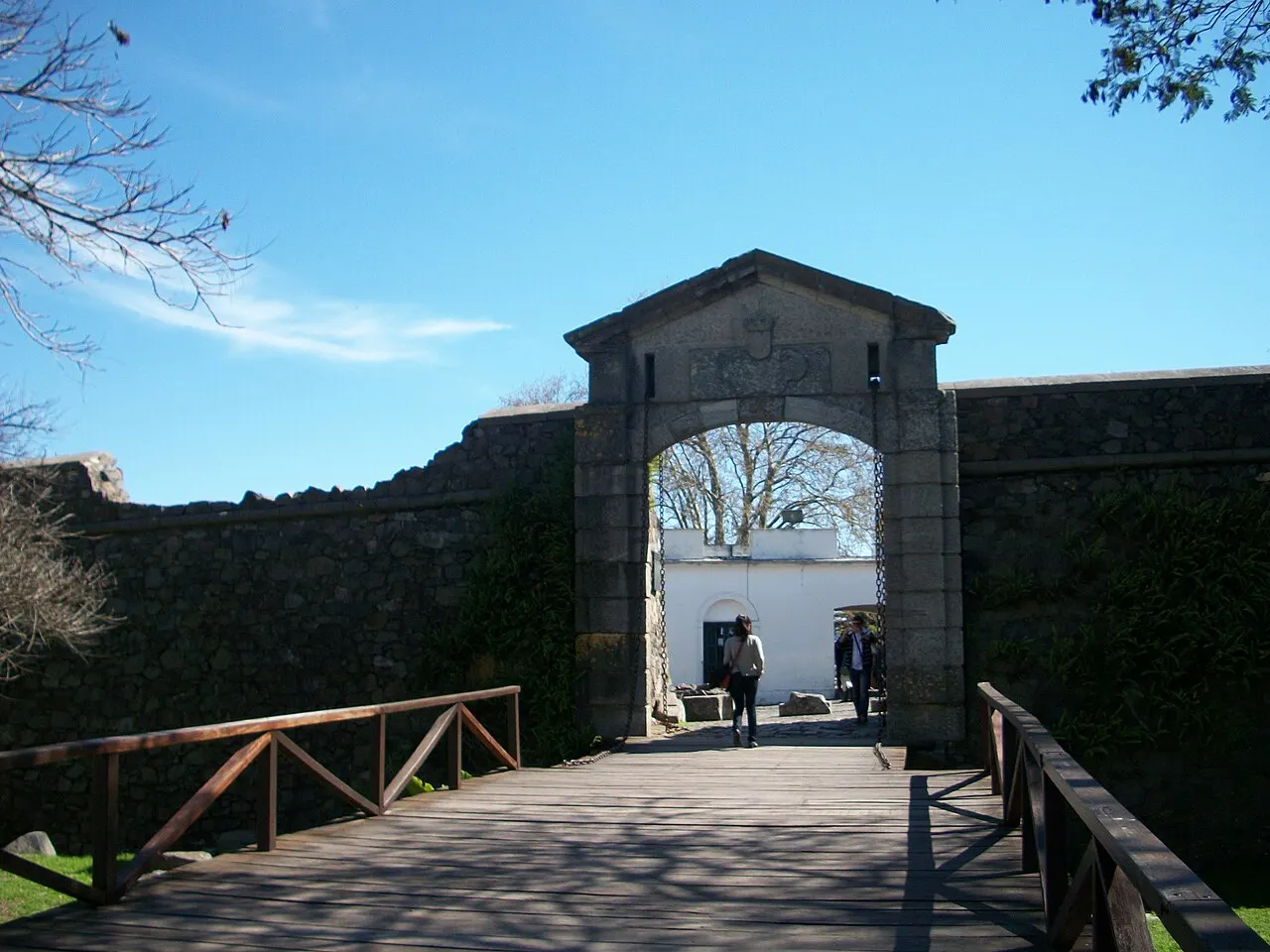
Portón de Campo
The gate of the old citadel, with a wooden drawbridge over the moat, marks the entrance to the Barrio Histórico from the land side. The stretch of wall beside it is not original from end to end: in 1968 it no longer existed, and it was rebuilt between 1968 and 1972 by the council the government created to recover the quarter, with some old stones and some new ones. It is the natural starting point for anyone arriving from the port, about 1 km away.
The gateway into the Portuguese town when arriving from the port explains the first thing to know: the wall you see was rebuilt between 1968 and 1972, when the quarter was restored.
Check access
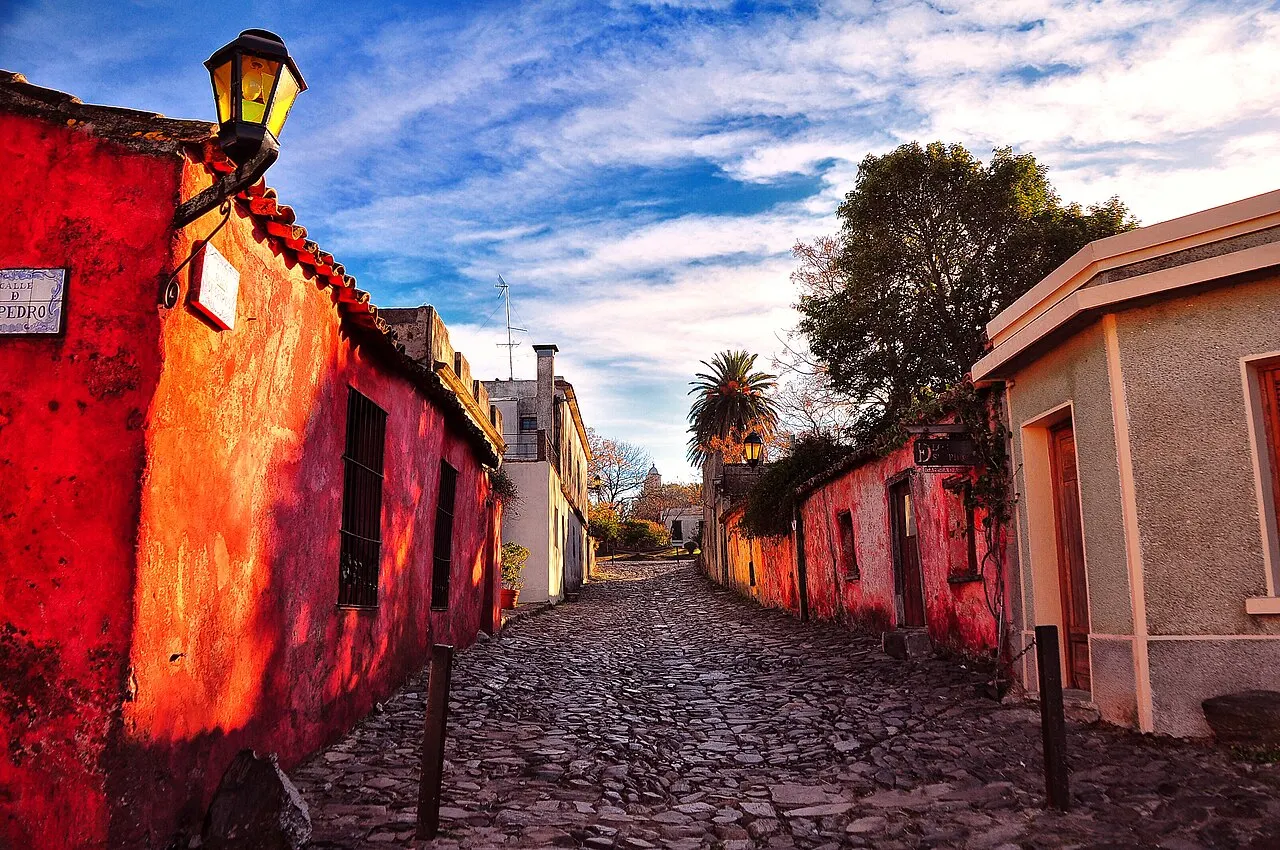
Calle de los Suspiros
A narrow street that runs down from the Plaza Mayor to the river, with wedge-set stone paving, no sidewalks and a roadbed sloping to the center, where rainwater runs. The houses, with stone walls and tile roofs, date from the first half of the 18th century, and it is one of the few streets in the quarter that keep their original state. Until the 1940s it was called Ansina; no one knows for sure where the present name comes from, and the versions in circulation range from the brothels of the port to convicts led to the river.
One of the few streets to retain its original state, with houses from the first half of the 18th century, wedge-set stone paving and a rain channel down the middle, leading straight to the river.
Check access
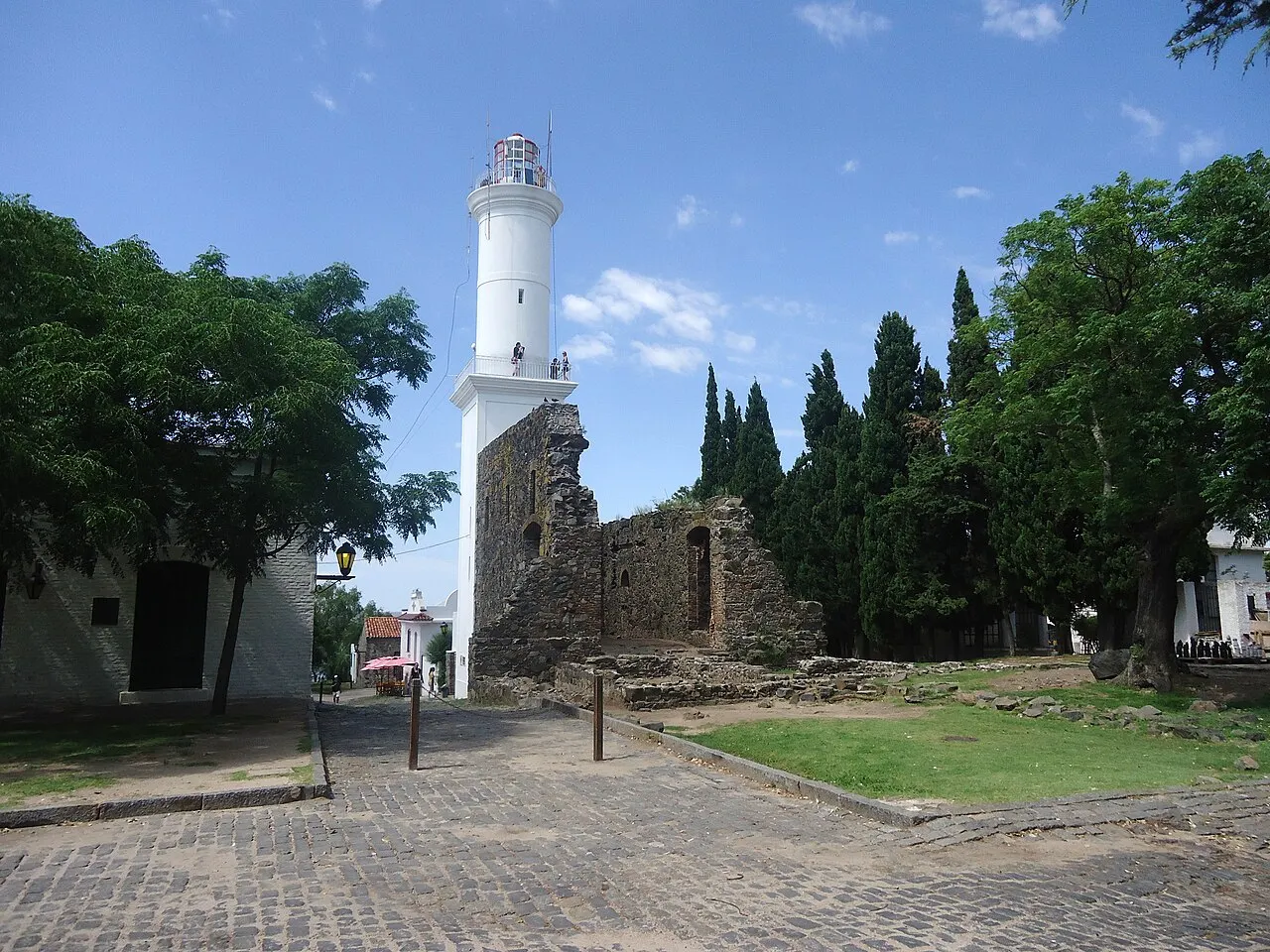
Faro de Colonia del Sacramento
The lighthouse was begun in 1845 and inaugurated on January 24, 1857, resting on the ruins of the Convent of San Francisco Xavier, beside the Plaza Mayor. You climb 118 steps to the lantern, 34 m above river level, and from the top you see the whole quarter and the bay. It opens Thursday to Sunday, 10 a.m. to noon and 3 p.m. to 5 p.m., with an entry fee of $50; it does not admit children under eight or sandal-type footwear, and it does not open on rainy or windy days (Intendencia de Colonia listing, consulted October 2026).
The 118 steps reach 34 m above the river, with the whole quarter and bay in view, but only Thursday to Sunday in two short sessions, and never in rain or wind.
Check access
Paseo de San Gabriel
The street that wraps around the west tip of the Barrio Histórico, facing the Río de la Plata. Because the peninsula points west, it is the place to watch the sun set over the water: around 7 p.m. in October, 8 p.m. in December and January and before 6 p.m. in June. Isla San Gabriel, which you can see about 3 km away, is where the Portuguese landed in 1680.
The tip of the peninsula points west, and this is where you watch the sun set over the Río de la Plata, a reason to consider staying overnight.
Check access
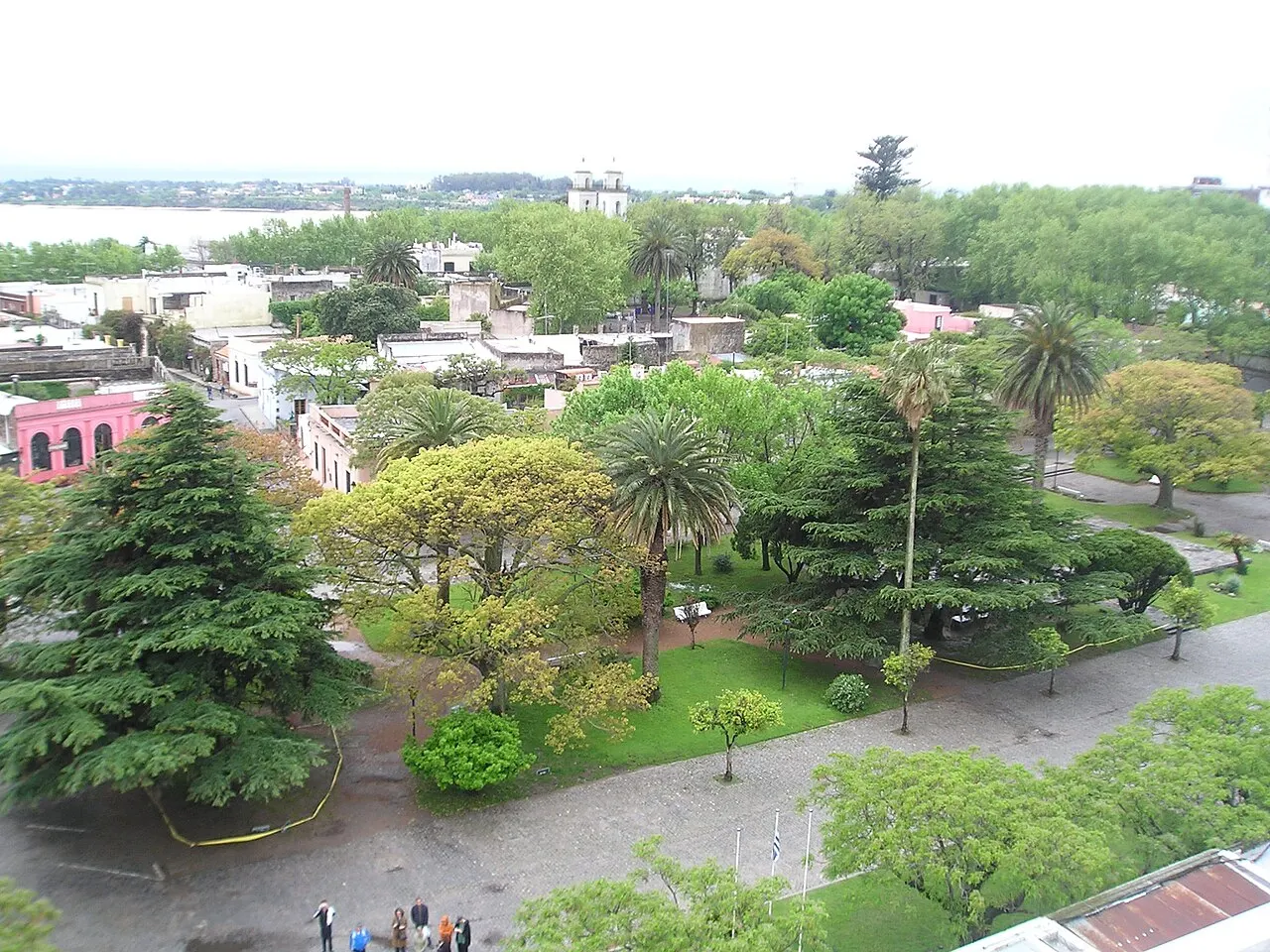
Plaza Mayor
The central square of the Portuguese quarter, tree-lined and surrounded by the addresses you visit: the Espacio Dr. Bautista Rebuffo, where you buy the single museum ticket, is on calle Del Comercio, facing it, and the Calle de los Suspiros starts at one of its corners. It also appears under the name Plaza Mayor 25 de Mayo.
The quarter's point of orientation: buy the museum ticket facing the square, then head from here to Calle de los Suspiros and the lighthouse.
Check access
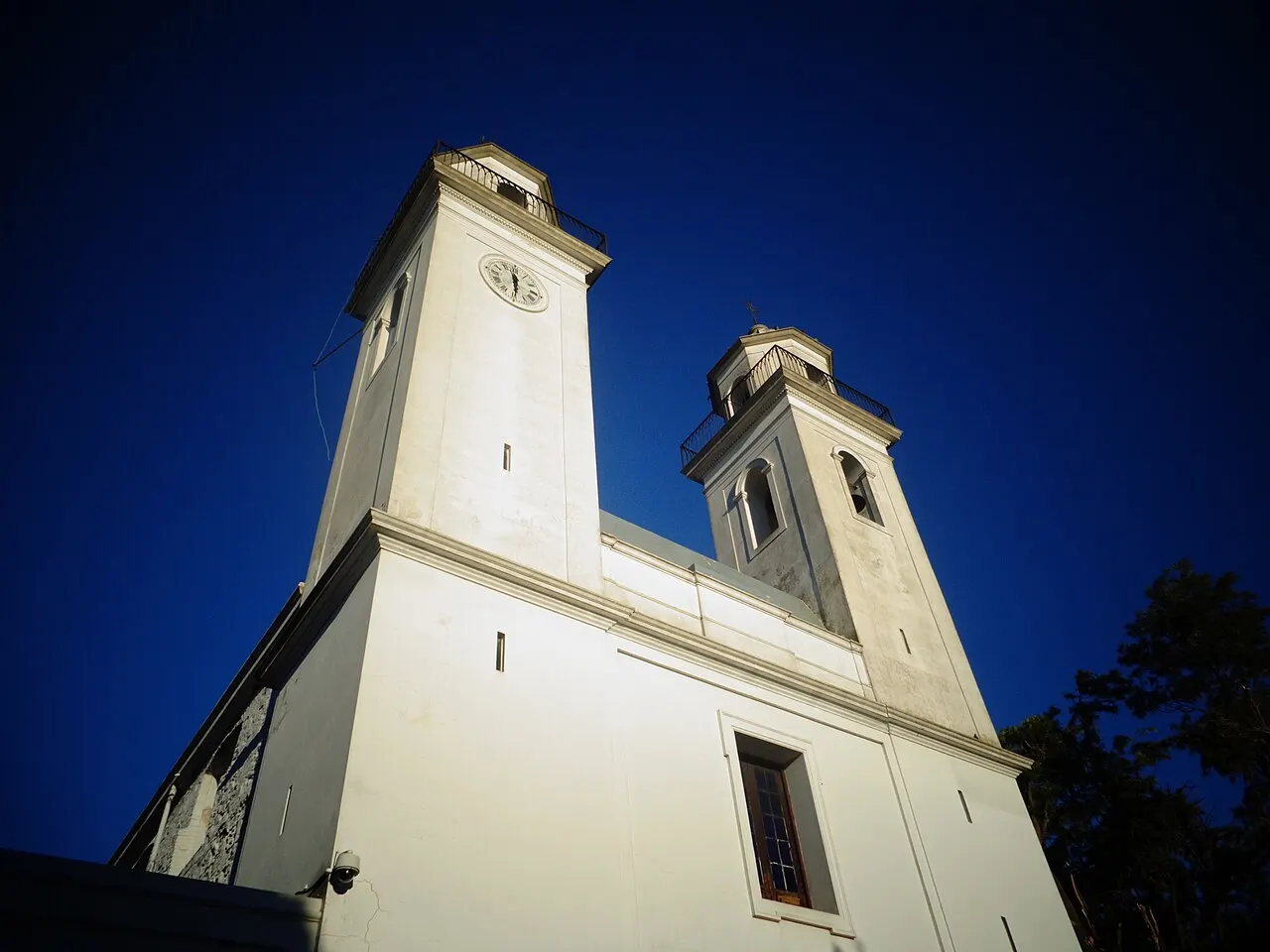
Basílica del Santísimo Sacramento
Considered the oldest church in Uruguay, though rebuilt several times: it began in 1680 as a straw-and-mud hut, got stone in 1699, and the present building dates from 1808 to 1810. In 1823 lightning struck the gunpowder stored under the sacristy and the explosion destroyed much of the church; Charles Darwin described it in ruins on the voyage of the Beagle. On the side wall you can tell the Portuguese stone masonry from the Spanish brick.
The side wall distinguishes Portuguese stone from Spanish brick. The present building dates from 1808–1810; the 1823 explosion destroyed much of the church, which Darwin described in ruins.
Check access

Museo de Colonia
Since 2022, the city's exhibition spaces have formed a single museum, with a $150 ticket valid for all of them (free up to age 12 and for residents of the department). It is sold at the Espacio Dr. Bautista Rebuffo, at calle Del Comercio 77, and through Redtickets. The spaces open from 11:30 a.m. to 4:30 p.m., but each one closes on different days: the Espacio Español, at calle De San José 156, opens Thursday to Sunday; the Vivienda Portuguesa, a house that already appears on plans from 1732, closes on Tuesdays; the Espacio del Telégrafo, at calle Del Colegio 53, tells the story of the submarine cable that linked Colonia to Buenos Aires from 1866 and opens Monday, Tuesday, Thursday, Friday and Saturday. The Espacio del Azulejo is temporarily closed (museum website, October 2026).
The single UYU 150 ticket for the museum spaces is free for children aged 12 and under and for residents of the department. The choice depends on the day of the week, because the spaces close on different days, and Espacio del Azulejo is temporarily closed in October 2026. Espacio Rebuffo and Vivienda Portuguesa are the most useful for understanding the town.
Check access
Plaza de Toros Real de San Carlos
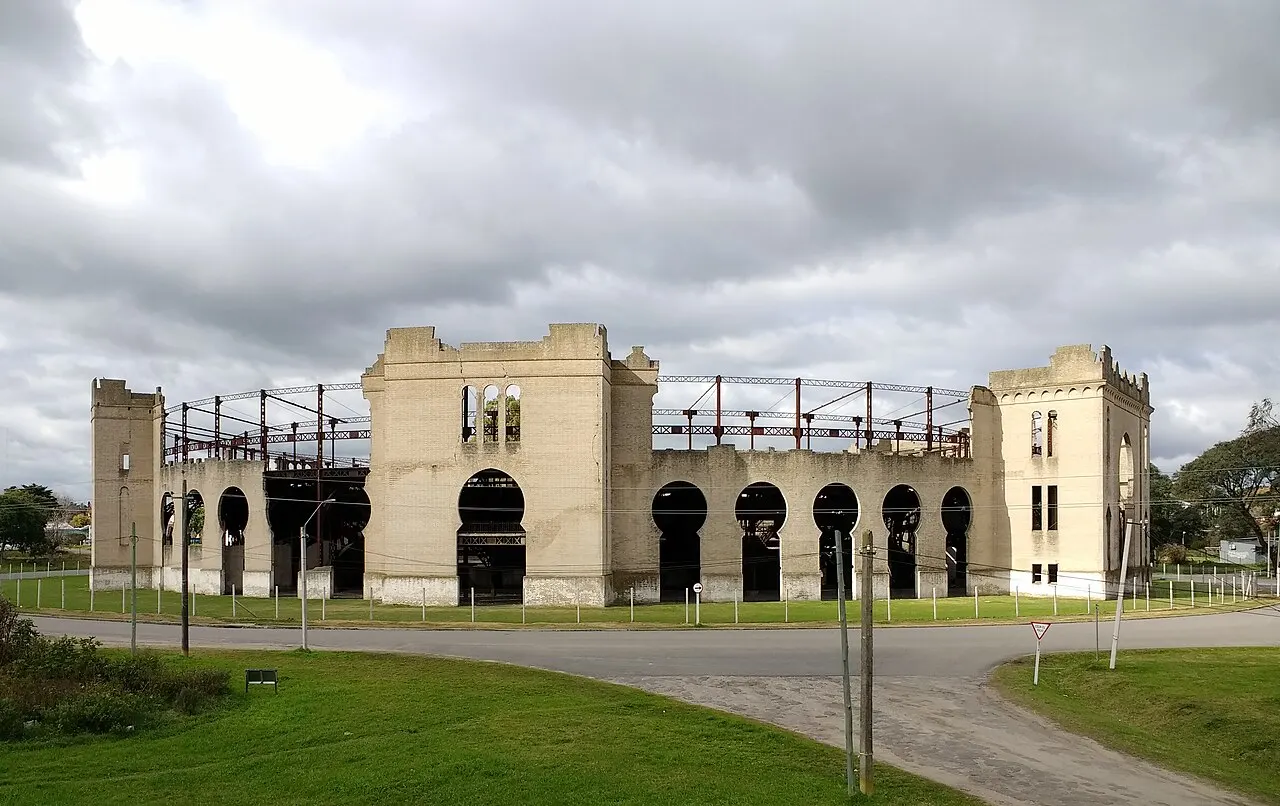
A Neo-Mudéjar arena 100 m in diameter, inaugurated on January 9, 1910 as part of the tourist complex of the businessman Nicolás Mihanovich, about 4 km north of the Barrio Histórico. Bullfighting was banned in Uruguay in 1912, the arena fell into ruin and was reopened on December 9, 2021, restored, as a venue for concerts and events. According to the Intendencia de Colonia listing (October 2026), the standard visit costs $250 and is valid Thursday to Sunday; the guided visit costs $350 and runs on Mondays and Thursday to Sunday, every hour from 11 a.m. to 5 p.m. (until 6 p.m. on Saturdays); Tuesday and Wednesday do not appear in the listing. There is also a guided night visit on Fridays and Saturdays, at $350, with a time that the listing itself gives as 8 p.m. in one passage and 9 p.m. in another. Tickets are sold at the box office or through Redtickets.
The 1910 arena, where bullfighting was banned in 1912 and which reopened restored in 2021, tells the story of Mihanovich's tourism project; guided visits leave hourly on Mondays and Thursday to Sunday, while Tuesday and Wednesday do not appear in the visit listing.
Check access
Bastión del Carmen
One of the bastions on the north coast of the Portuguese fortress town, today a cultural center with a theater, exhibitions and concerts. It is worth it for the day's program, which is on the Intendencia's calendar: with no show scheduled, walking past on the outside is enough.
Today it is a venue for performances and exhibitions; without an event on the calendar, passing by outside is enough.
Check access
Nilo’s itinerary
Start with the basic programme and choose extensions for the time you have.
Plan my days in the app ↗Day 1 · The Barrio Histórico on foot, from the port to the Paseo de San Gabriel
If you're coming from Buenos Aires, take the first Colonia Express boat (8:30 a.m. in September and October 2026, 8 a.m. in November), which arrives 1h15 later, and walk about 1 km from the port to the Portón de Campo.
Go through the Portón de Campo and follow the wall rebuilt between 1968 and 1972 to the Plaza Mayor.
From Thursday to Sunday, climb the lighthouse's 118 steps before noon (it opens 10 a.m. to noon, $50) and see the ruins of the Convent of San Francisco Xavier at its foot.
At 11:30 a.m., buy the single Museo de Colonia ticket ($150) at the Espacio Dr. Bautista Rebuffo, at calle Del Comercio 77, and start there.
Go down the Calle de los Suspiros to the river and have lunch in the Barrio Histórico.
In the afternoon, visit the museum spaces open that day, which close at 4:30 p.m., and the Basílica del Santísimo Sacramento.
Finish at the Paseo de San Gabriel to watch the sun set over the Río de la Plata; if you're going back to Buenos Aires the same day, first check whether the last boat leaves after sunset on your date.



If you stay longer
Day 2 · The Real de San Carlos along the rambla and Sunday in the Barrio Sur
On a Sunday, start with the street market on calles Fosalba and Rivera, in the Centro, which runs in the morning.
Continue to the Real de San Carlos, about 4 km to the north, by urban bus A or C, by taxi or by bicycle along the Rambla de las Américas.
Take the guided visit of the Plaza de Toros, departing every hour from 11 a.m. to 5 p.m. ($350), on Mondays and Thursday to Sunday, or the standard visit ($250), Thursday to Sunday; there is no visit on Tuesday and Wednesday.
See the Frontón del Real de San Carlos from outside, the Basque pelota fronton of the same complex, and have lunch in the Real de San Carlos.
Come back along the rambla in the afternoon, and from Thursday to Sunday stop by the Acuario de Peces Autóctonos, open 2 p.m. to 6 p.m.
On Sundays at 6 p.m., catch the candombe rehearsal of the comparsa Caracú Quemao, which sets out from the corner of calles 18 de Julio and Ituzaingó.
Day 3 · Carmelo and the wineries
Day trip
80 km to the northwest, about 1 hour by bus from the Colonia terminal (Berrutti, Intertur and Agencia Central). Carmelo sits on the Arroyo de las Vacas, with a swing bridge that opens by human power, and concentrates the department's wineries, such as Narbona, El Legado and Zubizarreta; on Saturdays, 12 p.m. to 6 p.m., there is an artisans' fair on the Rambla de los Constituyentes. To visit a winery, book ahead or go with an organized tour.
Food
Chivito
Uruguay's national sandwich, created in the 1940s in Punta del Este: grilled beef steak, ham, bacon, mozzarella, lettuce, tomato, hard-boiled egg and bell pepper, with mayonnaise, on a catalan roll, and almost always with fries on the side. It also comes served on a plate, without the bread.
Colonia cheeses
The department presents itself as Uruguay's cheese region, a legacy of the Swiss, German and Waldensian immigrants of the east. Fifteen producers in Rosario, La Paz, Colonia Valdense, Nueva Helvecia and Colonia make up the Ruta del Queso, with tastings, visits and direct sales.
Tannat and the department's wines
Tannat, a grape from southwestern France, is considered Uruguay's national grape and makes fuller-bodied red wines with firm tannins. The department of Colonia has 13 wineries open to visits along Rutas 1 and 21, concentrated in Carmelo, and Los Cerros de San Juan is named by the Intendencia as the oldest winery in the country.
Torta frita and mate
Thin, crisp fried dough, eaten on rainy days or in the afternoon with mate or a café con leche. Mate in Uruguay is drunk hot and bitter, with the water thermos under the arm, and it is what you see in the hands of people sitting on the rambla at the end of the afternoon.
Craft beer
Colonia has its own craft brewery, such as Barbot, near Parque AFE, and the department celebrates the immigrants' brewing tradition at the Bierfest in Nueva Helvecia, in December, with sauerkraut, Swiss sausage and German cakes in the food court on the square.
Asado con cuero
Beef or lamb roasted on its own hide, which holds in the juices and fat: the midday dish at the criollo festivals held across the department, with horse-breaking and parades.
Where to eat
- Barrio Histórico and Centro · $
Chivito and bar dishes, for the lunch of a visiting day.
- Los Dos Reales · Real de San Carlos · $$
Home cooking in a family setting, at Dr. Carlos Martínez Moreno 96, near the Plaza de Toros. Part of the Origen Colonia network, restaurants that buy from producers in the department.
Source · 2026-10-15
- Muelle Sur · Yacht harbor · $$
Lunch and afternoon snacks on the riverfront, at the Club de Yachting y Pesca, on calle Santa Rita. Also part of the Origen Colonia network.
Source · 2026-10-15
- Barbot · Puerto and Parque AFE · $$
A craft brewery with more than 20 styles on tap, brewing since 2013, at calle Washington Barbot 160.
Source · 2026-10-15
- Comarca Las Liebres · Colonia del Sacramento, Armonía Somers 1150 · $$$
Regional cooking with its own organic garden and vineyard, with a guided visit and a tasting of paired Colonia wines.
Source · 2026-10-15
$: chivito, torta frita or a bar dish · $$: a restaurant with home-style or regional cooking · $$$: lunch with a wine tasting at a farm or winery · 2026-10-15
Day trips
Carmelo and the wineries
80 km to the northwest, about 1 hour by bus from the Colonia terminal (Berrutti, Intertur and Agencia Central). Carmelo sits on the Arroyo de las Vacas, with a swing bridge that opens by human power, and concentrates the department's wineries, such as Narbona, El Legado and Zubizarreta; on Saturdays, 12 p.m. to 6 p.m., there is an artisans' fair on the Rambla de los Constituyentes. To visit a winery, book ahead or go with an organized tour.
Nueva Helvecia and the Ruta del Queso
65 km to the east, about 1 hour by bus (COT, Turil and Compañía Colonia). The former Swiss colony brings together some of the producers on the Ruta del Queso, which you can visit on your own, and hosts the Fiesta de Quesos in October and the Bierfest in December.
Conchillas
50 km to the northwest, about 40 minutes by bus. A village of about 500 people born in the late 19th century around the English company C. H. Walker & Co., which took stone and sand from there to build the port of Buenos Aires; the stone houses plastered yellow, with red zinc roofs, remain preserved by municipal ordinance.
Montevideo
About 180 km to the east along Ruta 1, about 2h30 by bus from the terminal next to the port. For anyone continuing on through Uruguay, it works better as the next stop than as a day trip.
Where to begin
The Barrio Histórico on foot, from the port to the Paseo de San Gabriel
If you're coming from Buenos Aires, take the first Colonia Express boat (8:30 a.m. in September and October 2026, 8 a.m. in November), which arrives 1h15 later, and walk about 1 km from the port to the Portón de Campo.
The Real de San Carlos along the rambla and Sunday in the Barrio Sur
On a Sunday, start with the street market on calles Fosalba and Rivera, in the Centro, which runs in the morning.
Money
The currency is the Uruguayan peso (UYU), written with the dollar sign $; when a price is in dollars, it appears as U$S, and it is worth looking twice before paying. On September 24, 2026, at the European Central Bank reference rate, one US dollar was worth about 40 pesos. The official prices published by the Intendencia de Colonia and the museum in October 2026 give the scale of a visit: the single Museo de Colonia ticket costs $150, the lighthouse climb $50, the Plaza de Toros $250 for the standard visit and $350 for the guided one, the Acuario $100 and the Museo del Origami $100. The public guided tour of the quarter cost $250 per person in Spanish and $400 in other languages, according to the Comisión Nacional para la UNESCO, with a notice that prices change, and there are private tours charged in dollars, such as an English-language walking tour at US$15. Residents of the department and small children do not pay for several of these tickets. Restaurants and inns have no official price; compare on site or on the booking platforms before you go.
Getting there and around
From Buenos Aires, by boat in 1h15
Two companies make the daily crossing from Buenos Aires: Colonia Express and Buquebus. Colonia Express leaves from the terminal at Av. Elvira Rawson de Dellepiane 155, in Puerto Madero Sur, and reaches the Muelle de Ultramar in the port of Colonia in 1h15; on the schedule from September 1 to October 31, 2026, departures from Buenos Aires are at 8:30 a.m., 10:30 a.m., 12:50 p.m., 6:30 p.m. and 8 p.m., and from Colonia at 8:30 a.m., 10:30 a.m., 4:30 p.m., 6 p.m. and 8:15 p.m.; in November 2026, those from Buenos Aires change to 8 a.m., 10:30 a.m., 12:30 p.m., 6:15 p.m. and 8 p.m., and those from Colonia to 8:30 a.m., 10 a.m., 4:15 p.m., 6 p.m. and 8:15 p.m. The schedule changes by season, so check the one for your date. If choosing Buquebus, check your terminal and travel-date timetable on the ticket; the timetable above belongs to Colonia Express. Boarding includes immigration control, and each person needs the travel document that is valid for their nationality; the baggage allowance is 30 kg. From the port to the Portón de Campo it is about 1 km on foot.
From Montevideo and by air
Montevideo is about 180 km away along Ruta 1, about 2h30 by bus, with the companies COT, Turil, Agencia Central, Intertur and Sabelin; the Colonia bus terminal is next to the port. There are no commercial flights to Colonia: the nearest international airport is Carrasco, in Montevideo, and those who fly to Buenos Aires continue by boat. By land, it is more than 450 km from Buenos Aires, across the Fray Bentos bridge.
Getting around town
The Barrio Histórico is covered on foot, but the ground is uneven stone, several streets have no sidewalk and wheelchair access is only partial, according to the Comisión Nacional para la UNESCO. For the Real de San Carlos, about 4 km to the north, there are the urban bus lines A and C (Real de San Carlos to Centro), with schedules on the Intendencia's website, as well as taxis and bicycles along the Rambla de las Américas. For Carmelo, Conchillas and Nueva Helvecia, the buses leave from the terminal: 40 minutes to 1 hour of travel.
Safety
Colonia is a small city, and the precautions that weigh most on a visitor are practical ones. The uneven stone paving, the streets with no sidewalk and the short slopes down to the river call for closed shoes and attention to the car sharing the same ground. At the lighthouse, the climb is 118 steps and it closes in rain and wind; children under eight do not go up. As anywhere with visitor traffic, keep your documents and phone on you at the port and at the tables of the restaurants on the square, rather than leaving them loose. Before going into the water at the Río de la Plata beaches, check the daily cyanobacteria bloom report from Uruguay's Ministerio de Ambiente. Tap water is safe to drink in Uruguay. The general emergency number is 911.
Etiquette tips
Mate is shared in a circle
The one who prepares it is the cebador: he fills the gourd for each person and passes it in turn, clockwise. If it is offered to you, hand the gourd back to whoever served, not to your neighbor.
Stone streets are shared with cars
The Calle de los Suspiros and other streets in the quarter have no sidewalk, and some streets in the Barrio Histórico allow parking, so cars and pedestrians share the stone: before taking a photo in the middle of the street, look both ways.
Mistakes to avoid
Forgetting it is another country
The crossing from Buenos Aires is international: boarding includes immigration control, and without the document accepted for your nationality you do not board. Anyone traveling with minors needs the authorizations each country requires.
Reading $ as dollars
A bare dollar sign is the Uruguayan peso. A price in dollars comes as U$S or US$, and the difference is about 40 times.
Leaving the lighthouse for a Monday
The lighthouse opens only Thursday to Sunday, 10 a.m. to noon and 3 p.m. to 5 p.m., and closes in rain or wind. Anyone who arrives on Monday, Tuesday or Wednesday sees the lighthouse from below.
Assuming all the museums open together
The single ticket is valid for all the spaces, but each one closes on different days, between 11:30 a.m. and 4:30 p.m., and the Espacio del Azulejo is temporarily closed. Before buying, check which ones are open that day.
Not checking the return boat against sunset
From September to November 2026, the last Colonia Express boat to Buenos Aires leaves at 8:15 p.m., after sunset, which falls around 7 p.m. in October and 7:30 p.m. in November, and the day trip fits with room to spare. From December to February the sun sets around 8 p.m., and the schedule for that season has not been published yet: check before buying, because the margin may get tight.
Wrong shoes on the stone
The paving is wedge-set stone, uneven and slippery in the rain; the lighthouse, besides, does not admit sandals. Sneakers or closed boots solve both.
Useful phrases
¿A qué hora sale el último barco a Buenos Aires?
What time does the last boat to Buenos Aires leave? The most useful question of the day, at the port or at the inn.
Una entrada para el museo, por favor.
One ticket for the museum, please. It is the single Museo de Colonia ticket, sold at the Espacio Rebuffo.
¿Está abierto el faro hoy?
Is the lighthouse open today? It depends on the day of the week and the wind.
¿Es en pesos o en dólares?
Is it in pesos or in dollars? Useful when the menu uses only the dollar sign.
Ta.
All right, understood. The short reply you hear most in Uruguay.
La cuenta, por favor.
The check, please.
Where to stay
- Barrio Histórico · First visit, and anyone who wants sunset on foot · $$: Everything is a few minutes away: the museum, the lighthouse, the Calle de los Suspiros and the Paseo de San Gabriel. There are hotels, hostels and inns in several price ranges.
- Centro · Those who compare prices and want ordinary city life · $: Straight blocks east of the old quarter, near the bus terminal and the Sunday market; the Barrio Histórico is a short walk away.
- Real de San Carlos · Long stays, with a car or bicycle · $$: Weekend houses and river beaches near the Plaza de Toros, about 4 km to the north; you depend on a bus, taxi or bicycle to get to the old quarter.
$: hostel or simple hotel in the Centro · $$: inn or hotel in the Barrio Histórico · $$$: high-end hotel or estancia in the surroundings · 2026-10-15
Districts
Barrio Histórico
The west tip of the peninsula, where the walled Portuguese city stood, also called the Barrio Sur. Irregular streets that follow the terrain, stone paving, museums, the square, the lighthouse and a good share of the inns and restaurants. Many houses stopped being homes and became shops, lodging and museums.
Centro
The city that grew east of the old wall, in straight blocks on the Spanish layout, with Avenida General Flores as its axis. It is where the people who live in Colonia live: shops, banks, the Sunday morning market on calles Fosalba and Rivera, and the tourist information office at Avenida General Flores and Rivera.
Puerto and Parque AFE
Between the Barrio Histórico and the rest of the city: the boat terminal, the bus terminal, the old railway station and Parque AFE, with the Mercado Artesanal and the BIT information center, at calle Odriozola 434. Anyone arriving from Buenos Aires lands here.
Real de San Carlos
About 4 km to the north, along the Rambla de las Américas, the place from which the Spanish besieged the Portuguese fortress town in 1761 and where Nicolás Mihanovich built, in the early 20th century, the bullring and the Basque pelota fronton. Today it is a residential neighborhood, with weekend houses and river beaches.
History
1527 · Gaboto names Isla San Gabriel
Sebastian Cabot's expedition sights the island on March 18, 1527 and gives it the name of the saint of the day. It is the low island, about 3 km from the tip of the peninsula, that you can see from the Paseo de San Gabriel.
1680 · Manuel Lobo founds Colonia do Santíssimo Sacramento
An expedition from Rio de Janeiro occupies Isla San Gabriel on January 20 and, in the following days, builds a fort on the peninsula opposite Buenos Aires. In August, Spanish troops and Indigenous forces from the missions take it, and Lobo dies a prisoner in Buenos Aires in 1683.
1681–1683 · Returned to Portugal by treaty
The Provisional Treaty of Lisbon, of May 7, 1681, orders the fortress town returned, and the Portuguese reoccupy it in 1683. From then on Colonia lives off smuggling with Buenos Aires and hide exports to Rio de Janeiro.
1705–1715 · Spanish siege and return through Utrecht
In the War of the Spanish Succession, a five-month siege drives the Portuguese out in March 1705. The Treaty of Utrecht returns the fortress town to Portugal in 1715.
1722 · Vasconcellos fortifies the town
Governor António Pedro de Vasconcellos takes office in 1722 and makes Colonia a rich, fortified town, with the coastal bastions of São Pedro, São Miguel, Santo António, São João, Carmo and Santa Rita.
1762–1777 · Cevallos and the end of Portuguese Colonia
Pedro de Cevallos takes the fortress town in 1762, it returns to Portugal in 1763 and is occupied again by Spain in 1777. The Treaty of San Ildefonso, of the same year, leaves it Spanish, and most of the wall is torn down.
1807–1828 · The British, Cisplatina and Uruguay
The British occupy Colonia in 1807, during the invasions of the Río de la Plata. The region is occupied by Luso-Brazilian troops in 1817 and annexed in 1821 as the Cisplatina Province, and in 1828 it passes to the Eastern State of Uruguay.
1857 · The lighthouse over the convent
Begun in 1845, the lighthouse was inaugurated on January 24, 1857, resting on the ruins of the Convent of San Francisco Xavier, and was paid for with a tax levied on ships arriving at Colonia and Montevideo.
1866 · The Río de la Plata telegraph cable
The River Plate Telegraph Company settles in Colonia in 1866, the landing point of the submarine cable that put Uruguay and Argentina in instant communication, and in 1874 it is bought by Western Telegraph. The Espacio del Telégrafo, at calle Del Colegio 53, tells that story.
1910–1912 · Mihanovich's bullring
The Plaza de Toros at Real de San Carlos is inaugurated on January 9, 1910, with a crowd brought from Buenos Aires on steamers. In 1912 President José Batlle y Ordóñez bans bullfighting, and the complex falls into decline.
1968–1972 · The recovery of the Barrio Histórico
A decree of October 10, 1968 creates the council in charge of restoring the quarter, then in ruins. By 1972 it rebuilds the wall that is visible today and the Portón de Campo, paves the streets and opens the first museums.
1995 · World Heritage Site
UNESCO inscribes the Barrio Histórico on the World Heritage List as an example of the fusion of Portuguese, Spanish and post-colonial styles in a Portuguese urban layout.
2021 · The bullring reopens
After a restoration contracted in 2019, the Plaza de Toros reopens on December 9, 2021, 111 years after its inauguration, as a venue for concerts, conventions and guided visits.
Complete history
A Portuguese city across from Buenos Aires
Colonia was born of a border dispute and a business deal. The Treaty of Tordesillas never made clear where Portuguese America ended, and in 1680 the governor of Rio de Janeiro, Manuel Lobo, was sent to build a fort on the north shore of the Río de la Plata, exactly opposite Buenos Aires. The merchants of Rio backed the expedition because they wanted what the Spanish monopoly forbade: selling sugar, tobacco, European manufactures and enslaved people in exchange for the silver that came down from Upper Peru through Buenos Aires. Colonia became a center of Portuguese and English smuggling, and that function explains why both crowns insisted on holding it.
Nearly a century of sieges and treaties
The Spanish took the fort the same year it was founded, and a treaty returned it. Between 1680 and 1777 the fortress town changed hands by siege and by diplomacy: lost in 1705, returned by Utrecht, besieged from 1735 to 1737, traded on paper for the Missions in the Treaty of Madrid of 1750, taken by Cevallos in 1762 and returned in 1763. In the Portuguese intervals, above all under Governor Vasconcellos, from 1722, the city gained stone houses with tile roofs, bastions on the coast and a wall across the peninsula. In 1777 Spain kept it for good, and most of the wall was torn down.
A street plan that gives away who built it
The difference between the two empires can be read on the map. Inside the old wall, the streets are narrow and irregular, fitted to the terrain, in the Portuguese pattern; outside, the Spanish and Uruguayan city grew in straight blocks, as the Laws of the Indies required. After passing through the British in 1807, the Luso-Brazilian Cisplatina Province and, in 1828, independent Uruguay, Colonia became a modest departmental capital, linked to Buenos Aires by the submarine telegraph from 1866 and by the steamers that brought crowds to the Real de San Carlos bullring from 1910.
From ruin to World Heritage Site
In the mid-20th century the old quarter was abandoned, and what you see today is in large part the result of a political decision. In 1968 the government created a council to recover it, which by 1972 had rebuilt the wall, the Portón de Campo and several houses and paved the streets, which until then had no stone. The UNESCO listing in 1995 consolidated tourism, and the fast boat made Colonia the closest gateway to Uruguay for people coming from Buenos Aires. The price of that is also in plain sight: many houses in the Barrio Sur stopped being homes and became shops, inns, restaurants and museums.
Colonia changed hands between Portugal and Spain by siege and by treaty from 1680 to 1777, when it became Spanish for good.
Geography and shape of the city
A peninsula pointing at Buenos Aires
The city occupies a low cape between Punta San Pedro and Punta Santa Rita, on the north shore of the Río de la Plata, an estuary with an average depth of about 4 m on the crossing, according to Colonia Express. The west tip, where the Portuguese fortress town stood, is the Barrio Histórico; the passenger port is right next to it, and the Centro, in straight blocks, extends east. To the north, the Rambla de las Américas follows the coast to the Real de San Carlos, about 4 km away, and in front of the peninsula lie Isla San Gabriel, about 3 km out, and the rock of Isla Farallón, with its 1875 lighthouse.
A mild, humid climate
The climate is humid subtropical, with rain spread through the whole year. At the World Meteorological Organization station in Colonia, 7 km from the center, the 1991 to 2020 normals give average highs of 28.6 °C in January and 14.6 °C in July, lows of 18.8 °C and 7.3 °C, and rain between 69 mm and 126 mm a month, with March the rainiest month. Frost and fog are relatively frequent in winter.
The peninsula points west, which is why sunset in Colonia happens over the Río de la Plata.
Culture
Sunday candombe in the Barrio Sur
Candombe, the drum music of the Afro-descendants of the Río de la Plata, has its best-known form in Uruguay, and Montevideo's candombe is on UNESCO's intangible heritage list. In Colonia, the comparsa Caracú Quemao rehearses in the street every Sunday of the year, at 6 p.m., setting out from the corner of calles 18 de Julio and Ituzaingó, in the Barrio Histórico, with the drums of the Sur beat and the dance troupe, free for anyone who follows along.
A museum spread across the city
Since 2022 the exhibition spaces of the Barrio Histórico have been a single Museo de Colonia, organized as a route through the city: the Portuguese period, the Spanish, daily military life, the Indigenous culture of the coast, the telegraph and the archive that tells how the quarter reached the UNESCO list. Beyond it, the city has a cultural center in the Bastión del Carmen and the Plaza de Toros, which since its reopening hosts concerts by Uruguayan and Argentine musicians such as Rubén Rada, No Te Va Gustar and Jorge Drexler.
Movie set, football and the Diversity March
The old quarter served as a location for period films, such as De eso no se habla (1993), by María Luisa Bemberg, with Marcello Mastroianni. In football, Plaza Colonia, founded in 1917, won the 2016 Uruguayan Clausura, the club's greatest achievement. And since 2017 the Colonia Diversity March has set out through the Barrio Histórico in November; the 2026 one, the tenth, is scheduled for November 14.
Festivals and events
Candombe rehearsals, every Sunday at 6 p.m.
The comparsa Caracú Quemao sets out from the corner of calles 18 de Julio and Ituzaingó and walks the stone streets of the Barrio Sur. Free, all year round.
Fiesta de Quesos del Uruguay, Nueva Helvecia
A festival of cheese producers held since 2024 in the Plaza de los Fundadores in Nueva Helvecia, 65 km away, tied to Uruguay's Concurso de Quesos; the third edition is scheduled for October 18, 2026. The date of the next one appears on the Intendencia de Colonia calendar.
Marcha de la Diversidad, November 14, 2026
The tenth edition sets out from the Paseo de San Gabriel, at the end of Avenida General Flores, with a gathering at 5 p.m. in the Barrio Histórico and a stage in front of the Campus Municipal.
Bierfest in Nueva Helvecia, December 10 to 13, 2026
The 58th edition of the beer festival organized since the 1960s by the Movimiento Nuevas Generaciones, in Parque El Retiro, with concerts, competitions such as the acarreo and Swiss and German food.
Fiesta de la Uva, January 29 to 31, 2027
Carmelo's grape harvest festival, at the Teatro de Verano, about 80 km from Colonia.
Books and films
I Don't Want to Talk About It (1993), María Luisa Bemberg
An Argentine period film with Marcello Mastroianni, shot on the streets of the Barrio Histórico, which shows the quarter as a set shortly before the UNESCO listing.
The Voyage of the Beagle, Charles Darwin
In the journal of the 1831 to 1836 voyage, Darwin describes the church of Colonia in ruins, destroyed by the explosion of the gunpowder store struck by lightning, the same one you see rebuilt in the Basílica.
Colonia del Sacramento, patrimonio mundial (1996), Fernando O. Assunção and Antonio Cravotto
Published by UNESCO the year after the listing, it is co-authored by Fernando O. Assunção, who chaired the council in charge of the restoration from 1968 to 1972, and explains what was recovered and why.
Frequently asked questions
Colonia: How do you get there from Buenos Aires?
By boat: Colonia Express and Buquebus make the daily crossing, and Colonia Express takes 1h15 from Puerto Madero Sur to the port of Colonia. The crossing is international, with immigration control at boarding, and each person needs the travel document that is valid for their nationality.
Colonia: Is one day enough?
One day is enough for the Barrio Histórico, and the boat day trip from Buenos Aires works: in the Colonia Express timetable published through November 2026, that company’s last boat leaves Colonia at 8:15 p.m.; plan arrival and check-in using the advance time shown on your ticket. Even so, I'd stay a night, to see the sunset on the Paseo de San Gabriel without depending on the boat schedule.
Colonia: When is the lighthouse open?
Only Thursday to Sunday, 10 a.m. to noon and 3 p.m. to 5 p.m., and it closes in rain or wind. Anyone who arrives on Monday, Tuesday or Wednesday sees the lighthouse from below.
Colonia: How do you get to Carmelo and the wineries?
Carmelo is 80 km to the northwest, about 1 hour by bus from the Colonia terminal, and concentrates the department's wineries, such as Narbona, El Legado and Zubizarreta. To visit a winery, book ahead or go with an organized tour.
Colonia: When is the best time to go?
March, April, October and November, with average highs between 21 °C and 26 °C, good for walking on stone all day. December has a high of 27 °C and is already high season, and rain is spread through the year.
Other cities in the country
Uruguay ↗- Days
- 2–3
- When
- Mar–Apr · Oct–Dec
- Per person/day
- Average 90–140 USDMid-range · per person/day
Cost scope
Per person per day: accommodation, meals, urban transport, visits and a small allowance for extras. Flights excluded; larger purchases vary. Editorial estimate, not a quote.
- Days
- 3–4
- When
- Jan–Mar · Dec
- Per person/day
- Average 4,660 UYUMid-range · per person/day
Cost scope
Per person per day: accommodation, meals, urban transport, visits and a small allowance for extras. Flights excluded; larger purchases vary. Editorial estimate, not a quote.