
Uruguay
Montevideo
Montevideo's late afternoon is the Río de la Plata rambla
Days Start with the basic programme and choose extensions for the time you have.
How the guide reaches this number
If you have a third, make it a Sunday, with the Tristán Narvaja market in the morning and the drums of Barrio Sur in the late afternoon. Anyone looking for clean-water beaches, lively nightlife or a long list of monuments will be disappointed, because the river is brown and the Centro empties after office hours. I like its small scale, made of conversations at the bar counter and walks with no destination in mind. With just one day, walk the Ciudad Vieja along Sarandí Street to Plaza Matriz. Have a grilled lunch at the Mercado del Puerto before 1pm and spend the afternoon on the Pocitos rambla until sunset. The biggest letdown is coming in the wrong month: in January Montevideans head to the beach, and in July the cold and wind empty the streets. In the right months, it's a comfortable capital where nobody rushes anybody.
2–3
When October to December and March to April; February for Carnival; avoid January, when the city goes on vacation
How the guide reaches this number
The seasons are reversed relative to the Northern Hemisphere, and that changes everything about a visitor's calendar. Summer, from December to February, has highs of 28–30°C, high humidity and the rambla in full use. January is when Montevideans take their own vacation, when many restaurants close and the city ends up emptier than it looks in photos. Winter, from June to August, has highs of 12–16°C and lows near 6°C, with a southerly wind that drops the felt temperature several degrees and days that end early. There's no dry season: the roughly 1,000 mm a year fall spread out, often in short, strong storms that pass before you find shelter. The best windows are October to December and March to April, at 20–25°C with long light. July is gray, windy and with nothing happening outdoors; February makes up for the heat with Carnival.
Per person/day Budget US$45–65; comfortable US$90–140 (approximate, 2026)
How the guide reaches this number
Per person per day: accommodation, meals, urban transport, visits and a small allowance for extras. Flights excluded; larger purchases vary. Editorial estimate, not a quote.
 What Nilo thinks
Give Montevideo two days: one for the Ciudad Vieja and the Centro on foot, another for the rambla, the river and soccer at the Estadio Centenario. If you have a third, make it a Sunday, with the Tristán Narvaja market in the morning and the drums of Barrio Sur in the late afternoon. Anyone looking for clean-water beaches, lively nightlife or a long list of monuments will be disappointed, because the river is brown and the Centro empties after office hours. I like its small scale, made of conversations at the bar counter and walks with no destination in mind. With just one day, walk the Ciudad Vieja along Sarandí Street to Plaza Matriz. Have a grilled lunch at the Mercado del Puerto before 1pm and spend the afternoon on the Pocitos rambla until sunset. The biggest letdown is coming in the wrong month: in January Montevideans head to the beach, and in July the cold and wind empty the streets. In the right months, it's a comfortable capital where nobody rushes anybody.Montevideo stretches along 22 km of rambla, the waterfront promenade beside an estuary so wide and brown it looks like the sea. Residents spend late afternoons there with a thermos of mate under their arm. The Spanish founded the city between 1724 and 1730 as a stronghold against the Portuguese, and Ciudad Vieja preserves Plaza Matriz and the Ciudadela gateway from that period. At Mercado del Puerto, an 1868 iron market hall, parrillas grill tira de asado and morcilla dulce over wood fires, and the Roldós bar serves medio y medio. Try the chivito too, the national sandwich, and the torta frita sold at stalls when it rains. Sundays bring the Tristán Narvaja market and the drums of Barrio Sur. Come between October and December or in March and April, and allow two days, with a third if it falls on a Sunday.
Quick facts
- Population
- about 1.3 million in the department; about 2 million in the metropolitan area (roughly half of Uruguay)
- Founded
- 1724–1730, as the Spanish stronghold San Felipe y Santiago de Montevideo
- Country and region
- Uruguay, Montevideo Department
- Language
- Rioplatense Spanish, with voseo and “sh” in place of ll and y; Portuguese is understood, not spoken
- Currency
- Uruguayan peso (UYU, $); about 40 pesos per dollar in 2026
- Time zone
- UTC−3, no daylight saving since 2015
- Best time to visit
- October to December and March to April; February for Carnival; avoid January, when the city goes on vacation
- Average daily cost
- Budget US$45–65; comfortable US$90–140 (approximate, 2026)
When to go
October to December and March to April; February for Carnival; avoid January, when the city goes on vacation
January
19° to 28°C
95 mm of rain
AvoidFebruary
19° to 27°C
94 mm of rain
May
11° to 19°C
83 mm of rain
June
8° to 16°C
89 mm of rain
July
7° to 15°C
93 mm of rain
August
9° to 17°C
90 mm of rain
September
10° to 18°C
92 mm of rain
How the year changes
The seasons are reversed relative to the Northern Hemisphere, and that changes everything about a visitor's calendar. Summer, from December to February, has highs of 28–30°C, high humidity and the rambla in full use. January is when Montevideans take their own vacation, when many restaurants close and the city ends up emptier than it looks in photos. Winter, from June to August, has highs of 12–16°C and lows near 6°C, with a southerly wind that drops the felt temperature several degrees and days that end early. There's no dry season: the roughly 1,000 mm a year fall spread out, often in short, strong storms that pass before you find shelter. The best windows are October to December and March to April, at 20–25°C with long light. July is gray, windy and with nothing happening outdoors; February makes up for the heat with Carnival.
The same numbers as a table
| Month | Temperature °C | Rain mm |
|---|---|---|
| January | 19 to 28 | 95 |
| February | 19 to 27 | 94 |
| March · | 17 to 25 | 106 |
| April · | 14 to 22 | 111 |
| May | 11 to 19 | 83 |
| June | 8 to 16 | 89 |
| July | 7 to 15 | 93 |
| August | 9 to 17 | 90 |
| September | 10 to 18 | 92 |
| October · | 12 to 21 | 102 |
| November · | 15 to 24 | 96 |
| December · | 17 to 26 | 91 |
Nilo's tips
Have lunch at the Mercado del Puerto before 1pm
Before 1pm you can still find a seat at the counter, facing the fire. Most counters close early, and anyone who turns up at nine at night finds the gate shut. Order a medio y medio at Roldós, which has served the mix of sparkling and white wine since 1886.
Buy the STM card on arrival: the bus costs less
Paying cash on board costs more than with the card, on any route. The city has no subway or train, so it's all buses. Buy the card at a kiosk or terminal right on arrival and use the time window to transfer without paying again.
Pay with a foreign card and save the 22% VAT
Between November 15 and April 30, a non-resident who pays for restaurant meals with a card issued abroad doesn't pay the 22% VAT. Lodging is exempt under the same conditions, and outside that window the benefit doesn't apply. In cash you lose the whole discount, and the difference shows up in every meal. Ask at the register before swiping your card, because almost nobody explains this on their own.
Go to the Tristán Narvaja market on Sunday, between 9am and 1pm
In that window, the stalls of records, secondhand books and tools are still fully stocked; by around 3pm, the street is already being swept. The market starts at 8am and also takes over the cross streets. Bring cash, because almost no stall takes cards, and leave empty space in your backpack for what you buy.
Follow the drums in Barrio Sur, Sunday afternoon
The candombe cuerdas rehearse in the street with no ticket, no stage and no published time, and anyone who wants to watch follows the sound. The rehearsals happen on Sunday late afternoons, in Barrio Sur and Palermo, mainly on Isla de Flores and Carlos Gardel streets. Fall in behind the drums and walk along, like everyone else. Get there a bit early to see the drumheads being tuned over fire on the sidewalk, the part nobody photographs.
From the airport, take the suburban bus to Tres Cruces
The bus costs a fraction of the taxi fare, with luggage space included. Carrasco is about 20 km from downtown, and a taxi or ride-hailing app to the Ciudad Vieja is the fastest option. Suburban company buses stop in front of the terminal and run to the Tres Cruces bus station. Confirm the route at the information desk before boarding, because routes change.
Explore the map
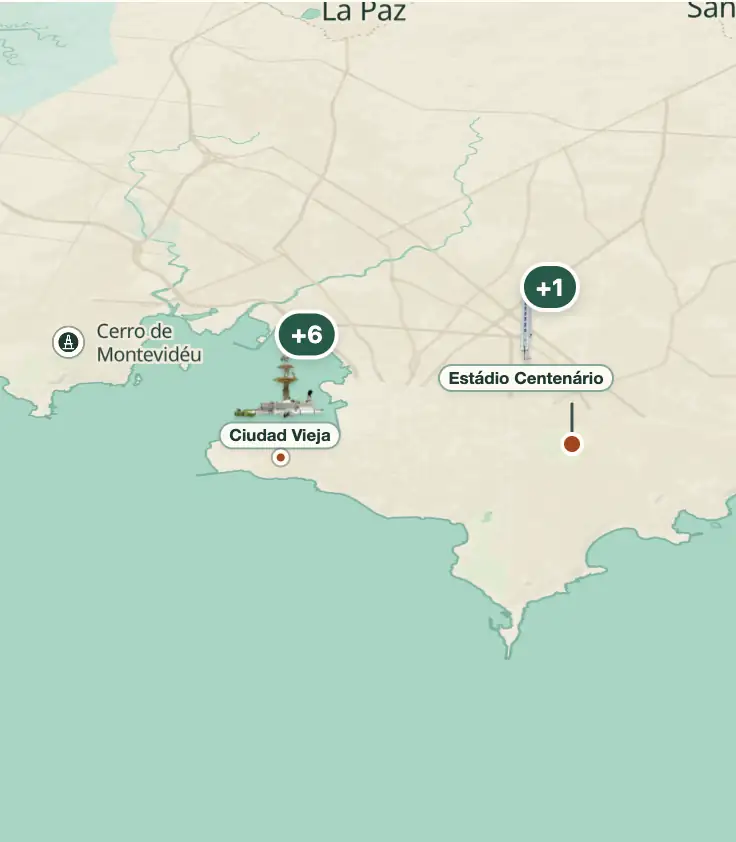
© OpenStreetMap · OpenFreeMap · © OpenMapTiles
Explore the map, read about the other places and plan your travel days in the app.
Open the appWhat to see
Montevideo: The brown estuary and the sheltered bay
Montevideo sits on rolling ground on the north bank of the Río de la Plata, the roughly 220 km wide estuary formed by the meeting of the Paraná and Uruguay rivers.

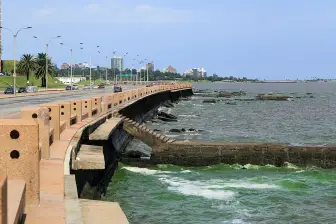
The Rambla
Twenty-two uninterrupted kilometers of boardwalk between the port and Punta Gorda, built starting in the 1920s. At sunset it fills with people carrying a thermos under their arm; the Pocitos–Buceo stretch is the busiest and the Parque Rodó stretch has the best benches.
At sunset the boardwalk fills with people carrying a thermos under one arm along all twenty-two kilometers, and the stretch from Pocitos to Buceo is the busiest.
Check access

Ciudad Vieja and Plaza Matriz
The city's oldest square, from 1726, holds the Metropolitan Cathedral completed in 1804 and the 1812 Cabildo, today a municipal museum. The marble fountain at the center dates to 1871; pedestrian-only Sarandí street links the square to Plaza Independencia.
The 1726 square brings together the cathedral, the cabildo, now a museum, and the 1871 marble fountain at its center, and Sarandí, a pedestrian-only street, leads out of this square toward Plaza Independencia.
Check access
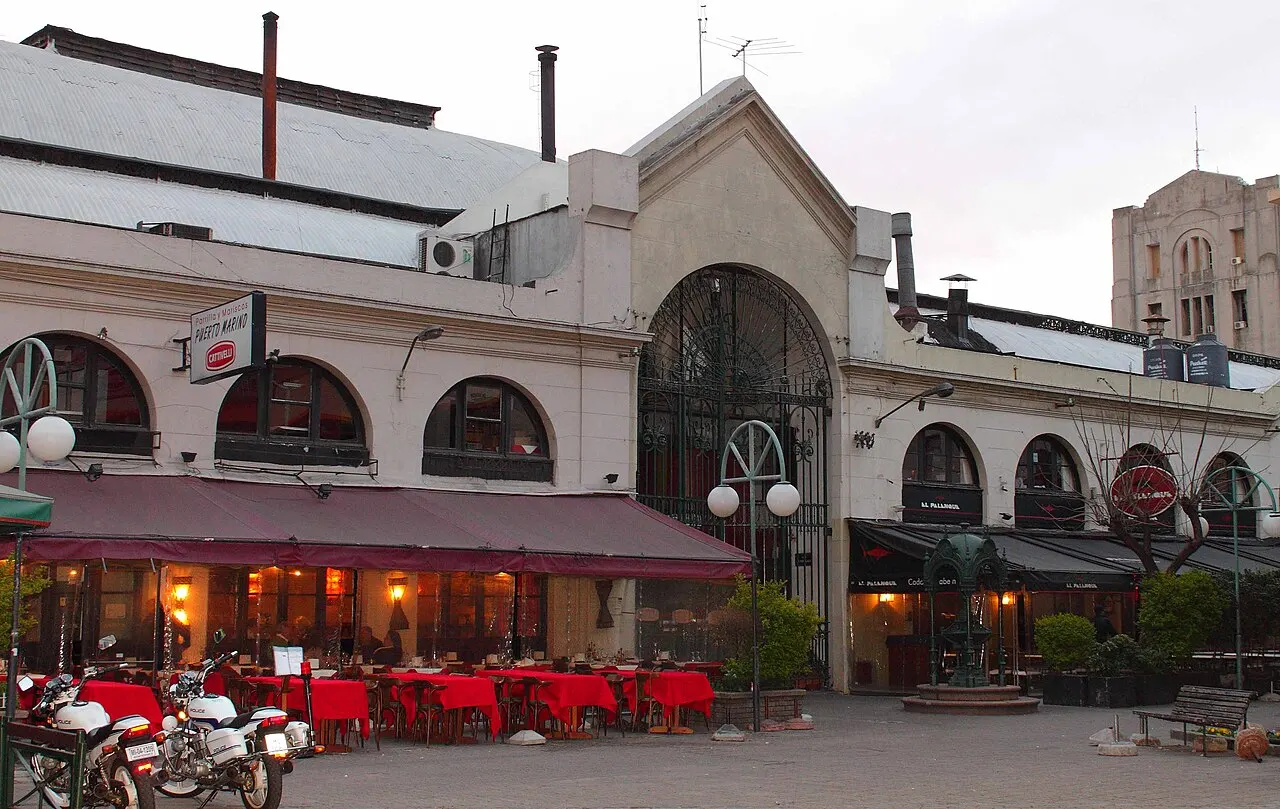
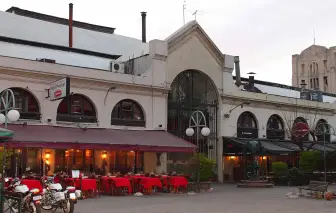
Mercado del Puerto
Cast-iron structure imported from England and opened in 1868, today filled with charcoal-grill parrillas around a covered courtyard. It's a lunch place, not a dinner one: most counters close early. The Roldós bar, from 1886, serves the medio y medio.
Inside the cast-iron structure imported from England and opened in 1868, most counters close early, so plan the meal for midday.
Check access
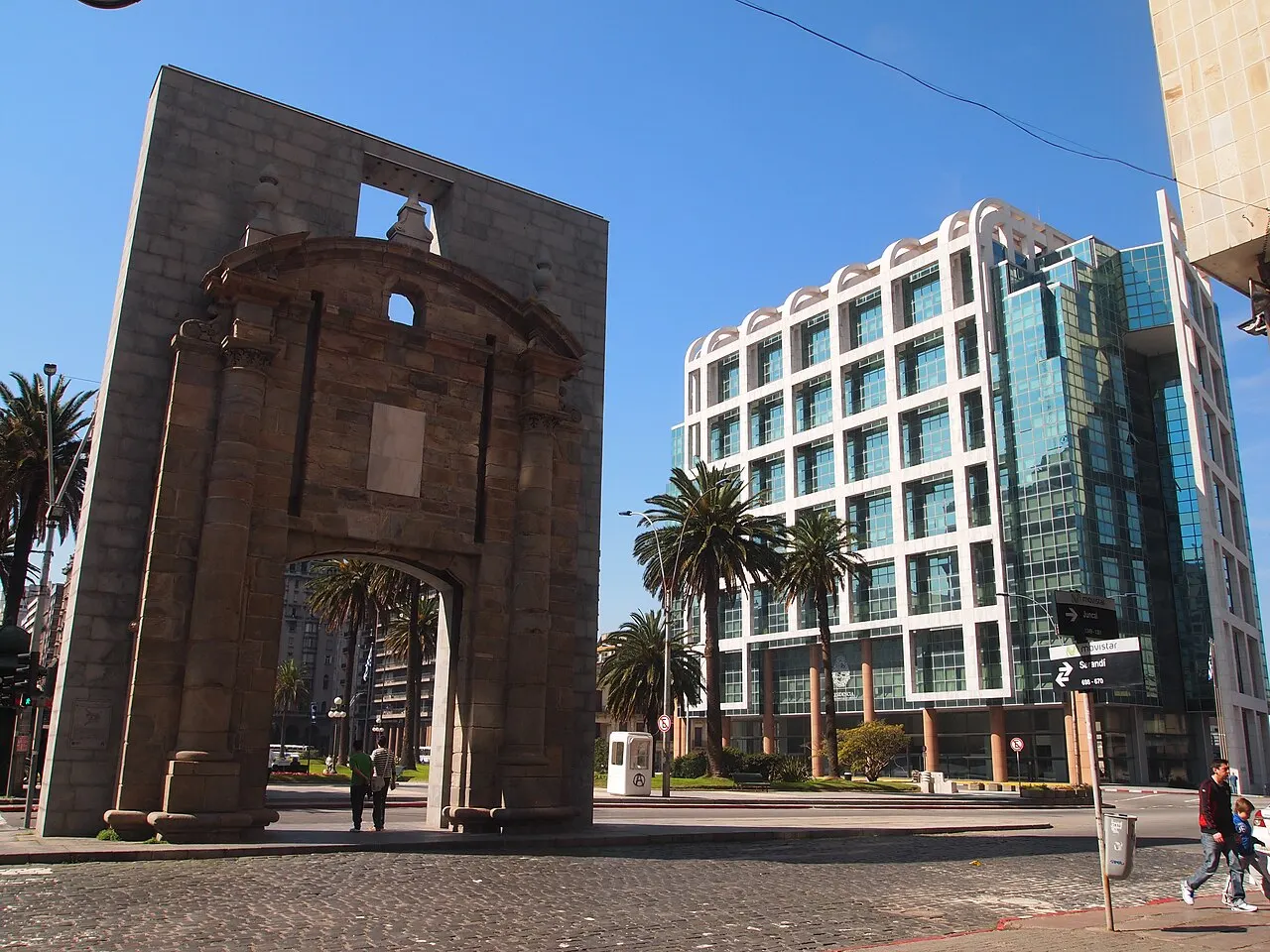
Plaza Independencia and Palacio Salvo
The square sits where the old Ciudadela stood, whose 1746 gate still stands at one end. Beneath the 1923 equestrian statue of Artigas is a mausoleum with a permanent guard and free admission; next to it, the Palacio Salvo (1928, by Mario Palanti) stands about 100 m tall and was South America's tallest building until 1935.
On the square, the 1746 Ciudadela gate still stands, the free-entry mausoleum sits beneath the equestrian statue, and the Palacio Salvo next to it stands about 100 m tall.
Check access

Teatro Solís
Opened on August 25, 1856, it's the country's main opera and theater house and underwent a full restoration between 1998 and 2004. Guided tours run almost daily, at a low price, with access to the stage and backstage.
The country's main opera house is worth the guided tour, which takes you onto the stage and backstage for a low price, in the hall opened in 1856 and restored between 1998 and 2004.
Check access

Torres García Museum
On Sarandí street, it holds the work of Joaquín Torres García (1874–1949) and the constructive universalism movement he founded. Here is the version of the map of South America turned upside down, drawn in 1943 with the argument that “our north is the south.”
The hall on Sarandí shows the work of Torres García, from 1874 to 1949, and holds the inverted-continent map, drawn in 1943 with the argument that the north for people who live here is the south.
Check access

Tristán Narvaja Fair
A street market running since 1909 that takes over Tristán Narvaja street and its cross streets every Sunday morning, from 8am. It sells antiques, records, secondhand books, tools and plants; by around 3pm the street is already being swept.
Antiques, records, secondhand books and plants are sold on Tristán Narvaja and its cross streets every Sunday morning since 1909, and cleanup crews are already sweeping the street by around 3pm.
Check access

Estadio Centenario
Opened on July 18, 1930 for the first World Cup, won by Uruguay on July 30, 4–2 over Argentina. It houses the Museo del Fútbol and was declared a historic monument of world soccer by FIFA in 1983. FIFA has assigned it one of the 2030 World Cup opening matches, and expansion work is planned: confirm access before going.
Estadio Centenario opened for the first World Cup, which Uruguay won 4 to 2, and houses the Museo del Fútbol. The stadium is a historic landmark of world soccer, with expansion works planned, so it's worth confirming access.
Check access

Cerro de Montevideo and Fortaleza General Artigas
A 132 m hill across the bay, with an 1804 lighthouse and a fortress built between 1809 and 1811, today a military museum. The view covers the whole port and the rambla's line; go and come back by taxi or app, because the surrounding neighborhood isn't a walking area for visitors.
It's a 132 m hill on the other side of the bay, with an 1804 lighthouse and an 1809–1811 fortress turned military museum, but the neighborhood around it isn't an area for walking. To see the view, go and come back by app, straight to the fortress, and leave it for when you have time after the Ciudad Vieja and the rambla.
Check access
Nilo’s itinerary
Start with the basic programme and choose extensions for the time you have.
Plan my days in the app ↗Day 1 · Ciudad Vieja and Centro on foot
Start at Plaza Independencia: the 1746 Ciudadela gate, Artigas's mausoleum under the statue, and the Palacio Salvo facade.
Walk down Sarandí street to Plaza Matriz, stopping at the Torres García Museum and the 1804 Metropolitan Cathedral.
Have a grilled lunch at the Mercado del Puerto, with a medio y medio at Roldós; arrive before 1pm to get a counter seat.
Take the guided tour of Teatro Solís in the late afternoon and walk back along the pedestrian Pérez Castellano.
Have dinner in Centro and walk 18 de Julio to the Obelisco, about 2 km in a straight line.
Day 2 · Rambla, river and soccer in a single day
Have coffee and bizcochos, sold by weight, at a Pocitos bakery before 10am.
Walk the rambla from Pocitos to Punta Carretas, about 4 km, passing the 1876 lighthouse.
Have a chivito for lunch and take the bus to the Estadio Centenario for the Museo del Fútbol.
Head back through Parque Rodó with a stop at the National Museum of Visual Arts, free admission.
Stay on the rambla for sunset with a thermos and gourd bought at any supermarket.




If you stay longer
Day 3 · A Sunday of street market and drums
Browse the Tristán Narvaja market between 9am and 1pm, with cash and empty space in your backpack.
Have lunch at Mercado Agrícola, in Goes, about 15 minutes by bus from Cordón.
Spend the afternoon in Prado, between the 1902 Botanical Garden, the rose garden and the 19th-century country estates.
Head back to Barrio Sur in the late afternoon and follow the candombe cuerdas' rehearsal on foot along Isla de Flores.
End at a bar in Palermo or Barrio Sur, keeping in mind that local nightlife only starts after 10pm.

Food
 AI illustration
Chivito
A sandwich of grilled beef tenderloin with ham, mozzarella, bacon, egg, lettuce, tomato and mayonnaise, served with fries. It was invented in Punta del Este in the 1940s and became the national urban dish; the “al plato” version skips the bread.
 AI illustration
Parrilla
Meat grilled over wood coals, never gas: asado strip, entraña, vacío and the achuras (chinchulines, sweetbreads, kidneys) that open the meal. The morcilla dulce, with orange peel and walnuts, is a local invention with no Brazilian equivalent.
 AI illustration
Mate
Coarsely ground yerba, heavy on the powder and without sugar, drunk from a wide gourd with a metal straw and a thermos under the arm. Uruguay is the world's biggest consumer, about 8 kg per person a year; you don't buy it ready-made on the street, you bring it from home.
 AI illustration
Milanesa
Breaded, fried steak, the standard lunch at any bodegón, served with mashed potatoes, fries or Russian salad. “A la napolitana” comes topped with ham, tomato sauce and melted cheese.
 AI illustration
Torta frita
A disc of dough fried in fat and dusted with sugar, sold from sidewalk stands for 30 to 60 pesos. Custom has it made on rainy days: when the sky closes in, the stands appear.
 AI illustration
Fainá
A thin chickpea-flour flatbread baked in the oven, a Genoese inheritance, served alongside or stacked on top of a slice of pizza, an order known as “a caballo.” It goes with a glass of moscato in the old pizzerias on 18 de Julio.
 AI illustration
Medio y medio
A chilled, equal-parts mix of sparkling wine and white wine. It comes in a small glass and goes with the asado at lunch.
 AI illustration
Bizcochos and chajá
Bizcochos are sweet and savory puff pastries sold by weight at bakeries, in the morning, to have with coffee or mate. Chajá, created in 1927 in Paysandú, stacks sponge cake, meringue, whipped cream and peach, and is the country's birthday dessert.
Day trips

Colonia del Sacramento
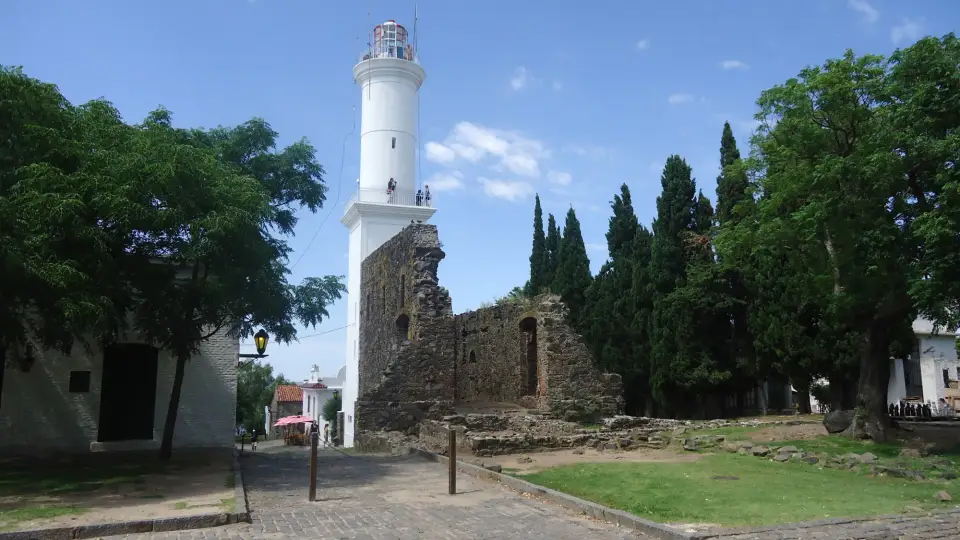
177 km west, about 2 hours 30 minutes by bus from Tres Cruces. Founded by the Portuguese in 1680, it has a historic quarter of irregular streets and Luso-Spanish houses listed by UNESCO in 1995, plus direct ferries to Buenos Aires.
Punta del Este
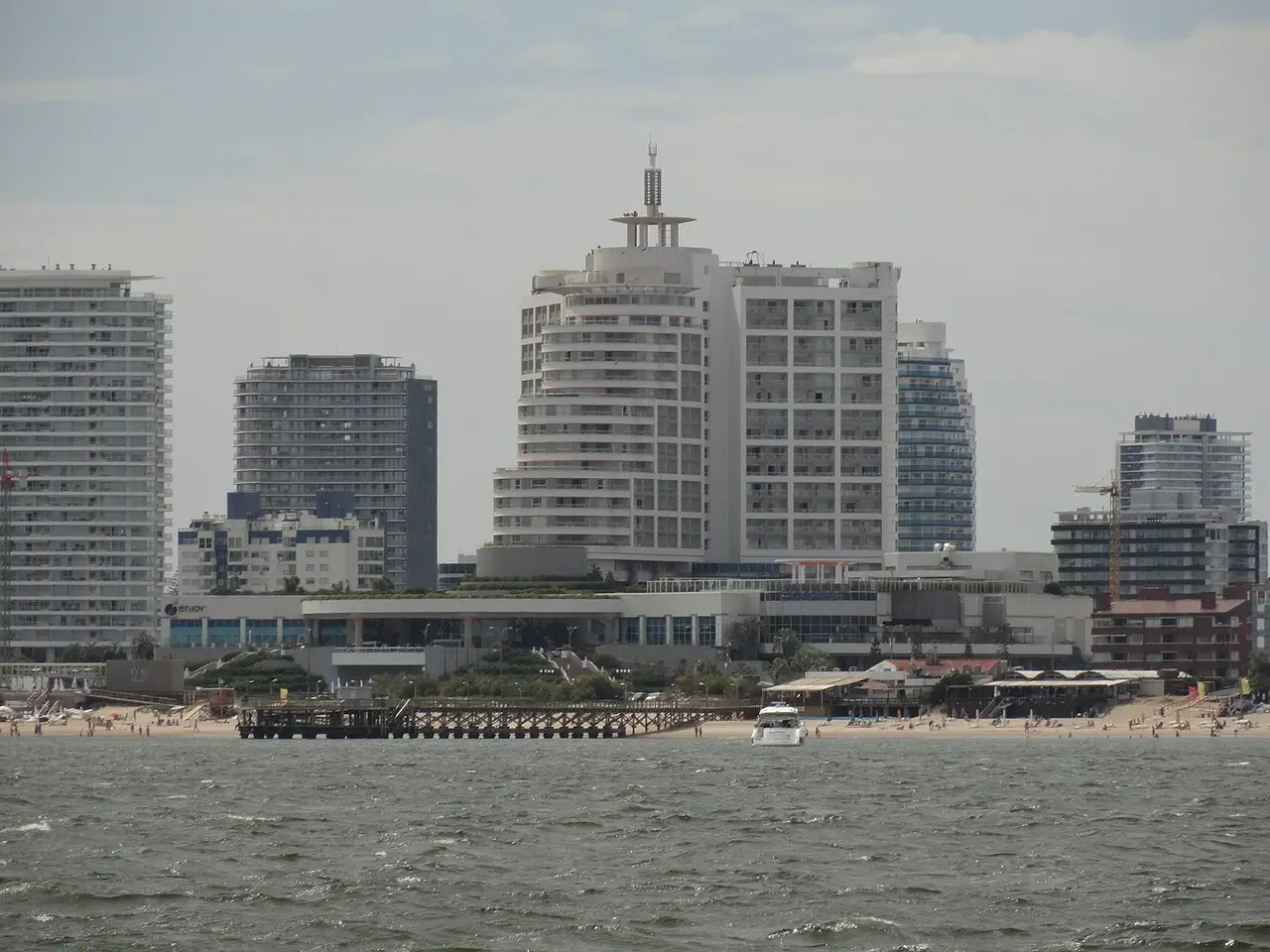
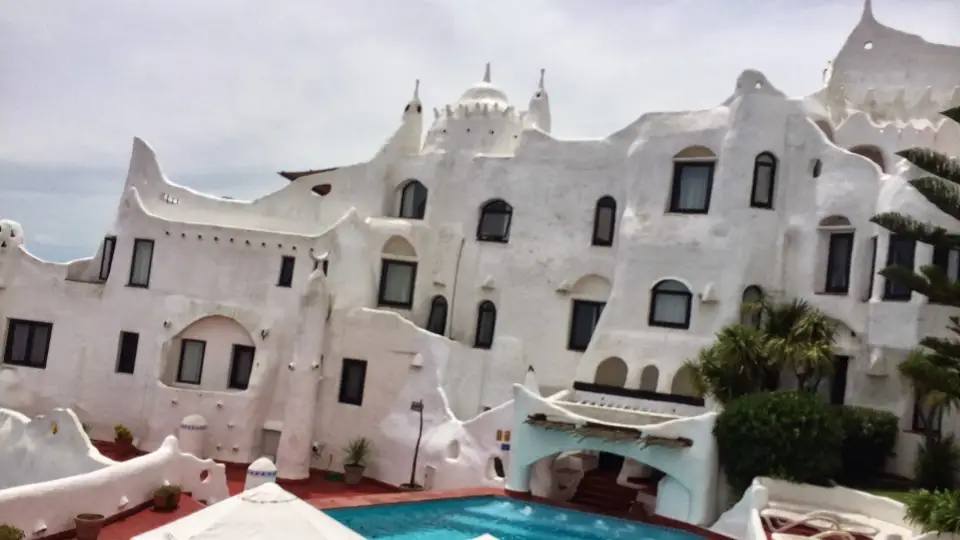
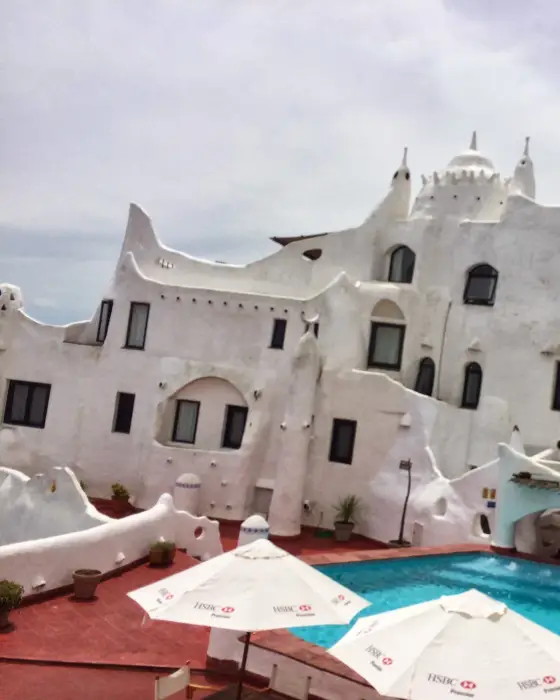
135 km east, about 2 hours by bus. A high-rise beach resort where the Río de la Plata turns into the Atlantic; the sculpture “La Mano” dates from 1982, by Mario Irarrázabal, and Carlos Páez Vilaró's Casapueblo sits in Punta Ballena, 13 km before it.

Piriápolis
100 km east, about 1 hour 30 minutes by bus. A resort town planned by Francisco Piria starting in 1890, with the 1930 Argentino Hotel and a cable car up Cerro San Antonio; it works best outside the high season.
Where to begin
Ciudad Vieja and Centro on foot
Start at Plaza Independencia: the 1746 Ciudadela gate, Artigas's mausoleum under the statue, and the Palacio Salvo facade.
Rambla, river and soccer in a single day
Have coffee and bizcochos, sold by weight, at a Pocitos bakery before 10am.
A Sunday of street market and drums
Browse the Tristán Narvaja market between 9am and 1pm, with cash and empty space in your backpack.
Money
The currency is the Uruguayan peso (UYU, written with the same sign as the dollar, so read the menu carefully), at about 40 pesos to the dollar in 2026, with annual inflation projected at around 4.4%. Uruguay is expensive by South American standards, so arrive with the price ranges in mind: cortado coffee 120–200 pesos, set lunch menu 450–800, chivito completo 500–800, parrilla dinner with wine 1,200–2,000 per person, liter of beer 200–350, short taxi ride 250–450. A mid-range hotel costs US$80 to 140 a night; a hostel bed, US$18 to 30. Cards are accepted almost everywhere, including contactless, but carry cash for street markets, kiosks and buses. From November 15 to April 30, non-residents paying with a card issued abroad get an automatic VAT refund on restaurant and lodging services. Ask at the register. A tip of about 10% in restaurants is customary, not mandatory, and you don't tip taxi drivers.
Getting there and around
Airport: 20 km from downtown, Viñoly's terminal
Carrasco International Airport (MVD) sits about 20 km east of downtown, with a terminal designed by Rafael Viñoly and opened in 2009. It's a single curved roof, which makes the hall feel bigger than it is. A taxi or ride-hailing app to the Ciudad Vieja takes 25 to 40 minutes and costs about US$25–35 in 2026. Suburban company buses stop right in front of the terminal and head to the Tres Cruces bus station for a fraction of that price. Confirm the route at the information desk, because routes change. Tres Cruces, opened in 1994, is the starting point for the whole country: Colonia del Sacramento in about 2 hours 30 minutes, Punta del Este in 2 hours, Salto in 6 hours. To Buenos Aires there's a bus plus ferry via Colonia and a direct fast boat from the port of Montevideo, with a crossing of about 2 hours 15 minutes.
No metro or train: it's all buses
There's no meaningful subway or urban train: public transport is entirely by bus, within the Sistema de Transporte Metropolitano (STM), run by CUTCSA and cooperatives. Since January 5, 2026 a one-hour ticket costs 52 pesos with the STM card and 64 pesos paying in cash on board. The two-hour one is 78 and 97 pesos, and the metropolitan combination is 80 pesos. The STM card is sold at kiosks and terminals, takes top-ups and allows transfers within the time window, which pays off in two days of use. Taxis run on a metered fare table; Uber and Cabify work well and are usually cheaper at night. The city is flat and walkable: from Plaza Independencia to Pocitos is about 7 km along the rambla, with an almost continuous bike lane, and the only real obstacle is the wind off the Plata, which shows up on no map.
Safety
Montevideo is calmer than most South American capitals, and homicides are concentrated in drug-trade disputes on the northern and western outskirts, far from the visitor circuit. The real risk is to your belongings: pickpocketing and phone theft in the Centro and on Avenida 18 de Julio, especially at bus stops and at the end of the business day, when the sidewalk fills up all at once. At night the Ciudad Vieja empties after office hours, and the blocks between Plaza Zabala and the port are poorly lit. Walk along streets with open bars or take a taxi back: the risk depends on the hour and the block more than on the people around you. Avoid Casavalle, Marconi, Cerro Norte and upper Goes, which hold no tourist interest anyway. At the Cerro, drive straight up to the fortress and come back the same way. At the Tristán Narvaja market, carry little cash and wear your backpack on your front. General emergency number: 911.
Etiquette tips
Mate: don't say thank you
Whoever pours keeps the thermos and hands the gourd back to each person on their turn. Saying “gracias” when handing it back means you don't want any more; only say thanks when you actually want to leave the circle.
Don't touch the straw
The straw stays exactly where it is and you drink it all down to the gurgle before handing it back. Stirring the yerba or drinking only half is read as carelessness, not manners.
Greeting: one kiss on the cheek, always
The social greeting is a kiss on the right cheek, even between men who know each other. Offering a handshake in an informal setting comes off as distant or overly formal.
Don't mix it up with Argentina
Mate, dulce de leche, tango and Carlos Gardel are an open and seriously held dispute. Crediting it all to Buenos Aires, or calling a Uruguayan an Argentine, ends the friendliness on the spot.
The check doesn't come on its own
Nobody rushes the table: the waiter only brings the check when you ask for “la cuenta, por favor.” Holding a table for two hours after coffee is normal behavior.
Soccer means picking a side
Peñarol and Nacional split entire families; asking someone's team is common talk, giving your opinion on a match between them isn't. Avoid wearing one club's shirt near the other's stadium on match day.
Mistakes to avoid
Marijuana: pharmacy only, only for registered residents
Thinking you can buy marijuana. Sales are legal, but only in pharmacies and only for residents registered in the country. For visitors there's no legal purchase channel, and buying on the street is still a crime.
Expecting open ocean at Pocitos
Expecting open ocean. Pocitos beach is the Río de la Plata: fresh to brackish water, brown with sediment and almost waveless. Anyone wading in looking for surf won't find any. The ocean only starts east of Punta del Este, more than 130 km away.
In January, the city empties out: vacation on the east coast
Coming in January expecting a full city. It's the month Montevideans go on vacation to the eastern coast; many restaurants close and the capital ends up quieter than in October.
The foreign card knocks off 22% VAT
Paying at a restaurant in cash. From November 15 to April 30, you lose the automatic VAT discount a foreign card guarantees, and nobody mentions it at the register.
The rambla is 22 km long: no metro, it's all buses
Counting on a subway or train. There isn't one: it's all buses, and the rambla, which looks short on the map, runs 22 km. The Ciudad Vieja–Pocitos stretch alone is about 7 km with the wind against you.
Useful phrases
Ta.
Ok, got it, alright. The most used word in the country, works as a reply to almost anything.
¿Cómo andás?
How's it going? Here they use “vos” instead of “tú”: vos tenés, vos querés, vos sabés.
Bo, ¿me pasás el mate?
Hey, pass me the mate? “bo” is the Uruguayan vocative, informal and affectionate.
La cuenta, por favor.
The check, please: without asking, it won't come to the table.
¿Cuánto sale?
How much is it? On the street they use “salir” instead of “costar.”
Está bárbaro.
It's great: the standard compliment, said with no apparent enthusiasm.
Districts
Ciudad Vieja
The founding peninsula, laid out in a grid in 1724, between Plaza Independencia and the port. By day it holds banks, ministries, museums and the Mercado del Puerto; by night it empties out, except for the blocks of bars on Bartolomé Mitre and Pérez Castellano.
Centro
The axis of Avenida 18 de Julio, from Plaza Independencia to Plaza Fabini and the Obelisco. Street-level shops, old cinemas, covered arcades and the Palacio Salvo; it's where the city works and where the marches happen.
Cordón and Parque Rodó
The University of the Republic neighborhood, with student rentals, cheap bodegones and the Tristán Narvaja street fair on Sundays. Parque Rodó has a lake, an amusement park, Carnival's Teatro de Verano and the rambla's first beach, Ramírez.
Barrio Sur and Palermo
The strip between Centro and the southern rambla, an Afro-Uruguayan hub since the 19th century and the birthplace of candombe: weekend rehearsals take over its streets, and in February the Desfile de Llamadas parade passes through here.
Punta Carretas
Upper-middle-class residential area around the 1876 lighthouse. The former prison from which 111 inmates, nearly all Tupamaros, escaped through a tunnel in September 1971 became a shopping mall in 1994 and is the neighborhood's landmark.
Pocitos
Apartment towers on short blocks facing a crescent-shaped beach; it's the country's densest neighborhood and the most walked stretch of the rambla. It works for lodging, a sunset run and dinner without ceremony.
Carrasco
The far east, with gardened houses, tree-lined streets and the 1921 Hotel Casino Carrasco, reopened in 2013. The airport is a few kilometers away and this is the most expensive part of the city.
Prado
North, around the 1902 Botanical Garden and 19th-century country estates. Hosts Expo Prado in September and Semana Criolla at Easter; on the way, in Goes, is the 1913 Mercado Agrícola, restored in 2013.
History
1680–1723 · The Luso-Spanish dispute over the Plata
Portugal founds Colonia del Sacramento in 1680, facing Buenos Aires, and spends four decades smuggling silver and hides. In November 1723 a Portuguese garrison occupies Montevideo bay.
1724–1730 · Spanish founding
Bruno Mauricio de Zabala expels the Portuguese in January 1724 and sets up a stronghold on the same site. Families arrive from the Canary Islands and Buenos Aires; the 1730 cabildo is the civil date the city celebrates.
1776–1806 · Port of the Viceroyalty
With the Viceroyalty of the Río de la Plata created in 1776, Montevideo becomes a base for the Spanish South Atlantic fleet and an authorized port, including for the landing of enslaved Africans. The wall and the Ciudadela set the layout of the old town.
1807 · British occupation
British troops take the city in February and stay seven months before negotiating their exit. They leave behind the first press to operate in the territory and a taste for free trade.
1811–1828 · Artigas and independence
José Artigas wins at Las Piedras in May 1811 and turns the rural uprising into a federal project, before being defeated by the Luso-Brazilian invasion. The 1828 Preliminary Peace Convention, arbitrated by the British, creates the Eastern State of Uruguay.
1843–1851 · The Great Siege
The capital withstands nine years of siege by the Blanco army backed by Rosas, defended largely by legions of Italian and French immigrants. The episode fixes the split between Blancos and Colorados and opens the city to mass immigration.
1860–1910 · The immigrant city
Italians, Galicians, Basques, Eastern European Jews and Syrian-Lebanese push the population from about 40,000 to more than 300,000 by 1910, on the way to the half million the city passes before 1930. The Cerro meatpacking plants, tango, candombe organized into comparsas and the Reus and Goes neighborhoods all take shape.

1903–1929 · The Batllista State
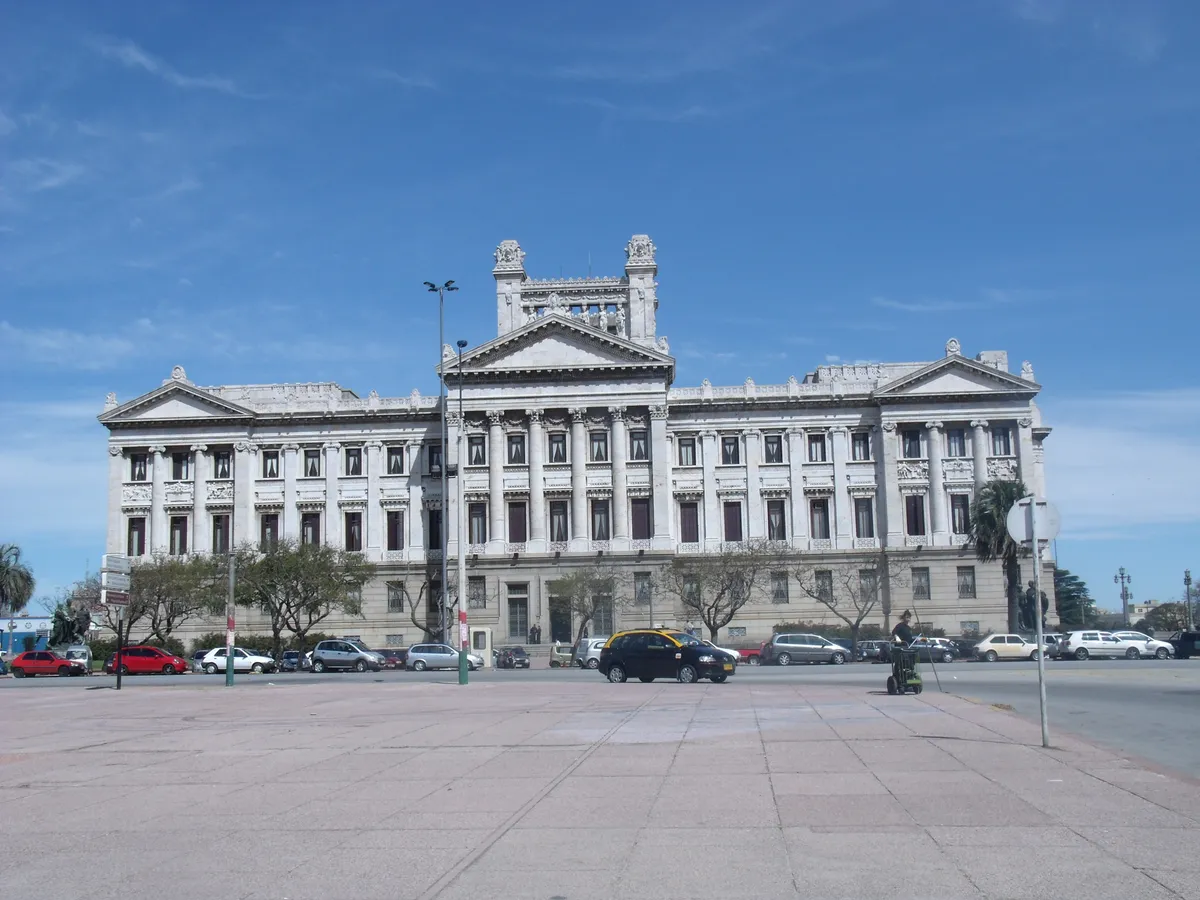
José Batlle y Ordóñez, president in 1903–07 and 1911–15, establishes the eight-hour workday, divorce at the wife's request, secular education and state-owned companies. Montevideo gains the rambla, wide avenues and the Palacio Legislativo, inaugurated in 1925.
1930 · The first World Cup
Estadio Centenario opens on July 18, 1930 for FIFA's inaugural tournament, which Uruguay wins on July 30 by 4–2 over Argentina. The name marks the centenary of the first Constitution, from 1830.
1973–1985 · Civil-military dictatorship
The coup of June 27, 1973 closes Parliament and installs twelve years of repression, with one of the highest rates of political prisoners per capita on the continent and mass emigration. Democracy returns on March 1, 1985.
1994–today · Mercosur, crisis and reinvention
Mercosur's administrative headquarters settles in the city in 1994; the 2002 financial crisis knocks about 11% off GDP. Since then have come the expanded port, the Zonamerica tech hub and the 2012–2013 laws on abortion, equal marriage and regulated marijuana.

Complete history
The Spanish stronghold against Colonia (1724–1730)
Montevideo's street plan still shows the military stronghold it once was. In 1680 Portugal founded Colonia del Sacramento on the opposite bank of the Río de la Plata, a few hours from Buenos Aires, and turned the region into a smuggling corridor for silver and hides. When a Portuguese garrison occupied Montevideo bay in November 1723, the governor of Buenos Aires, Bruno Mauricio de Zabala, expelled the Portuguese in January 1724 and built a stronghold there. The first civilian settlers came from the Canary Islands and Buenos Aires between 1726 and 1729, and the cabildo set up in 1730 is the date the city celebrates. That explains the fortified peninsula, the tight grid of narrow streets in the Ciudad Vieja and Plaza Independencia sitting exactly where the Ciudadela stood.
Authorized port of the Viceroyalty, from 1776
Port status defined what came next. With the creation of the Viceroyalty of the Río de la Plata in 1776, the city became a base for the Spanish South Atlantic fleet and an authorized port: including for the landing of enslaved Africans, whose descendants still sustain candombe in Barrio Sur today. The British took the town in February 1807 and handed it back seven months later, leaving behind a press and an appetite for open trade. From 1811 José Artigas turned the rural uprising into a federal project, was defeated by the Luso-Brazilian invasion of 1816–1820 and died in exile in Paraguay; the 1828 Preliminary Peace Convention, arbitrated by London, created Uruguay as a buffer state between Brazil and Argentina. Between 1843 and 1851 the capital spent nine years under siege, defended by foreign legions that later became a neighborhood.
Italian and Spanish immigration, between 1860 and 1930
Immigration remade the city between 1860 and 1930. Italians and Spaniards arrived first and in greatest numbers, followed by Eastern European Jews, who took over the row houses of the Reus neighborhood, and Syrian-Lebanese, who opened up the shops of Goes. The population went from about 40,000 to over half a million in seventy years. The Cerro meatpacking plants exported meat to Europe, the conventillos of Barrio Sur kept the candombe drums, and in 1917 a 20-year-old architecture student named Gerardo Matos Rodríguez wrote “La cumparsita,” which would premiere at Café La Giralda, on Plaza Independencia.
Designed by Batlle y Ordóñez
Uruguay's 20th century was designed by José Batlle y Ordóñez, president in 1903–07 and 1911–15. The eight-hour workday came, divorce at the wife's request, free secular education and a bloc of state companies for energy, fuel and insurance. Montevideo got the rambla along the Plata, the Palacio Legislativo in 1925 and Estadio Centenario in 1930, and the country earned the nickname “Switzerland of the Americas.” The two World Cups, 1930 at home and 1950 at the Maracanã, fixed a national identity that still fills bar-counter conversation.
The model broke in the 1950s
The model broke in the 1950s, when wool and beef prices fell. Stagnation led to the Tupamaro guerrilla in the 1960s, the coup of June 27, 1973 and twelve years of dictatorship, with mass political imprisonment and the departure of about 10% of the population. Democracy returned in March 1985; the 2002 financial crisis, spread from Argentina, knocked around 11% off GDP. The following twenty years brought growth, the Mercosur headquarters (1994), an expanded port linked to the central railway and laws that changed the country's image: legal abortion in 2012, equal marriage and state-regulated marijuana in 2013. Today's city is this: a historic center under slow restoration, a stable middle class along the coast and northern neighborhoods with persistent poverty.
“La cumparsita” premiered in 1917 at Café La Giralda.
Geography and shape of the city
The brown estuary and the sheltered bay
Montevideo sits on rolling ground on the north bank of the Río de la Plata, the roughly 220 km wide estuary formed by the meeting of the Paraná and Uruguay rivers. The city exists because of the natural bay to the west, the only shelter of still water on the coast, watched over by Cerro de Montevideo, at 132 m the only notable rise and the likely origin of the city's name.
From the colonial grid to the rambla
The colonial core was born on a fortified peninsula and grew eastward in a Spanish grid, with Avenida 18 de Julio as its spine; from 1900 the expansion followed the coast, and the Rambla (22 uninterrupted kilometers between the port and Punta Gorda) became the public axis stitching together Parque Rodó, Punta Carretas, Pocitos, Buceo, Malvín and Carrasco. North of Avenida General Flores lie the working-class neighborhoods, El Prado and the outskirts.
The climate and the pampero
The climate is humid subtropical, with no dry season, about 1,000 mm of rain spread through the year and a constant wind: the pampero, coming from the southwest, drops the temperature within a few hours.
Culture
Candombe: the beat of the city
Candombe is the beat of the city: three drums of Bantu origin (chico, repique and piano) played in cuerdas that march down the street in a line, tuned over fire before setting out. It arrived with enslaved Africans landed at the port and survived in the conventillos of Barrio Sur and Palermo, among them the Mediomundo, demolished by the dictatorship in 1978. UNESCO listed the practice as intangible cultural heritage in 2009. On Sunday evenings the cuerdas rehearse on Isla de Flores and Carlos Gardel streets, and anyone can follow on foot, behind the drums, without paying anything.
Carnival: forty days of festivities
Montevideo's Carnival lasts about forty days, from late January to early March, and is run as a championship: the groups perform at the Teatro de Verano Ramón Collazo, in Parque Rodó, and at neighborhood tablados. The Uruguayan murga (a chorus of thirteen to seventeen painted singers, backed by bass drum, cymbal and snare) sings satirical lyrics about the year's politics; it was censored during the dictatorship and went back to being the country's main public commentary. The official categories also include parodistas, humoristas, revistas and the sociedades de negros y lubolos.
Tango, literature and soccer
The city's cultural output is out of all proportion to its size. “La cumparsita,” the most recorded tango in the world, was written here in 1917 by Gerardo Matos Rodríguez and premiered at Café La Giralda, on Plaza Independencia. The prose of Juan Carlos Onetti, the poems of Idea Vilariño, the office novels of Mario Benedetti and the chronicles of Eduardo Galeano describe the same restrained, gray city; Eduardo Mateo, Jaime Roos and El Cuarteto de Nos turned it into a songbook. In soccer, Peñarol, founded in 1891, and Nacional, founded in 1899, split whole families, the country won the 1930 and 1950 World Cups, and the Maracanazo is still a live topic at any bar counter.
It's common to hear the candombe drums before seeing the group.
In the city of Onetti, Benedetti and Galeano, the Tristán Narvaja market has sold secondhand books among records, antiques and tools every Sunday since 1909, and by around 3pm the street is already being swept.
Festivals and events
 AI illustration
Carnival
From late January to early March, about 40 days: the longest in the world. Opening parade on Avenida 18 de Julio and the official contest at the Teatro de Verano, with tickets sold by the night and eliminating rounds up to the final.

Desfile de Llamadas
Two nights in February, usually the first Thursday and Friday of the month, along Isla de Flores street, in Barrio Sur and Palermo. About forty candombe comparsas parade in competition; there are paid stands and free sidewalk viewing, always packed.
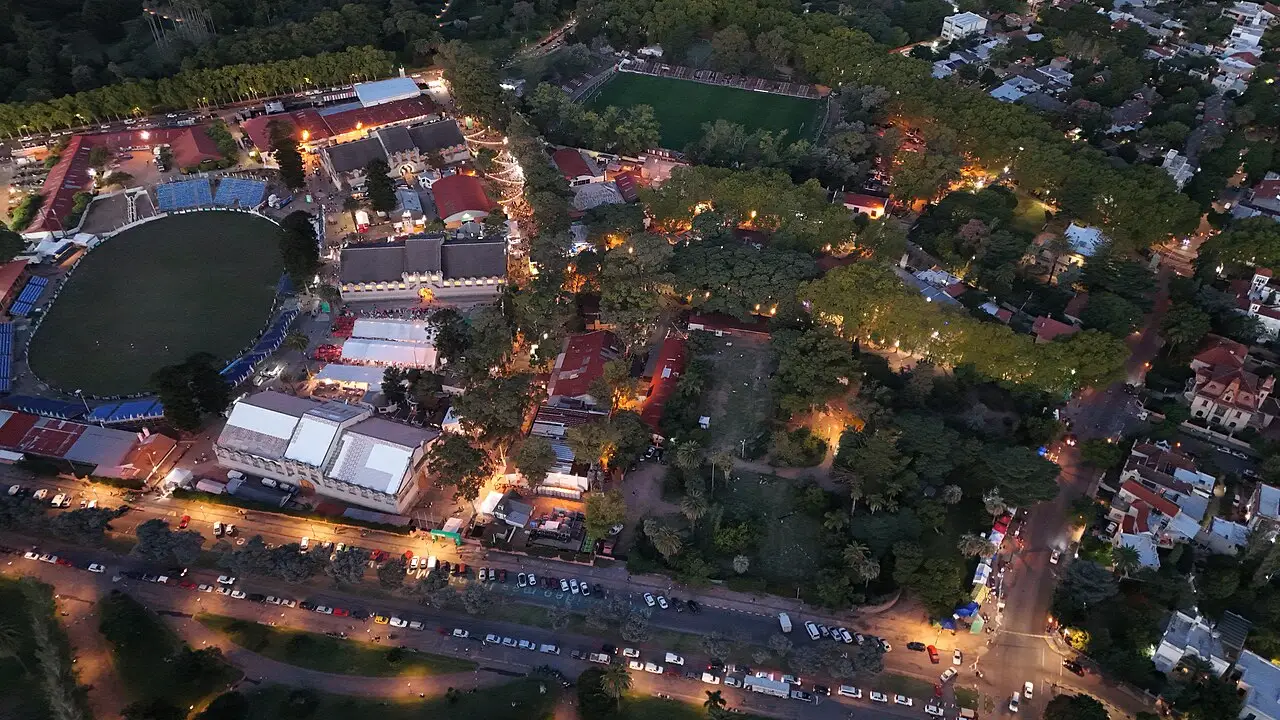
Semana Criolla del Prado
Semana de Turismo is the official name for Easter week in Uruguay. At the Prado it brings jineteadas (riding bucking horses), a craft fair and asado, and it's the holiday when the capital celebrates the rural country.

Expo Prado
About twelve days in September, at the Rural del Prado: an agricultural fair with prize cattle, machinery and country food. It's the city's biggest event outside summer and fills the buses from the northern zone.
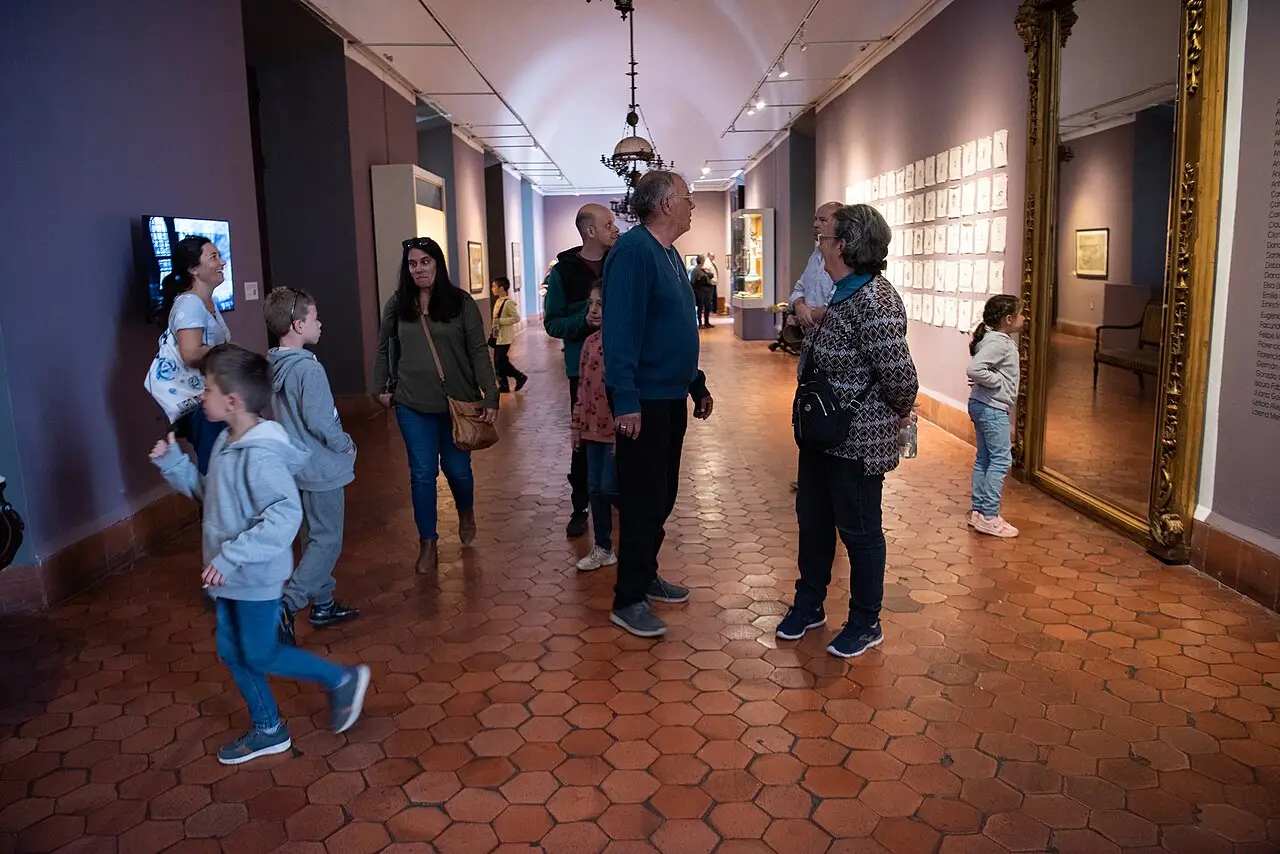
Día del Patrimonio
First weekend of October. Palaces, theaters, bank headquarters and private houses open for free, with an annual theme set by the government and long lines at buildings that never open otherwise.
Books and films
The Truce, by Mario Benedetti (1960)
The diary of a civil servant months from retirement; it's the most exact portrait of the Montevidean middle class and the restrained tone in which the city talks about itself.
Whisky (2004), by Juan Pablo Rebella and Pablo Stoll
A dry comedy about the owner of a sock factory in Ciudad Vieja. The film's pace, with long takes and minimal dialogue, is the real pace of the city.
Brindis por Pierrot, by Jaime Roos (1985)
An album that mixes murga, candombe and rock and names real neighborhoods, streets and characters; it works as a sound map of Montevideo.
Frequently asked questions
Montevideo: Can a tourist legally buy marijuana?
No: sales are legal only in pharmacies and only for residents registered in the country. For visitors there's no legal purchase channel, and buying on the street is still a crime.
Montevideo: What's the currency, and what's the dollar worth?
The currency is the Uruguayan peso (UYU, written with the same sign as the dollar, so read the menu carefully), at about 40 pesos to the dollar in 2026, with annual inflation projected at around 4.4%.
Montevideo: What's the best time to go?
October to December and March to April are the best windows, with 20 to 25 °C and long daylight. February makes up for the heat with Carnival; in January, Montevideans go on vacation, and some restaurants close.
Montevideo: Is the city safe for visitors?
Yes: Montevideo is calmer than most South American capitals, and homicides are concentrated in drug-trade disputes on the northern and western outskirts, far from the visitor circuit. The real risk is phone theft in the Centro and on Avenida 18 de Julio.
Montevideo: What's in a chivito?
It's a sandwich of grilled beef tenderloin with ham, mozzarella, bacon, egg, lettuce, tomato and mayonnaise, served with fries. It was invented in Punta del Este in the 1940s and became the national urban dish.
Other cities in the country
Uruguay ↗- Days
- 1–3
- When
- Mar–Apr · Oct–Nov
- Per person/day
- Average 3,150 UYUMid-range · per person/day
Cost scope
Per person per day: accommodation, meals, urban transport, visits and a small allowance for extras. Flights excluded; larger purchases vary. Editorial estimate, not a quote.
- Days
- 3–4
- When
- Jan–Mar · Dec
- Per person/day
- Average 4,660 UYUMid-range · per person/day
Cost scope
Per person per day: accommodation, meals, urban transport, visits and a small allowance for extras. Flights excluded; larger purchases vary. Editorial estimate, not a quote.


Itineraries through here
 Argentina, Uruguay and Chile in 10 daysTango, rambla and the AndesBuenos Aires · Montevideo · Santiago · Valparaíso8–12 days4 cities
 Buenos Aires and Montevideo in 7 daysBoth banks of the River PlateBuenos Aires · Montevideo5–7 days2 cities
 Argentina and Uruguay in 10 daysAcross the River Plate to Punta del EsteBuenos Aires · Colonia del Sacramento · Montevideo · Punta del Este9–14 days4 cities