India
Jaipur
Pink walled city, Amber's forts and bazaars by trade
Days Start with the basic programme and choose extensions for the time you have.
How the guide reaches this number
A third day goes to the block-printing workshops of Sanganer or Bagru, the C-Scheme and a show at the Raj Mandir cinema. If you're looking for peace and quiet, you'll suffer, because vendors and drivers approach you all day. You'll say no thirty times before lunch, with no hostility on either side. With only one day, get to Amber at 8am, take a ride-hailing car down to the walled city around noon and have a thali in Johari Bazaar for lunch. In the afternoon, see the Jantar Mantar and the City Palace, side by side, and finish at the Albert Hall, with the facade lit up after 7pm. Up close, the pink disappoints: it's faded terracotta, with wiring on top. The Jal Mahal from the photos can only be seen from the promenade, because it isn't open to visitors, and the night ends early, since the walled city empties out after 10pm.
2–3
When November to February: 8–25 °C, dry skies, almost no rain
How the guide reaches this number
November to February is the best time: 8–25°C, clear skies, and almost no rain, with mornings of 6–8°C in December and January and fog that delays flights and trains across the whole northern plain. March and October are transition months, with 30–35°C in the afternoon; high season runs from October to March, with peak prices in December and January and during Literature Festival week. From April to June the afternoon hits 40–45°C, with peaks above 46°C, a hot wind (the loo), and fort stone that burns to the touch; anyone coming in those months goes out at 6am and retreats indoors by 11am. The monsoon arrives in late June and runs through September, with about 550–650 mm falling in short, heavy bursts: the city turns green, the forts empty out, prices drop, and the nuisance is humidity. May is the hottest month, and it's the one I'd cut from the trip.
Per person/day backpacker ₹2,000–3,000; mid-range comfort ₹6,000–10,000; with car, driver, and haveli-hotel, above ₹15,000
How the guide reaches this number
Per person per day: accommodation, meals, urban transport, visits and a small allowance for extras. Flights excluded; larger purchases vary. Editorial estimate, not a quote.
 What Nilo thinks
Give Jaipur two days: one for the walled city on foot and another for the triangle of forts at Amber, Jaigarh and Nahargarh. A third day goes to the block-printing workshops of Sanganer or Bagru, the C-Scheme and a show at the Raj Mandir cinema. If you're looking for peace and quiet, you'll suffer, because vendors and drivers approach you all day. You'll say no thirty times before lunch, with no hostility on either side. With only one day, get to Amber at 8am, take a ride-hailing car down to the walled city around noon and have a thali in Johari Bazaar for lunch. In the afternoon, see the Jantar Mantar and the City Palace, side by side, and finish at the Albert Hall, with the facade lit up after 7pm. Up close, the pink disappoints: it's faded terracotta, with wiring on top. The Jal Mahal from the photos can only be seen from the promenade, because it isn't open to visitors, and the night ends early, since the walled city empties out after 10pm.Jaipur was designed before it was built: in 1727, Sawai Jai Singh II came down from the fortress of Amber and laid out, on flat ground, 33 m avenues that cross at right angles, with a square at every crossing. Inside the wall, the facades painted in 1876 in the same earthy pink surround the Hawa Mahal, the Jantar Mantar observatory, and the City Palace, where the royal family still lives. In the bazaars, each street has its own trade, from Johari's emeralds to the lacquer bangles shaped over a brazier in Maniharon ka Rasta, and vendors approach you all day long, without hostility. In the hills to the north, the forts of Amber, Jaigarh, and Nahargarh hold the mirror-lined Sheesh Mahal and the view over the whole grid. Eat pyaaz kachori in the morning, dal baati churma for lunch, and mirchi bada in the late afternoon. Come between November and February, with clear skies and 8 to 25°C, and give Jaipur two days.
Quick facts
- Population
- about 4.5 million in the city and urban agglomeration (2026 estimate; the last Indian census, in 2011, counted 3.07 million)
- Founded
- November 18, 1727, by Sawai Jai Singh II; capital of Rajasthan since March 30, 1949
- Country and region
- India: capital of Rajasthan state, historic region of Dhundhar
- Languages
- Hindi and Rajasthani (Dhundhari dialect); English in hotels, museums, ticket offices, and apps
- Currency
- Indian rupee (INR, ₹)
- Time zone
- IST, UTC+5:30, no daylight saving
- Best time to visit
- November to February: 8–25 °C, dry skies, almost no rain
- Average daily cost
- backpacker ₹2,000–3,000; mid-range comfort ₹6,000–10,000; with car, driver, and haveli-hotel, above ₹15,000
When to go
November to February: 8–25 °C, dry skies, almost no rain
March
17° to 32°C
4 mm of rain
April
23° to 38°C
7 mm of rain
May
27° to 41°C
12 mm of rain
June
28° to 40°C
62 mm of rain
July
26° to 35°C
191 mm of rain
August
25° to 33°C
203 mm of rain
September
24° to 34°C
80 mm of rain
October
20° to 34°C
19 mm of rain
How the year changes
November to February is the best time: 8–25°C, clear skies, and almost no rain, with mornings of 6–8°C in December and January and fog that delays flights and trains across the whole northern plain. March and October are transition months, with 30–35°C in the afternoon; high season runs from October to March, with peak prices in December and January and during Literature Festival week. From April to June the afternoon hits 40–45°C, with peaks above 46°C, a hot wind (the loo), and fort stone that burns to the touch; anyone coming in those months goes out at 6am and retreats indoors by 11am. The monsoon arrives in late June and runs through September, with about 550–650 mm falling in short, heavy bursts: the city turns green, the forts empty out, prices drop, and the nuisance is humidity. May is the hottest month, and it's the one I'd cut from the trip.
The same numbers as a table
| Month | Temperature °C | Rain mm |
|---|---|---|
| January · | 8 to 23 | 6 |
| February · | 12 to 26 | 10 |
| March | 17 to 32 | 4 |
| April | 23 to 38 | 7 |
| May | 27 to 41 | 12 |
| June | 28 to 40 | 62 |
| July | 26 to 35 | 191 |
| August | 25 to 33 | 203 |
| September | 24 to 34 | 80 |
| October | 20 to 34 | 19 |
| November · | 14 to 30 | 2 |
| December · | 10 to 25 | 4 |
Nilo's tips
Amber at 8, not at 10
At opening, 8am, Amber's courtyard has few people and the air is still cool, so leave your hotel at 7:30am. By 11am the fort is already packed, and from April to June, when the afternoon reaches 40–45°C, the courtyard stone burns to the touch. In summer, the line runs over 40 minutes. Climb the ramp on foot, in about 20 minutes, or by jeep, and skip the elephant line. With Amber done before 10am, the morning is free for Jaigarh, 15 minutes by car, and for the Panna Meena ka Kund stepwell, close by.
Buy the ₹1,000 composite ticket, which pays off from the second monument
It covers eight monuments and is valid for two consecutive days. The eight are Amber, Hawa Mahal, Jantar Mantar, Nahargarh, Albert Hall, the Isarlat tower, and the Sisodia and Vidyadhar gardens, and the ₹1,000 price is what's charged to foreigners. The pass is sold at the ticket office of any of these sites. Budget separately for the City Palace, which isn't included.
At Hawa Mahal, see the facade at 9am and enter from the back
The facade of the Hawa Mahal, from 1799, faces east and only gets sun in the morning, so arrive at 9am to see it lit from the street. The entrance is at the back, on Hawa Mahal Road, and inside, five stories of ramps lead to the top without a single step. Across the street, the café terraces charge for a photo you can take for free from the sidewalk.
Use the Pink Line metro and the e-rickshaw for ₹10 to 20
To cross the city end to end, take the metro, which avoids the traffic diverted by construction of the new line on Tonk Road. Inside the walls, swap the auto-rickshaw for a shared e-rickshaw: ₹10–20 per leg, versus ₹80–150 for a short ride.
Bring rupees in cash: UPI doesn't accept foreign cards
On the street, almost everyone pays by UPI, the QR code payment system that foreign cards can't access. That's why chai, rickshaws and bazaars ask for cash. ATMs charge about ₹200–250 per withdrawal and cap it at ₹10,000 per transaction, so take out the maximum each time, and as few times as possible. When paying at a large store, ask for change in small bills, because rickshaw drivers almost never have change for large notes.
Kachori in the morning, mirchi bada in the late afternoon
Pyaaz kachori is breakfast food, and mirchi bada comes out freshly fried in the late afternoon, for about ₹25. For the clay-cup lassi on MI Road, go in the mid-afternoon, because the shop closes once the day's milk runs out. In July and August, ghewar shows up in every sweet shop.
Explore the map

© OpenStreetMap · OpenFreeMap · © OpenMapTiles
Explore the map, read about the other places and plan your travel days in the app.
Open the appWhat to see
Jaipur: the Aravalli, the water, and the climate
Jaipur sits at about 430 m elevation in eastern Rajasthan, leaning against the northeastern tip of the Aravalli range, one of the oldest mountain chains in the world, here worn down to ridges 200 to 400 m above the plain.

Amber Fort (Amer)
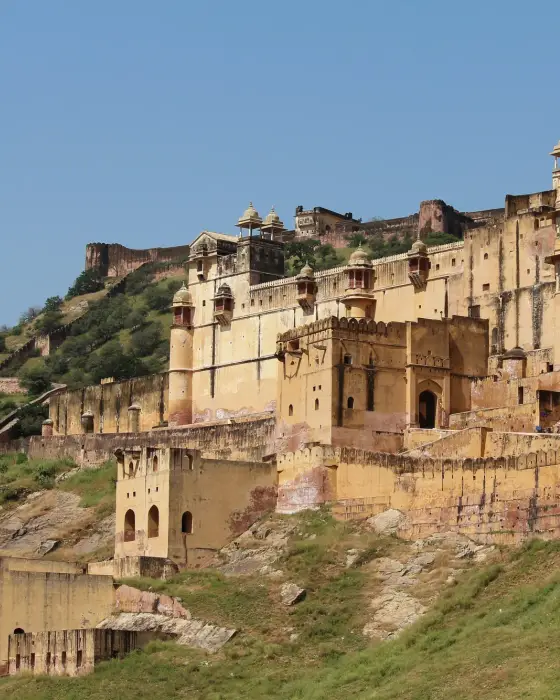
Palace-fortress started in 1592 by Man Singh I on Cheel ka Teela hill, 11 km from the center, with four terraced courtyards. The Sheesh Mahal is lined with convex mirrors and the Ganesh Pol has a fresco from 1640; admission about ₹500 for foreigners, or included in the composite ticket. Opens at 8am.
The fort begun in 1592 holds four stepped courtyards and the Sheesh Mahal covered in convex mirrors; the Ganesh Pol preserves a 1640 fresco.
Check access

Nahargarh
Built in 1734 to watch over the new city; from the parapet you see the whole 1727 grid. The Madhavendra Bhawan annex has nine identical apartments, one for each queen, linked by a corridor running behind all of them.
The complex built in 1734 to keep watch over the new city shows the entire 1727 grid from its parapet, and in the building called Madhavendra Bhawan the identical apartments, one per queen, are linked to each other by a corridor running behind the group.
Check access

City Palace
1729–1732 complex still inhabited by the Kachhwaha family in Chandra Mahal. The Diwan-i-Khas holds two silver urns about 1.6 m tall and about 340 kg, made in 1902 to carry Ganges water to London for Edward VII's coronation. Admission is separate from the composite ticket.
The reason to go into the inner hall is the silver jars, about 1.6 m tall and about 340 kg, made in 1902, which carried Ganges water to London for the coronation of Edward VII.
Check access
Jantar Mantar
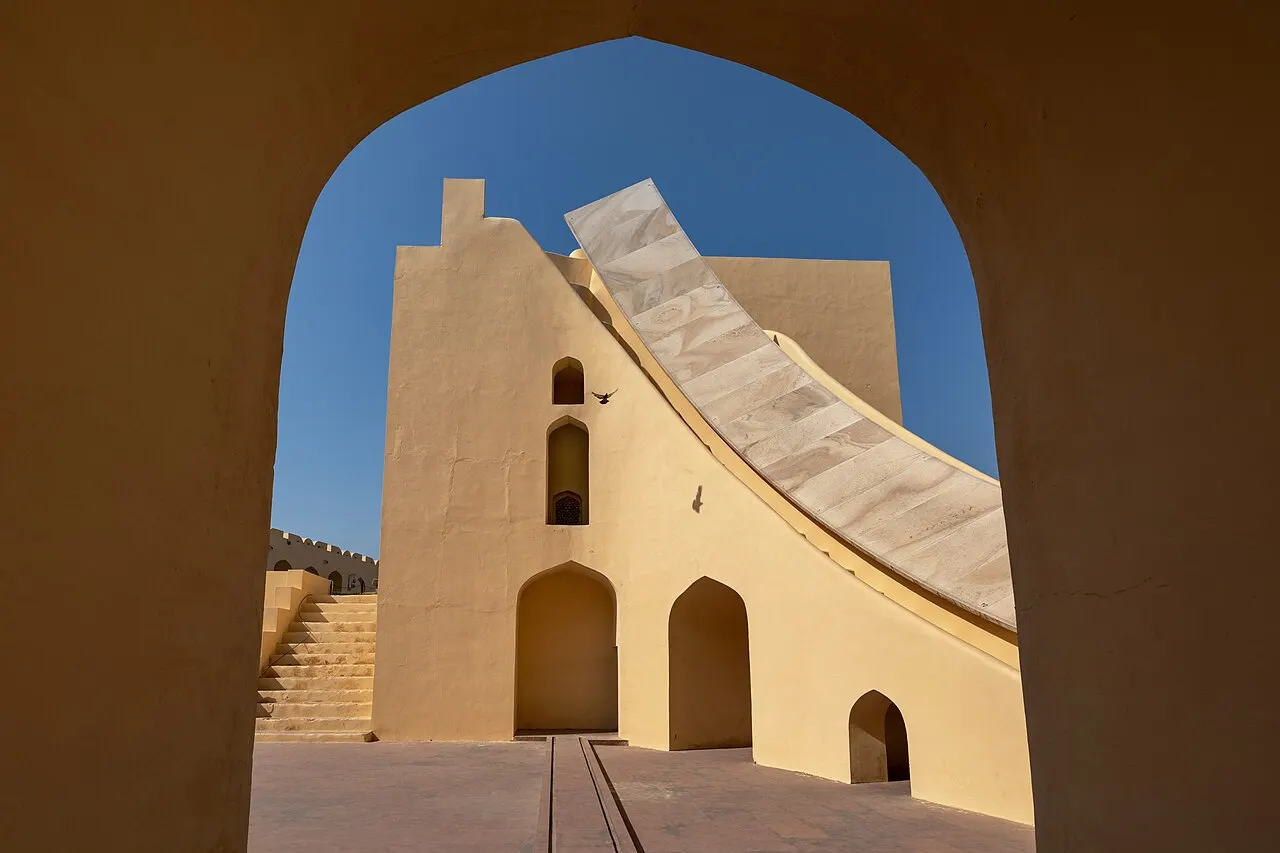
1728–1734 observatory with nineteen masonry instruments, a World Heritage site since 2010. The Vrihat Samrat Yantra is about 27 m tall and its shadow moves about 1 mm per second; the clock reads local solar time, not official Indian time.
Nineteen masonry instruments built between 1728 and 1734 include the Vrihat Samrat, and the sundial shows local solar time, different from official Indian time; on the roughly 27 m Vrihat, the shadow moves about 1 mm per second.
Check access

Hawa Mahal
A red and pink sandstone facade from 1799, five stories and 953 latticed niches, designed by Lal Chand Ustad. You don't enter through the facade: walk around to Hawa Mahal Road and climb the ramps, with no steps.
Lal Chand Ustad designed, in 1799, five stories and 953 latticed niches, and visitors don't use this front: they go around via Hawa Mahal Road and go up ramps, with no steps.
Check access

Albert Hall Museum
An Indo-Saracenic museum by Samuel Swinton Jacob, started in 1876 and opened in 1887 in Ram Niwas Bagh. It has an Egyptian mummy, Persian carpets and Rajasthan's ethnographic collection; the facade lit up after 7pm is a scene in itself.
Begun in 1876 and opened in 1887, Samuel Swinton Jacob's museum holds a mummy from Egypt, carpets from Persia, and the ethnographic collection gathered in Rajasthan, and the facade lit up after 7pm is a sight in itself.
Check access

Galtaji
18th-century temple complex in a gorge to the east, with spring-fed tanks and hundreds of rhesus monkeys. The walk up takes about 25 minutes; free entry, camera fee.
The walk up takes about 25 minutes to the 18th-century temples of the gorge to the east, where there are spring-fed tanks and rhesus macaques, and admission is free.
Check access
Panna Meena ka Kund and Patrika Gate
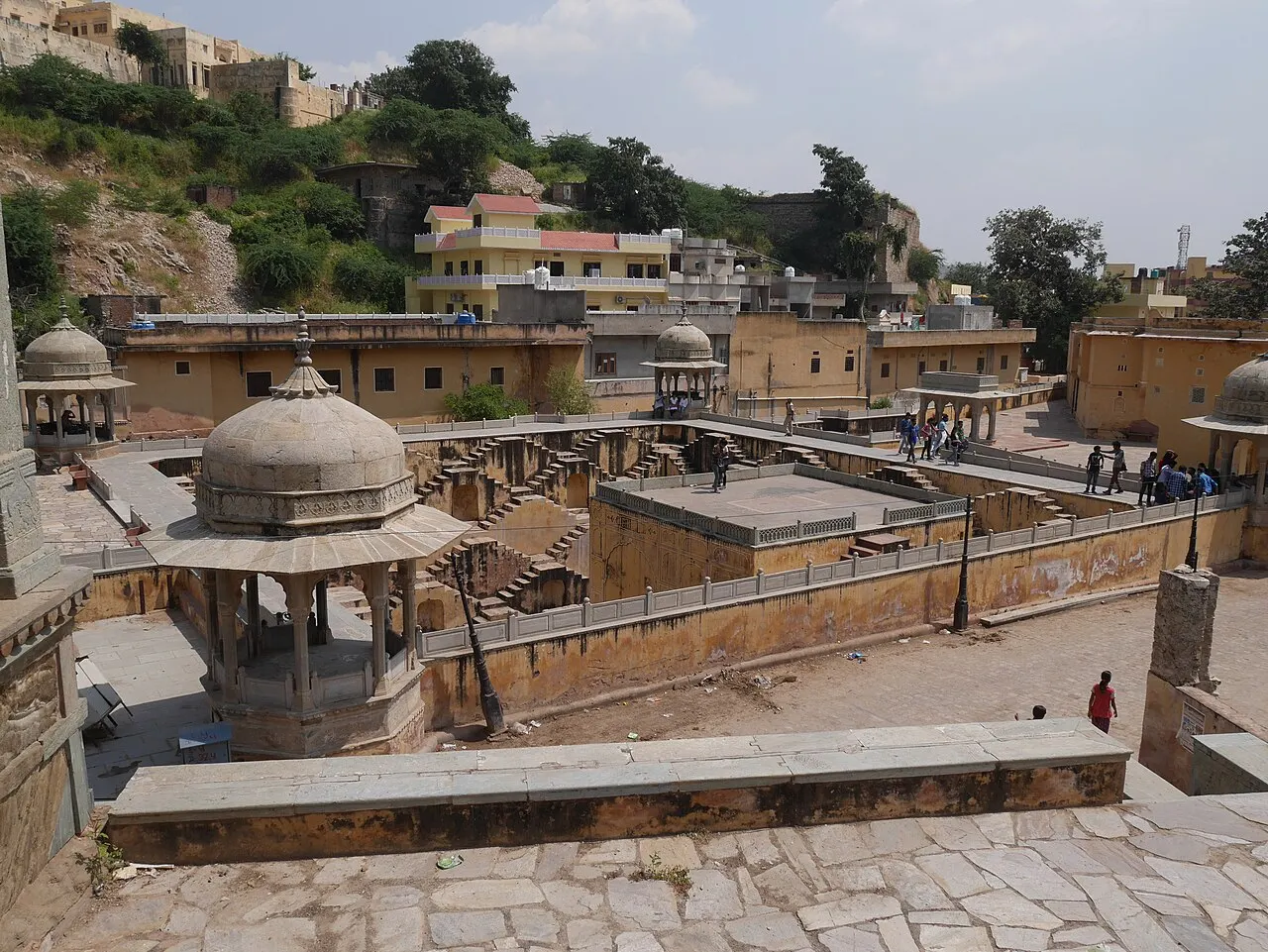
The 16th-century stepwell in Amber, with symmetrical zigzag staircases that never cross, and the painted gate from 2016 at Jawahar Circle, a modern reinterpretation of the wall's gates. Both are free.
In Amber, the 16th-century stepwell has a mirrored zigzag staircase whose flights never meet, and the gate painted in 2016 at Jawahar Circle reinterprets the wall's gates, and both are free.
Check access

Jaigarh
An 1726 fort on the ridge above Amber, linked to it by a covered passage. It holds the Jaivana, a wheeled cannon cast in 1720 with a barrel about 6 m long: the largest of its kind ever made, fired only once, as a test.
It's a whole fort for a single object: the Jaivana, a 1720 cannon with a barrel about 6 m long, fired only once, as a test. It's left out of the ₹1,000 composite ticket, requires another 15 minutes by car after Amber, and the full view of the grid streets of the 1727 city is at Nahargarh.
Check access
Nilo’s itinerary
Start with the basic programme and choose extensions for the time you have.
Plan my days in the app ↗Day 1 · The 1727 city, on foot
Start at 9am at Hawa Mahal: the facade faces east and only catches sun in the morning; the entrance is around the back, on Hawa Mahal Road.
Buy the composite ticket (₹1,000 for foreigners, two consecutive days) at the first ticket office; it also covers Amber and Nahargarh the next day.
Cross to the Jantar Mantar and the City Palace, side by side, and at the roughly 27 m sundial, compare the time the shadow shows with the time on your phone to see the difference between local solar time and IST.
Have a thali lunch in Johari Bazaar and walk on through Tripolia to Maniharon ka Rasta, the lane where lacquer bangles are molded over the brazier.
End the afternoon at the Albert Hall Museum and Ram Niwas Bagh, and stay until after 7pm to see the facade lit up.
Day 2 · The triangle of forts
Leave at 7:30am for Amber: at 8am the fort opens nearly empty and still cool.
Climb the ramp on foot (20 minutes) or by jeep; set aside an hour for Ganesh Pol and Sheesh Mahal, and skip the elephant line.
Drive 15 minutes on to Jaigarh to see the Jaivana cannon, from 1720, and the covered passage that links the fort to Amber.
Go down to Panna Meena ka Kund, a 16th-century stepwell 400 m from the fort, and have lunch in Amber.
Finish at Nahargarh in the late afternoon, with the whole 1727 grid in view, and head back along the Jal Mahal road with a stop on the shore of Man Sagar.


If you stay longer
Day 3 · Workshops, neighborhoods, and cinema
Spend the morning watching block printing in Sanganer, next to the airport, about 12 km south of the walled city, or in Bagru, about 30 km away; the workshops take visitors without an appointment on a weekday.
Come back for lunch in C-Scheme and stop by Jawahar Kala Kendra, which repeats the city's nine-square grid in its floor plan.
Before facing the bazaar, calibrate prices at the state-run craft emporiums, where the price tag is fixed and the quality is comparable.
Climb to Galtaji in the late afternoon, about 25 minutes on foot, to the spring-fed tanks and the monkeys, with no food in your hand and no plastic bag in sight.
Catch the 6:30pm show at Raj Mandir, a 1976 art deco cinema, even without understanding the dialogue.

Food
 AI illustration
Dal baati churma
Wheat-dough balls baked over coals, served with a five-lentil dal and sweet churma made of ground wheat with ghee and jaggery. A lunch dish, heavy, and the standard test of Rajasthani cooking.
 AI illustration
Laal maas
Mutton cooked in a paste of dried mathania chili with yogurt and garlic, red and strong, inherited from Rajput hunting cuisine. Order it with bajra roti, not rice.
 AI illustration
Gatte ki sabzi
Steamed chickpea-flour dumplings, cut and simmered in a spiced yogurt gravy. Desert food: it exists because there was no fresh vegetable.
 AI illustration
Pyaaz kachori
Fried pastry filled with spiced sautéed onion, eaten in the morning with tamarind chutney. ₹30–60 at the old shops near Sindhi Camp and in Johari Bazaar.
 AI illustration
Mirchi bada
Large chili pepper stuffed with spiced potato, battered in chickpea flour and fried to order. Late-afternoon street food, about ₹25 a piece.
 AI illustration
Ghewar
Porous disc of thin batter poured into hot ghee, soaked in syrup and topped with rabri or pistachio. Made mostly between July and August, for the Teej season.
 AI illustration
Lassi in a kulhad
Whipped yogurt served in an unfired clay cup, which is broken after use. The place on MI Road has served it since 1944 and closes when the day's milk runs out, sometimes before 6pm.
 AI illustration
Ker sangri
A stir-fry of berries from the ker shrub with dried sangri beans, rehydrated and seasoned with chili, amchur and ghee. It's desert food made to last, and it keeps for days without a refrigerator.
Day trips

Abhaneri (Chand Baori)
Abhaneri is about 95 km to the east, about 2 hours by car along the Agra road, and holds Chand Baori, a 9th-century stepwell with about 3,500 steps across 13 stories and about 30 m deep, next to the Harshat Mata temple. The visit takes half a day and pairs well with Bhandarej.

Bhangarh and Ajabgarh
Bhangarh is about 85 km northeast, about 2 hours 30 minutes by road via Sariska. It's an abandoned 17th-century fortified town, with an official ASI notice forbidding anyone to stay between sunset and sunrise. Set aside the whole day and arrive in the morning.
Ranthambore (Sawai Madhopur)
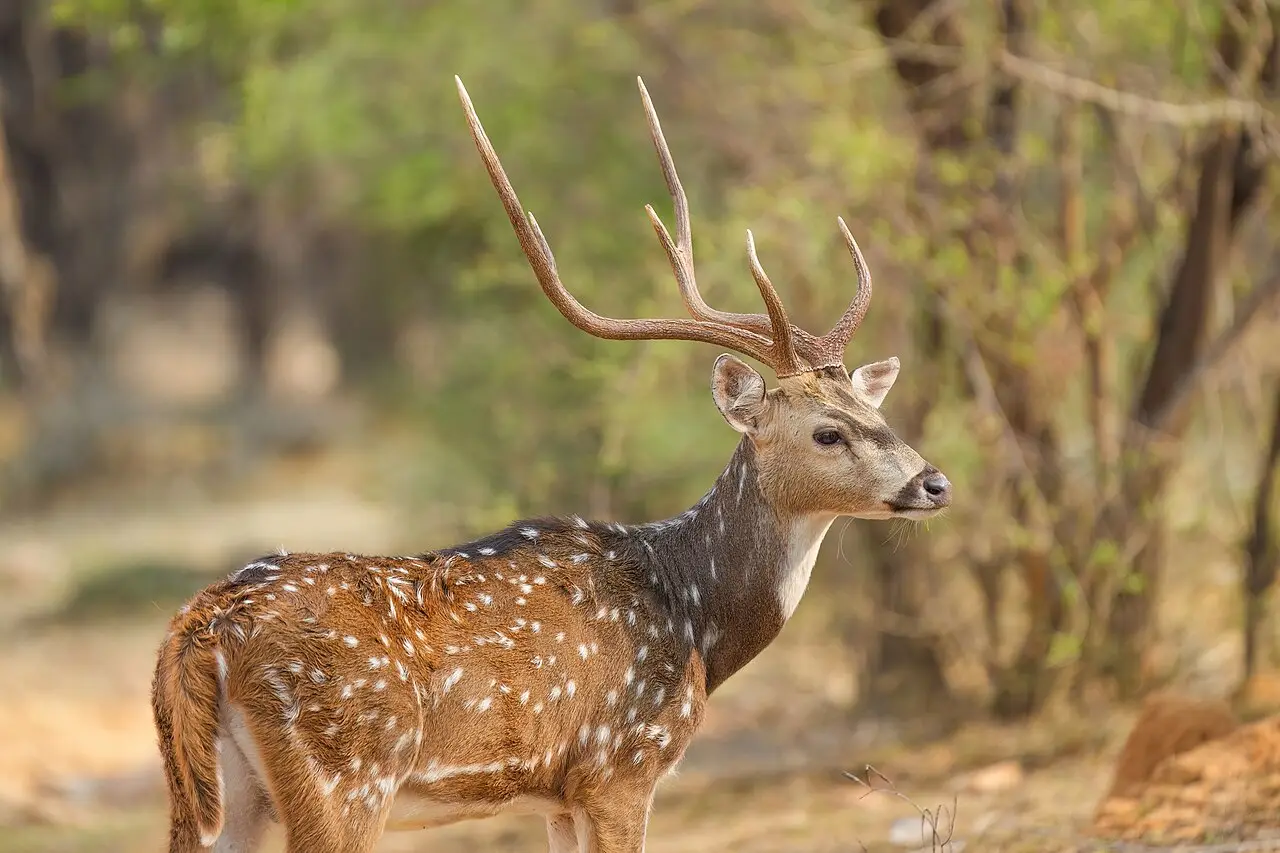
Ranthambore is about 160 km south, about 3 hours by car or about 2 hours by train to Sawai Madhopur. The national park has Bengal tigers and a 10th-century fort inside the reserve; safaris must be booked in advance, and the park closes from July to September.
Where to begin
The 1727 city, on foot
Start at 9am at Hawa Mahal: the facade faces east and only catches sun in the morning; the entrance is around the back, on Hawa Mahal Road.
The triangle of forts
Leave at 7:30am for Amber: at 8am the fort opens nearly empty and still cool.
Workshops, neighborhoods, and cinema
Spend the morning watching block printing in Sanganer, next to the airport, about 12 km south of the walled city, or in Bagru, about 30 km away; the workshops take visitors without an appointment on a weekday.
Money
The currency is the Indian rupee (INR, ₹), at about ₹16 to the real and about ₹88 to the dollar in September 2026. Reference ranges: street chai ₹10–20; pyaaz kachori ₹30–60; a simple lunch thali ₹150–300; dinner at a C-Scheme restaurant ₹600–1,200 per person; a large beer ₹200–350. Hostel bed ₹600–900; decent double room ₹1,800–4,000; haveli-hotel ₹6,000–15,000. The composite monument ticket costs ₹1,000 for foreigners and ₹300 for Indians, is valid for two consecutive days, and covers Amber, Hawa Mahal, Jantar Mantar, Nahargarh, Albert Hall, Isarlat, and the Sisodia and Vidyadhar gardens. City Palace isn't included and charges separately (about ₹700–1,000 for foreigners). Local payment runs on UPI, which foreign cards can't access: the chai line usually pays by pointing a phone at a paper taped to the wall, and it's rare to see anyone pull cash out of their pocket. Carry cash for the street, bazaar, and rickshaw, and use a card at hotels, museums, and big stores. ATMs charge about ₹200–250 per withdrawal and usually cap at ₹10,000 per transaction. Tipping isn't mandatory but is expected: about 10% at a table-service restaurant, ₹50–100 a day for a driver, and ₹500–800 for a half-day with a licensed guide.
Getting there and around
Airport, train and road to Jaipur
Jaipur International Airport (JAI), in Sanganer, is about 12 km south of the walled city and handled about 7.2 million passengers in fiscal year 2024-25. The arrivals hall has a prepaid taxi counter (about ₹400–600 to the center), but Uber and Ola, with a marked pickup point in the parking lot, usually cost less. By train, Jaipur Junction receives the Vande Bharat and Double Decker from Delhi in about 4 hours 30 minutes to 5 hours, and there are overnight trains to Jodhpur, Udaipur and Agra. By car, the Delhi–Mumbai Expressway has cut the drive from Delhi to about 3 hours 30 minutes to 4 hours; Agra is 4 hours 30 minutes away by car and Udaipur 6 hours. Brazilians need an Indian e-visa applied for before boarding: the 30-day e-Tourist costs US$10–25 depending on the season and the one-year visa about US$40, with a passport valid for six months and entry only through authorized airports and seaports.
The Pink Line dives under the old city
Within the city, the metro's Pink Line covers about 12 km and 11 stations between Mansarovar and Badi Chaupar, with the final stretch underground beneath the old city. It runs from about 6am to 9pm, every 5–10 minutes at peak times, and fares range from ₹6 to ₹21 (a token for single rides, a rechargeable card for frequent use). The network is short and serves only the west-east axis while the second line is still under construction. For everything else, there are JCTSL low-floor buses, auto-rickshaws (agree on the price first or book through the app) and ride-hailing cars; inside the walls, the shared e-rickshaw is cheaper. You can cover the walled city on foot in a day, but the sidewalks are taken up by merchandise and parked motorbikes: walk along the edge of the road, as everyone does, and look both ways even on one-way streets.
Safety
Jaipur is a big city and reasonably safe if you move around with ordinary care; the most common risk is a commercial scam. The usual ones are the driver's commission, the gem “factory” with a resale promise, the unlicensed guide at Amber's gate and the agreed price that changes at the end of the ride: fix every price in advance or use an app, and ask to see a guide's badge. The real physical danger is traffic: motorbikes coming the wrong way, informal lanes and no right of way for pedestrians. Cross with locals, never on your own; it's the safest technique. At Galtaji and on the Nahargarh stairs, rhesus monkeys snatch bags, bottles and glasses, and a bite means rabies prophylaxis the same day. Women traveling alone report staring and unwanted photos, more often in the walled city at night. The metro has a women's car, and a ride-hailing car spares you the hassle. After 10pm the walled city empties out and is poorly lit: call a car instead of walking back. Drink only bottled or filtered water, and eat street food where there's a line and the frying is done to order.
Etiquette tips
Shoes off, always
Take off your shoes at temples, inside some havelis and in private homes. Socks are fine; at Jain temples, also leave leather outside: belt, bag, wallet, watch strap.
Right hand for everything
Eat, hand over money, and take change with your right hand. The left is the hand for personal hygiene, and using it to give something is a lapse everyone notices.
Greeting without touch
Bring your palms together and say namaste, or khamma ghani with older people, instead of extending your hand: especially between men and women. If the other person offers a handshake, shake it.
Clothing covers shoulder and knee
Covered shoulders and knees apply at temples and in everyday life inside the walls, men included. Keep a scarf in your bag, because at several temples and at the gurdwaras you also need to cover your head.
Ask before photographing
Ask permission before photographing people, especially women and older people, and before photographing the inside of temples. Many monuments have an official camera fee (₹50–200): pay it at the ticket office, keep the receipt and never settle it with the attendant at the door.
Haggle only where there's no price tag
In the bazaar, the first number is a starting point, and the negotiation usually settles at 40–60% of it. At fixed-price shops, state emporiums, chains, and restaurants, haggling is rude.
Mistakes to avoid
Letting the driver pick the shop
Letting the auto-rickshaw driver choose where you shop. He gets a 20–40% commission from the rug, gem or textile shop, and that commission comes out of your price. Give the exact address of your destination right away, and turn down the “just five minutes” stop with the same sentence every time.
Gemstones to resell
Buying precious stones to resell at a profit back home. The gem scam has been running in Jaipur for decades, complete with a plausible certificate and an export-tax story. There's no resale market for a stone bought by a tourist at the counter.
Amber after ten
Arriving at Amber after 10am: the courtyard turns into an oven and the line stretches out.
Single tickets instead of the composite
Paying separate admission at five monuments instead of buying the composite ticket. The pass is already cheaper by the second place you visit and is sold at every ticket office of the monuments it covers.
The “your hotel is closed” at the station exit
Believing “your hotel is closed” or “the street is blocked today” outside the station or the airport. It's the standard script for swapping your booking for one that pays a commission: call your hotel before agreeing to any detour.
Useful phrases
नमस्ते: namaste (namastê)
Hello and goodbye, with palms together at chest height
खम्मा घणी: khamma ghani (khâmma gâni)
Rajasthani greeting, respectful; the reply is the same word
कितने का है? Kitne ka hai? (kítne ká hê)
How much is this?
यह बहुत महंगा है: yeh bahut mehenga hai (iê baút mehengá hê)
This is too expensive
मुझे नहीं चाहिए: mujhe nahin chahiye (mudjê nâin tchârrie)
No, thank you: to decline an insistent offer
धन्यवाद: dhanyavaad (dânniavád)
Thank you (formal; day to day, people mostly just say 'thank you')
Districts
Walled City (Parkota)
The original 1727 rectangle, with seven gates and mandatory pink facades. It concentrates the trade-specific bazaars, the City Palace, the Jantar Mantar and the Hawa Mahal; by day it's the densest place in the city and after 10pm it empties out.
Johari Bazaar
The jewelry street, inside the wall: kundan, meenakari, emeralds, and the cutting workshops that employ tens of thousands of people. Also home to the oldest sweet shops and thali houses.
Tripolia Bazaar and Maniharon ka Rasta
Metal, hardware, and the lane of lacquer-bangle makers, who soften the resin over a brazier and mold it on the customer's wrist. Sits at the foot of Isarlat tower (Sargasuli), from 1749.
C-Scheme
Planned neighborhood from the 1950s southwest of the wall, with bungalows, offices, galleries, and most of the cafés and restaurants where Jaipur's middle class eats out.
Bani Park
Residential area west of the train station, with havelis converted into guesthouses and mid-range hotels. It's the most practical base for anyone arriving by train who wants to walk to the wall.
Amer (Amber)
Village 11 km to the north, at the foot of the fort, with the Panna Meena ka Kund stepwell, temples, and block-printing workshops. It was the kingdom's capital until 1727.
Malviya Nagar and Jagatpura
Southeast of the city: universities, IT parks, the Sitapura industrial zone, and nearly all of the new apartment stock. It's the route the future Orange Line of the metro will run.
Mansarovar and Vaishali Nagar
A middle-class residential neighborhood west of the walled city, built in the 1980s and the western end of the metro's Pink Line. It suits travelers staying away from the center who want to ride the metro straight to Badi Chaupar, inside the walls.
History
11th–12th c. · The Kachhwahas in Dhundhar
The Rajput Kachhwaha clan settles in the Dhundhar region and takes Amber from the Meenas. Amber becomes the kingdom's capital and stays that way for six hundred years.
1592–1614 · Amber becomes a palace-fortress
Man Singh I, a general of Akbar and the emperor's brother-in-law through a dynastic marriage, starts the great fort project on Cheel ka Teela hill in 1592. The Mughal alliance pays for the construction and brings craftsmen from Lahore.
1727 · Jaipur is founded
Sawai Jai Singh II founds the city on the plain on November 18, 1727, with a plan by Vidyadhar Bhattacharya. Nine chowkris in a grid, a wall enclosing about 6 km², and seven gates.
1728–1734 · The Jantar Mantar
Jai Singh II, an astronomer before he was king, raises nineteen masonry instruments next to the palace. The Vrihat Samrat Yantra sundial is about 27 m tall and reads time down to the second.
1726–1734 · The triangle of forts
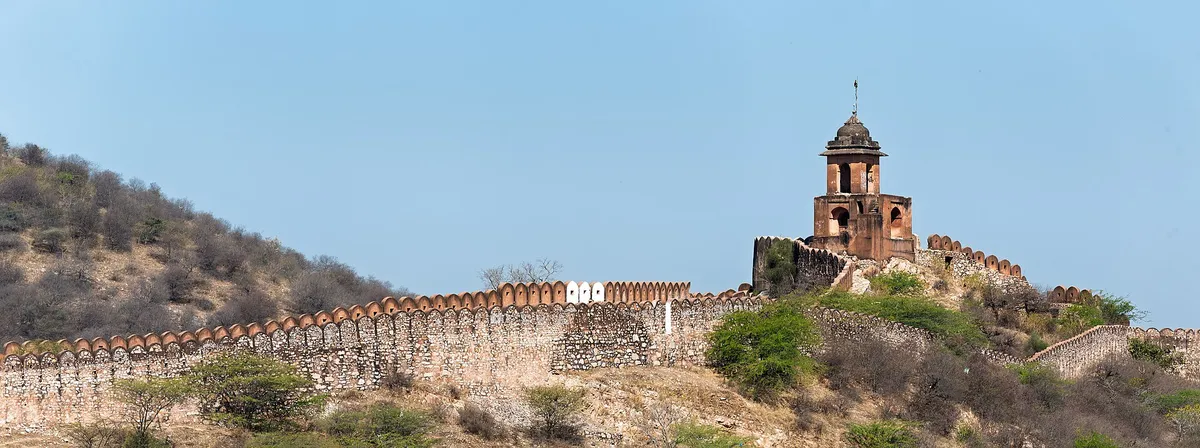
Jaigarh is completed in 1726 on the ridge above Amber, and Nahargarh in 1734 above the new city. The three forts are linked by walls and watch over the whole plain.
1799 · Hawa Mahal
Sawai Pratap Singh commissions the sandstone facade, with 953 latticed niches, designed by Lal Chand Ustad. It isn't a palace but a screened wall through which the women of the court watched the street without being seen.
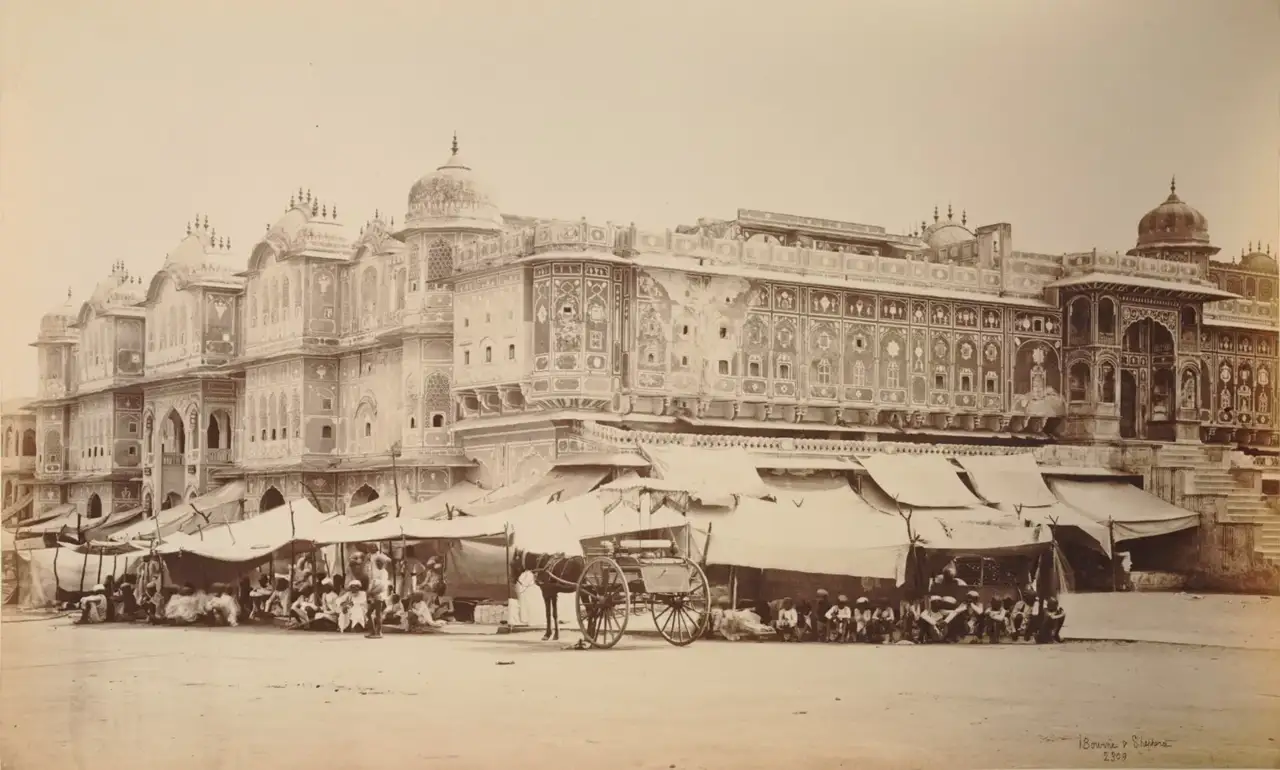
1876 · The city turns pink
Sawai Ram Singh II has the walled city painted terracotta to receive Albert Edward, Prince of Wales. The color became municipal rule and remains mandatory on facades inside the wall.
1887 · Albert Hall Museum
The museum designed by Samuel Swinton Jacob, started in 1876, opens in Ram Niwas Bagh. It's Rajasthan's oldest museum and a landmark of the city's expansion beyond the gates.

1949 · Capital of Rajasthan
On March 30, 1949, with the merger of the princely states, Jaipur becomes capital of the new state. Man Singh II, the last maharaja, is rajpramukh until 1956, and the family keeps the Chandra Mahal.
2008 · The May 13 bombings
Nine serial blasts across the walled city, including near Hanuman Mandir and Johari Bazaar, kill more than sixty people. Since then the bazaars have cameras, barriers, and traffic control.
2019–2026 · World Heritage status and the metro
The walled city enters the UNESCO list on July 6, 2019, with new facade and wiring rules. On July 4, 2026, the foundation stone was laid for the metro's Orange Line: 41 km, 36 stations, about ₹13,000 crore, expected delivery in 2031.
Complete history
Jaipur was engineered rather than grown
Until 1727, power in the Dhundhar region sat in Amber, the Rajput fortress of the Kachhwahas, wedged into an Aravalli gorge since the 12th century and expanded from 1592 by Man Singh I with the money he earned as Akbar's general. The marriage and military alliance with the Mughals gave the clan three things: steady income, access to engineers and enough peace to think about urban planning. By the early 18th century, Amber had run out of water and space, and Sawai Jai Singh II decided to move down to the plain and found a city planned from scratch.
The new city in nine rectangular sectors
The new city was laid out in nine rectangular sectors, the chowkris, with avenues about 33 m wide crossing at right angles and forming squares called chaupar. The plan is credited to Bengali engineer Vidyadhar Bhattacharya and combines the Hindu urban-planning treatise Shilpa Shastra with the geometry of Mughal trading cities; where a hill prevented a perfect square, one of the sectors was shifted to the side. Merchants were required to set up in ground floors with identical facades, and each bazaar was assigned a trade: jewelry in Johari, fabric in Bapu, metal in Thateron, lacquer bangles in Maniharon ka Rasta. Between 1728 and 1734, the maharaja himself built the Jantar Mantar, the largest of the five observatories he raised: the first was Delhi's, in 1724, and the others are in Ujjain, Mathura, and Varanasi.
The 19th century brought the color and the museum
In 1876, Sawai Ram Singh II had the entire walled city painted terracotta for the visit of the Prince of Wales: pink was the color of welcome, and lime wash with hematite cheaply covered the uneven plaster. The rule became a municipal regulation and still applies inside the walls. The same maharaja opened streets with gas lighting, founded the school of arts and began the Albert Hall, designed by Samuel Swinton Jacob and opened as a museum in 1887, the first major public building outside the gates.
Jaipur becomes the capital of Rajasthan in 1949
On March 30, 1949, with the merger of the princely states, Jaipur became the capital of the new state of Rajasthan. Man Singh II was rajpramukh until 1956 and the family stayed on at the Chandra Mahal, inside the City Palace, where it still lives. The city doubled in size every two decades: C-Scheme in the 1950s, Mansarovar in the 1980s, Vidhyadhar Nagar in the 1990s, all on a grid, all outside the wall. The economy came to rest on four legs: state administration, jewelry and gem-cutting, printed textiles and, after 2000, IT and higher education, with tourism crossing all of them.
The 2008 bombings, UNESCO and the metro
On May 13, 2008, nine serial explosions in the old city killed more than sixty people and changed how the bazaars are policed. On July 6, 2019, the walled city was added to the UNESCO World Heritage list, which brought requirements for facades, signage and wiring that are still being applied building by building. The metro's Pink Line opened in 2015 and reached underground into the old city in 2020, after a delay caused by an old stepwell found beneath the street during excavation. On July 4, 2026, the foundation stone was laid for the Orange Line, 41 km between Prahladpura and Todi Mod, due for completion in 2031, and until then Tonk Road lives with construction and permanent detours.
Geography and shape of the city
The Aravallis, the water, and the climate
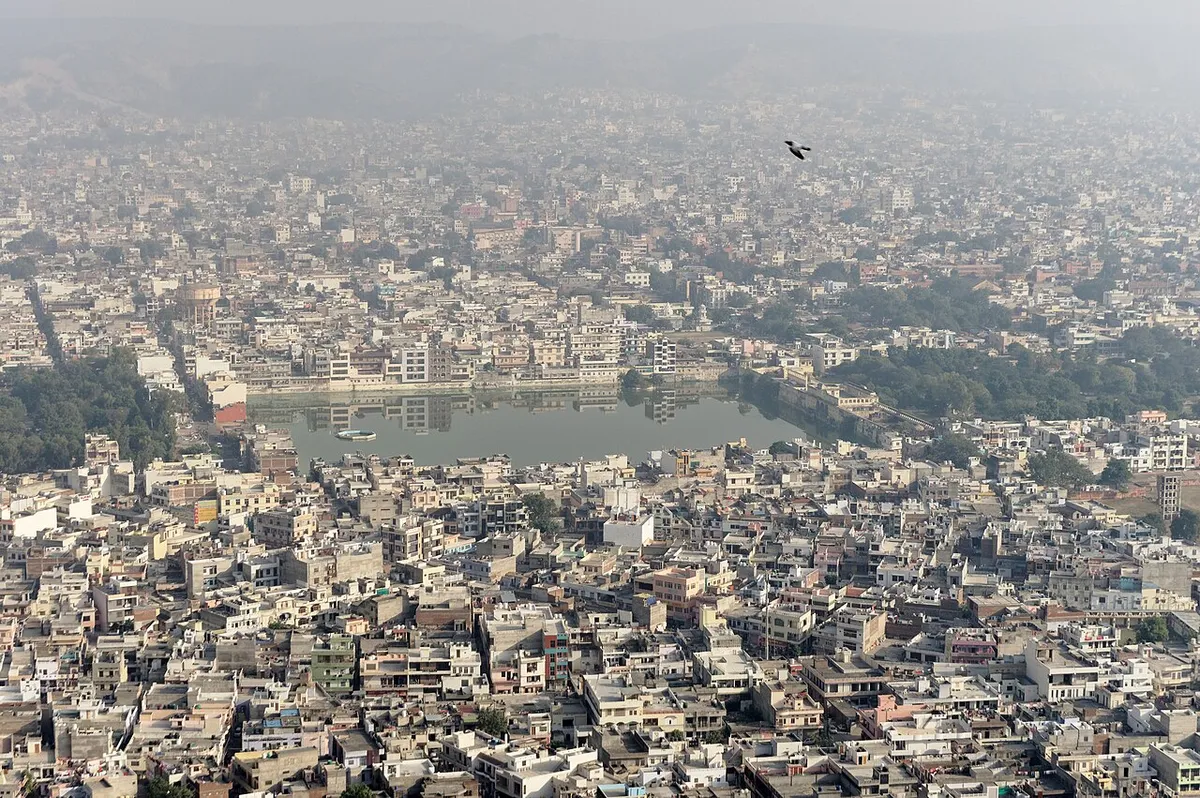
Jaipur sits at about 430 m of altitude in eastern Rajasthan, against the northeastern tip of the Aravalli range, one of the oldest mountain chains in the world, here reduced to ridges 200 to 400 m above the plain. There's no permanent river: the Dravyavati is seasonal, and drinking water comes by canal from the Bisalpur dam, about 120 km away. The climate is hot semi-arid (BSh), with about 550–650 mm of rain a year concentrated between July and September.
The 1727 wall and the city's growth
The 1727 wall traces a rectangle of about 6 km² with seven gates, cut by three east-west avenues and three north-south ones that meet at the chaupars. It's the only stretch of the city that makes sense to walk. Outside it, growth went south and west, into neighborhoods with a looser grid; to the north, the hills of Nahargarh and the Amber gorge block expansion and hold up the triangle of forts linked by walls.
The 1727 grid has a notch: on the side where the hill got in the way, the engineer pushed one of the nine blocks outside the square.
Culture
Gems, block printing and lac
Jaipur runs on things made by hand at industrial scale. Cutting and setting colored gemstones fills whole blocks in Johari Bazaar and Gopalji ka Rasta, and the techniques of kundan (pure gold molded around the stone, no claws) and meenakari (vitrified enamel over gold) arrived with craftsmen brought from Lahore by Man Singh I in the 16th century. Wood-block printing continues in Sanganer, to the south, and in Bagru, about 30 km away, where the dabu pattern uses mud and gum as a resist before dyeing with indigo and madder root. The lacquer bangles of Maniharon ka Rasta are softened over a brazier and closed on the customer's wrist, one at a time.
The most athletic kathak gharana
The kathak lineage known as the Jaipur gharana was born in the Kachhwaha courts and is the most athletic of these dance schools, with an emphasis on spins, footwork, and spoken rhythm. Jawahar Kala Kendra, a cultural center opened in 1993 and designed by Charles Correa, repeats in its plan the nine-square grid of the 1727 city, including the shifted square. Raj Mandir, the 1976 Art Deco cinema on Bhagwan Das Road, still runs Hindi-film screenings, with an audience that claps and whistles at the premiere.
Five days of festival in January
In January, the Jaipur Literature Festival occupies five days at the Hotel Clarks Amer, after two decades at the Diggi Palace, with free admission by registration and a crowd in the tens of thousands. In cricket, the Sawai Mansingh Stadium is home to the Rajasthan Royals, champions of the first IPL edition in 2008. Polo, a direct inheritance from the court, keeps a winter season at the Rambagh Polo Ground. Nightlife ends early: state law shuts down alcohol sales around 11pm and the rooftop bars close soon after.
At the Raj Mandir, the audience applauds and whistles on opening night.
On January 14, the day of Makar Sankranti, Jaipur's sky disappears behind the kites flown from every rooftop.
Festivals and events
 AI illustration
Gangaur
March or April, eighteen days after Holi. The procession of Gauri's images leaves City Palace and goes down Tripolia with camels, elephants, and bands; women fast for eighteen days beforehand.
 AI illustration
Teej
July or August, at the turn of the monsoon. Procession of the goddess Parvati through the bazaar, swings hung from trees, green clothing, and ghewar in every sweet shop.

Makar Sankranti
January 14. The whole city climbs onto rooftops to fly kites, and the sky stays covered with them until dark. Watch out for the manja line, coated with ground glass: it cuts hands and the necks of motorcyclists.

Diwali
October or November. The walled city's bazaars compete in a municipal facade-lighting contest; Johari and Tripolia become impassable at night for three or four days straight.
 AI illustration
Jaipur Literature Festival
Five days in January, at Hotel Clarks Amer. Free entry with prior registration; hotels fill up and can double in price that week.
Books and films
A Princess Remembers: Gayatri Devi and Santha Rama Rau (1976)
Memoirs of Man Singh II's third wife: they tell of purdah, the 1949 transition, and the loss of princely privileges from inside City Palace.
Jaipur Nama: Giles Tillotson (2006)
A history of the city through the accounts of people who passed through it since 1727: engineers, astronomers, British travelers. It's the text that explains why the grid is the way it is.
Shuddh Desi Romance (2013)
A Hindi film shot entirely in Jaipur, with tour guides and the wedding circuit as its backdrop. It shows the city that works for tourism, not the fort in the photo.
Frequently asked questions
Jaipur: how do you stop the driver from pulling into shops?
State the exact destination address right away, and refuse the “just five minutes” stop with the same phrase every time.
Jaipur: how do you get from the airport to downtown?
In the arrivals hall there's a prepaid taxi counter (about ₹400 to 600 to downtown), but Uber and Ola, with a marked pickup point in the parking lot, usually come out cheaper.
Jaipur: what do you see in Abhaneri, and how do you get there?
Abhaneri is about 95 km to the east, about 2 hours by car along the Agra road, and holds Chand Baori, a 9th-century stepwell with about 3,500 steps across 13 stories and about 30 m deep, next to the Harshat Mata temple. The visit takes half a day and pairs well with Bhandarej.
Jaipur: what's the currency, and what's it worth?
The currency is the Indian rupee (INR, ₹), at about ₹16 to the real and about ₹88 to the dollar in September 2026.
Jaipur: where do you have to take off your shoes?
Take your shoes off at temples, inside some havelis, and in private homes.
Other cities in the country
India ↗- Days
- 3
- When
- Jan–Mar · Oct–Dec
- Per person/day
- Average 5,000–9,000 INRMid-range · per person/day
Cost scope
Per person per day: accommodation, meals, urban transport, visits and a small allowance for extras. Flights excluded; larger purchases vary. Editorial estimate, not a quote.
- Days
- 2–3
- When
- Jan–Mar · Oct–Dec
- Per person/day
- Average 4,000–7,000 INRMid-range · per person/day
Cost scope
Per person per day: accommodation, meals, urban transport, visits and a small allowance for extras. Flights excluded; larger purchases vary. Editorial estimate, not a quote.
- Days
- 2–3
- When
- Jan–Feb · Nov–Dec
- Per person/day
- Average 6,000–12,000 INRMid-range · per person/day
Cost scope
Per person per day: accommodation, meals, urban transport, visits and a small allowance for extras. Flights excluded; larger purchases vary. Editorial estimate, not a quote.
- Days
- 2–3
- When
- Jan–Feb · Nov–Dec
- Per person/day
- Average 20–40 USDMid-range · per person/day
Cost scope
Per person per day: accommodation, meals, urban transport, visits and a small allowance for extras. Flights excluded; larger purchases vary. Editorial estimate, not a quote.