
India
New Delhi
Delhi has ruins of seven capitals in thirty kilometers
Days Start with the basic programme and choose extensions for the time you have.
How the guide reaches this number
The city doesn't suit anyone who wants quiet, continuous sidewalks or aimless strolling. The noise never lets up, and traffic means the day covers half of what you planned. With a single day, not a Monday, enter the Red Fort at 9:30am, walk to the Jama Masjid and have lunch in the lanes of Matia Mahal next door. In the afternoon, take the metro to Humayun's Tomb and the neighboring Sunder Nursery, and on a Thursday finish at the Nizamuddin qawwali, across the road. The river disappoints: the Yamuna, the reason the city exists, has pollution foam along its ghats, so don't plan a waterfront outing. The air disappoints more, because from November to January pollution gets bad enough to close schools, which makes February or March the best time.
3
When February and March.
How the guide reaches this number
October to March is high season, but from November to January the air reaches severe levels
February and March. October to March is high season, but from November to January the air reaches severe levels
Per person/day Backpacker ₹1,500–2,500 (about R$80–135); mid-range comfort ₹5,000–9,000 (about R$270–480); high-end from ₹20,000 (about R$1,070)
How the guide reaches this number
Per person per day: accommodation, meals, urban transport, visits and a small allowance for extras. Flights excluded; larger purchases vary. Editorial estimate, not a quote.
 What Nilo thinks
Stay three days in Delhi, one per era: Shahjahanabad, Old Delhi; the Sultanate south, from the Qutub Minar to Hauz Khas; and Mughal and Lutyens's Delhi, from Humayun's Tomb to India Gate. The city doesn't suit anyone who wants quiet, continuous sidewalks or aimless strolling. The noise never lets up, and traffic means the day covers half of what you planned. With a single day, not a Monday, enter the Red Fort at 9:30am, walk to the Jama Masjid and have lunch in the lanes of Matia Mahal next door. In the afternoon, take the metro to Humayun's Tomb and the neighboring Sunder Nursery, and on a Thursday finish at the Nizamuddin qawwali, across the road. The river disappoints: the Yamuna, the reason the city exists, has pollution foam along its ghats, so don't plan a waterfront outing. The air disappoints more, because from November to January pollution gets bad enough to close schools, which makes February or March the best time.In Delhi, a 72.5 m victory tower begun in 1199, the Mughal tomb that served as a model for the Taj Mahal, and Shah Jahan's walled city lie in different parts of the city, linked by the subway. At least seven successive capitals stood beside the Yamuna. In Old Delhi, Jama Masjid's minaret offers a view over Shahjahanabad's rooftops, and a rickshaw takes you to Khari Baoli, Asia's largest spice market. In the center, 15th-century Lodi tombs share Lodhi Garden with runners and yoga practitioners. Eat kebabs in the lanes of Matia Mahal, chole bhature, and the butter chicken invented in Daryaganj around 1947. On a Thursday, save the evening for qawwali at Nizamuddin's dargah. Come in February or March, avoid November to January, when pollution can close schools, and allow three days, one for each era of the city.
Quick facts
- Population
- about 22.7 million in the National Capital Territory; about 29 million in the urban agglomeration; the NCR, with Gurugram, Noida, Ghaziabad and Faridabad, exceeds 45 million (2026 estimates)
- Founded
- Occupied since roughly 1000 BCE at the site of Indraprastha (Purana Qila); Lal Kot, the first walled city, around 1052; New Delhi inaugurated as capital in 1931
- Country and region
- India: National Capital Territory of Delhi, Indo-Gangetic Plain, northern India, 233 km northwest of Agra
- Language
- Hindi and English are official; Punjabi and Urdu hold additional status. Metro and street signs are usually bilingual; English works well in hotels, the metro and restaurants, less so in the bazaars
- Currency
- Indian rupee (INR, ₹). ₹100 ≈ R$5.40; US$1 ≈ ₹96 (late September 2026). The ₹2,000 note was withdrawn from circulation in 2023
- Time zone
- IST, UTC+5:30, no daylight saving
- Best time to visit
- February and March. October to March is high season, but from November to January the air reaches severe levels
- Average daily cost
- Backpacker ₹1,500–2,500 (about R$80–135); mid-range comfort ₹5,000–9,000 (about R$270–480); high-end from ₹20,000 (about R$1,070)
When to go
February and March. October to March is high season, but from November to January the air reaches severe levels
April
21° to 37°C
13 mm of rain
May
26° to 40°C
29 mm of rain
June
28° to 39°C
81 mm of rain
July
28° to 36°C
196 mm of rain
August
27° to 34°C
227 mm of rain
September
25° to 34°C
128 mm of rain
How the year changes
February and March are the best months: 12–28 °C, sunshine, gardens in bloom and air that is merely poor, not severe. April to June brings the hot, dry season, with highs of 40–45 °C and peaks above 47 °C, and between noon and 4pm the streets empty as life moves indoors into homes, shops and malls. From late June to September comes the monsoon, with about 650–800 mm of concentrated rain and high humidity. Rain falls in short bursts, traffic floods and the Yamuna rises: in July 2023 the river hit a record 208.66 m and flooded stretches of its banks. October brings ideal weather and the worst problem at once, because crop-stubble burning in Punjab and Haryana, combined with thermal inversion, pushes the air quality index into the severe band. From November to January there are days with an AQI above 400, schools closed and restrictions under the GRAP plan, triggered 17 times between January 2025 and January 2026. December and January pair 5–20 °C with dense fog that delays flights and trains by hours. If you can choose, avoid November; if you come in December or January, bring a PFF2/N95 mask and count on losing a day to fog.
The same numbers as a table
| Month | Temperature °C | Rain mm |
|---|---|---|
| January · | 8 to 20 | 19 |
| February · | 11 to 24 | 22 |
| March · | 16 to 30 | 19 |
| April | 21 to 37 | 13 |
| May | 26 to 40 | 29 |
| June | 28 to 39 | 81 |
| July | 28 to 36 | 196 |
| August | 27 to 34 | 227 |
| September | 25 to 34 | 128 |
| October · | 20 to 33 | 14 |
| November · | 13 to 28 | 4 |
| December · | 8 to 23 | 8 |
Nilo's tips
Compare the tourist pass with your metro trips
With only a few trips, the three-day pass doesn't pay for itself, and the smart card, with a 10% discount per ride, can work out cheaper. A single ride costs ₹11–64. The one-day pass runs ₹200 and the three-day one ₹500, both with a refundable ₹50 deposit, and neither works on the Airport Express. Add five minutes at each station entrance for the X-ray and bag check, with more buffer at rush hour.
Go to Old Delhi before 11am, never on a Sunday
Old Delhi, Shah Jahan's Shahjahanabad, is a wholesale market that starts work early and shuts almost entirely on Sunday. Get to Chandni Chowk before 11am, while traffic is still moving, and take the metro to Chandni Chowk station, because from 9am to 9pm the main artery is closed to cars. From there, take a cycle rickshaw to Khari Baoli, for ₹50–100, and ask at the door of a warehouse to go up to the rooftop and see the courtyard of spice sacks, which has no ticket or box office.
Save Thursday night for the Nizamuddin qawwali
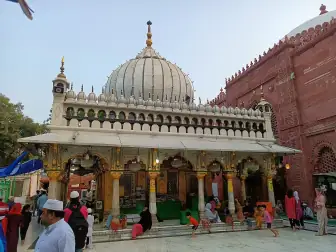
Every Thursday, after the maghrib prayer, the courtyard of the Nizamuddin Auliya dargah hosts live qawwali, so keep that evening free of dinner plans. Arrive half an hour early and eat on the way, at the Muslim eateries in the lanes of Nizamuddin Basti that lead to the dargah. At the entrance, leave your shoes and cover your head with the scarf lent at the door.
Landing after 11:30pm: the police prepaid taxi
The Airport Express runs until about 11:30pm, so if you land after that there's no metro to the center. In the arrivals hall, turn down anyone offering a ride and use the prepaid taxi from the police-supervised counter, or book a car through an app. Budget ₹500 to ₹900 to the center: late at night, with empty roads, the ride takes about 40 minutes, against up to 80 at rush hour.
Leave the airport with UPI and small notes up to ₹100
Almost everything in India is paid by UPI, and regular UPI requires an Indian bank account. So set up a prepaid UPI wallet right at the airport counters, which sell it to foreigners without an Indian account or SIM. If you'd rather use cash, withdraw on arrival, keeping in mind that ATMs usually stop at ₹10,000 per transaction, and ask for ₹10, ₹20, ₹50 and ₹100 notes, because street stalls, auto-rickshaws and temples rarely have change for big bills.
Book the president's gardens: they open twice a year
Admission to Amrit Udyan, the gardens of Rashtrapati Bhavan, is free, but only with a time slot booked online. The two windows of the year fall in winter and late summer; in 2026 they ran from February 3 to March 31 and from August 16 to September 15, and the following dates are posted on the Rashtrapati Bhavan website. It's closed on Mondays, and in the winter window there are still booking kiosks by Gate 35. If your trip falls in February, book the visit, because it's the month the gardens are in bloom. The mounted guard-changing ceremony takes place on Saturdays and also requires advance registration.
Explore the map

© OpenStreetMap · OpenFreeMap · © OpenMapTiles
Explore the map, read about the other places and plan your travel days in the app.
Open the appWhat to see
New Delhi: the Yamuna and the ridge
Delhi sits on the Indo-Gangetic plain, at about 216 m of elevation, cut north to south by the Yamuna River, which runs along the eastern side of the territory and stopped being usable long ago: the urban stretch takes in sewage from more than twenty drains, and pollution foam is visible at the ghats. West of the river lies Shahjahanabad, Shah Jahan's walled city, today a dense wholesale market of alleys organized by product: Khari Baoli (spices), Dariba Kalan (silver), Chawri Bazar (paper and invitations), and Kinari Bazar (trimmings).
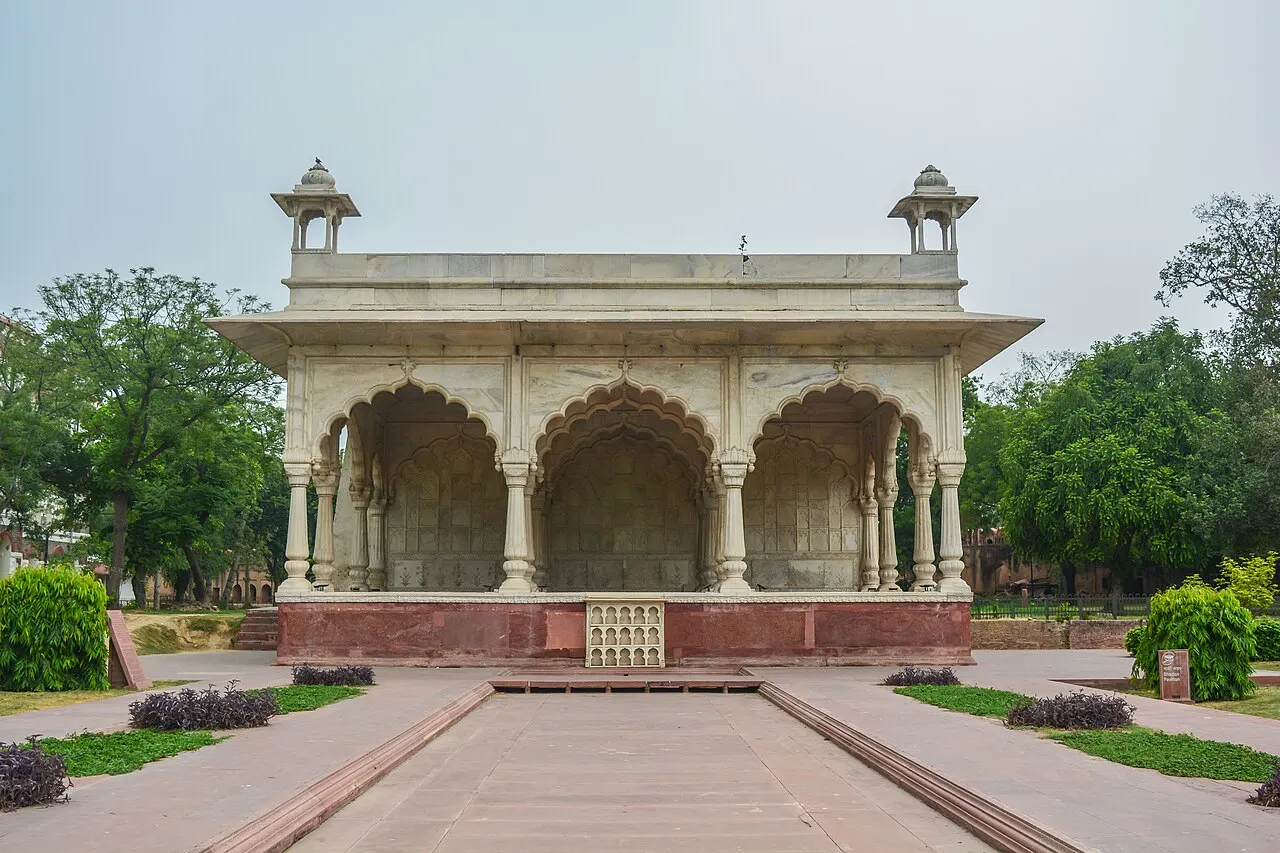
Red Fort (Lal Qila)
Shah Jahan's palace-fortress, built between 1638 and 1648, with 2.4 km of red sandstone walls and a World Heritage listing since 2007. Inside, the 60-column Diwan-i-Am and the Diwan-i-Khas, from which Nader Shah carried off the Peacock Throne in 1739. Closed Mondays; it's from the Lahori Gate ramparts that the prime minister addresses the nation every August 15.
Shah Jahan's palace-fortress, built from 1638 to 1648, is worth it for the 60-pillar Diwan-i-Am and the Diwan-i-Khas, from where Nader Shah carried off the Peacock Throne in 1739. It's from the parapet of the Lahori Gate that the prime minister gives a speech every August 15; go in at 9:30am and avoid Monday, when it's closed.
Check access
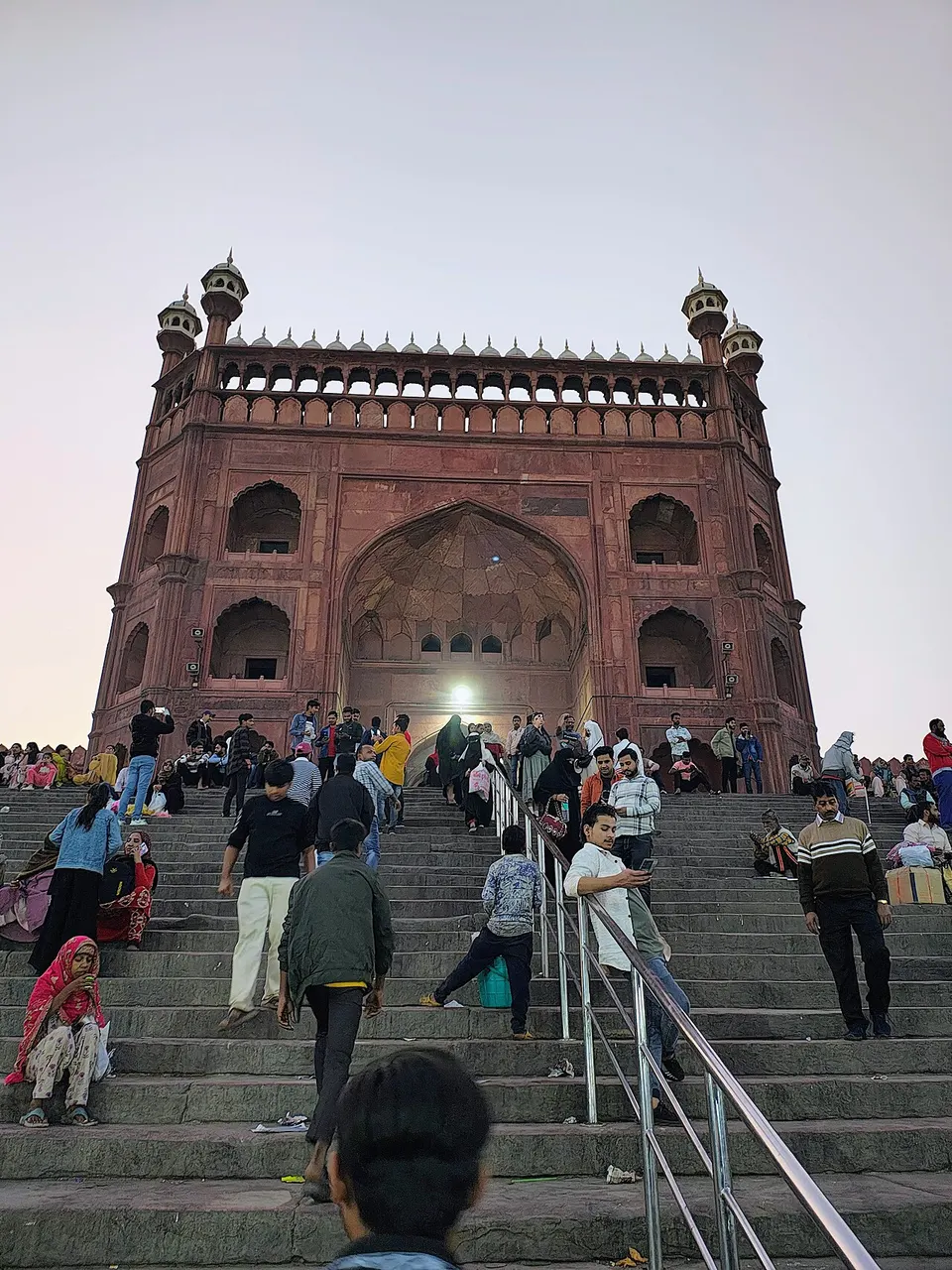
Jama Masjid
India's largest mosque, completed in 1656 by Shah Jahan, with a courtyard for about 25,000 worshippers and two 40 m minarets. Climbing the south minaret gives the best view over the rooftops of Shahjahanabad. Free entry, camera fee; closed to visitors during the five daily prayers, shoulders and legs covered, shoes off at the door.
India's largest mosque, completed in 1656, has a courtyard for about 25,000 worshippers, and climbing the south minaret gives the best view over the rooftops of Shahjahanabad. It's a walk from the Red Fort; go between prayers, because at the five daily prayer times the grounds close to visitors.
Check access

Humayun's Tomb and Sunder Nursery
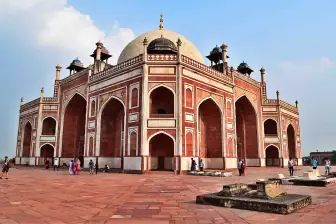
A 1565–1572 mausoleum commissioned by Bega Begum, India's first great Mughal funerary garden and a World Heritage site since 1993. It was restored between 2003 and 2013 by the Aga Khan Trust, which also opened an underground museum at the entrance in 2024. The ticket usually covers the whole complex, and neighboring Sunder Nursery holds fifteen more monuments in a landscaped park.
Bega Begum commissioned the first great Mughal funerary garden between 1565 and 1572, the Aga Khan Trust carried out the restoration from 2003 to 2013, and Sunder Nursery brings together fifteen more monuments.
Check access

Qutub Minar and the Iron Pillar
A 72.5 m, five-story victory tower, begun in 1199 by Qutb ud-Din Aibak and completed by Iltutmish and, later, Firoz Shah Tughlaq in 1368. Beside it, the Quwwat-ul-Islam mosque was built with columns from 27 dismantled temples, and the 4th–5th-century Iron Pillar remains practically rust-free. World Heritage since 1993; the internal staircase has been closed since a 1981 accident.
The victory tower reaches 72.5 m across five stories, and the mosque beside it was built with columns from 27 dismantled temples. The Iron Pillar remains practically rust-free.
Check access

Dargah of Nizamuddin Auliya
Shrine of the Sufi saint who died in 1325, in the middle of a neighborhood of narrow alleys. On Thursdays, after the maghrib prayer, there's live qawwali in the courtyard. Free entry, shoes left at the entrance, head covered for everyone; the poet Amir Khusrau and princess Jahanara Begum are buried in the same precinct.
The shrine of the Sufi saint who died in 1325 is worth it especially on a Thursday, when qawwali is sung live in the courtyard after the maghrib prayer. Arrive with half an hour to spare and eat beforehand in the alleys of Nizamuddin Basti.
Check access

Rashtrapati Bhavan and Amrit Udyan
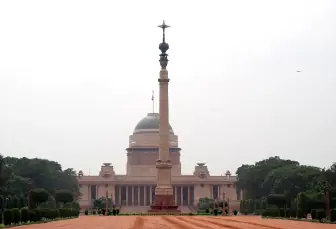
The president's residence, completed in 1929 with 340 rooms and a dome that echoes the Sanchi stupa. The Mughal gardens, renamed Amrit Udyan, open to the public in two windows a year, closed Mondays and requiring free online booking: in 2026, from February 3 to March 31 and from August 16 to September 15. The horseback changing of the guard happens on Saturdays, with prior registration.
The president's residence was completed in 1929 with 340 rooms, opens its gardens to the public only in two windows a year with a free reservation, and the mounted guard-changing ceremony requires registering in advance.
Check access
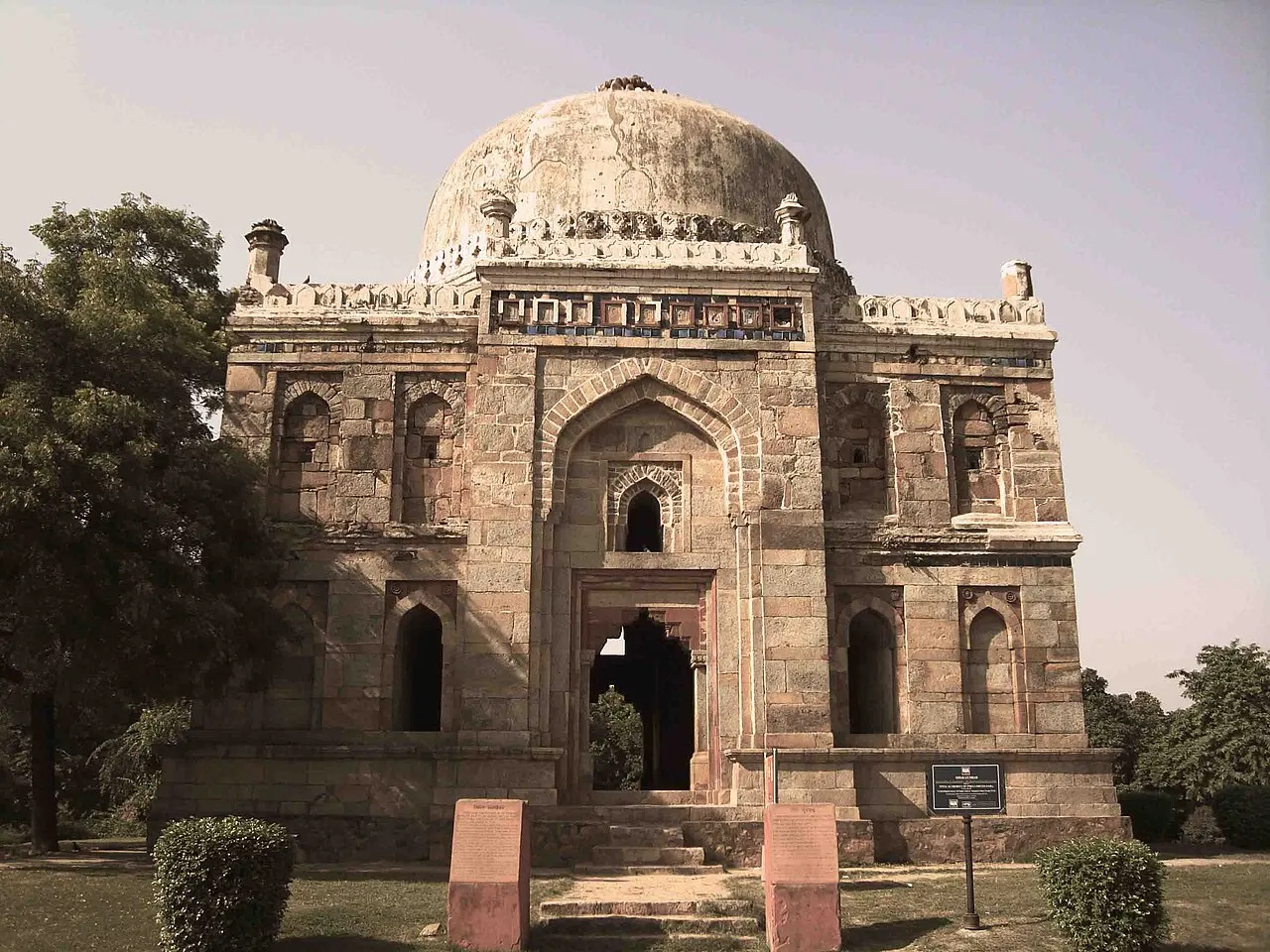
Lodhi Garden
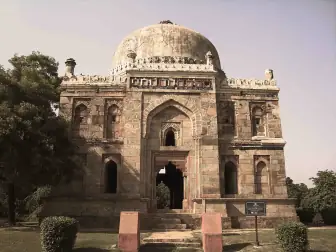
Thirty-six hectares of park built over a dynastic cemetery: the tombs of Mohammed Shah (1444) and Sikander Lodi (1517), the Bara Gumbad and the Sheesh Gumbad, dating from the 15th and 16th centuries. Open from dawn to dusk, no ticket, it's where local Delhi jogs, does yoga and rehearses weddings.
The park was built over a dynastic cemetery and opens from dawn to dusk, on ground where neighborhood Delhi goes running, does yoga, and rehearses wedding dances.
Check access
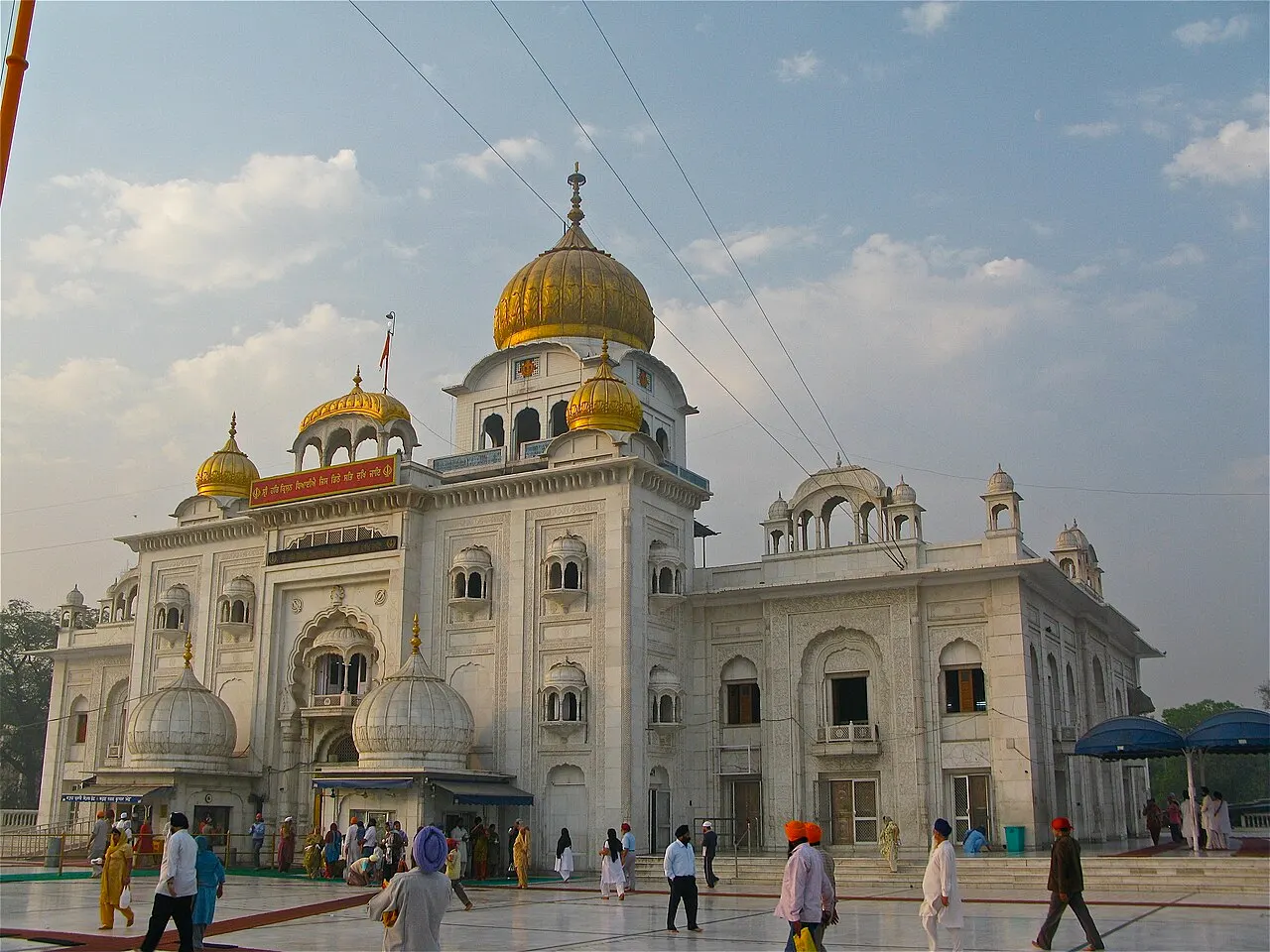
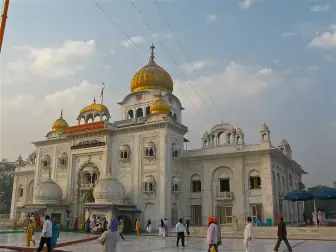
Gurudwara Bangla Sahib
An 18th-century Sikh temple with a golden dome and a sacred water tank, the sarovar, at its center. The community kitchen serves free meals to tens of thousands of people a day, seven days a week, and visitors can step in and help. Head covered with a scarf provided at the door, feet washed before entering.
The Sikh temple's community kitchen serves free meals to tens of thousands of people a day, and visitors can go in and help out. It's the evening visit on days without qawwali, with your head covered and your feet washed at the entrance.
Check access

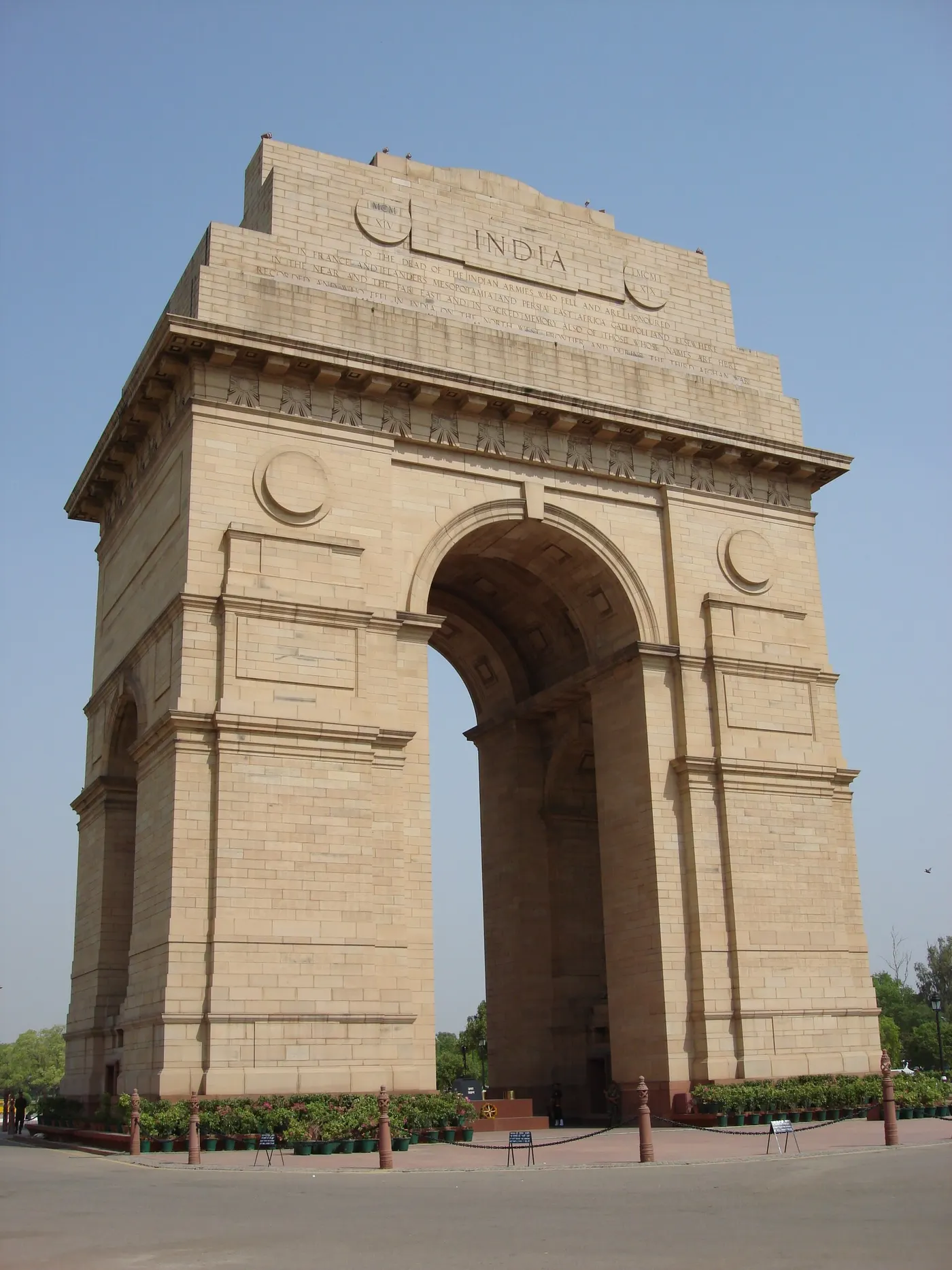
Kartavya Path and India Gate
A 3 km ceremonial axis designed by Lutyens, renamed from Rajpath to Kartavya Path in 2022 and rebuilt in the Central Vista project. At its east end, the 42 m arch completed in 1931 carries over 13,000 names of Indian soldiers killed in World War I and the Afghan campaign; a statue of Subhas Chandra Bose was installed under the nearby canopy in 2022.
It's a 3 km ceremonial axis, renamed in 2022, and a 42 m arch with more than 13,000 names engraved, seen from afar, across a lawn, on a stretch of the Central Vista still under construction. It's not worth crossing town just for this: fit the walk into the late afternoon of your Lutyens' Delhi day.
Check access
Nilo’s itinerary
Start with the basic programme and choose extensions for the time you have.
Plan my days in the app ↗Day 1 · Shahjahanabad, from the fort to the spice market
Arrive at the Red Fort at opening, around 9:30am, via the Lal Qila or Chandni Chowk metro station (violet and yellow lines); book the ticket online and avoid Monday, when it's closed.
Walk to the Jama Masjid, leave your shoes at the door and climb the south minaret to see the rooftop grid of Shahjahanabad.
Lunch in the alleys of Matia Mahal (kebab, korma and khameeri bread) then walk down to Dariba Kalan, the silver street, stopping at the jalebi shop on the corner.
Take a cycle-rickshaw for ₹50–100 to Khari Baoli, Asia's largest spice market, and climb one of the warehouse terraces to see the courtyard of sacks below.
Finish at Raj Ghat at sunset, where Gandhi was cremated in 1948, and take the metro back from Delhi Gate station.
Day 2 · Sultanate-era Delhi, from south to center
Start at 8am at the Qutub Minar complex (Qutab Minar station, yellow line, plus a 10-minute auto ride) to catch the low light and fewer crowds at the Iron Pillar.
Cross over to the Mehrauli Archaeological Park and walk an hour among Jamali Kamali, Balban's tomb and the Rajon ki Baoli stepwell, almost all without a ticket booth.
Have lunch in Champa Gali or Lado Sarai, on the Saket gallery strip, and save the afternoon for the Hauz Khas complex: the reservoir dug by Alauddin Khalji around 1300, the madrasa and the tomb of Firoz Shah Tughlaq.
Take the metro or a taxi to Lodhi Garden in the late afternoon and walk through the tombs of Mohammed Shah (1444) and Sikander Lodi (1517) until the gate closes.
Dinner in Khan Market, ten minutes on foot, then a walk past the murals of the Lodhi Art District, lit up late into the evening.
Day 3 · Mughals, Sufis and Lutyens's city
Open the day at Humayun's Tomb (JLN Stadium or Hazrat Nizamuddin station) and set aside time for the underground museum opened in 2024 and for the tomb of Isa Khan, older than the main one.
Cross over to Sunder Nursery and walk among the park's fifteen monuments; have lunch at one of the kiosks or in the alleys of Nizamuddin Basti.
In the afternoon, choose between the National Museum, on Janpath, and Gandhi Smriti, the former Birla House, where Gandhi was assassinated on January 30, 1948.
Head to the Kartavya Path in the late afternoon, walk to India Gate and look down the axis to the Rashtrapati Bhavan, designed by Lutyens.
On Thursday, finish at the Nizamuddin Auliya dargah after maghrib prayers for qawwali, then eat in the neighborhood’s lanes. On other days, visit Gurudwara Bangla Sahib with your head covered and have dinner in Connaught Place, a fifteen-minute walk away.



Food
 AI illustration
Chai in a kulhad
Black tea boiled with milk, sugar, ginger, and cardamom, served in a disposable clay cup or a small glass. It costs ₹10–30 at a street stall and about ₹150 at a café in an affluent neighborhood. Stalls serve it from early morning throughout the day; dispose of the clay cup where the vendor directs you.
 AI illustration
Chole bhature
Chickpeas in a dark, spicy sauce with a plate-sized fried puffed bread. A hearty breakfast typical of post-1947 Punjabi Delhi, ₹80–200. Sitaram Diwan Chand, in Paharganj, has served the city's most-copied version since 1950.
 AI illustration
Parathas of Paranthe Wali Gali
Layered flatbread stuffed and fried in ghee, served with pickle, tamarind chutney and sweet squash. This alley in Chandni Chowk has sold them since the 1870s, with fillings ranging from potato to almond and banana. A full meal for ₹150–300.
 AI illustration
Butter chicken and dal makhani
Both dishes were invented around 1947 in Daryaganj, when refugee cooks from Peshawar repurposed tandoor chicken into a tomato, butter and cream sauce. This is Delhi's contribution to India's global menu; a plate runs ₹350–700 at a mid-range restaurant.
 AI illustration
Chaat
A whole category of tangy, spicy street snacks: golgappe (hollow spheres filled with spiced water), aloo tikki, papdi chaat and dahi bhalla with chilled yogurt. Eaten standing, ₹40 to ₹120 a portion, in the late afternoon. Pick busy stalls with a line and fast turnover.
 AI illustration
Kebabs and nihari of Old Delhi
In the alleys of Matia Mahal, around the Jama Masjid: seekh and galouti kebab, korma and nihari, a meat stew cooked overnight and eaten for breakfast with khameeri bread. Karim's has run there since 1913; Al Jawahar is right next door. A meal for ₹250–600.
 AI illustration
Jalebi, kulfi and daulat ki chaat
Jalebi is a spiral of fried batter dunked in syrup, sold hot on the corner of Dariba Kalan by a shop running since 1884. Kulfi is dense reduced-milk ice cream, served stuffed with fruit in Chawri Bazar. Daulat ki chaat, milk foam whipped in the open air overnight, exists only from November to February.
 AI illustration
Momos
Steamed dumplings of Tibetan and Nepali origin, adopted as Delhi's urban snack and served with a spicy red sauce. ₹50–120 a plate on the street; the version closest to the original is in Majnu ka Tilla, the Tibetan colony settled in the city's north since the 1960s.
Day trips

Agra
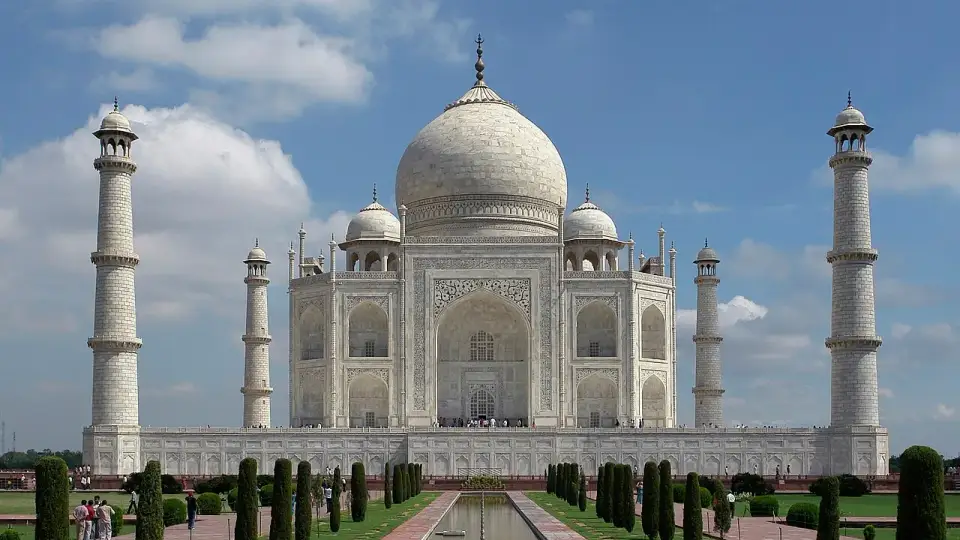
233 km southeast, 1 hour 40 minutes to 2 hours by express train from Hazrat Nizamuddin or New Delhi Station, or about 3 hours 30 minutes by car on the Yamuna Expressway. The Taj Mahal, Agra Fort and the tomb of Itimad-ud-Daulah fit into one long day; the Taj closes on Fridays, and foreigners pay an extra fee to enter the mausoleum.

Mathura and Vrindavan
150 km south, about 2 hours 30 minutes by car or train, at the heart of the pilgrimage circuit devoted to Krishna, with over a thousand temples between the two towns. Worth it most during Holi or Janmashtami, when the streets turn into a continuous festival and the crowds mean leaving Delhi before 6am.

Neemrana
122 km southwest, about 2 hours 30 minutes by car on the Jaipur highway, at a 15th-century fort-palace turned hotel, terraced up a hillside. Works as a day trip with lunch and a paid visit, with stepwells in the neighboring village.
Where to begin
Shahjahanabad, from the fort to the spice market
Arrive at the Red Fort at opening, around 9:30am, via the Lal Qila or Chandni Chowk metro station (violet and yellow lines); book the ticket online and avoid Monday, when it's closed.
Sultanate-era Delhi, from south to center
Start at 8am at the Qutub Minar complex (Qutab Minar station, yellow line, plus a 10-minute auto ride) to catch the low light and fewer crowds at the Iron Pillar.
Mughals, Sufis and Lutyens's city
Open the day at Humayun's Tomb (JLN Stadium or Hazrat Nizamuddin station) and set aside time for the underground museum opened in 2024 and for the tomb of Isa Khan, older than the main one.
Money
The currency is the Indian rupee (INR, ₹), and ₹100 was worth about R$5.40 in late September 2026. Common price ranges: street chai ₹10–30, street meal ₹60–150, dish at a simple restaurant ₹200–400, dinner for two at a mid-range place ₹1,500–2,500, beer at a bar ₹300–600, metro ₹11–64, short auto-rickshaw ride ₹60–150 and 5 km by Uber ₹150–250. A hostel bed runs ₹500–900, a clean mid-range hotel in Connaught Place or South Delhi ₹3,000–7,000 and high-end addresses from ₹20,000. Local payments run on UPI (PhonePe, Google Pay, Paytm), which requires an Indian bank account. Foreigners can get a prepaid UPI wallet at airport counters, but the simplest approach is a card at larger restaurants and shops plus cash in small notes of ₹10, ₹20, ₹50 and ₹100 for the street, autos and temples. ATMs are easy to find and usually cap withdrawals at ₹10,000 per transaction, with the local bank's fee added to your own. A 5% to 10% tip is customary at restaurants with table service, and ₹50–100 for a porter or guide. A court ruling made the service charge printed on the bill optional, and you can ask to have it removed without argument.
Getting there and around
From the airport: Airport Express at T3, Magenta Line at T1
Indira Gandhi International Airport (DEL) lies about 16 km southwest of Connaught Place and has three terminals in operation, two of them with the metro at the door. The orange line, the Airport Express, links Terminal 3 to New Delhi Railway Station in about 20 minutes for ₹60–70, running from about 4:45am to 11:30pm; Terminal 1 is on the Magenta Line. A ride-hailing taxi costs ₹500–900 to the center and takes 40 to 80 minutes depending on the hour. Late at night, go for the police prepaid taxi counter inside the arrivals hall. Long-distance trains leave from four stations: New Delhi (NDLS), Old Delhi (DLI), Hazrat Nizamuddin (NZM) and Anand Vihar. Buy tickets on the IRCTC website or app, and you'll dodge the fake agencies on the Paharganj sidewalk. Since February 22, 2026, the full Namo Bharat corridor, the 82 km regional train, links Sarai Kale Khan to Meerut in about 58 minutes, for ₹20 to ₹150.
Metro: about 390 km and ten lines
The metro is the practical way to get around: about 390 km, more than 280 stations and ten color-coded lines, running from about 6am to 11pm, with two new Phase 4 stretches opened on March 8, 2026. Fares were revised in August 2025 and run from ₹11 to ₹64 a ride, with 10% off on the smart card. There are 1- and 3-day tourist passes (about ₹200 and ₹500, with a refundable deposit) and QR-code tickets in the DMRC Momentum 2.0 app. At the entrance, bags go through an X-ray scanner and passengers pass through a metal detector and security screening, and the first car is reserved for women; a man who boards by mistake is politely asked to leave. Above ground, DTC buses and electric buses cover what the metro doesn't reach and offer free travel through Pink Saheli to eligible Delhi residents aged 12 and older; visitors should not count on this benefit. Auto-rickshaws have meters (about ₹30 flag fall), but in practice you negotiate, while on Uber, Ola or Rapido the fare is fixed in the app. Walking works well in Lutyens's Delhi, Lodhi Garden, Mehrauli and the lanes of Old Delhi, and badly almost everywhere else: the sidewalk vanishes mid-block, crossing the street means negotiating with traffic and cycling only makes sense in parks.
Safety
Delhi is a big, manageable city, and the most common risks are minor: travel-agency and rickshaw-driver scams, pickpockets in crowds (New Delhi Railway Station, Paharganj, Chandni Chowk, packed metro cars) and traffic. Crossing the street is the most dangerous thing you'll do all day, because India has one of the highest road-death rates in the world. Never cross alone: go in the middle of a group of locals and at their pace. Women traveling solo report verbal harassment and groping in tight spaces. The practical measures local women use are the first metro car, reserved for them, ride-hailing apps with shared trips instead of hailing a car on the street after 10pm, and avoiding empty buses at night. Note the numbers before you head out: general emergency 112, police 100, ambulance 102, women's helpline 1091; there are tourist police posts at the main monuments. After a car exploded next to the Red Fort metro station on November 10, 2025, killing fifteen people, bag screening became stricter at metro stations, monuments and markets, and periodic alerts lead to occasional street closures. Expect longer lines and carry ID. On the health side, the most concrete risks are the air from November to January and badly handled food or water in summer.
Etiquette tips
Shoes off, always
Take your shoes off at the entrance of temples, mosques, gurudwaras, dargahs and most homes. Free or ₹10–20 shoe check is usually available; bring socks, because stone floors scorch in the afternoon and turn icy in January.
Head covered at gurudwaras and dargahs
At Bangla Sahib and in Nizamuddin, men and women cover their heads; scarves are lent at the door. At Sikh temples you also wash your feet in the channel before entering.
Right hand for eating, giving and receiving
The left hand is considered unclean. Hand over money, a card or food with your right hand, even if you're left-handed, and eat with your right hand when eating with your fingers.
Namaste instead of a handshake
Press your palms together at chest height and say namaste: the gesture works with everyone and settles the question of how to greet. Many women don't shake hands with men, so wait for a hand to be offered before offering yours.
Clothing covering shoulders and knees
Covered shoulders and knees are required in temples, mosques, gurdwaras and dargahs, and they are also the practical norm in Shahjahanabad and residential neighborhoods. Men's shorts are rare outside gyms and tourist areas, and light pants handle the heat just fine.
Bargain where bargaining is expected
Bazaars like Chandni Chowk, Janpath, Sarojini Nagar and Karol Bagh expect haggling, and the first price quoted to a foreigner is usually two to three times the real value. In shops with price tags, restaurants, pharmacies and the metro, the price is fixed, and bargaining looks bad.
Mistakes to avoid

Whoever approaches you near the station
Accepting information from someone who approaches you on the street near New Delhi Railway Station or in Paharganj. The standard scam is claiming your hotel has closed, burned down or been shut by the authorities, then steering you to a “government tourism office” that sells an expensive package. The only official office is India Tourism at 88 Janpath. Any other address offered to you on the sidewalk is a con.
Rickshaw with no price and no app
Getting into an auto-rickshaw with no agreed fare and no app. Drivers rarely switch on the meter for foreigners, and the route can turn into a stop at a carpet shop that pays the driver a commission. Settle the price first or book through Uber, Ola or Rapido.
Planning by kilometer
Planning the day by distance in kilometers. Twelve kilometers in Delhi can take 70 minutes by car at rush hour and 20 by metro, so build the itinerary around metro lines, not the map.
On Mondays, the Red Fort and Akshardham close
Showing up on a Monday. The Red Fort and Akshardham close Mondays, Humayun's Tomb and the Qutub Minar open every day, and the Jama Masjid suspends visits during the five daily prayer times.
Tap water and raw salad
Drinking tap water, accepting ice of unknown origin, or eating raw salad at a street stall. Choose sealed bottled water, thoroughly cooked food served hot, and fruit you peel yourself. A busy stall may turn food over quickly, but a line does not prove good hygiene or eliminate contamination risk.
Useful phrases
नमस्ते: namaste (namastê)
Hello and goodbye, palms together; works for anyone, any time of day
शुक्रिया / धन्यवाद: shukriya / dhanyavaad (chukriá / dhanniavád)
Thank you; the first is Urdu and more common on the street, the second is Hindi and more formal
कितने का है? Kitne ka hai? (kitnê ka rê?)
How much does it cost? The phrase that opens any bazaar negotiation
बहुत महँगा है: bahut mehenga hai (baút mehengá rê)
That's very expensive: the polite counter to the first price offered
मीटर से चलिए: meter se chaliye (mítar se tchalie)
Please go by the meter: said when getting into an auto-rickshaw
मुझे नहीं चाहिए: mujhe nahin chahiye (mujê nahín tchahiê)
I don't want it, thanks: a firm, polite refusal to insistent vendors
Districts
Shahjahanabad (Old Delhi)
Shah Jahan's walled city, today a dense wholesale market of alleys organized by product: Khari Baoli (spices), Dariba Kalan (silver), Chawri Bazar (paper and invitations), Kinari Bazar (trimmings). Best early in the morning; after 11am traffic slows to a crawl, and the central stretch of Chandni Chowk is closed to motor vehicles during the day, leaving only cycle-rickshaws and foot traffic.
Connaught Place (Rajiv Chowk)
A Georgian ring of white colonnades designed by Robert Tor Russell and built between 1929 and 1933, with inner, middle and outer circles. Home to airlines, bookshops, bars, the street market of Janpath, and the busiest metro interchange; it's the reference point for measuring distances across the city.
Lutyens's Delhi
The power district: Rashtrapati Bhavan, the North and South Blocks, Parliament, the Kartavya Path and the embassies of Chanakyapuri. Blocks of bungalows on half-hectare plots, with almost no commerce, on the city's most tree-lined and most patrolled streets.
Nizamuddin
Neighborhood around the dargah of Nizamuddin Auliya, who died in 1325, with alleys of Muslim food and qawwali houses. Across the road are Humayun's Tomb and Sunder Nursery, a roughly 36-hectare historic park reopened in 2018; it's the block that best shows Mughal Delhi alive, not just in ruin.
Khan Market and Lodhi Colony
Khan Market is a two-row market built for refugees in 1951 and today one of Asia's most expensive commercial rents, with bookshops, cafés and pharmacies. Next door, Lodhi Colony holds the Lodhi Art District, with around 50 murals painted since 2015 on late-British-era residential blocks.
Hauz Khas and Saket
Hauz Khas grew up around the reservoir excavated by Alauddin Khalji around 1300 and the madrasa of Firoz Shah Tughlaq; the village has become a cluster of bars, studios and design shops. Saket, further south, is Delhi's mall-and-cinema district, with the Champa Gali and Lado Sarai area holding galleries.
Mehrauli
The oldest continuously inhabited part of the region, right beside the Qutub Minar complex. The Mehrauli Archaeological Park holds over a hundred structures across 80 hectares (Jamali Kamali, Balban's tomb, the Rajon ki Baoli stepwell) with almost no ticket booth.
Paharganj and Karol Bagh
Paharganj is the corridor of budget hotels facing New Delhi Railway Station, with the Main Bazaar as its spine; functional and cheap, but also where travel-agency scams concentrate. Karol Bagh, to the west, is the shopping neighborhood for electronics, fabrics and wedding wear, with the Gaffar Market as its landmark.
History
11th–12th c. · Lal Kot and Qila Rai Pithora
The Rajput Tomara ruler Anangpal II builds Lal Kot around 1052 on the quartzite outcrop of Mehrauli, where the Delhi Ridge meets the plain. Prithviraj Chauhan extends the walls in the 12th century and renames it Qila Rai Pithora.
1192–1206 · The Delhi Sultanate
Muhammad of Ghor defeats Prithviraj Chauhan at the Second Battle of Tarain in 1192. Qutb ud-Din Aibak takes power in 1206 and founds the Sultanate; the Qutub Minar is begun in 1199 and Iltutmish completes it in the 1220s.
1303–1398 · Four capitals and Timur's sack
Alauddin Khalji builds Siri, Ghiyath al-Din Tughlaq raises Tughlaqabad (1321–1325), Muhammad bin Tughlaq closes off Jahanpanah and even moves the court to Daulatabad in 1327, and Firoz Shah Tughlaq founds Firozabad in 1354. In 1398 Timur takes the city, massacres the population and carries its artisans off to Samarkand.
1526–1545 · Mughals, Sher Shah and the Purana Qila
Babur defeats Ibrahim Lodi at Panipat, 90 km to the north, and founds the Mughal Empire in 1526. Humayun begins Dinpanah in 1533, and Sher Shah Suri, who expels him between 1540 and 1545, finishes the walls now known as the Purana Qila.
1565–1572 · Humayun's tomb, the model for the Taj Mahal
Bega Begum commissions Humayun's Tomb from the architect Mirak Mirza Ghiyas: the first great Mughal garden tomb in India, with a char bagh plan and a double dome. About sixty years later, the Taj Mahal repeats the scheme.
1638–1656 · Shahjahanabad
Shah Jahan moves the capital from Agra and builds the Red Fort and the walled city of Shahjahanabad, with Chandni Chowk as its axis and a canal running down the middle of the avenue. The Jama Masjid, with a courtyard for 25,000 people, is completed in 1656.

1739 · Nader Shah takes the throne
The Persian Nader Shah sacks Delhi, orders a massacre that lasts a day, and carries off the Peacock Throne and the Koh-i-Noor diamond. Mughal power becomes a formality, and the city starts changing hands among Marathas, Afghans and the British.
1857 · The uprising and the demolition
The rebels proclaim Bahadur Shah Zafar emperor; the British retake the city in September and exile the last Mughal to Rangoon. The crackdown includes demolishing entire neighborhoods around the Red Fort and converting half the fort into a barracks.
1911–1931 · Lutyens's New Delhi
At the 1911 Durbar, King George V announces the transfer of the capital from Calcutta. Edwin Lutyens and Herbert Baker design a city of hexagons, radial avenues and bungalows for officials; the new capital is inaugurated in 1931, with the 340-room Rashtrapati Bhavan as its center.
1947–1984 · Partition, refugees and the pogrom
About 500,000 Punjabi refugees arrive after 1947, and the population nearly doubles in two years, giving rise to Lajpat Nagar, Patel Nagar and Rajinder Nagar. Gandhi is assassinated at Birla House on January 30, 1948; in November 1984, after Indira Gandhi's death, about 3,000 Sikhs are killed in the city.
 AI illustration
2002–2026 · The metro, Central Vista and Phase 4
The first metro line opens in December 2002, and the bus fleet switches to natural gas by Supreme Court order. The new Parliament is inaugurated in May 2023, the full Namo Bharat corridor to Meerut enters service on February 22, 2026, and the first Phase 4 metro stretches open on March 8, 2026.
 AI illustration
Complete history
The corridor between the ridge and the Yamuna
Delhi exists because of a geographic bottleneck. The Delhi Ridge, the northern tip of the Aravalli range, presses up against the Yamuna and forms a corridor just a few kilometers wide through which nearly all traffic between northwest Asia and the Gangetic plain must pass. Whoever controls that corridor controls the invasion route and the trade route. That's why the city was refounded so many times: each dynasty that arrived preferred to build its own walled capital near the pass rather than renovate the previous one. The result is a city with seven or eight historic centers scattered across 30 km, from the Qutub Minar in the south to Shahjahanabad in the north, with over 1,300 catalogued monuments, of which only a minority carry a plaque.
Mehrauli and the five Muslim dynasties, 1206–1526
The landscape you'll explore in the city's south dates from the Delhi Sultanate, founded in 1206, fourteen years after the Ghurid conquest of 1192, and based in Mehrauli as the subcontinent's first stable Muslim administration. Over the next three centuries, five dynasties (Mamluk, Khalji, Tughlaq, Sayyid and Lodi) each left their own fort, stepwell and octagonal tombs, now scattered among golf courses, parks and backyards. This period gave Delhi the architectural vocabulary it still uses: pointed arches, local quartzite covered with plaster, and domes on drums. Two catastrophes marked the era: the forced transfer of the population to Daulatabad in 1327 and Timur's sack in 1398, which emptied the city for decades.
Mughal Delhi: the layer everyone photographs
The second layer is Mughal, and it's the one tourists photograph. Humayun dies in 1556 falling down the stairs of his library, and the tomb his widow raises between 1565 and 1572 invents the form the Taj Mahal would later repeat. Shah Jahan moves the capital here from Agra in 1648 and builds Shahjahanabad, a 6.5 km² walled city organized around Chandni Chowk, with guilds laid out street by street: silverwork in Dariba Kalan, paper in Chawri Bazar, spices in Khari Baoli. That logic never died: Old Delhi is still a wholesale market organized block by product, and Khari Baoli remains Asia's largest spice market.
The Red Fort becomes a barracks in 1857
The revolt of 1857 split the city in two. British reprisals razed entire neighborhoods, turned the Red Fort into a barracks, barred Muslim residents from returning for years and ended the Urdu court that Ghalib and Zauq belonged to. Half a century later, the same British decided Delhi was imperial enough to be a capital again, and Lutyens designed New Delhi with its back to Shahjahanabad, with monumental axes, avenues as wide as parade grounds and no continuity with the old street grid. You still see the break on foot: the narrow lanes of the walled city end at the wide roundabouts and leafy bungalows of the Lutyens district.
1947 changes the demographics faster than any conquest
1947 changed the city's makeup faster than any military conquest. About half a million Punjabi refugees arrived with Partition while much of the Muslim population left for Pakistan; Urdu Delhi became Punjabi Delhi, and trade, food and accent followed. Then came the Emergency and the demolitions of 1975–77, the economic opening of 1991, the metro in 2002 and the explosion of the NCR: Gurugram, a village in 1990, now packs in the corporate towers of multinationals. That's why today's city puts metro works and rapid-rail corridors next to 14th-century dargahs, and lives with an air crisis that closes schools every winter.
The Iron Pillar, next to the Qutub Minar, was cast between the 4th and 5th centuries and remains practically free of rust.
The Sultanate tombs didn't stay only in the parks: there are 15th-century Lodi mausoleums inside the grounds of the Delhi Golf Club, between one hole and the next.
Geography and shape of the city
The Yamuna and the ridge
Delhi sits on the Indo-Gangetic Plain, at about 216 m elevation, cut north to south by the Yamuna River, which runs along the east side of the territory and long ago stopped being usable: the urban stretch takes sewage from more than twenty drains, and pollution foam is visible at the ghats. The only relief is the Delhi Ridge, a quartzite spur of the Aravallis that enters the city in four segments and underlies the Northern Ridge, Sanjay Van park and the Mehrauli area. It's also what's left of dry forest and the reason the city has monkeys and peacocks in residential neighborhoods.
Climate and the monsoon
The climate is semi-arid with a monsoon: June to September account for nearly all the roughly 650–800 mm of annual rainfall, and the pre-monsoon summer reaches 45–48°C.
Delhi has three street grids glued together
The city's layout combines three incompatible logics pressed up against one another: the organic lanes of Shahjahanabad, Lutyens's radial geometry of hexagons and circles, and the grid colonies built after 1947 and in the 1980s, each with its own central market block. Around it, the NCR sprawls across Haryana and Uttar Pradesh with no administrative seam, which is why transport and air quality are managed by interstate councils.
Culture
The institutional capital of culture
Delhi is the institutional capital of Indian culture: home to the Sahitya Akademi, the Lalit Kala Akademi, the National School of Drama (founded in 1959) and the theater cluster of Mandi House (Kamani, Sri Ram Centre, Shri Ram Bharatiya Kala Kendra) where you'll find a Hindi-theater, kathak-dance or Hindustani-music season running almost every week. The National Museum, on Janpath, holds the bronze Dancing Girl of Mohenjo-daro, from around 2500 BCE, and Buddhist relics attributed to the Buddha himself; there's long been a plan to move the collection to the North and South Blocks, so check the situation before you go. The National Gallery of Modern Art, in Jaipur House beside India Gate, covers Indian art of the last two hundred years, and the India Art Fair, in February, is South Asia's leading art fair.
Urdu poetry: Delhi's oldest living layer
The oldest and liveliest layer is Urdu poetry and Sufi music. Mirza Ghalib died in 1869 at his haveli in Ballimaran, now a small museum, and the tradition of mushaira (the gathering where poetry is recited and the audience answers aloud) survives in neighborhoods like Nizamuddin and Jamia Nagar. On Thursday nights, the qawwali sung at the Nizamuddin dargah links straight back to the 14th century, when Amir Khusrau formalized the genre. In parallel, Delhi has become, since the 2000s, the center of Hindi and Punjabi rap, with scenes born in outer neighborhoods like Khirki and Trilokpuri.
Cricket, multiplexes and a short night
Day to day, the city splits its time between cricket at Arun Jaitley Stadium (the former Feroz Shah Kotla, from 1883), movies in mall multiplexes and a nightlife concentrated in Hauz Khas Village, Aerocity and Connaught Place. Note that the legal drinking age in Delhi is 25, and that January 26, August 15 and October 2 are dry days. The city is also a working religious mosaic: Hindu temples, the Jama Masjid, the Gurudwara Bangla Sahib, the Bahá'í Lotus Temple (1986), Anglican cathedrals and Jain temples share the same neighborhood without anyone locally remarking on it.
At the mushaira, the poetry gathering, the audience answers the poet out loud, in a way that from a distance can look like correcting him.
Festivals and events
Diwali (October or November)
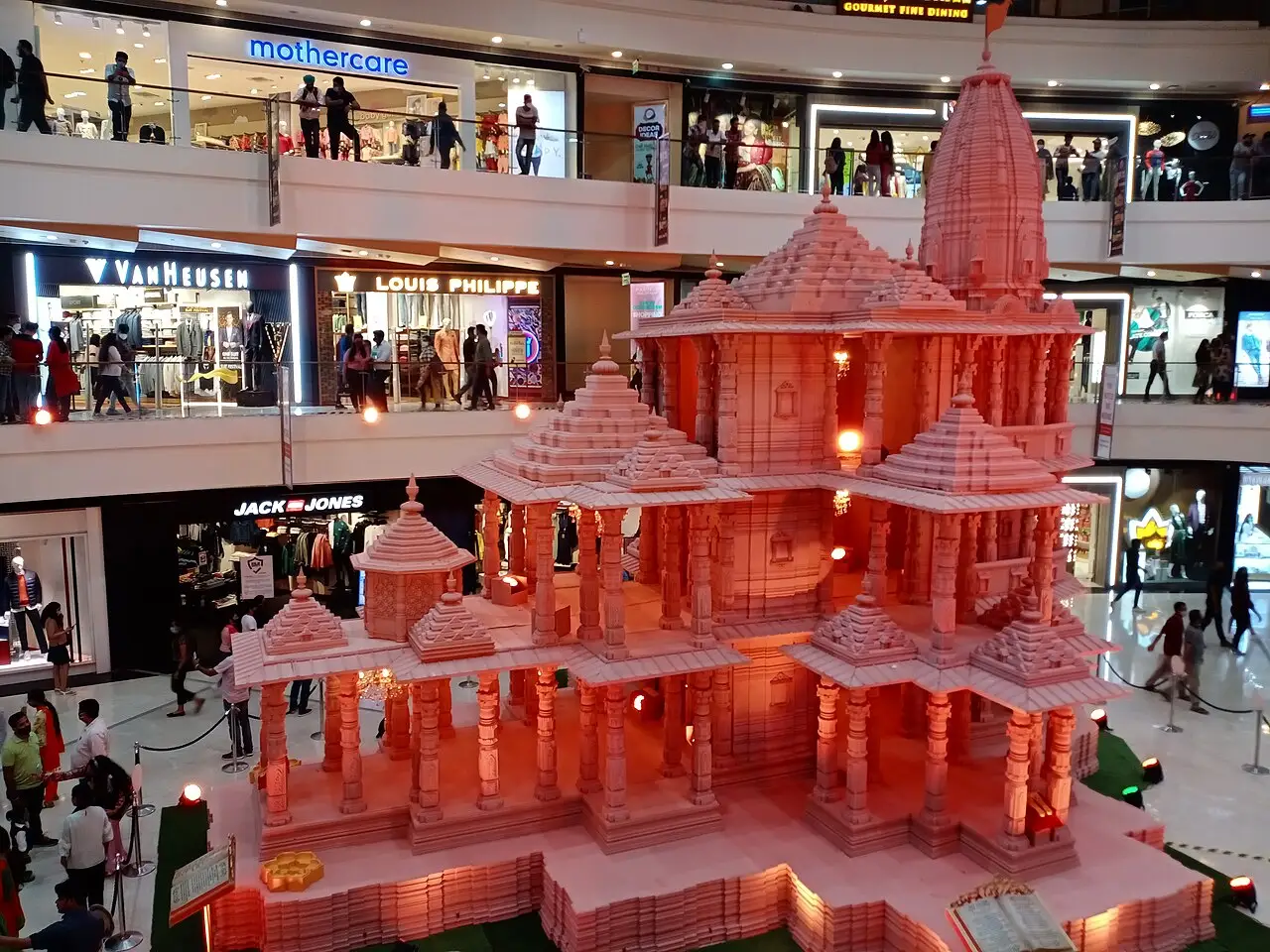
Five days of lamps, sweets and shopping; the markets of Sadar Bazar and Lajpat Nagar become impassable in the two weeks before. Fireworks are court-restricted to 'green' models and a few hours a night, and the air noticeably worsens in the days after.

Holi (March, full moon of Phalguna)
One day of colored powder and water in the streets, usually from 9am to 2pm. Shops, the metro and traffic run at reduced capacity, old white clothes are the standard costume, and local consensus is that if you don't want to take part, you stay indoors until the afternoon.

Ramlila and Dussehra (September or October)
Ten nights of popular theater on the Ramayana at Ramlila Maidan and on the Red Fort lawn, ending with the burning of giant effigies of Ravana. It's free, starts around 7pm, and draws enormous crowds.
Ramadan and Eid al-Fitr
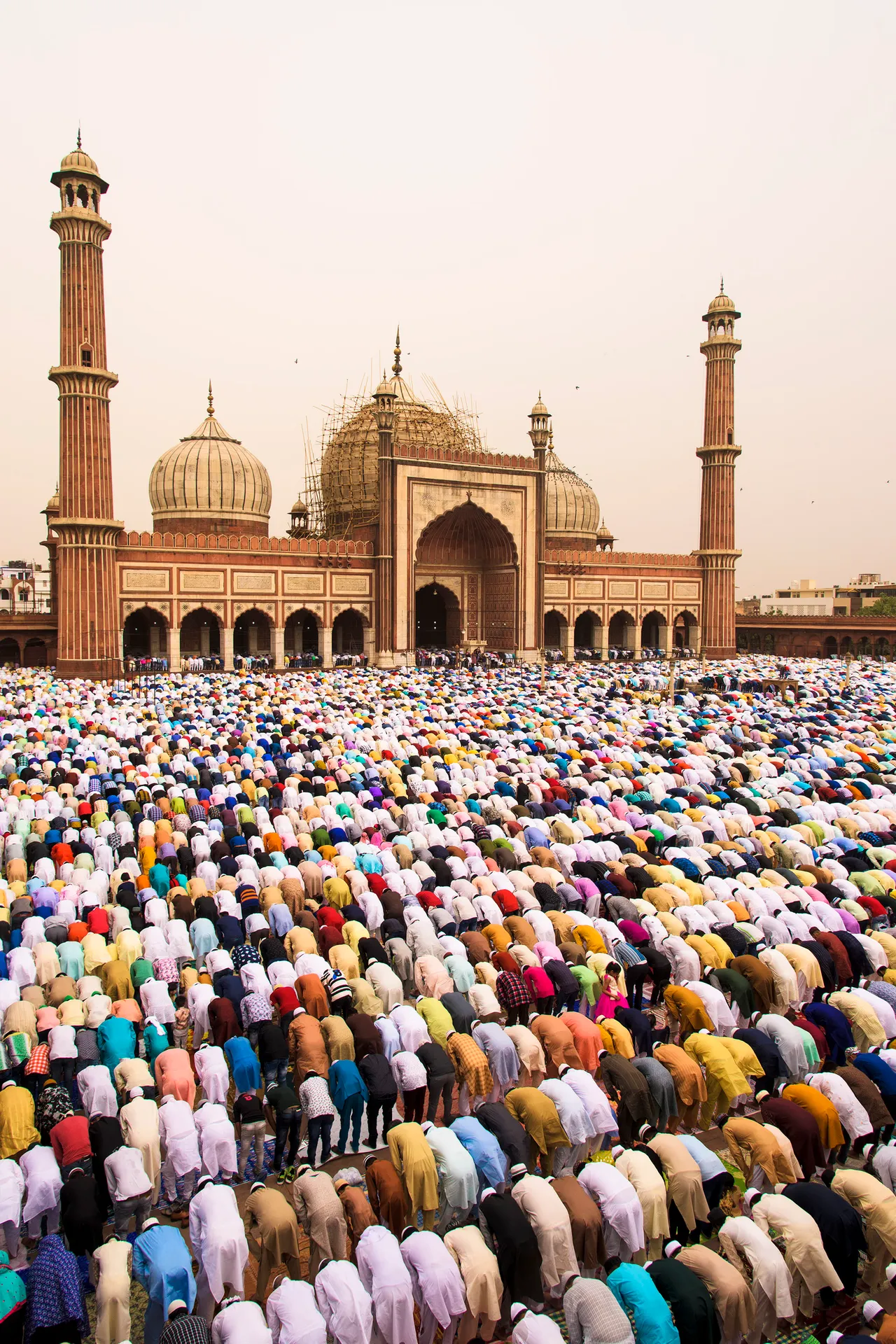
During the month of fasting, the alleys of Matia Mahal, beside the Jama Masjid, turn into a night food market running past midnight. On Eid, the mosque holds mass morning prayers and access for visitors is suspended for a few hours.
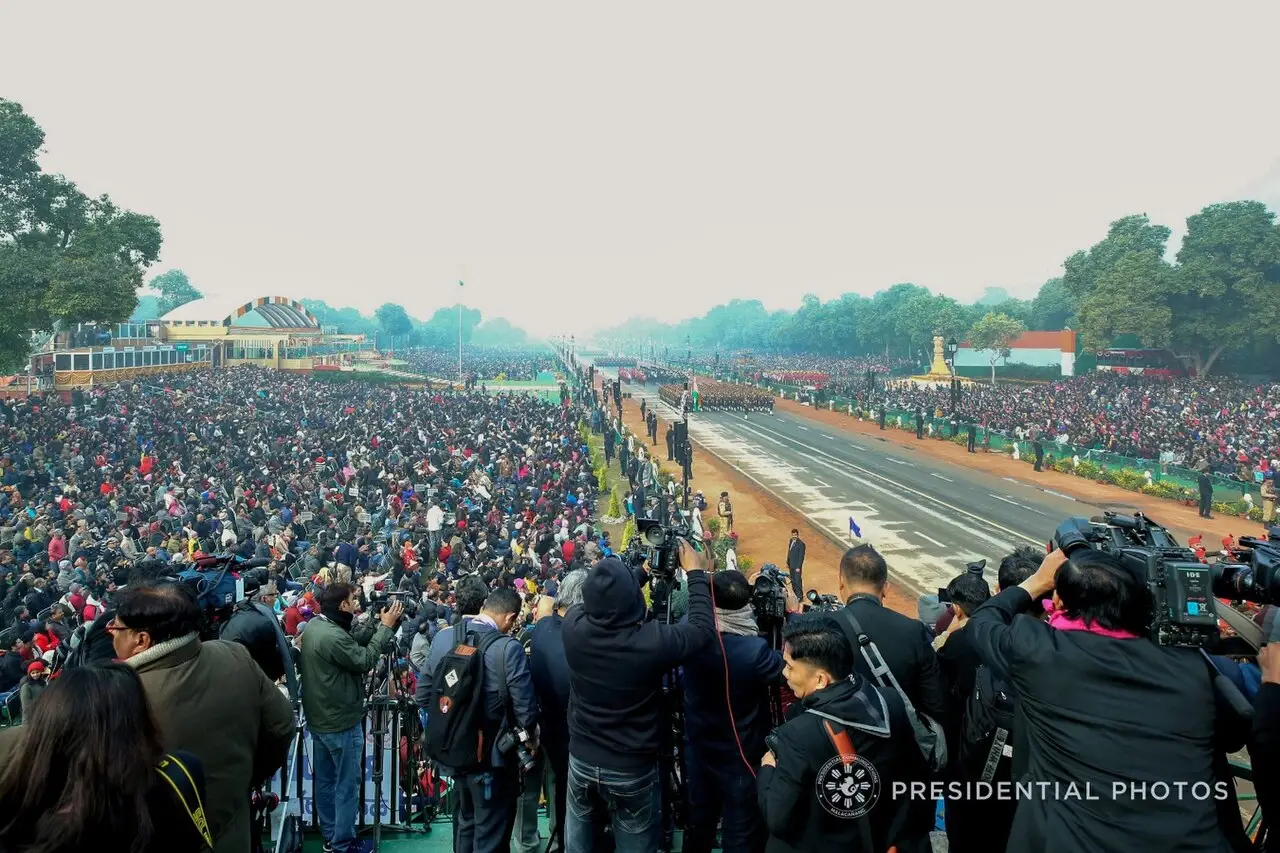
Republic Day (January 26)
A military and state-float parade down the Kartavya Path, with full rehearsals in the preceding days and the Beating Retreat on January 29. Tickets go on sale online in advance, the center gets sealed off, and several metro stations close for the day.
Books and films
City of Djinns: William Dalrymple (1993)
A year of living in Delhi, weaving the city's present together with its layers: 1947, 1857, the Mughals, the Sultanate. It's the book that teaches you to see the seven overlapping cities.
Twilight in Delhi: Ahmed Ali (1940)
A novel written in Shahjahanabad itself, about a Muslim family between 1911 and 1919, published while the culture it describes was still standing. It records what Partition would dismantle seven years later.
Monsoon Wedding: Mira Nair (2001)
A middle-class Punjabi wedding in south Delhi, filmed in real houses, gardens and markets. It shows the city built by the refugees of 1947, which barely appears in the guidebooks.
Frequently asked questions
New Delhi: what scam do people run near New Delhi Railway Station and in Paharganj?
The standard scam is to say your hotel has closed, burned down, or been shut down, and take you to a ‘government tourism office’ that sells an expensive package. The only official office is India Tourism at 88 Janpath.
New Delhi: how do you take the metro from the airport to downtown?
The orange line, the Airport Express, links Terminal 3 to New Delhi Railway Station in about 20 minutes for ₹60 to 70, running from around 4:45am to 11:30pm; Terminal 1 is on the magenta line.
New Delhi: how do you do a day trip to Agra?
233 km to the southeast, 1 hour 40 minutes to 2 hours by express train leaving from Hazrat Nizamuddin or New Delhi Station, or about 3 hours 30 minutes by car along the Yamuna Expressway.
New Delhi: what's the currency, and what's it worth?
The currency is the Indian rupee (INR, ₹), and ₹100 was worth about R$5.40 at the end of September 2026.
New Delhi: what's the best time to go?
February and March are the best months: 12 to 28°C, sun, gardens in bloom, and air that's only poor, not severe.
Other cities in the country
India ↗- Days
- 2–3
- When
- Jan–Mar · Oct–Dec
- Per person/day
- Average 4,000–7,000 INRMid-range · per person/day
Cost scope
Per person per day: accommodation, meals, urban transport, visits and a small allowance for extras. Flights excluded; larger purchases vary. Editorial estimate, not a quote.
- Days
- 2–3
- When
- Jan–Feb · Nov–Dec
- Per person/day
- Average 6,000–12,000 INRMid-range · per person/day
Cost scope
Per person per day: accommodation, meals, urban transport, visits and a small allowance for extras. Flights excluded; larger purchases vary. Editorial estimate, not a quote.
- Days
- 2–3
- When
- Jan–Feb · Nov–Dec
- Per person/day
- Average 6,000–10,000 INRMid-range · per person/day
Cost scope
Per person per day: accommodation, meals, urban transport, visits and a small allowance for extras. Flights excluded; larger purchases vary. Editorial estimate, not a quote.
- Days
- 2–3
- When
- Jan–Feb · Nov–Dec
- Per person/day
- Average 20–40 USDMid-range · per person/day
Cost scope
Per person per day: accommodation, meals, urban transport, visits and a small allowance for extras. Flights excluded; larger purchases vary. Editorial estimate, not a quote.


Itineraries through here
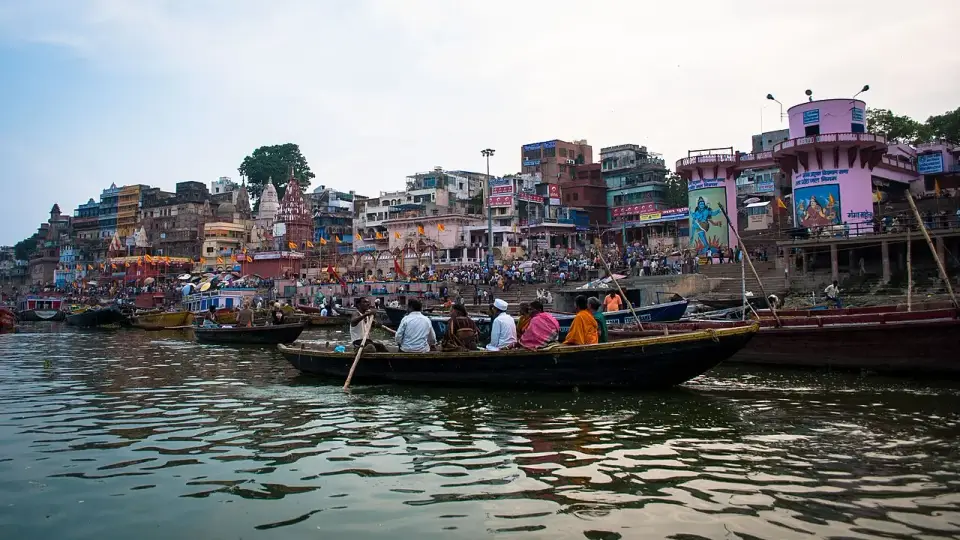
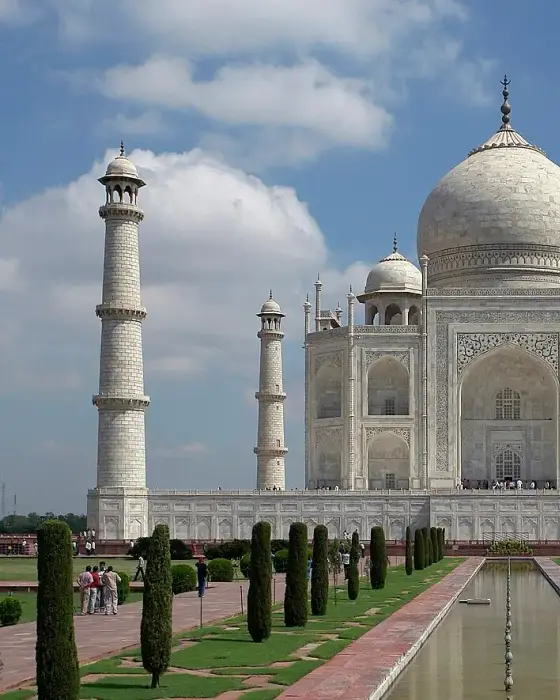 India’s Golden Triangle in 7 daysThe Golden TriangleNew Delhi · Agra · Jaipur7–9 days3 cities
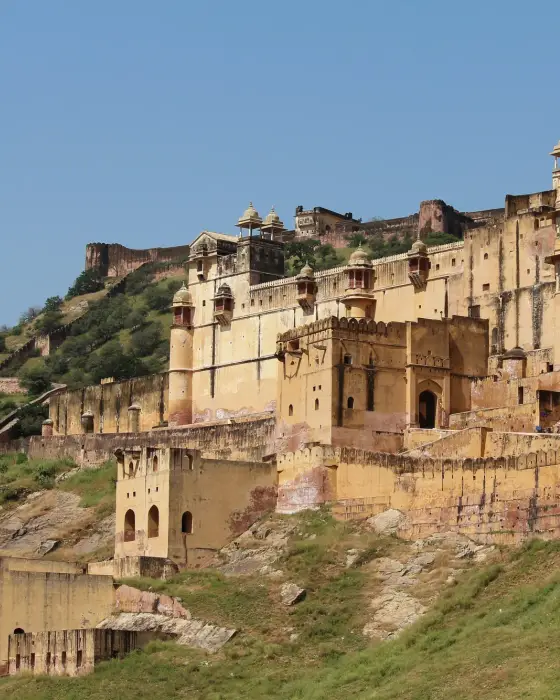 India in 10 daysThe Taj Mahal and the GangesNew Delhi · Agra · Jaipur · Varanasi9–12 days4 cities
 India and Nepal in 10 daysFrom the Taj Mahal to the HimalayasNew Delhi · Agra · Varanasi · Kathmandu10–13 days4 cities