India
Varanasi
The Ganges ghats, the aarti, the boat and Sarnath
Days Start with the basic programme and choose extensions for the time you have.
How the guide reaches this number
Stay those two days, adding a third only for Ramnagar, the looms and the lanes. A visit requires a willingness to deal with noise, discomfort and customs that don't always come with an explanation. On a one-day stop, board a boat at Assi at five in the morning, eat kachori-sabzi in Godowlia and walk through Vishwanath Dham before lunch. Spend the sunny hours in the brass shops of Thatheri Bazaar and walk back for the Dashashwamedh aarti at dusk. Despite the city's ancient reputation, the riverfront is mostly 18th-century, and repeated sales approaches can be tiring. Construction has spread across the city since 2014, and pollution makes bathing in the river unsafe. Between November and January, consider the air too: air-quality index readings frequently exceed 200.
2–3
When November to February: 8–25 °C, practically no rain; October and March also work
How the guide reaches this number
The good window is short and clear: from mid-October to mid-March, with dry skies and highs of 22 to 30 °C. December and January are the coldest months and the most beautiful at dawn, with lows of 6 to 10 °C, but they bring dense fog from the plain that delays flights and trains for hours and sometimes cancels them. Bring a coat, because old rooms have no heating. From March to June the heat takes over: April and May go past 40 °C almost every day, June can approach 45 °C and the stone of the ghats becomes impassable between 11am and 5pm. It's the period I'd avoid, along with the first half of July. The monsoon runs from late June to September and dumps most of the 1,000 to 1,100 mm annual total. The Ganges rises several meters, submerges the low steps, breaks up the continuous walk and sometimes halts boat service for days. High season follows winter and peaks at Dev Deepawali, Mahashivratri and during Ramlila, when hotels and boats cost double or triple. There's a second calendar no one puts on a poster: between November and January the air quality of the Gangetic plain gets much worse, with indices frequently above 200.
Per person/day US$20–40 per person (₹1,800–3,500) with a simple room, street food and e-rickshaw
How the guide reaches this number
Per person per day: accommodation, meals, urban transport, visits and a small allowance for extras. Flights excluded; larger purchases vary. Editorial estimate, not a quote.
 What Nilo thinks
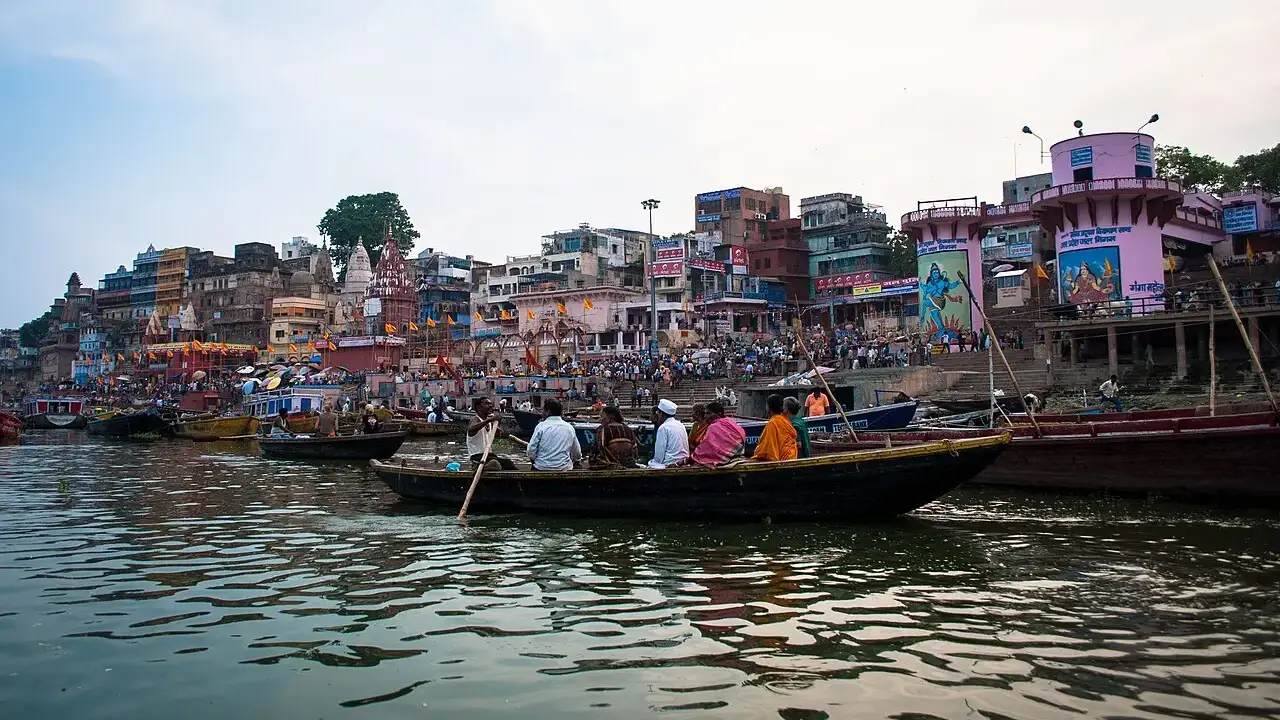
Give Varanasi's river a day, exploring from south to north, and Sarnath and the university another. Stay those two days, adding a third only for Ramnagar, the looms and the lanes. A visit requires a willingness to deal with noise, discomfort and customs that don't always come with an explanation. On a one-day stop, board a boat at Assi at five in the morning, eat kachori-sabzi in Godowlia and walk through Vishwanath Dham before lunch. Spend the sunny hours in the brass shops of Thatheri Bazaar and walk back for the Dashashwamedh aarti at dusk. Despite the city's ancient reputation, the riverfront is mostly 18th-century, and repeated sales approaches can be tiring. Construction has spread across the city since 2014, and pollution makes bathing in the river unsafe. Between November and January, consider the air too: air-quality index readings frequently exceed 200.In Varanasi, India's religious life unfolds in plain view, on the 84 ghats, the stone staircases that run down to the Ganges for nearly 7 km. At Manikarnika, the cremation pyres never go out, even at night, and a rowboat ride in the low light of dawn shows the entire face of the city. Behind the riverfront run the galis, alleys 1.5 to 3 m wide where no car fits, with the Kashi Vishwanath temple and its gold-clad towers, the kachori-sabzi stalls and, in winter, malaiyo, a milk foam that disappears by mid-morning. Every night, the Dashashwamedh Ganga Aarti offers fire and bells to the river. The city's occupation is ancient, but almost nothing at the water's edge predates the 18th century. Come between mid-October and mid-March and set aside two days, one of them for Sarnath, where the Buddha preached his first sermon, 10 km from downtown.
Quick facts
- Population
- about 1.8 million in the municipality and about 2.1 million in the urban agglomeration (2026 estimates); about 3.7 million in the district
- Founded
- Continuous occupation on the Rajghat plateau since about 1200–800 BCE; capital of the kingdom of Kashi in the 6th c. BCE
- Country and region
- India, eastern Uttar Pradesh (Purvanchal region), Gangetic plain
- Language
- Hindi and Bhojpuri day to day; Urdu in the weavers' quarters; English in hotels, guides, university
- Currency
- Indian rupee (INR, ₹); about ₹88 to 90 per dollar and about ₹16 per real in 2026
- Time zone
- UTC+5:30 (IST), no daylight saving
- Best time to visit
- November to February: 8–25 °C, practically no rain; October and March also work
- Average daily cost
- US$20–40 per person (₹1,800–3,500) with a simple room, street food and e-rickshaw
When to go
November to February: 8–25 °C, practically no rain; October and March also work
March
17° to 33°C
11 mm of rain
April
22° to 39°C
7 mm of rain
May
26° to 40°C
14 mm of rain
June
28° to 39°C
101 mm of rain
July
27° to 34°C
265 mm of rain
August
26° to 33°C
283 mm of rain
September
25° to 33°C
225 mm of rain
October
21° to 33°C
33 mm of rain
How the year changes
The good window is short and clear: from mid-October to mid-March, with dry skies and highs of 22 to 30 °C. December and January are the coldest months and the most beautiful at dawn, with lows of 6 to 10 °C, but they bring dense fog from the plain that delays flights and trains for hours and sometimes cancels them. Bring a coat, because old rooms have no heating. From March to June the heat takes over: April and May go past 40 °C almost every day, June can approach 45 °C and the stone of the ghats becomes impassable between 11am and 5pm. It's the period I'd avoid, along with the first half of July. The monsoon runs from late June to September and dumps most of the 1,000 to 1,100 mm annual total. The Ganges rises several meters, submerges the low steps, breaks up the continuous walk and sometimes halts boat service for days. High season follows winter and peaks at Dev Deepawali, Mahashivratri and during Ramlila, when hotels and boats cost double or triple. There's a second calendar no one puts on a poster: between November and January the air quality of the Gangetic plain gets much worse, with indices frequently above 200.
The same numbers as a table
| Month | Temperature °C | Rain mm |
|---|---|---|
| January · | 9 to 22 | 16 |
| February · | 12 to 27 | 22 |
| March | 17 to 33 | 11 |
| April | 22 to 39 | 7 |
| May | 26 to 40 | 14 |
| June | 28 to 39 | 101 |
| July | 27 to 34 | 265 |
| August | 26 to 33 | 283 |
| September | 25 to 33 | 225 |
| October | 21 to 33 | 33 |
| November · | 15 to 29 | 6 |
| December · | 10 to 24 | 4 |
Nilo's tips
Catch the boat at Assi Ghat at 5am
Leaving at 5am, you go up as far as Manikarnika while the light is still low. Arrange the rowboat at Assi Ghat beforehand; negotiated, it runs ₹300–800 an hour for two people. Settle everything before boarding (price, duration, route, and number of people), because negotiating midriver costs more. Also ask what powers the boat: diesel engines are banned, and the switch to CNG is still partial.
Reach Dashashwamedh before the ceremony starts
To find a spot at the 6pm Ganga Aarti, the Gangotri Seva Samiti, which has organized the ceremony since 1991, recommends arriving at 5pm. It runs 45 minutes to an hour, and it's worth confirming the time at the ghat itself close to your date. If you'd rather go in the morning with fewer crowds, Subah-e-Banaras, at Assi Ghat, brings together aarti, yoga, and classical music at dawn, free, since 2014.
Eat malaiyo before 10am, from November to February
Malaiyo, a milk froth whipped up before dawn, only exists between November and February and disappears around 10am. Look for it on the streets of Thatheri Bazaar and Chowk, where a clay bowl costs ₹40–100, because sit-down restaurants don't serve it. If you arrive in March, don't bother looking, because the season is over.
At the Vishwanath, bring passport; phone stays in locker
Foreigners enter through the Darshan Booking counter by showing their original passport, and phones and cameras stay in a locker. Also bring a copy of your passport and visa, because they ask for both. Count on 30 to 90 minutes in line on an ordinary day; mid-morning, after the boat and breakfast, is when the line shrinks. On Mahashivratri, give it up, because the old city becomes practically impassable for 24 hours.
Small bills or QR code, never the ₹500 note
Street stalls don't have change for a ₹500 note. Carry small bills or pay by QR code (UPI), which more and more foreigners can use through international wallets that support UPI. Withdraw cash in Cantt or Lanka, where ATMs are plentiful, and during festival season do it in advance, because on the eve, they run out of cash.
Skip Sankat Mochan on Tuesdays and Saturdays; April has concerts
The Hanuman temple has long lines on Tuesdays and Saturdays; on other days you walk right in. In April, the same courtyard becomes an all-night concert stage, with free entry. Hold on tight to glasses and bags: the monkeys of Sankat Mochan and Durga Kund grab anything loose, and a bite calls for a rabies shot right away.
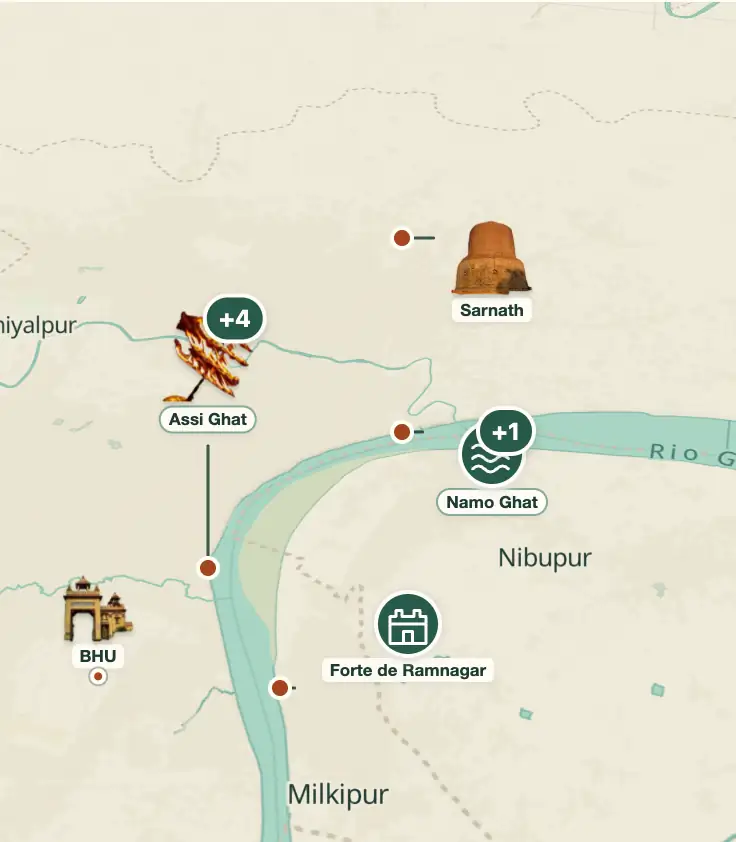
Explore the map
© OpenStreetMap · OpenFreeMap · © OpenMapTiles
Explore the map, read about the other places and plan your travel days in the app.
Open the appWhat to see
Varanasi: the bluff and the bend in the river
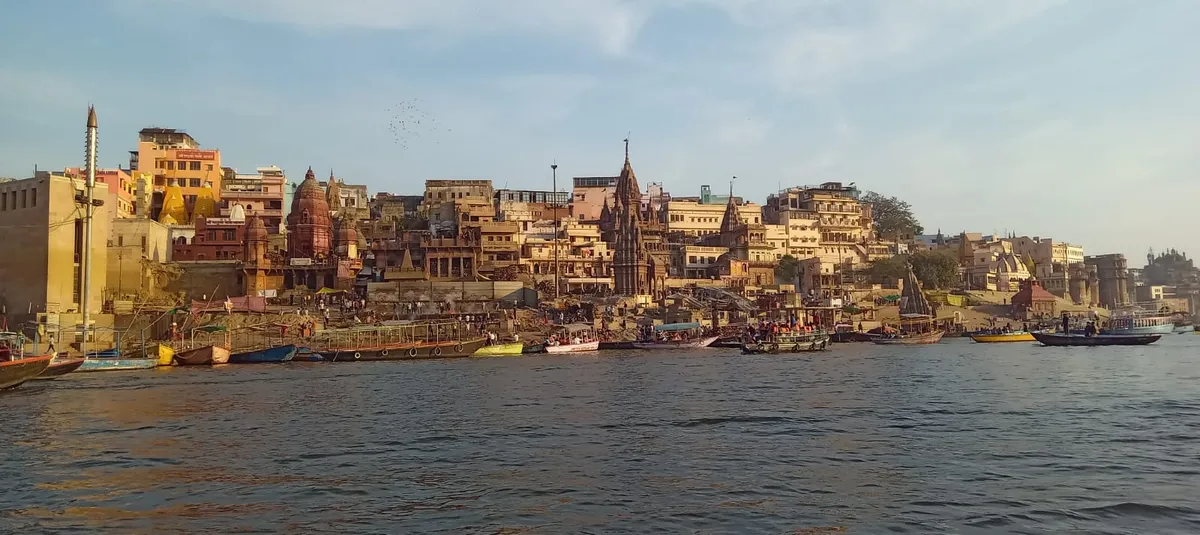
The urban stretch of the river is 500 to 700 m wide at flood stage and traces a bend to the north of about 7 km; the eastern bank, sandy and flood-prone, remains practically empty, with only Ramnagar further south, and that's what guarantees the open horizon line seen from the steps. Behind the ghats, the old city is a maze of galis 1.5 to 3 m wide, with no cars, where GPS is off by dozens of meters.

Kashi Vishwanath and the Dham
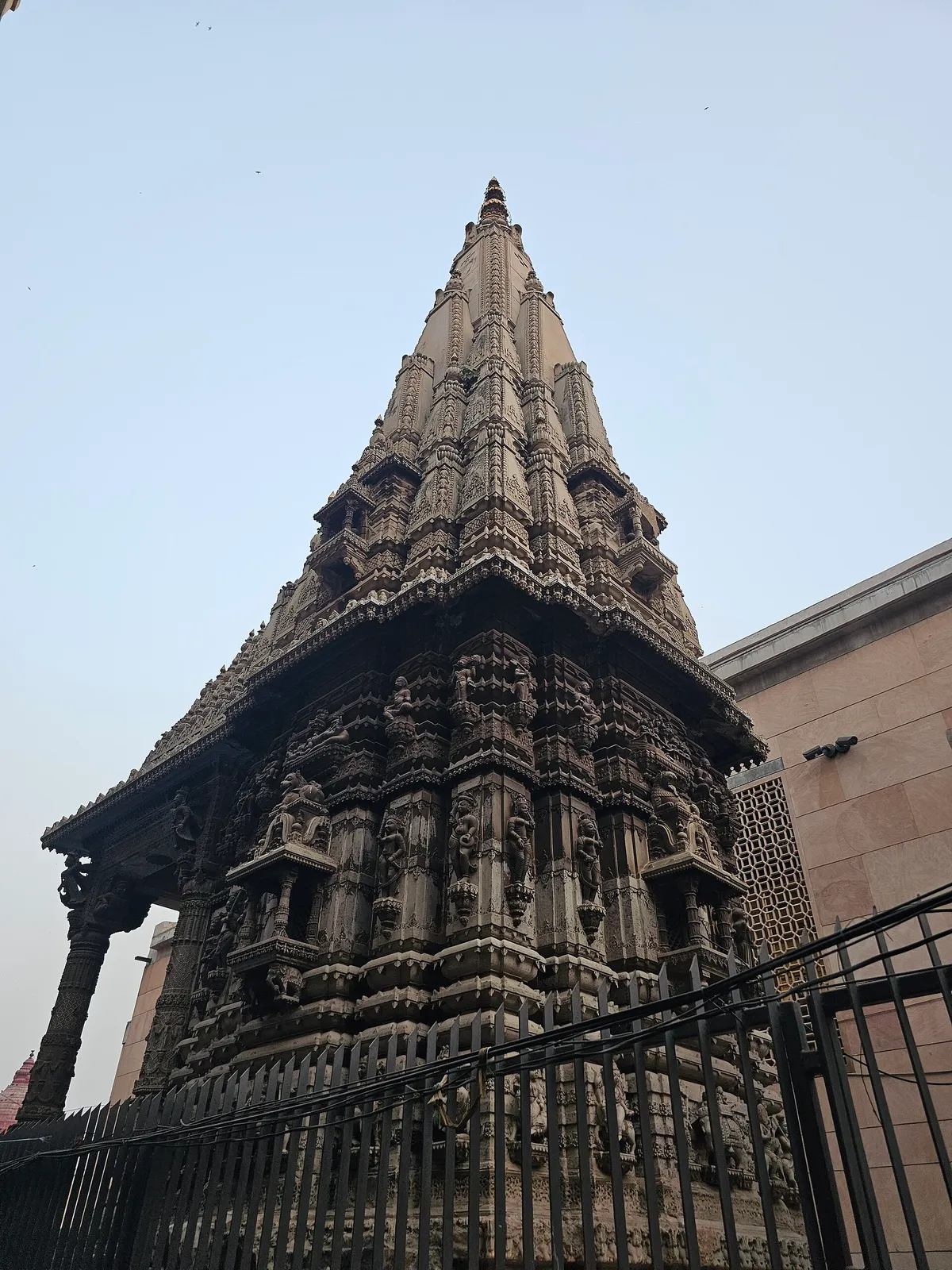
The city's main Shiva temple, in the form rebuilt by Ahilyabai Holkar in 1780, with towers plated in gold paid for by Ranjit Singh in the 1830s. Since December 2021 it sits inside the 5.3-hectare Kashi Vishwanath Dham corridor: phones and cameras must go in lockers, and foreigners enter by showing a passport at the marked gate.
It's the city's main Shiva temple, rebuilt by Ahilyabai Holkar in 1780 and with its towers gold-plated in the 1830s, paid for by Ranjit Singh. Count on 30 to 90 minutes in line on an ordinary day.
Check access

Dashashwamedh Ghat
The central and busiest ghat is 700 m from Godowlia. At dusk, the Ganga Aarti brings officiants, lamps and bells to the steps. Gangotri Seva Samiti’s schedule lists 6pm, with arrival recommended at 5pm. Check current times before choosing between the steps and a boat.
Go at dusk for the Ganga Aarti, when officiants, lamps, and bells fill the stairs of the city's busiest ghat, 700 m from Godowlia. The Gangotri Seva Samiti schedule sets it at 6pm and recommends arriving at 5pm; check the day's time and decide beforehand whether you'll watch from the steps or from a boat.
Check access

Manikarnika Ghat
The main cremation ghat, active 24 hours a day, with the fire kept burning by families of the Dom community. Photographing the pyres is effectively forbidden and poorly received; whoever offers “terrace access for a donation toward the wood” is running the city's oldest scam.
It's the main cremation ghat, where families from the Dom community keep the fire burning 24 hours a day. Watch from a distance and in silence, without photographing the pyres.
Check access

Assi Ghat
The southern end of the stairway, where the Assi stream meets the Ganges and where the 7 km walk along the ghats usually starts. From 5am to 6:30am there is Subah-e-Banaras, with morning aarti, yoga and live classical music, open and free, created in 2014.
Start the 7 km walk along the ghats here, at the point where the Assi stream meets the Ganges. Arrive around 5am for Subah-e-Banaras, which brings together morning aarti, yoga, and live classical music until 6:30am, with no admission charge.
Check access

Sarnath
10 km from the center, the place where the Buddha preached his first sermon around 528 BCE. The brick-and-stone Dhamek stupa stands about 43 m tall and 28 m across at the base, with 5th-century Gupta reliefs; the 1910 Sarnath Museum holds Ashoka's four-lion capital, India's national emblem since 1950.
This is where the Buddha preached his first sermon, around 528 BCE, 10 km northeast of downtown. Half a day is enough for the roughly 43 m Dhamek Stupa and for the museum, which holds the four-lion capital of Ashoka, India's national emblem since 1950.
Check access

BHU and New Vishwanath
The 1916 campus covers 5.3 km² with a circular layout, rare in India. At its center, the New Vishwanath temple, funded by the Birla family and completed in 1966, has a shikhara about 77 m tall, among the tallest in the country, and is open to any visitor; the 1920 Bharat Kala Bhavan museum holds miniatures and sculpture.
Go for the New Vishwanath temple, built by the Birla family, completed in 1966, with a shikhara about 77 m tall and open to any visitor, at the center of the university's circular campus. On the same campus, the Bharat Kala Bhavan museum brings together miniatures and sculpture.
Check access

Sankat Mochan and Durga Kund
The Hanuman temple that tradition credits to Tulsidas in the 16th century, ringed by monkeys and by a line on Tuesdays and Saturdays, and the 18th-century Durga temple, with its square stepped tank. Every April, Sankat Mochan has hosted five or six free all-night concerts of classical music since 1923.
In April it hosts entire nights of free classical music.
Check access

Panchganga Ghat and Alamgiri mosque
The ghat where tradition places the meeting of five rivers, with the 1673 Alamgiri mosque perched atop the bluff; it's the highest and most photographed point on the northern stretch. In Kartik, the ghat's balconies carry hundreds of lamps hung on bamboo poles.
It's worth it as a viewpoint for the northern stretch: Panchganga Ghat is the highest point on the bank, and the 1673 Alamgiri mosque sits atop the bluff. The best time is late afternoon. In Kartik, the ghat's balconies fill with lamps tied to bamboo poles.
Check access
Ramnagar Fort
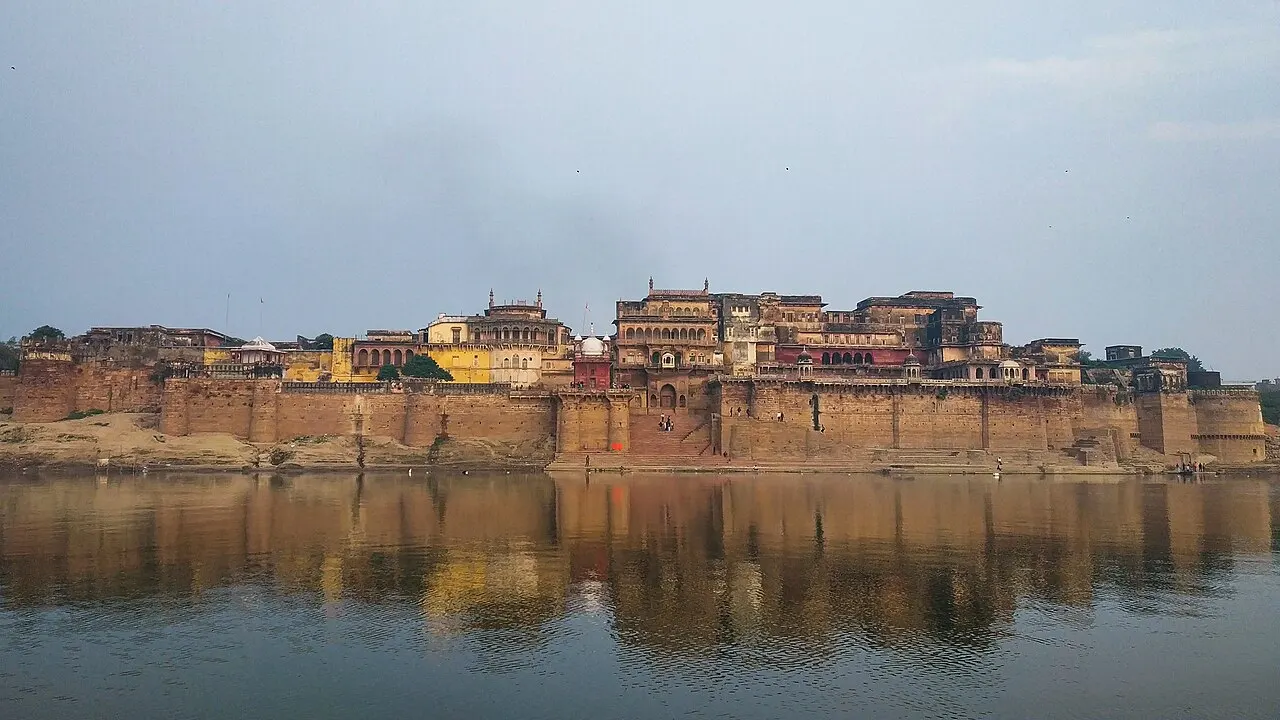
Built in 1750 by Balwant Singh in Chunar sandstone, on the east bank. The Saraswati Bhawan museum displays palanquins, weapons, carriages and an 1852 astronomical clock that tracks year, month, week, day and planetary position; the complex is little restored and shows it.
It dates from 1750, sits on the far bank, and the complex is poorly restored. What justifies the crossing is the 1852 astronomical clock in the Saraswati Bhawan museum, which shows the year, month, week, day, and position of the planets and can be seen in a few minutes. If time is short, trade the fort for one more hour on the boat.
Check access
Nilo’s itinerary
Start with the basic programme and choose extensions for the time you have.
Plan my days in the app ↗Day 1 · The river, south to north
At 5am, catch the rowboat you've arranged at Assi Ghat for ₹300–800 an hour, head up to Manikarnika and come back with the sun already high.
Have a breakfast of kachori-sabzi and jalebi at a Godowlia shop for ₹40–80, with tea in a clay cup.
Mid-morning at Kashi Vishwanath Dham: leave your phone and camera in the locker, bring a passport and expect 30 to 90 minutes in line.
Spend the afternoon in the shade of Thatheri Bazaar and its brass shops, and have a lassi on Kachori Gali before 4pm.
Watch the Ganga Aarti at Dashashwamedh. Check the time with the organizer: the current schedule gives a 6pm start and 5pm arrival. You can stay on the steps or arrange a boat.
Day 2 · Sarnath and the university
E-rickshaw or taxi to Sarnath, 10 km, 30 to 45 minutes; start at the Dhamek stupa and the Dharmarajika ruins.
Visit the Sarnath Museum, opened in 1910, to see Ashoka’s four-lion capital, and Mulagandha Kuti Vihar, built in 1931, with murals by Japan’s Kosetsu Nosu. The museum closes on Fridays: if it is a priority, move this excursion to another day.
Have lunch in Sarnath and head back to the center in early afternoon, before the worst of the heat.
Visit Banaras Hindu University and the New Vishwanath temple, built in 1966. Bharat Kala Bhavan opens Monday to Saturday, 10:30am to 4:30pm; in May and June, 7:30am to 1pm. During those months, visit the museum in the morning and leave Sarnath for another day. On Sundays and holidays, keep the temple and Lanka’s bookshops in your plan.
End the afternoon at Assi Ghat with a classical music concert or an open class, and have baati-chokha for dinner.


If you stay longer
Day 3 · Ramnagar, looms and lanes
Cross by boat or over the bridge to Ramnagar, on the east bank, for the 1750 fort and the Saraswati Bhawan museum, with its 1852 astronomical clock.
Come back at midday and take a long break for lunch, a shower and some reading, because a sunny afternoon on the stairways gets you nowhere.
Go to Madanpura or Alaipura to watch the handloom at work and compare Banarasi sari prices without a rickshaw middleman.
Catch late afternoon at Panchganga Ghat, in the northern stretch, with the 1673 Alamgiri mosque atop the bluff.
Close out the night with the sweets of Chowk and a paan banarasi.
Food
 AI illustration
Kachori-sabzi with jalebi
The standard breakfast: two discs of urad-lentil-stuffed dough, fried to order, with a bowl of potato or pumpkin curry and a sweet jalebi on top. Served on a leaf, from 7am to 11am, ₹40–80 a portion at the shops of Godowlia and Lanka.
 AI illustration
Tamatar chaat and chura matar
Tamatar chaat is mashed tomato cooked with spices, served hot in a small clay bowl with crushed savory crackers: a local invention, it doesn't exist like this in other cities. In winter comes chura matar, flattened rice with fresh peas and clarified butter.
 AI illustration
Malaiyo
Milk foam whipped outdoors at dawn, catching the night dew, served with sugar, saffron and pistachio: typical of the cool spell from November to February, sold early on the streets of Thatheri Bazaar and Chowk until it vanishes by mid-morning.
 AI illustration
Lassi in a kulhad
Thick, whipped yogurt, topped with cream and sometimes fruit, served in a disposable clay cup. ₹50–120; the shops of Kachori Gali and Assi have a line before 10am, and the cup shatters on the ground after the last sip.
 AI illustration
Baati-chokha
Wheat-dough balls baked over embers, broken open and drizzled with clarified butter, alongside a mash of roasted eggplant, tomato and potato. It's peasant food from Purvanchal, served at specific restaurants; ₹150–300 for the full plate.
 AI illustration
Thandai
Chilled milk with almond, melon seed, fennel, black pepper and rose petals, ₹40–100 a glass. At shops licensed by the Uttar Pradesh government you can also get the bhang version, a cannabis preparation legal at that specific counter and much stronger than it looks.
 AI illustration
Banarasi sweets
Launglata (pastry filled with coconut and khoya, sealed with a clove), malai gilori, layered rabri and the local kalakand. Old confectioners in Chowk sell by weight, ₹400–800 a kilo, and wrap it in edible silver leaf.
 AI illustration
Banarasi paan
A betel leaf (magahi is the most prized) with lime, catechu paste, seeds and, in the sweet versions, rose gulkand, folded into a triangle. It's eaten whole and without biting, after the meal, for ₹20 to 200 depending on the filling.
Day trips

Sarnath
10 km northeast, 30 to 45 minutes by e-rickshaw or taxi, a half-day round trip. Buddhist ruins, the roughly 43 m Dhamek stupa, a 1910 museum with Ashoka's capital, and monasteries from five Asian countries.

Chunar Fort
40 km upriver, 1 hour to 1 hour 30 minutes by car along the south bank, or a slow train to Chunar station. A fortress on rock overlooking the Ganges, fought over by Sher Shah Suri, the Mughals and the British; the local quarry is the same one that supplied sandstone for Ashoka's pillar.

Prayagraj
About 120 km to the west, 1 hour 30 minutes to 2 hours 30 minutes by fast train. The confluence of the Ganges with the Yamuna, Akbar's 1583 fort, a museum and the setting of the Kumbh Mela, which returns to the city in cycles of six and twelve years.
Where to begin
The river, south to north
At 5am, catch the rowboat you've arranged at Assi Ghat for ₹300–800 an hour, head up to Manikarnika and come back with the sun already high.
Sarnath and the university
E-rickshaw or taxi to Sarnath, 10 km, 30 to 45 minutes; start at the Dhamek stupa and the Dharmarajika ruins.
Ramnagar, looms and lanes
Cross by boat or over the bridge to Ramnagar, on the east bank, for the 1750 fort and the Saraswati Bhawan museum, with its 1852 astronomical clock.
Money
The currency is the Indian rupee (₹), around ₹88 to 90 per dollar and ₹16 per real in 2026; check the day's rate. 2026 ranges: tea in a clay cup ₹10 to 20, a plate of kachori-sabzi ₹40 to 80, lassi ₹50 to 120, vegetarian thali ₹120 to 250, dinner at an air-conditioned restaurant ₹400 to 900, a hostel bed ₹400 to 800, a simple guest house room near the ghats ₹800 to 2,000, a mid-range hotel ₹2,500 to 5,000 and historic river-facing hotels ₹12,000 to 30,000. A modest full day fits into ₹1,800 to 3,500 (US$20 to 40). Cash still handles almost everything in the galis, in small bills: no street stall can break a ₹500 note. QR code payment (UPI) is universal among Indians, and foreigners can increasingly pay through international wallets that support UPI. Cards work at hotels, chains and large stores. ATMs are plentiful in Cantt and Lanka, rarer inside the old city, and run out of cash on festival eves. Tipping isn't mandatory: 5 to 10% at a restaurant that doesn't charge service, ₹50 to 100 to the boatman beyond what was agreed, ₹500 to 1,000 a day for an accredited guide. Haggling over rickshaw, boat and fabric prices is normal. Ask the price before you get in, board, or let them unfold the fabric.
Getting there and around
Airport: 25 km away, up to 75 minutes
Lal Bahadur Shastri International Airport (VNS) is in Babatpur, 25 km northwest of the center, and the ride takes 45 to 75 minutes depending on traffic. A fixed-fare counter taxi or an app ride costs ₹800–1,400 to the ghats, and there are buses to Cantt station. The airport is undergoing a ₹2,870-crore expansion, with a new 75,000 m² terminal and a runway extended to 4,075 m to triple current capacity, so expect detours and temporary signage on the approach. By train, the main station is Varanasi Junction (Cantt), with Banaras (formerly Manduadih) and Varanasi City as alternatives and Pt. Deen Dayal Upadhyaya Junction, across the river 17 km away, as the major rail hub. Vande Bharat and express trains run to Delhi (8 to 12 hours, about 760 km), Prayagraj, Lucknow, Ayodhya, Patna, Gorakhpur and Khajuraho. Booking ahead on IRCTC is practically essential in high season.
No metro: the e-rickshaw by the thousands
Cars cannot fit through the narrow galis, but motorcycles and bicycles use some of them. Access is restricted between Godowlia and Dashashwamedh: a hotel “on the ghat” means 5 to 15 minutes on foot with your bag. There's no metro in the city, and the real transport is the electric e-rickshaw, by the thousands: ₹10–20 a seat on a shared route and ₹50–150 for a short private ride, always agreed before you get in. There are also auto-rickshaws, cycle rickshaws, electric and diesel city buses, and the Uber, Ola and Rapido apps, which work well on the wide roads and poorly in the old city. The Cantt–Godowlia cable car, 3.75 km long with five stations, ten-seat cabins and an announced fare of ₹50 to ₹100, is expected in 2026: check whether it's running yet. On the river, a rowboat costs ₹300–800 an hour for two people after bargaining, a shared seat goes for ₹100–200, and there are official electric boats. Diesel engines are banned, and the switch to CNG is only partial. You can walk the whole riverfront, from Assi to Raj Ghat, in about two hours, except during the monsoon floods, when stretches are underwater.
Safety
Violent crime against visitors is rare in Varanasi, and the main nuisance is commercial: constant approaches by boatmen, unaccredited guides, silk vendors and fake priests who start a ritual on the step and charge at the end; saying “no, thank you” once and continuing to walk resolves most of it. The objective risks are different: crowds, water, traffic and monkeys, and the stomach. Crowds: at Dev Deepawali, Mahashivratri and Bharat Milap there's real crush in two-meter alleys, and the right move is to avoid peak times and never go against the flow. Water: the Ganges current is strong and the riverbed drops abruptly a few meters from the bank. Drowning is a recurring cause of death, and fecal coliform is far above the bathing limit: going in is a health decision. Traffic and monkeys round out the list: at Durga Kund and Sankat Mochan the monkeys snatch bags, glasses and food, and a bite requires immediate rabies prophylaxis. Stomach: drink sealed or filtered water, eat what comes out boiling or freshly fried and avoid salad and street juice in the first few days. Women traveling alone report insistent staring and, in crowds, being jostled. Clothing covering shoulders and legs reduces attention, and the ghats north of Manikarnika are empty and poorly lit after 9pm. Note the two numbers before heading out: national emergency 112 and tourist support line 1363.
Etiquette tips
Shoes off: at temples, homes, and silk shops
Take your shoes off before entering any temple, many homes and a good number of silk shops, where you sit on a white mat. Shoe-check stands charge ₹10–20 at the entrance of the larger temples; socks are almost always fine.
No photos at the cremation ghats
At Manikarnika and Harishchandra, you don't photograph or film a pyre, a body, or a family, whether with a phone or a camera. Watching from a distance and in silence is accepted; put your phone away while you're in front of the pyres.
Right hand for anything passed hand to hand
Eat, hand over money, take change and accept prasad with your right hand. The left has a hygienic function, and using it for these gestures reads as uncleanliness, not distraction.
Shoulders and knees covered, no leather
Cover shoulders and legs in temples, regardless of gender; some women also cover their heads at specific shrines. Leather belts, bags, and sandals are barred from several temples, so leave them at the hotel on the day you visit.
Give way to a procession
When a funeral procession chants “Ram naam satya hai” in the alley, press against the wall, stop and let it pass. You don't cross the procession, don't film it and don't walk ahead of it.
Don't point your feet or step over someone seated
Don't point the soles of your feet at people, images, altars or the river, and don't step over someone sitting on the step. Sitting cross-legged or to the side solves it, and that's what everyone does.
Mistakes to avoid
Booking “on the ghats” and expecting a taxi at the door
Booking a hotel “on the ghats” and imagining the taxi pulls up to the door. Every vehicle stops at Godowlia, Assi or Sonarpura, and from there it's 5 to 15 minutes on foot through alleys with steps, bag in hand. Ask the hotel for the exact drop-off point and a porter before you arrive: whoever doesn't ask carries their own bag up the steps.
Closing the boat deal without fixing price and route
Closing the boat, guide or rickshaw deal without fixing price, duration, route and number of people before setting off. Negotiating at the end of the ride, once you're already mid-river or at the end of the lane, always costs more.
Accepting that “the Vishwanath is closed”
Accepting “today the Vishwanath is closed, I'll take you to another temple” at the Godowlia exit, or buying silk at a shop pointed out by the driver. The middleman's commission runs between 30% and 50% of the price, and you're the one who pays it.
Drinking a “special lassi” without asking
Drinking a “special lassi” without asking what's in it. Bhang is legal at licensed shops in Uttar Pradesh, but the usual dose knocks out anyone unaccustomed to it for eight hours or more, and it sometimes shows up in drinks offered for free.
Walking the ghats at noon
Planning a walk along the ghats at noon between April and June. The stone stores heat, there's no continuous shade and heatstroke is the most frequent medical problem among visitors those months. Walk from 5:30am to 9am and after 5pm.
Useful phrases
नमस्ते / प्रणाम (namastê / pranam)
Hello and goodbye, with hands together; “pranam” is the most respectful form, used with elders
का हो गुरु? (ka rrô guru?)
“Hey, master?”: the bhojpuri street greeting; “guru” here is an affectionate address between equals
हर हर महादेव (har har mahadêv)
“Shiva everywhere”: a greeting and celebration shout, heard on the ghats and in processions
कितने का है? (kitnê ka hai?)
How much does it cost? The first useful phrase at any stall, boat or rickshaw
थोड़ा कम कीजिए (thora kam kíjie)
“Come down a little”: the polite formula for negotiating price without confrontation
नहीं चाहिए, धन्यवाद (nahin tchárrie, dhanyavad)
“No thanks, I don't want it”: ends a vendor's approach without rudeness
Districts
Godowlia and Chowk
The old city's funnel: the Godowlia crossing is where every motor vehicle stops and everyone gets out to walk. From there, 700 m of traffic-free street leads to Dashashwamedh Ghat, past shops of bronze, garlands and brass.
The Vishwanath lanes
The maze between the temple and the river, with Vishwanath Gali, Kachori Gali and the metalware Thatheri Bazaar. Corridors 1.5 to 3 m wide, no cars, where people eat standing up and buy cloth, and where GPS is off by dozens of meters.
Assi, Bhadaini and Shivala
The southern end of the ghats, wider and easier to breathe in, with cafés, music and yoga schools, guesthouses and the largest concentration of long-stay foreigners. It's also where Assi Ghat comes alive at dawn, with a daily open-air cultural program running since 2014.
Lanka and BHU
The gate to Banaras Hindu University and its neighborhood of bookshops, stationers, photocopy shops and cheap food for 30,000 students. Inside the 5.3 km² campus are New Vishwanath, the Bharat Kala Bhavan museum and a university hospital that serves as the region's referral center.
Cantonment and Sigra
British Varanasi and middle-class Varanasi: wide streets, barracks, Varanasi Junction station, chain hotels, hospitals, offices and malls. This is the base for anyone who prefers a car, a big room and distance from the steps.
Madanpura, Alaipura and Lallapura
Weavers' quarters, mostly Muslim, where you can still hear the hand loom behind the doors and haggle over silk wholesale. Buying here, unhurried and without a rickshaw middleman, is the most direct way to understand the real price of a Banarasi sari.
Ramnagar
On the east bank, linked by bridge and by ferry, it is the seat of the old royal family: a 1750 fort, a museum and the 31-night Ramlila. Outside the festival period, it's a small, agricultural town looking at the ghats from a distance.
Sarnath
A separate hub 10 km northeast, around the Buddhist ruins and the Dhamek stupa. It has Thai, Japanese, Tibetan, Burmese and South Korean monasteries, a museum from 1910, and a pace that has nothing to do with the center.
History
12th–8th c. BCE · The Rajghat settlement
Excavations on the Rajghat plateau, where the Varuna river meets the Ganges, found pottery and an earthen wall from the period 1200–800 BCE. Occupation has never stopped since.
6th c. BCE · Kashi, one of the sixteen kingdoms
Kashi appears in Buddhist and Jain texts as one of the sixteen mahajanapadas, rich in cotton, silk, and horses. Around 528 BCE, the Buddha preaches his first sermon at Sarnath, 10 km to the northeast.
3rd c. BCE · Ashoka marks Sarnath
The Mauryan emperor Ashoka raises the Dharmarajika stupa in Sarnath and a polished sandstone pillar. The four-lion capital from that pillar became the official emblem of the Republic of India in 1950.
1194 · Sack and change of regime
Qutb al-Din Aibak, general of Muhammad of Ghor, defeats the Gahadavala king Jayachandra and sacks the city, demolishing temples. Varanasi passes to the Delhi Sultanate and later to the Sharqi sultans of Jaunpur.
1585 · Rebuilding under Akbar
Raja Todar Mal, Akbar's finance minister, funds the rebuilding of the Kashi Vishwanath temple, directed by the scholar Narayana Bhatta. It is the temple that survived for 84 years.
1669 · Demolition and the Gyanvapi mosque
Aurangzeb orders the temple destroyed and the Gyanvapi mosque is built over part of the old base. The legal dispute over the site continues in Indian courts, with an ASI survey in 2023.
1738–1780 · The kingdom of Benares and the ghats
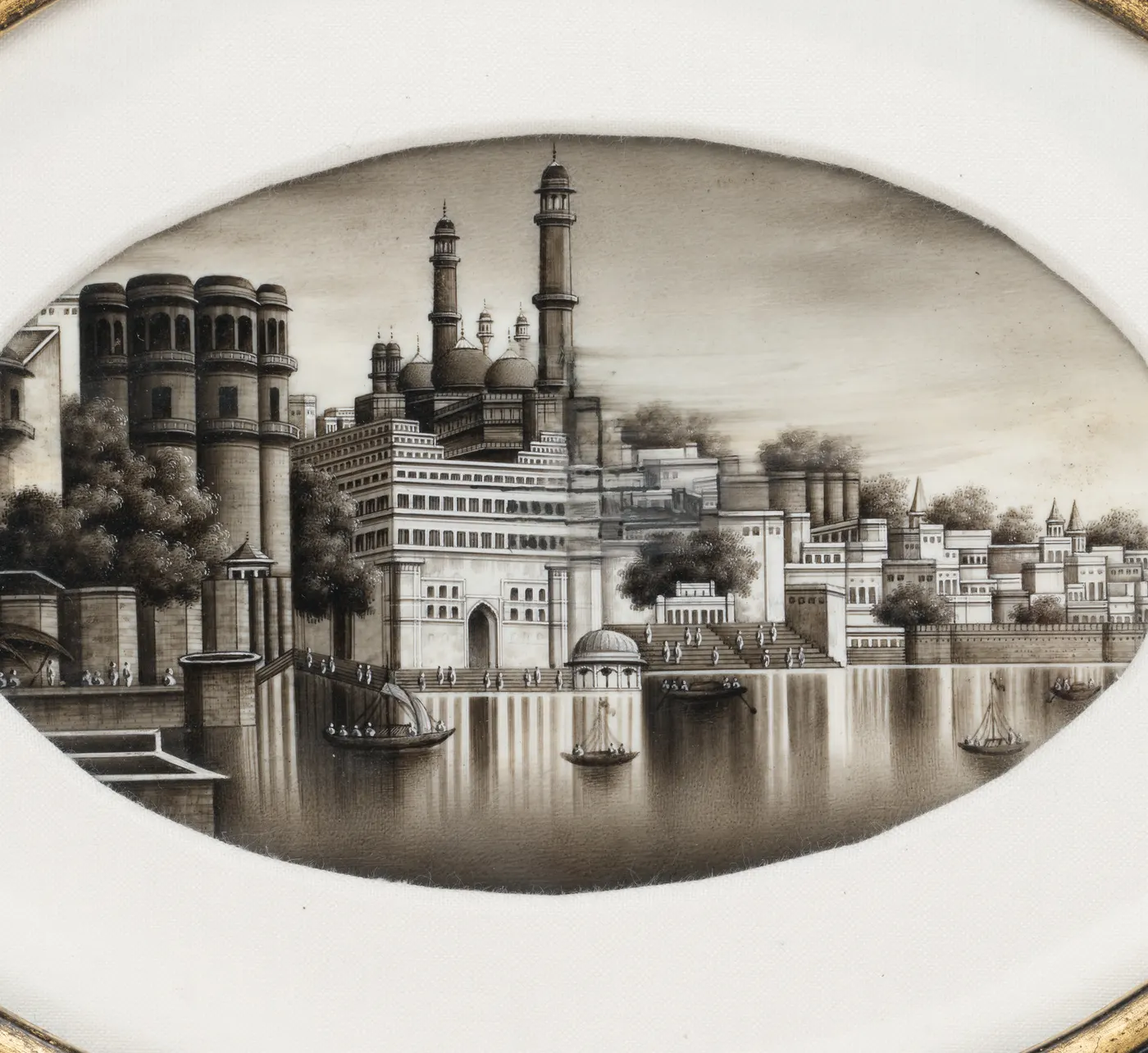
Mansa Ram and his son Balwant Singh consolidate the Benares dynasty and build Ramnagar fort in 1750. In 1780, Ahilyabai Holkar of Indore rebuilds Kashi Vishwanath where it stands today.
1781 · Chait Singh's revolt
Warren Hastings tries to impose an extraordinary levy on Raja Chait Singh; the city rises up and Hastings flees the ghat that now bears the raja's name. The East India Company takes direct control.
1916 · Banaras Hindu University
Madan Mohan Malaviya founds BHU on February 4, 1916, on 5.3 km² granted by the maharaja. The campus became one of the largest residential campuses in Asia, with about 30,000 students.

1956 · From Benares to Varanasi
The princely state of Benares had acceded to India in 1947 and was folded into Uttar Pradesh in 1949. In 1956 the city's official name changes from Benares to Varanasi, a contraction of Varuna and Assi.
1986–2026 · Cleaning the river and rebuilding the center
Rajiv Gandhi launches the Ganga Action Plan in Varanasi on June 14, 1986; the Namami Gange program replaces it in 2014, with treatment plants in Dinapur and Ramna. On December 13, 2021 the 5.3-hectare Kashi Vishwanath Dham corridor opens, clearing a 400 m passage between the river and the temple.
Complete history
The Ganges' 7-km bend and the city's bluff
The city is where it is because of a bend. The Ganges runs east across the plain and, at Varanasi, turns north for about 7 km before resuming its course. On the concave bank of that bend there is a clay bluff 20 to 25 meters high, where the upper parts of the city stand; on the convex one, a sandbank that floods every year and so has no urban settlement. On that bluff, between the mouth of the Varuna to the north and the Assi stream to the south (the two names that merged into “Varanasi”) there's pottery and wall remains from the 1200 to 800 BCE period on the Rajghat plateau. In the 6th century BCE, Kashi is one of the sixteen mahajanapadas, a trading post for cotton, silk and horses on the river route, and it's a few kilometers away, at Sarnath, that the Buddha preaches for the first time. Ashoka marks the spot with a pillar and a stupa in the 3rd century BCE.
A long cycle of destruction and rebuilding
Starting in 1194 the city enters a long cycle of destruction and rebuilding. Qutb al-Din Aibak defeats Jayachandra and tears down temples; the Delhi Sultanate and the Sharqis of Jaunpur follow. In 1585, with money from Todar Mal, Akbar's minister, the Kashi Vishwanath is rebuilt under the direction of scholar Narayana Bhatta. In 1669, Aurangzeb has it destroyed and the Gyanvapi mosque is built over part of the earlier structure. The site remains in legal dispute in India, with an ASI archaeological survey in 2023 and a heavy permanent police presence on site. The practical consequence for visitors is simple: the city is ancient, but almost no stone by the riverside predates 1700.
Riverfront: an 18th-century project, funded from afar
The riverfront photographed today is 18th-century work by outsiders. After 1730, Mansa Ram and Balwant Singh consolidate the zamindari of Benares, build the Ramnagar fort in 1750 and the city becomes a hub for credit and pilgrimage. Maratha and Rajput houses a thousand kilometers away (Holkar, Scindia, Peshwa, Bhonsle) finance palaces and stone staircases: that's why the ghats bear the names of dynasties that never governed the city. In 1780, Ahilyabai Holkar rebuilds the Kashi Vishwanath; in the 1830s, Ranjit Singh, of Punjab, funds the gold cladding of the towers, with something around 800 kg of metal. Chait Singh's revolt against Warren Hastings, in 1781, ends political autonomy; direct British rule takes hold, and a princely state of Benares is restored in 1911, headquartered in Ramnagar, until it joins India in 1947.
Modern Hindi and silk, from the late 19th to the 20th century
Between the late 19th century and the 20th, Varanasi became two things at once: the symbolic capital of modern Hindi and a working city of silk. Bharatendu Harishchandra (1850–1885) founded modern Hindi prose there; Premchand was born in Lamhi, 4 km from the center, in 1880; BHU opened in 1916, and Sampurnanand, the Sanskrit university, grew out of a college founded in 1791. Meanwhile, tens of thousands of families (most of them Muslim weavers of the Ansari community) kept the Banarasi sari going in Madanpura, Alaipura and Lallapura, a craft now squeezed between the power loom and imported silk. The municipal population rose from about 350,000 in 1951 to nearly 1.8 million today, and the environmental bill rose with it: sewage and industrial effluent keep fecal coliform counts in the river far above the bathing limit, despite the 1986 Ganga Action Plan and the 2014 Namami Gange.
A permanent building site since 2014
Since 2014, when Narendra Modi was elected as MP for Varanasi, a seat he was reelected to in 2019 and 2024, the city has become a permanent construction site. The Kashi Vishwanath Dham corridor, opened on December 13, 2021, cost about ₹340 crore, expropriated hundreds of properties and opened a 400-meter passage between Lalita Ghat and the temple, in a 5.3-hectare complex where a maze of alleys used to be. Lal Bahadur Shastri Airport and the Cantt–Godowlia cable car are the two projects changing the landscape most right now: the first is set to nearly triple its passenger capacity, and the second would be India's first cable public transport system, but its opening date has already been postponed more than once, so check before counting on it.
The gold on the towers of the Vishwanath weighs about 800 kg.
Geography and shape of the city
The bluff and the river bend
Varanasi sits on a 20-to-25-meter clay-and-loess bluff on the west bank of the Ganges, at about 80 m elevation, between the mouth of the Varuna river to the north and the old Assi stream to the south, today reduced to a drainage channel. The urban stretch of the river is 500 to 700 m wide at high water and traces a roughly 7 km bend to the north; the east bank, sandy and flood-prone, stays practically empty, with only Ramnagar further south, and that is what keeps the open skyline seen from the steps.
The 84 ghats
Along the bluff on the west bank run the 84 ghats, nearly 7 continuous km of stairway, from Assi Ghat in the south to Adi Keshava, near the mouth of the Varuna, with Manikarnika and Harishchandra as the two cremation ghats.
The gridless layout and the climate
The street plan has no grid: the old center is a tangle of galis 1.5 to 3 m wide, where only pedestrians, cows and motorbikes get through, organized less by streets than by pilgrimage circuits. The largest of them, the Panchkroshi Parikrama, about 88 km in five stages, still traces the city's symbolic boundary. Motor roads are few: Dashashwamedh Road, Luxa, Lanka–Assi and the Grand Trunk Road, with the new city and the housing complexes to the west, toward Sigra, Mahmoorganj and Bhelupur. The climate is humid subtropical, with 1,000 to 1,100 mm of rain concentrated from June to September, summers of 40 to 45 °C and winters of thick fog over the plain.
At flood stage, the river is 500 to 700 m wide at this stretch, wider than it looks from the steps.
Culture
One of the homes of Hindustani music
Varanasi is one of the main centers of Hindustani classical music. The Benares gharana formed entire lineages of tabla and vocal music: Kishan Maharaj, Samta Prasad, Girija Devi (1929 to 2017), a thumri master, the brothers Rajan and Sajan Mishra, and the shehnai of Ustad Bismillah Khan (1916 to 2006, Bharat Ratna in 2001), who played at the Balaji temple and whose playing became a defining sound of the country. Ravi Shankar was born here in 1920. The kathak dancer Sitara Devi, born in Kolkata, also trained in the cultural tradition of Benares. The music calendar is public and cheap: the Sankat Mochan Sangeet Samaroh has gathered five to six whole nights of free concerts in April since 1923, and at Assi Ghat there's classical music at dawn every day.
The hub of modern Hindi
In literature, the city is the hub of modern Hindi. Kabir, a 15th-century weaver and poet, was born here, and his work is sung by Hindus, Muslims, and Sikhs. Tulsidas began the Ramcharitmanas in 1574, in Ayodhya, and wrote part of it in Varanasi, where he lived beside the ghat that now bears his name; it's this version of the Ramayana that the city stages every year. Bharatendu Harishchandra (1850–1885) is treated as the founder of modern Hindi prose; Premchand was born in Lamhi, 4 km away, in 1880; Jaishankar Prasad and, closer to our time, Kashinath Singh, with the novel “Kashi ka Assi” (2004), captured the city from the inside. Sanskrit scholarship stays alive at Sampurnanand Sanskrit Vishwavidyalaya, heir to a 1791 college, and at BHU.
Banarasi silk: the city's third cultural economy
Varanasi also lives by the loom. The Banarasi sari, with its metallic-thread brocade, has held a geographical indication since 2009 and is made mostly by Muslim Ansari families in Madanpura, Alaipura and Lallapura; a piece made entirely by hand can take anywhere from two weeks to six months. The city also has a physical routine of its own, with wrestling akharas by the river and swimming in the Ganges, and a cinema that uses it as both setting and subject, in films such as “Masaan” (2015), “Raanjhanaa” (2013) and “Mukti Bhawan” (2016). Residents cite “banarasipan”, a mix of banter, deliberate idleness and contempt for hurry, as both identity and excuse.
Festivals and events

Dev Deepawali
On the full moon of Kartik, fifteen days after Diwali: in 2026, at the end of November. All 84 ghats are covered with clay lamps lit at dusk; it's the biggest crowd of the year, with traffic blocked, hotels booked months ahead and boats sold for multiples of the normal price.

Mahashivratri
February or March, the night dedicated to Shiva. A procession for the god's wedding, several-hour lines at Kashi Vishwanath from before dawn, and heavy bhang consumption at licensed shops; the old city becomes practically impassable for 24 hours.

Ramnagar Ramlila
It begins on Anant Chaturdashi, between September and October, and runs for 31 nights until the full moon of Ashwin, with Dussehra, the night of Ravana's death, in the middle of the cycle. It has been staged since around 1830 at the initiative of the royal family. There is no microphone, fixed stage or ticket: the audience walks from one spot in Ramnagar to another as the story changes setting.
 AI illustration
Sankat Mochan Sangeet Samaroh
Five to six nights of Hindustani classical music in the courtyard of the Hanuman temple, in April, from 8pm to dawn, with no admission charge, since 1923. Bring something to sit on the ground and plan on staying up late.
 AI illustration
Nag Nathaiya and Bharat Milap
In Kartik, at Tulsi Ghat, Nag Nathaiya reenacts Krishna dancing on the serpent Kaliya, watched from boats. Bharat Milap, in Nati Imli, the day after Dussehra, lasts five minutes and draws tens of thousands, a tradition over four centuries old.
Books and films
“Banaras: City of Light”, Diana L. Eck (1982)
The reference study on the city's sacred geography: why the ghats stand where they do, what the pilgrimage circuits mean, and how Kashi reads like a map.
“Masaan”, by Neeraj Ghaywan (2015)
Filmed at the ghats and the Harishchandra crematorium, it follows two stories about caste, debt and the middle class in Varanasi, without the usual tourist framing.
“Kashi ka Assi”, by Kashinath Singh (2004)
A satirical novel about the Assi neighborhood between the 1980s and 2000, the arrival of foreigners and the conversion of everyday life into a product; it gave rise to the film “Mohalla Assi”.
Frequently asked questions
Varanasi: does the taxi reach the hotel's door at the ghats?
No: every vehicle stops at Godowlia, Assi, or Sonarpura, and from there it's 5 to 15 minutes on foot through alleys with steps, luggage in hand. Ask the hotel for the exact drop-off point and a porter before you arrive, or you'll be carrying your own bag up the steps.
Varanasi: how do you get from the airport to the ghats?
A fixed-counter taxi or an app costs ₹800 to 1,400 to the ghats, and there's a bus to Cantt station.
Varanasi: how do you get to Sarnath, and what do you see there?
10 km to the northeast, 30 to 45 minutes by e-rickshaw or taxi, round trip in half a day. Buddhist ruins, the roughly 43 m Dhamek Stupa, a 1910 museum with the Ashoka capital, and monasteries from five Asian countries.
Varanasi: what's the currency, and what's it worth?
The currency is the Indian rupee (₹), around ₹88 to 90 to the dollar and ₹16 to the real in 2026; check the day's rate.
Varanasi: what's the best time to go?
The good window is short and clear: from mid-October to mid-March, with dry skies and highs of 22 to 30°C.
Other cities in the country
India ↗- Days
- 3
- When
- Jan–Mar · Oct–Dec
- Per person/day
- Average 5,000–9,000 INRMid-range · per person/day
Cost scope
Per person per day: accommodation, meals, urban transport, visits and a small allowance for extras. Flights excluded; larger purchases vary. Editorial estimate, not a quote.
- Days
- 2–3
- When
- Jan–Mar · Oct–Dec
- Per person/day
- Average 4,000–7,000 INRMid-range · per person/day
Cost scope
Per person per day: accommodation, meals, urban transport, visits and a small allowance for extras. Flights excluded; larger purchases vary. Editorial estimate, not a quote.
- Days
- 2–3
- When
- Jan–Feb · Nov–Dec
- Per person/day
- Average 6,000–12,000 INRMid-range · per person/day
Cost scope
Per person per day: accommodation, meals, urban transport, visits and a small allowance for extras. Flights excluded; larger purchases vary. Editorial estimate, not a quote.
- Days
- 2–3
- When
- Jan–Feb · Nov–Dec
- Per person/day
- Average 6,000–10,000 INRMid-range · per person/day
Cost scope
Per person per day: accommodation, meals, urban transport, visits and a small allowance for extras. Flights excluded; larger purchases vary. Editorial estimate, not a quote.


Itineraries through here
 Varanasi and Kathmandu in 7 daysFrom the Ganges to the Kathmandu ValleyVaranasi · Kathmandu5–7 days2 cities
 India in 10 daysThe Taj Mahal and the GangesNew Delhi · Agra · Jaipur · Varanasi9–12 days4 cities
 India and Nepal in 10 daysFrom the Taj Mahal to the HimalayasNew Delhi · Agra · Varanasi · Kathmandu10–13 days4 cities