Nepal
Kathmandu
Durbar Squares, Boudha and Swayambhu stupas, Pashupatinath
Days Start with the basic programme and choose extensions for the time you have.
How the guide reaches this number
With four days, sleep in Bhaktapur at the end of the third, walk through the nearly empty squares the next morning, and then head up to Nagarkot, 32 km from Kathmandu, to sleep at the viewpoint and watch the sun rise over the range. Don't come chasing clean air, sidewalks, and silence, because downtown is loud, dusty, and, in winter, smothered by smoke trapped in the valley. From the city, the mountains are only visible from afar and on haze-free mornings; the view from the photos is from Nagarkot or from the plane window. With just one day, start in Asan at 7am, pass through Durbar Square and the Kasthamandap, and have lunch in Jhochhen. Then take an app ride to Boudha and stay until late afternoon, walking the circuit around the stupa along with the residents. Anyone expecting a sanctuary frozen in time will find scaffolding, construction fencing, and ongoing work, because since the 2015 earthquake the temples have been restored in full view of passersby, and watching craftsmen redo the carving by hand is part of the visit.
3–4
When October and November (clear skies, 10–25°C); March works, with more haze on the horizon
How the guide reaches this number
October and November are the best time: the monsoon is over, the air is the cleanest of the year, and the mountain range is visible on haze-free mornings. Highs run 22–25°C, with lows of 10–12°C. It's also high season, with Dashain and Tihar in the middle and lodging prices 30% to 50% above average. From December to February it's cold, and houses have no heating (lows of 1–4°C, highs of 18–20°C), and the thermal inversion traps smoke inside the valley, with January logging the worst air-quality readings of the year. March and April warm up to 25–30°C, but agricultural burning and dust raise a haze that erases the horizon: it's a good time for festivals (Holi, Bisket Jatra) and a bad time for views. The monsoon runs from June to mid-September and brings most of the year's roughly 1,400 mm of rain. It rains mostly in the afternoon and at night, the green comes back, prices drop, and landslides close roads out of the valley. I'd cut two months: January, for the air, and August, for the steady rain and the road risk.
Per person/day Backpacker US$25–40; mid-range US$50–100; on a full day, monument tickets add up to about US$20 extra
How the guide reaches this number
Per person per day: accommodation, meals, urban transport, visits and a small allowance for extras. Flights excluded; larger purchases vary. Editorial estimate, not a quote.
 What Nilo thinks
Give the valley three days: one for Kathmandu's old core, one for Swayambhunath, Pashupatinath, and Boudha, and one for Patan and Bhaktapur. With four days, sleep in Bhaktapur at the end of the third, walk through the nearly empty squares the next morning, and then head up to Nagarkot, 32 km from Kathmandu, to sleep at the viewpoint and watch the sun rise over the range. Don't come chasing clean air, sidewalks, and silence, because downtown is loud, dusty, and, in winter, smothered by smoke trapped in the valley. From the city, the mountains are only visible from afar and on haze-free mornings; the view from the photos is from Nagarkot or from the plane window. With just one day, start in Asan at 7am, pass through Durbar Square and the Kasthamandap, and have lunch in Jhochhen. Then take an app ride to Boudha and stay until late afternoon, walking the circuit around the stupa along with the residents. Anyone expecting a sanctuary frozen in time will find scaffolding, construction fencing, and ongoing work, because since the 2015 earthquake the temples have been restored in full view of passersby, and watching craftsmen redo the carving by hand is part of the visit.In Kathmandu, residents walk clockwise around the stupas, spinning the prayer wheels with their right hand, and newcomers join the circuit. The valley, at 1,400 m, holds three ancient Newar royal cities, Kathmandu, Patan, and Bhaktapur, with palace squares, carved wooden pagodas, and the Kasthamandap, the pavilion that gave the city its name. Around them sit the great sacred sites: Swayambhunath atop 365 steps, the funeral pyres of Pashupatinath, on the Bagmati, and Boudhanath, the center of the Tibetan community. Eat buffalo momos, dal bhat with free refills, and juju dhau, Bhaktapur's firm curd served in a clay pot. Since the 2015 earthquake, scaffolding and restored facades share the same street, and craftsmen redo the carving by hand in front of passersby. Come in October or November, when the monsoon is over and the Himalaya appears on haze-free mornings, and give the valley three days.
Quick facts
- Population
- about 1 million in the municipality (2021 census: 845,767); about 3.3 million in the Kathmandu Valley
- Founded
- Licchavi settlement from the 4th c.; the city of Kantipur is attributed to King Gunakamadeva, around 723
- Country and region
- Nepal · Bagmati Province · Kathmandu District
- Language
- Nepali (official); Nepal Bhasa (Newari) in the historic core; English common in trade and tourism
- Currency
- Nepalese rupee (NPR, Rs), pegged to the Indian rupee at 1.60 NPR = 1 INR · about 140 NPR = US$1 in 2026
- Time zone
- NPT, UTC+5:45, no daylight saving; one of the few time zones in the world offset by 45 minutes
- Best time to visit
- October and November (clear skies, 10–25°C); March works, with more haze on the horizon
- Average daily cost
- Backpacker US$25–40; mid-range US$50–100; on a full day, monument tickets add up to about US$20 extra
When to go
October and November (clear skies, 10–25°C); March works, with more haze on the horizon
January
3° to 19°C
15 mm of rain
February
5° to 22°C
24 mm of rain
March
9° to 26°C
38 mm of rain
April
12° to 29°C
63 mm of rain
May
16° to 29°C
129 mm of rain
June
19° to 30°C
242 mm of rain
July
20° to 29°C
384 mm of rain
August
20° to 29°C
343 mm of rain
September
19° to 29°C
208 mm of rain
December
4° to 20°C
8 mm of rain
How the year changes
October and November are the best time: the monsoon is over, the air is the cleanest of the year, and the mountain range is visible on haze-free mornings. Highs run 22–25°C, with lows of 10–12°C. It's also high season, with Dashain and Tihar in the middle and lodging prices 30% to 50% above average. From December to February it's cold, and houses have no heating (lows of 1–4°C, highs of 18–20°C), and the thermal inversion traps smoke inside the valley, with January logging the worst air-quality readings of the year. March and April warm up to 25–30°C, but agricultural burning and dust raise a haze that erases the horizon: it's a good time for festivals (Holi, Bisket Jatra) and a bad time for views. The monsoon runs from June to mid-September and brings most of the year's roughly 1,400 mm of rain. It rains mostly in the afternoon and at night, the green comes back, prices drop, and landslides close roads out of the valley. I'd cut two months: January, for the air, and August, for the steady rain and the road risk.
The same numbers as a table
| Month | Temperature °C | Rain mm |
|---|---|---|
| January | 3 to 19 | 15 |
| February | 5 to 22 | 24 |
| March | 9 to 26 | 38 |
| April | 12 to 29 | 63 |
| May | 16 to 29 | 129 |
| June | 19 to 30 | 242 |
| July | 20 to 29 | 384 |
| August | 20 to 29 | 343 |
| September | 19 to 29 | 208 |
| October · | 14 to 27 | 43 |
| November · | 8 to 24 | 6 |
| December | 4 to 20 | 8 |
Nilo's tips
Extend the Rs 1,000 Durbar Square ticket the same day
Done on the same day as the purchase, the extension is free and the foreigner's ticket becomes valid for the length of your visa; the next day, you pay for everything again. Without the extension, it's valid for just one day. Bring the stub and a photo to the office on the square. Bhaktapur does the same, with its own price.
Bring US$30 in cash for the 15-day visa
The visa on arrival is paid in cash, and the airport's card readers go down often. The arrivals-hall kiosk charges US$30 for 15 days, US$50 for 30, and US$125 for 90, and the hall's ATM has a line exactly when your flight lands. Bring the cash and the photo from home. Exchange the rest at the money changers in Thamel, which give a better rate than the airport and issue a receipt; it's the receipt that lets you convert back on the way out.
Walk out past the airport parking lot
Outside the parking lot, the ride to Thamel runs Rs 300–600 by app, against about Rs 900 at the arrivals-hall prepaid taxi counter. Pathao, InDrive, and Yango operate there. On InDrive, the passenger makes an offer and the driver decides whether to accept.
Go to Asan at 7am and Swayambhunath at 8am
At 7am, rice and flowers arrive at Asan Tole, and you can still walk around the six-way intersection. Go to Swayambhunath at 8am, while residents do their morning circuit. After 10am traffic takes over the streets, and the afternoon peak runs from 4:30pm to 7:30pm.
Say “pugyo” to stop the dal bhat, pay with your right hand
Dal bhat refills are free, and the waiter keeps coming back with the pot until you say “pugyo” (POO-gyo), which means enough. At a neighborhood bhojanalaya, the dish costs Rs 200–400, and kitchens serve it around 10am and 7pm, the actual mealtimes. Receive and hand over money with your right hand, because the left doesn't take part at the table.
During Dashain, shops close for up to a week
During the festival, people who live in Kathmandu go back to their village, and the city empties out. Dashain follows the lunar calendar and takes fifteen days, which in 2026 run from October 11 to 25, and during that stretch buses and domestic flights fill up. If your trip falls on those dates, book internal transport in advance and count on shops being closed. The same goes for a bandh, the general strike that halts transport overnight; when it happens, the old core is still fully reachable on foot.
Explore the map
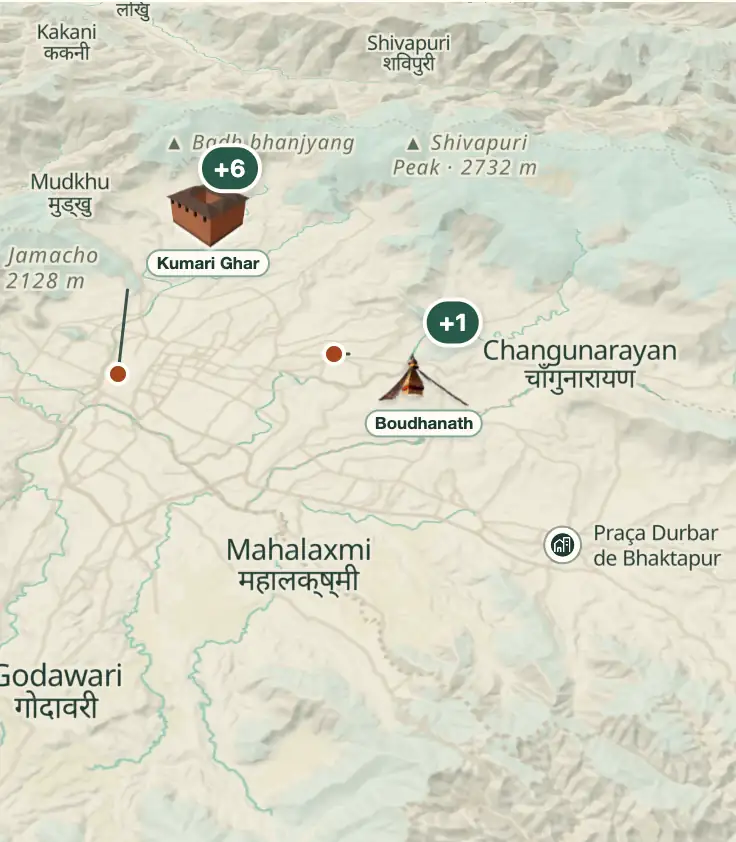
© OpenStreetMap · OpenFreeMap · © OpenMapTiles
Explore the map, read about the other places and plan your travel days in the app.
Open the appWhat to see
Kathmandu: the closed basin and the water outlet
The valley is an oval basin of about 665 km² at 1,300 to 1,400 m elevation, surrounded by four ranges that top 2,000 m (Shivapuri to the north, Phulchoki to the south, Nagarjun to the west, and Chandragiri to the southwest), with a single natural water outlet, the Chobhar gorge, through which the Bagmati flows south.
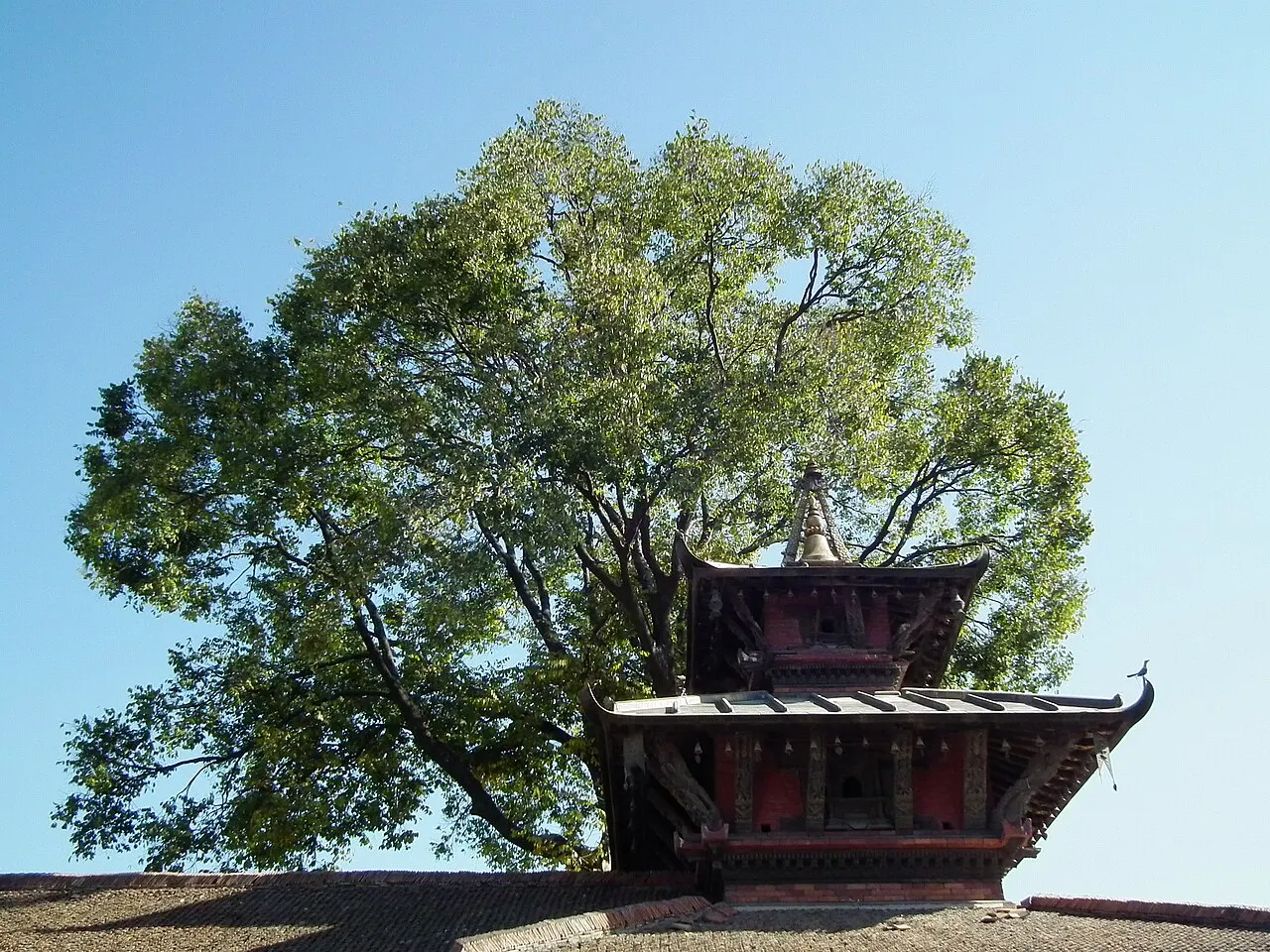
Kathmandu Durbar Square (Hanuman Dhoka)
Palace complex of the Malla and Shah kings, with more than 50 temples and courtyards, a UNESCO World Heritage Site since 1979. The gate has the statue of Hanuman covered in vermilion since 1672; the foreigner's admission costs Rs 1,000 and includes the Tribhuvan Museum, inside the palace.
The gate's statue is covered in vermilion.
Check access

Swayambhunath
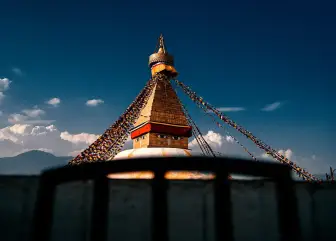
A stupa on a hill west of downtown, one of the valley's oldest Buddhist sites, documented since the 5th c. There are 365 stone steps up the east stairway to the eyes painted on the dome; the area has hundreds of rhesus macaques, and admission is about Rs 200.
Climbing from the east side brings you to the painted eyes on the stupa's dome, on the hill west of downtown, documented since the 5th century, while hundreds of rhesus macaques occupy the grounds. There are 365 stone steps.
Check access

Boudhanath
A stupa about 36 m tall, built on a mandala base about 100 m in diameter, one of the largest in the world, on the axis of the old trade route to Tibet. The dome cracked in 2015 and was rebuilt with funding from Buddhist communities, reconsecrated in November 2016; admission around Rs 400.
The stupa, about 36 m tall, on a mandala about 100 m in diameter on the old route to Tibet, has admission around Rs 400, and the dome, after cracking in 2015, was replaced with money from Buddhist communities before the new consecration in November 2016.
Check access
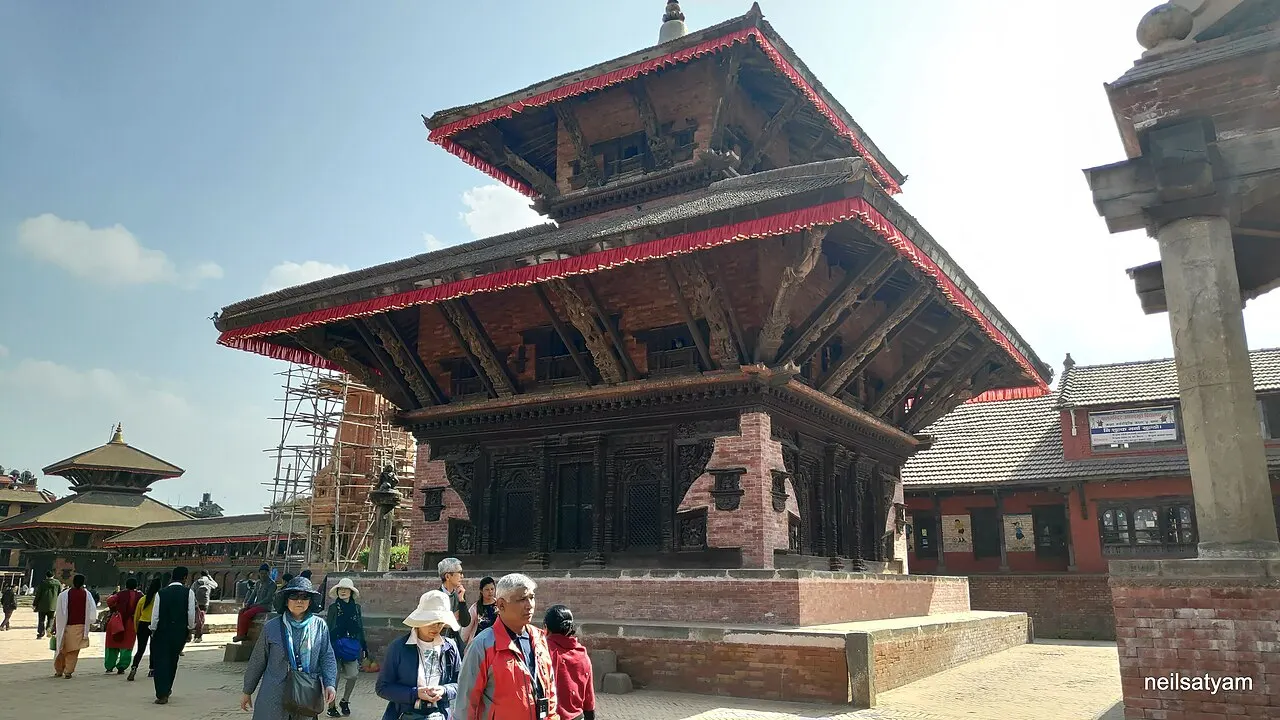
Bhaktapur Durbar Square and Nyatapola
A medieval ensemble of four connected squares, with the 1754 Golden Gate and the Palace of 55 Windows. A few steps away, the 1702 Nyatapola temple has five roofs and stands about 30 m: the tall building that fell in neither 1934 nor 2015.
The Nyatapola, from 1702, has five roofs and stands about 30 m tall. It was the tall building that didn't fall in 1934 or in 2015.
Check access

Kumari Ghar
A brick-and-wood house from 1757 where the royal Kumari lives, a Newar girl of the Shakya caste worshipped as a living goddess until puberty. She appears briefly at the courtyard window a few times a day; photographing the girl is forbidden, the courtyard isn't.
At the courtyard window you can catch a glimpse, throughout the day, of the Kumari, a Newar girl of the Shakya caste held to be a living goddess until puberty, in a wooden residence dating from 1757; photographing the girl is still forbidden.
Check access

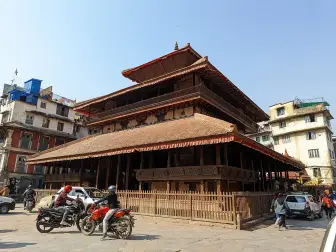
Kasthamandap
The wooden pavilion that gave the city its name, its base dated by excavation to the 7th c. It collapsed in 2015, killing dozens of people, and was rebuilt with traditional technique, reopening on April 4, 2022. The valley's most instructive piece on what restoration means here.
The base was dated by excavation to the 7th century, the structure collapsed in 2015 killing dozens, it was rebuilt again using the old craft, and the reopening came on April 4, 2022, and in the valley this is the most instructive example of what restoration means.
Check access
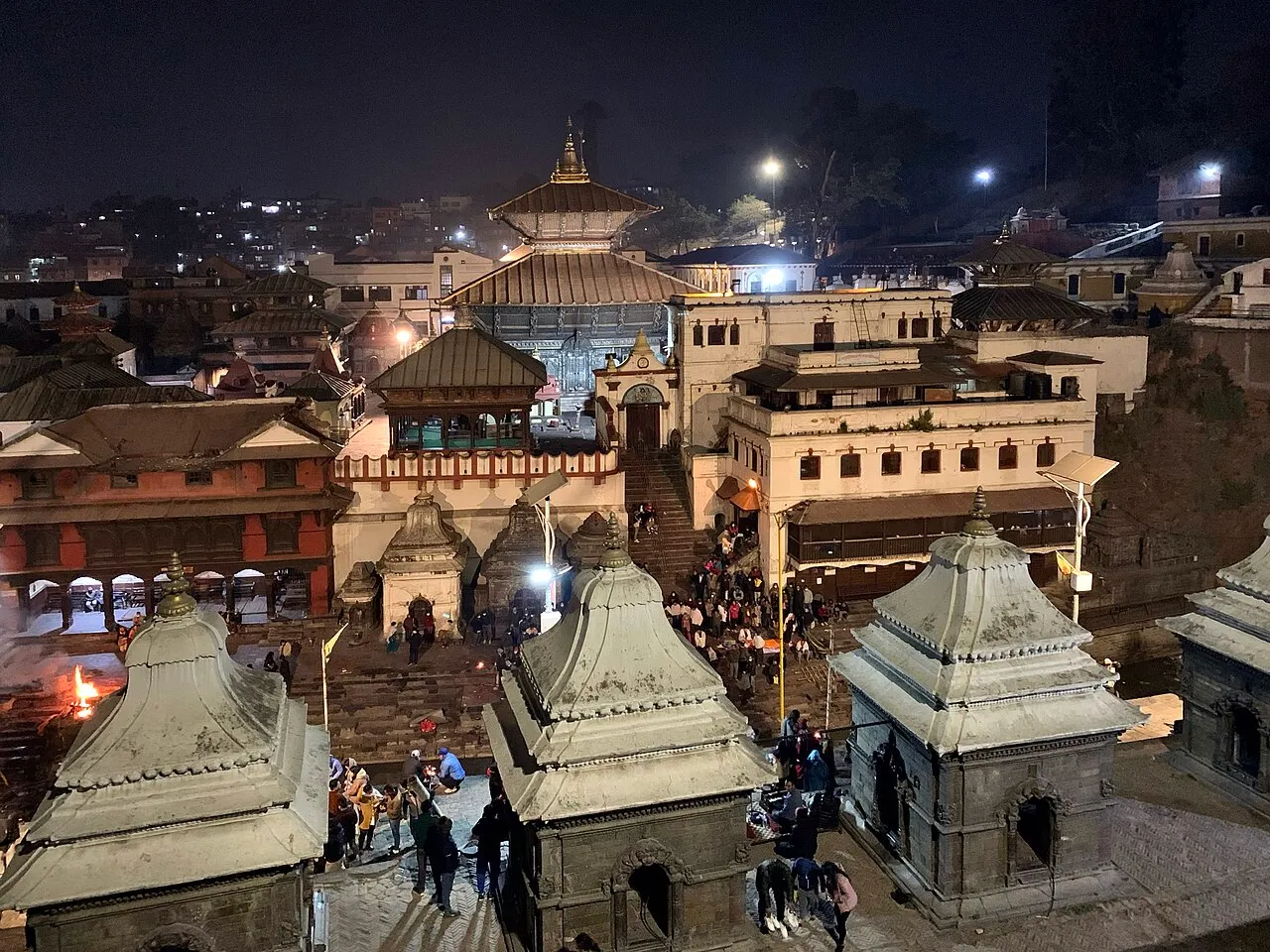
Pashupatinath
Nepal's largest Shiva temple, on the banks of the Bagmati, documented since the 5th c. with the current structure from 1692. The inner sanctum is off-limits to non-Hindus, but the open complex includes the Arya Ghat cremation grounds, the 15 shrines of Pandra Shivalaya, and the sadhus' forest; admission Rs 1,000.
It's Nepal's largest Shiva temple, with the current structure dating from 1692.
Check access

Patan Durbar Square
The most cohesive of the three royal squares, with the 21-shrine stone Krishna Mandir from 1637, and the Sundari Chowk courtyard with the royal bathing tank Tusha Hiti, from 1647. The Patan Museum, in the former palace, is the best museum of religious art in the Himalaya.
The 1637 Krishna Mandir gathers 21 shrines next to the Sundari Chowk courtyard, where the Tusha Hiti tank has stood since 1647, in the same complex as the museum. It's the best museum of religious art in the Himalayas.
Check access

Garden of Dreams (Swapna Bagaicha)
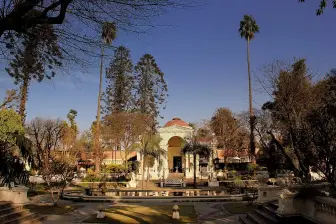
A 1920 neoclassical garden, built for Field Marshal Kaiser Shumsher Rana next to Thamel, restored with Austrian support and reopened in 2007. Half a hectare walled in, six pavilions dedicated to the seasons, and the only spot downtown where street noise disappears; entry around Rs 400.
Check access
Nilo’s itinerary
Start with the basic programme and choose extensions for the time you have.
Plan my days in the app ↗Day 1 · The old core, on foot
Start at 7am at Asan Tole, when the rice and flowers arrive; follow the old trade route on foot to Indra Chowk and the Seto Machhindranath temple.
Buy the ticket to Kathmandu Durbar Square and ask at the square's office, with a photo, for the free extension for the length of your visa.
Walk through Hanuman Dhoka, the Kasthamandap rebuilt in 2022, the Tribhuvan Museum, and the Kumari Ghar courtyard.
Have a Newar khaja set for lunch in Jhochhen (Freak Street) and walk down to Rani Pokhari, the 1670 tank returned to its historic design in 2020.
End the day at the Garden of Dreams, next to Thamel, and have momo for dinner at a local spot away from the bar circuit.
Day 2 · The three sacred sites
Climb the 365 steps of Swayambhunath before 8am, when locals do the morning circuit and the whole valley still shows from the viewpoint.
Take a ride-hailing car to Pashupatinath and walk along the east bank of the Bagmati: the 15 shrines of Pandra Shivalaya, the sadhus' forest and, across the river, the pyres of Arya Ghat.
Have lunch in Chabahil and walk 2 km to Boudhanath, entering through the stupa's main gate.
Do the kora clockwise in the late afternoon, when Tibetan residents make their rounds, and sit in on a chanting class at one of the nearby monasteries.
Have dinner on a rooftop with a view of the dome and head back by Pathao or InDrive, cheaper than a street taxi at night.
Day 3 · The other two royal cities
Cross the Bagmati to Patan early and set aside two hours for Durbar Square, the 1637 Krishna Mandir, and the Patan Museum.
Visit a lost-wax casting workshop in the Uku Bahal neighborhood and stop at Mahaboudha, the terracotta temple of a thousand buddhas.
Have lunch in Jhamsikhel and take a minibus or a ride-hailing car to Bhaktapur, 13 km east, a trip of 40 to 70 minutes.
Walk through Bhaktapur's four connected squares, the 1754 Golden Gate, the 1702 Nyatapola, and Pottery Square, with the potters' wheels running.
Eat a pot of juju dhau on the street and head back at dusk, before Koteshwor traffic locks up.



If you stay longer
Day 4 · Nagarkot
Day trip
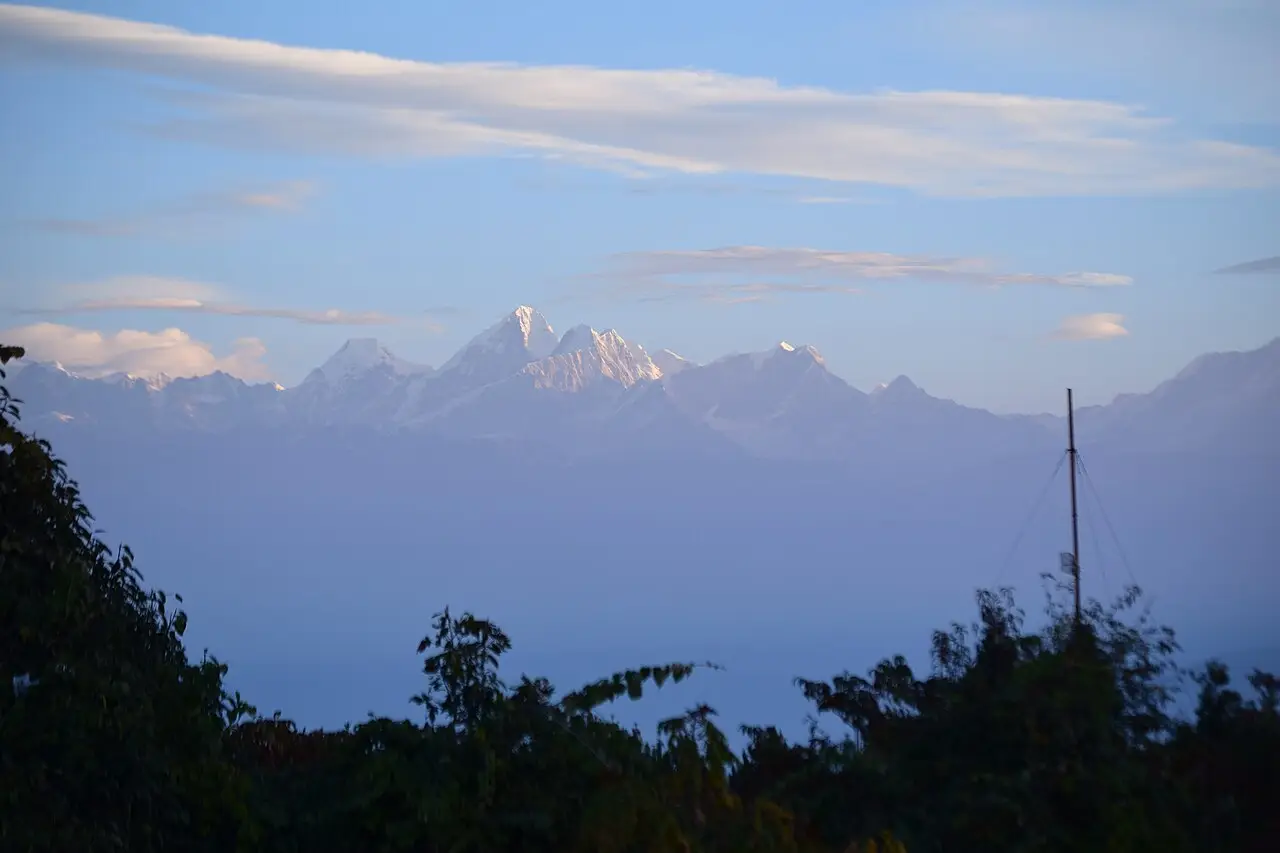
32 km northeast, 1 hour 30 minutes to 2 hours by car on the Bhaktapur road, at 2,175 m on the eastern rim of the valley. It's the classic sunrise lookout over Ganesh Himal, Langtang and Dorje Lakpa, with Everest visible in the distance on very clear days in October and November; you can walk down to Changunarayan in about 3 hours.
Food
 AI illustration
Momo
Steamed dumplings, filled with buffalo (buff), chicken or vegetables, served with tomato-and-chili achar. Ten pieces run Rs 150–350 at a local spot; the jhol momo variant comes submerged in a sesame-tomato sauce, and the kothey is pan-fried on one side.
 AI illustration
Dal bhat tarkari
Rice, lentil soup, vegetable curry, achar and sometimes meat, served on a metal tray with free refills. The phrase to decline more is “pugyo.” It costs Rs 200–400 at a neighborhood bhojanalaya and is the one meal in the country eaten twice a day, around 10am and 7pm.
 AI illustration
Samay baji and the Newar khaja set
A ritual Newar tray with beaten rice (chiura), fried soybeans, egg, ginger, black beans, a piece of meat and a glass of aila. It's the food of festivals and of the guthi, served year-round in the Newari eateries of Patan and Kirtipur.
 AI illustration
Choila and bara
Choila is buffalo grilled over coals and then seasoned with mustard, chili and smoking oil; bara is a thick black-lentil pancake, sometimes topped with an egg. Both are eaten in the afternoon, with chiura, and almost never at dinner.
 AI illustration
Sel roti
A ring of fermented rice dough, fried fresh, sweet, crisp outside and chewy inside. Sold in the morning from street trays in Asan and around temples, for Rs 20–50 apiece, and mandatory at Tihar.
 AI illustration
Juju dhau
Fermented buffalo-milk curd set in unglazed clay pots, a Bhaktapur specialty. The name means “king yogurt” in Newari. The clay absorbs the whey and leaves a firm texture; a pot costs Rs 60–150 and is eaten on the street, with a plastic spoon.
 AI illustration
Sekuwa and bhatmas sadeko
Sekuwa is marinated meat (goat, buffalo or chicken) grilled on a skewer over coals, served with chiura; bhatmas sadeko is fried soybeans with onion, lime and chili. They're Nepal's bar food, ordered along with drinks from around 5pm.
 AI illustration
Chiya, tongba and raksi
Chiya is black tea boiled with milk, sugar and sometimes cardamom, sold in a small glass for Rs 20–50 on any corner. At night, tongba is fermented millet served hot in a wooden tube topped up with hot water and sipped through a bamboo straw, a Limbu tradition from the east; raksi is a homemade spirit distilled from rice or millet.
Day trips

Bhaktapur
13 km to the east, 40 to 70 minutes by minibus or app depending on traffic. It's the best-preserved royal city in the valley, with a foreigner's admission of Rs 1,800 (about US$13), extendable for the length of your visa, and a historic center practically free of cars. It's worth spending a night to see the squares empty in the morning.
Nagarkot
32 km northeast, 1 hour 30 minutes to 2 hours by car on the Bhaktapur road, at 2,175 m on the eastern rim of the valley. It's the classic sunrise lookout over Ganesh Himal, Langtang and Dorje Lakpa, with Everest visible in the distance on very clear days in October and November; you can walk down to Changunarayan in about 3 hours.

Dhulikhel and Namobuddha
30 km east via the Araniko highway, 1.5 hours by car. Dhulikhel is a hillside Newar town with an open view of the mountain range; from there it's 3 to 4 hours of walking on a village trail to the Namobuddha monastery, one of the three great Buddhist sites in Nepal, with lunch served in the monastery's refectory.
Where to begin
The old core, on foot
Start at 7am at Asan Tole, when the rice and flowers arrive; follow the old trade route on foot to Indra Chowk and the Seto Machhindranath temple.
The three sacred sites
Climb the 365 steps of Swayambhunath before 8am, when locals do the morning circuit and the whole valley still shows from the viewpoint.
Money
The currency is the Nepalese rupee (NPR, Rs), pegged to the Indian rupee at 1.60 NPR = 1 INR, which in 2026 works out to about 140 NPR per dollar. It's a cash economy, and your pocket stays heavy the whole time: a tea costs Rs 20–50, a neighborhood dal bhat Rs 200–400, ten momos Rs 150–350, a plate at a Thamel tourist restaurant Rs 600–1,200, a large beer Rs 350–600, a simple guesthouse Rs 1,500–3,500 a night, and a mid-range hotel with breakfast Rs 4,000–9,000. Cards work at hotels, agencies and supermarkets, and almost never at a stall, taxi or temple. ATMs usually cap withdrawals at Rs 35,000 per transaction and charge about Rs 500 in local fees, on top of whatever your bank charges. In Thamel, exchange bureaus pay better rates than the airport and give a receipt, needed to convert rupees back on the way out. Tourist restaurants add 13% VAT and a 10% service charge to the bill; when that service charge is printed, no tip is needed. Where it isn't, rounding up is standard. QR payments (eSewa, Khalti, FonePay) dominate local commerce, but require a Nepali bank account and are rarely available to visitors passing through.
Getting there and around
Six kilometers that turn into an hour at peak time
Tribhuvan International Airport (KTM) is the valley's only international airport and sits about 6 km from Thamel, 20 minutes away off-peak and up to 1 hour in the late afternoon. Visas on arrival are issued at kiosks in the arrivals hall and paid only in dollars, so bring the bills and a photo from home. The prepaid taxi counter charges about Rs 900 to Thamel, with a surcharge of about Rs 100 after 9pm and 25% more if the car has air-conditioning. Outside the parking lot, the apps cost less: there's no Uber in Nepal, but Pathao, InDrive and Yango charge from Rs 100–200 by motorbike and Rs 300–600 by car within the center. Street taxis have meters that almost nobody turns on, so agree on the price before getting in.
Microbuses, Sajha buses and apps
Kathmandu has no metro or urban rail. Public transit is made up of microbuses and private vans, where the conductor shouts the destination out the window, plus electric Safa Tempos on some routes and the blue buses of the public cooperative Sajha Yatayat, which run on the Ring Road, on the Budhanilkantha–Lagankhel–Godawari line and on the Nagdhunga–airport link. Since April 14, 2026 there have also been night lines run with the city government. Fares range from Rs 20 to Rs 50 within the valley, paid in cash to the conductor, and there's no single ticket or integrated card. To find your way, use the name of the stop, like Ratna Park, Kalanki, Koteshwor and Lagankhel, which works better than an address. Inside the old core, walk, because the alleys are too narrow for cars; outside it, sidewalks are scarce and traffic drives on the left. Renting a motorbike costs Rs 1,200–1,800 a day, with a mandatory helmet. Since July 27, 2026, the Nagdhunga–Sisnekhola tunnel, the country's first road tunnel, about 2.7 km long, has removed much of the bottleneck on the western exit toward Pokhara.
Safety
Kathmandu's number-one risk is traffic, not crime: left-hand driving, motorbikes riding against the flow, sidewalks taken over, and crossings with no traffic light, in a valley where most accident victims are pedestrians and motorcyclists. Violent crime against foreigners is rare. What does exist is pickpocketing in crowds (Asan, Thamel at night, packed buses, festivals) and predictable scams: a “broken” meter, an improvised guide who charges afterward, a sadhu who offers a blessing and charges for the photo, an unregistered trekking agency that asks for full payment upfront. The monkeys at Swayambhunath and Pashupatinath steal food and open bags, and bite if you react; walk with empty hands. The city sits on an active seismic zone (1934, 2015), and it's worth locating, on the first night, the exit of the building where you're sleeping. In winter, air is the most concrete health issue: in January particulate levels regularly reach unhealthy ranges, and a filtered mask makes a real difference for anyone with asthma. General strikes (bandh) can still stop transport overnight without warning, and since the September 2025 uprising there are periodic political demonstrations in Maitighar and Baneshwor; they're localized and announced, and it's enough to route around them. Women traveling alone describe the city as calm by day; at night, prefer an app to an empty alley, especially outside the Thamel-Durbar Marg axis.
Etiquette tips
Shoes off; leather stays off too
Take off your shoes at the door of temples, inner courtyards and private homes. At Pashupatinath and several Hindu shrines, leather items (belt, bag, sandals) also have to stay outside.
The jutho rule
Food or drink that has touched your mouth, your plate or your spoon becomes impure for others. Don't offer your bottle or taste from someone else's plate: pour into a glass without touching the rim, and don't put back on the serving dish what's already gone onto your plate.
Right hand for everything
Hand over money, take change, eat and offer with your right hand. The left has a hygienic function and takes no part at the table or in offerings; for extra respect, hand things over with both hands.
Always clockwise
Circle stupas, temples and rows of prayer wheels keeping the monument on your right. It applies at Boudha, at Swayambhu and at any chorten in the middle of the sidewalk, and spin the wheels clockwise too.
Feet low; head always high
Don't point the sole of your foot at a person, an altar or an offering, don't step over someone sitting on the ground, and don't sit on a temple step with your legs stretched inward. The head is the most respected part of the body: don't pat anyone's head, not even a child's.
Cremation is not a spectacle to watch
At the Arya Ghat pyres, in Pashupatinath, the grieving family is a few meters away. Watch from the opposite bank of the Bagmati, without aiming a lens at faces, and decline the “blessing” from sadhus who ask for payment after the photo: agree beforehand or don't photograph.
Mistakes to avoid
Four distant points in one day
Scheduling four far-apart sights on the same day without counting traffic. 8 km within the valley take anywhere from 20 minutes to 1 hour 30 minutes depending on the time, and rush hour runs from 9am to 11am and from 4:30pm to 7:30pm.
No cash dollars for the visa
Arriving without cash dollars for the visa on arrival (US$30 to 125, depending on days). The card machines in the hall fail constantly, and the ATM fills up right when the flights land.
Thinking the Durbar squares are free plazas
Thinking the Durbar squares are public, free plazas. The foreigner's ticket is charged at the street entrance and runs between Rs 1,000 and Rs 1,800 per square, valid for one day, and in Kathmandu and Bhaktapur you can extend the pass for the length of your visa, free, by bringing a photo to the square's office the same day.
Tap water and salad
Drinking tap water, ice from a stall, or salad washed in untreated water. Use bottled, filtered or boiled water, and bring a reusable bottle, since there are refill stations at most Thamel guesthouses.
The trekking guide who approaches you on the street
Paying a “guide” who approaches you on the street upfront for trekking or a tour, or accepting a tika and red thread without asking the price. Book through a registered agency and confirm whether the trekking permit (TIMS and the park fee) is included.
Useful phrases
नमस्ते (namaste)
Hello and goodbye, with palms together at chest height; for more respect, “namaskar”
धन्यवाद (dhanyabaad)
Thank you: used much less than in English; a nod usually does
कति हो? (kati ho?)
How much does it cost? The question that opens any purchase outside a store with a price tag
मीठो छ (mitho chha)
It's delicious: said to the cook or the lady of the house after the first bite
पुग्यो (pugyo)
Enough, that's plenty: the phrase that stops the fourth round of dal bhat
फेरि भेटौंला (pheri bhetaunla)
See you again: the common farewell, since “goodbye” isn't really said
Districts
Thamel
About ten blocks of alleys closed to cars for much of the day, with trekking shops, exchange bureaus, agencies, bookstores and live-music bars. It's where arrivals base themselves, and the place where everything costs two to three times the Nepali price.
Basantapur and Jhochhen (Freak Street)
The royal palace square and the street that in the 1960s and 1970s housed the hippie trail. Today Jhochhen is a quiet street of cheap cafés and old guesthouses, a good alternative to Thamel for anyone who wants to sleep inside the old city.
Asan and Indra Chowk
The Newar market, running continuously for centuries, at the crossing of six streets on the old trade route to Tibet. Spices, rice, flower garlands, incense and brass utensils; it's the best place in the city to wander without a destination early in the morning.
Boudha
The neighborhood around the great stupa, northeast of downtown, formed by Tibetan refugees from 1959 onward and full of monasteries, thangka workshops, and rooftop cafés. At dawn and dusk the square fills with people doing the kora, the ritual clockwise circuit.
Patan / Lalitpur
A separate royal city until the 18th c., today contiguous with Kathmandu across the Bagmati. Concentrates lost-wax metalwork, the Patan Museum, and the valley's highest density of temples per square meter.
Jhamsikhel and Sanepa
South of Patan, an area of international organizations and the upper middle class, with the valley's priciest and least touristy restaurants, bars and cafés. It's where you eat non-Nepali food worth the price.
Lazimpat and Durbar Marg
An axis of embassies, large hotels, dealerships and offices, between Narayanhiti palace and the north. Wide streets, real sidewalks and little historic interest beyond the palace itself.
Bhaktapur
The third royal city, 13 km to the east, within the same valley. It kept the most intact medieval fabric of the three, with little traffic downtown, pottery workshops on Pottery Square, and the five-roofed, 30 m Nyatapola tower, raised in 1702.
History
4th–8th c. · The Licchavi valley
Nepal's oldest stone inscriptions, starting in 464, belong to King Manadeva. The Licchavis organize the valley into trading cities, mint coins, and raise the first great stupas.
c. 723 · Founding of Kantipur
Tradition credits the city's founding to King Gunakamadeva. The name Kathmandu comes from the Kasthamandap, the wooden pavilion on the palace square, whose excavation after 2015 dated its base to the 7th c.
1200–1482 · Unified Malla rule
The Malla kings govern the whole valley and sponsor the urban design of squares, courtyards and stone wells that still stands. Trade with Tibet, in salt, wool and gold, pays for the architecture.
1482 · Split into three kingdoms
With the death of Yaksha Malla, the valley splits into Kantipur, Patan and Bhaktapur. The three courts spend three centuries competing in temples, which is why there are three palace squares just a few kilometers apart.
1768 · Gorkha conquest
Prithvi Narayan Shah takes Kantipur on September 25, 1768, during the Indra Jatra festival, and makes it the capital of the kingdom he was unifying. It's the founding mark of modern Nepal.
1846–1951 · Rana regime
After the Kot massacre, in 1846, Jung Bahadur Rana reduces the king to a figurehead and installs a hereditary dynasty of prime ministers. The family builds white neoclassical palaces and keeps the country largely closed to foreigners.

1934 · The Nepal-Bihar earthquake
A quake of about magnitude 8.0 on January 15 kills roughly 8,500 people in the country and brings down much of the historic center, including the Dharahara tower. The 1930s rebuilding opens New Road, the city's first wide avenue.
1951–1990 · Opening and Panchayat
The fall of the Ranas in 1951 opens the country to the world; in the 1960s and 1970s Kathmandu becomes a stop on the hippie trail and Jhochhen street earns the nickname Freak Street. The partyless Panchayat regime lasts from 1960 to 1990.
1996–2008 · Maoist war and end of the monarchy
The Maoist conflict (1996–2006) pushes hundreds of thousands of people from the countryside into the valley and explains much of today's urban sprawl. On June 1, 2001 nearly the whole royal family is killed in Narayanhiti palace; on May 28, 2008 the monarchy is abolished.
2015 · Earthquake and federal constitution
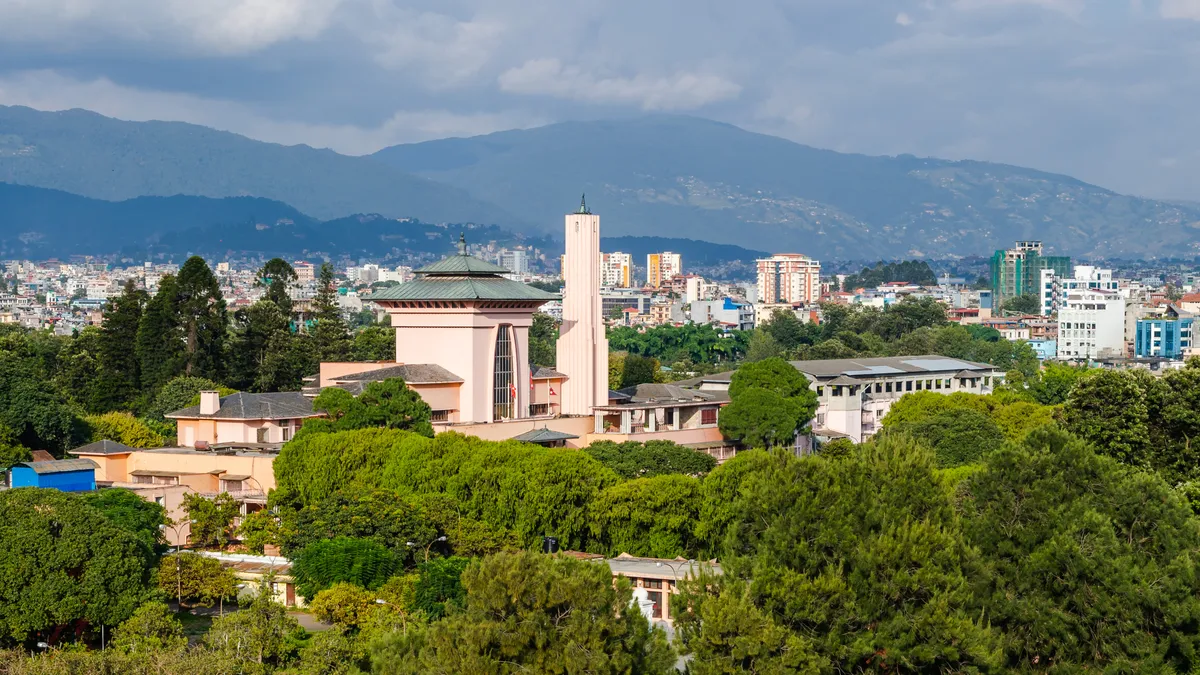
On April 25, 2015 a magnitude 7.8 quake kills about 9,000 people in the country and brings down monuments in all three palace squares. On September 20 Nepal promulgates the constitution making it a federal republic of seven provinces.

2025–2026 · Gen Z uprising and new election
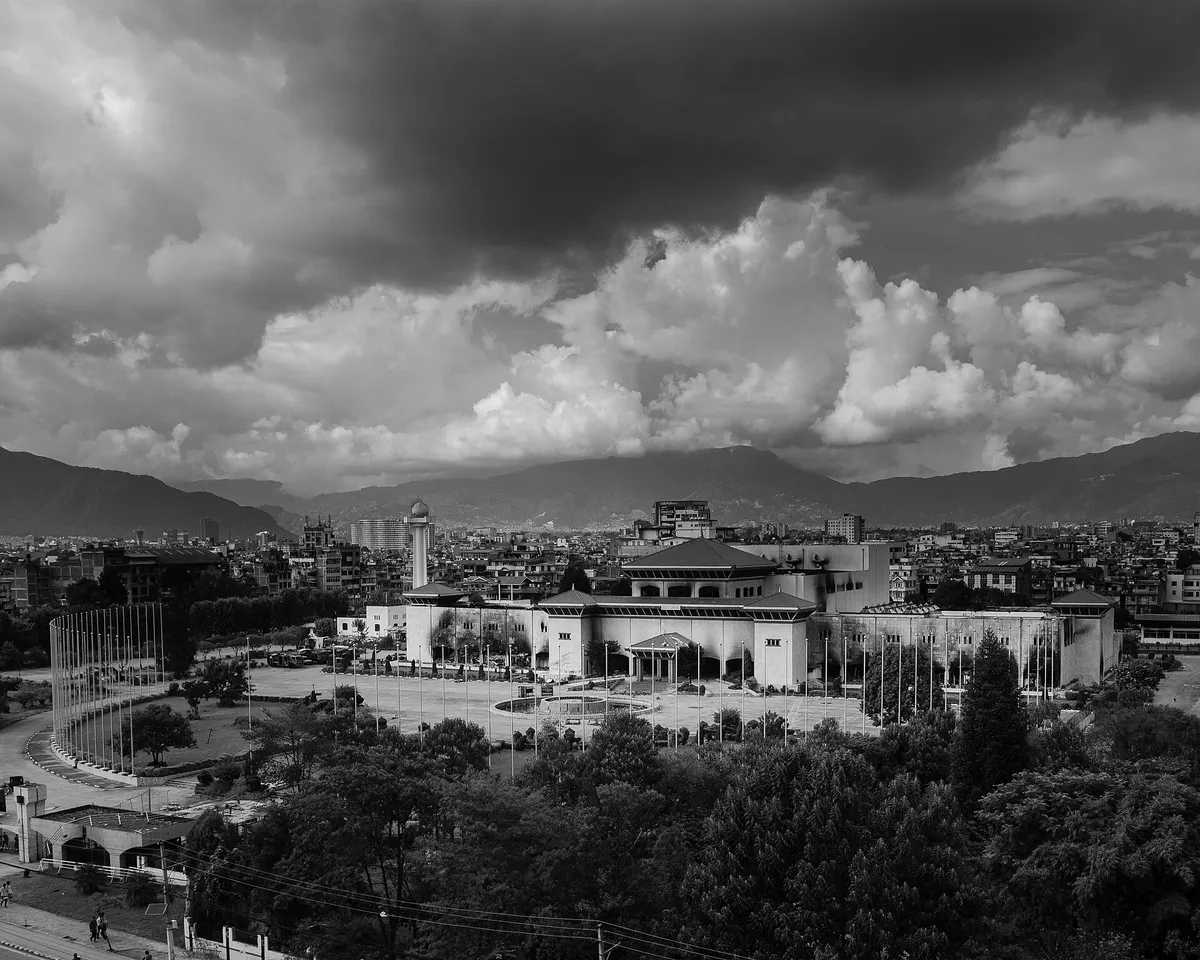
Between September 8 and 13, 2025, anti-corruption protests sparked by a social media ban leave more than 70 dead and set fire to public buildings, including Singha Durbar and parliament; Prime Minister KP Sharma Oli resigns and Sushila Karki takes over an interim government. In the March 5, 2026 election, the Rastriya Swatantra Party wins 182 of the 275 seats, and Balendra Shah, then mayor of Kathmandu, is sworn in as prime minister on March 27.
Complete history
The bed of a lake that dried up
The Kathmandu Valley is the bed of a lake that dried up. The geology confirms what the Buddhist legend already told: the bodhisattva Manjushri is said to have cut the hill at Chobhar with his sword to drain the water and free the land. The sediment from that lake is the most fertile soil in the mid-Himalaya, and that's why the valley sustained a population density impossible in the surrounding mountains. From the 4th c. onward, under the Licchavis, these villages become cities: Manadeva's inscriptions, from 464, already mention taxes, guilds and temples. What fixes the wealth, though, isn't agriculture but position. The valley is the bottleneck of one of the few practicable corridors between the Indian plain and the Tibetan plateau.
The Mallas turn the toll into a city
Between the 12th and 18th centuries, the Malla kings turned the revenue of the caravans that crossed the valley between India and Tibet into brick, wood and bronze. After 1482, the valley split into three rival kingdoms (Kantipur, Patan and Bhaktapur), and the competition among them explains why there are three palace squares that are nearly identical in function and completely different in detail, less than 15 km from one another. The work was carried out by the Newar community, with a system of occupational castes and hereditary community associations, the guthi, responsible for maintaining each temple, each well and each festival. The guthi is the key institution for understanding the city: it explains why the squares were preserved for centuries without a state, and why its erosion in the 20th century matches the decay of the historic center.
Prithvi Narayan Shah enters in 1768
On September 25, 1768, Prithvi Narayan Shah enters Kantipur during the Indra Jatra, while the court is distracted by the procession, and ends the Malla era. From then on Kathmandu stops being a valley capital and becomes the capital of a state stretching from the Terai to the Himalaya. In 1846, the Kot massacre hands real power to the Rana family, who rule until 1951 keeping the country closed: the first white palaces with Corinthian columns (Singha Durbar, Narayanhiti, Baber Mahal) date from this period and matter to today's city because many became a ministry, a museum or a shopping center. The 1934 earthquake destroys half of that ensemble, and the rebuilding opens New Road, the commercial axis that still cuts through downtown.
From the 1951 opening to the end of the Maoist war, in 2006
The 20th century compresses into the city everything Nepal did in eighty years. The 1951 opening brings international aid, an airport and roads; the 1960s and 1970s bring the hippie trail to Jhochhen; the Panchayat (1960–1990) centralizes jobs and schools in the capital; and the Maoist war from 1996 to 2006 dumps hundreds of thousands of displaced people from the countryside into the valley. The municipality's population triples in one generation, the 27 km Ring Road, built with Chinese aid in the 1970s to bypass the city, is swallowed by it, and the rice paddies between Kathmandu and Patan disappear under five-story concrete buildings built without seismic code. On June 1, 2001, the massacre of the royal family at Narayanhiti wrecks the monarchy's prestige, which is abolished on May 28, 2008.
The 2015 earthquake, reconstruction and the 2025 uprising
The earthquake of April 25, 2015 left about 9,000 dead across the country, more than 600,000 homes destroyed and entire monuments on the ground. Reconstruction was slow, but real and visible. Kasthamandap reopened on April 4, 2022, rebuilt with traditional techniques; Dharahara was rebuilt in concrete in 2021 next to the rubble of the 1832 original; Rani Pokhari was restored in 2020 to its historic design, after a public dispute over concrete versus brick. Politics, however, stayed stuck, and in September 2025 a social media ban sparked a youth uprising that left more than 70 dead and burned Singha Durbar and parliament. The March 5, 2026 election gave 182 seats to the Rastriya Swatantra Party, and Balendra Shah, a rapper, civil engineer and mayor of Kathmandu since 2022, known for demolishing illegal structures on sidewalks and riverbeds, took office as prime minister on March 27. Anyone arriving in 2026 sees both processes at once: restored historic facades and government buildings still covered in construction fencing.
The hill of Chobhar, which according to legend Manjushri cut with his sword to drain the valley's lake, is also the only natural outlet for water, where the Bagmati flows south.
On the same street, on the same day, there's a restored facade on one side and construction tarps on the other.
Geography and shape of the city
The closed basin and its water outlet
The valley is an oval basin of about 665 km² at an altitude of 1,300–1,400 m, ringed by four ranges that top 2,000 m (Shivapuri to the north, Phulchoki to the south, Nagarjun to the west and Chandragiri to the southwest), with a single natural outlet for water, the Chobhar gorge, through which the Bagmati drains south. That closed basin explains two things about daily life: the dry winter traps pollution under a thermal inversion layer, and the lakebed sediment amplifies seismic waves, which is why the 1934 and 2015 earthquakes were so destructive here and less so on the slopes.
The urban grid has three layers
The urban fabric has three overlapping layers: the medieval Newar core, a maze of brick alleys organized around internal courtyards (bahal and chowk) facing squares with stone wells and pagoda temples; the Rana and post-1951 belt, with straight avenues like New Road and Durbar Marg; and the post-1990 periphery, made of four-to-six-story concrete houses, built over former rice paddies and linked by roads with no sidewalk.
A ring turns into an internal axis
The 27 km Ring Road circles the whole and today is an internal axis; it is not an edge. The city has grown flush against Lalitpur to the south, with no visible break except the Bagmati river.
Culture
The material culture is Newar
The city's material culture is Newar before it is Nepali. The Newar community, which speaks Nepal Bhasa and is Hindu and Buddhist at once with no apparent contradiction, produced the carved wooden windows, the tiered pagoda roofs, the lost-wax bronze casting of Patan and thangka painting, techniques still practiced commercially today, above all in the workshops of Patan and Boudha. The calendar is run by hereditary community associations, the guthi, which maintain temples and fund festivals; the Kumari, a girl chosen as a living goddess, is the most visible expression of this system. Almost every active temple has access rules worth knowing: many Hindu shrines admit only Hindus, while Buddhist courtyards and stupas are open to all.
Hip-hop, folk rock, film and festivals
The city produces popular culture at its own pace. Nepali-language hip-hop, born in Kathmandu in the 2000s, was so central that rapper Balendra Shah became mayor in 2022 and prime minister in 2026; folk-rock bands like Nepathya fill stadiums; and the live music scene concentrates in the bars of Thamel and Jhamsikhel. Nepali commercial cinema reinvented itself starting with “Loot” (2012), shot on the city's streets, and the festival circuit is solid: Jazzmandu has run since 2002 in October or November, the Kathmandu International Mountain Film Festival since 2000 in December, and the Nepal Literature Festival brings together authors writing in Nepali and English. Diaspora English-language literature (Samrat Upadhyay, Manjushree Thapa) describes exactly the middle class that occupies these spaces.
Cricket has overtaken soccer
In sport, cricket has overtaken soccer in audience since the Nepali national team entered international tournaments: the Mulpani and Tribhuvan University stadiums fill on match day and the city follows along on big screens in bars. Soccer holds on at Dasharath Stadium, in Tripureshwor, renovated after 2015. Nightlife ends early by Asian standards: bars in Thamel and Jhamsikhel generally close between midnight and 1am, and the same goes for restaurants, which tend to serve their last order around 10pm.
Almost every active temple has an access rule; check before you climb the first step.
Festivals and events
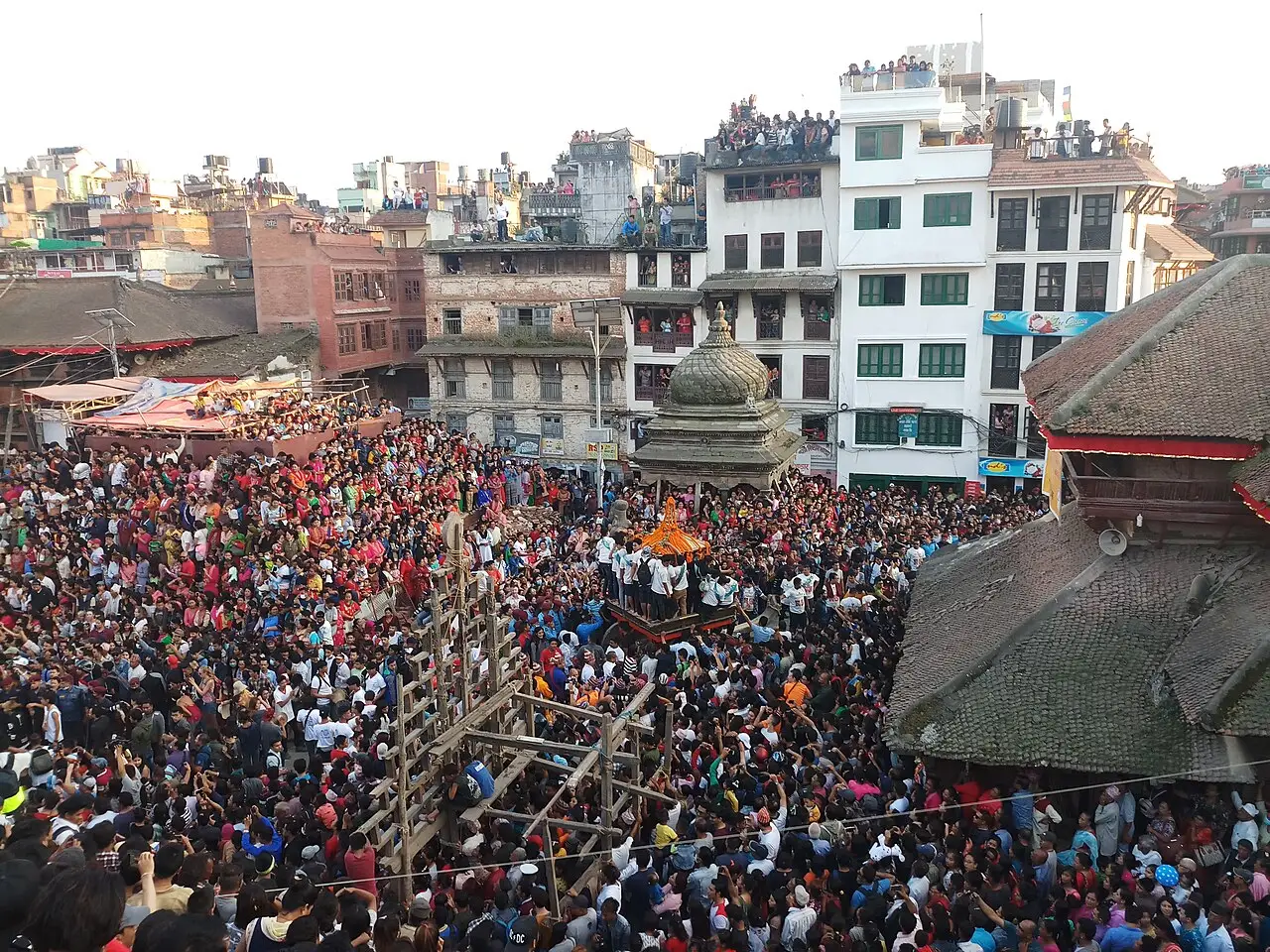
Indra Jatra (Yenya)
Eight days in August or September, by the lunar calendar. The ceremonial yosin pole is raised in Basantapur, Lakhey masked dancers move through the alleys, and the Kumari is pulled through the city on a chariot. It was during this festival that Prithvi Narayan Shah took the city in 1768.
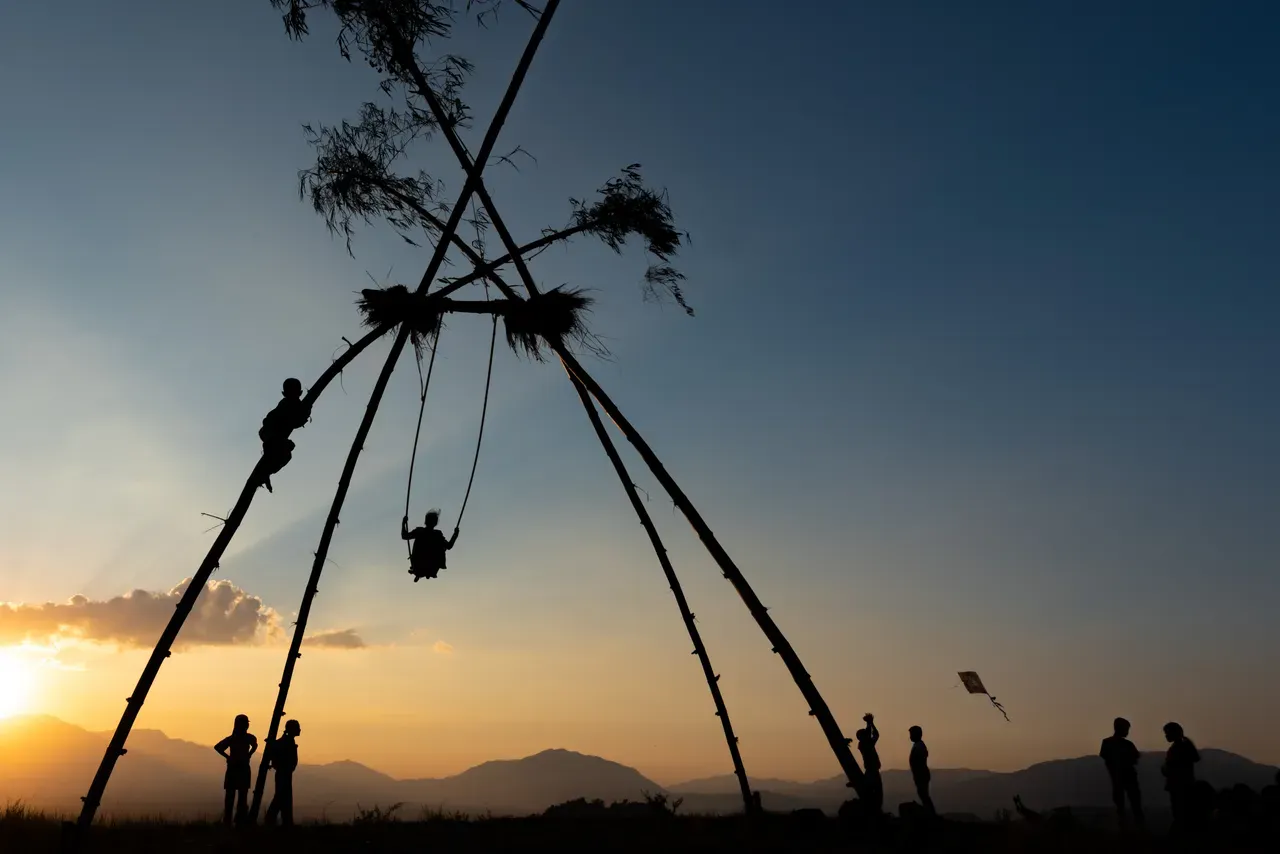
Dashain
Fifteen days on the lunar calendar, running from October 11 to 25 in 2026, in the biggest festival of the Nepali Hindu calendar. The city empties out because people who live here go back to their home villages: shops close for up to a week, buses and domestic flights fill up and bamboo swings (ping) appear on empty lots.

Tihar (Deepawali)
Five days in October or November, with one day dedicated to the crow, one to the dog, one to the cow, one to Laxmi, and the last, Bhai Tika, to siblings. Rows of oil lamps on doorsteps, colored-powder mandalas at doors, and groups of children singing deusi-bhailo door to door for sweets and coins.

Bisket Jatra
Nine days around April 14, the Nepali New Year, mainly in Bhaktapur and Thimi. Two heavy processional chariots are pulled by crowds in a tug-of-war through the narrow streets, and a 25 m pole is toppled by hand to mark the turn of the year.

Fagu Purnima (Holi)
A full-moon day in March, with colored powder and water thrown in the streets: Kathmandu celebrates it one day before the Terai does. It concentrates in Basantapur and Thamel from midday on; if you don't want to take part, avoid going out with a backpack and no rain cover.
Books and films
“Kathmandu” by Thomas Bell (2014)
Reportage and history in one volume: the author lived fifteen years in the city and links the unplanned urban sprawl to the collapse of the guthi system, the Maoist war, and the international aid economy. It's the single best book on why the city looks the way it does.
“Arresting God in Kathmandu” by Samrat Upadhyay (2001)
Middle-class short stories from the 1990s, set inside apartments rather than the squares: arranged marriage, tight money, desire and temple in the same block. It shows the city the monuments hide.
“Loot” by Nischal Basnet (2012)
The film that reinvented Nepali commercial cinema: a heist told in Kathmandu slang, shot on real locations like Kalanki, the Ring Road and the bars of Thamel. It spawned a 2017 sequel and a whole generation of directors.
Frequently asked questions
Kathmandu: do I need to bring cash dollars for the visa?
Yes: the visa on arrival (US$30 to 125, depending on the days) is paid only in dollars. The arrivals-hall card machines fail all the time, and the ATM gets packed right when flights land.
Kathmandu: how do you get from the airport to Thamel?
The arrivals-hall prepaid taxi counter charges about Rs 900 for the 6 km to Thamel, plus about Rs 100 after 9pm. Walking just outside the parking lot, the ride runs Rs 300 to 600 by app (Pathao, InDrive, and Yango).
Kathmandu: what's the currency, and what's it worth?
The currency is the Nepali rupee (NPR, Rs), pegged to the Indian rupee at 1.60 NPR = 1 INR, which in 2026 works out to about 140 NPR to the dollar.
Kathmandu: what's the best time to go?
October and November are the best time: the monsoon is over, the air is the cleanest of the year, and the mountain range is visible on haze-free mornings.
Kathmandu: can leather items go into temples?
At Pashupatinath and at several Hindu shrines, no: leather belts, bags, and sandals stay outside, along with your shoes.