Peru
Paracas
Paracas and Huacachina: bird islands, a seaside desert and dunes in the Ica valley
Days Start with the basic programme and choose extensions for the time you have.
How the guide reaches this number
The first is for Paracas: a boat to the Ballestas Islands in the morning, passing the Candelabra, and in the afternoon the reserve's northern circuit, with the interpretation center, the Museo Julio C. Tello, Playa Roja, the Catedral and a dip at La Mina, remembering the museum is closed on Mondays. The second is for the Ica valley: the regional museum, a pisco bodega and the Huacachina oasis, with buggy and sandboard on the dunes until sunset; anyone continuing south can sleep there. With a third day, I'd add the flight over the Nasca Lines from the Pisco airport or half a day at Tambo Colorado, the Inca adobe site in the Pisco river valley. I'd skip staying only in the village: the reason for the trip lies in the sea and the desert around it.
2–3
When December to April; it is summer, with sunnier days and a more inviting sea, but also with crowded weekends and holidays.
How the guide reaches this number
The reserve receives visitors all year, and from June to October days tend to bring fog and a colder wind.
December to April; it is summer, with sunnier days and a more inviting sea, but also with crowded weekends and holidays. The reserve receives visitors all year, and from June to October days tend to bring fog and a colder wind.
Per person/day Budget around PEN130; mid-range around PEN294; comfortable around PEN591 per person per day, based on spending reported by travelers to Budget Your Trip (checked October 2026).
How the guide reaches this number
Indicative figures, excluding travel to the destination.
Budget around PEN130; mid-range around PEN294; comfortable around PEN591 per person per day, based on spending reported by travelers to Budget Your Trip (checked October 2026). Indicative figures, excluding travel to the destination.
Per person per day: accommodation, meals, urban transport, visits and a small allowance for extras. Flights excluded; larger purchases vary. Editorial estimate, not a quote.
 What Nilo thinks
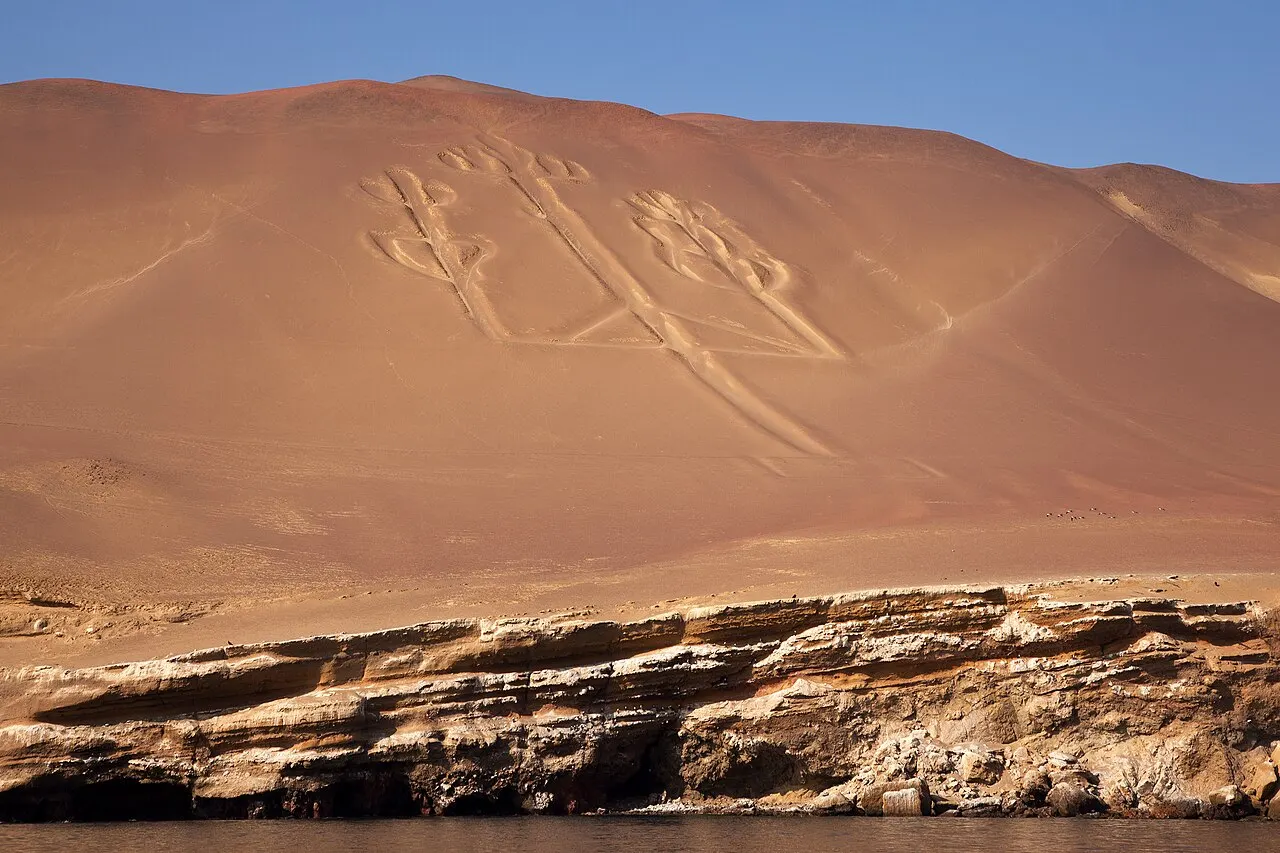
I'd stay two days. The first is for Paracas: a boat to the Ballestas Islands in the morning, passing the Candelabra, and in the afternoon the reserve's northern circuit, with the interpretation center, the Museo Julio C. Tello, Playa Roja, the Catedral and a dip at La Mina, remembering the museum is closed on Mondays. The second is for the Ica valley: the regional museum, a pisco bodega and the Huacachina oasis, with buggy and sandboard on the dunes until sunset; anyone continuing south can sleep there. With a third day, I'd add the flight over the Nasca Lines from the Pisco airport or half a day at Tambo Colorado, the Inca adobe site in the Pisco river valley. I'd skip staying only in the village: the reason for the trip lies in the sea and the desert around it.Paracas brings together on one trip things that rarely appear side by side. From the calm bay of El Chaco, a boat takes you in under an hour to the Ballestas Islands, where sea lions rest on the rocks and Humboldt penguins and colonies of guano birds fill the cliffs, fed by the cold water of the Humboldt Current. On the way is the Candelabra, a 170-meter figure scratched into a slope that only reveals itself from the sea. On land, the peninsula is desert, but it holds the cemeteries of the Paracas culture, which more than 2,000 years ago embroidered textiles of great refinement, and red-sand beaches below cliffs. And an hour inland, the Ica valley trades the sea for the pisco vineyards and the dunes around the Huacachina lagoon.
Quick facts
- Population
- 5,799 inhabitants in the Paracas district in the INEI 2025 National Census (7,516 in the 2017 census), according to the City Population compilation. Almost the entire population lives in El Chaco and the small settlements around the bay.
- Founded
- The peninsula was the center of the Paracas culture, from about 700 BCE to 200 CE; the district was created by Law 11,597 of 1951, and the Paracas National Reserve on September 25, 1975.
- Country and region
- Peru, Ica department, Pisco province. Huacachina is in the neighboring province of Ica.
- Language
- Spanish.
- Currency
- Peruvian sol (PEN, symbol S/).
- Time zone
- America/Lima: UTC−5 year-round, no daylight saving time.
- Best time to visit
- December to April; it is summer, with sunnier days and a more inviting sea, but also with crowded weekends and holidays. The reserve receives visitors all year, and from June to October days tend to bring fog and a colder wind.
- Average daily cost
- Budget around PEN130; mid-range around PEN294; comfortable around PEN591 per person per day, based on spending reported by travelers to Budget Your Trip (checked October 2026). Indicative figures, excluding travel to the destination.
When to go
December to April; it is summer, with sunnier days and a more inviting sea, but also with crowded weekends and holidays. The reserve receives visitors all year, and from June to October days tend to bring fog and a colder wind.
How the year changes
The Paracas coast is desert, and rain barely counts: the variation that matters is sun, fog and wind. From December to April, summer brings sunnier days, with highs of about 30 °C in February and March, and the sea is more inviting at La Mina; from January to March and on holidays, agencies add an extra Ballestas departure at noon, and the New Year and Semana Santa holidays fill the village. From June to October, days tend to start with fog and the wind chills the afternoon, and episodes of the paracas wind, which lift sand and reduce visibility, are more frequent; the visit is still possible, with a jacket. SERNANP recommends the reserve year-round. In any month, the Ballestas call for the morning, because the sector only receives boats until 1 p.m., and long weekends, such as the Fiestas Patrias of July 28 and 29, fill hotels and boats.
Nilo's tips
The Ballestas call for the first half of the day
I'd book the 8 a.m. boat: the sector only receives boats until 1 p.m., and an early departure leaves slack if the swell delays boarding.
Set aside cash for three charges
I'd bring soles in cash for the pier: the tour goes to the agency, but the SERNANP fee and the boarding fee are paid separately. If the reserve is also in the plan, I'd ask for the promotional fee of S/17 per adult, which covers both areas.
Monday is a no-museum day
I wouldn't plan the day I want to see the museums for a Monday: the reserve is open, but the Museo Julio C. Tello and the Museo Regional de Ica run Tuesday to Sunday.
A layer in the desert
I'd bring a light jacket even in summer. On the boat and at the afternoon viewpoints, the south wind chills, and from June to October mornings tend to have fog.
Dunes late in the day
I'd leave the buggy and sandboard at Huacachina for the middle of the afternoon, so the tour ends at sunset, and I'd schedule that day after the Ballestas day, which starts early.
Explore the map
Explore the map, read about the other places and plan your travel days in the app.
Open the appWhat to see

Islas Ballestas
Three rocky islands (Norte, Centro and Sur) in open sea, protected by the Reserva Nacional Sistema de Islas, Islotes y Puntas Guaneras. The visit is by boat only, with a tour operator, and without landing: the boat skirts arches and cliffs covered in guano, where you can see sea lions, Humboldt penguins, pelicans, boobies and guanays. According to SERNANP, the round trip from Paracas is 21.4 km and takes about 1 hour 40 minutes, and the sector receives visitors from 6 a.m. to 1 p.m. The tour sold by agencies does not include the SERNANP fee or the boarding fee charged at the pier; the SERNANP page lists S/11 for Peruvian adults and S/3 for minors aged 5 to 16, with no line for foreigners, so confirm the amount on Tu Ticket or at the pier. A life jacket is required, and departures can be delayed or suspended in rough seas.
Check access
Reserva Nacional de Paracas
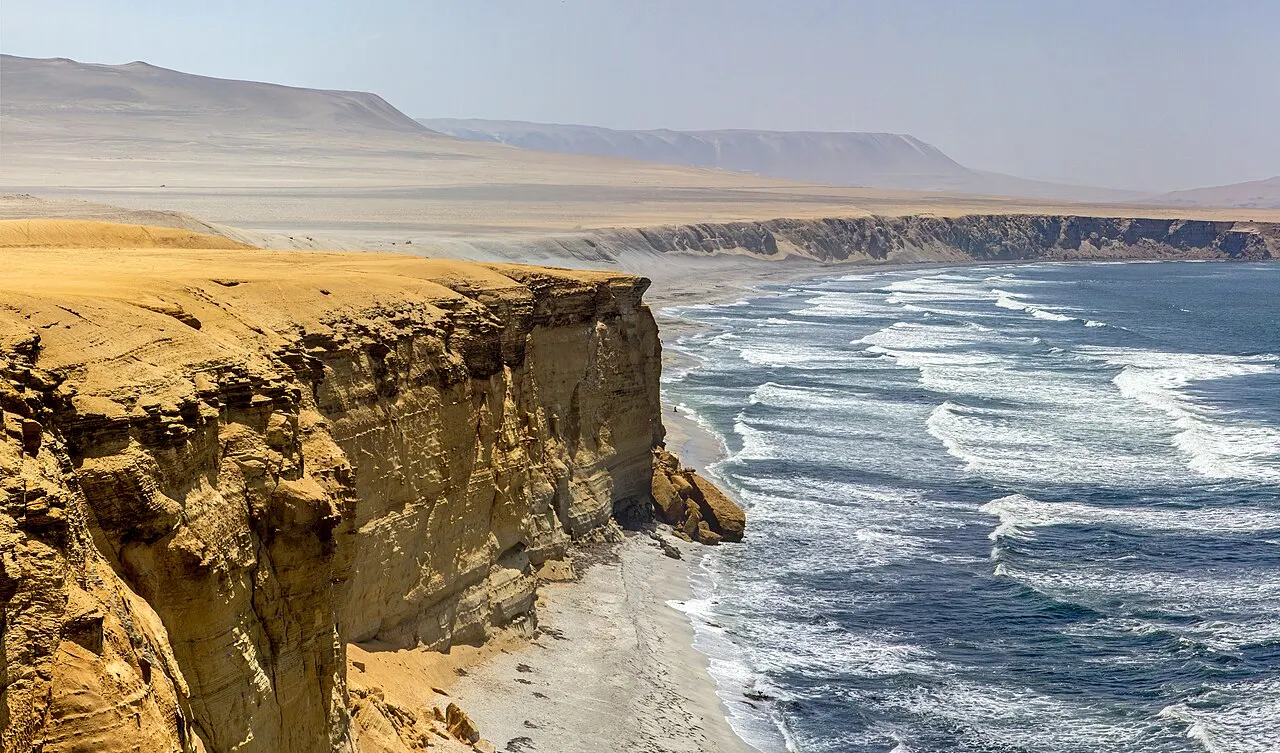
The protected area covering the peninsula and the sea around it, with 335,000 hectares, created in 1975 and recognized as a Ramsar site. SERNANP records 216 species of birds, 36 of mammals and 168 of fish. The entrance is at the Santo Domingo control post, every day from 9 a.m. to 4 p.m., where visitors register and pay the fee (S/11 on the general one-day fee; S/17 per adult on the promotional fee that also covers the Ballestas). The northern circuit is 26 km and takes 4 to 6 hours; many people do it on an organized tour, and SERNANP also describes access by bicycle or quad bike. Pets are not allowed. On the beaches, according to the rules published by Andina in 2023, drinking alcohol and eating any food is prohibited, overnight camping is restricted and grills are allowed only at Yumaque. Farther south are remote beaches such as Mendieta, outside the northern circuit and with no access rule published by SERNANP.
Check access

Playa Roja
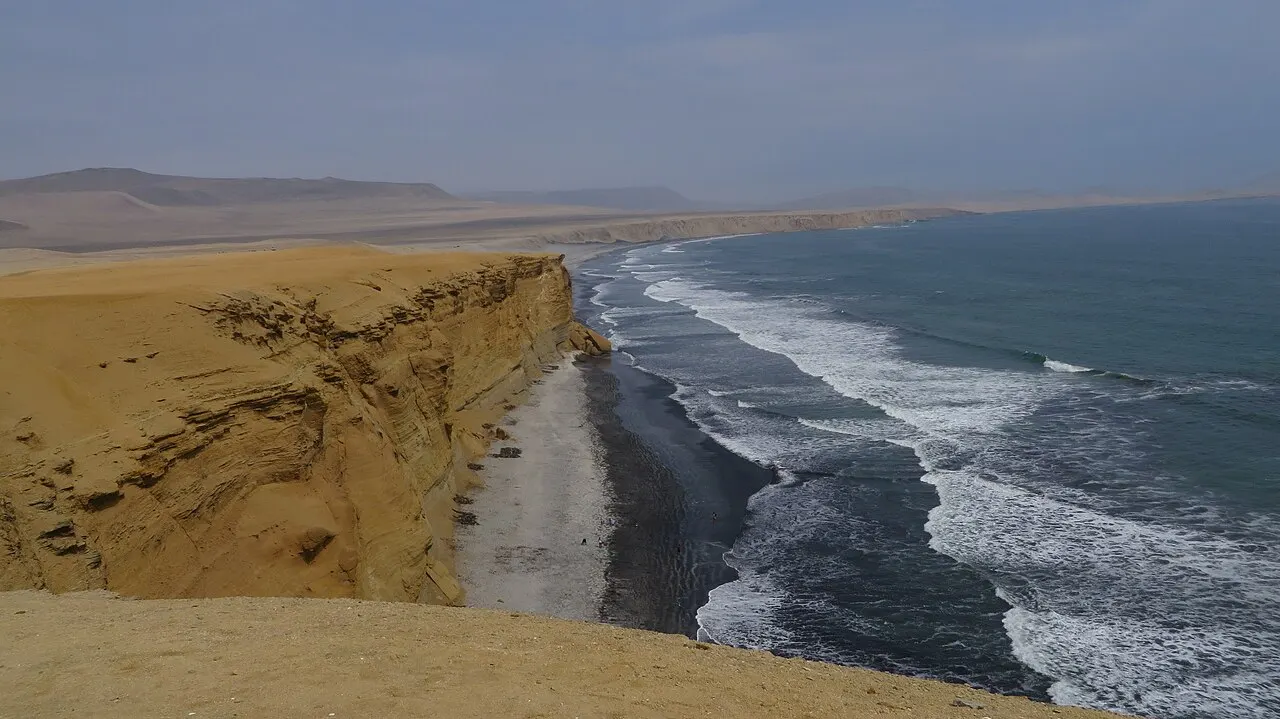
The reddish-sand beach on the northern circuit, seen from a viewpoint at the top of the cliff. The color comes from rock fragments of the neighboring Punta Santa María massif, which the waves wear down and deposit at the water's edge; the contrast with the sea and the golden dunes led the Spanish edition of National Geographic to include it, in 2025, among the seven natural wonders of South America. The visit is made from the viewpoint.
Check access

Huacachina
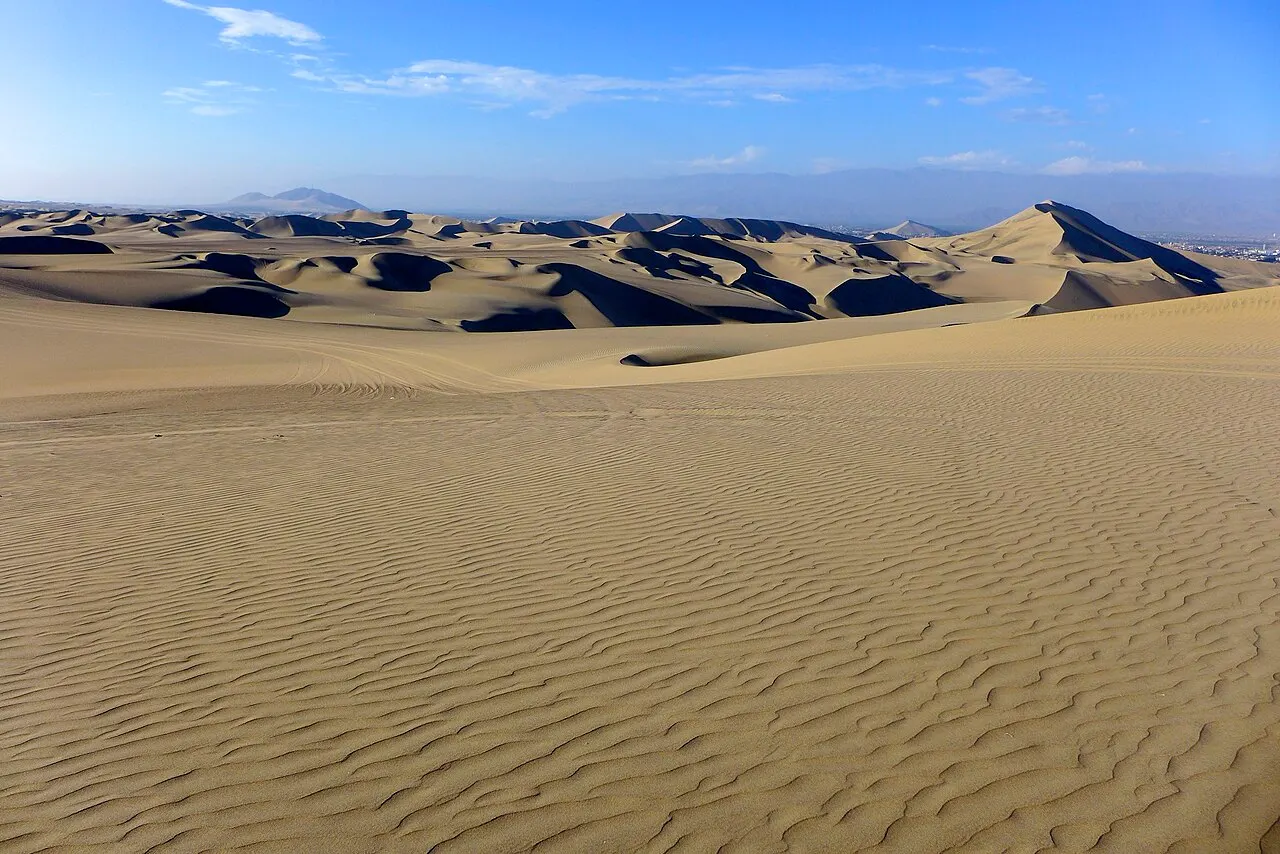
A greenish lagoon ringed by palms, eucalyptus and huarangos amid the dunes, 5 km from Ica, with a promenade, hotels and restaurants around it. The water used to rise from underground springs; with the fall of the water table, local businesspeople have pumped water into the lagoon since 2015. Besides walking around it and watching the sunset from the top of the dunes, you can rent a boat on the lagoon. The oasis was printed on the back of the 50 nuevos soles note issued in 1991.
Check access
Área de Conservación Regional Laguna de Huacachina
The dunes around the oasis, protected since 2014 in an area of about 2,458 hectares managed by the regional government of Ica. This is where the buggy tours (the areneros) and sandboard runs start, booked at the agencies on the promenade or in Ica. Ask for a seat belt and a helmet, and ask how much of the tour is actually on the dunes.
Check access
Candelabro de Paracas
A geoglyph about 170 meters long carved into a sandy slope on the north face of the peninsula, facing the sea. Its origin is still debated: pottery found nearby has been linked to the time of the Paracas culture, and the figure is often compared to the Nasca Lines. It was declared Cultural Heritage of the Nation. There is no tourist access by land: the Ballestas boats usually stop in front of it on the way out.
Check access
Centro de Interpretación de la Reserva Nacional de Paracas
A SERNANP information hall 2 km from the control post, recommended before heading out on the circuit: it explains the Humboldt Current, the wildlife and visitor etiquette. Entry requires the reserve ticket. Next to it are the plaza with display panels built by Mincetur and the birdwatching viewpoint facing the bay, where flamingos tend to appear.
Check access
Museo de Sitio Julio C. Tello
The museum of the Paracas culture, on the peninsula's isthmus, inside the reserve where Julio C. Tello excavated the Paracas cemeteries. The reddish concrete building, reopened in 2016 after the 2007 earthquake, has nine permanent rooms; according to Andina and Wikipedia, the exhibition brings together pottery, textiles, funerary bundles, trepanned skulls and the re-creation of a cave-type tomb. It is open Tuesday to Sunday, 9 a.m. to 5 p.m.; adult admission costs S/7.50, separate from the reserve fee. Since the reserve entry hours run from 9 a.m. to 4 p.m., get to the museum within them.
Check access
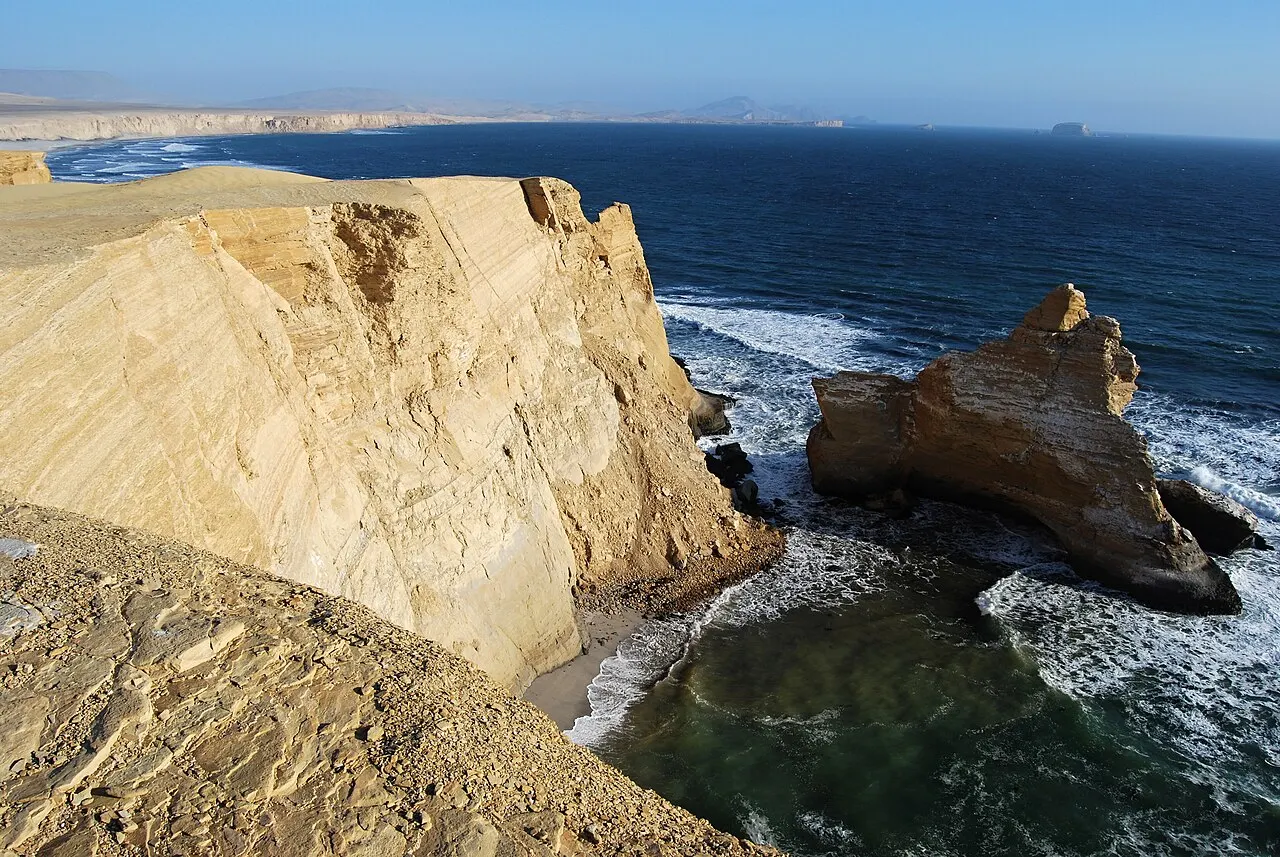
Mirador La Catedral
A viewpoint over what remains of the Catedral, the sea-carved rock formation whose arch collapsed in the earthquake of August 15, 2007. Today you see an isolated rock in front of the cliff, with seabirds, and the viewpoint helps in understanding the shape of the open coast. Anyone who has seen old photos should adjust their expectations: the arch no longer exists.
Check access
Nilo’s itinerary
Start with the basic programme and choose extensions for the time you have.
Plan my days in the app ↗Day 1 · Ballestas Islands in the morning and the reserve's northern circuit in the afternoon
Get to the El Chaco pier before the departure set by the agency (the best sellers are at 8 a.m. and 10 a.m.), with cash for the SERNANP fee and the boarding fee; if the reserve is also in the plan, ask for the promotional fee of S/17 per adult, which covers both areas.
On the boat, watch for the Candelabra on the way out and the sea lion and bird colonies at the Ballestas; the whole tour, round trip, takes about 1 hour 40 minutes.
Continue by tour, taxi or bicycle to the Santo Domingo control post, register and visit the Centro de Interpretación and the bay's birdwatching viewpoint; with the 10 a.m. boat the day gets tight, and it is worth choosing between the museum and the swimming beaches.
Visit the Museo de Sitio Julio C. Tello, on the isthmus (Tuesday to Sunday, 9 a.m. to 5 p.m.), before continuing to the viewpoints; if it is a Monday, swap this stop for the Ica museum the next day.
Take in the viewpoints of the Catedral, Playa Supay and Playa Roja and, if you want to get in the sea, stop at La Mina or Yumaque, remembering that eating is not allowed on the beaches; have your snack beforehand, off the sand. The reserve's entry hours are 9 a.m. to 4 p.m.; agree on the departure time with the agency.
Return to El Chaco for sunset over the bay and dinner of fish and seafood on the promenade.
Day 2 · Ica, the Huacachina oasis and the dunes late in the day
Leave Paracas in the morning for Ica, 71 km away (about an hour), by tour, taxi or car.
Visit the Museo Regional de Ica (Tuesday to Sunday) to see Paracas alongside Nasca, Wari and Inca, and then a traditional valley bodega to taste pisco.
Have lunch in Ica and continue to Huacachina, 5 km away; walk around the lagoon on the promenade.
In the middle of the afternoon, take the buggy and sandboard tour on the dunes and stay for sunset from the top of the sands.
Return to El Chaco at night, about an hour by road, or sleep in Huacachina if the trip continues south.
If you stay longer
Day 3 · Nasca Lines (flight from Pisco)
Day trip
The Pisco airport, about 10 km in a straight line from El Chaco, is used mostly for scenic flights over the Nasca Lines, which can only be understood from above. The trip to the airport is short, by taxi or with the operator's transfer, but the total time, the flight length, the maximum weight per passenger and the time-based cancellation policy vary among operators and should be confirmed at purchase. PromPerú notes that the flights also leave from the city of Nasca itself, farther south.
Food
Cebiche
Raw fish or seafood cured in lime juice, with red onion, chili and sides such as sweet potato and corn. It is the dish of the cevicherías of El Chaco and Pisco, served at lunch.
Leche de tigre
The tangy, spicy broth left from the cebiche, served in a glass, sometimes with pieces of fish and seafood. It usually opens the meal.
Tiradito
Thin slices of raw fish covered in chili sauce, without the onion of the cebiche. It appears on the same fish menus.
Jalea
Breaded, fried fish and seafood, with cassava and onion salad. Good for sharing at the table.
Parihuela
A thick fish and shellfish soup seasoned with chili, typical of the Peruvian coast.
Carapulcra con sopa seca
The dried-potato and pork stew, served alongside a seasoned pasta, typical of the provinces of Chincha and Cañete; in this combination it is called manchapecho. A dish for family gatherings and weekend lunches.
Tejas
Ica's traditional sweet: candied fruit or pecans filled with manjar blanco and coated in fondant. The chocoteja, with a chocolate coating, is a variation. You buy them at Ica's sweet shops.
Pisco
The spirit made from pisquera grapes such as quebranta, produced in five Peruvian regions with a designation of origin, Ica among them. You taste it neat at the valley's bodegas or in the pisco sour, the cocktail with lime, egg white and sugar.
Where to eat
- El Chaco (bay promenade)
Cevicherías and fish and seafood restaurants facing the boats: cebiche, leche de tigre, tiradito, jalea and parihuela. It is the obvious place for lunch after the boat, when fish is the center of the meal.
- Chalana · Paracas Bay, Hotel Paracas pier
A fish and seafood restaurant on the hotel's private pier, with fish and shellfish of sustainable origin supplied by farmers and fishers, according to the hotel. It serves lunch only and not every day: Thursday to Sunday, 11 a.m. to 5 p.m., according to the hotel's page; closed Monday to Wednesday.
Source · 2026-10-17
- Ica valley
Traditional pisco and wine bodegas, where you taste the spirit neat and the pisco sour; in the city's sweet shops, tejas of pecan or candied fruit. Anyone passing through Chincha, to the north, will find carapulcra with sopa seca, the province's emblematic dish.
- Huacachina (around the lagoon)
Restaurants and bars around the lagoon, handy for dinner after the dunes for those sleeping in the oasis; for regional cooking and the bodegas, Ica has more options.
· 2026-10-17
Day trips
Nasca Lines (flight from Pisco)
The Pisco airport, about 10 km in a straight line from El Chaco, is used mostly for scenic flights over the Nasca Lines, which can only be understood from above. The trip to the airport is short, by taxi or with the operator's transfer, but the total time, the flight length, the maximum weight per passenger and the time-based cancellation policy vary among operators and should be confirmed at purchase. PromPerú notes that the flights also leave from the city of Nasca itself, farther south.
Tambo Colorado
One of the most important Inca centers on the coast, built of adobe and rammed earth in the second half of the 15th century, with walls painted red, yellow and white, a trapezoidal plaza with an ushnu and trapezoidal doorways with double jambs, an adornment reserved for buildings of great importance. It lies in the Pisco river valley, near the village of Humay, about 47 km in a straight line east of El Chaco; you get there by car, a hired taxi or a tour, and the road time should be confirmed with the driver. It works well as a half day, without combining it with the Ballestas.
Where to begin
Ballestas Islands in the morning and the reserve's northern circuit in the afternoon
Get to the El Chaco pier before the departure set by the agency (the best sellers are at 8 a.m. and 10 a.m.), with cash for the SERNANP fee and the boarding fee; if the reserve is also in the plan, ask for the promotional fee of S/17 per adult, which covers both areas.
Ica, the Huacachina oasis and the dunes late in the day

Leave Paracas in the morning for Ica, 71 km away (about an hour), by tour, taxi or car.
Money
The currency is the Peruvian sol (PEN, S/). In the Paracas area, several charges are separate and usually call for cash. The Ballestas Islands tour is paid to the agency; the independent guide Trámites Perú listed, in July 2026, about S/40 for the boat (S/60 on holidays) and about S/5 for the boarding fee, charged at the pier. The SERNANP fee for the Ballestas is also separate: S/11 for Peruvian adults and S/3 for ages 5 to 16, free under 5; the page does not list a price for foreigners. Entry to the Paracas National Reserve costs S/11 on the general one-day fee, and SERNANP offers a promotional fee of S/17 per adult that covers the reserve and the Ballestas; tickets are also sold on the online system Tu Ticket. The Museo Julio C. Tello charges S/7.50 for adults, and the Museo Regional de Ica, S/8 (fees published by the Ministry of Culture, checked in October 2026). The Cruz del Sur bus from Lima to Paracas starts at S/60. Larger hotels accept cards, but confirm first at small stalls and restaurants; the main square of Pisco has bank branches, and we found no source on ATMs in El Chaco. Carry small change for the stops on the circuit.
Getting there and around
The air gateway is Jorge Chávez International Airport, in Lima. The Pisco airport, about 10 km in a straight line from El Chaco, receives mostly scenic flights to the Nasca Lines and non-scheduled flights, not routine commercial lines. From Lima airport to the bus terminal, the way is by official taxi or app, and the time depends heavily on traffic in the capital.
The simplest connection is by bus along the Panamericana Sur. Cruz del Sur leaves from the Terminal Javier Prado (Av. Javier Prado Este 1109, La Victoria, Lima) and arrives at the Terminal Paracas itself, on the entrance avenue of El Chaco: about 261 km, 3 hours to 4 hours 45 minutes, with about 17 daily departures between 4 a.m. and 1:30 p.m. and fares from S/60, according to the company, which checked prices and schedules on October 11, 2026. The final price depends on the date and how far ahead you book. Peru Hop covers the same Lima, Paracas, Huacachina and Nasca route as a hop-on, hop-off bus.
El Chaco is walkable. For the reserve, the options are the van tour sold on the promenade, a taxi or, according to SERNANP, bicycle and quad bike on the 26 km northern circuit; anyone thinking of cycling has to count on wind, sun and no shade. The Ballestas can only be visited with a boat operator, leaving from the El Chaco pier.
Ica is 71 km from Paracas, about an hour by road according to SERNANP, and Huacachina is another 5 km from the city. There are day tours to Ica and Huacachina from Paracas, and Peru Hop, which stops at both; the alternative is a taxi or a rental car.
Safety

Paracas is a quiet village, and the most real risks are natural ones. The coast is a seismic and tsunami zone: in 2007, waves reached about 10 meters at Yumaque and devastated Lagunillas, so it is worth recognizing the evacuation route signs at your hotel and on the beach and, after a strong tremor, moving to higher ground away from the sea without waiting for an alert. At sea, always wear the life jacket and accept delays or cancellations of boats because of swell. In the reserve, stay away from the edges of the cliffs, which are eroded rock and sandstone, and enter the water only at beaches where swimming is allowed, asking the rangers about conditions that day; the water is cold. The paracas wind can lift sand and reduce visibility on the road. On the Huacachina dunes, choose a buggy operator that provides seat belts and helmets and does not take on more people than seats; for sandboarding, follow the guide's instructions on where and how to go down. The desert sun is strong even on a cloudy day. In Pisco and Ica, take the usual care of any city with your phone and bag in crowded places, and at night use a taxi ordered by app or recommended by the hotel.
Etiquette tips
Distance from wildlife
You don't land on the Ballestas, and in the reserve you don't feed, touch or chase animals. On the boats, SERNANP asks for relative quiet so as not to scare the colonies.
Bamboo fences
The bamboo fences on the reserve's beaches protect nesting areas. Don't climb over them, even to get closer to the sea.
Food off the sand
Under the rules published by Andina in 2023, eating and drinking alcohol are not allowed on the reserve's beaches, and grills only at Yumaque. Have your snack before going down to the beach, in the car or at the service points, such as the cafeteria by the interpretation center.
Check in at the post
Every visitor registers at the Santo Domingo control post and follows the rangers' instructions. Walk only on marked trails.
Take trash back
Take your waste back with you or put it in the designated bins, and avoid single-use plastic, as SERNANP asks.
Greet before asking
In shops, stalls and agencies, the custom is to start with «buenos días» or «buenas tardes» before the question.
Mistakes to avoid
Paying for the Ballestas tour and arriving at the pier with no cash for the SERNANP fee and the boarding fee, which are charged separately.
Leaving the Ballestas for the afternoon: the sector receives boats from 6 a.m. to 1 p.m., and in rough seas departures can be suspended.
Scheduling the museum day for a Monday, when the Museo Julio C. Tello and the Museo Regional de Ica are closed.
Expecting the Catedral arch from the old photos: it collapsed in the 2007 earthquake.
Looking for the Candelabra from the road: it is seen from the sea, on the Ballestas boat.
Cycling the 26 km northern circuit without water, a hat and sunscreen, against the afternoon wind and with no shade on the way.
Bringing a snack to eat on the sand at La Mina: eating and drinking alcohol are prohibited on the reserve's beaches.
Heading out without a layer because the day started warm: the afternoon on the boat and at the viewpoints tends to turn cold with the wind.
Useful phrases
Buenos días
Good morning
¿A qué hora sale la lancha a las Ballestas?
What time does the boat to the Ballestas leave?
¿El tour incluye la tarifa de la reserva y la tasa de embarque?
Does the tour include the reserve fee and the boarding fee?
¿Dónde está el puesto de control?
Where is the control post?
Un cebiche para compartir, por favor
One cebiche to share, please
No muy picante, por favor
Not too spicy, please
La cuenta, por favor
The check, please
¿Aceptan tarjeta?
Do you take cards?
Where to stay
- El Chaco · Anyone arriving by bus, traveling without a car or wanting to walk to the Ballestas boat and to dinner on the promenade.: The Cruz del Sur terminal, the pier, the agencies and the restaurants are a few blocks from one another, and the 8 a.m. boat needs no transport. The offer includes hostels and mid-range hotels. On holidays such as New Year, Semana Santa and Fiestas Patrias, the village fills up and rates go up; book ahead.
- Paracas Bay (hotel waterfront) · Anyone looking for a resort with a pool, a calm bay beach and full service, and willing to depend on a transfer or taxi.: The larger hotels are on the bay shore, away from the bustle of the promenade, some with their own pier, like the Hotel Paracas one. The downside is the walking distance to independent restaurants and agencies, and the higher cost.
- Huacachina · Anyone who wants the dunes at dawn and at sunset, or is traveling south toward Nasca.: Sleeping in the oasis avoids the road back after sunset on the dunes. The village is tiny, with about 100 residents, and the offer is concentrated around the lagoon; for the Ballestas, you have to return to Paracas, about an hour by road, before the boat leaves.
- Ica (center) · Anyone who prefers city services, travels with family or makes the pisco valley the center of the trip.: It has shops, the regional museum and the valley's bodegas nearby. Huacachina is 5 km away, by taxi, and Paracas about an hour.
· 2026-10-17
Districts
El Chaco
The village proper, on the edge of the bay. It holds the pier where the boats to the Ballestas leave, the waterfront promenade with fish and seafood restaurants, the tour agencies and the Cruz del Sur terminal, on the entrance avenue. Everything is within walking distance, and it is the most practical base for anyone arriving by bus.
Paracas Bay (hotel waterfront)
The strip of beach hotels and condominiums along the bay shore, outside the El Chaco center. It suits anyone who wants a pool, a private pier and quiet; for dinner on the promenade or to catch the boat, you depend on a taxi, a hotel transfer or a walk along the shore.
Paracas National Reserve
The peninsula and the coast south of the bay, with the Santo Domingo control post, the interpretation center, the Museo Julio C. Tello and the northern circuit of viewpoints and beaches. It has no lodging: it is visited by day, with entry from 9 a.m. to 4 p.m.
Pisco and San Andrés
The city of Pisco and the neighboring district of San Andrés, about 15 km in a straight line north of El Chaco. They have banks, shops and the Pisco airport, used mostly for scenic flights over the Nasca Lines.
Huacachina
The oasis 5 km from Ica, with a lagoon ringed by palms and huarangos, a promenade around it and the dunes right behind. It is a tiny village, with about 100 permanent residents, and almost all the hotels, bars and buggy tours are clustered by the lagoon.
Ica
The regional capital, with 305,000 inhabitants in the five urban districts in the 2017 census (the most recent figure found with that delimitation). It has the Museo Regional, the shrine of the Señor de Luren, shops and the pisco and wine bodegas of the valley. It is the choice for anyone who wants city services and doesn't mind taking a taxi to the oasis.
History
c. 700 BCE–200 CE · The Paracas culture
Peoples who lived between the Ica and Pisco valleys and on the peninsula produced cotton and camelid-wool textiles, decorated pottery and cemeteries in the desert. The final phase of Paracas is considered by many specialists to be the beginning of the Nasca culture.
1820 · San Martín lands
On September 8, General José de San Martín's Liberation Expedition, with about 4,000 men, lands in Paracas Bay and sets up headquarters in Pisco, the starting point of the campaign for Peruvian independence.
1925 · Julio C. Tello at Cerro Colorado
The archaeologist Julio C. Tello finds the first tombs at Cerro Colorado, next to the peninsula's isthmus; in 1927 he excavates Wari Kayan, with more than 400 funerary bundles wrapped in embroidered mantles. This second group is now attributed to another tradition, the Topará culture.
1951 · The district is born
Law 11,597 creates the district of Paracas, separate from Pisco.
1964 · First site museum
On August 16, the Museo de Sitio Julio C. Tello opens, conceived by the archaeologist Frederic Engel to show the material from the peninsula's excavations.
1975 · The National Reserve
On September 25, Supreme Decree 1281-75-AG creates the Paracas National Reserve, Peru's first marine and coastal protected area; in 1992 it joins the Ramsar Convention's list of wetlands of international importance.
2007 · Earthquake and tsunami
The magnitude 8.0 earthquake of August 15 destroys much of Pisco, brings down the rock arch of the Catedral and damages the site museum; the tsunami that follows devastates the fishing cove of Lagunillas.
2014 · The Huacachina dunes protected
Supreme Decree 008-2014-MINAM creates the Laguna de Huacachina Regional Conservation Area, managed by the regional government of Ica.
2016 · The museum is reborn
The Museo de Sitio Julio C. Tello reopens in a new building designed by Sandra Barclay and Jean Pierre Crousse; in 2018 it receives the Leading Culture Destinations Awards prize for best new museum in Latin America.
Complete history
The Paracas peninsula looks empty, but it played a decisive role in Peruvian archaeology. Between about 700 BCE and 200 CE, people of the Paracas culture lived between the Ica and Pisco valleys and used the peninsula's desert to bury their dead. The extreme dryness preserved funerary bundles wrapped in layers of cloth, and this is the material the archaeologist Julio C. Tello began excavating in 1925 at Cerro Colorado, on the same peninsula where the site museum that bears his name stands today.
The best-known embroidered mantles, from Wari Kayan, left from there for Lima and are in the Museo Nacional de Arqueología, Antropología e Historia del Perú. Tello's interpretation, which divided Paracas into a Cavernas phase and a Necrópolis phase, has been revised: the so-called Paracas-Necrópolis is now attributed to the Topará culture, which came from the valleys to the north. At the peninsula's site museum, the visit brings together pottery, textiles and funerary bundles from this sequence.
Centuries later, the bay sheltered by the peninsula entered the history of independence. On September 8, 1820, José de San Martín's Liberation Expedition landed there and went on to Pisco, where it set up headquarters. Abraham Valdelomar, a writer born in Ica, drew on the episode for the story «El sueño de San Martín», in which the general imagines the Peruvian flag on seeing the parihuanas, the red-winged flamingos of the bay. It is fiction, but the flamingos are still on the south side of the bay.
Today's Paracas is organized around two decisions and one disaster. The creation of the district in 1951 and of the National Reserve in 1975 separated the village of El Chaco, which lives from fishing, tourism and the nearby port, from a protected peninsula. On August 15, 2007, a magnitude 8.0 earthquake with its epicenter at sea destroyed most of Pisco, brought down the rock arch of the Catedral, one of the most photographed images in the country, and the tsunami devastated the cove of Lagunillas. Reconstruction brought the new museum, opened in 2016, and the reserve's visitor infrastructure, in operation since 2017.
Inland, Ica has a different chronology: founded by the Spanish in 1563 and moved after successive earthquakes, it has been a center of wine and pisco since colonial times, pisco being the grape spirit named for the neighboring port. Huacachina, an oasis 5 km from the city, became one of the most exclusive resorts in the country around 1960; when well drilling lowered the water table, local businesspeople began pumping water into the lagoon, and the surrounding dunes gained regional protection in 2014.
I'd enter the Museo Julio C. Tello knowing that the best-known Wari Kayan bundles are now attributed to the Topará culture, not to Paracas: the revision of Tello's division helps in reading what the exhibition calls each phase.
Geography and shape of the city
The Paracas peninsula juts into the Pacific in the shape of a hammer and closes off, to the west and south, a shallow, calm bay: the Bahía de Paracas covers about 36 km², almost all of it less than 5 meters deep, and it hardly gets any swell. El Chaco, the hotels and the boat pier sit on this sheltered shore; flamingos and migratory birds use the wetlands on the south side of the bay, near the reserve entrance. From the isthmus westward and southward, the coast changes: rock and sandstone cliffs beaten by the open sea, beaches such as La Mina and Yumaque, and the reddish sand of Playa Roja, formed by fragments the waves tear from the Punta Santa María massif. The National Reserve covers 335,000 hectares, about 65% of it sea. What sustains so much life in a desert with almost no rain is the Humboldt Current: cold water welling up along the coast brings nutrients, feeds plankton and schools of anchoveta and, in turn, sea lions, Humboldt penguins and guano birds. The wind from the south and southwest prevails, and several times a year it gets strong enough to lift sand and reduce visibility; it is the wind locals call paracas. Ica is about 70 km inland, in an irrigated valley of vineyards and farms, and Huacachina, 5 km from the city, is a lagoon ringed by tall dunes.
I'd look at the map of the peninsula before the tour: El Chaco's bay is shallow and nearly still, and the coast on the other side of the isthmus is open sea; that difference explains where you can swim and where you only look from the viewpoint.
Culture
The culture that took its name from the peninsula is the main reason to step into a museum here. Paracas textiles, cotton and wool embroidered with mythological figures, became known around the world as Paracas mantles; the best-known pieces are in Lima, but the peninsula's site museum shows the context in which they were found, and the Museo Regional de Ica places Paracas alongside the cultures that followed, such as Nasca, Wari and Ica.
The Ica valley has been wine country since colonial times, and pisco is its best-known product. The Peruvian designation of origin recognizes five producing regions, and Ica, home to the port of Pisco that gave the spirit its name, is one of them. The valley's traditional bodegas open for tastings, and the Vendimia, in March, celebrates the harvest with grape stomping, contests and parades.
Ica's popular religiosity revolves around the Señor de Luren, a crucifix that, according to tradition, reached the city in 1570. The great procession begins on the Monday after the third Sunday in October, at 7 p.m., and goes through the streets for more than 18 hours, over carpets of flowers; on Good Friday there is another night procession.
Farther north, the province of Chincha is the heart of Afro-Peruvian culture. Enslaved Africans were brought to the vineyards and later to the cotton fields of the southern coast during the colonial period; for this region, the trade passed through Chincha from about 1595. Carapulcra with sopa seca is one of the dishes of that heritage. In literature, Abraham Valdelomar, born in Ica and raised in Pisco, set the story «El caballero Carmelo», one of the landmarks of modern Peruvian narrative, in the port.
I'd look for the parihuanas from the bird viewpoint with «El sueño de San Martín» in mind, Valdelomar's story in which the general imagines the Peruvian flag in front of the flamingos; it is fiction, but the birds are still there.
Festivals and events
Día del Pisco Sour
First Saturday of February, a national date established in 2004 in honor of the pisco cocktail.
Vendimia de Ica
March, every year: the grape harvest festival, with traditional stomping, contests, parades and tastings of wines and piscos. The exact date and program change each year.
Semana Santa
March or April, depending on the calendar. In Ica, the procession of the Señor de Luren on Good Friday; in Paracas, one of the busiest holidays of the year, with hotels and boats packed.
Fiestas Patrias
July 28 and 29, the national independence holiday. The long weekend fills the reserve and the bay's hotels.
Anniversary of the Paracas National Reserve
September 25. On dates like this, SERNANP gives free entry to residents of Ica; on September 27, World Tourism Day, free entry applies to Peruvian visitors.
Señor de Luren
October, in Ica: the main procession begins on the Monday after the third Sunday of the month and lasts more than 18 hours.
Books and films
«El caballero Carmelo», by Abraham Valdelomar (1913)
A story set in Pisco during the author's childhood, he having been born in Ica, about a family and its fighting rooster. It is one of the works that inaugurate modern Peruvian narrative and shows the region's coast before tourism.
«Paracas, primera parte», by Julio C. Tello (1959)
A posthumous publication of the notes of the archaeologist who excavated Cerro Colorado, edited by the Universidad Nacional Mayor de San Marcos. Technical reading, useful for anyone who wants to go beyond the site museum.
Frequently asked questions
Paracas: how do I get there from Lima?
The air gateway is Jorge Chávez International Airport, in Lima; the Pisco airport receives mostly scenic flights to the Nasca Lines and non-scheduled flights, not routine commercial lines. The simplest connection is by bus along the Panamericana Sur. Cruz del Sur leaves from the Terminal Javier Prado (Av. Javier Prado Este 1109, La Victoria, Lima) and arrives at the Terminal Paracas itself, on the entrance avenue of El Chaco: about 261 km, 3 hours to 4 hours 45 minutes, with about 17 daily departures between 4 a.m. and 1:30 p.m. and fares from S/60, according to the company, which checked prices and schedules on October 11, 2026; the final price depends on the date and how far ahead you book. From Lima airport to the bus terminal, the way is by official taxi or app, and the time depends heavily on traffic in the capital.
Paracas: how much do the Ballestas Islands and the reserve cost?
In the Paracas area, several charges are separate and usually call for cash. The Ballestas Islands tour is paid to the agency; the independent guide Trámites Perú listed, in July 2026, about S/40 for the boat (S/60 on holidays) and about S/5 for the boarding fee, charged at the pier. The SERNANP fee for the Ballestas is also separate: S/11 for Peruvian adults and S/3 for ages 5 to 16, free under 5; the page does not list a price for foreigners, so confirm the amount on Tu Ticket or at the pier. Entry to the Paracas National Reserve costs S/11 on the general one-day fee, and SERNANP offers a promotional fee of S/17 per adult that covers the reserve and the Ballestas; tickets are also sold on the online system Tu Ticket. The Museo Julio C. Tello charges S/7.50 for adults, separate from the reserve fee (fee published by the Ministry of Culture, checked in October 2026).
Paracas: how many days should I plan?
I'd stay two days. The first is for Paracas: a boat to the Ballestas Islands in the morning, passing the Candelabra, and in the afternoon the reserve's northern circuit, with the interpretation center, the Museo Julio C. Tello, Playa Roja, the Catedral and a dip at La Mina, remembering the museum is closed on Mondays. The second is for the Ica valley: the regional museum, a pisco bodega and the Huacachina oasis, with buggy and sandboard on the dunes until sunset; anyone continuing south can sleep there. With a third day, I'd add the flight over the Nasca Lines from the Pisco airport or half a day at Tambo Colorado, the Inca adobe site in the Pisco river valley.
Paracas: can I do the Ballestas Islands and the reserve on the same day?
Yes, with the Ballestas in the morning: the sector receives visitors from 6 a.m. to 1 p.m., and the round trip from Paracas takes about 1 hour 40 minutes, according to SERNANP; departures can be delayed or suspended in rough seas. Entry to the reserve, through the Santo Domingo control post, runs from 9 a.m. to 4 p.m., and the northern circuit is 26 km and takes 4 to 6 hours. With the 10 a.m. boat the day gets tight, and it is worth choosing between the museum and the swimming beaches; agree on the departure time with the agency.
Paracas: how do I get to Huacachina, and what should I ask for on the buggy tour?
Ica is 71 km from Paracas, about an hour by road according to SERNANP, and Huacachina is another 5 km from the city. There are day tours to Ica and Huacachina from Paracas, and Peru Hop, which stops at both; the alternative is a taxi or a rental car. Buggy tours and sandboard runs are booked at the agencies on the promenade or in Ica. Choose a buggy operator that provides seat belts and helmets and does not take on more people than seats, ask how much of the tour is actually on the dunes and, for sandboarding, follow the guide's instructions on where and how to go down.
Paracas: when is the best time to go?
December to April; it is summer, with sunnier days and a more inviting sea, but also with crowded weekends and holidays. The reserve receives visitors all year, and from June to October days tend to bring fog and a colder wind.
Paracas: what are the risks?
Paracas is a quiet village, and the most real risks are natural ones. The coast is a seismic and tsunami zone: in 2007, waves reached about 10 meters at Yumaque and devastated Lagunillas, so it is worth recognizing the evacuation route signs at your hotel and on the beach and, after a strong tremor, moving to higher ground away from the sea without waiting for an alert. At sea, always wear the life jacket and accept delays or cancellations of boats because of swell. In the reserve, stay away from the edges of the cliffs, which are eroded rock and sandstone, and enter the water only at beaches where swimming is allowed, asking the rangers about conditions that day; the water is cold. The desert sun is strong even on a cloudy day.
Other cities in the country
Peru ↗- Days
- 2–3
- When
- Jan–Apr
- Per person/day
- Average 350–550 S/Mid-range · per person/day
Cost scope
Per person per day: accommodation, meals, urban transport, visits and a small allowance for extras. Flights excluded; larger purchases vary. Editorial estimate, not a quote.
- Days
- 4–5
- When
- Apr–May · Sep–Oct
- Per person/day
- Average 350–600 S/Mid-range · per person/day
Cost scope
Per person per day: accommodation, meals, urban transport, visits and a small allowance for extras. Flights excluded; larger purchases vary. Editorial estimate, not a quote.
- Days
- 1–2
- When
- Apr–Oct
- Per person/day
- Average 425 S/Mid-range · per person/day
Cost scope
Per person per day: accommodation, meals, urban transport, visits and a small allowance for extras. Flights excluded; larger purchases vary. Editorial estimate, not a quote.
- Days
- 2–3
- When
- May–Oct
- Per person/day
- Explore costsGuide estimate
Cost scope
Per person per day: accommodation, meals, urban transport, visits and a small allowance for extras. Flights excluded; larger purchases vary. Editorial estimate, not a quote.
- Days
- 2–3
- When
- Apr–Nov
- Per person/day
- Average 209 PENMid-range · per person/day
Cost scope
Per person per day: accommodation, meals, urban transport, visits and a small allowance for extras. Flights excluded; larger purchases vary. Editorial estimate, not a quote.