Days Start with the basic programme and choose extensions for the time you have.
How the guide reaches this number
If you're after beaches and clear skies, you'll be let down. The sea is cold, the beaches are pebbles at the foot of a 60 to 80 meter cliff, and from May to October the sky is overcast almost every day. Stay two days: one in the 1535 damero and the historic center, another between Huaca Pucllana and the 4 km of malecón to Barranco. The third, if you have one, goes to the Museo Larco in the morning and a long dinner at night. With just one day, walk into the Museo Larco at 9am, have ceviche for lunch between 12:30 and 2pm in Surquillo and walk the malecón from Miraflores to Barranco before sunset. Leave out the historic center, which needs a full day. What disappoints most is the traffic, which eats hours of your day and has no fix in sight until Line 2 is finished.
2–3
When Late January to early April, when the sky opens; June to September is closed garúa, 14–19 °C
How the guide reaches this number
December to April is summer in Lima, 20 to 29°C and the domestic high season, with the Costa Verde and southern beaches packed on weekends; the clear skies, though, the best window of the year, run only from late January to early April. From May to October the garúa arrives: humidity sits between 85% and 95%, temperatures between 14 and 19°C, and the sky stays overcast for weeks. It never gets truly cold, and lows rarely drop below 12°C, but almost no house has heating, and the humidity makes indoors feel colder than the street. Less than 10 mm of rain falls a year, in any season, so an umbrella is nearly useless and a windbreaker jacket does the job. El Niño years warm the sea and change everything, including the fishing and the price of fish. If you want sun, avoid July and August, which also pile on the high prices of Fiestas Patrias.
Per person/day Backpacker S/120–180; mid-range S/350–550; with fine-dining dinners, S/900 or more
How the guide reaches this number
Per person per day: accommodation, meals, urban transport, visits and a small allowance for extras. Flights excluded; larger purchases vary. Editorial estimate, not a quote.
 What Nilo thinks
Come for the food and for buildings from different eras side by side: adobe pyramid, 1535 damero grid and office tower on the same block. If you're after beaches and clear skies, you'll be let down. The sea is cold, the beaches are pebbles at the foot of a 60 to 80 meter cliff, and from May to October the sky is overcast almost every day. Stay two days: one in the 1535 damero and the historic center, another between Huaca Pucllana and the 4 km of malecón to Barranco. The third, if you have one, goes to the Museo Larco in the morning and a long dinner at night. With just one day, walk into the Museo Larco at 9am, have ceviche for lunch between 12:30 and 2pm in Surquillo and walk the malecón from Miraflores to Barranco before sunset. Leave out the historic center, which needs a full day. What disappoints most is the traffic, which eats hours of your day and has no fix in sight until Line 2 is finished.In Lima, Huaca Pucllana, an adobe pyramid raised between the 3rd and 7th centuries, fills a block of Miraflores between mirrored-glass buildings. A few blocks away are some of South America's most awarded kitchens, and it's for the food that people come to Lima. Ceviche is eaten at lunch, with sweet potato and toasted corn, and the broth left at the bottom of the plate, the leche de tigre, is drunk from a separate cup. The legacy of Chinese and Japanese cooks shows up in lomo saltado, chaufa and tiradito. Downtown, the damero laid out in 1535 takes in the Plaza Mayor and the Convento de San Francisco, with catacombs where about 25,000 people were buried. In Miraflores, a malecón of parks runs along the bluffs to Barranco, with the Pacific 60 to 80 meters below. Come between late January and early April, when the sky opens and the May-to-October gray is behind you, and set aside two days.
Quick facts
- Population
- 10,129,708 in Metropolitan Lima (2025 census); 29.7% of Peru's 34.16 million people
- Founded
- January 18, 1535, by Francisco Pizarro, as Ciudad de los Reyes; the valley had been settled since about 200 A.D.
- Country and region
- Peru, arid central coast, Rímac valley; the province of Lima plus the constitutional province of Callao
- Language
- Spanish; Quechua and Aymara are also official nationwide, with a strong presence in the capital's migrant families
- Currency
- Sol (PEN, S/); around 3.4–3.8 per dollar and around 4.0–4.4 per euro in 2026
- Time zone
- PET, UTC−5, no daylight saving
- Best time to visit
- Late January to early April, when the sky opens; June to September is closed garúa, 14–19 °C
- Average daily cost
- Backpacker S/120–180; mid-range S/350–550; with fine-dining dinners, S/900 or more
When to go
Late January to early April, when the sky opens; June to September is closed garúa, 14–19 °C
May
15° to 25°C
0 mm of rain
June
13° to 23°C
1 mm of rain
July
12° to 22°C
1 mm of rain
August
11° to 22°C
1 mm of rain
September
13° to 23°C
0 mm of rain
October
14° to 24°C
0 mm of rain
November
15° to 24°C
0 mm of rain
December
16° to 25°C
0 mm of rain
How the year changes
December to April is summer in Lima, 20 to 29°C and the domestic high season, with the Costa Verde and southern beaches packed on weekends; the clear skies, though, the best window of the year, run only from late January to early April. From May to October the garúa arrives: humidity sits between 85% and 95%, temperatures between 14 and 19°C, and the sky stays overcast for weeks. It never gets truly cold, and lows rarely drop below 12°C, but almost no house has heating, and the humidity makes indoors feel colder than the street. Less than 10 mm of rain falls a year, in any season, so an umbrella is nearly useless and a windbreaker jacket does the job. El Niño years warm the sea and change everything, including the fishing and the price of fish. If you want sun, avoid July and August, which also pile on the high prices of Fiestas Patrias.
The same numbers as a table
| Month | Temperature °C | Rain mm |
|---|---|---|
| January · | 17 to 26 | 1 |
| February · | 18 to 27 | 1 |
| March · | 18 to 27 | 0 |
| April · | 17 to 26 | 0 |
| May | 15 to 25 | 0 |
| June | 13 to 23 | 1 |
| July | 12 to 22 | 1 |
| August | 11 to 22 | 1 |
| September | 13 to 23 | 0 |
| October | 14 to 24 | 0 |
| November | 15 to 24 | 0 |
| December | 16 to 25 | 0 |
Nilo's tips
Order ceviche between 12:30 and 2pm
Raw fish is eaten while the day's catch is still fresh, and for a Limeño, ordering ceviche at 9pm is culinary recklessness. Never order it after 4pm. The cevichería next to Mercado No. 1 in Surquillo is a ten-minute walk from Miraflores and charges S/30–55. When the fish runs out, drink the leche de tigre, the tart broth left at the bottom of the plate.
Book the taxi at the counter inside the terminal: S/50–90
At the arrivals door, drivers with badges and a well-rehearsed pitch offer rides outside the official counter. Walk straight past and book the car at the counter inside, or through an app. If someone is picking you up, arrange to meet at the new terminal, because the old one was shut down in 2025. In the early hours, the drive to Miraflores takes half an hour; at 6pm, it can take an hour and a half.
Buy both cards: the metro one and the Metropolitano one
The metro Line 1's rechargeable card doesn't work on the Metropolitano, which has its own card. A ride costs S/1.50 on the metro and, on the Metropolitano, S/3.20 on the trunk line and S/3.50 integrated. If you're going to use both, buy both right at the first station. Combis and custers don't take any card at all: cash only, and they stop wherever you ask.
See the Huaca Pucllana lit up, on the night visit
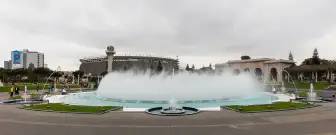
At night the line and the heat drop together, and the guided visit shows the pyramid lit up. The fountains at the Parque de la Reserva also only run after dark and close some days of the week, so check which days they run before crossing the city for them. If you want the Museo Larco in the late afternoon, get in by 5pm, because it closes at 7pm every day.
Check the 10% servicio before tipping
Many restaurants add a 10% “servicio” to the bill. Read that line before adding another 10% tip, because it's easy to pay double without noticing. At the hotel, ask at check-in for the 18% IGV exemption on lodging, because no one offers it unless you ask. It applies to foreigners staying up to 60 days, with passport and entry card in hand.
Do the long trips early on Sunday
Early on Sunday, 12 km takes 25 minutes, so save the neighboring districts for weekdays. On the day of a big soccer match, traffic is rerouted and you can't get through the streets around the stadium. Check the Liga 1 calendar before planning anything on the other side of the city.
Explore the map
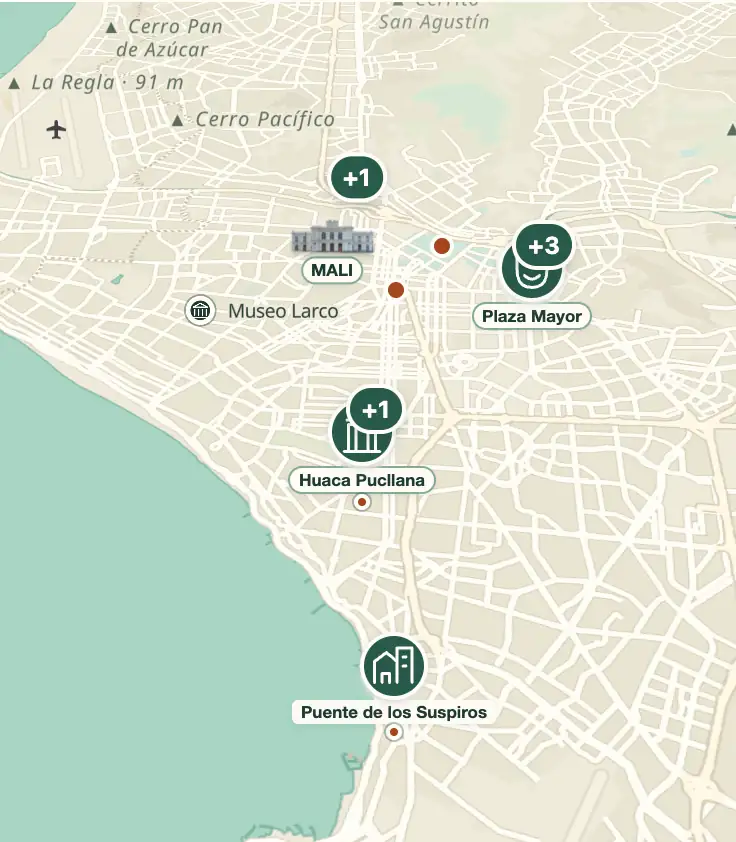
© OpenStreetMap · OpenFreeMap · © OpenMapTiles
Explore the map, read about the other places and plan your travel days in the app.
Open the appWhat to see
Lima: The gravel, the rivers and the garúa
Between the city and the sea there is a wall of bluffs 60 to 80 meters high, and at its foot runs the Costa Verde, a seaside avenue opened in the 1960s over pebble beaches. Atop the wall sits the malecón, which runs from Miraflores to Barranco.
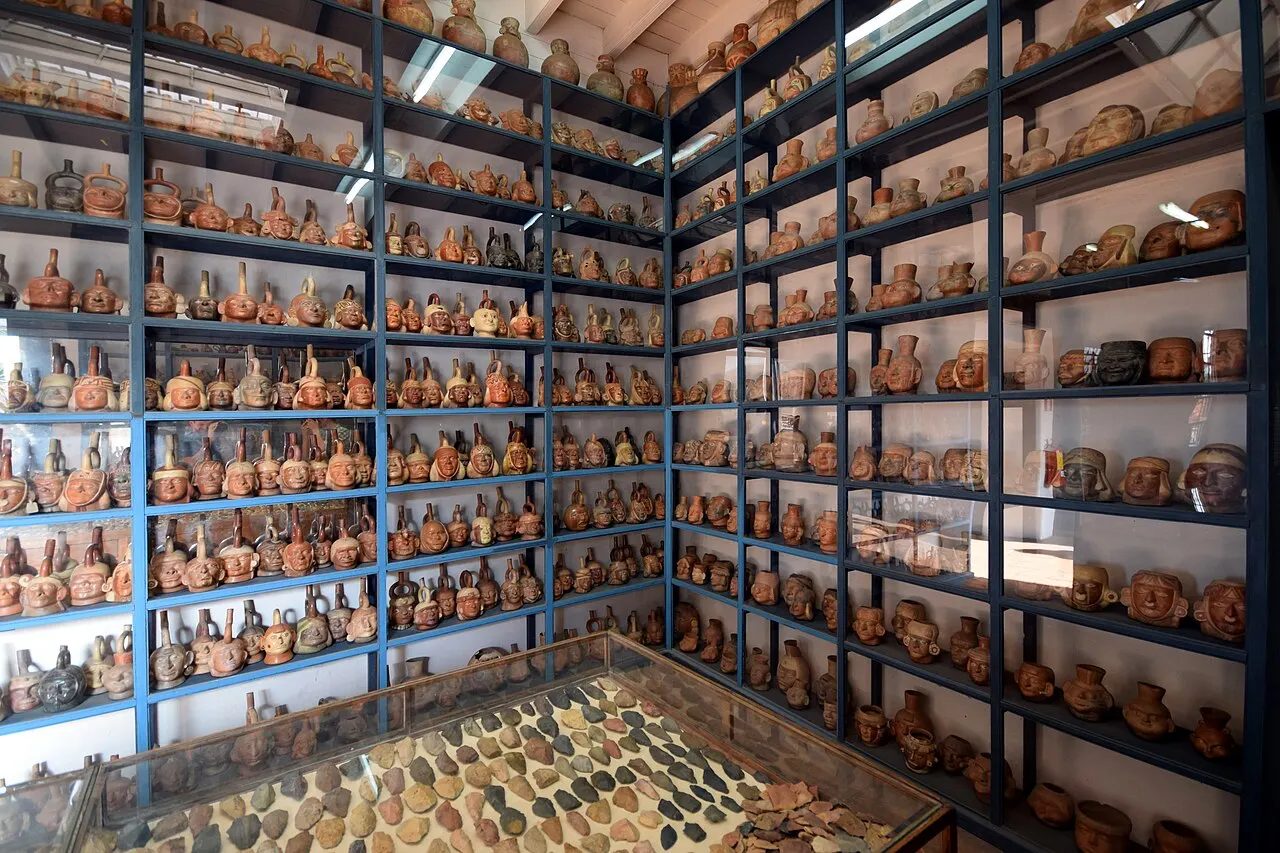
Museo Larco
In Pueblo Libre, inside an 18th-century mansion built on top of a huaca. It holds about 45,000 pre-Columbian pieces, with storerooms open to the public, Moche goldwork and the erotic ceramics gallery. Open daily from 9am to 7pm.
Inside an old mansion built on top of a huaca, the pre-Columbian collection includes storerooms open to the public, goldwork and an erotic ceramics gallery, and it opens every day; about 45,000 pieces; from 9am to 7pm.
Check access
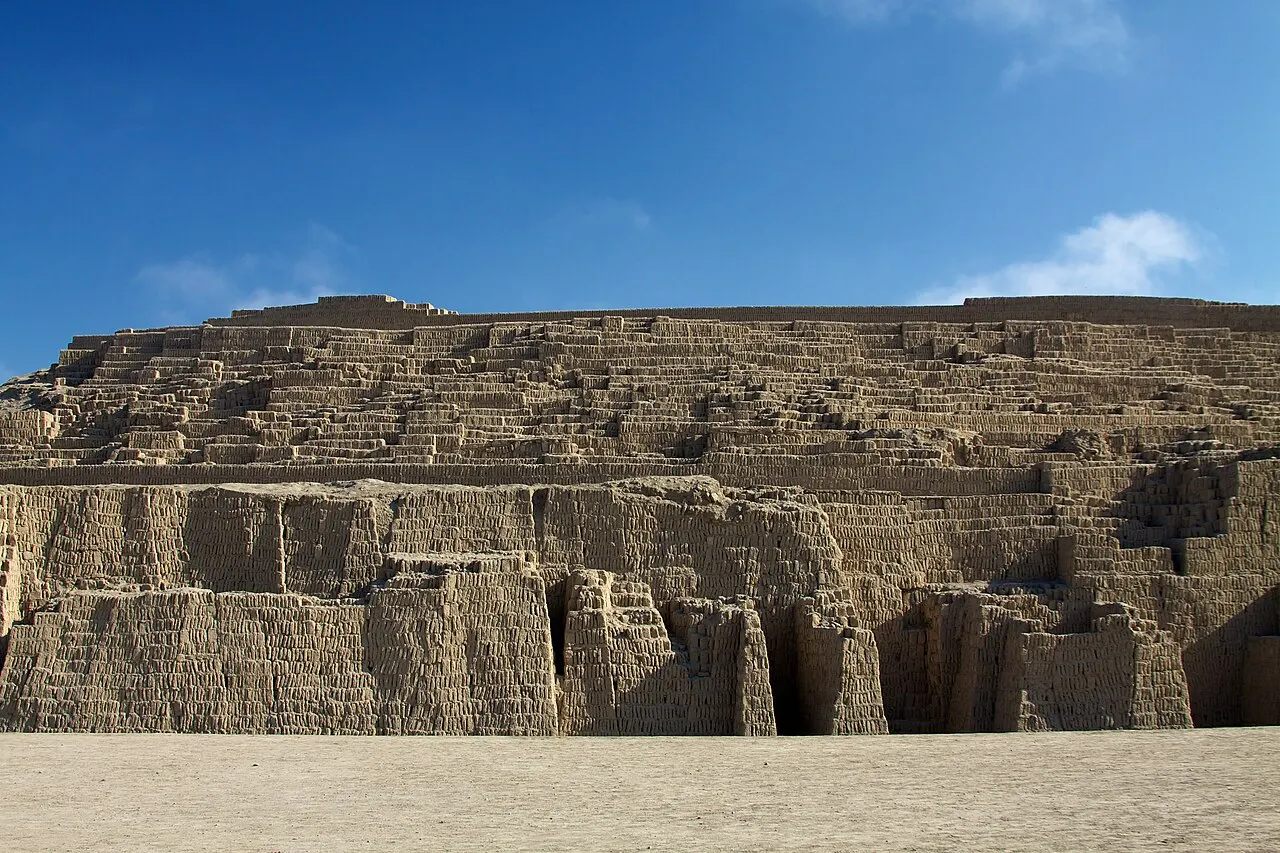
Huaca Pucllana
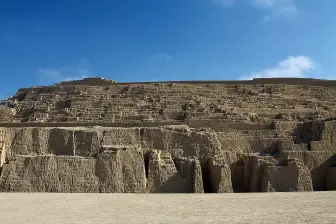
An adobe pyramid of the Lima culture (200–700 A.D.), about 22 m tall, surrounded by apartment buildings in Miraflores. The bricks were set on end and spaced apart, which absorbs tremors; there's a guided tour at night too, lit up.
The bricks set on end and spaced apart absorb tremors.
Check access
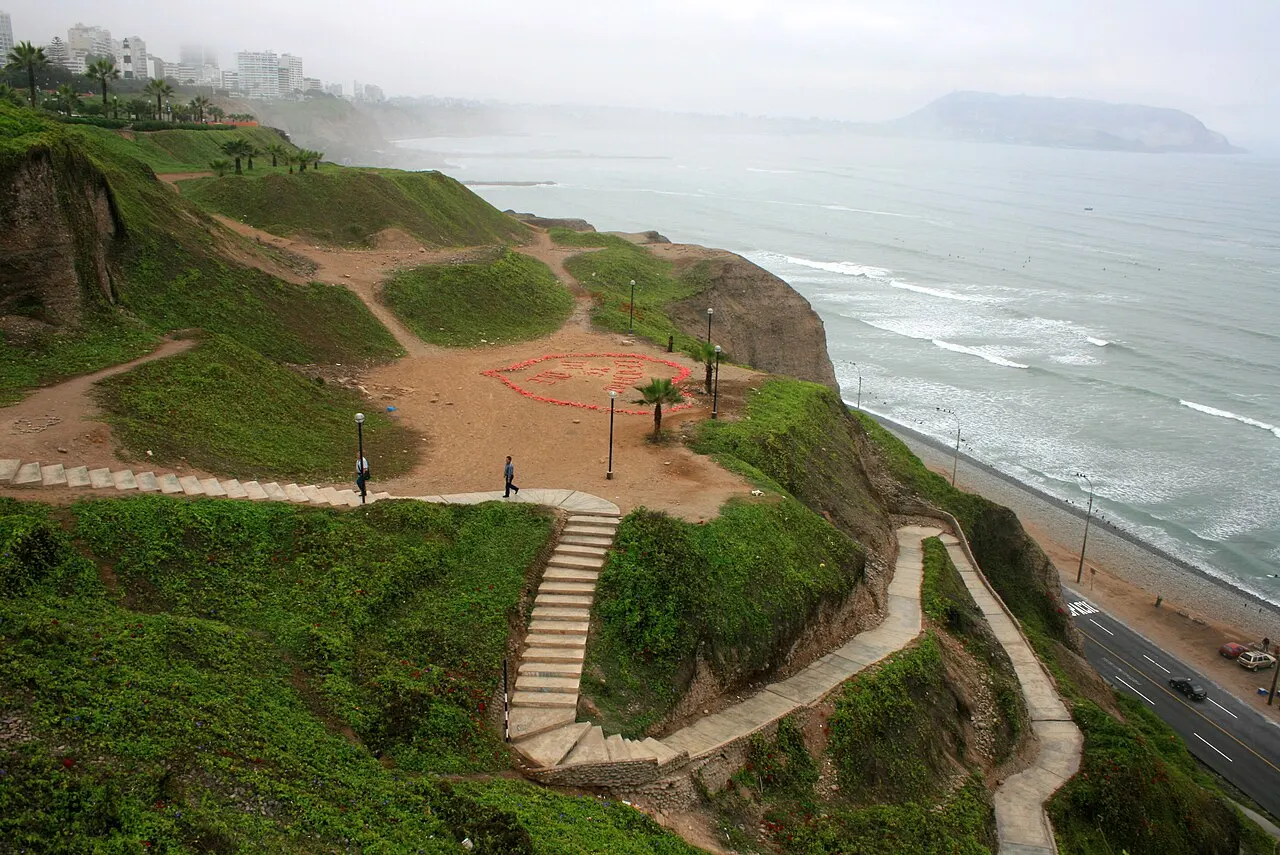
Malecón de Miraflores and Parque del Amor
Eleven kilometers of parks over cliffs 60 to 80 m above the Pacific, with the curved mosaic and the El Beso sculpture by Victor Delfín, installed in 1993. It's where the paragliding flights take off and where the city watches the sunset.
The cliffs rise 60 to 80 m, from there paragliders take off, and the city watches the day end.
Check access

Plaza Mayor and Palacio de Gobierno
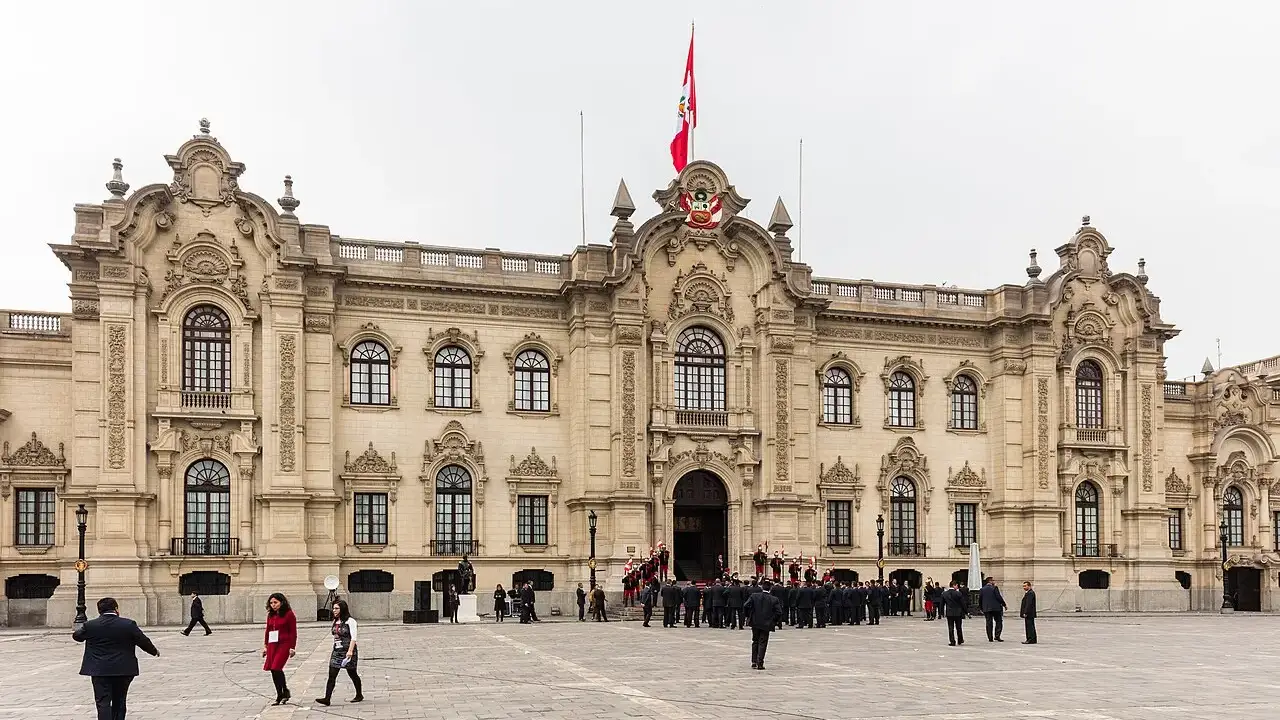
The founding square from 1535, with the palace on the lot that fell to Pizarro in the original division. The changing of the Húsares de Junín guard happens around midday; the bronze fountain at the center dates from 1651 and is the square's oldest object.
The palace occupies the lot that fell to Pizarro in the original 1535 land division, and on that square, where the 1651 bronze fountain is the oldest piece, the changing of the guard happens around midday.
Check access

Lima Cathedral
Begun in 1535 and rebuilt after the earthquakes of 1687 and 1746; the current towers date from 1797. It houses the chapel with the remains attributed to Francisco Pizarro, identified in 1977, and a carved 17th-century choir.
In the chapel rest remains attributed to Pizarro, and the identification of those remains came out in 1977.
Check access

Convento de San Francisco
A baroque complex completed in 1674, with a cloister of Sevillian tiles, a library of thousands of old volumes, and catacombs where about 25,000 people were buried until 1808. Entry is only by guided tour, around 45 minutes.
Access to the complex requires a guide for about 45 minutes, and in the catacombs about 25,000 people were buried until 1808.
Check access

MALI: Museo de Arte de Lima
In the Palacio de la Exposición, from 1872, inside the Parque de la Exposición. It covers three thousand years of Peruvian art, from pre-Inca textiles to the Lima painting school and to contemporary work, in a single chronological route.
Inside the park, the 1872 palace organizes, along a single path and in chronological order, three thousand years that begin in the fabric that predates the Incas.
Check access
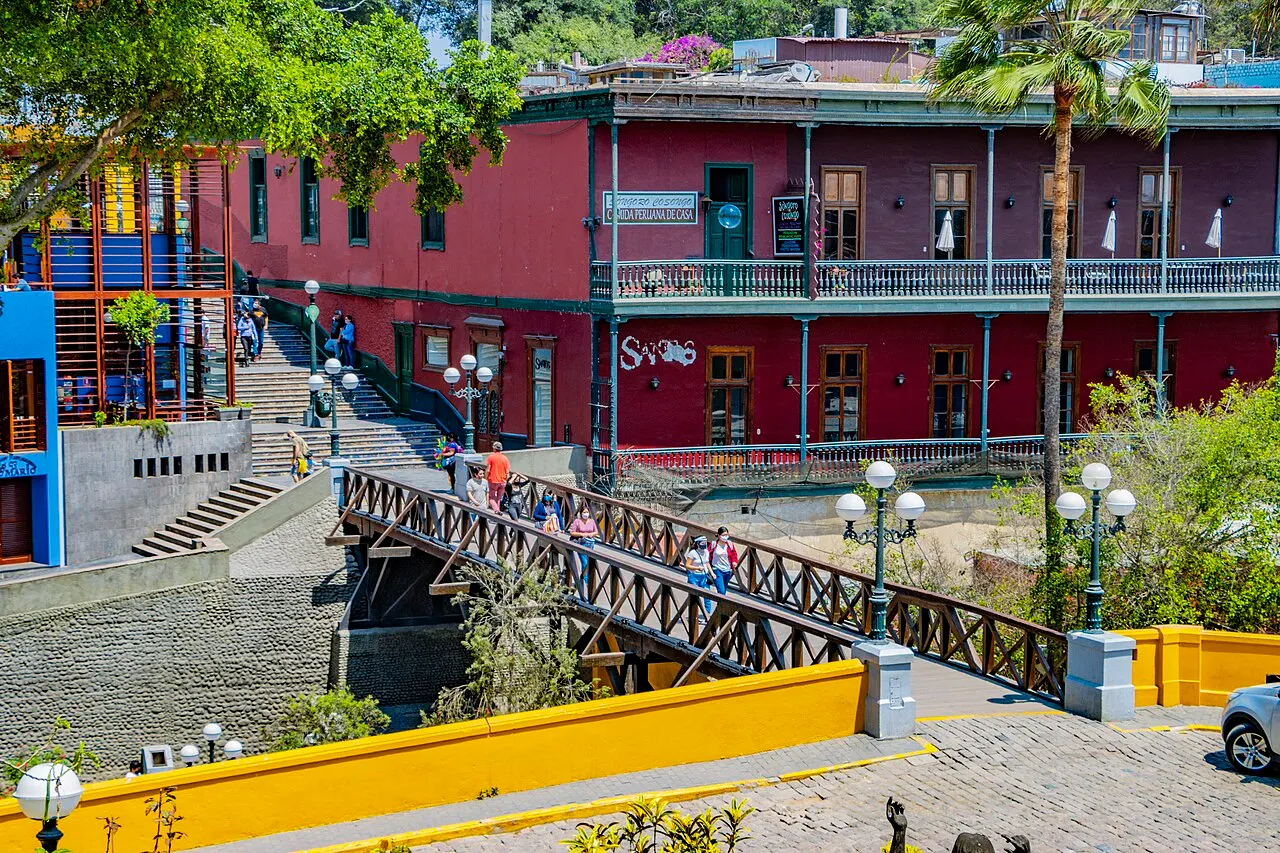
Puente de los Suspiros and MATE, in Barranco
The 1876 wooden bridge spans the Bajada de Baños, the lane of old houses that runs down to the sea. A hundred steps away, MATE, Mario Testino's museum opened in 2012, occupies a restored Republican-era house.
The 1876 wooden bridge stands a hundred steps from Mario Testino's museum, opened in 2012 inside a restored republican-era house.
Check access
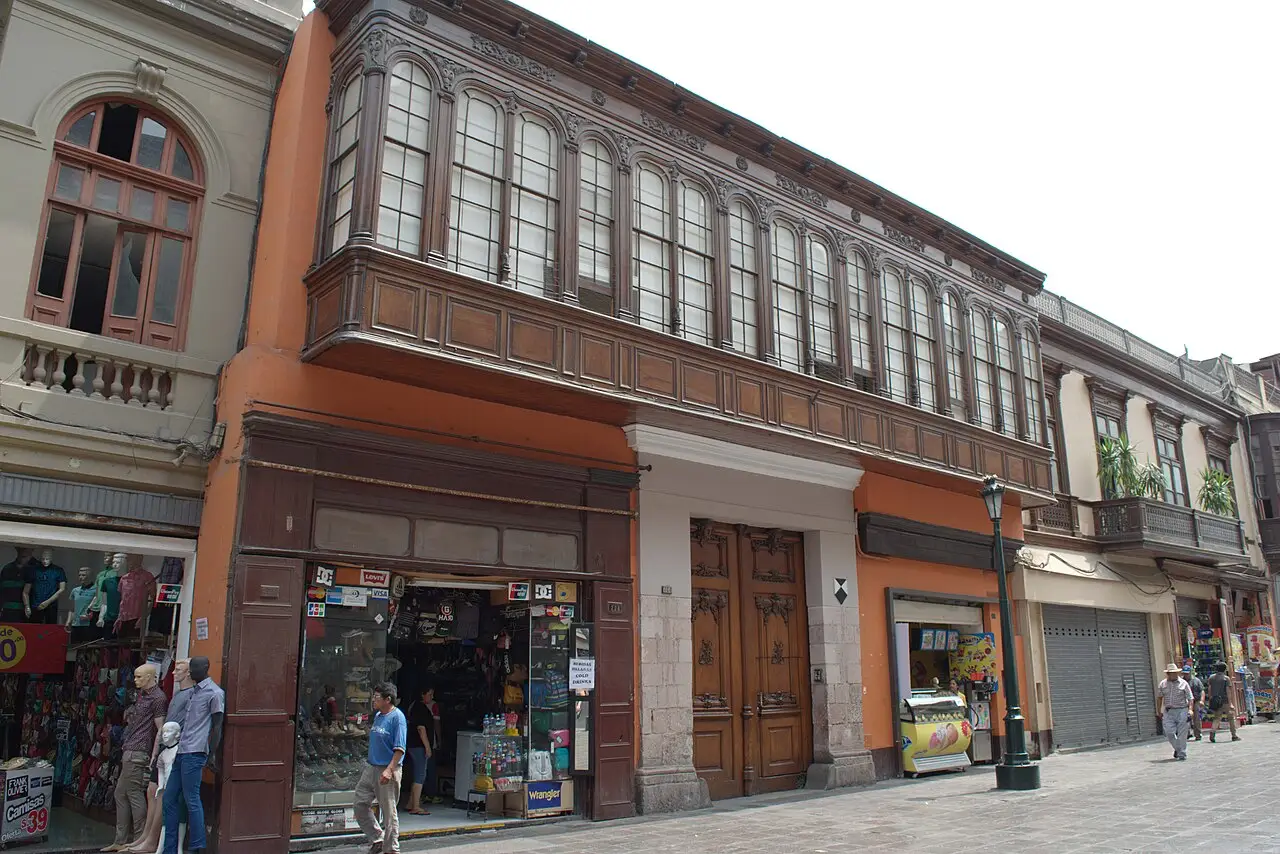
Casa de Aliaga
A house handed over by Pizarro to Jerónimo de Aliaga in 1535 and occupied by the same family ever since: the oldest continuously used residence in the Americas. Entry is only by scheduled visit, in small groups.
Check access
Nilo’s itinerary
Start with the basic programme and choose extensions for the time you have.
Plan my days in the app ↗Day 1 · The 1535 grid and the historic center
Start at 9am in the Plaza Mayor and stay for the changing of the Húsares de Junín guard, at the Palacio de Gobierno, around midday.
Take the guided tour of the Convento de San Francisco, with cloister, library and catacombs, about 45 minutes.
Have lunch by 1:30pm in the Barrio Chino: chifa on Calle Capón, two blocks from the Mercado Central.
Visit MALI, in the Parque de la Exposición, in the afternoon and, if you still have the energy, the Casa de la Literatura Peruana, in the old Desamparados station.
End at the Circuito Mágico del Agua, in the Parque de la Reserva, which only runs after dark.
Day 2 · Huaca, ceviche and the cliffs to Barranco
In the morning, take the guided tour of Huaca Pucllana, in Miraflores, which leaves at short intervals and shows the adobe pyramid ringed by buildings.
Have ceviche for lunch between 12:30 and 2pm at a cevichería next to Mercado No. 1 de Surquillo, a ten-minute walk away.
Walk the roughly 4 km of malecón to Barranco, passing the Parque del Amor and the paragliding launch points.
In Barranco, cross the Puente de los Suspiros, walk down the Bajada de Baños to the sea and visit MATE, Mario Testino's museum.
Stay for the sunset at the lookout and have anticuchos for dinner at a cart after 7pm.


If you stay longer
Day 3 · Pre-Columbian museums in the morning, dinner at night
Start the day at the Museo Larco, in Pueblo Libre, open from 9am to 7pm, and set aside the whole morning for the mansion's pre-Columbian collection.
Have lunch at the Antigua Taberna Queirolo, open since 1880, one block from the museum.
Spend the afternoon in San Isidro, walking between the El Olivar grove and the Huallamarca huaca.
Book months ahead for a fine-dining dinner (Central, Maido or Kjolle) or, instead, a peña criolla in Barranco.
If you'd rather leave the city, swap the afternoon for Pachacamac, 32 km to the south, and come back for dinner.

Food
 AI illustration
Ceviche
Cubed white fish cured in lime juice with red onion, ají limo and salt, served with boiled sweet potato, choclo and cancha. Eaten at midday, while the day's catch is still fresh; the leftover broth is the leche de tigre, drunk from a separate cup.
 AI illustration
Tiradito and causa
Tiradito is ceviche without onion, sliced thin and covered in ají cream: a legacy of Japanese knife work. Causa is a cold cake of mashed yellow potato with lime and ají amarillo, filled with chicken, tuna or crab. Both are lunchtime starters.
 AI illustration
Lomo saltado and arroz chaufa
A legacy of 19th-century Chinese cooks: beef stir-fried in a wok with onion, tomato, soy sauce and vinegar, served with fries and rice at the same time, never one or the other. Chaufa is Peruvian fried rice, with egg, scallion and whatever's on hand.
 AI illustration
Ají de gallina and papa a la huancaína
Shredded chicken in a cream of ají amarillo, bread, milk and walnuts, over potato and rice. Huancaína is cold boiled potato covered in ají cream with fresh cheese. These are the dishes behind the weekday corner menú.
 AI illustration
Anticuchos
Skewers of beef heart marinated in ají panca, vinegar and cumin, grilled over coals at street carts after 7pm and served with boiled potato and choclo. They cost a few soles apiece and are eaten standing on the sidewalk.
 AI illustration
Pollo a la brasa
A whole chicken roasted on a rotating charcoal spit, created in Chaclacayo around 1950 and sold by the quarter, with fries, salad and four sauces on the table. It's the Sunday family meal and has its own day on the calendar, the third Sunday of July.
 AI illustration
Chifa and nikkei
Two migrant cuisines became Lima cuisine: chifa, adapted Cantonese food concentrated on Calle Capón in the Barrio Chino since the 1850s, and nikkei, Japanese-Peruvian food formalized in the 1980s. Maido, by Mitsuharu Tsumura, was voted the world's best restaurant in 2025.
 AI illustration
Sweets and drinks
Picarones of pumpkin and sweet potato with chancaca syrup, suspiro a la limeña of dulce de leche and meringue, mazamorra morada, and turrón de Doña Pepa, which only shows up in October. To drink: chicha morada from purple corn, hot emoliente at pre-dawn carts, Inca Kola (created in 1935), and the pisco sour, born at the Morris Bar downtown in the 1920s.
Day trips
Pachacamac
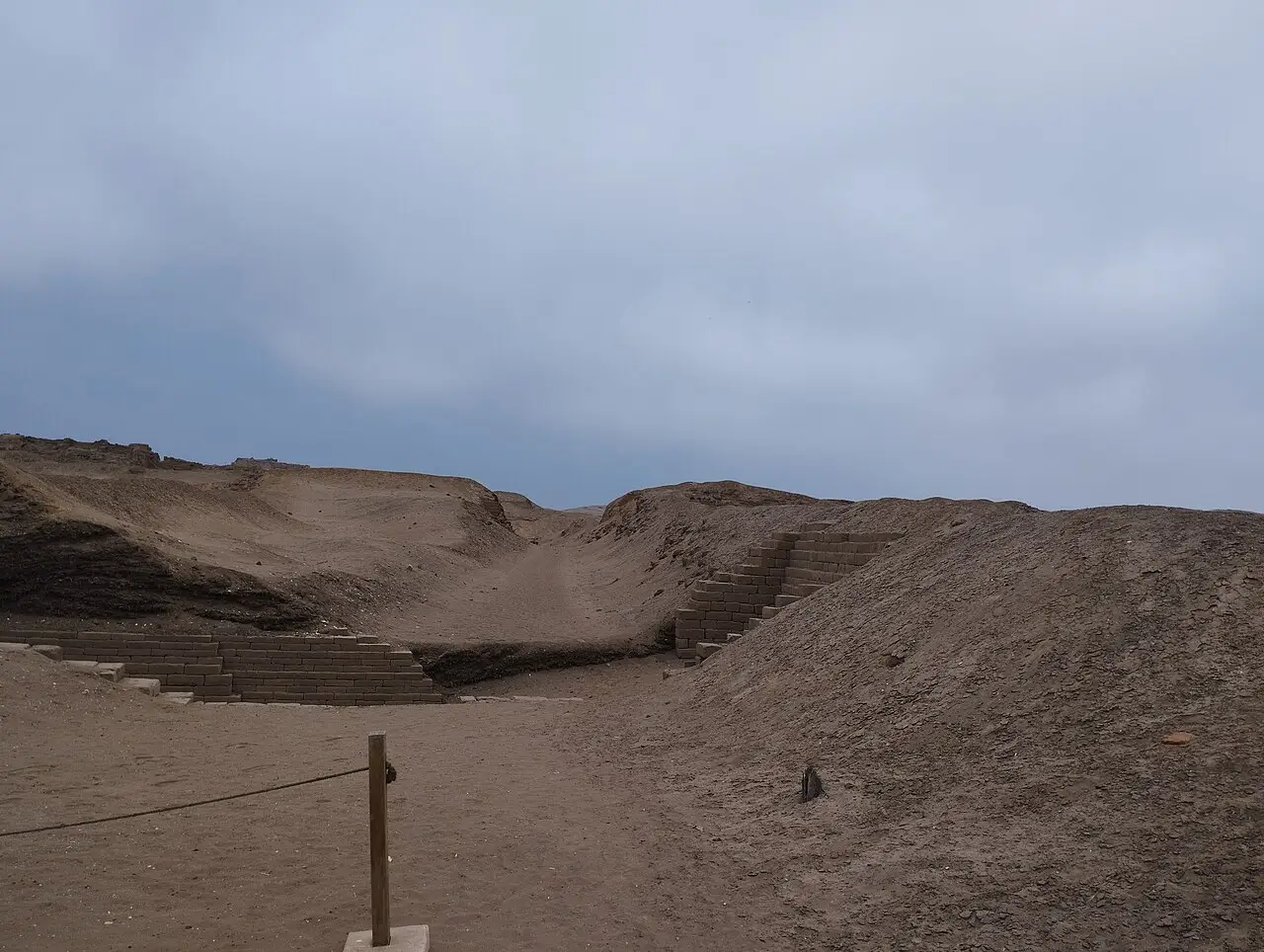
A pre-Inca sanctuary and oracle 32 km to the south, occupied from the 3rd to the 16th century, with an Inca sun temple, the Acllahuasi and a site museum opened in 2016. It's 45 to 60 minutes by car outside rush hour; half a day is enough.
Caral
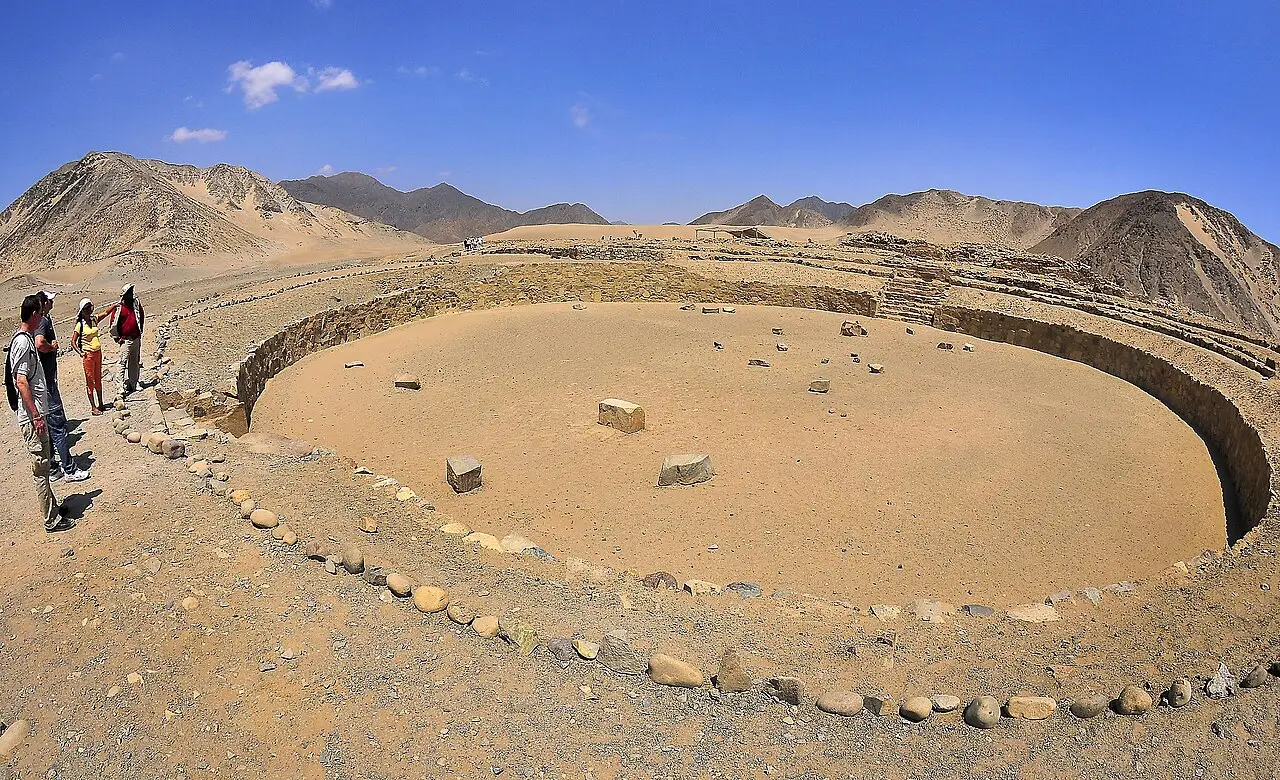
The oldest city in the Americas, occupied roughly from 3000 to 1800 B.C., in the Supe valley, about 185 km to the north along the Panamericana. A UNESCO World Heritage site since 2009; it's 3 hours to 3 hours 30 minutes of driving each way, so a full day.
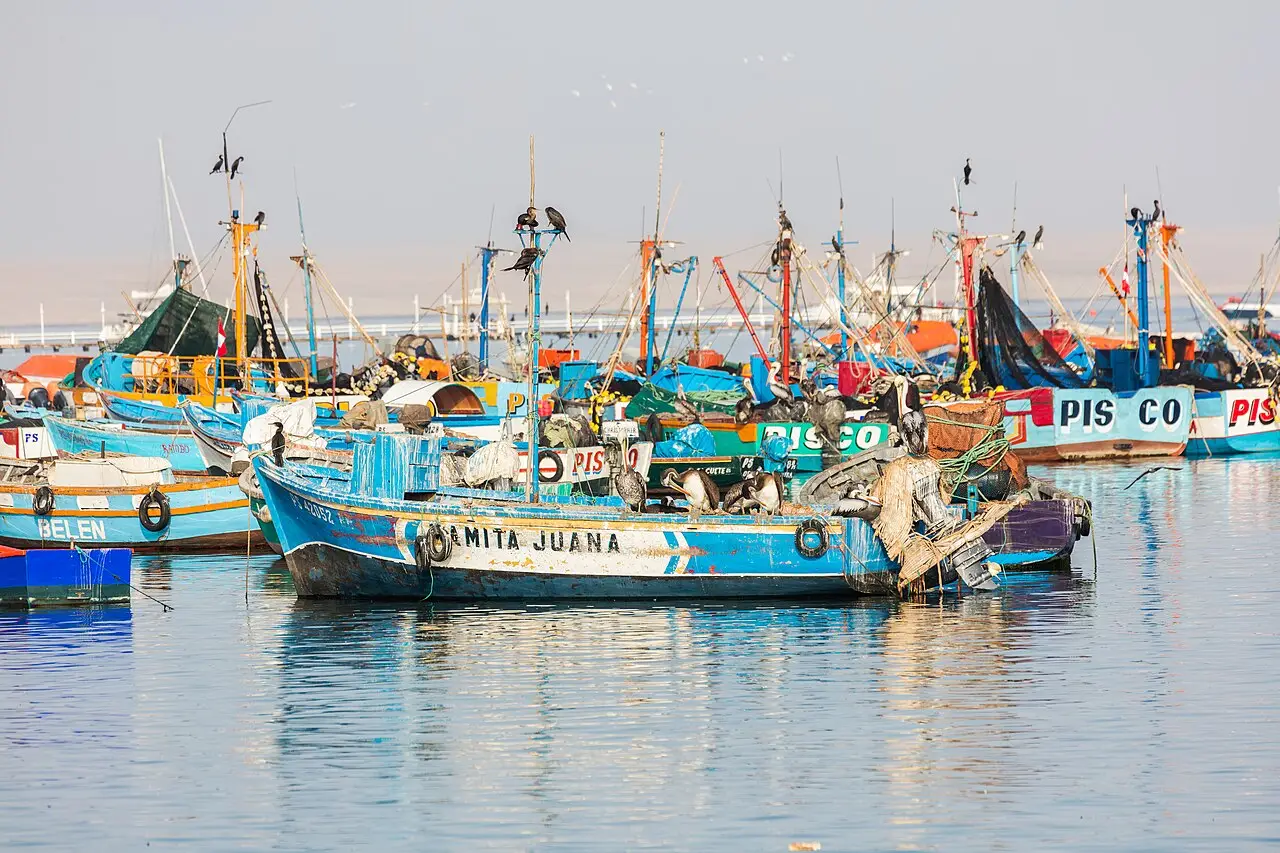
Paracas and Islas Ballestas
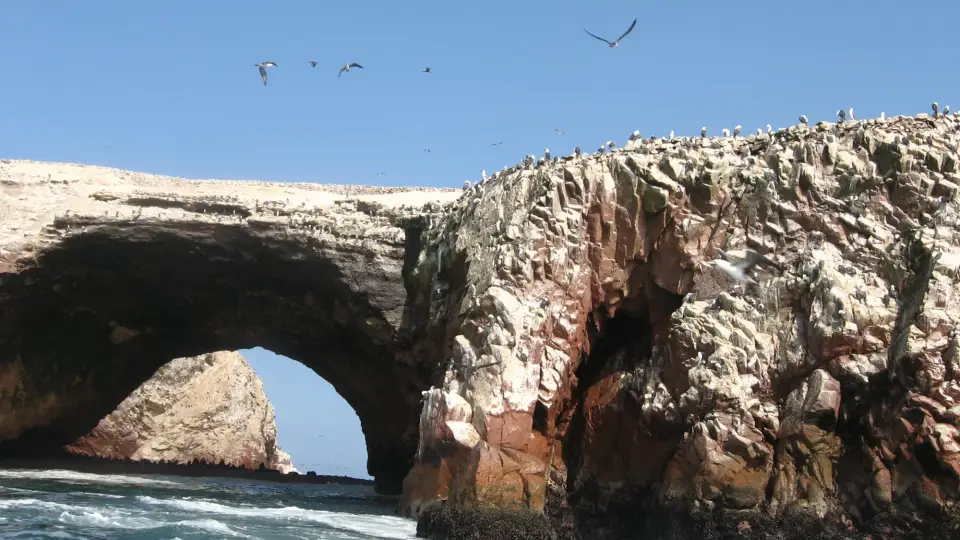
A coastal reserve and islands with sea lions, Humboldt penguins and the Candelabro geoglyph, about 250 km to the south; 3 hours 30 minutes to 4 hours by bus along the Panamericana Sur. The boat leaves early in the morning, and it can be combined with the dunes of Huacachina.
Where to begin
The 1535 grid and the historic center
Start at 9am in the Plaza Mayor and stay for the changing of the Húsares de Junín guard, at the Palacio de Gobierno, around midday.
Huaca, ceviche and the cliffs to Barranco
In the morning, take the guided tour of Huaca Pucllana, in Miraflores, which leaves at short intervals and shows the adobe pyramid ringed by buildings.
Pre-Columbian museums in the morning, dinner at night
Start the day at the Museo Larco, in Pueblo Libre, open from 9am to 7pm, and set aside the whole morning for the mansion's pre-Columbian collection.
Money
The currency is the sol (PEN, S/), with notes from 10 to 200 and coins of 1, 2 and 5. In 2026 it hovers around 3.4–3.8 to the dollar and 4.0–4.4 to the euro. For food, count on coffee at S/8–15, a menú del día with starter, main and a drink at S/12–25, ceviche at a neighborhood cevichería at S/30–55, beer at S/10–18 and a pisco sour at S/25–40. For everything else, a short ride-hailing trip runs S/12–25, a hostel S/40–80, a mid-range hotel S/250–450 and a tasting dinner at a world's-best-list restaurant S/700–1,200 per person with wine pairing. The usual tip is 10%, but many restaurants already add a 10% “servicio” to the bill, so check before adding another. Cards work without friction in Miraflores, San Isidro and Barranco, while markets, street carts, combis and neighborhood cevicherías deal in cash. Yape and Plin, the QR payments by phone, are everywhere, even at street stalls, but they generally require a Peruvian bank account, so don't count on them. Change money at registered exchange houses or with the accredited money changers in vests in Miraflores and San Isidro, and avoid the airport exchange. The 18% IGV is already built into prices, but on lodging at a registered hotel, foreigners staying up to 60 days are exempt from it.
Getting there and around
Jorge Chávez Airport, 12 km from downtown, new terminal since 2025
Jorge Chávez International Airport is in Callao, about 12 km from the historic center and 17 km from Miraflores. Since June 1, 2025 it has operated from a new terminal, with a second runway. There's no train to the airport, because the rail link depends on a branch of the Line 2/4 works, still under construction in 2026. The authorized taxi from the counter inside the terminal and ride-hailing cars cost S/50–90 depending on the time of day. The Airport Express bus runs to Miraflores for about US$12 and takes 40 to 70 minutes. Don't accept a driver who approaches you at the arrivals door, however organized the pitch looks.
Three systems that don't talk to each other
Within the city, the metro, the Metropolitano and buses don't talk to each other, and that's the most useful piece of information for the first day. The metro's Line 1 is elevated, runs 34.6 km with 26 stations between Villa El Salvador and Bayóvar, opened between 2011 and 2012 and was extended in 2014, and charges S/1.50 a ride with a rechargeable card bought at the station. The Metropolitano is a BRT in an exclusive lane along the Vía Expresa, from Naranjal in the north to Matellini in Chorrillos, with a trunk fare of S/3.20 and an integrated fare of S/3.50 in 2026, and it has its own card, which doesn't work on the metro. The buses come in two types: the corridor routes (blue along Av. Arequipa and Tacna, red along Javier Prado, and purple) and the informal combis and custers, which stop anywhere and only take cash. Line 2, underground and running east-west, has been under construction since 2014 and has been opening stretches since December 2023. Street taxis have no meter: the price is agreed through the window before you get in, and the standard advice, Limeños included, is to use an app. On foot, two things work well: the Miraflores–Barranco axis, with about 4 km of continuous malecón, and the historic center by day. There are bike lanes on Av. Arequipa and the malecón, with bike-share in Miraflores and San Isidro.
Safety
The real risk in Lima is to your belongings, not violence against visitors: what gets lost here is phones and backpacks, on crowded transit, at the Mercado Central, on Jirón de la Unión and outside bars, plus theft by pairs on motorbikes at traffic lights when the car window is open. Miraflores, San Isidro, Barranco and the historic center by day can be walked with the normal caution of any big city. I'd avoid walking at night in the center after the shops close, in the streets of Rímac, in La Victoria outside the Gamarra shopping strip and around the stadiums on derby days, and I wouldn't use a street ATM after dark. Since 2024 extortion of transport workers and small businesses has been the country's security issue, with states of emergency declared in Lima and Callao in 2025 and 2026; for visitors passing through, that means seeing more police and soldiers at checkpoints, and little else. Watch for three common scams: change handed back with a fake note, the driver who says he has no change, and street money changing outside the accredited changers. On S/100 and S/200 notes, check the watermark before putting them away. Note two numbers: 105 for the police and 116 for the fire department; the Tourist Police have a post in Miraflores.
Etiquette tips
The greeting kiss
A kiss on the right cheek between women and between men and women, even in work introductions; between men, a handshake. Refusing and offering a hand instead reads as distant, even if no one says anything.
Ceviche only until the afternoon
Ceviche is a lunch dish; the Limeño rule is to never order it after 4pm.
Pisco is Peruvian
The dispute with Chile over pisco's origin is a serious matter and even has a spot on the official calendar. Calling pisco sour a Chilean drink ends the conversation; the same goes for crediting the potato or quinoa to another country.
Lunch: the day's main meal, between 1pm and 3:30pm
Eaten between 1pm and 3:30pm, it's the big meal of the day, and the three-course menú is the norm on weekdays. Dinner before 8:30pm is early, and a restaurant full at 10pm is normal.
Social invitations run 20 to 40 minutes late
A social invite with a set time usually starts 20 to 40 minutes after the agreed hour; a work meeting, not so. Texting on WhatsApp that you're on your way is part of the protocol.
Asking for the check
The waiter won't bring the check before you ask, because that would seem like rushing the customer out. Say “la cuenta, por favor” and wait; sitting for an hour after coffee is fine.
Mistakes to avoid
Downtown and Miraflores need two days
Treating Lima as a one-night stopover on the way to Cusco. Land at night and fly to Cusco the next morning, and you see only the airport and the hotel, while the historic center, the malecón from Miraflores to Barranco and a neighborhood cevichería need two full days.
Twelve kilometers that turn into an hour
Underestimating traffic. A 12 km trip takes 25 minutes at 7am on Sunday and more than an hour and a half at 6:30pm on Friday. Budget double the time your maps app suggests, and don't book two reservations less than three hours apart.
Hailing a taxi without agreeing on a price
Hailing a taxi on the street and getting in without agreeing on a price. There's no meter in the city: either you use an app, or you negotiate the fare through the window before opening the door. Getting in first and asking after is the wrong order.
Winter garúa: a jacket, not an umbrella
Expecting sun between June and September and packing only summer clothes. The garúa doesn't wet enough to justify an umbrella, but it soaks a jacket in an hour's walk on the malecón, and no mid-range hotel has heating.
Tap water and street ice
Drinking tap water or accepting ice at a street stall. In Lima the household habit is to boil water or buy it bottled, so stick to sealed bottles and order juices at busy places.
Useful phrases
¿Cuánto está?
How much is it? Used more at markets and on the street than “¿cuánto cuesta?”
La cuenta, por favor
The check, please: you have to ask, nobody brings it unprompted
Al toque
Right away, on the spot: “te lo traigo al toque”
¡Qué bacán!
How cool: common Limeño slang; “chévere” also works
¿Me da la yapa?
Can you give me a little extra? The courtesy bonus a vendor tucks into the bag
¡Qué palta!
How embarrassing: literally “what an avocado”
Districts
Cercado de Lima (Historic Center)
The 1535 grid around the Plaza Mayor, a UNESCO World Heritage site since 1988: the cathedral, the Palacio de Gobierno, convents, Moorish-influenced wooden balconies, and the Jirón de la Unión as a pedestrian street. It's dense with churches, museums and government offices, and empties out once the shops close.
Miraflores
A district on the cliffs, with 11 km of malecón, Parque Kennedy and the Huaca Pucllana in the middle of the residential blocks. It holds most of the city's hotels, agencies and bars; it's pricey by local standards and is where nearly every visitor stays.
Barranco
A former 19th-century seaside resort covering 3.4 km², today the district of galleries, colorful republican-era houses and the bars of Av. Grau. Puente de los Suspiros and MATE sit five minutes apart, and the malecón links it to Miraflores on foot.
San Isidro
The country's financial center: bank headquarters, the El Olivar woods with olive trees descended from ones planted starting in 1560, and the Huaca Huallamarca surrounded by buildings. Expensive restaurants and little street life after 8pm.
Pueblo Libre and Magdalena
Neighborhoods of low houses and tree-lined streets, home to the Museo Larco and the Museo Nacional de Arqueología, Antropología e Historia. The Antigua Taberna Queirolo, open since 1880, is the classic lunch stop on the corner by the museum.
Rímac
Across the river, linked by the 1610 Puente de Piedra: Alameda de los Descalzos, Paseo de Aguas, the Descalzos convent and Plaza de Acho, a bullring from 1766. It's also the base of Cerro San Cristóbal; visit by day.
La Victoria and Gamarra
A working-class district adjoining downtown that holds South America's largest textile hub, with thousands of shops and workshops packed into a few blocks of Gamarra. It's home to Alianza Lima, at Matute stadium, and warrants attention outside the commercial streets.
Callao and Callao Monumental
A separate constitutional province, with the port, the airport and the Fortaleza del Real Felipe, from 1747. The old core of Chucuito and the Monumental Callao project have reclaimed blocks with murals, studios and bars; the rest of Callao is not a walking area.
History
c. 200–700 A.D. · The Lima culture builds the huacas
The adobe pyramids of Pucllana and the Maranga complex are raised with millions of small bricks set on end with gaps between them, a technique that dissipates tremors. The valley already lived off irrigation canals.
15th c. · Taulichusco and the Inca arrival
The curacazgo of Taulichusco manages the Rímac's water under the religious sway of Pachacamac, the coast's most consulted oracle. The Incas fold the region into the empire around 1470.
1535 · Pizarro founds Ciudad de los Reyes
On January 18, Francisco Pizarro lays out a 117-block grid on the river's south bank, 12 km from the natural port of Callao. The official name never stuck: Lima won out, a Castilianization of Rímac.
1542–1551 · Capital of the Viceroyalty of Peru
The city comes to govern from Panama to Chile and gains the Mint (1565) and the Inquisition tribunal (1570). On May 12, 1551, the University of San Marcos is born, the oldest still operating in the Americas.
1687–1746 · Wall, earthquake and tsunami
Between 1684 and 1687 Lima closes itself behind 11 km of adobe wall. On October 28, 1746, an earthquake brings down nearly the whole center and a tsunami sweeps Callao, killing most of its roughly 5,000 residents.
1821 · Independence in the Plaza Mayor
José de San Martín proclaims independence on July 28, 1821, a date that became a national holiday. The war is only settled at Ayacucho, in December 1824.
1851–1870 · Guano, railway and the walls come down
Guano income pays for the Lima–Callao railway, opened in 1851 and the first in Peru. Between 1868 and 1870 the walls are torn down to let the city grow.

1881–1883 · Chilean occupation
After the battles of San Juan and Miraflores, on January 13 and 15, 1881, the Chilean army occupies Lima for two years and nine months. The National Library's collection is carried off.

1919–1940 · The city stretches to the sea
Augusto Leguía opens Avenida Arequipa and remakes Plaza San Martín, linking downtown to the seaside resorts of Miraflores, Barranco and Chorrillos, already served by an electric tram since 1904. By 1940 the city has 645,000 residents.
1950–1990 · Andean migration and the conos
Between 1940 and 1993 the population goes from 645,000 to more than 6 million, almost tenfold, with land occupations that found entire districts, like Villa El Salvador in 1971. The “pueblos jóvenes” come to house more people than the old Lima.
 AI illustration
1980–2026 · Terrorism, the food boom, and political crisis
The Sendero Luminoso bombing on Tarata street kills 25 people on July 16, 1992, and the MRTA occupies the Japanese ambassador's residence from December 1996 to April 1997. After 2000 the city becomes a world food destination, while the country goes through six presidents between 2016 and 2025.
 AI illustration
Complete history
Irrigated land long before the Spanish
The Rímac valley was irrigated land long before the Spanish arrived. Between the 3rd and 7th centuries the Lima culture raised adobe complexes like Pucllana and Maranga, and from the 15th century the curacazgo of Taulichusco managed the canals under the religious sway of Pachacamac, the coast's most consulted oracle, already folded into the Inca empire around 1470. Francisco Pizarro chose this valley on January 18, 1535, for three practical reasons: fresh water, flat land and a navigable bay 12 kilometers away, at Callao. The official name, Ciudad de los Reyes, never caught on; Lima won out, a Castilianization of the place-name Rímac, which means “the one that speaks”.
Capital of the Viceroyalty of Peru, from 1542 to independence
From 1542 Lima was the capital of the Viceroyalty of Peru and, for two centuries, the most powerful city in Spanish South America. Silver from Potosí passed through it, and it was home to the 1565 Mint, the Inquisition tribunal set up in 1570 and the University of San Marcos, founded on May 12, 1551. Between 1684 and 1687 the city closed itself behind 11 kilometers of adobe wall against privateers. The earthquake of October 28, 1746 wiped out much of that: nearly every building in the center collapsed and a tsunami destroyed Callao. The rebuilding was done in quincha, and it's this Lima of light roofs and wooden balconies that survives in the historic center, a Unesco World Heritage Site since 1988.
Independence proclaimed in the Plaza Mayor
Independence was proclaimed by José de San Martín in the Plaza Mayor on July 28, 1821, but wealth only returned in the 1850s, with guano from the islands: fertilizer money paid for the railway to Callao in 1851, the demolition of the walls between 1868 and 1870, and a rentier class that spent more than the country produced. The bill came due in the War of the Pacific. After the battles of San Juan and Miraflores, on January 13 and 15, 1881, the Chilean army occupied Lima for two years and nine months. The city came out of it in debt and without its nitrate coastline, and only grew again in the 1920s, with Leguía's avenues and the trams that stitched the colonial center to the southern resorts.
Today's city was built after 1940
Today's Lima was built after 1940. That year the city had 645,000 inhabitants; by 1993 it topped 6 million. Andean migration, driven by the lack of land and by the concentration of industry in the capital, occupied the sandy flats in organized “invasiones” that became entire districts: Comas, San Juan de Lurigancho, and Villa El Salvador, founded in 1971 and recognized internationally as a model of self-managed urban development. Velasco's agrarian reform, in 1969, dismantled the hacienda economy that had supported Lima's elite. In the 1980s two crises came at once, hyperinflation, which reached 7,650% in 1990, and the war with the Shining Path. The war brought violence to the center, with all-night blackouts, car bombs and the Tarata Street bombing, in Miraflores, which killed 25 people on July 16, 1992.
A decade and a half of growth
After 2000 the Peruvian economy grew for a decade and a half on mining and agro-exports, and Lima changed face: malls over the cliffs, the Metropolitano BRT in 2010, the metro's Line 1 between 2011 and 2012, and a restaurant industry that became foreign policy; Gastón Acurio opened Astrid y Gastón in 1994, the Mistura festival drew hundreds of thousands of people per edition between 2008 and 2017, and Central and Maido reached the top of world lists, with Maido ranked first in 2025. Politics went the other way: seven presidents between 2016 and 2025, against a backdrop of insecurity that became the capital's dominant issue. The general elections of April 2026 and the inauguration on July 28 closed that cycle, while work on the metro's Line 2, begun in 2014, keeps opening stretches.
The center was rebuilt in quincha, mud over cane: a light material, which doesn't kill when it collapses.
Geography and shape of the city
The gravel, the rivers and the garúa
Lima occupies a fan of alluvial gravel between the Pacific and the first slopes of the Andes, from 0 to about 500 m of altitude, with arid hills appearing inside the urban grid. Three rivers with a torrential regime come down from the mountain range and cut through the city (Rímac, Chillón, and Lurín), and it's the Rímac that supplies almost all the drinking water, which turns any highland drought into an urban problem. It rains less than 10 mm a year because the cold Humboldt Current and the South Pacific anticyclone create a thermal inversion that traps humidity in a low layer: instead of rain, the city gets garúa, a mist that soaks without falling, and a ceiling of gray cloud from May to October. Between the city and the sea there is a wall of bluffs 60 to 80 meters high, and at its foot runs the Costa Verde, a seaside avenue opened in the 1960s over pebble beaches.
Three layers of street grid: from the colonial damero to the conos
The layout has three overlapping layers: the Spanish grid of 1535, with 117 original blocks around the Plaza Mayor; the southern seaside resorts, stitched to downtown by radial avenues like Arequipa in the 1920s; and the “conos” (Lima Norte, Este and Sur) neighborhoods born of land settlements from the 1950s onward that today hold most of the population, with San Juan de Lurigancho alone topping 1.2 million residents.
The subduction zone and the 1746 earthquake
All of Lima sits on an active subduction zone: the 1746 earthquake destroyed almost the entire city, and an event of magnitude close to 8 is treated by the state as a statistical certainty, not a hypothesis.
It rains less than ten millimeters a year because of the cold Humboldt Current, offshore.
Culture
The European waltz became criolla
Lima turned the 19th-century European ballroom waltz into the valse criollo, played on guitar, cajón and voice; Chabuca Granda fixed the repertoire with “La flor de la canela”, from 1950, and October 31 became the Día de la Canción Criolla, contested each year against imported Halloween. The central coast is also the birthplace of the cajón, a wooden box that enslaved Afro-Peruvians turned into a drum and that today is a standard instrument of Spanish flamenco; the group Perú Negro, founded in 1969, and singers like Susana Baca and Eva Ayllón carried the festejo and the landó abroad. In the southern and eastern districts, Peruvian cumbia and chicha (Andean huayno with electric guitar, born of the 1960s migration) fill halls with thousands of people on weekends.
Peruvian literature: Ricardo Palma, Vargas Llosa, and Ribeyro
A good part of Peruvian literature is literature of Lima. Ricardo Palma invented the colonial city in the Tradiciones peruanas, published between 1872 and 1910; Julio Ramón Ribeyro wrote, in plain prose, the stories of office, boarding house and resentment that define it; and Mario Vargas Llosa, the 2010 Nobel laureate who died in April 2025, used the Leoncio Prado school and the downtown bars as his map. Sebastián Salazar Bondy answered all that nostalgia with the essay Lima la horrible, from 1964. In film, Francisco Lombardi and Claudia Llosa filmed the city of migration and internal conflict, and the Lima Film Festival, run by the PUCP since 1997, fills theaters in Miraflores and San Isidro in August.
Soccer splits the city
The derby between Alianza Lima and Universitario splits the city: Alianza plays its home games at Matute, in La Victoria, and Universitario at the Estadio Monumental. On derby day, traffic around the stadium is rerouted and the surrounding streets fill with fans and police, so it's best to arrive early or watch the game in a bar.
Alianza Lima plays at Matute and Universitario at the Monumental, and when the two face each other the whole city feels the derby in its traffic.
Festivals and events

Señor de los Milagros
Throughout October, with the biggest processions on the 18th, 19th and 28th. The Christ that an Angolan slave painted in 1651 on a wall of what is now the Nazarenas sanctuary survived the 1655 earthquake and is still there; what goes out into the streets is an oil-painted copy, on a litter weighing nearly two tons carried in shifts. The city dresses in purple and downtown streets close.
 AI illustration
Fiestas Patrias
July 28 and 29, the anniversary of independence, proclaimed in 1821. Mass and Te Deum at the cathedral, military parade, flags mandatory on building fronts; many people travel, services are reduced and fares rise.
 AI illustration
Santa Rosa de Lima
August 30, a national holiday. The faithful line up at the sanctuary on Av. Tacna to toss letters with requests into the well where the saint is said to have thrown the key to her cilice, the penance belt she wore.
 AI illustration
Día de la Canción Criolla
October 31. Peñas, restaurants and clubs play valse, festejo and marinera all night, with jarana that often runs into dawn.
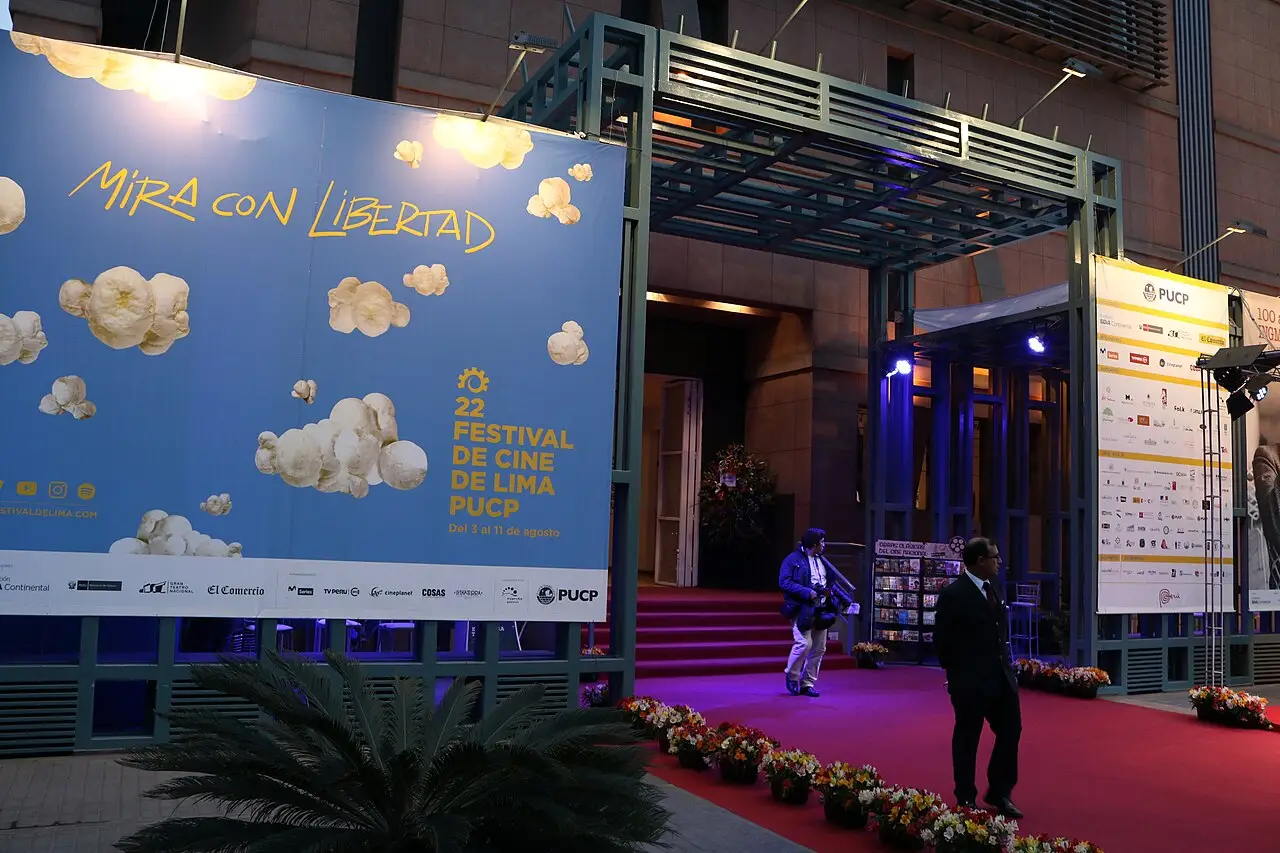
Lima Film Festival
August, organized by the Pontifical Catholic University since 1997. A week of Latin American cinema in theaters across Miraflores, San Isidro and downtown, with cheap tickets and screenings that sell out.
Books and films
Conversation in the Cathedral, by Mario Vargas Llosa (1969)
The novel that opens by asking at what point Peru went wrong, and dissects Odría's Lima, bar by bar, newsroom by newsroom.
Lima la horrible, by Sebastián Salazar Bondy (1964)
A short essay that dismantles the nostalgia for a “colonial Arcadia” and explains why the capital was ashamed of the country that sustained it.
The Milk of Sorrow, by Claudia Llosa (2009)
A Golden Bear winner in Berlin, filmed on the sandy slopes of Manchay: the Lima built by those who fled the violence of the 1980s, on the other side of the malecón.
Frequently asked questions
Lima: can you see the city in one night's stopover on the way to Cusco?
No. Land at night and fly to Cusco the next morning, and you see only the airport and the hotel, while the historic center, the malecón from Miraflores to Barranco and a neighborhood cevichería need two full days.
Lima: what is Pachacamac and how far is it?
It's a pre-Inca sanctuary and oracle 32 km to the south, occupied from the 3rd to the 16th century, with an Inca sun temple, the Acllahuasi and a site museum opened in 2016.
Lima: when is it sunny in the city?
Lima's summer runs from December to April, with 20 to 29°C and beaches on the Costa Verde and to the south packed on weekends, but clear skies, the best window of the year, run from late January to early April. From May to October, the garúa leaves the sky overcast for weeks.
Lima: how do people greet each other?
Women greet each other, and men greet women, with a kiss on the right cheek, even in work introductions; between men, the greeting is a handshake. Refusing the kiss and offering a handshake instead comes across as distant, even if no one says anything.
Lima: what's the real risk for visitors?
The real risk in Lima is to your belongings, not violence against visitors: what gets lost here is phones and backpacks, on crowded transit, at the Mercado Central, on Jirón de la Unión and outside bars, plus theft by pairs on motorbikes at traffic lights, with the car window open.
Other cities in the country
Peru ↗- Days
- 4–5
- When
- Apr–May · Sep–Oct
- Per person/day
- Average 350–600 S/Mid-range · per person/day
Cost scope
Per person per day: accommodation, meals, urban transport, visits and a small allowance for extras. Flights excluded; larger purchases vary. Editorial estimate, not a quote.
- Days
- 1–2
- When
- Apr–Oct
- Per person/day
- Average 425 S/Mid-range · per person/day
Cost scope
Per person per day: accommodation, meals, urban transport, visits and a small allowance for extras. Flights excluded; larger purchases vary. Editorial estimate, not a quote.
- Days
- 2–3
- When
- May–Oct
- Per person/day
- Explore costsGuide estimate
Cost scope
Per person per day: accommodation, meals, urban transport, visits and a small allowance for extras. Flights excluded; larger purchases vary. Editorial estimate, not a quote.
- Days
- 2–3
- When
- Apr–Nov
- Per person/day
- Average 209 PENMid-range · per person/day
Cost scope
Per person per day: accommodation, meals, urban transport, visits and a small allowance for extras. Flights excluded; larger purchases vary. Editorial estimate, not a quote.
- Days
- 2–3
- When
- Jan–Apr · Dec
- Per person/day
- Average 294 PENMid-range · per person/day
Cost scope
Per person per day: accommodation, meals, urban transport, visits and a small allowance for extras. Flights excluded; larger purchases vary. Editorial estimate, not a quote.