Dominican Republic
Punta Cana
Bávaro beaches, all-inclusive resorts, and a day on Isla Saona
Days Start with the basic programme and choose extensions for the time you have.
How the guide reaches this number
With five, the fifth would go to Playa Macao and the basilica of Higüey. Anyone who comes only to rest can stay the whole week in the resort, and the beach in front of the hotel is enough; but it is the two days outside it that show the rest of the country, the island inside a national park, and the colonial city with the cathedral of 1541, the oldest in the Americas still standing. Santo Domingo takes effort: it is about 200 km and 3 hours by bus each way, so it is only worth it with an early start. Punta Cana is also not a place for walking between neighborhoods, because the hotels are far from one another and from the towns on the highway, and anyone who wants to get around a lot needs a car or a taxi. For the beach to pay off, choose February to April, and in summer check the sargassum before booking.
4–5
When February to April; these are the months with the least rain, outside the hurricane season (June to November), and sargassum, which peaks in June or July, is lower in the Northern Hemisphere winter, from December to February.
How the guide reaches this number
December and January are also outside the hurricane season, with a little more rain
February to April; these are the months with the least rain, outside the hurricane season (June to November), and sargassum, which peaks in June or July, is lower in the Northern Hemisphere winter, from December to February. December and January are also outside the hurricane season, with a little more rain
Per person/day Budget about 4,280 DOP; mid-range about 10,600 DOP; comfortable about 25,400 DOP per person, based on spending reported by travelers to Budget Your Trip (consulted in October 2026).
How the guide reaches this number
Per person per day: accommodation, meals, urban transport, visits and a small allowance for extras. Flights excluded; larger purchases vary. Editorial estimate, not a quote.
 What Nilo thinks
I'd stay four days: two for the beach, one in Bávaro and another in the south, with Ojos Indígenas and Juanillo, one on Isla Saona, and one in the colonial zone of Santo Domingo. With five, the fifth would go to Playa Macao and the basilica of Higüey. Anyone who comes only to rest can stay the whole week in the resort, and the beach in front of the hotel is enough; but it is the two days outside it that show the rest of the country, the island inside a national park, and the colonial city with the cathedral of 1541, the oldest in the Americas still standing. Santo Domingo takes effort: it is about 200 km and 3 hours by bus each way, so it is only worth it with an early start. Punta Cana is also not a place for walking between neighborhoods, because the hotels are far from one another and from the towns on the highway, and anyone who wants to get around a lot needs a car or a taxi. For the beach to pay off, choose February to April, and in summer check the sargassum before booking.Along much of Bávaro, a reef of almost 30 km keeps the water shallow next to the sand, and it is this strip of about 10 km, with more than 50 large resorts between Uvero Alto and Cap Cana, that most people know as Punta Cana. Beyond the line of hotels there is another layer: the twelve ojos de agua of Ojos Indígenas, freshwater springs the Taíno held sacred; Playa Macao, where locals and surfers go; the basilica of Higüey, which receives more than 800,000 visitors a year. Farther away, Isla Saona, in a national park since 1975, with a natural pool 1 m deep 400 m from the coast, and the colonial zone of Santo Domingo, with the cathedral of 1541, complete the trip. The season matters in the choice: from February to April it rains less, sargassum is lower from December to February, and from June to November the hurricanes run. At the table, the Dominican day begins with mangú, a puree of green plantain, and morir soñando, orange juice blended with evaporated milk, shows up at any hour.
Quick facts
- Population
- 138,919 residents in the municipal district of Verón-Punta Cana, where Bávaro and Punta Cana are located (2022 census, Oficina Nacional de Estadística); there were 43,982 in the 2010 census
- Founded
- Land bought by investors in 1969; the name Punta Cana replaced Yauya or Punta Borrachos in 1970; international airport opened in 1984
- Country and region
- Dominican Republic, in the Caribbean; La Altagracia province, Higüey municipality, at the far east of the island of Hispaniola
- Language
- Spanish, in its Dominican variety
- Currency
- Dominican peso (DOP, written RD$); the US dollar is widely accepted in tourist areas
- Time zone
- UTC−4 year-round; the Dominican Republic does not observe daylight saving time
- Best time to visit
- February to April; these are the months with the least rain, outside the hurricane season (June to November), and sargassum, which peaks in June or July, is lower in the Northern Hemisphere winter, from December to February. December and January are also outside the hurricane season, with a little more rain
- Average daily cost
- Budget about 4,280 DOP; mid-range about 10,600 DOP; comfortable about 25,400 DOP per person, based on spending reported by travelers to Budget Your Trip (consulted in October 2026).
When to go
February to April; these are the months with the least rain, outside the hurricane season (June to November), and sargassum, which peaks in June or July, is lower in the Northern Hemisphere winter, from December to February. December and January are also outside the hurricane season, with a little more rain
How the year changes
It is warm all year in Punta Cana, and what changes the trip is rain, hurricanes, and sargassum. At the airport station (1991–2020 normals), the average high ranges from 28.5 °C in January to 32.0 °C in August, and the low from 21.2 °C to 24.3 °C; at night, from November to March, the temperature hovers around 20 °C. February to April are the driest months, with 50 to 65 mm a month, and March is the driest of all. May already reaches 129 mm, and from August to November it rains 106 to 135 mm a month. The Caribbean hurricane season normally runs from June to November. Atlantic sargassum peaks in June or July and is lower in the Northern Hemisphere winter, from December to February; in the warm months it reaches almost every beach in the east and south of the country, and in June 2026 it covered the sand at Uvero Alto. So anyone with a choice goes from February to April, when it rains less, with December and January close behind. In 2026 the volume was high: the September bulletin recorded a decline, but still above previous years for the same month.
Nilo's tips
Fill in the e-ticket at home, for arrival and departure
The form at eticket.migracion.gob.do is free and no longer follows the 72-hour rule. Sources differ on how far ahead: the country's official tourism website says you can fill it in as soon as you have your flight details, up to months ahead, and the British government says up to 7 days before arrival. Filling it in during the week of the trip satisfies both. It generates one QR code for arrival and another for departure. One person fills it in for up to seven travelers, and the family receives a single code. If something changes, use the request code that appears at the start of the form. For the address, anyone staying in a rental home should ask the host for the province, municipality, and sector.
Choose the month before the resort
From February to April it rains 50 to 65 mm a month, and sargassum is lower in winter, from December to February. From June to November is hurricane season, and in the warm months the seaweed can cover the sand along an entire stretch of coast, as at Uvero Alto in June 2026. If the trip falls in summer, I'd favor a hotel with a good pool and follow the University of South Florida's monthly bulletin before going.
Saona: excursions leave from Bayahíbe, 80 km from Bávaro
The island is in Cotubanamá National Park, and excursions leave from Bayahíbe, about 80 km and close to 1 hour 10 minutes by road from Bávaro, so the day starts early. Ask the operator whether the park fee is included, how long the boat stops at the natural pool, about 400 m from the coast, and whether there is a stop at Mano Juan. With 2,000 to 2,500 visitors a day, the departure time makes a difference.
Carry pesos outside the resort
The dollar is widely accepted in the tourist area, and the same number can be in one currency or the other. For a comedor, a colmado, and a motorcycle taxi, carry small peso notes, and always ask «¿en pesos o en dólares?» before agreeing.
Malaria and mosquitoes: sort it out before boarding
The CDC lists La Altagracia, including the resort areas, among the provinces with malaria transmission, and recommends preventive medication with a prescription. On the day trip to Santo Domingo, the colonial zone is in the Distrito Nacional, where the CDC points to transmission mainly in La Ciénaga and Los Tres Brazos and does not recommend medication for the rest; anyone already taking the medication for La Altagracia is covered. Dengue and Zika also circulate. Book a travel medicine appointment before you go and bring repellent.
Explore the map
Explore the map, read about the other places and plan your travel days in the app.
Open the appWhat to see
Punta Cana: The eastern point of the island
There is no old center. The tourist center, north of the airport, with most of the all-inclusive resorts along about 10 km of beach.
Playa El Cortecito
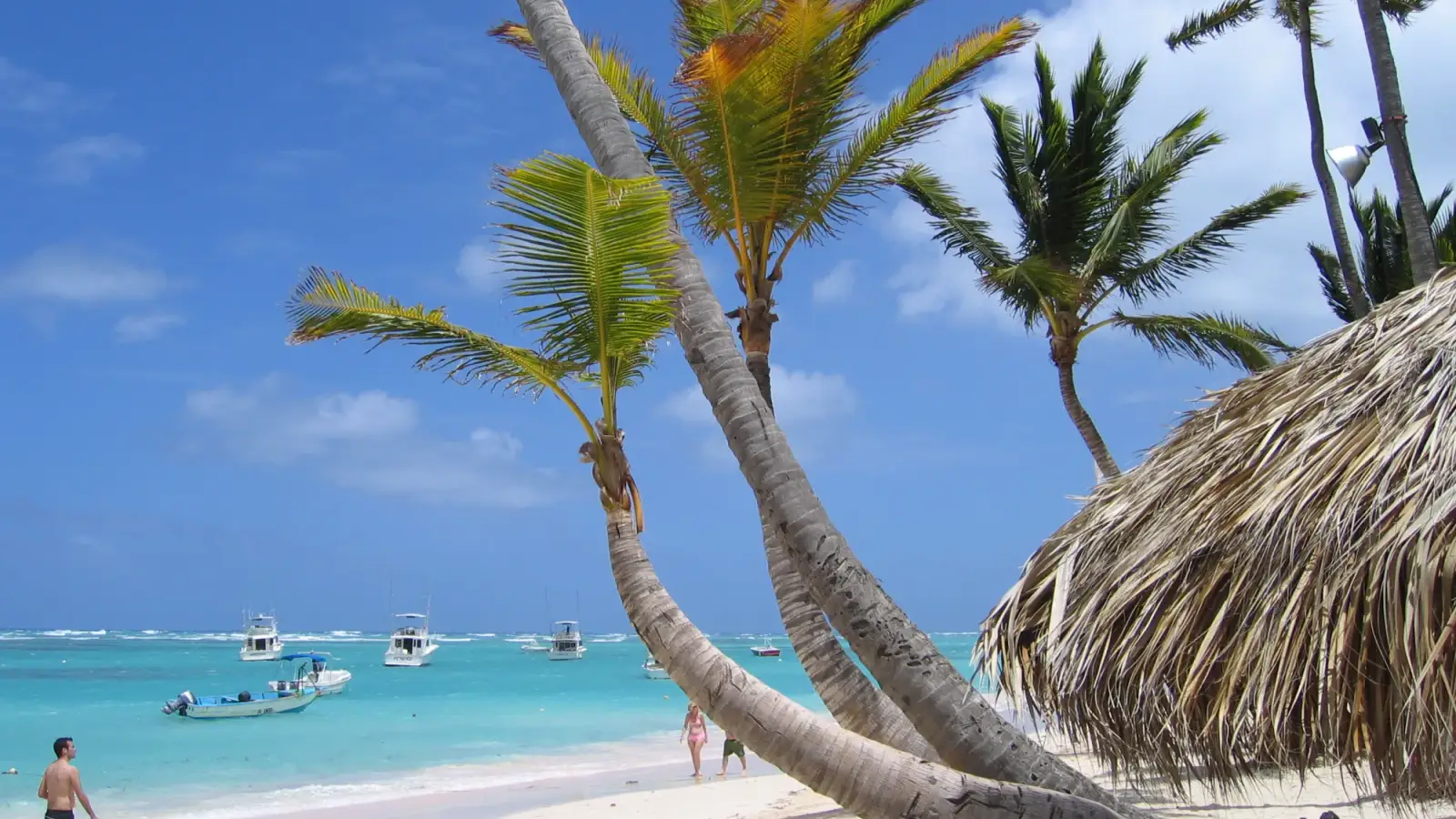
In the middle of Bávaro, the roughly 10 km strip of sand that runs from Los Corales to Arena Gorda. El Cortecito begins at Los Corales, where an old building called Pirata now houses two beach bars. The nearby reef generally keeps the water shallow. In sargassum season, conditions change from one day to the next, and on the affected stretches machine cleaning starts before dawn.
It is the middle of Bávaro’s roughly 10 km strip of sand, with generally shallow water and beach bars in Los Corales. This is the beach day that justifies the trip, provided sargassum has not piled up on the sand.
Check access

Playa Macao
A white-sand beach with palm trees in the northern part of Bávaro, about 30 minutes from the airport and about 25 km from El Cortecito. It is popular with locals, draws surfers, and is a stop on buggy and ATV tours.
About 25 km north of El Cortecito, this white-sand beach with palm trees is popular with locals and is the area’s surfing spot. Worth it for anyone wanting to see the coast without an unbroken line of resorts.
Check access
Playa Juanillo
A beach of pale sand and turquoise water inside Cap Cana, with beach volleyball, snorkeling, kayaking, and kitesurfing. Cap Cana is a private development, and public sources do not say how someone who is not staying there gets in: ask Cap Cana first, at +1 809 227-2262 or info@capcana.com.
Pale sand and turquoise water inside Cap Cana, with kayaking, snorkeling and kitesurfing. As it is within a private development and public sources do not explain access for non-guests, it is worth going only after confirming entry directly with Cap Cana.
Check access
Reserva Ecológica Ojos Indígenas
An area of more than 1,500 acres donated by the Puntacana Group to the Puntacana Foundation, with twelve ojos de agua, freshwater springs the Taíno considered sacred. Swimming is allowed in four of them, including Inriri and Cacibajagua. The visit is guided (Los Ojos Eco Journey) and booked through the foundation's website.
Twelve ojos de agua, freshwater springs considered sacred by the Taíno, in a reserve of more than 1,500 acres run by the Puntacana Foundation. Swimming is allowed in four of them, and visits are guided.
Check access
Basílica Nuestra Señora de La Altagracia
In Higüey, about 45 km and an hour by car from Punta Cana. Construction began in 1954 and the interior was finished in 1971. It holds the image of the Virgin of Altagracia, on display since 1571 and patron saint of the country, and receives more than 800,000 visitors a year, with the peak on January 21.
The basilica, built from 1954 to 1971, holds the image of the Virgin of Altagracia, displayed since 1571, and receives more than 800,000 visitors a year. It is a half-day outing into the province’s religious life, about an hour from the beach.
Check access

Hoyo Azul
A freshwater cenote inside Scape Park, in Cap Cana, about 3.7 m deep at its deepest point. You reach it by a 750 m self-guided trail, about 15 minutes, with uneven ground. Access is included in the park's Full Admission ticket; the park opens daily from 9 a.m. to 5 p.m., with attractions closing at 4:30 p.m.
The cenote, about 3.7 m deep at the end of a 750 m trail, is one attraction in a paid theme park and is accessible only with Full Admission. For freshwater swimming without the park package, Ojos Indígenas is a better choice.
Check access
Nilo’s itinerary
Start with the basic programme and choose extensions for the time you have.
Plan my days in the app ↗Day 1 · Bávaro along the sand, from El Cortecito to Los Corales
Start in the morning at Playa El Cortecito, before the sun gets strong, and walk along the sand toward Los Corales.
Before going into the water, look at the strip of sand and the flags: with sargassum piled up, choose another stretch or stay by the pool that day.
Have lunch at one of the beach bars in Los Corales and spend the afternoon in the shallow water protected by the reef.
At the end of the afternoon, book the next day's Los Ojos Eco Journey slot on the Puntacana Foundation website and arrange the taxi with the hotel.
Day 2 · Ojos Indígenas and Juanillo, south of the airport
Take a taxi from the hotel to the Ojos Indígenas Ecological Reserve: from El Cortecito it is about 22 km, close to 30 minutes without traffic.
Take the guided visit and swim in one of the four open springs, such as Inriri or Cacibajagua.
Continue to Playa Juanillo, in Cap Cana, about 3 km away. Cap Cana is private: ask first how someone who is not staying there gets in, at +1 809 227-2262 or info@capcana.com. Without confirmed access, go back to the Bávaro beach in the afternoon.
If you still want freshwater, Hoyo Azul is in Scape Park, with a Full Admission ticket; the attractions close at 4:30 p.m.
Return to Bávaro at the end of the afternoon.
Day 3 · Isla Saona (Cotubanamá National Park)
Day trip
The island is 25 km long and up to 5 km wide and is part of Cotubanamá National Park. Excursions leave from Bayahíbe, about 80 km from Bávaro and close to 1 hour 10 minutes by car without traffic, and pass through the Canaleto de Catuano. About 400 m from the coast there is a natural pool about 1 m deep, and the fishing village of Mano Juan is on the island. There are 2,000 to 2,500 visitors a day: ask the operator whether the park fee is included and how long the boat stays at each stop.
Day 4 · Colonial zone of Santo Domingo
Day trip
About 200 km by road from Bávaro, and about 3 hours on Expreso Bávaro, which leaves from Friusa or Verón. The settlement Bartholomew Columbus founded on the east bank of the Ozama River was moved to the west bank after a hurricane in 1502, and the city from that time has been a World Heritage Site since 1990. Here are the cathedral consecrated in 1541, the oldest in the Americas still standing, the Alcázar de Colón, home of Diego Colón, son of Christopher Columbus, built between 1511 and 1514, Calle Las Damas, from 1502, and the Museo de las Casas Reales. It is a full day: leave early and confirm museum hours.
If you stay longer
Day 5 · Macao and the basilica of Higüey
Leave early for Playa Macao, about 25 km north of El Cortecito, close to 30 minutes by car.
Spend the morning at the beach; if the sea is rough, it belongs to the surfers, and swimming is for the calmer part.
From Macao, continue to Higüey, about 28 km and 40 minutes, and visit the Basilica of Our Lady of Altagracia.
Return to Bávaro by road, about an hour by car.

Food
Mangú and los tres golpes
Puree of green plantain boiled with salt, mashed with some of the cooking water and butter. It is eaten at breakfast or dinner; with fried salami, fried white cheese, and a fried egg, and pickled red onion on top, it becomes «los tres golpes».
La bandera
The traditional Dominican lunch: white rice with stewed meat, served together on the same plate.
Sancocho de siete carnes
A stew of several meats (chicken, free-range or guinea fowl, pork, beef, and in some places goat), with smoked versions and sausages, which Dominican cooking treats as the national soup.
Chicharrón de pollo (pica pollo)
Chicken marinated in lime, breaded with flour, garlic, and oregano, and fried. It comes with tostones, fried plantain rounds, and lime.
Habichuelas con dulce
A creamy sweet of red beans with coconut milk, evaporated milk, sweet potato, raisins, and cinnamon, topped with a cookie or casabe. It is the dish of Lent and Holy Week.
Casabe
A flat, dry cassava bread inherited from the Taíno. It accompanies soups and stews.
Mamajuana
Dark rum, red wine, and honey left to infuse in a bottle with bark and herbs. The herbs were used by the Taíno as tea; the alcohol came after colonization. It is sold ready-made in the resorts and at the duty-free shop.
Morir soñando and Presidente beer
Morir soñando is orange juice blended with evaporated milk and sugar, sometimes with vanilla and lime. Among the country's most popular drinks is beer, especially Presidente.
Where to eat
- Verón and Friusa · $
La bandera at lunch, pica pollo with tostones, and sancocho, at the comedores and colmados of the towns where the people who work in the hotels live.
- Los Corales and El Cortecito · $$
Beach bars and restaurants open to people who are not guests, for a lunch outside the resort package.
$: up to RD$630 per meal at an inexpensive restaurant (Numbeo) · $$: RD$2,000 to RD$6,462 for a three-course dinner for two, without drinks, at a mid-range restaurant (Numbeo) · $$$: above the previous range · 2026-10-15
Day trips
Isla Saona (Cotubanamá National Park)
The island is 25 km long and up to 5 km wide and is part of Cotubanamá National Park. Excursions leave from Bayahíbe, about 80 km from Bávaro and close to 1 hour 10 minutes by car without traffic, and pass through the Canaleto de Catuano. About 400 m from the coast there is a natural pool about 1 m deep, and the fishing village of Mano Juan is on the island. There are 2,000 to 2,500 visitors a day: ask the operator whether the park fee is included and how long the boat stays at each stop.
Colonial zone of Santo Domingo
About 200 km by road from Bávaro, and about 3 hours on Expreso Bávaro, which leaves from Friusa or Verón. The settlement Bartholomew Columbus founded on the east bank of the Ozama River was moved to the west bank after a hurricane in 1502, and the city from that time has been a World Heritage Site since 1990. Here are the cathedral consecrated in 1541, the oldest in the Americas still standing, the Alcázar de Colón, home of Diego Colón, son of Christopher Columbus, built between 1511 and 1514, Calle Las Damas, from 1502, and the Museo de las Casas Reales. It is a full day: leave early and confirm museum hours.
Altos de Chavón (La Romana)
About 87 km from Bávaro and about 21 km from Bayahíbe. It is a replica of a sixteenth-century Mediterranean village, begun in 1976 by the architect Roberto Copa and the industrialist Charles Bluhdorn, above the Chavón River, near the Casa de Campo resort. It has the Church of St. Stanislaus, from 1979, a regional archaeology museum with pre-Columbian pieces from the region, and a 5,000-seat amphitheater opened in 1982. It combines well with Bayahíbe; confirm the entry arrangements beforehand.
Where to begin
Ojos Indígenas and Juanillo, south of the airport
Take a taxi from the hotel to the Ojos Indígenas Ecological Reserve: from El Cortecito it is about 22 km, close to 30 minutes without traffic.
Macao and the basilica of Higüey
Leave early for Playa Macao, about 25 km north of El Cortecito, close to 30 minutes by car.
Money
The currency is the Dominican peso (DOP, RD$), with banknotes of 50, 100, 200, 500, 1,000, and 2,000 pesos and coins of 1, 5, 10, and 25. The US dollar is widely accepted in tourist areas, and in private transactions people pay in dollars or euros when both parties agree; always ask which currency the price is in. Outside the resort, the figures Numbeo had gathered on October 2, 2026 (16 contributions in 18 months, with a warning that some are estimates) were: a meal at an inexpensive restaurant at RD$498 on average, from RD$175 to RD$630; a three-course dinner for two, without drinks, at a mid-range restaurant, RD$2,500, from RD$2,000 to RD$6,462; a domestic 0.5 L beer, RD$150; a cappuccino, RD$108; taxi base fare, RD$150. The US$10 tourist fee has been included in air tickets issued outside the country since April 25, 2018; citizens of Argentina, Chile, Israel, Japan, South Korea, and Uruguay are exempt and can request a refund online. The US$20 departure tax, required by law, is also included in the ticket. Anyone staying more than 30 days pays an extra fee on departure, calculated by the total length of stay, online or at airport immigration. In restaurants, the bill usually comes with a 10% service charge; check the line before tipping more. Card cloning is a risk in the country: keep your card in sight when paying, or pay in cash.
Getting there and around
From the airport to the beach
Punta Cana International Airport (PUJ) is the busiest in the country and sits about 3 km from the coast, on the road between Higüey and La Romana. By OpenStreetMap route calculation, without traffic, it is about 15 km and 20 minutes to El Cortecito, 9 km to Playa Blanca, 13 km to Juanillo, and 34 km, about half an hour, to Macao. Without a booked transfer, use an authorized airport or hotel taxi and agree on the fare before getting in. There are car rental desks in terminals A and B, among them Avis, Hertz, Budget, Europcar, Sixt, National, Enterprise, and Alamo.
Taxi, ride-hailing app, motoconcho, and guagua
To get from one point on the coast to another, the simplest option is a taxi from the hotel or from a registered company, which is what the British government recommends; it also notes that ride-hailing apps are widely available and that many taxis are in poor condition. The motoconcho, the motorcycle taxi, is usually driven badly and does not always come with a helmet. Guagua is the local word for bus. The resorts are far from one another, so anyone planning to leave the hotel often gains independence with a rental car.
Bus to Santo Domingo
Expreso Bávaro connects Bávaro-Punta Cana with Santo Domingo in about 3 hours, with terminals at the Friusa junction and the Verón junction, at Plaza Sitrabapu, across from Banco BHD. In Santo Domingo, the stops are on Calle Juan Sánchez Ramírez, at the corner of Avenida Máximo Gómez, and at Parque Enriquillo. The company asks passengers to arrive at the terminal one hour early; schedules and prices should be checked with it.
Safety
Most of the visit happens inside resorts, but the British government describes the country's crime rate as high and reports bag snatching, pickpocketing, and cases of sexual violence, including at beach resorts; do not leave your drink unattended. Use an authorized airport or hotel taxi, or one from a registered company. Card cloning is a risk: keep your card in sight when paying. The motoconcho is usually driven badly and often without a helmet for the passenger. At sea, there may be no lifeguard, and the sea is more dangerous during hurricane season; follow the warnings about water conditions and do not go in when sargassum has piled up, because the decomposing seaweed, about 48 hours after reaching the sand, releases hydrogen sulfide, which irritates the eyes, throat, and airways and is worse for people with asthma. On health, the US CDC (page revised September 3, 2026) lists La Altagracia, including the resort areas, among the provinces with malaria transmission and recommends preventive medication with a prescription (in Santo Domingo, the transmission cited is mainly in La Ciénaga and Los Tres Brazos, outside the colonial zone); dengue and Zika, spread by mosquitoes, are also present, and repellent and an air-conditioned room help. The hurricane season runs from June to November: follow the hotel's warnings during that time. The emergency number is 911.
Etiquette tips
Settle the currency before the price
The dollar circulates alongside the peso, and the same number can be in one currency or the other. For a taxi, a stall, or a tour, ask «¿en pesos o en dólares?» before agreeing.
Check the service charge before tipping
In restaurants, the bill usually comes with a 10% service charge. Leaving more is customary when the service was good, but it is not required.
Mistakes to avoid
Leaving the e-ticket for the airport
The electronic entry and exit form is mandatory for anyone flying on a commercial aircraft and must be ready before the airline counter. It is free; if a website asks for payment, it is not the official one, which is at eticket.migracion.gob.do. One person fills it in for up to seven travelers, and the family receives a single QR code.
Boarding without a return ticket
Since April 28, 2023, airlines must confirm that a foreign passenger has a ticket in and out of the country, and anyone without one may be denied entry. A one-way ticket is not enough, even if the exit is by land or sea.
Choosing the hotel without looking at the month
The resort is chosen from the photo of the beach, and the beach changes with the season. From June to November is hurricane season, and in the warm months sargassum can cover the sand, as at Uvero Alto in June 2026. From February to April, the same beach is usually dry and clean.
Treating Santo Domingo as a short outing
The colonial zone is about 200 km from Bávaro, and the bus takes about 3 hours each way. It is a full day, leaving early and returning at night.
Going past 30 days without counting the fee
The length of stay allowed without a visa varies by nationality. According to the country's official tourism website, anyone staying more than 30 days pays an extra fee on leaving, calculated by the total length of the trip, online or at airport immigration. Check both before booking your return.
Getting on a motoconcho without a helmet
The motorcycle taxi is cheap and at every junction, but drivers tend to drive badly and do not always have a helmet for the passenger. For trips between the beach and the highway, prefer the hotel taxi.
Useful phrases
¿En pesos o en dólares?
In pesos or in dollars? The question to ask before agreeing to any price
Un chin
A little bit. A word of Taíno origin, used to ask for «un chin más»
La guagua
The bus, in Dominican Spanish
El motoconcho
The motorcycle taxi
¿Qué vaina es esa?
What is that thing? «Vaina» works for any object or subject
La cuenta, por favor
The check, please. Check whether it already includes the 10% service charge
Where to stay
- Bávaro · First trip and anyone who wants a beach on foot with many hotel options · $$: It holds most of the all-inclusive resorts along about 10 km of sand, with beach bars in Los Corales and El Cortecito and shops at Plaza Bávaro. It is about 20 minutes from the airport.
- Punta Cana and Punta Cana Village · Short stays and anyone who wants to be near the airport · $$: It is a few minutes from the airport and close to the Ojos Indígenas reserve, with a golf course by the sea. The beach is the hotel's own, without the string of bars you find in Bávaro.
- Cap Cana · Couples, golf, and anyone who wants a more closed-off place · $$$: It is a private development, with a marina, the Punta Espada course, and Playa Juanillo. It is far from Bávaro and the towns on the highway; to leave it, count on a car or a taxi.
- Uvero Alto and Macao · Anyone who wants a more isolated resort and does not plan to go out much · $$: The hotels are more widely spaced and near Playa Macao, but they are about 30 minutes from Bávaro and farther from the airport, and it was one of the stretches covered in sargassum in June 2026.
- Verón · Small budgets and anyone taking the bus to Santo Domingo · $: It is at the road junction, near the Expreso Bávaro terminal, with shops and banks. It has no beach, and the nearest sand requires a taxi.
$: hotel or apartment without all-inclusive, in Verón or away from the beach · $$: all-inclusive resort in Bávaro, Punta Cana, or Uvero Alto · $$$: upscale resort or villa in Cap Cana · 2026-10-15
Districts
Bávaro
The tourist center, north of the airport, with most of the all-inclusive resorts along about 10 km of beach. Los Corales and El Cortecito are the stretches where the sand has bars and restaurants open to passersby, and Plaza Bávaro and Downtown Mall bring together shops and services. It suits those who want a beach on foot and the widest choice of hotels.
Punta Cana and Punta Cana Village
The original project area, between the airport and the sea, with the Puntacana Resort, an oceanfront golf course, and Punta Cana Village, a planned neighborhood of about 3,000 residents. It is a few minutes from the airport and close to the Ojos Indígenas reserve.
Cap Cana
A private development of about 120 km² to the south, with a marina of more than 150 slips, the Punta Espada golf course, Playa Juanillo, and Scape Park. It is the most closed-off part of the coast, with upscale hotels and condominiums.
Uvero Alto and Macao
The north coast, 25 to 30 km from Bávaro, with more widely spaced resorts and Playa Macao, popular with locals and surfers. It is farther from the airport and services, and it was one of the stretches covered in sargassum in June 2026.
Verón and Friusa
The towns at the road junctions, where many of the people who work in the hotels live. They have no beach and no tourist attraction; they have shops, colmados, banks, and the Expreso Bávaro terminals for Santo Domingo.
History
1494 · Columbus names Saona
On his second voyage, on September 14, 1494, Christopher Columbus lands on the island the Taíno called Adamanay and christens it Bella Savonesa, in honor of Michele da Cuneo. The name Saona comes from this.
early 16th century · The Higüey chiefdom and Cotubanamá
The east of the island was the Taíno chiefdom of Higüey. The cacique Cotubanamá resisted the Spanish, took refuge in a cave on Saona that now bears his name, was captured, and was sentenced to death by order of Governor Nicolás de Ovando.
1508 · Founding of Higüey
The Spanish found Higüey, today the seat of the municipality that includes the district of Verón-Punta Cana.
1944 · Mano Juan, the village of Saona
The government of Rafael Trujillo builds Mano Juan, on Saona, for 14 families. It is one of the island's two permanent settlements, along with Catuano, where a Navy post is located.
1954–1971 · The basilica of Higüey
Construction of the Basilica of Our Lady of Altagracia begins in 1954; it receives the image venerated since 1571 and is inaugurated on January 21, 1971, the patron saint's day. John Paul II visits in 1992.
1969–1970 · The land and the name
In 1969, North American investors, alongside Frank Rainieri, buy land on the eastern point of the island. Rainieri persuades them to open an access road and, in 1970, changes the name of the place from Yauya or Punta Borrachos to Punta Cana.
1975 · Del Este National Park
On September 16, 1975, Decree 1311 of President Joaquín Balaguer creates Del Este National Park, which includes Isla Saona and is now called Cotubanamá National Park.
1978–1984 · Club Med and the airport
Club Med joins the project in 1978 with a 350-room hotel. In 1984 the Puntacana Group opens Punta Cana International Airport, described as the first privately owned international airport in the Western Hemisphere.
2001–2007 · Cap Cana
South of Punta Cana, the private development of Cap Cana begins in 2001, covering about 120 km². The Punta Espada golf course opens in 2006, and the marina in 2007.
2010–2022 · The population triples
The municipal district of Verón-Punta Cana grows from 43,982 residents in 2010 to 138,919 in 2022, becoming the most populous municipal district in the country.
2011–2026 · The sargassum belt
Since 2011 a band of sargassum has formed in the Atlantic almost every summer. In June 2026 the seaweed covered the sand at Uvero Alto, and the September 2026 bulletin from the University of South Florida recorded a decline, still with high volume for the season.
Complete history
Before the resorts, the Higüey chiefdom
The far east of Hispaniola was the territory of the Taíno chiefdom of Higüey when the Spanish arrived. Columbus passed by Saona in 1494, and the conquest of the east, in the campaigns of the early sixteenth century, ended with the capture and execution of the cacique Cotubanamá by order of Nicolás de Ovando. Higüey, founded in 1508, became the region's town and the center of devotion to the Virgin of Altagracia, whose image has been venerated since 1571. The patron saint's festival moved from August 15 to January 21 to commemorate a victory over the French in 1690, and the current basilica, inaugurated in 1971, receives more than 800,000 visitors a year. For almost five centuries, the coast opposite stayed on the margins of all this: Saona only got a permanent village, Mano Juan, in 1944, built by the Trujillo government for 14 families.
A name chosen in 1970
In 1969, North American investors, alongside Frank Rainieri, bought land on a point of coast with no road access, and Rainieri persuaded them to open a road. In 1970 the place stopped being called Yauya or Punta Borrachos. Club Med arrived in 1978 with 350 rooms, the group's first hotel followed in 1979, and the 1984 airport, built by the Puntacana Group itself, changed the scale of the place: international flights began landing a few kilometers from the sand, and today it receives about 64% of the flights that arrive in the country.
The coast becomes a district
Bávaro, to the north, grew as the area of the large all-inclusive resorts, and Verón, at the road junction, as the town where many of the people who work in them live. To the south, Cap Cana began in 2001 as a private development, with a marina and golf. The result is a region of more than 50 large resorts and a population that tripled between the 2010 and 2022 censuses. In 2002 Bávaro hosted the Ibero-American Summit, and in 2017 Punta Cana hosted the CELAC summit. Since 2011 the sargassum that arrives in summer has become the beach's main problem, and on the affected stretches the sand is cleaned every day from before dawn.
Geography and shape of the city
The eastern point of the island
Punta Cana sits on the low plain at the far east of Hispaniola, with an average elevation of 28 m, in La Altagracia province. The cape divides the coast in two: to the north are Uvero Alto, Macao, Arena Gorda, Bávaro, El Cortecito, Los Corales, and Cabeza de Toro; to the south, Cabo Engaño, Punta Cana, and Juanillo. A reef of almost 30 km runs along the coast and creates shallow water and natural pools next to the sand, and the marine area around Punta Cana was declared a reserve in 2012.
One road and a line of beaches
There is no old center. The airport is about 3 km from the coast, on the road between Higüey and La Romana, and from it the roads lead north, toward Bávaro, and south, toward Cap Cana. Bávaro stretches for about 15 km, from the Verón junction to the Macao junction, with about 10 km of beach, and hotels occupy almost the entire seafront. Verón and Friusa, at the road junctions, are the towns of the people who work in the resorts, with shops, bus terminals, and banks. Higüey, the seat of the municipality, is about 45 km inland.
Tropical climate and the sea calendar
The climate is warm all year. At the airport station (1991–2020 normals), the average high ranges from 28.5 °C in January to 32.0 °C in August, the low from 21.2 °C to 24.3 °C, and 1,158.6 mm of rain falls per year. March is the driest month, with 50.4 mm, and from August to November it rains 106.7 to 135.3 mm per month. The Caribbean hurricane season normally runs from June to November, and Atlantic sargassum peaks in June or July and is lower in the Northern Hemisphere winter, from December to February.
A reef of almost 30 km runs along the coast and keeps the water shallow next to the sand along much of Bávaro.
Culture
Merengue and bachata
The country's two musics are merengue and bachata. Merengue was born in the mid-nineteenth century in the Cibao, the northern valley, with accordion, tambora (a two-headed drum), and güira (a metal scraper); Trujillo turned it into the national music and dance, and UNESCO inscribed it as intangible heritage on November 30, 2016. Bachata arose in poor neighborhoods and the countryside and was called «música de amargue» in the 1960s and 1970s; the album Bachata Rosa, by Juan Luis Guerra, in 1990, took it to the middle class and the world. Today it is also recognized by UNESCO as intangible heritage.
Baseball from October to January
The country's sport is baseball. The six-team Dominican professional league plays from mid-October to the end of January, and the nearest team is the Toros del Este, from La Romana, champions in 1995, 2011, and 2020 and of the 2020 Caribbean Series, at Estadio Francisco Micheli.
Devotion to Altagracia
Religious life in the province revolves around Higüey and the Virgin of Altagracia, patron saint of the country. On January 21, a national holiday, the basilica receives pilgrims from all over the country.
Nightlife in Bávaro
Nightlife is concentrated in the resorts and in venues such as Coco Bongo, on Avenida Barceló, which mixes nightclub and theater show.
Merengue joins three inheritances in one ensemble: the European accordion, the African tambora, and the güira, a metal scraper linked to the Taíno.
Festivals and events
Day of the Virgin of Altagracia, January 21
A national holiday and the busiest day at the basilica of Higüey, which receives pilgrims from all over the country. The date commemorates a victory over the French in 1690; before that, the festival was on August 15, which remains a second date for the patron saint.
Carnival, Sundays in February
The parades take place every Sunday in February, the month of independence, with the diablo cojuelo as the main character. The one in La Vega is among the biggest in the country, and in Santo Domingo February 27, Independence Day, has a military parade.
Holy Week, March or April
During Lent and Holy Week people eat habichuelas con dulce. Good Friday is a national holiday, and the date changes every year.
Books and films
The Feast of the Goat (2000), Mario Vargas Llosa
The novel follows the assassination of the dictator Rafael Trujillo in 1961 and its aftermath, alternating between 1961 and 1996. It explains the country that built Mano Juan on Saona and made merengue the national music. It was adapted for film in 2005.
In the Time of the Butterflies (1994), Julia Alvarez
A fictionalized version of the story of the Mirabal sisters, opponents of Trujillo. It is the reading that shows the dictatorship from the side of the families who lived under it.
Bachata Rosa (1990), Juan Luis Guerra e 4.40
The album that took bachata, once seen as music of the poor, to the Dominican middle class and abroad, and that won the Grammy for best tropical Latin album. It includes «Burbujas de Amor» and «Como Abeja al Panal» and «La Bilirrubina», a merengue.
Frequently asked questions
Punta Cana: how do you get from the airport to the hotel?
The airport (PUJ) is about 3 km from the coast, and without traffic it is about 20 minutes to El Cortecito and half an hour to Macao. Without a booked transfer, use an authorized airport or hotel taxi and agree on the fare before getting in.
Punta Cana: what do I need to sort out before boarding?
Fill in the free electronic entry and exit form at eticket.migracion.gob.do before the airline counter. If you are a foreign passenger, also have a ticket out of the country: since April 28, 2023, a one-way ticket is not enough, even if the exit is by land or sea.
Punta Cana: how many days should I stay?
I'd stay four days: two for the beach, one on Isla Saona and one in the colonial zone of Santo Domingo, which is about 3 hours by bus each way. With five, the fifth would go to Playa Macao and the basilica of Higüey.
Punta Cana: what is the Isla Saona trip like?
Excursions leave from Bayahíbe, about 80 km and close to 1 hour 10 minutes from Bávaro, so the day starts early. With 2,000 to 2,500 visitors a day, ask the operator whether the park fee is included and how long the boat stays at each stop.
Punta Cana: when is the best time to go, and what about the sargassum?
February to April are the driest months and fall outside the hurricane season, which runs from June to November. Sargassum peaks in June or July and is lower from December to February, so in summer check the sargassum before booking.