United States
Miami
Art deco beaches, Little Havana, art and the Everglades
Days Start with the basic programme and choose extensions for the time you have.
How the guide reaches this number
The third, if you have it, goes to the Everglades, the Cape Florida lighthouse and the beach. Across much of the city, Spanish is the first language, and coffee is drunk standing at the counter. But Miami has no historic center, because it was only incorporated in 1896, and much of the day passes inside a car or a ride-hailing app. With just one day, have breakfast standing at a walk-up window on Calle Ocho, take a bus or app ride to Brickell, where the free Metromover starts, and get off at the PAMM at midday; finish on the sand at South Beach in the late afternoon, once the sun stops burning. What disappoints is Ocean Drive at night, with high prices and a sidewalk full of speakers, and Wynwood Walls, which charges admission for murals no better than the free ones on the street next door.
2–3
When November to April, dry season; best in February and late April
How the guide reaches this number
The dry season runs from November to April: highs of 24–27 °C, lows of 15–20 °C, tolerable humidity, and little rain. It's high season, peaking between Christmas and Easter. Prices rise during Art Basel week in December and the two weeks of spring break in March, when Miami Beach typically imposes traffic restrictions, bag checks, and a curfew. May through October brings the wet season: 30–33 °C, with a heat index above 38. There's an almost daily downpour between 3 and 6pm, lasting 30–60 minutes and passing: it's enough to wait under an awning until the street dries. Hurricane season runs from June 1 to November 30, peaking between mid-August and early October. September and October also bring king tides, which flood the streets of Miami Beach and Brickell on clear, sunny days. If you can choose, go in February or the second half of April. The month I'd avoid is September, which stacks heat, rain, hurricanes, and flooding into one package, though it's also when hotels and flights get cheaper.
Per person/day US$90–150 budget, US$200–350 comfortable, not counting high-season lodging
How the guide reaches this number
Per person per day: accommodation, meals, urban transport, visits and a small allowance for extras. Flights excluded; larger purchases vary. Editorial estimate, not a quote.
 What Nilo thinks
Set aside two days for the essentials: one downtown, between the art at the PAMM and the bay, another in Little Havana, Coral Gables and Coconut Grove. The third, if you have it, goes to the Everglades, the Cape Florida lighthouse and the beach. Across much of the city, Spanish is the first language, and coffee is drunk standing at the counter. But Miami has no historic center, because it was only incorporated in 1896, and much of the day passes inside a car or a ride-hailing app. With just one day, have breakfast standing at a walk-up window on Calle Ocho, take a bus or app ride to Brickell, where the free Metromover starts, and get off at the PAMM at midday; finish on the sand at South Beach in the late afternoon, once the sun stops burning. What disappoints is Ocean Drive at night, with high prices and a sidewalk full of speakers, and Wynwood Walls, which charges admission for murals no better than the free ones on the street next door.Miami lives in two languages, between two bodies of water, Biscayne Bay and the Everglades, and the conversation slides from English to Spanish without warning. On Calle Ocho, in Little Havana, men over 55 play dominoes at Máximo Gómez Park, and the Cuban cafecito, sweet and strong, is drunk standing up. Across the bay, the roughly 800 art deco buildings of South Beach, raised between 1930 and 1942, keep their restored neon facing the beach, and in Wynwood the warehouse walls have turned into murals that change week to week. Try the Cuban sandwich at lunch and, at night, griot with pikliz from Little Haiti or a frita from Hialeah. The distances call for a ride-hailing app or the free Metromover, so pick your hotel neighborhood by what you want to see. Come between November and April, in the dry season, dodging the two weeks of spring break in March, and set aside two days.
Quick facts
- Population
- about 490,000 in the city; about 2.8 million in Miami-Dade County; about 6.3 million in the metro area (2025 estimates)
- Founded
- Incorporated on July 28, 1896, with 344 votes; Tequesta occupation of the same spot for about 2,000 years
- Country and region
- United States, state of Florida, Miami-Dade County
- Language
- English and Spanish on equal footing day to day; Haitian Creole a distant third
- Currency
- US dollar (US$); 7% sales tax in Miami-Dade, always charged on top of the listed price
- Time zone
- UTC−5 in winter (EST) and UTC−4 during daylight saving time (EDT), from March to November
- Best time to visit
- November to April, dry season; best in February and late April
- Average daily cost
- US$90–150 budget, US$200–350 comfortable, not counting high-season lodging
When to go
November to April, dry season; best in February and late April
May
23° to 30°C
161 mm of rain
June
25° to 32°C
267 mm of rain
July
25° to 33°C
187 mm of rain
August
25° to 33°C
243 mm of rain
September
25° to 32°C
260 mm of rain
October
23° to 30°C
194 mm of rain
How the year changes
The dry season runs from November to April: highs of 24–27 °C, lows of 15–20 °C, tolerable humidity, and little rain. It's high season, peaking between Christmas and Easter. Prices rise during Art Basel week in December and the two weeks of spring break in March, when Miami Beach typically imposes traffic restrictions, bag checks, and a curfew. May through October brings the wet season: 30–33 °C, with a heat index above 38. There's an almost daily downpour between 3 and 6pm, lasting 30–60 minutes and passing: it's enough to wait under an awning until the street dries. Hurricane season runs from June 1 to November 30, peaking between mid-August and early October. September and October also bring king tides, which flood the streets of Miami Beach and Brickell on clear, sunny days. If you can choose, go in February or the second half of April. The month I'd avoid is September, which stacks heat, rain, hurricanes, and flooding into one package, though it's also when hotels and flights get cheaper.
The same numbers as a table
| Month | Temperature °C | Rain mm |
|---|---|---|
| January · | 16 to 25 | 47 |
| February · | 17 to 26 | 55 |
| March · | 19 to 27 | 63 |
| April · | 21 to 29 | 86 |
| May | 23 to 30 | 161 |
| June | 25 to 32 | 267 |
| July | 25 to 33 | 187 |
| August | 25 to 33 | 243 |
| September | 25 to 32 | 260 |
| October | 23 to 30 | 194 |
| November · | 20 to 27 | 90 |
| December · | 18 to 26 | 62 |
Nilo's tips
Eat standing up on Calle Ocho for under US$6
The ventanitas of Calle Ocho are coffee windows that open straight onto the sidewalk, where you eat standing up, in five minutes, to start the day. Cafecito, croqueta de jamón and pastelito de guayaba come to under $6. If you order the colada, it arrives with a stack of little cups: pour for whoever's nearby before you drink your own, because the colada is made to share.
Take bus 150 from the airport to South Beach for US$2.25
From MIA, a rideshare to South Beach costs US$35–60. The 150 Airport Flyer bus does the same route for US$2.25, in 35–50 minutes, leaving from the Miami Intermodal Center. Tap to pay with card or phone. The US$5.65 daily cap applies to the Metrorail too.
Ride the full Metromover loop, for free, in about 30 minutes
Sitting on the train, you get a sense of the city's scale before you start spending on ride-hailing apps, so do the loop on the first day.
Read the bill before signing
In Miami Beach, a lot of places already add an 18–20% service charge and leave the tip line blank. The 7% tax comes on top of the menu price. Check the bill line by line before adding the tip a second time.
Ask about the resort fee before booking
Plenty of hotels charge a resort fee of US$25–45 a night, on top of the room rate. The final bill won't match the reservation. Stay in North Beach, above 63rd Street: the same beach as South Beach, for less. Between June and September the nightly rate drops to US$110–200, versus US$180–350 between December and April.
Go to the Everglades early, in winter: Shark Valley is 60 km
Early and in winter there are fewer mosquitoes and more alligators in sight, and the 24 km loop has no shade at all. Shark Valley is about 1 hour away on US-41, and admission costs $20 per person on foot or by bike, or $35 per car. Bring water and do the loop by bike or on the park's tram.
Explore the map
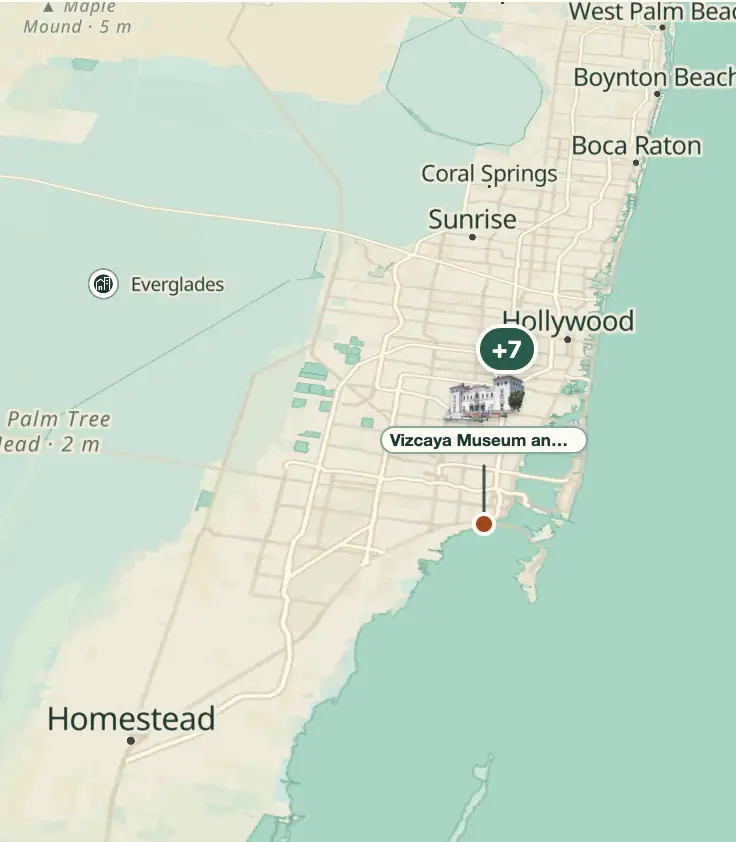
© OpenStreetMap · OpenFreeMap · © OpenMapTiles
Explore the map, read about the other places and plan your travel days in the app.
Open the appWhat to see
Miami: The low strip and the limestone ridge
The street grid is a numbered board starting from the intersection of Miami Avenue and Flagler Street, divided into the NW, NE, SW and SE quadrants. That's why addresses like "SW 8th St" work as coordinates, and the house number indicates the block.
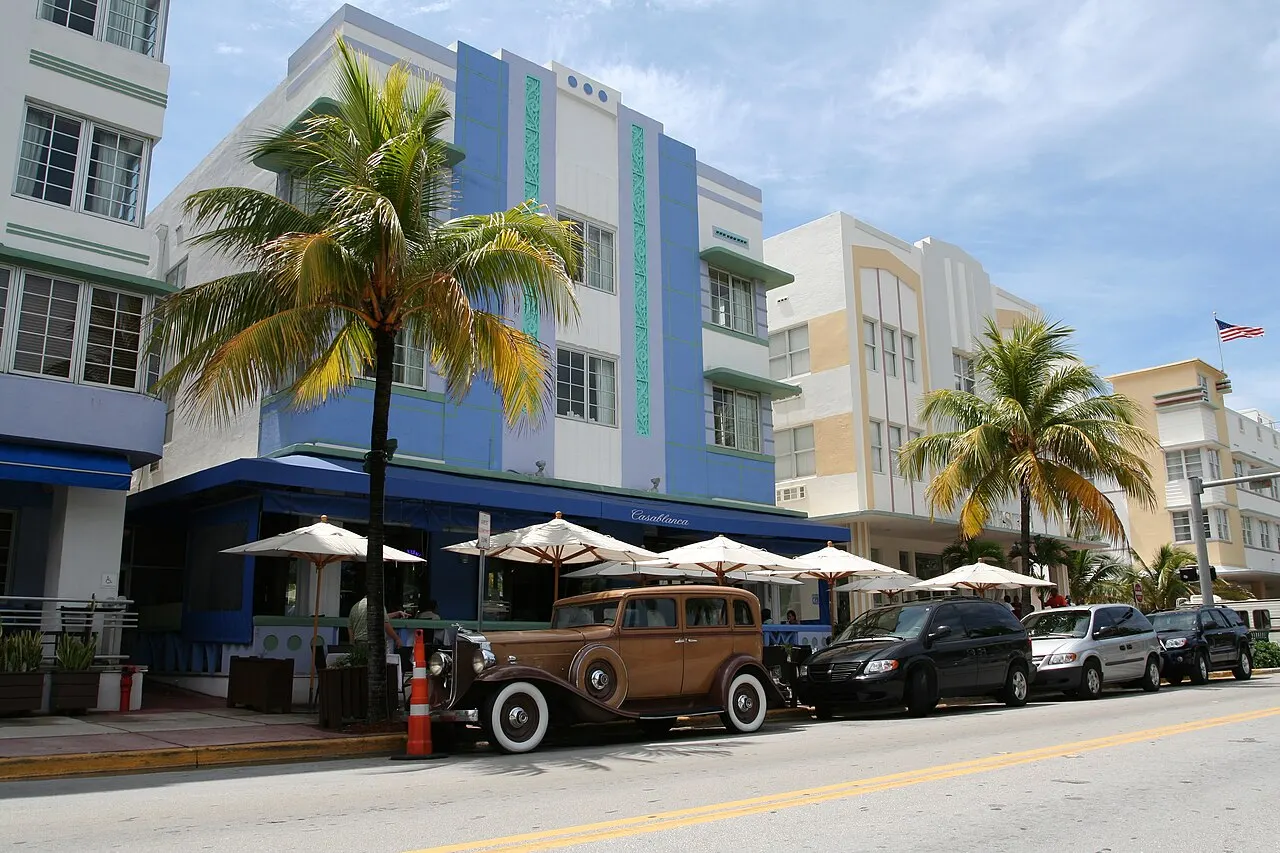
Art Deco Historic District
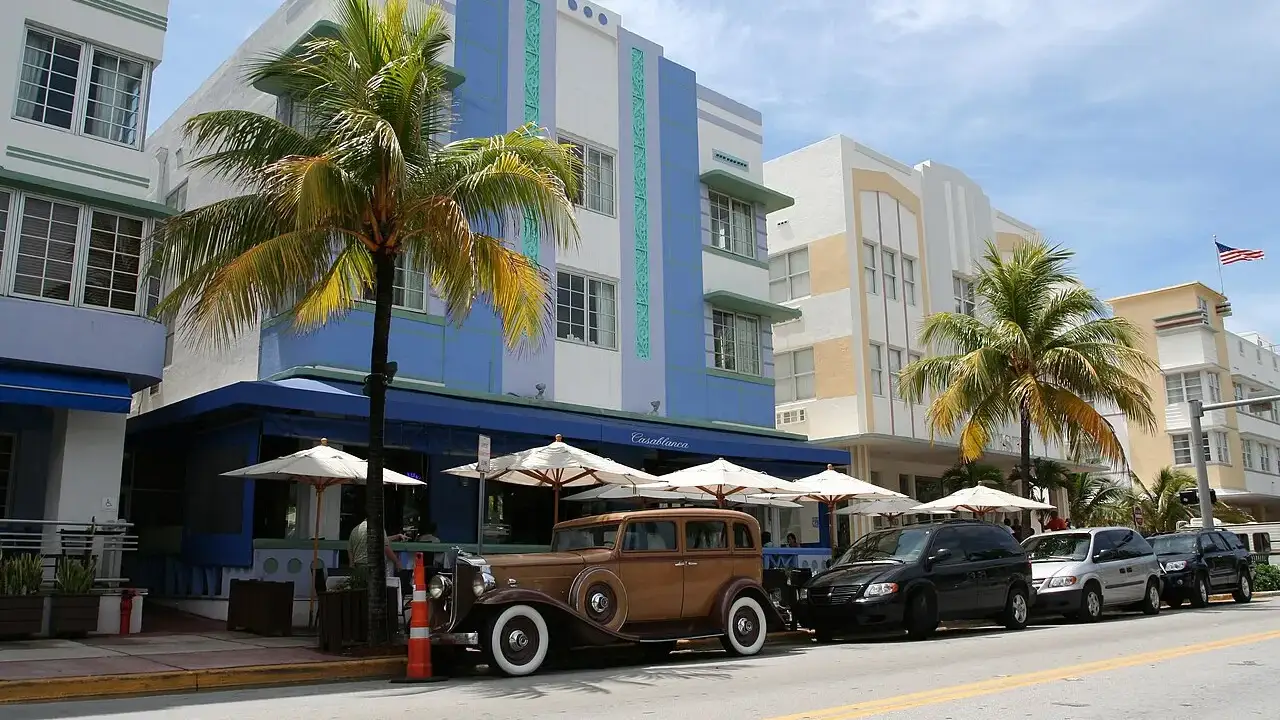
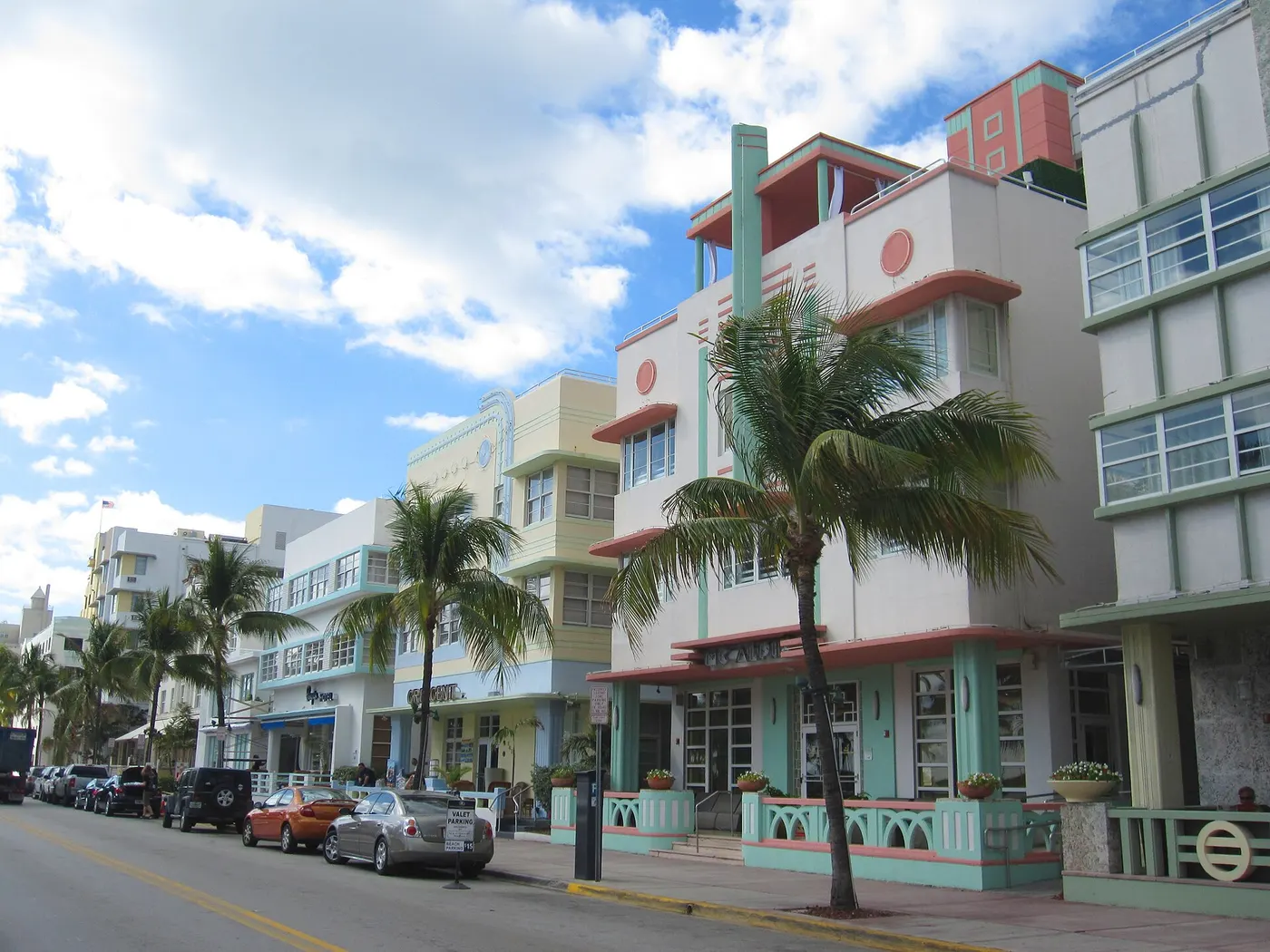
About 800 buildings from 1930–1942 between 5th and 23rd streets in Miami Beach, with symmetrical facades, concrete “eyebrows” over the windows, and restored neon. The Miami Design Preservation League runs guided walking tours leaving from the Art Deco Welcome Center, at Ocean Drive and 10th Street.
About 800 buildings put up from 1930 to 1942, from 5th Street to 23rd Street, show symmetrical facades, concrete eyebrows over the windows and restored neon, and walking tours leave from the Art Deco Welcome Center, on Ocean Drive at 10th Street.
Check access

Calle Ocho and Máximo Gómez Park
Máximo Gómez Park, known as Domino Park, at SW 8th and 15th Avenue, has operated since 1976 and only lets players 55 and older sit at the tables. The same stretch of the street holds the Cuban Memorial Boulevard, the Tower Theater (1926) and Ball & Chain, a music venue reopened in 2014.
Máximo Gómez Park, the Domino Park, opened in 1976, only lets people 55 and older sit at the domino tables. The same stretch of Little Havana holds the Cuban Memorial Boulevard, the Tower Theater, from 1926, and Ball & Chain, reopened in 2014.
Check access

Pérez Art Museum Miami and Frost Science
PAMM, opened in 2013 in a building by Herzog & de Meuron, stands on stilts and is covered in vertical gardens by Patrick Blanc, with a collection of modern and contemporary art from the Americas. Next door, in the same Museum Park, the Frost Museum of Science (2017) has a cone-shaped tank of 2.3 million liters.
The PAMM, opened in 2013 in Museum Park with a design by Herzog & de Meuron, stands on stilts beneath vertical gardens by Patrick Blanc and brings together modern and contemporary art from the Americas, with the Frost Museum of Science right next door.
Check access

Everglades: Shark Valley and Anhinga Trail
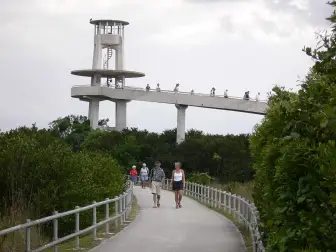
The national park, created in 1947, protects about 6,100 km² of flooded freshwater prairie flowing slowly south. At Shark Valley, 60 km from downtown, a paved 24 km loop can be biked or ridden by tram to an observation tower; the Anhinga Trail, at the Homestead entrance, is the boardwalk with the most alligators per meter.
Since 1947 the national park has protected about 6,100 km² of freshwater wetland that drains slowly southward; at Shark Valley a 24 km loop runs by bike or tram to a tower, and there's the boardwalk with the highest density of alligators.
Check access

Vizcaya Museum and Gardens
An Italian-inspired villa built between 1914 and 1922 for industrialist James Deering, with 34 rooms furnished with European pieces and formal gardens facing the bay. The carved stone barge in front of the house is the work of A. Stirling Calder.
James Deering had an Italian-inspired villa built from 1914 to 1922, with 34 rooms full of European furniture and formal gardens facing the bay, and the carved stone barge out front is by A. Stirling Calder.
Check access
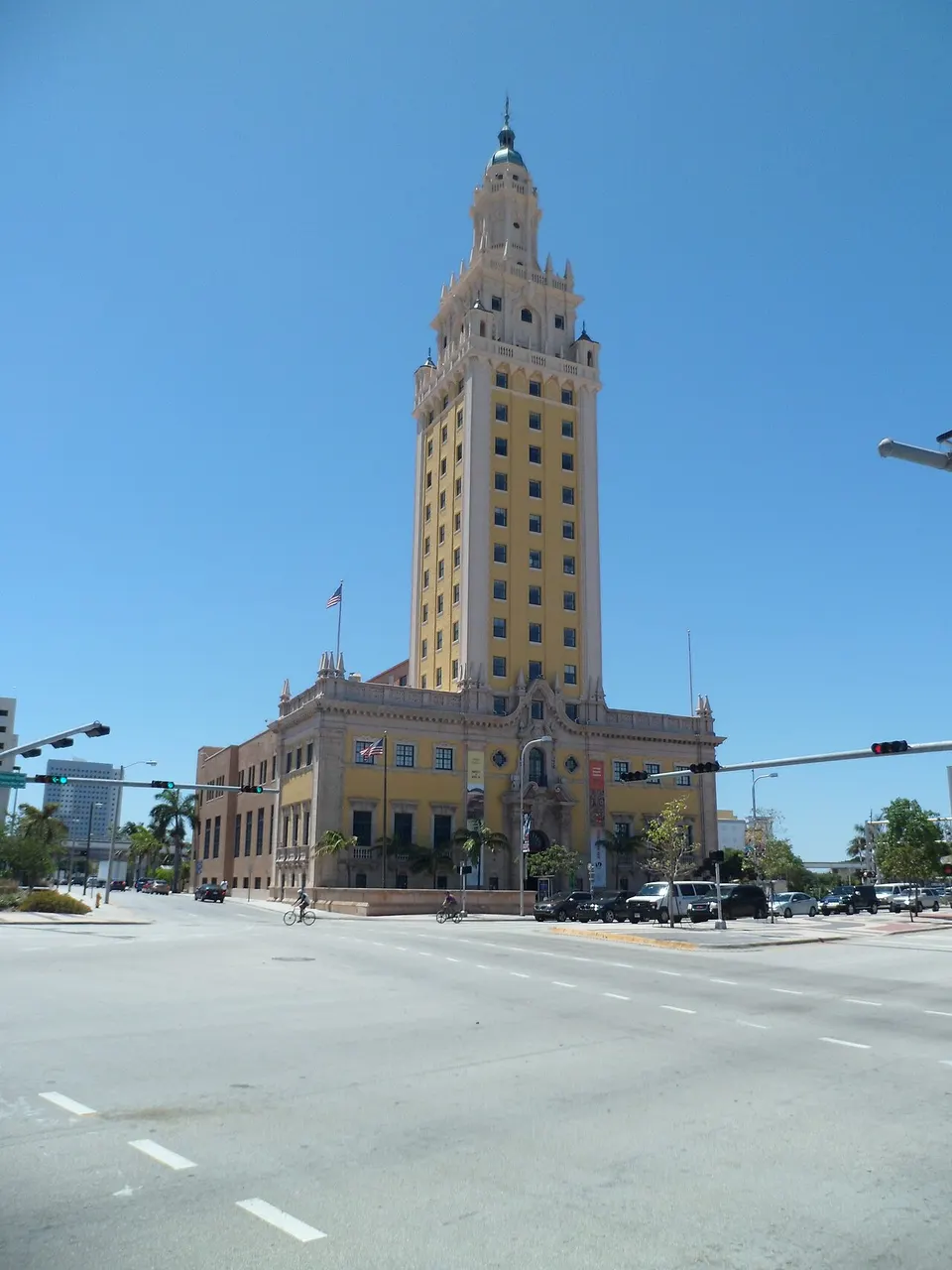
Freedom Tower
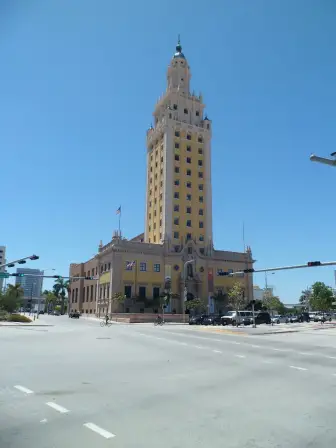
A 1925 tower designed by Schultze & Weaver after Seville's Giralda, home to the Miami News newspaper and, from 1962 to 1974, a federal reception center for Cuban refugees. It's been a National Historic Landmark since 2008 and belongs to Miami Dade College.
Schultze and Weaver designed, in 1925, based on the Giralda, the building that from 1962 to 1974 served as the federal reception center for Cuban refugees and has been a National Historic Landmark since 2008. The building belongs to Miami Dade College.
Check access

Venetian Pool and Biltmore Hotel
Coral Gables' public pool opened in 1924 inside a disused coral quarry and is fed by groundwater, with grottoes and Venetian-style towers. Ten minutes away, the Biltmore (1926) has a 96 m tower also modeled on the Giralda and free guided tours on fixed days (check ahead).
The Coral Gables pool opened in 1924 in a disused coral quarry, filled by the groundwater table, with Venetian grottoes and towers, and ten minutes away the 1926 Biltmore raises a 96 m tower inspired by the Giralda, with free tours on set days.
Check access
Bill Baggs Cape Florida State Park
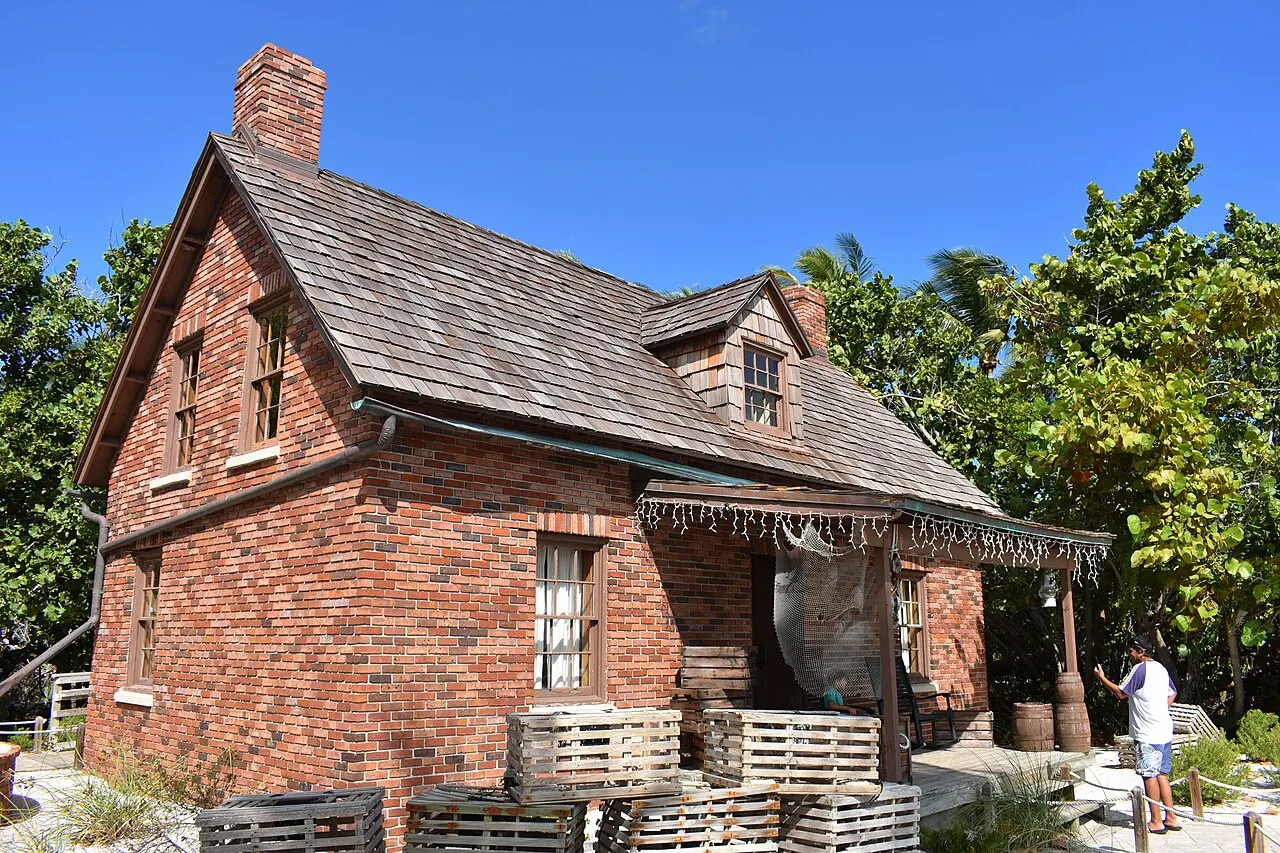
At the southern tip of Key Biscayne, this park holds the 1825 lighthouse, the oldest structure standing in the county, with 109 steps and guided visits at fixed times. The park also marks a departure point used by enslaved people fleeing to the Bahamas, a maritime branch of the Underground Railroad.
At the tip of Key Biscayne, the 1825 lighthouse has 109 steps and offers tours at set times, and the grounds mark an escape point for enslaved people heading to the Bahamas, linked to the Underground Railroad.
Check access
Wynwood Walls
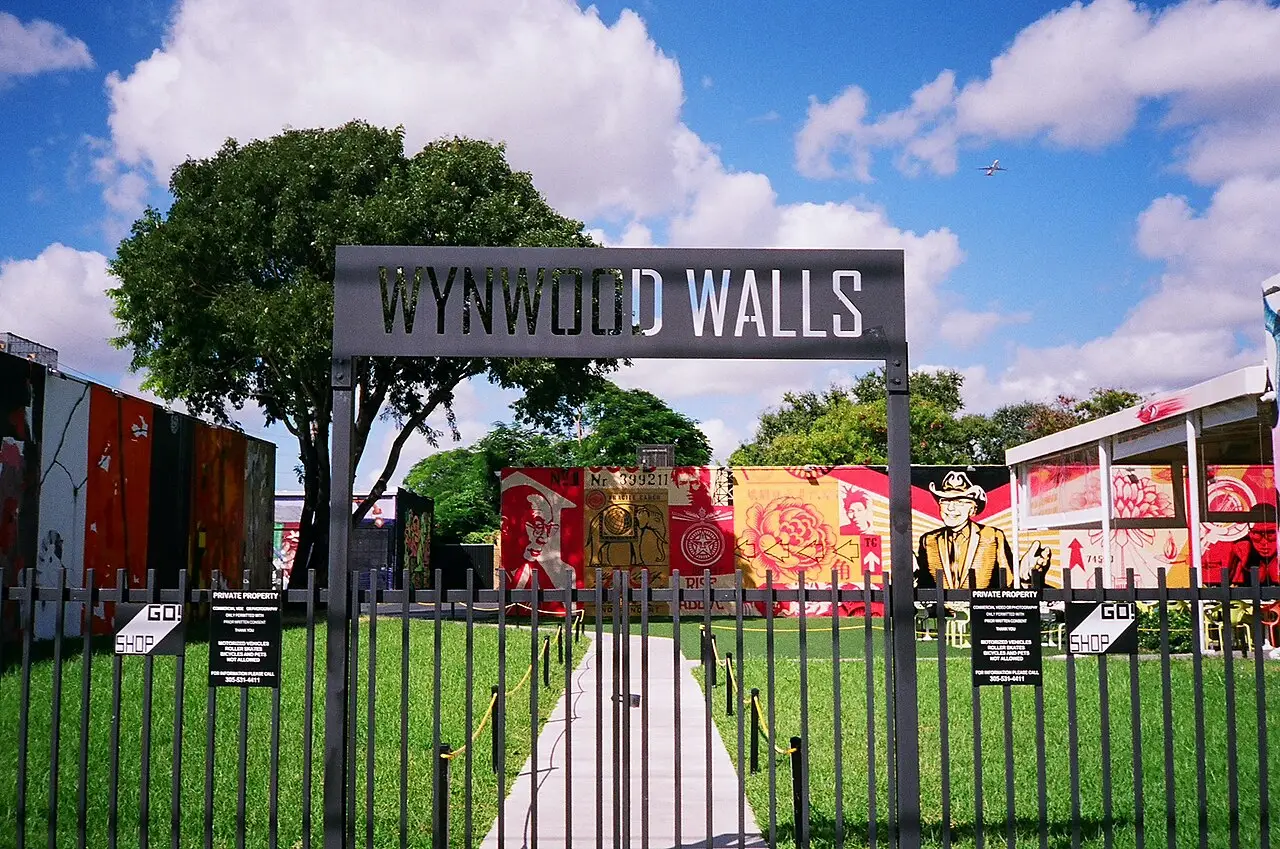
A mural courtyard created in 2009 by Tony Goldman, who turned warehouse walls into a permanent canvas for street artists; it now charges admission. The surrounding streets, especially NW 2nd Avenue between 22nd and 28th streets, have painting of the same caliber, free.
The courtyard Tony Goldman created in 2009 charges admission, and the block next door is free: NW 2nd Avenue between 22nd and 28th streets has painting of the same caliber, on both sidewalks, without charging anything.
Check access
Nilo’s itinerary
Start with the basic programme and choose extensions for the time you have.
Plan my days in the app ↗Day 1 · Downtown, art, and the bay
Start at the Freedom Tower, on Biscayne Boulevard, and walk to Bayfront Park; then loop through Downtown and Brickell on the free Metromover to get a feel for the city's scale in 30 minutes.
Set aside the morning for the Pérez Art Museum Miami, in Museum Park; with kids, swap it for the Frost Museum of Science next door and its cone-shaped tank of 2.3 million liters.
Take a rideshare to Wynwood, 15 minutes, and walk NW 2nd Avenue between 22nd and 28th streets: with or without a ticket to Wynwood Walls, the murals cover both sidewalks.
Walk another 25 minutes to the Design District to see Buckminster Fuller's Fly's Eye Dome in the central plaza and the free-admission Institute of Contemporary Art.
Have dinner in Wynwood or Midtown and take a rideshare back: overnight parking is pricey and DUI checkpoints are common in the area.
Day 2 · Little Havana, Coral Gables, and Coconut Grove
Have breakfast standing up at the ventanita of a cafetería on Calle Ocho: cafecito, croqueta de jamón and pastelito de guayaba, for less than US$6.
Walk from SW 12th to SW 17th Avenue, passing Máximo Gómez Park, the Cuban Memorial Boulevard, the Tower Theater (1926), and a cigar shop where they still roll by hand.
Head to Coral Gables and swim at the Venetian Pool, opened in 1924 inside a coral quarry; check the day's hours and minimum age beforehand.
Lunch on Miracle Mile and step into the lobby of the Biltmore Hotel (1926) to see the 96 m tower modeled on Seville's Giralda.
Close the day at Vizcaya, in Coconut Grove, with its gardens facing the bay; the last entry is usually mid-afternoon, so confirm the time before you head out.


If you stay longer
Day 3 · Everglades, lighthouse, and beach
Leave early, in a rental car or a booked transfer, for Shark Valley, in the Everglades, about 1 hour away on US-41, and ride the 24 km loop by bike or on the park's tram right after opening, before the sun heats up a route with no shade at all.
Head back on the Tamiami Trail (US-41), which turns into Calle Ocho as it enters the city, and have lunch at a Cuban restaurant in Westchester or Little Havana along the way.
Cross to Key Biscayne on the Rickenbacker Causeway and visit the 1825 lighthouse at Bill Baggs Cape Florida State Park; the climb up the 109 steps is only done on a guided tour, at set times, so check the afternoon slots before you head out.
In the late afternoon, once the sun stops burning, walk through the Art Deco Historic District: go up Ocean Drive from 5th Street to 15th Street and come back along Collins Avenue and Española Way.
If you still have energy, have dinner in South Beach or wrap up with a colada and an hour of live music at Ball & Chain, on Calle Ocho.

Food
 AI illustration
Cafecito and colada
Cuban espresso beaten with sugar until foamy, served in a small cup. The colada is the larger version, delivered with a tower of little plastic cups to share with whoever's nearby.
 AI illustration
Cuban sandwich
Pressed Cuban bread with ham, lechón (pork roasted in sour orange and garlic mojo), Swiss cheese, mustard, and pickles. The medianoche has the same filling on sweet egg bread; it's mostly eaten between 11am and 3pm.
 AI illustration
Croquetas and pastelitos
The croqueta de jamón is a fried ham cylinder in béchamel, sold for US$1–2 at the counter; the pastelito de guayaba is a puff pastry with guava paste, sometimes with cheese. Together with the cafecito, they make up the city's standing breakfast.
 AI illustration
Cuban frita
The frita is a burger of paprika-seasoned meat, topped with shoestring potatoes and raw onion, on a soft bun. It's been in Miami since the 1950s–60s and you'll find it at lunch counters in Little Havana, Westchester and Hialeah.
 AI illustration
Stone crab
Stone crab claws served cold with mustard sauce; only the claw is taken and the animal is returned to the sea. Season runs October 15 to May 1, and Joe's Stone Crab, in South Beach, has served the dish since 1913: no reservations, and the line is long.
 AI illustration
Griot with pikliz
Cubes of pork shoulder marinated in sour orange, boiled and then fried, served with plantain and pikliz, a spicy cabbage-and-carrot relish. It's the base dish at Haitian restaurants in Little Haiti and North Miami.
 AI illustration
Arepas, empanadas, and ceviche
Venezuelan cuisine (arepa reina pepiada, cachapa, tequeños), Argentine (empanada, milanesa, parrilla), and Peruvian (ceviche, lomo saltado) are everywhere, concentrated in Doral, Kendall, Sunny Isles, and North Beach.
 AI illustration
Key lime pie and batidos
A pie of key lime and condensed milk on a cookie crust, originally from the Keys and served chilled. Batidos of mamey, mango, or puffed wheat (trigo), made at Cuban fruterías, are the local late-afternoon milkshake.
Day trips
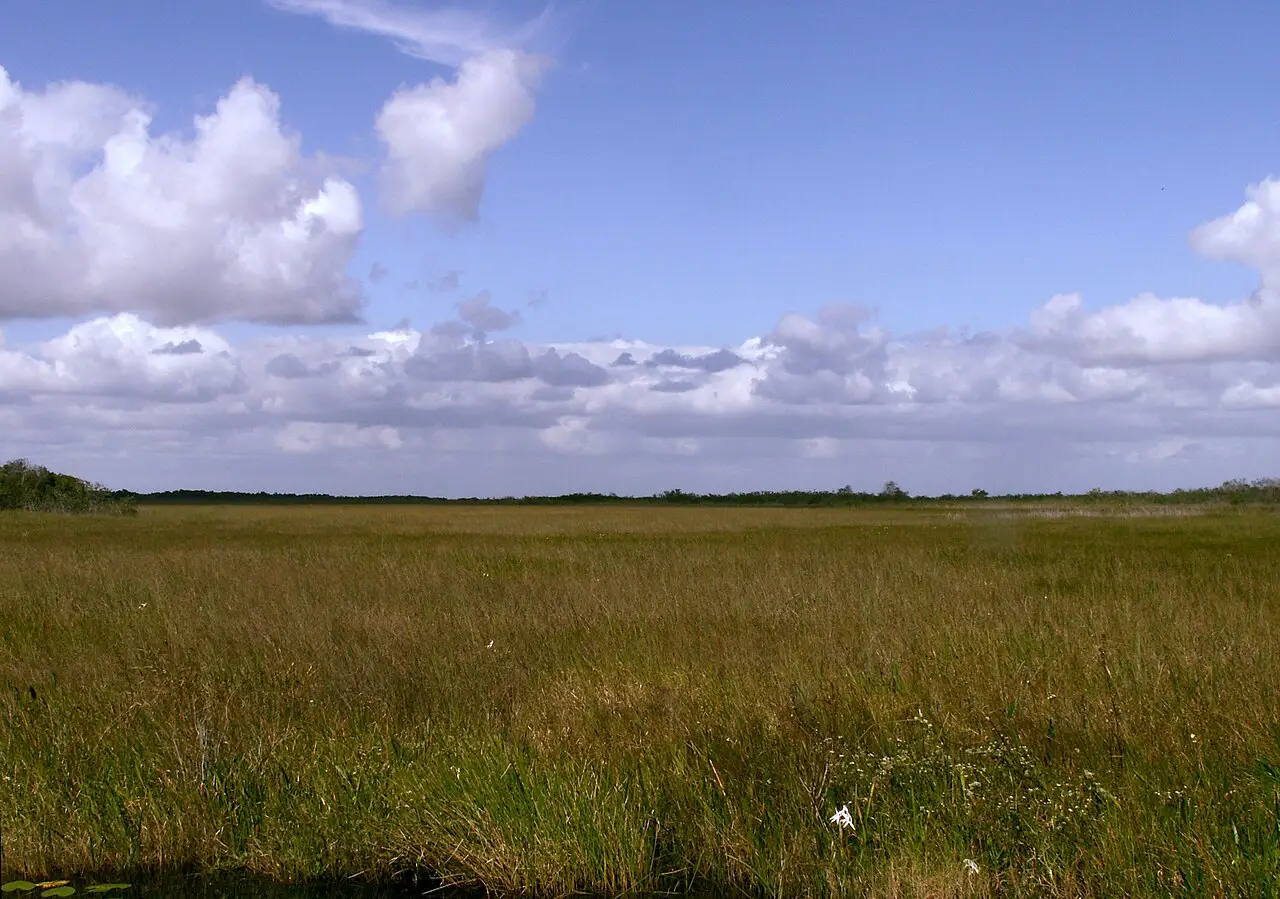
Everglades: Shark Valley and Anhinga Trail
The Homestead entrance, with the Anhinga Trail, is 65 km away via Florida's Turnpike, and Shark Valley, with its shadeless 24 km paved loop, is 60 km away. Go in the dry season, when the alligators are easier to see and the mosquitoes disappear, and bring water for the Shark Valley loop.

Key Largo and Islamorada
100 to 130 km via US-1, 1 hour 30 minutes to 2 hours depending on afternoon traffic. John Pennekamp Coral Reef State Park, the first underwater park in the United States (1963), offers glass-bottom boat tours and diving on the only living coral reef in the continental US.
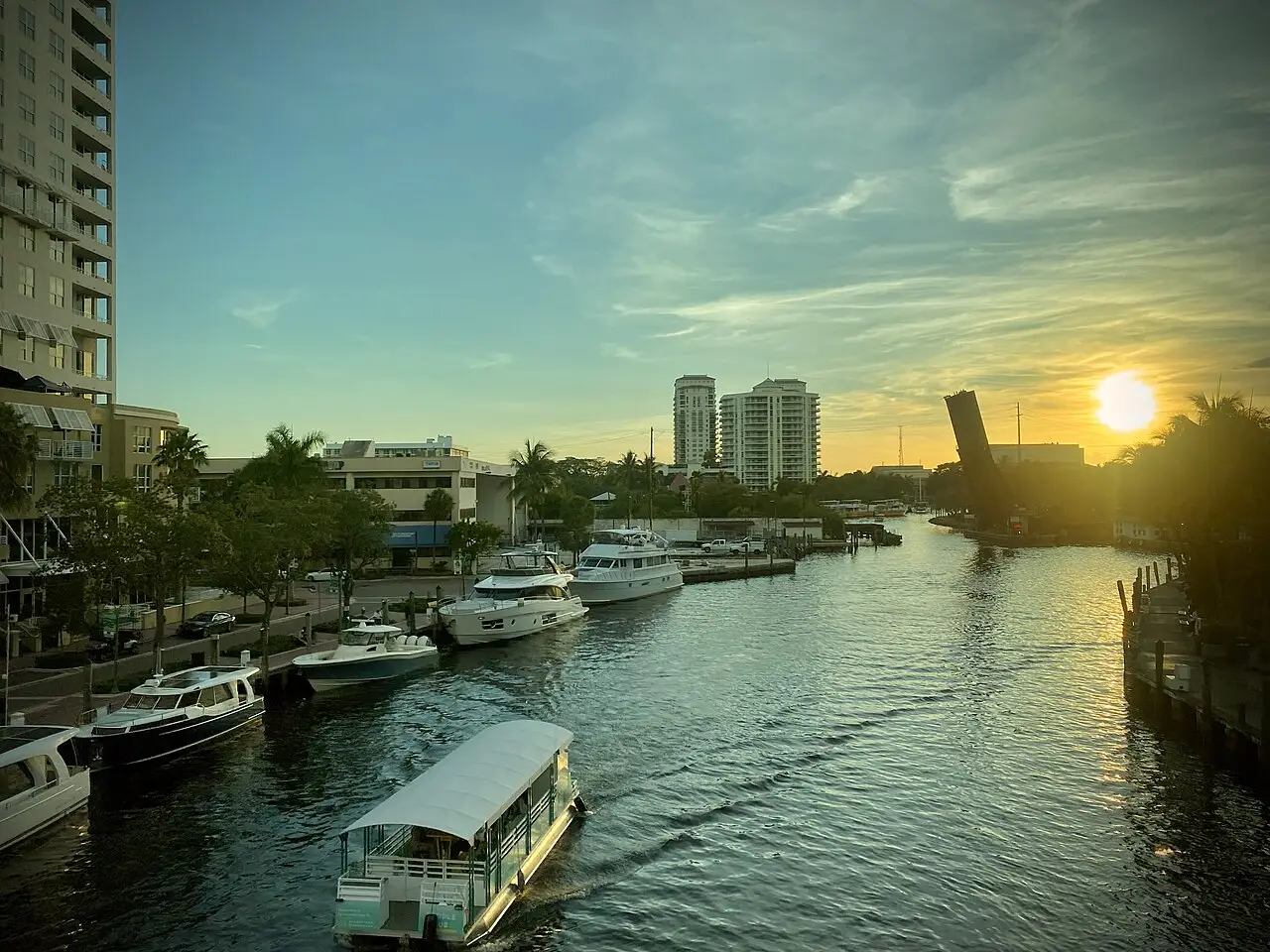
Fort Lauderdale and West Palm Beach
Fort Lauderdale is 45 km away, quick by train or by car outside rush hour. West Palm Beach is 110 km away, a good day trip with canals, beach, and museums.
Where to begin
Downtown, art, and the bay
Start at the Freedom Tower, on Biscayne Boulevard, and walk to Bayfront Park; then loop through Downtown and Brickell on the free Metromover to get a feel for the city's scale in 30 minutes.
Little Havana, Coral Gables, and Coconut Grove
Have breakfast standing up at the ventanita of a cafetería on Calle Ocho: cafecito, croqueta de jamón and pastelito de guayaba, for less than US$6.
Everglades, lighthouse, and beach
Leave early, in a rental car or a booked transfer, for Shark Valley, in the Everglades, about 1 hour away on US-41, and ride the 24 km loop by bike or on the park's tram right after opening, before the sun heats up a route with no shade at all.
Money
The currency is the US dollar. The listed price never includes tax, and the bill catches you off guard twice: add 7% sales tax in Miami-Dade and, at restaurants, an 18–20% tip. Many places in Miami Beach already add an 18–20% service charge and still leave the tip line blank. Read the bill before you sign. Approximate 2026 ranges: a cafecito at the ventanita US$1–2; coffee at a café US$4–6; lunch at a Cuban or Haitian counter US$10–16; a sit-down dinner US$30–60 per person without drinks; a beer US$7–9; a cocktail in South Beach US$18–25; museum admission US$16–30. A midrange hotel costs US$180–350 a night between December and April, and US$110–200 between June and September. Many charge a resort fee of US$25–45 a night, on top of the room rate. Ask before you book. Lodging taxes add up to about 13% in the city of Miami and 14% in Miami Beach. Cards and contactless payment work almost everywhere, including at the ventanitas. It's worth carrying US$20–40 in small bills for tips, food trucks and old parking lots.
Getting there and around
MIA Airport: 12 km, MIA Mover and Metrorail to downtown
It's 12 km from Miami International Airport (MIA) to downtown, and getting out is simple. The free MIA Mover takes you from the terminals to the intermodal station in about 5 minutes, and that's where trains, buses and all the rental car companies leave from. The Metrorail orange line reaches Downtown and Brickell in 15–20 minutes, and an express bus runs straight to South Beach. The single fare for Metrorail and Metrobus is US$2.25, paid contactless with a card, a phone, the GO Miami-Dade Transit app or the EASY Card, which costs US$2. If you pay contactless, a daily cap of US$5.65 applies automatically, so your third ride of the day is already cheaper and the rest cost nothing. Fort Lauderdale airport (FLL) is 45 km away and often has cheaper flights, with connections to Miami by Tri-Rail or Brightline. A taxi or ride-hailing app from MIA to South Beach costs US$35–60 depending on the time.
The Metromover is free and runs elevated
Within the city, the Metromover is free. It covers Downtown, Brickell, and Omni on three elevated lines, from 5am to midnight. The municipal trolleys (City of Miami Trolley, Miami Beach Trolley, Coral Gables Trolley, Doral Trolley) are also free. They handle short trips within each neighborhood. The Metrorail has only two lines: it doesn't reach Miami Beach or Wynwood. For the beach, take buses 120 Beach MAX and 119; for Wynwood, bus, bike, or rideshare. Uber and Lyft are plentiful and cost US$15–35 between neighborhoods. Renting a car only pays off for the Everglades, the Keys, or the suburbs. Parking in South Beach costs US$4–6 an hour, paid through the PayByPhone or ParkMobile apps. Towing is fast: it's common to see a car get towed while the owner is crossing the street. Citi Bike has stations in Miami Beach, Brickell, and Coconut Grove, but there are few protected bike lanes and the heat limits how far you'll go. Brightline connects MiamiCentral station to Fort Lauderdale (about 35 min), West Palm Beach (about 1 hour 15 minutes), and Orlando (about 3 hours 30 minutes).
Safety
Miami is safe if you stick to the tourist areas; violent crime is concentrated far from them. The everyday risk is theft from parked cars, at beaches, on Everglades trails and in Wynwood. The rule is to leave nothing visible and not to put luggage in the trunk in front of strangers. Common scams: padded bills at restaurants on Ocean Drive, boat tour “deals” sold on the sidewalk and standalone ATMs with high fees. At night, Downtown empties out and the industrial streets around Wynwood are deserted once the bars close; use a ride-hailing app instead of crossing on foot. Overtown, Liberty City, Opa-locka and parts of Little Haiti have high crime rates and no tourist reason to be there after dark. The most underestimated danger is traffic: the metro area ranks among the worst in the United States for pedestrians and cyclists, and turning right on red is allowed: cross at the crosswalk and look twice. In the ocean, follow the lifeguards' flags: two red flags mean no swimming, and purple warns of jellyfish or Portuguese man-of-war. Learn about rip currents before swimming at a beach without lifeguards. Between August and October, follow the National Hurricane Center and the county's evacuation orders. The midday sun burns unprotected skin in 15 minutes, often before you notice.
Etiquette tips
Tipping is part of the price
Leave an 18% to 20% tip at restaurants with table service, US$1–2 per drink ordered at the bar, US$2–5 a day for housekeeping and US$2–3 for the valet. Check first whether the service charge is already on the bill, so you don't pay twice.
Switching languages mid-sentence is normal
People start in English and finish in Spanish without warning. If you lose the thread, “English, please” works without any awkwardness, and the reverse works too, in Spanish.
The colada is for sharing
Handing out the little cups to whoever's nearby comes before drinking your own share; finishing a whole colada by yourself is the local equivalent of eating the birthday cake straight from the pan.
Don't assume every Spanish speaker is Cuban
Miami has Venezuelans, Colombians, Nicaraguans, Argentines, Peruvians, Dominicans, Puerto Ricans, and Mexicans, and the differences in accent, food, and politics matter a lot. Ask where someone's from instead of guessing.
Cuban and Venezuelan politics are no joking matter
In Little Havana and Doral, jokes about Fidel Castro, Chávez, or Maduro run into family histories of prison, confiscation, and exile. Listen more than you opine.
Dress for the air conditioning and for the door
Building interiors sit at 20 °C, so bring a light layer even in August. At night, restaurants and clubs turn away flip-flops, tank tops, and swimwear: the beach ends at the sidewalk, and you don't walk around the neighborhood in swim trunks.
Mistakes to avoid
Walking between South Beach and Wynwood
Thinking you can walk between South Beach, Wynwood, and Little Havana. It's easy to look at the map, try it, and give up at the first bridge: they're 10 to 20 km apart, with expressways in between. Plan every trip as 20 to 40 minutes by car, bus, or rideshare. Don't try to fit two distant neighborhoods into the same morning.
Sitting on Ocean Drive without reading the bill
Sitting down at an Ocean Drive restaurant without reading the menu and the bill. It's where you find complaints about unrequested cover charges, an 18–20% service charge stacked on top of the tip line, and US$30 cocktails. Two blocks in, on Española Way or Washington Avenue, the same dish costs half as much.
Five kilometers of bay between two cities
Confusing Miami with Miami Beach is a common mistake, sometimes before even arriving. They're separate municipalities, split by about 5 km of bay, with their own police, rules, and prices. Booking a hotel “in Miami” with the beach in mind usually gets you a room in Brickell, 20 minutes by car from the sand.
Leaving a bag visible inside the car
Leaving a backpack, camera, or bag visible inside the car. The most common crime against visitors is car break-ins in beach, park, or trail parking lots. Take everything with you, even for a ten-minute stop.
The Everglades at noon in July
Scheduling the Everglades for midday in July. In summer, the heat and mosquitoes make the walk brutal and the alligators hide. The visit works from December to March, right after sunrise or in the late afternoon.
Useful phrases
¿Qué bolá, asere?
“What's up, buddy?”: a Cuban greeting, the one you hear most in Little Havana and Hialeah
Dale
“Go ahead,” “okay,” “sure thing”: it works for agreeing, saying goodbye, and closing out a topic
Un cafecito, por favor
“A little coffee, please”. The sweetened Cuban espresso, served in a small cup
Una colada con cuatro tacitas
“A colada with four little cups”. The larger version of the cafecito, made to be shared
Sak pase? / N ap boule
“How's it going?” / “Getting by”: Haitian Creole, used in Little Haiti and North Miami
No es fácil
“It's not easy”: the standard Cuban comment for any difficulty, from traffic to rent
Districts
Downtown and Brickell
The financial center: the towers of Latin American banks stand south of the river, in Brickell, linked to Downtown by the free Metromover. Brickell concentrates restaurants and high-rent buildings; Downtown empties out at night outside the areas around the Kaseya Center and Miami Worldcenter.
Little Havana
The SW 8th Street (Calle Ocho) corridor between 12th and 27th avenues, with coffee ventanitas, cigar shops, Máximo Gómez Park, and the 1926 Tower Theater. More Central and South Americans live here today than Cubans, but the neighborhood's grammar is still Cuban.
Wynwood
A former warehouse and garment district, taken over by murals since 2009. It packs in galleries, breweries, and shops, walkable by day.
Design District and Midtown
Luxury showrooms, commissioned architecture (Buckminster Fuller's Fly's Eye Dome sits in the central plaza) and the free-admission Institute of Contemporary Art. An hour on foot covers it; anything else there is expensive.
Coconut Grove
The city's oldest settlement, from 1873, with houses under trees, sailboats on the bay, and Vizcaya a few minutes away. Slow pace, shaded sidewalks, and a local crowd at the cafés around CocoWalk.
Coral Gables
A separate municipality, planned by George Merrick starting in 1921 and incorporated in 1925, with curving streets, Spanish names and an aesthetic code still in force. It's home to the Venetian Pool, the Biltmore, the Miracle Mile and the University of Miami.
Little Haiti
Formerly Lemon City, the center of the largest Haitian community in the United States, with botanicas, bakeries, restaurants, and the Caribbean Marketplace. It sits on high ground, which has drawn the real estate pressure now pushing residents out.
South Beach and North Beach
South Beach is the Art Deco district between Ocean Drive and Washington Avenue, touristy and pricey. North Beach, above 63rd Street, is residential, with a strong Argentine and Brazilian presence, lower rents, and the exact same beach.
History
1st c. BC–1763 · The Tequesta on the river
The Tequesta people occupied the mouth of the Miami River for about two millennia. The Miami Circle, an 11.5 m ring of holes carved into the limestone and discovered in 1998 in Brickell, is the oldest trace of the city.
1567 · The Spanish mission
Pedro Menéndez de Avilés set up a Jesuit mission at the mouth of the river. It didn't last long, and when Spain handed Florida to the British in 1763, the last Tequesta shipped out for Havana.
1825 · Cape Florida Lighthouse
Built at the southern tip of Key Biscayne, it's the oldest structure still standing in the county. It was burned by Seminoles in 1836 and rebuilt in 1846.
1836 · Fort Dallas
The US Army set up a post on the north bank of the Miami River during the Second Seminole War. A handful of families and plantations settled around it, but no city yet.
1873–1896 · Coconut Grove and the railway
Coconut Grove was founded in 1873 by Bahamians and northern settlers and got the Peacock Inn, the first hotel, in 1884. Julia Tuttle convinced Henry Flagler to extend the Florida East Coast Railway to the bay, and the train arrived in April 1896.
1896 · The incorporation
On July 28, 1896, 344 voters approved the creation of the city; more than a third of them were Black men, many of them Bahamians who built the city. Segregation laws pushed them into Colored Town, today's Overtown, within a few years.
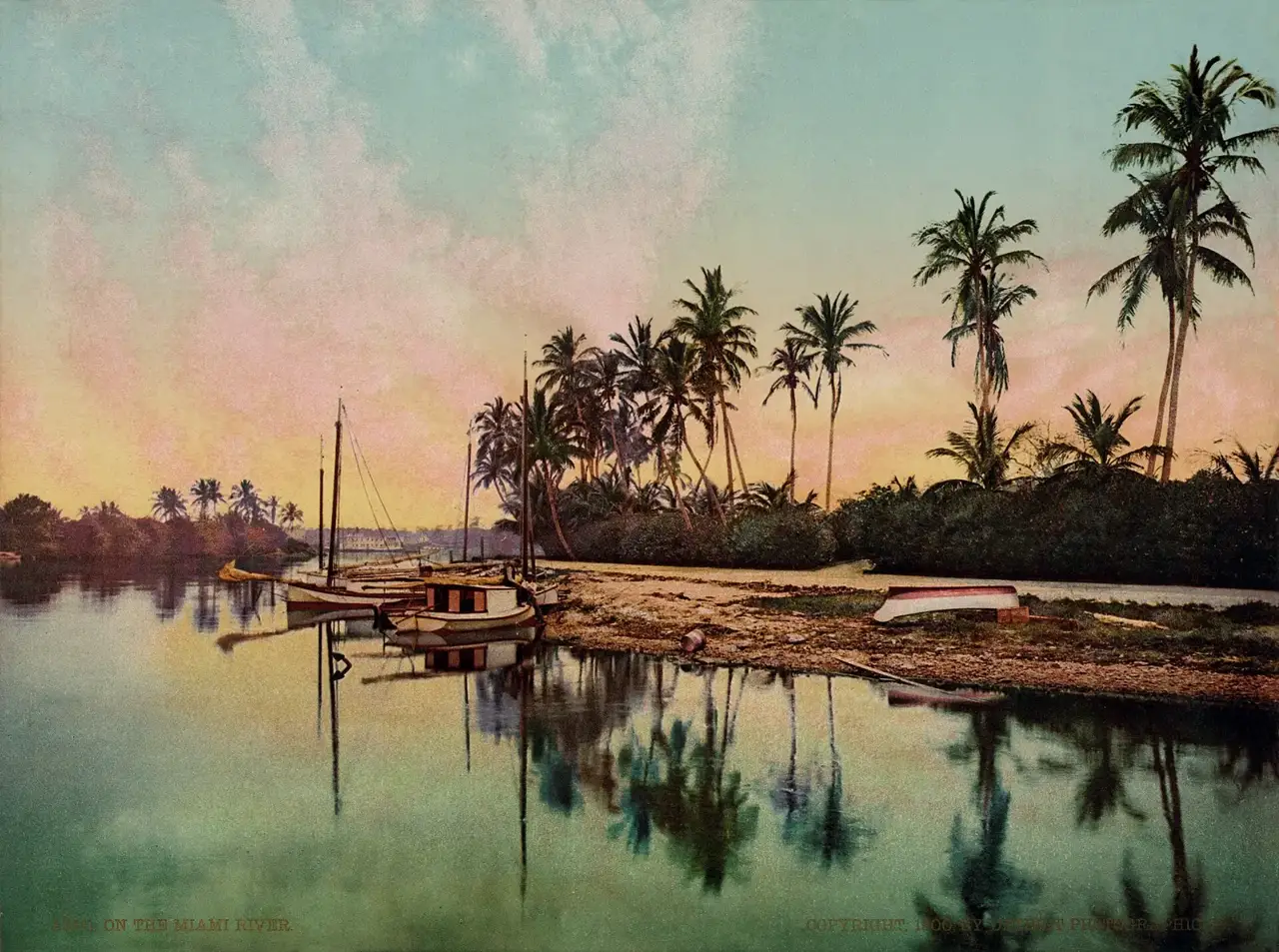
1915–1926 · Real estate boom and hurricane
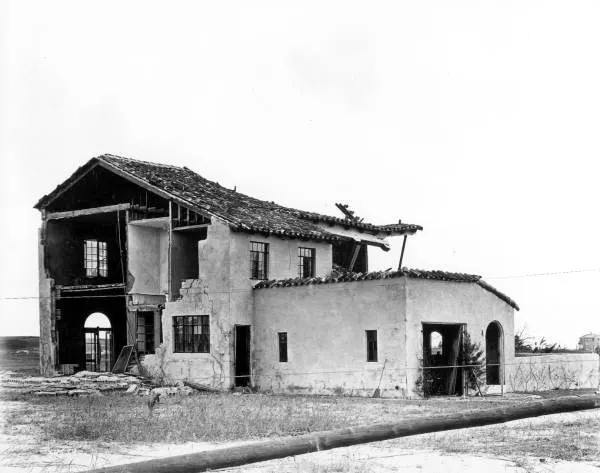
Carl Fisher dredged the mangrove swamp and created Miami Beach (1915); George Merrick launched Coral Gables in 1921, incorporated in 1925; land speculation doubled the city's size in five years. The hurricane of September 18, 1926, killed hundreds and ended the boom three years before the crash of 1929.
1930–1942 · Art Deco in South Beach
About 800 buildings in Art Deco and streamline style went up at the southern tip of the island, with symmetrical facades and concrete eyebrows over the windows. Threatened with demolition, the district became a national historic district in 1979 thanks to Barbara Baer Capitman's campaign.
1959–1980 · The Cuban exile
After the 1959 revolution came Operation Pedro Pan (14,000 unaccompanied children between 1960 and 1962), the Freedom Flights (1965–1973, about 300,000 people), and the Mariel boatlift, with about 125,000 in 1980. That same year, the Liberty City riots left 18 dead.
1980–1992 · Cocaine, Miami Vice, and Andrew
Drug money flowed into construction and banking, and the TV series Miami Vice (1984–1989) exported an image the city is still managing. On August 24, 1992, Hurricane Andrew leveled Homestead and the south of the county and forced Florida to rewrite its building code.
 AI illustration
2002–today · Art, financial towers, and the Surfside collapse
Art Basel Miami Beach began in 2002 and reshaped Wynwood, the Design District, and PAMM (2013), while Brickell became Latin America's financial skyline. The Surfside condo collapse on June 24, 2021, which killed 98, led to mandatory structural inspections; streets keep being raised against the tide.
 AI illustration
Complete history
The Tequesta, the Spanish mission and the lighthouse (up to 1836)
Long before the city, the Tequesta people lived at the mouth of the Miami River for about two thousand years. The Miami Circle, a ring of holes cut into the limestone and discovered in 1998 during a demolition in Brickell, is what remains of that presence. The Spanish set up a mission in 1567; the British took over Florida in 1763 and the last Tequesta left for Havana. When the United States bought Florida from Spain in 1821, there were only scattered plantations there, the Cape Florida lighthouse (1825) and, from 1836, Fort Dallas, a military post of the Second Seminole War.
Julia Tuttle and Flagler's railroad (1896)
Julia Tuttle, a widow from Cleveland who had inherited land on the north bank of the river, spent years trying to persuade the tycoon Henry Flagler to extend his Florida East Coast Railway to the bay. The freeze of 1894–95, which destroyed the orange groves of northern Florida and spared the far south, gave her the argument she needed. The train arrived in April 1896 and the city was incorporated on July 28 of the same year, with 344 votes; more than a third of the voters were Black men, many of them Bahamians who built Coconut Grove and Miami itself, and whom segregation pushed into Colored Town, today Overtown, a few years later.
Miami Beach and Coral Gables were built in the 1920s
The landscape visitors come for was born in the 1920s. Carl Fisher dredged the mangrove swamp on the barrier island and created Miami Beach, incorporated in 1915; George Merrick started selling lots in Coral Gables in 1921, as a Mediterranean-style garden city with an aesthetic code and curving streets, and the municipality was incorporated in 1925; brokers sold lots by phone to buyers who had never seen Florida. The hurricane of September 18, 1926, killed hundreds of people, destroyed the port and ended the boom before the 1929 crash. The answer came the following decade: the roughly 800 art deco and streamline buildings of South Beach went up between 1930 and 1942, and they escaped demolition only because of the campaign led by Barbara Baer Capitman and the Miami Design Preservation League, victorious in 1979.
The 1959 Cuban revolution and the exile in Miami
The 1959 Cuban revolution remade the city in one generation. First came the exiles, then Operation Pedro Pan, the Freedom Flights between 1965 and 1973 (about 300,000 people, many processed at the Freedom Tower) and the Mariel exodus, with about 125,000 arrivals in 1980. That same year, the acquittal of the police officers who killed Arthur McDuffie triggered the Liberty City riots, with 18 dead, and exposed the gap between Black Miami and boom-era Miami. In the 1980s, cocaine money financed part of the construction industry and the banks, and Miami Vice (1984–1989) sold the world a city of neon. On August 24, 1992, Hurricane Andrew devastated Homestead and the south of the county, with damages estimated at US$26 billion, and forced the state to create the strictest building code in the United States.
Latin American capital and Art Basel reshape neighborhoods
Today's Miami is the result of three simultaneous arrivals: the Latin American capital that made Brickell a Spanish-speaking financial center, the art that Art Basel brought in 2002 and that reshaped Wynwood, Allapattah and the Design District, and the Haitian, Venezuelan, Colombian, Nicaraguan and Argentine migrations that made Spanish and Creole the languages of the shop counter. From 2020 on, remote work drew tech and finance companies, and rents rose above the national average. Under everything is the water. Built on porous limestone 2–3 m above the sea, Miami can't defend itself from the water with walls, because the water rises up through the ground. So it raises streets, installs pumps and debates, with no answer, who will live on the few high plots of land, which happen to be poor, historic neighborhoods like Little Haiti.
The Tequesta occupied the mouth of the Miami River for about 2,000 years. What's left of them is the Miami Circle, a ring of holes cut in the limestone in Brickell, among the towers of a city founded in 1896.
Geography and shape of the city
The low strip and the limestone ridge
Miami occupies a flat, narrow strip between Biscayne Bay to the east and the Everglades to the west; average elevation is about 2 m, and the high point is the Atlantic Coastal Ridge, an oolitic limestone ridge of 3–7 m running parallel to the coast, on which US-1 and the railways were built.
The barrier islands, the bridges, and the river
The beaches you see in photos aren't in the city of Miami. They're in Miami Beach, Surfside, Bal Harbour, and Sunny Isles, a chain of barrier islands separated from the mainland by 3–5 km of water and connected to it by causeway bridges like the MacArthur, the Venetian, and the Julia Tuttle. The Miami River, short and channelized, still works as a cargo port to the Caribbean, and PortMiami, on Dodge Island, is the largest cruise terminal in the world.
The numbered grid and the climate
The street grid is numbered outward from the intersection of Miami Avenue and Flagler Street, split into NW, NE, SW, and SE quadrants: addresses like “SW 8th St” are coordinates rather than names, and the house number tells you the block. The climate is tropical monsoon, with a hot, rainy summer and a drier winter.
The address here tells you the quadrant before the street: in “SW 8th St,” SW means southwest.
Culture
Miami's music, from bolero to rap and electronic
Miami's popular culture runs in Spanish and in Creole. The Latin music industry has been based here since the 1980s (the regional offices of the major labels sit between Miami and Doral) and the city has been home to Celia Cruz, Gloria Estefan and the Miami Sound Machine, Willy Chirino, Shakira, Marc Anthony, and Pitbull. On the other side, 1980s Miami bass, with 2 Live Crew, and later the rap of Trick Daddy, Trina, Rick Ross, and the City Girls came out of Liberty City, Overtown, and Carol City. Since the Winter Music Conference, founded in 1985, Miami has also been America's hub for electronic dance music.
Art Basel since 2002: the year's busiest week
From 2002 on, Art Basel Miami Beach turned the first week of December into the economic event of the year and left a permanent circuit behind: PAMM, the ICA in the Design District, the Rubell Museum (moved to Allapattah in 2019), the de la Cruz Collection and The Bass, in Miami Beach. Literature has had the Miami Book Fair since 1984, on Miami Dade College's downtown campus, and authors who explain the city from the inside: Edwidge Danticat, a Haitian raised in Brooklyn who now lives in Little Haiti, Carl Hiaasen and Charles Willeford in Florida crime fiction, Richard Blanco in poetry. On screen, Barry Jenkins's Moonlight (2016), shot in Liberty City, won the Oscar for best picture.
Sports and religion are public
In Miami, sports and religion are public matters, from the stadiums to the exile chapels. The Miami Heat, three-time NBA champions, play at the Kaseya Center, on the edge of the bay, and the Dolphins, the Miami Open tennis tournament and the Formula 1 Grand Prix share Hard Rock Stadium, in Miami Gardens. Inter Miami brought Lionel Messi in 2023, and the Marlins play at loanDepot Park, built on the site of the old Orange Bowl, in Little Havana. The Ermita de la Caridad, a cone-shaped chapel from 1973 on the bay, facing Cuba, is a pilgrimage site for the exile community. Beyond it, the city divides among Hispanic Catholic parishes, Spanish-language evangelical churches, Haitian congregations worshipping in Creole and santería houses that operate without a sign.
Festivals and events
Art Basel Miami Beach
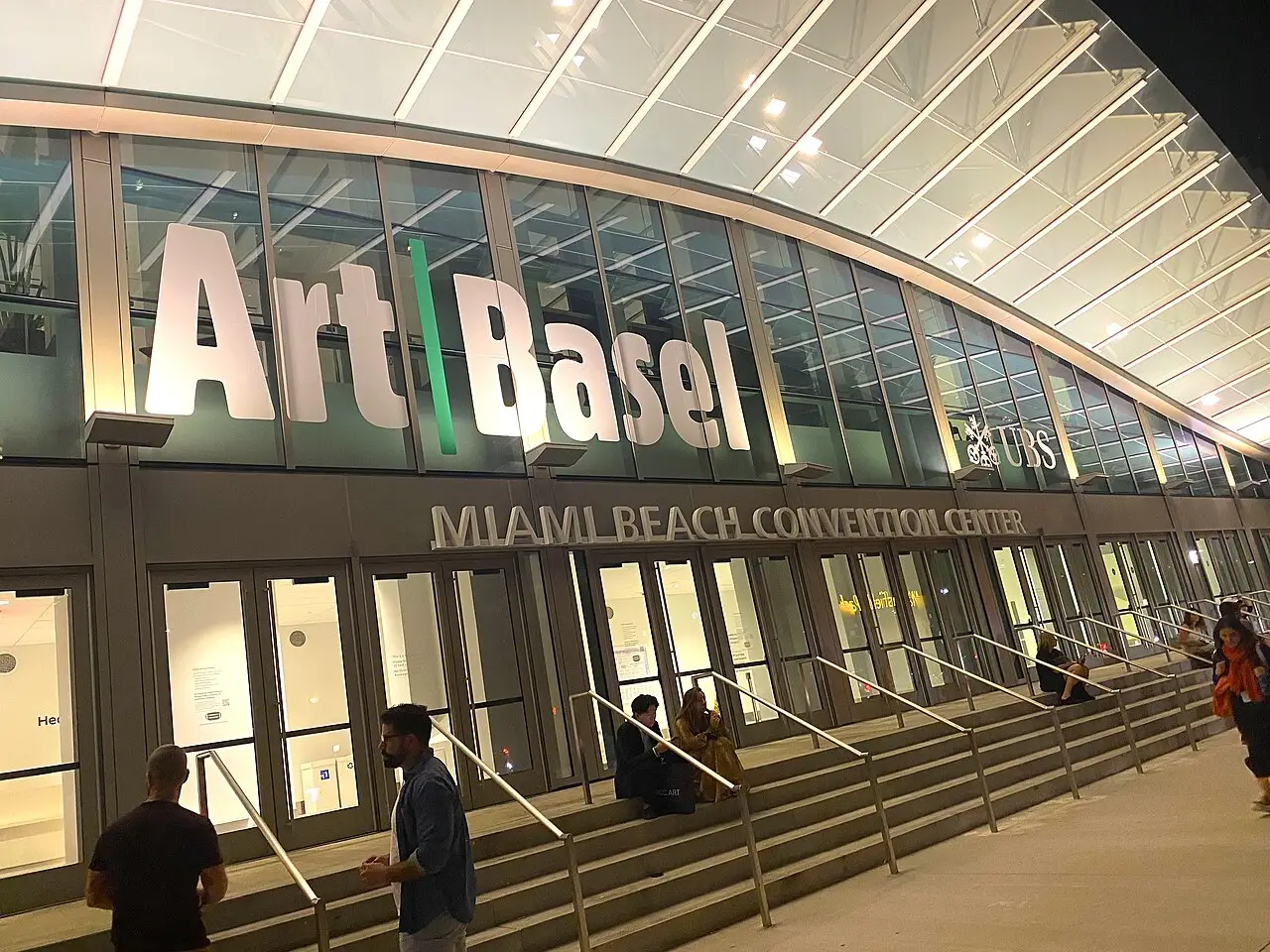
First week of December, at the Miami Beach Convention Center, running since 2002, with more than twenty satellite fairs spread across the city. Hotels and flights can double in price that week.
 AI illustration
Miami Carnival and Calle Ocho Festival
In March, the street festival closes about twenty blocks of SW 8th Street on a Sunday and draws hundreds of thousands of people. In the weeks before, Carnaval Miami warms up the party with a domino tournament and a race.
Ultra Music Festival
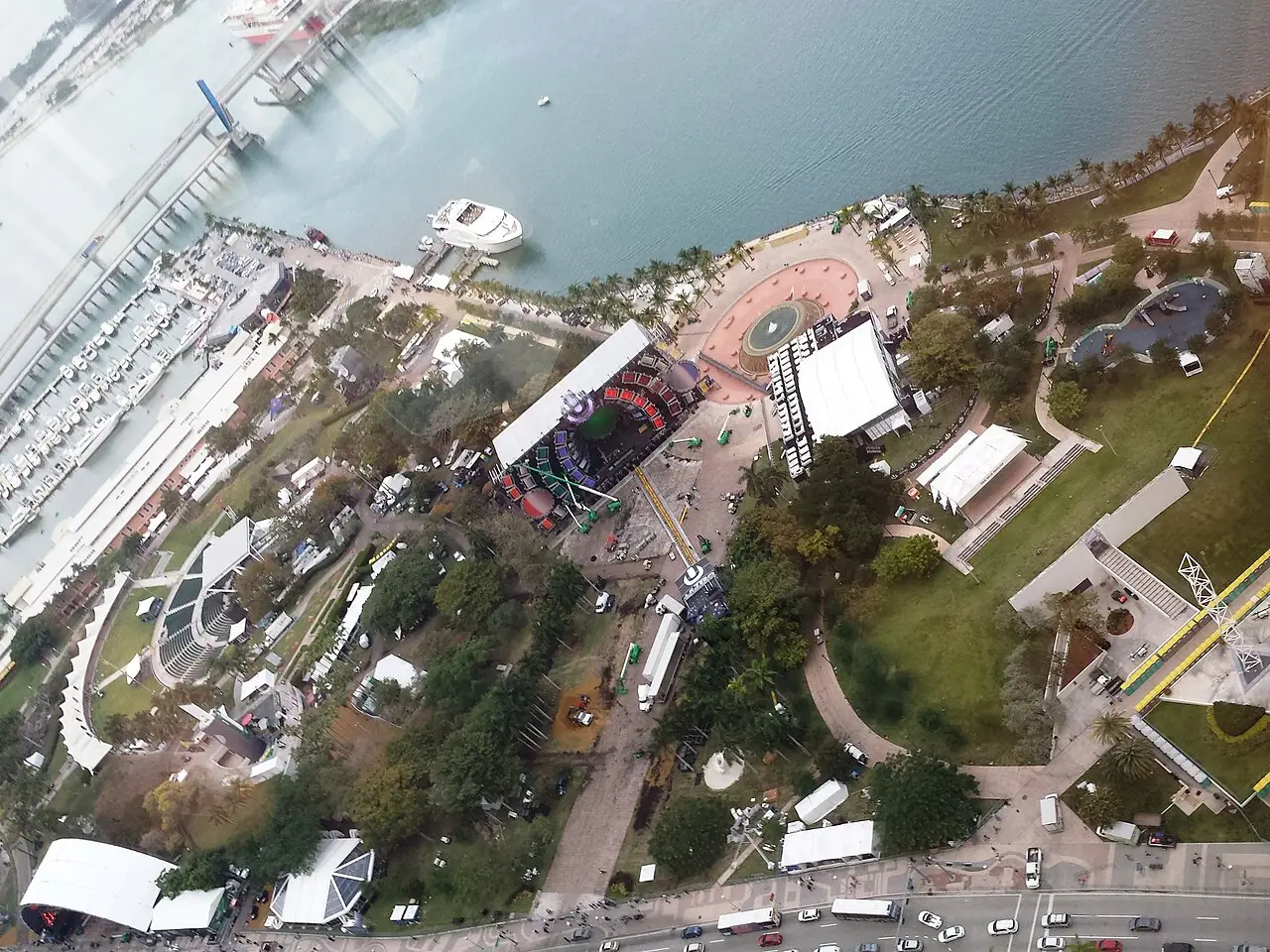
Last weekend of March, at Bayfront Park, in Downtown, running since 1999. Three days of electronic music that jam up the center and push hotel prices up.
 AI illustration
Miami Open and Miami Grand Prix
The tennis tournament takes over the Hard Rock Stadium complex in March; the Formula 1 leg runs on a street circuit built around the same stadium, in May, since 2022.
 AI illustration
Miami Carnival and Miami Book Fair
The Caribbean carnival parades in October at the Miami-Dade fairgrounds, with soca, calypso, and mas bands from Trinidad and Jamaica. The book fair takes over Miami Dade College's central campus in November, running since 1984.
Books and films
Miami, by Joan Didion (1987)
A report on the relationship between the Cuban exile, Washington politics, and the city formed between the two. It explains why Miami's elections are decided in Spanish.
Moonlight (2016), by Barry Jenkins
Filmed in Liberty City, it follows three stages of a Black boy's life in a Miami that doesn't make the travel posters. It won the Oscar for Best Picture in 2017.
Mi Tierra, by Gloria Estefan (1993)
An album entirely in Spanish, recorded in Miami with exiled Cuban musicians, reviving son, bolero and danzón. Listen before you go so you'll recognize the sound playing at the ventanitas and at Ball & Chain on Calle Ocho.
Frequently asked questions
Miami: can you walk from South Beach to Wynwood?
No: it's 10 to 20 km between South Beach and Wynwood, with expressways in between. Plan each trip as 20 to 40 minutes by car, bus or app.
Miami: how do you get from MIA Airport to downtown?
Take the free MIA Mover to the intermodal station, in about 5 minutes, and from there the Metrorail, orange line, reaches Downtown and Brickell in 15 to 20 minutes, for $2.25 paid by tap.
Miami: where do you enter the Everglades, and when?
The Homestead entrance, with the Anhinga Trail, is 65 km away via Florida's Turnpike, and Shark Valley, with its shadeless 24 km paved loop, is 60 km away. Go in the dry season, when the alligators are easier to see and the mosquitoes disappear, and bring water for the Shark Valley loop.
Miami: how much do you add for tax and tip on top of the listed price?
The listed price never includes tax, and the bill catches you off guard twice: add 7% sales tax in Miami-Dade and, at restaurants, an 18 to 20% tip.
Miami: when is the best time to go?
The dry season runs from November to April: highs of 24 to 27 °C, lows of 15 to 20 °C, tolerable humidity, and little rain.
Other cities in the country
United States ↗- Days
- 4–5
- When
- Apr–Jun · Sep–Oct
- Per person/day
- Average 180–320 USDMid-range · per person/day
Cost scope
Per person per day: accommodation, meals, urban transport, visits and a small allowance for extras. Flights excluded; larger purchases vary. Editorial estimate, not a quote.
- Days
- 4–5
- When
- Apr–May · Nov
- Per person/day
- Average 220–330 USDMid-range · per person/day
Cost scope
Per person per day: accommodation, meals, urban transport, visits and a small allowance for extras. Flights excluded; larger purchases vary. Editorial estimate, not a quote.
- Days
- 3
- When
- Sep–Oct
- Per person/day
- Average 180–280 USDMid-range · per person/day
Cost scope
Per person per day: accommodation, meals, urban transport, visits and a small allowance for extras. Flights excluded; larger purchases vary. Editorial estimate, not a quote.
- Days
- 4
- When
- May–Jun · Sep–Oct
- Per person/day
- Average 150–260 USDMid-range · per person/day
Cost scope
Per person per day: accommodation, meals, urban transport, visits and a small allowance for extras. Flights excluded; larger purchases vary. Editorial estimate, not a quote.
- Days
- 3
- When
- Feb–May · Oct–Dec
- Per person/day
- Average 250–350 USDMid-range · per person/day
Cost scope
Per person per day: accommodation, meals, urban transport, visits and a small allowance for extras. Flights excluded; larger purchases vary. Editorial estimate, not a quote.
- Days
- 2–3
- When
- Mar–May · Oct–Nov
- Per person/day
- Average 200–350 USDMid-range · per person/day
Cost scope
Per person per day: accommodation, meals, urban transport, visits and a small allowance for extras. Flights excluded; larger purchases vary. Editorial estimate, not a quote.
- Days
- 3
- When
- Mar–May
- Per person/day
- Average 220–320 USDMid-range · per person/day
Cost scope
Per person per day: accommodation, meals, urban transport, visits and a small allowance for extras. Flights excluded; larger purchases vary. Editorial estimate, not a quote.
- Days
- 2–3
- When
- Sep–Oct
- Per person/day
- Average 190–330 USDMid-range · per person/day
Cost scope
Per person per day: accommodation, meals, urban transport, visits and a small allowance for extras. Flights excluded; larger purchases vary. Editorial estimate, not a quote.
- Days
- 2–3
- When
- Jun–Sep
- Per person/day
- Average 130–220 USDMid-range · per person/day
Cost scope
Per person per day: accommodation, meals, urban transport, visits and a small allowance for extras. Flights excluded; larger purchases vary. Editorial estimate, not a quote.
- Days
- 5–6
- When
- Jan–Apr · Nov–Dec
- Per person/day
- Average 368 USDMid-range · per person/day
Cost scope
Per person per day: accommodation, meals, urban transport, visits and a small allowance for extras. Flights excluded; larger purchases vary. Editorial estimate, not a quote.
- Days
- 4–6
- When
- Apr–May · Sep
- Per person/day
- Average 329 USDMid-range · per person/day
Cost scope
Per person per day: accommodation, meals, urban transport, visits and a small allowance for extras. Flights excluded; larger purchases vary. Editorial estimate, not a quote.
- Days
- 2
- When
- Apr–May · Sep–Oct
- Per person/day
- Average 203 USDMid-range · per person/day
Cost scope
Per person per day: accommodation, meals, urban transport, visits and a small allowance for extras. Flights excluded; larger purchases vary. Editorial estimate, not a quote.
- Days
- 3
- When
- Apr · Sep–Oct
- Per person/day
- Average 251 USDMid-range · per person/day
Cost scope
Per person per day: accommodation, meals, urban transport, visits and a small allowance for extras. Flights excluded; larger purchases vary. Editorial estimate, not a quote.
- Days
- 3
- When
- May–Jun · Sep–Oct
- Per person/day
- Average 158 USDMid-range · per person/day
Cost scope
Per person per day: accommodation, meals, urban transport, visits and a small allowance for extras. Flights excluded; larger purchases vary. Editorial estimate, not a quote.