United States
New Orleans
Neighborhood jazz, second lines, Creole food, the Quarter
Days Start with the basic programme and choose extensions for the time you have.
How the guide reaches this number
The first is for the Vieux Carré and the river; the second, for Uptown by streetcar and the National WWII Museum; the third, for Tremé and Mid-City. A fourth day pays off if it falls on a second-line Sunday. Don't come looking for a big museum on every corner, flat sidewalks, punctual transit or quiet nights. With a single day, eat beignets at 8am at Café du Monde and spend the morning between Jackson Square and the Cabildo. Share a muffuletta at lunch and take the ferry to Algiers in the late afternoon. After 9pm, drop into three clubs on Frenchmen Street. The letdown is Bourbon Street, a strip of bars that doesn't represent the music here. The infrastructure disappoints too, with potholed asphalt, streets that flood after half an hour of rain and the August heat.
3
When February to May, and from mid-October to early December
How the guide reaches this number
The best windows are February to May and mid-October to early December, with highs between 20 °C and 28 °C and bearable humidity. Summer, from June to September, is a different city: highs of 32 °C to 34 °C, lows that don't drop below 25 °C, heat indexes often above 38 °C and rain almost every afternoon. In that season, life revolves around air conditioning and the hours before 11am, so save midday for indoor sights. Hurricane season runs from June 1 to November 30, peaking between mid-August and the end of September. August is the month to avoid, for the combination of heat, weather risk and the summer break some restaurants take. Winter is mild, between 8 °C and 17 °C, with short cold fronts and rare frost, and it's when Mardi Gras falls. About 1,600 mm of rain falls a year, spread across all months and heaviest in summer. Prices and crowds climb in the last two weeks of Mardi Gras, at French Quarter Fest in April, over the two Jazz Fest weekends at the turn of April and May, and at Essence in early July; for those dates, book four to six months ahead.
Per person/day US$120–180 budget; US$250–350 comfortable (approximate, 2026)
How the guide reaches this number
Per person per day: accommodation, meals, urban transport, visits and a small allowance for extras. Flights excluded; larger purchases vary. Editorial estimate, not a quote.
 What Nilo thinks
New Orleans calls for three days. The first is for the Vieux Carré and the river; the second, for Uptown by streetcar and the National WWII Museum; the third, for Tremé and Mid-City. A fourth day pays off if it falls on a second-line Sunday. Don't come looking for a big museum on every corner, flat sidewalks, punctual transit or quiet nights. With a single day, eat beignets at 8am at Café du Monde and spend the morning between Jackson Square and the Cabildo. Share a muffuletta at lunch and take the ferry to Algiers in the late afternoon. After 9pm, drop into three clubs on Frenchmen Street. The letdown is Bourbon Street, a strip of bars that doesn't represent the music here. The infrastructure disappoints too, with potholed asphalt, streets that flood after half an hour of rain and the August heat.Come to New Orleans for the music that spills into the street. On a second-line Sunday, a neighborhood club parades with its brass band and the whole neighborhood follows. At night, hear traditional jazz standing up at Preservation Hall or hop from door to door on Frenchmen Street, with small bills for the band's bucket. Eat gumbo, po-boys and beignets with chicory coffee, and close the day with a Sazerac, the city's official cocktail. In the French Quarter, notice that the houses are Spanish, rebuilt after the fires of 1788 and 1794, and that only the iron balconies are American. The best time to go is February to May, when the heat is bearable and Mardi Gras or Jazz Fest is on the calendar, so give the city three days.
Quick facts
- Population
- about 362,000 in the city (2025 estimate); about 1.0 million in the metro area
- Founded
- 1718, by Jean-Baptiste Le Moyne de Bienville, as La Nouvelle-Orléans
- Country and region
- United States: Louisiana, Orleans Parish, Mississippi delta
- Language
- English; Louisiana Creole and Cajun French survive in small communities inland
- Currency
- US dollar (US$)
- Time zone
- UTC−6 in winter, UTC−5 during daylight saving time (second Sunday of March to the first Sunday of November)
- Best time to visit
- February to May, and from mid-October to early December
- Average daily cost
- US$120–180 budget; US$250–350 comfortable (approximate, 2026)
When to go
February to May, and from mid-October to early December
January
8° to 17°C
132 mm of rain
June
24° to 32°C
193 mm of rain
July
25° to 33°C
172 mm of rain
August
25° to 33°C
176 mm of rain
September
23° to 31°C
130 mm of rain
How the year changes
The best windows are February to May and mid-October to early December, with highs between 20 °C and 28 °C and bearable humidity. Summer, from June to September, is a different city: highs of 32 °C to 34 °C, lows that don't drop below 25 °C, heat indexes often above 38 °C and rain almost every afternoon. In that season, life revolves around air conditioning and the hours before 11am, so save midday for indoor sights. Hurricane season runs from June 1 to November 30, peaking between mid-August and the end of September. August is the month to avoid, for the combination of heat, weather risk and the summer break some restaurants take. Winter is mild, between 8 °C and 17 °C, with short cold fronts and rare frost, and it's when Mardi Gras falls. About 1,600 mm of rain falls a year, spread across all months and heaviest in summer. Prices and crowds climb in the last two weeks of Mardi Gras, at French Quarter Fest in April, over the two Jazz Fest weekends at the turn of April and May, and at Essence in early July; for those dates, book four to six months ahead.
The same numbers as a table
| Month | Temperature °C | Rain mm |
|---|---|---|
| January | 8 to 17 | 132 |
| February · | 10 to 19 | 105 |
| March · | 13 to 22 | 111 |
| April · | 17 to 26 | 133 |
| May · | 21 to 30 | 143 |
| June | 24 to 32 | 193 |
| July | 25 to 33 | 172 |
| August | 25 to 33 | 176 |
| September | 23 to 31 | 130 |
| October · | 18 to 27 | 94 |
| November · | 12 to 22 | 98 |
| December · | 9 to 18 | 122 |
Nilo's tips
On Frenchmen Street, leave US$5 to US$10 in the bucket per set
Since most venues skip the cover charge, musicians make their night's pay from that bucket. The amount is per person and covers each full set you stay for, so bring $20 in small bills. Withdraw cash at the bank before leaving the hotel, because the ATM inside the bar charges $5 or more per withdrawal. Three blocks of the Marigny hold a dozen music venues, and the four I'd pick are The Spotted Cat, d.b.a., Snug Harbor and Blue Nile.
Preservation Hall: buy online, never the door line
The door line rarely gets in, so buy tickets online before you travel. The room has no bar or air conditioning, and much of the audience stands. Go without a drink in hand and in light clothes: what you're buying there is traditional jazz three meters from the musicians.
Tune in to WWOZ 90.7 FM to find Sunday's parade route
There's no fixed published schedule, and the week's route comes out on WWOZ 90.7 FM, which you check on the morning of that same Sunday. Between late August and June, a different social aid and pleasure club parades almost every Sunday, in a four-hour procession with a brass band through neighborhoods no guided tour covers. Always walk behind the band, never between the band and the uniformed members. Buy from the drink stand that follows the procession, because that's what pays for next year's parade.
The best view of the river costs US$2
The Canal Street ferry crosses in 10 minutes to Algiers Point, a 19th-century village with the best head-on view of the skyline and practically no tourists. The Natchez steamboat cruise costs many times more for the same river. Cross in the late afternoon and come back at sunset.
Jazzy Pass in the Le Pass app: worth it from 3 rides on
From the third ride of the day, the Jazzy Pass is cheaper than single fares. The green wooden St. Charles cars, from 1923–24, have no air conditioning, so board before 10am and sit on the shady side. Treat the streetcar as a ride, not as a way to make an appointment, because the gap between cars varies.
Order crawfish in season and red beans and rice on Mondays
Crawfish season runs from January to June; outside of it, the crawfish boil probably came frozen, so ask before you sit down. On Mondays, order red beans and rice, a dish from the old washday, and on that day neighborhood restaurants serve it cheaper and better. Raw oysters have their own calendar too: old-school spots like Casamento's follow the rule of the months without an “r” and take them off the counter from May to August. Casamento's itself closes from June to August.
Explore the map

© OpenStreetMap · OpenFreeMap · © OpenMapTiles
Explore the map, read about the other places and plan your travel days in the app.
Open the appWhat to see
New Orleans: The bend and the high strip
The city occupies the eastern bank of a crescent-shaped bend of the Mississippi, hence the nickname Crescent City, squeezed between the river and Lake Pontchartrain, a roughly 1,630 km² brackish body of water connected to the gulf. Today's Vieux Carré has about 78 blocks between Canal Street, Esplanade Avenue, Rampart and the river, grown from the 66-block grid laid out in 1721.

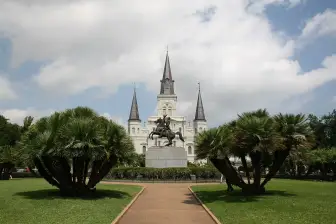
Jackson Square and St. Louis Cathedral
The 1721 parade ground, converted into a garden in 1851, with the 1856 equestrian statue of Andrew Jackson. The current cathedral was built between 1789 and 1794 and gained its central towers in 1850; it is the oldest continuously operating Catholic cathedral in the United States.
St. Louis Cathedral, the oldest in the United States in continuous use, can be seen in twenty minutes, and the 1721 parade ground out front is worth as much as the interior.
Check access
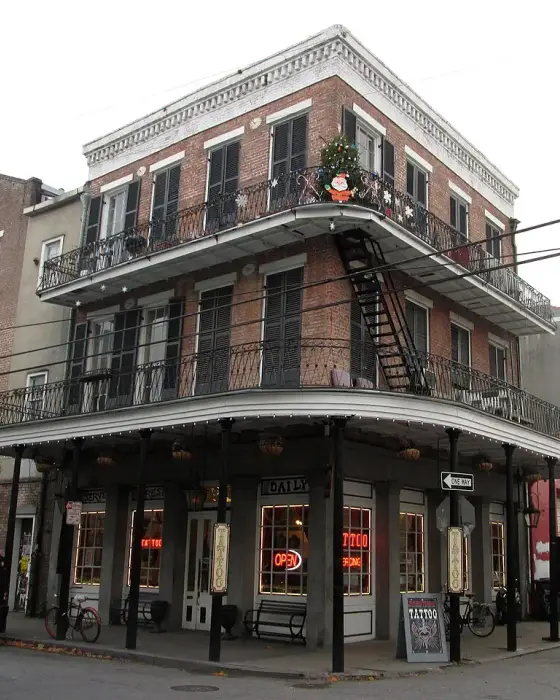
Frenchmen Street
Three blocks in the Marigny with a dozen music venues: The Spotted Cat, d.b.a., Snug Harbor, Blue Nile. Most have no cover charge: the band lives on the tip bucket that circulates between songs.
In two hours you can fit three music venues, paying the band through the tip bucket instead of a cover charge. Since the shows get going after 9pm, it's not a plan for anyone with an early flight the next day.
Check access

The Algiers ferry and the steamboat Natchez
The Canal Street ferry crosses the Mississippi in about 10 minutes for about US$2 and is the cheapest way to see the city from the water. The Natchez, a sternwheel steamboat launched in 1975, runs two-hour cruises with a live steam calliope played before departure.
Twenty minutes round trip, and what's worth it is the view during the crossing, more than Algiers itself. Go in the late afternoon: that's when downtown's lights switch on across the water.
Check access
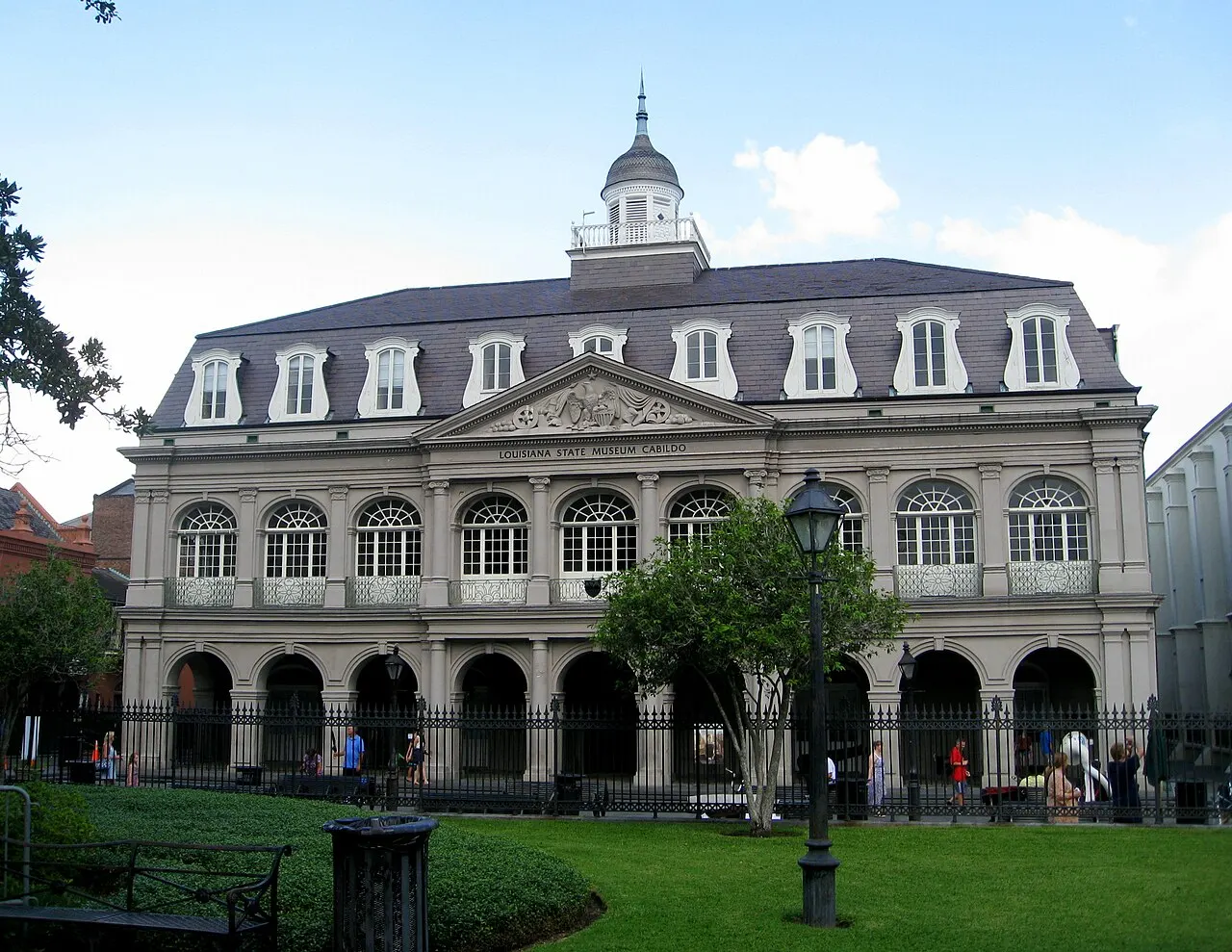
Cabildo and Presbytère
The two Spanish colonial buildings flanking the cathedral, today home to the Louisiana State Museum. It was in the Cabildo's second-floor hall that the transfer of Louisiana to the US was signed on December 20, 1803; the Presbytère houses the permanent exhibit on Hurricane Katrina.
The two Spanish buildings flank the cathedral and are a single visit: the transfer of Louisiana was signed at the Cabildo on December 20, 1803, and the Presbytère holds the permanent exhibit on Katrina, which explains today's city.
Check access
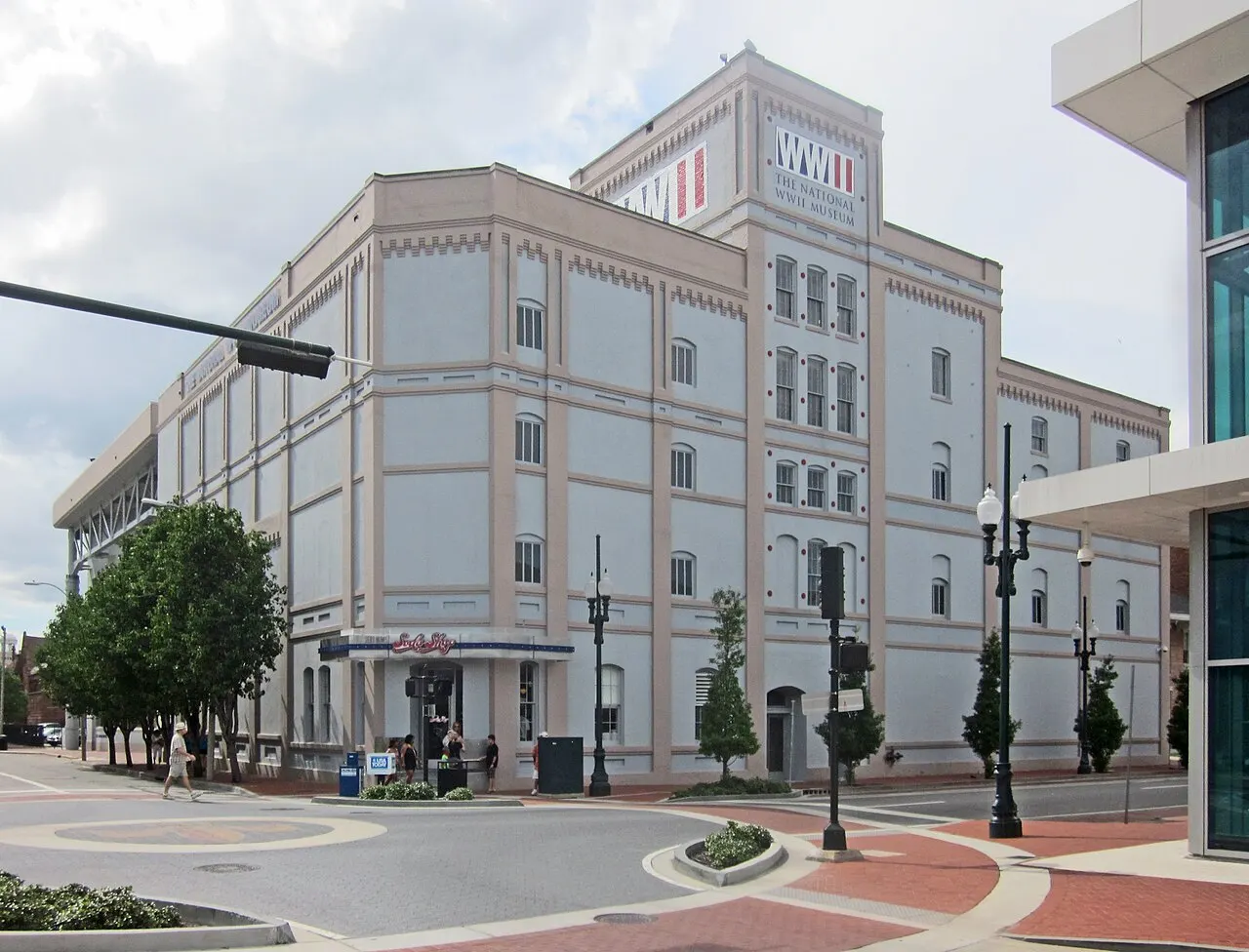
National WWII Museum
Opened on June 6, 2000, on the initiative of historian Stephen Ambrose, because the Higgins landing craft used at Normandy were designed and built in the city. It occupies five pavilions in the Warehouse District; set aside half a day and buy your ticket online (about US$36).
There are five pavilions, and it's worth setting aside at least half a day to go through them; a ticket bought online costs about $36. It's here because the Higgins boats used at Normandy were designed and built in the city, not because the war passed through here.
Check access
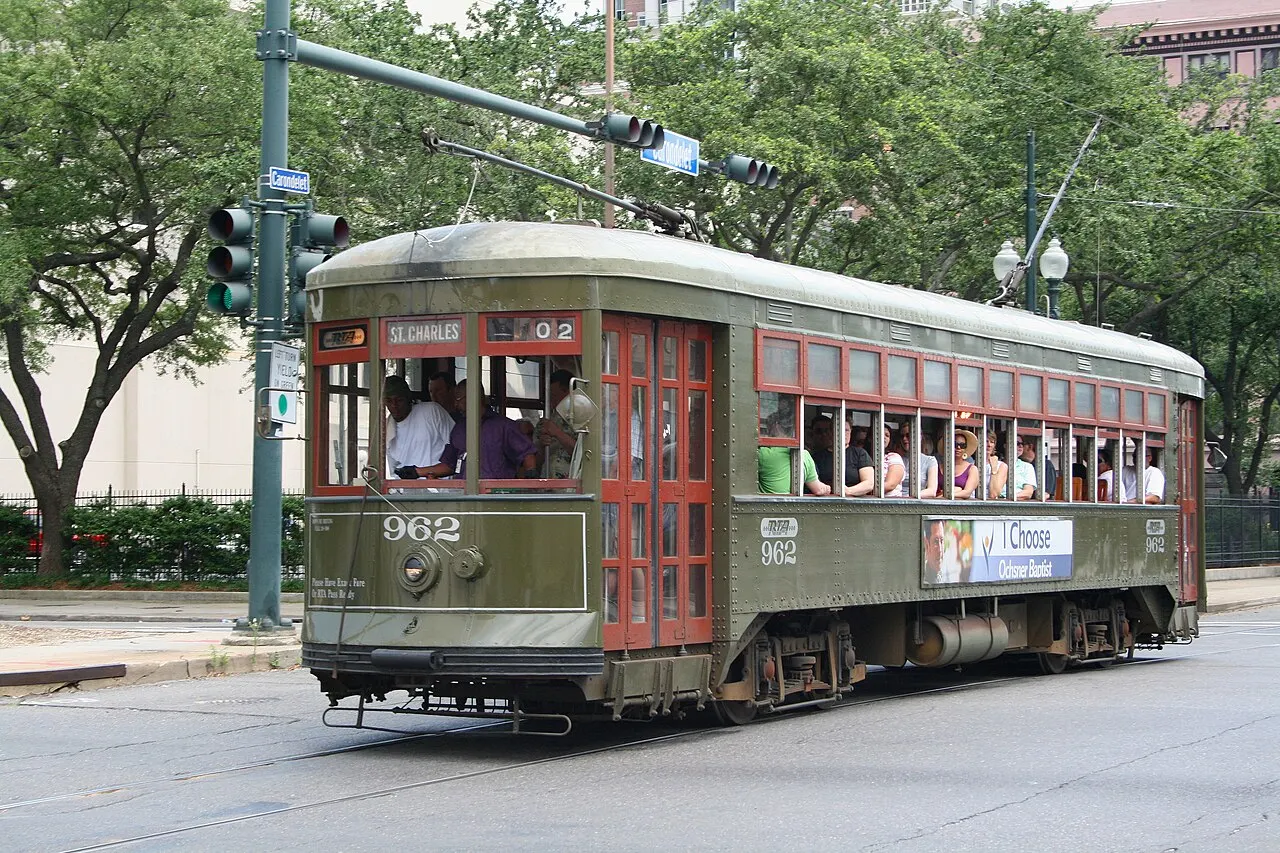
St. Charles Avenue streetcar
Opened in 1835 as the New Orleans & Carrollton Railroad, it's the oldest continuously operating streetcar line in the world. The green wooden cars are Perley Thomas models from 1923–24, with no air conditioning, and cover 13 km between Canal Street and Carrollton in about 50 minutes.
It's the world's oldest continuously operating streetcar line, with wooden cars from 1923–24, and it's worth it for the ride itself; for anyone on a schedule, the irregular interval gets in the way.
Check access

City Park and the art museum (NOMA)
A park of about 5.3 km², bigger than Central Park, with one of the largest concentrations of centuries-old live oaks in the world. NOMA dates from 1911, and the Sydney and Walda Besthoff Sculpture Garden next door has free admission and about 90 outdoor works.
Half a morning covers the park and the sculpture garden, which charges no admission; the NOMA asks for another. You get there on the red Canal streetcar, City Park/Museum branch.
Check access
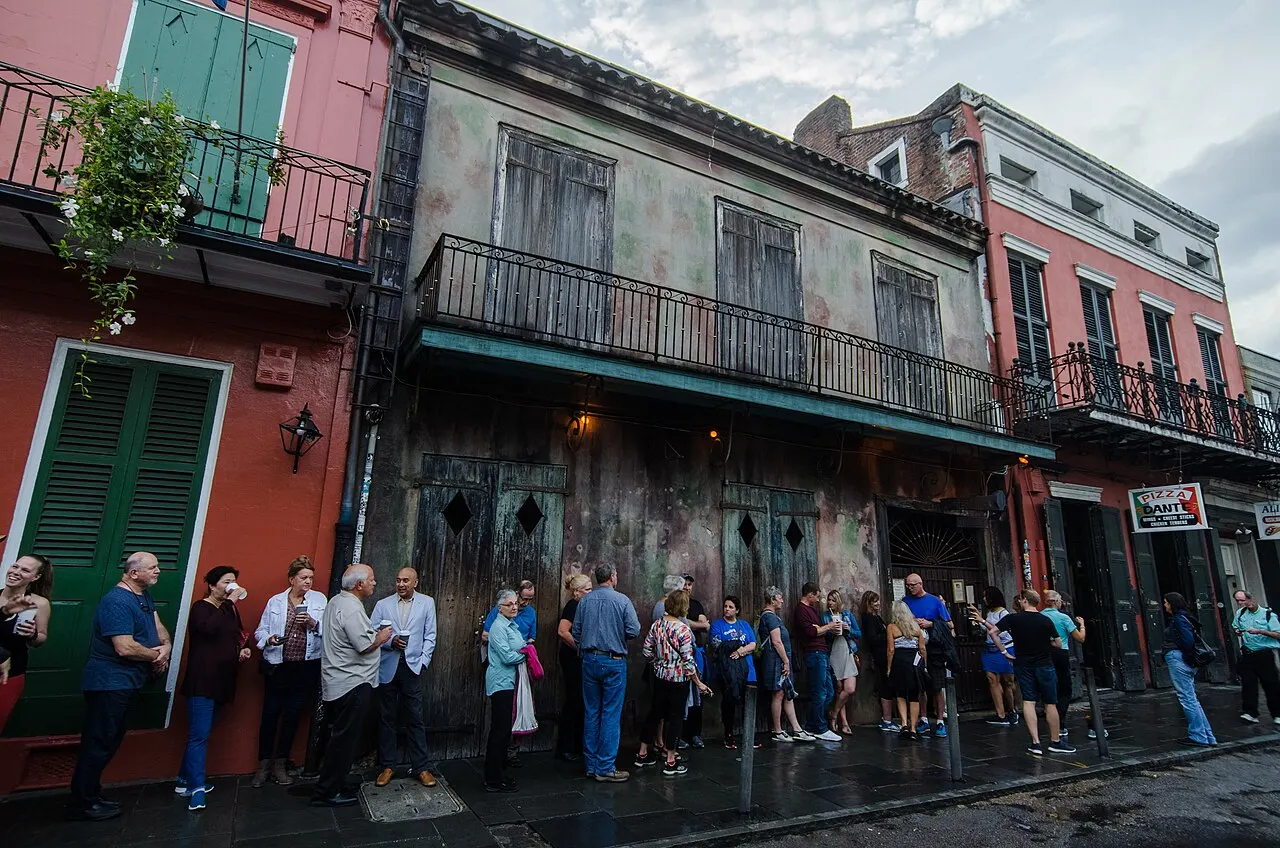
Preservation Hall
A room opened in 1961 on St. Peter Street, dedicated to traditional jazz: no bar, no air conditioning, about 100 seats, with much of the audience standing. There are three to four sets of about 45 minutes each per night; buy online, since the door line rarely gets in.
It's New Orleans traditional jazz since 1961, played a few meters from the audience, with nothing between the band and the crowd. The only guarantee of getting in is a ticket bought online before the trip.
Check access
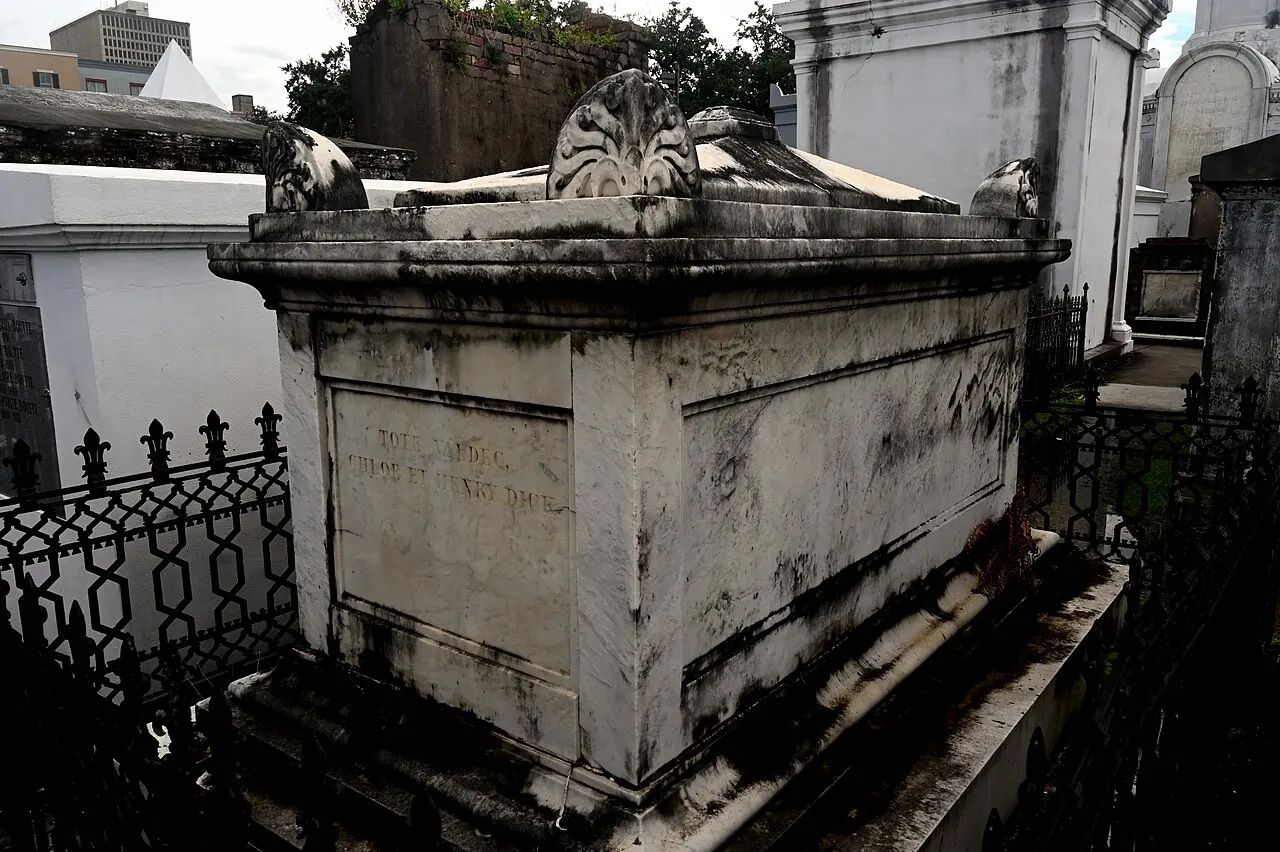
St. Louis Cemetery No. 1
Opened in 1789, with masonry tombs above ground because of the high water table and the heat, which turn a crypt into a natural kiln. Since 2015 entry has required a licensed guide or an archdiocese tour; the tomb attributed to Marie Laveau is near the entrance.
The cemetery visit takes about twenty minutes, but since 2015 you can only get in with a licensed guide, hired and booked beforehand. Only go if the tour is already arranged; without one, the tomb attributed to Marie Laveau stays behind the wall.
Check access
Nilo’s itinerary
Start with the basic programme and choose extensions for the time you have.
Plan my days in the app ↗Day 1 · The Vieux Carré, the river, and a first night of music
Get to Café du Monde at 8am, ahead of the line, for three beignets and a café au lait with chicory, for about US$9.
Cross over to Jackson Square and St. Louis Cathedral, and visit both wings of the State Museum: the Cabildo in the morning and then the Presbytère, with its Katrina exhibit.
Have a muffuletta from Central Grocery or a fried oyster po-boy near Decatur for lunch; order a half or share, because a whole one feeds four people.
In the late afternoon, take the ferry to Algiers Point (US$2, 10 minutes) to see the skyline from the middle of the river, and ride back at sunset.
Have dinner in the Marigny and, after 9pm, drop into three clubs on Frenchmen Street with small bills in your pocket.
Day 2 · Uptown by streetcar and the 20th century in the Warehouse District
Catch the green streetcar on St. Charles at Canal (US$1.25) and get off at Washington Avenue, 20 minutes later.
Walk for 90 minutes through the Garden District, between Prytania and Coliseum, circling the outside of Lafayette Cemetery No. 1 (1833).
Have lunch on Magazine Street and set aside an hour for the shops and used bookstores between Washington and Napoleon.
Head back to the CBD for the National WWII Museum, ticket bought online (about US$36); set aside three hours minimum.
End the day with a Sazerac, at the Sazerac Bar in the Roosevelt hotel or at the Carousel Bar in the Monteleone, which makes a full turn every 15 minutes.
Day 3 · Tremé, Mid-City and neighborhood music
Start at Congo Square, inside Louis Armstrong Park, and walk to the Backstreet Cultural Museum in Tremé, which holds Mardi Gras Indian suits.
Take the red Canal Street streetcar, City Park/Museum branch, to NOMA and the Besthoff Sculpture Garden, which is free.
Have a po-boy at Parkway in Mid-City for lunch, then walk along Bayou St. John to the Pitot House (1799).
If it's a Sunday between late August and June, check WWOZ 90.7 FM for the week's second line route and follow a stretch of the procession, always behind the band.
End with a neighborhood show: Tipitina's in Uptown, Chickie Wah Wah in Mid-City, or Preservation Hall with a ticket bought in advance.


Food
 AI illustration
Gumbo
A stew served over rice, thickened with roux (flour toasted in fat) and okra or sassafras powder (filé). The city's Creole version usually adds tomato and seafood; the Cajun version, from the countryside, uses an almost-black roux, chicken, and andouille sausage.
 AI illustration
Po-boy
A sandwich on local French bread, crusty outside and light inside (the Leidenheimer bakery has supplied the city since 1896). Filled with fried shrimp or oyster, or roast beef with debris gravy; ordering it “dressed” means lettuce, tomato, pickles, and mayonnaise. It originated during the 1929 streetcar strike, when the Martin brothers fed the strikers for free.
 AI illustration
Muffuletta
A round Sicilian sesame loaf filled with mortadella, salami, ham, provolone, and marinated olive salad. It was created at Central Grocery, on Decatur Street, in 1906; a whole one feeds four people.
 AI illustration
Beignets and café au lait
Three squares of fried dough under a mountain of powdered sugar, paired with coffee with chicory and hot milk: chicory entered the local habit during the Civil War blockade, when coffee ran short. Café du Monde has operated in the French Market since 1862, now from 7:15am to 11pm, and until midnight on Fridays and Saturdays.
 AI illustration
Red beans and rice on Monday
Red beans slow-cooked with andouille or pig's foot, served over white rice. The tradition comes from laundry day, when the pot could sit unattended on the stove; Louis Armstrong signed letters “Red beans and ricely yours.”
 AI illustration
Raw and chargrilled oysters
Gulf oysters shucked to order at the counter, with lemon and horseradish, or grilled over high heat with garlic butter and parmesan. Old houses like Acme (1910) and Casamento's (1919) keep the rule of the months without an “r”: Casamento's closes from June to August.
 AI illustration
Crawfish boil
Crawfish boiled with corn, potatoes, and seasoning, poured out onto a newspaper-lined table and eaten by hand. Season runs from January to June, peaking between March and May; it's sold by the pound at seafood shops, markets, and even gas stations.
 AI illustration
Sazerac and the house cocktails
Rye whiskey or cognac, sugar, Peychaud's bitters (created by a local pharmacist in 1838), and a glass rinsed with absinthe: the official cocktail of New Orleans since 2008. The same city produced the Ramos Gin Fizz, the Vieux Carré (Hotel Monteleone, 1938), and the Hurricane (Pat O'Brien's, 1940s).
Day trips

Whitney Plantation, Wallace
Whitney Plantation is about 90 km upriver along River Road, 1 hour by car. It's the only plantation museum in the American South that tells the story from the point of view of the enslaved people; it opened in 2014, and the guided tour takes about 2 hours. Laura and Oak Alley are ten minutes away, if you want to compare approaches.

Barataria Preserve (Jean Lafitte NHP), Marrero
Barataria Preserve, part of Jean Lafitte National Historical Park, is about 30 km south, 40 minutes by car. It has about 13 km of wooden boardwalks over a swamp of cypress and tupelo, with alligators visible from March to October and free admission. Bring insect repellent and go in the morning.
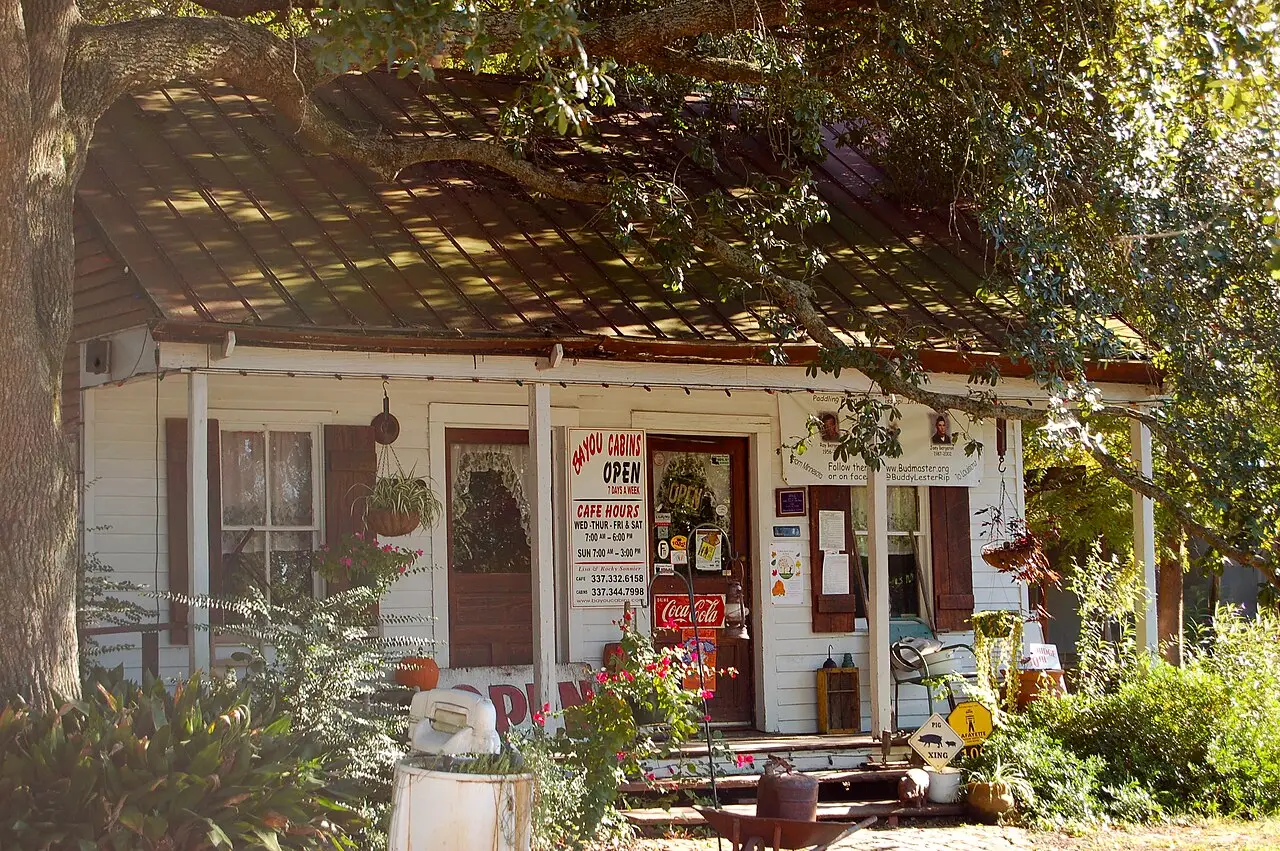
Breaux Bridge and the Atchafalaya Basin
Breaux Bridge is about 215 km west on I-10, 2 hours 15 minutes by car, in the heart of Cajun country. On Saturday mornings there's breakfast with live zydeco, and boat trips leave from there into the Atchafalaya Basin, the largest swamp in the United States, where Cajun French is still spoken at the table.
Where to begin
The Vieux Carré, the river, and a first night of music
Get to Café du Monde at 8am, ahead of the line, for three beignets and a café au lait with chicory, for about US$9.
Uptown by streetcar and the 20th century in the Warehouse District
Catch the green streetcar on St. Charles at Canal (US$1.25) and get off at Washington Avenue, 20 minutes later.
Tremé, Mid-City and neighborhood music
Start at Congo Square, inside Louis Armstrong Park, and walk to the Backstreet Cultural Museum in Tremé, which holds Mardi Gras Indian suits.
Money
The currency is the US dollar, and the price on the tag isn't what you pay at the register. Since January 1, 2025, when Louisiana raised its state rate to 5%, sales tax in Orleans has been 10%, and it reaches 11% in some special districts; it never shows up on the tag or the menu. Hotels charge higher taxes than stores do, plus an occupancy fee of US$1 to US$3 a night, and in the French Quarter a temporary 0.245% surcharge comes on top. In 2026, café au lait with three beignets runs US$8–10, and a po-boy US$12–18. A plate lunch at a neighborhood restaurant costs US$15–22, and a main course at a sit-down restaurant, US$28–45. A cocktail costs US$14–18 in the French Quarter and US$10–13 at a neighborhood bar; a draft beer, US$5–8. A mid-range hotel runs between US$150 and US$250 a night off-season, and during Carnival and Jazz Fest it climbs to US$400 to US$700, almost always with a minimum stay of four or five nights. Cards are accepted almost everywhere, but carry small bills for musicians' tips, the second-line bucket and bars with cash minimums, because the ATMs inside bars charge US$5 or more per withdrawal. Count the tip as part of the price: 18–20% at a restaurant, US$1–2 per drink at the bar, US$5 a day for housekeeping and 15–20% for a taxi.
Getting there and around
From Louis Armstrong Airport (MSY), in Kenner, to the French Quarter
The international airport, code MSY, is in Kenner, west of the city. Taxis charge a flat fare to downtown and the French Quarter: about US$36 for one or two people and about US$15 per person for three or more, which makes the ride pricier for groups. Uber and Lyft run between US$35 and US$55, depending on the time of day. The cheap option is the RTA's 202 Airport Express bus to the Union Passenger Terminal, for US$1.50, with few departures a day and a ride of about 50 minutes. That same Union Passenger Terminal, on Loyola Avenue, handles Amtrak trains and intercity buses. From there the City of New Orleans leaves for Chicago, the Crescent for New York, the Sunset Limited for Los Angeles and, since August 2025, the Mardi Gras Service for Mobile, Alabama. Brazilians need a US B1/B2 visa issued at a consulate: there is no visa waiver or electronic authorization for Brazil.
Four streetcar lines and the river ferries
Within the city, the RTA runs buses, four streetcar lines (St. Charles, Canal Street, Riverfront and Rampart–St. Claude) and the river ferries. A single fare costs US$1.25, plus US$0.25 for a transfer, and the Jazzy Pass costs US$3 for 1 day, US$8 for 3 days and US$15 for 7 days. Buy it in the Le Pass app or on board with exact change, because the driver doesn't give change. Streetcars come every 10 to 20 minutes and stop every two or three blocks, so they'll get you where you need to go, just not in a hurry. The tourist core is flat and walkable: from Jackson Square to the Garden District is about 4 km without climbing a single step. Renting a car only pays off for leaving the city, because daily parking in the Quarter runs over US$40, tow trucks clear cars within minutes on parade routes and the asphalt has deep potholes that heavy rain hides under water. After midnight, take a rideshare rather than walking between neighborhoods.
Safety
New Orleans has historically had one of the highest homicide rates in the United States, but lethal violence is concentrated in disputes between people who know each other and outside the tourist corridor, and 2024 and 2025 recorded the lowest numbers in about five decades. The real risk for visitors is different: car break-ins (never leave anything in sight, not even in the trunk), phone snatching and armed robbery on the edges of the French Quarter in the small hours, especially on Rampart, Iberville and Canal after 2am, plus pickpockets in parade crowds. Walk with company after midnight and call a rideshare instead of cutting between neighborhoods on foot. The best-known scam is the guy who bets he can guess “where you got your shoes”: the answer is “on your feet”, and the demand for money follows. Be wary, too, of unlicensed guides at cemetery gates and of street performers who charge for a photo without agreeing on a price first. Don't leave your drink unattended in the Bourbon bars. In summer, dehydration and heatstroke send more people to the emergency room than crime does, and heavy rain floods streets in half an hour. Between June and November, follow National Hurricane Center advisories and obey evacuation orders, which reverse the direction of the highways. Emergency: 911.
Etiquette tips
At a second line, stay behind the band
Anyone can follow a Sunday parade, but don't step between the band and the club's uniformed members, who paid for the parade and rehearsed the choreography. Money spent at the rolling drink stand that follows the procession helps pay for next year's edition.
Don't touch the Mardi Gras Indians' suits
Each suit takes a year of hand sewing and costs thousands of dollars in feathers and beads. Ask before photographing, and call it a suit, never a costume.
Catch beads in the air, don't take them from a hand
At parades, beads are thrown from the floats: picking them up off the ground is fine, taking them out of someone else's hand is not. Lifting your shirt in exchange for beads is a tourist phenomenon confined to two blocks of Bourbon, not a local tradition.
The tip bucket pays the band at every set
Most music venues have no cover charge, and the bucket circulates between songs. US$5 to US$10 per person is the minimum for anyone who stayed a full set; leaving before the bucket comes around gets noticed.
“Where'd you go to school?” means high school
Among locals, the question refers to high school, not college. It's the local way of placing someone on the city's map. Answering with your university gives away instantly that you just got here.
Plastic cup yes, glass no
It's legal to walk the street with alcohol in a plastic cup; ask for a “go cup” on your way out of the bar, and the bartender pours it in for you. Glass or a can on the sidewalk gets you a fine, especially in the French Quarter.
Mistakes to avoid
Thinking the music is on Bourbon
Assuming Bourbon Street is the city's music scene. The real live music is on Frenchmen, in Tremé, at Tipitina’s in Uptown, at Chickie Wah Wah in Mid-City and at the Sunday second lines announced on WWOZ 90.7 FM.
Calling the French Quarter French
Calling the French Quarter's architecture French. The fires of 1788 and 1794 destroyed the French colonial city, and what stands today is Spanish (courtyards, tile roofs and firewalls), with the cast-iron balconies added by Americans in the 1850s.
Booking Carnival without checking the logistics
Booking Carnival without understanding the logistics. Hotels triple their rates and require minimum stays of four or five nights. Parade routes close whole avenues for three to five hours straight, blocking pedestrians too. Getting stuck on the wrong side of the street can mean waiting the length of an entire movie.
A tow on the parade route runs over US$200
Renting a car to stay downtown. On top of parking, which runs over US$40 a day in the Quarter, car break-ins are the most common crime against visitors. On parade days, no-parking signs go up only a few hours ahead, and any car left on the route gets towed, with a fee above US$200.
38°C heat index and hurricane peak
Going in August. It's the month of a heat index above 38°C, near-daily storms, and the peak of hurricane season, and part of the neighborhood restaurant scene closes for vacation.
Useful phrases
Where y'at?
“How's it going?”: a local greeting; whoever talks this way is called a Yat
Making groceries
“To do the grocery shopping”: a literal calque of the French faire son marché
Neutral ground
The median strip of any avenue, a name inherited from the border between the Creole and American sectors on Canal Street
Lagniappe
“A little something extra” for free: the bonus a shopkeeper tosses into the bag at no charge
Go cup
The plastic cup for taking a drink from the bar out onto the street, legal in most of the city
Who dat?
The Saints' fan chant, short for “Who dat say dey gonna beat dem Saints?”
Districts
Vieux Carré (French Quarter)
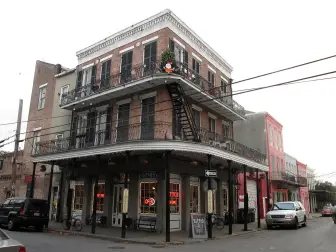
Today's Vieux Carré, about 78 blocks between Canal Street, Esplanade Avenue, Rampart, and the river, grew from the 66-block grid laid out in 1721. Royal and Chartres are lined with antique shops and galleries, Bourbon is lined with bars and tourists, and Decatur faces the river and the French Market.
Faubourg Marigny and Bywater
Just below Esplanade, Creole cottages and shotgun houses painted in bold colors, occupied by residents rather than hotels. Frenchmen Street has the city's densest concentration of genuinely live music; Bywater has cafés, artists' studios, and Crescent Park along the river.
Tremé
The oldest Black neighborhood in the United States, formed by free people of color starting in 1810. Home to Congo Square, St. Augustine Church (1841), and the social base of the brass bands and Sunday second lines.
Garden District
The American sector, settled after 1803 by Anglophone merchants who weren't accepted among the Quarter's Creoles. Mansions from 1840 to 1870 between Magazine and St. Charles, with Lafayette Cemetery No. 1 (1833) in the middle, under restoration since 2020 and open only to guided visits.
Uptown and Carrollton
A long strip along St. Charles Avenue, with the Tulane and Loyola campuses, Audubon Park (site of the 1884 World's Fair), and the Tipitina's club. Magazine Street runs parallel for about 10 km, lined with neighborhood shops, bars, and restaurants.
CBD and Warehouse District
The business center and old cotton warehouses converted into museums, galleries, and lofts. Home to the National WWII Museum, the galleries of Julia Street, the Caesars Superdome, and most of the big hotels.
Mid-City and Bayou St. John
Around City Park and the bayou that once served as an Indigenous shortcut to the lake. A residential neighborhood of double shotgun houses, with the Fair Grounds (site of Jazz Fest), the Canal Street streetcar's red line, and some of the city's best po-boys.
Algiers Point
Across the river, ten minutes by ferry from downtown. A 19th-century village of short streets and wooden houses, with the best head-on view of the skyline, and practically no tourists.
History
1718 · Bienville chooses the bend
Jean-Baptiste Le Moyne de Bienville sets up the French outpost on a strip of high ground at the bend, 170 km from the mouth. Engineer Adrien de Pauger draws the rectangular grid in 1721 that is still the Vieux Carré.
1763–1803 · Spain governs Louisiana for four decades, starting with the 1762 treaty
The Treaty of Fontainebleau (1762) hands Louisiana to Spain. The fires of 1788 (856 houses) and 1794 force rebuilding in brick, with interior courtyards and balconies. The “French Quarter” is, in practice, Spanish colonial architecture.
1791–1809 · Refugees from Saint-Domingue
The Haitian revolution pushes thousands of people to Cuba and from there to Louisiana: in 1809 alone about 10,000 arrive, among them white people, free people of color, and enslaved people. The population doubles, and French, Catholicism, and Creole culture are reinforced.
1803 · The Louisiana Purchase
The United States buys 2.1 million km² from France for US$15 million. The formal transfer is signed at the Cabildo, next to the cathedral, on December 20, 1803.
1815 · Battle of New Orleans
On January 8, at Chalmette, Andrew Jackson's troops defeat the British: two weeks after the Treaty of Ghent had already ended the war in Europe. The victory fixes the city in the national imagination and launches Jackson toward the presidency.
1812–1860 · The port, the steamboat, and the market in people
The first steamboat arrives in 1812, and cotton and sugar move down the river. By 1840 New Orleans is the third-largest city in the US and the country's largest market for enslaved people; at the same time, in Congo Square, African drumming and dance survive every Sunday.
1862–1896 · Occupation and legal segregation
The Union takes the city in April 1862 without destroying it. In 1892 Homer Plessy is deliberately arrested on a Press Street rail car, and the Plessy v. Ferguson decision (1896) turns segregation into law nationwide.
1897–1917 · Storyville and the birth of jazz
A city ordinance creates a legalized prostitution district next to Tremé in 1897. In the district's dance halls, Buddy Bolden, Jelly Roll Morton, and King Oliver play; Louis Armstrong is born in the city in 1901, and the Navy shuts down Storyville in 1917.
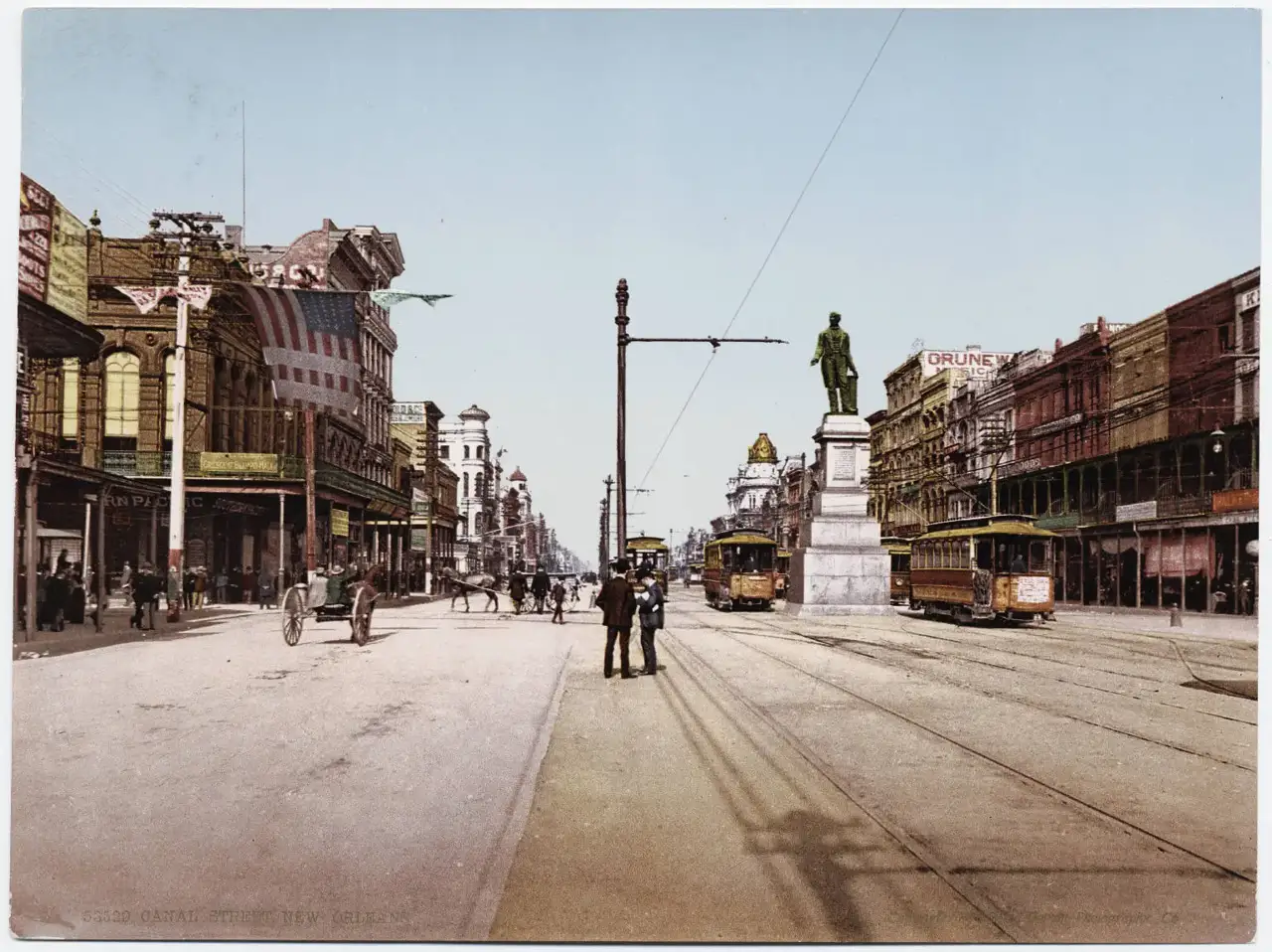
1913–1965 · Pumps, drainage, and sinking
A. Baldwin Wood's screw pump (1913) makes it possible to drain the swamp behind the city and occupy land below sea level. The organic soil dries out and sinks; in 1965 Hurricane Betsy floods the Lower Ninth Ward, foreshadowing what would come.
2005 · Katrina and the levee failures
On August 29 the hurricane passes to the east, but the floodwalls on the 17th Street, London Avenue and Industrial canals give way and about 80% of the city ends up underwater. Katrina kills about 1,390 people, and the population drops from about 455,000 to about 230,000 in a year.

2006–2026 · Rebuilding and a new perimeter
The Army Corps of Engineers spends about US$14.5 billion on levees, floodgates and the Lake Borgne barrier (2013), the largest of its kind in the U.S. The city celebrates its tricentennial in 2018 and reaches 2025 with about 362,000 residents, about 42% below its 1960 peak of nearly 627,000.

Complete history
Bienville founds the city in 1718, 170 km upriver from the sea
In 1718 Bienville founded La Nouvelle-Orléans 170 km upriver, away from the sea, on the strip of land the Mississippi itself had deposited along a bend, the only solid ground in the region, and a few kilometers from Bayou St. John, which gave quick access to Lake Pontchartrain and to the Gulf from behind. In 1721 Adrien de Pauger laid out the 66-block grid that became the Vieux Carré, and in 1722 the capital of French Louisiana moved there from Biloxi. France ceded the colony to Spain in the Treaty of Fontainebleau (1762), and it was the Spanish who gave downtown its current look: after the fires of 1788 and 1794, which together consumed more than a thousand buildings, their ordinances required brick, tile roofs, interior courtyards and firewalls. The cast-iron balconies everyone photographs came later, in the 1850s, under American rule.
Refugees from Saint-Domingue change the city, 1791–1809
The people who arrived made the city unique. The Haitian revolution pushed thousands of refugees from Saint-Domingue here between 1791 and 1809: white people, enslaved people, and a large population of gens de couleur libres, free people of color who owned property, held trades, and attended school. In 1809 alone about 10,000 landed, doubling the population and ensuring that French, Catholicism, and Napoleonic civil law survived the 1803 Louisiana Purchase. When Anglophone Americans arrived, the Creoles kept their distance: the newcomers built on the other side of Canal Street, in what would become the Garden District, and the avenue's central median became known as neutral ground, a name still used today for the median of any street in the city.
Prosperity came from the river and slavery
Nineteenth-century prosperity came from the river and from slavery. The steamboat arrived in 1812, and for three decades the port exported cotton and sugar from the whole valley; by 1840 the city was the third-largest in the country and also the largest market for enslaved people in the United States, with auctions held in downtown hotels and courtyards. In Congo Square, in Tremé, the free Sundays authorized since colonial times kept African drumming, singing, and dance alive for generations: the direct line that, between 1895 and 1917, produced jazz. The Union took the city in 1862 without bombarding it, which is why so much antebellum construction is still standing, but the postwar period brought segregation: a case deliberately staged by Creole activists, that of Homer Plessy in 1892, ended up legalizing “separate but equal” in 1896. In the twentieth century, A. Baldwin Wood's pump (1913) drained the swamp behind the city and let it spread onto land that only stayed dry as long as the pumps kept running, and that, as it dried, sank.
In 2005 the engineering failed
On August 29, 2005, that engineering failed. Katrina passed to the east, and the floodwalls on the 17th Street, London Avenue and Industrial canals broke and flooded the city: about 80% of the urban area ended up underwater, in spots for three weeks. Katrina killed about 1,390 people. The population plunged from about 455,000 to about 230,000, and the recovery was uneven: high-ground neighborhoods like the French Quarter and Uptown, which never flooded, bounced back fast, while the Lower Ninth Ward and parts of New Orleans East still have empty lots. The rebuilt protection system cost about $14.5 billion and includes the Lake Borgne surge barrier, about 3 km long, completed in 2013. It was what held back Hurricane Ida in 2021, when the city lost power for days but didn't flood.
New Orleans in 2026: smaller and more dependent on tourism
The New Orleans of 2026 is a smaller city, and more dependent on visitors, than it was in 2000: about 362,000 residents and an economy built on tourism, the port, health care, universities and film and TV production (the 2002 state tax incentives earned Louisiana the nickname Hollywood South). Today's problems have names: the cost of home insurance, which has multiplied since 2020; land loss in the delta, something like 4,800 km² since 1930; and public safety, a central issue since the January 1, 2025 attack on Bourbon Street, which killed 14 people and led to new removable steel barriers in the French Quarter. Recent investment went into tourism and transportation: the February 2025 Super Bowl in the renovated Caesars Superdome and the return of passenger rail to Mobile in August 2025.
Despite its name, the French Quarter is largely Spanish: after the fires of 1788 and 1794, Spanish ordinances required brick, tile roofs, interior courtyards and firewalls.
Geography and shape of the city
The bend and the high strip
The city occupies the eastern bank of a crescent-shaped bend of the Mississippi, hence the nickname Crescent City, squeezed between the river and Lake Pontchartrain, a roughly 1,630-km² brackish body of water connected to the gulf. The natural high ground is the narrow strip the river itself deposited over millennia, 1 to 4 meters above sea level: that's where the Vieux Carré, the Garden District, and Uptown sit, what locals call the sliver by the river.
The drained swamp and the pumps
Everything behind that strip was cypress swamp until A. Baldwin Wood's screw pump made it possible to drain it starting in 1913; the organic soil dried out, compacted, and sank, and today Lakeview, Gentilly, and New Orleans East sit 1 to 3 meters below sea level. The practical consequence is that New Orleans is a closed basin ringed by hundreds of kilometers of levees and floodwalls, kept dry only because dozens of pumping stations push the rain back out: when a lot of water falls in a short time, the streets flood within half an hour.
Riverside, lakeside, and hurricane season
The street grid follows the curve of the river rather than the compass, so nobody gives directions by north and south: locals say riverside and lakeside, uptown and downtown. The climate is humid subtropical, with about 1,600 mm of rain a year, long summers and a hurricane season from June 1 to November 30.
Culture
Jazz took shape between 1895 and 1917
Jazz took shape here between 1895 and 1917, at the meeting point of the African percussion preserved in Congo Square, the brass bands of funerals and parades, the French opera the city had consumed since the 18th century, and the dance repertoire of Storyville's halls. Buddy Bolden, Jelly Roll Morton, King Oliver, and Sidney Bechet came out of it; Louis Armstrong was born in 1901 in a poor neighborhood behind Rampart and took the music to Chicago in 1922. The city never stopped producing: Professor Longhair and Fats Domino set the rhythm and blues piano sound in the 1950s, The Meters invented New Orleans funk in the 1970s, Allen Toussaint wrote and produced half a century of hits, the Marsalis family renewed modern jazz, and Trombone Shorty bridges it to the present. There's live music any night of the week, and community radio WWOZ 90.7 FM is the most reliable guide to who's playing where.
Old institutions, barely visible from outside
Street culture is organized by old institutions that are easy for passersby to miss. The social aid and pleasure clubs, heirs to the mutual aid societies founded by Black New Orleanians in the 19th century, take to the streets almost every Sunday from late August to June: the so-called second line, a four-hour parade with a brass band, uniformed members and a crowd of hundreds behind them, crossing whole neighborhoods. The Mardi Gras Indians, or Black Masking Indians, spend a full year sewing feather and bead suits that weigh dozens of kilos and appear on three dates: Fat Tuesday, St. Joseph's Night (March 19) and the following Super Sunday. The jazz funeral follows the same logic: a dirge on the way out, dance music on the way back. None of this is a show staged for tourists; it's a neighborhood calendar, announced by radio and word of mouth.
Literature out of proportion to its size
Beyond music, the city has produced literature out of proportion to its size: Kate Chopin, Tennessee Williams (who wrote “A Streetcar Named Desire” while living on St. Peter Street), Walker Percy, Anne Rice, and John Kennedy Toole, whose “A Confederacy of Dunces” won the Pulitzer in 1981, twelve years after the author's suicide. Since the 2002 tax incentives, Louisiana has become a hub for film and TV production, and the series “Treme” (HBO, 2010–2013) documented the post-Katrina city with real musicians in the cast. Religion is mostly Catholic, with a street festival on St. Joseph's Day, Sicilian altars, and a syncretic Louisiana voodoo whose central figure, Marie Laveau (1801–1881), was a hairdresser and healer of the Vieux Carré. In sports, everything revolves around the Saints, Super Bowl champions in February 2010, when the win served as a symbolic milestone of the rebuilding.
The route of the Sunday parades is announced on WWOZ 90.7 FM radio, on the morning of the day itself.
The Sazerac, the city's official cocktail since 2008, uses Peychaud’s bitters, created by a New Orleans pharmacist in 1838.
Festivals and events

Mardi Gras / Carnival
Begins on January 6 (Twelfth Night) and ends on Fat Tuesday: February 9 in 2027. Dozens of krewes parade in the final two weeks: Rex (1872, which set purple, green, and gold), Zulu (1909, of the hand-painted coconuts), Endymion, Bacchus, Muses, and the satirical Krewe du Vieux. No large parade has entered the French Quarter since 1973, because of street width.
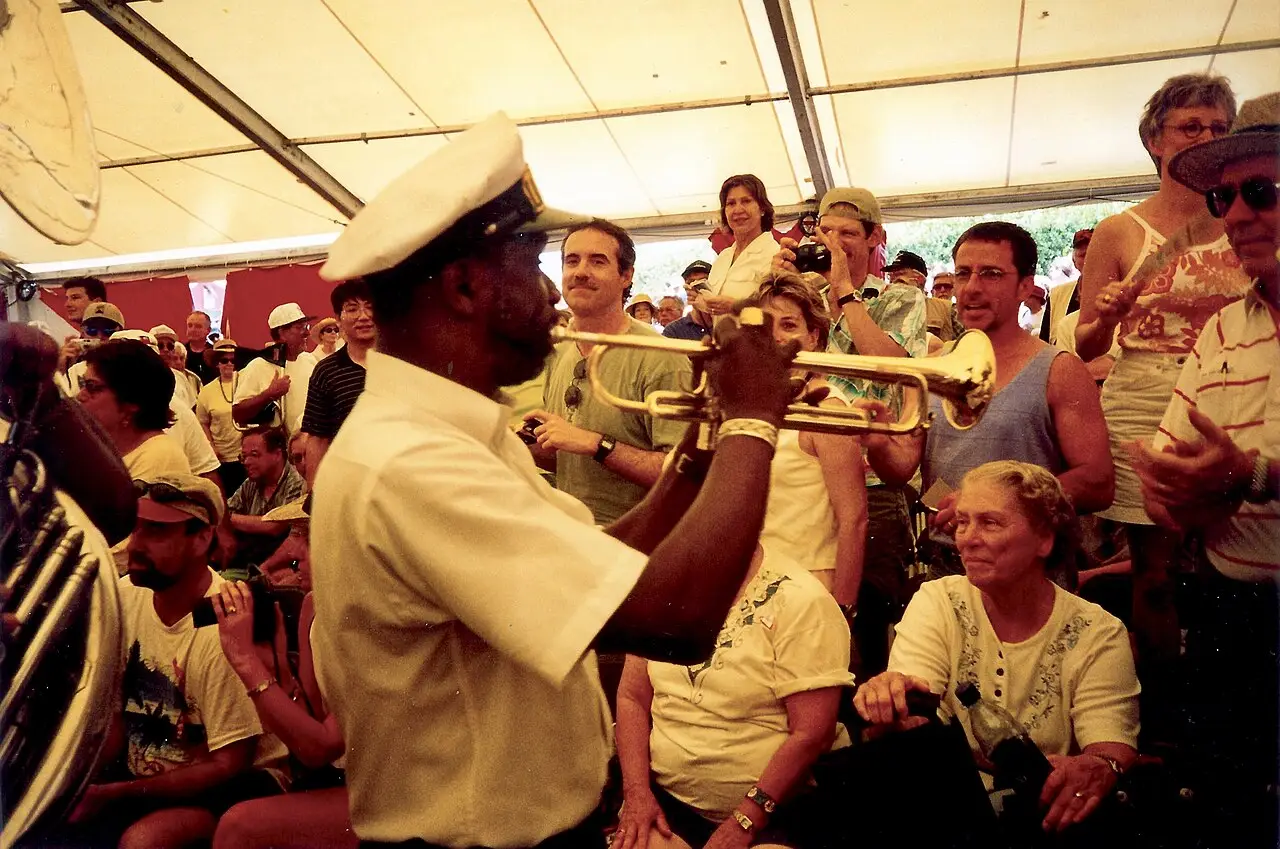
New Orleans Jazz & Heritage Festival
Last weekend of April and first of May, at the Fair Grounds racetrack in Mid-City, since 1970. About 14 stages running at once, with brass bands, gospel, Mardi Gras Indians, and regional food stalls; a day ticket runs around US$100.
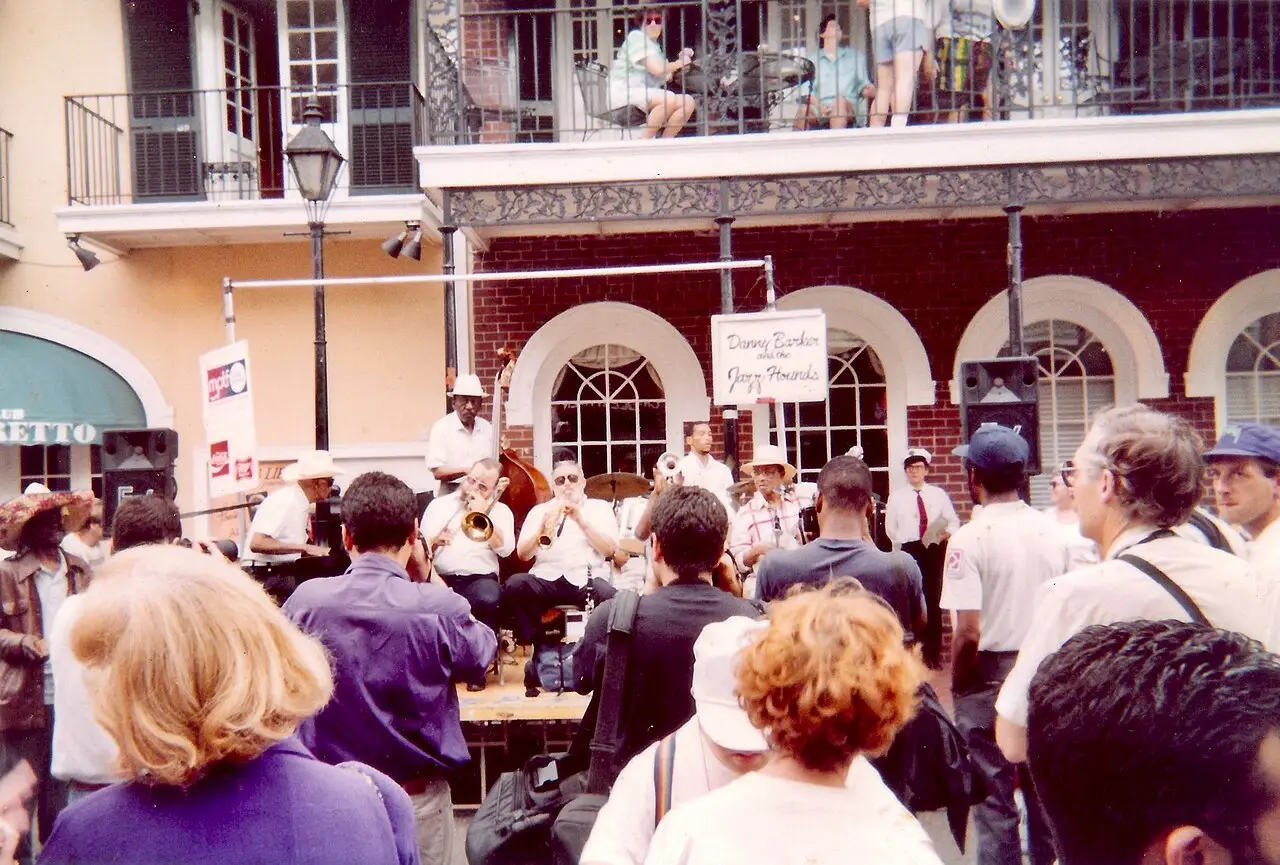
French Quarter Festival
Four days in April, with about 20 free stages spread across the neighborhood and the riverfront. It's the best-attended free music festival in the South, and the one locals attend more than Jazz Fest.

Essence Festival of Culture
First weekend of July, at the Caesars Superdome and the convention center, since 1995. The country's largest annual gathering of African American culture: panels and a marketplace by day, big-name concerts at night.

Southern Decadence
Labor Day weekend, in early September, in the French Quarter, since 1972. An LGBT+ celebration with a Sunday parade starting at the corner of Bourbon and St. Ann, in the heart of the city's gay neighborhood.
Books and films
“A Confederacy of Dunces,” John Kennedy Toole (written in the 1960s, published in 1980)
Won the Pulitzer in 1981. It moves through the real city (Canal Street, the French Quarter, a pants factory, a hot-dog cart) and captures the local relationship to work, neighborhood, and family.
“When the Levees Broke,” Spike Lee (2006)
A four-act documentary on Katrina and the levee failures, built from residents' testimony. It explains why the city's social map in 2026 isn't the one from 2005.
“Hot Fives and Hot Sevens,” Louis Armstrong (1925–1928)
The recordings that turned New Orleans's collective jazz into a soloist's music. Listening to “West End Blues” explains the origin of almost everything played on Frenchmen Street today.
Frequently asked questions
New Orleans: where can you hear live music outside Bourbon Street?
The real live music is on Frenchmen, in Tremé, at Tipitina's in Uptown, at Chickie Wah Wah in Mid-City and at the Sunday second lines announced on WWOZ 90.7 FM.
New Orleans: how much does the taxi from the airport to downtown cost?
The taxi charges a flat rate to downtown and the French Quarter: about $36 for one or two people and about $15 per person for three or more, which makes the ride pricier for groups.
New Orleans: how far is the Whitney Plantation?
The Whitney Plantation is about 90 km upriver along River Road, 1 hour by car.
New Orleans: does the price tag already include tax?
No: sales tax in Orleans is 10%, and reaches 11% in some special districts; it never shows up on the price tag or the menu.
New Orleans: when is the best time to go?
The best windows are February to May and mid-October to early December, with highs between 20 °C and 28 °C and bearable humidity.
Other cities in the country
United States ↗- Days
- 4–5
- When
- Apr–Jun · Sep–Oct
- Per person/day
- Average 180–320 USDMid-range · per person/day
Cost scope
Per person per day: accommodation, meals, urban transport, visits and a small allowance for extras. Flights excluded; larger purchases vary. Editorial estimate, not a quote.
- Days
- 4–5
- When
- Apr–May · Nov
- Per person/day
- Average 220–330 USDMid-range · per person/day
Cost scope
Per person per day: accommodation, meals, urban transport, visits and a small allowance for extras. Flights excluded; larger purchases vary. Editorial estimate, not a quote.
- Days
- 3
- When
- Sep–Oct
- Per person/day
- Average 180–280 USDMid-range · per person/day
Cost scope
Per person per day: accommodation, meals, urban transport, visits and a small allowance for extras. Flights excluded; larger purchases vary. Editorial estimate, not a quote.
- Days
- 4
- When
- May–Jun · Sep–Oct
- Per person/day
- Average 150–260 USDMid-range · per person/day
Cost scope
Per person per day: accommodation, meals, urban transport, visits and a small allowance for extras. Flights excluded; larger purchases vary. Editorial estimate, not a quote.
- Days
- 2–3
- When
- Jan–Apr · Nov–Dec
- Per person/day
- Average 200–350 USDMid-range · per person/day
Cost scope
Per person per day: accommodation, meals, urban transport, visits and a small allowance for extras. Flights excluded; larger purchases vary. Editorial estimate, not a quote.
- Days
- 2–3
- When
- Mar–May · Oct–Nov
- Per person/day
- Average 200–350 USDMid-range · per person/day
Cost scope
Per person per day: accommodation, meals, urban transport, visits and a small allowance for extras. Flights excluded; larger purchases vary. Editorial estimate, not a quote.
- Days
- 3
- When
- Mar–May
- Per person/day
- Average 220–320 USDMid-range · per person/day
Cost scope
Per person per day: accommodation, meals, urban transport, visits and a small allowance for extras. Flights excluded; larger purchases vary. Editorial estimate, not a quote.
- Days
- 2–3
- When
- Sep–Oct
- Per person/day
- Average 190–330 USDMid-range · per person/day
Cost scope
Per person per day: accommodation, meals, urban transport, visits and a small allowance for extras. Flights excluded; larger purchases vary. Editorial estimate, not a quote.
- Days
- 2–3
- When
- Jun–Sep
- Per person/day
- Average 130–220 USDMid-range · per person/day
Cost scope
Per person per day: accommodation, meals, urban transport, visits and a small allowance for extras. Flights excluded; larger purchases vary. Editorial estimate, not a quote.
- Days
- 5–6
- When
- Jan–Apr · Nov–Dec
- Per person/day
- Average 368 USDMid-range · per person/day
Cost scope
Per person per day: accommodation, meals, urban transport, visits and a small allowance for extras. Flights excluded; larger purchases vary. Editorial estimate, not a quote.
- Days
- 4–6
- When
- Apr–May · Sep
- Per person/day
- Average 329 USDMid-range · per person/day
Cost scope
Per person per day: accommodation, meals, urban transport, visits and a small allowance for extras. Flights excluded; larger purchases vary. Editorial estimate, not a quote.
- Days
- 2
- When
- Apr–May · Sep–Oct
- Per person/day
- Average 203 USDMid-range · per person/day
Cost scope
Per person per day: accommodation, meals, urban transport, visits and a small allowance for extras. Flights excluded; larger purchases vary. Editorial estimate, not a quote.
- Days
- 3
- When
- Apr · Sep–Oct
- Per person/day
- Average 251 USDMid-range · per person/day
Cost scope
Per person per day: accommodation, meals, urban transport, visits and a small allowance for extras. Flights excluded; larger purchases vary. Editorial estimate, not a quote.
- Days
- 3
- When
- May–Jun · Sep–Oct
- Per person/day
- Average 158 USDMid-range · per person/day
Cost scope
Per person per day: accommodation, meals, urban transport, visits and a small allowance for extras. Flights excluded; larger purchases vary. Editorial estimate, not a quote.