United States
San Diego
Naval bay, Balboa Park, Pacific bluffs and border cuisine
Days Start with the basic programme and choose extensions for the time you have.
How the guide reaches this number
Anyone with a fourth day can give it to the Safari Park in Escondido, the North County beaches by COASTER train, or a day trip to Tijuana with the documents for going and returning sorted out. With fewer than three days, you have to choose between spending the morning at the zoo and walking the northern bluffs.
3
When April, September, and October; from May to early July the marine layer covers the coast in the mornings, July and August bring school vacations and higher rates, and from December to March there is more rain and the sea is cold.
How the guide reaches this number
April, September, and October are the months I’d pick for San Diego. In September and October, average highs sit near 24 °C to 25 °C at the airport station, the morning sky usually clears earlier than in early summer, and the American school vacation crowds have already thinned; April is cooler (average high near 20 °C) and dry enough for walking in Balboa Park and Torrey Pines. November is still pleasant, with highs near 21 °C, but nights cool off and the rain starts to return. Between May and the end of June (sometimes stretching into July), the marine layer known locally as May Gray and June Gloom covers the coastal strip with low clouds in the morning, often clearing only in the afternoon, even though the county’s interior is sunny; highs stay between 21 °C and 22 °C. July and August have firmer afternoon sun, full beaches, high season at the hotels, and Comic-Con in late July. From December to March, highs sit near 19 °C, lows between 10 °C and 12 °C, and most of the year’s rain falls, but it is the best time for the tidepools at Cabrillo National Monument, with extreme low tides in daylight hours, and for watching migrating gray whales from the heights of Point Loma, from late December to mid-March.
Per person/day Budget around USD103; mid-range around USD251; comfortable around USD584 per person per day, based on spending reported by travelers to Budget Your Trip (checked October 2026).
How the guide reaches this number
Indicative figures, excluding travel to the destination.
Budget around USD103; mid-range around USD251; comfortable around USD584 per person per day, based on spending reported by travelers to Budget Your Trip (checked October 2026). Indicative figures, excluding travel to the destination.
Per person per day: accommodation, meals, urban transport, visits and a small allowance for extras. Flights excluded; larger purchases vary. Editorial estimate, not a quote.
 What Nilo thinks
I’d set aside three full days for San Diego: one for Balboa Park (choosing between the zoo and the El Prado museums) and the Embarcadero; a second, by car, for Cabrillo National Monument in Point Loma, Old Town, the murals of Chicano Park, and the end of the afternoon in Coronado; and a third for the Torrey Pines reserve, the La Jolla coast, and the boardwalk between Pacific Beach and Mission Beach. Anyone with a fourth day can give it to the Safari Park in Escondido, the North County beaches by COASTER train, or a day trip to Tijuana with the documents for going and returning sorted out. With fewer than three days, you have to choose between spending the morning at the zoo and walking the northern bluffs.I’d start looking at San Diego with a map of the water before choosing the neighborhood for the hotel. To the south, two narrow peninsulas close off a bay where aircraft carriers and working boats cross the ferry’s path to Coronado; to the north, the coast opens to the Pacific at the calm waters of Mission Bay and the broad beaches of Mission Beach and Pacific Beach, then rises in sandstone bluffs between La Jolla and Torrey Pines. In the middle, a mesa cut by canyons holds the gardens and the 1915 pavilions of Balboa Park.
Read more
That geography means the city works best when you group one sector per outing, instead of crossing twenty kilometers of highway at every meal. I’d combine Balboa Park with the Embarcadero waterfront in one day, set aside another for the tip of Point Loma, Old Town, the murals of Barrio Logan, and the end of the afternoon in Coronado, and leave the third for walking among the rare pines of Torrey Pines, watching the sea lions at La Jolla Cove, and finishing on the Pacific Beach boardwalk.
Quick facts
- Population
- About 1.4 million people in the city of San Diego (1,386,932 in the 2020 decennial census and a 2024 estimate of 1,404,452 from the U.S. Census Bureau) and about 3.3 million in San Diego County.
- Founded
- Ancestral Kumeyaay land; the Spanish presidio and the mission of San Diego de Alcalá were established on July 16, 1769, and the city was incorporated in the United States in 1850.
- Country and region
- United States, the far south of the state of California, San Diego County, on the border with Baja California (Mexico).
- Language
- English; Spanish is widely spoken in shops, transit, and everyday life in the border region.
- Currency
- U.S. dollar (USD).
- Time zone
- America/Los_Angeles (Pacific Time): UTC−8 in standard time and UTC−7 during daylight saving, from the second Sunday of March to the first Sunday of November.
- Best time to visit
- April, September, and October; from May to early July the marine layer covers the coast in the mornings, July and August bring school vacations and higher rates, and from December to March there is more rain and the sea is cold.
- Average daily cost
- Budget around USD103; mid-range around USD251; comfortable around USD584 per person per day, based on spending reported by travelers to Budget Your Trip (checked October 2026). Indicative figures, excluding travel to the destination.
When to go
April, September, and October; from May to early July the marine layer covers the coast in the mornings, July and August bring school vacations and higher rates, and from December to March there is more rain and the sea is cold.
January
10° to 19°C
50 mm of rain
February
11° to 19°C
56 mm of rain
March
13° to 19°C
37 mm of rain
May
16° to 21°C
7 mm of rain
June
17° to 22°C
1 mm of rain
July
19° to 24°C
2 mm of rain
August
20° to 25°C
0 mm of rain
November
13° to 22°C
20 mm of rain
December
10° to 19°C
43 mm of rain
How the year changes
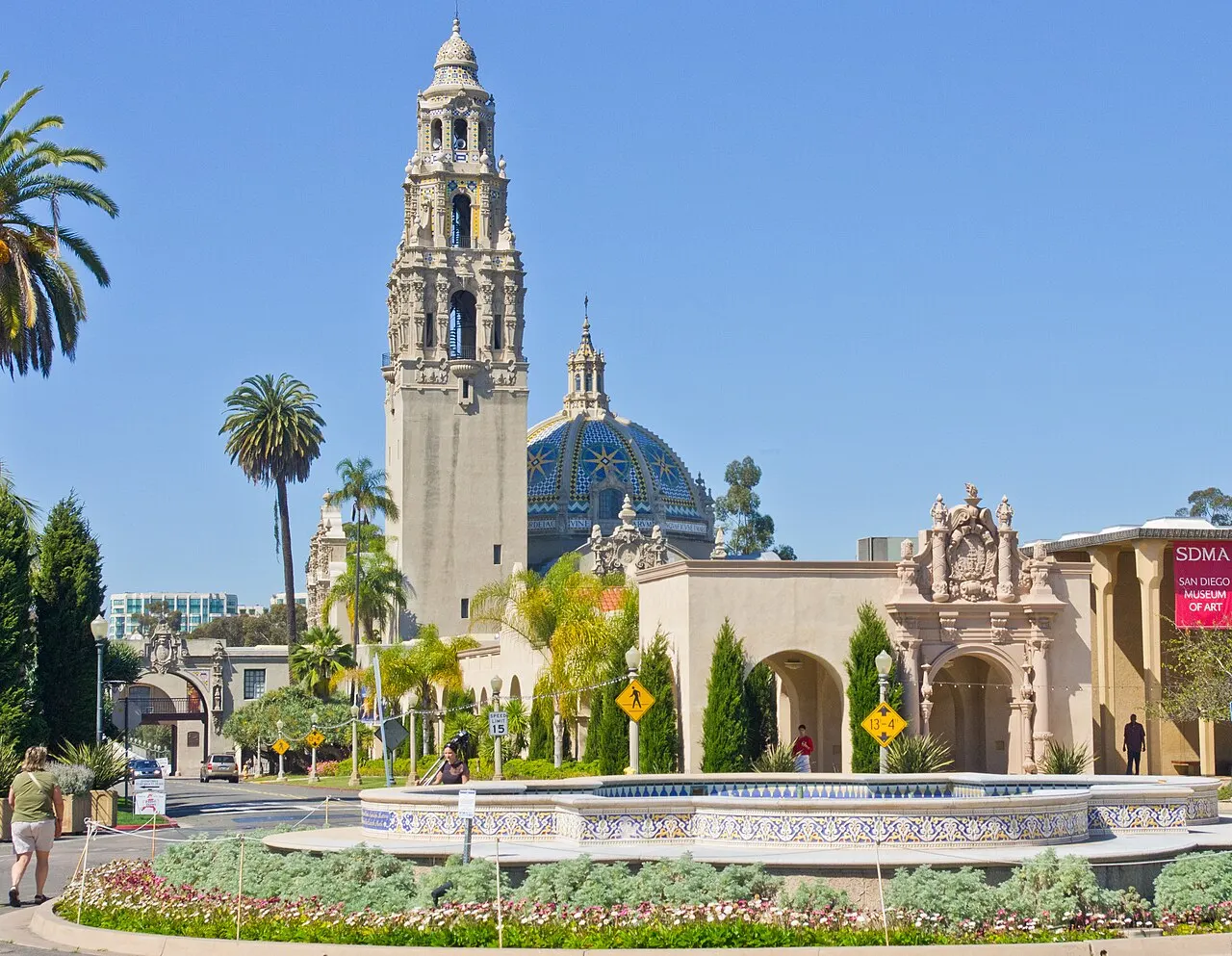
April, September, and October are the months I’d pick for San Diego. In September and October, average highs sit near 24 °C to 25 °C at the airport station, the morning sky usually clears earlier than in early summer, and the American school vacation crowds have already thinned; April is cooler (average high near 20 °C) and dry enough for walking in Balboa Park and Torrey Pines. November is still pleasant, with highs near 21 °C, but nights cool off and the rain starts to return. Between May and the end of June (sometimes stretching into July), the marine layer known locally as May Gray and June Gloom covers the coastal strip with low clouds in the morning, often clearing only in the afternoon, even though the county’s interior is sunny; highs stay between 21 °C and 22 °C. July and August have firmer afternoon sun, full beaches, high season at the hotels, and Comic-Con in late July. From December to March, highs sit near 19 °C, lows between 10 °C and 12 °C, and most of the year’s rain falls, but it is the best time for the tidepools at Cabrillo National Monument, with extreme low tides in daylight hours, and for watching migrating gray whales from the heights of Point Loma, from late December to mid-March.
The same numbers as a table
| Month | Temperature °C | Rain mm |
|---|---|---|
| January | 10 to 19 | 50 |
| February | 11 to 19 | 56 |
| March | 13 to 19 | 37 |
| April · | 14 to 20 | 17 |
| May | 16 to 21 | 7 |
| June | 17 to 22 | 1 |
| July | 19 to 24 | 2 |
| August | 20 to 25 | 0 |
| September · | 19 to 25 | 3 |
| October · | 16 to 24 | 13 |
| November | 13 to 22 | 20 |
| December | 10 to 19 | 43 |
Nilo's tips
Leave the airport by bus 992 or the free shuttle to Old Town
Because the runways sit right against the bay, I wouldn’t get into a long rideshare line without first looking at the two public exits: MTS line 992 drops you at Santa Fe Depot in a few minutes for 3 USD, and the electric San Diego Flyer bus takes you free to the Old Town terminal, where the Trolley’s Blue and Green lines pass.
Compare single fares with the 7 USD day pass
Each boarding on the Trolley and MTS buses costs 3 USD, with free transfers for two hours, and the regional day pass costs 7 USD. On a day with three or more separate rides, I’d check on the MTS website whether PRONTO or a contactless bank card already caps the charge at the pass price; if they don’t, I’d buy the day pass.
Keep the open Balboa Park stroll separate from the zoo marathon
I wouldn’t try to add the San Diego Zoo to three El Prado museums in the same afternoon. The zoo covers steep canyons and takes at least half a day; for the 1915 pavilions and the Botanical Building, it’s worth walking the free gardens without hurry and choosing just one paid interior.
Plan the coastal timing around the marine layer and the tide
In May and June, when the shoreline wakes up gray, I’d start with the museums or Old Town and leave La Jolla or Coronado for after lunch. In fall and winter, I’d check the tide table before going to Cabrillo National Monument: the tidepools close at 4:30 p.m. and only reveal wildlife at low tide.
Explore the map
Explore the map, read about the other places and plan your travel days in the app.
Open the appWhat to see
Balboa Park
The city’s main urban and cultural park, with about 485 hectares on a mesa cut by canyons northeast of downtown. The pedestrian axis of El Prado preserves the ornate pavilions of the 1915–1916 exposition, the Plaza de Panama, the Spreckels Organ Pavilion, and gardens that are free to enter. The museums sell individual tickets or combined passes; climbing the California Tower at the Museum of Us requires a timed ticket and stairs. Through December 31, 2026, park parking lots charge visitors from 8 a.m. to 6 p.m. (verified city residents don’t pay in the general lots, and Lower Inspiration Point, on Presidents Way, gives non-residents three free hours); the free internal tram runs from 8 a.m. to 8 p.m. from Inspiration Point, and the city council approved ending the charge as of January 1, 2027.
Check access
San Diego Zoo
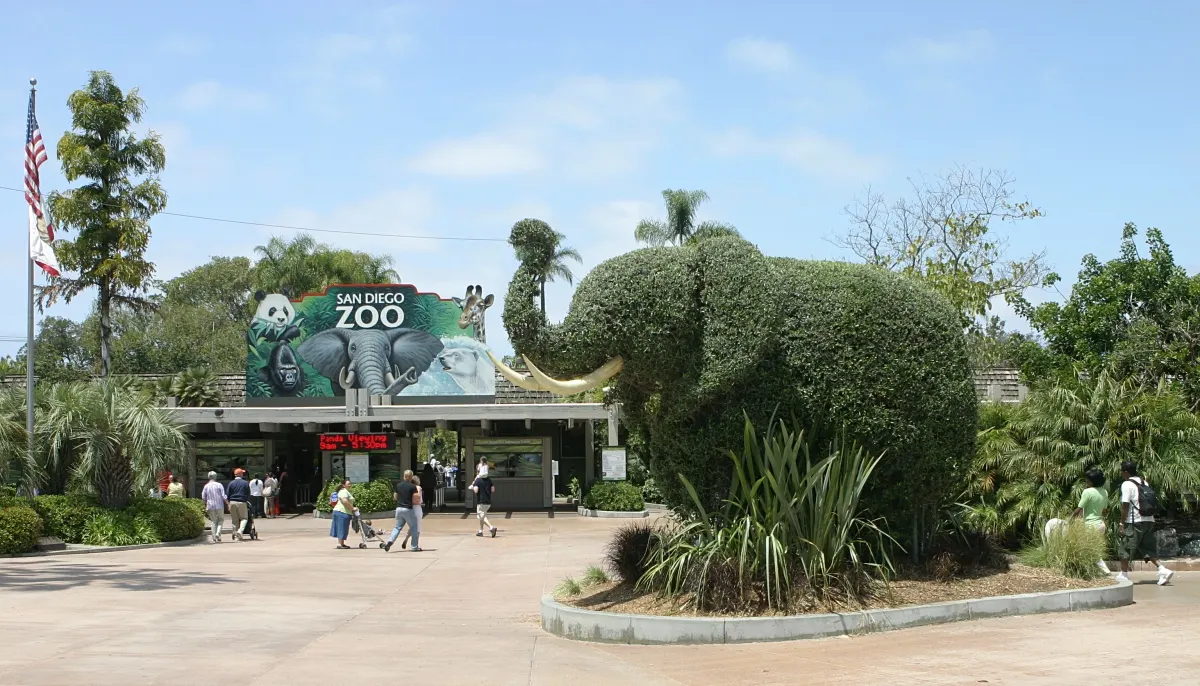
Set on about 40 hectares of canyons inside Balboa Park, it is one of the world’s leading zoological institutions for its conservation work and its enclosures organized by bioclimatic zone. The terrain is very steep: the standard one-day ticket (78 USD for adults 12 and older and 68 USD for children 3 to 11 on regular days, or 73 USD and 63 USD on selected Value Days, as checked in October 2026) includes the guided bus and the Skyfari aerial tram, subject to availability, which help save your legs on the climbs. It opens daily at 9 a.m., with a closing time that varies by season.
Check access

USS Midway Museum
The aircraft carrier USS Midway served in the U.S. Navy from 1945 to 1992 and is now moored at Navy Pier on the Embarcadero. The visit covers the hangar, the flight deck with dozens of restored aircraft, the crew quarters, the engine room, and the bridge, accompanied by an included audio guide (available in several languages) and volunteers who served aboard. As checked in October 2026, it is open every day from 10 a.m. to 5 p.m. (last entry at 4 p.m.), with online tickets at 39 USD for adults and 29 USD for youths 4 to 12 (41 USD and 31 USD at the ticket office).
Check access
Cabrillo National Monument
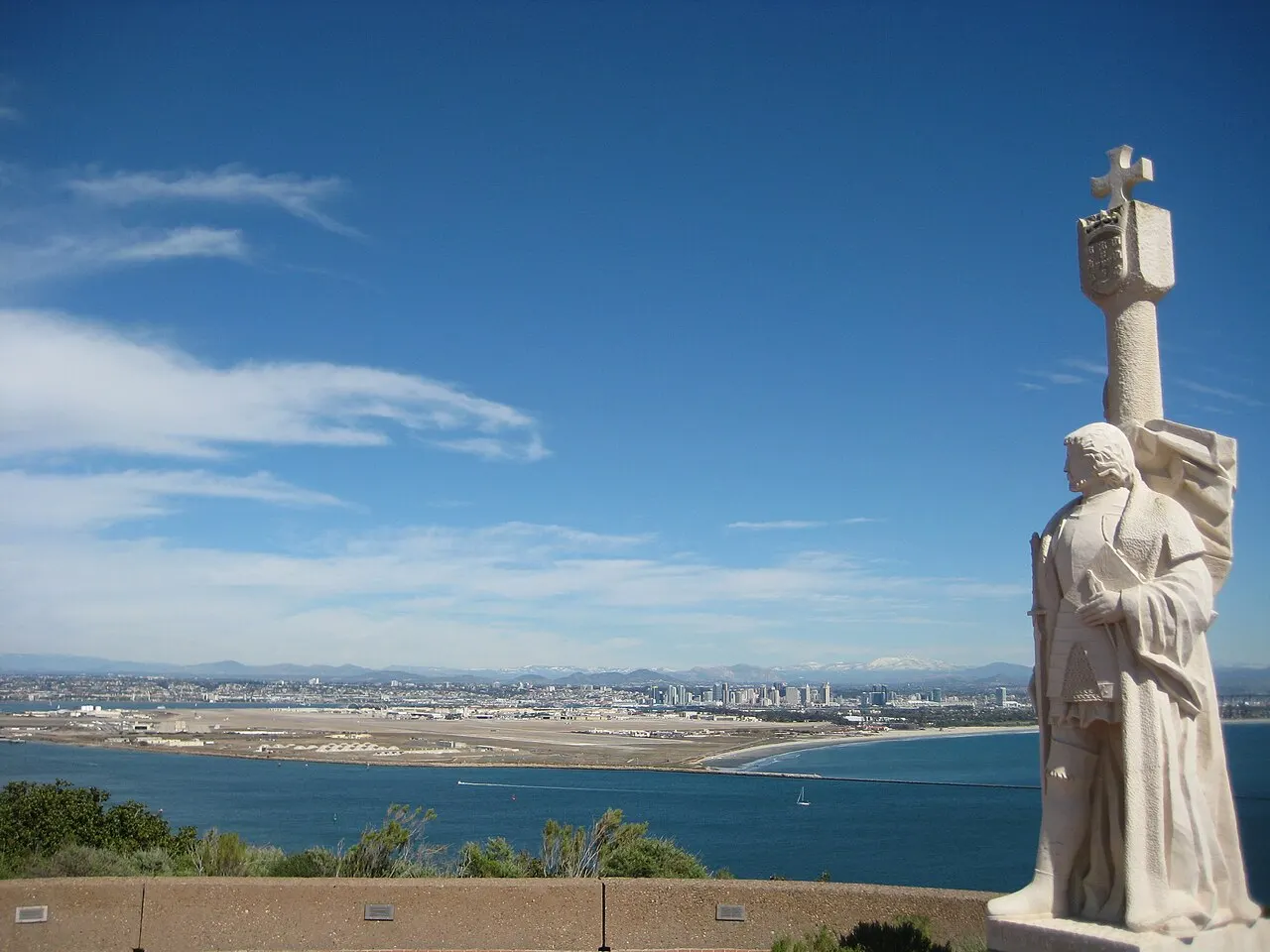
It occupies the southern tip of the Point Loma peninsula, above the entrance to the bay. Besides the monument to Juan Rodríguez Cabrillo and the Old Point Loma Lighthouse (1855), it offers one of the clearest views of San Diego’s geography, taking in the Coronado naval base, downtown, and the mountains toward Mexico; on the road down the west side are the tidepools, which show more life at extreme low tides, which fall in daytime in late fall and winter. As checked in October 2026, it is open daily from 9 a.m. to 5 p.m. (the Bayside and Oceanside trails close at 4 p.m. and the tidepool coastal area at 4:30 p.m.); the federal entrance fee is 20 USD per private vehicle or 10 USD per person on foot or by bicycle, valid for seven days.
Check access
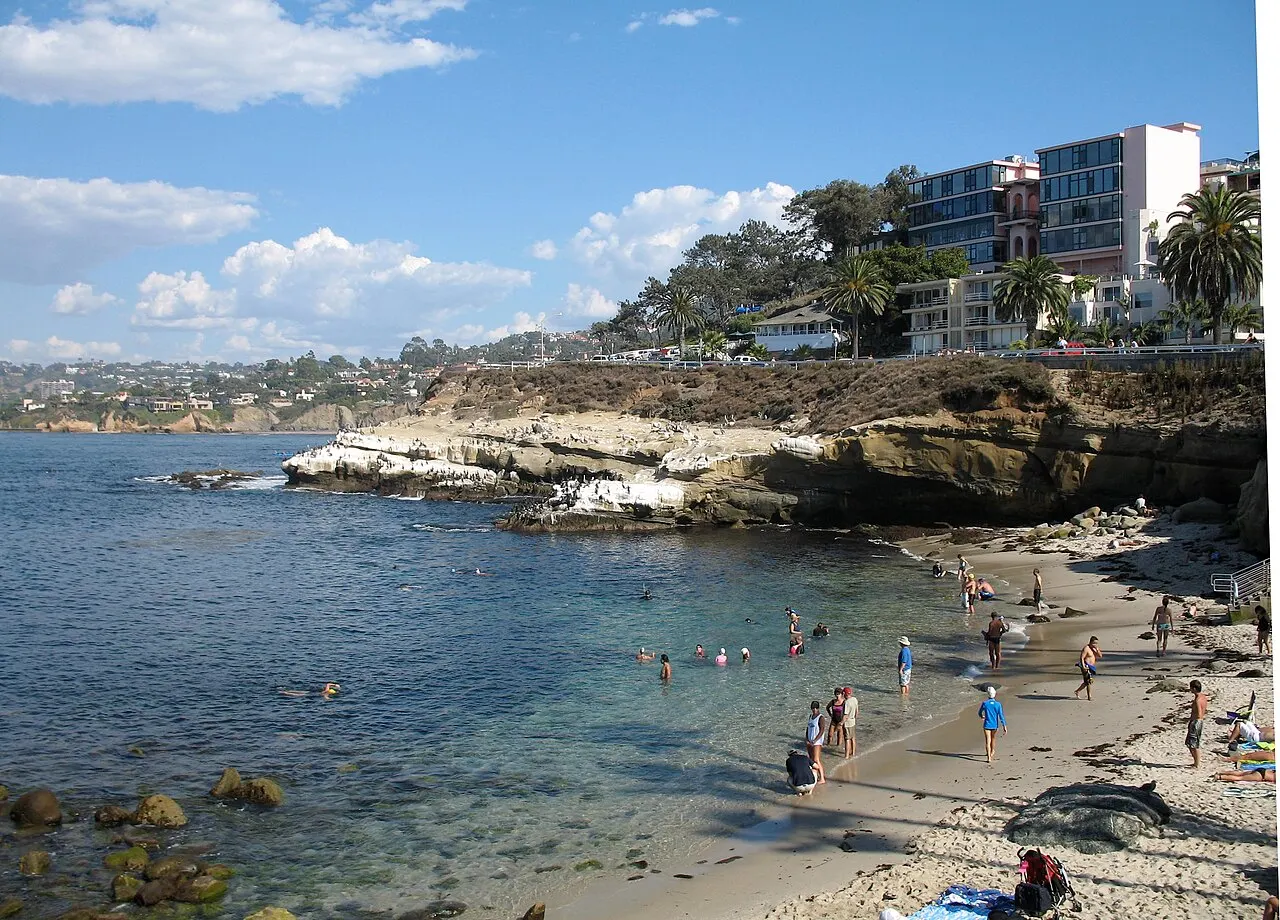
La Jolla Cove
A small cove tucked between sandstone bluffs inside a protected marine reserve, famous for its clear water for swimming and snorkeling and for the constant presence of California sea lions and harbor seals. The boardwalk of Ellen Browning Scripps Park lets you watch the animals from above at no cost. By order of the City of San Diego, the neighboring rocky headland of Point La Jolla and the strip of Boomer Beach remain closed to public access year-round to protect the colony and the pups: respect the fences, keep a safe distance on the open beach of the cove, and never touch or feed the wildlife.
Check access
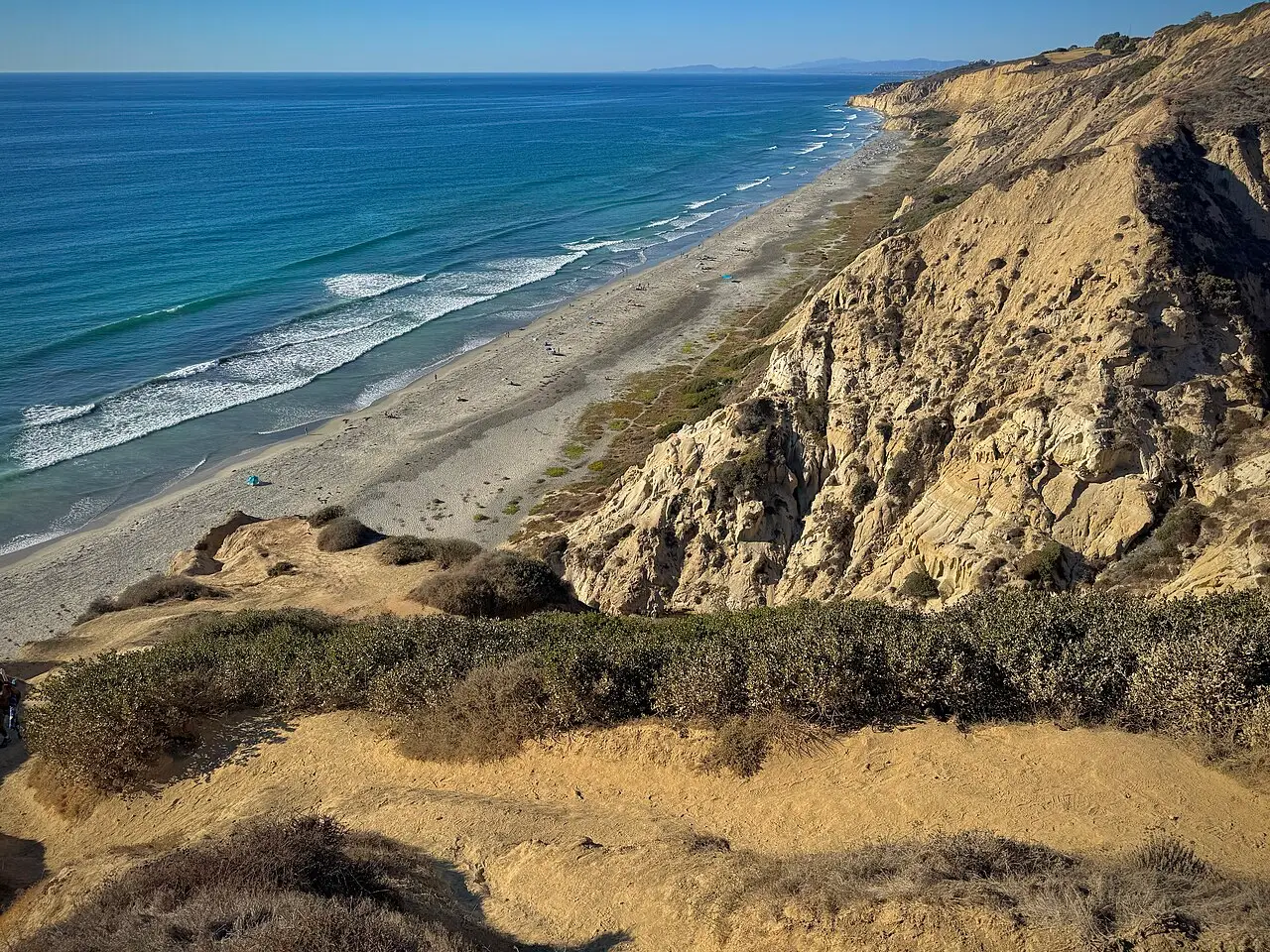
Torrey Pines State Natural Reserve
A state reserve on the city’s north coast that protects Pinus torreyana, described as the rarest pine in North America, along with sandstone ravines carved by the wind above the ocean. Short, well-marked trails, such as the Guy Fleming (1.1 km), the Parry Grove, and the Beach Trail (1.2 km to Torrey Pines State Beach), run along the clifftops and descend to the sand. Gate hours and parking fees for the reserve and the beach are on the websites of California State Parks and the Torrey Pines Association; check them before you set out.
Check access
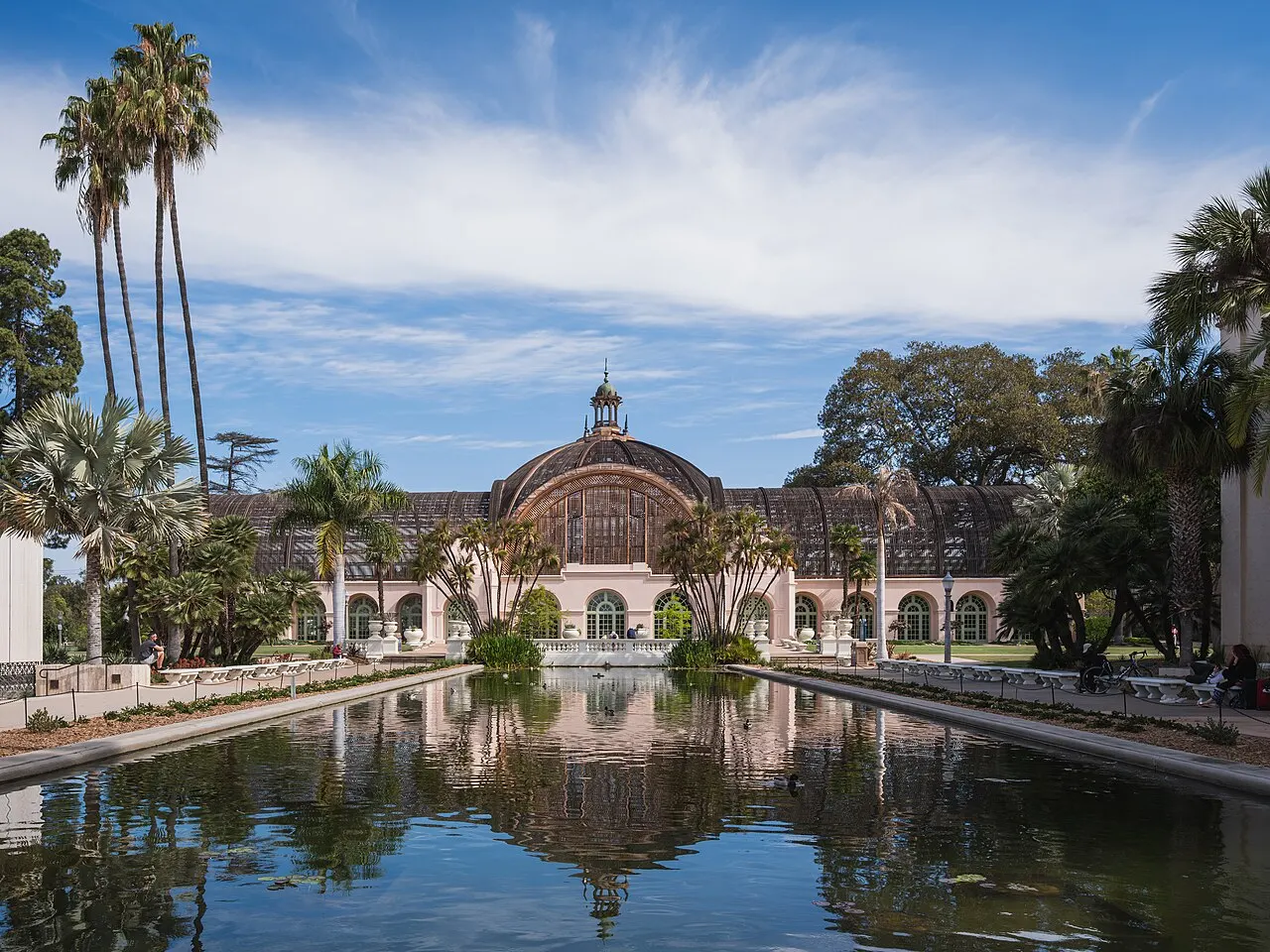
Botanical Building
It stands facing the Lily Pond reflecting pool in the heart of Balboa Park, one of the largest lath-and-wood structures in the world, built for the 1915 exposition. Closed in 2021 for structural restoration, it reopened to the public in December 2024 with a collection of ferns, orchids, cycads, and tropical plants. Admission is free, and the building is open daily from 10 a.m. to 4 p.m., except on city holidays.
Check access
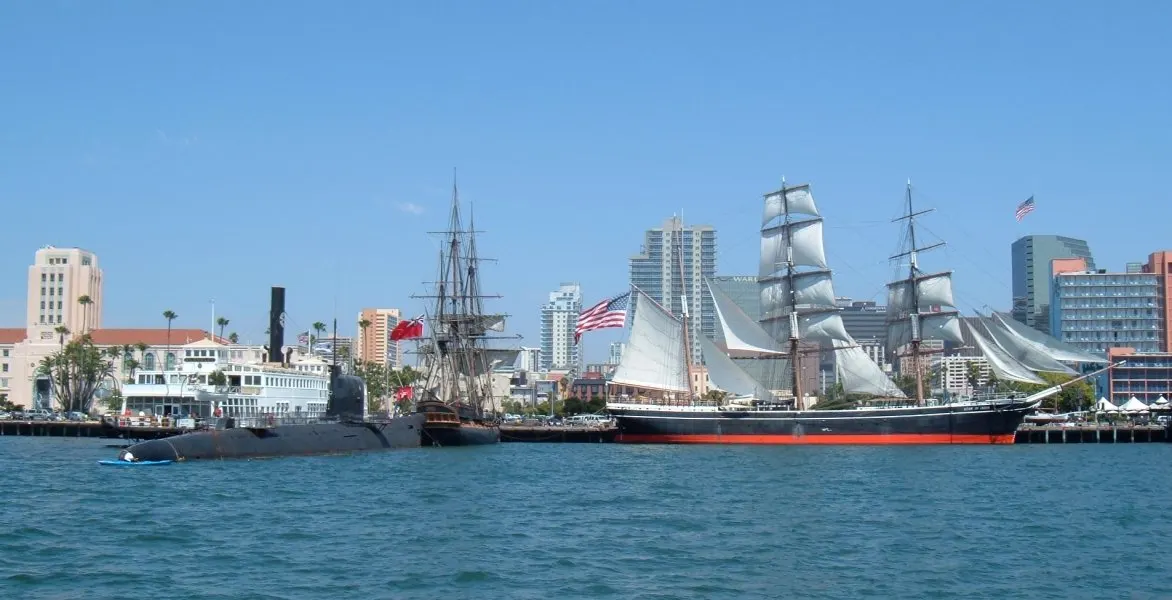
Maritime Museum of San Diego
A few blocks north of the USS Midway, on the Embarcadero, it holds a floating historic fleet that can be visited with a single ticket. The centerpiece is the Star of India, an iron-hulled sailing ship launched in 1863 on the Isle of Man that still sails occasionally, joined by the steam ferry Berkeley (1898), the replica of the sixteenth-century galleon San Salvador, and decommissioned submarines. It is open daily from 10 a.m. to 5 p.m. (last entry at 4 p.m.).
Check access
Santa Fe Depot
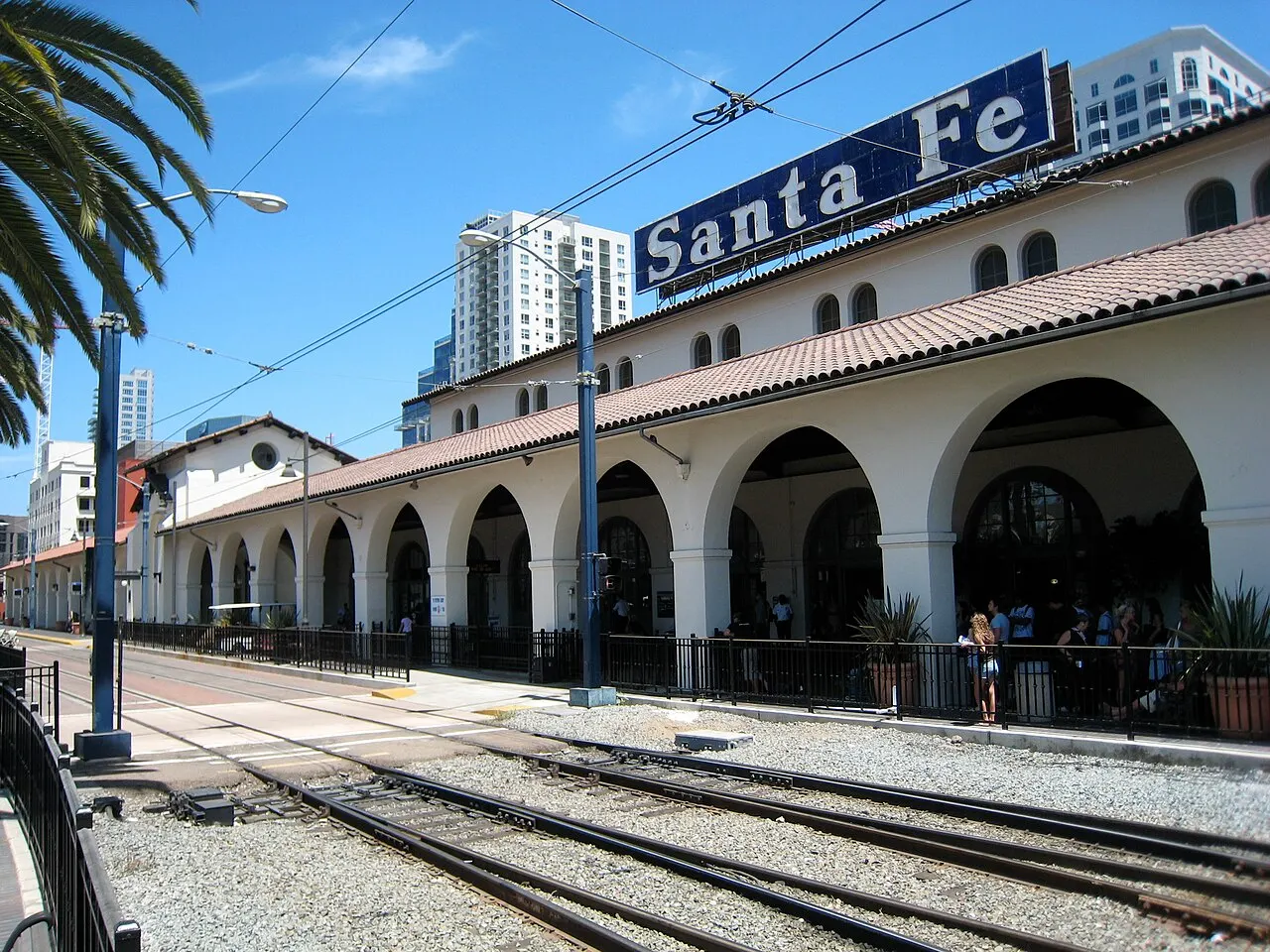
Opened in 1915 to receive visitors to the Panama-California Exposition and also called Union Station since 1919, the station stands out for its white Mission Revival facade, its two towers with colorful tiled domes, and its tile-lined concourse. It is the terminus of the Amtrak Pacific Surfliner coastal trains from Los Angeles and of the COASTER regional train, and it also connects to the Trolley lines downtown.
Check access
Nilo’s itinerary
Start with the basic programme and choose extensions for the time you have.
Plan my days in the app ↗Day 1 · Balboa Park, the zoo or the museums, and the Embarcadero waterfront
Arrive at Balboa Park at 9 a.m. If the zoo is your priority, give the whole morning to it, using the guided bus and the Skyfari aerial tram to handle the elevation changes between the canyons; if you prefer architecture and collections, walk the free axis of El Prado, the restored Botanical Building (open 10 a.m. to 4 p.m.), and the Alcazar Garden, and pick one or two interiors such as the San Diego Museum of Art or the timed climb up the California Tower.
Have lunch around Balboa Park, in Hillcrest or Little Italy, then head down to the edge of the bay.
In the afternoon, walk the Embarcadero from the historic Santa Fe Depot station (1915) to Navy Pier to visit the aircraft carrier USS Midway Museum (last entry at 4 p.m.) or the historic ships of the Maritime Museum of San Diego, such as the sailing ship Star of India.
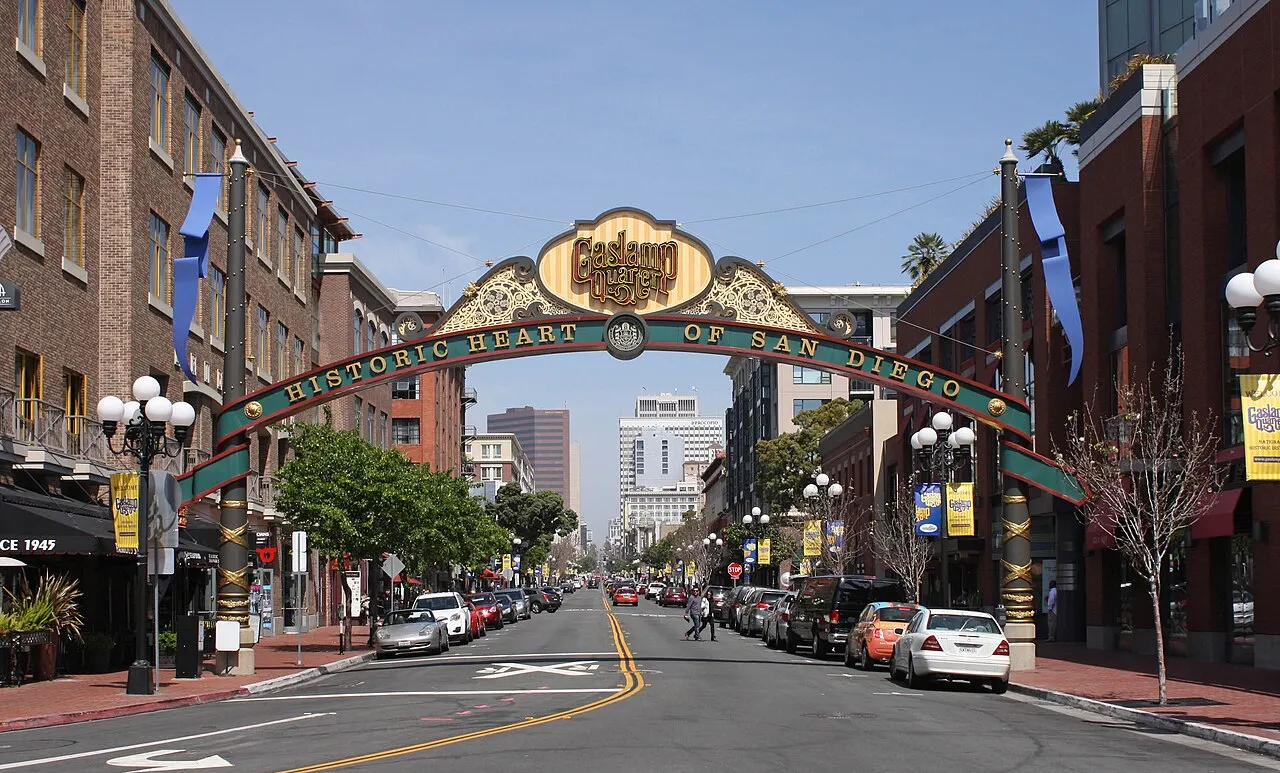
At dusk, follow the waterfront or take the Trolley to the Gaslamp Quarter to see the lit-up Victorian blocks, or have dinner in Little Italy along India Street.
Day 2 · Point Loma, Old Town, Barrio Logan, and Coronado
Leave by car at 8:30 a.m. for the southern tip of Point Loma: Cabrillo National Monument opens at 9 a.m. See the Old Point Loma Lighthouse, from 1855, and the panorama of the bay with the naval fleet; go down to the tidepools only if the tide table shows low tide during your visit (the best ones fall in daytime in late fall and winter) and, if not, walk the Bayside Trail, open until 4 p.m. On the way out, stop by the Sunset Cliffs bluffs.
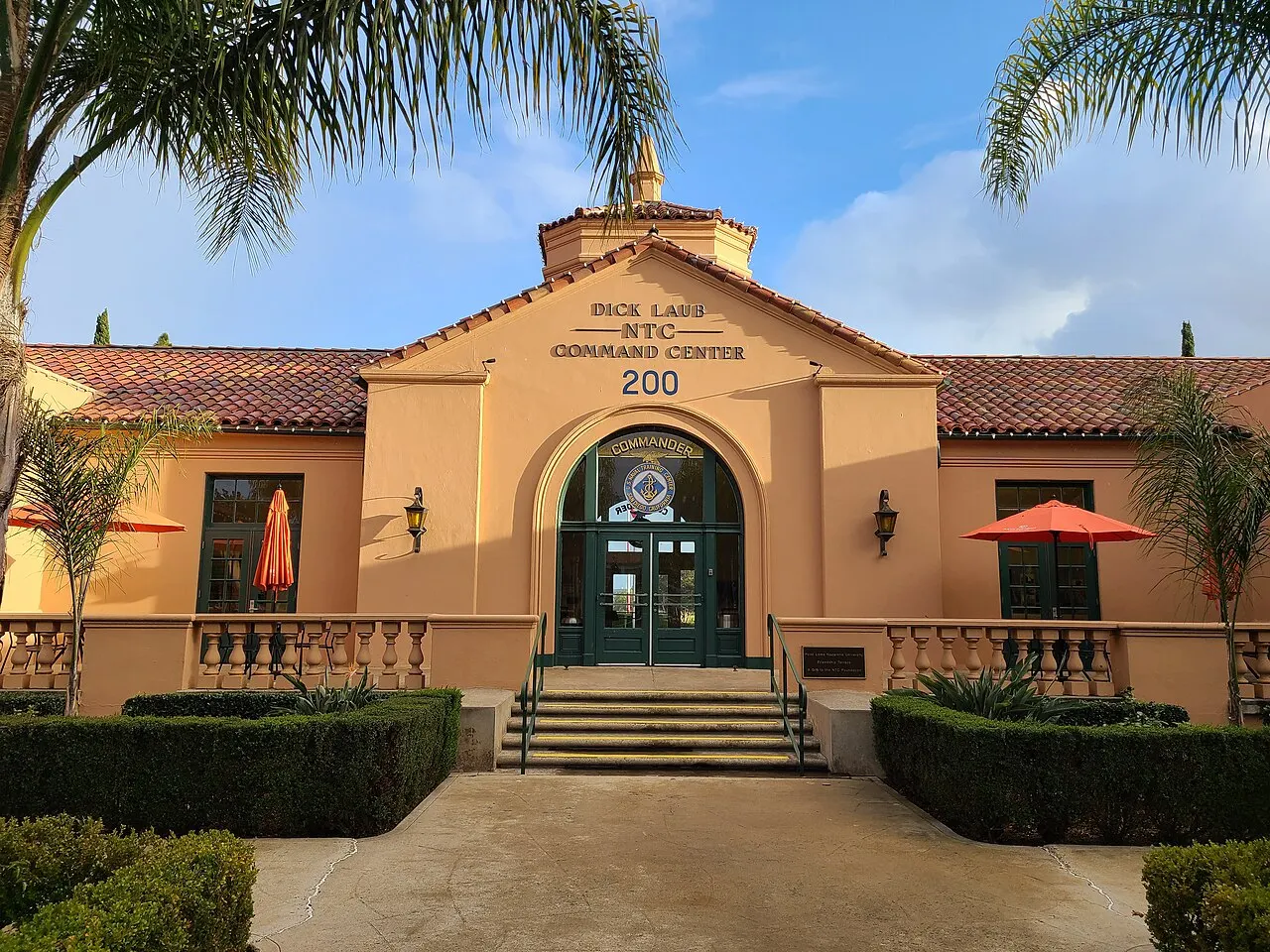
Around noon, have lunch at the Liberty Public Market, in the former naval training center at Liberty Station, on the way back to downtown.
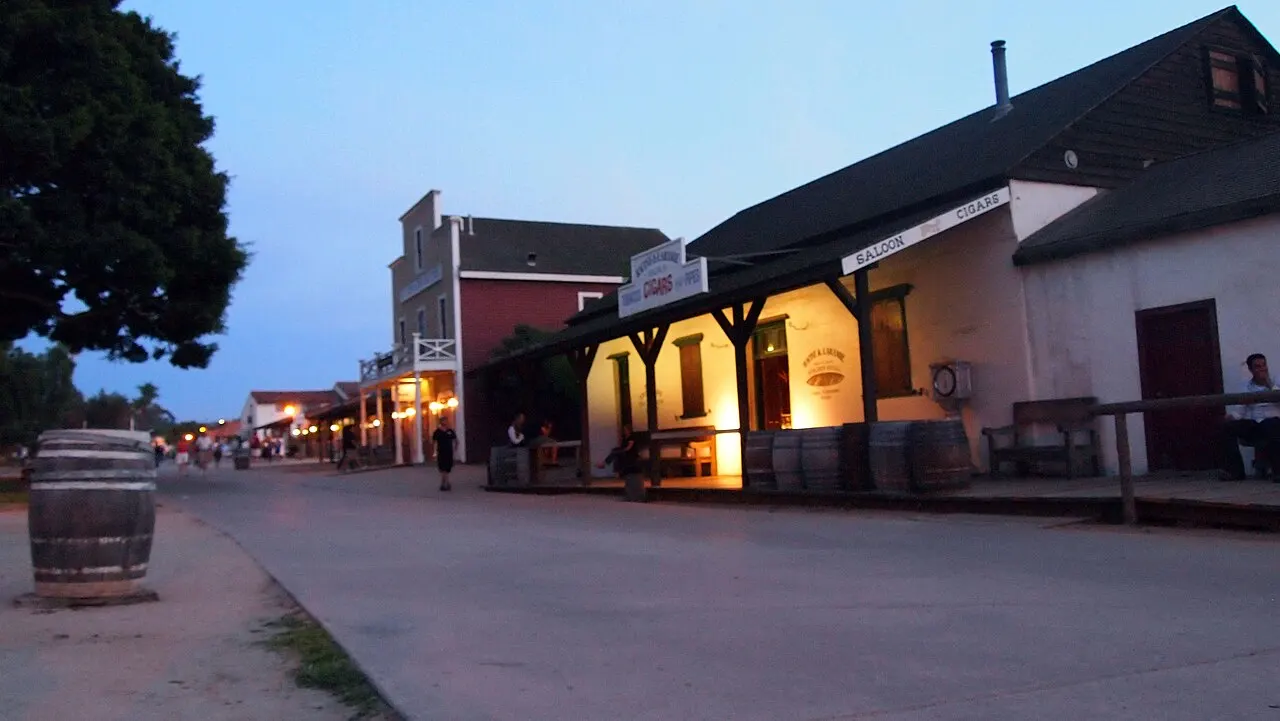
In the early afternoon, head to Old Town San Diego State Historic Park, a few minutes away by car, to see the adobe houses such as the Casa de Estudillo and the free museums; check the day’s closing time on the California State Parks website first.
Around 3 p.m., head down the I-5 to Barrio Logan to see the murals of Chicano Park under the bridge approaches (Thursday through Sunday, the community museum next door is open until 4 p.m.) and try a fish taco at a taqueria on Logan Avenue.
Cross the San Diego-Coronado Bridge and end the day on Coronado beach, in front of the 1888 Hotel del Coronado, with the sunset over the Pacific. Without a car, do the day by Trolley and bus and get to Coronado by the Flagship ferry: 15 minutes and 9 USD each way, with departures every 60 minutes from Broadway Pier and every 30 minutes from the Convention Center pier.
Day 3 · The Torrey Pines bluffs and the La Jolla coast
Start early at Torrey Pines State Natural Reserve, in the north of the city (check gate hours and parking on the California State Parks website): walk the Guy Fleming and Beach Trail trails among the rare pines on top of the sandstone cliff and go down to the beach to walk on the sand.
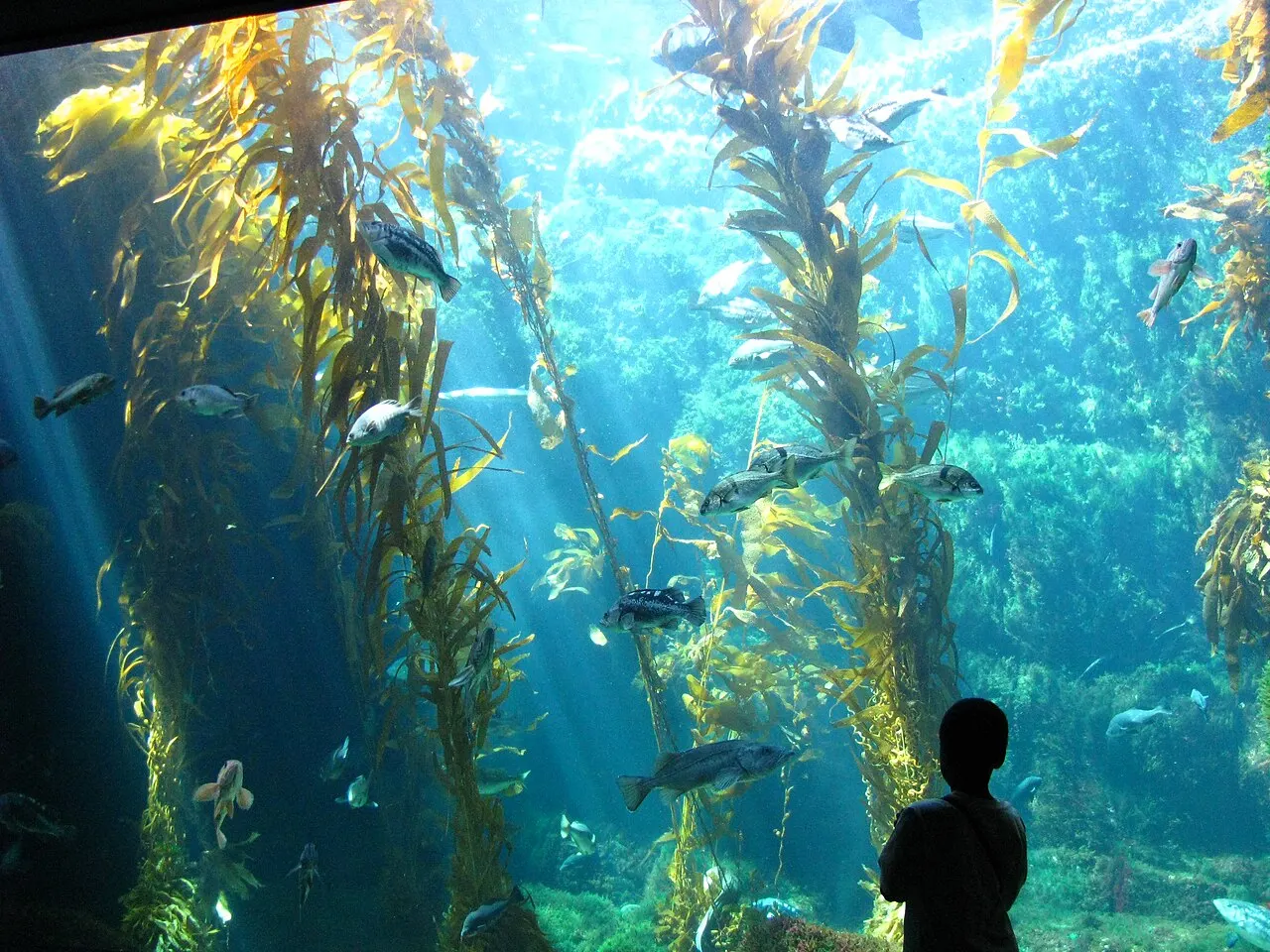
Late in the morning, head down a few kilometers to the Birch Aquarium at Scripps to see the kelp forest tanks and the view of the Pacific from the outdoor terrace.
Have lunch in La Jolla village and spend the afternoon walking the boardwalk of Ellen Browning Scripps Park and La Jolla Cove to watch the sea lions and seals (respecting the permanent closure of Point La Jolla and Boomer Beach); if the sea is calm and the water pleasant, set aside time for swimming, snorkeling, or kayaking from La Jolla Shores.
At dusk, head down the coast to Pacific Beach and walk Ocean Front Walk from Crystal Pier toward Mission Beach and Belmont Park, at the edge of Mission Bay; close out the trip with a California burrito at a neighborhood taco shop.
Food
Baja-style fish taco
White fish in a light batter, fried to order (or grilled), served in a corn tortilla with shredded cabbage, creamy white sauce, cilantro, and lime. Brought over from Ensenada and San Felipe in Baja California, it became popular on San Diego’s beaches starting in the 1980s and turns up both at beach stands and in the taquerias of South Bay and Barrio Logan.
California burrito
A creation of San Diego’s 24-hour taco shops: a large flour tortilla filled with grilled carne asada, french fries inside (in place of rice and beans), melted cheese, pico de gallo, and sour cream or guacamole. It is a whole, heavy meal, ordered at neighborhood counters from Ocean Beach to North Park.
Carne asada fries
A plate of french fries topped with cubes of carne asada, melted cheddar or Monterey Jack cheese, guacamole, sour cream, and fresh salsa, meant to be shared between two or more people at the city’s Mexican American eateries.
Sea urchin and fish from Tuna Harbor
San Diego’s small-scale fishing fleet unloads at the Tuna Harbor pier, between the USS Midway and Seaport Village. On Saturday mornings, the fishermen’s open-air market sells swordfish, tuna, crab, and red sea urchin (uni) opened on the spot, straight from the boat; uni also shows up in restaurants in Little Italy and Point Loma.
West Coast IPA craft beer
San Diego County has more than a hundred independent breweries and helped define the West Coast IPA style, dry, clear, and marked by the citrusy, resinous bitterness of American hops. Tasting rooms (taprooms) are concentrated in North Park, Miramar, and Little Italy.
Where to eat
- Barrio Logan, South Bay, and Ocean Beach
Baja California-style taquerias and seafood stands. Order tacos of battered white fish (or grilled shrimp and octopus) on fresh-made corn tortillas, with cabbage, crema, and salsa; at neighborhood taco shops, a california burrito with carne asada and french fries makes a whole meal at an affordable price.
- Little Italy and the Tuna Harbor pier
Italian cooking and seafood from the local fleet. Along India Street there is everything from bakeries, gelaterias, and pizzerias to sit-down dinner restaurants; on Saturday mornings, Little Italy’s street market and the fishermen’s Tuna Harbor Dockside Market let you try fresh products straight from the boats.
- North Park, South Park, and Hillcrest
Independent breweries, cafés, and neighborhood restaurants away from the convention circuit. It is the best area to try a locally made West Coast IPA with casual Californian, contemporary Mexican, or Asian cooking on walkable streets.
· 2026-10-17
Day trips
San Diego Zoo Safari Park (Escondido)
It sits in the San Pasqual Valley, about 55 km northeast of downtown (45 to 60 minutes by car on the I-15). Unlike the urban zoo in Balboa Park, it covers a broad area of 730 hectares of semiarid hills where herds of giraffes, rhinos, and antelope roam large open enclosures, toured by the Africa Tram included in the ticket (in the same price range as the Zoo, or combinable in the two-visit pass for 130 USD per adult). There is no practical rail link: you need a car and at least half a day.
Encinitas and the North County coast by COASTER train
The small coastal towns north of Torrey Pines, such as Solana Beach, Encinitas, and Carlsbad, can be visited without a car on the COASTER commuter train from Santa Fe Depot or Old Town (about 35 to 45 minutes to Encinitas). In Encinitas, the shopping district along Highway 101 is a few blocks from the station, near the Self-Realization Fellowship meditation gardens on the bluff and Swami’s beach.
Tijuana (Baja California, Mexico)
The Trolley’s Blue Line runs straight from downtown to the terminus at San Ysidro (check the travel time on the MTS planner), where you cross the border on foot over the El Chaparral footbridge toward Avenida Revolución and the contemporary food scene of the Zona Río. Before going, sort out the documents for both sides according to your citizenship: what Mexico requires on entry (Instituto Nacional de Migración) and what the United States requires on return (a valid U.S. visa or Visa Waiver Program ESTA authorization). Leave a margin for the immigration line on the walk back and check the pedestrian wait time on the CBP Border Wait Times site.
Where to begin
Balboa Park, the zoo or the museums, and the Embarcadero waterfront
Arrive at Balboa Park at 9 a.m. If the zoo is your priority, give the whole morning to it, using the guided bus and the Skyfari aerial tram to handle the elevation changes between the canyons; if you prefer architecture and collections, walk the free axis of El Prado, the restored Botanical Building (open 10 a.m. to 4 p.m.), and the Alcazar Garden, and pick one or two interiors such as the San Diego Museum of Art or the timed climb up the California Tower.
Point Loma, Old Town, Barrio Logan, and Coronado
Leave by car at 8:30 a.m. for the southern tip of Point Loma: Cabrillo National Monument opens at 9 a.m. See the Old Point Loma Lighthouse, from 1855, and the panorama of the bay with the naval fleet; go down to the tidepools only if the tide table shows low tide during your visit (the best ones fall in daytime in late fall and winter) and, if not, walk the Bayside Trail, open until 4 p.m. On the way out, stop by the Sunset Cliffs bluffs.
The Torrey Pines bluffs and the La Jolla coast
Start early at Torrey Pines State Natural Reserve, in the north of the city (check gate hours and parking on the California State Parks website): walk the Guy Fleming and Beach Trail trails among the rare pines on top of the sandstone cliff and go down to the beach to walk on the sand.
Money
The currency is the U.S. dollar (USD), and contactless payment is accepted at practically all shops, at museums, and on the MTS public transit validators. Sales tax in the city of San Diego is 7.75% on the California tax agency’s table in effect since October 1, 2026, always added at the register on top of the sticker price. On hotel rooms and short-term rentals, the city’s Transient Occupancy Tax is 11.75%, 12.75%, or 13.75% depending on the tax zone of the address, since May 1, 2025 (the city keeps a map for looking up the zone of each lodging); hotels with 70 rooms or more add the 2% tourism marketing district fee, itemized separately on the bill, and some charge resort fees. As a reference, prices checked in October 2026: bus or Trolley fare 3 USD and regional day pass 7 USD, ferry to Coronado 9 USD each way, entrance per vehicle at Cabrillo National Monument 20 USD, USS Midway 39 USD online, San Diego Zoo 73–78 USD for an adult, and daily parking in Balboa Park up to 16 USD for visitors, through the end of 2026. At sit-down restaurants, the expected tip is 18% to 22% before tax, and several places add a 3% to 5% service surcharge to the check: look at the receipt before deciding on the additional percentage.
Getting there and around
San Diego International Airport (SAN) is the major commercial airport closest to downtown in the United States, set beside the bay about 5 km northwest of Downtown. The first phase of the New Terminal 1 (New T1) opened on September 23, 2025, with new access roads and a parking garage, while final completion of the terminal continues under construction through 2028. To get out without a taxi or rideshare, there are two direct, inexpensive connections: city bus MTS Route 992 leaves the terminals every 15 minutes for Santa Fe Depot station and Broadway downtown at the standard fare of 3 USD; the electric San Diego Flyer shuttle is free and runs every 20 to 30 minutes between the airport terminals and the Old Town Transit Center, where the Trolley, the COASTER regional train, and Amtrak stop.
Public transit is run by MTS (Metropolitan Transit System) and, in the north of the county, NCTD, which share the PRONTO payment system (reloadable card or app) and also accept contactless bank cards or phones, validated at the posts before boarding the Trolley or inside the bus. Since October 1, 2026, the adult single fare on the Trolley and regional buses is 3 USD, with free transfers for two hours, and the regional day pass costs 7 USD. Before paying ride by ride, check on the MTS website whether the payment method you chose, PRONTO or a bank card, caps the day’s spending at the pass price on its own. The three main Trolley lines serve the central axis well: the Blue Line (UC San Diego Blue Line) links the border at San Ysidro to downtown, Old Town, and the UC San Diego/UTC campus in the north; the Green Line connects the Gaslamp, Santa Fe Depot, Old Town, and Mission Valley; and the Orange Line serves the east.
To get to Coronado, the Flagship Cruises passenger ferry crosses the bay in about 15 minutes to the Coronado Ferry Landing, for 9 USD each way from age 4, on two routes: from Broadway Pier, with departures every 60 minutes, and from the Convention Center pier (Fifth Avenue Landing), every 30 minutes; bicycles board if there is room. Bus line 901 crosses the San Diego-Coronado Bridge. Anyone coming from Los Angeles without a car can take the Amtrak Pacific Surfliner train between Union Station and Santa Fe Depot (about 2 hours 50 minutes to 3 hours along the coast; check for maintenance alerts on the San Clemente bluffs before buying). Within San Diego, the Trolley and the bus are enough for downtown, Balboa Park, Old Town, and Coronado, but the bluffs of Cabrillo National Monument, Sunset Cliffs, La Jolla Cove, and Torrey Pines and the beaches of Mission Beach and Pacific Beach are far from one another and poorly connected by direct lines: renting a car for a day or two (or combining a rideshare with the Trolley’s Blue Line to the UCSD/Nobel Drive station) saves hours of transfers.
Safety
San Diego has violent crime rates lower than those of other large American metropolises, but it calls for the usual care of a big city and an ocean coast. If you have a rental car, never leave backpacks, bags, or cables visible in the parking lots at Sunset Cliffs, Balboa Park, Torrey Pines, or the beaches. Downtown, parts of the east Gaslamp Quarter, the area around 12th & Imperial, and blocks of East Village have concentrations of people experiencing homelessness: prefer busy, well-lit streets when walking at night, or use a rideshare. The most frequent practical risks are in the sea and on the coastal trails: swim only in front of staffed lifeguard stations because of rip currents, shuffle your feet in shallow sand in the warmer water of summer and early fall to scare off stingrays (the so-called stingray shuffle), and keep your distance from the sandstone edges at Sunset Cliffs and Torrey Pines, where sudden collapses occur. The emergency number is 911.
Etiquette tips
Required distance from sea lions and seals
At La Jolla Cove and Children’s Pool, the animals rest on the sand and rocks right next to visitors. Federal marine mammal protection law prohibits touching, feeding, surrounding, or disturbing seals and sea lions, and the city keeps Point La Jolla and Boomer Beach closed all year: watch from the seawall and make way if an animal comes up the sand.
Alcohol and glass are banned on beaches and coastal parks
Since 2008, the city of San Diego has banned drinking alcoholic beverages on public beaches, coastal lawns, and oceanfront parking lots (including Pacific Beach, Mission Beach, Ocean Beach, and La Jolla Shores), and also prohibits glass containers and fires outside the official concrete fire rings.
Validate before boarding the Trolley
San Diego Trolley stations have no closed turnstiles, but inspectors check proof of payment inside the cars. Tap your bank card, phone, or PRONTO card on the platform validator before each boarding, transfers included.
Watch for restricted military zones
Large stretches of Point Loma and more than half of the Coronado peninsula belong to active Navy installations. Respect fences, no-stopping signs, and the limits on the beach next to the North Island base.
Mistakes to avoid
Planning beach mornings and coastal photography in May or June, counting on blue sky at 8 a.m. In those months the marine cloud cover usually blankets the shoreline until noon: use the morning for museums or more inland neighborhoods and leave the coast for the afternoon.
Trying to visit the San Diego Zoo and three or four Balboa Park museums on the same day. The zoo alone easily takes four to six hours of walking on slopes; if you want to explore the El Prado museums properly, split the plans or choose just one specific museum.
Climbing onto the closed rocks of Point La Jolla to take a selfie near sea lions. Besides a municipal and federal fine, adult males and females with pups react quickly when cornered.
Crossing the border into Tijuana in the late afternoon without checking the documents for both sides: what Mexico requires on entry and what the United States requires on return (a valid U.S. visa or, for citizens of Visa Waiver Program countries, ESTA authorization), depending on citizenship. Before coming back, check the pedestrian wait time at San Ysidro on the CBP Border Wait Times site.
Parking in Balboa Park or near the beaches without reading the time and rate signs. Through December 31, 2026, Balboa Park parking lots charge visitors from 8 a.m. to 6 p.m. (Lower Inspiration Point gives three free hours), and downtown and next to the beaches, parking meter and street cleaning enforcement is strict.
Useful phrases

May Gray / June Gloom
The layer of marine cloud that covers the coast in the mornings in late spring and early summer.
The Trolley
The light rail system of red cars that links the border to downtown, Old Town, and UC San Diego.
Stingray shuffle
The habit of sliding your feet through shallow sand when you enter the sea, instead of stepping down hard, so that stingrays feel the vibration and move out of the way.
Carne asada / California burrito
The classic order at local taco shops, made with grilled carne asada and french fries inside the tortilla.
The Del
The short form locals use for the historic Hotel del Coronado.
Where to stay
- Little Italy and the Embarcadero (Downtown) · Anyone traveling without a car or wanting to cover the bay waterfront, restaurants, and train and ferry boarding on foot.: It puts you next to Santa Fe Depot station, the airport’s bus 992, the Trolley, the USS Midway, and the ferry to Coronado, with streets that are more residential and lively than the financial core. The downsides are the high room rates, to which the occupancy tax of the address’s tax zone is added and, at large hotels, the 2% tourism fee, and the noise from the approach path of planes landing at the neighboring airport.
- Gaslamp Quarter and around Petco Park · Anyone who prioritizes nightlife, baseball games, or events at the convention center.: It has a large supply of big hotels and direct access to the Trolley’s Green and Blue lines. On the other hand, it is a noisy area on weekend nights, prices double during big conventions, and the blocks to the east call for more attention at night.
- Old Town and Hotel Circle (Mission Valley) · Anyone traveling by car on a moderate budget or wanting a central point between the beaches and the park.: It concentrates hotels and motels with simpler parking than downtown, and anyone near the Old Town Transit Center has the free airport shuttle and two Trolley lines. The Hotel Circle area, however, is squeezed along Interstate 8 and has no walkable shopping at the door.
- Mission Beach and Pacific Beach · Anyone who wants to sleep near the sand, bike along the boardwalk, and have bars and restaurants within walking distance at night.: It sits between the ocean and the calm waters of Mission Bay, with Ocean Front Walk linking the two neighborhoods and La Jolla just to the north. There is no Trolley station by the beach: to get to downtown, Old Town, or Balboa Park you need a bus, a car, or a rideshare, and the blocks around Garnet Avenue and Mission Boulevard get noisy on weekend nights.
- La Jolla or Coronado · Anyone looking for a beach stay, bluffs, and a resort pace, willing to pay more and travel to downtown.: It lets you start the day walking on the sand in Coronado or by the coves of La Jolla. The cost of lodging and parking is high, and there is no Trolley station within La Jolla Cove or Coronado, so you need a car, bus, or ferry to see the rest of the city.
· 2026-10-17
Districts
Downtown, Embarcadero, Little Italy, and the Gaslamp Quarter
The central core runs down in a grid to the bay. The Embarcadero lines up the cruise terminal, the USS Midway, the Maritime Museum, the Tuna Harbor fishing pier, the Seaport Village shopping and dining complex, and the ferry departures for Coronado; north of Santa Fe Depot station, Little Italy has walkable streets, a Saturday market, and restaurants along India Street; to the southeast, the Gaslamp Quarter takes up sixteen blocks of Victorian commercial architecture next to the convention center and Petco Park stadium.
Balboa Park, Hillcrest, and North Park
Above downtown, Balboa Park gathers 485 hectares of canyons, gardens, seventeen museums, and the zoo. Northwest of the park, Hillcrest is the historic center of the city’s LGBTQ+ life, with street-level shops and cafés on University Avenue; to the northeast, North Park and South Park concentrate independent craft breweries, local shops, and craftsman-style houses.
Old Town and Mission Valley
At the foot of Presidio Hill, where colonial settlement began in 1769, Old Town preserves nineteenth-century adobe and wood houses next to one of the city’s main Trolley and bus transfer hubs. To the east, the San Diego River valley (Mission Valley) holds shopping malls, highway hotels, the Trolley’s Green Line, and the historic Mission San Diego de Alcalá.
Point Loma and Ocean Beach
The Point Loma peninsula closes off the bay entrance to the west: at the southern tip are Cabrillo National Monument and the Fort Rosecrans military cemetery; on the side facing the open ocean are the Sunset Cliffs bluffs and the neighborhood of Ocean Beach, more residential and relaxed than the neighboring resorts. On the bay side, next to the airport, the former naval training center has become Liberty Station, with a food market, schools, offices, and galleries.

Mission Bay, Mission Beach, and Pacific Beach
North of the San Diego River mouth, the Mission Bay aquatic park takes in calm-water inlets and artificial islands. Between the bay and the ocean, Mission Beach stretches along a narrow spit with a boardwalk on both sides and the Belmont Park amusement park; just to the north, Pacific Beach gathers bars, restaurants, and shops on Garnet Avenue and Mission Boulevard around Crystal Pier, and has one of the busiest nightlife scenes in the city.
Coronado
An independent municipality linked to San Diego by the curved bridge over the bay, by the Silver Strand isthmus to the south, and by passenger ferry. It combines tree-lined streets, the large North Island naval air station, the historic Hotel del Coronado, and a very wide ocean beach of pale sand flecked with mica.
La Jolla and Torrey Pines
About 20 km northwest of downtown, La Jolla sits on a rocky headland with clear-water coves (La Jolla Cove), a long sandy beach (La Jolla Shores), the Birch Aquarium, and the UC San Diego campus. Farther north, Torrey Pines preserves sandstone bluffs, coastal trails, and the municipal golf course above the sea.

Barrio Logan
South of downtown and Petco Park, under the arches of the San Diego-Coronado Bridge, it is the historic heart of the Chicano and Mexican American community, organized around the murals of Chicano Park, independent galleries, and taquerias on Logan Avenue.
History
Millennia before 1769 · Kumeyaay territory
The Kumeyaay people lived in the strip between the ocean, the river valleys, and the Cuyamaca Mountains, with villages such as Kosa’aay at the foot of the hill where Old Town stands today.
1542 · Cabrillo’s expedition
Juan Rodríguez Cabrillo entered San Diego Bay in September 1542 and named it San Miguel; in 1602, Sebastián Vizcaíno charted the coast and gave the port the name San Diego.
1769 · The presidio and the first mission in Alta California
The expedition of Gaspar de Portolá and the Franciscan Junípero Serra founded the Presidio and Mission San Diego de Alcalá on July 16, 1769; in 1774 the mission was moved to the San Diego River valley.
1821–1848 · The Mexican pueblo at the foot of the hill
With Mexican independence and the secularization of the missions, civil life moved down from the presidio to the Old Town plaza, until the American takeover in the war of 1846–1848 and the Treaty of Guadalupe Hidalgo.
1867–1888 · New Town, the railroad, and the Hotel del Coronado
Alonzo Horton bought land by the wharf in 1867 to shift the city center to the edge of the bay; the arrival of the railroad in 1885 and the opening of the Hotel del Coronado in 1888 consolidated the new urban grid.
1915–1916 · The Panama-California Exposition in Balboa Park
To celebrate the opening of the Panama Canal, the city raised in the park the Spanish Colonial Revival ensemble designed by Bertram Goodhue and Carleton Winslow, along with the Cabrillo Bridge and the botanical pavilion.
1917–1945 · Pacific Fleet base and aircraft industry
The naval and Marine bases, together with the Ryan Aeronautical and Consolidated Aircraft factories (which built seaplanes and bombers in World War II), redefined the local economy and demographics.
1970 · The occupation and murals of Chicano Park
In April 1970, residents of Barrio Logan occupied the land under the pillars of the newly opened San Diego-Coronado Bridge to demand the community park they had been promised, launching the largest collection of outdoor Chicano murals in the country.
1981–2025 · The Trolley to the border and the airport renovation
The San Diego Trolley opened in 1981 linking downtown to San Ysidro, extended the Blue Line to UC San Diego and UTC in 2021, and was followed by the reopening of the Botanical Building in late 2024 and the first phase of the New Terminal 1 at the airport in September 2025.
Complete history
Before the Spanish ships arrived, the land between the Pacific coast, the San Diego River, and the inland ranges belonged to the Kumeyaay people, who managed oaks, Torrey pines, and marine resources in seasonal movements. Juan Rodríguez Cabrillo anchored in the bay in 1542, but colonial settlement only began on July 16, 1769, when Gaspar de Portolá and Junípero Serra established a military fort on top of Presidio Hill, along with the first of the twenty-one missions of Alta California. Five years later, the mission moved upriver in search of water and farmland, and in November 1775 a Kumeyaay revolt burned the complex, which was rebuilt in adobe.
During the Mexican period (1821–1848), residents left the fort hill and formed a civil settlement around the plaza that is now Old Town San Diego State Historic Park. After the United States annexed the region in 1848, that settlement seemed too far from the steamships. Starting in 1867, the entrepreneur Alonzo Horton bought lots by the southern anchorage and laid out the grid of today’s downtown, now preserved in the Gaslamp Quarter. In the 1880s, the rail connection and the real estate boom brought the opening of the Hotel del Coronado, built of wood on the peninsula across from downtown in 1888.
The cultural landscape visitors walk through today was born of the 1915–1916 Panama-California Exposition. Although the port was smaller than San Francisco’s, San Diego staged its own exposition to mark the opening of the Panama Canal as the first American port of call north of the canal. The architects Bertram Goodhue and Carleton Winslow rejected the usual classicism of world’s fairs and designed, along El Prado in Balboa Park, a sequence of ornate palaces in Spanish Colonial and Mission Revival style, accompanied by the Cabrillo Bridge and the Botanical Building of redwood lath.
At the same time, dredging of the channel and the harbor drew in the U.S. Navy. Between the First and Second World Wars, the city became the home of Pacific Fleet squadrons and an aviation hub: it was at the Ryan factory in San Diego that Charles Lindbergh’s Spirit of St. Louis was built in 1927, and Consolidated produced thousands of aircraft there during the war. Scientific research has older roots in La Jolla: the Marine Biological Association of San Diego, founded in 1903, set up its biological station there in 1907, and the Scripps Institution of Oceanography grew out of it; in 1960, the creation of UC San Diego around the institute added biomedical and oceanographic research to the military economy. Meanwhile, the construction of Interstate 5 and the San Diego-Coronado Bridge (1969) split the Mexican American neighborhood of Barrio Logan in two; the community’s response in April 1970 gave rise to Chicano Park, whose painted pillars tell the border history of the city.
I’d look at the concrete pillars under the bridge in Barrio Logan: what in 1970 was an overpass cutting through a residential neighborhood became an open-air museum through the direct pressure of its residents.
Geography and shape of the city
San Diego is organized around two coastal bays and a plateau carved by deep canyons. To the south, San Diego Bay is a natural harbor about 19 km long, closed off to the west by the rocky Point Loma peninsula and to the southwest by the Silver Strand sandbar, which carries the city of Coronado. North of Point Loma lie the channeled mouth of the San Diego River and Mission Bay, a former marsh dredged and filled between the 1940s and 1960s to form inlets and artificial islands, followed by the Mission Beach spit, the beaches of Pacific Beach, and the sandstone bluffs of La Jolla and Torrey Pines. Just inland, the terrain rises to flat mesas separated by canyons of native vegetation (chaparral); that topography explains why neighboring districts such as Bankers Hill, Hillcrest, and North Park are linked by high bridges over Balboa Park. The climate is coastal semiarid of the Mediterranean type: the airport station records about 250 mm of rain a year (1991–2020 normal), three quarters of it between December and March. Between May and early July, the temperature contrast between the warm interior and the cold California Current produces the marine layer known as May Gray and June Gloom, which keeps the shoreline cloudy in the morning even when the inland valleys are already clear.
From the tip of Cabrillo, in Point Loma, one look is enough to understand how the sandspit of Coronado shelters the bay and why the whole naval fleet fits inside it.
Culture
San Diego’s urban identity rests on the crossing of the Mexican border and the naval presence. At the end of the Trolley’s Blue Line, the San Ysidro-Tijuana crossing forms one of the busiest land borders in the world, where tens of thousands of workers, students, and families pass in both directions every day. That coexistence shows in the bilingual streets, in the music, in the taco shop cuisine, and in the muralist art of Barrio Logan, where Chicano Park preserves, in the paint on its concrete pillars, the memory of urban displacement and Chicano civil rights movements.
Across the bay, the presence of the Navy and the Marine Corps has shaped the landscape since the early twentieth century: gray ships cross the channel alongside pleasure sailboats, fighter jets and helicopters take off from the North Island base in Coronado, and naval vocabulary is part of local routine. In the neighborhoods on top of the mesa, around Balboa Park, cultural life revolves around the cluster of museums, the Old Globe theatre (which has kept an annual Shakespeare season since the 1930s), the LGBTQ+ scene of Hillcrest, and the surf culture and scientific research tied to the Scripps Institution in La Jolla.
I’d trade an expensive meal in the Gaslamp for a neighborhood taco shop and the Saturday morning fishermen’s market on the Tuna Harbor pier.
Festivals and events
Chicano Park Day
Held every April in Barrio Logan to celebrate the anniversary of the 1970 community occupation, with traditional music, Aztec dance, a lowrider classic car show, poetry readings, and community stalls under the murals of the bridge.
San Diego Pride
In mid-July, it brings a parade along University Avenue in Hillcrest and a festival in Balboa Park, making it one of the largest LGBTQ+ celebrations in the United States.
Comic-Con International
In late July, it takes over the San Diego Convention Center and transforms the whole Gaslamp Quarter and the Embarcadero waterfront with film, comics, and pop culture installations. Tickets sell out months ahead in online lotteries, and hotel rates downtown spike that week.
Miramar Air Show
In late September (September 25 to 27 in 2026), at the Marine Corps air station in Miramar, north of the city, it presents military and aerobatic flight demonstrations. The program changes every year; the 2026 edition announced the Navy’s Blue Angels.
December Nights in Balboa Park
On the first weekend of December, it opens the holiday season with night lighting of the historic pavilions of El Prado, choirs, international food stalls, and special hours at the park’s museums.
Books and films
Some Like It Hot, directed by Billy Wilder (1959)
Although the story is set in 1929 Florida, the classic with Marilyn Monroe, Jack Lemmon, and Tony Curtis was filmed at the Victorian facade and on the beach of the Hotel del Coronado, helping to fix the 1888 building in the American movie imagination.
Top Gun (1986) and Top Gun: Maverick (2022)
The first filmed its flight scenes at what was then Naval Air Station Miramar and the piano and jukebox scenes at the Kansas City Barbeque bar in downtown San Diego; the second is set at the North Island naval air station in Coronado, where the Hard Deck bar set was built on the beach with the Navy’s permission. Both portray the cultural weight that pilots and the Navy have on San Diego’s landscape.
Under the Perfect Sun: The San Diego Tourists Never See, by Mike Davis, Kelly Mayhew, and Jim Miller (2003)
A historical and political essay that examines how real estate speculation, the military-industrial complex, labor disputes, and the border with Tijuana shaped the city behind its image as a sunny beach resort.
Frequently asked questions
San Diego: how do I get from the airport to downtown?
San Diego International Airport (SAN) sits beside the bay, about 5 km northwest of Downtown. To get out without a taxi or rideshare, there are two direct, inexpensive connections: city bus MTS Route 992 leaves the terminals every 15 minutes for Santa Fe Depot station and Broadway downtown at the standard fare of 3 USD; the electric San Diego Flyer shuttle is free and runs every 20 to 30 minutes between the airport terminals and the Old Town Transit Center, where the Trolley, the COASTER regional train, and Amtrak stop.
San Diego: how many days should I plan?
I'd set aside three full days for San Diego: one for Balboa Park (choosing between the zoo and the El Prado museums) and the Embarcadero; a second, by car, for Cabrillo National Monument in Point Loma, Old Town, the murals of Chicano Park, and the end of the afternoon in Coronado; and a third for the Torrey Pines reserve, the La Jolla coast, and the boardwalk between Pacific Beach and Mission Beach. Anyone with a fourth day can give it to the Safari Park in Escondido, the North County beaches by COASTER train, or a day trip to Tijuana with the documents for going and returning sorted out. With fewer than three days, you have to choose between spending the morning at the zoo and walking the northern bluffs.
San Diego: do I need to rent a car?
Within San Diego, the Trolley and the bus are enough for downtown, Balboa Park, Old Town, and Coronado, but the bluffs of Cabrillo National Monument, Sunset Cliffs, La Jolla Cove, and Torrey Pines and the beaches of Mission Beach and Pacific Beach are far from one another and poorly connected by direct lines: renting a car for a day or two (or combining a rideshare with the Trolley's Blue Line to the UCSD/Nobel Drive station) saves hours of transfers. Since October 1, 2026, the adult single fare on the Trolley and regional buses is 3 USD, with free transfers for two hours, and the regional day pass costs 7 USD. Before paying ride by ride, check on the MTS website whether the payment method you chose, PRONTO or a bank card, caps the day's spending at the pass price on its own.
San Diego: how do I do a day trip to Tijuana?
The Trolley's Blue Line runs straight from downtown to the terminus at San Ysidro (check the travel time on the MTS planner), where you cross the border on foot over the El Chaparral footbridge toward Avenida Revolución and the contemporary food scene of the Zona Río. Before going, sort out the documents for both sides according to your citizenship: what Mexico requires on entry (Instituto Nacional de Migración) and what the United States requires on return (a valid U.S. visa or, for citizens of Visa Waiver Program countries, ESTA authorization). Leave a margin for the immigration line on the walk back and check the pedestrian wait time on the CBP Border Wait Times site.
San Diego: when is the best time to go?
April, September, and October; from May to early July the marine layer covers the coast in the mornings, July and August bring school vacations and higher rates, and from December to March there is more rain and the sea is cold.
San Diego: what taxes and tips go on the bill?
Sales tax in the city of San Diego is 7.75% on the California tax agency's table in effect since October 1, 2026, always added at the register on top of the sticker price. On hotel rooms and short-term rentals, the city's Transient Occupancy Tax is 11.75%, 12.75%, or 13.75% depending on the tax zone of the address, since May 1, 2025 (the city keeps a map for looking up the zone of each lodging); hotels with 70 rooms or more add the 2% tourism marketing district fee, itemized separately on the bill, and some charge resort fees. At sit-down restaurants, the expected tip is 18% to 22% before tax, and several places add a 3% to 5% service surcharge to the check: look at the receipt before deciding on the additional percentage.
San Diego: how much does it cost to visit Balboa Park?
The gardens and the El Prado promenade are free, but each museum and the zoo have their own ticket offices. The standard one-day San Diego Zoo ticket cost 78 USD for adults 12 and older and 68 USD for children 3 to 11 on regular days, or 73 USD and 63 USD on selected Value Days, as checked in October 2026, and it includes the guided bus and the Skyfari aerial tram, subject to availability. Through December 31, 2026, park parking lots charge visitors from 8 a.m. to 6 p.m., up to 16 USD a day; verified city residents don't pay in the general lots, Lower Inspiration Point gives non-residents three free hours, and the internal tram is free. The city approved ending the charge as of January 1, 2027.
San Diego: what safety precautions should I take?
San Diego has violent crime rates lower than those of other large American metropolises, but it calls for the usual care of a big city and an ocean coast. If you have a rental car, never leave backpacks, bags, or cables visible in the parking lots at Sunset Cliffs, Balboa Park, Torrey Pines, or the beaches. Downtown, parts of the east Gaslamp Quarter, the area around 12th & Imperial, and blocks of East Village have concentrations of people experiencing homelessness: prefer busy, well-lit streets when walking at night, or use a rideshare. The most frequent practical risks are in the sea and on the coastal trails: swim only in front of staffed lifeguard stations because of rip currents, shuffle your feet in shallow sand in the warmer water of summer and early fall to scare off stingrays, and keep your distance from the sandstone edges at Sunset Cliffs and Torrey Pines, where sudden collapses occur. The emergency number is 911.
Other cities in the country
United States ↗- Days
- 4–5
- When
- Apr–Jun · Sep–Oct
- Per person/day
- Average 180–320 USDMid-range · per person/day
Cost scope
Per person per day: accommodation, meals, urban transport, visits and a small allowance for extras. Flights excluded; larger purchases vary. Editorial estimate, not a quote.
- Days
- 4–5
- When
- Apr–May · Nov
- Per person/day
- Average 220–330 USDMid-range · per person/day
Cost scope
Per person per day: accommodation, meals, urban transport, visits and a small allowance for extras. Flights excluded; larger purchases vary. Editorial estimate, not a quote.
- Days
- 3
- When
- Sep–Oct
- Per person/day
- Average 180–280 USDMid-range · per person/day
Cost scope
Per person per day: accommodation, meals, urban transport, visits and a small allowance for extras. Flights excluded; larger purchases vary. Editorial estimate, not a quote.
- Days
- 4
- When
- May–Jun · Sep–Oct
- Per person/day
- Average 150–260 USDMid-range · per person/day
Cost scope
Per person per day: accommodation, meals, urban transport, visits and a small allowance for extras. Flights excluded; larger purchases vary. Editorial estimate, not a quote.
- Days
- 2–3
- When
- Jan–Apr · Nov–Dec
- Per person/day
- Average 200–350 USDMid-range · per person/day
Cost scope
Per person per day: accommodation, meals, urban transport, visits and a small allowance for extras. Flights excluded; larger purchases vary. Editorial estimate, not a quote.
- Days
- 3
- When
- Feb–May · Oct–Dec
- Per person/day
- Average 250–350 USDMid-range · per person/day
Cost scope
Per person per day: accommodation, meals, urban transport, visits and a small allowance for extras. Flights excluded; larger purchases vary. Editorial estimate, not a quote.
- Days
- 2–3
- When
- Mar–May · Oct–Nov
- Per person/day
- Average 200–350 USDMid-range · per person/day
Cost scope
Per person per day: accommodation, meals, urban transport, visits and a small allowance for extras. Flights excluded; larger purchases vary. Editorial estimate, not a quote.
- Days
- 3
- When
- Mar–May
- Per person/day
- Average 220–320 USDMid-range · per person/day
Cost scope
Per person per day: accommodation, meals, urban transport, visits and a small allowance for extras. Flights excluded; larger purchases vary. Editorial estimate, not a quote.
- Days
- 2–3
- When
- Sep–Oct
- Per person/day
- Average 190–330 USDMid-range · per person/day
Cost scope
Per person per day: accommodation, meals, urban transport, visits and a small allowance for extras. Flights excluded; larger purchases vary. Editorial estimate, not a quote.
- Days
- 2–3
- When
- Jun–Sep
- Per person/day
- Average 130–220 USDMid-range · per person/day
Cost scope
Per person per day: accommodation, meals, urban transport, visits and a small allowance for extras. Flights excluded; larger purchases vary. Editorial estimate, not a quote.
- Days
- 5–6
- When
- Jan–Apr · Nov–Dec
- Per person/day
- Average 368 USDMid-range · per person/day
Cost scope
Per person per day: accommodation, meals, urban transport, visits and a small allowance for extras. Flights excluded; larger purchases vary. Editorial estimate, not a quote.
- Days
- 4–6
- When
- Apr–May · Sep
- Per person/day
- Average 329 USDMid-range · per person/day
Cost scope
Per person per day: accommodation, meals, urban transport, visits and a small allowance for extras. Flights excluded; larger purchases vary. Editorial estimate, not a quote.
- Days
- 2
- When
- Apr–May · Sep–Oct
- Per person/day
- Average 203 USDMid-range · per person/day
Cost scope
Per person per day: accommodation, meals, urban transport, visits and a small allowance for extras. Flights excluded; larger purchases vary. Editorial estimate, not a quote.
- Days
- 3
- When
- May–Jun · Sep–Oct
- Per person/day
- Average 158 USDMid-range · per person/day
Cost scope
Per person per day: accommodation, meals, urban transport, visits and a small allowance for extras. Flights excluded; larger purchases vary. Editorial estimate, not a quote.