Mexico
Cancún
Caribbean beaches, Maya ruins, Isla Mujeres and Chichén Itzá from Cancún
Days Start with the basic programme and choose extensions for the time you have.
How the guide reaches this number
Two days from the city: one in the Zona Hotelera, with the Museo Maya and San Miguelito in the morning and Playa Delfines or Playa Langosta in the afternoon, depending on the flag and the sargassum; the other on Isla Mujeres, starting with El Meco and ending at Parque de las Palapas. The third would go to Chichén Itzá, which takes the whole day. With a fourth day, I'd spend the morning at the cenotes of the Ruta de los Cenotes and stop in Puerto Morelos on the way back. Beyond that, I wouldn't add more resort beach: I'd change bases, to Tulum or Valladolid, instead of making long day trips from Cancún. With only one day, I'd pick Isla Mujeres, because it takes care of the calm beach and the boat crossing in the same day. To dive at MUSA, I'd swap the first day's beach afternoon for the outing with an authorized operator.
3–4
When December to April; it is the driest period, but in 2026 sargassum began arriving in January, and September and October are the rainiest months
How the guide reaches this number
Cancún is hot all year, and choosing the date comes down to three things: rain, hurricanes and sargassum. From December to April it rains little, between 37 and 80 mm a month at the airport station, and nights stay near 20 °C. From May to August the heat rises, with average highs of 33 to 34 °C. September and October are the rainiest months, with more than 220 mm each, and the peak of the Atlantic hurricane season, which runs from June 1 to November 30; anyone traveling in that period should follow the alerts and read the cancellation conditions.
Per person/day Budget about 1,060 MXN; mid-range about 2,820 MXN; comfortable about 7,960 MXN per person, based on spending reported by travelers to Budget Your Trip (consulted in October 2026).
How the guide reaches this number
Per person per day: accommodation, meals, urban transport, visits and a small allowance for extras. Flights excluded; larger purchases vary. Editorial estimate, not a quote.
 What Nilo thinks
I'd stay three days with Cancún as a base. Two days from the city: one in the Zona Hotelera, with the Museo Maya and San Miguelito in the morning and Playa Delfines or Playa Langosta in the afternoon, depending on the flag and the sargassum; the other on Isla Mujeres, starting with El Meco and ending at Parque de las Palapas. The third would go to Chichén Itzá, which takes the whole day.
With a fourth day, I'd spend the morning at the cenotes of the Ruta de los Cenotes and stop in Puerto Morelos on the way back. Beyond that, I wouldn't add more resort beach: I'd change bases, to Tulum or Valladolid, instead of making long day trips from Cancún.
With only one day, I'd pick Isla Mujeres, because it takes care of the calm beach and the boat crossing in the same day. To dive at MUSA, I'd swap the first day's beach afternoon for the outing with an authorized operator.Cancún has a reputation as a resort city, and the first impression confirms it: hotels lined up on a 23 km strip of sand, turquoise water on both sides. But the same strip holds the ruins of Postclassic Maya ports, from the 13th to the 16th century, among the buildings, an INAH museum that explains the whole coast and, across the lagoon, a city of supermanzanas where families spend Saturday nights at Parque de las Palapas, eating marquesitas, the crisp crepe with cheese invented in Mérida.
Read more
What makes Cancún useful is what surrounds it. Isla Mujeres is half an hour away by boat, with the calmest beach in the region. The cenotes of Puerto Morelos show the water that runs beneath the peninsula. Chichén Itzá, the great Maya city of the interior, with El Castillo, is about 200 km away, a full day's trip. And there is the sea, which on this coast changes a great deal from one day to the next: the lifeguards' flag and the sargassum traffic light decide each day's beach.
Quick facts
- Population
- 888,797 inhabitants in the locality of Cancún (INEGI 2020 Census); 934,189 in the metropolitan area, according to DataMéxico with INEGI data
- Founding
- First construction camp in January 1970; April 20, 1970 remains the commemorative date. It began operating as a planned Fonatur tourist center in 1974
- Country and region
- Mexico: state of Quintana Roo, municipality of Benito Juárez, northeast of the Yucatán Peninsula, on the Caribbean Sea
- Language
- Spanish; Yucatec Maya is also spoken on the peninsula
- Currency
- Mexican peso (MXN); about 20 per euro and 17.6 per US dollar (Sept. 24, 2026). Some tourist services accept dollars, but give change in pesos at an unfavorable rate
- Time zone
- UTC−5 year-round, with no daylight saving time, since February 1, 2015; the state of Yucatán, where Chichén Itzá is, is one hour behind
- Best time to go
- December to April; it is the driest period, but in 2026 sargassum began arriving in January, and September and October are the rainiest months
- Average cost per day
- Budget about 1,060 MXN; mid-range about 2,820 MXN; comfortable about 7,960 MXN per person, based on spending reported by travelers to Budget Your Trip (consulted in October 2026).
When to go
December to April; it is the driest period, but in 2026 sargassum began arriving in January, and September and October are the rainiest months
How the year changes
Cancún is hot all year, and choosing the date comes down to three things: rain, hurricanes and sargassum. From December to April it rains little, between 37 and 80 mm a month at the airport station, and nights stay near 20 °C. From May to August the heat rises, with average highs of 33 to 34 °C. September and October are the rainiest months, with more than 220 mm each, and the peak of the Atlantic hurricane season, which runs from June 1 to November 30; anyone traveling in that period should follow the alerts and read the cancellation conditions.
Sargassum follows a different calendar. Traditionally it arrived in March and lasted until September, with a peak from June to August, but in 2026 it began in January and set a record, with 138,000 tons collected in the state through the end of September. No month guarantees clean sand. The official traffic light changes from one day to the next, and the bay-side beaches and Isla Mujeres usually get less algae than the east coast.
The end of the year, Holy Week and the July and August school vacations fill hotels, boats and beaches. If you want the equinoxes at Chichén Itzá, in March or September, plan around Yucatán time and the site's crowds.
Nilo's tips
Pick the day's beach in the morning, not when you book
The east coast of the Zona Hotelera and the bay side see different conditions on the same day. Before heading out, check the official sargassum traffic light and ask about the flag; if the open Caribbean is red, Langosta, Tortugas or Playa Norte on Isla Mujeres usually have calmer water.
Pay the Visitax before going to the airport
Make the payment on the official portal, visitax.gob.mx, ahead of time and keep the receipt on your phone. That way you avoid fake sites and higher charges at the airport, like the ones of up to 525 MXN reported in December 2025.
Spend a night in Valladolid if Chichén Itzá is the reason
Reaching Chichén Itzá at opening, 8 a.m. Yucatán time, from Cancún means leaving around 6:30 a.m. on Quintana Roo time, with two and a half hours on the road. If you sleep in Valladolid, about 40 km from the site, you arrive early without a predawn start, and the Tren Maya stops at both stations.
Eat at least once in El Centro
The price difference is big: a comida corrida at Mercado 23 costs 80 to 100 MXN, and the same hunger in the Zona Hotelera runs past 300 MXN. Pair dinner with an evening at Parque de las Palapas.
Carry pesos in cash for the small fees
City buses, the marine park wristband, the Isla Contoy fee, stalls and cenotes often work on cash only. Paying in dollars at these places usually gets you change in pesos at a poor rate.
Explore the map
Explore the map, read about the other places and plan your travel days in the app.
Open the appWhat to see
Cancún: The island shaped like a 7
The climate is tropical sub-humid. Here are the Museo Maya, the San Miguelito and El Rey ruins, Playa Delfines and restaurants on the lagoon side. The sea is prettier and more dangerous: surf, currents and, in season, more sargassum.

Playa Delfines
At about km 18 of Bulevar Kukulcán, it is one of the few public beaches in the Zona Hotelera with open access and no hotel in front. The lookout just above, with the colorful Cancún letters, gives the coast's best-known view. The beach faces the open Caribbean, with no reef nearby: strong surf and currents are common, and the red flag often flies. During sargassum season, the algae tend to arrive here before other stretches of the coast. Get there on the buses that run along the boulevard, asking to get off at the Mirador. Check the flag with the lifeguards and the sargassum traffic light before going in the water.
The easiest public beach to access on the open Caribbean coast, with the lookout and Cancún letters just above; red flags are frequent, and swimming depends on the flag and the sargassum status.
Check access

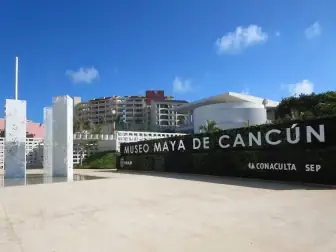
Museo Maya de Cancún
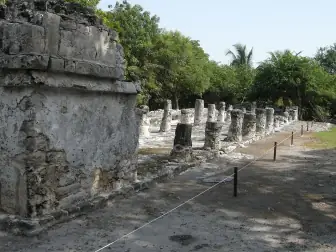
Opened by INAH in November 2012, with a design by Alberto García Lascurain, the museum has two permanent halls and one temporary hall, with Maya pieces mostly from Quintana Roo; INAH itself estimates a visit of about two hours. From the museum you enter the San Miguelito Archaeological Zone, a port and ceremonial center from 1200 to 1550, with East Coast style architecture, among vegetation and hotels. General admission to INAH's category I sites in Quintana Roo is 210 MXN in 2026; recent sources indicate it is open Tuesday through Sunday, but confirm hours and closing day before you go.
The INAH museum brings together Maya objects found in Quintana Roo and gives access to the ruins of San Miguelito, a Late Postclassic port among the hotels; this is the visit that explains the coast before Chichén Itzá or Tulum.
Check access

Playa Norte
At the northern tip of Isla Mujeres, a 10 to 15 minute walk from the pier, it is the shallowest, calmest beach within reach of Cancún, facing the bay. It recovered quickly after Hurricane Wilma. The island is about 7 km long, and you can get from end to end in about 20 minutes by golf cart, taxi or bicycle; for the rest of the day, Punta Sur, with the sculpture park and the remains of a Maya structure linked to Ixchel, charges a separate entrance fee.
The beach at Isla Mujeres' northern tip has shallow, calm water and is a 10- to 15-minute walk from the pier; the 20- to 35-minute crossing from Puerto Juárez makes it the best beach day within reach of Cancún.
Check access

Playa Langosta
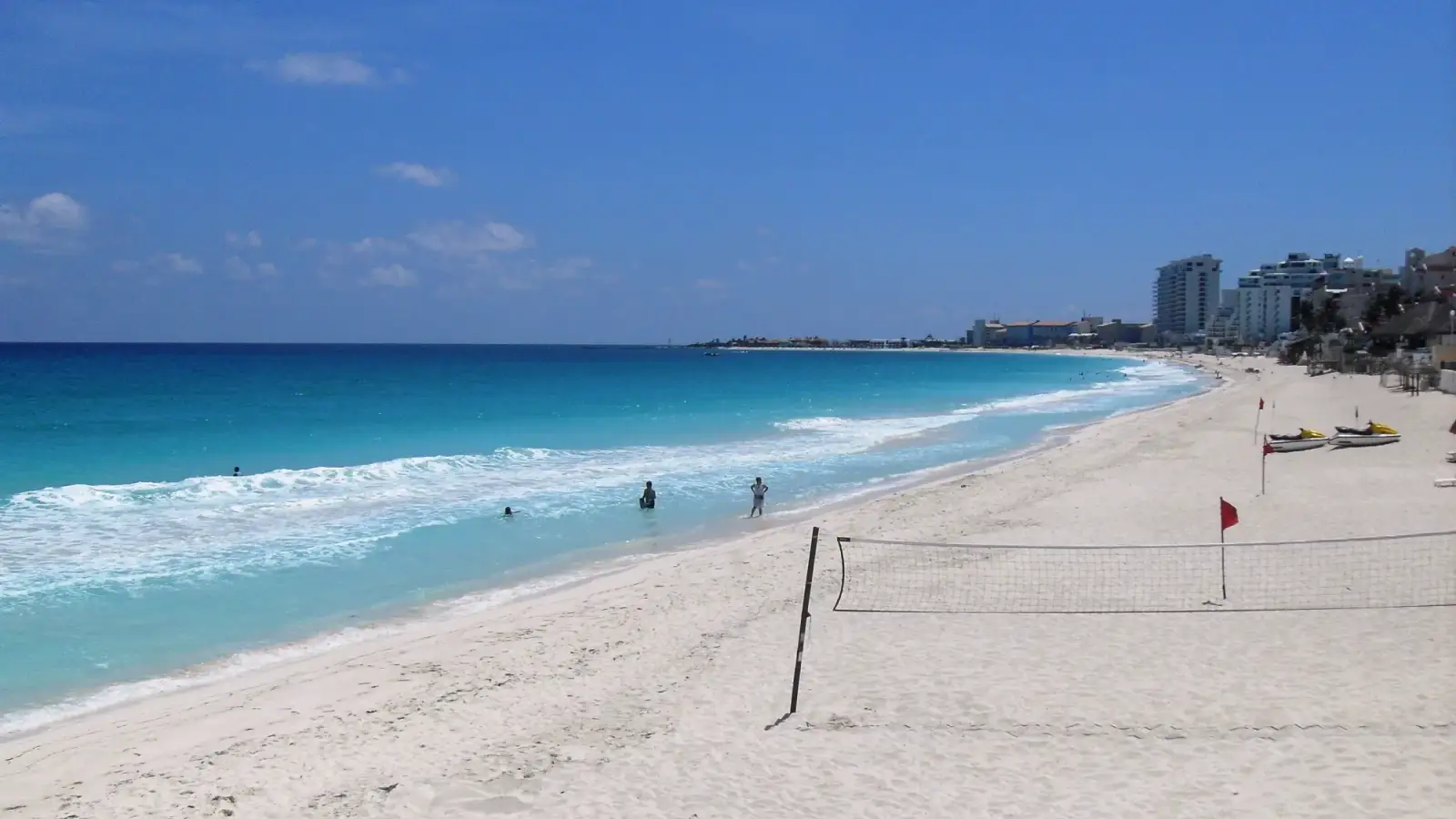
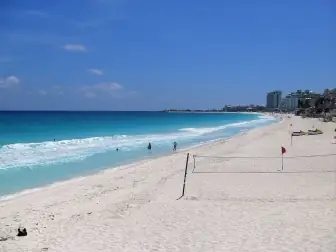
On the northern arm of the Zona Hotelera, facing the Bahía de Mujeres. The water is shallow and nearly free of surf, which makes it the calmest beach for swimming with children, and its sheltered position means it gets less sargassum than the east coast, though it is not free of it. It is close to Playa Tortugas, where boats to Isla Mujeres leave.
Facing the Bahía de Mujeres rather than the open Caribbean, it has shallow water with almost no surf and usually receives less sargassum than the east coast; the choice for a calm swim or a trip with children.
Check access
MUSA, Museo Subacuático de Arte
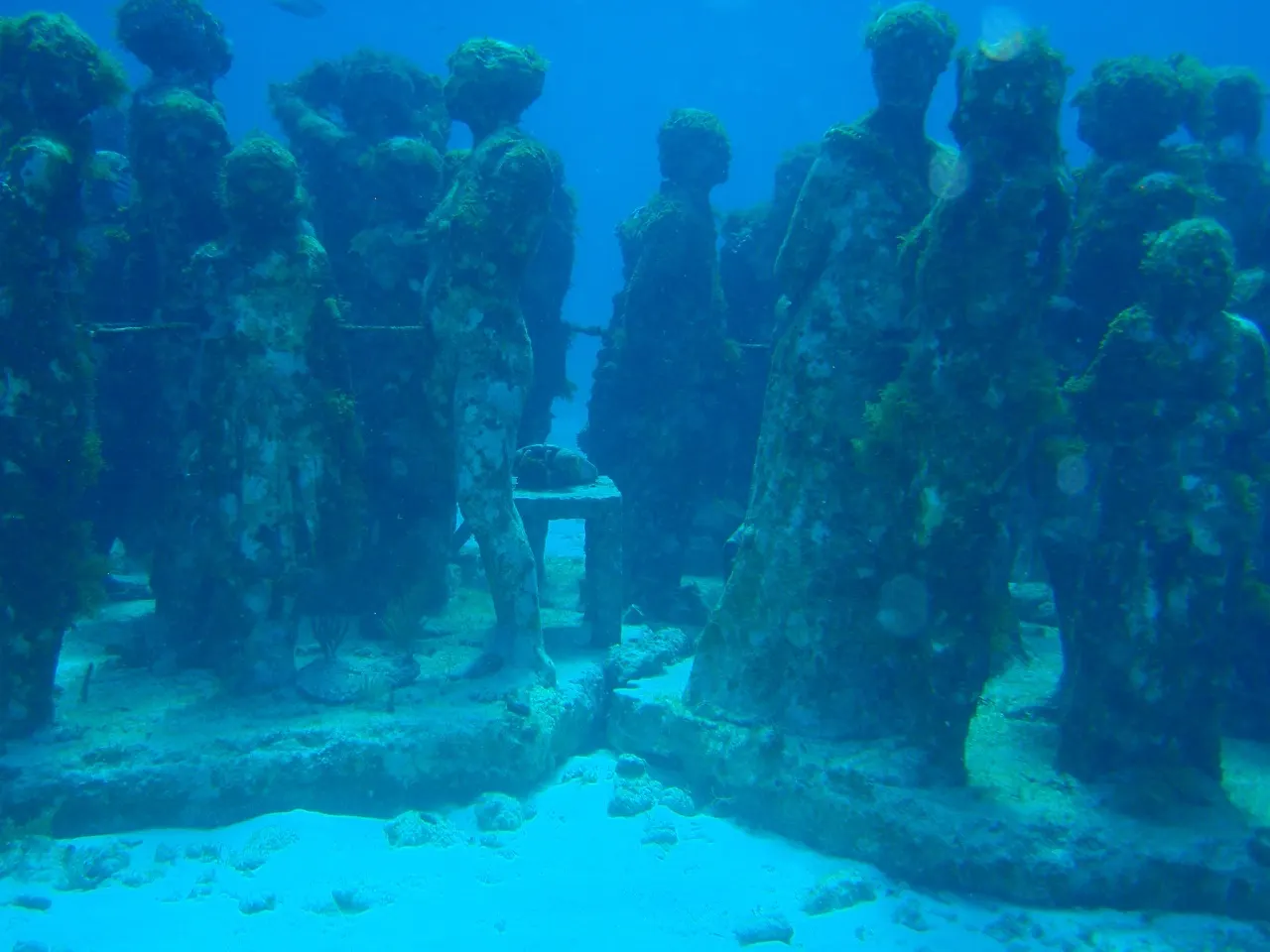
Opened in 2010, it brings together about 500 cement sculptures on the sea floor, at depths of 3 to 6 m: 477 in the Manchones gallery, near the southern tip of Isla Mujeres, and 23 in the Punta Nizuc gallery. Most are the work of British artist Jason deCaires Taylor, including the installation “The Silent Evolution,” with more than 400 human figures. The aim is to take pressure off the natural reef. It can only be visited with an authorized operator, snorkeling or diving, and the marine park charges for an access wristband, reported at 125 MXN in 2026. A room in the Plaza Kukulcán mall displays replicas for those who stay out of the water.
About 500 submerged sculptures at depths of 3 to 6 m, almost all in the Manchones gallery, visited only with an authorized operator and a marine-park wristband; worth it if you already plan to snorkel or dive.
Check access

El Meco Archaeological Zone
At km 2.7 of the Puerto Juárez–Punta Sam road, it was a trading port that controlled access to Isla Mujeres. The largest building, the Castillo, stands on the main plaza and once ended in two large serpent heads on the stairway, a motif reminiscent of Chichén Itzá. In October 2026, INAH listed MXN 80 for Mexican visitors and MXN 145 for foreign visitors. Check opening hours and allow travel time to the Puerto Juárez terminal if continuing to Isla Mujeres.
The former port that controlled the crossing to Isla Mujeres has a Castillo with serpent heads on the stairway; it fits into the morning of an island day, provided you check opening hours and allow time to reach the Puerto Juárez terminal.
Check access
Parque de las Palapas
In supermanzana 22 of El Centro, between Avenida Tulum and Avenida Yaxchilán, it is one of the oldest gathering places in the city, especially on weekend nights. It works as a plaza, with a playground, craft stalls and a stage covered by a palapa, the thatched roof that gives the place its name. All around, vendors sell marquesitas, esquites and churros. A renovation of about 44 million pesos finished in 2025, and the local press was already reporting wear by early 2026.
Cancún families' square on weekend nights, with a thatched stage, crafts and stalls selling marquesitas and esquites; it shows the city where tourism workers live.
Check access
El Rey Archaeological Zone
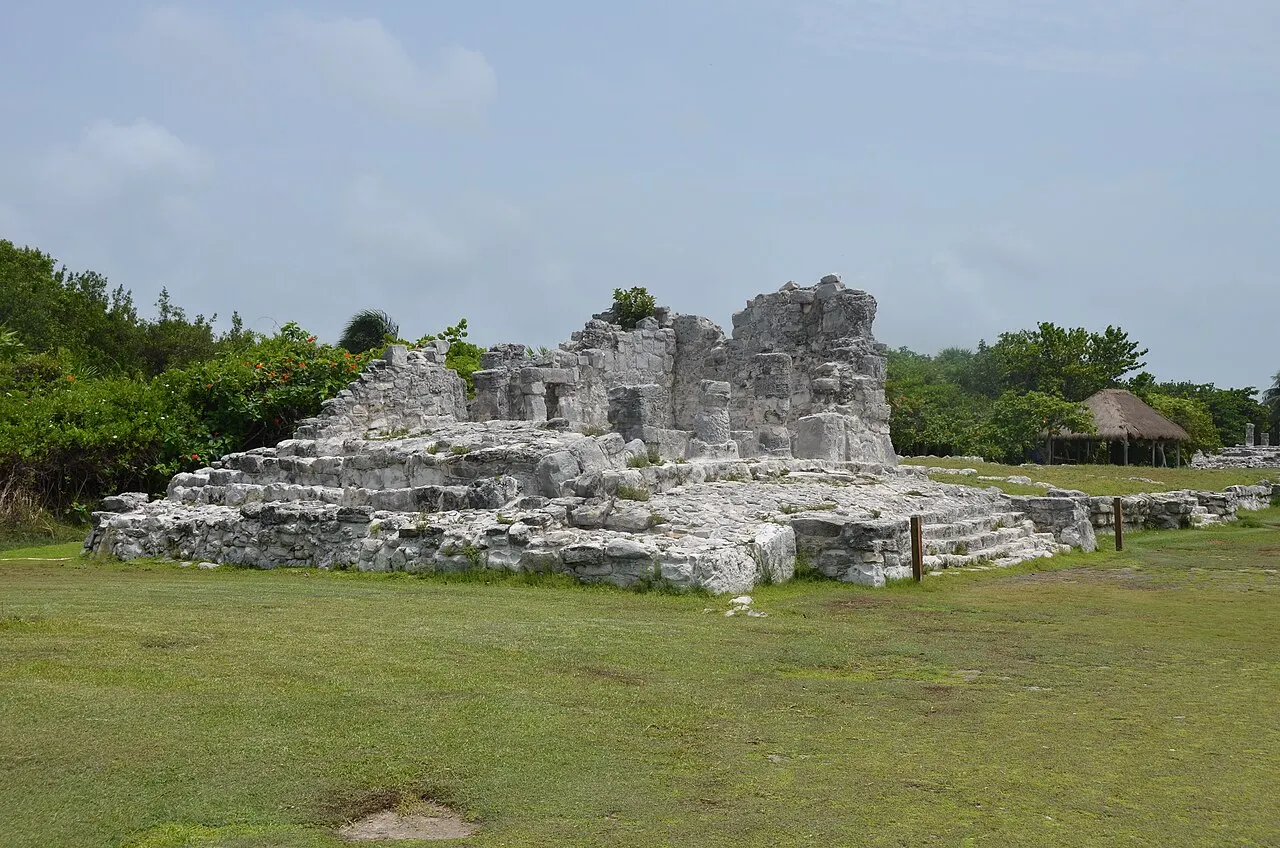
A small group of structures lined up along a main causeway and two small plazas, in the Zona Hotelera. It peaked between 1200 and 1550 as a center of maritime trade and fishing, and INAH considers it likely to have formed a single settlement with San Miguelito. It reopened in July 2025 with a new services area; INAH announced daily operation from 8 a.m. to 5 p.m., and category III admission costs 145 MXN in 2026. The visit takes 30 to 50 minutes.
The site is small, taking 30 to 50 minutes to visit, and INAH considers it likely that El Rey and San Miguelito were one settlement; if you have already seen San Miguelito with the museum, come here only with time to spare.
Check access

Mercado 28
Officially Mercado 115 Constitucional, it got its nickname from supermanzana 28. It started in the 1980s as a market for fruit, meat, fish and Yucatecan food and, after the 1994 crisis, came to sell mostly crafts, in more than 250 shops, with weak sales according to the merchants. To eat in the same market style, Mercado 23, nearby, still sells shoes, fruit, meat and sweets, along with cheap home-style food.
It began as a food market in the 1980s and, after the 1994 crisis, shifted almost entirely to crafts, with more than 250 shops; for food, nearby Mercado 23 retains more of the original role.
Check access
Nilo’s itinerary
Start with the basic programme and choose extensions for the time you have.
Plan my days in the app ↗Day 1 · Zona Hotelera: the Maya museum, the ruins and the open sea
Reach the Museo Maya de Cancún at opening, by bus along Bulevar Kukulcán. Recent sources indicate it is open Tuesday through Sunday; confirm the hours, and on a Monday swap the order of the day.
After the halls, enter the San Miguelito Archaeological Zone through the museum itself and set aside one to two hours for the two visits.
If you still want ruins, continue to El Rey, a few minutes along the boulevard; the visit takes 30 to 50 minutes.
Spend the afternoon at Playa Delfines. Go up to the lookout with the letters and check the flag with the lifeguards before going into the sea; if it is red or the sargassum traffic light is high, take the bus back north and switch to Playa Langosta, on the bay side.
Late in the day, have dinner on the Nichupté lagoon side, around km 12.5, to watch the sunset over the water, and head back by bus or taxi.
Day 2 · Puerto Juárez, Isla Mujeres and the evening in El Centro
Start early at El Meco Archaeological Zone, at km 2.7 of the Puerto Juárez–Punta Sam road; check opening hours and plan the onward trip to the Puerto Juárez ferry terminal after the visit.
Take the ferry to Isla Mujeres at Puerto Juárez and walk 10 to 15 minutes from the pier to Playa Norte to swim in the shallow water before midday.
For lunch, order tikin xic, the fish in achiote grilled over embers that the island claims as its own.
In the afternoon, go by taxi, bicycle or golf cart at an agreed price to Punta Sur, at the southern end, with the sculpture park and the remains of the Maya structure linked to Ixchel.
Return to Puerto Juárez and end the evening at Parque de las Palapas, in El Centro, with marquesitas and esquites; on a weekend, the plaza is full of families.
Day 3 · Chichén Itzá and Valladolid
Day trip
Chichén Itzá is about 200 km from El Centro in Cancún, in the state of Yucatán, about two and a half hours along the 180D toll highway. The Tren Maya also stops at Chichén Itzá and Valladolid, on the line that leaves the Cancún Aeropuerto station. Since March 27, 2026, admission is a single ticket of 697 MXN for foreigners. The site opens at 8 a.m. Yucatán time, which is 9 a.m. in Cancún; arrive at opening, for the heat and the crowds, and confirm the last entry. Valladolid, on the way, has a colonial center and cenotes, and works as a lunch stop or as an overnight stay to reach Chichén before the tour buses.


If you stay longer
Day 4 · Puerto Morelos and the Ruta de los Cenotes
Day trip
Puerto Morelos is about 38 km from El Centro, some 40 minutes by car along highway 307. Across from the Botanical Garden, the road inland that forms the Ruta de los Cenotes begins, with about 17 km to the village of Central Vallarta: Siete Bocas, for example, is at km 15.5, and Verde Lucero at km 18. Each cenote charges its own admission and has its own swimming rules. The route was named Mexico's best tourist route in the 2026 “Lo Mejor de México” awards. Without a car, the alternative is a tour with transportation.
Food
Cochinita pibil
Pork marinated in achiote, sour orange juice, garlic and spices, wrapped in banana leaf and roasted in an earth oven. It comes with pickled red onion and habanero chile on the side. It shows up in tacos and tortas, especially at breakfast and lunch.
Panuchos and salbutes
Both start from a fried corn tortilla. The panucho is stuffed with black beans and topped with shredded turkey, onion and tomato; the salbute is softer, unstuffed, with lettuce, tomato, pickled onion, turkey or chicken and avocado. They are snack-bar and market food, ordered by the piece.
Lime soup
Chicken broth scented with Yucatecan sour lime, with tomato, bell pepper, cilantro and strips of fried tortilla. It is a light broth, served as a starter.
Poc chuc with xnipec
Slices of pork marinated in sour orange and grilled, served with roasted onion and black beans. The xnipec that goes with it is a sauce of sour orange, tomato, onion, cilantro and habanero; the name in Maya means “dog's nose,” for the effect of the chile.
Tikin xic
Fish split open, marinated in achiote and sour orange and grilled over embers; it used to be wrapped in banana leaf and cooked in a hole in the ground. Its origin is credited to Isla Mujeres, although Yucatán also claims it, and the island is the classic place to order it.
Ceviche and seafood cocktail
Fish or shrimp cured in lime juice, with onion, tomato and cilantro, are the most common lunch near the sea. In El Centro, a full seafood meal costs 150 to 250 MXN; in the Zona Hotelera, a restaurant facing the lagoon charges 310 to 500 MXN per person.
Marquesitas
A crisp crepe rolled like a cigar, traditionally filled with queso de bola (an Edam type) and, today, also with dulce de leche, hazelnut chocolate or jam. It was created in 1945 by an ice cream vendor from Mérida, Vicente Mena Muñoz, and it is the dessert of the stalls at Parque de las Palapas.
Where to eat
- La Habichuela · El Centro · $$
Seafood, ceviche and lobster, along with Mexican and Yucatecan dishes, in a restaurant open since 1977 at Calle Margaritas, number 25.
Source · 2026-10-15
- El Centro, Mercado 23 · $
Comida corrida, with soup, a main dish and a drink, for 80 to 100 MXN, and cheap breakfasts at the market stalls.
- Parque de las Palapas · $
Marquesitas, esquites and churros at the stalls around the plaza, on weekend nights.
- El Fish Fritanga · Zona Hotelera, km 12.5 of Bulevar Kukulcán · $$
Seafood in a palapa on the edge of the Nichupté lagoon, between the La Isla and Plaza Kukulcán shopping centers, in a range of 310 to 500 MXN per person.
Source · 2026-10-15
- La Casa del Tikin Xic · Isla Mujeres, Playa Lancheros · $$
Tikin xic, the fish in achiote grilled over embers, served with onion and tomato.
Source · 2026-10-15
$: 80 to 100 MXN for a comida corrida at Mercado 23 · $$: 150 to 250 MXN for a seafood meal in El Centro · $$$: 310 to 500 MXN per person at a Zona Hotelera restaurant on the lagoon · 2026-10-15
Day trips
Chichén Itzá and Valladolid
Chichén Itzá is about 200 km from El Centro in Cancún, in the state of Yucatán, about two and a half hours along the 180D toll highway. The Tren Maya also stops at Chichén Itzá and Valladolid, on the line that leaves the Cancún Aeropuerto station. Since March 27, 2026, admission is a single ticket of 697 MXN for foreigners. The site opens at 8 a.m. Yucatán time, which is 9 a.m. in Cancún; arrive at opening, for the heat and the crowds, and confirm the last entry. Valladolid, on the way, has a colonial center and cenotes, and works as a lunch stop or as an overnight stay to reach Chichén before the tour buses.
Puerto Morelos and the Ruta de los Cenotes
Puerto Morelos is about 38 km from El Centro, some 40 minutes by car along highway 307. Across from the Botanical Garden, the road inland that forms the Ruta de los Cenotes begins, with about 17 km to the village of Central Vallarta: Siete Bocas, for example, is at km 15.5, and Verde Lucero at km 18. Each cenote charges its own admission and has its own swimming rules. The route was named Mexico's best tourist route in the 2026 “Lo Mejor de México” awards. Without a car, the alternative is a tour with transportation.
Playa del Carmen and Tulum
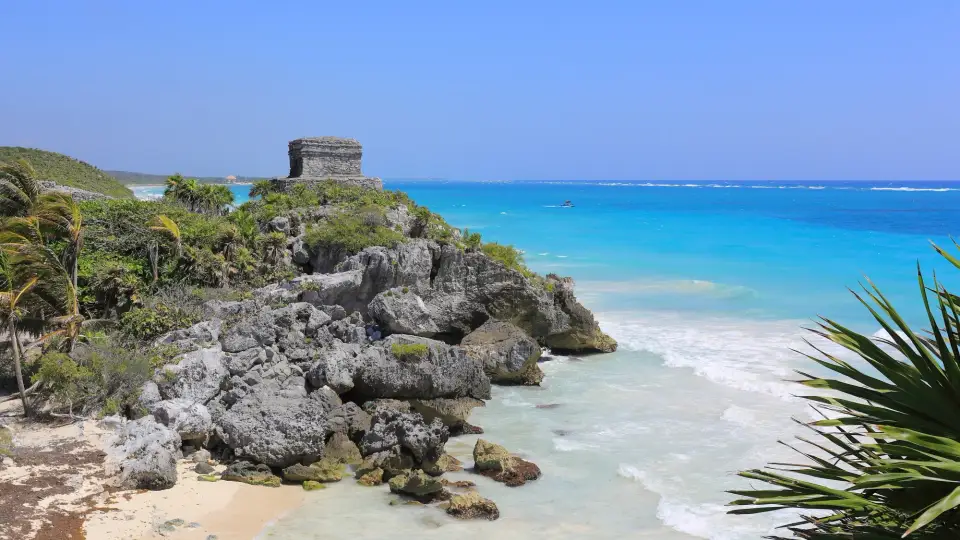
Playa del Carmen is about 67 km away, an hour by car, with frequent ADO buses from El Centro and the airport; the boats to Cozumel leave from there. Tulum, with its ruins above the sea, is about 127 km away, an hour and 45 minutes by car; a round trip in the same day is possible, but the town deserves one or two nights of its own.
Isla Contoy
A national park and refuge for about 150 bird species, about 30 km north of Isla Mujeres, with a limit of 200 visitors a day and access only with authorized operators. In 2026, the park fee is 225 MXN per visitor, usually paid separately at boarding. Book ahead in high season.
Where to begin
Zona Hotelera: the Maya museum, the ruins and the open sea
Reach the Museo Maya de Cancún at opening, by bus along Bulevar Kukulcán. Recent sources indicate it is open Tuesday through Sunday; confirm the hours, and on a Monday swap the order of the day.
Puerto Juárez, Isla Mujeres and the evening in El Centro
Start early at El Meco Archaeological Zone, at km 2.7 of the Puerto Juárez–Punta Sam road; check opening hours and plan the onward trip to the Puerto Juárez ferry terminal after the visit.
Money
The currency is the Mexican peso (MXN). In the Zona Hotelera many prices appear in US dollars, and some services accept the currency, but change comes in pesos at a poor rate; paying in pesos usually works out better. For comparison: a home-style meal at Mercado 23 costs 80 to 100 MXN, a seafood meal in El Centro 150 to 250 MXN, and a Zona Hotelera restaurant facing the lagoon 310 to 500 MXN per person.
Some costs do not show up in the price of the room or the tour. The Visitax is a state contribution for foreign tourists who visit Quintana Roo. The local press reported amounts of 224 to 285 MXN per person between December 2025 and August 2026, and the official portal, visitax.gob.mx, is where to check the current amount. Pay only there, because fake sites are out there, and keep the receipt; in December 2025, travelers reported charges of up to 525 MXN at the airport. On the hotel rate, ask for the final total: the rate may come without VAT, without the state lodging tax and without the Environmental Sanitation Fee charged by the municipalities of Cancún, Puerto Morelos and Isla Mujeres.
At sea and at the sites, fees add up too. The marine park that includes MUSA and the reefs of Punta Cancún and Punta Nizuc charges for an access wristband, reported at 125 MXN in 2026; Isla Contoy charges 225 MXN per visitor. INAH charges 210 MXN at the Museo Maya and 145 MXN at El Rey and El Meco, and Chichén Itzá charges foreigners 697 MXN on a single ticket since March 2026. Carry cash for buses, stalls and wristbands. Tipping is voluntary: check whether the bill already includes “servicio” before adding anything.
Getting there and around
From the airport, about 20 km from El Centro
Cancún International Airport (CUN) is about 20 km from El Centro, some 20 minutes by car without traffic. ADO links the airport to the El Centro bus station and runs directly from Terminals 2, 3 and 4 to Punta Cancún, near km 9 of Bulevar Kukulcán. This route ends at a fixed stop, not at each hotel; accommodation farther south may require a local R1/R2 bus or taxi. In October 2026, ADO listed about MXN 170 per person and 45 minutes to Punta Cancún; check the fare and timetable for your date and terminal. The airport taxi cost US$30 to 50 to the Zona Hotelera in August 2026, according to Diario Río Negro; a 2026 travel guide gives US$28 to 35 to El Centro. Taxi drivers and ride-hailing drivers have a long-running conflict at the airport, with blockades in 2026; if you don't want to depend on that, arrange the transfer with your lodging.
The Tren Maya has reached the Cancún Aeropuerto station since December 2023, but it sits outside the air terminal: check the connection there before setting a time. For the Riviera Maya and Yucatán, ADO has frequent departures from the El Centro bus station.
Buses on Bulevar Kukulcán and the new bridge
City buses run the length of Bulevar Kukulcán and connect the Zona Hotelera to El Centro; the authorized fare was 12 MXN in the Zona Hotelera in November 2025, with an increase to 15 MXN announced and postponed. Carry coins. The Puente Nichupté, opened in May 2026 and toll-free, crosses the lagoon and shortened the connection between the two sides; since September 2026, Route 27 of the MOBI system uses the bridge. Street taxis have no meter: agree on the price before getting in.
Boats to Isla Mujeres
Ultramar operates from Puerto Juárez and also from Playa Tortugas and Playa Caracol, in the Zona Hotelera; Xailing leaves from the Embarcadero. The crossing takes 20 to 35 minutes. In April 2025, Ultramar charged 580 MXN round trip per adult from Puerto Juárez, including an environmental sanitation fee of 34.95 MXN, and a request for an increase was under review; check the price on the day. Quintana Roo residents pay a lower fare.
Car for the cenotes and Chichén Itzá
For the Ruta de los Cenotes and Chichén Itzá, a rental car gives you freedom with your schedule. The 180D toll highway takes you to Chichén Itzá, about 200 km away, in about two and a half hours; federal highway 180, which is toll-free, runs through villages with speed bumps and can add more than an hour.
Safety
Quintana Roo calls for attention. The US Department of State travel advisory keeps the state at level 2, “exercise increased caution,” because of crime, and mentions Cancún, Playa del Carmen and Tulum; the guidance is to take extra care after dark in central areas and stay on well-lit, busy streets. Also check your own country's advisory. Arrange your return before going out at night, use a taxi recommended by your lodging or a service with an identified driver, do not accept drugs and do not leave your drink unattended. In an emergency, call 911.
At sea, the most common risk is the current. Respect the flags and the lifeguards, especially on the east coast of the Zona Hotelera, and do not swim in the Nichupté lagoon, where there are crocodiles. The strong sun calls for water, shade and sunscreen.
There is dengue in Quintana Roo: in 2026 the state confirmed more than 160 cases through July and one death. Use repellent by day and at night, and seek care if you have a fever after the trip. Drink sealed bottled water or treated water. Before buying your ticket, check with the Instituto Nacional de Migración and the Mexican consulate for the entry requirements for your passport and the reason for your trip.
Etiquette tips
The beach is public, even behind a hotel
Under Mexican law, the beach and the federal strip beside the sea are for public use, and no one may restrict access except for safety. In practice, many access points sit behind hotels. Use the signed public access points and the open beaches, like Delfines, Langosta and Tortugas; on the sand, you can walk the whole coast, but the hotel's loungers and umbrellas belong to its guests.
Sculptures and corals are not to be touched
At MUSA and on the reefs, do not touch the sculptures or the coral, and follow the accredited guide: the marine park limits dives and requires an authorized operator. The access wristband is mandatory.
A turtle nest is a fenced area
During nesting season, from May to October, do not enter the corrals, do not use a flash or flashlight on the sand at night and do not pick up hatchlings. If you see a turtle nesting or in danger, call 911.
Do not feed crocodiles
There are crocodiles in the Nichupté lagoon, and signs warn of them. Do not feed them, do not go near the banks and do not enter the lagoon water.
A few words of Maya
Yucatec Maya is a living language on the peninsula. A “Yuum bo’otik” (thank you) is a kind gesture; do not expect everyone to speak Maya, though, and Spanish is the everyday language in Cancún.
Mistakes to avoid
Choosing the beach by the hotel, without checking the flag
Going into the open sea on the east coast because it is in front of your room. There, a rip current can pull a person far out even close to shore, and on several days in 2026 Civil Protection restricted swimming at more than 80% of public beaches. A red or black flag means stay out of the water, even if the sea looks calm.
Thinking sargassum has a set month
Booking on the expectation of clean sand because the month “isn't sargassum season.” In 2026 the algae started in January. Check the daily traffic light and have a plan B: the bay side, Isla Mujeres, the cenotes or the museum.
Paying the Visitax on the wrong site
There are fake sites charging the Visitax. The only channel is visitax.gob.mx or companies authorized by the state secretariat. Keep the receipt for departure.
Forgetting Yucatán time
Setting the tour meeting or the train to Chichén Itzá by Cancún's clock. Yucatán is one hour behind Quintana Roo, and a mix-up over the hour costs you the visit.
Squeezing Chichén Itzá into an afternoon
It is about 200 km and two and a half hours each way by car. Leave early, count on the whole day and do not schedule anything important for the evening.
Renting a golf cart on Isla Mujeres without agreeing on the price
In 2024, a tourist paid 5,500 MXN for a cart whose price was 1,000. Agree on the amount in writing, with an established rental company, before heading out.
Useful phrases
¿Hay sargazo hoy?
Is there sargassum today? A useful question at the front desk or to the lifeguard before choosing a beach
¿Qué bandera hay?
What flag is up? Green allows swimming, yellow calls for caution, red and black prohibit it
¿Cuánto es en pesos?
How much is that in pesos? Helps when the price appears in dollars
¿El servicio está incluido?
Is the service charge included? To find out whether the tip is already on the bill
Bix a beel
A greeting in Yucatec Maya, something like “how is your road?”; pronounced “beesh a bel”
Yuum bo’otik
Thank you very much, in Yucatec Maya; pronounced “yoom BOH-tik”
Where to stay
- Zona Hotelera, bay side · Families with children and anyone who wants to swim in calm water · $$$: The Langosta, Tortugas and Caracol beaches have shallow water and little surf, tend to get less sargassum than the east coast, and boats to Isla Mujeres leave from there. It is closer to El Centro than the rest of the Zona Hotelera.
- Zona Hotelera, Caribbean side · Anyone who wants a resort facing the open sea · $$$: This is where the big resorts, the Museo Maya and Playa Delfines are. The sea is the prettiest and also the one with the most current and, in season, the most sargassum; from the southern end, El Centro is far away.
- El Centro · Small budgets and anyone who wants the real city · $: Hostels and hotels cost much less than in the Zona Hotelera, the ADO bus station is close for day trips, and Parque de las Palapas and the markets are within walking distance. The beach requires a bus or car, now shorter thanks to the Puente Nichupté.
- Isla Mujeres · Anyone who prefers a small town and a calm beach to the pace of the Zona Hotelera · $$: Sleeping on the island gives you Playa Norte early in the morning and in the late afternoon, when the tour boats have already gone. In exchange, every trip to Cancún or on a day trip starts with the crossing.
$: hostel bed, US$13 to 30 · $$: four-star hotel, US$80 to 200 a night · $$$: five-star hotel or resort, from US$250 a night · 2026-10-15
Districts
Zona Hotelera, bay side
The northern arm of the island, between the bridge entrance and Punta Cancún, facing the Bahía de Mujeres. The Langosta, Tortugas and Caracol beaches have calmer water, and boats to Isla Mujeres leave from Playa Tortugas and Playa Caracol. It is the most practical stretch for families and for anyone who wants to swim without strong surf.
Zona Hotelera, Caribbean side
After Punta Cancún, the long strip of resorts facing the open sea, to Punta Nizuc. Here are the Museo Maya, the San Miguelito and El Rey ruins, Playa Delfines and restaurants on the lagoon side. The sea is prettier and more dangerous: surf, currents and, in season, more sargassum.
El Centro
The city of the people who live in Cancún, across the lagoon. It has Parque de las Palapas, markets 28 and 23, the ADO bus station and most of the cheap lodging. Eating here costs much less than in the Zona Hotelera, and the Puente Nichupté shortened the trip to the beaches.
Puerto Juárez
The old village north of El Centro, next to the pier where most ferries to Isla Mujeres leave. El Meco is at km 2.7 of the Puerto Juárez–Punta Sam road; plan the onward trip to the ferry terminal separately.
Isla Mujeres
A municipality of its own, on an island about 7 km long and 650 m wide, 20 to 35 minutes away by boat. The town sits at the northern tip, by Playa Norte; at the southern end, Punta Sur has a sculpture park and the remains of a Maya structure linked to Ixchel. Sleeping on the island lets you see Playa Norte early in the morning and in the late afternoon.
History
1200–1550 · Maya ports on the coast
San Miguelito, El Rey and El Meco function as ports for maritime trade and fishing in the Late Postclassic period, with architecture in the East Coast style. El Meco controlled the passage to Isla Mujeres.
16th c. · Isla Mujeres gets its name
The Spanish name the island for the many images of goddesses they find there; the place was sacred to Ixchel, the Maya goddess of childbirth and medicine.
1847–1902 · Caste War and territory
The Maya rebellion that began in 1847 drives the non-Indigenous population out of the east of the peninsula, and the Maya state of Chan Santa Cruz keeps broad autonomy for decades. On November 24, 1902, Porfirio Díaz creates the Territory of Quintana Roo.
1967–1970 · The Banco de México picks the island
A study by Antonio Enríquez Savignac on the country's tourism potential leads Banco de México technicians to choose Cancún from six sites, for its beaches. The project receives presidential approval in 1969, and the first construction camp is set up in January 1970.
1974 · A new state and a tourist center
Quintana Roo becomes a state on October 8, 1974, and Cancún begins operating as a Fonatur Integrally Planned Center, with the first hotels financed by the federal government.
1988 · Hurricane Gilbert
On September 13 and 14, a category 5 hurricane hits Cancún head-on; in Quintana Roo it causes 40 deaths and destroys about one million hectares of forest and mangrove.
2005–2006 · Wilma and the rebuilt beaches
The eye of Hurricane Wilma sits over Cancún for more than six hours on October 22, 2005, and erosion carries away much of the sand. In May 2006, 11.5 km of restored beach are delivered, in a 235-million-peso project.
2010 · The underwater museum
MUSA officially opens on November 27, 2010, with cement sculptures that draw divers and boats away from the natural reef.
2012 · Museo Maya de Cancún
In November, INAH opens the museum designed by Alberto García Lascurain, next to the San Miguelito ruins, in the Zona Hotelera.
2023–2026 · Train, bridge and record sargassum
The Tren Maya reaches the Cancún Aeropuerto station in December 2023. On May 2, 2026, the Puente Nichupté, toll-free, opens over the lagoon; the same year, the sargassum collected in the state sets a record.
Complete history
The Maya coast before Cancún
Long before the hotels, this coast was already a route. Between 1200 and 1550, in the period archaeologists call the Late Postclassic, small Maya settlements of the so-called East Coast lived from canoe trade and fishing. San Miguelito, today next to the Museo Maya, was a port and ceremonial center; El Rey, a few kilometers away, probably belonged to the same settlement; El Meco, near today's Puerto Juárez pier, controlled the passage to Isla Mujeres, an island sacred to Ixchel. These places were abandoned after the Spanish arrived, and the ruins that now appear between the hotels are what remains of that network.
A frontier far from power
During the colonial era and the 19th century, the east of the peninsula stayed on the margins. The Caste War, which began in 1847, drove the non-Indigenous population out of the region and gave rise to the Maya state of Chan Santa Cruz, which kept broad autonomy for decades. Only in 1902 did the government of Porfirio Díaz create the Territory of Quintana Roo. The island of Cancún, at that time, had coconut groves and few residents; the neighboring village of Puerto Juárez had 117 inhabitants.
A city chosen in an office
Cancún did not grow: it was chosen. In the late 1960s, the Banco de México was looking for sites to create planned tourist hubs, and a study by Antonio Enríquez Savignac pointed to the potential of the Mexican Caribbean. Among six candidates, the technicians preferred this strip of sand for its beaches. Construction began in 1970, with a camp for the workers, and in 1974, the year Quintana Roo became a state, the place began operating as a Fonatur tourist center. The design separated the Zona Hotelera, on the island, from the service city on the mainland from the start, and that division is still the key to understanding Cancún.
Hurricanes, sand and growth
In five decades, the city went from a construction site to 888,797 inhabitants in 2020, almost all from elsewhere. Two hurricanes mark local memory. Gilbert, a category 5, hit Cancún in September 1988. Wilma kept its eye parked over the city in October 2005, left it without power or water and carried off the beach sand, which was replaced along 11.5 km in a project delivered in 2006. Today the most visible threat is another one: sargassum, an algae that arrives from the Atlantic in growing volumes and that in 2026 set a record for tons collected.
The city today
Cancún keeps changing shape. The Tren Maya linked the Cancún Aeropuerto station to the rest of the peninsula in December 2023, and the Puente Nichupté, opened in May 2026 over the lagoon, shortened the connection between El Centro and the Zona Hotelera. At the same time, residents and journalists point out that many of the beaches, public by law, are left without free access behind the hotels, a debate that has followed the city since it was designed for the visitor.
Cancún was chosen by Banco de México technicians from six candidates; construction began in January 1970.
Geography and shape of the city
The island shaped like a 7
The Zona Hotelera occupies Isla Cancún, a strip of sand about 23 km long shaped like a 7, linked to the mainland by bridges. The northern arm faces the sheltered Bahía de Mujeres, with shallow water and little surf; after Punta Cancún, the long arm runs south facing the open Caribbean, with no reef nearby along several stretches, to Punta Nizuc. Inside lies the Nichupté lagoon system, made up of seven bodies of water and ringed with mangrove, where crocodiles live.
Warm weather all year
The climate is tropical sub-humid. At the airport station, the annual average is 27 °C, with average lows of 19 °C in January and average highs of 34 °C in July and August. February, March and April get less than 50 mm of rain a month; September and October exceed 220 mm. The Atlantic hurricane season runs from June 1 to November 30, and September and October are the most affected months.
El Centro and the rest of the peninsula
On the mainland side, El Centro was laid out in supermanzanas, large numbered blocks that give their names to neighborhoods and markets, such as Mercado 28. The terrain is flat and limestone, with no rivers on the surface: the water runs underground and surfaces in the cenotes, natural freshwater wells that dot the peninsula, like those along the road leaving Puerto Morelos for the interior.
The island's northern arm faces the calm waters of the Bahía de Mujeres; the long arm faces the open Caribbean.
Culture
A young city made of people who arrived
Cancún is just over half a century old, and almost all of its population came from somewhere else, from the rest of the peninsula and the rest of Mexico. The city was planned to separate the visitor, on the island, from the people who work, on the mainland, and that division shows on the map: hotels and shopping centers on one side, supermanzanas with markets, churches and neighborhood plazas on the other. Parque de las Palapas, full of families on weekend nights, is the simplest place to see that other Cancún.
Maya on today's peninsula
Yucatec Maya remains a living language on the peninsula, and it appears in avenue names like Kabah, Yaxchilán and Bonampak and in the cooking, from pibil to xnipec. Hanal Pixán, “food of the souls,” is the Maya version of the Day of the Dead: in 2025, Cancún's municipal festival ran from October 30 to November 2, with a maritime procession in Puerto Juárez, an altar contest and the supper of the souls at Parque de las Palapas.
Underwater art and turtles on the sand
Part of Cancún's cultural life happens at sea. MUSA uses sculptures as an artificial reef, and the city follows the nesting of sea turtles every year: four of the world's seven species nest on the municipality's beaches, and in 2026 the city government monitored about 12 km of coast, from Punta Cancún to Punta Nizuc, with 52 protective corrals in partnership with hotels.
Festivals and events
Equinox at Chichén Itzá: around March 20 and September 22
At the equinoxes, in the afternoon, the light casts seven triangles on the north balustrade of El Castillo and forms the silhouette of a serpent that seems to descend the staircase. In March 2026, INAH set up a special three-day arrangement; with good weather, the effect can be seen for a few days before and after. Remember that Chichén Itzá keeps Yucatán time, one hour behind Cancún.
Turtle nesting season: May to October
Turtles come up the Zona Hotelera beaches to nest between May and October, and the hatchlings emerge in the following weeks. Nests are kept in fenced corrals, looked after by biologists; do not touch the animals or use a flashlight on the sand at night, and notify the authorities if you find a turtle in danger.
Hanal Pixán: late October and early November
The Maya Day of the Dead brings together altars, catrinas and the supper of the souls. In 2025, the municipal festival took over Puerto Juárez, Parque de las Palapas and the Los Olivos cemetery from October 30 to November 2; check the program for the year.
Books and films
Incidents of Travel in Yucatan, John Lloyd Stephens (1843)
The account by the American diplomat and explorer who, with the illustrator Frederick Catherwood, described Chichén Itzá, Tulum and dozens of other Maya sites for an outside audience. It helps explain how the ruins that have now become a day tour entered the traveler's imagination.
Relación de las cosas de Yucatán, Diego de Landa (c. 1566)
Written by the Franciscan friar who burned Maya codices at Maní in 1562, it is both one of the main sources on Maya life at the time of the conquest and a record of the violence with which that life was erased.
The Caste War of Yucatan, Nelson Reed (1964)
The history of the Maya rebellion that began in 1847 and of the state of Chan Santa Cruz, which explains why the east of the peninsula, where Cancún now stands, stayed outside government control until the 20th century.
Frequently asked questions
Cancún: How do you get from the airport to El Centro and the Zona Hotelera?
Cancún International Airport (CUN) is about 20 km from El Centro, some 20 minutes by car without traffic. ADO links the airport to the El Centro bus station and runs directly from Terminals 2, 3 and 4 to Punta Cancún, near km 9 of Bulevar Kukulcán. This route ends at a fixed stop, not at each hotel; accommodation farther south may require a local R1/R2 bus or taxi. In October 2026, ADO listed about MXN 170 per person and 45 minutes to Punta Cancún; check the fare and timetable for your date and terminal.
Cancún: What is the Visitax, and where do you pay it?
The Visitax is a state contribution for foreign tourists who visit Quintana Roo. The only channel is visitax.gob.mx or companies authorized by the state secretariat, because there are fake sites charging it; keep the receipt for departure.
Cancún: How many days should you stay?
I'd stay three days with Cancún as a base: one in the Zona Hotelera, another on Isla Mujeres, and the third at Chichén Itzá, which takes the whole day.
Cancún: How much is Chichén Itzá, and when does it open?
Since March 27, 2026, admission is a single ticket of 697 MXN for foreigners. The site opens at 8 a.m. Yucatán time, which is 9 a.m. in Cancún; arrive at opening, for the heat and the crowds.
Cancún: How do you get to Isla Mujeres?
Ultramar operates from Puerto Juárez and also from Playa Tortugas and Playa Caracol, in the Zona Hotelera; Xailing leaves from the Embarcadero. The crossing takes 20 to 35 minutes.
Other cities in the country
Mexico ↗- Days
- 4–5
- When
- Oct–Nov
- Per person/day
- Average 1,100–2,000 pesosMid-range · per person/day
Cost scope
Per person per day: accommodation, meals, urban transport, visits and a small allowance for extras. Flights excluded; larger purchases vary. Editorial estimate, not a quote.
- Days
- 3
- When
- Feb–Apr · Oct–Nov
- Per person/day
- Average 900–1,800 MXNMid-range · per person/day
Cost scope
Per person per day: accommodation, meals, urban transport, visits and a small allowance for extras. Flights excluded; larger purchases vary. Editorial estimate, not a quote.
- Days
- 2–3
- When
- Jan–Apr · Dec
- Per person/day
- Average 2,400 MXNMid-range · per person/day
Cost scope
Per person per day: accommodation, meals, urban transport, visits and a small allowance for extras. Flights excluded; larger purchases vary. Editorial estimate, not a quote.
- Days
- 3–4
- When
- Jan–Apr · Dec
- Per person/day
- Explore costsGuide estimate
Cost scope
Per person per day: accommodation, meals, urban transport, visits and a small allowance for extras. Flights excluded; larger purchases vary. Editorial estimate, not a quote.