Namibia
Sossusvlei
Sossusvlei: orange dunes, trees dead for centuries and a gate that opens only with the sun
Days I would stay two nights in Sesriem, inside the gate.
How the guide reaches this number
The first afternoon is for arriving: the roughly 340 km from Windhoek take almost the whole day, and there is light left for Sesriem Canyon or Elim Dune. The next morning is the reason for the trip, with Deadvlei at sunrise, Sossusvlei or the Big Daddy climb, and Dune 45 when the shade returns, late in the afternoon. On the second morning on the dunes, I would choose between the balloon flight and the walk to Hidden Vlei, and only then continue to Swakopmund. One night works, but it leaves a single morning on the dunes and no break from the heat before taking the road again.
2–3
Start with the basic programme and choose extensions for the time you have.
When May to September; in winter the days in the desert are mild and the nights can freeze, while from October to April the heat can reach 40 °C or more and the rains, when they come, fall mostly from December to April.
How the guide reaches this number
The desert can be visited year-round, and what changes is the heat and the price. From May to September, winter in the Southern Hemisphere, the days are mild and the sky clear; the nights get very cold and can freeze, so campers need a warm sleeping bag. From July to October, the Namibia Wildlife Resorts accommodations charge the highest rates of the year, and booking in advance is recommended. From October to April the desert heat can reach 40 °C or more, and a visit to the dunes comes down to early morning and late afternoon. The rainy season runs from December to April, with short downpours; in years of heavy rain in the Naukluft Mountains, the Tsauchab flows and can fill Sossusvlei, a rare event that changes the landscape for a while.
Per person/day Add up lodging per night, meals per person, the park fee per person and per vehicle, car hire and fuel; sleeping inside the Sesriem gate costs more and pays off in the morning on the dunes.
How the guide reaches this number
Per person per day: accommodation, meals, urban transport, visits and a small allowance for extras. Flights excluded; larger purchases vary. Editorial estimate, not a quote.
 What Nilo thinks
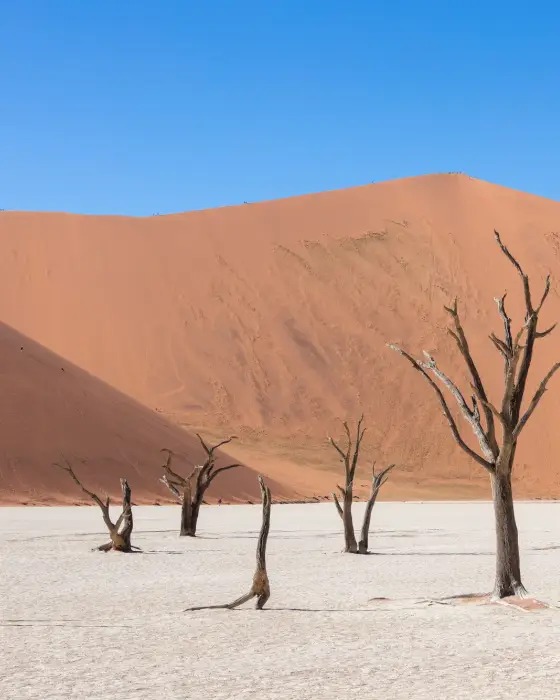
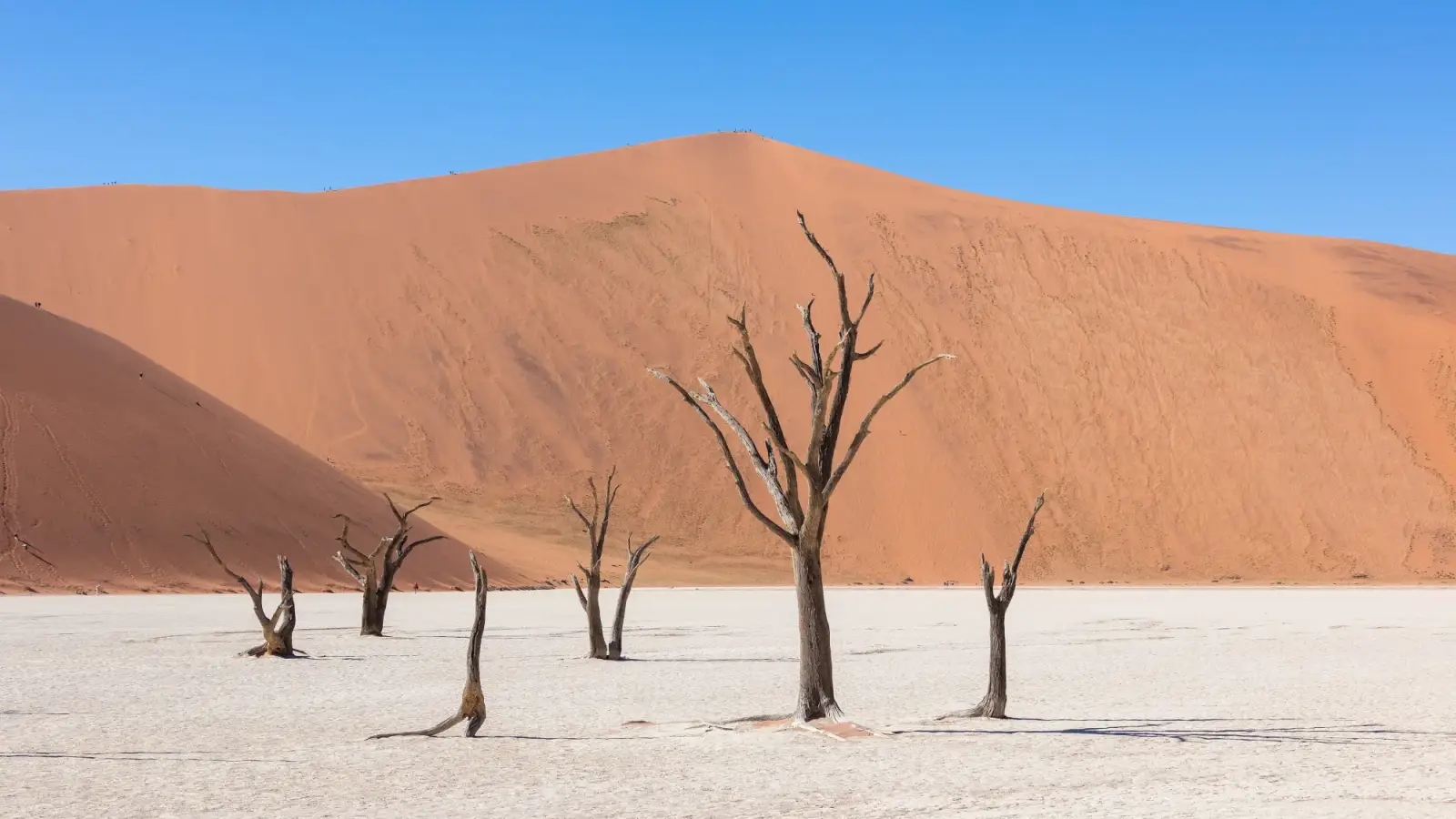
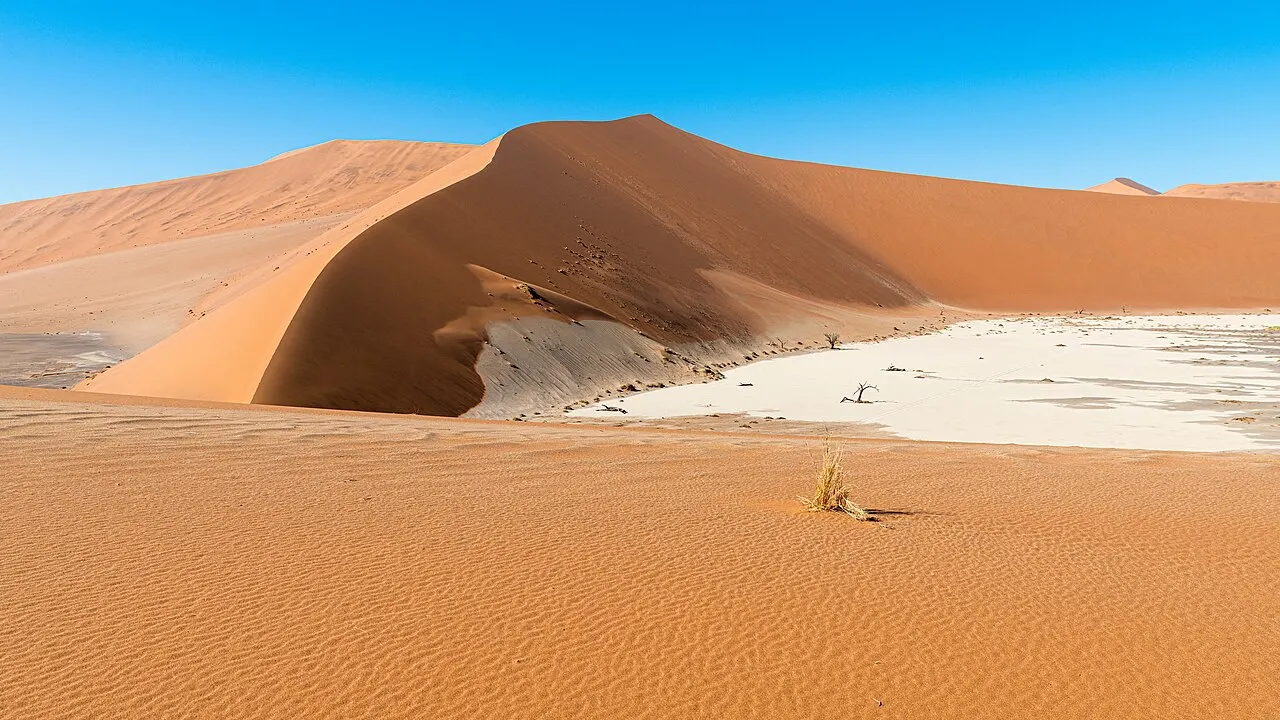
I would recommend Sossusvlei to those who enjoy silence, looking slowly at the ground and places that live on little. Around the park, the region is made of large farms crossed by dirt roads; at Solitaire, two of them became a habitat conservation fund, where the Hartmann's mountain zebra lives. Sesriem is little more than a gas station with kiosks, and life there revolves around the gate. On the dunes, the orange sand has dark patches of magnetite, and on the more stable ridges grows the nara, a plant that exists only in the Namib. In the dry riverbeds, the living camel thorn acacias show where water runs beneath the sand. I would not spend the whole morning chasing the same photo of the Deadvlei trees: the contrast that makes the image lasts while the sun is low, and after that it is more rewarding to wander slowly through the Sossusvlei pan, looking at the grass, the shrubs and the salt crust.Few places show the desert at work the way Sossusvlei does. A river that flows only in years of heavy rain comes down from the Naukluft Mountains, cuts a narrow canyon at Sesriem and dies in a closed basin, blocked by orange dunes among the tallest in the world. Beside it, at Deadvlei, the dunes cut off the water centuries ago, and the acacias were left standing, black and dry on a floor of almost white clay. The road there runs for 60 km between walls of sand, and their color changes with the height of the sun; in the early morning and late afternoon, one side of each dune lies in shadow and the ridge becomes a sharp line. Oryx and springbok cross the road, and the Atlantic fog, which sometimes reaches this far in the morning, is the water that much of the wildlife lives on. The Sesriem gate opens with the sun, and it is what organizes the visit.
Quick facts
- Population
- Sesriem has no separately counted population: it is a park gate with a gas station, a permit office and accommodations. The Hardap region, where it lies, had 106,680 inhabitants in Namibia's 2023 Population and Housing Census.
- Founding
- There is no founded town. The protected area began in 1907, when the German colonial administration proclaimed Game Reserve No. 3; the current boundaries of Namib-Naukluft date from 1986, and the Namib Sand Sea was added to the UNESCO World Heritage List in 2013.
- Country and region
- Namibia, Hardap region, Namib-Naukluft National Park. Sesriem is about 340 km from Windhoek by road, and the Sossusvlei 2x4 parking area is 60 km from the gate.
- Language
- English is Namibia's official language and the language of tourism. In the Hardap region, Afrikaans and Nama/Damara are the most widely spoken languages at home, each in 44% of households (2023 Census).
- Currency
- Namibian dollar (NAD, written N$), pegged to the South African rand at one to one. The rand circulates freely in Namibia; the Namibian dollar is not valid in South Africa.
- Time zone
- Africa/Windhoek: UTC+2 year-round. Namibia has not used daylight saving time since August 2017.
- Best time to visit
- May to September; in winter the days in the desert are mild and the nights can freeze, while from October to April the heat can reach 40 °C or more and the rains, when they come, fall mostly from December to April.
- Average daily cost
- Add up lodging per night, meals per person, the park fee per person and per vehicle, car hire and fuel; sleeping inside the Sesriem gate costs more and pays off in the morning on the dunes.
What’s new
Recent changes that affect the plan, with date and source.
- Apr 2026
New entrance fees for the national parks: in Namib-Naukluft, N$280 per adult from outside the SADC, N$180 for SADC citizens and N$60 for Namibians, plus N$60 per vehicle of up to 10 seats. source
- May 2026
The Ministry of Environment, Forestry and Tourism backed away from the ban on private cars beyond the 2x4 parking area: those with a 4x4 can continue to Deadvlei, the concessionaire's shuttle is optional, and buses and trucks are still barred. source
When to go
May to September; in winter the days in the desert are mild and the nights can freeze, while from October to April the heat can reach 40 °C or more and the rains, when they come, fall mostly from December to April.
January
13 h 29 min of daylight
National holidays
Jan 1 – 3, 2027 · long weekend · New Year's Day
Jan 1, 2028 · New Year's Day
Source: Nager.Date. Holiday dates shift; check close to your trip.
February
12 h 54 min of daylight
March
12 h 14 min of daylight
National holidays
Mar 21, 2027 · Independence Day
Mar 26 – 29, 2027 · long weekend · Good Friday, Easter Monday
Mar 18 – 21, 2028 · long weekend · Independence Day
Source: Nager.Date. Holiday dates shift; check close to your trip.
April
11 h 30 min of daylight
National holidays
Apr 14 – 17, 2028 · long weekend · Good Friday, Easter Monday
Source: Nager.Date. Holiday dates shift; check close to your trip.
May
Best time10 h 55 min of daylight
National holidays
May 1 – 4, 2027 · long weekend · Workers' Day, Cassinga Day
May 4 – 6, 2027 · long weekend · Ascension Day
May 22 – 25, 2027 · long weekend · Africa Day
May 28 – 30, 2027 · long weekend · Genocide Remembrance Day
Source: Nager.Date. Holiday dates shift; check close to your trip.
August
Best time11 h 16 min of daylight
National holidays
Aug 26 – 29, 2027 · long weekend · Heroes' Day
Source: Nager.Date. Holiday dates shift; check close to your trip.
October
12 h 40 min of daylight
November
13 h 20 min of daylight
December
13 h 40 min of daylight
National holidays
Dec 10 – 13, 2026 · long weekend · Human Rights Day
Dec 25 – 27, 2026 · long weekend · Christmas Day, Family Day
Dec 10 – 12, 2027 · long weekend · Human Rights Day
Dec 25, 2027 · Christmas Day
Dec 26, 2027 · Family Day
Source: Nager.Date. Holiday dates shift; check close to your trip.
High, shoulder and low season
High · July to October
Mild days and clear skies, with cold nights through August and heat returning in October. This is when the Namibia Wildlife Resorts accommodations charge the highest rates and advance booking for the spots inside the gate is recommended.
Shoulder · May and June
Early winter: mild days, nights that can freeze and NWR rates still in the lowest range. May concentrates national holidays; on those dates, it is wise to book in advance.
Low · November to April
Heat that can reach 40 °C or more in the desert and downpours mostly from December to April. NWR rates are lower, and the visit to the dunes concentrates in the early morning and late afternoon. Between Christmas and early January, the balloon flights stop for a short period, and domestic demand rises over the year-end and Easter holidays.
How the year changes
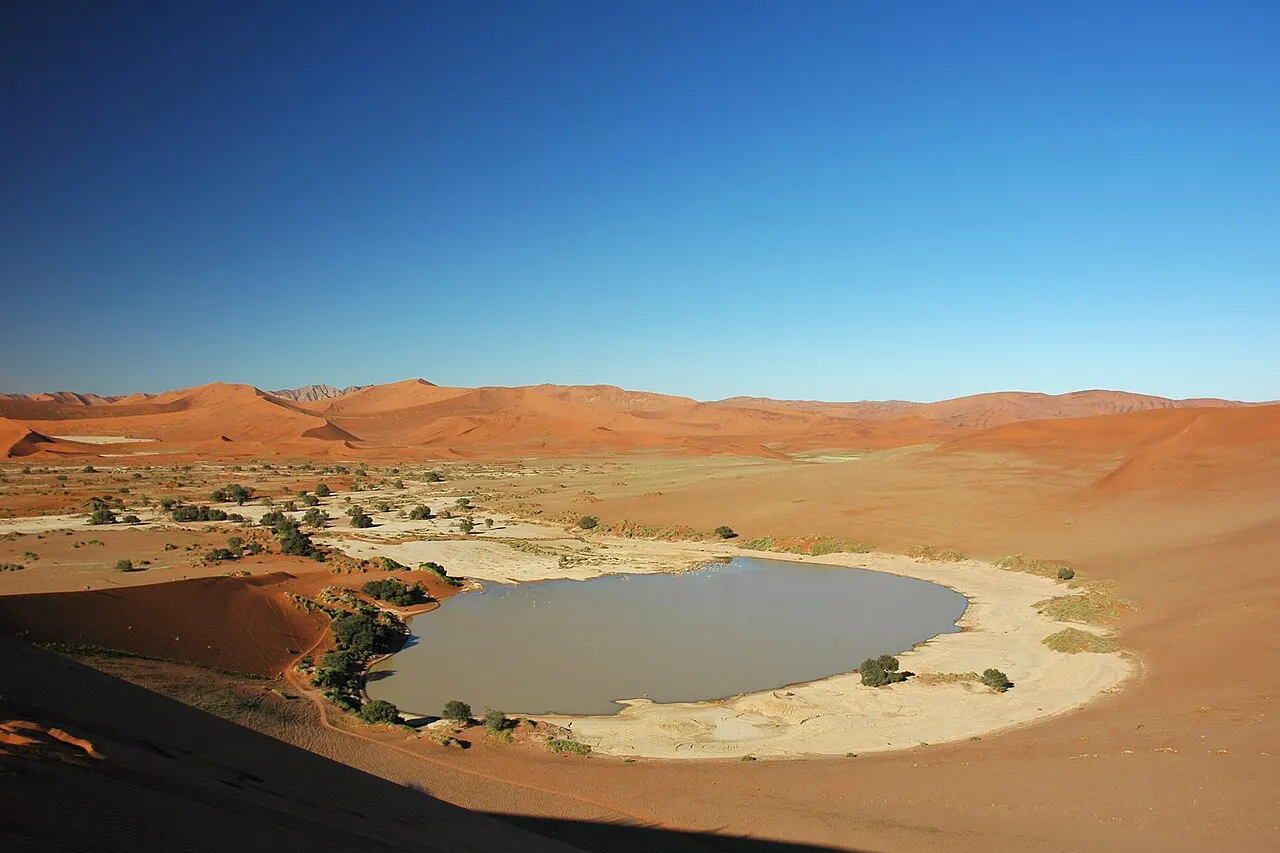
The desert can be visited year-round, and what changes is the heat and the price. From May to September, winter in the Southern Hemisphere, the days are mild and the sky clear; the nights get very cold and can freeze, so campers need a warm sleeping bag. From July to October, the Namibia Wildlife Resorts accommodations charge the highest rates of the year, and booking in advance is recommended. From October to April the desert heat can reach 40 °C or more, and a visit to the dunes comes down to early morning and late afternoon. The rainy season runs from December to April, with short downpours; in years of heavy rain in the Naukluft Mountains, the Tsauchab flows and can fill Sossusvlei, a rare event that changes the landscape for a while.
Nilo's tips
Sleep inside the gate
If the goal is Deadvlei with a low sun, book the Sesriem Campsite or the Sossus Dune Lodge, run by NWR. Lodges outside, however close they are, wait for the outer gate to open.
Buy the permit on arrival
The office is just past the Sesriem gate. Buying on the afternoon you arrive leaves the next day's departure free.
Deadvlei first, Dune 45 with shade
Go straight to the end of the road with the first light and leave Dune 45 for later. In summer, see it from the base on the way back and climb in the late afternoon, when the shade returns; that way you reach the trees ahead of the groups and do not climb sand in the heat.
Withdraw cash before heading down
Withdraw cash in Windhoek, before the escarpment: there is no ATM near the dunes, and fuel in Solitaire and Sesriem is paid in cash.
Book the balloon ahead
The balloon flight takes off from Sesriem at dawn, every day except for a short pause between Christmas and early January. It lasts about an hour and has few places: book before you arrive.
Explore the map
Explore the map, read about the other places and plan your travel days in the app.
Open the appWhat to see
Leave for last, if time allows: Hidden Vlei
Deadvlei
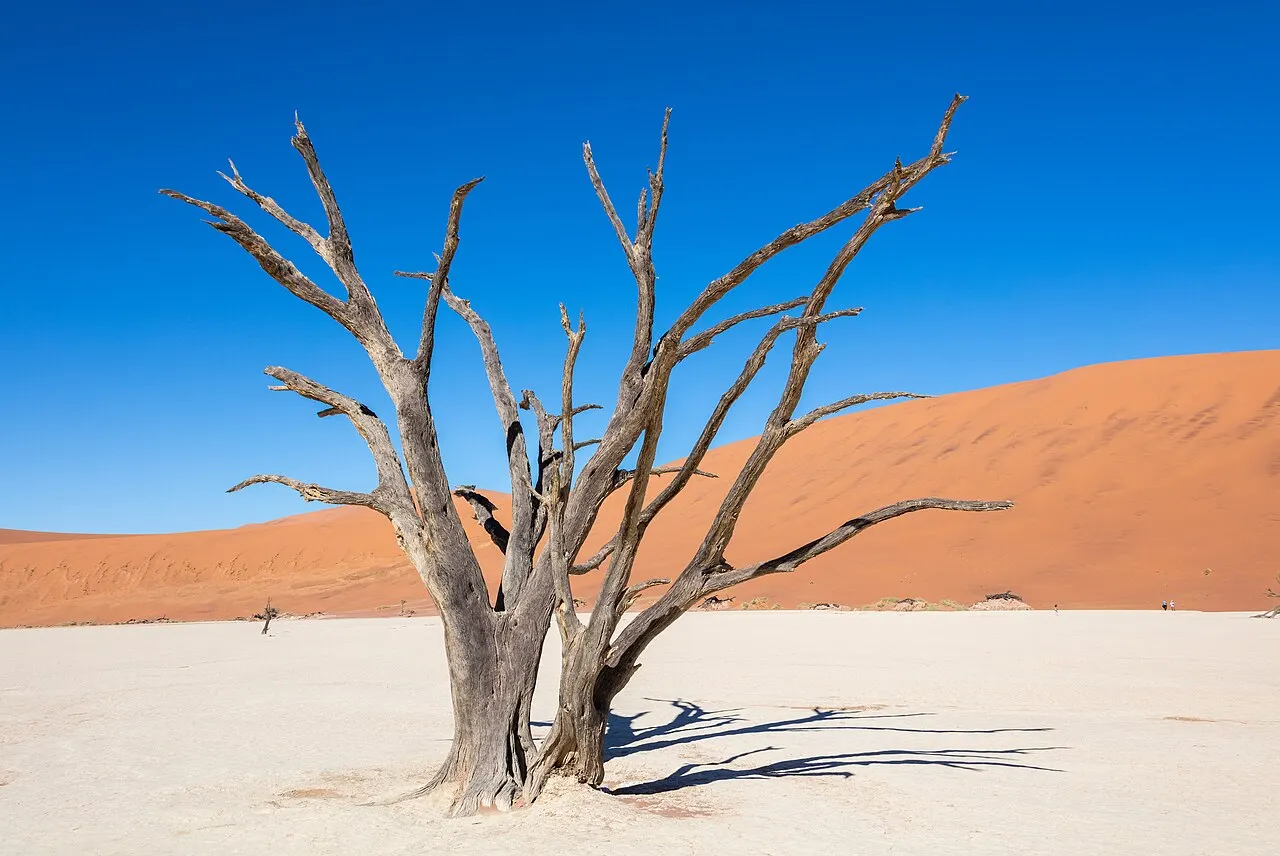
A white clay pan about 2 km from Sossusvlei, ringed by dunes among the tallest in the area. Centuries ago, the Tsauchab flooded the place and let camel thorn acacias grow; when the dunes blocked the river's path, 600 to 700 years ago, the trees died, and the trunks stand black and upright because the dry air prevents decomposition. The contrast between the pale floor, the dark trees and the orange sand is strongest with the low sun, in the first hours of the morning. You reach it from the 4x4 parking area by a short walk over loose sand, with no shade.
Check access
Sossusvlei
The pan that gives the region its name, at the end of the Tsauchab's course. In most years it is a pale crust of clay and salt, surrounded by dunes with grass, shrubs and living camel thorn acacias; after heavy rains in the mountains, rare and years apart, it fills and becomes a shallow lake for a while. It is a few minutes from Deadvlei across the same stretch of sand, and the two are visited on the same morning.
Check access
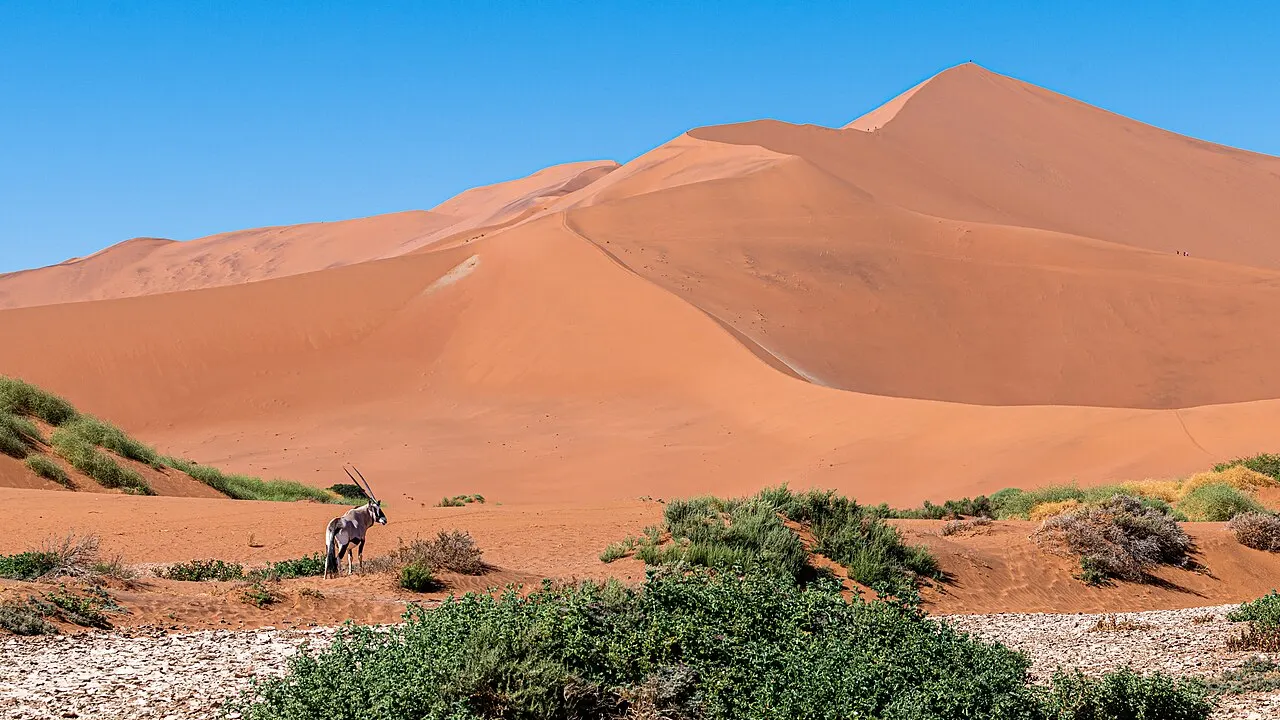
Big Daddy Dune
The tallest dune in the Sossusvlei area, at about 325 meters, facing Big Mama. The trail climbs along the ridge from the 4x4 parking area and ends above Deadvlei, with a view of the sea of dunes to the horizon. The sand gives way with every step, there is no shade and the heat builds fast after sunrise: it is a climb for those in good shape, who set out early and carry plenty of water.
Check access
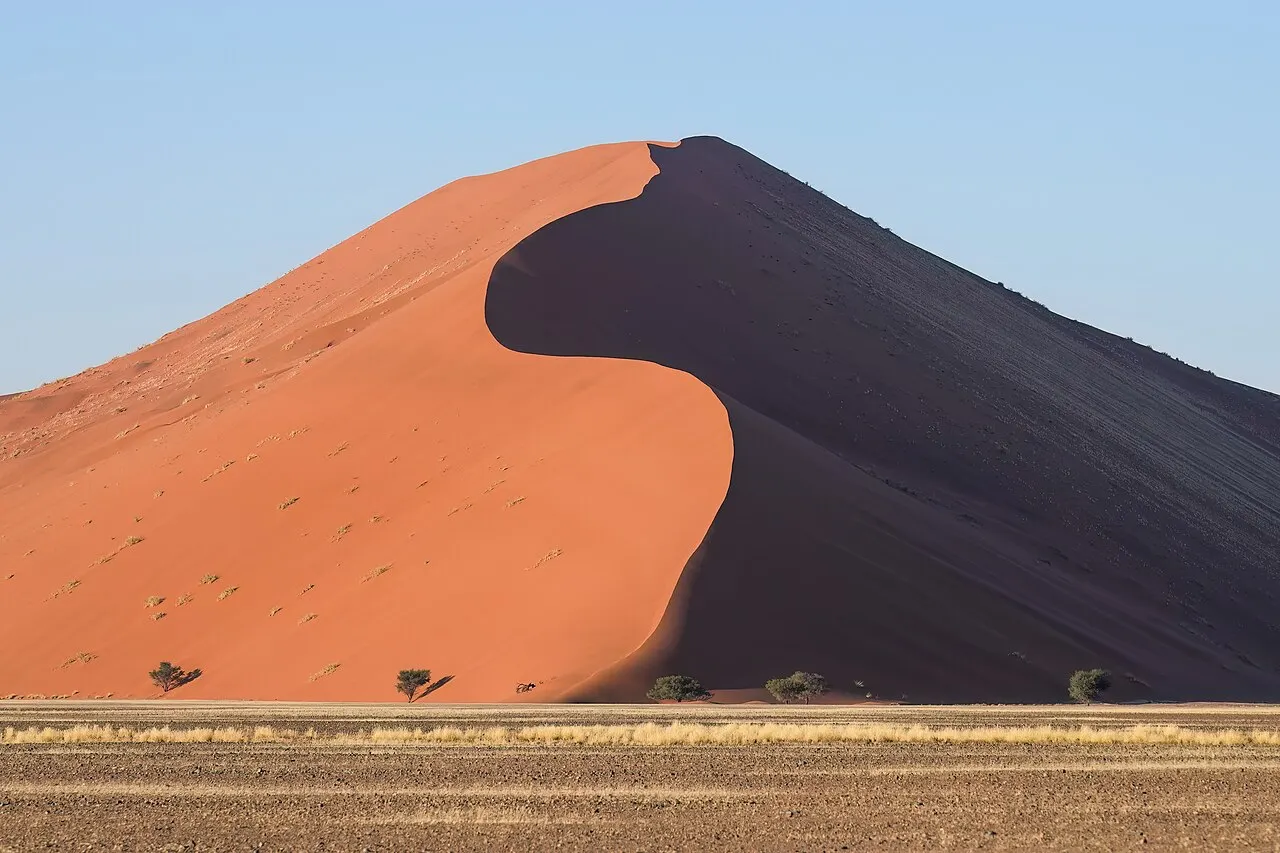
Dune 45
A star dune beside the road, at kilometer 45 past the Sesriem gate, formed of sand about 5 million years old carried by the Orange River. It stands at the roadside and is heavily photographed: the car stops right next to it, and the climb along the ridge takes about an hour. In the early morning and late afternoon, one side lies in shadow and the ridge draws a sharp line; in the heat of late morning, it is best seen from the base, and the climb is left for late afternoon or the cool days of winter.
Check access
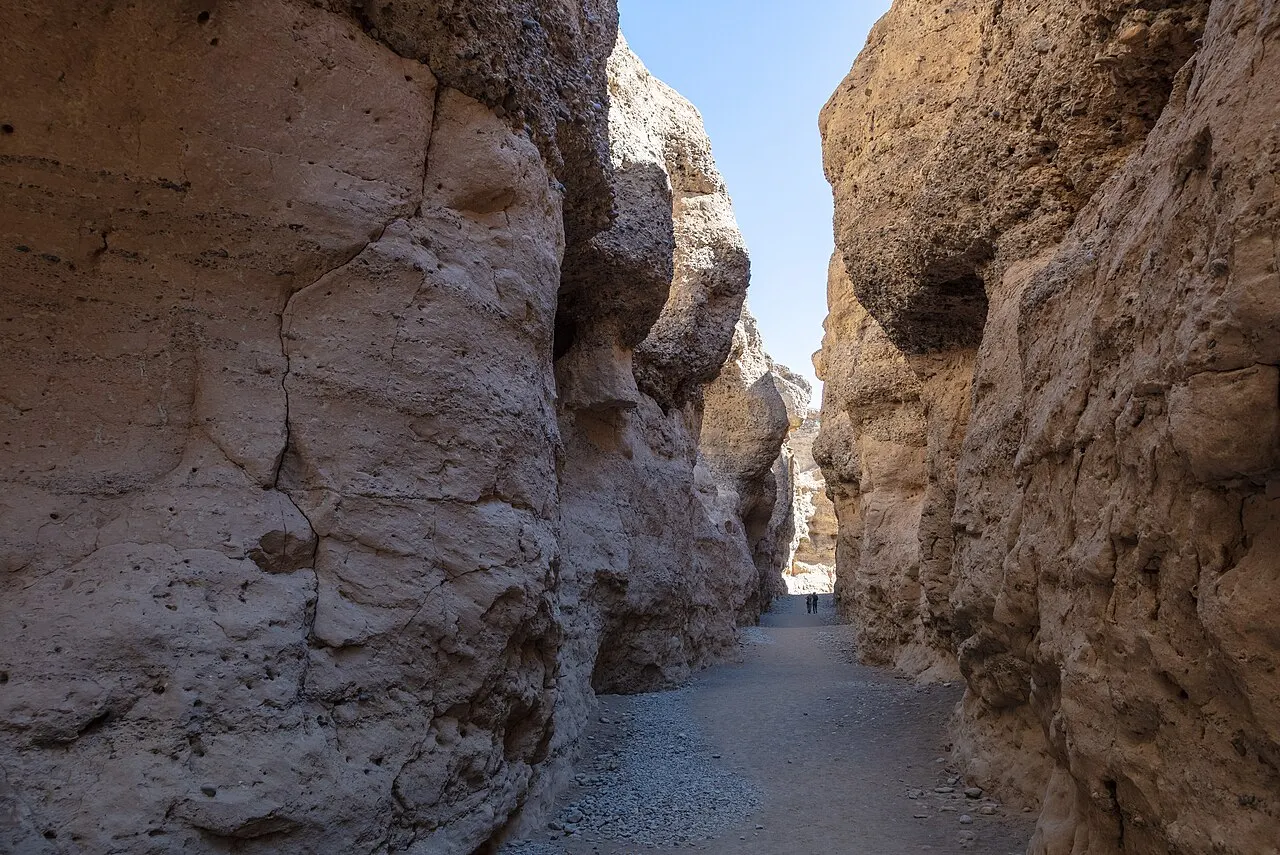
Sesriem Canyon
A gorge about 1 km long cut by the Tsauchab into sedimentary rock, 30 to 40 meters deep and only 2 meters wide in places, 4 km from the gate. You walk down to the dry bed; at the bottom, pools that refill after good rains attract animals. The name comes from the six leather straps the settlers tied together to draw water from here. Cool and shaded late in the day, it rounds out the afternoon of arrival.
Check access
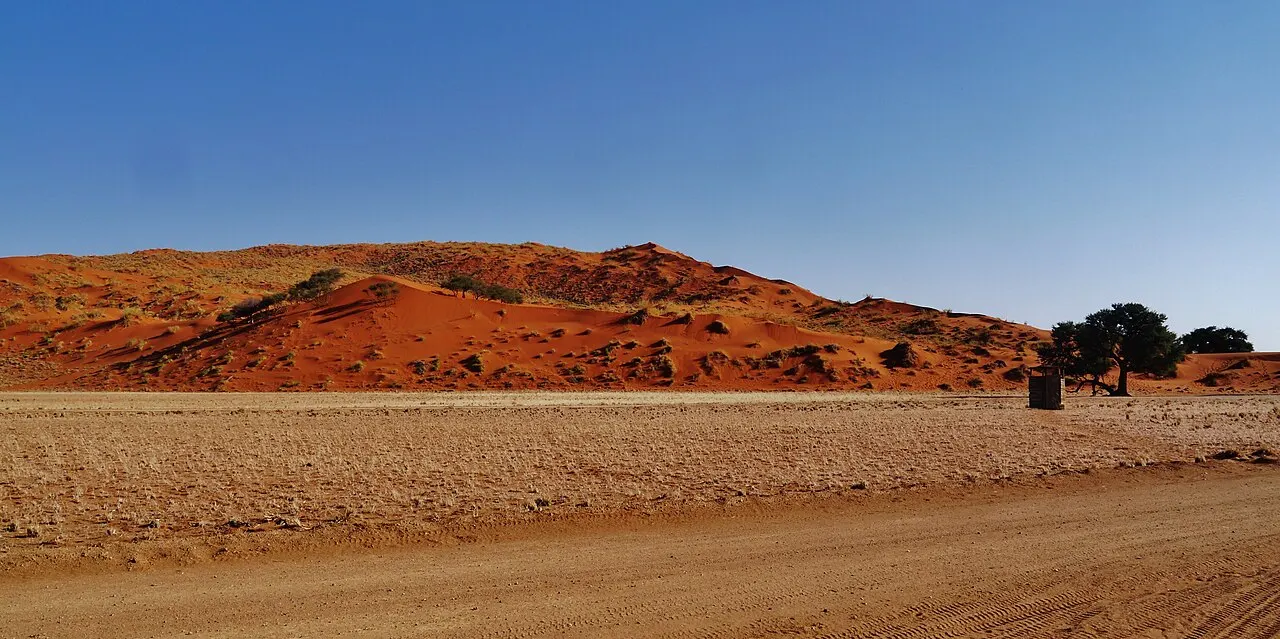
Elim Dune
A tall, relatively isolated dune 5 km from the Sesriem gate, on a spur off the main road, named after an old farm from the days before the park. Because it is so close to the gate, it is the sunset dune for those who arrive in the afternoon or want to avoid the long road late in the day; the Namibia Wildlife Resorts accommodations sell guided trips to it.
Check access
Nilo’s itinerary
Start with the basic programme and choose extensions for the time you have.
Plan my days in the app ↗Day 1 · From Windhoek to the Sesriem gate
Leave Windhoek early, with a full tank and cash for fuel: it is about 340 km, much of it gravel, and takes most of the day.
Go down the escarpment by the Remhoogte pass, the easier one, or by Spreetshoogte if the car has no trailer and you want the view from the top of the escarpment.
If your route passes through Solitaire, stop to refuel and eat at the bakery.
In Sesriem, check in inside the gate and buy the park permit at the office.
Late in the afternoon, go down into the bed of Sesriem Canyon, 4 km from the gate, or climb Elim Dune for sunset, 5 km away.
Have dinner at the campsite or the lodge and sleep early: tomorrow's departure is before the sun.
Day 2 · Deadvlei at sunrise and Dune 45 late in the afternoon
Leave from inside the gate before the sun and drive the 60 km of asphalt to the 2x4 parking area, about an hour.
Continue by 4x4, if you have experience on sand, or take the shuttle to the Deadvlei stop.
Walk to Deadvlei in the first light and stay among the trees while the sun is still low.
If you have the stamina and plenty of water, climb Big Daddy along the ridge; if not, head to the Sossusvlei pan, at the shuttle's other stop.
Return to the 2x4 parking area before the strong heat and, on the road back, stop at Dune 45 just to see it from the base; on cool winter days, the climb fits here too.
Spend the hot hours in the shade or by the pool at your accommodation.
Late in the afternoon, when the shade returns, drive the 45 km to Dune 45 and climb the ridge, or do the activity left out of day 1: Sesriem Canyon or Elim Dune.
If you stay longer
Day 3 · A second morning: balloon or Hidden Vlei
To see the dunes from above, take the balloon flight that leaves Sesriem at dawn: about an hour in the air, with breakfast after landing; book in advance.
To stay on the ground, return to the 2x4 parking area at first light and walk the 4 km across the sand to Hidden Vlei, the least visited pan.
Before noon, continue north via Solitaire, toward Swakopmund on the C14 and through Walvis Bay, or back to Windhoek.
Food
Braai
The Namibian barbecue, cooked over a wood or charcoal fire, present at family gatherings, parties and events.
Kapana
Thin strips of meat grilled on the spot over the fire and served with kapana seasoning, sauce and sides such as vetkoek and pap. It is street food from Windhoek and the towns, easier to find before or after the desert than near the dunes.
Pap and vetkoek
Pap is a firm porridge of maize or millet, served with meat and sauce, and prepared differently from one people to another. Vetkoek is a fried dough bread, eaten plain or filled.
Biltong
Air-dried cured meat, from beef or game such as ostrich and kudu, cut into strips and seasoned. It is sold at gas stations and markets and is the snack that holds up through hours on the road in the heat.
Potjiekos
A stew cooked slowly in a three-legged cast-iron pot, the potjie, over a little wood or charcoal: meat, vegetables and starch in the same pot. It began among the Boer pioneers and remains camp and gathering food.
Solitaire apple strudel
At the Solitaire stop, the bakery that Percy Cross McGregor, known as Moose, ran for more than twenty years became known for its apple strudel. It is the sweet pause for those crossing the desert between Sesriem, Windhoek and the coast.
Windhoek Lager
A lager from Namibia Breweries, a brewery founded in Windhoek in 1920 that keeps up the German brewing tradition of the colonial period. It is in the bars of campsites and lodges.
Where to eat
- Sossus Dune Lodge · Sesriem, inside the gate
The lodge has a restaurant and bar, and the daily rate is half board, with dinner and breakfast included. Those not staying there should ask NWR beforehand whether the restaurant accepts individual meals. It is the fullest meal inside the gate.
Source · 2026-10-19
- Sesriem gas station and campsite
The NWR campsite has a gas station and a shop with the basics. Those who camp and cook should bring the meat for the braai and the rest of their groceries from Windhoek, because the supply near the dunes is small.
- Solitaire
The stop's bakery is known for its apple strudel made from a German recipe; the place also has a restaurant. It works as lunch on the way between Windhoek, Sesriem and the coast.
- Swakopmund
As the trip continues, the cooking mixes the German tradition of bakeries and cafés with fish and seafood from the Atlantic. The most sought-after restaurants fill up on weekends and holidays, and it is worth booking a few days ahead.
· 2026-10-19
Day trips
Naukluft Mountains
Naukluft Camp, run by Namibia Wildlife Resorts, is about 100 km from Sossusvlei, according to NWR itself, in the mountains northeast of Sesriem that give the park part of its name. The area began as a refuge for the Hartmann's mountain zebra and has cliffs where black eagles nest, as well as natural pools in the rock. The Olive Trail, 10 km and about 4 hours, and the Waterkluft Trail, 17 km and 6 to 7 hours, start from the camp; the Waterkluft and the 4- or 8-day traverse, which requires a group of 3 to 12 people, are booked and paid for only at Naukluft itself. The camp has 21 camping sites, six chalets, a restaurant and a bar, for those who want to sleep there.
Duwisib Castle
NWR, which manages the castle, presents it as a stop for those heading from Sesriem and Sossusvlei toward southern Namibia. It is 72 km southwest of Maltahöhe: a red sandstone castle built in 1909 for the German officer Hans Heinrich von Wolf, with 22 rooms and materials brought from Germany by ox cart. The museum inside holds antiques, armor and paintings from the 18th and 19th centuries, and there are five rooms, ten camping sites and a restaurant.
Solitaire
North of Sesriem, at the junction of the C19 and the C14. A farm from 1948 that became a regular stop between the desert, Windhoek and Walvis Bay, with a gas station, tire shop, bakery, restaurant and the chapel finished in 1951. It suits arrival or departure better than a round-trip excursion.
Where to begin
Deadvlei at sunrise and Dune 45 late in the afternoon
Leave from inside the gate before the sun and drive the 60 km of asphalt to the 2x4 parking area, about an hour.
A second morning: balloon or Hidden Vlei
To see the dunes from above, take the balloon flight that leaves Sesriem at dawn: about an hour in the air, with breakfast after landing; book in advance.
Money
The currency is the Namibian dollar (N$), at parity with the South African rand, which is also accepted. Visa and Mastercard are accepted at accommodations and larger shops, but not everywhere, and gas stations do not accept credit cards. Do not count on an ATM near the dunes: withdraw cash in Windhoek or another town before heading into the desert. The park entrance fee, in effect since April 1, 2026, is N$280 per adult (16 or older) from outside the SADC, N$180 for citizens of SADC countries and N$60 for Namibians; for ages 9 to 15, N$180 for foreigners from outside the SADC, N$100 for the SADC and free for Namibians; up to age 8, free. A vehicle of up to 10 seats pays N$60. In the Namibia Wildlife Resorts rates consulted in October 2026, the Sesriem Campsite costs N$670 per person per night; the Sossus Dune Lodge, with dinner and breakfast, costs N$7,000 per person in a double room from July to October and N$4,030 from November to June. The guided trips from the same accommodations range from N$200 (a drive to the canyon) to N$750 (a guided outing to the dunes).
Getting there and around
Getting to Namibia
Hosea Kutako International Airport (WDH) is 45 km east of Windhoek. Major and independent car rental companies have counters at the airport, and most visitors continue by car, because there is no public transport to Sesriem. In Namibia, you drive on the left.
From Windhoek to Sesriem
It is about 340 km, much of it gravel, and the trip takes most of the day. On dirt roads, the tourism board recommends not exceeding 80 km/h. There are two passes down the escarpment: Remhoogte, on the Rehoboth side, is the easier; Spreetshoogte, the steepest in the country, with grades of up to 1:4.5, is closed to trucks and trailers and requires first gear on the descent. Fill up in Solitaire or Sesriem and bring cash, because gas stations do not accept credit cards for fuel.
Inside the park
The permit is bought at the office just past the Sesriem gate. The outer gate opens at sunrise and closes at sunset; guests of the Sesriem Campsite and the Sossus Dune Lodge, inside the gate, leave earlier and return later. From the gate to the 2x4 parking area is 60 km of asphalt, about an hour by car.
The last 5 km
Past the 2x4 parking area, deep sand begins. According to the ministry notice of May 2, 2026, those driving a 4x4 can continue to Deadvlei, and the concessionaire's shuttle is optional; buses and trucks cannot go beyond that point. Without experience on sand, leave the car and take the shuttle, which stops at Deadvlei and at Sossusvlei. Namibia Wildlife Resorts lists, at the Sesriem Campsite, a shuttle from the 2x4 to Deadvlei for N$180 per person; the concessionaire's price should be checked at the parking area.
Without a car
Agencies in Windhoek and Swakopmund sell tours with transport and a guide, and accommodations in the region offer trips to the dunes for their guests. Scenic flights over the dunes leave from Swakopmund and Walvis Bay, and the balloon takes off from Sesriem at dawn.
To the coast
Swakopmund, the coastal city of German colonial architecture founded in 1892, is the natural continuation of the trip, with Atlantic fog in place of the heat. You get there on the C19 to Solitaire and the C14 to Walvis Bay, from where 35 km of paved road on the B2 remain. It is gravel road for most of the way, so allow for the recommended limit of 80 km/h.
Safety
The real risks here are the heat, the road and the distance. In summer the temperature can reach 40 °C or more, and climbing a dune without water or wandering off without a reference point in the desert can become an emergency: bring water and a hat, and tell someone where you are going. On gravel roads, speed and fatigue cause accidents; keep to the recommended 80 km/h and do not drive at night, when animals cross the road. Spreetshoogte requires first gear on the descent so the brakes do not overheat. After heavy rain in the mountains, the Tsauchab can fill Sesriem Canyon within hours, so do not go down into the riverbed under a heavy sky. The Namib Desert is considered practically free of malaria. Real medical care exists only in the towns, and reaching a hospital can take most of a day: travel with insurance that covers air rescue. Emergency: 112; police: 10111.
Before you go
- Plug
- types D and M
- Voltage
- 220 V
- Driving side
- on the left
- Emergency
- General 112 · Police 10111
- Country code
- +264
- Official language
- English
- Currency
- Namibian dollar (NAD)
Source: Wikidata (CC0), checked September 2026.
Etiquette tips
Stay on the road and the trails
The desert looks empty, but it is a fragile ecosystem, with life around and beneath the dunes. Tire tracks off the road last for years, and cars stuck by inexperienced drivers are already an environmental problem on the final stretch of sand.
Use little water
Water is scarce throughout Namibia, and in the desert it comes from wells. Short showers and a closed tap are part of the stay.
Close the gates
Secondary roads in the region cross farms and have closed gates along the way. Close each one after you pass.
Mistakes to avoid
Thinking the nearest lodge opens the gate earlier
Private accommodations outside the park say they are closer to Sossusvlei, but their guests go through the same outer gate, which opens only at sunrise. To be on the dunes before the sun, you have to sleep inside the gate.
Tackling deep sand without experience
The last 5 km are loose sand. Buried rental cars are common there and cost time, a tow and damage to the desert; if you have never driven on sand, take the shuttle.
Measuring the road by the map
The roughly 340 km from Windhoek look like a morning, but the gravel calls for 80 km/h at most, and stops. Reach Sesriem with daylight to buy the permit and see the canyon.
Leaving Deadvlei for midday
From mid-morning on, tour groups tend to arrive, the dune shade shrinks and the heat climbs, to around 40 °C in summer. Set out early and be back in the shade before lunch.
Setting out without water
There is no water or shade between the parking area and the dunes. Bring more than you think you will drink, and a hat.
Useful phrases
Goeie môre
Good morning (Afrikaans)
Goeie dag
Hello, formal greeting (Afrikaans)
Dankie
Thank you (Afrikaans)
Asseblief
Please (Afrikaans)
Hoeveel kos dit?
How much does it cost? (Afrikaans)
Praat jy Engels?
Do you speak English? (Afrikaans)
Waar is die toilet?
Where is the restroom? (Afrikaans)
Totsiens
Goodbye (Afrikaans)
Where to stay
- Inside the Sesriem gate · Those who want to be at Deadvlei at sunrise and come back from the dunes after sunset, without depending on the outer gate hours.: The Sesriem Campsite and the Sossus Dune Lodge, run by Namibia Wildlife Resorts, are the accommodations inside the gate, and their guests leave before the sun and return after it sets. The campsite has 44 sites for up to 8 people, with a gas station and shop; the lodge has 25 chalets of wood, canvas and thatch, with a restaurant, bar and pool, about 4 km from the gate. The drawback is demand: in high season, from July to October, it is wise to book in advance, and the lodge costs a good deal more than the campsite. Book directly with NWR; when checked in October 2026, the website forwarded requests to the reservations email.
- Around the gate (C27, C19 and NamibRand) · Those who did not find a place inside the park, want more choice of style and price, or prefer a private dark-sky reserve.: There are private lodges and campsites along the roads leading to Sesriem, from farms with camping to luxury lodges, and the private NamibRand reserve, to the south, funded mostly by low-impact tourism, has its own accommodations. The drawback is the schedule: everyone enters through the outer gate, which opens only at sunrise, so sunrise at Deadvlei is out of reach, and the distance to the gate varies a great deal from one place to another.
$: Sesriem Campsite (NWR): N$670 per person per night, site for up to 8 people (rate checked in October 2026) · $$$: Sossus Dune Lodge (NWR), half board: N$4,030 to N$7,000 per person in a double room, depending on the season (rate checked in October 2026) · 2026-10-19
Districts
Sesriem
The park gate, with the permit office, the gas station, a small shop, the Sesriem Campsite and the Sossus Dune Lodge, both run by Namibia Wildlife Resorts. Sesriem Canyon is 4 km away, and Elim Dune 5 km. This is where you sleep to leave before the sun.
Dune road
The 60 km of asphalt between Sesriem and the 2x4 parking area, with numbered dunes on both sides. Dune 45 sits right beside the road, at the kilometer that gives it its name. There are no services along the way.
Vleis at the end of the road
The valley floor where Sossusvlei, Deadvlei and Hidden Vlei lie, surrounded by the Big Daddy and Big Mama dunes. It starts at the 2x4 parking area, where the asphalt ends, and can be reached only by 4x4, by shuttle or on foot across the sand.
Around the gate
The private lodges and campsites scattered along the C27 and C19 outside the park, as far as Solitaire to the north, and the private NamibRand reserve to the south. They offer more choice of accommodation, but their guests wait for the outer gate to open along with everyone else.
History
c. 1340–1430 · The trees of Deadvlei die
After the dunes blocked the Tsauchab River's path, the camel thorn acacias in the pan were left without water. The trees died 600 to 700 years ago, and the trunks did not decompose because the air is too dry.
1874–1881 · The thirst trekkers
Boer settlers of the Dorsland Trek cross the region. According to the tradition behind the name, they had to tie six leather straps together (ses riem, in Afrikaans) to lower a bucket down to the canyon water, and that is how the name Sesriem came about.
1904–1908 · War and genocide in the south
German colonial troops put down the Herero and Nama uprisings. The south of the country, homeland of the Nama, carries this memory, remembered today on Genocide Remembrance Day, a national holiday on May 28.
1907 · The reserve is born
The administration of German South West Africa proclaims three game reserves; Game Reserve No. 3 is the origin of today's Namib-Naukluft.
1979 · The mountains join the park
The Naukluft Mountain Zebra Park, created to protect the Hartmann's mountain zebra, is incorporated. Tourism in the park begins to take shape in the late 1970s.
1986 · Today's boundaries
Parts of the Sperrgebiet, the former prohibited diamond-mining zone, join the park, which reaches 49,768 km².
1990 · Independence
Namibia becomes independent in March 1990, after decades under South African administration.
2000s · Asphalt between the dunes
The road from Sesriem to the 2x4 parking area is paved, and the dunes come to be an hour's drive from the gate.
2013 · World Heritage
UNESCO inscribes the Namib Sand Sea, which includes Sossusvlei, on the World Heritage List.
2026 · New fees and the shuttle dispute
New park entrance fees take effect on April 1. A rule that took effect on May 1 banned private cars beyond the 2x4 parking area; a ministry notice of May 2 revoked it, and those with a 4x4 can keep driving to Deadvlei, with the shuttle optional.
Complete history
A river that ends in sand
The history of Sossusvlei is, above all, the history of a river. The Tsauchab rises in the Naukluft Mountains and runs about 150 km west, but it carries water only when it rains hard in the mountains. Over two million years, these rare floods carved Sesriem Canyon; farther on, the river spreads out and dies in a closed basin between the dunes. The name mixes two languages: vlei is Afrikaans for marsh, and sossus is a Nama word translated as no return or dead end. When the dunes shifted, they cut the river off from the neighboring pan, and the acacias of Deadvlei died of thirst some 600 to 700 years ago.
Settlers, war and reserve
The Nama lived and herded in the south of the territory long before Europeans arrived. Between 1874 and 1881, the Boers of the Dorsland Trek left Afrikaans names along the way, Sesriem among them. Germany made the region the colony of German South West Africa: it founded Swakopmund in 1892 as a port, put down the Herero and Nama uprisings between 1904 and 1908, in a genocide now remembered with a national holiday, and in 1907 proclaimed the reserve that would give rise to the park.
From reserve to destination
Under South African administration, the reserve became the Namib Desert Park in 1966, gained the Naukluft Mountains and a strip of sea in 1979, and reached its current boundaries in 1986. Tourism only began to take shape in the late 1970s. Namibia became independent in 1990; today the state-owned Namibia Wildlife Resorts runs the campsite and lodge at Sesriem, and the road to the dunes was paved in the 2000s.
The present
In 2013 the Namib Sand Sea joined the UNESCO list, and Sossusvlei became the best-known image of the country. The number of visitors brought the question that dominates 2026: who may drive the last kilometers of sand. After imposing the ban on May 1, the Ministry of Environment, Forestry and Tourism backed down the next day and kept access for private 4x4s, and the shuttle concessionaire says its contractual rights remain in force.
Geography and shape of the city
The sand sea
The Namib runs along the Atlantic coast for more than 2,000 km and has been dry for somewhere between 55 and 80 million years, which makes it a contender for the oldest desert in the world. In the Sossusvlei area, many dunes exceed 200 meters, and Big Daddy reaches about 325. The sand came mostly from the Orange River, to the south, and was pushed along by the wind; the orange color is iron oxide, and the older the dune, the redder it is.
A valley that ends
The visit is a straight line. From the Sesriem gate, a paved road runs 60 km west along the Tsauchab riverbed, with dunes on both sides; at the end, the 2x4 parking area and about 5 km of deep sand lead to the pans. Sossusvlei, Deadvlei, about 2 km from it, and Hidden Vlei sit in this valley floor, surrounded by the tallest dunes, such as Big Daddy.
A climate of extremes
It is a hot desert: the annual average is close to 24 °C, summer often reaches 40 °C and winter nights drop to around 10 °C, sometimes below freezing. Rain is rare. The fog that comes in from the Atlantic in the morning is the main source of water for much of the desert's life.
Who lives here
Oryx (the gemsbok, which appears on Namibia's coat of arms), springbok and ostriches cross the road. The Namib fog-basking beetle drinks the drops that condense on its own back, and in the grasslands appear the fairy circles, round clearings 2 to 12 meters across whose origin is still debated.
Culture
Names in three languages
The maps of the region tell history in layers. Sossus is a Nama word; vlei, Afrikaans; Deadvlei mixes the English dead with the Afrikaans vlei, and in Afrikaans the place is called Dooie Vlei. Sesriem comes from the Dorsland Trek settlers, and Naukluft is the German form of the Afrikaans noukloof, a narrow gorge. Vlei does not mean valley: it is the marsh or pan that fills with water.
A movie set
Sossusvlei is among the most photographed places in sub-Saharan Africa and has served as a backdrop for commercials, music videos and films, especially fantasy. The Cell (2000) used the dunes as a dreamscape, The Fall (2006) filmed in Deadvlei, and the wordless documentary Samsara (2011) includes shots of the desert.
Science in the desert
Inside the park is the Gobabeb research station, devoted to the desert environment. The Namib may have more endemic species than any other desert, and many depend on the fog that comes from the sea.
Dark skies
The private NamibRand reserve, which borders the park to the south, was recognized in 2012 as an International Dark Sky Reserve by the International Dark-Sky Association. The dry air, the sparse population and the lack of artificial light make the region a place for stargazing.
Life at the roadside stops
In a territory with about one inhabitant per square kilometer, roadside stops are meeting points. Solitaire began as a karakul sheep farm in 1948; the store became a gas station and post office, and the small Dutch Reformed Church chapel, finished in 1951, still brings the local community together.
Festivals and events
Independence Day
March 21, a national holiday marking the 1990 independence. On long holiday weekends, book accommodation in advance.
Easter
Good Friday and Easter Monday are national holidays; with the weekend, they make a four-day break.
Genocide Remembrance Day
May 28, a national holiday dedicated to the victims of the Herero and Nama genocide of 1904 to 1908.
Year-end
Christmas (December 25) and Family Day (December 26) are national holidays, and the Sossusvlei balloon flights take a short break between Christmas and early January.
Books and films
The Sheltering Desert, by Henno Martin
An autobiographical account of two German geologists who, in 1940, fled wartime internment and lived for two and a half years hidden in the Namib, in the Kuiseb valley, now inside the park. It shows how to survive on the desert's water and animals. It became a film in 1992.
The Fall (2006), by Tarsem Singh
A fantasy filmed in 24 countries without digital effects; Deadvlei appears as the setting for one of the story's landscapes.
Samsara (2011), by Ron Fricke
A wordless documentary shot in 70 mm in 25 countries, with shots of the Namibian desert.
Frequently asked questions
Sossusvlei: how do you get there?
Hosea Kutako International Airport (WDH) is 45 km east of Windhoek. Major and independent car rental companies have counters at the airport, and most visitors continue by car, because there is no public transport to Sesriem. In Namibia, you drive on the left. From Windhoek to Sesriem it is about 340 km, much of it gravel, and the trip takes most of the day. On dirt roads, the tourism board recommends not exceeding 80 km/h. There are two passes down the escarpment: Remhoogte, on the Rehoboth side, is the easier; Spreetshoogte, the steepest in the country, with grades of up to 1:4.5, is closed to trucks and trailers and requires first gear on the descent. Fill up in Solitaire or Sesriem and bring cash, because gas stations do not accept credit cards for fuel.
Sossusvlei: how many nights should I stay?
I would stay two nights in Sesriem, inside the gate. The first afternoon is for arriving: the roughly 340 km from Windhoek take almost the whole day, and there is light left for Sesriem Canyon or Elim Dune. The next morning is the reason for the trip, with Deadvlei at sunrise, Sossusvlei or the Big Daddy climb, and Dune 45 when the shade returns, late in the afternoon. On the second morning on the dunes, I would choose between the balloon flight and the walk to Hidden Vlei, and only then continue to Swakopmund. One night works, but it leaves a single morning on the dunes and no break from the heat before taking the road again.
Sossusvlei: when is the best time to go?
May to September; in winter the days in the desert are mild and the nights can freeze, while from October to April the heat can reach 40 °C or more and the rains, when they come, fall mostly from December to April.
Sossusvlei: is it worth sleeping inside the Sesriem gate?
If the goal is Deadvlei with a low sun, book the Sesriem Campsite or the Sossus Dune Lodge, run by NWR, the accommodations inside the gate: their guests leave before the sun and return after it sets. Private accommodations outside the park say they are closer to Sossusvlei, but their guests go through the same outer gate, which opens only at sunrise. In high season, from July to October, it is wise to book in advance, and the lodge costs a good deal more than the campsite; book directly with NWR.
Sossusvlei: can you drive all the way to Deadvlei?
Past the 2x4 parking area, deep sand begins. According to the ministry notice of May 2, 2026, those driving a 4x4 can continue to Deadvlei, and the concessionaire's shuttle is optional; buses and trucks cannot go beyond that point. Without experience on sand, leave the car and take the shuttle, which stops at Deadvlei and at Sossusvlei. Namibia Wildlife Resorts lists, at the Sesriem Campsite, a shuttle from the 2x4 to Deadvlei for N$180 per person; the concessionaire's price should be checked at the parking area.
Sossusvlei: how does the park fee work?
The park entrance fee, in effect since April 1, 2026, is N$280 per adult (16 or older) from outside the SADC, N$180 for citizens of SADC countries and N$60 for Namibians; for ages 9 to 15, N$180 for foreigners from outside the SADC, N$100 for the SADC and free for Namibians; up to age 8, free. A vehicle of up to 10 seats pays N$60. The permit office is just past the Sesriem gate, and buying on the afternoon you arrive leaves the next day's departure free.
Sossusvlei: do I need cash?
The currency is the Namibian dollar (N$), at parity with the South African rand, which is also accepted. Visa and Mastercard are accepted at accommodations and larger shops, but not everywhere, and gas stations do not accept credit cards. Do not count on an ATM near the dunes: withdraw cash in Windhoek or another town before heading into the desert.
Sossusvlei: how do you take the balloon flight?
The balloon flight takes off from Sesriem at dawn, every day except for a short pause between Christmas and early January. It lasts about an hour and has few places: book before you arrive.
Sossusvlei: is it safe?
The real risks here are the heat, the road and the distance. In summer the temperature can reach 40 °C or more, and climbing a dune without water or wandering off without a reference point in the desert can become an emergency: bring water and a hat, and tell someone where you are going. On gravel roads, speed and fatigue cause accidents; keep to the recommended 80 km/h and do not drive at night, when animals cross the road. Spreetshoogte requires first gear on the descent so the brakes do not overheat. After heavy rain in the mountains, the Tsauchab can fill Sesriem Canyon within hours, so do not go down into the riverbed under a heavy sky. The Namib Desert is considered practically free of malaria. Real medical care exists only in the towns, and reaching a hospital can take most of a day: travel with insurance that covers air rescue. Emergency: 112; police: 10111.
Sossusvlei: how do you continue to Swakopmund?
Swakopmund, the coastal city of German colonial architecture founded in 1892, is the natural continuation of the trip, with Atlantic fog in place of the heat. You get there on the C19 to Solitaire and the C14 to Walvis Bay, from where 35 km of paved road on the B2 remain. It is gravel road for most of the way, so allow for the recommended limit of 80 km/h.