China
Xi'an
Terracotta Warriors, the full city wall and the Muslim Quarter
Days I'd stay three full days in Xi'an.
How the guide reaches this number
The first is for the walled city: the towers, the Muslim Quarter, the Great Mosque, the Forest of Stelae and the bike ride around the wall at dusk. The second belongs entirely to the Terracotta Warriors and Lishan Garden, in Lintong, with the Huaqing Palace on the way back if there is energy left. The third goes south, to the Shaanxi History Museum and the two Tang pagodas. With two days, I'd keep the walled city and the warriors and leave the museum and the pagodas for another trip; less than that forces a choice between the clay army and the city. Mount Hua is an extension for a fourth day, and it is only worth it for those who can face hours of steep steps or a cable car line.
2–3
Start with the basic programme and choose extensions for the time you have.
When April, May and October; October only outside the national holiday week, October 1 to 7, and July has an average high of 32.8 °C (1991–2020 normal from the China Meteorological Administration).
How the guide reaches this number
Spring is the best season for being outdoors: April and May have average highs of 22 °C to 27 °C and less rain than the months of July to September. October cools to average highs of 19 °C and rains on about eleven days of the month, but in smaller volume than in September, the rainiest month of the year, with 117 mm on average. July and August are hot and humid, with average highs of 31 °C to 33 °C (1991–2020 normals from the China Meteorological Administration); in July 2026, a heat wave pushed highs to 37–40 °C, and the wall began recommending climbing between 8 a.m. and 10 a.m. or after 5:30 p.m. March and April can bring dust storms. Winter is cold and dry, with average highs of 5 °C to 7 °C between December and January, little snow and fewer people. National holidays weigh more than the weather: the week of October 1 to 7, Chinese New Year and the May 1 holiday pack the sites and sell out the bookings.
Per person/day Budget around CNY312; mid-range around CNY748; comfortable around CNY1,990 per person per day, based on spending reported by travelers to Budget Your Trip (checked October 2026).
How the guide reaches this number
Indicative figures, excluding travel to the destination.
Budget around CNY312; mid-range around CNY748; comfortable around CNY1,990 per person per day, based on spending reported by travelers to Budget Your Trip (checked October 2026). Indicative figures, excluding travel to the destination.
Per person per day: accommodation, meals, urban transport, visits and a small allowance for extras. Flights excluded; larger purchases vary. Editorial estimate, not a quote.
Salta · among the cheapestZermatt · among the priciest
Cheaper than 56% of them. The tick marks the median. Compared by the middle of each city’s daily range, converted at the 24 Sept 2026 exchange rate.
 What Nilo thinks
I'd recommend Xi'an to people who like archaeology, dense museums and eating with their hands on the street. The walled city shows different beliefs side by side: within the same rectangle live the Taoist temple of the City God, a Tibetan Buddhist temple founded in 1705, the mosques of the Hui community, among them the Great Mosque, which tradition dates to 742, and a Catholic cathedral. At the table, I'd start with yangrou paomo, in which each person crumbles their own bread before receiving the lamb broth, and go on to biangbiang, the wide noodle dressed with hot oil over chili, with an ice-cold Bingfeng in a glass bottle. For the Shaanxi cooking that isn't halal, I'd look for the little family places scattered around the center, which charge little. Datang Everbright City I'd see once, knowing it is a recent set and not a ruin.Xi'an keeps, in a single city, the first emperor's army, a complete city wall and the memory of the Silk Road. A rectangle of Ming wall, still running all the way around the center, encloses the streets the Tang laid out on a grid, and from the Bell Tower, in the middle of them, four avenues named for the points of the compass depart. To the east, a clay army of more than 8,000 soldiers, buried more than two thousand years ago to guard the first emperor, was found only in 1974, by farmers. To the south, two brick pagodas are a reminder that this was the Chang'an of monks and Silk Road merchants, and in the Muslim Quarter the Hui community keeps the mosque with Chinese-style courtyards and the city's best-known street food. The mountain is close, too: Mount Hua, sacred to Taoists, is a little over half an hour away by bullet train.
Quick facts
- Population
- 13,236,300 permanent residents at the end of 2025 across the whole municipality of Xi'an (11 districts and 2 counties), according to the 2025 statistical bulletin of the Xi'an Bureau of Statistics; 10,722,700 of them in urban areas.
- Founding
- The region has been a capital since the 11th century BC, with Fenghao, under the Western Zhou; the Han Chang'an dates from 202 BC, and the name Xi'an was adopted in 1369, at the start of the Ming dynasty.
- Country and region
- China, capital of Shaanxi Province, in the center of the Guanzhong Plain.
- Language
- Mandarin (putonghua). Inside the wall you still often hear the Guanzhong dialect. Outside hotels and major museums, little English is spoken.
- Currency
- Renminbi, whose unit is the yuan (CNY).
- Time zone
- Asia/Shanghai: UTC+8 all year, with no daylight saving time.
- Best time to go
- April, May and October; October only outside the national holiday week, October 1 to 7, and July has an average high of 32.8 °C (1991–2020 normal from the China Meteorological Administration).
- Average daily cost
- Budget around CNY312; mid-range around CNY748; comfortable around CNY1,990 per person per day, based on spending reported by travelers to Budget Your Trip (checked October 2026). Indicative figures, excluding travel to the destination.
When to go
April, May and October; October only outside the national holiday week, October 1 to 7, and July has an average high of 32.8 °C (1991–2020 normal from the China Meteorological Administration).
January
10 h 08 min of daylight
National holidays
Jan 1 – 3, 2027 · long weekend · New Year's Day
Jan 1, 2028 · New Year's Day
Jan 26, 2028 · Chinese New Year (Spring Festival)
Source: Nager.Date. Holiday dates shift; check close to your trip.
February
10 h 59 min of daylight
National holidays
Feb 6, 2027 · Chinese New Year (Spring Festival)
Source: Nager.Date. Holiday dates shift; check close to your trip.
March
11 h 58 min of daylight
May
Best time13 h 57 min of daylight
National holidays
May 1, 2027 · Labour Day
Source: Nager.Date. Holiday dates shift; check close to your trip.
June
14 h 26 min of daylight
National holidays
Jun 5 – 9, 2027 · long weekend · Dragon Boat Festival
Source: Nager.Date. Holiday dates shift; check close to your trip.
July
14 h 13 min of daylight
August
13 h 26 min of daylight
September
12 h 23 min of daylight
National holidays
Sep 11 – 15, 2027 · long weekend · Mid-Autumn Festival
Source: Nager.Date. Holiday dates shift; check close to your trip.
October
Best time11 h 20 min of daylight
National holidays
Oct 1 – 3, 2027 · long weekend · National Day
Source: Nager.Date. Holiday dates shift; check close to your trip.
November
10 h 23 min of daylight
December
9 h 53 min of daylight
High, shoulder and low season
High · March to November, with peaks on the May 1 and October 1 to 7 holidays
This is high season for the sites themselves: the Terracotta Warriors make the last ticket check at 5 p.m. (from March 16 to November 15), Mount Hua charges the full price and named bookings run out fast on holidays. April, May and October bring the most pleasant weather; September is the rainiest month, and July and August are hot, with visits concentrated early and at night.
Low · December to February, outside Chinese New Year
Cold and dry, with fewer people. The warriors keep the same price and close the ticket check at 4:30 p.m.; Mount Hua had a reduced ticket (100 CNY from December 2025 to February 2026), but icy trails call for care. Chinese New Year brings the Lantern Festival to the wall and fills the city again.
How the year changes
Spring is the best season for being outdoors: April and May have average highs of 22 °C to 27 °C and less rain than the months of July to September. October cools to average highs of 19 °C and rains on about eleven days of the month, but in smaller volume than in September, the rainiest month of the year, with 117 mm on average. July and August are hot and humid, with average highs of 31 °C to 33 °C (1991–2020 normals from the China Meteorological Administration); in July 2026, a heat wave pushed highs to 37–40 °C, and the wall began recommending climbing between 8 a.m. and 10 a.m. or after 5:30 p.m. March and April can bring dust storms. Winter is cold and dry, with average highs of 5 °C to 7 °C between December and January, little snow and fewer people. National holidays weigh more than the weather: the week of October 1 to 7, Chinese New Year and the May 1 holiday pack the sites and sell out the bookings.
Nilo's tips
Named bookings: original passport, always
The Terracotta Warriors sell only online and in the visitor's name, and the Shaanxi History Museum opens its free slots five days ahead, at 5 p.m., only through the official WeChat. I'd install WeChat while still at home, have both booked before arriving and carry the passport used for the booking, because a copy or a photo won't open the turnstile.
The wall in the late afternoon
I'd go up the wall after 5:30 p.m. and ride until dusk: the top has no shade, and in July's heat the administration itself recommends that hour or 8 a.m. to 10 a.m. Check the forecast before buying the ticket, because bikes aren't rented in the rain.
The right 306 leaves from outside
For the warriors, I'd take bus 306 at the east lot opposite Xi'an Railway Station and ignore anyone offering the same number on the inside of the wall. If in doubt, watch: on the official bus, the staff only confirm the destination, and locals fill the seats.
Mount Hua: take the first train
I'd buy one of the first trains in the morning to Huashan North Station and leave the return for late afternoon, because the lines for the cable cars and internal buses grow through the day and the walk between the peaks takes hours.
Explore the map
Explore the map, read about the other places and plan your travel days in the app.
Open the appWhat to see
Leave for last, if time allows: Xi'an Drum Tower · Datang Everbright City · Huaqing Palace · Daming Palace
Terracotta Army
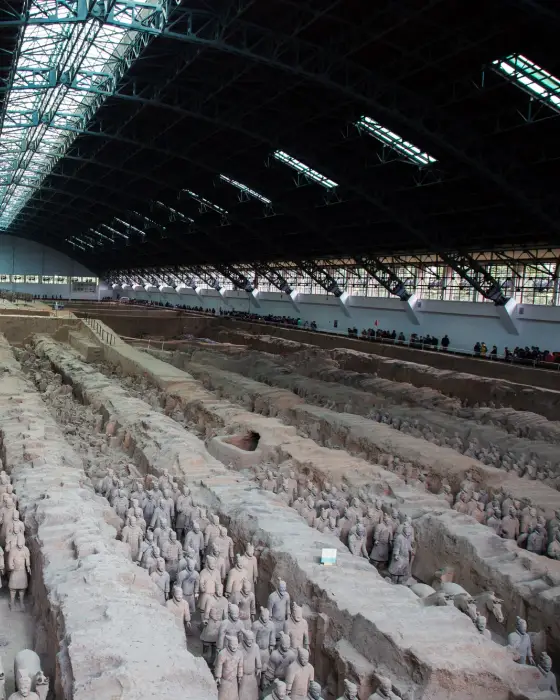
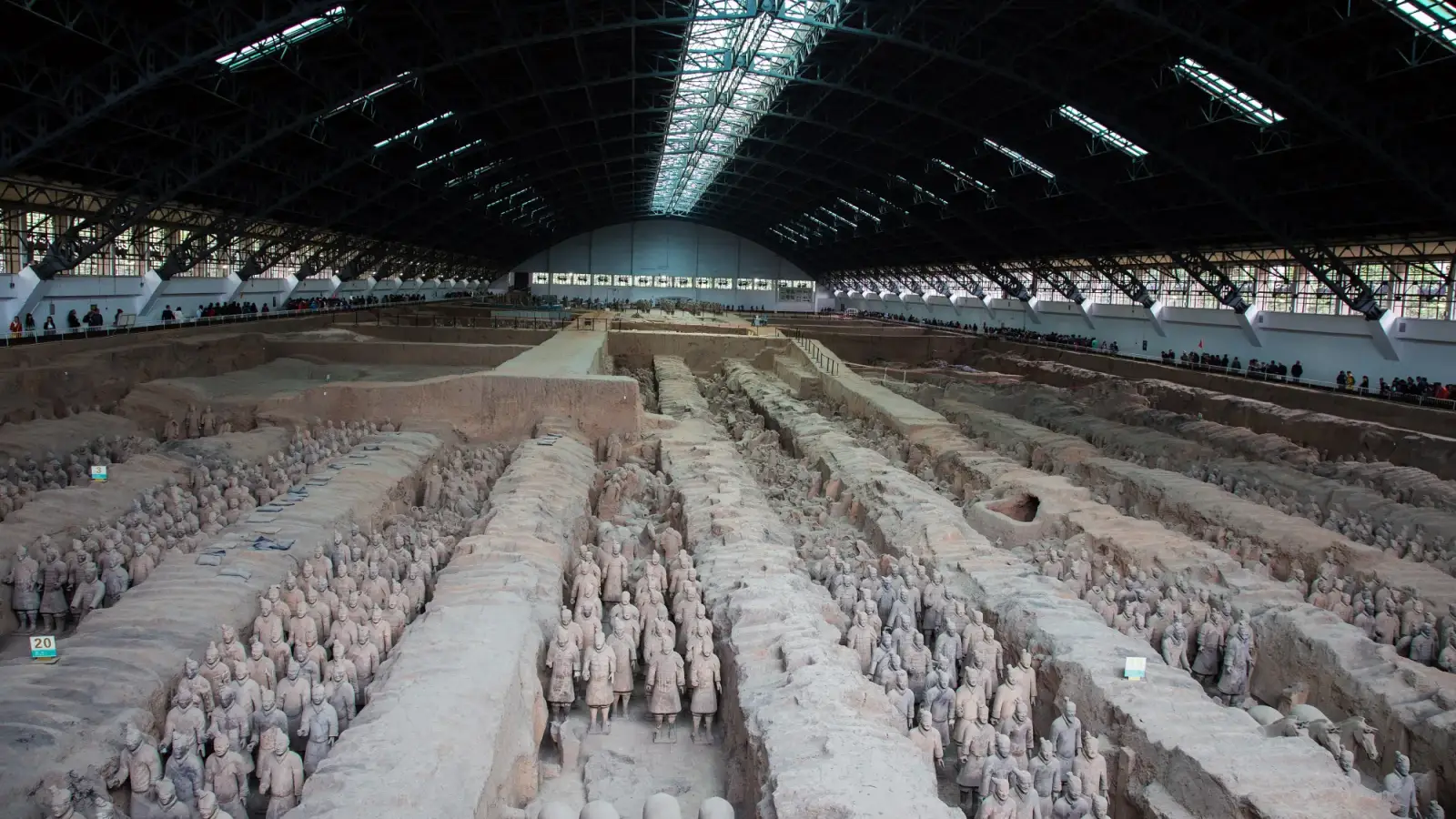
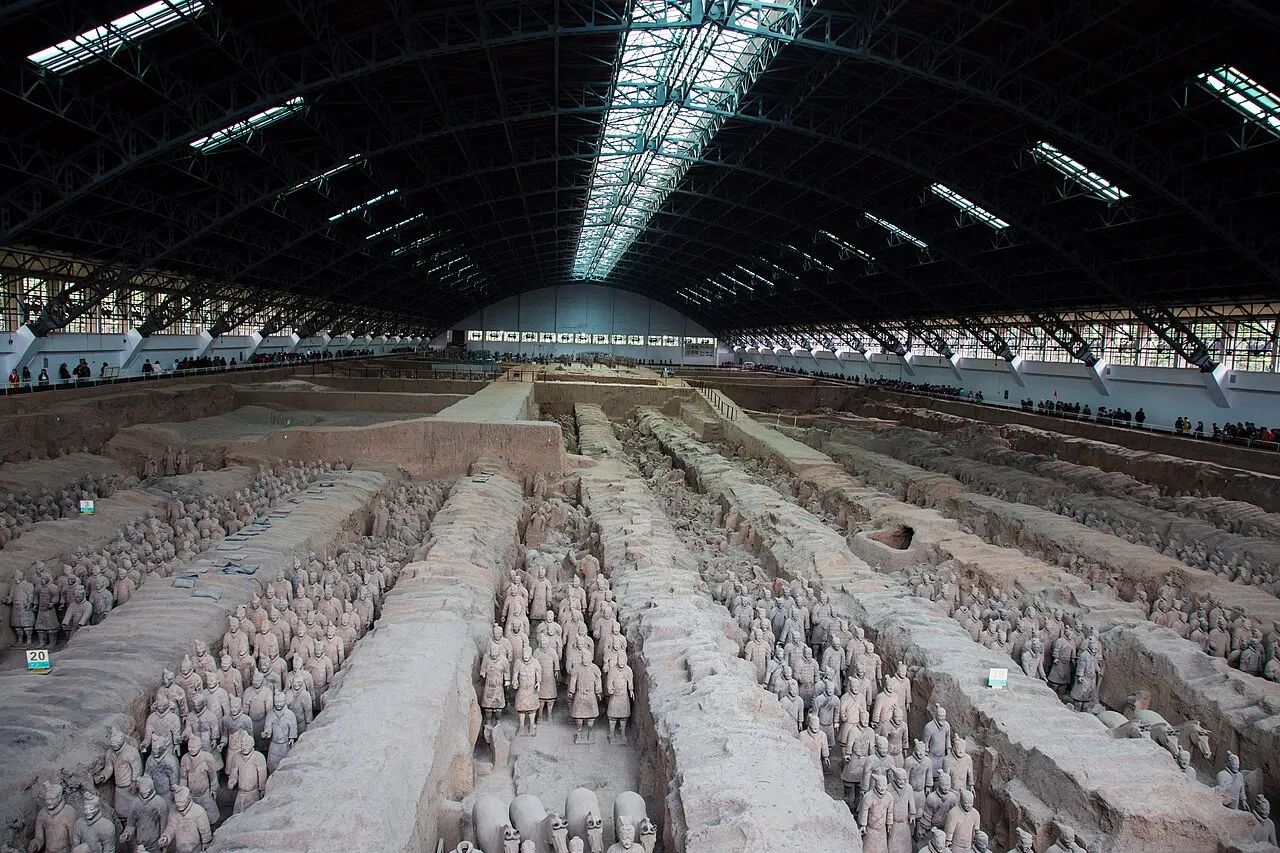
The Museum of the Mausoleum of Emperor Qin Shi Huang, in Lintong, about 40 km east of the center, covers the pits where farmers found the warriors in 1974. Pit 1, 230 m long, holds the main army in formation, with more than 3,000 life-size figures, each with a different face and uniforms and hairstyles that vary by rank; Pit 2 mixes cavalry, archers and war chariots, and Pit 3 is the command post. Since 2024, the restoration laboratory in Pit 1 has worked in view of the public. The ticket (120 CNY per adult all year, checked in October 2026) is valid on the same day for the pits and for Lishan Garden, next to the emperor's still-sealed tomb, where the bronze chariots are; a free bus connects the two areas, and each one takes about an hour and a half. Tickets are sold only online and in the visitor's name, through the website or the official WeChat accounts; bring the original document used for the booking and enter through the north gate.
Check access
Xi'an City Wall
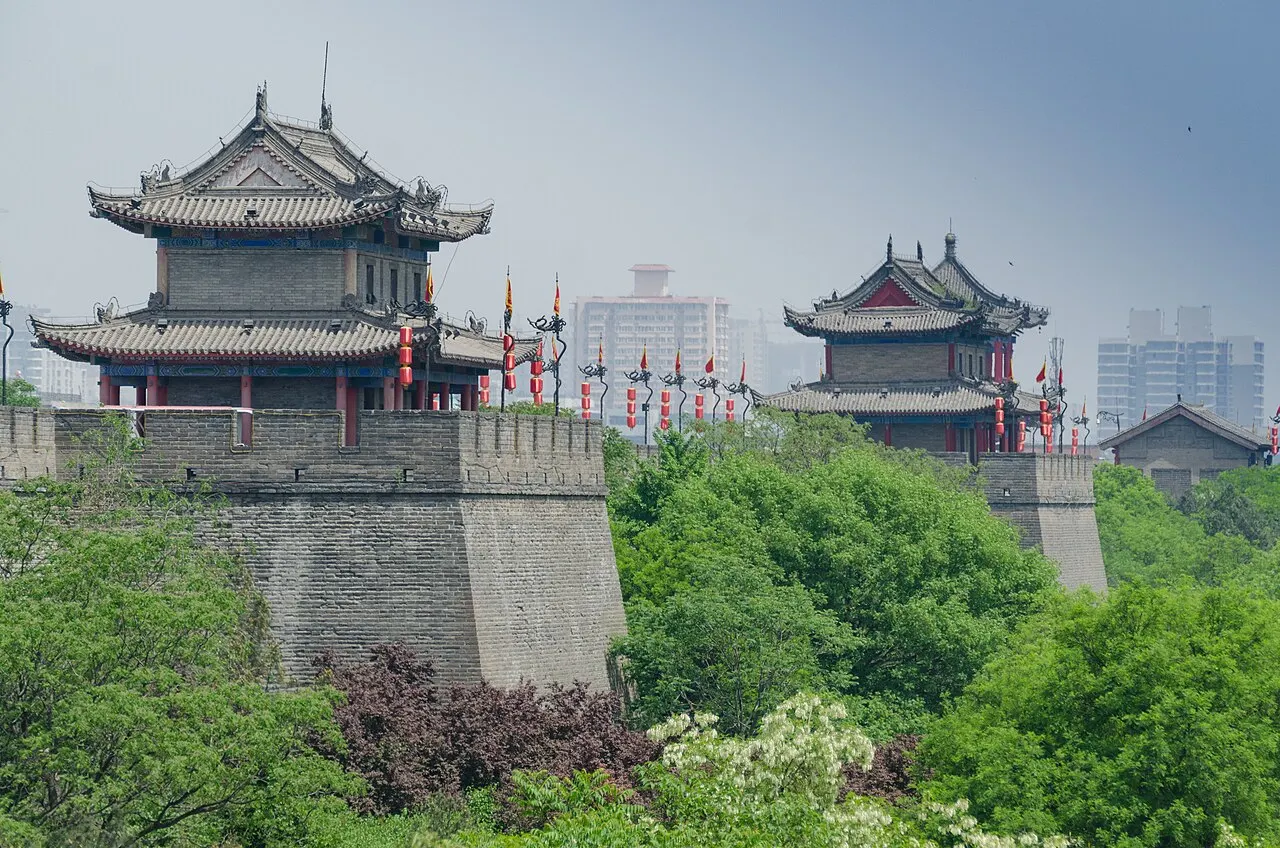
The Ming wall, begun in 1370 and reinforced with brick in 1568, encloses the center in a rectangle of 13.74 km, 12 m high, with a path 12 to 14 m wide on top and a moat around it. It is one of the most complete city walls in China, and the best way to cover it is by bike, rented at the main gates, on a loop of one to two hours. The gates have different hours: the south gate, Yongningmen, opens from 8 a.m. to 10 p.m. Admission is paid (54 CNY per adult in 2026), and the bike rental is charged separately; bikes are not rented out in the rain, because the surface gets slippery.
Check access
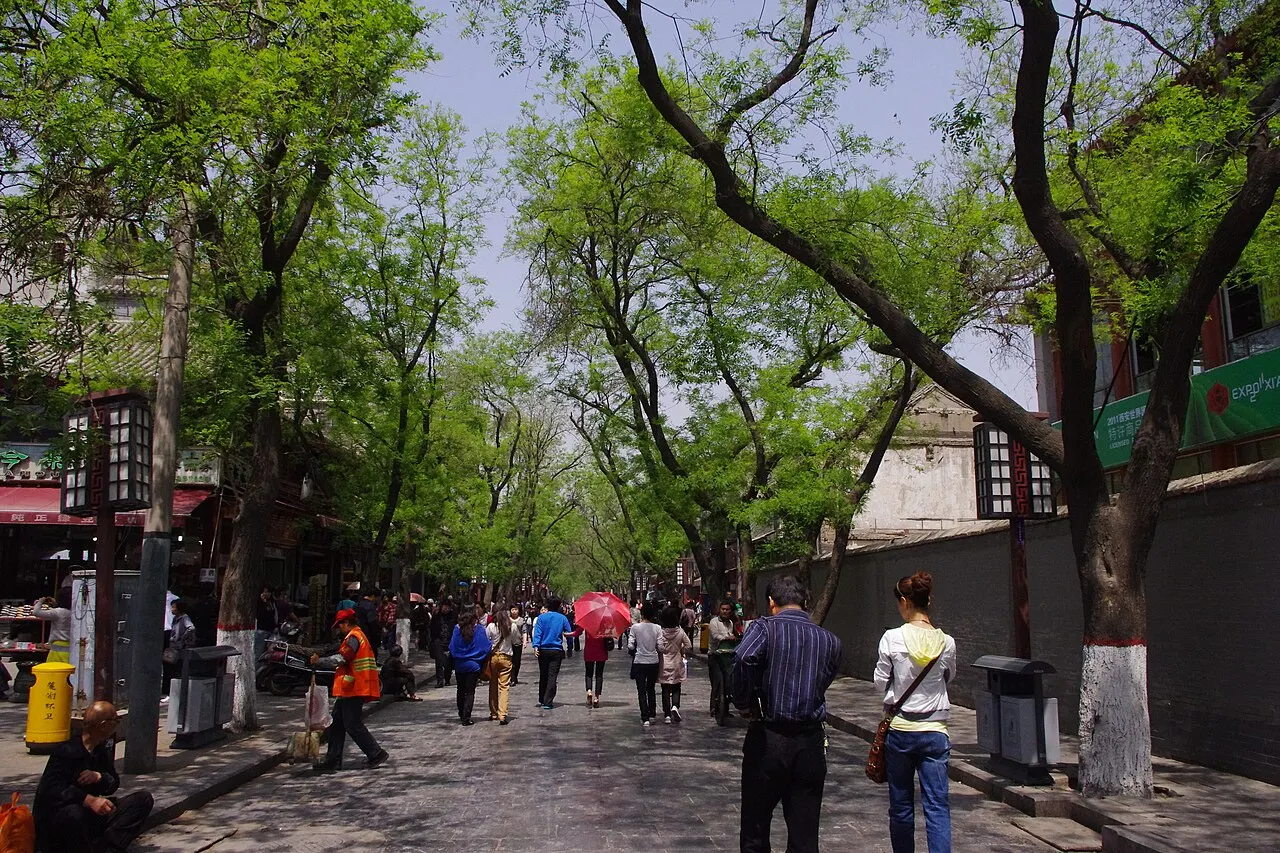
Muslim Quarter
The alleys north and west of the Drum Tower, with Beiyuanmen Street as their axis, are the Hui community's neighborhood and the most sought-after place in the city for street food: roujiamo, lamb soup with bread, fried persimmon cakes and dried fruit sold by weight. The main street is the busiest and the most expensive; the side lanes, such as Xiyang Shi, have more variety. Inside the quarter is the Gao Family Mansion, a restored Ming courtyard residence that hosts puppet theater.
Check access
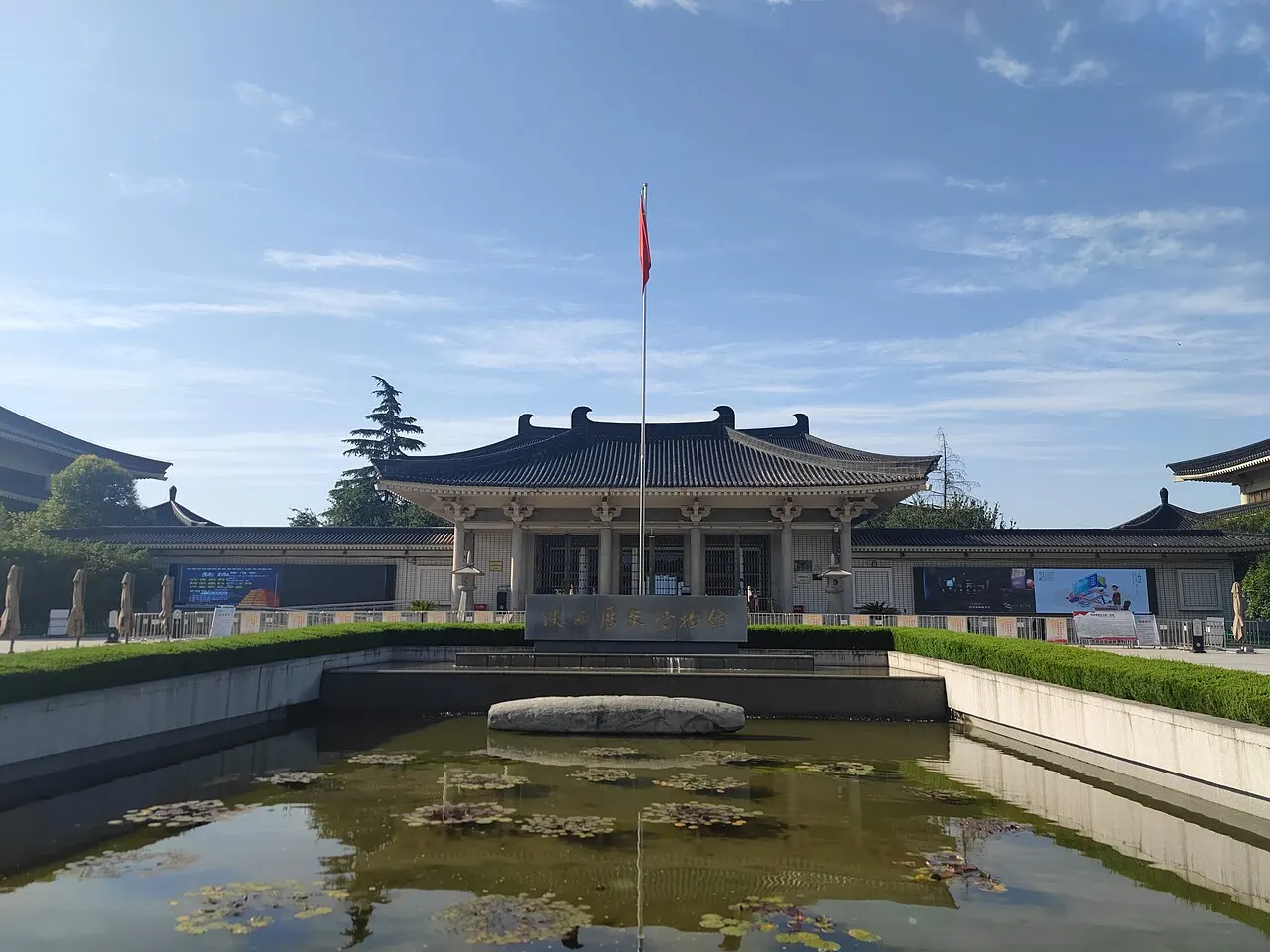
Shaanxi History Museum
In Xiaozhai, about 800 m northwest of the Big Wild Goose Pagoda, it gathers pieces from prehistory to the Qing period: pottery from the Neolithic village of Banpo, Shang bronzes and objects from the Tang court. The main exhibition is free, but only with a booking in your name through the museum's official WeChat, opened five days ahead at 5 p.m.; foreigners book with a passport. Opening hours change with the season: check the day's hours when you book. The Tang murals exhibition has a separate ticket.
Check access
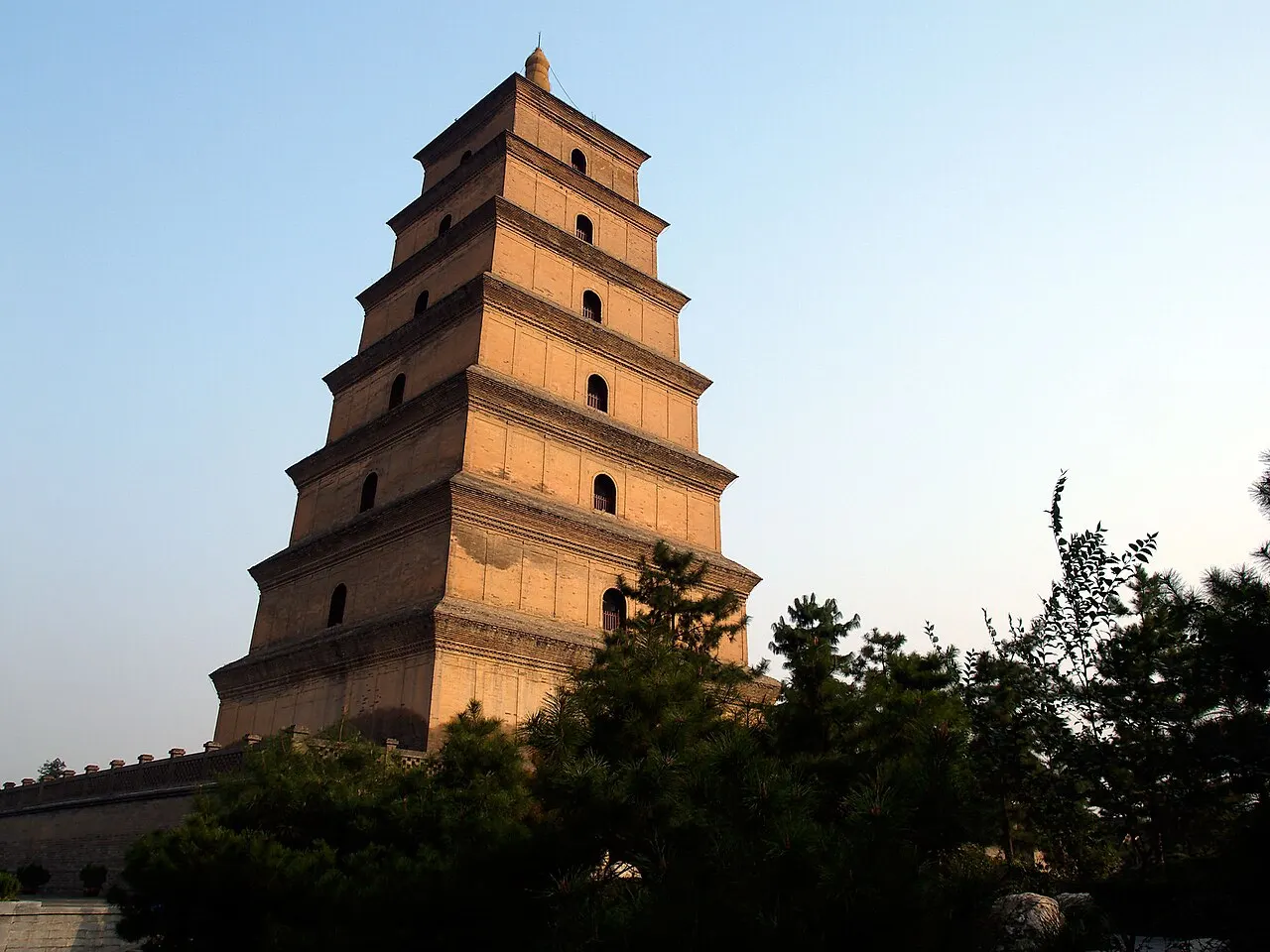
Big Wild Goose Pagoda
A seven-story brick tower inside the Da Ci'en Temple, built in 652 under the direction of the monk Xuanzang to house the scriptures he brought from India, rebuilt in the time of Empress Wu Zetian and faced with new brick in the Ming era. It is one of the Silk Road sites inscribed by UNESCO. Admission to the temple cost 30 CNY in 2026, and climbing the tower is paid separately. In the north square there is a fountain show with music; check the time on the day.
Check access
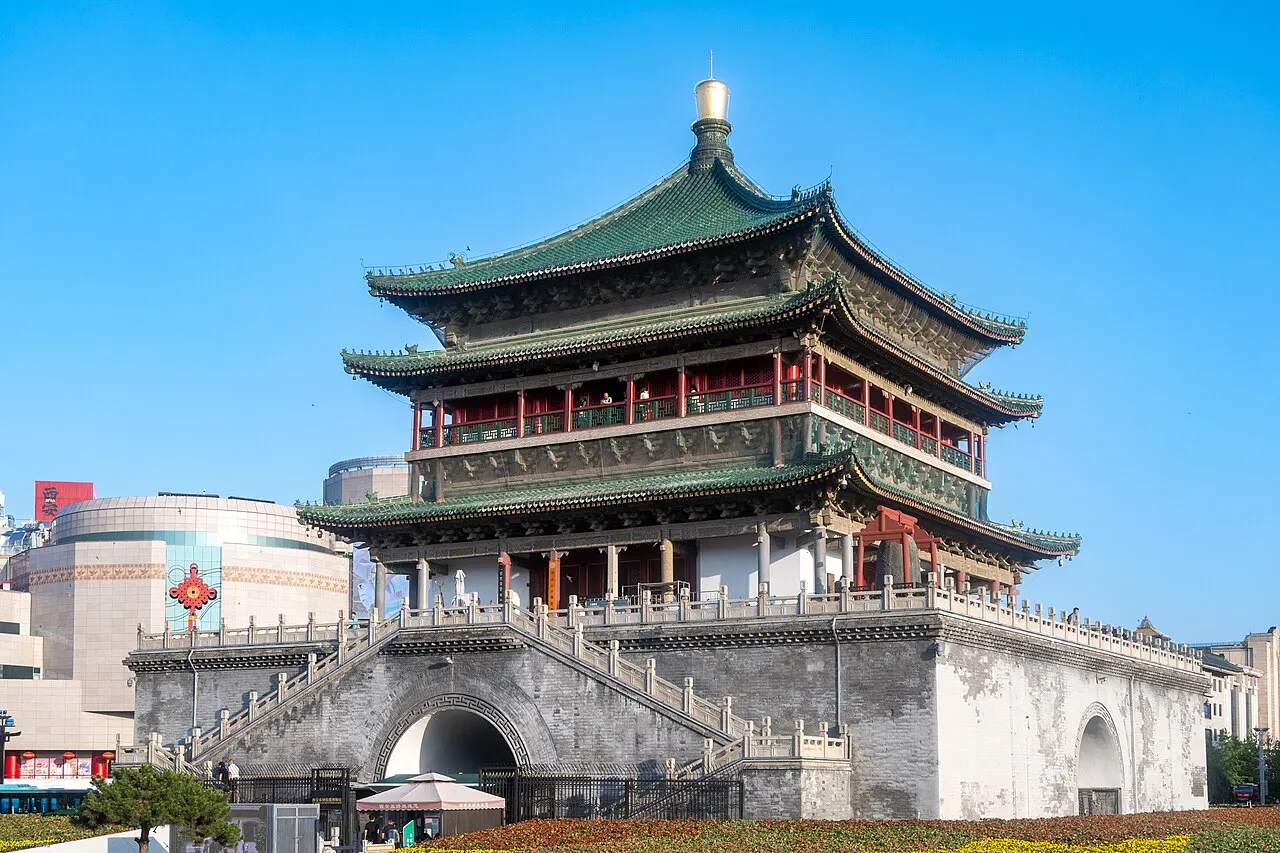
Xi'an Bell Tower
Built in 1384 and moved to the central crossing in 1582, it marks the geometric center of the walled city. It stands on a traffic island: you enter through the underpass next to Zhonglou metro station. Inside there are old bells and short musical performances throughout the day, and the view of the four avenues is the best orientation for the rest of the visit. At night, lit up, it is the postcard image of the center.
Check access
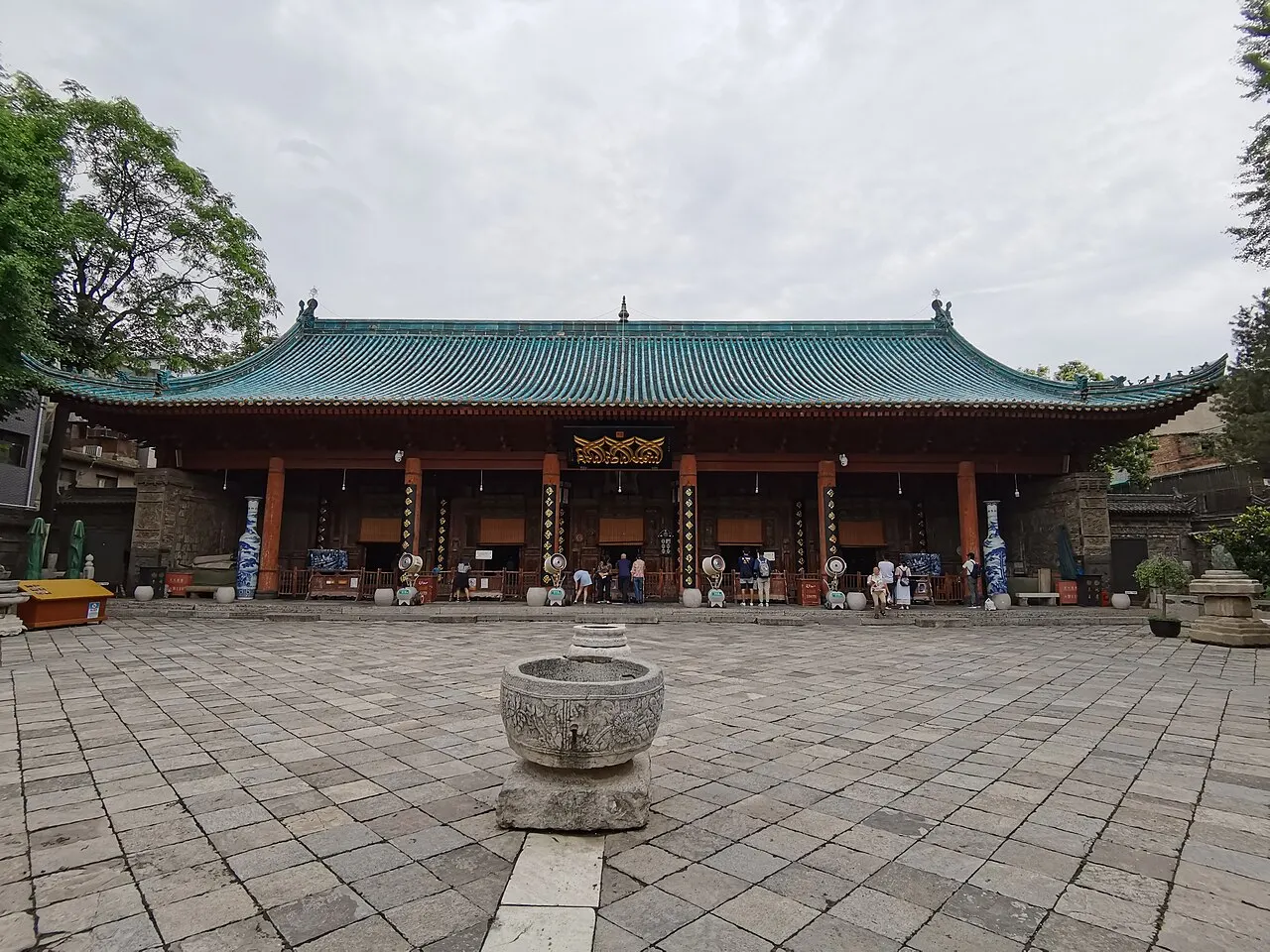
Great Mosque of Xi'an
On Huajue Xiang lane, near the Drum Tower, it is one of the largest old mosques in China. Tradition dates its founding to 742, and its present form comes from the reconstruction of 1392: instead of domes, four courtyards in sequence, with gardens and ceremonial arches, which combine Chinese architecture with the functions of a mosque. The prayer hall is reserved for Muslims; visitors walk through the courtyards in modest clothing, and non-Muslims pay admission.
Check access
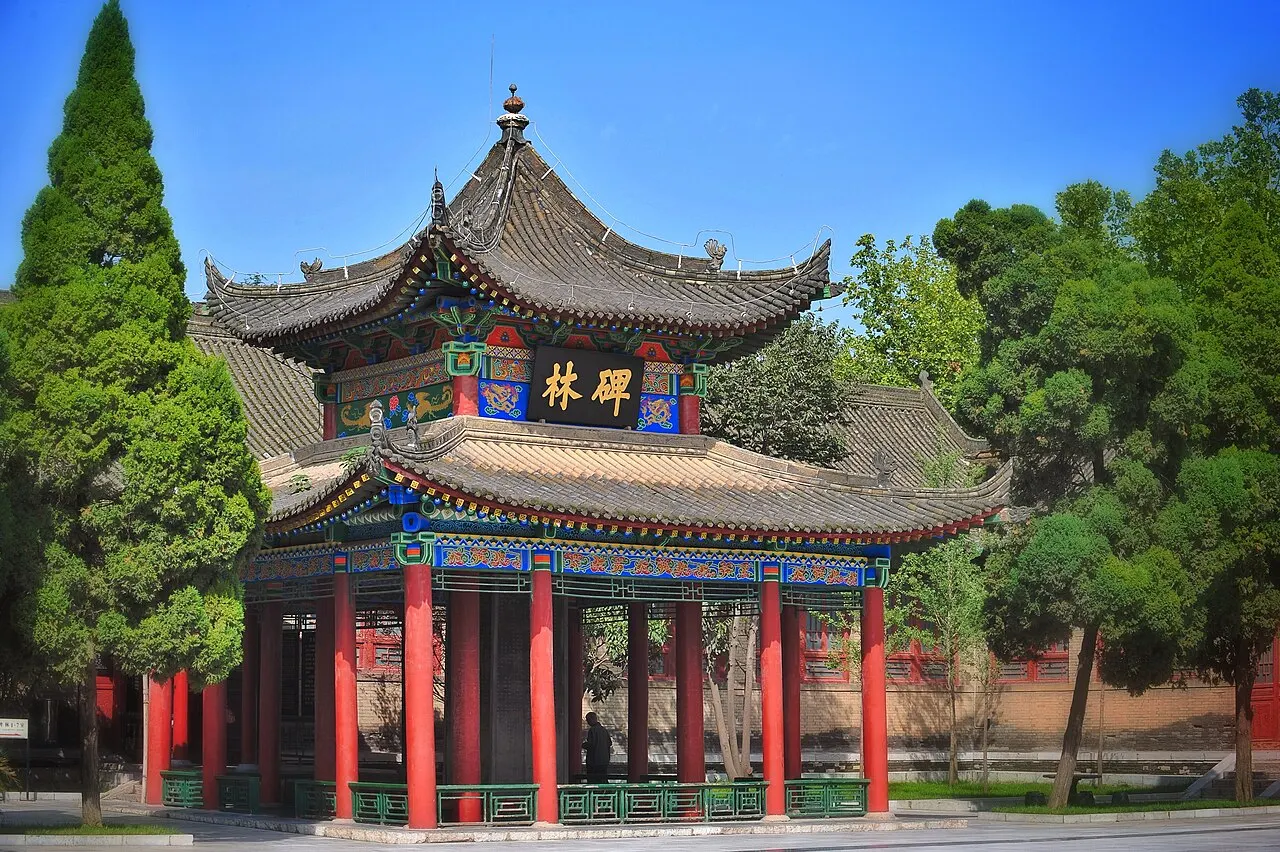
Forest of Stelae Museum
The Beilin, beside the south wall, near the Wenchang gate, holds thousands of stone stelae engraved with Confucian classics, poems and calligraphy, as well as the Nestorian Stele of 781, which records the arrival of Christianity in Tang China. For those who read Chinese or are interested in calligraphy, it is one of the great museums in the country; for everyone else, the Nestorian Stele and the scale of the collection justify an hour.
Check access
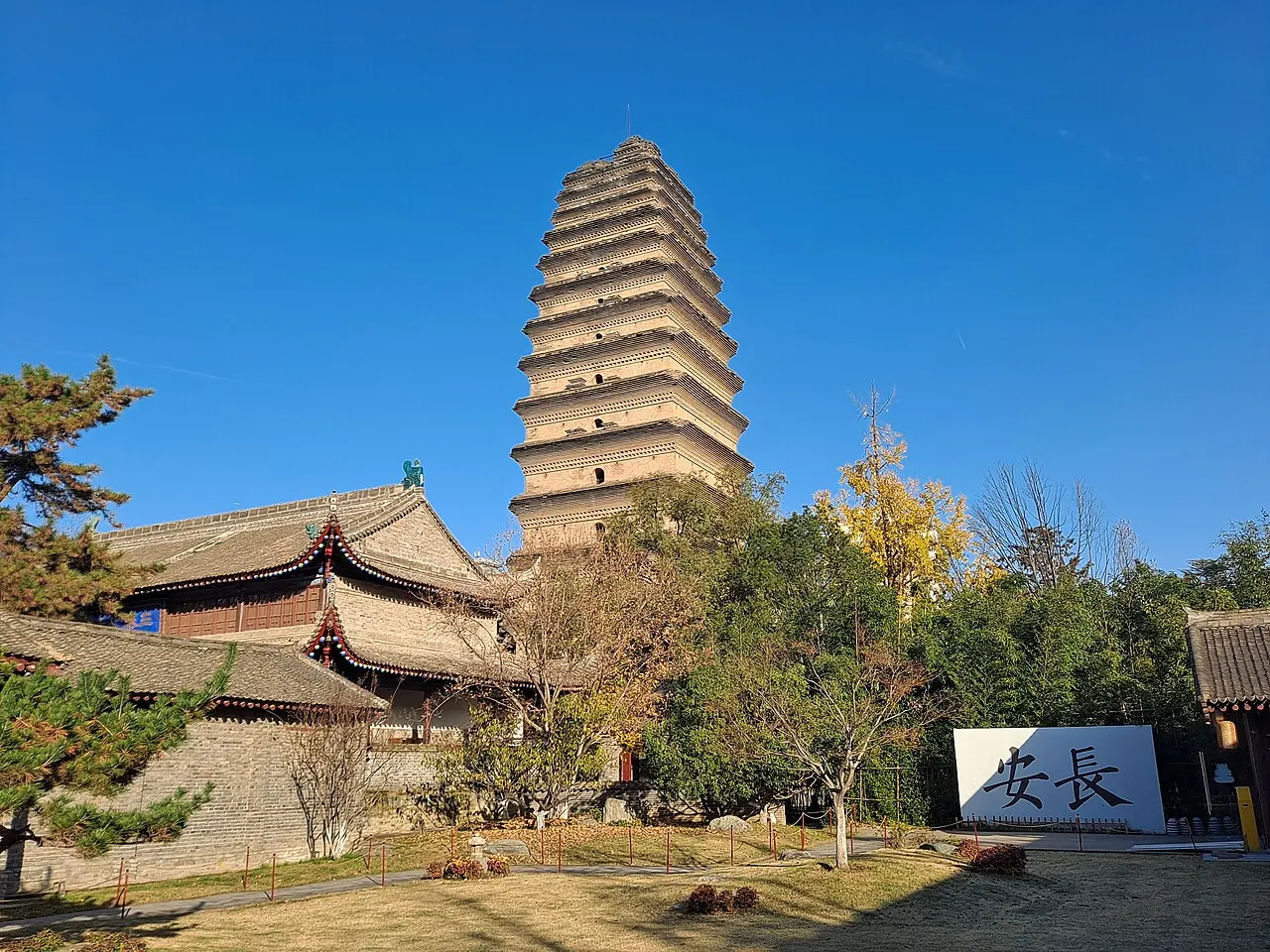
Small Wild Goose Pagoda
Begun in 707 at the Jianfu Temple to house the translations of the monk Yijing, it was 45 m tall and lost its top in the earthquake of 1556. It is part of the same Silk Road heritage and shares its park with the Xi'an Museum, which is free with a booking. The complex is closed on Tuesdays.
Check access
More places in the guide
Xi'an Drum Tower
Located 200 m west of the Bell Tower, at the entrance to the Muslim Quarter, it has a collection of drums and short performances. The ticket can be combined with the Bell Tower's at the ticket office. If you only have time to climb one of the two, the Bell Tower is the better choice; the Drum Tower is best enjoyed from outside, on the way to the quarter.
Datang Everbright City
A pedestrian street 2,100 m long that runs south from the Big Wild Goose Pagoda, with buildings and shows inspired by the Tang era, night lighting and performers in period costume. It is recent and theatrical, and on holidays it receives more than 300,000 people a day, according to the city government. It works best as a late-evening stop for anyone already at the pagoda.
Huaqing Palace
Hot springs at the foot of Mount Li, about 25 km from the center and on the way to the warriors, used by several dynasties and renovated by the Tang emperor Xuanzong, whose romance with the consort Yang Guifei inspired the poem Song of Everlasting Sorrow. Most of the buildings date from later periods, but the excavated Tang baths are on view. It was also the setting of the Xi'an Incident, in 1936. Huaqingchi station, metro line 9.
Daming Palace
An archaeological park north of Xi'an Railway Station, on the site of the palace where the Tang emperors lived for more than 220 years. What remains of the complex is platforms, a reconstructed gate and a scale model; the rest is lawn and wide plazas. It is part of the Silk Road heritage and is of interest to anyone who wants to grasp the scale of old Chang'an.
Nilo’s itinerary
Start with the basic programme and choose extensions for the time you have.
Plan my days in the app ↗Day 1 · Walled city: towers, the Muslim Quarter and a bike ride around the wall
At 9 a.m., climb the Bell Tower, entering through the underpass next to Zhonglou station, and look from there at the four avenues that organize the center.
Walk 200 m west to the Drum Tower and enter the Muslim Quarter along Beiyuanmen Street.
Visit the Great Mosque, on Huajue Xiang lane, in clothing that covers shoulders and legs.
Have lunch in the quarter: lamb soup with bread to crumble, or roujiamo and persimmon cakes in the side lanes.
In the afternoon, cross the center to the Forest of Stelae Museum, beside the south wall, near the Wenchang gate, and allow an hour to an hour and a half.
After 5:30 p.m., climb the wall at the south gate (Yongningmen), rent a bike at the top and ride the 13.74 km loop, one to two hours, catching the sunset on top.
Have dinner near the south gate, on Defu Xiang, or go back to the Muslim Quarter, which gets livelier after dark.
Day 2 · The Terracotta Warriors and Lishan Garden, in Lintong
Book ahead, on the website or on the museum's official WeChat accounts, the 9 a.m. or 9:30 a.m. slot, with the passport you will be carrying.
Around 7:30 a.m., take bus 306 (Tourism 5) at the east lot opposite Xi'an Railway Station, outside the wall; the trip takes about an hour without traffic and can take up to three hours in congestion. The metro to Huaqingchi station, on line 9, followed by a local bus or taxi, depends less on traffic.
Arrive 30 minutes before your booked slot and enter through the north gate with the original document.
Go through Pits 1, 2 and 3 and the restoration laboratory in Pit 1, in about an hour and a half.
Take the free bus to Lishan Garden, next to the emperor's tomb, to see the bronze chariots, in another hour and a half.
On the way back, get off at the Huaqing Palace if you still have energy; bus 306 and line 9 both pass it.
In the evening, back in the center, have a relaxed dinner near your hotel.
If you stay longer
Day 3 · Shaanxi History Museum and the two Tang pagodas
Five days ahead, at 5 p.m., book free entry to the Shaanxi History Museum through the official WeChat, with your passport.
At 8:30 a.m., be at the museum (Xiaozhai station, lines 2 and 3) and allow two to three hours for the main exhibition; the Tang murals exhibition, if you want to see it, has a separate ticket.
Have lunch in Xiaozhai and take line 2 north to Nanshaomen station (two stops) for the Small Wild Goose Pagoda and the Xi'an Museum, which close on Tuesdays and stop admitting visitors an hour before closing.
Go back on line 2 to Xiaozhai, change to line 3 and get off at the next station, Dayanta, for the Big Wild Goose Pagoda at the Da Ci'en Temple, in the late afternoon and before closing.
At dusk, watch the fountain in the north square if there is a show and, if you have energy left, walk down the illuminated Datang Everbright City.
Food
Roujiamo
Baked flatbread split open and stuffed with slow-cooked minced meat. In the Muslim Quarter it is beef or lamb; outside it, pork is also found. It is a morning snack and a street snack, eaten standing up.
Yangrou paomo
Lamb soup served with a firm bread that the diner crumbles by hand into very small pieces before the broth is poured over. It comes with pickled garlic and chili. Some restaurants serve the bread already crumbled, and there is a beef version.
Biangbiang mian
Hand-pulled noodles as wide as a belt, dressed with hot oil poured over chili and served with a topping of meat, tomato or egg. The character for biang is famous for having dozens of strokes.
Liangpi
Cold strips of wheat or rice dough seasoned with soy sauce, chili oil and vinegar, with cucumber, bean sprouts and cilantro. It is the light lunch of summer.
Guantang baozi
Steamed buns with broth inside, served in bamboo baskets, common in Hui restaurants.
Shizi bing
A fried persimmon cake filled with a sweet paste such as black sesame, sold at stalls in the Muslim Quarter.
Bingfeng
An orange soda from the province, served in a glass bottle at traditional restaurants, especially the noodle houses inside the wall.
Where to eat
- Muslim Quarter (Beiyuanmen and side lanes)
The place for the city's Hui cooking: beef or lamb roujiamo, lamb soup with bread to crumble, guantang baozi, fried persimmon cake and dried fruit sold by weight. The main street holds the crowd and the highest prices; the side lanes, such as Xiyang Shi, have more choice and lines of locals, who tend to point to the busiest stalls.
- Inside the wall, outside the Muslim Quarter
Small noodle and dumpling shops, many of them family-run, serve biangbiang mian, liangpi and jiaozi at low prices; on Fen Xiang lane, inside the wall, is one of the oldest biangbiang houses in the city. This is where the Shaanxi cooking that is not halal appears, and where you order the Bingfeng soda.
- Yongxingfang, by the Zhongshan gate
A complex of courtyards north of the Zhongshan gate, on the east wall, that brings together snacks from many cities in Shaanxi in one place and keeps the custom of drinking rice wine from a small bowl and then smashing it. It works well for tasting a lot in one evening.
- Qujiang and Dayanta
Mall restaurants and houses with a Tang menu around the pagoda and Datang Everbright City, as well as kitchens from other parts of China and the world. It is the practical choice for dinner after the pagoda, with more comfort and less street food.
· 2026-10-19
Day trips
Mount Hua (Huashan)
The sacred Taoist mountain, about 120 km to the east, has five main peaks, the highest of them the South, at 2,154.9 m. By high-speed train, leave early from Xi'an North Station for Huashan North Station (about 35 minutes) and continue by bus or taxi to the Visitor Center, where the internal buses to the two cable cars depart. A common combination is to go up by the West Peak cable car, walk across the South, Central and East peaks and come down by the North Peak cable car; climbing on foot from the base takes four to six hours. Cable cars, internal buses and the optional plank walk are paid separately. In the 2025–2026 low season, entry through the Visitor Center ran from 8 a.m. to 4 p.m. and the cable cars from 8 a.m. to 6 p.m.; check rules, booking and hours on the park's official channel before buying the train ticket. The trails have steep steps and exposed stretches and are not recommended for anyone with vertigo or knee problems.
Where to begin
Walled city: towers, the Muslim Quarter and a bike ride around the wall
At 9 a.m., climb the Bell Tower, entering through the underpass next to Zhonglou station, and look from there at the four avenues that organize the center.
The Terracotta Warriors and Lishan Garden, in Lintong
Book ahead, on the website or on the museum's official WeChat accounts, the 9 a.m. or 9:30 a.m. slot, with the passport you will be carrying.
Shaanxi History Museum and the two Tang pagodas
Five days ahead, at 5 p.m., book free entry to the Shaanxi History Museum through the official WeChat, with your passport.
Money
The currency is the yuan (CNY), and the city pays for almost everything by QR code. The People's Bank of China's 2024 payment guide for foreigners explains how to link an international card to Alipay or WeChat Pay; also carry some cash for stalls and buses, and a Visa, Mastercard or UnionPay card for hotels. Prices checked in October 2026: the Terracotta Warriors ticket costs 120 CNY per adult, the same in high and low season; the reduced fare applies only to full-time students of Chinese institutions, up to undergraduate level, with an ID card, and foreign children up to 1.4 m tall accompanied by their parents enter free if they are included in the advance booking. The main exhibition of the Shaanxi History Museum is free with a booking, and the Tang murals exhibition is paid separately; the Da Ci'en Temple charges 30 CNY, and the climb up the pagoda is charged separately. On Mount Hua, the ticket was 100 CNY in the low season, from December 2025 to February 2026, and returns to the full price from March to November; cable cars and internal buses are charged separately. Many active temples also charge admission, like parks.
Getting there and around
China's entry rules depend on nationality and the type of trip, and they change often. China grants unilateral visa-free entry for up to 30 days to citizens of a list of countries, with a validity period set and renewed by the government for fixed terms. There is also visa-free transit of up to 240 hours (10 days) for ordinary passports from 57 countries, with a confirmed onward ticket to a third country or region; Shaanxi is among the provinces covered by the policy, and the stay is valid throughout the province. Before buying your ticket, check the list of countries, the accepted ports of entry and the rule that applies to your passport with China's National Immigration Administration (NIA, en.nia.gov.cn) or a Chinese consulate.
Xi'an Xianyang International Airport (XIY) is about 40 km northwest of the center, already in the neighboring city of Xianyang. Metro line 14 connects the terminal to Xi'an North Station, where you change to lines 2 and 4; line 2 runs south to the Bell Tower (Zhonglou station). Airport buses go to the center and to Xi'an Railway Station in about an hour. For a taxi, use the official queue: illegal taxis and touts who say the last bus has already left are a known problem at arrivals.
High-speed trains leave from Xi'an North Station, about 15 km north of the center, served by metro lines 2, 4 and 14; line 2 continues south to the Bell Tower, and line 14 goes west to the airport. Beijing is about 4.5 hours away by train, and Mount Hua about 35 minutes. The passport works as a ticket and is read at the gate. Xi'an Railway Station, just outside the north wall, serves conventional trains and is the departure point for the buses to the warriors.
The metro is the simplest way to get around: line 2 cuts through the city from north to south via the Bell Tower, Xiaozhai (Shaanxi History Museum) and Nanshaomen (Small Wild Goose Pagoda); line 3 serves the Big Wild Goose Pagoda (Dayanta station); line 9 goes to Lintong. Bags go through X-ray at every entrance. You pay by QR code on Alipay or WeChat Pay, or with a ticket from the machine.
There are two ways to reach the Terracotta Warriors. Bus 306, also marked as Tourism 5, leaves from the east lot opposite Xi'an Railway Station and ends at the museum parking lot; it costs 7 CNY, paid on board, and takes about an hour without traffic, up to three hours in congestion. It also stops at the Huaqing Palace. Avoid vehicles advertised as 306 by touts on the inside of the wall, which include stops at shops. The other option is the metro to Huaqingchi station, on line 9, and then a local bus or a taxi.
Inside the wall almost everything can be done on foot, with underpasses at the big crossings. Legitimate taxis have plates starting with 陕AT, 陕AU or 陕AD; insist on the meter and note the plate number if there is a problem (complaints at 12328). Ride-hailing apps and shared bikes work through Alipay or WeChat.
Safety
Xi'an has a low rate of violent crime, and the practical risks are others. Pickpockets work on crowded buses, in the Muslim Quarter and on holidays. Illegal taxis and touts operate at the airport and at Xi'an Railway Station: use the official queue or an app, check the plate (陕AT, 陕AU or 陕AD on legitimate taxis) and, if you end up in an irregular taxi, don't argue, note the plate and call 12328. Stay away from tours that promise a low price and include stops at shops. In summer, heat is the real risk: the wall and the warriors' pits have long stretches in the sun, and the city government recommends visiting early or in the late afternoon. On Mount Hua, the trails have steep steps and exposed passages; stay on the path and avoid climbing in rain or ice. Emergencies: 110 (police), 120 (ambulance) and 119 (fire).
Before you go
- Plug
- types A, C and I
- Voltage
- 220 V
- Driving side
- on the right
- Emergency
- Fire 119 · Police 110 · Ambulance 120
- Country code
- +86
- Official language
- Putonghua
- Currency
- renminbi (CNY)
Source: Wikidata (CC0), checked September 2026.
Etiquette tips
At the Great Mosque, modest clothing and courtyards only
The mosque is an active place of worship for the Hui community. Visitors cover shoulders and legs; women do not need to cover their hair. The prayer hall is reserved for Muslims.
Crumbling the paomo bread is the diner's job
With the lamb soup and bread, the diner receives the whole bread and tears it into small pieces, about the size of a fingernail, before the broth goes into the bowl. Pieces that are too big are the classic mistake of someone ordering for the first time.
The document is the ticket
At attractions with named bookings, the staff compare your face, name and original document. Bringing a photo or a copy of your passport is not enough.
Mistakes to avoid
Arriving at the Terracotta Warriors without a booking made through the official channel or with the wrong passport. Tickets are sold only online and in the visitor's name, and the original document used for the booking is checked at the entrance.
Boarding the bus to the warriors that touts advertise inside the wall, in front of the station. The official 306 leaves from the east lot, on the outside; the others tend to include stops at shops and replica factories.
Trying to book the Shaanxi History Museum the day before. The free slots open five days ahead, at 5 p.m., and run out quickly.
Planning the bike ride around the wall for midday in July or on a rainy day. In the heat, the top has no shade; in the rain, the bikes are not rented out.
Scheduling the trip for the week of October 1 to 7 without counting on crowds at every site and sold-out slots.
Counting on English outside the big museums and hotels. Have place names written in Chinese characters and a translation app on your phone.
Useful phrases
你好 (nǐ hǎo)
Hello
谢谢 (xièxie)
Thank you
多少钱?(duōshao qián)
How much is it?
不要 (bú yào)
I don't want it (useful with touts)
不要辣 (bú yào là)
No chili
买单 (mǎidān)
The check, please
兵马俑 (Bīngmǎyǒng)
Terracotta Warriors
城墙 (chéngqiáng)
City wall
回民街 (Huímín Jiē)
Muslim Quarter
Where to stay
- Inside the wall, near the Bell Tower · First-time visitors who travel without a car and want to walk to the towers, the Muslim Quarter, the mosque and the wall.: Zhonglou station, on line 2, goes straight to the North Station and the Shaanxi History Museum, and the Railway Station, where the bus to the warriors leaves from, is a short ride north. The downside is the bustle: the central avenues have heavy traffic, and the streets next to the Muslim Quarter get crowded and noisy at night.
- South Gate and Defu Xiang · Those who want bars, music and restaurants open late, with the wall at the door.: Yongningmen station, on line 2, gives quick access north and south, and the shows and the bike ride around the wall start there. On the other hand, the noise of the nightlife reaches the rooms, and the bus to the warriors leaves from the opposite side of the walled area.
- Qujiang and Dayanta · Those who prefer newer hotels and want the pagodas, the Shaanxi History Museum and Datang Everbright City on foot or a few stops away.: Lines 3 and 4 serve the area, and the evenings around the pagoda are lively. The downside is the distance: the walled center is a few metro stops away, and getting to the warriors means crossing the city to the bus departure point or line 9.
- Around Xi'an North Station · Those who arrive late or leave very early on a high-speed train, including for Mount Hua.: The station is served by lines 2, 4 and 14, the last with a direct link to the airport. It is, however, about 15 km north of the center, with no attractions nearby, and is only worth it as an overnight stop in passing.
· 2026-10-19
Districts
Inside the wall (Bell Tower)
The historic rectangle, with the Bell Tower and the Drum Tower at its center, the shopping avenues, the Forest of Stelae Museum beside the south wall and the largest concentration of hotels for anyone who wants to walk. Buildings are low by regulation, and the local dialect is still heard more here than in the new districts.
Muslim Quarter (Huimin Jie)
A network of streets and alleys northwest of the Drum Tower, home to the Hui community, Chinese-speaking Muslims. It has the halal street food, the Great Mosque with its Chinese-style courtyards and the Gao Family Mansion. It fills up at night and on holidays.
South Gate and Defu Xiang
Around Yongningmen, the south gate, where the wall performances take place. The lane Defu Xiang has bars and live music, and just outside the wall are large shopping malls popular with residents. About 1 km farther south are the Small Wild Goose Pagoda and the Xi'an Museum, at Nanshaomen station.
Qujiang and Dayanta
A new district to the south, geared to tourism: the Big Wild Goose Pagoda, the Datang Everbright City pedestrian street and the Tang Paradise theme park. Xiaozhai, its neighbor to the west, has the Shaanxi History Museum, universities and shops.
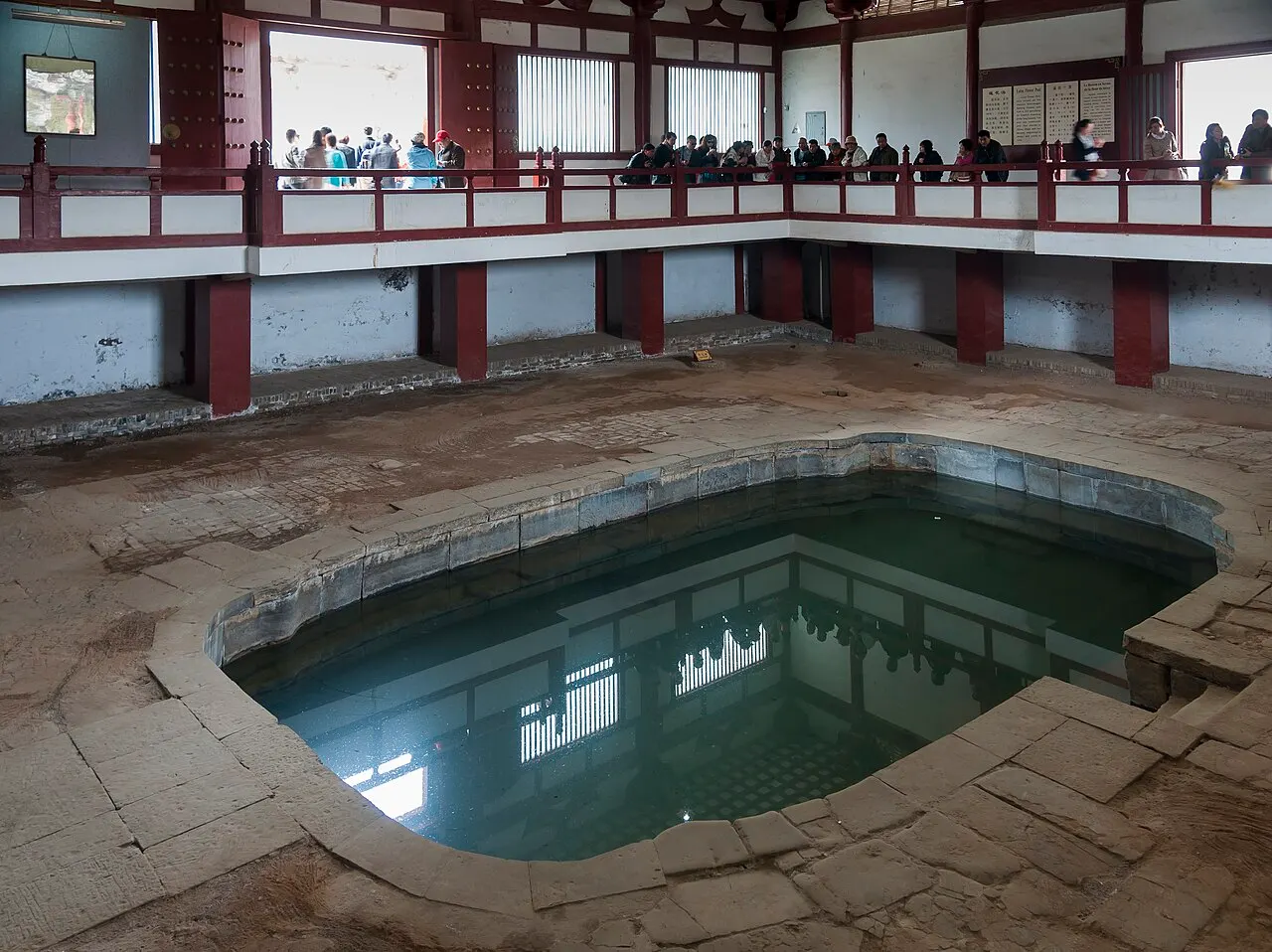
Lintong
A district to the east, about 40 km from the center, at the foot of Mount Li. This is where the Museum of the Qin Shi Huang Mausoleum Site, with the warriors, and the imperial hot springs of the Huaqing Palace are. It is visited as a day trip from the center.
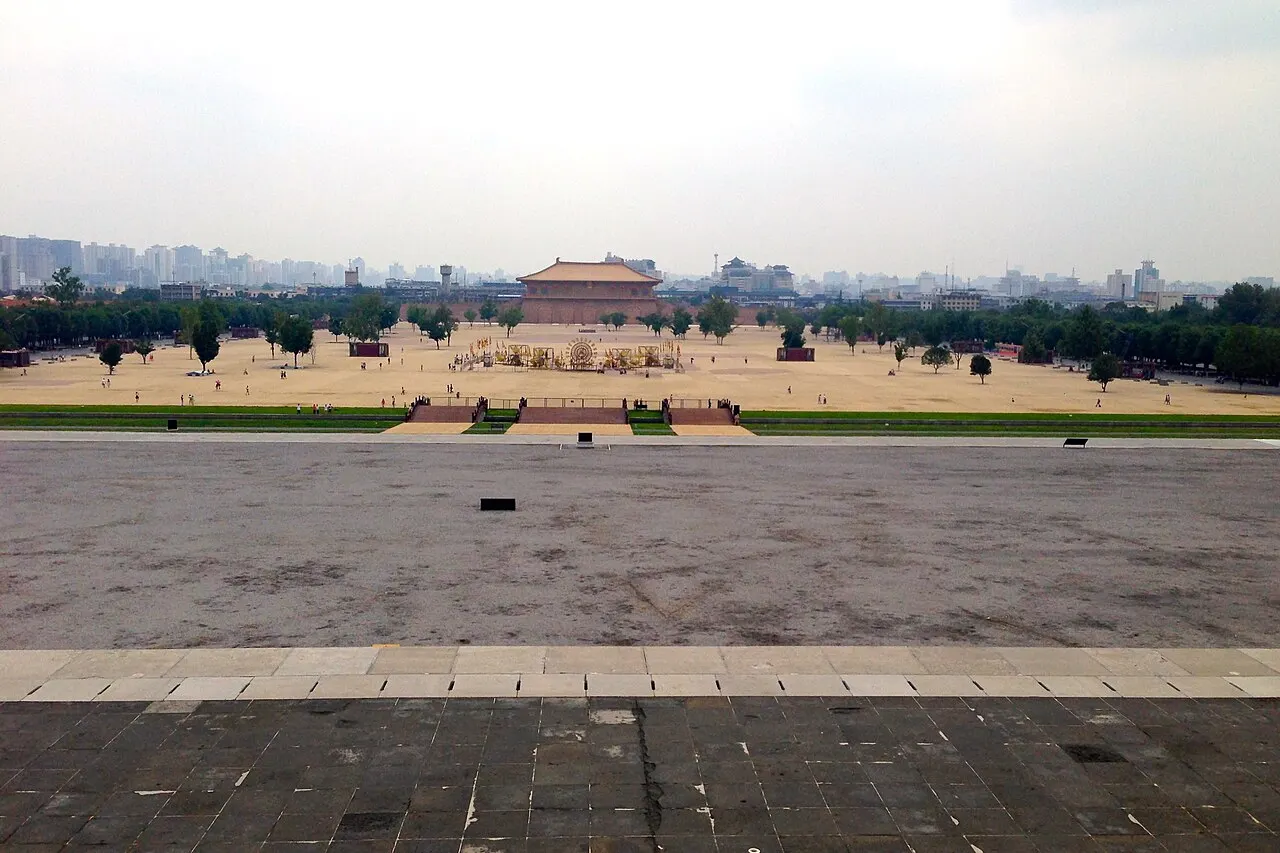
North: stations and Daming Palace
Just past the north wall are Xi'an Railway Station and the Daming Palace park. Much farther north, about 15 km from the center, Xi'an North Station handles the high-speed trains.
History
11th c. BC · Fenghao, capital of the Western Zhou
The twin cities of Feng and Hao, on the banks of the Feng River, southwest of present-day Xi'an, are the region's first capital.
246 BC · Work begins on the first emperor's mausoleum
The king of Qin, who would unify China in 221 BC as Qin Shi Huang, begins his tomb at the foot of Mount Li, east of the city.
202 BC · Chang'an, capital of the Han
Liu Bang, founder of the Han dynasty, sets up the capital south of the Wei River; this is the traditional founding date of Chang'an.
582–618 · Daxing and the Chang'an of the Tang
The Sui build a new planned capital southeast of the old one; the Tang rename it Chang'an in 618 and make it the city that Silk Road merchants knew.
652 · The Big Wild Goose Pagoda
The monk Xuanzang supervises the building of the tower at the Da Ci'en Temple to house the Buddhist scriptures he brought back from India.
1369–1384 · The Ming give the city its name and its present form
The city is renamed Xi'an in 1369; the wall is begun in 1370 over the old Tang imperial city, and the Bell Tower is built in 1384.
1936 · The Xi'an Incident
From December 12 to 26, the generals Zhang Xueliang and Yang Hucheng detain Chiang Kai-shek and force a common front between Nationalists and Communists against Japan.
1974 · Farmers find the warriors
In Lintong County, farmers find fragments of what would prove to be an army of more than 8,000 figures in three pits.
2014 · The Silk Road on the UNESCO list
The Big Wild Goose Pagoda, the Small one, the Daming Palace and other Xi'an sites become World Heritage as part of the Chang'an-Tianshan corridor.
Complete history
Xi'an sits at the spot on the Guanzhong Plain that Chinese history chose again and again as a seat of government. Sheltered by mountains to the south and narrow passes to the east, and watered by eight rivers of the Wei basin, the region housed the capital of the Western Zhou from the 11th century BC and, later, that of the Qin, who unified the country in 221 BC with their capital at Xianyang, just to the northwest. The first emperor, Qin Shi Huang, began his own mausoleum at the foot of Mount Li, to the east, and the clay army that brings most visitors today is his.
In 202 BC, the Han founded Chang'an, a name that means perpetual peace, south of the Wei River. From here, in the second century BC, Zhang Qian's missions set out to the west and began the regular exchanges of the Silk Road. In 582 the Sui built a new planned capital, with an imperial city, a palace and civilian districts laid out on a grid, and the Tang called it Chang'an again. Between the seventh and ninth centuries, the city received monks, merchants and communities from Central Asia and Persia: the Big Wild Goose Pagoda held Xuanzang's scriptures, the Nestorian Stele recorded Christians at court, and local tradition dates the founding of the Great Mosque to 742.
The end of the Tang emptied Chang'an, and the country's political center moved east. The city you visit today is above all the Ming reconstruction: the name Xi'an, meaning western peace, dates from 1369, the wall was begun in 1370 reusing stretches of the old Tang imperial city, and the Bell Tower was raised in 1384 and moved to the central crossing in 1582. The Qing set up a Manchu garrison in the northeast of the walled area, destroyed in the revolution of 1911.
In the twentieth century, Xi'an returned to the news in December 1936, when two generals detained Chiang Kai-shek and forced him into an alliance with the Communists against Japan; part of the episode took place at the Huaqing Palace, near the warriors. The city was never taken by the Japanese and passed to Communist control in May 1949. The discovery of the warriors in 1974 changed Xi'an's place in tourism, and the expansion to the south, with the Qujiang district around the Big Wild Goose Pagoda, gave the city a new face that stages the Tang era on illuminated pedestrian streets.
Geography and shape of the city
Xi'an occupies the center of the Guanzhong Plain, at an elevation of about 410 m, on terrain that is higher to the southeast and lower to the northwest. To the north runs the Wei River, a tributary of the Yellow River, and beyond it the Loess Plateau begins; to the south, the city rests against the foothills of the Qinling Mountains, the range that divides northern and southern China and that draws residents on weekends in search of shade. Mount Hua, the eastern end of the Qinling, lies about 120 km to the east. The historic center is a rectangle of about 11.5 km² enclosed by the Ming wall, with the Bell Tower at the crossing of the four main avenues (North, South, East and West), a direct inheritance of the Tang grid plan. Outside the wall, the city grows in ring roads and axes: Qujiang and the pagoda area to the south, the high-tech zone to the southwest, the stations and the Daming Palace to the north, and Lintong, where the warriors and the Huaqing hot springs are, to the east. The climate is monsoonal: hot, humid summers with short thunderstorms, cold, dry winters, a spring with dust storms in March and April, and most of the rain between July and the end of October.
Culture
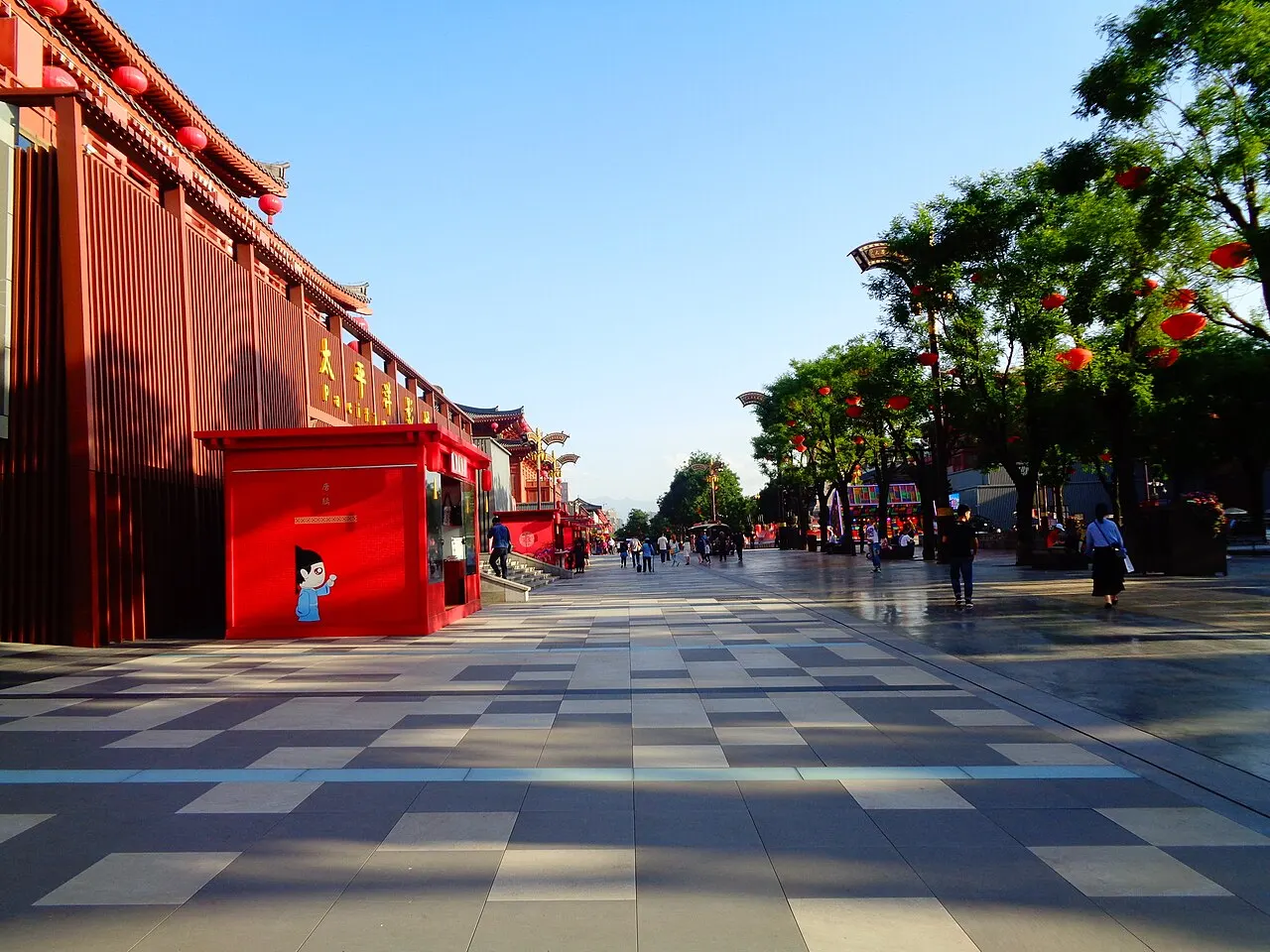
Xi'an's culture rests on the weight of having been Chang'an, and the city revives the Tang era in performances: on the wall, at the Yongning gate, there are regular Tang-inspired shows from early morning to night, and in the summer of 2026 the administration added cultural talks and the feiqian, a payment order inspired by the remittances of the Tang era, handed out with the ticket and exchanged for discounts at the stalls. The street Datang Everbright City turned this staging into a mass evening attraction.
In the performing arts, Shaanxi is the home of qinqiang opera, also called bangzi, the oldest of the great vocal systems of Chinese theater, and of Guanzhong shadow theater. At the Gao Family Mansion, in the Muslim Quarter, there are puppet shows. The painting of the Chang'an School and the region's peasant paintings complete the repertoire that appears in museums and fairs.
The Hui community, Muslim and Chinese-speaking, keeps several mosques in use in the Muslim Quarter, such as the Great Mosque and the one on Daxuexi lane, and a halal cuisine that has become the street food most associated with the city. The coexistence of temples inside the walled area is striking: the City God Temple is Taoist, the Guangren Temple, founded by the Kangxi emperor in 1705, is Tibetan Buddhist, and the Cathedral of St. Francis is Catholic.
Xi'an is also a university city, with institutions such as Xi'an Jiaotong University, and an industrial and research city. China's official time is produced by the National Time Service Center, in Lintong. Nightlife is concentrated at the south gate, in the bars of Defu Xiang and in the malls to the south.
Festivals and events
Wall Lantern Festival (Chinese New Year)
Since 1984, the wall has hosted the main Chinese New Year lantern exhibition, at the Yongning, Wenchang and Zhuque gates and at the barbican of the west gate, lit at dusk. In 2026 it began for the first time on January 1 and ran until the Lantern Festival; the dates for each year are announced in December or January on the wall's official channel.
National Holiday (October 1 to 7)
The National Day holiday week packs the Terracotta Warriors, the wall and Datang Everbright City, and the slots for named bookings run out quickly. The same effects appear at Chinese New Year and the May 1 holiday.
Wall summer season (July and August)
In 2026 the wall scheduled activities from July 1 to August 31, with Tang-inspired shows at the Yongning gate from early morning to night. With the heat, almost half of July's visitors went up at night.
Books and films
Records of the Grand Historian (Shiji), by Sima Qian
Written about a century after the death of the first emperor, it describes the building of the mausoleum at the foot of Mount Li, with the rivers of mercury that science is still investigating.
Journey to the West, by Wu Cheng'en
The classic novel turns the monk Xuanzang's journey to India into an adventure, the same journey that led to the building of the Big Wild Goose Pagoda.
Song of Everlasting Sorrow, by Bai Juyi
The Tang poem about the emperor Xuanzong and Yang Guifei, whose story takes place in part at the hot springs of the Huaqing Palace.
Hero (2002), by Zhang Yimou
The film recreates the assassination attempt on the king of Qin, the future Qin Shi Huang, and helps explain why the first emperor still dominates the local imagination.
Ruined City (Feidu, 废都, 1993), by Jia Pingwa
A novel set in a fictional version of Xi'an in the 1980s, a portrait of intellectuals and of an ancient city in transformation; it was translated into English as Ruined City.
Frequently asked questions
Xi'an: how do I get from the airport to the center?
Xi'an Xianyang International Airport (XIY) is about 40 km northwest of the center, already in the neighboring city of Xianyang. Metro line 14 connects the terminal to Xi'an North Station, where you change to lines 2 and 4; line 2 runs south to the Bell Tower (Zhonglou station). Airport buses go to the center and to Xi'an Railway Station in about an hour. For a taxi, use the official queue: illegal taxis and touts who say the last bus has already left are a known problem at arrivals.
Xi'an: do I need a visa to enter China?
China's entry rules depend on nationality and the type of trip, and they change often. China grants unilateral visa-free entry for up to 30 days to citizens of a list of countries, with a validity period set and renewed by the government for fixed terms. There is also visa-free transit of up to 240 hours (10 days) for ordinary passports from 57 countries, with a confirmed onward ticket to a third country or region; Shaanxi is among the provinces covered by the policy, and the stay is valid throughout the province. Before buying your ticket, check the list of countries, the accepted ports of entry and the rule that applies to your passport with China's National Immigration Administration (NIA, en.nia.gov.cn) or a Chinese consulate.
Xi'an: how many days should I stay?
I'd stay three full days in Xi'an. The first is for the walled city: the towers, the Muslim Quarter, the Great Mosque, the Forest of Stelae and the bike ride around the wall at dusk. The second belongs entirely to the Terracotta Warriors and Lishan Garden, in Lintong, with the Huaqing Palace on the way back if there is energy left. The third goes south, to the Shaanxi History Museum and the two Tang pagodas. With two days, I'd keep the walled city and the warriors and leave the museum and the pagodas for another trip; less than that forces a choice between the clay army and the city. Mount Hua is an extension for a fourth day, and it is only worth it for those who can face hours of steep steps or a cable car line.
Xi'an: how do I buy tickets for the Terracotta Warriors?
Tickets are sold only online and in the visitor's name, through the website or the official WeChat accounts; bring the original document used for the booking, because a copy or a photo won't open the turnstile, and enter through the north gate. The ticket (120 CNY per adult all year, checked in October 2026) is valid on the same day for the pits and for Lishan Garden, next to the emperor's still-sealed tomb, where the bronze chariots are; a free bus connects the two areas, and each one takes about an hour and a half. The reduced fare applies only to full-time students of Chinese institutions, up to undergraduate level, with an ID card, and foreign children up to 1.4 m tall accompanied by their parents enter free if they are included in the advance booking.
Xi'an: how do I get to the Terracotta Warriors?
There are two ways to reach the Terracotta Warriors. Bus 306, also marked as Tourism 5, leaves from the east lot opposite Xi'an Railway Station and ends at the museum parking lot; it costs 7 CNY, paid on board, and takes about an hour without traffic, up to three hours in congestion. It also stops at the Huaqing Palace. Avoid vehicles advertised as 306 by touts on the inside of the wall, which include stops at shops. The other option is the metro to Huaqingchi station, on line 9, and then a local bus or a taxi.
Xi'an: how do I book the Shaanxi History Museum?
The main exhibition is free, but only with a booking in your name through the museum's official WeChat, opened five days ahead at 17:00; foreigners book with a passport, and the slots run out quickly. Opening hours change with the season: check the day's hours when you book. The Tang murals exhibition has a separate ticket.
Xi'an: can I visit Mount Hua and return the same day?
The sacred Taoist mountain, about 120 km to the east, has five main peaks, the highest of them the South, at 2,154.9 m. By high-speed train, leave early from Xi'an North Station for Huashan North Station (about 35 minutes) and continue by bus or taxi to the Visitor Center, where the internal buses to the two cable cars depart. A common combination is to go up by the West Peak cable car, walk across the South, Central and East peaks and come down by the North Peak cable car; climbing on foot from the base takes four to six hours. Cable cars, internal buses and the optional plank walk are paid separately. In the 2025–2026 low season, entry through the Visitor Center ran from 08:00 to 16:00 and the cable cars from 08:00 to 18:00; check rules, booking and hours on the park's official channel before buying the train ticket. The trails have steep steps and exposed stretches and are not recommended for anyone with vertigo or knee problems.
Xi'an: when is the best time to go?
April, May and October; October only outside the national holiday week, October 1 to 7, and July has an average high of 32.8 °C (1991–2020 normal from the China Meteorological Administration). National holidays weigh more than the weather: the week of October 1 to 7, Chinese New Year and the May 1 holiday pack the sites and sell out the bookings.
Xi'an: how do I pay for things?
The currency is the yuan (CNY), and the city pays for almost everything by QR code. The People's Bank of China's 2024 payment guide for foreigners explains how to link an international card to Alipay or WeChat Pay; also carry some cash for stalls and buses, and a Visa, Mastercard or UnionPay card for hotels.
Xi'an: is it a safe city?
Xi'an has a low rate of violent crime, and the practical risks are others. Pickpockets work on crowded buses, in the Muslim Quarter and on holidays. Illegal taxis and touts operate at the airport and at Xi'an Railway Station: use the official queue or an app, check the plate (陕AT, 陕AU or 陕AD on legitimate taxis) and, if you end up in an irregular taxi, don't argue, note the plate and call 12328. Stay away from tours that promise a low price and include stops at shops. In summer, heat is the real risk: the wall and the warriors' pits have long stretches in the sun, and the city government recommends visiting early or in the late afternoon. On Mount Hua, the trails have steep steps and exposed passages; stay on the path and avoid climbing in rain or ice. Emergencies: 110 (police), 120 (ambulance) and 119 (fire).
Other cities in the country
China ↗- Days
- 4
- When
- Sep–Oct
- Per person/day
- Average 40–70 USDMid-range · per person/day
Cost scope
Per person per day: accommodation, meals, urban transport, visits and a small allowance for extras. Flights excluded; larger purchases vary. Editorial estimate, not a quote.
- Days
- 1–2
- When
- Sep–Oct
- Per person/day
- Average 100–250 CNYMid-range · per person/day
Cost scope
Per person per day: accommodation, meals, urban transport, visits and a small allowance for extras. Flights excluded; larger purchases vary. Editorial estimate, not a quote.
- Days
- 3
- When
- Sep–Nov
- Per person/day
- Average 450–900 CNYMid-range · per person/day
Cost scope
Per person per day: accommodation, meals, urban transport, visits and a small allowance for extras. Flights excluded; larger purchases vary. Editorial estimate, not a quote.
- Days
- 3–5
- When
- Sep–Nov
- Per person/day
- Average 602 CNYMid-range · per person/day
Cost scope
Per person per day: accommodation, meals, urban transport, visits and a small allowance for extras. Flights excluded; larger purchases vary. Editorial estimate, not a quote.
- Days
- 3–4
- When
- Mar–May · Sep–Nov
- Per person/day
- Average 479 CNYMid-range · per person/day
Cost scope
Per person per day: accommodation, meals, urban transport, visits and a small allowance for extras. Flights excluded; larger purchases vary. Editorial estimate, not a quote.