China
Chengdu
Pandas in the morning, tea house in the afternoon and Sichuan opera at night in Chengdu
Days I'd stay three days in Chengdu.
How the guide reaches this number
The first starts at the panda base at opening time and ends between the Wenshu Monastery, an afternoon at a tea house in People's Park and the opera at night; the second goes from the Du Fu Cottage and the Sichuan Museum to the Wuhou Shrine, with both entries reserved; the third is the bullet-train day trip to the Leshan Giant Buddha. With a fourth day, I'd go to Dujiangyan to see Li Bing's irrigation system and climb Mount Qingcheng; those more interested in Shu bronzes can swap that day for Sanxingdui. Mount Emei needs an overnight stay to reach the top without rushing, so I'd treat it as a two-day extension, leaving from Chengdu and sleeping at the foot of the mountain.
3–4
Start with the basic programme and choose extensions for the time you have.
When March to May and September to November; July and August are the hottest and rainiest months, and the week of October 1 to 7 and Lunar New Year fill the panda base and Leshan.
How the guide reaches this number
Spring and autumn are the best seasons: from March to May and from September to November, temperatures are comfortable for walking, with less rain than in summer; spring usually has clearer days than autumn. At the Wenjiang station (1991–2020 normals), the average high is 22.5 °C in April and 20.7 °C in October. Summer is hot and humid, with average highs near 30 °C in July and August, which concentrate the rain (232 mm in July and 217 mm in August); during the hottest hours of the day the pandas sleep. Winter is short, damp and overcast, with an average high of 9.3 °C in January and a low of 2.7 °C, rarely with snow in the city; on Mount Emei, by contrast, there is snow in winter and even a ski area from December. Chengdu is one of the least sunny cities in China, so count on a white sky in any season. National holidays weigh more than the weather: in the week of October 1 to 7 and at Lunar New Year, the panda base, Leshan, Emei and Dujiangyan are packed and reservations sell out beforehand.
Per person/day Budget around CNY198; mid-range around CNY479; comfortable around CNY1,090 per person per day, based on spending reported by travelers to Budget Your Trip (checked October 2026).
How the guide reaches this number
Indicative figures, excluding travel to the destination.
Budget around CNY198; mid-range around CNY479; comfortable around CNY1,090 per person per day, based on spending reported by travelers to Budget Your Trip (checked October 2026). Indicative figures, excluding travel to the destination.
Per person per day: accommodation, meals, urban transport, visits and a small allowance for extras. Flights excluded; larger purchases vary. Editorial estimate, not a quote.
Salta · among the cheapestZermatt · among the priciest
Cheaper than 84% of them. The tick marks the median. Compared by the middle of each city’s daily range, converted at the 24 Sept 2026 exchange rate.
 What Nilo thinks
I'd recommend Chengdu to people who like eating with attention, temples that are still in use and lunches in no hurry to end. What holds me most in the city is seeing devotion and leisure at the same address: in the monasteries, someone lights incense a few steps from someone spending the afternoon playing games at the courtyard tea house, and I'd give time to both instead of rushing between halls. On one of the days, I'd swap a dinner on a tourist street for a lunch at a nong jia le on the outskirts, where the meal stretches out and the conversation goes on after the last dish. And I'd order the mapo doufu before any hot pot, as a measure of a restaurant's kitchen: it is a simple tofu dish, and the balance between the fermented, the chili and the huājiāo shows up in the first bite.Chengdu is the city of pandas, and starting with them makes sense: the research base in the north of the city gathers giant pandas among bamboo groves, and early in the morning they eat and move around before sleeping through the hot hours. But what sets Chengdu apart is the rhythm of the people who live in it. The city is one of the largest in China and yet it is organized around tea houses, parks and unhurried meals; the same pot lasts the whole afternoon, and Sichuan opera still takes place in tea house courtyards, with actors who change masks in a single gesture. History is on view in layers: the bronzes of the ancient kingdom of Shu, the cottage of the poet Du Fu, the shrine of the heroes of the Three Kingdoms. And the food, with red chili and huājiāo, is a reason to travel in itself. Around it, the plain and the mountains hold three places that many people combine with the city: the Leshan Giant Buddha, carved into a cliff by the river; Mount Emei, sacred to Buddhists; and Dujiangyan, the hydraulic work more than two thousand years old that made the region a land of plenty.
Quick facts
- Population
- 21.535 million permanent residents at the end of 2025 across the whole municipality of Chengdu, which includes rural districts and satellite cities; 17.542 million lived in urban areas. Data from the 2025 statistical bulletin of the Chengdu Bureau of Statistics, released in April 2026.
- Founding
- According to tradition, the fifth king Kaiming of the ancient kingdom of Shu moved the capital to Chengdu around the 4th century BC; after the conquest by the State of Qin in 316 BC, Zhang Yi built the city walls in 311 BC. The name Chengdu has remained ever since.
- Country and region
- China, capital of Sichuan Province, on the Chengdu Plain, western edge of the Sichuan Basin.
- Language
- Mandarin (putonghua) in writing and schooling; in daily life, the Chengdu dialect, a variety of Sichuanese. English is little spoken outside hotels and tourist sites.
- Currency
- Chinese yuan renminbi (CNY), written ¥ or 元 and called kuai in speech.
- Time zone
- Asia/Shanghai: UTC+8 year-round, with no daylight saving time.
- Best time to visit
- March to May and September to November; July and August are the hottest and rainiest months, and the week of October 1 to 7 and Lunar New Year fill the panda base and Leshan.
- Average daily cost
- Budget around CNY198; mid-range around CNY479; comfortable around CNY1,090 per person per day, based on spending reported by travelers to Budget Your Trip (checked October 2026). Indicative figures, excluding travel to the destination.
When to go
March to May and September to November; July and August are the hottest and rainiest months, and the week of October 1 to 7 and Lunar New Year fill the panda base and Leshan.
January
3° to 9°C
8 mm of rain
10 h 23 min of daylight
National holidays
Jan 1 – 3, 2027 · long weekend · New Year's Day
Jan 1, 2028 · New Year's Day
Jan 26, 2028 · Chinese New Year (Spring Festival)
Source: Nager.Date. Holiday dates shift; check close to your trip.
February
5° to 12°C
11 mm of rain
11 h 08 min of daylight
National holidays
Feb 6, 2027 · Chinese New Year (Spring Festival)
Source: Nager.Date. Holiday dates shift; check close to your trip.
May
17° to 26°C
78 mm of rain
Best time13 h 43 min of daylight
National holidays
May 1, 2027 · Labour Day
Source: Nager.Date. Holiday dates shift; check close to your trip.
June
21° to 28°C
110 mm of rain
14 h 07 min of daylight
National holidays
Jun 5 – 9, 2027 · long weekend · Dragon Boat Festival
Source: Nager.Date. Holiday dates shift; check close to your trip.
July
22° to 30°C
232 mm of rain
13 h 56 min of daylight
August
22° to 30°C
217 mm of rain
13 h 16 min of daylight
September
19° to 26°C
121 mm of rain
Best time12 h 21 min of daylight
National holidays
Sep 11 – 15, 2027 · long weekend · Mid-Autumn Festival
Source: Nager.Date. Holiday dates shift; check close to your trip.
October
15° to 21°C
43 mm of rain
Best time11 h 26 min of daylight
National holidays
Oct 1 – 3, 2027 · long weekend · National Day
Source: Nager.Date. Holiday dates shift; check close to your trip.
December
4° to 11°C
6 mm of rain
10 h 10 min of daylight
High, shoulder and low season
High · June to August, the National Day week and Lunar New Year
The National Day holiday runs from October 1 to 7. Summer vacations and national holidays fill the panda base, Leshan, Emei and Dujiangyan, and reservation quotas sell out beforehand. Summer adds humid heat and most of the year's rain. Reserve tickets as soon as they open (the panda base sells up to 14 days ahead) and arrive at opening.
Shoulder · March to May and September to November, outside the week of October 1
The most pleasant temperatures of the year and less rain than in summer. It is the best time to combine city and mountain; on weekends, the day trips are still full of Chinese visitors.
Low · December to February, outside Lunar New Year
Damp cold and overcast skies in the city, ice and snow at the top of Emei, where the ticket drops to ¥110 from December 15 to January 15. Hours get shorter: the panda base opens at 8 a.m. and Mount Emei at 7 a.m.
How the year changes
Spring and autumn are the best seasons: from March to May and from September to November, temperatures are comfortable for walking, with less rain than in summer; spring usually has clearer days than autumn. At the Wenjiang station (1991–2020 normals), the average high is 22.5 °C in April and 20.7 °C in October. Summer is hot and humid, with average highs near 30 °C in July and August, which concentrate the rain (232 mm in July and 217 mm in August); during the hottest hours of the day the pandas sleep. Winter is short, damp and overcast, with an average high of 9.3 °C in January and a low of 2.7 °C, rarely with snow in the city; on Mount Emei, by contrast, there is snow in winter and even a ski area from December. Chengdu is one of the least sunny cities in China, so count on a white sky in any season. National holidays weigh more than the weather: in the week of October 1 to 7 and at Lunar New Year, the panda base, Leshan, Emei and Dujiangyan are packed and reservations sell out beforehand.
The same numbers as a table
| Month | Temperature °C | Rain mm |
|---|---|---|
| January | 3 to 9 | 8 |
| February | 5 to 12 | 11 |
| March · | 8 to 17 | 24 |
| April · | 13 to 23 | 45 |
| May · | 17 to 26 | 78 |
| June | 21 to 28 | 110 |
| July | 22 to 30 | 232 |
| August | 22 to 30 | 217 |
| September · | 19 to 26 | 121 |
| October · | 15 to 21 | 43 |
| November · | 10 to 16 | 15 |
| December | 4 to 11 | 6 |
Nilo's tips
Reserve pandas, Du Fu and Wuhou with your passport
The panda base, the Du Fu Cottage and the Wuhou Shrine sell named tickets up to 14 days ahead, and the quota runs out on holidays. The pandas accept the official WeChat and authorized platforms such as Trip.com; Wuhou only the official website and WeChat, and the Du Fu Cottage, the museum's WeChat. The passport used for the reservation must be shown at the entrance.
Set up phone payment
Before traveling, I'd install Alipay or WeChat Pay and register a foreign card: it is how you pay for the metro, street stalls and app-based taxis. Some cash in small bills takes care of the rest.
Say how much spice you want
If the server thinks you are not used to it, the dish may come toned down. For the dish as locals eat it, say that you like chili; for less, 微辣 (wēi là) is mildly spicy and 不要辣 (bú yào là) is no chili. If the huājiāo bothers you, 不要花椒 (bú yào huājiāo) leaves out the Sichuan pepper.
In Leshan, choose between the stairs and the boat
The staircase that descends beside the Buddha to its feet has long lines in the morning, and those who arrive later tend to face fewer groups. The boat shows the whole statue in about 15 minutes. I'd choose the stairs on a weekday outside a holiday, and the boat when time is short.
Explore the map
Explore the map, read about the other places and plan your travel days in the app.
Open the appWhat to see
If time is short, I would skip: Jinsha Site Museum
Leave for last, if time allows: Jinli Ancient Street · Tianfu Square · Taikoo Li Chengdu · Anshun Bridge
Chengdu Research Base of Giant Panda Breeding
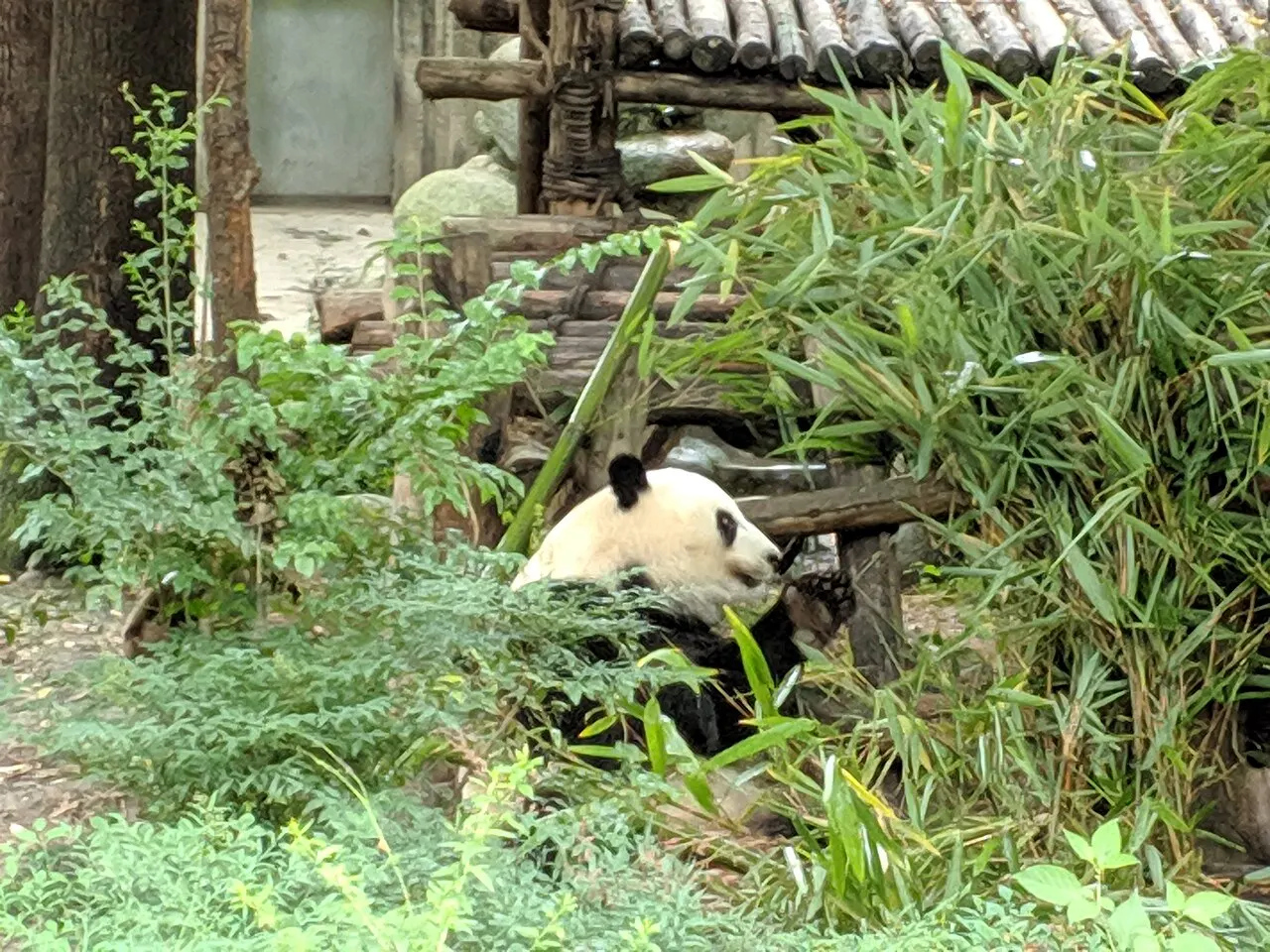
The Chengdu Research Base of Giant Panda Breeding (成都大熊猫繁育研究基地) is about 13 km north of the center. It was founded by the city government in 1987 with six rescued pandas and is now a large park of bamboo groves, enclosures and giant panda houses, with red pandas and other animals. Entry requires a named online reservation, up to 14 days ahead, through the official WeChat or authorized platforms such as Trip.com, with the original passport shown at the gate; daily capacity is limited. An adult ticket costs ¥55 (students ¥27; people over 60 and children up to 6 years old or under 1.30 m enter free, without a reservation), and the internal shuttle cart costs ¥30. From March to October the morning entry runs from 7:30 a.m. to noon and the afternoon one until 5 p.m.; from November to February, from 8 a.m. to 4:30 p.m. The pandas tend to be most active in the morning. House no. 6 is closed on Mondays, except on national holidays. Access is via Panda Avenue station (line 3), exit B, and then a bus or taxi to the gate.
Check access
Wenshu Monastery
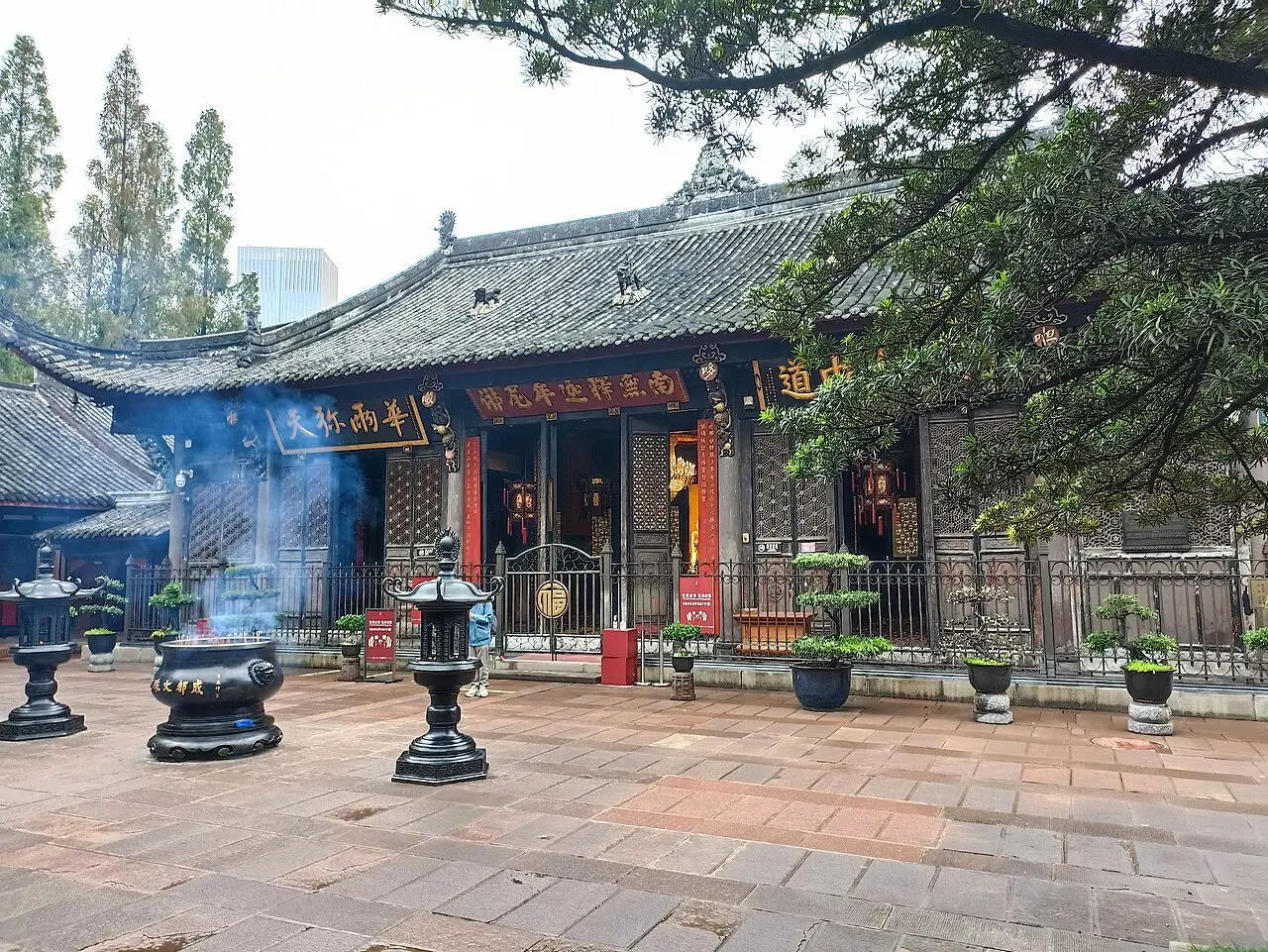
The Wenshu Monastery (文殊院), dedicated to the bodhisattva of wisdom, dates to the Tang dynasty and is the best-preserved Buddhist temple in Chengdu, with halls, gardens and relics attributed to the monk Xuanzang. It remains in full use: worshippers light incense, monks go about their day, and a tea house is frequented by locals who read, play games and chat, along with a vegetarian restaurant overlooking the gardens. Admission is free. It is next to Wenshu Monastery station (line 1).
Check access
People's Park
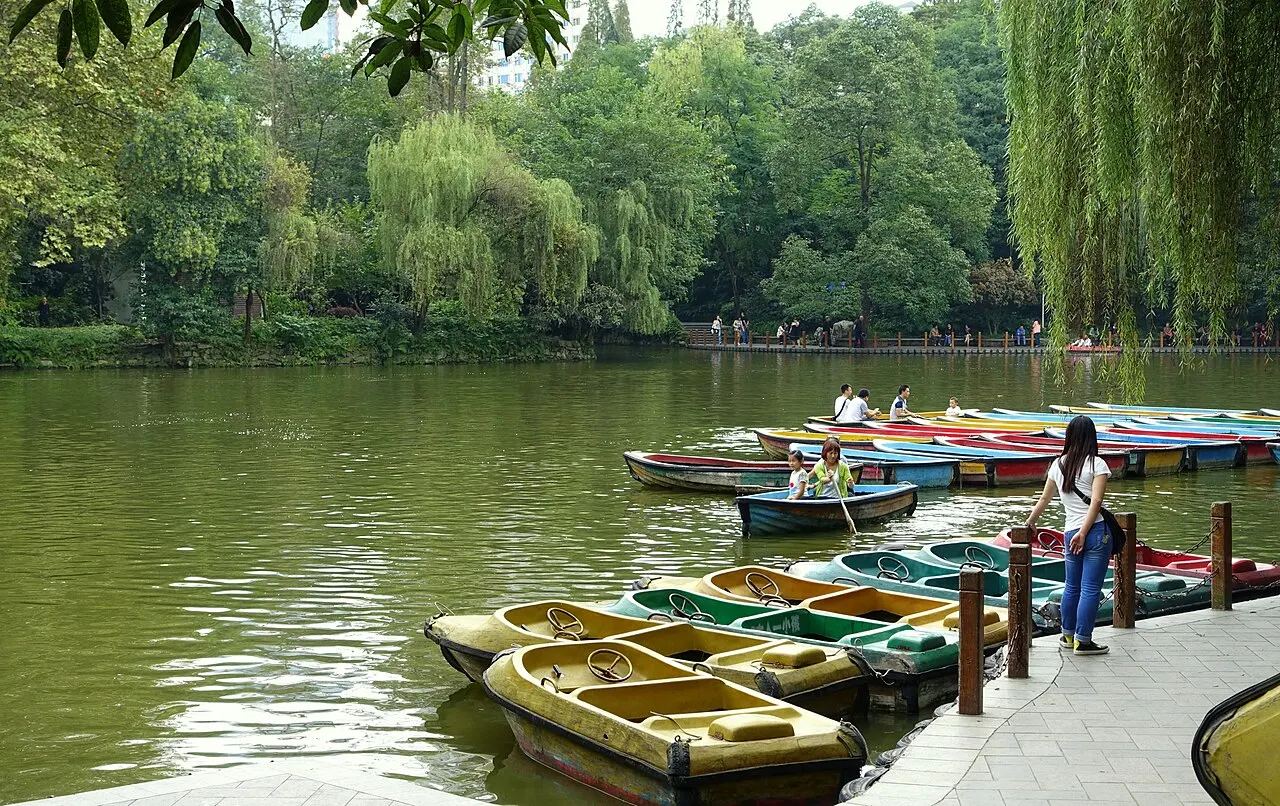
People's Park (人民公园), two blocks west of Tianfu Square, is the best place to see Chengdu's park life: lakes with pedal boats, open-air tea houses, groups that sing and dance, people writing characters on the ground with a brush and water and, in one corner, parents posting the details of their unmarried children in search of a match. The best-known tea house is Heming (鹤鸣茶社), more than a hundred years old. Entry to the park is free; the tea houses are fullest in the afternoon, and some offer ear cleaning by itinerant professionals.
Check access
Wuhou Shrine
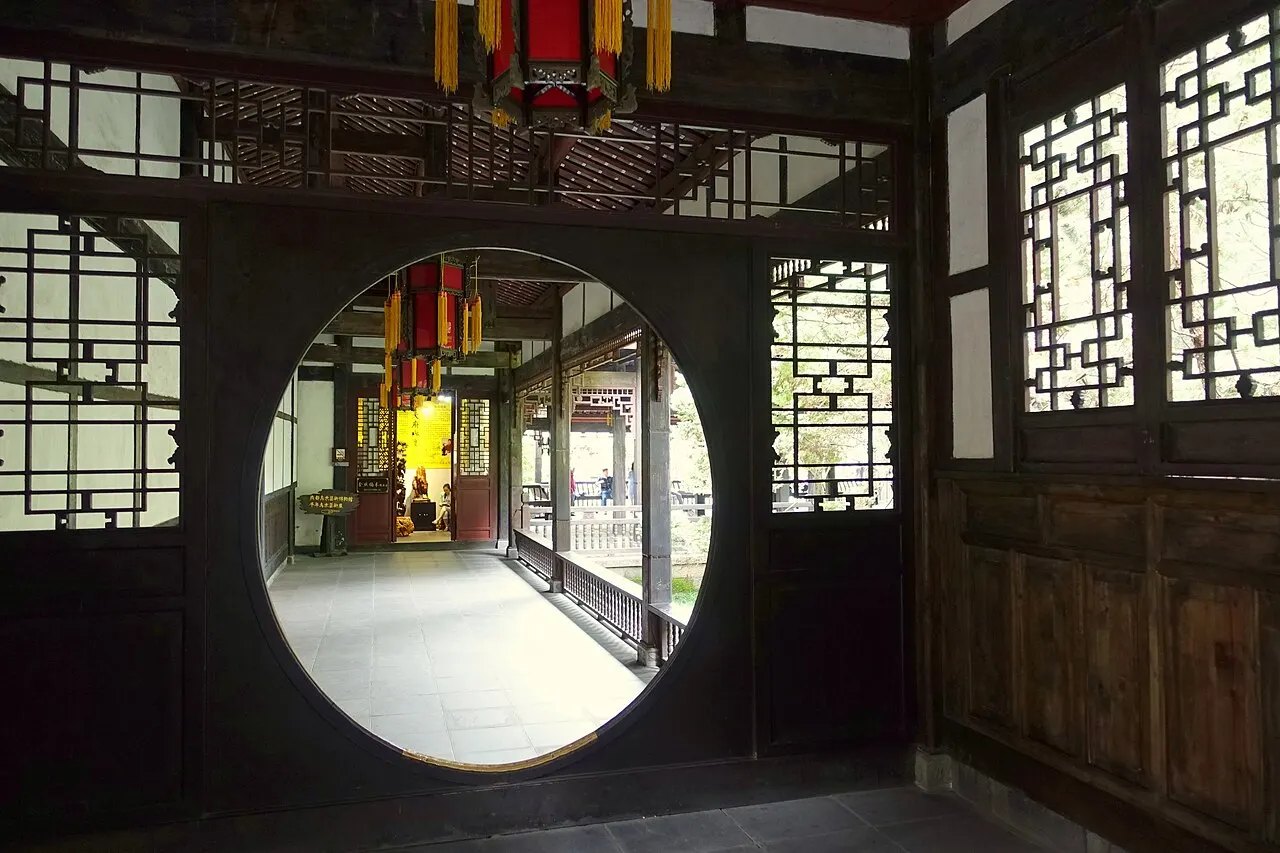
The Wuhou Shrine (武侯祠) honors Zhuge Liang, minister of the kingdom of Shu Han, and brings together in the same complex Liu Bei's hall and the Huiling Mausoleum, where the emperor and his ministers are worshipped together. It has statues, steles and gardens tied to the history of the Three Kingdoms. Entry is by named reservation only, opened 14 days ahead on the museum's official website or WeChat, with a passport; the museum states that it has not authorized resellers. A full ticket costs ¥50 and the ticket for ages 6 to 18 costs ¥25; those who do not use WeChat Pay or Alipay can pay in cash at the ticket window. It is open every day from 9 a.m. to 7 p.m., with last entry at 6 p.m. In the TEA world ranking of museum attendance released in 2025, it came in second, so expect crowds. It is about 750 m from Gaoshengqiao station (line 3), next to Jinli.
Check access
Du Fu Thatched Cottage
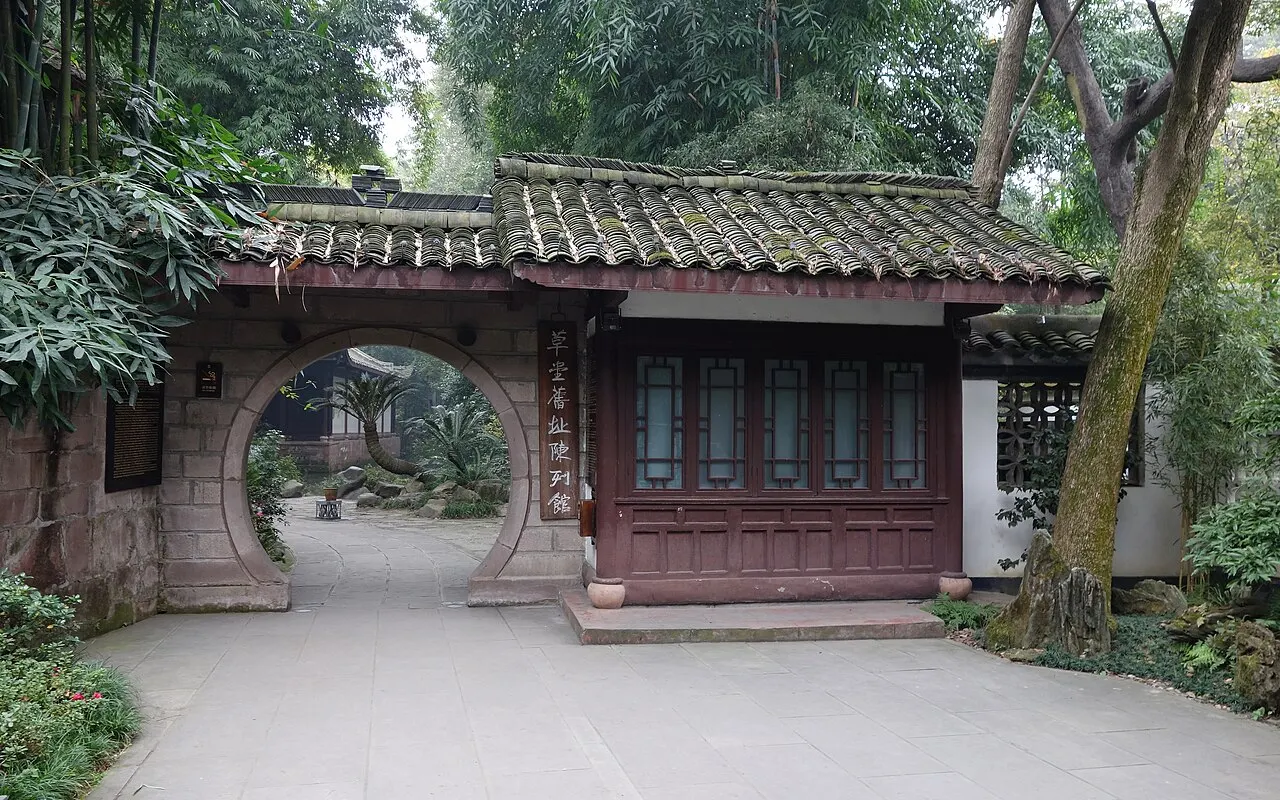
The park-museum of the Du Fu Thatched Cottage (杜甫草堂) occupies the place where the Tang dynasty poet lived for about four years starting in 759 and wrote more than 240 poems. The original hut no longer exists; the halls in the park date from the Ming dynasty, renovated in 1811, and there is a reconstruction of the house, a hall with murals of scenes from the poems and bamboo groves. Admission is by named ticket, reserved up to 14 days ahead through the museum's WeChat service. It is open from 9 a.m. to 6 p.m., with ticket sales until 5 p.m., and on long holidays and in summer the museum usually extends its hours to 8:30 a.m. to 6:30 p.m., as announced. Allow about two hours. It is in the west, near the Sichuan Museum, about 900 m on foot from Caotang Road North station (line 4).
Check access
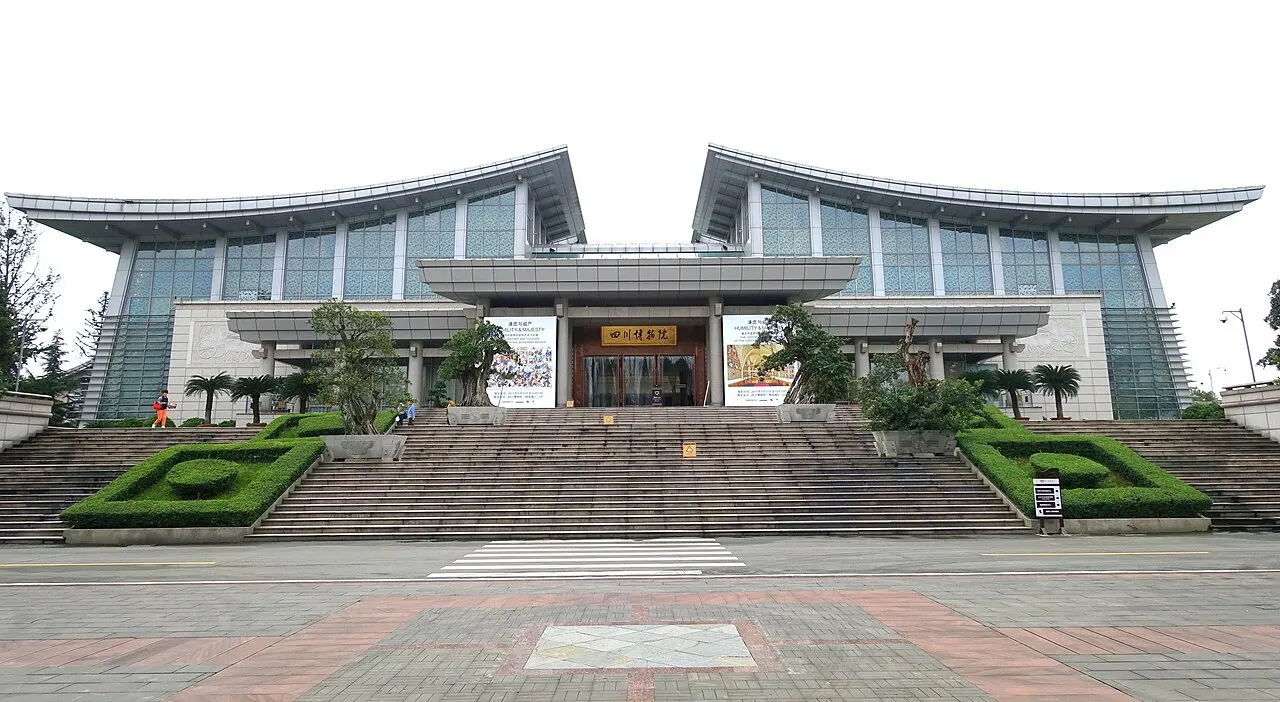
Sichuan Museum
The Sichuan Museum (四川博物院), next to the Du Fu Cottage, has three floors of bronzes, pottery, Han stone carvings and collections on the peoples of the province, and takes about two hours to go through. Admission is free with passport registration at the entrance for foreigners, and the museum is closed on Mondays; check the hours for the day before you go.
Check access
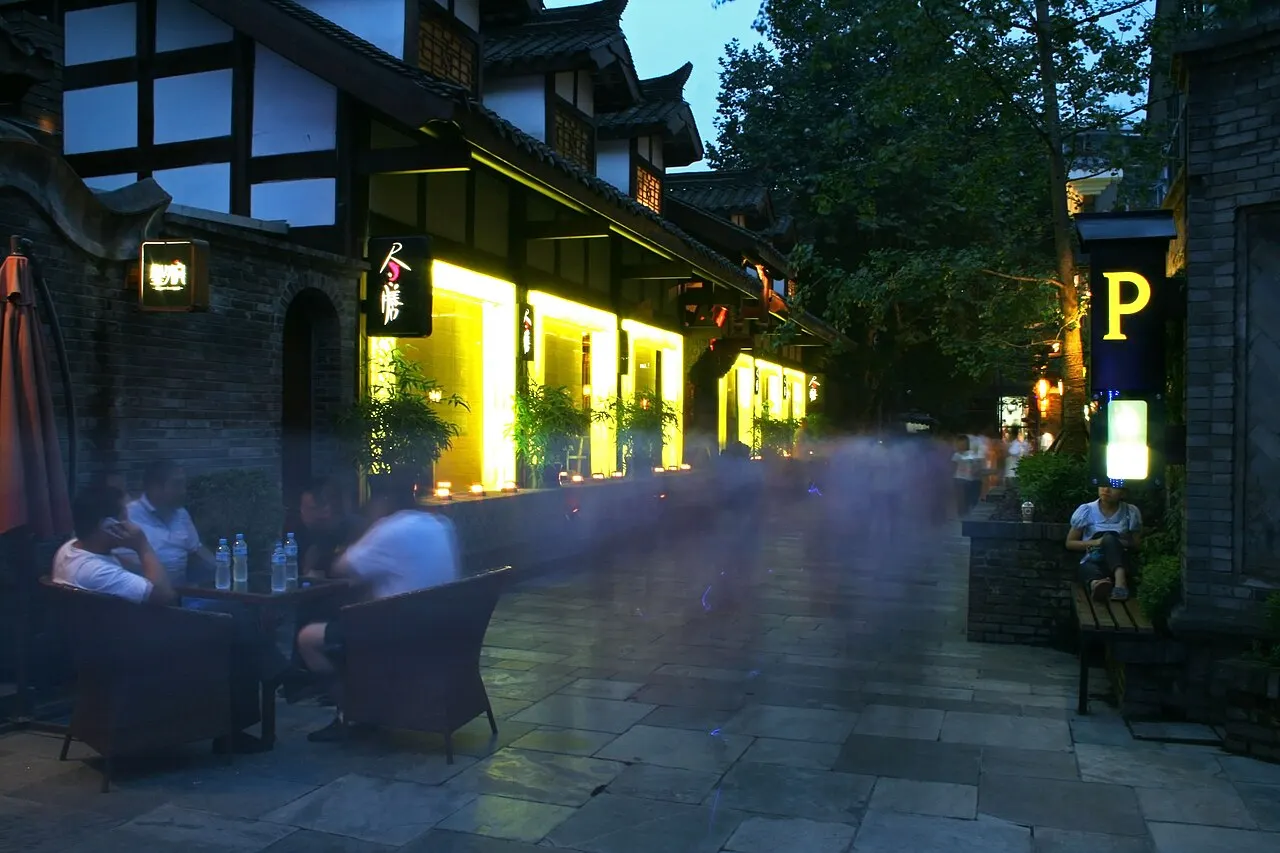
Kuanzhai Alley
Kuanzhai Xiangzi (宽窄巷子), the Wide and Narrow Alleys, were built in the Qing dynasty for Manchu soldiers and remained residential until 2003, when the government turned them into an area of tea houses, restaurants, bars and galleries, with the houses rebuilt in the old style. It is a short, photogenic stroll, with above-average prices. Kuanzhaixiangzi station (line 4).
Check access
Shufeng Yayun
The Shufeng Yayun tea house (蜀风雅韵), in the Cultural Park next to the Qingyang Temple, stages an evening show of about an hour and a half with excerpts of Sichuan opera, traditional music, shadow puppetry, fire-spitting and face-changing (biàn liǎn), in which the performer changes faces in a single gesture. The audience sits at tables under a covered courtyard, with a fan and no air conditioning. Tickets ranged from ¥100 to ¥300 depending on seat and program in September 2025; book ahead.
Check access
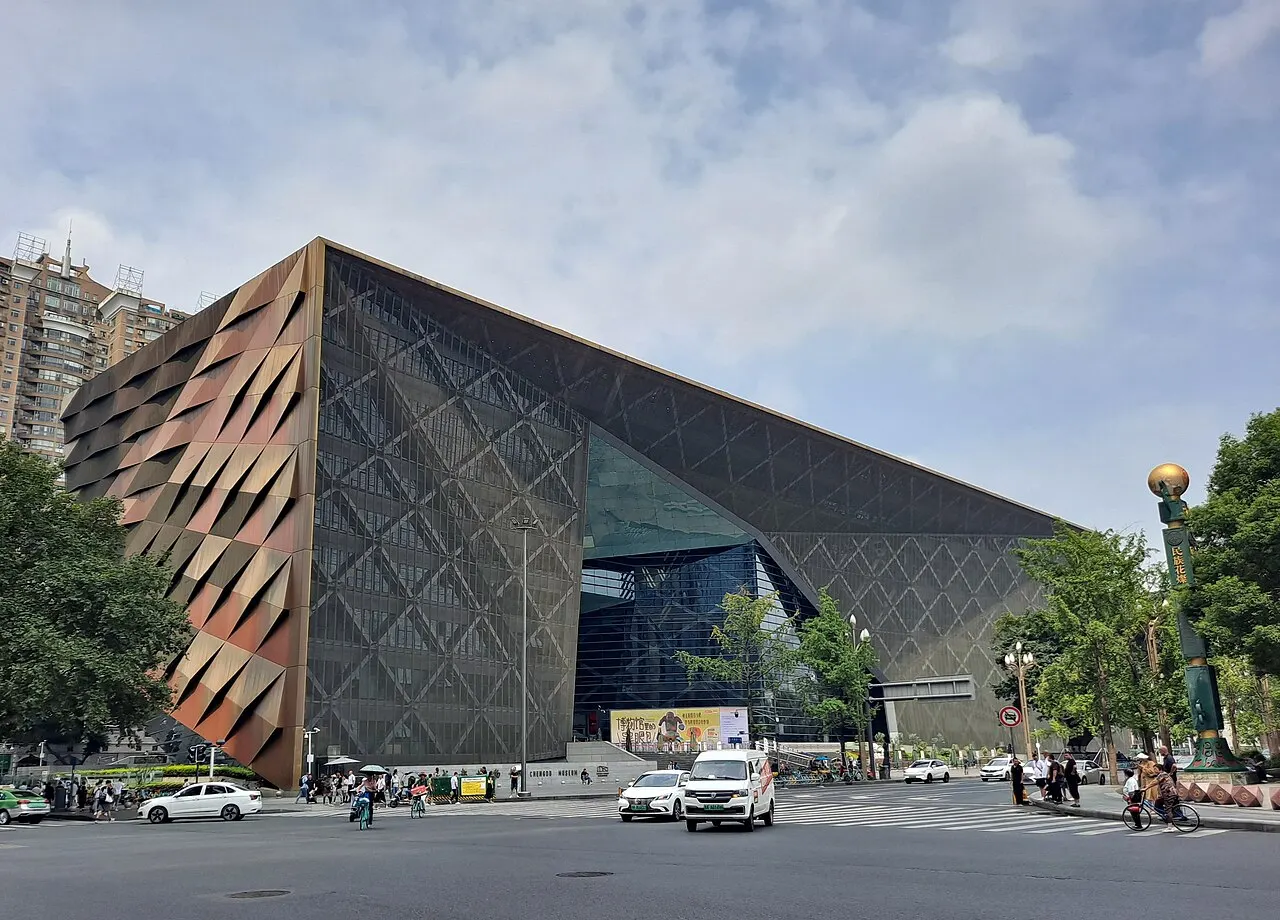
Chengdu Museum
The Chengdu Museum (成都博物馆), on the west side of Tianfu Square, tells the city's history across six floors, from prehistory to modern times; the museum itself suggests starting on the second floor and working upward. Admission is free with passport registration; it is open from 9 a.m. to 8:30 p.m. from May to October and until 8 p.m. from November to April, and it is closed on Mondays. Allow about two and a half hours.
Check access
More places in the guide
Qingyang Palace
The Qingyang Temple (青羊宫) is the largest and oldest Taoist temple in the city, tied to the legend that Laozi preached the Tao Te Ching there, and it holds the only known copy of the scripture collection Daozang Jiyao. Most of the current halls were rebuilt between 1667 and 1671, in the early Qing dynasty; the main hall, Sanqing, dates from 1669, and the Bagua Pavilion, with the image of Laozi riding an ox, is the best-preserved building in the complex. The temple is still in use, with courtyards, a tea house and a vegetarian restaurant, and it stands next to the Cultural Park, where there is opera at night.
Jinli Ancient Street
Jinli (锦里古街), attached to the Wuhou Shrine, is a shopping street rebuilt in an old style, full of lanterns, snack stalls, shops and bars. It works better as a stop on the way out of Wuhou, in the late afternoon, than as an outing of its own: it is heavily visited, and the restaurants and bars charge more than elsewhere.
Tianfu Square
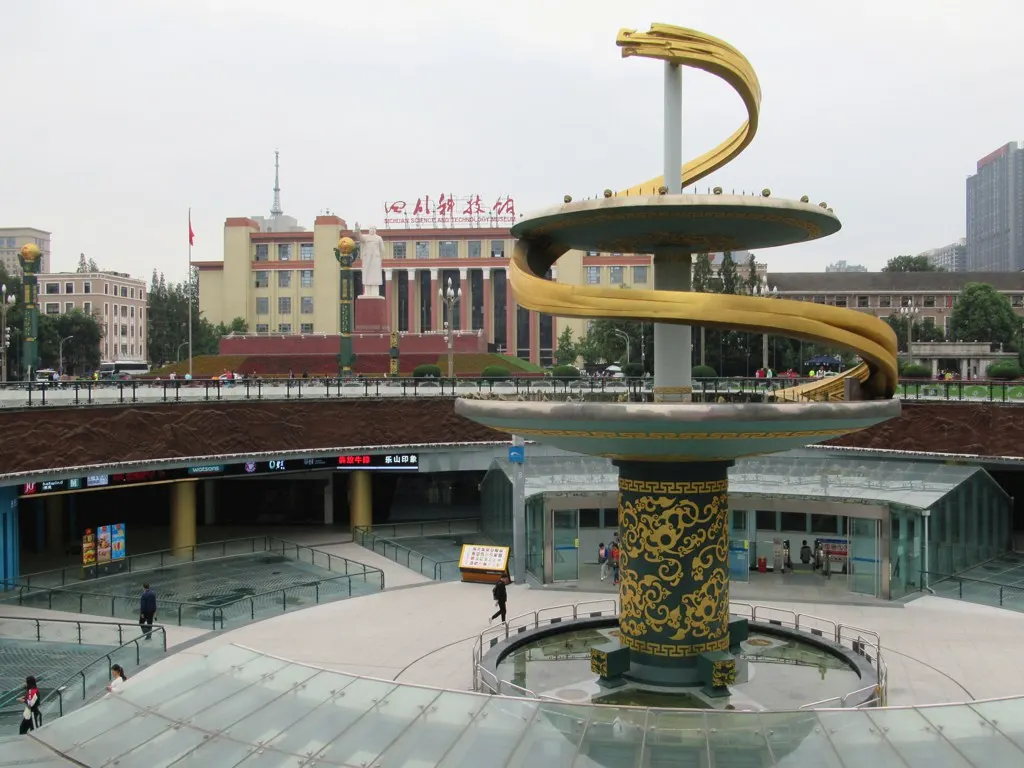
Tianfu Square (天府广场) is the geographic center and main metro hub of Chengdu, dominated by a large statue of Mao Zedong and surrounded by the Chengdu Museum and the Sichuan Science and Technology Museum. At noon and at dusk the fountains put on a water show with music. It is worth a stop on the way to the surrounding museums.
Taikoo Li Chengdu
Taikoo Li (成都太古里) is an open-air shopping center of low buildings and alleys, built around the Buddhist Daci Temple, where the monk Xuanzang studied in the Tang dynasty. It sits next to the Chunxi Road shopping street and is open from 10 a.m. to 10 p.m. It is for anyone who wants brands, cafés and restaurants in the center.
Anshun Bridge
The covered Anshun Bridge (安顺廊桥) crosses the Jin River in the center. Marco Polo mentioned a bridge at this spot; the current one was rebuilt in 2003, after a flood destroyed the previous one in the 1980s, and it has a restaurant on top. The south bank, near the bridge, concentrates bars that usually stay open until 2 a.m.
Jinsha Site Museum
The Jinsha Site Museum (金沙遗址博物馆) was built over the archaeological site discovered in 2001 and has two buildings: the hall built over the excavated area and the exhibition hall, with gold, jade, bronze and pottery about three thousand years old, including the gold sun-bird foil that became the emblem of Chengdu. It is closed for renovation; check the reopening on the museum's official website before adding it to your itinerary. In the meantime, the Shu bronzes can be seen at the Sanxingdui Museum, in Guanghan. Jinsha Museum station (line 7).
Nilo’s itinerary
Start with the basic programme and choose extensions for the time you have.
Plan my days in the app ↗Day 1 · Pandas in the morning, Wenshu and the afternoon in People's Park
With your named reservation made and your passport in hand, take the metro to Panda Avenue station (line 3) and exit at B; from there, a bus or taxi to the base gate. Arrive at opening: 7:30 a.m. from March to October, 8 a.m. from November to February.
Walk the base until about 11 a.m., while the pandas tend to be active; the internal shuttle cart (¥30) saves walking between areas.
Return to the center by metro, transferring to line 1, and get off at Wenshu Monastery station. Visit the Wenshu Monastery and have lunch at the temple's vegetarian restaurant or at the street stalls around it.
In the afternoon, continue by taxi or metro to People's Park, two blocks from Tianfu Square, and choose a table at an open-air tea house to watch the park in motion.
In the late afternoon, walk to Kuanzhai Xiangzi (Kuanzhaixiangzi station, line 4) to see the alleys before dinner.
At night, watch the Sichuan opera show at the Shufeng Yayun tea house, in the Cultural Park, with a reserved ticket; it lasts about an hour and a half.
Day 2 · Du Fu, the Sichuan Museum and the Three Kingdoms
The day before, reserve the named entry to the Du Fu Cottage through the official WeChat and, through the official website or WeChat, the one for the Wuhou Shrine, with your passport.
Start at 9 a.m. at the Du Fu Thatched Cottage (about 900 m from Caotang Road North station, line 4) and spend about two hours in the park.
Next door, visit the Sichuan Museum, which is free with passport registration; it closes on Mondays, and that time can go to the Cottage's garden or to Wuhou.
Have lunch in the area and take a short taxi ride to the Wuhou Shrine; allow an hour and a half and enter before 6 p.m., the last entry.
On the way out, stop by Jinli in the late afternoon and have hot pot or chuan chuan xiang for dinner in Yulin, a neighborhood in the same Wuhou district, ordering the level of spice you can handle.
Day 3 · Leshan Giant Buddha
Day trip
About 125 km to the south, in a straight line. The bullet train leaves from Chengdu East or Chengdu South station and reaches Leshan station in 52 minutes to 1 hour 20 minutes; from there, the K1 bus takes about 30 minutes to the Buddha's gate. The 71 m statue, carved into the red sandstone hillside at the meeting of the Min, Qingyi and Dadu rivers and completed in the early 9th century, has been a World Heritage Site together with Mount Emei since 1996. The ¥80 ticket is sold in timed sessions, and the park is open from 7:30 a.m. to 6:30 p.m. from April 1 to October 7 and from 8 a.m. to 5:30 p.m. the rest of the year. The narrow staircase that descends beside the statue to its feet forms lines that can reach about two hours on busy mornings; the boat (¥70, about 15 minutes) shows the whole figure from the front without docking. A full day, returning to Chengdu in the evening.
If you stay longer
Day 4 · Dujiangyan and Mount Qingcheng
Day trip
About 58 km northwest of the center. Trains of 30 to 40 minutes leave from Chengdu West and Xipu for Liduigongyuan station, a few minutes' walk from the entrance to the irrigation system, and continue to Qingchengshan station. The Dujiangyan system, begun in 256 BC by Li Bing, divides the Min River without a dam and still irrigates the plain; the visit includes the Anlan suspension bridge and the Erwang Temple, dedicated to Li Bing and his son. Mount Qingcheng, one of the centers of Taoism, has shaded trails and temples on the front face, with a 2.5 to 4 hour climb or a cable car. The two together form the Qingcheng-Dujiangyan World Heritage Site; they fit in one long day, and the Dujiangyan Panda Valley is an alternative for seeing pandas in a forested valley.
Food
Mapo doufu
Soft tofu in a red, oily sauce of douban (fermented broad bean paste with chili), douchi (fermented black soybeans), ground meat, traditionally beef, and huājiāo. The dish probably originated in a Chengdu restaurant in the 1860s and 1870s and is eaten with white rice.
Dandan mian
Wheat noodles with a sauce of chili oil, huājiāo, preserved vegetables (yacai or zha cai) and ground pork, topped with scallions and peanuts. In Chengdu it is served dry, to be mixed at the bottom of the bowl, and shows up at breakfast at neighborhood stalls.
Huoguo (hot pot)
A cauldron of spicy broth boils in the middle of the table, and everyone cooks meats, tofu, mushrooms, potatoes and greens, then dips them in an individual bowl of seasoned oil. The tradition came from Chongqing, but Chengdu is full of hot pot restaurants; ask for the divided pot if anyone does not eat spicy food.
Chuan chuan xiang
A skewer version of hot pot: customers pick skewers from a refrigerator, cook them in the pot at the table and pay by the count of sticks at the end. It is cheap, fast and found in every neighborhood, with spicy or mild broth.
Huiguorou
The name means twice-cooked meat: the pork is boiled and then stir-fried with spicy seasonings. It is one of the Sichuan home-style dishes most often cited by guides to the city.
Yacai bao
A steamed bun filled with yacai, a preserved vegetable typical of Sichuan, sometimes with meat. Sold in the morning and at lunch at street stalls, along with soy milk.
Huājiāo and málà
Huājiāo, the Sichuan pepper, is not related to black pepper: it gives a citrusy aroma and a tingle that numbs the lips. Combined with red chili, it forms málà, the numbing spice, the base of a large share of the city's dishes.
Tea in the tea houses
Tea houses in Chengdu mostly serve jasmine tea, along with green teas such as longjing and biluochun. The cup is refilled with hot water throughout the afternoon.
Baijiu
A grain spirit, served in small cups at dinners. In Chengdu, the Shuijingfang Museum shows the remains of a distillery about 600 years old, declared a national heritage site, and ends with a tasting.
Where to eat
- Neighborhood stalls and noodle shops, all over the city
A typical breakfast in Chengdu is a bowl of dandan mian or another noodle with chili oil, or yacai bao buns with soy milk, sold at small, cheap doorways. I'd choose the place with a line of locals in the morning, and order the spice by level.
- Wuhou and Jinli
Yulin and the area around Wuhou have hot pot and chuan chuan xiang restaurants, where the bill comes from counting the skewers. It is the city's group meal; ask for the divided pot, with one side without chili, if the table has different tastes.
- Wenshu
The vegetarian restaurant at the Wenshu Monastery has a dining room overlooking the gardens, and the surrounding streets have snack stalls. For a calm lunch between a temple and a park, it is the most practical choice.
- Tianfu Square and Chunxi Road
Around Chunxi Road and Taikoo Li, you'll find everything from mapo doufu and huiguorou restaurants to places serving other Chinese and foreign cuisines. It is the area with the most variety within a small radius, useful for a group with different tastes.
· 2026-10-19
Day trips
Leshan Giant Buddha
About 125 km to the south, in a straight line. The bullet train leaves from Chengdu East or Chengdu South station and reaches Leshan station in 52 minutes to 1 hour 20 minutes; from there, the K1 bus takes about 30 minutes to the Buddha's gate. The 71 m statue, carved into the red sandstone hillside at the meeting of the Min, Qingyi and Dadu rivers and completed in the early 9th century, has been a World Heritage Site together with Mount Emei since 1996. The ¥80 ticket is sold in timed sessions, and the park is open from 7:30 a.m. to 6:30 p.m. from April 1 to October 7 and from 8 a.m. to 5:30 p.m. the rest of the year. The narrow staircase that descends beside the statue to its feet forms lines that can reach about two hours on busy mornings; the boat (¥70, about 15 minutes) shows the whole figure from the front without docking. A full day, returning to Chengdu in the evening.
Dujiangyan and Mount Qingcheng
About 58 km northwest of the center. Trains of 30 to 40 minutes leave from Chengdu West and Xipu for Liduigongyuan station, a few minutes' walk from the entrance to the irrigation system, and continue to Qingchengshan station. The Dujiangyan system, begun in 256 BC by Li Bing, divides the Min River without a dam and still irrigates the plain; the visit includes the Anlan suspension bridge and the Erwang Temple, dedicated to Li Bing and his son. Mount Qingcheng, one of the centers of Taoism, has shaded trails and temples on the front face, with a 2.5 to 4 hour climb or a cable car. The two together form the Qingcheng-Dujiangyan World Heritage Site; they fit in one long day, and the Dujiangyan Panda Valley is an alternative for seeing pandas in a forested valley.
Mount Emei
About 135 km to the southwest, in a straight line, past Leshan, on the same bullet-train line to Emeishan station, in about an hour. It is the highest of China's four sacred Buddhist mountains, at 3,099 m, and the Jinding, at 3,077 m, holds the summit temples, reached by mountain bus and cable car. The ticket costs ¥160 from January 16 to December 14 and ¥110 from December 15 to January 15, according to 2026 guides; the park is open from 6 a.m. to 5 p.m. from May to October and from 7 a.m. to 4 p.m. from November to April. To reach the top without rushing, sleep one night in Baoguo, at the foot of the mountain, or near the summit; as a day trip, only the lower part, with the Baoguo Temple.
Sanxingdui
About 40 km to the northeast, in Guanghan. The new museum, opened after the excavations of 2020 to 2022, displays bronze, jade and gold objects from a culture of the 12th and 11th centuries BC. It is often crowded, and reservations are made through the museum's WeChat, in Chinese; the ticket cost ¥72 in 2023. You get there by Hi Panda bus or by train to Guanghan North and local bus no. 13. Half a day or an unhurried full day.
Where to begin
Pandas in the morning, Wenshu and the afternoon in People's Park
With your named reservation made and your passport in hand, take the metro to Panda Avenue station (line 3) and exit at B; from there, a bus or taxi to the base gate. Arrive at opening: 7:30 a.m. from March to October, 8 a.m. from November to February.
Du Fu, the Sichuan Museum and the Three Kingdoms
The day before, reserve the named entry to the Du Fu Cottage through the official WeChat and, through the official website or WeChat, the one for the Wuhou Shrine, with your passport.
Money
The currency is the Chinese yuan renminbi (CNY, ¥). China runs on the phone: WeChat Pay and Alipay accept foreign cards registered in the app and cover the metro, taxis, stalls and restaurants, and many metro machines accept international credit cards. Carry some cash in small bills for taxis and for places that only accept Chinese QR codes. Prices checked: adult ticket to the panda base ¥55 and internal shuttle cart ¥30 (official website, checked in October 2026); Wuhou Shrine ¥50, with named reservation (official website, October 2026); Leshan Giant Buddha ¥80 per timed session and daytime boat ¥70 per person (sales page and local guide checked in October 2026); Mount Emei ¥160 from January 16 to December 14 and ¥110 from December 15 to January 15 (according to 2026 travel guides); tea house opera show between ¥100 and ¥300 (September 2025); metro from Tianfu Airport to the center ¥11 (October 2024). The Sichuan Museum, the Chengdu Museum, the Wenshu Monastery and People's Park are free. At massage parlors and service businesses, be wary of places with two price lists, one in Chinese and a more expensive one in English.
Getting there and around
Chengdu has two airports, and your ticket says which one: Tianfu International (TFU), about 51 km southeast of the center, handles most international flights, and Shuangliu International (CTU), 14 km southwest, concentrates domestic ones. From Tianfu, metro line 18 takes 30 to 40 minutes to South Railway Station, depending on whether the train is express or stopping, with transfers to lines 1 and 7; in October 2024 the fare to Tianfu Square was ¥11, and trains run from about 6 a.m. to 11 p.m. From Shuangliu, line 10 leaves from both terminals and reaches the center in 30–40 minutes, with a transfer at Taipingyuan. Line 19 links the two airports in about 30 minutes on the express service.
The metro is the best way to get around: lines 1, 2, 3, 4 and 7 cover the center, and line 7 forms a loop with transfers to the others and to the railway stations. Ticket machines have an English option and accept WeChat Pay, Alipay and, for the most part, international credit cards; bags go through an X-ray at the entrance, and you need the ticket to exit as well. City buses have signs in Chinese only; the Amap mapping app helps with planning routes.
Official taxis are green or blue and have meters; drivers rarely speak English, so carry the address written in Chinese characters and small bills, because many refuse ¥100. Apps such as DiDi work in the city and for Dujiangyan. Shared bikes, such as those from Hellobike and Meituan, unlock with your phone; check the brakes and tires before setting off.
For day trips, the bullet train is the way. The Chengdu–Leshan–Emeishan intercity line leaves from Chengdu East and Chengdu South stations and reaches Leshan in 52 minutes to 1 hour 20 minutes; it continues to Emeishan station. Trains to Dujiangyan and to Qingchengshan station leave mostly from Chengdu West and Xipu and take 30 to 40 minutes, and they fill up on weekends and holidays. The Hi Panda buses (成都景区直通车) link Kuanzhai Xiangzi and Wuhou to several tourist sites, including Leshan, Emei, Dujiangyan and Sanxingdui.
Safety
Chengdu is a calm city for visitors, and the most common risks are minor. There are pickpockets in crowded places, such as packed buses, markets and the areas around railway stations; keep your phone and passport in a zipped pocket. Traffic demands attention: cars, bicycles and silent electric motorbikes may cross the crosswalk even when the pedestrian signal is green. Be wary of strangers who strike up a conversation to take you to a shop, tea house or investment, and of massage parlors with a different price list for foreigners. Use only official metered taxis or an app. Sichuan is a seismic region; on Mount Emei and Mount Qingcheng, rain and mist make steps slippery, and in winter the top of Emei can have ice. Tap water should not be drunk without boiling.
Before you go
- Plug
- types A, C and I
- Voltage
- 220 V
- Driving side
- on the right
- Emergency
- Fire 119 · Police 110 · Ambulance 120
- Country code
- +86
- Official language
- Putonghua
- Currency
- renminbi (CNY)
Source: Wikidata (CC0), checked September 2026.
Etiquette tips
Don't drink the hot pot broth
In Sichuan hot pot, the spicy broth is for cooking. You fish out the pieces with chopsticks and dip them in your own bowl of seasoned oil; sipping the broth with a spoon is something even locals don't do.
The tea house table is yours for the afternoon
Paying for one cup entitles you to stay: the attendant comes back to top up the hot water, and no one expects the table to be freed up quickly. Playing cards, reading or dozing off is part of it.
A working temple is a place of worship
At Wenshu and Qingyang there are people praying and lighting incense. Speak quietly in the halls, don't walk in front of anyone standing before the altar and respect the signs about photos.
Mistakes to avoid
Going to Jinli and Kuanzhai Xiangzi expecting preserved old streets: both were rebuilt in an old style for commerce and tourism.
Booking a connecting flight without checking the airport: Tianfu and Shuangliu are on opposite sides of the city, and the link between them takes about 30 minutes on line 19, plus the transit inside the terminals.
Trying to climb Mount Emei to the Jinding and return to Chengdu the same day: the train ride, the mountain buses and the cable cars take the whole day, and sunset and sunrise at the top call for an overnight stay.
Taking a taxi without the address in Chinese and with only ¥100 notes: drivers rarely read addresses in pinyin or English, and many have no change.
Booking your museum day on a Monday: the Sichuan Museum and the Chengdu Museum are closed on Mondays.
Useful phrases
你好 (nǐ hǎo)
Hello
谢谢 (xièxie)
Thank you
不要辣 (bú yào là)
No spice
微辣 (wēi là)
Mildly spicy
多少钱 (duōshao qián)
How much is it?
买单 (mǎidān)
The check, please
我要去… (wǒ yào qù…)
I want to go to…
Where to stay
- Tianfu Square and Chunxi Road · First-time visitors who want to be at the center of the metro, with shops and restaurants open late.: Lines 1 and 2 cross at Tianfu Square, and from there you reach the panda base, the western museums and the train stations for day trips with a single transfer. It has mid-range hotels near Chunxi Road. The drawback is the constant bustle and prices higher than in residential neighborhoods.
- Wenshu · Travelers on a tight budget who prefer a neighborhood with local life, a temple and street food.: The Wenshu area has hostels and simple hotels, sits on line 1, which goes straight to the center, and has street food stalls around the monastery. At night it is calmer than the center and the river; for the panda base, you have to transfer to line 3.
- Wuhou and Jinli · Backpackers and anyone who wants to go out at night in Yulin or Jinli without relying on taxis.: Near Wuhou there are several hostels, and line 3 gives direct access to the panda base. The bars of Yulin and the bustle of Jinli are within walking distance. Jinli is expensive and crowded at night, and the streets near it can be noisy.
- Kuanzhai Xiangzi and People's Park · Those who prefer a leafier center, close to the tea houses, People's Park and the opera.: It lies between People's Park, Kuanzhai Xiangzi and the Cultural Park, and line 4 takes you to the western museums. The streets of Kuanzhai are touristy and pricier, and for the panda base you have to transfer to line 3.
· 2026-10-19
Districts
Tianfu Square and Chunxi Road
The commercial center and the metro hub. Tianfu Square, with the statue of Mao and the Chengdu Museum and the science museum around it, leads east to the pedestrian street of Chunxi Road and to Taikoo Li, a low-rise complex of shops and restaurants around the Daci Temple. It suits anyone who wants everything on foot and easy transfers in any direction.
Kuanzhai Xiangzi and People's Park
The quieter center-west. The alleys of Kuanzhai Xiangzi, with rebuilt Qing-style houses, concentrate tea houses, restaurants and shops; a few blocks away, People's Park has lakes, tea pavilions and groups that dance and sing. The Qingyang Temple and the Cultural Park, with Sichuan opera, lie just to the west.
Wenshu
North of the center, around the Wenshu Monastery, a Buddhist temple in active use with a tea house and a vegetarian restaurant. The nearby streets have street food and cheap hostels, and the Wenshu Monastery station on metro line 1 connects the area to the center and the north station.
Wuhou and Jinli
South of the center. The Wuhou Shrine and Jinli Street, rebuilt in an old style, draw visitors by day and at night; around them is a street of Tibetan shops and, in the same district, the residential neighborhood of Yulin, with bars and small restaurants. It has several hostels and is close to metro line 3.
West: Du Fu, Sichuan Museum and Jinsha
The west side holds the Du Fu Thatched Cottage and the Sichuan Museum by Huanhua Creek and, farther northwest, the Jinsha Site Museum, closed for renovation. It is an area of museums and gardens, calmer at night, connected by metro lines 2, 4 and 7.
Jin River: Anshun and Jiuyan
The bank of the Jin River near the Anshun Bridge and the Jiuyan Bridge is the area of late-night bars, with illuminated promenades along the river. Good for dinner and going out; anyone sleeping nearby should expect activity until the early hours.
North Chenghua
The north of Chenghua District, already near the urban limit, where the Giant Panda Research Base is. It is not an area to stay in unless the only goal is the base; Panda Avenue station on line 3 is the way in.
History
12th–11th century BC · The Sanxingdui culture
In Guanghan, about 40 km from Chengdu, archaeologists found bronze, jade and gold objects from a Bronze Age culture that radiocarbon dating places in the 12th and 11th centuries BC. It is the oldest known chapter of the civilization the Chinese would call Shu.
c. 3,000 years ago · Jinsha, inside today's city
The Jinsha site, discovered in February 2001 in Qingyang District, revealed gold, jade, bronze and pottery from a Shu center about three thousand years old. A gold foil showing four birds around a sun became the emblem of Chinese cultural heritage in 2005.
4th century BC · Capital of the kingdom of Shu
Tradition records that the fifth king Kaiming of Shu moved the capital to Chengdu. The origin of the name is debated; the oldest explanation, from a 10th-century geography, links Chengdu to a saying about the time it takes a settlement to become a town and then a capital.
316 BC · Conquest by Qin
The State of Qin took Shu, set up a commandery there with its seat in Chengdu and, in 311 BC, ordered Zhang Yi to build the walls on the model of the capital Xianyang.
256 BC · Li Bing and Dujiangyan
The governor Li Bing began the Dujiangyan system on the Min River, which divides the water instead of damming it. The work protected the plain from floods and turned it into the land of plenty that Chinese texts came to associate with Sichuan.
Han dynasty · The city of brocade
Chengdu's silk brocade was so prized that the court created an imperial official just to oversee its production and trade. Hence the nicknames Jinguancheng and Jincheng, the city of brocade.
3rd century · Capital of Shu Han
After the fall of the Eastern Han, Liu Bei ruled the kingdom of Shu Han, one of the Three Kingdoms, from Chengdu. His minister Zhuge Liang is honored at the Wuhou Shrine, which also holds Liu Bei's mausoleum.
759 · Du Fu by Huanhua Creek
Fleeing the rebellion that devastated the north, the poet Du Fu built a thatched hut in western Chengdu and lived there for about four years, during which he wrote more than 240 poems.
965 · The Song and paper money
The Song conquered Chengdu, which became the birthplace of the first widely used paper money in the world.
1643–1646 · Zhang Xianzhong and the depopulation
At the end of the Ming, the rebel Zhang Xianzhong made Chengdu the capital of his Great Western Kingdom. The war and the massacres attributed to him depopulated Sichuan, and the Qing resettled millions of people from other provinces.
1911 · The Railway Protection Movement
The protests in Chengdu against the nationalization of the railways helped set off the Wuchang Uprising, which led to the fall of the Qing dynasty.
1937–1949 · Rear base of the war and last Nationalist stronghold
With the Japanese invasion, companies, universities and workers from the east took refuge in Sichuan, and Chengdu was bombed. In 1949 it was the last major city on the mainland in Kuomintang hands; the People's Liberation Army entered on December 27.
2008 · The Sichuan earthquake
The 2008 earthquake struck the region northwest of the city, including Dujiangyan, which rebuilt neighborhoods and facilities over the following years.
2021–2025 · Second airport and major events
Tianfu International Airport opened in 2021 and made Chengdu the third Chinese city with two international airports. The city hosted the Summer Universiade in 2023 and the World Games in 2025.
Complete history
The Chengdu Plain was inhabited long before it became part of imperial China. The discoveries at Sanxingdui and Jinsha show a Bronze Age civilization with its own aesthetic, of bulging-eyed masks and gold foils, which Chinese texts called Shu. Jinsha lies inside today's city, which is why the sun-bird foil appears on signs, logos and sidewalks in Chengdu.
The conquest by the State of Qin in 316 BC integrated Shu into the Chinese world, and Li Bing's work at Dujiangyan, beginning in 256 BC, changed the economy of the plain: with water distributed through canals instead of dammed, floods diminished and harvests became regular. Chengdu became the rich capital of the west, famous for silk brocade under the Han dynasty and chosen by Liu Bei as the seat of the kingdom of Shu Han in the Three Kingdoms period. The novel and the operas about that era keep Liu Bei and the minister Zhuge Liang alive, and the Wuhou Shrine is still one of the most visited places in the city.
Under the Tang dynasty, Chengdu was one of the most prosperous cities in the empire and welcomed Li Bai and Du Fu; under the Song, it was the place where paper money came into wide circulation. The city also knew destruction: the wars at the end of the Song and, above all, the period of Zhang Xianzhong in the 17th century left Sichuan depopulated. The Qing repopulated the province with migrants from other regions, which helps explain the variety of local traditions, such as the Hakka assembly halls in Luodai, on the outskirts.
In the 20th century, Chengdu took part in the fall of the Qing with the Railway Protection Movement, served as a rear base during the war against Japan and was the last major Nationalist stronghold on the mainland, in 1949. Then came the railways to Chongqing, Kunming and Tibet, the defense industry and, from the 1990s, growth that spread the city to the south and east. Today Chengdu is the fourth most populous city in China, has two international airports and invests in the idea of a park city, but it keeps its reputation as a place where people give time to tea, games and the table.
Geography and shape of the city
Chengdu occupies the Chengdu Plain, on the western edge of the Sichuan Basin, at about 500 meters above sea level. To the west, the Qionglai Mountains rise above 3,000 meters and reach 5,364 meters at the highest peak in the municipality; they shelter forests and part of the giant pandas' habitat. To the east, the low hills of Longquan close off the plain. The Min River descends from the mountains and is divided at Dujiangyan into canals that irrigate the region; in the city, the Jin and Fu rivers wrap around the old center and meet near the Anshun Bridge, where the riverside promenades and nightlife are. The urban grid grows in concentric ring roads from Tianfu Square, with the metro crossing the center on several lines; the most recent expansion advances south, into the Tianfu New Area, and east, where Tianfu Airport is. The climate is humid subtropical monsoon: hot, muggy summers, short and mild winters, and one of the lowest levels of sunshine in China, with overcast or hazy skies much of the year. At the Wenjiang weather station, 21 km from the center, the average high ranges from 9.3 °C in January to 30 °C in July, and July and August together bring more than 400 mm of rain.
Culture
The tea house is Chengdu's social institution. In 2023 the city had more than 30,000, from traditional ones with bamboo furniture to simple, modern ones. In them people play mahjong, read, get massages or ear cleanings and, in the larger ones, watch opera. Mahjong, with local rules simpler than those of southern China, also spills onto sidewalks and squares on sunny days. On the outskirts, the nong jia le, farmhouses turned into restaurants and guesthouses, welcome city residents with home cooking and mahjong tables.
Chengdu is the main home of Sichuan opera, a genre formed around 1700 from five musical styles and inscribed in 2006 on the first national list of intangible heritage. The best-known acts are face-changing (biàn liǎn) and fire-spitting; shows for visitors mix these acts with music, shadow puppetry and comedy spoken in Chinese.
The city has a long literary tradition: Du Fu and Li Bai lived there in the Tang dynasty, and the novel Family, by Ba Jin, is set in a wealthy Chengdu family in the 1920s. In recent culture, the Chengdu dialect shows up in comedy and rap, and the city hosted the World Science Fiction Convention in 2023. In 2010 UNESCO recognized it as a Creative City of Gastronomy.
Nightlife matters too: Chengdu had 3,566 registered bars, nightclubs and dance halls in 2023, concentrated along the Jin River, near the Anshun Bridge, and in the Yulin neighborhood. The city has a visible LGBT community, with bars in the center. The panda, a national symbol that lives in the mountains to the west, is everywhere, from metro signs to plush toy shops.
Festivals and events
Wuhou Shrine Grand Temple Fair (成都大庙会)
Around Lunar New Year, the Wuhou Shrine, Nanjiao Park and Jinli Street host lanterns, exhibitions, performances and a fair. In 2026 the fair ran from February 13 to March 3, from 9 a.m. to 10 p.m., with restricted traffic around it; the date changes every year with the lunar calendar.
Dujiangyan Water Releasing Festival (放水节)
In April, at Lidui Park and the Erwang Temple in Dujiangyan, parades and rituals commemorate Li Bing and mark the annual opening of the water for irrigation.
Dragon boat races on the Min River (端午龙舟赛)
During the Dragon Boat Festival, between May and June depending on the lunar calendar, Dujiangyan holds races on the Min River; the bank near the Anlan Bridge is the best spot to watch.
Books and films
Poems of Du Fu
The poems written in the thatched cottage by Huanhua Creek, such as the one about the cottage whose roof was torn off by the autumn wind, show the Chengdu of the Tang dynasty and explain why the park is a place of literary pilgrimage.
Family, by Ba Jin
The semi-autobiographical novel follows the conflict between generations in a wealthy Chengdu family in the early 1920s and is a portrait of the city before the revolution.
Shark's Fin and Sichuan Pepper, by Fuchsia Dunlop
A 2008 memoir by the British writer who studied at Sichuan University and took the cook's course at the province's culinary institute; a good introduction to huājiāo, málà and the Chengdu table.
Frequently asked questions
Chengdu: how do I get there from the airport?
Chengdu has two airports, and your ticket says which one: Tianfu International (TFU), about 51 km southeast of the center, handles most international flights, and Shuangliu International (CTU), 14 km southwest, concentrates domestic ones. From Tianfu, metro line 18 takes 30 to 40 minutes to South Railway Station, depending on whether the train is express or stopping, with transfers to lines 1 and 7; in October 2024 the fare to Tianfu Square was ¥11, and trains run from about 6:00 to 23:00. From Shuangliu, line 10 leaves from both terminals and reaches the center in 30–40 minutes, with a transfer at Taipingyuan. Line 19 links the two airports in about 30 minutes on the express service.
Chengdu: how do I visit the panda base?
The Chengdu Research Base of Giant Panda Breeding is about 13 km north of the center. Entry requires a named online reservation, up to 14 days ahead, through the official WeChat or authorized platforms such as Trip.com, with the original passport shown at the gate; daily capacity is limited. An adult ticket costs ¥55 (students ¥27; people over 60 and children up to 6 years old or under 1.30 m enter free, without a reservation), and the internal shuttle cart costs ¥30. From March to October the morning entry runs from 7:30 to 12:00 and the afternoon one until 17:00; from November to February, from 8:00 to 16:30. The pandas tend to be most active in the morning. House no. 6 is closed on Mondays, except on national holidays. Access is via Panda Avenue station (line 3), exit B, and then a bus or taxi to the gate.
Chengdu: how many days should I stay?
I'd stay three days in Chengdu. The first starts at the panda base at opening time and ends between the Wenshu Monastery, an afternoon at a tea house in People's Park and the opera at night; the second goes from the Du Fu Cottage and the Sichuan Museum to the Wuhou Shrine, with both entries reserved; the third is the bullet-train day trip to the Leshan Giant Buddha. With a fourth day, I'd go to Dujiangyan to see Li Bing's irrigation system and climb Mount Qingcheng; those more interested in Shu bronzes can swap that day for Sanxingdui. Mount Emei needs an overnight stay to reach the top without rushing, so I'd treat it as a two-day extension, leaving from Chengdu and sleeping at the foot of the mountain.
Chengdu: how do I get to the Leshan Giant Buddha?
The bullet train leaves from Chengdu East or Chengdu South station and reaches Leshan station in 52 minutes to 1 hour 20 minutes; from there, the K1 bus takes about 30 minutes to the Buddha's gate. The ¥80 ticket is sold in timed sessions, and the park is open from 7:30 to 18:30 from April 1 to October 7 and from 8:00 to 17:30 the rest of the year. The narrow staircase that descends beside the statue to its feet forms lines that can reach about two hours on busy mornings; the boat (¥70, about 15 minutes) shows the whole figure from the front without docking. It is a full day, returning to Chengdu in the evening.
Chengdu: when is the best time to go?
March to May and September to November; July and August are the hottest and rainiest months, and the week of October 1 to 7 and Lunar New Year fill the panda base and Leshan.
Chengdu: can I do Mount Emei as a day trip?
Climbing to the Jinding and returning to Chengdu the same day does not work: the train ride, the mountain buses and the cable cars take the whole day, and sunset and sunrise at the top call for an overnight stay. The bullet train reaches Emeishan station in about an hour, on the same line as Leshan, and the summit temples, on the Jinding, at 3,077 m, are reached by mountain bus and cable car. The ticket costs ¥160 from January 16 to December 14 and ¥110 from December 15 to January 15, according to 2026 guides; the park is open from 6:00 to 17:00 from May to October and from 7:00 to 16:00 from November to April. To reach the top without rushing, sleep one night in Baoguo, at the foot of the mountain, or near the summit; as a day trip, only the lower part, with the Baoguo Temple.
Chengdu: how do I get around the city?
The metro is the best way to get around: lines 1, 2, 3, 4 and 7 cover the center, and line 7 forms a loop with transfers to the others and to the railway stations. Ticket machines have an English option and accept WeChat Pay, Alipay and, for the most part, international credit cards; you need the ticket to exit as well. Official taxis are green or blue and have meters; drivers rarely speak English, so carry the address written in Chinese characters and small bills, because many refuse ¥100. Apps such as DiDi work in the city and for Dujiangyan.
Other cities in the country
China ↗- Days
- 4
- When
- Sep–Oct
- Per person/day
- Average 40–70 USDMid-range · per person/day
Cost scope
Per person per day: accommodation, meals, urban transport, visits and a small allowance for extras. Flights excluded; larger purchases vary. Editorial estimate, not a quote.
- Days
- 1–2
- When
- Sep–Oct
- Per person/day
- Average 100–250 CNYMid-range · per person/day
Cost scope
Per person per day: accommodation, meals, urban transport, visits and a small allowance for extras. Flights excluded; larger purchases vary. Editorial estimate, not a quote.
- Days
- 3
- When
- Sep–Nov
- Per person/day
- Average 450–900 CNYMid-range · per person/day
Cost scope
Per person per day: accommodation, meals, urban transport, visits and a small allowance for extras. Flights excluded; larger purchases vary. Editorial estimate, not a quote.
- Days
- 2–3
- When
- Apr–May · Oct
- Per person/day
- Average 748 CNYMid-range · per person/day
Cost scope
Per person per day: accommodation, meals, urban transport, visits and a small allowance for extras. Flights excluded; larger purchases vary. Editorial estimate, not a quote.
- Days
- 3–5
- When
- Sep–Nov
- Per person/day
- Average 602 CNYMid-range · per person/day
Cost scope
Per person per day: accommodation, meals, urban transport, visits and a small allowance for extras. Flights excluded; larger purchases vary. Editorial estimate, not a quote.