Laos
Luang Prabang
Luang Prabang: temples, monks at dawn and the Mekong on a walkable peninsula
Days I'd stay two days, and three if I wanted to see the city from the river as well.
How the guide reaches this number
The first is for the peninsula: the Tak Bat at dawn, Wat Xieng Thong, the National Museum before the morning ticket office closes, the Traditional Arts and Ethnology Centre in the afternoon, Phou Si at the end of the day and the night market. The second is for Kuang Si in the morning, when the pools are emptier, and the south of town in the afternoon, with the UXO Lao Visitor Centre and Wat Visoun. With a third day, I'd go up the Mekong by boat to the Pak Ou caves in the morning and cross to Chomphet in the afternoon, to see the peninsula from the other bank.
2–3
Start with the basic programme and choose extensions for the time you have.
When November to February; it is the dry and cooler season.
How the guide reaches this number
March and April usually bring smoke from agricultural burning, April and May are the hottest months, and from May to October it rains more, peaking in July and August.
November to February; it is the dry and cooler season. March and April usually bring smoke from agricultural burning, April and May are the hottest months, and from May to October it rains more, peaking in July and August.
Per person/day Budget around LAK154,000; mid-range around LAK385,000; comfortable around LAK951,000 per person per day, based on spending reported by travelers to Budget Your Trip (checked October 2026).
How the guide reaches this number
Indicative figures, excluding travel to the destination.
Budget around LAK154,000; mid-range around LAK385,000; comfortable around LAK951,000 per person per day, based on spending reported by travelers to Budget Your Trip (checked October 2026). Indicative figures, excluding travel to the destination.
Per person per day: accommodation, meals, urban transport, visits and a small allowance for extras. Flights excluded; larger purchases vary. Editorial estimate, not a quote.
 What Nilo thinks
I'd recommend Luang Prabang to people who like handmade crafts, herb-driven cooking and palaces that tell a country's history. The Haw Kham palace, completed in 1909, joins French Beaux-Arts style to Lao elements and shows, in a single building, the court that lived alongside the protectorate. At the table, sticky rice comes in little balls, dipped in jeow bong, and or lam teaches the taste of sakhan wood, which leaves the mouth slightly numb. I'd take a cooking class before eating out, because after crushing shallots in a mortar and steaming the rice, the ingredients of every dish in town become recognizable. For the weaving that fills the night market stalls, I'd go first to Ock Pop Tok, on the Mekong, where you learn to dye silk. And I'd swap the pricey restaurants on the main street for the Lao tables along the river.Luang Prabang fits on a peninsula: on one side runs the Mekong, wide and muddy, on the other the Nam Khan, and in the middle rises Phou Si, with a golden stupa on top. Between the two rivers, monasteries with tiered roofs share the street with wooden houses and shuttered townhouses from the French era, and religious life is not scenery: the monks live in the wats, study there and go out every morning, in a saffron-colored line, to receive rice from residents. The former royal capital keeps the palace where the last two kings lived and the Phra Bang, the Buddha image that gave the city its name. Outside it, the limestone landscape explains the other trips you make from here: the turquoise pools of Kuang Si and the Pak Ou caves, upriver, full of thousands of small Buddha images left by worshippers.
Quick facts
- Population
- About 92,000 residents in the Luang Prabang district in 2015 (Lao Statistics Bureau estimate compiled by City Population). The UNESCO-listed area covers the peninsula and the nearby riverbanks, not the whole district.
- Founded
- Capital of the kingdom of Lan Xang from 1353, when it was called Xieng Dong Xieng Thong; the current name comes from the Phra Bang, the Buddha image that symbolizes Lao sovereignty. UNESCO World Heritage Site since 1995.
- Country and region
- Laos, Luang Prabang province, in the north of the country. The city lies at the confluence of the Nam Khan and the Mekong, at about 300 m above sea level.
- Language
- Lao, written in its own script. In the surrounding villages, languages of peoples such as the Hmong and the Khmu are also spoken.
- Currency
- Lao kip (LAK, ₭).
- Time zone
- Asia/Vientiane: UTC+7 year-round, with no daylight saving time.
- Best time to visit
- November to February; it is the dry and cooler season. March and April usually bring smoke from agricultural burning, April and May are the hottest months, and from May to October it rains more, peaking in July and August.
- Average daily cost
- Budget around LAK154,000; mid-range around LAK385,000; comfortable around LAK951,000 per person per day, based on spending reported by travelers to Budget Your Trip (checked October 2026). Indicative figures, excluding travel to the destination.
When to go
November to February; it is the dry and cooler season. March and April usually bring smoke from agricultural burning, April and May are the hottest months, and from May to October it rains more, peaking in July and August.
January
15° to 28°C
17 mm of rain
Best time11 h 04 min of daylight
National holidays
Jan 1, 2027 · New Year's Day
Jan 1, 2028 · New Year's Day
Jan 3, 2028 · New Year's Day (in lieu)
Source: python-holidays. Holiday dates shift; check close to your trip.
March
18° to 34°C
52 mm of rain
12 h 02 min of daylight
National holidays
Mar 8, 2027 · International Women's Rights Day
Mar 8, 2028 · International Women's Rights Day
Source: python-holidays. Holiday dates shift; check close to your trip.
April
22° to 35°C
102 mm of rain
12 h 37 min of daylight
National holidays
Apr 14, 2027 · Lao New Year's Day
Apr 15, 2027 · Lao New Year's Day
Apr 16, 2027 · Lao New Year's Day
Apr 14, 2028 · Lao New Year's Day
Apr 15, 2028 · Lao New Year's Day
Apr 16, 2028 · Lao New Year's Day
Apr 17, 2028 · Lao New Year's Day (in lieu)
Apr 18, 2028 · Lao New Year's Day (in lieu)
Source: python-holidays. Holiday dates shift; check close to your trip.
May
23° to 35°C
161 mm of rain
13 h 05 min of daylight
National holidays
May 1, 2027 · International Labor Day
May 3, 2027 · International Labor Day (in lieu)
Source: python-holidays. Holiday dates shift; check close to your trip.
June
24° to 34°C
200 mm of rain
13 h 20 min of daylight
July
24° to 32°C
283 mm of rain
13 h 13 min of daylight
August
24° to 32°C
329 mm of rain
12 h 49 min of daylight
September
23° to 33°C
177 mm of rain
12 h 15 min of daylight
October
21° to 32°C
87 mm of rain
11 h 42 min of daylight
December
15° to 27°C
26 mm of rain
Best time10 h 56 min of daylight
National holidays
Dec 2, 2026 · Lao National Day
Dec 2, 2027 · Lao National Day
Source: python-holidays. Holiday dates shift; check close to your trip.
High, shoulder and low season
High · November to February
Dry and cool season, with clear skies, pleasant nights and the turquoise waterfalls. It is when the city gets the most visitors: book lodging and train tickets ahead. The Tak Bat starts later, around 6 a.m.
Shoulder · March, April and October
March and April heat up and usually bring smoke from the burning, which can hide the mountains; in April, the Lao New Year fills the city. October, at the end of the rains, brings the Ok Phansa and Lai Heua Fai festivals and still-green countryside.
Low · May to September
Rainy season, strongest in July and August. Showers tend to alternate with sun, the landscape turns green and the town is emptier and cheaper; Kuang Si is full and can turn muddy after heavy rain, and trails and dirt roads get slippery.
How the year changes
The dry season runs from November to April, and the best part of it, November to February, has sunny days and cool nights: in January, the 1991–2020 climate normals from the World Meteorological Organization give an average high of 28 °C and low of 15 °C, with rare rain. It is also high season, with tighter lodging. From March to May the heat builds (average high of 35 °C in April and almost that in May), and in March and April the agricultural burning at the end of the dry season usually shrouds the mountains in smoke that irritates eyes and lungs. The rains begin in May and grow stronger in July and August, when on average more than 280 mm falls per month, over about 20 rainy days; the waterfalls are full and sometimes muddy, and the town is emptier and greener. October, at the end of the rains, brings the Ok Phansa and Lai Heua Fai festivals.
The same numbers as a table
| Month | Temperature °C | Rain mm |
|---|---|---|
| January · | 15 to 28 | 17 |
| February · | 15 to 32 | 12 |
| March | 18 to 34 | 52 |
| April | 22 to 35 | 102 |
| May | 23 to 35 | 161 |
| June | 24 to 34 | 200 |
| July | 24 to 32 | 283 |
| August | 24 to 32 | 329 |
| September | 23 to 33 | 177 |
| October | 21 to 32 | 87 |
| November · | 18 to 30 | 27 |
| December · | 15 to 27 | 26 |
Nilo's tips
Museum before 11 a.m.
The National Museum ticket office closes at 11 a.m. and only reopens at 1:30 p.m.; if you miss the morning, the afternoon has ticket sales until 3:30 p.m.
Kuang Si at opening time
The falls open at 8 a.m., and the first green bus leaves Thatluang Park at 8 a.m. too. Arriving early gives you emptier pools and avoids the midday heat.
Kip in your pocket
Temples, caves, waterfalls and boats charge in kip and in cash. Withdraw money in town before heading out to the surroundings.
Book the train early
If you are continuing to Vientiane or Vang Vieng by train, buy the ticket on the LCR Ticket app as soon as you have the date; in high season they sell out.
Phou Si without the crowd
The itinerary climbs Phou Si at sunset, which is when the top is most crowded. The view is the same early in the morning, with far fewer people and less heat for the 328 steps.
Smoke in March and April
At the end of the dry season, agricultural burning usually shrouds the mountains. Anyone with asthma or other respiratory problems should take that into account when choosing dates.
Explore the map
Explore the map, read about the other places and plan your travel days in the app.
Open the appWhat to see
Leave for last, if time allows: Phralak Phralam Theater
Wat Xieng Thong
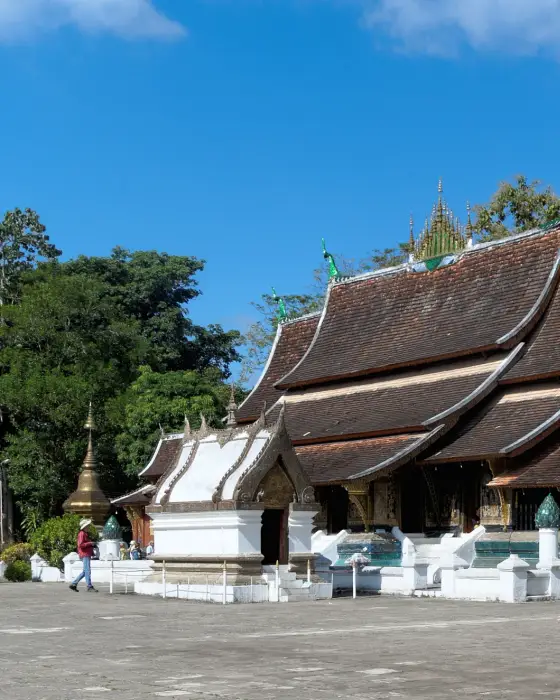
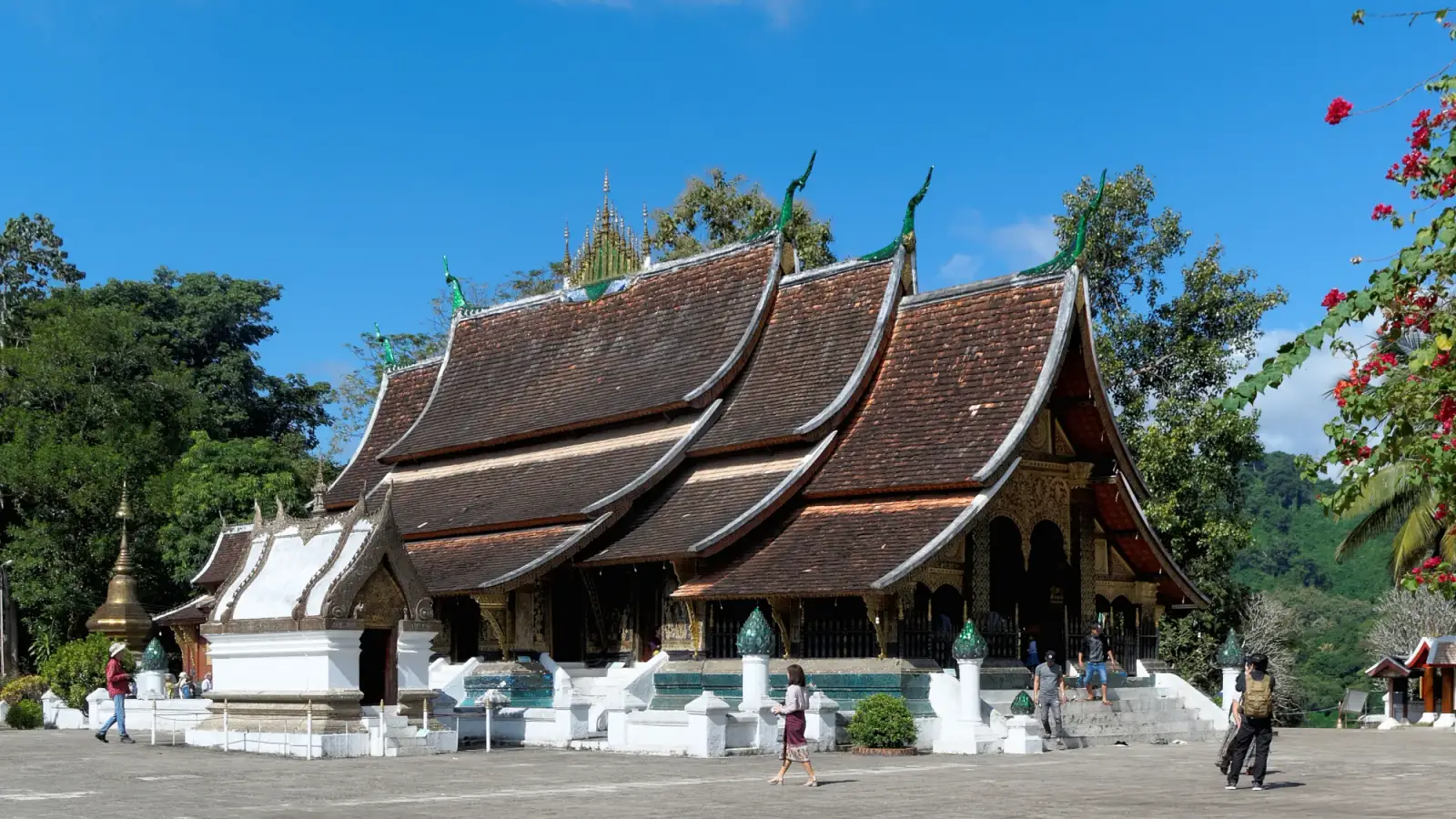
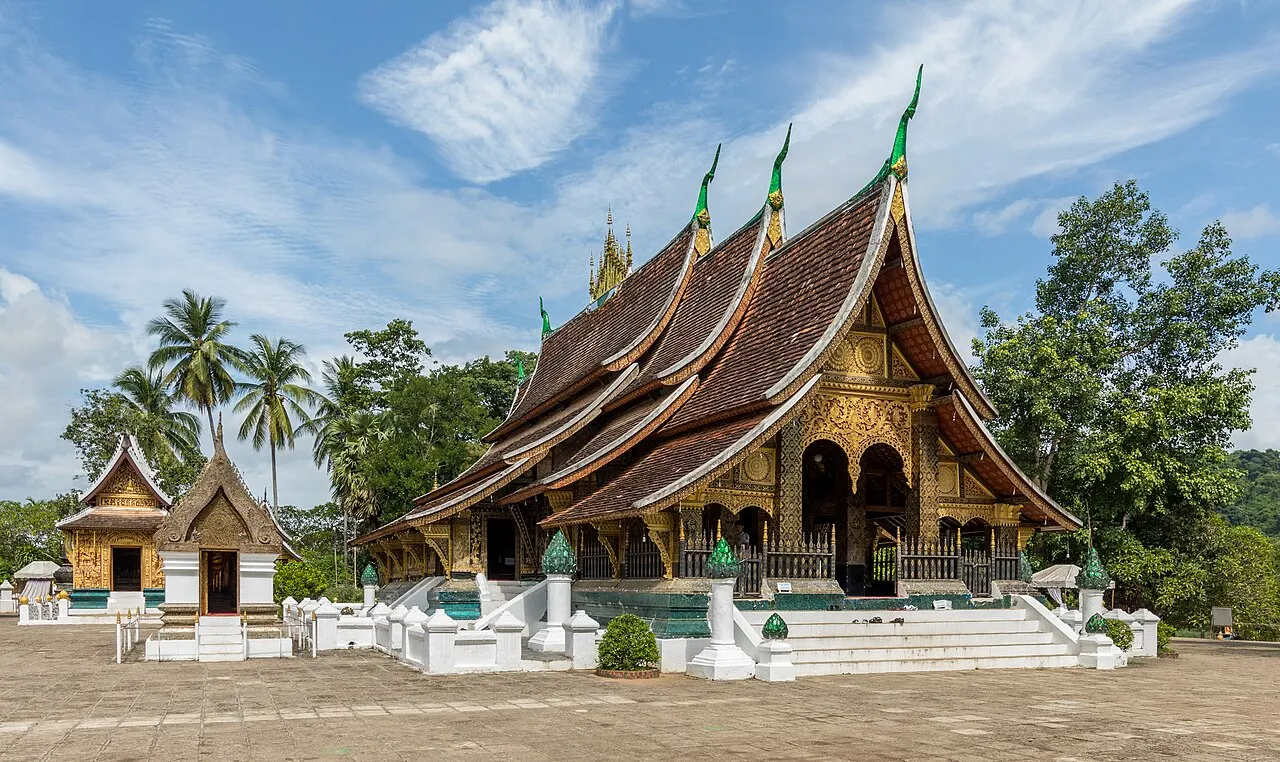
Founded by King Setthathirath around 1560, at the tip of the peninsula near the mouth of the Nam Khan, it is the monastery most associated with the Luang Prabang style: the roof of the sim (the ordination hall) descends in three curved tiers, and the outer walls have colored glass mosaics with scenes of everyday life in Luang Prabang. On the same grounds stands the hall built in 1962 to house the royal funeral carriage, made of carved and gilded teak, with the urns of King Sisavang Vong, father of the last king, and of members of the royal family. According to the provincial tourism website, it is open from 6 a.m. to 6 p.m. and charges foreigners 30,000 kip; the entrance is on the lane off the main street, and the Mekong side is exit only. Morning light is best for the mosaics.
Check access
Royal Palace of Luang Prabang (National Museum)
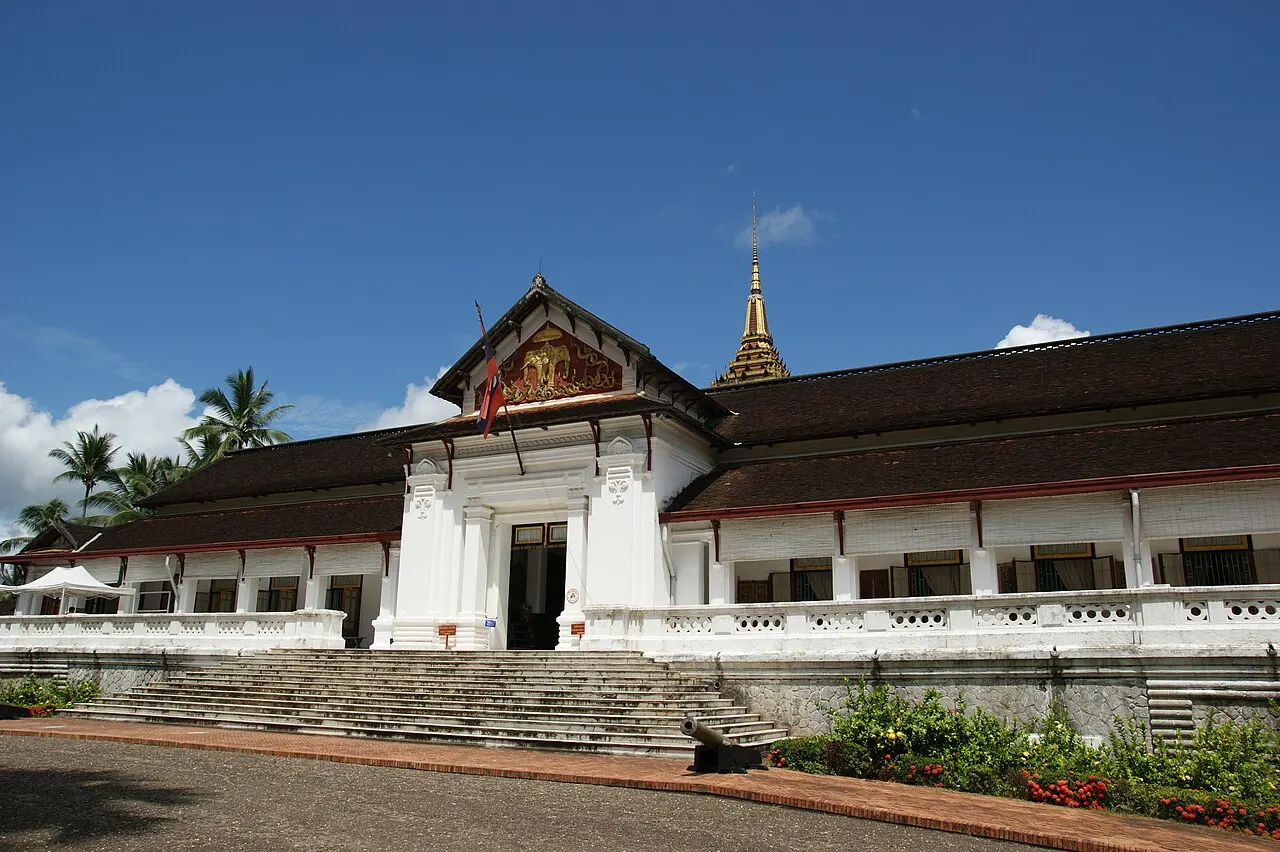
The Haw Kham palace was built between 1904 and 1909 for King Sisavang Vong and became a museum in 1976, after the end of the monarchy. Inside you pass through the state rooms and the royal family's quarters; on the grounds are the garage with the official cars, the Phralak Phralam theater and the Haw Pha Bang, the gold-roofed pavilion that houses the Phra Bang image. It is open from 8 to 11:30 a.m. and from 1:30 to 4 p.m., but the ticket office closes at 11 a.m. and 3:30 p.m.; foreigners pay 60,000 kip, according to the provincial tourism office, which also warns of a cleaning closure on a Thursday at the end of each month. Bags, shoes and photos stay outside; there are lockers, and shoulders and knees must be covered.
Check access
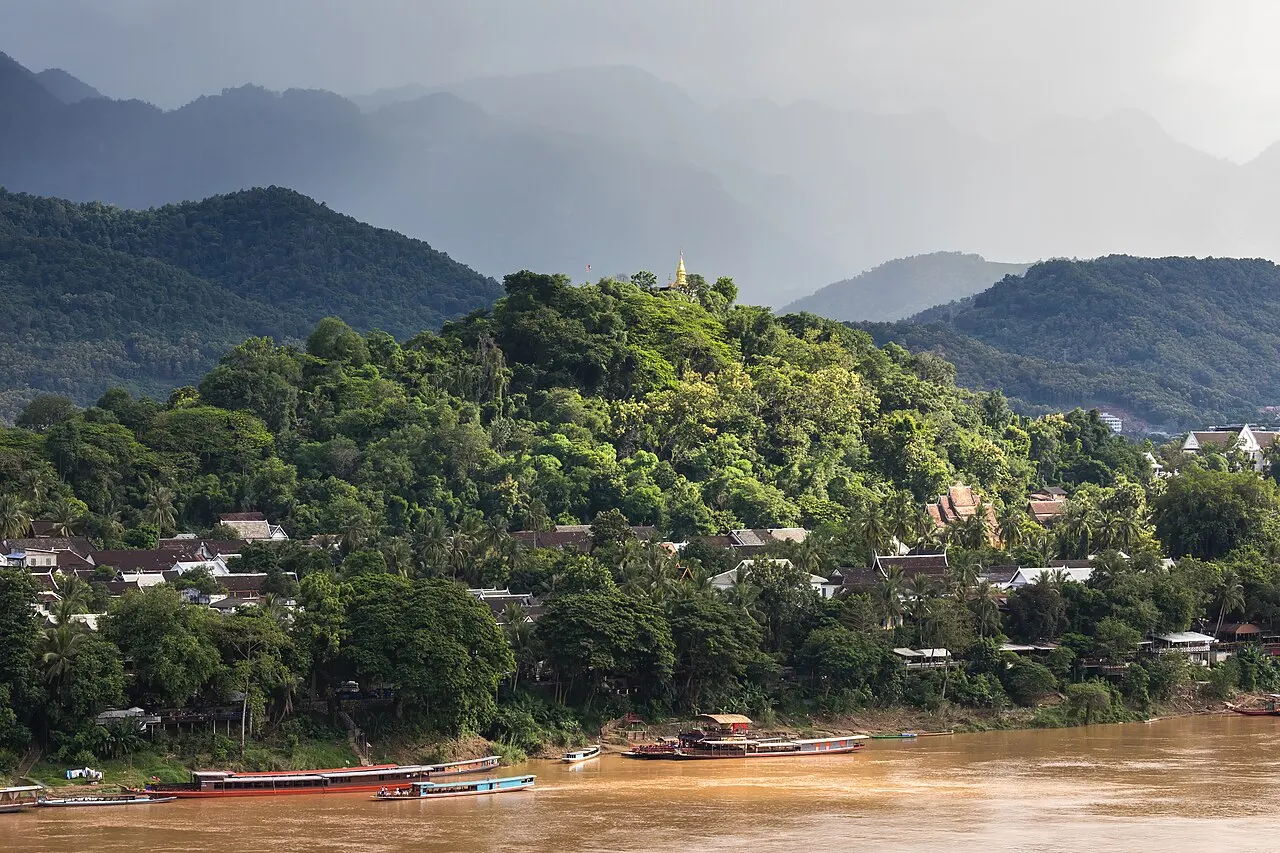
Phou Si
The hill in the middle of the city is topped by the golden stupa of Wat Chom Si, about 20 m tall, and has a view of the two rivers, the rooftops of the peninsula and the mountains. The most used climb starts across from the National Museum and has 328 steps among frangipani trees; other trails descend toward the Nam Khan and to the south, passing small temples, one of which holds a supposed footprint of the Buddha. The provincial tourism office lists opening from 6 a.m. to 6 p.m., depending on the season, and a 30,000 kip ticket for foreigners. It is a sacred place: dress appropriately and no alcohol. At sunset the top is crowded; early in the morning the view is the same, with fewer people.
Check access
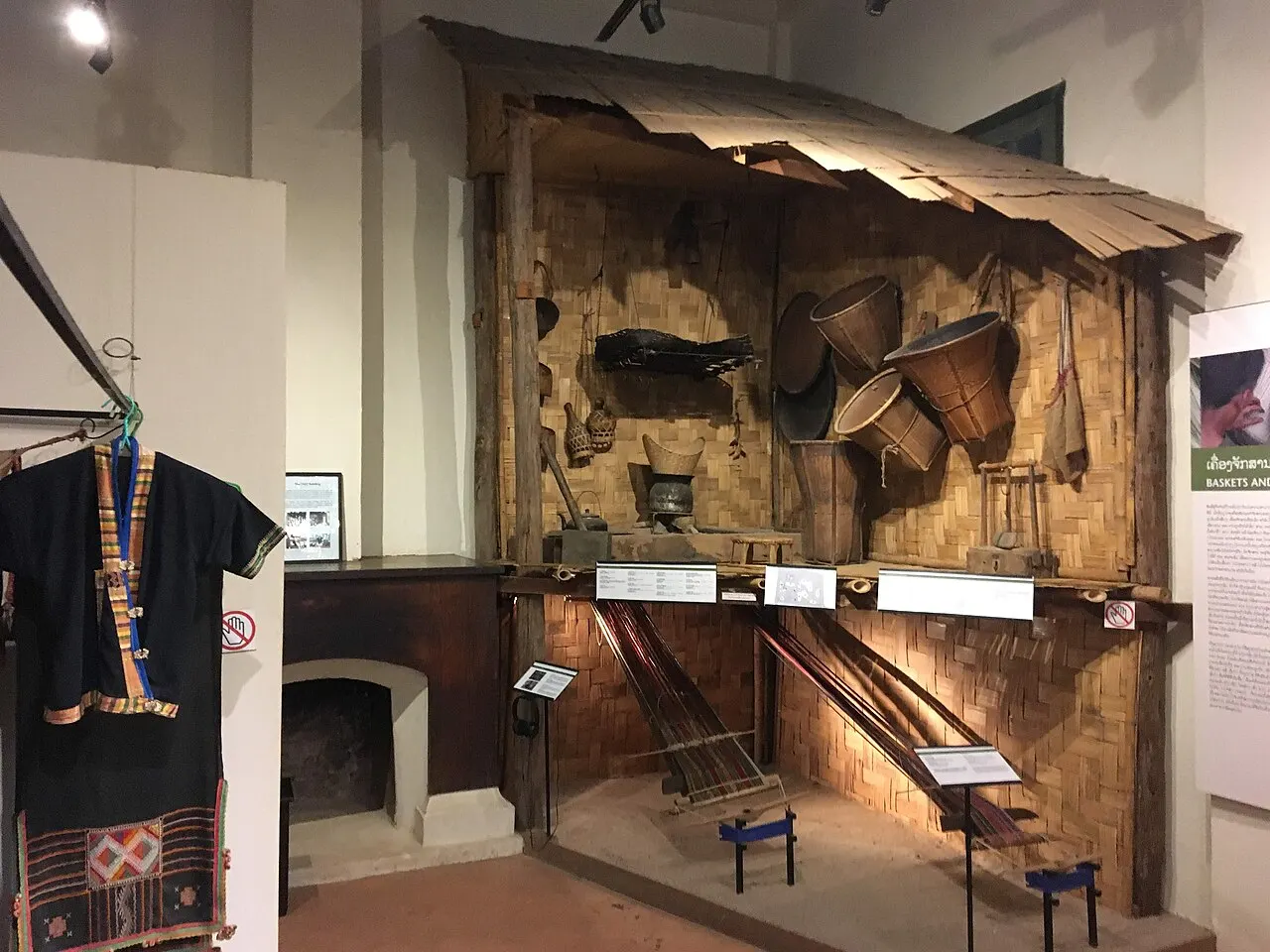
Traditional Arts and Ethnology Centre
The small museum at the foot of Phou Si, opened in 2007, presents the peoples of Laos, from the country's four major language families, through clothing, objects, photographs and testimonies, with texts in English and Lao and free translations in other languages, including Portuguese. It helps make sense of what you see in the villages and at the night market. It is open from 8 a.m. to 5 p.m., Tuesday to Sunday; from November to March it opens every day. The ticket costs 35,000 kip, and there are free guided tours on Tuesdays and Fridays at 3 p.m. and a bamboo-weaving workshop on Saturdays at 3 p.m., according to the provincial tourism office.
Check access
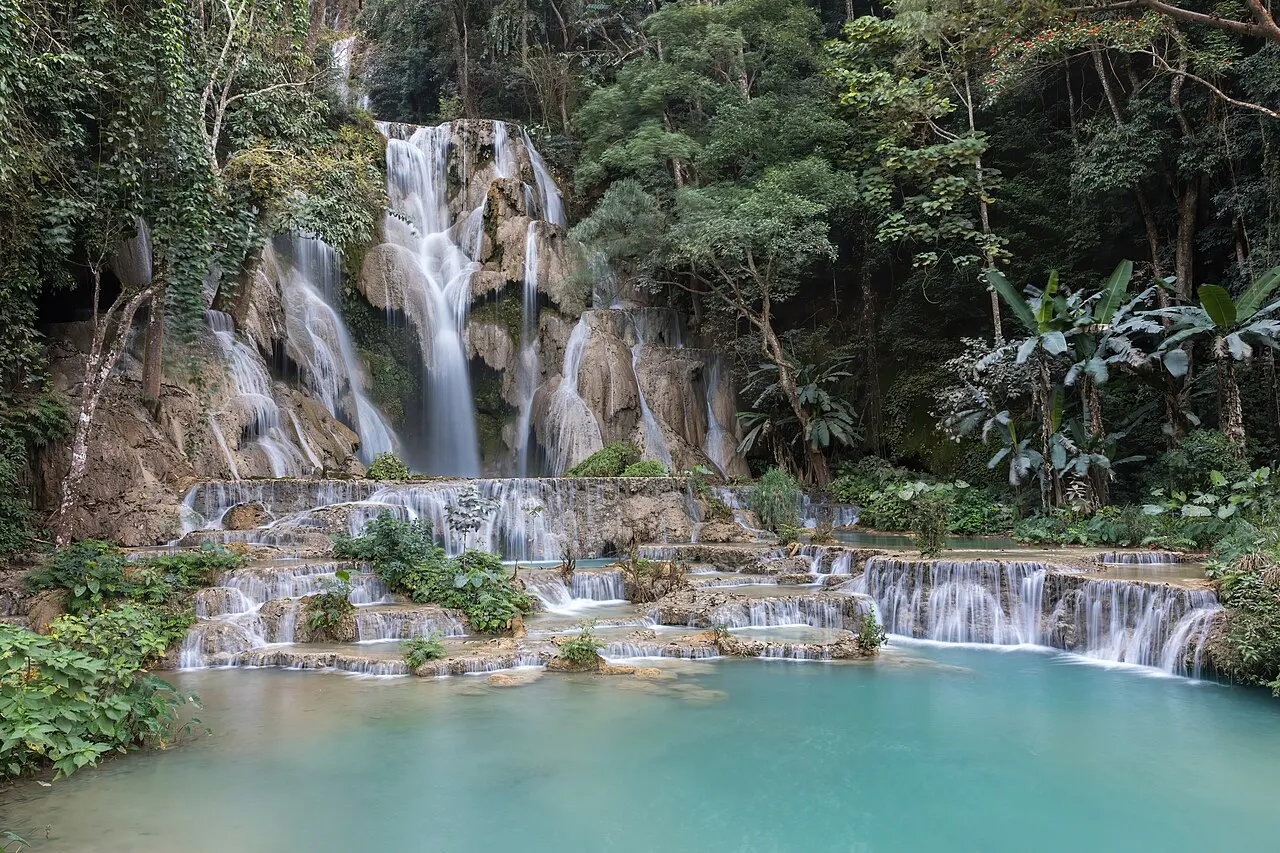
Kuang Si Falls (Tat Kuang Si)
About 30 km south of the city, some 45 minutes along a winding road, the Si River descends in limestone steps and forms pools of turquoise water in the dry season and greener water in the rains, when it can turn muddy; the main drop is about 60 m. From the parking lot, electric carts take you to the entrance, and the trail passes the Free the Bears rescue center, with no ticket. You can swim in the pools marked by signs, and very revealing swimwear is frowned upon. Open from 8 a.m. to 5:30 p.m.; foreigners pay 60,000 kip, according to the provincial tourism office (the national tourism page still shows a lower amount).
Check access
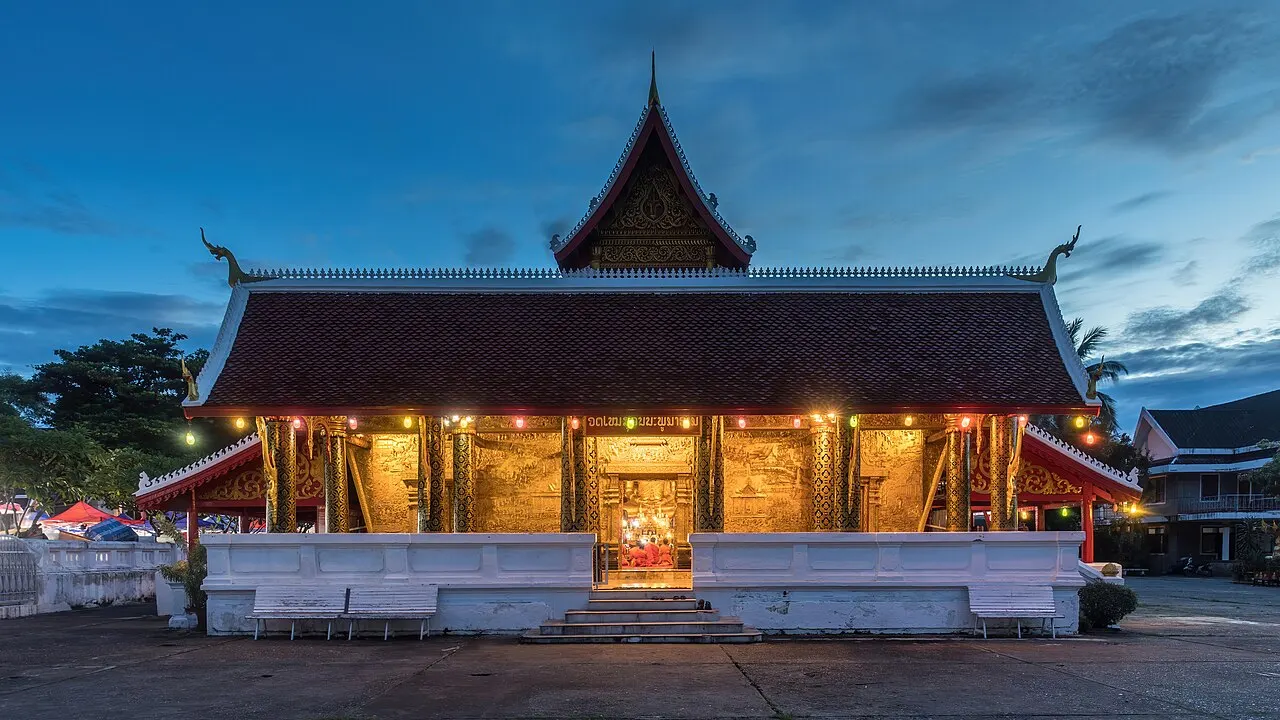
Wat Mai Suwannaphumaham
On the main street, next to the National Museum, the “new monastery” was built starting in 1796 and received its current name after the restoration begun in 1821. The roof has four tiers, and the reliefs on the walls show scenes of everyday life and the legend of Vessantara, one of the Buddha's earlier lives. The Phra Bang is brought here during the Lao New Year, in April, to be washed by worshippers. Open from 8 a.m. to 5 p.m.; the ticket is 10,000 kip, according to the provincial tourism office.
Check access
Wat Visounnarath
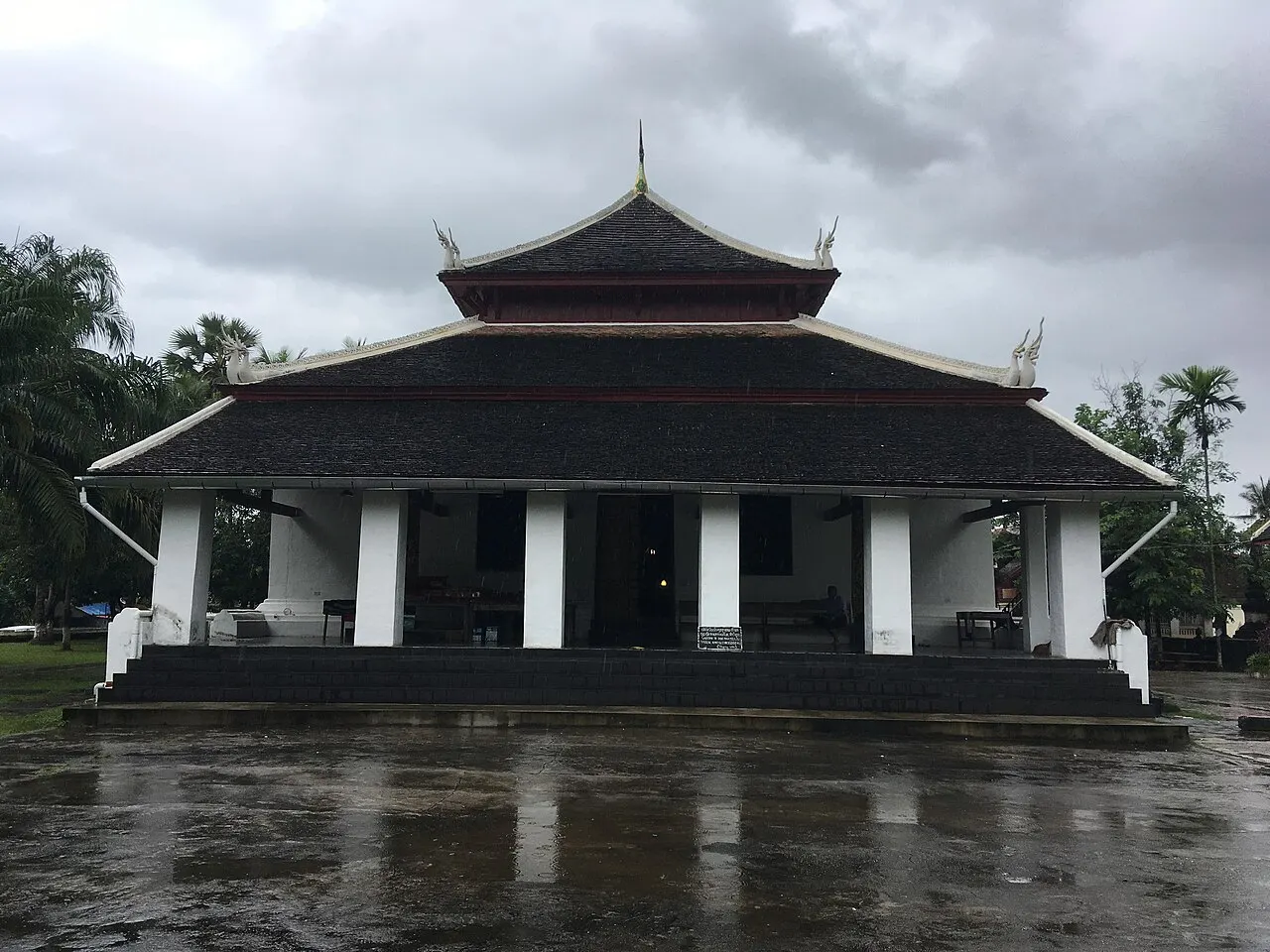
Founded in 1512 by King Visounnarath, south of Phou Si, it is one of the oldest temples in the city and kept the Phra Bang for two long periods. It was burned in the sack of 1887 and rebuilt in 1896. On the grounds stands That Pathoum, known as That Makmo, the “watermelon stupa,” for its rounded dome. Inside is the largest royal Buddha image among the city's temples, according to the provincial tourism office, along with pieces that once made the sim a museum of religious art. Open from 8 a.m. to 5 p.m.; the ticket is 20,000 kip, according to the provincial tourism office.
Check access
Luang Prabang Night Market
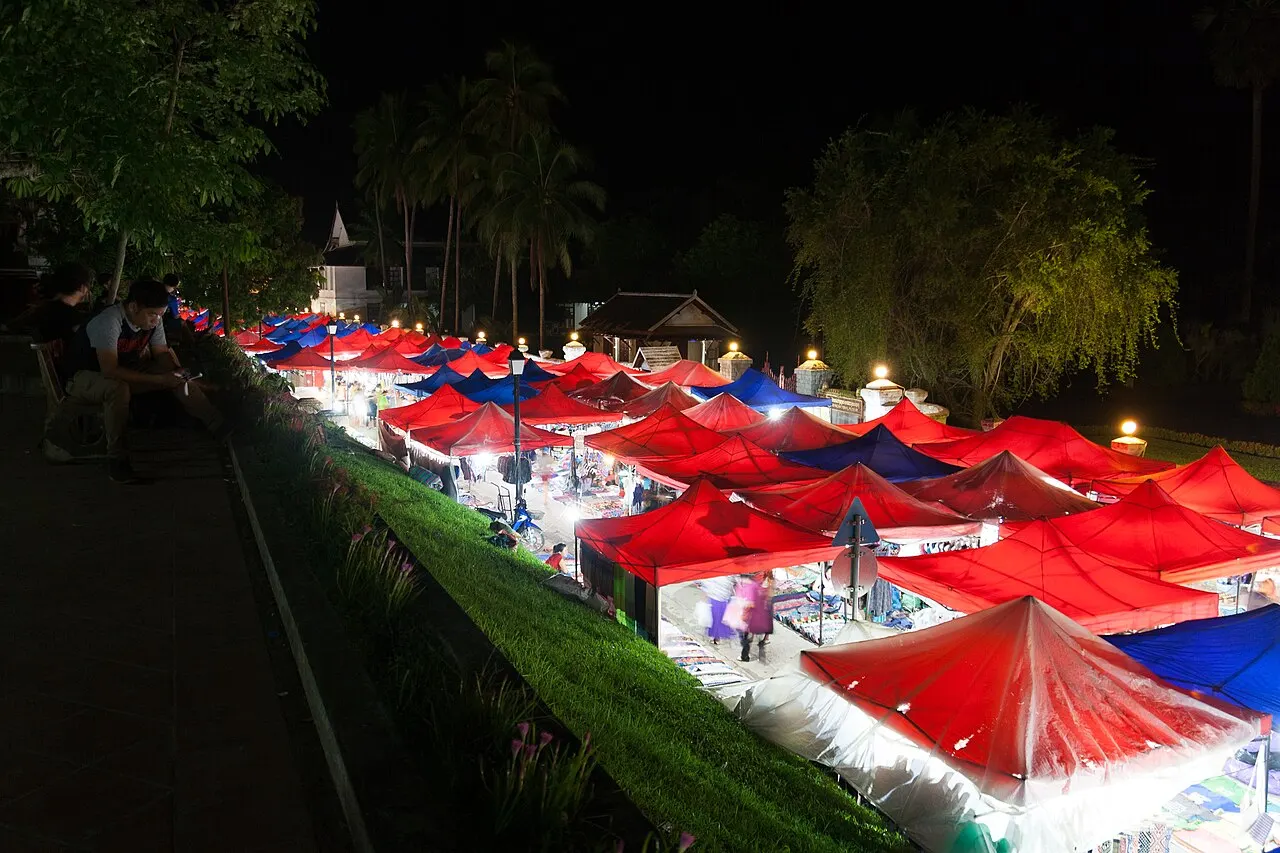
Every day, from 5 p.m. until about 10 p.m., a few hundred meters of Sisavangvong Street, from the tourist information center toward the palace, close to cars and turn into a row of craft stalls. The provincial tourism office speaks of about 250 vendors, with textiles, ceramics, handmade paper, silver, coffee and tea. In a lane between the main street and the Mekong are the food stalls. Gentle bargaining is normal.
Check access
UXO Lao Visitor Centre
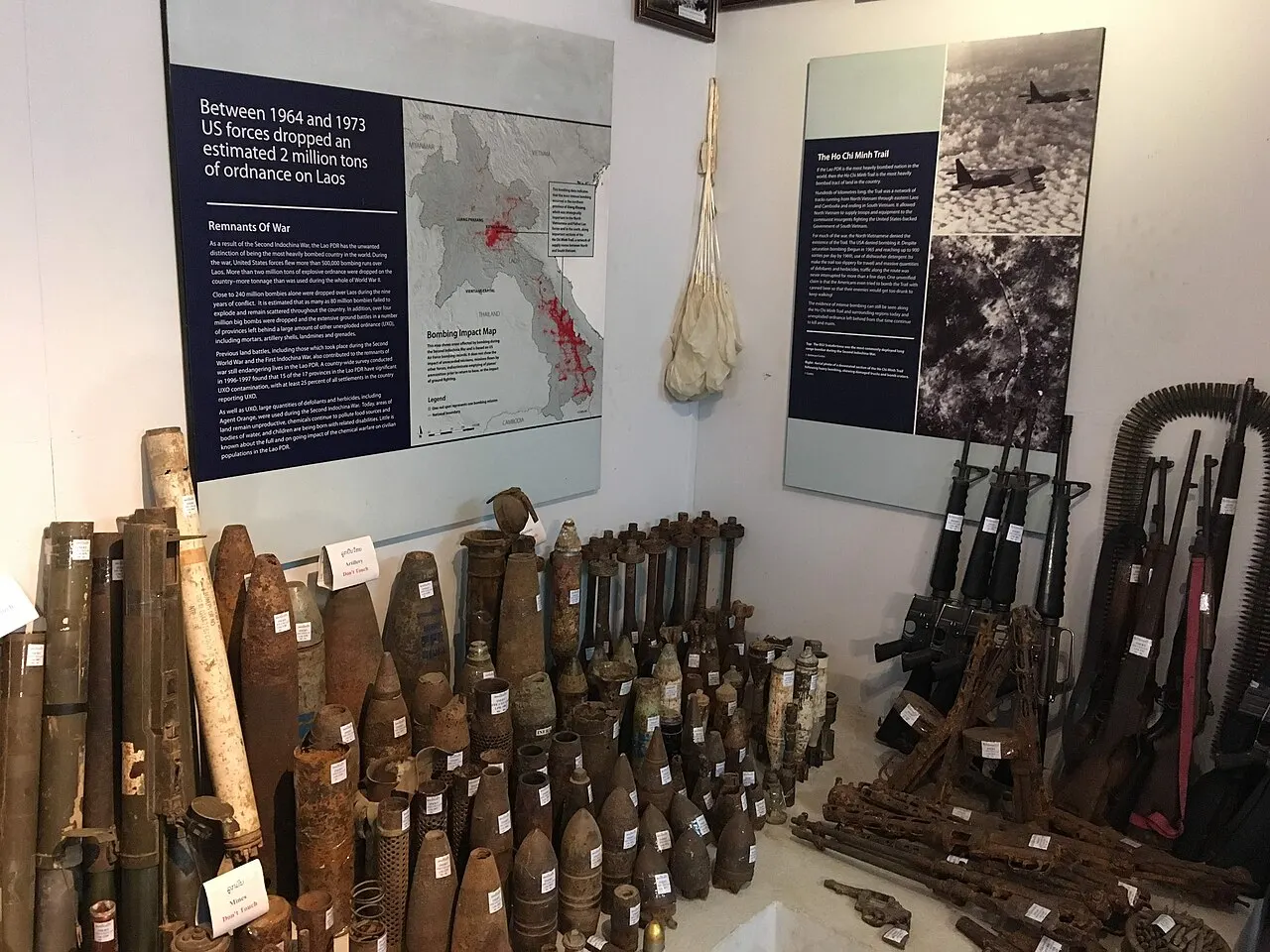
The visitor center of the organization that clears unexploded ordnance explains the secret war of 1964 to 1973, when Laos was heavily bombed, and what the cluster munitions still buried do to this day to people who work the land. There are defused bombs, survivors' stories and a documentary. It is in the village of Naviengkham, behind the Souphanouvong monument, about a 12-minute walk from the center. Admission is free, with donations; the provincial tourism office lists daily opening from 8 a.m. to 4 p.m., and older listings mention only weekdays.
Check access
More places in the guide
Wat Chomphet
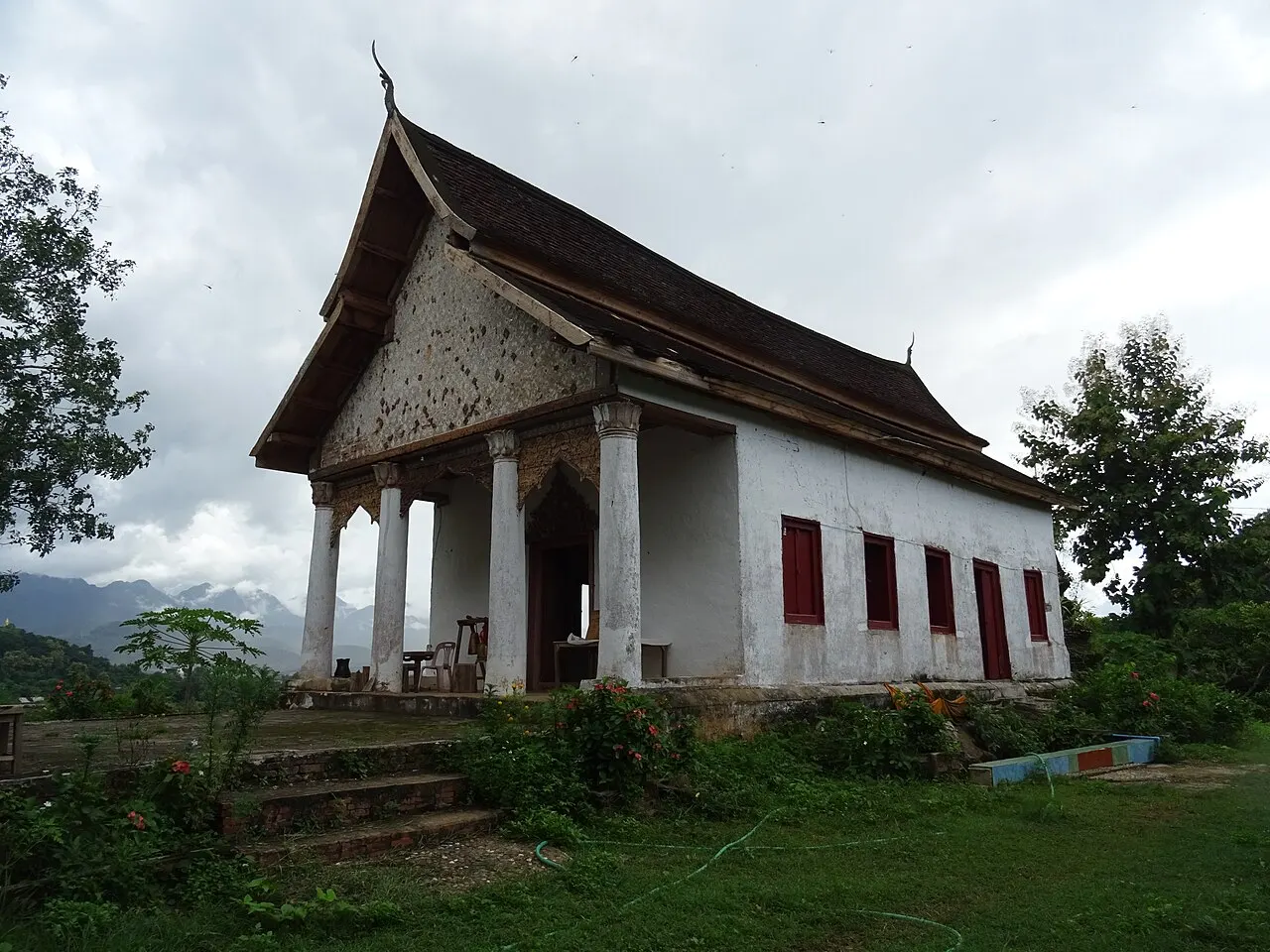
On the opposite bank of the Mekong, at the top of a 123-step staircase, this temple built in 1888 is in poor condition but offers one of the most complete views of the peninsula, Phou Si and the river. It is in the Chomphet district, where it is worth combining Wat Long Khoun, from the 18th century, with its mural paintings and the meditation space used by princes before they took the throne (open 8 a.m. to 5 p.m.), and Wat Xieng Man, from the 16th century. According to the provincial tourism office, the ticket bought at Wat Long Khoun is also valid for the neighboring temples and includes a local guide to the small cave of Wat Tham Sakkarin, used for meditation by the royal family. You get there by the passenger ferry that leaves from the bank near the National Museum.
Pak Ou Caves (Tham Ting)
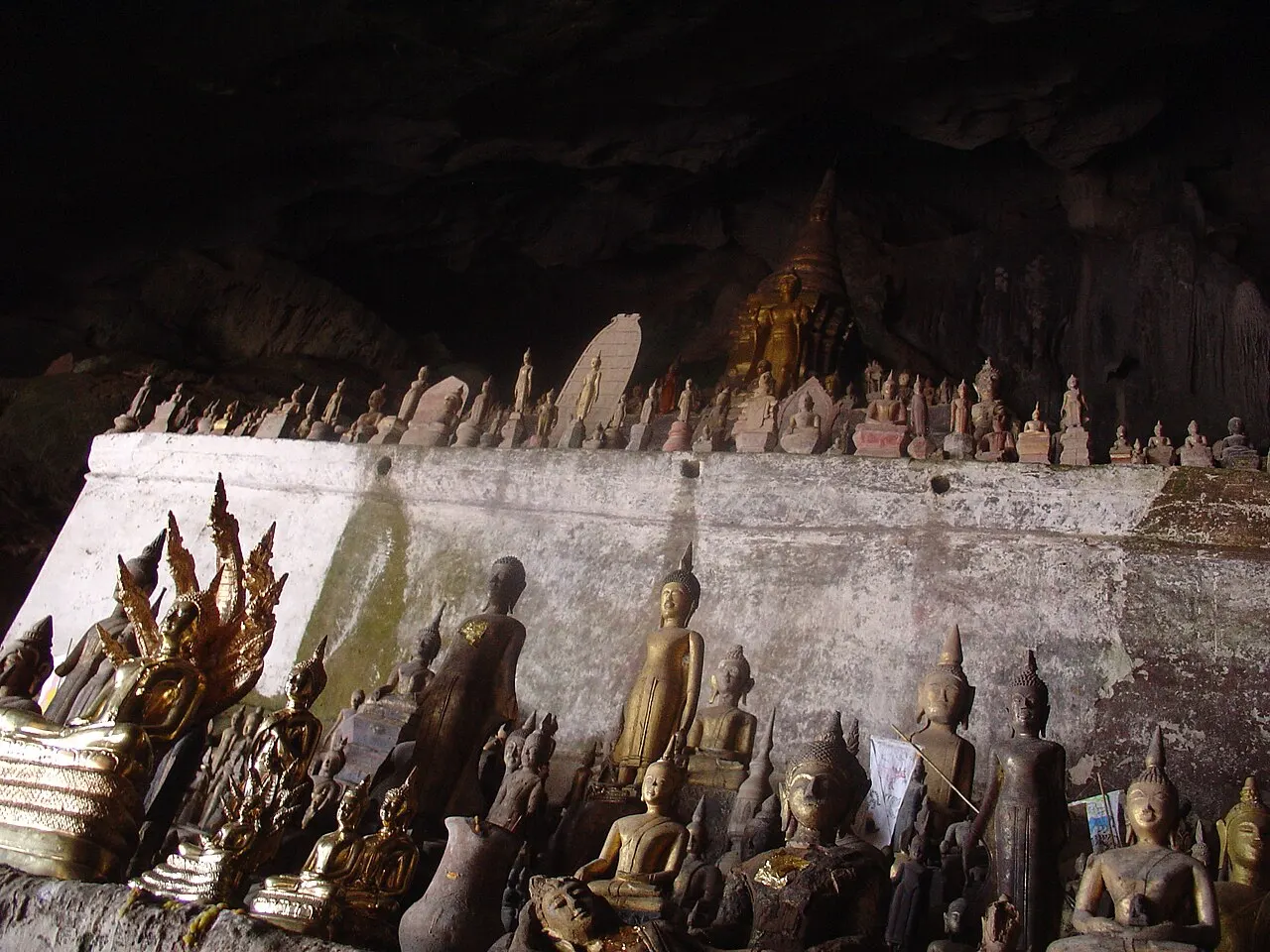
About 25 km upriver, on the limestone cliff opposite the mouth of the Ou River, two caves hold thousands of small Buddha images left by worshippers over the centuries. The lower cave, Tham Ting, is an opening in the rock above the Mekong; the upper one, Tham Theung, lies at the end of a staircase through the forest and is dark, so a flashlight helps. Open from 8 a.m. to 5 p.m.; foreigners pay 30,000 kip on site. The scheduled boat leaves at 8 a.m. from the office in the village of Vat Nong, takes about 1.5 hours upriver and makes the outing in about 3.5 hours round trip, for 80,000 kip per person, according to the provincial tourism office; you can also go by car and cross the river on a short boat at Pak Ou.
Phralak Phralam Theater
On the grounds of the National Museum, the theater, created in 2003, presents episodes of the Phralak Phralam, the Lao version of the Ramayana, with dance and a live orchestra. Performances are on Mondays, Wednesdays, Fridays and Saturdays, at 6 p.m. from October to February and 6:30 p.m. from March to September; tickets range from 150,000 to 250,000 kip depending on the row, and the box office is open from 8 a.m. to 6 p.m., according to the provincial tourism office. The show is in Lao, with summaries in other languages at the box office.
Nilo’s itinerary
Start with the basic programme and choose extensions for the time you have.
Plan my days in the app ↗Day 1 · The peninsula, from the Tak Bat to Phou Si
Before dawn, watch the Tak Bat from across the sidewalk (5:30 to 6:30 a.m. from March to October; 6 to 7 a.m. from November to February). The busiest stretch is Sakkaline Road, which tends to be crowded with visitors; the provincial tourism office suggests other parts of the city for watching more calmly, always at least 5 m from the monks.
Have breakfast at the morning market, on the street between Kitsalat and the National Museum, which wraps up around 11 a.m.
Walk to the tip of the peninsula and visit Wat Xieng Thong, which opens at 6 a.m.; enter through the lane off the main street.
Go back along the main street to the National Museum and enter before 11 a.m., when the morning ticket office closes; allow about 1.5 hours for the palace, the royal garage and the Haw Pha Bang.
On your way out, cross over to Wat Mai, next to the museum.
Have lunch and rest during the hottest hours, near the river.
In the afternoon, visit the Traditional Arts and Ethnology Centre, at the foot of Phou Si (closed on Mondays from April to October).
Late in the afternoon, climb the 328 steps of Phou Si from the entrance across from the museum to watch the sun set over the Mekong; it is the busiest time, and the provincial tourism office lists opening until 6 p.m., depending on the season. If you prefer an empty summit, make the climb in the first hour of another morning.
Head down to the night market, open from 5 to 10 p.m., and have dinner at the stalls in the food lane between the main street and the Mekong.
Day 2 · Kuang Si and the south of town
Take the 8 a.m. green bus from Thatluang Park or a pre-arranged tuk-tuk to Kuang Si, about 30 km south; the falls open at 8 a.m.
From the parking lot, take the electric cart to the entrance and follow the trail that passes the bear rescue center up to the pools.
Swim in the marked pools and leave time to climb to the main drop; bring sandals and a cover-up.
Head back to town in the early afternoon; confirm at the ticket window the return time of the green bus or arrange the return with the tuk-tuk.
Visit the UXO Lao Visitor Centre, behind the Souphanouvong monument, before 4 p.m.
Walk to Wat Visoun and the That Makmo stupa, which close at 5 p.m.
Have dinner at a Lao restaurant on the Mekong bank, with or lam and khai phaen.
If you stay longer
Day 3 · Along the Mekong: Pak Ou and Chomphet
Board the 8 a.m. scheduled boat to the Pak Ou caves, buying the ticket at the office in the village of Vat Nong (about 3.5 hours round trip).
At Pak Ou, visit the lower cave and climb the staircase to the upper one, with a flashlight.
If the boat stops at Ban Xang Hai on the way back, take the chance to see how lao lao is distilled.
Have lunch in town after you return.
In the afternoon, cross the Mekong on the passenger ferry near the National Museum and walk around Chomphet: Wat Long Khoun (open until 5 p.m.), where the ticket includes a guide to the Wat Tham Sakkarin cave and is valid for the neighboring temples, Wat Xieng Man, and the staircase of Wat Chomphet for a view of the peninsula from across the river.
Confirm the time of the last crossing with the boatman and head back before dark.
If it is a Monday, Wednesday, Friday or Saturday, an alternative to the late afternoon in Chomphet is the Phralak Phralam performance at the palace theater (6 p.m. from October to February; 6:30 p.m. from March to September).
Food
Or lam
The stew most associated with Luang Prabang: pork, vegetables, herbs and slivers of sakhan, a pepper-vine wood that leaves the mouth slightly numb. It is a mild, herbal stew.
Khai phaen
Thin sheets of green river algae harvested from the Mekong, dried and seasoned with sesame, chili and oil. It is not eaten raw: quickly fried, it becomes a crunchy, salty snack that goes with beer and jeow bong.
Jeow bong
A chili paste served in Luang Prabang alongside fried khai phaen and other snacks.
Luang Prabang khao soi
A rice noodle soup with a clear broth and spicy minced meat on top, quite different from the Chiang Mai version that goes by the same name. It is street-stall food; Wikivoyage lists one at the corner of Inthasome and Sisavangvong, which opens around 5 p.m.
Luang Prabang sausage
Pork sausage seasoned with herbs, one of the city's specialties, served grilled and sliced.
Mok pa
River fish seasoned with herbs and steamed in a banana leaf; it appears at the night market stalls and in Lao restaurants.
Khao niao
Sticky rice steamed and served in small bamboo baskets, eaten by hand in little balls, dipped into the dishes. It is the same rice offered to the monks at the Tak Bat.
Beerlao and lao lao
Beerlao is the national beer, found at every table on the riverfront. Lao lao is the rice spirit made in villages such as Ban Xang Hai, on the way to the Pak Ou caves.
French-heritage bread and pastries
Bakeries and stalls on the main street sell filled baguettes, croissants and crêpes, a legacy of the protectorate that became part of the breakfast routine.
Where to eat
- Night market food lane
Stalls in a lane between the main street and the Mekong, with salt-crusted grilled fish, charcoal-grilled meats, green papaya salad pounded to order and buffets of Lao and vegetarian dishes. It is the cheapest and most varied meal in the center; the tables fill up early in the evening.
- Mekong bank
Lao restaurants with tables facing the river, good for trying or lam, fried khai phaen with jeow bong, mok pa and Luang Prabang sausage with a Beerlao at sunset. Prices vary a lot: check the menu before you sit down.
- Main street (Sisavangvong and Sakkaline)
French-style bakeries for breakfast, with baguettes and croissants, and pricier restaurants serving refined Lao or Western cooking in the restored townhouses.
- Morning market and street stalls
Along the morning market, where residents buy vegetables, fish and herbs, small eateries serve breakfast to people coming back from the Tak Bat. It is where you eat the way the city eats, before the market wraps up around 11 a.m.
- Cooking classes (main street and surroundings)
Several restaurants on the main street teach Lao cooking; the provincial tourism office describes the work with shallots crushed in a mortar, fresh herbs and sticky rice steamed over a wood fire. A few places outside the center also offer classes, which generally end with the meal you prepared, according to Wikivoyage.
· 2026-10-19
Day trips
Tad Sae Waterfall
About 14 km by road to the boarding point on the Nam Khan, then about 8 minutes by boat. The falls are smaller and wider than those at Kuang Si, with walkways over the water. The ticket for foreigners is 30,000 kip, according to the provincial tourism office, which warns that it may be dry or nearly dry from February to July: check before going. Next door is a park with elephants, where you can feed them and also ride them, according to the provincial tourism office.
Nong Khiaw
About 3 hours north by bus, from the north bus station, lies this river village, from which boats continue to Muang Ngoi Neua. Given the distance, it works better with an overnight stay than as a day trip.
Where to begin
The peninsula, from the Tak Bat to Phou Si
Before dawn, watch the Tak Bat from across the sidewalk (5:30 to 6:30 a.m. from March to October; 6 to 7 a.m. from November to February). The busiest stretch is Sakkaline Road, which tends to be crowded with visitors; the provincial tourism office suggests other parts of the city for watching more calmly, always at least 5 m from the monks.
Kuang Si and the south of town
Take the 8 a.m. green bus from Thatluang Park or a pre-arranged tuk-tuk to Kuang Si, about 30 km south; the falls open at 8 a.m.
Along the Mekong: Pak Ou and Chomphet
Board the 8 a.m. scheduled boat to the Pak Ou caves, buying the ticket at the office in the village of Vat Nong (about 3.5 hours round trip).
Money
The currency is the Lao kip (LAK). Tickets for temples, caves and waterfalls are charged in kip, in cash, at the ticket office; the amounts published by the official provincial tourism website, checked in October 2026 (the pages carry no date), are 30,000 kip at Wat Xieng Thong and Phou Si, 60,000 kip at the National Museum and Kuang Si, 30,000 kip at the Pak Ou caves and 80,000 kip for the scheduled boat to them. In Chomphet, the ticket bought at Wat Long Khoun is also valid for the neighboring temples. On the main street there are ATMs that accept international cards, with a withdrawal limit and fee, and exchange offices whose rates vary widely: compare beforehand and be wary of anyone who advertises one rate and applies another. Thai baht and US dollars are sometimes accepted, at a worse rate. Outside the old town, prices for food and shopping are usually much lower than on the main street. At the night market you bargain gently; at temples, tickets are not negotiable.
Getting there and around
Luang Prabang International Airport (LPQ) is about 4 km north of the center and receives flights from Vientiane and from cities in the region, such as Bangkok, Chiang Mai and Hanoi; routes change often. Outside arrivals there is a fixed-fare taxi counter and ATMs. Visa rules depend on your passport: Wikivoyage lists the airport as an entry point with visa on arrival and e-Visa, but check the conditions on the official Laos e-Visa portal and with the consulate before you fly.
The Laos-China railway train is the fastest way to arrive overland: about two hours from Vientiane, via Vang Vieng, with trains that continue north to Boten, on the border, and on to Kunming. Tickets are sold through the LCR Ticket app; since April 1, 2026, second class between Vientiane and Luang Prabang costs 360,000 kip, according to the Lao tourism authority. Demand tends to exceed supply, so buy ahead. The station is about 12 km east of the old town; a green minibus takes you to the center for 40,000 kip (price from August 2026, according to Wikivoyage).
Along the Mekong, the slow boat links Huay Xai, on the Thai border, to Luang Prabang in two days, with an overnight stop in Pakbeng; the arrival pier is about 10 km from the center. There are buses to Vientiane, Vang Vieng, Nong Khiaw and the north from two bus stations on the outskirts, but the road south is winding and slow.
Within the peninsula everything is done on foot, and a bicycle works well on the flat streets. Large buses are banned in the protected area. To go farther there are tuk-tuks and vans: agree on the price beforehand, per person or for the whole vehicle, or use the ride-hailing app Loca. For Kuang Si, a green bus leaves from Thatluang Park at 8, 9:30, 10:30 a.m. and 12, 1:30 and 3 p.m., for 45,000 kip one way or 90,000 kip round trip (October 2025, according to Wikivoyage). A passenger ferry crosses the Mekong to Chomphet from the bank near the National Museum, and the agencies on the main street sell sunset boat trips on the Mekong.
Safety
The most concrete risks are practical ones. Motorbike and van traffic has increased, so cross with care and wear a helmet if you rent a motorbike; when renting, choose the shop carefully, photograph the vehicle and use a lock, because there are reports of high charges for supposedly stolen bikes. The road to Kuang Si is the riskiest for anyone on a scooter: paved but winding, with sand-filled potholes and many tourist vans at high speed, and Wikivoyage records serious accidents; a tuk-tuk, a van or the green bus are safer. In the countryside, unexploded ordnance from the war of 1964 to 1973 is still there: stay on marked trails and roads. At the waterfalls, swim only where there are signs and wear sandals, because the bottom is sharp rock. At exchange offices, check the rate and the amount before handing over the money. In March and April, the smoke from burning can bother people with respiratory problems, and in the rainy season it is wise to use mosquito repellent.
Before you go
- Plug
- types A, B, C, E and F
- Voltage
- 230 V
- Driving side
- on the right
- Emergency
- Police 191 · Ambulance 195 · Fire 190
- Country code
- +856
- Official language
- Lao
- Currency
- Lao kip (LAK)
Source: Wikidata (CC0), checked September 2026.
Etiquette tips
Watch the Tak Bat from a distance
The provincial tourism office asks for silence, no flash, shoulders, chest and legs covered, no physical contact with the monks, and at least 5 m of distance for anyone just watching. Do not follow the procession, and do not stand higher than the monks, such as on top of a vehicle. Sakkaline Road tends to be crowded; in other parts of the city the rite takes place with fewer people.
Offer only if the gesture has meaning for you
Anyone who wants to take part should buy the sticky rice at the market that morning, not from stalls on the main street, and do so respectfully; those who do not take part should not get in the way of those who are offering.
Shoulders and knees covered at temples
In the wats and the National Museum, cover from shoulder to knee, and take off your hat and shoes. At the museum you can rent a cloth at the entrance.
Women do not touch monks
Not even to hand something over: the object goes to a man or is placed near the monk.
Discretion in public
Kissing and even holding hands in public are frowned upon, and walking shirtless or in only a bikini through town or at the waterfalls is considered offensive.
No drinks on Phou Si
The top of the hill is sacred, and drinking alcohol is prohibited.
Ask before taking photos
At the morning market and in the villages, ask permission before photographing people.
Do not buy antiques
The provincial tourism office warns that taking antiques out can bring a fine.
Mistakes to avoid
Buying the Tak Bat rice from vendors on the main-street sidewalk instead of at the market, and standing right next to the line of monks to take photos.
Arriving at the National Museum at 11:15 a.m. and finding the morning ticket office already closed; it only reopens at 1:30 p.m.
Going to the Traditional Arts and Ethnology Centre on a Monday between April and October, when it is closed.
Climbing Phou Si only at sunset expecting an empty summit: it is the busiest time.
Leaving the purchase of the train ticket to Vientiane until the day before, in a season when demand tends to exceed supply.
Visiting Tad Sae waterfall between February and July without asking first: in that period it may be dry or nearly dry.
Renting a motorbike and leaving your passport as a deposit without agreeing, in writing, how and when it will be returned.
Swimming outside the marked pools at Kuang Si, or walking in a bikini between the pools and the parking lot.
Useful phrases
ສະບາຍດີ (sabai di)
Hello
ຂອບໃຈ (khop jai)
Thank you
ກະລຸນາ (kalunaa)
Please
Bo pen nyang
No problem, it's fine
Kho thot
Excuse me, sorry
Anee tor dai?
How much is this?
ແພງ (phaeng)
Expensive
Saep lai lai
It was very tasty
ນ້ຳ (nam)
Water
ເບຍ (bia)
Beer
Where to stay
- Historic peninsula · First-time visitors with few days who want to do everything on foot, including waking up for the Tak Bat.: The guesthouses in restored houses are a few minutes from Wat Xieng Thong, the museum, Phou Si and the night market, and the monks' procession passes through the streets of the peninsula. The drawback is the price, the highest in town, and the van and tuk-tuk traffic during the day.
- Nam Khan bank · Those who want to be close to everything but on a calmer side than the main street and the Mekong bank.: It is a few minutes' walk from the center, with a view of the smaller river and access to the trail that climbs Phou Si from the back. There are fewer restaurants at night than on the Mekong side.
- Ban Visoun and south Phousi · Those traveling on a smaller budget or staying longer who don't mind walking 10 to 15 minutes to the peninsula.: Outside the old town, lodging, food and shopping usually cost less, and the neighborhood is residential, near Wat Visoun, the UXO Lao Visitor Centre and the local markets. At night it is emptier and less lit than the center.
- Surroundings and hillsides · Those who want a hotel with a pool and garden and accept depending on transport.: There are hotels and resorts on the hills and along the road to Kuang Si, roomier and quieter. Every trip to the center takes a tuk-tuk, a hotel van or a bicycle, and you have to wake even earlier to see the Tak Bat.
· 2026-10-19
Districts
Historic peninsula
The listed heart of the city, between the palace and the point where the rivers meet. Here are Wat Xieng Thong, the National Museum, Wat Mai, the climb up Phou Si and the night market, along with many of the guesthouses in restored houses. It is the place to walk early in the morning, when the monks' procession passes, and in the late afternoon.
Mekong bank
The street on the west side of the peninsula, with restaurants and bars facing the river, the pier where the ferry to the other bank departs, and the sunset view over the mountains. It suits dinner with the river in front of you and the ferry to Chomphet.
Nam Khan bank
The east side of the peninsula, quieter, with small guesthouses, cafés and a view of the smaller river and the hillsides. It is a few minutes from the main street and the shortest way to the trail that climbs Phou Si from the back.
Ban Visoun and south Phousi
South of the hill, the town continues with residential streets, Wat Visoun monastery, the UXO Lao Visitor Centre, and local markets and supermarkets. It is the area for cheaper lodging and everyday food, 10 to 15 minutes on foot from the peninsula.
Chomphet
The district on the opposite bank of the Mekong, reached by boat. It has villages, the temples Wat Long Khoun, Wat Xieng Man and Wat Chomphet, and the most complete view of the peninsula from the river. It lacks the infrastructure of the center: you go for a daytime outing.
Surroundings
The countryside around the town, with rice fields, villages and limestone hills, where the Kuang Si and Tad Sae waterfalls, the Pak Ou caves, craft villages and a few hillside hotels with pools are found. You get there by tuk-tuk, van, bus or boat.
History
1353 · Capital of Lan Xang
Fa Ngum unites the region's principalities into the kingdom of Lan Xang, the “kingdom of a million elephants,” with its capital in the city then called Xieng Dong Xieng Thong.
14th c. · The Phra Bang arrives
The 83 cm Buddha image, sent from Angkor to King Fa Ngum, gives the kingdom Buddhist legitimacy and, later, gives the city its name.
1560 · Wat Xieng Thong
King Setthathirath founds the monastery that became the best-known example of the Luang Prabang style. Soon afterward, the kingdom's capital moves to Vientiane.
1707 · Kingdom of Luang Prabang
Lan Xang splits over dynastic disputes, and Luang Prabang becomes the capital of a kingdom of its own in the north.
1887 · The Black Flags sack the city
Armed groups from China loot and burn the city; Wat Xieng Thong is among the few temples spared.
1893 · French protectorate
The kingdom accepts French protection. The French presence leaves masonry townhouses with shutters next to the wooden houses.
1904–1909 · The royal palace
The Haw Kham palace is built, blending French Beaux-Arts style with Lao elements; it was the residence of kings Sisavang Vong and Sisavang Vatthana.
1945 · End of the protectorate declared
With the city occupied by Japanese troops, King Sisavang Vong declares the end of the protectorate on April 8; France reoccupies Luang Prabang in August.
1975 · End of the monarchy
With the proclamation of the Lao People's Democratic Republic on December 2, King Sisavang Vatthana abdicates. In 1976 the palace becomes the National Museum.
1989 · Opening to tourism
Laos reopens to tourism, and wooden houses and colonial townhouses are restored as guesthouses and hotels.
1995 · World Heritage Site
UNESCO inscribes the city of Luang Prabang on the World Heritage List for its fusion of traditional Lao and European colonial architecture.
2021 · The train arrives
On December 3 the Laos-China railway opens, linking Luang Prabang to Vientiane and to the Chinese border at Boten.
2026 · UNESCO monitors the dam and tourism
The World Heritage Committee notes that the impact assessment for the Luang Prabang hydropower plant on the Mekong has been revised, asks for a report on compliance with the mitigation measures and encourages a visitor carrying-capacity study for the listed city.
Complete history
Luang Prabang owes its name to a statue. The Phra Bang, an 83 cm Buddha image in an alloy of bronze, gold and silver, reached the first king of Lan Xang, Fa Ngum, in the 14th century, sent from Angkor, and helped establish Theravada Buddhism as the kingdom's religion. The city, then called Xieng Dong Xieng Thong, was the capital of Lan Xang from 1353 and, even after the court moved to Vientiane in the 16th century, remained the seat of royalty in the north. Today the Phra Bang is kept in the Haw Pha Bang, the pavilion on the grounds of the former palace.
The following centuries were fragile ones. In 1707 Lan Xang split apart and Luang Prabang became the capital of a smaller kingdom that paid tribute to stronger neighbors. In 1887 armed groups from China, the Black Flags, looted and burned the city, and the monarchy accepted French protection in 1893. The layer that sets the center apart dates from that period: masonry townhouses with shutters and verandas, built among Lao wooden houses and monasteries with low, tiered roofs. The Haw Kham palace, completed in 1909, sums up the mix.
The 20th century passed through the city without destroying it. It was occupied by Japanese troops in 1945, contested in the war of independence and, after 1975, lost its royal function when the monarchy ended and the palace became a museum. In the years of poverty that followed, almost nothing was demolished to make way for new buildings. When Laos reopened to tourism in 1989, the old houses were restored as guesthouses, and in 1995 UNESCO listed the city.
The World Heritage listing shapes a visit today. Large buses are not allowed into the protected area, construction follows a conservation plan monitored by UNESCO, and the monasteries are still home to monks and novices who go out every morning for the alms round. The pressures are current, too: the Laos-China railway, opened in 2021, shortened the trip from Vientiane, and the Luang Prabang hydropower plant on the Mekong is under monitoring by the World Heritage Committee. In 2026 the Committee asked Laos for a report on the plant's mitigation measures, encouraged a study of how many visitors the city can hold, and noted the country's commitment to submit major projects for review before irreversible decisions are made.
Geography and shape of the city
The old town occupies a long, narrow peninsula, about 1.5 km long and 500 m wide, formed by the Nam Khan, which runs along the east and flows into the Mekong at the tip of the peninsula. The main street runs down the middle of the peninsula to Wat Xieng Thong, called Sisavangvong in one stretch and Sakkaline in another; one street follows the Mekong bank and another the Nam Khan bank. In the center, Phou Si hill rises abruptly, with a stupa on top, and serves as a landmark for anyone on foot. South of the hill the town becomes more residential and less touristy, around Wat Visoun and the everyday markets; across the Mekong, the Chomphet district has villages and temples reachable by boat. The region is one of green hills and limestone, which is where the turquoise water of Kuang Si, about 30 km south, comes from. The climate is tropical, with a dry season from November to April and rain concentrated from May to October; December and January are the coolest months.
Culture
Luang Prabang is a city of working monasteries. Monks and novices live and study in the wats of the center and go out in line every morning for the Tak Bat, the alms round, in which kneeling residents place sticky rice in their bowls. The Buddhist calendar also marks the year: the start and end of the Buddhist Lent, between July and October depending on the lunar calendar, bring larger alms rounds and festivals at the temples.
The architecture tells the same story in another language. The Luang Prabang style shows in the tiered, curved roofs of the sim, in the gilded gables and in the glass mosaics; next to them, wooden houses and masonry townhouses from the French era form streets protected by a conservation plan.
The court's dance and music survive in the Phralak Phralam, the Lao version of the Ramayana, which dancers perform at the theater on the palace grounds and at the New Year festivities. Outside the center, living culture is the culture of crafts: silk and cotton weaving, handmade paper, ceramics, silver and bamboo weaving, many made by families of the region's ethnic groups and sold at the night market. To see weaving up close, the Ock Pop Tok center, on the Mekong about 2 km south of the town, offers free visits and gives weaving and silk-dyeing classes, according to Wikivoyage.
The city is also a place of recent memory. The UXO Lao Visitor Centre is a reminder that the bombs of 1964 to 1973 are still in the country's soil, and the Traditional Arts and Ethnology Centre shows the ethnic diversity that the main-street shop window tends to reduce to souvenirs.
Festivals and events
Pi Mai Lao (Lao New Year)
In mid-April, at the height of the heat. It is the biggest festival of the year and lasts about a week in the city, with water fights in the streets, two days of parades on the main street, Phralak Phralam performances and sand stupas built on the opposite bank of the Mekong. For three days the Phra Bang leaves the palace for Wat Mai, where worshippers wash it. Lodging sells out early.
Boun Bang Fai (rocket festival)
In May, at the start of the rains, the village of Nan, about 1.5 hours south, launches homemade rockets to ask for rain and a good harvest, with music and dance.
Khao Phansa
In July or early August, depending on the lunar calendar, the start of the three-month Buddhist Lent. On the morning of the first day the alms round becomes much larger, with residents who normally do not take part.
Boat races
At the end of the rainy season, usually in September (in Luang Prabang it takes place earlier than in the rest of the country), teams from villages and neighboring provinces compete in long-boat regattas on a stretch of about 400 m of the Nam Khan. The day before, a fair takes over the main street.
Ok Phansa and Lai Heua Fai
On the full moon that ends Buddhist Lent, usually in October, the temples fill with lanterns and, at night, villages and schools parade down the main street with handmade illuminated boats, which are then launched on the Mekong as an offering to the nagas. Residents float small offerings of flowers and candles on the river.
Khmu New Year
In December, a Khmu village in the surrounding area (the location changes every year) celebrates the new year with the baci ceremony, traditional dances and lao hai, a fermented rice drink served in jars.
Books and films
A Short History of Laos: The Land in Between, by Grant Evans
A short history of Laos that explains Lan Xang, the role of the Phra Bang and the country's relationship with Siam, France and Vietnam, context for understanding why the royal capital stayed in Luang Prabang.
“Multiple Nostalgias: The Fabric of Heritage in Luang Prabang,” by David Berliner (2012)
An academic article, published in the Journal of the Royal Anthropological Institute, on how residents, experts and visitors imagine the past of the listed city.
Frequently asked questions
Luang Prabang: how do you get from the airport to the center?
Luang Prabang International Airport (LPQ) is about 4 km north of the center and receives flights from Vientiane and from cities in the region, such as Bangkok, Chiang Mai and Hanoi; routes change often. Outside arrivals there is a fixed-fare taxi counter and ATMs.
Luang Prabang: do I need a visa to enter Laos?
Visa rules depend on your passport: Wikivoyage lists the airport as an entry point with visa on arrival and e-Visa, but check the conditions on the official Laos e-Visa portal and with the consulate before you fly.
Luang Prabang: how do you get there by train from Vientiane?
The Laos-China railway train is the fastest way to arrive overland: about two hours from Vientiane, via Vang Vieng, with trains that continue north to Boten, on the border, and on to Kunming. Tickets are sold through the LCR Ticket app; since April 1, 2026, second class between Vientiane and Luang Prabang costs 360,000 kip, according to the Lao tourism authority. Demand tends to exceed supply, so buy ahead. The station is about 12 km east of the old town; a green minibus takes you to the center for 40,000 kip (price from August 2026, according to Wikivoyage).
Luang Prabang: can you arrive by boat on the Mekong?
Along the Mekong, the slow boat links Huay Xai, on the Thai border, to Luang Prabang in two days, with an overnight stop in Pakbeng; the arrival pier is about 10 km from the center.
Luang Prabang: how should you watch the Tak Bat, the monks' alms round?
The monks' alms round takes place every morning, from 5:30 to 6:30 a.m. from March to October and from 6 to 7 a.m. from November to February, according to the provincial tourism office. It is a silent religious rite, not a show. The provincial tourism office asks for silence, no flash, shoulders, chest and legs covered, no physical contact with the monks, and at least 5 m of distance for anyone just watching. Do not follow the procession, and do not stand higher than the monks, such as on top of a vehicle. Sakkaline Road tends to be crowded; in other parts of the city the rite takes place with fewer people. Anyone who wants to take part should buy the sticky rice at the market that morning, not from stalls on the main street, and do so respectfully; those who do not take part should not get in the way of those who are offering.
Luang Prabang: how many days should you stay?
I'd stay two days, and three if I wanted to see the city from the river as well. The first is for the peninsula: the Tak Bat at dawn, Wat Xieng Thong, the National Museum before the morning ticket office closes, the Traditional Arts and Ethnology Centre in the afternoon, Phou Si at the end of the day and the night market. The second is for Kuang Si in the morning, when the pools are emptier, and the south of town in the afternoon, with the UXO Lao Visitor Centre and Wat Visoun. With a third day, I'd go up the Mekong by boat to the Pak Ou caves in the morning and cross to Chomphet in the afternoon, to see the peninsula from the other bank.
Luang Prabang: when is the best time to go?
The dry season runs from November to April, and the best part of it, November to February, has sunny days and cool nights: in January, the 1991–2020 climate normals from the World Meteorological Organization give an average high of 28 °C and low of 15 °C, with rare rain. It is also high season, with tighter lodging. From March to May the heat builds (average high of 35 °C in April and almost that in May), and in March and April the agricultural burning at the end of the dry season usually shrouds the mountains in smoke that irritates eyes and lungs. The rains begin in May and grow stronger in July and August, when on average more than 280 mm falls per month, over about 20 rainy days; the waterfalls are full and sometimes muddy, and the town is emptier and greener. October, at the end of the rains, brings the Ok Phansa and Lai Heua Fai festivals.
Luang Prabang: how do you get to the Kuang Si waterfalls?
About 30 km south of the city, some 45 minutes along a winding road, the Si River descends in limestone steps and forms pools of turquoise water in the dry season and greener water in the rains, when it can turn muddy; the main drop is about 60 m. Open from 8 a.m. to 5:30 p.m.; foreigners pay 60,000 kip, according to the provincial tourism office (the national tourism page still shows a lower amount). For Kuang Si, a green bus leaves from Thatluang Park at 8:00, 9:30, 10:30, 12:00, 13:30 and 15:00, for 45,000 kip one way or 90,000 kip round trip (October 2025, according to Wikivoyage). You can swim in the pools marked by signs, and very revealing swimwear is frowned upon. The road to Kuang Si is the riskiest for anyone on a scooter: paved but winding, with sand-filled potholes and many tourist vans at high speed, and Wikivoyage records serious accidents; a tuk-tuk, a van or the green bus are safer.
Luang Prabang: do you need cash?
Tickets for temples, caves and waterfalls are charged in kip, in cash, at the ticket office; the amounts published by the official provincial tourism website, checked in October 2026 (the pages carry no date), are 30,000 kip at Wat Xieng Thong and Phou Si, 60,000 kip at the National Museum and Kuang Si, 30,000 kip at the Pak Ou caves and 80,000 kip for the scheduled boat to them. On the main street there are ATMs that accept international cards, with a withdrawal limit and fee, and exchange offices whose rates vary widely: compare beforehand and be wary of anyone who advertises one rate and applies another. Thai baht and US dollars are sometimes accepted, at a worse rate.
Luang Prabang: can you visit Nong Khiaw as a day trip?
Nong Khiaw is a river village about 3 hours north by bus, from the north bus station; from there, boats continue to Muang Ngoi Neua. Given the distance, it works better with an overnight stay than as a day trip.
Luang Prabang: is it safe?
The most concrete risks are practical ones. Motorbike and van traffic has increased, so cross with care and wear a helmet if you rent a motorbike; when renting, choose the shop carefully, photograph the vehicle and use a lock, because there are reports of high charges for supposedly stolen bikes. The road to Kuang Si is the riskiest for anyone on a scooter: paved but winding, with sand-filled potholes and many tourist vans at high speed, and Wikivoyage records serious accidents; a tuk-tuk, a van or the green bus are safer. In the countryside, unexploded ordnance from the war of 1964 to 1973 is still there: stay on marked trails and roads. At the waterfalls, swim only where there are signs and wear sandals, because the bottom is sharp rock. At exchange offices, check the rate and the amount before handing over the money. In March and April, the smoke from burning can bother people with respiratory problems, and in the rainy season it is wise to use mosquito repellent.