China
Guilin
Guilin and Yangshuo: the Li River between limestone hills, by boat, on foot and by bicycle
Days I'd stay three days: one in Guilin, for the hills of the center, Reed Flute Cave and the lakes at night; one to go down the Li River by boat to Yangshuo, which is the route that justifies the trip; and one in the Yulong valley, by bicycle and raft.
How the guide reaches this number
With four, I'd add Xingping, to climb Laozhai Hill early and walk a stretch of the bank. The fifth day I'd give to the Longji terraces, preferably sleeping one night in one of the villages, because the trip from Guilin takes about three hours on mountain roads and the best light on the terraces is in the morning and the late afternoon. With just one day, I'd do only the boat to Yangshuo.
3–5
Start with the basic programme and choose extensions for the time you have.
When September to November; April to July is the rainy season, peaking in June, and the Golden Week holiday, October 1 to 7, fills boats and hotels.
How the guide reaches this number
Autumn, from September to November, is the best season for the region: rain falls to about 55 to 80 mm a month, highs drop from about 31 °C in September to 21 °C in November, and clear skies favor the river and the viewpoints. The exception is Golden Week, October 1 to 7, when boats, rafts and hotels sell out. April to July is the rainy season, peaking in June, near 450 mm. April and May each already have 230 to 320 mm, but that is when the Longji terraces receive water before planting and turn into mirrors; in June and July, floods can suspend the Yulong rafts and alter the cruise. August is the hottest month, with highs near 33 °C and less rain than July, green terraces and the peak of Chinese school holidays. Winter, from December to February, is cool and drier, with averages of 6 °C to 12 °C in January, fewer people and terraces left unplanted; with the river low, the cruise may start farther downstream from Guilin. Lunar New Year, between January and February, makes lodging more expensive.
Per person/day Budget around CNY242; mid-range around CNY602; comfortable around CNY1,460 per person per day, based on spending reported by travelers to Budget Your Trip (checked October 2026).
How the guide reaches this number
Indicative figures, excluding travel to the destination.
Budget around CNY242; mid-range around CNY602; comfortable around CNY1,460 per person per day, based on spending reported by travelers to Budget Your Trip (checked October 2026). Indicative figures, excluding travel to the destination.
Per person per day: accommodation, meals, urban transport, visits and a small allowance for extras. Flights excluded; larger purchases vary. Editorial estimate, not a quote.
Salta · among the cheapestZermatt · among the priciest
Cheaper than 70% of them. The tick marks the median. Compared by the middle of each city’s daily range, converted at the 24 Sept 2026 exchange rate.
 What Nilo thinks
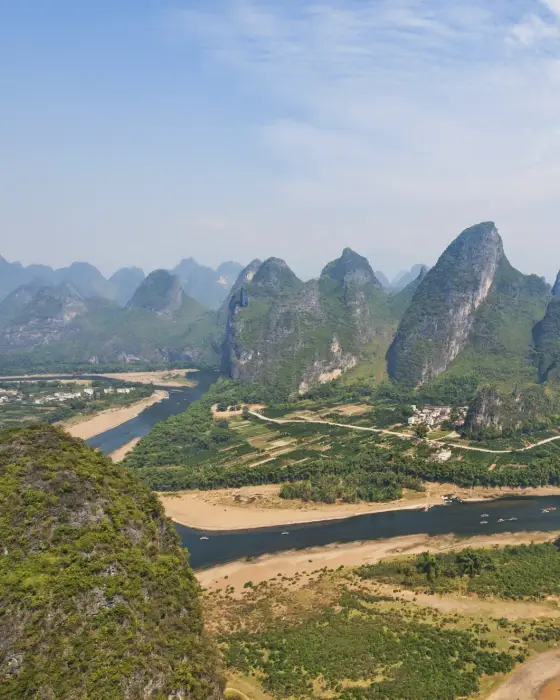
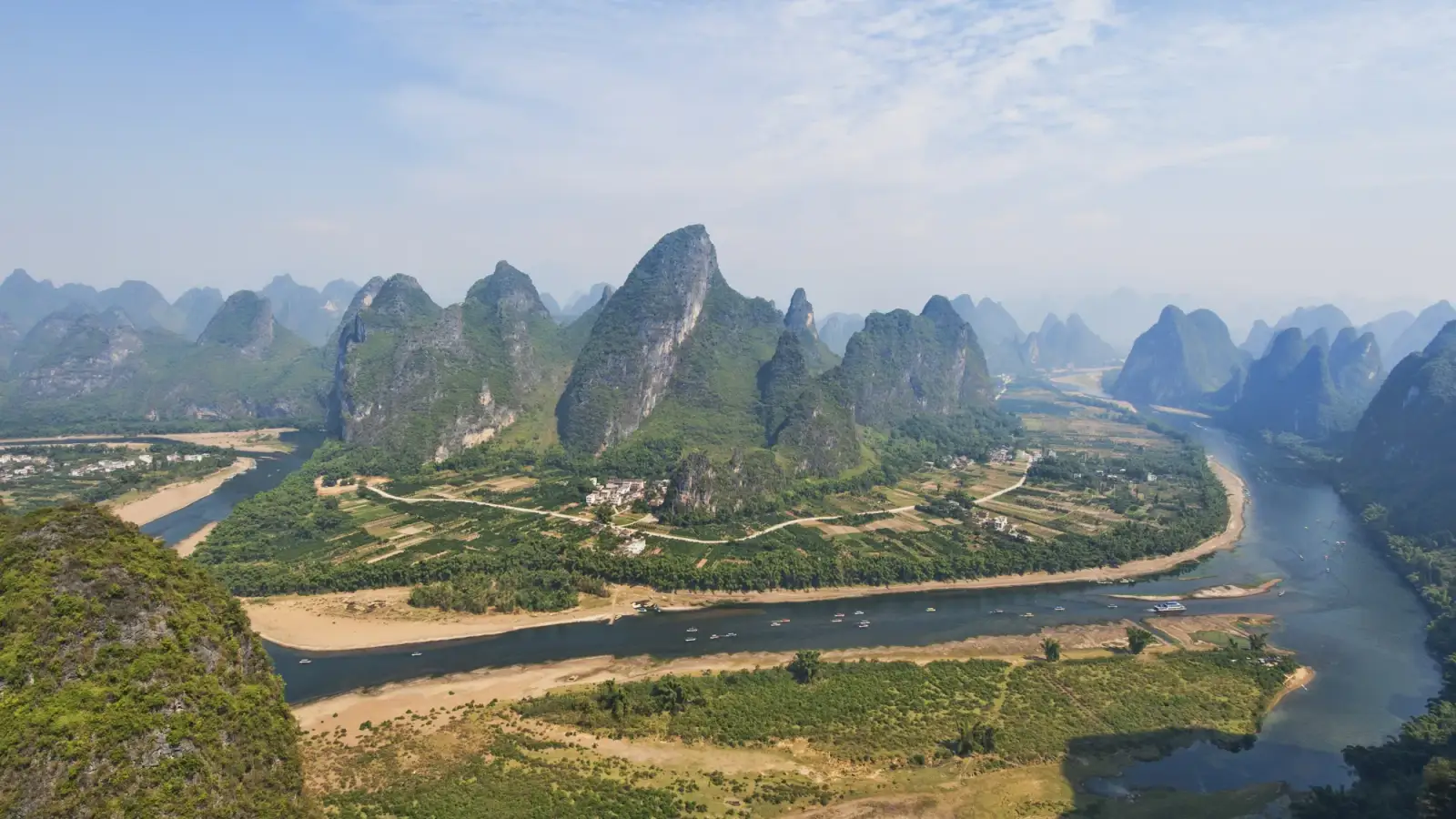
I'd recommend Guilin to anyone who likes landscapes straight out of a Chinese painting, breakfast bought at a stall and noticing how a whole region organizes itself around tourism. Guilin has avenues, a university and residential neighborhoods around the hills; Yangshuo is a county seat where almost everything, from bicycle rentals to tour agencies, revolves around those who arrive, today mostly Chinese tourists. At the table, I'd look for what the waterfront menus overlook: the sweet tofu drink sipped through a straw at the morning stalls, matigao, a dumpling filled with red bean, and the fermented tofu that Guilin has made for more than three hundred years. In Longji, the houses are wooden, three or four stories, each floor a little larger than the one below. In Yangshuo, I'd trade an hour of West Street for People's Park at the end of the day, where residents play cards and chat while knitting.Around Guilin, hundreds of limestone hills rise one by one from a plain of rice fields, with nearly vertical walls and the Li River running between them. In the city, these hills stand in the middle of the streets: there are stone stairways to climb and lit caves to walk through, a few minutes from the lakes of the center. Downriver, Yangshuo is the small town from which you set out by bicycle for the Yulong valley, a narrow tributary run on bamboo rafts pushed with a pole, and for Xingping, whose bend of river is printed on the back of the 20 yuan note. To the north, in the Longsheng mountains, Zhuang and Yao villages have farmed the slopes in terraces for more than 650 years, and the landscape changes color with the rice.
Quick facts
- Population
- 4,931,137 inhabitants in the prefecture-level city of Guilin, which includes counties such as Yangshuo and Longsheng, according to the 2020 census; 1,725,865 in the urban area.
- Founded
- Shi'an County, in 111 BC; the name comes from the Guilin commandery, created during the Qin campaigns in the south (221–206 BC).
- Country and region
- China, Guangxi Zhuang Autonomous Region, in the northeast of the region.
- Language
- Standard Mandarin with a local accent; Zhuang is co-official in Guangxi. Limited English outside hotels and tourist counters.
- Currency
- Chinese yuan renminbi (CNY, ¥).
- Time zone
- China Standard Time (Asia/Shanghai), UTC+8, no daylight saving time.
- Best time to visit
- September to November; April to July is the rainy season, peaking in June, and the Golden Week holiday, October 1 to 7, fills boats and hotels.
- Average daily cost
- Budget around CNY242; mid-range around CNY602; comfortable around CNY1,460 per person per day, based on spending reported by travelers to Budget Your Trip (checked October 2026). Indicative figures, excluding travel to the destination.
When to go
September to November; April to July is the rainy season, peaking in June, and the Golden Week holiday, October 1 to 7, fills boats and hotels.
January
6° to 12°C
69 mm of rain
10 h 44 min of daylight
National holidays
Jan 1 – 3, 2027 · long weekend · New Year's Day
Jan 1, 2028 · New Year's Day
Jan 26, 2028 · Chinese New Year (Spring Festival)
Source: Nager.Date. Holiday dates shift; check close to your trip.
February
8° to 14°C
84 mm of rain
11 h 20 min of daylight
National holidays
Feb 6, 2027 · Chinese New Year (Spring Festival)
Source: Nager.Date. Holiday dates shift; check close to your trip.
March
11° to 18°C
153 mm of rain
12 h 00 min of daylight
April
17° to 24°C
227 mm of rain
12 h 46 min of daylight
May
21° to 28°C
321 mm of rain
13 h 23 min of daylight
National holidays
May 1, 2027 · Labour Day
Source: Nager.Date. Holiday dates shift; check close to your trip.
June
24° to 31°C
449 mm of rain
13 h 42 min of daylight
National holidays
Jun 5 – 9, 2027 · long weekend · Dragon Boat Festival
Source: Nager.Date. Holiday dates shift; check close to your trip.
July
25° to 33°C
266 mm of rain
13 h 34 min of daylight
August
25° to 33°C
148 mm of rain
13 h 01 min of daylight
September
23° to 31°C
81 mm of rain
Best time12 h 18 min of daylight
National holidays
Sep 11 – 15, 2027 · long weekend · Mid-Autumn Festival
Source: Nager.Date. Holiday dates shift; check close to your trip.
October
18° to 26°C
55 mm of rain
Best time11 h 34 min of daylight
National holidays
Oct 1 – 3, 2027 · long weekend · National Day
Source: Nager.Date. Holiday dates shift; check close to your trip.
December
8° to 15°C
54 mm of rain
10 h 34 min of daylight
High, shoulder and low season
High · April to October, with peaks on May 1, in the July and August holidays and during Golden Week (October 1–7)
Li boats and Yulong rafts sell out days ahead, and Yangshuo hotels charge more on holidays. In the rainy season, from April to July, floods can suspend the rafts.
Shoulder · November
Still dry and pleasant, with fewer people and lower prices than in the high season.
Low · December to March, except Lunar New Year
Fewer people and lower prices. In winter the river drops and the cruise may start farther downstream from Guilin, and the Longji terraces are left unplanted.
How the year changes
Autumn, from September to November, is the best season for the region: rain falls to about 55 to 80 mm a month, highs drop from about 31 °C in September to 21 °C in November, and clear skies favor the river and the viewpoints. The exception is Golden Week, October 1 to 7, when boats, rafts and hotels sell out. April to July is the rainy season, peaking in June, near 450 mm. April and May each already have 230 to 320 mm, but that is when the Longji terraces receive water before planting and turn into mirrors; in June and July, floods can suspend the Yulong rafts and alter the cruise. August is the hottest month, with highs near 33 °C and less rain than July, green terraces and the peak of Chinese school holidays. Winter, from December to February, is cool and drier, with averages of 6 °C to 12 °C in January, fewer people and terraces left unplanted; with the river low, the cruise may start farther downstream from Guilin. Lunar New Year, between January and February, makes lodging more expensive.
The same numbers as a table
| Month | Temperature °C | Rain mm |
|---|---|---|
| January | 6 to 12 | 69 |
| February | 8 to 14 | 84 |
| March | 11 to 18 | 153 |
| April | 17 to 24 | 227 |
| May | 21 to 28 | 321 |
| June | 24 to 31 | 449 |
| July | 25 to 33 | 266 |
| August | 25 to 33 | 148 |
| September · | 23 to 31 | 81 |
| October · | 18 to 26 | 55 |
| November · | 13 to 21 | 82 |
| December | 8 to 15 | 54 |
Nilo's tips
The boat in winter
With the river low, between late autumn and early spring, the cruise may board farther downstream and cover part of the route by road. I'd ask for the actual boarding point when buying, because it changes what you see.
Yangshuo station is in Xingping
The high-speed train stops at a station called Yangshuo that sits in the hills of Xingping, more than 30 km from the county seat. I'd get off there only to sleep in Xingping; for West Street, the direct bus from Guilin avoids the transfer.
The Yulong raft
Each stretch has one boarding pier and another for getting off, and the duration runs from about 35 to 90 minutes. The raft only goes downstream, and the way back from the arrival pier is overland. I'd arrange that return before boarding and swap the descent for a bicycle ride if the water were muddy.
Laozhai early
The 1,159 steps of Laozhai Hill are steep and exposed to the sun. I'd climb first thing and leave the Xingping morning free for the riverbank.
Explore the map
Explore the map, read about the other places and plan your travel days in the app.
Open the appWhat to see
Leave for last, if time allows: Fubo Hill (伏波山) · Seven Star Park (七星公园) · West Street (西街) · Moon Hill (月亮山) · Impression Liu Sanjie (印象·刘三姐)
Li River (漓江)
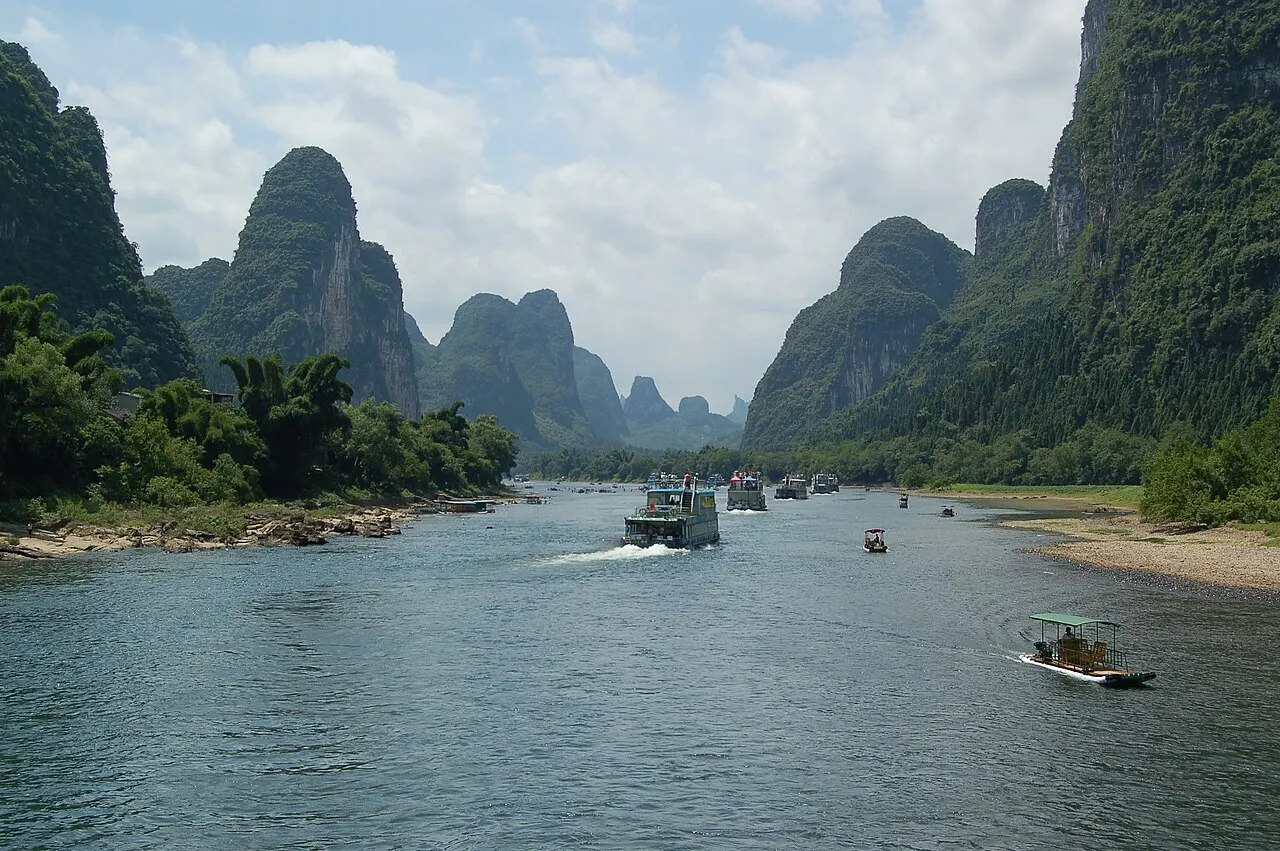
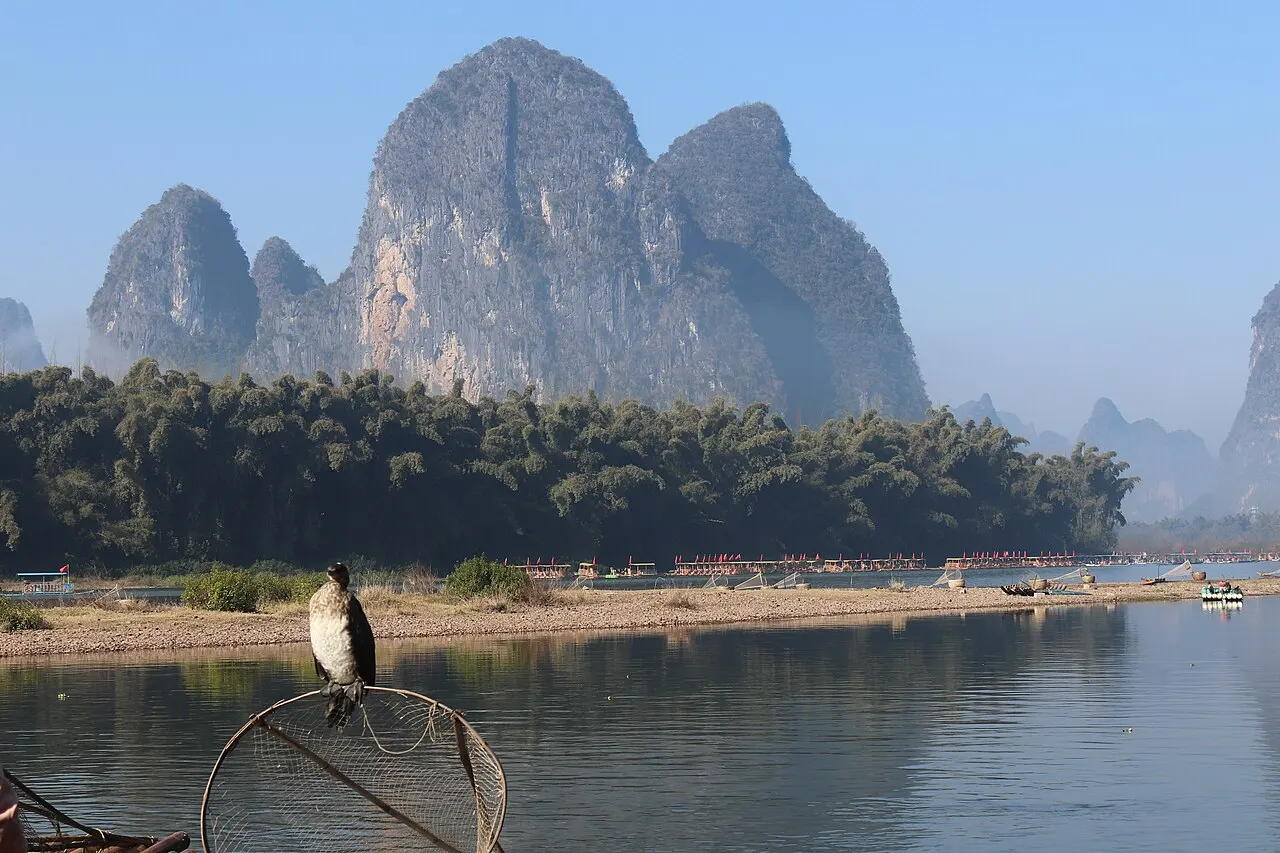
The stretch from Guilin to Yangshuo is the reason for the trip: about four hours by boat among limestone peaks, bamboo groves and villages, passing Xingping and the Huangbu shoal, the scenery that appears on the 20 yuan note. Three-star boats leave from Mopanshan Pier and four-star boats from Zhujiang Pier, both outside central Guilin, and reach Yangshuo around noon. Tickets are sold through the park's official channel and authorized platforms, and boarding requires the ID used for the purchase. In winter, with the river low, the boat may start farther downstream, with part of the route by road; in heavy rain, the operator decides whether the boat sails.
Check access
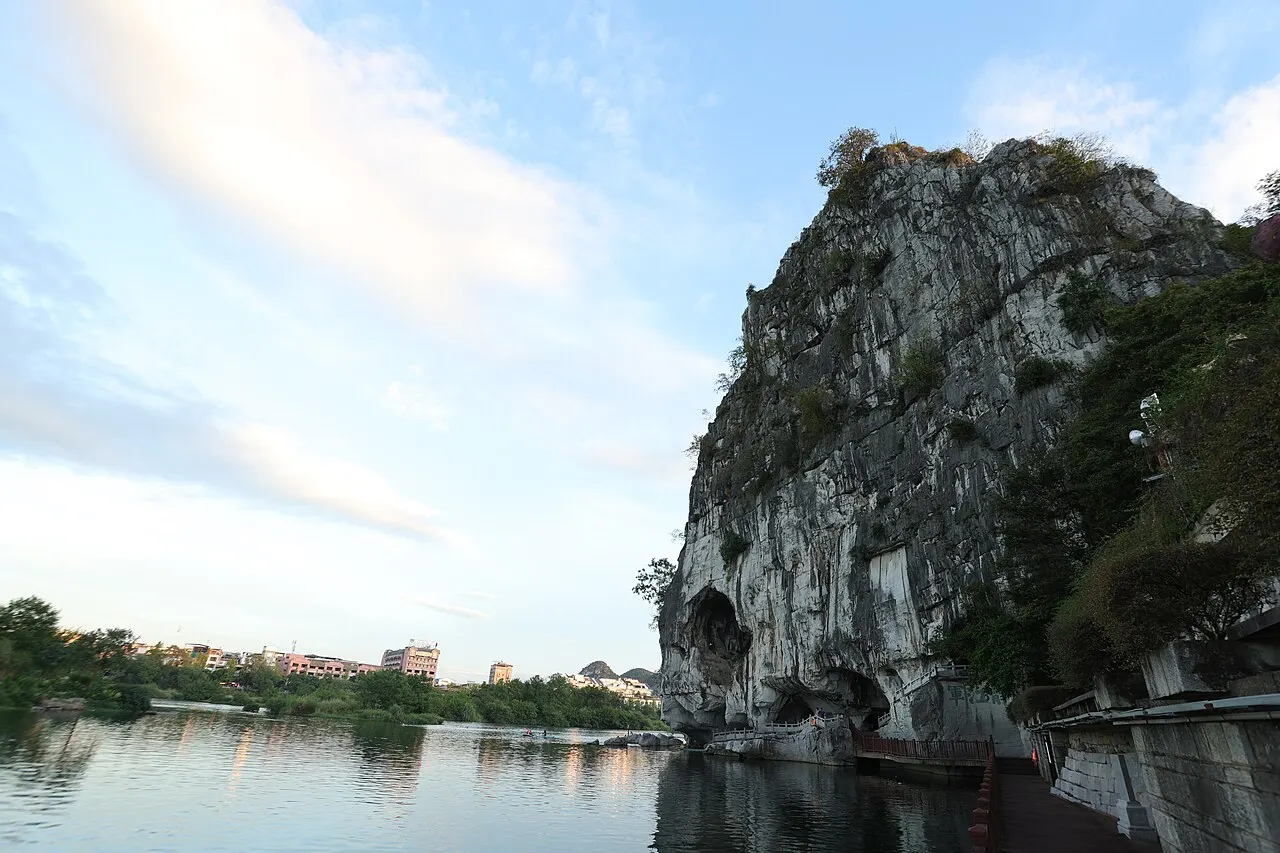
Elephant Trunk Hill (象鼻山)
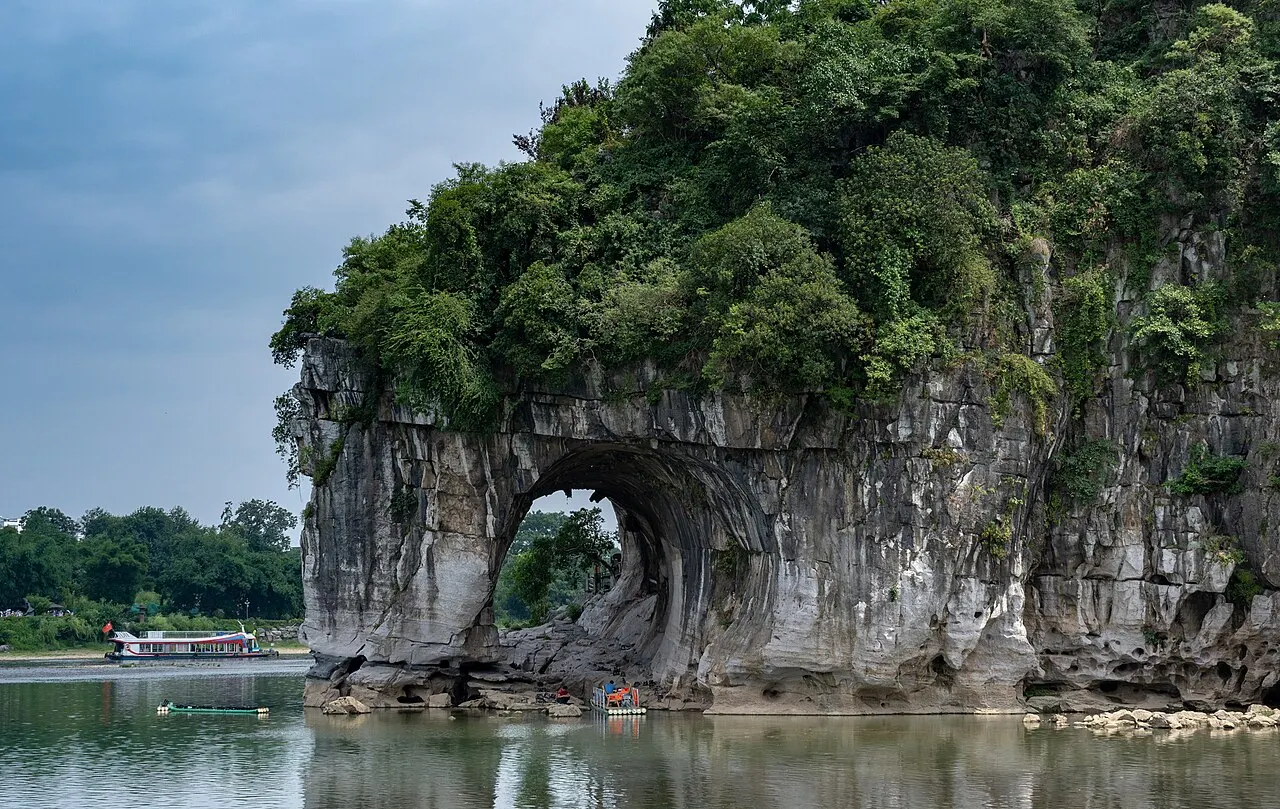
The official symbol of Guilin, at the confluence of the Taohua and the Li: a hill with a natural arch that looks like an elephant drinking water, the Shuiyue (Water and Moon) Cave underneath and the Puxian Pagoda on top. It is in Xiangshan Park, a walk from the center. Entry is free, with advance named reservation through the park's official channel; check the rule and the day's hours before going. Trees planted in the park block part of the view of the arch, which shows better from the river.
Check access
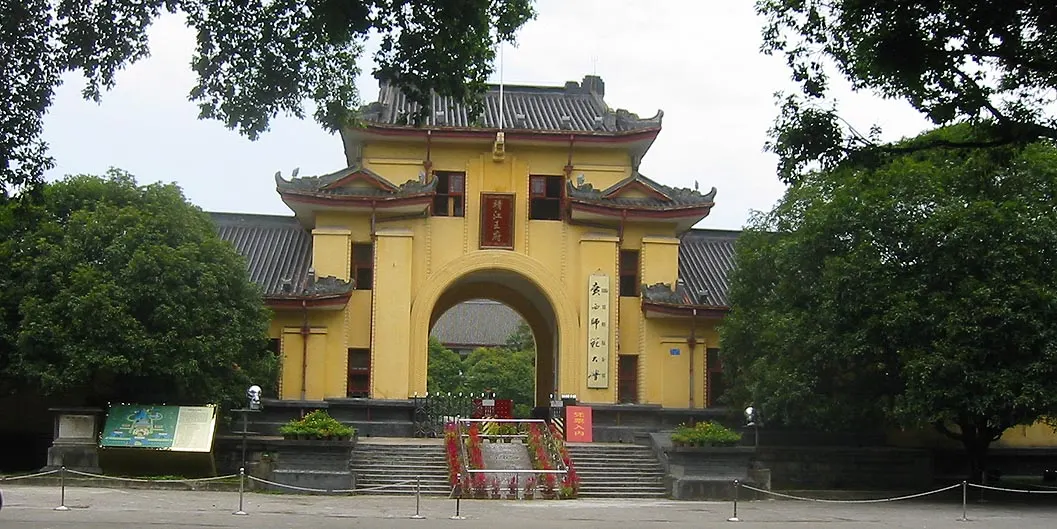
Princes of Jingjiang City and Duxiu Peak (靖江王城)
The walled compound of the Ming palace, begun in 1372, and the isolated peak that dominates it. Of the wooden buildings, burned in 1652, what remains are walls, gates, platforms and stone stairways; the compound is a campus of Guangxi Normal University and is open to visits with a ticket. The climb up Duxiu Peak leads to a view of the whole center, and in the reading cave at its base is the inscription by Wang Zhenggong with the most quoted line about Guilin.
Check access
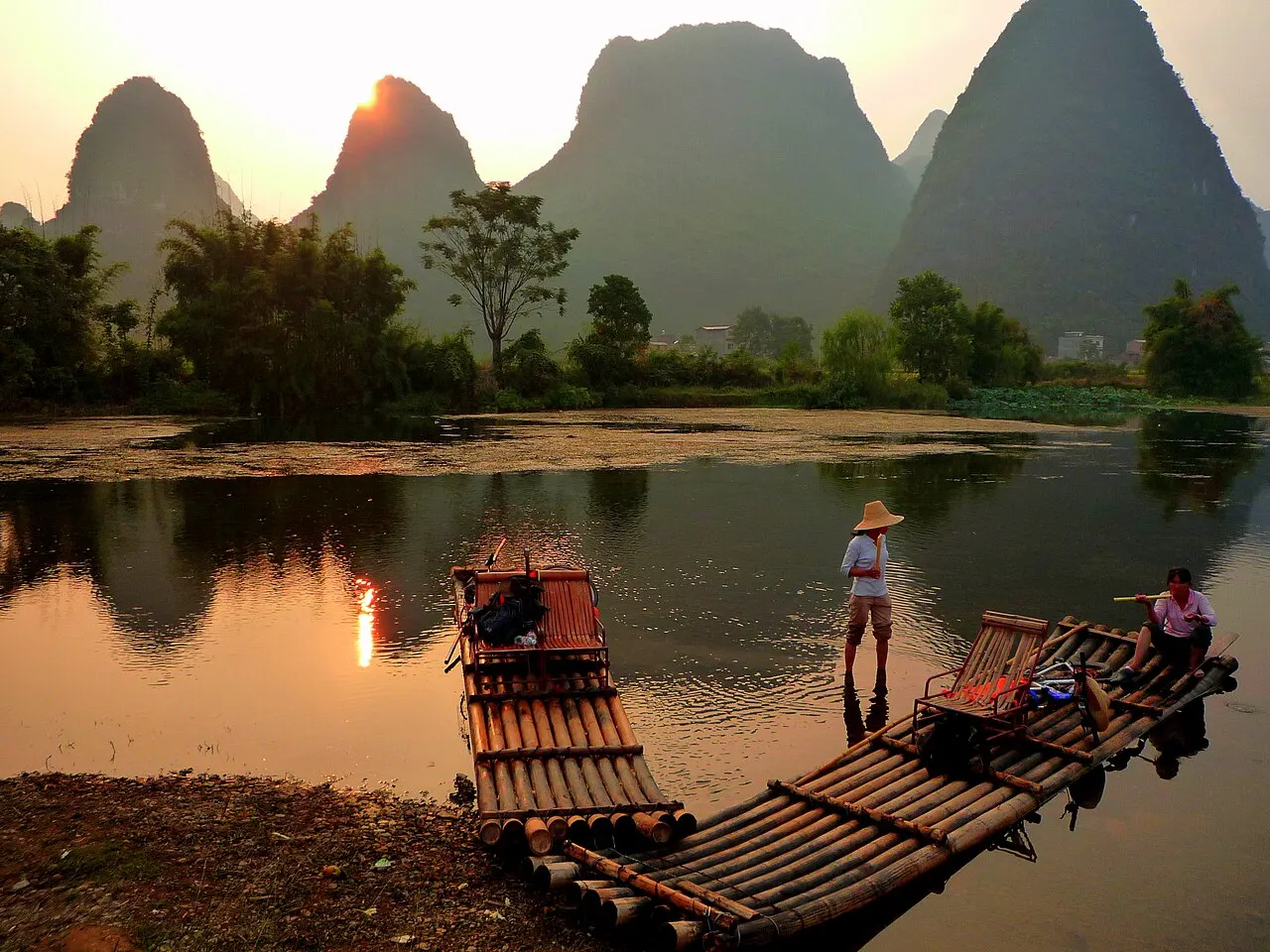
Yulong River (遇龙河)
A tributary of the Li that crosses a flat valley of rice fields west of Yangshuo and joins the Li at the foot of Shutong Hill. You go down on bamboo rafts pushed with a pole, with small weirs along the way that the raft jumps over; the time depends on the boarding pier, from about 35 minutes to 90 minutes. The raft only goes downstream: from the arrival pier, the way back is overland. The banks have trails and country roads good for cycling, between villages and stone bridges. With brown, choppy water, the descent is not safe.
Check access
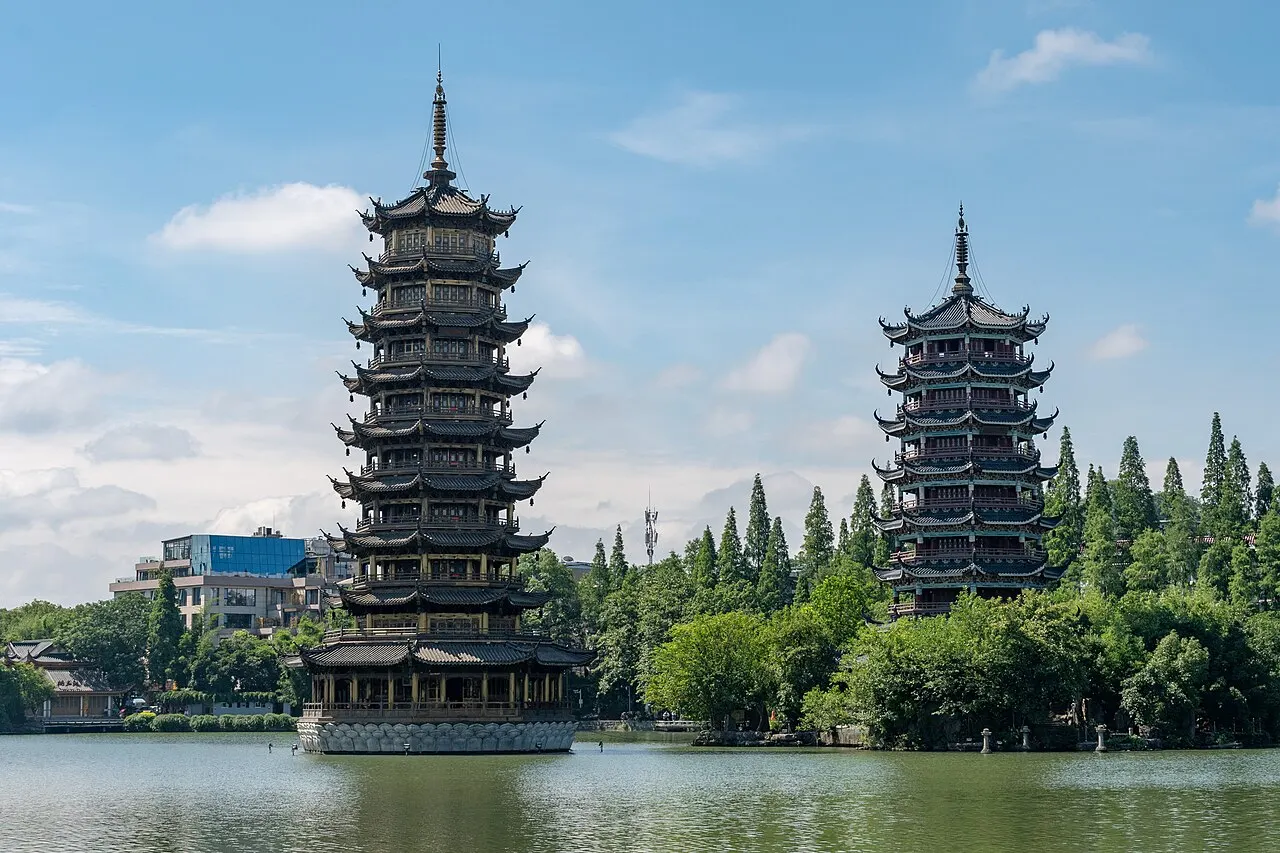
Sun and Moon Pagodas (日月双塔)
Two pagodas on the south shore of Shan Lake, built in 2001: the Sun Pagoda, yellow, 41 meters and nine stories, and the Moon Pagoda, pale blue, 35 meters and seven. They are part of the circuit of the two rivers and four lakes, the ring of water around the center, which you can walk for free along the banks or take by boat, with a separate ticket. Lit up at night, they are the best reason to leave the hotel in Guilin.
Check access
Diecai Hill (叠彩山)
A group of peaks in the north of the center, climbed by stone stairways. The top gives the widest view of Guilin over the Li River and the surrounding hills, which is why the climb is worth doing in the morning, before the heat.
Check access

Reed Flute Cave (芦笛岩)
A limestone cave in the northwest of the city, with stalactites lit by colored lights and 77 ink inscriptions, the oldest from 792, left by visitors of centuries past. Local residents reported the cave to the authorities in 1959, and it opened to the public in 1962, after access works. Admission is paid; check the price and hours on the official channel before going.
Check access
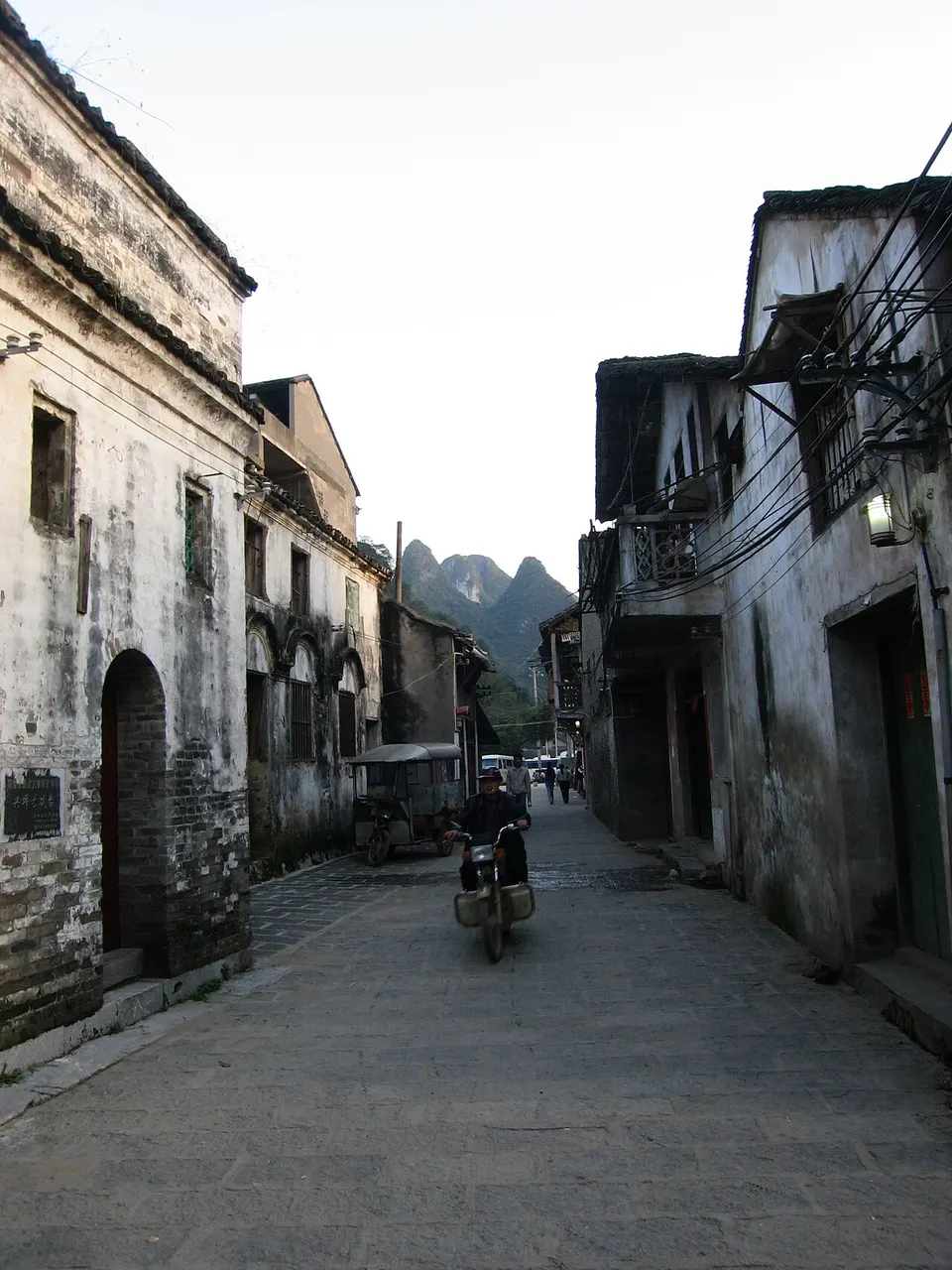
Xingping (兴坪古镇)
A village on the Li, settled since the year 265, with old streets, a quay and boats. It is the base for Laozhai Hill, for the Huangbu shoal and for walking the bank to Yangdi. Buses from Yangshuo take about 45 minutes; the high-speed train station called Yangshuo is a few kilometers away, with connecting buses.
Check access
Laozhai Hill (老寨山)
The peak at the south end of the Xingping waterfront, with 1,159 steps up to a pavilion about 220 meters above the village. The view takes in the bend of the Li and the surrounding peaks. The steps are steep and uneven; climb early, in the cool, and only with good footwear.
Check access
More places in the guide
Huangbu shoal, the scenery of the 20 yuan note (黄布滩)
The reflection of the peaks in the Li by the Huangbu shoal is the scene on the 20 yuan note of the fifth series. The spot from which the scene is photographed is about ten minutes' walk from Xingping, free; short boat trips leave the village for the same stretch.
Fubo Hill (伏波山)
A sheer-walled hill on the bank of the Li, with Tang dynasty carvings in stone and Buddhist inscriptions. It sits between Diecai Hill and Elephant Trunk Hill and offers a view similar to Diecai's, shorter.
Seven Star Park (七星公园)
A large park on the east bank of the Li, with hills, a cave with a separate fee and the Guihai Stele Museum, with more than two hundred steles from the Tang dynasty to the early twentieth century. Worth it for anyone staying more than one day in Guilin.
West Street (西街)
The stone street in the center of Yangshuo, a few hundred meters long between Pantao Road and the bank of the Li, full of shops, bars and restaurants. It received 21.1 million visitors in 2023. It works as a meeting point and a place for dinner; the interest of the trip lies outside it.
Moon Hill (月亮山)
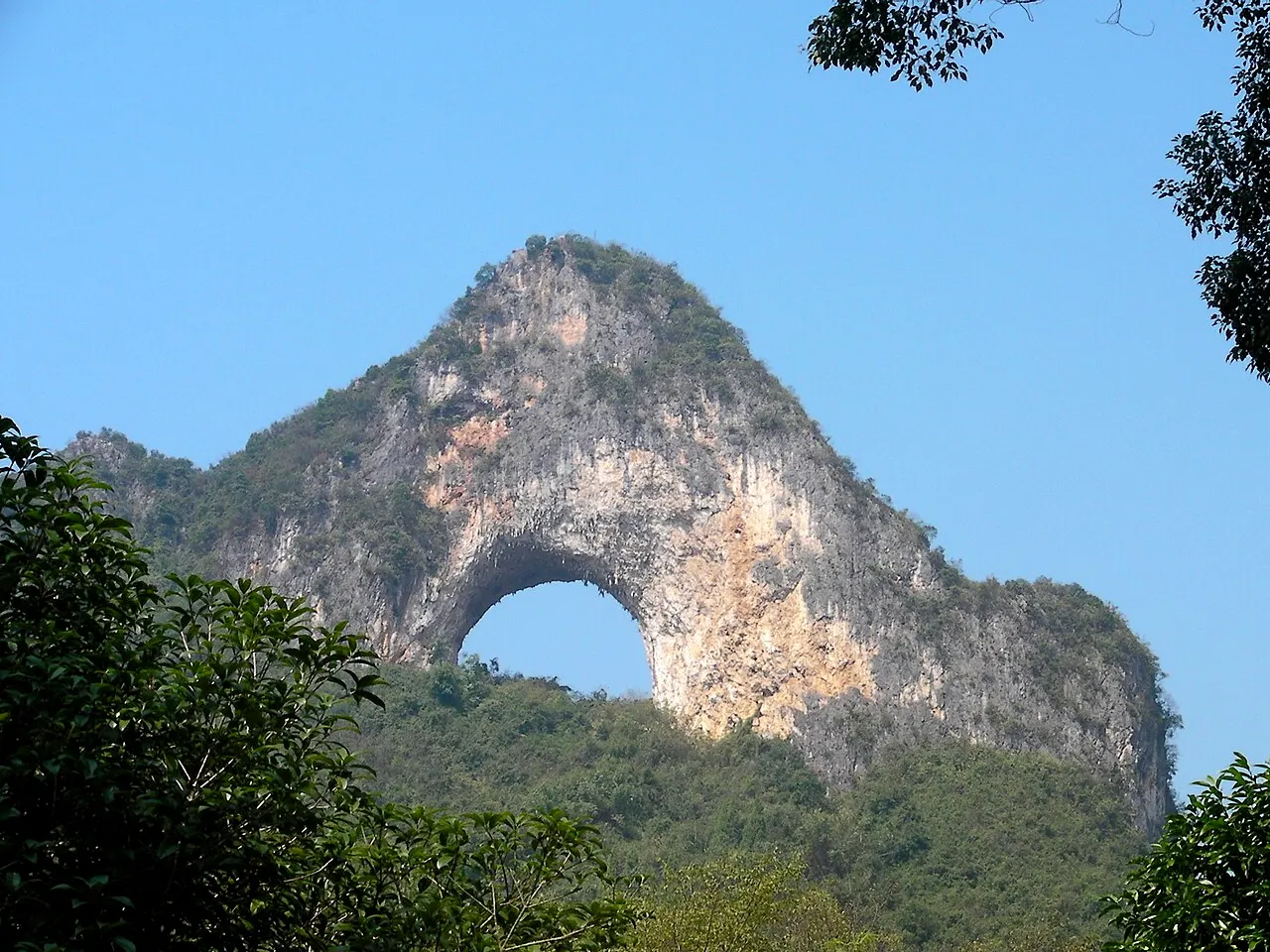
A peak 380 meters high beside Highway 321, south of Yangshuo, with a natural arch in the shape of a half moon. Whether the park that gives access to the climb is operating is uncertain: in 2025, guides and booking platforms listed it as closed with no reopening date, and more recent lists still mention the place without a notice. Confirm before planning the climb; the arch can be seen from the road, on the way to Gaotian.
Impression Liu Sanjie (印象·刘三姐)
An open-air night show on the Li, near the center of Yangshuo, directed by Zhang Yimou, with more than 600 participants in Zhuang, Miao and Yao costume and the lit-up peaks as scenery. It lasts about 70 minutes, with assigned seats, and may stop in January or February for maintenance. Worth it for anyone who likes large productions of light and staging.
Nilo’s itinerary
Start with the basic programme and choose extensions for the time you have.
Plan my days in the app ↗Day 1 · Guilin: hills, palace and lakes
Start early at Diecai Hill, in the north of the center, and climb the stairways to the top before the heat.
Walk south along the bank of the Li, past Fubo Hill, to the Princes of Jingjiang City; climb Duxiu Peak and look for Wang Zhenggong's inscription in the reading cave.
Have mifen for lunch at a neighborhood place on the side streets of the center, away from the restaurants on the waterfront.
In the afternoon, take a taxi or bus to Reed Flute Cave, in the northwest of the city, for the guided visit.
Return to the center and, in the late afternoon, visit Elephant Trunk Hill, with the entry booked in advance.
In the evening, walk along the shore of Shan Lake to the lit-up Sun and Moon Pagodas. Sleep in Guilin.
Day 2 · Down the Li River to Yangshuo
In the morning, take the transfer bought with the ticket to Mopanshan or Zhujiang Pier, with the passport used for the purchase.
Go down the river for about four hours, passing Xingping and the Huangbu shoal.
Arrive in Yangshuo around noon, drop your luggage and have lunch.
In the afternoon, book the Yulong raft for the next day through the official channel, if it is high season.
In the evening, have beer fish for dinner near West Street. Sleep in Yangshuo.
Day 3 · The Yulong valley by raft and bicycle
Early, take an agreed-price taxi or minibus to the boarding pier of your chosen stretch of the Yulong.
Go down the river on a bamboo raft; the duration runs from about 35 to 90 minutes, depending on the stretch.
From the arrival pier, go back overland to Yangshuo by taxi or minibus, and have lunch.
In the afternoon, rent a bicycle, check the brakes, gears and lock, and ride the country roads of the valley, between villages and stone bridges.
In the late afternoon, take the Gaotian road to see the Moon Hill arch from the highway, or go straight back to Yangshuo.
Return the bicycle before dark. Sleep in Yangshuo.
If you stay longer
Day 4 · Xingping and the river of the 20 yuan note
Decide before leaving where you will sleep. If the trip continues to Guilin, Longji or the flight, check out and take your luggage, because the high-speed train station is near Xingping.
Take the minibus early from Yangshuo's south bus station to Xingping, about 45 minutes.
Climb the 1,159 steps of Laozhai Hill while it is still cool, with good footwear.
Come down and walk about ten minutes to the spot with the scenery of the 20 yuan note, at the Huangbu shoal.
Have lunch in the village and, in the afternoon, walk a stretch of the bank toward Yangdi or take a short boat ride, with price and life jacket agreed beforehand.
In the late afternoon, if you are continuing to Guilin, take the connecting bus to Yangshuo station, about ten minutes, then the high-speed train of about half an hour, and sleep in Guilin; if you are staying, return to Yangshuo by minibus.
Day 5 · Longji rice terraces (龙脊梯田)
Day trip
In the mountains of Longsheng County, about 77 km north of Guilin, slopes terraced for more than 650 years climb to 1,100 meters. There are two sectors: Ping'an, a compact Zhuang village, with viewpoints reached on foot through the village itself, and Jinkeng, with the Yao village of Dazhai and a cable car to Jinfo Peak. From Guilin it is about two hours by road to Longsheng and about another hour by local bus to the villages, or a direct transfer you book; from Yangshuo, the route passes through Guilin and is much longer. General admission cost 80 CNY in September 2026, without the cable car. The terraces receive water in April and May, turn green from June to August and yellow at harvest, between September and October. Sleeping in a village lets you see the morning and late-afternoon light; anyone going and returning in a day has to leave Guilin early and catch the last bus, which leaves before sunset.
Food
Guilin mifen (桂林米粉)
White rice noodles, the city's breakfast and lunch meal. It comes with a topping and pickles and condiments to add as you like; the custom is to eat the noodles with the topping first, without broth, and only then add the broth from the pot. You order by weight, in liang: one liang is a snack, two is a meal. There are fried versions (chaofen) and versions with horse meat, which you can ask to leave out.
Beer fish (啤酒鱼)
The dish associated with Yangshuo: river carp or catfish cooked in beer sauce. The price is per jin (500 g) of the fish you choose alive, and a two-jin fish, with three or four more dishes, feeds three or four people.
Guilin chili sauce (桂林辣椒酱)
A chili sauce with garlic and Sanhua rice spirit, used in local dishes and sold in jars. Restaurants tend to take the chili out of the dish for people who are not from the region; if you want the dish as it is served locally, you need to ask.
Bamboo rice (竹筒饭)
In the Longji terrace villages, rice with meat, vegetables and seasonings is cooked inside a sealed bamboo tube, straight on the fire, by the side of the path.
Shatian pomelo (沙田柚)
The region's pomelo, sweet and juicy, sold everywhere; ask the seller to pick one and cut it on the spot.
Where to eat
- Central Guilin
Mifen for breakfast and lunch, at the neighborhood places on the side streets. Ask for two liang for a meal and eat the topping before adding the broth. The places near the station and the crowded restaurants on the Li waterfront have a reputation for being expensive and not very local.
- Guilin food streets (Zhishan Road, Nanhuan Road, Yiren Road)
Neighborhood restaurants with local dishes, such as snails with sour chili, duck dishes and river fish, at neighborhood prices. Nanhuan Road links Zhongshan Road to Elephant Trunk Hill and is on the way in the late afternoon.
- Yangshuo, away from West Street
Beer fish, chosen alive and charged by the jin. The restaurants on the parallel streets and at the night market tend to charge less than those on West Street; ask the weight and the price per jin before the fish goes to the kitchen.
- Longji villages
Rice cooked in bamboo, prepared by the side of the path, and the home cooking of the guesthouses, with mountain vegetables.
· 2026-10-19
Day trips
Longji rice terraces (龙脊梯田)
In the mountains of Longsheng County, about 77 km north of Guilin, slopes terraced for more than 650 years climb to 1,100 meters. There are two sectors: Ping'an, a compact Zhuang village, with viewpoints reached on foot through the village itself, and Jinkeng, with the Yao village of Dazhai and a cable car to Jinfo Peak. From Guilin it is about two hours by road to Longsheng and about another hour by local bus to the villages, or a direct transfer you book; from Yangshuo, the route passes through Guilin and is much longer. General admission cost 80 CNY in September 2026, without the cable car. The terraces receive water in April and May, turn green from June to August and yellow at harvest, between September and October. Sleeping in a village lets you see the morning and late-afternoon light; anyone going and returning in a day has to leave Guilin early and catch the last bus, which leaves before sunset.
Daxu (大圩古镇)
An old village on the east bank of the Li, about 23 km southeast of Guilin, with a bluish stone street of about 2 km, temples, guild halls and the Wanshou Bridge. It is about half an hour by bus from Guilin's city bus station, according to a crowdsourced guide updated in 2017; confirm the line before going. It suits anyone with a free morning in Guilin who wants to see a river village without the bustle of Yangshuo.
Where to begin
Guilin: hills, palace and lakes
Start early at Diecai Hill, in the north of the center, and climb the stairways to the top before the heat.
Down the Li River to Yangshuo
In the morning, take the transfer bought with the ticket to Mopanshan or Zhujiang Pier, with the passport used for the purchase.
The Yulong valley by raft and bicycle
Early, take an agreed-price taxi or minibus to the boarding pier of your chosen stretch of the Yulong.
Xingping and the river of the 20 yuan note
Decide before leaving where you will sleep. If the trip continues to Guilin, Longji or the flight, check out and take your luggage, because the high-speed train station is near Xingping.
Money
The currency is the yuan renminbi (CNY, ¥). In China almost everything is paid by QR code, with Alipay or WeChat Pay. Since 2023 both accept Visa and Mastercard cards issued abroad, and in 2024 the central bank raised the limit for foreigners to 5,000 dollars per transaction and 50,000 per year; registration is done in the app itself, and it is worth setting up and testing before you arrive. In the app you pay merchants, not individuals. Cash is still accepted and is useful at street stalls and in the Longji terraces, where crowdsourced guides report a lack of ATMs in Dazhai. Some dated prices: airport bus to central Guilin, 20 CNY, and to central Yangshuo, 50 CNY (December 2024); general admission to the Longji terrace area, 80 CNY, without the cable car and internal transport (checked September 2026). Tickets for the Li cruise and the Yulong rafts vary with the boat category, the stretch and the season; check the day's price on the park's official channel before buying. Fish in restaurants is charged by weight, and in Yangshuo clothing and souvenir shops tend to ask well above the final price: haggling is normal at stalls.
Getting there and around
Guilin Liangjiang International Airport (KWL) is west of the city, with flights from the main Chinese cities and a few in Southeast Asia. In December 2024 there were eight airport bus lines: Line 1 goes to the civil aviation terminal in the center for 20 CNY, and Line 7 goes directly to the Yangshuo bus station for 50 CNY, in about 90 minutes. A taxi from the airport to central Guilin is the most convenient option with luggage.
Guilin has three main stations: Guilin, in the center, on Zhongshan Nanlu; and Guilin North and Guilin West, farther out, where many high-speed trains stop, with connections to Guangzhou, Shenzhen, Hong Kong (West Kowloon), Nanning, Kunming, Changsha and Beijing. Schedules and purchase are on 12306, the Chinese railway platform.
There are three ways between Guilin and Yangshuo. The boat on the Li River makes the trip in about four hours and ends in Yangshuo. The intercity bus goes from the Guilin terminal to the Yangshuo county seat in about an hour and a half; the minibuses run by touts in the station square are less reliable. The high-speed train takes about half an hour from Guilin West or North to Yangshuo station, which is in Xingping, more than 30 km from the county seat: from there, connecting buses reach Xingping in ten minutes and central Yangshuo in about an hour.
In Guilin, the center can be covered on foot among the lakes, the river and the hills, and cheap city buses link the attractions; metered taxis are easy to find outside rush hour. In Yangshuo, taxis are few and do not use meters: agree on the price beforehand, including for tricycles and motorbike taxis. For the countryside, a rental bicycle is the natural way; check the brakes and gears before setting out. From the Yangshuo bus stations, minibuses run to Xingping, to Gaotian, along the Moon Hill road, and to Jinbao, passing near the Yulong valley.
To Longji, the trip from Guilin to the town of Longsheng takes about two hours on mountain roads, and from there local buses climb to the villages of Ping'an and Dazhai in about another hour. Village guesthouses and Guilin operators sell a direct transfer. The last bus down the mountain leaves before sunset.
Safety
Guilin and Yangshuo are calm destinations, and the most common problems are petty scams and thefts. At Guilin's central station and on buses, watch your wallet and phone, and be wary of approaches from people who introduce themselves as students or teachers and end up at a tea house or gallery with a high bill. In Yangshuo, insistent touts sell tours on the street and on buses; taxis without meters and West Street shops charge much more to those who do not haggle. On the valley roads, motorbike thieves snatch bags from bicycle baskets; carry belongings in front of you or secured. On the small beaches of the Li, thefts from people who leave their things on the bank to swim are frequently reported, and the river has a current. In the rainy season, floods can close stretches and suspend rafts; follow the operator's decision. In traffic, motorbikes and tricycles come from any direction, including on pedestrian streets. Do not drink tap water; bottled water is cheap. China's entry rules depend on nationality and have changed several times since 2024, with visa exemptions and visa-free transit of up to 240 hours for dozens of countries: check the current list with China's National Immigration Administration before buying your ticket.
Before you go
- Plug
- types A, C and I
- Voltage
- 220 V
- Driving side
- on the right
- Emergency
- Fire 119 · Police 110 · Ambulance 120
- Country code
- +86
- Official language
- Putonghua
- Currency
- renminbi (CNY)
Source: Wikidata (CC0), checked September 2026.
Etiquette tips
Agree on the price first
In Yangshuo, taxis, tricycles, motorbike taxis, short boat rides and raft crossings are negotiated before you get on. Arguing after the ride does not work and creates friction.
Photographing people in the villages
In the Yao and Zhuang villages of Longji, ask before photographing anyone. Some Yao women charge a small amount to be photographed, and a refusal should be accepted.
Shared table
Dishes arrive in the middle of the table and are shared; you order one dish per person plus rice, and fish is chosen by weight. Asking the weight before the fish goes to the kitchen avoids a surprise on the bill.
Mistakes to avoid
Assuming the Li River boat leaves from central Guilin: the Mopanshan and Zhujiang piers are outside the city, and anyone who did not buy with a transfer has to get to them early.
Getting on a short sightseeing boat in Xingping or Yangdi without first agreeing on price, duration and life jacket: the boats on this stretch are made of plastic tubes with a motor, and operators vary.
Leaving a bag or camera open in the bicycle basket on the valley roads: there are thefts done from motorbikes, from behind.
Going down the Yulong when the water is brown and choppy after heavy rain.
Going up to Longji in the afternoon counting on the last bus: it leaves before sunset, and the way back is long.
Arriving without Alipay or WeChat Pay set up and finding out at the register that the foreign card does not go straight through the terminal.
Useful phrases
你好 (nǐ hǎo, nee how)
Hello
谢谢 (xièxie, shyeh-shyeh)
Thank you
多少钱? (duōshao qián, dwoh-shaow chyen)
How much is it?
不要辣 (bú yào là, boo yaow lah)
No chili
我要去… (wǒ yào qù, wo yaow chyoo)
I want to go to…
二两米粉 (èr liǎng mǐfěn, ar lyang mee-fen)
Two liang of mifen (a meal-sized portion)
买单 (mǎi dān, my dahn)
The check, please
Where to stay
- Central Guilin, between Shan Lake and the Li River · People arriving by plane or train, with one day in the city, who want to do the hills, the palace and the lakes on foot.: Airport bus Line 1 ends in the center, the Li cruise transfers pick up at hotels in the area and the lit-up pagodas are a walk away. The drawbacks are the noise of the avenues and the expensive waterfront restaurants.
- Yangshuo, near West Street · People without a car who want buses, rental bicycles and dinner a few steps away.: The bus stations, the agencies and the restaurants are there, and the Li boat arrives a few minutes away. The street is noisy until late: a side street or a hotel near the river, away from the bars, sleeps better.
- Yulong Valley · People who want quiet, rice fields at the window and will spend their days cycling.: The guesthouses sit between the villages, near the trails and the raft piers. They depend on the guesthouse's own transfer or a negotiated taxi, and there are few restaurants at night.
- Xingping · People who want the most photographed stretch of the Li early, without crowds, and will arrive or leave by high-speed train.: The village is next to Laozhai Hill and the Huangbu shoal, and Yangshuo station is ten minutes away by bus. It has fewer services than Yangshuo, and buses to Guilin go through the county seat first.
- Ping'an or Dazhai, in Longji · People going to the terraces who want to see the morning and late-afternoon light.: The village guesthouses have a direct view of the terraces and arrange transfers. Cars stop below the villages, and luggage goes up on foot or in a basket, with porters who charge for the service; crowdsourced guides report a lack of ATMs in Dazhai.
· 2026-10-19
Districts
Central Guilin (Xiufeng)
The core between Zhongshan Road, the Li River and the Rong and Shan lakes. It has the Princes of Jingjiang City, the pagodas on Shan Lake and the food streets, and it is where you can cover the city on foot. It suits anyone with one day in Guilin who wants to return to the hotel between visits.
East bank of the Li (Qixing)
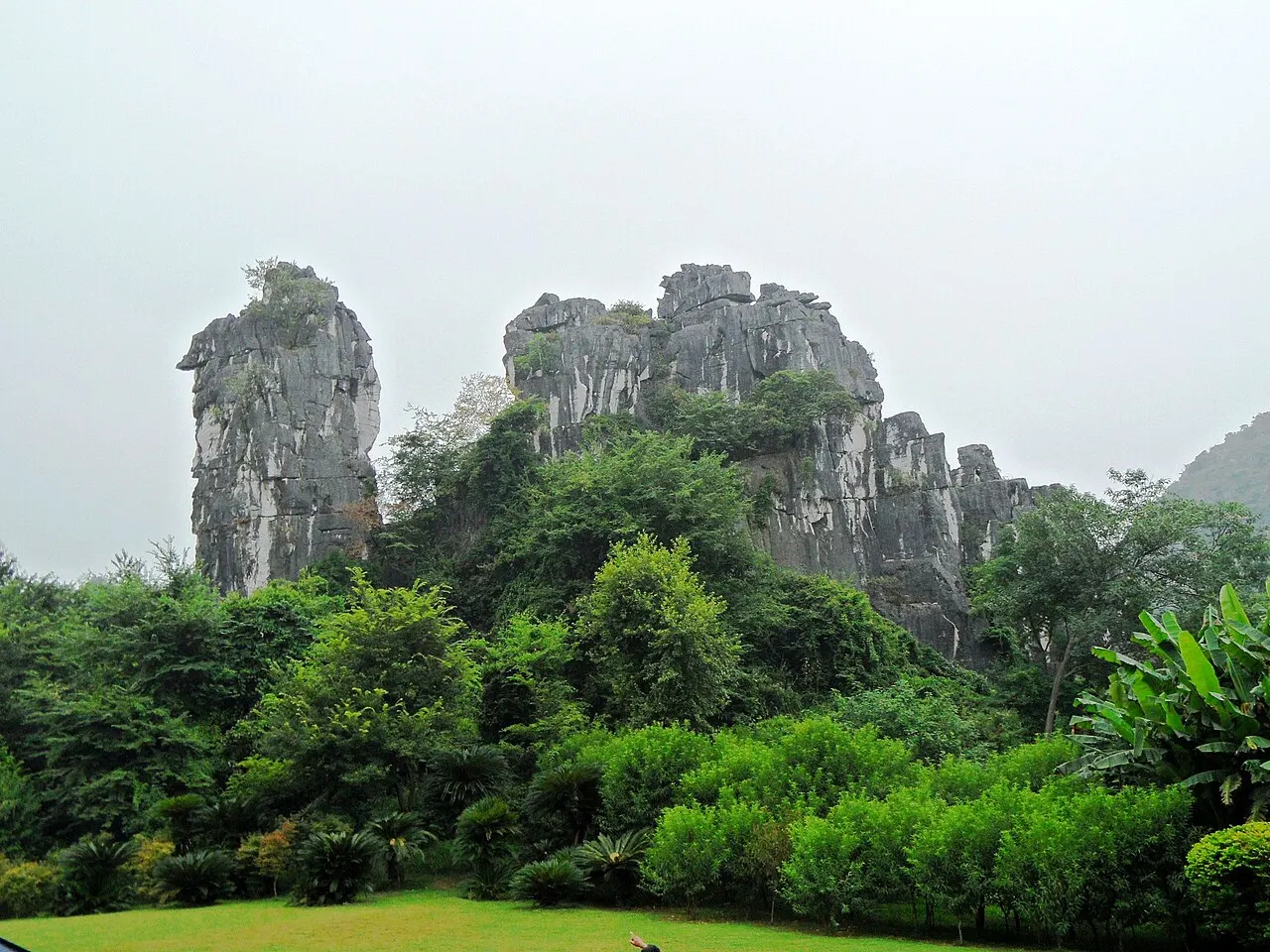
Across the bridges, around Seven Star Park, with the Guihai Stele Museum. A more residential, university neighborhood; it suits anyone who wants parks and a view of the center from the river.
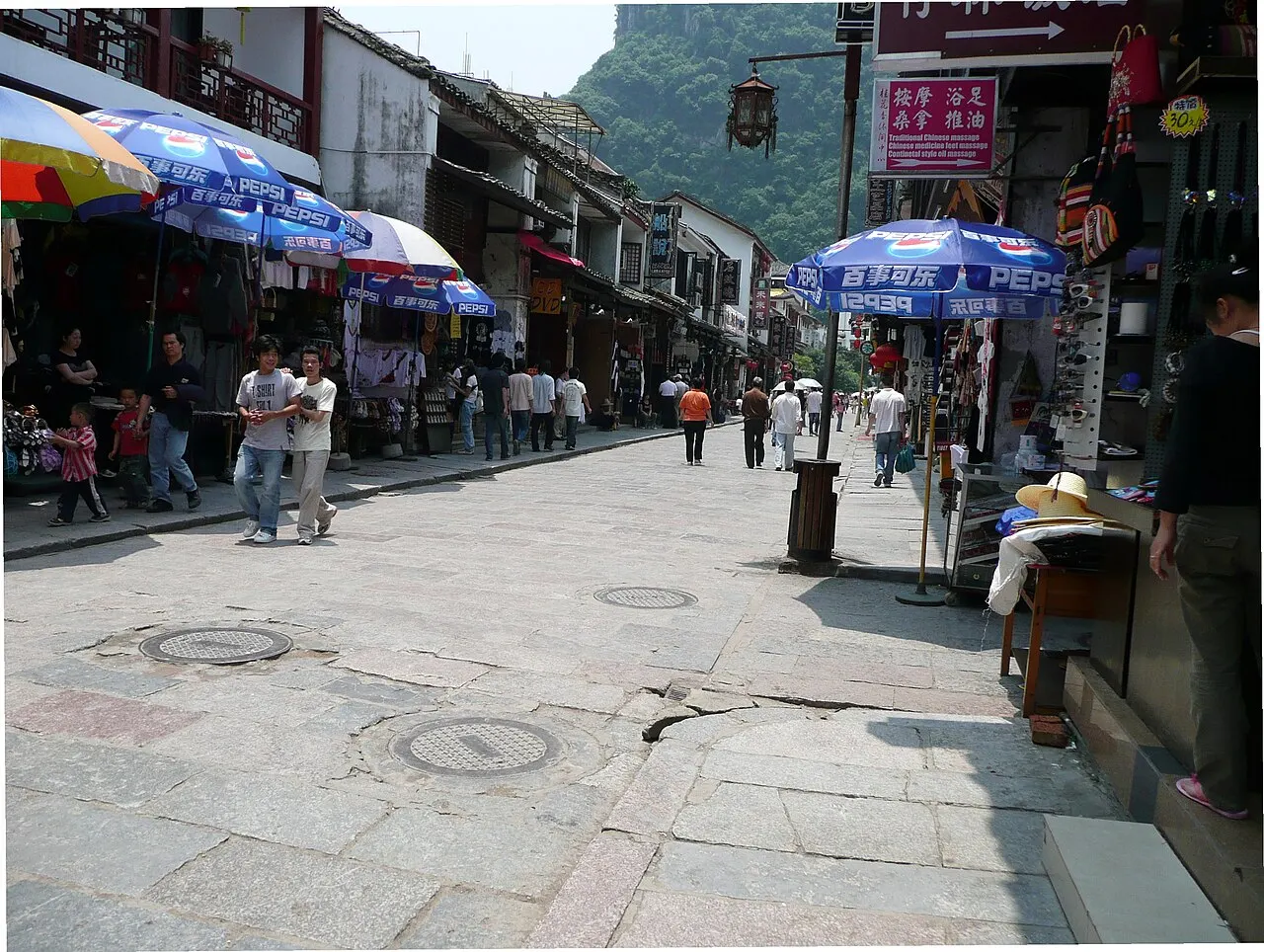
Yangshuo: West Street and Diecui Road
The two parallel streets that climb from the river make up Yangshuo's tourist center, with restaurants, bars, shops and tour agencies. It is close to the bus stations and the bicycle rentals; at night it is noisy.
Yulong Valley
Villages, stone bridges and rice fields west and southwest of Yangshuo town, along the Yulong River. It is the area for cycling and rafting; it has quiet guesthouses and little nightlife.
Xingping
An old village on the Li between Guilin and Yangshuo, about 45 minutes by minibus from Yangshuo, on the most photographed stretch of the river. Flat and walkable in fifteen minutes, with Laozhai Hill to the south and the high-speed train station in the nearby hills.
History
214 BC · The Lingqu Canal links two river systems
On the orders of Qin Shi Huang, a 36.4 km canal in present-day Xing'an County joins the Xiang River, which flows to the Yangtze, to the Li River, which flows down to the Pearl River system. Boats can now cross from central China to the south, and the Guilin region joins the route.
111 BC · Shi'an County is founded
The creation of Shi'an County on the banks of the Li is taken as the beginning of the city. The name Guilin, “forest of osmanthus,” comes from the commandery created in the Qin period.
590 · Yangshuo becomes a county
Under the Sui dynasty, Yangshuo is incorporated as a county. The street that is now West Street already existed as the axis of the settlement.
1201 · The phrase that defines the region
Wang Zhenggong (1133–1203), a senior provincial official, writes two poems for the banquet of those who passed the provincial examination, and the second opens with the line saying that the mountains and waters of Guilin surpass all others in the world. The poem was carved in stone beside the reading cave of Duxiu Peak; covered by limestone deposits, the inscription was only found again in 1983.
1372 · The palace of the Princes of Jingjiang
Construction begins on the residence of Zhu Shouqian, grandnephew of the first Ming emperor, at the foot of Duxiu Peak. Fourteen princes over twelve generations lived there during 257 years.
1652 · The palace burns
In the war between the last Ming loyalists and the Qing, the palace's main wooden buildings are destroyed by fire. From 1657 the compound houses the province's imperial examinations.
1936–1949 · Wartime capital of Guangxi
Guilin becomes the provincial capital again and, in the war against Japan, takes in refugees: the population rises from about 70,000 to more than 500,000 by 1944. The fighting that year destroys much of the city; in 1950 the capital moves to Nanning.
2014 · The Guilin karst joins UNESCO
The second phase of the South China Karst, a World Heritage Site since 2007, includes the Guilin karst, with areas of isolated hills and clustered peaks along the Li in Yangshuo County.
2016 · The high-speed train reaches Xingping
On January 24 the Yangshuo station opens on the Guiyang–Guangzhou high-speed line. It is in Xingping, not in the county seat.
Complete history
Guilin's position is explained by water. The Li River runs south to the Pearl River system, and to the north, in Xing'an County, the Xiang passes by on its way to the Yangtze. In 214 BC the Qin dynasty joined the two with the Lingqu Canal, 36.4 km long, to carry troops and supplies for its campaigns against the peoples of the south. From then on the region stopped being a periphery and became a passage: in 111 BC Shi'an County appeared, the core of the city, and the name Guilin, “forest of osmanthus,” came from the commandery the Qin created.
The city you visit today has little left standing from that long history, but it keeps a great deal in writing. The hills of the center have caves with inscriptions from many centuries, and one of them, on Duxiu Peak, gave the region its most quoted phrase. At the foot of that peak, from 1372, the Princes of Jingjiang, a branch of the Ming imperial family, built a walled palace that operated for 257 years. It burned in the war of 1652, became the seat of the province's imperial examinations in the Qing period and, since 1954, has been a campus of Guangxi Normal University; what you visit are the walls, the gates, the stone platforms and the peak itself.
The twentieth century passed through Guilin with force. The city was the capital of Guangxi before 1912 and again between 1936 and 1949, and in the war against Japan it took in refugees: the population jumped from about 70,000 to more than 500,000 in 1944. The fighting of 1944 destroyed a large part of the city, including the government buildings in the old palace, and today's center is almost entirely postwar reconstruction.
Yangshuo took another path. A county since 590, it was briefly occupied by Japan in 1944 and, from the 1970s and 1980s, opened to foreign tourism; West Street became a backpacker stop, with signs in Chinese and English. Today the public is mostly Chinese, and the landscape that drew the first visitors has won formal recognition: in 2014, karst areas of the county were added to the UNESCO World Heritage List as part of the South China Karst.
Geography and shape of the city
What defines the region is karst: carbonate rocks formed some 320 to 400 million years ago, slowly dissolved by rainwater until what remained were isolated hills with sheer walls, caves and clustered peaks. The Li River, 164 km long from the mouth of the Lingqu Canal to Pingle, crosses this landscape from north to south. Guilin spreads along both banks of the Li, with the old center on the west bank, where the river receives the Taohua; the two rivers and four lakes of the center (Rong, Shan, Gui and Mulong) form a ring of water around the core of the city, and hills such as Diecai, Fubo and Elephant Trunk Hill rise straight from the bank. Downriver, the Li runs between clustered peaks, passes Xingping and reaches Yangshuo, about 83 km after Guilin. There the tributary Yulong, which joins the Li at the Gongnong Bridge, at the foot of Shutong Hill, crosses a flat valley of rice fields and villages, good for cycling. To the north the terrain changes: in the Longsheng mountains, the Longji terraces climb to 1,100 meters, on slopes of up to 50 degrees. The climate is subtropical monsoon. In Guilin, January has averages of about 6 °C to 12 °C, and July and August have average highs near 33 °C. The rainy season runs from April to July, peaking in June (about 450 mm); October and December stay near 55 mm.
Culture
Guangxi is the autonomous region of the Zhuang, and around Guilin the Yao, Dong and Miao also live. The Zhuang singing tradition reached the cinema in 1961 with Liu Sanjie, a musical about a legendary singer filmed with Guangxi landscapes, and she is the same character who gives her name to the night show in Yangshuo. In Longji, the Ping'an villages are Zhuang and those of Dazhai, in the Jinkeng sector, are Red Yao; the Yao women of the region are known for very long hair, which they do not cut and wear piled on top of the head.
Guilin's landscape has been a subject of painting and poetry for centuries, and the city has a habit of writing on its own hills: Fubo Hill, Duxiu Peak and Reed Flute Cave hold poems, records and Buddhist inscriptions from several periods, protected together as the Guilin Stone Inscriptions. In Yangshuo, the same peaks have drawn climbers since the 1990s; Moon Hill and other cliffs have high-grade routes, and there are climbing, tai chi and cooking schools aimed at foreigners.
Festivals and events
Sanyuesan (三月三)
On the third day of the third lunar month, between March and April in the Gregorian calendar, the singing festival of the Zhuang and other peoples of the region. Since 2014 it has been a two-day holiday in Guangxi.
Spring Festival (Lunar New Year)
Between late January and February, according to the lunar calendar. Many families travel, and lodging prices go up.
National Day and Golden Week
October 1 to 7, a national holiday. It is the busiest week of the year on the Li River, in Yangshuo and at the terraces, with pricier lodging and boats sold out in advance.
Books and films
Liu Sanjie (film, 1961)
A musical by Su Li, from the Changchun Film Studio, about a legendary Zhuang singer, filmed with Guangxi landscapes. It explains the singing tradition that gives the Yangshuo show its name and the place this character holds in the region.
Poem by Wang Zhenggong, on Duxiu Peak
The poem of 1201, carved in stone and found again in 1983, the source of the line saying that the mountains and waters of Guilin surpass all others. Reading the text before seeing the inscription helps explain why the city presents itself through its landscape.
Frequently asked questions
Guilin: how do you get from the airport to the center?
Guilin Liangjiang International Airport (KWL) is west of the city. In December 2024 there were eight airport bus lines: Line 1 goes to the civil aviation terminal in the center for 20 CNY, and Line 7 goes directly to the Yangshuo bus station for 50 CNY, in about 90 minutes. A taxi from the airport to central Guilin is the most convenient option with luggage.
Guilin: how do you get to Yangshuo?
There are three ways between Guilin and Yangshuo. The boat on the Li River makes the trip in about four hours and ends in Yangshuo. The intercity bus goes from the Guilin terminal to the Yangshuo county seat in about an hour and a half; the minibuses run by touts in the station square are less reliable. The high-speed train takes about half an hour from Guilin West or North to Yangshuo station, which is in Xingping, more than 30 km from the county seat: from there, connecting buses reach Xingping in ten minutes and central Yangshuo in about an hour.
Guilin: how does the Li River boat to Yangshuo work?
The stretch from Guilin to Yangshuo takes about four hours by boat, passing Xingping and the Huangbu shoal. Three-star boats leave from Mopanshan Pier and four-star boats from Zhujiang Pier, both outside central Guilin, and reach Yangshuo around noon. Tickets are sold through the park's official channel and authorized platforms, and boarding requires the ID used for the purchase. Tickets vary with the boat category, the stretch and the season; check the day's price on the park's official channel before buying. In winter, with the river low, the boat may start farther downstream, with part of the route by road; in heavy rain, the operator decides whether the boat sails.
Guilin: how many days should I stay?
I'd stay three days: one in Guilin, for the hills of the center, Reed Flute Cave and the lakes at night; one to go down the Li River by boat to Yangshuo, which is the route that justifies the trip; and one in the Yulong valley, by bicycle and raft. With four, I'd add Xingping, to climb Laozhai Hill early and walk a stretch of the bank. The fifth day I'd give to the Longji terraces, preferably sleeping one night in one of the villages, because the trip from Guilin takes about three hours on mountain roads and the best light on the terraces is in the morning and the late afternoon. With just one day, I'd do only the boat to Yangshuo.
Guilin: do I need a visa to enter China?
China's entry rules depend on nationality and have changed several times since 2024, with visa exemptions and visa-free transit of up to 240 hours for dozens of countries: check the current list with China's National Immigration Administration before buying your ticket.
Guilin: how do you pay for things?
In China almost everything is paid by QR code, with Alipay or WeChat Pay. Since 2023 both accept Visa and Mastercard cards issued abroad, and in 2024 the central bank raised the limit for foreigners to 5,000 dollars per transaction and 50,000 per year; registration is done in the app itself, and it is worth setting up and testing before you arrive. In the app you pay merchants, not individuals. Cash is still accepted and is useful at street stalls and in the Longji terraces, where crowdsourced guides report a lack of ATMs in Dazhai.
Guilin: how do you visit the Longji rice terraces?
The terraces are in the mountains of Longsheng County, about 77 km north of Guilin, and have two sectors: Ping'an, a compact Zhuang village, with viewpoints reached on foot through the village itself, and Jinkeng, with the Yao village of Dazhai and a cable car to Jinfo Peak. From Guilin it is about two hours by road to Longsheng and about another hour by local bus to the villages, or a direct transfer you book; from Yangshuo, the route passes through Guilin and is much longer. General admission cost 80 CNY in September 2026, without the cable car. Sleeping in a village lets you see the morning and late-afternoon light; anyone going and returning in a day has to leave Guilin early and catch the last bus, which leaves before sunset.
Guilin: when is the best time to go?
September to November; April to July is the rainy season, peaking in June, and the Golden Week holiday, October 1 to 7, fills boats and hotels.
Guilin: is it safe?
Guilin and Yangshuo are calm destinations, and the most common problems are petty scams and thefts. At Guilin's central station and on buses, watch your wallet and phone, and be wary of approaches from people who introduce themselves as students or teachers and end up at a tea house or gallery with a high bill. On the valley roads, motorbike thieves snatch bags from bicycle baskets; carry belongings in front of you or secured. On the small beaches of the Li, thefts from people who leave their things on the bank to swim are frequently reported, and the river has a current. Do not drink tap water; bottled water is cheap.
Other cities in the country
China ↗- Days
- 4
- When
- Sep–Oct
- Per person/day
- Average 40–70 USDMid-range · per person/day
Cost scope
Per person per day: accommodation, meals, urban transport, visits and a small allowance for extras. Flights excluded; larger purchases vary. Editorial estimate, not a quote.
- Days
- 1–2
- When
- Sep–Oct
- Per person/day
- Average 100–250 CNYMid-range · per person/day
Cost scope
Per person per day: accommodation, meals, urban transport, visits and a small allowance for extras. Flights excluded; larger purchases vary. Editorial estimate, not a quote.
- Days
- 3
- When
- Sep–Nov
- Per person/day
- Average 450–900 CNYMid-range · per person/day
Cost scope
Per person per day: accommodation, meals, urban transport, visits and a small allowance for extras. Flights excluded; larger purchases vary. Editorial estimate, not a quote.
- Days
- 2–3
- When
- Apr–May · Oct
- Per person/day
- Average 748 CNYMid-range · per person/day
Cost scope
Per person per day: accommodation, meals, urban transport, visits and a small allowance for extras. Flights excluded; larger purchases vary. Editorial estimate, not a quote.
- Days
- 3–4
- When
- Mar–May · Sep–Nov
- Per person/day
- Average 479 CNYMid-range · per person/day
Cost scope
Per person per day: accommodation, meals, urban transport, visits and a small allowance for extras. Flights excluded; larger purchases vary. Editorial estimate, not a quote.