Egypt
Aswan
Aswan: Philae temple on an island, Nubian villages, and the Nile among granite rocks
Days I'd stay three days in Aswan, and two are enough for anyone who leaves Abu Simbel out.
How the guide reaches this number
The first is for Philae, right at opening, and the Nubian Museum in the afternoon, to learn Nubian history before entering the villages; the evening is for the souq. The second is for the river: the Tombs of the Nobles early, Elephantine next, and the late afternoon at Gharb Soheil, with dinner in a Nubian village. I'd give the third to Abu Simbel, leaving before dawn, because it is the most impressive temple in southern Egypt and can't be done in half a day. Anyone arriving or leaving by cruise to Luxor can fit in Kom Ombo along the way, without spending a day of Aswan on it.
2–3
Start with the basic programme and choose extensions for the time you have.
When November to February; in March, April, and October the heat already calls for starting the day early, and from May to September average highs exceed 39 °C.
How the guide reaches this number
From November to February, Aswan has the most pleasant days of the year: in January the average high is around 23 °C and the low around 10 °C, with cool nights, and that is also when the most visitors arrive and cruises and hotels charge the most. In March and October the average highs are already 30 °C and 36 °C, and in April they exceed 35 °C; you can visit well by starting at 7:00 and keeping the middle hours of the day for rest. From May to September average highs run between 39 °C and 42 °C, open-air sites are punishing from late morning through the afternoon, and the city receives fewer tourists, with lower prices. Rain is almost nonexistent: the annual average is under 1 mm. At Abu Simbel, on the shore of Lake Nasser, the wind makes the early morning feel much colder than in Aswan, especially in winter, and February 22 and October 22 are among the busiest days at the temple.
Per person/day Budget around EGP648; mid-range around EGP1,490; comfortable around EGP2,890 per person per day, based on spending reported by travelers to Budget Your Trip (checked October 2026).
How the guide reaches this number
Indicative figures, excluding travel to the destination.
Budget around EGP648; mid-range around EGP1,490; comfortable around EGP2,890 per person per day, based on spending reported by travelers to Budget Your Trip (checked October 2026). Indicative figures, excluding travel to the destination.
Per person per day: accommodation, meals, urban transport, visits and a small allowance for extras. Flights excluded; larger purchases vary. Editorial estimate, not a quote.
Salta · among the cheapestZermatt · among the priciest
Cheaper than 100% of them. The tick marks the median. Compared by the middle of each city’s daily range, converted at the 24 Sept 2026 exchange rate.
 What Nilo thinks
I'd recommend Aswan to people who like seeing several religions along the same stretch of river and architecture best appreciated from the opposite bank. On Elephantine Island, beside the temples of Khnum and Satet, papyri in Aramaic recorded a colony of Jewish mercenaries with a temple of their own, destroyed in 410 BC. High on the west bank, the tomb of Aga Khan III receives a red rose every day, a custom his widow began, and the family's winter house just below was designed by Hassan Fathy, the architect who brought back the Nubian mud-brick vault. Between one crossing and the next, I'd have the sugarcane juice pressed on the spot, which the city treats as a matter of local pride. Of the two Fatimid cemeteries, I'd choose the southern one, because the domes with octagonal faces stand next to the Nubian Museum and fit into the same afternoon without a detour.In Aswan, just below the First Cataract, the Nile is different from the rest of Egypt: wide, full of islands and blocks of dark, rounded granite, with white-sailed feluccas crossing from one bank to the other and golden dunes on the west side. For the ancient Egyptians, this was where the country began, and the frontier can still be seen in the mix of pharaonic temples and Nubian villages. The temples threatened by the dams were dismantled and rebuilt on higher ground, like that of Isis at Philae, on an island reached only by boat. Elephantine Island combines five-thousand-year-old ruins with Nubian villages of painted houses, and the Nubian Museum tells the story of a people who lost their land to the High Dam and kept their language, music, and cooking. Calmer than Luxor, Aswan is also the base for Abu Simbel and the starting or ending point of Nile cruises.
Quick facts
- Population
- About 400,000 inhabitants across the city's two urban divisions (Aswan 1 and Aswan 2), according to the July 2023 estimate from Egypt's statistics agency (CAPMAS), compiled by City Population. Aswan Governorate, which extends to Abu Simbel and the border with Sudan, had about 1.66 million.
- Founding
- Swenet, the Syene of the Greeks, was the border city of ancient southern Egypt; on Elephantine Island, opposite, there was a fort around 3000 BC. The monuments of the region have been a UNESCO World Heritage Site since 1979, as the Nubian Monuments from Abu Simbel to Philae.
- Country and region
- Egypt, Upper Egypt, capital of Aswan Governorate. The city lies on the east bank of the Nile, north of the two dams and Lake Nasser.
- Language
- Egyptian Arabic. Nubian languages are also spoken in the Nubian communities: Kenzi (Mattokki) in the Aswan region and Nobiin among families resettled near Kom Ombo. In the tourism sector, English is common.
- Currency
- Egyptian pound (EGP).
- Time zone
- Africa/Cairo: UTC+2 in winter and UTC+3 during daylight saving time, reinstated in 2023, from the end of April to the end of October.
- Best time to go
- November to February; in March, April, and October the heat already calls for starting the day early, and from May to September average highs exceed 39 °C.
- Average cost per day
- Budget around EGP648; mid-range around EGP1,490; comfortable around EGP2,890 per person per day, based on spending reported by travelers to Budget Your Trip (checked October 2026). Indicative figures, excluding travel to the destination.
When to go
November to February; in March, April, and October the heat already calls for starting the day early, and from May to September average highs exceed 39 °C.
January
10° to 23°C
0 mm of rain
Best time10 h 49 min of daylight
National holidays
Jan 7 – 9, 2027 · long weekend · Christmas Day (Orthodox)
Jan 22 – 25, 2027 · long weekend · Revolution Day 2011 / National Police Day
Jan 7, 2028 · Christmas Day (Orthodox)
Jan 25, 2028 · Revolution Day 2011 / National Police Day
Source: Nager.Date. Holiday dates shift; check close to your trip.
March
16° to 30°C
1 mm of rain
12 h 01 min of daylight
April
20° to 36°C
0 mm of rain
12 h 44 min of daylight
National holidays
Apr 23 – 25, 2027 · long weekend · Sinai Liberation Day
Apr 14 – 17, 2028 · long weekend · Sham El-Nessim
Source: Nager.Date. Holiday dates shift; check close to your trip.
May
25° to 40°C
0 mm of rain
13 h 19 min of daylight
National holidays
Apr 30 – May 3, 2027 · long weekend · Labour Day, Sham El-Nessim
Source: Nager.Date. Holiday dates shift; check close to your trip.
June
27° to 42°C
0 mm of rain
13 h 37 min of daylight
National holidays
Jun 10 – 12, 2027 · long weekend · Islamic New Year
Source: Nager.Date. Holiday dates shift; check close to your trip.
July
28° to 42°C
0 mm of rain
13 h 29 min of daylight
National holidays
Jul 1 – 3, 2027 · long weekend · June 30 Revolution
Jul 23, 2027 · Revolution Day
Source: Nager.Date. Holiday dates shift; check close to your trip.
August
28° to 42°C
0 mm of rain
12 h 58 min of daylight
National holidays
Aug 14, 2027 · Prophet Muhammad's Birthday (Tentative Date)
Source: Nager.Date. Holiday dates shift; check close to your trip.
September
26° to 40°C
0 mm of rain
12 h 17 min of daylight
October
22° to 36°C
1 mm of rain
11 h 35 min of daylight
National holidays
Oct 6 – 9, 2027 · long weekend · Armed Forces Day
Source: Nager.Date. Holiday dates shift; check close to your trip.
High, shoulder and low season
High · November to February
Average highs between 23 °C and 30 °C, cool nights, and almost no rain. It is the season of cruises, full hotels, and the highest prices; Philae and Abu Simbel receive groups from early on, and February 22 is among the busiest days at Abu Simbel.
Shoulder · March, April, and October
The heat rises to average highs of 30 °C to 36 °C, and a visit works by starting at 7:00 and stopping in the middle of the day. There are fewer people than in winter, except on October 22 at Abu Simbel.
Low · May to September
Average highs of 39 °C to 42 °C and lows above 24 °C. Open-air sites are comfortable only in the first hour, the city has few tourists, and hotels and boats are cheaper.
How the year changes
From November to February, Aswan has the most pleasant days of the year: in January the average high is around 23 °C and the low around 10 °C, with cool nights, and that is also when the most visitors arrive and cruises and hotels charge the most. In March and October the average highs are already 30 °C and 36 °C, and in April they exceed 35 °C; you can visit well by starting at 7:00 and keeping the middle hours of the day for rest. From May to September average highs run between 39 °C and 42 °C, open-air sites are punishing from late morning through the afternoon, and the city receives fewer tourists, with lower prices. Rain is almost nonexistent: the annual average is under 1 mm. At Abu Simbel, on the shore of Lake Nasser, the wind makes the early morning feel much colder than in Aswan, especially in winter, and February 22 and October 22 are among the busiest days at the temple.
The same numbers as a table
| Month | Temperature °C | Rain mm |
|---|---|---|
| January · | 10 to 23 | 0 |
| February · | 12 to 26 | 0 |
| March | 16 to 30 | 1 |
| April | 20 to 36 | 0 |
| May | 25 to 40 | 0 |
| June | 27 to 42 | 0 |
| July | 28 to 42 | 0 |
| August | 28 to 42 | 0 |
| September | 26 to 40 | 0 |
| October | 22 to 36 | 1 |
| November · | 16 to 30 | 0 |
| December · | 11 to 25 | 0 |
Nilo's tips
Philae at opening, with the boat booked for the group
The temple opens at 7:00, and the first hour has low light over the lake and fewer people. The motorboat charges per boat, not per person: settle the trip out, the wait, and the trip back in one price and pay at the end.
Nubian Museum also in the evening, on Thursdays and Fridays
On those two days the museum reopens from 18:00 to 21:00, with the ticket office open until 20:00. It is the answer for anyone who spent the afternoon on a boat or arrived back from Abu Simbel.
Public ferry to cross, felucca to sightsee
To get to Elephantine or the Tombs of the Nobles, the public ferry is enough and costs little. The felucca is worth more when it is the outing itself, in the late afternoon, sailing around the islands with the wind.
Tombs of the Nobles with the guard who has the key
The tombs are locked, and a guard accompanies the visit, opening the doors. The ticket covers the complex of Mekhu and Sabni and those of Sarenput I and II; if the guard asks for another amount to open one of them, show your ticket.
Abu Simbel: pick the date for the solar alignment, or avoid it
On February 22 and October 22 the sun lights up the sanctuary, the ticket rises to 1,200 EGP, and the temple is among the busiest places of the year. Anyone who doesn't care about the phenomenon gets a calmer visit on any other date.
The Philae terrace is worth paying for separately
The panoramic terrace ticket (200 EGP) gives a view of the lake and the islands from the top of the temple. I'd pay for it in the first hour, before the groups arrive.
Explore the map
Explore the map, read about the other places and plan your travel days in the app.
Open the appWhat to see
If time is short, I would skip: Aga Khan Mausoleum
Leave for last, if time allows: Unfinished Obelisk · Aswan High Dam · Monastery of St. Simeon · Sehel Island
Philae Temple
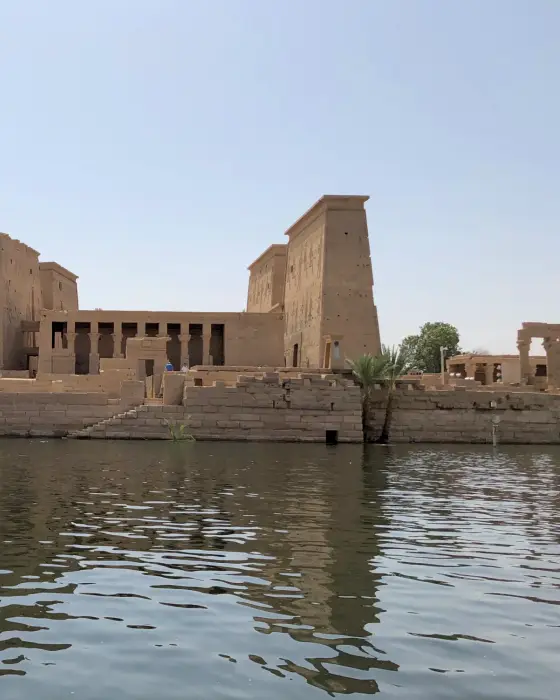
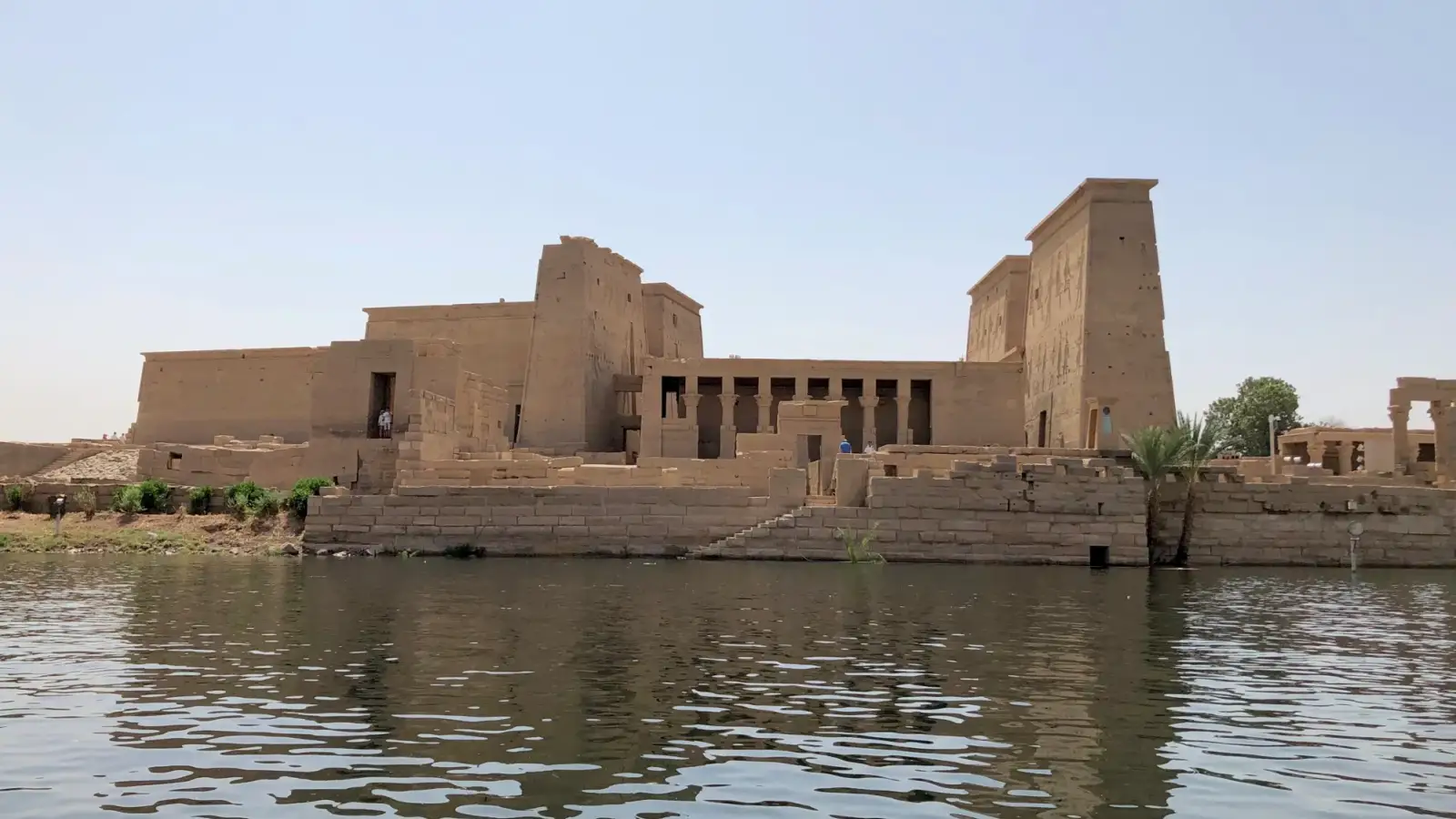
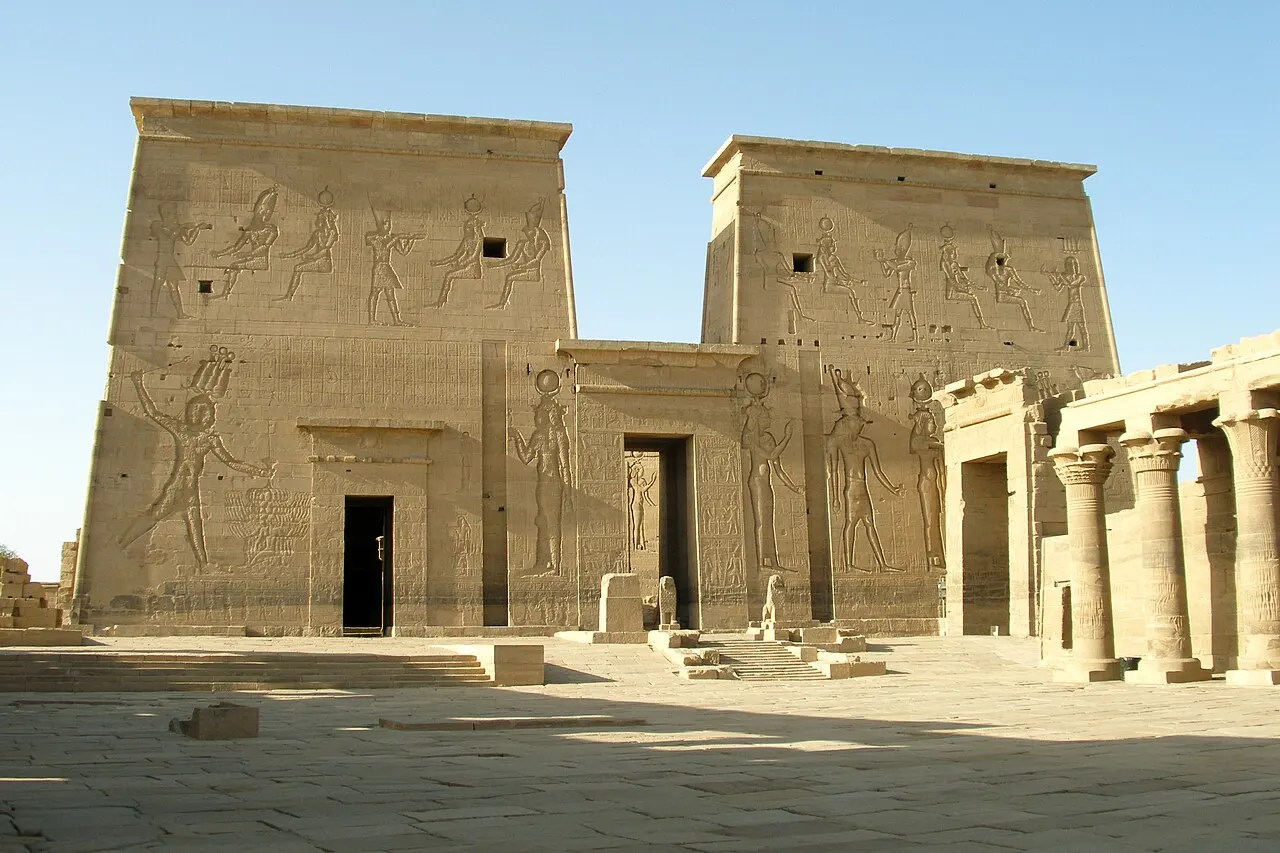
The sanctuary of Isis, begun by Ptolemy II and expanded until Roman times, is Aswan's main monument and can only be reached by boat, from the landing south of the old dam. Besides the main temple, with the birth room where Isis nurses Horus, there are the temple of Hathor and Trajan's Kiosk, roofless, at the water's edge. The whole complex was dismantled and rebuilt on the island of Agilkia between 1977 and 1980, and the original island, submerged, lies a few hundred meters away. Look for the crosses carved over the reliefs, from the time when the temple became a church. Open 7:00 to 16:00; the ticket for a foreign adult costs 550 EGP, and access to the panoramic terrace costs 200 EGP extra (Ministry of Tourism and Antiquities, accessed October 19, 2026). In the evening there is a sound and light show, with sessions in different languages depending on the day.
Check access
Elephantine Island
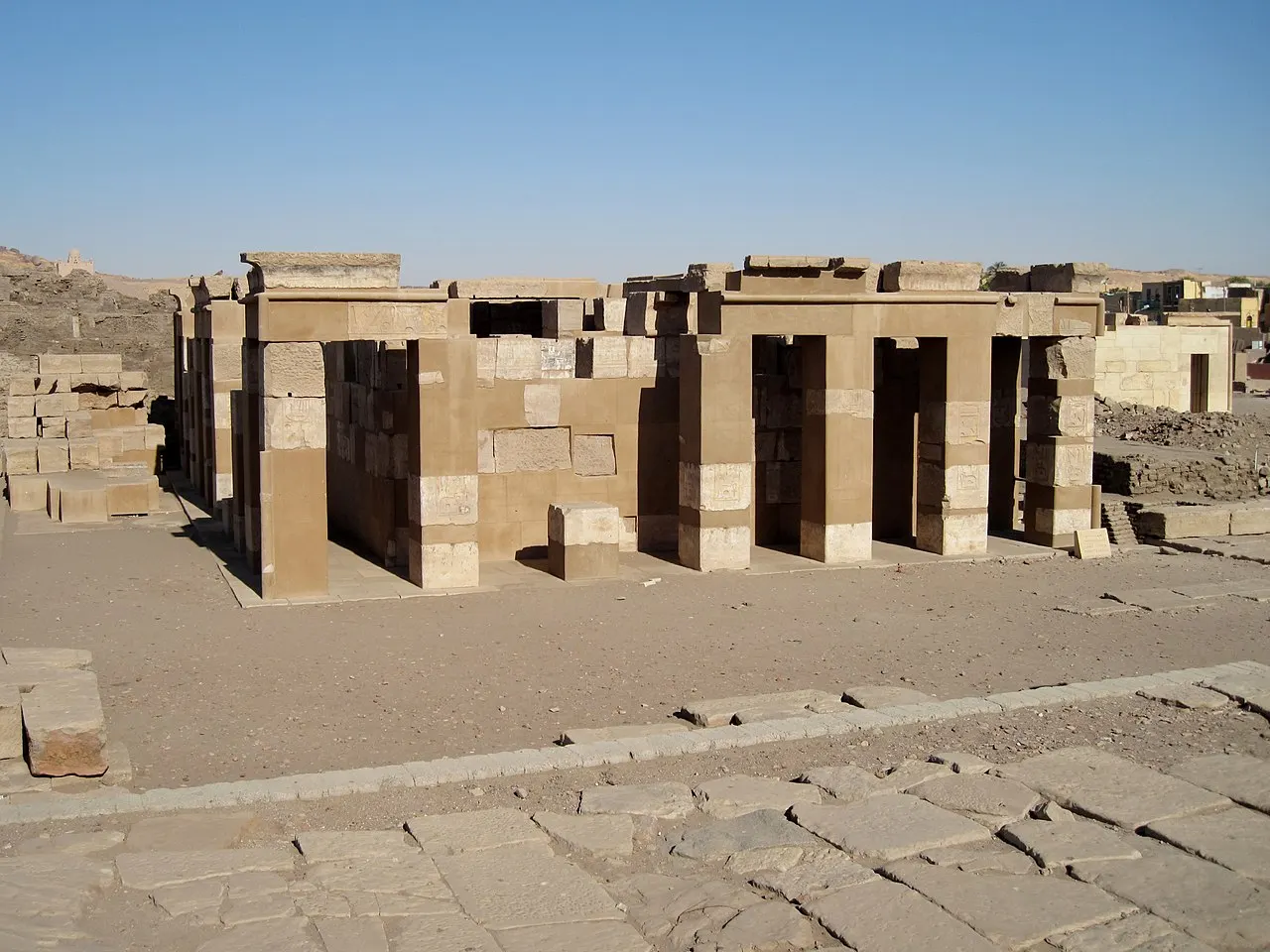
The border island, inhabited for more than five millennia, has at its southern tip the ruins of the temples of Khnum and Satet, old houses excavated by the German mission, and two nilometers, the stairways that measured the height of the flood. The Aswan Museum, in the same compound, displays statues, sarcophagi, and ram mummies, the animal of the god Khnum. After the site, it is worth walking through the Nubian villages of Siou and Koti, in the middle of the island. Open 8:00 to 16:00, with a ticket of 200 EGP for a foreign adult (Ministry of Tourism and Antiquities, accessed October 19, 2026). The public ferry leaves from the Corniche, opposite.
Check access
Nubian Museum
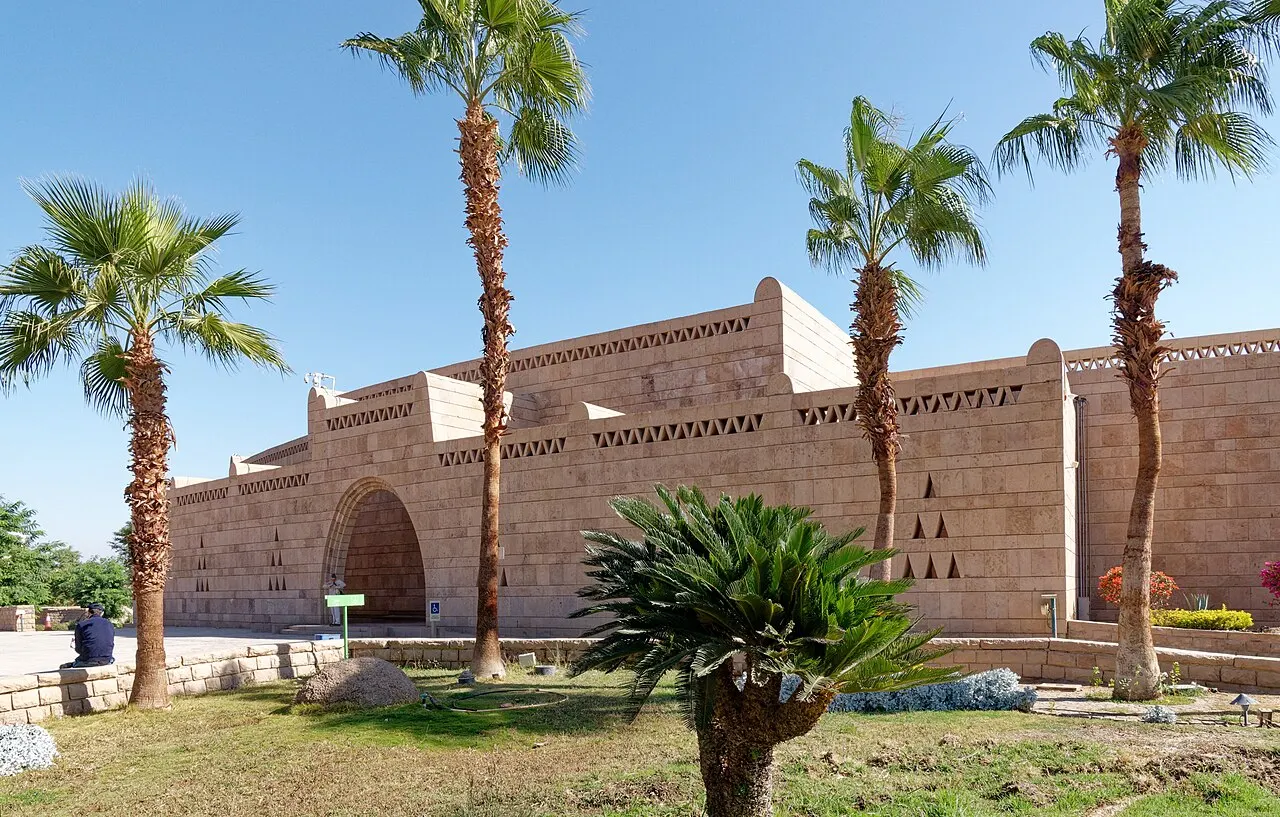
The best place to understand Nubia and what the High Dam did to it. Across three floors, the collection runs from prehistory to the rescue campaign of the 1960s, with thousands of pieces, and the main hall shows the traditions and crafts of the Nubian villages in dioramas. The garden works as an open-air museum, with part of a Fatimid cemetery, a cave with prehistoric engravings, and the reconstruction of a Nubian house. Open 9:00 to 17:00, with the ticket office open until 16:00; on Thursdays and Fridays it reopens from 18:00 to 21:00. Ticket of 400 EGP for a foreign adult (Ministry of Tourism and Antiquities, accessed October 19, 2026).
Check access
Gharb Soheil
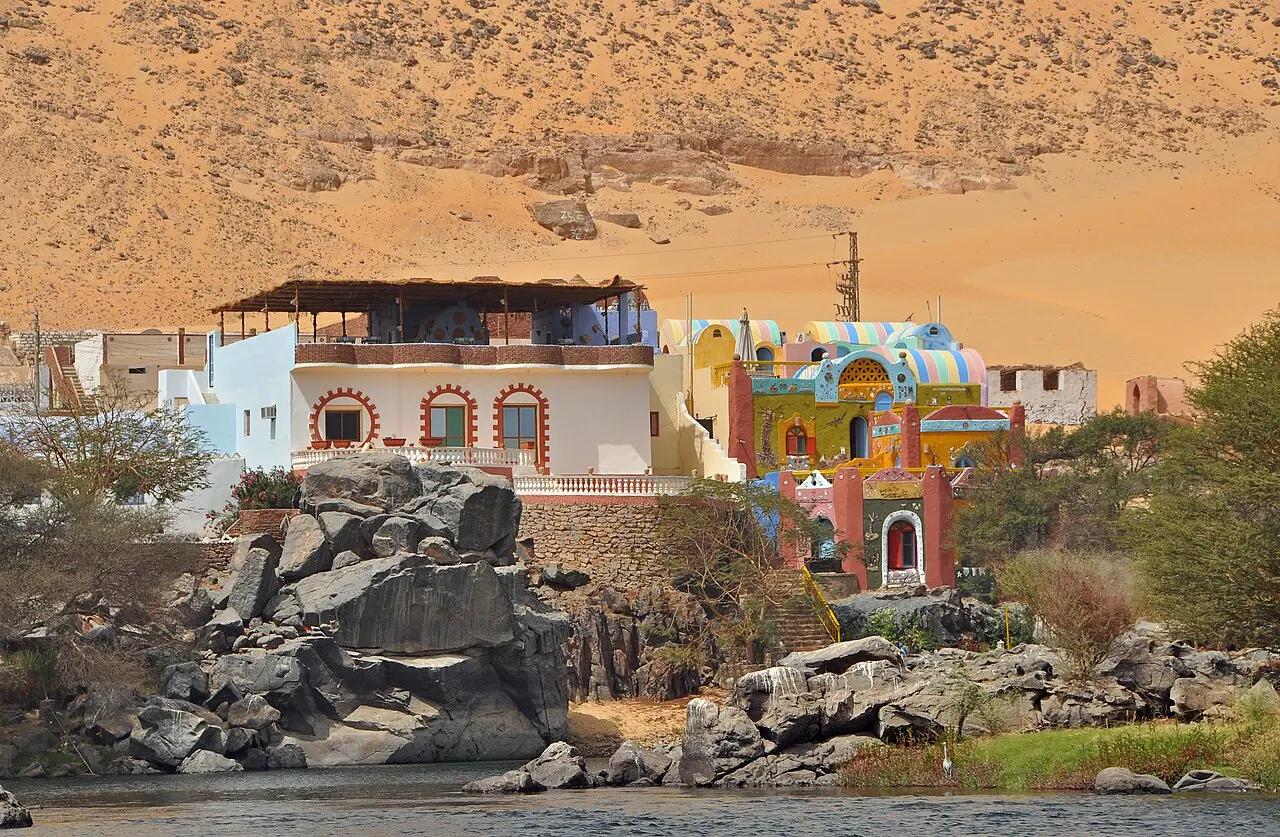
A Nubian village on the west bank, with houses painted in strong colors, guesthouses, restaurants serving Nubian cuisine, and craft shops. It formed about a hundred years ago, when the old dam was built and first raised. The visit is usually by boat, in the late afternoon, combined with dinner; it is an inhabited village, and asking permission before photographing people and interiors is part of the visit.
Check access
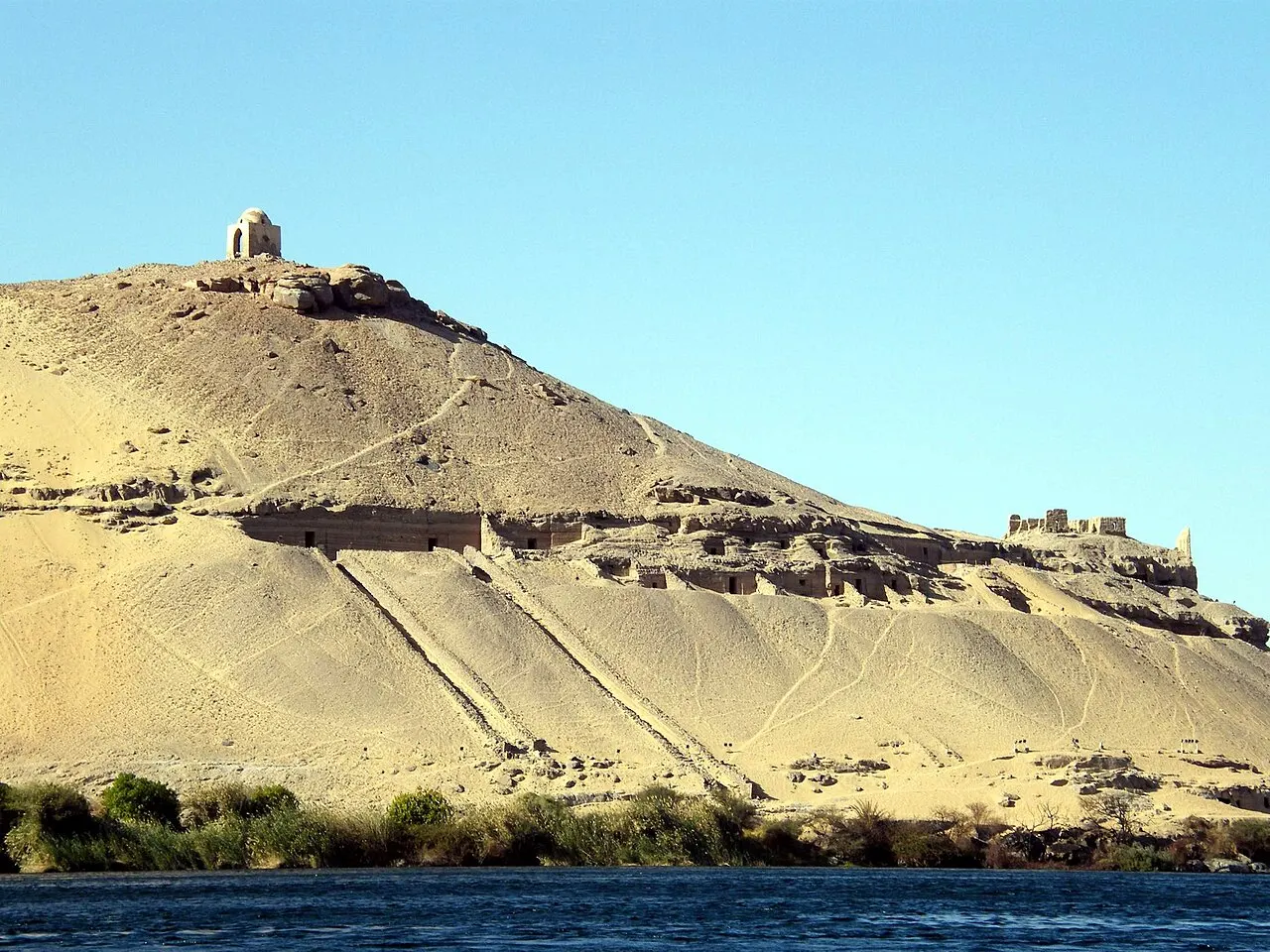
Tombs of the Nobles
About a hundred tombs cut into terraces on the hill of Qubbet el-Hawa, on the west bank, opposite the center, where governors and priests of the Old and Middle Kingdoms were buried. The most visited are the complex of Mekhu and Sabni and that of Sarenput II, with well-preserved paintings; the person who opens the doors is a guard with the key. From the top, at the sheikh's dome that gives the hill its name, the view takes in the river, the islands, and the desert. You get there by the public ferry from the center's bank; the climb is on foot, under the sun.
Check access
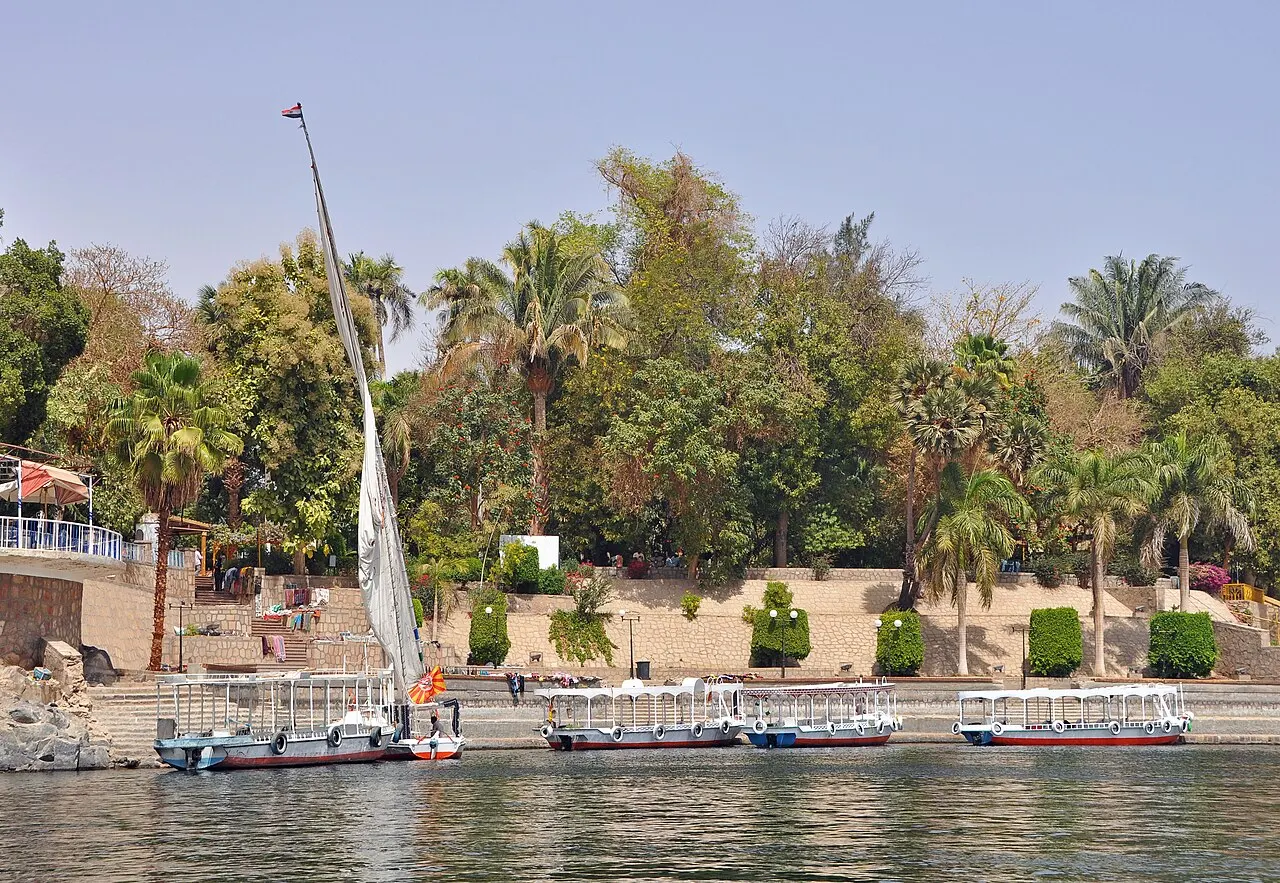
Aswan Botanical Garden
It occupies the whole of El Nabatat Island, the former Kitchener's Island, turned into a garden by Lord Kitchener, who owned it, and later handed to the government as a botanical research institute. It has palm trees, trees brought from India, and many birds, and is popular with local families on weekends. You can only reach it by boat or felucca, landing on the southeast side of the island.
Check access
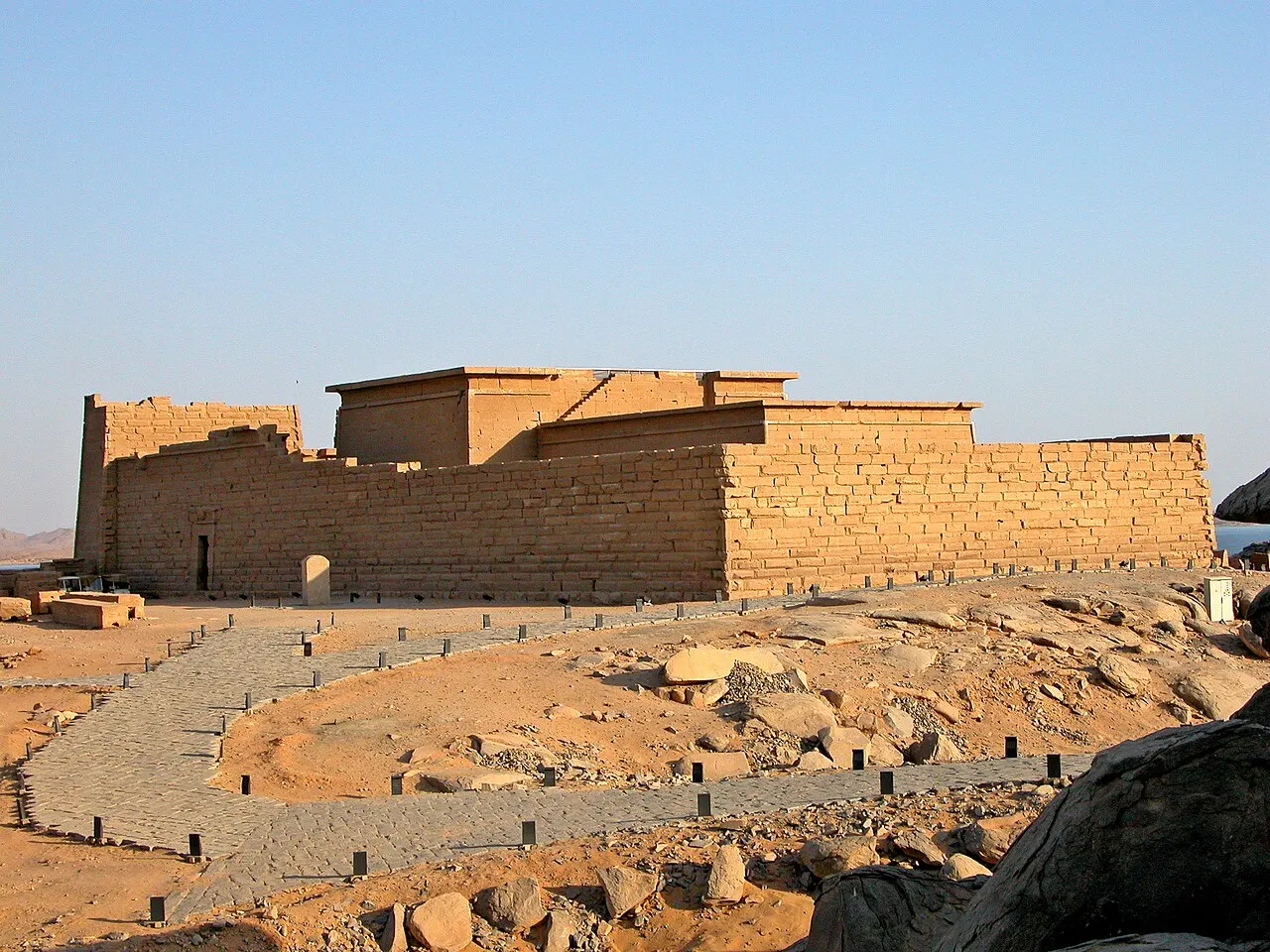
Temple of Kalabsha
On the New Kalabsha promontory, by the High Dam, stand temples moved from Nubia before the flooding. The main one, dedicated to the Nubian god Mandulis and built in the reign of Augustus, was moved in 1962 and 1963; beside it are the temple of Beit el-Wali, of Ramesses II, and the small Kiosk of Qertassi. Open 7:00 to 16:00, with a ticket of 200 EGP for a foreign adult (Ministry of Tourism and Antiquities, accessed October 19, 2026).
Check access
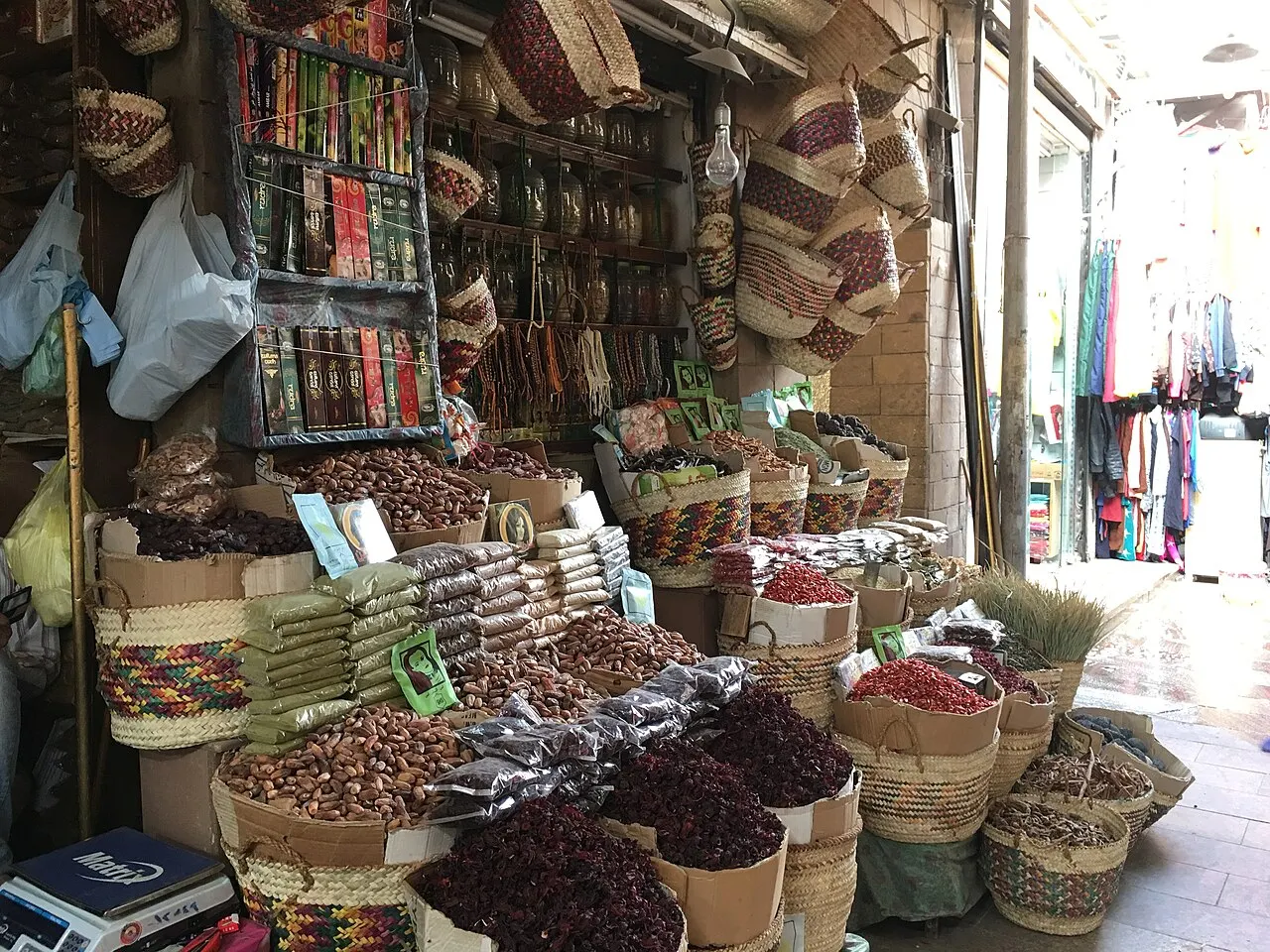
Sharia as-Souq
The market street, which starts near the station and runs south parallel to the Corniche, with spices, karkadeh, henna, dates, baskets, and Nubian fabrics, as well as fruit and vegetables for local trade. For a calm stroll, late afternoon is cooler.
Check access
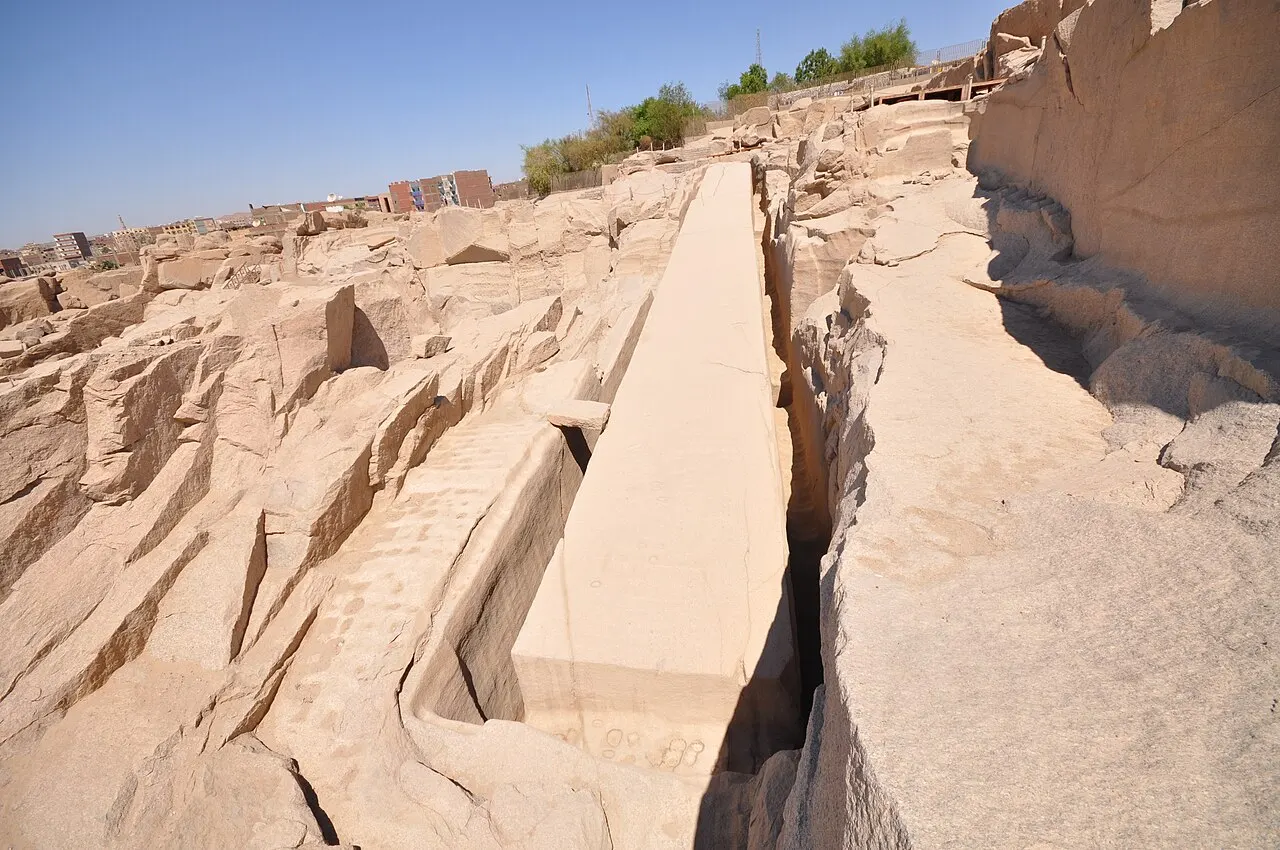
Unfinished Obelisk
In the ancient quarry on the east side of the city, the largest known obelisk of ancient Egypt still lies attached to the rock. Attributed to Hatshepsut, it was abandoned when the granite cracked; it would have been about 42 meters long and weighed 1,168 tonnes. The tool marks and the ocher lines explain how the stone was cut. Open 7:00 to 16:00, with a ticket of 220 EGP for a foreign adult (Ministry of Tourism and Antiquities, accessed October 19, 2026).
Check access
More places in the guide
Aswan High Dam
The earth-and-rock dam, 3.8 km long and 111 meters high, that holds back Lake Nasser, built between 1960 and 1970 with Soviet support. At the top of the wall there is a lookout over the lake and the monument to Egyptian-Soviet friendship, shaped like a lotus flower. The visit is short and is done together with Philae or Kalabsha.
Monastery of St. Simeon
The ruins of a large Coptic monastery in the desert of the west bank, surrounded by a high wall and arranged on two terraces, with a church, a cave, cells, a refectory, oil presses, and ovens. The church still has remains of paintings, and the walls hold Coptic and Arabic graffiti. You get there on foot or by camel from the Tombs of the Nobles. Open 7:00 to 17:00, with a ticket of 150 EGP for a foreign adult (Ministry of Tourism and Antiquities, accessed October 19, 2026).
Sehel Island
A large island between the city and the old dam, with Nubian villages and hundreds of inscriptions carved into the granite blocks by travelers going to or returning from Nubia, among them the Famine Stela, from the Greco-Roman period. The visit requires a private boat and goes well with a trip to Gharb Soheil.
Aga Khan Mausoleum
The tomb of Aga Khan III, built between 1956 and 1960 in a style inspired by Fatimid mausoleums, high on the west bank; since 2025 it also holds Aga Khan IV. A red rose is left on the tomb every day, a custom begun by his widow, the Begum Om Habibeh. Just below is the family's winter house, designed by Hassan Fathy. The interior of the mausoleum has been closed to the public since 1997, and the building is seen from afar, from the river or the Corniche.
Nilo’s itinerary
Start with the basic programme and choose extensions for the time you have.
Plan my days in the app ↗Day 1 · Philae, the Nubian Museum, and the souq
Set out early by taxi or tuk-tuk, with a fixed price, to the Philae landing, south of the old dam, to arrive at opening time, 7:00.
Buy the ticket (550 EGP, plus 200 EGP if you want the panoramic terrace) and hire a motorboat for the group, with the trip out, about two hours of waiting on the island, and the trip back in one deal.
Walk through the temple of Isis, the birth room, the temple of Hathor, and Trajan's Kiosk in about an hour and a half, and go up to the terrace if you have bought access, before the groups arrive.
Return to the city in late morning, have lunch in the center, and spend the hottest hours in the shade.
Reach the Nubian Museum around 14:00, because the ticket office closes at 16:00, and set aside two hours for the collection and the garden, with the Nubian house and the Fatimid cemetery.
Walk north along the Corniche in the late afternoon, with the feluccas and Elephantine ahead.
Have dinner near the souq and walk Sharia as-Souq in the evening, when the market is busiest.
Day 2 · The west bank, Elephantine, and Gharb Soheil
Cross early, by public ferry, from the center side to the west bank and climb to the Tombs of the Nobles right at opening, before the strong sun: Mekhu and Sabni and Sarenput II, with the guard who has the key, and then the dome of Qubbet el-Hawa for the view of the islands.
Come down and arrange at the dock a boat or felucca that goes around El Nabatat Island and drops the group at the southern tip of Elephantine, with price, stops, and time agreed.
Visit the site at the southern tip of Elephantine, with the temples of Khnum and Satet, the nilometer, and the Aswan Museum, in about an hour and a half; the compound closes at 16:00.
Walk through the Nubian villages of Siou and Koti, in the middle of the island, asking permission before photographing people, and return to the Corniche by public ferry.
Have lunch and rest during the hot hours.
In the late afternoon, set out by boat upriver to Gharb Soheil, walk through the village, and have dinner of Nubian cuisine, with the time of the return trip agreed before boarding.
If you stay longer
Day 3 · Abu Simbel
Day trip
About 300 km south by road, near the border with Sudan, a trip of about three hours each way. Minibus excursions leave Aswan before dawn, around 4:00 or 5:00, and return in the afternoon; there are also domestic flights to the Abu Simbel airport. The two temples of Ramesses II and of Nefertari, moved to higher ground in 1968, are open 6:00 to 17:00, with a ticket of 750 EGP for a foreign adult, and 1,200 EGP on February 22 and October 22, when the sun lights up the sanctuary (Ministry of Tourism and Antiquities, accessed October 19, 2026). To see the evening sound and light show you have to sleep in Abu Simbel.
Food
Kabed
Nubian wheat bread, sometimes mixed with sorghum or barley flour, baked in a disc on a round clay or iron griddle, the doka. The fermented version is eaten with honey and milk; the unleavened one goes with vegetable stews. It is the dish Nubian homes serve to visitors.
Itr and bamia
Dried molokhia, called itr in the villages, and okra (bamia), cooked in broth and eaten with unleavened kabed. It is everyday food in Nubian cooking.
Karkadeh
An infusion of hibiscus flower, one of the characteristic crops around Aswan. It is served hot or iced, and Egypt's official tourism site associates it with Nubia since antiquity.
Abreh
A Nubian drink made from thin, dried sheets of dough, also called abreh, dissolved in water with sugar or mixed with other juices, such as apricot. It is a drink of the Nubian region, rarely seen in the rest of Egypt.
Fish from the Nile and Lake Nasser
At the fish restaurants near the souq, the fish is chosen at the counter, weighed, and grilled or fried on the spot, and the price is by weight. Lake Nasser supports a commercial fishery that supplies the city.
Kofta and pigeon grills
Charcoal-grilled kofta and beef kebab and grilled pigeon, served with bread, salad, and tahini, at the grill houses in the center, frequented mainly by locals.
Aswan dates
The governorate's palm groves are among the region's main crops, and dried dates appear at the souq's fruit stalls next to spices and henna.
Sugarcane juice
Asab comes out of the press on the spot, at the juice counters in the center, and is a matter of local pride. It is the afternoon drink in the hot months.
Where to eat
- Sharia as-Souq and around the station
Fish restaurants where you choose the fish at the counter and pay by weight, grills of kofta, kebab, and pigeon with bread and tahini, and counters of sugarcane juice and karkadeh. It is the cheapest food in the center and the one most sought out by locals.
- Corniche
Restaurants on pontoons and terraces over the river, with mezze, stews in clay pots, fish, and local beer. You pay more for the view of the sunset over the west bank, and the menu is designed for visitors.
- Gharb Soheil and the villages of Elephantine
Nubian home cooking: kabed, itr and okra stews, karkadeh, and tea. It is worth combining dinner with the boat trip, because the time of the return depends on the boatman.
- Hotels on the South Corniche
For those who want an alcoholic drink, a long meal, or afternoon tea with a view of Elephantine, the restaurants and terraces of the large hotels are the option, some with a minimum spend for those not staying there.
· 2026-10-19
Day trips
Abu Simbel
About 300 km south by road, near the border with Sudan, a trip of about three hours each way. Minibus excursions leave Aswan before dawn, around 4:00 or 5:00, and return in the afternoon; there are also domestic flights to the Abu Simbel airport. The two temples of Ramesses II and of Nefertari, moved to higher ground in 1968, are open 6:00 to 17:00, with a ticket of 750 EGP for a foreign adult, and 1,200 EGP on February 22 and October 22, when the sun lights up the sanctuary (Ministry of Tourism and Antiquities, accessed October 19, 2026). To see the evening sound and light show you have to sleep in Abu Simbel.
Kom Ombo
About 50 km to the north, by car on the valley road or by local train to Kom Ombo station and tuk-tuk to the temple. The double temple of the Ptolemaic period, dedicated to the crocodile god Sobek and to Horus the Elder, has two parallel axes and two sanctuaries, and a Roman relief with what is interpreted as surgical instruments. Open 7:00 to 21:00, with a ticket of 450 EGP for a foreign adult (Ministry of Tourism and Antiquities, accessed October 19, 2026). It is a stop for cruises to Luxor, as is Edfu, farther north.
Where to begin
Philae, the Nubian Museum, and the souq
Set out early by taxi or tuk-tuk, with a fixed price, to the Philae landing, south of the old dam, to arrive at opening time, 7:00.
The west bank, Elephantine, and Gharb Soheil
Cross early, by public ferry, from the center side to the west bank and climb to the Tombs of the Nobles right at opening, before the strong sun: Mekhu and Sabni and Sarenput II, with the guard who has the key, and then the dome of Qubbet el-Hawa for the view of the islands.
Money
The currency is the Egyptian pound (EGP), and small notes solve almost everything that happens outside the hotels: ferry, tuk-tuk, tea, water, and baksheesh, the tip expected by whoever opens a door or carries a bag. What weighs most on the budget is admission tickets, charged in pounds and adjusted often. According to the Ministry of Tourism and Antiquities page, accessed October 19, 2026, a foreign adult pays 550 EGP at Philae (plus 200 EGP for the panoramic terrace), 400 EGP at the Nubian Museum, 220 EGP at the Unfinished Obelisk, 200 EGP at Elephantine and Kalabsha, 150 EGP at the Monastery of St. Simeon, 450 EGP at Kom Ombo, and 750 EGP at Abu Simbel, a price that rises to 1,200 EGP on February 22 and October 22. Students with a card pay half at most sites. The Philae sound and light show costs US$20 per adult, according to the official shows website. Boats, feluccas, and horse carriages have no posted price: the fare comes out of the conversation at the dock and is per boat, not per person.
Getting there and around
By air: Aswan Airport, taxi agreed beforehand
Aswan International Airport (ASW) is about 25 km south-southwest of the center, on the west bank, beyond the High Dam, with domestic flights, such as those from Cairo. There is no public bus to the terminal: the way in is by taxi, with the fare agreed before getting into the car, or by hotel transfer. Ride-hailing apps work in the city, but the driver sometimes tries to renegotiate the fare by message before arriving. Entry rules for Egypt depend on nationality: some travelers can get a tourist visa on arrival, others through the official portal visa2egypt.gov.eg before the trip, and some need a consulate; check before buying the ticket. In some summers, the Egyptian government waives the visa fee for travelers flying directly into Aswan or Luxor airports; the waiver applies to those who enter Egypt through one of these two airports, not to those who enter through Cairo and continue on a domestic flight.
By train: Luxor in 3 to 4 hours, Cairo in a day or a night
The station is at the northern end of the center, a few hundred meters from the river, and is the end of the main line of Egyptian National Railways (ENR). Luxor is 3 or 4 hours away; Cairo, about 10 hours more. The air-conditioned express trains have first and second class, and in April 2026 the Cairo–Aswan route cost US$80 in first and US$65 in second for foreigners. There is also a private overnight sleeper train, run by Watania, booked on the company's website. ENR tickets are bought on the website or at the station, in advance.
Nile cruise to Luxor
Cruise ships dock along the Corniche and make the trip between Aswan and Luxor in 3 to 4 nights, with stops at the temples of Kom Ombo and Edfu. These are packages with meals, not scheduled boats. There are also multi-day felucca trips downriver, booked in advance. Above the High Dam, Lake Nasser has its own cruises, which run from Aswan to Abu Simbel.
In the city: on foot along the Corniche, by boat for the rest
The center, the Corniche, and the souq can be covered on foot. For Elephantine and the west bank, there are cheap public ferries, with a higher fare for foreigners; motorboats and feluccas charge by the boat, and the price, duration, and stops are agreed at the dock before boarding. For the Nubian Museum, the Unfinished Obelisk, Philae, and the High Dam, you take a taxi, tuk-tuk, or horse carriage, always with a fixed price.
Philae: taxi to the landing and a boat for the group
The temple is on an island in the lake between the dams. You take a taxi or tuk-tuk to the landing south of the old dam, buy the ticket, and hire a motorboat for the group, with the trip out, the wait, and the trip back agreed in one deal. Agree the wait to match the length of the visit, about an hour and a half to two hours with the terrace, so you don't have to renegotiate on the island.
Safety
Aswan is considered a calm city for visitors, with visible policing at the sites, the landings, and on the road to Abu Simbel. The most likely risks are others. The first is the heat: from May to September, heatstroke and dehydration are the real problem, and bottled water, a hat, and a pause during the middle hours of the day solve it. The second is theft in the souq, with a known trick: the seller offers a scarf or a papyrus with one hand while looking for the pocket with the other; a wallet in front and a closed bag prevent it. The third is the price that changes: boatmen, carriage drivers, and drivers who do not agree the fare and ask for more at the destination. Women traveling alone report insistent stares and comments, more than contact. Do not drink tap water. Boatmen offer a stop for a swim in the Nile near Gharb Soheil, but schistosomiasis, an infection caused by a parasite transmitted in fresh water, exists in Egypt, and the health guidance for travelers is not to swim in untreated rivers, lakes, or ponds. In the rare heavy rains, such as the storm of November 2021, flash floods drive scorpions out of their burrows; so, on a rainy day, watch where you step and do not walk barefoot on open ground.
Before you go
- Plug
- types C and F
- Voltage
- 220 V
- Driving side
- on the right
- Emergency
- Police 122 · Ambulance 123 · Fire 180
- Country code
- +20
- Official language
- Arabic
- Currency
- Egyptian pound (EGP)
Source: Wikidata (CC0), checked September 2026.
Etiquette tips
Clothing that covers shoulders and knees
In the city, in the villages, and at the sites, men and women wear clothing that covers shoulders and knees. In a mosque, women cover their hair and everyone takes off their shoes.
Ask before photographing people and houses
The Nubian villages of Elephantine, Gharb Soheil, and Sehel are inhabited. Photographing people, children, and the inside of houses requires asking permission first; façade paintings and landscapes do not.
Tea in the shop is part of the bargaining
In the souq, the shopkeeper offers tea and conversation, and the invitation usually comes with the expectation of a purchase. Accepting is polite; if you don't want to buy, say thank you and say so right away.
Baksheesh for whoever provides a service
Guards who open tombs, people who hold the camel or point out a relief expect a tip. Declining the service before it begins avoids the argument afterward.
Right hand for eating and handing things over
Bread, money, and gifts are passed with the right hand, and it is the one used for eating when the meal is without utensils.
Ramadan: discretion during the day
During the month of fasting, avoid eating, drinking, and smoking in the street by day. Hotel restaurants continue to serve those who are not fasting.
Mistakes to avoid
Boarding a felucca or a motorboat without first agreeing the price, the duration, and the stops, and finding out in the middle of the river that the price was per person or one way only.
Arriving at the Nubian Museum after 16:00, when the afternoon ticket office has already closed, and losing the day's visit.
Leaving Philae for late morning in the hot months, when the sun on the lake beats down without shade and the cruise groups have already arrived.
Going to Abu Simbel in light clothing in winter: the excursion leaves before dawn and the wind from Lake Nasser makes the start of the day cold.
Counting on a visit to the interior of the Aga Khan mausoleum, closed to the public since 1997.
Accepting the horse carriage or tuk-tuk without a fixed price and hearing at the destination that the price was different.
Planning to visit open-air sites, such as the Tombs of the Nobles and the Unfinished Obelisk, between noon and 15:00 from May to September, with highs above 39 °C.
Useful phrases
السلام عليكم: as-salamu alaykum
“Peace be upon you” (as-sa-LAH-moo a-LAY-koom). A greeting for any time of day; the reply is wa alaykum as-salam.
صباح الخير: sabah el-kheir
“Good morning” (sa-BAH el-KHAYR). The usual reply is sabah en-nur, “morning of light”.
شكراً: shukran
“Thank you” (SHOOK-ran).
لا، شكراً: la, shukran
“No, thank you” (la SHOOK-ran). Said once and calmly, it ends most offers at the dock and in the souq.
بكام؟: bikam?
“How much?” (bi-KAM). For a boat, also ask whether the price is per boat (lel-markeb) and round trip (rayeh gay).
ممكن صورة؟: momken sura?
“May I take a photo?” (MOM-ken SOO-ra). Needed before photographing people in the villages.
كفاية: kifaya
“Enough” or “that's enough” (ki-FAH-ya). Useful when tea, food, or offers keep arriving.
مع السلامة: ma'a salama
“Goodbye” (ma-a sa-LAH-ma).
Where to stay
- Center and Sharia as-Souq · People traveling by train, on a tight budget, who want to walk to the souq and the ferries.: It is near the station and the boarding point for the west bank, with the simplest hotels in the city and cheap food all around. The drawback is the constant bustle and the insistent approach of people selling tours at hotel doors.
- Corniche and South Corniche · People who want a river view and larger hotels, with a pool, and will take their trips by taxi or boat.: The hotels facing the Nile and Elephantine line the avenue, and the southern stretch, with the Nubian Museum and the Old Cataract, is the quietest. From the south to the center and the station is about 30 minutes on foot, and prices rise considerably in winter.
- Elephantine Island · People who prefer quiet and Nubian family-run guesthouses, and don't mind depending on a boat.: There are guesthouses in the villages of Siou and Koti, a few minutes by ferry from the center. The routine comes to depend on the crossing: at night, the return trip has to be arranged with a boat.
- Gharb Soheil and the west bank · People who want to sleep in a Nubian village, with a view of the river and the desert, and accept being far from the city.: The Nubian guesthouses on the west bank are the way to see the village beyond the tour hours. Everything depends on a boat or a car with a driver, and going back and forth to the sites on the east side takes longer and costs more.
· 2026-10-19
Districts
Center and Sharia as-Souq
The commercial heart between the train station and the Corniche, cut by the souq street, which starts near the station and runs south with spices, fabrics, Nubian basketry, fruit, and juices. It has the simple hotels, grilled-meat and fish restaurants, and the boarding point for the ferries to the west bank. It is the most practical area for those arriving by train.
Corniche
The avenue along the Nile, with cafes, shops, and landings for feluccas and motorboats, facing Elephantine. One stretch has received a multilevel walkway with a lookout over the islands. It is where almost every boat trip is arranged, and also where the boatmen's approaches are most insistent.
South Corniche
The southern stretch of the avenue, where the Nubian Museum, the Coptic Cathedral of the Archangel Michael, one of the Fatimid cemeteries, and the large hotels are, including the historic Old Cataract. It is more spread out and quiet; from the center, the museum is about half an hour on foot.
Elephantine Island
The island opposite the center, with the archaeological site and the Aswan Museum at the southern tip and the Nubian villages of Siou and Koti in the middle, with narrow streets and painted houses. You get there by public ferry or boat, in a few minutes.
West bank
Hills of sand and rock with almost no town, with the Tombs of the Nobles and the dome of Qubbet el-Hawa to the north, the Aga Khan mausoleum on the heights, and the Monastery of St. Simeon in the desert. The public ferry leaves from the center side; the rest is done on foot or by camel, under a strong sun.
Gharb Soheil
A Nubian village on the west bank, west of Sehel Island, formed about a century ago, at the time the old dam was built. It has painted houses, guesthouses, and Nubian restaurants aimed at visitors. You get there mainly by boat from the Corniche.
Between the dams
The stretch of river between the old dam and the High Dam and the start of Lake Nasser: the Philae landing, the island of Agilkia with the temple of Isis, and, by the High Dam, the New Kalabsha promontory, with temples rescued from Nubia. It is not a district to stay in; you go by taxi or on an arranged tour.
History
c. 3000 BC · A fort on the border island
By the First Dynasty there was already a fort on Elephantine, a transfer point for the trade arriving from Nubia, above all ivory. The temples of Satet and Khnum, tied to the flooding of the Nile, arose on the same island.
Old Kingdom · The governors of the west bank
The nobles who governed the region and led expeditions to the south were buried in tombs cut into the hill of Qubbet el-Hawa, such as those of Mekhu and his son Sabni, of the Sixth Dynasty.
c. 1473–1458 BC · The obelisk that cracked
Attributed to Hatshepsut and intended for the temple of Amun at Karnak, the largest obelisk in the quarry was abandoned still attached to the rock when the stone cracked. It would have been about 42 meters long.
c. 1264 BC · Ramesses II in Nubia
The great temple of Abu Simbel was carved into the rock, about 300 km south of Aswan by road, with four seated colossi on the facade and a smaller temple dedicated to Hathor and Queen Nefertari.
5th c. BC · The Elephantine papyri
Papyri and ostraca in Aramaic found on the island document a colony of Jewish mercenaries with their own temple to Yahweh, which coexisted, and came into conflict, with the local Egyptian cult until it was destroyed in 410 BC.
c. 240 BC · The shadow that measured the Earth
Eratosthenes used the fact that, in Syene, the summer solstice sun cast almost no shadow to calculate the circumference of the Earth.
394 AD · The last hieroglyphic inscription
In the temple of Isis at Philae, a priest carved the last dated hieroglyphic inscription known. The temple remained in operation until the reign of Justinian I and was then converted into a church.
6th–14th c. · The desert monastery
On the west bank, the monastery now known as St. Simeon was in religious use from the 6th century to the early 14th, surrounded by a high wall, with a church, cells, a refectory, and workshops.
1899–1902 · The first dam
The British built the old dam across the First Cataract, inaugurated on December 10, 1902 and raised twice in the following decades. The island of Philae came to be flooded almost all the time.
1900 · The cataract hotel
The Cataract Hotel, built by Thomas Cook for European winter travelers, opened on January 8, 1900 on the south Corniche. Agatha Christie set parts of Death on the Nile there.
1960–1971 · The High Dam
Built with Soviet support, the High Dam was completed in 1970 and inaugurated in 1971, forming Lake Nasser. The project displaced about 100,000 Nubians in Egypt and Sudan and submerged much of Lower Nubia.
1962–1980 · Temples lifted to higher ground
The international UNESCO campaign dismantled and rebuilt the threatened temples: Abu Simbel was moved in 1968, Kalabsha in the early 1960s, and Philae, between 1977 and 1980, to the neighboring island of Agilkia.
1997 · The Nubian Museum
The museum dedicated to Nubia, born of the rescue campaign, opened on the south Corniche, designed by Mahmoud Al-Hakim, in sandstone and pink granite. In 2001 it received the Aga Khan Award for Architecture.
Complete history
For the ancient Egyptians, the country began at Aswan. The Nile flows from south to north, and Swenet, the city on the east bank, was the first navigable point below the cataract, from where a boat could descend unobstructed to the delta. For that reason it was at once a customs post, a military garrison, and a market: boats going up and down the river paid fees there, and ivory and other goods from Nubia changed hands on Elephantine Island, where there had been a fort since about 3000 BC.
The second reason for the city's importance was stone. The quarries on both banks supplied pink and dark granite, syenite, which became colossi, obelisks, and one-piece shrines across Egypt. The Unfinished Obelisk, abandoned when the rock cracked, still shows the marks of the tools. On the west bank, the local governors of the Old and Middle Kingdoms, who commanded the expeditions to the south, were buried in tombs cut into the hill of Qubbet el-Hawa, with biographical texts that tell of those journeys.
In the following centuries, the frontier continued to attract temples and religions. The Ptolemies and the Roman emperors built the sanctuary of Isis at Philae, where the ancient Egyptian religion held out until the 6th century; the temple became a church, and crosses were carved over the reliefs. On the west bank, a Coptic monastery operated until the early 14th century. From the Islamic periods there remain the Fatimid cemeteries, with domes with octagonal faces from the 10th century: the southern one, next to the Nubian Museum, and the northern one, in the Anani district. They are part of the World Heritage Site together with Elephantine, Qubbet el-Hawa, the quarries, and the Monastery of St. Simeon. The mausoleum of Aga Khan III, high on the west bank, came in the 20th century.
The 20th century transformed the landscape. The old dam, opened in 1902 and later raised, flooded Philae for much of the year; the High Dam, inaugurated in 1971, created Lake Nasser, submerged Lower Nubia, and displaced about 100,000 Nubians in Egypt and Sudan, many of them resettled in new villages near Kom Ombo. The international UNESCO campaign saved dozens of temples by moving them to higher ground, and the Nubian Museum, opened in 1997, tells that story. At the same time, winter tourism, which took shape with the hotel opened by Thomas Cook in 1900, made Aswan one of the travel bases of Upper Egypt.
Geography and shape of the city
Aswan occupies the east bank of the Nile at the point where the river leaves the First Cataract, a strip of islands, channels, and blocks of dark granite that runs from the old dam to the city. Above the city the Nile is about 650 meters wide and splits around the islands: Elephantine, about 1.6 km long, lies right opposite the center; El Nabatat Island, the botanical garden island, about 750 meters long, lies behind it; farther south are the island of Sehel and dozens of islets. The city stretches in a strip along the Corniche, with the train station at the northern end of the center and the Nubian Museum in the south, and grows inland, toward the Eastern Desert, where the old granite quarries are. The west bank is a different landscape: dunes and hills of sand and rock, with the tombs of Qubbet el-Hawa, the Aga Khan mausoleum, and, farther south, Nubian villages such as Gharb Soheil. Upriver, 6 or 7 km apart, are the old dam, with Philae on the lake between the two, and the High Dam, which holds back Lake Nasser. The climate is hot desert: it almost never rains, average air humidity is around 26%, and the sun shines practically all year.
Culture
Aswan's culture is largely Nubian. The Nubians, a people with their own language and tradition who lived along the Nile between southern Egypt and northern Sudan, lost much of their land to the dams, and many families were resettled in villages near Kom Ombo or moved to the cities. In the Aswan region, the local Nubian language is Kenzi (Mattokki), heard alongside Arabic in the villages of Elephantine, Gharb Soheil, and Sehel, and the houses painted in strong colors, on both banks, are the most visible form of that identity. The Nubian mud-brick vault, a building technique without timber, was revived in the 20th century by the Egyptian architect Hassan Fathy, who rediscovered it in a Nubian village.
Music is central to Nubian memory. Songs of lament speak of the lost land, the drum and hand clapping mark the rhythm, and in fann al-kaff, the art of the palm, poets improvise verses over the group's beat. Singers who built careers in Cairo came from Aswan, such as Mohamed Mounir and Ahmed Mounib, and the Nubian Museum has an open-air amphitheater for folklore performances.
The city belongs to the UNESCO Creative Cities Network in the category of crafts and folk art, and Nubian handicrafts, such as basketry, beads, and fabrics, tend to be of better quality and price here than in other tourist cities in the country. Since 2017, the Aswan International Women Film Festival has brought together films directed by women, and the International Sculpture Symposium leaves its granite works on display in an open-air park near the old quarry.
Religious life is mostly Muslim, with a visible Coptic community: the Coptic Cathedral of the Archangel Michael, consecrated in 2006 on the south Corniche, is one of the largest Coptic Orthodox churches in Egypt. Compared with other cities in the country, Aswan is more tolerant of beer in restaurants aimed at visitors, but the street still follows the rhythms of Ramadan and the major Islamic festivals.
Festivals and events
Abu Simbel solar alignment
On February 22 and October 22, at sunrise, the rays enter the great temple, cross the main hall, and light up the statues in the sanctuary. On those two dates the ticket costs more, the excursions leave Aswan while it is still dark, and the temple has one of its busiest days of the year.
Aswan International Women Film Festival
An annual festival created in 2017, sponsored by the ministries of Culture, Tourism, and Social Solidarity, dedicated to films by women directors. The dates of each edition are announced by the organizers.
Aswan International Sculpture Symposium
Invited sculptors work the region's granite, and the finished works go to the open-air sculpture park near the old quarry. The calendar of each edition is announced by the organizers.
Ramadan and Eid al-Fitr
The month of fasting follows the lunar calendar and changes date every year. During the day the pace is slower and some site and museum hours are reduced; after sunset the Corniche and the souq fill up.
Eid al-Adha
The feast of the sacrifice, also with a movable date, is a national holiday of several days and brings families together.
Books and films
Death on the Nile, by Agatha Christie
The detective novel set on a Nile cruise has parts set in the cataract hotel in Aswan; the 1978 adaptation was filmed at the hotel itself.
La Mort de Philae, by Pierre Loti (1909)
Loti's account of Philae, already flooded for much of the year by the old dam, became tied to the fame of the temple that, decades later, led UNESCO's member countries to fund its rescue.
A Thousand Miles up the Nile, by Amelia Edwards (1877)
Edwards's diary of her journey up the Nile to Abu Simbel, where the party arrived in 1874, shows Aswan and Nubia before the dams.
Frequently asked questions
Aswan: how do you get from the airport to the city?
Aswan International Airport (ASW) is about 25 km south-southwest of the center, on the west bank, beyond the High Dam, with domestic flights, such as those from Cairo. There is no public bus to the terminal: the way in is by taxi, with the fare agreed before getting into the car, or by hotel transfer. Ride-hailing apps work in the city, but the driver sometimes tries to renegotiate the fare by message before arriving.
Aswan: do you need a visa?
Entry rules for Egypt depend on nationality: some travelers can get a tourist visa on arrival, others through the official portal visa2egypt.gov.eg before the trip, and some need a consulate; check before buying the ticket.
Aswan: how do you arrive by train or by cruise?
The station is at the northern end of the center, a few hundred meters from the river, and is the end of the main line of Egyptian National Railways (ENR). Luxor is 3 or 4 hours away; Cairo, about 10 hours more. The air-conditioned express trains have first and second class, and in April 2026 the route between Cairo and Aswan cost US$80 in first and US$65 in second for foreigners. There is also a private overnight sleeper train, run by Watania, booked on the company's website. ENR tickets are bought on the website or at the station, in advance. Cruise ships dock along the Corniche and make the trip between Aswan and Luxor in 3 to 4 nights, with stops at the temples of Kom Ombo and Edfu. These are packages with meals, not scheduled boats. Above the High Dam, Lake Nasser has its own cruises, which run from Aswan to Abu Simbel.
Aswan: how many days should you stay?
I'd stay three days in Aswan, and two are enough for anyone who leaves Abu Simbel out. The first is for Philae, right at opening, and the Nubian Museum in the afternoon, to learn Nubian history before entering the villages; the evening is for the souq. The second is for the river: the Tombs of the Nobles early, Elephantine next, and the late afternoon at Gharb Soheil, with dinner in a Nubian village. I'd give the third to Abu Simbel, leaving before dawn, because it is the most impressive temple in southern Egypt and can't be done in half a day. Anyone arriving or leaving by cruise to Luxor can fit in Kom Ombo along the way, without spending a day of Aswan on it.
Aswan: is it worth setting aside a whole day for Abu Simbel?
I'd give Abu Simbel a day, leaving before dawn, because it is the most impressive temple in southern Egypt and can't be done in half a day. It is about 300 km south by road, near the border with Sudan, a trip of about three hours each way. Minibus excursions leave Aswan before dawn, around 4:00 or 5:00, and return in the afternoon; there are also domestic flights to the Abu Simbel airport. The two temples of Ramesses II and of Nefertari are open 6:00 to 17:00, with a ticket of 750 EGP for a foreign adult, and 1,200 EGP on February 22 and October 22, when the sun lights up the sanctuary (Ministry of Tourism and Antiquities, accessed October 19, 2026); on those dates the temple is among the busiest of the year. To see the evening sound and light show you have to sleep in Abu Simbel. In winter, bring warm clothing: the excursion leaves before dawn and the wind from Lake Nasser makes the start of the day cold.
Aswan: how do you get to Philae Temple?
The temple is on an island in the lake between the dams. You take a taxi or tuk-tuk to the landing south of the old dam, buy the ticket, and hire a motorboat for the group, with the trip out, the wait, and the trip back agreed in one deal. Agree the wait to match the length of the visit, about an hour and a half to two hours with the terrace, so you don't have to renegotiate on the island; the boat charges per boat, not per person, and is paid at the end. Open 7:00 to 16:00; the ticket for a foreign adult costs 550 EGP, and access to the panoramic terrace costs 200 EGP extra (Ministry of Tourism and Antiquities, accessed October 19, 2026). The first hour has low light over the lake and fewer people.
Aswan: how much are the tickets?
Admission tickets are charged in pounds and adjusted often. According to the Ministry of Tourism and Antiquities page, accessed October 19, 2026, a foreign adult pays 550 EGP at Philae (plus 200 EGP for the panoramic terrace), 400 EGP at the Nubian Museum, 220 EGP at the Unfinished Obelisk, 200 EGP at Elephantine and Kalabsha, 150 EGP at the Monastery of St. Simeon, 450 EGP at Kom Ombo, and 750 EGP at Abu Simbel, a price that rises to 1,200 EGP on February 22 and October 22. Students with a card pay half at most sites. The Philae sound and light show costs US$20 per adult, according to the official shows website. Boats, feluccas, and horse carriages have no posted price: the fare comes out of the conversation at the dock and is per boat, not per person.
Aswan: when is the best time to go?
From November to February, Aswan has the most pleasant days of the year: in January the average high is around 23 °C and the low around 10 °C, with cool nights, and that is also when the most visitors arrive and cruises and hotels charge the most. In March and October the average highs are already 30 °C and 36 °C, and in April they exceed 35 °C; you can visit well by starting at 7:00 and keeping the middle hours of the day for rest. From May to September average highs run between 39 °C and 42 °C, open-air sites are punishing from late morning through the afternoon, and the city receives fewer tourists, with lower prices. Rain is almost nonexistent: the annual average is under 1 mm. At Abu Simbel, on the shore of Lake Nasser, the wind makes the early morning feel much colder than in Aswan, especially in winter, and February 22 and October 22 are among the busiest days at the temple.
Aswan: is it safe?
Aswan is considered a calm city for visitors, with visible policing at the sites, the landings, and on the road to Abu Simbel. The most likely risks are others. The first is the heat: from May to September, heatstroke and dehydration are the real problem, and bottled water, a hat, and a pause during the middle hours of the day solve it. The second is theft in the souq, with a known trick: the seller offers a scarf or a papyrus with one hand while looking for the pocket with the other; a wallet in front and a closed bag prevent it. The third is the price that changes: boatmen, carriage drivers, and drivers who do not agree the fare and ask for more at the destination. Women traveling alone report insistent stares and comments, more than contact. Do not drink tap water. Boatmen offer a stop for a swim in the Nile near Gharb Soheil, but schistosomiasis, an infection caused by a parasite transmitted in fresh water, exists in Egypt, and the health guidance for travelers is not to swim in untreated rivers, lakes, or ponds. In the rare heavy rains, such as the storm of November 2021, flash floods drive scorpions out of their burrows; so, on a rainy day, watch where you step and do not walk barefoot on open ground.
Aswan: can you visit Kom Ombo?
Kom Ombo is about 50 km to the north, by car on the valley road or by local train to Kom Ombo station and tuk-tuk to the temple. The double temple of the Ptolemaic period, dedicated to the crocodile god Sobek and to Horus the Elder, has two parallel axes and two sanctuaries. Open 7:00 to 21:00, with a ticket of 450 EGP for a foreign adult (Ministry of Tourism and Antiquities, accessed October 19, 2026). It is a stop for cruises to Luxor, as is Edfu, farther north; anyone arriving or leaving by cruise can fit it in along the way, without spending a day of Aswan on it.
Other cities in the country
Egypt ↗- Days
- 3–4
- When
- Jan–Mar · Nov–Dec
- Per person/day
- Average 70–120 USDMid-range · per person/day
Cost scope
Per person per day: accommodation, meals, urban transport, visits and a small allowance for extras. Flights excluded; larger purchases vary. Editorial estimate, not a quote.
- Days
- 2–3
- When
- Jan–Mar · Oct–Dec
- Per person/day
- Average 70–120 USDMid-range · per person/day
Cost scope
Per person per day: accommodation, meals, urban transport, visits and a small allowance for extras. Flights excluded; larger purchases vary. Editorial estimate, not a quote.