Ethiopia
Addis Ababa
Museums, the Merkato, coffee and injera in the highlands
Days Start with the basic programme and choose extensions for the time you have.
How the guide reaches this number
On the first, do the National Museum, the Ethnographic Museum and Holy Trinity Cathedral; on the second, the Merkato, the Piazza and an evening of masinko in Kazanchis. The third is for Entoto and Unity Park, and a fourth only makes sense with a day trip to Bishoftu or Debre Libanos. Don't come looking for a pretty historic center: what stood in the Piazza has been torn down since 2024. With only one day, see Lucy when the National Museum opens and have beyaynetu for lunch at a neighborhood restaurant near Arat Kilo. Spend the afternoon at Holy Trinity and close with a full coffee ceremony. Leave Entoto out of that day, because the ridge tops 3,200 m and the altitude already wears out almost everyone on day one. Also allow for traffic and construction dust, which eat up more time than any itinerary expects.
2–3
When October to February: clear sky and little dust; avoid July and August, the peak of the rainy season
How the guide reaches this number
Addis Ababa has two seasons, not four, and that changes the whole plan: the average temperature stays around 16 °C year-round, with highs of 20 to 25 °C and lows of 6 to 11 °C, and what changes is the rain. The kiremt, the big rainy season, runs from late June to early September, with July and August each accumulating about 280–300 mm and near-daily late-afternoon rain. It's the worst period for walking and for traveling on dirt roads. From February to April comes the belg, of small, irregular rains, which is also the hottest, muggiest time. The good window runs from October to February: clear sky, low dust, and the plateau still green in October, right after the rains, when the yellow adey abeba fields bloom. January brings Timkat and drier air. December and January nights drop to 6–8 °C, and it's worth packing a coat to sleep warm. UV radiation is strong at 2,355 m even on a cloudy day, and the dry season's low humidity dries out throat and skin. If you can choose, avoid July and August; if you go in September, you'll catch the Ethiopian New Year and Meskel in the same two weeks.
Per person/day Backpacker US$25–40; mid-range comfort US$70–130.
How the guide reaches this number
Street food and transport are cheap; hotel, guide, and foreigner admission fees concentrate the expense
Backpacker US$25–40; mid-range comfort US$70–130. Street food and transport are cheap; hotel, guide, and foreigner admission fees concentrate the expense
Per person per day: accommodation, meals, urban transport, visits and a small allowance for extras. Flights excluded; larger purchases vary. Editorial estimate, not a quote.
 What Nilo thinks
Addis Ababa asks for two days and works better with three. On the first, do the National Museum, the Ethnographic Museum and Holy Trinity Cathedral; on the second, the Merkato, the Piazza and an evening of masinko in Kazanchis. The third is for Entoto and Unity Park, and a fourth only makes sense with a day trip to Bishoftu or Debre Libanos. Don't come looking for a pretty historic center: what stood in the Piazza has been torn down since 2024. With only one day, see Lucy when the National Museum opens and have beyaynetu for lunch at a neighborhood restaurant near Arat Kilo. Spend the afternoon at Holy Trinity and close with a full coffee ceremony. Leave Entoto out of that day, because the ridge tops 3,200 m and the altitude already wears out almost everyone on day one. Also allow for traffic and construction dust, which eat up more time than any itinerary expects.In Addis Ababa, coffee is roasted, ground and served fresh in a clay jebena, and it's at the table and in the museums that you come to understand Ethiopia. The National Museum holds Lucy, the 3.2 million-year-old skeleton, and in Haile Selassie's former palace, the Ethnographic Museum keeps crosses, icons and instruments from across the country. The Merkato, East Africa's largest open-air market, sells spices, coffee and grain across tens of thousands of stalls. The teff injera arrives without cutlery: eat with your right hand and accept the gursha, the mouthful someone places in your mouth as a gesture of welcome. At night, in the azmari bet of Kazanchis, a singer improvises verses to the sound of the masinko, and the verse might be about you. Come between October and February, with clear skies, and plan for two days, or three to climb Entoto, taking it slow, because at 2,355 m the air is thin.
Quick facts
- Population
- about 5 million in the city (est. 2026); estimates range from 3.9 to 5.5 million depending on the boundary used. Ethiopia has about 135 million people, Africa's second-largest population
- Founded
- 1886, by Empress Taytu Betul; capital of the empire from 1889, with the coronation of Menelik II
- Country and region
- Ethiopia, Horn of Africa. Chartered city, surrounded on all sides by the Oromia region, which calls it Finfinne
- Language
- Amharic, written in the Ge'ez alphabet (fidel, over 200 characters). Oromo, Tigrinya, Somali, and Afar have also been federal working languages since 2020; English is the language of higher education and circulates in hotels, cafés, and offices
- Currency
- Around 165 ETB to the dollar in 2026, floating exchange rate since 2024 (details in the money tab)
- Time zone
- UTC+3 year-round, no daylight saving; 6 hours ahead of Brasília. On the street the Ethiopian clock also applies: 7am there is “one o'clock”
- Best time to visit
- October to February: clear sky and little dust; avoid July and August, the peak of the rainy season
- Average daily cost
- Backpacker US$25–40; mid-range comfort US$70–130. Street food and transport are cheap; hotel, guide, and foreigner admission fees concentrate the expense
When to go
October to February: clear sky and little dust; avoid July and August, the peak of the rainy season
How the year changes
Addis Ababa has two seasons, not four, and that changes the whole plan: the average temperature stays around 16 °C year-round, with highs of 20 to 25 °C and lows of 6 to 11 °C, and what changes is the rain. The kiremt, the big rainy season, runs from late June to early September, with July and August each accumulating about 280–300 mm and near-daily late-afternoon rain. It's the worst period for walking and for traveling on dirt roads. From February to April comes the belg, of small, irregular rains, which is also the hottest, muggiest time. The good window runs from October to February: clear sky, low dust, and the plateau still green in October, right after the rains, when the yellow adey abeba fields bloom. January brings Timkat and drier air. December and January nights drop to 6–8 °C, and it's worth packing a coat to sleep warm. UV radiation is strong at 2,355 m even on a cloudy day, and the dry season's low humidity dries out throat and skin. If you can choose, avoid July and August; if you go in September, you'll catch the Ethiopian New Year and Meskel in the same two weeks.
Nilo's tips
Buy your domestic flight after your international one, on Ethiopian
If your inbound flight is on Ethiopian, the domestic fare to Lalibela, Axum, Gondar and Bahir Dar drops to a fraction of the price, while the same route bought from abroad can cost three to four times more. Ticket the international leg first and only then the domestic one, on the same inbound ticket. Choose the plane over the road, because the conflicts in Amhara and Oromia close highways without warning.
Wednesday and Friday are the best days to eat
On Orthodox fasting days, Wednesday and Friday, and during Lent, Ethiopian cooking goes vegan: no meat, eggs or milk. That's when the best beyaynetu appears, the tray of six to twelve little mounds of lentils, shiro, gomen and beets, for 150–350 birr at a neighborhood restaurant. Save doro wat for Sunday, the day it's made properly.
Withdraw cash before the long weekend and bring new dollar bills
Cards only work at big hotels, some airlines and a few malls in Bole; in the rest of the city, pay in cash. The machines run empty on long holidays, so take out money the day before. Exchange only recent dollar bills, because banks refuse marked notes.
From the airport and after 8pm, call a car through an app
The tram doesn't reach the terminal, so call a Ride, Feres or Yango. Bole is about 6 km from downtown, and the fare runs about 400 to 900 birr, in 15 to 40 minutes. Uber doesn't operate here, and curbside taxis charge double for the same trip. By day, the blue and white minibus covers it all for 10 to 30 birr, with the weyala, the fare collector, shouting the destination through the door. After 8pm, go back to the app, because at night the streets go dark and construction sites have no signage.
Coffee ceremony takes an hour: skip street invitations
Real buna is washed, roasted, and ground in a mortar right in front of you. Then it's boiled in the clay jebena and served in three rounds (abol, tona, and baraka) with incense and fresh grass on the floor. Set aside an hour and don't rush it. The city's most common scam is a young man who approaches in English, claims to be a student, and invites you to a “traditional ceremony” or a nearby bar. The bill comes back inflated. For a quick, honest coffee, order a macchiato at any counter, 30–70 birr.
Buy a gabi at Shiro Meda before the first cold night
December and January nights drop to 6 to 8°C, and almost no building has heating, your hotel included. At the Shiro Meda market, at the foot of Entoto, the stalls sell hand woven cotton: the netela, thin, for the shoulders by day, and the gabi, thick, for the night. The gabi costs less than a coat, fits in your bag, and is what the whole city wears once the sun goes down.
Explore the map
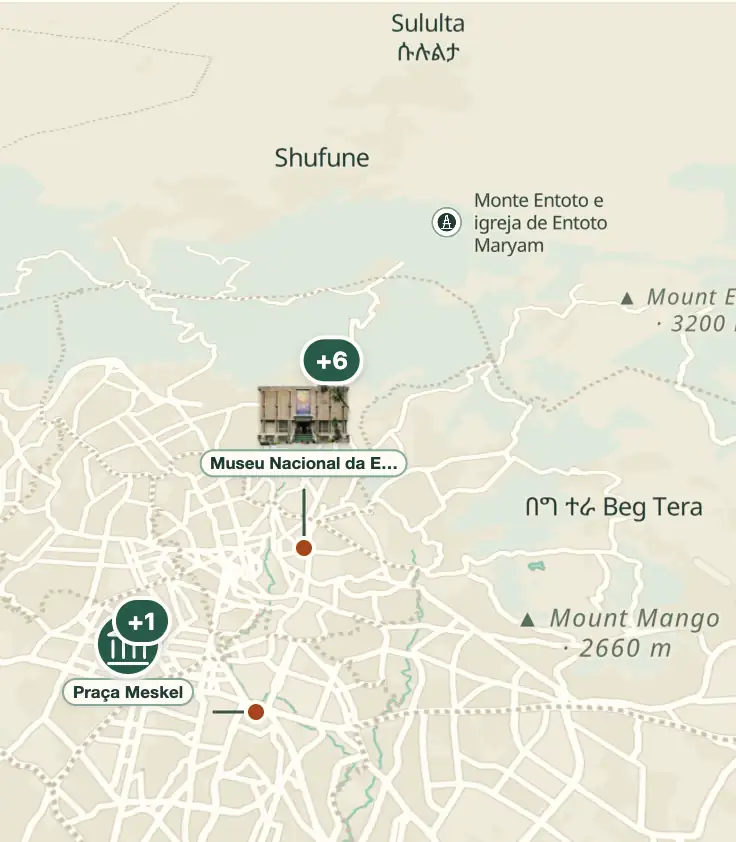
© OpenStreetMap · OpenFreeMap · © OpenMapTiles
- National Museum of Ethiopia
- Ethnographic Museum, at Addis Ababa University
- Merkato
- Holy Trinity Cathedral (Kidist Selassie)
- St. George's Cathedral and its museum
- Meskel Square and the Red Terror Martyrs Memorial Museum
- Mount Entoto and Entoto Maryam church
- Adwa Victory Memorial Museum
- Unity Park, at the Grand Palace of Menelik
Explore the map, read about the other places and plan your travel days in the app.
Open the appWhat to see
Addis Ababa: The slope and the altitude
With its center at 2,355 m, Addis Ababa is among the highest capitals in the world, below La Paz, Quito and Bogotá. West of the center lies the Merkato, the market born from the Italian occupation's segregation plan and still the country's wholesale hub.
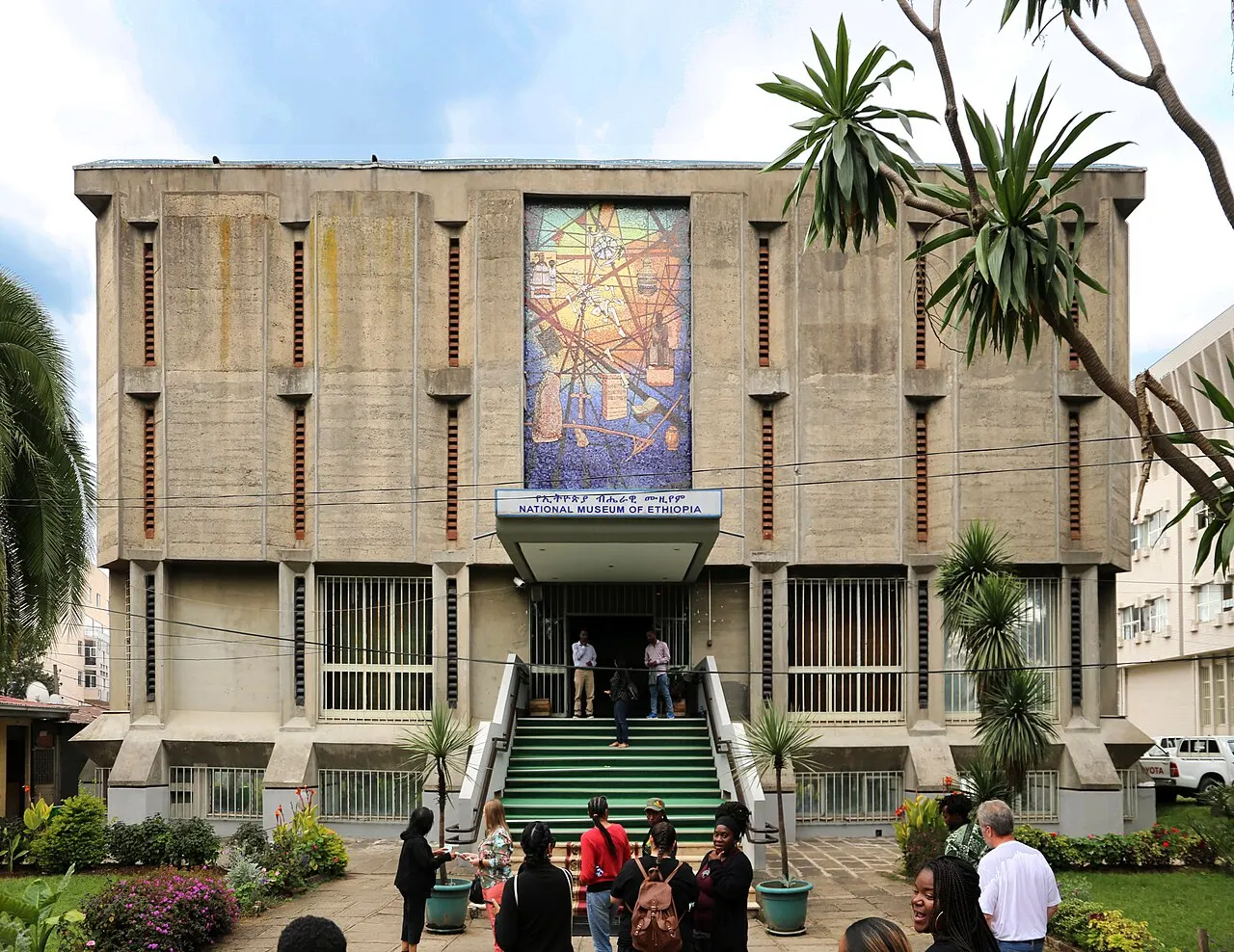
National Museum of Ethiopia
Holds “Lucy” (Dinkinesh in Amharic, “you are marvelous”), the 3.2 million-year-old Australopithecus afarensis skeleton found in Hadar, in the Afar region, in 1974. The display case shows a replica while the original stays in a vault; the upper floors cover sacred art, Haile Selassie's throne, and modern Ethiopian painting.
The display case shows a copy of the ancient skeleton while the original stays locked away, and upstairs there's sacred art and modern painting; Lucy, 3.2 million years old; Hadar, 1974.
Check access

Ethnographic Museum, at Addis Ababa University
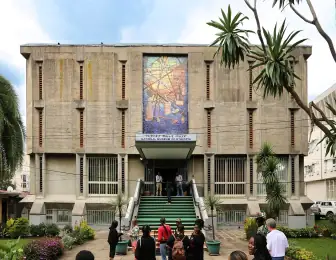
Occupies the Guenete Leul Palace, Haile Selassie's residence until 1960, on the Sidist Kilo campus. It has the country's best collection of instruments, processional crosses and icons, organized by life cycle, and keeps the emperor's bedroom and bathroom intact.
The collection follows the life cycle, and the emperor's bedroom remains set up in the palace where he lived; Guenete Leul, until 1960; Sidist Kilo.
Check access

Merkato
Go in the morning, with little in your pockets and preferably accompanied: the spice section (berbere, mitmita, cardamom) and the coffee section are the most readable for anyone not buying wholesale. At Menalesh Tera, workshops turn metal and plastic collected around the city into utensils and stoves.
The spice and coffee sections are the ones a visitor can make sense of, and workshops recycle metal and plastic into stoves; go in the morning, accompanied; Menalesh Tera.
Check access
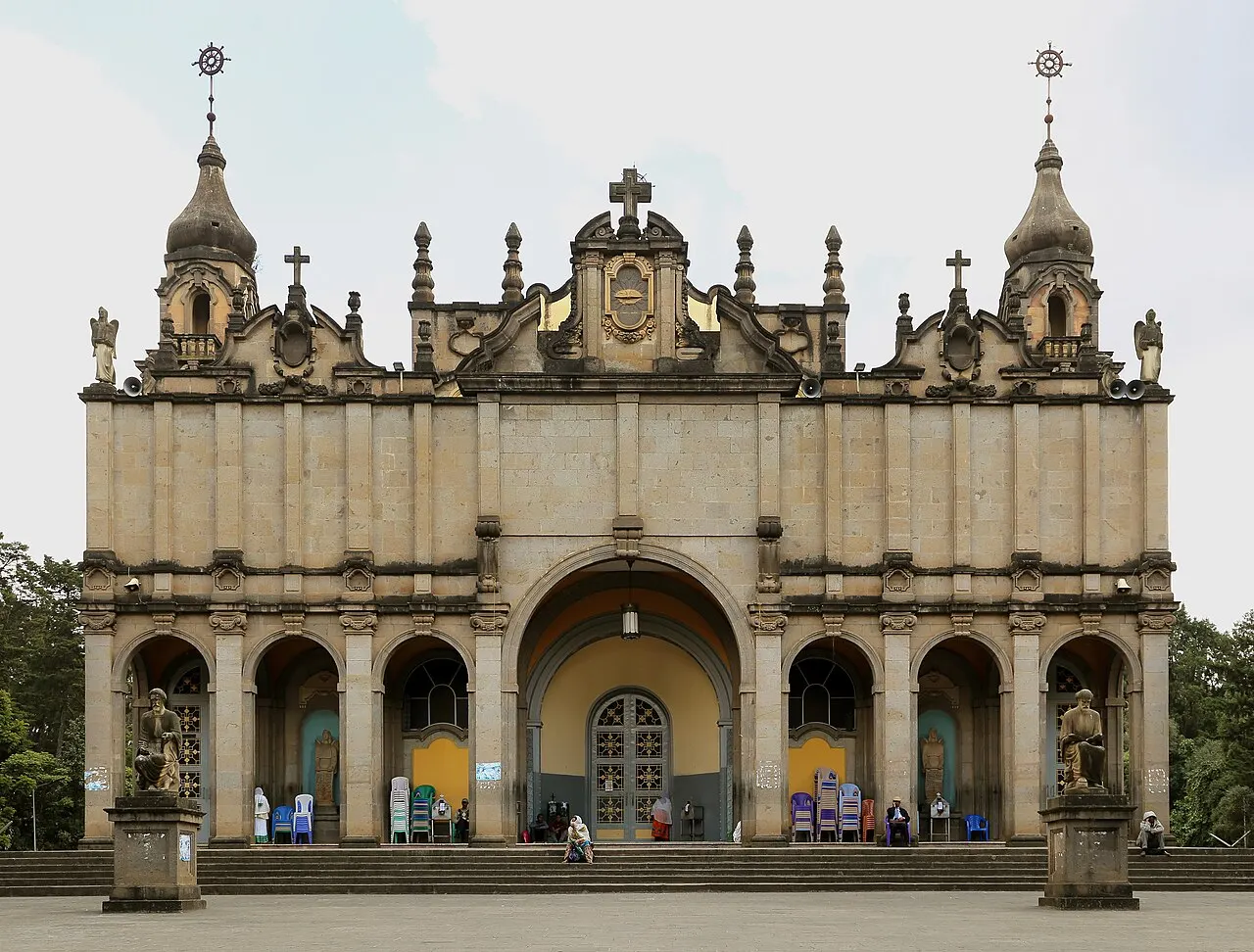
Holy Trinity Cathedral (Kidist Selassie)
Consecrated in 1942, it mixes neo-baroque arches with Ethiopian details. It holds the marble tombs of Haile Selassie and Empress Menen, the tomb of British suffragette Sylvia Pankhurst, and, in the courtyard, the grave of the ministers executed by the Derg in November 1974.
In the same grounds lie the imperial couple, a British suffragist and, in the courtyard, the grave of the ministers killed in 1974; consecrated in 1942; Sylvia Pankhurst.
Check access

St. George's Cathedral and its museum
An octagonal church from 1896, built to mark the victory at Adwa, where Empress Zauditu (1917) and Haile Selassie (1930) were crowned. The museum in the courtyard holds coronation robes, crowns, crosses, and paintings by Afewerk Tekle.
The eight-sided building was raised to mark a victory, and two sovereigns were crowned here; Adwa, 1896; Zauditu, 1917, Selassie, 1930.
Check access

Meskel Square and the Red Terror Martyrs Memorial Museum
The square is the city's civic arena: bleacher-style steps used for parades, for the Meskel bonfire, and as a training track at five in the morning. On the west side, the museum, opened in 2010, documents the Derg's executions between 1976 and 1978 with photographs, personal belongings, coffins, and remains; entry is by donation.
The square with the grandstands hosts the parades and the Meskel bonfire, and on its west side the museum opened in 2010 documents the Derg's executions between 1976 and 1978 with photographs, personal belongings and bones; admission is by donation.
Check access

Mount Entoto and Entoto Maryam church
At about 3,200 m, where Menelik held court before descending to Filwoha; the octagonal 1885 church and the museum set up in the wood-and-stone palace still stand. Entoto Park, opened in 2020, has trails and tracks, and on a clear day the view reaches the whole city.
Climbing up to the old court pays off when the day is dry and the view takes in the whole city; Menelik, about 3,200 m; church from 1885.
Check access
 AI illustration
Adwa Victory Memorial Museum
Opened in February 2024 in the Piazza, at the spot marked as the city's kilometer zero, it brings together a museum on the 1896 battle, a library, auditoriums, shops, and a pool in a largely underground complex. It's the symbol of the current construction cycle and also the target of criticism over its cost and the surrounding demolitions.
The complex, mostly underground, brings together the battle, books, an auditorium, a shop and a pool, and is at the center of the debate over cost and demolition; February 2024; the 1896 battle.
Check access

Unity Park, at the Grand Palace of Menelik
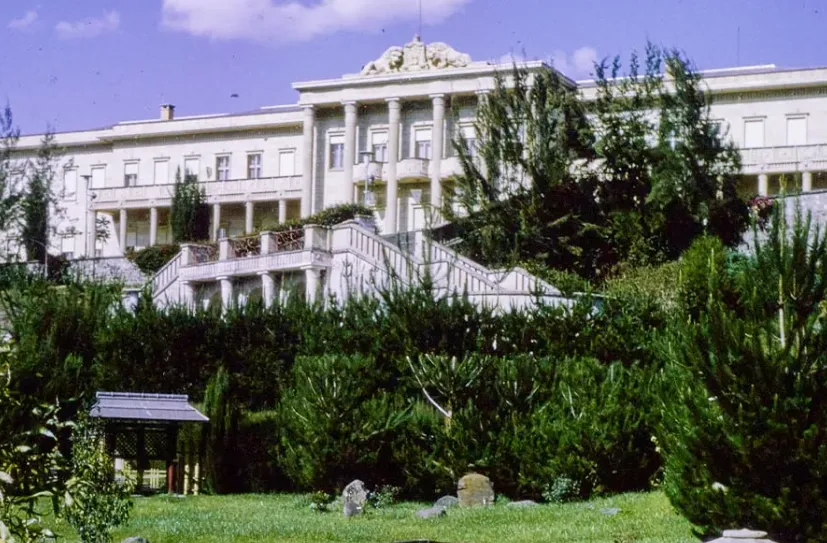
Opened in October 2019 within the grounds of Menelik's Grand Palace, in Arat Kilo, with the throne room, restored imperial houses, pavilions on the country's regions, gardens, and a zoo with dark-maned lions. Foreigner admission around US$20; closed on Mondays.
It's US$20 foreign admission at a site that closes on Mondays: the throne room and the Unity Park zoo only make the itinerary on the afternoon of the third day, after Entoto and Shiro Meda.
Check access
Nilo’s itinerary
Start with the basic programme and choose extensions for the time you have.
Plan my days in the app ↗Day 1 · The skeleton, the palace, and the first jebena
Start at the National Museum of Ethiopia, in Arat Kilo, right at opening, and head straight to the basement to see Lucy before going up to the floors of sacred art and modern painting.
Walk up to Sidist Kilo and visit the Ethnographic Museum, in Haile Selassie's former palace, inside the university campus; set aside an hour just for the crosses and instruments.
Have a beyaynetu for lunch at a neighborhood restaurant near Arat Kilo, and ask for water and salt, because the altitude dehydrates more than expected.
Head to Holy Trinity Cathedral, see the imperial tombs and the grave of the ministers executed in 1974, and talk to the caretaker about the stained-glass windows.
Finish with a full coffee ceremony at a traditional house or a historic café in the Piazza; go slow on day one and turn in early.
Day 2 · Piazza, Merkato, and a night of masinko
Go to Merkato early in the morning, with a local guide arranged through your hotel, and stick to the spice, coffee, and recyclables sections; leave your camera and a bulky wallet in your room.
Head up to the Piazza, visit St. George's Cathedral and the museum in its courtyard, and see what's left of the Italian-era buildings amid the corridor project's works.
Have kitfo for lunch at a Gurage restaurant and ask for “leb leb” if you don't want the meat fully raw; pair it with ayib and gomen.
Spend the afternoon at the Adwa Victory Memorial Museum, at kilometer zero, and then go down to Meskel Square to end the day at the memorial to the victims of the regime toppled in 1991.
In the evening, look for an azmari bet in Kazanchis to hear masinko and watch eskista; bring small notes, since you tip the singer during the show.


If you stay longer
Day 3 · Entoto, Shiro Meda and Unity Park
Head out at six in the morning to Entoto Park or the steps of Meskel Square and walk alongside the groups of runners; the air is cleaner before the traffic.
Climb up to Entoto Maryam, visit the 1885 church and the museum in Menelik's palace, and look out over the whole city from the viewpoint facing south.
Walk down to Shiro Meda, the textile market at the foot of Entoto, and buy a cotton gabi before the night cold sets in.
In the afternoon, go into Unity Park, inside the Grand Palace of Menelik, to see the throne room and the imperial houses. Check first that it's not Monday, when it's closed.
Have tibs off the brazier for dinner in Bole and close with a tej at a tej bet, served in the berele flask; order half a liter, not a full liter.
Food
 AI illustration
Injera
A sour teff pancake (teff being a tiny grain that only thrives at altitude) fermented for two to three days and baked on a clay griddle called a mitad. It serves as plate, cutlery, and food all at once: the sauces go on top and you tear off pieces from the edge with your right hand.
 AI illustration
Doro wat
Chicken stew with berbere, spiced butter niter kibbeh, and an enormous amount of onion cooked for hours into a paste, with one whole boiled egg per person. It's the feast-day, Sunday, and end-of-fast dish; served with fresh ayib cheese to cut the heat.
 AI illustration
Beyaynetu and shiro
A fasting tray with six to twelve small mounds: misir lentils, atkilt cabbage and potato, beets, gomen greens, and shiro, a chickpea or fava-bean purée with berbere. On Wednesdays and Fridays, and throughout the roughly 55 days of Orthodox Lent, almost every restaurant serves only this: vegan by definition.
 AI illustration
Kitfo
Raw beef minced very fine, seasoned with mitmita and niter kibbeh, of Gurage origin. Ask for “leb leb” (lightly warmed) or “tere” (raw), with ayib, gomen and, in Gurage houses, the dense kocho bread, made from the enset false banana.
 AI illustration
Tibs
Cubes of meat sautéed fresh with onion, garlic, rosemary, and green chili, served sizzling on a clay brazier. It's the late-afternoon dish, the easiest to order for anyone unsure how much berbere they can handle, and the standard at bars that close late.
 AI illustration
Buna: the coffee ceremony
Arabica coffee originated in Ethiopia, and here the buna ceremony lasts an hour, from the green bean to the clay jebena.
 AI illustration
Tej and tella
Tej is a honey wine fermented with gesho leaves, served in a berele, the thin-necked glass flask, at houses called tej bet. Tella is homemade barley beer with a sour-bread taste; both are cheap and hit fast at 2,355 m of altitude.
 AI illustration
Breakfast: firfir, chechebsa, and macchiato
Firfir is torn injera sautéed in the previous day's sauce; chechebsa is sliced dough with butter and berbere; ful is the fava-bean purée that came by way of the Red Sea. Alongside always comes a small macchiato in a glass cup, a legacy of the five Italian years and today the city's most visible urban habit.
Day trips
Bishoftu (Debre Zeit)
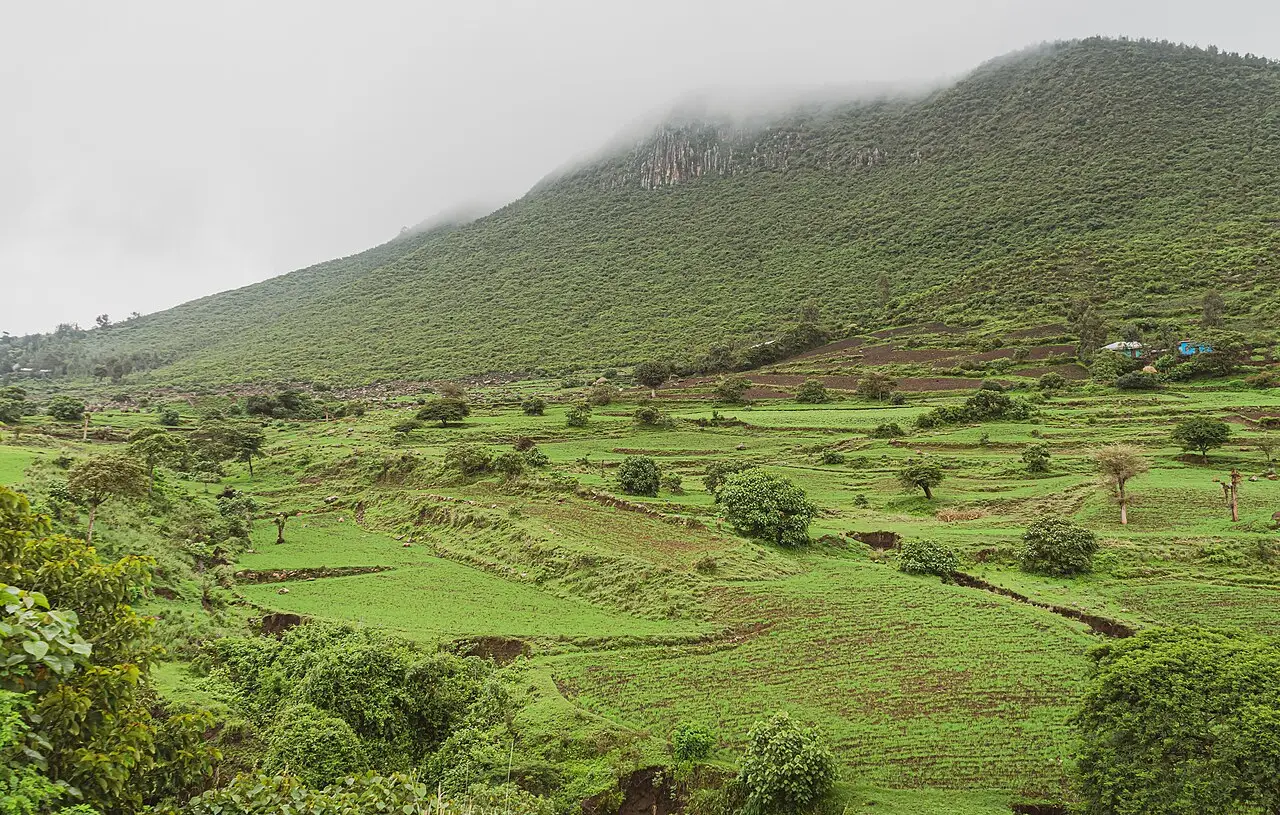
45 km southeast along the Adama highway, about 1 hour by car or by train: five crater lakes (Bishoftu, Hora, Babogaya, and Kuriftu among them) with lakeside hotels, boats, and bird-watching. It's the city's weekend getaway and hosts the Oromo Irreecha ceremony in October.

Debre Libanos and the Jemma gorge
110 km north, 2 hours to 2 hours 30 minutes by car: a monastery founded in the 13th century by Tekle Haymanot, the so-called “Portuguese bridge” from the 17th century, and a viewpoint over the thousand-meter gorge, with gelada baboons and vultures. In 1937 Italian troops executed hundreds of monks and deacons there.

Tiya, Adadi Maryam, and Melka Kunture
85 to 90 km south, 2 hours to 2 hours 30 minutes, in a single day loop: the 36 carved stelae of Tiya, a UNESCO World Heritage Site since 1980; the rock-hewn church of Adadi Maryam, attributed to the 12th–13th centuries; and the prehistoric site of Melka Kunture, on the banks of the Awash River, with tools more than a million years old.
Where to begin
The skeleton, the palace, and the first jebena
Start at the National Museum of Ethiopia, in Arat Kilo, right at opening, and head straight to the basement to see Lucy before going up to the floors of sacred art and modern painting.
Piazza, Merkato, and a night of masinko
Go to Merkato early in the morning, with a local guide arranged through your hotel, and stick to the spice, coffee, and recyclables sections; leave your camera and a bulky wallet in your room.
Entoto, Shiro Meda and Unity Park
Head out at six in the morning to Entoto Park or the steps of Meskel Square and walk alongside the groups of runners; the air is cleaner before the traffic.
Money
The currency is the Ethiopian birr (ETB), which has floated since July 2024 and was worth about 160–170 to the dollar and about 185–195 to the euro in 2026, after losing about two-thirds of its value over the period. Price ranges in 2026: macchiato 30–70 birr, a St. George or Habesha beer at a bar 80–150 birr, beyaynetu or shiro at a neighborhood restaurant 150–350 birr, tibs or kitfo at a good place 400–900 birr and a full dinner at a Bole restaurant 1,000–2,500 birr per person. The minibus costs 10–30 birr, an app ride 200–500 birr, a night at a midrange hotel 3,000–9,000 birr (US$20–55) and at an international hotel from US$100. Museum tickets for foreigners run from about 200 birr at the National Museum to about US$20 at Unity Park. Cash rules here: cards have very limited use, even in Bole. The ATMs of CBE, Dashen and Awash accept Visa, cap each withdrawal and run out of notes on long weekends. Bring dollars in new bills to exchange at a bank (the parallel market is illegal and its advantage shrank after the float) and install Telebirr if you're staying for weeks, because that's how the city pays. Tipping: 10% at restaurants with table service, rounding up in taxis and a small note for the guard who watched your car.
Getting there and around
Bole, Africa's biggest hub
Bole International Airport (ADD) is about 6 km southeast of the center and is Africa's largest connecting hub, base of Ethiopian Airlines, which flies to more than 130 destinations. The terminal expanded in 2019 has capacity for about 22 million passengers a year. Entry requires a passport valid for six months and a visa: almost all nationalities use the e-visa, requested on the official portal three to seven days in advance, valid only for entry through Bole and priced at US$62 for 30 days and US$152 for 90 days (official portal rates, 2026). Travelers from Brazil also need the international yellow fever vaccination certificate. From the airport to the center takes 15 to 40 minutes by car, at about 400–900 birr by app.
Sub-Saharan Africa's first tram
Within the city, the 2015 light rail was the first in sub-Saharan Africa: two lines, about 34 km and 39 stations, crossing at Meskel and linking Menelik II to Kality (north–south) and Ayat to Torhailoch (east–west). The fare is subsidized and runs 2 to 6 birr per ride depending on distance, but much of the fleet is out of service and the trains come packed. Most residents get around by minibus, at 10–30 birr per leg. There are also the Sheger and Anbessa buses, cheaper and slower. Ride-hailing apps handle any trip for 200–500 birr on a short ride (Uber doesn't operate here) and are the right choice after dark. Walking has improved with the wide sidewalks of the corridor project in Bole, Kazanchis and Piazza, but the altitude, the traffic and the July rain tire you quickly and shorten the distance you can manage on foot. New bike lanes exist and almost nobody uses them, except on car-free days (Menged Le Sew), on selected Sundays of the month.
Safety
Violent crime against foreigners is low here and opportunistic theft is high. The classic spots are the Merkato, the Piazza, packed minibuses and the crowds leaving events at Meskel Square: carry the minimum, keep your phone put away and split your cash between two pockets. At night the biggest risk is the lack of lighting, with open manholes and stray dogs on the street, so after 8pm use a ride-hailing app even for two blocks. Be wary of anyone who strikes up a conversation on the street and quickly suggests taking you to a nearby café or bar: the bill for that invitation arrives multiplied. Fake guides in front of museums and note-switching during exchange are variations of the same scam. Outside the capital things are different: conflicts in the Amhara and Oromia regions close roads and cause holdups, so make long journeys by plane and check consular advisories before setting out. Demonstrations are rare in the center, but avoid political gatherings, and expect occasional mobile internet outages. Drink bottled water, carry a copy of your passport and leave the original at the hotel.
Etiquette tips
Eat only with your right hand
Use your left hand only for personal hygiene. Wash your hands before and after the meal: in many restaurants someone brings a jug and basin to the table for this. When eating, tear the injera from the edge nearest you with three fingers, without reaching into the side of the tray that belongs to someone else.
Accept the gursha
Someone may roll up a mouthful and place it straight into your mouth: it's a gesture of affection between close people and of welcome to a guest, and it usually comes in an odd number. Refusing is rude; returning the gesture to whoever served you is the right response.
Greet with both hands and the shoulder
Between men who know each other, the handshake comes with a right-shoulder-to-right-shoulder touch. To show respect to someone older, rest your left hand on your own right elbow while extending your hand; between close friends, it's three alternating cheek kisses.
Confirm the time on both clocks
In Ethiopia, the hour count restarts at sunrise, 6am: that's why “three o'clock” is 9am and “six o'clock” is noon. When setting any meeting, including with drivers and guides, ask whether the time is “be habesha seat” (Ethiopian time) or “be ferenj seat” (foreign time).
In churches, take off your shoes and respect the split space
Take off your shoes to enter Orthodox churches, where men and women stand on opposite sides and most cover their heads with a white netela. The central sanctuary, where the tabot is kept, is reserved for the clergy, and on feast days ordinary worshippers pray outside, leaning against the outer wall.
Ask before photographing, and avoid official buildings
Photographing people without asking is frowned upon and often draws a request for money; in Merkato, pointing a camera at a stall can turn into a real argument. Photographing military installations, the palace, the airport, bridges, and checkpoints is forbidden, and the rule is enforced seriously.
Mistakes to avoid
Domestic flight bought separately
Buying the domestic flight separately from the international one, the most expensive mistake of the trip. Anyone who books Lalibela or Gondar before having an inbound flight on Ethiopian loses the reduced domestic fare and pays full price.
Outside Bole, it's all cash
Counting on your card outside Bole. In the rest of the city, from the minibus to the neighborhood restaurant, everything is paid in cash birr, and the ATM may be empty right on a long holiday weekend, so arrive with dollars in recent bills to exchange at a bank.
From 2,355 m to 3,200 m in 48 hours
Climbing Entoto on day one. The city already sits at 2,355 m and the ridge tops 3,200 m: headache, insomnia, and shortness of breath in the first 48 hours are common. Drink water, eat early, and leave a long walk or run for the third day.
No e-visa, no yellow fever certificate
Arriving without the e-visa or the yellow fever certificate, the mistake that stops people at check-in. The US$62 electronic visa isn't issued on the spot, so apply as soon as you buy your ticket, and carry the yellow card with your passport.
Ordering meat on a Wednesday or Friday
Ordering meat on a Wednesday or Friday and being puzzled by the menu. On those days, and throughout Orthodox Lent, most kitchens serve only fasting dishes, with no meat, egg, or milk, and it's exactly when the city's best beyaynetu gets made.
Useful phrases
ሰላም (selam)
Hello, and also “peace”. The greeting that works all day (“se-lám”)
እንደምን አደሩ? (endemin aderu?)
Good morning, in the respectful plural form; in the afternoon, “endemin walu?” (“en-de-mín a-de-rú”)
አመሰግናለሁ (ameseginalehu)
Thank you (“a-me-se-gui-ná-le-hu”); “ishi” (እሺ) is the “okay” heard in every other sentence
ስንት ነው? (sint new?)
How much is it? (“sint nêu”); “wud new” means “that's expensive”
አንድ ቡና እባክህ (and buna ebakih)
One coffee, please (“and bu-ná e-bák-h”): say “ebakish” if you're speaking to a woman
ደህና ሁን (dehna hun)
Take care, the common goodbye (“dê-na hun”); to a woman, “dehna hunyi”
Districts
Piazza (Arada)
The oldest core, up in the northwest, with St. George's Cathedral (1896), the Taitu Hotel (1898, the country's first) and the gold and silver jewelers. It was the Italian quarter of the 1930s and lost much of its historic buildings to the corridor project's demolitions from 2024 onward.
Merkato
In the Addis Ketema district, it's East Africa's largest open-air market, with tens of thousands of traders divided into sections: spices, coffee, grains, secondhand clothing, tools, and recyclables. It was born from the Italian segregation plan and remains the country's wholesale center.
Bole
The airport axis: hotels, malls, office towers, restaurants, and most of the short-term rental apartments. It's the priciest area and the easiest for new arrivals, and where the city most resembles any capital under fast-track construction.
Kazanchis
The neighborhood of international organizations, between the Economic Commission for Africa and the African Union headquarters, with conference hotels and live-music houses (azmari bet). Much of the old fabric was expropriated and demolished from 2024 onward to make way for towers and a park.
Arat Kilo and Sidist Kilo
The city's two administrative and university crossroads, with ministries, the Grand Palace of Menelik and Unity Park, the National Museum, Addis Ababa University and the Ethnographic Museum. The names mean “four kilometers” and “six kilometers,” counted from the kilometer zero, at the Piazza.
Entoto and Shiro Meda
At the foot of Entoto sits the market neighborhood for traditional embroidered fabrics, such as the habesha kemis.
Sarbet and Old Airport
A low-rise residential zone to the southwest, around the old Lideta airfield, with embassies, international schools, and tree-lined streets. It's the quietest area for a stay of more than a week, and where many foreign restaurants are.
Megenagna and CMC
The expanding east, a convergence point for minibus lines and the tram, with condominium blocks built from 2005 onward and neighborhood commerce. Useful for understanding how most of the city actually lives and gets around.
History
15th–16th c. · Before the city
Church ruins and walls atop Mount Entoto point to occupation long before the founding. The Shewa plateau was a friction zone between the Christian kingdoms of the north and the Oromo expansion from the south.
1881–1885 · Menelik camps at Entoto
Menelik, then king of Shewa, sets up court at 3,200 m and consecrates the Entoto Maryam church in 1885. The summit was defensible, but cold, short on firewood, and without hot water.
1886 · Taytu chooses Filwoha
Empress Taytu Betul descends to the Filwoha hot springs, sets up camp, and names the place Addis Ababa, “new flower.” The court and army follow, and each military chief raises his own sefer, the neighborhood-camp that still defines the urban grid.
1889 · Capital of the empire
Menelik II is crowned emperor and moves the capital to Addis Ababa. The city is nearly abandoned for lack of firewood until Australian eucalyptus, imported around 1895, solves the fuel problem.
1896 · Adwa and St. George's Cathedral
On March 1st the Ethiopian army defeats Italy at Adwa and secures the country's independence. The octagonal St. George's Cathedral, in the Piazza, is built to mark the victory and becomes the site of coronations.
1917 · The train arrives from Djibouti
The Franco-Ethiopian railway, begun in 1894, reaches Addis Ababa and links the plateau to the Red Sea. La Gare station, from 1929, and Churchill Avenue organize the city's southern axis and bring the first banks, hotels, and foreign legations.
1930 · Coronation of Haile Selassie
Ras Tafari Makonnen is crowned emperor at St. George's before delegations from around the world. The event projects the city abroad and gives rise to the Rastafari movement in Jamaica.

1936–1941 · Italian occupation
Italy takes the city in May 1936 and turns it into the capital of Italian East Africa, with a segregated urban plan that pushes African commerce into what is now Merkato. On February 19, 1937, the Yekatit 12, the crackdown following an assassination attempt on Viceroy Graziani kills thousands of residents in three days.
1958–1963 · Diplomatic capital of Africa
The UN Economic Commission for Africa moves in in 1958 and Africa Hall opens in 1961, with Afewerk Tekle's stained-glass window on the continent's liberation. On May 25, 1963, 32 countries found the Organisation of African Unity there, today the African Union.
1974–1991 · The Derg and the Red Terror
Haile Selassie is deposed in September 1974 by Mengistu Haile Mariam's Derg and dies the following year. Between 1976 and 1978 the Red Terror kills tens of thousands of people in the cities; the regime falls in May 1991.
2012–2026 · Tower, tram, and corridors
The African Union headquarters, 99.9 m tall and financed by China, opens in 2012; the urban tram, the first in sub-Saharan Africa, in September 2015; the electric railway to Djibouti, in 2018. Since 2024 the Corridor Development Project has redone entire avenues, built wide sidewalks and bike lanes, and demolished much of the historic Piazza, with tens of thousands displaced.

Complete history
The city exists because of hot water
Addis Ababa was born near the hot springs of Filwoha. Menelik, king of Shewa, had held court atop Mount Entoto since 1881, a defensible spot, but at 3,200 m it was cold and short on firewood and water. In 1886 Empress Taytu Betul came down to the Filwoha basin, where the hot springs bubble up, had a house built near them and called the place Addis Ababa. There was no layout, no plan: each major military chief set up his own camp, the sefer, around the palace, with his soldiers, craftsmen and his own church. That's why the city has no compact historic center or regular blocks. Some neighborhoods are still named by distance, counted from the city's kilometer zero, at the Piazza: Arat Kilo means four kilometers, and Sidist Kilo, six.
It nearly moved for lack of firewood
In its first years the settlement burned through all the surrounding forest and was nearly moved to Addis Alem, 50 km to the west. What saved it was Australian eucalyptus, imported around 1895, which grows fast and resprouts after cutting; the Entoto hillsides are still covered in it today. The victory over Italy at Adwa, on March 1, 1896, gave Ethiopia a rare recognition on the continent and brought foreign legations to the capital. Then came the first bank (1905), the first public school (1908), the telephone, the hospital, and, in 1917, the Djibouti train, which linked the plateau to the sea. In 1930 Haile Selassie was crowned at St. George's Cathedral before international delegations, and the following year he granted the country's first constitution.
Physical marks of the Italian occupation, 1936–1941
The Italian occupation from 1936 to 1941 lasted five years and left physical marks nobody can ignore. The fascist plan segregated the city by race and moved African commerce to a new market in the west, the Mercato, which today, as the Merkato, is the largest open-air market in East Africa. After an assassination attempt on Viceroy Graziani on February 19, 1937, Italian troops and civilians spent three days burning houses and executing residents: Yekatit 12, remembered by an obelisk in Sidist Kilo. The city was retaken in May 1941 and the empire restored. After the war, Haile Selassie used Ethiopia's independence as political capital: in 1958 he brought the UN Economic Commission for Africa here, in 1961 he opened Africa Hall and on May 25, 1963 he hosted the founding of the Organization of African Unity, the reason more than a hundred countries keep embassies in Addis Ababa.
The fall of the monarchy, in 1974
The monarchy fell in 1974, brought down by a military committee, the Derg, in a year of famine in the north and inflation in the cities. Haile Selassie was imprisoned in the palace and died in 1975; sixty ministers and generals were shot in November 1974 and are buried in the courtyard of Holy Trinity Cathedral. Between 1976 and 1978, Mengistu Haile Mariam's Red Terror killed tens of thousands of students and activists, almost all of them urban; the names and coffins are kept at the Meskel Square memorial. The regime nationalized land and property, which froze private construction for nearly two decades, and it fell in May 1991, when the Tigrayan-led coalition entered the city. Only from the 2000s onward did Addis Ababa start growing vertically again, with public housing blocks, the ring road financed by China, and a boom of construction sites.
The 21st century: African Union HQ, tram, and railway
The string of projects began in 2012 with the African Union headquarters, a 99.9 m tower donated by China, continued with the light rail in 2015, the first in sub-Saharan Africa, and the electric railway to Djibouti in 2018, and reached the new terminal at Bole airport in 2019. Abiy Ahmed became prime minister in April 2018 and received the Nobel Peace Prize in 2019, but in November 2020 the country entered the Tigray war, which lasted until the Pretoria agreement in November 2022, and conflicts in Amhara and Oromia continue to restrict overland travel outside the capital. Inside it, the Corridor Development Project, launched in 2024, opened avenues, wide sidewalks, bike lanes and lighting, and tore down entire neighborhoods, including most of the Italian buildings of the Piazza and old Kazanchis, with mass evictions and fierce controversy. As a result, in 2026 visitors find construction sites and demolished blocks next to the new avenues, in a capital that still hosts the meetings of African politics.
The name Addis Ababa means 'new flower' in Amharic.
The Australian eucalyptus that covers the slopes of Entoto arrived around 1895 and saved the city, which nearly moved elsewhere for lack of firewood.
Geography and shape of the city
The slope and the altitude
The city occupies the southern edge of the Ethiopian plateau, where the slopes of Mount Entoto descend toward the Awash River valley. Altitude ranges from about 2,326 m in Bole, in the southeast, to about 3,000 m in the high northern neighborhoods, and reaches 3,200 m on the Entoto ridge. With its center at 2,355 m, Addis Ababa is among the highest capitals in the world, below La Paz, Quito and Bogotá.
Neighborhoods laid out by the terrain, with no grid plan
The terrain explains almost everything: the wealthy neighborhoods and international organizations settled halfway up the slope, the airport and new expansion took the flat southeast, and the small rivers running down from the mountain (Kebena, Bantyketu, Akaki) cut the fabric into ravines that long served as informal borders between neighborhoods. There's no urban grid: the city grew from military camps arranged around Menelik's palace, and the streets followed trails, ridgelines, and watercourses, with many unnamed roads and addressing done by reference (“behind such-and-such hotel”). The ring road, built between 1998 and 2003 with Chinese financing, was the first attempt to bring order to traffic; the 2024 corridor project is the second, with 40-meter-wide avenues, continuous sidewalks, and tree planting.
Climate of two seasons, with no summer or winter
The climate is subtropical highland (Köppen Cwb): annual average around 16 °C, with no thermal summer or winter, only a dry season and a rainy season, and a eucalyptus cover planted since 1895 that still supplies firewood to much of the periphery.
Culture
Ethio-jazz, recorded by Amha Records since 1969
The city produced a musical genre of its own. Between 1969 and 1975, the Amha Records label recorded hundreds of tracks in which the Ethiopian pentatonic scale met big band horns, organ and electric bass: this is Ethio-jazz, whose central figure is Mulatu Astatke, trained in London and Boston and still active in Addis Ababa. The Derg shut down the nightclubs after 1975, and the repertoire only circulated again with the Éthiopiques record series, launched in France in 1997, and with the use of the recordings in film soundtracks. Alongside it, the tradition of the azmari lives on: the minstrel who improvises verses about the audience to the sound of the masinko, a one-string fiddle, in houses in Kazanchis and Yohannes; the dance that goes with it, eskista, is done almost entirely with the shoulders and collarbones. Names like Tilahun Gessesse, Mahmoud Ahmed, Aster Aweke and Teddy Afro fill stadiums or dominated the radio for decades.
Orthodox church, fasting, the Ethiopian calendar and the arts
Religious life organizes the calendar and the soundscape. Most of the population is Orthodox Tewahedo Christian, with Muslim and Protestant minorities living on the same block; before five in the morning the loudspeakers of churches and mosques overlap. The most observant fast between 180 and 250 days a year (no meat, eggs or dairy), which explains why vegan cooking is everywhere. The country uses the Ethiopian calendar, with twelve 30-day months plus a short month of five or six days, running seven to eight years behind the Gregorian, and counts the hours from sunrise. In words and images, Addis Ababa is the center of Amharic literature, from Haddis Alemayehu to Sebhat Gebre-Egziabher, and trained painters at the Alle School of Fine Arts, founded in 1958, from Afewerk Tekle and Gebre Kristos Desta to Julie Mehretu, born here in 1970; the diaspora produced novelists writing in English such as Maaza Mengiste and Dinaw Mengestu. Ethiopian cinema reached the international circuit with “Difret” (2014), “Lamb” (2015), the country's first film in the official selection at Cannes, and the documentary “Faya Dayi” (2021).
Running: from Abebe Bikila to Tirunesh Dibaba
In Ethiopia, running is a topic of public conversation, and Addis Ababa has the heroes to match. Abebe Bikila won the Rome marathon barefoot in 1960 and the Tokyo one in 1964; after him came Derartu Tulu, Haile Gebrselassie, now a businessman in the city, Kenenisa Bekele and Tirunesh Dibaba. The altitude turned the slopes of Entoto and Sululta into permanent training grounds, and at five in the morning there are groups running on the steps of Meskel Square. In November, the Great Ethiopian Run brings about 45,000 people to cover 10 km through the center. Meskel Square also sits next to the national stadium, home of the city's soccer, where Saint George, founded in 1935, is the oldest club in the country.
At an azmari house, the improvised verse may be about you.
By five in the morning there are already people running in the street. Ethiopia is the country of Abebe Bikila and Haile Gebrselassie.
Festivals and events

Timkat: January 19 (20 in leap years)
Orthodox Epiphany is the biggest festival on the calendar: the tabot, replicas of the Ark of the Covenant, leave the churches in procession under embroidered cloths to the Jan Meda field, spend the night in a tent and, the next morning, holy water is sprinkled over the crowd. Since 2019 the festival has been on UNESCO's intangible heritage list.

Meskel: September 27 (28 in leap years)
Celebrates the finding of the True Cross by Saint Helena. On the eve, the square named for the feast hosts the Demera, a cone-shaped pyre of branches and yellow flowers lit by the patriarch at dusk; the direction it falls is read as an omen for the year. Also UNESCO intangible heritage, since 2013.
 AI illustration
Enkutatash: September 11 (12 in leap years)
The Ethiopian New Year marks the end of the rains, when the plateau is green and the yellow adey abeba flower blooms. Girls sing from door to door and receive coins or bread; on September 11, 2026 the Ethiopian year 2019 began.

Irreecha: early October
Oromo thanksgiving festival for the passing of the rainy season, with fresh grass and flowers carried to the water. The urban celebration, Irreecha Finfinne, draws hundreds of thousands of people to Addis Ababa on a Saturday, the eve of the larger ceremony at Lake Hora Arsedi, in Bishoftu, on Sunday.

Great Ethiopian Run: November
A 10 km road race created in 2001 by Haile Gebrselassie, with about 45,000 runners in matching t-shirts and the center closed on a Sunday morning. Registration opens months ahead and usually sells out; there's a separate women's race on another date.
Books and films
“Cutting for Stone,” Abraham Verghese (2009)
A novel set in an Addis Ababa mission hospital between the 1950s and the 1974 revolution, written by a doctor born in the city. It explains the imperial capital, the medicine, the coup, and the departure of the Ethiopian diaspora to the United States.
“The Emperor,” Ryszard Kapuściński (1978)
Reportage built from the testimonies of Haile Selassie's courtiers about the palace's final years and the 1974 fall. It's disputed by Ethiopian historians on points of accuracy, but remains the best account of how that court worked.
“Éthiopiques,” record series (since 1997)
The French collection that reissued the recordings made in Addis Ababa between 1969 and 1975, before the Derg shut down the nightclubs. Start with volume 4, devoted to Mulatu Astatke's ethio-jazz, and volume 21, with Emahoy Tsegué-Maryam Guèbrou on piano.
Frequently asked questions
Addis Ababa: Why book the domestic flight only after the international one?
Anyone who books Lalibela or Gondar before having an inbound flight on Ethiopian loses the reduced domestic fare and pays full price.
Addis Ababa: How do you get a visa for Ethiopia?
The terminal expanded in 2019 has capacity for about 22 million passengers a year. Entry requires a passport valid for six months and a visa: almost all nationalities use the e-visa, requested on the official portal three to seven days in advance, valid only for entry through Bole and priced at US$62 for 30 days and US$152 for 90 days (official portal rates, 2026).
Addis Ababa: What's in Bishoftu, and how do you get there?
Bishoftu is 45 km southeast along the Adama highway, about 1 hour by car or by train, and has five crater lakes with lakeside hotels, boats and bird-watching. It's the city's weekend getaway.
Addis Ababa: What's the currency, and what's the birr worth?
The currency is the Ethiopian birr (ETB), which has floated since July 2024 and was worth about 160 to 170 to the dollar and about 185 to 195 to the euro in 2026, after losing about two-thirds of its value over the period.
Addis Ababa: What's the climate like throughout the year?
Addis Ababa has two seasons, not four, and that changes the whole plan: the average temperature stays around 16 °C year-round, with highs of 20 to 25 °C and lows of 6 to 11 °C, and what changes is the rain.