Egypt
Luxor
Karnak, the Valley of the Kings and both banks of the Nile
Days Start with the basic programme and choose extensions for the time you have.
How the guide reaches this number
A third, if you have one, goes to Deir el-Medina, the workers' village, and to the Tombs of the Nobles, the smallest and best painted. Organize each day around the heat: get up at five, stay in the shade between 1pm and 4pm and head back out afterward. Luxor doesn't suit anyone looking for beaches, nightlife or a stroll without being approached. On the Corniche the vendors' offers are constant, and it's enough to say “la, shukran” once, without stopping. With just one day, cross on the first ferry and do the Valley of the Kings and Deir el-Bahari in the morning. Come back for lunch and end at Karnak late in the afternoon. The Valley of the Kings disappoints those expecting treasure: the ticket covers three tombs, and Tutankhamun's gold has been at Giza since November 2025. Medinet Habu, visited at four in the afternoon, is worth more than its reputation.
2–3
When October to March; December and January bring peak season and the highest prices
How the guide reaches this number
Luxor is hot desert, with almost no rain, about 1 mm a year, and sun guaranteed nearly every day. From June to August, highs sit between 40 and 43 °C and top 45 °C in heat waves. During that period, the west bank only works early: cross before 6am and come back at noon, because the tombs have no ventilation and are hotter inside than the street. December to February is high season, with highs of 22 to 25 °C, lows of 5 to 9 °C, full hotels, and peak prices. Bring a real jacket for the nights and for the dawn balloon flight, because in the desert the temperature plunges before sunrise. October, November, and March give the best balance, with 28 to 35 °C and lower rates. In March and April the khamsin can blow, a sand-laden wind that cuts visibility and cancels balloons, which is why April falls outside the best window. August is the month to avoid: maximum heat, some restaurants closed, and no discount that makes up for it.
Per person/day US$25–40 backpacking, US$70–120 for mid-range comfort, not counting site tickets
How the guide reaches this number
Per person per day: accommodation, meals, urban transport, visits and a small allowance for extras. Flights excluded; larger purchases vary. Editorial estimate, not a quote.
 What Nilo thinks
Stay two days, one for each bank: first the east, with temples, museum and market, then the west, with the Valley of the Kings and the mortuary temples. A third, if you have one, goes to Deir el-Medina, the workers' village, and to the Tombs of the Nobles, the smallest and best painted. Organize each day around the heat: get up at five, stay in the shade between 1pm and 4pm and head back out afterward. Luxor doesn't suit anyone looking for beaches, nightlife or a stroll without being approached. On the Corniche the vendors' offers are constant, and it's enough to say “la, shukran” once, without stopping. With just one day, cross on the first ferry and do the Valley of the Kings and Deir el-Bahari in the morning. Come back for lunch and end at Karnak late in the afternoon. The Valley of the Kings disappoints those expecting treasure: the ticket covers three tombs, and Tutankhamun's gold has been at Giza since November 2025. Medinet Habu, visited at four in the afternoon, is worth more than its reputation.In Luxor, the temples of ancient Thebes stand inside the modern city: Luxor Temple and, 2.7 km farther along the Avenue of Sphinxes, Karnak, with the 134 columns of the hypostyle hall. The Egyptians placed the temples on the east bank, where the sun rises, and the tombs on the west, where it sets, and across the Nile, a public-ferry crossing away, are the Valley of the Kings and Hatshepsut's temple, terraced into the cliff face. Plan your days around the heat: visit early, rest in the shade in the early afternoon, and head back out when the sun drops. Order ful and fava-bean falafel for breakfast, stuffed pigeon for lunch, and cane juice pressed on the spot. On the Corniche, vendors approach constantly, and a simple “la, shukran” without breaking stride is enough. Come between October and March and allow two days, one for each bank.
Quick facts
- Population
- about 285,000 in the city (2023); about 1.4 million in Luxor Governorate
- Founded
- Waset documented since about 2100 BC; capital of Egypt during the Middle Kingdom and the New Kingdom
- Country and region
- Egypt, Upper Egypt; Luxor Governorate, created in December 2009
- Language
- Egyptian Arabic in the Saidi variant; English common in the tourism sector
- Currency
- Egyptian pound (EGP); about 45–50 per dollar as of September 2026
- Time zone
- UTC+2 in winter and UTC+3 from late April to late October (daylight saving resumed in 2023)
- Best time to visit
- October to March; December and January bring peak season and the highest prices
- Average daily cost
- US$25–40 backpacking, US$70–120 for mid-range comfort, not counting site tickets
When to go
October to March; December and January bring peak season and the highest prices
April
18° to 35°C
0 mm of rain
May
22° to 39°C
1 mm of rain
June
25° to 41°C
0 mm of rain
July
26° to 41°C
0 mm of rain
August
26° to 41°C
0 mm of rain
September
23° to 39°C
1 mm of rain
How the year changes
Luxor is hot desert, with almost no rain, about 1 mm a year, and sun guaranteed nearly every day. From June to August, highs sit between 40 and 43 °C and top 45 °C in heat waves. During that period, the west bank only works early: cross before 6am and come back at noon, because the tombs have no ventilation and are hotter inside than the street. December to February is high season, with highs of 22 to 25 °C, lows of 5 to 9 °C, full hotels, and peak prices. Bring a real jacket for the nights and for the dawn balloon flight, because in the desert the temperature plunges before sunrise. October, November, and March give the best balance, with 28 to 35 °C and lower rates. In March and April the khamsin can blow, a sand-laden wind that cuts visibility and cancels balloons, which is why April falls outside the best window. August is the month to avoid: maximum heat, some restaurants closed, and no discount that makes up for it.
The same numbers as a table
| Month | Temperature °C | Rain mm |
|---|---|---|
| January · | 7 to 23 | 3 |
| February · | 9 to 25 | 0 |
| March · | 13 to 30 | 2 |
| April | 18 to 35 | 0 |
| May | 22 to 39 | 1 |
| June | 25 to 41 | 0 |
| July | 26 to 41 | 0 |
| August | 26 to 41 | 0 |
| September | 23 to 39 | 1 |
| October · | 20 to 36 | 1 |
| November · | 13 to 29 | 1 |
| December · | 9 to 24 | 0 |
Nilo's tips
Cross the Nile on the public ferry, for 10 to 20 EGP
The ferry charges foreigners 10 to 20 EGP, with no negotiation, and the private motorboats at the landing charge 50 to 100 EGP for the same trip. The crossing takes about five minutes and runs almost all day, so the motorboat is only worth it outside ferry hours. The first useful crossing leaves around 5:30am, and it's the one that decides whether your west bank day fits in before the heat.
Buy the ticket before the tomb door
At the Valley of the Kings, going straight up to the tomb door without a ticket means walking back to the visitor center, along a trail exposed to the sun. The ticket office is there, before the entrance, and it's where you find out which three tombs in the rotation are open, because the list changes daily. The standard ticket costs 750 EGP, and the special tombs charge separately: Tutankhamun (KV62) 700 EGP, Seti I (KV17) 2,000 EGP, and Ramesses V and VI (KV9) 220 EGP. Buy everything right there.
Luxor Pass: do the math before you buy
With two days in town, individual tickets come out cheaper, and the standard pass only pays for itself if you cover the whole west bank and the big east bank temples in five days. The 5-day pass costs about US$100 for the standard version and US$200 for the version with Seti I and Nefertari, which only pays off for those set on those two tombs. Before buying, add up the individual price of each site that fits your trip, starting with Karnak, at 600 EGP. To get the pass you need your passport, a copy, and a photo, and it's worth bringing the photo ready from home, because sorting it out on the spot eats up a morning.
Karnak at 6, the avenue at the end of the day
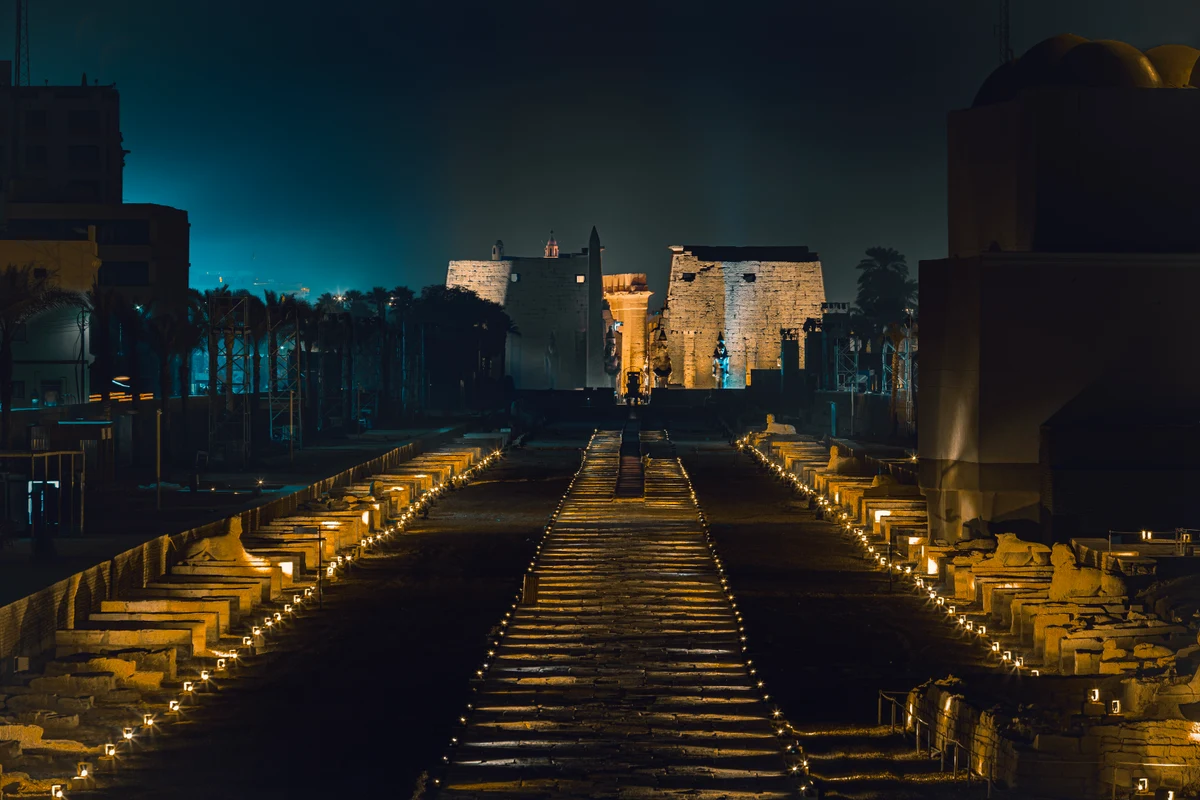
At 6am, at opening, you can go straight to the hypostyle hall before the cruise buses unload and fill the space between the 134 columns with lines. Save the avenue of sphinxes for the end of the day, 2.7 km and about 45 minutes on foot to Luxor Temple, with the shade in your favor. Luxor Temple is open from 6am to 8pm, with no break; come in around 7pm, when the lights come on, and you get an hour among the lit columns.
Shops close Friday at noon: change money and hit the pharmacy beforehand
It's the hour of prayer, and downtown only returns to normal in the mid-afternoon. Handle currency exchange, the pharmacy, and the travel agency on Sharia el-Mahatta on any other day of the week. The evening before, Thursday night, wedding processions close entire streets and announce themselves with the mizmar two blocks ahead. Don't ask your tuk-tuk driver to cut through the procession, because waiting takes less time than the detour.
On the west bank, arrange the return tuk-tuk before 9pm
After 9pm, the lanes of Gezira and Al-Ba'irat are left without lighting or transport, and there's no reliable ride-hailing app to bail you out. Arrange your return tuk-tuk before dark, for about 20 to 50 EGP for a short ride, or the trip to the ferry turns into a blind walk between cane fields. By day, from November to March, when the heat allows, a bicycle rented for 100 to 200 EGP covers the whole west bank.
Explore the map
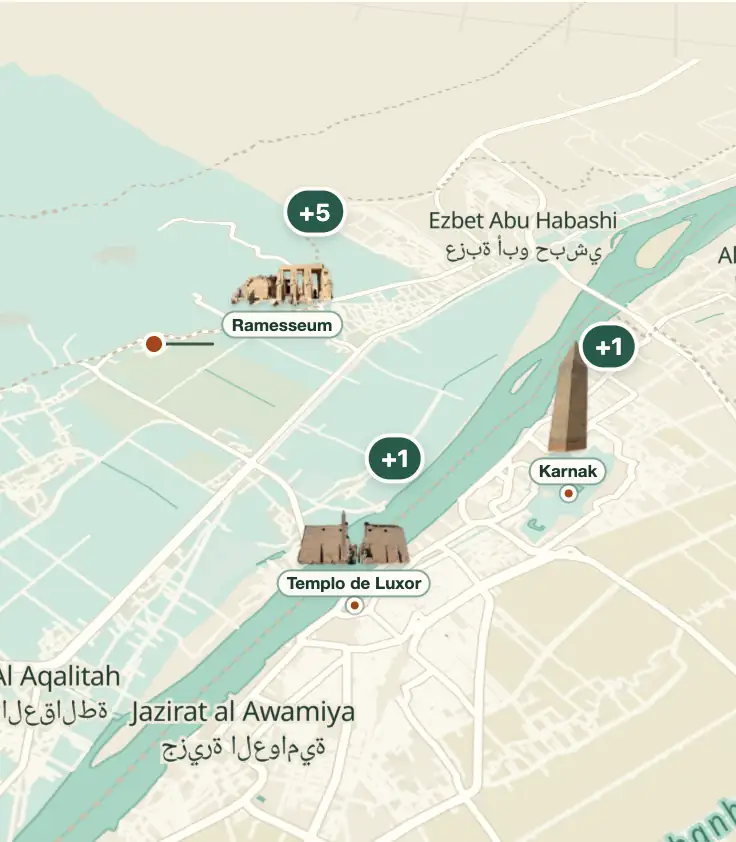
© OpenStreetMap · OpenFreeMap · © OpenMapTiles
Explore the map, read about the other places and plan your travel days in the app.
Open the appWhat to see
Luxor: The alluvial strip between two plateaus
Luxor is divided by the Nile: the city and the temples sit on the east bank, and the tombs and mortuary temples on the west, beneath the Theban cliff. The climate is hot desert (BWh), with about 1 mm of rain a year, which is why 3,300-year-old paintings still have color.

Karnak (Ipet-isut)
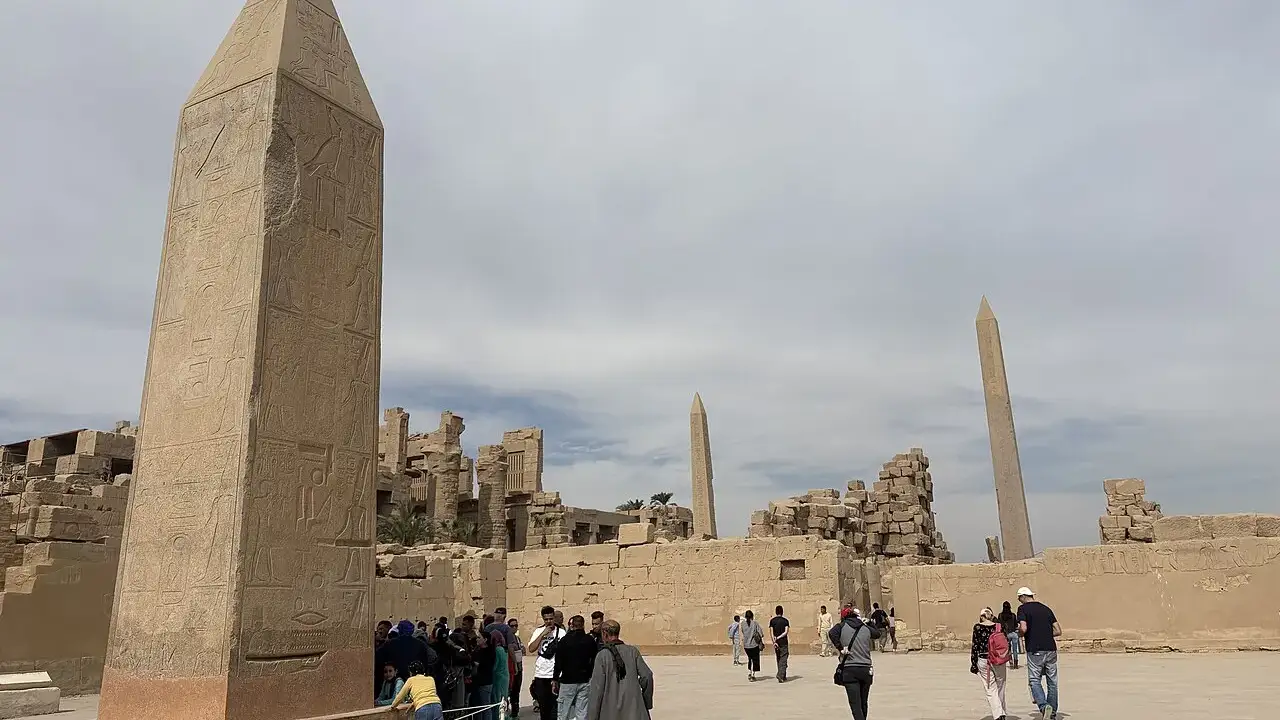
Ancient Egypt's largest religious complex, with about 2 km² built and rebuilt over 1,500 years. The hypostyle hall of Seti I and Ramesses II has 134 columns across about 5,000 m²; Hatshepsut's obelisk, still standing, is about 29 m tall and weighs around 340 tons.
The country's most extensive pharaonic cult complex covers about 2 km² and was built and remodeled over 1,500 years; the hall of Seti I and Ramesses II gathers 134 pillars, and Hatshepsut's monolith still stands in place, about 29 m tall and weighing around 340 tons.
Check access

Luxor Temple (Ipet-resyt)
Built by Amenhotep III and expanded by Ramesses II, it was the destination of the Opet Festival procession, which brought Karnak's barques over once a year. One of the two pylon obelisks remains; the other has stood on the Place de la Concorde in Paris since 1836.
Amenhotep III built and Ramesses II expanded this temple, the destination of the Opet Festival, whose barques came from Karnak once a year, and of the pylon's two obelisks only one remains, because the one that left stands in Paris, on the Place de la Concorde, since 1836.
Check access
Deir el-Bahari
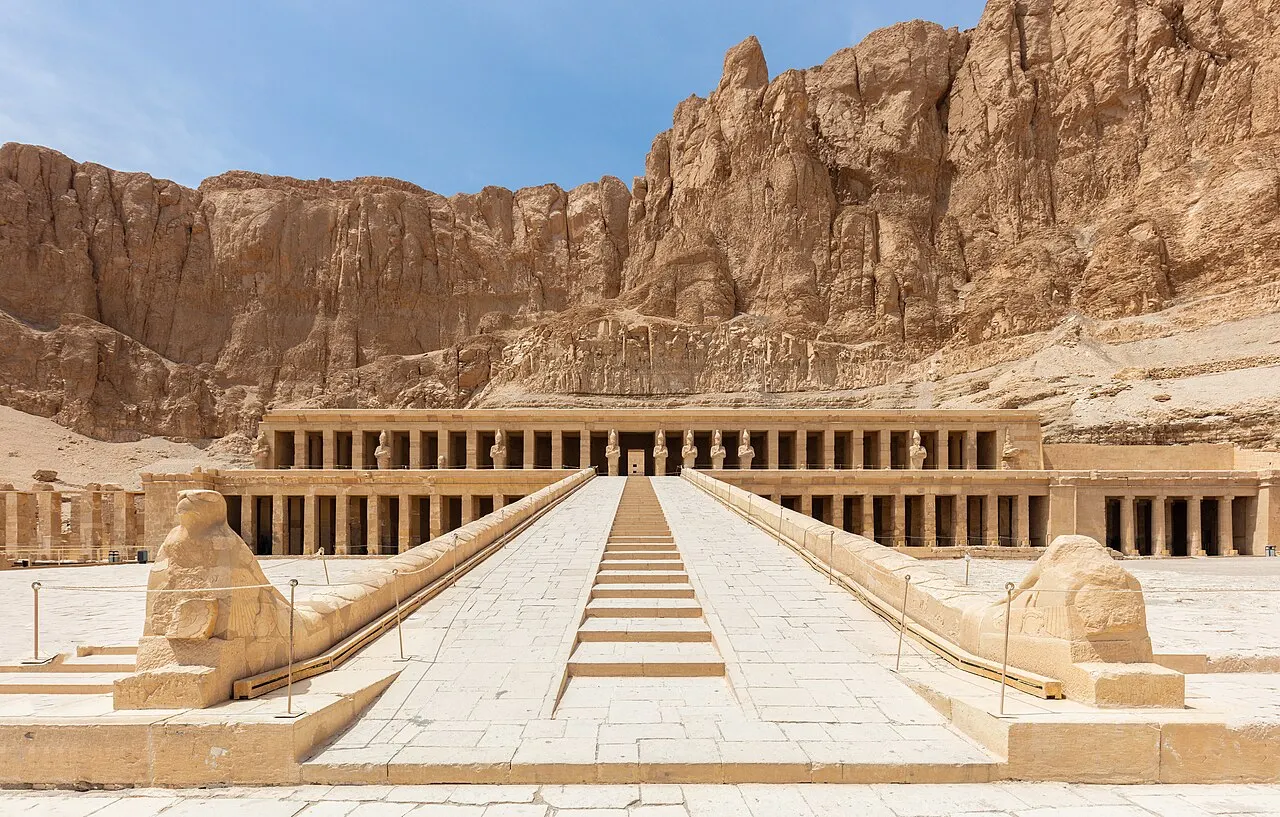
Hatshepsut's mortuary temple, built in three terraces set into the cliff, designed by Senenmut around 1470 BC, with the relief of the expedition to the land of Punt on the middle portico. Beside it stand the ruins of Mentuhotep II's temple, about 550 years older.
Hatshepsut's mortuary temple has three terraces, was designed by Senenmut around 1470 BCE, holds the relief of the expedition to Punt, and beside it stand the remains of Mentuhotep II's temple, about 550 years older.
Check access
Medinet Habu
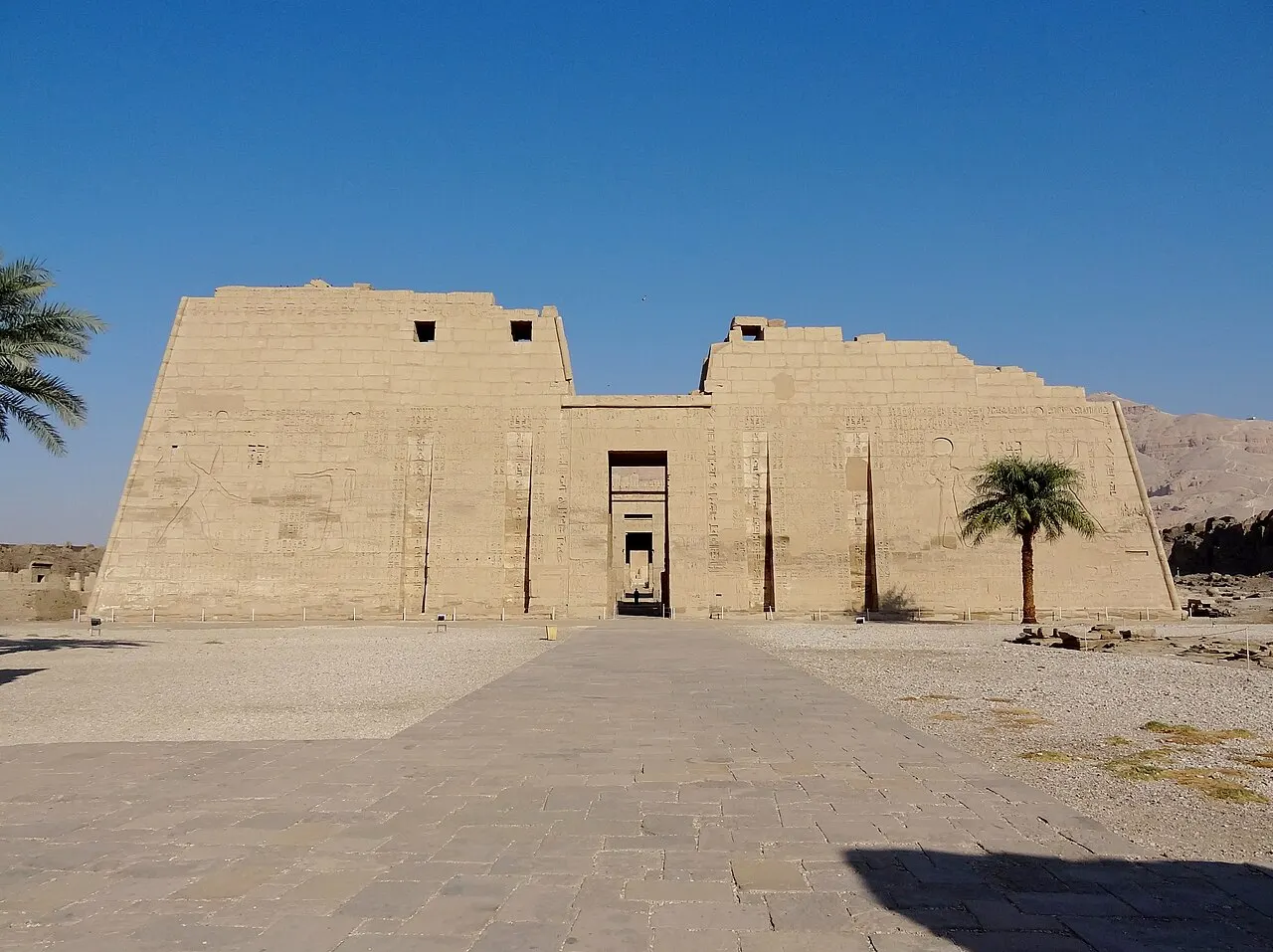
Ramesses III's mortuary temple, from about 1180 BC, the best-preserved on the west bank. The outer reliefs depict the battle against the Sea Peoples, and part of the interior ceilings still carries original pigment.
Ramesses III's mortuary temple, from about 1180 BCE, is the best preserved on the west bank, the outer reliefs depict the battle against the Sea Peoples, and some interior ceilings still carry original pigment.
Check access
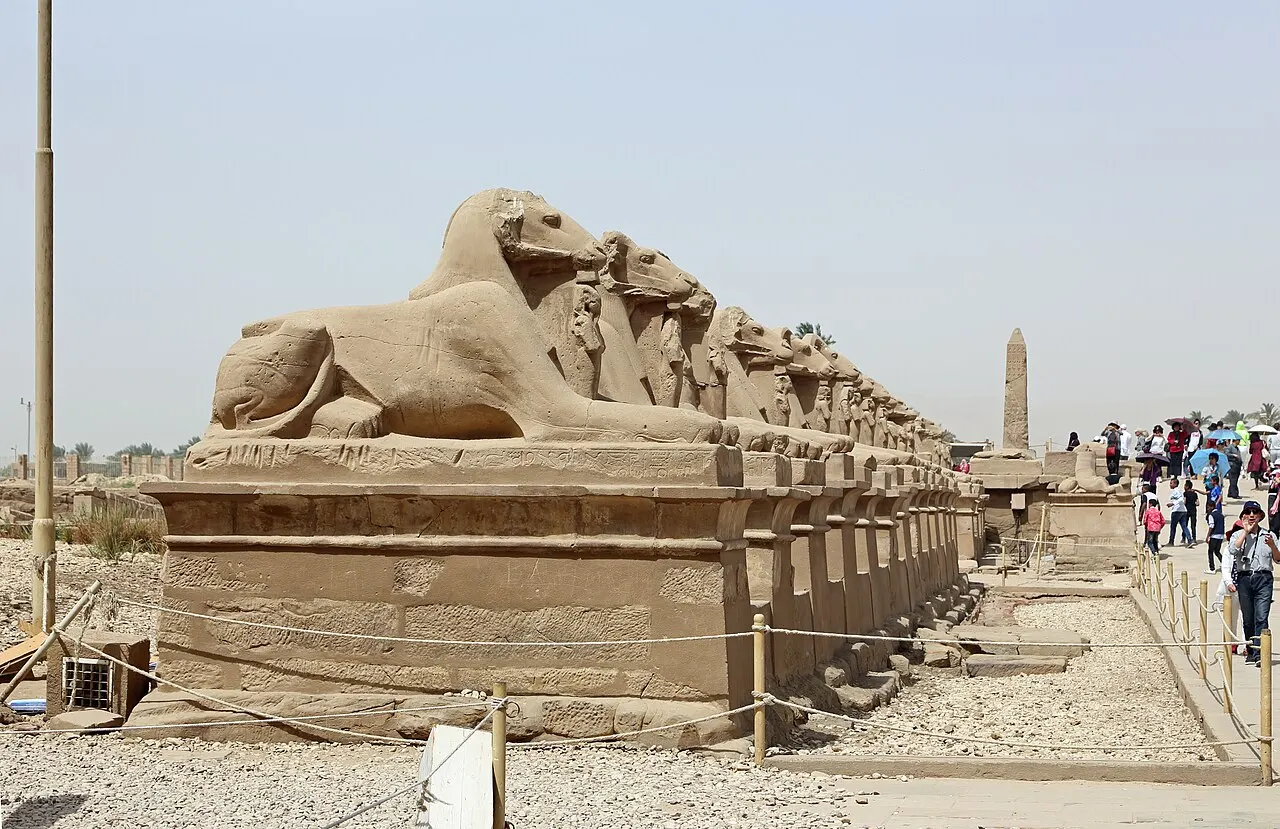
Avenue of Sphinxes
A 2.7-km processional way between Luxor and Karnak, with about a thousand stone sphinxes and rams, excavated in stages since 1949 and reopened to the public on November 25, 2021. Walking it at the end of the afternoon takes about 45 minutes.
The 2.7 km avenue linking Luxor to Karnak gathers about a thousand stone sphinxes and rams, was excavated in stages starting in 1949, and reopened to visitors on November 25, 2021, and walking it takes about 45 minutes.
Check access

Valley of the Kings
The New Kingdom's royal necropolis, with more than 65 catalogued tombs cut into the rock between about 1500 and about 1070 BC. The standard ticket gives access to three tombs from the day's open rotation; Tutankhamun (KV62), Seti I (KV17), and Ramesses V and VI (KV9) charge separate admission, and KV22, Amenhotep III's tomb, rejoined the circuit in 2025.
It's the reason to cross the river: the standard ticket opens three tombs from the day's rotation, and Tutankhamun (KV62), Seti I (KV17), and Ramesses V and VI (KV9) charge separately, all bought at the visitor center. Go early, before the heat, because the tombs have no ventilation, and look for KV22, Amenhotep III's tomb, which rejoined the circuit in 2025.
Check access
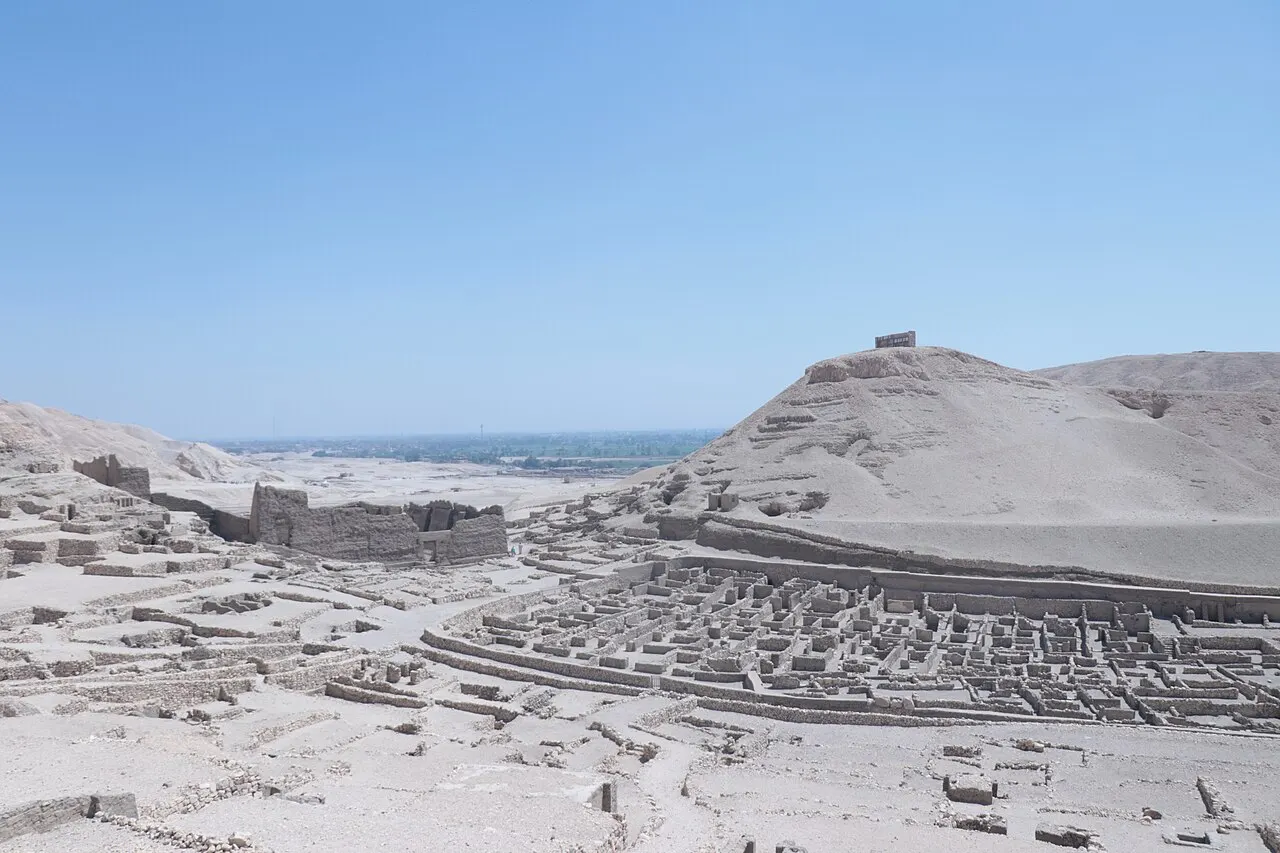
Deir el-Medina and Valley of the Queens
The village of the workers who cut the royal tombs, with its own small, intensely painted streets, houses and tombs, like those of Sennedjem and Inherkha. A kilometer away is the tomb of Nefertari (QV66), on a separate ticket, expensive and with limited visiting time.
Whoever worked on the kings' tombs lived in a village with its own intensely painted houses and tombs, like those of Sennedjem and Inherkha, and 1 km away is Nefertari's, QV66, on a separate and expensive ticket, with a timed visit.
Check access
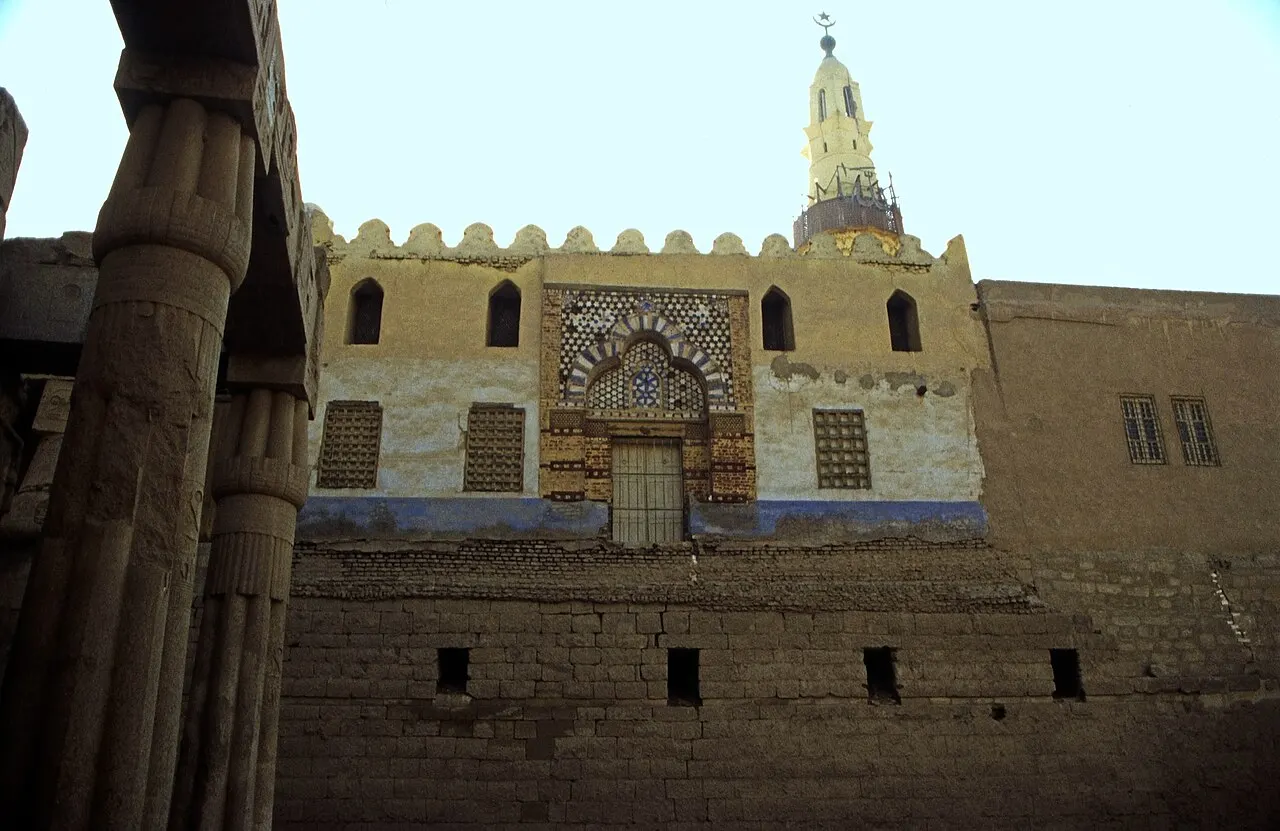
Abu al-Haggag Mosque
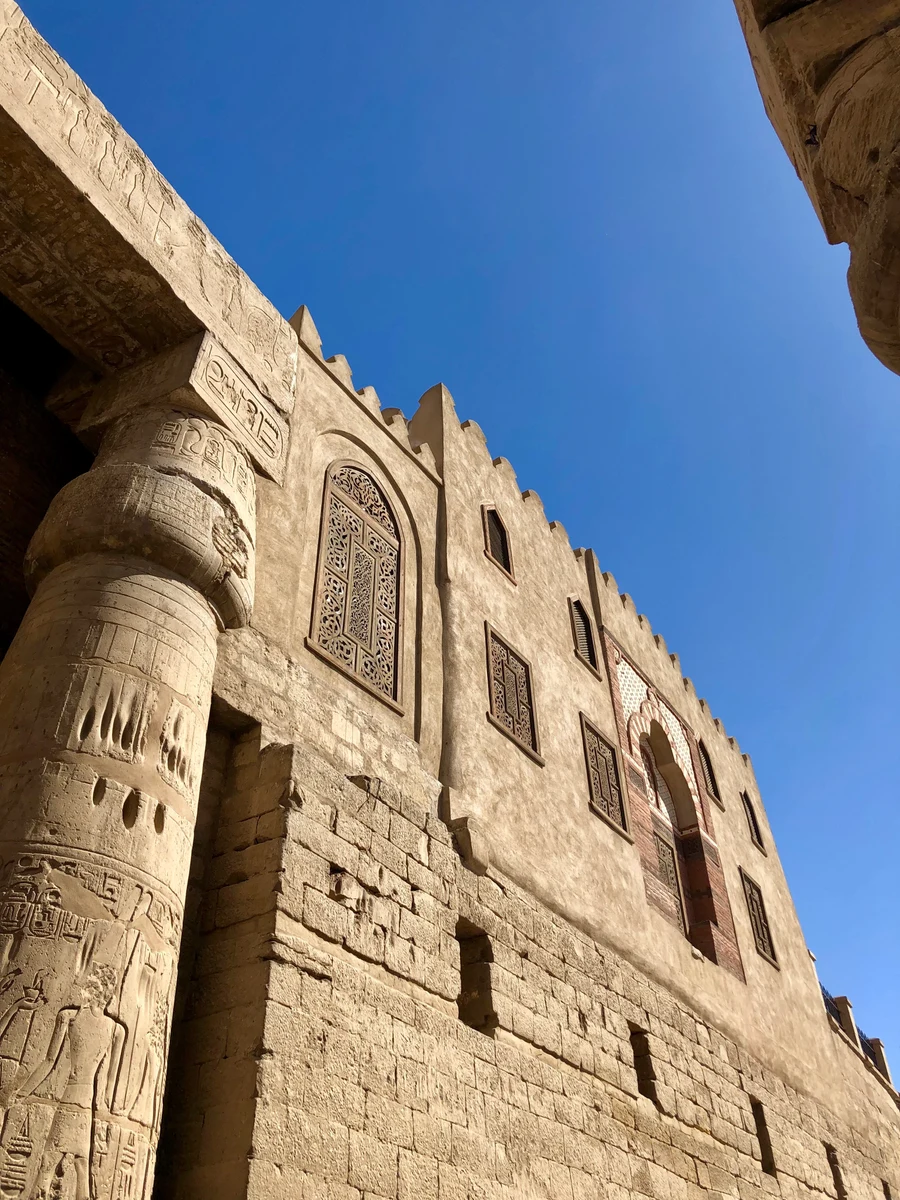
A 13th-century mosque built over Luxor Temple's courtyard when it was buried under nearly 15 m of debris. After the excavation, the door was left several meters above the pharaonic floor level; the mosque is still in use and is the reason this corner of the temple was never dismantled.
It's covered by the same Luxor Temple ticket and is seen from inside it, looking up. Ten minutes, and best in the late afternoon, when the facade catches side light.
Check access

Ramesseum
Ramesses II's mortuary temple, now in ruins, with mud-brick storerooms around it and the fallen colossus, estimated at about 1,000 tons, that inspired Shelley's 1818 sonnet “Ozymandias.”
Ramesses II's mortuary temple is in ruins, and Medinet Habu, a few kilometers away, is far better preserved. What remains distinctive is the fallen colossus of about 1,000 tons that became Shelley's “Ozymandias” in 1818, and it's seen in twenty minutes.
Check access
Nilo’s itinerary
Start with the basic programme and choose extensions for the time you have.
Plan my days in the app ↗Day 1 · East bank: temples, museum and market
Get to Karnak at opening, around 6am, enter through the avenue of rams and go straight to the hypostyle hall before the cruise-ship buses unload.
Visit the Luxor Museum, on the Corniche, in about 1 hour 30 minutes: it holds the statues from the cache found in 1989 under the courtyard of Luxor Temple, in an exceptional state of preservation.
Have tagen for lunch at a restaurant in the center, away from the Corniche, and rest during the hours of peak heat, between 1pm and 4pm.
Walk the 2.7 km of the avenue of sphinxes, from Karnak to Luxor Temple, in the late afternoon.
Return to Luxor Temple around 7pm, when the lighting turns on, and look for the Abu al-Haggag mosque above Ramesses II's courtyard before closing, at 8pm.
Day 2 · West bank: Valley of the Kings and mortuary temples
Cross on the first ferry, around 5:30am; anyone taking a balloon boards earlier still, in the dark, for US$80 to 120.
At the Valley of the Kings ticket office, right at opening, buy the three tombs from the day's rotation and, if your budget allows, the Seti I (KV17) supplement, the longest and most decorated tomb in the valley.
Climb to the terraces of Hatshepsut's temple at Deir el-Bahari, and on the way down stop at the Colossi of Memnon, by the side of the road.
Have lunch on a terrace in Gezira or Al-Ba’irat and wait for the heat to ease.
Reach Medinet Habu around 4pm, in low light, when the reliefs of the battle against the Sea Peoples and the pigment left on the ceilings become legible.


If you stay longer
Day 3 · Workers, mud village and river
Start at 8am at Deir el-Medina, the craftsmen's village, with the tombs of Sennedjem and Inherkha, small and with almost intact paintings.
Visit the Tombs of the Nobles at Sheikh Abd el-Qurna (Rekhmire, Sennefer, Nakht), sold on tickets covering groups of two or three tombs.
Walk through New Gourna, Hassan Fathy's village, and then step into an alabaster workshop in Qurna to see the stone cut and polished before buying anything.
Spend about 45 minutes at the Mummification Museum, on the Corniche, to understand the process behind the mummies and tombs of the west bank.
Set out on a felucca at sunset from the Corniche, with price and route agreed at the landing before boarding.
Food
 AI illustration
Ful medames
Fava beans slow-cooked for hours with olive oil, cumin, lemon and garlic, served with baladi bread from breakfast onward. It's the caloric base of the day across all of Upper Egypt and costs a few EGP from a street cart.
 AI illustration
Taameya
The Egyptian falafel, made from fava beans rather than chickpeas, green inside from the amount of cilantro and parsley. It comes in a sandwich with salad and tahini, usually from the same stall as the ful.
 AI illustration
Hamam mahshi
Pigeon stuffed with freekeh (green wheat) or rice and roasted whole; an occasion dish in Upper Egypt, and one Luxor's restaurants serve more often than Cairo's do. Eaten with the hands, and it gives far less meat than it looks.
 AI illustration
Tagen
A stew baked and served in the clay pot that gives it its name, in versions with okra (bamya), meat in tomato sauce, white beans or rice pudding. It arrives bubbling and is the cheapest hot meal at local restaurants.
 AI illustration
Molokhia
A thick soup of blended jute-mallow leaves, seasoned with fried garlic and cilantro, served over rice with chicken, meat or rabbit. The slippery texture is typical of the dish, and that's how it's meant to be.
 AI illustration
Aish baladi and aish shamsi
Whole-wheat bread baked in a very hot oven, which puffs up into a pocket, and Upper Egypt's “sun” version, left to ferment outdoors before baking. The bread is subsidized and reaches the table before any order is placed.
 AI illustration
Sugarcane juice and karkade
Luxor sits in Egypt's sugarcane belt, and asab comes fresh off the press, green and cold, for 10 to 20 EGP. Karkade, a hibiscus-flower infusion, is served hot in winter, cold in summer, and almost always offered free on arrival at hotels.
 AI illustration
Feteer meshaltet and om ali
Feteer is a many-layered flaky pastry, baked in a large disc, served savory with cheese or sweet with honey; om ali is a bread pudding with milk, nuts and raisins, served warm. They show up at celebrations, hotel breakfasts and family dinners.
Day trips

Dendera
Temple of Hathor about 60 km north, about 1 hour by car. The ceiling cleaning, done between 2005 and 2020, restored the original colors; the zodiac seen today is a copy, since the original has been in the Louvre since 1821. The crypt and the rooftop chapel of Osiris are worth the extra time.
Abydos
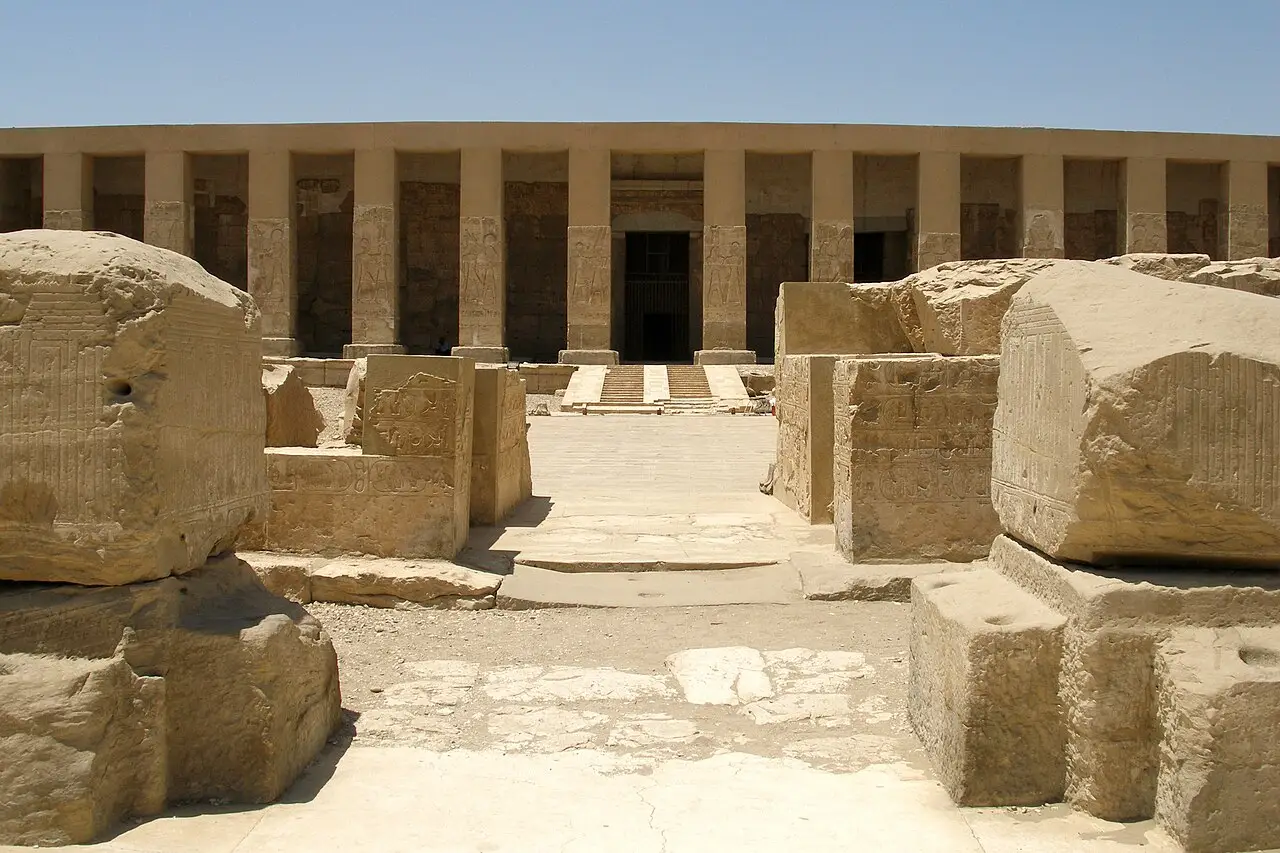
The temple of Abydos is about 150 km to the north, 2 hours 30 minutes to 3 hours by car, and is almost always combined with Dendera in a 10- to 12-hour day. The temple of Seti I holds the Abydos King List, with 76 pharaohs' cartouches, and the Osireion, an underground structure of granite blocks.
Esna and Edfu
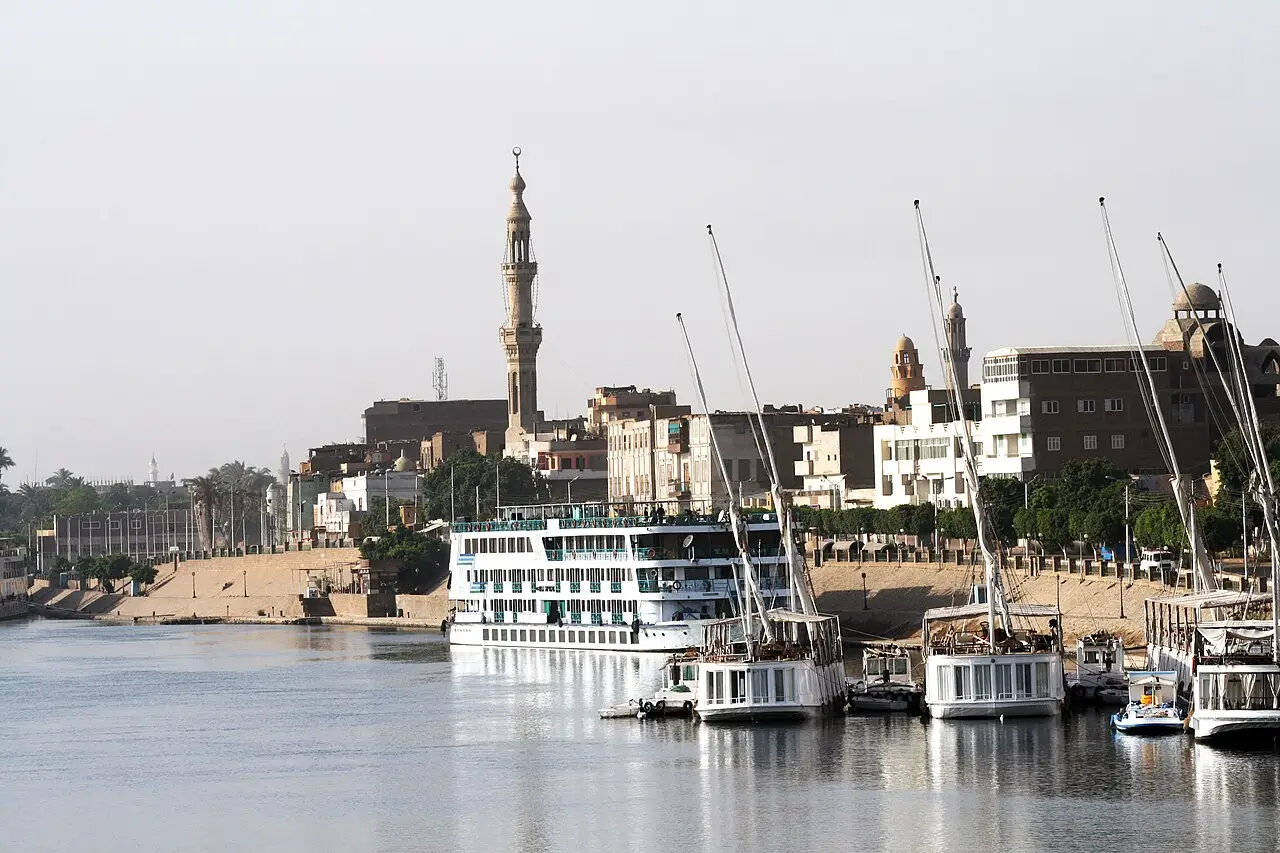
55 km and 115 km south, about 1 hour and 2 hours by car, and fixed stops on every cruise. The Temple of Khnum in Esna sits about 9 m below current street level and had its ceiling restored between 2018 and 2023; the Temple of Horus in Edfu is the most complete pharaonic temple to survive.
Where to begin
East bank: temples, museum and market
Get to Karnak at opening, around 6am, enter through the avenue of rams and go straight to the hypostyle hall before the cruise-ship buses unload.
West bank: Valley of the Kings and mortuary temples
Cross on the first ferry, around 5:30am; anyone taking a balloon boards earlier still, in the dark, for US$80 to 120.
Workers, mud village and river
Start at 8am at Deir el-Medina, the craftsmen's village, with the tombs of Sennedjem and Inherkha, small and with almost intact paintings.
Money
The currency is the Egyptian pound (EGP), at around 45 to 50 to the dollar in September 2026, and the exchange rate has moved a lot since 2022. Eating is cheap: street tea or coffee costs 10–25 EGP, a taameya sandwich 10–20 EGP and a tagen with bread at a local restaurant 80–180 EGP, while a tourist-oriented dinner runs 250–500 EGP and local beer 60–120 EGP. For lodging, a guesthouse in Gezira costs US$12–25 a night, a mid-range hotel US$40–80, and the Winter Palace and its equivalents from about US$150. What weighs on the budget are the tickets: the Valley of the Kings costs 750 EGP for three tombs, Karnak 600 EGP and Luxor Temple 500 EGP for a foreign adult, and the smaller temples and tombs 150 to 300 EGP each, with frequent increases. Karnak and the Valley of the Kings take only cards at the ticket office, but carry small notes for tuk-tuks, the ferry, water and baksheesh. The tip is 10 to 20 EGP for a small service and about 10% at restaurants that don't add a service charge.
Getting there and around
Luxor Airport: a 6 km taxi ride, price agreed before you get in
Luxor International Airport (LXR) is on the desert side, close to the city. A taxi to the Corniche costs about 150 to 300 EGP, agreed before getting in, because meters aren't used. Flights from Cairo take about 1 hour, and there are direct European charters in winter. Between May and October of 2026 and 2027, the Egyptian government waives the visa fee for travelers landing in Luxor and Aswan. Outside that window, the tourist visa costs about US$25, obtained in advance through the official portal visa2egypt.gov.eg or paid in cash on arrival. By train, the station is at the end of Sharia el-Mahatta. Cairo–Luxor takes 10 to 11 hours on the overnight trains, with sleeper cars much more expensive than seats, and Luxor–Aswan takes 3 to 4 hours. River cruises between Luxor and Aswan dock on the Corniche and usually take 3 to 4 nights.
No metro, no buses: the tuk-tuk is the network
There's no metro within the city, and no urban bus network for visitors. The real transport is the tuk-tuk: about 20 to 50 EGP for a short ride, to anywhere on either bank. There are also minibuses on the Karnak–downtown route. To cross the river, the public ferry wins: it costs little and is almost always available, while private motorboats cover the same route for more, with the price agreed beforehand. Ride-hailing apps have patchy coverage in Luxor, so expect to negotiate. The bridge south of the city only pays off for those driving. By bicycle you can cover the west bank in the cooler months, with rentals on both sides of the river, but from May onward the heat makes it impractical. The Corniche's horse carriages (hantour) are a tourist option, with weak animal-welfare oversight and always-negotiated fares. On foot, downtown links the Corniche, the souq, and the main temple within a few minutes, but Karnak is 3 km from downtown, and that distance turns uncomfortable on foot above 30 °C.
Safety
Luxor is one of the most heavily policed cities in Egypt, with fixed posts at the sites, metal detectors at hotel entrances and checkpoints on the roads to Dendera and Abydos. This setup dates from the attack of November 17, 1997 at Deir el-Bahari, which killed 62 people, and there has been no repeat in the city since. The everyday risks are different and far more likely. The first is heatstroke and dehydration, from May to September. The second is crossing the street on the Corniche, where crosswalks and traffic lights barely work. People who cross negotiate the right of way with the driver by eye contact. The third is commission scams: the “friend” who steers you to his cousin's alabaster shop, the unlicensed guide who doubles the price at the end of the day and change counted in the dark. Women traveling alone often report verbal harassment, especially at night in the souq. Walking with a clear destination and refusing without hesitation greatly reduces the approaches. Don't drink tap water; stick to sealed bottles. The lanes of the west bank are left without lighting or transport from 9pm, so arrange your return before crossing.
Etiquette tips
Shoulders and knees covered
Men and women cover shoulders and knees in town and at archaeological sites, even at 40 °C. In a mosque, women cover their hair and everyone takes off their shoes at the entrance.
Refuse in one sentence, without stopping
“La, shukran” said once, without stopping to explain and without breaking stride, ends most approaches. Continuing to answer, even to say no, reads as interest in negotiating.
Baksheesh: 10 to 20 EGP for guards and porters
Guards, porters and anyone who opens a door or points out a detail expect 10 to 20 EGP. The practical rule is to decline the service before accepting it; once you accept, you pay.
Don't photograph people without asking
Ask before photographing people, especially women, children and the inside of homes on the west bank. “Momken sura?” does the job, and a no is also an answer.
Right hand for eating and handing things over
Bread, money, cards and gifts pass with the right hand. The left has another culturally assigned function, and the distinction is taken seriously.
During Ramadan, no eating or drinking on the street by day
During Ramadan, avoid eating, drinking, chewing gum or smoking in the street by day, and that includes water. Hotel restaurants keep serving, discreetly, for those who aren't fasting.
Mistakes to avoid
Booking the west bank tour with the first tout
Sealing the west bank package with the first driver who approaches at the ferry landing. The standard circuit (Valley of the Kings, Deir el-Bahari, Colossi) has a going rate. Ask at your guesthouse before crossing. Agree on the number of stops and the wait time at each one. What wasn't agreed on at the dock doesn't get agreed on the road.
The Valley of the Kings as a single visit
Treating the Valley of the Kings as a single visit. The ticket gives access to three tombs from the day's rotation, and Tutankhamun (KV62), Seti I (KV17), and Ramesses V and VI (KV9) are paid separately, so confirm the list at the visitor center's ticket office, never at the tomb door.
West bank after ten
Going to the west bank after 10am between May and September. The descending corridors of the tombs are long and have no airflow, the temperature inside exceeds the one outside, and cases of people feeling unwell are routine in summer.
Thinking Tutankhamun is here
Tutankhamun's gold moved to the Grand Egyptian Museum, in Giza, along with the gilded outer coffin. In the tomb, KV62, only the mummy and the stone sarcophagus remain, and the separate 700 EGP ticket pays for that.
A felucca “for half an hour” with no set price
Boarding a felucca “for half an hour” without settling the price and destination first. Negotiating price in the middle of the river is always worse than negotiating it at the dock.
Useful phrases
السلام عليكم: as-salamu alaykum
“Peace be upon you” (as-sa-LA-mu a-LAY-kum). The standard greeting in any situation; the reply is “wa alaykum as-salam.”
لا، شكراً: la, shukran
“No, thank you” (la, SHOOK-ran). The city's most useful phrase; said once and without breaking stride, it works.
بكام ده؟: bikam da?
“How much is this?” (bi-KAM da). The first number offered is usually an invitation to bargain, not a final price.
معلش: maalesh
“No harm done” or “sorry” (MA-a-lesh). Used to excuse yourself, accept a delay, or close out a misunderstanding.
إن شاء الله: inshallah
“God willing” (in-sha-AL-lah). Applied to schedules, it means the time depends on more factors than the ones agreed on.
ممكن صورة؟: momken sura?
“May I take a photo?” (MOM-ken SOO-ra). A required question before photographing anyone.
Districts
Corniche el-Nil
The riverside avenue running from Luxor Temple to Karnak, with the Winter Palace (1907), the Luxor Museum, the Mummification Museum and the felucca dock. It's the city's showcase, and also the stretch with the most insistent touts.
Sharia el-Mahatta
A straight street about 700 m long linking the train station to Luxor Temple, packed with agencies, pharmacies, exchange offices and snack shops. It is a practical street, busy with travelers handling logistics, with little scenery for a slow walk.
Luxor Souq
A market running parallel to the Corniche, one block inland: spices, karkade, textiles and alabaster in the first stalls; fruit, hardware and work clothes further in. The deeper you walk, the closer the price gets to what the neighbor pays.
Karnak
A neighborhood north of downtown, around the Amun-Ra complex, with low houses, mechanic shops and the terminus of several minibuses. It lives off the temple's foot traffic and the Qena road's.
Al-Awameya and Manshiya
Residential neighborhoods east of the train tracks, of exposed-brick buildings, schools and a street market where the city does its real shopping. Almost no visitor crosses the rail line.
Gezira
The first strip of houses after the ferry lands on the west bank, with family-run guesthouses, terrace restaurants and bike rentals. It's the cheapest base for anyone who wants to wake up on the side of the tombs.
Al-Ba'irat and Qurna
Farming villages on the west bank, between sugarcane fields and the desert line, with the alabaster workshops that supply shops on both sides of the river. This is where the families who lived on top of the nobles' tombs came from, before being removed between 2006 and 2009.
New Gourna
An experimental earth-architecture neighborhood that Hassan Fathy built in the 1940s, to move families off the top of the nobles' tombs.
History
about 2055 BC · Thebes becomes capital
Mentuhotep II reunifies Egypt after the First Intermediate Period and moves power to Waset. At Deir el-Bahari he builds the terraced temple that Hatshepsut would copy 550 years later.

about 1550 BC · New Kingdom
Ahmose expels the Hyksos and opens the 18th dynasty. Amun, a local god, merges with Ra and becomes a state deity, which turns Karnak into the country's largest landholding institution.

about 1500 BC · The Valley of the Kings
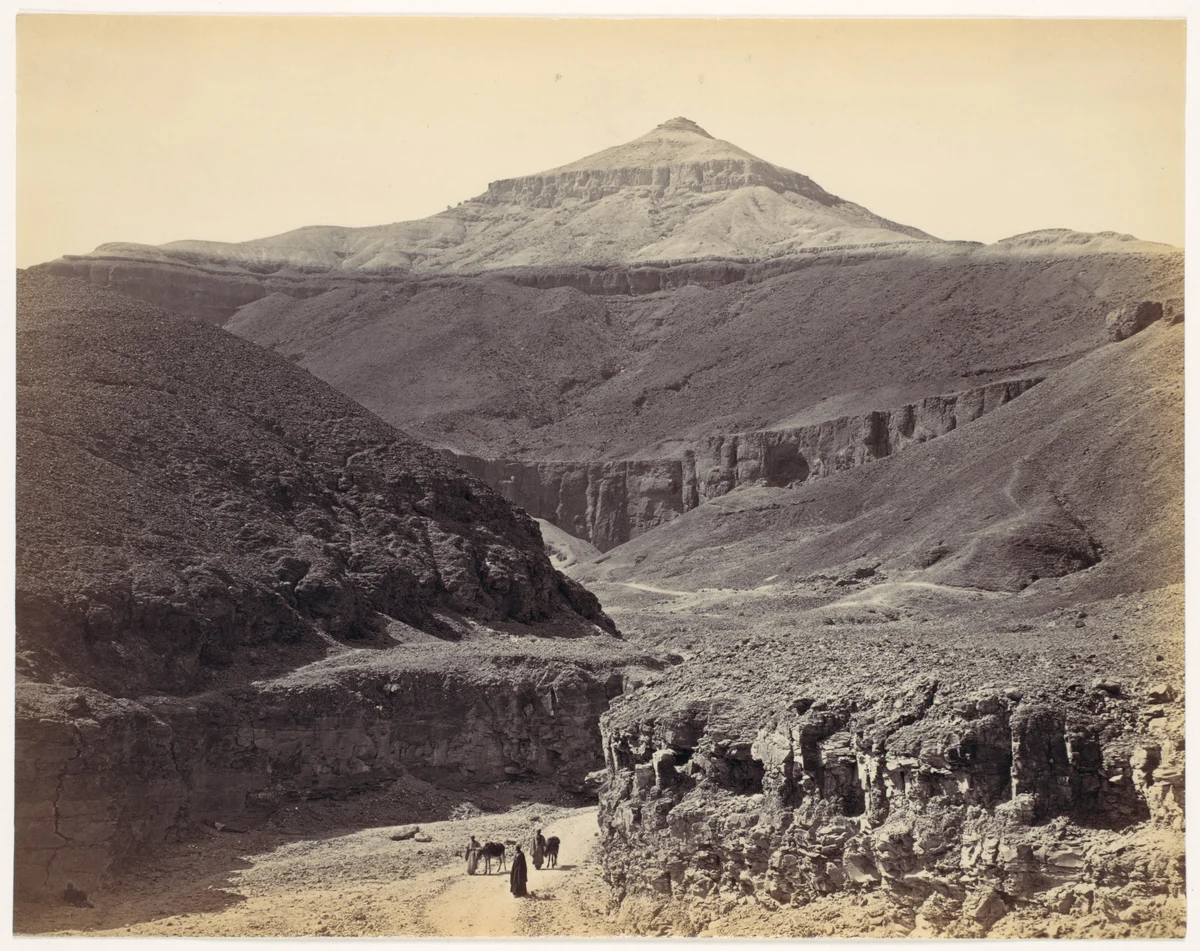
Thutmose I abandons the pyramid form and has a tomb cut into the rock on the other side of the river. The royal necropolis grows there over four centuries.
about 1479–1458 BC · Hatshepsut
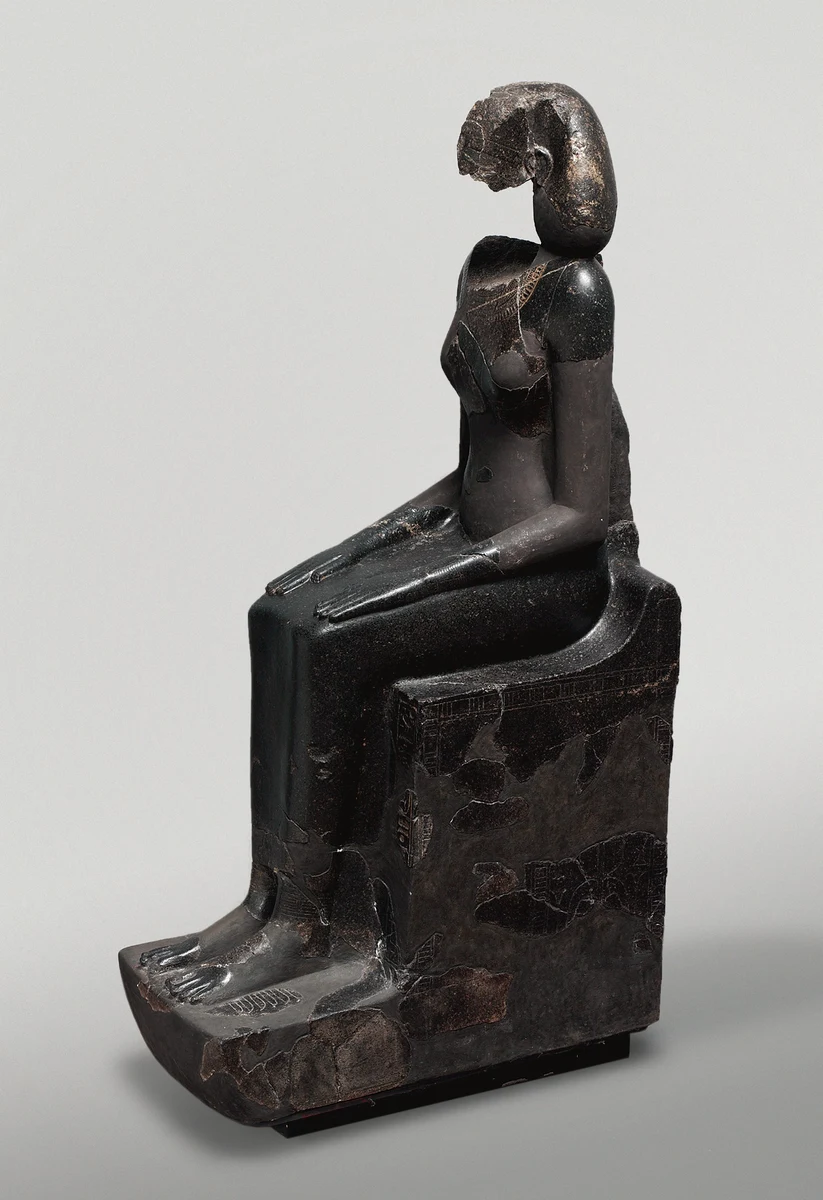
She builds Djeser-Djeseru at Deir el-Bahari, designed by Senenmut, and raises an obelisk about 29 m tall at Karnak. Her name is erased from the monuments after her death.
about 1348 BC · The court leaves Thebes
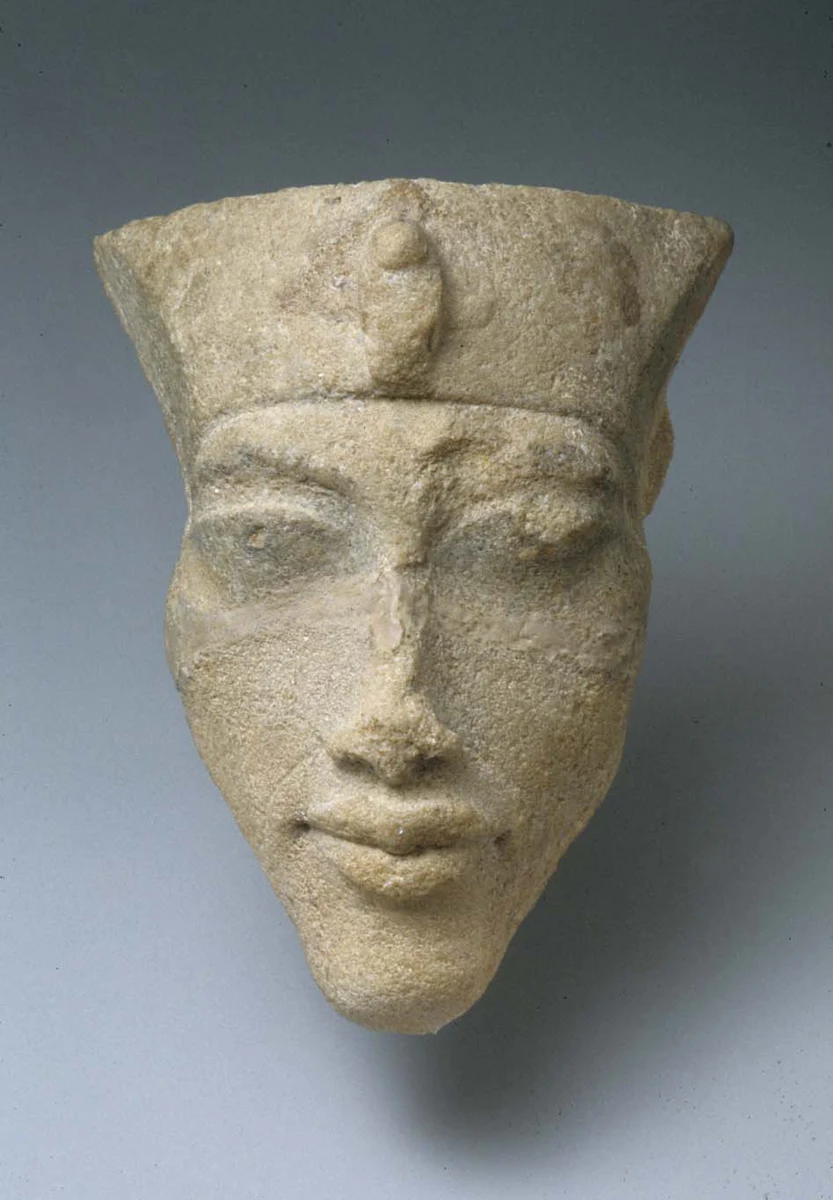
Akhenaten closes the temples of Amun and moves the capital to Amarna. Tutankhamun reverses the decision and Thebes regains its religious role.
about 1279–1213 BC · Ramesses II
He completes Karnak's hypostyle hall, raises the pylon and obelisks of Luxor Temple, and builds the Ramesseum on the west bank. The scale of his reign shapes the landscape seen today.

about 1157 BC · The Deir el-Medina strike
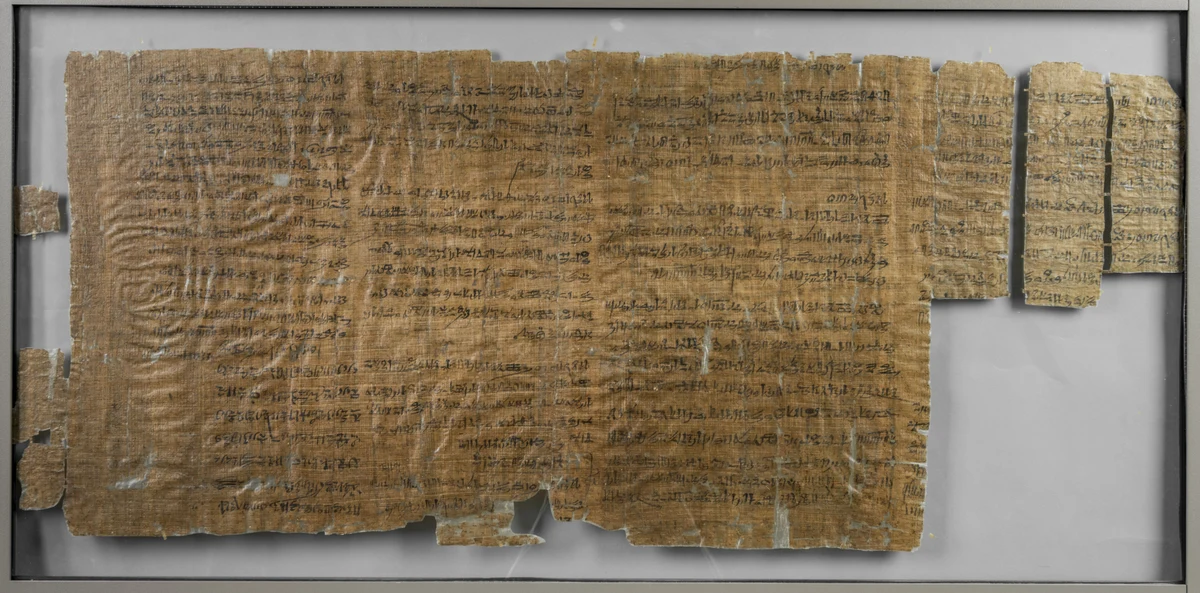
In year 29 of Ramesses III, the tomb workers stop work because their grain rations are late. It is the first strike recorded in writing in history.
663 BC · Assyrian sack
Ashurbanipal's troops sack Thebes and carry off the obelisks. The city never again rules Egypt and becomes a provincial and religious center.

about AD 300 and 13th c. · Roman castrum and mosque
A Roman legion sets up a fortified camp inside Luxor Temple; from the Latin castra comes the Arabic al-Uqsur, “the palaces.” In the 13th century the Abu al-Haggag mosque is built over the already-buried courtyard.
1881 and 1922 · The cache and KV62
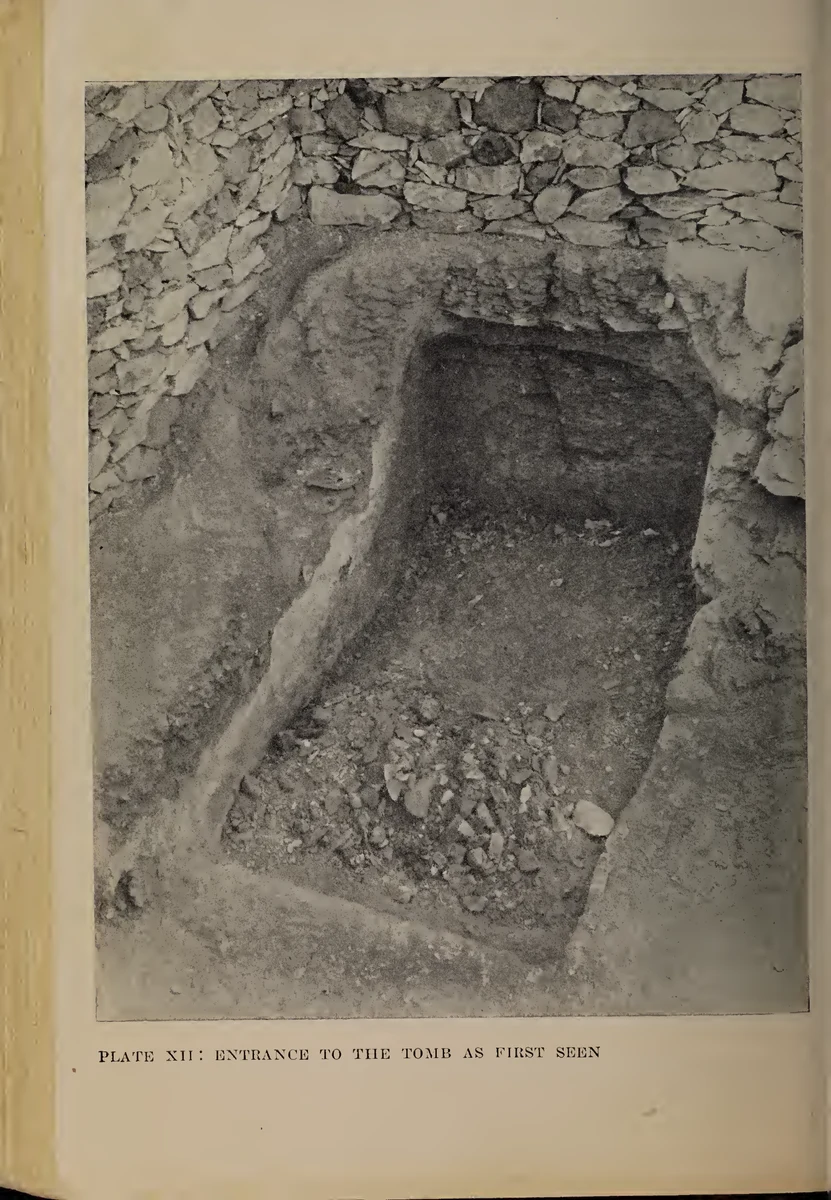
The royal cache at Deir el-Bahari, secretly worked by the Abd el-Rassul family, is revealed in 1881 with more than 50 mummies, including Ramesses II. On November 4, 1922, Howard Carter finds the nearly intact tomb of Tutankhamun.
1997–2021 · Attack, governorate and avenue
The attack of November 17, 1997 at Deir el-Bahari kills 62 people and sets tourism back for years. Luxor becomes its own governorate in December 2009, and the avenue of sphinxes reopens on November 25, 2021.
Complete history
From provincial Waset to the capital of Mentuhotep II (c. 2055 BC)
Waset was a provincial town of the fourth nome of Upper Egypt until Mentuhotep II, around 2055 BC, won the civil war of the First Intermediate Period and brought the government here. The decision had a theological consequence: Amun, a minor local god, was promoted and merged with Ra, the northern sun god. Amun-Ra became a state deity, and every pharaoh had to prove legitimacy by donating land, cattle and gold to his temple. That's why Karnak is a 1,500-year construction site: nearly every New Kingdom king had to add something.
The New Kingdom fixed the geography
The New Kingdom (about 1550–1070 BC) fixed the geography the city still uses. The temples of the living stayed on the east bank, where the sun rises; the mortuary temples and tombs, on the west, where it sets. Thutmose I broke with the pyramid tradition around 1500 BC and had a hidden tomb cut in a dry valley behind the cliff, what is now called the Valley of the Kings, with more than 65 cataloged tombs. Hatshepsut, Thutmose III, Amenhotep III, Seti I, Ramesses II and Ramesses III built on an ever-larger scale. An entire village, Deir el-Medina, existed solely to house the craftsmen who cut and painted those tombs; the thousands of ostraca found there document wages, lawsuits, love letters and the strike of around 1157 BC.
Tomb robbery marks the start of the decline
Luxor's decline began with the robbing of its own tombs. From the end of the New Kingdom onward, tomb robbing became a local industry, and priests pulled the royal mummies out of their tombs and hid them in collective caches. In 663 BC Ashurbanipal's Assyrians sacked the city. Then came the Ptolemies, who restored temples, and the Romans, who set up a fortified military camp inside Luxor Temple around AD 300: hence the Arabic name al-Uqsur, “the palaces.” Christian churches occupied rooms of the temples; in the 13th century, the Abu al-Haggag mosque was built over Ramesses II's courtyard, by then buried under nearly 15 m of debris. When archaeologists excavated the courtyard in the 20th century, the mosque was left hanging in mid-air, and it's still in use.
Bonaparte, Champollion, and nineteenth-century tourism
European rediscovery created the city's second economy. Bonaparte's expedition published the “Description de l'Égypte” between 1809 and 1829; Champollion deciphered hieroglyphs in 1822 and visited Thebes in 1828. One of Luxor Temple's two obelisks was sent to France in 1831 and raised on the Place de la Concorde in 1836. Belzoni found the tomb of Seti I in 1817. The Abd el-Rassul family, of Qurna, sold pieces from the royal cache at Deir el-Bahari for a decade before it was revealed in 1881. In 1869 Thomas Cook began operating steamers on the Nile and Luxor became a European winter resort, with the Winter Palace opening in 1907. The high point came on November 4, 1922, when Howard Carter, funded by Lord Carnarvon, found KV62, the only nearly intact royal tomb ever found in the valley.
New Gourna, the 1997 attack and the reopened tombs
The 20th and 21st centuries were a dispute over who lives where. Hassan Fathy designed New Gourna between 1946 and 1952, in mud brick and Nubian vaults, to rehouse the families living literally on top of the nobles' tombs; the village saw little uptake and the removal only happened, by force, between 2006 and 2009. The attack of November 17, 1997 at Deir el-Bahari killed 62 people, 58 of them foreign tourists, and produced the security apparatus that still governs access to the sites. Luxor became an autonomous governorate in December 2009, splitting off from Qena. The avenue of sphinxes, excavated in stages since 1949, reopened on November 25, 2021. In November 2025 the Grand Egyptian Museum opened in Giza and received the Tutankhamun collection; only the mummy and outer sarcophagus remained in KV62. The tomb of Amenhotep III (KV22) reopened to the public in 2025, and two 18th-dynasty tombs, of Rabuya and Samut, were unveiled in May 2026. None of that closes the list: Polish, French, American and Egyptian archaeological missions work in the city every winter, and the map of open sites shifts from one season to the next.
The name Luxor comes from the Arabic al-Uqsur, “the palaces,” which in turn comes from the Latin castra, the camp a Roman legion set up inside the temple.
Geography and shape of the city
The alluvial strip between two plateaus
Luxor sits at about 25.7° N and about 76 m above sea level, in a stretch where the Nile valley is a band of alluvial soil 5 to 10 km wide, squeezed between two limestone plateaus.
The two banks and the cliff
The river runs south to north and splits the city into two logics: the east bank is urban, with the Corniche running along the water, the station road running straight down to the main temple, and Karnak 3 km to the north; the west bank is agricultural, with sugarcane and alfalfa fields that reach exactly the line where irrigation stops, and there, with no transition, the desert and the archaeological zone begin. Behind it rises the Theban cliff, crowned by el-Qurn, the natural pyramid-shaped peak about 420 m tall that sits above the Valley of the Kings.
Climate and crossings
The climate is hot desert (BWh) with almost no rainfall, on the order of 1 mm a year, which explains why 3,300-year-old paintings still have color. The link between the two banks is the national ferry, in the center, or the road bridge opened in 1998, about 7 km to the south; the airport sits about 6 km east of the center, on the desert side.
Culture
Saidi culture: accent, mizmar and tahtib
Luxor is culturally Saidi, that is, from Upper Egypt, and you hear it before you see it: the dialect pronounces the qaf as a hard g, which immediately sets a local apart from a Cairene. Street and wedding music is made with the mizmar, a shrill double oboe that carries across blocks, with the tabla baladi and, in older versions, the horsehair rababa. Tahtib, a choreographed stick duel between two men with sticks of about 1.20 m, was inscribed by Unesco on the intangible heritage list in 2016 and still appears at weddings and moulids. Family and clan structures weigh more than in the delta, and the wedding processions that close streets every Thursday night show it to anyone passing by.
Antiquity's economy: guides, balloon pilots and Chicago House
The second cultural layer is the antiquity economy, which employs most of the city directly or indirectly: licensed guides, drivers, felucca captains, alabaster carvers in Qurna, dozens of balloon operators taking off before dawn, hotel staff and foreign archaeological missions. Chicago House, home base of the University of Chicago's epigraphic survey, has operated on the Corniche since 1924, copying relief after relief before salt and humidity erase them; the Polish mission has worked at Deir el-Bahari since the 1960s, and the French-Egyptian center CFEETK, at Karnak, since 1967. Much of what's known about the ancient city was produced by people who've spent the winter here for three generations.
African cinema since 2012
In contemporary life, the Luxor African Film Festival has run since 2012, in March, with open-air screenings facing Luxor Temple, and there's a second festival dedicated to Egyptian and European cinema early in the year. Karnak keeps up its nightly sound-and-light shows in several languages. There's a Coptic community with churches on both banks and its own holidays, like Coptic Christmas, on January 7, and Easter, which falls between April and May. None of this runs apart from the Muslim religious calendar: the city's real rhythm follows the five calls to prayer and, once a year, the month of Ramadan.
In Luxor, the five calls to prayer divide the day, and at noon on Friday shops close for the most important of them.
Festivals and events
 AI illustration
Moulid of Abu al-Haggag
The feast of the city's patron saint, on the 14th of Shaaban in the lunar calendar: around late January in 2027. Wooden boats mounted on carts parade through the city for days, in a form Egyptologists read as a survival of the pharaonic Opet procession.
 AI illustration
Karnak's solar alignment
At the winter solstice, December 21 or 22, the sun rises aligned with the main axis of the Temple of Amun-Ra and passes straight through the pylons. The site opens earlier on those days and the entrance area gets crowded.
 AI illustration
Luxor African Film Festival
An African cinema showcase founded in 2012, held in March, with a feature and short film competition and free screenings in the square facing Luxor Temple.
 AI illustration
Ramadan and the two Eids
It follows the lunar calendar, and in 2027 Ramadan is expected to begin around February 7. During the month, local restaurants close by day and the city wakes up after sunset; archaeological sites usually shorten their hours, and at iftar traffic practically stops.
 AI illustration
Sham el-Nessim
The Monday after Coptic Easter, which follows the Orthodox calendar and falls in April or May: in 2027, Easter is on May 2 and Sham el-Nessim on May 3. It's a national holiday of pre-Islamic origin, and families take over the Nile banks and the gardens with cured fish (fesikh), green onions, lupini beans, and painted eggs.
Books and films
“The Mummy: The Night of Counting the Years,” by Shadi Abdel Salam (1969)
Egyptian film inspired by a family from Qurna and the decade-long secret they kept about an archaeological find.
“Architecture for the Poor,” by Hassan Fathy (1973)
A first-person account of the failure of New Gourna, the mud-brick village the architect built between 1946 and 1952 to move residents off the top of the nobles' tombs. The village sits about 3 km from the Colossi of Memnon and can be visited.
“Death on the Nile,” by Agatha Christie (1937)
A novel written after the author's stays at the Winter Palace, opened in 1907; the 1978 adaptation filmed at Karnak and Luxor Temple. It portrays the layer of European winter tourism that shaped the Corniche.
Frequently asked questions
Luxor: How much does a taxi from the airport to the Corniche cost?
About 150 to 300 EGP, agreed before getting in the car, because no meter is in use; the airport is about 6 km east of the center.
Luxor: What's the currency, and how much is the pound worth?
The currency is the Egyptian pound (EGP), at around 45 to 50 to the dollar in September 2026, and the exchange rate has moved a lot since 2022.
Luxor: What's the climate like throughout the year?
Hot desert, with about 1 mm of rain a year: from December to February highs sit at 22 to 25 °C, with nights of 5 to 9 °C; October, November, and March give 28 to 35 °C; and from June to August highs run from 40 to 43 °C and top 45 °C in heat waves.
Luxor: Do I need to cover my shoulders and knees?
Yes: men and women cover shoulders and knees in town and at archaeological sites, even at 40 °C.
Luxor: Is it safe to visit the city?
Yes. Luxor is one of the most heavily policed cities in Egypt, with fixed posts at the sites, metal detectors at hotel entrances, and checkpoints on the roads to Dendera and Abydos.
Other cities in the country
Egypt ↗- Days
- 3–4
- When
- Jan–Mar · Nov–Dec
- Per person/day
- Average 70–120 USDMid-range · per person/day
Cost scope
Per person per day: accommodation, meals, urban transport, visits and a small allowance for extras. Flights excluded; larger purchases vary. Editorial estimate, not a quote.

Itineraries through here
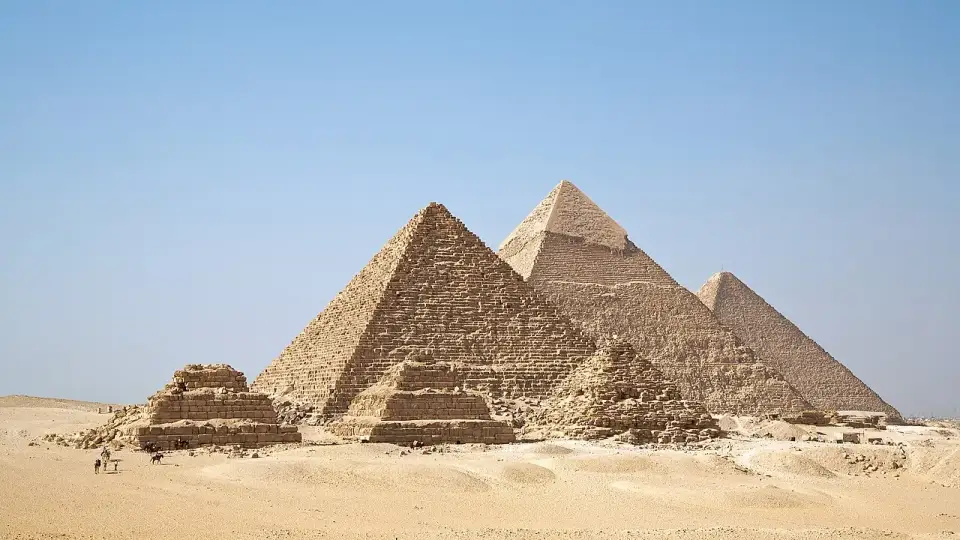
 Egypt in 7 daysFrom the pyramids to LuxorCairo · Luxor5–7 days2 cities
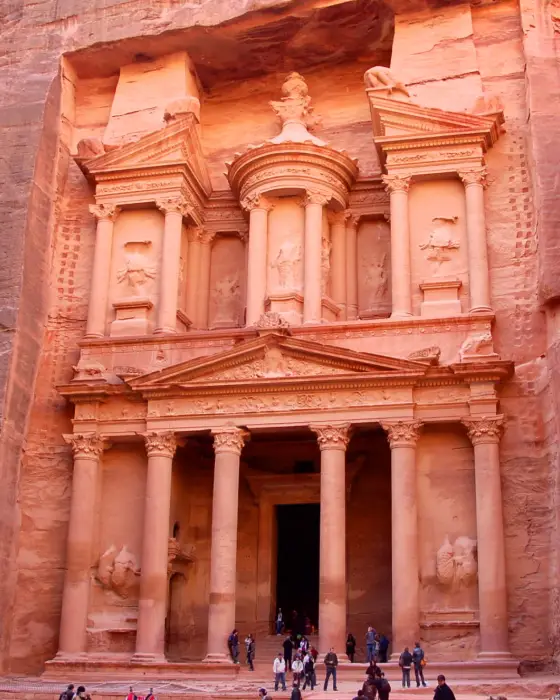 Egypt and Jordan in 7 daysFrom the pyramids to PetraCairo · Luxor · Petra7–9 days3 cities
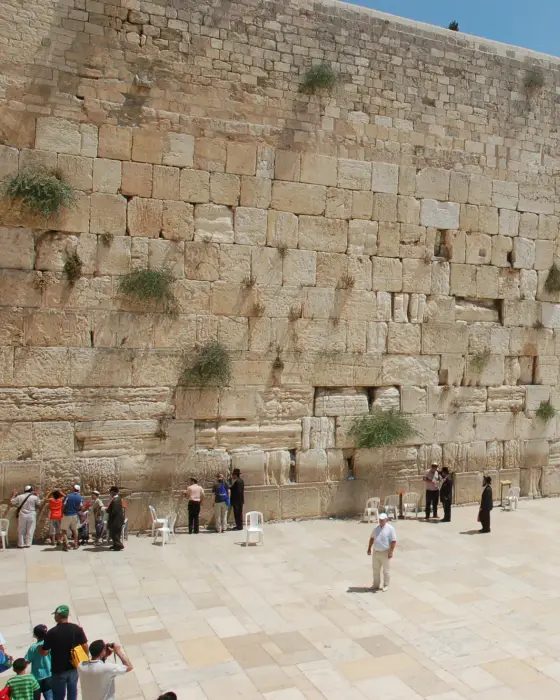 Egypt, Jordan and Israel in 10 daysPyramids, Petra and JerusalemCairo · Luxor · Petra · Jerusalem10–12 days4 cities
 Turkey and Egypt in 10 daysFrom Istanbul to the pyramidsIstanbul · Cairo · Luxor8–11 days3 cities