Jordan
Petra
The Siq, the Treasury and the Monastery carved in sandstone
Days Start with the basic programme and choose extensions for the time you have.
How the guide reaches this number
On the first, do the Siq, the Treasury, the Street of Facades and the Al-Khubtha trail; on the second, climb to the Monastery, come down to the Nabataean center and return through the exit agreed with your guide, allowing for the whole walk from the basin. Visitors who need to avoid stairs can focus on the Siq, the Treasury and the Street of Facades, checking mobility assistance at the Visitor Center. With a single day, go in at the seasonal opening time, 6am in summer or 6:30am in winter, pass the Treasury before 8am and climb straight to the Monastery, with water in your backpack. Come down for lunch at the Basin restaurant and leave the High Place of Sacrifice for another trip, because climbing to both high points on the same day is too tiring. The letdown is the constant sales pressure and the heat of the basin, which in August has no shade between 11am and 3pm. In return, you only have to take a Nabataean staircase away from the crowds to find yourself alone before the carved valley.
2
When March–May and September–November; April and October give the best balance of temperature and light
How the guide reaches this number
Spring (March to May) and fall (September to November) are the comfortable seasons: daytime temperatures of 18 to 28 °C in the basin, clear skies and flowers on the slopes in March and April. Summer (June to August) reaches 33–36 °C on the valley floor, always hotter than the village, with no shade between 11am and 3pm; if you come then, enter at 6am and leave at noon. Winter (December to February) has highs of 8 to 13 °C, lows near freezing, occasional snow that closes the plateau road, and short, violent rains that can shut the Siq. Almost all the annual rainfall, 150 to 200 mm, falls between November and March, mostly from December to February. Official summer hours are 6am to 6pm. From October 2, 2026, to March 1, 2027, winter hours are 6:30am to 5pm. Check the official calendar before visiting. Crowds are greatest in October, April and the Eid holiday weeks. Skip August for the heat and January for closures and short days.
Per person/day Budget 35–55 JOD; mid-range 70–120 JOD (about US$100–170), not counting the 50 JOD entry ticket
How the guide reaches this number
Per person per day: accommodation, meals, urban transport, visits and a small allowance for extras. Flights excluded; larger purchases vary. Editorial estimate, not a quote.
 What Nilo thinks
Stay two days in Petra, because the two-day ticket costs only 5 JOD more. On the first, do the Siq, the Treasury, the Street of Facades and the Al-Khubtha trail; on the second, climb to the Monastery, come down to the Nabataean center and return through the exit agreed with your guide, allowing for the whole walk from the basin. Visitors who need to avoid stairs can focus on the Siq, the Treasury and the Street of Facades, checking mobility assistance at the Visitor Center. With a single day, go in at the seasonal opening time, 6am in summer or 6:30am in winter, pass the Treasury before 8am and climb straight to the Monastery, with water in your backpack. Come down for lunch at the Basin restaurant and leave the High Place of Sacrifice for another trip, because climbing to both high points on the same day is too tiring. The letdown is the constant sales pressure and the heat of the basin, which in August has no shade between 11am and 3pm. In return, you only have to take a Nabataean staircase away from the crowds to find yourself alone before the carved valley.Petra is the Nabataean capital, carved into the red, purple and yellow bands of sandstone in the Sharah Mountains. Enter on foot through the Siq, a 1.2 km gorge with walls up to 180 m high that ends at the Treasury's facade. Beyond the gap lies a valley with more than 800 monuments, almost all tombs, from the rock-cut theater to the Royal Tombs, while the 47 m-wide Monastery stands at the top of about 800 steps. The kingdom grew wealthy by charging tolls on the incense route. Its 20 or 30 thousand residents drank water that channels and cisterns brought by gravity from the Ain Musa spring, in a valley without a river. Almost all visitors stay within the first 3 km, while the higher Nabataean stairways lead to empty trails above Wadi Araba. At night, Wadi Musa, the village beside the gate, serves mansaf and maqluba. Come in April or October, with temperatures of 18 to 28 °C, and allow two days, because reaching the basin and returning means about 8 km on foot before any high trails.
Quick facts
- Population
- The archaeological site is uninhabited; Wadi Musa, the village at the gate, has about 20–25 thousand residents, and the region administered by PDTRA about 35,000 (2026 estimates)
- Founded
- Nabataean settlement from around the 4th century BC; first written mention in 312 BC; peak between 100 BC and 100 AD
- Country and region
- Jordan: Ma'an Governorate, Sharah mountains, on the eastern edge of Wadi Araba
- Language
- Arabic (southern Bedouin dialect); English common in hotels, ticket offices, and among guides
- Currency
- Jordanian dinar (JOD, د.ا), pegged to the dollar at about 0.709 JOD = US$1; 1 JOD ≈ US$1.41 and about R$7.80 in 2026
- Time zone
- UTC+3 year-round, no daylight saving since 2022
- Best time to visit
- March–May and September–November; April and October give the best balance of temperature and light
- Average daily cost
- Budget 35–55 JOD; mid-range 70–120 JOD (about US$100–170), not counting the 50 JOD entry ticket
When to go
March–May and September–November; April and October give the best balance of temperature and light
January
2° to 14°C
9 mm of rain
February
3° to 16°C
8 mm of rain
April
10° to 25°C
5 mm of rain
June
17° to 33°C
0 mm of rain
July
19° to 35°C
0 mm of rain
August
19° to 35°C
0 mm of rain
October
13° to 28°C
7 mm of rain
December
4° to 16°C
3 mm of rain
How the year changes
Spring (March to May) and fall (September to November) are the comfortable seasons: daytime temperatures of 18 to 28 °C in the basin, clear skies and flowers on the slopes in March and April. Summer (June to August) reaches 33–36 °C on the valley floor, always hotter than the village, with no shade between 11am and 3pm; if you come then, enter at 6am and leave at noon. Winter (December to February) has highs of 8 to 13 °C, lows near freezing, occasional snow that closes the plateau road, and short, violent rains that can shut the Siq. Almost all the annual rainfall, 150 to 200 mm, falls between November and March, mostly from December to February. Official summer hours are 6am to 6pm. From October 2, 2026, to March 1, 2027, winter hours are 6:30am to 5pm. Check the official calendar before visiting. Crowds are greatest in October, April and the Eid holiday weeks. Skip August for the heat and January for closures and short days.
The same numbers as a table
| Month | Temperature °C | Rain mm |
|---|---|---|
| January | 2 to 14 | 9 |
| February | 3 to 16 | 8 |
| March · | 6 to 20 | 5 |
| April | 10 to 25 | 5 |
| May · | 14 to 30 | 1 |
| June | 17 to 33 | 0 |
| July | 19 to 35 | 0 |
| August | 19 to 35 | 0 |
| September · | 17 to 33 | 0 |
| October | 13 to 28 | 7 |
| November · | 8 to 21 | 3 |
| December | 4 to 16 | 3 |
Nilo's tips
Enter at opening, 6am in summer and 6:30am in winter
At opening time you walk through the Siq almost alone and reach the Treasury before 8am, with the facade still in shade. Save the Al-Khubtha trail, about 600 steps, for mid-morning, when the light hits the facade seen from above.
The two-day ticket is 55 JOD, only 5 more
With 5 JOD more than the one-day ticket, which costs 50, you can spread out the climbs and rest between them. Allow one day for the Siq, Treasury, and tombs, and another for the Monastery and Nabataean center. Plan your return before climbing, including the steps down and the walk to your chosen exit.
Check where the Monastery trail starts
There's more than one access point, and the Umm Sayhoun one leads to a different sector of the park. The back trail to the Monastery starts in Bayda/Little Petra and covers 7 km of terrain with ascents and descents; allow hours for this walk. Consult the Visitor Center to validate your ticket and arrange logistics. If you climb the steps from the basin, include the descent in the day's effort too.
Settle the price before you get on a horse, donkey, or camel
Only the horse for the first 800 m comes included with the ticket, and even then the handler expects a tip of 3 to 5 JOD. That stretch runs from the Visitor Center to the mouth of the Siq. For any other ride on an animal's back, agree on the price out loud before you get on and pay in cash, never halfway up the stairs. For those who don't want to walk or ride, there are electric carts at fixed prices set at the Visitor Center.
Save one night for Petra by Night
The show runs only Sunday to Thursday, and the ticket is valid only for those who also have the daytime ticket. Confirm the schedule at the Visitor Center when you buy the ticket. For the quietest gorge, go in at the back of the group, instead of the front.
See the Petra Museum and Little Petra for free
The Petra Museum explains the water system visible in the site's walls. It's next to the Visitor Center and fits into your arrival afternoon or after the walk; check the museum's own hours. Siq al-Barid, Little Petra, is 8 to 10 km north, and the ceiling of a biclinium holds Hellenistic frescoes with hardly anyone around. Set aside an afternoon for it; a round-trip taxi with waiting time costs 10 to 15 JOD.
Explore the map
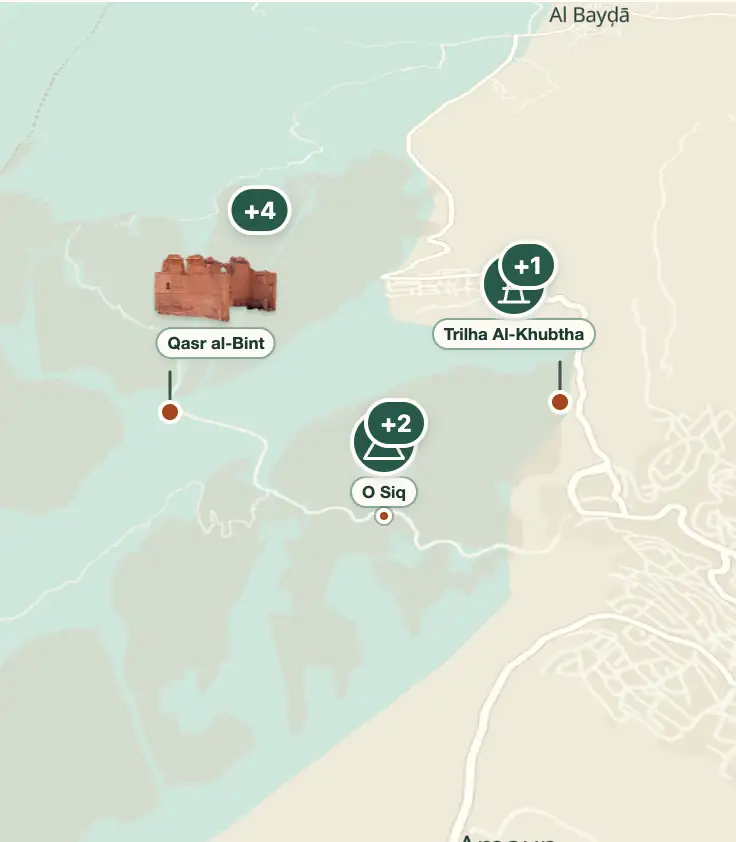
© OpenStreetMap · OpenFreeMap · © OpenMapTiles
Explore the map, read about the other places and plan your travel days in the app.
Open the appWhat to see
Petra: The basin and the escarpment
The rock is Umm Ishrin and Disi sandstone, streaked with iron and manganese oxides that produce the walls' red, purple, and yellow bands; soft enough to be carved with a chisel and tough enough to last two thousand years. Wadi Musa, the village that serves the site, is terraced on the slope between roughly 1,000 and 1,200 m and holds nearly all the hotels, restaurants, ATMs, and the bus stop.

The Siq
A gorge about 1.2 km long with walls up to 180 m, functioning as the ceremonial entrance to the city. Look for the original Nabataean paving in a few stretches, the empty votive niches, and the worn, life-size relief of a camel caravan on the left wall.
Check access
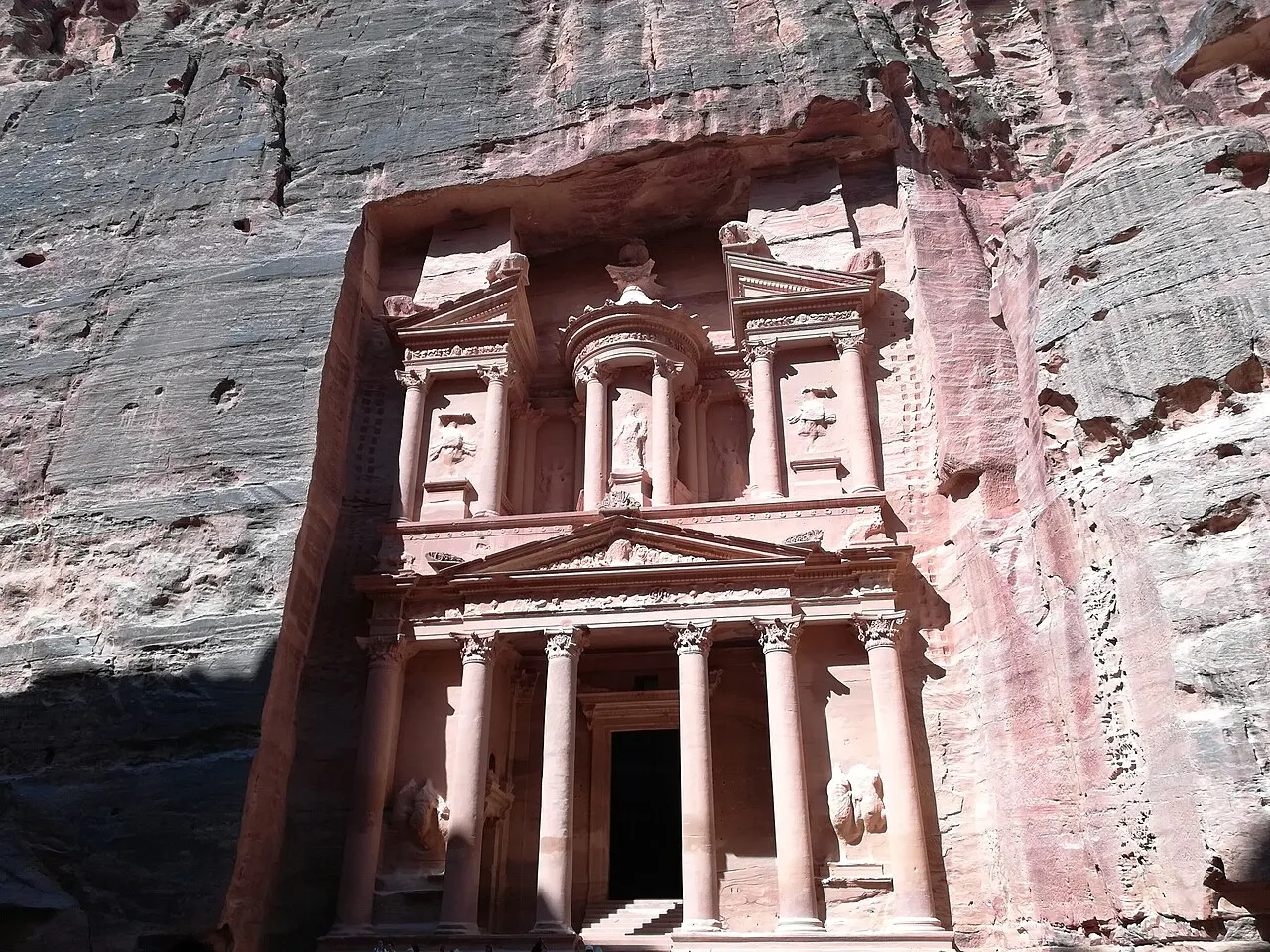
Al-Khazneh (the Treasury)
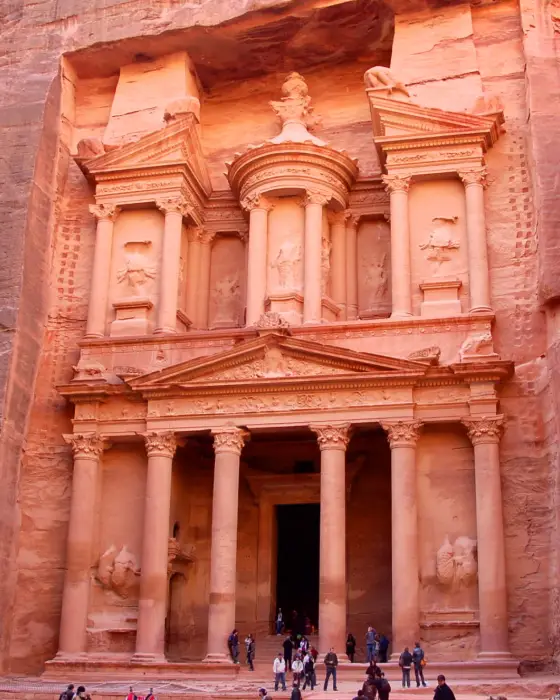
A facade about 39 m tall, carved between the 1st century BC and the 1st century AD, probably the tomb of King Aretas IV. The urn on top bears bullet marks from people who believed it held gold; behind the door there's only a square, empty chamber.
Check access

Ad-Deir (the Monastery)
A facade about 47 m wide by 48 m tall, atop roughly 800 steps. Likely a worship hall linked to King Obodas I; the name comes from crosses carved inside during the Byzantine period.
It's the largest facade at the site, about 47 m wide, and the roughly 800 steps of the climb are part of the visit. Go up early, with water, or save it for the second day of the ticket.
Check access
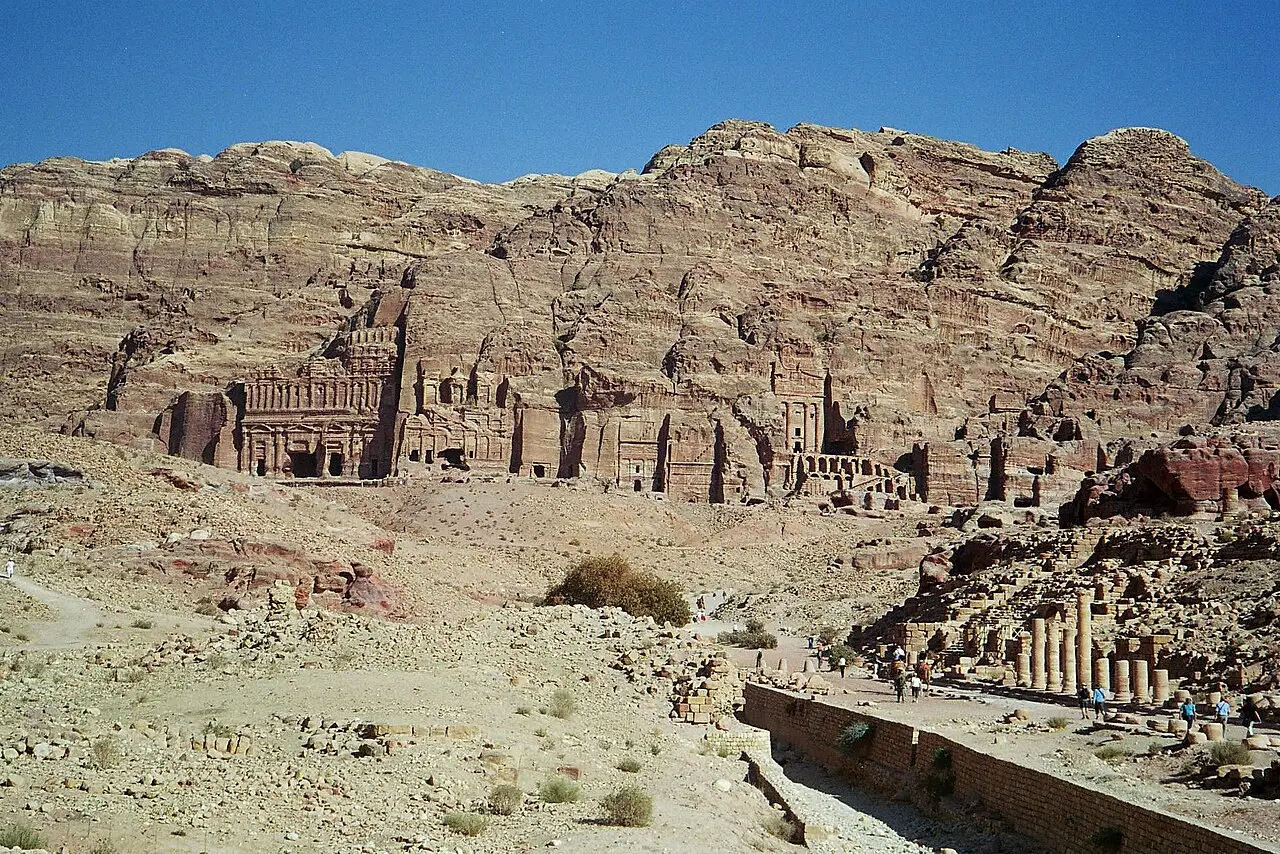
Al-Khubtha Trail
About 600 steps from the Royal Tombs up to the viewpoint looking down on the Treasury. It takes 1 hour 30 minutes to 2 hours round trip and is the best spot on the site in mid-morning, when the facade is lit up.
It's about 600 steps up to the viewpoint that looks down on the Treasury, a 1 hour 30 minute to 2 hour round trip, and mid-morning is when the facade is lit.
Check access

Royal Tombs
A row carved into the face of Jabal al-Khubtha: the Urn Tomb, converted into a church in 446 with a Greek inscription painted on the wall, the Silk Tomb, the Corinthian Tomb, and the Palace Tomb. Late-afternoon light is what reveals the streaks in the stone.
Check access
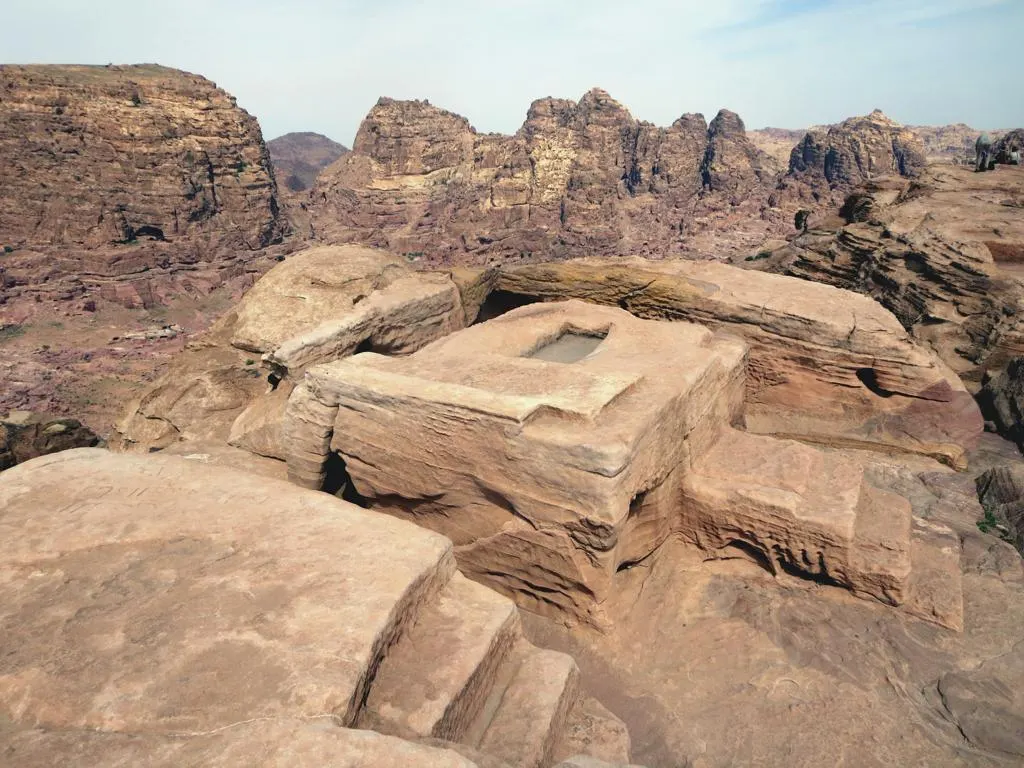
High Place of Sacrifice
A platform on Jabal Madbah, at about 1,035 m, with two 6-meter obelisks left standing when the rest of the summit was chiseled away. It has an altar, a drainage channel, and the most complete view of the basin.
It's worth it for the most complete view of the basin and the two 6-meter obelisks left standing when the rest of the summit was chiseled away. Go up early, before the heat.
Check access
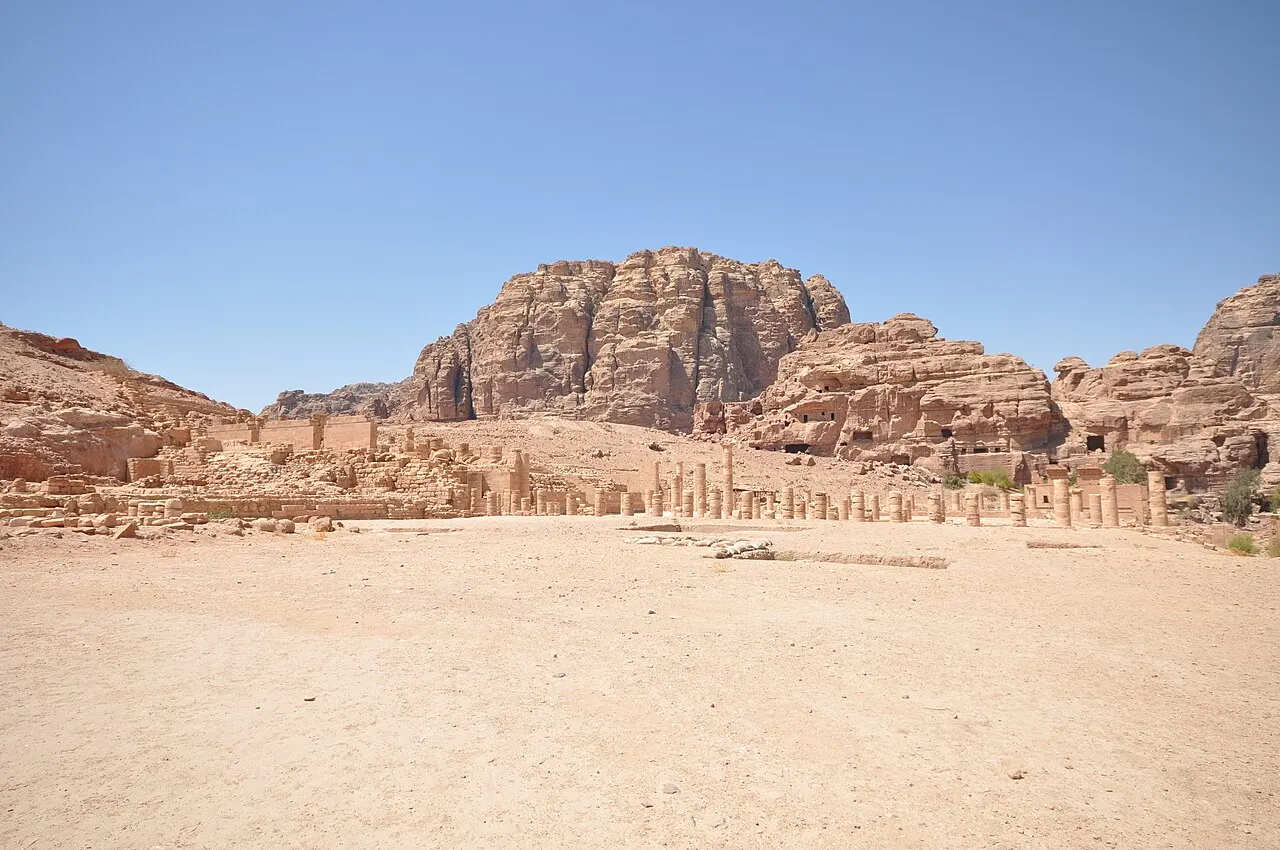
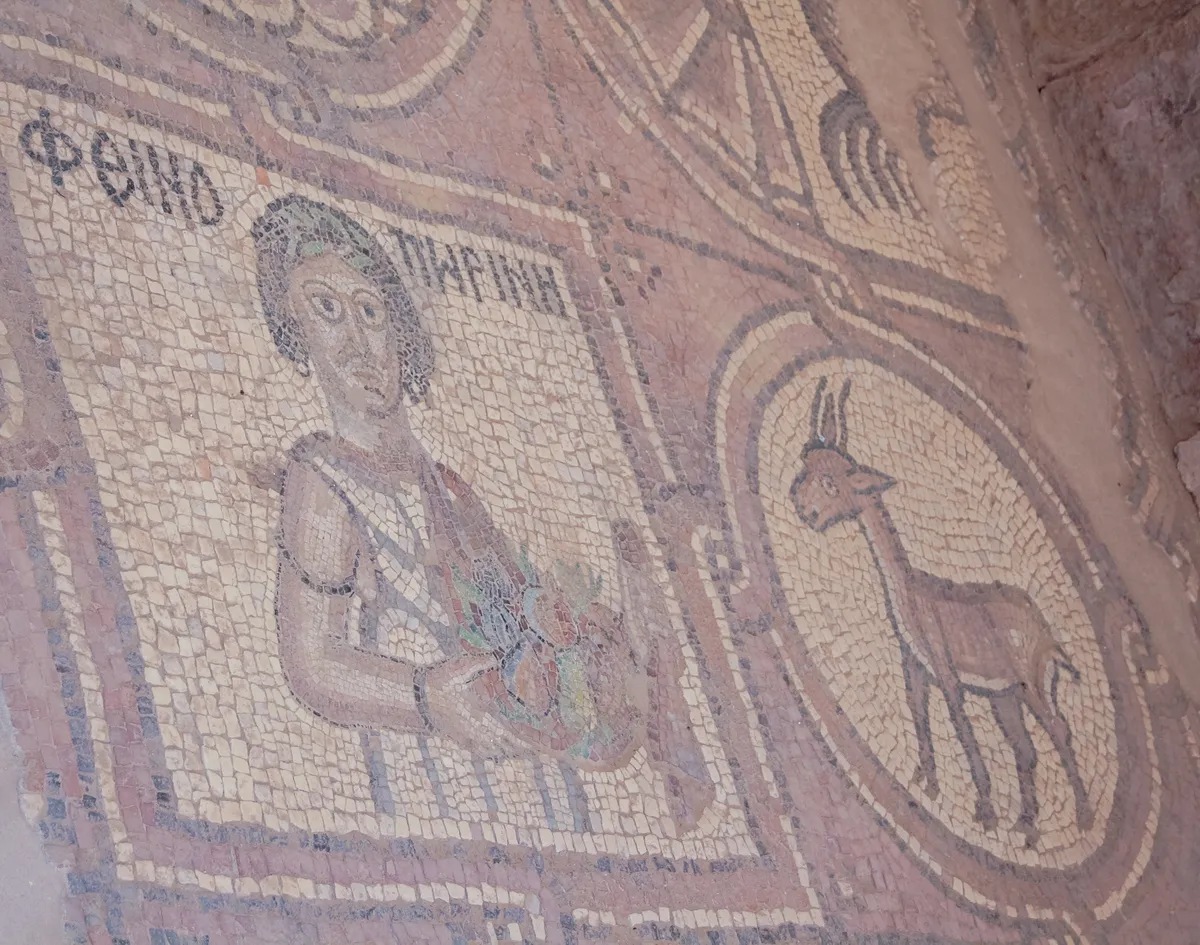
Byzantine Church
The Byzantine Church, in the city center, holds mosaics of animals and the seasons on the floor, ruined since a likely 6th-century fire.
It's worth it for the floor mosaics, and it's seen quickly, on the way through the Nabataean city center.
Check access

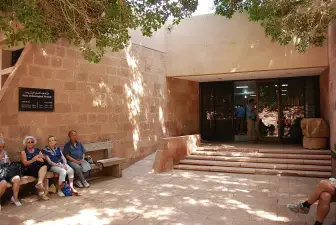
Petra Museum
Opened in 2019 beside the Visitor Center, it brings together archaeological finds, Nabataean pottery and explanations of Petra’s water system. Admission is free; the museum has its own hours, different from the park’s opening, so plan a visit on your arrival afternoon or after the walk.
It's worth it as an introduction to the site: it shows the Nabataean pottery and the water system you later see in the walls, for free, next to the Visitor Center.
Check access

Theater
Carved into the rock in the 1st century, with 45 rows and an estimated capacity of 4,000 to 8,500. The Romans expanded it by cutting into earlier tombs, whose chambers stayed open and visible on the back wall.
The theater sits right on the path, on the Street of Facades, and takes only ten minutes: it's 45 rows cut into the rock in the 1st century, and on the back wall, the tomb chambers the Romans sliced through when they expanded it. It's worth it as a break, with no detour at all.
Check access
Nilo’s itinerary
Start with the basic programme and choose extensions for the time you have.
Plan my days in the app ↗Day 1 · The Siq and the facade
Enter at opening, 6am in summer or 6:30am in winter according to the official calendar, and walk the 800 m of Bab as-Siq.
Take your time through the Siq: it's worth noticing every detail carved into the rock rather than rushing the 1.2 km to the facade.
Reach the Treasury before 8am and continue down the Street of Facades to the theater, still in shade.
Climb the Al-Khubtha trail in the morning, when the light favors the view down onto the Treasury.
Walk back through the Siq at dusk and, if it's a Petra by Night evening (Sunday to Thursday), stay to see the gorge lit by candles.
Day 2 · The heights and the Nabataean center
Enter again at the seasonal opening time and head straight to the city center without stopping at the Treasury.
Make the climb to the Monastery, about 800 steps in 45 to 60 minutes, and continue on to the two viewpoints over Wadi Araba.
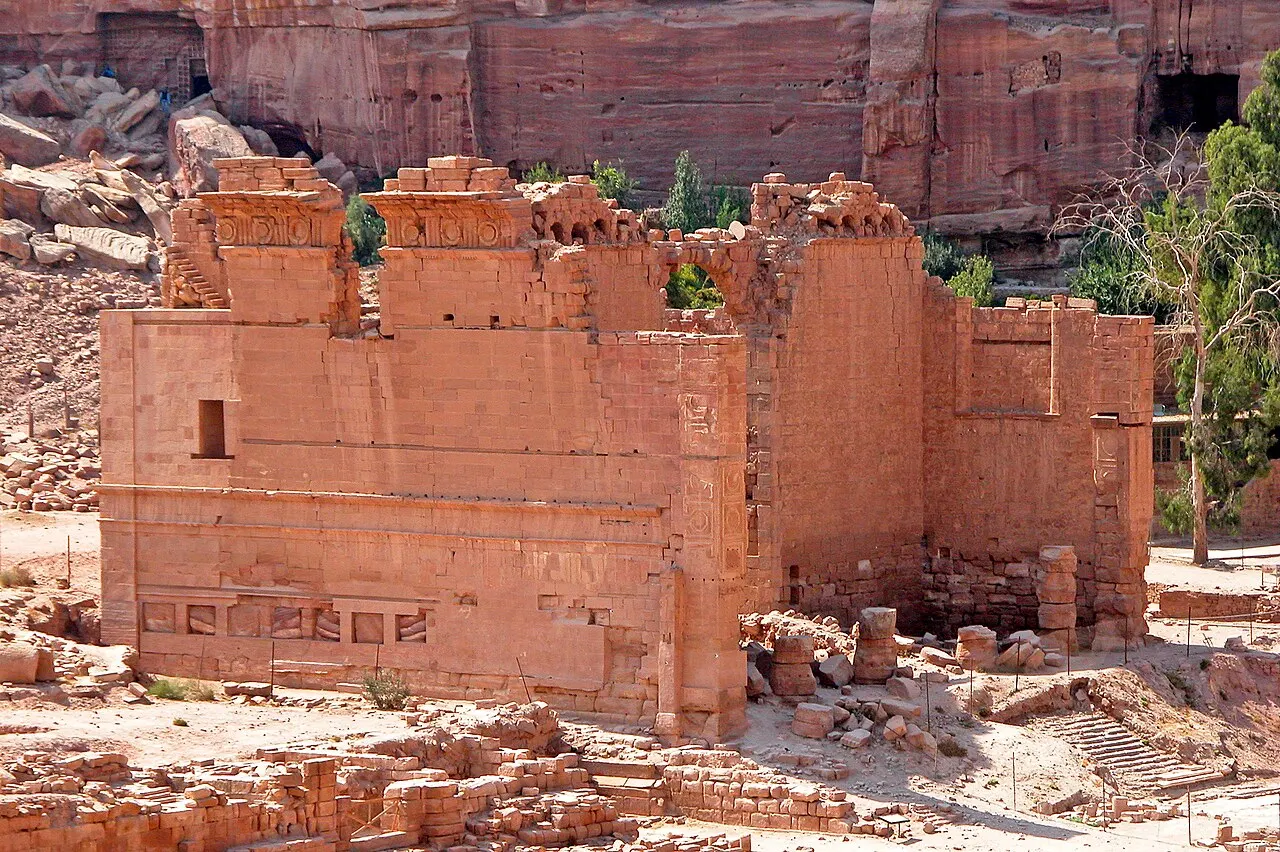
Come down for lunch at the Basin restaurant or eat what you brought; save the afternoon for the Byzantine Church, the Great Temple, and Qasr al-Bint.
After descending from the Monastery and visiting the basin, choose your return route with your guide or the Visitor Center: the Umm Sayhoun access is in the northern sector and still requires walking to reach it. Arrange transport to Wadi Musa before leaving that way.
Finish at the Petra Museum, free, next to the Visitor Center.


Food
 AI illustration
Mansaf
The national dish: lamb cooked in jameed, dried sheep's yogurt reconstituted, served over rice and shrak bread. Eaten with the right hand around a shared tray, at weddings and Friday lunches.
 AI illustration
Zarb
Meat and vegetables roasted for hours in an oven buried in sand, a Bedouin tradition served at camps and at a few restaurants in Wadi Musa and Umm Sayhoun. Usually needs same-day notice, in the morning.
 AI illustration
Maqluba
Maqluba, “upside down” in Arabic, is the pot of rice, eggplant, potato and chicken that's flipped whole onto the platter when served. It's a common home-cooked lunch and appears on almost every menu in the village.
 AI illustration
Galayet bandora
Tomato sautéed with olive oil, garlic, and pepper, served bubbling in a small metal pan, with bread to scoop it up. The cheap, everywhere dish of the region.
 AI illustration
Mezze
Hummus, eggplant mutabbal, tabbouleh, falafel, foul, and pickles arrive together before the main course. At Wadi Musa hotels it comes buffet-style; at smaller places, at the table, by the portion.
 AI illustration
Shrak
Thin bread baked on the domed saj griddle, folded in four and used as a utensil. It shows up at almost every meal and is the base mansaf is built on.
 AI illustration
Sage and mint tea
Shai bi maramiya and shai bi na'na, served very sweet in a small glass; the Bedouin stalls inside the site charge 1 to 2 JOD. The glass tends to arrive before you order it.
 AI illustration
Knafeh nabulsieh
Kadaif or semolina pastry over cheese, baked on a tray and drenched in syrup, sold by weight and cut on the spot. A late-afternoon dessert at the sweet shops on the main street.
Where to eat
- Al-Wadi Restaurant · Tourist Street · $
Mansaf, maqlouba and a range of grills in a gray stone dining room, neighborhood prices and a short line.
Source · 2026-09-28
- My Mom's Recipe Restaurant · Tourist Street · $$
Jordanian cooking in an updated Bedouin style, open all day, 10am to 11pm.
Source · 2026-09-28
- The Cave Bar · Tourist Street, next to the Visitor Center · $$
A bar and Arabic small plates inside a 2,000-year-old Nabataean tomb, marketed as the oldest bar in the world; open 1pm to midnight.
Source · 2026-09-28
$: up to 3 JOD · $$: 3-10 JOD per dish · $$$: above 10 JOD, or the bar inside the site · 2026-09-28
Day trips

Wadi Rum
Wadi Rum is about 110 km south, 1 hour 45 minutes by car: a desert of sandstone and granite with Bedouin camps, climbing and Jabal Umm ad-Dami, the country's highest point. Admission costs 5 JOD, is included in the Jordan Pass, and it's worth spending a night there.

Little Petra and Beidha
8 to 10 km north, a 20-minute taxi ride: Siq al-Barid, a caravan outpost with Hellenistic frescoes preserved on the ceiling of a biclinium, and the Neolithic village of about 7000 BC next door. Free entry.

Shobak and Dana Reserve
The 1115 Crusader castle sits 35 km north (30 min), and the Dana reserve 60 km away (1 hour), with 1,200 m of elevation change between the plateau and Wadi Araba. Both fit into one day on the King's Highway.
Where to begin
The Siq and the facade
Enter at opening, 6am in summer or 6:30am in winter according to the official calendar, and walk the 800 m of Bab as-Siq.
The heights and the Nabataean center
Enter again at the seasonal opening time and head straight to the city center without stopping at the Treasury.
The empty valleys
Climb to the High Place of Sacrifice via the staircase near the theater, about 45 minutes of steps, and see the two 6-meter obelisks at the top.
Money
The currency is the Jordanian dinar (JOD), pegged to the dollar since 1995 at about 0.709 JOD per US$1: meaning 1 JOD is worth about US$1.41 and about R$7.80 in 2026. The dinar splits into 100 piastres or 1,000 fils, and it's common to hear street prices quoted in piastres, which forces a mental conversion before agreeing to anything. Current ranges: coffee or tea 1–2 JOD, falafel sandwich 0.50–1 JOD, a meal with mezze 8–15 JOD, hotel buffet 20–25 JOD, midrange double room 50–90 JOD, taxi within Wadi Musa 2–5 JOD, licensed guide 50–60 JOD per half day. The entry ticket is the most expensive item of the day: 50 JOD for one day, 55 for two, and 60 for three, for anyone spending at least one night in Jordan. Same-day entries and exits pay 90 JOD, and children under 12 don't pay. The Jordan Pass, which must be bought before departure, costs 70, 75, or 80 JOD depending on days in Petra, covers more than 40 sites, and provides a waiver of the 40 JOD visa fee for eligible travelers who buy it before arrival and stay at least two full nights, according to the current official FAQ. The pass is not a visa: check the requirements for your nationality and entry point before buying. Cards work at hotels and larger restaurants; inside the site, at the Bedouin stalls and in taxis, bring cash. A 10% tip is standard when there's no service charge.
Getting there and around
From Amman, 235 km and three hours of driving to Petra
Queen Alia International Airport (AMM), south of Amman, lies about 235 km (3 hours) away by road. Aqaba's airport (AQJ), on the Red Sea, is about 125 km (2 hours) away, and is the shorter route in. The JETT company links Amman to Wadi Musa with one daily bus leaving around 6:30am from the 7th Circle terminal, taking about 4 hours and costing around 11 JOD, with a return trip in the late afternoon. Book ahead, since it's a single bus and it doesn't get bigger because you showed up. Shared minivans connect Wadi Musa to Ma'an, Aqaba, and Wadi Rum, leaving when full and charging 5 to 10 JOD. A private taxi from Amman runs 65 to 90 JOD, and hotels arrange vans to Wadi Rum and the Dead Sea. By rental car there are two routes: the Desert Highway, fast and straight (3 hours), and the King's Highway, passing through Madaba, Karak, Dana, and Shobak in 5 to 6 hours.
Nothing is flat: the village drops 200 m
Wadi Musa is hilly, and the local taxi fare should be agreed before departure. Inside the park, walking is the main way to visit, with electric carts and animal services on some stretches. From the gate to the Treasury and back is about 4 km; extending to the basin takes the route to about 8 km, before the climb to the Monastery. The official Visitor Center–Treasury club car table lists 15 JOD one way and 25 JOD round trip; confirm at the counter how the charge applies to your group and the return time, without assuming the price covers an exclusive vehicle. Besides the main gate, the Umm Sayhoun one gives access to the Royal Tombs sector, but it doesn't eliminate the steps between the basin and the Monastery.
Safety
Jordan has one of the lowest violent crime rates in the region, and the real risk in Petra is falls, heat, and water, not robbery. The Al-Khubtha, Monastery, and High Place of Sacrifice trails have uneven steps and unprotected stretches above drops, and serious accidents almost always happen to people who leave the marked path chasing a photo. Between November and March, rain on the plateau turns into a flash flood inside the Siq within minutes: the 1963 flood killed about twenty French tourists, and the flood of November 2018 forced the evacuation of about 3,700 people from the park; when management closes the gorge for expected rain, there's nothing to negotiate. In summer, heatstroke and dehydration are the most common reasons for a rescue. Commercial hassling is constant and friendly at the same time, and a repeated “la, shukran” ends the matter. Women traveling alone report insistent romantic advances from some guides and horse handlers, and the practical response is to book services at the hotel desk or the Visitor Center, never on the trail. Tourist police are stationed at the Visitor Center, and the emergency number in Jordan is 911.
Etiquette tips
Clothing that covers shoulders and knees
Wadi Musa is a conservative village outside the tourist circuit. Inside the site no one minds shorts, but on the main street, in the markets, and when entering anyone's home, pants and covered shoulders avoid awkwardness, for men as well.
The standard is two glasses of tea; a third invites you to stay
When a Bedouin offers tea, a flat “no” sounds harsh; a hand on the chest and a shukran does the job. If you accept, two glasses is standard, and a third signals you're staying to talk.
Right hand for eating and handing things over
Food, money, and documents pass with the right hand. At a shared mansaf, you eat with your right hand, from the part of the tray in front of you, never from the middle.
Photographing people requires asking
The Bedouin who work at the site get photographed all day long; many charge for it, and many women say no. Ask first: “mumken sura?” usually works, and accept a refusal.
Friday: shops close between 11:30am and 1:30pm
On Fridays, the midday prayer empties the shops of Wadi Musa between about 11:30am and 1:30pm. Hotels and the site operate as usual, but almost everything else closes.
Alcohol exists, but discreetly
Some hotels and two or three bars sell beer and arak; drinking in the street or entering the site drunk is a clear social offense. During Ramadan, foreigners also avoid eating, drinking, and smoking in public during the day.
Mistakes to avoid
Buying only a one-day ticket
Many people buy the one-day ticket and only then discover the size of the site. Just going from the gate to the Treasury and back is about 4 km on foot; reaching the basin and back makes 8 km, the Monastery is about 800 steps farther up, and the park covers 264 km².
Arriving at 10am with the tour groups
Arriving at 10am along with the tour buses. At opening time the gorge is almost deserted, but from 9:30am on it fills with groups and noise, and there's a line to photograph the facade.
The Jordan Pass only waives the visa fee if bought before the trip
Buying the Jordan Pass after arrival prevents you from using its visa-fee waiver. The current official FAQ requires purchase before arrival and at least two full nights in Jordan for eligible travelers. Check the rules for your nationality and border crossing; the pass does not replace a visa.
Underestimating water and sun in the basin
Underestimating water and sun. There's no shade in the basin between 11am and 3pm, the stalls charge 1 to 2 JOD a bottle, and 3 liters per person is the minimum in summer. Hats and sunscreen aren't sold inside at a reasonable price.
Agreeing to “just one ride” without fixing the price
Agreeing to “just one ride” on horse, donkey, or camel without fixing the price, then arguing halfway up the stairs. The stretch to the Siq is included in the ticket, with a 3-to-5-JOD tip; any other route gets negotiated beforehand, in cash and out loud.
Useful phrases
أهلاً وسهلاً (ahlan wa sahlan)
Hello / welcome: just “ahlan” works fine, and the reply is “ahlan bik”
شكراً (shukran)
Thank you; the reply is “afwan”, you're welcome
لا، شكراً (la, shukran)
No, thank you: with a hand on the chest, the standard polite refusal
كم الحساب؟ (kam al-hisab?)
How much is the bill? For the price of an item, “bikam hada?”
بدي مي، لو سمحت (biddi mayy, law samaht)
I'd like water, please
إن شاء الله (inshallah)
God willing: also used for “maybe” and to postpone a commitment without saying no
Where to stay
- Next to the Visitor Center (Tourist Street) · Getting through the gate at 6am without relying on a taxi · $$$: It sits a few minutes' walk from the Visitor Center and the Siq, in the priciest stretch of the village. Whoever sleeps here is first through the gate at opening time, ahead of the heat and the line.
- Central Wadi Musa (Shaheed Street) · A first trip, with restaurants and shops on foot · $$: It holds most of the restaurants, the currency exchange and the bus stop, ten to fifteen minutes' walk from the gate.
- Upper Wadi Musa · A tight budget, willing to walk · $: Climbing the hill from the center, prices drop because the walk back is steep and a return taxi becomes part of the bill; a good base for anyone not rushing in the morning.
- At-Taybeh · Themed lodging, away from the bustle · $$$: A fifteen-minute drive from the gate, it is a former village converted into a resort with a hammam and a pool; without a car or a pre-arranged taxi, the night feels isolated.
$: simple guesthouse, 15-30 JOD · $$: mid-range hotel, 50-90 JOD · $$$: above 90 JOD, a resort or a view of the gate · 2026-09-28
Districts
Wadi Musa
The village that serves the site, terraced on the slope between roughly 1,000 and 1,200 m, with nearly all the hotels, restaurants, ATMs, and the bus stop. The lower part, near the Visitor Center, is the priciest; going up the slope prices drop and the walk back is steep.
Ain Musa
The upper entrance to the village, 4 km before the gate, where a small dome shelters the spring that tradition attributes to Moses's staff. It's also the historic source that supplied the Nabataean city by gravity.
Umm Sayhoun
A village built by the government in 1985 to resettle the Bdoul tribe, who lived in the site's caves. It's also where the Umm Sayhoun gate is, which provides access to the northern sector and the Royal Tombs.
Bab as-Siq
The 800 m between the Visitor Center and the mouth of the gorge, with the Djinn Blocks, the Obelisk Tomb, and the start of the Nabataean channel. It's where the horses stand, and where most people underestimate how far they still have to go.
The Nabataean city center
The open basin after the Siq: the Roman colonnaded street, the Great Temple, Qasr al-Bint, the theater, and the slope of the Royal Tombs. It's the only flat stretch of the site and holds the tea stalls and the two restaurants inside the site.
Wadi Farasa and the High Place
The southern valley and the climb to the High Place of Sacrifice, on Jabal Madbah, with altars, obelisks, the Lion Fountain, and the Tomb of the Roman Soldier. A 3-to-4-hour circuit, almost always empty.
The Ad-Deir plateau
The summit to the northwest, reached by about 800 carved steps, where the Monastery facade and the viewpoints over Wadi Araba are found. There are tea stalls at the landings of the climb and at the two viewpoints at the end.
Beidha and Siq al-Barid
8 to 10 km to the north, a 20-minute taxi ride: see the rare frescoes of the biclinium before climbing up to the Neolithic village next door.
History
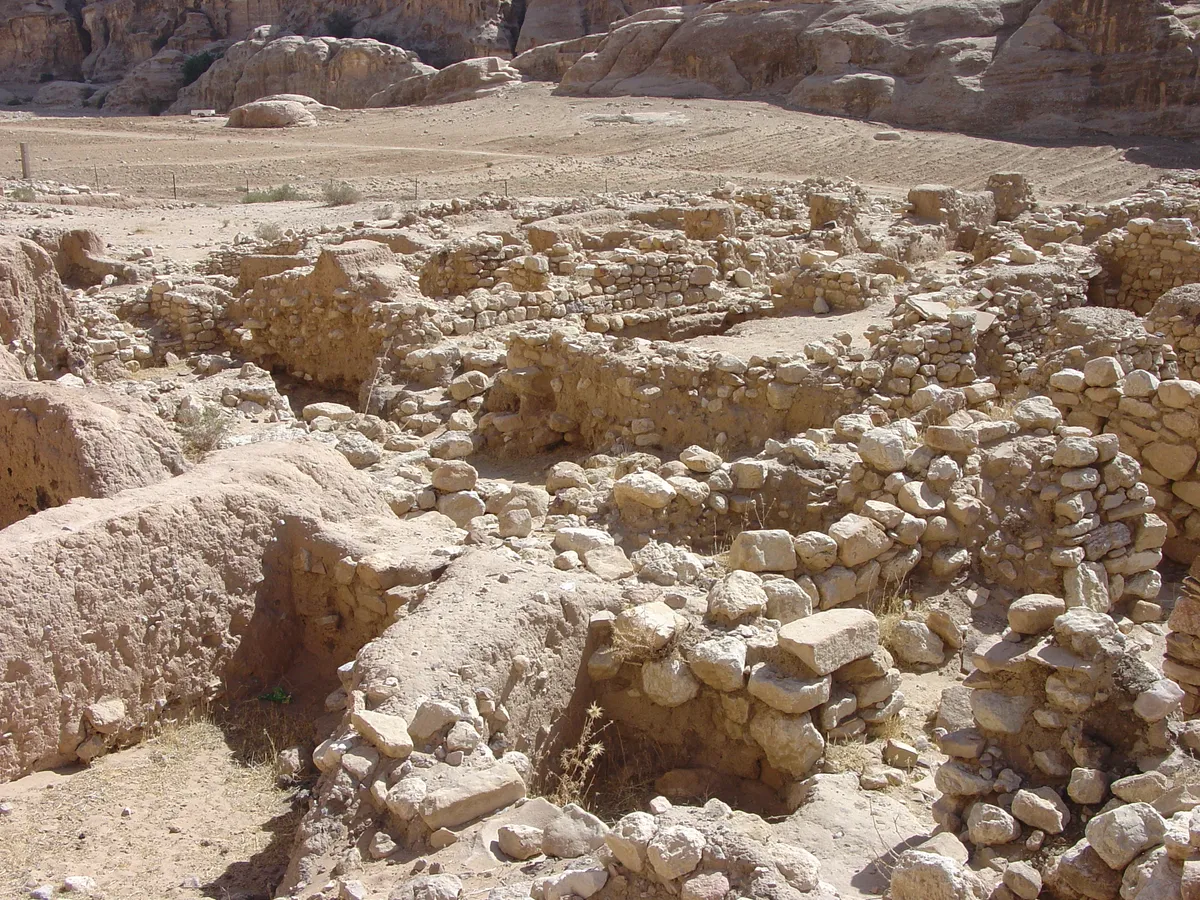
c. 7000 BC · Beidha, a Neolithic village
8 km to the north, the settlement of Beidha gathers houses first circular and later rectangular, one of the earliest experiments in settled living in the Levant. It's excavated by Diana Kirkbride starting in 1958.
7th c. BC · Edom atop the rock
The Edomites occupy the Umm al-Biyara plateau above the valley, living off herding and copper. A seal bearing the name of King Qos-Gabar, a contemporary of Ashurbanipal, was found there.

312 BC · The Nabataeans enter written history
Diodorus Siculus records two Greek expeditions by Antigonus I against “the rock” of the Nabataeans, who resist and recover the looted goods. It's the first mention of the people at this place.

100 BC–100 AD · Peak of the kingdom
Under Obodas II, Aretas IV (9 BC–AD 40) and Rabbel II, Petra controls the frankincense and myrrh from Yemen and Oman on their way to Gaza. The population reaches an estimated 20–30 thousand people, and the great facades are carved.

106 AD · Roman annexation
Trajan absorbs the kingdom into the province of Arabia Petraea without any source recording a battle. The Via Nova Traiana links Bostra to Aqaba and begins diverting traffic toward Palmyra and the Red Sea.

130 AD · Hadrian's visit
The emperor passes through the city, which appears on coins as Hadriane Petra. The rock-cut theater, seating 4,000 to 8,500, is expanded during this period, cutting into older tombs.

363 · The earthquake that shrank Petra
A quake on May 19 brings down much of the freestanding construction and wrecks the water channels. The city stays inhabited, but shrinks to the size of the water it can still capture.

5th–6th c. · Byzantine Petra
Petra becomes a bishopric, the Urn Tomb is consecrated as a church in 446, and a basilica with mosaics operates on the north slope. A fire there chars the papyrus archive; a new earthquake in 551 closes the cycle.
1116 · Crusader castles
Baldwin I builds Al-Wu'aira, called Li Vaux Moise, and a tower at Al-Habis to watch the route between Damascus and Cairo. Saladin takes the region in 1189.
1812 · Burckhardt crosses the Siq
The Swiss Johann Ludwig Burckhardt, posing as Sheikh Ibrahim, convinces a guide to take him to the Tomb of Aaron and passes through the gorge on August 22. He's the first European to describe the place in seven centuries.

1985–2026 · Heritage listing, relocation, and tourism
UNESCO inscribes Petra in 1985, and that same year the Bdoul tribe is moved from the caves to Umm Sayhoun. In 2007 comes the “new wonder” title, in 2009 the PDTRA takes over management, and visitor numbers return to around 1 million a year after the 2020–2021 collapse.

Complete history
The Nabataeans and the incense route, from 312 BC
Petra was born at a point on the incense route with two advantages: the Ain Musa spring and a gorge that was easy to defend. The Nabataeans, Arabs who were originally nomads, appear in Greek texts in 312 BC, when two expeditions sent by Antigonus I failed against “the rock” where they stored their goods. What they sold came from the south: frankincense from Dhofar and Hadramawt, myrrh, and Indian spices landed on the Red Sea. Petra was the station where caravans changed animals, paid duties and drank, and the kingdom's trade secret was knowing where there was water in a desert that its competitors couldn't cross.
Between 100 BC and AD 100, Petra gains a theater, a colonnaded street and tombs
Between 100 BC and AD 100, caravan revenues paid for the monumental city. Under Obodas II and especially Aretas IV (9 BC–AD 40), Petra gained its theater, colonnaded street, Qasr al-Bint and great facade tombs, in an architecture combining Greek orders, plain-block Nabataean capitals and Egyptian massing. It also gained a hydraulic system with dams, more than 100 cisterns and ceramic pipes bringing water by gravity from the Ain Musa spring along the Siq. The estimated population reached 20 or 30 thousand in a valley with no permanent river. The script used in its inscriptions, Nabataean Aramaic, is the direct ancestor of the Arabic alphabet.
Trajan annexed the kingdom in 106
In 106 AD Trajan annexed the kingdom, and Petra became the capital of the province of Arabia Petraea. The Via Nova Traiana, the growth of Palmyra, and shipping through the Red Sea gradually pulled trade away from the land route; the city stayed rich on administration, not on caravans. The earthquake of May 19, 363, brought down half the freestanding buildings and destroyed the channels, and from then on Petra is a city that keeps shrinking, occupying less and less of the valley it had once carved.
The Christian phase, hard to see from afar
In the 5th century, Petra was a bishop's seat: the Urn Tomb was consecrated as a church in 446, and a basilica with mosaics of animals and the seasons stood on the northern slope until a fire, probably in the 6th century, charred the archive it held. Those are the 152 papyrus scrolls found in 1993, which record inheritances, marriages and land disputes in Byzantine Petra. After the earthquake of 551 and the Islamic conquest in the 630s, the place drops out of the written record. The Crusaders arrived in 1116, when Baldwin I built the castle of Al-Wu‘aira and a tower on Al-Habis, and lost both to Saladin in 1189.
“Rediscovered” in 1812
For Europe, Petra was “rediscovered” on August 22, 1812, by Johann Ludwig Burckhardt: for the tribes of the region, it was never lost. In 1845 John Burgon's poem fixed the phrase “a rose-red city, half as old as time”, written by someone who hadn't yet seen it. The 20th century brought systematic excavations, Jordan's independence in 1946, UNESCO inscription in 1985, and, that same year, the removal of the Bdoul from the caves to Umm Sayhoun. Since being named a “new wonder” in 2007, tourism has become practically the region's only economy: about 1 million visitors a year, a near-total collapse in 2020–2021, and a recovery that once again ran into the regional effects of nearby conflicts starting in 2023.
The Bedouin of the region always knew about Petra; the Swiss Burckhardt, in 1812, was the first European to describe it in seven centuries.
Geography and shape of the city
The basin and the escarpment
Petra sits in a basin in the Sharah mountains, on the escarpment separating the Jordanian plateau from Wadi Araba, the depression that continues the Rift Valley down to the Red Sea. The site lies between 800 and 1,100 m of altitude, and Wadi Musa, the gateway village, around 1,100 m; a few kilometers to the west the land drops more than a thousand meters to the Araba, which explains the constant wind and the temperature gap between the top of the village and the bottom of the valley, always warmer.
The sandstone and its bands
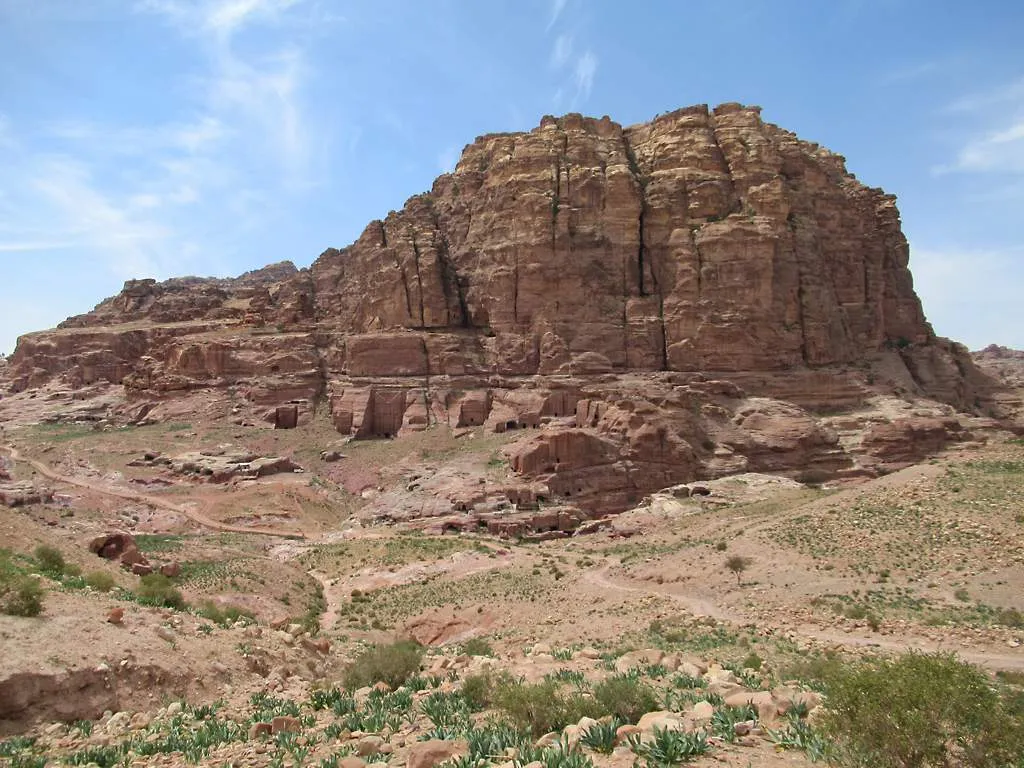
The rock is Umm Ishrin and Disi sandstone, streaked with iron and manganese oxides that produce the red, purple, and yellow bands on the walls: soft enough to be carved with a chisel, hard enough to last two thousand years.
The Siq and the water engineering
The natural access is the Siq, a tectonic fissure about 1.2 km long, widened by water, 3 to 12 m wide with walls up to 180 m, which the Nabataeans paved and fitted with an open channel on one side and ceramic pipes on the other. The city's entire engineering is hydraulic: more than 100 cisterns, dams, and the Al-Muthlim tunnel, cut to divert Wadi Musa's flash floods away from the gorge, a necessary precaution in a place that gets 150 to 200 mm of rain a year, almost all of it between November and March and almost always at once.
In the Siq, the walls reach up to 180 m in height, and the passage narrows to as little as 3 m wide.
Culture
The population is Bedouin, in three tribes
The region's population is Bedouin and organized into three main tribes: the Bdoul, who used to occupy the site's caves and claim Nabataean descent; the Liyathnah, the majority in Wadi Musa; and the Ammarin, to the north, around Beidha. In 1985 the government moved the Bdoul into concrete houses in Umm Sayhoun, a few kilometers from the valley where they were born, and most of the park's jobs (guides, horse handlers, vendors, guards) went to these families. In 2008 UNESCO inscribed the “cultural space of the Bedu in Petra and Wadi Rum” on its intangible heritage list, recognizing oral poetry, the single-string rababa, goat-hair weaving, and the knowledge of herding and routes.
Nabataeans: inscriptions, coins, and architecture, without books
No literature survives from the Nabataeans: what's left are inscriptions, coins and architecture. The Nabataean Aramaic carved into the niches of the Siq is the graphic ancestor of written Arabic, and the city's pre-Islamic religion centered on Dushara and al-Uzza, represented by rectangular blocks of stone, the betyls, rather than human figures, which explains the many seemingly empty niches in the walls. The living culture today is Jordanian: coffee with cardamom in handleless cups, Nabati poetry recited at weddings, dabke at parties in Wadi Musa and crafts that range from Bedouin silver to colored-sand bottles assembled with a funnel in front of the customer.
The Treasury on screen: Indiana Jones, The Mummy, and Transformers
Petra is also an image before it's a place. The Treasury's facade plays the Grail temple in Indiana Jones and the Last Crusade (1989), reappears in The Mummy Returns (2001) and Transformers: Revenge of the Fallen (2009), and Jordan's Royal Film Commission built much of the country's promotion on that instant recognition. The effect shows on the ground: it's estimated that most of the flow concentrates in the site's first 3 km, and the trails to the High Place, Umm al-Biyara, and Sabra sit empty on the very same day there's a line to photograph the Treasury.
Dushara and al-Uzza were worshipped as blocks of stone, the baetyls, not as statues.
Festivals and events
 AI illustration
Ramadan and the two Eids
The lunar month falls in February in the coming years (around early February in 2027) and changes everything: restaurants closed during the day, life starting after sunset, the site empty in the afternoon. Eid al-Fitr and Eid al-Adha fill hotels with Jordanian families.

Petra by Night
From Sunday to Thursday, from 8:30pm to 10:30pm, about 2,000 candles light up the Siq, and at the Treasury square the facade gets a narrated projection-mapping show, a format adopted in May 2025. The ticket costs about 30 JOD, sold separately at the Visitor Center; it isn't covered by the Jordan Pass and is only valid for those who also have a daytime ticket.
 AI illustration
Petra Desert Marathon
A trail race in September, starting and finishing at the site itself, with 10K, half, and full marathon distances. It closes parts of the park on race morning and fills the village's hotels.
 AI illustration
Jordan Trail season
March–April and October–November draw the most guided hikes along the 675 km trail that crosses the country. The four-day Dana–Petra leg, arriving at the site from above, is the most sought-after stretch.
 AI illustration
Olive harvest
October and November empty Wadi Musa during the day: families head up to the terraces, and the new olive oil shows up in markets and hotel tables a few weeks later.
Books and films
Married to a Bedouin, by Marguerite van Geldermalsen (2006)
The New Zealander who married a Bdoul Bedouin in 1978 and lived in a cave at the site until the 1985 relocation. It's the closest account we have to an inhabited Petra.
Petra and the Lost Kingdom of the Nabataeans, by Jane Taylor (2001)
An archaeological synthesis with field photography: who the Nabataeans were, how water reached the city, and what each facade was before it became an image.
Indiana Jones and the Last Crusade (1989)
The facade of the Treasury plays the Grail temple, and that scene is how many people recognize Petra before they arrive. In the film there's a maze of rooms behind the door; in the rock, there's a single empty chamber.
Frequently asked questions
Petra: Is it worth buying only the one-day ticket?
For anyone who wants to see more than the Treasury, no: the two-day ticket costs 55 JOD, only 5 more than the one-day. Going from the gate to the Treasury and back is already about 4 km on foot; reaching the basin and back makes 8 km, and the Monastery is about 800 steps farther up.
Petra: What's the closest airport?
Aqaba airport (AQJ), on the Red Sea, is about 125 km and 2 hours from Petra and is the shortest way in; from Amman it's 235 km and three hours by road.
Petra: How far is Wadi Rum, and what's there?
Wadi Rum is about 110 km south, 1 hour 45 minutes by car: a desert of sandstone and granite with Bedouin camps, climbing, and Jabal Umm ad-Dami, the country's highest point. Admission costs 5 JOD, is included in the Jordan Pass, and it's worth spending a night there.
Petra: How much to budget per day, with the ticket?
Budget 35–55 JOD a day on the economical side and 70–120 JOD for mid-range comfort, not counting the ticket, which is the priciest item: 50 JOD for one day, 55 for two, and 60 for three. The currency is the Jordanian dinar (JOD), pegged to the dollar: 1 JOD is worth about US$1.41 and about R$7.80 in 2026.
Petra: What's the best time to go?
Spring (March to May) and fall (September to November) are the comfortable seasons: daytime temperatures of 18 to 28 °C in the basin, clear skies and flowers on the slopes in March and April.