South Korea
Jeju
Jeju: Hallasan volcano, lava cones and caves, a basalt coast and the Olle trails on an island south of Korea
Days I'd stay four days in Jeju, with the first three nights in Jeju-si and the fourth in Seogwipo.
How the guide reaches this number
The first day is for the old capital and the 4·3 Peace Park, which explain the island; the second, for the east, with Manjanggul, the Haenyeo Museum and Seongsan Ilchulbong; the third, for Hallasan, with the reservation made the month before; and the fourth, for the waterfalls and coast of Seogwipo. Anyone with more time can add the west coast, from Yongmeori to Hyeopjae beach, in a day by car from Seogwipo, and Udo, preferably sleeping a night in Seongsan to catch the morning ferry. Fewer than four days forces a choice between Hallasan and the east.
4
Start with the basic programme and choose extensions for the time you have.
When April, May, October and November; from June to September the heat is humid, rainfall is higher and storms and typhoons are a risk, and in winter strong wind and snow on Hallasan change how you plan the trails.
How the guide reaches this number
Spring, from March to May, is the season of canola flowers and cherry blossoms and one of the best for the Olle trails. Summer, from June to August, is hot and very humid, with the season of beaches with lifeguards and a risk of storms and typhoons; rain also weighs on early autumn. October and November bring drier air and silvery grass on the oreum. Winter is milder than on the mainland, with few days below zero on the coast, but it is very windy and Hallasan is covered in snow: the official guide names Eorimok as the simplest trail for seeing snowy Hallasan, and the mountain roads call for care. In winter the tangerines are ripe. At Seongpanak, at 760 m, August is the rainiest month, and the weather up there changes faster than in town.
Per person/day Budget around KRW47,100; mid-range around KRW117,000; comfortable around KRW282,000 per person per day, based on spending reported by travelers to Budget Your Trip (checked October 2026).
How the guide reaches this number
Indicative figures, excluding travel to the destination.
Budget around KRW47,100; mid-range around KRW117,000; comfortable around KRW282,000 per person per day, based on spending reported by travelers to Budget Your Trip (checked October 2026). Indicative figures, excluding travel to the destination.
Per person per day: accommodation, meals, urban transport, visits and a small allowance for extras. Flights excluded; larger purchases vary. Editorial estimate, not a quote.
Salta · among the cheapestZermatt · among the priciest
Cheaper than 73% of them. The tick marks the median. Compared by the middle of each city’s daily range, converted at the 24 Sept 2026 exchange rate.
 What Nilo thinks
I'd recommend Jeju to anyone who likes walking slowly through a volcanic landscape, noticing how a people organizes itself with little good land and eating what the sea and the pasture give. The black stone is everywhere: in the low walls that outline the fields, in the traditional houses of Seongeup, still inhabited, and in the dol hareubang, the stone grandfathers with round hats that guarded the villages. The island's old nicknames speak of lots of stone, lots of wind and lots of women, and of houses without gates, where poles laid across stone pillars told passersby whether the entrance was open. At the table, I'd go after what exists only here, such as whole grilled okdom, seaweed momguk and buckwheat bingtteok. The commercial theme parks and museums scattered across the island I'd leave out: time goes further on an oreum or in a market.All of Jeju came out of eruptions, and a visit follows the path of the lava. On the coast, it formed the tuff cone of Seongsan, which rises from the sea, the hexagonal columns of Jungmun and the layered cliffs of Yongmeori, with pale-sand beaches and shallow water between them. Along this shore the haenyeo work, women divers who go down on a single breath for abalone and sea urchin and mark their position with orange buoys, and through it run the Olle trails, from village to village. Inland, the lava ran underground and left tubes such as Manjanggul, while Hallasan, always in view when the clouds allow, asks for a whole day and a reservation. The two cities share the work: Jeju-si keeps the market and what remains of the old capital, and Seogwipo sits among waterfalls that fall almost into the sea. The 1948 massacre left marks in villages, caves and beaches that now receive visitors, and the 4·3 Peace Park helps you recognize them.
Quick facts
- Population
- 662,792 registered residents in Jeju Special Self-Governing Province, which includes Jeju-si, Seogwipo and the smaller islands, according to the Korean Ministry of the Interior's resident registry (data from June 2026).
- Founding
- No single founding: the island was the seat of the ancient kingdom of Tamna, became a district of the Goryeo kingdom in 1105, became a separate province on August 1, 1946 and a Special Self-Governing Province on July 1, 2006.
- Country and region
- South Korea, Jeju Special Self-Governing Province, an island about 130 km off the south coast of the Korean Peninsula. The capital is Jeju-si, in the north; Seogwipo covers the southern half.
- Language
- Korean. The Jeju language, spoken mostly by older people, was classified by UNESCO in 2010 as critically endangered.
- Currency
- South Korean won (KRW).
- Time zone
- Asia/Seoul, UTC+9, no daylight saving time.
- Best time to go
- April, May, October and November; from June to September the heat is humid, rainfall is higher and storms and typhoons are a risk, and in winter strong wind and snow on Hallasan change how you plan the trails.
- Average cost per day
- Budget around KRW47,100; mid-range around KRW117,000; comfortable around KRW282,000 per person per day, based on spending reported by travelers to Budget Your Trip (checked October 2026). Indicative figures, excluding travel to the destination.
What’s new
Recent changes that affect the plan, with date and source.
- May 2026
Manjanggul reopened on May 30, 2026, after two years and five months closed, with a deck along the whole open section, reinforcement against rockfall and dimmer LED lighting. source
- Sep 2026
The Gwaneumsa trail reached the top of Hallasan again on September 24, 2026, after works on the stretch between Samgakbong and the summit, which was closed in August and September. source
- Aug 2026
In August 2026 the extension of the restriction on the circulation of outside vehicles on Udo took effect, with exceptions such as chartered 16-seat buses, electric or hydrogen rental cars, rental cars used by people with mobility difficulties and by island guests. source
- Mar 2026
The Jeju Fire Festival abolished the burning of the grass on Saebyeol Oreum; the March 2026 edition replaced fire on the hill with a light show. source
When to go
April, May, October and November; from June to September the heat is humid, rainfall is higher and storms and typhoons are a risk, and in winter strong wind and snow on Hallasan change how you plan the trails.
January
4° to 9°C
68 mm of rain
10 h 11 min of daylight
National holidays
Jan 1 – 3, 2027 · long weekend · New Year's Day
Jan 1, 2028 · New Year's Day
Jan 26 – 30, 2028 · long weekend · Lunar New Year, Lunar New Year, Lunar New Year
Source: Nager.Date. Holiday dates shift; check close to your trip.
February
4° to 10°C
57 mm of rain
11 h 01 min of daylight
National holidays
Feb 6 – 9, 2027 · long weekend · Lunar New Year, Lunar New Year, Lunar New Year
Source: Nager.Date. Holiday dates shift; check close to your trip.
March
7° to 13°C
91 mm of rain
11 h 58 min of daylight
National holidays
Feb 27 – Mar 1, 2027 · long weekend · Independence Movement Day
Mar 1, 2028 · Independence Movement Day
Source: Nager.Date. Holiday dates shift; check close to your trip.
May
15° to 22°C
96 mm of rain
Best time13 h 54 min of daylight
National holidays
May 1 – 5, 2027 · long weekend · Labour Day, Children's Day
May 13 – 16, 2027 · long weekend · Buddha's Birthday
Source: Nager.Date. Holiday dates shift; check close to your trip.
June
19° to 25°C
171 mm of rain
14 h 22 min of daylight
National holidays
Jun 6, 2027 · Memorial Day
Source: Nager.Date. Holiday dates shift; check close to your trip.
July
24° to 29°C
210 mm of rain
14 h 10 min of daylight
National holidays
Jul 17 – 19, 2027 · long weekend · Constitution Day
Source: Nager.Date. Holiday dates shift; check close to your trip.
August
25° to 30°C
272 mm of rain
13 h 24 min of daylight
National holidays
Aug 14 – 16, 2027 · long weekend · Liberation Day
Source: Nager.Date. Holiday dates shift; check close to your trip.
September
21° to 26°C
228 mm of rain
12 h 23 min of daylight
National holidays
Sep 11 – 14, 2027 · long weekend · Chuseok
Sep 14 – 19, 2027 · long weekend · Chuseok, Chuseok
Source: Nager.Date. Holiday dates shift; check close to your trip.
October
16° to 22°C
95 mm of rain
Best time11 h 22 min of daylight
National holidays
Oct 2 – 4, 2027 · long weekend · National Foundation Day
Oct 9 – 11, 2027 · long weekend · Hangul Day
Source: Nager.Date. Holiday dates shift; check close to your trip.
December
6° to 11°C
56 mm of rain
9 h 56 min of daylight
National holidays
Dec 25 – 27, 2026 · long weekend · Christmas Day
Dec 25, 2027 · Christmas Day
Source: Nager.Date. Holiday dates shift; check close to your trip.
High, shoulder and low season
Shoulder · March to May
Canola and cherry blossoms, good weather for the Olle trails and green barley on Gapado in April. From March, Hallasan park adopts later cutoff times at the checkpoints.
High · July and August
Beach season, with lifeguards and extended hours at beaches such as Hyeopjae, much pricier car rental and humid heat. Heavy rain and typhoons can cancel ferries and close trails.
Shoulder · June and September to November
June and September are still hot and rainy; October and November bring drier air and silvery grass on the oreum.
Low · December to February
Strong wind on the coast, snow and ice on Hallasan and snow on the mountain roads. It is the season of tangerines and camellias, and the trails to Witse Oreum turn white.
How the year changes
Spring, from March to May, is the season of canola flowers and cherry blossoms and one of the best for the Olle trails. Summer, from June to August, is hot and very humid, with the season of beaches with lifeguards and a risk of storms and typhoons; rain also weighs on early autumn. October and November bring drier air and silvery grass on the oreum. Winter is milder than on the mainland, with few days below zero on the coast, but it is very windy and Hallasan is covered in snow: the official guide names Eorimok as the simplest trail for seeing snowy Hallasan, and the mountain roads call for care. In winter the tangerines are ripe. At Seongpanak, at 760 m, August is the rainiest month, and the weather up there changes faster than in town.
The same numbers as a table
| Month | Temperature °C | Rain mm |
|---|---|---|
| January | 4 to 9 | 68 |
| February | 4 to 10 | 57 |
| March | 7 to 13 | 91 |
| April · | 11 to 18 | 90 |
| May · | 15 to 22 | 96 |
| June | 19 to 25 | 171 |
| July | 24 to 29 | 210 |
| August | 25 to 30 | 272 |
| September | 21 to 26 | 228 |
| October · | 16 to 22 | 95 |
| November · | 10 to 16 | 70 |
| December | 6 to 11 | 56 |
Nilo's tips
Book Hallasan on the day the month opens
The park's system releases next month's slots on the first business day of each month, at 9 a.m., and on the first day there may be a virtual queue. The QR arrives by text message to the phone you provided; without it, you don't get past the checkpoint.
One base in the north and another in the south
I'd sleep in Jeju-si for the first three nights, for the capital, the east and Hallasan, and move to Seogwipo on the morning of the fourth day. That way the south and, if there is time, the west are near the hotel, without two hours on the bus on the way back.
Build the east day around the calendar
Before picking the date, check the first Monday of the month (Seongsan Ilchulbong), the first Wednesday (Manjanggul), Mondays (Haenyeo Museum) and Tuesdays (Geomunoreum).
A transit card in your pocket
A T-money card handles the buses, gives a discount and avoids the problem of lines that do not accept cash. You can top it up at convenience stores, including at the airport.
Yongmeori depends on the sea
Even within opening hours, the coast closes at high tide and in waves. I'd call 064-794-2940 before crossing the island and keep Hyeopjae beach as plan B.
Udo with a return time
The ferry doesn't run in rough seas. I'd go to Udo in the morning, with the return in the afternoon, and confirm the last departure at the port on arrival.
Explore the map
Explore the map, read about the other places and plan your travel days in the app.
Open the appWhat to see
Leave for last, if time allows: Jeju Mokgwana · Yongduam · Saebyeol Oreum · Seopjikoji · Seongeup Village · Soesokkak · Jeju Stone Park · Samseonghyeol · O'sulloc Tea Museum
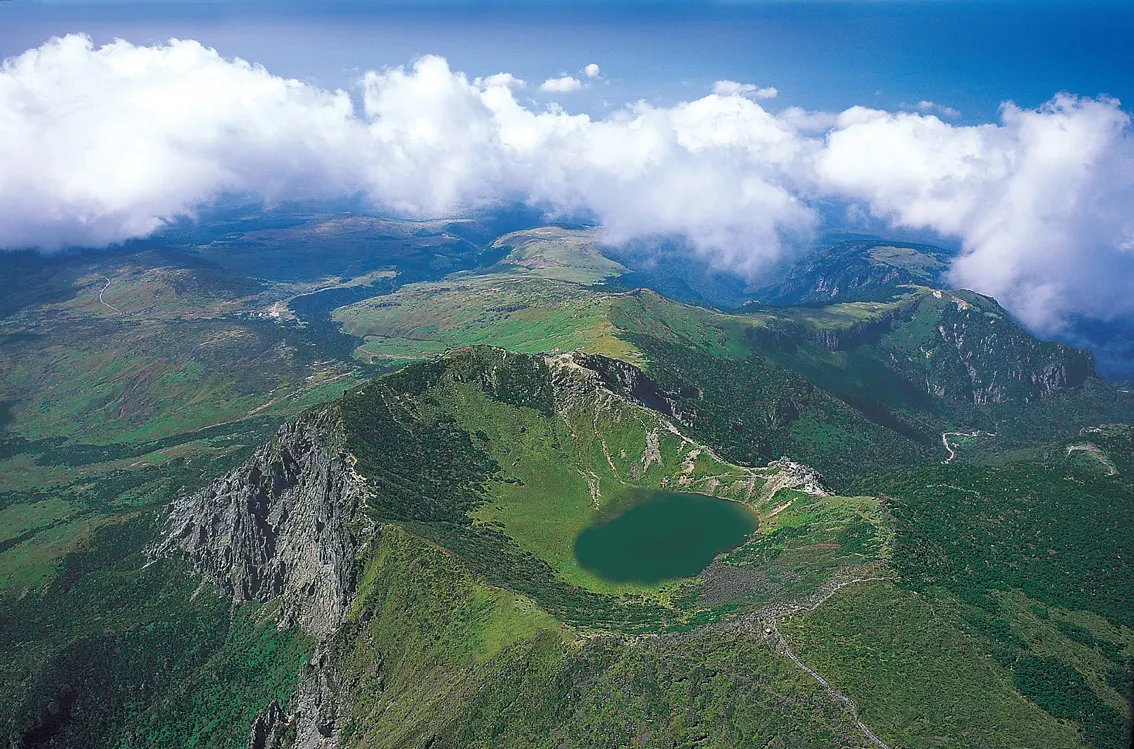
Hallasan
The volcano that forms the island, at 1,947 m, is the highest point in South Korea and a national park. Only two trails reach the crater lake Baengnokdam at the top: Seongpanak, 9.6 km to the summit and about 4.5 hours up the east side, longer and with a moderate grade, and Gwaneumsa, 8.7 km up the north side, steeper. Both require a reservation in the park's official system, with a QR code sent by text message to your phone; the park asks for ID and closes the passage at the checkpoints in late morning or early afternoon, depending on the season. If you can't get a slot, or don't have the stamina for about 19 km round trip, take the Yeongsil or Eorimok trails to the Witse Oreum shelter, at about 1,700 m, without the lake. On the Yeongsil trail it is 3.7 km, about 1.5 hours, from the rest area at 1,280 m, which only vehicles of up to 12 seats can reach; if you arrive by bus you get off at the park office, at 1,000 m, and add 2.4 km of road, for a total of about 3 hours 15 minutes to Witse Oreum. From there the trail continues to the South Wall junction. The weather closes in fast up there: check the park's website to see whether the trails are open that day.
Check access
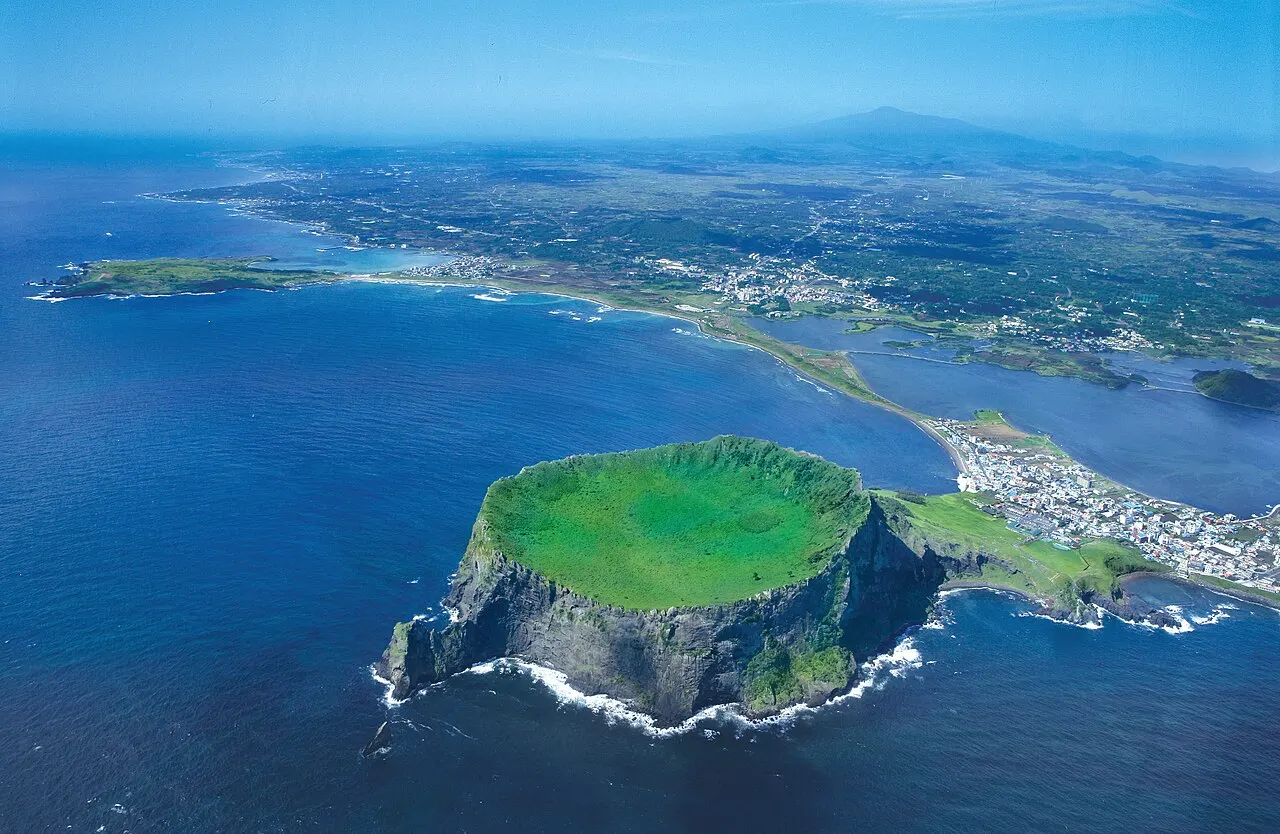
Seongsan Ilchulbong
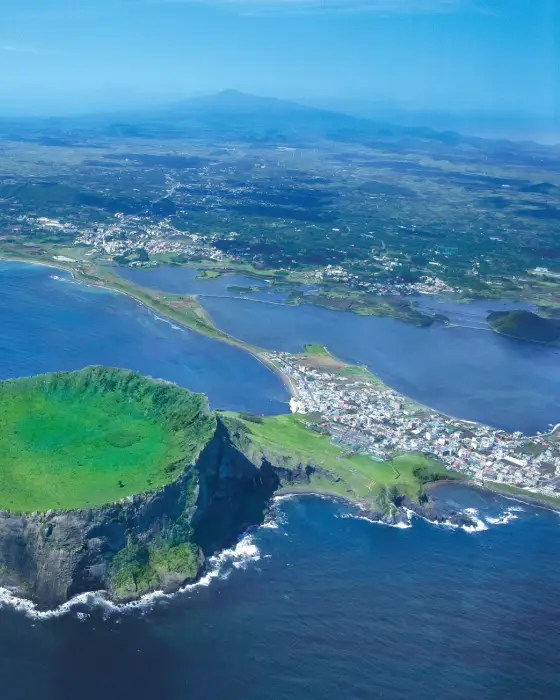
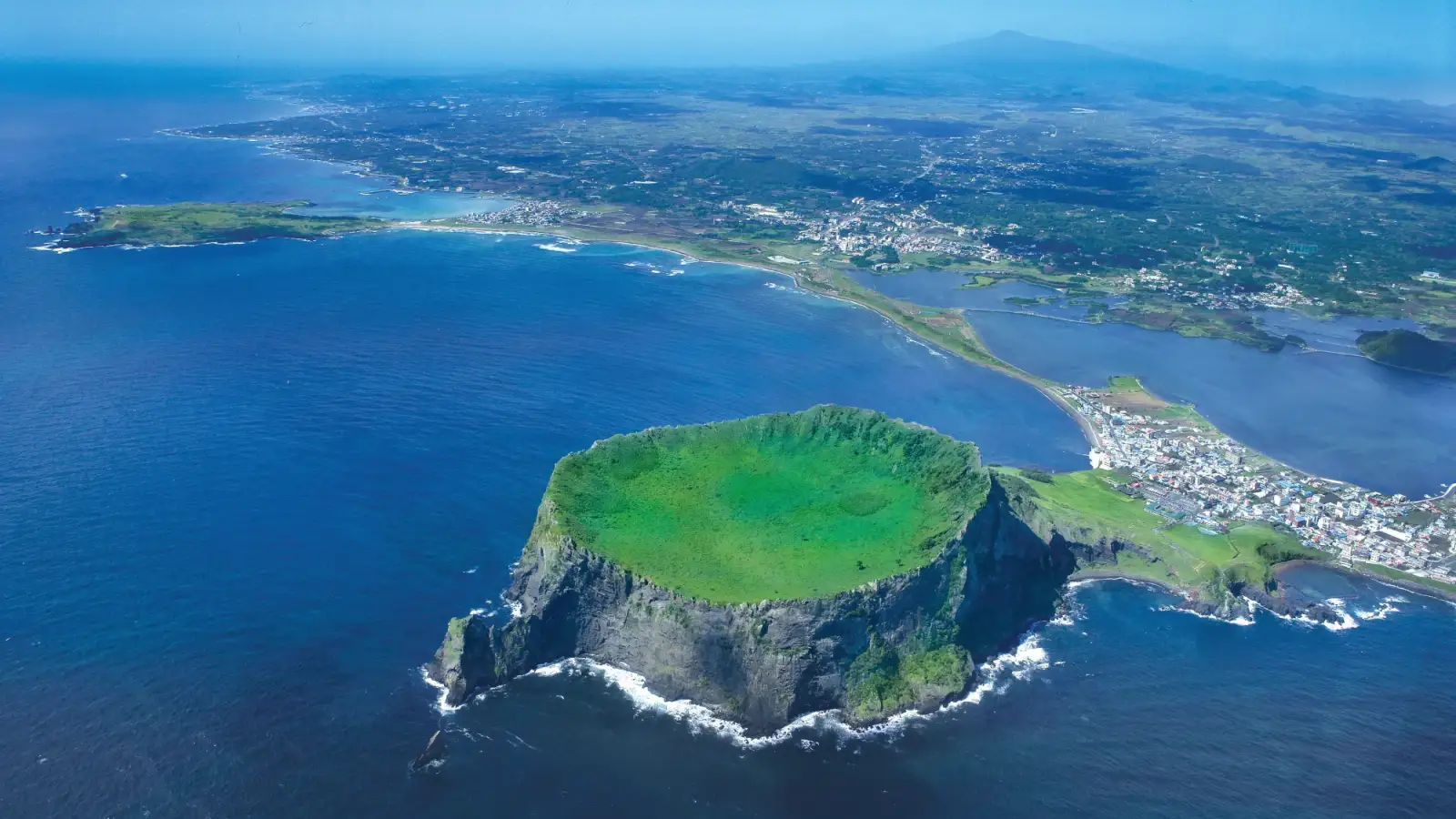
A 182 m tuff cone that rose from the sea in a shallow eruption thousands of years ago and is now joined to the island by sand and gravel. The paid trail climbs stairs to the rim of a grass-covered crater about 600 m across in 30 to 40 minutes; the free trail circles the base to Umutgae beach. The name means sunrise peak, and the opening time follows the light: it opens at 6 a.m. from November to February, at 5 a.m. in March, April, September and October and at 4:30 a.m. from May to August, with the ticket office closing one hour before closing time. It closes on the first Monday of each month. Adults pay 5,000 won.
Check access
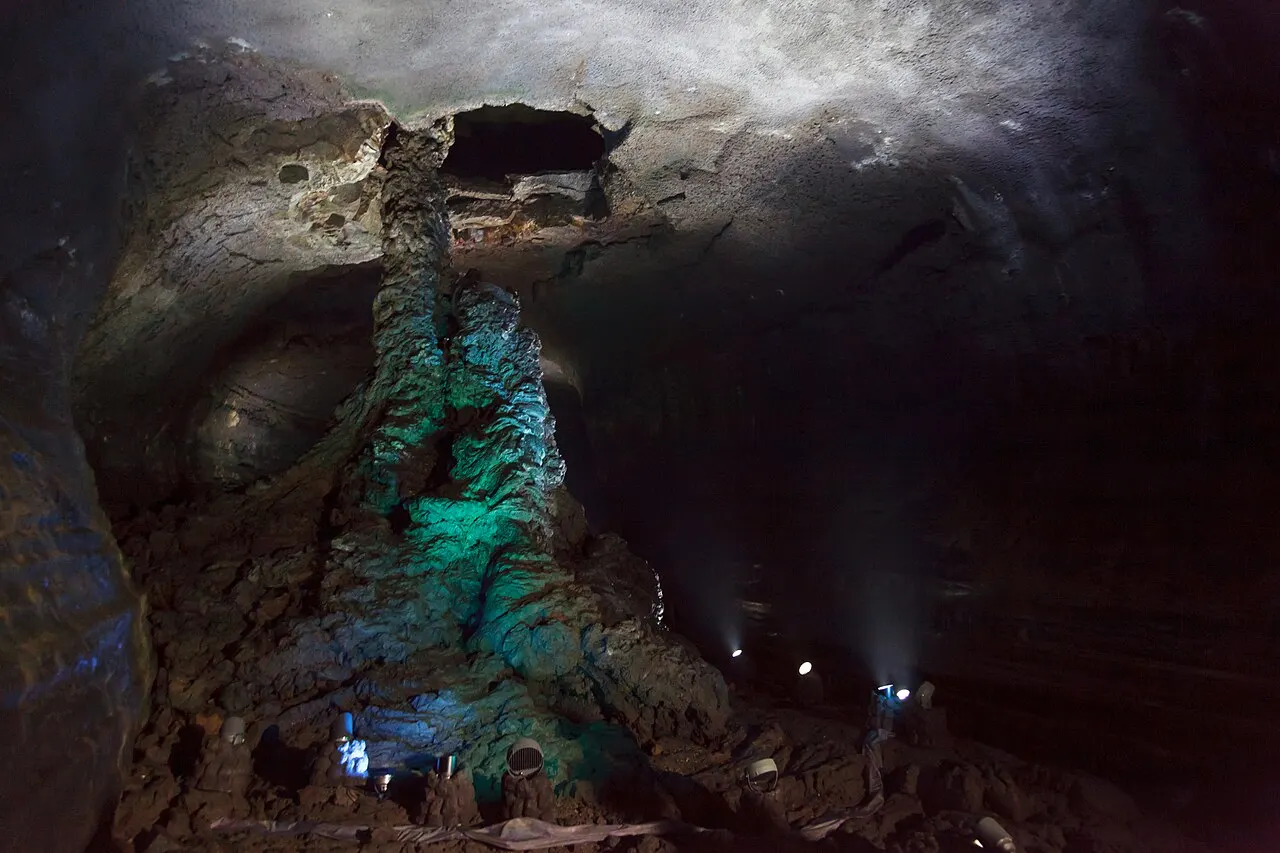
Manjanggul
A lava tube about 7.4 km long and up to 18 m wide, of which the public walks about 1 km to a 7.6 m lava column. The cave reopened on May 30, 2026, after two years and five months closed because of a rockfall in 2023: the open section now has a deck along its whole length and dimmer LED lighting. It is cold inside all year, around 12 °C to 14 °C, and a sweater is enough. It is open from 9 a.m. to 6 p.m., with last entry at 5 p.m., and closes on the first Wednesday of the month; adults pay 4,000 won.
Check access
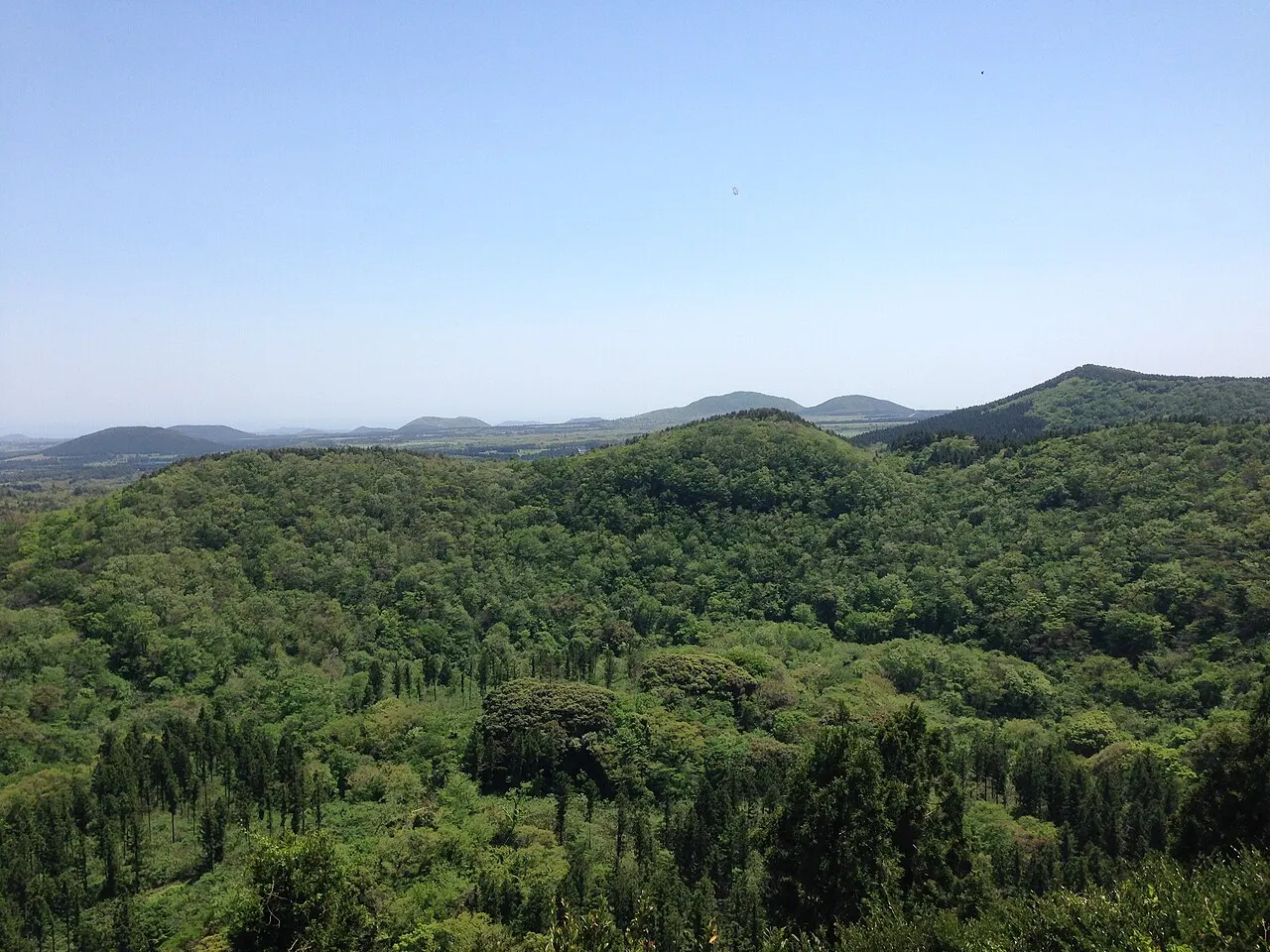
Geomunoreum
The cone that produced the lava that formed Manjanggul and other tubes is the only oreum included in the World Heritage listing, and it can only be visited with a reservation and accompanied by a guide. Departures run from 9 a.m. to 2 p.m., every 30 minutes, with up to 50 people per group; routes are about 2.1 km (one hour), 5 km (two and a half hours) and 6.7 km (three and a half hours). Reservations open on the 1st of the previous month, at 9 a.m., and leftover slots can be taken on site. It closes on Tuesdays, on Seollal and on Chuseok; no sandals are allowed, and no food beyond emergency candy. Adults pay 2,000 won.
Check access
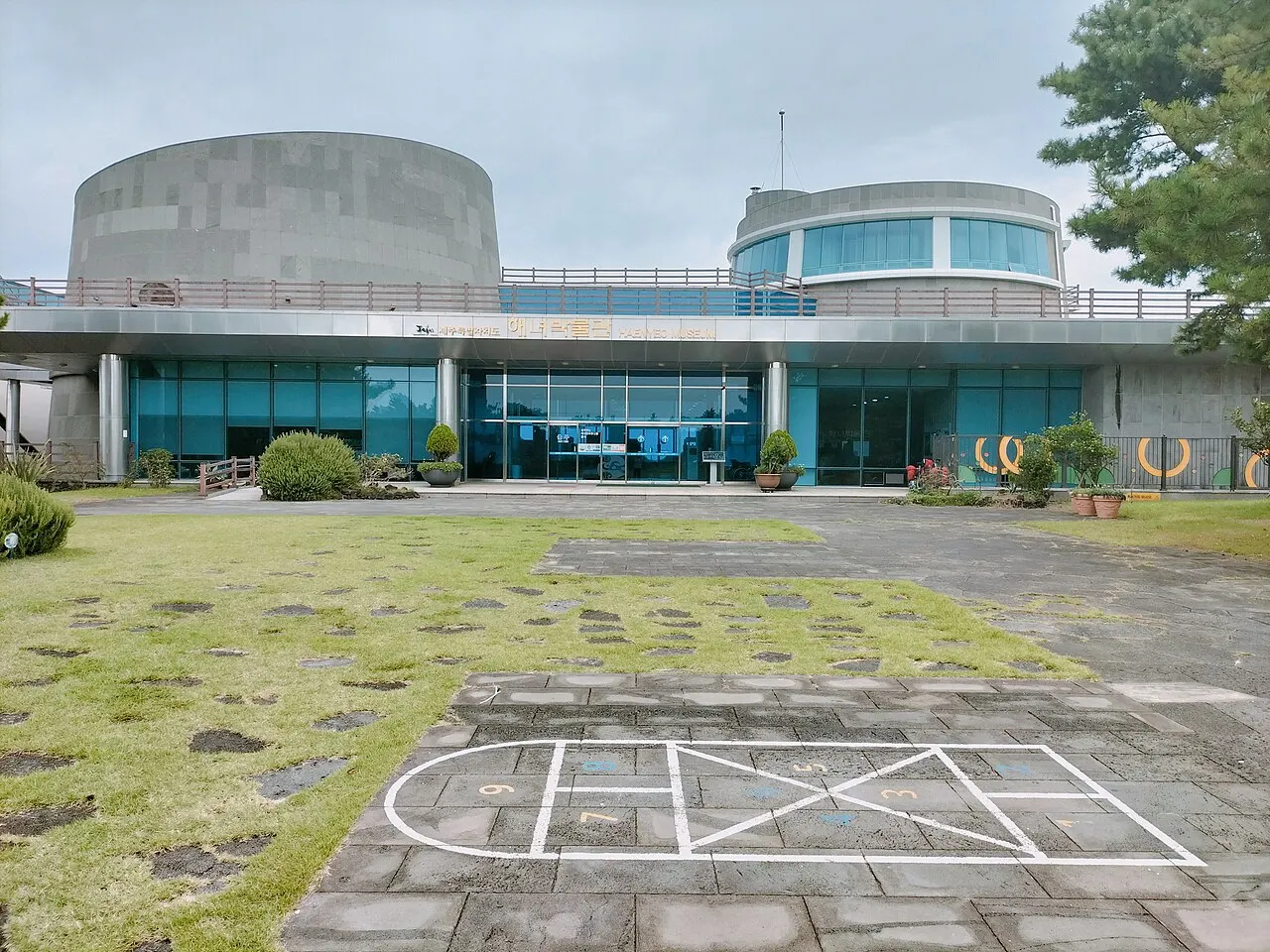
Haenyeo Museum
In Hado, on the northeast coast, the museum tells the life of Jeju's women divers, who dive on a single breath to about 20 m to gather abalone, sea urchin and seaweed, and whose culture was added to UNESCO's intangible heritage list in 2016. The objects on display were donated by the haenyeo themselves, and there is a reconstructed house and rooms on their struggle against Japanese rule. It is open from 9 a.m. to 6 p.m. and closes on Mondays; adult admission costs 1,100 won.
Check access
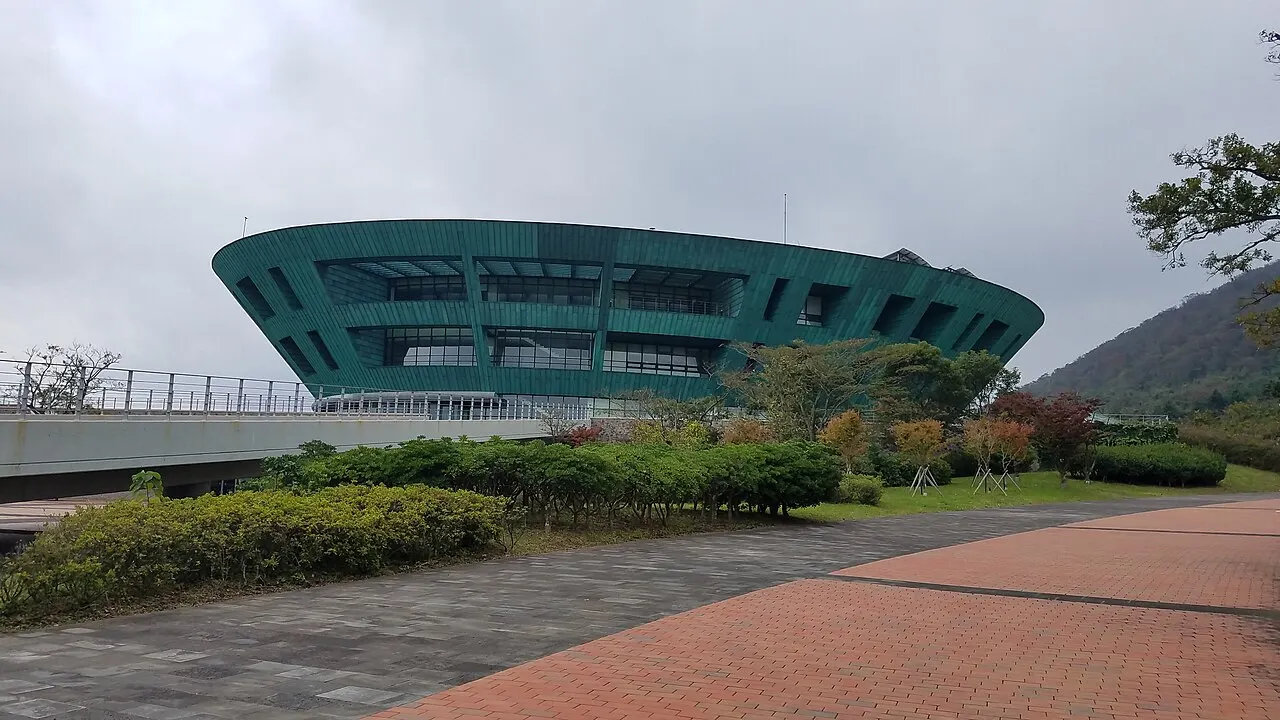
Jeju 4·3 Peace Park
A memorial and museum dedicated to the victims of the uprising and massacre of 1948 and 1949, opened in 2008 in Bonggae-dong, in the interior of Jeju-si. The memorial explains the causes, the repression and the search for truth. It helps in reading the rest of the island: villages, caves and places such as Jeongbang and the Seongsan area hold 4·3 markers. Check the hours and closing day on the foundation's website before you go.
Check access
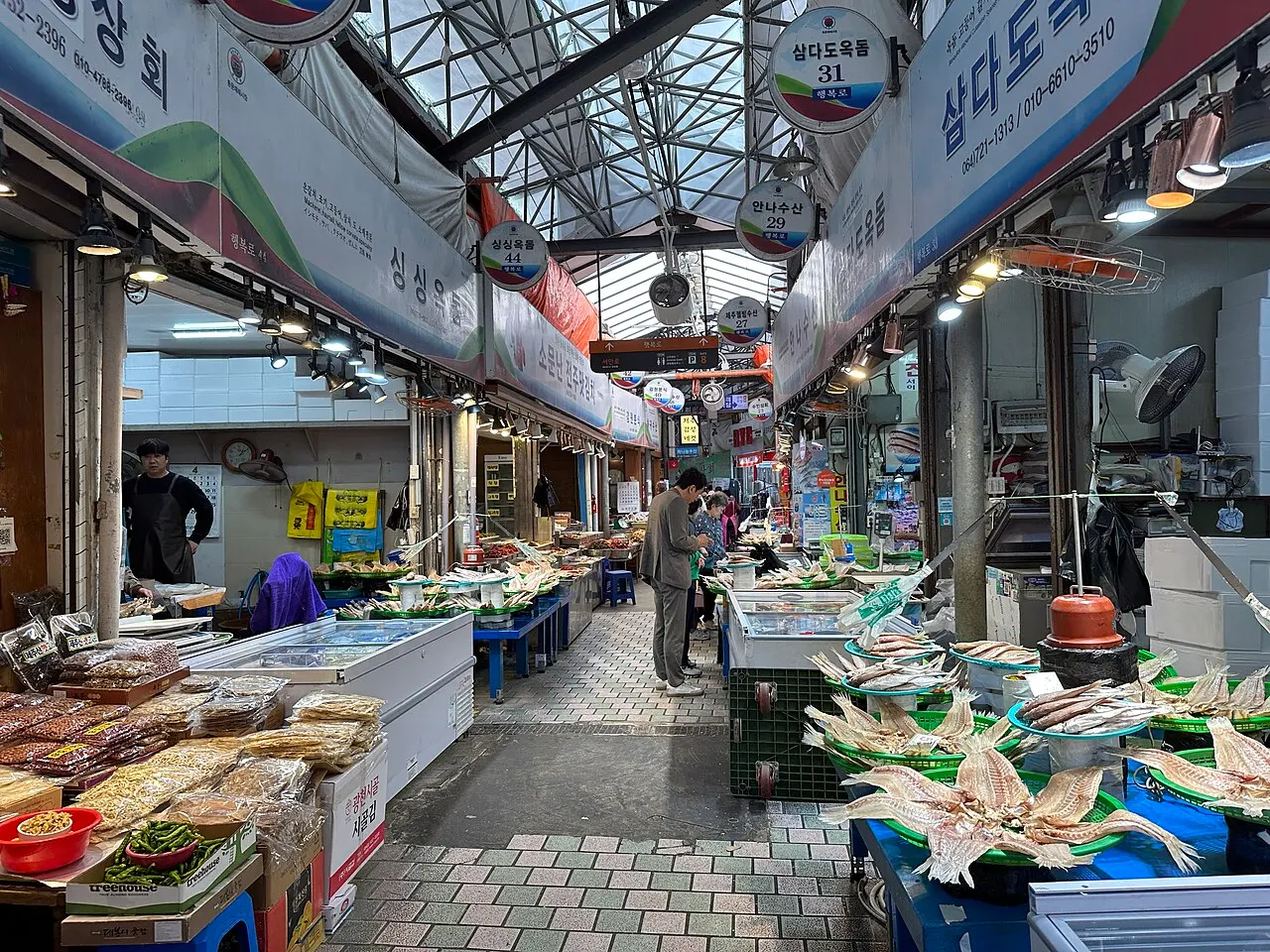
Dongmun Market
Opened soon after liberation in 1945, it is the island's largest traditional market, with fruit, fish, herbs and clothing. The fish stalls sell cutlassfish hoe at reasonable prices, according to the Korea Tourism Organization, and at night the area around gate 8 becomes a street food market. It is open from 7 a.m. to 9 p.m., with hours varying by stall, and sits in the old center of Jeju-si.
Check access
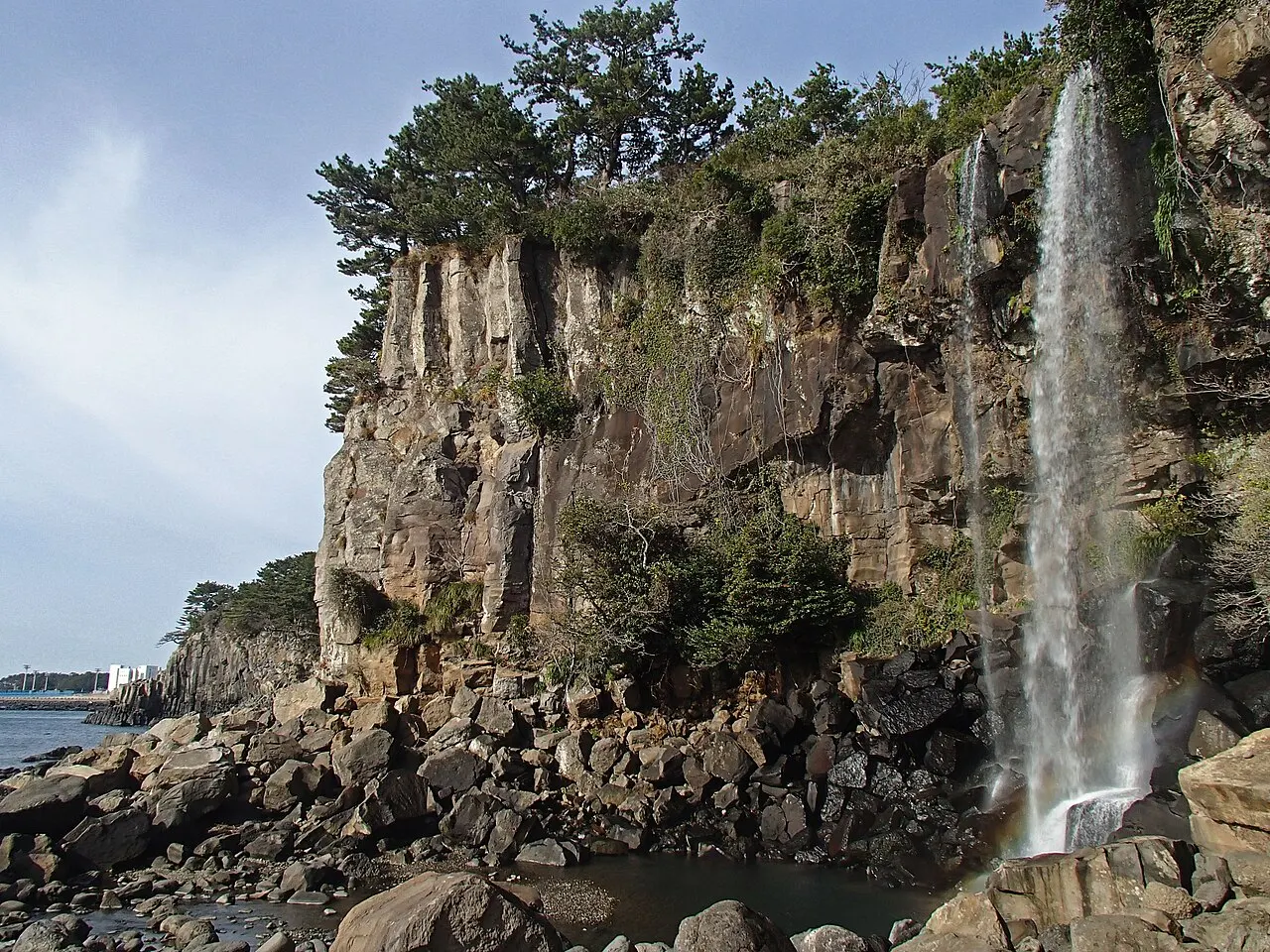
Jeongbang Waterfall
A 23 m fall that drops from the cliff straight onto the rocky shore, near the center of Seogwipo; the island's official tourism site describes it as the only coastal waterfall in Korea that pours into the sea. A staircase descends in about five minutes to the base, between walls of columnar basalt. It is open from 9 a.m. to 5:50 p.m., with last entry at 5:30 p.m., and may close in rough seas or bad weather; adults pay 2,000 won.
Check access
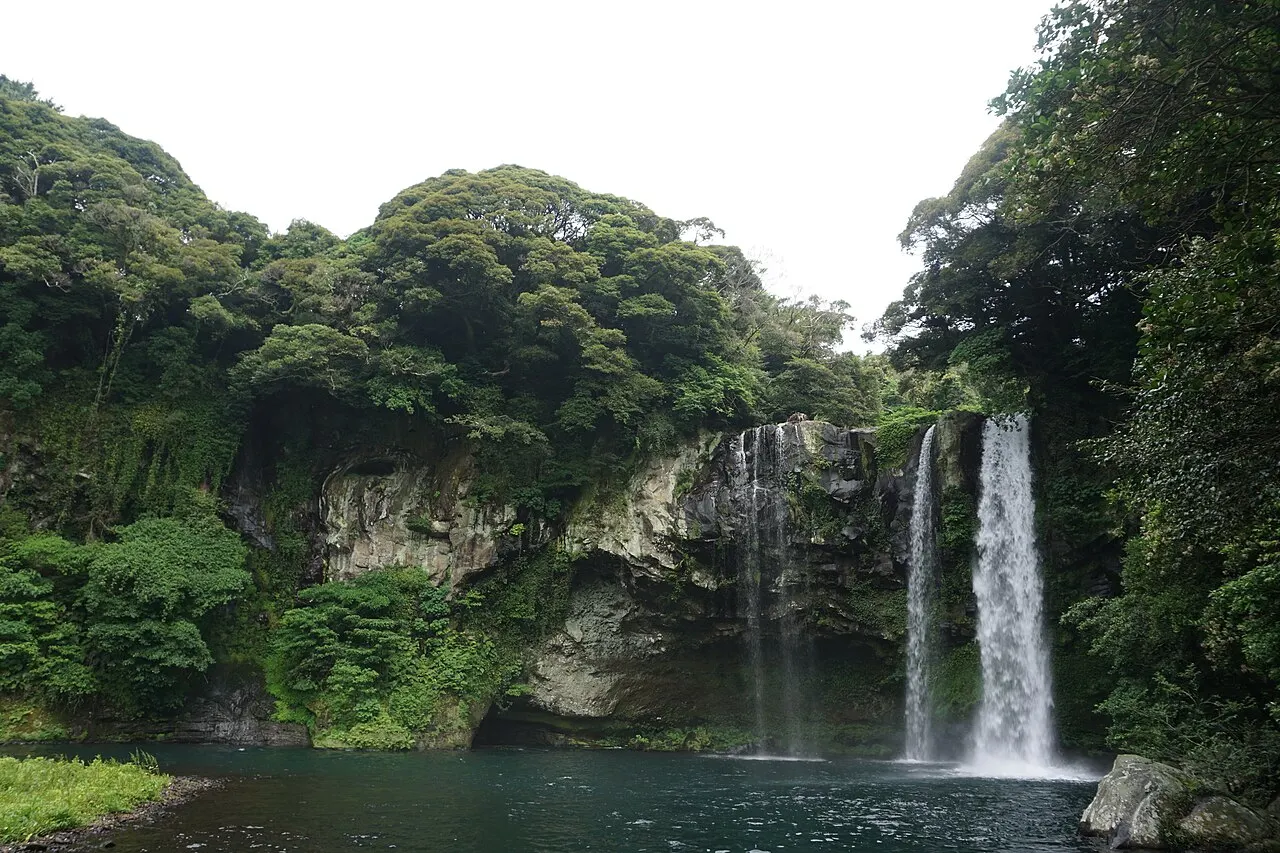
Cheonjiyeon Waterfall
A 22 m fall at the end of a subtropical forest valley, a short walk from Seogwipo harbor, with a flat, well-kept trail. It is open from 9 a.m. to 10 p.m., with last entry at 9:20 p.m., and so works at the end of the day; the official guide highlights the night view.
Check access
More places in the guide
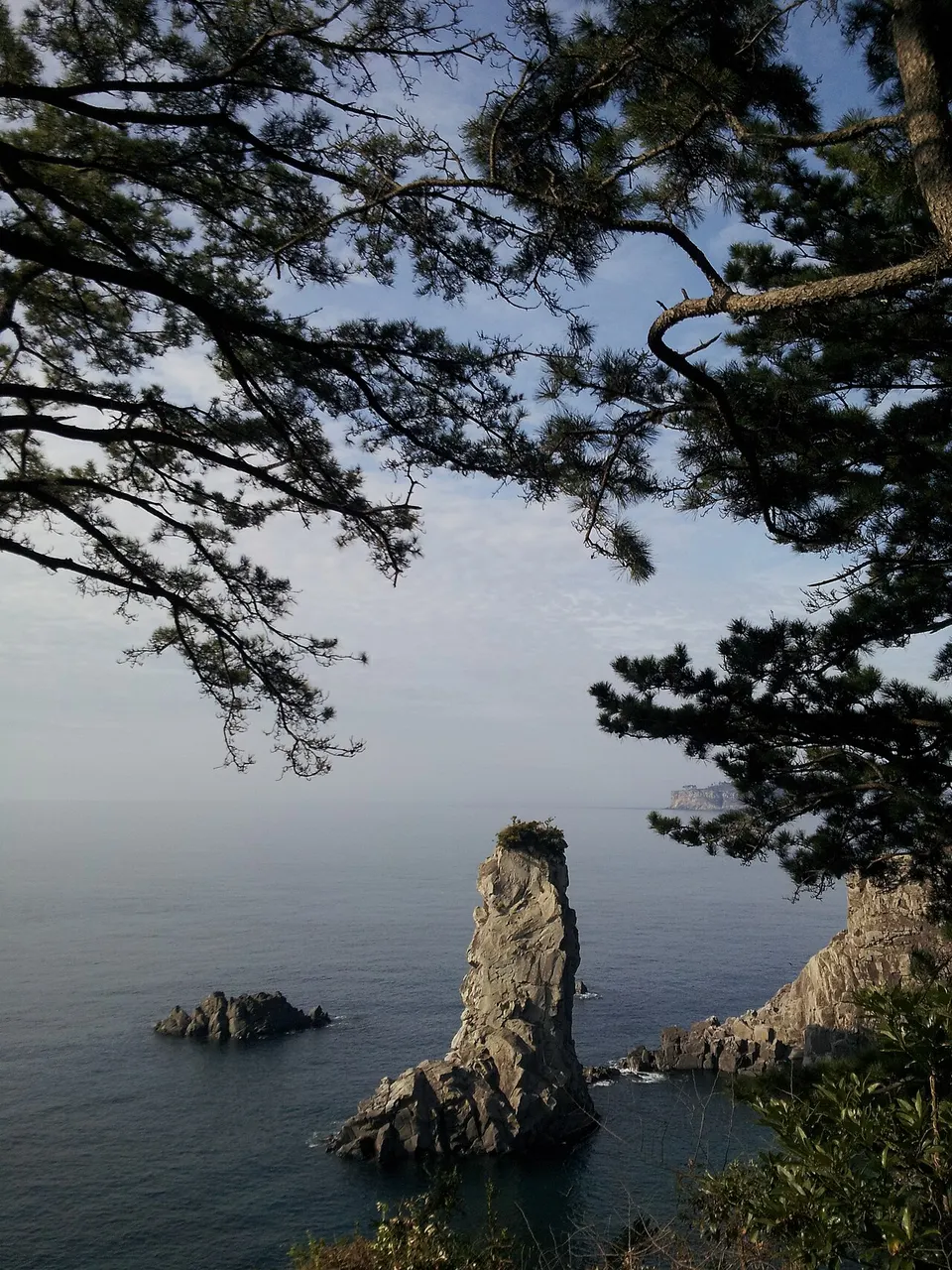
Oedolgae
A rock pillar of about 20 m rising from the sea west of central Seogwipo, with pines on top. The official guide lists it as the starting point of Olle trail 7, and a stretch of this coast is the simplest way to walk the Olle without giving up a whole day.
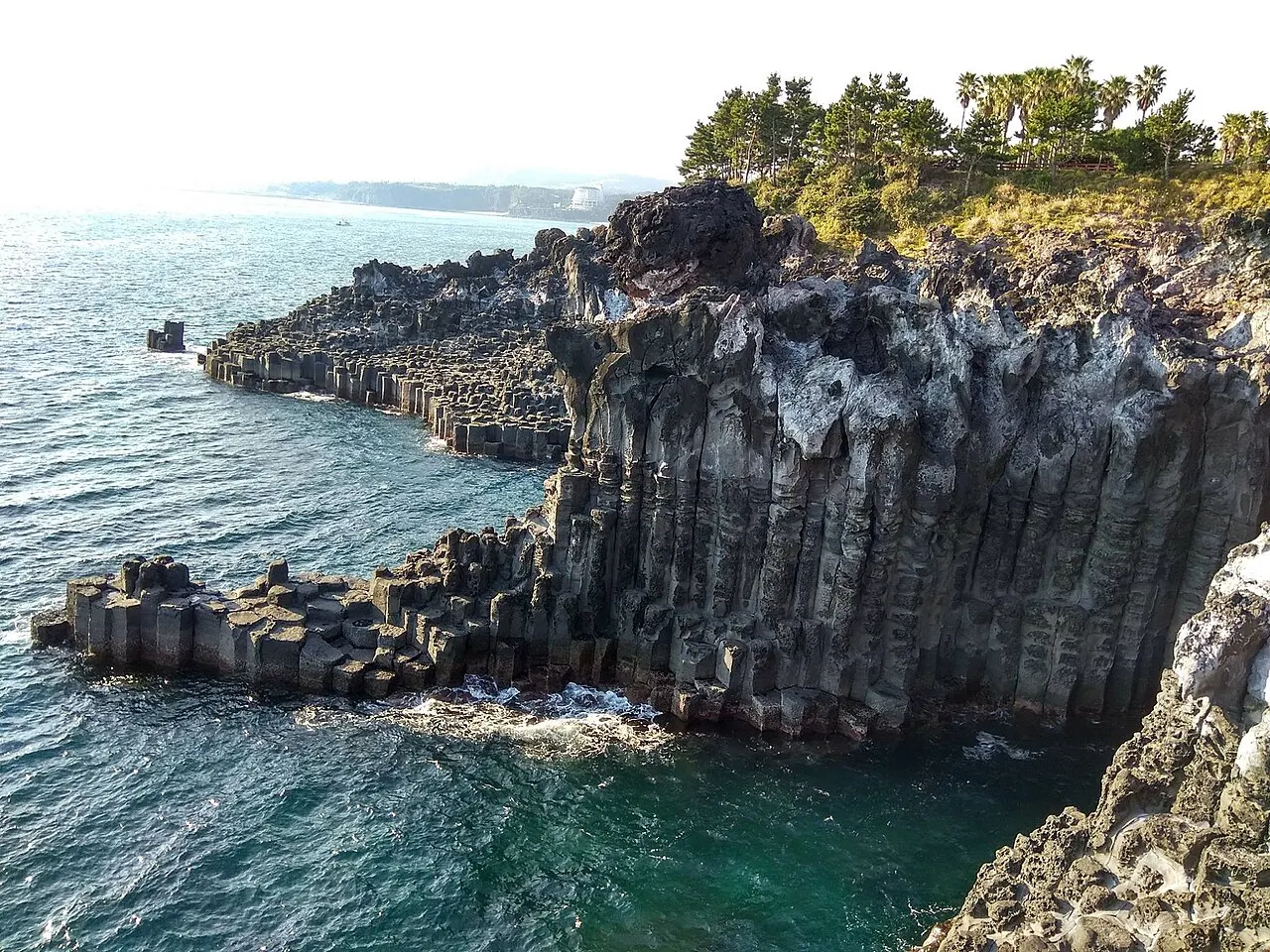
Jusangjeolli
On the Jungmun and Daepo shoreline, hexagonal basalt columns formed by lava cooling quickly on meeting the sea line up like a wall. The visit is short, and the hours follow sunset, generally 9 a.m. to 6 p.m., according to the Korea Tourism Organization.
Yongmeori Coast
At the foot of Sanbangsan, tuff cliffs about 700 m long and 25 m to 40 m high were carved by the waves into layers and cavities. The path runs right along the water and closes at high tide, in waves or in bad weather: standard hours are 9 a.m. to 5 p.m., with last entry at 4:30 p.m., and it is worth calling 064-794-2940 or checking the official Instagram @6sot_official on the day. Adults pay 2,000 won. Sanbangsan, just above, has a staircase up to the Sanbanggulsa cave temple.
Hyeopjae Beach
Pale sand, shallow water and the silhouette of Biyangdo opposite make Hyeopjae the best-known beach in the west and a favorite of families with children. The official season, with lifeguards, covers the summer, from late June to early September, with dates and hours announced each year. Outside it the beach stays open, without swimming service, and is worth it for the sunset.
Seogwipo Maeil Olle Market
A covered market in central Seogwipo, open all year, with fresh fish, citrus, omegitteok and hallabong juice. The roof makes it a good rainy-day plan, and at night part of it works as a food market.
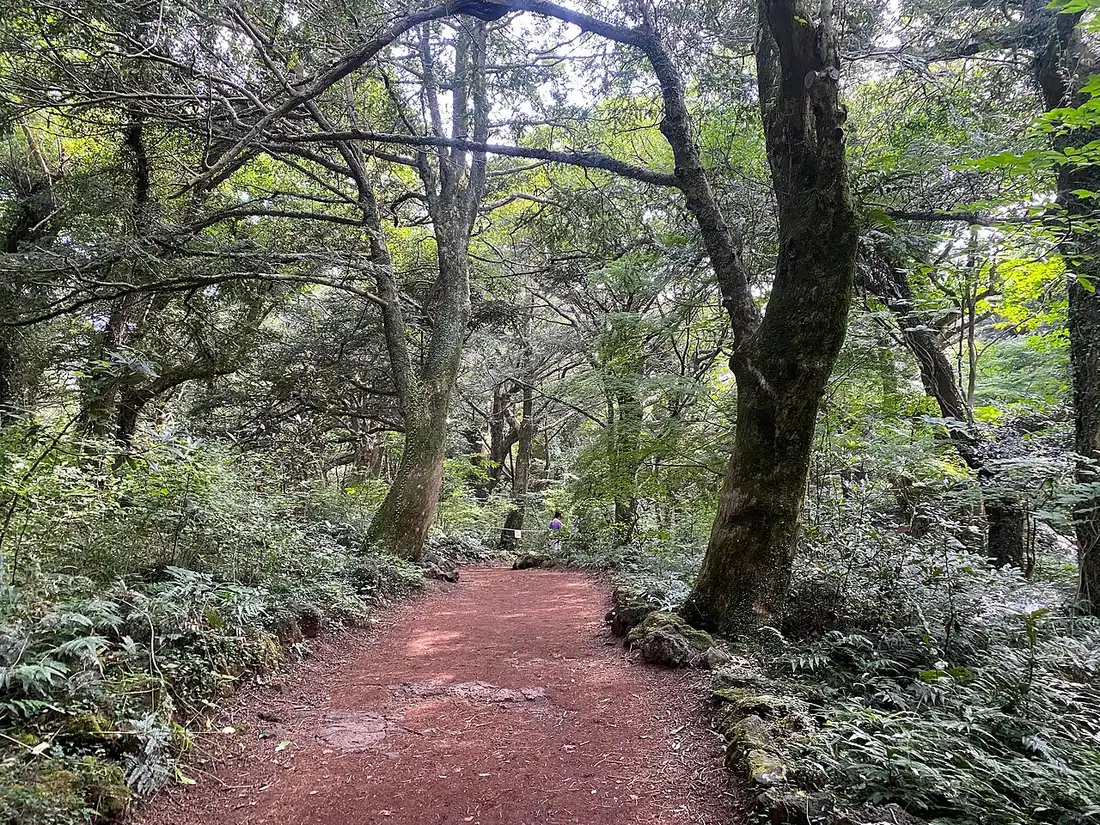
Bijarim Forest
More than 2,800 bija trees, a conifer in the yew family, 500 to 800 years old, grow over 45 hectares in the east of the island; Jeju's official guide presents it as South Korea's largest natural forest monument. Route A is almost entirely flat and is the one the official site recommends for pregnant visitors, strollers and wheelchairs; B has stretches of stone. It is open from 9 a.m. to 6 p.m., with last entry at 5 p.m.; adults pay 3,000 won, and no food or drink is allowed in, except water.
Hamdeok Beach
On the northeast coast, about an hour by bus from the airport, the beach of pale sand and shallow turquoise water is a favorite of families. Next to it, the small Seoubong cone can be climbed in a short time and shows the beach and Hallasan from above.
Jeju Mokgwana
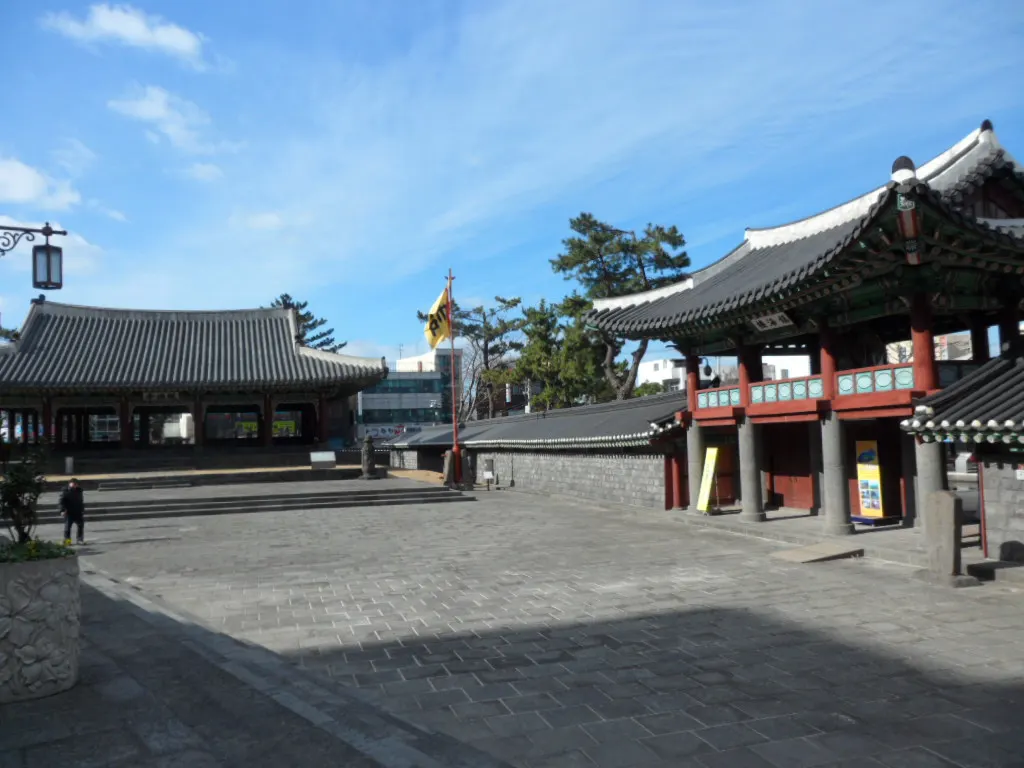
The island's former government complex in the Joseon period, next to the Gwandeokjeong pavilion, was rebuilt from excavations and is the best place to understand how Jeju-si worked as a capital. It is open every day from 9 a.m. to 6 p.m.; adults pay 1,500 won. From May to October there is free evening opening from 6 p.m. to 9 p.m., except Mondays and Tuesdays.
Yongduam
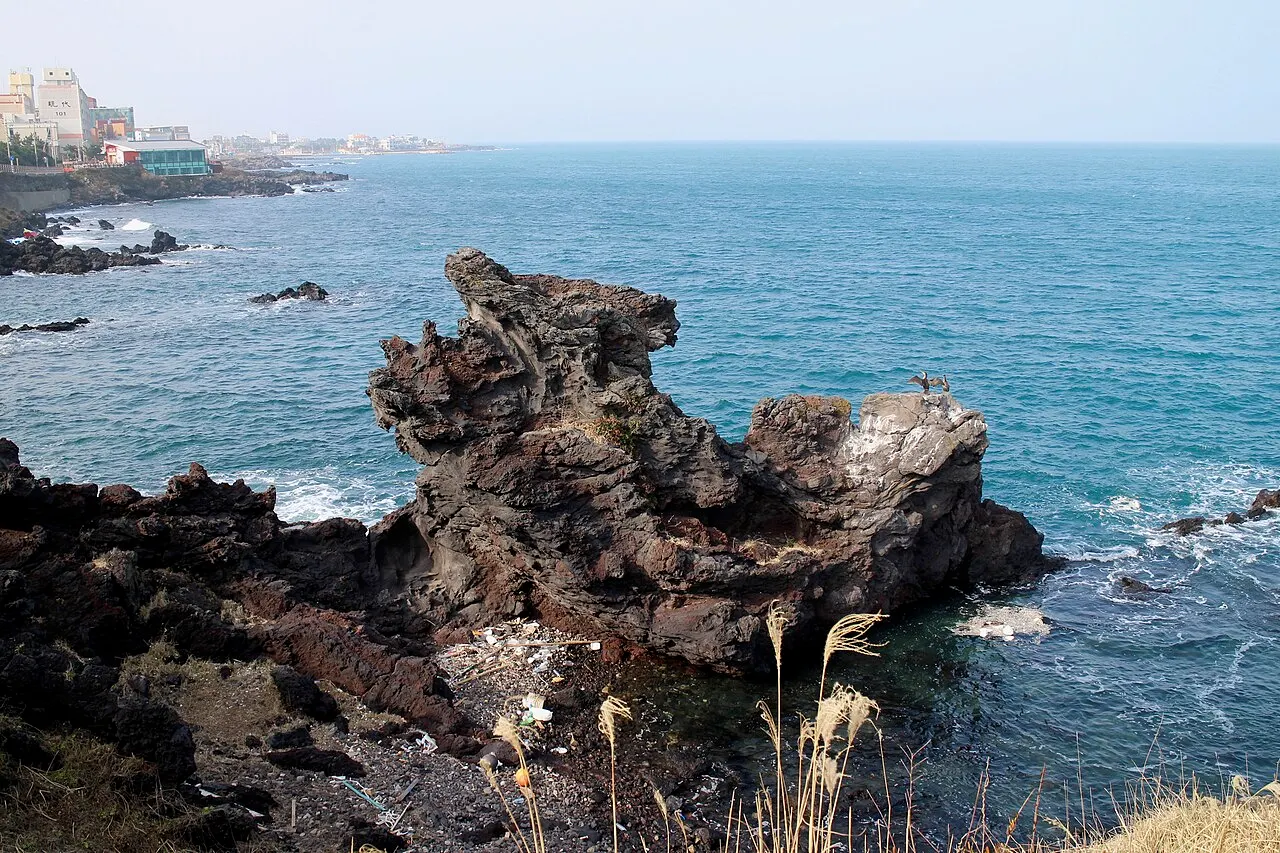
A lava rock on the coast of Jeju-si that, according to legend, is a dragon that failed to rise to the sky, near the airport. It is a short stop that makes sense in the late afternoon of a day in the capital or between arrival and the hotel.
Saebyeol Oreum
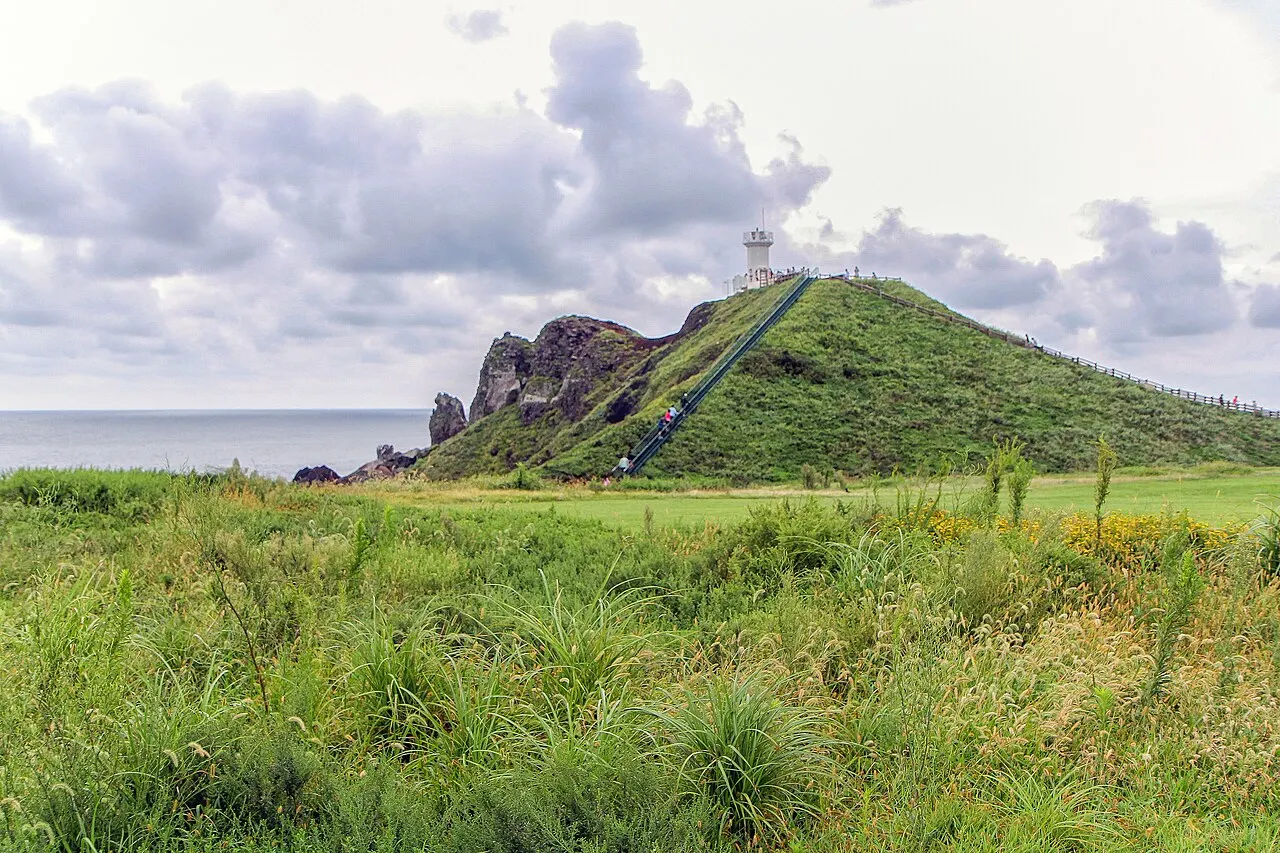
One of the best-known cones in the west, 519.3 m high at the top, reached in 20 to 30 minutes by a trail with steep stretches. In autumn the hill is covered in silvery grass. It is also the stage of the Jeju Fire Festival, in March.
Seopjikoji
A headland on the east coast with grassland, rocks and a view of Seongsan Ilchulbong; in spring it is surrounded by canola flowers. It makes sense as an addition to Seongsan, not as a destination of its own.
Seongeup Village
An old walled town in the interior of Pyoseon, a county seat since 1423 and inhabited for about 600 years, with preserved walls, traditional houses and short lanes, the olle, that lead from the street to each house. The whole village is national folklore heritage, and residents act as volunteer guides. Because it is a residential neighborhood, a visit calls for discretion and respect for the yards.
Soesokkak
A gorge in Seogwipo where the fresh water coming down from Hallasan meets the sea and forms deep pools between lava walls. The way to see it up close is by boat: on the tewoo, Jeju's traditional raft, or in rowing boats for two or three people.
Jeju Stone Park
A museum and ecological park in Jocheon dedicated to the island's stone culture, with dol hareubang, gate pillars and tomb statues displayed outdoors and a traditional thatched-roof house. It closes on Mondays and on January 1, Seollal and Chuseok; guided visits, lasting one hour to an hour and a half, leave from 9 a.m. to 4 p.m., with a break at midday, and a reservation is recommended.
Samseonghyeol
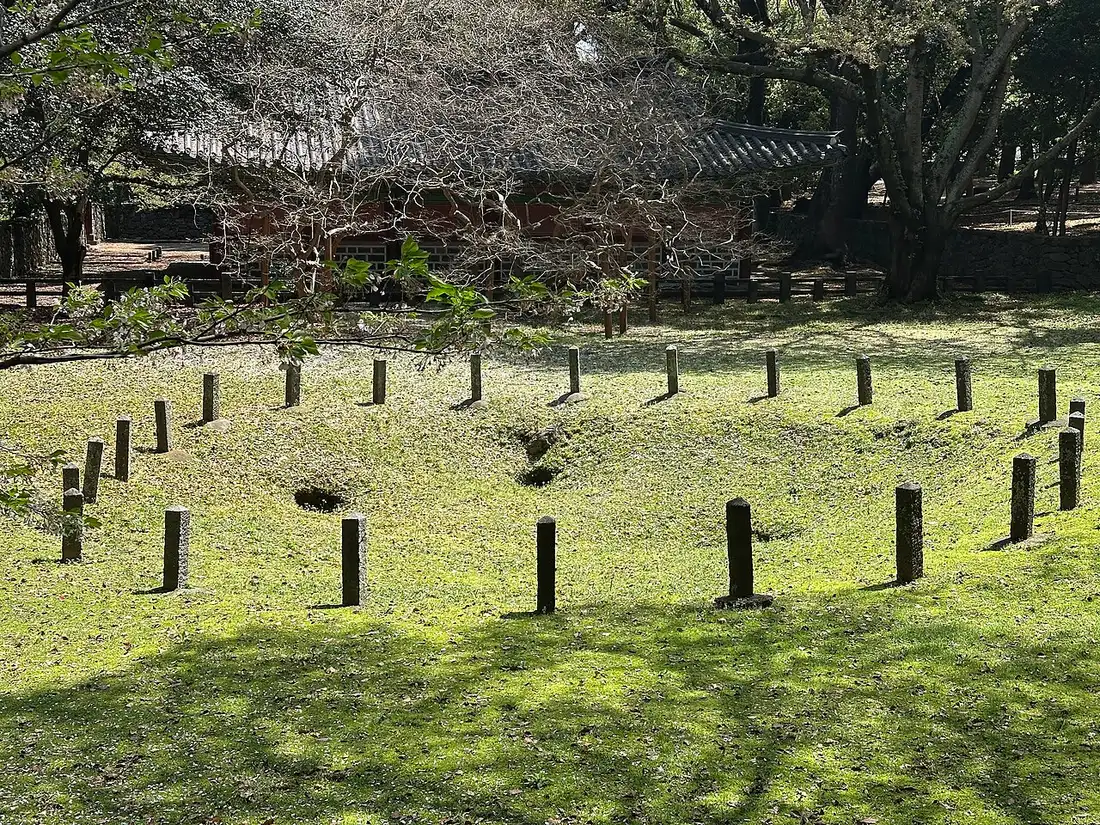
In central Jeju-si, a protected grove holds the three holes from which, according to legend, the founders of the Tamna kingdom emerged. There are traditional ceremonies on April 10, October 10 and December 10. The visit is short and fits into the same outing as Jeju Mokgwana.
O'sulloc Tea Museum
A tea museum beside large green tea plantations in the southwest of the island, with tea-related objects, a tea house and sweets made with green tea. It works as a break during the day in the west.
Nilo’s itinerary
Start with the basic programme and choose extensions for the time you have.
Plan my days in the app ↗Day 1 · Jeju-si: the old capital and the memory of the 4·3
In the morning, take a taxi or bus to the 4·3 Peace Park, in Bonggae-dong, and set aside two hours for the memorial (check the hours on the foundation's website).
Go back to the center and have gogi-guksu for lunch at one of the restaurants on the noodle street, on Samseong-ro.
In the afternoon, walk to Jeju Mokgwana and the Gwandeokjeong pavilion (9 a.m. to 6 p.m.); if you have time, stop first at the Samseonghyeol shrine, in the same area.
Late in the afternoon, continue by taxi to Yongduam to see the dragon rock in low sun.
In the evening, have dinner at the market around gate 8 of Dongmun Market or at a black pork grill house near the port. Sleep in Jeju-si.
Day 2 · East: the lava tube, the haenyeo and Seongsan Ilchulbong
Leave early by bus or car for the northeast coast (about 70 minutes by bus from the airport) and arrive at Manjanggul at opening, 9 a.m.; bring a sweater for the cold inside the tube. Avoid the first Wednesday of the month.
Continue to the Haenyeo Museum, in Hado, for a one-hour visit; it closes on Mondays, in which case swap it for Bijarim forest.
Have lunch on the coast, where haenyeo houses serve jeonbok-juk and mulhoe, or go to Haenyeo's Kitchen, in Jongdal (check dates and reservations on the restaurant's website).
In the afternoon, climb Seongsan Ilchulbong by the paid trail (30 to 40 minutes to the crater) and come down by the free one to Umutgae beach; check the season's closing time and the first Monday of the month.
If there is light left, go to Seopjikoji. Return to Jeju-si by bus, about two hours, to sleep near the terminal where the Hallasan bus leaves.
Day 3 · Hallasan by the Seongpanak trail
With the reservation made in the park's system, take bus 281 at the Jeju-si terminal, from 6 a.m.; the trip to Seongpanak takes about 45 minutes. Bring ID, the QR code on your phone, water, food and cold-weather clothing.
Start walking before 7 a.m.: it is 9.6 km and about 4.5 hours to the top, and the checkpoint at the Jindallaebat shelter closes the passage in late morning or early afternoon, depending on the season.
At the top, see the Baengnokdam lake and begin the descent within the time set by the park.
Descend by Seongpanak and return to Jeju-si on the 281. Without a reservation, do Yeongsil or Eorimok to Witse Oreum, leaving at the same time.
Have an early dinner in Jeju-si; the next day starts with the move south.
Day 4 · Seogwipo: waterfalls, market and the Olle 7 coast
In the morning, move to Seogwipo: bus 281 crosses the mountain along the 5.16 road, and the 600 limousine leaves the airport and passes through Jungmun. Leave your bags at the hotel.
Visit Jeongbang waterfall (9 a.m. to 5:50 p.m.) and go down the stairs to the base.
Have lunch at Maeil Olle Market and try omegitteok and hallabong juice.
In the afternoon, walk along the coast to Oedolgae on a stretch of Olle 7; then, by taxi or bus, continue to Jusangjeolli, in Jungmun, before sunset.
In the evening, return to the center for Cheonjiyeon waterfall (last entry at 9:20 p.m.) and cross the Saeyeongyo bridge, lit until 10 p.m. Sleep in Seogwipo; on departure day, the 600 limousine takes you to the airport.
Food
Heuk-dwaeji (black pork)
Pork from the native black-skinned breed, grilled at the table. In Jeju it usually comes with meljeot, salted anchovy that cuts the fat. There is a whole street of black pork grill houses near the port of Jeju-si.
Galchi (cutlassfish)
A long, silvery fish prepared grilled, stewed in soy or chili sauce, or in galchi-guk, a clear soup with pumpkin. At Dongmun Market it is also sold raw, as hoe.
Okdom-gui
Grilled tilefish, one of the seven local dishes the province highlights as typical of the island, alongside the cutlassfish soup and the gogi-guksu.
Gogi-guksu
Thick noodles in pork bone broth, topped with slices of boiled meat. The noodle street on Samseong-ro, in central Jeju-si, gathers several restaurants.
Momguk
A thick pork broth soup with mom, a brown seaweed from Jeju's coast, and buckwheat. A simple, very local meal.
Jeonbok-juk
Rice porridge with abalone; in Jeju the whole abalone is used, including the innards, which gives it a greenish color. Haenyeo houses on the coast serve the recipe.
Mulhoe
Raw fish in a cold broth seasoned with doenjang, the soybean paste; the version with jaridom, a small fish from Jeju's waters, is jari-mulhoe. A summer dish.
Haemul ttukbaegi
A seafood stew in doenjang broth, with crab, shellfish and the small mollusk obunjagi, served boiling in a clay bowl.
Bingtteok
A thin buckwheat crepe rolled around a filling of radish seasoned with sesame and scallion.
Omegitteok
A glutinous millet cake with red beans outside and inside, sold in the markets; today there are versions with chestnuts and fruit.
Hallabong and gamgyul
Tangerines are the island's emblem fruit. Varieties such as hallabong and cheonhyehyang appear in juices, sweets and jams; in winter the tangerines are ripe in the orchards.
Hallasan soju
The island's soju, with about 20% alcohol according to Jeju's official guide, appears at almost every barbecue table.
Where to eat
- Old center of Jeju-si
Dongmun Market for raw cutlassfish, tangerine sweets and the night market near gate 8, with kimchi rolls with black pork and abalone gimbap. On the noodle street on Samseong-ro, gogi-guksu at any time of day.
- Tap-dong and the port
The street of black pork grill houses, where the meat comes with meljeot, and the raw fish houses on the Seobudu pier, which usually end the meal with spicy soup or fish porridge.
- Seogwipo center
Maeil Olle Market for a quick fish lunch, omegitteok and hallabong juice, in a covered space that works on rainy days; at night part of it works as a food market.
- Haenyeo's Kitchen · East coast (Jongdal and Bukchon)
Haenyeo's Kitchen serves seafood gathered by the women divers with a presentation about their lives: in Jongdal, a buffet with a live presentation; in Bukchon, a tasting menu with projections. Check operating days and reservations on the restaurant's website before you go.
Source · 2026-10-19
- Coastal villages in the east
Haenyeo houses and village restaurants serve jeonbok-juk with the whole abalone, haemul ttukbaegi and, in summer, mulhoe. Ask the day's price for seafood, which varies with the catch.
· 2026-10-19
Day trips
West coast: Yongmeori, Sanbangsan and Hyeopjae
A day from Seogwipo, best by car. In the morning, the Yongmeori coast (9 a.m. to 5 p.m., last entry at 4:30 p.m., 2,000 won), which closes at high tide or in waves: confirm by phone at 064-794-2940 or on Instagram @6sot_official before setting out. Just above, the Sanbangsan staircase leads to the Sanbanggulsa cave temple. In the afternoon, continue along the west coast to Hyeopjae beach for the sunset behind Biyangdo; from there, the bus takes about 70 minutes to the airport.
Udo
The largest of the neighboring islands is about 15 minutes by ferry from Seongsan or Jongdal; from Jeju-si, allow about two hours by bus to the port, or sleep a night in Seongsan to catch the morning ferry. It has a 17 km circuit, covered in two to three hours by electric bicycle, scooter or the island's bus. The island restricts the circulation of cars from outside; check the exceptions on the official page before taking a vehicle. The highlights are Seobinbaeksa beach, made of calcareous algae fragments, Hagosudong beach, the Udobong lookout, at 132 m, and the Geommeolle sea cave, accessible at low tide. Admission to the marine park costs 1,000 won for adults, in addition to the ferry, which may not run in rough seas.
Outside vehicles restricted on Udo, with exceptions: 1 August 2026 – 31 July 2029 (checked Oct 2026) source
Marado and Gapado
Marado, the southernmost point of South Korea, is 1.3 km long and can be walked in about an hour, with the southernmost marker, a chapel with a roof shaped like an abalone shell and a lighthouse from 1915. Ferries leave from Unjin or Songaksan port, in the southwest, and take about 30 minutes. Gapado, on the way, is covered in green barley in April.
Biyangdo
A small volcanic islet about 15 minutes by ferry from Hallim port, right opposite Hyeopjae beach. A 20-minute trail climbs Biyangbong, 114 m, to a white lighthouse, and the north coast has about 20 hornitos, lava chimneys, among them the rock of the woman carrying a baby. The full walk around takes about two hours.
Where to begin
Jeju-si: the old capital and the memory of the 4·3
In the morning, take a taxi or bus to the 4·3 Peace Park, in Bonggae-dong, and set aside two hours for the memorial (check the hours on the foundation's website).
East: the lava tube, the haenyeo and Seongsan Ilchulbong
Leave early by bus or car for the northeast coast (about 70 minutes by bus from the airport) and arrive at Manjanggul at opening, 9 a.m.; bring a sweater for the cold inside the tube. Avoid the first Wednesday of the month.
Seogwipo: waterfalls, market and the Olle 7 coast
In the morning, move to Seogwipo: bus 281 crosses the mountain along the 5.16 road, and the 600 limousine leaves the airport and passes through Jungmun. Leave your bags at the hotel.
Money
The currency is the South Korean won (KRW). Credit cards are accepted in most shops, but it helps to have some cash for market stalls and for the bus, where the transit card is the most practical method. Admission prices checked in October 2026 on the official tourism sites of Korea and Jeju: Seongsan Ilchulbong costs 5,000 won for adults, Manjanggul 4,000, Bijarim 3,000, Geomunoreum, Jeongbang and Yongmeori 2,000 each, Jeju Mokgwana 1,500, the Haenyeo Museum 1,100 and the Udo marine park 1,000, not counting the ferry. The Hallasan reservation system does not publish a trail fee in its price table; the Seongpanak parking lot charges 1,000 won for the first hour for a small car, up to 13,000 won a day.
Getting there and around
Getting there
Jeju International Airport (CJU) is inside Jeju-si and is the second largest in the country; the air bridge with Gimpo, in Seoul, is one of the busiest routes in the world, and there are flights from several Korean cities, such as Busan. In July 2026 there were direct international flights to 23 cities, mostly in China, Japan, Taiwan, Hong Kong and Singapore, according to the Korea Tourism Organization. There are also ferries from mainland ports; schedules are on the Korean shipping association's booking site (island.haewoon.co.kr).
From the airport
Buses leave from the ground floor of the terminal. The old center of Jeju-si and Dongmun Market are about 20 minutes away by bus. For Jungmun and Seogwipo, the 600 limousine leaves in front of gate 5, from 6 a.m. to 10:40 p.m., at intervals of 16 to 40 minutes, and stops at several hotels up to the Seogwipo KAL Hotel; the adult fare ranges from 1,300 to 5,500 won, depending on the stretch, per the table on bus.jeju.go.kr.
Buses on the island
There is no train or subway. The bus network has express lines between regions, blue long-distance lines and green local ones; according to the table on the official site bus.jeju.go.kr, adults pay 1,150 won with a card or 1,200 in cash on regular lines, and on express lines 2,000 won with a card up to 20 km, with a surcharge by distance up to 3,000 won; anyone paying cash on an express always pays the 3,000. T-money cards work on all buses: tap the card when you board and when you get off. Some lines do not accept cash. Line 281 links the Jeju-si terminal to Seogwipo along the 5.16 road and stops at Seongpanak, the Hallasan trailhead; it runs from 6 a.m. to 10 p.m., about 45 minutes from Jeju-si to the trailhead and 50 from Seogwipo. Plan routes on the official site bus.jeju.go.kr.
Car
For the west, the interior and the oreum, a rental car gets you more than the bus. Foreigners must present a passport and an international driving permit. July and August are high season and rentals get more expensive. The roads that cross Hallasan, the 5.16 and the 1100, are winding and get fog and snow in winter. Udo restricts the circulation of cars from outside: on the island, use buses, bicycles or a rented electric car, and check the official page for the exceptions (among them, chartered 16-seat buses and electric or hydrogen rental cars) before taking a vehicle.
Taxi
Metered taxis run in both cities and work well for short trips, such as from central Seogwipo to Oedolgae. The province accredits English-speaking drivers through the Jeju Global Taxi service (jeju.go.kr/globaltaxi), with advance booking.
Boats to the islands
The ferry to Udo leaves from Seongsan and Jongdal and takes about 15 minutes; to Marado, from Unjin or Songaksan port, about 30 minutes; to Biyangdo, from Hallim, about 15 minutes. All depend on the sea that day.
Safety
South Korea has a reputation for high public safety, highlighted by Jeju's own official guide; on a trip to the island, the risks that weigh most come from nature and traffic. On Hallasan, altitude, distance and fast-changing weather cause exhaustion, falls and heart problems, and the park recommends that anyone who is unfit or has a chronic illness stick to the trails up to Witse Oreum. In summer, watch out for wasps on the trail, according to the park itself. On the coast, waves and tide close paths such as Yongmeori and can suspend ferries; at the beaches, swim only in season and in the lifeguarded area. In summer and early autumn, follow the meteorological service's storm and typhoon warnings. On the mountain roads, fog and snow call for low speed. Emergencies: 112 for police and 119 for fire and ambulance; the island's tourism hotline (064-740-6000) answers in English, Chinese and Japanese, and the national 1330 line also has service in other languages.
Before you go
- Plug
- types C and F
- Voltage
- 220 V
- Driving side
- on the right
- Emergency
- Police 112 · Ambulance, Fire 119
- Country code
- +82
- Official languages
- Korean and Korean Sign Language
- Currency
- won (KRW)
Source: Wikidata (CC0), checked September 2026.
Etiquette tips
Buses and the card
Tap your transit card when you board and also when you get off, so that the transfer is recognized.
The Hallasan reservation is in your name
The entry QR goes to the registered phone and the park asks for ID; cancel in the system if you are not going, because someone who doesn't show up without canceling is barred from reserving for three months, and for a year the second time.
Inhabited villages
Seongeup and the coastal villages are people's homes: do not enter yards, ask permission before photographing people and keep your voice down.
Memory of the 4·3
At the Peace Park and at the markers scattered across the island, treat the place as a memorial, without posing for photos on the plaques.
Smoking and litter
Smoking outside designated areas can draw a fine of up to 100,000 won, and dropping litter on the ground, up to 50,000, according to the official guide.
The Korean table
Side dishes and water come at no charge and can be refilled; cutlery is usually in the table drawer, and the button on the table calls the server.
Mistakes to avoid
Showing up at Seongpanak without a reservation
Without a reservation you don't get past the checkpoint to the summit, and slots are limited: on the day the month opens, the system itself warns that there may be a virtual queue and sold-out dates. If you missed the window you can climb via Yeongsil or Eorimok to Witse Oreum.
Starting the climb late
The checkpoints close the passage to the summit in late morning or early afternoon, depending on the season. Someone who leaves Seongpanak at 9 a.m. risks being turned back in the middle of the trail.
Judging the island by the map
East and west look close, but the bus from the airport to Seongsan takes about two hours. Grouping outings by region avoids losing half the day in transit.
Ignoring the closings
Seongsan Ilchulbong closes on the first Monday of the month, Manjanggul on the first Wednesday, Geomunoreum on Tuesdays and the Haenyeo Museum on Mondays. A day in the east on a Monday can miss two of them.
Going to Yongmeori without checking the tide
At high tide or in waves, the coast closes even within opening hours. Call or check the official notice before crossing the island.
Forgetting the international license
Rental agencies ask foreigners for a passport and an international driving permit; without one, there is no car.
Useful phrases
안녕하세요 (annyeonghaseyo)
Hello; works as a greeting at any time of day.
감사합니다 (gamsahamnida)
Thank you.
얼마예요? (eolmayeyo?)
How much is it?
카드 돼요? (kadeu dwaeyo?)
Do you take cards?
화장실은 어디예요? (hwajangsireun eodiyeyo?)
Where is the restroom?
…까지 가 주세요 (…kkaji ga juseyo)
Please take me to… (for a taxi).
여기서 세워 주세요 (yeogiseo sewo juseyo)
Please stop here.
물 주세요 (mul juseyo)
Water, please.
맛있어요 (masisseoyo)
It's delicious.
도와주세요 (dowajuseyo)
Help me, please.
Where to stay
- Old center of Jeju-si · For those who arrive by plane, go to Hallasan by bus and want to walk to dinner.: It is about 20 minutes from the airport, near Dongmun Market and the terminal where the 281 leaves for Seongpanak, and has restaurants open late. The downside is the distance from the beaches and the south: from the center to Seongsan it is about two hours by bus.
- Shin-Jeju · For those with an early flight or a late arrival who prefer a chain hotel.: It lies above the airport, with chain hotels and buses to both sides of the island. For Dongmun Market and the old center, count on a taxi or bus.
- Seogwipo center · For those who want to explore the south without a car and have dinner near the harbor.: Waterfalls, market, bridge and harbor are within walking distance, and the 281 and the 600 limousine link the center to Hallasan and the airport. The downside is the airport on the other side of the mountain, which weighs on early flights.
- Jungmun · For those looking for a resort, a pool and a beach, especially with family.: It is a planned area of resorts and large hotels, near Jusangjeolli and Saekdal beach, with the 600 limousine to the airport. Outings beyond the complex call for a bus, taxi or car.
- Seongsan · For those who want the sunrise at Seongsan Ilchulbong or the first ferry to Udo.: It puts the peak and the Udo port within a walk. It is at the far east, far from the airport and the west; worth one or two nights, not as a single base.
- Hallim, Hyeopjae and Aewol · For those traveling by car who want beach and sunsets.: Guesthouses and renovated traditional houses, a common type of lodging on the island according to the official guide, are near Hyeopjae, Hallim port and the Handam trail. Without a car, the east, Hallasan and Seogwipo are far.
· 2026-10-19
Districts
Old center of Jeju-si
Around Gwandeok-ro are the Jeju Mokgwana complex, the Gwandeokjeong pavilion and Dongmun Market, the island's largest traditional market. It is the part of the capital you can cover on foot, with neighborhood shops, buses to almost the whole island and the airport about 20 minutes away by bus.
Tap-dong and the port
Between the old center and the sea, the Tap-dong waterfront has the street of black pork restaurants and, by the west pier, Seobudu, a row of raw fish houses.
Shin-Jeju
The new town, built in recent decades above the airport, concentrates provincial government buildings, chain hotels and wide avenues. It suits those who arrive late or leave early, but has little of the character of the old city.
Seogwipo center
The center brings together Maeil Olle Market, Lee Jung-seop Street, the harbor with the Saeyeongyo bridge and Cheonjiyeon waterfall. Jeongbang waterfall and the Oedolgae rock are a short taxi ride away.
Jungmun
A resort complex created in 1978 west of Seogwipo, with resorts, the convention center, Saekdal beach and the basalt columns of Jusangjeolli. The 600 limousine bus links Jungmun to the airport.
Seongsan and the east coast
The eastern tip has Seongsan Ilchulbong, the port where ferries leave for Udo, the Seopjikoji headland and, farther north, haenyeo villages such as Hado and beaches such as Woljeong-ri, Gimnyeong and, already near Jeju-si, Hamdeok. It is far from the airport and close to everything you do at sunrise.
Hallim, Hyeopjae and Aewol
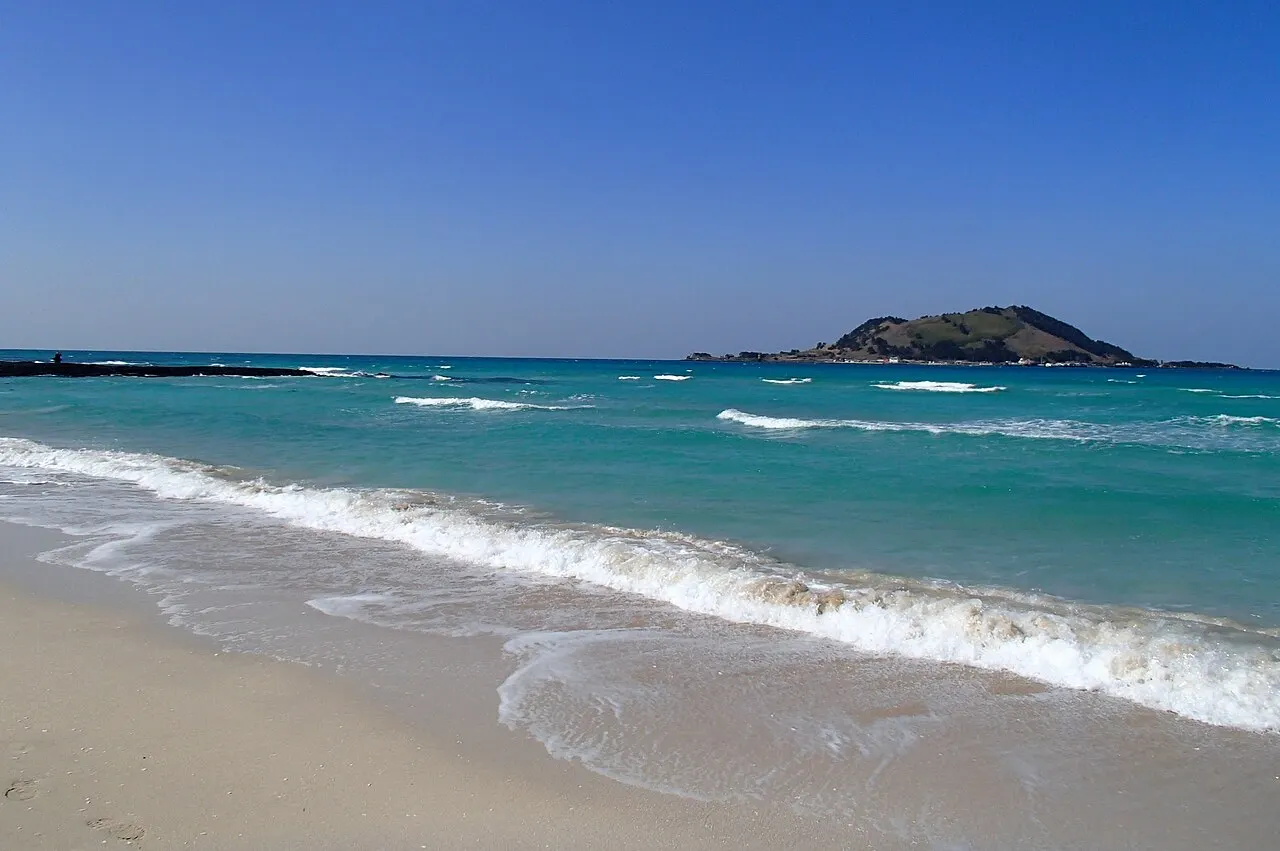
On the west coast, Hyeopjae beach faces the island of Biyangdo, Hallim harbor has the ferry to it and Aewol has the Handam coastal trail. It is the sunset coast, better served by car.
Interior and oreum
Between the two cities lie the volcanic cones, such as Saebyeol Oreum, forests such as Bijarim and Saryeoni, and the trailheads of Hallasan. There is almost no lodging or commerce: it is territory you pass through by car or on a specific bus.
History
Prehistory · First inhabitants
Human settlement of the island began 8,000 to 10,000 years ago, according to the province's historical overview.
5th c. · Kingdom of Tamna
Tamna, the first known state on the island, began paying tribute to kingdoms on the peninsula from the 5th century. Legend places the origin of the Jeju people in three holes in the ground, preserved at the Samseonghyeol shrine in Jeju-si.
1105 · Goryeo district
The Goryeo kingdom abolished the name of the old kingdom and turned the island into the district of Tamna, with officials sent from the mainland.
1271–1273 · The Sambyeolcho and the Mongols
In 1271 the Sambyeolcho rebels, coming from Jindo, fortified themselves on the island; two years later they were defeated by Goryeo and Mongol troops, and in 1273 the Yuan dynasty installed a military governor. The island became a horse pasture for the cavalry until 1356.
Joseon · Administrative seat in Jeju-si
The Jeju Mokgwana complex concentrated the island's government. Excavations from 1991 to 1998 found the remains of 30 buildings, and eight were rebuilt by 2002.
1910–1945 · Japanese rule
Jeju was part of the Korea annexed by Japan. Traces of Japanese military installations remain at Seongsan Ilchulbong and Geomunoreum.
1946 · A province of its own
On August 1, 1946, under the US military government, Jeju stopped belonging to South Jeolla and became a separate province.
1948–1949 · The 4·3 uprising and massacre
The uprising of April 3, 1948 and the repression that followed killed between 14,000 and 30,000 people, about a tenth of the island's population. The subject was censored for decades.
2003 · Report and apology
A national committee published the report on the 4·3, and President Roh Moo-hyun apologized on behalf of the government. The 4·3 Peace Park opened on March 28, 2008.
2007 · World Heritage
Hallasan, Seongsan Ilchulbong and the Geomunoreum lava tube system were inscribed by UNESCO as Jeju Volcanic Island and Lava Tubes.
2016 · The haenyeo at UNESCO
The culture of Jeju's women divers was added to the list of the Intangible Cultural Heritage of Humanity.
Complete history
A kingdom on a volcanic island
Before it was a Korean province, Jeju was Tamna, a kingdom that kept tributary relations with the states of the peninsula and whose origin local tradition explains with three demigods who emerged from the earth at Samseonghyeol, today in the center of Jeju-si. Goryeo incorporated the island in 1105; after the defeat of the Sambyeolcho rebels, the Mongol Yuan dynasty governed it from 1273 to 1356, and Joseon established central control in the 15th century. The Jeju Mokgwana complex, rebuilt from excavations, shows how the island was governed from the north, where the city still concentrates the administration, the port and the airport.
Isolation and a sea economy
The distance from the mainland and the volcanic soil, which does not hold water, made Jeju a land of herding, fishing and diving. From the 18th century women came to dominate gathering on the seabed, and the haenyeo became the breadwinners of many families.
The 20th century and the 4·3
After 35 years of Japanese rule, Jeju became a province in 1946 and, two years later, was the stage of the uprising of April 3, 1948. The repression campaign, which lasted until 1949, left between 14,000 and 30,000 dead, about a tenth of the population, and led about 40,000 people to flee to Japan. The subject was forbidden for decades; only in 2003 did the government acknowledge the abuses and apologize. The 4·3 Peace Park, opened in 2008, is the place to understand why so many villages in the interior have memorial markers.
From farming island to holiday destination
Jeju-si grew fast from the 1970s and gained Shin-Jeju, the new town above the airport; in the south, the Jungmun resort complex was created in 1978. In 2006 the island gained the status of Special Self-Governing Province, with two cities, Jeju-si and Seogwipo, in place of the former counties. UNESCO recognition came in 2007, along with the Olle trails, inspired by the Camino de Santiago, which take visitors on foot through the coastal villages.
Geography and shape of the city
A volcano that is the island
Jeju is a shield volcano 73 km from east to west and 31 km from north to south; the whole province, with the smaller islands, covers about 1,850 km². Hallasan, at 1,947 m, fills the center and is visible from almost the whole coast when it isn't wrapped in clouds; at the top lies the crater lake Baengnokdam. On the slopes there are about 360 parasitic cones, the oreum, made of ash and scoria, and near the sea there are tuff cones and rings formed by eruptions in contact with water, such as Seongsan Ilchulbong and Yongmeori.
Lava below, forest above
Rivers of lava that cooled on the outside and kept flowing inside left tubes such as Manjanggul, in the Geomunoreum system. Over the lava fields grows the gotjawal, a forest of trees and vines on loose rock that acts as a recharge area for the groundwater the island depends on. The water returns to the surface on the coast, in cold springs and in the waterfalls of the south.
North and south
Hallasan divides the island into two halves. In the north, Jeju-si concentrates the airport, port and commerce and gets more of the continental winter wind. In the south, Seogwipo is more sheltered and has slightly milder winters, basalt cliffs and the Jeongbang and Cheonjiyeon waterfalls. The two cities are linked by roads that cross the mountain, such as the 5.16 and the 1100, which are winding and subject to fog and snow in winter.
The mountain has a different climate
The weather on Hallasan changes more, and faster, than on the coast. At Seongpanak, at 760 m, the January average is below zero and annual rainfall exceeds 4,300 mm in the Korea Meteorological Administration's 1999 to 2020 normals, with August the rainiest month. A sunny morning in Jeju-si does not guarantee an open summit.
Culture
The haenyeo
Jeju's women divers go down without a tank, with a mask, a net and an orange buoy called a tewak, and when they surface they let out a breathing whistle, the sumbisori. Today almost nine in ten are over 60. Their culture was added to UNESCO's intangible heritage list in 2016, and the Haenyeo Museum in Hado keeps the story; at several points on the coast the orange buoys show where they are working.
Stone, wind and walls
Basalt is everywhere: in the low dry-stacked stone walls that separate fields and tombs, in the traditional houses and in the dol hareubang, the stone grandfather statues with round hats that guarded the entrances of fortified villages. Of the pre-modern originals, 47 or 48 remain, 21 of them in Jeju-si and 12 in Seongeup. Jeju Stone Park, in Jocheon, brings this tradition together with the myths of Seolmundae Halmang, the figure who, according to legend, tore off the top of Hallasan and hurled it where Sanbangsan now stands.
The Jeju language
The island's traditional speech is so different from standard Korean that researchers treat it as a language of its own, now critically endangered. The title of the 2025 Netflix series set on the island, Pokssak sogatsuda, is a Jeju expression for thanking someone for their effort.
Memory of the 4·3
April 3 is a day of ceremony at the 4·3 Peace Park, and Korean literature and cinema have returned to the subject in recent decades, from Jiseul, by O Muel, to Han Kang's novel published in English as We Do Not Part. The memory also appears in discreet plaques in villages, caves and beaches.
Olle trails
Suh Myung-sook, a former journalist born on the island, created the foundation that opened the Olle trails, inspired by the Camino de Santiago. Olle is the Jeju word for the lane that connects the road to a house's gate. There are 21 main routes and six variants, about 437 km, almost all along the coast and on the neighboring islands.
Festivals and events
Seongsan Sunrise Festival
At the turn of the year, around Seongsan Ilchulbong, to watch the first sunrise of the year at the island's easternmost point.
Tamna Ipchun-gut
In early February, near Ipchun, the start of spring in the traditional calendar, a festival tied to the date at the Jeju Mokgwana complex and in the old center of Jeju-si.
Jeju Fire Festival (Deulbul)
In March, at Saebyeol Oreum. The burning of the cone's grass has been abolished, and the festival now projects a light show onto the oreum, keeping the torch march and the wish bonfires.
Jeonnong-ro cherry blossoms
In April, on Jeonnong-ro street, five minutes from the airport, a tunnel of cherry trees gets a fair and food stalls, according to the official guide.
4·3 ceremony
On April 3, a ceremony in memory of the victims at the 4·3 Peace Park.
Gapado Green Barley Festival
In spring, when the island of Gapado is covered in green barley, especially in April.
Books and films
We Do Not Part (Jakbyeolhaji anneunda), by Han Kang (2021)
A novel in which the narrator travels to Jeju at a friend's request and reflects on the 4·3 massacre; the French translation won the Prix Médicis for foreign literature in 2023.
The Island of Sea Women, by Lisa See (2019)
A historical novel about the friendship of two haenyeo from the Japanese rule to the present day; the author interviewed women divers on the island.
Jiseul, by O Muel (2012)
A black-and-white film, spoken in the Jeju language by local actors, about villagers who hid in a cave during the repression of 1948.
When Life Gives You Tangerines (Pokssak sogatsuda, 2025)
A 2025 Netflix series set in Jeju; the original title is an expression from the island's language.
Our Blues (2022)
A Korean series in a format of independent episodes, with stories of characters set in Jeju.
Frequently asked questions
Jeju: how do you get from the airport to Jeju-si and Seogwipo?
Jeju International Airport (CJU) is inside Jeju-si. Buses leave from the ground floor of the terminal. The old center of Jeju-si and Dongmun Market are about 20 minutes away by bus. For Jungmun and Seogwipo, the 600 limousine leaves in front of gate 5, from 6:00 to 22:40, at intervals of 16 to 40 minutes, and stops at several hotels up to the Seogwipo KAL Hotel; the adult fare ranges from 1,300 to 5,500 won, depending on the stretch, per the table on bus.jeju.go.kr.
Jeju: how many days should I stay?
I'd stay four days in Jeju, with the first three nights in Jeju-si and the fourth in Seogwipo. The first day is for the old capital and the 4·3 Peace Park, which explain the island; the second, for the east, with Manjanggul, the Haenyeo Museum and Seongsan Ilchulbong; the third, for Hallasan, with the reservation made the month before; and the fourth, for the waterfalls and coast of Seogwipo. Anyone with more time can add the west coast, from Yongmeori to Hyeopjae beach, in a day by car from Seogwipo, and Udo, preferably sleeping a night in Seongsan to catch the morning ferry. Fewer than four days forces a choice between Hallasan and the east.
Jeju: how do you book the Hallasan trail?
Seongpanak and Gwaneumsa, the only trails that reach the summit, require a reservation in the park's official system. The system releases next month's slots on the first business day of each month, at 9:00, and on the first day there may be a virtual queue. The QR arrives by text message to the phone you provided; without it, you don't get past the checkpoint. Cancel in the system if you are not going, because someone who doesn't show up without canceling is barred from reserving for three months, and for a year the second time. If you missed the window you can climb via Yeongsil or Eorimok to Witse Oreum.
Jeju: how do you climb to the summit of Hallasan?
Only two trails reach the crater lake Baengnokdam at the top: Seongpanak, 9.6 km to the summit and about 4.5 hours up the east side, longer and with a moderate grade, and Gwaneumsa, 8.7 km up the north side, steeper. Both require a reservation in the park's official system, with a QR code sent by text message to your phone; the park asks for ID and closes the passage at the checkpoints in late morning or early afternoon, depending on the season. Someone who leaves Seongpanak at 9:00 risks being turned back in the middle of the trail. If you can't get a slot, or don't have the stamina for about 19 km round trip, take the Yeongsil or Eorimok trails to the Witse Oreum shelter, at about 1,700 m, without the lake. The weather closes in fast up there: check the park's website to see whether the trails are open that day.
Jeju: how do you get around the island by bus?
There is no train or subway. The bus network has express lines between regions, blue long-distance lines and green local ones; according to the table on the official site bus.jeju.go.kr, adults pay 1,150 won with a card or 1,200 in cash on regular lines, and on express lines 2,000 won with a card up to 20 km, with a surcharge by distance up to 3,000 won; anyone paying cash on an express always pays the 3,000. T-money cards work on all buses: tap the card when you board and when you get off. Some lines do not accept cash. Line 281 links the Jeju-si terminal to Seogwipo along the 5.16 road and stops at Seongpanak, the Hallasan trailhead; it runs from 6:00 to 22:00, about 45 minutes from Jeju-si to the trailhead and 50 from Seogwipo. Plan routes on the official site bus.jeju.go.kr.
Jeju: is it worth renting a car?
For the west, the interior and the oreum, a rental car gets you more than the bus. Foreigners must present a passport and an international driving permit. July and August are high season and rentals get more expensive. The roads that cross Hallasan, the 5.16 and the 1100, are winding and get fog and snow in winter. Udo restricts the circulation of cars from outside: on the island, use buses, bicycles or a rented electric car, and check the official page for the exceptions (among them, chartered 16-seat buses and electric or hydrogen rental cars) before taking a vehicle.
Jeju: how do you visit the west coast and Yongmeori?
A day from Seogwipo, best by car. In the morning, the Yongmeori coast (9:00 to 17:00, last entry at 16:30, 2,000 won), which closes at high tide or in waves: confirm by phone at 064-794-2940 or on Instagram @6sot_official before setting out. Just above, the Sanbangsan staircase leads to the Sanbanggulsa cave temple. In the afternoon, continue along the west coast to Hyeopjae beach for the sunset behind Biyangdo; from there, the bus takes about 70 minutes to the airport.
Jeju: how do you get to Udo?
The largest of the neighboring islands is about 15 minutes by ferry from Seongsan or Jongdal; from Jeju-si, allow about two hours by bus to the port, or sleep a night in Seongsan to catch the morning ferry. It has a 17 km circuit, covered in two to three hours by electric bicycle, scooter or the island's bus. The island restricts the circulation of cars from outside; check the exceptions on the official page before taking a vehicle. The highlights are Seobinbaeksa beach, made of calcareous algae fragments, Hagosudong beach, the Udobong lookout, at 132 m, and the Geommeolle sea cave, accessible at low tide. Admission to the marine park costs 1,000 won for adults, in addition to the ferry, which may not run in rough seas.
Jeju: when is the best time to go?
April, May, October and November; from June to September the heat is humid, rainfall is higher and storms and typhoons are a risk, and in winter strong wind and snow on Hallasan change how you plan the trails.
Jeju: do I need cash?
Credit cards are accepted in most shops, but it helps to have some cash for market stalls and for the bus, where the transit card is the most practical method.
Jeju: is it safe?
South Korea has a reputation for high public safety, highlighted by Jeju's own official guide; on a trip to the island, the risks that weigh most come from nature and traffic. On Hallasan, altitude, distance and fast-changing weather cause exhaustion, falls and heart problems, and the park recommends that anyone who is unfit or has a chronic illness stick to the trails up to Witse Oreum. On the coast, waves and tide close paths such as Yongmeori and can suspend ferries; at the beaches, swim only in season and in the lifeguarded area. In summer and early autumn, follow the meteorological service's storm and typhoon warnings. Emergencies: 112 for police and 119 for fire and ambulance; the island's tourism hotline (064-740-6000) answers in English, Chinese and Japanese, and the national 1330 line also has service in other languages.
Other cities in the country
South Korea ↗- Days
- 3–4
- When
- Apr–Jun · Sep–Nov
- Per person/day
- Average 160,000–260,000 KRWMid-range · per person/day
Cost scope
Per person per day: accommodation, meals, urban transport, visits and a small allowance for extras. Flights excluded; larger purchases vary. Editorial estimate, not a quote.
- Days
- 2–3
- When
- Apr–May · Oct
- Per person/day
- Average 144,700 KRWMid-range · per person/day
Cost scope
Per person per day: accommodation, meals, urban transport, visits and a small allowance for extras. Flights excluded; larger purchases vary. Editorial estimate, not a quote.