Thailand
Krabi
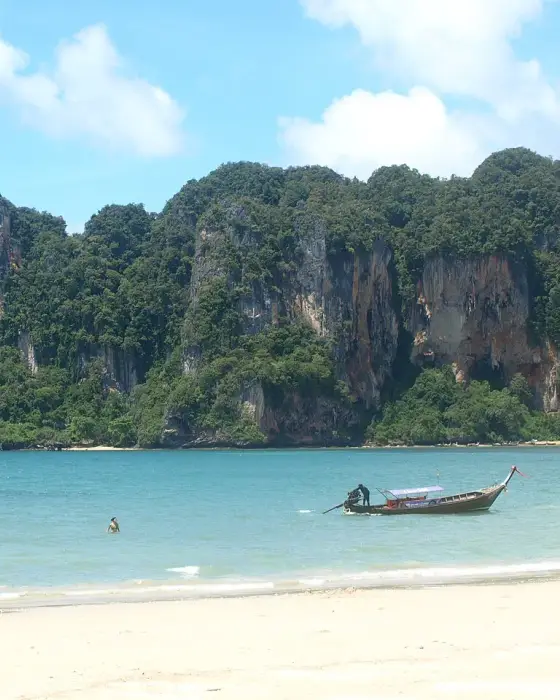
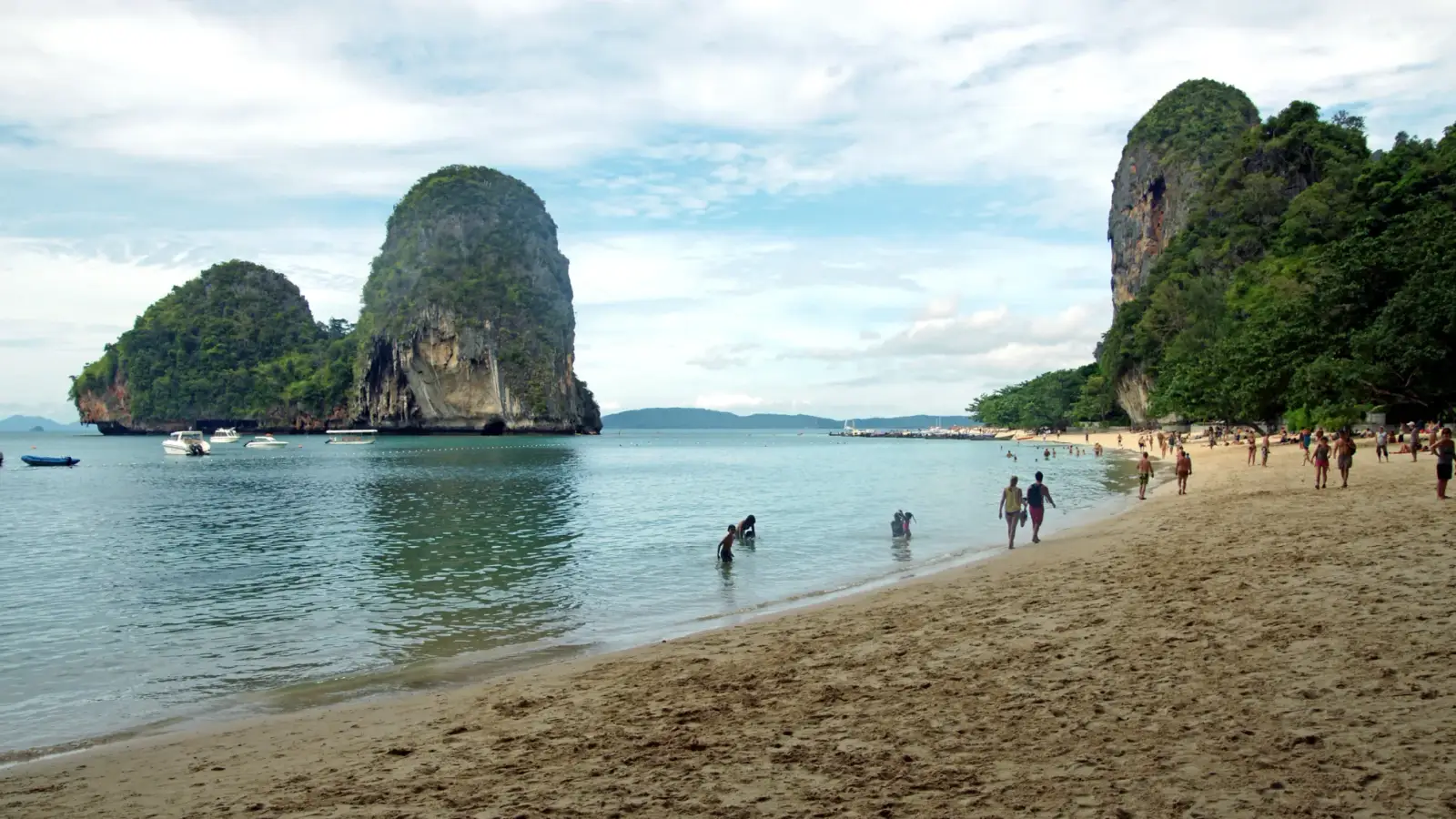
Krabi, a coast of limestone towers on the Andaman Sea, with Railay, the islands off Ao Nang and a town on the river
Days I'd stay three days in Krabi, sleeping in Ao Nang.
How the guide reaches this number
The first is for Railay: the early boat to Phra Nang beach, the viewpoint if you have the stamina and an afternoon of climbing or kayaking. The second is for the Poda islands, on a chartered long-tail boat timed for low tide so you can walk across the Ko Thap sandbar. The third is for Krabi Town, with the morning market, the climb to Wat Tham Suea, the boat to Khao Khanap Nam and dinner at the night market. With a fourth day, I'd go to the Hong islands and the kayak lagoon; with a fifth, to Phi Phi, by ferry or speedboat. The emerald pool and the Khlong Thom hot springs are for people with even more time, or for rainy days when the sea won't let the boats out, along with the Krabi Town day.
3–5
Start with the basic programme and choose extensions for the time you have.
When December to March; this is the dry season, with the lowest rainfall of the year and calm seas for boats.
How the guide reaches this number
From May to October the monsoon brings rain on more than half the days, peaking in October, and November still sees rain on more than half the days
December to March; this is the dry season, with the lowest rainfall of the year and calm seas for boats. From May to October the monsoon brings rain on more than half the days, peaking in October, and November still sees rain on more than half the days
Per person/day Budget around THB927; mid-range around THB2,350; comfortable around THB6,060 per person per day, based on spending reported by travelers to Budget Your Trip (checked October 2026).
How the guide reaches this number
Indicative figures, excluding travel to the destination.
Budget around THB927; mid-range around THB2,350; comfortable around THB6,060 per person per day, based on spending reported by travelers to Budget Your Trip (checked October 2026). Indicative figures, excluding travel to the destination.
Per person per day: accommodation, meals, urban transport, visits and a small allowance for extras. Flights excluded; larger purchases vary. Editorial estimate, not a quote.
Salta · among the cheapestZermatt · among the priciest
Cheaper than 84% of them. The tick marks the median. Compared by the middle of each city’s daily range, converted at the 24 Sept 2026 exchange rate.
 What Nilo thinks
I'd recommend Krabi to people who like paddling slowly, eating in markets and noticing how Buddhists and Muslims share the same town. In the covered market in Krabi Town, when the national anthem plays, nearly everyone stops where they are until the music ends, and it is a good place to see that custom up close. At the north end of Phra Nang beach, the princess's shrine holds the wooden offerings of fishermen asking for protection; I'd stop by it before spreading out a towel, because it tells you that this beach is also a place of devotion. At the table, I'd alternate the south's two cuisines: the spiced rice and mild curry of the Muslim stalls one day, seafood the next. Among boat trips, I'd choose a kayak in the Ao Thalane mangroves over the speedboats that fit several islands into one morning, because the kayak goes into channels where a motor can't.Krabi is a limestone landscape. The sheer-sided hills that rise from rice paddies and mangroves carry on out to sea as islands, and along the coast they enclose beaches that no road reaches. Railay is the best known: a peninsula cut off by cliffs, reached by long-tail boat, with water up to your knees, where climbers scale the rock a few meters from people swimming in the sea. Offshore, the islands of Poda and Hong have white sand, shallow coral and a lagoon you enter by kayak through a gap in the rock. The capital, Krabi Town, has little beach and a lot of life: the morning market, the roti stalls and the spiced-rice stalls of the south's Muslim cooking, the river between two hills and a monastery set in the caves at the foot of a cliff, from which a stairway of more than a thousand steps climbs to the top of the hill. A trip here alternates days by boat, among beaches and islands, with days on land, among the market, the temple and the river's mangroves.
Quick facts
- Population
- 483,855 registered residents in Krabi Province (civil registry of the Department of Provincial Administration, 2024); 30,459 in the municipality of Krabi, the capital (same registry, end of 2025). Ao Nang and Railay are outside the municipality, in Mueang Krabi district
- Founding
- No single date: the communities formed in the late 18th century were raised to city status by King Chulalongkorn in 1872, and in 1875 Krabi stopped depending on Nakhon Si Thammarat and began answering directly to Bangkok
- Country and region
- Thailand: Krabi Province, in the south of the country, on the Andaman Sea coast, with more than 130 islands
- Language
- Thai, with the accent and vocabulary of the south; in the tourist areas of Ao Nang and Railay, English covers the basics
- Currency
- Thai baht (THB, ฿); about 38 per euro and 33.5 per US dollar (rate of September 24, 2026)
- Time zone
- UTC+7 all year, no daylight saving time
- Best time to go
- December to March; this is the dry season, with the lowest rainfall of the year and calm seas for boats. From May to October the monsoon brings rain on more than half the days, peaking in October, and November still sees rain on more than half the days
- Average daily cost
- Budget around THB927; mid-range around THB2,350; comfortable around THB6,060 per person per day, based on spending reported by travelers to Budget Your Trip (checked October 2026). Indicative figures, excluding travel to the destination.
What’s new
Recent changes that affect the plan, with date and source.
- Sep 2026
Thailand has shortened the permitted stay for people entering under the visa exemption: since September 15, 2026, it is up to 30 days, for tourism only, according to the British government's notice to its citizens. The exemption and the length depend on nationality; check the rule for your passport before buying your ticket. source
When to go
December to March; this is the dry season, with the lowest rainfall of the year and calm seas for boats. From May to October the monsoon brings rain on more than half the days, peaking in October, and November still sees rain on more than half the days
January
Best time11 h 42 min of daylight
National holidays
Jan 1, 2027 · New Year's Day
Jan 9, 2027 · National Children's Day
Jan 1, 2028 · New Year's Day
Jan 3, 2028 · New Year's Day (in lieu)
Jan 8, 2028 · National Children's Day
Source: python-holidays. Holiday dates shift; check close to your trip.
February
Best time11 h 53 min of daylight
National holidays
Feb 21, 2027 · Makha Bucha
Feb 22, 2027 · Makha Bucha (in lieu)
Feb 10, 2028 · Makha Bucha
Source: python-holidays. Holiday dates shift; check close to your trip.
April
12 h 18 min of daylight
National holidays
Apr 6, 2027 · Chakri Memorial Day
Apr 13, 2027 · Songkran Festival
Apr 14, 2027 · Songkran Festival
Apr 15, 2027 · Songkran Festival
Apr 6, 2028 · Chakri Memorial Day
Apr 13, 2028 · Songkran Festival
Apr 14, 2028 · Songkran Festival
Apr 15, 2028 · Songkran Festival
Apr 17, 2028 · Songkran Festival (in lieu)
Source: python-holidays. Holiday dates shift; check close to your trip.
May
12 h 29 min of daylight
National holidays
May 1, 2027 · National Labor Day
May 3, 2027 · National Labor Day (in lieu)
May 4, 2027 · Coronation Day
May 20, 2027 · Visakha Bucha
Source: python-holidays. Holiday dates shift; check close to your trip.
June
12 h 35 min of daylight
National holidays
Jun 3, 2027 · HM Queen Suthida's Birthday
Source: python-holidays. Holiday dates shift; check close to your trip.
July
12 h 33 min of daylight
National holidays
Jul 18, 2027 · Asarnha Bucha
Jul 19, 2027 · Buddhist Lent Day
Jul 20, 2027 · Asarnha Bucha (in lieu)
Jul 28, 2027 · HM King Maha Vajiralongkorn's Birthday
Source: python-holidays. Holiday dates shift; check close to your trip.
August
12 h 23 min of daylight
National holidays
Aug 12, 2027 · HM Queen Sirikit The Queen Mother's Birthday; National Mother's Day
Source: python-holidays. Holiday dates shift; check close to your trip.
September
12 h 10 min of daylight
October
11 h 57 min of daylight
National holidays
Oct 23, 2026 · HM King Chulalongkorn Memorial Day
Oct 13, 2027 · HM King Bhumibol Adulyadej Memorial Day
Oct 23, 2027 · HM King Chulalongkorn Memorial Day
Oct 25, 2027 · HM King Chulalongkorn Memorial Day (in lieu)
Source: python-holidays. Holiday dates shift; check close to your trip.
November
11 h 45 min of daylight
December
Best time11 h 40 min of daylight
National holidays
Dec 5, 2026 · HM King Bhumibol Adulyadej the Great's Birthday; National Day; National Father's Day
Dec 7, 2026 · HM King Bhumibol Adulyadej the Great's Birthday (in lieu); National Day (in lieu); National Father's Day (in lieu)
Dec 10, 2026 · Constitution Day
Dec 31, 2026 · New Year's Eve
Dec 5, 2027 · HM King Bhumibol Adulyadej the Great's Birthday; National Day; National Father's Day
Dec 6, 2027 · HM King Bhumibol Adulyadej the Great's Birthday (in lieu); National Day (in lieu); National Father's Day (in lieu)
Dec 10, 2027 · Constitution Day
Dec 31, 2027 · New Year's Eve
Source: python-holidays. Holiday dates shift; check close to your trip.
High, shoulder and low season
High · December to March
Dry season, with the year's lowest rainfall and calm seas: boats to the islands almost every day, Railay full and lodging prices higher in Ao Nang. From February to March the average highs exceed 34 °C. The Hong islands season runs from January to April.
Shoulder · April and November
Transition months. April is hot, with average highs above 34 °C, and the rain starts to increase again; the Hong islands are still in season. November opens the tourist season, with the province in festival mode, but it still rains on more than half the days and the sea can cancel tours.
Low · May to October
Southwest monsoon, with rain on more than half the days and a peak in October. Island tours can be canceled the same day, the crossing to Railay is safer from Ao Nam Mao, and jellyfish appear closer to shore. Prices drop, but part of the commerce in Ao Nang closes, and Maya Bay is usually closed to landings in August and September.
How the year changes
The year in Krabi is divided by the monsoon. From December to March, the dry season, the northeast wind brings clear skies, calm seas and the year's lowest rainfall: 32 mm in January, 43 mm in February and 98 mm in March, according to the 1981 to 2010 normals for the Krabi station. This is when boats to the islands run almost every day. From February to April the average highs exceed 34 °C, and in April rain starts to increase again (147 mm). From May to October the southwest wind brings rain on more than half the days and waves that cancel tours; October is the rainiest month, with 323 mm. November opens the tourist season, but it still rains on more than half the days (180 mm). During the monsoon prices drop, some of the restaurants and shops in Ao Nang close or cut their hours, the crossing to Railay is usually safer from Ao Nam Mao, and jellyfish appear closer to shore. At Maya Bay, on Phi Phi, the park usually suspends landings in August and September.
Nilo's tips
Early-morning boat
The first boat from Ao Nang to Railay West, followed by a ten-minute walk, gets you to Phra Nang beach before the tour speedboats. After 6 p.m. the boat fare goes up; I'd head back before then.
Tide table in hand
The Ko Thap sandbar and the kayak entrance to the Ko Hong lagoon depend on low tide. Group tours run on a fixed schedule; to choose the time by the tide, I'd charter a long-tail boat at the Ao Nang booth.
Cash for the fees
The national park fee on the islands is not included in the price of most tours and is paid in cash: 400 baht per foreign adult on Poda and Phi Phi.
A flexible monsoon
From May to November, I'd leave one day free in the schedule: if the sea cancels the boat, the Krabi Town day or the trip to the hot springs and the emerald pool at Khlong Thom, both overland, can take its place.
The market ends early
The Krabi Town morning market loses its bustle after 8 a.m. If you sleep in Ao Nang, I'd leave before 7 a.m. and combine the market with the climb at Wat Tham Suea, while it's still cool.
Explore the map
Explore the map, read about the other places and plan your travel days in the app.
Open the appWhat to see
If time is short, I would skip: Su San Hoi
Leave for last, if time allows: Diamond Cave · Wat Kaew Korawaram
Railay Beach
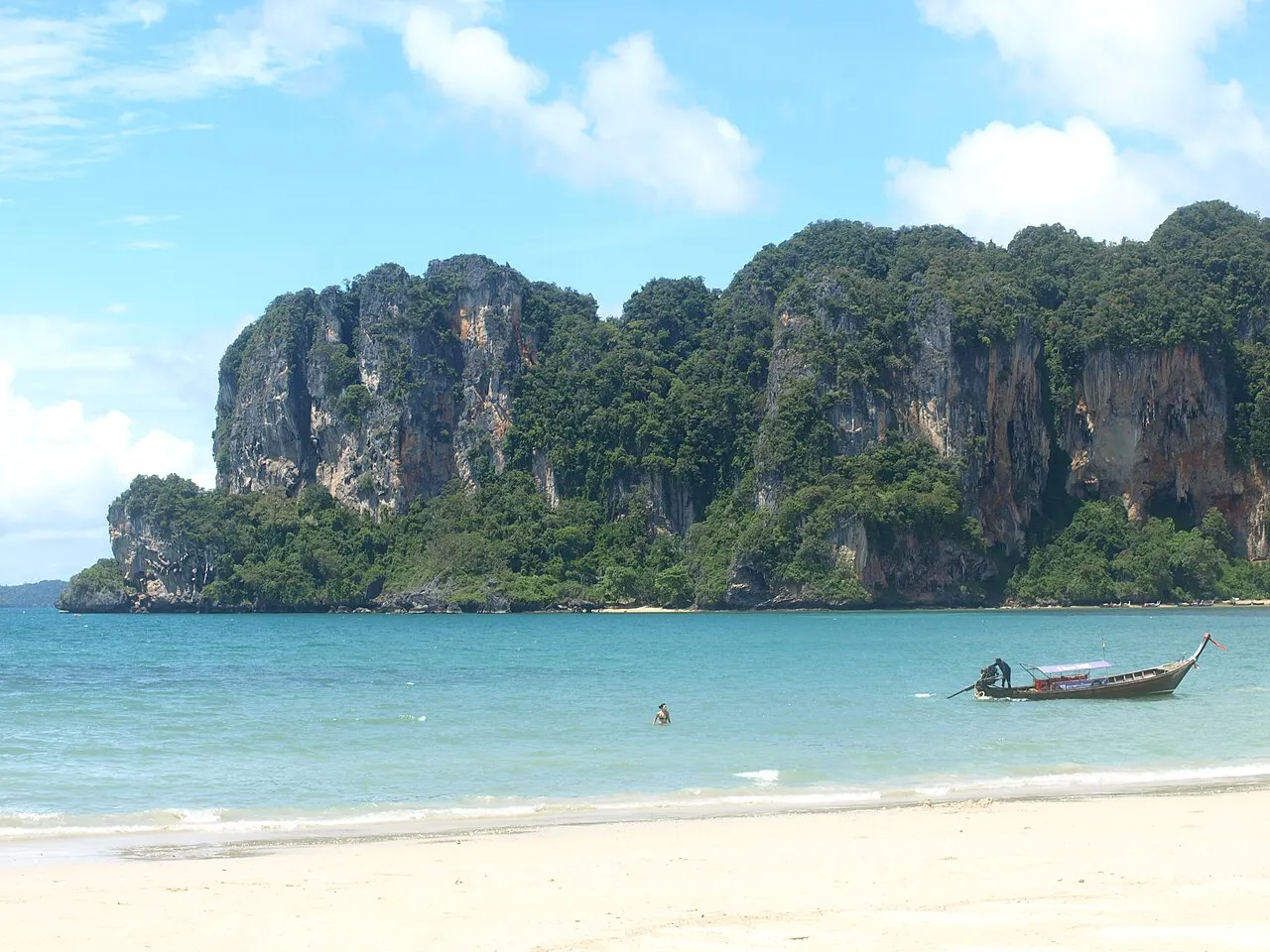
Railay West beach is the image of Krabi: white sand and shallow water between two limestone cliffs where climbers scale the rock beside people sunbathing. There is no road; you arrive by long-tail boat from Ao Nang in ten to fifteen minutes. The north end is the best for swimming, and at sunset the cliffs become silhouettes over the bay. Behind the beach, a promenade with restaurants and shops connects to the east side of the peninsula. Climbers and backpackers stay in the neighboring cove, Ton Sai.
Check access
Phra Nang Cave Beach
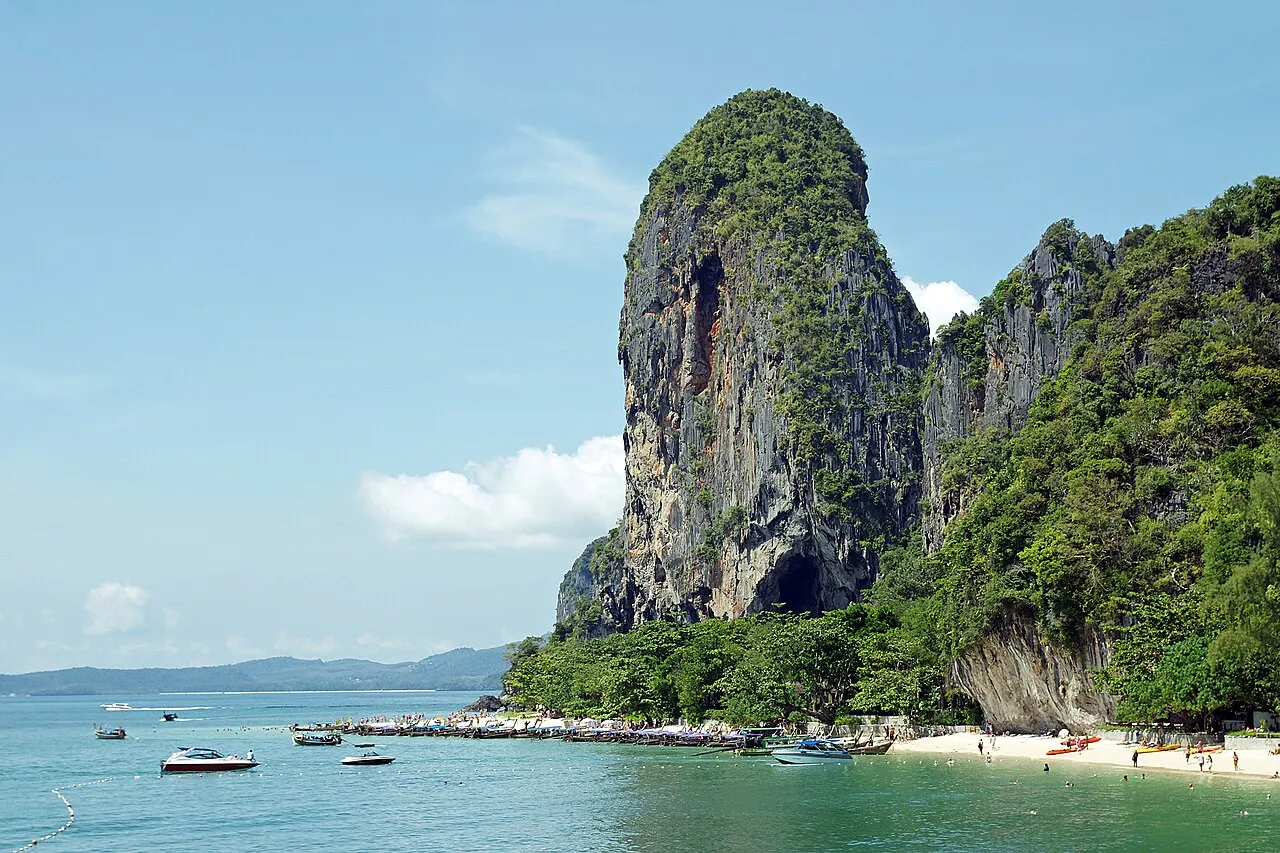
At the southern tip of the peninsula, Hat Tham Phra Nang is considered the most beautiful beach on the peninsula, with pale sand, limestone islets in front of it and a cliff that drops straight onto the sand. You reach it on foot by a flat trail beneath the rocks from Railay East. At the north end, a small cave holds the shrine of Princess Phra Nang, full of wooden phallus-shaped offerings left by fishermen asking for her protection. Through the day, tour boats take up much of the strip of sand; early in the morning it is still free.
Check access
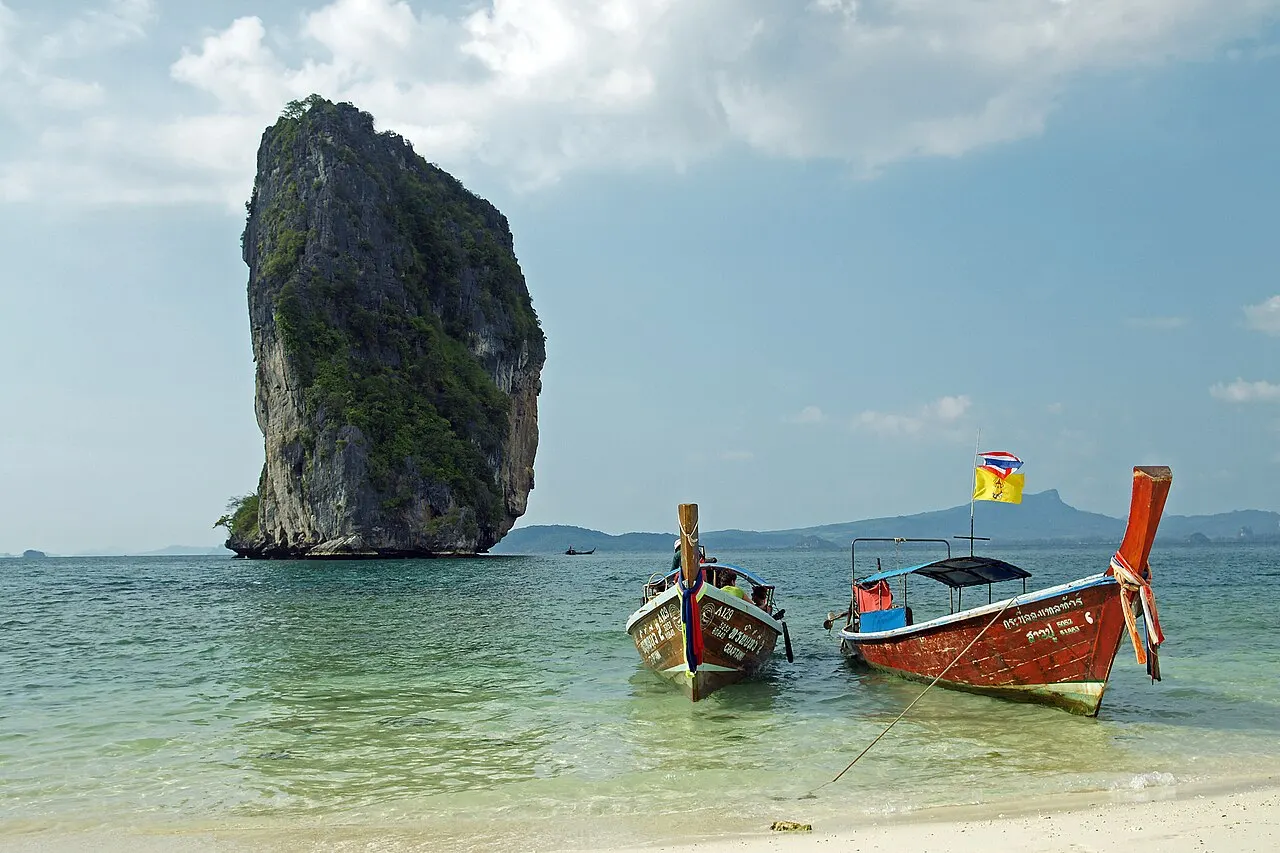
Ko Poda
The Poda archipelago, about 8 km from Ao Nang and 25 minutes by long-tail boat, includes Ko Poda, Ko Kai, Ko Mo and Ko Thap, with white sand, clear water and shallow coral. At low tide a sandbar links Ko Thap to the neighboring islets and you can walk across, which the Thais call Talay Waek, the sea that parts. The trip that agencies sell as the four-island tour usually combines Ko Poda, Ko Kai, Ko Thap and Phra Nang beach, in Railay, on a fixed schedule. If you have already been to Phra Nang or want to time the tide, you can charter a long-tail boat just for Poda and Thap at the booth on Ao Nang beach. The islands are part of the national park, with a fee of 400 baht for adult foreigners and 200 for children.
Check access
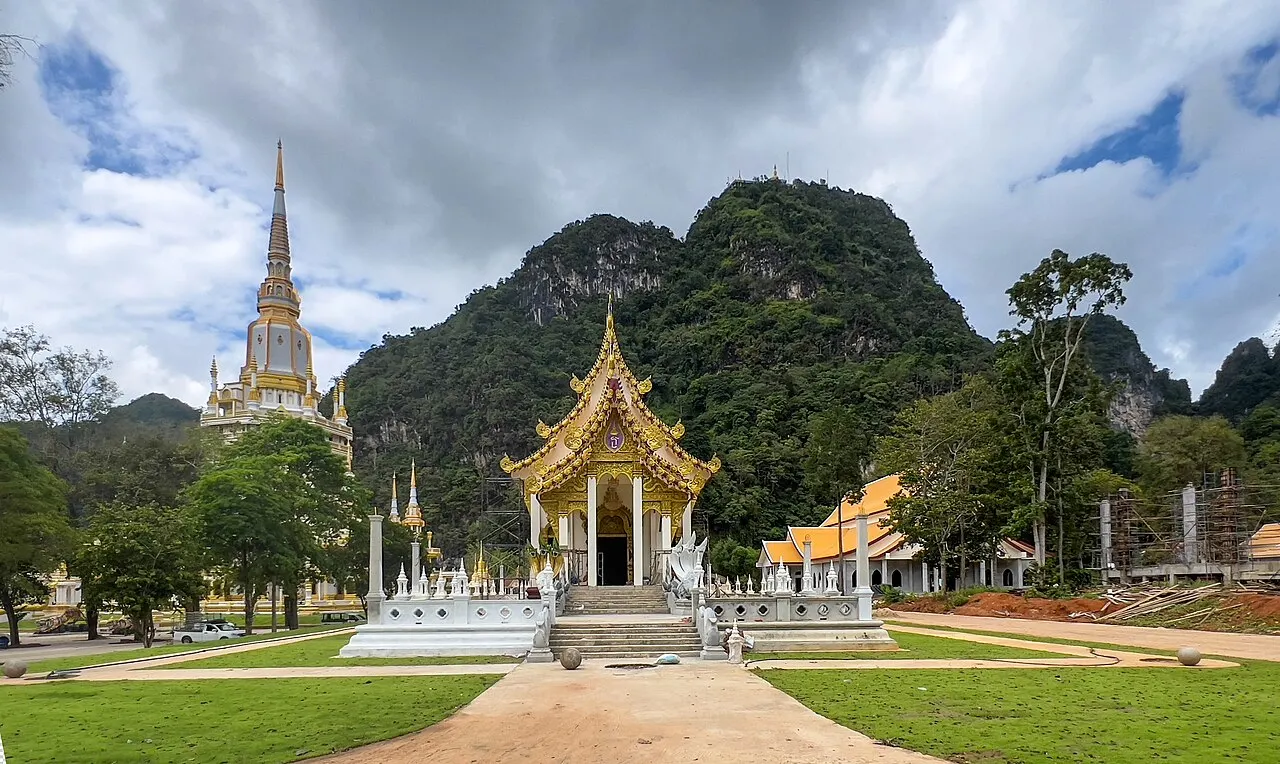
Wat Tham Suea
The Tiger Cave temple, about 9 km from the center of Krabi Town, began in 1975 as a meditation center at the foot of a limestone cliff. At the base are the hall beneath the rock and the caves where the monks meditate. What draws visitors is the stairway to the top of Khao Kaeo hill, with more than 1,200 steps (published counts run from 1,239 to 1,272), where there is a golden pagoda, a replica of the Buddha's footprint and a view over the hills and the sea. It is a working temple: cover your shoulders and knees, and watch out for monkeys with food and loose belongings.
Check access
Railay Viewpoint
A steep trail leaves the path between Railay East and Phra Nang and climbs, with ropes on the red-mud sections, in about half an hour to a viewpoint over the peninsula's two beaches. From the top, another, more dangerous stretch descends in 20 to 25 minutes to the hidden lagoon of Sa Phra Nang, at the bottom of a pit of cliffs. It is a climb over slippery rock: it requires closed shoes, both hands free and good fitness, and should not be done after rain.
Check access
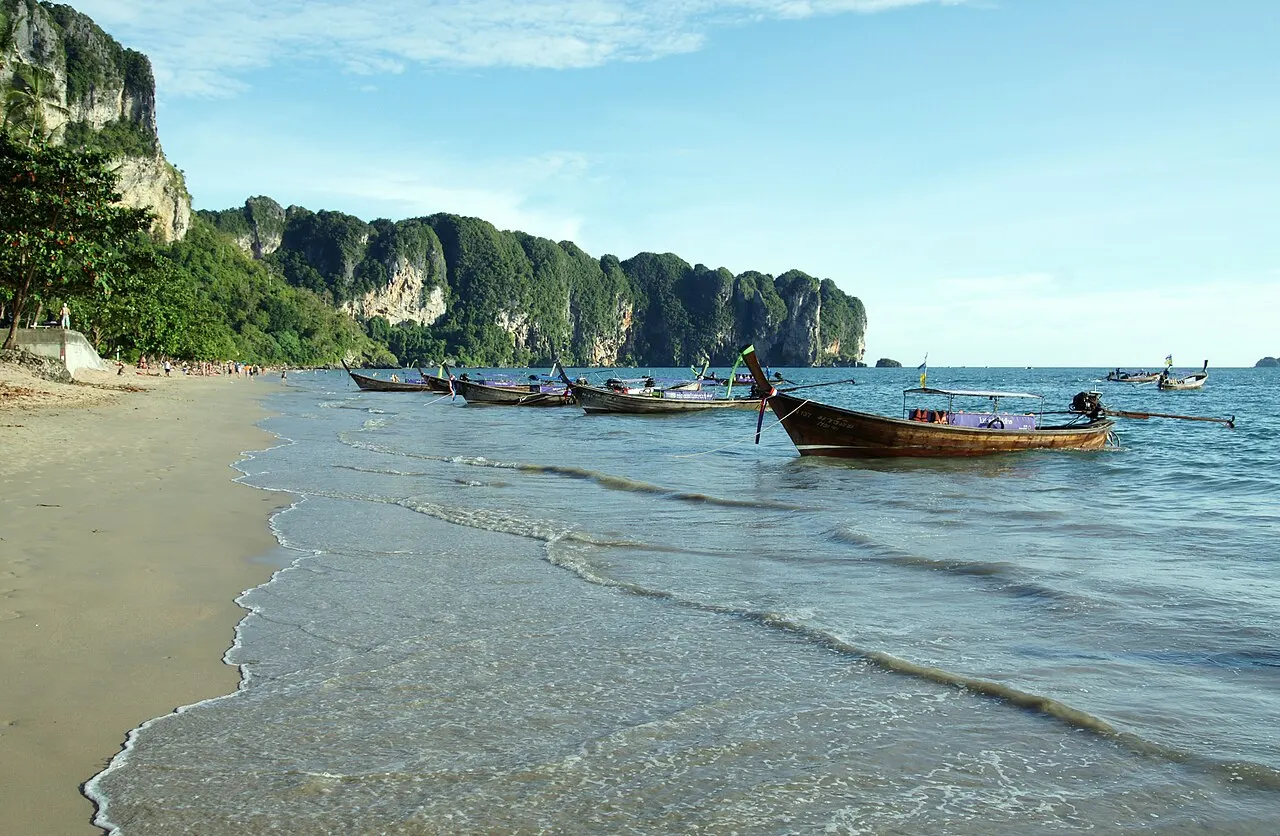
Ao Nang Beach
Ao Nang's main beach is more a base than a destination: the west end is taken over by the boats leaving for the islands, and the water near the Khlong Haeng stream, which separates Ao Nang from Noppharat Thara, receives sewage and is not suitable for swimming. The east end is cleaner and has monkeys on the rocks. From there, a wooden walkway of ten to fifteen minutes leads to the little beach of Pai Plong, which is prettier and calmer.
Check access
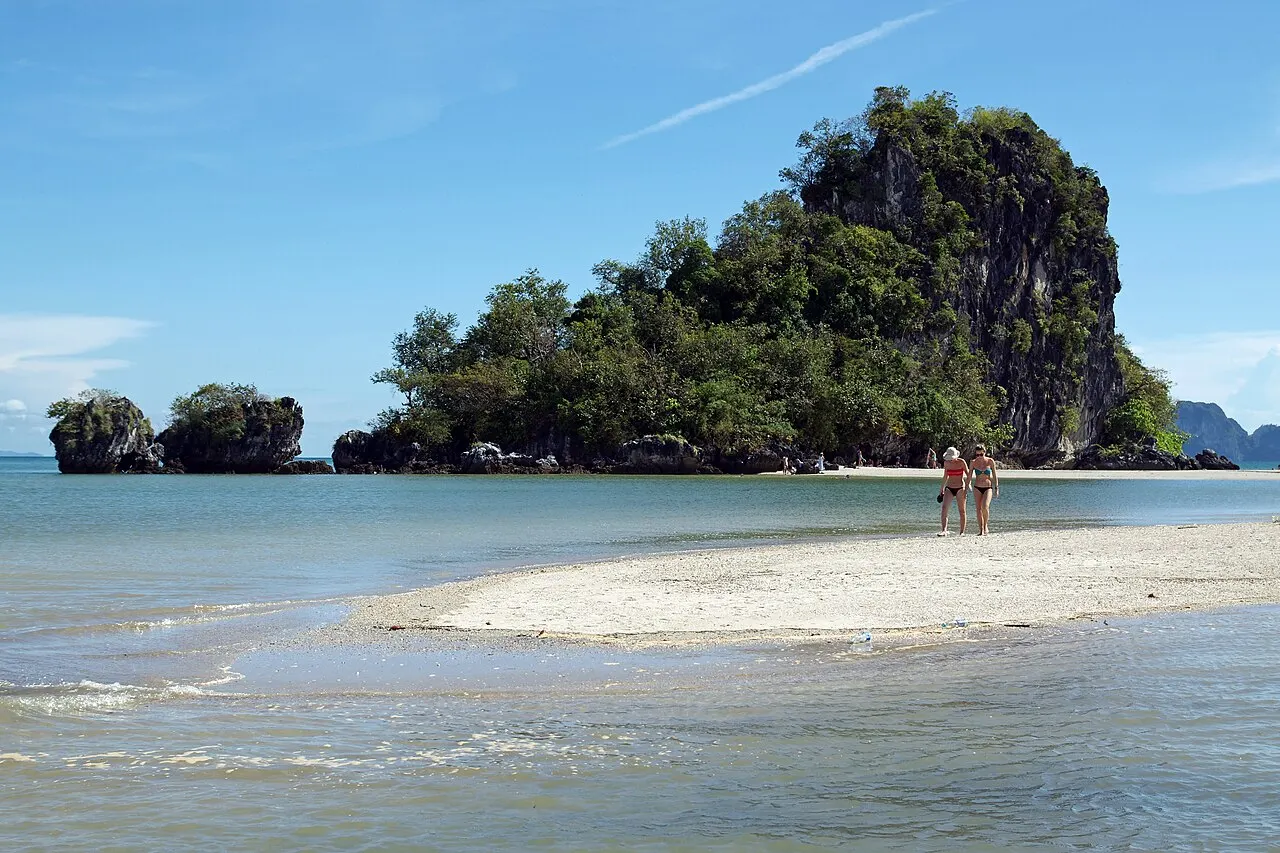
Noppharat Thara Beach
The long, flat beach north of Ao Nang belongs to the Hat Noppharat Thara-Mu Ko Phi Phi national park. It has less commerce than Ao Nang, views of the islands and sand that is good for walking. It is the best of the Ao Nang beaches for late afternoon.
Check access
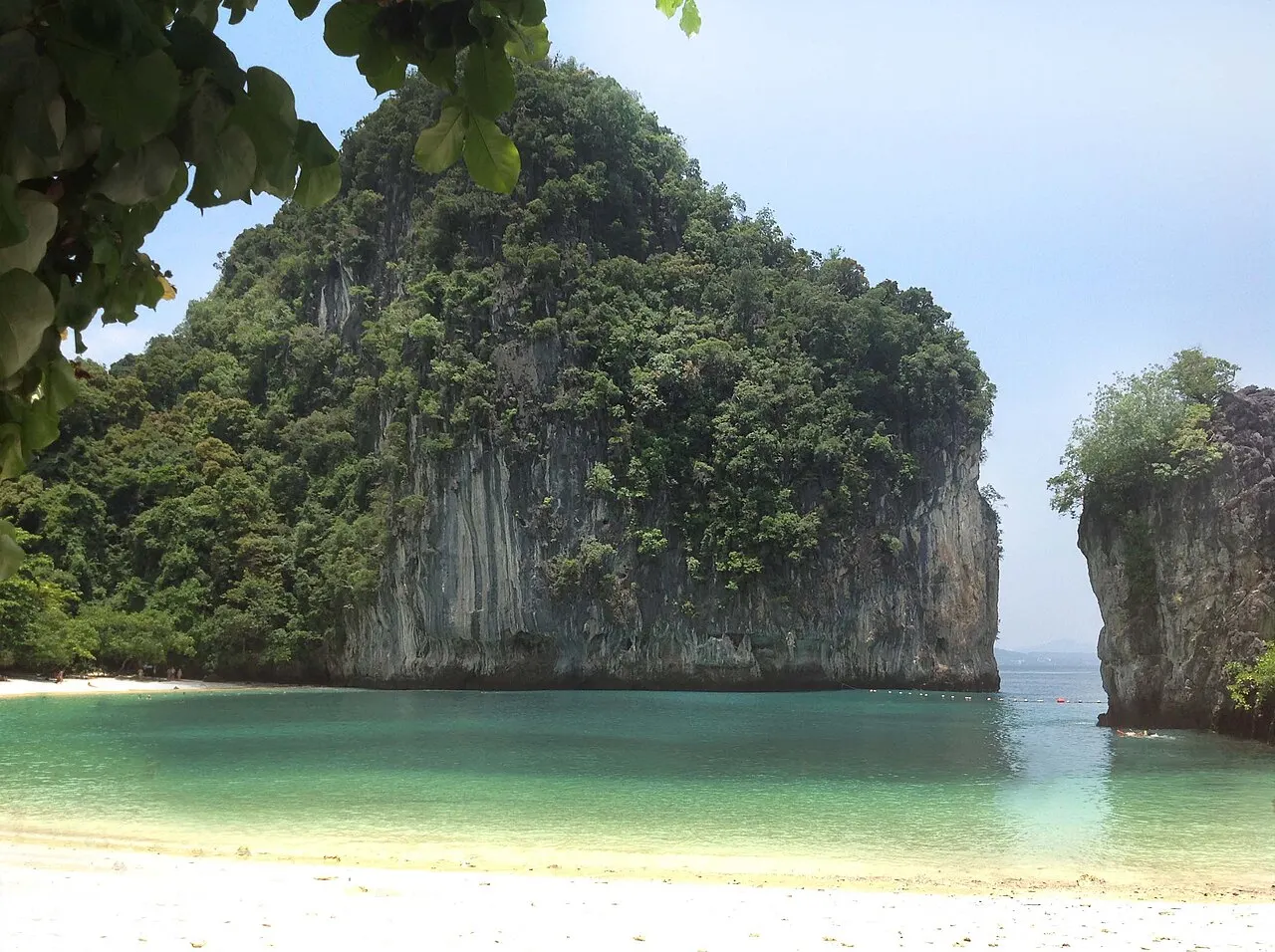
Ko Hong
The Hong island group, inside Than Bok Khorani National Park, is known for a lagoon ringed by limestone cliffs with a single narrow entrance: at low tide you enter by kayak, at high tide by swimming. On the main island there are white-sand beaches, a 400 m trail and a viewpoint at 109 m. The long-tail boat takes about 40 minutes from Noppharat Thara; the safest season runs from January to April, outside the monsoon.
Check access
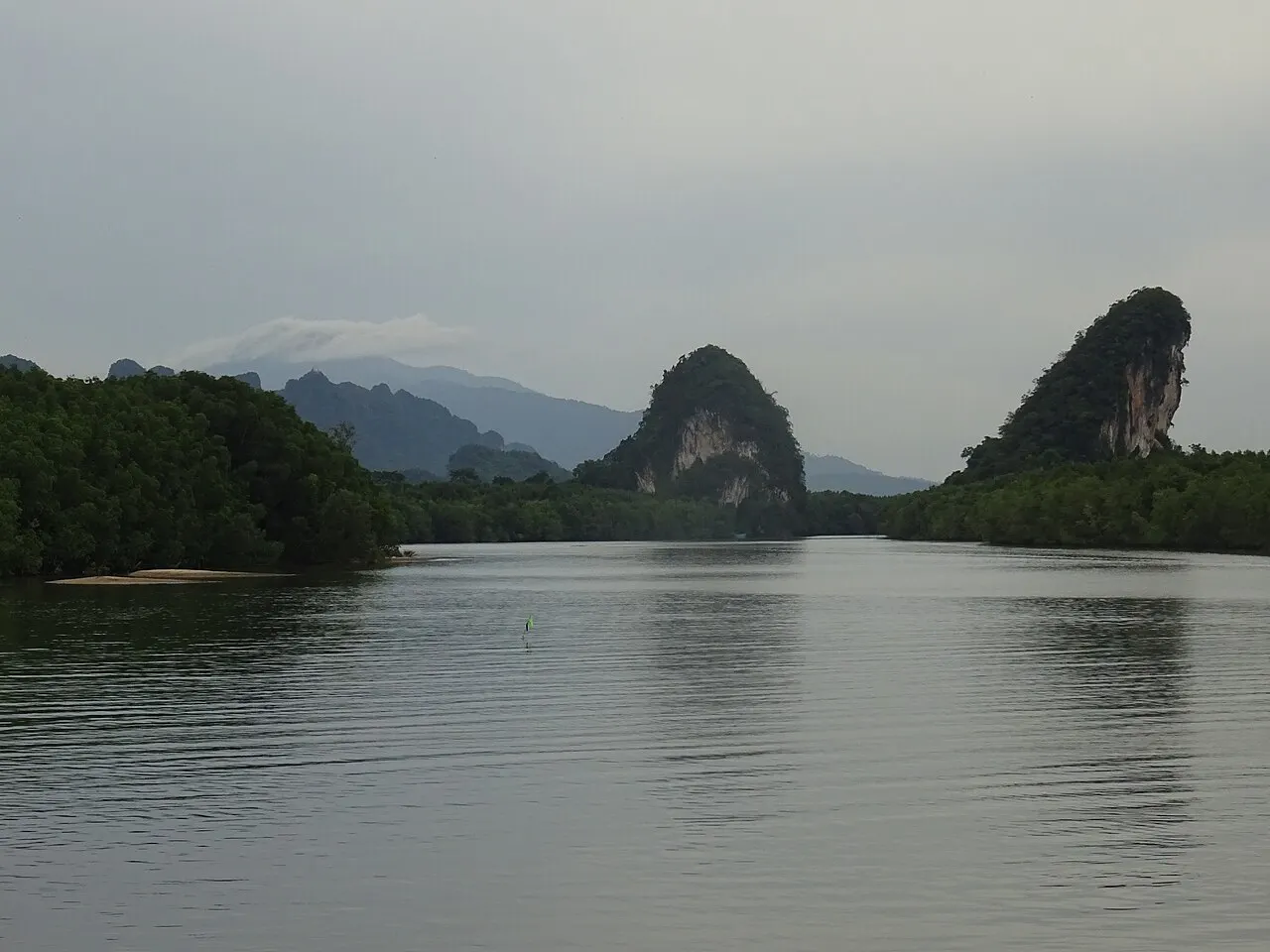
Khao Khanap Nam
The two limestone hills of about 100 m that flank the Krabi River are the symbol of the town and even appear in Jurassic World Rebirth. Ancient human skeletons and pottery were found inside one of the caves. You get there by long-tail boat from the pier in the center, in about 20 minutes, passing through the mangroves of the estuary; the boat is chartered whole, so it is worth putting together a group. Stairs lead from the bank to the top of one of the hills.
Check access
More places in the guide
Krabi Walking Street
The pedestrian street of Krabi Town, in the center, between the Vogue department store and the Vieng Thong hotel, turns into a market on weekend nights, Friday to Sunday, with food, clothing and handicraft stalls and a seating area. It is where locals have dinner and where you eat southern food at town prices, not beach prices. On other days, the night market by the river pier serves the same purpose.
Ao Thalane
Ao Thalane bay, about 30 km by road north of Ao Nang (some 40 minutes), is where Krabi's mangrove kayak tours go. The half-day or full-day routes enter narrow channels between limestone cliffs, caves and, depending on the tide, a lagoon, where motorboats can't pass. Agencies in Ao Nang pick you up at the hotel; the route depends on the day's tide.
Diamond Cave
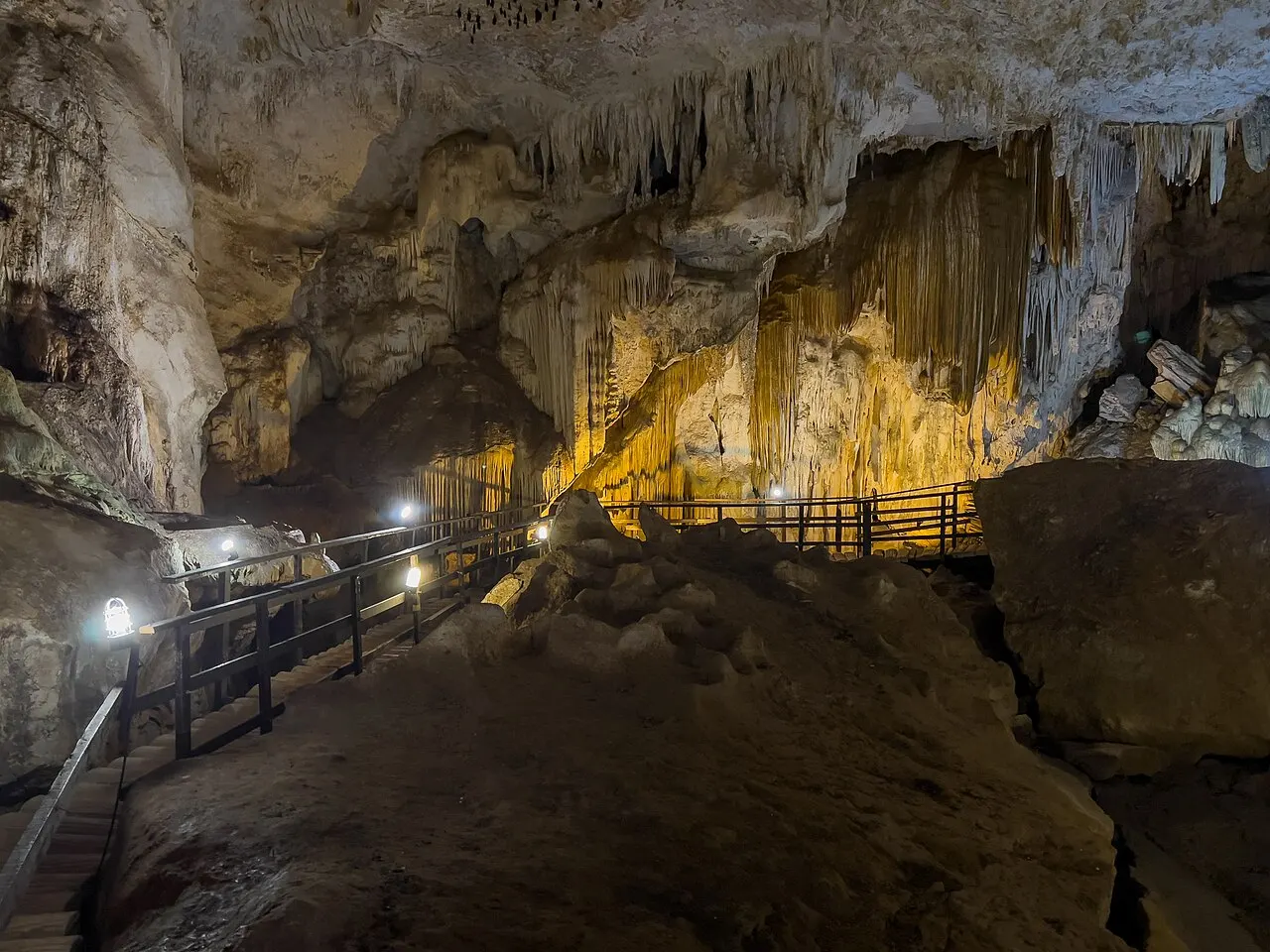
The Phra Nang Nai cave, known as Diamond Cave, is on the east side of Railay and is walked along a lit walkway among formations that sparkle like crystal. It is small and takes about fifteen minutes, with a low admission fee; it is worth a stop on the way to Ton Sai, not an outing in itself.
Wat Kaew Korawaram
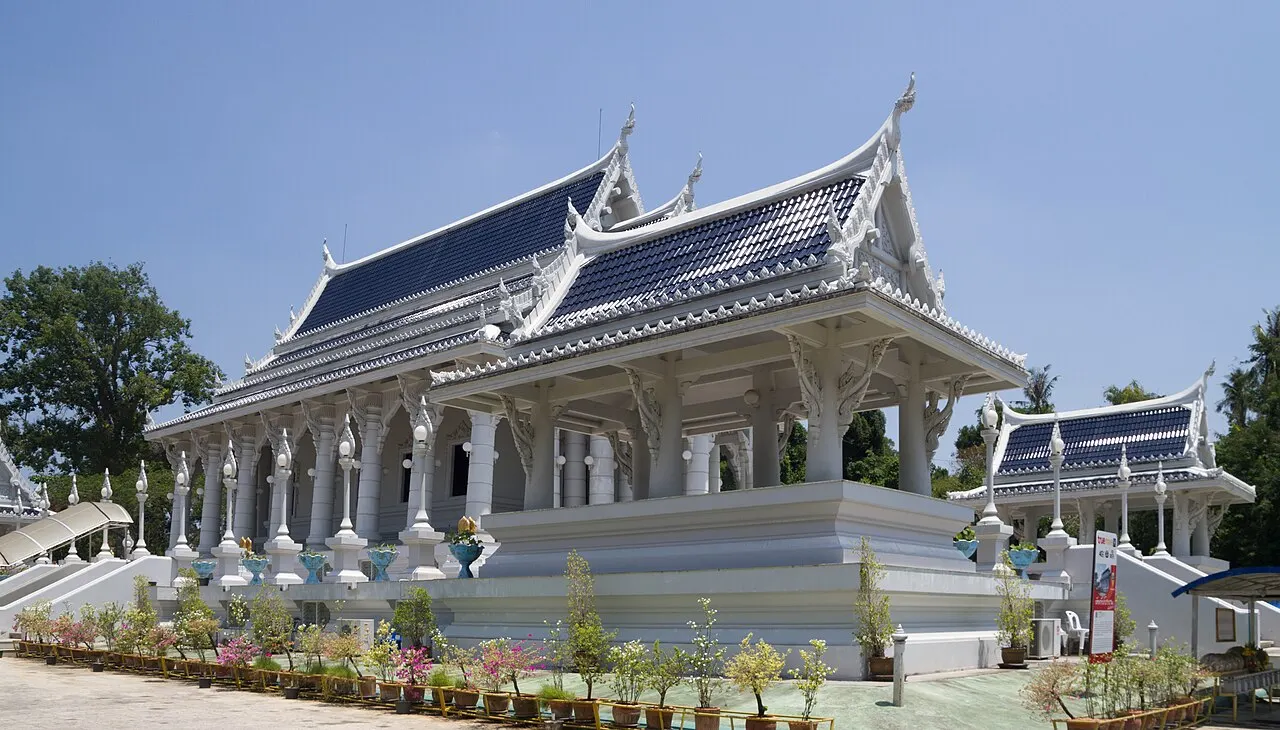
The main temple in the center of Krabi Town, in a recent white building, stands on Maharat Road. It is a short visit, for those who are already in town.
Su San Hoi
The shell cemetery, between Ao Nang and Ao Nam Mao, is a slab at the water's edge made of freshwater mollusk shells about 40 million years old, pressed into a rock that looks like concrete. There is a small museum and many shops. It interests people who like geology; for everyone else, what you see is a gray slab on the beach.
Nilo’s itinerary
Start with the basic programme and choose extensions for the time you have.
Plan my days in the app ↗Day 1 · Railay and Phra Nang beach
Have an early breakfast in Ao Nang and walk to the east end of the beach, where the booth and the long-tail boats to Railay West are; the boat leaves when it has eight passengers and takes ten to fifteen minutes.
Get off at Railay West, cross the peninsula on the promenade to Railay East and follow the flat trail beneath the cliffs to Phra Nang beach, about ten minutes on foot.
Enjoy Phra Nang in the first hours, before the tour boats take over the sand: a swim, the princess's shrine in the cave at the north end and the climbers on the cliff.
If you have closed shoes and the ground is dry, climb the viewpoint trail, which starts from the same path, in about half an hour; the descent to the lagoon is optional and more dangerous.
Have lunch on the Railay West promenade or the Railay East walkway.
In the afternoon, take an introductory climbing lesson with a school in Railay East, or rent a kayak in Railay West to paddle among the islets in front of Phra Nang.
On the way back to Railay West, step into Diamond Cave for fifteen minutes, on the east side.
Watch the sunset at Railay West and return to Ao Nang by boat; after 6 p.m. the fare is higher.
Day 2 · The Poda islands and the Ko Thap sandbar
The day before, check the tide table for the time of low tide and charter a long-tail boat to Ko Poda and Ko Thap at the cooperative booth on Ao Nang beach, with the return time agreed. The four-island group tour also stops there, but it runs on a fixed schedule and repeats the previous day's Phra Nang beach.
Leave Ao Nang in the morning; the boat takes about 25 minutes to Ko Poda. Bring cash for the national park fee (400 baht per foreign adult).
Spend the first hours on Ko Poda beach, with shallow water and coral close to the sand.
At low tide, go on to Ko Thap and walk across the sandbar to the neighboring islets, the Talay Waek.
Return to Ao Nang in mid-afternoon and end the day with a walk along Noppharat Thara beach at sunset.
Day 3 · Krabi Town: the morning market, the Tiger Cave and the river
Leave Ao Nang around 6:30 a.m., by taxi or car with a driver, for the center of Krabi Town, about 20 minutes away.
Have breakfast at the covered morning market on Maharat Road, before 8 a.m., when the bustle starts to fade.
Continue to Wat Tham Suea, about 9 km past the center, and climb the stairway to the top of Khao Kaeo with water and clothing that covers your shoulders and knees; set aside the morning to climb, see the pagoda and come down unhurried.
Go back to the center for lunch, khao mok gai or massaman at a halal canteen, and stop by Wat Kaew Korawaram, on Maharat Road.
In the afternoon, at the pier in the center, charter a long-tail boat to the Khao Khanap Nam hills, about 20 minutes each way through the mangroves of the estuary.
Have dinner at the Walking Street if it's Friday, Saturday or Sunday, or at the night market by the pier on other days, and return to Ao Nang by taxi or songthaew.
If you stay longer
Day 4 · Ko Hong and the lagoon
Leave in the morning from the Noppharat Thara pier on a boat tour to the Hong islands; the long-tail boat takes about 40 minutes.
Enter the Ko Hong lagoon by kayak if the tide is low, or by swimming if it is high, following the boatman's instructions.
Land on the main island, walk the 400 m trail and climb to the viewpoint; bring cash for the park fee.
Return to Ao Nang in mid-afternoon and save the evening for Pai Plong beach, a ten- to fifteen-minute walk along the walkway that starts at the east end of Ao Nang.
Day 5 · Phi Phi Islands
Day trip
The archipelago is about 42 km from Krabi Town, in the same national park as Ao Nang. Ferries leave from the Khlong Chilat port, about 4 km from the center of Krabi Town and 20 km from Ao Nang, and reach Ton Sai pier on Phi Phi Don in one to two hours; there are also boats from Noppharat Thara pier and tour speedboats from Ao Nang. Phi Phi Don is the only inhabited island; Maya Bay, on Phi Phi Leh, can be visited only by boat, with landing at the Loh Samah pier on the opposite side of the island: boats do not anchor inside the bay, and each visitor stays at most one hour. The park usually suspends landings in August and September. The park fee for foreigners is 400 baht. On a day trip by ferry there is little time left for Phi Phi Leh; anyone who wants both islands on the same day is better off on a speedboat tour.
Food
Hoi chak tin
The wing snail, a marine mollusk, is the dish most associated with Krabi. It appears in the seafood restaurants along the coast, prepared in several ways; ask how the house makes it.
Hoi wan phat phrik
Sea snails stir-fried with chili and Thai basil, another classic of the seafood restaurants on the Krabi coast.
Khao mok gai
Rice with chicken and spices from the Muslim cooking of the south, a relative of biryani. It is a lunch dish at the halal stalls and canteens of Krabi Town.
Khanom jeen
Thin rice noodles served with fish curry and vegetables. It is an everyday meal in southern Thailand.
Massaman
The curry of Muslim origin, milder than the spicy curries of the south, made with coconut milk and spices.
Roti
Thin dough fried on a griddle, a legacy of the Muslim communities, eaten savory or sweet. The roti stalls at the night markets of Krabi Town are always full of locals.
Cha yen
Sweetened Thai tea, served iced, sold at markets and stalls in cups or in plastic bags with a straw.
Where to eat
- Krabi Town markets
This is where you eat southern food at local prices. The covered morning market on Maharat Road opens before dawn and is busiest before 8 a.m.: fruit, sticky rice, patongko (the fried dough of the breakfast table), sweet tea and hot soy milk. At night, the market by the pier and the weekend Walking Street have roti, Thai dishes, seafood and fruit shakes. I'd go to the morning one for the food and to the night one for the buzz.
- Seafood restaurants in Ao Nang and Noppharat Thara
For hoi chak tin, the wing snail that is Krabi's dish, and for snails stir-fried with chili and Thai basil, plus whole grilled fish. Ask the price before choosing, especially for fish sold by weight.
- Halal stalls in Krabi Town
Khao mok gai, massaman and roti at lunch, at the Muslim canteens in the center. They are quick, cheap meals without alcohol, and good for understanding the Muslim side of southern cooking.
· 2026-10-19
Day trips
Phi Phi Islands
The archipelago is about 42 km from Krabi Town, in the same national park as Ao Nang. Ferries leave from the Khlong Chilat port, about 4 km from the center of Krabi Town and 20 km from Ao Nang, and reach Ton Sai pier on Phi Phi Don in one to two hours; there are also boats from Noppharat Thara pier and tour speedboats from Ao Nang. Phi Phi Don is the only inhabited island; Maya Bay, on Phi Phi Leh, can be visited only by boat, with landing at the Loh Samah pier on the opposite side of the island: boats do not anchor inside the bay, and each visitor stays at most one hour. The park usually suspends landings in August and September. The park fee for foreigners is 400 baht. On a day trip by ferry there is little time left for Phi Phi Leh; anyone who wants both islands on the same day is better off on a speedboat tour.
Emerald Pool and the Khlong Thom hot springs
About 57 km from Krabi Town, an hour by car, and 71 km from Ao Nang, in the Khao Phra-Bang Khram wildlife sanctuary. Sa Morakot, the Emerald Pool, is a pool of clear green water, from a hot spring filtered through the limestone, in the middle of the forest and reached by a trail; nearby, at the Khlong Thom hot springs, the water comes out between 40 °C and 50 °C and trickles down in small warm cascades. The sanctuary is one of the refuges of Gurney's pitta, a rare bird. Go by car with a driver or on a tour, leaving early, and bring a towel and sandals; each area charges its own entrance fee.
Ao Luek: Than Bok Khorani and Tha Pom Khlong Song Nam
North of the capital, in Ao Luek district. Than Bok Khorani National Park, about 45 km from Krabi Town, has streams and green-water pools beneath the forest, and the caves of Tham Lot and Tham Phi Hua To, the latter with prehistoric paintings. On the way, about 34 km from the capital, Tha Pom Khlong Song Nam has a circular walkway through peat forest and mangrove; the name, canal of the two waters, comes from the meeting of fresh and salt water. It can be done by car with a driver in half a day or a full day.
Where to begin
Railay and Phra Nang beach
Have an early breakfast in Ao Nang and walk to the east end of the beach, where the booth and the long-tail boats to Railay West are; the boat leaves when it has eight passengers and takes ten to fifteen minutes.
The Poda islands and the Ko Thap sandbar
The day before, check the tide table for the time of low tide and charter a long-tail boat to Ko Poda and Ko Thap at the cooperative booth on Ao Nang beach, with the return time agreed. The four-island group tour also stops there, but it runs on a fixed schedule and repeats the previous day's Phra Nang beach.
Krabi Town: the morning market, the Tiger Cave and the river
Leave Ao Nang around 6:30 a.m., by taxi or car with a driver, for the center of Krabi Town, about 20 minutes away.
Ko Hong and the lagoon
Leave in the morning from the Noppharat Thara pier on a boat tour to the Hong islands; the long-tail boat takes about 40 minutes.
Money
The currency is the Thai baht (THB, ฿). Cards work at hotels, larger restaurants and agencies, but long-tail boats, songthaews, market stalls and the national park fee require cash; there are ATMs in Krabi Town and in Ao Nang. For reference, Numbeo recorded on October 2, 2026 about 100 baht for a meal at a simple restaurant, 635 baht for a three-course meal for two at a mid-range restaurant, without drinks, 60 baht for a cappuccino and about 58 baht for a half-liter local beer. On the islands of Poda and Phi Phi, part of the Hat Noppharat Thara-Mu Ko Phi Phi national park, foreigners pay an entrance fee of 400 baht (children, 200), separate from the tour, and other parks and reserves charge their own fees at the entrance. Ao Nang is among the priciest areas in the province; Krabi Town is cheaper for eating and sleeping. Alcohol is generally sold from 11 a.m. to midnight, since May 29, 2026; sales may be suspended on election days and major religious holidays, and drinking is not allowed in temples or public parks.
Getting there and around
Krabi International Airport (KBV) is 15 km from the center of Krabi Town, about 25 minutes by car without traffic, and 29 km from Ao Nang, about 35 minutes. It has frequent flights from Bangkok and connections to other cities in Asia and the Middle East. In the arrivals hall there are bus counters for the airport, Krabi Town and Ao Nang line, which stops at hotels along the way, and taxi counters with fixed prices. Before flying to Thailand, every foreigner fills out the digital arrival card (TDAC) on the immigration website, up to three days before arrival.
With no train in the province, overland connections leave from the Krabi bus terminal, about 5 km north of the center. There are direct buses to and from Bangkok, taking about 12 hours, and vans and buses to Phuket, Surat Thani, home to the nearest train station, Trang and Hat Yai.
Between Krabi Town and Ao Nang, which are 18 km apart, about 20 minutes by car, white songthaews run: pickups with benches in the bed that pass the bus terminal and the town center; to get off, you press the bell and pay the driver. At night the service thins out and the fare goes up. In Ao Nang, tuk-tuks and sidecar motorcycle taxis make short trips at a price agreed beforehand.
Railay has no road. Long-tail boats leave from the east end of Ao Nang beach for Railay West in ten to fifteen minutes; 2026 guidebooks list 100 baht per person during the day, departing when the boat collects eight passengers, with a higher fare after 6 p.m. The cooperative's price list is posted at the booths at both ends of the beach. There are also boats from Ao Nam Mao and from the center of Krabi Town to Railay East. There is no pier: bring only the luggage you can carry with water up to your knees, and a waterproof bag for electronics.
The ferries to Phi Phi and Ko Lanta leave from the Khlong Chilat passenger port, about 4 km from the center of Krabi Town; the crossing to Phi Phi takes one to two hours, depending on the boat, with the first departures around 9 a.m. From the Noppharat Thara pier, in Ao Nang, boats leave for Phi Phi, Ko Lanta and the Hong islands. In the monsoon there are fewer departures, and the schedule can only be confirmed with the operator.
Renting a motorbike is common, but many rental bikes are not registered and cannot legally be on the road; check the insurance and never leave your passport as a deposit.
Safety
The risks that weigh most in Krabi are at sea and on the road. Rip currents have caused drownings on the Andaman coast, especially in the monsoon: heed the red flags on beaches with lifeguards and avoid swimming where no one else is. Jellyfish come close to shore from May to October, and some stings can be fatal; follow your hotel's advice. When swimming in Railay and Ao Nang, stay clear of the long-tail boat routes. For climbing, hire a local guide or school: sea air corrodes the fixed bolts, and anchor failures happen. Motorbike accidents are a serious risk; wear a helmet and don't rent a bike without registration. In bars, don't leave your drink unattended, and watch your bag near motorbikes: there are thefts by people passing by. Dengue and rabies exist in Thailand: use repellent and don't touch the monkeys. Emergency numbers: 191 (police), 1669 (ambulance) and 1155 (tourist police).
Before you go
- Plug
- types A, B, C and F
- Voltage
- 220 V
- Driving side
- on the left
- Emergency
- Police 191 · Fire 199 · Ambulance 1669
- Country code
- +66
- Official language
- Thai
- Currency
- baht (THB)
Source: Wikidata (CC0), checked September 2026.
Etiquette tips
Temples have a dress code
At Wat Tham Suea and the other temples, enter with your shoulders and knees covered and take off your shoes before going into the halls and worship caves. It is a working monastery, with monks meditating.
Don't criticize the royal family
Criticizing the monarchy is a crime in Thailand, punishable by a long prison term, and the law is applied broadly, including to comments on social media.
Markets without alcohol
In markets and stalls run mostly by Muslims, such as the night market on Maharat Road, there may be no alcohol on sale. Don't bring your own beer to the table at a halal stall.
Don't feed the monkeys
In Railay, in Ao Nang and at Wat Tham Suea, monkeys grab food, glasses and phones. Don't offer food and keep anything loose put away.
Smoking and vaping
Smoking in a public place draws a fine of up to 5,000 baht, and e-cigarettes and vaporizers are banned in the country, with confiscation and a fine. Smoke only where an area is designated.
Mistakes to avoid
Arriving at Phra Nang beach in the middle of the day, when tour boats take up much of the sand; early in the morning it is free.
Missing the last daytime-fare boat from Railay and having to pay the night rate, or charter a whole boat back to Ao Nang.
Boarding the long-tail boat with a wheeled suitcase and electronics outside a waterproof bag: there is no pier, and the water comes up to your knees.
Climbing the Railay viewpoint trail in flip-flops or after rain: it is red mud, rock and rope.
Swimming near the Khlong Haeng stream, between Ao Nang and Noppharat Thara, which carries sewage to the sea.
Booking the island tour in the monsoon with no slack in the schedule; boats are canceled when the sea rises.
Forgetting the cash for the national park fee, charged separately from the tour price.
Renting a motorbike without registration and without insurance that covers motorbikes, or leaving your passport as a deposit.
Useful phrases
สวัสดีครับ / สวัสดีค่ะ (sawasdee khrap / sawasdee kha)
Hello (khrap when the speaker is a man, kha when a woman)
ขอบคุณครับ / ขอบคุณค่ะ (khop khun khrap / khop khun kha)
Thank you (man, woman)
เท่าไหร่ (tao rai)
How much does it cost?
ไม่เผ็ด (mai phet)
Not spicy
เรือหางยาว (ruea hang yao)
Long-tail boat
ไปไร่เลย์ (pai Rai Le)
I'm going to Railay
ห้องน้ำอยู่ที่ไหน (hong nam yu thi nai)
Where is the restroom?
Where to stay
- Ao Nang · First-time visitors to Krabi who want to do the islands, Railay and Krabi Town without depending on a boat schedule to get back to the room.: It has lodging at every level, restaurants, agencies and the boats to Railay and the islands, and is about 35 minutes from the airport. It is the busiest area and one of the priciest in the province, the main beach is crowded with boats at the west end, and in the monsoon part of the commerce closes.
- Railay West and Railay East · People who want to wake up without cars, reach Phra Nang beach before the tour boats or climb every day.: The peninsula is empty early in the morning and at night, when the day visitors leave. The drawback is that everything depends on a boat: arriving and leaving with luggage, going to Ao Nang for dinner or shopping. Railay West has the beach and the priciest hotels; Railay East, lined with mangroves and without a swimming beach, has the cheaper options five minutes away on foot.
- Ton Sai · Climbers and backpackers on a tight budget.: It sits at the foot of the climbing cliffs and has the simplest lodging in the area. Access is by boat or by a trail over rocks and through woods to Railay West, and the infrastructure is basic.
- Krabi Town · People arriving late by bus or plane, catching an early ferry to Phi Phi or Ko Lanta, or who prefer town life and want to spend less.: The markets, the bus terminal, the ferry port and the airport are close by, and food and lodging cost less than in Ao Nang. The nearest beach is about 18 km away, so days at the sea start with transport.
- Noppharat Thara · People who want a calmer beach without moving away from the boats.: The beach is long and quiet, and the Noppharat Thara pier serves the Hong islands, Phi Phi and Ko Lanta. There are fewer restaurants and shops than in Ao Nang, so to eat out you often go there.
· 2026-10-19
Districts
Ao Nang
The beach with most of the hotels, restaurants, agencies and the boarding point for long-tail boats to Railay and the islands. The waterfront is lively and full of boats at the west end; the east end is nicer for swimming, and a short trail leads to the little beach of Pai Plong. It is the most practical base for a first visit to Krabi.
Noppharat Thara
The long beach that continues Ao Nang to the north, inside the Hat Noppharat Thara-Mu Ko Phi Phi national park. It is quieter, good for a sunset walk, and has the pier where boats leave for the Hong islands and ferries for Phi Phi and Ko Lanta.
Railay
The peninsula ringed by cliffs, with no cars, divided into Railay West, with a white-sand beach and the priciest hotels; Railay East, lined with mangroves, where the boats from Krabi Town arrive and the cheapest lodging is; and Phra Nang beach, at the southern tip. Everything is a five- to ten-minute walk.
Ton Sai
The cove next to Railay West, popular with climbers and backpackers, with simple lodging. You get there by boat or by a trail through the woods and over rocks; the walk is longer than those in Railay and can be difficult at high tide.
Krabi Town
The capital, on the bank of the Krabi River, where most of the population lives and where the morning market, the night markets, the bus terminal and the ferry port are. It has little beach and plenty of everyday life, and it is cheaper than Ao Nang.
Ao Nam Mao
The bay between Krabi Town and Ao Nang, with a pier for boats to Railay East. In the monsoon, when the sea at Ao Nang is rough, this is usually the safer place to cross to Railay.
History
37,000–27,000 years ago · The Lang Rongrien rock shelter
Excavations at the Lang Rongrien rock shelter, in the interior of the province, found layers of human occupation from this period.
Prehistory · The cave paintings of Ao Luek
In the caves of Tham Phi Hua To and Tham Chao Le, in Ao Luek district, there are rock paintings of people, animals and geometric shapes.
Late 18th century · An elephant corral
The governor of Nakhon Si Thammarat ordered a corral built in Krabi to capture and keep elephants. The followers of the official sent to run it formed three settlements, Pakasai, Khlong Pon and Pak Lao.
1872 · Krabi becomes a city
King Chulalongkorn raised the three settlements to city status under the name Krabi, which means an old kind of sword. The provincial seal still shows two crossed swords in front of the sea and Mount Phanom Bencha.
1875 · A direct link to Bangkok
Krabi stopped being a dependency of Nakhon Si Thammarat and began reporting directly to the central government, the start of the province as an entity of its own.
1970s · The first backpackers in Railay
Backpackers began visiting the Railay peninsula, cut off by its cliffs. Sport climbing would come later and make the place a destination for climbers from all over the world.
1975 · The monastery in the Tiger Cave
A monk from Surat Thani founded a meditation center next to the Tham Suea caves, near the capital. The site was granted temple status in 1985.
1999 · The international airport
Krabi International Airport opened on July 10, 1999. It brought Ao Nang within reach of flights from Bangkok and the rest of Asia and sped up the beach's shift from backpacker destination to hotel destination.
2001 · The protected estuary
The mangroves at the mouth of the Krabi River were added to the Ramsar Convention's list of wetlands of international importance on July 5, 2001.
2004 · The Indian Ocean tsunami
The waves of December 26, 2004 hit the province's coast and islands hard. Today the signs of the disaster are hard to find.
2018–2022 · Maya Bay closed
Maya Bay, on Phi Phi Leh, was closed in June 2018 so the corals could recover, after reaching almost 5,000 visitors a day in 2017. It reopened in 2022 with access only through a pier on the other side of the island and a controlled number of daily visitors.
2025 · Movie set
Jurassic World Rebirth, released in July 2025, filmed in Krabi: Railay appears in aerial shots, and the Khao Khanap Nam hills, beside the river, are in the film too.
Complete history
Krabi has a long prehistory and a short urban history. The limestone shelters that now draw climbers were home to hunter-gatherers tens of thousands of years ago: Lang Rongrien holds layers of occupation from 37,000 to 27,000 years ago, and the Ao Luek caves have paintings of people and animals. In the Khao Khanap Nam cave, beside the river, ancient human skeletons and pottery fragments were found.
The town began in the late 18th century as an outpost of Nakhon Si Thammarat, the great center of the south, which had a corral built here to capture elephants. The settlements that grew up around it became the city of Krabi in 1872, by decision of King Chulalongkorn, and in 1875 began answering directly to Bangkok. The name is that of an old sword, and the sword is still on the provincial seal. The population was formed of Buddhists, Muslims, families of Chinese origin and the sea peoples, such as the Urak Lawoi of Ko Lanta, and this mix can still be seen today in the temples, the mosques and the menu.
For almost all of the 20th century the economy was agricultural, based on rubber, oil palm and fishing. Tourism began in the 1970s, with backpackers in Railay, and grew in scale with the international airport of 1999, which turned Ao Nang into a hotel beach. The 2004 tsunami hit the coast and islands hard, and today the signs of the disaster are hard to find.
Recent debates revolve around the limits of the landscape. In 2015 and 2016, a proposed coal power plant in the province met opposition from local officials, business owners and residents, who saw it as a threat to tourism. In 2018 Maya Bay was closed to let the corals recover and reopened only in 2022 with access rules, and the Tourism Authority of Thailand now presents Krabi as its model of sustainable tourism, with tours led by fishing and mangrove communities.
Geography and shape of the city
Krabi occupies an indented stretch of the Andaman Sea coast, between the provinces of Phang Nga, to the north, and Trang, to the south. The landscape is karst: limestone, dissolved by rain over millions of years, left isolated hills with sheer, cave-riddled sides that rise both from the inland plains and from the sea, where they form islands and peninsulas. The best known is Railay, cut off from the mainland by cliffs and therefore reachable only by boat. The highest point in the province is Mount Phanom Bencha, at 1,397 m, covered in forest.
The capital sits on the bank of the Krabi River, a short river of about 5 km lined with mangroves, whose mouth is a wetland protected by the Ramsar Convention. The two Khao Khanap Nam hills mark the entrance to the town by river. The tourist coast begins to the west: Ao Nang is 18 km from the capital, with Noppharat Thara right next to it; Railay and Ton Sai lie south of Ao Nang, ten or fifteen minutes by boat. At sea, the Poda and Hong archipelagos are less than an hour by boat from Ao Nang, and Phi Phi is about 42 km from the capital. The airport is 15 km northeast of the town.
The climate is tropical monsoon. From December to March the dry northeast wind blows, the sea is calm and the year's lowest rainfall falls, from 32 mm in January to 98 mm in March. From May to October the damp southwest wind brings rain on more than half the days, plus waves, peaking in October, and November is still rainy. Temperatures change little over the year: average highs run from about 31 °C to 34 °C.
Culture
Krabi is a province of two religions. About 65% of the population is Buddhist and 34% Muslim, and the mosque sits alongside the temple. You notice it at the table, with halal stalls, roti and spiced rice next to noodles with fish curry, and in practical details, such as markets that don't sell alcohol.
The sea has its own peoples too. The Urak Lawoi, the largest group of sea peoples on this coast, live on Ko Lanta, about 80 km from the capital, and keep rites such as Loi Ruea, in which symbolic boats carry bad luck away. The province also has Moken communities, known as sea gypsies, and families of Chinese origin.
For visitors, the most visible living culture in Krabi is that of the sea and the rock. Railay and Ton Sai have drawn climbers from all over the world for decades, with hundreds of bolted routes on the cliffs above the beach and schools that give beginner courses to people who have never climbed. The long-tail boatmen, organized in cooperatives with set prices, are part of the landscape and the local economy. The Tourism Authority of Thailand presents the province as a model of sustainable tourism, with kayak tours in the mangroves of Ban Thung Yee Peng and visits to fishing villages such as Laem Sak and Ko Klang, led by the residents themselves.
Outside tourism, Krabi lives on rubber and oil palm, which cover much of the farmland, and on fishing. The festivals are those of southern Thailand: Sat Duean Sip, in the tenth lunar month, when families bring sweets to the temples in memory of their ancestors, and Chak Phra, the procession of Buddha images. Since May 29, 2026, the sale of alcohol across the country has generally been allowed from 11 a.m. to midnight, with its own rules for hotels and licensed nightlife venues.
Festivals and events
Krabi Boek Fa Andaman
November. The festival that opens the province's tourist season, with water sports competitions and cultural performances. The date changes every year and is announced by the province.
Loy Krathong
On the full moon of the twelfth lunar month, usually in November. All over the country, small floating offerings with candles and flowers are set on the water; in Krabi, on the river and at the beaches.
Sat Duean Sip
In the tenth lunar month, between September and October. The festival of the south in which families bring traditional sweets, such as khanom la, to the temples in honor of their ancestors.
Laanta Lanta
Usually in March, in the old town of Ko Lanta. Music, ceremony demonstrations, folk games and food, on the street of wooden houses built by Chinese merchants.
Loi Ruea
On the full moons of the sixth and eleventh lunar months, on Ko Lanta. The rite of the Urak Lawoi, who dance around symbolic boats before releasing them to sea to carry away bad luck.
Books and films
The Beach, by Danny Boyle
The 2000 film with Leonardo DiCaprio was shot at Maya Bay, on Phi Phi Leh. The fame it brought explains the excess of visitors that led to the bay's closure between 2018 and 2022.
Jurassic World Rebirth
The 2025 film used Krabi's landscapes, from Railay in aerial shots to the Khao Khanap Nam hills and the caves of Ao Luek, as the setting for the world of the dinosaurs.
Thailand: A Climbing Guide, by Sam Lightner Jr.
The climbing guide published by The Mountaineers, with the routes of Railay and Ton Sai. The proceeds go to replacing bolts corroded by sea air, and reading it explains why that matters.
Frequently asked questions
Krabi: how do I get there from the airport?
Krabi International Airport (KBV) is 15 km from the center of Krabi Town, about 25 minutes by car without traffic, and 29 km from Ao Nang, about 35 minutes. In the arrivals hall there are bus counters for the airport, Krabi Town and Ao Nang line, which stops at hotels along the way, and taxi counters with fixed prices. Railay has no road: if you are staying there, you finish the trip by long-tail boat, from Ao Nang, from Ao Nam Mao or from the center of Krabi Town.
Krabi: what do I need to enter Thailand?
Before flying to Thailand, every foreigner fills out the digital arrival card (TDAC) on the immigration website, up to three days before arrival. Thailand has shortened the permitted stay for people entering under the visa exemption: since September 15, 2026, it is up to 30 days, for tourism only, according to the British government's notice to its citizens. The exemption and the length depend on nationality; check the rule for your passport before buying your ticket.
Krabi: how do I get to Railay?
Railay has no road. Long-tail boats leave from the east end of Ao Nang beach for Railay West in ten to fifteen minutes; 2026 guidebooks list 100 baht per person during the day, departing when the boat collects eight passengers, with a higher fare after 18:00. The cooperative's price list is posted at the booths at both ends of the beach. There are also boats from Ao Nam Mao and from the center of Krabi Town to Railay East. There is no pier: bring only the luggage you can carry with water up to your knees, and a waterproof bag for electronics.
Krabi: how many days should I stay?
I'd stay three days in Krabi, sleeping in Ao Nang. The first is for Railay: the early boat to Phra Nang beach, the viewpoint if you have the stamina and an afternoon of climbing or kayaking. The second is for the Poda islands, on a chartered long-tail boat timed for low tide so you can walk across the Ko Thap sandbar. The third is for Krabi Town, with the morning market, the climb to Wat Tham Suea, the boat to Khao Khanap Nam and dinner at the night market. With a fourth day, I'd go to the Hong islands and the kayak lagoon; with a fifth, to Phi Phi, by ferry or speedboat. The emerald pool and the Khlong Thom hot springs are for people with even more time, or for rainy days when the sea won't let the boats out, along with the Krabi Town day.
Krabi: when is the best time to go?
December to March; this is the dry season, with the lowest rainfall of the year and calm seas for boats. From May to October the monsoon brings rain on more than half the days, peaking in October, and November still sees rain on more than half the days.
Krabi: can I do Phi Phi as a day trip?
The archipelago is about 42 km from Krabi Town, in the same national park as Ao Nang. Ferries leave from the Khlong Chilat port, about 4 km from the center of Krabi Town and 20 km from Ao Nang, and reach Ton Sai pier on Phi Phi Don in one to two hours; there are also boats from Noppharat Thara pier and tour speedboats from Ao Nang. Maya Bay, on Phi Phi Leh, can be visited only by boat, with landing at the Loh Samah pier on the opposite side of the island: boats do not anchor inside the bay, and each visitor stays at most one hour. The park usually suspends landings in August and September, and the park fee for foreigners is 400 baht. On a day trip by ferry there is little time left for Phi Phi Leh; anyone who wants both islands on the same day is better off on a speedboat tour.
Krabi: is it safe to swim in the sea?
Rip currents have caused drownings on the Andaman coast, especially in the monsoon: heed the red flags on beaches with lifeguards and avoid swimming where no one else is. Jellyfish come close to shore from May to October, and some stings can be fatal; follow your hotel's advice. When swimming in Railay and Ao Nang, stay clear of the long-tail boat routes, and don't swim near the Khlong Haeng stream, between Ao Nang and Noppharat Thara, which carries sewage to the sea.
Other cities in the country
Thailand ↗- Days
- 3–4
- When
- Jan–Feb · Nov–Dec
- Per person/day
- Average 2,500–4,500 THBMid-range · per person/day
Cost scope
Per person per day: accommodation, meals, urban transport, visits and a small allowance for extras. Flights excluded; larger purchases vary. Editorial estimate, not a quote.
- Days
- 2–3
- When
- Jan · Nov–Dec
- Per person/day
- Average 2,000–3,500 THBMid-range · per person/day
Cost scope
Per person per day: accommodation, meals, urban transport, visits and a small allowance for extras. Flights excluded; larger purchases vary. Editorial estimate, not a quote.
- Days
- 3–4
- When
- Jan–Mar · Dec
- Per person/day
- Average 4,420 THBMid-range · per person/day
Cost scope
Per person per day: accommodation, meals, urban transport, visits and a small allowance for extras. Flights excluded; larger purchases vary. Editorial estimate, not a quote.
- Days
- 3–4
- When
- Feb–Apr
- Per person/day
- Average 2,510 THBMid-range · per person/day
Cost scope
Per person per day: accommodation, meals, urban transport, visits and a small allowance for extras. Flights excluded; larger purchases vary. Editorial estimate, not a quote.