Morocco
Chefchaouen
Chefchaouen, the blue medina on the slopes of the Rif
Days I'd stay two full days, with two nights in town.
How the guide reaches this number
The first is for the medina: Souika, the square and the Kasbah in the morning, Ras el Ma in the afternoon and the climb to the Spanish mosque for the end of the day. The second is for Akchour, leaving early, for the Bridge of God and the cascades, with the return arranged before mid-afternoon. With only one night, I'd stay in the medina and leave Akchour for another trip, because the trail needs a whole morning and does not fit with a fixed bus. An extra day is only justified for those who want to hike in the park, such as the climb to Jebel el-Kalaa.
2
Start with the basic programme and choose extensions for the time you have.
When May, June and October; from mid-July to September demand rises and lodging gets tight, and in winter rain and mountain cold get in the way of the trails.
How the guide reaches this number
The best time to combine the medina and the trails is May, June and October: days are usually mild and the snow on the peaks, which can last until April, has gone. From mid-July to September, the holidays bring Moroccan and foreign tourists and the return of emigrants from the region; lodging gets tight and the heat builds in the middle hours of the day, although the mountain eases it at night. Winter, from November to March, is cold and rainy, with snow on the peaks, and rooms without heating turn damp. After heavy rain and during the spring thaw, the Akchour river rises and some stretches of trail become impassable. Ramadan changes the hours of cafés and restaurants, which fill up after sunset.
Per person/day Budget around MAD297; mid-range around MAD703; comfortable around MAD1,500 per person per day, based on spending reported by travelers to Budget Your Trip (checked October 2026).
How the guide reaches this number
Indicative figures, excluding travel to the destination.
Budget around MAD297; mid-range around MAD703; comfortable around MAD1,500 per person per day, based on spending reported by travelers to Budget Your Trip (checked October 2026). Indicative figures, excluding travel to the destination.
Per person per day: accommodation, meals, urban transport, visits and a small allowance for extras. Flights excluded; larger purchases vary. Editorial estimate, not a quote.
Salta · among the cheapestZermatt · among the priciest
Cheaper than 82% of them. The tick marks the median. Compared by the middle of each city’s daily range, converted at the 24 Sept 2026 exchange rate.
 What Nilo thinks
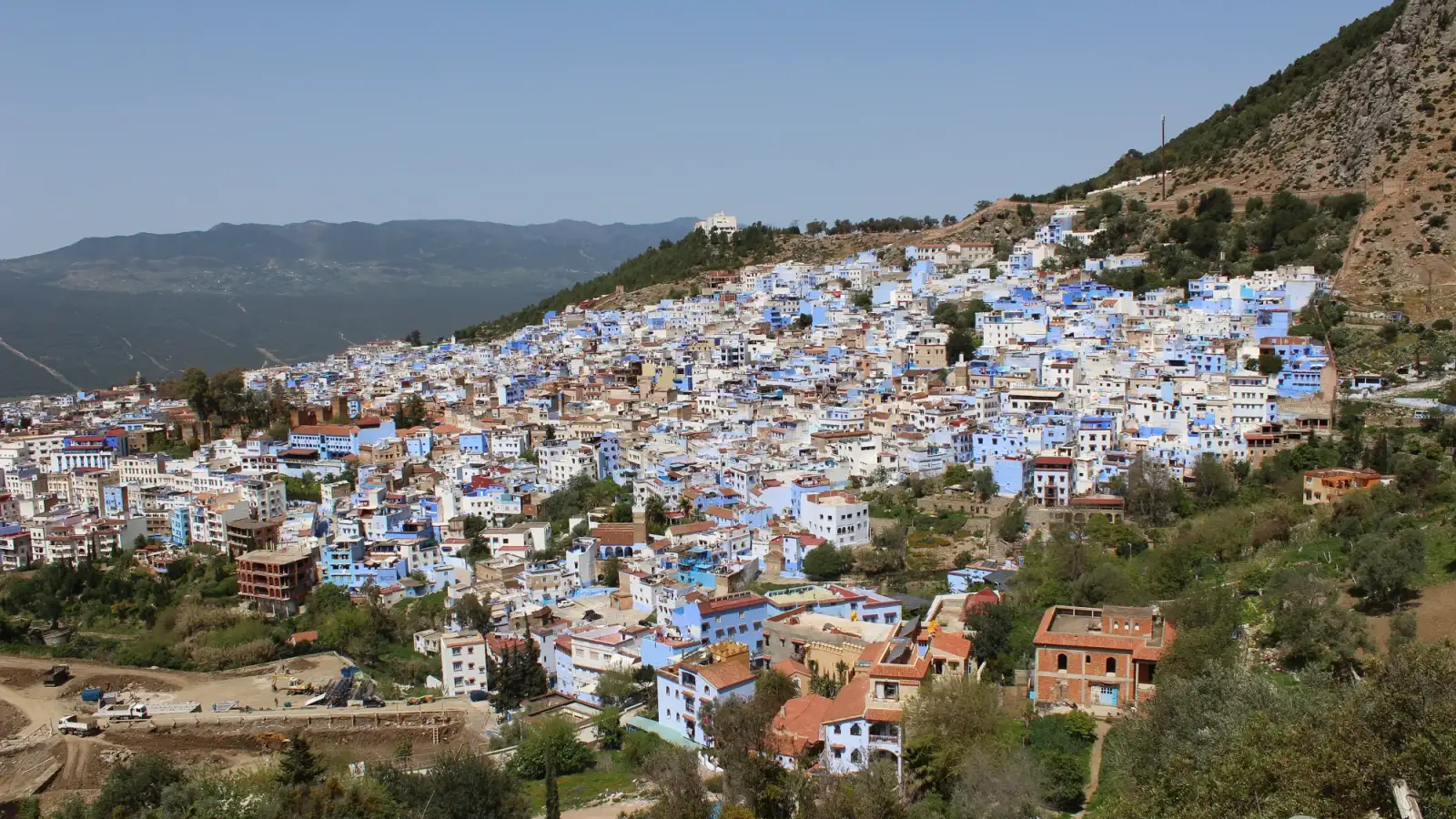
I'd recommend Chefchaouen to people who enjoy noticing clothing, craft and neighborhood routine more than monuments. In the market outside the medina, the fouta, the striped cloth that Rif women wear over their skirts, shares space with thick wool djellabas with pointed hoods, a local specialty; that is where I'd buy something for the mountain cold. The oldest hammam in town is still heated with wood, and it is worth asking where it is and what the hours are for each group, because men and women use the bath at separate times. On the square, a double door of carved wood opens onto the oldest funduq in town, where merchants slept before selling in the courtyard and where some traders still work. I'd leave the most photographed streets for the evening, or come off-season, when the stalls close and the lanes are much calmer.I'd go to Chefchaouen for its scale. In a few hours on foot you can cross the whole medina, from the Kasbah square to the Ras el Ma spring, and see how a fifteenth-century fortress became a town, with the courtyard houses of the refugees from al-Andalus. The blue of the walls is what everyone photographs, but what organizes the visit is the mountain: the streets climb in stairs, the water comes down from the fountains, and from the hill of the Spanish mosque you understand at once why the town hangs there. Just past the walls begin the gorges and forests of Talassemtane, and the Bridge of God, near Akchour, shows the other half of the place.
Quick facts
- Population
- 46,168 inhabitants in the municipality of Chefchaouen, according to the 2024 census of the High Commission for Planning (HCP); the whole province had 412,713.
- Founded
- 1471, when Ali ibn Rashid al-Alami built the kasbah that gave rise to the town.
- Country and region
- Morocco, Tangier-Tetouan-Al Hoceima region; capital of Chefchaouen province.
- Language
- Moroccan Arabic (darija) in daily life; with visitors, Spanish and French are the most widely used foreign languages.
- Currency
- Moroccan dirham (MAD, DH).
- Time zone
- UTC+0 all year since September 2026, with no clock change during Ramadan.
- Best time to visit
- May, June and October; from mid-July to September demand rises and lodging gets tight, and in winter rain and mountain cold get in the way of the trails.
- Average daily cost
- Budget around MAD297; mid-range around MAD703; comfortable around MAD1,500 per person per day, based on spending reported by travelers to Budget Your Trip (checked October 2026). Indicative figures, excluding travel to the destination.
When to go
May, June and October; from mid-July to September demand rises and lodging gets tight, and in winter rain and mountain cold get in the way of the trails.
January
9° to 17°C
93 mm of rain
10 h 04 min of daylight
National holidays
Jan 1 – 3, 2027 · long weekend · Ras l' âm
Jan 9 – 11, 2027 · long weekend · Takdim watikat al-istiqlal
Jan 14 – 17, 2027 · long weekend · Id Yennayer
Jan 1, 2028 · Ras l' âm
Jan 8 – 11, 2028 · long weekend · Takdim watikat al-istiqlal
Jan 14 – 16, 2028 · long weekend · Id Yennayer
Source: Nager.Date. Holiday dates shift; check close to your trip.
February
10° to 18°C
87 mm of rain
10 h 57 min of daylight
March
12° to 19°C
73 mm of rain
11 h 58 min of daylight
April
13° to 21°C
62 mm of rain
13 h 06 min of daylight
May
15° to 23°C
30 mm of rain
Best time14 h 02 min of daylight
National holidays
May 1, 2027 · Eid Ash-Shughl
Source: Nager.Date. Holiday dates shift; check close to your trip.
July
21° to 30°C
1 mm of rain
14 h 17 min of daylight
National holidays
Jul 30 – Aug 1, 2027 · long weekend · Eid Al-Ârch
Source: Nager.Date. Holiday dates shift; check close to your trip.
August
21° to 30°C
5 mm of rain
13 h 28 min of daylight
National holidays
Aug 14, 2027 · Oued Ed-Dahab Day
Aug 20 – 22, 2027 · long weekend · Thawrat al malik wa shâab, Eid Al Chabab
Source: Nager.Date. Holiday dates shift; check close to your trip.
September
20° to 28°C
29 mm of rain
12 h 23 min of daylight
November
13° to 21°C
92 mm of rain
10 h 19 min of daylight
National holidays
Nov 6 – 8, 2026 · long weekend · Eid Al Massira Al Khadra
Nov 14 – 18, 2026 · long weekend · Eid Al Istiqulal
Nov 6, 2027 · Eid Al Massira Al Khadra
Nov 18 – 21, 2027 · long weekend · Eid Al Istiqulal
Source: Nager.Date. Holiday dates shift; check close to your trip.
December
11° to 18°C
100 mm of rain
9 h 48 min of daylight
High, shoulder and low season
High · Mid-July to September
Summer holidays, with Moroccan and foreign tourists and the return of emigrants from the region. Lodging gets tight; book ahead and avoid the hot hours on the trails.
Shoulder · April to June and October
Mild days, good for walking. In April there can still be snow on the peaks and a full river at Akchour; May, June and October are the most balanced months.
Low · November to March
Cold, rain and snow in the mountains. The medina is emptier and cheaper, but several trails turn difficult and the river can block paths; prefer lodging with heating.
How the year changes
The best time to combine the medina and the trails is May, June and October: days are usually mild and the snow on the peaks, which can last until April, has gone. From mid-July to September, the holidays bring Moroccan and foreign tourists and the return of emigrants from the region; lodging gets tight and the heat builds in the middle hours of the day, although the mountain eases it at night. Winter, from November to March, is cold and rainy, with snow on the peaks, and rooms without heating turn damp. After heavy rain and during the spring thaw, the Akchour river rises and some stretches of trail become impassable. Ramadan changes the hours of cafés and restaurants, which fill up after sunset.
The same numbers as a table
| Month | Temperature °C | Rain mm |
|---|---|---|
| January | 9 to 17 | 93 |
| February | 10 to 18 | 87 |
| March | 12 to 19 | 73 |
| April | 13 to 21 | 62 |
| May · | 15 to 23 | 30 |
| June · | 18 to 27 | 8 |
| July | 21 to 30 | 1 |
| August | 21 to 30 | 5 |
| September | 20 to 28 | 29 |
| October · | 16 to 24 | 75 |
| November | 13 to 21 | 92 |
| December | 11 to 18 | 100 |
Nilo's tips
Getting back from Akchour
I'd agree on the time and price of the return with the grand taxi driver before starting the trail, or take his phone number. Waiting for a shared car at the end of the afternoon can take a while.
Flashlight on the hill
I'd bring a flashlight, or a charged phone, to come down from the Spanish mosque after sunset along the dirt trail.
Kasbah early
I'd go into the Kasbah while it is still morning, before the square fills up, to see the garden and the museum without rushing.
Explore the map
Explore the map, read about the other places and plan your travel days in the app.
Open the appWhat to see
Leave for last, if time allows: Place el-Haouta
Place Outa el Hammam
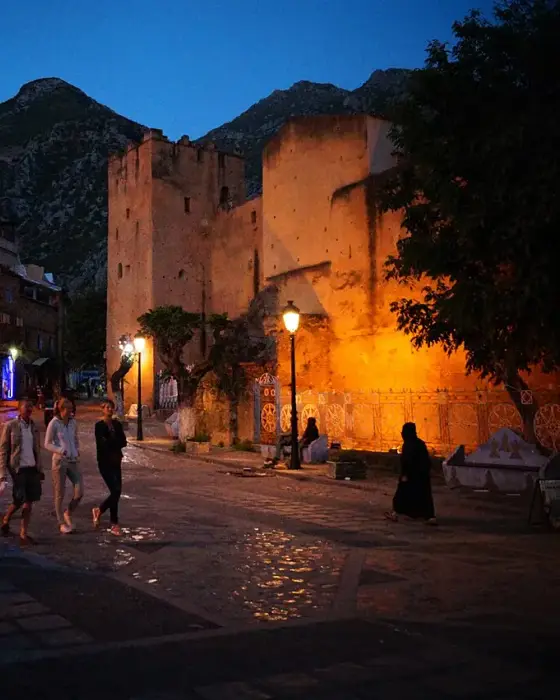
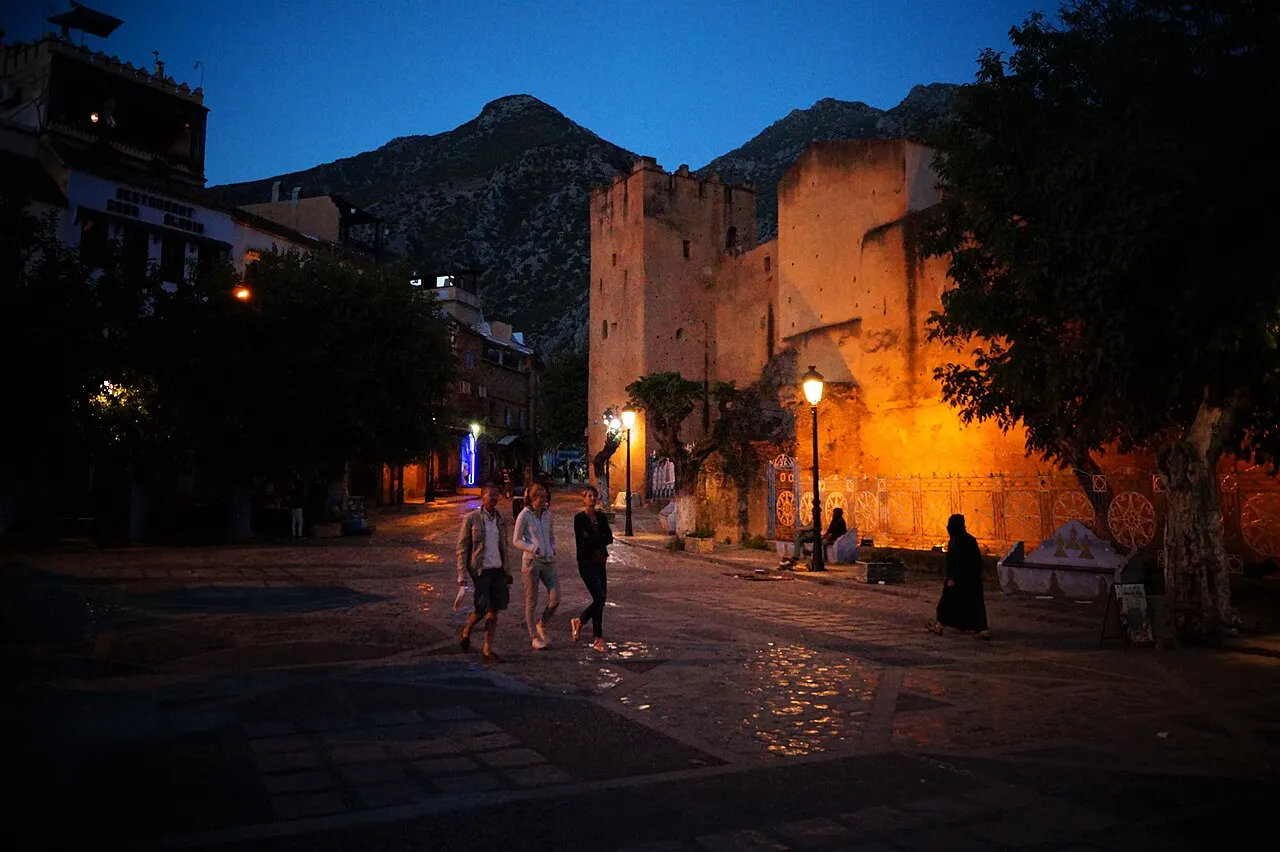
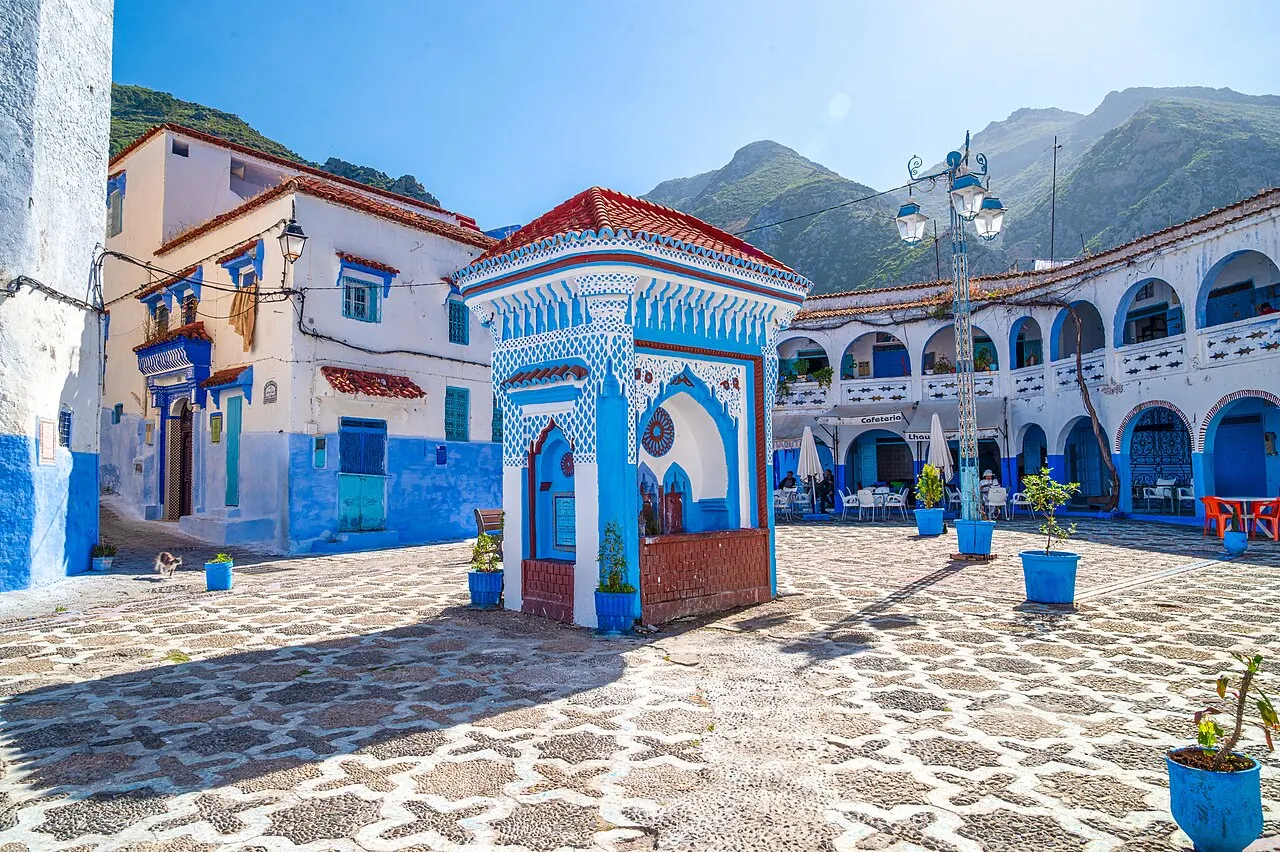
The main square of the medina, probably laid out in the sixteenth century by a son of the founder, brings together the Kasbah, the Great Mosque, an old funduq (merchants' inn) and cafés with outdoor tables. In the center is a four-sided fountain. It is the best spot to get your bearings before entering the lanes, and the busiest at the end of the day.
Check access
Kasbah of Chefchaouen
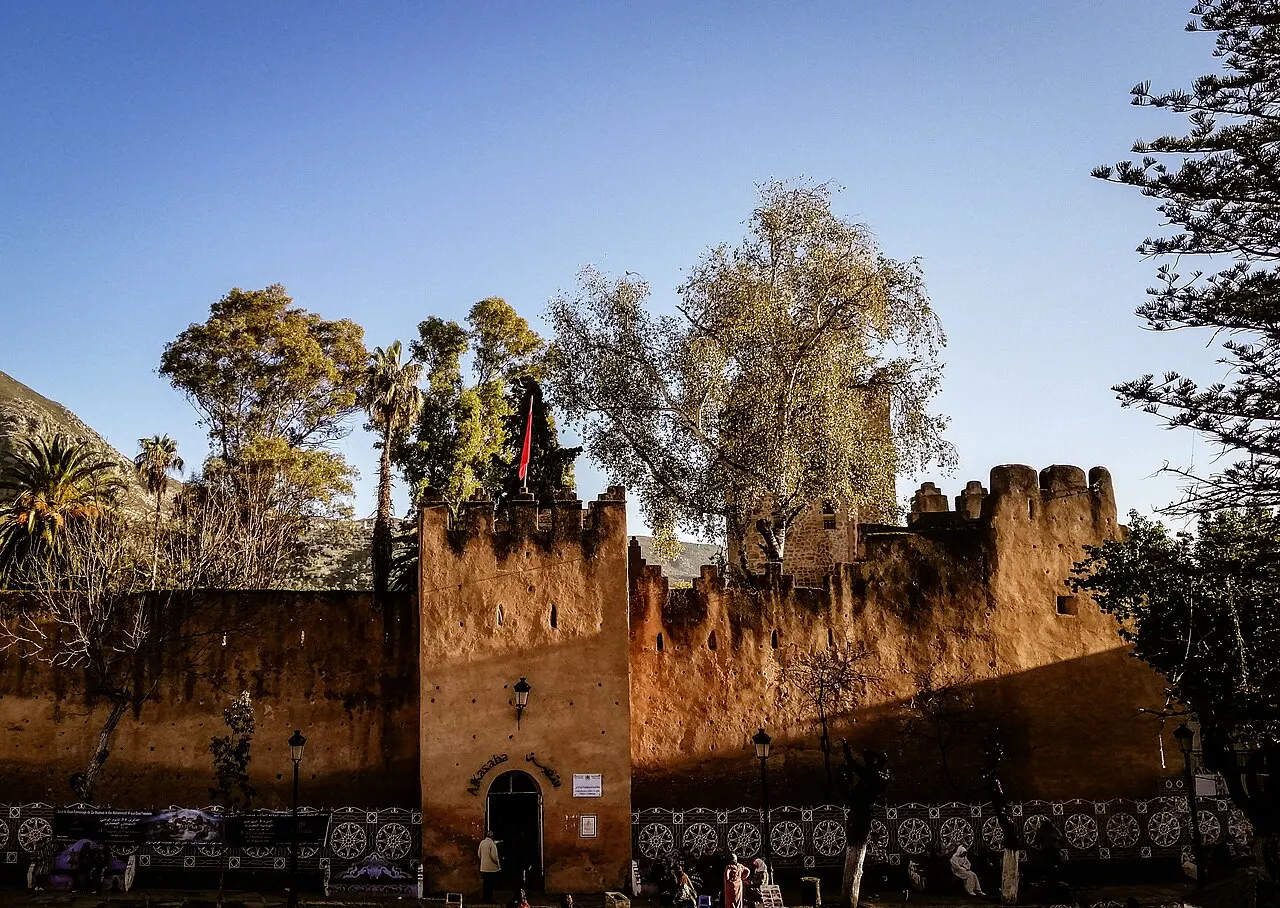
The original fortress, from 1471, is a rectangular enclosure of walls and ten rammed-earth towers, with a taller tower to the west, probably from the early sixteenth century, with inner rooms covered by brick domes. The courtyard has become a garden, and a house from the late seventeenth century holds a small museum of archaeology and ethnography, old weapons, photographs of the town and textiles. Admission is charged and the fee differs for residents and foreigners; check the price and hours at the ticket office.
Check access
Ras el Ma
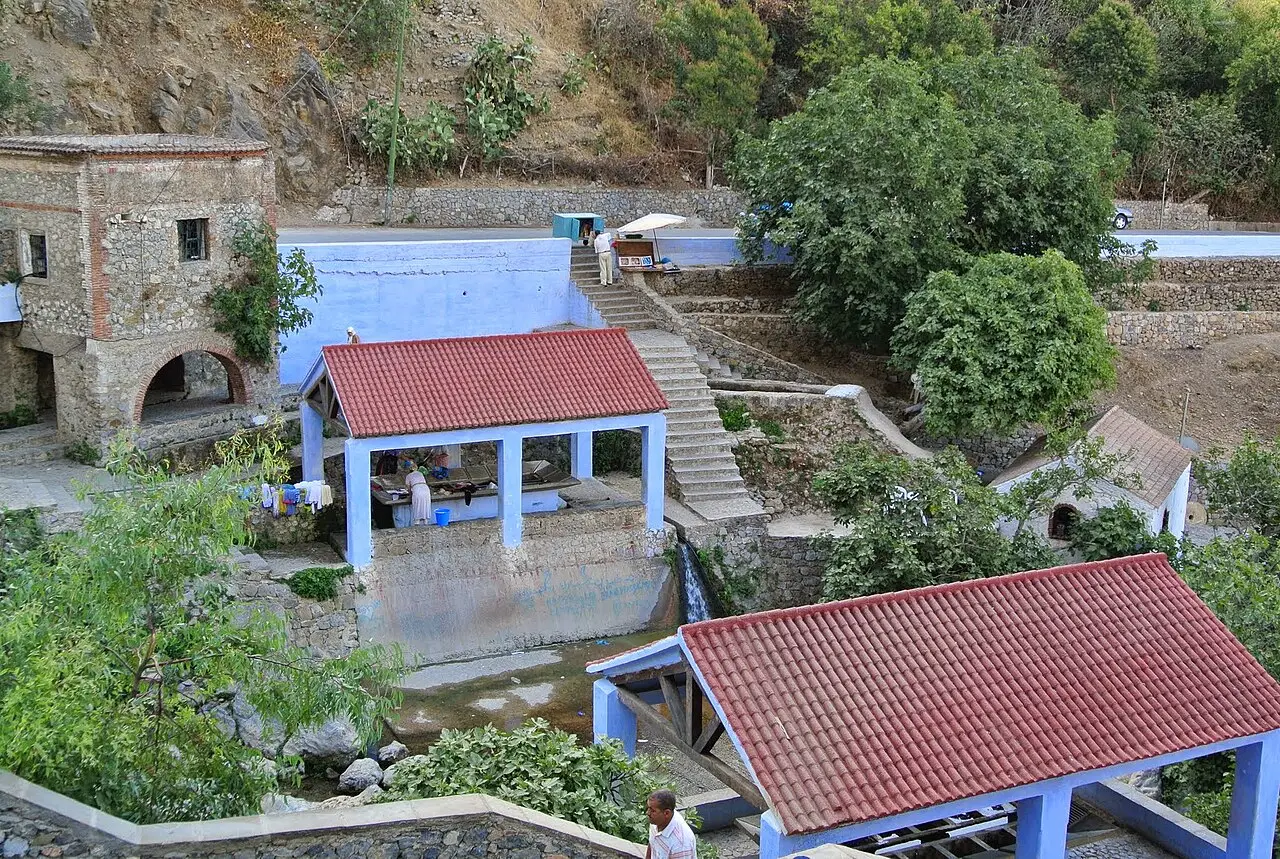
The spring that supplied the town lies just east of the walls, and today the water comes out through a stone structure. Nearby are an old mill and a bridge, possibly from the nineteenth century. Residents come to wash clothes and rugs in the basins, to chat and to cool off, and there are simple cafés on the bank. It is also the start of the trails to the hills to the east.
Check access
Mosquée espagnole
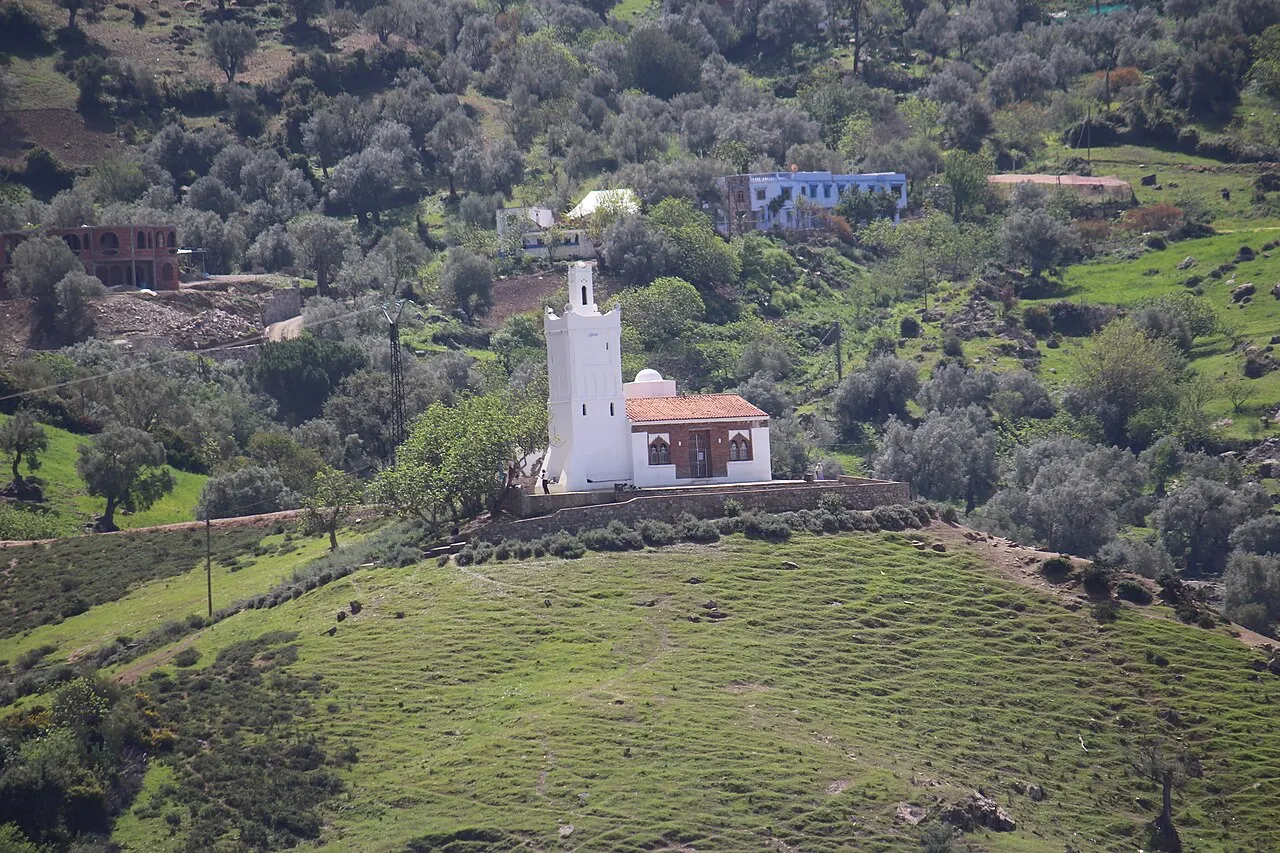
The Jemaa Bouzafar mosque, also written Bouzaâfar, was built by the Spanish in the 1920s on a hill east of town, and today it is hardly used for worship. The dirt trail starts at Ras el Ma, by the bridge in front of the Bab Onsar gate, and takes 20 to 30 minutes on an easy walk. The reason for the climb is the view: the whole medina on the slope, with the mountain behind it, especially late in the afternoon.
Check access
Pont de Dieu
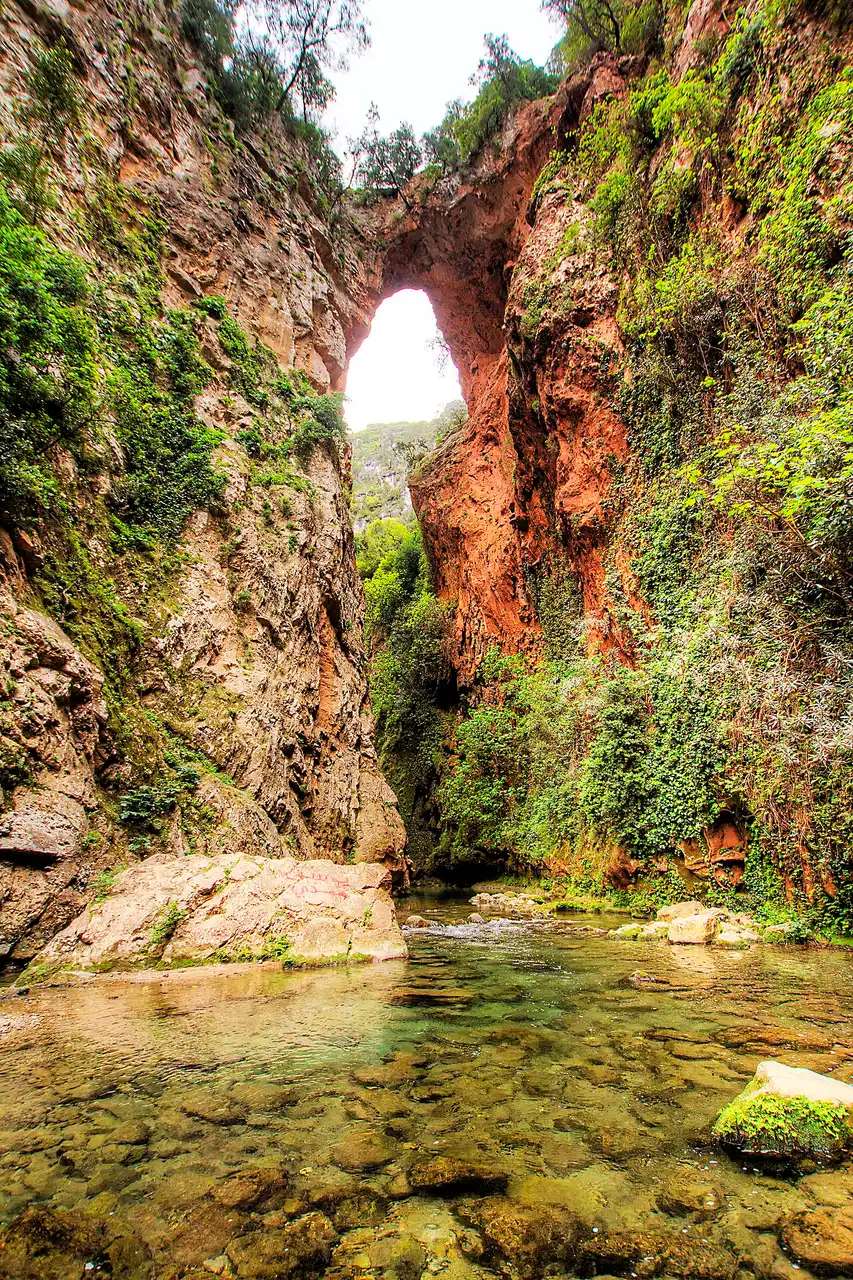
The Bridge of God is a natural stone arch about 25 meters above the river, near the village of Akchour, inside Talassemtane National Park. The river carved the passage beneath the rock. The trail from Akchour takes about an hour and a half and climbs steeply after the dam; after rain or snowmelt, the path along the riverbank can become impassable.
Check access
Grande Mosquée de Chefchaouen
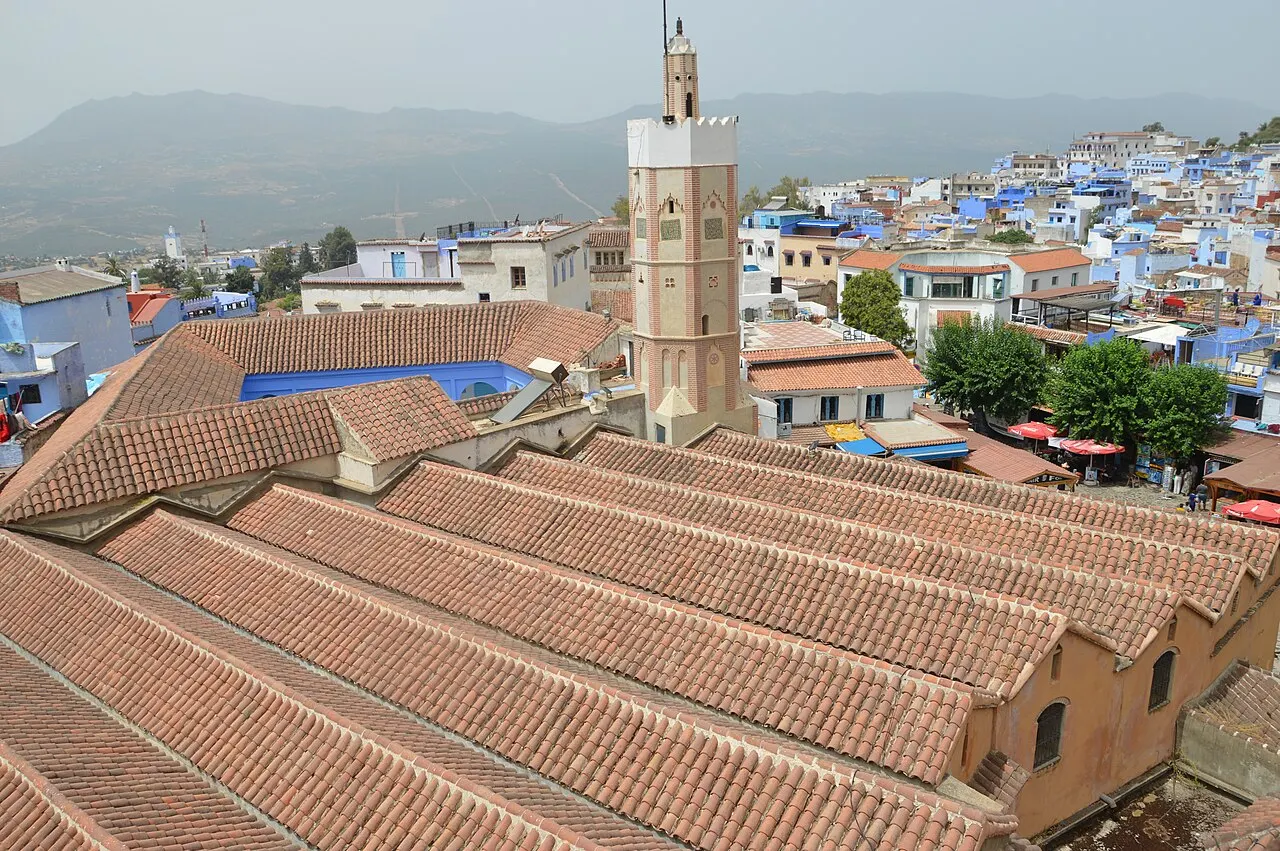
The oldest and most important mosque in town, next to the Kasbah on the central square. As in most of Morocco, the interior is reserved for Muslims; for everyone else, the visit is from the facade and the square.
Check access
Souika
The “little souk” neighborhood keeps an arch left from the gates of the original market and the Aïn Souika fountain, a wall fountain behind an arch, with recently restored tiles. It is a good walk for seeing houses, workshops and shops away from the busiest route.
Check access
Cascades d'Akchour
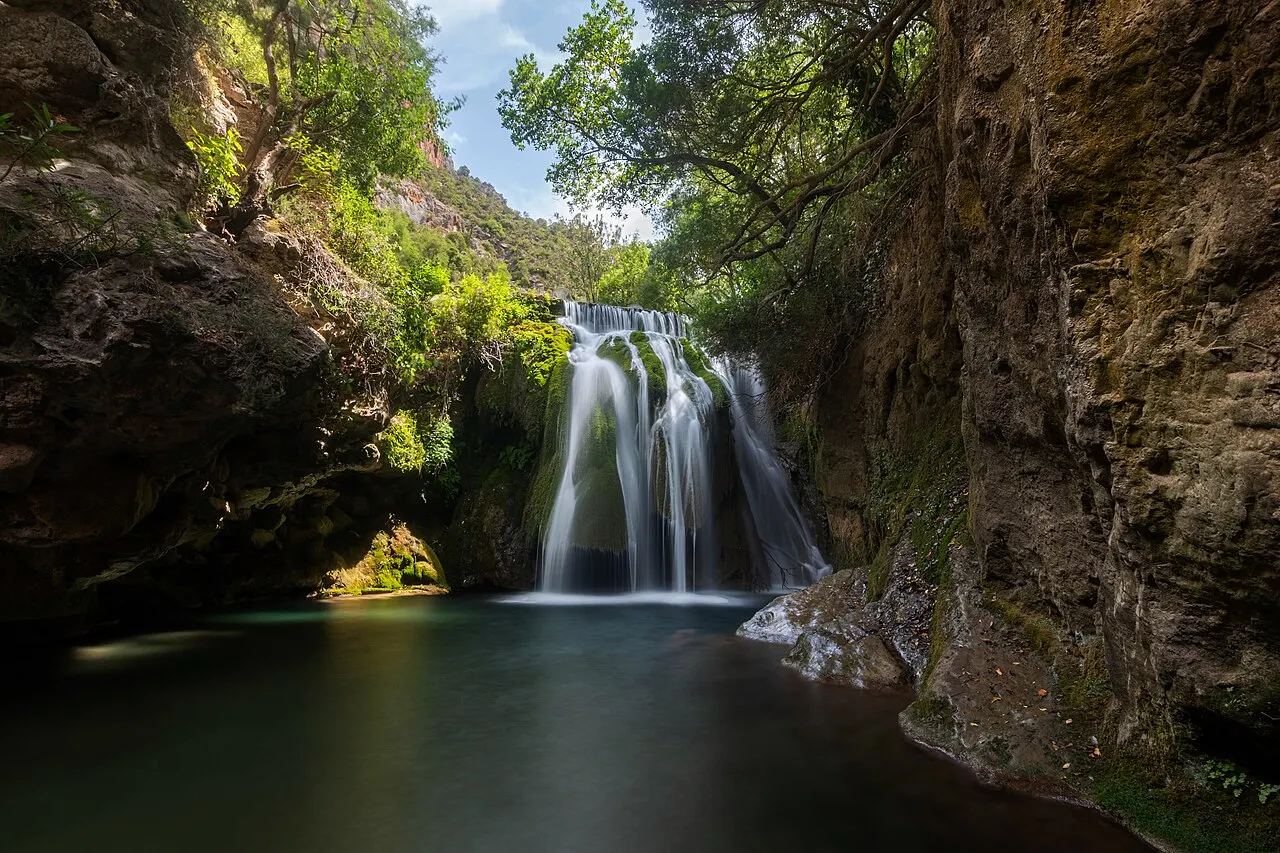
The Akchour waterfalls lie upriver from the village. The small cascades are about 2 km from the entrance, around 40 minutes on an easy walk; the big waterfall is about 6 km away, on a moderate trail that takes up the whole day. Bring footwear that can get wet.
Check access
Parc national de Talassemtane
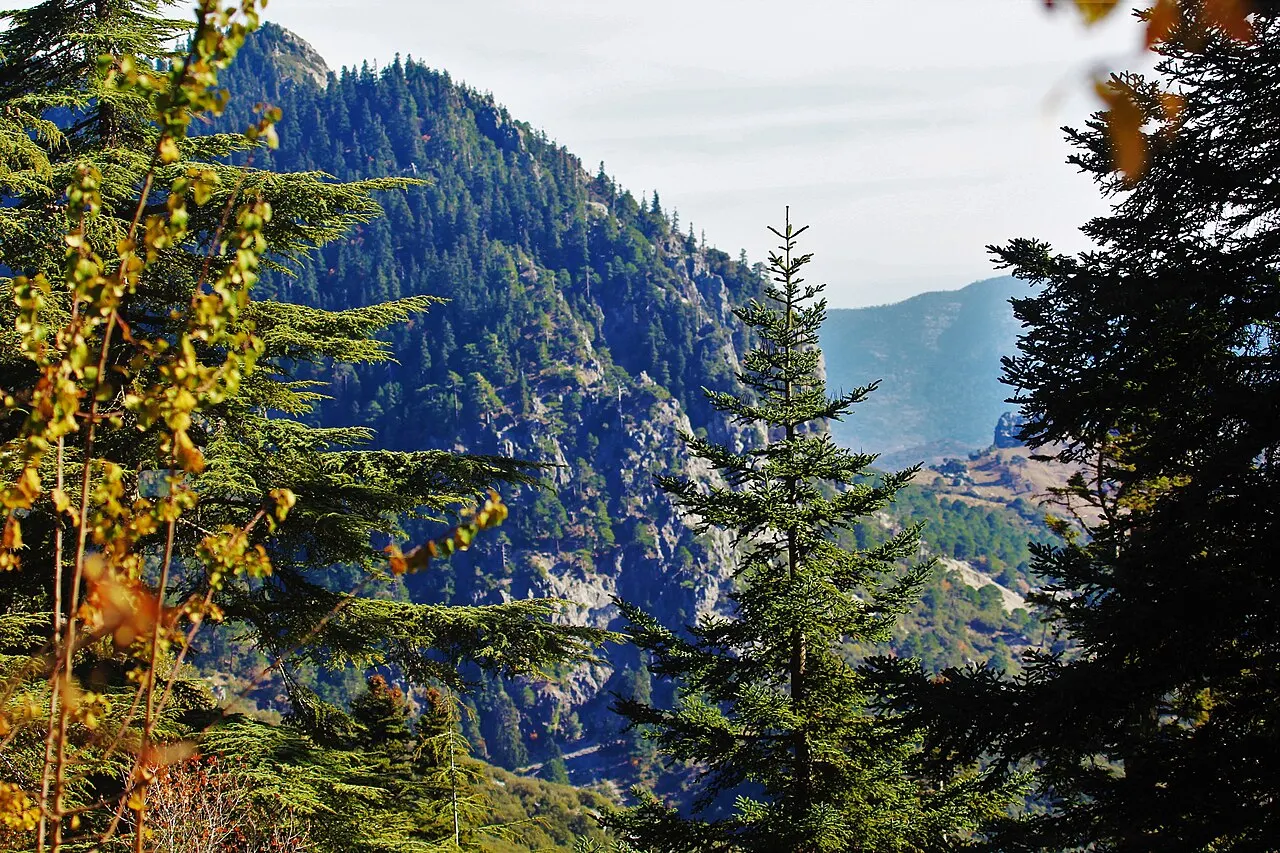
Created in 2004, the park covers 58,950 hectares of limestone mountains, gorges and forests, including the only Moroccan fir forests in the country, as well as Atlas cedar. There are Barbary macaques and more than a hundred bird species. The longer trails, such as the crossing from Azilane to Akchour, call for a local guide, a map and clothing for the cold.
Check access
More places in the guide
Place el-Haouta
A small square in Souika, between Bab el-Ain and the main square, with a traditional fountain in the center and painted houses around it. It lies on the way for anyone entering from the south and works as a pause, with no program of its own.
Nilo’s itinerary
Start with the basic programme and choose extensions for the time you have.
Plan my days in the app ↗Day 1 · Souika, the Kasbah and late afternoon at the Spanish mosque
Enter the medina through Bab el-Ain, the south gate, and follow Souika, passing the small Place el-Haouta, the arch of the old market and the Aïn Souika fountain.
Continue to Outa el Hammam square and visit the Kasbah while it is still morning: walls, garden, the small museum and the west tower.
On the way out, see the facade of the Great Mosque, next to the Kasbah, on the same square.
Have lunch near the square or on a side street, with tagine, bissara or a salad with goat cheese.
In the afternoon, cross the medina eastward to the Bab Onsar gate and the Ras el Ma spring.
An hour before sunset, take the dirt trail that starts at the bridge in front of Bab Onsar and climb 20 to 30 minutes to the Spanish mosque.
Come back down for dinner in the medina.
Day 2 · Akchour, the Bridge of God and the waterfalls
Leave early by grand taxi for Akchour, about 30 km away on the Oued Laou road; agree with the driver on the time and price of the return.
At the entrance to the gorge, choose one of two paths: the Bridge of God trail, about an hour and a half on foot, with a steep climb after the dam, or the small cascades, about 40 minutes on an easy walk.
With time, do both, returning to the entrance between one and the other; the big waterfall, about 6 km away, only fits those who give it the whole day.
Bring water and a snack bought in the medina, such as goat cheese, bread and olives, and be at the taxi stand by mid-afternoon.
Back in Chefchaouen, spend the end of the day on the main square or at Ras el Ma.
Food
Bissara
A thick purée of dried fava beans with olive oil, the local specialty for breakfast and on cold days. It is eaten hot, with bread, in simple cafés in the medina.
Fresh goat cheese
The region is known for its goat cheese, sold in small shops in the medina and served in salads. It goes well with bread and mountain olives.
Olive oil and olives
The olive tree is the main crop on the slopes around the town. Olive oil and olives appear at breakfast, in salads and in almost every tagine.
Tagine
The slow stew cooked in a clay pot with a conical lid, made with goat or lamb and vegetables, with chicken, or with fish. The restaurants around the main square serve many; quality varies a lot.
Harira
A tomato soup served in cafés and simple restaurants, cheap and good for the cold mountain days.
Baghrir
Pancakes served with honey and olive oil or butter at some stalls and cafés.
Mint tea
Served in a small glass, with sugar, in any café in town. Alcohol is rare: almost no restaurant serves alcoholic drinks.
Where to eat
- Medina cafés
For breakfast, eggs, goat cheese, olives, bread and tea, or a bowl of hot bissara, served in practically any café in the medina at a low price.
- Outa el Hammam square
The restaurants with tables on the square and terraces above it serve tagine, couscous, harira and salads, with a view of the Kasbah. The location weighs on the price and quality varies; ask for the menu with prices and compare.
- Side streets of the medina
Small places a few steps from the square serve fish tagine, couscous and salad with goat cheese, usually for less and with less bustle. For a snack, there are sandwich stalls, such as one by Bab el-Ain, and some make baghrir with honey.
- Local product shops
To take away or to put together a picnic for Akchour, the shops in the medina sell fresh goat cheese, olives and olive oil from the region.
· 2026-10-19
Day trips
Jebel el-Kalaa
The peak that dominates the town is climbed from the upper part, along the southeast valley road and then a trail marked in white and yellow, not always visible. The round trip can take up to nine hours; a viewpoint on the way is about 30 minutes from the walls and is already worthwhile for anyone with only a morning. Bring water and food, and avoid it in rain.
Oued Laou
The nearest Mediterranean coast is about an hour by grand taxi, along the road that passes through Akchour. The beaches of Oued Laou and Targha, on the same coast, are the way out for anyone who wants to trade the mountain for the sea for a day.
Azilane to Akchour crossing
A two-day hike through Talassemtane National Park. The rural guesthouse at Azilane is about 14 km from the start, in Chefchaouen, along a track that climbs to about 1,800 meters; the next day, you descend through the villages and the river valley to Akchour. There can be snow until April. Go with a local guide and confirm the guesthouse before setting out.
Where to begin
Souika, the Kasbah and late afternoon at the Spanish mosque
Enter the medina through Bab el-Ain, the south gate, and follow Souika, passing the small Place el-Haouta, the arch of the old market and the Aïn Souika fountain.
Akchour, the Bridge of God and the waterfalls
Leave early by grand taxi for Akchour, about 30 km away on the Oued Laou road; agree with the driver on the time and price of the return.
Money
The currency is the Moroccan dirham (DH). There are banks and ATMs in the new town and next to Outa el Hammam square; bring cash for taxis, cafés, stalls and small shops, and for the days in Akchour, where you should not count on an ATM. The prices below are from Wikivoyage, with the date of each update, and serve as an order of magnitude: Kasbah admission cost 80 DH for foreigners and 10 DH for residents in June 2024; a local breakfast with eggs, cheese, olives and tea was between 20 and 25 DH in January 2023; a glass of mint tea, 7 to 10 DH; and the public hammam, 15 DH. In the medina's shops, the price of rugs, leather and fabrics is negotiable; ask the price before ordering food in a restaurant with no priced menu.
Getting there and around
Chefchaouen has no airport and no train station. The nearest airports are Tangier (TNG), Fez (FEZ) and Tetouan (TTU, with few flights). From the airport, take a taxi to the bus station or the grand taxi stand in the city you arrive in and continue by road: from Tangier, the grand taxi takes about two and a half hours, according to Wikivoyage (June 2023). Those coming from Casablanca or Rabat can take the train to Tangier and continue from there.
The bus station is in the new town, on Mohammed V avenue, about a 15-minute walk uphill from the medina. CTM and other companies connect the town to Fez (about four hours), Tetouan (about an hour and a half) and Tangier (two and a half to three hours, usually via Tetouan), as well as Rabat, Casablanca and Meknes. Schedules and prices change: check on the CTM channel or at the ticket window. Wikivoyage noted in 2017 that CTM buses to Fez sold out days in advance, so buy early if the departure date is already settled. Some buses between Fez and Tetouan stop at Derdara, 8 km away, from where frequent grand taxis climb to the town. At the bus station door there are usually petits taxis; Wikivoyage noted 10 DH to the medina in January 2023.
The grand taxis (shared six-seat cars, paid per seat) to Tetouan and Tangier leave from a stand next to the bus station; there is another stand for Bab Taza and Ouezzane. For Akchour and Oued Laou, ask for the stand for the taxis on that road. Anyone who wants to leave without waiting for the car to fill up pays for the empty seats.
Inside the medina, you get around only on foot, along slopes and stairs. Those arriving by car leave the vehicle in the lots by the gates, such as Bab el-Mahrouk and Bab Onsar, usually watched by attendants who charge a small fee.
Safety
Chefchaouen is a calm town, and the most common problems are pushiness and scams, not violence. At the bus station and in the medina, there are people who offer to guide you and then charge, people who say your hotel is closed and people who offer hashish. A calm, repeated no usually solves it; do not agree to go with someone who approaches you to their home, where the pressure to buy is greater and refusing is difficult. The town lies on the edge of a cannabis-growing region, and on the trails you may pass fields; farmers usually ignore passersby or offer drugs. Buying, transporting or using it is a crime. In the mountains, the main risk is the terrain: poorly marked trails, a river that rises after rain, and cold and snow on the peaks until spring. For long hikes in Talassemtane, hire a local guide and tell your lodging which route you will take. Tap water comes from springs, but those with sensitive stomachs should prefer bottled water.
Before you go
- Plug
- types C and E
- Voltage
- 127/220 V
- Driving side
- on the right
- Emergency
- Ambulance, Fire 15 · Police 19 · Police 112
- Country code
- +212
- Official languages
- Arabic and Standard Moroccan Tamazight
- Currency
- Moroccan dirham (MAD)
Source: Wikidata (CC0), checked September 2026.
Etiquette tips
Mosques and zawiyas
The interior of mosques, including the Great Mosque, is reserved for Muslims. Look from the doorway without going in and without photographing people at prayer.
Clothing in the medina
Covered shoulders and knees are the standard of respect near mosques, zawiyas and mausoleums, in a town with a strong religious life, and in the mountain villages.
Photographing people
Many of the doors and stairs people photograph are the entrances to homes. Ask permission before photographing residents and do not take up the steps of private houses.
Greeting and bargaining
A “salam alaykum” opens any conversation. Ask the price only if you are thinking of buying; a calm “la, shukran” ends a seller's approach.
Ramadan
During the month of fasting, eat and drink discreetly on the street during the day.
Mistakes to avoid
Doing Chefchaouen as a day trip from Fez: it is about eight hours on the road in total, which leaves little time for the medina.
Following someone who approaches you at the bus station saying that the hotel you booked is closed or under construction. The aim is to take you to other lodging, for a commission.
Arriving in Akchour late in the morning without arranging the return: taxis back become scarce in the afternoon.
Trying the path along the riverbed to the Bridge of God after rain or during the thaw, when the water rises.
Accepting hashish offered on the street or on the trails, thinking it is tolerated: buying, transporting or smoking it is a crime in Morocco.
Useful phrases
السلام عليكم: Salam alaykum (sa-LAHM a-LAY-kum)
Peace be upon you: the everyday greeting, answered with wa alaykum salam.
شكرا: Shukran (SHOO-kran)
Thank you.
لا شكرا: La, shukran (la SHOO-kran)
No, thank you: the polite refusal for sellers and street guides.
بشحال؟: Bshhal? (bch-HAL)
How much? It opens the bargaining; ask only if you are thinking of buying.
فين راس الما؟: Fin Ras el Ma? (fin ras el ma)
Where is Ras el Ma? Works for asking any direction, by swapping in the name of the place.
واخا: Wakha (WAH-kha)
All right, agreed: it settles a price, a return time and any arrangement.
Where to stay
- Medina, around Outa el Hammam square · Those who want to walk to the Kasbah, the restaurants and the lanes, and go back to the room between outings.: It is the most central spot, with the largest supply of guesthouses, homestays and terraces with views. On the other hand, it is the busiest area at night, and luggage goes up stairs from the medina gate, because cars cannot enter.
- Ras el Ma and Bab Onsar · Those who prefer quiet, will climb to the Spanish mosque and the trails, and do not mind slopes.: The upper, eastern part of the medina is quieter and sits next to the spring and the start of the mountain paths. The climb from the bus station and from the square is the longest; for anyone with limited mobility, it weighs heavily.
- New town, near Hassan II and Mohammed V avenues · Those arriving by car, traveling with large suitcases or catching an early bus.: It is close to the bus station, banks and parking, with hotels reached directly from the street. It loses the atmosphere of the medina and requires an uphill walk to the main square.
- Akchour and the river valley · Those who come for the Talassemtane trails and want to start early at the Bridge of God or the big waterfall.: There are rural guesthouses in the area, and sleeping there saves the morning road trip. In return, it is far from the town and the restaurants, and transport at night is scarce; confirm the lodging and your arrival before going.
· 2026-10-19
Districts
Medina
The walled historic center, with its blue and white houses, stepped lanes, the Kasbah, the Great Mosque and Outa el Hammam square. Everything is done on foot, with climbs and steps; it is where most small lodgings and restaurants are.
Souika
One of the oldest neighborhoods of the medina, southwest of the Kasbah, built around a small covered market from the fifteenth century. It lies between the Bab el-Ain gate and the main square, with Place el-Haouta, shops selling local products and an old fountain, and it is the natural route for anyone entering from the south.
Ras el Ma and Bab Onsar
The upper, eastern part of the medina, next to the Bab Onsar gate and the spring. It is steeper and quieter, and close to the trail to the Spanish mosque and the paths into the mountains.
New town
The neighborhoods below the walls, around Hassan II and Mohammed V avenues. They hold the bus station, banks, markets and hotels with car access; they have less charm, but they solve arrival, departure and luggage.
History
1471 · A kasbah against the Portuguese
Ali ibn Rashid al-Alami, who had fought in the kingdom of Granada, built a small fortress at the foot of the mountain to defend the region from Portuguese attacks on northern Morocco. The Kasbah on the central square is that fortress.
1492–1609 · Refugees from al-Andalus
The fall of Granada and the expulsions that followed brought Muslims, Moriscos and Jews from the Iberian Peninsula. They built neighborhoods on the slope in the Andalusian style, and the fortress became a town, with walls, gates and mosques.
1883 · Charles de Foucauld's description
The French explorer entered the town, then closed to Christians, and left the first European description of it, with three to four thousand inhabitants and about ten Jewish families.
1920–1926 · Spanish occupation and the Rif War
The Spanish army occupied the town in 1920. Between 1924 and 1926 it was part of Abd el-Krim's Republic of the Rif; in 1925 it was bombed by a squadron of American pilots in the service of France, and the Spanish retook it in 1926.
1956 · Independence
With the end of the Spanish protectorate in the north, Chefchaouen became part of independent Morocco.
2004 · Talassemtane National Park
A decree of October 2004 created the park, covering 58,950 hectares in the provinces of Chefchaouen and Tetouan, to protect the Moroccan fir and the limestone mountains around the town.
2010 · The Mediterranean diet at UNESCO
Chefchaouen was included as a representative community of Morocco in the inscription of the Mediterranean diet on UNESCO's list of intangible cultural heritage.
Complete history
Chefchaouen was born of military necessity. In 1471, the sharif Ali ibn Rashid al-Alami, a descendant of an important religious lineage of northern Morocco, built a kasbah at the foot of the mountain, far enough from the coast to be safe from the Portuguese who were attacking the coastal towns. The rammed-earth walls and towers of that fortress still stand on the central square.
The town grew with those who had lost their homes on the other side of the strait. After the fall of Granada in 1492, and until the final expulsion of the Moriscos from Spain in 1609, Muslims and Jews from al-Andalus settled on the slope and built neighborhoods like those of Granada: houses closed to the street, with an inner courtyard, brick arches and a network of channels that carried water from the springs. Within a few decades, the fortress had become a town with about ten gates, several mosques and a culture that blends the Andalusian heritage with that of the Jbala tribes of the mountain.
For centuries the town stayed closed to Christian foreigners. In 1883, the French explorer Charles de Foucauld defied the ban, entered it and described it as a village of three to four thousand inhabitants, with tiled roofs and streams running everywhere. The twentieth century brought the Spanish occupation in 1920, the Rif War, a bombing in 1925 and the return of the Spanish in 1926. The protectorate left visible marks, such as the mosque the Spanish built on the hill to the east and the Spanish still heard in town.
Since independence in 1956, Chefchaouen has been a provincial capital and lives on trade, crafts and tourism, which grew with the fame of its blue streets. There are several explanations for the origin of that color, and none is agreed on by the sources; what is known is that today the painting is kept up by residents and has become the image of the town. Around it, the creation of Talassemtane National Park in 2004 turned the mountains that once protected the town into a hiking destination.
Geography and shape of the city
Chefchaouen sits on the slope of a mountain in the western Rif, about 600 meters above sea level, beneath two horn-shaped peaks: the name comes from the Berber achawen, “the horns”; another reading combines the Arabic chef, “look,” and understands it as “look at the horns.” The medina occupies the upper part, enclosed by walls, and the new town spread out below it, along Hassan II and Mohammed V avenues, where the bus station and services are. East of the walls, the Ras el Ma spring comes out of the rock and runs down the valley; the water from the springs is what fixed the town there. To the north and east begin the limestone mountains of Talassemtane National Park, with forests of fir, cedar and pine, gorges and rivers, like the one that passes through Akchour. The climate is Mediterranean mountain: hot, dry summers and cold, rainy winters, with snow on the peaks.
Culture
Chefchaouen is a religious town: it has about twenty mosques and prayer halls, eleven zawiyas (centers of Sufi brotherhoods) and seventeen mausoleums, which earned it the nickname “holy city.” The festivals of the Islamic calendar, such as the Mawlid, draw crowds to the founder's mausoleum and the zawiyas, and many families preserve Andalusian music, which accompanies religious celebrations and family ceremonies.
The architecture tells of the town's Andalusian origin: houses of stone, brick, wood, earth and lime, closed to the street and open to a courtyard with orange trees, lemon trees, grapevines and jasmine. The brick arches that reinforce the houses cross the lanes, and the public fountains, such as the one on the main square and the one in Souika, were part of a water network that came from the springs.
Crafts are the most widespread activity in the town and the province: wool weaving, leather, ironwork and above all woodwork, which accounts for most of what is sold. Around the town, the countryside belongs to the Jbala, mountain peoples who grow olives, figs, almonds and grapes and raise goats; the town has traded with them for centuries. The Mediterranean diet, inscribed on UNESCO's intangible heritage list, counts Chefchaouen among the communities that represent it.
Festivals and events
Mawlid
On the 12th day of the Islamic month of Rabi al-Awwal, the Prophet's birthday, there are Quran readings in the mosques and homes, celebrations at the mausoleum of Ali ibn Rashid and at the zawiyas, and couscous is distributed to the poor. The date shifts by about eleven days a year on the Gregorian calendar.
Sha'bana
On the 15th day of the month of Sha'ban, residents, especially pupils of the Quranic schools, visit the tomb of Moulay Abdessalam ben Mchich, patron saint of the Jbala region, about 50 km from the town.
Ramadan and the night of the 26th
During the month of fasting, the rhythm of the day changes and the town comes alive after sunset. On the night of the 26th, families encourage girls between seven and ten to make their first fast, and some parade dressed as brides after the afternoon prayer.
Ashura
On the 10th day of the month of Muharram, families eat couscous with qaddid, the dried meat kept from the Feast of the Sacrifice, along with dried fruit and sweets, and children receive gifts.
Books and films
Reconnaissance au Maroc, by Charles de Foucauld (1888)
The account of the 1883 journey, with the first European description of Chefchaouen, when the town was still closed to Christians.
Understanding Chefchaouen: Traditional knowledge for a sustainable habitat, by Letizia Dipasquale (2020)
An open-access study from Firenze University Press on courtyard houses, water and the architecture of the medina, with drawings and photos.
Storytelling in Chefchaouen Northern Morocco, by Aicha Rahmouni (2014)
A study published by Brill with tales from the town's oral tradition, told by two female storytellers in the local Arabic, with transliteration and English translation.
Frequently asked questions
Chefchaouen: how do you get there?
Chefchaouen has no airport and no train station. The nearest airports are Tangier (TNG), Fez (FEZ) and Tetouan (TTU, with few flights). From the airport, take a taxi to the bus station or the grand taxi stand in the city you arrive in and continue by road: from Tangier, the grand taxi takes about two and a half hours, according to Wikivoyage (June 2023). Those coming from Casablanca or Rabat can take the train to Tangier and continue from there. The bus station is in the new town, on Mohammed V avenue, about a 15-minute walk uphill from the medina. CTM and other companies connect the town to Fez (about four hours), Tetouan (about an hour and a half) and Tangier (two and a half to three hours, usually via Tetouan), as well as Rabat, Casablanca and Meknes. Schedules and prices change: check on the CTM channel or at the ticket window. Some buses between Fez and Tetouan stop at Derdara, 8 km away, from where frequent grand taxis climb to the town. At the bus station door there are usually petits taxis; Wikivoyage noted 10 DH to the medina in January 2023.
Chefchaouen: how many days should you stay?
I'd stay two full days, with two nights in town. The first is for the medina: Souika, the square and the Kasbah in the morning, Ras el Ma in the afternoon and the climb to the Spanish mosque for the end of the day. The second is for Akchour, leaving early, for the Bridge of God and the cascades, with the return arranged before mid-afternoon. With only one night, I'd stay in the medina and leave Akchour for another trip, because the trail needs a whole morning and does not fit with a fixed bus. An extra day is only justified for those who want to hike in the park, such as the climb to Jebel el-Kalaa.
Chefchaouen: is a day trip from Fez worth it?
Doing Chefchaouen as a day trip from Fez means about eight hours on the road in total, which leaves little time for the medina. By bus, the trip to Fez takes about four hours.
Chefchaouen: how do you get to Akchour and the Bridge of God?
Leave early by grand taxi for Akchour, about 30 km away on the Oued Laou road; ask for the stand for the taxis on that road and agree with the driver on the time and price of the return before starting the trail, because taxis back become scarce in the afternoon. At the entrance to the gorge, the Bridge of God trail, to a natural stone arch about 25 meters above the river, takes about an hour and a half and climbs steeply after the dam; after rain or snowmelt, the path along the riverbank can become impassable. The small cascades are about 2 km from the entrance, around 40 minutes on an easy walk; the big waterfall is about 6 km away, on a moderate trail that takes up the whole day. Bring footwear that can get wet, water and a snack bought in the medina, and cash: in Akchour, you should not count on an ATM.
Chefchaouen: when is the best time to go?
The best time to combine the medina and the trails is May, June and October: days are usually mild and the snow on the peaks, which can last until April, has gone. From mid-July to September, the holidays bring Moroccan and foreign tourists and the return of emigrants from the region; lodging gets tight and the heat builds in the middle hours of the day, although the mountain eases it at night. Winter, from November to March, is cold and rainy, with snow on the peaks, and rooms without heating turn damp. After heavy rain and during the spring thaw, the Akchour river rises and some stretches of trail become impassable. Ramadan changes the hours of cafés and restaurants, which fill up after sunset.
Chefchaouen: how do you walk up to the Spanish mosque?
The Jemaa Bouzafar mosque, also written Bouzaâfar, was built by the Spanish in the 1920s on a hill east of town, and today it is hardly used for worship. The dirt trail starts at Ras el Ma, by the bridge in front of the Bab Onsar gate, and takes 20 to 30 minutes on an easy walk. The reason for the climb is the view: the whole medina on the slope, with the mountain behind it, especially late in the afternoon. To come down after sunset along the dirt trail, I'd bring a flashlight, or a charged phone.
Chefchaouen: can you visit the Kasbah and the Great Mosque?
The Kasbah, the original 1471 fortress on Outa el Hammam square, has a garden in its courtyard and a small museum in a house from the late seventeenth century. Admission is charged and the fee differs for residents and foreigners; check the price and hours at the ticket office. Wikivoyage recorded 80 DH for foreigners and 10 DH for residents in June 2024. The Great Mosque, next to the Kasbah, is the oldest and most important in town; as in most of Morocco, the interior is reserved for Muslims, and for everyone else the visit is from the facade and the square.
Chefchaouen: how do you pay?
The currency is the Moroccan dirham (DH). There are banks and ATMs in the new town and next to Outa el Hammam square; bring cash for taxis, cafés, stalls and small shops, and for the days in Akchour, where you should not count on an ATM. The prices that follow are from Wikivoyage, with the date of each update, and serve as an order of magnitude: Kasbah admission cost 80 DH for foreigners and 10 DH for residents in June 2024; a local breakfast with eggs, cheese, olives and tea was between 20 and 25 DH in January 2023; a glass of mint tea, 7 to 10 DH; and the public hammam, 15 DH. In the medina's shops, the price of rugs, leather and fabrics is negotiable; ask the price before ordering food in a restaurant with no priced menu.
Chefchaouen: is it safe?
Chefchaouen is a calm town, and the most common problems are pushiness and scams, not violence. At the bus station and in the medina, there are people who offer to guide you and then charge, people who say your hotel is closed and people who offer hashish. A calm, repeated no usually solves it; do not agree to go with someone who approaches you to their home, where the pressure to buy is greater and refusing is difficult. The town lies on the edge of a cannabis-growing region, and on the trails you may pass fields; farmers usually ignore passersby or offer drugs. Buying, transporting or using it is a crime. In the mountains, the main risk is the terrain: poorly marked trails, a river that rises after rain, and cold and snow on the peaks until spring. For long hikes in Talassemtane, hire a local guide and tell your lodging which route you will take. Tap water comes from springs, but those with sensitive stomachs should prefer bottled water.
Other cities in the country
Morocco ↗- Days
- 3
- When
- Mar–May · Oct–Nov
- Per person/day
- Average 700–1,400 MADMid-range · per person/day
Cost scope
Per person per day: accommodation, meals, urban transport, visits and a small allowance for extras. Flights excluded; larger purchases vary. Editorial estimate, not a quote.
- Days
- 2–3
- When
- Mar–May · Sep–Nov
- Per person/day
- Average 800–1,400 MADMid-range · per person/day
Cost scope
Per person per day: accommodation, meals, urban transport, visits and a small allowance for extras. Flights excluded; larger purchases vary. Editorial estimate, not a quote.
- Days
- 2–3
- When
- Apr–Jun · Sep–Oct
- Per person/day
- Average 800–1,400 MADMid-range · per person/day
Cost scope
Per person per day: accommodation, meals, urban transport, visits and a small allowance for extras. Flights excluded; larger purchases vary. Editorial estimate, not a quote.
- Days
- 4
- When
- Jan–Apr · Oct–Dec
- Per person/day
- Average 400–900 MADMid-range · per person/day
Cost scope
Per person per day: accommodation, meals, urban transport, visits and a small allowance for extras. Flights excluded; larger purchases vary. Editorial estimate, not a quote.