Switzerland
Interlaken
Rail base for the Jungfraujoch, the Lauterbrunnen Valley and Lakes Thun and Brienz
Days Start with the basic programme and choose extensions for the time you have.
How the guide reaches this number
Interlaken is the base, and the excursions are in the mountains and on the lakes around it: one day on the Jungfraujoch, going up by the Eiger Express and coming back via Wengen and Lauterbrunnen; one in the Lauterbrunnen Valley, with the Staubbach, the Trümmelbach falls, the Schilthorn and the descent through Mürren; and one in Grindelwald, with the First cable car and the walk to the Bachalpsee. I'd leave the order open and pick the clearest day for the Jungfraujoch, because in fog it is not worth the price. The fourth day is for Lake Brienz, by bus and boat, with Iseltwald, the Giessbach falls and Brienz; with a fifth, I'd do Lake Thun, with Spiez, Oberhofen and Thun Castle. With only one day, I'd go to the Lauterbrunnen Valley and the Schilthorn, which bring together walls, waterfalls and the view of the three peaks. The town itself fits into late afternoons: the Höhematte, the Höheweg, Unterseen and the sunset from the Harder Kulm. In summer everything is open, and it is also the season with the most rain; between late October and December, check line by line what is under maintenance.
3–5
When June to September: all the mountain railways, trails and boats are running; from December to March the draw becomes skiing in Grindelwald, Wengen and Mürren
How the guide reaches this number
The year in Interlaken is divided by what is open on the mountain, more than by the temperature in town. From June to September all the mountain railways, the boats on both lakes, the high trails and the Schynige Platte garden are running; the town's average highs stay between 19 °C and 24 °C, but it is also the rainiest season, with 146 mm in July and in August. From May to October, the seat reservation for the Jungfraujoch is mandatory. In late October and in November, several lines stop for maintenance: in 2026, the Schynige Platte cog railway stops after October 25, the First cable car is closed from late October until the winter season, and the Stechelberg–Mürren section of the Schilthorn closes from October 19 to 30, with a replacement bus. From December to March, Grindelwald, Wengen and Mürren become ski resorts, the Jungfraujoch stays open and the boats on Lake Brienz stop; in Interlaken the average lows of January are −2.8 °C. April and early May are another transition window, with snow up high and some lines under maintenance. In any month, the Jungfraujoch, at 3,454 m, is much colder than the town and has snow all year: bring warm clothing and sunglasses.
Per person/day Budget about CHF 111; mid-range about CHF 254; comfortable about CHF 496 per person, based on the spending that travelers report to Budget Your Trip (checked October 2026).
How the guide reaches this number
Per person per day: accommodation, meals, urban transport, visits and a small allowance for extras. Flights excluded; larger purchases vary. Editorial estimate, not a quote.
 What Nilo thinks
Stay three days, and four if you can. Interlaken is the base, and the excursions are in the mountains and on the lakes around it: one day on the Jungfraujoch, going up by the Eiger Express and coming back via Wengen and Lauterbrunnen; one in the Lauterbrunnen Valley, with the Staubbach, the Trümmelbach falls, the Schilthorn and the descent through Mürren; and one in Grindelwald, with the First cable car and the walk to the Bachalpsee. I'd leave the order open and pick the clearest day for the Jungfraujoch, because in fog it is not worth the price. The fourth day is for Lake Brienz, by bus and boat, with Iseltwald, the Giessbach falls and Brienz; with a fifth, I'd do Lake Thun, with Spiez, Oberhofen and Thun Castle. With only one day, I'd go to the Lauterbrunnen Valley and the Schilthorn, which bring together walls, waterfalls and the view of the three peaks. The town itself fits into late afternoons: the Höhematte, the Höheweg, Unterseen and the sunset from the Harder Kulm. In summer everything is open, and it is also the season with the most rain; between late October and December, check line by line what is under maintenance.Interlaken grew out of a monastery on a flat strip of land between two lakes, Thun and Brienz, and became famous for what lies to the south of it: the Eiger, the Mönch and the Jungfrau, three peaks from 3,967 m to 4,158 m that you can see from the lawn of the Höhematte, in the center of town. Since the early 19th century, poets, painters and then the cog railways have made this the gateway to the mountains of the Bernese Oberland. In 1912, a tunnel dug inside the Eiger took the train to the Jungfraujoch, at 3,454 m, above the Aletsch Glacier, the largest in the Alps. Twenty-two minutes away by train is the Lauterbrunnen Valley, a narrow cut between limestone walls from which the 297 m Staubbach waterfall drops, with the car-free villages of Wengen and Mürren up above. Grindelwald lies beneath the north face of the Eiger, first climbed in 1938, and on Lake Brienz the boats stop at the foot of the Giessbach falls. At the table, the food is that of the pastures: alpine cheese, rösti and the herders' macaroni with potato and cream.
Quick facts
- Population
- 6,123 residents in the municipality (December 31, 2025); Interlaken forms a continuous urban area with Unterseen and Matten
- Founding
- Augustinian monastery founded around 1130 and placed under imperial protection in 1133; the municipality was called Aarmühle until 1891, when it officially adopted the name Interlaken
- Country and region
- Switzerland, canton of Bern, Bernese Oberland region; 4.27 km² at 568 m above sea level, between Lakes Thun and Brienz
- Language
- German as the official and written language; on the street people speak the Swiss German of the Bernese Oberland; in the 2000 census, 83.4% of residents had German as their first language
- Currency
- Swiss franc (CHF)
- Time zone
- Central European Time: UTC+1 in winter and UTC+2 during daylight saving time
- Best time to go
- June to September: all the mountain railways, trails and boats are running; from December to March the draw becomes skiing in Grindelwald, Wengen and Mürren
- Average daily cost
- Budget about CHF 111; mid-range about CHF 254; comfortable about CHF 496 per person, based on the spending that travelers report to Budget Your Trip (checked October 2026).
When to go
June to September: all the mountain railways, trails and boats are running; from December to March the draw becomes skiing in Grindelwald, Wengen and Mürren
How the year changes

The year in Interlaken is divided by what is open on the mountain, more than by the temperature in town. From June to September all the mountain railways, the boats on both lakes, the high trails and the Schynige Platte garden are running; the town's average highs stay between 19 °C and 24 °C, but it is also the rainiest season, with 146 mm in July and in August. From May to October, the seat reservation for the Jungfraujoch is mandatory. In late October and in November, several lines stop for maintenance: in 2026, the Schynige Platte cog railway stops after October 25, the First cable car is closed from late October until the winter season, and the Stechelberg–Mürren section of the Schilthorn closes from October 19 to 30, with a replacement bus. From December to March, Grindelwald, Wengen and Mürren become ski resorts, the Jungfraujoch stays open and the boats on Lake Brienz stop; in Interlaken the average lows of January are −2.8 °C. April and early May are another transition window, with snow up high and some lines under maintenance. In any month, the Jungfraujoch, at 3,454 m, is much colder than the town and has snow all year: bring warm clothing and sunglasses.
Nilo's tips
Decide on the Jungfraujoch by the webcam, not the calendar
The Jungfraujoch is the most expensive excursion in the region, from CHF 129.60 plus CHF 10 for the seat reservation from May to October, and in fog at 3,454 m you see nothing. That is why I would leave the date open: the evening before, I'd look at the Jungfraubahnen webcams and the forecast and only then buy. Until October 31, 2026, the Good Morning Ticket gives a 20% discount on one of the first two departures of the day (from Interlaken Ost, at 7:04 a.m. and 7:34 a.m.), with the descent from the Jungfraujoch by 1:17 p.m.; it cannot be combined with the Half Fare Card, the Swiss Travel Pass or other discounts. If the weather closes in, swap with the Lauterbrunnen Valley day, which works under any sky.
Go up one valley and come down the other
From the Jungfraujoch you return via Grindelwald or via Kleine Scheidegg, Wengen and Lauterbrunnen. I'd go up on the Eiger Express, the fastest way, and come down on the Wengen side, to see the north face of the Eiger and the Lauterbrunnen Valley from the window. Check when buying that your ticket covers this return.
Do the pass math before you arrive
Add up the excursions you will really take (Jungfraujoch, Schilthorn, First, boats) and compare with the Berner Oberland Pass, which gives the Schilthorn and the boats at no extra cost, with the Jungfrau Travel Pass and with the Swiss Half Fare Card. The Swiss Travel Pass pays off more for those who cross the country; for a stay in the Oberland only, I'd choose a regional pass.
In fall, check what is still running
From late October to early December several lines stop for maintenance, and some, like the Schynige Platte and the Harder Kulm, do not run in winter. In 2026, the Schynige Platte stops after October 25 and the First cable car is closed from late October until the winter season. I'd look at each line's timetable in the app or on the SBB site before building each day.
Take food up the mountain
Eating at a mountain restaurant is expensive, and the best views are far from them. I'd buy bread, alpine cheese and cold cuts at a supermarket in Interlaken in the morning and eat them at the edge of the Bachalpsee or on the plateau of the Schynige Platte.
Explore the map
Explore the map, read about the other places and plan your travel days in the app.
Open the appWhat to see
Interlaken: The Bödeli between two lakes
Until after the 10th century the two lakes were one; this gravel separated them, and today Lake Brienz sits 6 m above Lake Thun. The Aare flows from east to west through the town, from Lake Brienz, 14 km long and up to 260 m deep, to Lake Thun, the largest Swiss lake lying entirely within a single canton. The street between the Ost and West stations, with the Höhematte, the Victoria-Jungfrau, the Kursaal and the casino and most of the big hotels.

Jungfraujoch
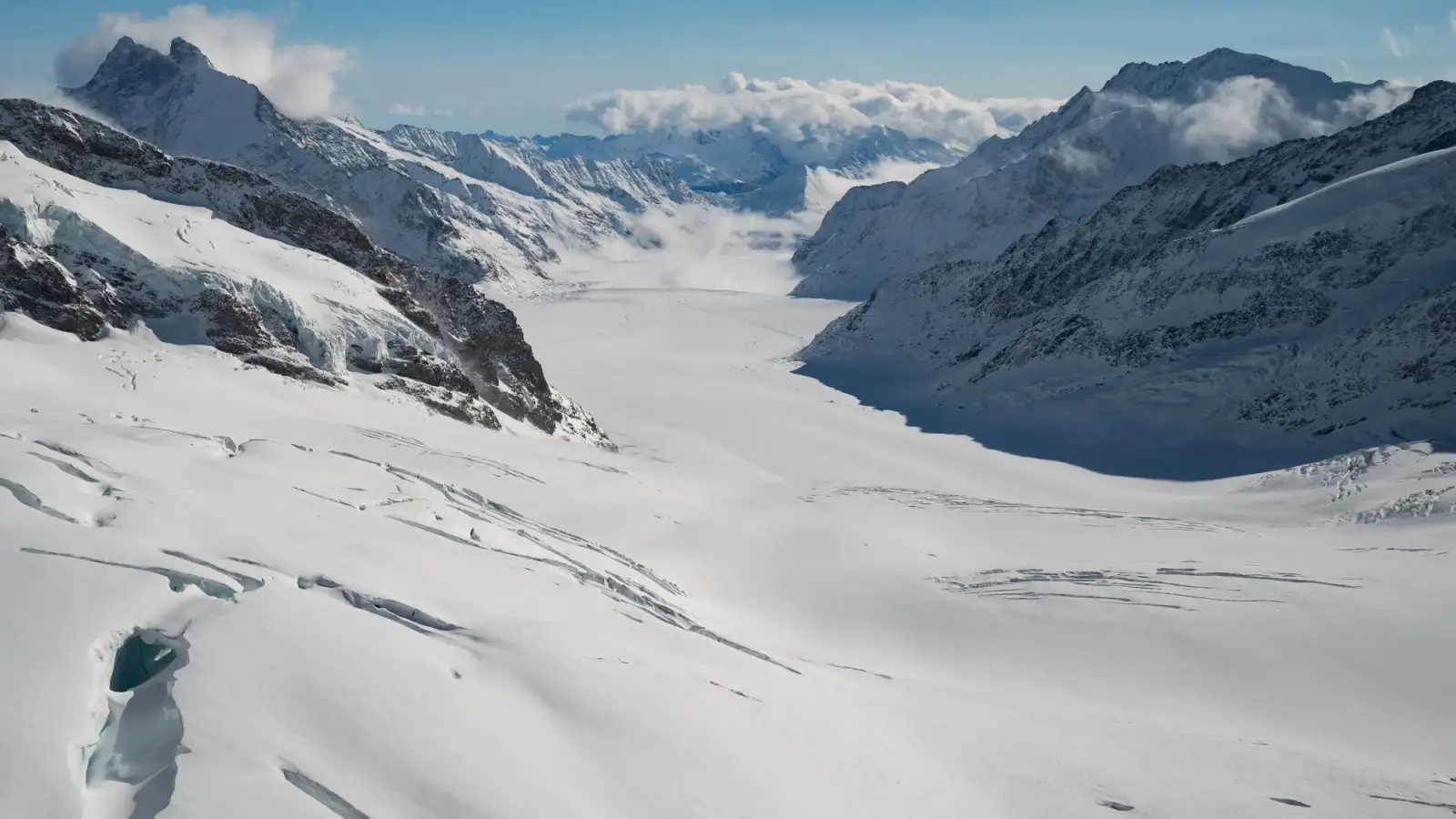
The saddle between the Jungfrau and the Mönch, with the railway station at 3,454 m, the highest in Europe. From Interlaken Ost, the trip via the Eiger Express takes 1 hour 37 minutes on the October 2026 timetable, with a five-minute stop at the window of the Eismeer station, inside the Eiger. Up there are the Sphinx viewing terrace, at 3,571 m, with a view of the Aletsch Glacier, the Ice Palace, the plateau on the snow and an exhibition on the railway. The Jungfraubahnen advertises the ticket from CHF 129.60, depending on the starting point and the pass, and the seat reservation, CHF 10, is mandatory from May 1 to October 31, 2026.
The station at 3,454 m, opened in 1912 after 16 years of construction inside the Eiger and the Mönch, brings visitors face to face with the Aletsch Glacier, the largest in the Alps, without any climbing. The high price is only worth it on a clear day, and seat reservations are mandatory from May to October.
Check access

Staubbachfall
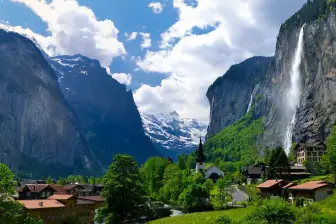
The 297 m waterfall that drops from a hanging valley above the village of Lauterbrunnen, the highest free-falling waterfall in Switzerland, a few minutes' walk from the station. Goethe visited it in 1779 and wrote the poem "Song of the Spirits over the Waters" there. The fall is stronger with the snowmelt at the start of the season and after rain; in a dry summer it loses force.
The narrow valley between limestone walls is the landscape that defines the region, and the 297 m Staubbach waterfall, Switzerland’s highest free fall, is a few minutes’ walk from the station, with no admission charge.
Check access

Bachalpsee
The lake at 2,265 m above Grindelwald, divided in two by a natural barrier, less than an hour's walk from the First station, at 2,166 m. The round trip takes about two hours. Next to the First station is the First Cliff Walk, a 45 m walkway attached to the rock face. The First cable car leaves from Grindelwald, three minutes by bus from the station, and the Jungfraubahnen advertises the ticket from CHF 38.
The lake at 2,265 m is less than an hour away on a well-maintained trail from First station. It is a mountain walk without technical difficulty that leads to an alpine lake and fits into a morning.
Check access

Höhematte
The lawn in the center of Interlaken, between the Höheweg and the Victoria-Jungfrau, from where you see the Jungfrau massif between the hotels. The Unspunnen festival and the Swiss wrestling that goes with it are held here, and the Jungfrau Marathon starts from here, next to the Victoria-Jungfrau.
The lawn in the middle of town offers a view of the Jungfrau massif between the 19th-century hotels on the Höheweg; it is free and on the walking route between the two stations.
Check access

Harder Kulm
The viewpoint at 1,322 m above Interlaken, served since 1908 by a funicular that leaves a few steps from the Ost station and takes about ten minutes. The Zwei-Seen-Steg platform shows Lake Thun, Lake Brienz and the Bödeli between them, with the Eiger, the Mönch and the Jungfrau in front. It does not run in winter: in 2026, the last day is November 29; the Jungfraubahnen ticket office advertises a price from CHF 22.
The funicular climbs from near Interlaken Ost station to 1,322 m in ten minutes, and the platform at the top shows both lakes and, between them, the Bödeli plain on which the town was built. It runs until late November.
Check access
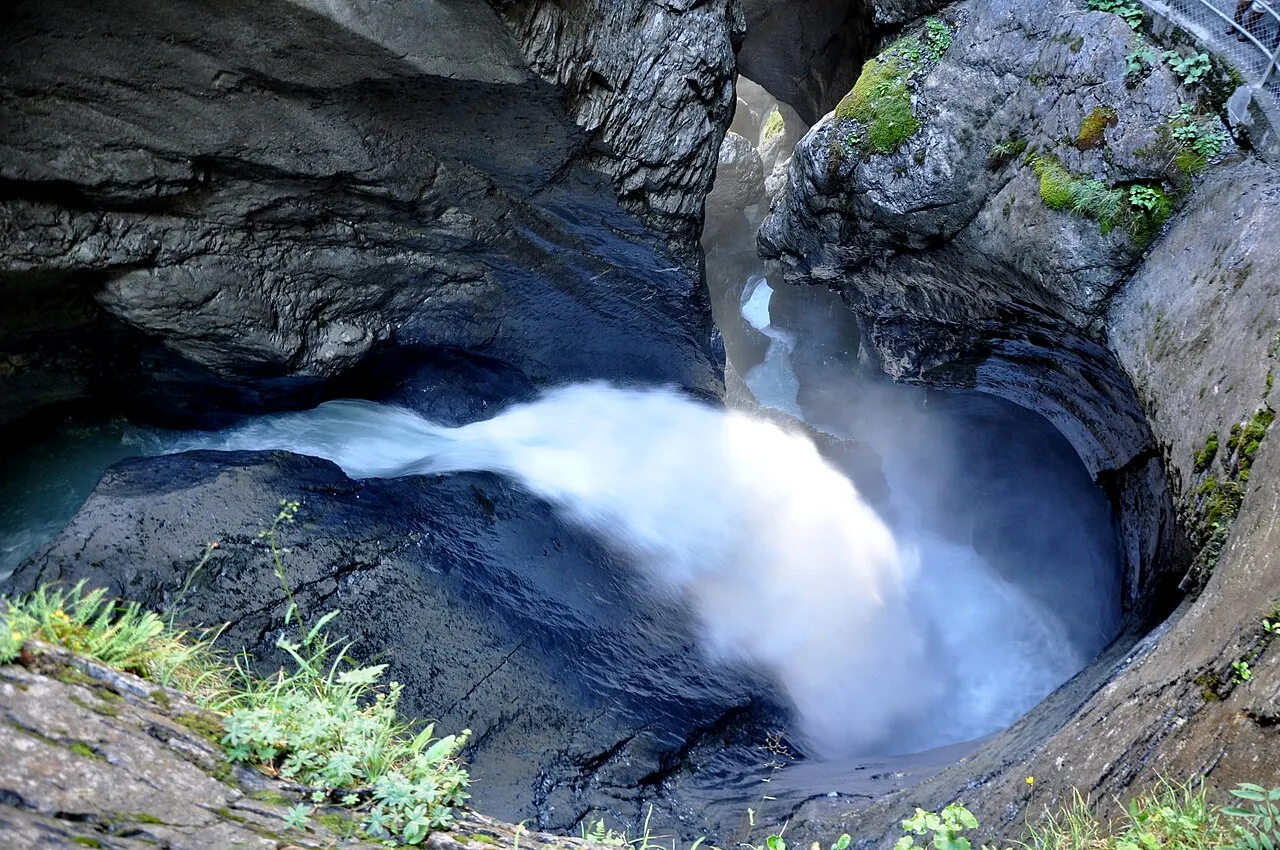
Trümmelbachfälle
Ten waterfalls inside the mountain, 3 km from Lauterbrunnen, down which the meltwater of the Eiger, the Mönch and the Jungfrau runs, up to 20,000 liters per second. An elevator in the tunnel and stairs lead through the falls; the visit takes about an hour. It is open from April to early November, depending on the weather, from 9 a.m. to 5 p.m. in spring and fall and from 8:30 a.m. to 6 p.m. in July and August; the adult ticket starts at CHF 18. Children under 4 and dogs are not admitted.
Ten waterfalls inside the mountain, with a tunnel lift, carrying up to 20,000 liters per second of meltwater from the Eiger, the Mönch and the Jungfrau. Closed in winter; children under 4 and dogs are not admitted.
Check access

Schilthorn
The 2,970 m summit above Mürren, with the revolving restaurant Piz Gloria, which makes a full turn in 45 minutes and was the setting for the James Bond film "On Her Majesty's Secret Service," from 1969. The cable car takes 24 minutes from Stechelberg to the summit, changing at Mürren and at Birg, where there is a walkway on the rock face. The round trip from Stechelberg costs CHF 115 for adults, CHF 57.50 with the Swiss Half Fare Card and CHF 45.70 with the Swiss Travel Pass, and is free with the Berner Oberland Pass (fares valid until December 12, 2026).
The 2,970 m summit has the revolving Piz Gloria restaurant, a setting for the 1969 James Bond film, and a frontal view of the Eiger, the Mönch and the Jungfrau. It is free with the Berner Oberland Pass and costs CHF45.70 with the Swiss Travel Pass.
Check access

Mürren
A Walser village at 1,638 m, with no road access, on the edge of the wall of the Lauterbrunnen Valley and facing the Eiger, the Mönch and the Jungfrau. The first British skiers arrived in 1911, and in 1924 Arnold Lunn founded the Kandahar Ski Club here. You get there by the Stechelberg cable car or by the combination of cable car and train via Grütschalp, which takes 18 minutes from Lauterbrunnen.
The village at 1,638 m has no road access and sits on the edge of the cliff, facing the three peaks. Visit it on the same day as the Schilthorn, on the way down.
Check access
Schynige Platte
The viewpoint at 1,967 m between Interlaken and Grindelwald, served since 1893 by a 7.26 km cog railway that leaves from Wilderswil and takes 52 minutes. Here is an alpine garden opened in 1927, with about 800 alpine plants, and from here departs the roughly six-hour traverse via the Faulhorn to the Bachalpsee and First. The line runs only in summer; in 2026 the last day is October 25.
The 1893 cog railway climbs 7.26 km from Wilderswil to an alpine garden with about 800 plants and a view over both lakes and the three peaks. It runs only in summer, and the 2026 season ends on October 25.
Check access
Nilo’s itinerary
Start with the basic programme and choose extensions for the time you have.
Plan my days in the app ↗Day 1 · Jungfraujoch by the Eiger Express, back via Wengen
The evening before, check the Jungfraubahnen webcams and, if the forecast is for clear skies, buy the ticket and the mandatory seat reservation (CHF 10, May to October) at jungfrau.ch, choosing one of the first departures of the morning.
At Interlaken Ost take the train to Grindelwald Terminal (29 minutes), ride the Eiger Express up to Eigergletscher and continue on the Jungfraubahn to the Jungfraujoch: 1 hour 37 minutes in all, with a five-minute stop at the window of the Eismeer station.
Up top, at 3,454 m, go slowly: take the elevator to the Sphinx terrace (3,571 m) to see the Aletsch Glacier, then the Ice Palace and the plateau on the snow. Allow two to three hours.
Come down on the Jungfraubahn to Kleine Scheidegg and continue on the Wengernalpbahn to Wengen and Lauterbrunnen, beneath the north face of the Eiger; when buying, check that your ticket covers this return through the other valley.
At Lauterbrunnen, take the 22-minute train to Interlaken Ost and end the day on the Höheweg, with the view of the Jungfrau over the Höhematte.
Day 2 · Lauterbrunnen Valley, Trümmelbach and Schilthorn
Take the train from Interlaken Ost to Lauterbrunnen (22 minutes) and walk from the station to the base of the Staubbachfall, the 297 m fall above the village.
Return to the station and take bus 141 toward Stechelberg to the Trümmelbach falls stop: the visit takes about an hour and runs only from April to early November.
Stay on the same bus to Stechelberg, Schilthornbahn, and take the cable car up to the Schilthorn (24 minutes, changing at Mürren and Birg) for lunch or coffee at the Piz Gloria, at 2,970 m.
On the way down, get off at Mürren and walk across the village to the train station, about 800 m from the cable car, looking at the valley from above.
Return to Lauterbrunnen by train and cable car via Grütschalp (18 minutes) and from there to Interlaken. In 2026, from October 19 to 30, the Stechelberg–Mürren section of the cable car is under maintenance: on those days, do the day in reverse, going up and down via Grütschalp.
Day 3 · Grindelwald, First and the Bachalpsee
Take the train from Interlaken Ost to Grindelwald (36 minutes) and the three-minute bus, or walk along the main street, to the First cable car.
Ride up to First, at 2,166 m, and walk the First Cliff Walk, the 45 m walkway attached to the rock face, in about 20 minutes.
Follow the marked trail to the Bachalpsee, at 2,265 m: less than an hour each way and about two hours round trip.
Come down by cable car, have lunch in Grindelwald and return by train to Interlaken.
Late in the afternoon, if the funicular is running, go up the Harder Kulm from the Ost station (about ten minutes) to see the two lakes in the last light. Before setting the day, check that the First cable car is open: it stops for maintenance from late October until the winter season.





If you stay longer
Day 4 · Lake Brienz: Iseltwald, Giessbach and Brienz
This day follows the boat timetable of October and November 2026, when there are few departures; from December 7 on there is no boat on Lake Brienz, and in other months check the BLS timetable, which may have more departures.
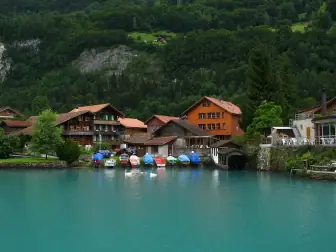
In the morning, take bus 103 at Interlaken Ost to Iseltwald (about 20 minutes, every half hour) and walk around the village and the peninsula.
Board the 12:36 p.m. boat at Iseltwald and get off at the Giessbach pier at 12:56 p.m.
Go up by funicular or on foot to the falls, walk the trail that passes under one of the 14 falls and have lunch there.
Take the 3:58 p.m. boat from Giessbach to Brienz (arriving 4:10 p.m.), see the woodcarving workshops near the pier and return by train to Interlaken Ost (17 to 20 minutes; there is a departure at 4:37 p.m.). From December 7 on, do Iseltwald by bus and go to Brienz by train.
Day 5 · Lake Thun: Spiez, Oberhofen and Thun
Day trip
West of Interlaken, Lake Thun has boats all year from the Interlaken West pier: to Spiez it is 1 hour 22 minutes and to Thun 2 hours 10 minutes on the October 2026 timetable. By train, Thun is 30 minutes away and Spiez about 20 from the Interlaken West station; from October 19 to December 11, 2026, anyone leaving from Interlaken Ost must add the replacement bus to West. In Thun, the castle built between 1180 and 1190 by Berthold V of Zähringen houses a museum; Oberhofen has a castle at the water's edge, 39 minutes by bus from Interlaken West. Combine the boat on the way out and the train on the way back.
Food
Älplermagronen
The macaroni of the Alpine herders: short pasta with potato, cream, cheese and onion. It was born on the summer pastures, where dried pasta was light to carry uphill.
Rösti
Grated potato fried in a pan in the shape of a disc, originally a breakfast of the farmers of the canton of Bern. Today it goes with almost everything, from fried egg to sausage, and appears in every mountain restaurant.
Berner Platte
The Bernese platter of smoked meats and sausages, bacon and pork, served with sauerkraut seasoned with juniper, potato and beans. Tradition links it to the Bernese victory over the French at Neuenegg, in 1798.
Berner Alpkäse and Hobelkäse
The hard cheese made in summer on the pastures of the Bernese Oberland, in wheels of 5 to 14 kg, with protected designation of origin. Aged for at least two years, it becomes Hobelkäse, cut into thin shavings and eaten with bread.
Cheese fondue
Cheese melted with wine in a caquelon over a burner, eaten with bread speared on long forks. It was promoted as a national dish by the Swiss Cheese Union in the 1930s.
Meringue with whipped cream
Dry meringue served with whipped cream. A popular legend, unconfirmed, links the name to Meiringen, east of Lake Brienz, where an Italian pastry cook is said to have invented it around 1600.
Raclette
Cheese heated and scraped over boiled potatoes, a dish originating in the canton of Valais, on the other side of the Bernese Alps, common throughout Switzerland.
Where to eat
- Radius by Stefan Beer · Höheweg · $$$
Signature cuisine with one Michelin star, in the Victoria-Jungfrau hotel, facing the Höhematte. Book ahead.
Source · 2026-10-16
- Panorama Restaurant Harder Kulm · Harder Kulm · $$
Panoramic restaurant at the top of the funicular, with a lunch ticket that includes the ride up (from CHF 39, boarding until 1:10 p.m.).
Source · 2026-10-16
- Piz Gloria · Schilthorn · $$
Revolving restaurant at 2,970 m, which makes a full turn in 45 minutes; it serves brunch and a plate of cold cuts and cheeses in the afternoon.
Source · 2026-10-16
- Unterseen and center · $$
Rösti, Älplermagronen and fondue in the Swiss restaurants.
- Supermarkets in the center · $
Bread, alpine cheese and cold cuts for a picnic on the trail or the train, the cheapest way to eat in the mountains.
$: up to about CHF 25 for a simple meal (Numbeo, Swiss average) · $$: CHF 25 to 50 per person; three-course dinner for two around CHF 100, without drinks · $$$: over CHF 50 per person, or a tasting menu · 2026-10-16
Day trips
Lake Thun: Spiez, Oberhofen and Thun
West of Interlaken, Lake Thun has boats all year from the Interlaken West pier: to Spiez it is 1 hour 22 minutes and to Thun 2 hours 10 minutes on the October 2026 timetable. By train, Thun is 30 minutes away and Spiez about 20 from the Interlaken West station; from October 19 to December 11, 2026, anyone leaving from Interlaken Ost must add the replacement bus to West. In Thun, the castle built between 1180 and 1190 by Berthold V of Zähringen houses a museum; Oberhofen has a castle at the water's edge, 39 minutes by bus from Interlaken West. Combine the boat on the way out and the train on the way back.
Schynige Platte
The 1893 cog railway leaves from Wilderswil, 5 minutes by train from Interlaken Ost, and climbs in 52 minutes to 1,967 m, where the alpine garden is and a view of the two lakes and the three peaks. From here departs the roughly six-hour traverse via the Faulhorn to First, for those with the legs and a whole day. It runs only in summer; in 2026 the last day is October 25.
Ballenberg and Brienz
The Ballenberg open-air museum, opened in 1978 on 66 hectares near Brienz, brings together about a hundred rural houses from all over Switzerland, with crafts and farm animals. Go by train to Brienz (17 to 20 minutes) and by bus 151 to the museum (16 minutes); check the museum's website for the opening season. In Brienz, the Rothorn steam train, from 1892, climbs 7.6 km to 2,244 m.
Lucerne
The Luzern–Interlaken Express links Interlaken Ost to Lucerne without a change in 1 hour 48 minutes, along Lake Brienz and over the Brünig Pass. Leaving early, a whole day in the city fits, with a return in the late afternoon.
Bern
The Swiss capital is about 1 hour away by train. From October 19 to December 11, 2026, the train leaves from Interlaken West, with a replacement bus from Ost.
Where to begin
Jungfraujoch by the Eiger Express, back via Wengen
The evening before, check the Jungfraubahnen webcams and, if the forecast is for clear skies, buy the ticket and the mandatory seat reservation (CHF 10, May to October) at jungfrau.ch, choosing one of the first departures of the morning.
Lauterbrunnen Valley, Trümmelbach and Schilthorn
Take the train from Interlaken Ost to Lauterbrunnen (22 minutes) and walk from the station to the base of the Staubbachfall, the 297 m fall above the village.
Grindelwald, First and the Bachalpsee
Take the train from Interlaken Ost to Grindelwald (36 minutes) and the three-minute bus, or walk along the main street, to the First cable car.
Lake Brienz: Iseltwald, Giessbach and Brienz

This day follows the boat timetable of October and November 2026, when there are few departures; from December 7 on there is no boat on Lake Brienz, and in other months check the BLS timetable, which may have more departures.
Money
The currency is the Swiss franc (CHF), and the official Interlaken lodging list also gives prices in euros, converted at a reference rate. The average price reference for Switzerland at Numbeo, on October 15, 2026, is CHF 25 for a meal at an inexpensive restaurant (from CHF 18 to CHF 40), CHF 100 for a three-course dinner for two at a mid-range restaurant, without drinks, CHF 7.50 for a half-liter draft beer and CHF 5.07 for a cappuccino. The expense that weighs in Interlaken is mountain transport: the Jungfraujoch starts at CHF 129.60, plus CHF 10 for the seat reservation that is mandatory from May to October; the round trip from Stechelberg to the Schilthorn costs CHF 115; the First cable car starts at CHF 38; and the Trümmelbach falls, at CHF 18. That is why the first calculation of the trip is the passes (see Transport). Service is included in the price at Swiss restaurants since the sector's collective agreement of 1974, and the custom is to round the bill up to the next five or ten francs. Every lodging charges the tourist tax per night, including the cantonal tax of CHF 1 per adult, and gives in return a guest card with local benefits.
Getting there and around
Arriving by train
Interlaken has no commercial airport: you arrive by train, with departures every half hour to and from Bern, Zurich, Geneva and Basel. From Zurich Airport there is a direct train every hour, in about 2 hours 15 minutes, and from Zurich HB it is about 2 hours (Zurich is on the same route). From Bern it is about 1 hour, from Basel about 2 hours and from Geneva Airport between 3 hours 10 minutes and 3 hours 30 minutes. From Lucerne, the Luzern–Interlaken Express crosses the Brünig Pass and arrives directly at the Ost station in 1 hour 48 minutes. There are also direct trains from Germany. Note the 2026 construction work: from October 19 to December 11, the line between Interlaken West and Interlaken Ost is closed, trains from Bern and Thun stop at West and replacement buses go on to Ost and Wilderswil; those coming from Lucerne arrive directly at Ost.
The two stations and the mountain trains
Interlaken West is in the center, near the Lake Thun pier; Interlaken Ost is the region's junction, with the Berner Oberland-Bahn to Lauterbrunnen (22 minutes) and Grindelwald (36 minutes), the Brünig line to Brienz and Lucerne and the Lake Brienz pier. Outside the construction period, the train between the two stations takes five minutes, and on foot it is about 30 minutes along the Höheweg. For the Jungfraujoch there are two routes: via Grindelwald Terminal and the Eiger Express (1 hour 37 minutes from Interlaken Ost on the October 2026 timetable) or via Lauterbrunnen, Wengen and Kleine Scheidegg, where everyone changes to the Jungfraubahn. For Mürren and the Schilthorn, continue to Lauterbrunnen and take the cable car to Grütschalp with the train to Mürren, or bus 141 to Stechelberg and the Schilthorn cable car.
Passes: Swiss Travel Pass, Berner Oberland Pass and the half fare
The Swiss Travel Pass covers train, bus and boat throughout Switzerland and gives a discount on most mountain railways; it is worth it for those who arrive and leave from far away and cross the country. In the region, it gives free travel from Stechelberg to Mürren and lowers the Schilthorn to CHF 45.70. The Berner Oberland Pass covers public transport in the Bernese Oberland, with the boats and the whole Schilthorn cable car; it costs from CHF 240 (3 days) to CHF 435 (10 days) for adults and from CHF 168 to CHF 316 with the Swiss Half Fare Card, at the fares valid until December 12, 2026. For the Jungfraujoch, the price calculator on jungfrau.ch shows the cost of the trip with each pass, and the Jungfraubahnen sells its own Jungfrau Travel Pass, from 3 to 8 days, from CHF 165. Do the math with the excursions you will actually take before buying any pass.
Boats, buses and the car
The BLS boats cross both lakes: on Lake Thun they run all year from the Interlaken West pier, and on Lake Brienz they stop in winter, from December 7, leaving from the Interlaken Ost pier. On the October and November 2026 timetable, there are only two departures a day from Interlaken Ost to Brienz, at 11:40 a.m. and 3:10 p.m. The Swiss Travel Pass and Berner Oberland Pass are valid on the boats; the Half Fare Card gives a 50% discount, and the day pass costs from CHF 36. Local and regional buses are run by PostAuto and STI, with lines to Iseltwald (about 20 minutes), the St. Beatus Caves and Thun. Wengen, Mürren and Gimmelwald have no road access; for the valleys, the region itself recommends leaving the car at the Matten Park+Ride and continuing by public transport.
Safety
Interlaken is a calm town, and the real risks are in the mountains. The weather changes fast above 2,000 m: bring warm clothing, a rain jacket and water even on a sunny day, and check the forecast and the time of the last train or cable car back before setting out on the trail. On the Jungfraujoch, at 3,454 m, the air is thin and the ascent is quick: walk slowly up there and do not leave the marked areas on the glacier. On the trails, stay on the marked path and do not go near the edge of the walls of the Lauterbrunnen Valley. Adventure activities, such as paragliding and canyoning, are sold by agencies in town; choose licensed companies and check what your travel insurance covers. In the water, the danger is the cold and the current: according to the Swiss Lifesaving Society (SLRG), the country's open waters are below 14 °C on average seven months a year, and below 8 °C in five of them. Swim in a lake or river only if you are a strong swimmer, enter the water slowly, do not jump into unknown water and wear a life jacket in a rowboat, kayak or raft, even in summer; on the Aare between the two lakes there is a current. In town, the care needed is that of any place full of tourists, with luggage on the crowded station platforms. Emergencies: 112 (general number), 117 (police), 118 (fire), 144 (ambulance) and 1414 (Rega, the Swiss air rescue, for accidents in the mountains).
Etiquette tips
Say hello when you walk in
In German-speaking Switzerland people say "Grüezi" on entering a shop, restaurant or mountain hut and on passing someone on the trail. In the Bern region you also hear the local form of the greeting; answering with "Grüezi" is always right.
Round up the bill, without calculating a percentage
Service has been included in the price since 1974. The custom is to round up to the next five or ten francs when paying, on average about 6% of the bill, said to the waiter at the moment of payment.
Take train punctuality seriously
Mountain trains and cable cars leave at the minute scheduled, and the Jungfraujoch reservation ticket shows a time. Reaching the platform at the last minute with luggage is the most common way to miss the connection.
Close the gates and respect the cattle
The trails cross pastures with cows, and the fences and gates exist for the cattle. Close what you open, keep your distance from cows with calves and keep dogs on a leash.
Quiet in the car-free villages
Wengen, Mürren and Gimmelwald are villages of residents and farmers, with no road and no traffic. Noise carries far: keep loud music and late-night conversation indoors.
Mistakes to avoid
Buying the Jungfraujoch without checking the weather
Buying the Jungfraujoch ticket days in advance and going up in fog. The most expensive excursion in the region is also the one that depends most on clear skies: check the Jungfraubahnen webcams the evening before and have an alternative plan, such as the Lauterbrunnen Valley.
Forgetting the seat reservation
From May 1 to October 31, 2026, the CHF 10 seat reservation for the Jungfraujoch is mandatory and guarantees the departure time. Buying only the ticket and going to the station can leave you without a seat on the train.
Buying a pass without doing the math
Buying the Swiss Travel Pass just to stay in Interlaken. It pays off for those who cross Switzerland; for three or four days in the region only, compare it with the Berner Oberland Pass, the Jungfrau Travel Pass and the Half Fare Card by adding up the excursions you will really take.
Assuming everything runs all year
Planning the Schynige Platte or the First cable car for November, the Trümmelbach for late November or the Harder Kulm for December. In 2026, the Schynige Platte stops after October 25, First is closed from late October until the winter season, the Trümmelbach is open only until early November and the Harder Kulm funicular until November 29. Check the line's timetable before setting the day.
Driving to Wengen or Mürren
Trying to drive up to the villages of the Lauterbrunnen Valley. Wengen, Mürren and Gimmelwald have no road access, and the car stays in Lauterbrunnen or in Stechelberg.
Useful phrases
Grüezi
Hello: the standard greeting in German-speaking Switzerland, on entering any place and on the trail
Merci vilmal
Thank you very much; the French "merci" is part of Swiss German
Einmal nach Lauterbrunnen und zurück, bitte
One round trip to Lauterbrunnen, please: works at the ticket window of any station
Fährt dieser Zug nach Grindelwald?
Does this train go to Grindelwald? Useful at Interlaken Ost, because the Berner Oberland-Bahn train splits at Zweilütschinen
Zahlen, bitte
The check, please
Ist der Weg offen?
Is the trail open? A question you ask at the tourist office or the mountain station at the start and end of the season
Where to stay
- Höheweg and center · First trip, to take the train every day · $$: Between the Ost and West stations, near the mountain trains, the boats and restaurants. It is the busiest area and has the largest choice of hotels.
- Next to the Ost station · Tight budgets and backpackers · $: The youth hostel of the Swiss network sits next to Interlaken Ost, where the trains to Lauterbrunnen, Grindelwald and the Jungfraujoch leave, and there are other hostels less than 2 km from the center.
- Unterseen · Those who prefer quieter streets near Lake Thun · $$: Across the Aare, near the West station and the Lake Thun pier, it has smaller hotels and the old core of 1279. For the mountain trains, the Ost station is farther.
- Matten and Wilderswil · Families and those arriving by car · $$: Quieter than the center, with the Matten Park+Ride. Wilderswil is on the line to Lauterbrunnen and Grindelwald, 5 minutes from Interlaken Ost, and is the starting point for the Schynige Platte.
- Wengen and Mürren · Couples and those who want quiet and views · $$: Car-free villages at the top of the Lauterbrunnen Valley, facing the three peaks. Every trip depends on a train or cable car.
- Grindelwald · Those who come for hiking in summer or skiing in winter · $$: At the foot of the Eiger, with the Eiger Express and the First cable car in the village. For the lakes and the Lauterbrunnen Valley, the train to Interlaken takes 36 minutes.
$: hostel dorm bed, from CHF 35.60 to CHF 48.60 at the starting prices advertised on Hostelworld · $$: double room with breakfast at most hotels in the center, from about CHF 120 to CHF 450 a night depending on the season (indicative prices from the 2025/26 Interlaken Tourismus list) · $$$: over CHF 450 a night; at the Victoria-Jungfrau, the double room starts at CHF 499 · 2026-10-16
Districts
Höheweg and center
The street between the Ost and West stations, with the Höhematte, the Victoria-Jungfrau, the Kursaal and the casino and most of the big hotels. It is the most practical address for anyone taking the train every day, and the busiest.
Unterseen
The town across the Aare, founded in 1279, with an old square, the church rebuilt in 1852 and smaller hotels along the Seestrasse, near the West station.
Matten and Wilderswil
Matten is the residential municipality to the south, attached to the center, with the region's Park+Ride; Wilderswil, five minutes by train from the Ost station, is the village where the Schynige Platte cog railway departs.
Lauterbrunnen Valley
The village of Lauterbrunnen, 22 minutes by train, is the interchange for Wengen, Mürren and the Schilthorn. The valley floor stays flat to Stechelberg, with the Staubbach and the Trümmelbach falls along the way.
Wengen and Mürren
The two car-free villages at the top of the Lauterbrunnen Valley: Wengen at 1,274 m, on the train route to Kleine Scheidegg; Mürren at 1,638 m, on the route to the Schilthorn. Sleeping there means quiet and views, and depending on trains and cable cars for everything.
Grindelwald
A mountain village at 1,034 m and 36 minutes by train, beneath the north face of the Eiger. It has the Eiger Express, the First cable car and the Männlichen cable car, and in winter it is one of the centers of the Kleine Scheidegg ski area.
Lake Brienz
The east shore, with Bönigen, Iseltwald, the Giessbach falls and the town of Brienz, known for its woodcarving school and the Rothorn steam train. Boats leave from the Interlaken Ost pier.
Lake Thun
The west shore, with the St. Beatus Caves, Oberhofen Castle, Spiez and the town of Thun. Boats leave from the Interlaken West pier and run all year.
History
c. 1130–1133 · The monastery between the lakes
A nobleman from Oberhofen founds a wooden house of prayer on the Bödeli, and from it grows the Augustinian monastery of Interlaken; in 1133 Emperor Lothair III takes it under his protection. The monastery controls the bridge over the Aare, collects tolls and, over the following centuries, buys land in Grindelwald, in Iseltwald and on the pastures of Wengernalp.
1279 · The founding of Unterseen
On July 13, 1279, King Rudolf I of Habsburg authorizes Baron Berchtold III of Eschenbach-Oberhofen to build a fortified town between the two lakes, on the right bank of the Aare. It is today's Unterseen, older as a town than Interlaken.
1528 · The Reformation and Bernese rule
Bern adopts the Reformation, dissolves the monastery in 1528 and annexes its lands. The Bernese bailiff of the region comes to live in the buildings of the former convent, where the castle that now houses cantonal offices was built in the mid-18th century.
1805 · The first Unspunnen festival
On August 17, 1805, patricians of Bern organize an Alpine herders' festival near the ruins of Unspunnen Castle, with Swiss wrestling, stone throwing and singing. The festivals of 1805 and 1808 attract the first foreign visitors, along with the landscapes of the painter Franz Niklaus König.
1835–1865 · Steamboats on the lake and the Kursaal
Steamboats begin running on Lake Thun in 1835 and on Lake Brienz in 1839. In 1859 the Kursaal opens, a spa and event hall for guests, and in 1865 the Hotel Victoria, the origin of the Victoria-Jungfrau on the Höheweg.
1872–1893 · The trains arrive
The Bödelibahn links the piers of the two lakes from 1872. In 1890 the Berner Oberland-Bahn reaches Lauterbrunnen and Grindelwald; in 1891 the municipality adopts the name Interlaken; in 1893 the line to Thun, the Schynige Platte cog railway and the Wengernalpbahn to Kleine Scheidegg open.
1912 · The train reaches the Jungfraujoch
After 16 years of construction, the Jungfraubahn, granted to the industrialist Adolf Guyer-Zeller in 1894, opens the Jungfraujoch station on August 1, 1912, at 3,454 m, at the end of a tunnel dug inside the Eiger and the Mönch.
1914–1955 · The wars halt tourism
The First World War abruptly halts the growth of hotels, and the Second empties the town again. The recovery begins in 1955, when Interlaken starts to market itself also as a convention city.
1938 · The north face of the Eiger
On July 24, 1938, Andreas Heckmair, Ludwig Vörg, Heinrich Harrer and Fritz Kasparek complete the first ascent of the north face of the Eiger, the wall of about 1,800 m above Kleine Scheidegg where at least 64 climbers have died since 1935.
2001 · Jungfrau-Aletsch on the UNESCO list
The Jungfrau-Aletsch area, with the north wall of the Jungfrau and the Eiger and the Aletsch Glacier, is added to the World Heritage list in 2001, as the first natural site in the Alps.
2020–2026 · The Eiger Express and the new Schilthorn
On December 5, 2020, the Eiger Express opens, a cable car that links Grindelwald Terminal to the Eigergletscher station and shortens the trip to the Jungfraujoch. On April 2, 2026, the last new section of the Schilthorn cable car, between Birg and the summit, enters service.
Complete history
A monastery and a bridge over the Aare
Before tourism, the Bödeli was monastery land. Around 1130 the Augustinian house that gave rise to Interlaken appeared between the two lakes, and in 1133 it passed under the emperor's protection. The monastery controlled the bridge over the Aare and charged a toll to those who crossed, and over the Middle Ages it bought pastures and rights in Grindelwald, Iseltwald and Wengernalp. The Jungfrau probably owes its name to these lands: the Wengernalp pasture was called Jungfrauenberg, "mountain of the maidens," because it belonged to the monastery's nuns. Across the river, the fortified town of Unterseen was founded in 1279. When Bern adopted the Reformation, in 1528, it dissolved the monastery, annexed the lands and installed its bailiff there.
How a festival became a destination
The first visitors came drawn by paintings and by a festival. Around 1800, the Alpine landscapes of Franz Niklaus König were circulating across Europe, and in 1805 and 1808 the Unspunnen festival, organized by patricians of Bern with Swiss wrestling, stone throwing and herders' singing, brought the first foreign visitors. Goethe had already visited the Staubbach fall in 1779, and in September 1816 Byron crossed the Bernese Alps writing a good part of "Manfred." From 1820 guests arrived in search of mountain air and cures; the lake steamers began in 1835 and 1839, the Kursaal opened in 1859, and between 1860 and 1875, and again between 1890 and 1914, luxury hotels lined up on the Höheweg with a view of the Jungfrau. The settlement that grew around the monastery's mill was called Aarmühle until 1891, but the post office and the station already used the name Interlaken, and that was the one that stuck.
The railways that brought the town to the mountain
What made Interlaken the base it is today was the rails. The Bödelibahn linked the piers of the two lakes in 1872; the Berner Oberland-Bahn reached Lauterbrunnen and Grindelwald in 1890; in 1893 came the line to Thun, the Schynige Platte cog railway and the Wengernalpbahn to Kleine Scheidegg. The next step was to pierce the mountain: the Jungfraubahn, granted to Adolf Guyer-Zeller in 1894, began construction in 1896 and reached the Jungfraujoch on August 1, 1912, at 3,454 m, after 9 km of line almost entirely in tunnel under the Eiger and the Mönch. In Mürren and Wengen, villages without roads, the British organized in the early 20th century some of the first downhill ski races.
Wars, the north face and mass tourism
The First World War cut the flow of guests from one year to the next, and the Second repeated the blow. The recovery came from 1955, with conventions and, in the following decades, with mass tourism. In the meantime the region gained fame for the north face of the Eiger, first climbed in 1938 and the subject of books and films, and for the summit of the Schilthorn, where the revolving restaurant Piz Gloria served as the setting for the 1969 James Bond film.
The town today
Today Interlaken is a town of hotels, stations and adventure agencies, and the tourist destination that bears its name recorded 3.55 million overnight stays in 2024. Interlaken, Matten and Unterseen are three municipalities that grew until they touched, and twice, in 1914 and 1927, they rejected a merger in a vote. The transport network keeps changing: the Eiger Express, from 2020, shortened the ride up to the Jungfraujoch, the Schilthorn cable car was rebuilt between 2024 and 2026, and at the end of 2026 the line between the town's two stations is being rebuilt to take longer trains.
The name of the Jungfrau, "the maiden," probably comes from the Wengernalp pasture, which belonged to the nuns of the Interlaken monastery.
Geography and shape of the city
The Bödeli between two lakes
Interlaken occupies the Bödeli, an alluvial plain formed by the sediments of two rivers: the Lütschine, which comes down from Lauterbrunnen and Grindelwald in the south, and the Lombach, which comes from the north. Until after the 10th century the two lakes were one; this gravel separated them, and today Lake Brienz sits 6 m above Lake Thun. The Aare flows from east to west through the town, from Lake Brienz, 14 km long and up to 260 m deep, to Lake Thun, the largest Swiss lake lying entirely within a single canton. The Höheweg, the street of the grand hotels, links the Interlaken Ost and Interlaken West stations, and the Höhematte, the lawn in front, keeps the view open to the south.
The two valleys and the three peaks
To the south, the Lütschine splits at Zweilütschinen into two valleys. The Lauterbrunnen Valley is a narrow cut between limestone walls, rarely more than a kilometer wide, from which dozens of waterfalls drop; Wengen and Mürren sit on terraces at the top of the two walls, with no road. The Grindelwald Valley is more open, with the village at 1,034 m beneath the Wetterhorn and the Eiger. At the head of both, the wall formed by the Eiger (3,967 m), the Mönch (4,107 m) and the Jungfrau (4,158 m) separates the Bernese Oberland from the Valais and from the Aletsch Glacier, the largest in the Alps.
The climate measured in town
The Interlaken weather station, at 577 m, records in the 1991 to 2020 normals average highs of 24.3 °C in July and 3.2 °C in January, with average lows of 13.8 °C in July and −2.8 °C in January. Summer is the rainiest season, with 146 mm in July and another 146 mm in August; February is the driest month, with 67 mm. Up high the picture is different: on the Jungfraujoch, at 3,454 m, the Jungfraubahnen guarantees snow and ice on all 365 days of the year.
Lakes Thun and Brienz were one until after the 10th century; the sediments of the Lütschine separated them, and it is on this deposit, the Bödeli, that Interlaken was built.
Culture
Herders' festivals and Swiss wrestling
The oldest festivals in the region come from life on the summer pastures. The Unspunnen festival, created in 1805, brings together Swiss wrestling (Schwingen), the Unspunnen stone throw and yodeling; the full festival takes place every twelve years and the wrestling contest every six, both on the Höhematte, and the next full edition is scheduled for 2029. In summer, there are daily alphorn concerts on the Harder Kulm and the Schynige Platte. The William Tell plays, held outdoors, are associated with Interlaken, but are performed on the land of the neighboring municipalities, Matten and Wilderswil.
Poets, painters and writers
The landscape of the region entered European literature early. Goethe wrote the "Song of the Spirits over the Waters" after seeing the Staubbach in 1779; Byron wrote a good part of "Manfred" on a journey through the Bernese Alps in September 1816; Mendelssohn passed through Wengen, where there is a memorial to him. In 1911, a young J. R. R. Tolkien walked from Interlaken to the Lauterbrunnen Valley, and the valley's landscape is linked to the drawings he made afterward of Rivendell. In the 20th century, the north face of the Eiger produced mountain books and films, and the Schilthorn entered the movies with James Bond.
Crafts of the lake and the valley
In Brienz, the cantonal woodcarving school, founded in 1862, keeps alive the tradition of wooden figures and objects sold around the region. Alpine cheese is still made in summer on the high pastures and sold in shops and on the farms themselves. At the Ballenberg open-air museum, near Brienz, about a hundred rural buildings brought from all over Switzerland show how people lived before tourism.
Mountain sport
In January, Wengen hosts the Lauberhorn races of the Alpine Ski World Cup, and Mürren the amateur Inferno race, scheduled for January 20 to 23, 2027. In early September, the Jungfrau Marathon starts in Interlaken, next to the Victoria-Jungfrau, and ends at the Eigergletscher station, at 2,320 m. Interlaken has also become a starting point for paragliding, skydiving and canyoning, offered by several agencies in town.
Festivals and events
Unspunnenfest, late August, every twelve years
Festival of Alpine herders with Swiss wrestling, the Unspunnen stone throw, yodeling and regional costumes, held since 1805. It starts on the last Saturday of August and lasts a week; the last one was in 2017, and the next is planned for 2029.
Lauberhorn races, January
The World Cup Alpine ski races in Wengen.
Inferno race, January
Ski race in Mürren open to amateurs, with 1,850 places in the downhill in 2027, held from January 20 to 23, 2027.
Jungfrau Marathon, September
Mountain race held every year in early September since 1993. It starts in Interlaken, next to the Victoria-Jungfrau, and ends at the Eigergletscher station, at 2,320 m, after 1,953 m of climbing.
Greenfield Festival, summer
Open-air music festival held every summer on the outskirts of Interlaken.
Books and films
Manfred (1817), Lord Byron
The dramatic poem was written largely on a journey Byron made through the Bernese Alps in September 1816, and the protagonist is a nobleman who lives in isolation in the Bernese Alps. It shows how the region's landscape entered European Romanticism before mass tourism.
The White Spider (Die Weisse Spinne, 1959), Heinrich Harrer
Harrer, one of the four climbers of the first ascent of the north face of the Eiger in 1938, tells of the attempts and tragedies on the wall that can be seen from Kleine Scheidegg. The title comes from the ice field in the upper part of the face.
North Face (Nordwand, 2008), by Philipp Stölzl
The German film reconstructs the 1936 attempt by Toni Kurz and Andreas Hinterstoisser on the north face of the Eiger, with journalists and onlookers following from the hotel at Kleine Scheidegg.
On Her Majesty's Secret Service (1969)
The James Bond film with George Lazenby used the Schilthorn restaurant as the villain's hideout, and the plot passes through Lauterbrunnen, where Tracy meets Bond during the escape. The producer paid for the completion of the Piz Gloria revolving platform in exchange for using it in the film.
Frequently asked questions
Interlaken: how do you get there?
Interlaken has no commercial airport: you arrive by train, and from Zurich Airport there is a direct train every hour, in about 2 hours 15 minutes. From October 19 to December 11, 2026, the line between Interlaken West and Interlaken Ost is closed, and replacement buses run from West to Ost.
Interlaken: how many days should I stay?
Stay three days, and four if you can: one on the Jungfraujoch, one in the Lauterbrunnen Valley with the Schilthorn and one in Grindelwald, with First and the Bachalpsee. I'd leave the order open and pick the clearest day for the Jungfraujoch, because in fog it is not worth the price.
Interlaken: how do you plan the trip up to the Jungfraujoch?
From May 1 to October 31, 2026, the CHF 10 seat reservation is mandatory, on top of the ticket from CHF 129.60. In fog at 3,454 m you see nothing, so I'd check the Jungfraubahnen webcams the day before buying.
Interlaken: which transport pass pays off?
The Swiss Travel Pass pays off for those crossing Switzerland; for three or four days in the region only, compare it with the Berner Oberland Pass, which includes the boats and the Schilthorn, the Jungfrau Travel Pass and the Swiss Half Fare. First add up the excursions you will actually do.
Interlaken: what is running in late October and November?
In 2026, the Schynige Platte stops after October 25, First is shut from late October until the winter season, the Trümmelbach is open only until early November and the Harder Kulm funicular until November 29. From October 19 to 30, 2026, the Stechelberg–Mürren section of the Schilthorn also closes for maintenance; reach Mürren by cable car and train via Grütschalp.
Other cities in the country
Switzerland ↗- Days
- 1–2
- When
- Jun–Sep
- Per person/day
- Average 250–400 CHFMid-range · per person/day
Cost scope
Per person per day: accommodation, meals, urban transport, visits and a small allowance for extras. Flights excluded; larger purchases vary. Editorial estimate, not a quote.
- Days
- 3
- When
- Jul–Sep
- Per person/day
- Average 242 CHFMid-range · per person/day
Cost scope
Per person per day: accommodation, meals, urban transport, visits and a small allowance for extras. Flights excluded; larger purchases vary. Editorial estimate, not a quote.