Maldives
Malé (Maldives)
Local islands, resorts and reefs in the Maldives, from Malé
Days Start with the basic programme and choose extensions for the time you have.
How the guide reaches this number
Malé can be seen in a morning and an afternoon, from Saturday to Thursday, with the Friday Mosque, the National Museum, the fish market and the ferry to Villimalé, and it also serves as the arrival night. The two days in Maafushi show the inhabited island, with the bikini beach, a boat trip and a lower nightly rate. The two days at the resort give what the local island doesn't: alcohol, bikinis on any beach and the reef at the door. I'd choose a resort in Malé Atoll, by speedboat, to avoid depending on the seaplane. With a week, I'd add resort days, or swap the resort for southern Ari, the base for the whale sharks that live there year-round. With a single day, between two flights, I'd stay in Malé and take the ferry to Villimalé. Anyone who wants only the resort can skip Maafushi, but will miss seeing an inhabited island. For diving with manta rays, the trip is a different one, out to Baa Atoll.
5–6
When January to April; this is the dry season of the northeast monsoon, with February and March the months with the least rain, while May and October are the rainiest
How the guide reaches this number
The temperature barely changes: at the airport station, average highs stay between 30.4 °C and 31.9 °C and lows between 25.5 °C and 27.1 °C in every month (1991 to 2020 normals). What changes is the rain and the sea. From January to April the northeast monsoon blows, the dry season, with February (38 mm) and March (49 mm) as the driest months; it is also the period of best visibility for diving, which can reach 30 m. The transition happens in April and May, and May already gets 238 mm. The southwest monsoon runs from early June to the end of November, with heavy downpours, a rougher sea and October as the rainiest month (245 mm); heavy rain can flood low islands for a few hours. For surfing, the season runs from March to October, with the biggest waves from June to August. December, with 212 mm, is still rainy. Ramadan changes date every year and alters the routine of the inhabited islands, not that of the resorts.
Per person/day Add up lodging per night, meals per person, speedboat or seaplane transfers and the per-night taxes; at a resort, the meal plan changes the total a lot.
How the guide reaches this number
Per person per day: accommodation, meals, urban transport, visits and a small allowance for extras. Flights excluded; larger purchases vary. Editorial estimate, not a quote.
 What Nilo thinks
I'd stay five days: one in Malé, two in Maafushi and two at a resort. Malé can be seen in a morning and an afternoon, from Saturday to Thursday, with the Friday Mosque, the National Museum, the fish market and the ferry to Villimalé, and it also serves as the arrival night. The two days in Maafushi show the inhabited island, with the bikini beach, a boat trip and a lower nightly rate. The two days at the resort give what the local island doesn't: alcohol, bikinis on any beach and the reef at the door. I'd choose a resort in Malé Atoll, by speedboat, to avoid depending on the seaplane. With a week, I'd add resort days, or swap the resort for southern Ari, the base for the whale sharks that live there year-round. With a single day, between two flights, I'd stay in Malé and take the ferry to Villimalé. Anyone who wants only the resort can skip Maafushi, but will miss seeing an inhabited island. For diving with manta rays, the trip is a different one, out to Baa Atoll.In the Maldives, the whole country barely rises out of the sea: 1,192 coral islands in 26 atolls, with an average elevation of 1.5 m and a highest point of 2.4 m. One half of the trip is the resort that takes up an entire island, with alcohol, bikinis and the reef a few steps from the veranda. The other has existed since 2009, when tourists were first allowed to sleep on the islands where Maldivians live, like Maafushi, 26 km from the capital: there the ferry doesn't run on Friday, clothing covers the shoulders and the alcohol stays on the boat anchored off the beach. Between the two lies Malé, an island of about 1.9 km² packed with buildings, with a coral stone mosque from 1658, a fish market on the north waterfront and hotaa that serve gulha with tea.
Quick facts
- Population
- 211,908 inhabitants in the administrative area of Malé, which includes Hulhumalé and Villimalé, and 515,132 in the country (2022 census)
- Founding
- Malé was the king's island under the kingdoms that preceded Islam; the country converted to Islam in 1153 and became a republic on November 11, 1968
- Country and region
- Maldives, South Asia, in the Indian Ocean; Malé sits on the southern edge of North Malé Atoll
- Language
- Divehi, written in the Thaana script, from right to left; English is widely spoken
- Currency
- Rufiyaa, or Maldivian rupee (MVR, written Rf); resorts charge in US dollars, and the dollar is accepted almost everywhere
- Time zone
- UTC+5 year-round, with no daylight saving time; some resorts keep their own "island time," up to two hours ahead
- Best time to visit
- January to April; this is the dry season of the northeast monsoon, with February and March the months with the least rain, while May and October are the rainiest
- Average daily cost
- Add up lodging per night, meals per person, speedboat or seaplane transfers and the per-night taxes; at a resort, the meal plan changes the total a lot.
When to go
January to April; this is the dry season of the northeast monsoon, with February and March the months with the least rain, while May and October are the rainiest
How the year changes
The temperature barely changes: at the airport station, average highs stay between 30.4 °C and 31.9 °C and lows between 25.5 °C and 27.1 °C in every month (1991 to 2020 normals). What changes is the rain and the sea. From January to April the northeast monsoon blows, the dry season, with February (38 mm) and March (49 mm) as the driest months; it is also the period of best visibility for diving, which can reach 30 m. The transition happens in April and May, and May already gets 238 mm. The southwest monsoon runs from early June to the end of November, with heavy downpours, a rougher sea and October as the rainiest month (245 mm); heavy rain can flood low islands for a few hours. For surfing, the season runs from March to October, with the biggest waves from June to August. December, with 212 mm, is still rainy. Ramadan changes date every year and alters the routine of the inhabited islands, not that of the resorts.
Nilo's tips
Book the seaplane for the morning and the arrival night in Hulhumalé
The seaplane flies only in daylight, and the late-afternoon flight tends to be cancelled. If your international flight lands at night, sleep in Hulhumalé, next to the airport, and continue to the resort the next morning. On the way back, count the hours backward from the international flight, and ask whether the resort uses official time or "island time," which can be up to two hours ahead.
Add up the taxes before choosing the resort
The advertised nightly rate usually comes without the 10% service charge, the 17% TGST and the US$ 12 green tax per person per night. Children under 2 are exempt from the green tax. The transfer is also charged separately. A resort in Malé Atoll, reached by speedboat, takes the extra flight and the dependence on daylight hours out of the bill.
On a local island, long clothes outside the bikini beach
On Maafushi and the other inhabited islands, the bikini is for the separate tourist beach only. On the way to it, in the streets and in the cafés, men and women cover their shoulders and avoid short shorts. Keep a sarong or a light shirt in your beach bag.
To drink on Maafushi, the boat or the resort
There is no alcohol for sale on land. On Maafushi, guesthouses call a boat anchored near the beach, about 5 minutes away, that serves drinks, and there are day trips to resorts. Don't take the drink back to the island or to Malé, because it's a crime.
Malé in a day, Saturday to Thursday
The capital can be crossed on foot in an hour, and the part that matters is on the north waterfront. On Friday, the museum is closed and the banks don't open; plan your day in Malé for Saturday to Thursday. Carry small bills in rufiyaa for the ferry and the hotaa, because that's where the dollar is least practical.
Fill in the IMUGA within 96 hours before arrival
The traveler declaration is online, free and individual, children included, and opens only 96 hours before arrival. Keep the paid lodging booking and the return ticket at hand: immigration asks for both.
Explore the map
Explore the map, read about the other places and plan your travel days in the app.
Open the appWhat to see
Malé (Maldives): Atolls, faru and channels
The country is organized into administrative divisions named with letters of the Thaana alphabet: Malé Atoll, around the capital, is Kaafu. The four historic districts, Henveiru, Galolhu, Maafannu and Machchangolhi, on an island you can cross on foot in about an hour. It holds the Friday Mosque, the National Museum, the fish market, the ministries and the port. It is dense, with heavy motorbike traffic, and works for a day of sightseeing or for the night between a flight and a transfer.
Friday Mosque (Hukuru Miskiy)
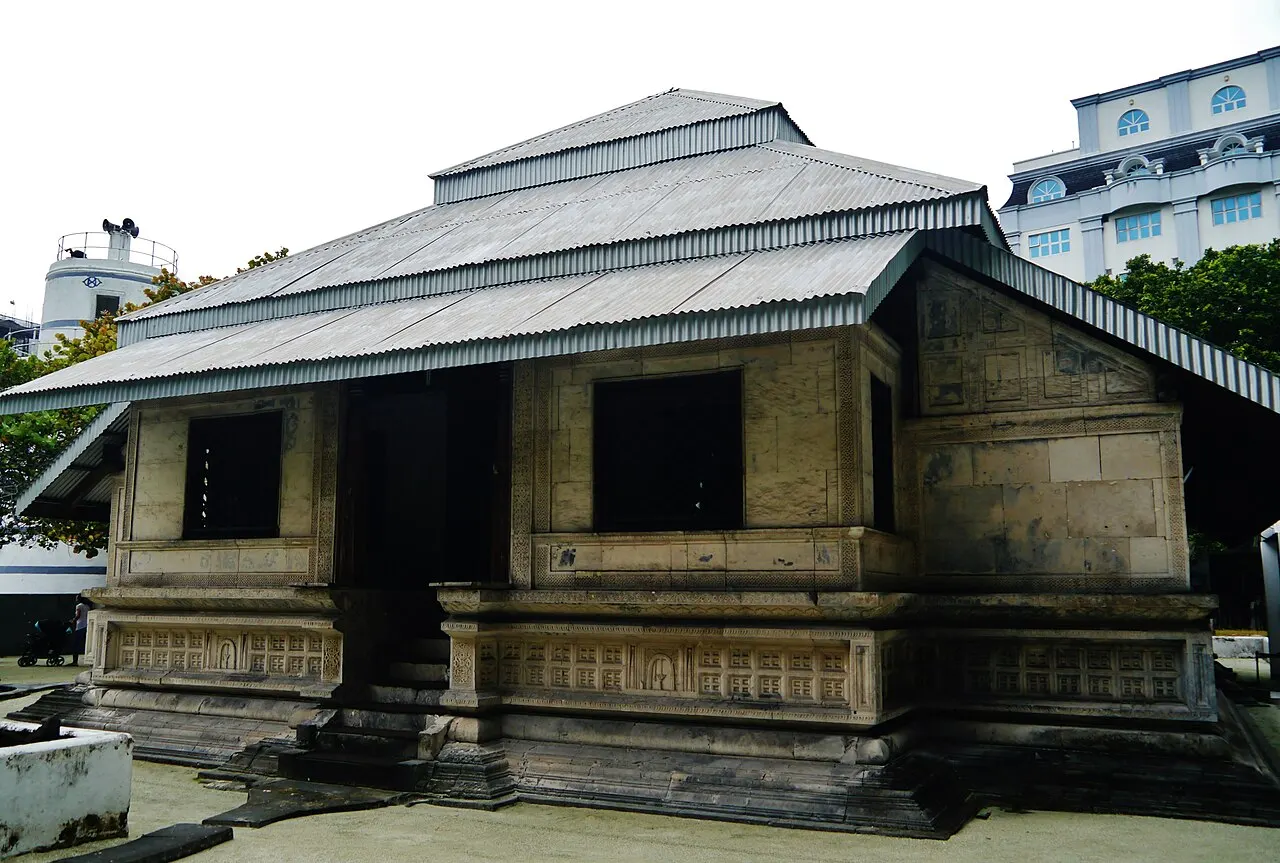
Built from 1656 to 1658 by Sultan Ibrahim Iskandar I with coral blocks cut while still wet, which harden as they dry, and with carvings of Arabic script and ornamental motifs. The minaret dates from 1675, and the complex has been on Unesco's tentative list since 2008. It is a working mosque with no published visiting hours: the caretakers usually let in visitors who ask permission, outside prayer times and in clothing that covers shoulders and legs.
The 1656–1658 mosque, built of coral blocks cut while wet and carved with Arabic script, is one of the few buildings left standing after Malé’s redevelopment following 1968, and has been on Unesco’s tentative list since 2008.
Check access

Maafushi
An inhabited island in South Malé Atoll, with 4,471 residents, about 30 minutes by speedboat from Malé. It is the local island with the most guesthouses near the capital. It has a small bikini beach in the north, where swimwear is allowed, five or more dive operators, water sports and boat trips for snorkeling, fishing and visits to other islands and to resorts. Life on the island follows the country's rules: covered clothing outside the separate beach and no alcohol on land.
Thirty minutes by speedboat from Malé, it has the widest choice of guesthouses among the local islands near the capital, a bikini beach, dive operators and boat trips, and reveals the half of the journey that the resort does not show.
Check access
Medhu Ziyaaraiy
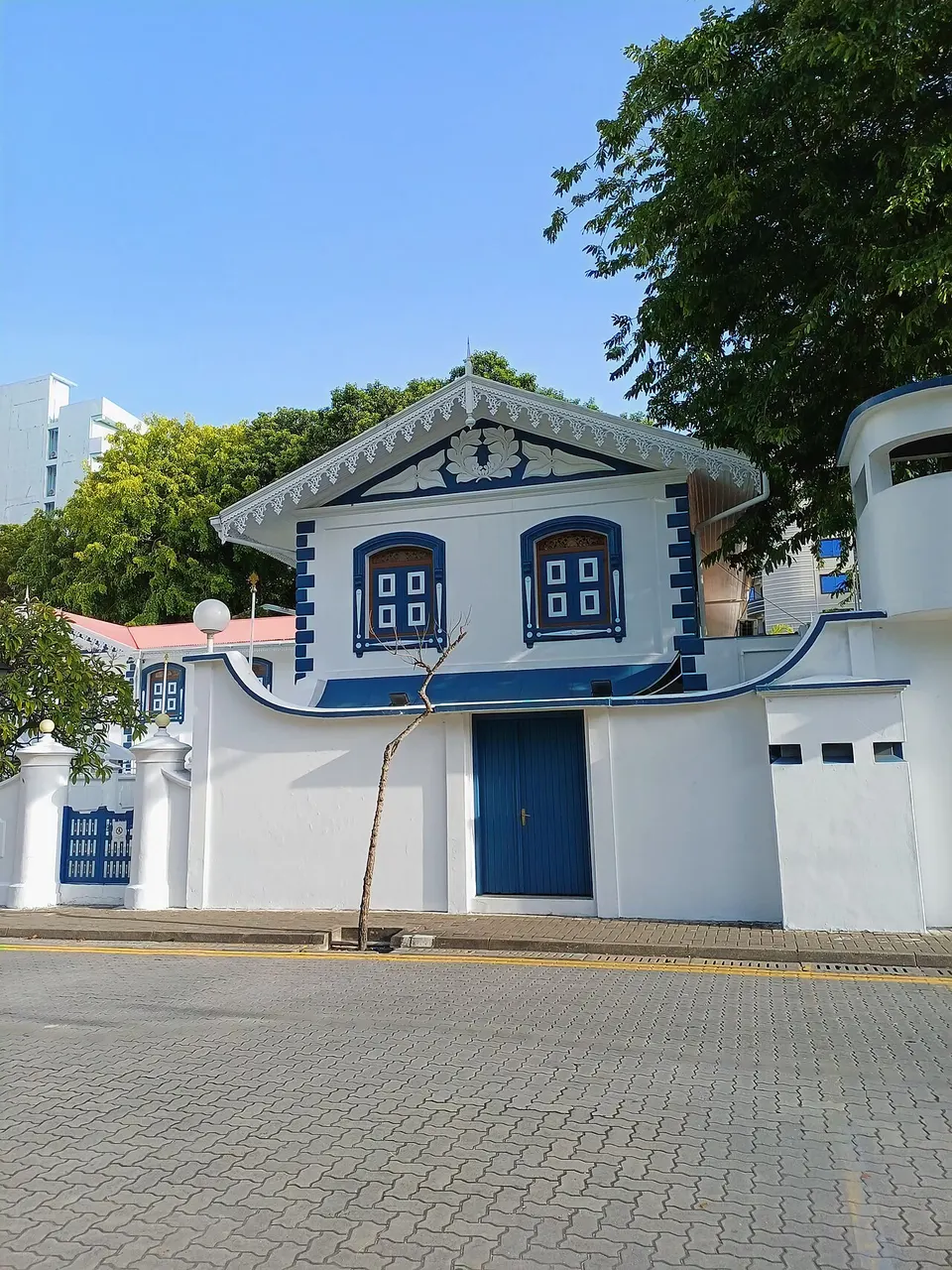
The tomb of Abu al-Barakat Yusuf al-Barbari, to whom tradition attributes the conversion of the Maldives to Islam in 1153, is the most venerated place in Malé. It stands across the street from the Friday Mosque and can be seen in a few minutes, with the same respect owed to a place of prayer.
The tomb of the man whom tradition credits with the conversion of 1153 is across the street from the Friday Mosque, so it fits into the same stop in a few minutes.
Check access
National Museum of the Maldives
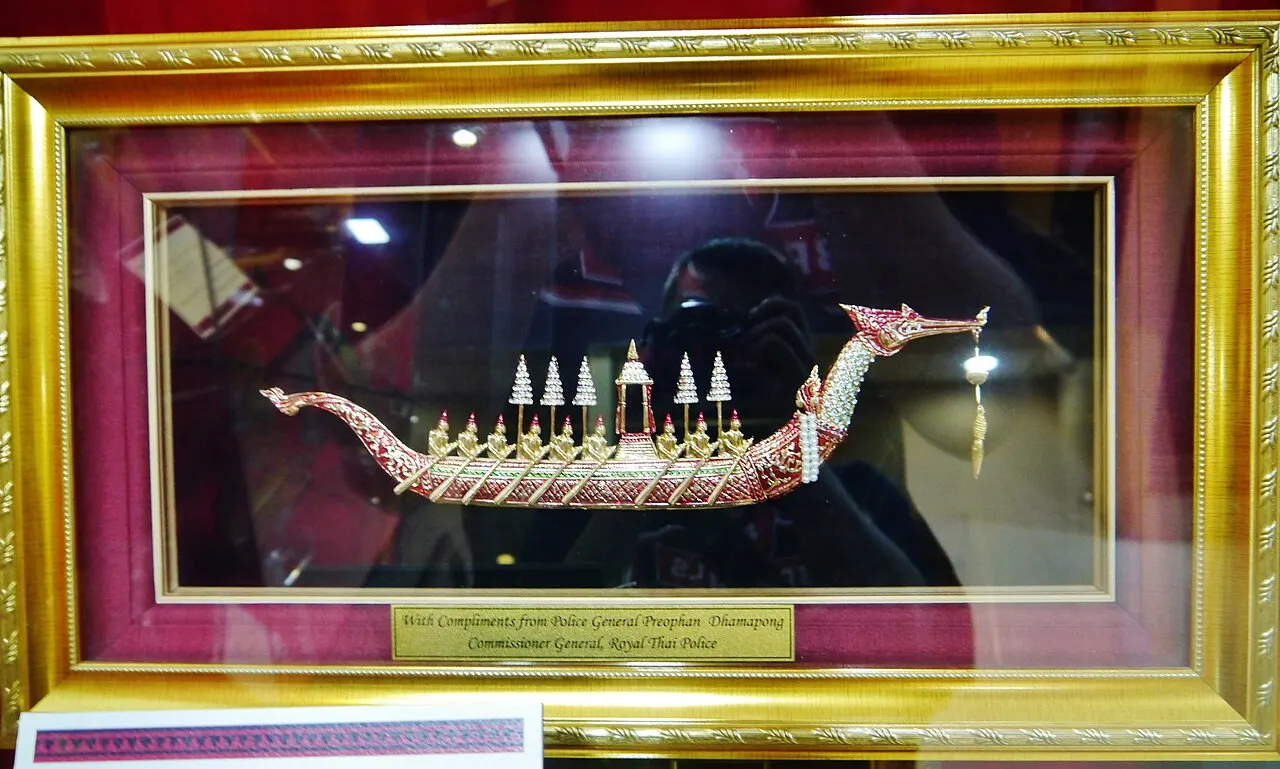
Opened in 1952, it occupies a new building from 2010 in Sultan Park, a free park on the grounds of the former royal palace, demolished after 1968. The collection includes thrones, royal parasols, weapons, textiles and lacquerwork, as well as a carved 13th-century plank from the Hukuru Miskiy. Almost all Buddhist pieces from before the 12th century were destroyed by extremists in February 2012. It closes on Fridays, and the ticket price listed in September 2026 was US$ 3 or Rf 38.
Thrones, weapons, textiles and lacquerwork tell the story of the sultanates erased from the landscape by the palace’s demolition, but almost the entire Buddhist collection was destroyed in 2012, and the museum closes on Fridays.
Check access
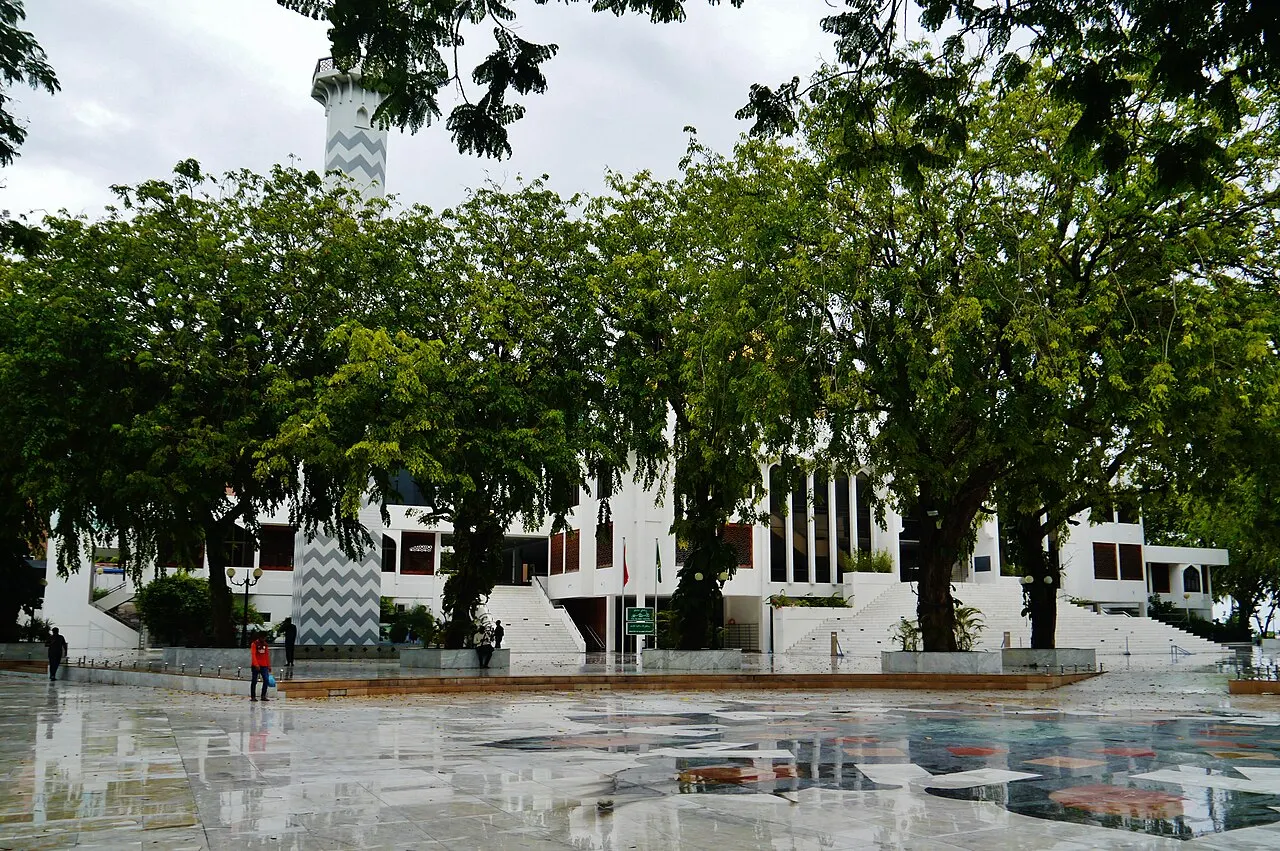
Islamic Center (Masjid al-Sultan Muhammad Thakurufaanu al-Auzam)
The golden dome that shows from any boat arriving in Malé belongs to the great mosque inaugurated on November 11, 1984, with a 41 m minaret and room for about 5,000 worshippers. It is named for the hero who expelled the Portuguese, and the interior has carved wood and Arabic calligraphy. Visitors enter outside prayer times, in appropriate clothing.
The golden dome of 1984 is the landmark for arrivals by boat, and a visit outside prayer times reveals carved wood and Arabic calligraphy.
Check access
Malé Fish Market
On the north waterfront, west of Republic Square, tuna is cleaned and sold in a hall with a strong smell of fish, where blood runs from the floor into the street; it is not a tidy place, and closed shoes are a good idea. One block away is the local market, with produce from the atolls, dried and smoked fish and snacks, and on the second floor of the fish market there is a hotaa, the local café, busiest in the afternoon.
The fish market and the local market next to it are where Malé’s tuna and atoll-produce trade can be seen, with an inexpensive hotaa upstairs.
Check access

Villimalé
The ferry leaves Malé every few minutes and crosses the 2 km in about 10. The island is a residential district, with natural beaches and two dive centers, and the outer side has dangerous currents. It is the simplest way to see a Maldivian beach without leaving the capital.
The 10-minute ferry takes you to natural beaches without leaving the city, making an afternoon for those just passing through Malé, but the outer side of the island has dangerous currents.
Check access
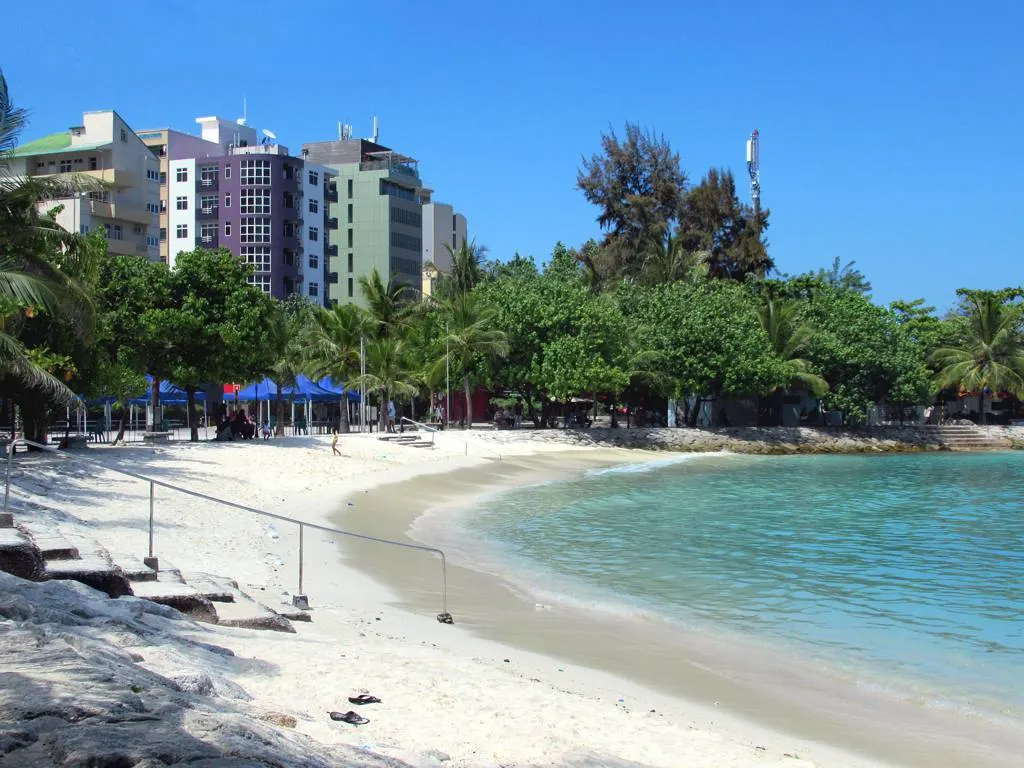
Artificial Beach, Malé
An artificial beach on the east coast, about a 10-minute walk from the airport ferry dock. It is where residents of the capital go for a swim, almost always in clothes, and it is better for understanding the city than for a beach day.
The capital’s residents’ beach, where almost everyone swims clothed; worthwhile as a late-afternoon stop, while any island in the atoll has a better beach.
Check access
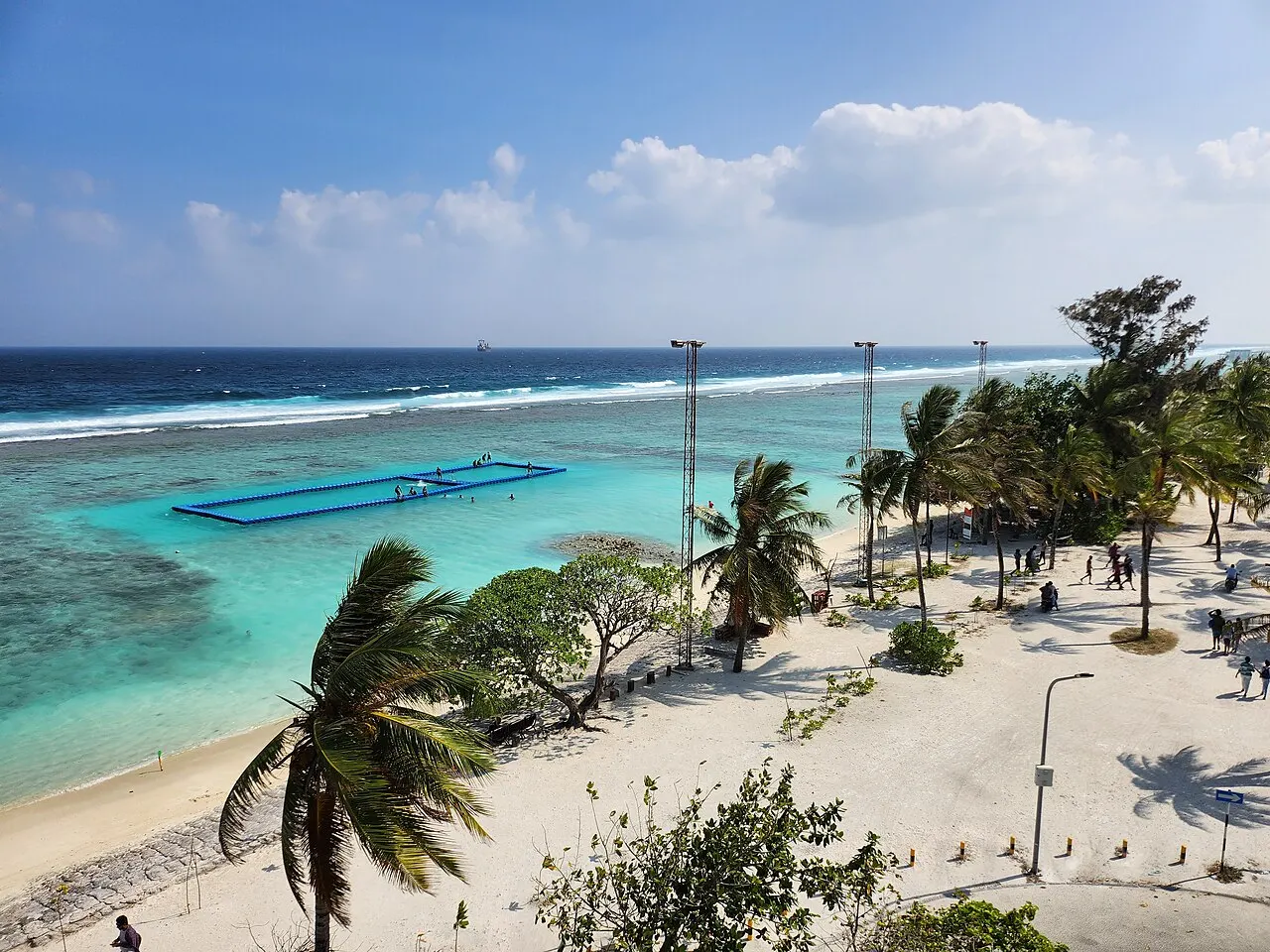
Hulhumalé Beach
The strip of sand at the far end of the artificial island, opposite the dock. It suits anyone sleeping in Hulhumalé before or after a flight; for a beach day, the islands of the atoll are a better bet.
Only worthwhile for those already staying in Hulhumalé because of a flight; as a destination, the atoll’s islands offer more.
Check access
Nilo’s itinerary
Start with the basic programme and choose extensions for the time you have.
Plan my days in the app ↗Day 1 · Malé on foot, from the Friday Mosque to the fish market
Sleep the arrival night in Malé or Hulhumalé and start early, in clothes that cover shoulders and knees.
Go to the Friday Mosque (Hukuru Miskiy) and the Medhu Ziyaaraiy across from it; to enter the mosque, ask permission from the caretaker, outside prayer times.
Walk on to Sultan Park and the National Museum, which closes on Fridays, and then to the Islamic Center, also outside prayer times.
Head down to the north waterfront for the fish market and the local market, and have lunch at a hotaa, with hedhika and tea.
In the afternoon, take the ferry to Villimalé, 10 minutes away, and walk the beaches on the inner side, without swimming where the current is strong.
Return to Malé and finish at the Artificial Beach in the late afternoon; sleep in Malé or Hulhumalé.
Day 2 · By speedboat to Maafushi, where you sleep
Take the passenger speedboat to Maafushi, about 30 minutes, booked through the guesthouse; the public ferry takes about 1h45 and doesn't run on Fridays.
Drop your bag, have lunch and walk around the island in long clothes; it can be covered on foot in a short time.
Spend the afternoon on the beach in a bikini, in the north of the island, the only area where swimwear is allowed.
Arrange the next day's boat trip at the guesthouse, with life jackets for everyone.
Sleep in Maafushi.
Day 3 · A day on the water from Maafushi
Head out in the morning on a snorkeling trip or a scuba dive with one of the island's operators.
If the trip includes another inhabited island, such as Gulhi, keep the same covered clothing as on the island you left from.
To drink or wear a bikini outside the separate beach, the option is a day trip to a resort, booked on the island.
Have dinner on the island and sleep in Maafushi.
Day 4 · Back to Malé and the transfer to the resort
Take the morning speedboat to Malé or straight to the airport, depending on the transfer arranged with the resort.
If the resort is reached by seaplane, be at the Velana seaplane terminal at the scheduled time, because it flies only by day.
Arrive at the resort in the afternoon and ask at reception where it is safe to swim on the house reef.
Check whether the resort's clock follows official time or "island time" before booking the return transfer.
Sleep at the resort.
Day 5 · A full day at the resort and on the reef
Snorkel the house reef in the morning, in the area the staff point out.
Book a dive or a resort boat trip for the afternoon, if the sea allows.
Confirm the return transfer time: with an evening international flight, the seaplane departure has to be in daylight.
Sleep at the resort.



If you stay longer
Day 6 · Free day
Free day: use it to rest, go back to the place you liked most or cover a setback.
Food
Mas huni
The Maldivian breakfast: chopped tuna mixed with grated coconut, onion, lime and chili, eaten with roshi, the flatbread, and sweet tea. Today many households use canned tuna instead of cured tuna.
Garudhiya
A clear tuna broth boiled with salt and water, which locals treat as the national dish. It is eaten with rice, seasoned at the table with lime, chili and onion, or with boiled taro and breadfruit and grated coconut.
Rihaakuru
The brown, almost black paste left when garudhiya is boiled until the water evaporates. It goes into almost every home meal, in small amounts, as a seasoning.
Gulha and other hedhika
Hedhika are the savory snacks of the hotaa, the local cafés. The gulha is a fried ball filled with tuna, coconut and chili; the masroshi is a filled, baked dough; the bajiyaa resembles a samosa. They come with hot tea, in the morning or late afternoon.
Mas riha
A curry of fresh tuna cubes in coconut milk, the most important curry in Maldivian cooking, served with rice or roshi.
Valhoamas
The "Maldive fish": tuna cooked, smoked and dried in the sun until dark and hard. Flaked, it goes into curries, snacks and traditional mas huni.
Huni roshi
A flatbread with grated coconut in the dough, eaten at breakfast with sweet or savory sides.
Where to eat
- Maarukeytu Hota · Malé Fish Market · $
A hotaa on the second floor of the fish market, with Maldivian food and no English menu, at Rf 20–30 a plate.
Source · 2026-10-15
- Malé (central island) · $
Hedhika and tea at the neighborhood hotaa, in the morning and late afternoon; gulha, masroshi and bajiyaa sit in the display case.
- FoodBank · Orchid Magu, Malé · $$
Seafood and Maldivian food, from US$ 6 to US$ 40.
Source · 2026-10-15
- Maafushi · $$
Guesthouse and main-street restaurants with Western, Indian and Thai cooking, no alcohol.
- Resort islands · $$$
The resort's own restaurants, in dollars, with a 10% service charge and 17% TGST; the only place with wine and beer.
$: up to Rf 30 a plate at a hotaa · $$: Rf 60–120 a plate at a café in Malé · $$$: resort restaurant, in dollars, with a 10% service charge and 17% TGST · 2026-10-15
Day trips
Gulhi, inhabited island next to Maafushi
It lies in South Malé Atoll, about 21 km from Malé and near Maafushi, and connects to the other islands by the MTCC public ferry every day except Fridays. There are boat trips from Maafushi to other inhabited islands; the same rule of covered clothing applies.
Dhigurah and southern Ari, for the whale sharks
Dhigurah is about 97 km southwest of Malé, in the South Ari marine protected area, created in 2009, covering 42 km², where whale sharks live year-round. Ari is about 30 minutes by seaplane from Malé, and Maamigili airport receives domestic flights. It means moving your base for two days or more, not a day trip.
Hanifaru Bay, in Baa Atoll
About 120 km in a straight line north-northwest of Malé, in a Unesco biosphere reserve since 2011. The small bay gathers up to a hundred manta rays when the tide pushes plankton into it. You get there by domestic flight to Dharavandhoo airport or by seaplane. The visiting rules and the season for the rays change; confirm with the operator before booking.
Where to begin
Malé on foot, from the Friday Mosque to the fish market
Sleep the arrival night in Malé or Hulhumalé and start early, in clothes that cover shoulders and knees.
By speedboat to Maafushi, where you sleep
Take the passenger speedboat to Maafushi, about 30 minutes, booked through the guesthouse; the public ferry takes about 1h45 and doesn't run on Fridays.
Money
The currency is the rufiyaa (MVR, written Rf), but the US dollar is accepted almost everywhere, and resorts charge in dollars, by card or in cash. Bank of Maldives exchanges money in the airport arrivals hall and, after check-in, in the departure area, where it changes rufiyaa back up to the amount of the receipt from the first exchange; keep that receipt. What sets the budget is the type of island. In Malé, a plate at a hotaa cost Rf 20 to Rf 30, and a café meal with a local and Thai menu, Rf 60 to Rf 120; a guesthouse room started at US$ 20, and hotels in the capital ran from US$ 40 to US$ 240 (Wikivoyage, September 2026). Those room prices come before tourist taxes, which are added to the bill, and almost every bill, at a restaurant or hotel, also carries a 10% service charge. At a resort, everything is in dollars and the price is subject to the 10% service charge and the 17% tourism tax (TGST), in force since July 1, 2025. Add the green tax per person per night as well, since January 1, 2025: US$ 12 at resorts, liveaboard boats and hotels with more than 50 rooms, and US$ 6 at guesthouses and hotels of up to 50 rooms on inhabited islands; children under 2 are exempt. The international departure tax, since December 1, 2024, is US$ 50 in economy for foreigners, US$ 120 in business and US$ 240 in first class; it is built into the ticket, so it is not paid again at the airport. A boat dive cost about US$ 50 with your own equipment and US$ 75 with rented equipment, according to Wikivoyage (September 2026). Banks close on Friday and Saturday.
Getting there and around
From Velana airport to Malé and Hulhumalé
Velana International Airport (MLE) is on the island of Hulhulé, next to Malé, and got a new passenger terminal in July 2025. Anyone with a resort booking is met by a representative right after customs. For Malé, the public ferry leaves from the dock to the left of arrivals, costs MVR 15 and takes about 10 minutes; it runs every 15 minutes from 6 a.m. to 8:30 p.m. and every 30 minutes until midnight. The taxi has a fixed fare of MVR 70 to 90 depending on the destination, Malé or the two phases of Hulhumalé, with a surcharge between midnight and 6 a.m., and can be hailed through the Avas app. Airport buses cross the Sinamalé Bridge and cost Rf 10 on the main lines and Rf 15 between Malé, Hulhulé and phase 2 of Hulhumalé, but they don't take luggage. (Fares and schedules from the September 2026 revision of Wikivoyage.)
Speedboat, seaplane or domestic flight to the island
There are three ways to reach an island. Resorts in Malé Atoll pick guests up by speedboat. The more distant ones use seaplanes, the Twin Otters of Trans Maldivian Airways and Manta Air, which take off from the airport's own seaplane terminal and fly only in daylight; late-afternoon flights tend to be cancelled, and anyone arriving at night sleeps in Malé or Hulhumalé. For the farther atolls there are domestic flights by Maldivian, Manta Air and Villa Air, from Velana, with the last leg by speedboat; the country has 18 airports, domestic and international. The transfer is arranged with the resort and paid separately; a private transfer costs US$ 500 to 800, according to Wikivoyage (September 2026).
Public ferry and speedboat to the local islands
The inhabited islands of Malé Atoll connect to the capital by MTCC public ferries and passenger speedboats. To Maafushi, the speedboat takes about 30 minutes and cost about US$ 25 per person, and the public ferry cost about MVR 22 and took about 1h45, departing Malé from the area of the Villingili terminal and not running on Fridays (Wikivoyage, August 2026 revision). Schedules change: check with MTCC or ask the guesthouse to book the speedboat. On the more distant islands, the ferry leaves once a day, and not on Fridays.
Around Malé
The central island can be crossed on foot in about an hour, and most of what you visit is on the north waterfront, 15 minutes from the airport ferry dock. City buses cost Rf 7 within Malé and accept contactless cards; taxis have a fixed fare. For Villimalé, the ferry runs every few minutes; for Hulhumalé, there is a ferry of about 20 minutes, for MVR 10, in addition to the bus over the bridge. In the monsoon rain, the narrow streets flood and traffic stalls.
Safety
Crime is low at the resorts, but there is petty theft; use the room safe. In Malé and Hulhumalé there are knife crimes linked to gangs, so avoid empty streets on foot after dark, and stay away from political protests, which sometimes happen in the capital. The biggest killer is the sea: tidal currents drag swimmers away from the beach, so swim only in designated areas and check that the tour boat has life jackets. Dengue circulates in the country. The only full hospitals are in Malé and Hulhumalé, and many resorts are hours from emergency care, so travel insurance must cover evacuation; there are decompression chambers for divers at Bandos, Kuredu and Kuramathi. The laws on drugs are severe, with zero tolerance. Same-sex relations are illegal, and a conviction can bring a fine or a long prison sentence. Emergencies: 119 for police, 102 for ambulance and 118 for fire.
Etiquette tips
Cover shoulders and legs outside the resort
On the inhabited islands and in Malé, men and women cover their shoulders and avoid short or tight shorts; for women, covering the legs as well is recommended. Bikinis are restricted to the separate tourist beach, and topless and nudity are banned across the country, resorts included.
Alcohol only inside the resort
Possessing or consuming alcohol, or being drunk, outside the resorts and on the inhabited islands can lead to arrest and deportation. Don't take the bottle from the resort onto the boat back or to Malé.
In Ramadan, no eating in public by day
During the month of fasting, outside the resorts, you don't eat, drink or smoke in public between dawn and sunset.
Religion is a private matter
Publicly practicing a religion other than Islam is illegal. Religious items for personal use stay in your luggage, and proselytizing of any kind is not allowed.
Mosques outside prayer times
The Islamic Center receives visitors outside prayer times. The Friday Mosque has no published visiting hours: ask permission from the caretaker, who usually lets in polite, well-dressed visitors. At both, enter in clothing that covers shoulders and legs.
Mistakes to avoid
Arriving at night and counting on the seaplane
Booking an international flight that lands at night with a seaplane transfer the same day. The seaplane flies only by day and late-afternoon flights tend to be cancelled; book the night in Hulhumalé or Malé and continue to the resort the next morning. On the way back, the same applies: an evening international flight means leaving the resort with time to spare.
Forgetting the IMUGA declaration and immigration requirements
Most nationalities receive a free 30-day tourist visa on arrival, and some passports (India, Malaysia, Russia, Sri Lanka and Azerbaijan) get a 90-day exemption; since April 15, 2025, entry on an Israeli passport is refused. Check the rule for your passport before buying your ticket. On arrival, immigration asks for a passport valid for at least one month, a confirmed return ticket, a paid booking at a registered establishment and money for the stay. The IMUGA declaration is filled in online, free of charge, in the 96 hours before arrival, one per person, children included.
Bringing alcohol in your luggage
Alcohol and pork cannot enter the country. Customs X-rays luggage, holds the bottle and gives a receipt to collect it on departure.
Planning the local island without checking Friday
Counting on a public ferry or an open bank on Friday. Several ferries don't run that day, and banks and government offices close; on a local island, getting around on Friday usually depends on a private speedboat.
Comparing resorts by the nightly rate alone
On top of the resort's nightly rate come the 10% service charge, the 17% TGST, the US$ 12 green tax per person per night and the transfer, which may be by speedboat or seaplane and is charged separately. Food and drink are also in dollars, and there is no alternative off the island.
Swimming where the current rules
Entering the sea outside the designated area. Tidal currents in the channels between reefs are strong and cause drownings every year; ask the resort or guesthouse staff where it is safe to swim and keep away from boats and propellers.
Useful phrases
Assalaamu alaikum
Hello, a formal greeting; "maruhabaa" is the informal form, which also means "welcome"
Haalu kihineh?
How are you?
Shukuriyyaa
Thank you
Meege agu kihaavareh?
How much is this?
Ma'aaf kurey
Excuse me, or sorry: used both to get someone's attention and to apologize
Vakivelan
See you later
Where to stay
- Hulhumalé · Anyone arriving or leaving at night · $: It sits next to the airport by landfill, lodging tends to cost less than in Malé and there is a beach at the end of the island. There is nothing to visit beyond that.
- Malé (central island) · Anyone who wants a day on foot in the capital · $$: The mosque, the museum and the market are minutes away on foot. Hotels cost US$ 40 to US$ 240 in September 2026, and the island is dense, with traffic and noise.
- Maafushi · Smaller budgets and anyone who wants to see an inhabited island · $: It is the local island with the most guesthouses near the capital, about 30 minutes by speedboat from Malé, with a bikini beach and dive operators. In return, there is no alcohol on land and clothing follows the island's rules.
- Resort islands in Malé Atoll · A short first trip, with no extra flight · $$$: The transfer is by speedboat from the airport, without depending on the seaplane schedule. The resort has alcohol, bikinis on any beach and the reef at the door, with everything charged in dollars.
- Resorts in Ari and Baa · Diving, manta rays and whale sharks · $$$: They are near the protected area of southern Ari and Hanifaru Bay, but require a seaplane or a domestic flight followed by a speedboat. Seaplanes fly only in daylight; confirm the domestic flight and speedboat schedules with the resort before choosing your international arrival.
$: guesthouse from US$ 20 a night, before taxes, plus US$ 6 green tax per person · $$: hotel in Malé, US$ 40–240 a night · $$$: resort on its own island, in dollars, plus US$ 12 green tax per person and the transfer · 2026-10-15
Districts
Malé (central island)
The four historic districts, Henveiru, Galolhu, Maafannu and Machchangolhi, on an island you can cross on foot in about an hour. It holds the Friday Mosque, the National Museum, the fish market, the ministries and the port. It is dense, with heavy motorbike traffic, and works for a day of sightseeing or for the night between a flight and a transfer.
Hulhulé
The island of Velana International Airport, with the passenger terminal, the runway and the seaplane terminal. It is about a 10-minute ferry ride from Malé, or across the Sinamalé Bridge.
Hulhumalé
An artificial island connected to the airport by landfill, inhabited since 2004, with a beach at the end opposite the dock. Lodging tends to cost less than in Malé, and the proximity to the airport makes it the base for the night of arrival or departure.
Villimalé
A residential island 2 km west of Malé, the city's fifth district, with natural beaches and dangerous currents on the outer side. It was a prison from 1962 and got a resort in 1973, before becoming a district. On weekends it fills with residents of the capital.
Maafushi
An inhabited island in South Malé Atoll, 26 km from the capital, with 4,471 residents in the 2022 census. It was the inhabited island that grew most with guesthouses after 2009: in August 2016 it already had more than 55, more than any other inhabited island in the country. It has a bikini beach in the north, dive centers and boat trips. There is no alcohol on the island.
Resort islands
Uninhabited islands occupied entirely by a resort, in the North and South Malé atolls, a speedboat ride from the capital, or farther out, in Ari, Baa and other atolls, reached by seaplane or domestic flight. This is where you find alcohol, bikinis on any beach and the reef at the door of your room.
History
2nd c. · The cowrie "money islands"
Since the 2nd century, Arab merchants called the Maldives the "money islands" because of the cowries, shells used as currency across Asia and the east coast of Africa. The archipelago exported these shells in large quantities for centuries, along with coconut fiber.
1153 · The conversion to Islam
The last Buddhist king, Dhovemi, adopts Islam and the title of Sultan Muhammad al Adil, opening a sequence of six dynasties and 84 sultans and sultanas. Tradition credits the conversion to Abu al-Barakat Yusuf al-Barbari, whose tomb, the Medhu Ziyaaraiy, stands across from Malé's Friday Mosque.
1343 · Ibn Battuta in Malé
The Moroccan traveler serves as chief judge in the Maldives for about nine months and describes Malé: the residence of Queen Khadija, warehouses of cowries ready for trade and several wooden mosques.
1558–1573 · The Portuguese and Muhammad Thakurufaanu
The Portuguese keep a garrison in Malé, administered from Goa, until Muhammad Thakurufaanu and his brothers, coming from Utheemu, take the city by surprise in 1573. The date is celebrated as National Day, the first day of Rabi al-Awwal in the Islamic calendar.
1656–1675 · The coral stone mosque
Sultan Ibrahim Iskandar I has the Friday Mosque, the Hukuru Miskiy, built from 1656 to 1658, with coral blocks cut while still wet. The minaret is finished in 1675.
1887 · British protectorate
On December 16, 1887, the sultan signs an agreement with the British governor of Ceylon that hands foreign policy to Britain in exchange for military protection, and keeps domestic government with the sultans.
1965–1968 · Independence and republic
Independence is signed on July 26, 1965. A referendum in March 1968 abolishes the sultanate, and the republic is declared on November 11, 1968, with Ibrahim Nasir as its first president. In the remodeling of Malé that follows, the royal palace and the forts are demolished.
1972 · The first resort
Kurumba receives its first guests on October 3, 1972, and Bandos opens the same year. By 2007 there were 92 resorts.
1997–2004 · Hulhumalé, the island made of sand
Dredging of Hulhumalé begins on October 16, 1997, in a lagoon near the airport, and the artificial island receives its first residents in 2004, to relieve a Malé with no room to grow.
2004 · The tsunami
The wave of December 26, 2004 floods almost every island, kills 102 Maldivians and 6 foreigners, forces 21 resorts to close and causes damage estimated at over US$ 400 million, about 62% of GDP.
2008–2012 · A new constitution and a political crisis
The 2008 Constitution brings the first direct presidential elections. In February 2012 President Mohamed Nasheed resigns after a mutiny by the police and the army, and in the same month the Buddhist statues in the National Museum are destroyed.
2018–2025 · Bridge, new runway and terminal
The Sinamalé Bridge links Malé to the airport island in 2018. In 2022 the 3,400 m runway and the seaplane terminal open, and in July 2025 the new passenger terminal at Velana airport is inaugurated.
Complete history
A trade route in the middle of the ocean
The Maldives have been inhabited for more than 2,500 years, and the first settlers came from the south of the Indian subcontinent and from Ceylon. The location explains almost everything that came after: for the Arab and Persian navigators who dominated Indian Ocean routes from the 10th century, the archipelago was the first stop for anyone leaving Basra for Southeast Asia. What was loaded there was cowries, used as currency from Asia to the African coast, and coconut fiber for rope. That contact led King Dhovemi to adopt Islam in 1153; since then the country has been Muslim, the 2008 Constitution declares the republic "based on the principles of Islam," and a non-Muslim cannot become a citizen.
Malé, the king's island
Malé has always been the seat of power. Tradition says that fishermen from the neighboring island of Giraavaru cleaned tuna on a large sandbank, and that a prince from the north, Koimala, settled there; the names of the island's four districts, Henveiru, Galolhu, Maafannu and Machchangolhi, are said to come from those fishermen. In the 17th century Sultan Muhammad Imaduddin ringed the island with walls on the north, east and west. The forts and walls, already in ruins, were dismantled in 1925–1927, under Muhammad Shamsuddeen III, to be rebuilt on a smaller scale. After the republic of 1968, President Ibrahim Nasir's remodeling tore down the royal palace and what remained of the forts; what survives is the Friday Mosque and the house of the last sultan, now on the grounds of the National Museum.
From the Portuguese to the protectorate
The only period of direct foreign occupation was the Portuguese one, from 1558 to 1573, ended by the revolt of Muhammad Thakurufaanu, still the national hero and the namesake of Malé's great mosque. The British, who ruled Ceylon, turned the islands into a protectorate in 1887 but left domestic government to the sultans. Independence came on July 26, 1965, and the republic in 1968. President Nasir opened the first international airport in 1966 and mechanized fishing, and in 1972 the first resorts, Kurumba and Bandos, changed the country's economy.
The "one island, one resort" model
Tourism grew in a design of its own: each resort occupies an entire uninhabited island, far from the islands where Maldivians live. The design kept visitors, with their alcohol and bikinis, away from the inhabited islands. In 2009 a regulatory change began to allow tourists to sleep on inhabited islands too, and guesthouses spread. Maafushi, 26 km from Malé, shows the pace: it had 40 guesthouses in December 2015 and 72 in December 2017. According to the Ministry of Tourism's annual statistics, the country received 1,878,543 tourists in 2023 and 2,046,615 in 2024.
A capital that manufactures land
Malé had 2,148 inhabitants in 1888 and 29,522 in 1977. The lagoon around the island was filled in through 1986, and with nowhere left to build, in 1997 the government began making Hulhumalé from sand pumped from the seabed, inhabited since 2004. Garbage from the capital and the resorts has gone since 1992 to Thilafushi, another artificial island, raised on a lagoon to the west. The underlying issue is elevation: more than 80% of the territory lies less than one meter above the sea, and the 2004 tsunami, which forced 21 resorts to close and badly damaged inhabited islands such as Maafushi, showed the country what the water can do.
The country's first resort, Kurumba, received its first guests on October 3, 1972.
Geography and shape of the city
Atolls, faru and channels
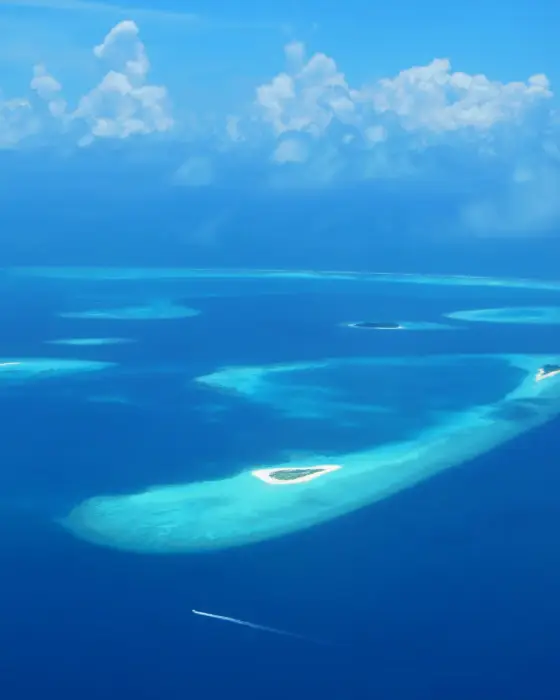
An atoll is a ring of coral reef surrounding a lagoon, with low islands on the ring. The Maldives have 26 natural atolls, lined up in a double chain along an undersea ridge of about 960 km, and the islands are small: the largest is no more than 8 km². Inside the atolls there are smaller ring-shaped reefs, called faru in Divehi, and between them run the channels (kandu) where the tidal current is strong, which explains both the good dive sites and the warning not to swim without guidance. The country is organized into administrative divisions named with letters of the Thaana alphabet: Malé Atoll, around the capital, is Kaafu.
Malé and the surrounding islands
The central island of Malé is about 1.9 km² and is entirely covered with buildings, narrow streets and docks. To the east lies Hulhulé, the airport island, linked to the capital since 2018 by the 1.39 km Sinamalé Bridge; Hulhulé connects by landfill to Hulhumalé, a 4 km² artificial island with a beach. To the west, 2 km away, is Villimalé, a former resort turned residential district, reached by ferry. Malé has no river and no countryside: water comes from deep desalinated wells, power from diesel generators, and garbage goes by boat to Thilafushi.
A climate of two monsoons
The climate is tropical monsoon, hot and humid all year. At the airport station, the 1991 to 2020 normals give average highs between 30.4 °C and 31.9 °C and lows between 25.5 °C and 27.1 °C in every month. What changes is the rain: the northeast monsoon brings the dry season, with 38 mm in February and 49 mm in March. The southwest monsoon, from June to the end of November, brings the wet one: June has 146 mm, and from July to November rainfall runs between 193 mm and 245 mm a month, with October the rainiest. May, in the transition, already has 238 mm.
More than 80% of the Maldives' territory lies less than one meter above sea level.
Culture
An Islamic republic in everyday life
Sunni Islam is the state religion, and public practice of any other religion is prohibited. This shapes the week and the day: the weekend is Friday and Saturday, and on Majeedhee Magu, Malé's main shopping street, shops open from 9 a.m. to 11 p.m., close for 15 minutes after each prayer time and take a break from 6 to 8 p.m. During Ramadan, most restaurants on the inhabited islands stay closed until nightfall. The language is Divehi, related to Sinhala and written in the Thaana script since the 16th century, from right to left; English is the language of secondary and higher education and works in any guesthouse, hotel or government office.
Bodu beru, baibalaa and soccer
Festive music is the bodu beru, "big drum": about twenty people, with three drums, a singer, a bell and a scraped bamboo stick, in a rhythm that starts slow and speeds up to the most intense dance. The form is related to music from East Africa and is said to have arrived with Indian Ocean sailors. Bodu beru often accompanies traditional games, such as baibalaa, similar to volleyball and played with a coconut-leaf ball, and the fenei bashi wrestling. The sport that draws the most people, however, is soccer, with the national Dhivehi Premier League.
The sea as a trade
Tuna fishing was the basis of the economy until tourism, and the dhoni, the traditional wooden boat, motorized since 1974, is still in use between islands, slower and cheaper than the speedboat. Much of the surviving craftwork belongs to specific islands: Thulhaadhoo, in Baa Atoll, is known for lacquerwork, and Fulidhoo, in Vaavu Atoll, for the langiri and thaara dances. In everyday Malé, living culture is found in the hotaa, the markets of the north waterfront and the bustle of the docks.
Festivals and events
Ramadan and Eid al-Fitr, movable dates
The month of fasting changes date every year on the Islamic calendar; in 2027, it is expected to run from February 8 to March 8, followed by the Eid al-Fitr holidays. On the inhabited islands, eating, drinking and smoking in public during the day is prohibited, and many cafés open only at nightfall; at resorts the routine does not change.
Eid al-Adha, movable date
The feast of the sacrifice is a five-day national holiday; in 2027, it is expected from May 15 to 19, including Arafah Day. Public services and many ferries change their schedules.
Independence Day, July 26
It commemorates the 1965 agreement with Britain that ended the protectorate; it is a national holiday.
National Day, 1 Rabi al-Awwal
It commemorates Muhammad Thakurufaanu's victory over the Portuguese in 1573, with parades and celebrations. The date follows the Islamic calendar: in 2027, it is expected on August 3.
Victory Day and Republic Day, November 3 and 11
Two national holidays in the same two weeks. November 11 marks the republic declared in 1968.
Books and films
The Island President (2011), by Jon Shenk
A documentary about President Mohamed Nasheed and his campaign against sea level rise in a country where more than 80% of the territory lies less than one meter above the water. It won the Audience Award for documentaries at the 2011 Toronto Festival.
Rihla, by Ibn Battuta (14th century)
The account of the Moroccan traveler, who was a judge in the Maldives in the 1340s, describes Malé with the residence of Queen Khadija, the cowrie warehouses and the wooden mosques. It is the oldest and most detailed portrait of the capital.
The Maldive Islanders (1999), by Xavier Romero-Frías
A study of the popular culture of the old kingdom of the Maldives, published in Barcelona and listed in the reference bibliography on the country. It helps in understanding the traditions that still appear on the inhabited islands.
Frequently asked questions
Maldives: What does immigration ask for on arrival?
Most nationalities receive a free 30-day tourist visa on arrival, with a passport valid for at least one month, a confirmed return ticket, a paid booking at a registered establishment and money for the stay. The IMUGA declaration is online and free, in the 96 hours before arrival. Since April 15, 2025, entry on an Israeli passport is not permitted. Check the rules for your passport and the health requirements for your route before buying a ticket.
Maldives: How do you get from Velana airport to Malé?
The public ferry leaves from the dock to the left of arrivals, costs MVR 15 and takes about 10 minutes. The taxi has a fixed fare of MVR 70 to 90 depending on the destination, Malé or the two phases of Hulhumalé, with a surcharge between midnight and 6 a.m.
Maldives: How many days should you plan?
I'd stay five days: one in Malé, two in Maafushi and two at a resort. With a week, I'd add resort days, or swap the resort for southern Ari, the base for the whale sharks that live there year-round.
Maldives: How do you get from Malé to Maafushi?
The speedboat takes about 30 minutes and cost about US$ 25 per person, and the public ferry cost about MVR 22 and took about 1h45, not running on Fridays (Wikivoyage, August 2026). Schedules change: check with MTCC or ask the guesthouse to book the speedboat.
Maldives: When is the best time to go?
From January to April the northeast monsoon blows, the dry season, with February (38 mm) and March (49 mm) as the driest months. The southwest monsoon runs from early June to the end of November, with October as the rainiest month (245 mm).