Oman
Muscat
Muscat: the Grand Mosque in the morning, the Mutrah souq in the afternoon, and the sea pressed against the mountains
Days I'd stay three days in Muscat.
How the guide reaches this number
Two are enough for the city, because the big sights fit into two mornings: one at the Grand Mosque, followed by the opera house and Qurum Beach, and another between the Mutrah fish market, Old Muscat, and the National Museum, with the souq and the corniche in the late afternoon. I'd give the third day to the coast road, to swim in the pools of Wadi Shab and stop at the Bimmah Sinkhole on the way back; it is the best sample of Oman's landscape from the capital. If one of the three days falls on a Friday, I'd reserve it for Wadi Shab, because the mosque does not admit visitors and the small museums of Old Muscat close. With a fourth day, preferably a Friday, I'd go to Nizwa for the goat market, the fort, and the souq.
2–3
Start with the basic programme and choose extensions for the time you have.
When November to March; April and October already have average highs near 35 °C, and from May to September they run between 35 °C and 40 °C, with high humidity.
How the guide reaches this number
November to March is the best time: average highs run between 25 °C and 30 °C, and you can walk the corniche and the wadis in the middle of the day. It is also when the Muscat Festival takes place and when the city receives the most visitors. April and October already warm up, with average highs near 35 °C, and call for outdoor activities only early and in the late afternoon. From May to September average highs run between 35 °C and 40 °C, with high humidity near the sea; it is the low season, when a visit is organized around museums, malls, and pools. The few rains fall mostly between December and April, and a storm in the mountains can suddenly fill the wadis. Ramadan changes date every year and alters business and restaurant hours.
Per person/day Add up lodging per night, meals per person, the museum and Opera House entries and the car or tours for the day trips; from October to March, the high season changes the total considerably.
How the guide reaches this number
Per person per day: accommodation, meals, urban transport, visits and a small allowance for extras. Flights excluded; larger purchases vary. Editorial estimate, not a quote.
 What Nilo thinks
I'd recommend Muscat to anyone who likes music, handmade objects, and home cooking. In silverwork, the best is in the small pieces: the little boxes that carry the name of Nizwa, the rose-water sprinklers, and the message holders called hurz, which vendors nickname the old-fashioned fax. At home, the main meal is the midday one, and dinner is light. Among the home dishes are muqalab, offal cooked with cinnamon, cardamom, and ginger, and mushaltat, wheat bread stuffed with cheese, meat, or honey; in Ramadan, sakhana, a thick soup of wheat, dates, molasses, and milk. At the Opera House, I'd choose the ticket that includes the House of Musical Arts, because its exhibition runs through the sounds and music of Oman and elsewhere, context that a visit to the building alone does not give.Muscat is a Gulf capital with no skyline of towers. Low white buildings spread across a narrow strip between the sea and dark rock mountains, and each cove holds a different piece of the city. In Old Muscat, the sultan's palace sits between two 16th-century Portuguese forts, facing a museum that tells the story of the whole country. In Mutrah, the port still sets the rhythm: wooden dhows, fish unloaded at dawn, and a souq of covered lanes where the smell of frankincense mixes with jasmine. To the west, the Sultan Qaboos Grand Mosque opens its prayer hall to visitors, and the Royal Opera House brings everything from Arabic music to ballet to the city. And a few hours of road are enough to trade the asphalt for clear pools at the bottom of canyons and for the forts and palm groves of the interior.
Quick facts
- Population
- 1.72 million inhabitants in the Muscat Governorate, which groups six wilayat (provinces), according to Oman's National Centre for Statistics and Information (NCSI), for 2022.
- Founding
- A port mentioned since the 1st century by Greco-Roman geographers; capital of the country since 1793, when the seat of government moved from Rustaq to Muscat.
- Country and region
- Oman, Muscat Governorate, on the northeastern coast of the country, on the Gulf of Oman.
- Language
- Arabic. English is widely used in tourism and commerce; the city also hears Balochi, Swahili, Hindi, Urdu, and Malayalam, languages of long-established communities and of immigrant workers.
- Currency
- Omani rial (OMR), divided into 1,000 baisa, with a fixed exchange rate to the US dollar.
- Time zone
- Gulf Standard Time, UTC+4, no daylight saving time.
- Best time to go
- November to March; April and October already have average highs near 35 °C, and from May to September they run between 35 °C and 40 °C, with high humidity.
- Average daily cost
- Add up lodging per night, meals per person, the museum and Opera House entries and the car or tours for the day trips; from October to March, the high season changes the total considerably.
When to go
November to March; April and October already have average highs near 35 °C, and from May to September they run between 35 °C and 40 °C, with high humidity.
January
17° to 25°C
13 mm of rain
Best time10 h 51 min of daylight
National holidays
Jan 5, 2027 · Isra' and Mi'raj (estimated)
Jan 11, 2027 · Sultan's Accession Day
Jan 11, 2028 · Sultan's Accession Day
Source: python-holidays. Holiday dates shift; check close to your trip.
February
18° to 26°C
10 mm of rain
Best time11 h 23 min of daylight
National holidays
Feb 25, 2028 · Eid al-Fitr (estimated)
Feb 26, 2028 · Eid al-Fitr (estimated)
Feb 27, 2028 · Eid al-Fitr (estimated)
Feb 28, 2028 · Eid al-Fitr (estimated)
Source: python-holidays. Holiday dates shift; check close to your trip.
March
20° to 29°C
15 mm of rain
Best time12 h 01 min of daylight
National holidays
Mar 8, 2027 · Eid al-Fitr (estimated)
Mar 9, 2027 · Eid al-Fitr (estimated)
Mar 10, 2027 · Eid al-Fitr (estimated)
Mar 11, 2027 · Eid al-Fitr (estimated)
Source: python-holidays. Holiday dates shift; check close to your trip.
April
25° to 35°C
9 mm of rain
12 h 43 min of daylight
May
29° to 39°C
1 mm of rain
13 h 17 min of daylight
National holidays
May 15, 2027 · Eid al-Adha (estimated)
May 16, 2027 · Eid al-Adha (estimated)
May 17, 2027 · Eid al-Adha (estimated)
May 18, 2027 · Eid al-Adha (estimated)
Source: python-holidays. Holiday dates shift; check close to your trip.
June
30° to 40°C
12 mm of rain
13 h 35 min of daylight
National holidays
Jun 6, 2027 · Islamic New Year (estimated)
Source: python-holidays. Holiday dates shift; check close to your trip.
July
30° to 37°C
3 mm of rain
13 h 27 min of daylight
August
28° to 36°C
1 mm of rain
12 h 57 min of daylight
National holidays
Aug 14, 2027 · Prophet's Birthday (estimated)
Source: python-holidays. Holiday dates shift; check close to your trip.
September
27° to 36°C
0 mm of rain
12 h 17 min of daylight
October
25° to 35°C
1 mm of rain
11 h 37 min of daylight
November
21° to 30°C
7 mm of rain
Best time11 h 00 min of daylight
National holidays
Nov 20, 2026 · National Day
Nov 21, 2026 · National Day
Nov 20, 2027 · National Day
Nov 21, 2027 · National Day
Source: python-holidays. Holiday dates shift; check close to your trip.
December
18° to 27°C
12 mm of rain
Best time10 h 41 min of daylight
National holidays
Dec 25, 2027 · Isra' and Mi'raj (estimated)
Source: python-holidays. Holiday dates shift; check close to your trip.
High, shoulder and low season
High · November to March
Pleasant temperatures all day and the Muscat Festival. It is when the city receives the most visitors.
Shoulder · April and October
Average highs near 35 °C. Outdoor activities and the wadis are for the early hours and late afternoon, and demand drops compared with winter.
Low · May to September
Average highs between 35 °C and 40 °C, with high humidity on the coast. Walking becomes difficult, and the wadis are for early hours only; it is the low season. In June 2007 and June 2010, cyclones hit the city.
How the year changes
November to March is the best time: average highs run between 25 °C and 30 °C, and you can walk the corniche and the wadis in the middle of the day. It is also when the Muscat Festival takes place and when the city receives the most visitors. April and October already warm up, with average highs near 35 °C, and call for outdoor activities only early and in the late afternoon. From May to September average highs run between 35 °C and 40 °C, with high humidity near the sea; it is the low season, when a visit is organized around museums, malls, and pools. The few rains fall mostly between December and April, and a storm in the mountains can suddenly fill the wadis. Ramadan changes date every year and alters business and restaurant hours.
The same numbers as a table
| Month | Temperature °C | Rain mm |
|---|---|---|
| January · | 17 to 25 | 13 |
| February · | 18 to 26 | 10 |
| March · | 20 to 29 | 15 |
| April | 25 to 35 | 9 |
| May | 29 to 39 | 1 |
| June | 30 to 40 | 12 |
| July | 30 to 37 | 3 |
| August | 28 to 36 | 1 |
| September | 27 to 36 | 0 |
| October | 25 to 35 | 1 |
| November · | 21 to 30 | 7 |
| December · | 18 to 27 | 12 |
Nilo's tips
Two halves to the day
I'd organize each day around shop hours and the sun: museums and the mosque in the morning, a long break in the middle of the day, the souq and corniche when business reopens in the late afternoon.
Small notes in your pocket
I'd carry notes of 100 and 500 baisa and of 1 rial: they work for the bus, tea on the corniche, the boat crossing at Wadi Shab, and for closing a deal in the souq without asking for change.
Clothes that work for everything
I'd bring light trousers or a long skirt and a long-sleeved shirt in my daypack; with that you can enter the mosque, walk the souq, and avoid sunburn at the wadi.
Friday out of town
On Friday the mosque does not admit visitors and the small museums of Old Muscat close. I'd keep that day for Wadi Shab and the Bimmah Sinkhole; with a fourth day, I'd give it to Nizwa instead, because the goat market runs on Friday morning.
Book performances ahead
If you want to see a performance at the Royal Opera House, I'd check the program on its website before fixing the dates, and pack formal clothes.
A boat trip
Dhow and dolphin-watching trips are on the official list of Muscat programs, and the Bandar Al Rowdha marina is a departure point for fishing and diving boats. Between September and November, whale sharks pass the Daymaniyat Islands, off the capital's coast; to dive or snorkel there, I'd book with an operator and choose those months.
Visa before you fly
Entry rules depend on nationality: citizens of a long list of countries enter without a visa for up to 14 days, and everyone else applies for an e-visa on the Royal Oman Police portal, with a passport valid for six months. I'd check the portal before buying the ticket.
Explore the map
Explore the map, read about the other places and plan your travel days in the app.
Open the appWhat to see
Leave for last, if time allows: Al Mirani Fort · Muscat Gate Museum · Mutrah Fort · Riyam Park · Bait Al Baranda
Sultan Qaboos Grand Mosque
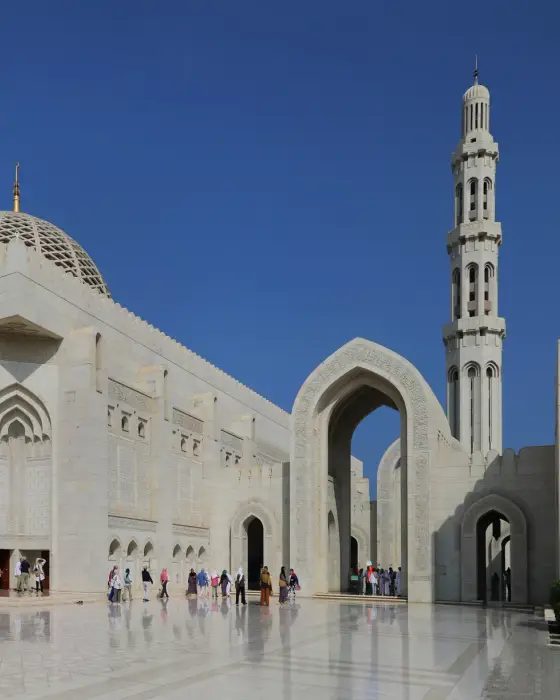
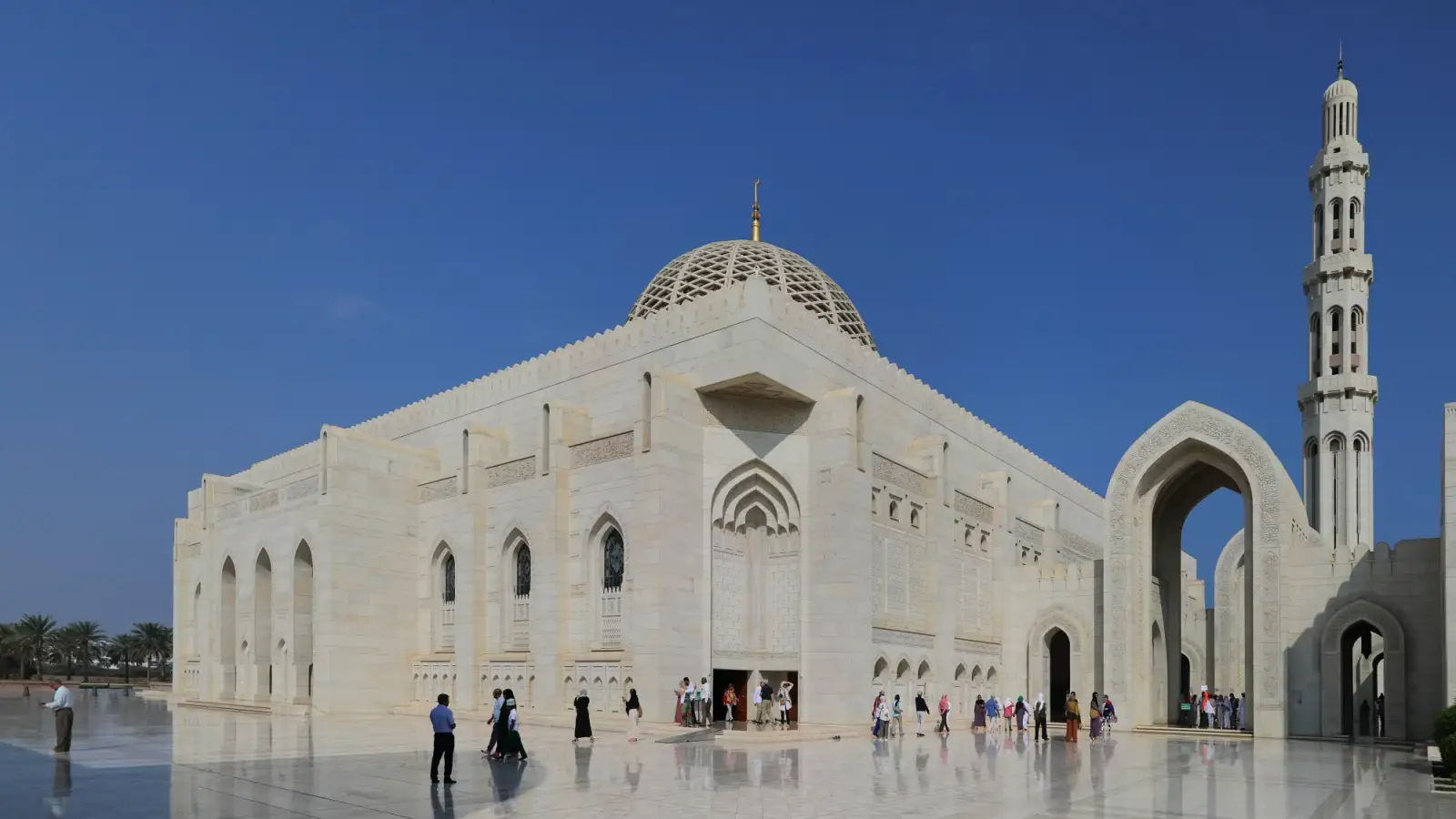
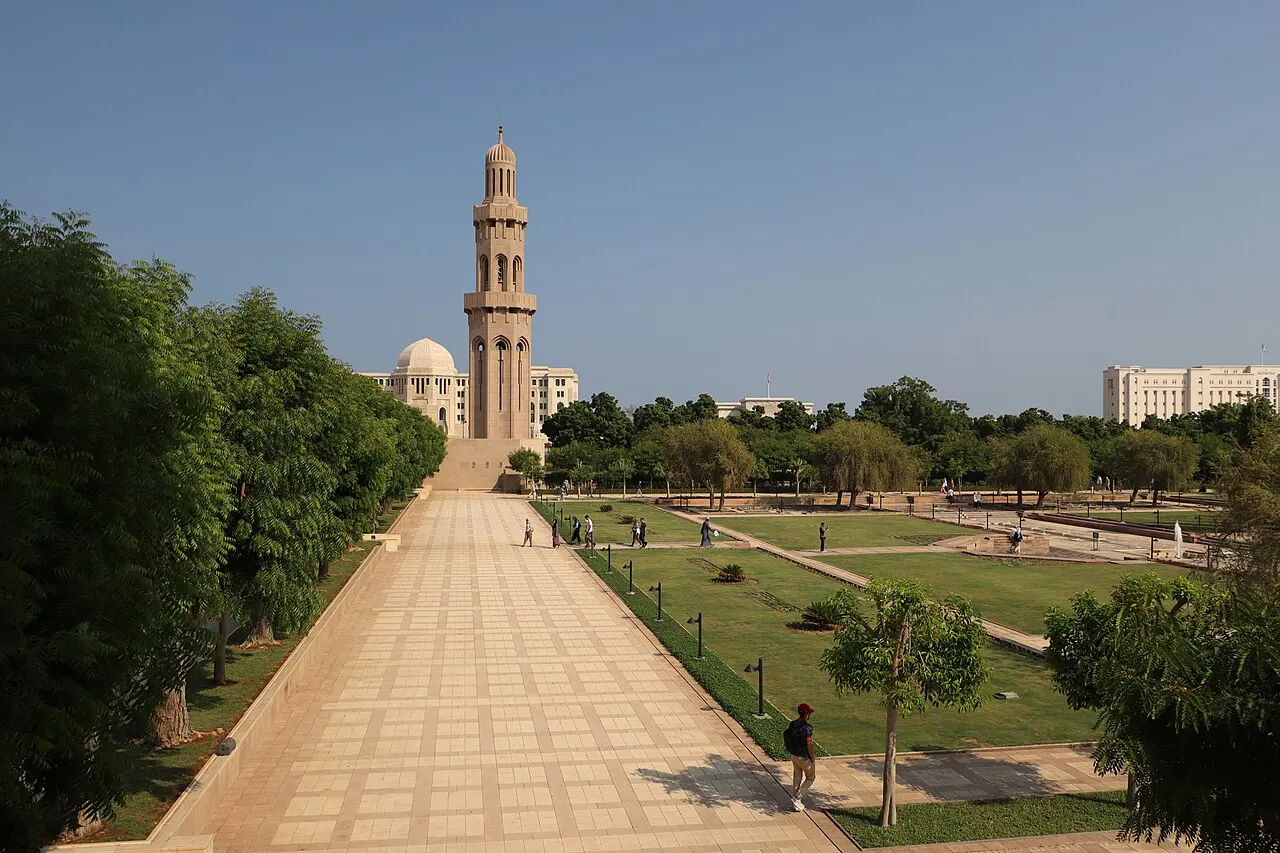
The country's largest mosque was inaugurated in 2001 and holds up to 20,000 worshippers. The main minaret is 90 m tall, and four smaller minarets complete the complex's five. The prayer hall, with walls clad in white and dark gray marble, holds a single-piece Persian carpet of about 4,200 m² and 1.7 billion knots, which was the largest in the world until 2007, when the one in the Sheikh Zayed Mosque in Abu Dhabi surpassed it, and a 14 m chandelier with 600,000 crystals. The north and south corridors, 240 m each, are divided into halls, each decorated with motifs from a different Islamic culture. Non-Muslims can visit every day except Friday, from 08:30 to 11:00, in modest clothing with arms and legs covered; women and girls aged 7 and over cover their hair. Abayas and scarves can be rented at the complex's shop, with an ID left as a deposit. Mwasalat buses stop out front.
Check access
Opening hours: Sat–Thu 08:30–11:00; Fri closed (checked Oct 2026) source
Mutrah Souq
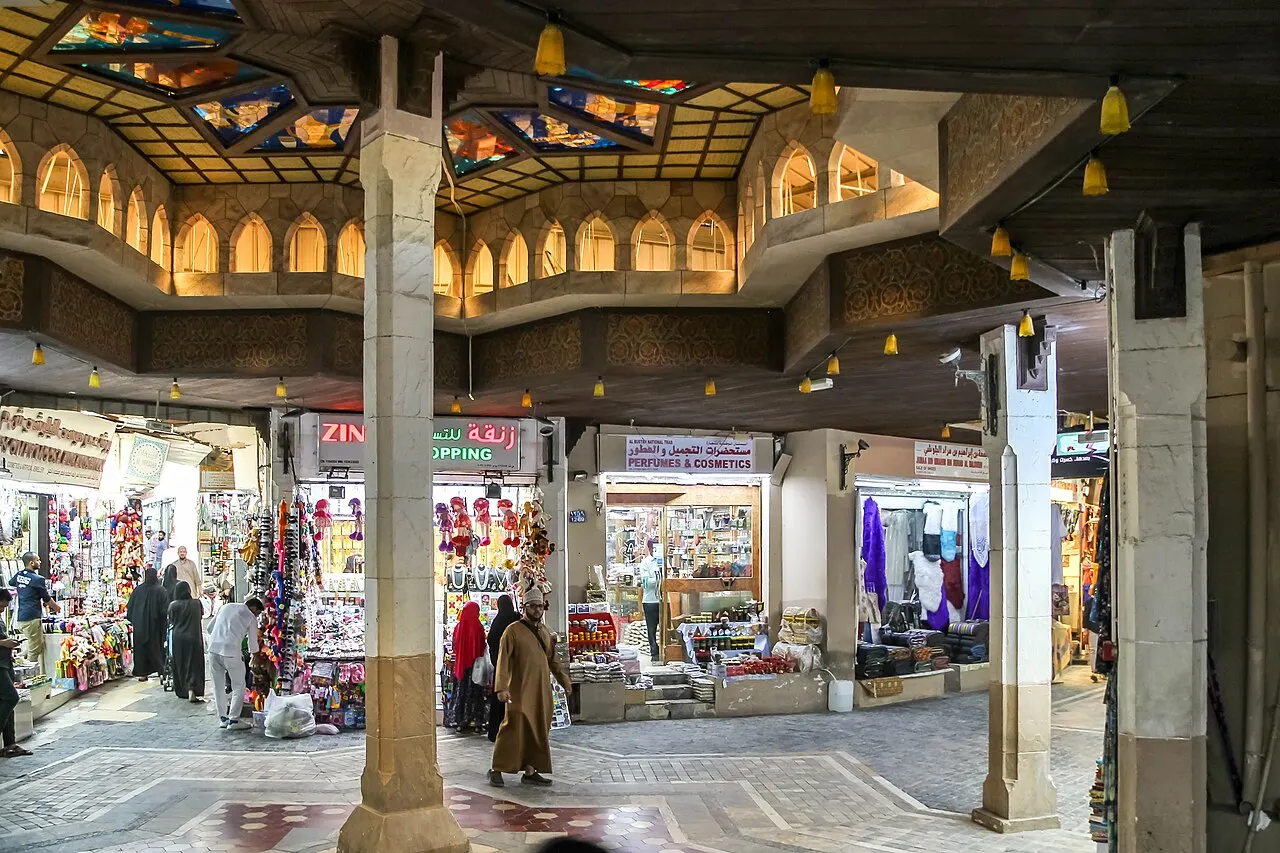
The Mutrah souq, also called Al Dhalam (darkness), for its covered alleys where the sun barely enters, is one of the oldest markets in Oman. The main street sells clothing, shoes, and household goods; the side lanes hold incense, perfume oils, jasmine, spices, silver, white dishdashas and embroidered caps (kumma), as well as framed khanjars and pottery. Many shops close in the middle of the day and reopen in the late afternoon, when it gets busier. Haggling is normal; few shops accept cards.
Check access
Mutrah Corniche
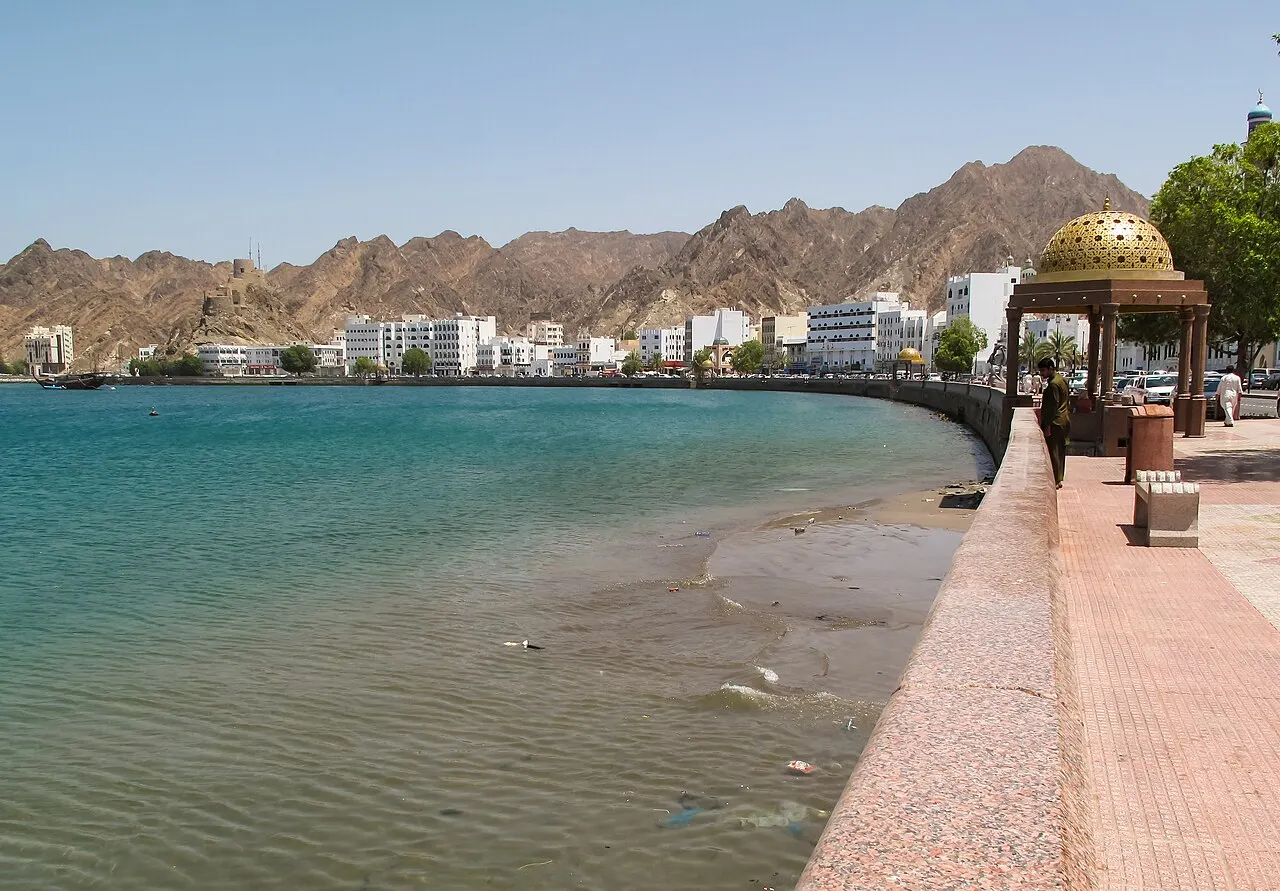
The Mutrah promenade follows the port, where wooden dhows and the royal yacht are moored, with restored Portuguese watchtowers on the hills and at the water's edge. It links the fish market, the souq, and Riyam Park, and in the late afternoon it fills with families, snack bars, and milk tea served on the sidewalk.
Check access
Al Alam Palace
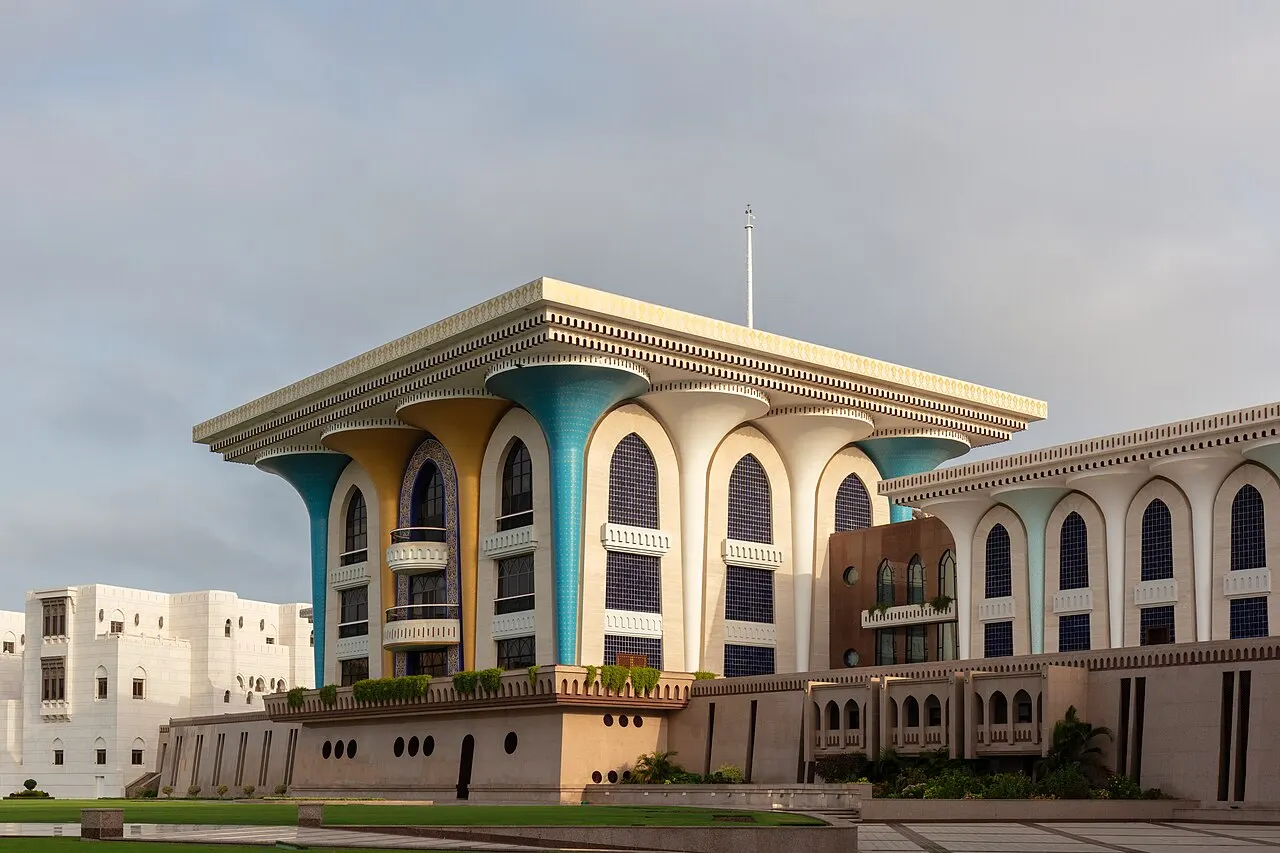
The sultan's ceremonial palace, from 1972, has a facade with gold and blue columns and is used to receive heads of state. It stands at the end of a 250 m arcaded plaza, between the Jalali and Mirani forts, on the site of the 19th-century palace. The interior is closed; the public can go up to the gate and take photos. The surrounding government buildings, white, with battlements and wooden balconies, complete the view.
Check access
National Museum of Oman
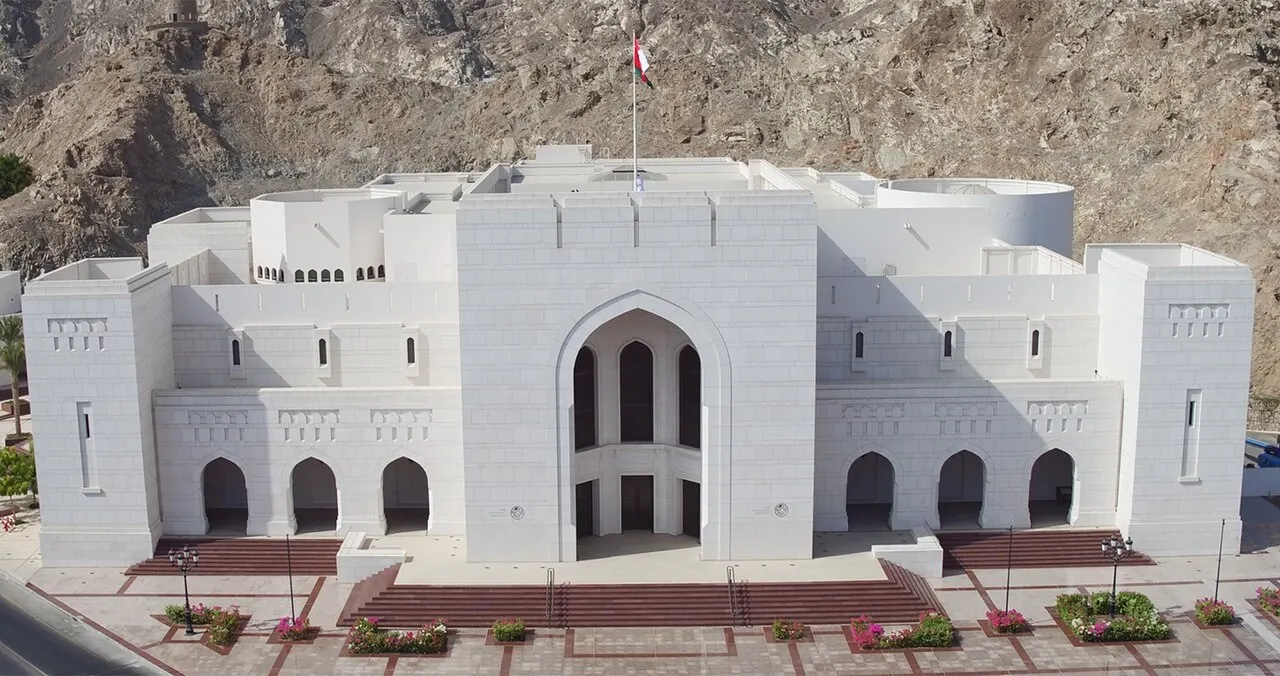
Opened in 2016 across from Al Alam Palace, it has 14 permanent galleries on the land and people of Oman, maritime history, the aflaj irrigation systems, silver, weapons, Islamic art, and the renaissance after 1970, with a collection of about 5,500 objects. It was the first museum in the Middle East to use Arabic Braille in its captions. It is open every day from 10:00 to 17:00, and the ticket office closes at 16:30; tourists pay 5 rials, by credit card only. Allow two hours or more.
Check access
Opening hours: Mon–Sun 10:00–17:00 (checked Oct 2026) source
Admission: OMR 5 (checked Oct 2026) source
Mutrah Fish Market
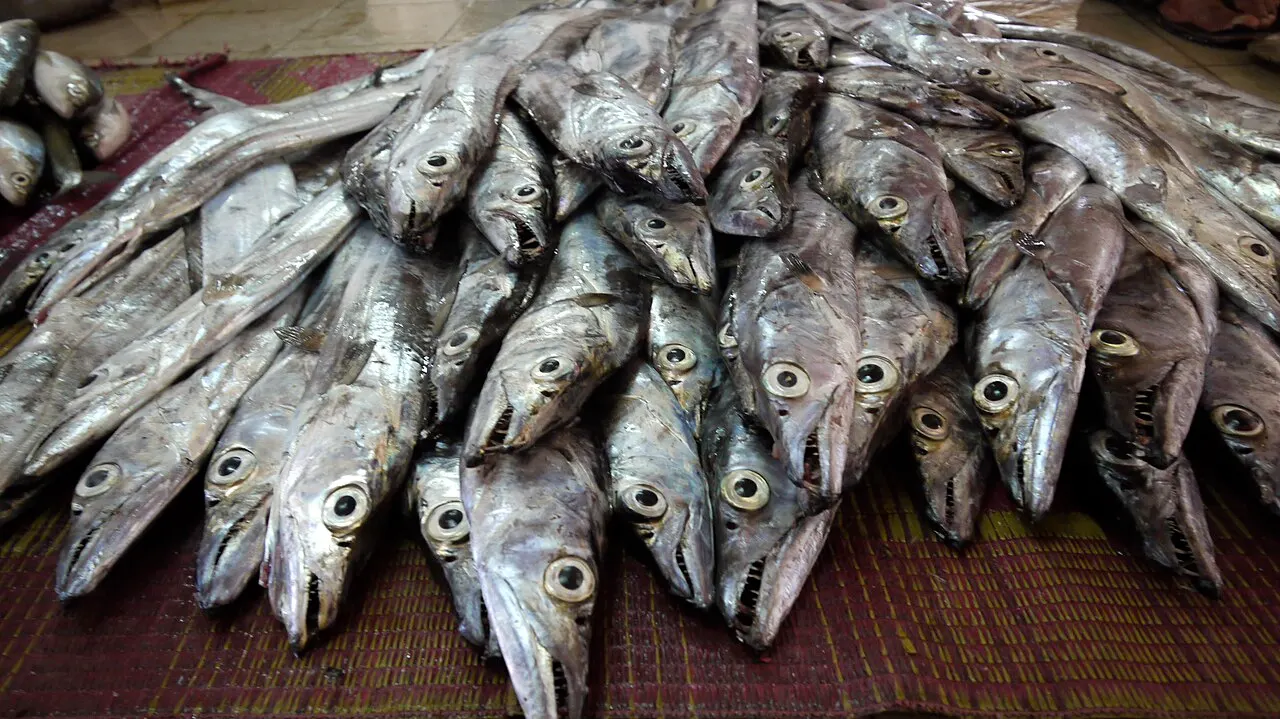
The Mutrah fish market is on the corniche, near Sultan Qaboos Port. Fishermen unload and sell the day's catch in the first hours of the morning, and the busiest time runs roughly from 06:00 to 10:00.
Check access
Al Jalali Fort
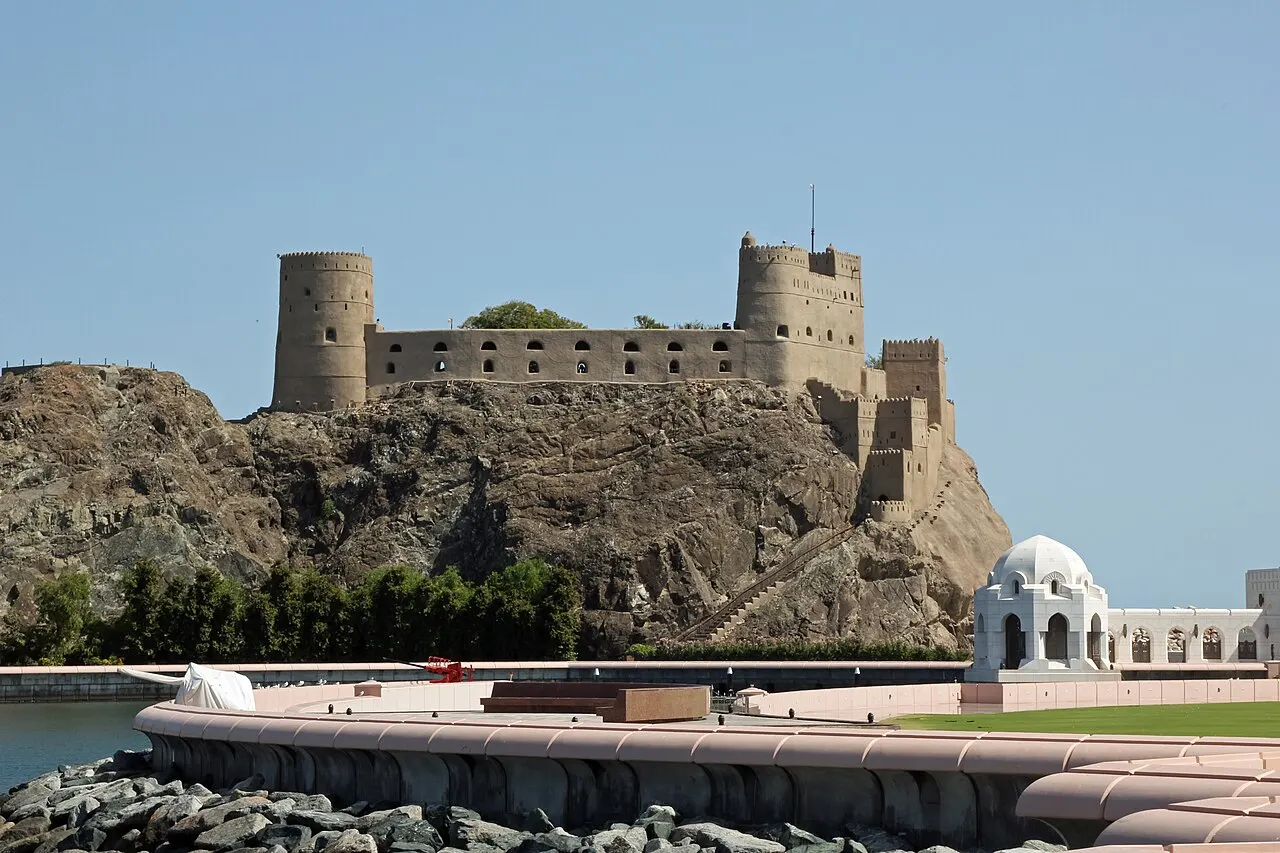
Built by the Portuguese in the 1580s on an older Omani fort, it guards the east rock of the bay of Old Muscat. It was the country's main prison for much of the 20th century and, restored in 1983, became a museum of Omani history reserved for official visits. It can be seen from outside, from the palace plaza and the waterfront.
Check access
Bait Al Zubair
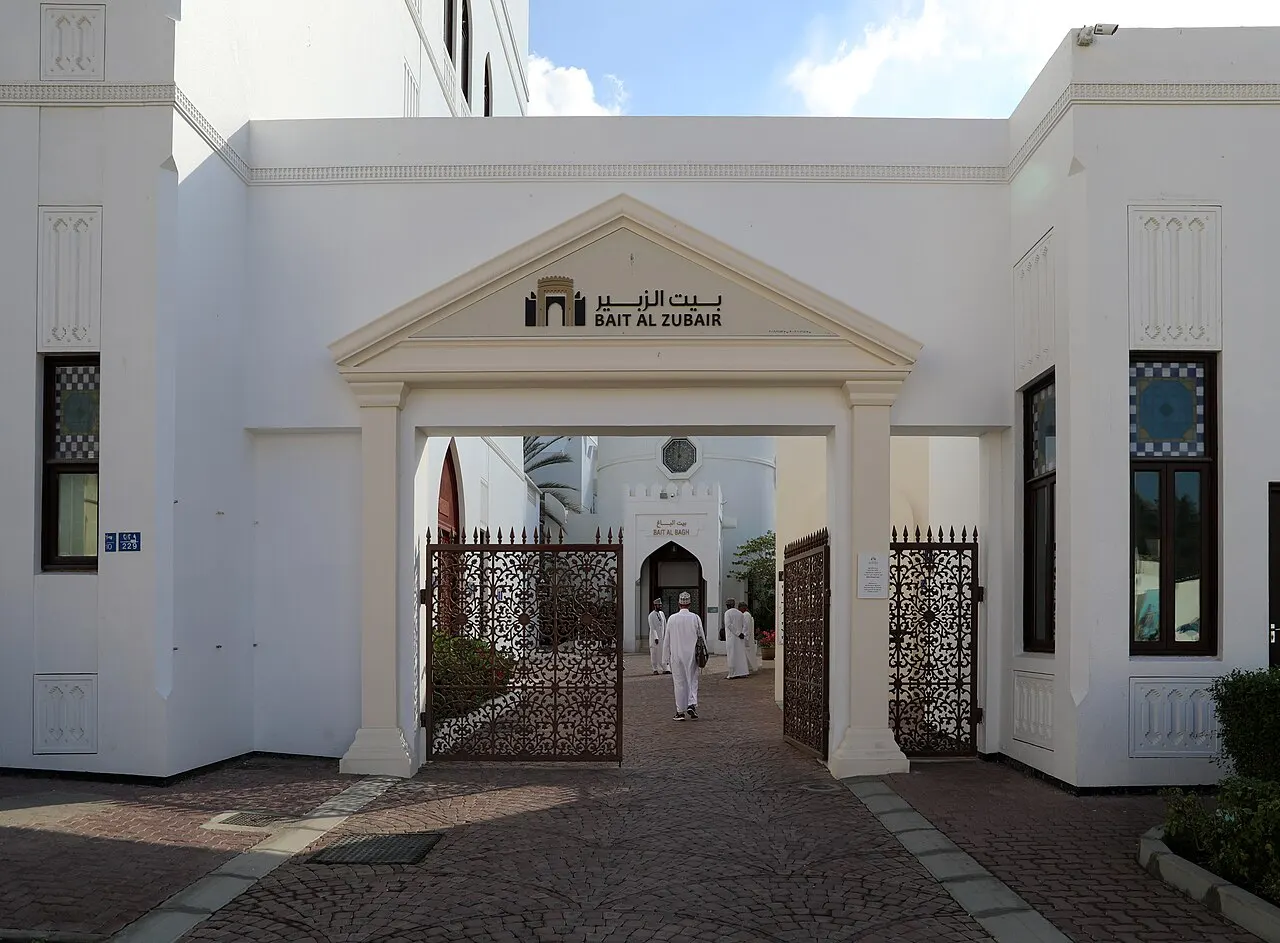
A museum set in a former family residence in Old Muscat, with a collection of khanjars and antique weapons, household objects, costumes, and photographs, and a model of an Omani village in the garden. Across the way is the Bait Muzna gallery, showing Omani artists. Open Saturday to Thursday.
Check access
Royal Opera House Muscat
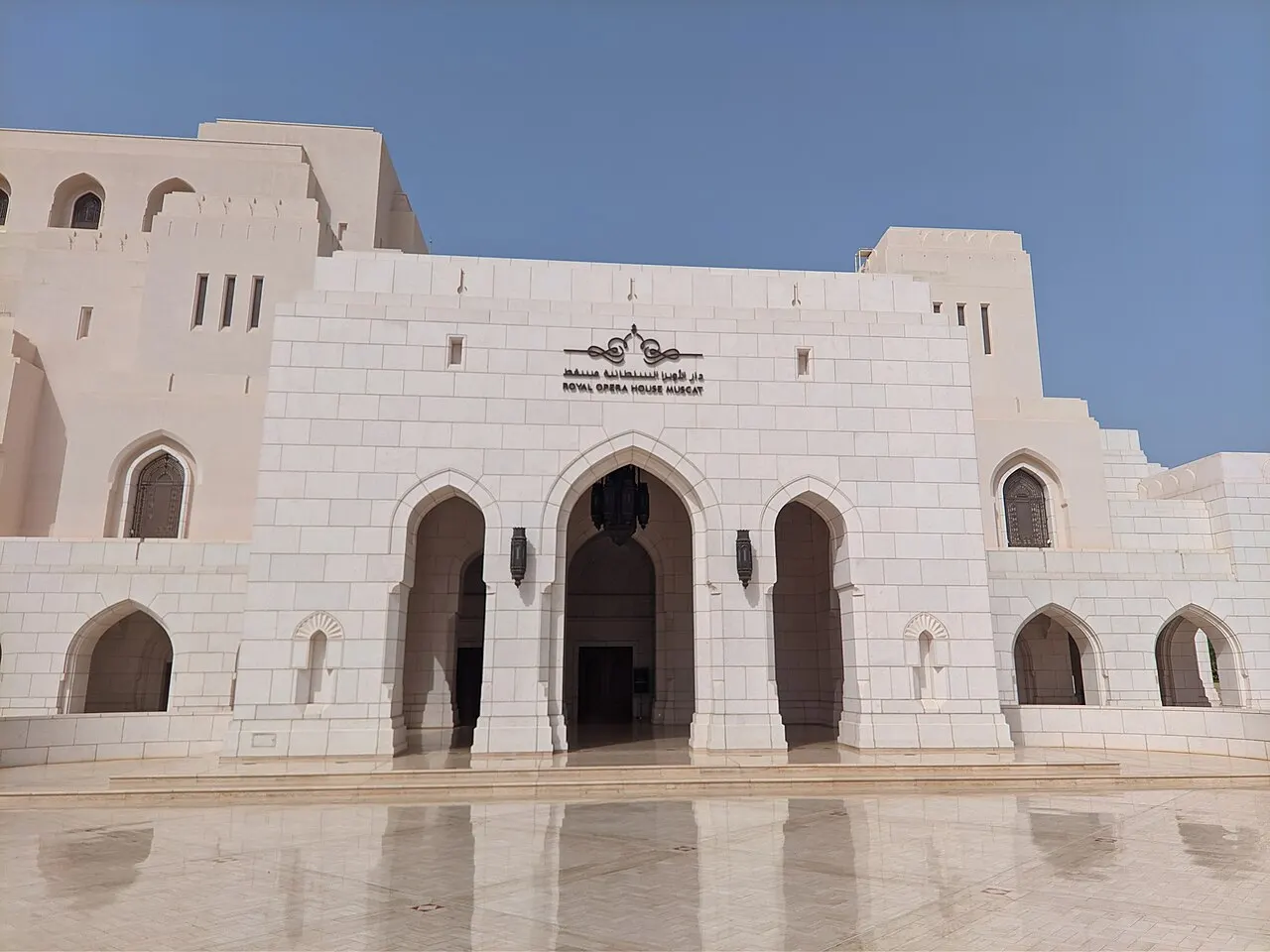
Opened in 2011, with a capacity of 1,100, the opera house blends contemporary Omani architecture with decoration in Islamic, Mughal, and European motifs, and has an auditorium that converts from theater to concert hall. Guided tours leave every 20 minutes, Saturday to Thursday, from 08:30 to 17:30, subject to the auditorium's availability; the adult ticket is 3.15 rials for the opera house alone and 4.20 rials including the House of Musical Arts. The season brings opera, orchestra, ballet, jazz, flamenco, and Arabic music. At performances the dress code is formal, with no jeans, T-shirts, or sneakers, and children under 6 are not admitted, except at children's programs.
Check access
Opening hours: Sat–Thu 08:30–17:30 (checked Oct 2026) source
More places in the guide
Qurum Beach
Qurum's public, free beach, long and well kept, with showers and little other infrastructure. It gets crowded on weekends. On a public beach the local code applies: a one-piece swimsuit for women and long shorts for men.
Al Mirani Fort
The twin fort, on the west rock of the bay, also dates from the Portuguese period and stands beside Al Alam Palace. It is closed to visitors and falls within the same view as the Jalali.
Muscat Gate Museum
A small museum at a point on the old city wall, where the gates used until the 1970s once stood. From the top you can see Old Muscat and the palace. Open in the morning, Saturday to Thursday.
Mutrah Fort
A Portuguese fort from the 1580s on a hill above the corniche. It is not open to the public, but you can climb on the outside to near it to see the Mutrah port from above.
Riyam Park
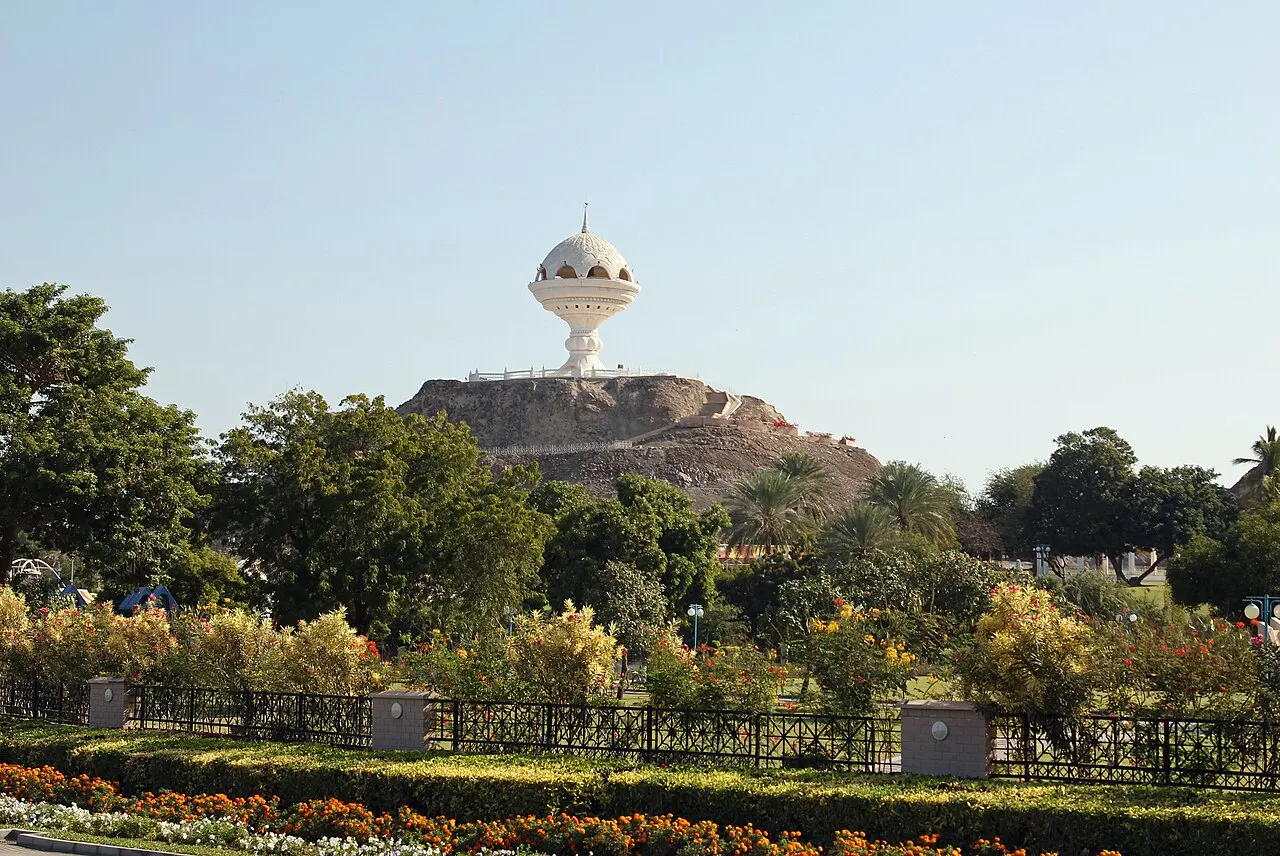
A park at the east end of the Mutrah corniche, crowned by a giant incense burner on the hilltop that serves as a lookout over the bay. It is also the start of the C38 trail, which follows an old miners' path to an abandoned village and ends near the souq: it takes 1 h 30 min to 2 h, has stretches over bare rock marked only with painted flags, and should not be started after 16:00.
Bait Al Baranda
A restored house from the 1930s on the Mutrah corniche, with an exhibition on the history of Muscat: paleontology and prehistory on the ground floor, history and ethnography upstairs.
Nilo’s itinerary
Start with the basic programme and choose extensions for the time you have.
Plan my days in the app ↗Day 1 · The Grand Mosque, the opera house, and the sea at Qurum
On a day from Saturday to Thursday, arrive at the Sultan Qaboos Grand Mosque, in Bawshar, at 08:30, when it opens to visitors, already dressed accordingly; Mwasalat line 1 stops out front, or take a taxi.
Walk the corridors of decorated halls and the prayer hall, with the carpet and the chandelier, and leave before 11:00, when the visiting period ends.
Continue by taxi or on line 1 to the Royal Opera House, in Shatti Al Qurm, and take the guided tour, which leaves every 20 minutes; if there is a performance that evening, buy the ticket right there.
Have lunch at the cafés around the opera house or in Qurum, and rest during the hottest hours.
In the late afternoon, walk along Qurum Beach, next to Qurm Park, until sunset.
At night, attend the opera performance, in formal dress, or dine on grilled meats and lentil soup at the food trucks near Al Ghubrah beach, a beach popular with families.
Day 2 · Mutrah early, Old Muscat, and the corniche at dusk
Also from Saturday to Thursday, because the small museums of Old Muscat close on Friday: start at the Mutrah fish market, on the corniche near the port, between 07:00 and 09:00, while the unloading is still going on.
Walk along the corniche to the entrance of the souq and wander the lanes of incense, silver, and fabrics while the shops are open in the morning.
Take Mwasalat line 4 or a taxi to Old Muscat and start with the Muscat Gate Museum, which opens only in the morning.
Visit Bait Al Zubair and, across from it, the Bait Muzna gallery; have lunch at a simple café in the old town.
Cross the arcaded plaza to the gate of Al Alam Palace, with the Jalali and Mirani forts on either side of the bay.
Spend the middle of the afternoon at the National Museum of Oman, across from the palace, allowing two hours for the galleries; the ticket office closes at 16:30.
Return to Mutrah in the late afternoon, when the souq reopens and the corniche fills; climb to the incense burner at Riyam Park for the view of the bay and finish with tea and a sandwich at a snack bar on the corniche.
If you stay longer
Day 3 · Bimmah Sinkhole and Wadi Shab
Day trip
Both stops are south of Muscat, on coastal highway 17, on the way to Sur; Wadi Shab is about 1 h 30 min by car from the capital. Go by rental car, with a driver, or on an organized tour, and set aside the whole day. Start early at Wadi Shab, near Tiwi: the parking lot is under the highway overpass, and local boatmen ferry people across the riverbed to the start of the trail for a low fare, paid in cash. The path passes irrigation channels, date palm plantations, and rock walls and ends at a series of clear pools; by swimming to the last one, you reach a cave with a waterfall, with a short stretch where you have to pass underwater. The round trip on foot takes about three hours, with slippery rocks and some scrambling; after rain, parts of the trail may be destroyed. On the way back north, stop at the Bimmah Sinkhole, inside Hawiyat Najm Park, a lake of blue-green water about 50 by 70 m and some 20 m deep, about 600 m from the sea, with stairs down to the water, restrooms, and a picnic area; swimming is allowed and admission is free.
Food
Shuwa
Goat, lamb, beef, or camel meat seasoned with date paste and spices, wrapped in leaves and slow-roasted in an oven dug into the ground. It is festival food, prepared communally; some restaurants serve the meat with white rice.
Qabuli
Spiced rice with chicken or lamb, split peas, and caramelized onion, finished with ghee. It is considered the national dish and appears in many restaurants across the country.
Harees
Wheat cooked with chicken or meat until it becomes a thick paste, served with ghee.
Mishkak
Skewers of meat marinated in tamarind and chili, grilled at stalls, especially near the beaches.
Mashuai
Whole kingfish roasted on a skewer, served with lemon rice. The long coastline makes grilled fish with salad and rice a common lunch.
Omani halwa
A warm, semi-solid sweet, with a consistency like honey and a flavor reminiscent of Turkish delight, eaten with a spoon. It is sold in jars in the souq and at specialized factories.
Kahwa and dates
Arabic coffee with cardamom, served in small cups, almost always with dates and halwa. It is the sign of hospitality in homes and offices.
Milk tea and laban
At the snack bars on the corniche, you order milk tea (halib) or black tea (sulaimani) with a sandwich. Laban, a lightly salted buttermilk, goes with meals.
Where to eat
- Mutrah corniche
Sidewalk snack bars with sandwiches, fruit juices, milk tea (halib), and black tea (sulaimani), ordered while looking out at the port in the late afternoon. It is the simplest and cheapest meal on the route and goes well with the walk back from the souq.
- Near Al Ghubrah beach
At night, food trucks near the desalination plant sell grilled meat and fish, lentil soup, and potato salad, to eat at the beach's picnic tables. It is cheap food on a beach geared to families; in the stretches with a family beach sign, men on their own may not enter.
- Al Khuwair and Ruwi
Indian, Pakistani, and Bengali restaurants, with curries, roti bread, and South Indian vegetarian options, serving immigrant workers at low prices. It is cheap food and reflects who lives in the city.
- Al Ghubrah
Restaurants serving traditional Omani cooking, such as those in the Al Ghubrah district, offer qabuli, shuwa, harees, and fish on plates for sharing. Order shuwa to try the slow roast without waiting for a festival, and finish with kahwa, dates, and halwa.
- Hotels in Qurum, Al Bustan, and Bandar Jissah
For dinner with wine or beer you have to go to the big hotels or the few restaurants licensed for alcohol; the hotel ones also serve seafood and Friday brunches. Drinks are expensive.
- Mutrah souq and Nizwa
Omani halwa in jars, dates, and cardamom coffee to take home; in Nizwa, the region's dates are a specialty of the souq.
· 2026-10-20
Day trips
Bimmah Sinkhole and Wadi Shab
Both stops are south of Muscat, on coastal highway 17, on the way to Sur; Wadi Shab is about 1 h 30 min by car from the capital. Go by rental car, with a driver, or on an organized tour, and set aside the whole day. Start early at Wadi Shab, near Tiwi: the parking lot is under the highway overpass, and local boatmen ferry people across the riverbed to the start of the trail for a low fare, paid in cash. The path passes irrigation channels, date palm plantations, and rock walls and ends at a series of clear pools; by swimming to the last one, you reach a cave with a waterfall, with a short stretch where you have to pass underwater. The round trip on foot takes about three hours, with slippery rocks and some scrambling; after rain, parts of the trail may be destroyed. On the way back north, stop at the Bimmah Sinkhole, inside Hawiyat Najm Park, a lake of blue-green water about 50 by 70 m and some 20 m deep, about 600 m from the sea, with stairs down to the water, restrooms, and a picnic area; swimming is allowed and admission is free.
Nizwa
The former capital of the interior is about 1 h 30 min by car southwest of Muscat, on highway 15, at the foot of the Hajar Mountains; Mwasalat runs the route by bus in about 2 h 20 min. The fort, built in the 17th century by Imam Sultan bin Saif, is dominated by an enormous round tower, from which you can see the town and the palm groves. On Friday the fort opens only in the morning, and the goat market, which also takes place on Thursday, runs in the first hours: arrive around 07:30 to see the last hour of bargaining. The souq sells silver, khanjars, pottery, spices, and the region's dates, and the eastern sections, still unrenovated, are the most interesting. Nearby are the Falaj Daris, an irrigation channel inscribed as a World Heritage Site, and the Oman Across Ages museum, opened in 2023. Bahla, with its fort, is half an hour to the west.
Opening hours: Sat–Thu 09:00–16:00; Fri 09:00–11:00 (checked Oct 2026) source
Where to begin
The Grand Mosque, the opera house, and the sea at Qurum
On a day from Saturday to Thursday, arrive at the Sultan Qaboos Grand Mosque, in Bawshar, at 08:30, when it opens to visitors, already dressed accordingly; Mwasalat line 1 stops out front, or take a taxi.
Mutrah early, Old Muscat, and the corniche at dusk
Also from Saturday to Thursday, because the small museums of Old Muscat close on Friday: start at the Mutrah fish market, on the corniche near the port, between 07:00 and 09:00, while the unloading is still going on.
Money
The currency is the Omani rial (OMR), divided into 1,000 baisa and pegged to the US dollar. There are small notes of 100 and 500 baisa, useful in the souq and on buses. ATMs of Bank Muscat and NBO accept foreign cards, and there are exchange offices at the airport and in the city. Hotels, malls, restaurants, and museums accept cards, and the National Museum charges by credit card only; in the souq and in taxis, though, cash is the rule, and few shops in Mutrah accept cards. Prices published by the institutions themselves in 2026: tourist admission to the National Museum, 5 rials; guided tour of the Royal Opera House, 3.15 rials per adult, or 4.20 rials including the House of Musical Arts. Outside malls, supermarkets, and restaurants, polite haggling is expected.
Getting there and around
From the airport
Muscat International Airport (MCT), in Seeb, is 37 km west of Mutrah. Official taxis leave from level -1 of arrivals; the airport taxi desk sells the ride at a fixed price, and the OTaxi app also gives the fare before the trip. Mwasalat buses leave from the ground floor, outside the terminal, and accept cash only; withdraw or exchange money in the terminal beforehand.
City buses
Mwasalat runs air-conditioned lines, almost all starting from Ruwi. Line 1 passes the Royal Opera House, the Grand Mosque, and the airport; line 4 links Ruwi to Mutrah and Al Alam Palace, passing the National Museum. You board by the front door, tell the driver your destination, and pay in cash, per trip, with no transfers between lines. Schedules and bus positions appear on Google Maps, but buses sometimes leave a few minutes early. Women usually sit at the front.
Taxis and ride-hailing
The orange-and-white taxis have no meter, and the price is agreed before you get in; ask at your hotel what the trip should cost. Asking for an exclusive taxi (engaged) keeps the driver from picking up other passengers on the way. The OTaxi app shows the price in advance and removes the need to negotiate. Women sit in the back seat. White minibuses (baiza) run shared routes along the avenues, at a low price.
Car
For the wadis and the interior, a rental car is the most flexible option; within Muscat an ordinary car is enough, and wadi trails call for a 4x4. The highways have many speed cameras, exit signage is confusing, and driving at night outside the city is risky because of animals on the road and cars without headlights. Driving a visibly dirty car can earn a fine.
On foot
Each nucleus can be covered on foot: the Mutrah corniche, the souq, and the fish market are close together, and the same goes for the palace, the forts, and the museums of Old Muscat. Between nuclei, use a bus or taxi, especially in the heat.
Buses to other cities
Mwasalat links Muscat to Nizwa (about 2 h 20 min) and to Sur (about 4 h 15 min), and to the Emirates via Sharjah, Al Ain, and Abu Dhabi, the last with a change at Al Ain; tickets are bought on the company's website. For Dubai, the private company Al-Khanjry Transport runs three departures a day.
Safety
Visit Oman, from the state group OMRAN, describes Oman as one of the safest countries in the world and recommends ordinary care with valuables in the car and on the beach. The greater risk is traffic: the country has a high road death rate, drivers speed outside the city, and at night there are cars without headlights and camels on the road. The heat calls for water always at hand and long outings only early or in the late afternoon. In the wadis, sudden floods are dangerous, because rain in the mountains rushes down the dry riverbeds; trails such as the one at Wadi Shab have slippery rocks and stretches of easy scrambling. Relations between people of the same sex are a crime in Oman. Gambling sites and adult content are blocked, and accessing them is illegal. Prefer bottled water. The emergency number for police, ambulance, and fire is 9999.
Before you go
- Plug
- types C and G
- Voltage
- 240 V
- Driving side
- on the right
- Emergency
- General 968 · Ambulance, Police, Fire 112
- Country code
- +968
- Official language
- Arabic
- Currency
- Omani rial (OMR)
Source: Wikidata (CC0), checked September 2026.
Etiquette tips
Clothing
Women with shoulders, midriff, and knees covered, and nothing tight or sheer; men in trousers or shorts at knee length in the city, leaving short shorts for outdoor activities. At a public beach, a one-piece swimsuit and long shorts; Western swimwear is for hotel beaches.
At the mosque
Arms and legs covered, loose clothing and, for women and girls aged 7 and over, hair covered.
Ramadan
During the fast, drinking anything in public by day is forbidden, including for foreigners. Eat and drink in your room or in the reserved areas of hotels, and expect shops and restaurants to keep reduced hours.
Alcohol
Only in licensed hotels and restaurants. Drinking in public is forbidden.
The sultan and politics
The late Sultan Qaboos is highly respected. Avoid negative comments about him, about the current sultan, and about local politics, and do not joke about religion.
Between men and women
In taxis, women sit in back; in minibuses, they sit next to other women. Beaches marked as family beaches do not admit men on their own. Outside Muscat, eye contact and smiles with the opposite sex can be misread.
Mistakes to avoid
Arriving at the mosque after 11:00 or on a Friday
The Grand Mosque admits non-Muslims from 08:30 to 11:00, every day except Friday. Anyone who leaves the visit for after lunch finds the prayer hall closed to visitors.
Going to the souq at lunchtime
Many shops close in the middle of the day. The Mutrah souq is livelier and cooler in the late afternoon and at night.
Underestimating distances
Old Muscat, Mutrah, the mosque, and the opera house are in separate nuclei along the coast. Planning to do everything on foot in the heat is tiring and wastes the day.
Getting into a taxi without agreeing on the price
Street taxis have no meter. Agree on the fare beforehand or use the OTaxi app.
Running out of cash
Mwasalat buses and many shops in the souq accept cash only, and small notes help with bargaining.
Buying silver and a khanjar without looking closely
Some of the silver sold in Mutrah is not Omani, and many khanjars are made in Pakistan or India. Authentic new silver is usually marked with the word Oman. Before buying a dagger or a sword cane, check whether your country allows the object to be brought in.
Changing clothes in public at the wadi
At Wadi Shab and other wadis, Omanis consider it offensive to change clothes outdoors and to wear skimpy swimwear. Arrive dressed to swim, in a one-piece swimsuit or shorts and a T-shirt.
Entering a wadi in bad weather
Rain in the mountains fills the riverbeds quickly. With dark clouds or rain, do not enter the wadi and do not cross flooded stretches; on the roads, white and red posts mark the safe level.
Useful phrases
As-salaamu alaykum (أَلسَّلَامُ عَلَيْكُمْ)
Hello, the everyday greeting; the reply is wa alaykum as-salaam
Shukran (شُكْرًا)
Thank you
Min fadlak / min fadlik (مِنْ فَضْلِك)
Please, when speaking to a man / to a woman
Bikam? (بِكَم؟)
How much is it?
La, shukran (لَا، شُكْرًا)
No, thank you
Inshallah (إِنْ شَاءَ ٱللّٰه)
God willing; a common reply to any future plan
Ma'a as-salaama (مَعَ ٱلسَّلَامَة)
Goodbye, go in peace
Khalas (خَلَاص)
Enough, done, finished
Where to stay
- Mutrah · Those who want to walk out to the souq, the fish market, and the corniche, and take the line 4 bus to Old Muscat and Ruwi.: It is the district where you get the most from the city on foot, early in the morning and at night. The hotel supply is small and older, and a corniche hotel with nightclubs is cited as noisy at night. For the mosque, the opera house, and the Qurum beaches you need a taxi.
- Qurum and Shatti Al Qurm · Those who want an urban beach, big hotels, the opera house, and restaurants nearby.: It sits midway between the airport and the old town, with easy access to the mosque and the opera house. The drawback is depending on a taxi to reach Mutrah and Old Muscat.
- Al Khuwair and Al Ghubrah · Those traveling on a smaller budget, arriving late on a flight, or setting out by car for the interior.: It concentrates business hotels along Sultan Qaboos Street and cheap Indian restaurants, and is close to the Grand Mosque and the airport. It is an area of wide avenues, with no street life and no sights to walk to.
- Al Bustan and Bandar Jissah · Those who want a resort, calm sea, and diving, and will get around by car.: The southern coves have beaches among the rocks, diving centers, and coastal trails, and lie south of Old Muscat. They have no public transport, and any trip into the city depends on a car or taxi.
· 2026-10-20
Districts
Old Muscat
The original walled city, on a small bay closed in by rock. Here are Al Alam Palace, the Jalali and Mirani forts, the National Museum, Bait Al Zubair, and the Muscat Gate Museum. It is quiet and official, with few places to eat. It suits anyone who wants museums and architecture.
Mutrah
The old commercial port, with the corniche along the water, the fish market, the covered souq, and the Portuguese watchtowers on the hills. It is the liveliest district for a walk in the late afternoon and the one with the most simple food and street tea.
Ruwi
The commercial district created after 1970, with banks, shops, Indian and Pakistani restaurants, and the terminal where several Mwasalat bus lines start. It has no major attractions, but it is practical for anyone who depends on buses.
Qurum and Shatti Al Qurm
Residential seaside districts, with Qurum Beach, Qurm Park, malls, cafés, and the Royal Opera House. They concentrate the big hotels and are the choice for anyone who wants beach and comfort, at the cost of a taxi to reach the old town.
Bawshar and Al Ghubrah
Districts to the west where the Sultan Qaboos Grand Mosque stands. At night, near Al Ghubrah beach, food trucks appear with grilled meats and lentil soup.
Al Khuwair
An area of offices and ministries along Sultan Qaboos Street, with business hotels and many cheap Indian restaurants.
Al Bustan and Bandar Jissah
Coves south of Old Muscat, with resorts, beaches among the rocks, diving centers, and coastal trails. The Bandar Al Rowdha marina, on the coastal road between Old Muscat and Al Bustan, is the departure point for boats for fishing, diving, and excursions. There is no public transport, and everything depends on a car or taxi.
History
6th millennium BCE · The fishermen of Ras al-Hamra
Fishermen's graves at Ras al-Hamra, now inside the urban area, are the oldest signs of organized settlement in the region.
1st century · The hidden harbor
Geographers such as Ptolemy and Pliny the Elder mention a port on the coast that many scholars identify with Muscat, sheltered among rocks.
1507 · The Portuguese arrive
Afonso de Albuquerque's fleet attacks and burns the city. The Portuguese control the port for more than a century and, in the 1580s, build the Jalali and Mirani forts at the mouth of the bay.
1650 · End of Portuguese rule
Troops of the Ya'rubi imams take the city, and the Portuguese garrison surrenders in January 1650.
1744 · The Al Bu Said dynasty
The dynasty that still rules Oman begins; the date is celebrated on National Day, on November 20.
1793 · Muscat becomes the capital
The seat of government moves from Rustaq, in the interior, to the port of Muscat.
1833–1856 · An Indian Ocean empire
Said bin Sultan signs a treaty with the United States in 1833 and, in 1840, moves the court to Zanzibar. After his death, in 1856, Zanzibar and Oman continue under different sultans.
1970 · Qaboos takes power
Qaboos bin Said deposes his father and begins the modernization: the country becomes the Sultanate of Oman, and Muscat gets a new port, an airport at Seeb, and the commercial district of Ruwi.
1972 · Al Alam Palace
The current ceremonial palace is completed, built between the two forts on the site of the old sultans' palace.
2001 · The Grand Mosque
The Sultan Qaboos Grand Mosque is inaugurated on May 4, on the 30th anniversary of the reign.
2007 · Cyclone Gonu
The cyclone hits Muscat in June and causes extensive damage to homes, roads, and businesses.
2011 · The Royal Opera House
The Royal Opera House Muscat opens in October with Turandot, conducted by Plácido Domingo.
2016 · The National Museum
The National Museum of Oman opens on July 30, across from Al Alam Palace.
2020 · A new sultan
Qaboos dies in January, and his cousin Haitham bin Tariq takes the throne.
Complete history
A port between the Gulf and India
The bay of Old Muscat is deep and closed in by rock, and so it sheltered ships long before there was a large city. Trade with Persia, the Gulf, and the Indian subcontinent shaped the place for centuries, and it still shows in the mix of the people who live and sell there: Hindu merchants from Sindh and Kutch dominated the port's commercial life in the 19th century, and the Luwati community, who came from Sindh, still keeps the walled quarter of Sur al-Lawatiya, in Mutrah.
The Portuguese forts
In 1507 Afonso de Albuquerque's fleet, met with gunfire in the harbor, took and burned Muscat. The Portuguese stayed more than a century, and after two Ottoman attacks they built the Jalali and Mirani forts in the 1580s, one on each side of the bay, as well as Mutrah Fort. In 1650 the imam's troops expelled the garrison. The forts still stand and frame the view of the palace, but they are now used for official purposes and are not open to visitors.
Capital of a maritime empire
The Al Bu Said dynasty, in power since 1744, moved the capital from the interior to the port in 1793. In the 19th century, under Said bin Sultan, Oman controlled stretches of the east African coast, and the court even lived in Zanzibar. The division of the inheritance after 1856 separated the two parts, and the following century was one of disputes between the sultan of the coast and the imams of the interior, a conflict that ran into the 1950s, when Nizwa rose against the sultan and was defeated with British help, and which helps explain the symbolic importance of the interior town.
After 1970
When Qaboos bin Said came to power in 1970, Muscat was a small, closed city. The new government built the Sultan Qaboos port, the airport, and the district of Ruwi, and the city grew west along the coast. The building rule that favors low buildings and light facades of Arab inspiration dates from that time and explains why Muscat has no skyline of towers like other Gulf capitals. The Grand Mosque (2001), the Royal Opera House (2011), and the National Museum (2016) are the great cultural works of Qaboos's reign; he died in January 2020 and was succeeded by his cousin, Haitham bin Tariq.
Geography and shape of the city
Between the sea and the mountains
Muscat lies on a narrow strip between the Gulf of Oman, to the north, and the Hajar range, which reaches the water at several points. The dark, bare hills around Mutrah and Old Muscat are ophiolites, iron-rich rocks that were once on the ocean floor, and they separate the coves from one another. That is why the city has no single center: each bay became a nucleus.
A linear city
Sultan Qaboos Street crosses the city from east to west and links Ruwi, Qurum, Al Khuwair, Bawshar, and Al Ghubrah to the airport at Seeb, and buses and taxis run along it. The Muscat Governorate groups six wilayat (Muscat, Mutrah, Bawshar, Seeb, Al Amarat, and Qurayyat). The distances between the sights call for motorized transport, even though each nucleus can be covered on foot.
Climate
The climate is hot desert. In January the average runs from a low of about 17 °C to a high of 25 °C; in June, from 30 °C to 39 °C, with high humidity in summer. About 100 mm of rain falls per year, almost all of it between December and April. Cyclones from the Arabian Sea are rare, but Gonu, in 2007, and Phet, in 2010, dropped more than 100 mm in a single day.
Culture
Religion and coexistence
Most Omanis follow Ibadi Islam, a branch distinct from Sunnism and Shiism, with a reputation for tolerance. In Ruwi, churches of dozens of Christian denominations share the same grounds, and Muscat has had Hindu temples since the 18th century. Non-Muslims practice their own religion, but may not proselytize in public or distribute religious literature.
A city of many origins
The past as a maritime empire left Baloch, Swahili, and Indian communities and the Luwati, of Sindhi origin, who speak the Luwati language and live in the walled quarter of Sur al-Lawatiya, in Mutrah. Workers from South Asia, especially from the Indian state of Kerala, now make up a large part of the labor force, which explains the strength of Indian food in the city.
Dress and symbols
Omani men wear the dishdasha, a white tunic, with an embroidered kumma or a wrapped massar on the head; at ceremonies, the khanjar, a curved dagger in a silver sheath, which is a national symbol. Worked silver, frankincense, and perfumes, such as those of the Amouage house, made in Muscat, complete the repertoire of objects seen in the souq.
Sea and boats
Oman built dhows for centuries, especially in Sur, south of Muscat. In 1980 the ship Sohar, built in the traditional way, sailed from Oman to Guangzhou, in China, to retrace Sindbad's voyages; today the ship is on display in Muscat.
Performing arts
The Royal Opera House, opened in 2011, brought international opera, orchestras, and ballet to the city, as well as concerts of Arabic and Gulf music. In winter, an annual festival of Omani culture brings together music, dance, crafts, and food.
Festivals and events
Muscat Festival
Between late January and early February: a month of music and dance performances, crafts, food, and other attractions, with events in Qurm Park and other venues around the city.
Ramadan and Eid al-Fitr
Movable date in the Islamic calendar. During Ramadan Muslims fast by day, and businesses keep reduced hours. Eid al-Fitr, at the end of the month, fills the Mutrah souq with families buying clothes and jewelry.
Eid al-Adha
Movable date in the Islamic calendar. It is the feast of sacrifice, one of the two great religious holidays of the year.
National Day
November 20: a national holiday celebrating the founding of the Al Bu Said dynasty, in 1744.
Royal Opera House season
The Royal Opera House publishes each season's program on its website, with opera, orchestra, ballet, and Arabic music, and sells tickets in advance.
Books and films
The Sindbad Voyage, by Tim Severin
The account of the 1980 voyage of the Sohar, a dhow built in Sur, from Oman to China, which explains the maritime tradition that made Muscat an Indian Ocean port.
Celestial Bodies (Sayyidat al-Qamar), by Jokha Alharthi
A novel by an Omani writer about a society in transition; in Marilyn Booth's English translation, it won the Man Booker International Prize in 2019.
Frequently asked questions
Muscat: how do you get from the airport to the city?
Muscat International Airport (MCT), in Seeb, is 37 km west of Mutrah. Official taxis leave from level -1 of arrivals; the airport taxi desk sells the ride at a fixed price, and the OTaxi app also gives the fare before the trip. Mwasalat buses leave from the ground floor, outside the terminal, and accept cash only; withdraw or exchange money in the terminal beforehand.
Muscat: do you need a visa to enter Oman?
Entry rules depend on nationality: citizens of a long list of countries enter without a visa for up to 14 days, and everyone else applies for an e-visa on the Royal Oman Police portal, with a passport valid for six months. I'd check the portal before buying the ticket.
Muscat: how many days should you stay?
I'd stay three days in Muscat. Two are enough for the city, because the big sights fit into two mornings: one at the Grand Mosque, followed by the opera house and Qurum Beach, and another between the Mutrah fish market, Old Muscat, and the National Museum, with the souq and the corniche in the late afternoon. I'd give the third day to the coast road, to swim in the pools of Wadi Shab and stop at the Bimmah Sinkhole on the way back; it is the best sample of Oman's landscape from the capital. If one of the three days falls on a Friday, I'd reserve it for Wadi Shab, because the mosque does not admit visitors and the small museums of Old Muscat close. With a fourth day, preferably a Friday, I'd go to Nizwa for the goat market, the fort, and the souq.
Muscat: how do you visit the Sultan Qaboos Grand Mosque?
The Sultan Qaboos Grand Mosque admits non-Muslims every day except Friday, from 08:30 to 11:00, in modest clothing with arms and legs covered; women and girls aged 7 and over cover their hair. Abayas and scarves can be rented at the complex's shop, with an ID left as a deposit. Mwasalat buses stop out front. Anyone who leaves the visit for after lunch finds the prayer hall closed to visitors.
Muscat: can you see the city without a car?
Each nucleus can be covered on foot: the Mutrah corniche, the souq, and the fish market are close together, and the same goes for the palace, the forts, and the museums of Old Muscat. Between nuclei, use a bus or taxi, especially in the heat. Mwasalat runs air-conditioned lines, almost all starting from Ruwi. Line 1 passes the Royal Opera House, the Grand Mosque, and the airport; line 4 links Ruwi to Mutrah and Al Alam Palace, passing the National Museum. You board by the front door, tell the driver your destination, and pay in cash, per trip, with no transfers between lines. Schedules and bus positions appear on Google Maps, but buses sometimes leave a few minutes early. Women usually sit at the front. The orange-and-white taxis have no meter, and the price is agreed before you get in; ask at your hotel what the trip should cost. Asking for an exclusive taxi (engaged) keeps the driver from picking up other passengers on the way. The OTaxi app shows the price in advance and removes the need to negotiate. Women sit in the back seat. White minibuses (baiza) run shared routes along the avenues, at a low price.
Muscat: what dress and behavior rules should you follow?
Women with shoulders, midriff, and knees covered, and nothing tight or sheer; men in trousers or shorts at knee length in the city, leaving short shorts for outdoor activities. At a public beach, a one-piece swimsuit and long shorts; Western swimwear is for hotel beaches. During the Ramadan fast, drinking anything in public by day is forbidden, including for foreigners; eat and drink in your room or in the reserved areas of hotels, and expect shops and restaurants to keep reduced hours. Alcohol is served only in licensed hotels and restaurants, and drinking in public is forbidden.
Muscat: how do you get to Wadi Shab and the Bimmah Sinkhole?
Wadi Shab and the Bimmah Sinkhole are south of Muscat, on coastal highway 17, on the way to Sur; Wadi Shab is about 1 h 30 min by car from the capital. Go by rental car, with a driver, or on an organized tour, and set aside the whole day. Start early at Wadi Shab, near Tiwi: the parking lot is under the highway overpass, and local boatmen ferry people across the riverbed to the start of the trail for a low fare, paid in cash. The path passes irrigation channels, date palm plantations, and rock walls and ends at a series of clear pools; by swimming to the last one, you reach a cave with a waterfall, with a short stretch where you have to pass underwater. The round trip on foot takes about three hours, with slippery rocks and some scrambling; after rain, parts of the trail may be destroyed. On the way back north, stop at the Bimmah Sinkhole, inside Hawiyat Najm Park, a lake of blue-green water about 50 by 70 m and some 20 m deep, about 600 m from the sea, with stairs down to the water, restrooms, and a picnic area; swimming is allowed and admission is free. At Wadi Shab and other wadis, Omanis consider it offensive to change clothes outdoors and to wear skimpy swimwear. Arrive dressed to swim, in a one-piece swimsuit or shorts and a T-shirt. Rain in the mountains fills the riverbeds quickly. With dark clouds or rain, do not enter the wadi and do not cross flooded stretches; on the roads, white and red posts mark the safe level.
Muscat: how do you get to Nizwa?
Nizwa, the former capital of the interior, is about 1 h 30 min by car southwest of Muscat, on highway 15, at the foot of the Hajar Mountains; Mwasalat runs the route by bus in about 2 h 20 min. The fort, built in the 17th century by Imam Sultan bin Saif, is dominated by an enormous round tower, from which you can see the town and the palm groves. On Friday the fort opens only in the morning, and the goat market, which also takes place on Thursday, runs in the first hours: arrive around 07:30 to see the last hour of bargaining. The souq sells silver, khanjars, pottery, spices, and the region's dates, and the eastern sections, still unrenovated, are the most interesting. Nearby are the Falaj Daris, an irrigation channel inscribed as a World Heritage Site, and the Oman Across Ages museum, opened in 2023. Bahla, with its fort, is half an hour to the west.
Muscat: when is the best time to go?
November to March is the best time: average highs run between 25 °C and 30 °C, and you can walk the corniche and the wadis in the middle of the day. It is also when the Muscat Festival takes place and when the city receives the most visitors. April and October already warm up, with average highs near 35 °C, and call for outdoor activities only early and in the late afternoon. From May to September average highs run between 35 °C and 40 °C, with high humidity near the sea; it is the low season, when a visit is organized around museums, malls, and pools. The few rains fall mostly between December and April, and a storm in the mountains can suddenly fill the wadis. Ramadan changes date every year and alters business and restaurant hours.
Muscat: is it safe?
Visit Oman, from the state group OMRAN, describes Oman as one of the safest countries in the world and recommends ordinary care with valuables in the car and on the beach. The greater risk is traffic: the country has a high road death rate, drivers speed outside the city, and at night there are cars without headlights and camels on the road. The heat calls for water always at hand and long outings only early or in the late afternoon. In the wadis, sudden floods are dangerous, because rain in the mountains rushes down the dry riverbeds; trails such as the one at Wadi Shab have slippery rocks and stretches of easy scrambling. Relations between people of the same sex are a crime in Oman. Gambling sites and adult content are blocked, and accessing them is illegal. Prefer bottled water. The emergency number for police, ambulance, and fire is 9999.